News Tidbits 2/6/16: Good Ideas and Bad Ideas

6 02 2016

maplewood_site_plan_concept
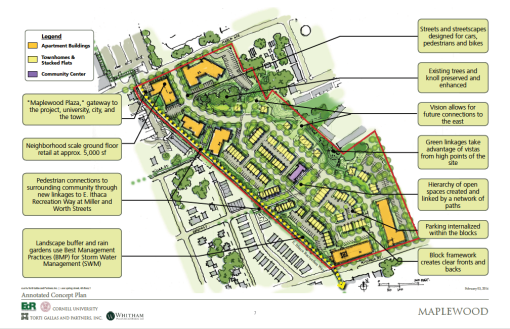
1. Let’s start with the big news this week, Cornell’s long-incubating plans to redevelop Maplewood Park. Official write-up on the Voice here. Personally, looking at the viewer stats, I’m a little disappointed that this has gotten as little attention as it has, since it’s a very large, very important project. But I suppose it’s a double-edged sword, because invariably, when a project does get a lot of attention, it’s because it’s a huge controversy (State Street Triangle, Black Oak wind farm, 210 Hancock, and so on).

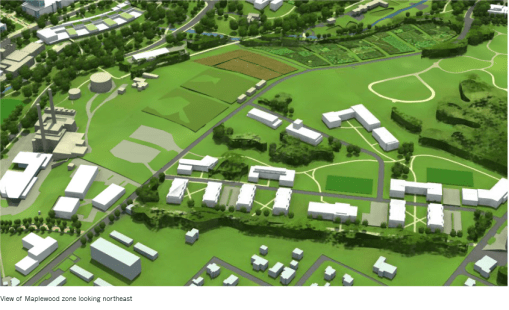
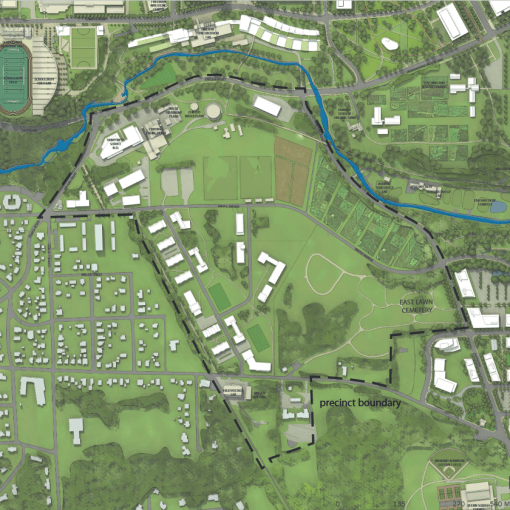
There’s a lot to like about the plan (found here on the town’s website). Dense, walkable, a little mixed-use (more office or retail would be nice, but given that it’s tax exempt space, the more space there is the more controversial this project would likely be). Buildings aren’t too likely to cause controversy, since they’re 4 floors at most and they’ll be designed to blend in (“echo the surrounding neighborhood with the use of contemporary features”, per the narrative). Most of the comments on the Voice article describe Cornell as the great Satan, but one reader did express desire for the bigger, taller buildings to be central to the parcel, with townhouses on the outside. As a relatively untrained observer, it would seem that would be best from the perspective of trying to minimize appearance as much as possible, but it would also encourage vehicular traffic towards the center of the parcel, and negatively impact its pedestrian orientation. I haven’t seen any reactions from local planners, but I am curious what their first impressions are.

When writing up Tuesday’s article, my thought was that this was “Phase I”, Ithaca East/Maple Hill was “Phase II”, and East Hill Plaza/East Hill Village was “Phase III” with a 2019 or later start; but the rumor mill is circulating that work on the first parts of East Hill Village may be concurrent with Maplewood Park. We’ll see what arises in the coming months.
304_hector_inhs

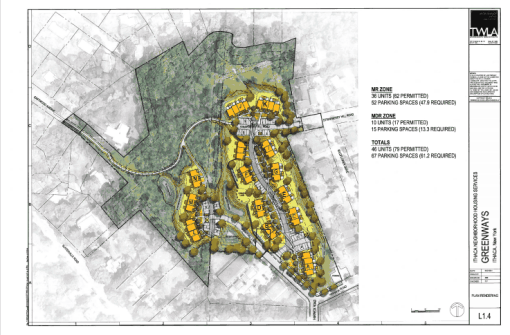
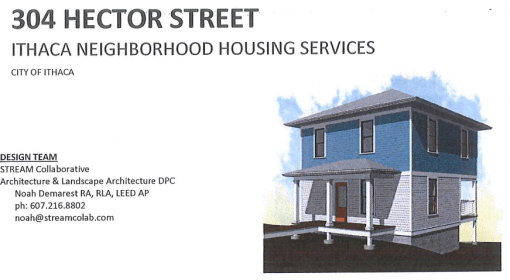
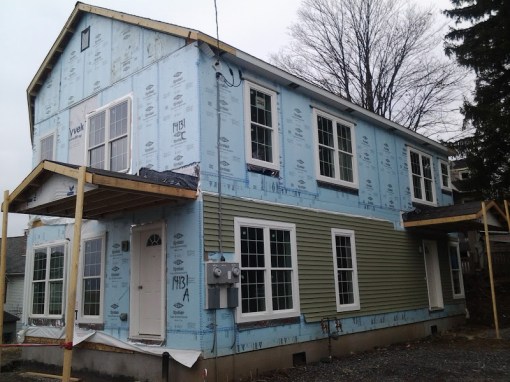
2. When those units come online in 2018, it’ll be a big step towards reducing the deep housing deficit. But in the meanwhile, the housing market will be uncomfortably tight. Which is why it’s good to see some pooled city/county/Cornell money being disbursed for affordable owner-occupied housing. The Community Housing Development Fund proposes that the city give $80,000 towards Habitat for Humanity‘s “Breaking Ground” duplex at 101-107 Morris Avenue in Northside (208/201 Third Street), and $85,000 to INHS for the seven moderate-income owner-occupied townhouses at 210 Hancock, and an affordable 1368 SF single-family home at 304 Hector Street on West Hill. Cornell will give $235,000 towards the townhouses and Hector Street home, but $100,000 of that is a re-allocation of funds from the cancelled Greenways project. The county is giving $100,000 towards six rental units at 210 Hancock.

Claudia Brenner has designed most of INHS’s homes in recent years, but this time around it looks like Noah Demarest of  STREAM Collaborative penned the home design. This is a revision of the previous render, if memory serves correctly; INHS had wanted to build the home last year, but construction costs as high as they are, the non-profit held off.
biggs_2

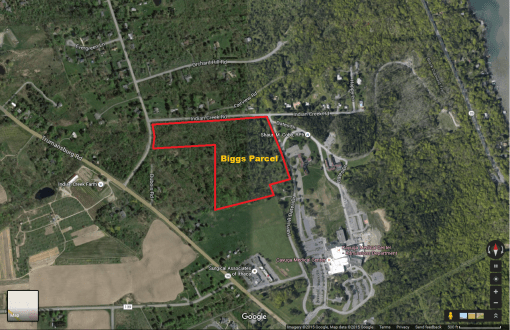
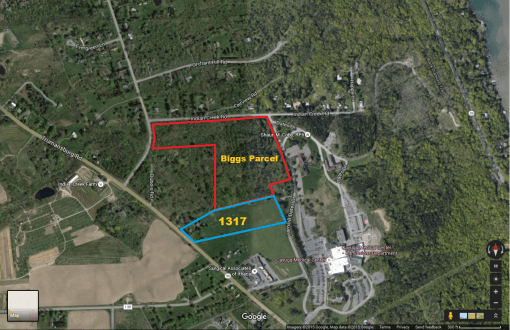
3. In other news, the county’s Government Operations Committee was to make a decision on the Biggs Parcel this week, but decided not to. It’s set to the return to the county’s agenda at the meeting on March 2nd. The ICNA has submitted a purchase offer (sum undisclosed) for the 25.5 acre parcel. The offer from Roy Luft to combine the parcel’s cluster zoning rights to build senior housing on his property at 1317 Trumansburg Road still stands, as far as I’m aware. Update – From the ICNA’s Linda Grace-Kobas, the Luft proposal has been dropped due to “size and complexity”.

Pg-3-Rendering

ag_quad_2

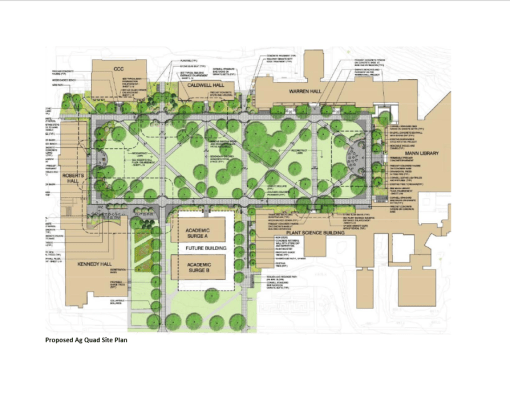
4. Courtesy of the city, some more details on Cornell’s Ag Quad renovation. Site Plan Review (SPR) application here, Full Environmental Assessment Form (FEAF) here, project specs here, drawings here. Formally, the project is referred to as the “Cornell Ag Quad Utility & Landscape Project”, since the project also involved major utility upgrades and repairs under the quad. The work planned calls for new steam lines, a telecom duct bank, new sanitary piping and water lines underground, and above ground there will be new paths, light posts, pedestrian plazas with stone benches, fire apparatus access path, blue light phones and a loosening of the soil compacted by other construction projects (such as the staging area for Warren Hall while it was under renovation). Most trees will be preserved, except for a few that stand where the new utilities and fire lane will go.

The project cost is $3 million on the SPR, with a rehabilitation period from April 2016 to July 2017, divided into two phases. No new permanent jobs, but about 25 construction jobs will be created. MKW + Associates LLC of New Jersey is serving as the consulting landscape architect.

On a side note, at least we can be fairly sure now that Cornell does plan on taking down the surge academic buildings at some point for a future permanent building.

5. Ithaca wants to build bridges. Physically, anyway. The city will hold a public information meeting next week 2 PM Wednesday on replacing the deteriorated single-lane Brindley Street bridge on the west side of the city. The bridge, which dates from 1938 and was last modified in 1952, is functionally obsolete and in dire need of rehabilitation.

Currently, the city is weighing two plans – a $2.43 million replacement of the old one-lane steel bridge with a two-lane bridge with sidewalks and shoulders for walkers and bikers, and a $2.59 million plan that extends two-lane Taughannock Boulevard through a parking lot, over a wider span and intersecting with Taber Street, leaving Brindley a single-lane bridge. While more expensive, this option diverts most traffic away from the awkward six-way intersection Brindley has with West Seneca and West State Streets. The nitty-gritty can be found in the design report here. It would also be of significant benefit to the Cherry Street industrial park and future waterfront development by improving access to the area.

Whichever plan moves forward will be decided by April, with construction from May-November 2017. Most of the project costs will be covered with federal funds, with some state funds and municipal bonds covering the balance (80/15/5% respectively).

902_dryden_v3
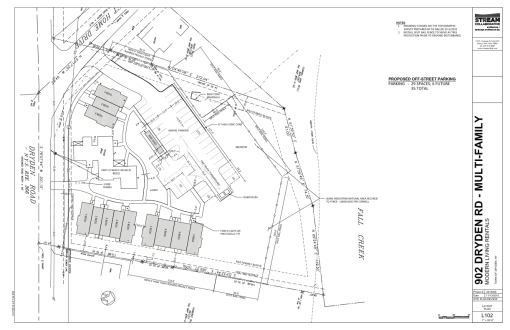
6. Some progress on 902 Dryden, perhaps. From the town of Dryden Town Board minutes, The number of new units is down, from 12 to 8, and only 26 new bedrooms from the previous 38. The overall square footage is also down, from 18,000 to 11,000 SF, with 26 parking spaces, 1 per bed. So that render above from December is outdated (although the color scheme is nice and bright, hopefully that carried over), there are two units on the right and six on the left, as well as the existing duplex.

As a result of the smaller project, one of the casualties is the net-zero aspect, because the initial cost for installing the solar panels outweighs the decreased revenue. Heat will be all-electric with the opportunity to install solar at a later date, if it pencils out. As for the opposition, it definitely sounds more muted in the town minutes, one neighbor seems intent on forcing enough site studies to break the bank, but overall the commentary reads muted to positive. The minutes don’t indicate if the public meeting is finally closed and if a vote to approve the project can be taken later this month.

7. Looks like Josh Brokaw at the Ithaca Times was able to get the Maguires to open up about their plans for Caprenter Business Park. In a phone call with Brokaw, Phil Maguire confirmed plans for a $12 million, 40,000 SF Ford/Lincoln/Nissan dealership, which will then allow them to proceed with renovations of their properties down by Wegmans. While they estimate about 70 jobs would be created and that it will be designed to be “inlet-worthy”, the problem remains that a car dealership flies in the face of the mixed-use urban environment that the city had been envisioning for the waterfront. One valid point does get raised though – side-by-side NYSEG power lines overhead would have to be buried for many building projects on the Circle (but not for parking lots), which gives any developer an extra several hundred thousand dollar expense in the development process.

Sketch plans are expected to be shown at the March Planning Board meeting later this month, about the same time the Common Council is expected to adopt the temporary PUD zoning that would give them say over any projects proposed in the waterfront area. Expect this dealership proposal to be a very heated and occasionally uncomfortable debate.
cherry_2

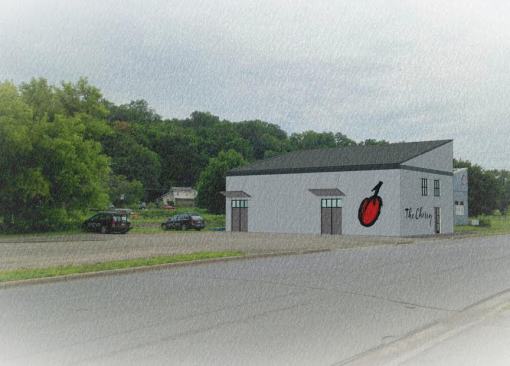
8. What’s on the agenda for next week? Not a whole lot new. The city’s projects memo doesn’t have any new projects, unless you count Island Fitness redoing their parking lot. There are a few more renders for the Cherry Artspace, as well as some project details – $200,000 construction cost, 1,944 SF building by Claudia Brenner with seating for up to 164 on the lower level, 2 jobs created, May – October 2016 buildout.

The Ithaca Landmarks Preservation Commission has some minor old business to attend to, and what likes some discussion over the recently-purchased home at 410 North Cayuga will be introduced (chances are, it’s something like window or roof replacement, maybe an add-on room). Discussion is planned for 311 College Avenue, the old firehouse home of the Nines, but this is also likely to be minor.

The town of Lansing’s planning board also has a meeting next week, but the only item of discussion is the Mirabito petroleum storage facility on Town Barn Road.


Cornell Finally Moving Forward on Maplewood Plan

3 02 2016

maplewood
Finally, finally, some real news. Cornell, through its Chronicle news outlet, has issued a statement regarding plans for the Maplewood Park Apartments replacement. Let’s look at the most important details.

– Cornell will be partnering with collegiate housing developer EdR. Cornell will own the land, but EdR will finance, construct and manage the development.

– Groundbreaking is expected this fall, with a summer (August) 2018 opening.

– Approximately 850 bedrooms are anticipated in the first phase, which is only for graduate and professional students. No undergrads here.

– Designs and unit mix are not yet finalized

– To quote Jeremy Thomas, Cornell’s senior director of real estate: ““Our goals for this site are to foster a close-knit neighborhood feel, while connecting this community through walkways and outdoor spaces to the university and surrounding neighborhoods, including the East Hill Plaza area where we are planning future mixed-use development.”

– EdR and Cornell will be meeting with neighborhood groups, the local landlords’ association, and since the project will contain a sizable portion of family housing, the ICSD.

Now, with all that acknowledged, let’s do a little more research. First, the developer. EdR (formerly Education Realty Trust) is a Memphis-based student housing developer following in the steps of Campus Advantage, CA-Ventures, and others who have tried and failed to make their way into the Ithaca market. The difference is, apart from EdR also being a Real Estate Investment Trust that finances its own projects (REITCampus Advantage was not, nor was Campus Acquisitions before it was bought), the company has Cornell’s blessing and the proposal is on Cornell land, which are very, very important cards in their hand. It would take a huge flaw to make local officials come out against this project, which will address a critical student housing shortage at the university.
EdR has been through upstate a few times before, though not in Ithaca. They developed and manage student housing for SUNY ESF in Syracuse (454-bed Centennial Hall), and developed two private apartment complexes adjacent to Syracuse University, the mixed-use 312-bed Campus West project, and the 423-bed University Village Apartments. They have a mix of arrangements with different schools – the SU projects are totally private, but Centennial Hall is owned by ESF and managed by EdR, an arrangement that sounds pretty similar to what Cornell will be doing.

Looking at the profile, I can’t find too much of a pattern in the choice of architects. In many cases, they’re local (the Univ. of Kentucky projects used Sherman Carter Barnhart, a Lexington firm, while University Village and Campus West used Holmes King Kallquist, a Syracuse firm), but there’s a few wild cards from outside a region – Centennial Hall used WTW Architects of Pittsburgh. In sum, it looks there might be a slight preference towards firms local to a project site, but apart from that, the chosen designers are literally and figuratively all over the map. EdR looks to have focused on mixed-use, compact and urban-friendly projects with their more recent partnerships.

As for price range, we’re talking some serious coin being tossed around. The Syracuse projects, which are half the size of Cornell’s project, cost $28-$30 million. EDR, in its own press release yesterday, estimates the project will cost about $80 million. Or course, it will be tax-exempt, but that much money translates to a lot of construction jobs, and Cornell is a strong supporter of trade unions. Local companies might get in as subcontractors, but with a project this large, one of Cornell’s preferred circle of general contractors (Welliver, Pike, LeChase) will most likely tackle the overall buildout.

Now, thinking about the project itself, if it’s 850 beds (rough assumption of one bedroom per person), that’s almost twice the capacity of Maplewood and its 394 units/480 beds. Maplewood is 109,000 SF of usable space (122,000 SF gross) and sits on 16.02 acres. So the current density is about 24.6 units/acre, or 30 beds/acre, in one-story buildings that cover the vast majority of the site.

maplewood_3

The 2008 Master plan, if it’s any indication, calls for 15-30 units per acre (the number of beds is left up to interpretation) and up to 400,000 SF of space in 2-4 story buildings, creating a more campus-like appearance by going vertical instead of spreading out as the current Maplewood does. While the layout in the plan was totally conjecture, the specs are not. The town of Ithaca zoning (High Density Residential) caps it at 36 feet, but Cornell could probably get a floor or two of variance without much difficulty – the town’s 2014 Comprehensive Plan recognizes Maplewood as one of the appropriate sites for “Traditional Neighborhood Development High Density“, dense mixed-use thoroughly integrated into the surrounding street fabric, 6-30 units/acre but averaging 8-16 units/acre with 10-20% open space.

There’s one last detail to mull over in all of this. According to the city, Cornell will be exercising its right to take back the Ithaca East apartments to the east and northeast of Maplewood (I spoke/emailed with Abbott about this a few days ago when the city docs were released, so…convenient timing). According to property manager Bruce Abbott, Cornell renews every June and he has two years to finish out his management of the property, so Cornell won’t take over Ithaca East until June 2018 at the earliest – which would be just in time for a second phase if Cornell desires, right as phase one is finishing up. Cornell also purchased the homes between Maplewood and Ithaca East, in 1998 and 2013. So looking further ahead, here’s an adjacent 8.2 acres that seems likely to fall under the Big Red development radar in the next couple years, not to mention future plans for East Hill Plaza. EdR is going to be very busy over these next few years.


Collegetown Terrace Construction Update, 1/2016

17 01 2016

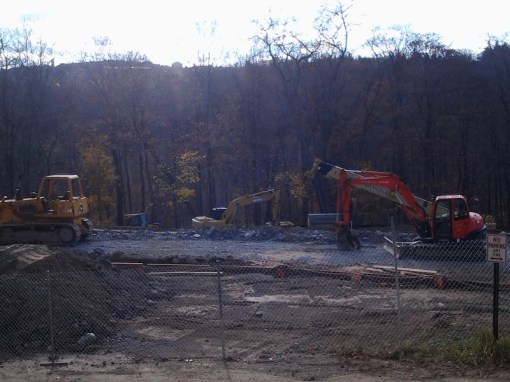
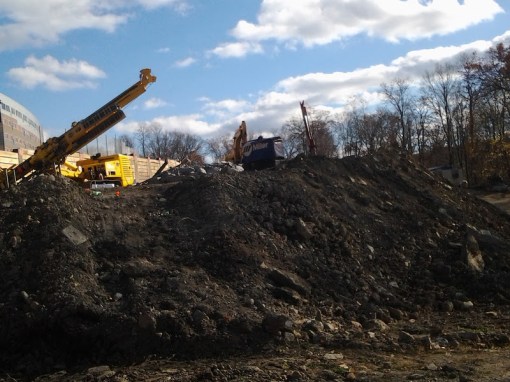
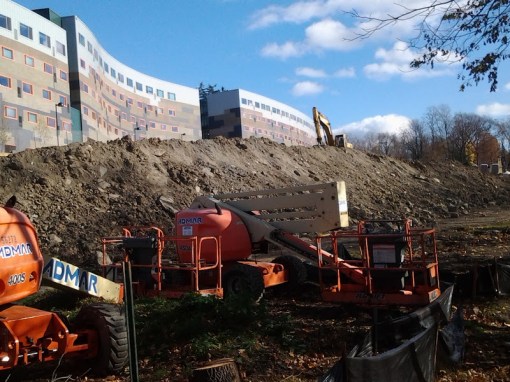
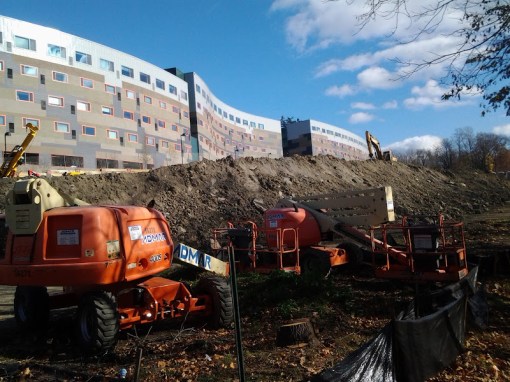
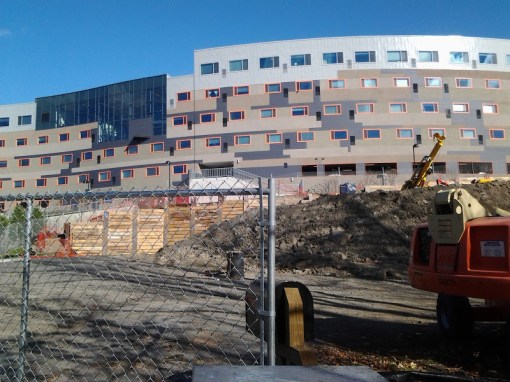
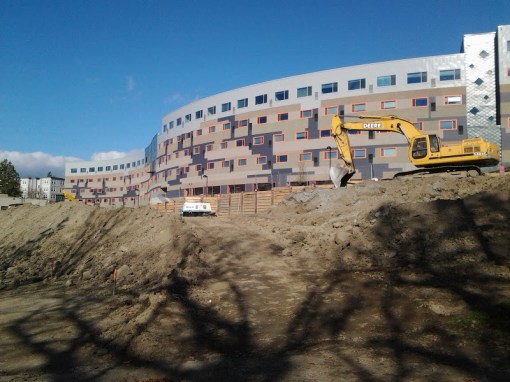
Being a 247-unit, 344-bed project means a lot of earth has to be moved before anything starts to rise from the ground. As a result, the project is undergoing the necessary if not exactly glamorous step of excavation for Building 7. All three phases combines have an estimated construction cost in the range of $70 million. The impression I’m getting from here is that when the time comes, foundation forming and pouring will begin from the west side and slowly make its way east, and so the west side of the curvaceous apartment building will be further along the east side at a given time during construction (similar to how it played out with Buildings 5 and 6 during the previous phase). Local development company Novarr-Mackesey plans to have the apartment building ready for tenants by August 2017.

20160109_132637 20160109_132711 20160109_132725 20160109_132743 20160109_133206 20160109_133401 20160109_133413 20160109_133535 20160109_133627

From December 2015:

20151205_091839 20151205_091917 20151205_092046 20151205_094226 20151205_094229 20151205_094237


307 College Avenue (Collegetown Crossing) Construction Update, 12/2015

10 12 2015

Unlike the other two Collegetown midrises under construction, Josh Lower’s project at 307 College Avenue, Collegetown Crossing, is already starting to make a noticeable dent in the Collegetown skyline. The front concrete stairwell reaches up to the third floor, with the structural steel not far behind. Corrugated decking has been laid into place and sprayed with fireproofing material. Plastic tarp has been put up for weather protection while workers go about the first steps of interior work, including the installation of sprinkler pipes and plumbing, stud walls, and so on.

The $10.5 million Collegetown Crossing project will bring 46 units and 96 bedrooms to market when it opens next august, as well as a 3,200 SF full-service branch of the Greenstar Co-Op grocery store. Two other commercial spaces and an indoor TCAT bus stop are planned. Collegetown favorite Jagat Sharma is the designer, and Hayner Hoyt Corporation out of Syracuse is the general contractor.

20151205_100653 20151205_100727 20151205_100736 20151205_100807 20151205_100838 20151205_100929 20151205_101006 20151205_101156


205 Dryden Road (Dryden South) Construction Update, 12/2015

9 12 2015

As with 327 Eddy a couple of blocks away, Pat Kraft’s 6-story building underway at 205 Dryden, called “Dryden South”, has yet to reach street level, but it’s close to going vertical. It was a little difficult to get to this site due to traffic, but the last photo shows what appear to be columns rising from a shallow mat slab foundation. Unlike the low-lying parts of Ithaca, the soil on East Hill is amenable to shallow foundations for a medium-sized building like this; all the better for the developer, since shallow foundations are cheaper than deep foundations. The steel rods at the top of the concrete columns will tie-in to the structural steel – the weight of the upper floors will be channeled down into the columns, which will then transfer the weight to the rebar mesh and concrete slab at the base (basement bottom) of the new building. The rebar mesh helps to distribute the weight of the building evenly across the slab. The thicker the mat slab is, the more weight it can support.

On a side note, it doesn’t look like John Novarr’s project at 209-215 Dryden is underway just yet, though it was originally slated to start last month. But given that Cornell has already signed up to occupy the whole building, Novarr’s project has a very good chance of moving forward, it’s just a matter of time.

Dryden South will bring 10 4-bedroom apartments to market when it opens in August 2016. The ground floor will hold 2,400 SF of retail space for Kraftee’s book and apparel store. The $6.4 million project is being built by LeChase Construction, and the design is by local architect Jagat Sharma.

20151205_100234 20151205_100323 20151205_100337


327 Eddy Street Construction Update, 12/2015

8 12 2015

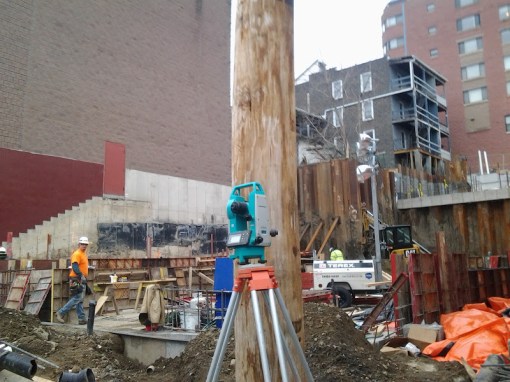
327 Eddy is almost ready to rise from the ground. The mat slab foundation for the upper tier has been poured onto the rebar mesh, with more rebar sticking out of the concrete, ready to tie-in the walls as they’re built up. On the lower tier, it looks like some forms are still in-place for further concrete pours (which sounds right, based off the elevation drawing below). No doubt the work crews have appreciated winter’s delayed arrival this year.

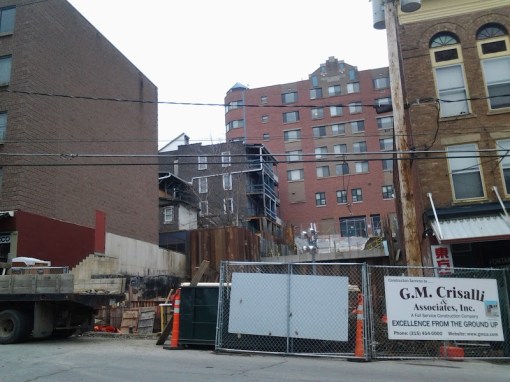
Plans call for a new 5-story building split into “steps” on the steeply-sloped site. The mixed-use building will bring 1,800 SF of retail space and 22 new apartment units with 53 bedrooms to the market in August 2016. Longtime Collegetown landlord Steve Fontana of the Fontana’s Shoes family is the developer, Jagat Sharma is the architect, and GM Crisalli & Associates of Syracuse will be overseeing construction. A construction loan of $4,824,000 is being provided by Tompkins Trust Company. A 2-story mixed-use building and the one-story Pixel Lounge building  were demolished to make way for the project.

Note in the elevation drawing below, the building is six stories. It was reduced to five, and the decorative crown was reworked after approval was granted. It also looks like the latest render was stretched to compensate the loss in height.

20151205_101654 20151205_101743 20151205_101803 20151205_102126

327_eddy_rev2_3 327_eddy_rev4_1


804 East State Street Construction Update, 12/2015

7 12 2015

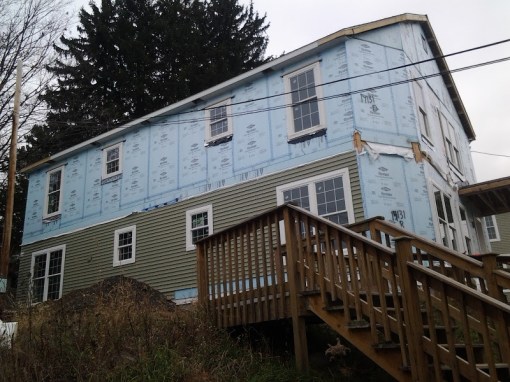
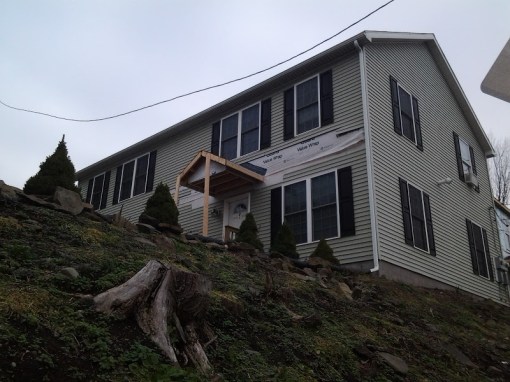
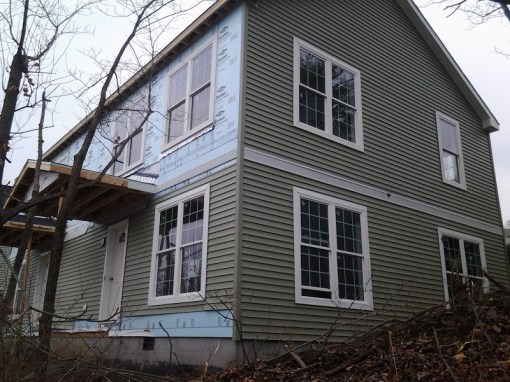
Modular projects tend to move quickly. Such is the case over at 804 East State Street. The modular units have been assembled and fitted – since the interiors comes partially finished and the windows and doors come already fitted, the builder/assembler saves on not only time, but labor costs. For further reading, Ithaca Builds provides a great discussion of how modular units are assembled, including a tour of modular manufacturer Simplex Homes’ factory here.

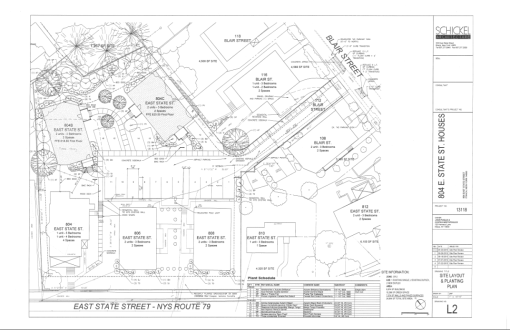
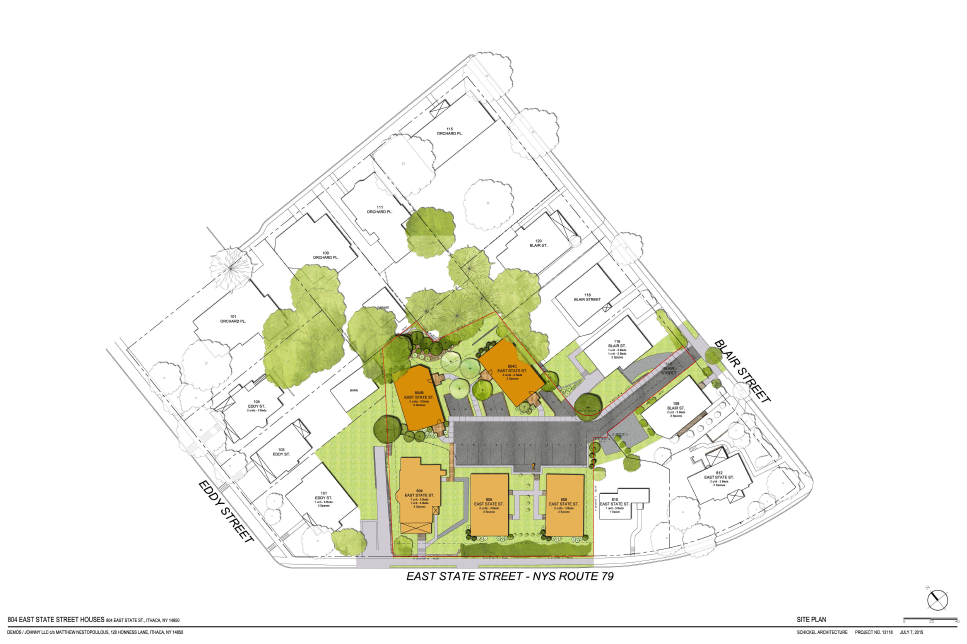
Perhaps the big surprise during this visit is that there are three duplexes underway – a third duplex is being built at 810 East State Street, which previously held a mid-century 3-bedroom bungalow. The three existing duplexes on the parcel are being spruced up as well, with the addition of small porches at their front entries. Each duplex houses 2 3-bedroom units, about 1150 SF per unit.

It appears that some exterior siding/trimming and  interior finishing remains to be completed, and then landscaping once construction wraps up. Although the duplexes themselves are rather bland (some residents in the East Hill Historic District can see the site from their windows, and were opposed to construction), the developer met with residents and oriented the new units to minimize visual impact on Orchard Place, with heavy landscaping to better conceal the State Street properties. The neighbors also pushed for stick-built houses, but the owner/developer ruled it out due to costs.

A building loan agreement filed November 10th states that Tompkins Trust Company is lending the Nestopoulos family (operating under the name “Demosjohnny LLC”) $560,000 for the project. The units should be ready for their first renters by mid-January.

Schickel Architecture is the architect, and Costas Nestopoulos is the general contractor.

20151205_103659 20151205_103715 20151205_103738 20151205_103757 20151205_103833 20151205_103906 20151205_103946 20151205_104005 20151205_104029

112_blair_v4_2

112_blair_v5_1


News Tidbits 11/30/15: It’s like the 1990s All Over Again

30 11 2015

maplewood

1. I want to start this oddly-timed roundup with a big thanks to the readers and commenters who encouraged me to write last Monday’s op-ed. If it wasn’t for you guys, I would have held off. I’m not looking to make waves, but there is a significant, valid concern over Cornell’s housing shortage, and it merited a rebuke.

I also want to thank you guys because the emails I received (about 10 separate readers) were pretty much offloading on how much they hate Cornell, which completely missed the point the article. Worse still, one went into a rant on not only students, but on how much they hate racial minorities, and a second went off into a density rant (followed by stomach-churning quote “if nurses, police and teachers can’t afford to live here, they shouldn’t be living here”). If I thought they were representative of Ithaca for even a moment, I’d hang up my keyboard. But I know that there are good people like the readers here, who are more thoughtful, knowledgeable and arguably less crazy.

So, with all that noted, here’s the actual news – someone familiar with the Cornell Campus Planning Committee wrote in to say that the Maplewood replacement is expected to have 600-700 beds, and that the committee is still hopeful for an August 2017 opening, which would mean it would have to presented fairly soon (that would still leave a year-long gap in housing, but better late than never). They also acknowledged that “Cornell didn’t do such a good job” with planning for a possible housing shortage, which although not an official statement, seems as good of a justification for Monday’s piece as any.

gways_rev_1

2. Then there was the other piece that dovetailed the affordable housing setbacks last week – Greenways, INHS’s 46-unit affordable owner-occupied townhouse project in the East Ithaca neighborhood, is being abandoned. A part two article with some hard data is being planned. There’s no real silver lining here. It’s Cornell land and the university could potentially revive it, but there’s no indication that will ever happen.

It’s just been a crappy week for housing affordability in Ithaca.

3. Over in Collegetown, several rental homes are being offloaded at once. The properties, 120-134 Linden Avenue, consist of six student apartment houses, with a listed price of $6.5 million. A check of the county website indicates the properties are assessed at $2.75 million, and a cross-check of the Collegetown Form Zoning shows most of these properties are CR-1 (the southern two homes) and CR-3 (the four northernmost homes). CR-1 is the least dense zoning, and CR-3 is a little denser, but mostly maxed out by the existing properties. In short, the code suggests significant redevelopment is unlikely, so the price seems to be based off of potential rental income.

The Halkiopoulos family currently owns the properties, which make up a sizable portion of their multi-million dollar Collegetown portfolio (they’re one of the medium-sized landlords). The Halkiopouloses’ M.O. has been to buy single-family homes and convert the property to student rentals, rather than building their own apartment buildings. It seems likely that the high price indicates they’ll go to one of the other big landlords, or to someone with really deep pockets looking to break into the Collegetown market.

4. A couple folks might be concerned this week after Jason Tillberg’s latest piece about Ithaca’s deflating economy. But there’s a caution light before this data is taken to be hard truth. Frankly, the BLS estimates suck.

A lot.

The numbers are subject to big revisions. Case in point, here are the pre-revision and post-revision 2013 and 2014 data:

ith_initial_1314 ith_revised_1314

It’s not uncommon for the numbers to be changed by thousands, because it’s based on a random sampling of non-government multi-person employers. 500,000 are sampled over the whole country each month, but only about 55 of the 3,300 or so orgs in Tompkins and Cortland Counties are included in the Ithaca metro sample (Cortland’s jobs numbers are included with Ithaca’s because jobs are measured by Combined Statistical Area [CSAs]. However, Ithaca is considered a separate metropolitan area [MSA] from the Cortland micropolitan area [µSA], so population stats are always distinct). The overall trend of the selected orgs is then applied to a base number. For places like Ithaca where the local economy is dominated by a few employers, random sampling isn’t the best approach because it misses crucial components of the local economic picture. But the BLS sticks with its current approach for consistency’s sake across regions and time periods.

During the first quarter of each year, the BLS conducts a full analysis and re-analysis of data going back the last three years. The general rule is, the data from three years ago is very good, the data from two years ago is okay, and the data from the previous year is…very, very preliminary. Tompkins County hasn’t had any large layoffs reported the state’s WARN database this year, and the only major retail closings recently have been A.C. Moore and Tim Horton’s.

In short, don’t let it keep you up at night, and wait until March before passing judgement on the 2015 economy.

902_dryden_v2_1

902_dryden_3
5. Over in Dryden town, the townhouse project proposed by local firm Modern Living Rentals (MLR) at 902 Dryden Road in Varna is a little smaller – 13 units and 40 bedrooms, versus the previous 15 units and 42 bedrooms; these numbers include the duplex with 6 bedrooms that currently exists on the site. Meanwhile, the procession of hate continued at the latest town meeting. The arguments are the same as before. To the earlier, larger proposal, some town councilpersons had given a tentative positive response, while at least one was opposed to the original proposal (in Dryden, the Town Board votes on projects rather than the Planning Board). MLR hopes to request approval at the town’s December 17th meeting – if approved, the construction period is planned for January-August 2016.

For those interested, the Stormwater Plan (SWPPP) is here, revised Full Environmental Assessment Form (FEAF) here, revised site plan here, project description courtesy of STREAM Collaborative here. No new renders, but presumably it still looks the same in terms of materials and colors.

biggs_1

6. Next up on the suburban tour, the fighting over the Biggs Parcel in the town of Ithaca. The Indian Creek Neighborhood Association (ICNA) presented a plan for the property – and the plan is, maybe we can find a way to force the county to keep it, but if not please don’t sell the land to anyone who will build on it. All the county wants is to sell the land so it pays taxes, and the ICNA plan seems to have failed to really address that point. Tompkins officials countered by saying that they’re not keeping it and that if the ICNA cares about this parcel of land so much, buy it. There was then some back and forth about doing a new assessment to account for the developmentally-prohibitive wetlands on site – in other words, decreasing its current $340,000 assessment, with the exact amount to be determined by the county assessment department. At 25.52 acres, of which some is still developable, the price will likely stay above six figures.

So the county’s doing its new assessment, because all it wants is to sell the land so that someone is paying taxes on it. Meanwhile, the ICNA has taken to venting on their web page, angry that the county still plans to sell, and that they may have to actually buy the land in order to dictate its future use.

327_w_state_demo

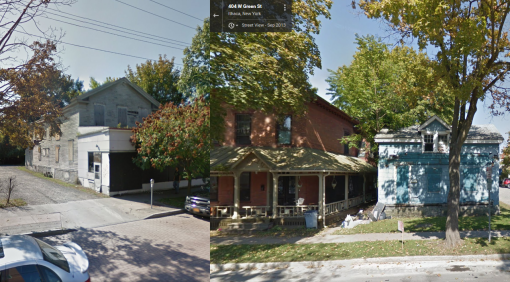
7. To wrap up a thoroughly depressing week, a couple of demolitions by neglect. 327 West State Street and 404 West Green Street will both be demolished by the end of the year, according to the Ithaca Times. Both are older, likely century-old structures, but too far gone to be salvageable. According to county records, the City Health Club, which abuts and owns both properties, purchased 404 West Green in 1987, and 327 West State Street in 1993. The porch on 404 came down sometime in the late 1990s or early 2000s, and the only change since then was painting the plywood on the boarded-up door and windows. County photos suggest 327 was in bad shape but possibly occupied up until 2000 or so, and steadily grew worse from there. Offhand, the procedure is to bill the owner for the demo. 404 West Green is B-2d zoning, 327 West State is CBD-60. But don’t expect any redevelopment anytime soon.

Hmmm…bad economic news, projects being cancelled, decay and demolitions in the city and fighting over suburban projects. For Ithaca and Tompkins County, it’s like the 1990s recession all over again.


Collegetown Terrace Construction Update, 11/2015

10 11 2015

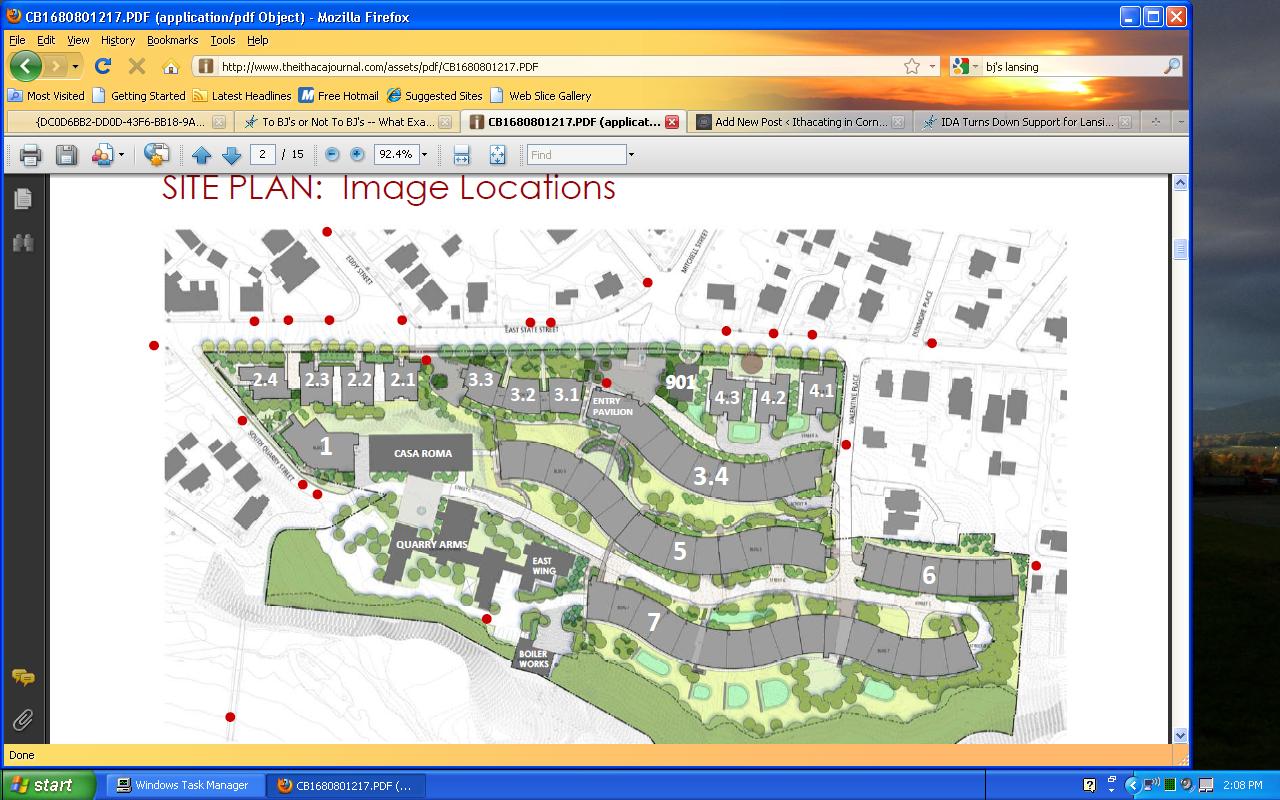
Well, this one can finally be counted as “underway”. Site prep has begun for the last building at the Collegetown Terrace site, on the 900 Block of East State Street south of Collegetown. Being just a few weeks underway (work commenced in late October), the primary tasks in the short-term are clearing the site and building shoring walls (the steel H-beams with wood lagging). The H-beams are drilled or driven in at regular intervals, and hold the soil back while the foundation is excavated. This building is going to have a deep foundation and a large footprint, so foundation work is likely to take a while, we’ll be well into 2016 before steel starts to rise from the ground.

The last phase of Collegetown Terrace (Phase III) is expected to be completed by August 2017. Phase III will focus on the construction on the last building, #7 (formally known as 120 Valentine Place), a long, curving building very similar to  the completed Building #5. Funding for the new building comes from part of a $50 million loan extended to developer Novarr-Mackesey in 2013 by Pittsburgh-based PNC Bank, and revised in December 2014. As this project demonstrates, even though a proposal might be approved, it can take years for something to actually get off the ground — if ever. Initial approvals were granted all the way back in 2011.

Building 7 is expected to have 247 units, and 344 bedrooms once it’s completed. About 80 of the units will be set up “dormitory-style”, where all tenants get their own bedroom and bathroom, but share kitchens and community lounge spaces. Novarr-Mackesey had found after the previous phases were completed that parking was only being utilized by 50% of tenants, so rather than build a floor of parking that would more than likely go unused, the firm applied to the city Board of Zoning Appeals for a parking variance (652 spaces for the whole complex, which is 51 less than required by zoning) to change one floor of parking planned for Building 7 into the “dorm-style” living space. The variance was granted by the BZA in Spring 2014. The dorm-style units are expected to rent at half to two-thirds of the cost of a studio unit, and to appeal to graduate and professional students on a budget. The current layout calls for parking on the first floor, then the dorm floor, then regular studio-3 bedroom units on floors 3-6.

With this project underway, it’s the single-largest residential building under construction in Tompkins County. Hopefully, one that will make a dent in the city and county’s housing crunch.

20151108_131029 20151108_131142 20151108_131223 20151108_131447 20151108_131708 20151108_131713 20151108_131746 20151108_131750 20151108_131756 20151108_131944 20151108_132024 20151108_132033 20151108_132045 20151108_132141 20151108_132223 20151108_132236 20151108_132320

ctown_terr_phase3


804 East State Street Construction Update, 10/2015

20 10 2015

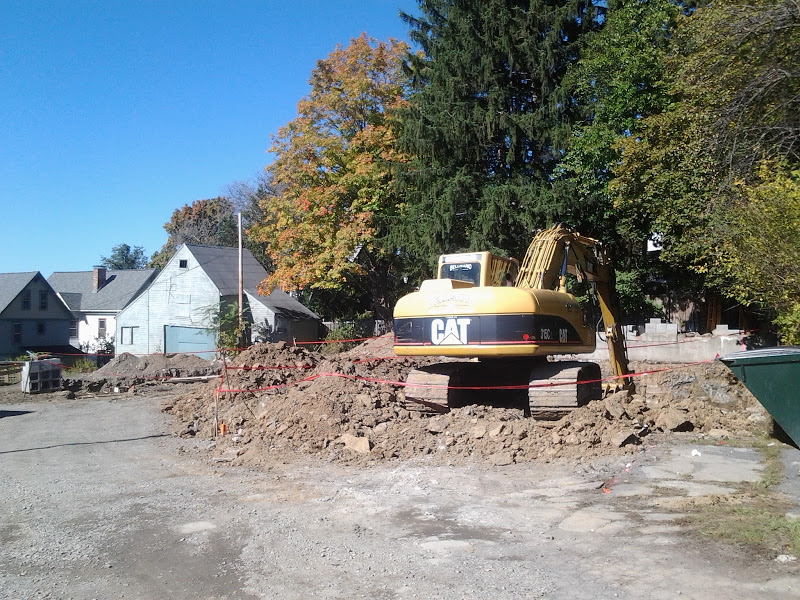
A new, small project to add to the list of projects underway, 804 East State has started construction on the fringe of Collegetown. The owners of the site, the Nestopoulos family of Ithaca, are building two modular duplexes, 4 units total, with 3 bedrooms each (12 total).

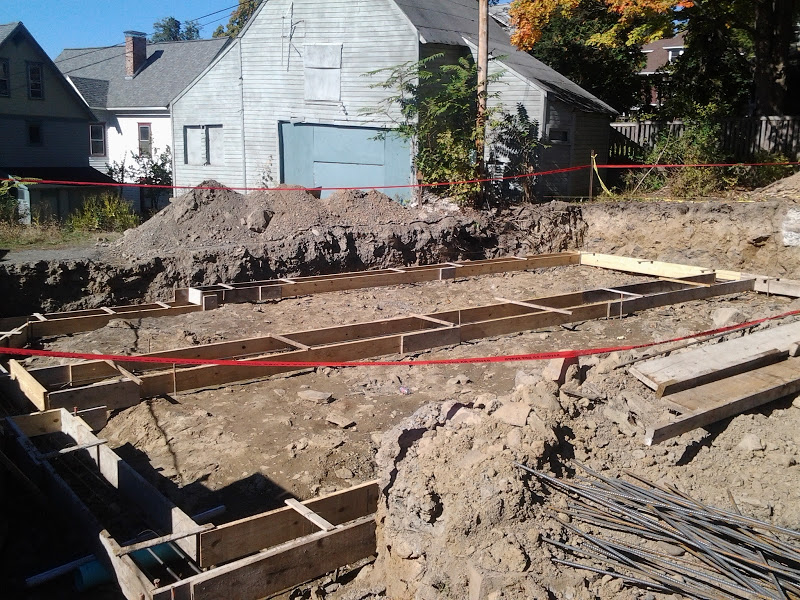
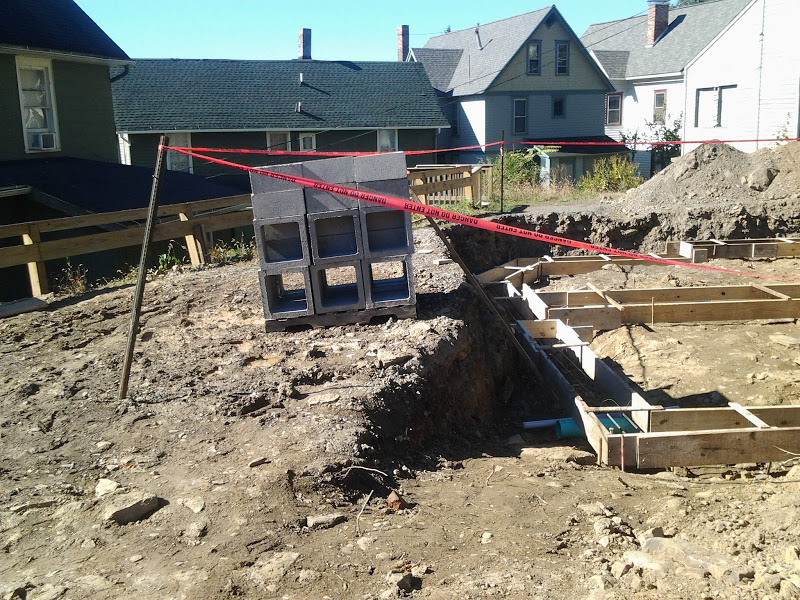
The foundations have been dug for both duplexes, and form boards have been placed in the footprints of the west building. The concrete foundation gets poured into the form boards, and the boards help the concrete hold its shape while it cures. Looking closely, you can see a few steps in the wood forms, since the site is sloped, the concrete foundation will be stepped. The small wood sticks on top of the forms are spreaders, to provide extra stiffness.

Once the forms are squared and levelled, the concrete will be poured in, levelled off and smoothed over. After a day or so, the forms can be removed, leaving the newly-finished foundation. Once the foundation is ready, the builders can begin erecting the concrete masonry unit (CMU) walls, the hollow concrete blocks seen in the photos. The modular pieces will then be brought in, hoisted into place and sealed together, not unlike the process at the Belle Sherman Cottages.

The plan is to have these completed by December 2015, with new occupants (likely students) moving in the following month. The project replaces a gravel parking lot. In an effort to appease neighbor opposition about the homes simple (and perhaps bland) design, the number of houses was reduced from three to two, they were oriented to minimize visual impact, parking was moved from below the units to surface lots, and extensive landscaping with an “outdoor room” is planned.

20151011_135439 20151011_135455 20151011_135513 20151011_135533 20151011_135556

112_blair_v4_2 112_blair_v4_1