City Centre Construction Update, 3/2019

24 03 2019

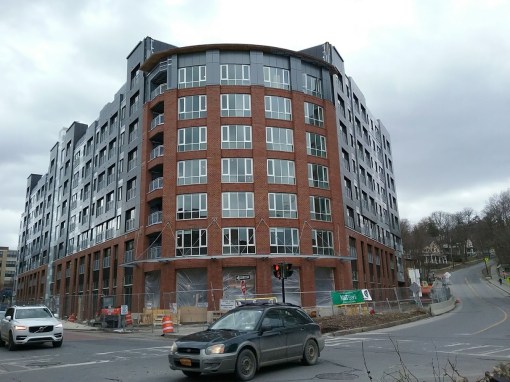
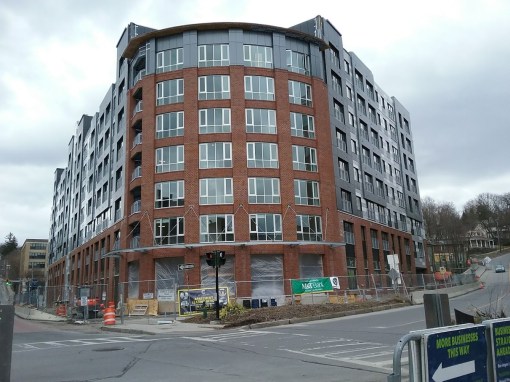
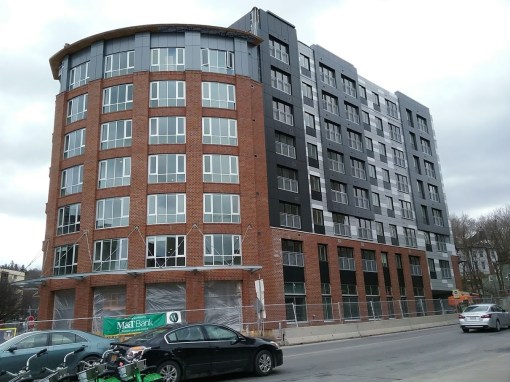
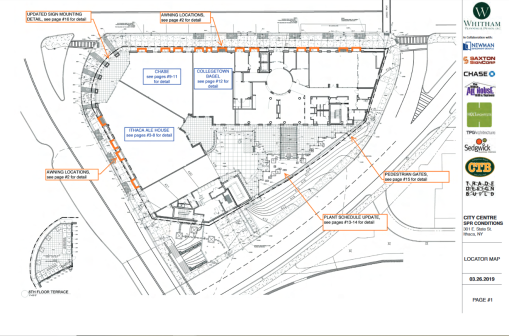
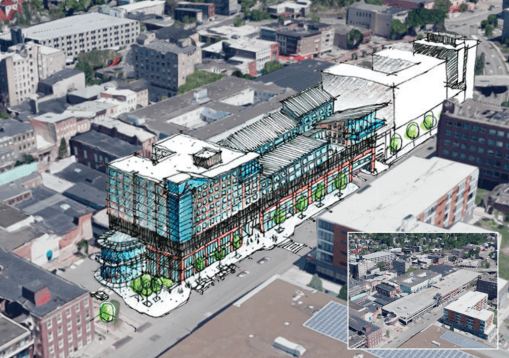
All of City Centre’s retail occupants have been identified – The Ale House, Collegetown Bagels and Chase Bank. Although two of three are cannibalizing other Downtown locations, the move comes with some benefits – it’s an expansion for CTB and the Ale House, and the Ale House is expecting to add 20 jobs, and CTB will likely add a few new positions as well. Chase is totally new, and if the average bank branch is 2,000 SF and 6.5 staff, it seems safe to assume that a 5,357 SF branch/regional office is probably 12-15 staff. Ithaca’s own HOLT Architects is engaged in some minor building design work and Whitham Planning and Design is doing the landscaping (including the heat lamps, string lighting and fire pits), Saxton Sign Corporation of Auburn will make the signage, Trade Design Build of Ithaca and TPG Architecture of New York will flesh out the interiors, and East Hill’s Sedgwick Business Interiors will provide furnishings. Clicking here will allow you to scroll through the interior layouts for the retail spaces.

A glance at their Instagram suggests that as of a week ago, about 100 of the 192 apartment units have been reserved. There don’t appear to be any particular trends in the unit selection, an off-the-cuff suggests a similar occupancy rate for studios, one-bedroom and two-bedrooms, and there’s no strong preference in floors, though perhaps there’s a slight preference towards interior-facing units (I wouldn’t call it statistically significant). It appears they’re filling at a good clip now that graduate and professional students are making their commitments to Cornell (professional students, for example business/MBA and law/JD students, tend to be older and wealthier, and are one of the target markets for the project). If trends continue, the project will be in good shape for its June opening, with full retail occupancy and high residential occupancy, even at City Centre’s decidedly upmarket prices.

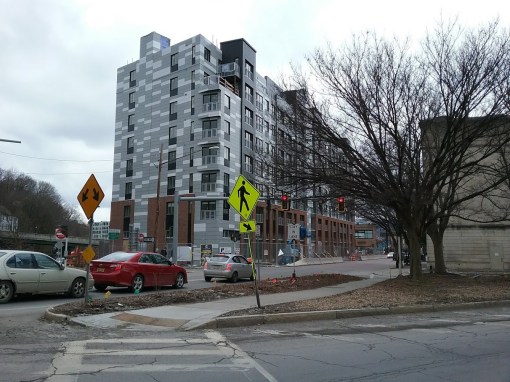
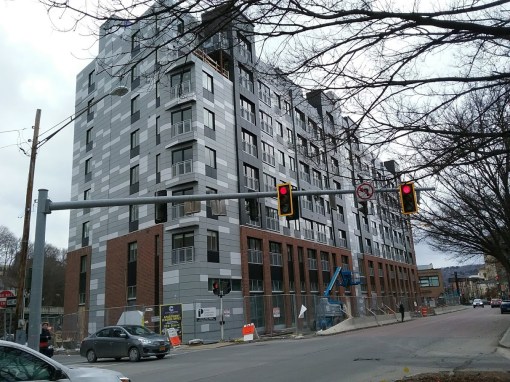
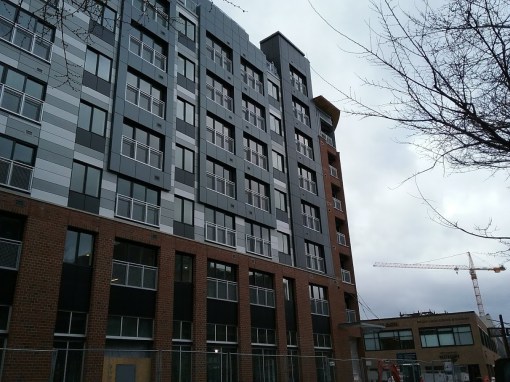
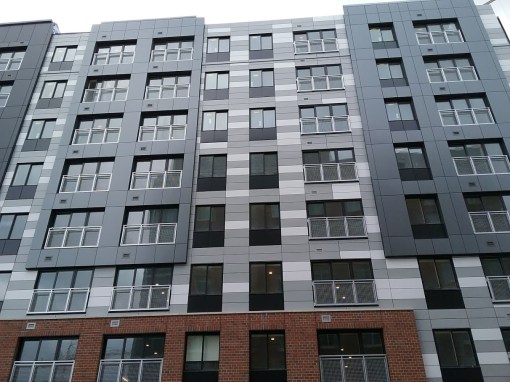
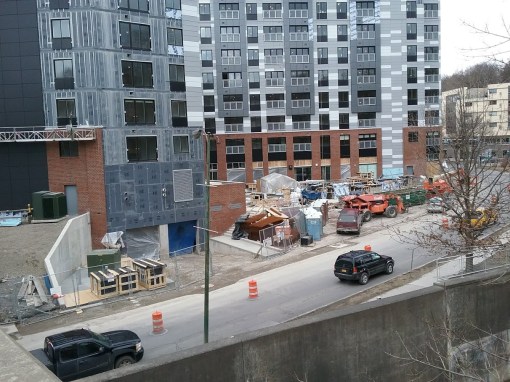
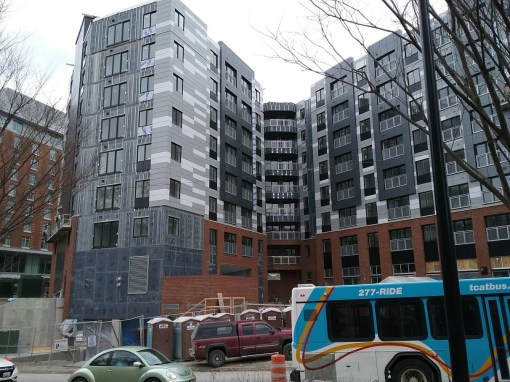
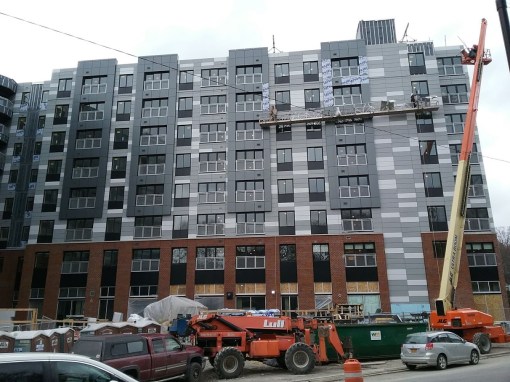
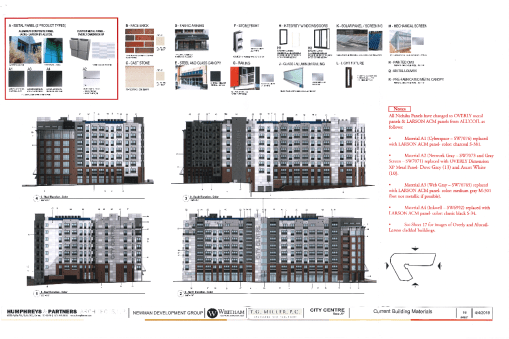
On the exterior, some of the Overly and Larson ACM metal panels have yet to be installed (mostly on the back./interior side), trim and exterior details are partially in place, and the ground level is still being built out with commercial doors and utility fixtures (garage doors for commercial deliveries, for example). The roof membrane doesn’t appear to be in place yet either. Overall, though, the exterior is substantially complete, and it looks like the will finish out over the next several weeks on schedule, which is a pretty big deal for a 218,000 SF $53 million project. Kudos to Purcell Construction and their subcontractors on that. Signage and landscaping will also go in this spring. I’m not big on the patterning of the metal panels (which looks like design by MS Paint), but it seems to be the go-to exterior material of choice.

Background information and the history of the project can be found here.


News Tidbits 3/11/19

12 03 2019

1. The city of Ithaca and The Vecino group have come to a tentative agreement. The two have been negotiating since entering into a 90-day Exclusive Negotiating Agreement at the end of last year. While Vecino is still looking at the financial models for the conference center space, it appears that the city is ready to move forward with a formal agreement to be voted on by the Ithaca Urban Renewal Agency (IURA) and the Common Council, and then to have the building plans reviewed by the Planning Board, and then the sale of the property to be brokered by the IURA and agreed to by the Common Council. If approval is granted in good order and state funding is obtained (Vecino is pursuing 4% low income housing tax credits, vs. the more competitive 9% variety), then construction could start on the $95 million mixed-use project by late 2020.

2. GreenStar will be asking the IURA for a $400,000 loan to assist in the construction of their new flagship location at 770 Cascadilla Avenue. It does not seem to be related to their construction woes, as the initial paperwork was filed in January, but it makes for rather awkward timing. The loan is likely to be approved without significant reservation thanks to GreenStar’s reputation and the promise of dozens of living wage jobs, though the IURA is unhappy with what is described as “weak collateral”, and it has some concerns with GreenStar’s ability to fundraise.

Important note – the paperwork mentions one of GreenStar’s funding sources will be the buyer of the current Space A Greenstar at 700 West Buffalo Street, who so happens to be “the owner of the Cascadilla Street property”. This buyer will pay $2 million for the building when GreenStar moves out in early 2020.

At first glance, one might think that’s Guthrie. But Guthrie transferred ownership of the parcel to “Organic Nature LLC” last month. Organic Nature LLC is a company owned by the project team building City Harbor. In short, the City Harbor developers are buying the Space @ Greenstar, and likely have plans for the property.

3. If you’re an urban planner – and I hope this blog is interesting to you if you are – the IURA is issuing a request for qualifications for a parking study. The project will include three major tasks: analysis of the current parking system; determination of possible scenarios of programs and actions for the future direction of the parking system that are financially sustainable; and preparation of a strategy and an implementation plan, with estimated costs and a schedule. TLDR; look at existing operations, describe future directions (ten year period), make parking-related recommendations and implementation recommendations. Knowledge of transportation demand management and experience with designing strategic initiatives to handle parking needs will be a big plus. Submission packets due April 12th to Director of Parking Pete Messmer, more info at the end of the agenda packet here.

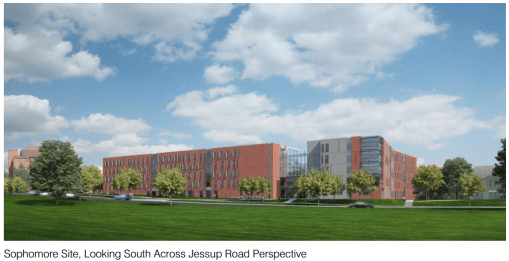
4. Quick note – the North Campus housing proposed by Cornell was modified slightly at the request of city boards. The new design adds “break points” in the facade to activate the central wings of the buildings and make the building masses seem less imposing. The general massing and material choices remain unchanged.

5. Mid-sized Collegetown landlords Greg and Mataoula Halkiopoulos (of Matoula’s Houses) have decided to renovate a decrepit 19th century carriage house at the rear of their property at 214 Eddy Street, and turn it into a three-bedroom, 839 SF rental. 214 Eddy is in the East Hill Historic District, so the design, by local architect John Barradas, will need to be approved by the Ithaca Landmarks Preservation Commission. It looks like a practical renovation, respectful of the carriage house’s form but also with a modern touch. Early Design Guidance will be offered at the March ILPC meeting, and any decisions on a Certificate of Appropriateness are still a few months out.

6. There have been some major changes to the Perdita Flats plan at 402 Wood Street. Previous version here. For one, it now has frontage on Fair Street and will have a Fair Street address. The building and garden have been re-positioned, the footprint reduced slightly (38’x36′ to 36’x36′), larger porch, modified exterior cladding materials, and the driveway has been removed at the Planning Board’s suggestion. The building remains 4 units and 7 bedrooms, and STREAM Collaborative penned the redesign.

The wood shiplap siding and standing-seam black metal siding are a bit of an acquired taste, especially with the wood oiled or left to grey naturally. But the house is still planning to be a net-zero energy showcase of what can be done with environmentally sustainable multifamily housing, and that’s the real statement to developers (Courtney Royal and Umit Sirt) are trying to make. The owners will be applying for incentives from the NYSERDA Low-Rise Residential New Construction Program and are hoping to attain the Zero Carbon Petal of the Living Building Challenge.


GreenStar Co-Operative Market Construction Update, 2/2019

2 03 2019

We’re going to rewind the clock a bit on this to before GreenStar. It’s early 2017. Two major regional medical service providers are eyeing locations in the affluent and growing city of Ithaca. The first is Cayuga Medical Center / Cayuga Medical Associates. The second is Guthrie Clinic / Guthrie Medical Group.

How bad did these two want to outdo each other and lock their rival out of the city? So much so that Cayuga Medical Center paid several times the value on Carpenter Business Park. So much so that Guthrie bought a site that would fail to meet their needs.

For neither CMC or Guthrie was it the best of moves, but not everything is done rationally. In June 2017, Guthrie paid $2.85 million for the properties at 750 and 770 Cascadilla Street, over the asking price of $2.7 million. For those millions they purchased 3.12 acres, with a 37,422 SF printing press/ warehouse built in 1980, and a 30,000 SF storage facility built in 1988. Cornell University had previously used the facilities as part of its printing press operations, and had been seeking to sell the properties since July 2016.

Guthrie started looking at its options at that point, and wasn’t liking them. But there appeared to be an opportunity. The developers of City Harbor, working on their mixed-use proposal a couple of blocks away, would provide Guthrie a convenient escape hatch to Pier Road, where they could build a structure from scratch that would suit their needs. In return, Guthrie would offer up its recently-purchased Cascadilla properties to GreenStar on a long-term lease, with an option to buy.

For GreenStar Co-Op Market, the site was a welcome opportunity of its own, a real estate version of “one man’s meat is another man’s poison”. Founded in 1971, GreenStar has been leasing its current location at 701 West Buffalo Street since the fall of 1992, following a fire that destroyed their store on North Cayuga Street. Satellite stores operate out of the DeWitt Mall at 215 North Cayuga Street in Downtown Ithaca, and at 307 College Avenue in Ithaca’s Collegetown neighborhood. Specializing in locally-sourced and organic foods, the co-op has enjoyed significant market growth in the past decade, with sales increasing by nearly 50% since 2011, to over $22 million annually.

That was both a good and a bad thing. As I wrote for the Voice back in April 2018, GreenStar makes a very small profit on sales, and relies on membership growth as a supplement. But their West End store was jam-packed, all built out with no more room and increasingly agitated co-op members. With other grocers moving in on the organic and natural food market, it was going to be grow, or perish, taking 200 jobs with it. GreenStar had been in talks with landlords and developers for a new space, and City Harbor’s project team was one of those who listened. Just as City Harbor’s Pier Road was Guthrie’s escape hatch, 770 Cascadilla Street was going to be GreenStar’s.

Plans were first announced in December. As a Co-Operative food market, GreenStar has to put any kind of move of this scale out to its shareholders for a vote, through paper and electronic ballots with a three week voting period in March of 2018. The vote for the move was 92% in favor. The project was approved by the city last July, and the groundbreaking was this past November. If all goes well, the lease agreement will allow GreenStar to buy the property from Guthrie in 2030; this passed the member vote with 97% saying yes.

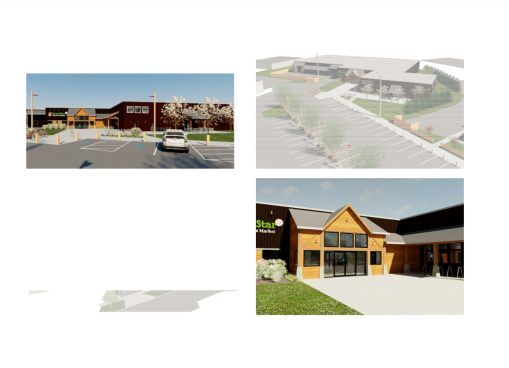
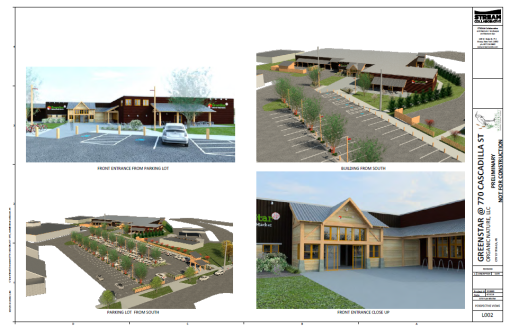
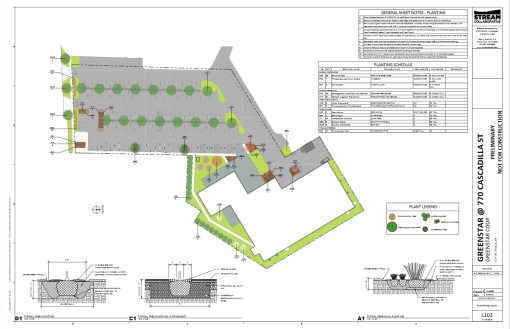
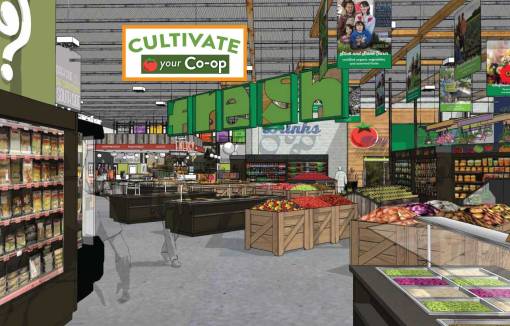
The plan is to renovate 770 Cascadilla into the latest and greatest GreenStar flagship. 750 Cascadilla would come down for a 160-space store parking lot and landscaping. The new space would have an edible garden, outdoor cafe, mezzanine stairway and classrooms. The building would be refinished, insulated, and potentially net-zero energy compatible, meaning all the energy it consumes comes from renewable sources. Breaking it down, the new retail area will be 16,500 SF, there will (well, was, see the last paragraph in this entry) be 5,200 SF mezzanine space for office and administrative functions, and a 13,000 SF kitchen and events space. With the addition of the mezzanine, the warehouse will be expanded in square footage from about 30,000 SF to 35,219 SF. The Space @ GreenStar would be moved to within the new store, and shrink from a 225-person capacity, to 125, and once moved in the old Space @ GreenStar location will be put up for sale. The Space isn’t much of a revenue generator for the Co-Op, and is rarely utilized at full capacity.

The project will take a little over a year, from November 2018 to December 2019 (the store itself wouldn’t open until February 2020, after the equipment is in, shelves are stocked and electronics are tested). Local architecture firm STREAM Collaborative is in charge of exterior design, and architect Pam Wooster will handle the interior layout. Elmira’s Edger Enterprises will be the general contractor for the buildout. Delaware River Solar will supply the solar energy to power the building via an off-site array.

GreenStar, which is carrying out the project with its City Harbor partners (Edger Enterprises, Morse Construction and Lambrou Real Estate) as Organic Nature LLC, did apply for and receive a standard seven-year tax abatement worth about $625k, about 4% of the project cost. $130k in new taxes would be paid over the period. GreenStar’s project would add at least 40 full-time equivalent positions with most jobs in the $15-$16/hour range plus benefits (Starting pay will be about $13.50/hour plus benefits; GreenStar has previously been certified as a living wage employer, though they appear to have been just below it in 2017). Generally speaking, the abatement application was one of the less contentious public hearings, which could be due to GreenStar’s stature in the Ithaca community, its labor and environmental practices, and because dedicated opposition could put 200 jobs and the whole Co-Op at risk of closure.

According to GreenStar’s TCIDA tax abatement application, while the project is $4.9 million to build (hard costs), the overall project costs are $14.8 million. Other sources have said $3.7 million in hard costs, so YMMV. Along with $8.7 million in bank and credit union financing, and $4.6 million in cash equity, the Co-Op has launched a $2.5 million capital campaign to sell investment shares to owners to help cover the project costs.

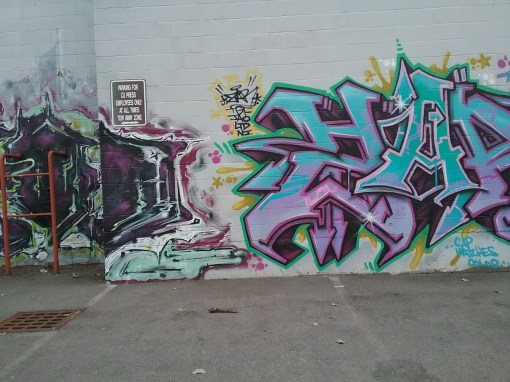
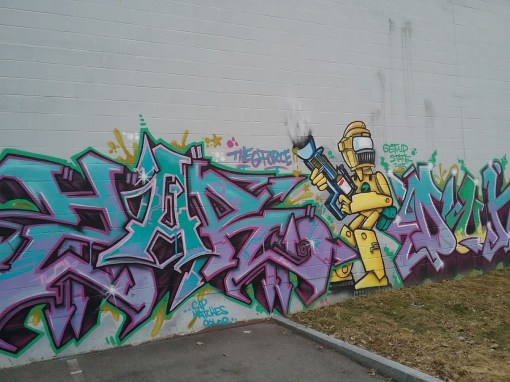
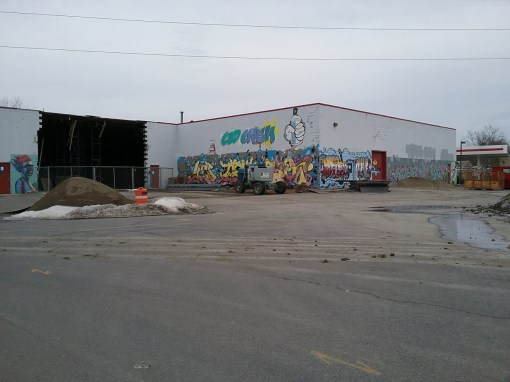
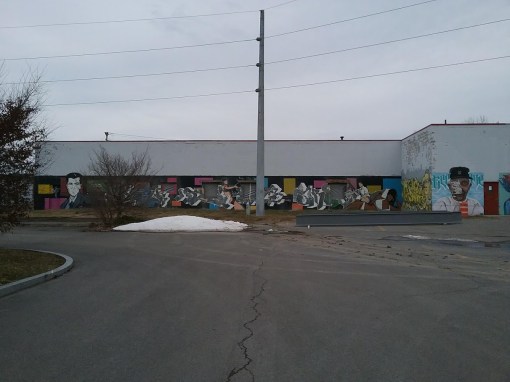
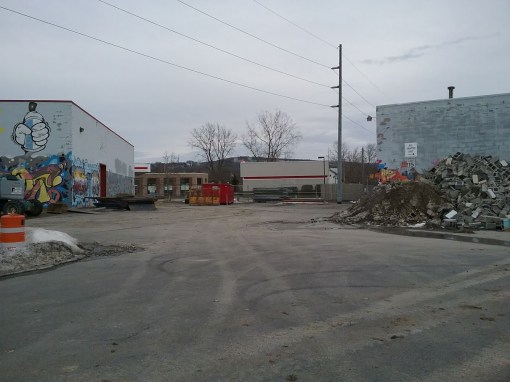
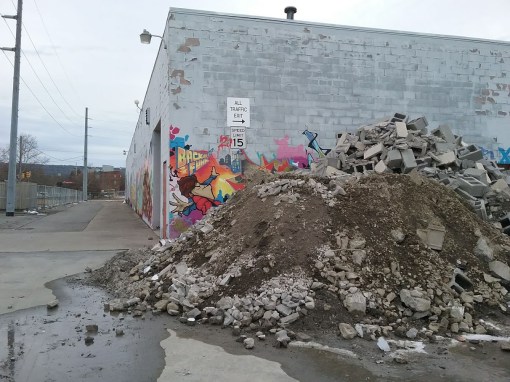
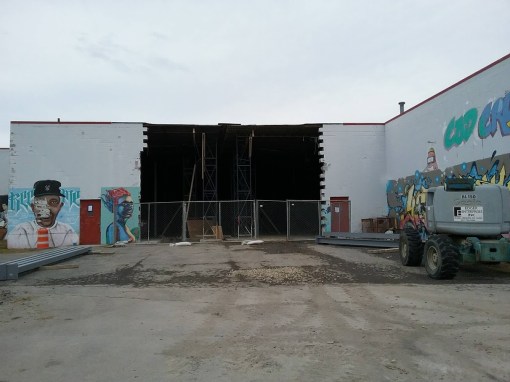
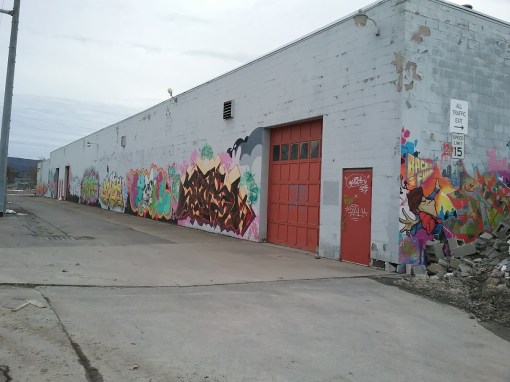
At present, a large gap has been opened in the exterior of 770 Cascadilla’s CMU facade. This is where the entrance of the new GreenStar will be, and it was practically the only major design change during the review process. The steel sitting aside the building may be for building out the mezzanine. A pile of debris sits next to 750 Cascadilla, which will itself be a pile of debris in due course. About the biggest loss here will be some pretty fantastic street art.

In the past couple of weeks, the interior was revised as a cost-cutting measure, shrinking the mezzanine by roughly half and reducing the size of the classrooms from 108 seats to a single room of 33, with the former first-floor classroom space now replaced by offices for GreenStar staff. The opening also appears to have been pushed back by 1-2 months, to “early spring 2020”.


Early render

early render

final render


News Tidbits 1/21/2019

22 01 2019

1. A quick note regarding the county’s feasibility study of a new county office building on the 400 Block of North Tioga Street on the edge between Downtown and Fall Creek – Ithaca’s HOLT Architects has been tapped to perform the analyses. The idea isn’t totally new to HOLT, who had drawn up rough ideas of a joint city-county office building as part of the Downtown Ithaca Alliance’s 2020 Strategy way back at the start of the decade. This process will quietly continue until the results are ready for review and discussion sometime in March.

In an off-record conversation with a county official, the topic came up of, “why not just move to one of the office buildings in the Cornell business park”, as the county Department of Health has done. This person pointed out that it would much easier to buy a building, renovate it, move in and start operations. Except for one bring problem – the suburban office park is hardly accessible, and so the choice of county occupants would be fairly limited, given the need for the county’s less well-off to be able to access the site. A location on the fringe of Ithaca’s Downtown is much more walkable and readily approachable from buses, bikes and so forth, while a Cornell business park is really only readily accessible to those coming by car or the occasional bus. So the county is willing to walk on coals and risk the ire of nearby residents in order to maintain a more accessible facility.

2. Before it was officially announced, the rumor that INHS was selected for the Immaculate Conception School had been floating around for a few weeks. Most of the city staff and officials I’ve spoken with were actually breathing something of a relief, because most of them know and trust INHS. Or rather, they trust INHS to be one of the less divisive choices out there. They’re local, they plan to have a mix of affordable housing and office space for family services-related non-profits, and they’ll be going through an open house process that will give residents a chance to help shape the project before anything goes up to the city for review.

Two details worth noting – for one, INHS does have timeline in mind for its redevelopment (new construction and renovations) to the site. It would like to have tenant occupancy by December 2021, so they’ve got three years to go from start to finish. Expect meetings this Spring and Summer, and probably a project submission by late summer for a fall planning board review and approval by the end of the year. That will give them time to start applying for and attaining affordable housing grants, and to break ground on the redevelopment sometime in 2020.

For two, the city of Ithaca intends on buying the school gymnasium on the northeast side of the parcel. The gym would be used for indoor recreation by the Greater Ithaca Activities Center (GIAC), which is just next door. They’re looking to pay $290,000 for the parcel. It is not clear if this was planned in conjunction with INHS, if INHS developed two separate purchase plans to accommodate that possibility, or if it simply throws a wrench into things. Generally speaking, gym access and affordable housing were the two signaled prerequisites for any city consideration of a Planned Unit Development (PUD), the DIY Zoning that would give more flexibility with site redevelopment. Regardless of PUD, I suspect renovation of the school and Catholic Charities buildings are one key redevelopment feature, and on the new construction side, the parking lot on the corner of North Plain and West Court Streets isn’t long for this world.

3. Tenant number two has been confirmed for City Centre – Collegetown Bagels will be moving from its 1,500 SF location at 201 North Aurora Street, to a 2,300 SF ground-level retail space inside the 192-unit apartment building. According to Edwin Viera at the Times, “Gregor Brous, owner and operator of Collegetown Bagels, decided to make the move after finding out the current building CTB is located in is being demolished.”

For the record, that’s a couple of years out. Visum Development does have plans for the site, which involve a mixed-use apartment building with approximately 60 units above ground-level retail. A sketch plan review was conducted back in 2015, but the plan has not undergone any formal review, and it has to undergo some redesigns anyway since they had planned to buy Jagat Sharma’s parcel at 312 East Seneca Street, and consolidate it into their project. Sharma instead sold to developer Stavros Stavropoulos, who has his own plans for a six-story building. The rumor has been that any redevelopment of the site is still a year or two away, but it is a likely prospect in the medium-term.

As for CTB, the larger space will allow them to try out some new concepts, expand their drink menu, and from the sound of it, add some alcoholic beverages to their offerings. This is not the first time they’ve looked at the Trebloc site, as they had tentatively agreed to move into State Street Triangle, had the building been approved and built.

4. Just to mention the Planning Board Agenda, for the sake of brevity, here’s the link, but not much is actually being decided on this month. Wegman’s is seeking yet another two-year extension on the 15,700 SF retail building they had approved in December 2014 (long rumored as a Wegmans-owned liquor store or a homegoods store similar to Williams-Sonoma). Amici House is seeking some signage variance approval and approval of site plan changes already made. This is likely to pass since its material color and detail changes, but because this was already done without consent and they’re going back to request consent after the fact, the board may have some harsh words. Amici House attends for its 23 studios to be available for occupancy by young, formerly homeless or otherwise vulnerable individuals by February 1st. Site plan approval is also on the agenda for the Maguire Ford Lincoln renovation and expansion. New proposals are the 200-unit mixed-use Visum affordable housing duo shared on the Voice today, and the Modern Living Rentals proposal for 815 South Aurora, which as touched on the other day, is likely to be pretty sizable.

The supplemental on the Falls Park senior housing project notes that the project is intended to qualify under Ithaca’s Green Building Policy under the “Easy Path” scoring system, and perhaps a bit disappointingly, the smokestack for Ithaca Gun, once intended for incorporation into the public space, will be coming down so that the ground beneath it can be cleaned during the remediation. However, smokestack bricks will be available as mementos for those who want them.

Heading to the ZBA will be a lot subdivision to split a double lot on Homestead Road back into two lots, the Amici House signage, and Agway’s plan to rebuild a 700 SF storage shed destroyed by fire, with a new one-story 1,400 SF structure. Zoning on its waterfront site requires two floors, but the new shed is only one floor and needs a variance.


Press Bay Court Construction Update, 12/2018

21 12 2018

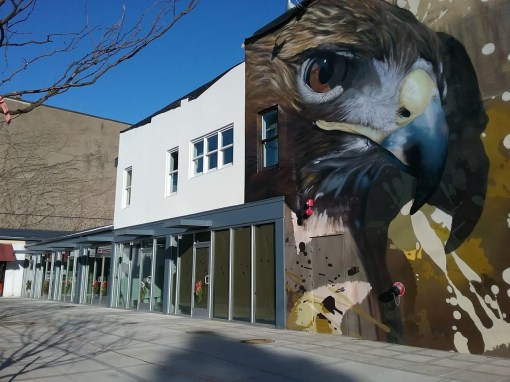
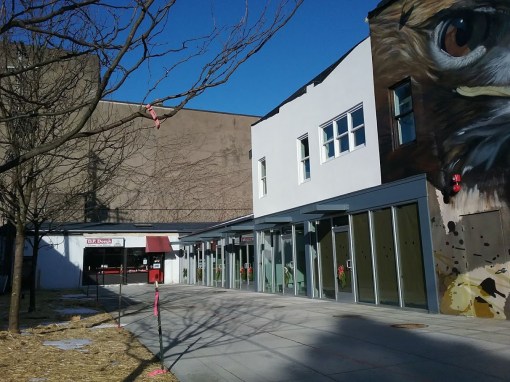
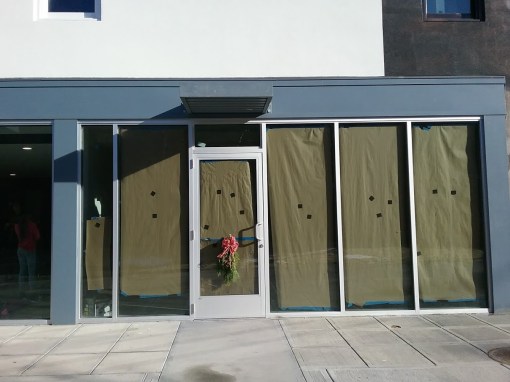
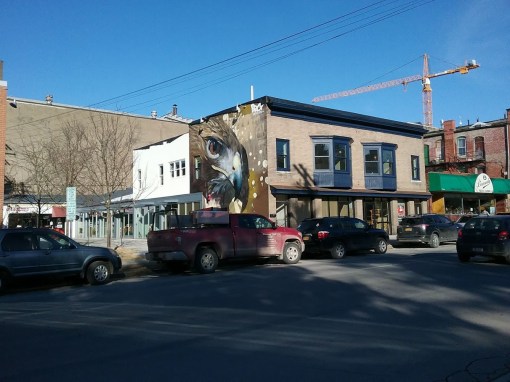
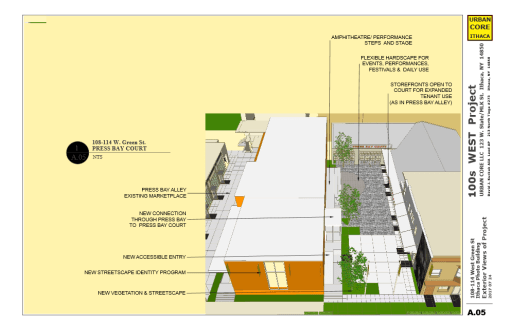
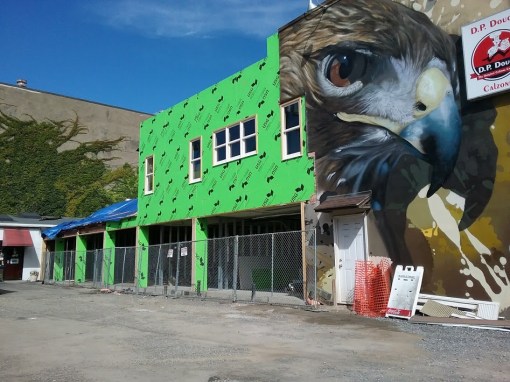
For practical purposes, I’m calling this one complete as of the end of this year. At least one of the new stores was set up and ready for opening (Gee June Bridal) while a couple others were just starting to fit out their spaces with equipment for their own launches. Among them will be Halal Meat and Groceries, One Ring Donuts, Hair • Color • Art and Bramble, an herbal retailer, moving from its Press Bay Alley slot. Calzone restaurant D.P. Dough will move from the rear storefront to the front of the 108-114 West Green retail strip, right along West Green Street in the former Hausner’s Garage. The hawk mural was given a touch up courtesy of Connecticut-based street artist Ryan ‘ARCY’ Christenson.

The fitting out of the West Green Street retail units is ongoing, but the four apartment units are nearly complete with only minor finishing details left, and based off Press Bay Alley’s Instagram, it’s quite the transformation. From their facebook page:

Beautiful historic spaces with modern amenities. These apartments are truly unique. Original 1914 wood rafters and exposed wood deck ceilings, steel beams, and brick surfaces paired with completely new utilities and modern design features

• super-efficient air source heat pumps (heat and AC)
• all LED lighting
• brand new appliances (including dish washer and garbage disposal)
• tasteful modern cabinets with soft close hardware
• beautiful tile bathrooms with modern frameless glass shower enclosures
• freshly refinished original distressed hardwood floors
• Air tight spray foam insulation and high-performance rigid foam on the roof
• Sprinkler system for fire safety

Prices range from $1200-1300/month plus electric*

Included in the rent:

• WiFi Internet**
• Garbage and recycling disposal
• Water service

Apartments are substantially complete and available for a January 1 occupancy

*heat/AC and cooking are all electric, this is a fossil fuel free building

**building is NOT equipped with cable, internet is provided by high speed fiber optic line

$1200-$1300/month is more than the 75% AMI below-market units they were originally aiming for, but not by much – $1200/month works out to $48k-$52k/year, or 80-90% of the local AMI of $59k. “Workforce housing”, to borrow a Visum Development Group term for the 80-90% bracket.

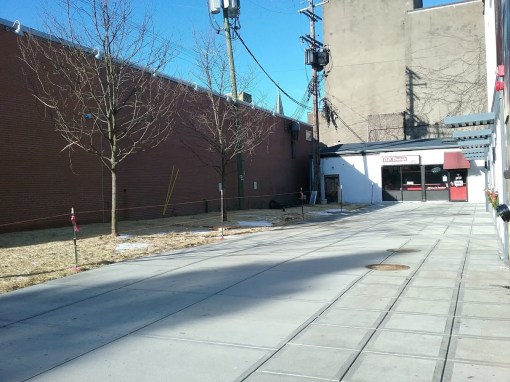
The biggest deviation from the plans appears to be that the passage into the former Ithaca Journal press building has not been built, and instead of vegetation and hardscaping for the amphitheater and court pavers, it’s only vegetation. It’s not clear if the amphitheater and west entry to the press building will be built at a later time.

All in all, this is a great project to have in Ithaca’s Downtown. It extends the vitality of the Commons westward in a form sympathetic to the neighborhood and physical surroundings, making use of a vacant building. It also enhances Press Bay Alley by generating more foot traffic next door. It will provide complementary attractions to make downtown a more engaging place for visitors, and supplies a bit of new moderate-income housing. A big win for the city of gorges.

More info on the development of the project can be found here.

//www.instagram.com/embed.js


News Tidbits 12/17/18

18 12 2018

Here’s a look at the agenda for the city of Ithaca Planning and Development Board meeting this month. It’s a week earlier than usual due to the Christmas holiday. Notes and comments in italics below.

1. Agenda Review 6:00
2. Special Order of Business – Presentation of the Greater Southside Plan 6:05
3. Privilege of the Floor 6:20
4. Approval of Minutes: November 27, 2018 6:35

5 Special Permits 6:40

A. Project: Bed & Breakfast Special Permit
Location: 130 Coddington Road
Applicant: Noah Demarest
Actions: Declaration of Lead Agency, Public Hearing, Determination of Environmental Significance, Potential Consideration of Special Permit Approval

Project Description: The applicant is seeking a Special Permit for use of the property as a homeowner occupied Bed and Breakfast. The property was originally issued a Special Permit in 1998 for operation of the five bedroom home as a homeowner occupied Bed and Breakfast; the Special Permit was not renewed in 2003, as required by §325-9c(4)(g)[3], and has therefore expired. During a recent home inspection, it was discovered the property had continued to operate absent a Special Permit, necessitating a new Special Permit application. No physical alterations to the building or the site are proposed. Issuance of a Special Permit is an Unlisted Action under the City of Ithaca Environmental Quality Review Ordinance (“CEQRO”) and the State Environmental Quality Review Act “(“SEQRA”)

This is a simple case of where the previous owner never renewed the five-year permit and didn’t tell the new buyer, who planned to continue using the home as a live-in Bed & Breakfast. No letters of opposition are on file. Approval, with the proper completion of all necessary forms, is likely to be straightforward.

B. Project: Bed & Breakfast Home Special Permit 6:50
Location: 2 Fountain Place
Applicant: Jason K Demarest
Actions: Declaration of Lead Agency, Public Hearing, Determination of Environmental Significance, Potential Consideration of Special Permit Approval
Project Description: The applicant is seeking a Special Permit to operate the existing 4,492 SF nine (9) bedroom residence located at 2 Fountain Place as a Bed and Breakfast Home. The owner is proposing to utilize four (4) of the nine (9) bedrooms as guest bedrooms for a period not to exceed 21 consecutive days, with a fifth bedroom utilized for home-owner occupancy. Guest occupancy will be limited to two persons or one family per guestroom. No exterior modifications are proposed to the existing home to establish the B&B use, and the existing house is compatible with the character of the neighborhood. Existing parking for seven (7) vehicles exists in the turnaround off Willets Place. The applicant does not propose cooking facilities in the guestrooms, and food service is to be limited to guests of the B&B. No other B&B Homes exist within 500 feet of the property. One sign that is five (5) SF maximum in area and not self-illuminated will be installed in compliance with Chapter 272 of the City Code, “Signs.”

Under city zoning code, B&Bs, which are to be owner-occupied, are allowed to four bedrooms to be used for the guests. A zoning code variance to use eight bedrooms as guest occupancy seemed unlikely, but the new owners believe the B&B may still be viable. Local architect Jason K. Demarest (brother of STREAM’s principal architect, Noah Demarest) is known for his historic restorations and historically-inspired design work, so his involvement is auspicious for those who hope that the century-old mansion and former Ithaca College president’s house retains its character.

6 Site Plan Review
A. Project: Chain Works District Redevelopment Plan (FGEIS) 7:00
Location: 620 S. Aurora St.
Applicant: Jamie Gensel for David Lubin of Unchained Properties
Actions: Review FGEIS & Town Comments – No Action
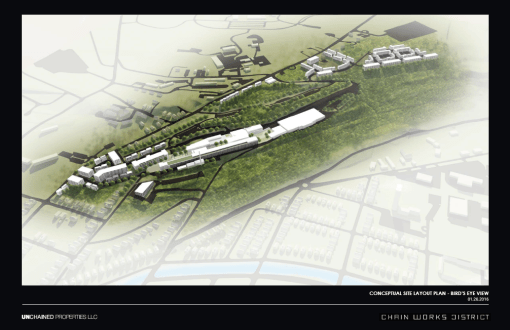
Project Description: The proposed Chain Works District seeks to redevelop and rehabilitate the +/-800,000 sf former Morse Chain/Emerson Power Transmission facility, located on a 95-acre parcel traversing the City and Town of Ithaca’s municipal boundary. The applicant has applied for a Planned Unit Development (PUD) for development of a mixed-use district, which includes residential, commercial, office, and manufacturing. The site’s redevelopment would bridge South Hill and Downtown Ithaca, the Town and the City of Ithaca, by providing multiple intermodal access routes including a highly-desired trail connection. The project will be completed in multiple phases over a period of several years with the initial phases involving the redevelopment of the existing structures. Current redevelopment of this property will focus on retrofitting existing buildings and infrastructure for new uses. Using the existing structures, residential, commercial, studio workspaces, and office development are proposed to be predominantly within the City of Ithaca, while manufacturing will be within both the Town and City of Ithaca. Project materials are available for download from the City website: http://www.cityofithaca.org/DocumentCenter/Index/119

Hey, they’re starting to include documentation links in the agenda descriptions now! Most of the town’s comments are minor modifications and a possible correction on one of the traffic lane analyses. There’s a boatload of paperwork to dig through, so this meeting is just a chance for the planning board to look at the town’s comments, digest some of the supplemental files, and make sure there are no red flags or major concerns within that subset of information.
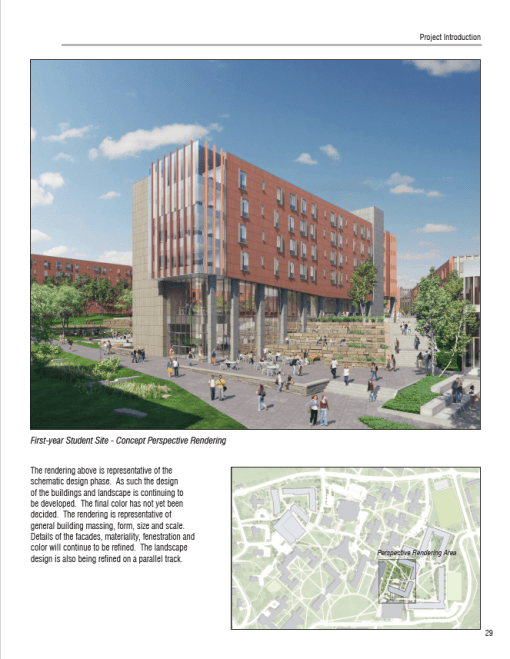
B. Project: North Campus Residential Expansion (NCRE) 7:20
Location: Cornell University Campus
Applicant: Trowbridge Wolf Michaels for Cornell University
Actions: Determination of Environmental Significance
Project Description: The applicant proposes to construct two residential complexes (one for sophomores and the other for freshmen) on two sites on North Campus. The sophomore site will have four residential buildings with 800 new beds and associated program space totaling 299,900 SF and a 59,700 SF, 1,200-seat, dining facility. The sophomore site is mainly in the City of Ithaca with a small portion in the Village of Cayuga Heights; however, all buildings are in the City. The freshman site will have three new residential buildings (each spanning the City and Town line) with a total of 401,200 SF and 1,200 new beds and associated program space – 223,400 of which is in the City, and 177,800 of which is in the Town. The buildings will be between two and six stories using a modern aesthetic. The project is in three zoning districts: the U-I zoning district in the City in which the proposed five stories and 55 feet are allowed; the Low Density Residential District (LDR) in the Town which allows for the proposed two-story residence halls (with a special permit); and the Multiple Housing District within Cayuga Heights in which no buildings are proposed. This has been determined to be a Type I Action under the City of Ithaca Environmental Quality Review Ordinance (“CEQRO”) §176-4 B.(1)(b), (h) 4, (i) and (n) and the State Environmental Quality Review Act (“SEQRA”) § 617.4 (b)(5)(iii). Project materials are available for download from the City website: http://www.cityofithaca.org/DocumentCenter/Index/811

This is likely to be the most contentious part of the meeting. The planning staff have conducted their analysis. Some traffic mitigation measures are sought, including circulation and mass transit / multi-modal transit improvements. The city will make sewer system upgrades a stipulation of project approval, and being next to the Cornell Heights Historic District, the board as Lead Agency wants a more sensitive use of materials and material colors, and extensive vegetative screening to be reviewed further before approval. But the most debated component, the energy use impacts, the city feels is effectively mitigated through the proposed measures by the applicant team.

I’m going to raise one point of correction though – the number of beds is going up to 2,079, but the planning staff should note that a campus-owned fraternity house, the former Sigma Alpha Mu building at 10 Sisson Place (the chapter moved to 122 McGraw Place), is coming down to make way for the project, so the gross number of beds is at least 30 less that that figure.
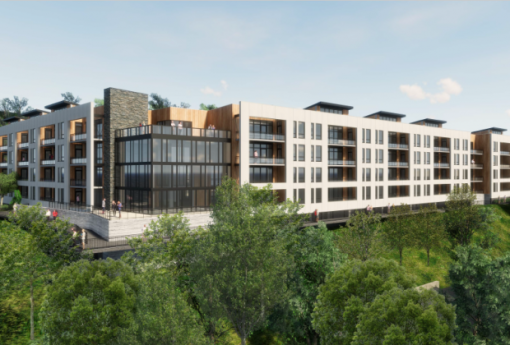
C. Project: Falls Park Apartments (74 Units) 7:50
Location: 121-125 Lake Street
Applicant: IFR Development LLC
Actions: Review of FEAF Part 3 – No Action
Project Description: The applicant proposes to build a 133,000 GSF, four-story apartment building and associated site improvements on the former Gun Hill Factory site. The 74-unit, age-restricted apartment building will be a mix of one- and two-bedroom units and will include 7,440 SF of amenity space and 85 parking spaces (20 surface spaces and 65 covered spaces under the building). Site improvements include an eight-foot wide public walkway located within the dedicated open space on adjacent City Property (as required per agreements established between the City and the property owner in 2007) and is to be constructed by the project sponsor. The project site is currently in the New York State Brownfield Cleanup Program (BCP). Before site development can occur, the applicant is required to remediate the site based on soil cleanup objectives for restricted residential use. A remedial investigation (RI) was recently completed at the site and was submitted to NYSDEC in August 2018. The project is in the R-3a Zoning District and requires multiple variances. This is a Type I Action under the City of Ithaca Environmental Quality Review Ordinance (“CEQRO”) §176-4 B(1) (h)[2], (k) and (n) and the State Environmental Quality Review Act (“SEQRA”) §617-4 (b) (11). Project materials are available for download from the City website: http://www.cityofithaca.org/DocumentCenter/Index/852

Part III of FEAF is the city planner-written review of impacts, proposed mitigations, and whether the lead agency feels the mitigations are appropriate and effective. Some stormwater, remediation plan and other supplemental materials are still needed before a declaration of significance can be made. 

D. Project: New Two-Family Dwellings 8:10
Location: 815-817 N Aurora
Applicant: Stavros Stavropoulos
Actions: Public Hearing
Project Description: The applicant proposes to demolish an existing two-family residential structure and construct two new 1,290 SF two-family dwellings on a 9,590 SF lot. The existing residential building is a legally non-conforming building with a side setback deficiency (2.9 feet instead of the required 5 feet). The proposed redevelopment will include four parking spaces for four three-bedroom apartments. The applicant is requesting the Board’s approval to use the landscaping compliance method for parking arrangement. The project site is located in the R-2b Zoning District and meets all applicable zoning lot and setback requirements. This is an Unlisted Action under the City of Ithaca Environmental Quality Review Ordinance (“CEQRO”) and the State Environmental Quality Review Act (“SEQRA”). Project materials are available for download from the City website: http://www.cityofithaca.org/DocumentCenter/Index/859

City staff were really unhappy about this plan last month, and it was implied that this was one of the examples of “bad” infill that may lead to the new single primary structure overlay. However, barring extreme circumstances (think Maguire at Carpenter Park), review will continue under the current regulations. No new materials appear to have been submitted since the last meeting. 

E. Project: Maguire Ford Lincoln Additions and Improvements 8:30
Location: 370 Elmira Road
Applicant: John Snyder Architects PLLC
Actions: Public Hearing, Potential Determination of Environmental Significance

Project Description: The applicant proposes to demolish a portion of the existing building and construct two additions with updated exterior materials. The existing building is 18,500 GSF, with 2,265 GSF proposed for demolition. The new building will be 24,110 GSF. Site improvements include incorporation of a new pedestrian walking path, and site connections to Wegmans. Approximately 311 parking spaces are proposed to accommodate customer, service parking, employee, and display parking. The project site is located in the SW-2 Zone, is subject to the 2000 Southwest Design Guidelines, and will require a zoning variance for a front yard that exceeds the maximum permissible in the SW-2 district (34 feet maximum permitted, 69-feet 3-inch setback proposed). This is an Unlisted Action under the City of Ithaca Environmental Quality Review Ordinance (“CEQRO”) and the State Environmental Quality Review Act (“SEQRA”); however, it will be treated as a Type I Action for the purpose of environmental review. Project materials are available for download from the City website: http://www.cityofithaca.org/DocumentCenter/Index/860

The revised plans include modified architectural features (more windows, a green wall), and a greater amount of vegetated landscaping to comply with zoning. On-site solar panels are being considered per board recommendation, but the old building was not designed to hold the weight of solar panels. The new wings will be designed to host panels. Heat pumps are being evaluated for some functions, but some of the heavy-duty components like the service bay will likely rely on modified conventional fuel systems. The building will meet or exceed NYS Energy Code requirements.

F. West Hill- Tiny Timbers – Sketch Plan 8:50

This one has been a long time coming. Tiny Timbers bought a 5.45 acre parcel on the south end of Campbell Avenue’s 400 block back in September 2016, and has long planned one of its cluster home developments on the vacant lot. As noted at the time on the blog:

“Dolph et al. are looking to do a similar development to the one in Varna on a 5.45 acre parcel at the south end of the 400 Block of Campbell Avenue, which was noted in a weekly news roundup when it hit the market back for $195k in August 2015. The Journal’s Nick Reynolds touched on it in a through write-up he did earlier this week. The comprehensive plan calls this portion of West Hill low-density residential, less than 10 units per acre. Current zoning is R-1a, 10000 SF minimum lot size with mandatory off-street parking, although maybe a cluster subdivision would come into play here. The Varna property is a little over 6 units per acre. If one assumes a similar density to the Varna project, the ballpark is about 35 units, if sticking to the 10000 SF lot size, then 23 units.

On the one hand, expect some grumbling from neighbors who won’t be thrilled with development at the end of their dead-end street. On the other hand, these small houses are modestly-sized and priced, they’ll be owner-occupied, and if the Varna site is any indication, the landscaping and building design will be aesthetically pleasing.”

G. 112-114 Summit Ave – Sketch Plan 9:10

This one required some fact-checking, because 114 Summit Avenue was the former Cascadilla school dorm that came down last year to make way for the Lux apartment project at 232-236 Dryden Road. A better address for this project might be “238 Dryden”, and the rumor mill says it’s by Visum Development Group, who developed the Lux. Although the exact positioning seems uncertain, the parcel north of the Lux is CR-3 (three floors, 40% lot coverage, parking and houselike features such as gables and porches required), and the remaining adjoining parcels are CR-4 (four floors, 50% lot coverage, no parking required). With student housing experiencing a little more slack in the market lately, it’s not clear if this is student housing, or another use.

7. Old/New Business PRC Meeting Time/ Date 9:30

8. Reports
A. Planning Board Chair
B. BPW Liaison
C. Director of Planning & Development 9:40

9. Adjournment 9:50


South Meadow Square Construction Update, 11/2018

25 11 2018

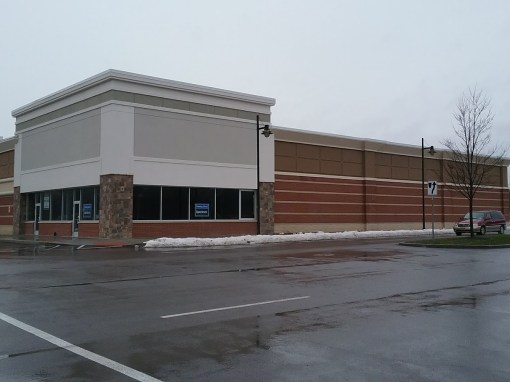
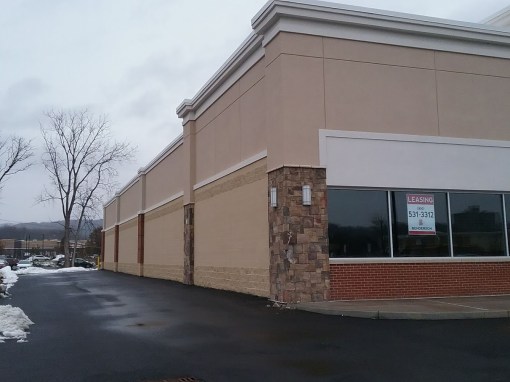
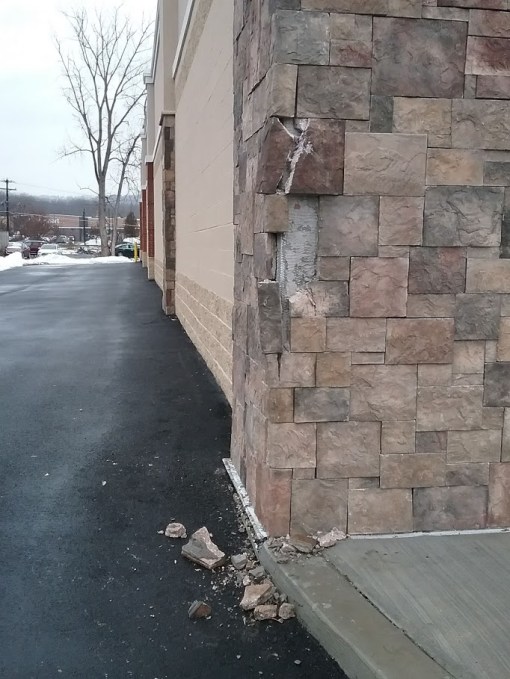
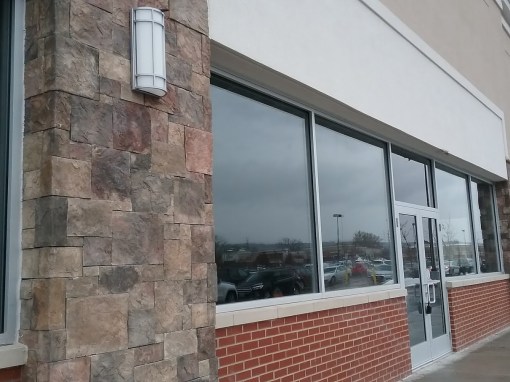
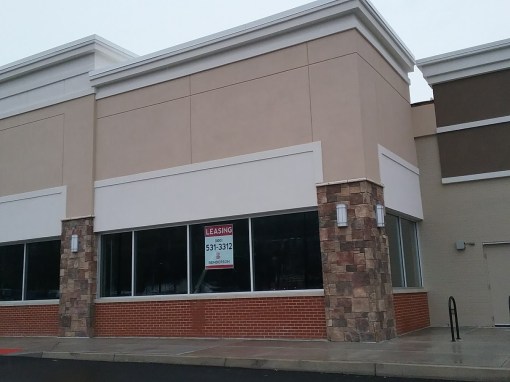
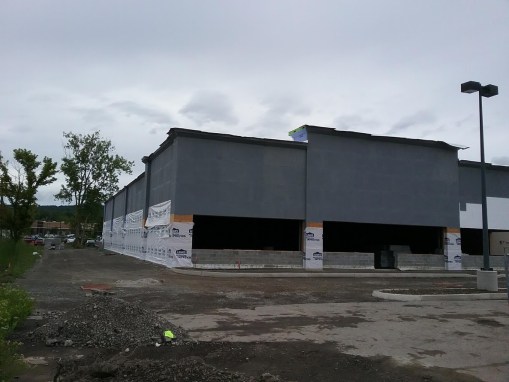
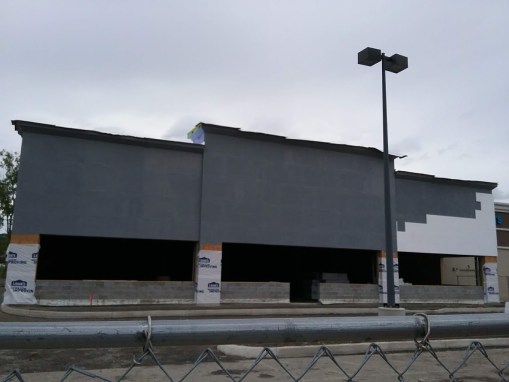
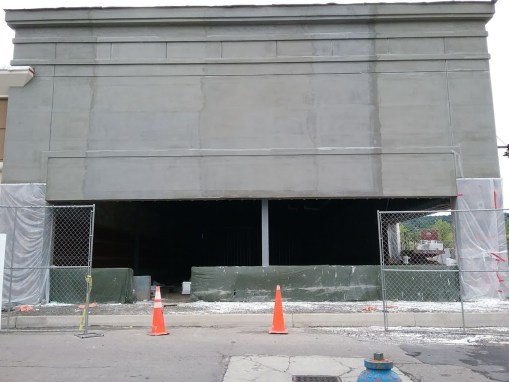
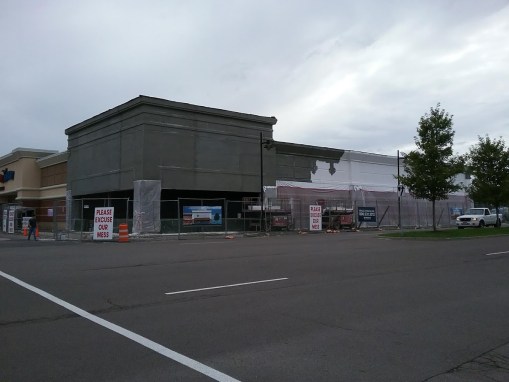
From the outside, these are practically completed, except for some decorative elements. Some exterior lighting mounts are missing from the smaller north endcap, and the south endcap is substantially complete – except for the part where it appears a large truck tried to navigate the tight turn around the building and took out part of the stone veneer, exposing the scratch coat and lath (backing material for the plaster scratch coat). The variety of materials – brick veneer, stone veneer, EIFS and metal flashing/windows attempts to create some visual interest and unique identities among the storefront spaces.

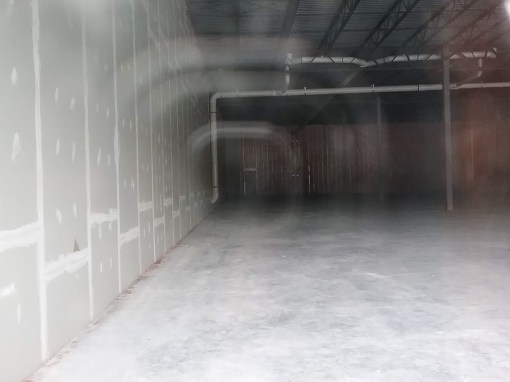
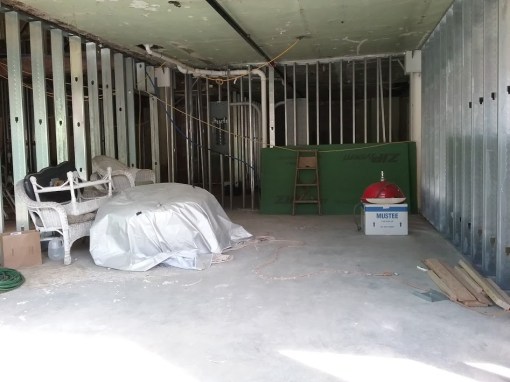
Note that in commercial retail, it’s pretty common to build the exterior (shell) and basic interior structural components (core), but leave the interior unfinished. A tenant interested in the space will fit-out the space to their needs, finishing out and furnishing the interior as they see fit. The costs of fit-out vary depending on the terms negotiated by the landlord (in this case, Benderson Development) and the tenant.

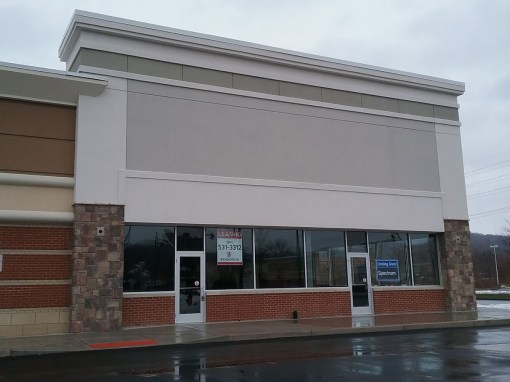
Interestingly, the north endcap, with 7,315 SF of rentable space, has two entrances, but the interior doesn’t show a non-structural split between units, so it’s not clear if it just has two entrances or if it will be two separate retail fronts. Spectrum has confirmed it will be a tenant when the building is fitted out. Spectrum, the cable and internet provider currently located at 519 West State Street, was previously Time Warner Cable until the firm was bought by Charter Communications in 2016. Spectrum and its predecessor are very controversial companies, both for local reasons and for macro-scale reasons (horrendous reputations for poor service, often ranking among the most hated companies in the country). Locally, Spectrum has engendered significant controversy by replacing WSKG, the Binghamton-based PBS affiliate, with WCNY, the Syracuse-based PBS affiliate, for its Tompkins and Cortland County customers. This would be fine, if WCNY had much Ithaca-Cortland coverage, or was interested in providing it, and as a result the local TV news and media coverage has been greatly reduced. For-profit WENY of Elmira had been dropped by Time Warner a couple years earlier, as Ithaca/Tompkins has been increasingly tied into the Syracuse broadcast market.

This drop in coverage led to significant pushback from community groups and local elected officials, and with some negotiating, they were successful in bringing a TV news affiliate back to Ithaca. WENY’s “New York Local Ithaca” opened its doors at 112 West State Street a couple of weeks ago, and is carried on Spectrum’s Channel 11. Most of the broadcast is Elmira rehash with local weather, but Tompkins-centered programs are in the works, including partnerships with Ithaca College and Cornell to provide formal news coverage (how this affect ICTV is unclear).

The north end cap, which clocks in at 14,744 SF, is still available. The 3,200 SF endcap space on the smaller retail strip next to Firehouse Subs has yet to begin construction.


Press Bay Court Construction Update, 9/2018

3 10 2018

Press Bay Court, a project by local businessmen John Guttridge and David Kuckuk d/b/a Urban Core LLC, is moving along at a good clip. In what could be seen as an expansion of Press Bay Alley, the plan reuses a dilapidated 1920s building and renovates it into several small-scale retail spaces, ranging from 320 – 2,200 square-feet. Among them will be Halal Meat and Groceries, One Ring Donuts, Gee June Bridal Shop and Hair • Color • Art. Bramble, an herbal retailer, will move from its Press Bay Alley slot into one of the Press Bay Court storefonts.

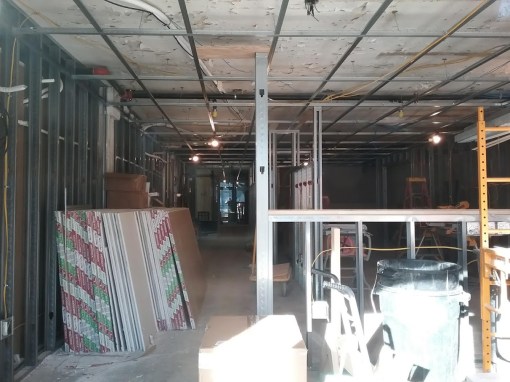
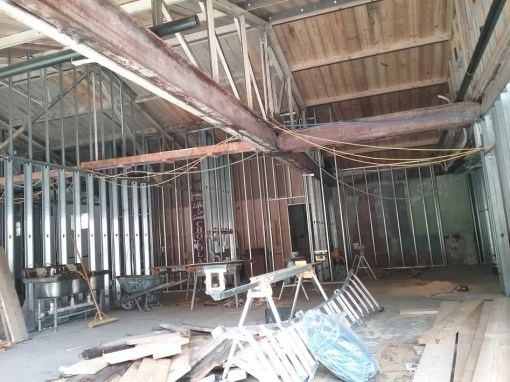
The business websites for Gee June and Hair • Color • Art both indicate October 2018 openings in Press Bay Court (October 16th, in Gee June’s announcement), and there’s a lot of work to be done between now and then. The interior of the building was gutted and new steel stud walls have been erected, as well as fresh gypsum sheathing on the outside. The four second floor one-bedroom apartments are also being renovated, which will be rented at below-market rates (Urban Core is aiming for 75% area median income, which roughly equates to a household salary in the $42,000/year range for a single person, $48,500 for couple). Expansive windows will be installed at ground level to provide a better sense of the activity indoors, and an awning will be erected as the exterior is finished out. The exterior parking lot will be turned into a landscaped pedestrian gathering space for impromptu social events as well as festivals and small concerts or shows.

//www.instagram.com/embed.js


View this post on Instagram


These are going to be the coolest apartments in downtown…

A post shared by PressBayAlley (@pressbayalley) on

//www.instagram.com/embed.js


South Meadow Square Construction Update, 8/2018

6 08 2018

It looks like the new south retail endcap is using a standard EIFS (Exterior Insulation Finishing System) for the exteriors. EIFS, also known as synthetic stucco or by the brand name Dryvit, is a pretty common choice for commercial builds. Readers might remember when it was used with the Holiday Inn Express built a couple of years ago on Elmira Road. Over the plywood there’s a dark grey moisture barrier. This is being overlaid with an adhesive and insulation board, which will then get a reinforcing mesh, base/scratch coat, and a finish coat. Drainage cavities are then built over the barrier to allow water that has penetrated the surface to exit the wall without wrecking it (a big problem with early EIFS systems).  The north endcap looks like it already has insulation boards in place, as well as a base coat for the primary moisture barrier, and a white coat that might be a primer for the finish coat. New curbing, lighting and a fire hydrant have been installed.

Although the south endcap is 14,744 SF, the listing on commercial real estate website Loopnet says there are two spaces, one about 15,000 SF, and a second 3,400 SF. The property doesn’t show a 3,500 SF space, and the north endcap is 7,315 SF, so it’s not clear what that refers to. It could be the 3,200 SF space that is planned for a the pad parcel next to Firehouse Subs, but that hasn’t started yet. If that is the case, however, that implies Benderson Development may have a tenant under contract for the north endcap that they just haven’t yet announced.


News Tidbits 7/21/18

21 07 2018

1.. I rarely check in on Groton, but here’s an interesting little rehabilitation. Back in August 2017, I noted that a historic village church at 113 Church Street was for sale. The buyers last February were David and Delsy DeMatteo, who own and rent out a number of Groton-area properties. The DeMatteos appear to have submitted and received approval for a plan to renovate the structure into a 12-unit apartment building, replacing the religious-turned-commercial space with ten apartment units (two units already exist). From the look of it, the ten new units would consist of eight one-bedroom and two two-bedroom units. The plan was approved in late fall when the DeMatteo likely had a purchase option on the property, and the sale closed on February 8th. Always nice to see new life breathed into a place that played a role in the lives of many.

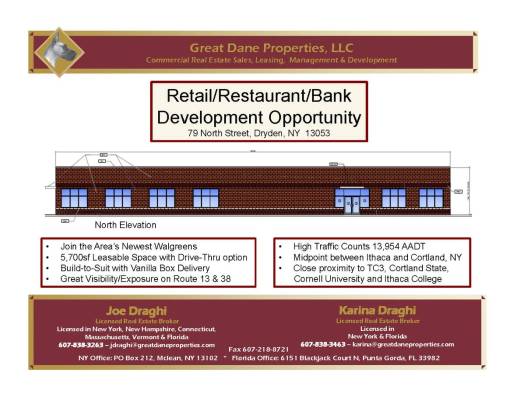
2. Over in Dryden village, the second phase of the new Rite Aid-turned-Walgreens development site is being marketed. Great Dane Properties is touting 5,700 SF of space for lease, with a drive-thru option should one desire it. The spec site plan can be seen here – the render above is likely the north elevation. Early conversations stated a 3,800 SF restaurant space (typical for a fast food /chain coffee shop), 1,900 SF of other retail space, and 33 parking spaces, but the plan is vanilla box, meaning minimally finished interior – it’s a shell with the exterior complete and all the utilities are good to go, but the build-out of fixtures, finishes and partitions is up to the tenant. A second commercial real estate posting suggests a 2019 build-out, though it’s more likely based on the ability to secure a primary tenant.  That listing also floats a hotel as another possible use of the location.

The first post came from Craigslist, which as a matter of personal opinion, that seems a bit unbecoming for high-value commercial listings, and may not effectively reach the target market of business owners and RE corporate development teams. You’re trying to fill 5,700 SF of new retail space, not sell Grandma’s old couch.

3. Also in Dryden, plans for a new veterinary office building at 1650 Hanshaw Road. Existing site plan here, proposed site plan here, elevations here. It’s not a particularly large project – a one-story metal building 4,800 SF in size, with revised landscaping 14 new parking spaces. The new building would go in front of the existing building on the property, so not much in the way of site prep required. The plans are being drawn up and led through review by local architect George Breuhaus.

4. It looks like the gut renovation and expansion of 1020 Craft Road is complete. The $1.88 million project involved taking the existing 10,500 SF car dealership-turned-industrial building, tearing out everything except the support beams, and fully rebuilding the interior along with constructing an additional 4,400 SF of space. Three commercial office spaces were completed, and it appears Cayuga Medical has leased two of the spaces for medical offices. The project was developed and built by Marchuska Brothers Construction of Binghamton.


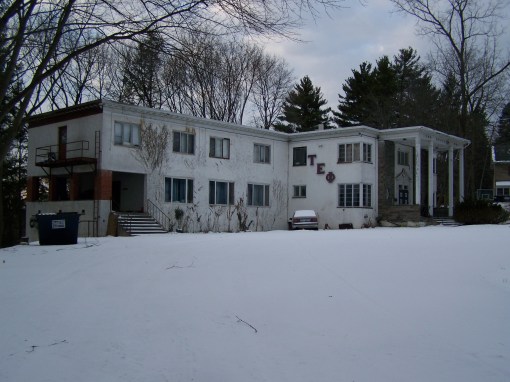
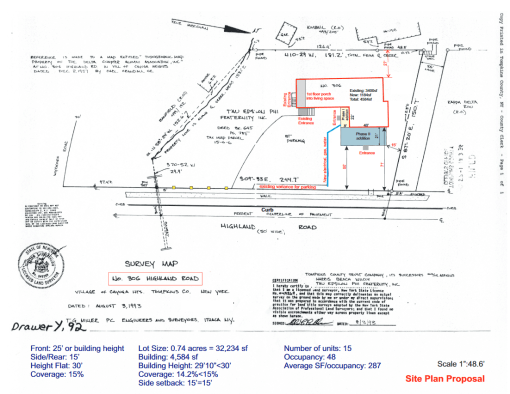
5. Speaking of renovations, it looks like someone is interested in the former Tau Epsilon Phi house at 306 Highland Road in Cayuga Heights. The plans show 15 “units” and potentially up to 48 beds, which sounds like a group living situation, but the plans do not identify the developer. The first phase would involve exterior and interior renovations for 36 beds in the 3,400 SF building, enclosing the side porch and constructing a small addition on the southeast face to create a new entrance. A second phase is shown in the documents that would seek a 1134 SF, 12-bed addition at what is currently the front entrance of the early 1960s building, the east facade. It was previously noted that 306 Highland was for sale for $1.385 million, which was steadily reduced to $1.025 million before being taken off the market at the start of June. The village will begin site plan review of the project at its Planning Board meeting on July 23rd.

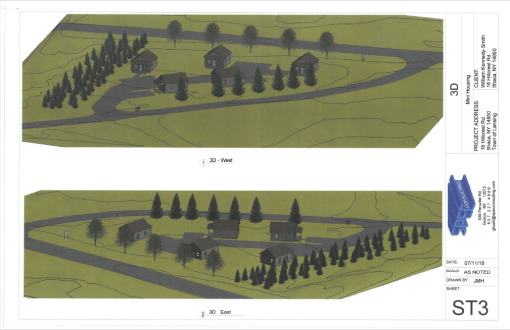
6. On to Lansing. Here’s a little more about the Hillcrest Tiny House project -memo here, application here, drawings by architectural firm SPEC Consulting here,  . The five homes would be built on 16 Hillcrest Road, a parcel split by Hillcrest Road where it intersects with Warren Drive – the developer is the home owner who lives on the other half of the parcel, south of the intersection. The triangular northern piece would host the rather traditional-looking cottages, which would be one-bedroom units, about 450 SF each, and have two parking spaces apiece. The land is zoned industrial/research, which allows commercial and industrial uses – the owners argue that its location on the west side of Warren Road near other residential development along Hillcrest means that a commercial or industrial use would be out of character.

One could make an argument that this is desirable in that their small size would help address the  middle-market for housing demand, which has been lacking in new options, resulting in existing options being pressured upward in price. The project would cost about $200,000 to build and the owner/developer estimates two months to build each cottage, though it’s not clear if construction of each cottage would be concurrent, or one at a time.

Quick side note, Milton Meadows has submitted a construction plan for the new access road in tandem with the town’s realignment of the Woodsedge Drive/Route 34 intersection. Taylor the Builder, the general contractor for the project, is planning for November 2018 – September 2019 for the 72-unit affordable apartment complex.

7. Urban Core LLC has started exterior demolition and reconstruction work for the Press Bay Court project. I’ve been waiting to officially move this into the construction column for a while, could never quite be sure when walking past – the full rundown and description of the project can be found in the October introduction here. To quote part of it:

“What Urban Core’s latest plans would do is expand that “experiential” micro-retail mix eastward towards the corner of Green and Cayuga Streets, the Commons and the downtown core. The parking lot in front of D. P. Dough would be converted into a plaza much like Press Bay Alley’s, and the first floor of 108-110 West Green would be renovated into 5-8 micro-retail units facing the new plaza (the Green Street entrances would be retained), with 320-2200 SF per unit. The second floor would be renovated into four below-market rate one-bedroom apartments with 510-660 SF of living space, and the exterior masonry would be cleaned and repaired. The hawk mural will be preserved. New signage, bike infrastructure, curbing, sidewalks and a parklet are included in the plans. The total square footage in phase two is about 9,000 SF.”

8. 105 Dearborn has received a construction loan to move forward. The 10,930 SF, 12-bedroom, 16-person high-end skilled care facility will cost $4.2 million to build according to the loan filed this Friday the 20th, and over the next year it’ll slowly take form on what is now a vacant corner in leafy Cornell Heights. Bridges Cornell Heights will run the facility, and add a handful of news jobs as a result of the new addition. Tompkins Trust Company is the lender, and the historically-inspired design was penned by Rochester-based Bero Architecture.

7. Looks like a fairly interesting monthly meeting ahead for the Ithaca City Planning Board. Here’s the agenda:

1. Agenda Review 6:00
2. Privilege of the Floor 6:01

3. Subdivision Review

A. Project: Minor Subdivision 6:15
Location: 508-512 Edgewood Place
Actions: Determination of Environmental Significance – Consideration of Preliminary and Final Approval

This subdivision at the end of a private street in the East Hill neighborhood would re-subdivide a double lot that had been consolidated after the original house burnt down in the late 1930s. Any news structure on the newly created .326 acre lot would be subject to Ithaca Landmarks Preservation Commission design review. No specific plans are on file.

4. Site Plan Review

A. Project: Stewart Park Inclusive Playground 6:30
Location: Stewart Park
Applicant: Rick Manning for the City of Ithaca
Actions: Consideration of Project Changes

Project Description: The project was approved by the Planning Board on March 27, 2018. The applicant is now requesting project changes, including relocation and redesign of the bathrooms and parking area, and layout and programming changes to the overall playground.

The bathroom building was to be combined with a pavilion, but that proved to be expensive and the playground architects had bad experiences with the original structural supplier, so local architecture firm STREAM Collaborative stepped in to design a separate 24′ x 24′ bathroom building with utility rooms and storage space. The pre-school playground and sand garden were moved, the splash pad tweaked, some swings were added and the adult wellness area was deleted for this initial buildout.

B. Project: Minor Subdivision & Construction of a Duplex 6:45
Location: 209 Hudson Street
Applicant: Jagat Sharma, architect, for Bia Stavropoulos, owner
Actions: Determination of Environmental Significance

Touched on this one a couple of weeks ago – the project was revised from two duplexes to just one, with three bedrooms per unit. Even development-averse councilwoman Cynthia Brock offered support for the plan (with minor aesthetic tweaks), which is about as good as one can hope for a green light to proceed. Note no approvals are planned because this has to go to the Board of Zoning Appeals for a lot size variance.

C. Project: Major Subdivision (3 Lots), Two Duplexes, One Single Family Home & Site Improvements 7:00
Location: 128 West Falls Street
Applicant: Ron Ronsvalle
Actions: Consideration of Preliminary and Final Subdivision Approval and Site Plan Approval

BZA gave Ronsvalle’s five-unit rental project in Fall Creek the all-clear. This project came up earlier this month in a previous news roundup – a five-unit infill project in Fall Creek, originally approved in February 2015, and revived now that the developer has found a way to continue working after a debilitating accident. Don’t foresee any issues here.

D. Project: North Campus Residential Initiative (NCRI)
Location: Cornell University Campus
Applicant: Trowbridge Wolf Michaels Landscape Architecture on behalf of Cornell
Actions: Intent to Declare Lead Agency

This will be huge – 766,000 SF of space for 2,000 student dormitory beds and associated program space, including a 1,200 seat dining hall. I’ll have more coverage next week. John Novarr favorite ikon.5 is the project architect.

E. Hudson Street Townhomes – 117-119 Coddington Road –Sketch Plan 7:50
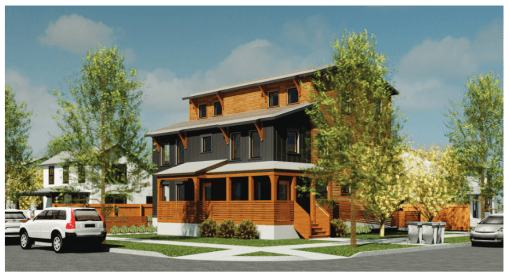
One of this week’s new shinies. This project appears to be slated for a parking between two apartment complexes and across the street from the Elks Lodge just north of Ithaca College’s campus. Depending on how they reconfigure the existing parking lot, they could do a high single-digit or low double-digit number of townhomes. Zoning here is R-3b. Up to four floors/40 feet, 40% lot coverage, one parking space per unit of per three bedrooms (two spaces for 4-5 bed units). Lot coverage may end up being based on a subdivision, since this falls into the South Hill Zoning Overlay and no additional primary structures are allowed on a lot. The property has been owned by the Dennis family since 1979, but the developer may be someone else with a purchase deal on the subdivided lot.

F. Falls Park Project – 121-125 Lake Street – Sketch Plan 8:05

This would be whatever Travis Hyde Properties is planning for the former Ithaca Gun site on Gun Hill. I have been told this is “substantially different” from the earlier Ithaca Falls Residences plan. Assume residential. This was rezoned R-3a not long back, up to four floors/40 feet, 35% lot coverage, one parking space per unit of per three bedrooms (two spaces for 4-5 bed units). I would expect a fair number of units for a 1.42 acre property; the IFR plan was 45 units.
5. Zoning Appeals 8:10
#3102, 209 Hudson St., Area Variance
#3103, 216 University Ave., Area Variance
#3104, 737 Willow Ave., Area Variance