News Tidbits 3/12/17: Affordable Housing Week 2017

13 03 2017

It’s been a busy week. Let’s start by reviewing some of the entrants for the city’s affordable housing funds.

The Ithaca Urban Renewal Agency will be holding public hearings on March 16th and 23rd as part of the process to determine who will receive money from the Housing and Urban Development (HUD) grants awarded to the city. The 25 applicants, same number as last year, range from jobs training to community services to the development of affordable housing. All summed up, there’s $1.982 million requested, and $1.149 million available; that’s up from $1.85 million requested in 2016, with $1.54 million available (about $273,900 of that came from the returned funding for INHS’s cancelled project at 402 South Cayuga Street). In fact, the amount of money available is the lowest it’s been in a few years – in 2015, $1.78 million was requested out of $1.215 million available, just a little over two-thirds of the total. With the increasing requests, the chances for funding have gone down this year.

Without discounting the value of the other applications, the focus here will be on the real estate development projects. For the record, writing about a project is neither an endorsement or opposition from this blog.
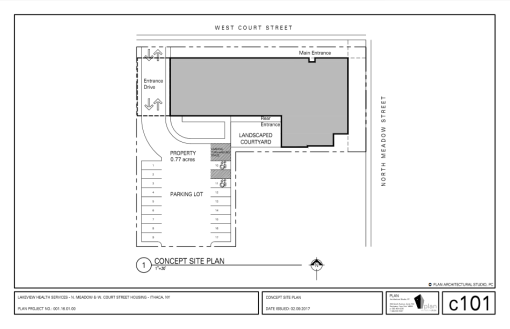
1. The big new proposal coming out this year appears to be Lakeview Health Service’s plan for the corner of North Meadow and West Court Streets on the city’s West End. I expanded on the basics in a Voice article here, but for the blog’s sake, we’ll take a look at the finances.

In terms of leverage, it’s a pretty big project – a request of $250,000 towards a $20,081,186 project. However, keep in mind this project is only eligible for HOME funds and not CDBG (Federal Community Development Block Grants), and the city only has $295,245 in HOME funds to work with after overhead is taken into account – this is a pretty substantial request for something still in the conceptual stages.

The project fills a substantial by providing 50 units of affordable rental housing, all 1-bedroom units, in a 5-story building. Not only that, but half of those units would be set aside for those living with psychiatric disabilities. Ten of the general housing units would be available to those making 50-60% of area median income (AMI, about $27-$32k), with the other 40 going for less than or equal to 50% AMI. Those units will be interspersed with the general affordable housing. The special needs residents will be considered case-by-case; it’s for those who are generally independent, but may need assistance in stressful or difficult times. Lakeview will maintain an office on the first floor that will be staffed 24/7.

Some retail space will also be available on the first floor, which helps to cover the operational expenses, and meets the city’s goal of a more dense and vibrant West End. 17 parking spaces will be provided, so it’s expected the residents will utilize bikes and mass transit. The design will be slab-on-grade, with a deep foundation – soil in this part of the city is poor due to the high water table, so projects either have to be one or two floors with slab foundations, or they have to build enough floors to accommodate the costs of driving piles into the ground, in this case 80 feet down. This is something to keep in mind with the waterfront rezoning, as the soils are pretty similar.

The pro-forma assumes $730,300 in income in the first year after vacancies are noted, and about $313,500 in expenses, leaving a little over $416,800 for debt service. Everything goes up a little bit each subsequent year for inflation. The debt service is scheduled to last for 50 years.
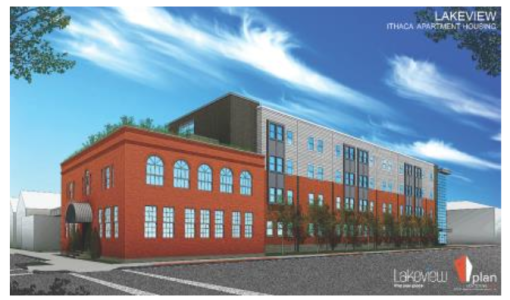
Rochester’s PLAN Architectural Studios is the architect, so expect a modern design not unlike the cancelled concept plan for the Elmira Savings Bank site on West State and Meadow. The preliminary floor plan suggests the retail will face West Court Street rather than the Meadow/13 corridor.

As with many affordable projects, this one has a rather extended schedule due to the need to compete for public grants in tandem with private loans – funding applications are being submitted this year with loan awards during 2018, including the IURA’s. Construction would be from October 2018 to April 2020, with rent-up shortly thereafter. It’s odd to think this likely won’t even show up in the 2020 census, but we’re starting to get that far into the decade.
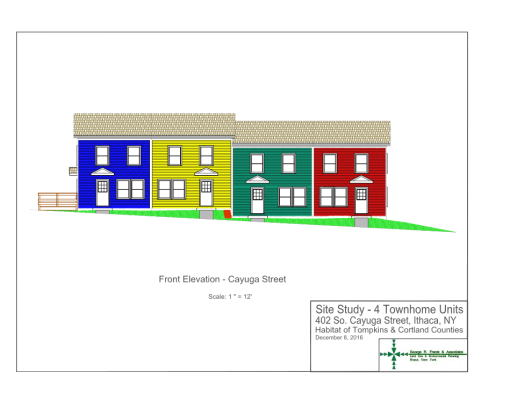
2. Meanwhile, Habitat for Humanity is continuing to move forward with their 4-unit townhouse plan at 402 South Cayuga. The non-profit has agreed to purchase the land from the city for $32,000, a below-market price that the city is fine with accepting, given Habitat’s plans for 4 owner-occupied affordable townhomes for those making 30-60% area median income (AMI). They are requesting $80,000 towards the $270,000 cost. It appears that Habitat’s splitting it into two phases, two units in each – given the small size of their organization, it’s a sensible approach. $540,000 for ~5200 SF of units is also quite a deal, at about $104/SF, about half the cost of an INHS project. Habitat does have volunteer labor that it can utilize.
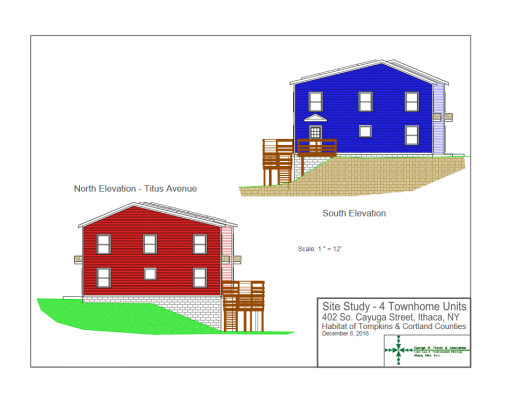
Habitat is hoping to parlay the Morris Avenue two-family they’re doing later this year into sustained interest and funding for Cayuga Street – attracting donors with one city project, who might be interested in donating time and dollars to the next one. Like with Lakeview, construction is likely on a 2018-2020 timeframe. They’re also only eligible for HOME funds, so either Lakeview or Habitat will not be getting their full request, possibly both.
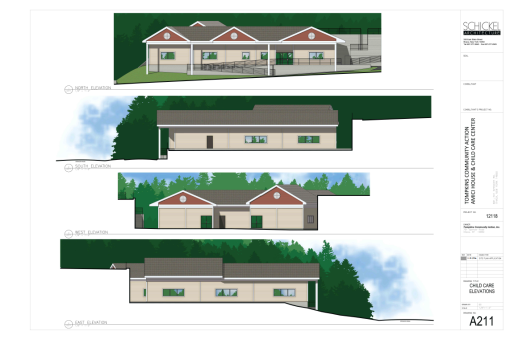
3. On the economic development side, TCAction is requesting $84,200 towards their $8.25 million childcare center at 661-665 Spencer Road. The project is part of the Amici House plan and was approved by the city concurrently, but technically separate from the 23 units of vulnerable youth housing being provided next door.

Named for a late, long-time TCAction employee Harriet Giannelis, the project helps fund the site acquisition – one of the land parcels is owned by the county, and TCAction has a $184,000 purchase lease-back agreement (the county bought the land from a private owner, and they’re currently leasing it to TCAction), which will be paid off partly with the IURA funds. The new 7,010 SF childcare center will provide daycare and early-education programs (Head Start) to 40 low-income children. Although promising three new jobs in the application, TCAction expects 21 Full-time equivalent positions to be created. It’s easier to provide an employee’s lifetime income documentation for 3 staff vs. 21. Welliver will be the project contractor, so expect local union labor.

Most of the other funds come from county, state and federal grants – another $500,000 comes from a loan with M&T Bank.
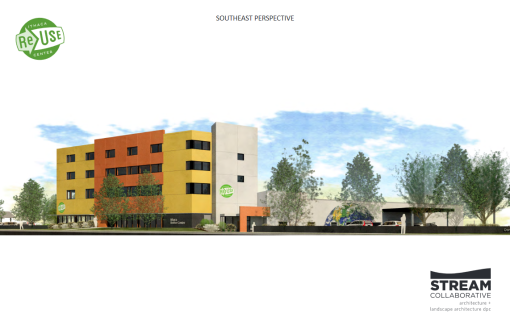
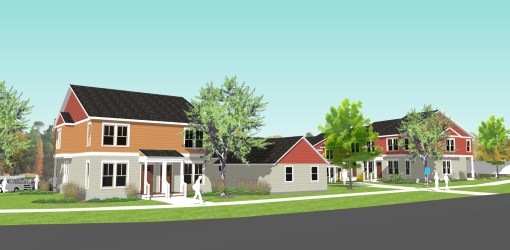
4. Also on the economic side is Finger Lakes Re-Use’s expansion plan at 214 Old Elmira Road. the non-profit has refined their plans for a new mixed-use expansion, and plans to start the city’s formal project review process later this month. Some of the numbers have been tweaked a little bit, but the basic components are the same – Finger Lakes ReUse would work with Tompkins Community Action (TCAction) to bring a new 4-story, 26,100 square-foot (SF) building to FLR’s property at 214 Old Elmira Road. The first floor would expand FLR’s retail operation, while the upper floors would provide office space for FLR, and 22 units of transitional housing for formerly homeless individuals. Plans also call for an 8,100 SF warehouse for salvaged lumber/wood, and a 600 SF pavilion. 79 parking spaces are included in the project.
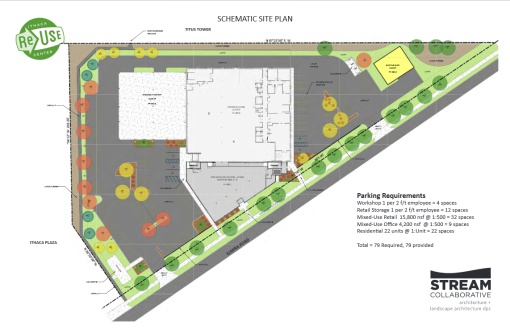
As with TCAction’s Giannelis Center, 9 FTE jobs are expected to be created by the $10 million project, but FLR promises to provide previous income documentation for 3. The monetary request from the CDBG funds is $100,000, and they will also be using Welliver. Welliver seems to be the safe choice when a developer wants subcontracted or direct local union labor.

The application states the $100k is going towards site acquisition, which I’m not fully following since they own the property and it doesn’t appear any new property is to be acquired. Perhaps the site has legal stipulations that have to be bought away? It’s not totally clear.

If I can be an architecture critic for a moment, I like the warm colors, but that largely blank east stairwell is kinda bleak. Maybe use those orange panels on that as well? Or another warm color?

Anyway, we’ll find what the IURA thinks; funding will be determined by the end of April, and formally awarded in June after the city’s Planning Committee signs off on the disbursement.



News Tidbits 3/4/17: Oh Hey, Tax Season

4 03 2017

20170217_155759

1. It’s that time of the year where the Tompkins County Department of Assessment goes through its assessment process in preparation for adjustments to property values for 2017, known as “Annual Equity Maintenance”, or AEM for short. Since there are 35,249 tax parcels in Tompkins County with a total value of $11.9 billion, not all are reassessed every year – most places are reassessed every three years, except for areas of rapid change (for instance, Fall Creek is every two years at present), or individual properties that are being undergoing change, whether it be a new construction, sudden property damage, or a sales transaction. The state has their own system, called Cyclical Reassessment Program (CRP, but the county docs refer to it as CRAP), but the county opts out to do their own valuations.

Some properties are easier than others – for example, a purchaser of a big-box property isn’t buying just the building, but a long-term lease from a tenant like BJ’s in Lansing. Student houses in parts of Collegetown are worth less than the property they sit on, which the tax system cannot accommodate. They provide one example of a $500,000 house sitting on $3 million of land – that’s not something the tax system is designed to handle, so the house is overvalued, but the property as a whole is very undervalued.

The department notes that sales were strong this year. According to their records, average sales are up 4.5% from $228,442 to $238,796, and the median sale is up 2.5%, from $200,000 to $205,000. The document also only notes 677 sales, which would be the lowest since before 1990, and is lower than the 681 sales noted by the Ithaca Board of Realtors (and IBR represents most but not all agencies). Someone is mistaken, it’s just hard to tell who. Assessments are on average about 8% lower (9% median) than home sale prices.

Some of the other takeaways are a modest softening in the student housing market in 2016 (Cornell enrollment in Ithaca did drop slightly from 2015-16, before renewing its upward trajectory in 2017), the city and Dryden’s Ellis Hollow continue to be strong markets but the other suburban neighborhoods are regaining interest, and Groton’s a mixed bag due to the poor state of some village properties. New assessments for 2017 (including parts of Ithaca town, Caroline, Freeville, Enfield, lakeside properties, restaurant properties, and manufacturing facilities) will be publicly available on July 1st.

schwartz_plaza_final

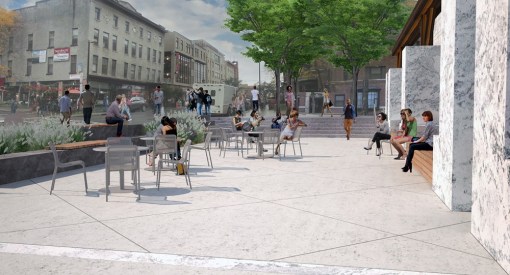
2. The redesign of Schwartz Plaza has started the formal review process. Cornell submitted the sketch plan at the February meeting, and hopes to have approvals for the renovation by next month. The properties would lose the walls and open up to the surrounding Collegetown, in what Cornell and Ithaca hope will give the densely-populated neighborhood a needed public gathering space. As reported by the Cornell Daily Sun’s Nick Bogel-Burroughs, project manager David Cutter hopes that the project leads to further public space enhancements near the stone arch bridge and down by Eddygate – this includes additional pedestrian and bike facilities, electronic boards with bus information, and a possible realignment of the Oak/College intersection into a T-configuration.

But for now the focus is on Schwartz Plaza. Cornell intends to have approvals within 1-2 months, start construction in June, and have the new plaza ready by August 2017. Trowbridge Wolf Michaels Landscape Architects is the design firm of record.

Postscript, Novarr’s townhouses at 238 Linden were pulled from the meeting before the sketch plan was due to be presented at the city planning board meeting last Tuesday. As for 301 Eddy, still trying to dig up information.

330_college

3. Nick Reynolds has a very interesting profile and interview of Jason Fane over at the Times. Definitely worth a read about one of Ithaca’s most prominent landlords.

Speaking personally, I’ve got mixed feelings about it, if only because it takes a blog quote I made about 330 College Avenue in 2014, and in the article’s context, I sound like an arthouse snob. Fane has always been serious about building on the property, and that’s great, but I stand by my quote on 330 – after the years of negotiations on the new form district code, there is no way a 12-story building was going to be built on the corner of College and Dryden, even if Jagat Sharma, Fane’s favored architect, brought his A-game. It’s not a matter of economics or taste, it’s a matter of very real opposition from the Belle Sherman and East Hill neighborhoods. Any politician who considers signing off would be voted out of office ASAP. Any city staffer who consents will be shown the door. Look at what happened with State Street Triangle. In a city where people have many gripes about development, this is one project that is truly stopped in its tracks. I think Fane could negotiate 7 or even 8 stories if he gives the city a donation towards affordable housing, or some other community benefit. but not 11 or 12.

I like grand buildings and imposing structures, but I’m also a realist. End rant.

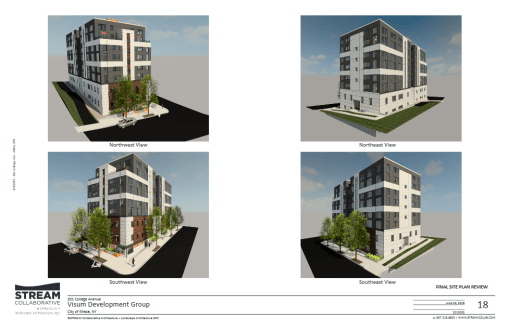
4. Todd Fox’s Visum Development has a couple construction updates on their Facebook page. Exterior stud walls are being installed on the lower floors of 201 College, and two of the three townhouse strings at 902 Dryden Road have been fully framed and sheathed, with siding installation underway. At a glance, it looks like the exterior will look more like the elevations on Modern Living Rentals’ listings page rather than the STREAM Collaborative renders – the renders had horizontal lap siding, the elevations show vertical lap siding as seen above.

If more developer could post updates as Visum and Carina Construction do, that would be swell.

sleep_inn_v3_1

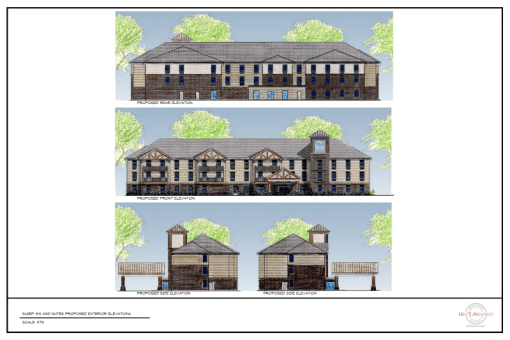
5. Wrapping up a quiet news week, here’s the agenda for the town of Ithaca planning board next week. A lot subdivision for a new house, a pair of communication towers, and the final approvals for the Sleep Inn proposed by hotelier Pratik Ahir at 635 Elmira Road. True to the sketches presented last fall, the design has that rustic look on all sides of the structure, and all the town’s requests have been met, which should allow for a smooth final approval meeting on Tuesday. The design will be unique among the 320 locations of the Sleep Inn chain. It should be noted that the town’s Zoning Board of Appeals was very split on the height and size variances, approving them with just a 3-2 margin.

In the other towns, the only one with anything new to report is Danby, whose planning board is looking at a special use permit for a property management company’s offices at 1429 Danby Road, and a 3,535 SF expansion to the Ithaca Waldorf School at 20 Nelson Road.


201 College Avenue Construction Update, 2/2017

2 03 2017

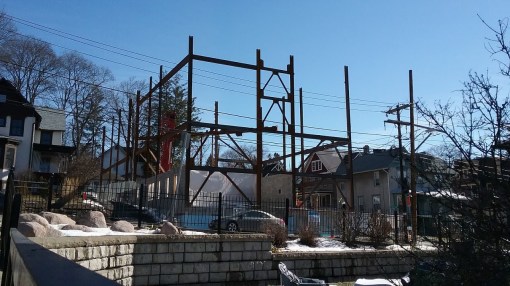
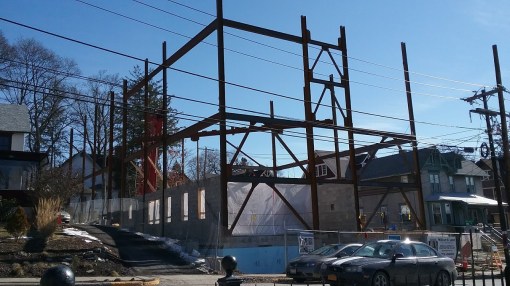
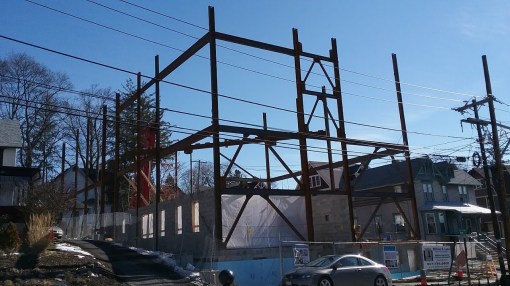
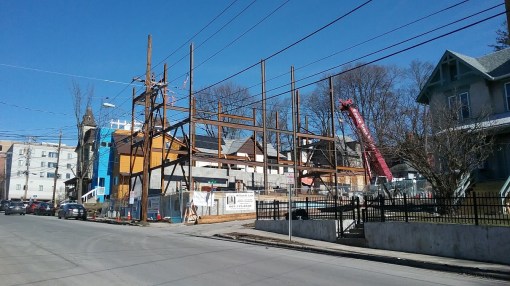
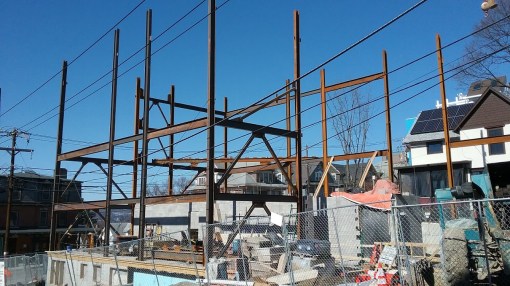
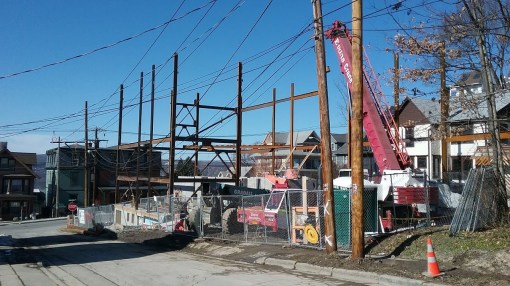
201 College Avenue is reaching for the sky – when these photos were taken about a week and half ago, the structural steel was as high as the third floor, so there’s still two more floors to be boxed out by the H-beams. Although only five floors, the mezzanine-approach to maximizing square footage means that the units on the third through fifth floors are quite tall, 16 feet from sub-floor to sub-floor, 70 feet for the whole building.

The basement level, which only occupies the west half of the building (the east half is slab-on-grade) has been fleshed out with reinforced concrete walls – the windows on the street corner will look into a gym and game room, while the two pocket windows on the northwest corner will look into the mechanical room. The blue boards on the concrete are rigid styrofoam panels used for insulation and moisture protection.

It looks like some wall framing is underway on the first floor for the three-bedroom units – those CMU walls face the stairwell, and the exterior walls of the building itself. The interior unit walls will likely be a more typical lightweight steel frame.

There’s been some documentation floating around that suggests an early working name for 201 College Avenue was “The Heustis Lofts”, Heustis (sometimes Huestis) Street being the original name of College Avenue. However, it doesn’t seem the moniker was officially adopted.
20170218_115452 20170218_115504 20170218_115509 20170218_115538 20170218_115559 20170218_115623 20170218_115712 20170218_115735 20170218_115747 20170218_115756 20170218_115802

201_college_v5_1


209-215 Dryden Road Construction Update, 2/2017

1 03 2017

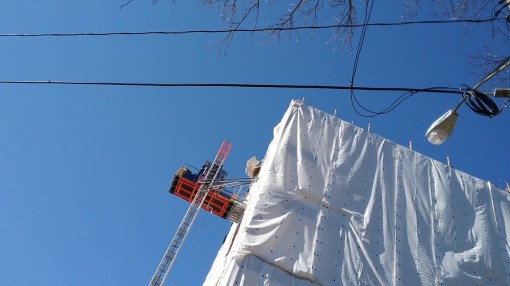
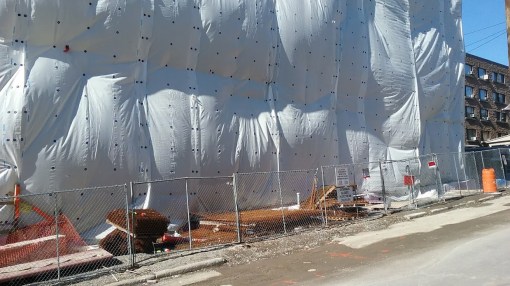
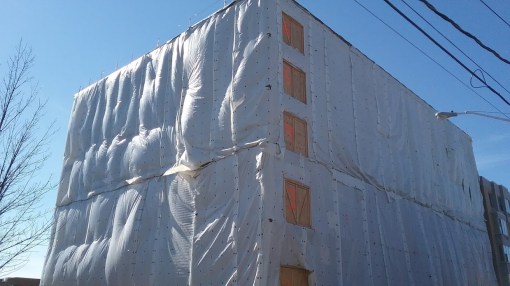
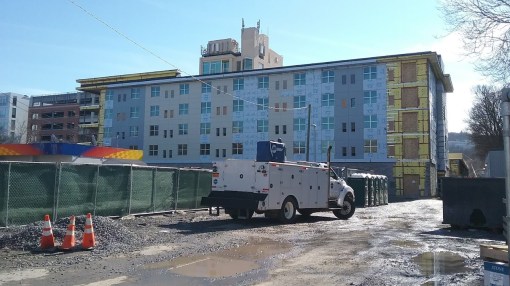
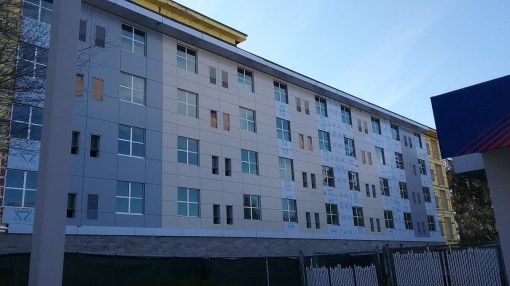
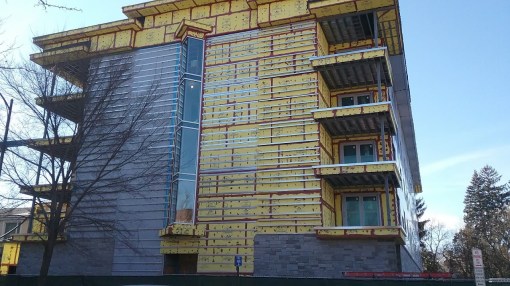
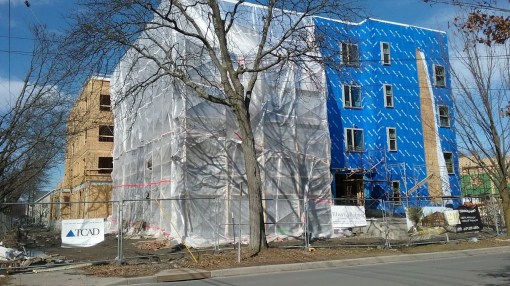
Admittedly, when the entire building is sealed up in opaque plastic covers, it makes for a less-than-interesting construction update. The plywood doors are for the loading and unloading of materials via lifts, and apart from those, there isn’t much to break up the monotony of white plastic sheets. Note that the access doors are not the same as the elevator shaft, which is located about midway along the west wall next to 205 Dryden/Dryden South.

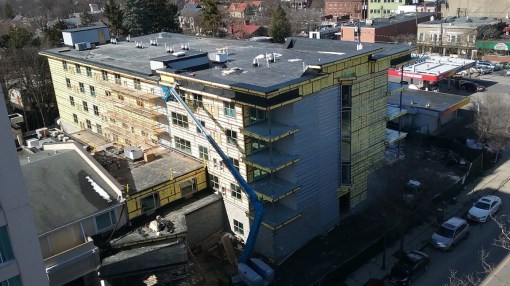
However, it does look like some exterior facade work is starting to get underway. Brown and grey metal panels are beginning to be installed on the building’s rear face – this is the side that will have the least amount of glass, as occupants won’t have much to see if developer John Novarr moves forward with his plans for townhomes on the double-lot of a house that came down to allow a construction staging area for the Breazzano Center. With the new home to the Executive MBA expected to open up this Spring, Novarr can proceed with options for that double-lot. 238 Linden is zoned CR-4, four floors with no required parking. The proposed townhouses could provide a visual transition between the 80-foot Breazzano and the 2.5 story houses that comprise most of the housing stock on this block of Linden Avenue, some of which are for pending sale.

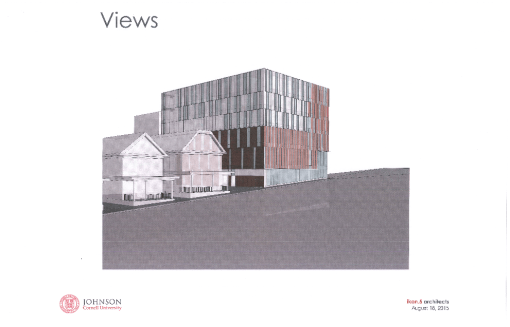
In further detail, the rear facade windows are 1″ insulated glass with aluminum frames, and translucent insulated spandrel glass below the panes. The metal panels are insulated aluminum and are installed using a framing system – you can see the grey insulated panels with clips along the top edge of the panels. The plastic covers on the panels are to protect against scratches and scuffs prior to installation. ikon.5 sought to provide differentiation with mahogany brown panels on the south (Linden Avenue) side, with lighter salmon-peach panels planned for the north (Dryden Road). The west and east sides will be a little bit of of both. The first floor the street facing sides, and the atrium will be glass curtain walls. The dark panels are intended “to differentiate upper from lower and facilitate a relationship with the smaller scale of adjacent buildings,” per the application. Some of the later documents show a lighter shade of gray for the south side of the top floors, but to be frank, I am uncertain what is accurate.

Note that the fourth floor’s back side will have few windows because that is where the 1,990 SF video production studio will be located, and this requires a controlled-light environment. Presumably, with the green room and studio rooms, the intent is to have a comfortable and efficient interview space for live videos recorded for or streamed to students at remote campuses. The large flank of plywood panels at ground level is the service exit, with future loading dock and trash/recyclables enclosure.

20170218_120030 20170218_120120 20170218_120144 20170218_120149 20170218_120207 20170218_120254 20170218_120309 20170218_120351 20170218_120401 20170218_120408 20170218_120535

209_215_2

209_215_3


News Tidbits 2/25/17: Creating a Place to Call Home

25 02 2017

is2r5l9l9byvab0000000000
1. It looks like the homes designed for Tiny Timbers won’t just be limited to Tiny Timbers. The company has partnered with realtor Brent Katzmann for a to-be-built house in Lansing’s Farm Pond Circle housing development touts a Tiny Timbers-based home design by STREAM Collaborative. 1.09 acres and a 2 bed, 2 bath 1,430 SF house for $219,400. The relatively low price compared to most new builds is in part due to Tiny Timbers’ modular approach – the “Big Cube” retails for $156,900 with a finished basement, and the Farm Pond parcels go for $39k-$45k, so not counting the soft costs (permits/marketing), that pretty much sums up the costs.

Farm Pond Circle is a 19-lot subdivision in Lansing town that was the brainchild of the late Jack Jensen. All homes have to exceed state energy code by 20%, cannot exceed 2600 SF, and cannot use aluminum or vinyl siding. A couple lots have been aside for affordable single-family home construction. After Jensen’s passing in 2014, another local homebuilder, Bruno Schickel (Boiceville Cottages), picked up the undeveloped lots (10 of the 19) for about $165k last February, and intends to follow through on Jensen’s plans.

tiny_tims_7

2. Speaking of Tiny Timbers, it appears the budding modular timber-frame builder is expanding their offerings into a full line of homes. Tiny Timbers now has 16 different models in five series. Prices range from a completed 600 SF model with no basement at $109,900, to a 1,950 SF model with finished basement at $197,900, land and well/septic not included.

In a blog post on their website, Caleb Dolph, builder Buzz Dolph’s son and the guy in charge of marketing, says that the first sold house is underway in Hector (if Ithaca had exurban areas, Hector would be it), at least five others are in contract, though it’s not clear if any of those are for the 15-lot Varna site. Given that they planned for ten houses in 2017, the Tiny Timbers staff might have underestimated the market, which is more a fortunate challenge than a complaint.

3. A local non-profit is looking to expand its real estate footprint a little bit. Tompkins County Opportunities, Alternatives, and Resources (OAR) is seeking to buy a run-down house at 626 West Buffalo Street and renovate it into five beds of transitional housing for those getting out of jail and trying to get back on their feet. The intent is to provide, safe, secure housing to better help with the transition process, which can include education, job training and mental health and/or addiction treatment. The county would provide $100,000 in a one-time allotment – the house is for sale for $99,999, the purchase offer is for $95,000, and a further $60,000 would be spent on renovations. The rest of the money ($55,000) comes from grants, donations and a mortgage. Ultimately, the goal is to provide decent housing that helps reduce the recidivism rate (convicted persons committing more crimes), ideally saving the county on future court and incarceration costs, as well as what they hope pans out to a lower crime rate.

swd_websitelogo

4. Staying on the topic of special needs housing, the Second Wind Cottages is looking to add another three cottages in Newfield this year. The cottages are modest, ~200 SF and costing $12-$15k each to build. As reported by the Times’ Jaime Cone, every unit provides shelter to a formerly homeless male. Rents are “pay as you can”. A small community facility provides services like a kitchenette, office, washer and dryer. Three more cottages are planned for 2018, which will round out the “campus” with 18 units. A similar facility is planned up the road, one that will house homeless women and children. Although Newfield is a ways out, both sites are on the bus line into Ithaca.

The Second Wind Cottages are a private endeavor by businessman Carmen Guidi, and paid for through grants, fundraisers, and donations (money, furniture, etc). Volunteer labor similar to that used for Habitat for Humanity is utilized and welcomed. Like with the OAR house, by providing a safe, warm space to live, these units may help reduce homelessness and the issues homelessness creates.

123_eddy_street_2

lambrou_123_eddy_craigslist

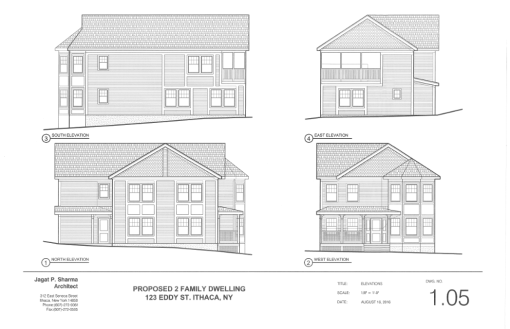
5. Work has yet to start on the new two-family home planned at 123 Eddy Street in Collegetown, but it looks like developer/landlord Nick Lambrou is seeking major changes to the project. Lambrou wants to replace the approved design at top, with the one below, which is copied from a Craigslist posting. The designs are both by Jagat Sharma, but the new plan is a variant of the two-family homes that Sharma’s doing for Charlie O’Connor at the recently-approved 4-building 607 South Aurora project.

The property falls into the East Hill Historic District, which is under the ILPC’s jurisdiction. According to Bryan McCracken, the city’s Historic Preservation Planner, the design will be heading for review within the next month or two.

The design has been used before so there’s familiarity with the design and lower risk, plus there are possible cost efficiencies if using the same contractors as O’Connor, because they’ll move quicker as they’ve done it before. On the other hand, unlike 607 South Aurora, this property is in the East Hill Historic District, and full-time neighbors on Orchard Place have been watching these plans very closely – they’re wary of students, and will likely not be fans of the projecting second-floor porch, as the previous version was tucked into the building. Not sure using a slightly more decorated version of a design being deployed elsewhere will get the ILPC’s blessing, but we’ll see what happens.

cayugafarms_2

6. Why yes, Lansing town is still hopping mad about the natural gas issue. The town supervisor cites the tap-out as the cause of delay for Robert Weinstein’s 102-unit Cayuga Farms project, although the previous documentation says it’s a sewer issue – the developer has to deploy an Orenco modular sewer system, which has to be approved by the NYS DEC.

maplewood_v7_4

7. Here’s a copy of Maplewood’s buildout timeline. The first Maplewood apartments should start construction in May 2017, pending no issues. Generally, the crews will be working from the outside in; buildings closer to Maple Avenue and Mitchell Street have earlier construction schedules, while those interior to Maplewood will start in the fall or early winter. Also, street names. Veteran’s Place will continue to be the main thoroughfare, but from north to south, it will intersect with “James Lane”, “East Sylvan Mews”, and “Lena Street”. James Lane wraps around to form the secondary N-S thoroughface on the east side of the parcel. James and Lena Mitchell were the original owners of the property when Ithaca was first settled in the early 1800s.

The Stormwater Property Protection Plan (SWPPP) still needs to be okayed by the town of Ithaca, but that’s about the only thing left before final approval is granted.

107_s_albany_rev_1

8. It looks like the Planning Board meeting should be interested. Not a whole lot being decided, but some sketch plans have been submitted. For rental projects aiming for August 2018 openings, Feb-Apr is going to be the primary submission period, as they seek approvals by May or June so that construction can run on a Summer 2017 – Summer 2018 schedule.
AGENDA ITEM Approx. Start Time
1.Agenda Review 6:00

2. Privilege of the Floor 6:01

3. Subdivision Review
A. Project: Minor Subdivision 6:10
Location: 109 Dearborn Place, Tax Parcel 9.-3-11
Applicant: Lee and Elizabeth Ambrose
Actions: Declaration of Lead Agency, Public Hearing, Determination of Environmental Significance, Recommendation to BZA

4.Site Plan Review
A. Project: Apartments (11 Units) 6:30
Location: 107 S Albany Street
Applicant: Stavros Stavropoulos
Actions: Declaration of Lead Agency, Public Hearing, Determination of Environmental Significance

B. Schwartz Plaza Redesign- Sketch Plan 6:50

More on that here.

C. 238 Linden Avenue – Townhomes – Sketch Plan 7:10

238 Linden is a non-historic student rental house, and a John Novarr property in a CR-4 zone – 4 floors, no parking required. Further to that, 240 Linden to its north was taken down for staging space for the Breazzano Center, but as that will be finishing up this Spring, it leaves an MU-2 (six floors, no parking) parcel open for development. A townhomes plan suggest one or both of these parcels will host something not unlike the ikon.5-designed townhouses plan Novarr plans to build at 119-125 College Avenue.

D. 372 Elmira Road – McDonalds Rebuild – Sketch Plan 7:30

If Ithaca’s lucky, it’ll have upscale features like the one finishing up in Dryden. Otherwise, a modern update to the 1980s design is plausible. A number of older McD’s restaurants nationwide have been upgraded to the new design in the past few years.

E. 301 Eddy Street – Student Apartments 7:50

This is intriguing. 301 Eddy is a Nick Lambrou property in an MU-2 zone – a four-story, 8-unit/37 bed apartment building built in 1995, and it’s also the address for Collegetown Park’s parking lot. One possibility is replacing part of the parking lot with another apartment building – Lambrou may push to six floors, but it’s not his style. He’s described his offerings as “boutique” buildings, properties with less than 20 units and 20-50 bedrooms. Recent examples include 2015’s 116 Catherine Street, and 2012’s 309 Eddy Street. If the past is any precedent, this will be a Jagat Sharma design.

5. Zoning Appeal: #3057, Area Variance, 109 Dearborn Place 8:10

6. Old/New Business: Special Meeting Chainworks District DGEIS – Transportation 8:20

7. Reports
A. Planning Board Chair (verbal) 8:30
B. Director of Planning & Development(verbal)
C. Board of Public Works Liaison (verbal)


Hotel Ithaca Construction Update, 2/2017

21 02 2017

The to-do list for the $13.8 million Hotel Ithaca “modernization” is drawing short as it nears its May completion date. All the DensGlass fireproof fiberglass mat gypsum sheathing is in place and the edges of the panels are closed up with liquid flashing. On top of the sheathing are metal clips to which the exterior panels are mounted. The stone veneer on the first floor is mostly finished. Many, but not all of the balcony doors, windows and AC units have been fitted. Details like balcony railings will be installed towards the end of exterior work. On the inside of the building, it’s a good bet that the rough-ins are complete, insulation and drywall is probably in place and close to being completed, with crews moving onto things like subfloors/underlayment, painting, and installation of room fixtures such as sinks and bathtubs. The rest of the AC units will likely go in after the subfloors are installed.

Some Hotel Ithaca job postings are advertising 94 new rooms, but unless there were some last minute changes, the number on file is 90. Also worth noting, the contractor, Buffalo-based Krog Corp., and its team of subcontractors have done a fairly good job of staying on Hart Hotels’ schedule – the SPR doc from two years ago called for an April 2017 opening.

More background info on the Hotel Ithaca project can be found here, and by using the “Hotel Ithaca” tag one can backtrack through the bimonthly progress reports.

20170218_124910 20170218_125001 20170218_125022 20170218_125054 20170218_125120 20170218_125323 20170218_125334 20170218_125340

hotel_ithaca_final_1


1001 North Aurora Street Construction Update, 2/2017

20 02 2017

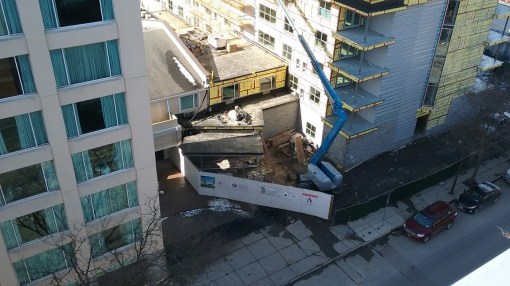
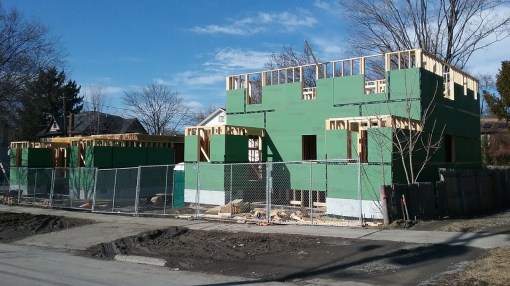
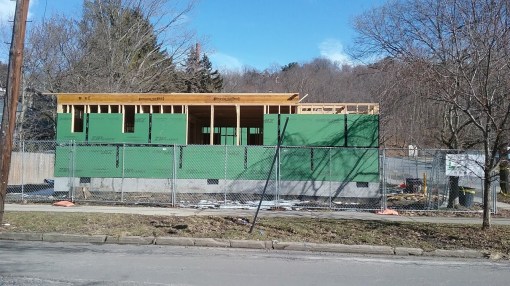
Another project making rapid progress in a short time. The two two-family homes at 1001 N. Aurora Street are being framed out. Going over the wood studs are Huber ZIP sheathing plywood panels, like all the cool kids are using in residential wood-frame construction.

There are pros and cons to each approach. DuPont, in sales literature for its Tyvek Housewrap, touts easier installation, more durability during installation, and claims superior waterproofing. The ZIP system, however, has made significant inroads into the construction market because it does an excellent job at allowing moisture to escape while keeping external water from getting in, and although it requires a little more care to work with (taping), it’s still fairly easy to work with. ZIP panels also tend to be more expensive. Liquid water-resistant barrier (WRB) sprays like the ones you see used on commercial buildings and at Cornell tend to provide the best waterproofing, but they are the most expensive option. So if one drew a scale weighing cost and performance, they could have housewraps at the low end of cost and relative performance, ZIP panels in the middle, and WRB sprays at the top.

Anyway, these duplexes will be known as 202 Queen Street and 206 Queen Street. In the signage on the site, the bottom design is what was approved (quick tip – do not use old renders on signage). They replace a single-family home. Stavros Stavropoulos is the developer, and Daniel Hirtler the architect – the two are also behind the plans for the new 11-unit apartment building at 107 South Albany Street.

20170218_133909 20170218_133914 20170218_133932 20170218_133947 20170218_134030 20170218_134045 20170218_134115


210 Hancock Construction Update, 2/2017

20 02 2017

Normally construction sites get updates every two months. But at the INHS Hancock project site, things are getting really interesting in a short time.

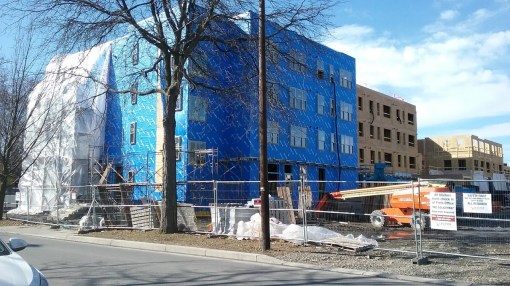
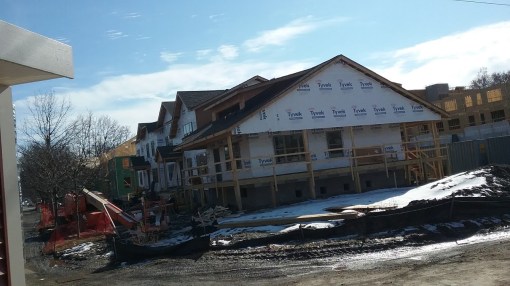
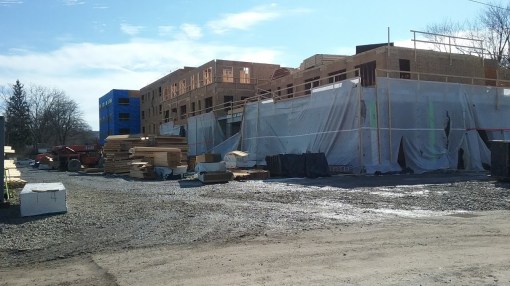
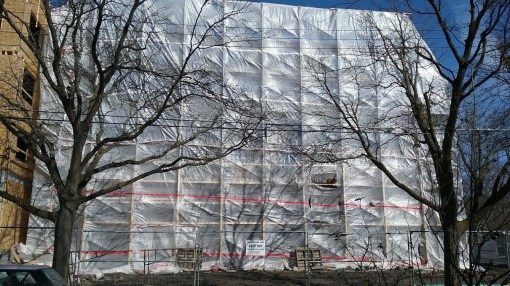
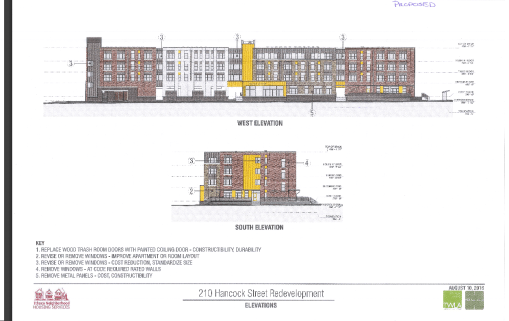
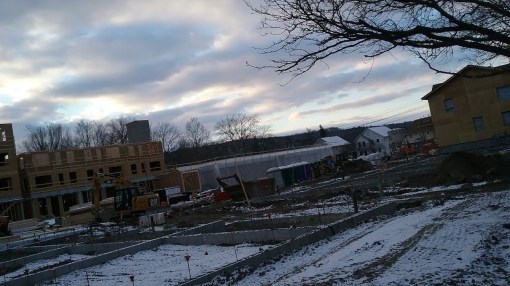
First, the main apartment building. In just the past month, section “A”, the southernmost wing, has been wrapped in Blueskin, roofed, and the windows have been fitted. Answering a question from a few months back, it looks like the Blueskin’s purpose is to be the water/vapor membrane under the brick. The section of “A” under the weatherproof plastic tenting is being bricked – a few loose bricks can be seen in the last photos through holes in the plastic. Not only do the workers appreciate some protection from the elements, brickwork requires temperatures to be kept above freezing so that the water in the mortar doesn’t freeze out, so not only is there plastic wrap, Lecesse has also deployed portable heaters. Section “B” will follow with the Blueskin sheathing, roofing and window-fitting, and then “C” and “D”, which host the indoor garage (hence the CMUs) and are still being framed out.

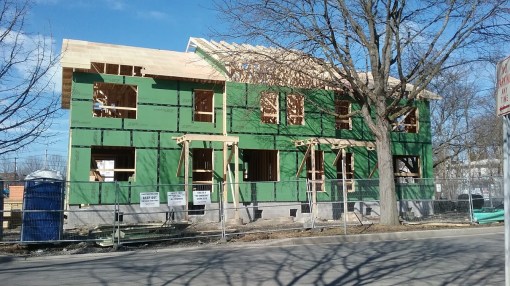
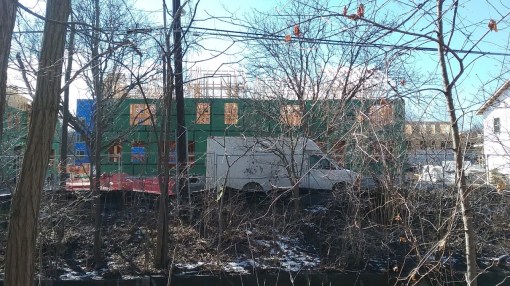
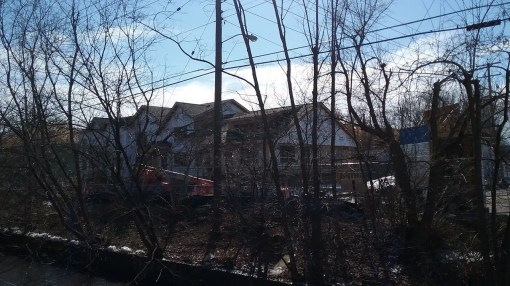
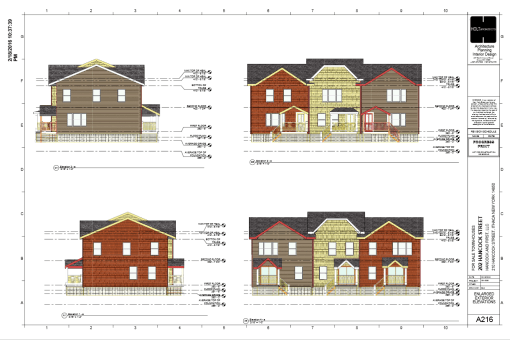
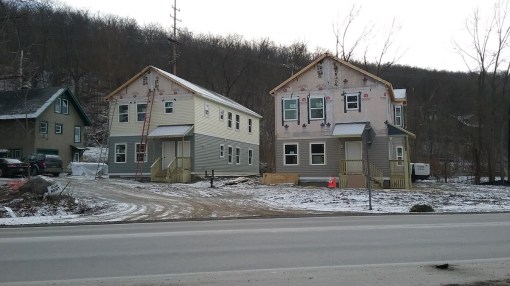
The five rental townhouses have a typical wood-frame build-out – first comes wood framing and roofing, then tar papered and shingling, housewrapping and window fitting. Interestingly, the seven for-sale townhouses (collectively referred to as “202 Hancock”) are using Huber ZIP sheathing panels, which the rentals did not. The Hancock street trio of homes have been framed but not roofed, while the Lake Avenue quartet are still being framed out, awaiting the rest of their roof trusses. The insides of the for-sale homes are still just bare stud walls at this point, while the rentals are probably far enough along that most utility rough ins have been completed, and sheetrock is being hung in the units. All in all, Lecesse Construction and their subcontractors have been moving at a very good clip over the past month or so.

A construction loan filing on January 23rd states Tompkins Trust lent INHS $1,581,796 to finance the 202 Hancock units. The total cost (hard and soft) of the seven for-sale units is estimated at $2.36 million. The five two bedroom units (1,147 SF) will be sold for about $114,000, and two three-bedroom units (1,364 SF) for $136,000, to qualified applicants making 60-80% of local AMI, or $37,000-$49,000/year.

For the sake of comparison, the apartment building and for-sale units are partially financed with a $7,790,511 loan from a Citibank fund – through an LLC, Citibank bought the low-income housing tax credits (LIHTCs) awarded to the project by New York State. The apartment building’s total cost comes to $13.8 million, with the rest financed through INHS’s money, federal tax credits, housing grants and a low-interest loan from the state’s housing division (NYSHCR).

Renters or homeowners interested in obtaining a unit can fill out an inquiry form here. The rentals will be ready for occupancy by August 1st, 2017, and the for-sale units are looking at a November 2017 completion.

20170218_132608 20170218_132630 20170218_132650 20170218_132705 20170218_132720 20170218_132737 20170218_132806 20170218_132824 20170218_132828 20170218_132850 20170218_132905 20170218_132928 20170218_133033 20170218_133051 20170218_133132 20170218_133217 20170218_133245 20170218_133259 20170218_133312 20170218_133355 20170218_133420

inhs_pride_design_v5_3

blueskin-vp100-brick inhs_pride_design_v6_1202_hancock_2 202_hancock_1 202_hancock_3

inhs_pride_design_v6_1


News Tidbits 2/18/17: Credits and Loans

18 02 2017

warren_medical_lansing_1

1. Over in Lansing village, it looks like the new Arleo medical office building is starting to moving forward. A sketch plan of the project was presented at the village planning board’s meeting earlier this week. Although Lansing doesn’t upload accessory docs like site plans and elevations, this one has been floating around for the past several months in marketing material as “Cayuga Ridge”. Quoting the May 7th 2016 news roundup:

“The new one-story building, which appears to be designed by Binghamton-based Keystone Associates, would be off of Warren Road, although it looks like the building would be accessed from a driveway coming off of Uptown Road. The 2.71 acre property north of 100 Uptown Road is zoned “Human Health Services District” by the village, and borders undeveloped land owned by Cornell, and several other suburban medical office buildings built over the past few decades. The resolution on the attached site plan is too low to determine the square footage, though it looks to be in the low tens of thousands.”

labourgade-on-seneca-dormer2

2. For those who like their cottages tiny – it looks like Schickel Construction has begun work on the spiritual successor to their 140-unit Boiceville Cottages project in Caroline. The 40-house rental development is called “La Bourgade on Seneca”, and is located in the town of Hector, in Schuyler County just outside of Burdett village. For the record, Bourgade is a French term for an unfortified village or settlement. More details can be found on the website here. There will be two cottage types available -, “The Classic”, a 2-bedroom, 900 SF plan that will rent at $1,495/month, and “The Spacious”, a 2-bedroom with a dormer loft space totaling 1,000 SF and renting at $1,695 month. The house very much like their Boiceville cousins, but with angled eaves (dunno what the correct term is and google’s not helping – if there’s an architect reading, please chime in). All units will have lake views.

Personally, I see this as a stretch for the Ithaca market, since it’s 25 miles west of the city. But it might tap into a more plebeian contingent the wine country crowd, the wealthier of whom have taken to building grand vacation or permanent homes along the Finger Lakes in recent years. The first 9 units, three clusters of three, are currently under construction, as is a community center. Delivery is expected in May 2017.

ic_master_plan_3

3. It looks like Ithaca College is putting some more thought into their housing needs. The college has been meeting with planning firm U3 Advisors to explore the possibility of new off-campus student housing.

U3 Advisors is already familiar with the area, as they are also under contract with Cornell to formulate their off-campus housing plan. Unlike Cornell, however, Ithaca College has no plans to grow enrollment – the master plan expects it to stay steady around 7,000. However, many of the dorms are reaching the end of their useful lives, meaning that the college can either sink a fair sum into renovation and replacement of utility systems, or tear down and build anew. An off-campus option could either be a private entity on private land, or a deal on IC-owned land like what Cornell and EdR are doing with Maplewood. A 200-300 bedroom off-campus option could mesh with the town of Ithaca’s visions for a walkable South Hill neighborhood on the intersection of Route 96 and King Road.

It’s still just studies and meetings at this point, but as the oldest dorms hit 50 years old on South Hill, there might be something fresh in the pipeline. We’ll see what happens.

cma_v2_2

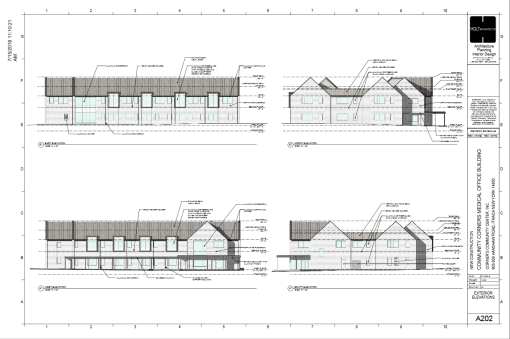
4. Ithaca’s West End will be welcoming a new tenant in the next couple months. Courtesy of Nick Reynolds over at the Times, the USDA is shifting its regional office out of Community Corners in Cayuga Heights, and into Fulton Meadows, a commercial office building at 225 South Fulton Street. the move is being undertaken in anticipation of the construction of Tim Ciaschi’s new Cayuga Medical Associates office building, which is set to get underway at Community Corners later this year.

201_college_v5_1

5. Looks like we have an idea of the price tag for Visum Development’s 201 College Avenue. According to a construction loan filed with the county on the 15th, S&T Bank loaned Todd Fox’s company $7,870,673 to help cover the costs of the project. The breakdown in the filing says $6,841,038 for hard construction costs (materials/equipment/labor), $507,000 in soft costs (permits/legal/marketing/financing fees), $300k in contigency and $226k in interest reserves. Add in the $2.64 million for the land purchase, and the total comes to $10,514,180.

That’s something of a premium because the project is on an accelerated schedule after the big hullabaloo with Neil Golder and the city Planning Board last fall. Note that the loan doesn’t cover all the costs and that there is money from other sources, like cash equity from Visum itself.

S&T Bank is a regional bank based out of Western Pennsylvania, but they’ve been making inroads into Ithaca’s commercial lending market. S&T Bank also financed the construction of the Holiday Inn Express that recently opened on Route 13, lending $5,973,750 to the hotel developers.

Quick aside, I think this is the first time I’m seeing the square footage calculated out – 201 College will be 33,398 SF.

20170106_160736

6. Hopefully this runs after by INHS refinancing explainer, so it makes more sense. Quick rehash, low income housing tax credits (LIHTCs) are sold to banks and similar financial institutions so that they get the tax credit, and the affordable housing developer gets the money they need to move forward with a project. With that in mind, here’s an interesting though unfortunate tidbit from INHS’s Paul Mazzarella:

“This following may be more than you want to include in this article, but it is relevant.  The pricing of tax credits exists in a marketplace where they rise and fall in value.  In past projects completed by INHS, we’ve received from $0.91 to $1.02 of equity investment for each dollar of tax credit.  The pricing of tax credits has recently plummeted because of the recent election and the uncertainty in DC.  This is mostly due to discussions about changing the corporate tax rate.  A lower corporate tax rate will mean that companies have less profits to shield from taxes and therefore the demand for tax credits will be reduced.  Even though no changes have yet been made to the corporate tax rate, just the discussion about this has reduced the pricing of tax credits to around $0.80.  What does this mean for INHS? It means that the project that we’ve been working on for several years suddenly has a funding gap that didn’t exist a few months ago, due entirely to investor’s fear of risk due to an uncertain future..  This is true for every tax credit project in the country and has all of us struggling to make the pro formas work.”

Sigh. Politics.

habitat_208_third_st


7. The Times has the first render for Habitat for Humanity’s two-family townhouse project at 208/210 Third Street on the city’s Northside. It looks to be the same architect as the 4-unit project for 402 South Cayuga – I can’t seem to find the architect offhand as a few designers have donated time and energy, but local planner George Frantz shepherded the project through the approvals process. Each unit is about 1500 SF. The plan for the $305,000 project is to break ground in April and have the move-in ceremony in Spring 2018. As with all local Habitat projects, a portion of the construction will come from volunteer labor, including 500 hours of “sweat equity”, and homeownership classes that the two recipient lower-income families (making 60% AMI or less, $32,000/year) will need to complete as part of the deal.

maplewood-v7_7-planning-board

8. Wrapping this up with the local agendas for next week – the town of Ithaca will be looking at a home B&B permit on Bostwick Road, a retaining wall for Ithaca College’s track, and finishes touches on the Maplewood approvals. The city’s project review meeting indicates the city plans to look at the subdivision at 109 Dearborn Place, Declaration of Lead Agency and Environmental Review for the 11-unit 107 South Albany Street plan,  and “Approval of Conditions” for City Centre, which is just making sure they’ve completed everything asked for in the final approval. In sum, nothing too exciting at the moment, but we’ll see if the city has any new projects coming up when the actual PB agenda comes out next week.

9. Quick note to wrap up – the woman behind the Rogues Harbor Inn in Lansing has purchased a prominent and historic building on Freeville’s main drag. Eileen Stout purchased 2 Main Street, a mixed-use building with restaurant space, a tile shop and three apartments, on Thursday for $132,000. The seller was Tompkins Trust and it’s well below assessment – doesn’t look like a foreclosure though. The bank bought the property for almost double the price in May 2016.


News Tidbits 1/28/17: Helping You Avoid Politics For Five Minutes

28 01 2017

1. Looking at sales, it looks like there were a couple of big ones this week in the Ithaca area. The first was on Friday the 20th, where 402-04 Eddy Street was sold for $913,000. The buyer was an LLC tied to Charles and Heather Tallman, who own several properties in Collegetown. The $913k price is above the 2015 assessment of $880k, but below the 2016 $1 million assessment. The Tallman historically have not been the kind to redevelop property, and the three-story mixed-use building is part of the East Hill Historic District, so don’t expect any big changes.

The next two were on Wednesday the 25th – Parkside Gardens on the Southside at 202 Fair Street, and Lakeside (Grandview Court) on South Hill, were sold for a whopping $10,450,000 from a Long Island landlord (Arbor Hill Homes) to an LLC based out of Delaware. Parkside has 51 units and was built in the 1950s, and is assessed at $2 million. It sold for $4.2 million, about double what the $2.145 million the owner paid in 2007. Lakeside has 58 units and was built in the 1970s. It is assessed at $2.8 million, the previous owner paid $2.58 million in 2007, and just sold it for $6.25 million.

Up until 2014, they accepted housing vouchers, but according to an email from the IURA’s Nels Bohn, The Learning Web handled the vouchers and the IURA has nothing about the complexes on file after 2014. It might be a case similar to Ithaca East, where the affordable housing lease period ran out and the owner converted to market rate. The Voice tried to do a story on it in Fall 2015, but it went nowhere, and then again in January 2016, and it went nowhere. I did research but Jeff and Mike were going to be the respective writers. Here are my notes from September 21, 2015:

The two complexes were recently offered for sale, but the listing was deactivated. According to 2011 IURA minutes, the owner is kind of a sleazeball, uses them as an investment property but doesn’t do maintenance. Another company (Rochester-based Pathstone, they’ve done work with INHS) considered buying Parkside in 2011/12, but backed out when problems arose.

One could argue that the two complexes had a shady owner who just cashed out big. The buyer can be traced through its unique name to a Baltimore company called Hopkins Holding, and a LinkedIn profile of a partner in the company saying their specialty is student housing. At the high price paid for Lakeside, I could easily see a redevelopment happening, though I’m not as certain about Parkside’s future.

20170106_160711

2. There were also a couple of construction loans filed this week. Tompkins Trust lent Collegetown Crossing $500,000 according to a filing on the 23rd, but the type of work is unspecified in the county docs. Tompkins Trust also lent INHS $1,581,796 in a separate filing on the 23rd, to finance the seven for-sale townhouses underway at 202 Hancock Street in Northside, part of the 210 Hancock affordable housing project.

3. A few weeks ago, the pending sale of the former Phoenix Books barn at 1610 Dryden Road came up. Now we what the plans are. It appears a local businessman wants to renovate the barn and use it for automotive trailer sales. The plan requires a special use permit from the town because it’s a residential zone, and the project is seeking a landscaping outdoor area to showcase trailers for sale. It doesn’t read as if the barn itself will be greatly altered in appearance, although its structural stability is in question, so it will need its north wall shored up, and roof repaired so that rainwater stops pouring into the basement. The town will be going through the project over the next couple of months, but there don’t appear to be any big obstacles that will prevent a permit from being issued.
masonic_temple_1-771x595

4. For the sake of acknowledgement, the ILPC approved of Jason Fane’s renovation plans for the Masonic Temple. There was a little back-and-forth about window replacements, and they made sure to note that the “for rent” signage was not grandfathered and would have to come down once the three commercial spaces are rented out, and the signage would not be allowed to go back up even if the spaces were vacated at a later date. The ILPC also seems inclined towards a historic district on the north edge of Collegetown along Oak Avenue and Cascadilla Place, but that still has yet to take form.

5. Out in the towns and villages, there isn’t anything too exciting on the agenda. Cayuga Heights had a one-lot subdivision for a new home site at 1010 Triphammer for their latest meeting. The town of Dryden had a 5-lot subdivision off of 1624 Ellis Hollow Road, and a 7-lot subdivision at the former Dryden Lake Golf Course.Dryden also received the sketch plan for the 12 Megawatt solar array planned by Distributed Solar at 2150 Dryden Road (12 MW is enough for ~2400 homes). Ulysses had to review a special permit for turning a nursery business into a bakery/residence, and a 2 Megawatt array at the rear of 1574 Trumansburg Road. The town of Lansing had a meeting scheduled, but nothing was ever put online, nor was there a cancellation notice.

6. The townhouses at 902 Dryden are starting to rise up. Visum Development’s facebook page notes that the foundations for all structures are complete, and framing is underway; you can see roof trusses on the right of the photo. Looks like a typical wood frame with Huber ZIP sheathing, which has become the popular (and arguably more effective) alternative to traditional plywood and housewrap. According to the hashtag overkill, the 8-unit, 26-bed housing plan is still on track for an August 2017 occupancy.

20170107_113438

7. Quick wrap up, we now have addresses for the two-family homes going up on Old Elmira Road. They will be 125 Elmira Road and 129 Elmira Road. This means the end of the awkward Spencer Road/Old Elmira Road disclaimer in the next (and probably last) update in March, although for the sake of continuity the title of the post won’t change – continuity was the same reason 210 Hancock was co-tagged with neighborhood pride site for about a year. Just trying to make it easier to follow along.