1001 North Aurora Street Construction Update, 2/2017

20 02 2017

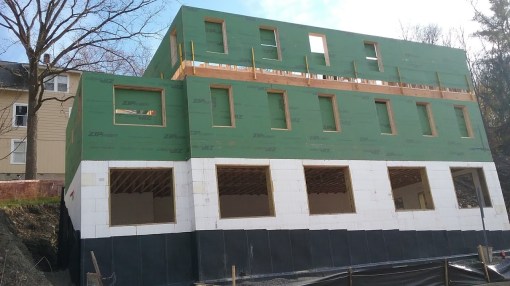
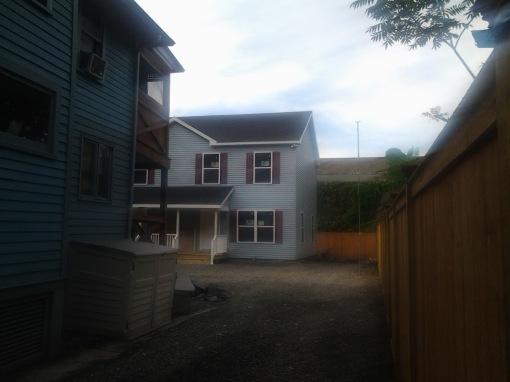
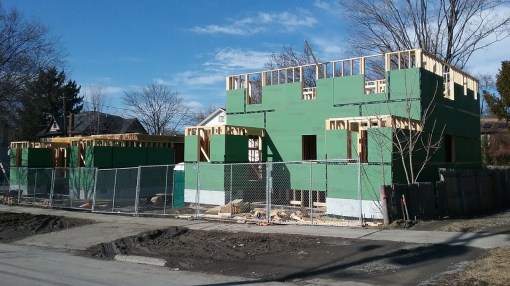
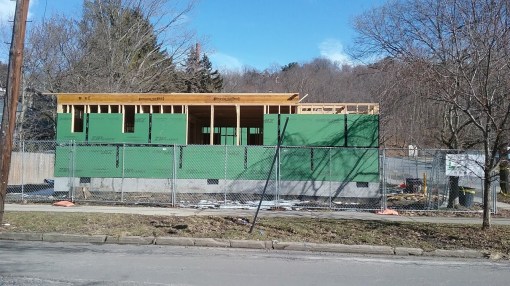
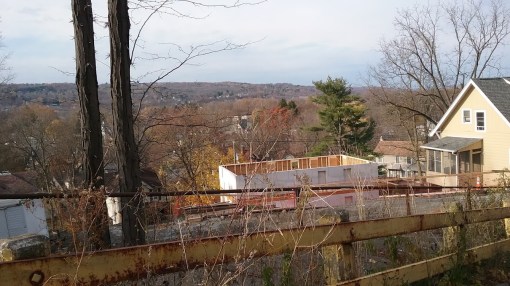
Another project making rapid progress in a short time. The two two-family homes at 1001 N. Aurora Street are being framed out. Going over the wood studs are Huber ZIP sheathing plywood panels, like all the cool kids are using in residential wood-frame construction.

There are pros and cons to each approach. DuPont, in sales literature for its Tyvek Housewrap, touts easier installation, more durability during installation, and claims superior waterproofing. The ZIP system, however, has made significant inroads into the construction market because it does an excellent job at allowing moisture to escape while keeping external water from getting in, and although it requires a little more care to work with (taping), it’s still fairly easy to work with. ZIP panels also tend to be more expensive. Liquid water-resistant barrier (WRB) sprays like the ones you see used on commercial buildings and at Cornell tend to provide the best waterproofing, but they are the most expensive option. So if one drew a scale weighing cost and performance, they could have housewraps at the low end of cost and relative performance, ZIP panels in the middle, and WRB sprays at the top.

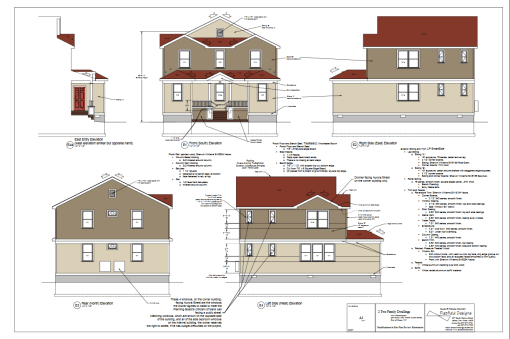
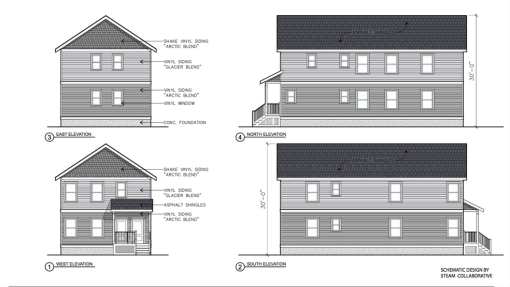
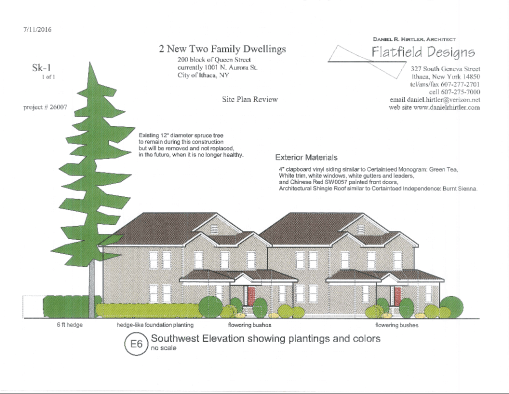
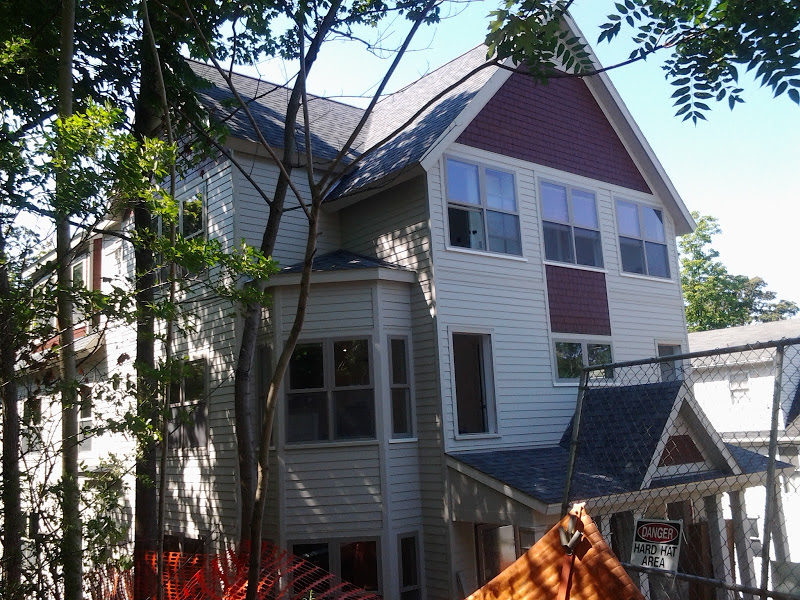
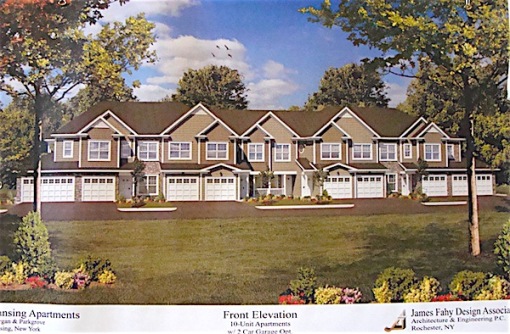
Anyway, these duplexes will be known as 202 Queen Street and 206 Queen Street. In the signage on the site, the bottom design is what was approved (quick tip – do not use old renders on signage). They replace a single-family home. Stavros Stavropoulos is the developer, and Daniel Hirtler the architect – the two are also behind the plans for the new 11-unit apartment building at 107 South Albany Street.

20170218_133909 20170218_133914 20170218_133932 20170218_133947 20170218_134030 20170218_134045 20170218_134115


Ithaka Terraces (215-221 West Spencer Street) Construction Update, 1/2017

14 01 2017

The first building of the Ithaka Terraces, Building “A”, is fully framed and in the process of being roofed. The project uses double stud exterior walls in tandem with Insulated Concrete Forms (ICFs), which is thermally insulated plastic filled with concrete. The zip sheathing goes on over the surface. The purpose of the thick, more premium approach is for more efficient insulation, since the condo units are designed to be net-zero compatible (the high energy efficiency reduces the need for off-site renewable energy sources, and net-zero becomes more feasible as a result).

Further up the sloping site, smaller Building “B” has completed the ICF erection ground floor and is starting work on the upper floors. Note the reinforced concrete wall facing South Cayuga (east). That will eventually be back-filled and hidden from view. As seen in some of the early concept designs below, only the top floor of the three floors of Building “B” and “D” will have windows facing outward; the South Cayuga side of the property is where the parking lot will be laid.

The other large building in the four-building cluster, Building “C”, a mirrored floorplan of “A”, is just getting started; the site was being prepped and graded when these photos were taken last week. Building “D”, a mirrored floorplan of “B”, will start construction at a later date, as the other three get further along. In the last photo, one can see the winding temporary staircase workers use to get to the building themselves. AquaZephyr, an Ithaca firm specializing in eco-friendly construction, is the general contractor in charge of the buildout.

The 12-unit condo project will begin formal marketing later this Spring. There will be 10 two-bedroom units and 2 three-bedroom units, in the $265k-$390k range. A late 2017 opening is planned. Interested readers can submit queries here.

20170107_112320 20170107_112356 20170107_112359 20170107_112419 20170107_112433 20170107_112437 20170107_112656 20170107_112710 20170107_112727 20170107_112735

215-221_spencer_v1_2 215-221_spencer_v3_1

ith_terr_intro


1001 North Aurora Street Construction Update, 1/2017

11 01 2017

This is another one of those modest-sized infill projects where if you blink, you might just miss it.

1001 North Aurora is on the north end of Fall Creek, across the street from the elementary school. The plan replaces an old though not especially historic single-family home with twom two-family homes, each unit with three bedrooms for a total twelve. Four parking spaces are included. The project was approved in October 2016 by the city planning board; the lot subdivision that triggered board review.

Over the course of review, the board requested a little more character in the house designs, including more windows, two different shades of lap siding (which will be LP SmartSide wood siding, painted Sherwin-Williams “Rice Grain” and “Sawdust”), and dormers. The materials also include Owens Corning TruDefinition “Terra Cotta” shingles and S-W “Nacre” trim boards. The initial design looked like this, and the final is shown below. The eastern building will not have the dormer, and may not have the pocket windows in the west wall either, as those were stated to be cost-dependent. The side facing Aurora, however, has to put them in as a stipulation of the approvals; after some recent issues with other projects, the board’s been getting a little more assertive when it comes to building details being built as approved.

The developer is Stavros Stavropoulos. The Stavropoulos family is perhaps best known for running State Street Diner, but recently they’ve been wading deeper into the development pool, building a new two-family home at 514 Linn Street and a two-family addition onto 318-320 Pleasant Street. Tompkins Trust gave a $400,000 construction loan to this project back in August.

Each unit will ring in at about 1200 square feet. Local architect Daniel R. Hirtler, fresh off of another duplex on the corner of Oak Avenue and Oneida Place in Collegetown, is in charge of design. Construction is expected to wrap up by the end of May 2017. According to Craigslist, the units are renting for about $2325 each ($775/bedroom), and two of the four units are already rented. Quote:

“New duplexes featuring 3 bedroom, 1.5 bath apartments. Open floor plans, ductless heating and cooling in every room, hardwood floors, stainless steel appliances, corian counter tops, stackable washer and dryer, fully furnished, off street parking and much more.”

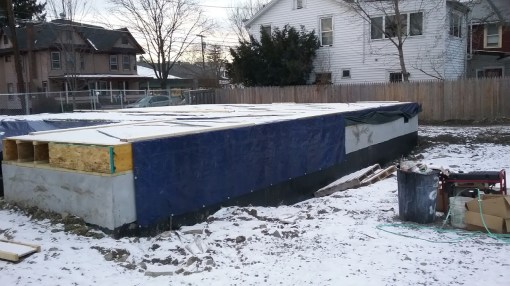
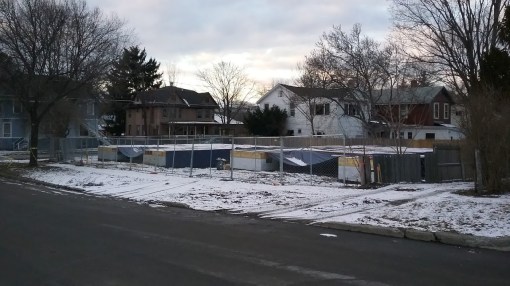
You’ll notice in the photos below that the completed foundation slab sits a little above the ground – the northern part of Fall Creek has a high water table, so to help avoid water/flooding issues, the buildings are raised slightly. Wood framing is just beginning, so look for these to take shape as we finish out the winter and head into spring.

Quick final detail – 1001 North Aurora Street was the old address. These properties will use addresses on the 200 Block of Queen Street.

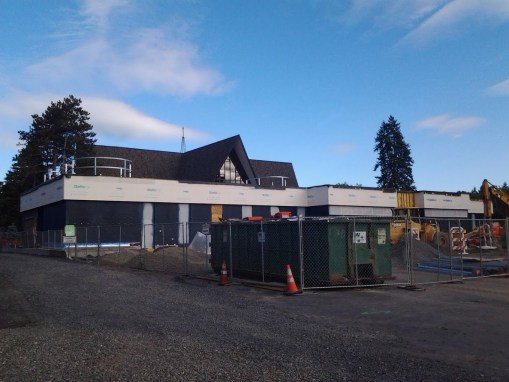
20170106_161844 20170106_161904 20170106_161928  20170106_161955 20170106_162000 20170106_162032

1001_n_aurora_v2_1


Ithaka Terraces (215-221 West Spencer Street) Construction Update, 11/2016

26 11 2016

Ed Cope’s Ithaka Terraces have made modest but noticeable progress in the past couple of months. Building A is up to the third floor, while Building C is undergoing foundation work. The other two buildings, B and D, will come along in later stages.

Since the 12-unit South Hill condo project is going for net-zero capability, its construction is a little different from the norm. Quoting the sales website:

“The building features nominal 12 inch thick double stud exterior walls with a total of R39 continuous dense packed cellulous insulation and 18 inches of R63 loose fill cellulous insulation in the attic. The walls and attic are completely air sealed with Zip sheathing with all seams taped to prevent vapor migration through the walls and ceiling.”

The exterior walls are a combination of thick wood stud walls, thermal plastic filled with concrete and Huber Zip sheathing. In between the cavities of the stud walls, local contractor AquaZephyr will be blowing in dense cellulose insulation (pictures of that process here). This will allow the condos to achieve a very high degree of energy efficiency, and assist in making the project net-zero capable.

More info on the project can be found here.

20161119_125056 20161119_125109 20161119_125122 20161119_125128 20161119_125148 20161119_125208 20161119_125219 20161119_125229 20161119_132737

215-221_spencer_v3_1


News Tidbits 10/1/16: Sketchy Details

1 10 2016

lansingapts600
1. Over in Lansing, it looks like Park Grove Realty is having a rough time getting their plans rolling. Legions of angry homeowners turned out at the village’s Board of Trustees meeting to protest a requested zoning change for a 20-acre Bomax Drive property that Park Grove seeks to build 140 apartments upon. The meeting wasn’t about the project, which will follow the zoning change once approved. For the record, the meeting was only about the zoning change, which is currently zoned for office park business/technology and has been owned by Cornell since 2008.

The unusual thing is that the primary opponent seems to be the Jonson family, of development company IthacaHome, formerly known as Forest City Realty. They built some of Lansing’s 1990s subdivisions and the Heights of Lansing project at the end of Bomax Drive, which is stalled out due to a lack of interest and Ivar Jonson’s passing. The claim from Janet Jonson is that if left commercial office/tech, then maybe an office building would be built and executives would build homes on some of their vacant lots. Even Larry Fabbroni was there to say an office building would generate less traffic than housing would. The meeting was very heated, according to the Lansing Star’s Dan Veaner.

The village planning board was there to listen, but not especially sympathetic. For one, there’s plenty of undeveloped commercially-zoned land; but there is a housing shortage. For two, although some complained “transients” would lower their housing values, these units will be going for $1,400-$1,900/month. The board’s not focused on the project just yet, that will come in due course. Meanwhile, the trustees moved to schedule public review for the zoning change, with that meeting planned for October 17th.

A couple miles away, Park Grove has also been getting flack for taking down willow trees as part of a plan to reduce root damage and mold issues, and to expand parking and add a 425 SF rental office on the Triphammer Apartments (former Chateau Claire) property. The heavy-handed approach was not well received. In short, Park Grove’s principals are the village pariahs at the moment, though they have brought some of it on themselves.

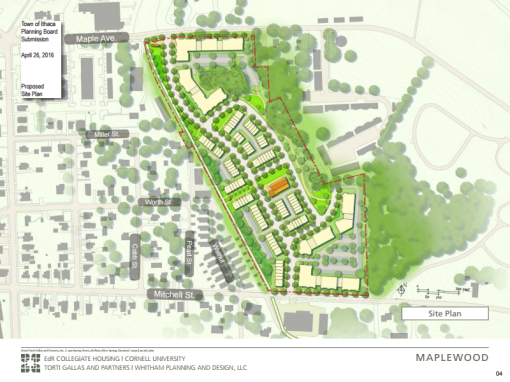
maplewood_v3_2

2. Just a brief check-up on the Maplewood Park redevelopment. The project team has been busy over the past month making revisions to the Draft Environmental Impact Statement (DEIS) as part of its determination of adequacy, and the DEIS was just accepted for public review as of the town of Ithaca planning board meeting on the 20th.

A digital copy of the revised DEIS can be found on the town’s website here. A public hearing will also take place on October 18th. The SEQR review period is 45 days from acceptance, so public comment will be accepted on the document up to 4 PM on Halloween.

100_1967

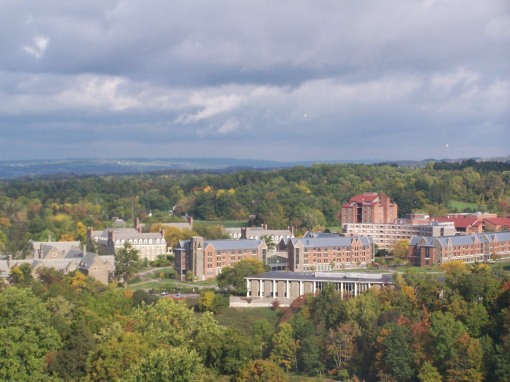
3. As part of their campus housing study, Cornell launched an extensive survey of their students. A summary and a link to the full results can be found on their webpage here. The university also held public forums this past week on campus to hear opinions from the community and explain what happens next (what needs work, how much campus housing is needed, where on campus, what student segments, strategies for the next 25 years, and so on).

Among the grad and professional (MBA/JD/MPH/etc) students, more anticipated living on campus when they arrived, than actually did – 32% vs. 18% of respondents. On average, G/P students felt they should pay about 7% less than they do. They want Wi-Fi, private bathrooms, on-site laundry and package/mail delivery. Outside, they want wider sidewalks and more frequent bus stops/service, and parking fees should be bundled in rent if parking is offered.

Those off campus preferred Downtown (26%) and Collegetown (24%). Grads and domestic students preferred Downtown, professional and international students preferred Collegetown. Grad students tended to be more satisfied with their housing than undergrads.

Similarly, more undergrad respondents want(ed) to live on campus – 56% do or have, 78% want/wanted to. That stat’s a little weird, since freshmen are required to live on campus. Only about 45% describe an apartment as ideal housing, vs 88% for grad/prof students. They also want Wi-Fi and laundry, as well as study areas and dining nearby. 49% selected Collegetown as their preferred housing choice, with another 36% preferring an on-campus location if available.

cornellspace-771x394

At the public forums, the university presented a few potential building sites for new campus housing. The goal was to have sites away from full-time residential areas (less hassle), easy to prepare (less physical hassle), accommodate 300-500 students (scale efficiencies) and be near existing facilities (quality of life and infrastructure). Three north campus locations were presented – CC parking lot, the side lot at RPCC, and the fields next to Appel Commons. The RPCC and CC locations show up on the 2008 Master Plan as well, 3-6 floors and up to 200,000 SF of space. So it seems those two locations have a more sustained interest. The city of Ithaca and the Village of Cayuga Heights have a boundary line that straddles those sites, a latitudinal line just south of Jessup Road. If something were proposed, most of the land is in the city, but the village would have to vote to defer decision-making to the city. That is a potential complication that Cornell has to keep in mind.

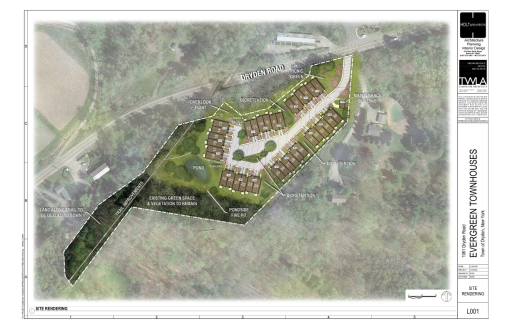
evergreen_dryden_1

4. The Evergreen Townhouses project in Dryden will be the subject of a special meeting of the town planning board on Wednesday October 5th at 7 PM at the Varna Community Center. The full suite of documents, including county review, planning board notes for the town board (recall that in Dryden, the town board votes to approve projects instead of the planning board), sewer capacity report and concept plan description can be found here. SEQR has been reviewed and a traffic study has been completed. The project will need a PUD approval, since 36 units exceeds what the zoning allows (28). If the PUD is approved, land will be deeded to the town for its recreational rail trail. Like the Park Grove project in Lansing, this rental proposal has seen a fair amount of opposition, due to traffic and concerns about renters, and the possibility of encouraging suburban sprawl east of Varna. Oddly enough, for being this far along in the process, there still haven’t been any detailed renders of the townhouses released to the public.

5. Here are a few details about the 607 South Aurora project. Readers might recall the sketch plan was presented at the August Planning Board meeting.

As I discovered this week, sketch plans are actually off the record. Meaning that a developer doesn’t have to give it to the city for publication if they don’t want to. Apparently, John Novarr is going this route – although images for his townhouse project on the 100 Block of College Avenue were presented last week, the city has no official record of them, and he said he has no intent to share plans until he’s ready for the city to declare itself lead agency. For what it’s worth, the project, geared towards Cornell faculty and staff, was well received by the Planning Board.

On the one hand, not sharing the sketch plan limits public exposure and the risk brought by exposure, and it allows the board to eliminate the most controversial aspects before the public can see them. On the other hand, it’s less transparent, and makes me an unhappy camper.

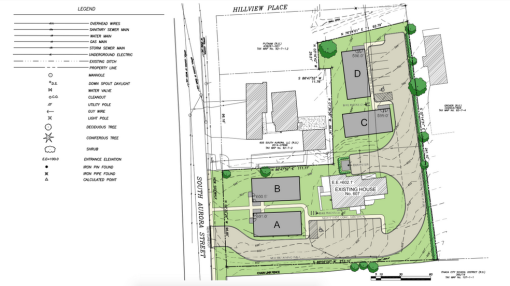
Back to the topic at hand, 607 South Aurora as initially conceived calls for 4, 2-family, 2-story houses on the property, while retaining the existing house. That’s a total of 8 units, and 24 bedrooms total. Parking would be in two sections tucked back from the street. The project is not unlike the one approved for 312-314 Old Elmira Road in Ithaca’s South Side neighborhood. Although STREAM Collaborative’s Noah Demarest presented the project at the August meeting, STREAM is not in charge of this proposal. The project is being designed by Collegetown favorite Jagat Sharma for local developer Charlie O’Connor.

607_s_aurora_1 607_s_aurora_2

Charlie O’Connor is a part of Modern Living Rentals, and regardless of how one might actually feel about their work, it is probably the most transparent development/rental company in the local market. True to form, a quick check of their website turned up images of 607 S. Aurora. It looks like the same general design will be used for each building, and each unit will be 3 bedrooms and about 1,122 feet. I hope they change up the exterior colors for variety’s sake. The board and planning department was fine with the buildings, but suggested revisions to the site plan, so the next iteration will likely have a different site layout.

20160918_164039 20160918_164106

6. Sorry, didn’t realize the lens was smudged. This very subtle duplex is underway in Ithaca’s South Side neighborhood, behind an existing duplex at 512-14 West Green Street. Because it fits in all the setbacks (it’s a very large, deep lot for an inner city parcel) and the rear of the property falls into the State Street Corridor’s CBD-60 zoning (i.e. no parking required), this project never needed more than staff-level approval from the city. Honestly, were it not for a small disturbed area at the curb-cut from construction vehicles moving in and out, one would never know this duplex was under construction.

The property is owned by the Ciaschi family, and appears to have been passed between family members since at least the 1960s. A building loan filed on June 17th indicates that Tompkins Trust lent $330,000 towards the project. As with many smaller builds, this a modular by Ithaca’s Carina Construction. Carina is supplied by Simplex Homes, and it looks like this 3-bedroom/2-unit is based off Simplex’s “Elkton IV” plan (but that could be wrong). Give how far along the outside is, it would not be a surprise if renters move in by the start of October.

147962

7. The near-death Black Oak Wind Farm could actually happen, if they pay Enfield the money they want for FOIL costs. Using the original EIS, they’ve reverted to the initial plan, including use of the landowners’ properties who tried to pull out in the face of the project’s rancorous opposition. The BOWF project team had been attempting to move two of the turbines to accommodate property owners who changed their mind about being associated with the project, but the Supplemental EIS had been caught in legal red tape with the town of Enfield and the town of Newfield to its south, where one of the alternative sites was planned. So the new plan is to just go forward with the original signed contracts and build what was proposed before the 2015 SEIS. The project team has requested final approval, but the town has said they want to be paid $19,000 for the cost of handling all the FOIL (Freedom of Information Laws) requests, of which they’re not sure who’s actually required to cover the cost.

This project and its manager, Marguerite Wells, have probably been put through a greater Hell than any other proposal in this county, which is really, really saying something. Let’s recall, apart from the opposition that has demonized the project manager and the investors (successfully, one could unfortunately argue), that when they considered the alternative site, Newfield’s town board rewrote their wind farm law to implicitly but effectively ban wind turbines from the town. The BOWF project has been incubating for nine or ten years.

According to Marguerite Wells, if they can’t get approval at the Enfield town board’s October 12th meeting, the wind farm proposal dies. And with it, pretty much any commercial wind turbine plans for Tompkins County (looking at Newfield, maybe single-family turbine plans as well – the way the 2016 revision is written, a homeowner can’t even hook up a little one to their roof, as it’s too close to an occupied structure).

8. Here’s a little kick in the pants to end the week. It was reported in Bloomberg of the five Ivies that have released results so far, Cornell’s endowment did the worst in the past year, with a -3.3% loss (which comes out to a drop of about $200 million). The university is taking reactive measures, including moving its investment offices to New York City. “The investment committee believes over the long term the relocation to New York City gives us even better access to potential staff who might not be willing to move to Ithaca,” said Cornell CFO Joanne DeStefano. That’s a bit deflating.


News Tidbits 9/10/16: Situations To Be Avoided

10 09 2016

Pardon the week hiatus. Sometimes, by the time there’s enough news to share, it’s already the weekend, so it just makes more sense to fun a longer feature the following week.

maguirebirdseye-620x420

1. The Maguire dealership proposal for Carpenter Business Park had a lukewarm reception at its public info session a week and a half ago. A copy of the application can be found here, and Second Ward Councilman Ducson Nguyen was kind enough to upload a 90-minute video of the meeting on his facebook page, and a transcript of the meeting can be found here. A second public info meeting will be held on the 14th.

You might recall news of the project broke last winter, followed shortly thereafter by a vote of the city Common Council to subject waterfront and waterfront-vicinity properties to a “Temporary Mandatory Planned Unit Development” (TM-PUD), meaning that any building proposal would be subject to a vote of the Common Council as a stipulation of approval (typically, projects only need the Planning Board’s consent, plus the BZA and/or ILPC if needed). One other project has gone through the TM-PUD process since then, the Cherry Artspace performing arts building. The small experimental theater held its public info meetings at the end of March and mid-April. It enjoyed fairly broad  public support, but two of the eight voting councilmen still voted against its construction at the May meeting. If a a project with widespread support has some trouble getting passage, you can already guess what will happen with the Maguire proposal.

There’s only about a year left in that TM-PUD. But for the Maguires, it was too late as soon as the TM-PUD was passed. Perhaps more concerning, this is creating one of those cases where everybody’s opinion is coming out of the woodwork – some demand it be a park, some say industrial space only, Form Ithaca advocates walkable mixed-uses, and then there was that verbal brawl on the Ithaca West list-serve about the evils of the Ithaca Community Garden. A lot of folks think their idea is the only reasonable option, so if this plays out like the old library site, there’s going to be a lot of acrimony in the long run. Hopefully when the TM-PUD expires, the city will have the new urban mixed-use zoning ready for implementation, so situations like this can be avoided in the future.

20160821_123800

2. Can’t help but feel just a little sympathetic towards Steve Fontana – he tried to have this project open for move-in, and everything that could go wrong, was going wrong. The Journal’s Nick Reynolds reports that first it was a safety systems issue with the elevator holding up the certificate of occupancy, and then a water main burst. The latest planned opening date is September 9th, when the initial date was August 1st. Now it’s a financial issue, a public relations issue, and a mess for all involved. This could be used as an example of why Todd Fox put the 201 College site up for sale – it became clear that August 2017 opening wasn’t going to happen.

201_college_v5_1

3. On that note, I’m going touch on 201 College real quick. Given the amount of time that went into the Collegetown Form District – six years – this just looks bad all around. On the one hand, Todd Fox could benefit from more patience (granted, we don’t know what the financing situation was), and the character attack on Neil Golder in his supporting documentation turned some people off to his cause. But what John Schroeder did also deserves strong scrutiny. It’s odd to claim a zoning code issue when the MU-1 code is only three pages, and he helped write it. He was also aware that 201 College went through pre-site plan review with the city’s Planning Department, and they gave it the okay to proceed with review. This looks very suspiciously like Schroeder was explicitly looking for anything he could to help out his old colleague Neil, and that small ambiguity was the best he could do, which he was able to parlay with success.

This continues an uncomfortable pattern we’ve seen with other projects like the Old Library where one government body gives the OK, and another stops it after the consent is given. The whole point of these laborious review processes is to prevent controversy from arising. Who wants to take on the risk of proposing condos, mixed-use and affordable housing when, given that many projects require the approvals of multiple boards and committees, there’s a track record of mixed signals?

Rezoning has come up as an idea, but it’s not as simple as it sounds. Spot rezoning (single-lot rezoning) would likely be deemed illegal because the current zoning is consistent with the recently-passed Comprehensive Plan, something the courts look for in zoning lawsuits. Thinking slightly broader, Collegetown’s MU-1 is nine parcels – Fox, Josh Lower and John Novarr, all major local developers, own seven of them. If 20% of those affected by a rezoning proposal file a protest petition, a super-majority of the Common Council – 75%, 8 of 10 in practice – is required for rezoning approval. That is what stopped the first Collegetown rezoning during the Peterson administration. If it couldn’t pass then, a similar super-majority event is unlikely to pass now.

4. On the edge of Ithaca’s South Side neighborhood, the CVS Pharmacy sold for a pretty penny – or rather, $4.09 million, on the 1st. The property is assessed at $1.8 million, but sold for $3.6 million in 2006. The buyer is an LLC traceable to a suburban Boston firm with a broad retail space portfolio, so whether they plan to keep things as they are, or propose something new, is anyone’s guess.

trebloc-future2-1-620x420

5. Finally, a copy of the Site Plan Review application for Newman Development Group’s City Centre project at 301 East State Street in Downtown Ithaca. Keep in mind, this is from the June filing, so things are likely to have been updated or revised in response to the planning board. The 9 story building tops out at 96 feet. The approximate construction cost at the time of the filing was $32 million, with a proposed build-out from February 2017 to October 2019, which seems lengthy, and in another part of the document it says construction will last only 20 months. 400 construction jobs, 50 permanent jobs by tenants in the 10,600 SF of first floor retail, and building service staff. Overall square footage isn’t given, but given the retail and 7,225 SF of amenity space, 160,000 SF probably isn’t a bad first guess. For comparison, State Street Triangle was 288,000 SF, later reduced to the same height and similar dimensions as City Centre. In a sense, City Centre started off where SST required months to get to. Hopefully that bodes well for the proposal.

arpt_pk_1

6. Remember that airport business park study from a while back? There’s no strong demand for a business park. But the NYS DOT wants to move their waterfront office and storage facility to the site. So removing those salt sheds and replacing them with mixed-use waterfront property won’t happen until the state buys whatever it needs here, builds and moves in to a new facility. Not sure what they’ll do with the property on Ellis Drive in Dryden that they’ve owned for the past decade; presumably sell it as surplus, but who knows?

chain_works_rev3_3

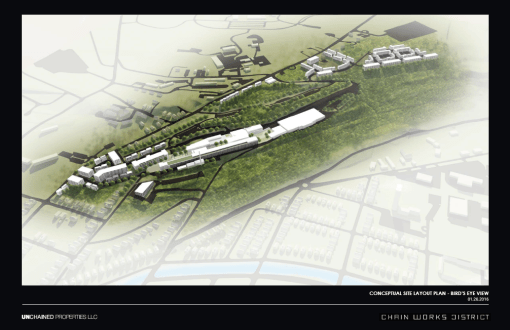
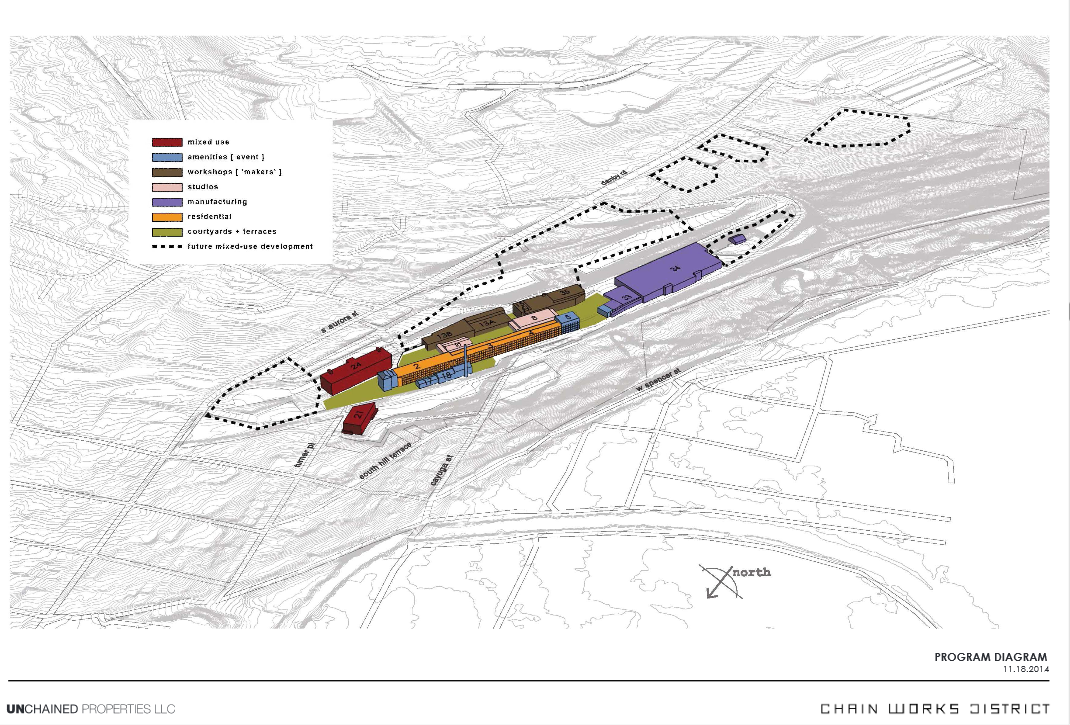
7. From the Ithaca Times: The Al-Huda Islamic Center hopes to start construction on their Graham Road mosque in 2017, and then obtain land for burials later this decade. In other news, new Times reporter Lori Sanken is reporting on the Chain Works progress, the Planning Board requesting color changes, careful consideration of heights, and debates about forest [preservation and Route 96B. Developer Dave Lubin of UnChained Properties wants to do renovations to existing buildings first, but seeing as they have yet to have the state sign off on a remediation place, they’re considering the construction of new buildings first, if NYS DEC approval for remediation gets delayed. And Catholic Charities and non-profit group Ithaca Welcomes Refugees are actively trying to procure affordable living space for 50 refugees who will be arriving in the Ithaca area after October 1st.

pinney_peruville_1
8. It’s been incubating for a while, but it looks like former Lansing town supervisor A. Scott Pinney’s plan for 15 duplexes (30 units) is moving forward. A gravel road will be extended from 4 existing duplexes at 390 Peruville Road (NYS 34B), looping through the property from Scofield to Peruville. The “Developer’s Conference” to talk about the project will be a part of the Lansing town planning board’s meeting next Monday. Also up for discussion are slight revisions to the Village Solars PDA, related to the community center and first-floor commercial space in the proposed Building F.

1001_n_aurora_1

9. From the Ithaca city Projects Memo for September, it looks like there’s a couple of subdivisions planned. One is for 404 Wood Street in the South Side neighborhood, where the owner wants to subdivide a double-lot he has for sale, allowing the vacant lot to be developed for a house or small apartment building. Quoting the application, “Instead of an empty grassy lot, there would be a building on it”. Points for simplicity.

The other is a double lot at 1001 North Aurora Street in Fall Creek. This came up a couple of weeks ago in a weekly tidbits round-up, because the new owner, Stavros Stavropoulos, received a $400,000 loan to build a duplex. Turns out it’s actually two duplexes, which require a lot subdivision, and will trigger planning board review. The application notes that even with the density increase, it’s still less than the surrounding neighborhood. The two two-family homes with have 3 bedrooms and about 1200 SF per unit, and are designed by local architect Daniel R. Hirtler to fit in with the neighborhood. Unusually, the application includes documentation of the previous owner signing off on the redevelopment plan. Construction is estimated to run from this month through May 2017.


News Tidbits 9/12/15: Some Projects Lose Mass, and Some Hold Mass

12 09 2015

1. We’ll start this week off with a little bit of economic development news. According to paperwork filed with the Tompkins County IDA, CBORD, a Lansing-based software company, wants to move out of its digs in the Cornell office park by the airport, and into a new larger facility in renovated space in the South Hill Business Campus next to Ithaca College. CBORD would lease 41,000 SF of space with five year options to renew. All 245 local employees would be moved into the renovated space, which would be finished by the end of May 2016 and designed by local architect John Snyder.

The project is expected to cost about $3.7 million. No new jobs are stated in the application.

Assuming SHBC’s website is up-to-date, no contiguous spaces are currently large enough for the tenant, so either the internal space will be split up, or some other tenants will be jostled around to make room for CBORD.

As for the abatement itself, CBORD is requesting a sales tax abatement, one year in length, with a value of $296,000, about 8% of the project cost. It doesn’t appear to have made any waves at Thursday night’s meeting, so what;s likely to be a low-key public hearing and approval vote will be coming in the pipeline.

Also at the IDA meeting, final approvals were granted for tax abatements on the 209-215 Dryden project by John Novarr in conjunction with Cornell. and for INHS’s 210 Hancock affordable housing development in the city’s Northside neighborhood.

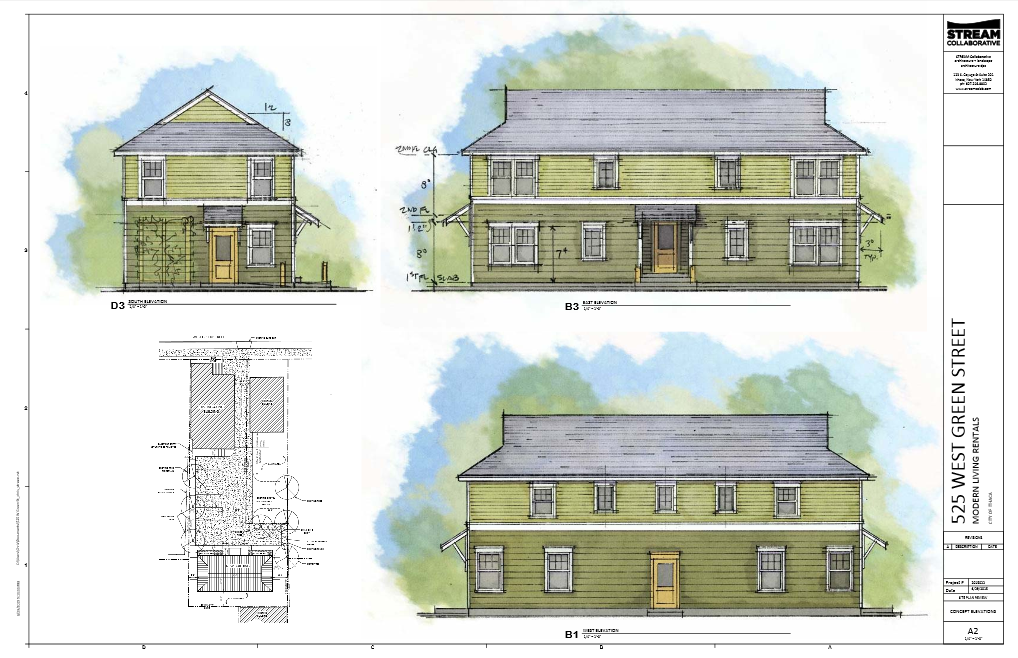
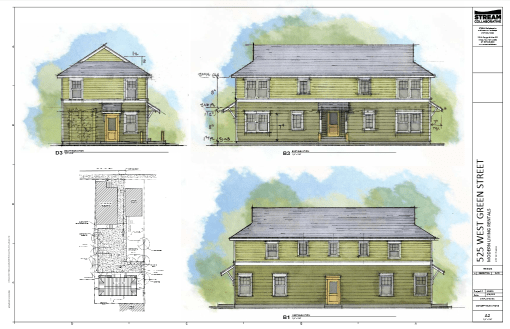
2. Another small infill project seeks approval from the city’s planning board and the Board of Zoning Appeals (BZA). 525 West Green Street, located on the edge of the South Side neighborhood, is currently home to a 4-unit apartment house. Local developer Todd Fox of Modern Living Rentals (MLR) is seeking to build a 4-unit, 4-bedroom apartment house at the rear of the property, where a clapped-out garage currently stands. The units would be rentals, but this far from Cornell and Ithaca College, the target market is likely to be permanent Ithaca residents – single professionals would be a good guess.
525_w_green_1

Plans drawn up by prolific local firm STREAM Collaborative call for a 2-story, 2,360 SF “carriage house” building designed to fit in with the rest of the neighborhood, although quite honestly no one would be able to see the new building unless one were looking down the driveway. A landscaped rear parking area for 8 vehicles would replace the current 4-car lot behind the existing building.

According to Site Plan Review documents, construction cost is estimated at $300,000, and construction would take place from November 2015 to July 2016. Area variances are required from the BZA since this building partially occupied space reserved for the rear setback, but according to the SPR the variance has already been granted.

Readers might recall that MLR has been a very busy company as of late – although relatively new to the Ithaca scene (MLR was established in 2010 by then-recent college graduates Charlie O’Connor and Todd Fox), the company has developed the 6-unit 707 East Seneca apartment building, a duplex at 605 South Aurora, and is currently going through the approvals process for solar-powered townhomes out in Varna. The duo also partnered with local real estate businessman Bryan Warren to purchase the Collegetown Bagels at 201-207 North Aurora Street.

As for the project itself, 525 West Green Street is perhaps the largest example of the carriage house trend Ithaca has been seeing lately, where old garages or unused rear lot spaces are being developed into small, detached apartments, typically no more than studio or 1-bedroom size. Other examples include 201 West Clinton, 607 Utica,  and new this month, a studio apartment proposed for a former workshop/garage at 701 North Aurora. Arguably, one could throw New Earth Living/Sue Cosentini’s Aurora Street pocket neighborhood in there as well.

Given that these properties are modestly-sized, rarely visible from the street, and provide rental income to property owners who in most cases live on the same lot, they seem like an appropriate way to increase density without upsetting Ithaca’s character balance.
troy_rd_rev1_1

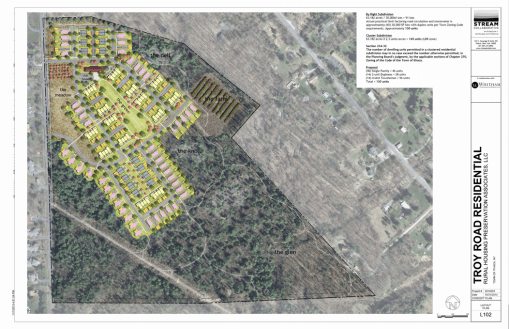
3. Briefly in blurbs – according to the agenda for Ithaca town’s Public Works Committee (PWC), the town will be looking at sanitary sewer access for a potential development along Troy Road. Now, before anyone gets their blood pressure raised, this most likely has nothing to do with the 130-unit project that was mothballed a few months ago. But, there have been rumors of smaller-scale plans for one of the parcels that comprised the now-subdivided property. The development radar has been turned on, and if anything shows up, you’ll see it shared here.

4. Staying in Ithaca town for the time being, the town’s planning board has but one project on their agenda for next Tuesday – a new parish center for St. Catherine of Siena Church in the Northeast Ithaca neighborhood.

Yes, even in Ithaca, one of the least religious metros in the country, famously home to a school that pastors derided in fiery philippics 150 years ago for daring to not affiliate itself with a Christian denomination or enforce mandatory church attendance, churches can hold their own.

st_catherines_1

Plans call for a new 10,811 SF parish center at 302 St. Catherine Circle, on what is currently part of the church parking lot. Once built, the current parish center, a one-story, 10,275 SF jumble of boxes and corridors, would be demolished and replaced with parking spaces. Richard McElhiney Architects of NYC is the project architect, and a bit of an unusual choice since the firm doesn’t have a presence or previous work up here.

In an assessment by Ithaca town planner Christine Balestra, concerns were noted about a phased parking plan for the church while construction is underway, and minor requests for landscaping details (plans call for two fountains). Other than that, it doesn’t look like this is going to make any waves during the approvals process.

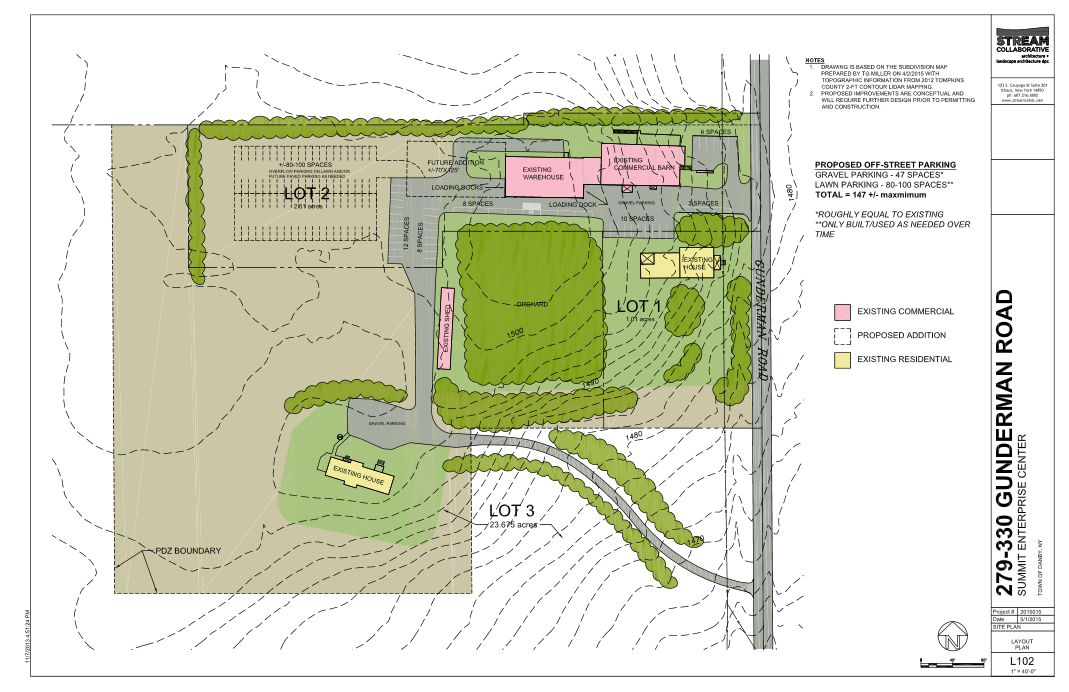
5. Over in the town of Danby, plans are underway to convert a former clothing design and warehouse facility into a mixed-tenant business center. Docs filed by STREAM Collaborative’s Noah Demarest on behalf of owner David Hall call for modifications of a Planned Development Zone for the property at 297-303 Gunderman Road. Danby’s PDZ is not unlike the city’s PUD and town of Ithaca’s PDZ, where the form and layout is regulated rather than the use. The original PDZ for the property dates from the mid-1990s.

summit_danby_1

The “Summit Enterprise Center” would be anchored by National Book Auctions currently on Danby Road, Blue Sky Center for Learning (a company that provides support and therapy for autistic individuals and their families), and New Moon Harvest, a food and beverage maker. Additional office, warehouse and industrial/food production space would be available to potential tenants. The existing 21,000 SF building and landscape would not be significantly changed, although future plans for a 4,147 SF addition and parking lot are noted.

chain_works_rev2_1

6. Speaking of PDZs and PUDs, I did take the opportunity when I spoke to David Lubin last week to ask how things were going with the Chain Works District development. Here’s what he said:

“Chain Works District is continuing. We’re working with the state and Emerson, investigating the site and making sure all the remediation plans are readied and approved. There will be public hearings. It’s a slow process. We will need DEC approval for the residential uses. We hope to obtain city approvals [for the draft environmental impact statement] this year.”

There’s no doubt the project will take time. With complicated topography, environmental issues, 800,000 SF of planned development space and two municipalities, it’s arguably the most complicated tax parcel in all of the county, if not the region. Readers may stretch their memories back and remember that the first phase will consist of the renovation of buildings 21, 24, 33 and 34 into mixed-use and manufacturing space. Ithaca Builds (come back Jason, Ithacans need someone with your knowledge) provides a detailed run-down here.

619_w_state_st_1

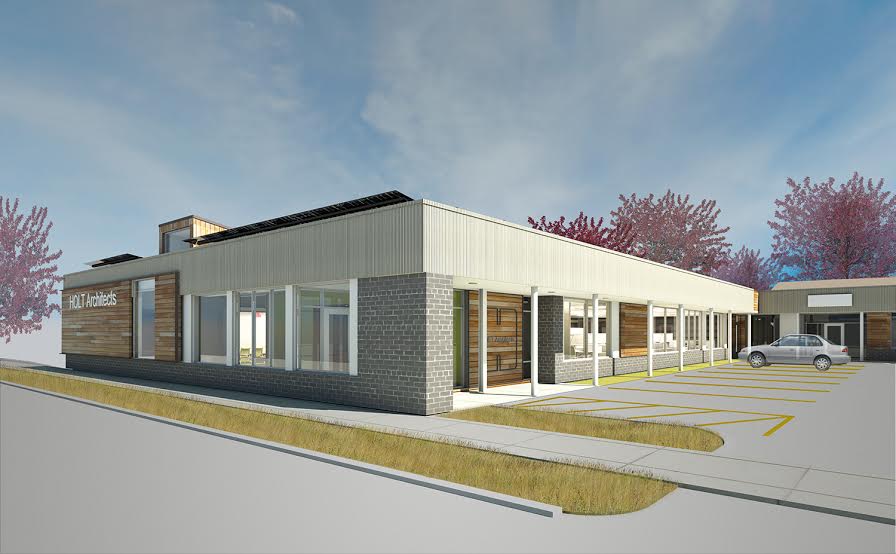
7. Courtesy of Maria Livingston at HOLT Architects, here’s a render of the renovation HOLT is undertaking for its new headquarters at 619 West State Street. Gone are the rather dated-looking decorative parapets, and in comes a clean, modern design with a mix of wood, brick and steel facade materials. HOLT’s 30 employees will occupy most of the new space in the  net-zero energy structure, but there will be space for two other tenants (one of which has already been claimed).

HOLT is spending about $900k on the renovation, which is due to be complete next March. Tompkins Trust Company is providing the financing, and local company McPherson Builders is in charge of general construction.

A copy of the official press release, and an interior render, can be found on HOLT’s blog here.

state_st_triangle_v5_1

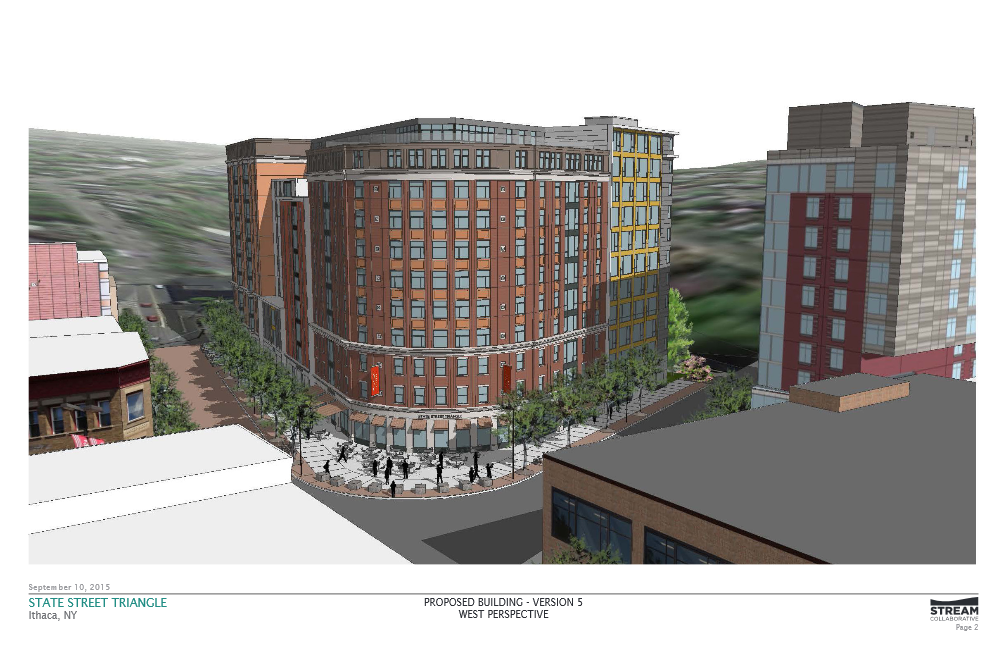
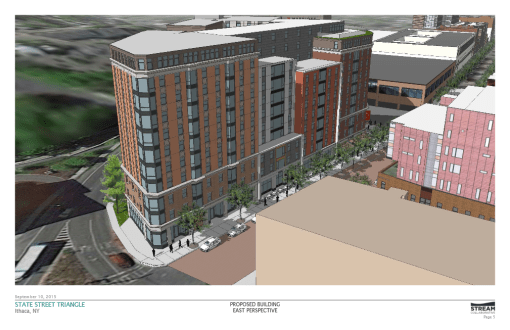
8. We’ll wrap up this work with a topic at the tip of everyone’s tongue – State Street Triangle. Architects Kelly Grossman of Austin, Texas and Noah Demarest of STREAM have worked to redesign the project so that its massing is less imposing and its design a little more varied. Specifically, it now looks more like several buildings built next to each other with varying setbacks and heights, rather than one continuous mass – the change is especially prominent on the 300 Block of East State, where the most concern was raised.

The developers held a community meeting Thursday night (pro tip for Campus Advantage – next time, give more than 30 hours’ notice), which has been covered by the Journal here and the Voice here. That the developers scheduled their own community meeting outside of the confines of city hall is laudable.

As part of the redesign, the number of bedrooms has been reduced from 620 to 582. Recent estimates have now priced the project at $70 million. The developer has expressed interest in designated some of the units as affordable housing, in what would be an example of the inclusive zoning that some city staff are currently looking into.
state_st_triangle_v5_2

The project is seeking a tax abatement, though the formal details have yet to be released. Rents would be between $980-$1,600 per month per person, and would include utilities, gym and other “all-inclusive services”. I suspect that a parking space in the Cayuga Garage is an added cost.

Speaking strictly for myself, the design is an improvement, though I have subjective quibbles – for instance, would a lighter color material make the north wall of 11-story middle section less visible from a distance, and would it be possible to give the blank walls more character. Balancing pros and cons, I also think the design of the Commons-facing corner looks tasteful and classy. The prospect of affordable units in the building is intriguing. If I was a planning board member, I’d ask to see material samples to make sure the building doesn’t end up looking cheap.

state_st_triangle_v5_3

Additional images of the updated design can be found on the city’s website here, and a written summary of the changes from project consultant Scott Whitham of can be found here.


707 East Seneca Street Construction Update, 8/2015

14 08 2015

By the time I had taken updated photos of the apartment building under construction at 707 East Seneca Street, most of the exterior work had been completed (looking at the photos closely, those might be some trim boards leaning next to the first-floor doorway). The work has shifted mostly to finishing out the interior, and then when the vast majority of work on the building is completed, landscaping and paving will follow. Everything looks to be on schedule for tenant move-in later this month.

For a look at interior progress photos, Modern Living Rentals has been posting occasional updates on their facebook page.

The building will have 6 3-bedroom units, 18 beds total. Todd Fox and Charlie O’Connor of Ithaca’s Modern Living Rentals are the developers, and the design of the building, heavily influenced by its location in the East Hill Historic District, is the work of local firms Schickel Architecture and STREAM Collaborative.

20150727_105957 20150727_110035 20150727_105910


News Tidbits 3/14/15: A Spring Thaw and A Warming Housing Market

14 03 2015

215_221_wspencer

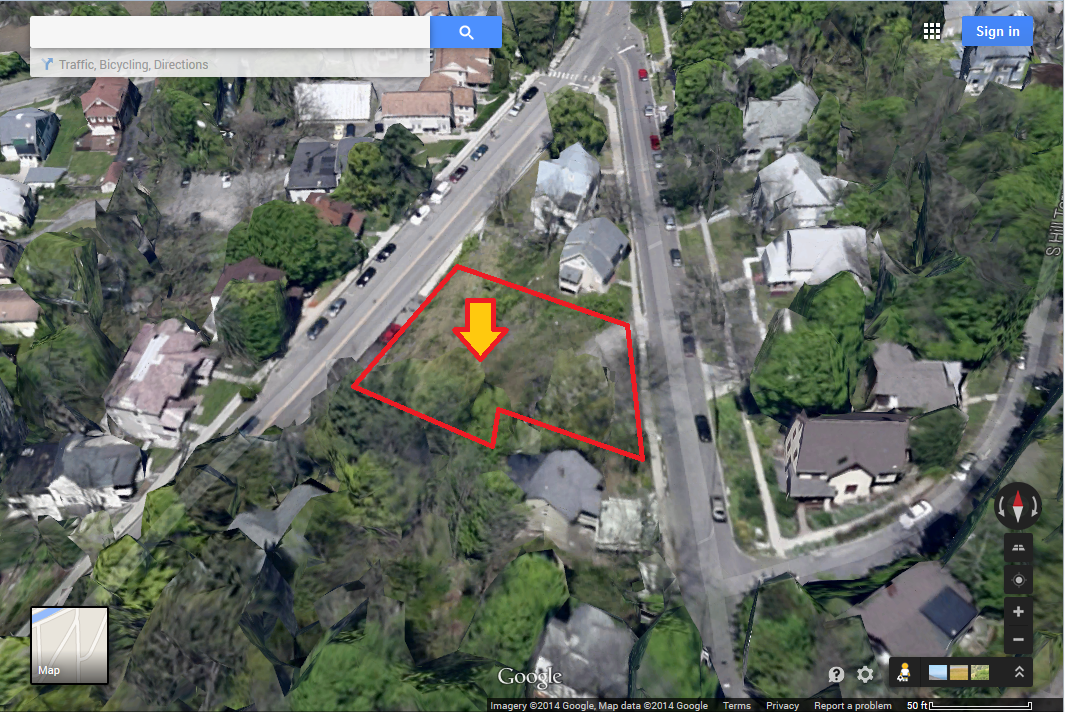
1. This past Friday the 6th, the city IURA (Ithaca Urban Renewal Agency) sold off a vacant city-owned property at 215-221 West Spencer Street to Edward Cope for $110,000. The name might not sound familiar, but a quick address check of the sales documents reveals an association with PPM Homes, a local rental company with a few hundred bedrooms in dozens of properties scattered around the city, most of them subdivided homes. Edward Cope also bought a vacant privately-owned lot at nearby 228 West Spencer Street for $15,000 on February 19th. 228 West Spencer, a small, steep site with tight zoning restrictions, was approved last year for one custom house design with 1536 sq ft. of space (the design plans came with the sale). As for 215-221 West Spencer, it was noted in July of last year that the city was selling the parcel (though I was under the impression it had already sold) and the buyer was intending multi-family housing. The 0.47 acre site has the potential for a medium-sized apartment building (20 units), but that’s a simple calculation using the zoning. With topography and neighbor considerations, the reality will be smaller.

In short, keep an eye on these properties, because PPM has the money to make the house and the apartment building happen.

holiday_inn_expansion_1

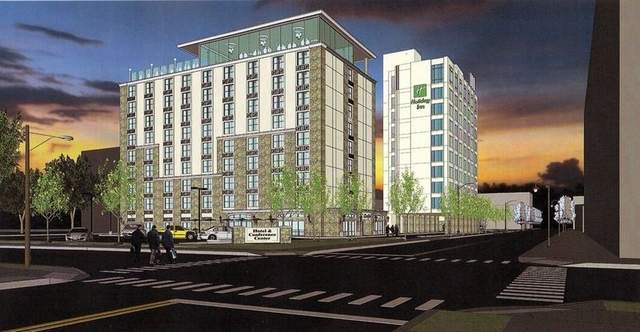
2. From the March IURA Agenda, a few good notes from the attached February minutes:

A. The Hotel Ithaca conference center is still actively trying to move forward.

B. The IURA received an inquiry about vacant land in the Cherry Street industrial park, from a business seeking to relocate into the city.

C. The city is making progress on taking over the state-owned parcel at 508 Taughannock Boulevard, previously used by the U.S. Coast Guard.

D. The former Ithaca Gun site is virtually entirely cleaned up, which will allow the apartment project proposed for the site to move forward with the planning and approvals process.

All things to keep an eye on in the upcoming months.

titus_wood_1

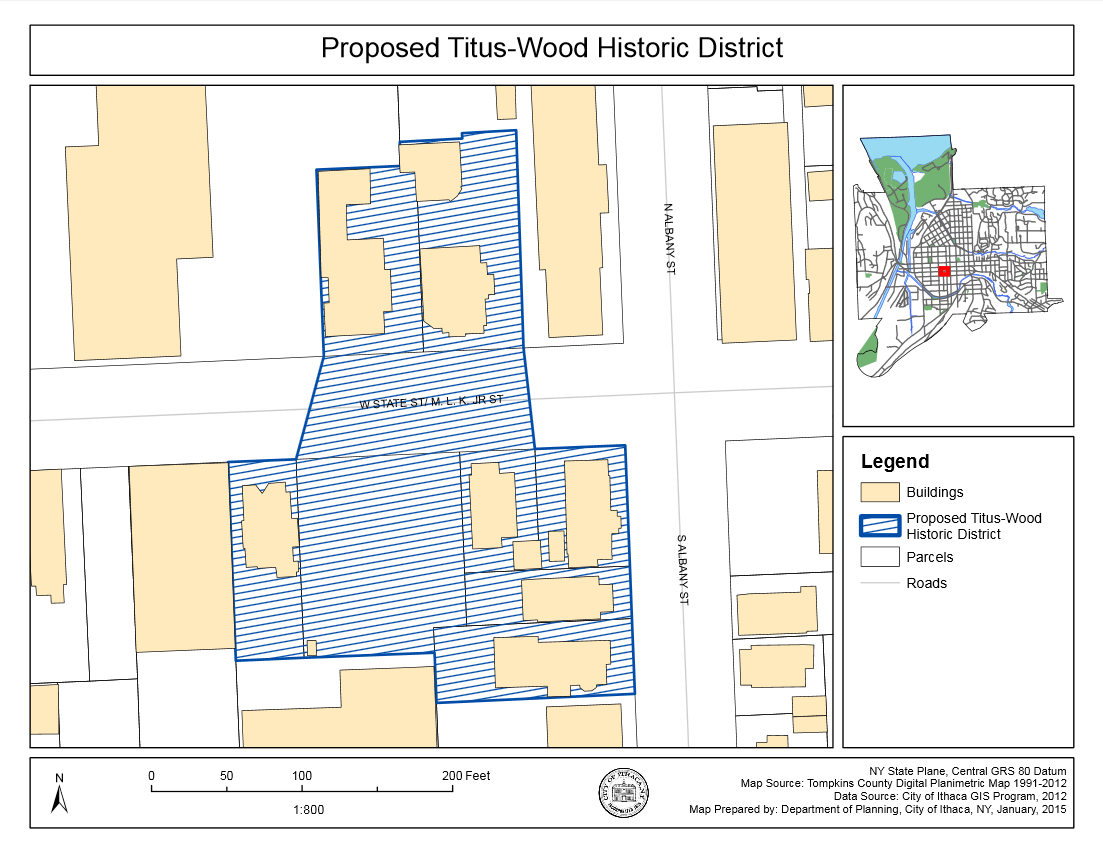
3. Looking at the city’s Planning and Economic Development Committee Agenda, there was quite a pushback from locals and the county for the proposed Titus-Wood historic district. The city fire department objected to landmarking their parking lot, the county wrote a letter opposing landmarking 317 W. State (and 315 W. State, which is not a registered address but could be the parking lot) because it was felt neither was historic enough and that it impeded urban infill, and the owner of 110 S. Albany, Ian Shapiro of Taitem Engineering, protested because his previous experience with the ILPC has been very frustrating, and that the ILPC gives applicants a really hard time over energy conservation efforts such as solar panels.

For the record, he’s not wrong about that. Some ILPC members have not been a fan of solar panels (examples here, here, here and here), and it has been at times a months-long process to get installation approval. It boils down to a dispute of alternative energy use vs. historic preservation, both things that Ithacans love, but can conflict with each other in cases like these.

Regardless of the opposition, the PEDC passed the historic district resolution with a unanimous vote, and the resolution now goes on to the Common Council, who will likely approve the new historic district.

4. Over in Lansing, concerned citizens looks like they can put their fears to rest regarding development of the Kingdom Farm property. The 528.1-acre property sold to a Cayuga County dairy farmer on March 10th for the hefty price of $2.8 million (in other words, $5,302/acre). The farm has been in the possession of the Watchtower Bible and Tract Society (the business branch of Jehovah’s Witnesses) for several decades, and the owners even pitched a 500-unit development for the site in the late 2000s. Back in October when the tax-exempt land went up for sale for $3 million, the Lansing Star reported that some more activist local residents wanted the town to step in and help a farmer buy the land so they could keep the property agricultural. There hasn’t been any news of the town taking that step, and it appears the problem resolved itself without the need of taxpayer dollars. Also, it means the property, assessed at $2.2 million, goes back onto the tax rolls. This might be one of the few cases where everything appears to have been worked out and all can go home happy.

5. 514 Linn Street has come down for a new duplex now under construction. Each apartment unit will have 3 bedrooms and be completed this summer. Although the predecessor building dated from the late 1800s, it was also an early “cookie-cutter” home; 512 Linn was the same design. Fall Creek is mostly developed, but Linn Street is no stranger to new builds – 514 follows a few years after 516 Linn, which was a new home built on a vacant lot.

amabel_v2_1 amabel_v2_2

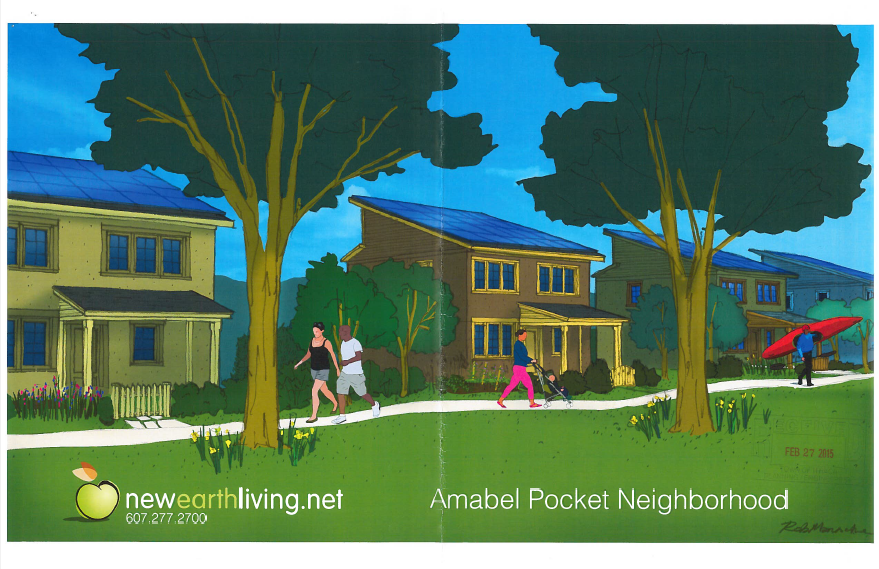
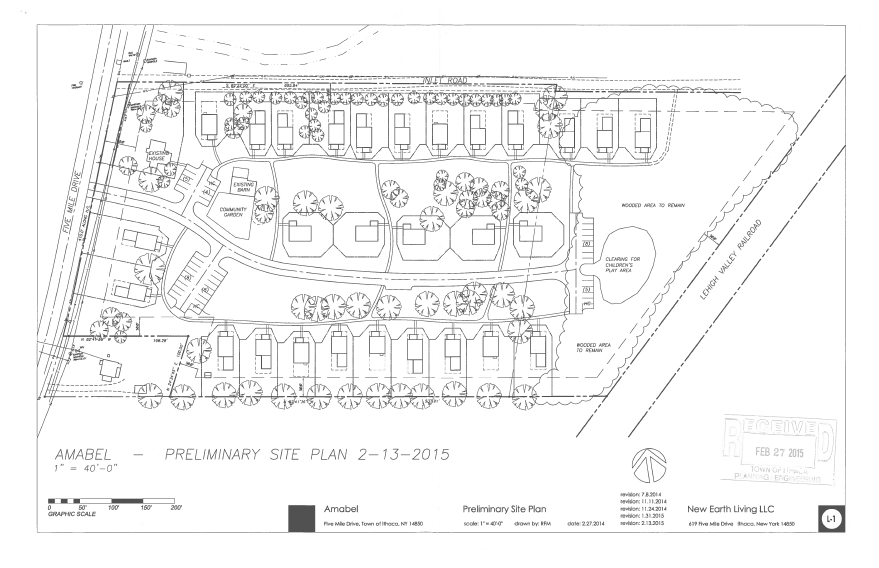
6. Lastly, it looks like the town of Ithaca’s planning board finally has a few things to work on, after having no meeting since early January. For their Tuesday meeting, the town will review plans for more luxury tents at La Tourelle, a new municipal water tank near Sapsucker Woods, and revised plans for the Amabel project off of Five Mile Drive. The number of units has been reduced to 28, and since November, two units were added to the far west portion of the parcel bordering Five Mile Drive (and as it turns out, those center units aren’t duplexes). Contrary to the example render, six different home designs will be available. Developer Sue Cosentini of New Earth Living LLC hopes to begin sales this summer.

Get connected:

Have comments or questions about these projects for your local government? Contact info below:

Town of Ithaca Planning Board: Use the form here – http://www.town.ithaca.ny.us/contact-us

Ithaca Common Council: http://www.cityofithaca.org/341/Common-Council – click on your councilperson’s name, their email is on the subsequent page.


News Tidbits 8/9/14: Can You Infill Me In?

9 08 2014

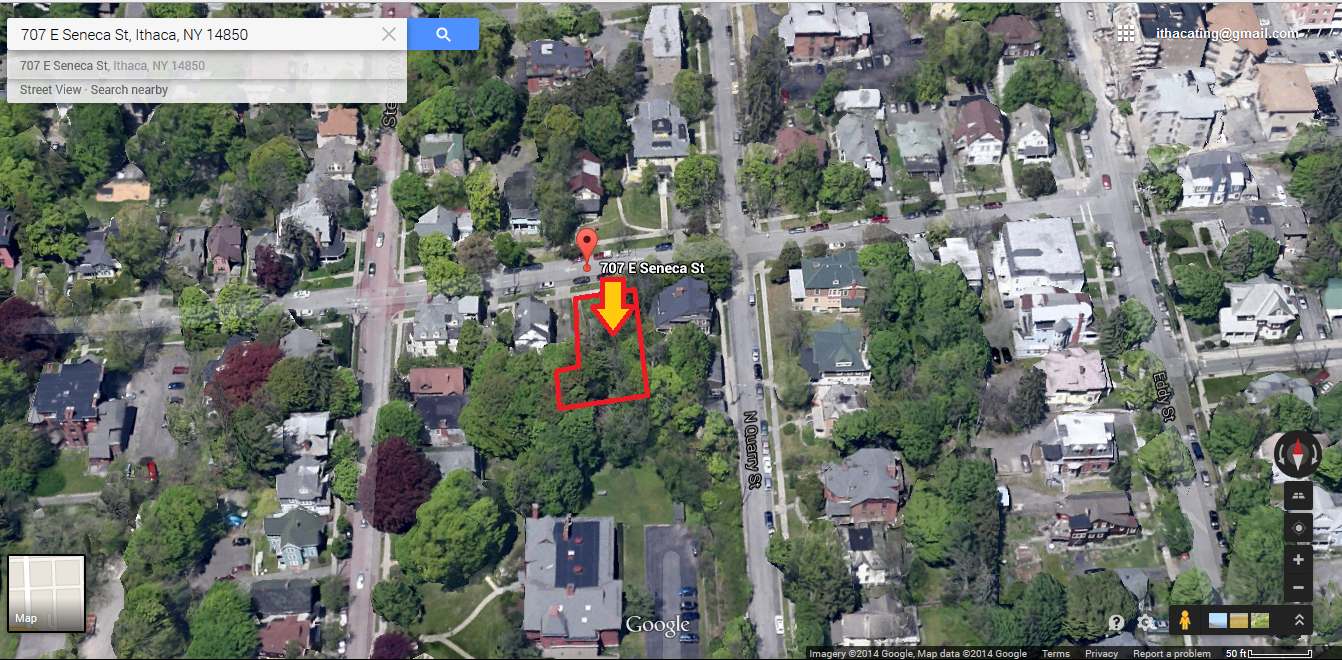
1. The city’s trying to balance its budget with the help of some land sales. In this instance, the property in question is 707 E. Seneca, a property just outside inner Collegetown, in the East Hill Historic District. The land was conveyed to the city in 1982 for use as a park/green space (it had been a school playground), but the land wasn’t maintained, and ended up become an unkempt vacant lot. After a few rounds of voting during the spring and early summer, the city has voted to put it to sale through the IURA (Ithaca Urban Renewal Agency). According to the county, the lot’s assessed price is $100,000, not bad for 1/6th of an acre. The site would be sold with deed restrictions to keep it from becoming a parking lot, and any new build (likely a single family or student house) will have to match the rest of the neighborhood. But it’s future infill, it’s money in the city’s pocket, and it’s less tax-exempt property.
707_East_seneca

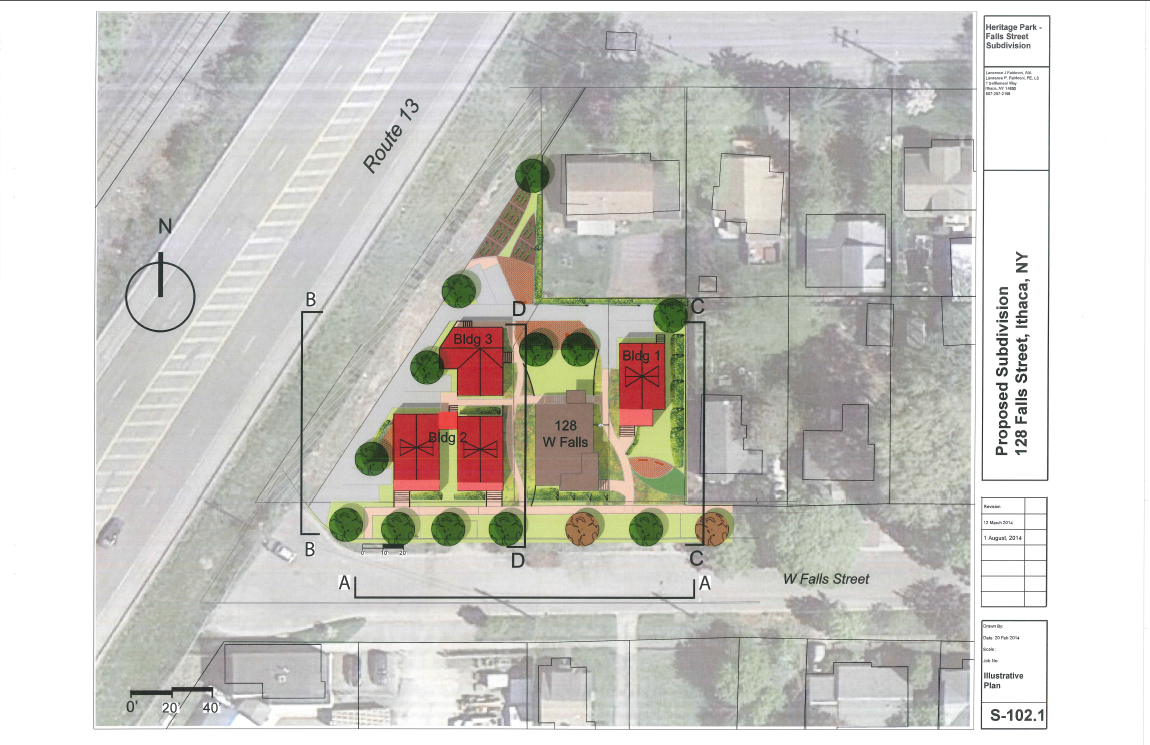
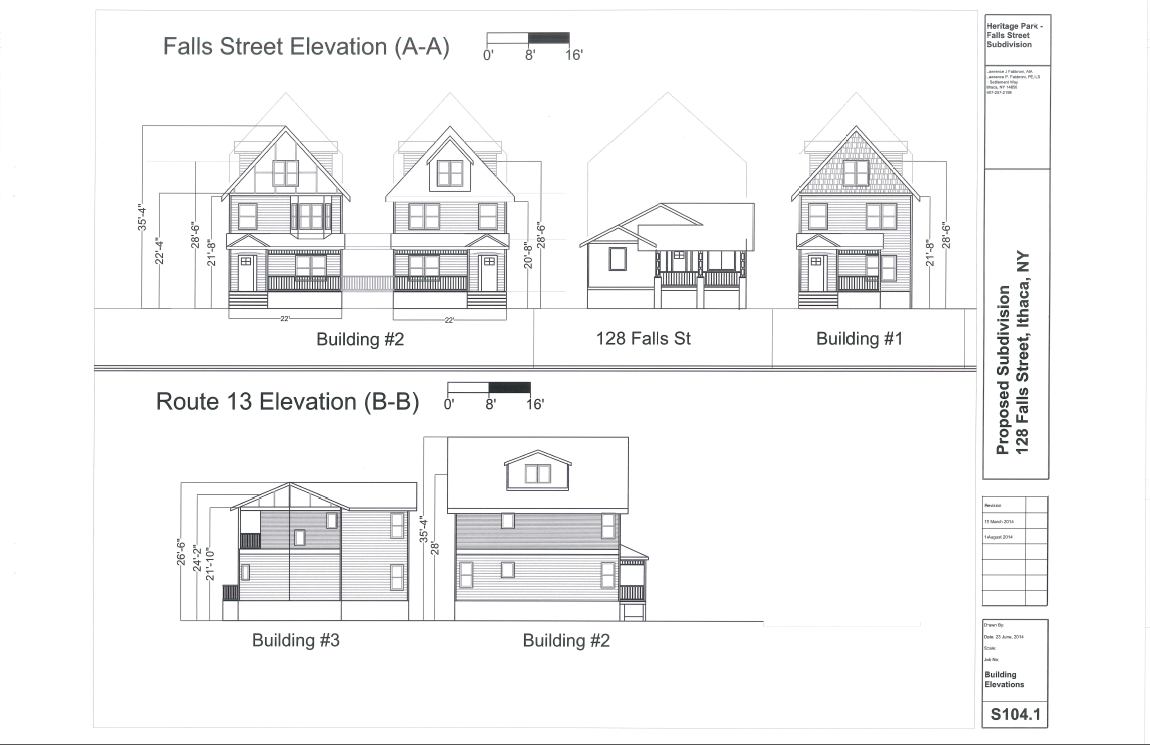
2. Speaking of infill, a project that fell to the back-burner due to neighborhood opposition is making a comeback. Revised 128 West Falls Street plans here (original plans here). Readers might recall this Fall Creek infill project by Heritage Builders hit a wall when neighbors complained that the project was just too much. In the revised proposal, which architect Larry Fabbroni says was designed with neighbor input and support, the number of units remains the same (5), but the two large houses next to 13 have been completely redesigned. House #2 is now designed to look like two separate houses (but they share a foundation, so they aren’t), and House #3 is shorter and less, uh, avant-garde. A lot variance is still required, so if this project finally received approval, expect it to be no earlier than this fall.
128_wfalls_rev1_1

128_wfalls_rev1_2

3. More than one person pointed out to me the Ithaca Times’ article regarding the Ithaca hotel boom. It’s actually a pretty thoughtful piece, but for those with not much time or short attention spans, here’s the spark note version:

-There’s still demand for more hotel rooms in Ithaca, but it’s getting closer to market saturation. R0om-nights (occupancies) are down, but rates are up, and compared to neighboring metros, Ithaca is still pretty damn lucrative, and demand is relatively strong for the time being.

-The convention center as part of the Hotel Ithaca is on hold. Major boo. The convention center has major potential to grow Ithaca’s hospitality market by giving the city the ability to host medium-sized (500+ person) conventions, because multiple hotels are required to adequately host those events. It would also help ease the weekend-weekday disparity, where demand is red hot for weekends, and tepid during the week.

Ith_Marriott

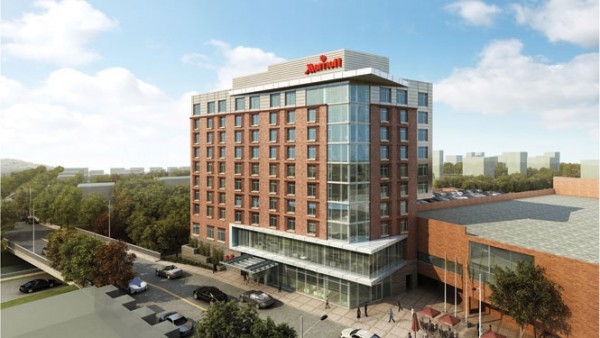
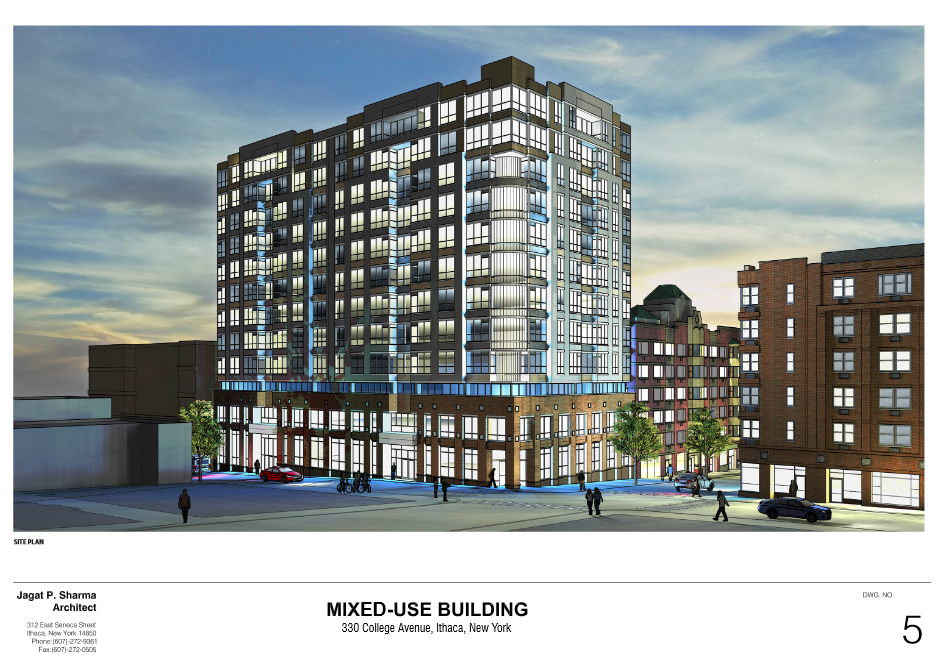
4. On the topic of Times articles, here’s a piece about Fane’s 12-story juggernaut. I’m just curious, do I qualify as the “local media” they cite? If yes, I’m flattered. But, at least their article isn’t just a rehash of what’s already been written. Called “Collegetown Tower”, the building would house 250-300 tenants, easily making it the highest capacity private building in inner Collegetown (I phrase it like that because Cornell’s Cascadilla Hall is in the same range). In an email to the Times, Fane envisions a “high-quality” food retailer and two other stores.

Although Fane says it’s a serious proposal, I still find it curious that there were no interior layouts created for the residential floors yet; I still think he’s just testing the waters to see what reactions are. Whatever the case, I can’t say I’m a fan of this:

“He stressed that if the project does not garner the necessary support at this time, he would wait until that time arrives.”

In other words, get used to that empty storefront. A 12-story, ~140′ building is unlikely to pass in a location where there was very contentious debate over 90′ (and even that had setbacks after 60′). 90′ feet barely passed the Collegetown Committee, and the opposition was so vocal that the city tried to reduce the zoning (and failed).

But don’t my word for it. The Ithaca Times came out against the height increase.

330_college

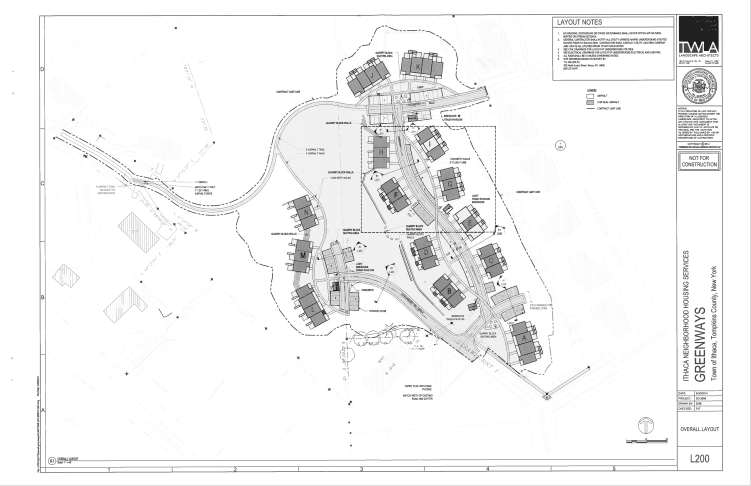
5. I remember being confused about this when I saw it in the news, and my confusion was merited – the town did not deny Greenways, because it was never formally presented and voted on…also, per the Times article I quoted, I was wrong about it being approved in July, but it has received preliminary approval as of the 5th. The inherent risk in writing about these projects is misinterpretation, and I’m as guilty as the rest.

greenways3

greenways4