News tidbits 6/26/16: The Odd Time Out

26 06 2016

trebloc-future2-1-620x420 trebloc-future

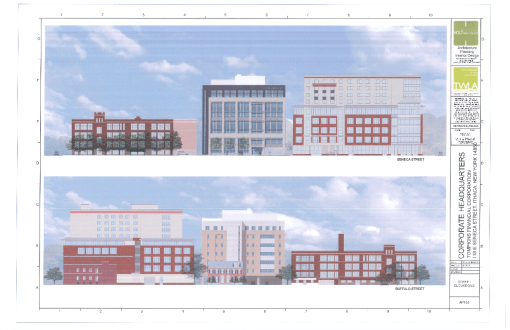
1. In what was ostensibly the biggest news of the week, Newman Development Group (NDG) of Vestal announced plans for the Trebloc site in downtown Ithaca. “City Centre” includes nine floors total, with roughly 250 apartments from studios to 2-bedrooms, about 10,000 SF (square feet) of retail space, 3,200 SF of amenities like a business center, and an underground garage of 70 spaces (the site is zoned CBD-120, which has no parking requirement). Readers might recall that Texas-based student housing developer Campus Advantage had proposed the State Street Triangle project, but their purchase option was not renewed by the owner of Trebloc.

Looking at their portfolio, Ithaca is NDG’s odd market out – most of their projects involve suburban retail centers and chain hotels, with shopping plazas from coast to coast. A smaller division, NDG Student Living, focuses on acquiring and building student housing, with their most recent projects in Binghamton and Oneonta. Ithaca seems to be the only metro where they’ve built general housing; earlier this decade, they worked with local businessman Bryan Warren on the Seneca Way mixed-use project on the east end of downtown.

The gut reaction to Newman as a developer is that, although they’re not very accustomed to urban mixed-use, there is one market where they do know what they’re doing, and that would be Ithaca’s.

Let’s just start right off the bat with one big difference between NDG and CA – the way the news was broken. CA was caught off-guard when the Journal’s David Hill broke the news of a 120-foot building a few days before the Planning Board meeting. NDG, working with local consultant Scott Whitham, emailed the same press release to each of the three major news organizations in Ithaca, which gave them the upper hand on the way information was delivered. The Times ran their copy first with almost no additional details, the Voice came a little later in the afternoon with more details such as unit total and retail space, and the Journal’s version came in the evening with even more details, such as the 70-space underground garage, and plans for the project to pursue CIITAP, the city’s property tax abatement program.

We’ll see what happens next week. The garage, not removing the turn lane, the general housing focus as opposed to students, and an initial design by Humphreys and Partners Architects that doesn’t repulse people are all cards that NDG holds that CA didn’t. But, there will still be sizable opposition. Playing your cards correctly is just as important to a winning hand as having them.

2. It looks like Gimme! Coffee is percolating something new out in Trumansburg. Through an LLC, the local coffee chain picked up 25-27 West Main Street for $350,000 on the 20th. The building is the former Independent Order of Odd Fellows Temple, a fraternal organization which established a chapter in Trumansburg in 1839, with ties to an older fraternal organization going further back to 1818. The 19th century temple is now about 1,700 SF of retail space, and 3 apartments totaling 3,300 SF on the upper floors; recent tenants have included Life’s So Sweet Chocolates and a barber shop.

Ithaca also had a location, first in downtown, and then on West Hill from the late 1920s. The older location was demolished to build the county library in the 1960s, while the West Hill location is a mix of uses today, one of which is the Museum of the Earth.

Gimme! has had a 1,200 SF shop at nearby 7 East Main Street since 2002, but they rent the space from Interlaken businessman Ben Guthrie. Logical guess here would be, they like Trumansburg, they wanted to buy a space and stay near where they are now, this opportunity came up down the street and they went for it. The sale price on 25-27 W Main is a substantial climb from the $288,000 it sold for in June 2010; I guess they call Trumansburg “little Ithaca” for a reason.
201_college_v5_1

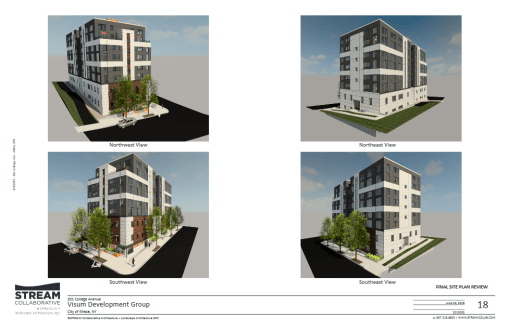
3. So, documents filed with the 201 College project this week were quite intriguing. First off, no action was taken at the zoning board meeting, but the developer of 201 College modified the project so that it no longer needs the setback variance or the entryways design variance. The planters were shrunk down in order to keep the sidewalk 12′ wide as requested by the Planning Board. Some additional 3-D drawings were also sent along, and site elevations and utilities plan here.

201_college_future

One of the images sent along was a “future context” file of potential nearby projects in the next couple of years. This document likely stems from the Planning Board debate of just what is likely to get developed in the vicinity over the next 5 years or so. There are four massings, merely following what zoning allows.

302-306 College Avenue – “Avenue 302”, by the Avramis family. Two buildings, one of six floors, one four, possibly in the 2017-2019 timeframe. Nothing formal has been discussed since the 2014 sketch plan, but the houses currently there are leased through May 2017.

215 College Avenue – A Novarr project. All that is publicly known at this stage is that Novarr wants to start construction in Summer 2017. Zoning allows 5 floors.

202 College Avenue – 202, 204, 206 and 210 College Avenue are all Novarr properties (there is no 208), as is the adjacent 118 Cook Street, which is not included in the massing outline. The College Avenue parcels allow 5 floors, 118 Cook 4. There hasn’t been any news with these properties lately.

119-125 College Avenue – three houses (there is no 123) owned by an Endicott-based landlord. I had to put out some inquiries on these houses, and there may be a sale in the works, although nothing’s on file with the county yet. These are CR-4, allowing 4 floors, but they could be tough to redevelop because these houses are seen as potentially historic resources.

Anyway, a vote on the project’s approvals is set for Tuesday. Neil Golder has created a group called “Save the Soul of Collegetown” to stage a rally in front of city hall that evening and try and halt the plans, but the last I checked on Facebook, three of the five people going were reporters.


amici house 1 county
4. Going more into briefs now, the Amici House funding plan for building a housing facility for 23 at-risk youth, and a second structure for five head-start classrooms and 42 students, was approved by the county this week. Once the sale is finalized, expect the official plans to be presented to city officials not long thereafter. Once those are approved, additional grant applications can be filed and hopefully, construction will be completed no later than 2018. According to the county’s press release, the Amici plan will create about 25 living wage jobs.

gannett5

5. Starting on the 27th, Gannett Health Services will begin to transition over to the new addition, while work begins on renovating the older wings of Cornell’s healthcare facility. This marks the rough completion of phase one, and the halfway point for the $55 million project. The Gannett webpage says the whole facility will be known as “Cornell Health” upon completion.

6. Back in November, Ithaca’s second ward saw a competitive election between candidates Ducson Nguyen and Sean Gannon. One of the big differences between the two was on development – Nguyen advocated for urban development in downtown, and Gannon thought there was too much building going on and it needed to be slowed down. Nguyen won by a hefty margin on election night.

A building loan agreement was inked next week to build a new duplex (two-unit semi-detached house) behind an existing property at 512-514 West Green Street. $330,000, Ithaca’s Carina Construction will be the contractor (expect a Simplex modular duplex). The property is bisected by zoning, with the rear falling into the State Street development corridor, so no parking is required for the new rear duplex. At a glance, it looks like a winning plan – it will be modest-sized, it’s in a walkable area, and it supplies much-needed housing. The Ciaschi family is developing the units.

The property also happens to be next door to Mr. Gannon. I’m sure he will be all kinds of amused.


News Tidbits 6/18/16: Wit Fails Me After Eight Years

18 06 2016

201_college_v4_1 201_college_v4_2
1. Let’s start off with a brief update on 201 College Avenue. My colleague Mike Smith at the Voice did an encompassing article on the topic late last Friday, and there have been a couple more modest developments as of late. Apart from the multi-million dollar sale mentioned last week, the city’s Design Review Committee also gave their input on the project. They said they like the current form of thje building’s front (west) entrance, because it calls forth elements of Grandview House a few doors down. they also recommended darker or neutral grey colors to minimize the appearance of the fifth floor, more windows along College Avenue, warm accent colors, and tweaks to the window and cladding scheme. The resulting revisions were incorporated into the latest building design seen above, and for which additional images, material samples sheet and interior plans can be found here. The project will be discussed at the Project Review meeting next week, and the official Planning Board meeting Tuesday 6/28, at which the public hearing will be held, and consideration of preliminary approval.

107_s_albany_v2_2

107_s_albany_v2_1

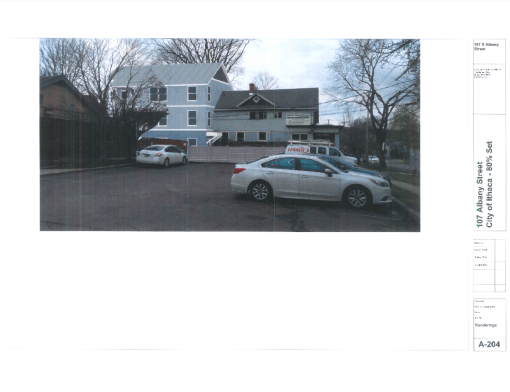
2. Speaking of design review, 107 South Albany also went through the committee this week. Recommendations included projecting window sills, stucco all the way back to the rear balconies, and noting on docs that the large sign on the existing building would be removed during the renovation. Site Plan Review app here, drawings here, Full Environmental Assessment Form (FEAF) here, planting plan here.

The renovation and addition seems like a good example of re-use in a corridor that the city is targeting for new investment. It preserves the century-old structure and adds housing in such a way that, by location and design, doesn’t have a significant visual impact. By zoning, Nick Stavropoulos could have sought five floors if he wanted. This plan will be going through the whole shebang at the June meeting – Declaration of Lead Agency, Public Hearing, Determination of environmental Significance, and Prelim and Final Approval.

Among other things to be discussed at Project Review and the Planning Board meetings – Prelim/Final Approval for 602 West State Street (the Elmira Savings Bank project), signage for Collegetown Crossing, and a few minor zoning variances. New sketch plans, if any, will be announced on the PB Agenda next week.

3. This week in big sales – someone plunked down $680,000 on a house at 107 Catherine Street in Collegetown. I say somebody because they conducted the purchase through an LLC (aptly named “105-107 Catherine Street LLC”) registered by a local law firm last summer. Just like the Maguire purchase of the Carpenter Circle land, this effectively hides the buyer from public view. The same purchase bought 105 Catherine for $780,000 last November. It looks like 105 has 10 bedrooms and 107 has 7 bedrooms, based off assessment docs.

cafd1

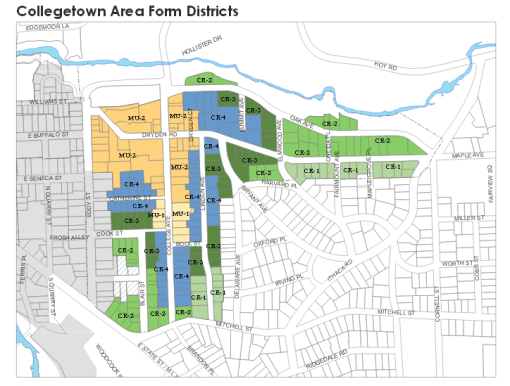
105 and 107 Catherine make up the edge of the CR-4 Form District. By zoning, an applicant could build up to four floors, no parking required. A development plan would likely consolidate lots. Something to keep an eye on. Collegetown is getting to be a very expensive place.

4. Meanwhile, here’s something that’s just hitting the market. For the budding landlords, 306 North Cayuga is up for sale. The “C. R. Williams House” was built in 1898 (interior/exterior photos from the early 1980s here). The current owner, Jeff Kalnitz, picked it up for $300k in 1997, had it on and off the market a couple of times, and then decided to do a thorough ILPC-approved renovation. The 12,500 SF property, which holds six high-end apartments and approvals for a seventh, is being offered at $1.45 million. It’s worth looking at the listing if only for the glamorous interior shots.

amici house 1 county
5. On Tuesday, the Tompkins County Legislature will vote on whether or not to take $118,000 from the county’s general fund to indirectly help build head start classrooms and a living facility for homeless young adults.

The $118,000 would be use to purchase a house at 661 Spencer, whose land would be incorporated into plans for a 23-person facility for homeless young adults (some with children) aged 18-25, and five classrooms. The classrooms would be built as one building, while the housing looks to be an addition to the TCAction building. The one-story house at 661 Spencer, built in 1950 and formerly formerly owned by the Amici family, would be removed.

The plan is the latest incarnation of TCAction’s Amici House project, slated to share their headquarters property at 701 Spencer Road on the southern edge of the city of Ithaca. TCAction first acquired their property with the help of the county back in 2001; the cost of the purchase is paid back to the county in the form of a 20-year lease.

If the legislature approves, the lease would be extended by two years so TCAction can pay them back for the up-front cost of buying 661 Spencer. The Amici House project would be completed by 2018.

6. Poet’s Landing in Dryden will be moving forward with its 48-unit second phase. The rentals, which are targeted at individuals making 60% of county median income, are expected to begin construction in August with a late summer 2017 opening. Phase I, which consisted of 72 units, opened in early 2013. The state awarded the project $1,600,000 from its Housing Trust Fund, and $734,956 in Low-Income Housing Tax Credits to help finance the apartments’ construction.

tfc_v2_1

7. Tompkins Trust held the official groundbreaking this Friday for it’s new 7-story headquarters. Plans were slightly delayed after some issues arose with NYSEG. The current plan is to have the 123,000 SF building ready for occupancy by March 2018. Costs have risen somewhat, from $26.5 million to $31.3 million.


Ithaca Marriott Construction Update, 6/2016

16 06 2016

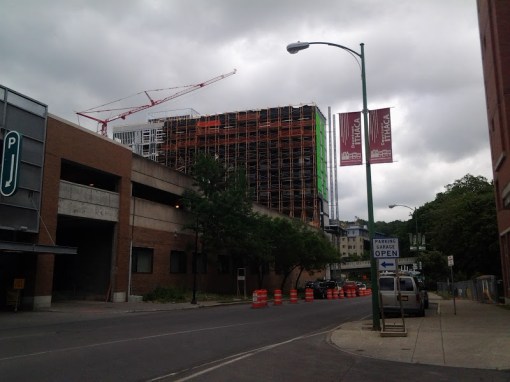
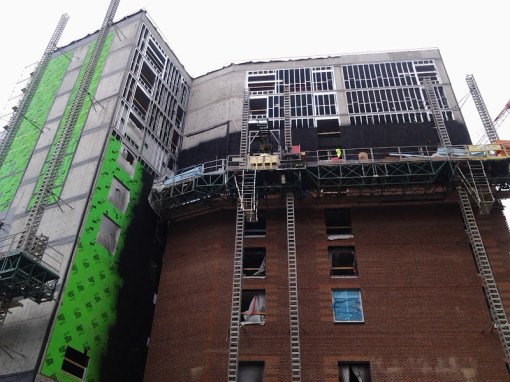
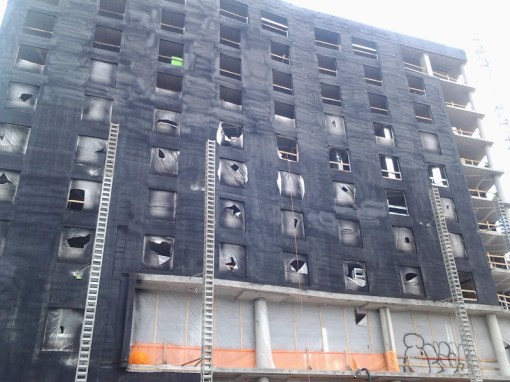
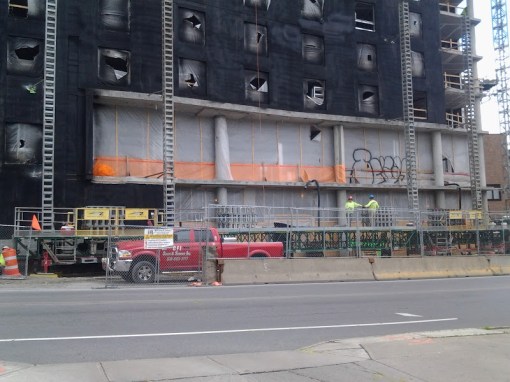
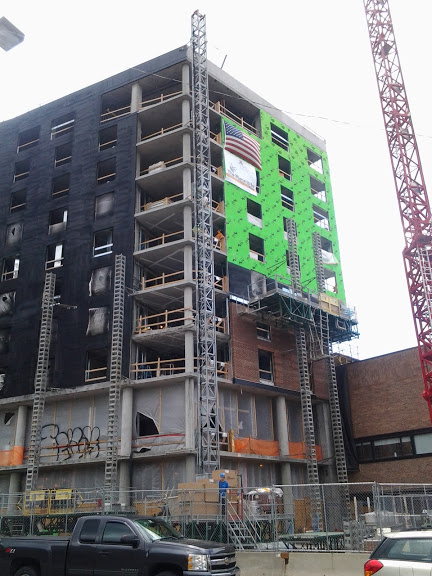
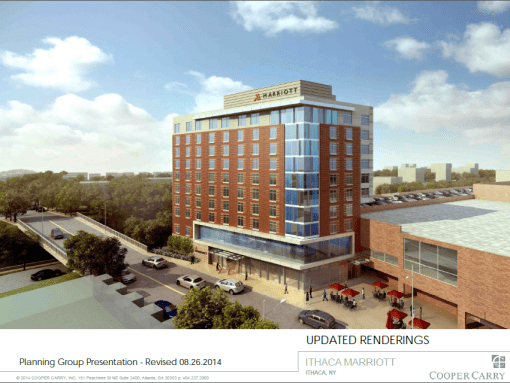
The Marriott is moving right along. Ten stories of reinforced concrete topped out at the beginning of May, with the mechanical penthouse being the last component. Exterior steel stud walls have been erected, fire-proof gypsum sheathing is being installed, and the black waterproofing material has been sprayed all along the front (east) face, and most of the back (west). Work on the brick veneer is steadily progressing up the north and south faces. The first floor facing South Aurora will have a stone veneer, while the top floor and the overhanging portion of the west face will use a few different shades of grey Nichiha fiber cement panels.

Work is also continuing inside as well – interior stud walls, electrical, plumbing, and HVAC. Specialty projects such as utilities are typically handled by various sub-contractors selected from bids.

In case you missed it, I did an interview with contractor W.H. Lane Inc. about the project for the Voice here. Plans still call for an August 23rd opening. During a debate on diversity at the latest city PEDC meeting, TCAD’s Heather McDaniel mentioned that Marriott has already hired four staff for the new hotel, of which three are women, including the general manager.

20160608_124634 20160608_124930 20160608_125143 20160608_131533 20160608_131621 20160608_131747 20160608_131812 20160608_131905 20160608_131932 20160608_132051 20160608_132111 20160608_132115 20160608_132201 20160608_132819 20160608_134654

marriott_rev1_1


Hotel Ithaca Construction Update, 6/2016

14 06 2016

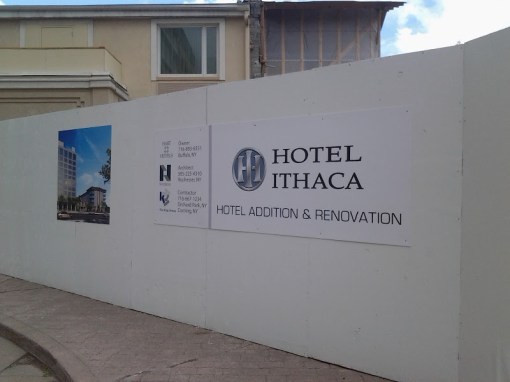
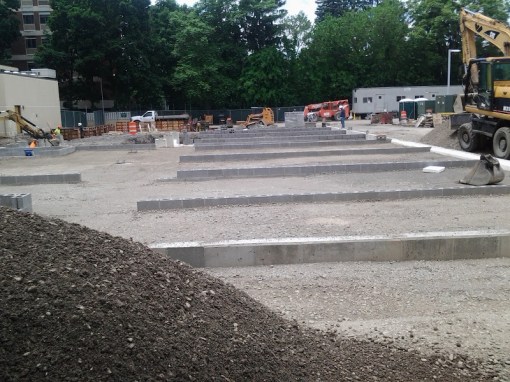
The Hotel Ithaca’s new wing seems to be moving right along. Most of the foundation has been completed. Some wooden forms used for foundation pours can be seen in the third photo, right next to the reinforced concrete footing. CMU walls create interior partitions within the building’s footprint – likely space for some of the 90 future hotel rooms, although none of the published materials online have shown an interior layout of the new wing. It’s suggested in the project site plan review documents that the new fitness center, breakout rooms and meeting rooms will be near where the new wing will connect to the existing hotel. Given the lack of windows or an entrance on the the first floor of the new wing facing South Cayuga, some of those function spaces are probably down at this east end of the wing, nearest to the street. Early plans did have an entrance on the South Cayuga side, but it was removed during project revisions.

The $9.5 million project is expected to open to guests in May 2017. More info about the project can be found here.

20160608_131325 20160608_131331 20160608_131351 20160608_131419 20160608_131442 20160608_131446


Carey Building Construction Update, 6/2016

14 06 2016

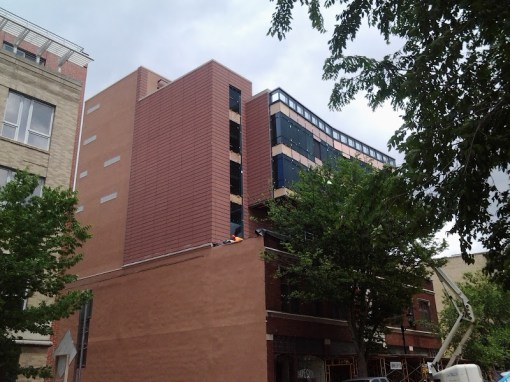
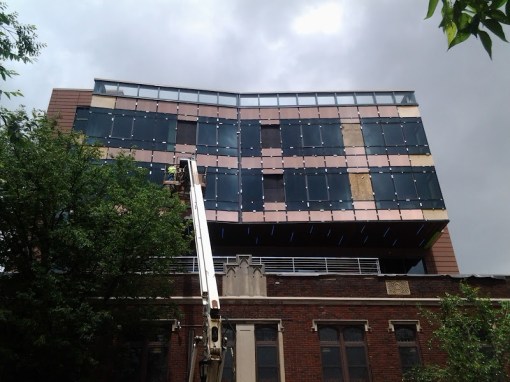
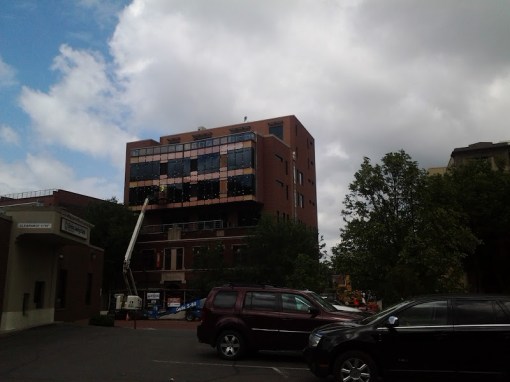
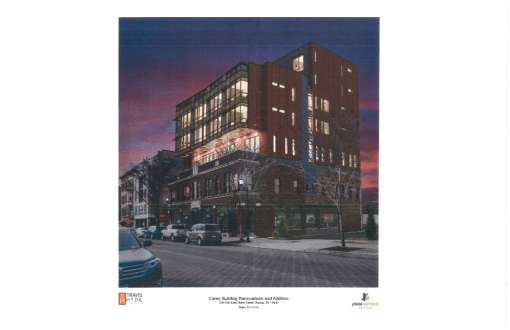
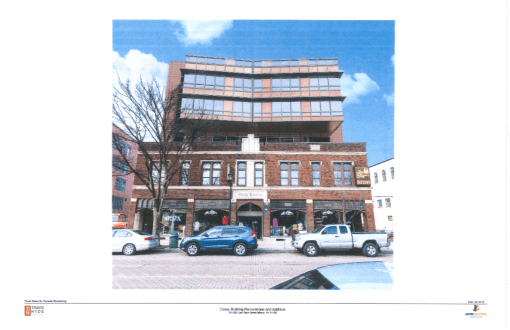
Another project that’s nearing the finishing line. Travis Hyde Properties will be wrapping up their Carey Building overbuild over the next several weeks. The target move-in day for tenants is June 15th, but there have been some last minute hang-ups with NYSEG and getting the utility services all ready to go, so I’m not 100% positive that date is still accurate. Side note, NYSEG is also the same reason why Tompkins Trust has been unable to commence with their new headquarters project.

I can finally affirm that the brown tinted glass looks different than the plywood placeholders. Actually, it’s a nice bronze shade that complements the synthetic stucco and terra cotta quite nicely. The bronze glass will also be used in the unfinished vertical section in the east facade.

Also, a really cool detail – the overhang of the fourth floor has been outfitted with color-changing LED lights, which will make going out onto Rev’s third floor rooftop patio that much more interesting. I’m willing to bet they can be programmed for standard white light, and for special occasions.

As mentioned in the weekly roundup a couple weeks back, rents on the units are going from $1,225/month for the microunits to $2,699/month for a high-end penthouse 2-bedroom. At the time of the WSKG newspiece (May 22nd), 5 of the 20 units already had claims staked. The THP webpage still lists all the units as available in the list of vacancies (although the list doesn’t look like it’s been updated since some time in May), but on another part of the website, only the lowest-price studios, the $1,225/month units, are listed as still available. There are 4 $1225/month studios, 2 $1250/month studios, 2 $1300/month studios, 6 $1325/month studios, and 2 $1350/month studios. So, assuming the website information is fully-encompassing, that would imply that at least 12 of the 16 micro-units are rented, and an unknown number of the 4 2-bedroom units, which range from $2337-$2699/month.

Apart from the specialty glazing on the exterior, a potential future wall mural, and whatever finishing work is left inside, this one’s wrapped up. John Snyder Architects and LeChase Construction have left their mark on the downtown Ithaca skyline.

However, work on this block isn’t likely to stop anytime soon – just as the Carey wraps up, the Hilton Canopy hotel will be getting underway. The Canopy is targeting an early 2018 opening.

20160608_132229 20160608_132255 20160608_132334 20160608_132357 20160608_132428 20160608_132535 20160608_132922 20160608_134712

carey_rev5_1 carey_rev5_3 carey_rev5_2


Simeon’s Reconstruction Update, 6/2016

13 06 2016

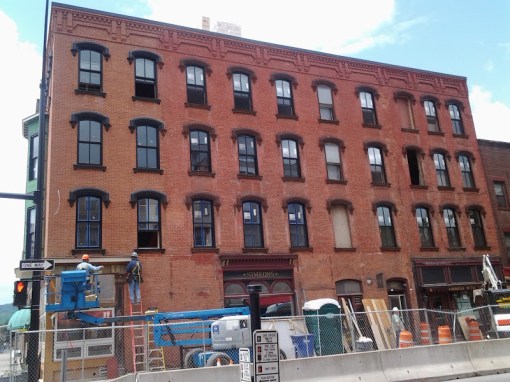
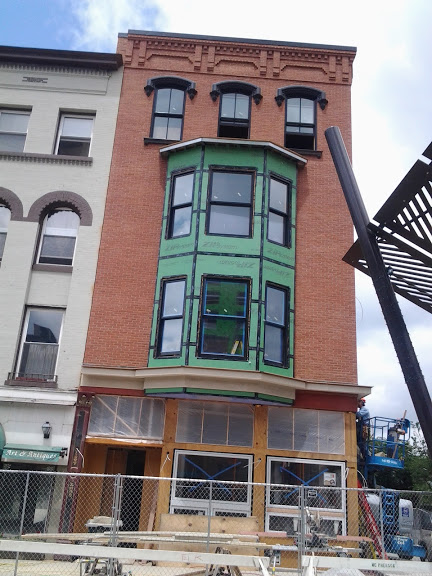
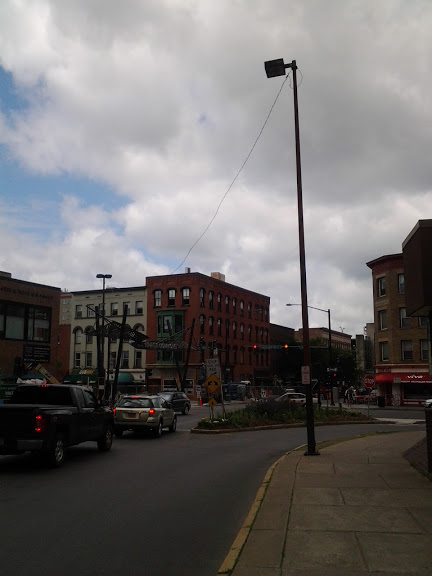
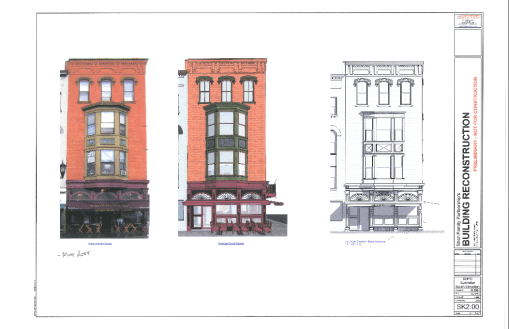
Almost done. From the outside, work on the Griffin Building (Simeon’s) reconstruction is nearlycomplete – glancing at the lead image, it’s almost as though the tragic semi-truck crash never happened. But, looking closely, one can pick out telltale signs – for instance, the new brick isn’t the same shade as the century-old brick in the undamaged section of the 1871 building. New energy-efficient windows are being fitted on the east facade. The ZIP panels facing the Commons will be overlaid with cast iron, some of which will be restored panels that were put into storage after the emergency demolition, and refurbished while construction was underway.

Inside, McPherson is progressing with drywall and utility work for the upper-floor apartments, and Simeon’s contractor (Fahs Construction Group of Binghamton) is building out the first and second floor restaurant space to house the new Simeon’s. The new entrance to Simeon’s will also be faced with cast iron. Initial plans called for a June opening, but according to city Planning Director JoAnn Cornish, they’re now looking at August. The apartments are expected to be ready for occupancy by late August.

20160608_132219 20160608_132559 20160608_132637 20160608_132652 20160608_132734

20160608_132134

simeons_v2_1


News Tidbits 5/28/16: A Battle Between Neighbors

28 05 2016

201_college_v2_3

1. It seems the Planning Board had something of a philosophical crisis at their meeting, per the Times’ Josh Brokaw. The cause of the crisis is Neil Golder, Todd Fox and 201 College Avenue. Here’s the backstory.

201 College is a 2.5 story, 12-bedroom house on the corner of College and Bool. Local developer Todd Fox has a proposal on the boards for a 5-story apartment building (shown above). Neil Golder lives next door at 203. He moved into 203 in 1972 when he was a grad student at Cornell, bought the place in the early ’90s, lived there with his partner Kathy until she passed a couple of years ago. He still lives there, and rents out spare bedrooms.

201 and 203 were rezoned as part of the 2014 Collegetown rezoning to MU-1. This came only after years of debate, and Neil was one of the residents who pushed to have the properties rezoned in 2009 with a payment in lieu of parking scheme that upset a lot of the landlords, who mounted a significant legal challenge that prevented the rezoning from happening – more about that can be found in this Voice explainer.

For the record, Golder has never been much of a fan of development in Collegetown. His two big things have been that density is bad (but he seems to have mellowed on this issue since the parking push in 2009), and that Collegetown needed a grocery store. He was supportive of Collegetown Crossing because the developer (the Lowers) live next door at 205 and Greenstar will be opening a grocery store on the ground floor.

So, back to the zoning. There are nine MU-1 properties. The four between Catherine and Cook belong to Novarr – he has not expressed any intent to redevelop them. The other five are 215, 209, 205, 203 and 201 College Avenue. Novarr has expressed intent to redevelop 215 starting in late 2017. 209 is Grandview House, a historic landmark, and pretty much untouchable. 205 is Lower’s house, 203 is Golder, and then you have 201.

201 is the southernmost of the nine, and therefore most likely to stand out. The thing is, zoning consistent, when development happens organically, it means the parcel most likely to stand out isn’t necessarily the last one to get developed, nor will it necessarily be the smallest. In this case, the physical transition is from 2.5-3.5 story houses, to 5-story apartment, to 2.5 story house, and then a 3.5 story house and 5-story boarding house.

As of right, Todd Fox can build up to 5 floors and 70 feet tall as an average height. The site slopes slightly, so the building is shorter on the north side than the south side. The design fits the zoning – but it has to go to the BZA for a couple of minor area variances, one for entrances off of Bool, and the other, the board requested the project incorporate – the building was moved northward slightly to allow for street trees and a wider sidewalk on College Avenue. The May agenda noted that the Board had no concerns with either variance.

Golder has sent letters to the Times and the Voice (directly to my colleagues Mike and Jolene but not to me, interestingly), he has been stopping people on the street to sign his petition, he’s tried the ILPC, Planning Board, Historic Ithaca, friends in city government, even the city forester, everything and everyone he can to try and halt the current plans, but there has yet to be a compelling, objective counter-argument.

Countering some of the claims in his many letters, the individual pine trees at the front are not historic landmarks or city-owned, the city has to review and approve of construction plans anyway, and the traffic issue had already been discussed back during the rezoning. The developer has agreed to push the building back, which will give more visibility to Golder’s driveway, and a curb bump-out at the corner is proposed as part of the project. So that leaves the aesthetic argument of “I don’t like it”, which puts the Planning Board in a really difficult spot because as long as the form districts say the design is fine, that argument won’t stand up to a legal challenge.

There is a strong argument with his solar panels, which have been a part of broader discussion within the city. 201’s height would marginalize Golder’s solar panels, so in that case the project causes non-subjective hardship; this could be mitigated if 201 has solar panels (they are being considered) and shares electric, or by other compensation. Although, it might depend on when the panels went in, before or after rezoning. If people start rushing to put up solar panels as a back-door method to thwart development, the city’s going to step in.

So here’s the essence of the issue – after years of fighting over zoning, and finally settling on a compromise in 2014, the city is faced with a development that is legal, but it’s vehemently opposed by a venerable and high-profile neighbor, where the objections can be effectively mitigated, but not necessarily the way he wants them to be. A planning board member has to find the balance between allowing everyone to have their say, and acknowledging valid issues that should be addressed, without letting individuals exert too much control over their neighbors and infringing on property rights.

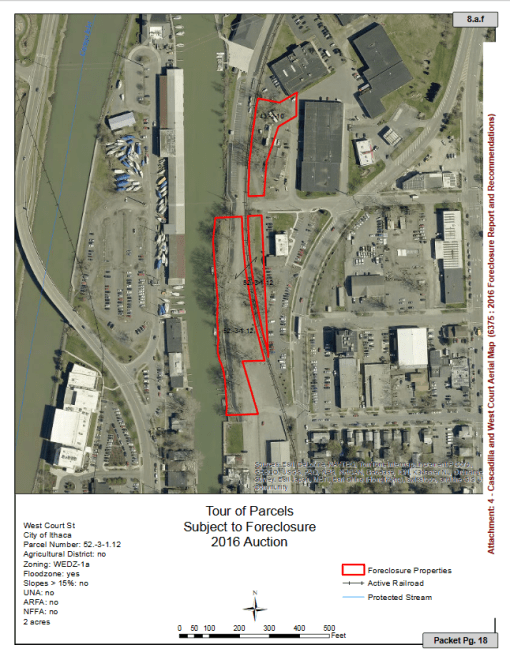
waterfront_foreclosure_parcels_0516

2. Okay, onto other things. The city might be acquiring a couple of sizable West End/Waterfront parcels from the county. The properties, which consist of a pier/boardwalk, informal parking and vacant land, are located at the end of West Court and Cascadilla Streets, and are being seized as a tax foreclosure. The county is looking at selling them to the city in exchange for the $42,844 in back taxes. The larger one is 2 acres, the smaller 0.6 acres, and in total they’re valued at $630,000. The owner, an LLC, picked them up for $156,625 in 1999.

If the city picks them up, they’ll be filed into the IURA’s holdings for potential sale down the line. As it is, the parcels have issues – the railway, accessibility, and soils down here are known for being difficult to build on. But in the long term, there’s potential for water-focused amenities, private development, or a combo of the two. It looks like a good investment given the city’s still-in-the-works plan to encourage redevelopment of the West End and Waterfront, so this is worth keeping an eye on as things move forward.

402_s_cayuga_st_boggsfernandez

3. The IURA reviewed funding proposals for affordable housing earlier this Spring, and the minutes are now online. the duplex at 622 West Clinton, and the affordable unit with the 4-unit 402 South Cayuga project were not funded. The IURA is encouraging 622’s applicant to re-submit for next year, and the minutes note that 402 is likely to still go forward, but without the affordable unit.

It’s also been noted that there is some discontent with INHS because the cost of their projects are coming in high, and that they would like more diversity in applying entities. However, the seven townhomes at 202 Hector and the single-family house at 304 Gector (all for-sale housing) are fully funded. The Habitat for Humanity duplex on the 200 Block of Third Street is also fully funded.

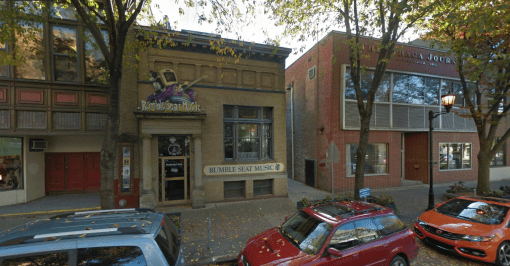
rumble_seat_1

4. Another piece of news from the IURA – the new occupant for the Rumble Seat Music building. It appears to be a drink bar called “Watershed Union“, serving coffee and juice by day and adult beverages by night. Five or six living wage jobs would be created. There might be some grumbling over the moral evils of alcohol, but the business plan has the support of neighboring businesses and the Downtown Ithaca Alliance.

Also, the Canopy Hilton is still moving forward. But are doing a minor LLC ownership change to allow another Patel family member to be a part of the ownership team.

5. Hitting the market this week, for all those big-potato investors out there – the Belmont Townhouses at 324 Spencer Road. The listing from local realtor Brent Katzmann has the price set at $2,595,000, for a 14-unit complex that opened in 1995. The posting mentions the possibility of a 1031 Exchange, which allows an individual to sell a currently-owned investment property, and buy a new investment property of equal or greater value while avoiding capital gains taxes – continuity of investment locks up the profit gained from sale.

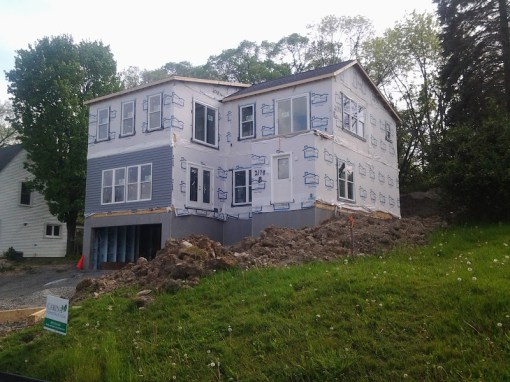
20160522_160150 20160522_160211
6. House of the week. This house is on the 100 Block of Campbell Avenue on Ithaca city’s portion of West Hill. This home is being built by Carina Construction, an Ithaca-based modular home specialist. The foundation and garage were poured and the pieces were probably craned on and locked together sometime in the past few weeks – a little bit of siding has started to show up on the front. The process is a lot like the one Carina used to assemble the Belle Sherman Cottages across town.

Color me impressed, the design is unique, and once exterior details like the porch and second-level deck go on, I imagine it’ll look really nice. Tompkins Trust lent $280,000 back in April, and the construction permits were issued not long thereafter (the total project cost is in the $320k range, per the permit filing). The land was created in a lot subdivision last year, and sold for $35,000 last August.


Simeon’s Reconstruction Update, 4/2016

28 04 2016

After the metal stud walls and fireproof gypsum board went up, it looks like another layer has been applied to the exterior. On portions of the structure that will be covered by brick, a closed-cell spray foam was used. Architect Jason Demarest provides a link to Goodale Construction of King Ferry on his Twitter account, so that might have been the subcontractor. Closed-cell spray foam, made with polyurethane and applied a few inches thick, provides insulation under the brick. On areas that will be covered by metal panels and details, Huber ZIP panels have been attached. Some of the original cast iron was salvaged after the accident and will be reused, but I haven’t seen anything that indicates if all the exterior trim will be cast iron, or if the exterior will be finished with metal panels that have a similar appearance.
Simeon’s, which is being built under a different contractor, is expected to reopen in June. Five apartments on the upper floors will hit the market later this year.

20160414_121110

20160414_121054

20160414_121009

20160414_120934

20160414_120426

20160414_120056

20160414_121141

simeons_v2_2


News Tidbits 3/19/16: A Taxing Problem

19 03 2016

20160109_115414

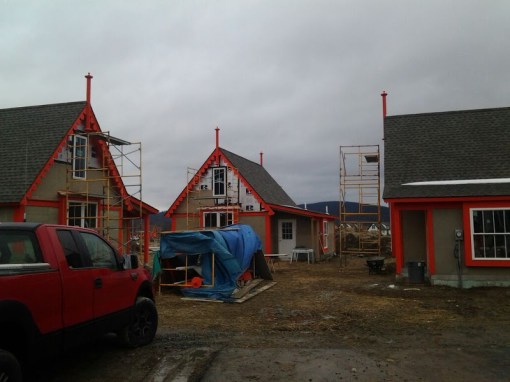
1. Apart from controversial presidential endorsement, Congressman Tom Reed paid a visit to the development community last week at the Boiceville Cottages project out in Caroline. According to Dan Veaner at the Lansing Star, the meeting was touted as an opportunity for developers, builders and contractors to express their concerns with onerous government procedures, specifically the local level.

Bruno Schickel, speaking at the event, noted that Boiceville could only have been done in Caroline because the 3,000 person town has no zoning (but they do have some type of commission that acts as a planning board). The lack of layers and conflicting comments from different interests allowed Schickel to get the latest 75-unit expansion approved in just two meetings back in 2012, something that he notes would have likely taken two years in other municipalities.

Then there’s this quote from another developer.

“After the site tour Reed spent time chatting with builders about regulations, mandates and costs that prevent some projects from ever being built.  One developer told Reed about an incident that killed a project before it even got started.
‘I tried to build a mixed use residential retail commercial building and I needed more residential units to make the economics work for lending,’ he said.  ‘I wanted six more apartments and the Town of Ithaca wanted an environmental impact statement.  the deal with these impact statements is that you pay an expert $20,000 so he can produce a 50 page report.  They look at it and read it and if they don’t like it they want to hire their own expert and they make the developer pay for it.  I backed out right away.  I pulled the plug and walked out of the meeting.'”

In case anyone was wondering, that was Evan Monkemeyer and his never built College Crossings project on the corner of 96 and East King Road. Which, to be honest, didn’t get re-approved because the window of opportunity closed as soon as the town updated its Comprehensive Plan and decided it wanted dense mixed-use. It’s an uncomfortable situation for all parties.

Obviously, there are two sides. Schickel is a very thoughtful and responsible builder/developer, but others may not be, which is why guidelines need to be in place. But, having watched the battles over affordable housing, and seeing the battles over wind and solar power now erupting in the western half of the county, it does give pause. I never thought I’d hear Black Oak investors such as County Legislator Dooley Kiefer and Caroline town board member Irene Weiser described like greedy Wall Street corporate villains, but that’s the current state of affairs. Using the same point from last week, the county can’t afford to be self-defeating, and having too many rules and regulations can keep a lot of good things, like green energy and affordable housing, from happening. The big, hotly-debated question is, where is the balance?

On a final note, the Star confirms that Schickel will finish build-out of the late Jack Jensen’s Farm Pond Circle project in Lansing, as soon as the Boiceville Cottages are finished later this year.

20151011_134147

2. It’s that time of the year for property re-assessment. The county gives a rundown of their process and goals for this year here. Most places handle assessment on the city/town/village level, so being that Tompkins County is solely responsible here makes it unique in the state.

tc_assessment_1

The report notes that high demand and low supply has kept sales prices on an uptick, and as those get factored into assessments, the values of property are due to go up as well. There aren’t as many sales as in the mid 2000s, but county home values are appreciating at an uncomfortably fast clip – median price went up 4.2% in just the past year, much greater than wage growth. The Voice has gotten some emails from people extremely upset that the county is doubling their land value, and there have been similar emails getting shared on neighborhood e-mail listserves, so there will probably be a story coming out on that soon.

Certain areas are facing certain challenges. For example, Collegetown’s land value is so high that it’s often worth more than the building that sits upon it, making much of the neighborhood a redevelopment target. Fall Creek is seeing home value appreciation much faster than the rest of the county, making it ground-zero for rapid gentrification. The county’s not pulling these values out of the ether; assessments are based in part on what people will pay for similar neighborhood properties. Fall Creek is walkable, centralized and a strong fit to the rustic, crunchy vibe buyers are often looking for in Ithaca. There are signs that the North Side and South Side neighborhoods are seeing similar impacts, but they’re not as noticeable because those neighborhoods were traditionally less well-off, so the gross home values aren’t as high, even if they’re appreciating at similar rates.

Out in the towns, the county feels Caroline is being under-assessed, which they hope to change in 2017, and there have been wildly high-priced sales in Ulysses that the county attributes to “excited” lakefront buyers. About the only area where the county is concerned about falling land values is Groton, where poorly-maintained properties are taking their toll on the tax base.

On the commercial end, Commons businesses and county hotels can expect a 5% assessment increase.

east_hill_master_plan

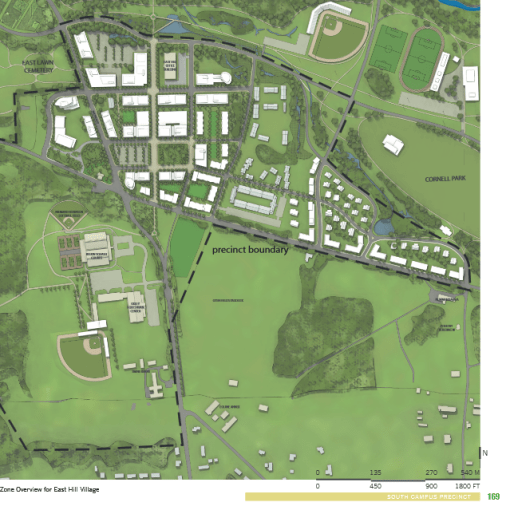
3. Looks like the town of Ithaca released their annual planning board summary. Only 15 new of modified proposals were reviewed in 2015, down from 27 in 2014, and 32 and 41 in 2012 and 2011 (2013 is excluded for some reason). Nevertheless, the town’s planning department has been busy trying to translate the 2014 Comprehensive Plan into form-based zoning code, at least some of which they hope to roll out this year. A couple sources seem to have taken to referring to it as the “Ithacode”.

Also in the pipeline – reviewing Maplewood (with the city as secondary), reviewing Chain Works (with the city as primary), and possibly, Cornell rolling out plans for East Hill Village (early design concept shown above), the first phases of which are expected to be unveiled within the next year.

902_dryden_v4_1

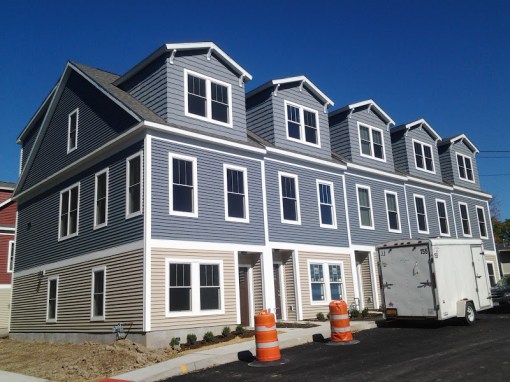
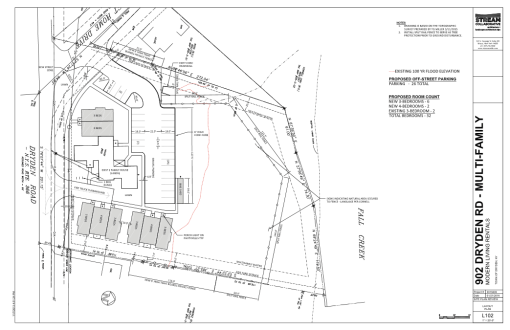
4. The townhouses at 902 Dryden Road in Varna have been approved. The Dryden town board voted 4-0 to approve the project at their meeting on the 17th. The 8 new units and 26 new bedrooms should begin construction this July and be completed by June 2017. Local company Modern Living Rentals will be developing the site, and the townhouses (no updated render, sorry) are being designed by STREAM Collaborative.

Also relevant to the Varna discussion, the planning department memo notes a pre-application meeting was held for a proposal to subdivide and build 16 “small homes” at the corner of Freese Road and Dryden Road currently owned by Dryden businessman Nick Bellisario. No other information is currently available about the project.

hughes_cornell_3

5. Let’s wrap this up with a look at the city of Ithaca Planning Board agenda next week. Quick reminder, the general order is: sketch plan, Declaration of Lead Agency, Public Hearing, Declaration of Environmental Significance, BZA if necessary, prelim approval, final approval. Here’s the formal rundown:

Site Plan Review
A. 210 Hancock – project update, no decisions
B. 424 Dryden, rear parking lot for 5 cars – prelim and final approval
C. Hughes Hall Renovations, Cornell University – Determination of Environmental Significance, prelim and final approval
D. Ag Quad Renovations, Cornell University – Determination of Environmental Significance, prelim and final approval
E. The Cherry Artspace, 102 Cherry St. – Declaration of Lead Agency and Public Hearing

F. Sketch Plan – 301 E. State Street, the Trebloc Building.

Don’t know if this is a continuation of State Street Triangle or something else (it would be a surprise if someone could create a new plan in such a short time), but we’ll find out on Tuesday. Zoning is CBD-120, meaning commercial or mixed-use, no parking required, up to 120 feet in height.

G. Sketch Plan – 201 College Avenue

201 College Avenue sits on the corner of College Avenue and Bool Street in inner Collegetown, and is presently occupied by a well-maintained though unremarkable 12-bedroom student apartment house owned by an LLC associated with the director of a local non-profit recreational center. The property is currently assessed at $545k. Zoning for the property is Collegetown MU-1, allowing for a 5-story, 70′ tall building with no on-site parking required. A quick check of neighboring properties indicates that the owner only owns this property, so whatever is planned will likely be limited to just this house.


News Tidbits 3/12/16: After Much Discussion, Even More Discussion

12 03 2016

maplewood_site_plan_concept

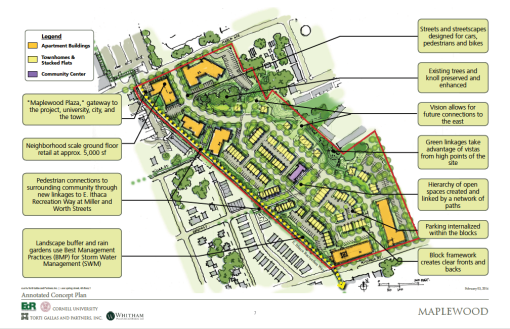
1. The community meetings have begun for Maplewood Park’s replacement. The Cornell and Professional Graduate Student Assembly (GPSA) held a discussion with the developer EdR and project architects Torti Gallas this past Monday. According to the Sun, some of the features planned in the new graduate housing development include-

“[S]omething like the Big Red Barn but on a smaller scale as a community room so you can open it up and have events…there will also be a business center for group projects and work. We are also planning an outdoor recreational space like tot lots for people who have families and volleyball courts.”

Concerns about affordability were raised, but the developer said that rent prices are still being sorted out. From the meeting, the four big goals of the project are “affordability, walkability, sustainability and community,” with streets that also serve as public gathering spaces, and a variety of unit sizes and types. Definitely something to keep an eye on as plans are fleshed out.

On the bureaucratic end, the Maplewood Park sketch plan is set to be presented to the Ithaca town planning board next Tuesday by Scott Whitham of Whitham Planning and Design. A sketch plan has no votes involved and is merely an informational session, and an opportunity for the board to give preliminary thoughts and input. The board will also be hearing a much less interesting proposal for a new bus shelter in B Lot.

dryden_south_rev_1
2. Looks like Kraftee’s in Collegetown will be shutting its doors. According to the Cornell Daily Sun, the book and apparel store, which opened its Ithaca location in 2002, will be closing for good at the end of the month. Owner Pat Kraft did have plans to move the store into the first floor of the Dryden South mixed-use project currently under construction at 205 Dryden Road, but now with Cornell’s new Executive MBA building underway on the lot next door, he plans to “explore other more complementary uses for the commercial space.” Since the project is in MU-2 zoning, Kraft is legally obligated to have “active use” commercial on the 2,400 SF first floor: hotel, bank, theater, retail, and/or food service.

20150829_125449

3. The city’s CIITAP production at the Wednesday PEDC meeting was productive. The board seemed comfortable with the pre-payment option preferred by the IURA. The question now comes down to what length abatements to offer. The 10-year has strong support, but there was discussion on whether or not to offer the 7-year option (only used once by the Hotel Ithaca) and the 12-year option with the enhanced benefits. So while this a few months of discussion left ahead of it, there’s a better idea of what the revised CIITAP will look like. For the record, the 1% fund payout would be based on hard construction costs only, not soft costs. So for example, the Marriott currently underway, it would have paid 1% of $19 million instead of $32 million (would it have still moved forward? Dunno).

20150727_145641

4. Also at the PEDC meeting, the development policy topic du jour finally moved forward – incentive inclusionary zoning. Discussion on the law here, and a primer on the topic here. So, stemming from a debate with the Times’ Josh Brokaw on Twitter, my initial reading of this law was mandatory. But I was mistaken, it’s voluntary and the city will want a couple years to gauge its effectiveness.

The Sun writeup is here, but eventually you;ll be able to find live video archived from the meeting here. I think Mayor Myrick pretty much nailed it with this quote –

“This proposal is an opportunity for those of us who claim to care about affordable housing but oppose large-scale subsidized housing.”

The unpleasant truth is, classism reared its ugly head during the 210 Hancock debate, and thanks to the online petition, everyone saw it. After all the prep and community meetings that went into the project before it was even proposed, there were still people who said it was unsafe, uncivilized, would breed trouble, that the residents would cause crime, they’d all be on welfare…pretty unnerving commentary from a community that considers itself progressive. Abhorrent as it is, these comments aren’t going to go away. Many of these folks are older, some have been here for decades, and they’re set in their beliefs. It’s regrettable to say this, but the more subtle and intermixed the affordable housing is, the less likely it is to face neighborhood opposition.

Along with the removal of parking requirements and +1 floor option in certain neighborhoods, the reduced site plan review option (only affecting the plan layout and design, not the environmental aspects) was judged to be the most appealing by developers. To be fair, a project redesign based on board input can be expensive, so reducing that prospect in neighborhoods with pre-established form guidelines (currently only Collegetown, but the Waterfront is likely to have its own form-based hybrid code in a year or two) is a big positive.

The PEDC voted to circulate the law for review, with only 1st Ward Councilwoman Cynthia Brock dissenting. There will be more typed about this law as it moves forward.

On a semi-related note, it looks like the town of Ithaca is now starting to look into some kind of inclusive or incentive zoning as well.
old_libe_thp_holt_v3

5. For this week’s eye candy, here’s the latest revision for Travis Hyde Properties’ DeWitt House senior apartment project at the Old Library site.  This was the version presented at the March 8th meeting. HOLT Architects has been tuning in to both the ILPC’s and the Planning Board’s comments (the two have been conducting joint meetings to avoid extra bureaucracy and contradicting each other) and is trying to hem down the general design idea such that SEQR and SPR and the rest of the approval process paperwork can begin.

As can be seen, the design is quite a bit different from the original plan with the “dorky roof” as one county legislator called it (for the record, I liked the dorky roof). This is an idea of where the design is going, but not the final revision, since the ILPC and Planning Board still plan on commenting further. For those still simmering over the decision last summer, just remember that even if the Franklin/STREAM proposal for condos had been selected, the ILPC and Planning Board would have had a heavy hand in that design process as well. The design for DeWitt House will continue to evolve, and updated images will be shared as they become public.

20160219_145406

6. Meanwhile, out in Lansing, lawmakers are under pressure because NYSEG cannot accept any new gas service requests because the current pipeline is fully tapped. About half of homes nationally and many commercial and industrial structures use natural gas an an energy source, so this could potentially put the kibosh on a lot of home and commercial construction. Definitely not welcome at a time when the town and village are at high risk of losing their biggest taxpayer.

NYSEG is still actively pursuing construction of a new gas pipeline from Freeville, one that has garnered considerable opposition from Dryden and some eco-activists. The environmental advocates have pushed for renewables, but the recent opposition to the Black Oak wind farm in Enfield, and to solar panels in Ulysses for the Sciencenter have created yet another complication to the county meeting its green energy goals, let alone overall energy needs. The area can’t afford to be self-defeating.

The Lansing Star is reporting that NYSEG has obtained about half the easements it needs, and could eminent domain the rest as a last resort. It’s a tense and complicated situation.

20160219_17504020160219_175113

7. Wrap this up with a quick house of the week update on INHS’s 203 Third Street affordable home project. These photos are a couple weeks old now, but most of the trim has been attached with the exception of the porch, and with that, finish-out of the interior and landscaping, this 2-bed, 1.080 SF house will be good for sale. INHS is asking $129,000 from qualified moderate-income homeseekers (buyers making 70-80% of Area Median Income, I think offhand), and is expected to change hands this summer. Claudia Brenner did the design, and Rick May Construction did the buildout.