The Government Campus

3 09 2016

5-1-2012 120

The idea of a government campus in Ithaca is very intriguing. It offers big opportunities, and potential pitfalls.

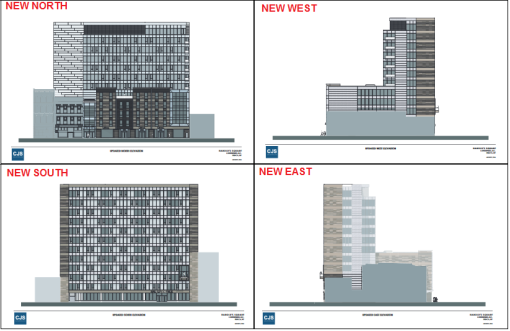
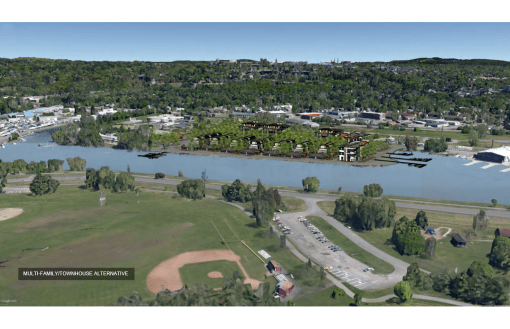
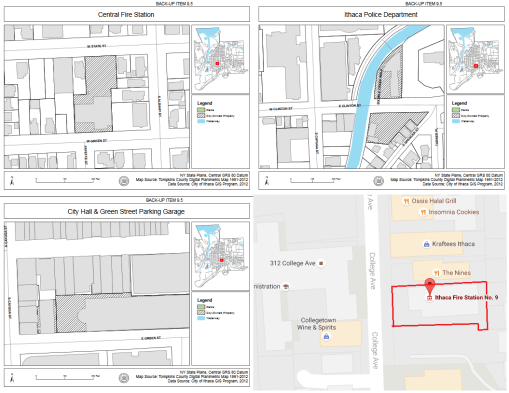
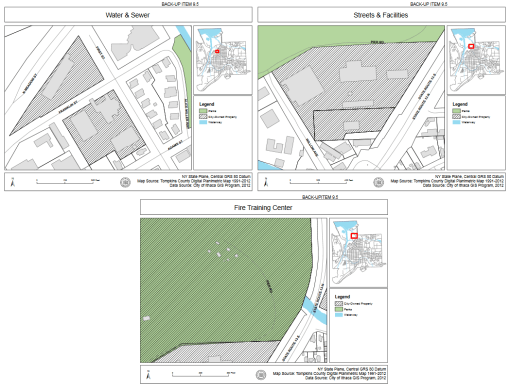
A copy of the funding request can be found here. The $150,000 study comprises two components – the first would combine the Collegetown Fire Station (No. 9), Central Fire Station at 310 W. Green Street, the Police Headquarters on E. Clinton and City Hall into one site on the property of the Central Fire Station. The second combines DPW Streets and Facilities and DPW Water and Sewer into one location.

Given the very profound impact this would have on the city, there’s been relatively little news about it. I cued my colleague Mike Smith in to it, and he did an interview with Planning Director JoAnn Cornish, which led to two articles. The spark notes are that the current condition of some of these properties is poor, so the city is looking at which to consolidate and/or build new, and which to renovate. The money is left over from the study looking into moving Station No. 9 and designing a replacement (apparently, it only cost $80,000 of the $500,000 allotted), so this is the planning department’s shout of carpe diem. The Common Council has given strong support to doing the consolidation study.

Let’s make it clear – there is no commitment anything will happen. Nothing may change at all, Station No. 9 may still move to Maple Avenue while everything else is left as is, or the consolidation plan might actually get carried out. But if they have the money and time, it’s worth exploring the possibilities.
consolidation_study_1

Study one, the “government campus”, involves a space needs assessment for programming and staff, concept site plans, and cost estimates for new facilities. The study will also offer appraisals for existing buildings and discussion of selling these properties:

  • City Hall and the adjacent parking lot to its east
  • The Collegetown Fire Station
  • The Police HQ, but not the Courts Building
  • The Western 1/3rd of the Green Street Garage

Each has its opportunities. The western third of the Green Street Garage has some of Ithaca’s most accommodating zoning for urban projects – CBD-140, a 140-foot building with no parking requirement. When the garage was rebuilt several years ago, only the central section was structurally redone. The western section is nearing 50 years old, so without major renovation, it will be nearing the end of its safe useful life. The early plans for Cayuga Green called for a larger garage on Green Street, so another floor or two on the remaining two thirds is not impossible.

Meanwhile, Ithaca has never been particularly attached to its city hall – the building was built for NYSEG in 1939, and the city bought the building in 1964, demolishing its old city hall for the Seneca Street Garage not long after. In the mid 1980s, the city attempted to sell city hall so that it could be bought by a private owner and leased out to the county, all part of an effort to keep the Department of Social Services downtown – the city failed to persuade the county legislature, which moved DSS out to West Hill until the Human Services Building opened on the 300 block of West State in 1998. Demolition would face significant opposition, but conversion to housing could be a safe option for a hypothetical new owner.

The Collegetown Fire Station is prime real estate. It’s MU-2 zoning (six floors, no parking) in the heart of Collegetown at 309 College Avenue. Given that 201 College sold for $2.65 million, and 215 College sold for $5.3 million, there’s little doubt the city could fetch a multi-million price here. An RFP would have to be cognizant of the fact that the site itself is best-suited to student housing, because not only would its price be limited by other means, non-students may not be comfortable living in a location that’s 95+% students. There could be a provision for housing fund payments or off-site affordable housing at an appropriate location.

The city police station is a question mark. The zoning for the Police HQ and Courts building is B-1a, and the police parking lot is R-3b. R-3b is 4 floors, 40% lot coverage, a parking space for every unit or three bedrooms, whichever is greater. B-1a is nearly the same, but with 50% lot coverage, but the Courts Building could make selling a tough prospect.

Now comes the question of the Central Fire Station redevelopment, which occupies much of its site on West Green. A back-of-the-envelope for the police HQ, fire station No. 9 and City Hall is about 48,000 SF (assuming police uses make up half of the courts complex). The Central Fire Station occupies 17,000 SF. So you’re asking for a sizable multi-story building on top of what’s there, and not counting impacts like parking. The city would need to be careful, as South Side is one of the more affordable areas and the risk for displacement of low-income households is considerable. Any project would also have to go through ILPC consideration since it borders historic properties.
consolidation_study_2

Study #2, the DPW consolidation, also offers opportunities. The study calls for a consolidation at a new location in Southwest Ithaca down by the box stores. It involves a space needs assessment for programming and staff, concept site plans, and cost estimates for new facilities. The city says it may also consider a shared facility with the town of Ithaca, or the county. In such a move, the city frees up space that it could sell on the North Side, and opportunities that could enhance redevelopment efforts on the Waterfront. The Northside area is also one of the new parts of the city where affordable housing is feasible and accommodated by neighbors, so mixed-uses with market-rate and affordable housing is plausible. The Pier Road area has high water tables which could drive up foundation (construction) costs, but Form Ithaca highlighted redevelopment potential at the site during their charettes.

Anyway, this is a lot of handwaving. Any work would be far, far off, probably well into the 2020s. A lot can happen between now and then – the economy tanks, priorities change, the sale of any property ends up a big debacle like the county’s Old Library redevelopment. It could make the city a lot of money in sale and taxes and help continue the downtown renaissance, or if done wrong it could end up being a burden that hurts taxpayers as well as lower-income households. But it’s certainly an interesting topic to explore.


Tompkins Financial Corporation HQ Construction Update, 8/2016

31 08 2016

Tompkins Financial Corporation’s decision to build in downtown Ithaca is seen as something of a major victory by civic groups and local leaders. For one, it’s a major economic investment, and for two, it’s taken by many as a sign that downtown Ithaca has “turned the corner”.

Tompkins Financial Corporation is the parent company of Tompkins Trust Bank, as well as some other financial units. The company can trace its roots back to Tompkins County Bank’s formation in 1836. Along with Tompkins, TFC also manages several smaller banks throughout New York and Pennsylvania, totaling 67 branches and about 1,100 employees. About 280 of those work in downtown Ithaca at the current headquarters.

Currently, the office space is decentralized, scattered throughout multiple downtown sites and one suburban site, some of which are owned and others of which are rented. The bank began studies several years ago to examine a new headquarters, and looked at an urban location downtown, and a suburban location. Throughout the last 50 years, most large private companies have opted for the latter, and not without good reason. The logistics are simpler, the land is cheaper, the parking is easier – a study commissioned by TFC showed they could have saved over three million dollars by choosing a suburban site. But, as downtowns like Ithaca’s have made a resurgence in popularity, and given the bank’s long-time presence in downtown, they decided to pursue the urban option.

The new headquarters, first proposed in March 2015, will keep 282 employees in downtown (making an average annual wage of about $81k), add 18 more from the consolidation of the Craft Road office in Lansing, and potentially add a number of new jobs as the bank continues to grow. The IDA application gives 6 new positions over 3 years, all well over living wage; paperwork submitted to the city says 77 jobs over ten years. The project applied for and received a ten-year tax abatement from the Tompkins County IDA, saving about $4.06 million in property taxes and $2.112 million in one-time sales taxes. The community hearing was generally supportive for an abatement, and even with the reduced short-term tax bill, a net positive of $3.78 million will still be paid in taxes over the next decade.

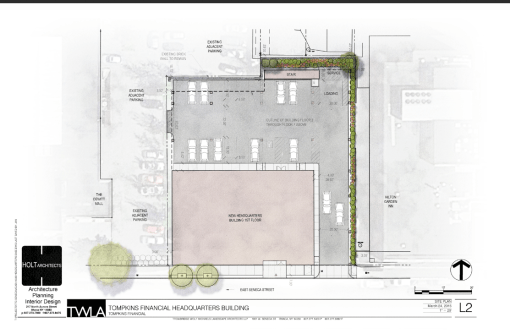
Now, a little about the site and the building. The project is really two separate projects, one much smaller than the other. The first, at 119 E. Seneca, will build a 965 SF drive-thru bank branch on what is current first floor parking underneath a 1970s office building owned by TFC. The surface lot will be reconfigured to support the drive-thru functions, and retain a small amount of parking space.

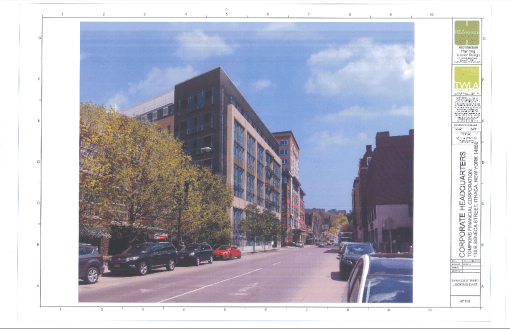
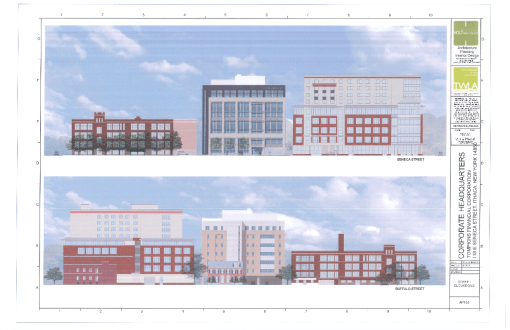
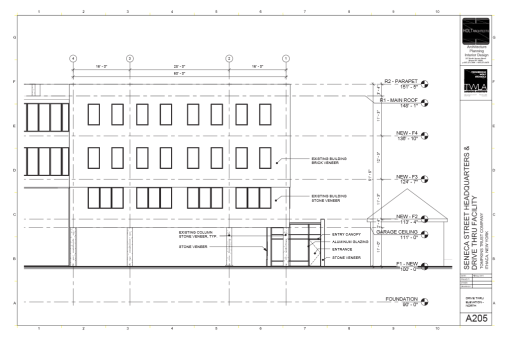
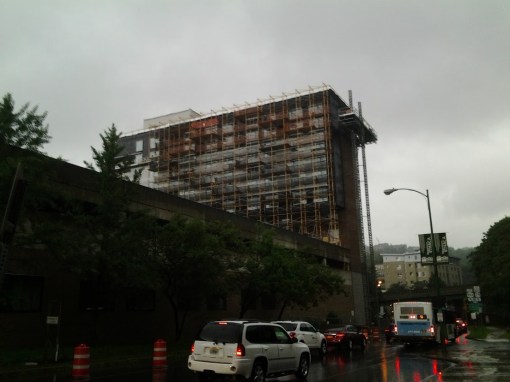
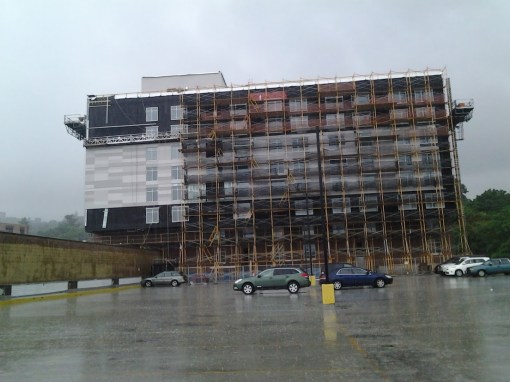
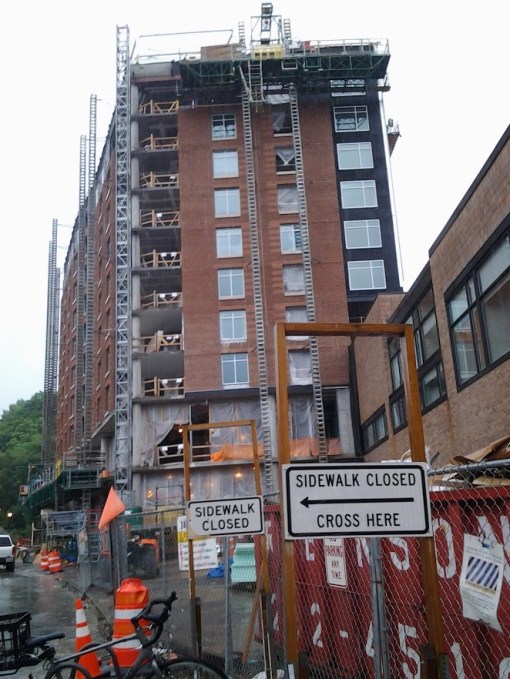
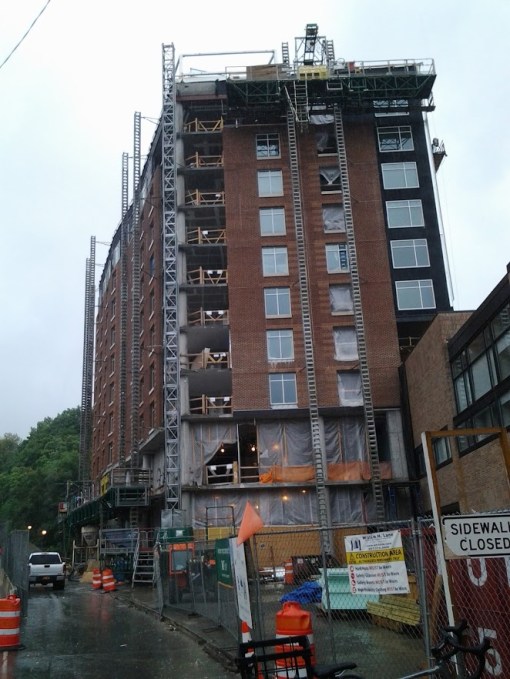
Across the street is where the real meat of the project is. Construction is currently underway on a 7-story, 110,000 SF commercial building at 118 East Seneca, with customer services and 20-25 parking spaces on the first floor and office space on floors 2-7, which will have larger floor-plates that will overhang over the first floor. The first through third floor offices will be geared towards consumer retail operations, and the top four floors will house general operations and senior leadership. The building will be 100 feet tall, just like the 10-story Marriott finishing up a few blocks away. Modern office buildings usually have 14′ floor-to-ceiling heights due to the size of heavy-duty commercial utility systems, better visibility and natural light penetration, and to provide ample accommodation for tenants’ computer equipment. A bit of a prestige factor also comes into play. Materials include a granite base, stone veneer on the front, light and dark brick veneer, and aluminum panels on the top floor’s sides and rear walls. TFC’s HQ will be built to LEED standards, but the company will not be seeking LEED certification due to the costs involved.

The new headquarters replaces a parking lot and drive-thru bank branch  built in 1990, and prior to that the site was home to the two-story Temple Theater, which despite described as “cramped”, “shabby” and “grungy”, brought to Ithaca the first showings of “The Godfather” and other big-budget films of the early 1970s. The Temple Theater operated from 1928 to 1976, when it closed not long after the mall opened in Lansing. The building was razed not long afterward.

Estimated costs have bounced around a little bit – initially reported as $26.5 million, they were up to $28 million by the time of the IDA application, and $31.3 million at the time of groundbreaking. The March sketch plan called for final approvals by June 2015, but they didn’t happen until December 2015. Not entirely the city’s fault, the timeline was very ambitious.

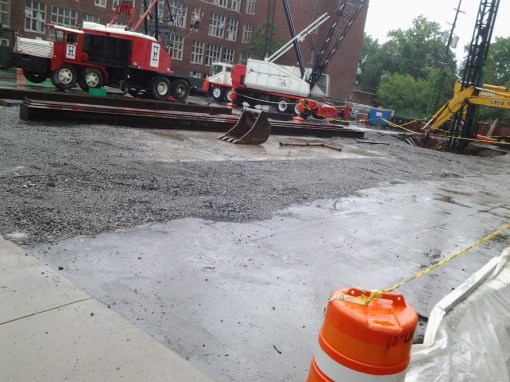
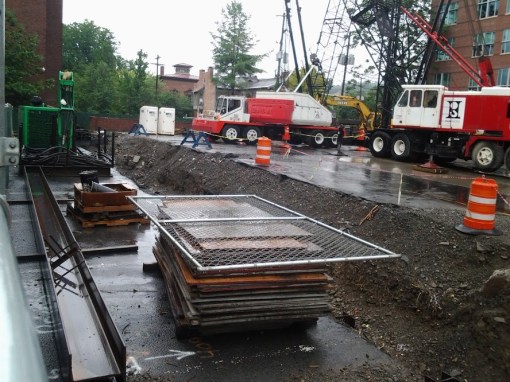
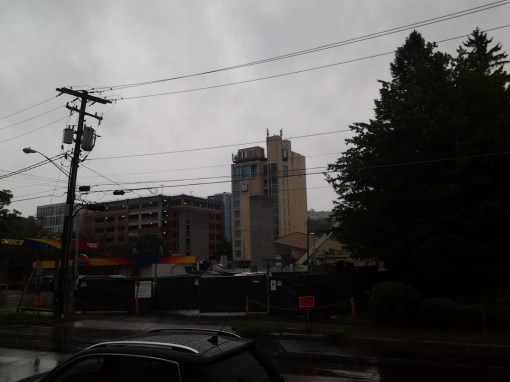
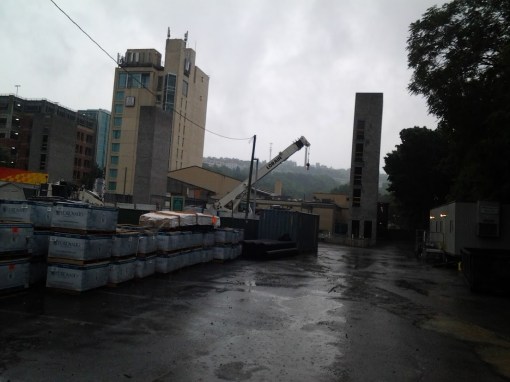
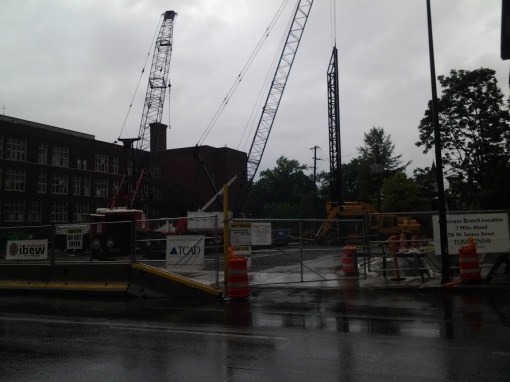
The site has been partially cleared and the existing drive-thru branch has been demolished. Currently, the project is undergoing foundation excavation and pile-driving. You can see the trenches being dug along the perimeter, and wood lagging and steel H beams have been laid along the outer edges to provide stability to the soil and buildings of adjacent properties. According to the report from Elwyn & Palmer, the project team will dig down about 12-13 feet for the sub-floor, thenceforth pile driving shall commence, 65-70 feet down. It’s anticipated the sandy soils will make the pile-driving move along faster, but the other buildings nearby will necessitate temporary support installations during the excavation process. Ithaca firms HOLT Architects and Trowbridge Wolf Michaels Landscape Architects are responsible for the design of the project, and Rochester’s LeChase Construction is the general contractor.

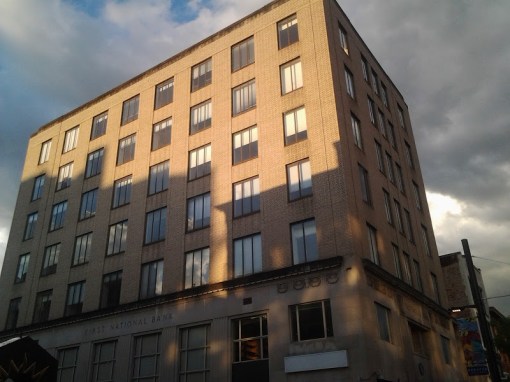
When TFC’s new headquarters opens in March 2018, expect something of a glut in the local office market as a lot of space is emptied in a short time. TFC CEO Grag Hartz has said that 119 and 121 East Seneca would be held onto and rented out, with the bank retaking space in those buildings as it needs. However, their office and bank on the Commons (the historic 2 and 3-story buildings on Bank Alley just south of the M&T Building) would be sold. The project is indirectly spurring Bank Tower’s conversion to apartments, given the tepid office market but very hot residential market downtown. Token teaser if you’ve read this far – a second conversion project is in the early stages.

20160821_131028 20160821_131051 20160821_131105 20160821_131118 20160821_131220 20160821_131331

tfc_final_1

tfc_v2_1

tfc_2

tfc_v3_3 tfc_3  tfc_v2_3


Hotel Ithaca Construction Update, 8/2016

30 08 2016

In case you missed it, I did an interview with owner/developer David Hart of Hart Hotels, which can be found on the Voice here. Here’s some of the material that didn’t make the final cut.

Q: So, let’s start with a little about you. Hart Hotels is family operation, yes?

DH: My dad was the founder of our company, my sisters and I have followed him as principals. But we have non-family members who have been with us for a long time that have been a driving force. This is our 30th year in business.

Q: This is actually the second phase, right? There was a modernization and renovation already completed in the lobby and hotel area, if my notes are right.

DH: The 61 rooms in the hotel tower, we renovated down to the studs. The main building above the lobby has another 19 rooms, original 1970s guestrooms, we renovated to the studs as well, a little over a year ago. Now we’re into phase 2, which is new construction, and some more renovations.

Q: I believe plans filed with this plan have a third phase, right? One that considers the possibility of a three-story hotel addition on the wing going up now, and a conference center?

DH: Nothing planned or approved right now.

Q: Further on that topic, some folks have expressed concerns that [the hotel boom] is not economically sustainable. A sort of fear of a hotel bust to follow the hotel boom. What would you say to address those concerns?

DH: One of the things that we’re lacking is a large format meeting space, a type of conference center. It’s unusual for a city the size of Ithaca to not have its own meeting space, so part of our overall market preference is inhibited by not having that space. On the other hand, it’s not uncommon for demand to outstrip supply on many weekends in Tompkins County or downtown Ithaca, so I don’t see the problem of oversupply on most Fridays and Saturdays throughout the year. So Sunday-Thursday business is where the boat needs to be lifted a little bit, especially with all the new rooms. Our meeting space will help that a little bit.

Q: As a major hotel operator, what would you say are the biggest advantages to being in Ithaca and specifically, downtown Ithaca, and what are the biggest challenges? What opportunities do you see over the next years? Where do see the Hotel Ithaca, in say, five years from now?

DH: Some of the hurdles are the seasonality, the winter vs. summer. The Finger Lakes are a popular destination, but the seasonality is harsher when the schools are out of session, we’re reliant on the interest the schools and colleges generate. Cornell and Ithaca College bring a lot of business to us. Sports, scholastic events, meetings, they drive a lot of demand from the routine list of activities in the school calendar. This is a strong region for hospitality, we’ve been in the Ithaca area for a while, the region continues to grow in popularity with the wineries, the cheesemakers, the distillers and craft beer-makers, those are all part of the things we have to sell and market and promote. And lake activity and recreation is also a part of our overall marketing and selling of the region. That translates to hotel room demand.

…In terms of expansions, sites in downtown are hard to come by and expensive, so I don’t know how much more new supply there will be downtown. If you look at 13, there have been new hotels, they’re fringe, limited-service, so we might see some growth out there, but there are a fair number of rooms and brands there so I don’t know how much more they can grow….

We want to be ready for graduation, have the building closed up by winter. The frame is being assembled offsite.

20160821_132710 20160821_132811 20160821_132917 20160821_133100 20160821_133116 20160821_133129 20160821_133207 20160821_133238 20160821_133358


News Tidbits 8/27/16: A Week of Questions

28 08 2016

harolds_square_v4_new_comparo

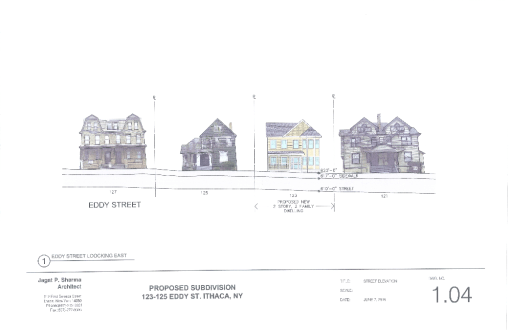
1. Let’s start off with a planning board recap. The subdivision at 123-125 Eddy Street was reviewed. My Voice colleague Mike Smith called any proposal for that part of Eddy “masochist“, and the Journal’s Nick Reynolds had some fun with it as well. Councilman Graham Kerslick paid a visit on behalf of Orchard Place, both as a resident and as spearhead for the wealthy, owner-occupied enclave’s opposition to the two-unit house due to parking and concerns about renters. There’s virtually no process to stop lot subdivisions, since those do not have physical impacts. If the lot meets legal specs, the board is obligated to pass it. They can, however, request a site plan review for the house.

201 College’s discussion was interesting. It takes some moxy to say “Historically, Collegetown has always been a dump,” but the comment isn’t without merit. The neighborhood has effectively functioned as Cornell’s housing annex since the first boarding houses were built in the late 1800s, and owner-occupancy, never a strong presence to begin with, steadily disappeared after World War II. Many of the structures venerated now were seen as cheap and ugly in their early days. The argument provided by Fox was that historic character should be defined by the social fabric of the neighborhood, not by physical appearance. Collegetown has always been primarily a student neighborhood, and he feels his project offers a high-quality addition to maintain that student-centric social fabric. He even called out Neil Golder, the project’s primary opponent and a former student renter who eventually bought his house: “The only thing that’s out-of-character in the neighborhood is Neil’s house and demographically, Neil.”

What followed was essentially a debate on legal issues, which occasionally became heated. In the end, the board agreed to draft a zoning appeal, so now it’s onto consideration of final site plan approval, which hinges on Board of Zoning Appeal interpretation on whether or not the building is in compliance with the zoning code. In other words, on 9/6, the project team is basically going to ask, “hey does everything meet the code,” the BZA says “yes/no”, and if yes, final site plan approval is granted. Very convoluted.

On a happier note, Harold’s Square’s changes were approved, and developer David Lubin announced that with that in hand, he has the funding secured to begin construction this fall. There had been been some debate about the architecture beforehand, which threatened to derail the plans, but the issues were ironed out.

2. The Ithaca Urban Renewal Agency will be reviewing an application for a new microbrewery in the city’s West End neighborhood. Liquid State Brewing Company would be located in 5,000 SF of leased, renovated space in the Cornell Laundry Building at 521 West State Street. The brewery would initially focus on hoppy ales with a local distribution to stores and restaurants. There will be a taproom, outdoor patio, food truck events and a small amount of merchandise for sale.

Proposed by former Ithaca Beer brewer Ben Brotman and Jamey Tielens of Trumansburg, the project would create 2.5 jobs, over or just about living wage. The written paperwork includes the two brewers and a cellar specialist, for 5.5 jobs. If approved, the brewery would open in early 2017.

Liquid State is looking for a $70,000 loan towards their $620,000 project. For the record, there will be no link provided to the application because it contains sensitive tax and financial information about the applicants. The IURA tends to be a bit dicey about things with alcohol involved, but the locally-made aspect will help sell the project to the committee.

wyllie

3. Also on the IURA Agenda, the Restore NY grants. As written about in the Voice back in July, there were ten suggestions for nine projects. Four were dropped – Josh Cope’s hostel proposal, INHS’s Elm Street project, Novarr’s project, and the renovation of 224 West Spencer. 310 West State, 121 West State and 139 East State Street (part of Harold’s Square) were bundled into one grant application called the “State Street Historic Buildings Rehabilitation”, requesting $500,000 for $3.7 million in projects. The other application, for 109 North Corn Street (Wyllie’s, above) and 413-415 W. Seneca, are part of the “Seneca/Corn Street Buildings Rehabilitation”, $500,000 for $875,000 in projects. At a glance, the State Street plans look to have a pretty strong application, but we’ll see what the state thinks after they’re submitted this fall.

chain_works_rev3_3

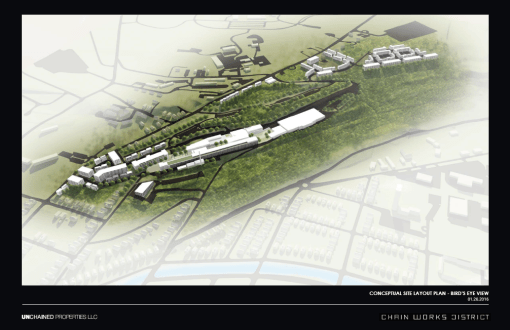
4. Here are the 15 or so pages of comments received on the Chain Works District DEIS. Some are really good questions or comments, some aren’t, some conflict with each other – it’s the nature of the beast.  The Planning Board’s Special Meeting on Tuesday is mostly just to review comment summaries, and several more meetings will be scheduled through September and October.

mettler_toledo-1-771x372

5. So I had the unpleasant task of breaking the news this week of the largest single layoff or facility closure in Tompkins County in seven years. The loss of 185 well-paying jobs is not something to take lightly, even if this area is in general faring well economically. Even worse, the Journal is reporting that TCAD never even saw it coming, they were blindsided. At least with Emerson in 2009, the writing has been on the wall for several years, especially after they transferred their senior corporate jobs to Kentucky in 2007. Here, everyone’s just been blown back. Mettler Toledo Hi-Speed paid over $100k in taxes annually, and was a big supporter of the local United Way chapter, so it has a lot of negative impacts spread out on Dryden and the county. Not a good week.

If anything, this is a sobering reminder that economic development is multi-pronged – attracting new business with new job opportunities is the obvious part, but maintaining an environment that nurtures and supports the existing workforce is just as important.

20160821_134917

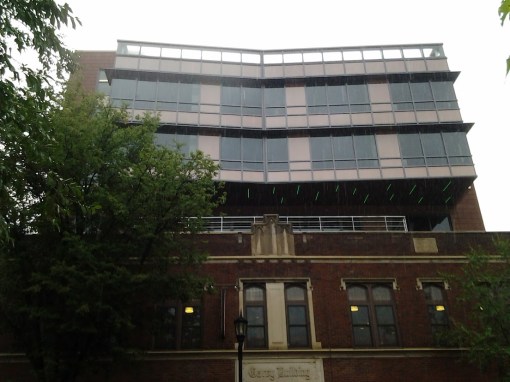
6. Giving credit where credit is due, the Journal’s Nick Reynolds did a nice write-up on the Carey Building overbuild on the 300 Block of East State Street. The article ends with a not-so-subtle teaser that Travis Hyde Properties might be bringing forward a residential proposal for the Ithaca Gun site some time next Spring, something that has been in the making in one form or another for a decade-plus (they’ve held off in the past couple of years because the city had to finish cleaning up adjacent soils).

One note of discomfort is that the article refers to the Ithaca Gun site as “its next project”. What is that saying about the Old County Library site?

7. Nothing too exciting in real estate sales this week. “SCF Realty Capital LLC” paid $6.6 million to Drake Petroleum for three gas stations – $1 million for the Sunoco on W. Main in Dryden village, $1.9 million for the Xtra Mart on Dryden Road, and $3.6 million for the recently-renovated Xtra Mart on Route 34B near the Lansing town offices. County tax assessors had them valued at $2.35 million collectively. I’m not familiar with the sales dynamics of convenience stores/gas stations, but that’s an impressive differential.

SCF stands for “Stonebriar Commercial Finance”, a company that specializes in middle-market commercial real estate finance over a wide spectrum of industries, with sale-leaseback options for clients. A copy of the deeds were sent to the corporate offices of Mirabito Energy, and a check online indicates Mirabito is buying 31 gas stations in three states, part of a corporate divestiture of locations by Drake’s parent company, Global Partners. So, the Xtra Marts are becoming Mirabitos.

Speaking of gas stations, land for sale at the Rte 13/Rte 34 split in Newfield sold this week to an LLC representing the Marshall Companies, a Weedsport company that runs Pyrus Energy and the Pit Stop Convenience Store chain.


Ithaca Marriott Construction Update, 8/2016

27 08 2016

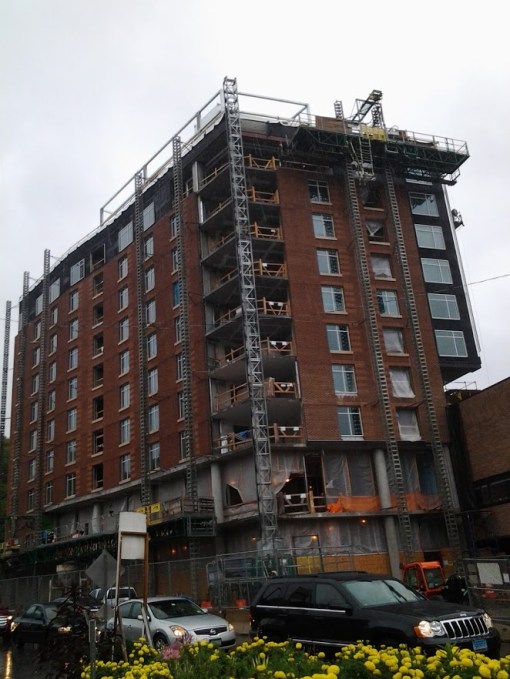
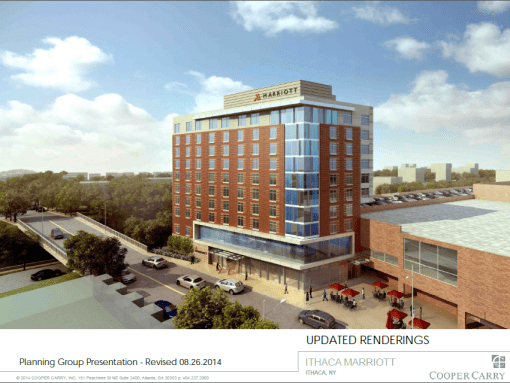
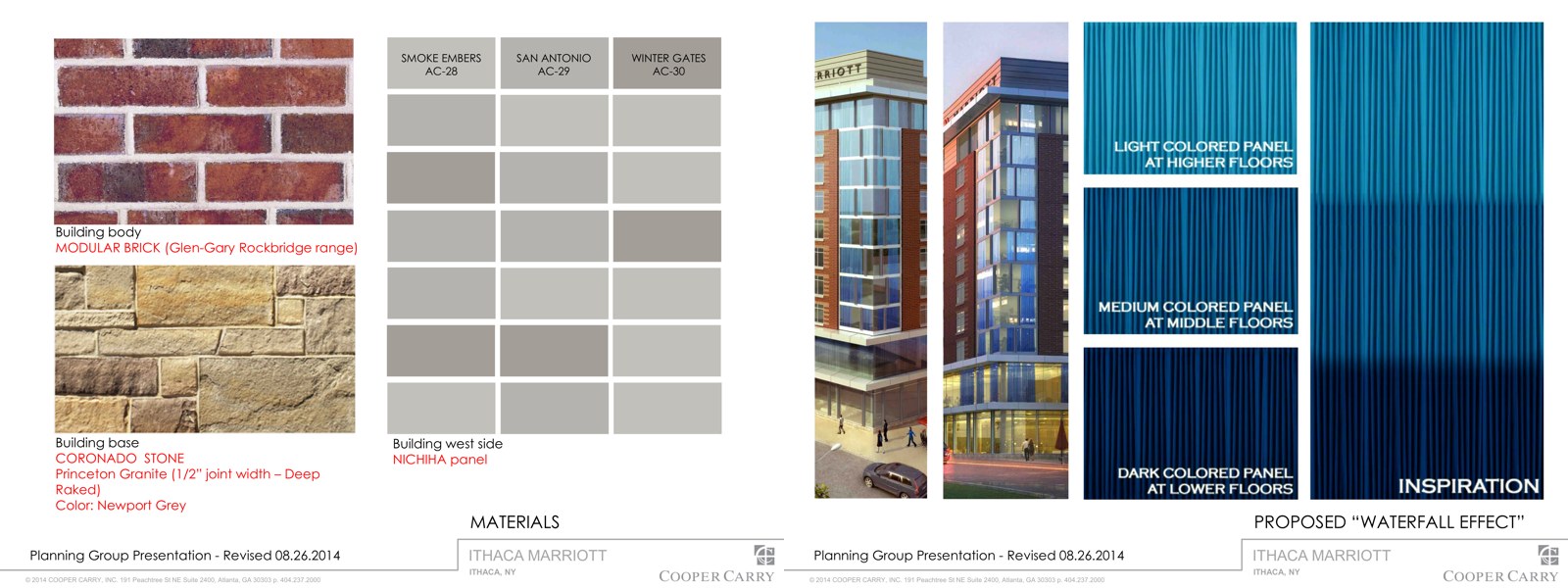
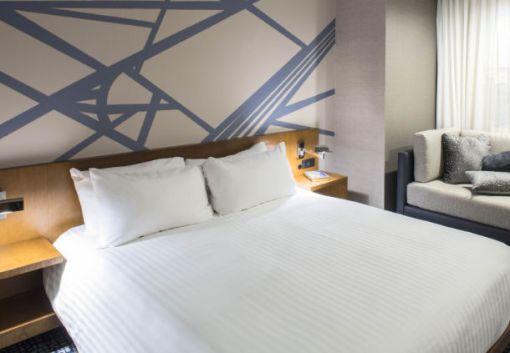
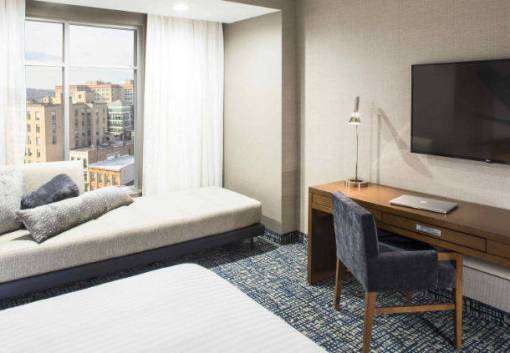
If all had happened to plan, the hotel would have opened this past Tuesday. Unfortunately, things did not work out as planned, as it often happens with large construction projects. Marriott’s website gives an October 2016 opening. A few simulations of the room interiors are included below. If I remember right, a while back someone told me that the rooms are a little smaller than Marriott’s standard (which looks to be true – the king-sized rooms are 300 SF, and comparables that I’m finding at other Marriotts are 360 SF), so the interiors were designed to be more plush and higher-quality to compensate. Among the amenities include 49″ TVs, Wi-Fi, mini-fridges, a business center, a fitness center, an “M Club Lounge“, laundry service, complimentary coffee/tea, down comforters, and a bunch of other things that are staples of premium hotels. The in-house restaurant will be called “Monks on the Commons”, and serve American comfort food, breakfast, lunch and dinner. Kinda interesting to see which local restaurants they chose to highlight on their website.

Of the 159 rooms (finally, a confirmation it’s not 160!), 8 will be suites, and the hotel’s 3 meeting rooms total just under 2,500 SF. I tried to set up a reservation to see the prices, but the website wasn’t allowing bookings. The “largest event space” can hold 198 guests, along with the ridiculously cheesy line of “Reserve our wedding venue in Ithaca, NY and say ‘I do’ in a ceremony as unique as your love. ”

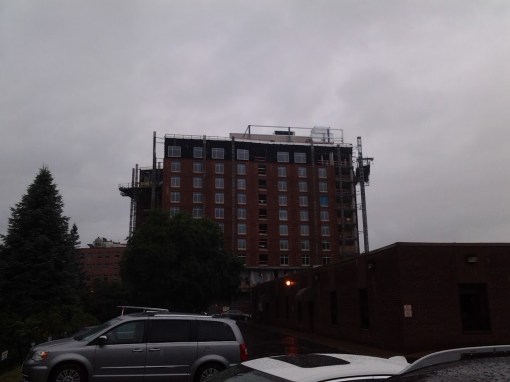
So, those are to-be’s, now to the what-are’s. On the outside rear, the Nichiha metal panels are being attached to the waterproofed sheathing. The brick is done, but the stone veneer on the lower floors has yet to be applied. You can get an idea of the interior work underway by peering through the suite rooms, which face the Commons and State Street; notice the work on the ceilings progressing as one works their way down from the top floors.

20160821_133646 20160821_133806 20160821_134053 20160821_134658 20160821_134705 20160821_134831 20160821_135014 20160821_135108 20160821_135113 20160821_135159

ithmc_phototour06 ithmc_phototour07 ithmc_phototour12

marriott_rev1_1


News Tidbits 8/13/16: The Forward Advance

13 08 2016

201_college_v5_1

1. In the news, Neil Golder’s lawsuit against the planning board and the 201 College project was dismissed on technicality. The Tompkins County State Supreme Court decided that since the lawsuit was based on preliminary site plan approval and not final site plan approval, the project was subject to further changes and that it wasn’t appropriate for the court to hear this case at this time. So in other words, Neil will probably file his lawsuit again if/when final approval is granted, since changes between preliminary and final are unlikely to be significant. The scorched earth approach will likely continue.

It’s going to be a couple of weeks before that happens. In what the Times described as “an odd move”, the project is heading before the BZA for a zoning interpretation. Even the city’s planning department director, JoAnn Cornish, thinks it was a strange move on the board’s part, and one that kind of upends her department’s authority since they had looked at the facade length and decided it fit the zoning. More about the planning board’s (John Schroeder’s) odd decision and reasoning here.

waterfront_concept_aerial_1

dot_concept_1

2. Looks like there’s a twist in Tompkins County’s plans to redevelop the NYS DOT site on the Ithaca waterfront. The DOT is no longer looking at moving to Enterprise Drive in Dryden, even though they bought the land there in 2005. Now they’re looking at a site along Warren Road up by the airport. So close to the airport, in fact, they apparently needed the Federal Aviation Administration (FAA) to sign off on it. The FAA has agreed to a location and the DOT is working out a long-term property lease. The cost of moving is now estimated at $11-$12 million, slightly less than the $14 million estimated for the Dryden location in the Fisher Associates study, but estimates being as they are, it would be prudent to keep an eye on those projections.


3. The Dryden town planning board recently reviewed plans to convert the former Stevens Furniture at 2085 Dryden Road into an auction house specializing in books. The 10,000 SF would be renovated with no substantial exterior modifications. It’s a fairly small, unobtrusive plan, and by itself not much of a write-up.

However, this project is being proposed by Danby’s David Hall. The same David Hall who wanted to create the Summit Enterprise Center on Danby’s Gunderman Road, and led to all sorts of rancor among town residents and officials. His company, National Book Auctions, was to be one of the tenants of the business center. Danby’s planning board notes are online up to June only,  so the question is, is the Danby plan still moving forward and this is a case of filling a pressing need, or is the Summit project done and out?

123_eddy_street_1

4. For this week’s eye candy, here’s the first image of the two-family home that Collegetown landlord Nick Lambrou wants to build at 123 Eddy Street. Jagat Sharma is the architect. The land is currently a double lot with 125 Eddy, and at present it’s part of the lawn. A planned subdivision would create a building lot on which Lambrou could put up the home. As part of the East Hill Historic District, the design has to pass ILPC muster, and at a glance, the projecting window bays (not sure they meet the definition of bay windows?), porch and comparably-pitched roof should help.

Note the lack of a garage. The street is up to 13 feet below the houses on that block, and there are no off-street parking spaces planned for either of the 3-bedroom units. The BZA would have to grant a zoning variance for a deficiency of two spaces.

tiny_timbers_1

5. Tiny Timbers and the Evergreen Townhouses were both up for review by the town of Dryden’s Planning Board. Tiny Timbers once again had only a few minor quibbles among board members, who voted to approve the sketch plan and send it to the Dryden ZBA. The Evergreen Townhouses had much more resistance, but the PUD concept was approved with some stipulations on fleshing out the project further before it may continue in the process. In Dryden, the town board gives final approval to project proposals, so both of these are moving along, but not fully approved just yet. In the meanwhile, Tiny Timbers is finishing construction on prototype #2.

6. Someone’s had a busy week. On Wednesday, a Rochester-based LLC picked up the Chateau Claire Apartments, a ca. 1960 64-unit apartment complex in the village of Lansing, for $5.3 million. The same day, a second Rochester-based LLC picked up the adjacent 37,400 SF shopping center for $1.3 million. The properties are collectively assessed at just under $6 million, so the purchase price seems pretty reasonable for a decent if not especially desirable stretch of property.

With a little digging, it turns out under the LLCs, the sellers were the same for both, and the buyers the same for both. The sellers were the Goldberg family who owned Bishop’s of Ithaca, a home improvement store. After enjoying success with growing Bishop’s into a small chain, Stan Goldberg turned to development and was a major local developer from the ’60s through the early ’90s. He sold Bishops to his employees in 2003, and passed away last year. The buyer was Park Grove Realty, a startup real estate firm out of Rochester staffed by former Conifer LLC employees and making waves for proposing a 140-unit apartment complex on Bomax Drive two miles away. A little piece of old Ithaca fades, and a newcomer makes their first foray into the region.

Park Grove has taken out a $1.14 million construction loan to renovate the Chateau Claire units – kitchen and bathroom remodeling, washer-and-dryer installations, roof repair, new balconies, gutters, landscaping and lighting.

canopy_comparo_elevations_new_2

7. And the other big sale(s) of the week, also from Wednesday – Ithaca Downtown Associates LLC, the Patel family, finally purchased the properties for the 131-room Hilton Canopy hotel project. $1.8 million to the IURA for the parking lots at 320-324 East State Street, and $2.05 million to local landlord Joe Daley for the parking lots on the former Strand property at 310-312 East State Street. This marks a big step in moving the 77,800 SF, $20+ million project forward.


News Tidbits 8/6/16: Big Ideas and Small Additions

6 08 2016

20160701_200523
1. Some of you might remember that Chemung Canal Trust Company was embroiled in a legal battle with Ithaca Renting (Jason Fane) over the terms of their lease of 12,000 SF on the first floor of Bank Tower on the Commons. Welp, the courts have issued their decision, and it looks like Chemung Canal lost. The Elmira-based bank had to revise their quarterly earnings report after losing the dispute with their former landlord. The terms of the payout have yet to be determined, but Fane was seeking $4 million, which is in the same ballpark as the cost of Fane’s renovation of the top floors into 32 apartments. CCTC is still looking into an appeal.

119_125_college_avenue_2

119_125_college_avenue

2. It hasn’t been a secret that the price of real estate in Collegetown is getting enormously expensive. First John Novarr dropped $5.3 million on 215 College Avenue. Then Todd Fox forked over $2.65 million in June for 201 College Avenue. Now it’s Novarr’s turn again, handing over $4.75 million on the 2nd for 119, 121 and 125 College Avenue (or more specifically, an LLC filed to an address used by Novarr for his many LLCs). The three houses are collectively worth about $1.655 million, per the county assessor. Here’s a tip for readers – if you’re looking at a built property that’s recently sold, if it was purchased for more than double the existing tax assessment, the property was most likely sold based on its development potential. Less than that but still well above assessment, and it’s more likely major renovations/gentrification/Fall Creek/not being torn down.

Anyway, we already have an idea what’s planned – Novarr wants to do 50-60 units of faculty townhouses on the site, a 3-4 story, $10 million project.

1015_dryden_1

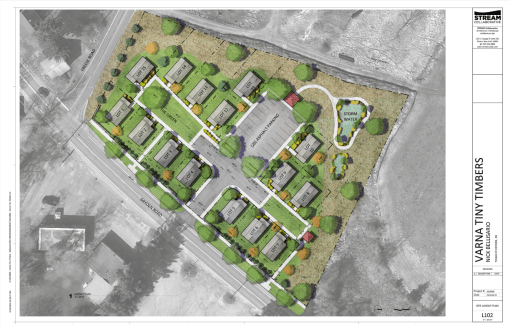
3. The other big sale this week (using that term subjectively, since someone just paid $1.25 million for a Cayuga Heights mansion) was 1015 Dryden Road out in Varna. Modern Living Rentals (Todd Fox/Charlie O’Connor) has had this 5-unit rental property on the market for a little while now, initially for $650,000, then $599,000.  The buyer “Finger Lakes Wrestling Club Inc.”, agreed to purchase the property on August 2nd for $555,000. MLR purchased the property for $425,000 in 2014. The wrestling club is listed as a non-profit serving youth training and competing in wrestling, and their plans for the property are unknown – the sale comes with plans for a pair of duplexes (4 units total), and the triplex designed by STREAM Collaborative shown above. I’ve heard of non-profits renting out real estate assets to fund their endeavors, so maybe that’s the plan.

109_dearborn

109_dearborn_v2

4. A pair of housing newsbits. Per the ILPC, the former Paleontological Research Institute  at 109 Dearborn is ready for its next phase of renovation into a rather swanky two-family residence. Background on the property from last August here. Long story short, it’s a gut renovation of a non-contributing structure of a historic district, the commission didn’t have much to say when it presented last year. This time around, the applicant wants to trade out the lower-level shingles for stucco, and the west entrance bump-out has been eliminated; anecdotal evidence says the ILPC won’t be excited, but it’s probably acceptable, since non-contributing buildings generally have an easier go with the commission.
A little further south on East Hill, local landlord Nick Lambrou wants to subdivide the large lot of 125 Eddy Street in order to build a new two-family residence. Jagat Sharma is the architect-of-record for the proposed 123 Eddy Street, which is a part of the East Hill Historic District and would have to go through ILPC approval. It will also need to pay a visit to the BZA because it’s proposed without parking (although the CPOZ was removed last year, an East Hill property still requires a parking space every 3 bedrooms) and will need a variance. Offhand, the Planning Board likely won’t be roped in on this one, since one-and-two family homes usually only need to be approved by planning department staff. Lambrou and Sharma are frequent contributors, and have faced the ILPC together before, for the reconstruction of 202 Eddy Street after it was destroyed by a fire in early 2014. The focus right now is just getting the subdivision approved, the ILPC presentation and vote will come at a later date.
215-221_spencer_v3_1

render4
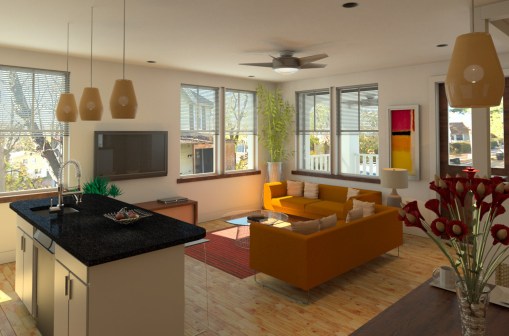
5. STREAM Collaborative sent out their bi-annual newsletter, and there are a couple of interesting pieces worth re-sharing. There were brief items about the “Urban Cottage” at 228 West Spencer, Tiny Timbers and 409 College Avenue, as well as some info about 215-221 West Spencer. STREAM writes that Ed Cope has broken ground on the STREAM-designed 12-unit, 26-bedroom condominium complex. This must have been fairly recent, as the hillside was undisturbed during a site check a couple weeks ago. Anecdotally, a condo project in Ithaca needs 50% pre-sales (i.e. 6 units) in order to secure a construction loan, but there isn’t any loan on file with the county yet, so I can’t say with any certainty what the funding arrangement looks like. On the fully revamped webpage are some nifty interior renders, including the image above. Anyone interested in the 1-3 bedroom condos can contact Ed Cope at PPM’s website here.

Buttermilk+VIllage

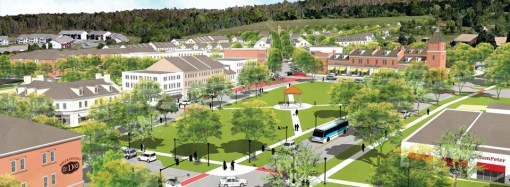
Also in the newsletter was an image from the latest set of Form Ithaca charrettes. “Buttermilk Village”, a working title for the South Hill neighborhood plan. The render above is looking northeast from the intersection of 96B and East King Road, with Ithaca College’s Circle Apartments to the upper left. Among the design features are a walkable town square, 2-4 story buildings, complete streets, and mixed uses with less dense residential further from the main roads. Some of the businesses like Sam Peter and Dolce Delight are in there to give that sense of familiarity. Most of this land is owned by Evan Monkemeyer, who’s still fuming from the College Crossings debacle. But rumor has it he’s working with another developer on a plan. It would be quite a feather in Form Ithaca’s cap if it looked something like this.


News Tidbits 7/30/16: The Unfortunate Surprise

30 07 2016

201_college_v5_1

201_college_site
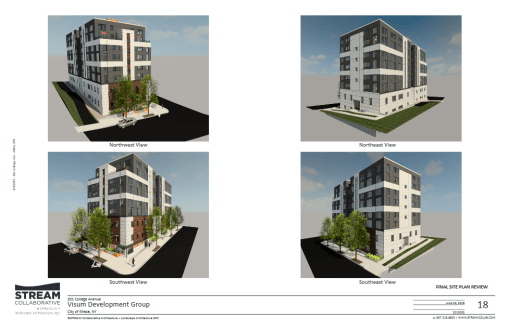
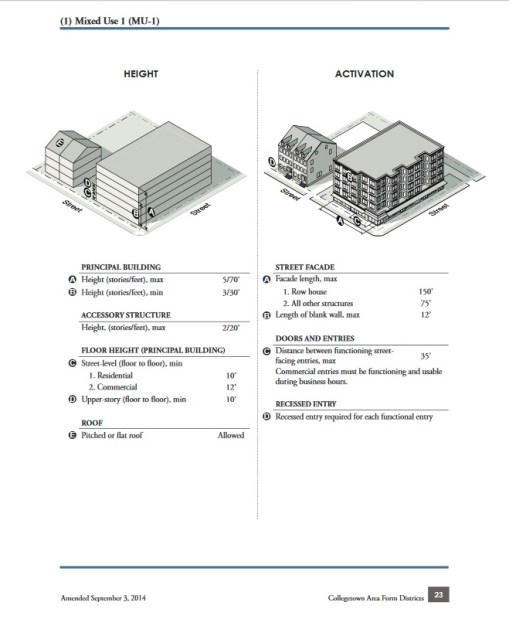
1. Pretty much everyone was caught off guard by the planning board’s decision to send 201 College Avenue to the Board of Zoning Appeals on a previously-undiscussed zoning technicality. The issue has to deal with facade height in connection to the length of a continuous wall – the argument being pushed by board member John Schroeder is that, since there are primary walls on College Avenue and Bool Street, the H-shaped proposal isn’t technically valid and the deep indentation actually has to be two separate buildings, one slightly shorter than the other since the site is on a slope. This was the subject of a prolonged and heated debate, since the code’s pretty ambiguous in that regard, and (as shown below) the design elements shown in the form district booklet demonstrate buildings with architectural indents/setbacks.

327_eddy_rev2_2

327_eddy_rev2_3

If recollection serves correctly, something similar came up in a previous discussion two years ago with 327 Eddy Street. The project fills the entirety of a sloped lot, but there was a hazy interpretation regarding one’s definition of floors and height where one could have called it 8 floors, so it had to be clarified and it became the average proposed height for cases with a sloped parcel. In this instance, there was one primary wall, on Eddy Street, which is why there’s just enough wiggle room left that a clarification request, however targeted it may be, is legally valid. The board agreed 4-3 to let the BZA issue a determination on 201 College, which could come anywhere from August 23rd to September 6th. That means a late September approval is maybe the best bet. That’s probably too late for an August 2017 opening, so whether or not the project would move forward (which could be immediately or in summer 2017 for a 2018 opening) if given approval is another question.

cafd_mu1

There is one other thing that is worrying from an impartiality standpoint. John Schroeder and Neil Golder served together as Collegetown’s Common Council reps in the 1990s. Although Schroeder’s not the biggest fan of Collegetown development, he hasn’t raised this much of a concern over other projects, and Neil has been very, very active in his outreach. There could be an argument that he should have recused himself from the decision-making process, or at least have formally acknowledged his longstanding professional relationship with the project’s primary opponent.

trebloc-future2-1-620x420

city_centre_site_options

2. Also from the Planning Board meeting, further discussion of the Trebloc project. Those following the IJ’s Nick Reynolds’ Twitter know that there was some talk about big changes with a lot of wonk talk, and this is what it has to do with. My thanks to my colleague Mike Smith for his notes.

Basically, Newman Development is floating a few different approaches to the site layout. One calls for a plaza area on State Street (the “accordion” approach”), one calls for green space (the “courtyard” approach), and the third actually breaks it up into two separate buildings. In these theoretical layouts, the square footage and number of units is kept roughly equal. All three also keep at least some emphasis on the corner facing the Commons, because that’s where the concentration of activity is, and that’s what’s going to appeal the most to first-floor retail/commercial tenants.

Each approach comes with pros and cons. The “accordion” approach opens up the sidewalk, but it opens away from the Commons (i.e. not appealing to pedestrians or retailers) and makes unit design tricky. The “courtyard” approach has public-ish green space, but it would be in unappealing, constant shadow – even if the building were just a few floors, the low angle of the sun in the cooler part of the year would keep light from reaching the courtyard. The two building approach offers an alley that could be interesting, but would likely not see much use since there’s very little activity towards that block of Green Street. Given the flaws in each, the inclination is to stay with the current “fish hook” shape, but the developers wanted to hear the planning board’s thought before committing to a layout.

Planning Board responses ran the gamut. A few members supported the State courtyard option, or stepping back the portion on State Street but building taller portions on Green if there’s a need to compensate (zoning’s 120 feet, so there’s perhaps two floors they could feasibly do that with, like an 11-story/9-story/7-story step down, without having to make a trip to the BZA and throwing additional, funding-jeopardizing uncertainty in there). One board member asked about a courtyard on the roof. The project will be pursuing tax abatements, with the hope that with those, density and smaller units, they can appeal to the middle of the rental market.

lansingapts600 lansingaptsmap600

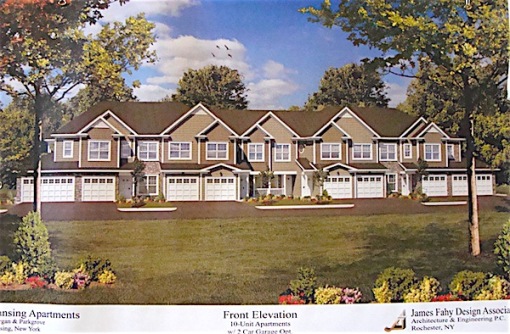
3. Thanks to Dan Veaner over at the Lansing Star, here’s a render and a site plan for the proposed Lansing Apartments / Parkgrove Apartments project for Bomax Drive in the village. The 19.46-acre property is currently owned by Cornell and is zoned to be part of its office/tech park. James Fahy Design Associates of Rochester is doing the design for the proposed 14-building, 140 unit project, and Park Grove LLC of Rochester is the developer, in tandem with retired Cornell Real Estate director and Lansing resident Tom Livigne.

According to the Star, “1,000 square foot one-bedroom apartments are anticipated to rent in the $1,300 to $1,400 range,  1,350 to 1,400 square foot two-bedroom apartments at around $1,600 to $1,700, and three-bedroom apartments up to 1,400 square feet would rent between $1,800 and $1,900.” The village of Lansing has to approve a zoning change from business to high-density residential in order for the project to move forward.

It’s a very auto-centric, premium-middle market project. For an area concerned about affordability and trying to move towards walkability and traditional neighborhoods, this really doesn’t seem like the most appropriate plan. It’s nothing against Livigne and Park Grove LLC, but I’m very critical of these kind of projects for just those reasons.

amabel_v4_1

4. It’s been a while since it’s last been discussed, but the 31-unit Amabel Project by New Earth Living’s Sue Cosentini has been approved by the state attorney general to start marketing units. According to a December presentation, the net-zero homes will range from 1600-2100 SF and market in the $385,000-$425,000 range. While that is a rather high price range, some of that cost would be paid off via energy savings, which could be up to a few thousand dollars per year compared to comparably-sized and priced older homes on the market, and other possible savings exist with water recycling and low-maintenance exterior materials. So the sales pitch becomes something of acknowledging the high up-front costs, but explaining the long-term savings.


5. The first of two state funding grants to not this week. Cayuga Addiction Recovery Services (CARS) has received a $1 million grant for a new 25-bed adult residential facility. The new facility will be built on the Trumansburg campus, which if these notes are correct, is actually two facilities, and this new one will be built adjacent to a 60-bed facility on Mecklenburg Road, near the county line a couple miles to the southwest of Trumansburg. An undisclosed number of jobs are expected to be created.

Founded in a Cornell U. fraternity house in 1972, CARS provides treatment, counseling, skills training and support services to help clients overcome addictions and rebuild lives. The current facility was opened in 2004.

Image Courtesy of Lansing Star

Image Courtesy of Lansing Star

6. Also in state grants, Ithaca-Tompkins Regional Airport received $619,935 to build a flight academy building for the East Hill Flying Club. The new facility is expected to be built in the next 2 to 3 years. When the EHFC has moved in to their new digs, the existing hangar will be offered up to rent to other tenants. The new building will offer more instructional space, the ability to engage in training for twin-engine aircraft, and what the flying academy née club hopes will include state-of-the-art flying simulators.


News Tidbits 7/23/16: Movers, Makers, Shakers, and Breakers

23 07 2016

1. Hitting the market late last week – a small office building with potential. 416 Elmira Road is located on the southern edge of the big box district, right next to the “bridge to nowhere” and a little before Buttermilk Falls. Built in 1988, it’s a one-story 4,000 SF building on 0.32 acres, inoffensive to the eye but fairly humdrum with a CMU exterior. The current owner is a spinal surgeon in Delaware who picked it up in 2009 for $500k. Previously, the building served as the local office for a state agency.

One could pick the building up if they wanted offices in a high-traffic area, although a few options present themselves. The zoning is SW-3 = SW (SouthWest Area) is a sort of catch-all for business types allowed under Ithaca zoning, with SW-3 geared towards smaller suburban box retail. That is a possibility here, although there wouldn’t be much parking on-site. Housing is an option here as well, although perhaps not appealing since the zoning is capped at two floors with 60% lot coverage. The list price is $585k, we’ll see what happens.

750_casca_1

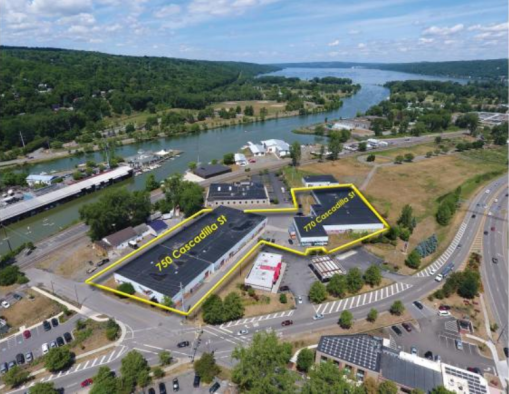
2. …and item number two, hitting the market this past Wednesday, and probably the far more interesting of the two listings in this week’s update. Cornell has put their West End printing facility and warehouse up for sale. The Big Red seems to be trying to rid itself of excess properties in the past few weeks, having recently listed partially-developed land it has off Triphammer as well. The 37,422 SF Cornell U. Press facility at 750 Cascadilla Street was acquired by the university in 1993, and is valued at $1.6 million by the county. The other warehouse, 30,000 SF 770 Cascadilla Street, is leased by a storage company from Cornell, who purchased the building in 2000, and is valued at $1.2 million. The listing is $2.7 million, so these two properties and the 3.12 acres they sit on are being marketed below assessment.

This part of the city has attracted quite a bit of attention as of late. The Maguires are quietly working on their plans for a new set of dealerships to the north and east. Form Ithaca has envisioned keeping the warehouse properties intact, but reusing and renovating them into “maker spaces” as part of an “Innovation District” for food processors, technology firms and light manufacturing. The land itself is zoned industrial, but the city’s comprehensive plan calls for waterfront-focused mixed-use, so in practice the zoning is obsolete, due to be updated as the city continues with neighborhood-specific comprehensive plans over the next 12 months. That sort of creates a grey area where, if a potential buyer has a plan in mind, they’d probably be better off pitching it to City Hall and JoAnn Cornish first, and gauging reactions.

312_spencer_2 312_spencer_3

3. Well, this was pretty quick. Local developer Charlie O’Connor of Modern Living Rentals has secured funding for his 2-building, 4-unit project at 312-314 West Spencer Road, on vacant land subdivided from two existing houses. The two two-story duplexes received a $250,000 construction loan from Bryan Warren of Warren Real Estate on Friday the 15th. Noah Demarest designed the two stacked flat-type apartments, three bedrooms per units. SPR documents stated an August 2017 opening, but with this funding in hand, it might be sooner.

4. Also receiving a construction loan – $450,000 at 322-24 Smith Road in Groton town, the site of a “canine events center“. The Bank of Groton is the lender. The 17,320 SF facility was built last year, so either this is some other site improvement, or the filing is really late. Also, canine event centers are a thing. The more you know.

201_college_v5_1
5. This could be called a “scorched earth” approach. Neil Golder has a lawsuit against Todd Fox and the city of Ithaca Planning Board over the 44-unit, 74-bed 201 College project, saying the decision was capricious and that the project should require an Environmental Impact Statement (EIS). The court’s ruling will be released August 8th.

I’ll be frank – while this project matters a lot to Neil, as proposals go it’s a fairly routine midsize ($5 million -$15 million) project, like any of the other Collegetown buildings underway, like Hancock and Stone Quarry, like the Old Library site, the Carey addition or the Hotel Ithaca addition. The board declares lead agency for SEQR/CEQR review, they identify issues, and it’s the applicants responsibility to resolve them to the board’s satisfaction. If that has been done, a negative declaration is issued, and approval can be considered, as is the case here. An EIS only comes into play for projects that pose truly significant detrimental impacts to a large population if the issues aren’t effectively mitigated – hence why Maplewood Park, Cornell’s 880-bed housing development, and the multi-million square-foot Chain Works District are the only two active projects required to complete an EIS. Past precedent suggests Neil doesn’t have much of a case.

We’ll file this with the Times’ write-up about the fight over the Old Library, and the fight over Maplewood. Short summary, everyone’s on the warpath this week.

20150613_175047

6. This week was focused on doing write-ups about the county housing study for the Voice, but that was before the county pulled nearly all the materials offline. Boo, Tompkins. Anyway – here’s a few details from the special needs interviews that I had planned sharing in this update – Catholic Charities has procured a 4-bedroom house, INHS’s Paul Mazzarella says his organization is looking at introducing a new project in 2017, and TCAction has early plans for a second, 15-bed facility, separate from their Amici House project.

7. The town of Ithaca is planning to put out a “request for qualifications for professional services” to conduct an economic feasibility study of the Elmira Road / Inlet Valley corridor southwest of the city.  The official vote to move forward will be at the Tuesday meeting, with bids due by some point in September. The $60,000 study (half town, half NYS ESD) will be an economic feasibility study and development plan designed “to enhance its distinct characteristics by fostering and building on the assets that currently exist, rather than enabling expansion of the city’s urban and regional development”. In other words, the town would like to expand on its idea from the Comprehensive Plan – artisanal and cottage industries, “maker spaces”, some lodging and light industrial. We’ll see what they come up with, which will have to relate to the new form-based code the town is planning to implement.

trebloc-future
8. Fairly light agenda for the city planning board next week – not a whole lot of decision making expected.

1.        Agenda Review     6:00
2.        Privilege of the Floor    6:01
3.        Site Plan Review

A. Rooftop telecommuncation facility on top of Island Fitness – Declaration of Lead Agency, public hearing, Determination of Environmental Significance, Consideration of Preliminary & Final Site Plan Approval
B. 201 College – “No Action — Applicant’s Response to Site Plan Review Issues”. Originally this was supposed to be final site plan approval, which may or may not be impacted by the whole lawsuit spiel.
C. City Centre (shown above) – “No Action — Applicant Response to Planning Board Comments”
D. SKETCH PLAN: Amici House — Tompkins Community Action Expansion at 661-711 Spencer Rd – I had heard this one might be four floors, and INHS has a hand in it. We’ve seen the site plan for a while now, so this isn’t going to make a big splash.


News Tidbits 7/2/16: Not the (City Centre) of Attention

2 07 2016

201_college_v5_1
1. Let’s start this off with the big news of the week – the proposal for 201 College Avenue was approved by the Planning Board. The debate was spirited, to put it most politely; catty, to use the official write-up in the Voice; and in the follow-up phone call I had with my editor, who attended the meeting with a Voice summer intern, she described it by saying “both sides were pretty awful”. I am sympathetic to Neil’s predicament, although I think it’s also a fairly unique case; I hope some sort of arrangement with the solar panels is worked out.

The observations regarding age and view of the project is actually pretty similar to a conversation the Journal’s Nick Reynolds and I had on Twitter about the City Centre project – older Ithacans often have starkly different views on density and urban development than younger residents, who tend to be more pro-density and pro-urban infill/growth. The young aren’t naive and more so than the old are obsolete; but they are products of different times. Today’s older Ithacans are the same ones who were frowned upon by the old Ithacans of their youth (the Silent Generation and the Greatest Generation), who were much more politically conservative and made up the large majority of the city’s Republicans from when Ithaca was once a contested city, and the Boomers were moving in and tilting it leftward. A sociologist could probably make a good research paper studying Ithaca’s generational views of urban environments.

Anyway, construction on this project is supposed to start in short order; funding has already been secured, and Binghamton-based W. H. Lane Inc. will be the general contractor for the $6 million project.

trebloc-future
2. Meanwhile, City Centre’s sketch plan was also reviewed at the Planning Board meeting. The initial reaction seems muted, gauging from Nick Reynolds’ Twitter and the lack of comment from my Voice colleagues.

city_centre_1

city_centre_2


According to the sketch plan submission, the vast majority of units (240 of the 255) will be studios (120) ranging from 457-563 SF, and one-bedrooms (120) ranging from 580-754 SF. The other 15 will be two-bedroom units, eight 914 SF units and seven 1,370 SF units. All units are market-rate, with target demographics including young professionals and downsizing empty nesters. Students are allowed, though the units won’t be marketed to them. Ground floor retail will be 10,700 SF at the corner of State and Aurora. 7,220 SF fronting State Street will be “Leasing/Club Space” for building and tenant functions. The 71-space parking garage will be accessed via East Green Street, car share membership will be included in the rent, and there will be indoor bike racks.

With the mild initial reaction noted, we’ll see how the project details shape up as the summer progresses, and the board potentially launches formal project review (Declaration of Lead Agency) as soon as late July.


3. Hitting the market this week is a potential opportunity for the deep-pocketed investor/developer. The property is 2248 North Triphammer Road in the village of Lansing. The sale consists of two parcels totaling 3.42 acres – a 1.53 acre parcel with a 2,728 SF M&T Bank branch built in 1992 and holding a long-term triple-net (NNN) lease; the other, an undeveloped 1.89 acre parcel to the rear that the listing notes could be developed out into 13 housing units. The price for the pair is $2,125,000.

A triple-net lease means the tenant pays everything – insurance, maintenance and real estate taxes (formally, net insurance, net maitenance and net real estate taxes on the leased asset – the three nets).  Because of this, the rent is substantially lower than it otherwise might be. There are certain cases where a landowner might want to do triple-net – like when they’re a tax-exempt entity leasing out to a for-profit company. A quick check of the records shows the properties are owned by Cornell, and were acquired in 1953 and 1960. What the property has been to Cornell is a fairly safe investment (though with a lot of fine print to determine who pays for things like if a tornado hits or the foundation cracks), generating a modest amount of rent and functioning like an inflation-protected bond, but guaranteed by the lessee rather than the government. All the better when the tenant is stable and signed on for the long-term, as is the case here.

The county has the bank parcel assessed at $635,000, the undeveloped parcel at $140,000.  Lansing village zoning has Commercial High Traffic for the bank property, and High Density Residential for the vacant parcel. HDR zoning requires 6,000 SF of land per dwelling unit in a 35′ tall multi-unit building, and 1.89 acres = 82,215 SF, so that’s where the 13 units comes from. For comparison’s sake, single family is 12,000 SF, and duplexes 15,000 SF (or, doing the math, one could in theory carve out six home lots, or 5 duplex lots for 10 units, though with lot setbacks, the property’s triangular shape probably lowers those figures).

4. On the other end of the sales process, the former Maine’s supermarket has been sold. The six year-old, 26,146 SF building at 100 Commercial Avenue in the city of Ithaca was purchased for $4,150,000 on Thursday the 30th, by Illinois-based Agracel Inc., well above its $3.1 million assessment. Agracel is an industrial space and warehouse developer, fitting for a property once described as a “food and party warehouse”. The former Maine’s appears to be a little on the small side compared to the rest of their portfolio, but there is the possibility of expansion, or even a teardown and rebuild if they really felt the need.

Readers may recall that Maine’s closed its Ithaca store in February, which along with a closing in suburban Rochester reduced its stores from six to four.

20160701_095549

20160701_095552
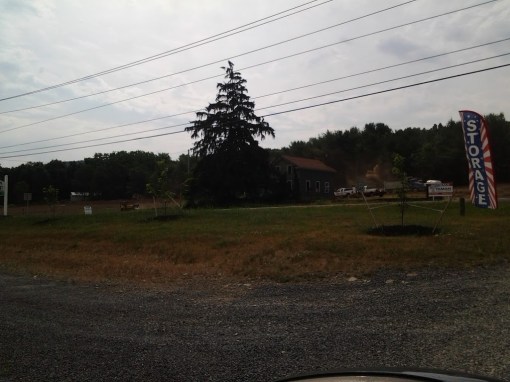
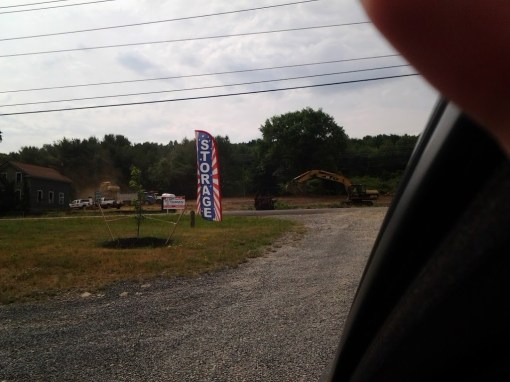
5. Work on the new Storage Squad facility has begun on the 1400 Block of Dryden Road east of Varna. Right now, the focus is on site clearing; the house was used by local fire departments for training exercises, and will come down in a controlled burn later this summer. The 79,000 SF storage facility should be ready for use by February 2017. One full time and a few part-time jobs will be created.

And for the record, I think that’s my middle finger.

6. So this is curious. The city recently uploaded a couple of older documents detailing development plans off of Floral Avenue on the southern tip of Ithaca’s West Hill neighborhood.

The first dates from Febraury 1992, and is a filing to create a 27-lot cluster subdivision on 4.15 acres at 452 Floral Avenue. The paperwork indicates that the intent was affordable housing, by a company named House Craft Builders. The city’s then-Planning Director, H. Matthys Van Cort, wrote a recommendation for negative declaration of environmental significance, and the project was approved in June 1992, but it never moved forward, and 452 remains vacant land today. It appears House Craft was dissolved in 2012; the officer was an architect for Ecovillage who has since retired and moved out of state.

The second is a subdivision requested by INHS in 1987. The filing requested 236 Floral Road be split into two parcels, with the intent of renovating a decrepit 236 into a for-sale affordable single-family home, and build a new house on 224. This was approved, and eventually, 236 was renovated and transferred to its owner in 1996, and 224 was built in 1994.

Now, as interesting as this all is, the city doesn’t upload decades-old subdivision files just to amuse nerds. The $64,000 question is, why were they uploaded now?