210 Linden Avenue Construction Update 7/2018

13 07 2018

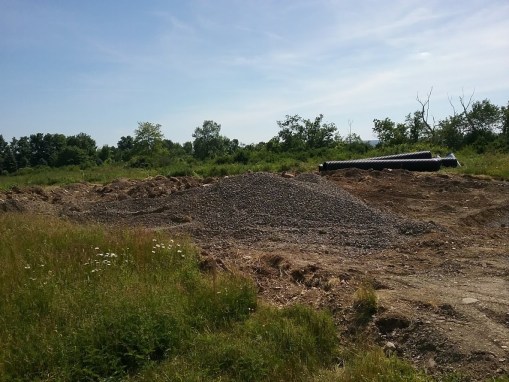
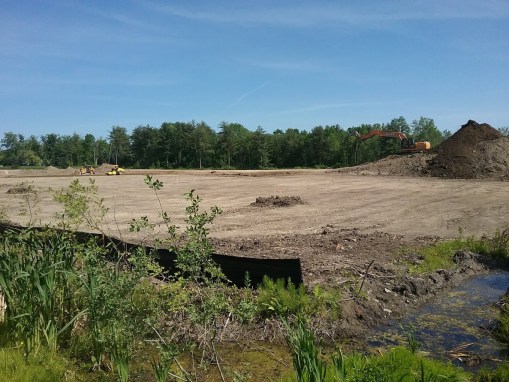
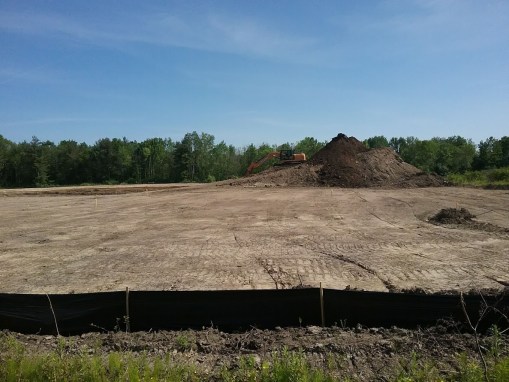
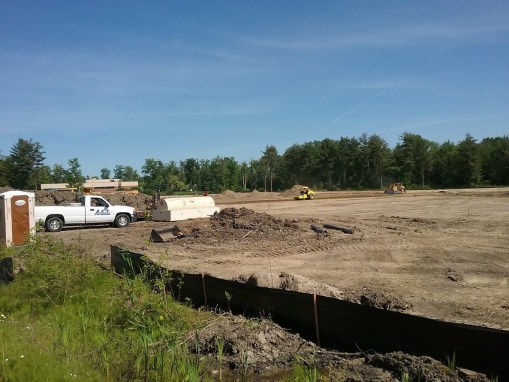
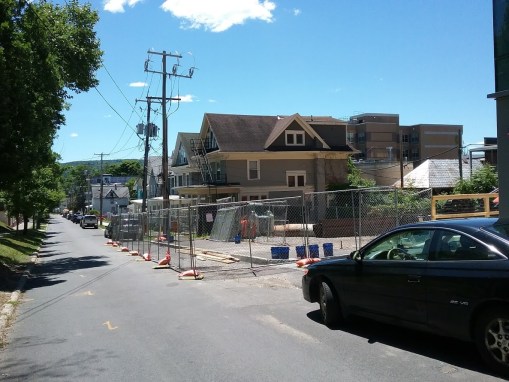
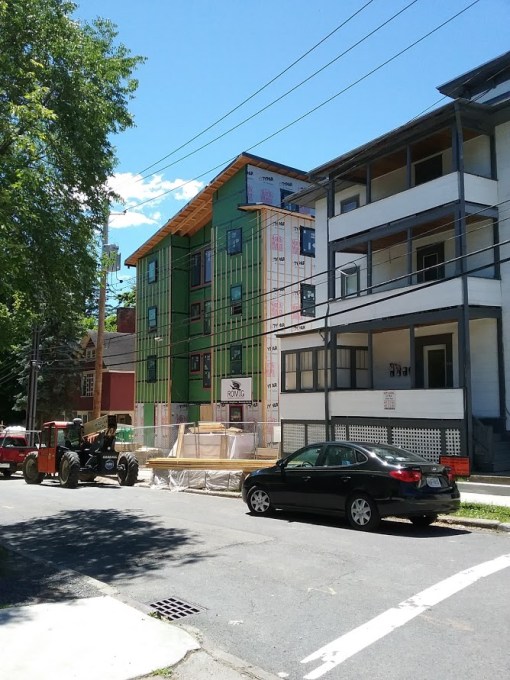
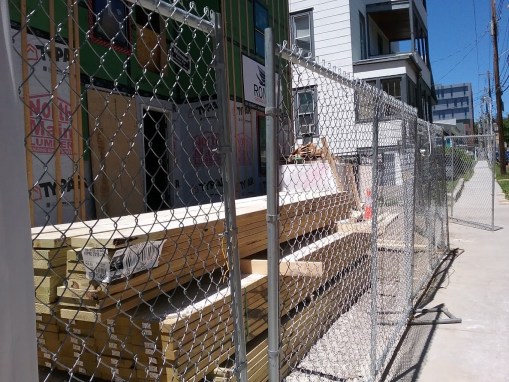
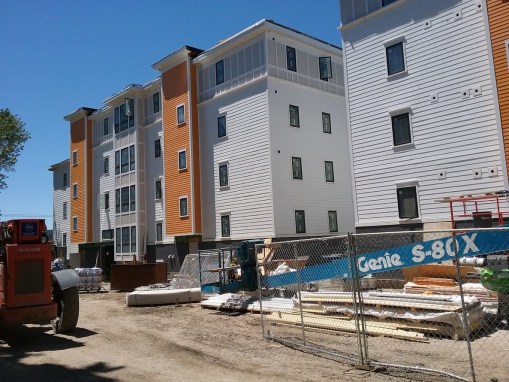
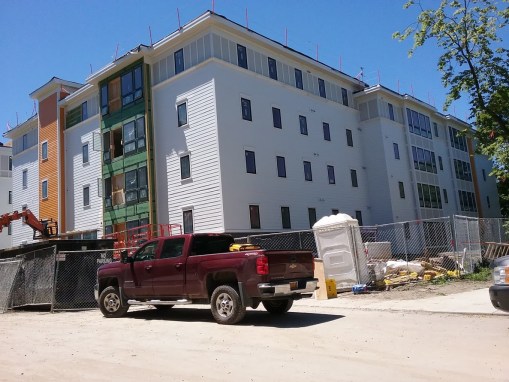
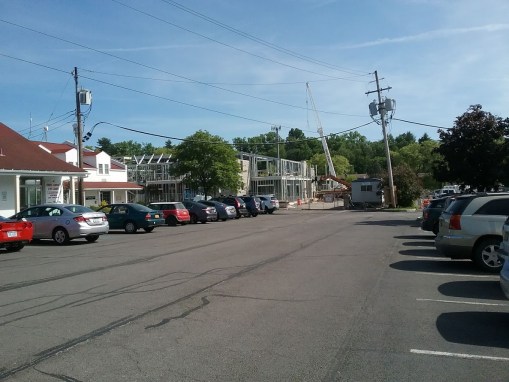
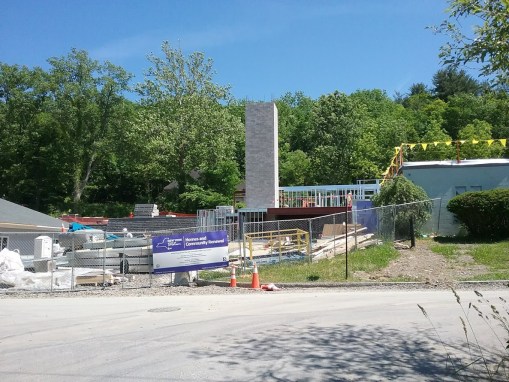
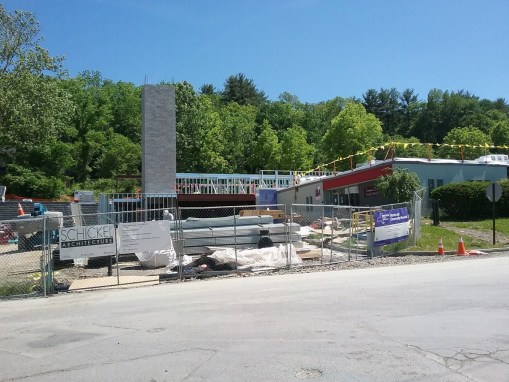
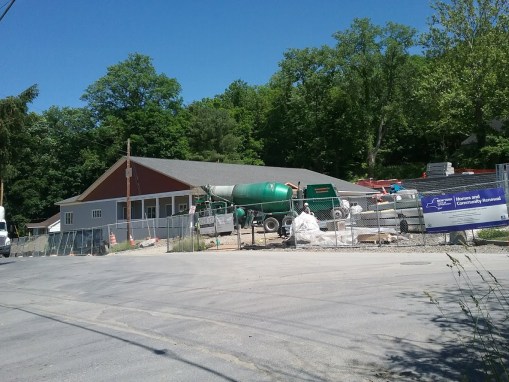
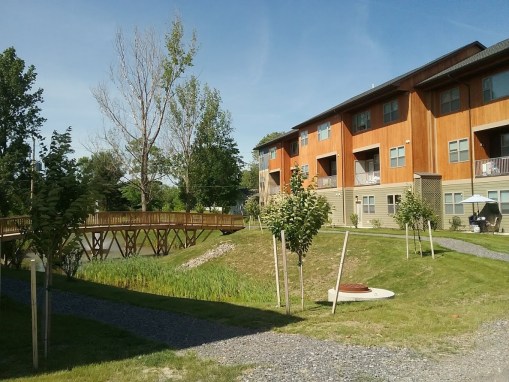
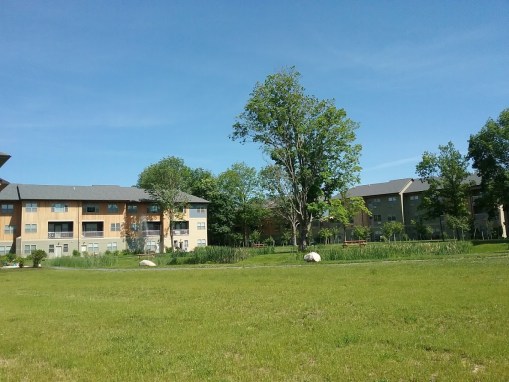
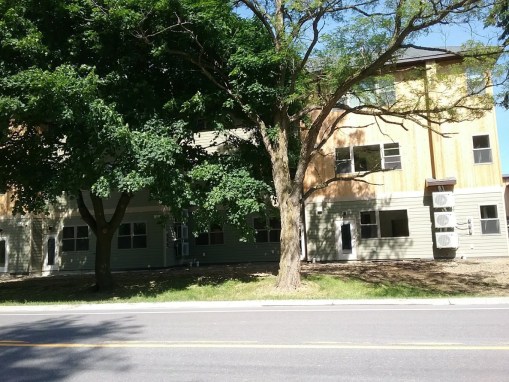
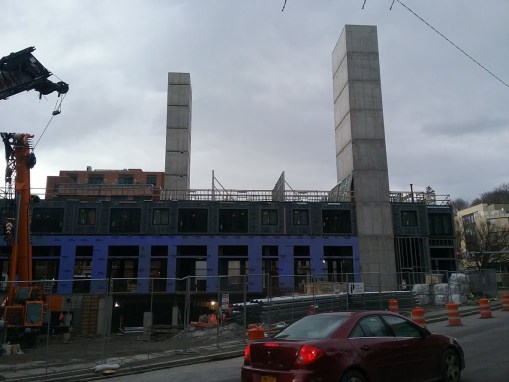
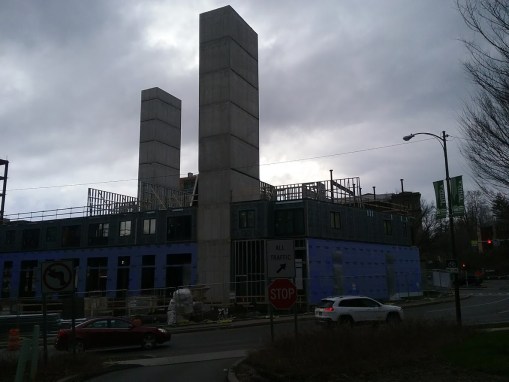
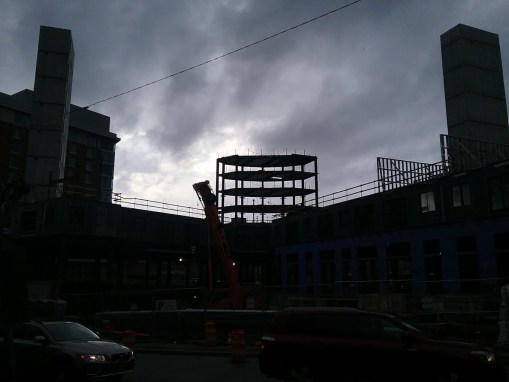
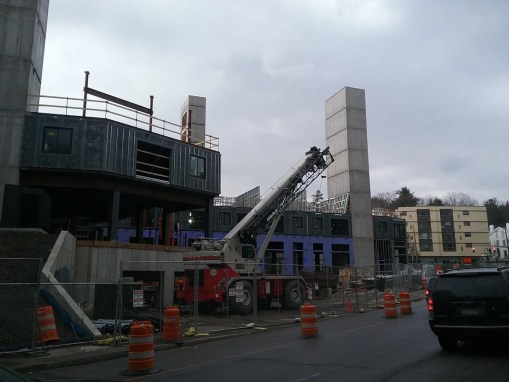
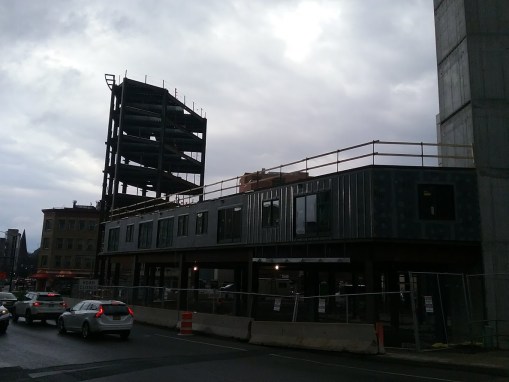
Time to take a look at Visum’s smaller Collegetown projects. 210 Linden is the largest and furthest along; the city allowed them to hook up to water and sewer service this week.

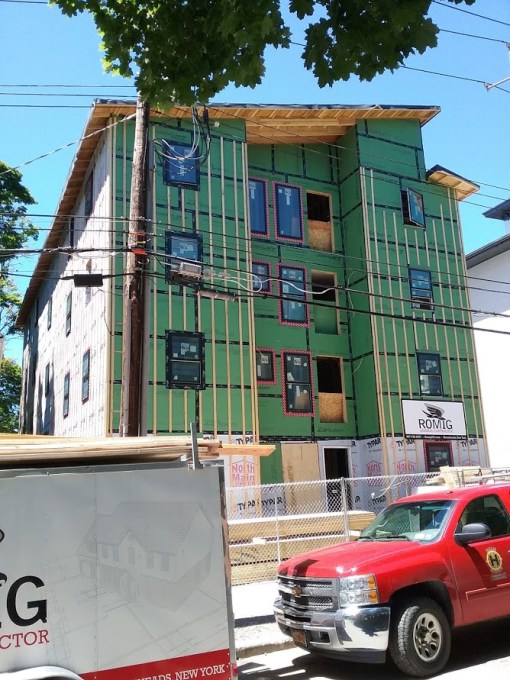
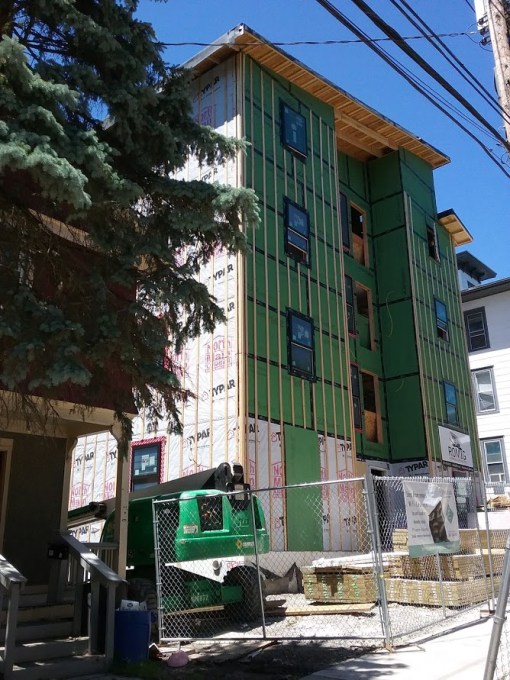
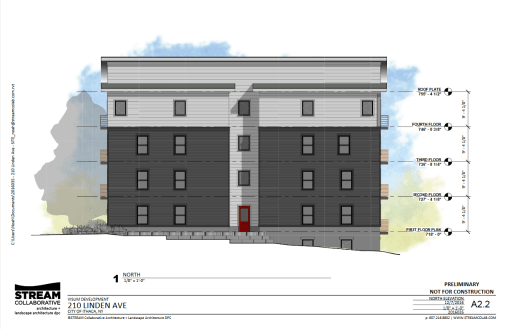
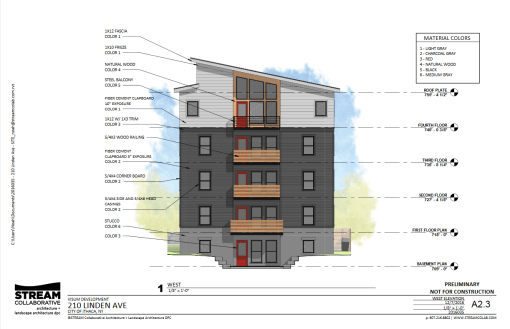
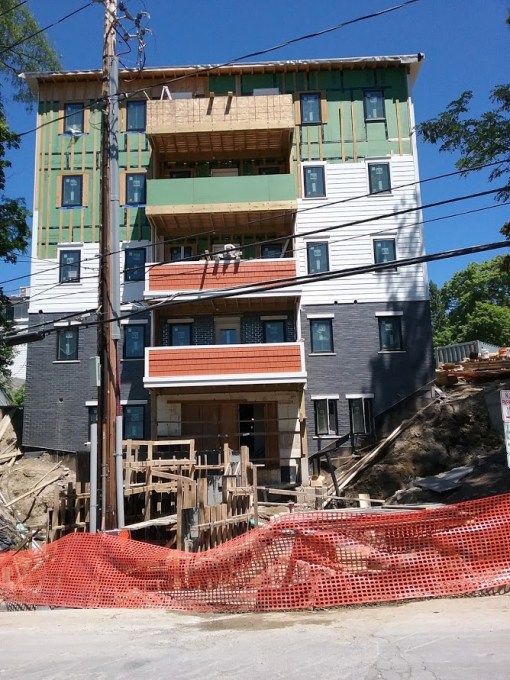
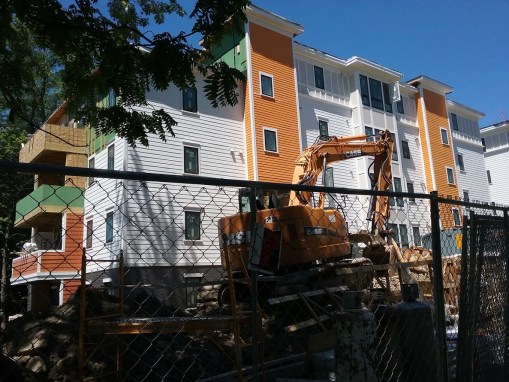
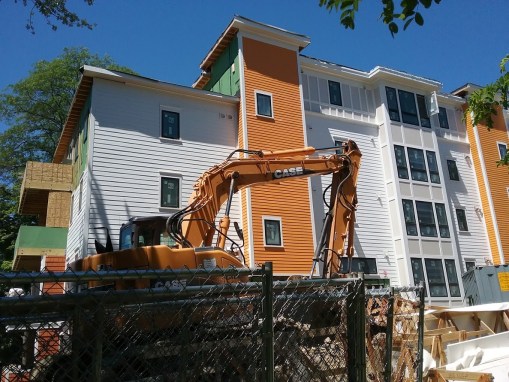
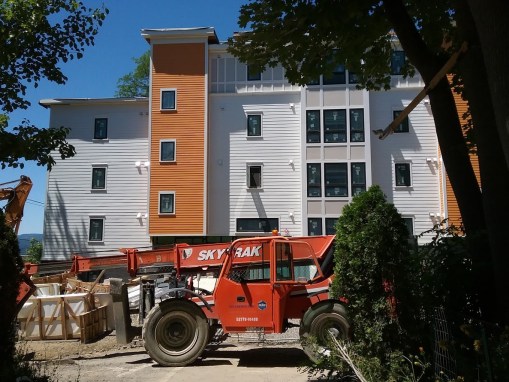
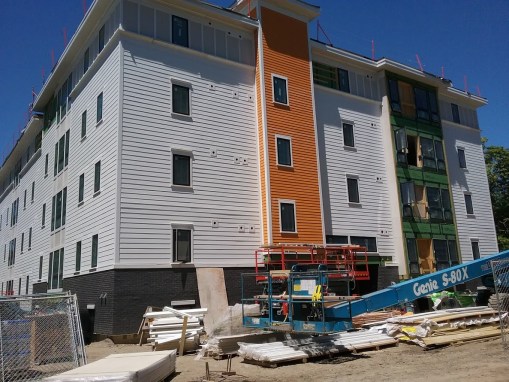
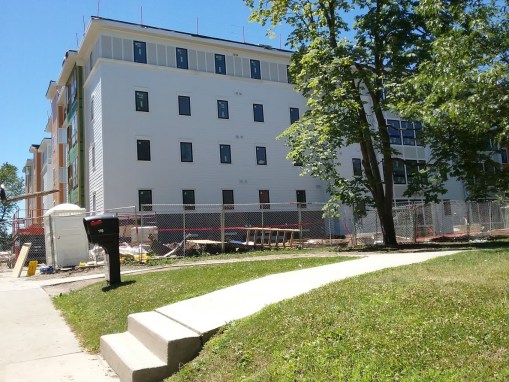
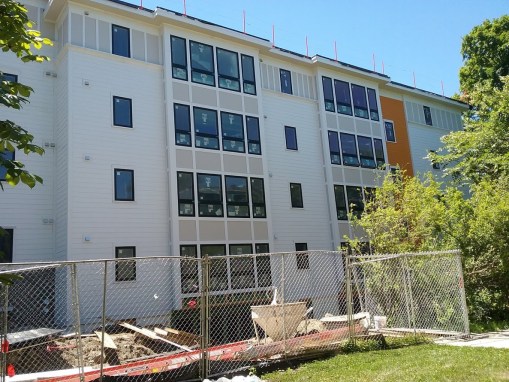
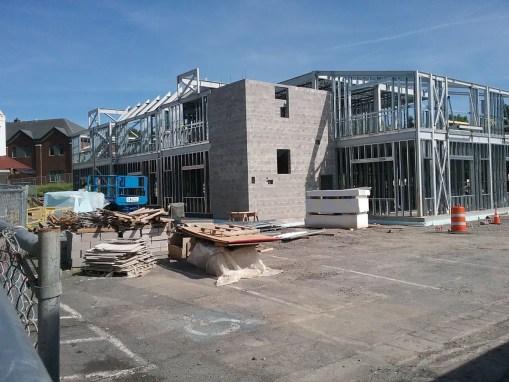
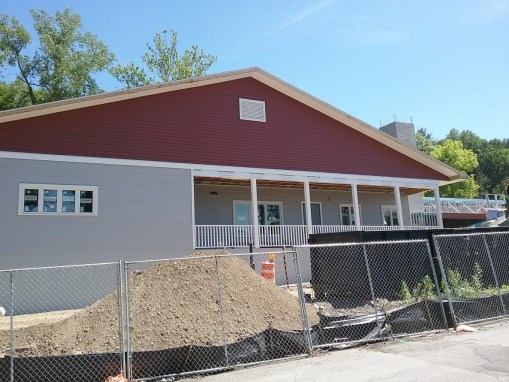
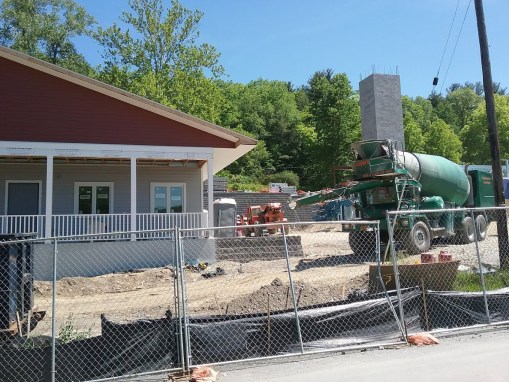
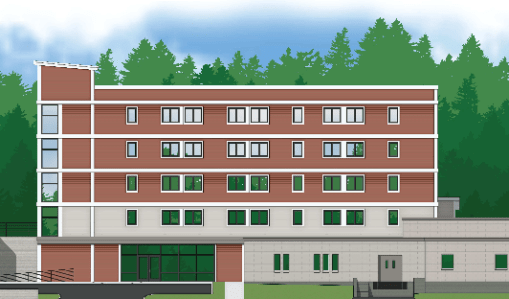
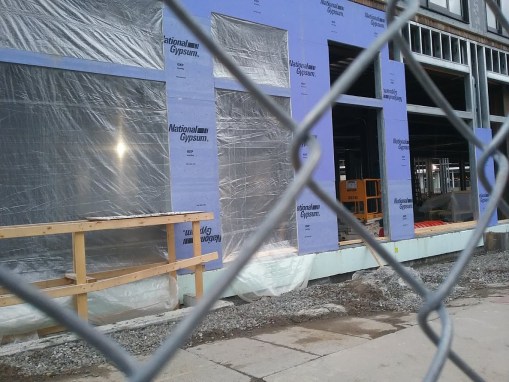
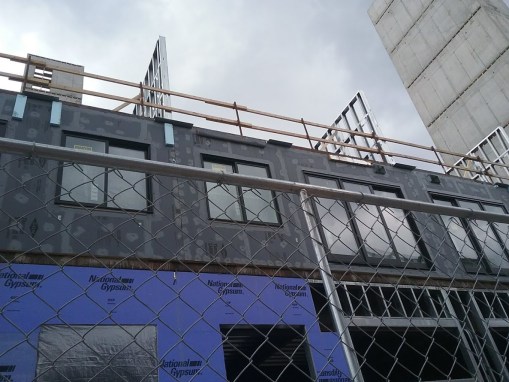
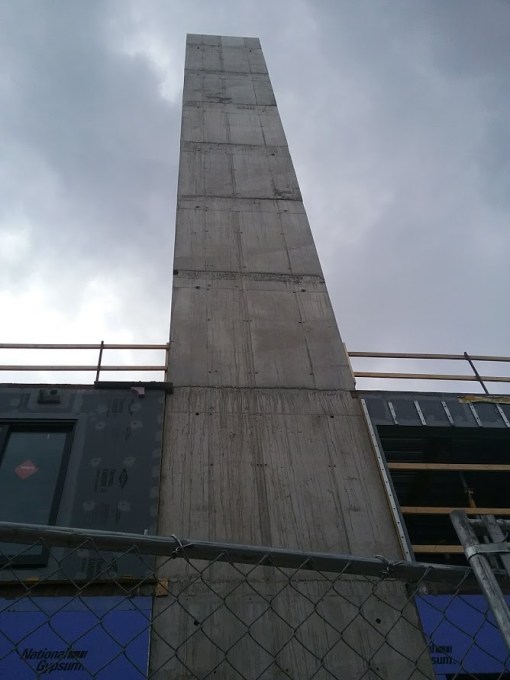
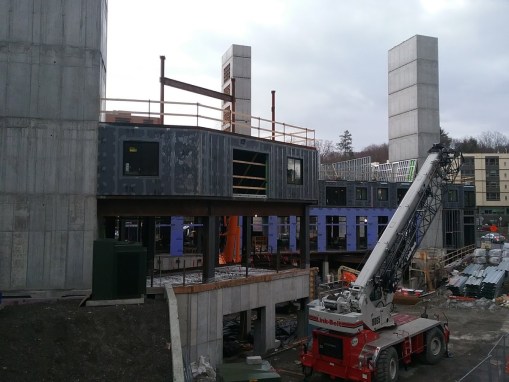
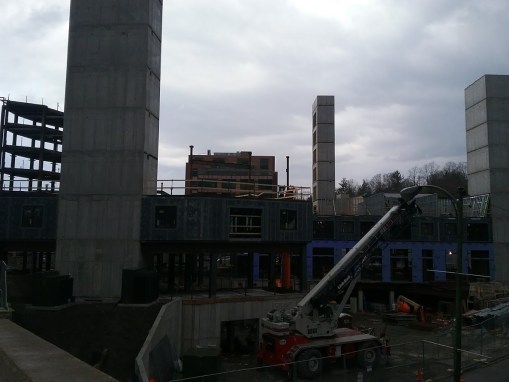
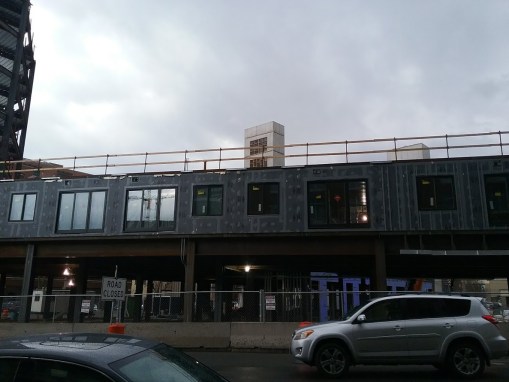
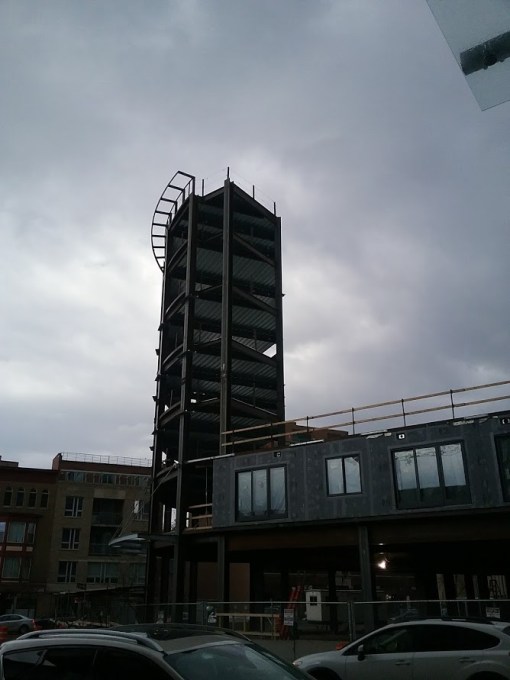
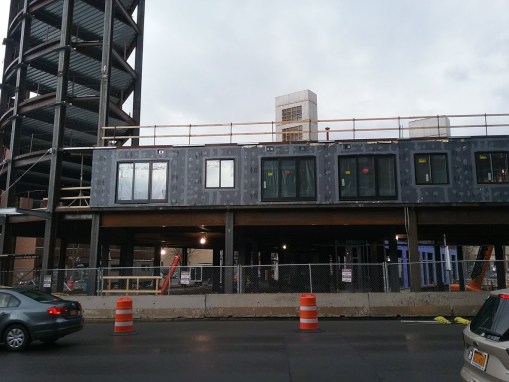
Note there are some clear differences between what was originally approved, and what’s being built. The fenestration is a different layout – the top floor windows originally did not line up with the window arrangement of the other floors. Secondly, the floor-to-ceiling multi-pane treatment on the top floor’s front (east) facade has been eliminated, given a similar if slightly glassier treatment as the other three floors, which had a balcony window reduced in size. The most likely guess is value engineering – save cost, save time, especially the latter since the building needs to be open by mid-August.

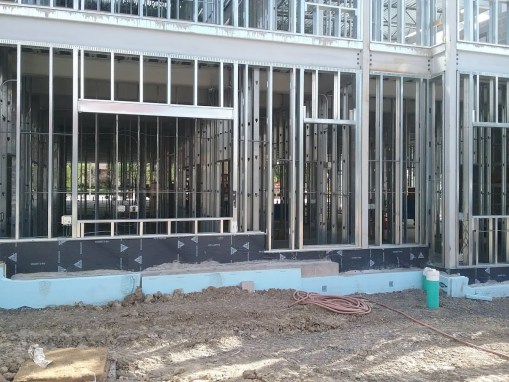
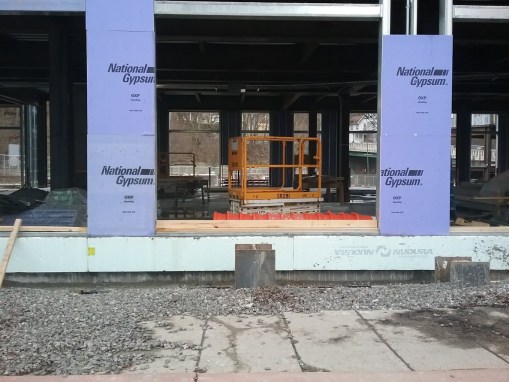
The overall shape remains the same, but with these changes it’s a bit of a question mark as to the appearance of the final materials – it’s probably the same as approved, since the vertical wood rails over the sheathing indicate the LP SmartSide fiber cement lap siding is coming at some point. The sheathing is a mix of Huber plywood zip panels with its specialized tape system, and TYPAR housewrap over plywood panels courtesy of North Main Lumber, a regional lumber sales chain. Romig General Contractor is doing the build-out, and their work with Visum is arguably the first multi-family project they’ve tackled in the Ithaca area.

Although 210 Linden is too small to host much in the way of amenities (it has a garbage collection room and bike room in the basement), its 37 residents will have full access to the amenities offered in The Lux just up the street. Connecting the dots, those were probably quartz countertops in the Lux update; seems plausible the same high-end fixtures, cabinetry and appliances would be used in both.

The background info/intro to 210 Linden can be found here.


The Lux (232-236 Dryden Road) Construction Update, 7/2018

12 07 2018

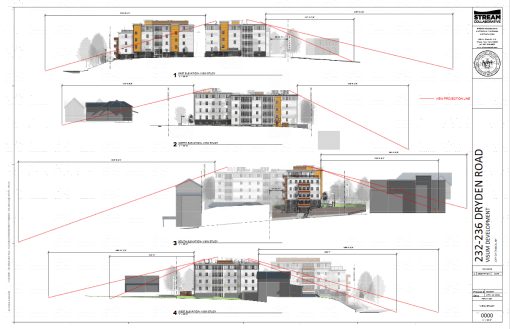
This one is in its home stretch. It’s rather striking how much the front balconies stand out, probably the result of the contrast in materials. The upper levels will use LP SmartSide white and marigold yellow fiber cement lap siding, and the lower levels are a black brick veneer (Endicott Thin Brick colored “Maganese Ironspot” with charcoal-colored mortar). The balconies use white Smart Trim and “Redwood” Allura fiber cement straight edge shingles. The architect, STREAM Collaborative’s Noah Demarest, designed the balconies to be a nod to the original appearance of the previous building on the site, the private Cascadilla School dormitory.

The second and third photos are practically a progression pic, showing that the balconies are framed in wood, walled with sheets of ZIP plywood sheathing, and then faced with the exterior materials. Some exterior finished still need to be attached, the concrete pours are ongoing for the Dryden Road entrance, and it appears the roof membrane has yet to be laid.

As far as the interior goes, the construction crews were using a front loader to lift countertops to units, so it seems likely drywall hanging and painting have been finished, and the floors may be installed but not yet finished out. Fixtures, appliances, doors and trim pieces probably have not been installed yet, though perhaps the lower-level units are further along. It’s a pretty tight deadline to get the buildings complete, with move-in day expected to be August 17th.

Outside of Maplewood, at 207 beds (I’ve presumed net gain at 140-150) this will be the largest non-Cornell project coming onto the Collegetown market this year. Given market concerns about the absorption of Maplewood units as well as the size and the timeline of Cornell’s future North Campus dorms (2000 beds, with two phases opening in 2020 and 2021) it might be the last large Collegetown project for a while. A few midsize 50-100 bed projects will likely come along in the interim, perhaps the Nines replacement, and the rumored replacement for the Chacona Block (411 College Avenue, home of Student Agencies), which is expected to head before the planning some time within the next twelve months. Novarr’s faculty/staff focused apartment buildings at 119-125 College Avenue have yet to begin construction and seem to be a big question mark. It’d be a shame if it still failed to move forward even after the resdesign to accommodate fire code changes.

According to the FAQ on The Lux’s website, units will be furnished and pets are allowed for a $150 fee. The eight parking spaces are available for rent to tenants on a first-come, first-serve basis at $200/month.  Units are $1,200-$1,300/month per bedroom, and includes access to an on-site fitness facility, rooftop terrace and hot tub, security system, sauna, game room and study room (most of those in 232 Dryden, “Lux South”). There’s no beating around the bush, this is high-end student housing, “creme of the creme” as one of my grad school professors would say.

On a final note, quick shoutout and well wishes to Visum Development VP Patrick Braga, who will be leaving his position to do a Master’s in Urban Planning at Harvard. In a world where developers and city planners often run in their own circles, it’ll be good to have someone with strong experience in both.


East Pointe Apartments Construction Update, 6/2018

24 06 2018

If the name doesn’t sound familiar, that’s okay. For the past two years, the common reference to these was either “The Bomax Drive Apartments” or the “Park Grove Realty Apartments”, either of which was used interchangeably. The official name according to Park Grove Realty’s webpage is “East Pointe Apartments”. East of what, I dunno.

Park Grove Realty is a new company headed by a group of long-time developers and real estate professionals. Andrew Crossed and Andrew Bodewes cut their teeth at Conifer Realty, a regional affordable housing developer based out of Rochester (readers might be familiar with some of their local projects, including Linderman Creek, Cayuga Meadows, and Poet’s Landing). They knew their way around development and had familiarity with the area. Not only that, they were working with Tom LiVigne, who has been on the board of many local projects and recently retired as the president of real estate operations at Cornell.

While LiVigne was at Cornell in 2008, the university purchased a 19.46 acre parcel on Bomax Drive. The property was zoned for business and technology, which is intended for commercial office, warehousing or tech-focused industrial space, which is what Cornell originally had in mind. But, with the onset of the Great Recession, and a re-assessment of Cornell’s needs, nothing ever came forth for the property.

A little bit of speculating here, but because Conifer’s Cayuga Meadows had been floating around since the late 2000s, LiVigne would have been professionally familiar with Crossed and Bodewes. It seems likely that as LiVigne retired in early 2015, and Crossed and Bodewes launched their company a few months later, they might have approached him with the idea of an Ithaca project, knowing the market’s strong economics and housing deficit. LiVigne was familiar with Cornell’s excess holdings, and whatever discussions he had with Park Grove post-retirement led to the idea of a project on this property.

The project was first conceived and brought before the village of Lansing in July 2016. East Pointe is a 140-unit townhouse complex, fourteen strings of ten units, plus a community building, situated on a wooded vacant parcel on Bomax Drive. The intent was to explicitly avoid Collegetown and Downtown, and do a project geared towards the upper-middle class market segment, more specifically empty nesters and young professionals who may be moving in for work, but have yet to buy a house (this is exactly the same sub-market and words used by the developers of the 102-unit Cayuga Orchard project over in the town of Lansing, and even bears a passing resemblance). Arguably, a modest slice of graduate/professional students is possible as well.

To make the project possible, the zoning would have to be changed to high-density residential – the village planning board wanted a traffic study and wasn’t excited that there was no affordable housing here (the project team argued the asking price Cornell wanted made affordable housing infeasible), but was otherwise open to the idea of the zoning change; no one had developed a business and technology space since 2005, and residential was seen as a downzoning from what could have been done there, should Cornell have really pushed for a large office of research building. The neighboring developer, however, was not okay with the rezoning.

I don’t intend to rehash Forest City Realty and the Jonson family’s attempt to stop the project, but the argument was that it was a “spot rezoning” and that it was illegal. The Jonsons felt the units would decrease the desirability of their own project, the luxury for-sale townhomes in the Heights of Lansing. It became so impassioned that Lisa Bonniwell (Ivar and Janet Jonson’s daughter) ran herself and allies to try and take over the village Board of Trustees and mayorship last year in an effort to stop the proposal – they lost by a large margin. They also took the village to state court, lost, appealed, and lost again. The village estimates, with considerable distaste, that although they won, the court cases cost them close to $50,000.

It’s because of the lawsuit that the timeline gets a little muddled. The rezoning request was filed in September 2016, the public hearing in October, and the zoning change was made in November 2016 – to make it clear, that was the rezoning, not the project. The project wasn’t approved until November 2017, after the lawsuit was rejected and had gone to an appeals court. For a little while, Park Grove had a “continue at your own risk” for preparing final drawings and legal paperwork, given that the appeal was not declined by the state court until February 2nd 2018. The first real sign the project was moving forward came on March 16th of this year, when Cornell sold the land to Park Grove for $1.5 million, $300,000 more than what the university paid in August 2008.
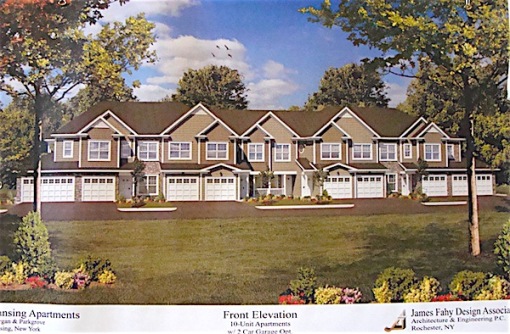
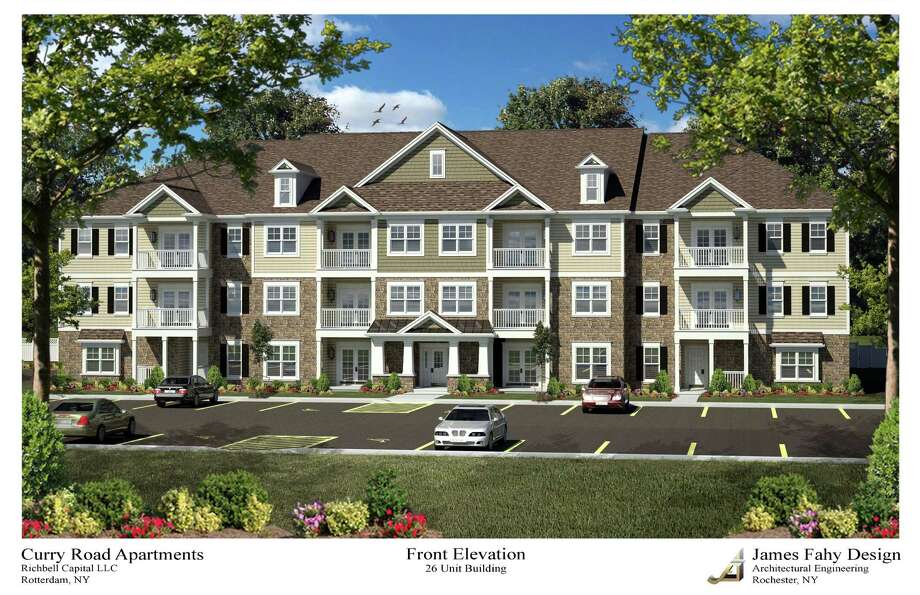
Each string will have four units on the first floor, and six units on the second floor. Each unit has their own entrance, and the project is being described by the developer as “walk-up garden style“. The mix of units is 36 one-bedroom units, 90 two-bedroom units, and 14 three-bedroom units – since 36 and 90 don’t break down evenly by 14, I’d expect slightly difference unit mixes per building, and perhaps that will result in some slight design differences for things like window and door placement. However, they’ve only ever shown one apartment string in their official renders. The renders above are from early in the process (top), and the one they uploaded to the company website last week (bottom) – note the differences in the end garages and in the second floor/roof on the right side of the image. it may be a change in design, or it may be two different building designs they plan to utilize depending on unit layout. Have to wait and see on that one.

The one-bedrooms will be about 900 square feet and go for $1,400/month, according to an early interview with the Ithaca Times. The 1,300 SF two-bedroom units will go for $1,700/month, and the three-bedrooms, which will be about 1,400 SF, will for $1,900/month. The Lansing Star gives similar stats. Renters will get “high end finishes and amenities”, with possible amenities including  the community building with swimming pool, bocce ball court, walking trails, a community garden and a dog park.

I have not seen any building costs or local lending activity associated with the project, but if it’s in the ballpark of the nearby Village Solars (which is $2-$3 million per building), then it would not be unreasonable to expect something in the range of $30 million (of course, I am not the county tax assessor, so don’t take my word as gospel).

The architect, James Fahy Design Associates of Rochester, has a lot of experience with newer suburban developments, both single-family and multi-family. A google search (their website hasn’t been updated) shows similar gable-loving, shake siding and stone veneer embracing projects in the Buffalo, Rochester, Syracuse and Albany areas. Jess Sudol of Passero Associates is the engineering consultant.

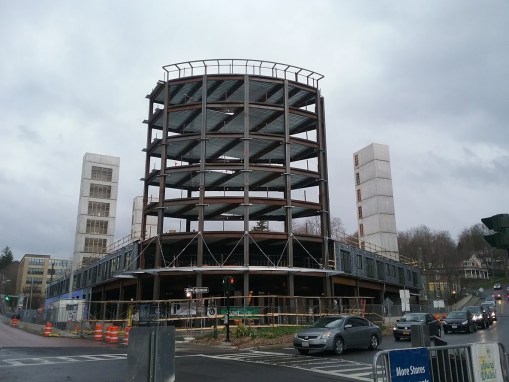
Right now, the site is being cleared and graded, with subterranean utilities installs (water/sewer) and early foundation excavation work is underway. The first two apartment strings are expected to be ready by Spring 2019. DGA Builders of Pittsford (suburban Rochester), a division of Pennsylvania-based DGA Construction Group, appears to be the general contractor, and A.E.Y. Enterprises of Macedon (Wayne County) is the site work subcontractor.


Cayuga Medical Associates Construction Update, 6/2018

21 06 2018

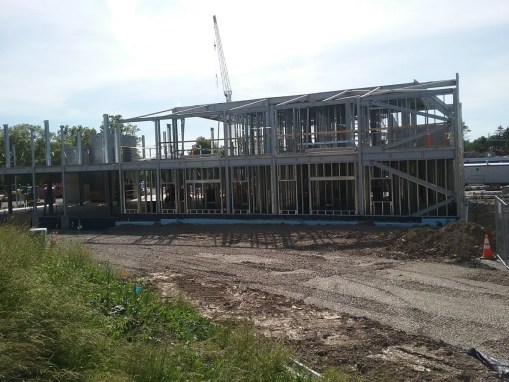
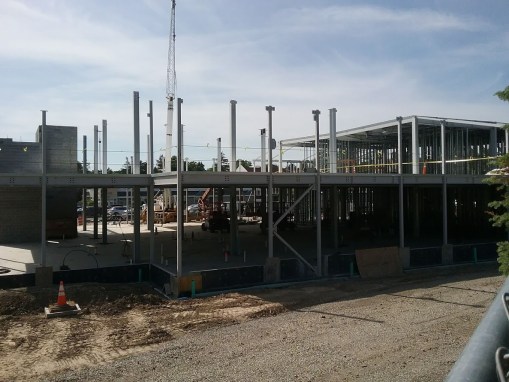
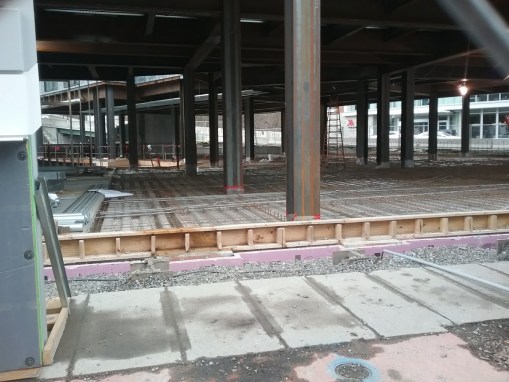
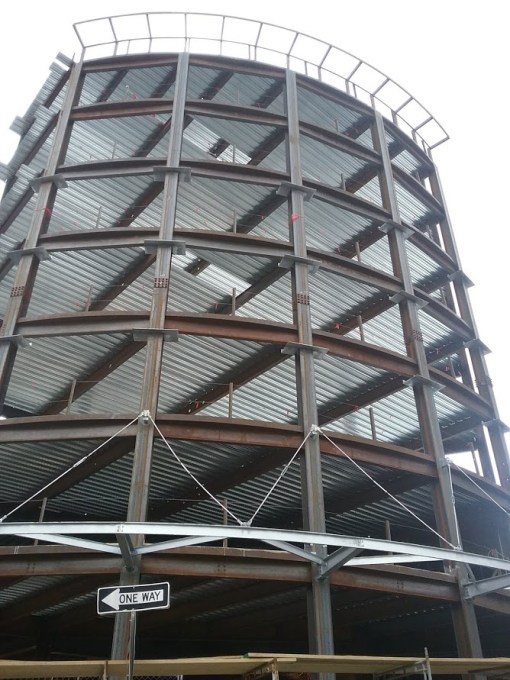
McPherson Builders is continuing work on the $7.8 million Cayuga Medical Associates Building at 903-09 Hanshaw Road in Community Corners. The concrete masonry block stairwells have been assembled, steel framing is complete on the first floor (with interior framing and some early utilities rough-ins underway), and exterior wall assembly is ongoing for the second floor and the roof – structural steel beams will be bolted together, and the stud walls will follow. Interestingly, it looks like HOLT Architects incorporated large diagonal structural beams into the building frame, perhaps for extra stability.

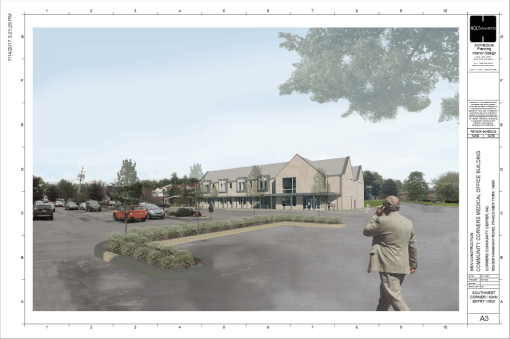
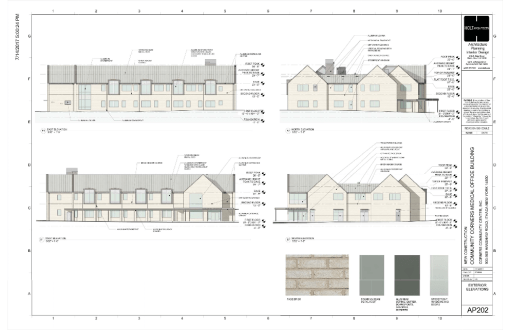
Most of the steel gable trusses are stacked neatly off to the side, and they’ll be craned into place as the second floor is built out. Note that most of the roof is flat, but the gables are to go up along the exterior edge. This adds a traditional design to an otherwise modern building, and better complements the existing structures at Community Corners. Early in the permit process, the target was a late summer (August/September) delivery, but it seems more likely to be early fall (October?) at this point.

Background info and specs for the project can be found here.


Amici House Construction Update, 6/2018

19 06 2018

There has been significant progress at the Amici House construction site at 661-701 Spencer Road. The 7,010 SF Harriet Giannelis Childcare Center (which will host headstart classrooms and daycare facilities) is fully framed, roofed, fitted with windows, and most of the exterior siding (unsure at a glance if it’s CertainTeed vinyl or fiber cement lap siding, though the top color looks like CertainTeed “Autumn Red”) has been attached. Even some of the trimboards have already been attached along the front entry/porch. It would seem likely that, if logistics provide for it, the building could be open for its first students in the fall.

To be honest, the design is a bit of a surprise – the original building design by Schickel Architecture was the same size but looked quite different, and the revisions were never uploaded (maybe the planning and building department had something on file, but there was nothing online). Note that most of that front-facing concrete slab is going to backfilled (partial refilling of the excavated area).

As for the five-story mixed-use structure, that is just getting underway with structural framing. The first floor, which will have offices and meeting space, has its steel skeleton and some of its exterior stud walls have been attached. The second floor is just getting underway, and the masonry blocks for the elevator core have been assembled. It appears the existing TCAction building will be getting a new roof as part of the construction work – note that they are not able to work here while construction is ongoing, and have temporarily relocated to 609 West Clinton Street. The 20,712 SF building, with its offices and 23 efficiency units for homeless and/or vulnerable young adults, will be completed early next year.

The background information and planning for the project can be found in the March introductory post and photo set here. Prolific regional contractor Welliver is the construction manager for the $8.25 million project.


South Meadow Square Construction Update, 6/2018

18 06 2018

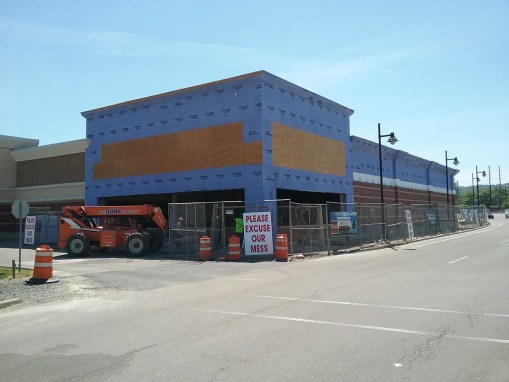
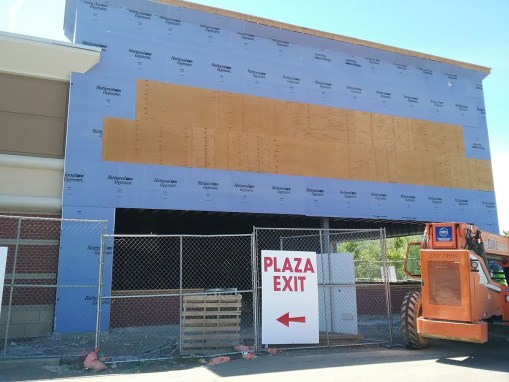
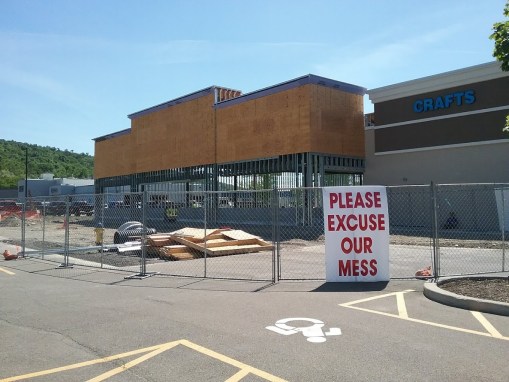
The new endcap spaces on the former KMart (now Hobby Lobby) Plaza at 742-744 South Meadow Street. The first set of photos are the northern endcap with 7,315 SF of retail space, next to PetSmart. The southern endcap is a 14,744 SF space being built where K-Mart’s garden center used to be, which I think explains the huge chunks of concrete slab piled out in front.

With no tenants formally announced, these spaces will not be completely finished on the inside – all utilities will be in as well as structural supports and insulation, but the space will be fitted out to the needs of the tenants, so things like flooring, fixtures and interior finishes will wait until someone has signed a lease with Benderson Development. I did not see anything on file for a fit-out in the city of Ithaca’s building permits paperwork (however, I did see last week that Elmira Savings Bank landed an unnamed tenant for its second floor office space at 602 West State Street).

Oftentimes you’ll see retail real estate managers try to find tenants that complement each other, say a salon and a cafe, or a sporting goods store with a women’s clothing store (the somewhat sexist argument there is that the ladies go to one while their male partners go to the other). Increasingly, entertainment and recreation options are becoming tenants – take for instance the announcement that a live theatre company will be taking 12,000 SF of space in the Shops at Ithaca Mall. That can help existing tenants by drawing in unique customer traffic that may choose to browse, shop and dine at other mall venues.

Back to the site at hand, the decorative facade appears to be initially shaped with plywood over steel stud walls, with a layer of fireproof gypsum laid over the top of that (except toe cornices, which appear to have no plywood layer, only gypsum). The bases are concrete masonry walls. The textured stone veneers and fiber cement panels will come later.


Village Solars Construction Update, 6/2018

16 06 2018

It looks like there’s a lull in the construction at the moment. Both 102 Village Place and 116 Village Circle appear to be complete, though a quick guess would be that 102 Village Place is already occupied, and 116 Village Circle will be ready for its first tenants at the end of the month. The two have a total of 42 units, 24 in the former and 18 in the latter. TCAT is in discussions to add or modify a bus route to service the growing apartment complex, which has already added a couple hundred residents to the area since 2013, with plans for hundreds more over the next several years.

According to the phasing plan, the next phase is to replace 2 Village Circle and 22 Village Circle with a pair of 18-unit buildings. Those would be twelve studios and six two-bedrooms each, replacing two ten one-bedroom unit buildings (net gain of 28 residents, for those keeping in track). Demolition has not yet started on the existing structure, but the most likely plan is to start a little later in the early summer, and have the new pair of buildings ready for a spring 2019 occupancy.


118 College Avenue Construction Update, 4/2018

13 05 2018

Finally, clearing out the last of that late April photo stash. Not many here, but a new, small Collegetown project is underway at 118 College Avenue.

This is a Visum project, and probably their lowest profile plan. In fact, this one never even went through the sketch plan part of the city review process, the project team went straight to asking for the city planning to declare itself lead agency for environmental review in March 2017. Approval was a short time later as Ithaca goes, in May 2017. Building permits were issued this past winter.

It wasn’t a rash decision by any means – the project is largely similar to a previously-approved plan a few houses up at 126 College Avenue, and there is very little difference between the two properties in terms of context. They are both CR-4 zones allowing 4 floors and 45′ heights. The original 118 College Avenue was a two-story, early 20th century rental house with six bedrooms and marginal historic value, though I imagine the house was rather pretty before some unfortunate additions threw off its symmetry. The property was purchased by Red Door Rentals (Greg Mezey and Ryan Mitchell) in April 2014, transferred to another Mezey/Mitchell company, “MPB Capital LLC” in October 2017, and then to an LLC associated with Visum on the same day as the MPB Capital transfer. It seems plausible Ryan and Mitchell are project investors, with Visum as developer.

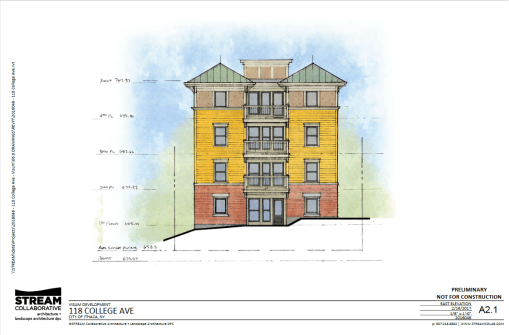
Plans call for a new 4-story, 45′ building on the sloped lot. With that slope, the basement is exposed on the west face, so it has the appearance of five floors from the rear and sides. A back of the envelope calculation says this building is about 9,000 SF. The roof hosts a 6′ architecturally-integrated mechanical screen; hides the mechanicals, but gives the apartment building an Italianate aesthetic. The building uses electric heat pumps and is designed to be net-zero energy compatible. The hard construction cost rings in $1.415 million, according to the SPR filing – it would be assessed at a substantially higher amount. Unabated taxes her, so while people may dislike Collegetown, projects like this help fill the city coffers.

There will be 5 apartment units with 28 bedrooms – 4 six-bedroom units, 1 four-bedroom unit on the basement level. The project comes with five new trees, lush landscaping for its small lot, an outdoor bike rack, screened trash area, and bike storage and mechanical rooms in the basement. Tenants with valid licenses will be given membership in Ithaca Carshare, to try and dissuade them from bringing personal vehicles. Not a surprise here, but college students are the intended market.

Only a couple minor changes occurred from start to finish – the window on the northeast face was replaced with a patterned trimboard to keep visual interest. The rooflines ware adjusted in the render below, but not the building plan, so we’ll see which is correct.

For materials, the basement-level will use stucco mixed with Sherwin-Williams “Sawdust” paint, the first level is a combination of Belden face brick (Belcrest) and S-W “Truepenny” fiber cement clapboards, more fiber cement clapboard on the mid-section in S-W “Overjoy“, trimboards, balcony trim and window casing colored S-W “Svelte Sage”, black window frames, stucco (in S-W “Favorite Tan”) with more fiber cement trim and frieze boards on the top level, and the pyramidal roof caps will be standing seam metal, Pac-Clad “Aged Copper”. Mix of materials, mix of colors – should stand out nicely.

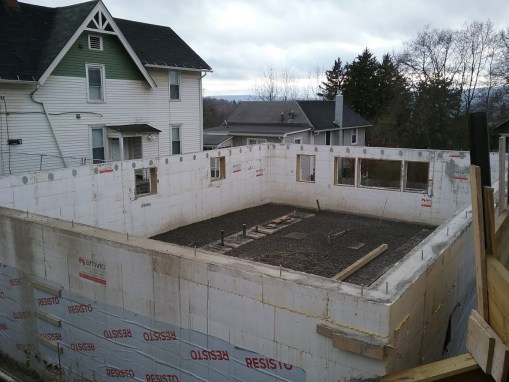
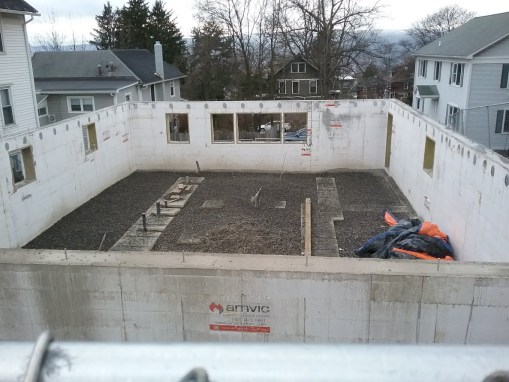
Expect buildout to look similar to 210 Linden and The Lux – Amvic insulated concrete forms at the basement level, double-stud Huber ZIP panel plywood sheathing, scratch coats on the portion to be covered in stucco, perhaps wood furring to raise the exterior clapboard and prevent dampness, and probably Anderson windows. The project is expected to be complete by August – units are going for $950/bedroom, plus utilities. Pricey, but at least they allow large dogs.

Along with Visum and Red Door Rentals for this ride through the development process is STREAM Collaborative as the building and landscape architect. Since they’re GC at 210 Linden Avenue, Romig General Contractors may be the manager of the construction crew here as well.


Masonic Temple Renovation Update, 4/2018

13 05 2018

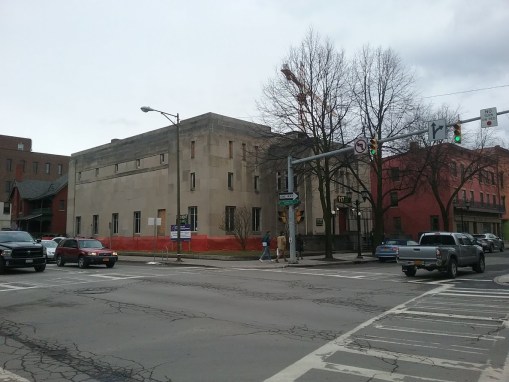
The Masonic Temple renovation is low-key but worth an explainer. Here we go:

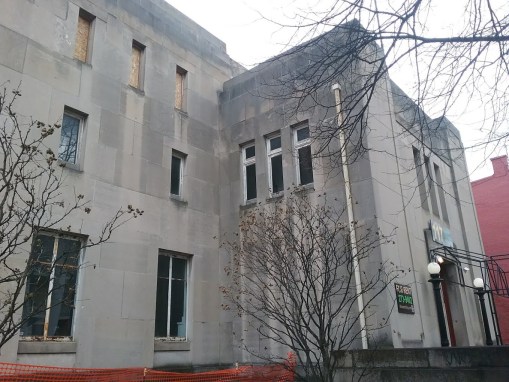
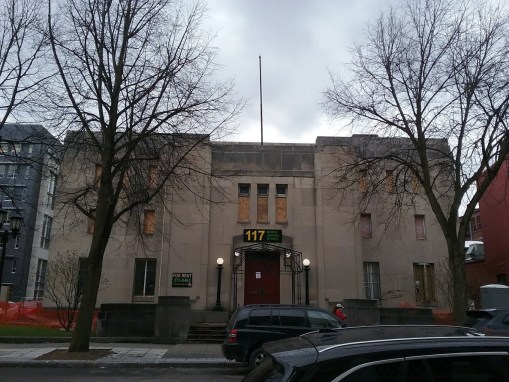
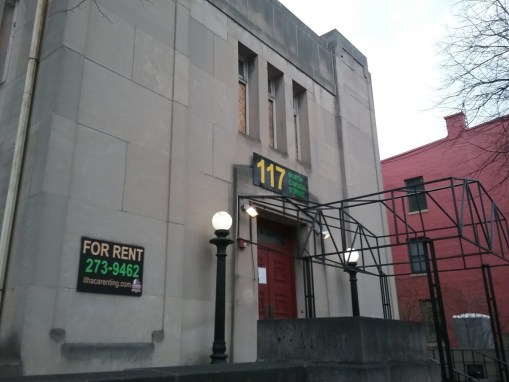
The 17,466 SF Masonic Temple at 115-117 North Cayuga Street is a bit of an unusual building. It was one of the last designs by prolific local architects Arthur Gibb and Ornan Waltz, and completed in 1926. The style is Egyptian Revival, which was also used for the Sphinx Head Tomb at 900 Stewart Avenue, and to a lesser extent in the Carey Building, which was built around the same time. Egyptian Revival architecture uses what are or are perceived to be Egyptian motifs (stark facades, strong symmetrical elements, Egyptian-themed ornamentation), and experienced a resurgence in the 1920s following the opening of King Tut’s tomb – the early 20th century designs are sometimes grouped in as a subcategory of Art Deco.

Keep in mind that Freemasonry is a loose affiliation of fraternal groups, with some degree of secrecy (that they like to play up, for better or worse). Although diminished in this age, they played a role in community social life much as Greek Life does on college campuses. The Ithaca Freemasons wanted something exotic with just a hint of foreboding, so the architects went with minimal ornamentation, strong symmetry, simple, slit-like windows, and a bare, impassive facade, here a thin limestone veneer over a steel frame (a modern idea for the time). To quote William D. Moore’s Masonic Temples: Freemasonry, Ritual Architecture, and Masculine Archetypes, “a critic claimed that Ithaca’s Masonic Temple could help visitors to imagine themselves ‘transported to the civilizations of the Pharaohs…There is no mistaking this structure for an abode of commerce’.”

By the 1990s, the Masonic Temple had fallen into disuse, and local developer and major landlord Jason Fane picked it up in 1993. Fane had made his intent clear that he preferred to demolish the building and build new on the site, a stone’s throw from the hear of Downtown. In response and concern to that idea, the building was landmarked in 1994. You could probably see some parallels to the Nines situation here, only the Nines owners aren’t already multi-millionaires and don’t have a negative public image.

It’s a difficult building to reuse. Not only does one contend with the extra hurdles and costs of working with a landmarked historic structure, but the rooms are cavernous and the building has been described as functionally obsolete – its outdated mechanical systems and lack of handicap accessibility have made it a difficult sell to prospective commercial tenants. The last tenant was the Odyssey nightclub, which moved out over a decade ago. Older folks tend to remember a restaurant prior to that, Europa.

Fane himself was never a big fan of what was considered his “white elephant” property; out of concerns he was letting it decay to the point of an emergency demolition, the CIITAP tax abatement rules were modified in 2014 to say that applicants had to be code compliant on all their other existing properties, and was targeted at Fane, who was seeking an abatement at the time for an apartment proposal at 130 East Clinton Street (it was denied and the project was never built).

The best way to describe the Masonic Temple problem is that it’s not the location, and it’s not out of a lack of interest – it was simply the cost of making it code-compliant and more accessible for tenants. Early plans considered putting The History Center here, while an earlier plan from 2012 considered buying the property from Fane and making it into a community center. The 2012 plan never made much headway – Fane was not keen on selling, and he still harbored hopes of demolishing it. The History Center plan was also seen as more expensive than a specialized space for The History Center.

The city has long hoped that they and Fane would see eye-to-eye, and finally it appears that dream is coming true. In July 2015, the city Common Council voted to support an application from Fane to the New York State Main Street Program, a state-sponsored grant program that encourages revitalization efforts at historic sites in downtown urban centers. In December of that year, the state awarded Fane a $500,000 grant towards the rehabilitation of the building (which cost a little over $1 million total). The initial plans were to get the ball rolling on construction in summer 2016, but it does appear that much-lauded renovation plan is finally moving forward now.

The renovation, designed by architectural preservation specialists Johnson-Schmidt & Associates of Corning, calls for the creation of three commercial spaces, the installation of a ramp at the rear of the auditorium, and a new elevator on the southwest side of the building. With the interior kitchen still intact, it is likely that at least one of the commercial spaces would be geared towards a restaurant tenant.

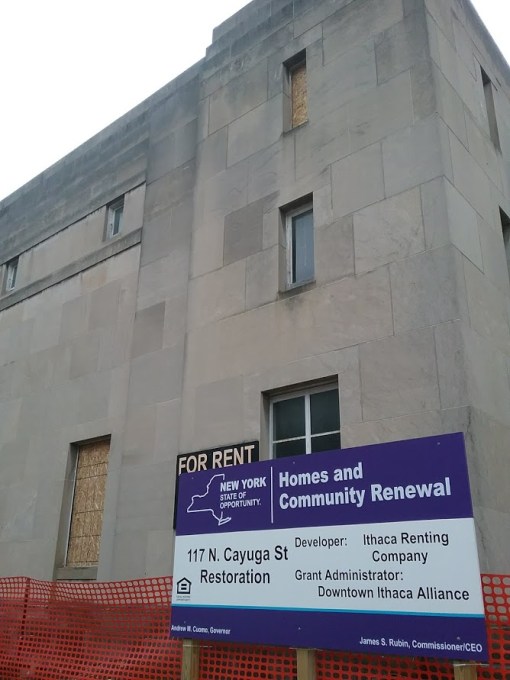
A new roof membrane will be applied, the exterior limestone and stucco will be cleaned and repaired, the street windows repaired and repainted, and the auditorium windows, which had been boarded up by previous tenants, will be replaced with similar-looking new windows. The front entrance’s stone steps would be redone, and the front doors and lamp posts would be restored. The Ithaca Landamrks Preservation Commission signed off on the work in January 2017. The plans can be seen in the application here.

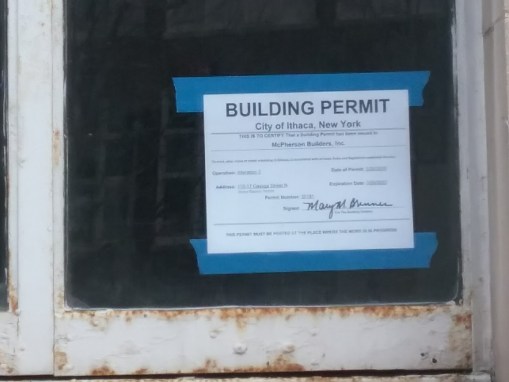
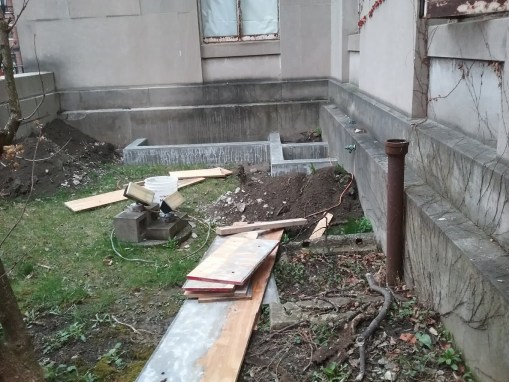
At the moment, it looks like asbestos abatement is underway, and the ground-level light wells are having their deteriorated concrete removed and replaced. Kascon Environmental Services is performing the asbestos removal, and McPherson Builders Inc. of Ithaca is the contractor-of-record. I asked Fane via email if the plans had changed at all since January 2017, or if there were any tenants on board, but as is often the case with him and his lawyer/representative Nate Lyman, there is no response.

3/30/2018

4/28/2018


City Centre Construction Update, 4/2018

12 05 2018

Mostly just clearing out my stash at this point; as the webcam shows, exterior framing is up to the third floor.
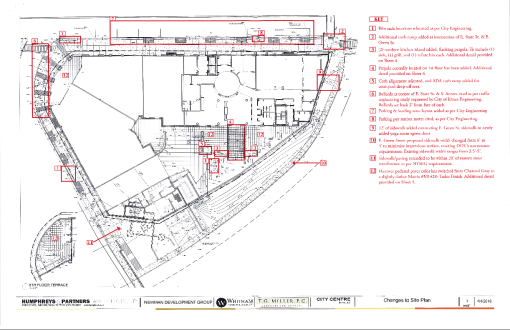
A number of changes have been made to the City Centre project, inside and out. Whitham Planning and Design shepherded the alterations through the planning board, which was generally okay with them. Among the revisions:

-Landscaping Changes. Among them, street tree species and layout, and tree grates are being replaced with FlexiPave porous paved covers. The number of shrubs was decreased, perennial flowers increased. Bike racks were relocated, street lights, curbing and curb ramps were adjusted, concrete planters were added by the parking drop-off area, a pergola with string lights was added, bollards were added, the sidewalk width along East Green Street was reduced from 6′ to 5′, and pavers were changed to a slightly darker shade of grey.

-On the first floor, the lobby layout was reconfigured, and some exterior doors were relocated for ease of access. The number of retail spaces was reduced from four to three, but the total square footage for the retail is about the same (11,000 SF). A storm water vault and fire pump room were added in the underground garage, and the parking spaces were reconfigured slightly to accommodate (still about 71 spaces).

-The unit mix has changed from 61 studios, 78 one-bedrooms, and 53 two-bedrooms, to 33 studios, 120 one-bedrooms, and 39 two-bedrooms. Still 192 units total, but with fewer studios and two-bedrooms and more one-bedrooms, basically. This might have to do with what’s easiest to rent to the target market (young professionals, a few downsizers, deep-pocketed students). Perhaps studios aren’t seen as having enough space for the upmarket market segment.

-The exterior facing materials have been changed from Nichiha aluminum panels to Overly Dimension XP Metal Systems, and Alucoil Larson ACM aluminum panels. The color palette is generally the same, perhaps slightly greyer with the revised paneling. Air intake vents were added to the building facade. Fenestration (window size/arrangement) was also changed up.

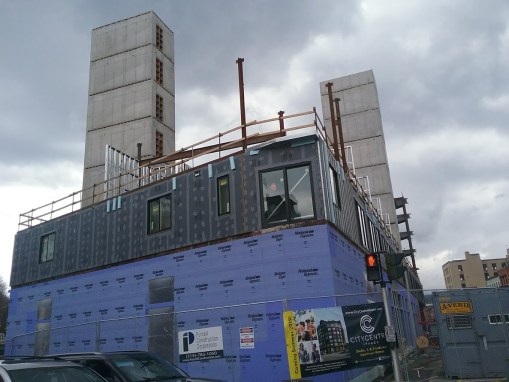
The floor buildout is a rather interesting process, because they’re practically building from the inside-out as each floor is added. The interior steel stud walls and structural steel supports go up first, then roof decking overhead, and then what appear to be prefabricated modular exterior wall panels with Marvin Windows already fitted. The dark panel is Dow Thermax Xarmor, which apart from sounding like a Star Wars extra, is a heavy-duty fire-rated fiberglass insulation board covered with a dark exterior facer that serves as a water barrier. These panels can be set into place very quickly, saving time and labor costs. The ground-level is more typical fireproof gypsum sheathing. The steel rails on the upper floors are likely for the aluminum exterior panels, so they may clipped into place.