News Tidbits 10/7/17: Opportunities Come and Go

7 10 2017

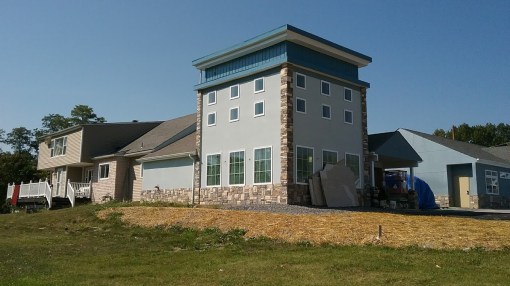
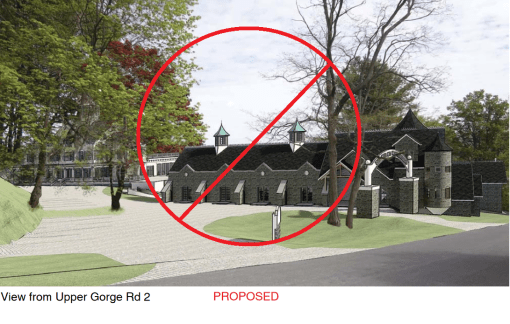
1. The Inn at Taughannock expansion is no longer. The project, which called for a 2-story addition containing dining facilities, five guest rooms and facilities to support a 200-person capacity event center, was opposed by neighbors in Ulysses for being too large, the potential for noise, traffic, and for being out of character with the area. The strong disapproval played a big role in the town of Ulysses Zoning Board of Appeals’ decision to reject two of three building variances sought for the project, the exception being a cupola on the existing building. The board also permitted four of the six proposed signs.

With denials noted, the plan at this point is mostly landscaping – clean fill (soil) to level out the south lawn for gatherings, construction of a stone fence wall and retaining wall, re-configuring a stairway and patio area, lawn seeding and stormwater facilities.

2. One door is closed, another potentially opens. For sale, a trio of parcels – 526 West Seneca Street, 528 West Seneca Street, and 209 North Meadow Street – are up for sale on the city’s West End. The listing from Pyramid Brokerage’s August Monkemeyer is short and to the point:

“Rare opportunity on prime signalized intersection in Ithaca’s commercial corridor. Corner location with excellent exposure, road frontage and heavy traffic 32,000 plus ADDT. Redevelopment site for multiple commercial uses.”

For the record, ADDT is a typo. It’s AADT – “Average Annual Daily Traffic”. The brochure is a little more in-depth, and says 39,000 AADT. The listing price for the collection is $1.5 million.

528 West Seneca is a recently renovated early 1900s 4-unit apartment house purchased by current owner Shawn Gillespie in 2003 and it has an assessed value of $200,000. 528 West Seneca is an early 1900s house converted into an office building. It was renovated in the 2000s, purchased by Gillespie in 2012 and is assessed at $220,000. 209 North Meadow, an 1880s single-family home, has seen better days. It was co-purchased by Gillespie in 2015 and is assessed at $50,000 due to its poor condition. All of the buildings are designed in the older vernacular style common to the Ithaca area (“urban farmhouses”), so they’re old, but the designs were cookie cutter for their time, and their overall historic value is limited.

Zoning is a mixed bag. The two with frontage on Meadow are WEDZ-1b, while 526 West Seneca is R-3b. R-3b allows 4-story buildings with up to 40% lot coverage, has parking requirements that vary depending on the type of residence, and is geared towards small apartment buildings. WEDZ-1b is one of the city rarer codes, general retail and office uses that allows 100% lot coverage on parcel with less than 50 feet frontage (209 Meadow in this case), and 90% otherwise. However, the maximum floor height is only two floors, and one story buildings have to have pitched roofs. Unlike its WEDZ-1a counterpart across the street, parking is required. Looking at the code, it seems like a recipe for suburban box retail in the heart of the West End, with the R-3b a possible site for additional parking. That doesn’t seem to mesh with the urban mixed-use direction the city’s been moving towards. Should it sell, and it looks noteworthy, there will be a follow-up.

3. The construction loan for Nick Stavropoulos’ 107 South Albany Street project has been filed. Tompkins Trust will be able to watch their latest loan agreement from just a few blocks away. The total loan amount is $1,110,346.75. A small local company, Northeast Renovation Inc., will be the general contractor for the 11-unit apartment building.

Subcontractors on file include Frank Belentsof of Bestway Lumber (Excavation), Brian Kehoe of Kehoe’s Concrete Concepts for foundation work, Albanese Plumbing LLC for plumbing/HVAC/sprinklers, Weydman Electric, Goodale Sprayfoam for insulation, Joe Alpert of Drywall Interiors for sheetrock hanging. Fabbroni Engineers is doing the structural engineering in partnership with architect Daniel R. Hirtler.
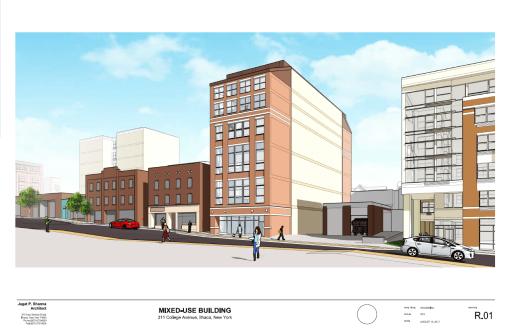
4. The city of Ithaca Planning and Development Board was less than enthused about 311 College Avenue, aka Visum Development’s mixed-use Nines replacement. From the sound of it, the board’s John Schroeder was liable to go apoplectic. At the least, it seems the board wants a feasibility study for the cost of moving the firehouse-turned-restaurant to another site. From a design perspective, the board would like for either the design to pay homage to the Nines, or to reuse some of its building materials.

In contrast, it was fairly smooth sailing for the other projects under review. The duplex at 217 Columbia and Lakeview’s 60-unit supportive/affordable housing project were approved, and INHS’s 13-unit affordable housing proposal for the 200 Block of Elm Street progressed despite West Hill neighborhood opposition.

5. To touch on that topic a little more, the Times’ Nick Reynolds did an in-depth piece looking at the “crisis point” in Collegetown. It’s worth a read. I don’t agree with some of the insinuations (Student Agencies’ renovation of ca. 1985 409 College Avenue is not an aesthetic threat to the block), but it’s worth a read.

The document that Schroeder and Tomlan wrote of buildings they wanted preserved was uploaded as a PDF, but it is no longer online. The only copy of the list is from this blog, in a post eight years ago, and an article from the June 16, 2009 Ithaca Journal. The list and the response highlighted in the Journal shows there was a real disconnection, and I doubt most readers agreed completely with either Tomlan or the property owners. Since the PDF was published and reviewed by city staff and board appointees, two of 31 structures, the Snaith House (140 College) and Grandview House (209 College), were historically designated, and rightfully so, as exemplary architecture of their period. The Larkin was just designated as well, and the Chacona Block (Student Agencies) will be before the end of the year. Both of them are attractive older structures that provide a positive aesthetic complement to the neighborhood.

The Palms dive bar was not high design or even mediocre design, nor was it much of a desired neighborhood attribute, at least to permanent residents; nostalgic perhaps, but not historic. Pushing a structure on nostalgia alone will likely not clear the Planning Committee, as Steve Smith and Cynthia Brock nearly demonstrated with the Larkin Building. Mary Tomlan wanted to preserve a bar when the owner wanted to retire and sell it to whoever would give him the most. Sounds familiar.

However, the difference between the Palms and the Nines is that the Nines has a more substantial history, the structure has historic significance as the original home of Fire Station No .9. With its outdoor patio, it adds an aesthetic quality by being setback from the street yet maintaining active use frontage. That is not economically feasible in Collegetown and hasn’t been for decades, but it made sense for a fire station that served the community for generations. If there’s a balance between giving way to the new and preserving the old, the Nines and Palms fall on different sides.

The Times article references a “stopgap” measure that is basically an indefinite moratorium. That’s not the answer either. Most Collegetown structures offer little historic value. The Nines is a rare case otherwise. Without protective regulations, it was always a potential development target. Or rather, it was more like a landmine waiting to be triggered.
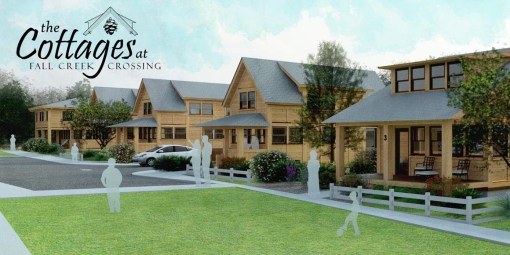
6. Courtesy of STREAM Collaborative’s biannual newsletter, the Varna Tiny Timbers project has a name and website. “The Cottages at Fall Creek Crossing”, as the 15-unit single-family development will be known, has website at http://www.cottagesatfallcreek.com. It’s bare bones at the moment and the lots have not yet begun marketing and sales. The pocket neighborhood of for-sale 2-bedroom and 3-bedroom homes will be built on the corner of Freese and Dryden Roads, the potential walkable, mixed-use center of the hamlet should a traditionally-designed Varna ever come to fruition. According to the newsletter, STREAM collaborated with Tiny Timber owner Buzz Dolph on the branding, logo and website, as well as on the design of the buildings and landscape.

7. It pains me a bit to admit this, but the Times is killing it in local meeting coverage. Even worse, the Voice has been short-staffed this week due to illness. At the Common Council meeting last night, members voted to give the IURA the necessary permission to handle the Green Street redevelopment project, including the RFP and submission review, sales terms and environmental review. Vicki Taylor Brous, public relations representative for developer Dave Lubin and his Harold’s Square project next door, spoke against the plans and said the project may be illegal, but until proven as such, review and discussion of the Ithaca Associates plan and any other submissions will move forward.

On another note, landmarking of the Larkin Building at 403 College Avenue was approved 8-2, with Cynthia Brock (D-1st) and Steve Smith (D-4th) opposed. Also, in what can only help Lansing Republicans, the city voted to join in on the Article 78 to halt the Cargill project until an Environment Impact Statement is conducted. The DEC deemed it unncecessary, and the lawsuit argues Cargill got special treatment. The dicey part is that a long, expensive study puts 200 blue-collar jobs at risk, and the debate has become a successful rallying cry for local conservatives.

I’m not a political consultant, but I think if outspoken Legislator Mike Sigler (R-Lansing) loses next month, it’ll be because of the national environment and the ability of progressive groups to tap into that at the local level. And if he wins, it’ll be because he channeled and won over the blue-collar Cargill households and their supporters who feel overlooked or kicked around in this debate.
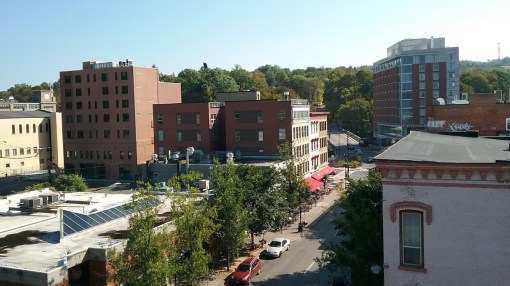
8. One of the the perks of development – the latest Ithaca city budget calls for no tax increase for the 95% of homeowners whose assessment did not go up this year (not because of the market, but because the assessment office cycles through different parts of the county on 2-3 year intervals). The city will bring in an extra $621,508 (2.8%) through property taxes, mostly from new development “closing” on assessments as they’re completed and occupied. From 2012 to 2016, the budget increased 5.2%, while taxes, notoriously high thanks to the large percentage of tax-exempt property, fell 1%. In his budget presentation (copy on the Times webpage here), Myrick stated that without the $131 million in development since 2011, taxes would be 6.9% higher.

One thing that is not made clear in the article is that Collegetown Terrace, one of those big contributors, doesn’t have a tax abatement or PILOT. That’s taxed at 100% value. According to assessor Jay Franklin, assessments for a given year are calculated for the state of a property on March 1st, and in Terrace’s case, Building 7 wasn’t finished. Now that it is, it can be assessed at full value for 2018, which will be an additional $20-$25 million in taxable property (using $22.5 million, it equates to $270,900 in city taxes, given $12.04 per $1,000 assessed).

That might be the biggest addition, but other recent completions are not inconsequential. Back of the envelope estimates here, but when the Breazzano Center and INHS 210 Hancock PILOTs first show up in 2018, they will generate an additional $52,000. Even with its abatement, the Hotel Ithaca will add about $21,600 in year one if its $15 million price tag is close to assessment, and that will increase to $216,000/year after seven years (the downtown Business Improvement District tax rate is $14.40/$1,000). Several other recently-completed downtown projects will also pay more as their abatements taper towards full property value. For example, just the 10% increase for the Marriott in 2018 equates to about $29,000. Smaller projects like 607 South Aurora, 1001 North Aurora, 602 West State, 215-221 West Spencer and 123-129 Elmira stand to add another $70,000 or so in tax revenue. So all these projects not only make a dent in the housing deficit or provide jobs, they also provide a buffer to challenging times with declining state assistance. While development does increase demand for services, projects that are close to municipal services and able to easily tap into existing infrastructure generally provide a net positive financial benefit to the community.

Meanwhile, the town of Ithaca is looking at a miniscule tax increase this year of 0.21 percent (1.57 cents per $1,000), and will benefit from the Maplewood project, which at $80 million and $6.66/1,000, will pay in the ballpark of $532,000 towards the town, its highway department and the inter-municipal fire department (the city also gets a small share, only 1-2%).

9. A couple of sales of note. A 28.07 parcel of land along Oakcrest Road in Lansing, which was touted for potential suburban housing development, was sold for $610,000 to a well-known Cornell professor and his wife. The price was a little over 90% of ask, not bad for land. From a close mutual friend, real estate development is not one of the buyer’s interests. So, less likely to be a development, but maybe a grand estate.

Meanwhile, south of the Shannon Park development, and on the southern edge of the image above, an LLC paid $480,000, slightly below assessment, for 731 Cayuga Heights Road, a well-maintained 1820 farmhouse on 12.55 acres. The LLC’s address is the same as the Pyramid Companies, owners (or recent sellers?) of the Shoppes at Ithaca Mall, which the land abuts to its east. Something to keep an eye on, for sure.


10. Looking like a slow week and month ahead. The city of Ithaca Landmarks Preservation Commission is reviewing a roofing project. Nothing new in the city project’s memo, though some supplemental documents were added for Bridges Cornell Heights’ 16-bedroom mansion proposed at 105 Dearborn Place. It and INHS’s 203-209 Elm Street plan are up for final approval at the end of the month, potentially leaving no projects for review before the city (311 College will be discussed, but not reviewed this month, and its future progress is uncertain). The town’s planning board meeting was cancelled.



McDonald’s Rebuild Construction Update 9/2017

4 10 2017

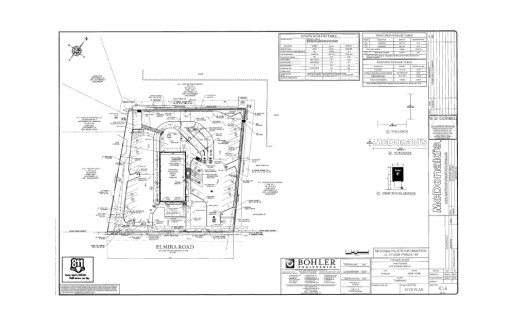
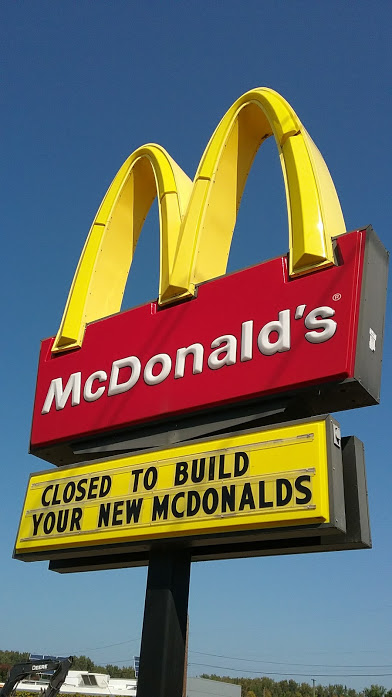
Love their food or hate their food, this blog will not discriminate. McDonald’s is undergoing a rebuild of their Ithaca location at 372 Elmira Road, on the south edge of the city’s suburban retail corridor.

According to county records, a McDonald’s has been on this property since 1964, with a renovation in the 1970s. The 4,777 SF restaurant built at that time was given the corporate design language used by the franchise from the 1960s through the 1990s – a double-sloped mansard roof, bright reds and yellows, and for many restaurants like Ithaca’s, a glass-enclosed seating area that seemed to hit its height of popularity around the late 1970s and early 1980s.

However, by the early 2010s, McDonald’s decided to go with a new look. The appearance was meant to be more subdued and professional, with natural colors, flattened arches, and brick/stone finishes. In a sense, Ronald McDonald grew up.

Part of the motivation for this update is to remain competitive in an evolving fast-food market. The segment is increasingly under pressure from fast-casual chains that tend to be more upscale, but are enjoying the majority of sales growth in recent years, even as McDonald’s sales growth has stalled. The Illinois-based company is pursuing an update of restaurants in target communities (focusing on economically strong and/or affluent communities first) to improve on the dining experience and try to draw back customers from the fast-casuals like Chipotle and Shake Shack, as well as keeping up with renovations pursued by their primary competitors, Burger King and Wendy’s.

These designs include a less cafeteria-like interior, going with more refined and intimate layouts to improve the customer experience. Out with the plastic seats and primary colors, and in with wooden chairs and tables, faux-leather seating, fireplaces, flat screen televisions, and softer lighting. The new builds also offer the latest technological advances and rigging, like burger kiosks and self-service.  As of early 2016, about 20 percent of the 14,300 restaurants had been remodeled or rebuilt.

The Elmira Road location is corporate-owned, with most of the legwork handled by Bohler Engineering of Albany. Plans call for a teardown of the old restaurant, to be replaced by a 4,552 SF restaurant with a dining area for 66 seats, a double-lane drive-thru, pedestrian and bike amenities, outdoor seating area (screened from Elmira Road by a brick wall), and adequate queue space for hungry patrons on the go. Expect a soft red or terra cotta brown Belden face brick exterior with Country Ledgestone Boral USA veneer and aluminum metal accents. The number of parking spaces will be reduced from 59 to 33. The cost of the project is $1.375 million, according to the Site Plan Review application.

The project didn’t elicit any commentary; not many people live down here, and it’s a modest project. It was first proposed in March and approved by June, which is about as fast as one can move through all the stages of Planning Board review. Construction is expected to run from September through December 2017.

Although SW-2 zoning is one of the city’s more flexible options, the project applied for and received zoning variances for setbacks (it’s too far back per zoning, but McDonald’s said they needed it to safely install the drive-thru queue), building width (needs to be 35% of lot, McDonald’s is 21.4%) and signage.

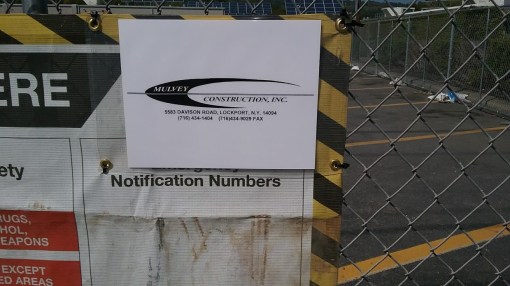
Bohler was the engineering consultant, and it looks like Mulvey Construction, a commercial general contractor based out of Lockport (near Buffalo), will be in charge of the build-out. While liable to ruffle a few feathers among the local trades, Mulvey is a preferred contractor for McDonald’s, and has handled the construction of over 50 new and renovated McDonald’s. They have demonstrated familiarity with the design, allowing for better labor efficiency (cost savings) and a firmer grasp of quality control.

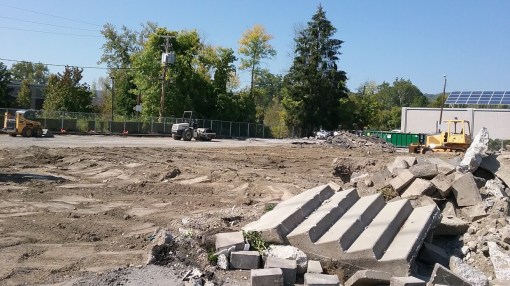
Looking at the project site, the old property has been fenced off and demolished, leaving only rubble at this point. The footprint of the new store is located further back in the lot, and it seems that the old slab foundation was torn out, which would explain the large concrete debris pile.


Rodeway Inn Construction Update, 9/2017

3 10 2017

The synopsis of the project can be found here.

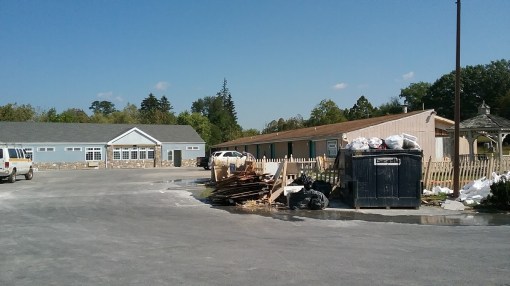
This was one of the more interesting visits because I ran into the owner, Pratik Ahir of JAMNA Hospitality Inc., while taking photos. Granted, there’s often that uncomfortable initial tension of “who’s taking photos of my property and why”, but I’ve been in touch with him through email before, so once I introduced myself the mood was much friendlier.

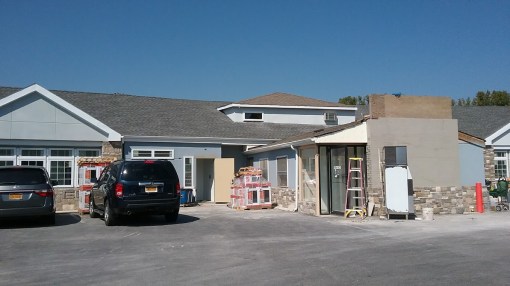
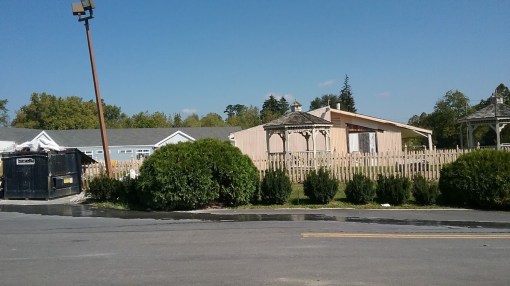
From what Ahir told me, this project could serve as a textbook example of the perils of renovating older buildings. One of the big reasons for the change in project scope was that one wings’ exterior walls partially collapsed during the initial work. So trying to make lemonade from lemons, Ahir decided to revise the project from additions to existing wings, to constructing brand new motel wings. This change also doubled the project cost.

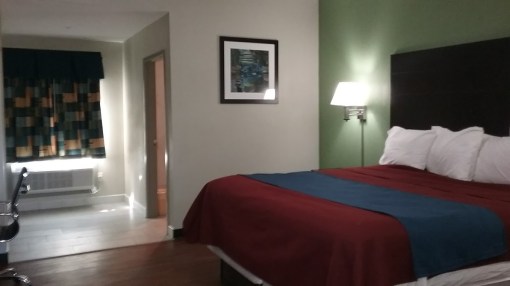
The motel should be fully open for occupancy around October 20th. The rooms appears to be no-frills but comfortable and tastefully appointed for travelers, and given Tompkins County’s premium on hotel room rates, a clean, economical option is welcome. The interior architecture is pleasant enough, while the exterior…I wouldn’t say it looks bad, but it is something of a hodge-podge of architectural features that aren’t ugly, but don’t quite mesh.

Ahir says he has plans to put his 70-room Sleep Inn project out for bid to a couple of preferred contractors, and hopes to start that project in the next few months. His partnership is with Choice Hotels (Rodeway is their economy motel unit), and he identified a market need for a new lower-middle segment hotel in the area, and Sleep Inn seemed like a good fit. Choice Hotels agreed, and the only Sleep Inn between Albany and Buffalo was green-lighted by the corporate parent.

We also touched on the presence of a couple other chain hotel specialist firms buying into or looking to buy into the Ithaca area. The temptation is there, and some, like Rudra Hotels/Rosewood Management, who did the Holiday Inn Express at 371 Elmira Road earlier this year, have established their footprint. Others are still figuring out their next step. On a related note, a number of smaller regional banks see Ithaca as a safer investment than other regional cities thanks to its economic stability, and this interest may result in a little more financing available for project developers over the next few years. Ahir says financing has been arranged for the Sleep Inn.


Ithaka Terraces Construction Update, 9/2017

3 10 2017

So we have a rule at the Voice not to publish the press releases of private for-profit entities unless they add something to an article. They don’t get published as standalones, if at all. From a pragmatic standpoint, giving a for-profit free advertising at our expense doesn’t make good financial sense, and it leads to questions about our integrity.

But, they still come in, filed away in case they come in handy at some point. That was the case here for the press release sent along by Brous Consulting’s Kevin Doubleday for the Ithaka Terraces project back on September 11th:

***

For Immediate Release: September 11th, 2017

Contact: Kyle Waller at 607-272-1765 or office@ppmhomes.com.

ITHAKA TERRACES CONDOMINIUM PROJECT GAINS APPROVALS NEEDED TO PROVIDE FIRST CONDOS AND FIRST NET-ZERO PROPERTY IN DOWNTOWN ITHACA

Ithaka Terraces is a new sustainable luxury condominium complex in downtown Ithaca, currently under construction at 215 West Spencer Street. Scheduled to open in Fall 2017, the Terraces are destined to be the region’s first net-zero condominium complex. The property is currently undergoing last-stage developments with units now available for sale through locally owned and operated PPM Homes. The project is also one of only a few condominium projects to be built in the area since the most recent recession.

The twelve unique units, inspired by colorful Greek cliffside architecture, thus the Ithaka name, range in size from a single story, 1005 square feet flat up to a two-story townhouse, 1520 square feet and boast high-end amenities including hardwood and tile flooring, luxury finishes, and a host of energy-saving appliances. Units start at $299,000.

Combining cutting edge green technology with a walkable location, a car-free or car-light lifestyle is easily attainable. The motivation to build Ithaka Terraces came from the developer’s desire to provide the maximum possible state-of-the-art sustainable living with the highest emphasis on achieving net-zero energy. Hence, no costs were spared to find and take advantage of opportunities in the design and building process to incorporate the most advanced sustainable techniques. The potential for reduced energy use is in place in these condominiums, making the inhabitants able to maintain one of the lowest environmental impacts and costs possible anywhere with a fantastic and active quality of life.

Ithaka Terraces strives to incorporate the most sustainable construction methods and living technology. This includes the use of air-source heat pumps, conduction ranges, LED lighting, electric water heaters, Low-E windows, super-insulated walls and roofs, smart temperature monitoring devices, and other energy-saving devices.

Further green features are available for even greater sustainable living at the Terraces, including charging stations for electric vehicles and at least six Ithaca Carshare vehicles stationed within walking distance. Transportation for the average household is likely to use more energy than the home itself. The Terrace’s convenient location makes it simple to reduce transportation energy use significantly by allowing cars to be an option rather than a necessity for the vast majority of trips.

Because of recent net-metering laws passed by New York State, off-site solar power can be provided to homes in cities from solar arrays outside the city, which makes net-zero living possible. All the energy used at Ithaka Terraces will be provided by solar power from PPM Homes’ 225 kw (835 panels) solar farm about 15 miles east of Ithaca.

Ed Cope, owner of PPM Homes and team leader of the Ithaka Terraces team, has been active in environmental and sustainability causes for forty years.  He started an environmental center in Indiana 25 years ago and he and his family live off grid, using power only from renewable energy (solar panels and some wind).  He started Energy Independent Caroline as part of his early efforts to switch the Caroline town government to renewable energy for its power use.  

One of his apartment buildings on South Hill was the first commercial roof-top solar installation in Ithaca. Ed has strived to build housing units so energy efficient that their entire energy use can come from his small solar farm outside Ithaca; truly net-zero energy. Additional team members include Stream Collaborative, Taitem Engineering, Renovus Solar, and TG Miller and Associates. The project is being managed by Kyle Waller at PPM homes.

For more information on Ithaka Terraces, you can visit: www.ithakaterraces.com or contact Kyle Waller at 272-1765 or office@pphomes.com.

END.

***

It looks like they might be doing soft marketing of the units, with a brochure up and inquiries allowed, but no formal listings up yet. The Ithaka Terraces website states that prices will be in the $299,000-$434,000 range, a ~10% jump from previous estimates. Units range in size from 1,005 SF to 1,520 SF. Ten are two-bedroom units, two are three-bedroom units.

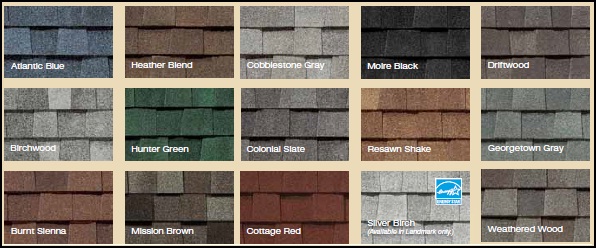
Buildings A and C look like they’re getting the scratch coat for its stucco finish, while B is still ZIP panels and waterproofed covers. Framing is still underway for Building D, which started much later than the other three.offhand, I think the shingles are from one of Certaineed’s designer series, here in Cottage Red. The formwork along the east side/upper slope may be for a concrete retaining wall that will hold the hill back from the parking area.


607 South Aurora Street Construction Update, 9/2017

2 10 2017

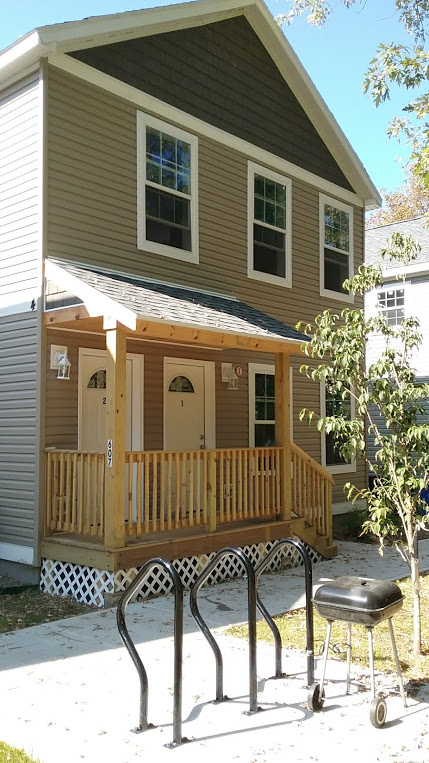
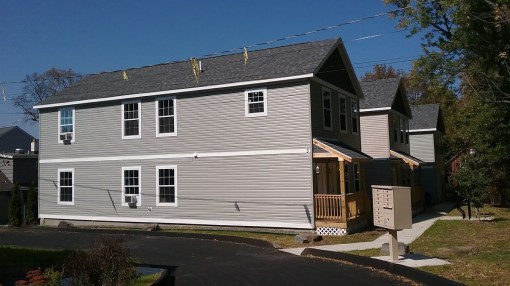
Landscaped, occupied, done. Modern Living Rentals’ infill project at 607 South Aurora Street on South Hill adds another 25 beds to the market, in four new two-family homes and a renovated existing home.

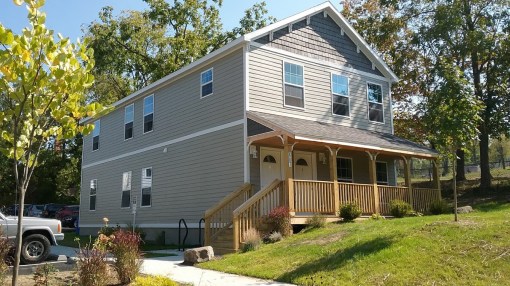
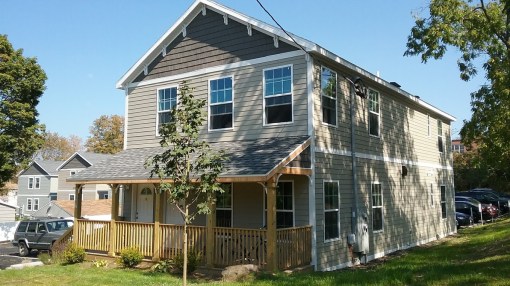
Strictly looking at the project, it’s pretty unassuming. This armchair critic thinks these turned out nicer than the ones on Elmira Road, though a greater splash of color on the siding would have been nice. The brackets and full-length porch are welcome additions on the Aurora Street structure.

If someone had told me 217 Columbia’s two-family infill would cause such a stir, I would have been surprised, since it’s a small project, and this and the Elmira Road pair didn’t create much a stir during the review process. But sometimes, after multiple projects of similar format, all it takes is one more to stir up enough consternation to snowball into a full-blown controversy.

I’m not going to fault anyone there. MLR’s Charlie O’Connor saw an opportunity and went for it. He is arguably one of the most reticent developers in Ithaca, preferring unobtrusive projects that he hopes will create as little debate as possible. It’s kinda funny in a way, because although he’s a business partner with Todd Fox (Visum’s property management is handled by MLR), the two of them are near-opposites in that regard. He paid a fair sum for 217 Columbia Street, so he doesn’t want to walk away from the investment, but he’ll do whatever it takes to make the neighbors happy short of cancelling the project. At last check, there was a proposal to stipulate the two three-bedroom units would not be permitted to student renters, and that the building would be stick-built and designed to better fit with the older structures of the neighborhood.

On the other side, permanent residents have a right to be annoyed if the perceived balance between students and non-students starts to shift and harm their quality of life. The neighborhood, like many of Ithaca’s more walkable parts, has experienced significant upward pressure on housing prices, and rental infill units can be a double-edged sword because the individual property is priced out of reach for homeowners (for-sale infill would be a different story). Even with the owner-occupied properties, there’s a strong whiff of gentrification, turning what was once a blue-collar neighborhood serving downtown shoppers and Morse Chain into a hodgepodge of increasing number of student rentals, and more white-collar, deep-pocketed households.

Somewhat incongruous to all this is that Ithaca College’s student population has declined almost 10% since 2010, which would suggest less pressure for student rentals; however, many of the college dorms date from the 1960s, and the utilities systems need replacement – some are already on their last legs, and that may limit occupancy as they sputter into obsolescenceThe college and students are aware of the discord and are trying to address it gently; more extreme measures like curtailing the ability or capping the number of students who can live off-campus might create major blowback, something the college may be actively trying to avoid after last year’s turmoil. A new dorm or two would help, but even modular temporary dorms can cost a fair sum, and there is nothing planned in the short-term. A long-term question mark is the impact of the Chain Works District, but that’s a few years out at best.

Landlords should at least be cognizant of this tension (and the ones on South Hill tend to be a mixed bag, to be honest), because if things turn south and the college does take drastic measures, units are going to become much harder to fill at current monthly rates. Town officials and voters were unhappy with the quality and appearance of new housing built in the Birdseye View development and in the Pennsylvania-Kendall Avenue corridor, and that contributed to the push to curtail student housing in the town’s portion of South Hill.

The local community is not easygoing or forgiving. If you do crap work, crap will hit the fan sooner or later. Even if you do good work like 607 South Aurora here, it pays to be attentive and flexible.

While legal language is being prepared for an overlay that would prevent more than one primary structure on South Hill properties until a new neighborhood plan is developed (2-3 years minimum), 217 Columbia had already started review before that was considered, so in effect it’s grandfathered in, even if it hasn’t started construction before the overlay likely gets passed by PEDC this month and Common Council in November.


Cayuga View Senior Living Construction Update, 9/2017

2 10 2017

The official groundbreaking for the Cayuga View Senior Living project was back on August 9th. Since that time, the basement level of the Cayuga View Senior Living project has been built out work has begun on the ground level floorplate, and the construction of masonry stairwells and elevator cores. It looks like the big supplier for the CMUs is Zappala Block out of Rensselaer (“REN-suh-lur”).

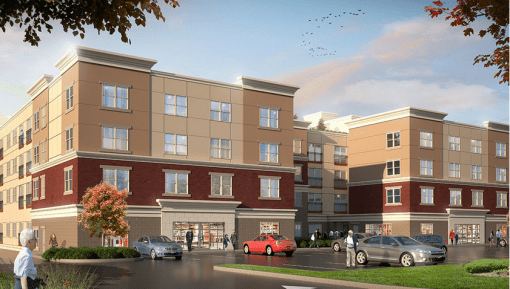
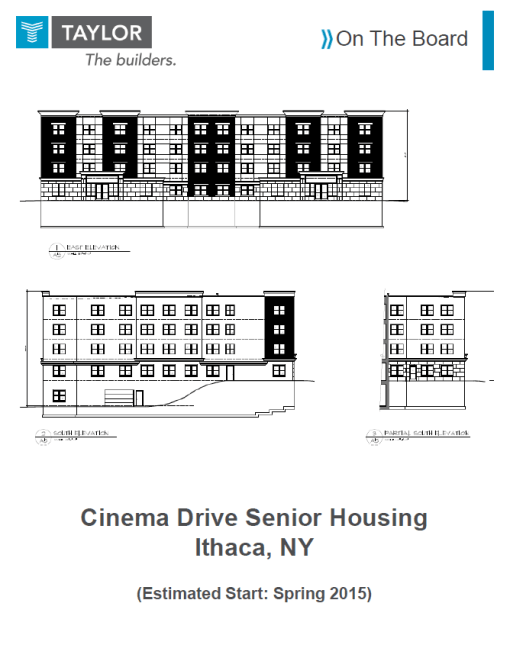
The Taylor the Builders (general contractor) press release alternately states 50 units and 60 units in the mixed-use project, but the number I’ve long heard is 60, 48 2-bedroom and 12 1-bedroom. The 2,680 SF of first-floor retail is split evenly between the two wings of the building’s ground floor. One of the things that pops up fairly often in the marketing literature is the attempt to sell it to snowbird retirees who leave the area during the cooler and cloudier months for more pleasant climes, which the Thaler family co-developing Cayuga View has long done.

“We are proud to partner with Manley Thaler and Rochester’s Cornerstone Group, to bring this scenic mixed-use development to the Village of Lansing,” said Taylor president Karl Schuler at the groundbreaking. “This project addresses a specific niche and community need for market-rate senior housing, while doing so with an overall development that more than satisfies a lifestyle choice among the growing populous {sic} of mature adults in this market.” It’s going to be a busy time for Rochester-based Taylor, as work is also getting underway in Downtown Ithaca on the 12-story Harold’s Square project this month.

Noting the gaps above the window and door rough openings, my semi-educated guess would be that it’s set aside for later architectural finishes, maybe polished stone or similar. It’s a little hard to cross-check with renders because 1) only one render of the project has ever been formally released, and 2) that render does not really show the slope of the site of the walkout basement level. An earlier render from a couple years ago predates the current window layout, but lends credence to the possibility. The below-grade base of the concrete foundation (or will be, once backfilled) looks to be insulated with Dow rigid foam board insulation with a black waterproofing membrane over the top.

The project timeline calls for a Spring 2018 opening. A synopsis of the project can be found here.


Village Solars Construction Update, 9/2017

1 10 2017

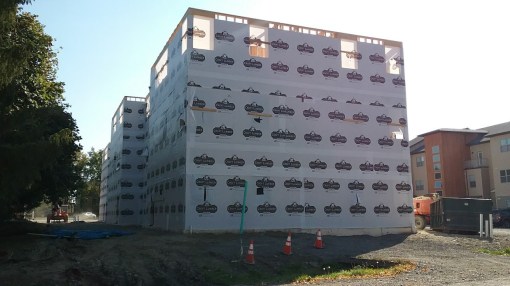
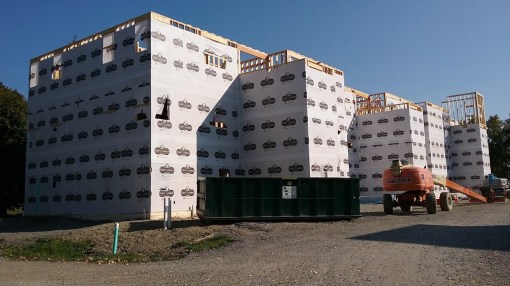
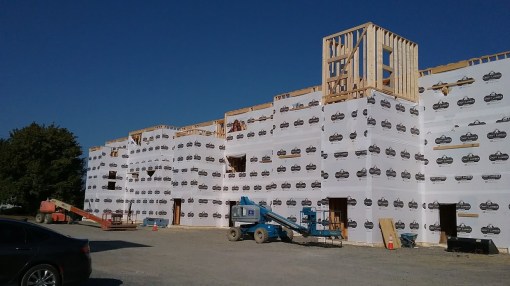
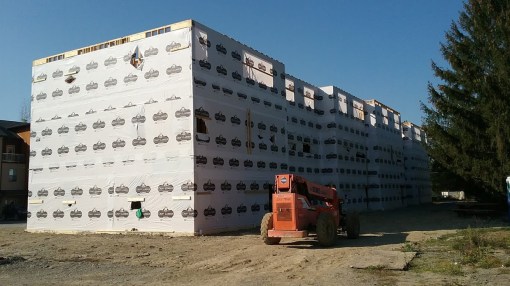
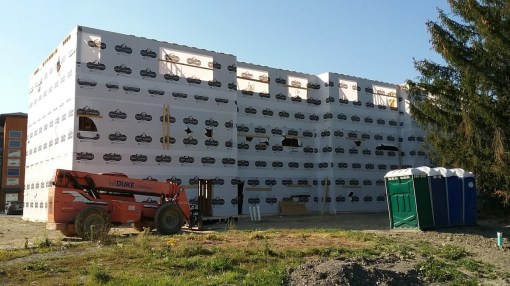
It looks like the Village Solars are moving along, albeit at the slowest pace in years. Since 102 Village Place was torn down back in June, the site was cleared, the foundation and underground utilities reconfigured, and framing has begun on its replacement. The wood frame was up to the top floor by the time of this late September site visit, and erection of the roof trusses was due to take place in just a few days. The housewrap is already in place, and as the interior receives its frames, pipes, wiring and rough-ins, work will being on window and door fittings. Probably looking at an early spring finish here.

Note that it’s not uncommon to just housewrap over the rough openings, and cut out the holes later. The excess will be trimmed off and the edges will be fastened back to the inside wall, allowing for a tight and complete wrapping of the rough opening.

Interestingly, none of the other tear-downs or new building sites have started, meaning that only one building is currently under construction. That’s rather unusual for Lifestyle Properties, whose in-house construction crew typically works on 2 or 3 buildings at a time. There was a dirt pile near one of the future building sites, but it’s been that way for a while, so it’s likely being used as a staging area. The limited construction suggests that the Lucentes may be falling behind their anticipated construction timeline, which generally calls for two or three buildings a year in order to stay on track.


Poet’s Landing Phase II Construction Update, 9/2017

1 10 2017

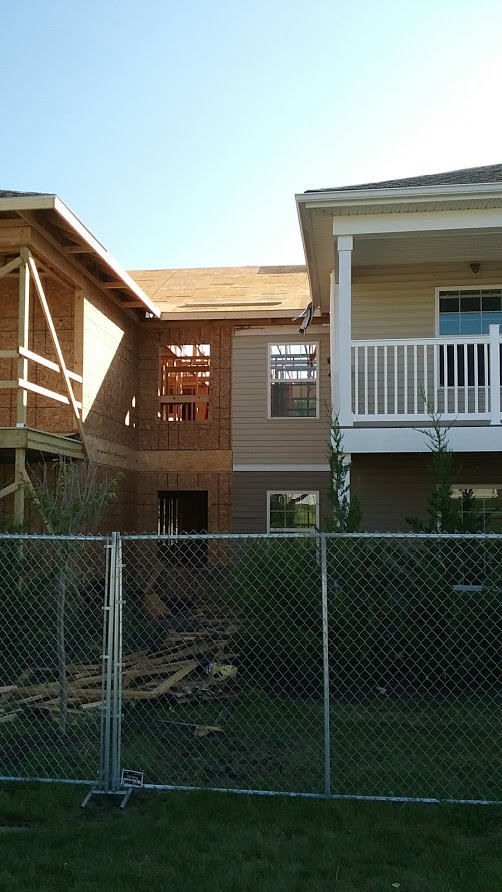
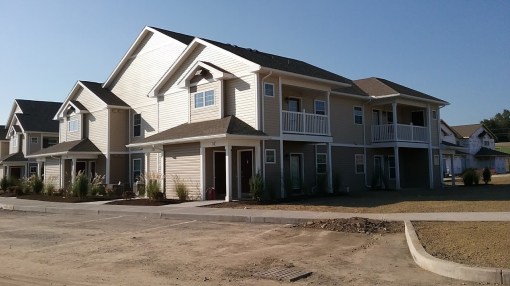
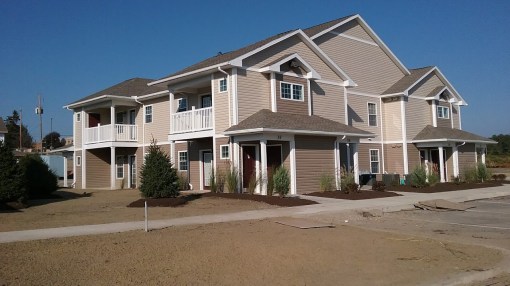
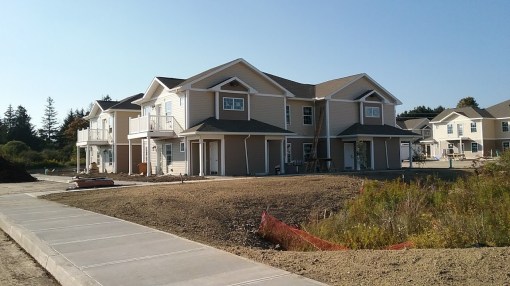
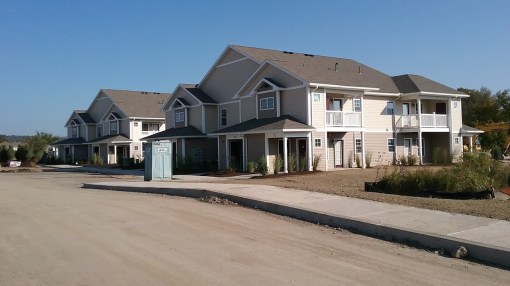
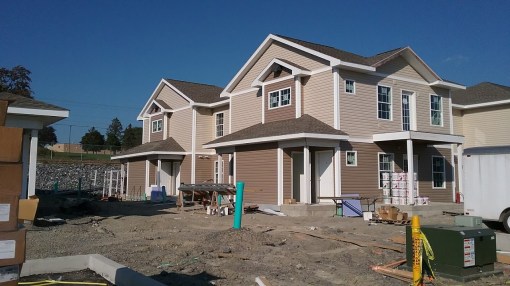
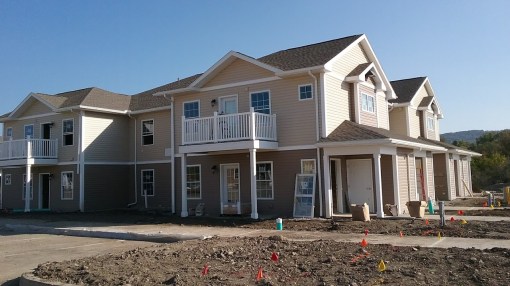
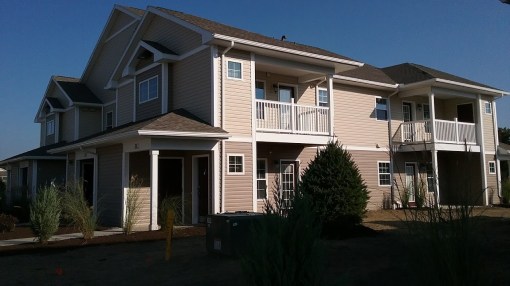
It looks like the first units are coming onto the market. Conifer Realty has the application up for the first apartments, as do third-party websites like apartments.com. Oddly enough, the apartment.com listing says 16 3-bedroom, 16 2-bedroom and 16 1-bedroom units. This is incorrect. There are 8 3-bedroom, 16 2-bedroom, and 24 1-bedroom units. One can tell from sight alone because Conifer uses the same three building plans in all of its suburban apartment clusters. One design consists of eight 3-bedroom units, the second design is eight two-bedroom units, and the last design is eight one-bedroom units. For units on each floor, mirroring each other in layout. Keeps things simple and materials costs down.

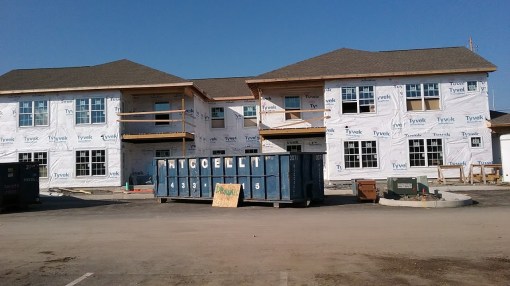
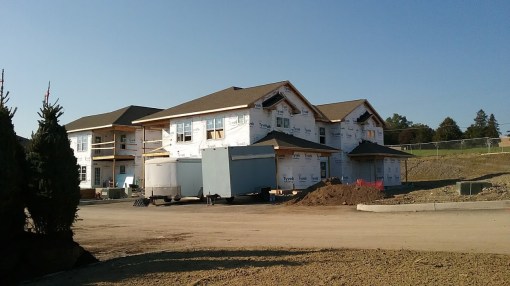
Keeping with the blog-only nomenclature, buildings “A” and “B”, the two that are basically complete from the outside, are the one bedroom-units. “C”, “D” and “E”, which are receiving exterior lighting rigs, trim and architectural features like balconies and patios, are the 2-bedroom clusters. Building “F”, which is still at the housewrap stage and the building that is least furthest along, is the three-bedroom cluster. For proof, consider the building that was badly damaged in this summer’s fire – it was reported that 31 people were left homeless. That would most likely imply it was the three-bedroom design, which would have 24 bedrooms.

The general rule of thumb is one person for bedroom for basic planning purposes. Affordable housing family units, for whom these three-bedroom apartments are intended, may average more than that because of income guidelines, and that two adults or multiple children may share a bedroom. Likewise, on the other end of the scale, properties with empty nesters or more affluent owners/renters may have numbers average less than one person per bedroom due to guest bedrooms, or conversion of bedrooms to home offices or hobby rooms. Owner-occupied single family homes often fall in this category, where the typical home is three bedrooms, but the average owner-occupied household size is 2.5. There are a number of companies dedicated to studying the number of people likely to live in a unit based off its location, size and intended market, and applying those figures to calculations like the number of students expected to be added to a district, or the number of car trips generated.

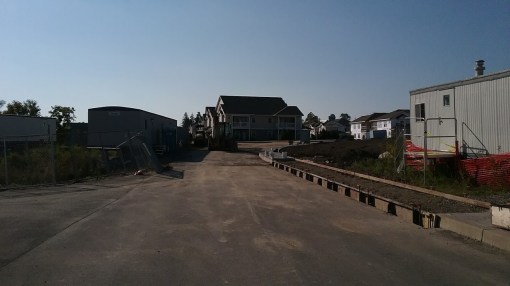
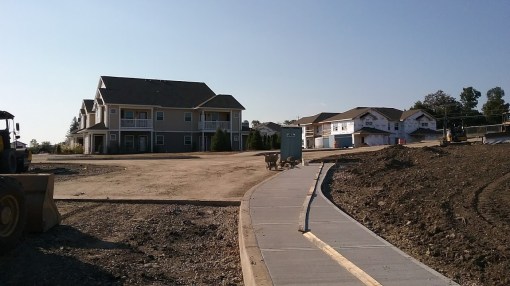
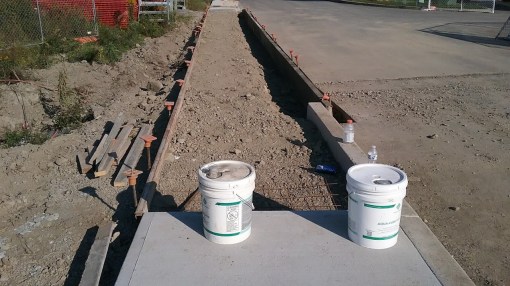
Curbing has been laid, the parking lot is paved and striped, streetlamps are in place and the concrete sidewalk is being poured. The process to build sidewalks is pretty similar to the work for foundations – excavate the path, build the formwork to keep the concrete in place as it cures, lay down some steel rebar to provide additional strength to the concrete, pour, level and smooth, and run a finishing trowel to create an edge so that the concrete has an expansion joint to help expand and contract without cracking the sidewalk. The steel plugs are to keep the forms in place.
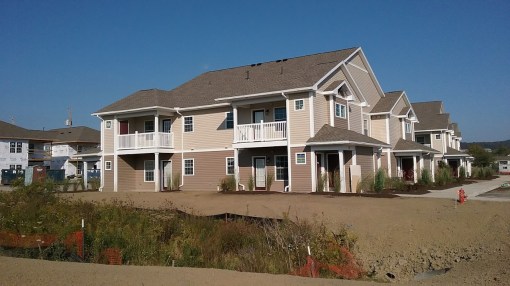
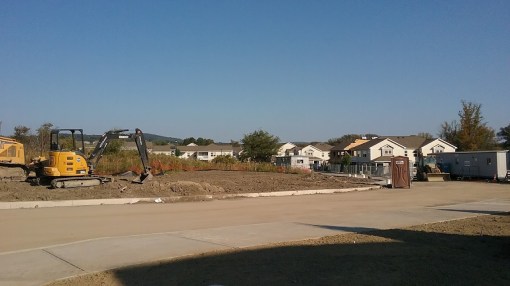
The building that was damaged by fire is under reconstruction. The east wing was destroyed by the flames and was torn down. The only thing being reused for those four units is the slab foundation. The four west wing units were salvageable, but they did need an extensive renovation. Damaged trim and siding sections will be replaced, and on the inside, drywall damaged by water has been removed and new sheets are being hung. It looks like some of the appliances were saved; peering through the windows, a refrigerator was sitting in the middle of the floor in an upstairs unit. Closer to the fire, it’s more of a gur renovation, with only portions of the exterior salvaged, while the inside is replaced from the stud walls out. Taking a guess for the typical construction length of units so far, the renovated and rebuilt units probably won’t be ready for tenants for another five to six months.

According to the advertisement on Conifer’s website, amenities and feature include

Dishwasher
Garbage disposal
Wall to wall carpeting
Patio or balcony available
Walk-in closets
Discounted cable package
Central air conditioning
Smart card laundry center
Fully equipped Fitness room
Computer lab
Clubhouse with great room
Controlled building access
Key fob hardware
Professional on-site management
24 hour maintenance
Ample parking
Beautifully landscaped grounds
Accessible for people with disabilities
Close to shopping, schools & medical facilities

1-bedroom units are 716 SF, 2-bedroom units are 950 SF, and 3-bedroom units are 1,150 SF. Lease are 12 months with a month’s rent as security deposit. Three units will be adapted for mobility-impaired residents, and a fourth unit will be adapted to individuals who are hearing or vision-impaired.

According to a filing with the state as part of the grant application, the gross rents (rent plus utilities) will range from $724 to $1,070 a month, to be occupied by households with incomes 50% to 60% of area median income.

2017 AMI in Tompkins County is $53,000 for a single person, and $60,500 for a two-person household, and $68,100 for a three-person household. Therefore, the income limits are $26,500-$31,800 for a single person, $30,250-$36,300 for a two-person household, and $34,050-$40,860 for a three-person household.

Conifer and contractor partner LeChase Construction will be delivering the $10.8 million project over the next few months, and that should wrap up Conifer’s Ithaca work for the time being. The programmatically similar Milton Meadows project in Lansing is being developed by a competitor, Cornerstone Group. The two firms’ Rochester headquarters are about six miles apart; their apartment projects are about twelve miles apart.