News Tidbits 8/24/17: Early Start

24 08 2017

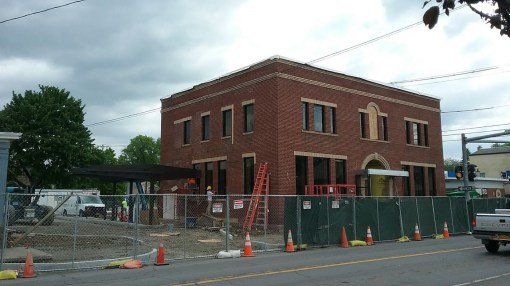
1. The Old Library redevelopment is creeping forward. The Old Library Committee of the Tompkins County Legislature voted to recommend the sale of the property for the previously stated amount of $925,000 to Travis-Hyde. With that vote, it goes forward to the full legislature for a vote on September 5th, where there are no major challenges expected. The Library Committee vote was 4-1, with legislator Dooley Kiefer (D-Cayuga Heights) opposed. Kiefer has always been opposed to any sale, and has long advocated for a lease of the land – and the only way the lease made any practical sense was by being 50 years in length, so that any investment could have the possibility of being recuperated. Given that she’ll probably vote no again for consistency’s sake, and perhaps a rejection from legislator Anna Kelles (D-Ithaca) because she was a long-time proponent of the condo plan, there aren’t likely to be any other opposition votes from the 15-member legislature. Once the sale is okayed, site prep for the 58-unit mixed-use senior facility at 310-314 North Cayuga Street can begin by the end of the year, with a spring 2019 opening expected.

2. So when is an expansion truly an expansion? That’s the question raised by the Times’ recent coverage of a proposed renovation of the county jail, which faces issues with overcrowding, but whose expansion of holding cells is strongly opposed by a number of advocacy groups. The jail is shared with the Sheriff’s Department offices at the moment, and the combined facility at 779 Warren Road is collectively referred to as the Public Safety Building.

The ideal concept as pitched by the Sheriff’s Office would create an additional 13,000 square-foot administrative facility adjacent to the jail that would provide office space, conference space and locker rooms for officers. This would free up programmatic space in the PSB to be used for support functions like classrooms and counseling/meeting rooms, with the ultimate goal of reducing recidivism (the tendency of a convicted criminal to re-offend, and thus take up space in the jail). So,it’s  not a jail expansion per se, but a support services expansion, which would probably drive debate among advocacy groups. The proposal is strictly conceptual, but the county is prepared to move forward with a formal study from LaBella Associates if requested.

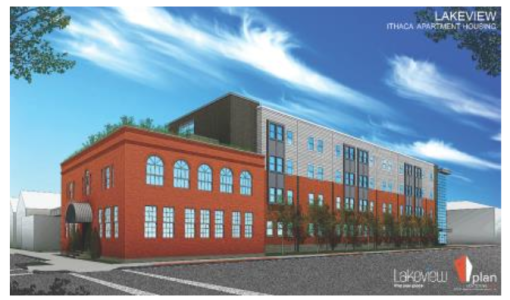
3. At the latest Planning Board meeting, Lakeview’s 60-unit supportive and affordable housing plan was granted the green light to go forward to the next step, though not without reservation and concern from some local business owners and elected officials. Per the Times’ Matt Butler, 1st Ward councilors Cynthia Brock and George McGonigal spoke in opposition to the current plan, feeling it was too large and unattractive, while nearby business owners were uncomfortable with the population who would live there. 30 units would be set aside for those who are mostly independent but may need some degree of mental health support, 22 units are general affordable housing, and eight are for formerly homeless individuals. All units are one bedrooms. Lakeview will provide office and support space for services on the first floor of the 62,700 SF building.

In other news, the debate over South Hill continued with the airing of grievances against student housing, Finger Lakes ReUse earned approval for its Elmira Road project, and someone must have left early, because the planning board failed to reach quorum (minimum attendance) to vote on recommendation of historic designation for the Chacona Block at 411-415 College Avenue.

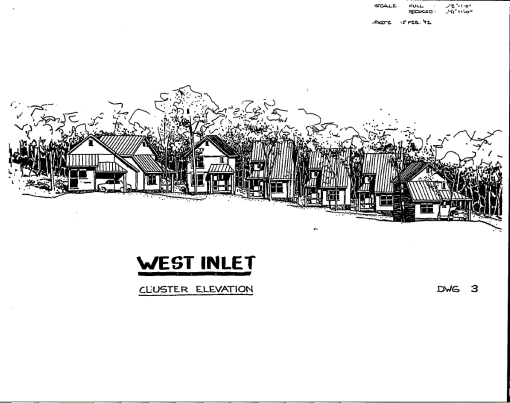
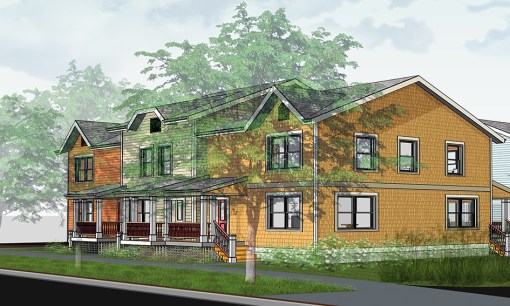
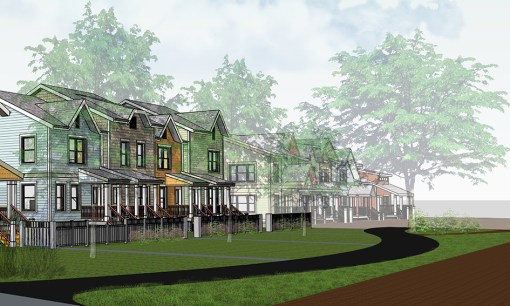
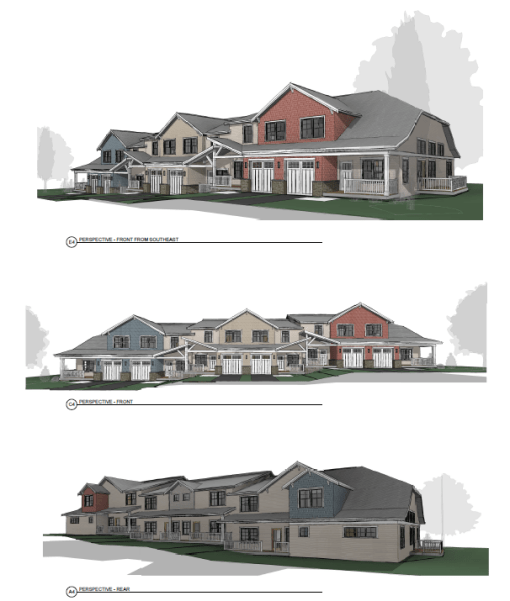
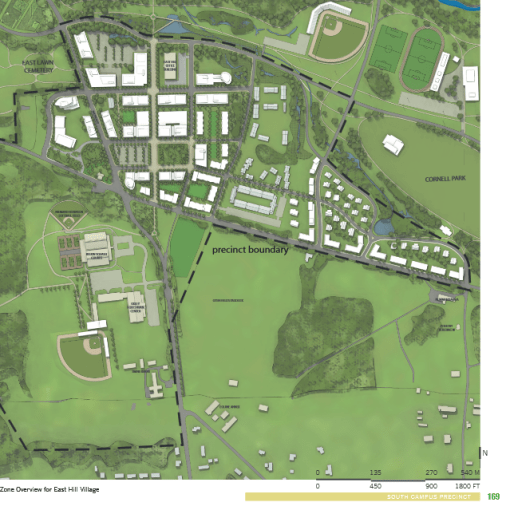
4. Here’s an interesting little proposal out of Danby – a 10-unit pocket neighborhood. The project would be located on 2.2 acres at the rural intersection of Brown Road and Short Road, northeast of the hamlet of West Danby. The houses would be modular and modestly-sized with two basic styles, a 1.5-story cape and 1-story ranch. Additionally, they would be designed for aging-in-place, Net Zero Energy (zero net energy consumption), and have a shared common space (courtyard, lawn or similar), parking lot and septic system. The project, which has access to municipal water service, would require a zoning variance. The project is similar to the Amabel and Aurora Street pocket neighborhoods in Ithaca, though it’s a different developer – here, it’s Mike McLaughlin, a business owner from Newfield, and Danby residents Esther and Brooke Greenhouse. Esther was a team member in the condo proposal for the Old Library site.

Although not explicit, these are likely for-sale units, possibly with a push towards seniors. With shared spaces, modular components and modest sizes, the cost for these is likely to be modest as well – they would likely be similar to the Lansing Community Cottages price range of $175k-$225k.
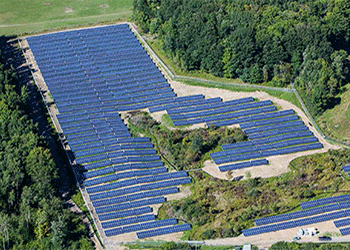
5. After much debate, the Sun8 Dryden solar projects have been approved by the town planning board. The sites include a nearly 11 MW facility at 2150 Dryden Road, and an 18 MW facility along Turkey Hill and Dodge Roads. The projects will produce approximately 28 MW of electricity, which is enough to power the approximately 7,500 households. The project will utilize a Payment In Lieu of Taxes (PILOT) of $8,000/MW, or about $224,000 in year one of operation, and with built-in inflation, about $8 million over 20 years.

Meanwhile, the town has begun review on a much smaller solar project at 2243 Dryden Road. Delaware River Solar is seeking approval to construct a 2.4 MW array on the interior portion of a farm property just west of the village near Ferguson Road. About 35 acres of the 115 acre parcel would be impacted during construction, with five acres used for the panels themselves.

6. In real estate listings, here’s something unusual for those who dare to be different – a Groton church, already renovated with living space and studio space. Aptly-located 113 Church Street is listed at $174,900 and 9,490 square feet on Zillow, but a check of county records says 9,166 SF – a 1,000 SF apartment, a 1,344 SF office, 4,078 SF “non-contributing space”, and 2,744 SF “cold storage”. The property was built in either 1881 or 1883 (county record) for a Congregational denomination, and after some mergers in the 1960s it became the Groton Community Church. From records and county file photos, it looks like the church building was re-purposed in the late 1990s or early 2000s. Previous tenants include a head start program, massage therapy, and art gallery. The tax assessment is for $100k, which seems to account for the old and somewhat mothballed condition of the property, such as the boarded up windows on the steeple tower. Should one be interested, contact info can be found in the first link.
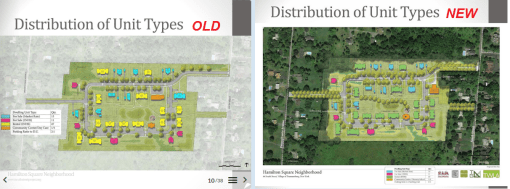
7. This week’s news round-up is running a little early because I wanted to get the latest Trumansburg Hamilton Square materials out before the planning board meeting Thursday evening. Over the past few weeks, there haven’t too many changes to the project site plan, but the daycare center was moved from inside the loop road to outside, exchanging locations with a string of for-sale market-rate townhomes. The resulting move also seems to have decreased the number of market-rate units (some townhome, some detached single-family) down by one, to 14. 11 affordable for-sale townhomes and 47 affordable rental units are still in the mix.

//simplebooklet.com/embed.php?wpKey=W7HALtX9d87mG9WFMNbp9N&source=embed

//simplebooklet.com/embed.php?wpKey=RK3Z4a5lU7XdYcy2vpC4Gc&source=embed

A copy of the traffic study from SRF Associates has also been made available on the project website. The traffic study aims to be thorough, and will likely be expanded in response to neighbor concerns about slower traffic like garbage trucks and school busses, snow impacts, and a possible sampling and estimation of school-focused but non-peak hours and a couple other intersections further from the project site (Rabbit Run Road, and Whig/South Streets). The meeting tomorrow will be at 7 PM at the Trumansburg Fire Hall. The actual submission of the project for formal board review is not expected until late next month, after incorporating feedback from the upcoming meeting.


News Tidbits 8/21/17: Insert Eclipse Pun Here

21 08 2017

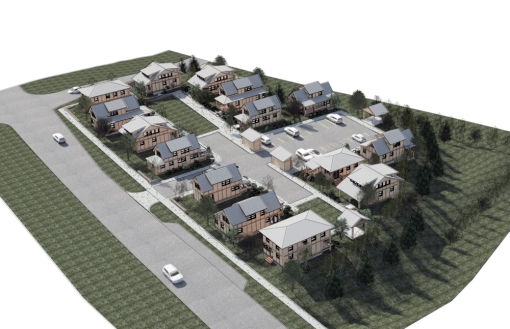
1. Quite the sight in the latest Tiny Timbers update. The nascent kit-based homebuilder plans to roll out several new designs, many of which will be incorporated into the 15-unit Varna project on the corner of Dryden and Freese Roads. That brings their total number of home design options up to about 21 or so, in several general styles from four-square to prairie-style to bungalow. It is not clear if the layout will be pre-set at is was with the Belle Sherman Cottages (relatable because STREAM Collaborative designed both), or if it will be left to the buyers.

Tiny Timbers is a bit of a misnomer because the designs are a modest but still sizable 1,000-1,500 square feet, with two or three bedrooms. Prices will be in the mid 100s to low 200s, depending on unit and features. I’d be more inclined to compare them to the starter homes of the 1950s in terms of market appeal and affordability.

Tiny Timbers has yet to get permission to start marketing for the community (the state needs to sign off on all new Home Owner Associations), but marketing has started for some scattered site development on Hector Street in Ithaca’s West Hill, and there is work underway on a few custom builds for landowners in other parts of the county.

2. Last week was not a good showing for the Inn at Taughannock. As relayed by the Times’ Jamie Swinnerton, the town of Ulysses Zoning Board of Appeals denied the lot variances, the heights variances and even the sign variances. The only one they outright permitted was the height variance to allow a rooftop cupola on the existing inn. The sign variance is kinda weird, because it sounds like they were okay with some individual signs, but not the sum of parts, so they’re doing another meeting.

While this isn’t what owner/developer Carl Mazzocone was hoping for, there were alternative plans drafted that did present an alternative design that, while the same style, fit within the zoning parameters. So this is a setback, but this project isn’t off the table yet.

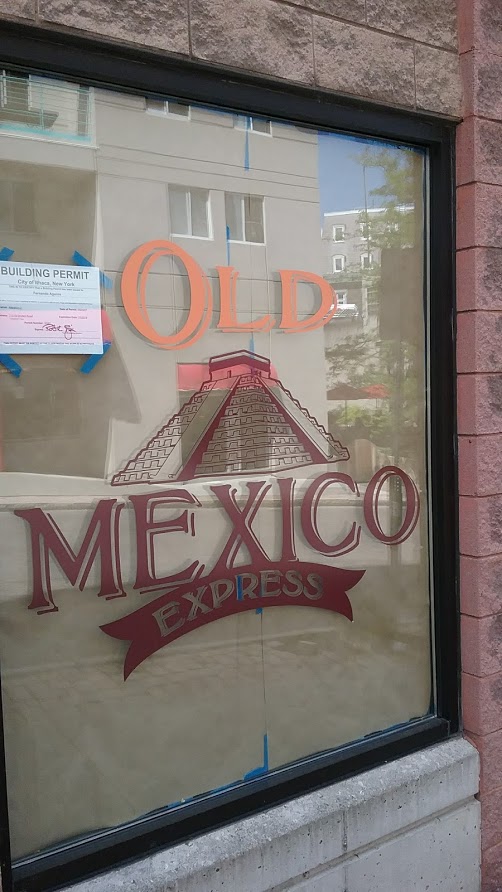
3. Sure, most readers outside the Cornell bubble avoid Collegetown like the plague, but it’s worth noting when new businesses are coming in. Old Mexico, the restaurant that replaced Manos Diner in Southwest Ithaca, will be opening a modest to-go operation at 119 Dryden Road (Collegetown Plaza) in what used to be a barbershop (at least in my time in the late 2000s). Meanwhile, where the Collegetown tobacco shop used to be at 221 Dryden (Collegetown Center), will now be a “Chinese street food” restaurant called Beijing Jianbing. Best of luck to both. At least restaurants aren’t being driven out of business by the internet anytime soon.

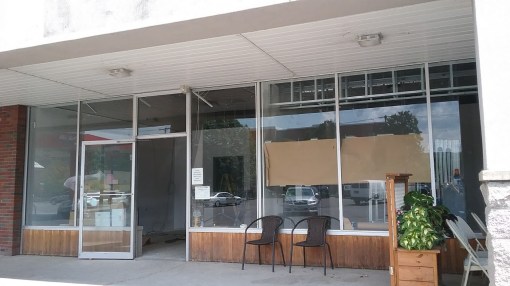
4. In the same vein, it was noted a few weeks ago that a $415,000 construction loan was filed for Hancock Plaza, the strip retail plaza at the corner of Hancock and Third Streets in Ithaca’s Northside. A quick check showed an interior renovation underway with new metal stud walls and sheet-rock going in, and the somewhat uncertain workers said that the storefront next to Istanbul restaurant would be a “medical service facility”.

5. Earlier this month, it was mentioned that a 4.5 acre parcel at 452 Floral Avenue in Ithaca was sold to a local homebuilder for $100,000. Now he’s trying to flip it. The asking price is $239,000. The tax assessment is $68,400.

The real estate ad notes the potential of an R-3a zone, which allows for homes, townhouses, small apartments and small-scale commercial with a special permit. The zoning permits four floors and 35% lot coverage, with a minimum of 5,000 SF per lot for a home, plus incremental increases for additional units.

On a side note, with thanks to the city for uploading about 470 documents from the IURA’s microfilm stash, here’s what the 1992 affordable for-sale proposal looked like for that same property. There appear to be 27 home lots, but a few may have been designed for accessory or two-family units. This gives an idea of what could reasonably be done under the existing zoning, but there are many possibilities.

Side note, I found this by chance. If anyone has time to pick through 470 documents from the 1960s to 2000, more power to you.

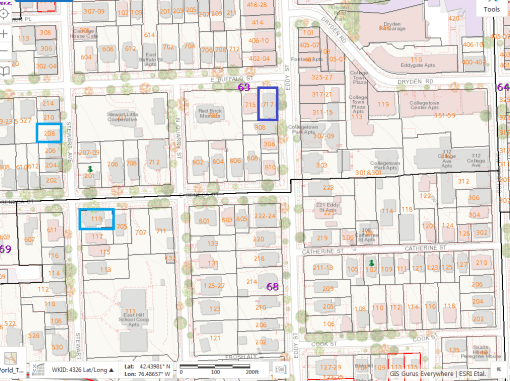
6. Also for sale, to the deep-pocketed investor looking for a safe investment – multiple East Hill apartment houses. 5-unit 119 Stewart Avenue for $995,000, a two-family home at 208 Stewart Avenue for $695,000, and $2.25 million for a 23-bed (20 SRO, 1 studio, 1 2-bedroom) property at 717 East Buffalo Street. The Stewart Avenue properties are owned by a Long Island-based LLC representing a higher ed professional now located in Massachusetts, and were purchased just a few years ago – 119 for $625k in 2014, and 208 for $513k in 2012. 717 East Buffalo was purchased by a Brooklyn investment group in 2003, and is taxed at $1.05 million. The positive is that they’re close enough to Cornell to easily take advantage of the student market. The negative is that they are all in the East Hill Historic District, which means redevelopment is off the table, and exterior renovations have to go through the ILPC.

7. Pretty slow month for the Planning Board. Finger Lakes ReUse is seeking preliminary approval for their expansion project and final approval for the warehouse portion. 709 West Court Street, the 60-unit affordable project from Lakeview, will have its DEIS finalized, potentially allowing for city approval in September. There are no new projects though, unless one counts the six-bedroom duplex at 217 Columbia, which is so minor from the state’s perspective that it only qualifies for city review. The Times is reporting that O’Connor is willing to prohibit student tenants, but permanent residents are still opposed to new student housing in their neighborhood.

There could be some interesting discussion at the meeting, not only with South Hill development, but with historic preservation matters. For instance, Student Agencies is upset that they city is likely to landmark its building at 413-415 College Avenue, which it says it had intent on redeveloping. Unfortunately, timing is everything. Likewise, the shoe is on the other foot with the Nines at 307 College Avenue, for which there has been an unpublished sketch plan of a redevelopment project. The ILPC is expressing frustration that it wasn’t landmarked already, but with the development plans already presented, the city would be acting reactively instead of proactively as it’s doing on College Avenue, and that could make the difference if a legal situation were to arise. So while the Chacona Block is likely safe and soon to be under ILPC purview, the Nines will not be protected for as long as the redevelopment plan is active, and the best the ILPC can do is recommendations.

Here’s tomorrow’s agenda:

AGENDA ITEM Approx. Start Time

  1. Agenda Review 6:00
  2. Privilege of the Floor 6:01
  3. Site Plan Review

A. Project: Mixed Use Apartments – Finger Lakes ReUse Commercial Expansion and Supportive Apartment 6:10

Location: 214 Elmira Road

Applicant: Finger Lakes ReUse

Actions: Consideration of Preliminary Approval Overall & Final Site Plan Approval for Phase 1

Project Description:

The applicant proposes to expand the existing office and retail center with a new +/- 26,100sf
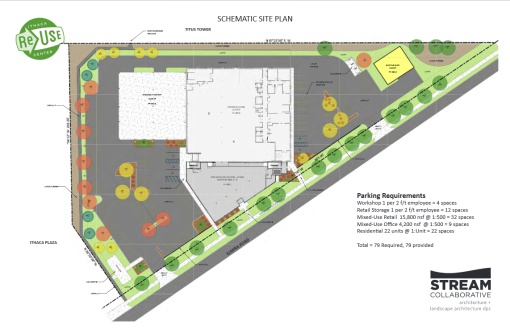
attached 4-story mixed-use building to include retail, office, and 22 units of transitional housing fronting Elmira Road. A 7,435 SF covered outdoor inventory building and a 600 SF pavilion are also proposed. The new parking and loading layout will reduce the number of curb cuts on Elmira road from 5 to 2 and provide 70 parking spaces. An improved sidewalk will be constructed to provide a safer link between the existing pedestrian bridge that connects the Titus Tower property to Elmira Road. The building will have landscaped entrances facing Elmira Road and these will be connected to the new building entrances giving residents and patrons arriving on foot direct access to the street. The project site is in the B-5 Zoning District and has received the required area variance. This is a Type I Action under the City of Ithaca Environmental Quality Review Ordinance (“CEQRO”) §176-4 (I), and the State Environmental Quality Review Act (“SEQRA”) § 617.4 (11) for which the Planning Board as Lead Agency made a Negative Declaration of Environmental Significance on June 27, 2017.
Ed. note – the first phase is the warehouse addition for lumber storage. Phase 2 is the supportive apartments.

B. Project: 709 West Court Street 6:30

Location: 326 & 328 N Meadow St. and 709 – 713 West Court St.

Applicant: Trowbridge Wolf Michaels for Lakeview Health Services Inc.

Actions: Public Hearing, Determination of Environmental Significance

Project Description:

The applicant proposes to construct a five-story L-shaped building with footprint of 10,860 SF
and GFA of 62,700 SF on the .81 acre project site comprising four tax parcels (to be consolidated). The building will contain sixty (60) one-bedroom apartments plus associated shared common space (community room, laundry facilities, lounges, and exterior courtyard), support staff offices, program spaces, conference room, utility rooms, and storage. The siting of the building allows for a small landscaped front yard, a south-facing exterior courtyard, and a 16 space surface parking lot in the rear of the site. Site development will require the removal of five structures and associated site elements. The project is in the WEDZ-1 Zoning District. This is a Type I Action under the City of Ithaca Environmental Quality Review Ordinance (“CEQRO”) §176-4 (1) (k) and (n), and the State
Environmental Quality Review Act (“SEQRA”) § 617.4 (11) and is subject to environmental review.

C. Project: Duplex 6:50

Location: 217 Columbia Street

Applicant: Charlie O’Connor for 985 Danby Rd LLC

Actions: Public Hearing


Project Description:

The applicant is proposing to install a modular duplex with one 3-bedroom apartment on each floor. The new structure is proposed to be sited directly behind the existing duplex on the property. As the project will increase the off-street parking required from two to four spaces, the applicant is proposing to shift the existing curb cut to the east and install an expanded parking area and drive aisle along the eastern property line. The project also includes removing a 30”dbh oak and one street tree, closing the existing curb cut, installing a fence, landscaping and walkways. The project is in the R-2a Zoning District. This is a Type II Action under the City of Ithaca Environmental Quality Review Ordinance (“CEQRO”) §176-5 C.(8) and the State Environmental Quality Review Act (“SEQRA”) § 617.5 (C)(9) and is not subject to environmental review.


  1. Zoning Appeals 7:20
  2. Old/New Business 7:30
    1. A. 412 East State Street – review and sign off on Argos Inn shared parking agreement with 418 East State Street.
    2. B. PB Report on Proposed Local Landmark Designation of 403 College Avenue and 411-415 College Avenue . There will be a short presentation by Scott Whitham regarding 411-413 College Avenue.
    3. C. Development Patterns of South Hill – Discussion
  1. Reports from PB Chair, Director of Planning and Development, and BPW Liaison 8:00
  2. Approval of previous minutes
  3. Adjournment


602 West State Street Construction Update, 7/2017

19 07 2017

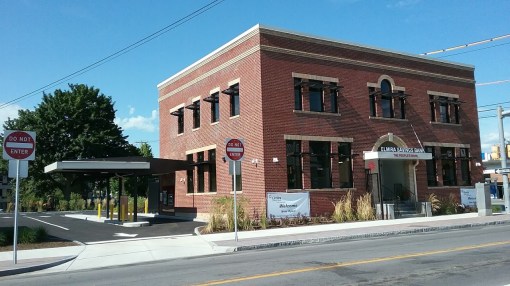
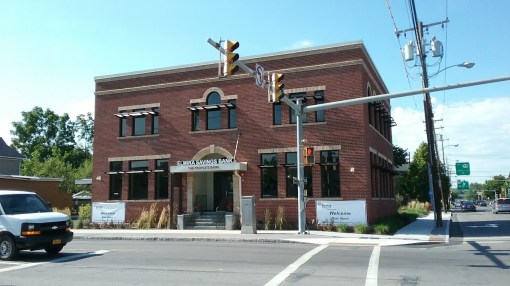
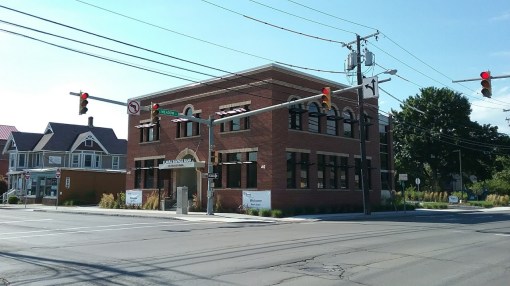
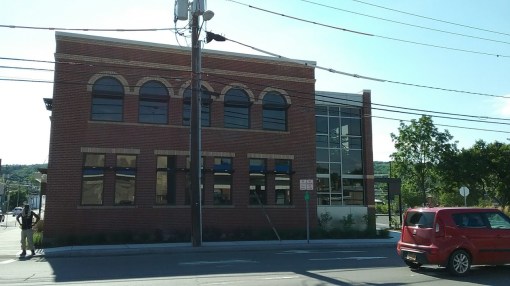
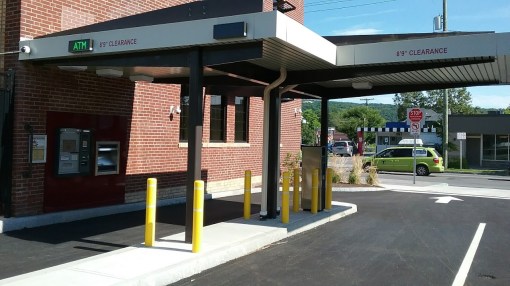
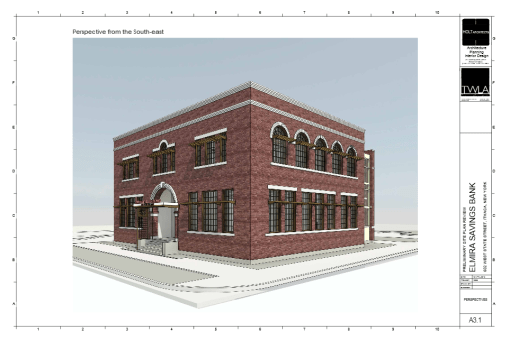
The new Elmira Savings Bank is open in Ithaca’s West End, and this project is done. A former restaurant is now 5,000 SF of renovated space plus 1,600 SF in a contemporary addition. Design-wise, it’s a smart re-use of a century-old structure, modernizing it but maintaining the integrity the original structure. Kudos to HOLT Architects for a successful blend of old and new. Elmira’s Edger Enterprises brought the $1.7 million project from the drawing board and into reality.

There’s no doubt that the project is further proof in the increased vitality and attraction of Ithaca’s long-forsaken West End, and another step on the the path to turning it into a stronger neighborhood. Within just a block, one has the new Planned Parenthood (2014), the 17-unit Iacovelli Apartments (2013), the renovated HOLT Architects office (2016), a gas station renovated into the Jade Garden restaurant (2015), and the new microbrewery opening up in the rear of the Cornell Laundry warehouse.

If there is one thing I wish had gone different with this project, it was the sale of the property and removal of three low-income families. That got ugly, and it tarnished what was otherwise a decent project. The story I’ve been told in the two years since is that the bank were mislead by the previous owner, who gave them old rental paperwork saying tenants were month-to-month, and ESB mistakenly assumed it was still accurate. So there’s something to be said about due diligence and taking a couple hours out to meet with tenants before any notices go out.

The northern end of the property has preserved a few mature trees, and in the long-run ESB would like to partner with a developer, affordable or otherwise, to do something along West Seneca. Plus, there are organizations like Lakeview, who coincidentally looked at doing a development where ESB is nowand are moving forward with affordable housing in the West End. More opportunities for mixed-use plans with market-rate and affordable housing will open up as properties go on the market and Ithaca’s economy continues to develop – and plans like Cayuga Med’s are big if auspicious question marks.

While it’s great to have new housing plans brought forward, it’s also important to maintain existing affordable housing (and programs to assist) while adding those new options. With Lakeside and Parkside scooped up and pushed upmarket, and Maple Hill now market-rate Ithaca East, that takes hundreds of units out of the equation, and this is a significant concern. It’s no surprise that tensions boiled over given the difficulties in preserving existing LMI housing options, and in approving and building new ones.

Anyway, enough with the final thoughts. Enjoy the photos.

Before:

After:


News Tidbits 6/10/17: In High Demand

10 06 2017

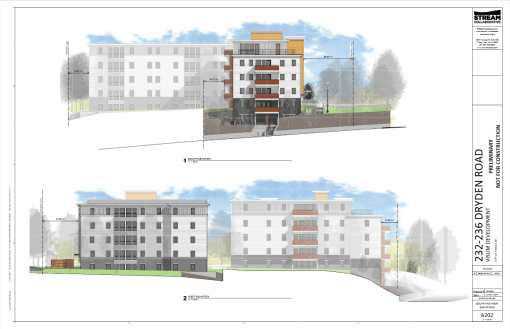
1. Start off this week with some eye candy. Here are the latest renders for Visum Development’s 191-bed, 60-unit project at 232-236 Dryden Road. The biggest change here is the Dryden Road facade – revised fenestration, and the addition of shingle-style balconies. STREAM Collaborative’s intent is to give the south building a little more historical sensitivity – when the Cascadilla school still had a dorm in the late 1800s and early 1900s, it included a 4-story shingle-style dormitory complete with dining room and gym. The balconies are throwbacks to the dormitory’s balconies.

However, given that this building will date open in 2018 and not 1898, instead of wood shingle, the balconies will use Allura “Redwood” fiber cement shinglewood pulp mixed with sand and cement, shaped for a wood-like appearance, but with the durability of concrete. Fiber cement is also more expensive to buy and install vs. materials like vinyl, which is why only more expensive or visible structures tend to use it. Other planned materials include Endicott manganese ironspot velour brick veneer, fiber cement panels with LP smart trim painted in Sherwin-Williams Pure White and Anonymous (actual name), lap siding in SW Pure White and Marigold, granite grey stucco (*real* stucco, not DryVit), a metal canopy and Andersen windows.

2. Business is good for STREAM Collaborative. So good that they’re expanding both in staff and space. The young, prolific architecture firm led by Noah Demarest will be moving out from its location in the City Hall Annex at 123 Sough Cayuga Street, and into a larger downtown space in the ca. 1872 Gregg Block at 108-112 West State Street, across from the State Theatre. The new digs are being renovated now, and are expected to be ready for occupancy by July 1st.

On another note, the owner of the city hall annex has taken to advertising the office space on Cragislist, which seems like the wrong choice to me. An apartment, sure. A house for sale or offices to rent? My impression is that folks prefer a more professional medium than what Craigslist offers. Kinda the same with jobs – servers or dog-sitters, sure. Accountants or architects? Ehh.

Maybe I’m just behind the times. Here’s the posting for the former Hal’s Deli on the 100 Block North Aurora Street. $5500/month.

3. WHCU is reporting that INHS has had no shortage of applicants for the 210 Hancock rentals. After receiving over 200 applications, they set up a lottery in which 122 “made it through” , and then selected the top 60 (there are 59 rental units though…might be a just in case there’s a drop-out, or it could just be conversational rounding). If it’s anything like New York City’s lottery, what happens is that each application is validated, sorted for requested unit type, and is assigned a randomized log number – those who get 1-48 for the one-bedroom subset, and 1-11 for the two-bedrooms subset, are awarded dibs on a unit, so long as they pass the income check and background check. Unit occupancy is expected late this summer, and marketing for the seven for-sale units will start…

4. …pretty much now. The three units in the first image are 204, 206 and 208 Hancock Street, the four for-sales in image two are from L to R, 406, 408, 410 and 412 Lake Street. 206 Hancock, 408 Lake and 410 Lake will be 910 SF 2 bedroom, 1.5 bath units that will sell for $112,000 to qualified buyers. 406 Lake and 412 are 1088 SF, 2 bed 1.5 bath units priced at $129,000. The largest units, 204 Hancock and 208 Hancock, are 1300 SF, 3 bed 1.5 bath units that will sell for $145,000. The plan is to have buyers lined up for all seven units by the end of the year.

5. The county legislature has approved the Heritage Center acquisition. The county will pay $2 million for the 18,500 SF property, about $400,000 below assessment. Tompkins Financial Corporation is parting with its former offices next spring as it moves into a new HQ a block away. The plan is to have the heritage center, which will host tourism and history-focused non-profits, open for occupancy by the end of 2018, just as The History Center’s lease at 406 E. State runs out.

6. Seems like Lakeview is serious about their West End mixed-use project. The mental health services organization just purchased three properties on Thursday the 8th – 326 North Meadow for $150,000, 711-13 West Court Street for $525,000, and 329 North Meadow and 709 West Court (same owner) for $550,000.

Lakeview is planning a mixed-use 5-story building with a small amount of first-floor retail and 50 apartment units, all of which would be affordable, and half of which would be set aside for those with mental health ailments who are generally independent, but will have Lakeview staff to turn to in times of need. The project team requested $250,000 from the city IURA to help finance the $20.1 million project, but were only awarded $50,000 since it’s still at a relatively stage without detailed plans. The project team expects to submit their project for review later this year, with a 2018 construction start.

7. Tiny Timbers is doing well. In an update to their website, they note the completion of their first house, a “lofted L” model just over the county line in Hector, and a new house planned in Enfield (given that Enfield permitted just one new house last year, there’s probably a joke in there somewhere). There is another home just getting underway in Lansing’s Farm Pond Circle development, and a fourth will start soon on Grandview Drive in the city of Ithaca’s portion of South Hill. All the new units will be “big cubes” like the render shown above.

8. Looking at the city of Ithaca’s planning department memo this month, there’s nothing new to note for June. Smaller projects tend to show up in the memo, since the sketch plan for feedback isn’t as big of a deal for a small proposal, like a new store or a modest apartment building. Finger Lakes ReUse’s 22 studio units for vulnerable/formerly homeless populations will have its public hearing and Determination of Environmental Significant (step before prelim approval), the McDonald’s rebuild will have Declaration of Lead Agency, public hearing, BZA recs and DoES, 232-236 Dryden will have its DoES vote, and the Old Library redevelopment and 238 Linden will be up for approval.

9. Finishing off this week with a word of approval – the Dryden town board gave approval to Gary Sloan’s 36-unit Evergreen Townhouses at 1061 Dryden Road, per Cassie Negley at the Ithaca Times. At the boards’ (both planning and town) encouragement, the solar panels were replaced with electric heat pumps, which could utilize off-site solar and open up the possibility of a more environmentally sustainable project overall, given the proliferation of solar arrays underway in Tompkins and the region (my off the cuff estimate has at least enough solar arrays planned in Tompkins in the next 18 months to power over 10,000 homes). A play structure and 11 more parking spaces were also added.


News Tidbits 6/3/17: The Return, Part I

3 06 2017

My apologies for the lack of a weekly round-up. My day job has been busier than usual, and the list of topics just kept growing, making it an even more daunting task. Gonna try and work through a few at a time until everything’s caught up.

1. Cornell and EHVP’s East Hill Village webpage has started to flesh out their Q&A regarding the mixed-use megaproject slated to replace East Hill Plaza. Here are a few details:

– Cornell wants to make it clear that all images to date, include the conceptual from the master plan above, are strictly conceptual and have little bearing on the final product. The more realistic and nuanced take is that Cornell has an idea of what they want and the program format they want it in, for broad concepts like housing capacity, commercial/research space and general urban planning. In terms of an actual layout or tenant specifics, they probably don’t have much.

– Perhaps in response to a Voice commenter and former Ithaca town planning board member who accused the university of segmentation (meaning, during environmental review they illegally broke up a project into phases to avoid a greater analyses and to downplay impact), the FAQ notes that they didn’t really have this fleshed out and it’s separate from Maplewood. Given the size, scale, that it’s a physically separated set of properties, and vague goals they’re walking into this with, that’s a fair statement. If this were, say, a replacement for Ithaca East, which borders Maplewood, it’d be a different story.

– The current thinking is to keep the main retail strip, which was requested at the first community meeting. However, they may take down a portion of it to create a through-street, and reconfigure/relocate the parking.

– They haven’t written off pursuing a PILOT or tax abatement. They are exploring an affordable housing component. Eco-features like solar arrays, heat pumps and net-zero structures are being considered.

– Meetings will continue through the summer, with concept plans prepared for the town by the fall. Construction on the first phase would begin in 2019. It will be multi-phase.

No second meeting has been posted yet, but keep an eye out for updates.

2. Making its round around local governments and news outlets is a recently-published study by local structural engineering firm Taitem that tells of good news for heat pumps, and maybe serve to county one of the town of Lansing’s arguments regarding the West Dryden natural gas pipeline. Although the firm is a promoter of green initiatives, their study indicated that financially, the technological advancement in heat pumps over the past several years has made them competitive with natural gas, although each has pros and cons. For smaller units, a 1,500 SF townhouse in the study, it was found that an air-source heat pump was slightly less in annual cost than a natural gas furnace – for a modeled 4,000 SF detached custom home, it was a few percent more. Ground-source pumps were more expensive (but slightly “greener” than air pumps), and propane was the most costly, as well as the biggest carbon emitter. Although contractors are still adapting to heat pumps, the cost is decreasing somewhat as their use spreads and familiarity grows.

However, not everything is roses, at least not yet. For large-scale commercial and industrial operations whose heating needs are substantially greater, it appears that heat pumps have yet to be competitive, and even Taitem’s Ian Shapiro acknowledges that’s likely the case at present. But while the pipeline will continue to be an issue for larger commercial enterprises, homebuilders and residential developers should be able to adapt without too much additional financial burden or risk.

For the sake of example, the Village Solars charged a modest premium on rents when they went with pumps a few years ago (due to installation costs rather than operating costs), but having a strong product makes up for the extra short-term investment, the costs will potentially balance out over a few decades, and frankly, it makes for good marketing in eco-conscious Tompkins County.

I’ll admit to being skeptical over the past few years, and I still have concerns for economic impacts like the MACOM decision, but at least from a residential construction standpoint, the Village Solars and this study are making a strong statement.

3. Move this one into the “construction” column – Cayuga View Senior Living has secured a construction loan. The mixed-use, 60-unit senior housing project at 25 Cinema Drive in Lansing village has been in stall mode for a year as financing remained elusive. However, according to a construction loan filed on May 25th, Five Star Bank is loaning the Thaler family and their associates $10.88 million to make their project become reality. Along with the loan, the Thalers and their business partners will be putting up $1,796,450 in equity to move the project forward, bring total costs to $12,676,450.

Here’s a cost breakdown – individual figures are blocked out to avoid potential legal issues. But for the sake of illustration, here is the breakdown of the finances. Source of funds to the left, breakdown of hard and soft costs to the right. Breaking down the terms, we’ll start with the hard costs: easements are the legal right to use someone else’s land for your own use – often seen with utilities, they can also be used for private improvements like sewer, solar, paths or driveways/parking. Site improvements include landscaping, driveways, and drainage. Building Cons. costs are actual materials/labor expenses, and tenant improvements are the costs of fitting out retail space as part of a lease agreement. Lastly, general conditions are a catch-all for non-construction labor costs, including site management like porto-potty rental and temp utilities, material transport costs and project management – for this project, site management falls under the general contractor, Taylor the Builders of Rochester.

Soft costs include contigency (cover your rear allowance),  overhead developer profit (the amount needed to compensate the development team, which isn’t necessarily the exact same group as those putting up equity, for taking on this project), construction interest and LOC [Line of Credit] fees to the lender, and other line items that are either self-explanatory or too vague to ascribe. At $145/SF, the cost is a fair 10% less than a similar project in Ithaca city (offhand, 210 Hancock’s apartments are ~$160/SF), which can be explained in part by lower land costs and a less complicated site to work within, and to get in and out of.

Five Star Bank is a regional bank based out of Wyoming County in the western part of the state. They hold a few local mortgages, but this appears to be their first construction loan recorded in Tompkins County.

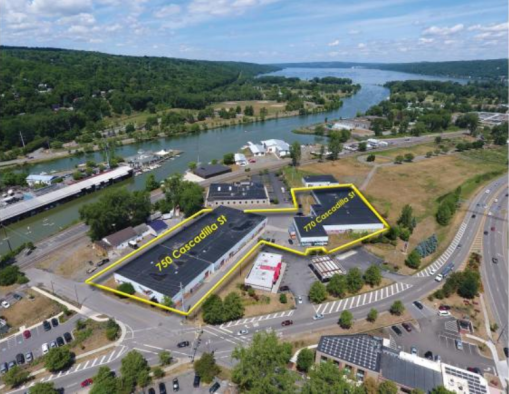
4. I’ll wrap up “Part 1” with a piece of interesting news – Cornell found a buyer for their printing facility and warehouse on Ithaca’s West End. According to a county filing on June 2nd, Guthrie Clinic is paying $2.85 million for the properties at 750 and 770 Cascadilla Street, which is over the asking price of $2.7 million. For that they get 3.12 acres, a 37,422 SF warehouse built in 1980, and a 30,000 SF storage facility built in 1988 and currently leased out.

Guthrie is a regional healthcare provider based out of Sayre, Pennsylvania – their premier facility is the 254-bed Robert Packer Memorial Hospital, which Ithacans might know as one of two locations someone is likely to be transported to in the event of a severe injury (the other being University Hospital up in Syracuse). For the record, Cayuga Medical Center has 204 beds.

Guthrie’s presence in Tompkins County includes some specialty offices and an existing 25,000 SF clinic at 1780 Hanshaw Road in Dryden. That building first opened in 1995, with an addition in 2000. Guthrie has been a building spree as of late, with a 25-bed hospital in Troy, PA that opened in 2013, and a 65-bed hospital in Corning that opened in 2014.

As for what they want to do on Ithaca’s West End, well, I’m working on figuring that one out. I’m hoping the Times writers who follow the blog will cut me some slack and let me try to unravel this one.


602 West State Street Construction Update, 5/2017

30 05 2017

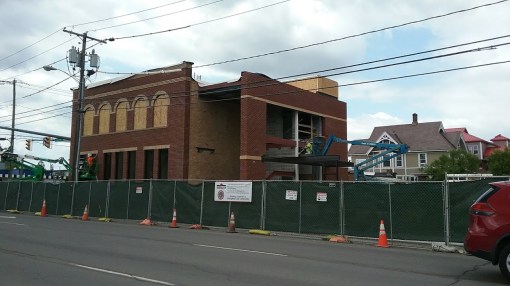
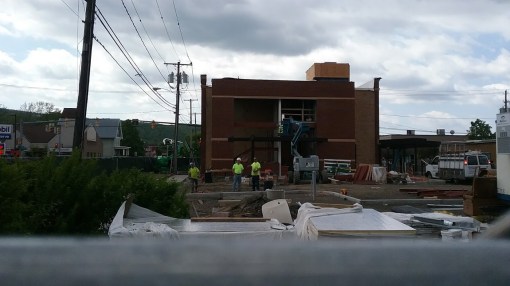
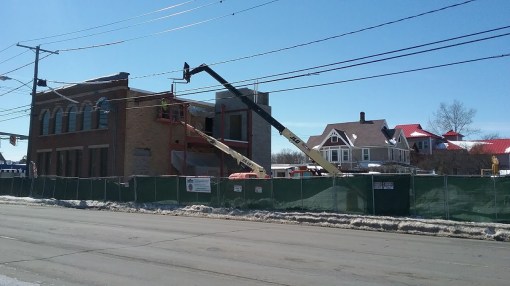
Starting to get a good idea of what the final product will look like at the future Elmira Savings Bank location at 602 West State Street. The structural steel for the drive-thru canopy is up, the new front and rear entrance canopies are being erected, and the new curbing is down. The new north addition has its steel and masonry with matching belt course, but it looks like the new interior stairs have yet to be built (the floor plan of the new addition is basically a stairwell albeit an imposing one, an elevator lobby and the elevator). the two-story opening facing Meadow Street will be framed with metal panels and fitted out with a contemporary glass curtain wall.

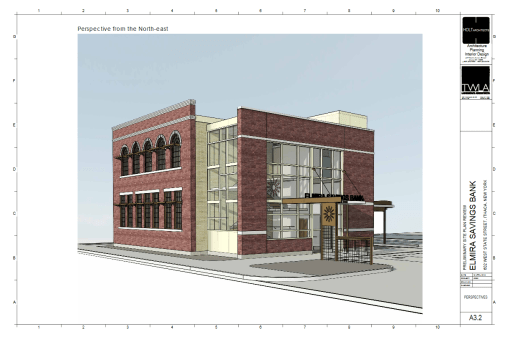
The early renders suggested a beige color for the aluminum panels, but according to the final materials submission, the panels will be Alucobond “Anodic Satin Mica”, which most folks would describe as a soft tan/dull tan. The alumnium roof coping, flashing and gutters/downspouts will be Hickman Sandstone, and the stucco will be painted Benjamin Moore Horizon Greyboth are close approximations of the building’s historic paint colors.

Taking a guess, the arched windows have to be custom-made, and given the time that takes, it might explain why they’re the last replacement windows to be inserted. The windows will be fitted with metal sunshades towards the end of the construction period.

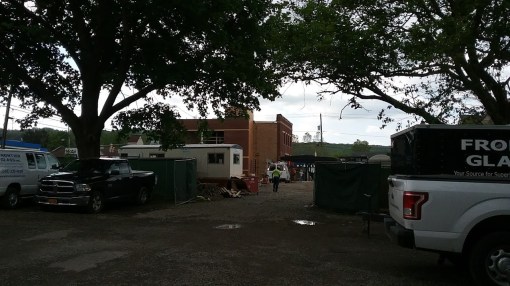
Construction on the $1.7 million renovation/addition (5,000SF/1,600 SF, total 6,600 SF) is due to wrap up in August. Elmira Savings Bank will occupy 3,300 SF on the first floor. The second floor, also about 3300 SF, will host for-rent office space (a little too big for the Voice though, which I’d wager at 800 SF off the cuff). HOLT Architects is in charge of design, and Elmira’s Edger Enterprises is in charge of the buildout. It looks like glazing has been subcontracted to Frontier Glass Inc. of Rochester.


The Cherry Artspace Construction Update, 3/2017

26 03 2017

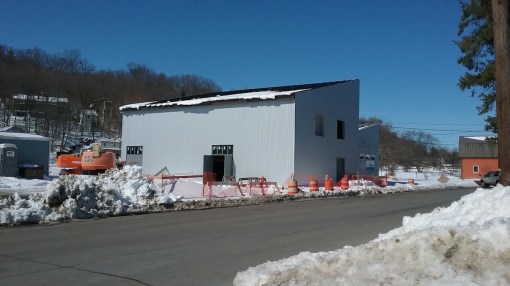
The corrugated metal exterior has been attached, the roof is complete, and the doors and windows are being fitted. Once the steel framing was completed, the exterior work was expected to move quickly, as all the components had already been assembled and were just waiting in storage. McPherson Builders is making quick work of the 1,900 SF project.

The Cherry Artspace crew do a great job providing updates on their website, on a much quicker timeframe than this blog. They also have some interior shots, which show the mezzanine area, and the insulation that has yet to be installed. The first show inside the new venue is scheduled for April 20th (for those interested, tickets here).

I did an in-depth interview for the Voice about the Cherry Arts and the Artspace with Director Samuel Buggeln and Associate Director Jennifer Herzog, which I very much enjoyed. A copy of that can be found here.


602 West State Street Construction Update, 3/2017

21 03 2017

The new addition has risen out of the ground at Elmira Savings Bank’s new $1.7 million branch office at 602 West State Street. The cinder block shaft will host the elevator shaft/stairwell, and the steel framing is underway for the new 1600 SF north extension. The non-historic blue paint is being stripped from the bricks of the existing structure, and from the plastic on the roof, it looks like a new roof is being laid, probably EPDM (synthetic rubber) or something similar. The building’s insulation is being updated, and the plan is to have an all-electric HVAC system (heat pumps).

Although the initial press release called for March opening, June or July seems more likely. Elmira Savings Bank will occupy 3,300 SF on the first floor. The second floor, also about 3300 SF, will host for-rent office space. HOLT Architects is in charge of design, and Edger Enterprises is in charge of the buildout. Based off the signage, it looks like John Mills Electric (IBEW Union, Local 241) is doing the subcontracted electrical work.


News Tidbits 3/12/17: Affordable Housing Week 2017

13 03 2017

It’s been a busy week. Let’s start by reviewing some of the entrants for the city’s affordable housing funds.

The Ithaca Urban Renewal Agency will be holding public hearings on March 16th and 23rd as part of the process to determine who will receive money from the Housing and Urban Development (HUD) grants awarded to the city. The 25 applicants, same number as last year, range from jobs training to community services to the development of affordable housing. All summed up, there’s $1.982 million requested, and $1.149 million available; that’s up from $1.85 million requested in 2016, with $1.54 million available (about $273,900 of that came from the returned funding for INHS’s cancelled project at 402 South Cayuga Street). In fact, the amount of money available is the lowest it’s been in a few years – in 2015, $1.78 million was requested out of $1.215 million available, just a little over two-thirds of the total. With the increasing requests, the chances for funding have gone down this year.

Without discounting the value of the other applications, the focus here will be on the real estate development projects. For the record, writing about a project is neither an endorsement or opposition from this blog.

1. The big new proposal coming out this year appears to be Lakeview Health Service’s plan for the corner of North Meadow and West Court Streets on the city’s West End. I expanded on the basics in a Voice article here, but for the blog’s sake, we’ll take a look at the finances.

In terms of leverage, it’s a pretty big project – a request of $250,000 towards a $20,081,186 project. However, keep in mind this project is only eligible for HOME funds and not CDBG (Federal Community Development Block Grants), and the city only has $295,245 in HOME funds to work with after overhead is taken into account – this is a pretty substantial request for something still in the conceptual stages.

The project fills a substantial by providing 50 units of affordable rental housing, all 1-bedroom units, in a 5-story building. Not only that, but half of those units would be set aside for those living with psychiatric disabilities. Ten of the general housing units would be available to those making 50-60% of area median income (AMI, about $27-$32k), with the other 40 going for less than or equal to 50% AMI. Those units will be interspersed with the general affordable housing. The special needs residents will be considered case-by-case; it’s for those who are generally independent, but may need assistance in stressful or difficult times. Lakeview will maintain an office on the first floor that will be staffed 24/7.

Some retail space will also be available on the first floor, which helps to cover the operational expenses, and meets the city’s goal of a more dense and vibrant West End. 17 parking spaces will be provided, so it’s expected the residents will utilize bikes and mass transit. The design will be slab-on-grade, with a deep foundation – soil in this part of the city is poor due to the high water table, so projects either have to be one or two floors with slab foundations, or they have to build enough floors to accommodate the costs of driving piles into the ground, in this case 80 feet down. This is something to keep in mind with the waterfront rezoning, as the soils are pretty similar.

The pro-forma assumes $730,300 in income in the first year after vacancies are noted, and about $313,500 in expenses, leaving a little over $416,800 for debt service. Everything goes up a little bit each subsequent year for inflation. The debt service is scheduled to last for 50 years.

Rochester’s PLAN Architectural Studios is the architect, so expect a modern design not unlike the cancelled concept plan for the Elmira Savings Bank site on West State and Meadow. The preliminary floor plan suggests the retail will face West Court Street rather than the Meadow/13 corridor.

As with many affordable projects, this one has a rather extended schedule due to the need to compete for public grants in tandem with private loans – funding applications are being submitted this year with loan awards during 2018, including the IURA’s. Construction would be from October 2018 to April 2020, with rent-up shortly thereafter. It’s odd to think this likely won’t even show up in the 2020 census, but we’re starting to get that far into the decade.

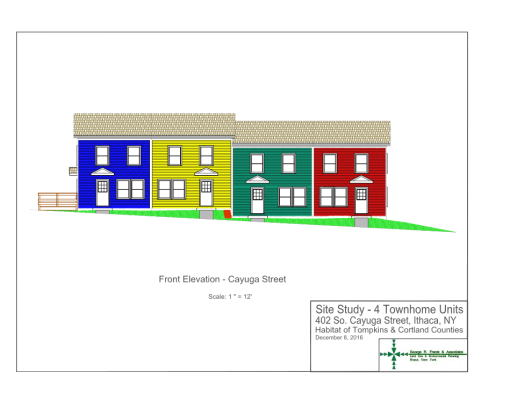
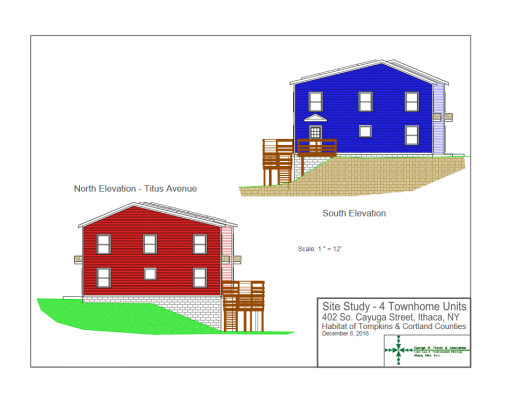
2. Meanwhile, Habitat for Humanity is continuing to move forward with their 4-unit townhouse plan at 402 South Cayuga. The non-profit has agreed to purchase the land from the city for $32,000, a below-market price that the city is fine with accepting, given Habitat’s plans for 4 owner-occupied affordable townhomes for those making 30-60% area median income (AMI). They are requesting $80,000 towards the $270,000 cost. It appears that Habitat’s splitting it into two phases, two units in each – given the small size of their organization, it’s a sensible approach. $540,000 for ~5200 SF of units is also quite a deal, at about $104/SF, about half the cost of an INHS project. Habitat does have volunteer labor that it can utilize.

Habitat is hoping to parlay the Morris Avenue two-family they’re doing later this year into sustained interest and funding for Cayuga Street – attracting donors with one city project, who might be interested in donating time and dollars to the next one. Like with Lakeview, construction is likely on a 2018-2020 timeframe. They’re also only eligible for HOME funds, so either Lakeview or Habitat will not be getting their full request, possibly both.

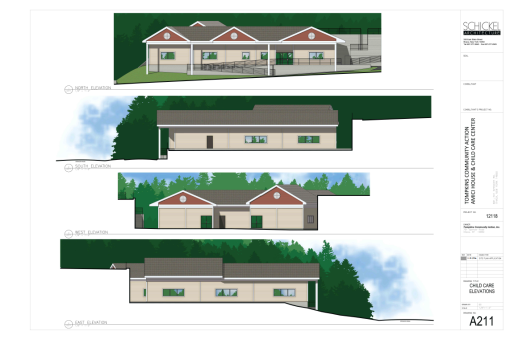
3. On the economic development side, TCAction is requesting $84,200 towards their $8.25 million childcare center at 661-665 Spencer Road. The project is part of the Amici House plan and was approved by the city concurrently, but technically separate from the 23 units of vulnerable youth housing being provided next door.

Named for a late, long-time TCAction employee Harriet Giannelis, the project helps fund the site acquisition – one of the land parcels is owned by the county, and TCAction has a $184,000 purchase lease-back agreement (the county bought the land from a private owner, and they’re currently leasing it to TCAction), which will be paid off partly with the IURA funds. The new 7,010 SF childcare center will provide daycare and early-education programs (Head Start) to 40 low-income children. Although promising three new jobs in the application, TCAction expects 21 Full-time equivalent positions to be created. It’s easier to provide an employee’s lifetime income documentation for 3 staff vs. 21. Welliver will be the project contractor, so expect local union labor.

Most of the other funds come from county, state and federal grants – another $500,000 comes from a loan with M&T Bank.

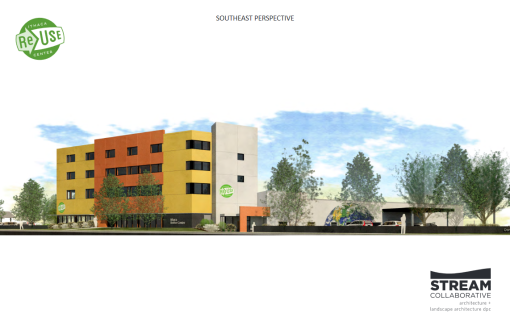
4. Also on the economic side is Finger Lakes Re-Use’s expansion plan at 214 Old Elmira Road. the non-profit has refined their plans for a new mixed-use expansion, and plans to start the city’s formal project review process later this month. Some of the numbers have been tweaked a little bit, but the basic components are the same – Finger Lakes ReUse would work with Tompkins Community Action (TCAction) to bring a new 4-story, 26,100 square-foot (SF) building to FLR’s property at 214 Old Elmira Road. The first floor would expand FLR’s retail operation, while the upper floors would provide office space for FLR, and 22 units of transitional housing for formerly homeless individuals. Plans also call for an 8,100 SF warehouse for salvaged lumber/wood, and a 600 SF pavilion. 79 parking spaces are included in the project.

As with TCAction’s Giannelis Center, 9 FTE jobs are expected to be created by the $10 million project, but FLR promises to provide previous income documentation for 3. The monetary request from the CDBG funds is $100,000, and they will also be using Welliver. Welliver seems to be the safe choice when a developer wants subcontracted or direct local union labor.

The application states the $100k is going towards site acquisition, which I’m not fully following since they own the property and it doesn’t appear any new property is to be acquired. Perhaps the site has legal stipulations that have to be bought away? It’s not totally clear.

If I can be an architecture critic for a moment, I like the warm colors, but that largely blank east stairwell is kinda bleak. Maybe use those orange panels on that as well? Or another warm color?

Anyway, we’ll find what the IURA thinks; funding will be determined by the end of April, and formally awarded in June after the city’s Planning Committee signs off on the disbursement.


News Tidbits 2/25/17: Creating a Place to Call Home

25 02 2017

is2r5l9l9byvab0000000000
1. It looks like the homes designed for Tiny Timbers won’t just be limited to Tiny Timbers. The company has partnered with realtor Brent Katzmann for a to-be-built house in Lansing’s Farm Pond Circle housing development touts a Tiny Timbers-based home design by STREAM Collaborative. 1.09 acres and a 2 bed, 2 bath 1,430 SF house for $219,400. The relatively low price compared to most new builds is in part due to Tiny Timbers’ modular approach – the “Big Cube” retails for $156,900 with a finished basement, and the Farm Pond parcels go for $39k-$45k, so not counting the soft costs (permits/marketing), that pretty much sums up the costs.

Farm Pond Circle is a 19-lot subdivision in Lansing town that was the brainchild of the late Jack Jensen. All homes have to exceed state energy code by 20%, cannot exceed 2600 SF, and cannot use aluminum or vinyl siding. A couple lots have been aside for affordable single-family home construction. After Jensen’s passing in 2014, another local homebuilder, Bruno Schickel (Boiceville Cottages), picked up the undeveloped lots (10 of the 19) for about $165k last February, and intends to follow through on Jensen’s plans.

tiny_tims_7

2. Speaking of Tiny Timbers, it appears the budding modular timber-frame builder is expanding their offerings into a full line of homes. Tiny Timbers now has 16 different models in five series. Prices range from a completed 600 SF model with no basement at $109,900, to a 1,950 SF model with finished basement at $197,900, land and well/septic not included.

In a blog post on their website, Caleb Dolph, builder Buzz Dolph’s son and the guy in charge of marketing, says that the first sold house is underway in Hector (if Ithaca had exurban areas, Hector would be it), at least five others are in contract, though it’s not clear if any of those are for the 15-lot Varna site. Given that they planned for ten houses in 2017, the Tiny Timbers staff might have underestimated the market, which is more a fortunate challenge than a complaint.

3. A local non-profit is looking to expand its real estate footprint a little bit. Tompkins County Opportunities, Alternatives, and Resources (OAR) is seeking to buy a run-down house at 626 West Buffalo Street and renovate it into five beds of transitional housing for those getting out of jail and trying to get back on their feet. The intent is to provide, safe, secure housing to better help with the transition process, which can include education, job training and mental health and/or addiction treatment. The county would provide $100,000 in a one-time allotment – the house is for sale for $99,999, the purchase offer is for $95,000, and a further $60,000 would be spent on renovations. The rest of the money ($55,000) comes from grants, donations and a mortgage. Ultimately, the goal is to provide decent housing that helps reduce the recidivism rate (convicted persons committing more crimes), ideally saving the county on future court and incarceration costs, as well as what they hope pans out to a lower crime rate.

swd_websitelogo

4. Staying on the topic of special needs housing, the Second Wind Cottages is looking to add another three cottages in Newfield this year. The cottages are modest, ~200 SF and costing $12-$15k each to build. As reported by the Times’ Jaime Cone, every unit provides shelter to a formerly homeless male. Rents are “pay as you can”. A small community facility provides services like a kitchenette, office, washer and dryer. Three more cottages are planned for 2018, which will round out the “campus” with 18 units. A similar facility is planned up the road, one that will house homeless women and children. Although Newfield is a ways out, both sites are on the bus line into Ithaca.

The Second Wind Cottages are a private endeavor by businessman Carmen Guidi, and paid for through grants, fundraisers, and donations (money, furniture, etc). Volunteer labor similar to that used for Habitat for Humanity is utilized and welcomed. Like with the OAR house, by providing a safe, warm space to live, these units may help reduce homelessness and the issues homelessness creates.

123_eddy_street_2

lambrou_123_eddy_craigslist

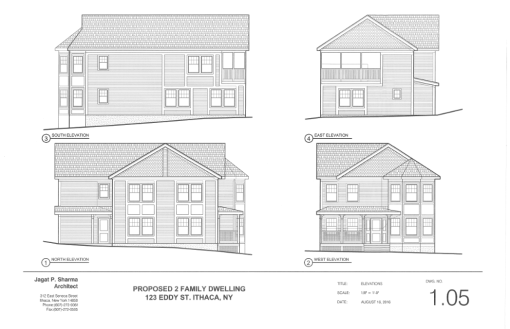
5. Work has yet to start on the new two-family home planned at 123 Eddy Street in Collegetown, but it looks like developer/landlord Nick Lambrou is seeking major changes to the project. Lambrou wants to replace the approved design at top, with the one below, which is copied from a Craigslist posting. The designs are both by Jagat Sharma, but the new plan is a variant of the two-family homes that Sharma’s doing for Charlie O’Connor at the recently-approved 4-building 607 South Aurora project.
The property falls into the East Hill Historic District, which is under the ILPC’s jurisdiction. According to Bryan McCracken, the city’s Historic Preservation Planner, the design will be heading for review within the next month or two.

The design has been used before so there’s familiarity with the design and lower risk, plus there are possible cost efficiencies if using the same contractors as O’Connor, because they’ll move quicker as they’ve done it before. On the other hand, unlike 607 South Aurora, this property is in the East Hill Historic District, and full-time neighbors on Orchard Place have been watching these plans very closely – they’re wary of students, and will likely not be fans of the projecting second-floor porch, as the previous version was tucked into the building. Not sure using a slightly more decorated version of a design being deployed elsewhere will get the ILPC’s blessing, but we’ll see what happens.

cayugafarms_2

6. Why yes, Lansing town is still hopping mad about the natural gas issue. The town supervisor cites the tap-out as the cause of delay for Robert Weinstein’s 102-unit Cayuga Farms project, although the previous documentation says it’s a sewer issue – the developer has to deploy an Orenco modular sewer system, which has to be approved by the NYS DEC.

maplewood_v7_4

7. Here’s a copy of Maplewood’s buildout timeline. The first Maplewood apartments should start construction in May 2017, pending no issues. Generally, the crews will be working from the outside in; buildings closer to Maple Avenue and Mitchell Street have earlier construction schedules, while those interior to Maplewood will start in the fall or early winter. Also, street names. Veteran’s Place will continue to be the main thoroughfare, but from north to south, it will intersect with “James Lane”, “East Sylvan Mews”, and “Lena Street”. James Lane wraps around to form the secondary N-S thoroughface on the east side of the parcel. James and Lena Mitchell were the original owners of the property when Ithaca was first settled in the early 1800s.

The Stormwater Property Protection Plan (SWPPP) still needs to be okayed by the town of Ithaca, but that’s about the only thing left before final approval is granted.

107_s_albany_rev_1

8. It looks like the Planning Board meeting should be interested. Not a whole lot being decided, but some sketch plans have been submitted. For rental projects aiming for August 2018 openings, Feb-Apr is going to be the primary submission period, as they seek approvals by May or June so that construction can run on a Summer 2017 – Summer 2018 schedule.
AGENDA ITEM Approx. Start Time
1.Agenda Review 6:00

2. Privilege of the Floor 6:01

3. Subdivision Review
A. Project: Minor Subdivision 6:10
Location: 109 Dearborn Place, Tax Parcel 9.-3-11
Applicant: Lee and Elizabeth Ambrose
Actions: Declaration of Lead Agency, Public Hearing, Determination of Environmental Significance, Recommendation to BZA

4.Site Plan Review
A. Project: Apartments (11 Units) 6:30
Location: 107 S Albany Street
Applicant: Stavros Stavropoulos
Actions: Declaration of Lead Agency, Public Hearing, Determination of Environmental Significance

B. Schwartz Plaza Redesign- Sketch Plan 6:50

More on that here.

C. 238 Linden Avenue – Townhomes – Sketch Plan 7:10

238 Linden is a non-historic student rental house, and a John Novarr property in a CR-4 zone – 4 floors, no parking required. Further to that, 240 Linden to its north was taken down for staging space for the Breazzano Center, but as that will be finishing up this Spring, it leaves an MU-2 (six floors, no parking) parcel open for development. A townhomes plan suggest one or both of these parcels will host something not unlike the ikon.5-designed townhouses plan Novarr plans to build at 119-125 College Avenue.

D. 372 Elmira Road – McDonalds Rebuild – Sketch Plan 7:30

If Ithaca’s lucky, it’ll have upscale features like the one finishing up in Dryden. Otherwise, a modern update to the 1980s design is plausible. A number of older McD’s restaurants nationwide have been upgraded to the new design in the past few years.

E. 301 Eddy Street – Student Apartments 7:50

This is intriguing. 301 Eddy is a Nick Lambrou property in an MU-2 zone – a four-story, 8-unit/37 bed apartment building built in 1995, and it’s also the address for Collegetown Park’s parking lot. One possibility is replacing part of the parking lot with another apartment building – Lambrou may push to six floors, but it’s not his style. He’s described his offerings as “boutique” buildings, properties with less than 20 units and 20-50 bedrooms. Recent examples include 2015’s 116 Catherine Street, and 2012’s 309 Eddy Street. If the past is any precedent, this will be a Jagat Sharma design.
5. Zoning Appeal: #3057, Area Variance, 109 Dearborn Place 8:10

6. Old/New Business: Special Meeting Chainworks District DGEIS – Transportation 8:20

7. Reports
A. Planning Board Chair (verbal) 8:30
B. Director of Planning & Development(verbal)
C. Board of Public Works Liaison (verbal)