News Tidbits 9/10/16: Situations To Be Avoided

10 09 2016

Pardon the week hiatus. Sometimes, by the time there’s enough news to share, it’s already the weekend, so it just makes more sense to fun a longer feature the following week.

maguirebirdseye-620x420

1. The Maguire dealership proposal for Carpenter Business Park had a lukewarm reception at its public info session a week and a half ago. A copy of the application can be found here, and Second Ward Councilman Ducson Nguyen was kind enough to upload a 90-minute video of the meeting on his facebook page, and a transcript of the meeting can be found here. A second public info meeting will be held on the 14th.

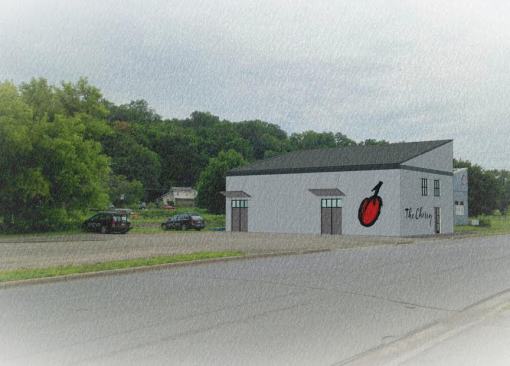
You might recall news of the project broke last winter, followed shortly thereafter by a vote of the city Common Council to subject waterfront and waterfront-vicinity properties to a “Temporary Mandatory Planned Unit Development” (TM-PUD), meaning that any building proposal would be subject to a vote of the Common Council as a stipulation of approval (typically, projects only need the Planning Board’s consent, plus the BZA and/or ILPC if needed). One other project has gone through the TM-PUD process since then, the Cherry Artspace performing arts building. The small experimental theater held its public info meetings at the end of March and mid-April. It enjoyed fairly broad  public support, but two of the eight voting councilmen still voted against its construction at the May meeting. If a a project with widespread support has some trouble getting passage, you can already guess what will happen with the Maguire proposal.

There’s only about a year left in that TM-PUD. But for the Maguires, it was too late as soon as the TM-PUD was passed. Perhaps more concerning, this is creating one of those cases where everybody’s opinion is coming out of the woodwork – some demand it be a park, some say industrial space only, Form Ithaca advocates walkable mixed-uses, and then there was that verbal brawl on the Ithaca West list-serve about the evils of the Ithaca Community Garden. A lot of folks think their idea is the only reasonable option, so if this plays out like the old library site, there’s going to be a lot of acrimony in the long run. Hopefully when the TM-PUD expires, the city will have the new urban mixed-use zoning ready for implementation, so situations like this can be avoided in the future.
20160821_123800

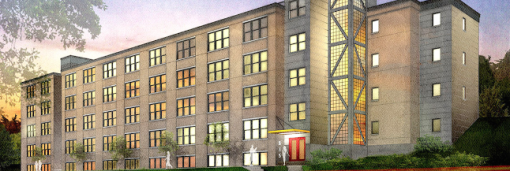
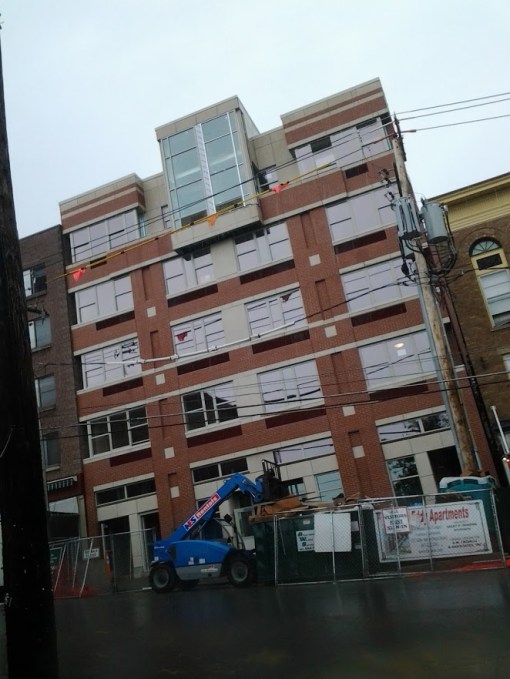
2. Can’t help but feel just a little sympathetic towards Steve Fontana – he tried to have this project open for move-in, and everything that could go wrong, was going wrong. The Journal’s Nick Reynolds reports that first it was a safety systems issue with the elevator holding up the certificate of occupancy, and then a water main burst. The latest planned opening date is September 9th, when the initial date was August 1st. Now it’s a financial issue, a public relations issue, and a mess for all involved. This could be used as an example of why Todd Fox put the 201 College site up for sale – it became clear that August 2017 opening wasn’t going to happen.
201_college_v5_1

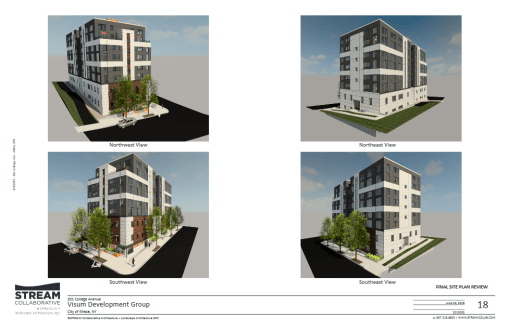
3. On that note, I’m going touch on 201 College real quick. Given the amount of time that went into the Collegetown Form District – six years – this just looks bad all around. On the one hand, Todd Fox could benefit from more patience (granted, we don’t know what the financing situation was), and the character attack on Neil Golder in his supporting documentation turned some people off to his cause. But what John Schroeder did also deserves strong scrutiny. It’s odd to claim a zoning code issue when the MU-1 code is only three pages, and he helped write it. He was also aware that 201 College went through pre-site plan review with the city’s Planning Department, and they gave it the okay to proceed with review. This looks very suspiciously like Schroeder was explicitly looking for anything he could to help out his old colleague Neil, and that small ambiguity was the best he could do, which he was able to parlay with success.

This continues an uncomfortable pattern we’ve seen with other projects like the Old Library where one government body gives the OK, and another stops it after the consent is given. The whole point of these laborious review processes is to prevent controversy from arising. Who wants to take on the risk of proposing condos, mixed-use and affordable housing when, given that many projects require the approvals of multiple boards and committees, there’s a track record of mixed signals?

Rezoning has come up as an idea, but it’s not as simple as it sounds. Spot rezoning (single-lot rezoning) would likely be deemed illegal because the current zoning is consistent with the recently-passed Comprehensive Plan, something the courts look for in zoning lawsuits. Thinking slightly broader, Collegetown’s MU-1 is nine parcels – Fox, Josh Lower and John Novarr, all major local developers, own seven of them. If 20% of those affected by a rezoning proposal file a protest petition, a super-majority of the Common Council – 75%, 8 of 10 in practice – is required for rezoning approval. That is what stopped the first Collegetown rezoning during the Peterson administration. If it couldn’t pass then, a similar super-majority event is unlikely to pass now.

4. On the edge of Ithaca’s South Side neighborhood, the CVS Pharmacy sold for a pretty penny – or rather, $4.09 million, on the 1st. The property is assessed at $1.8 million, but sold for $3.6 million in 2006. The buyer is an LLC traceable to a suburban Boston firm with a broad retail space portfolio, so whether they plan to keep things as they are, or propose something new, is anyone’s guess.

trebloc-future2-1-620x420

5. Finally, a copy of the Site Plan Review application for Newman Development Group’s City Centre project at 301 East State Street in Downtown Ithaca. Keep in mind, this is from the June filing, so things are likely to have been updated or revised in response to the planning board. The 9 story building tops out at 96 feet. The approximate construction cost at the time of the filing was $32 million, with a proposed build-out from February 2017 to October 2019, which seems lengthy, and in another part of the document it says construction will last only 20 months. 400 construction jobs, 50 permanent jobs by tenants in the 10,600 SF of first floor retail, and building service staff. Overall square footage isn’t given, but given the retail and 7,225 SF of amenity space, 160,000 SF probably isn’t a bad first guess. For comparison, State Street Triangle was 288,000 SF, later reduced to the same height and similar dimensions as City Centre. In a sense, City Centre started off where SST required months to get to. Hopefully that bodes well for the proposal.

arpt_pk_1

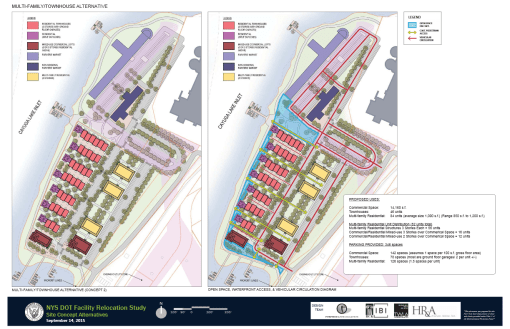
6. Remember that airport business park study from a while back? There’s no strong demand for a business park. But the NYS DOT wants to move their waterfront office and storage facility to the site. So removing those salt sheds and replacing them with mixed-use waterfront property won’t happen until the state buys whatever it needs here, builds and moves in to a new facility. Not sure what they’ll do with the property on Ellis Drive in Dryden that they’ve owned for the past decade; presumably sell it as surplus, but who knows?
chain_works_rev3_3

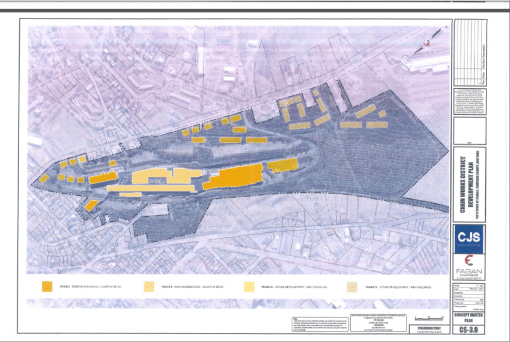
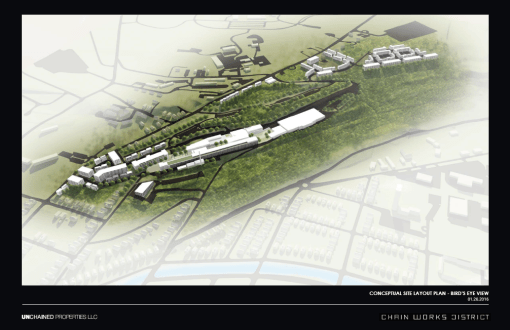
7. From the Ithaca Times: The Al-Huda Islamic Center hopes to start construction on their Graham Road mosque in 2017, and then obtain land for burials later this decade. In other news, new Times reporter Lori Sanken is reporting on the Chain Works progress, the Planning Board requesting color changes, careful consideration of heights, and debates about forest [preservation and Route 96B. Developer Dave Lubin of UnChained Properties wants to do renovations to existing buildings first, but seeing as they have yet to have the state sign off on a remediation place, they’re considering the construction of new buildings first, if NYS DEC approval for remediation gets delayed. And Catholic Charities and non-profit group Ithaca Welcomes Refugees are actively trying to procure affordable living space for 50 refugees who will be arriving in the Ithaca area after October 1st.

pinney_peruville_1
8. It’s been incubating for a while, but it looks like former Lansing town supervisor A. Scott Pinney’s plan for 15 duplexes (30 units) is moving forward. A gravel road will be extended from 4 existing duplexes at 390 Peruville Road (NYS 34B), looping through the property from Scofield to Peruville. The “Developer’s Conference” to talk about the project will be a part of the Lansing town planning board’s meeting next Monday. Also up for discussion are slight revisions to the Village Solars PDA, related to the community center and first-floor commercial space in the proposed Building F.
1001_n_aurora_1

9. From the Ithaca city Projects Memo for September, it looks like there’s a couple of subdivisions planned. One is for 404 Wood Street in the South Side neighborhood, where the owner wants to subdivide a double-lot he has for sale, allowing the vacant lot to be developed for a house or small apartment building. Quoting the application, “Instead of an empty grassy lot, there would be a building on it”. Points for simplicity.

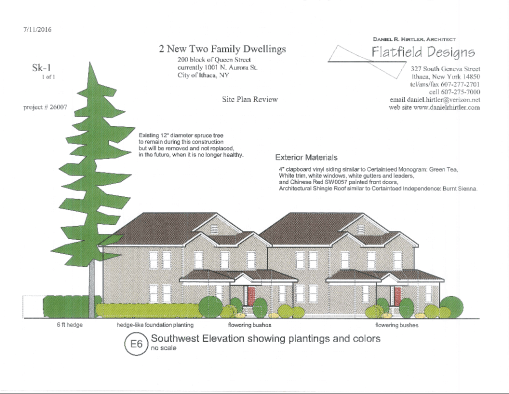
The other is a double lot at 1001 North Aurora Street in Fall Creek. This came up a couple of weeks ago in a weekly tidbits round-up, because the new owner, Stavros Stavropoulos, received a $400,000 loan to build a duplex. Turns out it’s actually two duplexes, which require a lot subdivision, and will trigger planning board review. The application notes that even with the density increase, it’s still less than the surrounding neighborhood. The two two-family homes with have 3 bedrooms and about 1200 SF per unit, and are designed by local architect Daniel R. Hirtler to fit in with the neighborhood. Unusually, the application includes documentation of the previous owner signing off on the redevelopment plan. Construction is estimated to run from this month through May 2017.


The Government Campus

3 09 2016

5-1-2012 120

The idea of a government campus in Ithaca is very intriguing. It offers big opportunities, and potential pitfalls.

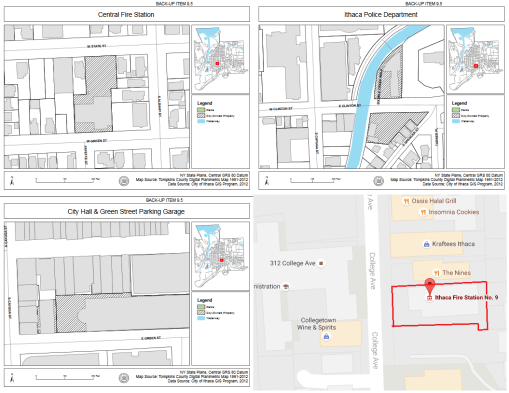
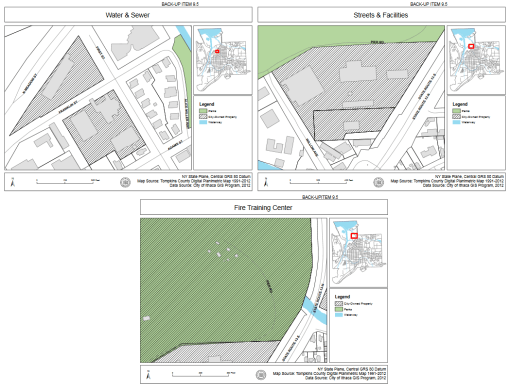
A copy of the funding request can be found here. The $150,000 study comprises two components – the first would combine the Collegetown Fire Station (No. 9), Central Fire Station at 310 W. Green Street, the Police Headquarters on E. Clinton and City Hall into one site on the property of the Central Fire Station. The second combines DPW Streets and Facilities and DPW Water and Sewer into one location.

Given the very profound impact this would have on the city, there’s been relatively little news about it. I cued my colleague Mike Smith in to it, and he did an interview with Planning Director JoAnn Cornish, which led to two articles. The spark notes are that the current condition of some of these properties is poor, so the city is looking at which to consolidate and/or build new, and which to renovate. The money is left over from the study looking into moving Station No. 9 and designing a replacement (apparently, it only cost $80,000 of the $500,000 allotted), so this is the planning department’s shout of carpe diem. The Common Council has given strong support to doing the consolidation study.

Let’s make it clear – there is no commitment anything will happen. Nothing may change at all, Station No. 9 may still move to Maple Avenue while everything else is left as is, or the consolidation plan might actually get carried out. But if they have the money and time, it’s worth exploring the possibilities.

consolidation_study_1

Study one, the “government campus”, involves a space needs assessment for programming and staff, concept site plans, and cost estimates for new facilities. The study will also offer appraisals for existing buildings and discussion of selling these properties:

  • City Hall and the adjacent parking lot to its east
  • The Collegetown Fire Station
  • The Police HQ, but not the Courts Building
  • The Western 1/3rd of the Green Street Garage

Each has its opportunities. The western third of the Green Street Garage has some of Ithaca’s most accommodating zoning for urban projects – CBD-140, a 140-foot building with no parking requirement. When the garage was rebuilt several years ago, only the central section was structurally redone. The western section is nearing 50 years old, so without major renovation, it will be nearing the end of its safe useful life. The early plans for Cayuga Green called for a larger garage on Green Street, so another floor or two on the remaining two thirds is not impossible.

Meanwhile, Ithaca has never been particularly attached to its city hall – the building was built for NYSEG in 1939, and the city bought the building in 1964, demolishing its old city hall for the Seneca Street Garage not long after. In the mid 1980s, the city attempted to sell city hall so that it could be bought by a private owner and leased out to the county, all part of an effort to keep the Department of Social Services downtown – the city failed to persuade the county legislature, which moved DSS out to West Hill until the Human Services Building opened on the 300 block of West State in 1998. Demolition would face significant opposition, but conversion to housing could be a safe option for a hypothetical new owner.

The Collegetown Fire Station is prime real estate. It’s MU-2 zoning (six floors, no parking) in the heart of Collegetown at 309 College Avenue. Given that 201 College sold for $2.65 million, and 215 College sold for $5.3 million, there’s little doubt the city could fetch a multi-million price here. An RFP would have to be cognizant of the fact that the site itself is best-suited to student housing, because not only would its price be limited by other means, non-students may not be comfortable living in a location that’s 95+% students. There could be a provision for housing fund payments or off-site affordable housing at an appropriate location.

The city police station is a question mark. The zoning for the Police HQ and Courts building is B-1a, and the police parking lot is R-3b. R-3b is 4 floors, 40% lot coverage, a parking space for every unit or three bedrooms, whichever is greater. B-1a is nearly the same, but with 50% lot coverage, but the Courts Building could make selling a tough prospect.

Now comes the question of the Central Fire Station redevelopment, which occupies much of its site on West Green. A back-of-the-envelope for the police HQ, fire station No. 9 and City Hall is about 48,000 SF (assuming police uses make up half of the courts complex). The Central Fire Station occupies 17,000 SF. So you’re asking for a sizable multi-story building on top of what’s there, and not counting impacts like parking. The city would need to be careful, as South Side is one of the more affordable areas and the risk for displacement of low-income households is considerable. Any project would also have to go through ILPC consideration since it borders historic properties.

consolidation_study_2

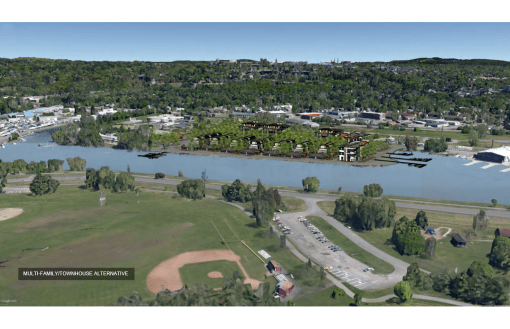
Study #2, the DPW consolidation, also offers opportunities. The study calls for a consolidation at a new location in Southwest Ithaca down by the box stores. It involves a space needs assessment for programming and staff, concept site plans, and cost estimates for new facilities. The city says it may also consider a shared facility with the town of Ithaca, or the county. In such a move, the city frees up space that it could sell on the North Side, and opportunities that could enhance redevelopment efforts on the Waterfront. The Northside area is also one of the new parts of the city where affordable housing is feasible and accommodated by neighbors, so mixed-uses with market-rate and affordable housing is plausible. The Pier Road area has high water tables which could drive up foundation (construction) costs, but Form Ithaca highlighted redevelopment potential at the site during their charettes.

Anyway, this is a lot of handwaving. Any work would be far, far off, probably well into the 2020s. A lot can happen between now and then – the economy tanks, priorities change, the sale of any property ends up a big debacle like the county’s Old Library redevelopment. It could make the city a lot of money in sale and taxes and help continue the downtown renaissance, or if done wrong it could end up being a burden that hurts taxpayers as well as lower-income households. But it’s certainly an interesting topic to explore.


News Tidbits 8/13/16: The Forward Advance

13 08 2016

201_college_v5_1

1. In the news, Neil Golder’s lawsuit against the planning board and the 201 College project was dismissed on technicality. The Tompkins County State Supreme Court decided that since the lawsuit was based on preliminary site plan approval and not final site plan approval, the project was subject to further changes and that it wasn’t appropriate for the court to hear this case at this time. So in other words, Neil will probably file his lawsuit again if/when final approval is granted, since changes between preliminary and final are unlikely to be significant. The scorched earth approach will likely continue.

It’s going to be a couple of weeks before that happens. In what the Times described as “an odd move”, the project is heading before the BZA for a zoning interpretation. Even the city’s planning department director, JoAnn Cornish, thinks it was a strange move on the board’s part, and one that kind of upends her department’s authority since they had looked at the facade length and decided it fit the zoning. More about the planning board’s (John Schroeder’s) odd decision and reasoning here.

waterfront_concept_aerial_1

dot_concept_1

2. Looks like there’s a twist in Tompkins County’s plans to redevelop the NYS DOT site on the Ithaca waterfront. The DOT is no longer looking at moving to Enterprise Drive in Dryden, even though they bought the land there in 2005. Now they’re looking at a site along Warren Road up by the airport. So close to the airport, in fact, they apparently needed the Federal Aviation Administration (FAA) to sign off on it. The FAA has agreed to a location and the DOT is working out a long-term property lease. The cost of moving is now estimated at $11-$12 million, slightly less than the $14 million estimated for the Dryden location in the Fisher Associates study, but estimates being as they are, it would be prudent to keep an eye on those projections.


3. The Dryden town planning board recently reviewed plans to convert the former Stevens Furniture at 2085 Dryden Road into an auction house specializing in books. The 10,000 SF would be renovated with no substantial exterior modifications. It’s a fairly small, unobtrusive plan, and by itself not much of a write-up.

However, this project is being proposed by Danby’s David Hall. The same David Hall who wanted to create the Summit Enterprise Center on Danby’s Gunderman Road, and led to all sorts of rancor among town residents and officials. His company, National Book Auctions, was to be one of the tenants of the business center. Danby’s planning board notes are online up to June only,  so the question is, is the Danby plan still moving forward and this is a case of filling a pressing need, or is the Summit project done and out?

123_eddy_street_1

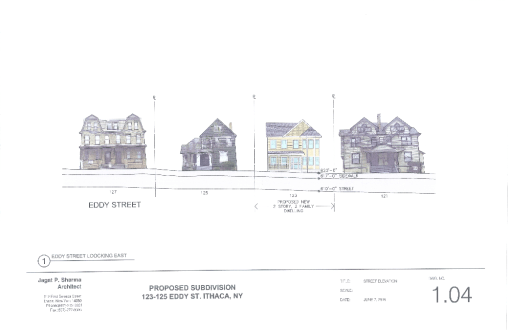
4. For this week’s eye candy, here’s the first image of the two-family home that Collegetown landlord Nick Lambrou wants to build at 123 Eddy Street. Jagat Sharma is the architect. The land is currently a double lot with 125 Eddy, and at present it’s part of the lawn. A planned subdivision would create a building lot on which Lambrou could put up the home. As part of the East Hill Historic District, the design has to pass ILPC muster, and at a glance, the projecting window bays (not sure they meet the definition of bay windows?), porch and comparably-pitched roof should help.

Note the lack of a garage. The street is up to 13 feet below the houses on that block, and there are no off-street parking spaces planned for either of the 3-bedroom units. The BZA would have to grant a zoning variance for a deficiency of two spaces.

tiny_timbers_1

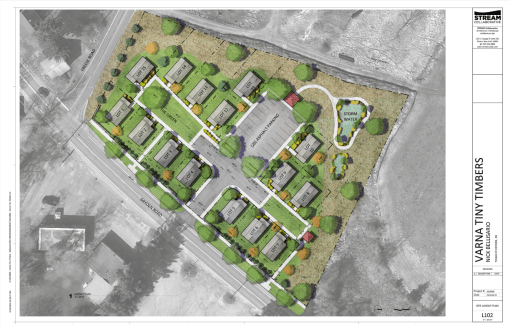
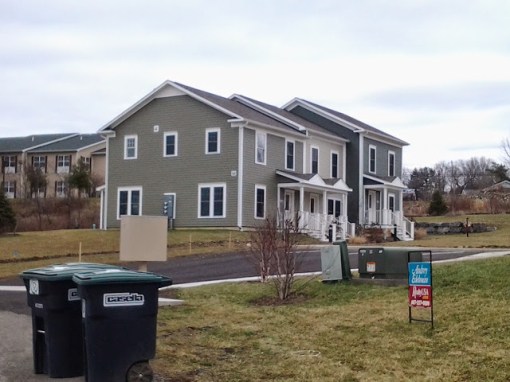
5. Tiny Timbers and the Evergreen Townhouses were both up for review by the town of Dryden’s Planning Board. Tiny Timbers once again had only a few minor quibbles among board members, who voted to approve the sketch plan and send it to the Dryden ZBA. The Evergreen Townhouses had much more resistance, but the PUD concept was approved with some stipulations on fleshing out the project further before it may continue in the process. In Dryden, the town board gives final approval to project proposals, so both of these are moving along, but not fully approved just yet. In the meanwhile, Tiny Timbers is finishing construction on prototype #2.

6. Someone’s had a busy week. On Wednesday, a Rochester-based LLC picked up the Chateau Claire Apartments, a ca. 1960 64-unit apartment complex in the village of Lansing, for $5.3 million. The same day, a second Rochester-based LLC picked up the adjacent 37,400 SF shopping center for $1.3 million. The properties are collectively assessed at just under $6 million, so the purchase price seems pretty reasonable for a decent if not especially desirable stretch of property.

With a little digging, it turns out under the LLCs, the sellers were the same for both, and the buyers the same for both. The sellers were the Goldberg family who owned Bishop’s of Ithaca, a home improvement store. After enjoying success with growing Bishop’s into a small chain, Stan Goldberg turned to development and was a major local developer from the ’60s through the early ’90s. He sold Bishops to his employees in 2003, and passed away last year. The buyer was Park Grove Realty, a startup real estate firm out of Rochester staffed by former Conifer LLC employees and making waves for proposing a 140-unit apartment complex on Bomax Drive two miles away. A little piece of old Ithaca fades, and a newcomer makes their first foray into the region.

Park Grove has taken out a $1.14 million construction loan to renovate the Chateau Claire units – kitchen and bathroom remodeling, washer-and-dryer installations, roof repair, new balconies, gutters, landscaping and lighting.

canopy_comparo_elevations_new_2

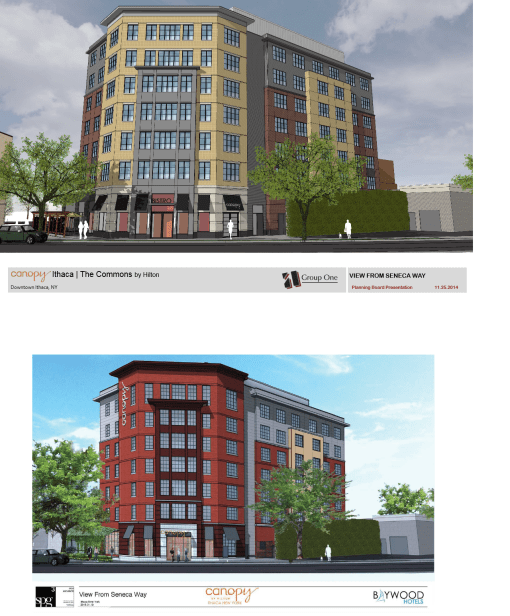
7. And the other big sale(s) of the week, also from Wednesday – Ithaca Downtown Associates LLC, the Patel family, finally purchased the properties for the 131-room Hilton Canopy hotel project. $1.8 million to the IURA for the parking lots at 320-324 East State Street, and $2.05 million to local landlord Joe Daley for the parking lots on the former Strand property at 310-312 East State Street. This marks a big step in moving the 77,800 SF, $20+ million project forward.


News Tidbits 7/23/16: Movers, Makers, Shakers, and Breakers

23 07 2016

1. Hitting the market late last week – a small office building with potential. 416 Elmira Road is located on the southern edge of the big box district, right next to the “bridge to nowhere” and a little before Buttermilk Falls. Built in 1988, it’s a one-story 4,000 SF building on 0.32 acres, inoffensive to the eye but fairly humdrum with a CMU exterior. The current owner is a spinal surgeon in Delaware who picked it up in 2009 for $500k. Previously, the building served as the local office for a state agency.

One could pick the building up if they wanted offices in a high-traffic area, although a few options present themselves. The zoning is SW-3 = SW (SouthWest Area) is a sort of catch-all for business types allowed under Ithaca zoning, with SW-3 geared towards smaller suburban box retail. That is a possibility here, although there wouldn’t be much parking on-site. Housing is an option here as well, although perhaps not appealing since the zoning is capped at two floors with 60% lot coverage. The list price is $585k, we’ll see what happens.

750_casca_1

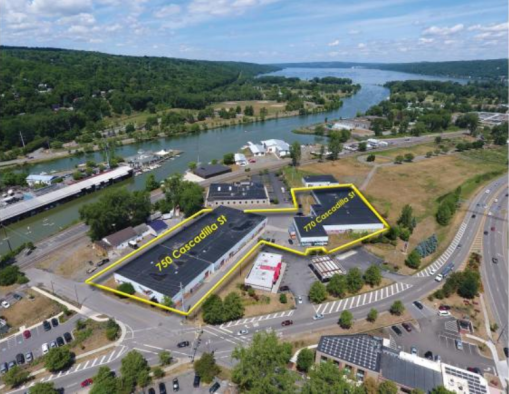
2. …and item number two, hitting the market this past Wednesday, and probably the far more interesting of the two listings in this week’s update. Cornell has put their West End printing facility and warehouse up for sale. The Big Red seems to be trying to rid itself of excess properties in the past few weeks, having recently listed partially-developed land it has off Triphammer as well. The 37,422 SF Cornell U. Press facility at 750 Cascadilla Street was acquired by the university in 1993, and is valued at $1.6 million by the county. The other warehouse, 30,000 SF 770 Cascadilla Street, is leased by a storage company from Cornell, who purchased the building in 2000, and is valued at $1.2 million. The listing is $2.7 million, so these two properties and the 3.12 acres they sit on are being marketed below assessment.

This part of the city has attracted quite a bit of attention as of late. The Maguires are quietly working on their plans for a new set of dealerships to the north and east. Form Ithaca has envisioned keeping the warehouse properties intact, but reusing and renovating them into “maker spaces” as part of an “Innovation District” for food processors, technology firms and light manufacturing. The land itself is zoned industrial, but the city’s comprehensive plan calls for waterfront-focused mixed-use, so in practice the zoning is obsolete, due to be updated as the city continues with neighborhood-specific comprehensive plans over the next 12 months. That sort of creates a grey area where, if a potential buyer has a plan in mind, they’d probably be better off pitching it to City Hall and JoAnn Cornish first, and gauging reactions.

312_spencer_2 312_spencer_3

3. Well, this was pretty quick. Local developer Charlie O’Connor of Modern Living Rentals has secured funding for his 2-building, 4-unit project at 312-314 West Spencer Road, on vacant land subdivided from two existing houses. The two two-story duplexes received a $250,000 construction loan from Bryan Warren of Warren Real Estate on Friday the 15th. Noah Demarest designed the two stacked flat-type apartments, three bedrooms per units. SPR documents stated an August 2017 opening, but with this funding in hand, it might be sooner.

4. Also receiving a construction loan – $450,000 at 322-24 Smith Road in Groton town, the site of a “canine events center“. The Bank of Groton is the lender. The 17,320 SF facility was built last year, so either this is some other site improvement, or the filing is really late. Also, canine event centers are a thing. The more you know.

201_college_v5_1
5. This could be called a “scorched earth” approach. Neil Golder has a lawsuit against Todd Fox and the city of Ithaca Planning Board over the 44-unit, 74-bed 201 College project, saying the decision was capricious and that the project should require an Environmental Impact Statement (EIS). The court’s ruling will be released August 8th.

I’ll be frank – while this project matters a lot to Neil, as proposals go it’s a fairly routine midsize ($5 million -$15 million) project, like any of the other Collegetown buildings underway, like Hancock and Stone Quarry, like the Old Library site, the Carey addition or the Hotel Ithaca addition. The board declares lead agency for SEQR/CEQR review, they identify issues, and it’s the applicants responsibility to resolve them to the board’s satisfaction. If that has been done, a negative declaration is issued, and approval can be considered, as is the case here. An EIS only comes into play for projects that pose truly significant detrimental impacts to a large population if the issues aren’t effectively mitigated – hence why Maplewood Park, Cornell’s 880-bed housing development, and the multi-million square-foot Chain Works District are the only two active projects required to complete an EIS. Past precedent suggests Neil doesn’t have much of a case.

We’ll file this with the Times’ write-up about the fight over the Old Library, and the fight over Maplewood. Short summary, everyone’s on the warpath this week.

20150613_175047

6. This week was focused on doing write-ups about the county housing study for the Voice, but that was before the county pulled nearly all the materials offline. Boo, Tompkins. Anyway – here’s a few details from the special needs interviews that I had planned sharing in this update – Catholic Charities has procured a 4-bedroom house, INHS’s Paul Mazzarella says his organization is looking at introducing a new project in 2017, and TCAction has early plans for a second, 15-bed facility, separate from their Amici House project.

7. The town of Ithaca is planning to put out a “request for qualifications for professional services” to conduct an economic feasibility study of the Elmira Road / Inlet Valley corridor southwest of the city.  The official vote to move forward will be at the Tuesday meeting, with bids due by some point in September. The $60,000 study (half town, half NYS ESD) will be an economic feasibility study and development plan designed “to enhance its distinct characteristics by fostering and building on the assets that currently exist, rather than enabling expansion of the city’s urban and regional development”. In other words, the town would like to expand on its idea from the Comprehensive Plan – artisanal and cottage industries, “maker spaces”, some lodging and light industrial. We’ll see what they come up with, which will have to relate to the new form-based code the town is planning to implement.

trebloc-future
8. Fairly light agenda for the city planning board next week – not a whole lot of decision making expected.

1.        Agenda Review     6:00
2.        Privilege of the Floor    6:01
3.        Site Plan Review

A. Rooftop telecommuncation facility on top of Island Fitness – Declaration of Lead Agency, public hearing, Determination of Environmental Significance, Consideration of Preliminary & Final Site Plan Approval
B. 201 College – “No Action — Applicant’s Response to Site Plan Review Issues”. Originally this was supposed to be final site plan approval, which may or may not be impacted by the whole lawsuit spiel.
C. City Centre (shown above) – “No Action — Applicant Response to Planning Board Comments”
D. SKETCH PLAN: Amici House — Tompkins Community Action Expansion at 661-711 Spencer Rd – I had heard this one might be four floors, and INHS has a hand in it. We’ve seen the site plan for a while now, so this isn’t going to make a big splash.


News Tidbits 7/9/16: Land Ho

9 07 2016

waterfront_foreclosure_parcels_0516

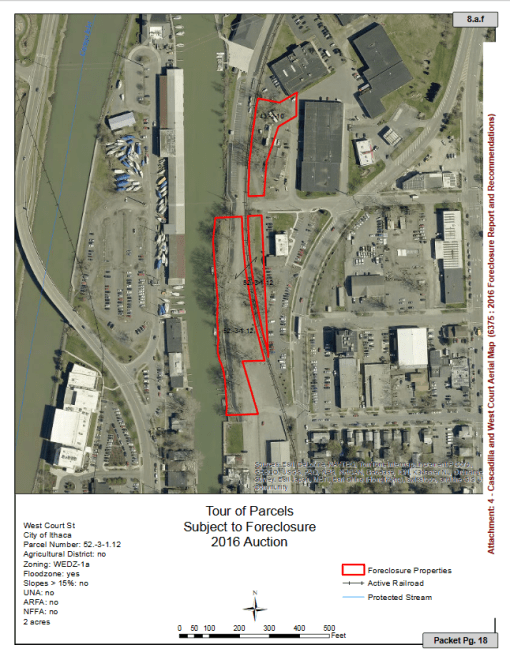
1. Starting off this week, a couple of new pieces regarding Ithaca’s waterfront. First, the city’s chances of picking up some prime waterfront real estate at a low, low price are gone, though not any fault of their own. Readers might recall that back in late May, the properties were about to be foreclosed on for unpaid taxes, and the county was discussing selling the parcels, worth over $630,000, to the city if the city paid off the $42,844 tax bill. Pretty sweet deal for the city, right?

But the owner, an LLC that has held the parcels since the late 1990s, managed to pay off the tax bill and an attached penalty fee, which means they get to keep the land. So, if the city had any plans for those parcels, they’ll be filing those away for a long while.

2. However, it looks like several properties are being put up for the sale in the city’s West End near the Waterfront. Local realtor Brent Katzmann has four properties listed – 321 N Fulton, a duplex on 0.11 acres for $144,800; 319 N Fulton, a single family on 0.04 acres for $109,875; 626 W Buffalo, a single family on a narrow and deep 0.15 acre lot, for $124,999; and 622 W Buffalo, a duplex on a narrow and deep 0.19 acre lot, for $134,800. The prices generally run at or up to 10% over the tax-assessed value ($130,000/$100,000/$125,000/$125,000). The currently owner is a Long Island-based LLC, led by a pair of New York City real estate lawyers, who acquired the properties from 2010-2012. Prior to them, many of the properties have been through a merry-go-round of owners over the past 10-15 years.

The properties are in fair to rough shape, and the marketing tactic being used isn’t renovation, but rather development potential. The four properties all fall within WEDZ-1a zoning, which is the city’s attempt at encouraging development on the West End. WEDZ-1a permits residential, commercial and mixed-use 2-5 story buildings, 90% lot coverage (100% if less than 50 feet on two sides – the Buffalo parcels and 319 N Fulton), and no parking requirement. The properties are not affected by the city’s TM-PUD.

The West Buffalo lots could be tough since the house in-between is owned by someone else, but deep lots and the corner of North Fulton and West Court offer some potential. Worth keeping an eye on, if only to see who they sell to.

20141227_140754

3. One less homebuilder around. Avalon Homes is closing up shop. The Ithaca-based company is selling off its lots and trying to wrap up the homes they have underway. Rumors abound as to why, but if firm, verifiable information can be obtained, there will be more to follow.

Avalon made its name doing stick-built built, with a focus on affordability and green construction. Avalon, a certified Living Wage employer, was the general contractor for INHS’s Holly Creek townhomes (shown above), and employed at least a dozen back in 2010.

old_library_thp_v4

old_libe_thp_holt_v6

4. The Planning Board and the Ithaca Landmarks Preservation Commission will be conducting another joint meeting on Tuesday the 12th at 5:30 regarding the Travis Hyde Properties’ proposal for the Old Library. HOLT Architects responded to comments from the ILPC at its last meeting that the design needed to be “quiet” by submitting the revised elevations seen below.

Mission accomplished? Armchair architect comment here, but the revised design is too far the other way. There’s a joke about the color beige, coincidentally similar to the new brick, being an adjective for “dull, boring, indistinctive“. I like the previous design with its wood-like fiber cement and characterful roofline, and I wonder if perhaps a revised color palette of that design, with maybe a few less full-sized balconies, would be a happy medium.

5. As announced on city of Ithaca Mayor Svante Myrick’s Facebook page, the Namgyal Monastery Institute of Buddhist Studies will be the site of a library and museum of the Dalai Lamas, the first of its kind outside of Tibet. The facility would be located on the 28 acres Namgyal owns on South Hill at its Du Khor Choe Ling monastery complex. Architectural plans and costs are still being determined, but a quote from Ngawang Dhondup, administrator for Namgyal’s facility, says that it will be larger than Namgyal, which has been underway since 2007 and will be about 14,500 SF when completed.

All in all it’s a great feather in Ithaca’s cap, but two things to be a bit wary of moving forward are the reactions and possible opposition from neighbors to what will be a very high profile religious facility, and given geopolitical issues, the reception to the Library of the Dalai Lamas may not be so warm from some denizens of cosmopolitan Ithaca.

12-29-2011 003

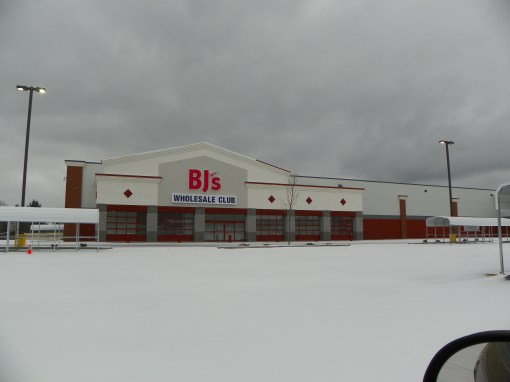
6. Way back in 2010 and early 2011, when the BJ’s Wholesale club was proposed in Lansing, one of the components of the proposal was to build 12 units of senior housing on land north of the then-proposed store. The project also called for wetlands, walking trails and a bird sanctuary on the undeveloped portion of the 11-acre property. Developer Eric Goetzmann (Arrowhead Ventures/Triax Group) faced considerable opposition to the plan since it involved big box retail and was housing outside of the density corridor, but after the IDA initially voted the project down in December 2010, a revised application calling for a smaller PILOT was passed by the IDA in April 2011 (some of the logic being that the county was in a financial bind during the recession, and some increase in taxable property was better than none).

Well, the BJ’s was built and opened the following year, but the wetlands and housing have had a much longer slog. The U.S. Army Corps of Engineers in in charge of new wetland permits, and the process is a complex, arduous one (man-made wetlands are difficult to build, and the Army Corps would rather they be done right than done fast). Goetzmann teamed up with The Upper Susquehanna Coalition and The Wetland Trust to design the “Inland Salt Marsh Bank”, which was just approved by the Army Corps, and the final permits expected shortly. With the wetlands taken care of, Arrowhead can begin to look towards the housing component, which they plan to put forward later this year for a 2017 construction date. As part of these plans, they want a one-year extension on the legal construction start for the housing from the IDA. Given that Arrowhead has met the other criteria and can demonstrate proof of progress on the wetlands, this probably won’t face much opposition. But eventually, it looks as if the village of Lansing will finally get those 12 units of senior housing.

biggs_1

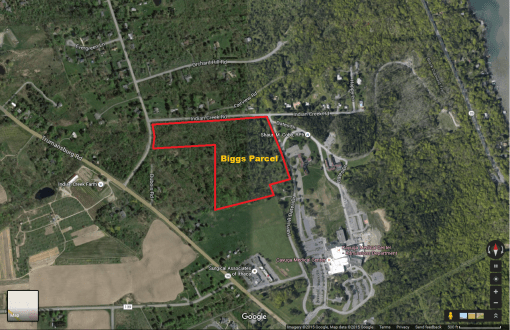
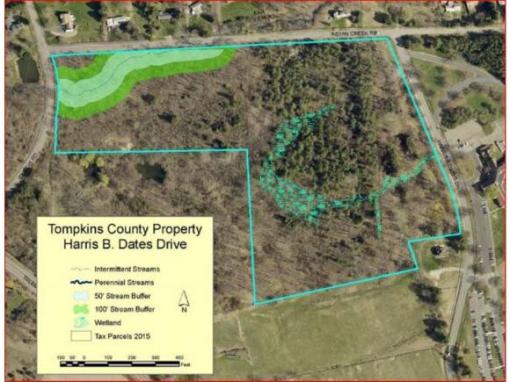
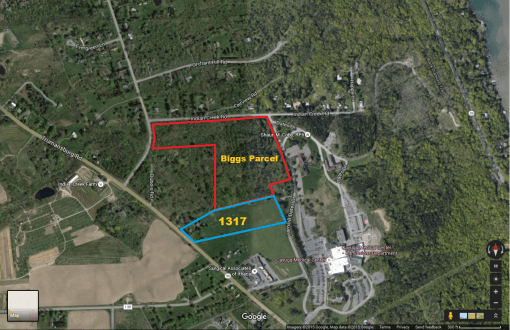
7 It looks like the Biggs Parcel is officially listed for sale. Local realtor CJ DelVecchio was selected by the county to manage the listing for the 25.52 acres near Cayuga Medical Center. The asking price is $275,000. The land comes with a conservation easement on the northwest side due to its proximity to a stream, and the wetlands near the center would be tricky to work with, because wetlands typically can’t be developed unless new wetlands are created, which is not cheap or easy to do.

c507

Readers might remember that this parcel has quite a history behind it. Declared surplus land by Tompkins County, the county had set up a tentative deal for a 58-unit affordable housing complex on the property, but the deal fell through after the wetlands were discovered to cover more area than previously thought.

Neighbors, via the Indian Creek Neighborhood Association (ICNA), have tried to force the county to hold onto the land to keep it from being developed. One of the big sticking points had been whether or not the 25.5 acres would be taxable – the county isn’t especially concerned at this point if the land gets developed or not, but they have made it clear that they want to sell it to a private owner that will pay taxes. The problem is, proposals to preserve the land often dovetailed with plans to donate it to an organization like Finger Lakes Land Trust, which would render the property tax-exempt. The ICNA did end up making a closed bid for the property, but the offer was rejected.

A neighbor to the south did propose reconfiguring the property to preserve the woods and build cottages on his back lot – by adding the Biggs land, he could have built more units under the regulations of the cluster zoning. But the plan fell through due to “size and complexity”, according to the ICNA’s Linda Grace-Kobas.

The land had been valued at $340,000 before the discovery of the additional wetlands, and the revised 2016 assessment brings that down to $240,000.


News Tidbits 5/28/16: A Battle Between Neighbors

28 05 2016

201_college_v2_3

1. It seems the Planning Board had something of a philosophical crisis at their meeting, per the Times’ Josh Brokaw. The cause of the crisis is Neil Golder, Todd Fox and 201 College Avenue. Here’s the backstory.

201 College is a 2.5 story, 12-bedroom house on the corner of College and Bool. Local developer Todd Fox has a proposal on the boards for a 5-story apartment building (shown above). Neil Golder lives next door at 203. He moved into 203 in 1972 when he was a grad student at Cornell, bought the place in the early ’90s, lived there with his partner Kathy until she passed a couple of years ago. He still lives there, and rents out spare bedrooms.

201 and 203 were rezoned as part of the 2014 Collegetown rezoning to MU-1. This came only after years of debate, and Neil was one of the residents who pushed to have the properties rezoned in 2009 with a payment in lieu of parking scheme that upset a lot of the landlords, who mounted a significant legal challenge that prevented the rezoning from happening – more about that can be found in this Voice explainer.

For the record, Golder has never been much of a fan of development in Collegetown. His two big things have been that density is bad (but he seems to have mellowed on this issue since the parking push in 2009), and that Collegetown needed a grocery store. He was supportive of Collegetown Crossing because the developer (the Lowers) live next door at 205 and Greenstar will be opening a grocery store on the ground floor.

So, back to the zoning. There are nine MU-1 properties. The four between Catherine and Cook belong to Novarr – he has not expressed any intent to redevelop them. The other five are 215, 209, 205, 203 and 201 College Avenue. Novarr has expressed intent to redevelop 215 starting in late 2017. 209 is Grandview House, a historic landmark, and pretty much untouchable. 205 is Lower’s house, 203 is Golder, and then you have 201.

201 is the southernmost of the nine, and therefore most likely to stand out. The thing is, zoning consistent, when development happens organically, it means the parcel most likely to stand out isn’t necessarily the last one to get developed, nor will it necessarily be the smallest. In this case, the physical transition is from 2.5-3.5 story houses, to 5-story apartment, to 2.5 story house, and then a 3.5 story house and 5-story boarding house.

As of right, Todd Fox can build up to 5 floors and 70 feet tall as an average height. The site slopes slightly, so the building is shorter on the north side than the south side. The design fits the zoning – but it has to go to the BZA for a couple of minor area variances, one for entrances off of Bool, and the other, the board requested the project incorporate – the building was moved northward slightly to allow for street trees and a wider sidewalk on College Avenue. The May agenda noted that the Board had no concerns with either variance.

Golder has sent letters to the Times and the Voice (directly to my colleagues Mike and Jolene but not to me, interestingly), he has been stopping people on the street to sign his petition, he’s tried the ILPC, Planning Board, Historic Ithaca, friends in city government, even the city forester, everything and everyone he can to try and halt the current plans, but there has yet to be a compelling, objective counter-argument.

Countering some of the claims in his many letters, the individual pine trees at the front are not historic landmarks or city-owned, the city has to review and approve of construction plans anyway, and the traffic issue had already been discussed back during the rezoning. The developer has agreed to push the building back, which will give more visibility to Golder’s driveway, and a curb bump-out at the corner is proposed as part of the project. So that leaves the aesthetic argument of “I don’t like it”, which puts the Planning Board in a really difficult spot because as long as the form districts say the design is fine, that argument won’t stand up to a legal challenge.

There is a strong argument with his solar panels, which have been a part of broader discussion within the city. 201’s height would marginalize Golder’s solar panels, so in that case the project causes non-subjective hardship; this could be mitigated if 201 has solar panels (they are being considered) and shares electric, or by other compensation. Although, it might depend on when the panels went in, before or after rezoning. If people start rushing to put up solar panels as a back-door method to thwart development, the city’s going to step in.

So here’s the essence of the issue – after years of fighting over zoning, and finally settling on a compromise in 2014, the city is faced with a development that is legal, but it’s vehemently opposed by a venerable and high-profile neighbor, where the objections can be effectively mitigated, but not necessarily the way he wants them to be. A planning board member has to find the balance between allowing everyone to have their say, and acknowledging valid issues that should be addressed, without letting individuals exert too much control over their neighbors and infringing on property rights.

waterfront_foreclosure_parcels_0516

2. Okay, onto other things. The city might be acquiring a couple of sizable West End/Waterfront parcels from the county. The properties, which consist of a pier/boardwalk, informal parking and vacant land, are located at the end of West Court and Cascadilla Streets, and are being seized as a tax foreclosure. The county is looking at selling them to the city in exchange for the $42,844 in back taxes. The larger one is 2 acres, the smaller 0.6 acres, and in total they’re valued at $630,000. The owner, an LLC, picked them up for $156,625 in 1999.

If the city picks them up, they’ll be filed into the IURA’s holdings for potential sale down the line. As it is, the parcels have issues – the railway, accessibility, and soils down here are known for being difficult to build on. But in the long term, there’s potential for water-focused amenities, private development, or a combo of the two. It looks like a good investment given the city’s still-in-the-works plan to encourage redevelopment of the West End and Waterfront, so this is worth keeping an eye on as things move forward.

402_s_cayuga_st_boggsfernandez

3. The IURA reviewed funding proposals for affordable housing earlier this Spring, and the minutes are now online. the duplex at 622 West Clinton, and the affordable unit with the 4-unit 402 South Cayuga project were not funded. The IURA is encouraging 622’s applicant to re-submit for next year, and the minutes note that 402 is likely to still go forward, but without the affordable unit.

It’s also been noted that there is some discontent with INHS because the cost of their projects are coming in high, and that they would like more diversity in applying entities. However, the seven townhomes at 202 Hector and the single-family house at 304 Gector (all for-sale housing) are fully funded. The Habitat for Humanity duplex on the 200 Block of Third Street is also fully funded.

rumble_seat_1

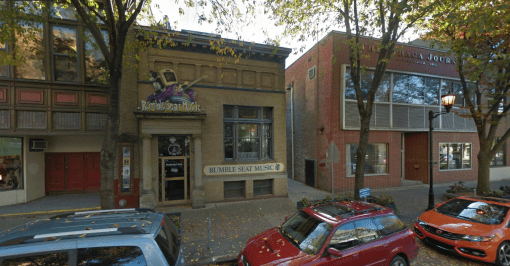
4. Another piece of news from the IURA – the new occupant for the Rumble Seat Music building. It appears to be a drink bar called “Watershed Union“, serving coffee and juice by day and adult beverages by night. Five or six living wage jobs would be created. There might be some grumbling over the moral evils of alcohol, but the business plan has the support of neighboring businesses and the Downtown Ithaca Alliance.

Also, the Canopy Hilton is still moving forward. But are doing a minor LLC ownership change to allow another Patel family member to be a part of the ownership team.

5. Hitting the market this week, for all those big-potato investors out there – the Belmont Townhouses at 324 Spencer Road. The listing from local realtor Brent Katzmann has the price set at $2,595,000, for a 14-unit complex that opened in 1995. The posting mentions the possibility of a 1031 Exchange, which allows an individual to sell a currently-owned investment property, and buy a new investment property of equal or greater value while avoiding capital gains taxes – continuity of investment locks up the profit gained from sale.

20160522_160150 20160522_160211
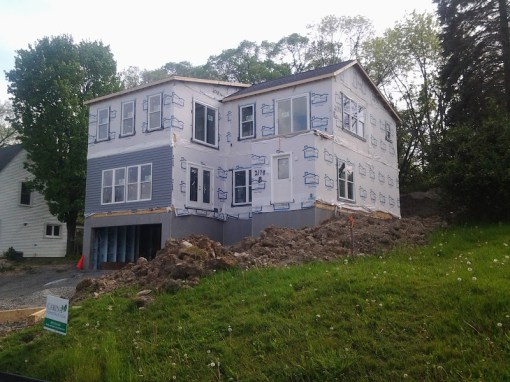
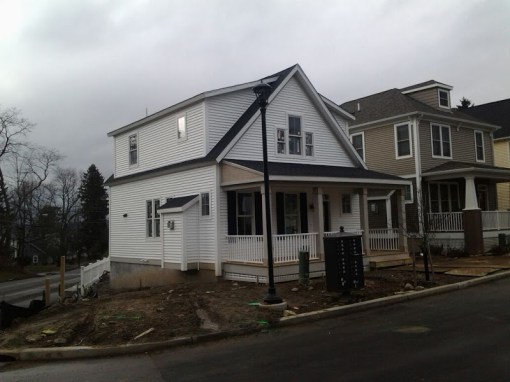
6. House of the week. This house is on the 100 Block of Campbell Avenue on Ithaca city’s portion of West Hill. This home is being built by Carina Construction, an Ithaca-based modular home specialist. The foundation and garage were poured and the pieces were probably craned on and locked together sometime in the past few weeks – a little bit of siding has started to show up on the front. The process is a lot like the one Carina used to assemble the Belle Sherman Cottages across town.

Color me impressed, the design is unique, and once exterior details like the porch and second-level deck go on, I imagine it’ll look really nice. Tompkins Trust lent $280,000 back in April, and the construction permits were issued not long thereafter (the total project cost is in the $320k range, per the permit filing). The land was created in a lot subdivision last year, and sold for $35,000 last August.


News Tidbits 5/7/16: Everything’s Political

7 05 2016

815_s_aurora_night

1. Let’s start with government. The city of Ithaca passed revisions to its cell phone tower law reducing the no-build fall radius from 200% of height, to 120% of height. The 120% was decided upon after a check of other municipalities, where it was generally the most common figure.

The change allows development to proceed on the grassy field at 815 South Aurora Street on South Hill, although as mentioned last week, the fall zone revision isn’t as much as developers Todd Fox and Charlie O’Connor had hoped for. But it’s still enough to work with; according to Josh Brokaw at the Times, a revised plan that meets the new guidelines could be going to the planning board for sketch plan review in June, possibly with more units than the 87 studio units initially planned. It was also reported that the local neighborhood group (South Hill Civic Association, SHCA) is comfortable with the initial plan, so this might be a relatively smooth process when the project is ready for review.

2. Meanwhile, while one thing moves forward, Dryden’s been hit with a major setback. The Pinckney Road parcel sale in Dryden was foiled when voters, in a 1188-936 vote, rejected the town’s plans to use recreation reserve funds to purchase the 15 acre property. The town would have spent about $56,800 of a fund that has over $300,000, and the county would have contributed $15,000, so that the town could have turned it into park space in the long-term. The town was prepared to buy the property, but residents opposed to the sale managed to get enough signatures on a petition to force to to go up for a vote.

It sounded like a worthy and reasonable plan. But I get the feeling that there were a lot of folks who figured it would pass by a wide margin, so they just didn’t vote. In a marketing course a while back in college, I remember the professor sharing an interesting statistic – versus feeling neutral, the general public is three times more likely to support an initiative when they really like something, and nine times more likely to vote or speak out when they’re really opposed. People are more driven by aversion than reward, and that’s probably what happened here.

20141227_134402

3. Sticking with local governments, the town of Ithaca is set to vote on a moratorium on duplexes, but with some modifications from the initial proposal. For one, given construction seasons revolving around the warm season, and the time it takes to plan and get permits, it was decided to make it only nine months (January 2017) instead of one year, so that they could limit the possibility of dragging it through two construction seasons. And although the town planning committee chair wasn’t on board with it, an exemption is in place if one of the units will be owner-occupied. If their goal is to revise the approach to student housing, then at least these amendments fix or lessen some of the bigger issues a moratorium would produce.

https://twitter.com/streamcolab/status/657329991827509248
4. Just a wee bit more info on the “Tim Timbers” planned for the corner of Freese and Dryden Roads in Varna. The tiny houses are small though not micro-sized – they’re expected to be about 800 square feet. Local architecture firm STREAM Collaborative is working with businessman Nick Bellisario on the 16-lot subdivision and home development.

waterfront_concept_aerial_1waterfront_concept_mf_th_SP_1

5. So the full 206-page, $78,000 NYS DOT waterfront redevelopment study by Fisher Associates is on the city’s website. The initial results were shared here back in October, but the final product has some additional, very interesting details.

waterfront_concept_timeline

One of those additions is a potential timeline for development. It calls for getting official support and commitments over the next several months, issuing an RFP later this year for the new DOT facility in Dryden, and issue an RFP for the NYSDOT waterfront site later this year, with review in Q1 2017 and developer selection in Q2 2017, assuming this doesn’t end up like the Old Library debate. The DOT would move to Dryden in Q3 2018, and the excess state land would be transferred to the county, sold in Q1 2019, and ready for occupancy by mid-2020.

The other really interesting new section is Appendix 5, stakeholder outreach. This consists of interviews with city officials and nearby property owners – Cornell (who say they have no plans for their waterfront properties), the Farmer’s Market, and some smaller businesses and organizations. The gist of the comments had more to do with Farmer’s Market than the DOT – namely, heavy traffic issues, needs more parking, and needs to physically expand to accommodate a waiting list of vendors and cool-season operations. There are early plans incubating for a nearby indoor market facility, if memory serves right. As for the DOT site, the mixed-use plan was deemed most favorable, and the stakeholders agreed that the site had great potential for redevelopment.

warren_medical_lansing_1

6. Looks like marketing has started for a proposed new medical office building in the village of Lansing. The new one-story building, which appears to be designed by Binghamton-based Keystone Associates, would be off of Warren Road, although it looks like the building would be accessed from a driveway coming off of Uptown Road. The 2.71 acre property is zoned “Human Health Services District” by the village, and borders undeveloped land owned by Cornell, and several other suburban medical office buildings built over the past few decades. The resolution on the attached site plan is too low to determine the square footage, though it looks to be in the low tens of thousands.

The property was purchased by Arleo Real Estate from Cornell for $378,600 in October 2014. Arleo Eye Associates owns and occupies the neighboring building to the south. Arleo built their 7,119 SF optometry office in 2007.


The Future is Now? Another Look At Form-Based Zoning

9 02 2016

It looks like plans are starting to come together for the form-based zoning that is being considered for the Town of Ithaca. Form Ithaca, whom have been working pretty closely with the town on their new plan, released the results of a study on their website last month. Based on the date of the PDF (the 22nd), it looks like it went up before the neighborhood plan meeting, and the write up on that meeting will make it into the Voice at some point.

form_ithaca_pt2_1
One of the key things that the code seeks to establish is to simplify the code from the current use-based setup (called ‘Euclidean” after the Euclid, Ohio court case that established its legality) to something based on size and shape. The current setup handles mixed-use projects poorly, and PDZ and PUDs create a whole lot of paperwork and eat up time the town could spend handling other issues. Another problem is that the Euclidean zoning purposely establishes work areas away from residential zones, which encourages car-dependent, parking-heavy types of development, the kind that are more expensive to maintain, more environmentally demanding, and increasingly out of favor, especially with younger demographics.

form_ithaca_pt2_2

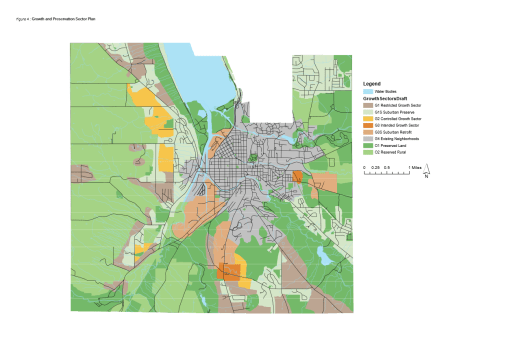
The above map is a rough idea of where Form Ithaca feels development would be best directed. The darker greens are either prohibited (O1, Preserved Land) or strongly discouraged (O2, Reserved Rural). Then from G1 to G3S, you have increasing levels of support for development and dense development. The only “new” neighborhoods established by the G3 zone are the South Hill Center (the 96B/King road intersection) and Cornell’s Maplewood Park east of the city. As already mentioned in the Maplewood writeup, Cornell’s pursuing a PDZ for the new urbanist project they have planned because their timing is a little quicker than Ithaca town’s – waiting for the new zoning would delay the project.

The plan also calls for retrofitting suburban areas, G3S. The 96B/South Hill Corridor,East Hill Plaza, and the city’s Southwest Corridor and Waterfront are targeted. The 96B corridor is currently undergoing a pedestrian and traffic study in part because the town wants to figure out how to protect pedestrians and encourage pedestrian-oriented development in what’s currently a suburban layout.

Recently, there have been privately-developed plans that haven’t been on board with these ideas. On the one end of the spectrum, early incarnations of the Troy Road housing development that was cancelled, which called for 200+ units in a “Restricted Growth Corridor”, a proposed type of zoning that suggests clustered development with substantial open space requirements. The project had been redesigned and reduced to fit 130 units in cluster zoning, but it was then cancelled. On the other end of the spectrum, the town is currently weighing a proposal to purchase agricultural easements on Eddy Hill Inc.’s farmland, which comprises most of the yellow on the southwest side of the town. That would prevent development in an area where development is thought to be more suitable.

form_ithaca_pt2_3

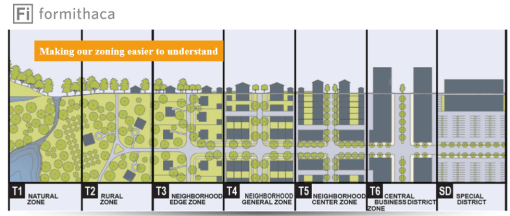
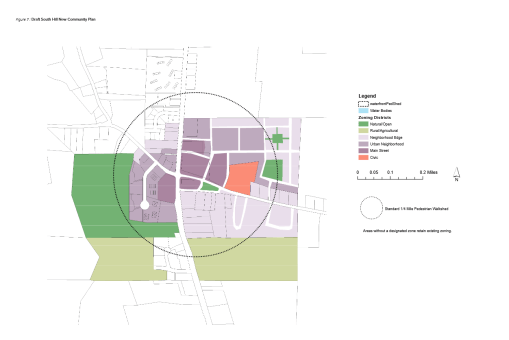
The above image is a proposed zoning setup for the South Hill center. Neighborhood Edge defines more typical single-family home development (T3), Urban Neighborhood towards a Fall creek type of density (T4, townhouses, duplexes/triplexes, closely spaced single-family homes), and Main Street would be more akin to the State Street Corridor (T5), first floor commercial or other active uses with apartment and condos on the couple floors above.

form_ithaca_pt2_4

There’s also an image regarding the Waterfront plans, but given the Maguire proposal, I’d rather wait until the dust settles and there’s a better idea of what’s going to happen.

This is all conceptual, and there are pros and cons – while it encourages less driving and establishes an activity hub in the town, it’s been noted that mixed-use can be more expensive to develop, which may be passed on to the occupants. Also, rezoning can impact current owners and create some tensions. Telling someone that density is encouraged in view of their house may not go over well, just as the landowner planning to sell to a housing developer may not be amused to find himself at odds with the town’s plans. But, given the issues facing Ithaca and Tompkins County, proposing something that attempt to address affordability, demographic and environmental issues is better than proposing nothing.


News Tidbits 2/6/16: Good Ideas and Bad Ideas

6 02 2016

maplewood_site_plan_concept
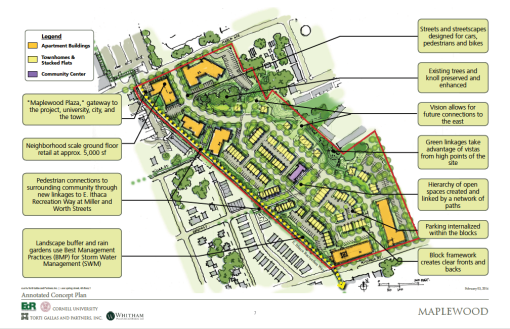
1. Let’s start with the big news this week, Cornell’s long-incubating plans to redevelop Maplewood Park. Official write-up on the Voice here. Personally, looking at the viewer stats, I’m a little disappointed that this has gotten as little attention as it has, since it’s a very large, very important project. But I suppose it’s a double-edged sword, because invariably, when a project does get a lot of attention, it’s because it’s a huge controversy (State Street Triangle, Black Oak wind farm, 210 Hancock, and so on).

There’s a lot to like about the plan (found here on the town’s website). Dense, walkable, a little mixed-use (more office or retail would be nice, but given that it’s tax exempt space, the more space there is the more controversial this project would likely be). Buildings aren’t too likely to cause controversy, since they’re 4 floors at most and they’ll be designed to blend in (“echo the surrounding neighborhood with the use of contemporary features”, per the narrative). Most of the comments on the Voice article describe Cornell as the great Satan, but one reader did express desire for the bigger, taller buildings to be central to the parcel, with townhouses on the outside. As a relatively untrained observer, it would seem that would be best from the perspective of trying to minimize appearance as much as possible, but it would also encourage vehicular traffic towards the center of the parcel, and negatively impact its pedestrian orientation. I haven’t seen any reactions from local planners, but I am curious what their first impressions are.

When writing up Tuesday’s article, my thought was that this was “Phase I”, Ithaca East/Maple Hill was “Phase II”, and East Hill Plaza/East Hill Village was “Phase III” with a 2019 or later start; but the rumor mill is circulating that work on the first parts of East Hill Village may be concurrent with Maplewood Park. We’ll see what arises in the coming months.

304_hector_inhs

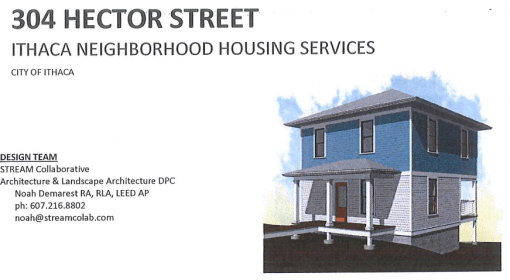
2. When those units come online in 2018, it’ll be a big step towards reducing the deep housing deficit. But in the meanwhile, the housing market will be uncomfortably tight. Which is why it’s good to see some pooled city/county/Cornell money being disbursed for affordable owner-occupied housing. The Community Housing Development Fund proposes that the city give $80,000 towards Habitat for Humanity‘s “Breaking Ground” duplex at 101-107 Morris Avenue in Northside (208/201 Third Street), and $85,000 to INHS for the seven moderate-income owner-occupied townhouses at 210 Hancock, and an affordable 1368 SF single-family home at 304 Hector Street on West Hill. Cornell will give $235,000 towards the townhouses and Hector Street home, but $100,000 of that is a re-allocation of funds from the cancelled Greenways project. The county is giving $100,000 towards six rental units at 210 Hancock.

Claudia Brenner has designed most of INHS’s homes in recent years, but this time around it looks like Noah Demarest of  STREAM Collaborative penned the home design. This is a revision of the previous render, if memory serves correctly; INHS had wanted to build the home last year, but construction costs as high as they are, the non-profit held off.

biggs_2

3. In other news, the county’s Government Operations Committee was to make a decision on the Biggs Parcel this week, but decided not to. It’s set to the return to the county’s agenda at the meeting on March 2nd. The ICNA has submitted a purchase offer (sum undisclosed) for the 25.5 acre parcel. The offer from Roy Luft to combine the parcel’s cluster zoning rights to build senior housing on his property at 1317 Trumansburg Road still stands, as far as I’m aware. Update – From the ICNA’s Linda Grace-Kobas, the Luft proposal has been dropped due to “size and complexity”.

Pg-3-Rendering

ag_quad_2

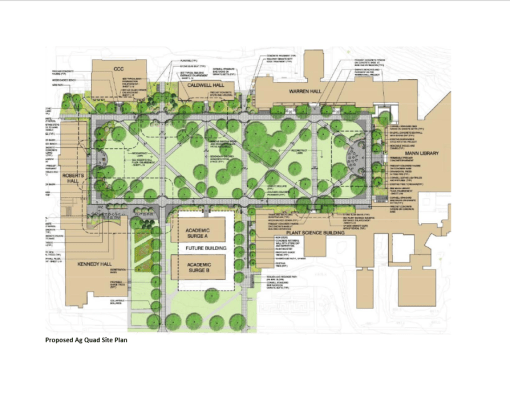
4. Courtesy of the city, some more details on Cornell’s Ag Quad renovation. Site Plan Review (SPR) application here, Full Environmental Assessment Form (FEAF) here, project specs here, drawings here. Formally, the project is referred to as the “Cornell Ag Quad Utility & Landscape Project”, since the project also involved major utility upgrades and repairs under the quad. The work planned calls for new steam lines, a telecom duct bank, new sanitary piping and water lines underground, and above ground there will be new paths, light posts, pedestrian plazas with stone benches, fire apparatus access path, blue light phones and a loosening of the soil compacted by other construction projects (such as the staging area for Warren Hall while it was under renovation). Most trees will be preserved, except for a few that stand where the new utilities and fire lane will go.

The project cost is $3 million on the SPR, with a rehabilitation period from April 2016 to July 2017, divided into two phases. No new permanent jobs, but about 25 construction jobs will be created. MKW + Associates LLC of New Jersey is serving as the consulting landscape architect.

On a side note, at least we can be fairly sure now that Cornell does plan on taking down the surge academic buildings at some point for a future permanent building.

5. Ithaca wants to build bridges. Physically, anyway. The city will hold a public information meeting next week 2 PM Wednesday on replacing the deteriorated single-lane Brindley Street bridge on the west side of the city. The bridge, which dates from 1938 and was last modified in 1952, is functionally obsolete and in dire need of rehabilitation.

Currently, the city is weighing two plans – a $2.43 million replacement of the old one-lane steel bridge with a two-lane bridge with sidewalks and shoulders for walkers and bikers, and a $2.59 million plan that extends two-lane Taughannock Boulevard through a parking lot, over a wider span and intersecting with Taber Street, leaving Brindley a single-lane bridge. While more expensive, this option diverts most traffic away from the awkward six-way intersection Brindley has with West Seneca and West State Streets. The nitty-gritty can be found in the design report here. It would also be of significant benefit to the Cherry Street industrial park and future waterfront development by improving access to the area.

Whichever plan moves forward will be decided by April, with construction from May-November 2017. Most of the project costs will be covered with federal funds, with some state funds and municipal bonds covering the balance (80/15/5% respectively).
902_dryden_v3
6. Some progress on 902 Dryden, perhaps. From the town of Dryden Town Board minutes, The number of new units is down, from 12 to 8, and only 26 new bedrooms from the previous 38. The overall square footage is also down, from 18,000 to 11,000 SF, with 26 parking spaces, 1 per bed. So that render above from December is outdated (although the color scheme is nice and bright, hopefully that carried over), there are two units on the right and six on the left, as well as the existing duplex.

As a result of the smaller project, one of the casualties is the net-zero aspect, because the initial cost for installing the solar panels outweighs the decreased revenue. Heat will be all-electric with the opportunity to install solar at a later date, if it pencils out. As for the opposition, it definitely sounds more muted in the town minutes, one neighbor seems intent on forcing enough site studies to break the bank, but overall the commentary reads muted to positive. The minutes don’t indicate if the public meeting is finally closed and if a vote to approve the project can be taken later this month.

7. Looks like Josh Brokaw at the Ithaca Times was able to get the Maguires to open up about their plans for Caprenter Business Park. In a phone call with Brokaw, Phil Maguire confirmed plans for a $12 million, 40,000 SF Ford/Lincoln/Nissan dealership, which will then allow them to proceed with renovations of their properties down by Wegmans. While they estimate about 70 jobs would be created and that it will be designed to be “inlet-worthy”, the problem remains that a car dealership flies in the face of the mixed-use urban environment that the city had been envisioning for the waterfront. One valid point does get raised though – side-by-side NYSEG power lines overhead would have to be buried for many building projects on the Circle (but not for parking lots), which gives any developer an extra several hundred thousand dollar expense in the development process.
Sketch plans are expected to be shown at the March Planning Board meeting later this month, about the same time the Common Council is expected to adopt the temporary PUD zoning that would give them say over any projects proposed in the waterfront area. Expect this dealership proposal to be a very heated and occasionally uncomfortable debate.

cherry_2

8. What’s on the agenda for next week? Not a whole lot new. The city’s projects memo doesn’t have any new projects, unless you count Island Fitness redoing their parking lot. There are a few more renders for the Cherry Artspace, as well as some project details – $200,000 construction cost, 1,944 SF building by Claudia Brenner with seating for up to 164 on the lower level, 2 jobs created, May – October 2016 buildout.

The Ithaca Landmarks Preservation Commission has some minor old business to attend to, and what likes some discussion over the recently-purchased home at 410 North Cayuga will be introduced (chances are, it’s something like window or roof replacement, maybe an add-on room). Discussion is planned for 311 College Avenue, the old firehouse home of the Nines, but this is also likely to be minor.

The town of Lansing’s planning board also has a meeting next week, but the only item of discussion is the Mirabito petroleum storage facility on Town Barn Road.


News Tidbits 1/23/2016: A Doozy of A Week Ahead

23 01 2016

1. Over in the town of Ithaca, an update is being considered for the Rodeway Inn budget motel at 654 Elmira Road. Previously, the motel had been approved for renovations that would expand the size of the 25 existing units and provide 2 new inside corner units, along with the associated landscape and site improvements. This proposal was originally approved by the town in December 2013, but then the project never went forward, partially because the Maguire group was looking at buying the property and tearing it down to make way for their artisanal car dealerships and headquarters. With the Maguire’s plan filed away in the circular drawer, the owners of the Rodeway Inn have decided to reconsider the renovation project.

rodeway_1
Along with the room expansion, the new plan also calls for renovating an existing on-site residence into a new office by building an 1146 SF addition, while the existing motel office is renovated into a community room to serve travelers. Variances for side-yard setbacks granted for the previous proposal must also be re-approved, since zoning variances in the town of Ithaca are only valid if construction starts within 18 months of being granted (in other words, the variance expired last June).

Pennsylvania-based HEX 9 Architects is in charge of design, and JAMNA Hospitality is the developer.

chapteR_house_reconst_v4_2

chapteR_house_reconst_v4_1

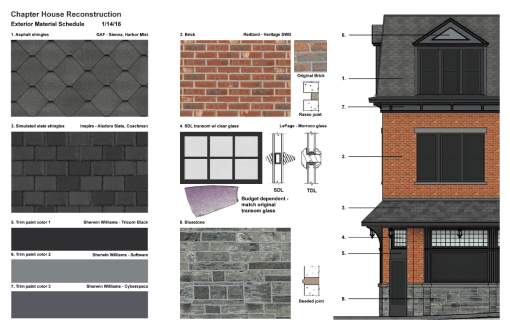
2. From the city of Ithaca Landmarks Preservation Council agenda next Tuesday, the latest iteration of the design plans for the Chapter House replacement and its neighbor at 406 Stewart Avenue. The Chapter House looks to be in the last stages of ILPC approval, while the apartment house next door is still in the early design review stage.

Looking at the Chapter house, the zinc roofing tiles have been replaced with asphalt, and two more paint colors will be included on the trim, which has gone from white to dark grey and black. The ILPC is doing what they do best, going over projects with a very fine toothed comb and debating every detail. Meanwhile, the current iteration of 406 Stewart Avenue calls for a 4-story apartment building with design features very similar to the previous 3-story building. That project still has some debates ahead of it, so we’ll see what happens moving forward.

Also on the agenda, discussion with the Planning Board about the DeWitt House/Old Library redevelopment, an update on repairs to 102 East Court Street, and some type of work being done at 210 Stewart Avenue (could be anything from paint color and shingle choices to major work; if it merits a post it’ll be included in a future update).

323taughannock_rev2_1

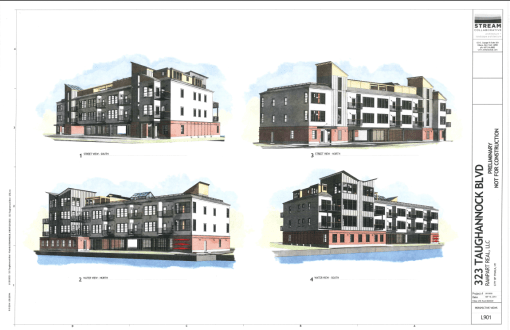
3. The Times’ Josh Brokaw wrote a nice summary of developments down at the Ithaca Waterfront, although I wish it hadn’t run when it did (re: HOLT update). Thanks to Josh, we have an idea of what’s going on with the approved but as-yet unbuilt 21-unit 323 Taughannock apartment project:

There was an “unexpected issue” that came up, Flash said, with the project, and so they must take “a sharper look at the engineering” to make the costs work.

I’m going to take a slightly educated guess – the soils were even crappier than anticipated. The high water table and easily-compacted soil in the West End and Waterfront pretty much mandate that multi-story projects have deep, expensive foundations to support the weight of structures. A soil issue was one of the problems that delayed the Lofts @ Six Mile project, and the reason why it’s built tall and narrow; also, since the Bloomfield/Schon has to pay for that deep foundation, it’s one of the reasons why the Lofts are so expensive. From the sounds of the Times article, balancing the deep foundation with adequate parking for the parcel is an issue. I’ll keep my fingers crossed, this project could be a real asset to that area.

Also, pretty sure that Cascadilla Landing still isn’t happening, and the Times has realized that. Anyway, it’s a good piece, and I’m not going to steal all of Josh’s thunder or his Myrick quotes, so spare two minutes and have a read through.

ith_big_plan_map_v2

4. For my moderate griping about timing with Josh’s Inlet Island development piece, I could note that this quote in the IURA Governance Commitee Agenda from city Planning and Economic Development Director JoAnn Cornish ties my article and his together:

“Cornish reported that the Planning and Economic Development Committee identified the Waterfront Neighborhood Plan as the Phase 2 plan of the Comprehensive Plan it would like to move forward with. Funding has been allocated for it. The plan would most likely be a hybrid Waterfront/West End neighborhood plan, in anticipation of significant development interest in that part of the city.”

In good news, affordable housing grants were thankfully saved in the federal budget, meaning that there will be a similar amount heading to NYS in 2016 as in 2015, and those funds would be available to future Ithaca projects should they jump through all the application hoops and be deemed worthy by Albany. The IURA is looking to smooth over any possible shortfalls by offering itself as a housing strategy consultant for the Waterfront/West End and Southside Phase II plans, and in the longer term, sales of parcels at the end of Cherry Street, at 410-426 Taughannock Boulevard, and Fire Station No. 9.

Also, the Argos Inn and Bandwagon Brewery/Restaurant have paid off their IURA loans. Proof that, although there have been failures (Finger Lakes Wine Center), the IURA can properly vet projects and be successful in its mission.

20160109_131947 20160109_132008

20160109_131909

5. House of the week. 102 Walnut Street, town of Ithaca. the last of Agora Home LLC’s Belle Sherman Cottages is nearly complete, possibly to go on the market as a spec house. The house is a little small than its neighbors since the lot is smaller, but the unique design gives the street some extra diversity. Apart from landscaping, paving and some finish work (on the exterior trim at least, although being a Simplex modular means the inside is probably finishing up as well), the house is just about finished. Nice work Carina Construction.

6. Last but certainly not least, the Planning Board agenda for next Tuesday. It’s a big one.

I. Agenda Review
II. Public Comments
III. Special Order of Business – Chain Works District Redevelopment Project – Presentation of Draft Generic Envrionment Impact Statement (DGEIS) and Scheduling.

chain_works_rev1_1

It’s finally moving forward. The Chain Works District, which was last presented at a meeting in November 2014, is finally ready to discuss parts of its environmental review and timelines. Per the agenda, “The project is a mixed‐use development consisting of four primary phases: (1) the redevelopment of four existing buildings (21, 24, 33, & 34); (2) the repurposing of the remaining existing buildings; (3) potential future development within areas of the remainder of the site adjacent to the existing buildings/parking areas; and (4) future developments within remaining areas of the site.” This will merit its own piece, but in the interest of time, Ithaca Builds offers a great summary of the previous steps and the proposal itself.

IV. Subdivision Review – 101-107 Morris Avenue. Declaration of Lead agency, Public Hearing, Declaration of Environmental Significance and Recommendation to the Board of Zoning Appeals (BZA). This subdivision proposed to reconfigure a pair of vacant North Side lots to allow a duplex to be built by Habitat for Humanity. The two 1400 SF units would be sold to families with modest incomes. There’s a letter of support and the Board has already drafted a recommendation to the BZA giving their thumbs-up.

V. Site Plan Review

A. Cayuga Green Phase II (Lofts @ Six Mile Creek). The applicant proposes to omit a green screen on the parking garage. A letter from the developer asserts that the wall will be adequately masked by trees.

canopy_hampton_rev8_comparo

B. Hilton Canopy Hotel – Project Update, addressing conditions of Site Plan Approval and Requested Changes. Developer Neil Patel (and represented by Scott Whitham) requests to increase the number of hotel rooms from 123 to 131, and increase building size from 74,475 to 77,884 SF. Height would remain the same. Once again, this is something that could be the subject of its own post, but will have to keep it brief for the moment.

state_st_triangle_v6_1

C. State Street Triangle – Project update, no decisions planned. 9 stories, 96′, 180 units, 452 bedrooms, 12,300 SF ground-floor retail, including space for Ithaca Bakery and CTB. See Thursday night’s Voice article for more info. Smaller, shorter, and maybe palatable.

D. 424 Dryden, parking lot rearrangement, Declaration of Lead Agency

E. E-Hub, 409 College Avenue, renovations. While technically it doesn’t require review, Student Agencies and STREAM are asking for thoughtful feedback.

F. Sketch Plan – Elmira Savings Bank, Route 13. Pretty sure this is the one tied up in that PR disaster. WEDZ-1a Zoning allows up to 90% lot coverage, 5 floors and 65′, but given previous statements, the short-term work might just have to do with renovations of the former Pancho Villa restaurant, maybe a drive thru lane or other major exterior work. We’ll see. Background reading on the parcels themselves here.

G. Sketch Plan – Cherry Artspace. Developer: Performance Premises LLC/Samuel Buggeln. Cherry Artspace, a theater company, is located at (where else?) 102 Cherry Street on the city’s southwest side. The building was purchased in August 2015 for $240,000, it had previously housed Renovus Energy before the solar panel company decided to move out to more spacious digs in Ulysses. The theater company, directed by Sam Buggeln (pronounced “bug-ellen”), wishes to renovate the ca. 1980, 1,154 SF building into dedicated performing arts space.

VI. Zoning appeal recs for the Habitat duplex

VII. Planning Board Resolution to the BPW regarding Seneca Street Streetscape work, Cascadilla Street Railing Options, and potential rezoning of a section East State Street/MLK Blvd. from B-4 to the more restrictive and residential-focused R-3a. Glancing at the zoning map, only the north side of the 400 Block is B-4, so the downzoning is probably intended for the houses on the corner of E. State and Schuyler, 420 and 422-24 E.State/MLK, and 108 Schuyler Place.

travis_hude_libe_libe_v3

Also worth noting, the Travis Hyde Old Library project will be discussed separately with the ILPC. That meeting is at 6 PM at City Hall. The Planning Board meeting at City Hall starts at 6:45 PM.