News Tidbits 12/26/15: Do You Hear What I Hear

26 12 2015

1. Not as visible, but still important – Student Agencies Inc. has secured a $3 million construction loan from Tompkins Trust Company for a major renovation of its building at 409 College Avenue. Although details about the project itself are a bit scarce in the paperwork filed on the 18th, it is likely the eHub entrepreneurial space being built for Cornell students, faculty and staff. The eHub space will include space for PopShop (a space for student business planning and development), the eLab business incubator, conference space, mentors-in-residence, and basically all the physical space and things a budding businessperson would like to help them succeed.

According to a previous write-up by the Cornell Chronicle, the lab should be open later this Spring, with 10,000 SF on the second and third floors of 409 College Avenue, and 4,000 SF of space in Kennedy Hall on the Ag Quad. STREAM Collaborative of Ithaca will be the interior architect for 409 College, and Ithaca-based Morse Project Management LLC is the general contractor.

Now, this could be a great thing for Ithaca, because it leverages Cornell’s presence to foster business development. Sort of like a Cornell-centric Rev. And Rev, for what it’s worth, has had several successful associated firms in the past couple of years – Ursa Space Systems was named a STARTUP-NY partner and will be hiring 22 people, and Ithaca Hummus is looking at hiring 50 over the next five years. Even the Ithaca Voice grew from what was basically a one-person operation when it launched in June 2014 (hat-tip to Jeff Stein), to having several full-time staff as well as giving Ithaca a higher profile through viral hits like the Key West promotion and the Harry Potter Wizarding Weekend.

Anything that allows Ithaca to grow and diversify its economy is a great thing, and if it can utilize Cornell’s presence to help that cause, all the better.
20151205_124218

2. The Lansing Star is reporting that 2015 was a banner year in Lansing, with 200 single-family homes, apartments and townhouse in the works. Along with the 20 or so plans reviewed, the town is also looking at revising its Comprehensive Plan, and the town may even consider the adoption of form-based codes in certain locations such as the proposed and stalled Lansing Town Center.

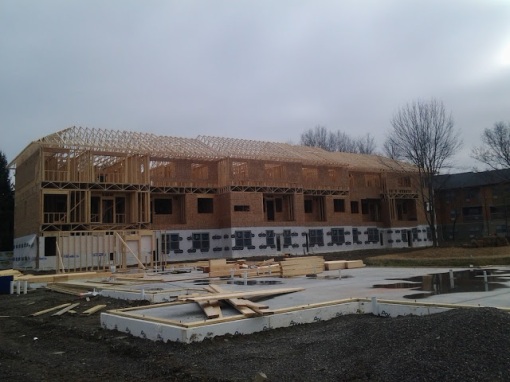
One caveat I’d add is that the key word is reviewed, meaning approved. Not underway. The 102-townhome Cayuga Farms project still had major issues to work out with its proposed package sewer system. If one were to look at permits, it’d probably be 36 or so units with the Village Solars, and probably as many with scattered single-family homes and duplexes, which would make for an average-to-above average year – final 2015 values will be available from the HUD in March. The village could see a big boost from its usual single-digit permit total, if the Cayuga View project gets its construction permit this year.
cayuga_view_1

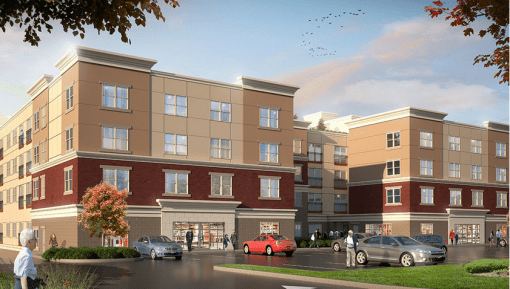
3. Speaking of Cayuga View, the price point came up at a Lansing village meetings, the minutes of which came online this week. Drumroll please—

The targeted price point is $1600/month for a one-bedroom, one-bath unit (of which there will be 12), and $2700/month for a 2-bedroom, 2-bath unit (of which there will be 48).

That’s quite a high figure. Applying the standard 30% affordability threshold, the targeted income bracket for seniors is $64,000-$108,000/year. That’s comparable, or a little more than, the Lofts @ Six Mile Creek. It also draws parallels to inner Collegetown projects like Dryden South, where rents will be $1350/bedroom. But those projects fall in traditionally high land-value areas.

If it’s financed, then a lender must believe there’s a market for it, and given the general difficulty in financing projects in this region, that really is saying something. Increased affluence and number of retirees moving in? Hoping to capture the older, richer Cornell faculty/staff crowd? Bad judgement? Who knows.
tfc_v2_1

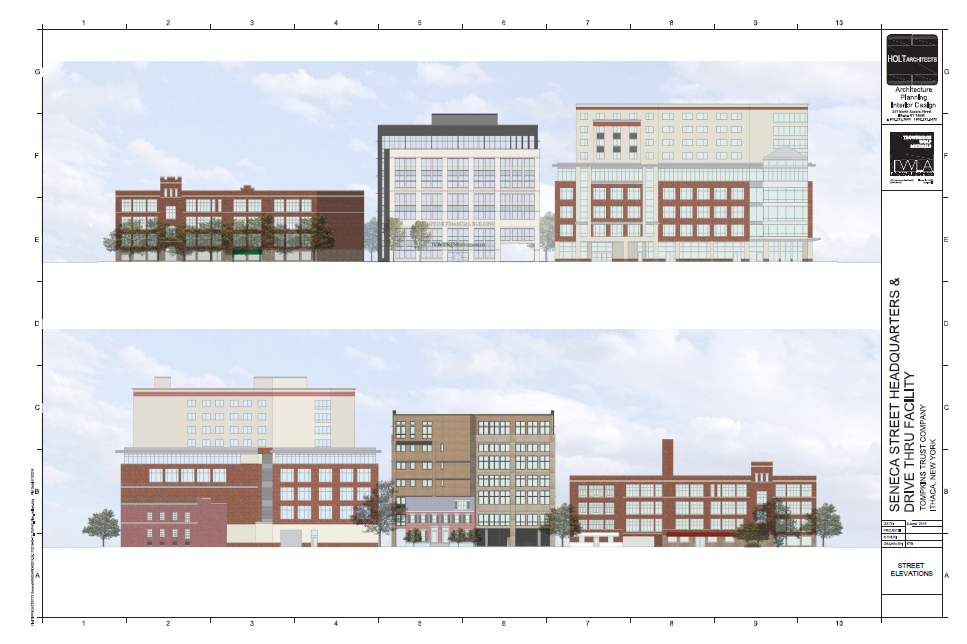
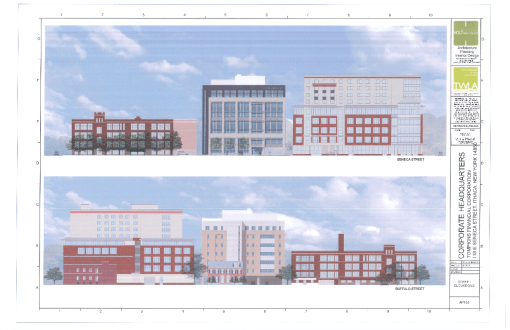
4. In the briefest of blurbs, the Times’ Josh Brokaw, who I applaud for attending even the less interesting city Planning Board meetings, reports that the Tompkins Trust HQ has been approved, with a permit likely once they get a minor curb-cut issue worked out. The contentious Printing Press Lounge debate also received the Planning Board’s go-ahead, if not necessarily its blessing. Expect a late winter or early spring construction start with the Tompkins Trust HQ, with completion the following year.
biggs_1

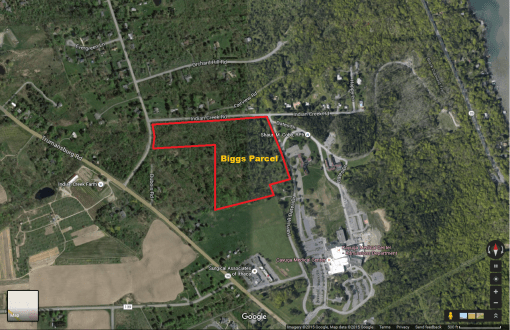
5. A couple of interesting developments for the Biggs Parcel in Ithaca town. According to the Times’ Jaime Cone (new writer, guys?), a member of the ICNA, Roy Luft, is prepared to make an offer for the Biggs Parcel that would preserve the vast majority of the land. Luft owns a 10-acre parcel to the south (street address 1317 Trumansburg Road). He proposes to take a non-wetland portion on the southern end of the Biggs Parcel, combine it with the open field behind his house, and pursue a cluster subdivision of homes intended as owner-occupied senior housing, which on the surface seems like a decent plan and location, given that owner-occupied senior housing is in demand and the land is adjacent to Cayuga Medical.

With this offer aired, the county, in a 4-1 vote, is giving the ICNA until January 15th to make an offer, otherwise they’ll put the land for sale on the general market. There is no assessment figure publicly available (though a new value has been determined); the ICNA says that’s unfair, while the county legislators have countered by saying not having the assessment value doesn’t stop the ICNA from making an offer, and that the neighbor group has already had a year and a half to make an offer.

20151205_134719

6. Once again, a double-feature house of the week. The theme of this week – high-end homes. Here we have home #1, 8 Pleasant Grove Lane in Cayuga Heights. The house has been mostly framed and the sides have been sheathed, but from the looks of the exposed roof trusses, if would seem that when this photo was taken a couple of weeks ago, the dormers still needed to be decked and the interior was still just stud walls and rough openings.

Design-wise, the home seems to fit in pretty well with its neighbors, which were mostly built in the late 1970s and early 1980s. The property was purchased in 2012 for $132,500 by an LLC traceable to a coach for a Cornell athletics team. Previously, the lot had been owned by its Pleasant Grove Road neighbors, and was sold in an estate sale.

20151205_131313 20151205_131331

7. House of the week #2. I couldn’t pass up the chance to see the one house under construction that seems to have the entire lakefront mansion community so utterly pissed off. For the record, this house on the Captains Walk cul-de-sac has been under construction for years – you can see it in the satellite imagery for Google maps, which dates from 2013. It also appears to be even larger than many of its million-dollar neighbors. Three-car garage? Check. Courtyard-type entry? Check. Windows have been fitted, the roof has been shingled and the exterior has been sheathed with Huber ZIP System panels. A spring finish would be a good guess. Records indicate a couple from Pennsylvania, the founders of a chain of assisted care facilities, bought the undeveloped parcel for $213,800 in 2013.



News Tidbits 12/19/15: So New Even the Pavement Shines

19 12 2015

cayuga_view_1

1. We’ll start off this week with some eye candy. Over in Lansing village, the planning board is hammering out details regarding signage and covenants related to the Cinema Drive senior housing project. But it also gives the project a new name – from C.U. Suites to “Cayuga View Senior Living“. Lo and behold, one types that into Google and up comes the following partially-finished website. The name sounded familiar, and as it turns out there’s a good reason for that – Cayuga View is also the name of a portion of the Linderman Creek apartment complex in the town of Ithaca.

According to the website, the 55+ (“55 and BETTER”, as they tout on the page) apartment building at 50 Cinema Drive will contain 48 2-bedroom units and 12 1-bedroom units with four different four plans. The 4-story apartment building will have retail space on the first floor, “and will offer underground parking and storage, wireless internet, cable, business center, fitness center, rooftop garden, and scenic views. A companion dog or cat under 30 pounds will be allowed.”

No word on the project architect, but the project is being developed by the Thaler family, and Taylor the Builders out of suburban Rochester is the general contractor. The site was originally conceived as an office building several years ago, and then around 2012 it was proposed as a 39-unit mixed-use apartment building with an eye towards graduate students.

amabel_v4_1

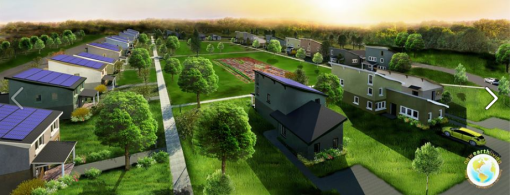
2. Sticking with residential development and fancy renders, here’s the latest render for New Earth Living LLC’s Amabel housing development, courtesy of their Facebook page. Final approval was granted just this week by the town of Ithaca. The 31-unit eco-friendly housing development (consisting of one standing farmhouse and 30 new homes facing inward from a loop road) will be located on undeveloped grass/woodland behind 619 Five Mile Drive. In the project literature, the site is said to be designed around a “pocket neighborhood” concept, with the houses facing towards each other for interaction, and away from the street for privacy. The houses may not be everyone’s cup of tea, but are designed for net-zero efficiency. Houses range from 1-3 bedrooms and 1,200-2,100 SF. No specific prices yet, but expect marketing to begin sometime early next year.

3. For the aspiring developer who wants to get a head start on planning – the 11.71 acre Bella Vista site at 901-999 Cliff Street in the city’s West Hill neighborhood is for sale for $395,000. As the advertisement on Homefinder notes, the project has received approvals for a 44-unit apartment or condo building (what it doesn’t say is that those would have to be renewed via a reaffirming vote by the planning board, since the project was approved more than two years ago). The property is currently assessed for $210,000.
w592-h-q

Primary Developers Inc., a company founded by local businessman Mauro Marinelli, purchased the land for $175,000 in 2002 and received approvals for the 44-unit Bella Vista project in 2007, and the units were marketed by local realtors as condominiums. But as the recession set in, sales foundered and the project never moved forward. Primary Developers Inc. sold the medical office building on the adjacent southern parcel and two other neighboring parcels of land to another local real estate company for $945,000 earlier this year.

chapter_house_materials

4. Some minor tweaks to the Chapter House project since its November sketch plan presentation to the Ithaca city planning board, which looks to mostly be a slightly lighter brick color and a little more detail on the rear wall. From top to bottom, the Chapter House reconstruction proposes Rheinzink zinc shingles, white trim of unknown material, a Redland Brick Heritage SWB bricks, Inspire Roofing Aldeora Slate Coachman (790) simulated slate shingles over the first floor bump-out, SDL (Simulated Divided Lites) transom windows with LePage Morocco textured glass glazing over the picture windows, Sherwin Williams “Tricorn Black” paint on the Chapter House bar exterior trim, and genuine bluestone not unlike the famous Llenroc bluestone used in many of Ithaca’s historic buildings. As far as they look online, they appear to be attractive, premium finishes.

The owner, Sebastian Mascaro of Florida and represented by Jerry Dietz of CSP Management, hopes to start construction in late January or early February for an August 2016 opening.

cornell_novarr_6

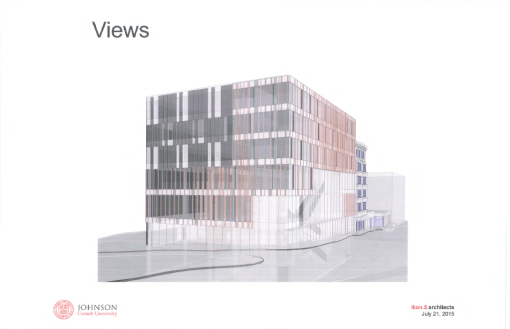
5. Note that there was ever much doubt, but it looks like local developers John Novarr and Philip Proujansky have secured the construction loan(s) needed to build 209-215 Dryden Road in Collegetown, a six-story academic and office building in which Cornell has committed to occupy 100% of the space for use in its Executive MBA program. According to loan documents filed with the county, there were two loans, one for $6,482,295.33 and the other for $9,430,528 (for a total of $15,912,823.33). Wells Fargo Northwest was the lender, and it looks like some of the funds are going through a “pass-through” trust.

The 73,000 SF building will host about 420 Cornell MBA students and staff when it opens in late Spring 2017, later increasing to 600 as Cornell fills out the rest of the square footage. Hayner Hoyt Corporation of Syracuse will be the general contractor. Ikon.5 of Princeton is the project architect.

20151205_094944 20151205_094957

6. Going to do a double-feature for house of the week this week, mostly because I have a backlog of images. Here’s number one.

The last house is underway at the Belle Sherman Cottages. After not hearing anything about it, I had presumed they had just decided not to build Lot #9, which is smaller than the other lots and was going to have a unique “cottage” design. Well, color me surprised. The town of Ithaca issued a permit in early November, and by the 5th of this month, the CMU block foundation was excavated and poured. Looking at builder Carina Construction’s facebook page, the modular units have since arrived and have been hoisted onto the foundation, assembled and secured. Custom interior finishes, porch framing, siding, backfilling and landscaping will follow as the house moves towards completion.

No renders for the finished house, unfortunately, although I suppose STREAM Collaborative might have something on file. Agora Home LLC of Skaneateles is the developer of the Belle Sherman Cottages, which includes 18 other single-family homes and 10 townhouses, all of which have been completed and sold.

20151205_095437 20151205_095453 20151205_095528

424_dryden_rd_1

7. Now for House of the Week #2. 424 Dryden Road’s subdivision earlier this year turned the rear parking lot into a second lot, and the owners, William and Angie Chen of Lansing, decided to build a duplex on the land, which has been bestowed the address of 319 Oak Avenue.

It seems a little odd that the trim already seems to be applied to the house when the windows haven’t been fitted yet. The standard Huber ZIP System sheathing is being covered with a mahogany-colored vinyl siding. Wooden wall studs can be seen from the rough window openings and there appears to be electrical wiring on the rear of the house, so it’s a fair guess that utilities rough-ins are probably underway.

Local architect Daniel R. Hirtler of Flatfield Designs penned the design, and according to the construction loan agreement on file with the county, Tompkins Trust Company lent the Chens $400,000 to help bring their duplex from the drawing board to reality.

416_e_state_v2_1

8. For those hoping for something new and exciting in next week’s Planning Board agenda, it’s going to be a downer month. Here’s what’s planned.

A. Revisions to the internal sidewalk plans at 804 East State Street to allow stripped asphalt vs. concrete.
B. Tweaks to the signage for the downtown Marriott currently under construction.
C. The “Printing Press” bar debate at 416-18 E. State Street, again.
D. Final approval for Tompkins Financial Corporation’s new HQ.

The agenda also includes a couple zoning variance reviews for house additions at 105 First Street in North Side, and 116 West Falls Street in Fall Creek. The board is planning a joint meeting with the ILPC to review and comment on the Travis Hyde plan for the Old Library site, tentatively scheduled for January 12th.


Simeon’s Reconstruction Update, 12/2015

16 12 2015

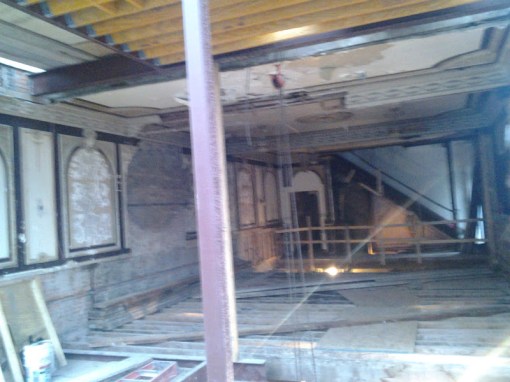
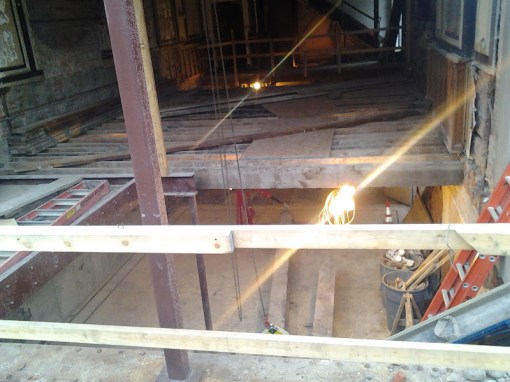
The intersection of State Street and Aurora Street is a busy little hive of construction activity. Steps from the Marriott and the Carey Building addition, the Griffin Block, better known for its tenant Simeon’s, is continuing reconstruction after June 2014’s tragic crash.

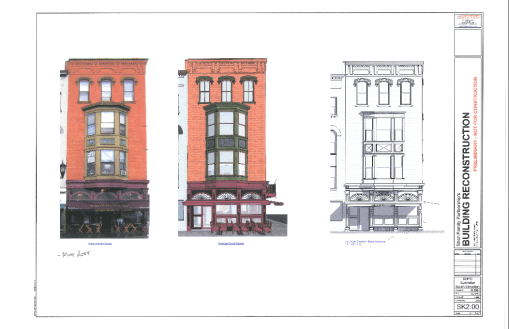
The chute and open windows indicate interior renovations underway in the salvageable part of the ca. 1872 structure, while structural steel framing serves as the the largest indication of the faithful reconstruction planned for the front entrance on the Commons. The outline of the steel approximately outlines where the rebuilt bay windows will be. It’s hard to tell just what work is specifically underway on the basement level and first floor.

According to the October Ithaca Voice article:

“The interior, however, will be thoroughly modernized and reworked. An elevator will be retrofitted into the existing building near where Simeon’s former Aurora Street entrance, and a sprinkler system will be installed throughout the building. Simeon’s will not only occupy the first floor in the new building, the restaurant will have a 40-seat dining area on part of the second floor as well.

Five luxury apartments, a mix of one and two-bedroom units, will also be built on the second and third floors. The Shens did consider applying for historic building restoration federal tax credits, but given the application complications posed by the interior renovations, and the slow process by which the credits are approved, they decided it wasn’t in their best interest.”

The new restaurant is expected to be open around the start of spring (end of Q1 2016), with the apartments ready by late summer. Local architect Jason K. Demarest is in charge of design, and Ithaca-based McPherson Builders is the general contractor. The Shen family received a $1.3 million building loan from the Tompkins Trust Company to pay for the renovation and reconstruction.


20151204_154029  20151204_154059 20151204_154147 20151204_154154 20151204_154211

simeons_v2_1 simeons_v2_2


Village Solars Apartments Construction Update, 12/2015

13 12 2015

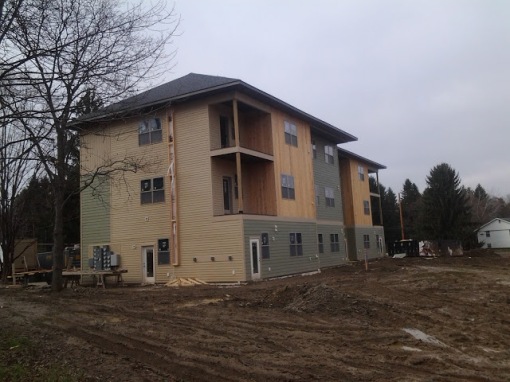
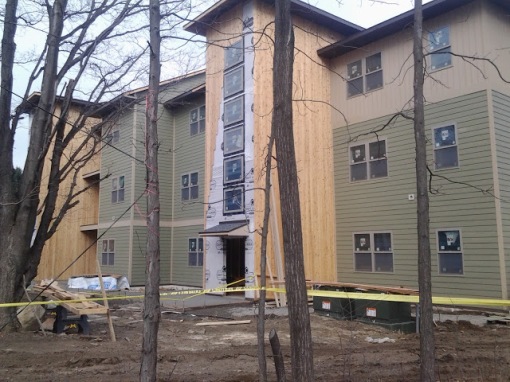
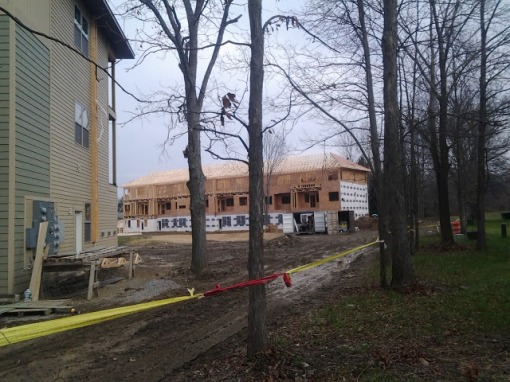
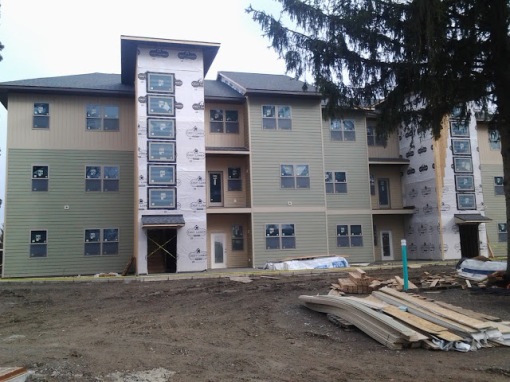
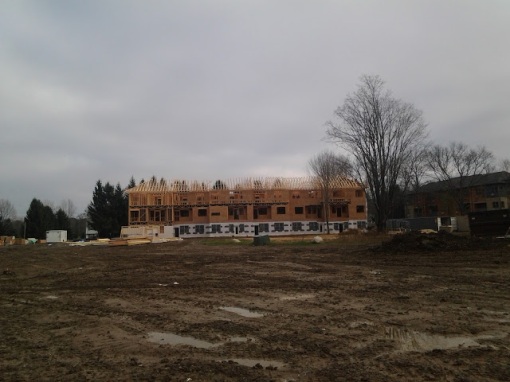
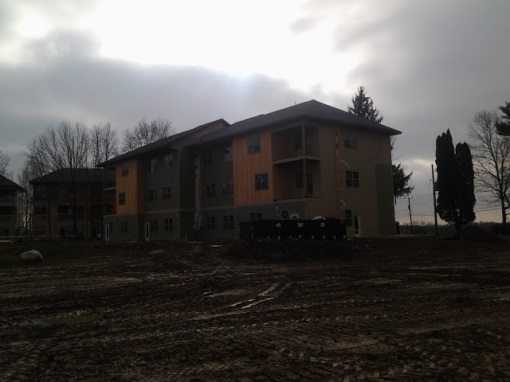
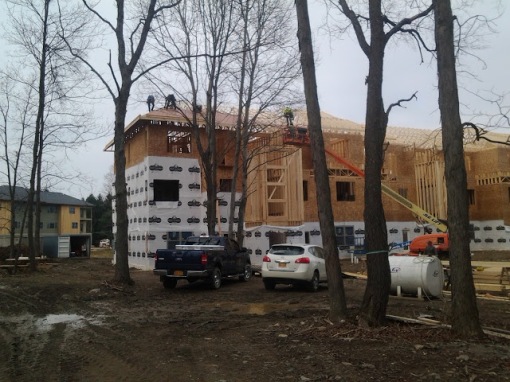
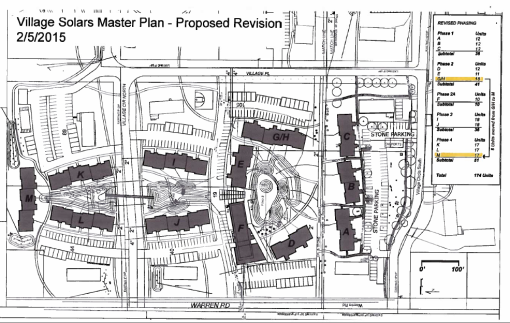
There’s been a fair amount of progress during the late fall at the Village Solars apartment complex site off of the 1000 Block of Warren Road in the town of Lansing. 12-unit Building “D” is finish up attachment of its exterior facade, which like buildings A-C, looks to be a combination of a wood grain board and earth-toned fiber cement board. Balcony railings and trim still have yet to be attached. I didn’t look inside, but based on the photos, it looks like the wood stud walls are still exposed near the entry doors on the first floor.

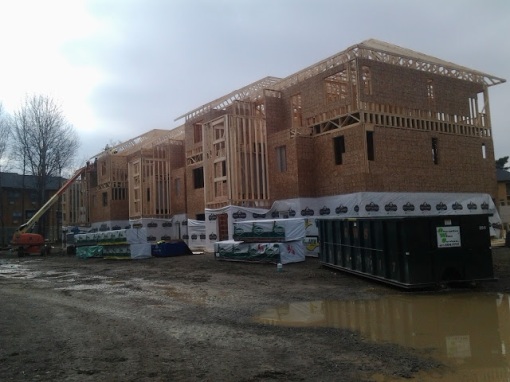
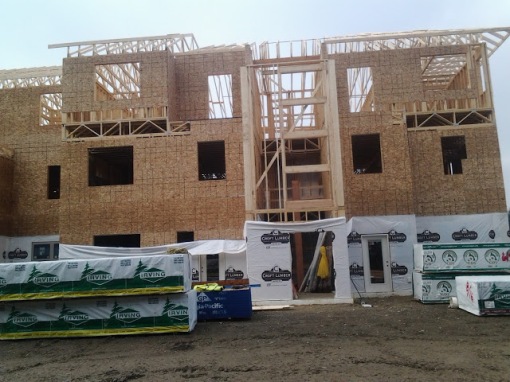
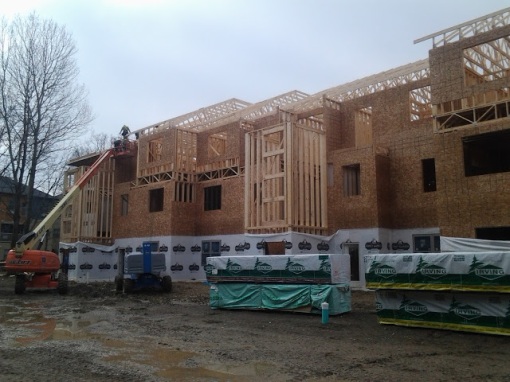
Across the future pond, 18-unit Building “G/H” (backstory here) has been framed out and some Tyvek-type sheathing has been attached (the material is labelled “Croft Lumber“, which is a building supply store down in Sayre, PA). Some first floor windows and doors have been fitted, but most of the future windows and doors are still rough openings. The roof trusses are all in place, and workers were installing ZIP system plywood sheathing while these photos were being taken.

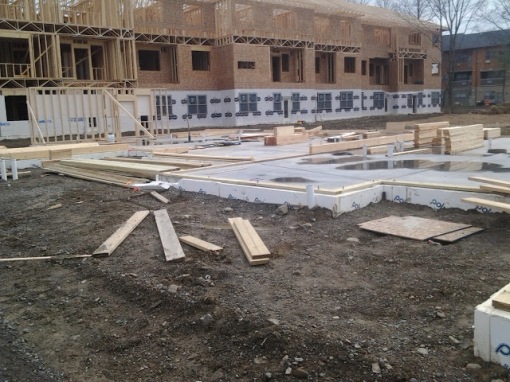
11-unit Building “E” has had its foundation poured and is only just beginning framing, with just one standing exterior stud wall.

20151205_123855 20151205_123932 20151205_123941 20151205_124021 20151205_124106 20151205_124143 20151205_124218 20151205_124235 20151205_124335 20151205_124403 20151205_124407 20151205_124839

village_solars_2 village_solars


News Tidbits 12/12/15: Money Money Money Money

12 12 2015

canopy_hampton_rev4_1

1. Time to do a little rumor-killing. There’s been some confusion as to whether or not the Hilton Canopy is actually happening, since it was supposed to have started construction by this time and it hasn’t. There was also an article in the Ithaca Times that suggested that construction costs much higher than original estimates had caused the project to be cancelled.

Well, the project has definitely been delayed, but it looks like it will still be moving forward. According to a utility easement resolution at the Ithaca Urban Renewal Agency’s Economic Development Committee (IURA EDC) meeting, a project financing commitment has been secured and the developer of the Hilton (Neil Patel of Lighthouse Hotels LLC) is planning a construction start in the first quarter (Jan-Mar) of 2016, which would suggest a mid-2017 opening.

inhs_pride_design_v5_3

2. Also in financial news, INHS looks to have secured grant funding that will allow it to move forward with its 210 Hancock project in the next four months, according to INHS Executive Director Paul Mazzarella. The grants were officially awarded in an announcement from the governor’s office on Tuesday. $3.6 million will come from the state’s Housing and Community Renewal program, $500,000 from the state low-income housing tax credit (LIHTC) program, and $1.03 million from the U.S. Department of Housing and Urban Development’s LIHTC program. In total, the award is valued at $5.13 million, about a quarter of the estimated $20 million development cost. The project has received about $17 million in grants and tax credits to date.

The money awarded covers only the rental units – 54 apartments in the four-story mixed-use building, and five townhouses. The seven owner-occupied townhouses remain unfunded.

The apartments, which include a 30-child low-income daycare facility and commercial office space for non-profits, will welcome their first tenants in Summer 2017. They will rent from 27% to 105% of local median household income, depending on the unit. Descriptively, it’s a mixed-income project with residents’ incomes ranging from $25,000-$60,000 per year.

ith_big_plan_map_v2

3. From the Common Council’s Planning and Economic Development Committee, there are a few things of note this week –

A. The city seems to be looking towards greater encouragement and flexibility with redevelopment of waterfront parcels by making WF-1 and WF-2 zones Planned Unit Developments (PUDs). What a PUD does is allow greater flexibility in uses and design by removing or loosening zoning constraints on site use, and being more accommodating to mixed-use projects (the Chain Works District proposal is a PUD, for example). Previously, PUDs could only be applied to industrial sites. The other stipulation, however, is that the applicant would have to work with the Common Council to determine appropriate development of the site.

The Waterfront Zoning allows up to 5 stories and 100% lot coverage. The PUD will give flexibility beyond that, dependent on what the Common Council is comfortable with for a given site and proposal.  So if Applicant X shows up with a huge apartment building or a big industrial building, it’s probably not going to get very far. But if it’s well designed and has affordable units? Maybe the council will grant a little more density or another floor. It depends on a developer showing up with something that they feel offers some kind of community benefit and fits with the Comprehensive Plan, and whether the Common Council agrees with the developer’s reasoning.

There is great potential in the waterfront – those views can fetch a premium (i.e. higher land values, and more tax dollars), it’s far enough removed from the colleges that students would be unlikely residents, and many of the properties are underutilized, with only marginal public benefit.  So potentially, if someone wants to work with the Common Council (one can count on at least 8 or 9 of the 10 being willing to cooperate), there could be some benefits in the long-term.

B. The Commons first-floor active-use zoning ordinance looks to be heading for a Common Council vote in January. More about that ordinance here, Item 5.

C. That damned backyard chickens thing again. Only this time, it might be moving forward with a pilot program involving 20 families.

D. Per the Times’ Josh Brokaw, expect incentive/inclusionary zoning to be up for PEDC review in January.

tfc_comparo

4. Hey look, this week’s eye candy. Tompkins Financial Corporation’s proposed downtown Ithaca Headquarters at 119 East Seneca Street will be reviewed for final project approval at this month’s Planning Board meeting. As part of that, here’s the final project design, part of the final Site Plan Review submission here.

From the front, it looks like some of the window layout has changed on the top floor and southwest corner, and there are fewer sunshades above the windows. There’s a third tree in the planting plan, and there’s variation in the cladding materials on the west wall facing the DeWitt Mall.

tfc_v3_1

In fact, it’s the non-primary facades that have changed the most, with different (and generally lighter-colored) brick and aluminum panels when compared to the previous rendition. Although there’s less glass than before, the lighter colors and greater variation in materials de-emphasize the bulk from the perspective of its townhouse neighbors at the rear. The 7-story, 110,000 SF commercial office building should begin construction in early 2016 with an eye towards completion the following spring.

elmira_savings_1

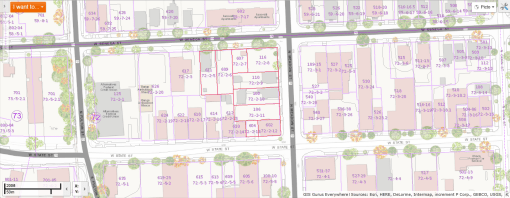
5. There was quite a sale on Ithaca’s West End last Friday. Nine properties outlined in red on the map above – 106, 108, 100 and 116 North Meadow Street, 607, 609 and 611 West Seneca Street, and 602 and 604 West State Street – were sold for $1,725,000 to Elmira Savings Bank.

Now, there are a few reasons why this is worthy of attention. For one, banks don’t typically shell out almost two million dollars without some kind of plan. For two, Elmira Saving Bank has been moving forward with expansion plans in the Ithaca area in hopes of capitalizing on the growing local economy. For three, there has been a lot of development in this neighborhood as of late – the Iacovelli Apartments (2013) and Planned Parenthood (2014) are right across the street, and it’s worth noting that the 18,000 SF HQ for Alternatives Federal Credit Union (2002) is on the other side of the block.

The properties are currently home to parking lots, several older, non-historic houses (most in poor condition) and a two-story 4,500 SF commercial building previously home to the Pancho Villa Mexican restaurant. The restaurant building had been on the market for $699,900.

The zoning here is all WEDZ-1a. West End Zone 1a allows for 2 to 5 story buildings, 90% lot coverage in the case of large assemblages such as this, and no off-street parking requirement. That means these parcels have a lot of potential. The previous owner had been rumored to be planning a mixed-use building on some of the properties, but nothing official ever came forth.

Two phone calls were placed to Elmira Savings Bank’s headquarters in Elmira, and two voicemails were left, but neither received a response. But these properties are definitely something to keep a close watch on over the following months.

6. That 9100 SF store being developed on the corner of East Shore and Cayuga Vista Drives in Lansing that was mentioned last week (here, Item 4)? It’s going to be a Dollar General. Not sure if that’s better than the auto/tire store speculated last week.

20151108_152102

7. Lest it be forgotten, it appears Lady Luck and some state bureaucrats smiled at the Southern Tier this week, awarded the region one of the three $500 million prizes of the Upstate Revitalization Initiative, known colloquially as the Upstate “Hunger Games”. Rochester/Finger Lakes and Syracuse/Central are the other $500 million winners. Seven regions competed, and the four losers will receive $80-$100 million for their priority projects. The money will be paid out in five annual installments of $100 million. A copy of the Southern Tier’s plan is here.

I wrote about Ithaca’s plans for its share on the Voice here. The first year projects alone will have a range of impacts, ranging from job creation and training to municipal construction projects to quality of life projects like museum expansions. Potentially, it could result in hundreds of jobs in Tompkins County, financial capital for several major projects, and make the area more attractive for investment for both local and external entities. As these projects move forward, they’ll receive their due write-ups here and on the Voice.

Of course, the key things are that the community can manage this monetary award, and that someone can track and guide these projects to completion – something the Southern Tier has struggled with, when one looks at the result of previous, much smaller awards.

8. The state’s just shoveling money into Ithaca this week. The New York State Office of Community Renewal (part of the state’s HUD equivalent, the Homes and Community Renewal agency) has awarded $500,000 towards the rehabilitation of the Masonic Temple at the corner of East Seneca and North Cayuga Streets in downtown Ithaca.

The Masonic Temple was built in 1926 and designated a local historic landmark in 1994. The property is owned by Ithaca Renting Company (Jason Fane), who purchased the building from the Masons in 1993. Fane’s never been a fan of the historic designation because the ILPC can be expensive and onerous to work with, nearly everyone else hasn’t been a fan of his long-deferred maintenance of the 90-year old building (if you have ever wondered why that CIITAP rule was added about an applicant being in building code compliance with all their other properties…now you know). A few years ago, Fane had not been shy in his interest in demolishing the building.

After rejecting a purchase offer to turn the building into a community center and space for the New Roots charter school, Fane decided to go the preservation route earlier this year and apply for a grant to renovate the interior and add an elevator to the building to make it ADA-compliant. This would make the building much more marketable to commercial tenants, many of which have shunned the 17,466 SF building. Fane laid out a few different options this past summer, including one where four commercial spaces (rental, office, restaurant) would be created. Based on the grant announcement, it looks like that will be the option pursued.

The Downtown Ithaca Alliance backed the application, as did the Common Council by unanimous vote at their July meeting.

The renovation will cost at least $1 million, and according to the grant announcement, seeks to start construction in summer 2016. Expect more info when it hits the ILPC and Planning Board at a later date.

20151205_121714 20151205_121736

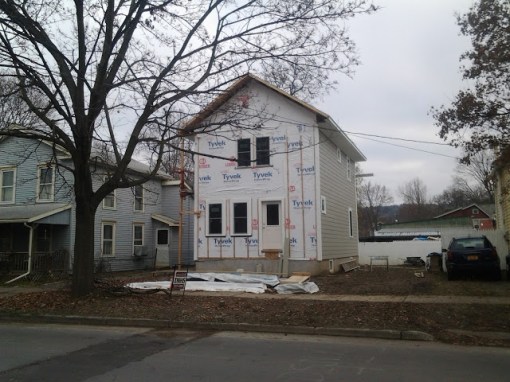
9. House of the week. This week, INHS’s new 2-bedroom, 1150 SF single-family home underway at 203 Third Street in the city of Ithaca’s Northside neighborhood. The house is framed, roofed and sheathed. Siding (Hardie board?) and trim is being attached on the sides, and one can expect a nice gracious porch to be attached once exterior materials are installed on the front. A home of the design was previously built at 507 Cascadilla Street.

203 Third Street was a vacant that the city seized in a tax foreclosure in 2011. It was transferred to the Ithaca Urban Renewal Agency, who sold it to INHS for $17,000 in December 2014. The process is pretty similar for a lot of the home lots that INHS builds on – the non-profit buys dilapidated or vacant properties from the IURA, which they build or renovate into affordable single-family and duplex houses. In the case of 203 Third Street, INHS competed for the site, outscoring Habitat for Humanity’s submission in an IURA examination of proposals.

As with all INHS homes, this one will be sold to a buyer of modest means, which means someone making at or a little less than the county’s median household income of $53k/year (I think 80% of MHI is the low bound offhand, so about $42k/year). The houses will be a part of INHS’s Community Housing Trust, limiting the price it can be sold for and requiring that if put up for sale, it is sold to another family of modest means. It may just be one house, but it will mean a lot to one family.

Claudia Brenner is the architect, with Rick May Construction and Mike Babbitt in charge of construction (thanks to Claudia for the builder info).


The Swinging Pendulum of the CIITAP Program

17 11 2015

20151011_144907

If I had seen this before the Friday news roundup, I’d have included it there. But since I have no Monday night post scheduled this week, discussing the latest changes to CIITAP will be a fair substitute.

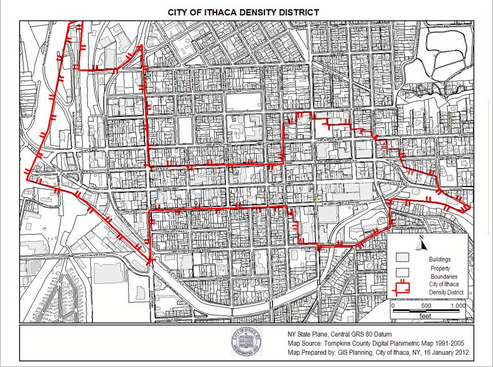
So, background. CIITAP stands for Community Investment Incentive Tax Abatement Program, and it’s a property tax abatement program that gives developers the opportunity to apply for abatement for a portion of their property taxes for a period of up to 7 years, or for an enhanced abatement of up to ten years if they can demonstrate financial hardship (i.e. without the abatement, there’s no way the project will be cost-effective; if it’s not cost-effective, a bank won’t offer construction loans, and the project doesn’t happen). Basically, it’s a tool designed to promote development in certain parts of the city where density is expected and/or encouraged, rather than lose tax-generating and job opportunities to the suburbs. A more substantial description can be found in a write-up for the Voice that I did back in January here.

The first version, which went into effect in 2001 as the Downtown Density Program, led to five projects being built, six if you split Cayuga Green into its garage and mixed-use components. The projects were worth about $62 million, and the earliest ones are now paying full taxes. Then the city decided it wanted more from the density incentive, and it created the CIIP Program, which was created in 2006. Over the following six years (2006-2012), that led to just one project, the $3.5 million Ital Thai renovation on the Commons. Part of it was that from 2006-2007, there was a moratorium on abatements, and another part was the recession. But another part of that was that CIIP was really lengthy and burdensome it had 48 stipulations, and a project had to meet 15 for partial assistance, and 23 for full assistance. It was so much paperwork that developers were disinterested and opted for other parts of the county.

ciitap_map

Onto round three, the current CIITAP – much more simplified, it initially had three stipulations – one, that it be in the density district; two, that it was a $500,000 investment in either a new building, or in the renovation of a historic building; and three, that if a new building, that it be at least three floors. A fourth was later added that said that all your other properties had to be up to code and have no outstanding violations, which arguably was a tacit response to Jason Fane’s application for 130 East Clinton while he let the Masonic Temple rot. However, in the past couple of years there have been complaints from various groups that the city wasn’t getting enough out of the bargain. You can kinda see how the pendulum swings – the political consensus is that the first version was too generous, the second version two burdensome, and the third version too generous.

The city put together a study group to examine revisions to CIITAP, chaired by a Common Council member (Ellen McCollister of the 3rd Ward), and consisting of City Planning and IURA staff, a representative from TCAD, a representative from a local labor union, a developer, and a representative from the Coalition for Sustainable Economic Development. In short, the city’s trying to get a broad spectrum of perspectives. The revised CIITAP is to presented at the PEDC meeting Tuesday night.
Here are the goals:

1. Retain the program as an effective tool to incentivize smart growth and discourage sprawl
2. Improve the program’s ability to deliver broad community benefits that may include:
*** An increased use of local labor
*** An increase in living wage job creation
*** More environmentally friendly building
*** Increased economic opportunities for people of all backgrounds

Note that given the previous versions, they’re easier said than done.

ciitap-revision

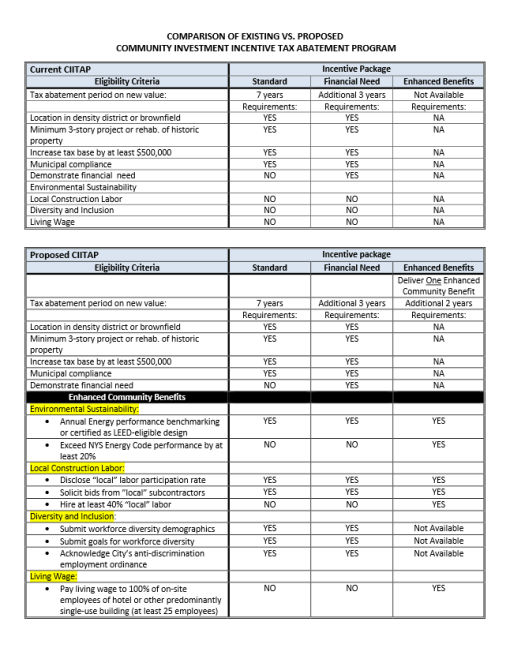
In addition the standard 7-year and 10-year abatement, there’s also a new very stringent “enhanced” 12-year abatement option. All the 7-year and 10-year stipulations carry over, but now there’s a few more requirements on the list in four categories – “Environmental Sustainability”, “Local Construction Labor”, “Diversity and Inclusion”, and “Living Wage” .

  • In the “Environmental Sustainability” category, the new rule on the standard 7-year abatement and 10-year abatement is one of two two choices. The first choice is an annual benchmarking of energy usage during the abatement period using free software from the EPA. The report would be given to the city, IDA and made public, to prove the building is using energy at the level designed. The second choice is that they could submit paperwork indicating they’re pursuing LEED Certification, and provide proof of certification upon completion.
  • The “Local Construction Labor” category defines “local” as tompkins or any of the counties it borders (Cayuga, Seneca, Schuyler, Chemung, Tioga, and Cortland Counties — so no Syracuse, Rochester or Binghamton). In order to be eligible for a tax abatement, an applicant must commit to the City in writing and submit to the IDA proof that the general contractor has solicited bids from local sub-contractors for all major trades required for the construction project, such as HVAC, electrical, plumbing, carpentry and masonry. Secondly, they must submit a copy of their monthly payroll monthly payroll reporting of all workers on site during construction with a summary of how many employees are “local”, using the address, zip-code, and total payroll amount per employee. I’m not sure if all this will be public info – privacy advocates might push for keeping the employee address and payroll information confidential to the city and IDA.
  • In the “Diversity and Inclusion” category, the new requirement for all applicants is a company or primary tenant’s workforce demographic analysis by gender, race/ethnicity, age, disability, job class with gender, and job class with race/Hispanic ethnicity; as well as acknowledgement they have read and understood the City’s Anti-Discrimination employment ordinance; and a statement of their company’s or the major tenant’s goals for workforce diversity.
  • The program does touch on an affordable housing fund or mandate, but it’s stated that members don’t feel CIITAP can adequately address affordable housing, and the committee recommends exploring inclusionary zoning.

Under this plan, the number of stipulations for the 7-year and 10-year abatements goes from four to seven. The rest of the procedure is as before – the city holds a public meeting, then decides whether or not to endorse the project, and it goes to the county (TCIDA) for their vote, which is typically in line with the city’s recommendation.

Now, a new option is the 12-year “super-abatement”. Along with the demonstrated financial need, a project must also commit to one of the following – 40% local labor, energy usage 20% less than NYS Energy Code Requirements, or living wages for single-use entities like hotels. This is in addition to the previous stipulations for 10-year abatements.

So now’s the magic question? Will it be acceptable to the broader community? The city’s HR director wrote in an email attached to the PEDC agenda that the program doesn’t do enough for diversity, and needs to mandate rather than encourage it. Without a doubt, this whole program, as we’ve seen in the past fifteen years, is a delicate balance between encouraging density while getting community benefits. Hopefully, the abatement pendulum stops swinging and it finally comes to rest in a comfortable middle ground.


A Long Voyage Ahead for The Waterfront

27 10 2015

The NYS DOT property is probably the next big, Old Library-type project facing the county in the upcoming couple of years. There’s a lot to consider in a possible move of the DOT to Dryden, and subsequent sale of the site to a chosen developer. For that, the county paid $78,000 to Fisher Associates to conduct a feasibility study, the results of which are shared below.

The feasibility study examined multiple angles – environmental, physical, market and financial factors. It has to, because without a through examination of the site, the county could under-price themselves, or vice-versa, there may be fewer or no offers, should buyers think the site’s a poisoned chalice.

But let’s start with the initial disclaimer – things are years out. The Old Library site issued an RFEI in November 2013, and a preferred developer was only named in August. Plus, everything is still dependent on a DOT move, which will have its own schedule if it happens. All things considered, although the county has generously offers 2017 as a construction start date, it’ll probably be the end of the decade if not the 2020s before any soil starts to turn, assuming there’s an interested developer.

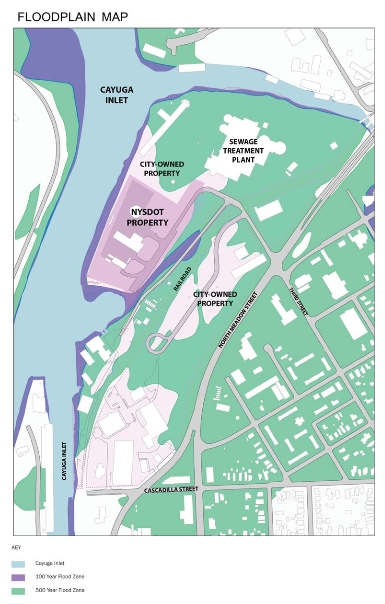
So let’s start with a look at the site’s history and environmental concerns. According to Fisher Associates’ Environmental Site Assessment (ESA, link here), the property was virtually unused until the NYS DOT bought the land and starting building their facilities on it in 1958. There were petroleum tanks underground, but they were removed and the land re-mediated in 2004, and now the only tanks on-site are above ground, and in good condition. Some concerns still exist with salt brine tanks, debris in the inlet, and materials from when the DOT used a septic system, before it was hooked up to the city sewer. None of these appear to be potential deal breakers, just things worth noting.

waterfront_floodplain

Perhaps surprisingly for a waterfront property, the vast majority of the site isn’t in the 100 or 500-year flood zone. Most of the site is elevated just enough to avoid flood risk.

Empire GeoServices of Cortland conducted the geotechnical report and site soil analysis. Looking at the soil conditions, being next to the water poses some limitations. Most of the lower elevations of the city suffer from poor, water-logged soils, which are soft and compressible near the top – in a few cases, shallow spread foundations, typically the cheapest option, have been damaged by excessive soil settling, so those are not recommended. Deep, pile foundations, like the ones used at the Lofts @ Six Mile Creek (micro-piles), Marriott (caissons) or some of the big box stores, are a safe option because they go down to more solid soil layers, but they’re more expensive. Shallow mat foundations can also be used in place of shallow spread foundations, but they’re also more complex and expensive, and are really only suitable for “light buildings” with less pounds for square inch. A mat foundation was used for Cornell’s new rowing center.

Long story short on the soils, it means that whatever is built will need a complex foundation, and its likely that whatever gets built will be priced at a premium. The study tacks on an extra 10% to the cost for townhouses and mixed-use buildings.

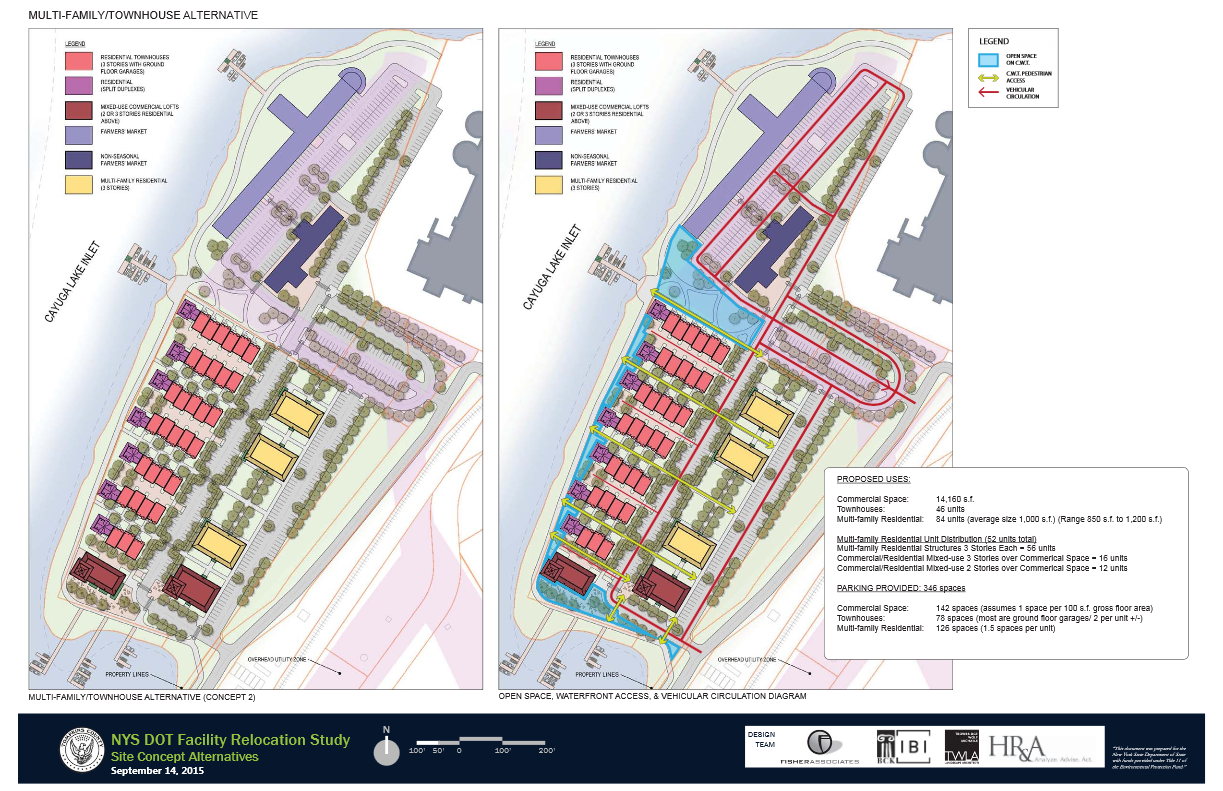
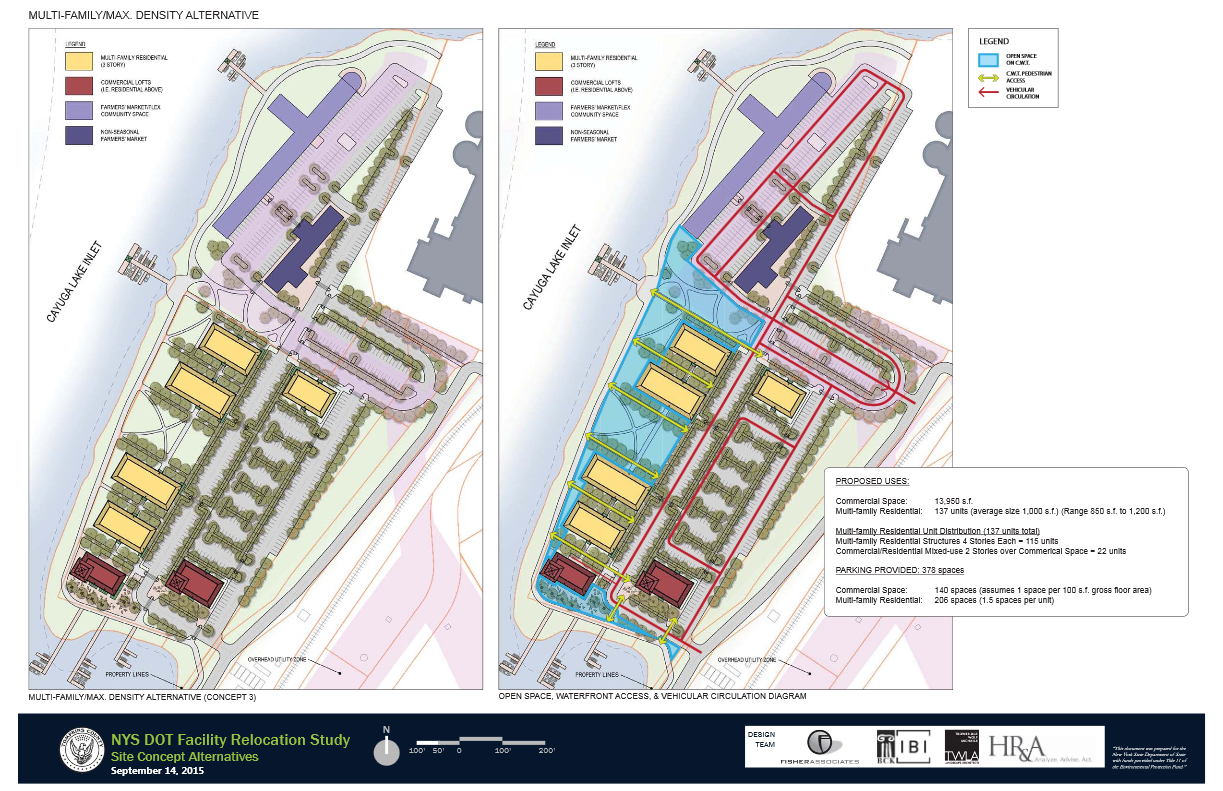
In the study, there are three plans considered – a hotel plan, a multifamily/townhouse “preferred” plan, and a maximum density plan. The site plan PDF is here, for you kids following along at home.

waterfront_concept_hotel_SP_1

The hotel plan imagines a 124-room hotel (midsize in the Ithaca market) with 6450 SF of commercial space. The plan includes 10 townhouses and 52 multi-family units in the 850-1200 SF range. There are 286 parking spaces, as required by zoning – 1 for each hotel room (124), 1 per 100 SF of commercial space (64), 2 for each townhouse (20) and 1.5 for each apartment-type unit (78). 1 Space for 100 SF commercial space is fairly generous to drivers – the ITE trip generation manual shows most commercial retail to be well below that threshold, with only service outlets like fast-food joints, coffee shops and bars exceeding the 1 space/100 SF value.

The market issues with this plan are focuses on the hotel. A hotel was envisioned for the waterfront for decades, but being off by itself with only few nearby attractions (the trail and farmer’s market, not much else), it’s not as desirable as downtown, nor is the land as cheap as the Southwest suburban corridor. The feasibility study notes the waterfront might be a draw in the summer, but the weather the rest of the year would limit its appeal. With increased interest in living in the city, the hotel idea has had less allure in recent years. Still, the option was included for the sake of comment and critique. The study says a hotel would need 120+ room to support fixed costs (taxes, maintenance), and recommends a brand not present in Ithaca, like Hyatt or Starwood (Westin/Sheraton).

waterfront_concept_mf_th_SP_1

The multi-family/townhouse plan does away with the hotel and instead focuses more on residential. The plan is composed of 14,160 SF of commercial space, 46 townhouses and 84 multi-family units (130 units total). 356 parking spaces are provided.

waterfront_concept_max_den_SP_1

The maximum density plan is as it sounds – the maximum legally allowed by zoning. The plan calls for 13,950 SF of commercial space, 137 multi-family units and 378 parking spaces.

Note that all three plans have a new indoor farmer’s market building, but that’s a separate development being spearheaded by the market.

waterfront_concept_aerial_1

Renderings make for great eye candy, but the emphasis is definitely not on the architecture here, because it’s a bit like predicting what new cars will look like in 2020. You know it will probably have four wheels, lights and doors, but everything else is just for show. Whoever buys it will come in with their own idea of how things should look (see Form Ithaca’s waterfront study for their take). For the sake of reference, a copy of the aerial renders of each layout is here.

Now for a financial summary (link), the feasibility in its essence. HR&A Advisors, who partnered with Fish Associates for the study, notes that development can work with a potential buyer’s bottom line, but it’s going to be expensive and the developer will seek to minimize risk as much as possible – there’s not much padding in the profit. There are few comparable products in the county to the site, which makes determining the market size, rents and level or risk somewhat more difficult than usual. The study assumes a 3-year, single-phase build-out.

waterfront_concept_financial_1

The study assumes about $2.15/SF for a residential unit – in other words, a 1,000 SF unit (like a larger 2 bedroom or smaller 3 bedroom unit) renting for $2,150/month, similar to the Lofts @ Six Mile Creek or Gateway Commons downtown, which were used as comparables. Luxury housing, without a doubt. The waterfront commands a price premium, but the disconnection to the rest of the city could hinder rentals. Some condos/owner-occupied units are possible, but rentals would be the majority. Development costs range from $165/SF for a townhouse, to $215/SF for a multi-family unit, to $287/SF for the hotel. The value of a project ranges from $39-$45 million depending on plan, and with development costs taken into count, the land could sell for something less than $1,000,000 to $2.5 million. Over time, the project may generate $13-$22 million in tax revenue over 20 years, depending on approach.

waterfront_concept_financial_2

The land itself will not sell for the price required to cover the DOT’s cost of moving, which will have to be underway before any sale takes place. The move is estimated at $14 million. This means that the city and county may have to chip in on upfront costs in order to get a good project in that will pay itself off via tax revenue. HR&A notes that an RFP should be flexible in its options, and be open to zoning variances that might improve a project’s chance of success.


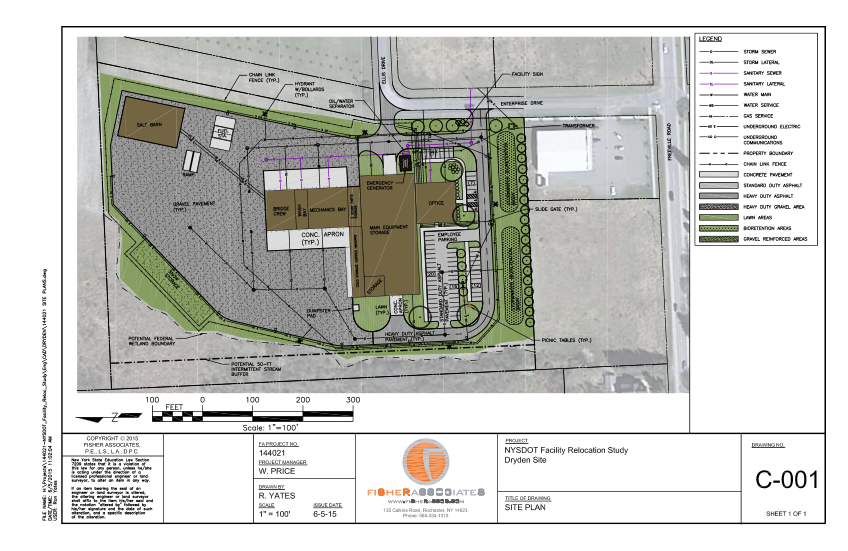
dot_concept_1

For what it’s worth, Fisher associates also did a conceptual layout for a new DOT facility here.

According to the county, here are the next steps in the process:

  • A financial plan for the redevelopment of the Cayuga Inlet site that reduces the risk for private developers and generates revenue to support the move of the existing NYS DOT facility.
  • An analysis of the project’s impacts on infrastructure and utilities, the natural environment, neighborhood and adjacent properties, and the surrounding road network.
  • An estimate of the land value of as well as the individual components of the plan. The result will be an order of magnitude valuation of the site to better understand the project’s ability to attract private investment, support debt, and support a purchase price and tax revenue stream that could be used to advance the NYS DOT facility’s relocation.
  • A draft Request for Proposals (RFP) to solicit developers to redevelop the site.
  • An estimate of the ongoing direct fiscal benefits to accrue to the City of Ithaca and to Tompkins County, including real property taxes, personal property taxes, school taxes, sales tax, and other applicable taxes and fees.
  • A financial strategy for moving the DOT site with some combination of revenue from sale of the site, direct funding from NY State, and, possibly, a local contribution from anticipated tax revenues.

Expect that last one to be potentially controversial. The state might move slow but could be supportive, but the city will have to explain and hope that a possible initial investment in the DOT’s move to Dryden could pay off over subsequent years. Voters don’t always like long-term plans.


News Tidbits 10/24/15: Breckneck Builds and Market Slowdowns

24 10 2015

college_crossings_v3_end

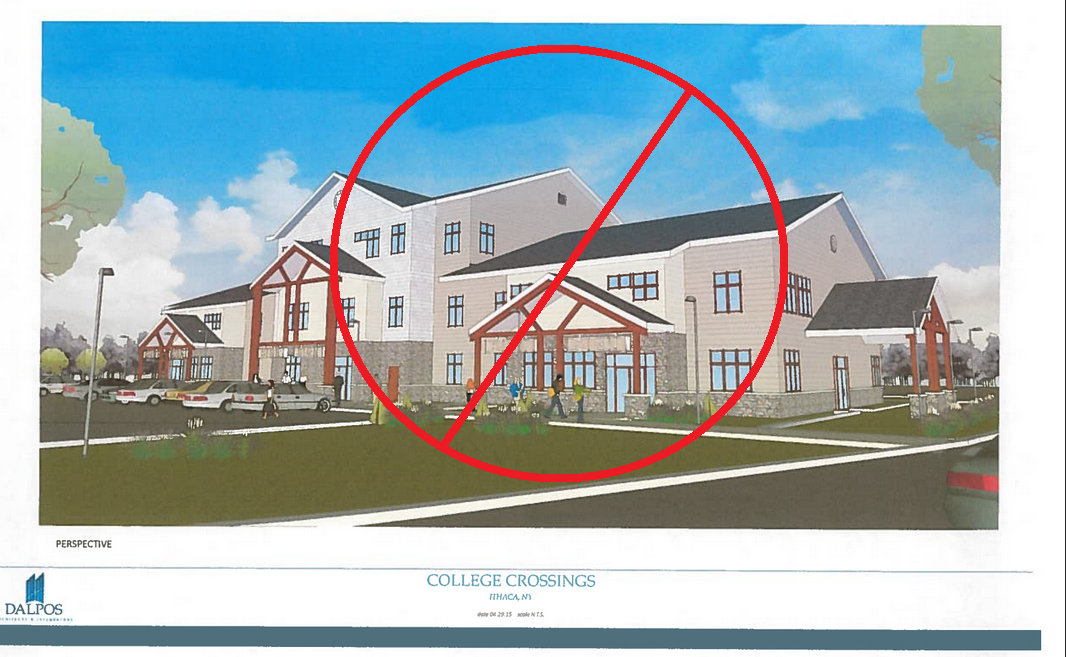
1. College Crossings is dead. But its passing opens up an interesting conversation.

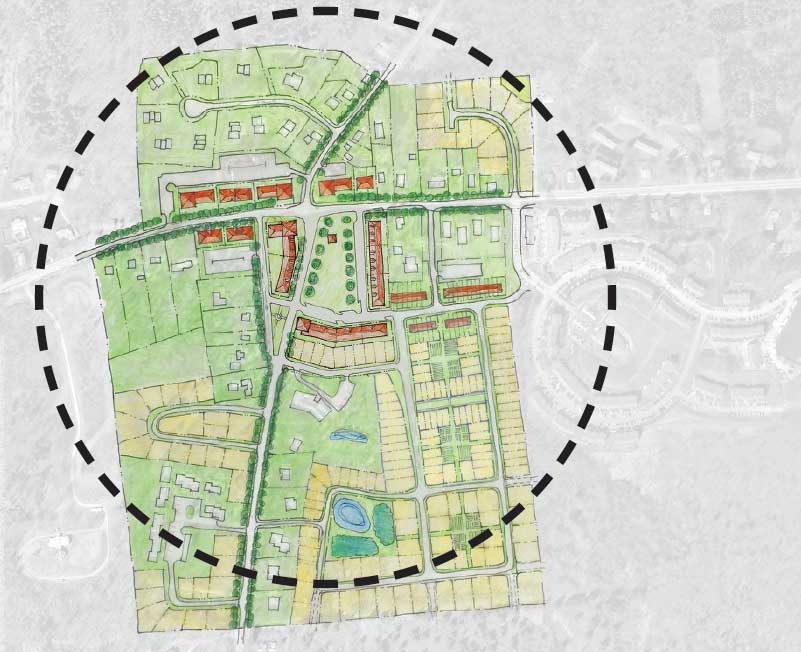
According to Ithaca town planning board minutes uploaded earlier this week, developer Evan Monkemeyer withdrew his proposal after planning board members weren’t comfortable with approving the environmental assessment and mitigation plan for the proposal (technically called a “negative declaration” by the lead agency on the SEQR). While at least one was bothered by the 3-story, 54′ height, many board members had visions of the Form Ithaca charrette for the property, and this didn’t quite jibe with Monkemeyer’s plans for South Hill’s King Road and Route 96B/Danby Road intersection. Minutes for the July and August meetings can be found here.

college_crossing_2

plan-2 plan-1

Now, I will gladly admit that I was not a fan of this project, and I too wanted something more along the lines of Form Ithaca. I’m surprised, though, that it was enough to derail approvals of the project.

Now, the problem is, the town’s new comprehensive plan embraces form-based codes and “Smart Growth”, but the zoning is auto-centric, outdated, and doesn’t mesh with the plan. If you’re a developer or builder, big or small, and what’s legal and what the town wants are two very separate things…Houston, we have a problem.

At this point, there’s two questions that come to mind – one, given that the town planning board has cancelled most of its meetings lately due to a lack of proposals, is the disconnect between plan and zoning halting projects, and two, when will revised zoning be ready. For guidance and knowledge, I reached out to town of Ithaca assistant planning director Dan Tasman, because he’s pleasant, responsive and a pretty great guy.

As for question one, here’s his quote: “Seriously, I think it’s … complicated.” His thoughts were that there’s no indication whether the recent slowdown were caused by the planning/zoning disconnect, or natural ebb and flow related to lending and planning on the ends of home-builders and developers.

As for question two, the response was summed up as, “a lot of communities face the same issue after they adopt new comp plans. On the positive side, Ithaca’s not growing that fast, and the pace of development is slow. Still, there’s a sense of urgency.”

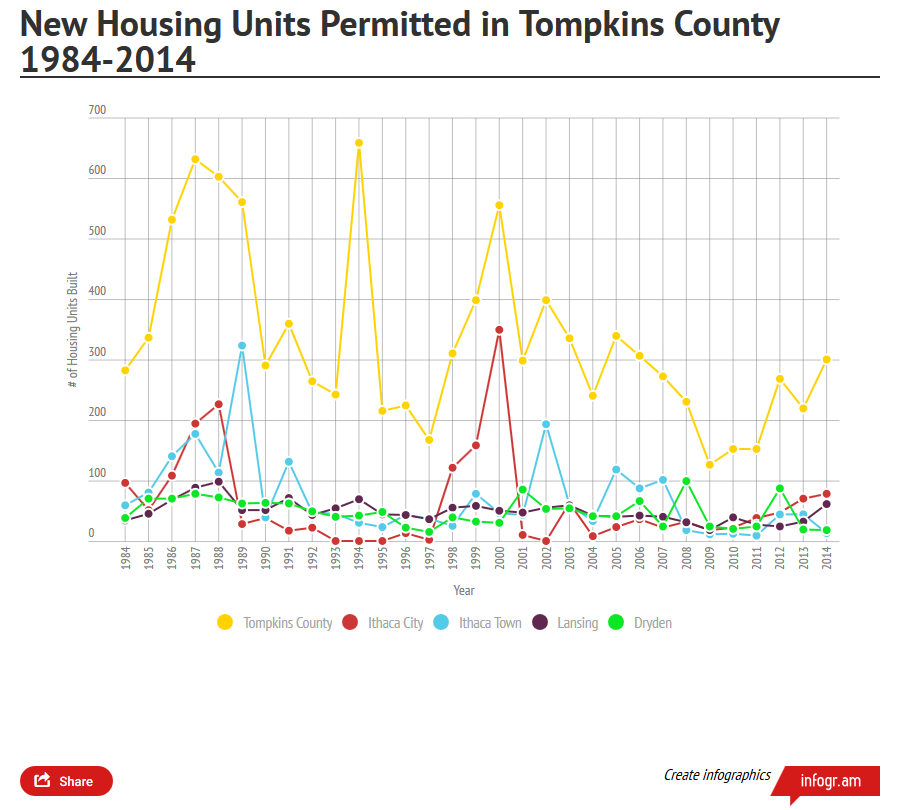
He’s right about the town not growing that fast. The permit records show that in September, the only new home-building permit was for a duplex at 214 Pennsylvania Avenue on South Hill (the Iacovellis building more student rentals for IC, probably). The previous month online, June, had four single-family homes, filling out lots in previous-approved subdivisions.

tc_housing_permits_1984_2014

Traditionally, the town of Ithaca has made up a pretty sizable chunk of the new home permits in the county. But if they only issue 30-40 this year (still better than last year’s 14), then it falls on the rest of the communities to try and make up the housing deficit, at least in the short term. Ithaca city’s total, anticipated to be 247 new units to be permitted in 2015, is only about 84 units right now, because John Novarr has yet to start Collegetown Terrace’s Phase III, and Steve Flash’s 323 Taughannock on Inlet Island has yet to start either. To bring down the deficit in a decade, as well as keep up with annual economic growth, the county would need over 600 units per year; it’s not certain if the total will reach even half that in 2015.

On the one hand, the town of Ithaca is trying to be proactive and adopt a new approach to development in quick and good order. On the other hand, it’s not a great situation for trying to make a dent in the housing deficit, with its attendant affordability issues, and there’s the possibility things are going to get worse before it gets better. I don’t know if there’s a right or a wrong way of going about it, but it’s a stressful setup.

2. On the county level, officials are seeking legislature approval for launching a study into the feasibility of an airport business/industrial park in Lansing. 52 acres of vacant land along Warren and Cherry Roads are being considered for the study, which would include a conceptual site plan of potential buildings and parcels, and an assessment of the needs and characteristics of companies most likely to open in the potential business park. Utilities and green infrastructure will also be looked at in the study. The projected cost is less than $50,000, and being paid for by the Tompkins County Industrial Development Agency (TCIDA). The feasibility study would be awarded next month, with authorization and approvals on the staff level.

arpt_pk_1

For what it’s worth, folks living up there are used to business traffic – Borg Warner’s 1,300 person plant is adjacent to the study site. The Warren Road Business Park lies a minute’s drive up the road, and the Cornell Business Park is about a minute’s drive south. The land also has municipal sewer, allowing for large-scale projects. A copy of the RFP states two that the two parcels shown above are the primary analysis area, with secondary areas closer to the airport runway and the resident land to the west separate from the park. They aren’t a part of the proposed business park, but the county asks that they be examined for development potential by the study.

holiday_inn_express_v2

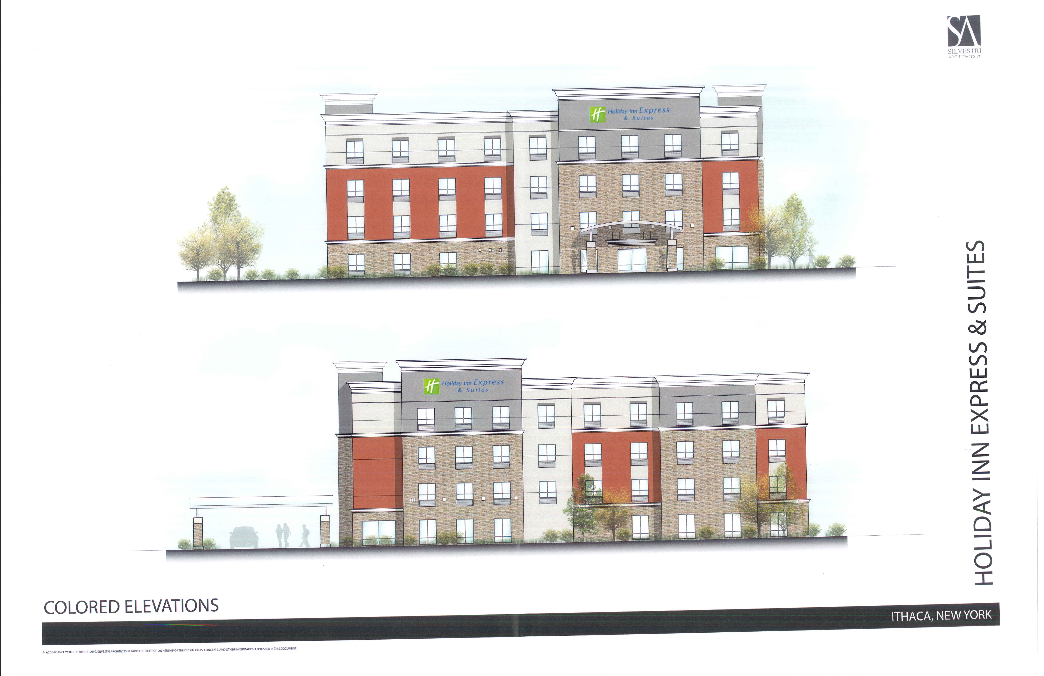
3. Details, details – the Holiday Inn Express already under construction in big-box land at 371 Elmira Road will be going in front of the city planning board this month for some slight modifications. The developer, Rudra Management and Rosewood Hotels of Cheektowaga, wants to increase the number of rooms from 76 to 79, and add three parking spaces accordingly. Along with that comes the bevy of supporting docs – technical drawings here, landscape plan here, landscape schedule here, and elevation drawings here. Apart from a palette change on the exterior (the red-brown color is “Decorous Amber“, part of the new official Holiday Inn color scheme per the architects’ cover letter), there are no changes to the design, the 3 additional rooms are just an update to the interior configuration of the hotel, one more room on each of floors 2-4. Apart from tastes in color and making sure the three new parking spaces pose no issues, the board won’t have to debate much here, and the hotel is still very likely to open next summer.

1015_dryden_1

4. In small but notable builds, Modern Living Rentals (MLR) is at it again. The relatively new Ithaca-based rental and development company is planning a triplex (3 units) at 1015 Dryden Road, just east of the hamlet of Varna. According to an email from MLR co-owner Todd Fox, the units, all 2-bedrooms, will start construction in the spring, and it’s a safe wager they’re shooting for an August 2016 completion, just in time for Cornell student renters. Judging from the renders on MLR’s site, each unit will be around 930 SF, so about 2,790 SF total. MLR teamed up once again with local architecture firm STREAM Collaborative for the design.

1015 Dryden is also home to a single-family home built in 1938, and a 4-unit apartment building from about 1980. The apartment building was badly damaged in a fire in 2011, renovated, and the site was sold to MLR for $425,000 in March 2014.

815_s_aurora_4 815_s_aurora_5 815_s_aurora_6

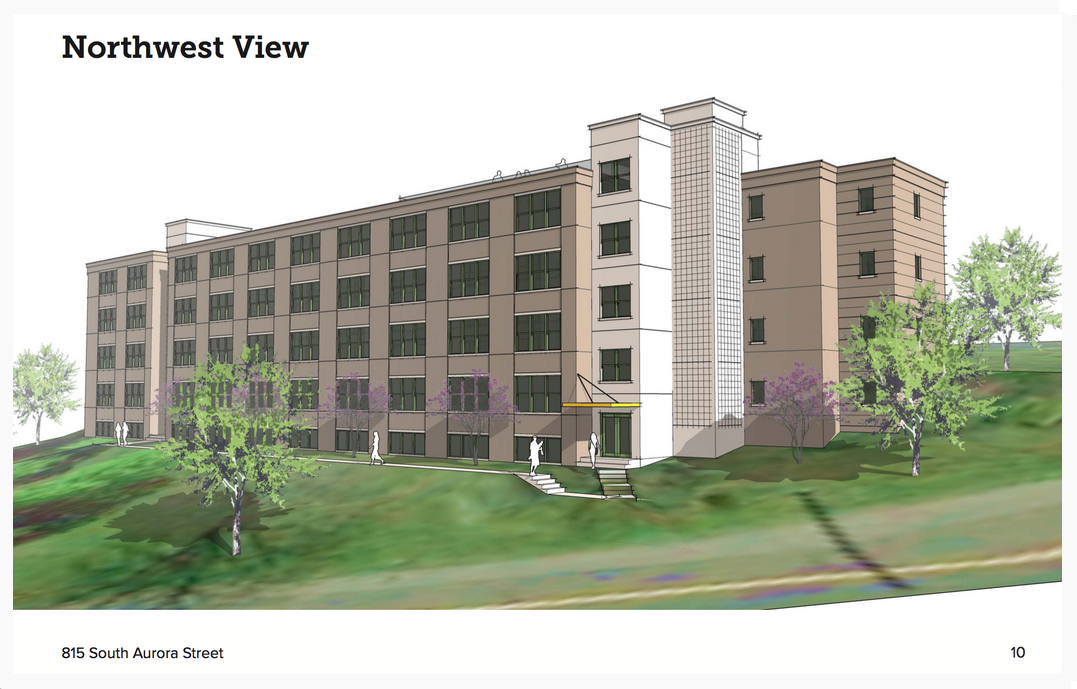
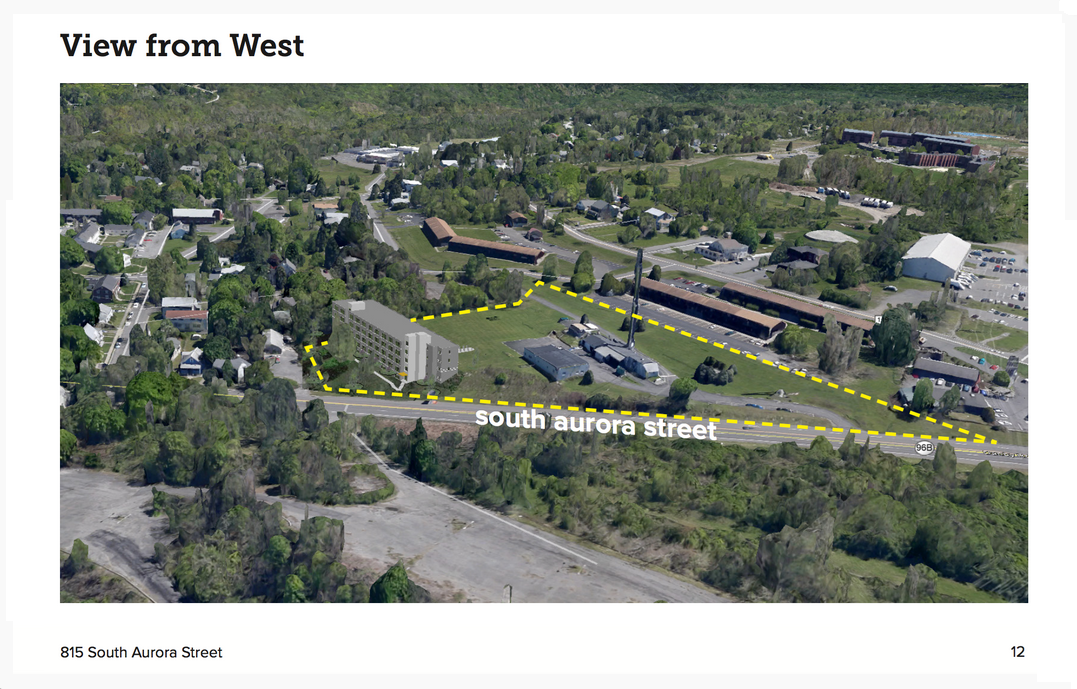
5. While on the topic of MLR, let’s throw in some eye candy. Along with the plans for 1015 Dryden, additional images for the proposed 87-unit project at 815 South Aurora Street on South Hill can be found on their website as well. I’ve included two perspective renderings and an aerial render, but more images can be found here. The 87 units will all be studio apartments. STREAM Collaborative is responsible for this design as well.

A detailed write-up of the project, including the related cell phone tower issue, can be found here.

6. Out in Lansing town, there are two attention-grabbing news pieces from Tuesday’s next planning board meeting. One is a plan for an LP gas / petroleum distribution facility on Town Barn Road (parcel address 3125 N. Triphammer Road). A 30,000 gallon storage tank and gravel drive are planned in the initial phase, with 5 15,000 gallon tanks, a garage/maintenance building, and an office planned in later phases. Now, normally a project like this is not a big deal, but there’s the outside possibility local contingents of the anti-Crestwood, anti-fossil fuel groups will go on the offensive to try and stop it. So the potential for political football is there.

The other detail isn’t up for discussion yet, but the town notes that 15 duplexes (30 units) are being planned by former Lansing town supervisor A. Scott Pinney for a site on Peruville Road (the county calls it 428 Scofield Road, but the land has frontage on both roads). The site already houses 4 duplexes built in 2011.

Breakneck_Builds_-_Master_Card

7. Instead of the the usual “House of the Week”, this week is more of a shout-out/advertisement. For those with cable, The DIY Network will be running a new episode of “Breckneck Builds” tonight at 11 PM (additional showings listed here), highlighting a just-finished home on Dryden’s Hollister Road. Quoting the promo write-up:

“Jordyn is ready to leave her rental behind and buy her first home, but what is most important to Jordyn is that her new home is eco friendly, so she is turning to the modular world to build a big house with a small carbon footprint.”

The modular home assembly was the work of local builder Carina Construction, who also tackled the modular units at the Belle Sherman Cottages site. Local builder, local resident, local project, so set your DVRs or TiVo.

8. Last but not least, here’s your Planning Board agenda for next Tuesday. Nothing new at this month’s meeting, but here’s the run-down:

A. Review of changes and revised approval for the Holiday Inn Express (see above)

B. Declaration of environmental significance and BZA reccomendations for 215-221 West Spencer Street– Pocket Neighborhood, 12 units w/ 26 bedrooms, Ed Cope/PPM Homes is the developer, Noah Demarest of STREAM Collaborative is the architect.

C. Environmental Review Discussion for the bar/lounge proposed for the renovation of 416 E. State – cover letter here, description here, letters of opposition in the agenda.

D. Public hearing and re-approval, Hotel Ithaca renovations, 222 S. Cayuga – Site Plan Review drawings here, renders here and here. Not sure there’s enough of a difference from the first time around, but at least the cross-catching on the exterior is gone.

E. Herson/Wagner Funeral Home renovation, 327 Elmira – Declaration of Lead Agency and Public Hearing – I wrote about that in the Voice here. Fun fact, the original proposed title was “Funeral home hopes to being new life to Elmira Road property”. It was rejected.


News Tidbits 10/3/15: Lying in Wait

3 10 2015

1.We’ll start with a news piece out of the ‘burbs. Over in Lansing town, wealthy homeowners are accusing the town board and the town planning board of disenfranchising and ignoring them over concerns about the proposed Novalane housing development. Dan Veaner at the Lansing Star gives a very thorough rundown here.

Quick summary, Novalane is a 19-lot high-end housing development slated for farmland between two other high end housing developments, the mostly-built Lakewatch and Eastlake subdivisions, the first phase of which is comprised of seven lots on the west side of the parcel. The sticking point has to do with access roads for the new homes. The developer proposes to connect the two developments via the Smuggler’s Path cul-de-sac, which would extend down through an undeveloped lot in Eastlake and connect with Eastlake Road.

According to the town, the intent has always been to connect the two developments – but apparently, no one ever had a good idea where. Neighbors on Reach Run are incensed because they’re afraid of additional traffic on their road if the connector isn’t extended all the way, but if connected, Eastlake residents are opposed to cross-traffic they suspect will cut through to get to East Shore Drive. Aside from that conundrum, some neighbors have suggested being okay with the road if it went all the way from Smuggler’s Path to form an intersection with Waterwagon Road, but that doesn’t seem possible given the property lines of the Rec Club. At the very least, it would be a big burden in the development costs.

So on the one hand, here is a town that has struggled with planning issues. On the other, you have wealthy residents angry about construction vehicles accessing the one house currently under construction in Lakewatch, and prepared to sue the town over the potential of seven more houses. There’s also this gem of a line:

“We’re large taxpayers.  It’s an autocracy.  To be treated like that by our own representatives is incorrect and not acceptable.  Who are they working for?”

Maybe all taxpayers and not just the large ones? Just saying.

2. Switching over to another ‘burb, the proprietors of Storage Squad made their pitch to the town of Dryden, per the Ithaca Times. Storage Squad, a Cornell startup that has expanded to twenty cities, seems to have a rather unique take on the appearance of self-storage. For their facility planned at 1401 Dryden Road, the company wants to build 79,600 SF of space, 70,000 SF of which would be in five buildings consisting of 400 storage units. 315 units may join 3-4 years down the line. According to the presentation, there would be a Cornell-inspired clock tower, brick and ivy growing on the side walls. Paved entries, gated, and split-face concrete masonry units. Apparently, it was enough to win the town supervisor over. A special zoning permit will be required, but approval is expected later this fall. No word on whether they’ll keep the 150-year old house on-site.

3.  Must be a good week for Dryden. The eyesore at 76 West Main Street has been sold and has a construction loan approved to finish renovations. The Ithaca Voice article I did on the reno is here. I toyed with the idea of calling Dryden mayor Reba Taylor for a quote, but I figured I’d get a very generic statement it any at all, and in the interest of time the idea was shelved. I might get a response to one-third of the calls I make regarding development/real estate stuff, which can be frustrating but I’ve gotten used to it.

state_st_triangle_v5_1

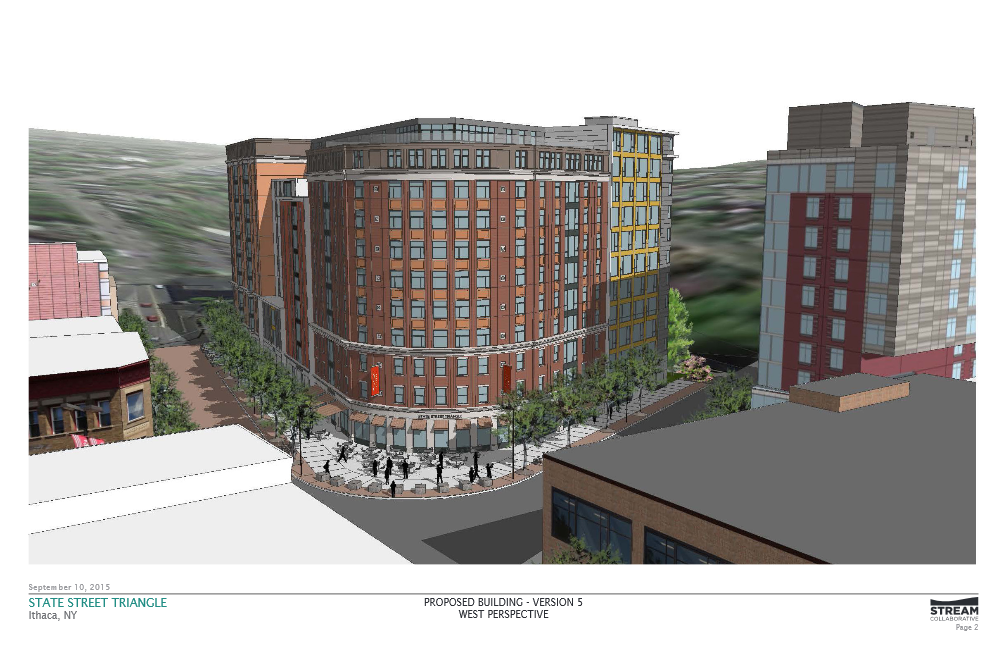
4. The Times’ Josh Brokaw brings out an update on the latest State Street Triangle news. The important details:

– CTB has agreed to take one of the commercial spaces. No word on how that would affect the North Aurora Street location a couple blocks away.

– The planning board didn’t have many words; One member suggested the curve portion was “too flat” and an arcade on the first floor (not the video game kind, but the archways over a walkway kind). A second brought up affordable housing, which the developers have given consideration, but isn’t in the current plan.

– In favor: the director of Cinemapolis, other developers, CTB’s owner and students. Not in favor – the head of Historic Ithaca, and councilman George McGonigal – who opposed the Stone Quarry Apartments, the waterfront rezoning, 210 Hancock and thinks the city can make Cornell build dorms. The Times has called him out as “anti-urban”. If a councilperson outside the first ward speaks out, it’ll get a lot more credence on this blog.

304_college_2

304_college_3

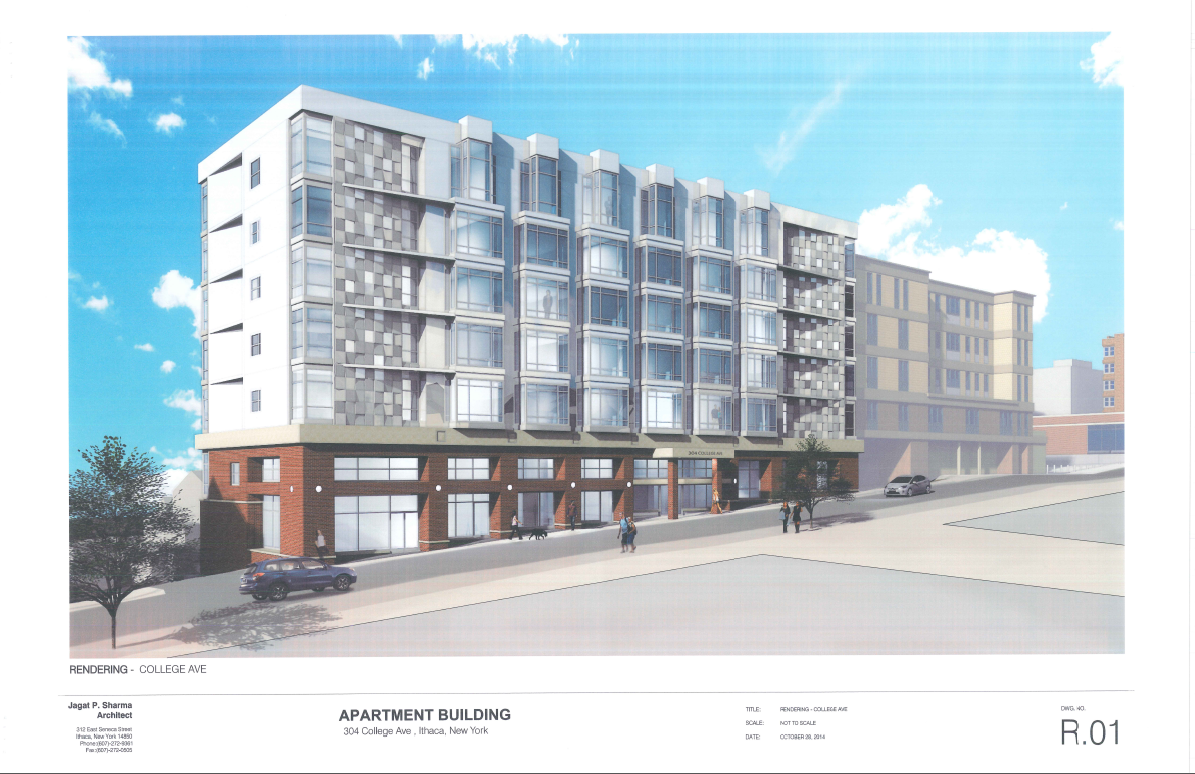
5. The city and Cornell gave an interesting presentation about development to the Collegetown Neighborhood Council this week. City planning director JoAnn Cornish gave a rundown of what’s planned, included the 102 apartments 302-306 College Avenue (phases one and two shown above). This one might still be in the hopper, but don’t expect it to move forward anytime soon – the developers (the Avramis family) have rented out the houses to be demolished through May 2017. It also seems like that one building would be in the 2017-2018 time frame, the second 2018-2019. So these two mid-rises are quite a ways out, assuming they’re still in the works. Also, Fane’s 12-story proposal for 330 College is still dead, but something more modest may come forward someday.

On another interesting note, Cornell’s lead planner, Leslie Schill, said the university may be looking into turning Eddy Gate and the Sheldon Court plaza into green spaces to offset the lack of parks in the neighborhood. Cornell might also renovate the Ag Quad into a richer pedestrian experience.

6. The Carpenter Business Park purchaser continues to intrigue. A company called Carpenter Business Park LLC, using a P.O. Box ties to the Miller Mayer law firm, has bought two more parcels after buying the four unused land parcels in the Carpenter Business Park for $2.4 million last August. This time around, the LLC purchased a nondescript one-story commercial building at 742 Cascadilla Street, and a nearby tiny silver of land between the Palisades Corporation and Cornell U. Press buildings for $304,000. It’s not clear what the buyer is intended to do with all these properties (we know it’s not a big box store), but it’s definitely curious. If something comes up, it’ll be shared here.


News Tidbits 9/12/15: Some Projects Lose Mass, and Some Hold Mass

12 09 2015

1. We’ll start this week off with a little bit of economic development news. According to paperwork filed with the Tompkins County IDA, CBORD, a Lansing-based software company, wants to move out of its digs in the Cornell office park by the airport, and into a new larger facility in renovated space in the South Hill Business Campus next to Ithaca College. CBORD would lease 41,000 SF of space with five year options to renew. All 245 local employees would be moved into the renovated space, which would be finished by the end of May 2016 and designed by local architect John Snyder.

The project is expected to cost about $3.7 million. No new jobs are stated in the application.

Assuming SHBC’s website is up-to-date, no contiguous spaces are currently large enough for the tenant, so either the internal space will be split up, or some other tenants will be jostled around to make room for CBORD.

As for the abatement itself, CBORD is requesting a sales tax abatement, one year in length, with a value of $296,000, about 8% of the project cost. It doesn’t appear to have made any waves at Thursday night’s meeting, so what;s likely to be a low-key public hearing and approval vote will be coming in the pipeline.

Also at the IDA meeting, final approvals were granted for tax abatements on the 209-215 Dryden project by John Novarr in conjunction with Cornell. and for INHS’s 210 Hancock affordable housing development in the city’s Northside neighborhood.

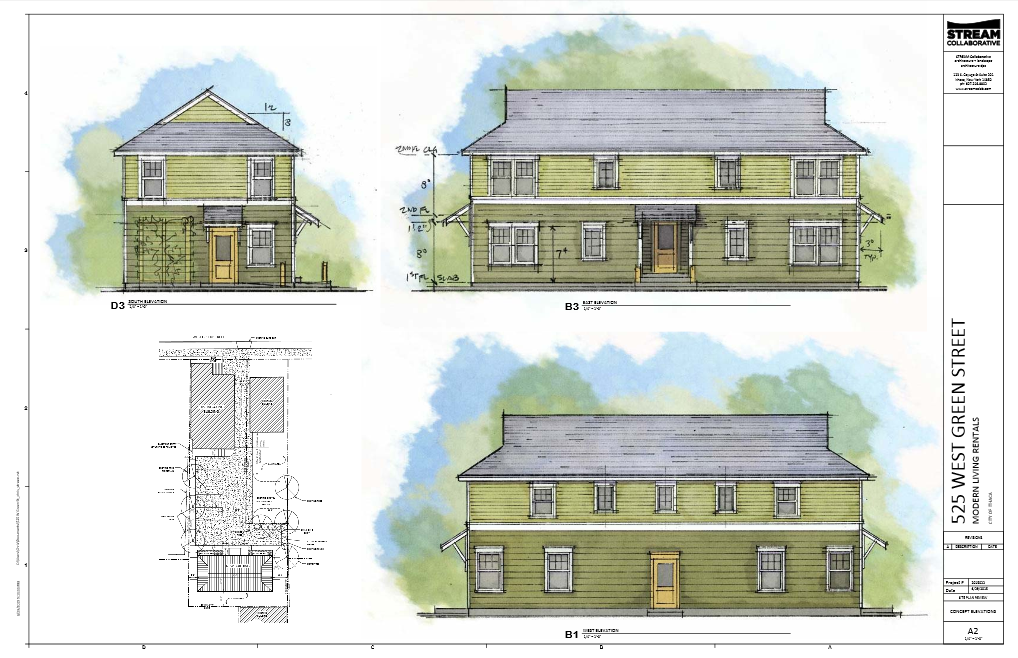
2. Another small infill project seeks approval from the city’s planning board and the Board of Zoning Appeals (BZA). 525 West Green Street, located on the edge of the South Side neighborhood, is currently home to a 4-unit apartment house. Local developer Todd Fox of Modern Living Rentals (MLR) is seeking to build a 4-unit, 4-bedroom apartment house at the rear of the property, where a clapped-out garage currently stands. The units would be rentals, but this far from Cornell and Ithaca College, the target market is likely to be permanent Ithaca residents – single professionals would be a good guess.

525_w_green_1

Plans drawn up by prolific local firm STREAM Collaborative call for a 2-story, 2,360 SF “carriage house” building designed to fit in with the rest of the neighborhood, although quite honestly no one would be able to see the new building unless one were looking down the driveway. A landscaped rear parking area for 8 vehicles would replace the current 4-car lot behind the existing building.

According to Site Plan Review documents, construction cost is estimated at $300,000, and construction would take place from November 2015 to July 2016. Area variances are required from the BZA since this building partially occupied space reserved for the rear setback, but according to the SPR the variance has already been granted.

Readers might recall that MLR has been a very busy company as of late – although relatively new to the Ithaca scene (MLR was established in 2010 by then-recent college graduates Charlie O’Connor and Todd Fox), the company has developed the 6-unit 707 East Seneca apartment building, a duplex at 605 South Aurora, and is currently going through the approvals process for solar-powered townhomes out in Varna. The duo also partnered with local real estate businessman Bryan Warren to purchase the Collegetown Bagels at 201-207 North Aurora Street.

As for the project itself, 525 West Green Street is perhaps the largest example of the carriage house trend Ithaca has been seeing lately, where old garages or unused rear lot spaces are being developed into small, detached apartments, typically no more than studio or 1-bedroom size. Other examples include 201 West Clinton, 607 Utica,  and new this month, a studio apartment proposed for a former workshop/garage at 701 North Aurora. Arguably, one could throw New Earth Living/Sue Cosentini’s Aurora Street pocket neighborhood in there as well.

Given that these properties are modestly-sized, rarely visible from the street, and provide rental income to property owners who in most cases live on the same lot, they seem like an appropriate way to increase density without upsetting Ithaca’s character balance.

troy_rd_rev1_1

3. Briefly in blurbs – according to the agenda for Ithaca town’s Public Works Committee (PWC), the town will be looking at sanitary sewer access for a potential development along Troy Road. Now, before anyone gets their blood pressure raised, this most likely has nothing to do with the 130-unit project that was mothballed a few months ago. But, there have been rumors of smaller-scale plans for one of the parcels that comprised the now-subdivided property. The development radar has been turned on, and if anything shows up, you’ll see it shared here.

4. Staying in Ithaca town for the time being, the town’s planning board has but one project on their agenda for next Tuesday – a new parish center for St. Catherine of Siena Church in the Northeast Ithaca neighborhood.

Yes, even in Ithaca, one of the least religious metros in the country, famously home to a school that pastors derided in fiery philippics 150 years ago for daring to not affiliate itself with a Christian denomination or enforce mandatory church attendance, churches can hold their own.

st_catherines_1

Plans call for a new 10,811 SF parish center at 302 St. Catherine Circle, on what is currently part of the church parking lot. Once built, the current parish center, a one-story, 10,275 SF jumble of boxes and corridors, would be demolished and replaced with parking spaces. Richard McElhiney Architects of NYC is the project architect, and a bit of an unusual choice since the firm doesn’t have a presence or previous work up here.

In an assessment by Ithaca town planner Christine Balestra, concerns were noted about a phased parking plan for the church while construction is underway, and minor requests for landscaping details (plans call for two fountains). Other than that, it doesn’t look like this is going to make any waves during the approvals process.

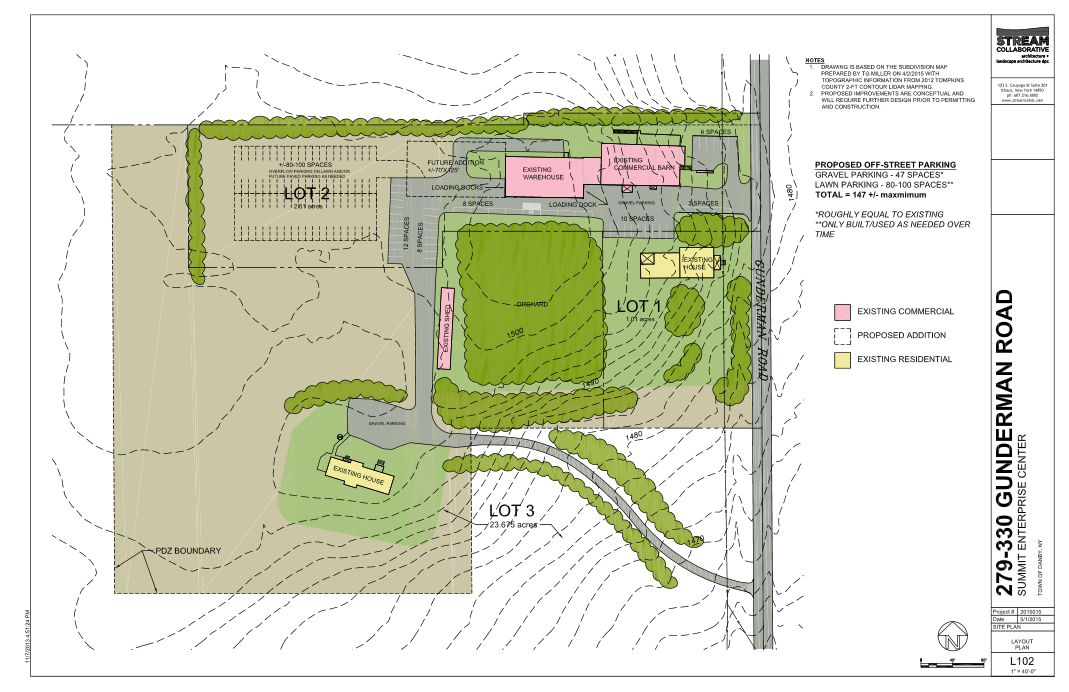
5. Over in the town of Danby, plans are underway to convert a former clothing design and warehouse facility into a mixed-tenant business center. Docs filed by STREAM Collaborative’s Noah Demarest on behalf of owner David Hall call for modifications of a Planned Development Zone for the property at 297-303 Gunderman Road. Danby’s PDZ is not unlike the city’s PUD and town of Ithaca’s PDZ, where the form and layout is regulated rather than the use. The original PDZ for the property dates from the mid-1990s.

summit_danby_1

The “Summit Enterprise Center” would be anchored by National Book Auctions currently on Danby Road, Blue Sky Center for Learning (a company that provides support and therapy for autistic individuals and their families), and New Moon Harvest, a food and beverage maker. Additional office, warehouse and industrial/food production space would be available to potential tenants. The existing 21,000 SF building and landscape would not be significantly changed, although future plans for a 4,147 SF addition and parking lot are noted.

chain_works_rev2_1

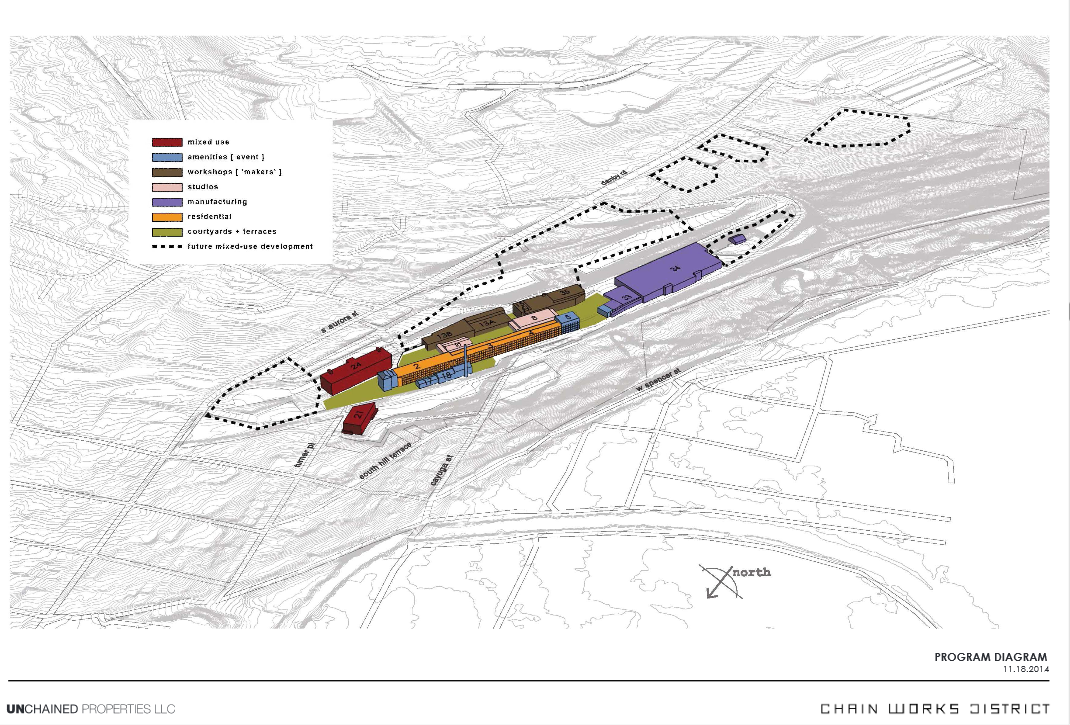
6. Speaking of PDZs and PUDs, I did take the opportunity when I spoke to David Lubin last week to ask how things were going with the Chain Works District development. Here’s what he said:

“Chain Works District is continuing. We’re working with the state and Emerson, investigating the site and making sure all the remediation plans are readied and approved. There will be public hearings. It’s a slow process. We will need DEC approval for the residential uses. We hope to obtain city approvals [for the draft environmental impact statement] this year.”

There’s no doubt the project will take time. With complicated topography, environmental issues, 800,000 SF of planned development space and two municipalities, it’s arguably the most complicated tax parcel in all of the county, if not the region. Readers may stretch their memories back and remember that the first phase will consist of the renovation of buildings 21, 24, 33 and 34 into mixed-use and manufacturing space. Ithaca Builds (come back Jason, Ithacans need someone with your knowledge) provides a detailed run-down here.

619_w_state_st_1

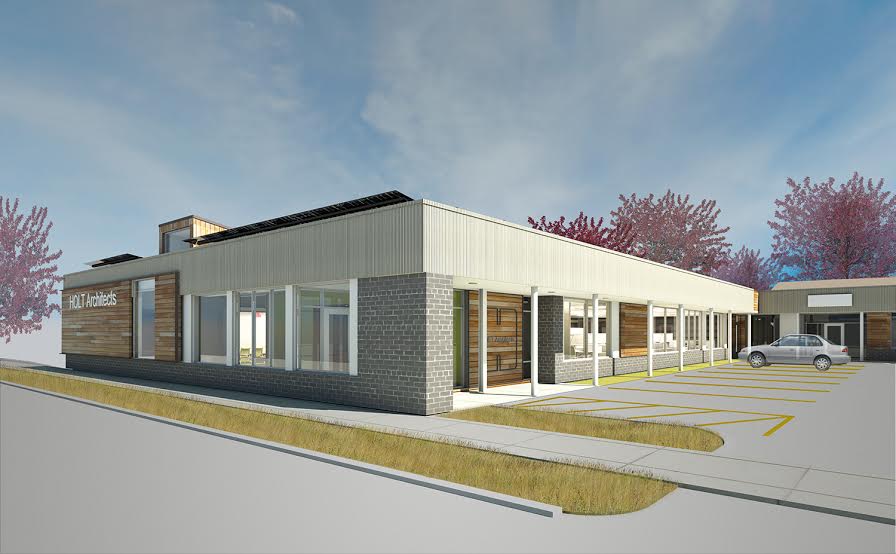
7. Courtesy of Maria Livingston at HOLT Architects, here’s a render of the renovation HOLT is undertaking for its new headquarters at 619 West State Street. Gone are the rather dated-looking decorative parapets, and in comes a clean, modern design with a mix of wood, brick and steel facade materials. HOLT’s 30 employees will occupy most of the new space in the  net-zero energy structure, but there will be space for two other tenants (one of which has already been claimed).

HOLT is spending about $900k on the renovation, which is due to be complete next March. Tompkins Trust Company is providing the financing, and local company McPherson Builders is in charge of general construction.

A copy of the official press release, and an interior render, can be found on HOLT’s blog here.

state_st_triangle_v5_1

8. We’ll wrap up this work with a topic at the tip of everyone’s tongue – State Street Triangle. Architects Kelly Grossman of Austin, Texas and Noah Demarest of STREAM have worked to redesign the project so that its massing is less imposing and its design a little more varied. Specifically, it now looks more like several buildings built next to each other with varying setbacks and heights, rather than one continuous mass – the change is especially prominent on the 300 Block of East State, where the most concern was raised.

The developers held a community meeting Thursday night (pro tip for Campus Advantage – next time, give more than 30 hours’ notice), which has been covered by the Journal here and the Voice here. That the developers scheduled their own community meeting outside of the confines of city hall is laudable.

As part of the redesign, the number of bedrooms has been reduced from 620 to 582. Recent estimates have now priced the project at $70 million. The developer has expressed interest in designated some of the units as affordable housing, in what would be an example of the inclusive zoning that some city staff are currently looking into.

state_st_triangle_v5_2

The project is seeking a tax abatement, though the formal details have yet to be released. Rents would be between $980-$1,600 per month per person, and would include utilities, gym and other “all-inclusive services”. I suspect that a parking space in the Cayuga Garage is an added cost.

Speaking strictly for myself, the design is an improvement, though I have subjective quibbles – for instance, would a lighter color material make the north wall of 11-story middle section less visible from a distance, and would it be possible to give the blank walls more character. Balancing pros and cons, I also think the design of the Commons-facing corner looks tasteful and classy. The prospect of affordable units in the building is intriguing. If I was a planning board member, I’d ask to see material samples to make sure the building doesn’t end up looking cheap.

state_st_triangle_v5_3

Additional images of the updated design can be found on the city’s website here, and a written summary of the changes from project consultant Scott Whitham of can be found here.