News Tidbits 8/1/15: Tempers As Hot as the Temperatures

1 08 2015

state_st_triangle_v3_3

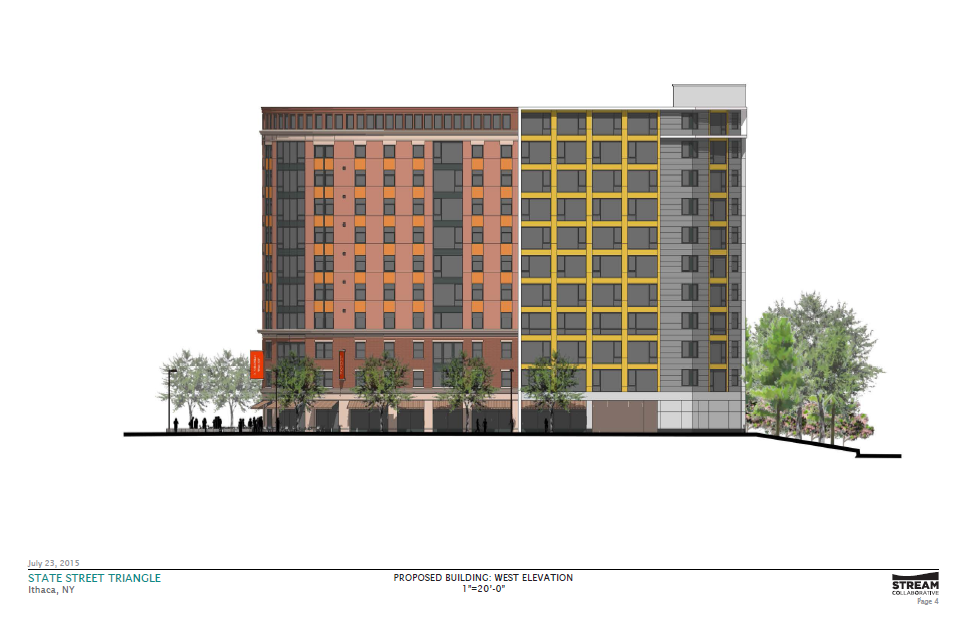
1. I asked someone familiar with the State Street Triangle how the presentations went this week. “About as well as could be expected” was the diplomatic response received in turn.

The Times, Journal and Voice all devoted coverage to the controversial project this week since its CIITAP application was up for review, as well as revised plans being brought forth to the planning board. The project draws detractors from different angles – some because of size, some because it’s student housing, some because of the tax abatement.

The tax abatement is what confuses me somewhat, for reasons related to the theory I wrote up a few weeks ago, which no longer holds water. My own personal thought was that a sort of economy of scale would kick in with greater site efficiency, negating the need for a tax abatement. That isn’t to say that they still couldn’t try for one, because it meets all the CIITAP requirements, just that they didn’t need it (it would have been proverbial “icing on the cake” if granted). But now they’re saying it’s the only way to move forward. I don’t know the financials and what their necessary ROI is (and probably never will), but I’d happily listen to an explanation.

But the point I made in the piece still holds true – if Jason Fane’s project a couple blocks away was rejected for not having enough of a community benefit, market-rate student housing, even that which generates an extra $7.36 million in taxes over a decade, is going to be a big stretch, unless they plan on using the sheer size of it as a selling factor. The city planning board doesn’t have to worry about the controversy, because the project conforms wholly to a central business district zone. It’s going to be the tax abatement issue that makes or breaks this proposal.

2. As part of its 10th anniversary feature, the Lansing Star did a nice retrospective of what’s changed in the past ten years in Lansing. When it comes to development, it isn’t especially kind:

“Lansing hasn’t changed much in ten years.  While grand plans for the future of the Town have been explored, not many have been realized.”

The article then goes on to detail how after the sewer initiative was defeated by public vote, a few developers banded together to try and fulfill the town center that Lansing was pushing for. Quoting the article, “the town government couldn’t get its act together to make that happen, even though it wouldn’t be footing the bill for the infrastructure (including sewer)”. About the only development initiative that has taken off is the Warren Road corridor, which was spurred mostly by threats of a major employer (Transonic) leaving the town (and Transonic paid for the sewer study). Meanwhile, the Star characterizes the village government as simply existing for “maintenance” purposes.

The paper notes some successes with parks and wildlife initiatives, but the highlight of the piece seems to be that Lansing is routinely failing to achieve its municipal planning and development goals.

3. Back in Ithaca city, plans are underway for the major renovation of a shopping plaza into professional office space for a local architecture firm. According to documents filed with the county, an LLC associated with HOLT Architects is spending $897,500 on the renovation, and another $415,000 for acquisition costs. The renovations will start in late August should be completed by March 2016. Tompkins Trust Company is providing the financing, and local company McPherson Builders is in charge of general construction.

From the press release published late Friday, HOLT chose the West End location for its walk-ability and centralized location. The building will be renovated into a net-zero energy structure for the 30-person architecture firm. No renders yet, but they’ll be included in a future news roundup when they become available.
college_crossings_v3_1

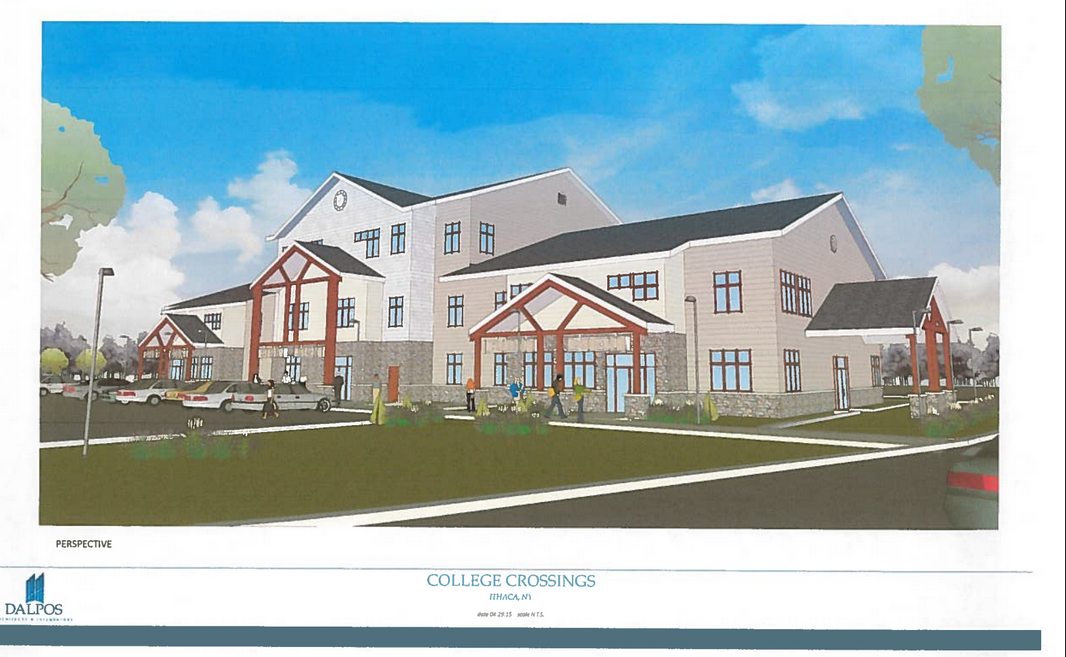
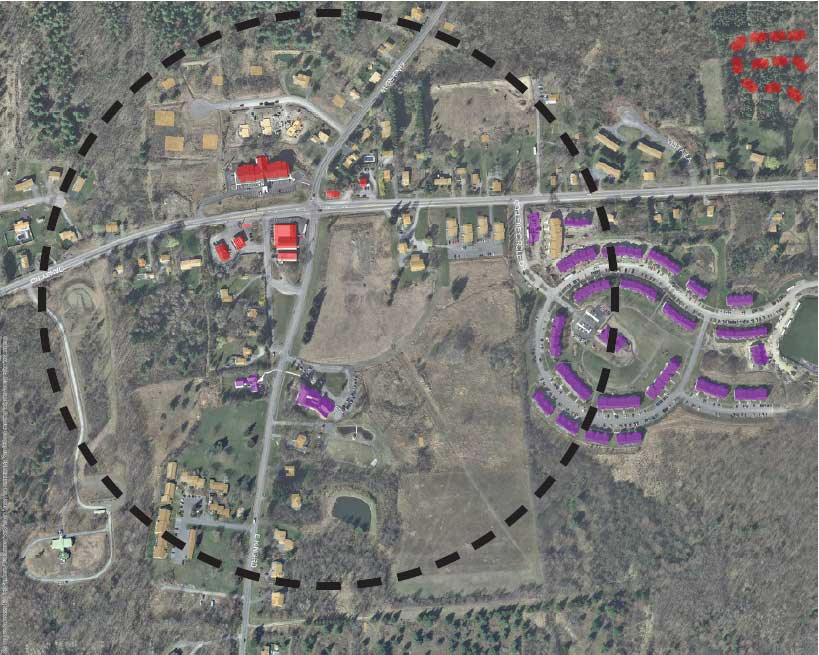
4. As written in the Voice, College Crossings at the corner of East King Road and Rt. 96B in Ithaca town is back to the board for revision number three. This one increases the project by a floor, 13,000 square feet and six more apartments. It’s been no big secret that developer Evan Monkemeyer’s had difficulties getting the project off the ground (he resorted to Craigslist for marketing the retail spaces), and given a total of 18,000 SF spread among 8 apartments (doing the standard 15% deduction for circulation/utilities, one gets over 1,900 square feet per apartment) these units are almost certainly geared towards IC students. A solid market since they’re next door, though not likely to elicit warm fuzzies from the neighbors (although based off the response on the Voice’s facebook, most people just don’t care; if only 210 Hancock had it this easy). Previous plans can be found here.
south-hill-areaplan-1 plan-2

Personal opinion, I’m a little disappointed in the revision. The mixed-use aspect is fine, but I was hoping the developer would tap into some of the ideas presented for the land by Form Ithaca instead of plopping a building in the middle of a 120-space parking lot. Monkemeyer owns a lot of acreage in adjacent land parcels, so this doesn’t bode well for a “walkable center” in Ithaca town.

210_hancock_62015

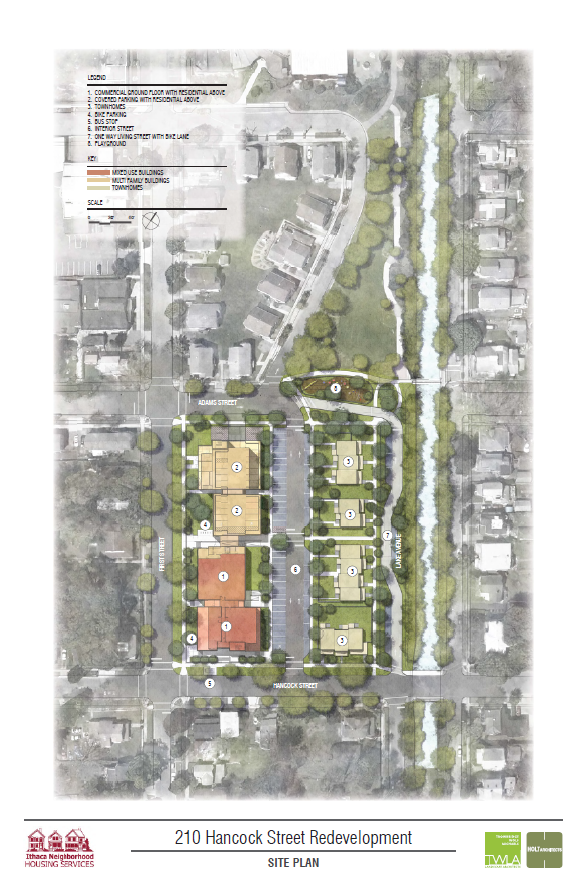
5. Ithaca Neighborhood Housing Services (INHS) is armed with more 210 Hancock studies and analysis as it prepares to go in front of the city Board of Zoning Appeals next Tuesday. With the commercial loading space question settled, it leaves the height variance of 6.5 feet (40 feet zoned, 46.5 feet requested), and the parking variance of 20 spaces (84 required, 64 given). Original/full application here, new addendum analyses here.

The board requested additional information about pile driving and the parking situation. In response, INHS has conducted further analysis and shown that, 40′ or 46.5′, piles would be required either way. INHS has offered in its application to use a “vibratory oscillating” method of pile driving, where piles are vibrated into the ground rather than driven. This reduces noise (no hammer-like banging) and produces less overall vibration. Further parking studies found that 210 Hancock offers a greater percentage of parking than similar buildings like McGraw House, the Cayuga Apartments and Lakeview on Third Street, INHS’s parking study of its tenants was reiterated, and an analysis of its commercial tenants was given – the occupants will have 16 designated spaces from 7 AM to 5 PM, when the daycare and non-profit offices are in operation. After hours, they’ll serve as potential overflow parking.

It’s frustrating to think that a suburban market-rate project surrounded by a parking lot has no opposition, but a transparent project with affordable housing and a lot of community benefits gets so much grief.

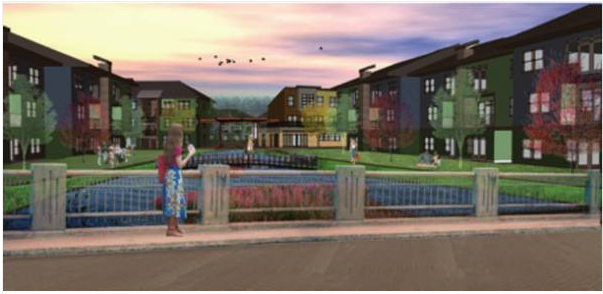
6. For home-builders or those looking to build a palatial estate, here’s your latest opportunity – 5.45 acres at the end of Campbell Avenue in Ithaca city are up for sale. The area’s zoned for single-family homes, and the city is encouraging owner-occupied houses in that area. Previously, the property was seen as a potential 10-lot development in the late 1980s/early 1990s, but the plan was never carried out. The biggest barrier is probably that it’s West Hill, where neighbors have taken to going after their neighbors to keep them from subdividing and building homes.

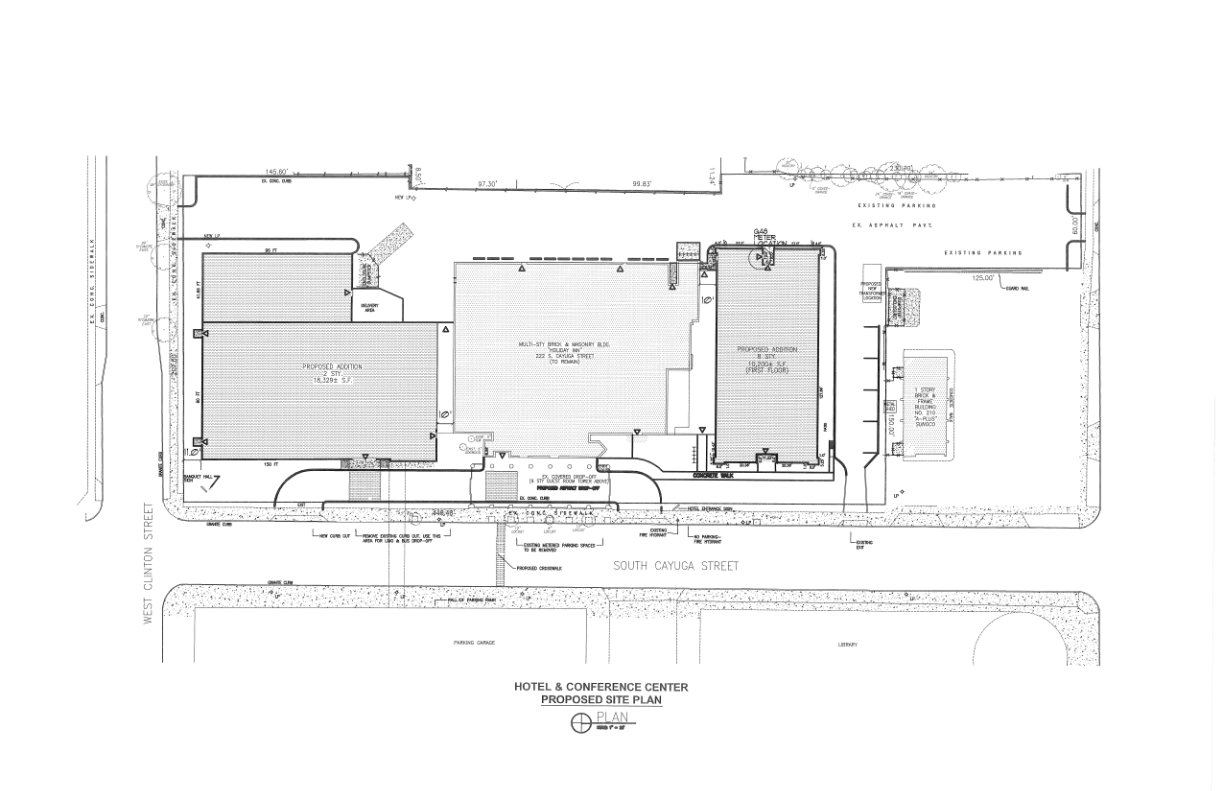
7. Initially, this was going to be a Voice article, but when the revised plans were presented, no renders were included. The Voice’s more general audience wouldn’t be as interested in this piece. But if you’ve read this far, and you read this blog frequently enough, then you won’t mind clickable, expandable site plans (pdf here).

hotel_ithaca_phase_1 hotel_ithaca_phase_2

The Hotel Ithaca is once again seeking to expand its offerings.

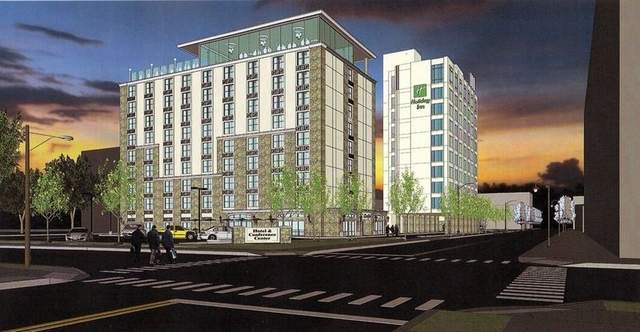
But this time around, it’s proposing to do in phases. Sketch plans presented at the Planning Board last Tuesday evening call for demolition of the two-story wings as before, but then the construction will be broken up into two phases.

The first consists of a five-story, 51,835 SF wing build on the northern side of the property, next to the gas station on the corner; the second phase, at a later, undetermined date, calls for three more floors on the hotel wing (bringing the new wing to eight stories and 81,600 SF), with a two-story, 18,300 SF conference center to be built on the corner of South Cayuga and West Clinton Streets.

The number of rooms in the addition has been unconfirmed, but given previous plans, it is likely to be little to no change from the current hotel, once the two-story wings are demolished. Until phase two is built, a parking lot would sit on the site of the future conference center.

The hotel is operated by Hart Hotels of Buffalo. Like several other Hart Hotels properties throughout the Northeast, the hotel has no chain affiliation, although the property was a Holiday Inn until the end of 2013. The 181-room hotel initially opened as a Ramada Inn in 1972, and the 10-story “Executive Tower” was completed in 1984.

Zoning at the site is CBD-100 (Central Business District), meaning that a proposed structure can be up to 100 feet (two floors at the least) with minimal required setbacks and no required on-site parking.
holiday_inn_expansion_1

Under plans previously presented three years ago, the Hotel Ithaca sought to demolish the two-story wings of the hotel, and in their place the hotel would would build a new 9-story, 115-room tower, a kitchen addition, and a 15,000 SF conference center. The demolition would have resulted in a loss of 100 rooms, so the net gain was a total of 15 hotel rooms.

The then-$18 million project had significant local support from business owners, because Ithaca lacks the ability to host mid-size conferences and conventions (midsize meaning about 500 attendees), which sends conventioneers elsewhere. Currently, the lack of meeting space limits conferences to about 250 guests. The addition of a convention facility is seen as a major benefit to downtown retail, as well as other hotels that would handle overflow guest traffic. Convention traffic typically happens during weekdays, when regular tourist traffic is lowest.

However, the project, which was initially slated to start in November 2012, has failed to obtain financing for construction. The project applied for and received a property tax abatement for the new construction, and the Ithaca Urban Renewal Agency (IURA) even offered the possibility of a $250,000 loan if it would create a financial package that would allow the convention center to be built. But until now, there had been no indication of any plans moving forward.


News Tidbits 7/25/15: To Reuse and Rejuvenate

25 07 2015

travis_hude_libe_libe_v3 oldlibe_franklin_proposal

1. Let’s just outright say it – the Tompkins County Legisltaure’s Old Library decision is a complete mess at this point. As covered last week, there were three separate individual resolutions – one from legislator Mike Lane for the Travis Hyde proposal (first image), and one each from legislators Dooley Kiefer and Leslyn McBean-Clairborne for the Franklin proposal (second image).

They all failed. 8 yes’s are required. The Travis Hyde proposal failed with 5 yes and 7 no’s. The Franklin proposal failed with 5 yes and 7 no’s on Kiefer’s resolution, and 4 yes and 8 no’s on McBean-Clairborne’s resolution. Martha Robertson, a supporter of the Travis Hyde proposal, recused herself because she had received donations from Frost Travis during her failed congressional campaign in 2014. Legislator Glenn Morey, also a supporter of the Travis Hyde proposal, was absent from the meeting.

I don’t see any way this will ever get the eight votes required. Kathy Luz Herrera voted against the proposals because the resolution has a ground lease (meaning the county still owns the land but leases the property), and Dooley Kiefer has stated she refuses to support any of the projects unless they have a ground lease – in other words, these two have mutually exclusive votes. By voting against McBean-Clairborne, Kiefer’s made it clear she will vote against the Franklin project unless it meets her exact specifications. Shinagawa voted against Travis Hyde for not being what the community wanted, but won’t vote for the Franklin proposal unless they guarantee Lifelong’s involved. And Stein has come out in favor of the Travis Hyde proposal. There’s no solution on the horizon.

So now it heads back to the Old Library Committee. Sale to the highest bidder and demolition of the library are real options on the table.

cayugafarms_2

cayuga_farms_1
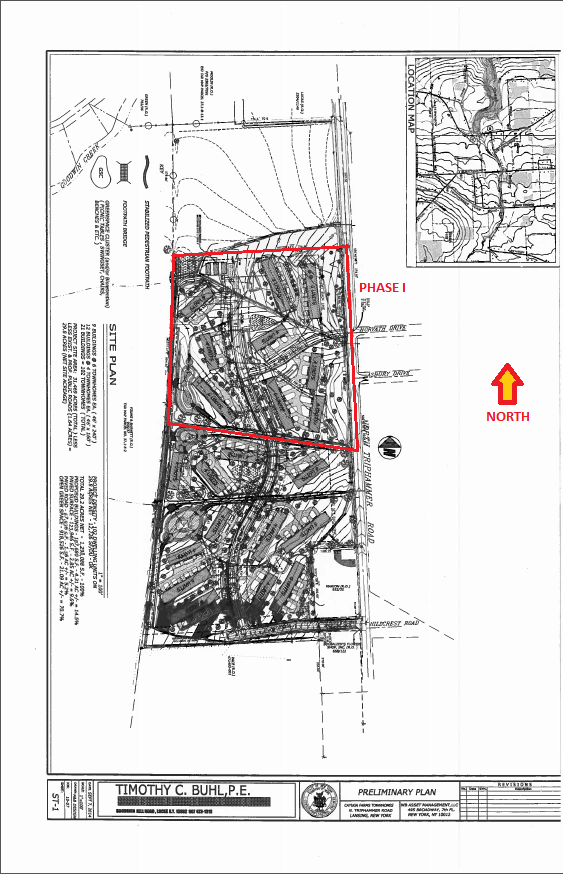
2. Turning to Lansing town, the planning board there has approved plans for the 102-unit Cayuga Farms townhouse project for a 31.4 acre parcel off of North Triphammer Road near Horvath Drive. First reported last Friday by the Lansing Star, the project received negative SEQR determination (meaning that, following the state’s environmental review guidelines, that the planning board decided the project will have no serious detrimental impact on the community) and issued preliminary site plan approval.

However, one issue still remains to be resolved before any shovels hit the dirt – sewer. The project currently has a modular package sewer treatment proposal that would work in place of the voter-defeated municipal sewer, and allow for denser development than the town’s rule on septic tanks. But the DEC’s interest in that type of treatment has been mixed. It could be a while before the situation gets sorted out.

Readers might remember this project because it’s one of the few I’ve openly derided. The 102 units are townhouse-style apartments marketed towards the upper end of the market. They would be built in phases over a period of several years.

cornell_novarr_5 cornell_novarr_6

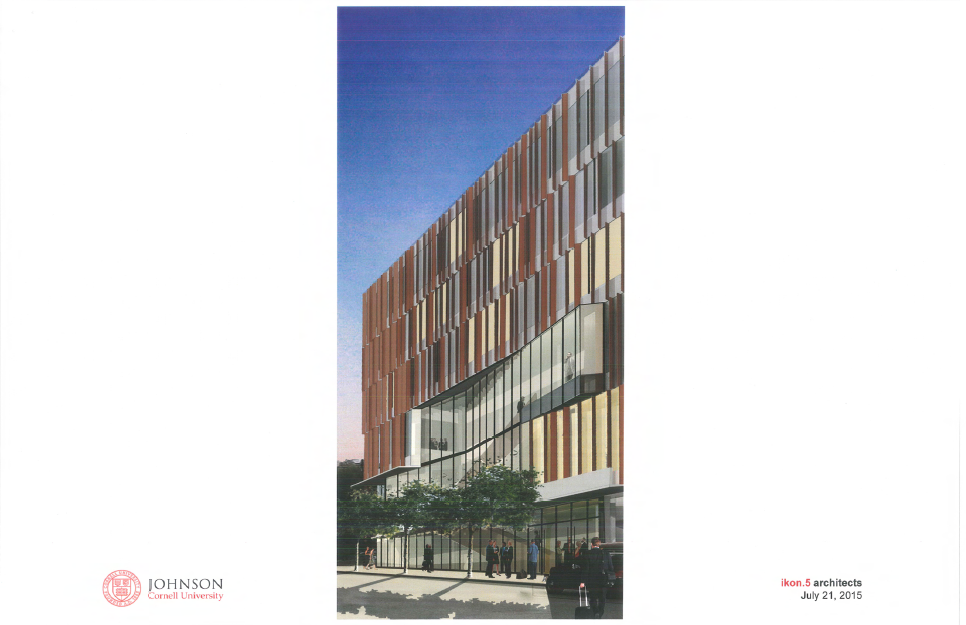
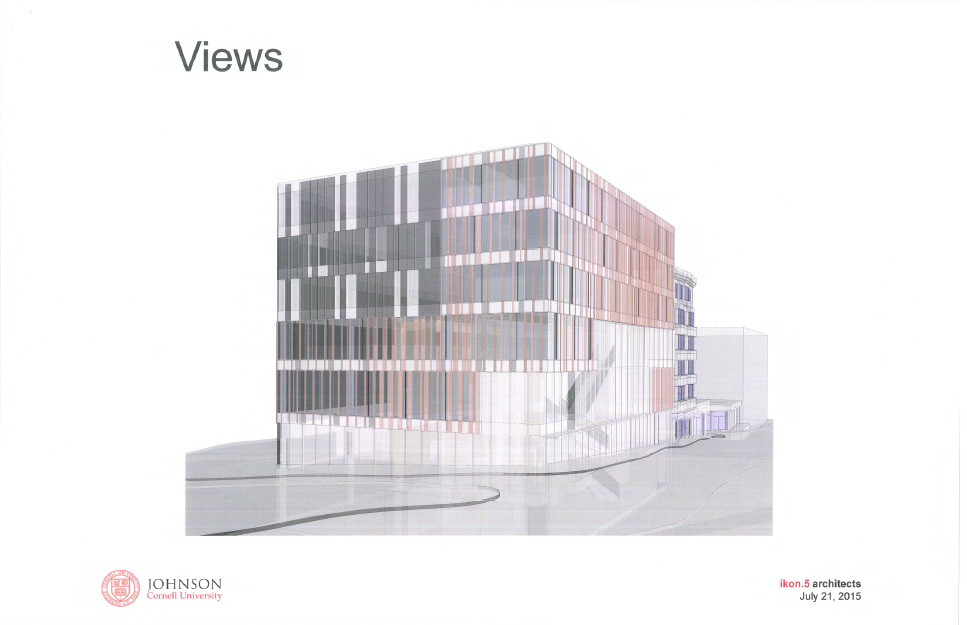
3. Now for some eye candy. Included with this week’s planning board project review committee agenda are additional renderings for John Novarr’s project at 209-215 Dryden Road. Doing a quick visual cross-check with the initial renderings, there don’t appear to be any substantial design changes, and the colorful metal cladding appears to retain the same pattern as before. Getting a little poetic here, the cascading metal bars are reminiscent of water running down a wall.

The city’s Full Environmental Assessment Form doesn’t express many worries about the project; some concerns have been raised about too many pedestrians on the street (the building would add 420 people to Collegetown’s sidewalks at the outset, 600 when fully occupied), but that seems to be about it for now.

The $12 million project is moving right along in an effort to start construction this fall. Declaration of Lead Agency and some CEQR discussion (the city’s more stringent version of SEQR, State Environmental Quality Review) are expected at the July planning board meeting. Plans call for 76,200 SF building with three floors of classrooms and three floors of offices for Cornell’s Johnson School Executive MBA program. The building would be ready for the Big Red’s B-students in April 2017. The property would remain on the tax rolls.

20150605_114431

4. A couple of interesting news notes courtesy of the Ithaca Urban Renewal Agency (IURA) Agenda:

First, popular downtown restaurant Madeline’s is looking to obtain an agency loan as part of a renovation project. The $470,000 project would add three jobs, only one of which pays living wage. The restaurant on the first floor of the Rothschild Building (the two-story building in the above photo) hopes to take advantage of the new hotels going up, and law firm Miller Mayer moving its 60 employees into the Rothschild Building. Previously the firm was in the Chemung Canal Trust Company building further up the Commons.

Second, the Finger Lakes School of Massage has applied for an agency loan to facilitate a move from West Hill to downtown. The school would move its ~34 staff and 75-95 students into 10,804 SF of leased space on the Rothschild Building’s second floor, with a further 1,700 SF on the ground level for a retail store and alumni massage clinic. The space would be renovated at a cost of about $194,300.

Although both projects come with risks (Madeline’s being a restaurant, FLSM having some worrying financial statements), both projects have been recommended for loan approval. The FLSM and Miller Mayer news suggest that most of the office space in the old Rothschild Building, left vacant when Tetra Tech moved to Cornell’s office park in 2010, has now been refilled.

The new window cut out built recently into the Rothschild Building’s east facade is part of the space where FLSM is moving into.

416_e_state_1

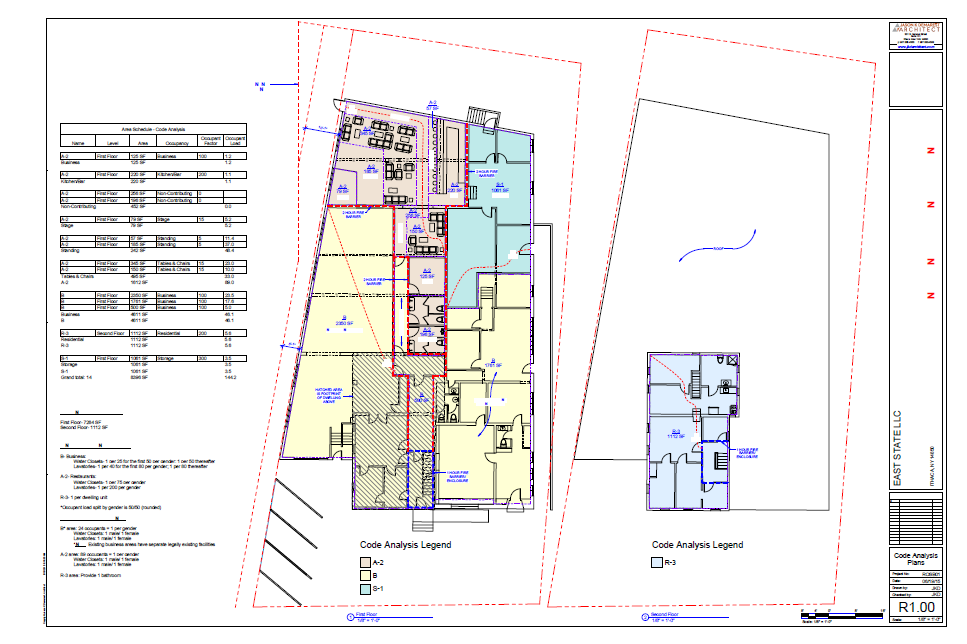
5. And now another reuse project – at 416-418 East State Street, currently home to an underused 7,600 SF office and a connected manufacturing/storage building. The house dates from the 19th century, with various additions as recent as the 1970s. According to plans filed with the city, an LLC linked to Argos Inn architect Ben Rosenblum has plans to convert the old manufacturing space into a bar and storage space, with renovated offices and a 2 bedroom apartment in the original house. The project will include an accessory parking lot, revised landscaping and handicap access. Area and setback deficiencies have resulted in the need for a zoning variance, but a parking variances won’t be required because the bar will have after hours parking across the street at Gateway Plaza. The building itself won’t change dimensions, but the change in use triggers the city zoning laws.

There have been some concerns expressed about this project – at least one neighbor is vociferously opposed to a bar, citing noise problems and concerns about smokers, and the county planning department is not a fan of the traffic and parking arrangement. Offhand, I think a bar is legal in B-4 zoning, but the noise impacts will merit further scrutiny.

The project is definitely something of interest to the Voice’s audience, but in an email, Rosenblum said that details are still being worked out and that he’d prefer to discuss the plan at a later date.

Scott Whitham is serving as a consultant, and local architect Jason Demarest is designing the renovation.

state_st_triangle_v3_1 state_st_triangle_v3_2 state_st_triangle_v3_3

6. Some very substantial changes are in store for Campus Advantage’s $40 million, 240-unit State Street Triangle project at 301 East State Street in downtown Ithaca.

The Texas-based developer has recruited the assistance of Ithaca architecture firm STREAM Collaborative to help redesign the 240-unit project. And there’s clearly been a lot of work since the previous planning board rendition.

In this revision, a much greater emphasis has been placed on the street interaction and active street uses. Gone is the soaring corner, and in its place is a design with a greater use of horizontal elements (like the decorative belt above the third floor) in order to give the building a more human scale – crucial when you’re planning one of the largest buildings in Ithaca.

The developer is also seeking to remove the northbound turning lane from Aurora onto State Street, and replacing it with a pedestrian area with widened sidewalks, outdoor seating and dining spaces. The land would have to be procured from the city, or some other type of collaboration would have to take place with city officials and engineers.

In documents provided in the city’s planning board agenda for next Tuesday, the developer notes that the project remains student-oriented, but in order to play down comments of it being a massive dorm, 10 4-bedroom units were reconfigured into 40 studio apartments that the developer hopes will be appealing to non-student tenants looking for a less expensive, modestly-sized space.

The State Street Triangle project is also exploring LEED certification.

The project still has a lot of details to be addressed – city transportation engineer Tim Logue has expressed concerns that the traffic study underestimates the number of car trips, and has asked for a revised study. The project is also under closer analysis because the potential addition of 600 residents into downtown Ithaca would put a greater stress on utilities and infrastructure.

These and other questions are likely to be topics of discussion at next Tuesday’s meeting.

The State Street Triangle may be pursuing a CIITAP tax abatement (so much for my theory a couple weeks ago), but the city has not uploaded the application at the time of this writing.
7. Looks like a busy meeting next week for the Ithaca city planning board. In order:

1. A subdivision at 106-108 Madison Street on the Northside. The applicant wishes to create a new lot on the east side of the existing lot, for the purpose of building a new-single-family home.

2. A. Declaration of Environmental Significance and BZA recommendation for the Dibella’s sub shop proposed at 222 Elmira Road

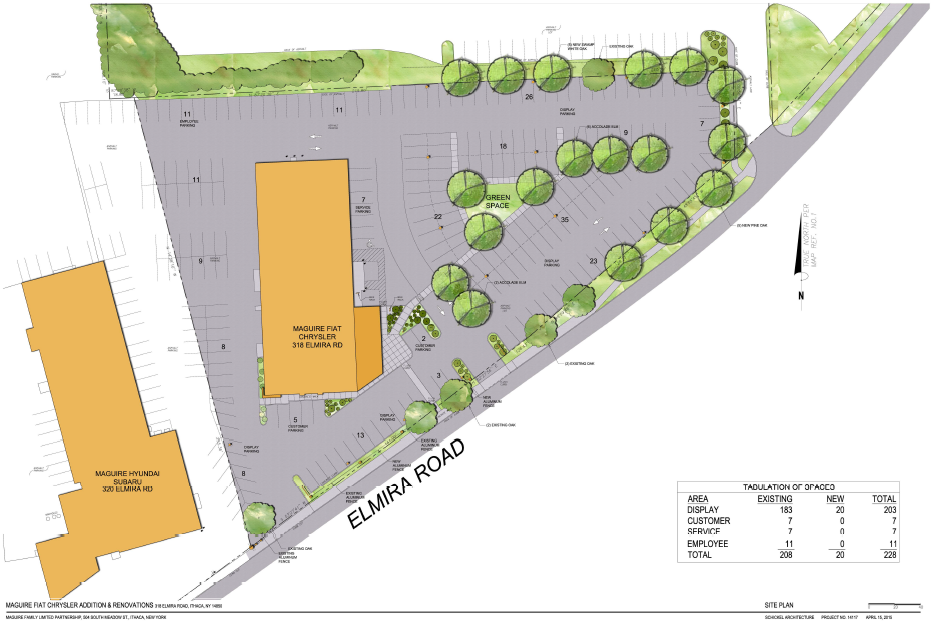
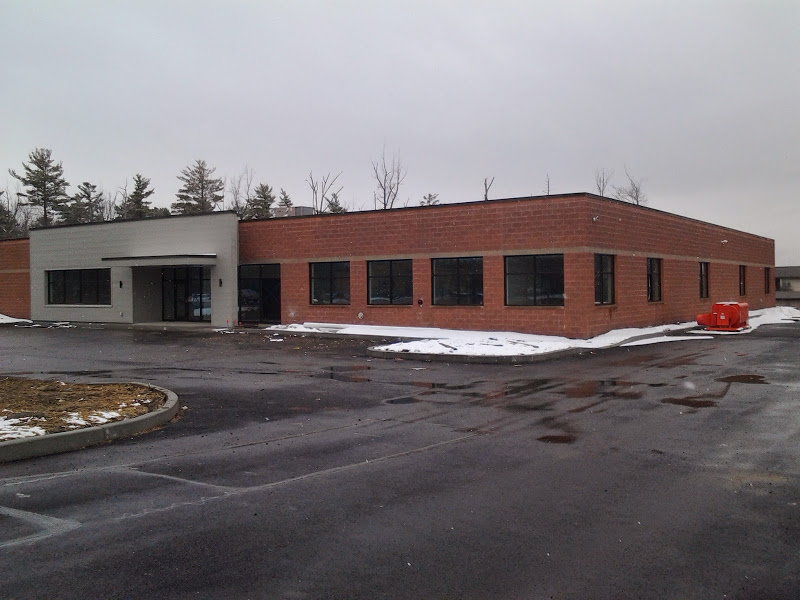
B. Declaration of Environmental Significance, BZA recommendation and potential approval for the 1,100 SF addition to the Maguire Chrsyler/Fiat dealership in Southwest Ithaca

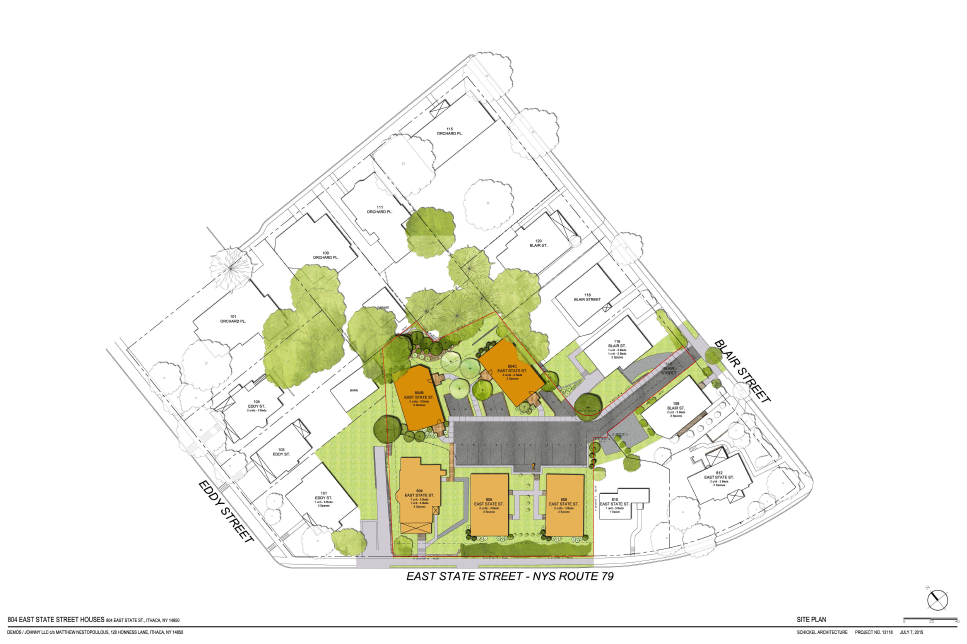
C. Declaration of Environmental Significance, and potential approval for the two duplexes proposed at 112 Blair/804 East State Street

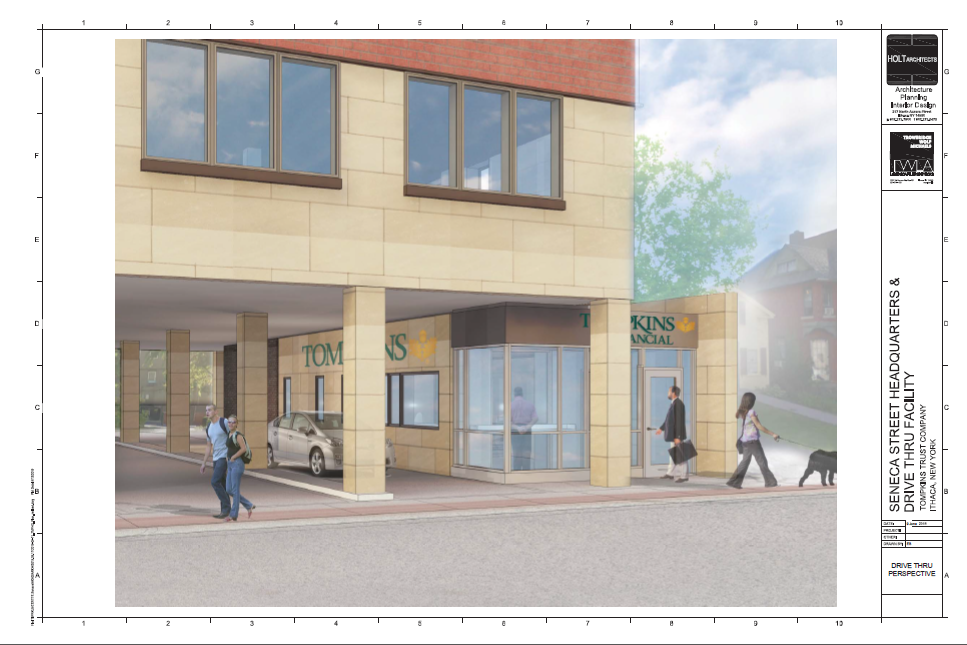
D. Site-plan approval for the first phase of the Tompkins Financial HQ (the new drive-through in the current HQ’s parking lot)

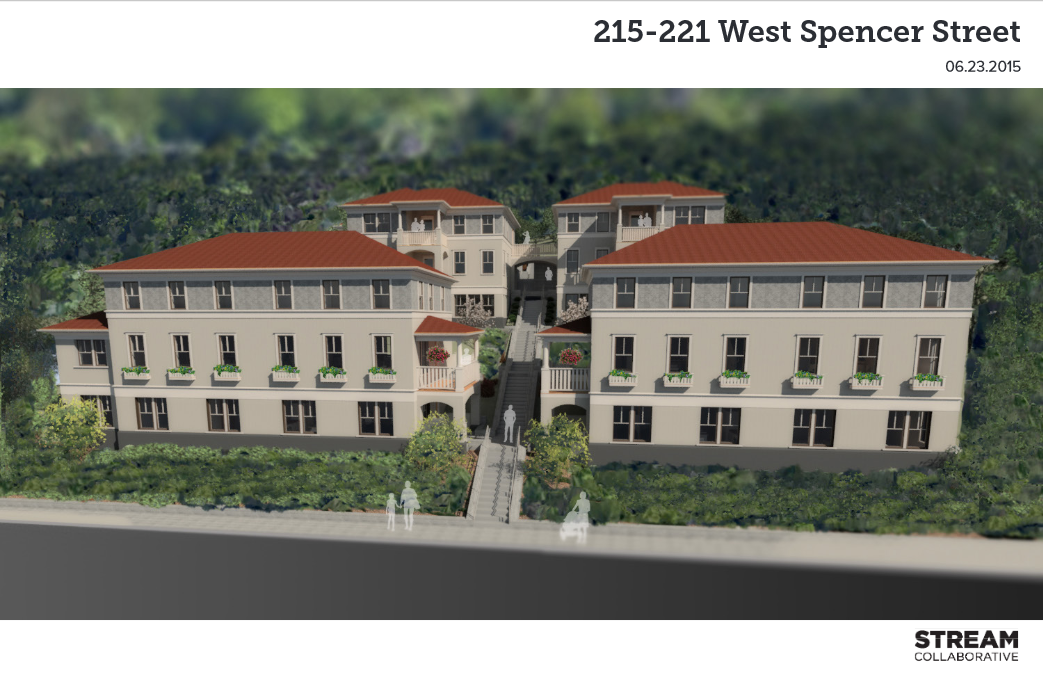
E. CEQR (the city’s version of SEQR) discussion for 215-221 W. Spencer Street

F. Declaration of Lead Agency and CEQR discussion on 209-215 Dryden (the Novarr project noted above)

G. Declaration of Lead Agency and CEQR discussion on State Street Triangle (

noted above)

holiday_inn_expansion_1

H. Sketch Plan – Hotel Ithaca Expansion. Readers might remember a 9-story addition and convention center were approved for the Hotel Ithaca almost two years ago (shown above). Nothing has happened with the expansion plans, for reasons which had been attributed to financing. Dunno what we can expect this time around, but we’ll find out next week.


Village Solars Apartments Construction Update, 6/2015

19 06 2015

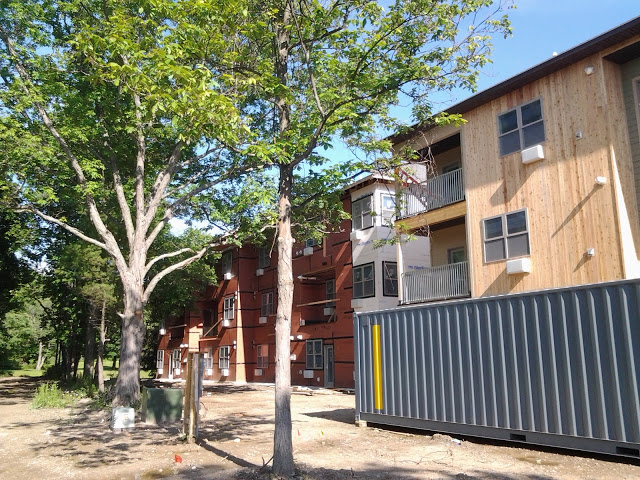
Out in Lansing, the first phase of the Village Solars Apartments is starting to allow tenants to move in. Building “A” looks to be substantially complete, with tenant vehicles parked in the gravel lot, and a guy preparing a grill session out back. The unvarnished wood siding was a bit of a surprise, but it goes well with the natural color tones of the siding. Building “B” in the middle is due to receive its first tenants around July 1st, and building “C” on the east end might be planning an August 1st move-in date, based off the dates in the rental advertisements. These dates have been pushed back from the May and June dates that were noted back in the February post, and those had already been a push back from original dates in March and April. Further pushbacks are unlikely, if only because the developers risk losing out on the large and lucrative student market, which revolves around the start of the fall semester in late August.

Building “B” still has some sheathing showing, but is quickly attaching the remaining exterior trim, and building “C”, which is the same configuration as “A”, is still bare sheathing and waterproof wrap, but all of the windows and doors have been fitted. Without looking inside, I’d imagine “B” is polishing up the last interior finishes, while “C” is still installing appliances, flooring and the like. Interior rough-in probably wrapped up during the spring.

Judging from the revised Craigslist postings, Lifestyle Properties has had some success with filling the units, with some of the floor plans sold out. The one-bedroom units will rent for $1050-$1145, two-bedroom unis rent for $1235-$1369, and three-bedroom units will rent for $1565-$1650. Prices vary a little depending on what floor the unit is on, the higher up the more it costs.

Currently, some of the land has been cleared for the next phase (2 and possibly 21, which have 41 units and 10 units respectively). I checked with someone familiar with the project to ask when phase two would begin construction, and they said that there’s been talk of starting the second phase, but he wasn’t sure when it would start.

The Village Solars apartments are a large apartment complex located in the town of Lansing off of Warren Road near the county airport. The complex takes its name from what the Craigslist sales pitch calls “their passive solar design and energy saving features”. The four-phase project calls for an initial build-out of 174 apartment units, with a second addition yet to be approved that would bring the total number of units over 300. With the third phase of Collegetown Terrace yet to start, this is currently the largest residential project under construction in Tompkins County.

The Village Solars are being developed by local company Lifestyle Properties. Lifestyle is run by Steve Lucente of the Lucente family, who have been major builder/developers in Ithaca since the 1950s. No word on the architect. Upstate Contractors of Syracuse appears to be handling the construction work.

20150613_171008 20150613_171012 20150613_171016 20150613_171053 20150613_171106 20150613_171248 20150613_171254 20150613_171316 20150613_171331

village_solars_2

village_solars


News Tidbits 5/9: Changing Elevations

9 05 2015

cinema_drive_1

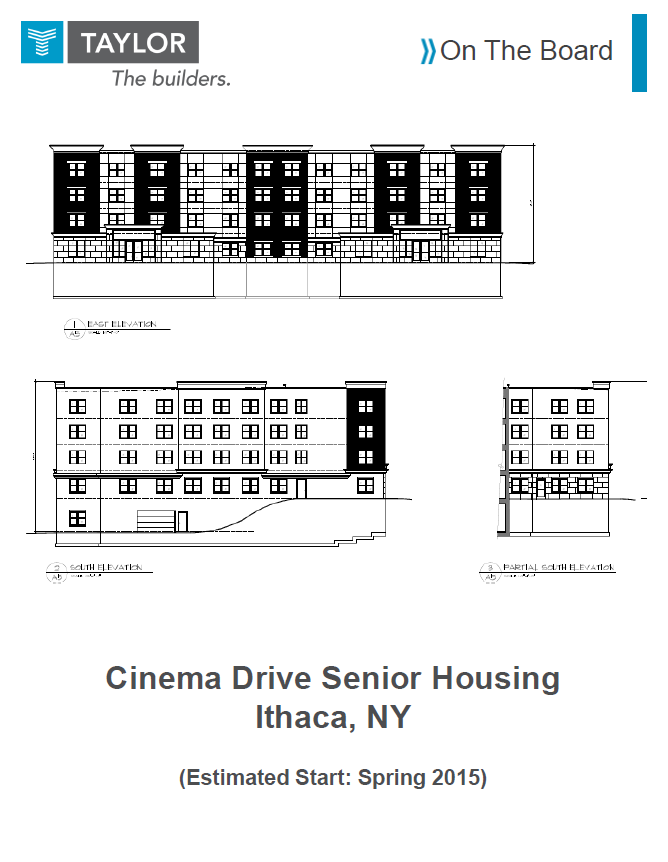
1. Looks like the CU Suites project is in fact the render shared by Taylor Contractors. Readers might remember these elevations from last week for a proposed “Cinema Drive Senior Housing”, but that the image didn’t match up with the proposal, a 3-story, 43,000 sq ft structure. According to the village of Lansing’s Board of Zoning Appeals agenda, the project is now a multi-story mixed-use building with a size of 87,515 square feet, which looks about right for the building proposed above. The project is seeking rear yard setback and height variances for not enough of a rear yard parking setback from the lot line, and for exceeding the maximum height allowed by zoning (which is 35 feet).

Doing some back of the envelope calculations, if one calls only the top three floors senior housing ((3/4.5) * 87515 = 58343) and uses the rough guidelines of 15% for circulation/utilities and 980 sq ft per unit, then one gets about 51 units, which makes this a pretty sizable project by local standards.

inhs_pride_v3_elevations_1 inhs_pride_v3_elevations_2

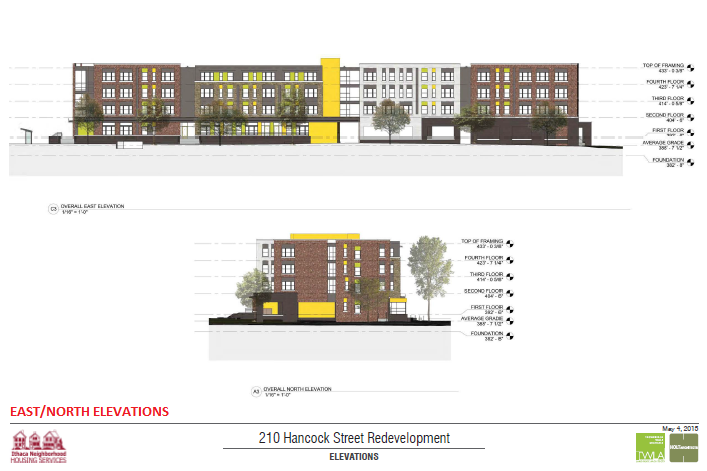
2. Now for a change or perspective – new perspectives of the 210 Hancock project, in the form of elevations found in higher resolution here. Now you can see what all of the buildings look like as a whole, rather than the simulated viewpoints previously shown. The elevations heights give the apartment building’s height at about 40 feet. Apart from some tweaks to the way the first-floor parking is screened, there haven’t been a whole lot of changes since the last planning board meeting. Note that the buildings are tucked in or pushed out and separated by “hyphen” connectors so they don’t present one continuous street wall. The design is by local firms TWLA and HOLT Architects.

Am I the only one who finds the lime green and goldenrod to be a bit..intense when compared to the other facade materials?

112_blair_v3_1 112_blair_v3_2

3. You want more new drawings? You get more new drawings! This batch represents the latest incarnation of the duplexes proposed for 112 Blair Street / 804 East State Street. Renders copied from here, project narrative here. Developer Demos / Johnny LLC (the Nestopoulos family) is still trying to have these ready in time for the Fall 2015 school year. Rather than continue seeking an area variance in zoning, the project is back down to two duplexes with three bedrooms and ~1,235 sq ft each (12 bedrooms total). After meeting with neighbors, it was decided to move back to surface building to reduce building height, and to add expansive front porches, which gives the otherwise bland duplexes a little character. Site Plan Review will take place this month.

clarebridgecrossings_1

4. Looks like there might be an expansion of senior care facilities in Ithaca town. The Ithaca Town Board is set to discuss changes next week to the Planned Development Zone (PDZ) for the Sterling Heights / Clare Bridge Cottage assisted living facilities, located on Bundy Road just north of the city-town line. Sterling House is a 48-unit assisted living facility, while Claire Bridge Cottage is a 32-unit facility specializing in memory care (Alzheimer’s and dementia). The new building, a 23,200 sq ft 32-unit facility to be called “Clare Bridge Crossings”, is designed to bridge the gap between the two – patients who might be in early stages of illness and experiencing mild symptoms, but otherwise still capable of some degree of personal independence.

The new building appears to be a one-story addition tucked between the other two structures, so it won’t be visible from the street. Along with the new building, there will be updates to parking, landscaping stormwater facilities, and the addition of a couple of courtyards between the buildings. The architect is PDC Midwest, a Wisconsin firm that specializes in memory care facilities.

Now, some readers might be saying, “who cares?”. There’s a couple of reasons to care. For one, this is important from a quality-of-life perspective. Picture a senior couple where one is reasonably healthy and the other has memory care needs. It means a lot to have a facility nearby that can care for their loved ones. Secondly, an expansion would bring with it a number of jobs to support the new residents – nurses, maintenance, kitchen staff and so forth. So there’s an economic benefit as well.

Full disclosure – my mother is a nurse who works for an assisted living program that includes clients with memory care concerns. So I’ve heard a thing or two about a thing or two.

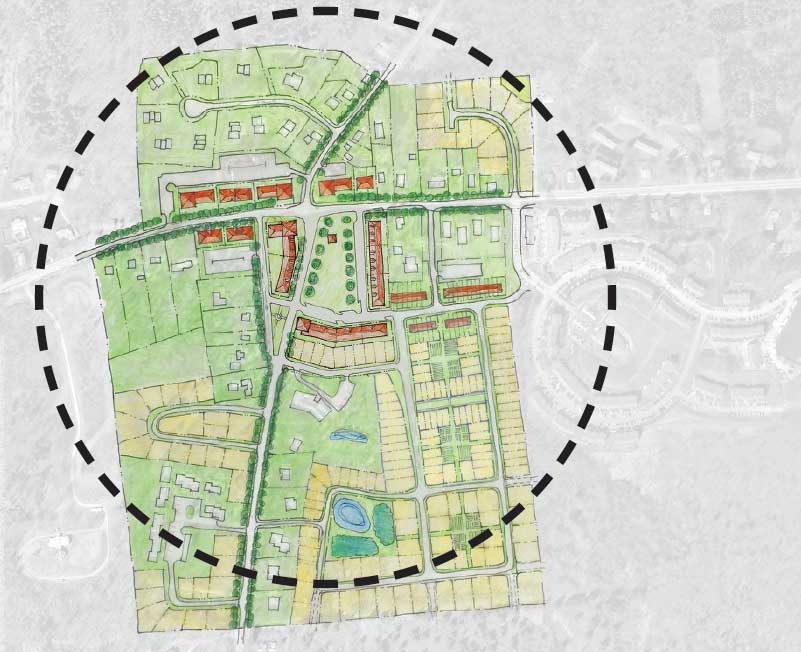
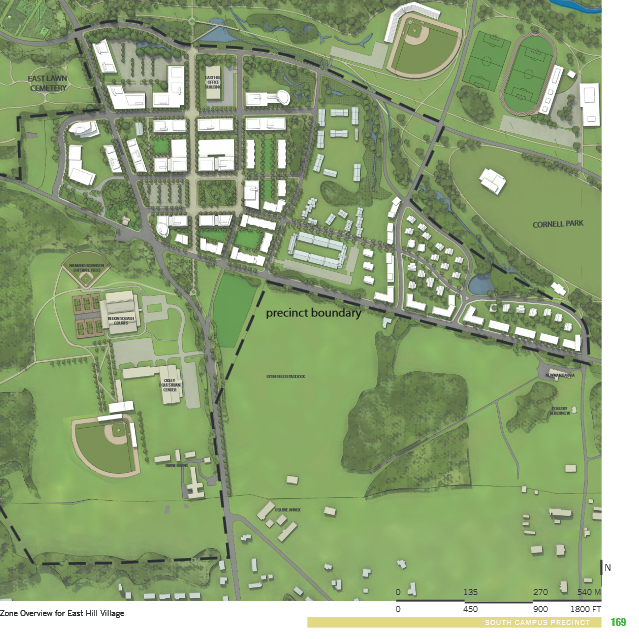
east_hill_master_plan

5. On a parting note for the week, here’s a little more information on Cornell’s redevelopment plans for East Hill Plaza. According to Planning Committee minutes from the town of Ithaca, Cornell will be taking part in a multi-day design charrette hosted by form-based zoning proponents FormIthaca in early June. Form-based zoning in a very small nutshell is zoning that focuses on design elements rather than use. Cornell is interested because the plan will hopefully lead to a regulating plan for the “compact mixed-use” development Cornell hopes to build to build in that area. The plan could provide language for a new Planned Development Zone that would potentially allow Cornell to move forward with a housing/retail mix at East Hill Plaza.

Cornell has sought to redevelop East Hill Plaza and surrounding parcels (most of which they already own) for several years. A vision for the plaza shows up in Cornell’s 2008 Master Plan (the so-called “East Hill Village” shown above), and given the need for housing in the area, East Hill Plaza would likely be one of the location where opposition would be less likely, given the the lack of homeowners nearby and the site’s proximity to Cornell.


News Tidbits 5/2/15: Oh, The Anticipation

2 05 2015

1. Lansing village is trying to find a happy medium in its zoning. Specifically, commercial zoning. The village is looking to rezone a group of properties along Triphammer Road near the mall from Commercial Low Traffic to Commercial Medium Traffic, a new kind of zone for the village. According to an article in the Lansing Star, the zone would include “low traffic food and beverage establishments [that] might include sit-down restaurants with or without a bar where food is consumed on premises, which may include carry-out or similar service such as [a] bakery or café,” as well as senior living facilities and certain stores under 10,000 square feet in size.

Most of this has to do with two parcels specifically – a vacant strip of land on Oakcrest Road is slated for a dozen units of senior housing that was a stipulation of the BJ’s approval. The senior homes are part of the BJ’s Planned Development Area and not explicitly affected, but are rezoned on technicality. A vacant parcel on the corner of Triphammer and Hickory Hollow Roads next to Ciao Italian Restaurant has received a lot of attention from outside developers, for hotels, liquor stores and general retail, but the current commercial low traffic zoning allows for none of those (CLT reads as limited to office buildings and isolated small shops). The zoning is under review and any changes would only be enacted after a public hearing at a later date.


cinema_drive_1

2. Here’s a pleasant surprise: drawings for a project on Cinema Drive in Lansing. My guess is that this is the project planned by the Thaler family, aka “CU Suites”. The CU Suites proposal described a 3-story, 43,000 sq ft building; the one shown here is 4 stories. The CU Suites proposal is also likely to break ground soon, just as this project is planning. I’m not 100% certain the two are the same thing, but if this were another project on that short street, I’d be very surprised.

Strangely, the source of these drawings is the Cornerstone Library proposal. The selected building partner, Taylor General Contractors of Rochester, was using it as an example of work underway.

harolds_square_taylor

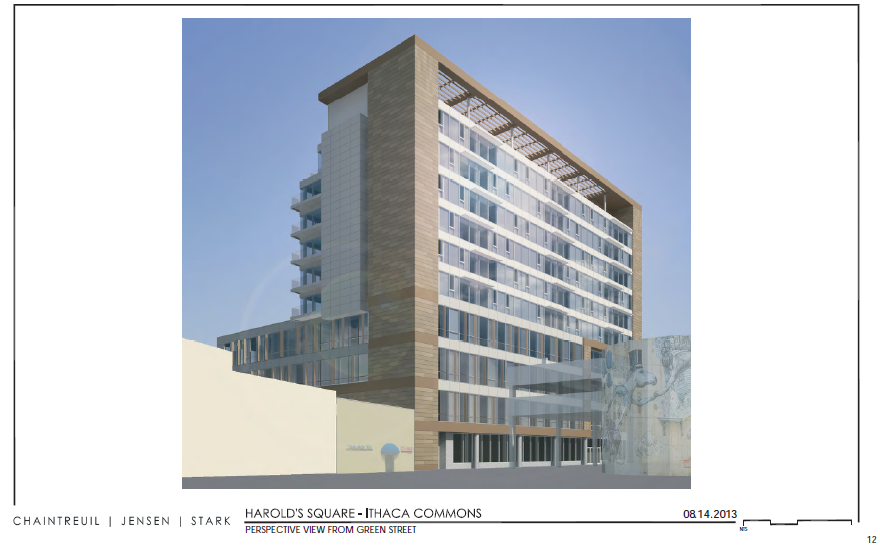
3. Then there’s another project Taylor General Contractors is involved in – Harold’s Square. Taylor has done some work for Harold’s Square developer David Lubin in the recent past, so this makes sense. Will it actually start in Fall 2015? Good question, but there’s been no word on if Lubin has closed on financing for his 11-story downtown project.

fine_arts_1

4. No sketch plans have been uploaded to the city’s website just yet, but initial renderings for the new Fine Arts Library in Rand Hall were presented at the Planning Board’s meeting last Tuesday, according to the Cornell Daily Sun. According to AAP Prof. Jon Ochshorn’s blog, Cornell’s been trying to keep the design plans of this project under tight control, which is fairly unusual for a school that often promotes new projects well in advance (Klarman, Gannett, Gates).

So far, the only public release has been an image of an interior staircase, a soaring, unsettling feature that can be found throughout the works of the project architect, Vienna-based Wolfgang Tschapeller ’87.

University architect Gilbert Delgado did his part to sell the project. From the Sun: “[We’re] resetting the clock on this very important building,” he said. “This is the presence that we’re looking for: noble, early 20th century industrial building that’s been repurposed to our higher use which will exhibit one of the world’s greatest book collections.”

Speaking for only myself, I have concerns with how this is being managed. Cornell had planned to demolish Rand in the early 2000s to make way for Milstein Hall (which went through three starchitects before shovels hit the ground), but alumni blowback caused them to renege on that plan. It’s clear that there’s a certain sort of attachment that AAP alums have towards their structural workhorse. My worry, with the lack of details so far, is that Cornell is stymieing the flow of information for ignoble purposes. Students and alumni won’t be able to object and petition against plans they don’t see and hear about until the figurative last second. Plus, AAP hasn’t had good luck with budgets for new buildings – Milstein’s cost more than doubled from $25 million to $55 million during its incubation, while it shrank in size. In a time of fiscal stress for the university, a dramatic, structurally complicated new library may not be prudent. I’m not against this project explicitly, but I do have reservations.

Regardless of my armchair criticism, when renders do finally show up, you’ll see copies hosted here soon after.

Cayuga-Meadows-Shot

5. According to the town of Ithaca’s 2014 Planning Board report, Conifer has secured funding for “Cayuga Meadows“, its approved 68-unit (sometimes given as 62, unsure which is accurate) affordable senior housing building planned for West Hill. With finances in order, the 3-story, 19,520 sq ft building, sited just south of the Overlook at West Hill apartment complex, will likely start construction this year. Per Ithaca Builds, approvals were granted in late 2013 after a years-long planning process that had Cornell involved early on.

Some other projects still gestating include an 18-lot single family subdivision off of Park Lane in Eastern Heights, and Cornell clarifying plans for a large mixed-use project at or near East Hill Plaza.


News Tidbits 4/25/15: Long Week, Long Reads

25 04 2015

Grab the popcorn and sodas, folks, this will be a long one.

inhs_pride_design_comparo_v1_v3_1

1. Let’s start with some new and updated renders for the evolving 210 Hancock Street development that INHS has planned for the Northside neighborhood.

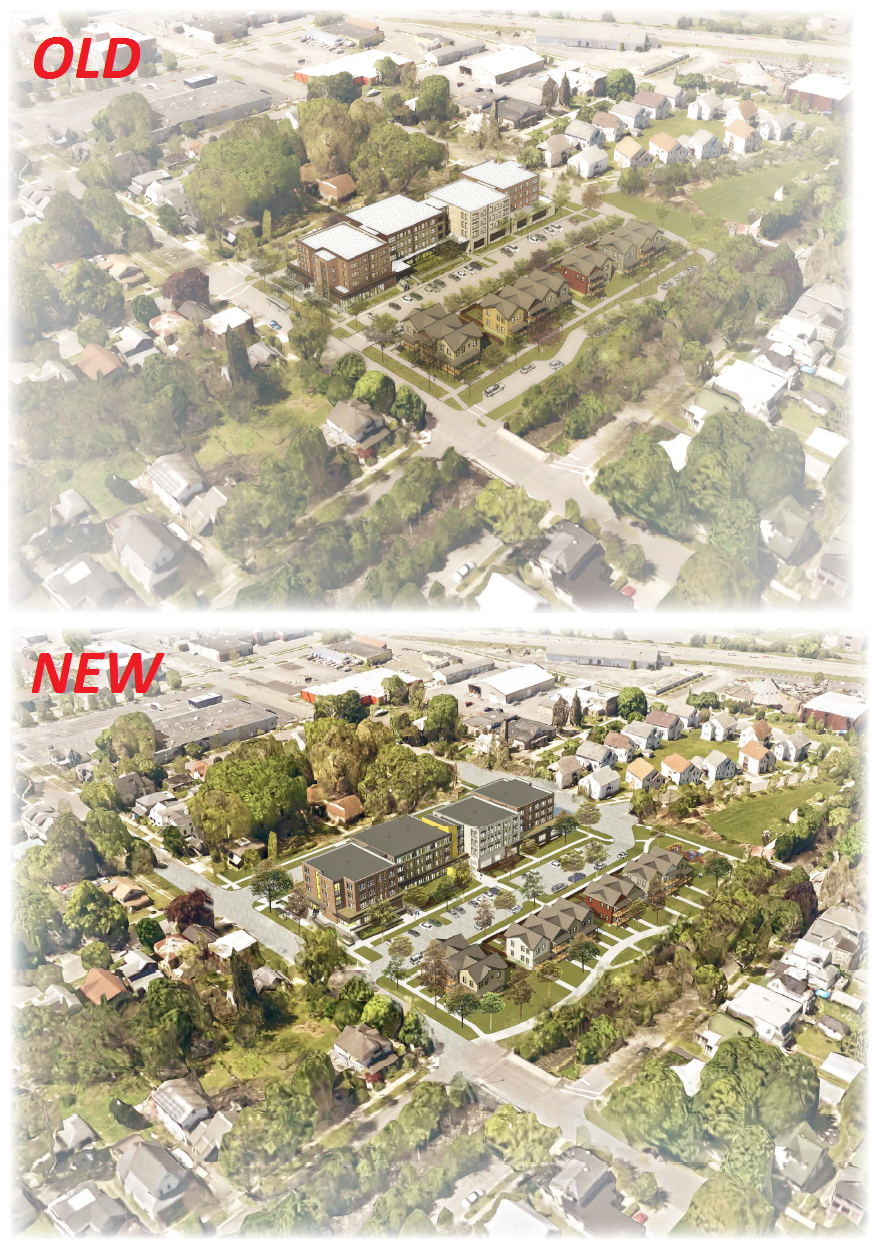
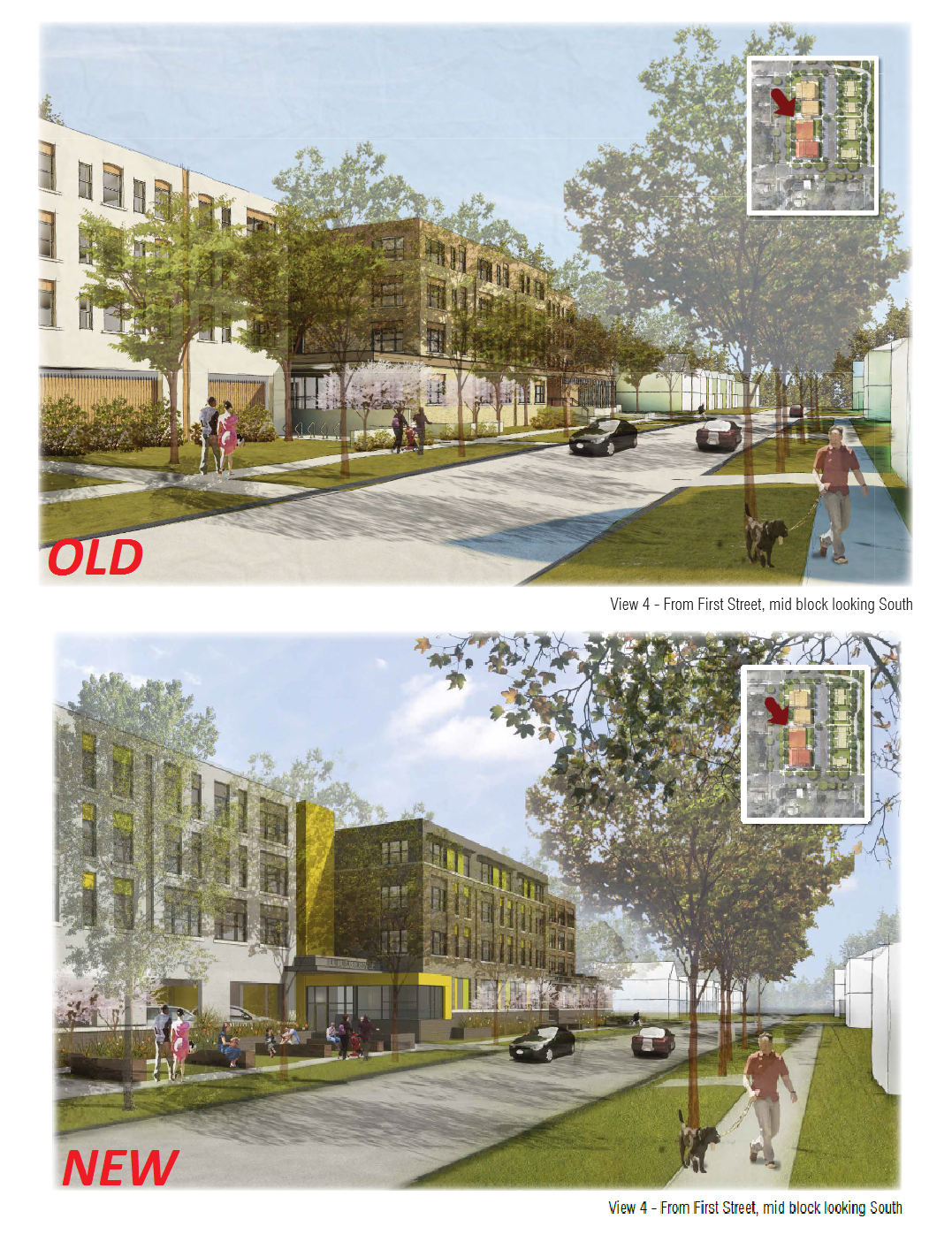
In each image, the top half is the old version, the bottom half the newest version. The lead image, an aerial rendering, shows that the houses haven’t changed much, though at the city and neighborhood’s insistence, Lake Street has now been closed off to all vehicular traffic in the refined proposal. The biggest structural changes have been in the apartment buildings – the color scheme of materials has been changed up quite a bit, and the partitions between the buildings have been re-worked to try and make the buildings appear less connected (one of the complaints raised was that they were too much like a wall; for this same reason, the buildings are slightly offset from each other, so no continuous face is presented towards the street).

inhs_pride_design_comparo_v1_v3_2

inhs_pride_design_comparo_v1_v3_5

Looking closer at the individual apartment buildings themselves, the designs have been pretty thoroughly reworked. Different window layouts, different window sizes, different colors – about the only thing that’s been kept the same is the overall massing of each building. The plan calls for 53 1 and 2-bedroom apartments and about 65,000 square feet of space, of which 7,500 square feet will be covered parking. The included commercial space has been expanded from 8,200 sq ft in the initial proposal, to about 10,000 sq ft now. More renders of the newest iteration can be found here.

inhs_pride_design_v3_7

No real changes yet in the for-sale houses that will be included in the project, apart from a palette change (previous render here – the new one is less bright, with darker earth tones). These are designed to blend in with the surrounding homes, and fall in INHS’s typical 2-3 bedroom, 1,100-1,400 sq ft range. The houses are townhomes in rows of 2-4 units, All sporting one or two-story porches. These will be built in a phase separate from the apartments. Certain affordable housing grants are geared towards owner-occupied units specifically, so the Neighborhood Pride lot will be split up into two parcels, one with the apartment rentals, one for the homeowners.

Questions and comments can be directed to the City Planning Office at dgrunder@cityofithaca.org.

2. Up in Lansing village, it looks like a proposed mixed-use project may finally be moving forward after years of incubation. “CU Suites”, a 3-story, 43,000 square foot project proposed by the Thaler family for a vacant lot on Cinema Drive, is asking the village to waive sewer connection fees. Presumably, this is about getting their finances in order before moving into the construction phase; there has been no news if funding has been secured yet. Something to keep an eye on this summer, certainly.

The Cinema Drive site was previously approved for a project of those parameters in fall 2012, consisting of two commercial spaces and a 39-unit apartment building, but that plan has not been carried out. The CU Suites proposal went before the village for “alterations and possible clarification” last December. No updated renders on the village website, but a site plan of the previously approved plan can be found here.

20150405_141933

3. Here’s some more details on the “not feasible as presented” Flatiron project. Readers might recall the 12-unit affordable housing proposal at 910 West State Street was given low priority for HUD Entitlement Grant funding.

From the presentation notes recently posted online:

“The project application is not fully developed, but probably represents more of an effort to start a conversation about the project. There is a great need for affordable housing in the community. The project was conceived to address the high cost associated with typical renovations to properties which make them unaffordable. The project would be located in an oddly-shaped trapezoidal building which [Ishka Alpern] would like to renovate to match its prior condition. It would be a very nice, unique addition to Inlet Island. Inlet Island has historically been a location for affordable housing and it is important to maintain that, before too many unaffordable projects are built there. Unfortunately, it is difficult to build affordable housing units without some form of funding assistance.”

In the Q&A the committee had with developer Ishka Alpern, no time table was given, and Alpern said he was open to waiting a year to refine it. It was also noted that once a commercial lease on the property expires in four years, an even larger project could be proposed, though it could be limited by the poor soils. While it appears renovating is the most feasible approach, the city was not impressed with the cost of investment per beneficiary – larger projects like 210 Hancock mentioned above have economies of scale going for them, costing less to build per unit. Smaller projects like the Flatiron need proportionately more assistance, making them less attractive for grant money. The city’s looking for the greatest good for the greatest number, in a sense.

In other news from the Ithaca Urban Renewal Agency (IURA), a private developer, Viridius Property LLC, is buying five duplexes with 10 units of affordable housing from non-profit Community Housing of Ithaca with the intent of keeping them low-to-moderate income, but retrofitting the buildings to run on renewable energy sources. Viridius, a company run by computer scientist and tech CEO Stuart Staniford and his wife, was established in early 2014, and has been on a buying spree as of late. They own $1.7 million in rental real estate assets now, these duplexes will raise it $2.7 million, and the goal expressed in a letter to the IURA is $5 million.

Quoting the letter sent to the IURA:

“Viridius is oriented to the “triple-bottom-line.” Although as a privately owned business
we will look to return on investment, we also seek to improve the environment and society. We
are particularly focused on contributing to the solution to climate change by converting the
existing building stock to be appropriate for continued use in the twenty-first century. At each of our properties, Viridius is removing the propane, natural gas, coal, or oil heating systems and replacing these with systems based on renewables. The specifics depends on the particular
building; to date, we have used pellet boilers and air source heat pumps. Viridius is also
developing our first solar panels at one of our buildings, and elsewhere acquires commercial
renewable power for electricity. Also, at our own residence we have deployed geothermal heat
pumps for heating and cooling and have all our electrical needs taken care of by solar panels on site. Viridius is certified as a living wage employer by the Tompkins County Worker’s Center
and has five full time staff at present in addition to the owners.

So it’s eco-friendly and/or affordable housing. Most residents will welcome the new fish into the local pond, even if all the property being acquired is a bit eye-raising.

Lastly from the IURA, the Carpenter Business Park on the north side is on the market for $2.85 million. Four vacant parcels on Third Street and Carpenter Park Road on the north side of the city recently sold for $2.216 million from “Templar LLC” based in Ithaca to “Ithaca Lender LLC” out of New Jersey, in what may have been a foreclosure sale. The address on file is associated with a company called “Kennedy Funding Financial LLC”, which is described as “one of the largest direct private lenders in the country, specializing in bridge loans for commercial property and land acquisition, development, workouts, bankruptcies, and foreclosures.” A google search turns up a legal notice between the two entities a few months ago.

gannett5

4. Construction is gearing up for the Gannett Health Center’s addition on Cornell’s Central Campus. Work on the project officially launched March 30th, according to the Cornell Daily Sun. Expect site clearing, excavation, and pile driving as we move through the spring and into the summer. The project will be broken into phases – Phase I focuses on new construction, Phase II on renovation of the current building, and Phase III concludes the project with reconstruction of the Ho Plaza entrance. About 75% of the material removed from the old building is expected to be recycled.

The architect of record is local architecture/Cornell alumni-filled firm Chiang O’Brien. There will be two additions, the four-story, 55,000 square-foot building featured above, and an additional 18,600 square foot addition that replaces the northeast side of the current building. The project also includes a new entrance and substantial renovations to the original 1950s structure (22,400 square feet of the existing 35,000), as well as landscaping, site amenities, and utilities improvements. The projected cost is $55 million, and the target completion date is October 2017.

The Gannett Health Center expansion has been a long time coming. Initial plans in the late 2000s called for a completely new building on site. HOLT Architects prepared a plan for a 119,000 square foot building, and an all-new building was also included in Cornell’s 2008 Master Plan. But once the Great Recession waged its battle on Cornell’s finances, the Gannett redevelopment was scaled back to its current form. According to a statement given by Gannett Director Dr. Janet Corson-Rikert to the Sun, the earlier plan had a budget of $133 million; the new addition and renovations are expected to cost $55 million.

The project is expected to create about 175 construction jobs and 40 permanent jobs (additional doctors, counselors and support personnel) when completed.

5.  According to next week’s Board of Public Works agenda, the approved 327 Eddy apartment project has been pretty heavily modified.

Here’s the old design:
327_eddy_rev2_1

Here’s what the developer is planning to build:

327_eddy_rev3_1

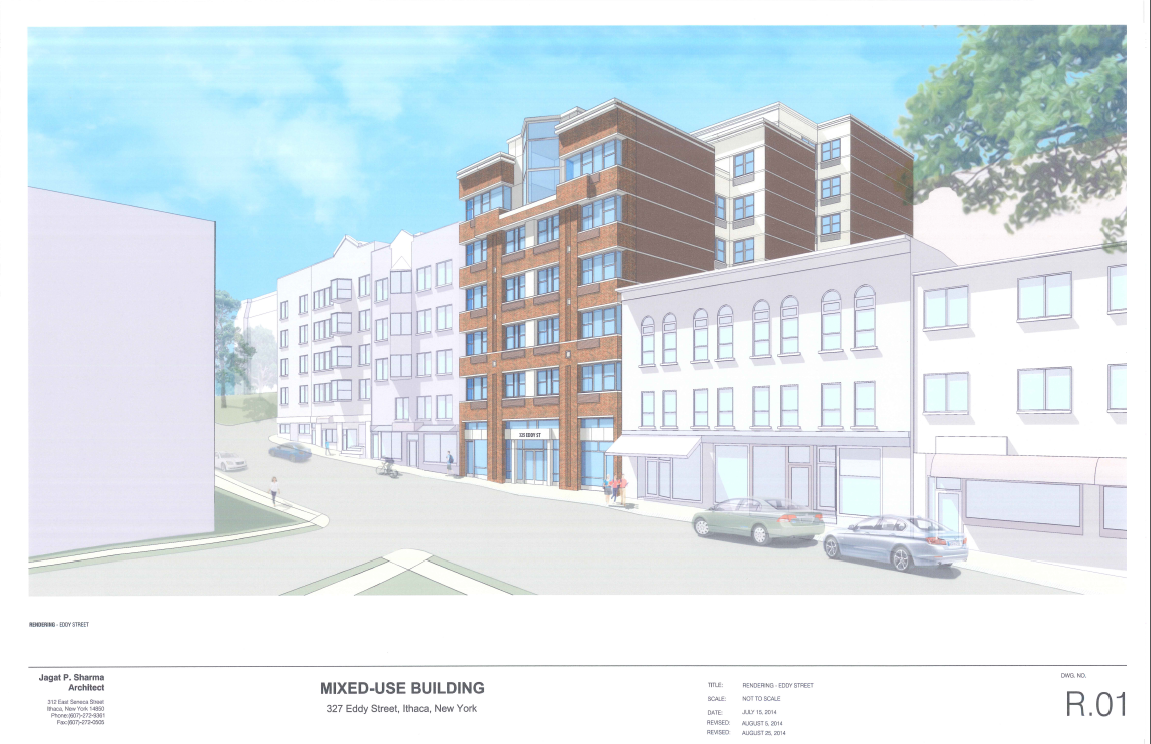
I must have missed something? All the sources I’ve seen have referred to this as a six-story building, not five. The side windows were added late in the approvals process, I think. Anyway, the project is going to the BPW because the developer wants to project the top centerpiece window as a bay window rather than having it set back from the front facade. This would push two feet (2′ x 12′ isoceles triangle) into the city’s right-of-way over Eddy Street,  and the board is recommending to the council that the mayor authorize (he says she should he should, sheesh) the intrusion for an appraised value of $3,073.84, based on an appraisal value from Pomeroy Appraisal Associates in Syracuse.

The decrease in size also comes with a decrease in units and rooms – from 28 units and 64 beds to 22 units and 53 beds. This is a double-edged sword – some might cheer the loss of size or like that the roofline is continuous with its northern neighbor, but it will be harder to stem the tide of single-family home conversion to student apartments if Collegetown’s core isn’t as capable of absorbing Cornell’s student population growth.

The included email in the agenda says the planning board recommended an overhang bay window. Personally, I feel it would make the building look clunky. But that’s just me.

maguire_fiat_1

6. Here’s another project being served up to the Planning Board this Spring. Additions and renovations to a car dealership down in southwest Ithaca’s suburbia. Site Plan Review and drawings here. The dealership is Maguire Fiat Chrysler. Plans call for combining two show lots into continuous lot and adding 20 spaces, adding a 1,165 square foot showroom addition, and new landscaping and signage, including a second freestanding sign for Fiat that requires a sign variance (the max allowed by zoning is one freestanding sign). Documents indicate all the work will cost about $360k and run from September to December of 2015.

Observant readers might remember that Maguires proposed a delaership/headquarters compound in Ithaca town late last year; but due to irreconcilable differences regarding standard zoning vs. Planned Development zone, the plan was tabled.

100_1474

7. Woof. Almost to the end. The Ithaca Planning and Development Board is going to have their hands full at next Tuesday’s meeting. Agenda here. Here’s a rundown of what’s in store:

– A minor subdivision to create a new home lot at 201-203 Pearl Street.

A. Approving the adjustment to the Carey Building design discussed earlier this week

B. Enhancements to the pocket park next to the Lake Street bridge (landscaping, paving)

C. Declaration of Lead Agency and discussion on INHS’s 210 Hancock project

D. Declaration of Lead agency, Public Hearing and Determination of Environmental Significance for the proposed Texas Roadhouse on Meadow Street

E. Declaration of Lead agency for the Tompkins Financial HQ – hopefully, we’ll get some detailed renders at the meeting

F. “State Street Triangle Project (Trebloc Building site)” – This will be huge. I cannot stress by excitement enough at seeing the Trebloc Building demolished – I have not hidden my dislike of it, and in nearly seven years of writing this blog, it’s the only building I’ve ever called an “architectural turd“.  Located at 301 East State Street, the Trebloc Building was built in 1974 during the age of Urban Renewal, and was originally supposed to be two floors. The city has been quietly desiring redevelopment of the prominent corner for years, and the site was upzoned from 60 to 120 feet in late spring 2013.

According to some praise-worthy sleuthing by David Hill at the Ithaca Journal, the developer is Robert Colbert in cooperation with Austin Texas-based Campus Advantage, a large-scale developer of student apartments. plans call for a 120-foot building on site, with first floor retail and student-oriented apartments above.

This will be a tremendous project by Ithaca standards. The developer clearly states on its website that it’s only interested in working with sites that will provide at least 100 units of housing. Assuming the Trebloc Building’s footprint of 13,569 sq ft, one story retail followed by eleven floors of apartments yields almost 150,000 square feet of residential space. Figure a loss of 15% for utlities and circulation space, and an average size of about 980 square feet for an average residential apartment unit, and one gets 130 units and an unknown number of beds that could conceivably add a couple hundred students to downtown Ithaca’s population, not to mention millions of dollars of taxable real estate.

There’s a lot that will need to looked at – utility loads, parking, vehicle circulation, aesthetic impacts, and numerous other attributes. But the city’s holding the door open about as wide as it can for this site, and it’ll be an exciting process.

G. “Sketch Plan: Cornell Fine Arts Library – Rand Hall Addition”

Written about previously, it looks like the city will get its first chance to review the project. But someone with a insider’s look has some pretty harsh comments for the plan to renovate Rand hall.

Cornell Architecture professor Jonathan Ochshorn wrote in to tell readers here about the plans for the Fine Arts Library. I’m including a link to his blog post on the project here.

To try and sum up Prof. Ochshorn’s post would do him an injustice, but suffice it to say, the library plans will only keep the brick shell of Rand – the windows will be replaced, and a large “hat” will be placed on the roof. One that bears strong scrutiny from the Planning Board, since there could be significant visual aesthetic impacts on the Arts Quad Historic District.

I’m gonna tie up this post here and sit on the other items until next week. More weeks like this and I’ll need an intern.


Dairy One and Binoptics Construction Update, 4/2015

14 04 2015

Neither one is especially pretty, but the local benefits are substantial.

Over on Warren Road in Lansing, two business expansion projects are underway just across the street from each other. The first one is the Dairy One project at 720 Warren Road.

A quick walk-by of the site shows that the exterior of the building is complete, finishes have been applied, and the grass landscaping has been seeded and covered with straw to protect it from the wind and birds. The new research center looks ready for its spring opening.

The new “Northeast Dairy and Food Testing Center” is a 50-50 collaboration between local firm Dairy one Cooperative Inc., and Chestnut Labs of Springfield, Missouri. The  17,000 sq ft building is a $3.5 million investment and will add 11 jobs at the outset, 3 through Dairy One and 8 through Chestnut Labs. 4 more jobs would be added over the following two years if all goes to plan.

According to the TCIDA report, Chestnut opted for Ithaca as its first satellite office because of a desire to expand into the Northeast and its proximity to Cornell. The design by Syracuse-based Dalpos Architects.

20150405_151240

20150405_151148

20150405_151249

Across Warren Road on its west side, the new addition to Binoptics is underway. Technically the address for Binoptics is 9 Brown Road, but the property sits on the corner of Brown and Warren Roads.

The plywood has yet to be sheathed and covered in exterior facade materials, but windows have been fitted into the new one-story, 2,800 square foot addition.  The addition is pegged at a cost of $7.7 million, mostly on new equipment. The design of the addition is by Rochester-based Architectura P.C., who also did the Cayuga Medical Associates Building just south of the Route 13/Warren Road intersection.

BinOptics, a laser developer and manufacturer, sees the addition as part of its plan to add 91 jobs over the next three years, including 35 jobs this year as the new addition is completed.

20150405_151157 20150405_151109


News Tidbits 3/28/15: It’s Affordable Housing Week

28 03 2015

The unplanned theme of the week: affordable housing projects.

1. This week and next, the Ithaca Urban Renewal Agency will be holding public hearings as part of the process to determine who will receive money from the Housing and Urban Development (HUD) grants awarded to the city. The 21 applicants ranges from jobs training to community services to the development of affordable housing. In total, $1.78 million has been requested, and there’s $1.215 million available, just a little over two-thirds of the total requested.

Without discounting the value of the other applications, the focus here will be on the real estate development projects. For the record, writing about a project is neither an endorsement or opposition from this blog.

inhs_pride_design_3

A. INHS is requesting $457,326 dollars for its 210 Hancock Street redevelopment project (also known as the Neighborhood Pride site). The total cost of the project as stated in the application is now up to $17.3 million. The application only applies to the apartment buildings, not the townhouses. The townhouses and apartments are going to be subdivided into separate parcels, because certain affordable housing funds are targeted towards renters and others towards homeowners. Subdividing the Neighborhood Pride parcel into the apartment and owner-occupied parcels will make for a smoother application process, and they’ll be separate projects within the larger framework of the 210 Hancock property.

210 Hancock will have 53 apartments – the 3 bedrooms have been eliminated and split into 1 and 2 bedroom units, so the number of units has gone up but the total number of bedrooms remains the same (64). The units are targeted towards renters making 48-80% of annual median income (AMI). The AMI given is $59,150 for a one-bedroom and $71,000 for a two-bedroom. The one-bedroom units will be rent for $700-1,000/month to those making $29,600-$41,600, and the two-bedroom units will rent for $835-$1300/month to individuals making $34,720-$53,720. Three of the units will be fully handicap adapted.

One of the commercial spaces will be occupied by local social welfare non-profit Tompkins Community Action for use in an early head-start program for approximately 30 children from lower-income households. The other two spaces have strong interest but do not have tenants lined up yet.

flatiron_1

B. This second project is something new. Alpern & Milton LLC (local buisnessman Ishka Alpern and his brother, Franklin Milton) are requesting $250,000 towards a $1,285,000, 12-unit project proposed for Inlet Island called “The Flatiron”. The project seeks a renovation of 4,900 sq ft at 910 W. State/MLK Street (shown above) and a 3,700 sq ft addition onto the neighboring parcel at 912 W. State/MLK. The finished project will resemble the triangular form of the famous Flatiron Building in NYC. the application says “the project will be of a historic nature, but the structure being proposed is not currently, nor will it be, deemed ‘historic’ in terms of housing or building code”. Ten of the units will be available to 30-50% AMI, and the other two will be available to those making 50-80% AMI.

The brothers do have some small projects to their credit, according to the filed paperwork. They handled the renovation of Brookton’s Market and 514-516 W. State/MLK Street. Judging from the google maps dating back to 2012, some renovations have already been done to 910 W. State.

2. In this week’s Journal, there was an article that gave a rundown of recipients of the Tompkins County Affordable Housing fund paid for by a combination of the city of Ithaca, Tompkins County and Cornell. Most of them I recognized – Holly Creek, the Habitat for Humanity duplexes in Groton and Trumansburg, Breckenridge Place and so on.

There was one I didn’t recognize. The Amici House proposal, which is being planned by Tompkins Community Action. I vaguely remember coming across this during the Stone Quarry debate last year, but at the time I couldn’t even verify if it was a real proposal. TCAction is proposing to build approximately 15 units affordable townhouses at 661-665 Spencer Road, just east of the Salvation Army store. There haven’t been any formal plans presented yet, but the project did receive $75,000 from the fund to pay for a pre-development feasibility study.

Farm Pond Site RES'D & LOT s 010414

3. Like single-family home development? Have lots of extra money lying around? The second phase of Lansing’s 21-lot Farm Pond Circle development is up for sale. Jack Jensen, the original developer, passed away last fall. Of the ten lots in phase two, four have already been reserved; there are also two lots left in phase one. The second phase is being offered for $155,000.

The Farm Pond Circle development is fairly stringent. Current deed restrictions limit the size of each housing unit to 2600 sq ft, vinyl or aluminum siding isn’t allowed, and only very specific subsections of the lots can be developed. Buyers aren’t limited to green energy, but there is a strong push in that direction. Also, at least four of the lots are earmarked for affordable housing (single-family or duplexes, buyers muse make  less than 80% of median county income of $53k)). The affordable units, at least two of which have already been built, are being developed in partnership with Jack Jensen’s non-profit, Community Building Works!.

4. It’s back again. The county’s Old Library committee will be meeting next Friday the 3rd at 9 AM in the legislature chambers. The goal of this meeting will be to review the formal proposals received for the Old Library site, which is likely the same four remaining from the RFEI, but in theory it could one or a hundred. Whereas the RFEI submissions were general, the proposals get into the nitty-gritty – site plan, architectural details, funding, time frame, proponents, all of it. Expect revisions to the previous four designs as a result of commentary from the public and legislators.

Since most folks can’t make Friday meetings, if anyone has general comments, conflicts or concerns about the proposals, I’ll just leave the committee’s contact info here: Legislature@tompkins-co.org. Use “Old Library” as the subject.


News Tidbits 3/14/15: A Spring Thaw and A Warming Housing Market

14 03 2015

215_221_wspencer

1. This past Friday the 6th, the city IURA (Ithaca Urban Renewal Agency) sold off a vacant city-owned property at 215-221 West Spencer Street to Edward Cope for $110,000. The name might not sound familiar, but a quick address check of the sales documents reveals an association with PPM Homes, a local rental company with a few hundred bedrooms in dozens of properties scattered around the city, most of them subdivided homes. Edward Cope also bought a vacant privately-owned lot at nearby 228 West Spencer Street for $15,000 on February 19th. 228 West Spencer, a small, steep site with tight zoning restrictions, was approved last year for one custom house design with 1536 sq ft. of space (the design plans came with the sale). As for 215-221 West Spencer, it was noted in July of last year that the city was selling the parcel (though I was under the impression it had already sold) and the buyer was intending multi-family housing. The 0.47 acre site has the potential for a medium-sized apartment building (20 units), but that’s a simple calculation using the zoning. With topography and neighbor considerations, the reality will be smaller.

In short, keep an eye on these properties, because PPM has the money to make the house and the apartment building happen.

holiday_inn_expansion_1

2. From the March IURA Agenda, a few good notes from the attached February minutes:

A. The Hotel Ithaca conference center is still actively trying to move forward.

B. The IURA received an inquiry about vacant land in the Cherry Street industrial park, from a business seeking to relocate into the city.

C. The city is making progress on taking over the state-owned parcel at 508 Taughannock Boulevard, previously used by the U.S. Coast Guard.

D. The former Ithaca Gun site is virtually entirely cleaned up, which will allow the apartment project proposed for the site to move forward with the planning and approvals process.

All things to keep an eye on in the upcoming months.

titus_wood_1

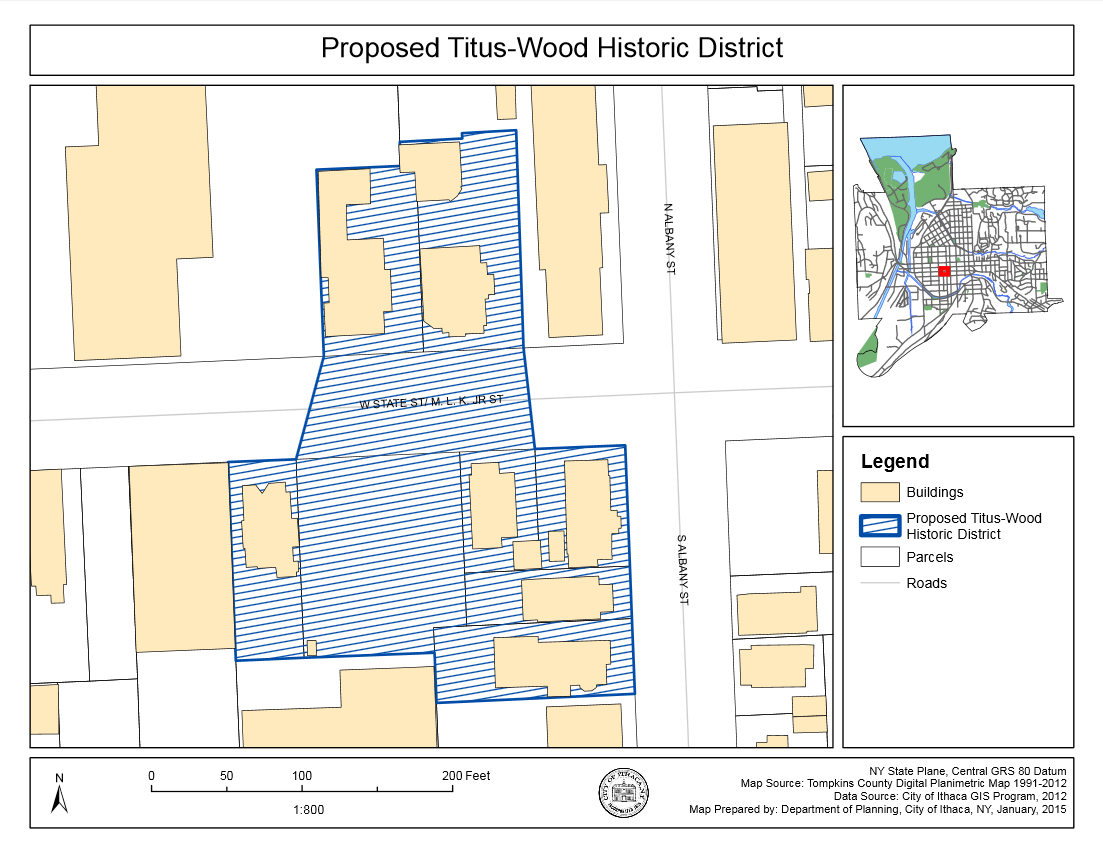
3. Looking at the city’s Planning and Economic Development Committee Agenda, there was quite a pushback from locals and the county for the proposed Titus-Wood historic district. The city fire department objected to landmarking their parking lot, the county wrote a letter opposing landmarking 317 W. State (and 315 W. State, which is not a registered address but could be the parking lot) because it was felt neither was historic enough and that it impeded urban infill, and the owner of 110 S. Albany, Ian Shapiro of Taitem Engineering, protested because his previous experience with the ILPC has been very frustrating, and that the ILPC gives applicants a really hard time over energy conservation efforts such as solar panels.

For the record, he’s not wrong about that. Some ILPC members have not been a fan of solar panels (examples here, here, here and here), and it has been at times a months-long process to get installation approval. It boils down to a dispute of alternative energy use vs. historic preservation, both things that Ithacans love, but can conflict with each other in cases like these.

Regardless of the opposition, the PEDC passed the historic district resolution with a unanimous vote, and the resolution now goes on to the Common Council, who will likely approve the new historic district.

4. Over in Lansing, concerned citizens looks like they can put their fears to rest regarding development of the Kingdom Farm property. The 528.1-acre property sold to a Cayuga County dairy farmer on March 10th for the hefty price of $2.8 million (in other words, $5,302/acre). The farm has been in the possession of the Watchtower Bible and Tract Society (the business branch of Jehovah’s Witnesses) for several decades, and the owners even pitched a 500-unit development for the site in the late 2000s. Back in October when the tax-exempt land went up for sale for $3 million, the Lansing Star reported that some more activist local residents wanted the town to step in and help a farmer buy the land so they could keep the property agricultural. There hasn’t been any news of the town taking that step, and it appears the problem resolved itself without the need of taxpayer dollars. Also, it means the property, assessed at $2.2 million, goes back onto the tax rolls. This might be one of the few cases where everything appears to have been worked out and all can go home happy.

5. 514 Linn Street has come down for a new duplex now under construction. Each apartment unit will have 3 bedrooms and be completed this summer. Although the predecessor building dated from the late 1800s, it was also an early “cookie-cutter” home; 512 Linn was the same design. Fall Creek is mostly developed, but Linn Street is no stranger to new builds – 514 follows a few years after 516 Linn, which was a new home built on a vacant lot.

amabel_v2_1 amabel_v2_2

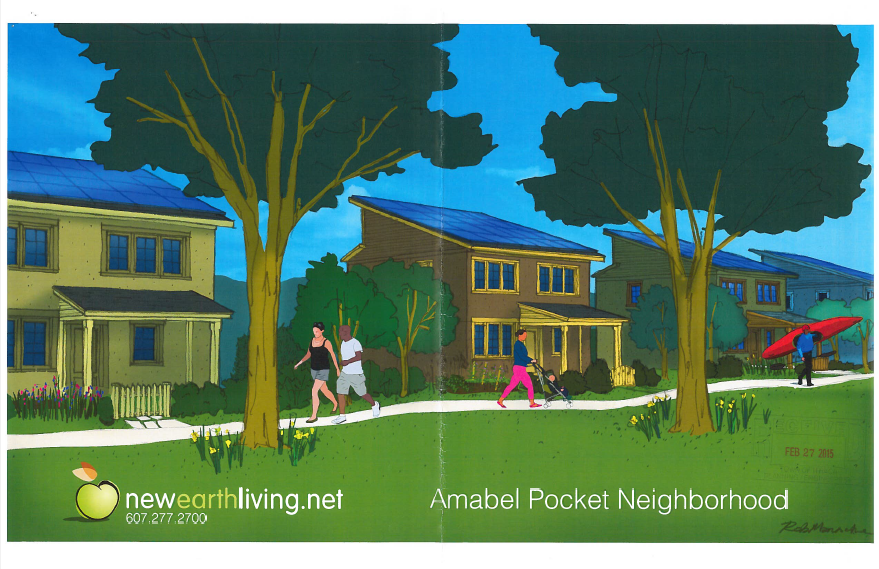
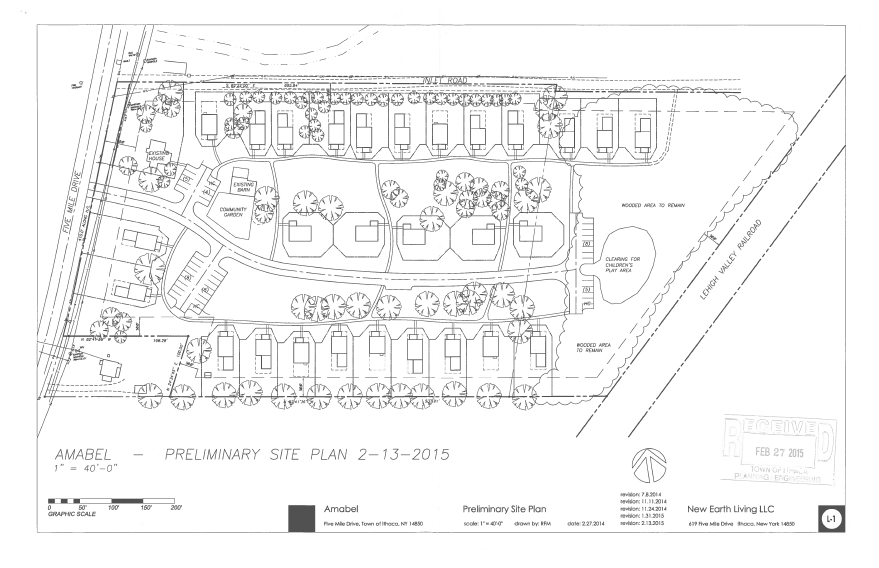
6. Lastly, it looks like the town of Ithaca’s planning board finally has a few things to work on, after having no meeting since early January. For their Tuesday meeting, the town will review plans for more luxury tents at La Tourelle, a new municipal water tank near Sapsucker Woods, and revised plans for the Amabel project off of Five Mile Drive. The number of units has been reduced to 28, and since November, two units were added to the far west portion of the parcel bordering Five Mile Drive (and as it turns out, those center units aren’t duplexes). Contrary to the example render, six different home designs will be available. Developer Sue Cosentini of New Earth Living LLC hopes to begin sales this summer.

Get connected:

Have comments or questions about these projects for your local government? Contact info below:

Town of Ithaca Planning Board: Use the form here – http://www.town.ithaca.ny.us/contact-us

Ithaca Common Council: http://www.cityofithaca.org/341/Common-Council – click on your councilperson’s name, their email is on the subsequent page.


News Tidbits 3/7/15: All is Not Well on East Hill

7 03 2015

hsrqev1

1. Leading off this week with a note of optimism – David Lubin, the developer of the proposed Harold’s Square mixed-used building in downtown Ithaca, says that plans for the 11-story building are still underway, according to a comment he made to the Ithaca Journal. Lubin says he’s currently in the process of lining up investors to finance the construction of the project, a challenging process once one tells investors that the project is in upstate New York. It’s not impossible to have a private project financed in Ithaca (if the Marriott underway down the street is any indication), but for a project costing $38 million, it’s no surprise that it’s taking a while. It’s easy to think that this one has slipped into the dustbin, but fortunately it has not.

Meanwhile, Ithaca Builds woke from its winter slumber to give an update regarding Lubin’s other big project, the Chain Works District for the old Emerson site on South Hill. Currently, the Chain Works District is in the process of writing up its Draft Generic Environmental Impact Statement (DGEIS). A DGEIS is part of the State Envrionmental Quality Review (SEQR), where the leading agency looks at a project, determines if any adverse project impacts are properly mitigated, and if so, issues a statement giving a negative declaration (approval). In this case, the NYS DEC also needs to be on board, approving the contaminated site for residential use. This is a pretty complicated project. There’s 800,000 sq ft of space to be removed or re-purposed, in an environmentally compromised site split between two political entities who are conducting joint meetings with their planning boards in an effort to try and move this project forward (the town of Ithaca board deferred to the city of Ithaca for lead agency; and both have rezoned the site to their respective specialized mixed-use zones). According to IB, the Phase I and Phase II Environmental Site Assessments (ESAs) contain about 60,000 pages of paperwork. The official timeline (already behind schedule, according to city docs) hopes to have the DGEIS submitted shortly, with a declaration of significance sometime in the Spring. In theory, Phase I site prep could start this year, but who knows if that will happen in practice.

franklin_libe_0414 travhyde_libe_0414 roccorner_libe_0414 dpi_libe_0414

2. The ILPC (Ithaca Landmarks Preservation Council) had a chance to review the four proposals for the Old Library site. Perhaps no surprise, the favored proposal was the Franklin/O’Shae proposal at top, which keeps the 1960s library and its “intrinsic historic value”. Members did, however, express some concern with the current building’s environmental contamination (asbestos). As for the other proposals, council members generally liked the Travis Hyde plan, and felt the Cornerstone and DPI projects were insensitive to the site (although one member expressed appreciation that at least the Cornerstone plan had affordable housing). It sounds like there will be some major tweaks to the building renders in the full proposals due later this month, so it’ll be best to hold off on judgment until those revised plans are published.

100_3080

3. Now for some bad news- Cornell is running into major financial problems, to the tune of a $55 million deficit. About half of that, $27.5 million, is expected to be reconciled with budget cuts (the other half will be covered by tuition increases). Considering the very large role Cornell plays in the local economy, this could have a chilling effect on local businesses that depend on Cornell or its employees. There are shades of 2009 here, when a projected $150 million deficit over 5 years resulted in 432 voluntary retirements, and hundreds of jobs lost.  The cut from 2008 to 2009 was a 5% reduction for the 2009-10 fiscal year, while the cut to go into effect for 2015-16 is estimated at 2-2.3%. Quoting an interview the Sun did with Skorton:

“[In the 2008 financial crisis,] We froze everybody’s salary for a year, paused construction, slowed down on hiring, developed a voluntary staff retirement incentive and 8 percent of the staff force was reduced … and [we had] a couple hundred layoffs, which is very, very hard to do,” Skorton said. “So that’s how the University acted in the worst crisis that ever happened. And so that’s a predictor of how it’s going to happen in this case.”

An article in the Sun a couple of days later notes that faculty employment is at an all time high. With 1,652 faculty in Fall 2014, Cornell has now passed 2007’s 1,647. – but one observant commenter, who I will happily buy a drink if I ever meet in person, notes that Cornell’s total enrollment is up 2,050 students since 2007. Devil’s in the details, folks – Cornell could use this “all-time high” as an excuse to not hire more faculty during its latest financial crisis, even though the student-faculty ratio have been increasing for years. Let’s not forget that faculty-student ratios are a crucial part of college rankings.

All of this is rather disconcerting news, especially in a time where the national economy has been picking up. Cornell has real potential to not only cause a localized recession, but also fall behind its peer institutions.

4. On a somewhat brighter note, even with this appalling winter, the construction of Klarman Hall is only nine days behind schedule, according to the Sun. Atrium glass installation should begin in April, and East Avenue will be reopened to two-way traffic around that same time. Although this project is well underway towards a December 2015 completion, one has a right to wonder if it is wise for Cornell to pursue the Gannett expansion and Upson renovation (valued at over $100 million combined) during these perilous financial times.

village_solars_3

village_solars_2

5. The town of Lansing’s planning board is set to review some slight changes to the massive Village Solars apartment project at its Tuesday meeting.

First, a quick primer – while the whole plan is for about 300 units, the approved phases account for only 174 units, and are being built in phases. The photo updates I’ve previously featured here on the blog show the first phase underway, buildings “A”, “B” and “C” on the right (south), with 36 units total. There are four phases, with two sub-phases in phase 2. Phase 2 consists of D, E, G and H with their 41 approved apartment units, and phase 2A is building F, which has the community center as well as 10 more units.

The revised plan calls for moving 6 units from buildings G and H to building M, which is in phase 4. G and H are combined into one apartment building (G/H), leaving 35 units in Phase 2. There are a couple reasons cited for this change – when working with NYSEG to lay out the utilities, it was decided to make phase 2 all electric services, due to concerns that Lansing may not be able to provide gas service if the tense situation with the gas pipeline proposal on West Dryden Road doesn’t go in the town’s favor. One of the results of the utility infrastructure change was a difference in utilities layout, and it was deemed prudent to shirt the walkway northward. This impacted the site design, which is why the Lucentes are seeking to revise the PDA (planned development area, similar to the city’s PUD and the town’s PDZ).

The change isn’t huge, and isn’t likely cause too much consternation among board members. This is actually the first site plan I’ve seen for the project, since it was approved before the town uploaded supplemental docs to its webpage. More importantly, it’s much clearer how future phases could build out – if the ~300-unit project takes 8-10 years as projected, then estimating the construction of phase 2 and 2A from summer 2015-16 seems reasonable.

simeons_1

6. Planning board members had mixed reviews about the Simeon’s rebuild, according to the Ithaca Times. While some members were excited about the rebuild, others expressed concern with the proposed addition of a second-floor balcony, seen in the above render by architect Jason Demarest. The project is eligible for state tax credits designed to renovate historic buildings, but if the credits are granted, then the balcony would not be built. If the credits are not granted, the building owners are looking not only at a balcony, but the possibility of widening the bay windows a little (it turns out the bay windows were an early renovation to the original Griffin Building, and larger bay windows would benefit a planned expansion of Simeon’s to the second floor). Regardless, cast-iron ornamentation that was salvaged before demolition will be incorporated into the rebuild.
During the same meeting, the planning board accepted revised signage for the Marriott, and there was further discussion about the Canopy Hilton. Nearby residents expressed concerns that a downtown hotel will increase traffic, and complaints were made about the ingress/egress plan for both the hotel and the CSMA next door. No word on the land swap CSMA wants, but it doesn’t seem like they’re budging on their property’s all-important utility easement quite yet.