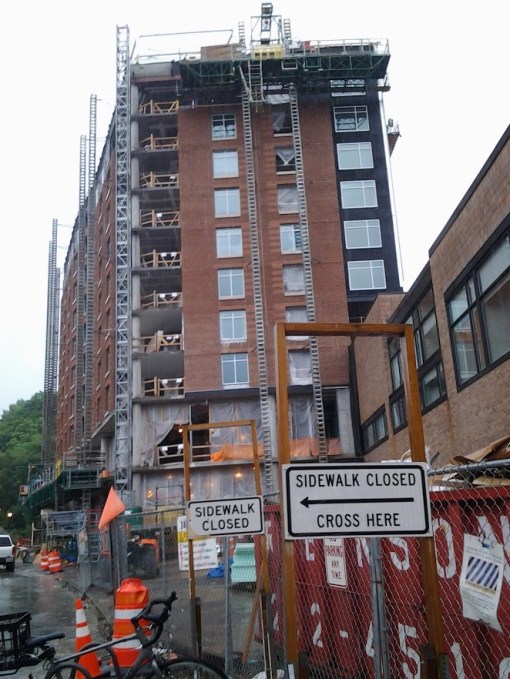
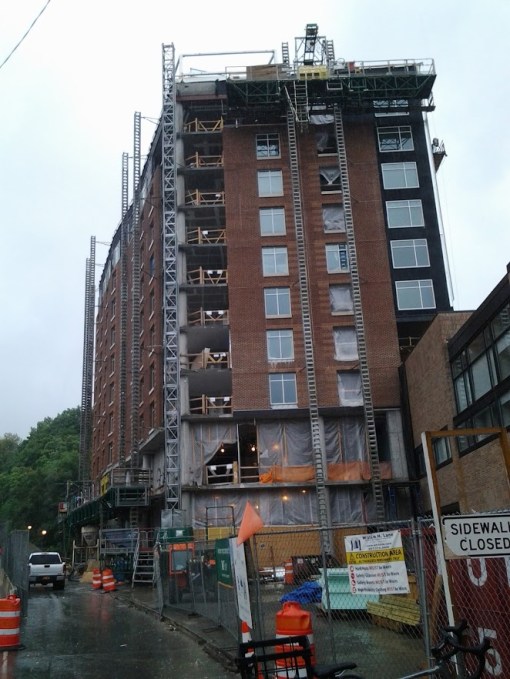
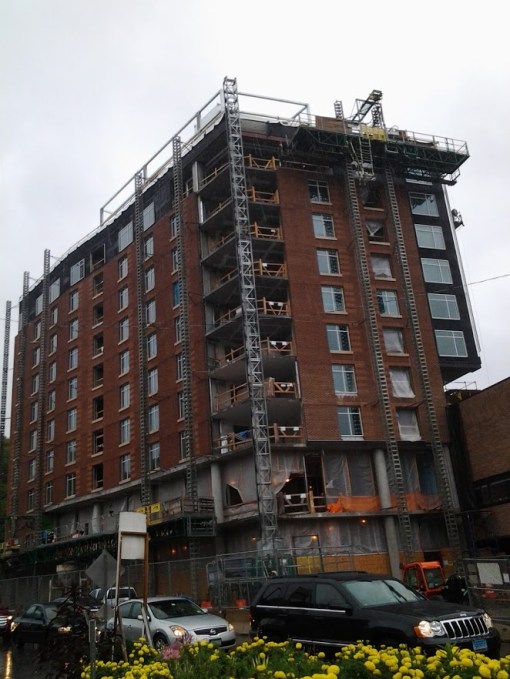
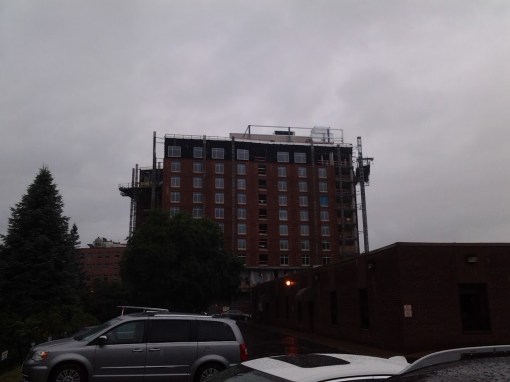
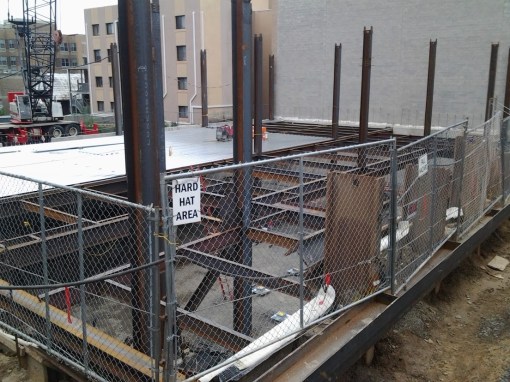
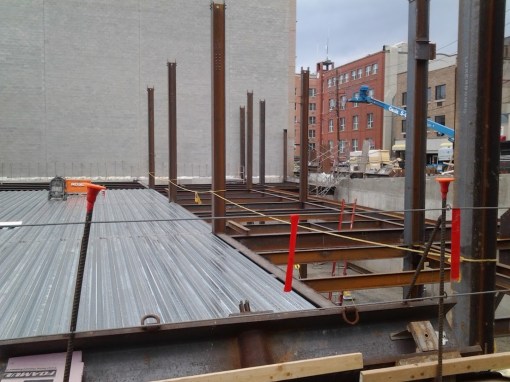
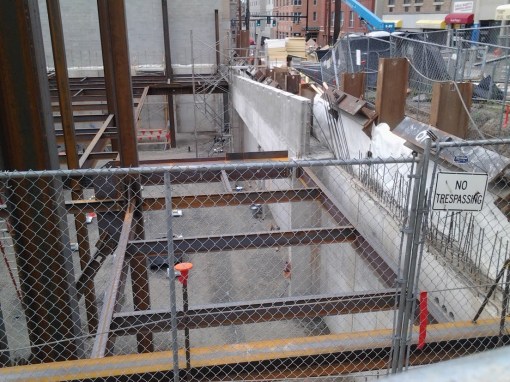
Tompkins Financial Corporation HQ Construction Update, 8/2016

31 08 2016

Tompkins Financial Corporation’s decision to build in downtown Ithaca is seen as something of a major victory by civic groups and local leaders. For one, it’s a major economic investment, and for two, it’s taken by many as a sign that downtown Ithaca has “turned the corner”.

Tompkins Financial Corporation is the parent company of Tompkins Trust Bank, as well as some other financial units. The company can trace its roots back to Tompkins County Bank’s formation in 1836. Along with Tompkins, TFC also manages several smaller banks throughout New York and Pennsylvania, totaling 67 branches and about 1,100 employees. About 280 of those work in downtown Ithaca at the current headquarters.

Currently, the office space is decentralized, scattered throughout multiple downtown sites and one suburban site, some of which are owned and others of which are rented. The bank began studies several years ago to examine a new headquarters, and looked at an urban location downtown, and a suburban location. Throughout the last 50 years, most large private companies have opted for the latter, and not without good reason. The logistics are simpler, the land is cheaper, the parking is easier – a study commissioned by TFC showed they could have saved over three million dollars by choosing a suburban site. But, as downtowns like Ithaca’s have made a resurgence in popularity, and given the bank’s long-time presence in downtown, they decided to pursue the urban option.

The new headquarters, first proposed in March 2015, will keep 282 employees in downtown (making an average annual wage of about $81k), add 18 more from the consolidation of the Craft Road office in Lansing, and potentially add a number of new jobs as the bank continues to grow. The IDA application gives 6 new positions over 3 years, all well over living wage; paperwork submitted to the city says 77 jobs over ten years. The project applied for and received a ten-year tax abatement from the Tompkins County IDA, saving about $4.06 million in property taxes and $2.112 million in one-time sales taxes. The community hearing was generally supportive for an abatement, and even with the reduced short-term tax bill, a net positive of $3.78 million will still be paid in taxes over the next decade.

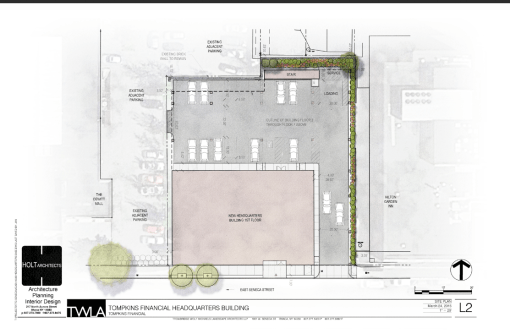
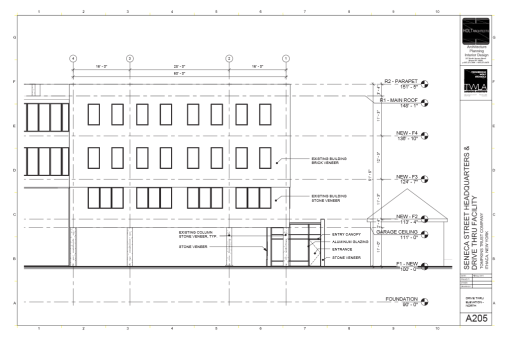
Now, a little about the site and the building. The project is really two separate projects, one much smaller than the other. The first, at 119 E. Seneca, will build a 965 SF drive-thru bank branch on what is current first floor parking underneath a 1970s office building owned by TFC. The surface lot will be reconfigured to support the drive-thru functions, and retain a small amount of parking space.

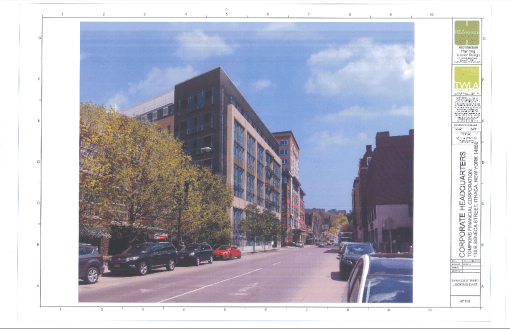
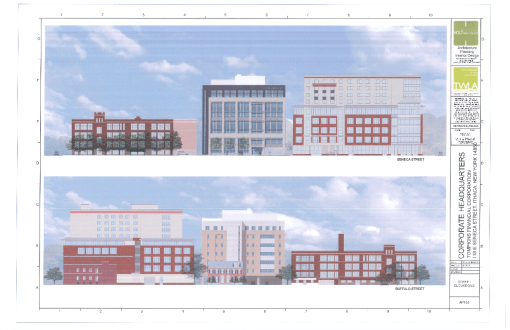
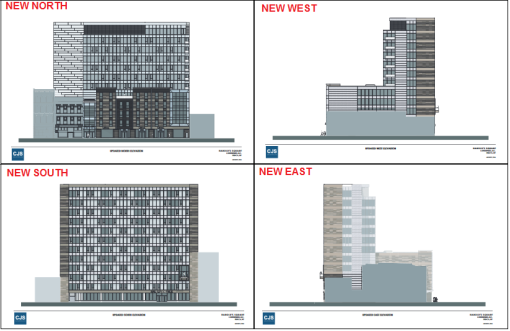
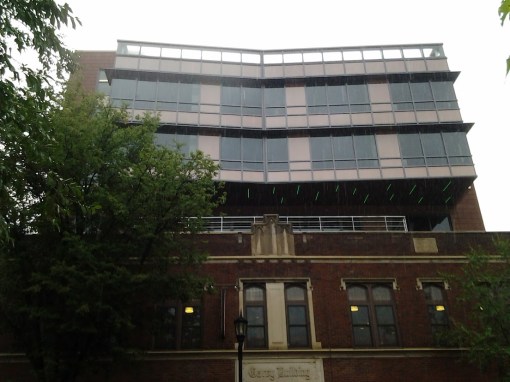
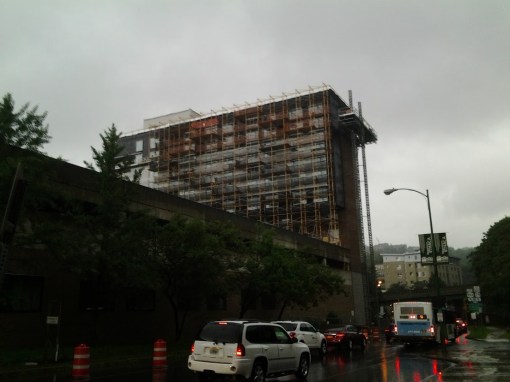
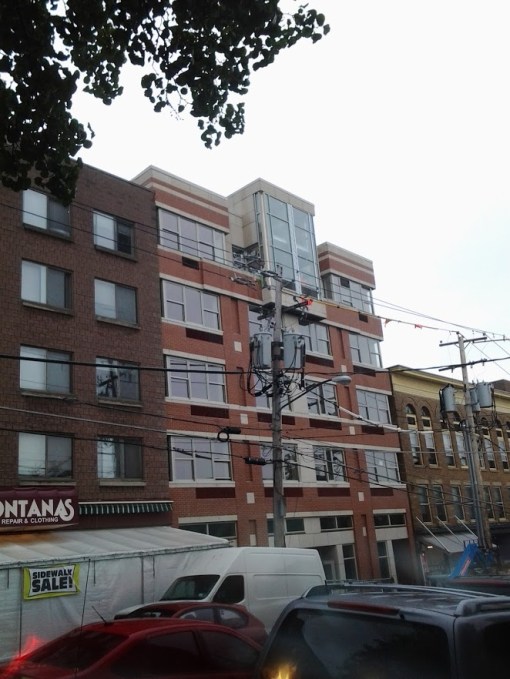
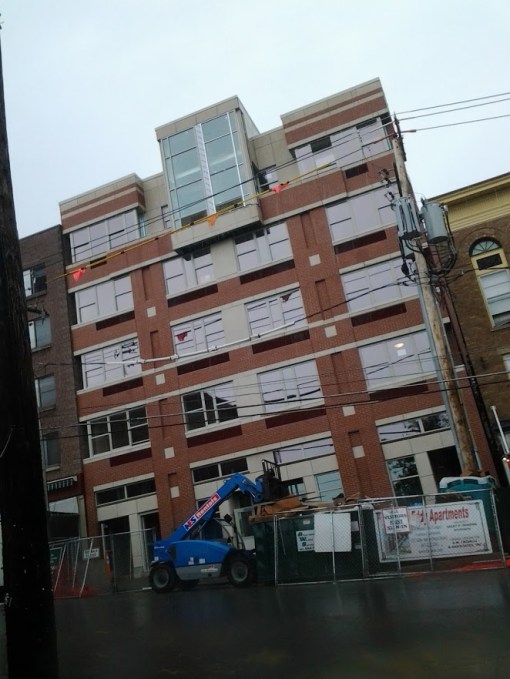
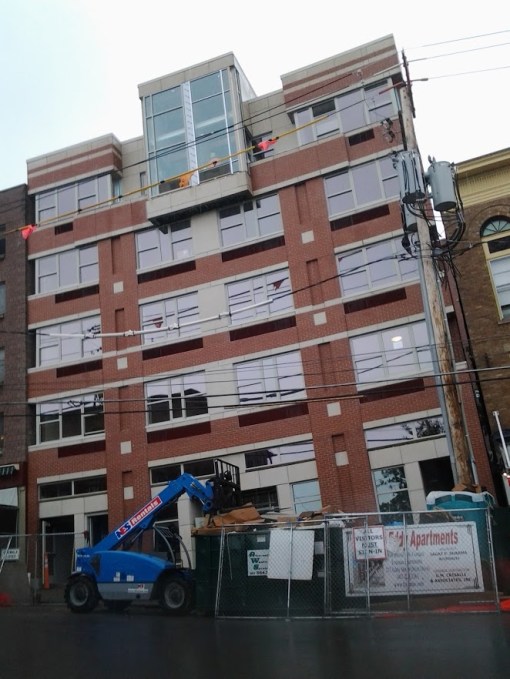
Across the street is where the real meat of the project is. Construction is currently underway on a 7-story, 110,000 SF commercial building at 118 East Seneca, with customer services and 20-25 parking spaces on the first floor and office space on floors 2-7, which will have larger floor-plates that will overhang over the first floor. The first through third floor offices will be geared towards consumer retail operations, and the top four floors will house general operations and senior leadership. The building will be 100 feet tall, just like the 10-story Marriott finishing up a few blocks away. Modern office buildings usually have 14′ floor-to-ceiling heights due to the size of heavy-duty commercial utility systems, better visibility and natural light penetration, and to provide ample accommodation for tenants’ computer equipment. A bit of a prestige factor also comes into play. Materials include a granite base, stone veneer on the front, light and dark brick veneer, and aluminum panels on the top floor’s sides and rear walls. TFC’s HQ will be built to LEED standards, but the company will not be seeking LEED certification due to the costs involved.

The new headquarters replaces a parking lot and drive-thru bank branch  built in 1990, and prior to that the site was home to the two-story Temple Theater, which despite described as “cramped”, “shabby” and “grungy”, brought to Ithaca the first showings of “The Godfather” and other big-budget films of the early 1970s. The Temple Theater operated from 1928 to 1976, when it closed not long after the mall opened in Lansing. The building was razed not long afterward.

Estimated costs have bounced around a little bit – initially reported as $26.5 million, they were up to $28 million by the time of the IDA application, and $31.3 million at the time of groundbreaking. The March sketch plan called for final approvals by June 2015, but they didn’t happen until December 2015. Not entirely the city’s fault, the timeline was very ambitious.

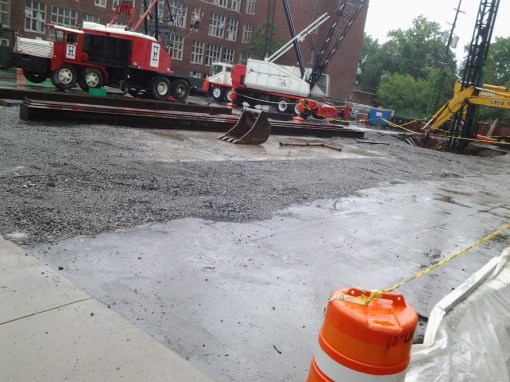
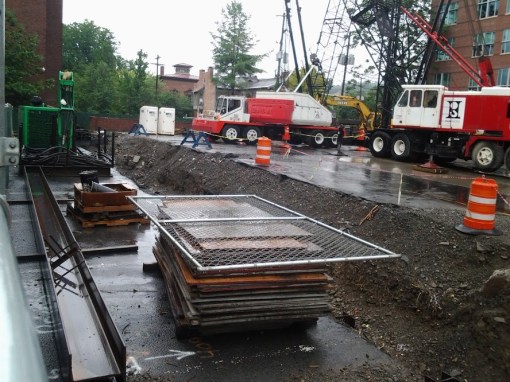
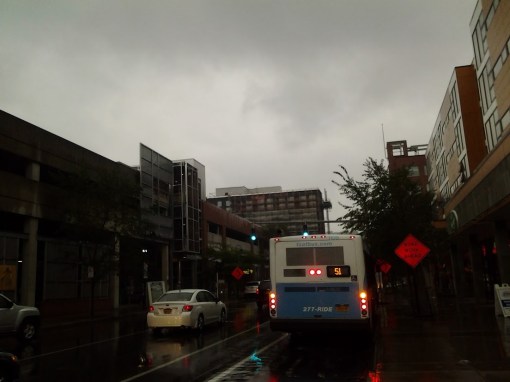
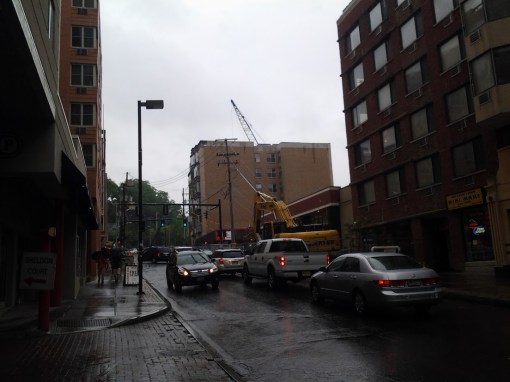
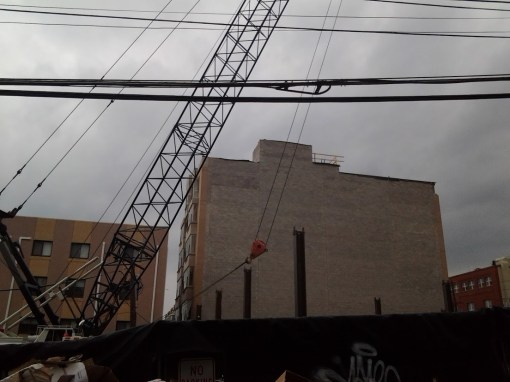
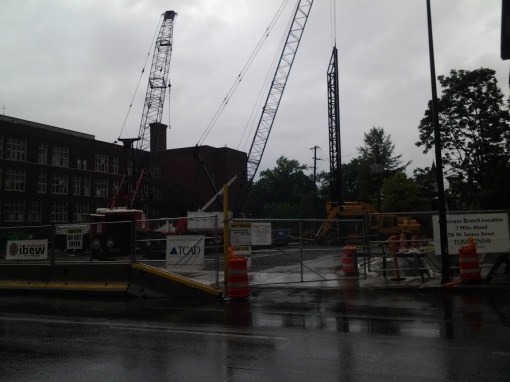
The site has been partially cleared and the existing drive-thru branch has been demolished. Currently, the project is undergoing foundation excavation and pile-driving. You can see the trenches being dug along the perimeter, and wood lagging and steel H beams have been laid along the outer edges to provide stability to the soil and buildings of adjacent properties. According to the report from Elwyn & Palmer, the project team will dig down about 12-13 feet for the sub-floor, thenceforth pile driving shall commence, 65-70 feet down. It’s anticipated the sandy soils will make the pile-driving move along faster, but the other buildings nearby will necessitate temporary support installations during the excavation process. Ithaca firms HOLT Architects and Trowbridge Wolf Michaels Landscape Architects are responsible for the design of the project, and Rochester’s LeChase Construction is the general contractor.

When TFC’s new headquarters opens in March 2018, expect something of a glut in the local office market as a lot of space is emptied in a short time. TFC CEO Grag Hartz has said that 119 and 121 East Seneca would be held onto and rented out, with the bank retaking space in those buildings as it needs. However, their office and bank on the Commons (the historic 2 and 3-story buildings on Bank Alley just south of the M&T Building) would be sold. The project is indirectly spurring Bank Tower’s conversion to apartments, given the tepid office market but very hot residential market downtown. Token teaser if you’ve read this far – a second conversion project is in the early stages.
20160821_131028 20160821_131051 20160821_131105 20160821_131118 20160821_131220 20160821_131331

tfc_final_1

tfc_v2_1

tfc_2

tfc_v3_3 tfc_3  tfc_v2_3


News Tidbits 8/27/16: A Week of Questions

28 08 2016

harolds_square_v4_new_comparo

1. Let’s start off with a planning board recap. The subdivision at 123-125 Eddy Street was reviewed. My Voice colleague Mike Smith called any proposal for that part of Eddy “masochist“, and the Journal’s Nick Reynolds had some fun with it as well. Councilman Graham Kerslick paid a visit on behalf of Orchard Place, both as a resident and as spearhead for the wealthy, owner-occupied enclave’s opposition to the two-unit house due to parking and concerns about renters. There’s virtually no process to stop lot subdivisions, since those do not have physical impacts. If the lot meets legal specs, the board is obligated to pass it. They can, however, request a site plan review for the house.

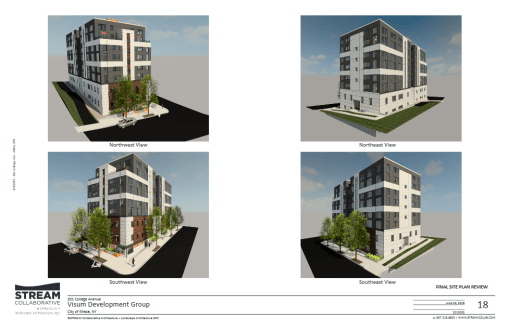
201 College’s discussion was interesting. It takes some moxy to say “Historically, Collegetown has always been a dump,” but the comment isn’t without merit. The neighborhood has effectively functioned as Cornell’s housing annex since the first boarding houses were built in the late 1800s, and owner-occupancy, never a strong presence to begin with, steadily disappeared after World War II. Many of the structures venerated now were seen as cheap and ugly in their early days. The argument provided by Fox was that historic character should be defined by the social fabric of the neighborhood, not by physical appearance. Collegetown has always been primarily a student neighborhood, and he feels his project offers a high-quality addition to maintain that student-centric social fabric. He even called out Neil Golder, the project’s primary opponent and a former student renter who eventually bought his house: “The only thing that’s out-of-character in the neighborhood is Neil’s house and demographically, Neil.”

What followed was essentially a debate on legal issues, which occasionally became heated. In the end, the board agreed to draft a zoning appeal, so now it’s onto consideration of final site plan approval, which hinges on Board of Zoning Appeal interpretation on whether or not the building is in compliance with the zoning code. In other words, on 9/6, the project team is basically going to ask, “hey does everything meet the code,” the BZA says “yes/no”, and if yes, final site plan approval is granted. Very convoluted.

On a happier note, Harold’s Square’s changes were approved, and developer David Lubin announced that with that in hand, he has the funding secured to begin construction this fall. There had been been some debate about the architecture beforehand, which threatened to derail the plans, but the issues were ironed out.

2. The Ithaca Urban Renewal Agency will be reviewing an application for a new microbrewery in the city’s West End neighborhood. Liquid State Brewing Company would be located in 5,000 SF of leased, renovated space in the Cornell Laundry Building at 521 West State Street. The brewery would initially focus on hoppy ales with a local distribution to stores and restaurants. There will be a taproom, outdoor patio, food truck events and a small amount of merchandise for sale.

Proposed by former Ithaca Beer brewer Ben Brotman and Jamey Tielens of Trumansburg, the project would create 2.5 jobs, over or just about living wage. The written paperwork includes the two brewers and a cellar specialist, for 5.5 jobs. If approved, the brewery would open in early 2017.

Liquid State is looking for a $70,000 loan towards their $620,000 project. For the record, there will be no link provided to the application because it contains sensitive tax and financial information about the applicants. The IURA tends to be a bit dicey about things with alcohol involved, but the locally-made aspect will help sell the project to the committee.

wyllie

3. Also on the IURA Agenda, the Restore NY grants. As written about in the Voice back in July, there were ten suggestions for nine projects. Four were dropped – Josh Cope’s hostel proposal, INHS’s Elm Street project, Novarr’s project, and the renovation of 224 West Spencer. 310 West State, 121 West State and 139 East State Street (part of Harold’s Square) were bundled into one grant application called the “State Street Historic Buildings Rehabilitation”, requesting $500,000 for $3.7 million in projects. The other application, for 109 North Corn Street (Wyllie’s, above) and 413-415 W. Seneca, are part of the “Seneca/Corn Street Buildings Rehabilitation”, $500,000 for $875,000 in projects. At a glance, the State Street plans look to have a pretty strong application, but we’ll see what the state thinks after they’re submitted this fall.

chain_works_rev3_3

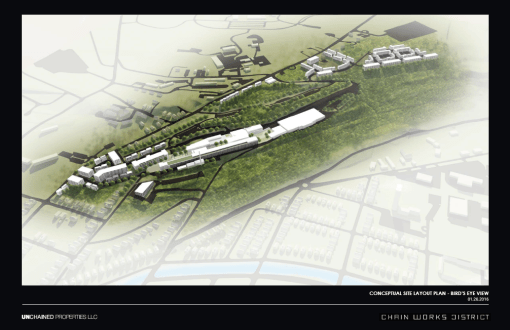
4. Here are the 15 or so pages of comments received on the Chain Works District DEIS. Some are really good questions or comments, some aren’t, some conflict with each other – it’s the nature of the beast.  The Planning Board’s Special Meeting on Tuesday is mostly just to review comment summaries, and several more meetings will be scheduled through September and October.

mettler_toledo-1-771x372

5. So I had the unpleasant task of breaking the news this week of the largest single layoff or facility closure in Tompkins County in seven years. The loss of 185 well-paying jobs is not something to take lightly, even if this area is in general faring well economically. Even worse, the Journal is reporting that TCAD never even saw it coming, they were blindsided. At least with Emerson in 2009, the writing has been on the wall for several years, especially after they transferred their senior corporate jobs to Kentucky in 2007. Here, everyone’s just been blown back. Mettler Toledo Hi-Speed paid over $100k in taxes annually, and was a big supporter of the local United Way chapter, so it has a lot of negative impacts spread out on Dryden and the county. Not a good week.

If anything, this is a sobering reminder that economic development is multi-pronged – attracting new business with new job opportunities is the obvious part, but maintaining an environment that nurtures and supports the existing workforce is just as important.

20160821_134917

6. Giving credit where credit is due, the Journal’s Nick Reynolds did a nice write-up on the Carey Building overbuild on the 300 Block of East State Street. The article ends with a not-so-subtle teaser that Travis Hyde Properties might be bringing forward a residential proposal for the Ithaca Gun site some time next Spring, something that has been in the making in one form or another for a decade-plus (they’ve held off in the past couple of years because the city had to finish cleaning up adjacent soils).

One note of discomfort is that the article refers to the Ithaca Gun site as “its next project”. What is that saying about the Old County Library site?

7. Nothing too exciting in real estate sales this week. “SCF Realty Capital LLC” paid $6.6 million to Drake Petroleum for three gas stations – $1 million for the Sunoco on W. Main in Dryden village, $1.9 million for the Xtra Mart on Dryden Road, and $3.6 million for the recently-renovated Xtra Mart on Route 34B near the Lansing town offices. County tax assessors had them valued at $2.35 million collectively. I’m not familiar with the sales dynamics of convenience stores/gas stations, but that’s an impressive differential.

SCF stands for “Stonebriar Commercial Finance”, a company that specializes in middle-market commercial real estate finance over a wide spectrum of industries, with sale-leaseback options for clients. A copy of the deeds were sent to the corporate offices of Mirabito Energy, and a check online indicates Mirabito is buying 31 gas stations in three states, part of a corporate divestiture of locations by Drake’s parent company, Global Partners. So, the Xtra Marts are becoming Mirabitos.
Speaking of gas stations, land for sale at the Rte 13/Rte 34 split in Newfield sold this week to an LLC representing the Marshall Companies, a Weedsport company that runs Pyrus Energy and the Pit Stop Convenience Store chain.


Ithaca Marriott Construction Update, 8/2016

27 08 2016

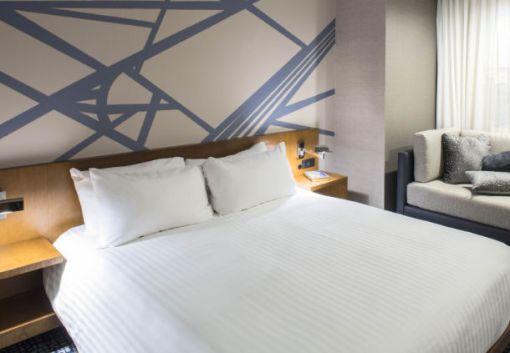
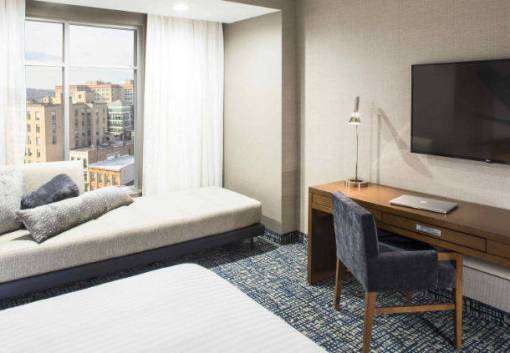
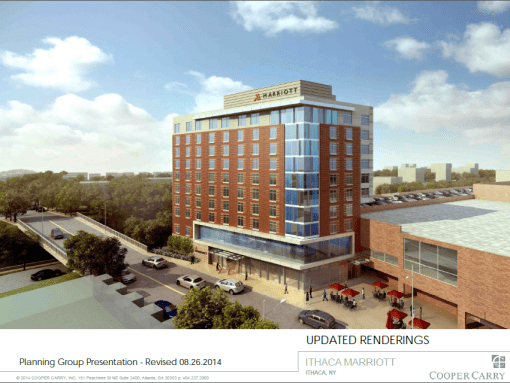
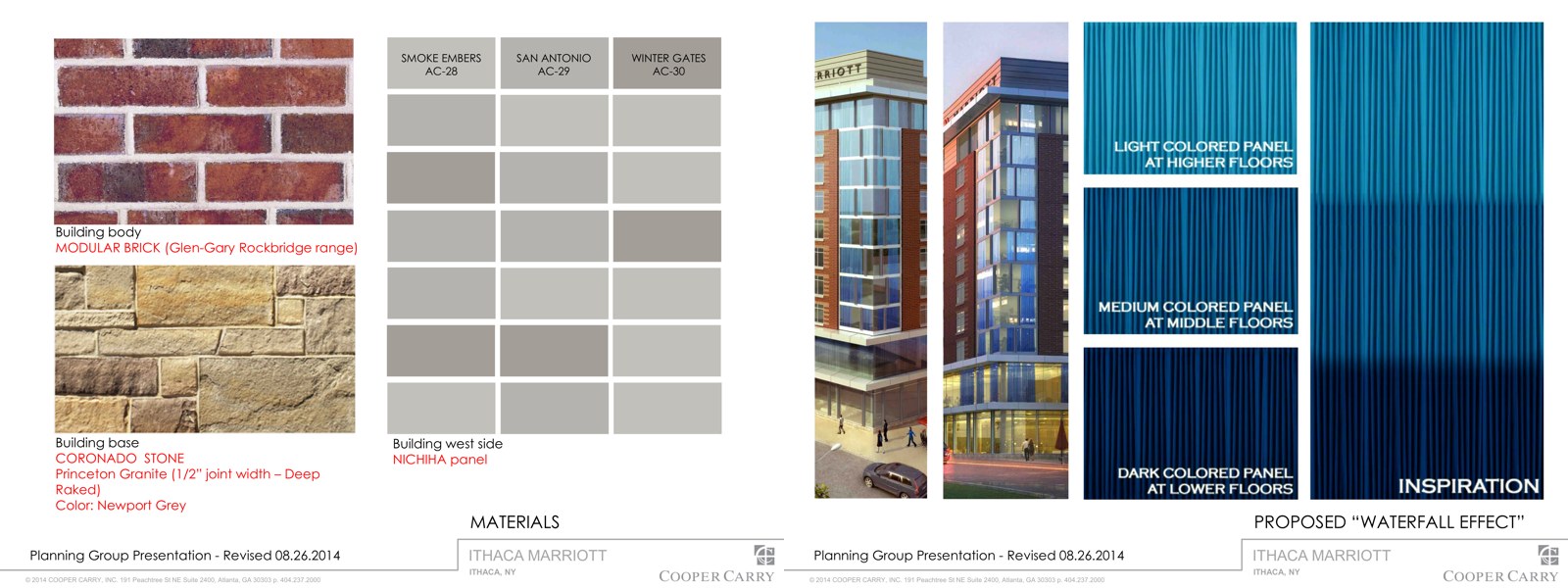
If all had happened to plan, the hotel would have opened this past Tuesday. Unfortunately, things did not work out as planned, as it often happens with large construction projects. Marriott’s website gives an October 2016 opening. A few simulations of the room interiors are included below. If I remember right, a while back someone told me that the rooms are a little smaller than Marriott’s standard (which looks to be true – the king-sized rooms are 300 SF, and comparables that I’m finding at other Marriotts are 360 SF), so the interiors were designed to be more plush and higher-quality to compensate. Among the amenities include 49″ TVs, Wi-Fi, mini-fridges, a business center, a fitness center, an “M Club Lounge“, laundry service, complimentary coffee/tea, down comforters, and a bunch of other things that are staples of premium hotels. The in-house restaurant will be called “Monks on the Commons”, and serve American comfort food, breakfast, lunch and dinner. Kinda interesting to see which local restaurants they chose to highlight on their website.

Of the 159 rooms (finally, a confirmation it’s not 160!), 8 will be suites, and the hotel’s 3 meeting rooms total just under 2,500 SF. I tried to set up a reservation to see the prices, but the website wasn’t allowing bookings. The “largest event space” can hold 198 guests, along with the ridiculously cheesy line of “Reserve our wedding venue in Ithaca, NY and say ‘I do’ in a ceremony as unique as your love. ”

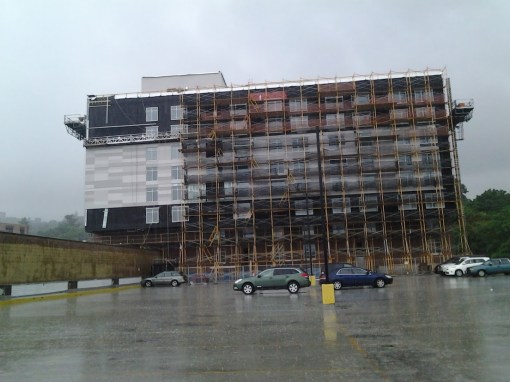
So, those are to-be’s, now to the what-are’s. On the outside rear, the Nichiha metal panels are being attached to the waterproofed sheathing. The brick is done, but the stone veneer on the lower floors has yet to be applied. You can get an idea of the interior work underway by peering through the suite rooms, which face the Commons and State Street; notice the work on the ceilings progressing as one works their way down from the top floors.

20160821_133646 20160821_133806 20160821_134053 20160821_134658 20160821_134705 20160821_134831 20160821_135014 20160821_135108 20160821_135113 20160821_135159

ithmc_phototour06 ithmc_phototour07 ithmc_phototour12

marriott_rev1_1


409 College Avenue (Student Agencies eHub) Construction Update, 8/2016

26 08 2016

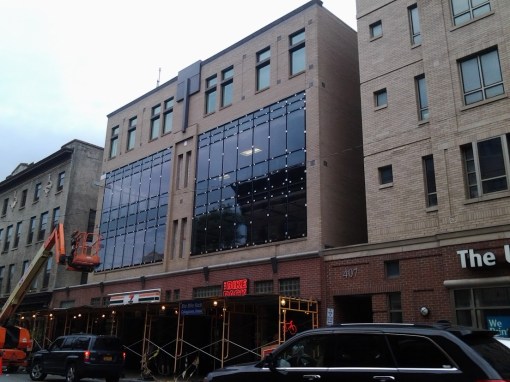
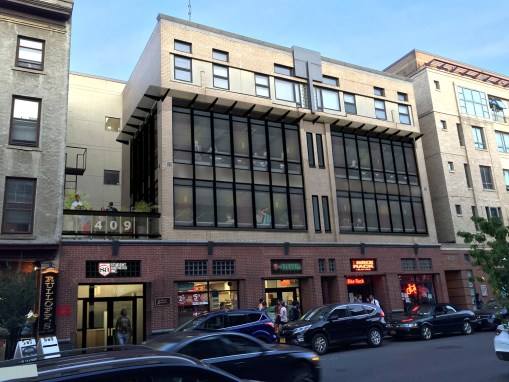
The Student Agencies Building at 409 College Avenue has received its new glass curtain wall. The glazing seems to have just arrived judging from the brackets. New windows have yet to be installed in the center column, and there’s still other work on the exterior to-do list, such as the etched glass railing for the second-floor balcony, the brise soleil, and minor trim work.

Note that the top (fourth) floor appears to have also been redone. This was not in any of the renders, although the Planning Board’s Design Review panel probably had to sign off on it. It’s likely that this is one of the reasons why the renovation work has gone on longer than anticipated.

STREAM Collaborative is the architect, and on their website are some interior renders of the new eHub co-working space. A couple shots are embedded below, but more can be found on STREAM’s website here. Morse Construction Management is the general contractor.

EDIT: I asked STREAM’s Noah Demarest if the fourth floor was a last minute change. “Yes. Last minute change due to the facade being in far worse condition than we thought. It is completely rebuilt. We have technical drawings we submitted to staff but never updated the renders.”

20160821_103915 20160821_103933 20160821_103951

409_final_1 409+2nd+Floor+West 409+Multi-Purpose+2

20160415_101834


205 Dryden (Dryden South) Construction Update, 8/2016

25 08 2016

There will probably be one last follow-up group of photos. The exterior masonry work is ongoing, but according to owner/developer Patrick Kraft, the development team (Kraft, general contractor LeChase Construction, architect Jagat Sharma, etc.) is shooting for a Labor Day weekend completion. The ruminations and before/after photos can wait until that time. Meanwhile, the apartment units are occupied and the safety systems (fire alarm/sprinkler) are online.

The Cornell Daily Sun is reporting that the suites are occupied although there’s still some last-minute finishing work like painting, trim and custom window dressings. Common spaces such as the gym also have yet to be finished, according to 14850.com.

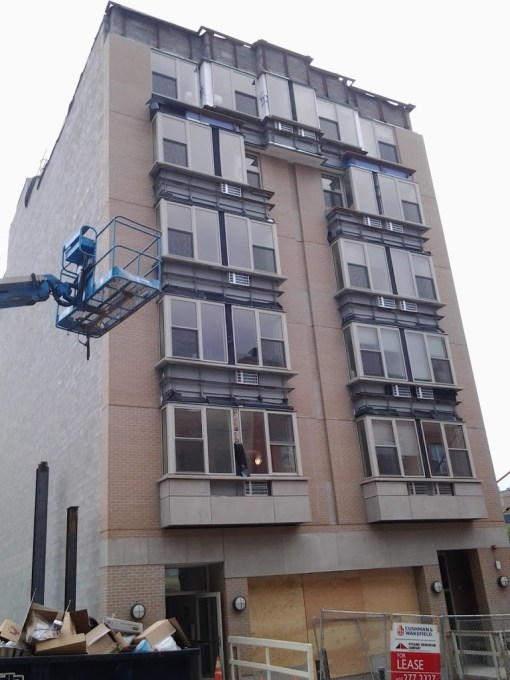
A quick glance shows that precast panels and AC units are being installed on the front of the building, while the back side appears to be completed. The steel rails between the rows of windows serve as heavy-duty anchors for the panels. The glass entryway for the first-floor retail space is still covered with plywood for the moment. No tenant has been announced for the 2,400 SF space, although Kraft hopes to land someone that will complement the Johnson School building going up next door.

20160821_103733 20160821_103754 20160821_103813 20160821_103834 20160821_123204

20160821_103604

205_dryden_-_rendering


327 Eddy Street (Dryden Eddy Apts) Construction Update, 8/2016

24 08 2016

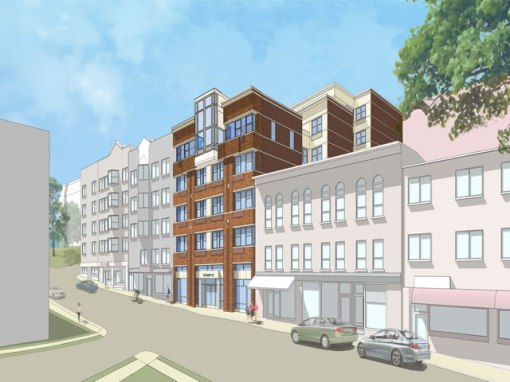
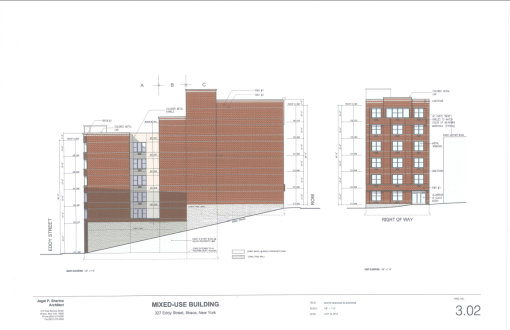
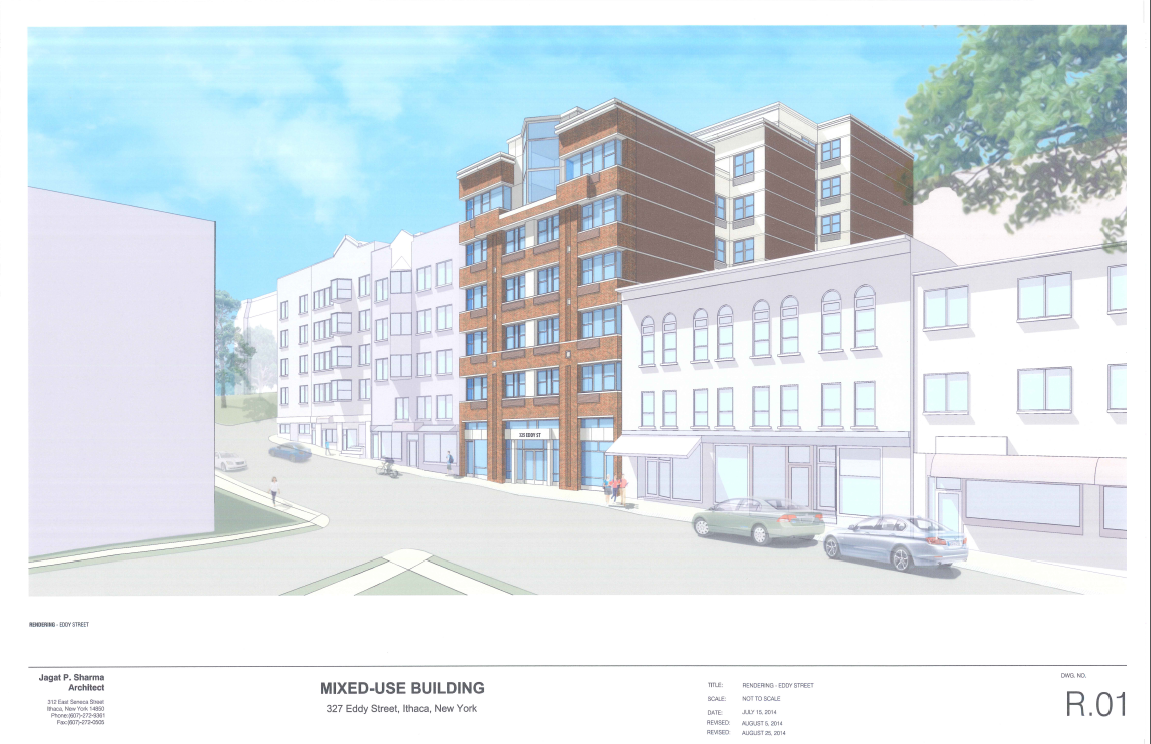
Number two on the follow-up of Collegetown mid-rises, the 22-unit, 53-bedroom Dryden Eddy Apartments should be open to tenants by this Friday. According to developer Steve Fontana, the issue was that the elevator had yet to be fully integrated with the fire alarm system, so the city couldn’t issue a certificate of occupancy until that was taken care of.

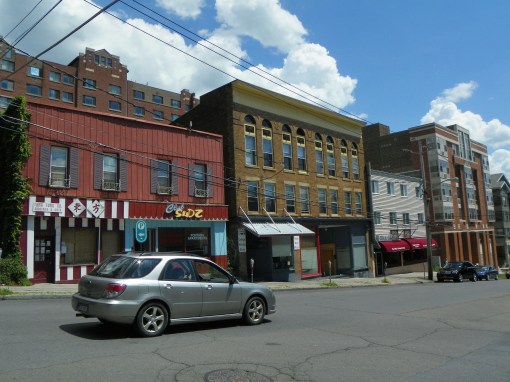
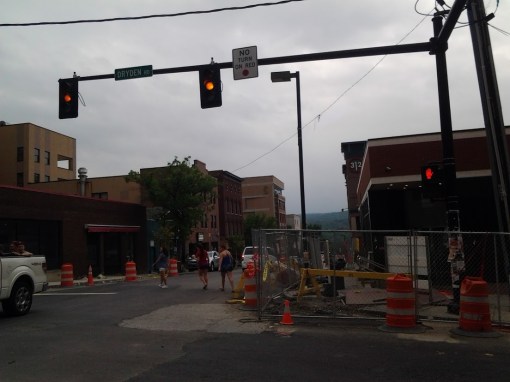
Also worth noting, Fontana has secured two tenants for the first-floor commercial space (originally it was supposed to be a gym, but those plans faded out at some point). The Papachryssanthos family, one of Collegetowns old greek families and the proprietors of the Souvlaki House two buildings down, will be splitting the 1800 SF into a liquor store (aptly named “Ithaca Wine and Spirits”) and a café called “Chatty Cathy”. The owners of the East Asian grocer Tung Fong retired, and the Pixel bar and Club Sudz laundromat have passed into memory.

While not as ground-breaking as 307 College, 327 Eddy still serves as a useful addition to Collegetown, offering density in an appropriate location and maintaining a wall-to-wall streetscape with its neighbors. The density will be an asset by providing additional foot traffic to neighborhood businesses, and (back-of-the-envelope estimate) there will be an additional $160,000/year in property tax revenues for the city, county and school district. The final product fits in with a nice design, though I personally prefer the originally-approved plan, with one more floor and a crown set back from the face in the shape of a triangular prism. The rectangular crown makes it look too similar to its neighbor down the road at 309 Eddy. Something I had not realized until now was that the rear (east) face was totally reworked as well, with bay window projections instead of the smaller “punch-out” windows, which comparing the two, seems to be an improvement. But I digress, taste is subjective.

The construction cost was at least $4.824 million, with financing provided by Tompkins Trust Company. G.M. Crisalli and Associates of Syracuse served as general contractor for the project.

Before:
6-29-2014 158

After:

20160821_123606 20160821_123800 20160821_123751 20160821_123644 20160821_123624
20160821_123309 20160821_123334

327_eddy_rev4_1 327_eddy_rev2_1

327_eddy_rev1_3


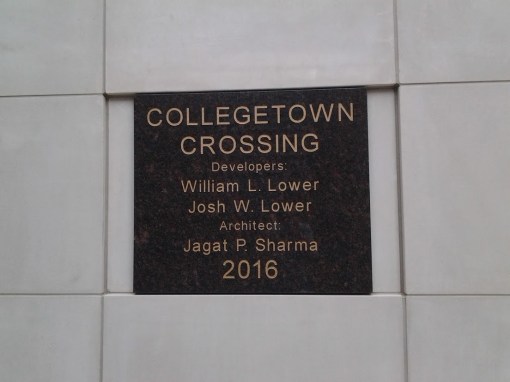
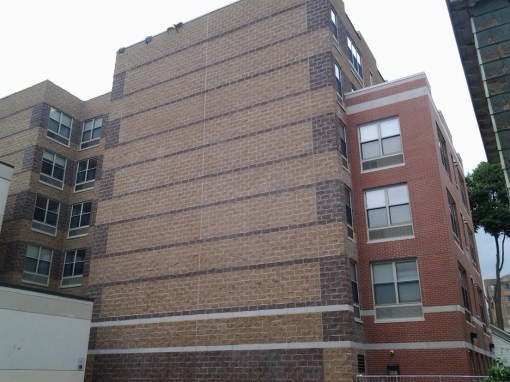
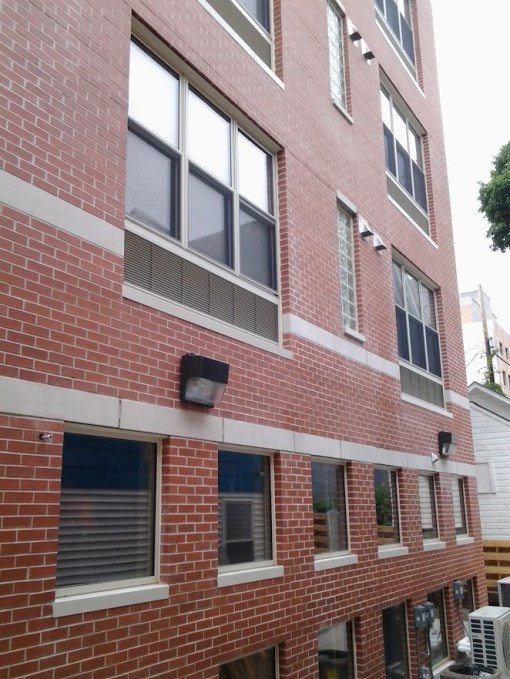
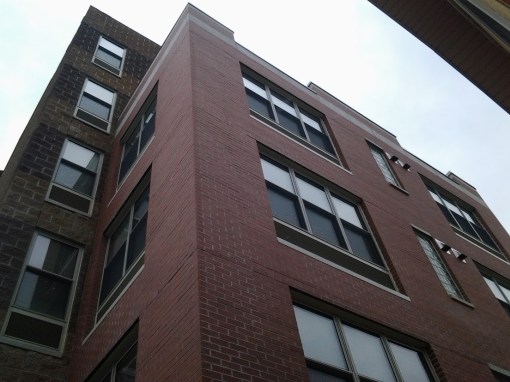
307 College Avenue (Collegetown Crossing) Construction Update, 8/2016

24 08 2016

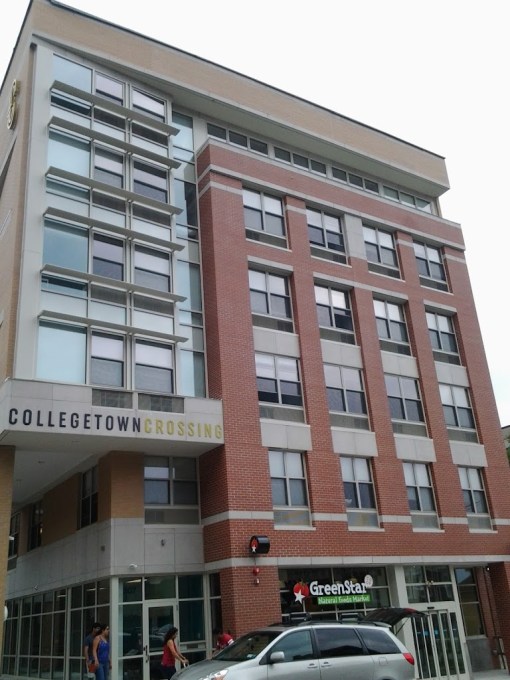
Although Greenstar had yet to open this weekend when these photos were taken (it opened Tuesday), it’s safe to say that this project is complete. The plantings and outdoor benches for the pedestrian walkway are seeking the planning board’s approval for tweaks (straight benches vs. curvy benches, large shrubs in place of trees), and assuming they’re granted, those will be installed and rooted in a few weeks.

We could look at this project as a lot of numbers. Four years of planning. Six floors. $10.5 million construction loan. 46 units. 96 bedrooms. $1,000/month rent. 3,200 SF grocery store. 14 living-wage jobs created by said store. Two bus pull-off spaces. One parking space for delivery. Zero parking spaces for residents.

We could also get qualitative with it. Collegetown Crossing really was the pioneer of the new urban movement that has become more popular in recent years, both from livability and walkability standpoints as well as the financial perspective. Students have trended away from vehicle ownership in the past 15 or so years, from 50% in 2000 to 27% in 2012. Concurrently, there’s been a bigger emphasis on denser, mixed-use neighborhoods – malls and suburban apartment complexes are less popular than they were, and street-front shops with apartments above are making a resurgence, as the Commons and downtown Ithaca are demonstrating. Collegetown Crossing really helped to catalyze the conversation already underway, and no doubt had an influence on Collegetown’s hybrid form-based zoning code that did away with parking in the valuable core of the neighborhood. So the other new apartment buildings with active-use ground floors, Cornell’s Breazzano Center, and whatever else comes forth, they owe a hat tip to Collegetown Crossing and its developer, Josh Lower.

And speaking of hat tips, for all of the problems Hayner Hoyt has had this year, they deserve a big round of applause for finishing this project within its tight deadline, even with the other construction and logistical issues currently plaguing Collegetown. Jagat Sharma also deserves recognition for a project that looks pretty nice. When I was writing about the Collegetown delays in the Voice and speaking with Lower on the phone, he asked what I thought, and I said it came out better than I expected. Cue the awkward phone pause. What I meant was that the flat-looking perspective drawing doesn’t do the building justice, the built product is much more interesting to look at.

It looks good, the grocery and pedestrian alley enhance the quality of life for neighborhood residents, it replaces an unappealing two-story building, and it helps build the tax base. This project is a big positive.

Before:
12-29-2011 077

After:

20160821_104102 20160821_104245 20160821_104314 20160821_104339 20160821_104354 20160821_104602 20160821_104653 20160821_104721 20160821_104728 20160821_104854 20160821_105050

ctown_crossing_rev2_1


209-215 Dryden Road Construction Update, 08/2016

23 08 2016

Structural steel is rising at 209-215 Dryden Road, the site of the new Breazzano Family Center for Executive Education. In the past month, the steel frame has been built out to street-level and decking is being attached to what will be the ground floor. A 90-seat tiered classroom will be in the basement below the decking, and a second 90-seat tiered classroom will be built on top of the decking. In the third-to-last photo, you can see a large open space between the steel columns, which is where the building’s four-story atrium will be. Those steel columns next to Dryden South (205 Dryden) really are as close as they look – the finished walls of the buildings will be separated by just two inches.

Like much of Collegetown, the project hasn’t been without its problems. A construction worker was injured last month when his leg was pinned against a concrete form. Thankfully, it doesn’t sound like the injury was too serious.

The six-story, 76,200 SF building is expected to open in summer 2017. Given the issues surrounding and delaying 201 College Avenue, this might be the only major building opening in inner Collegetown next year. About 200 Cornell staff will occupy the fourth through sixth floors at opening, and 350-400 Executive MBA students will attend week-long instruction sessions in the building during off-season academic periods (summer intercession and winter break).

20160821_101952 20160821_102029 20160821_103440 20160821_103525 20160821_103604 20160821_103623 20160821_103652 20160821_103721 20160821_103726

209-215_2

209-215_basement


News Tidbits 8/20/16: Another Campus Coming?

20 08 2016

Fairly quiet week, but still a few things going on-

inhs_pride_design_v5_3

1. The Journal’s Nick Reynolds followed up on the pile-driving underway at the 210 Hancock site in Ithaca’s North Side neighborhood. Admittedly, no one wants to live next to a site while hearing and feeling the bang of the pile-driver against the piles being inserted into the ground. Thankfully, this phase of the affordable housing project should be wrapped up by the end of the month. Lecesse Construction’s subcontractor, Ferraro Piling and Shoring of rural Erie County, is inserting 10-15 piles per day between the hours of 8 AM and 4 PM, and about 170 piles will be used in the project. Not fun for the neighbors, but this too shall pass.

sleep_inn_1

2. The town of Ithaca’s planning board had their close look at the Sleep Inn proposal for Elmira Road. They were not impressed. The primary complaints were that it was a one-sided design (meaning the front received significantly more cosmetic attention than the rear and sides), that it was big and that it was ugly.

The architect of the 70-room hotel, Joe Turnowchyk of HEX 9 Architects, responded with “all corporate hotels are basically ugly”, which isn’t the kind of response that will be well-received. It was followed with “[He thinks] that if they’re going to put more money into the front of the building, they shouldn’t need to address the rear”, which isn’t a good response either, because the rear faces the Black Diamond Trail.

Outsider looking in, one interpretation of the board’s commentary is that the stone and brick is fine, but they want less of a slab and more articulation – the recently-opened 64-room Best Western Plus in Cortlandville comes to mind. The massing is broken up, and architectural details and brickwork add visual interest, giving it aesthetic appeal even though the road is 40 or 45 MPH over there. The minutes note a comparison to an Arizona Sleep Inn to show what can be done with Choice Hotels brands. Anyway, the decision was tabled, with a revised design presentation planned for a September meeting.

3. New to the market this week – a duplex and five-unit mobile home park in Varna being marketed for “development potential”. The site is a one acre parcel at 10 Freese Road in Varna, touted as “perfect for townhouses or apartments”. Since the late 1980s, the “Wayside Mobile Home Park” has been the property of Ithaca attorney Ray Schlather, who was an ardent opponent of West End density and waterfront rezoning a few years back.

Zoning is Varna Hamlet Traditional District (VHTD), and it gets a little weird density-wise – per the guidelines, and being one acre, a developer could do four single-family homes, six townhouses, six condos, or three rental apartments, max 30% lot coverage. If LEED Certified, add 2 S-F homes, 2 townhouses, 1 condo, or 4 apartment units respectively. Lastly, there’s a redevelopment bonus, which honestly appears to be at the town’s discretion. If awarded, add another home, 2 townhouses, condo or 4 apartments. So in theory, max build-out for a green redevelopment is either 7 single-family houses, 10 townhouses, eight condos or eleven rental apartments on that acre of land. No idea what happens if they’re combos thereof.

Anyway, the property is being offered at $219,000, just a little over the $192,500 tax assessment.

4. So this is intriguing – the city of Ithaca Common Council will be taking a vote next Wednesday to take $150,000 from the $500,000 Capital Project fund to relocate and build a new Fire station #9, and fund two consolidation studies. One would consolidate the city hall, the Central Fire Station, Station No. 9, and Police HQ into a government campus at the site of the Central Fire Station at 310 West Green Street; the second is to study a centralized facility shared by water/sewer and streets/facilities. There’s a lot that need to be considered as part of the government campus study, which would likely involve buying neighboring properties, or building skyward. Also worth noting, the fire station parking lot is part of the Downtown West historic district. Anyway, look for a lot more discussion if the money is awarded and the study gets underway.

123_eddy_street_2

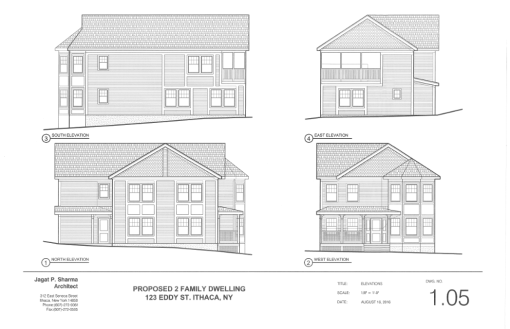
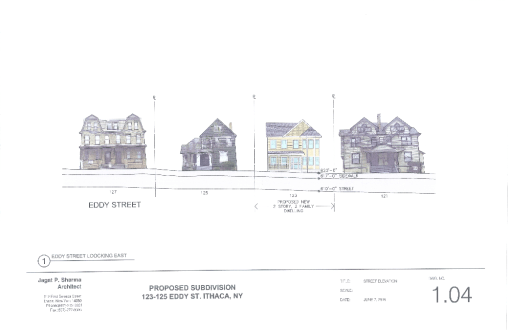
5. This week’s eye candy. Folks on Orchard Place asked for more detailed renders of the proposed two-family home at 123 Eddy Street, and here they are. Medium yellow Hardie board with white trim was the original plan. It appears that after the original drawing was submitted, the roof was realigned and one of the west-facing (front) second-floor windows was removed.

Note that this is just the planning board lot subdivision approval – although a single two-family home is typically too small to trigger planning board’s site plan review qualifications, the design still has to be approved by the ILPC and the Board of Zoning Appeals.

6. Case in point – If you live in Fall Creek, you might notice a new two-family house in the coming months. The Stavropoulos family, owners of the State Street Diner, just purchased the house for sale at 1001 North Aurora Street (above asking price, which is, for better or worse, quite common in Fall Creek) and plans to replace it with a duplex. Tompkins Trust gave them a $400,000 construction loan on the 18th. It’s a little different from the Stavropoulos’ typical M.O., which is to buy an existing house and do major renovations, as they did at 318-320 Pleasant Street and 514 Linn Street. This one looks like it will be a completely new build. No BZA, ILPC or Planning Board approval is required here, just staff level approval from the city.

7. Somewhat interesting Planning Board meeting next Tuesday. Here’s what in the bullpen:

1. Agenda Review 6:00
2. Privilege of the Floor 6:01
3. Subdivision Review 6:20

A. 123 & 125 Eddy St. (shown above)
Applicant: Nick Lambrou
Actions: Declaration of Lead Agency PUBLIC HEARING Determination of Environmental Significance Recommendation to BZA

4. Site Plan Review 6:40
A. Project: Mixed-Use Building (Harold’s Square)
Location: 123-139 E. State St. (The Commons)
Applicant: David Lubin for L Enterprises, LLC
Actions: Consideration of Project Changes

So I wrote about these changes for the Voice. The Planning Board resolution calls for modifications to the new design. The board mandates glass block for the elevator shaft on the north and lower west facades, restoration of the terra cotta cap and vertical bands on the Commons-facing facade, and restoring a deleted window from the East facade above the Sage Building. Could really used some updated renders right about now.

B. Project: Mixed-Use Building — Collegetown Crossing 6:55
Location: 307 College Ave.
Applicant: Scott Whitham for
Actions: Consideration of Project Changes (Landscape)

Project Description: Some slight tweaks here to the pedestrian walkway, mostly changes “simplifying and altering materials for the landscape”. The curvy benches are now straight, and the trees were eliminated in favor of shrubs because of concerns of branches extending onto the fire station’s property.

C. Project: Apartment Building 7:05
Location: 201 College Ave.
Applicant: Noah Demarest, STREAM Collaborative, for Visum Development Group
Actions: Consideration of Amended Negative Declaration of Environmental Significance, Request for Zoning Interpretation & Appeal Consideration of Final Site Plan Approval

Dunno what to say about this one at this point, since this is unfamiliar territory for everyone involved. We’ll see what happens.

D. SKETCH PLAN: 607 S. Aurora St. 7:35

The new project of the month is for 607 South Aurora Street on South Hill. It’s a single-family home on a 0.7 acre lot owned by Lou Cassaniti, the hot dog vendor on the Commons, but rumor mill says the applicant is Charlie O’Connor of Modern Living Rentals. Zoning is R-2a, which is detached single-family and duplex. Semi-educated guess, given lot size, zoning and rumored developer, the plans are small-scale infill, maybe subdividing the existing lot to build a duplex or two.

4. Zoning Appeals 7:50

5. Old/New Business 7:55

A. Chain Works District Redevelopment Project DGEIS: Special Planning Board Meeting, August 30, 2016, 6:00 p.m. to Review Comments/Responses
B. Maguire/Carpenter Business Park Temp. Mandatory Planned Unit Development (PUD): Public Information Session, Wednesday, August 31, 2016, 6:00 p.m., Common Council Chambers


News Tidbits 8/13/16: The Forward Advance

13 08 2016

201_college_v5_1

1. In the news, Neil Golder’s lawsuit against the planning board and the 201 College project was dismissed on technicality. The Tompkins County State Supreme Court decided that since the lawsuit was based on preliminary site plan approval and not final site plan approval, the project was subject to further changes and that it wasn’t appropriate for the court to hear this case at this time. So in other words, Neil will probably file his lawsuit again if/when final approval is granted, since changes between preliminary and final are unlikely to be significant. The scorched earth approach will likely continue.

It’s going to be a couple of weeks before that happens. In what the Times described as “an odd move”, the project is heading before the BZA for a zoning interpretation. Even the city’s planning department director, JoAnn Cornish, thinks it was a strange move on the board’s part, and one that kind of upends her department’s authority since they had looked at the facade length and decided it fit the zoning. More about the planning board’s (John Schroeder’s) odd decision and reasoning here.

waterfront_concept_aerial_1

dot_concept_1

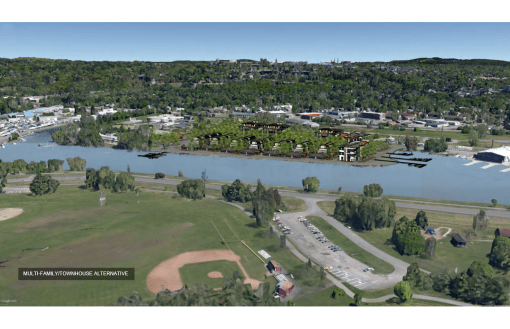
2. Looks like there’s a twist in Tompkins County’s plans to redevelop the NYS DOT site on the Ithaca waterfront. The DOT is no longer looking at moving to Enterprise Drive in Dryden, even though they bought the land there in 2005. Now they’re looking at a site along Warren Road up by the airport. So close to the airport, in fact, they apparently needed the Federal Aviation Administration (FAA) to sign off on it. The FAA has agreed to a location and the DOT is working out a long-term property lease. The cost of moving is now estimated at $11-$12 million, slightly less than the $14 million estimated for the Dryden location in the Fisher Associates study, but estimates being as they are, it would be prudent to keep an eye on those projections.


3. The Dryden town planning board recently reviewed plans to convert the former Stevens Furniture at 2085 Dryden Road into an auction house specializing in books. The 10,000 SF would be renovated with no substantial exterior modifications. It’s a fairly small, unobtrusive plan, and by itself not much of a write-up.

However, this project is being proposed by Danby’s David Hall. The same David Hall who wanted to create the Summit Enterprise Center on Danby’s Gunderman Road, and led to all sorts of rancor among town residents and officials. His company, National Book Auctions, was to be one of the tenants of the business center. Danby’s planning board notes are online up to June only,  so the question is, is the Danby plan still moving forward and this is a case of filling a pressing need, or is the Summit project done and out?

123_eddy_street_1

4. For this week’s eye candy, here’s the first image of the two-family home that Collegetown landlord Nick Lambrou wants to build at 123 Eddy Street. Jagat Sharma is the architect. The land is currently a double lot with 125 Eddy, and at present it’s part of the lawn. A planned subdivision would create a building lot on which Lambrou could put up the home. As part of the East Hill Historic District, the design has to pass ILPC muster, and at a glance, the projecting window bays (not sure they meet the definition of bay windows?), porch and comparably-pitched roof should help.

Note the lack of a garage. The street is up to 13 feet below the houses on that block, and there are no off-street parking spaces planned for either of the 3-bedroom units. The BZA would have to grant a zoning variance for a deficiency of two spaces.

tiny_timbers_1

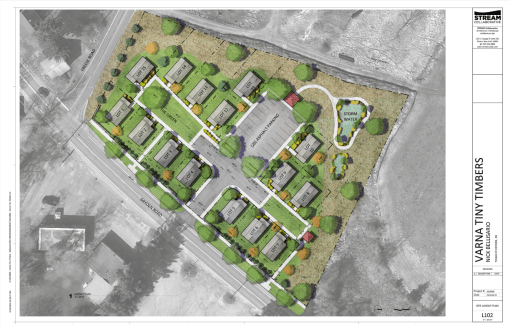
5. Tiny Timbers and the Evergreen Townhouses were both up for review by the town of Dryden’s Planning Board. Tiny Timbers once again had only a few minor quibbles among board members, who voted to approve the sketch plan and send it to the Dryden ZBA. The Evergreen Townhouses had much more resistance, but the PUD concept was approved with some stipulations on fleshing out the project further before it may continue in the process. In Dryden, the town board gives final approval to project proposals, so both of these are moving along, but not fully approved just yet. In the meanwhile, Tiny Timbers is finishing construction on prototype #2.

6. Someone’s had a busy week. On Wednesday, a Rochester-based LLC picked up the Chateau Claire Apartments, a ca. 1960 64-unit apartment complex in the village of Lansing, for $5.3 million. The same day, a second Rochester-based LLC picked up the adjacent 37,400 SF shopping center for $1.3 million. The properties are collectively assessed at just under $6 million, so the purchase price seems pretty reasonable for a decent if not especially desirable stretch of property.

With a little digging, it turns out under the LLCs, the sellers were the same for both, and the buyers the same for both. The sellers were the Goldberg family who owned Bishop’s of Ithaca, a home improvement store. After enjoying success with growing Bishop’s into a small chain, Stan Goldberg turned to development and was a major local developer from the ’60s through the early ’90s. He sold Bishops to his employees in 2003, and passed away last year. The buyer was Park Grove Realty, a startup real estate firm out of Rochester staffed by former Conifer LLC employees and making waves for proposing a 140-unit apartment complex on Bomax Drive two miles away. A little piece of old Ithaca fades, and a newcomer makes their first foray into the region.

Park Grove has taken out a $1.14 million construction loan to renovate the Chateau Claire units – kitchen and bathroom remodeling, washer-and-dryer installations, roof repair, new balconies, gutters, landscaping and lighting.

canopy_comparo_elevations_new_2

7. And the other big sale(s) of the week, also from Wednesday – Ithaca Downtown Associates LLC, the Patel family, finally purchased the properties for the 131-room Hilton Canopy hotel project. $1.8 million to the IURA for the parking lots at 320-324 East State Street, and $2.05 million to local landlord Joe Daley for the parking lots on the former Strand property at 310-312 East State Street. This marks a big step in moving the 77,800 SF, $20+ million project forward.