Village Solars Construction Update, 6/2017

17 06 2017

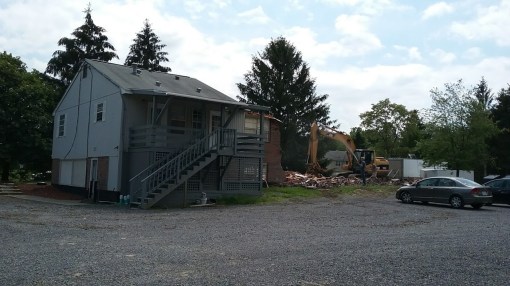
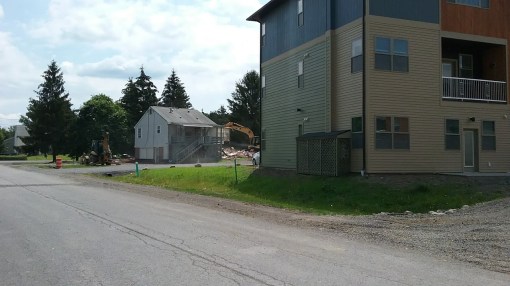
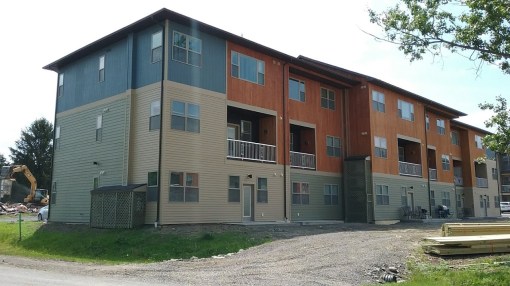
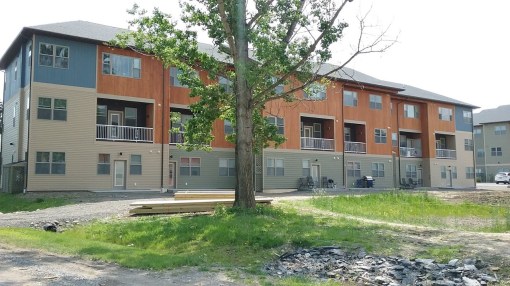
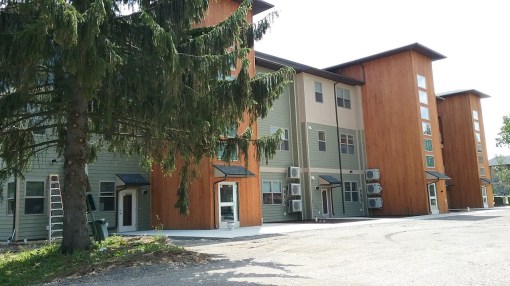
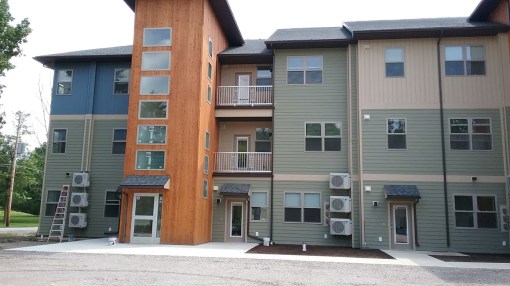
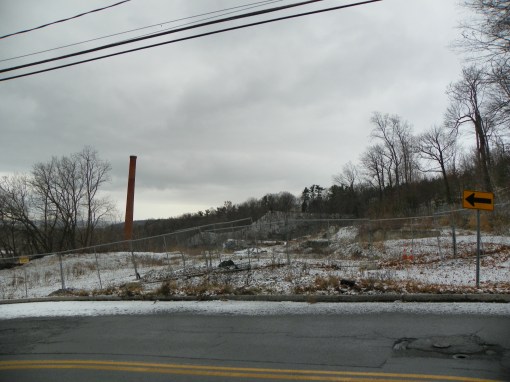
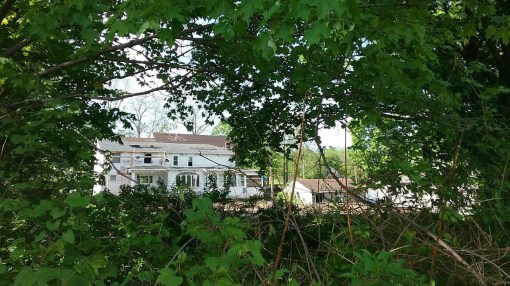
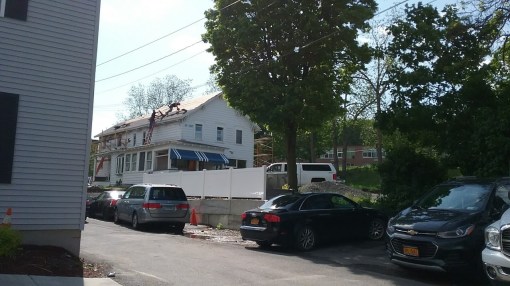
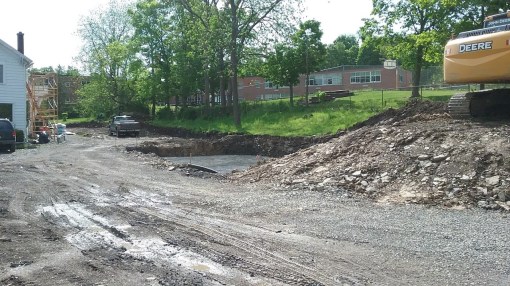
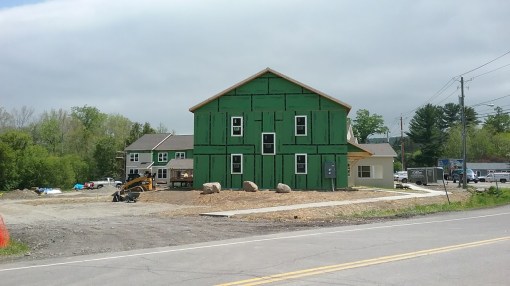
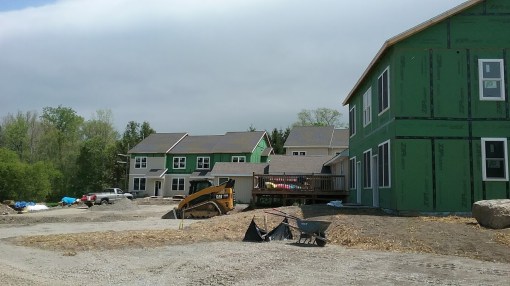
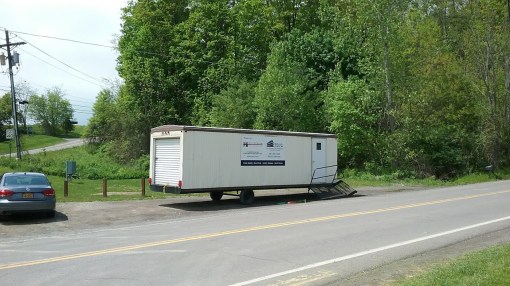
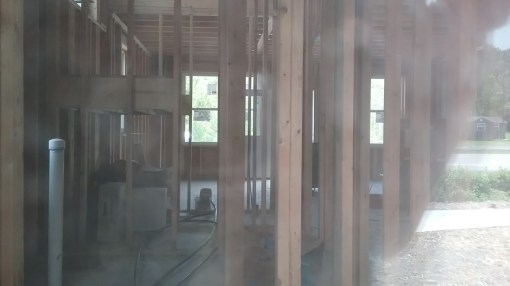
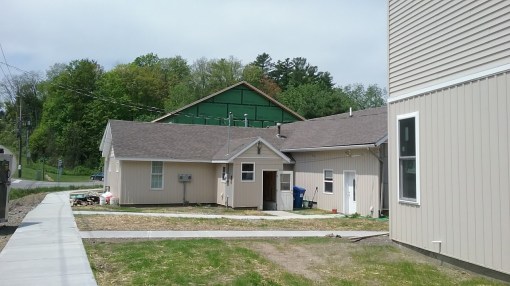
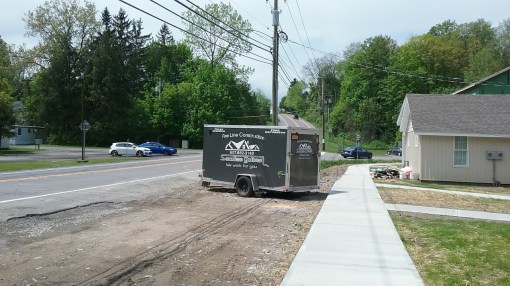
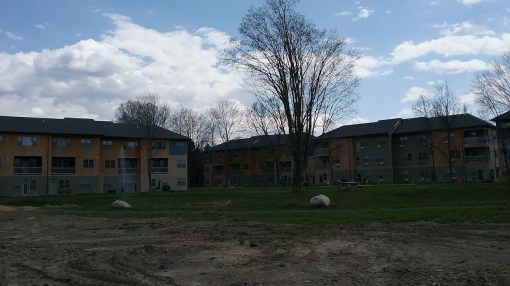
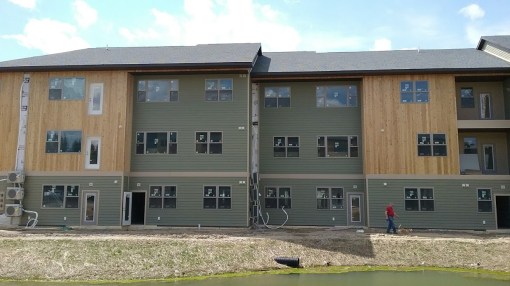
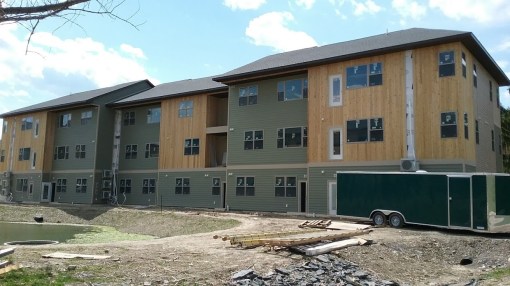
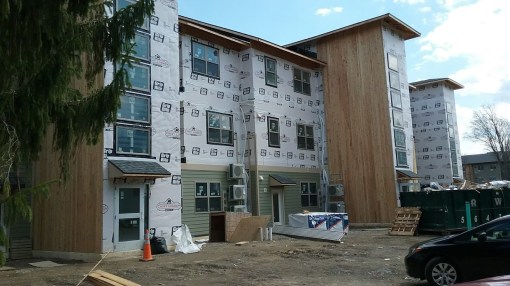
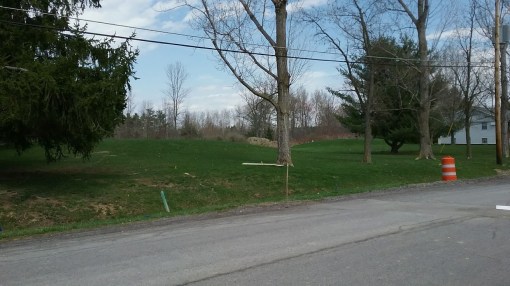
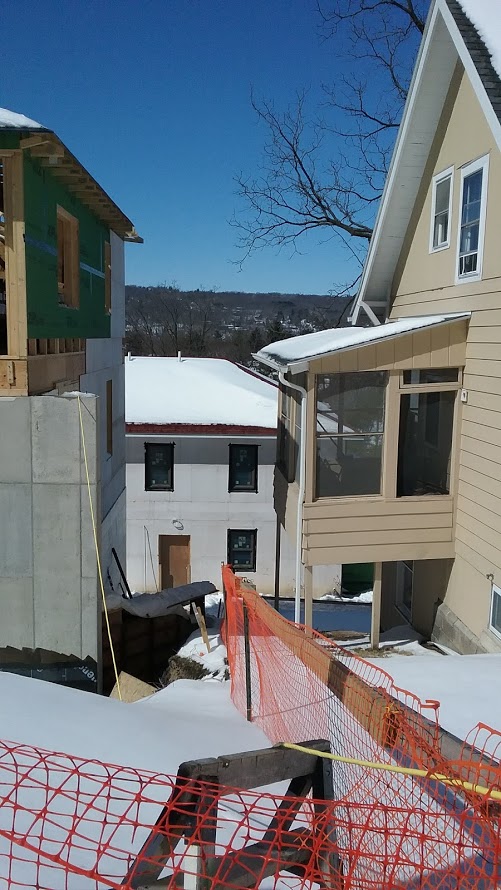
It’s not often that I run into someone who’s aware of this blog, let alone while taking site photos. When I arrived at the Village Solars property off of Warren Road in Lansing, I was immediately surprised to see they were taking down one of the older 1970s 10-unit properties, 102 Village Place. A salvage job this is not; the excavator was actively tearing through the brick veneer and wood window frames, leaving them in a pile as it slowly worked its way through the building. A gentlemen with a hose was spraying the fresh debris down to keep airborne dust to a minimum. To be honest, even if the building has little historic value, there’s always a bit of a bittersweet feeling to see a place that hundreds called home fall to the march of progress.

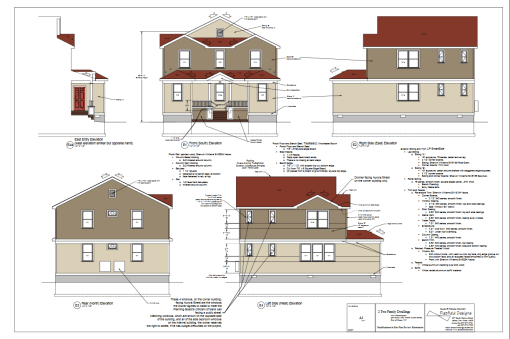
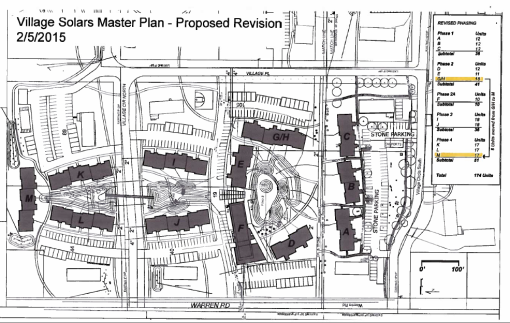
And the march of progress it is. As readers of the Voice may be aware, the plan for the Village Solars has been changed up. The next few phases will remove the 1960s-1970s 8-unit and 10-unit (all 1-bedroom) buildings and build new Village Solars buildings on their foundations. The net gain in units will be 70, bringing the number built and to be built from 502 to 572, and a gain in bedrooms of about 124.

It’s a bit complicated of a breakdown – four of the new building planned – 24-unit “K”, 24-unit “L”, and 18-unit “M” – were originally to be the next phase. When all that was said and done, Building “F”, which will host retail components, a community center and 20 studio units, was to be built. Those are being pushed off in favor of the replacement units. For example, 102 Village Place, coming down in the photos below, will be replaced with a 24-unit building that will also be called 102 Village Place. It’s five peers closest to the Village Solars will also be coming down for the construction of 18 or 24 unit apartment buildings on their footprints. There will be five phases, and it looks like two older buildings will come down and have replacements built each year for the next three years, with the last two being the all-new K/L/M and F. The designs for the six new buildings will be similar to the existing Village Solars.

So while taking photos, I happened to see a gentleman in a wide-brimmed hat and loafers, drinking a couple beers. I intended to not make waves and to just walk past when he broke the ice by saying “I’m surprised there aren’t more neighbors out watching. You don’t see something like this everyday.” I ended up making my acquaintance with Jon Lucente, the son of Rocco Sr., brother of Steve and uncle to Rocco Jr. – so, not as directly involved as the others, but still aware and knowledgeable. Turns out he lives in the Village Solars.

One of our conversation topics swirled around the hassles of regulation – a little talk on the Briarwood mess ten years ago, a little bit about Varna, and a lot about the Village Solars. To be frank, he had nothing but great things to say about Lansing town government. But he complained some of the building code regulations created headaches for his family and their in-house contracting team. For example, the buildings had be earthquake-proof, and the expensive sprinkler systems over the balconies are only legal until 2022 but they were the only type approved for use. Interestingly, they originally wanted to do four floors but building codes say an elevator is required for 4 or more floors (this tripped up Ecovillage as well as few years back). Jon brought this all back to the cost being passed on to tenants.

On my end, it was mostly just polite acknowledgement. I understand his point, but details like the elevator rule are in the building code for safety reasons. The thing is, building codes are an imprecise science – they may be too stringent in some circumstances, but lacking in others, so as a result they’re constantly re-evaluated. Given an event like the London Grenfell Tower fire disaster, where the Reynobond aluminum panels were stuffed with polyiso insulation, which is a risk because it can produce toxic fumes if it burns, there’s always good reason to take a hard look at the codes and reassess. For the record, polyiso is a common insulation material, although in the local cases I’m aware of, it goes on over the fireproofing and under the cladding, meaning it would be very difficult to set it on fire, and the Grenfell case implies the panels may have created a tunnel effect for heat and flame. The specific cladding that was used on Grenfell Tower is banned for use on buildings taller than 40 feet in the U.S.  

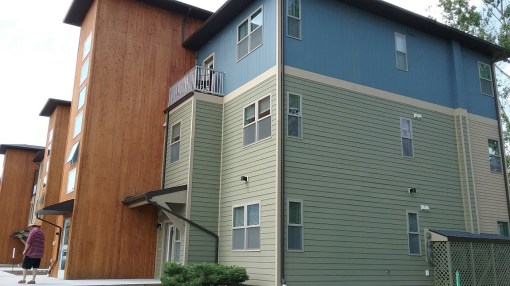
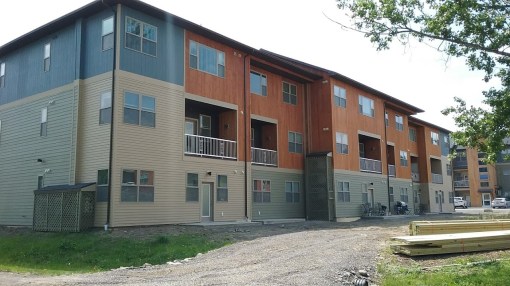
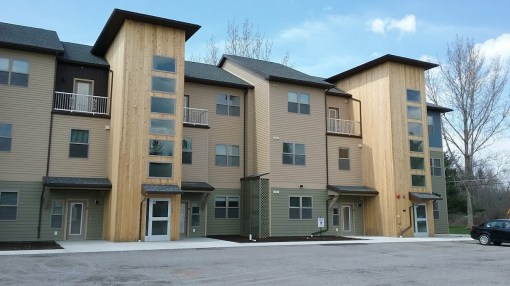
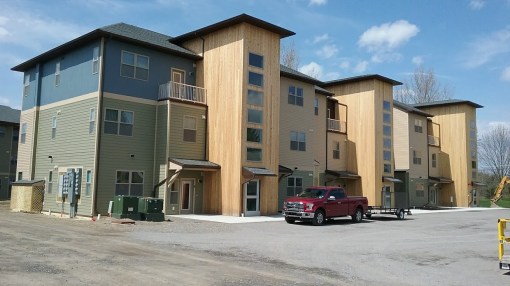
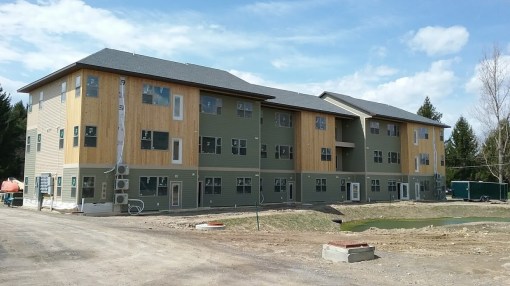
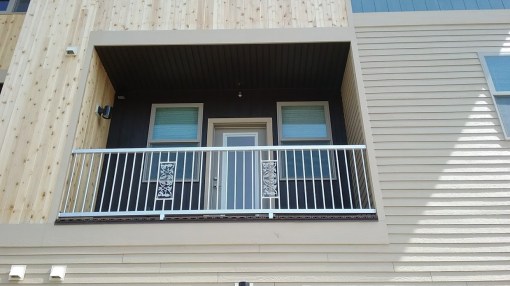
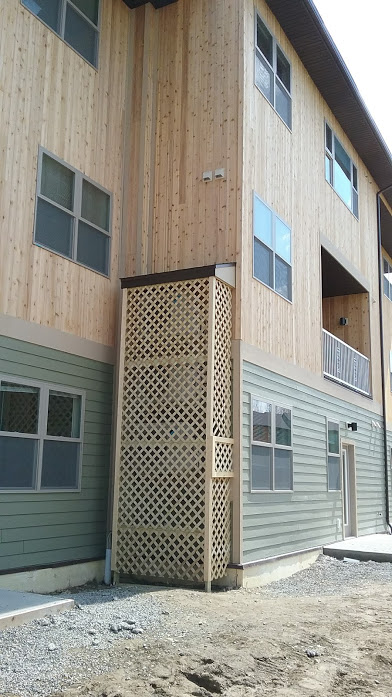
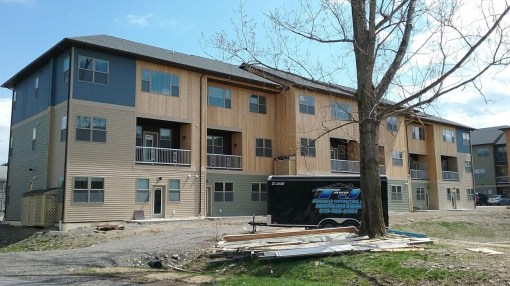
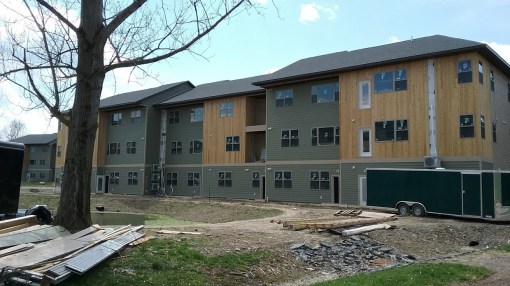
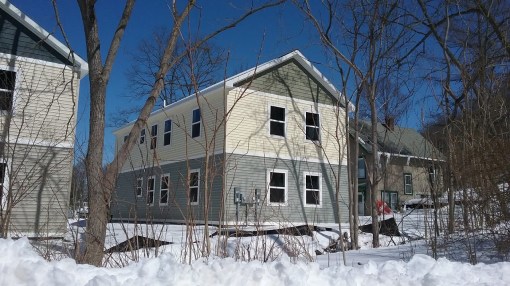
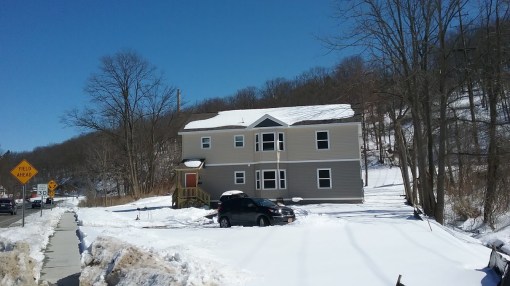
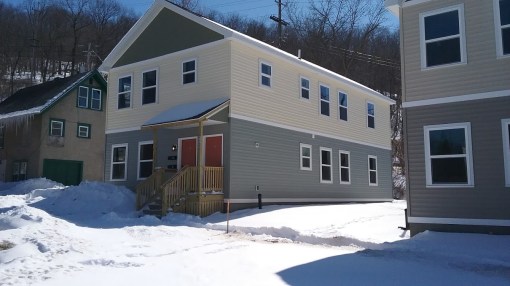
Anyway, I still enjoyed an opportunity to chat with one of the Lucentes. Building “I” is occupied and Building “J” will be open for occupancy at the start of July – just a little exterior trim left to do on the outside. The photos below have a close-up of the fiber cement board used on the Village Solars, which apropos to this post, doesn’t burn because it’s basically sand and concrete mixed with wood pulp. Won’t make the same claim about those wood-grain trim boards though.


News Tidbits 6/5/17: The Return, Part III

5 06 2017

1. The Ithaca Gun site is almost in the clear, according to the NYS Department of Environmental Conservation (DEC). The state is proposing a “no further action” status for remediation of the Lake Street site along Fall Creek gorge, where the factory maintained a presence from 1885 to 1986. Testing the guns with lead bullets for decades had the unfortunate result of contaminating the gorge with toxic levels of lead and heavy metals, and the area has been under remediation in some form for almost 20 years. The first round of cleanup for the Superfund was from 2002-2004, but insufficient cleaning resulted in a second round of cleaning in 2014. A third round to excavate more contaminated soil along the steep slopes of the gorge was undertaken by the federal EPA over the past couple of years.

To quote: “Based on the results of the investigations at the site, the interim remedial measures and post-IRM screening that have been performed, the NYSDEC is proposing No Further Action as the remedy for the site…Periodic site inspections and reporting, which include additional removals of lead shot as needed, will ensure continued protection for the environment and public health.”

Note that this only impacts the part of the site that was donated to the city as parkland. A separate remediation plan has been crafted by Travis Hyde Properties as part of their plans to build 45 units of housing on the former factory site, the “Ithaca Falls Residences“. The completion of work on the city land would allow THP to put the finishing touches on their plan, and potentially move forward with their long-incubating housing proposal.

2. There was one detail that was initially missed when going over the failed candidacy of Lisa Bonniwell to the village of Lansing Board of Trustees. While her family’s housing development, the “Heights of Lansing”, has been in perpetual stall with only about 22 of the 80 units built since approval in 2005 (and the last townhouses in 2011-12, shown above), they do plan to start work on another “six-plex” string of luxury townhouses this year – Bonniwell cast blame on the gas moratorium for the holdup. Gives them something else to focus on after their lawsuit over the Park Grove Apartments re-zoning down the road, in which the courts decided in the village’s favor.

The existing units are 3 bedrooms, 2,297-2,400 SF and sell for about $350,000-375,000. Expect the next batch to be fairly similar, though with different exterior details – each string’s exterior finishes are unique.

3. Sticking with Lansing, the Cayuga Farms townhouses are planning some modest changes – the buildings will be smaller, which will allow 20% green space and the construction of a community clubhouse. There will still be 102 units with 3 bedrooms each, 1500-1800 SF, in the upper-middle (“premium”) market segment. The plan has been held up for years while trying to find appropriate ways to address wastewater/sewage, initially floating a pricey Orenco modular site-specific plan. However, with the likelihood of a sewer main being routed up North Triphammer Road in the near-future, that would render the sewage treatment issue a moot point and allow the already-approved project to move forward with permit requests.

4. Nothing too exciting with the local planning boards at the moment. The town of Ithaca is reviewing adjustments to the Westview subdivision that would allow homebuilder to have building permits open for more than two houses at any given time, and to allow him to build houses from different project phases (locations) so long as they have road frontage, sewer and water. Apparently the 2004 stipulations have created a headache with his newest home lots.

Meanwhile in Ulysses, the town planning board will be reviewing plans for additions to the Taughannock Inn at 2030 Gorge Road. The rather whimsical structure designed by architect Jason Demarest would add a “gatehouse/stable”, with five guest rooms, a check-in area, a bar and dining space, ice cream parlor, tent space, reflecting pools and whatever else that makes it sort of romantic events center for weddings, banquets and reunions. The 1870s inn will receive a new cupola, and the projects needs several zoning variance and a noise law revisions so that they can create to 90 dB until 1:30 AM.

5. Lansing’s 1020 Craft Road was picked up by an LLC tied to a construction company out of Endicott for $615,000 back in April, so that was was a strong indicator that something was planned. That plan looks like a gut renovation and 4,410 SF in additions, as well as a paved and landscaped parking lot. Pyramid Brokerage is already advertising professional office space in the 10,500 SF building, which was built around 1980 and used for manufacturing (sheet metal fabrication), and it was looking pretty run down by the time it was purchased. The lease is for $18.00/SF, with a minimum available space of 5,250 SF, which would be a pretty good sized office. Depending on the finishes though, it might have appeal for those looking for a suburban location with easy parking – CFCU’s headquarters is next door, and several other firms are housed in neighboring buildings.

6. The county released its report of potential tax foreclosures. The long story short is that if property taxes aren’t paid, the county may seize a property (courtesy says they give a couple warning first), which may then be sold by the county at auction to pay off the back taxes, or it may be given to a municipality if the community wants it, or it may be withheld completely if it is deemed to have special ecologic value (biodiversity, wetland, “Unique Natural Areas”, etc.)

There doesn’t appear to be anything too exciting in this year’s batch. The city almost got some prime waterfront real estate at a bargain price last year, but the owner was able to pay the tax bill before the city could claim it. This year, we see several rural properties that the county would like to put deed restrictions on for stream buffers and conservation options, a pair of industrial properties in Caroline and Dryden, and a handful of single-family homes around the area. Nothing that looks especially tempting to the ambitious, although there are a handful of individuals who scoop these properties up at auction and then market them at a much higher price (with some success).


607 South Aurora Street Construction Update, 5/2017

2 06 2017

Projects are a bit like politicians in that the higher profile or most controversial ones get the vast majority of attention. 607 South Aurora Street fills neither of those specifications, and as a result, relatively few people are even aware of it.

The South Hill infill apartment project is located on an unusually large 0.73 acre lot. The property consists of an existing 5-bedroom, 2,300 SF home dating from about 1910, and had been in the possession of the Cassaniti family since at least the 1960s, legally split among the six Cassiniti brothers. If you’ve visited the hot dog and soda vendor on the Commons, you’ve met one of the Cassanitis.

Enter Charlie O’Connor of Modern Living Rentals (MLR). MLR is a young and ambitious rental company based out of Ithaca, a partnership primarily led by O’Connor and business partner Todd Fox. However, each has had their own ideas on how best to approach development – while Fox likes to think big and aim for high-profile projects, O’Connor is much more low-key and incremental in his approach. The two differ enough that they developer under different entities – Fox under his firm, Visum Development, and O’Connor as MLR. However, regardless of who develops, all their rental units are managed by MLR.
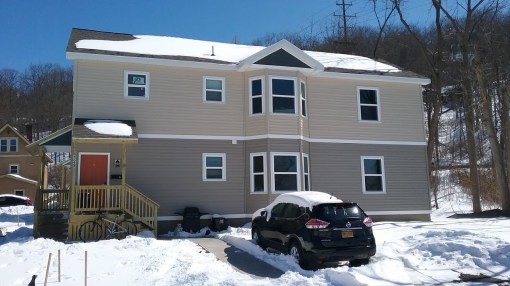
So while Fox is dreaming big with projects such as 201 College Avenue and 232-236 Dryden Road, and potentially sets off heated debates, O’Connor prefers to avoid controversy and take on less risk. His first project, with behind-the-scenes business partner Bryan Warren, was a pair of two-family houses at 312 West Spencer Road about half a mile southwest of 607. A bit of an unusual location, but close enough to urban destinations and Ithaca College that it was potentially viable, and after getting approvals last year, the project moved forward and is at least partially if not fully rented. Two existing houses that shared the original lot are being renovated as part of the project.

With those basically finished, O’Connor and Warren have moved onto MLR’s next project, 607 South Aurora. First proposed in August 2016, the location near downtown and IC makes it an easy sell, and in an area of 1.5-2.5 story owner-occupied and rental homes, four more two-family homes aren’t going to cause a big debate. In fact, in a city that loves giving its input, there were only ever a couple of neighbor comments about the project, and they were generally amenable – ‘better these than a large apartment building’ was the gist of it.

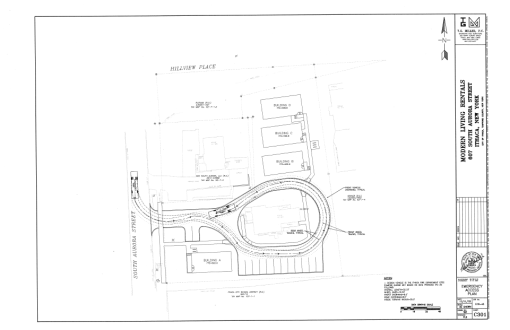
There were a few stipulations and revisions that were required, however. The original plan called for two homes near the street and two in the back of the L-shaped lot, with the renovated existing house in the middle. This was especially well received for aesthetic reasons (the city is still quite sore about the poorly-sited house MLR did two years before on the lot next door), so the site plan was redesigned to have three buildings on the interior side of the “L”, and one on the street to better match the curbside context. An internal driveway and clustered parking were added to help traffic and emergency vehicle circulation.

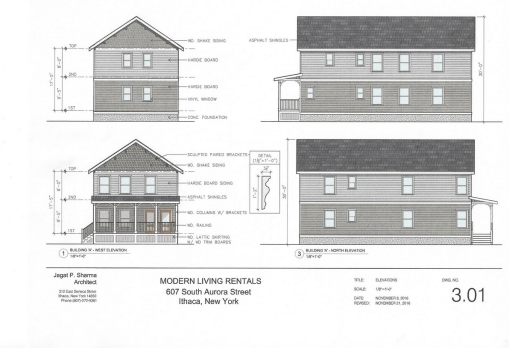
The building themselves didn’t change much – like 125 and 129 Elmira, they’re modular units on Superior Wall foundations. The unit facing Aurora has fiber cement siding and nicer details like a full lattice porch with railings, columns and brackets on the porch and roof. The rear units have small entry porches and use vinyl lap and shake siding.

With those details noted, the project was approved in November, and through an LLC, O’Connor and Warren bought 607 South Aurora, valued at $220,000 by the county, for $452,776 back in March (rule of thumb – if development is planned, expect a hefty premium).

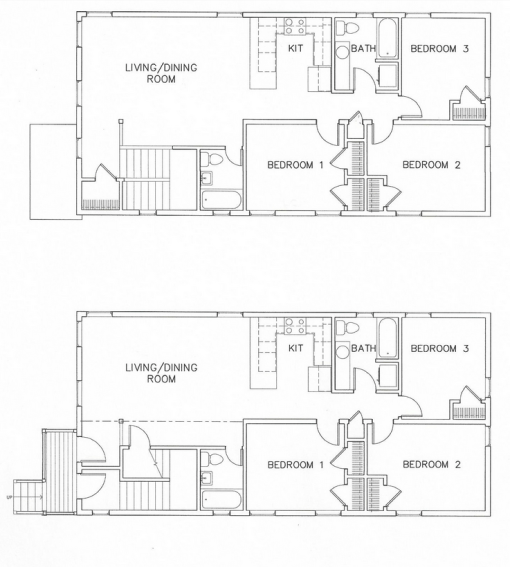
Each of the eight new rental units will be three bedrooms and about 1,128 SF. The existing house will also be renovated and expanded slightly, raising the rear roof-line to add interior space. Expect occupancy by the start of the new academic semester in August. The apartments are being marketed at $2250/month, which works out to $750/bedroom.

According to county docs, the construction loan from Tioga State Bank was for $1.92 million and filed the day the house was sold. That figure is a combo of hard (materials, labor) and soft costs (acquisition, marketing, legal); by itself, the hard cost for the new construction and the renovation looks to be about $1.04 million.  Rochester’s Taylor the Builders, who will be doing Harold’s Square at some point, is the project’s general contractor.

Looking at the site last month, a new roof is underway, and you can clearly see where the roof was raised in the roof by looking at the trim boards; the new section is housewrapped, and presumably the whole house will receive a new exterior finish at a later date. The windows in the rear are just rough openings for now, new windows will come along shortly. The soil has been excavated for the slab foundation of Building “A”, but due to the angle and slope of the site from the roads, it’s hard to tell how much of the site prep for “B”, “C” and “D” has been completed in the rear, apart from some disturbed soil.


902 Dryden Road Construction Update, 5/2017

27 05 2017

Visum Development/Modern Living Rentals’ project at 902 Dryden Road in Varna is coming along. Dropping by the site a few days ago, one of the things that stands out to be is that the design of the pair of townhouses closest to Forest Home Drive have been redesigned from the render that was shown when the project was approved by the Dryden town board in March 2016. Legally, this isn’t a big deal, since as long as the board stipulations have been met and it doesn’t affect the SEQR determination, then the modification is allowed. To be 100% honest, this armchair critic likes the redesign more, since it avoids the blank space near the party wall. Comparing the render to the other townhouse strings, it looks like there were some elevation adjustments and changes in fenestration, but the general appearance remains the same as approved.

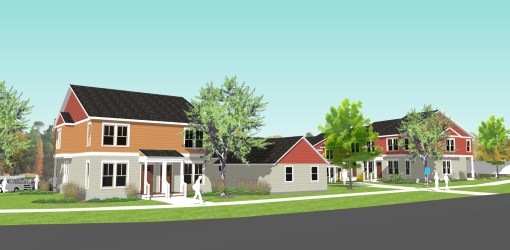
However, one thing that I’m a little concerned about is the siding being all one color. It’s not a critical issue, but I think the monochrome makes the project bland and less pleasing to the eye. All the renders I’ve seen have shown a mixed palate, whether it be the grey/red/orange below, or the beige/blue/brown combination shown on MLR’s website. The mixed forms of siding – vertical, lap and shingle – but I hope that this isn’t the final exterior color.

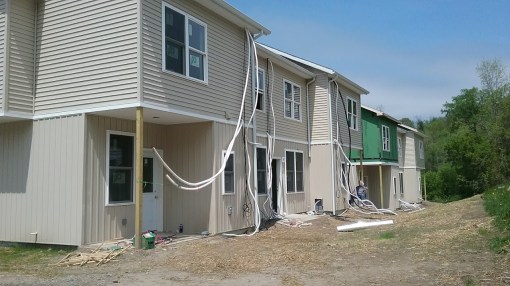
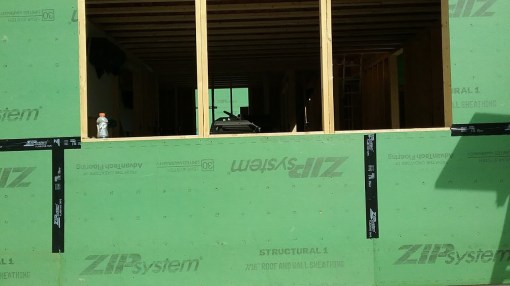
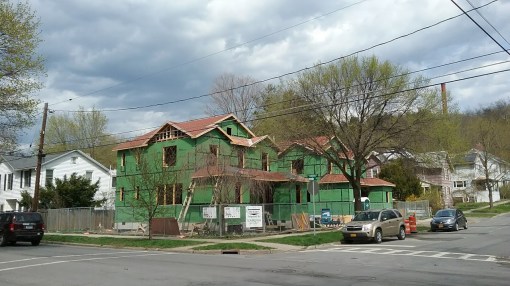
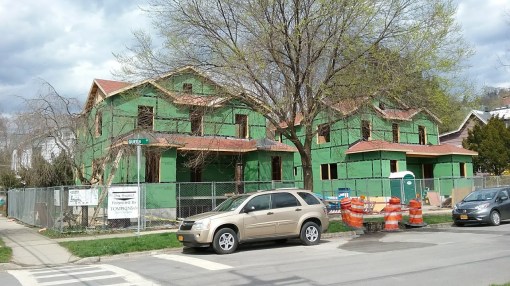
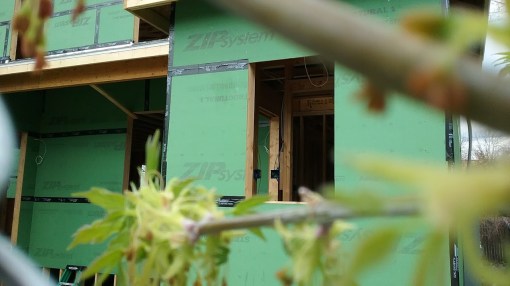
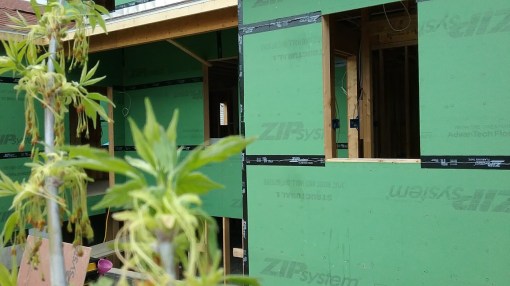
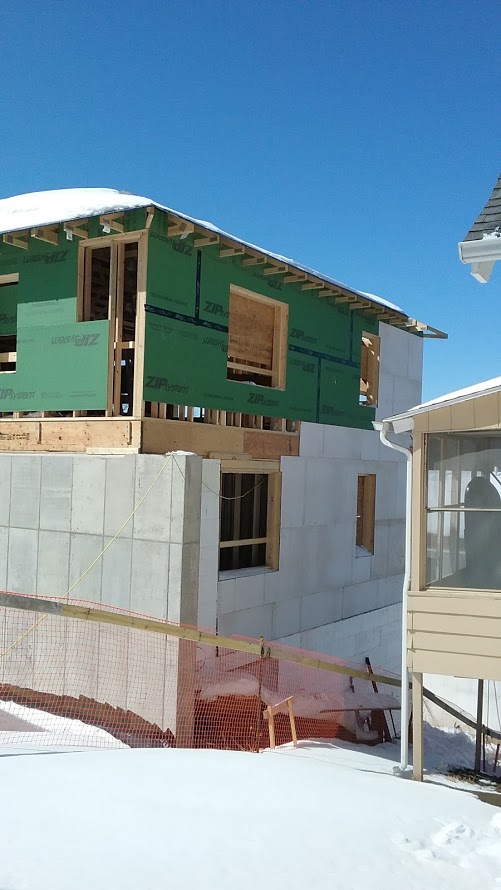
Anyway, the buildings have all been roofed and sheathed with ZIP panels, doors and windows have been fitted, the interior stud walls are good to go and rough-ins are underway. On the older strings, some of the siding is up and trim boards have been attached. The wiring and tubes coming out of the eaves on the rear face are connections for the electric air-source heat pumps. Although not a part of the initial build-out, Visum is exploring the installation of an offsite photovoltaic grid that would make the project net-zero energy, meaning that all the energy used is generated from renewable resources.

The site will have 26 parking spaces for its 32 bedrooms (2 existing 3-bedroom units, 6 new 3-bedroom units, 2 new 4-bedroom units), well above the one parking space per unit required by zoning. The site will also be a “flag stop” for TCAT buses and have bike racks to serve 20-24 bikes. The units, which are going for about $600-$700/bedroom, will be ready for occupancy in time for the 2017-18 academic year. Bella Faccia Construction, who did 707 East Seneca, is the general contractor, and STREAM Collaborative is the architect. AJH Design and Fine Line Construction also serve on the project team.

Side note, Bella Faccia’s website claims they’re doing a Cici’s Pizza in Ithaca – that would have been news to me, and my editor at the Voice would have been over the moon, but it turns out it was a typo and they meant Horseheads.


The Tompkins County Housing Strategy

18 05 2017

The County’s Housing Strategy draft was originally going to be in the next news roundup, but it’s large enough to do separately, and my colleague Kelsey is tackling this meeting for the Voice. For those who couldn’t attend the Housing Strategy hosted by the county last Wednesday evening, the presentation is here and the outline is here. Comments can be sent to the Planning Department here from now through the end of the month.

First, quantities. This was touched on in the news round-up a couple of weeks ago, but the county would like at least 580 units coming online each year, plus specialty student and senior housing. For comparison’s sake, the county hasn’t exceeded that value since 1994, when Kendal was permitted in Cayuga Heights, and prior to 2016, the last time it exceeded 500 units was in 2000.

In more recent years, the value bounced between 200 and 300 units in a given year; during the recession, it dropped into the mid-100s. The article linked above is older, so it lacks the 2015 values, which were 279 units countywide, consistent with 2012-2014. Then we get to 2016, which was just finalized by HUD. There were 575 units, of which 121 were single-family homes, and 454 were multi-family structures. Let’s present that by community (click on the table to expand):

Cayuga Heights and Freeville didn’t approve a single unit, while the 271 units in Ithaca city is their highest stat since 2000, and the second highest in the 35-year online record. Dryden village’s growth can be attributed to Poet’s Landing Phase II, Ithaca town’s to Cayuga Meadows, and Lansing town’s to the Village Solars.

The point of this is to illustrate that 580 units annually is a lofty figure, but it is an attainable goal.

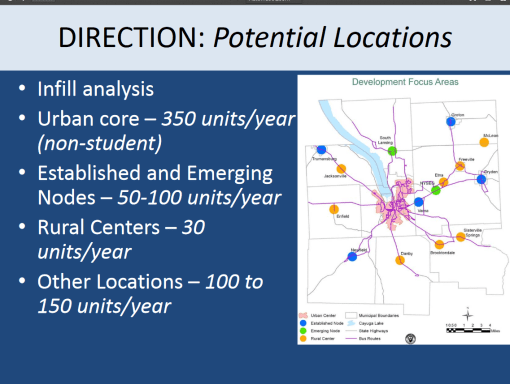
Then we get to locations. The ideal is to focus the growth in the city of Ithaca – since these stats are non-student housing, the targeted areas in the city include Downtown, the State Street Corridor, West End/Waterfront, and anything they can displace from the big box corridor on the southwest side. If a good opportunity for infill presents itself elsewhere in the city, that’s great, but it’s not the focus.

However, not everyone wants to live in Ithaca. Land in the “nodes” is cheaper and oftentimes the approvals process is easier. The county envisions 50-100 in the villages and growing hamlets like Varna and South Lansing, were a town center concept is in the RFP review process. Rural hamlets would see a handful of units annually (30 or less), and other locations basically just refers to Lansing’s suburban sprawl between the village and South Lansing. The town is hellbent on development any which way it happens, conventional approaches are the easiest to get financed, and the county’s not going to fight them.

The county’s housing strategy is three-pronged: Information/Collaboration, New Units and Existing Units.

  • Information and Collaboration includes a virtual housing office for resources and a collaborative network to formulate and pitch housing solutions. It’s kinda vague in the notes.
  • New unit strategies include support for targeted new development, streamlining zoning and examining potential incentives through the IDA.
    • Targeted new development can include RFQs for government-owned surplus property, early community engagement regarding DFAs (Development Focus Areas) and assistance in producing “shovel-ready” sites through things such as sewer access and energy hookups.
    • Streamlining zoning is to make it easier to get an initial product that will look like the final product – less uncertainty, less money spent on revisions. Inclusionary zoning seems pretty much dead in the water, as the county doesn’t seem to know if the community will support incentives for affordable housing, or if will even be effective. Done wrong, an inclusionary ordinance could actually result in less housing, if the burden is too great for the incentives offered.
    • Additional IDA incentives could include mixed-market or all-affordable rentals being eligible for abatements, and possible an abatement for any neighborhood or community who builds in inclusionary zoning. Looking at you, Trumansburg.
  • Existing unit strategies include the encouragement of rehabs (especially from rentals to owner-occupied), code enforcement and fair housing enforcement. Airbnb is still a tricky issue, so expect some tweaks to regulations on what constitutes rentals, hotels and legal occupancy.

There’s also a strong support/monitoring component in the strategy, which basically is a tracker of all projects underway, what stages, what they consist of, and so on. Beat you to the punch guys.


1001 North Aurora Street Construction Update, 4/2017

21 04 2017

Some more progress on the two-building, four-unit 1001 North Aurora Street project in Fall Creek. Since February, the building have been framed out, roofed and shingled. For the record, the shingles are Owens Corning TruDefinition Duration Shingles, Terra Cotta color. Huber ZIP System plywood sheets are being attached to the exterior over the wood studs, and interior framing, rough-ins and drywall is underway.

On a happy note, it looks like the side windows on the eastern building, which had the potential to be deleted as a cost-saving measure, are indeed going in based on the rough openings. The exterior will consist of two brownish shades of LP SmartSide cedar texture siding, with a white lap band and trim. Technically, that white is Sherwin-Williams “Nacre”, and these plebeian lips had to go to Google to figure out how that’s pronounced (NAY-ker). Because mother-of-pearl is just two darn pedestrian. The browns are “Rice Grain” and “Sawdust”.

Developer Stavros Stavropoulos (d/b/a Renting Ithaca) should be bringing these 3-bedroom rental units onto the market by the end of May, as 202 Queen Street and 206 Queen Street. Shortly thereafter, he and architect Daniel Hirtler which be launching into next project, and their biggest to date – a 3-story, 11-unit apartment building at 107 South Albany Street, just west of downtown.


Village Solars Construction Update, 4/2017

19 04 2017

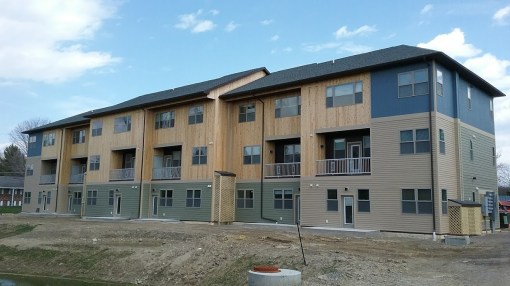
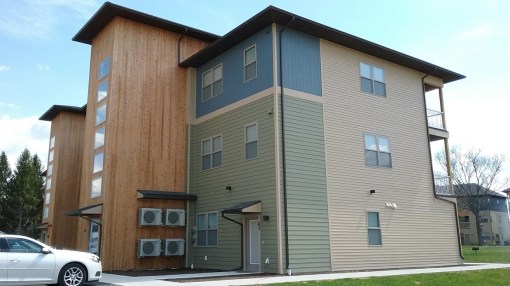
At the never-ending Village Solars apartment complex in Lansing, Building “I” is nearly complete from the outside. It sports a few details that make it stand apart from earlier phases – the balconies railings are a different design, a dark-colored fiber cement board is being used for some of the balcony alcoves, and the heat pumps have been hidden away under a wood lattice screen. Given how clean the immediate project site is, it would not be a surprise if this building is aiming for a May 1 occupancy.

Meanwhile, Building “J” is a little further behind – the windows and doors have been fitted and the roofing is complete, but the exterior wood grain and fiber cement panels are still a work in progress, as is the building trim. The doors on the upper levels will likely lead to small juliette balconies like those seen here. Inside, it’s stud walls and rough-ins, and there did not appear to be any drywall hung yet.You can see the unscreened Daikin heat pumps in the fourth photo below. It looks like the roofing was done by T and J Associated Contractors out of Auburn.

It doesn’t look like work has started on Phase 4 yet, which should consist of the last three buildings in the first stage of build-out (“K”, “L”, and “M”). If it’s anything like the previous phases, the construction team will start with the Phase 4 site clearing this summer. The later stages of development call for multiple phases to the east, and possible replacement of some of the older 1970s apartment buildings with newer structures [3/22 Town Board Minutes]. Potentially, the complete build-out would be around 423 units, from 400 SF studio micro-units to 1,185 SF three-bedroom two-bath apartments. Keep in mind, that would be several years out, well into the next decade. Along with those units come community space, retail components, expanded trail and outdoor components and a bus stop.

Rents look to be in the middle of the market – the micro-unit studios start at $865/month, going all the way up to top-of-the-line three-bedroom units at $1680/month. One-bedrooms and two-bedrooms start at $950/month and $1260/month respectively.

While looking around, an older gentlemen walking his dog went in and out; dunno if it was a relative of the Lucente family (the owner/developers, d/b/a Lifestyle Properties), or a curious onlooker.


News Tidbits 3/25/17: Out in the Wild

25 03 2017

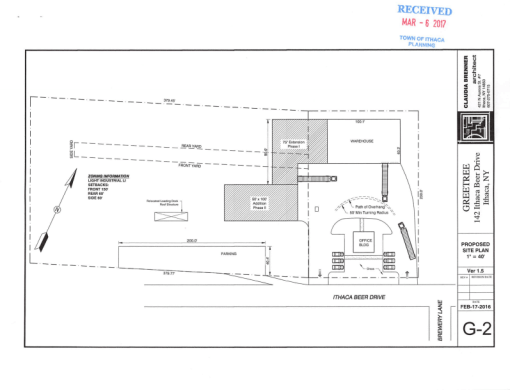
1. Let’s start by touching real quick on this past week’s Ithaca town meeting. The Bundy subdivision and the renovation of the former Wings Over Ithaca space at East Hill Plaza were approved, per Matt Butler at the Times. The Greentree project was reviewed and the board granted itself lead agency to conduct environmental review. Greentree owner John Gaunt is still unsure whether he’ll keep the Elmira Road building, which is where Ithaca Beer got its start in the late 1990s. Although primarily a warehouse/ag industry project, there will be some potentially public-friendly features, namely a garden park and picnic area. The board expressed a desire to see Greentree work with neighbor Ithaca Beer for landscaping between the two buildings.

2. I followed up with Lansing town planning consultant Michael Long regarding English Village. As readers might remember from last week, that’s the 58 single-family home lots and 59 townhouses proposed somewhere in Lansing – didn’t know where because that was the first anything has been published about it. Here’s Long’s response:

“The English Village is a concept developed by Jack Young to build a network of single family homes and apts. /condos that surround the existing soccer fields along Water Wagon [sic] Road. It is still very early in the conceptual phase so there has not been an formal application made as yet, but a project that has been talked about for many, many years. We don’t have anything specific yet but is a project “In-progress”.”

Jack Young is a Cayuga Heights businessman (and chair of their zoning board of appeals), who owns a sizable amount of undeveloped land in Lansing; most of it is used for farming. The soccer fields on Waterwagon Road are just east of The Rink, which is putting in a new climbing tower. There’s been plenty of conventional suburban development up this way since the 2000s, although in recent years the new starts have slowed as conventional suburban layout have lost some of their allure to walkable urban or truly rural properties. We’ll have to keep an eye out and see what happens.

3. Now turning attention over to Dryden. Apparently the town of Dryden thinks I’m with the Ithaca Times. Anyway, two new projects have popped up on the radar this week.
The first is a 6,016 SF, 8-unit apartment on the 500 Block of Etna Road just east of the airport. All units will be 1-bedrooms. The developer is Ithacan Salim Kasimov; with partner Yelena Kurbanova, they’ve picked up some properties in and around the area for home construction over the past few years, although this might be their first multi-family building. Simple, maybe a little bland – a floor-separating exterior lap band and two different colors of siding would do wonders.

The project exceeds zoning, where 2 units/acre is allowed, and this is pursuing 8 units on 1.78 subdivided acres (the other lot holds a two-family home). SEAF here, floor plans hereThe argument was that these are all one-bedroom units, and a typical house is 3+ bedrooms, so it’s not a substantial variance. The project was in planning before the rural zoning code was updated, which complicates matters.

According to Dryden town planning director Ray Burger, the ZBA asked for more information, but the application has been withdrawn. This project is in limbo for the time being.

The second is called the “Pineridge Cottages”, and went to the Dryden Planning Board for a sketch plan review this week. This one came up on this blog a long time ago – it’s a proposal for about 20 single-family rental homes on about nine acres on the corner of Dryden Road/Route 13 and Mineah Road. At the time, the logic was that the density requirements would let it slip under the radar, since the project is under 4 units/acre and could have avoided triggering most site plan review regulations. But maybe with the revised zoning laws, that’s no longer the case.

4. It’s a Tiny Timber out in the wild! Not something that was expected while covering the Maple Festival, but there it was on the property. This would be the very first one, according to the Tiny Timbers blog. The TT blog says it’s in Hector (which is correct, it’s 500 feet from the Tompkins/Schuyler County line), but the Wellspring Farm advertises itself with a Trumansburg address, so this was really just fortuitous circumstance. The model is a Model L Lofted with optional green corrugated metal roofing.

It’s looks like sales are off to a good start – the 14 Farm Pond Circle lot is pending, as is the Ellis Hollow Road lot. A Tiny Timber Big Cube is also expected to replace a dilapidated home at 104 Grandview Place on Ithaca’s South Hill. Prospects are so good, Buzz Dolph plans to rent a warehouse on Dryden’s Hall Road to serve as an assembly facility for the modular components, and is looking for construction partners in neighboring markets. Modest, affordable owner-occupied housing is an under-served but big potential market, and to its profit, Tiny Timbers looks to be part of the solution.

5. According to documents filed with the county this week, the construction loan for 607 South Aurora is $1,920,000. Tioga State Bank is the lender on record, with Charlie O’Connor of Modern Living Rentals as developer. The documents give a March-August build-out for the 4-building project; each building will host 2 three-bedroom units, and utilize modular components. These will look pretty similar to the pair that just opened on Old Elmira Road.

The two-family directly on South Aurora is designed with a full-length porch and sculpted brackets, with Hardie Plank fiber cement boards to look more aesthetically pleasing. The trio tucked away from road will use vinyl siding. Advertisements targeting Ithaca College students are already posted on MLR’s website, saying that the 3-bedroom units will rent for $2,250/month, or $750/bedroom.

6. One of those rare interesting things from the slimmed down Ithaca Journal – it appears CFCU has been doing pretty well this decade. Not only were they recently approved for an expansion into Cayuga County and Seneca County (that’s where Geneva is, guys), the Lansing-based credit union and financial services firm has added 40% to its financial holdings and 42 jobs since the start of the decade. Not too shabby at all, keep up the good work.

7. Interesting planning board meeting shaping up. Here’s the March agenda:

1. Agenda Review 6:00

2. Privilege of the Floor 6:01

3. Subdivision Review
A. Project:
Minor Subdivision 6:10
Location: 109 Dearborn Place Tax Parcel 9.-3-11

4. Site Plan Review

A. Project:
Apartments (11 Units) 6:20
Location: 107 S Albany Street
Applicant Stavros Stavropoulos
Actions: Consideration of Preliminary and Final Site Plan Approval

B. Project:
Schwartz Performing Arts Center Plaza Improvements 6:40
Location: 430 College Ave
Applicant: Ram Venkat for Cornell University
Actions: Declaration of Lead Agency .Public Hearing . Determination of Environmental Significance, Consideration of Preliminary & Final Site Plan Approval

C. Project:
Apartments ( 5 Units) 7:00
Location: 118 College Ave
Applicant: Visum Development Group
Actions: Declaration of Lead Agency

D. Project:
Finger Lakes ReUse Commercial Expansion and Supportive Apartments 7:20
Location: 214 Elmira Road
Applicant: Finger Lakes ReUse
Actions: Declaration of Lead Agency

E. Townhomes- 238 Linden Ave – Sketch Plan 7:30

This proposal was removed right before the February meeting. Same details as before: 238 Linden is a non-historic student rental house, and a John Novarr property in a CR-4 zone – 4 floors, no parking required. Further to that, 240 Linden to its north was taken down for staging space for the Breazzano Center, but as that will be finishing up this Spring, it leaves an MU-2 (six floors, no parking) parcel open for development. A townhomes plan suggest one or both of these parcels will host something not unlike the ikon.5-designed townhouses plan Novarr plans to build at 119-125 College Avenue.

F. Apartments 232- 236 Dryden Road – Sketch Plan 7:50

Another CR-4 proposal is slated for what is currently a parking lot at 232-236 Dryden Road. Given that the parking lot address is 232-238 Dryden, it seems plausible a small, remnant component is being kept. The owner is James Rider, the 57-year owner of the Hillside Inn budget hotel in Collegetown. Going out on a limb, it’s likely he is not the developer, but someone else who happens to have a purchasing option. Four floors, no parking required, on a parking lot – seems like a good opportunity for an infill project without much risk to the city’s historic fabric.

5. Zoning Appeals 8:10
#3059, Appeal of Determination, 742 Cascadilla At (Carpenter Bus. Park) – Yes, Maguire has filed the lawsuit and this is related. Carpenter is the Plan B at this point, but they want to make sure that Plan B is legal if that’s what it boils down to.
#3060, Area Variance, 322 Park Place – small addition to an existing house.
#3062, Area Variance, 104 Grandview Place – the Tiny Timber mentioned above.
#3063, Sign Variance, 505 3rd Street (Aldi) – Aldi is renovating and expanding stores across the country, a massive 1,300+ store project that’s liable to cost more than $1.5 billion over the next few years (prototype shown above). Ithaca will be one of the first to get the new layout, adding 2,700 SF to its Aldi outpost. The move is to allow expanded fresh food offerings (meat, dairy and produce), and install new energy-efficient refrigeration units. Note that the expansion is to allow a slightly larger combined store signage area than what’s legally allowed (total 272.9 SF vs 250 SF). Victor-based APD Engineering and Architecture is in charge.

6. Old/New Business 8:30

7. Reports


Ithaka Terraces Construction Update, 3/2017

20 03 2017

Over at the Ithaka Terraces located at 215-221 West Spencer Street, Building “A” is fully framed, sheathed, nearly all Low-E windows have been fitted and the roof has been shingled. Buildings “B” and “C” are still in the process of framing and sheathing. Building “D” might be excavated at this point, but all the snow made it impossible to tell.

Note that the condos use double-stud walls, meaning their are two sets of wood stud walls used in the exterior frame, parallel to each other but spaced apart by about 5 inches. That space is then filled with R39 densely-packed cellulose insulation. The result has its pros and cons. The cons are that it’s more expensive to build, and it reduces the interior space a little bit. The pro is that it’s very energy efficient, which comes in handy for a project trying to achieve net-zero energy use. Along with the low energy consumption and green features, the project will be powered by a solar array owned by the developer out in Caroline.

Since these buildings will have a stucco finish, and stucco tends to absorb moisture but ZIP sheathing does not, most building codes require a water-resistant barrier between the ZIP sheathing and the exterior stucco. This allows the wall to repel and drain off moisture without risking the integrity of the facade. In the photos below, the WRB is the would be the thin white coating going over the sheathing.

Formal marketing for the 12 units is expected to launch in a couple of months. 10 2-bedrooms and 2 3-bedroom units will be available, with prices ranging from $265,000-$390,000.


312-314 Spencer Road Construction Update, 3/2017

20 03 2017

Last update for these two-family homes. 125 Elmira Road and 129 Elmira Road are done and at least one of the 3-bedroom units is occupied. Each house uses three different colors of Certrainteed vinyl siding. Each floor has a unique lap siding finish, while the gables have colored shake siding and are roofed with asphalt shingles. Side note, the two older homes at 312 and 314 Spencer Road are being renovated as part of the project.

It’s only now occurring to me that the elevations presented in the initial SPR filing don’t match either structure – the diagram shows a house with bay window projections and two front entrances. 125 Elmira has the dual front entrances but no bay windows, while 129 has a front entrance and a side entrance (and as noted in January, the shake siding does not cover the whole bay projection as originally intended).

It’s not a large or imposing project, but it does give the east end of Old Elmira Road a more residential feel, and thoughtful infill is always welcome. For those interested in the background story, here is the link.

Charlie O’Connor of Modern Living Rentals is the developer, and Noah Demarest of STREAM Collaborative was the architect. Superior Walls did the concrete foundation. I have not seen anything about the general contractor, but if any readers know, please feel free to leave a note in the comments.