News Tidbits 6/4/16: A Stormy Summer Start

4 06 2016

201_college_v3_1
1. We’ll start this week off with a follow-up on the 201 College Avenue debate. All discussions of planning philosophy noted, one solid request, as reported by Josh Brokaw at the Ithaca Times, was to try and reduce the bulk from the College Avenue side, if not necessarily the building footprint. The above drawing was submitted by STREAM Collaborative’s Rob Morache earlier this week, with a cover letter describing the changes here. The modification reduces the building by 2 bedrooms, to 74, which to go by Todd Fox’s comment in the Times article, puts the project at the borderline of financial feasibility. The middle still pops out a little because that’s where the fire stairs are located. Some minor details were changed with the accent panels, and recessing the windows slightly on the south and west facades. For the record, the panels are Nichiha and Allura fiber cement, with painted metalwork and fiberglass window sashes.

Although now outdated, a shadow study for the previous design has since been uploaded by the city. There are two versions, with and without neighboring building shadows, here and here respectively.

Expect further detail refinements; the building is set to go in front of the Design Review Committee Tuesday morning.

20160414_120418

2. WSKG did a segment earlier this week on micro-apartments, with an interview with Frost Travis and the Carey Building project wrapping up on East State Street. A few details worth noting from the segment – 5 of the 20 rental units (which range from $1,225/month for the microunits to $2,699/month for a high-end penthouse 2-bedroom) are already spoken for and the building’s not even finished yet. For some reason, Monica Sandreczki says there will be about 35 residents at full occupancy, which is a big stretch since there are 16 micro-units and 4 two-bedroom units – going one person per micro-unit and bedroom, a better estimate would be 24.

The news piece also notes that the 201 College project contains micro-apartments – which is true, given that the building is 44 units and 74 bedrooms, and at least the early plans had a number of split-level 410-670 SF studio units.

401_lake

3. And 401 Lake Street will bite the dust. The Common Council voted 8-1 last Wednesday night to have structure demolished and the tax-foreclosed properties be designated as parkland. Cynthia Brock (D-1st) voted against the measure and preferred a sale for tax reasons, and her ward counterpart George McGonigal (D-1st) argued that the city was destroying historic working-class housing, though he ultimately supported the measure. Brock did take a whack at new affordable housing in the city, commenting that INHS is getting $75,000 for each townhouse, and Habitat for Humanity getting $75,000 for a duplex even with its volunteer labor, when there was a potential, cost-efficient opportunity for affordable housing designation with this unit. Josephine Martell (D-5th) seemed to be the strongest proponent for demo, stating that the unique potential to enhance the Ithaca Falls Natural Area should be taken every opportunity of. The city bought the tax-foreclosed property from the county; the background on that is on the Voice here.

The funds for the demolition, estimated at $25,000, will come from the sale of IURA land to the Hilton Canopy project. That measure was approved 6-3, with Brock, McGonigal and Graham Kerslick (D-4th) opposed. With work on the Lake Street Bridge currently underway, demolition is not expected for at least a few months.

There was a thought exercise regarding the selling the falls’ parking lot to INHS for development of 3-9 units of affordable housing; it’s an interesting idea, since 401 and the adjacent are right next to the Falls, but the 0.55 acres of city property adjacent to the Lake and Lincoln Streets intersection is still over 200 feet away at its closest point.

4. The rare bit of news out of Enfield. A $612,000 building loan was issued by the Bank of Greene County to provide funds for renovating and expanding the volunteer fire station at 172 Enfield Main Road.

Give that Enfield issues no more than a handful of new construction permits each year, it’s about the only other thing going on apart from the Black Oak Wind Farm debate. One would think that arguments like “the wind does not blow as much as it used to” would be easily shot down and things would move forward, but instead it’s Marguerite Wells, the project manager for BOWF, getting raked over the coals. I don’t have a dog in this fight, but I do feel bad for her.

5. In case anyone was wondering – county planner Megan McDonald says the Denter housing study will be publicly available by late July.

arpt_pk_1

6. Here’s something intriguing from the county’s Facilities and Infrastructure Committee agenda – a proposal to “Prepare airport land for future development“, seeking $500,000. None of the money comes from the county; it appears to be dependent on grants, or an interested developer. Which, given the fact that this shows up in budget docs going back to 2014, doesn’t exactly seem to be generating many queries.

The parcels are described as the “Cherry Road and Agway parcels”, which must be owned by the county since they want to lease out the land – but checking the deed records of parcels adjacent to the airport, there’s no record of an Agway in any of the deed histories. The parcels may be related to the properties in the airport business park feasibility study, shown above and awarded to the team of Clark Patterson Lee and Camoin Associates this past winter.

7. It’s unusual to see Cornell buying property these days, but this Friday, the university purchased the house at 1250 Trumansburg Road on Ithaca’s West Hill for $157,000. The house is a 19th century fixer-upper on 1.21 acres – Cornell owns the land surrounding it, some of which is being subdivided off to build the Cayuga Meadows affordable senior housing project. The house is assessed at $215,000, but the real estate listing notes it needs some work, and it’s been off and on the market for five years.

Several years ago, Cornell expressed intent to develop the 35 acres it owns into a mixed-use complex with a hotel institute, housing, offices and medical services, but the only part of the plan that ever really moved forward was Conifer’s project. I haven’t seen the plans in years, but I remember the early plans (there were a couple versions) were very sprawly; six, eight years ago, walkability was not as valued as it is now.

By buying the house, Cornell reduces its need to work around a neighbor and can incorporate the property into potential plans. This purchase would seem to suggest that Cornell still has strong interest in developing the rest of the West Hill property at some point. In the meanwhile, Cornell might rent it out while the school figures out what it wants to do with the acreage.
20160522_151346 20160522_151417

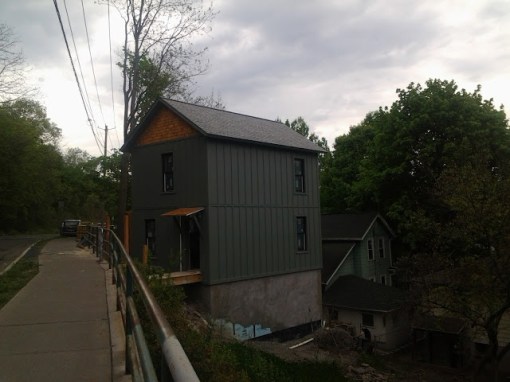
8. House of the week. From the outside, 228 West Spencer Street is almost done, and the interior is fairly far along as well, with finishing work underway. Architect Noah Demarest says the house will be put up for sale in a few weeks, if everything goes as planned.


Collegetown Terrace Construction Update, 5/2016

31 05 2016

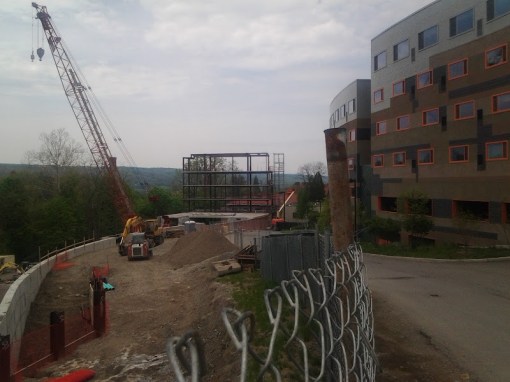
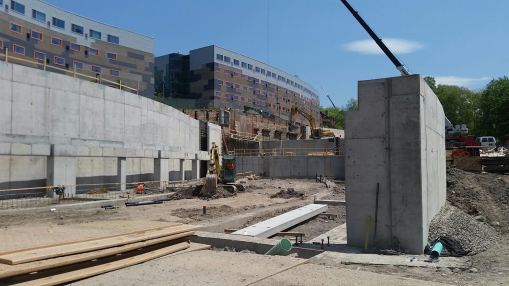
Just like in March, there are really two sets of photos here. The first set contains photos that I’ve taken from outside the fence. The second set of photos are from inside the fence, and come courtesy of Nick Robertson and Jocelyn Garrison at Welliver, the general contractor in charge of the project, and a big thanks goes out to them for taking and sharing photos from inside the fence.

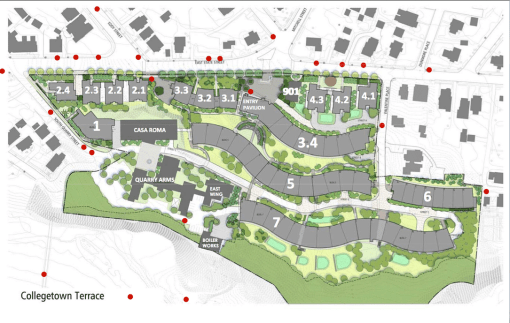
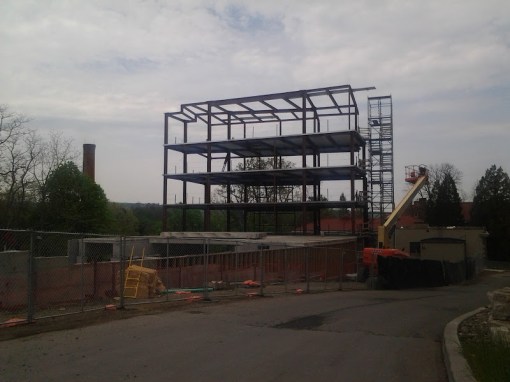
The erection of the steel frame has started on the westernmost portion of the building, and corrugated decking is being attached to each level. Work on the building is generally progressing from west to east, and  the sheer length of the building allows the western sections to be quite a bit further along than the eastern sections, where foundation walls are still being formed. The reinforced concrete sections visible in the last of the Welliver photos is where the parking garage will go; readers might remember that Novarr sought and received a zoning variance to remove a floor of parking space and turn it into less expensive dorm-style housing, citing the lack of utilization of existing parking, and a desire to appeal to a larger segment of the rental market.
20160522_141042 20160522_141058 20160522_141148 20160522_141154 20160522_141222 20160522_141228 20160522_141237

Set two:

index index2 index3

ctown_terr_phase3


Brookdale Ithaca Crossings Construction Update, 5/2016

30 05 2016

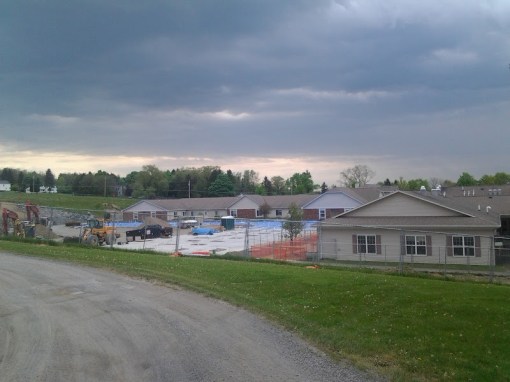
As the population ages, so do the need for specialized care facilities. Work continues on the the Brookdale Ithaca Crossings project on West Hill.

Plans call for a 23,200 SF, 1-story building with 32 bedrooms (32 beds total). Along with the new building, there will be updates to parking, landscaping stormwater facilities, and the addition of a couple of courtyards between the buildings. The project was first proposed in late 2014, and approved last July.

The facility is designed to complement Brookdale’s two other Ithaca facilities, which are adjacent to the project site – The first, a 46-unit facility to the north of the project site, is Brookdale Ithaca Assisted Living (formerly Sterling House), which serves as enhanced assisted living for seniors. The second, a 32-unit facility to the easy of the project site, is Brookdale Ithaca Memory Care (formerly Clare Bridge), which serves as assisted living for those with specific memory care needs, individuals suffering from advanced cases of Alzheimer’s Disease and dementia. Both of the older facilities opened in 1999. The current project was initially called “Clare Bridge Crossings”, but it was later renamed to Brookdale Ithaca Crossings.

For more information about memory care and a few more details about offerings, I wrote an article for the Voice here.

Nursing home and assisted living facilities have to demonstrate to the state that their is a local need for a project, and the “certificate of need” is only issued at the end of a project, after it’s been built and the state has concluded its inspection. According to Brookdale representatives, there’s no indication that the certificiate of need will not be issued.

Construction is expected to last around 14 months, which would give an estimate of Q1 2017 for completion. The architect is PDC Midwest, a Wisconsin firm that specializes in memory care facilities.
Looking at the site, the foundation has been excavated and footings have been poured, and it looks like the foundation slab is already in for the south wing. The blue material might be some kind of vapor barrier film to help protect against moisture.

20160522_160747 20160522_160812 20160522_160823 20160522_165738

clarebridgecrossings_1 clarebridgecrossings_2


Gannett Health Center Construction Update, 5/2016

29 05 2016

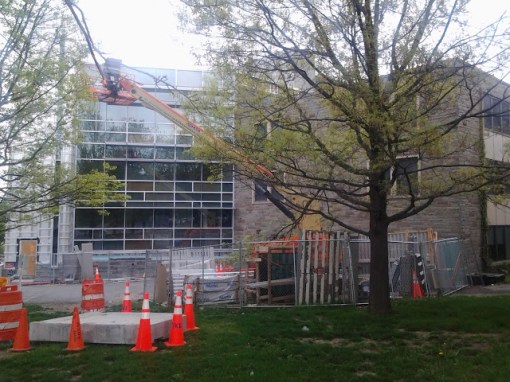
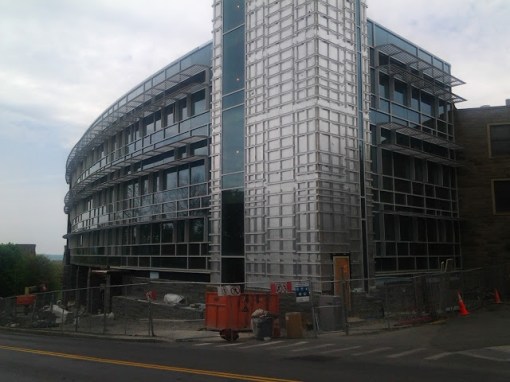
Work on the exterior of the new wing of the Gannett Health Center is in the final stretch. The bluestone veneer is being attached, and the rails (also called “continuous anchors“) are on for the limestone veneer. It looks like insulation panels are still being installed on the upper levels of the west stairwell. When the insulation is attached, the rails are screwed on, the limestone panels are slid into place, and then they’re mortared or caulked into place with silicone.

Most of the work has shifted towards the completion of rough-ins and interior finishing, and the new wing should open for occupancy sometime later this summer (July/August). All operations will shift over into the new wing so that the next phase, renovation of the existing wings, can begin in earnest. The whole $55 million project will wrap up by October 2017.
20160522_134926 20160522_134947 20160522_135044 20160522_135105 20160522_135148 20160522_135249

gannett5 gannett2


News Tidbits 5/28/16: A Battle Between Neighbors

28 05 2016

201_college_v2_3

1. It seems the Planning Board had something of a philosophical crisis at their meeting, per the Times’ Josh Brokaw. The cause of the crisis is Neil Golder, Todd Fox and 201 College Avenue. Here’s the backstory.

201 College is a 2.5 story, 12-bedroom house on the corner of College and Bool. Local developer Todd Fox has a proposal on the boards for a 5-story apartment building (shown above). Neil Golder lives next door at 203. He moved into 203 in 1972 when he was a grad student at Cornell, bought the place in the early ’90s, lived there with his partner Kathy until she passed a couple of years ago. He still lives there, and rents out spare bedrooms.

201 and 203 were rezoned as part of the 2014 Collegetown rezoning to MU-1. This came only after years of debate, and Neil was one of the residents who pushed to have the properties rezoned in 2009 with a payment in lieu of parking scheme that upset a lot of the landlords, who mounted a significant legal challenge that prevented the rezoning from happening – more about that can be found in this Voice explainer.

For the record, Golder has never been much of a fan of development in Collegetown. His two big things have been that density is bad (but he seems to have mellowed on this issue since the parking push in 2009), and that Collegetown needed a grocery store. He was supportive of Collegetown Crossing because the developer (the Lowers) live next door at 205 and Greenstar will be opening a grocery store on the ground floor.

So, back to the zoning. There are nine MU-1 properties. The four between Catherine and Cook belong to Novarr – he has not expressed any intent to redevelop them. The other five are 215, 209, 205, 203 and 201 College Avenue. Novarr has expressed intent to redevelop 215 starting in late 2017. 209 is Grandview House, a historic landmark, and pretty much untouchable. 205 is Lower’s house, 203 is Golder, and then you have 201.

201 is the southernmost of the nine, and therefore most likely to stand out. The thing is, zoning consistent, when development happens organically, it means the parcel most likely to stand out isn’t necessarily the last one to get developed, nor will it necessarily be the smallest. In this case, the physical transition is from 2.5-3.5 story houses, to 5-story apartment, to 2.5 story house, and then a 3.5 story house and 5-story boarding house.

As of right, Todd Fox can build up to 5 floors and 70 feet tall as an average height. The site slopes slightly, so the building is shorter on the north side than the south side. The design fits the zoning – but it has to go to the BZA for a couple of minor area variances, one for entrances off of Bool, and the other, the board requested the project incorporate – the building was moved northward slightly to allow for street trees and a wider sidewalk on College Avenue. The May agenda noted that the Board had no concerns with either variance.

Golder has sent letters to the Times and the Voice (directly to my colleagues Mike and Jolene but not to me, interestingly), he has been stopping people on the street to sign his petition, he’s tried the ILPC, Planning Board, Historic Ithaca, friends in city government, even the city forester, everything and everyone he can to try and halt the current plans, but there has yet to be a compelling, objective counter-argument.

Countering some of the claims in his many letters, the individual pine trees at the front are not historic landmarks or city-owned, the city has to review and approve of construction plans anyway, and the traffic issue had already been discussed back during the rezoning. The developer has agreed to push the building back, which will give more visibility to Golder’s driveway, and a curb bump-out at the corner is proposed as part of the project. So that leaves the aesthetic argument of “I don’t like it”, which puts the Planning Board in a really difficult spot because as long as the form districts say the design is fine, that argument won’t stand up to a legal challenge.

There is a strong argument with his solar panels, which have been a part of broader discussion within the city. 201’s height would marginalize Golder’s solar panels, so in that case the project causes non-subjective hardship; this could be mitigated if 201 has solar panels (they are being considered) and shares electric, or by other compensation. Although, it might depend on when the panels went in, before or after rezoning. If people start rushing to put up solar panels as a back-door method to thwart development, the city’s going to step in.

So here’s the essence of the issue – after years of fighting over zoning, and finally settling on a compromise in 2014, the city is faced with a development that is legal, but it’s vehemently opposed by a venerable and high-profile neighbor, where the objections can be effectively mitigated, but not necessarily the way he wants them to be. A planning board member has to find the balance between allowing everyone to have their say, and acknowledging valid issues that should be addressed, without letting individuals exert too much control over their neighbors and infringing on property rights.

waterfront_foreclosure_parcels_0516

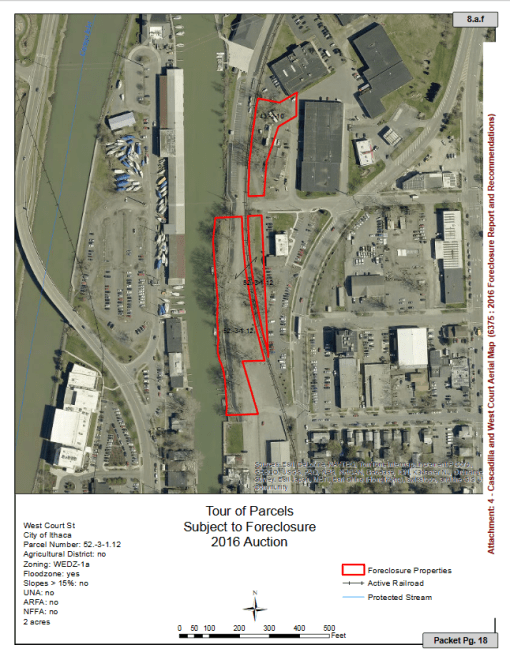
2. Okay, onto other things. The city might be acquiring a couple of sizable West End/Waterfront parcels from the county. The properties, which consist of a pier/boardwalk, informal parking and vacant land, are located at the end of West Court and Cascadilla Streets, and are being seized as a tax foreclosure. The county is looking at selling them to the city in exchange for the $42,844 in back taxes. The larger one is 2 acres, the smaller 0.6 acres, and in total they’re valued at $630,000. The owner, an LLC, picked them up for $156,625 in 1999.

If the city picks them up, they’ll be filed into the IURA’s holdings for potential sale down the line. As it is, the parcels have issues – the railway, accessibility, and soils down here are known for being difficult to build on. But in the long term, there’s potential for water-focused amenities, private development, or a combo of the two. It looks like a good investment given the city’s still-in-the-works plan to encourage redevelopment of the West End and Waterfront, so this is worth keeping an eye on as things move forward.

402_s_cayuga_st_boggsfernandez

3. The IURA reviewed funding proposals for affordable housing earlier this Spring, and the minutes are now online. the duplex at 622 West Clinton, and the affordable unit with the 4-unit 402 South Cayuga project were not funded. The IURA is encouraging 622’s applicant to re-submit for next year, and the minutes note that 402 is likely to still go forward, but without the affordable unit.

It’s also been noted that there is some discontent with INHS because the cost of their projects are coming in high, and that they would like more diversity in applying entities. However, the seven townhomes at 202 Hector and the single-family house at 304 Gector (all for-sale housing) are fully funded. The Habitat for Humanity duplex on the 200 Block of Third Street is also fully funded.

rumble_seat_1

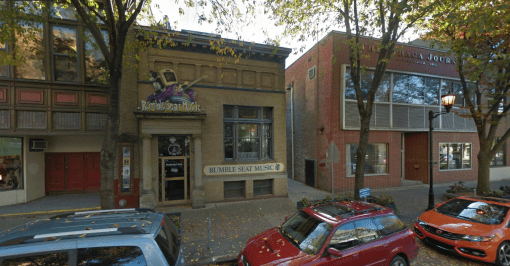
4. Another piece of news from the IURA – the new occupant for the Rumble Seat Music building. It appears to be a drink bar called “Watershed Union“, serving coffee and juice by day and adult beverages by night. Five or six living wage jobs would be created. There might be some grumbling over the moral evils of alcohol, but the business plan has the support of neighboring businesses and the Downtown Ithaca Alliance.

Also, the Canopy Hilton is still moving forward. But are doing a minor LLC ownership change to allow another Patel family member to be a part of the ownership team.

5. Hitting the market this week, for all those big-potato investors out there – the Belmont Townhouses at 324 Spencer Road. The listing from local realtor Brent Katzmann has the price set at $2,595,000, for a 14-unit complex that opened in 1995. The posting mentions the possibility of a 1031 Exchange, which allows an individual to sell a currently-owned investment property, and buy a new investment property of equal or greater value while avoiding capital gains taxes – continuity of investment locks up the profit gained from sale.

20160522_160150 20160522_160211
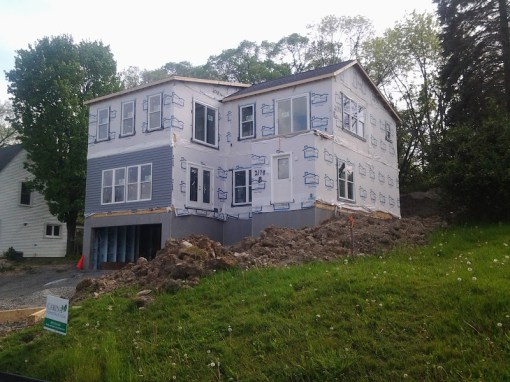
6. House of the week. This house is on the 100 Block of Campbell Avenue on Ithaca city’s portion of West Hill. This home is being built by Carina Construction, an Ithaca-based modular home specialist. The foundation and garage were poured and the pieces were probably craned on and locked together sometime in the past few weeks – a little bit of siding has started to show up on the front. The process is a lot like the one Carina used to assemble the Belle Sherman Cottages across town.

Color me impressed, the design is unique, and once exterior details like the porch and second-level deck go on, I imagine it’ll look really nice. Tompkins Trust lent $280,000 back in April, and the construction permits were issued not long thereafter (the total project cost is in the $320k range, per the permit filing). The land was created in a lot subdivision last year, and sold for $35,000 last August.


Upson Hall Construction Update, 5/2016

26 05 2016

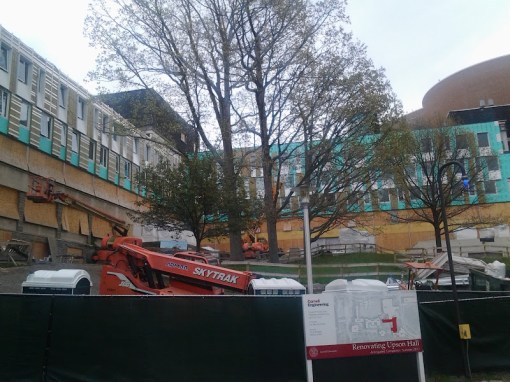
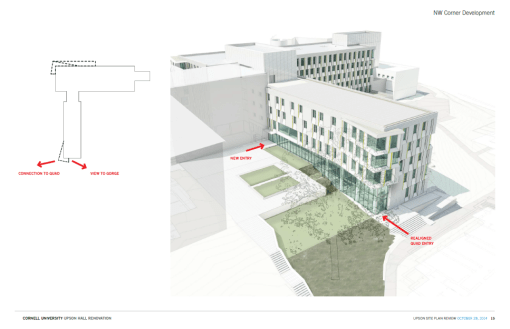
Taking a gander at Upson Hall, it looks like the renovation project is coming along nicely. The bump-outs are built out, sheathed and covered with the turquoise water resistant barrier. It looks like an insulation layer is going on top of the barrier, and then clips for the grey terra cotta panels. Many of the windows have been fitted, and the south windows of the west wing have had white aluminum surrounds installed, but the west face of the west wing is still metal stud walls, and neither of the bump-outs have received glazing.

Note that the building renovation is in two phases – the work set to wrap up this August focuses on floors 3, 4, and 5. Floors 1, 2 and what’s left in the basement will be finished over the following 12 months. There’s a third phase after those two, mostly dealing with enhanced landscaping.

According to Cornell’s project update page, mechanical rough-ins are underway for the rooftop equipment, and then the interior work (rough-ins, drywall, painting, ceiling installation) which is generally further along the farther up in the building one goes.

20160522_133359 20160522_133427 20160522_133517 20160522_133644 20160522_133729 20160522_133818 20160522_133823

upson_4

upson_3


Cornell Veterinary School Expansion Construction Update, 5/2016

25 05 2016

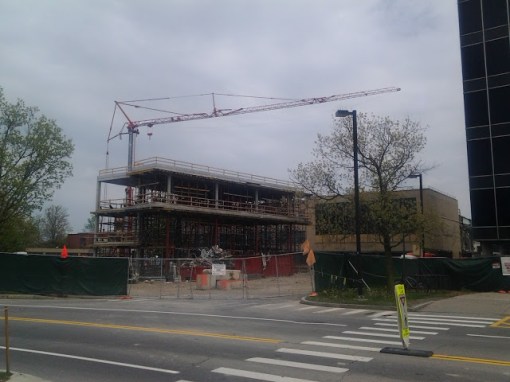
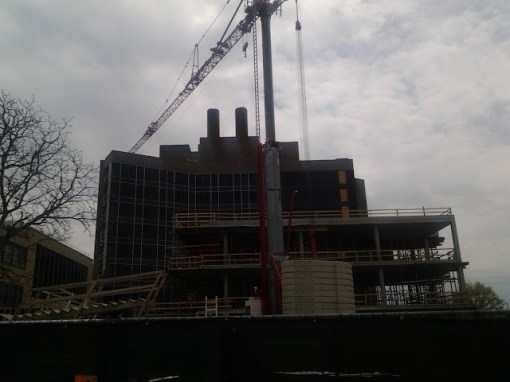
From Tower Road, it doesn’t appear a whole lot has changed since the last construction update in March. Work has shifted away from new construction somewhat, and towards the demolition of underused academic space to make way for the rest of the Vet School reconfiguration and expansion. The reinforced concrete frame of the new library and dean’s wing has advanced a bit, and new curtain wall glazing appears to be going in on the Vert Research Tower. The project is a bit disjointed because of the needs of academic space and surging at various times of the year.

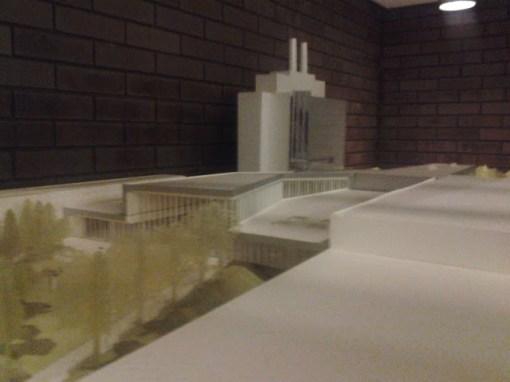
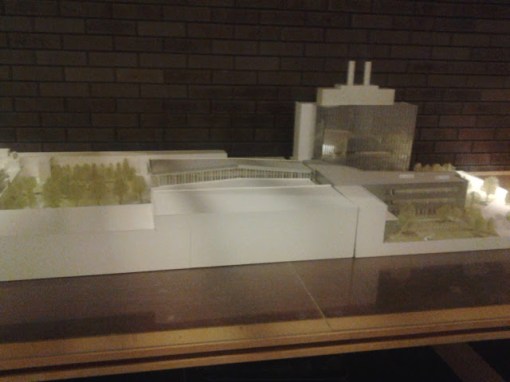
Thanks to the kindness of a woman in blue scrubs, I was able to enter the building. While trying to find a good angle of the new demolition (couldn’t, but there’s a photo on the Vet School website here), I stumbled upon a model and timeline of the project, pictures below. According to the timeline here, the project completion is January 2018, not June 2017 as reported on the website. Dunno which one is more accurate. The model does a great job illustrating the full breadth of the project in relation to the rest of the vet school complex.

20160522_130612 20160522_130756 20160522_130851 20160522_130922 20160522_131344 20160522_131403 20160522_131417 20160522_131428 20160522_131445 20160522_131554 20160522_131846

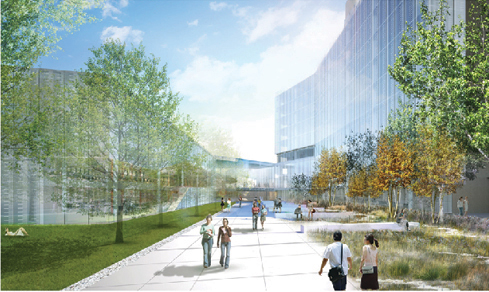
Looking east from Tower Avenue. Rendering property of Cornell.

Looking east from Tower Avenue. Rendering property of Cornell.

Looking west from new courtyard. Rendering property of Cornell.

Looking west from new courtyard. Rendering property of Cornell.


Holiday Inn Express Construction Update, 5/2016

25 05 2016

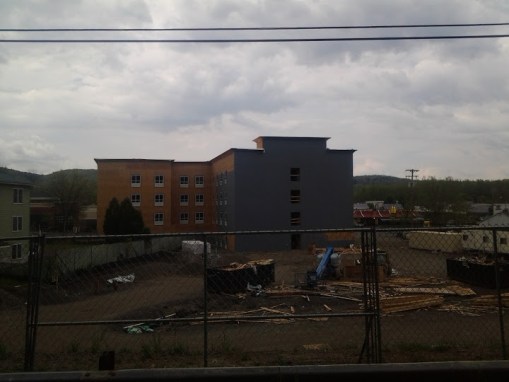
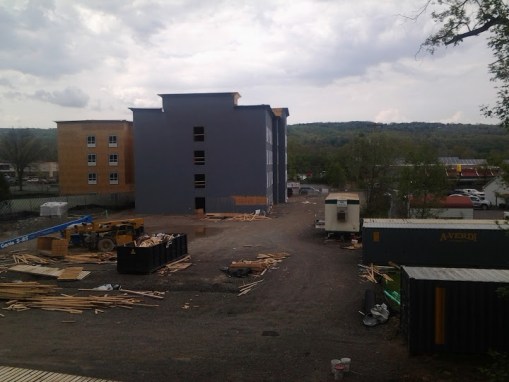
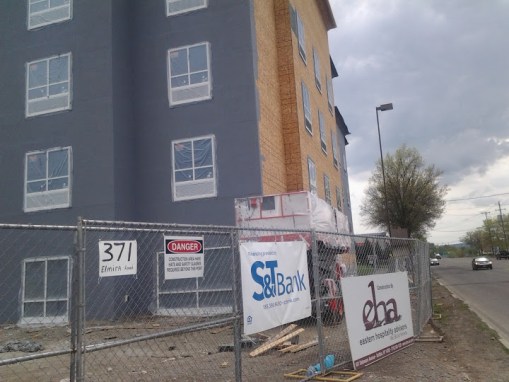
The new Holiday Inn Express at 371 Elmira Road seems to be coming along fairly quickly. Framing was completed a few weeks ago, and at this point most of the windows have been fitted. For those concerned that this is going to be a battleship grey eyesore, fear not. The plywood will be covered with varying colors of an Exterior Insulated Finishing System (EIFS, a synthetic stucco) and stone veneer. The grey is most likely a moisture barrier. Drainage cavities are then built over the barrier to allow water that has penetrated the surface to exit the wall without wrecking it (a big problem with early EIFS systems).

When finished, the hotel should look a lot like this one, with some minor design differences and an updated color scheme:

The project is being financed with a $5.98 million loan from S&T Bank, a regional bank in Western Pennsylvania, and Eastern Hospitality Advisors, a Buffalo contractor specializing in hotel construction, is managing the build-out.

The 4-story, 79-room hotel is expected to open late this summer.

20160522_145118 20160522_145153 20160522_145515 20160522_145542

holiday_inn_express_v2


Boiceville Cottages Construction Update, 5/2016

24 05 2016

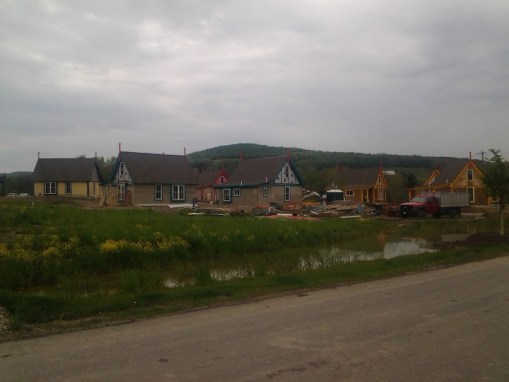
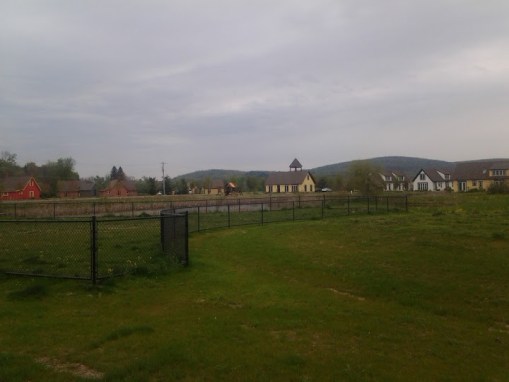
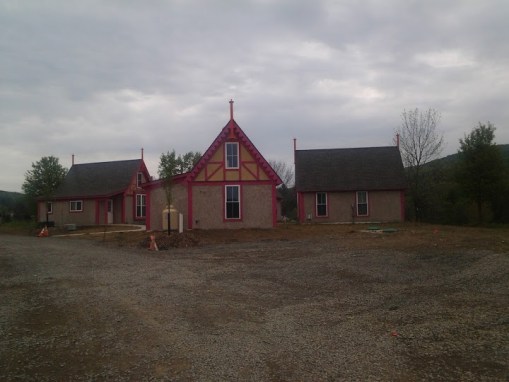
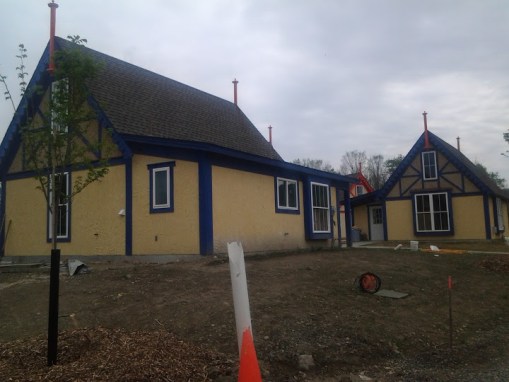
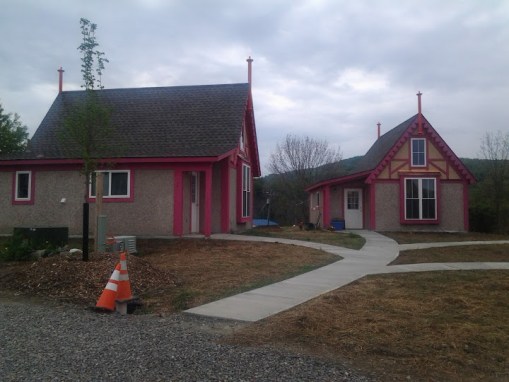
The Boiceville Cottages are nearly complete. All of the cottages have been framed and sheathed. A set of teal-trimmed cottages are being stucco’d and are having their roofs shingled, but most of the other cottages, including a set of canary yellow-trimmed homes that had only just been sheathed in March, are nearly done (with interior finishing being the only major work left) or are already occupied.

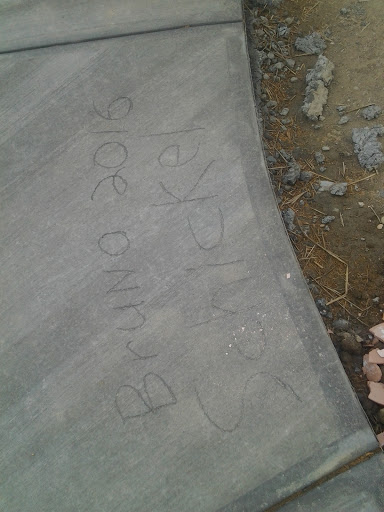
Check out the “easter eggs” – drawings in between some of the decorative half-timbers, and builder Bruno Schickel’s personalized sidewalk slab.

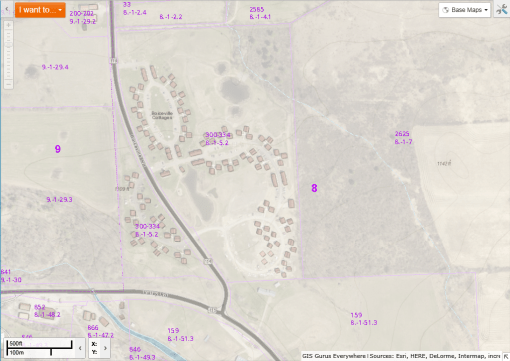
The 140-unit project will finish up this summer, and after that Schickel will be turning his attentions to building out the late Jack Jensen’s Farm Pond Circle project in Lansing. For those who want to visit, the cottages are on Boiceville Road just west of Slaterville Springs.

Searching “Boiceville” in the search box on the right will give you about three years of construction updates (April 2013 looks like the first). It has been a long build-out, but there’s no other project quite like it.

20160522_124239 20160522_124249 20160522_124301 20160522_124340 20160522_124408 20160522_124427 20160522_124457 20160522_124521 20160522_124555 20160522_124618 20160522_124623 20160522_124804

boiceville_1


DiBella’s Construction Update, 5/2016

24 05 2016

One restaurant opens, another is just getting underway. NYC-based Marx Realty, operating as Ithaca Joint Ventures LLC, is finally starting work on the DiBella’s pad building long-planned for the Ithaca Shopping Plaza off Old Elmira Road.

DiBella’s first started planning for an Ithaca location back in November 2014. After a few design iterations, the project was approved by the Planning Board and BZA late last summer. The restaurant replaces what was previously part of the shopping center’s parking lot.

The exterior will be similar to DiBella’s other recent stand-alone restaurant locations – CMU faced with brick and stone veneer, decorative sconces (light fixtures), and a “patina green” patio roof. The size of the building will be about 3,400 square feet, which is typical for the Rochester-based sandwich chain. The interior will be designed with a 1930s/1940s era theme, also standard for the DiBella’s chain. Along with the building comes a revised parking arrangement for 35 cars, bike racks, signage, landscaping and a modest patio area. Early Site Plan Review documents estimate the project cost at $600,000.

As for the construction images, it looks like the foundation’s sub-base is being prepared for the foundation slab. This is going to be concrete slab-on-grade, no basement. The sub-base will give a uniform base from which to build upon, and helps to compact the soil, making it less likely to undergo excessive settling. The soils down in the flats are notoriously difficult to build on, because they are very soft and compressible – the shopping plaza, which was originally built in the 1950s, has had some mild settling issues. I don’t see anything to confirm it, and someone knowledgeable feel free to chime in, but it would seem removal and replacement of existing fill is likely to approach used here, similar to the Texas Roadhouse project. The drum roller in the last photo supports that idea. The turquoise pipes are water-sewer pipes.

The FEAF estimates a seven month construction period, so a late fall opening isn’t out of the question. DiBella’s expect to employ about 25.

A&E Construction of suburban Philadelphia is the project contractor, and the building was designed by Ithaca architect Jason K. Demarest.

20160522_150132 20160522_150306 20160522_150330

DiBellas-Ithaca-NY-rendering-large