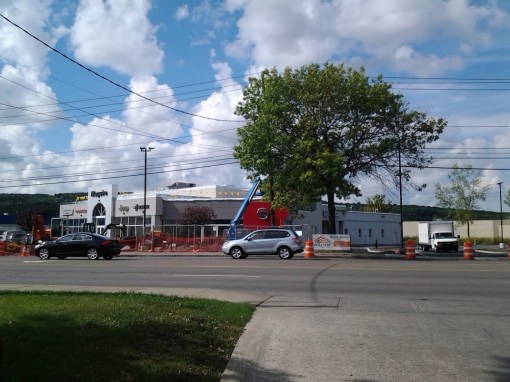
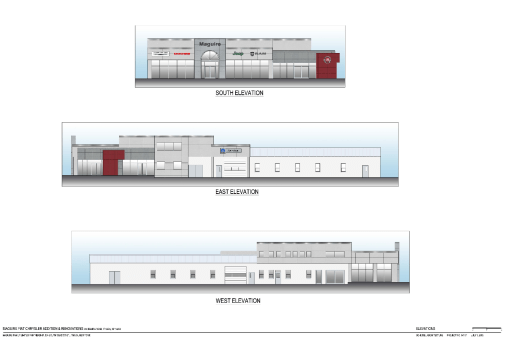
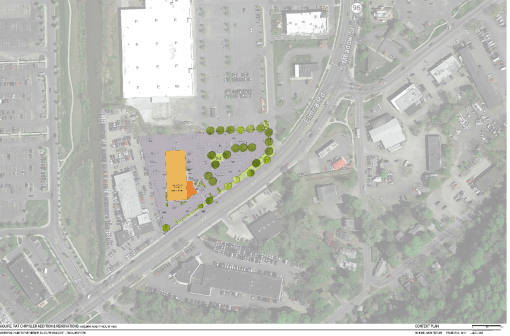
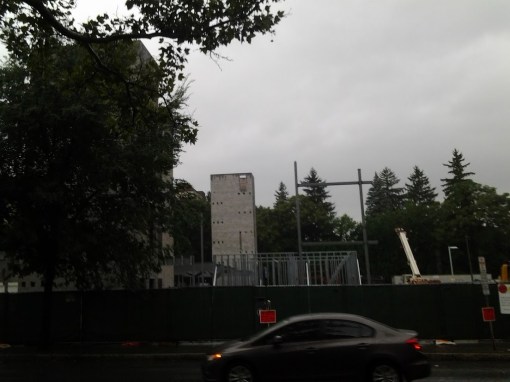
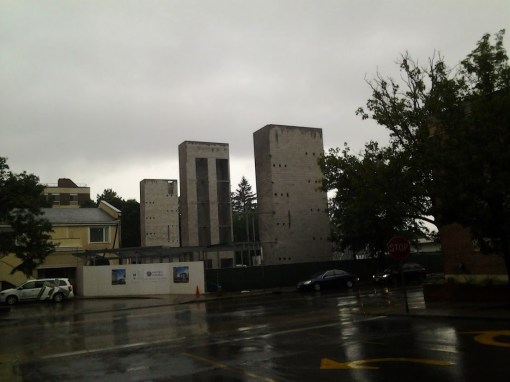
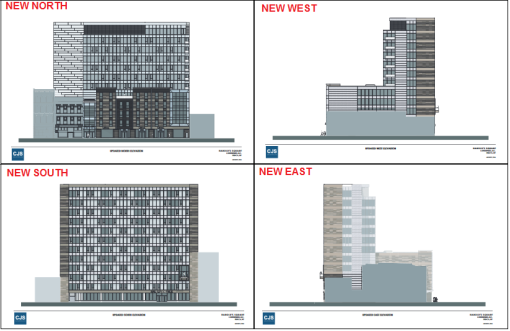
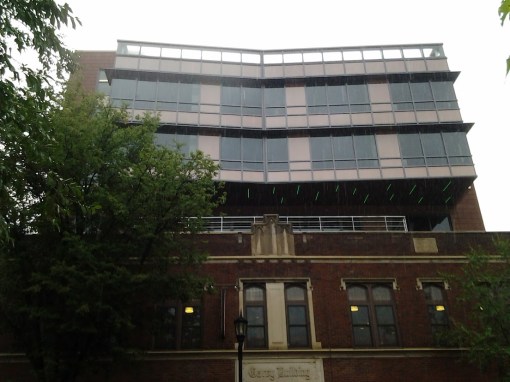
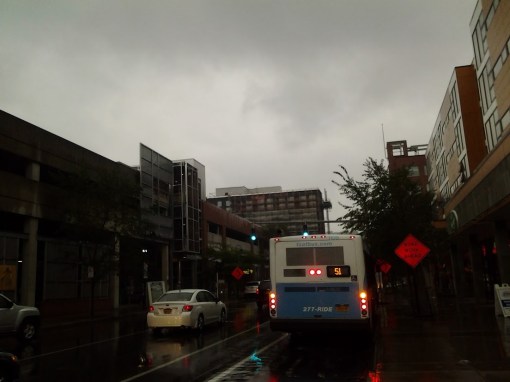
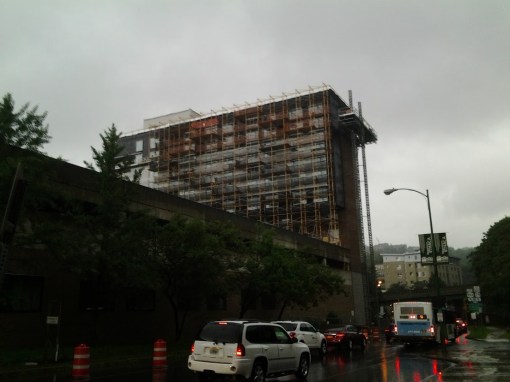
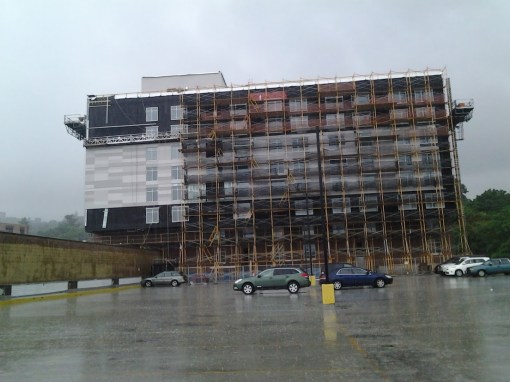
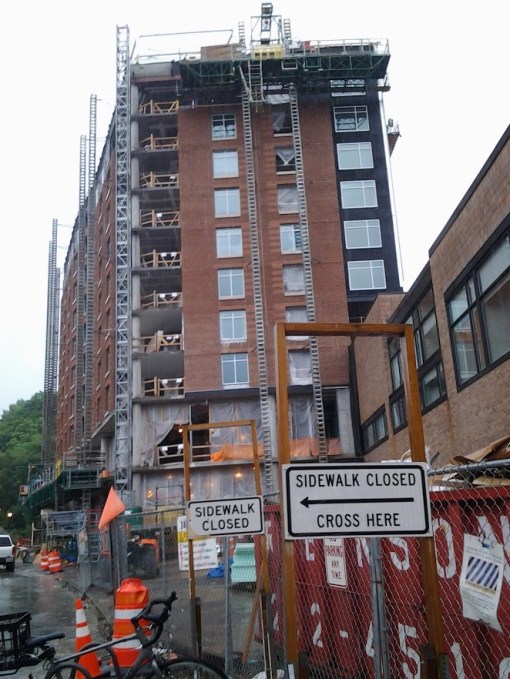
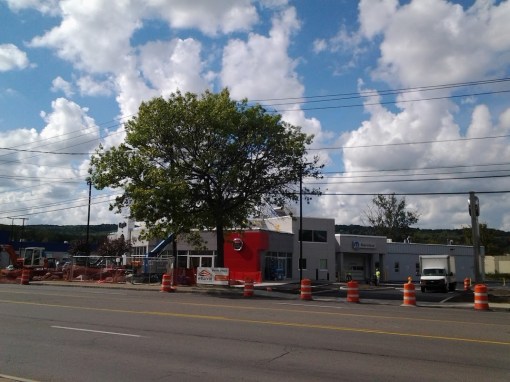
The small addition the Maguire Family of Dealerships is putting on their Fiat/Chrysler location looks to be nearly complete from the outside. The aluminum panels are up, the new east wing is fully glazed and new signage has been posted, both on the building and the stand alone podium signage near Route 13. The parking lot and display have been reconfigured, and the entry drive has been modified. It looks like the only thing left is landscaping and paving by the front of the building. Welliver will be wrapped up within a few weeks, and Maguire’s 2-story, 1,836 SF addition will be done. More info on the project can be found here.
Maguire Fiat/Chrysler Addition Construction Update, 9/2016
20 09 2016Comments : Leave a Comment »
Tags: construction, ithaca, maguire fiat/chrysler, photos, southwest ithaca
Categories : construction, ithaca, photos
DiBella’s Construction Update, 9/2016
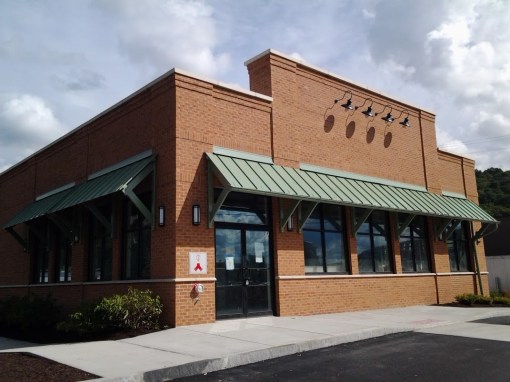
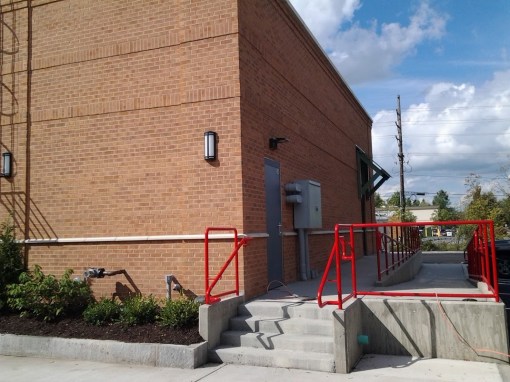
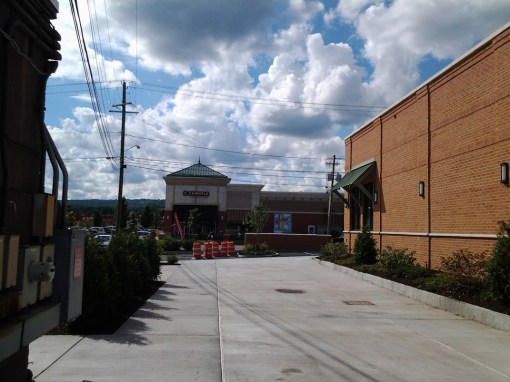
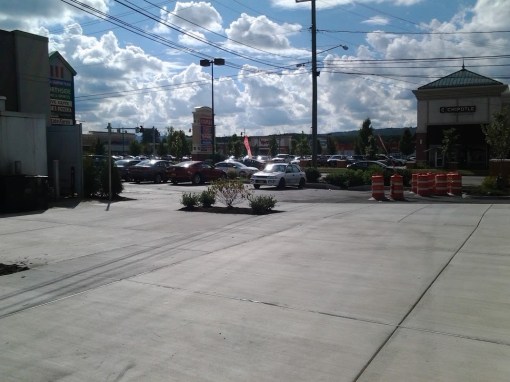
19 09 2016From the outside, the Dibella’s pad building is just about done. All that’s left is signage and accessory installations such as bike racks. The open paved space south of the building will be a patio for outdoor dining, which would be a nice spot on a day like this.
The inside is still being finished out – looks like the some interior walls are still waiting for their drywall to be hung, and in other spots, the drywall has been primed but trim and paint have yet to be applied. Allowing a few weeks for trimming and painting and equipment installation, it looks like the sub shop could open by Halloween.
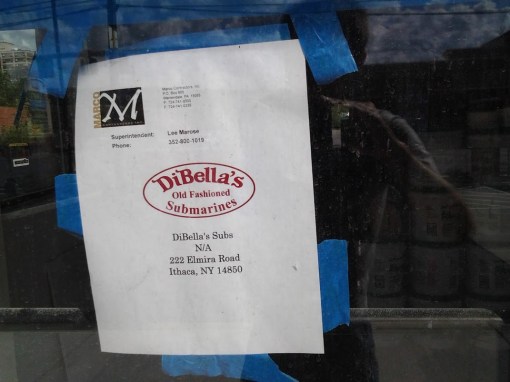
Marx Realty might have switched contractors when work shifted from the building itself to the outfitting of the interior. A&E Construction handled the construction of the building (the “shell space”), but Marco Contractors Inc. of suburban Pittsburgh is handling the interior fit-out. More infp about the DiBella’s project can be found here.
Perhaps because of its high visibility, by a wide margin more emails come in asking about what’s being built here than any other project in the county.
Comments : Leave a Comment »
Tags: construction, DiBella's, ithaca, photos, restaurants, suburbia
Categories : construction, ithaca, photos
News Tidbits 9/17/16: Point By Point
17 09 2016
1. Starting this week off with the Maguires again. Although there was significant vocal opposition from planning committee members to the proposal, they decided to postpone the decision for another month. It would have been more merciful and understanding if they had just declined to continue, but the committee voted 4-1 against making a decision at their Wednesday night meeting, citing to need to process public comment. Most of the comments in favor of the proposal mostly spoke highly of the Maguires as employers and economic drivers (and even some of the opposition did as well), most of the opposition focused on the plan not meshing with visions for what they want the neighborhood to become. The board will consider a resolution against the project next month, but it sounds like the decision has already been made.
2. This will be something of an unusual month. Along with the typical retinue of meetings, the Planning Board will have a special meeting next week to weigh in on the next round of Chain Works District EIS public comments, approve some slight revisions to 210 Hancock, and zoning determination for 201 College Avenue.
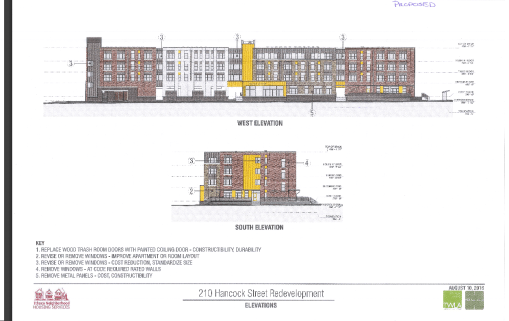
The changes to 210 Hancock are noticeable but minor. On the landscaping side, the concrete curb around the playground is proposed to be removed as a cost-saving measure, a fence separating the for-sale and for-rent townhouses will be removed and a fire lane put in, and the Lake Avenue paving will be changed up to match the waterfront trail. For the buildings, the 54-unit apartment building would have some windows tweaked or removed to standardize sizes (reduce cost) and fire safety concerns, and some of the yellow metal panels would be replaced with brick for cost and ease of installation. No changes are proposed to the townhouses.
As for 201 College, City Zoning Director Phyllis Radke issued a determination that 201 College is compliant and permitted by MU-1 zoning. She also states a number of concerns with the Planning Board’s handling of the review. Among the reasons cited are:
- Pre-site plan review in November 2015 by zoning and planning concluded the project met CAFD guidelines.
- Facade isn’t defined in the CAFD document. Building length and facade length can be interpreted as two separate measurements.
- Facade length did not come up as a concern until July, four months after meetings began, after design review by the board, and after prelim site approval had been granted.
- The building meets the conceptual guidelines provided in the zoning. While there are concerns about (yet unwritten) design standards and activation of both street facades, there’s nothing in the code for MU-1 that explicitly limits facade length on any side other than the primary face. There is, however, in MU-2. So secondary street facade length was stated in the code for one zone, but in no others. Even though it’s been argued as an ambiguity, the board did not consider secondary street facade length in its review of a CR-2 zoned duplex at 319 Oak Avenue in early 2015. The activation requirements apply only to the primary face for non MU-2 structures. If the board decided it was still ambiguous, Hess Realty Corp. vs. Town of Rotterdam (1993) says that ambiguities must be resolved in the favor of the property owner.

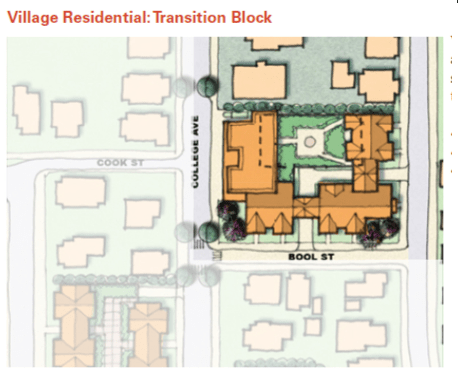
- The 2009 vision guidelines that people keep citing, and Neil uses on the “Save our Soul” facebook page – not only do they suggest taking down Neil’s house, they also have building lengths running the entirety of Bool Street.
With all that noted, even if it’s decided the project is in fact legal and doesn’t need a trip to the BZA, it likely won’t be moving forward this year, if at all. Visum couldn’t start in time for the desired August 2017 completion, and the project and site are for sale. For a potential buyer, though, it would be of significant benefit to have the zoning debate resolved before any sale occurs.
3. Out in the towns, there’s not a whole lot of development discussion in next week’s agendas. The town of Ithaca will continue its review of Maplewood Park (running behind schedule at this point) and issue a couple of lot subdivisions, neither of which are expected to be a big debate. The town of Dryden received plans for a 10,500 SF self-storage facility for the vacant northeast corner of Freeville Road and Enterprise Drive. The 70′ x 150′ warehouse will house 121 units, and about 7,500 SF will be climate-controlled. The project will cost about $350,000. There also plans for an Open Development Area (ODA) on Dryden’s Scofield Road. ODA means an ROW or easement is required for building permits, and the town has to review the plans – nothing’s been filed yet.
4. A pair of construction loan agreements worth noting this week. The first is Storage Squad’s facility going up at 1401 Dryden Road east of Varna. According to a filing on the 12th, the company received a construction loan of $1.4 million from Tompkins Trust. That money will be used to finance the build-out of their 79,600 SF storage facility already underway. The second is the Dollar General being built at the corner of Route 34/East Shore Drive and Cayuga Vista Drive in Lansing. Primax Properties (under the name Sea Mountain Ventures II LLC) received a $956,000 loan to build the 9,100 SF retail store, which is also under construction. that loan was also filed on the 12th. The lending institution is BB&T, a major regional bank in the Southeast. Primax is headquartered in Charlotte, and BB&T is headquartered just 90 minutes up the road in Winston-Salem, so in this case, it’s less about a bank being interested in Ithaca, and more about two major companies located near each other and having an established business relationship.


5. So the Ithaca Urban Renewal Agency’s Economic Development Committee selected the $3.7 million Seneca/Corn proposal to submit to the state for the Restore NY 4 grant. And I feel a bit embarrassed because the Voice story, comparing the Seneca/Corn proposal and the State Street rehabs, ran after the decision was made, so it comes off as a bit clueless thanks to timing. Anyway, the application will be looked at by the Planning Committee, and submitted in early October. If all goes well, funding could be granted by the beginning of next year, with the renovated Wyllie’s and the Ithaca Glass overbuild ready for tenants by early 2018. Ed Cope is the developer, STREAM Collaborative the architect.
6. For sale this week, and for the budding entrepreneur – 2,310 SF neighborhood commercial retail at 402-04 West Court Street in the Washington Park neighborhood. Talk about a change. When I started at Cornell ten years ago, this was “The Corner Store”, and it was severely run down. I don’t remember the florist sign, but everything else in the assessment photo below fits my memories from the mid 2000s.
During the past ten years, the bump-out was renovated, then the building was repainted, and The Corner Store became the “Red and White Cafe“, a highly-regarded neighborhood fish fry and seafood restaurant. According to the listing, the major renovations came about three years ago. County records indicate the property last exchanged hands in 1988. Along with the retail space comes 432 SF of storage.
The listing is asking for $975,000, but that would be for building and business – the building and lot are valued at $120,000, so any potential buyer is going to be much more interested in the cafe than the building.
Comments : 5 Comments »
Tags: 201 college avenue, 210 hancock, affordable housing, collegetown, dryden, ithaca, lansing, maguire project, northside, student housing, waterfront, zoning
Categories : affordable housing, collegetown, construction (planned), ithaca, news, student housing, Tompkins County, urban planning
News Tidbits 9/10/16: Situations To Be Avoided
10 09 2016Pardon the week hiatus. Sometimes, by the time there’s enough news to share, it’s already the weekend, so it just makes more sense to fun a longer feature the following week.
1. The Maguire dealership proposal for Carpenter Business Park had a lukewarm reception at its public info session a week and a half ago. A copy of the application can be found here, and Second Ward Councilman Ducson Nguyen was kind enough to upload a 90-minute video of the meeting on his facebook page, and a transcript of the meeting can be found here. A second public info meeting will be held on the 14th.
You might recall news of the project broke last winter, followed shortly thereafter by a vote of the city Common Council to subject waterfront and waterfront-vicinity properties to a “Temporary Mandatory Planned Unit Development” (TM-PUD), meaning that any building proposal would be subject to a vote of the Common Council as a stipulation of approval (typically, projects only need the Planning Board’s consent, plus the BZA and/or ILPC if needed). One other project has gone through the TM-PUD process since then, the Cherry Artspace performing arts building. The small experimental theater held its public info meetings at the end of March and mid-April. It enjoyed fairly broad public support, but two of the eight voting councilmen still voted against its construction at the May meeting. If a a project with widespread support has some trouble getting passage, you can already guess what will happen with the Maguire proposal.
There’s only about a year left in that TM-PUD. But for the Maguires, it was too late as soon as the TM-PUD was passed. Perhaps more concerning, this is creating one of those cases where everybody’s opinion is coming out of the woodwork – some demand it be a park, some say industrial space only, Form Ithaca advocates walkable mixed-uses, and then there was that verbal brawl on the Ithaca West list-serve about the evils of the Ithaca Community Garden. A lot of folks think their idea is the only reasonable option, so if this plays out like the old library site, there’s going to be a lot of acrimony in the long run. Hopefully when the TM-PUD expires, the city will have the new urban mixed-use zoning ready for implementation, so situations like this can be avoided in the future.
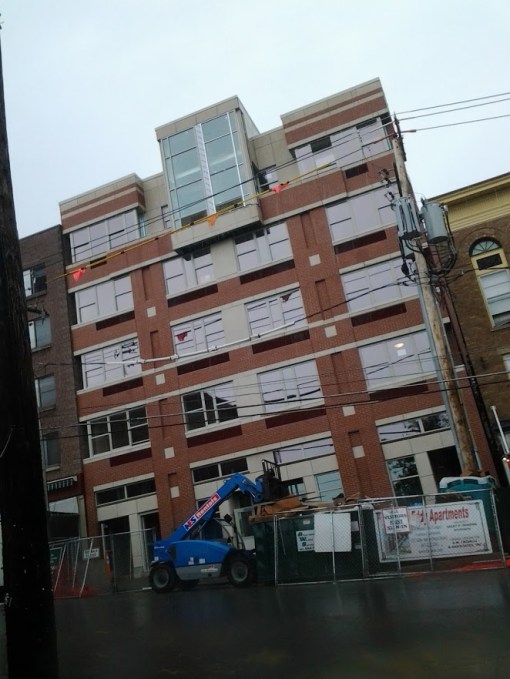
2. Can’t help but feel just a little sympathetic towards Steve Fontana – he tried to have this project open for move-in, and everything that could go wrong, was going wrong. The Journal’s Nick Reynolds reports that first it was a safety systems issue with the elevator holding up the certificate of occupancy, and then a water main burst. The latest planned opening date is September 9th, when the initial date was August 1st. Now it’s a financial issue, a public relations issue, and a mess for all involved. This could be used as an example of why Todd Fox put the 201 College site up for sale – it became clear that August 2017 opening wasn’t going to happen.
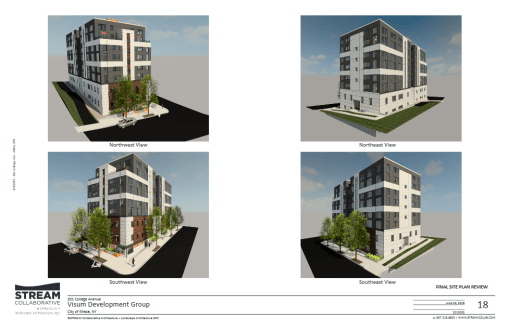
3. On that note, I’m going touch on 201 College real quick. Given the amount of time that went into the Collegetown Form District – six years – this just looks bad all around. On the one hand, Todd Fox could benefit from more patience (granted, we don’t know what the financing situation was), and the character attack on Neil Golder in his supporting documentation turned some people off to his cause. But what John Schroeder did also deserves strong scrutiny. It’s odd to claim a zoning code issue when the MU-1 code is only three pages, and he helped write it. He was also aware that 201 College went through pre-site plan review with the city’s Planning Department, and they gave it the okay to proceed with review. This looks very suspiciously like Schroeder was explicitly looking for anything he could to help out his old colleague Neil, and that small ambiguity was the best he could do, which he was able to parlay with success.
This continues an uncomfortable pattern we’ve seen with other projects like the Old Library where one government body gives the OK, and another stops it after the consent is given. The whole point of these laborious review processes is to prevent controversy from arising. Who wants to take on the risk of proposing condos, mixed-use and affordable housing when, given that many projects require the approvals of multiple boards and committees, there’s a track record of mixed signals?
Rezoning has come up as an idea, but it’s not as simple as it sounds. Spot rezoning (single-lot rezoning) would likely be deemed illegal because the current zoning is consistent with the recently-passed Comprehensive Plan, something the courts look for in zoning lawsuits. Thinking slightly broader, Collegetown’s MU-1 is nine parcels – Fox, Josh Lower and John Novarr, all major local developers, own seven of them. If 20% of those affected by a rezoning proposal file a protest petition, a super-majority of the Common Council – 75%, 8 of 10 in practice – is required for rezoning approval. That is what stopped the first Collegetown rezoning during the Peterson administration. If it couldn’t pass then, a similar super-majority event is unlikely to pass now.
4. On the edge of Ithaca’s South Side neighborhood, the CVS Pharmacy sold for a pretty penny – or rather, $4.09 million, on the 1st. The property is assessed at $1.8 million, but sold for $3.6 million in 2006. The buyer is an LLC traceable to a suburban Boston firm with a broad retail space portfolio, so whether they plan to keep things as they are, or propose something new, is anyone’s guess.
5. Finally, a copy of the Site Plan Review application for Newman Development Group’s City Centre project at 301 East State Street in Downtown Ithaca. Keep in mind, this is from the June filing, so things are likely to have been updated or revised in response to the planning board. The 9 story building tops out at 96 feet. The approximate construction cost at the time of the filing was $32 million, with a proposed build-out from February 2017 to October 2019, which seems lengthy, and in another part of the document it says construction will last only 20 months. 400 construction jobs, 50 permanent jobs by tenants in the 10,600 SF of first floor retail, and building service staff. Overall square footage isn’t given, but given the retail and 7,225 SF of amenity space, 160,000 SF probably isn’t a bad first guess. For comparison, State Street Triangle was 288,000 SF, later reduced to the same height and similar dimensions as City Centre. In a sense, City Centre started off where SST required months to get to. Hopefully that bodes well for the proposal.
6. Remember that airport business park study from a while back? There’s no strong demand for a business park. But the NYS DOT wants to move their waterfront office and storage facility to the site. So removing those salt sheds and replacing them with mixed-use waterfront property won’t happen until the state buys whatever it needs here, builds and moves in to a new facility. Not sure what they’ll do with the property on Ellis Drive in Dryden that they’ve owned for the past decade; presumably sell it as surplus, but who knows?
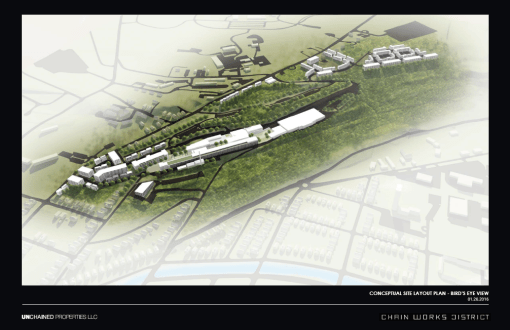
7. From the Ithaca Times: The Al-Huda Islamic Center hopes to start construction on their Graham Road mosque in 2017, and then obtain land for burials later this decade. In other news, new Times reporter Lori Sanken is reporting on the Chain Works progress, the Planning Board requesting color changes, careful consideration of heights, and debates about forest [preservation and Route 96B. Developer Dave Lubin of UnChained Properties wants to do renovations to existing buildings first, but seeing as they have yet to have the state sign off on a remediation place, they’re considering the construction of new buildings first, if NYS DEC approval for remediation gets delayed. And Catholic Charities and non-profit group Ithaca Welcomes Refugees are actively trying to procure affordable living space for 50 refugees who will be arriving in the Ithaca area after October 1st.

8. It’s been incubating for a while, but it looks like former Lansing town supervisor A. Scott Pinney’s plan for 15 duplexes (30 units) is moving forward. A gravel road will be extended from 4 existing duplexes at 390 Peruville Road (NYS 34B), looping through the property from Scofield to Peruville. The “Developer’s Conference” to talk about the project will be a part of the Lansing town planning board’s meeting next Monday. Also up for discussion are slight revisions to the Village Solars PDA, related to the community center and first-floor commercial space in the proposed Building F.
9. From the Ithaca city Projects Memo for September, it looks like there’s a couple of subdivisions planned. One is for 404 Wood Street in the South Side neighborhood, where the owner wants to subdivide a double-lot he has for sale, allowing the vacant lot to be developed for a house or small apartment building. Quoting the application, “Instead of an empty grassy lot, there would be a building on it”. Points for simplicity.
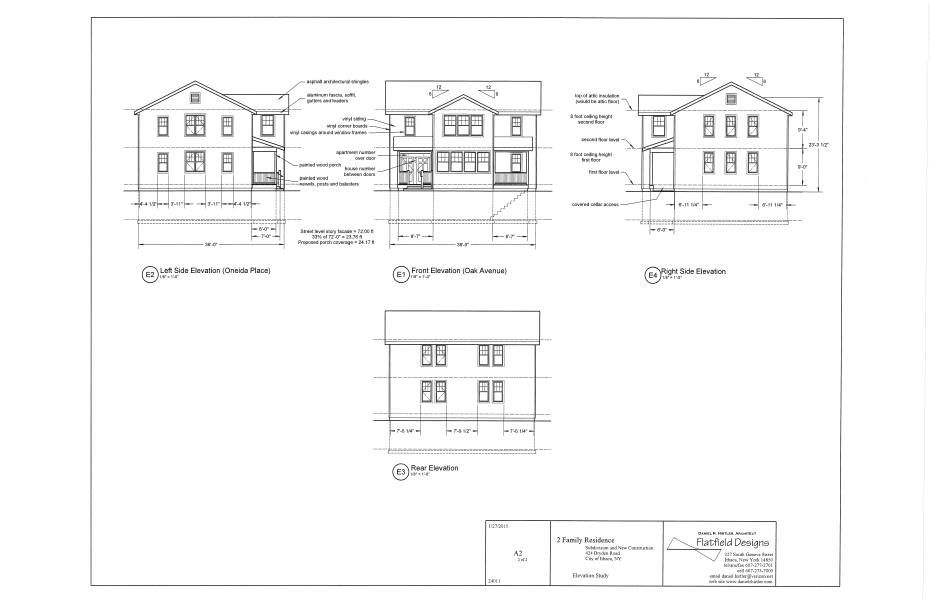
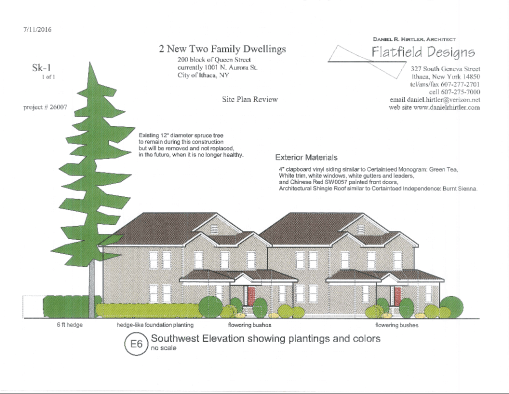
The other is a double lot at 1001 North Aurora Street in Fall Creek. This came up a couple of weeks ago in a weekly tidbits round-up, because the new owner, Stavros Stavropoulos, received a $400,000 loan to build a duplex. Turns out it’s actually two duplexes, which require a lot subdivision, and will trigger planning board review. The application notes that even with the density increase, it’s still less than the surrounding neighborhood. The two two-family homes with have 3 bedrooms and about 1200 SF per unit, and are designed by local architect Daniel R. Hirtler to fit in with the neighborhood. Unusually, the application includes documentation of the previous owner signing off on the redevelopment plan. Construction is estimated to run from this month through May 2017.
Comments : 2 Comments »
Tags: 201 college, 327 Eddy, airport, chain works district, City Centre, collegetown, downtown ithaca, fall creek, infill, ithaca, lansing, maguire project, news, NYS DOT site, south hill, Southside, waterfront
Categories : collegetown, construction (planned), general housing, ithaca, news, student housing, Tompkins County
The Government Campus
3 09 2016The idea of a government campus in Ithaca is very intriguing. It offers big opportunities, and potential pitfalls.
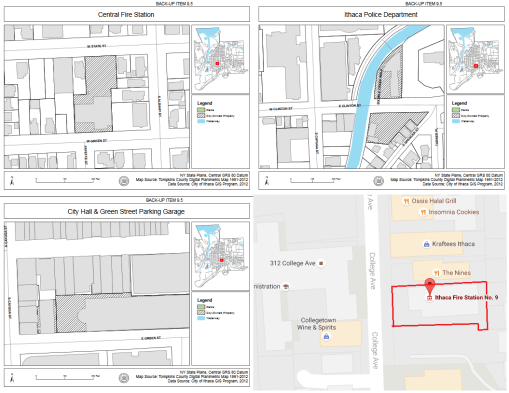
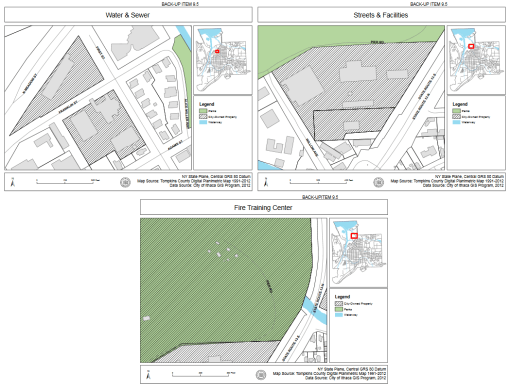
A copy of the funding request can be found here. The $150,000 study comprises two components – the first would combine the Collegetown Fire Station (No. 9), Central Fire Station at 310 W. Green Street, the Police Headquarters on E. Clinton and City Hall into one site on the property of the Central Fire Station. The second combines DPW Streets and Facilities and DPW Water and Sewer into one location.
Given the very profound impact this would have on the city, there’s been relatively little news about it. I cued my colleague Mike Smith in to it, and he did an interview with Planning Director JoAnn Cornish, which led to two articles. The spark notes are that the current condition of some of these properties is poor, so the city is looking at which to consolidate and/or build new, and which to renovate. The money is left over from the study looking into moving Station No. 9 and designing a replacement (apparently, it only cost $80,000 of the $500,000 allotted), so this is the planning department’s shout of carpe diem. The Common Council has given strong support to doing the consolidation study.
Let’s make it clear – there is no commitment anything will happen. Nothing may change at all, Station No. 9 may still move to Maple Avenue while everything else is left as is, or the consolidation plan might actually get carried out. But if they have the money and time, it’s worth exploring the possibilities.
Study one, the “government campus”, involves a space needs assessment for programming and staff, concept site plans, and cost estimates for new facilities. The study will also offer appraisals for existing buildings and discussion of selling these properties:
- City Hall and the adjacent parking lot to its east
- The Collegetown Fire Station
- The Police HQ, but not the Courts Building
- The Western 1/3rd of the Green Street Garage
Each has its opportunities. The western third of the Green Street Garage has some of Ithaca’s most accommodating zoning for urban projects – CBD-140, a 140-foot building with no parking requirement. When the garage was rebuilt several years ago, only the central section was structurally redone. The western section is nearing 50 years old, so without major renovation, it will be nearing the end of its safe useful life. The early plans for Cayuga Green called for a larger garage on Green Street, so another floor or two on the remaining two thirds is not impossible.
Meanwhile, Ithaca has never been particularly attached to its city hall – the building was built for NYSEG in 1939, and the city bought the building in 1964, demolishing its old city hall for the Seneca Street Garage not long after. In the mid 1980s, the city attempted to sell city hall so that it could be bought by a private owner and leased out to the county, all part of an effort to keep the Department of Social Services downtown – the city failed to persuade the county legislature, which moved DSS out to West Hill until the Human Services Building opened on the 300 block of West State in 1998. Demolition would face significant opposition, but conversion to housing could be a safe option for a hypothetical new owner.
The Collegetown Fire Station is prime real estate. It’s MU-2 zoning (six floors, no parking) in the heart of Collegetown at 309 College Avenue. Given that 201 College sold for $2.65 million, and 215 College sold for $5.3 million, there’s little doubt the city could fetch a multi-million price here. An RFP would have to be cognizant of the fact that the site itself is best-suited to student housing, because not only would its price be limited by other means, non-students may not be comfortable living in a location that’s 95+% students. There could be a provision for housing fund payments or off-site affordable housing at an appropriate location.
The city police station is a question mark. The zoning for the Police HQ and Courts building is B-1a, and the police parking lot is R-3b. R-3b is 4 floors, 40% lot coverage, a parking space for every unit or three bedrooms, whichever is greater. B-1a is nearly the same, but with 50% lot coverage, but the Courts Building could make selling a tough prospect.
Now comes the question of the Central Fire Station redevelopment, which occupies much of its site on West Green. A back-of-the-envelope for the police HQ, fire station No. 9 and City Hall is about 48,000 SF (assuming police uses make up half of the courts complex). The Central Fire Station occupies 17,000 SF. So you’re asking for a sizable multi-story building on top of what’s there, and not counting impacts like parking. The city would need to be careful, as South Side is one of the more affordable areas and the risk for displacement of low-income households is considerable. Any project would also have to go through ILPC consideration since it borders historic properties.
Study #2, the DPW consolidation, also offers opportunities. The study calls for a consolidation at a new location in Southwest Ithaca down by the box stores. It involves a space needs assessment for programming and staff, concept site plans, and cost estimates for new facilities. The city says it may also consider a shared facility with the town of Ithaca, or the county. In such a move, the city frees up space that it could sell on the North Side, and opportunities that could enhance redevelopment efforts on the Waterfront. The Northside area is also one of the new parts of the city where affordable housing is feasible and accommodated by neighbors, so mixed-uses with market-rate and affordable housing is plausible. The Pier Road area has high water tables which could drive up foundation (construction) costs, but Form Ithaca highlighted redevelopment potential at the site during their charettes.
Anyway, this is a lot of handwaving. Any work would be far, far off, probably well into the 2020s. A lot can happen between now and then – the economy tanks, priorities change, the sale of any property ends up a big debacle like the county’s Old Library redevelopment. It could make the city a lot of money in sale and taxes and help continue the downtown renaissance, or if done wrong it could end up being a burden that hurts taxpayers as well as lower-income households. But it’s certainly an interesting topic to explore.
Comments : 1 Comment »
Tags: city-regional planning, collegetown, downtown ithaca, northside, waterfront
Categories : collegetown, ithaca, urban planning
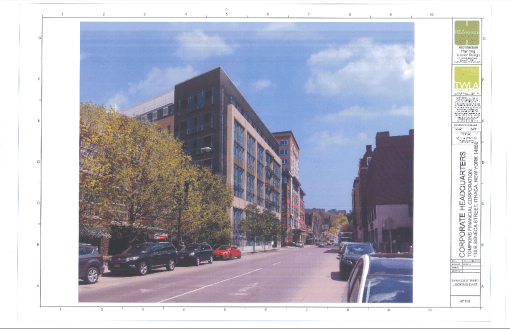
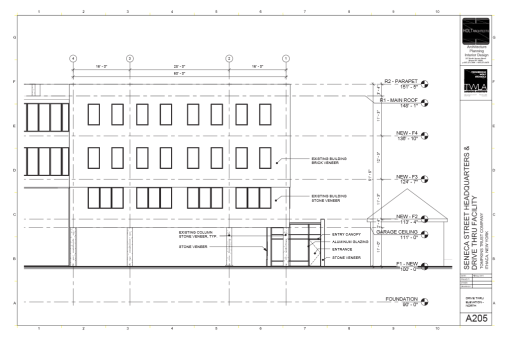
Tompkins Financial Corporation HQ Construction Update, 8/2016
31 08 2016Tompkins Financial Corporation’s decision to build in downtown Ithaca is seen as something of a major victory by civic groups and local leaders. For one, it’s a major economic investment, and for two, it’s taken by many as a sign that downtown Ithaca has “turned the corner”.
Tompkins Financial Corporation is the parent company of Tompkins Trust Bank, as well as some other financial units. The company can trace its roots back to Tompkins County Bank’s formation in 1836. Along with Tompkins, TFC also manages several smaller banks throughout New York and Pennsylvania, totaling 67 branches and about 1,100 employees. About 280 of those work in downtown Ithaca at the current headquarters.
Currently, the office space is decentralized, scattered throughout multiple downtown sites and one suburban site, some of which are owned and others of which are rented. The bank began studies several years ago to examine a new headquarters, and looked at an urban location downtown, and a suburban location. Throughout the last 50 years, most large private companies have opted for the latter, and not without good reason. The logistics are simpler, the land is cheaper, the parking is easier – a study commissioned by TFC showed they could have saved over three million dollars by choosing a suburban site. But, as downtowns like Ithaca’s have made a resurgence in popularity, and given the bank’s long-time presence in downtown, they decided to pursue the urban option.
The new headquarters, first proposed in March 2015, will keep 282 employees in downtown (making an average annual wage of about $81k), add 18 more from the consolidation of the Craft Road office in Lansing, and potentially add a number of new jobs as the bank continues to grow. The IDA application gives 6 new positions over 3 years, all well over living wage; paperwork submitted to the city says 77 jobs over ten years. The project applied for and received a ten-year tax abatement from the Tompkins County IDA, saving about $4.06 million in property taxes and $2.112 million in one-time sales taxes. The community hearing was generally supportive for an abatement, and even with the reduced short-term tax bill, a net positive of $3.78 million will still be paid in taxes over the next decade.
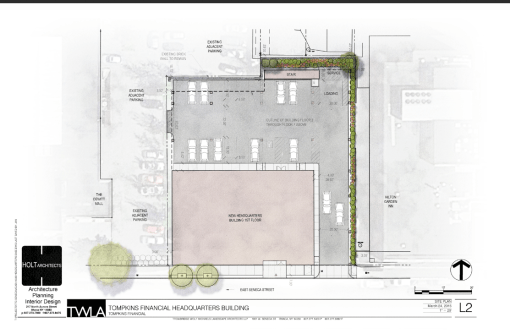
Now, a little about the site and the building. The project is really two separate projects, one much smaller than the other. The first, at 119 E. Seneca, will build a 965 SF drive-thru bank branch on what is current first floor parking underneath a 1970s office building owned by TFC. The surface lot will be reconfigured to support the drive-thru functions, and retain a small amount of parking space.
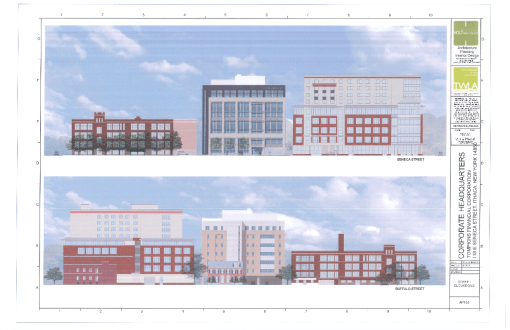
Across the street is where the real meat of the project is. Construction is currently underway on a 7-story, 110,000 SF commercial building at 118 East Seneca, with customer services and 20-25 parking spaces on the first floor and office space on floors 2-7, which will have larger floor-plates that will overhang over the first floor. The first through third floor offices will be geared towards consumer retail operations, and the top four floors will house general operations and senior leadership. The building will be 100 feet tall, just like the 10-story Marriott finishing up a few blocks away. Modern office buildings usually have 14′ floor-to-ceiling heights due to the size of heavy-duty commercial utility systems, better visibility and natural light penetration, and to provide ample accommodation for tenants’ computer equipment. A bit of a prestige factor also comes into play. Materials include a granite base, stone veneer on the front, light and dark brick veneer, and aluminum panels on the top floor’s sides and rear walls. TFC’s HQ will be built to LEED standards, but the company will not be seeking LEED certification due to the costs involved.
The new headquarters replaces a parking lot and drive-thru bank branch built in 1990, and prior to that the site was home to the two-story Temple Theater, which despite described as “cramped”, “shabby” and “grungy”, brought to Ithaca the first showings of “The Godfather” and other big-budget films of the early 1970s. The Temple Theater operated from 1928 to 1976, when it closed not long after the mall opened in Lansing. The building was razed not long afterward.
Estimated costs have bounced around a little bit – initially reported as $26.5 million, they were up to $28 million by the time of the IDA application, and $31.3 million at the time of groundbreaking. The March sketch plan called for final approvals by June 2015, but they didn’t happen until December 2015. Not entirely the city’s fault, the timeline was very ambitious.
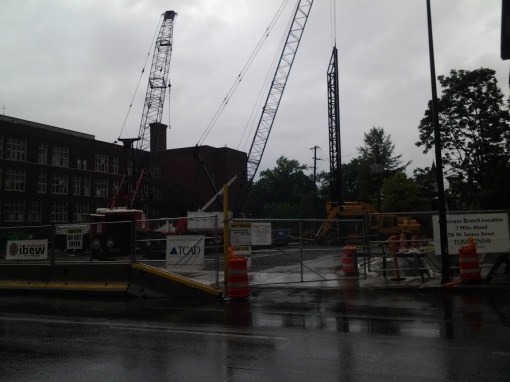
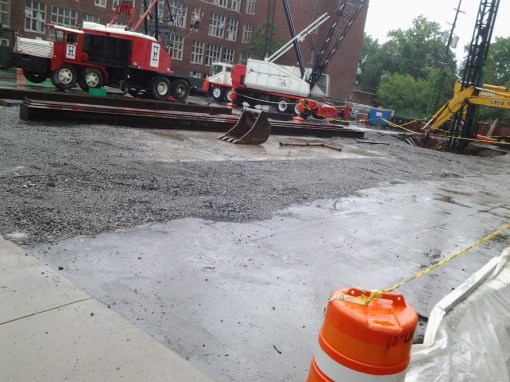
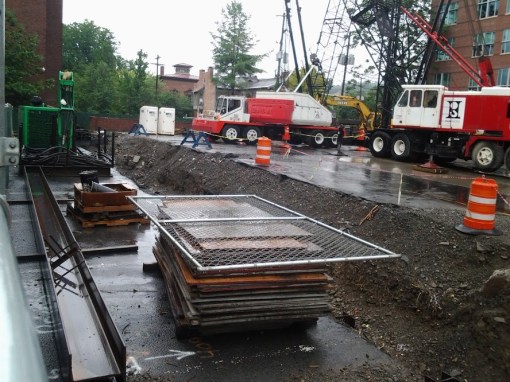
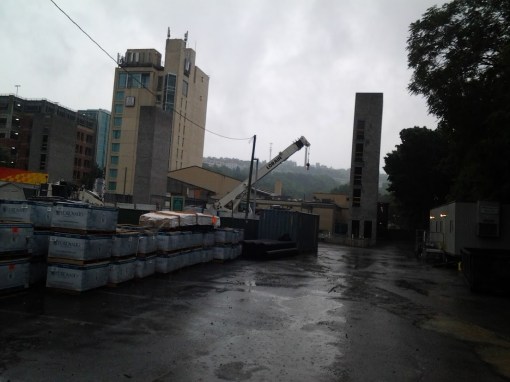
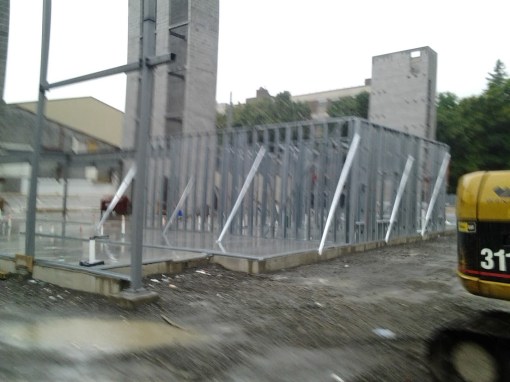
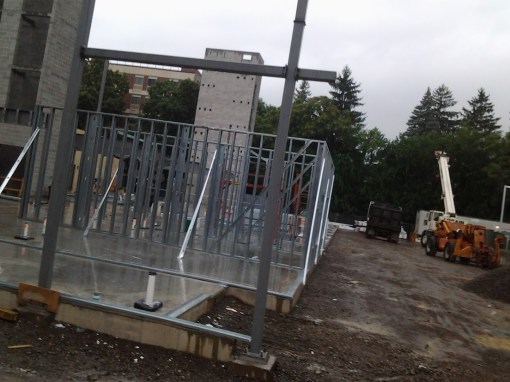
The site has been partially cleared and the existing drive-thru branch has been demolished. Currently, the project is undergoing foundation excavation and pile-driving. You can see the trenches being dug along the perimeter, and wood lagging and steel H beams have been laid along the outer edges to provide stability to the soil and buildings of adjacent properties. According to the report from Elwyn & Palmer, the project team will dig down about 12-13 feet for the sub-floor, thenceforth pile driving shall commence, 65-70 feet down. It’s anticipated the sandy soils will make the pile-driving move along faster, but the other buildings nearby will necessitate temporary support installations during the excavation process. Ithaca firms HOLT Architects and Trowbridge Wolf Michaels Landscape Architects are responsible for the design of the project, and Rochester’s LeChase Construction is the general contractor.
When TFC’s new headquarters opens in March 2018, expect something of a glut in the local office market as a lot of space is emptied in a short time. TFC CEO Grag Hartz has said that 119 and 121 East Seneca would be held onto and rented out, with the bank retaking space in those buildings as it needs. However, their office and bank on the Commons (the historic 2 and 3-story buildings on Bank Alley just south of the M&T Building) would be sold. The project is indirectly spurring Bank Tower’s conversion to apartments, given the tepid office market but very hot residential market downtown. Token teaser if you’ve read this far – a second conversion project is in the early stages.
Comments : 3 Comments »
Tags: commercial office buildings, construction, construction (planned), downtown ithaca, ithaca, photos, tcida, tompkins financial corporation hq
Categories : construction, construction (planned), ithaca, photos
Hotel Ithaca Construction Update, 8/2016
30 08 2016In case you missed it, I did an interview with owner/developer David Hart of Hart Hotels, which can be found on the Voice here. Here’s some of the material that didn’t make the final cut.
Q: So, let’s start with a little about you. Hart Hotels is family operation, yes?
DH: My dad was the founder of our company, my sisters and I have followed him as principals. But we have non-family members who have been with us for a long time that have been a driving force. This is our 30th year in business.
Q: This is actually the second phase, right? There was a modernization and renovation already completed in the lobby and hotel area, if my notes are right.
DH: The 61 rooms in the hotel tower, we renovated down to the studs. The main building above the lobby has another 19 rooms, original 1970s guestrooms, we renovated to the studs as well, a little over a year ago. Now we’re into phase 2, which is new construction, and some more renovations.
Q: I believe plans filed with this plan have a third phase, right? One that considers the possibility of a three-story hotel addition on the wing going up now, and a conference center?
DH: Nothing planned or approved right now.
Q: Further on that topic, some folks have expressed concerns that [the hotel boom] is not economically sustainable. A sort of fear of a hotel bust to follow the hotel boom. What would you say to address those concerns?
DH: One of the things that we’re lacking is a large format meeting space, a type of conference center. It’s unusual for a city the size of Ithaca to not have its own meeting space, so part of our overall market preference is inhibited by not having that space. On the other hand, it’s not uncommon for demand to outstrip supply on many weekends in Tompkins County or downtown Ithaca, so I don’t see the problem of oversupply on most Fridays and Saturdays throughout the year. So Sunday-Thursday business is where the boat needs to be lifted a little bit, especially with all the new rooms. Our meeting space will help that a little bit.
Q: As a major hotel operator, what would you say are the biggest advantages to being in Ithaca and specifically, downtown Ithaca, and what are the biggest challenges? What opportunities do you see over the next years? Where do see the Hotel Ithaca, in say, five years from now?
DH: Some of the hurdles are the seasonality, the winter vs. summer. The Finger Lakes are a popular destination, but the seasonality is harsher when the schools are out of session, we’re reliant on the interest the schools and colleges generate. Cornell and Ithaca College bring a lot of business to us. Sports, scholastic events, meetings, they drive a lot of demand from the routine list of activities in the school calendar. This is a strong region for hospitality, we’ve been in the Ithaca area for a while, the region continues to grow in popularity with the wineries, the cheesemakers, the distillers and craft beer-makers, those are all part of the things we have to sell and market and promote. And lake activity and recreation is also a part of our overall marketing and selling of the region. That translates to hotel room demand.
…In terms of expansions, sites in downtown are hard to come by and expensive, so I don’t know how much more new supply there will be downtown. If you look at 13, there have been new hotels, they’re fringe, limited-service, so we might see some growth out there, but there are a fair number of rooms and brands there so I don’t know how much more they can grow….
We want to be ready for graduation, have the building closed up by winter. The frame is being assembled offsite.
Comments : Leave a Comment »
Tags: construction, construction (planned), downtown ithaca, hotel ithaca, hotels, interviews
Categories : construction, construction (planned), hotels, interviews, ithaca
News Tidbits 8/27/16: A Week of Questions
28 08 20161. Let’s start off with a planning board recap. The subdivision at 123-125 Eddy Street was reviewed. My Voice colleague Mike Smith called any proposal for that part of Eddy “masochist“, and the Journal’s Nick Reynolds had some fun with it as well. Councilman Graham Kerslick paid a visit on behalf of Orchard Place, both as a resident and as spearhead for the wealthy, owner-occupied enclave’s opposition to the two-unit house due to parking and concerns about renters. There’s virtually no process to stop lot subdivisions, since those do not have physical impacts. If the lot meets legal specs, the board is obligated to pass it. They can, however, request a site plan review for the house.
201 College’s discussion was interesting. It takes some moxy to say “Historically, Collegetown has always been a dump,” but the comment isn’t without merit. The neighborhood has effectively functioned as Cornell’s housing annex since the first boarding houses were built in the late 1800s, and owner-occupancy, never a strong presence to begin with, steadily disappeared after World War II. Many of the structures venerated now were seen as cheap and ugly in their early days. The argument provided by Fox was that historic character should be defined by the social fabric of the neighborhood, not by physical appearance. Collegetown has always been primarily a student neighborhood, and he feels his project offers a high-quality addition to maintain that student-centric social fabric. He even called out Neil Golder, the project’s primary opponent and a former student renter who eventually bought his house: “The only thing that’s out-of-character in the neighborhood is Neil’s house and demographically, Neil.”
What followed was essentially a debate on legal issues, which occasionally became heated. In the end, the board agreed to draft a zoning appeal, so now it’s onto consideration of final site plan approval, which hinges on Board of Zoning Appeal interpretation on whether or not the building is in compliance with the zoning code. In other words, on 9/6, the project team is basically going to ask, “hey does everything meet the code,” the BZA says “yes/no”, and if yes, final site plan approval is granted. Very convoluted.
On a happier note, Harold’s Square’s changes were approved, and developer David Lubin announced that with that in hand, he has the funding secured to begin construction this fall. There had been been some debate about the architecture beforehand, which threatened to derail the plans, but the issues were ironed out.
2. The Ithaca Urban Renewal Agency will be reviewing an application for a new microbrewery in the city’s West End neighborhood. Liquid State Brewing Company would be located in 5,000 SF of leased, renovated space in the Cornell Laundry Building at 521 West State Street. The brewery would initially focus on hoppy ales with a local distribution to stores and restaurants. There will be a taproom, outdoor patio, food truck events and a small amount of merchandise for sale.
Proposed by former Ithaca Beer brewer Ben Brotman and Jamey Tielens of Trumansburg, the project would create 2.5 jobs, over or just about living wage. The written paperwork includes the two brewers and a cellar specialist, for 5.5 jobs. If approved, the brewery would open in early 2017.
Liquid State is looking for a $70,000 loan towards their $620,000 project. For the record, there will be no link provided to the application because it contains sensitive tax and financial information about the applicants. The IURA tends to be a bit dicey about things with alcohol involved, but the locally-made aspect will help sell the project to the committee.
3. Also on the IURA Agenda, the Restore NY grants. As written about in the Voice back in July, there were ten suggestions for nine projects. Four were dropped – Josh Cope’s hostel proposal, INHS’s Elm Street project, Novarr’s project, and the renovation of 224 West Spencer. 310 West State, 121 West State and 139 East State Street (part of Harold’s Square) were bundled into one grant application called the “State Street Historic Buildings Rehabilitation”, requesting $500,000 for $3.7 million in projects. The other application, for 109 North Corn Street (Wyllie’s, above) and 413-415 W. Seneca, are part of the “Seneca/Corn Street Buildings Rehabilitation”, $500,000 for $875,000 in projects. At a glance, the State Street plans look to have a pretty strong application, but we’ll see what the state thinks after they’re submitted this fall.
4. Here are the 15 or so pages of comments received on the Chain Works District DEIS. Some are really good questions or comments, some aren’t, some conflict with each other – it’s the nature of the beast. The Planning Board’s Special Meeting on Tuesday is mostly just to review comment summaries, and several more meetings will be scheduled through September and October.
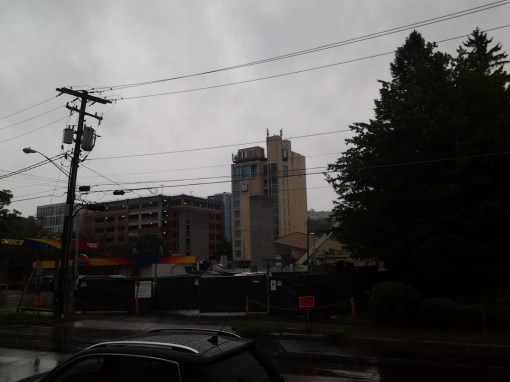
5. So I had the unpleasant task of breaking the news this week of the largest single layoff or facility closure in Tompkins County in seven years. The loss of 185 well-paying jobs is not something to take lightly, even if this area is in general faring well economically. Even worse, the Journal is reporting that TCAD never even saw it coming, they were blindsided. At least with Emerson in 2009, the writing has been on the wall for several years, especially after they transferred their senior corporate jobs to Kentucky in 2007. Here, everyone’s just been blown back. Mettler Toledo Hi-Speed paid over $100k in taxes annually, and was a big supporter of the local United Way chapter, so it has a lot of negative impacts spread out on Dryden and the county. Not a good week.
If anything, this is a sobering reminder that economic development is multi-pronged – attracting new business with new job opportunities is the obvious part, but maintaining an environment that nurtures and supports the existing workforce is just as important.
6. Giving credit where credit is due, the Journal’s Nick Reynolds did a nice write-up on the Carey Building overbuild on the 300 Block of East State Street. The article ends with a not-so-subtle teaser that Travis Hyde Properties might be bringing forward a residential proposal for the Ithaca Gun site some time next Spring, something that has been in the making in one form or another for a decade-plus (they’ve held off in the past couple of years because the city had to finish cleaning up adjacent soils).
One note of discomfort is that the article refers to the Ithaca Gun site as “its next project”. What is that saying about the Old County Library site?
7. Nothing too exciting in real estate sales this week. “SCF Realty Capital LLC” paid $6.6 million to Drake Petroleum for three gas stations – $1 million for the Sunoco on W. Main in Dryden village, $1.9 million for the Xtra Mart on Dryden Road, and $3.6 million for the recently-renovated Xtra Mart on Route 34B near the Lansing town offices. County tax assessors had them valued at $2.35 million collectively. I’m not familiar with the sales dynamics of convenience stores/gas stations, but that’s an impressive differential.
SCF stands for “Stonebriar Commercial Finance”, a company that specializes in middle-market commercial real estate finance over a wide spectrum of industries, with sale-leaseback options for clients. A copy of the deeds were sent to the corporate offices of Mirabito Energy, and a check online indicates Mirabito is buying 31 gas stations in three states, part of a corporate divestiture of locations by Drake’s parent company, Global Partners. So, the Xtra Marts are becoming Mirabitos.
Speaking of gas stations, land for sale at the Rte 13/Rte 34 split in Newfield sold this week to an LLC representing the Marshall Companies, a Weedsport company that runs Pyrus Energy and the Pit Stop Convenience Store chain.
Comments : 3 Comments »
Tags: 201 college, 201 college avenue, carey building, chain works district, collegetown, downtown ithaca, economy, harold's square, ithaca, IURA, layoffs, west end
Categories : construction (planned), general housing, ithaca, Tompkins County
Ithaca Marriott Construction Update, 8/2016
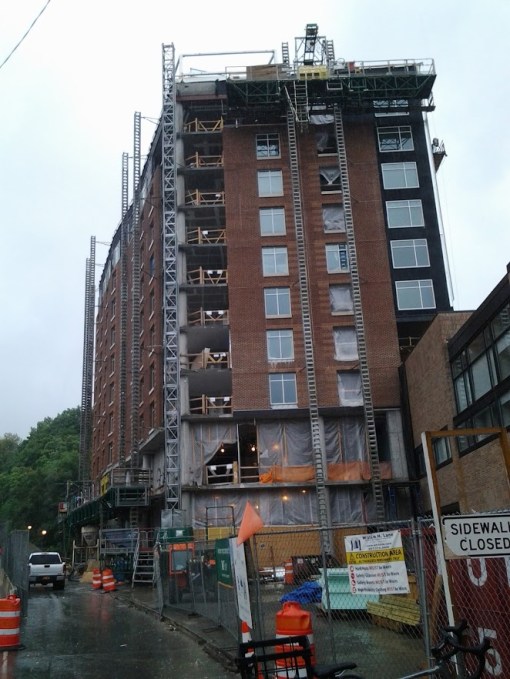
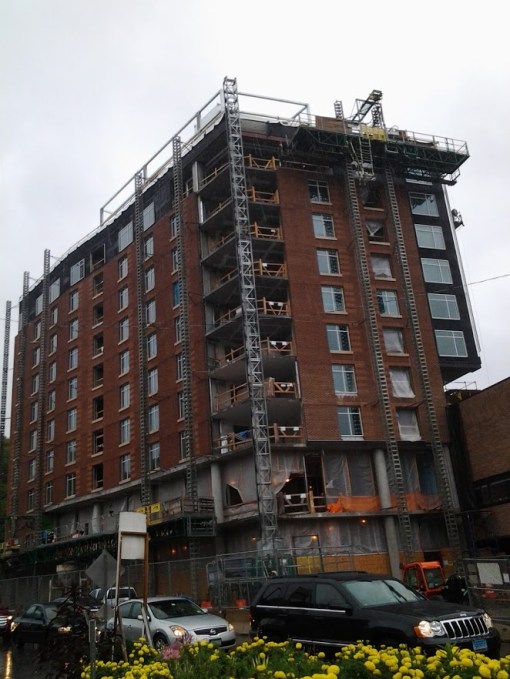
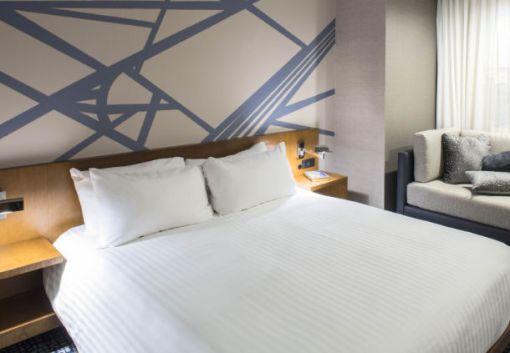
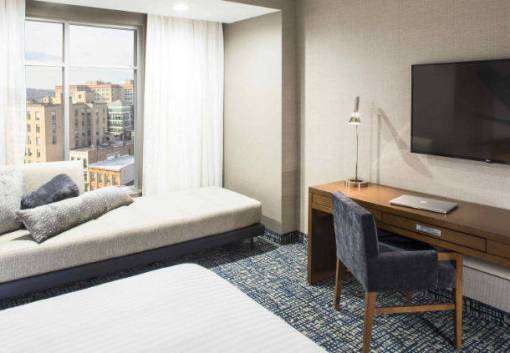
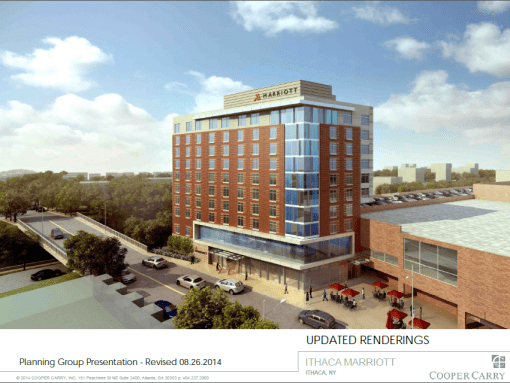
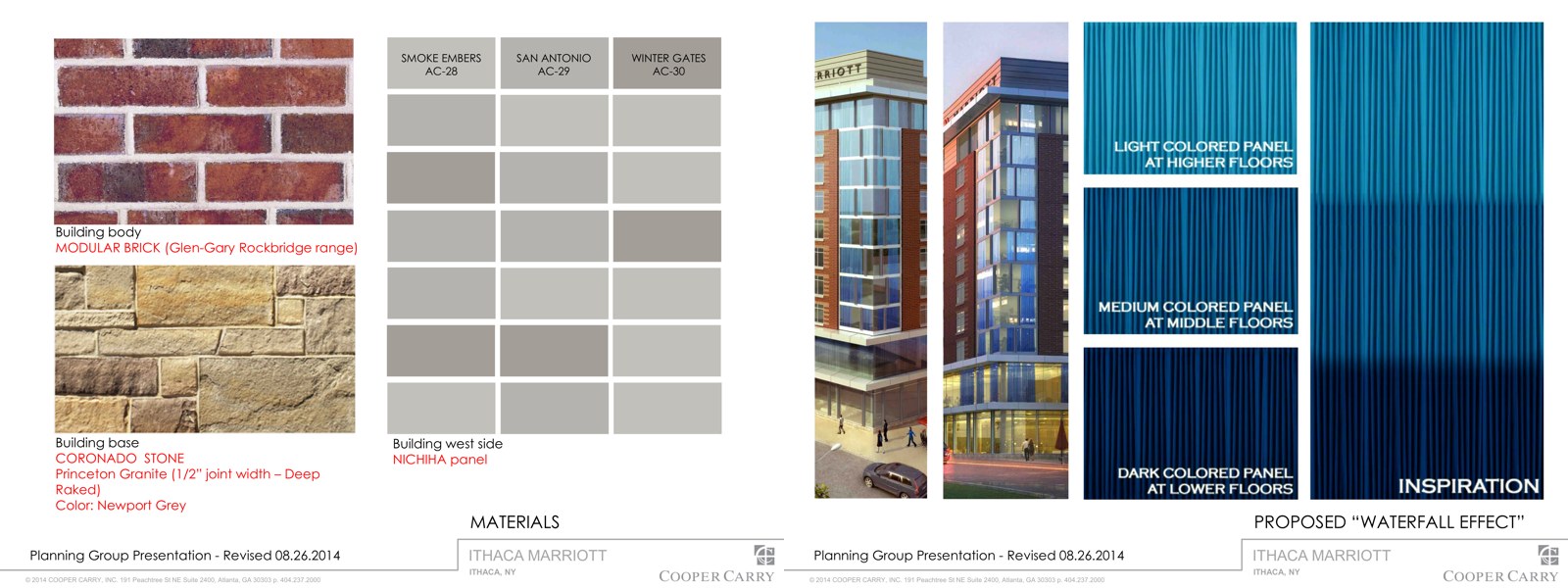
27 08 2016If all had happened to plan, the hotel would have opened this past Tuesday. Unfortunately, things did not work out as planned, as it often happens with large construction projects. Marriott’s website gives an October 2016 opening. A few simulations of the room interiors are included below. If I remember right, a while back someone told me that the rooms are a little smaller than Marriott’s standard (which looks to be true – the king-sized rooms are 300 SF, and comparables that I’m finding at other Marriotts are 360 SF), so the interiors were designed to be more plush and higher-quality to compensate. Among the amenities include 49″ TVs, Wi-Fi, mini-fridges, a business center, a fitness center, an “M Club Lounge“, laundry service, complimentary coffee/tea, down comforters, and a bunch of other things that are staples of premium hotels. The in-house restaurant will be called “Monks on the Commons”, and serve American comfort food, breakfast, lunch and dinner. Kinda interesting to see which local restaurants they chose to highlight on their website.
Of the 159 rooms (finally, a confirmation it’s not 160!), 8 will be suites, and the hotel’s 3 meeting rooms total just under 2,500 SF. I tried to set up a reservation to see the prices, but the website wasn’t allowing bookings. The “largest event space” can hold 198 guests, along with the ridiculously cheesy line of “Reserve our wedding venue in Ithaca, NY and say ‘I do’ in a ceremony as unique as your love. ”
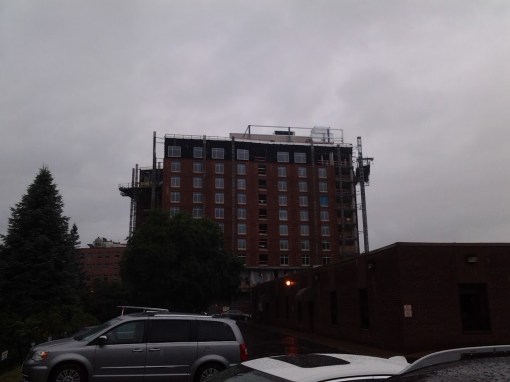
So, those are to-be’s, now to the what-are’s. On the outside rear, the Nichiha metal panels are being attached to the waterproofed sheathing. The brick is done, but the stone veneer on the lower floors has yet to be applied. You can get an idea of the interior work underway by peering through the suite rooms, which face the Commons and State Street; notice the work on the ceilings progressing as one works their way down from the top floors.
Comments : 1 Comment »
Tags: construction, downtown ithaca, hotels, ithaca, ithaca marriott, Marriott, photos
Categories : hotels, ithaca
409 College Avenue (Student Agencies eHub) Construction Update, 8/2016
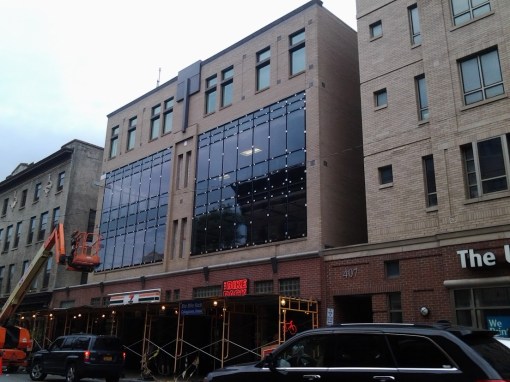
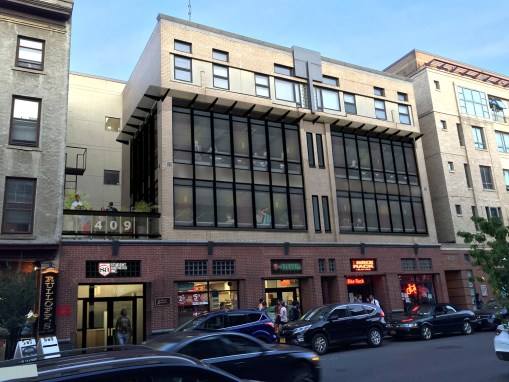
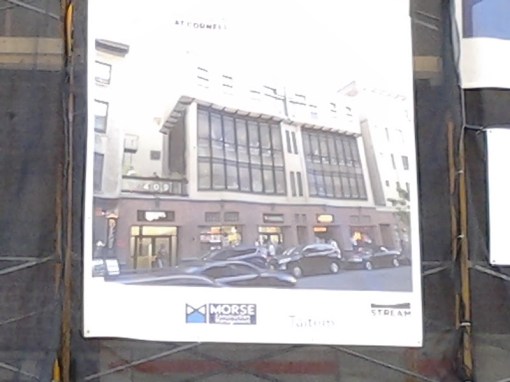
26 08 2016The Student Agencies Building at 409 College Avenue has received its new glass curtain wall. The glazing seems to have just arrived judging from the brackets. New windows have yet to be installed in the center column, and there’s still other work on the exterior to-do list, such as the etched glass railing for the second-floor balcony, the brise soleil, and minor trim work.
Note that the top (fourth) floor appears to have also been redone. This was not in any of the renders, although the Planning Board’s Design Review panel probably had to sign off on it. It’s likely that this is one of the reasons why the renovation work has gone on longer than anticipated.
STREAM Collaborative is the architect, and on their website are some interior renders of the new eHub co-working space. A couple shots are embedded below, but more can be found on STREAM’s website here. Morse Construction Management is the general contractor.
EDIT: I asked STREAM’s Noah Demarest if the fourth floor was a last minute change. “Yes. Last minute change due to the facade being in far worse condition than we thought. It is completely rebuilt. We have technical drawings we submitted to staff but never updated the renders.”
Comments : Leave a Comment »
Tags: collegetown, construction, eHub, ithaca, photos
Categories : collegetown, construction, ithaca, photos