News Tidbits 10/17/15: Pressing the Issue

17 10 2015

amabel_v4_1

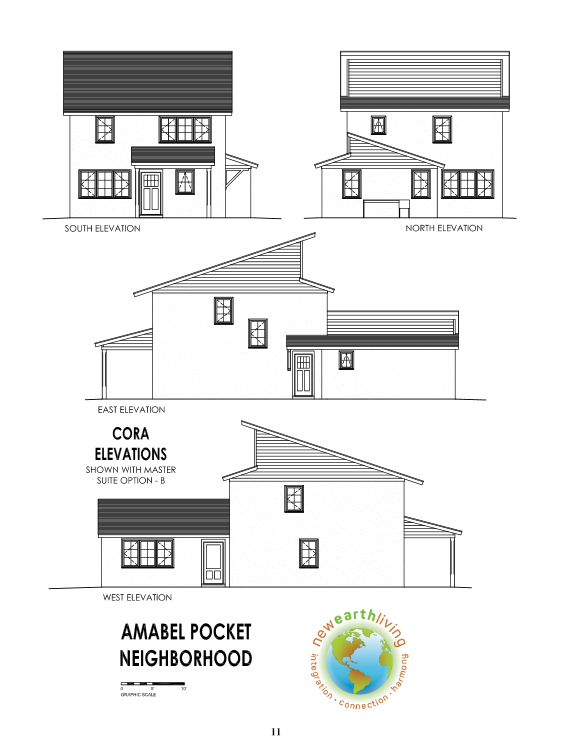
1. It looks like the Amabel housing development has another site plan. New pedestrian paths, a relocated community garden, and some substantial tweaks to the layout of the house, including a small access road for three homes near the southern termination of the loop road with Five Mile Drive (older plans here).

Marketing for the project hasn’t officially started, but New Earth Living LLC’s (Susan Cosentini’s) website does have interior renders for one of the proposed house styles, as well as an informational PDF. Plans call for Net-Zero energy efficiency homes, meaning that the amount of energy generated on site will power all the project’s energy needs. Example homes included in the PDF range from 1,184 SF to 2,083 SF – it looks like there will be four home models with alternate configuration options. Prices have yet to be announced.
amabel_v4_2

The Amabel project, proposed for 619 Five Mile Drive just southwest of the city of Ithaca’s boundary line, has been in the works for the past couple of years, a sort of grand follow-up to New Earth Living’s Aurora Street Pocket Neighborhood in Fall Creek. The project will have about 30 single-family homes at full build-out.

I know some of the more pessimistic readers here may call this suburban sprawl with a green sheen, but it’s a lot better than a cul-de-sac.

20151011_130755

2. The village of Lansing sent off their updated Comprehensive Plan to the county planning department this week for review and approval. Now, planning should be the village’s forte, since the village of Lansing was founded in the 1970s as a backlash against the construction of commercial and residential properties along Triphammer and Route 13, including what’s now The Shops at Ithaca Mall. The plan was last updated in 2005, and draft of the new plan can be found here.

The village seems to note with some distress that although population growth has slowed, traffic has continued to increase (due in large part to significant growth in Lansing town; many town residents pass through the village to get to employment centers in Ithaca). North Triphammer Road has already been widened, but there are concerns about the ability of infrastructure to handle further traffic increases. The village also notes a strong rise in the 55+ population, as well as the same affordable housing issues that plague Ithaca and much of the county; in Lansing’s case, the median household income can afford a $171,000 home by their estimate (2.5 x $54,721 = $136,800 qualifying mortgage, + 20% down-payment), but the average house in Lansing costs $258,000 (affordable to a household making ~$82,500; note all the numbers are 2010 values). The plan also shows that fair market rent in Lansing increased 64.1% from 2005-2015, meaning that unless a renter had an annual wage increase of 5.8%, they paid more of their income towards housing year after year.  29.4% of homeowners and 39.1% of renters pay above the HUD’s 30% of total income threshold for affordability. The village is concerned it will price aged residents right out of their homes.

In an effort to combat the growing problem, the village wants to focus new housing along main thoroughfares with easy bus access and bike infrastructure, and is aiming for smaller homes and apartments geared towards aging-in-place and senior communities. The village notes that 500 to 600 units of housing could potentially be developed over the next few decades (note Lansing averages ~10 units per year), mostly on the large, low-density home lots near the lake. These would almost certainly be geared towards the highest income brackets, but the benefit of greater supply might relieve pressure on other homes.

On the business end, the village would also like to encourage Cornell to relocate back-office and research operations to village sites. There’s also a push for senior-oriented businesses and a possible rethinking of the malls, not an uncommon thought in this age where malls are struggling and dying off.

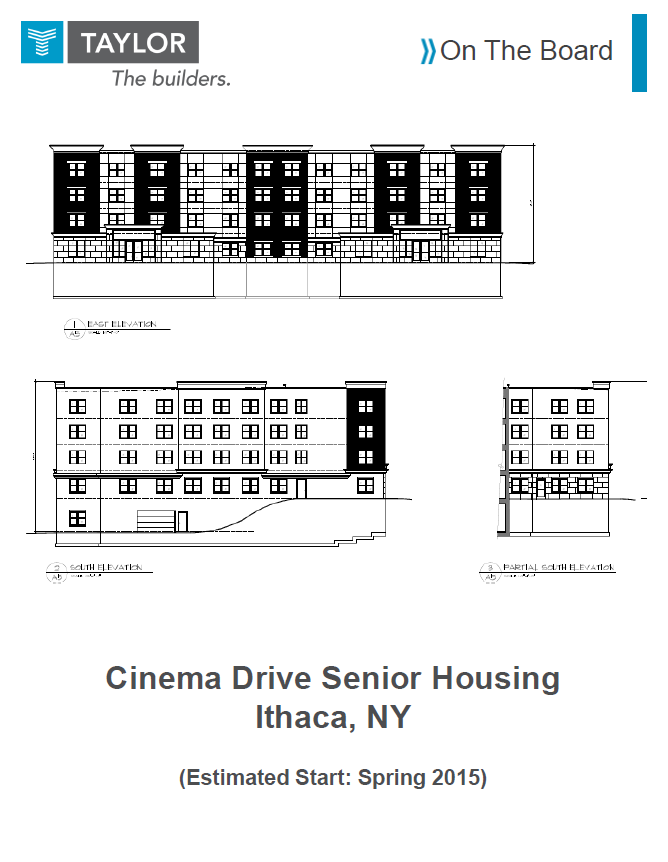
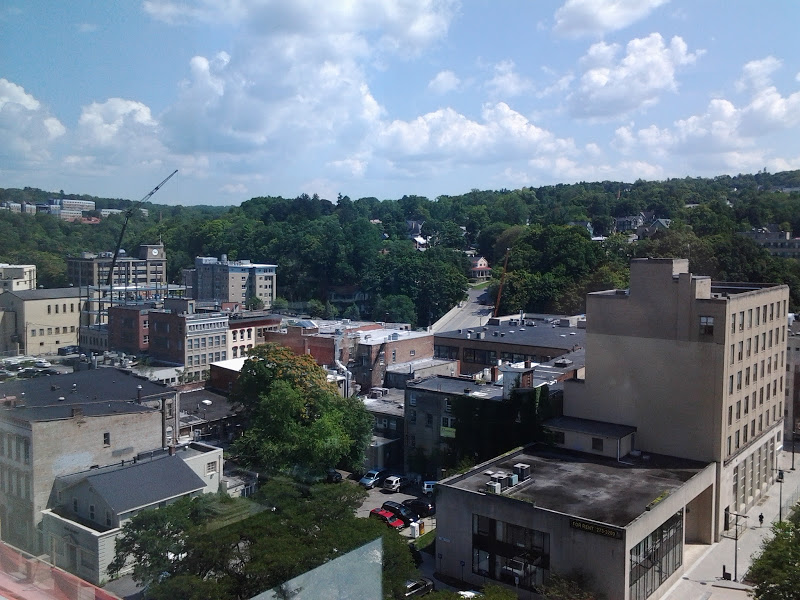
There are arguably two senior developments planned that already fit their “want” category – the 12 senior units planned for the Lansing Meadows PDA (the ones planned next to BJ’s on Oakcrest Road), and 62 senior units for the CU Suites site on Cinema Drive (photo from last week above). Other residential growth will be fairly “organic”, with new homes built at the whim of owners and mom-and-pop builders. A new commercial medium-traffic zone along Hickory Hollow Drive might open some more business opportunities; as for Cornell, they seem to be more focused on their East Hill Village plans, but research park tenants are always a possibility.

The village plans to update its comprehensive plan again by 2025.
402_s_cayuga_st_rev2_1

3. On the topic of plans, here’s a progress report just released by the Ithaca Urban Renewal Agency regarding its five-year plan.

If you wanted another reason why housing in Ithaca is so expensive, the plan alludes to it here:

“A spike in local construction costs has delayed the start of construction on a planned four-unit first-time homebuyer project and a public facilities project that will improve a public recreational area. We anticipate these projects moving forward once they have been able to close their funding gaps.”

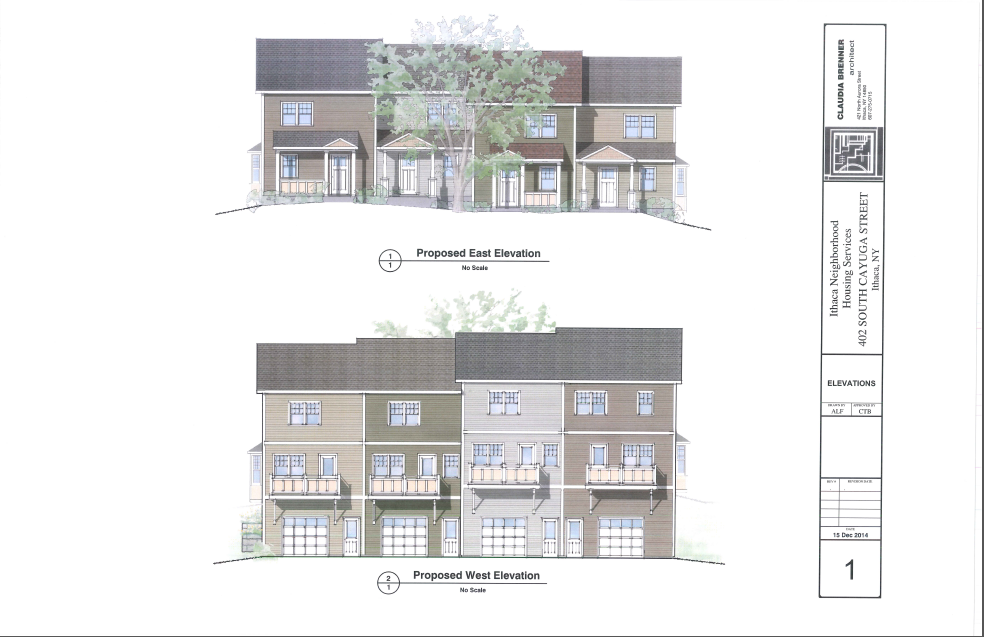
The four-unit homebuyer project is the townhouse project planned by INHS for 402 South Cayuga Street (shown above). INHS director Paul Mazzarella said the project was due to receive bids last month, and if they were within INHS’s budget, it would start construction. It hasn’t started.

Ithaca’s a small labor pool, so you either truck in labor from elsewhere and incur the wrath of construction unions, or you go local and pay a premium. But even then, with the relative burst in activity as of late, the local pool is getting tapped out and that’s driving prices up. Non-profits like INHS don’t have a lot of wiggle room in their budgets, and city government just won’t build if they can’t get affordable bids for infrastructure work. It also impacts programs that provide low-cost home repairs to those with low and fixed-incomes, because those low-cost repairs are no longer low-cost, and fewer people are able to be served.

One could one look at this as either a reason to limit approvals (which the construction trade unions are opposed to) or introducing more out-of-town labor to the market (which the trade unions are also opposed to). Stuck between two metaphorical rocks.

So long story short, in a region where the cost of housing is climbing dangerously fast, the city has a lot of work left to do meeting its affordability goals, with many actions/programs falling well short of annual numbers needed to meet the 5-year goal statistics. Hopefully some progress will be made in the upcoming year.
state_st_triangle_v5_1

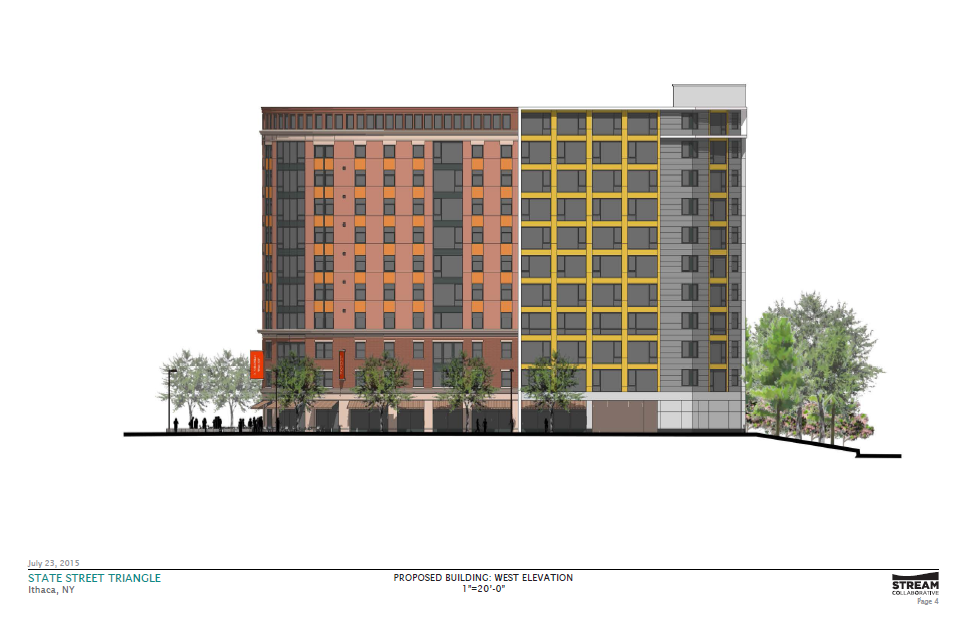
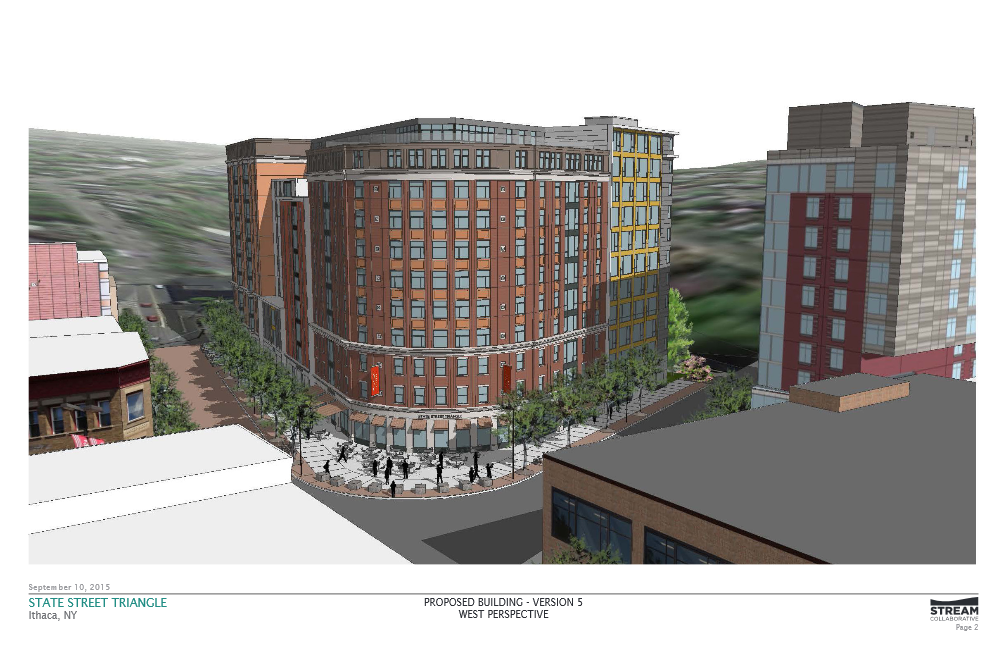
4. The mayor has dealt State Street Triangle a serious blow by announcing his opposition to the State Street Triangle, first reported on his facebook page and picked up by every news outlet in town, Svante Myrick cited the student housing focus and massing concerns for his opposition (he explicitly stated the height, 11 stories and 116 feet, was appropriate for its location, the 300 block of East State Street in the heart of downtown Ithaca). This is a big setback because apart from his social influence, the mayor sits on the county IDA, which is the governing body that votes on tax abatements.

A couple of the outlets have reached out to Campus Advantage, which is busy trying to formulate a response. They’ve hired a PR firm for whenever they’re ready. It could be the end of the project, it could still go on, it could be drastically altered. The chips have been tossed into the air, let them fall where they may.

20151011_121733 20151011_121800

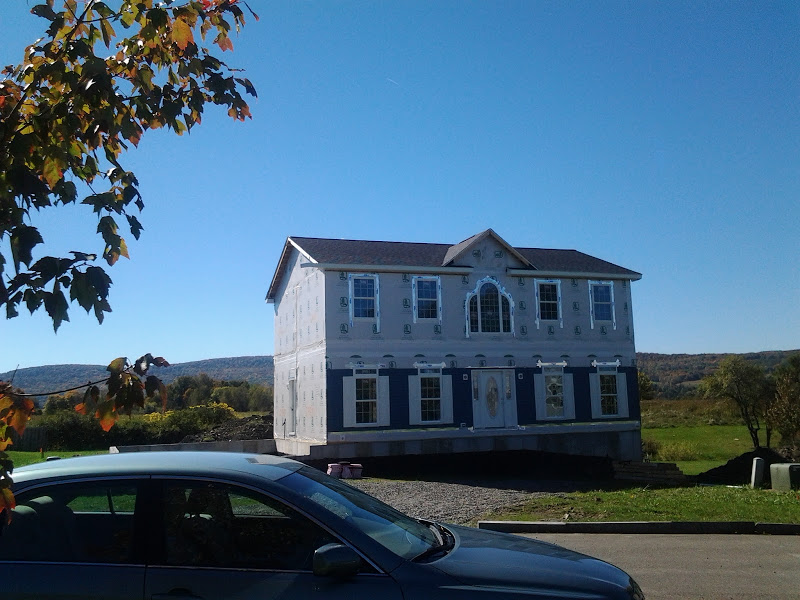
5. House of the week. This week, a trip out to Maple Ridge in Dryden. Maple Ridge is a housing development within the village that had the unfortunate luck of launching right before the Great Recession. After struggling, it’s been picking up in the past couple of years with five houses built since 2013. This modular home is the “Cayuga Lake” model offered by American Homes in Dryden. The pieces have been assembled and fastened together on top of the poured foundation, and some finish work has started. The uncapped foundation section is most likely a future garage. Modular homes tend to move through construction pretty quick, and this one will likely be finished in time for the holidays.

waterfront_rfp

6. The county and city hosted a meeting discussing possible waterfront re-development plans for the NYS DOT site on Thursday night. Three plans were presented, two mixed-use commercial and residential, and a third that the Journal describes as just being “hotel”, but given the 7.66 acres on site, is probably mixed-use with a hotel component.

The third option is a little bit of a throwback because the city long-saw the waterfront as prime for a hotel. But the market has shifted towards downtown and Route 13, and with the market adding new hotels at a pretty good clip over the next few years (Marriott, Canopy, Holiday Inn Express), a hotel in that area is pretty unlikely. Local lawyer/developer Steve Flash proposed a five-story hotel on Inlet Island in 2007, but in the days before the waterfront zoning allowed five floors, the project was opposed and shelved.

An initial cost of the move is being pegged at $14 million, but it isn’t clear if a potential buyer would pay that directly, or the county/city, who then get reimbursed by a buyer. $14 million is quite an amount, but given the site’s potential, it’s feasible (but don’t expect any outside-the-box thinking; a developer will want to minimize risk since they have to make such a huge initial investment).

If anything is clear, it’s that, contrary to the opinion of at least one speaker at the meeting, most folks would like the snow plows and road salt stored somewhere else.
20150727_145000

6. I don’t comment on politics. I don’t comment on candidates. But I will comment on issues. And, probably no surprise to readers here, I find it worrisome when anti-development candidates come forward.

By and large, development in Ithaca isn’t happening “for the sake of development” like in the 1990s, when the local economy was mired in recession. It’s happening because the Ithaca area has added 6,000 jobs in ten years, mostly in healthcare and education. Cayuga Medical Center has added over 500 positions in 10 years, and while Cornell’s direct employment hasn’t changed much, the university has added nearly 2,500 students. That has created demand for thousands of units, but when combined with the slow pace of development within the county over the past decade, the result has been a critical housing deficit.

This is one of the major reasons behind the current affordable housing crisis – high demand, plus insufficient increases in supply, have resulted in very low vacancy rates and have made it a seller’s paradise when it comes to housing.

If you plan on selling your house or rental property and retiring to Florida in the next couple of years, you’re in for serious bank! Everyone else, whether through rents or increased tax assessments, ends up with a much greater burden. Housing costs are a big player in how Ithaca became the 8th most expensive city in the country.

If there are thousands of people coming here for work or retirement, and new housing isn’t there to absorb them, the wealthier folks moving in will simply pay a premium on what exists, and price out the existing working and middle class who can’t afford those premiums. Which some people are okay with.

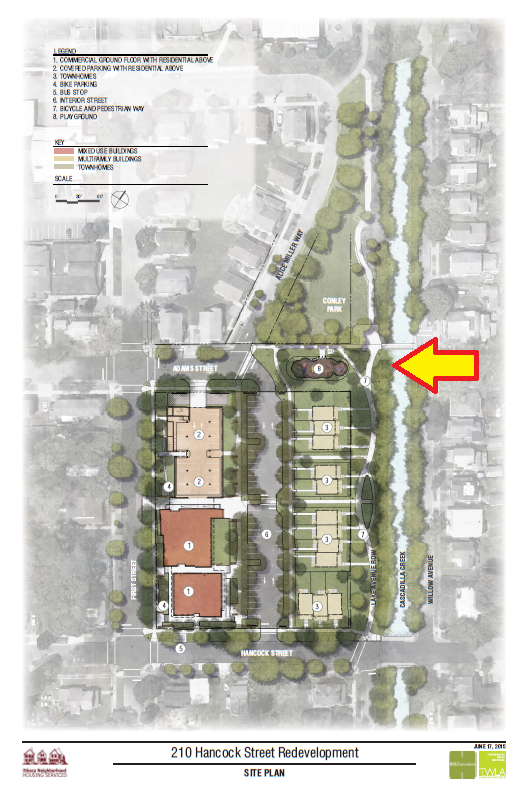
Ithaca doesn’t need to “slow down” development, because that’s one of reasons why the affordability crisis is as bad as it is. What Ithaca needs is to be proactive about development, and generally it has been under Mayor Myrick. The city has actively worked to reformulate general guidelines like the Comprehensive Plan (first all-new plan since 1971!) and is starting work on part II, working on neighborhood-specific themes. Myrick’s government has also identified and maintained targeted development areas, like Collegetown’s Form Zoning and downtown density. The mayor has even come to bat for the $30k-$50k/year working class folks that “breed trouble” and need affordable housing, like with INHS’ 210 Hancock project.

Affordability is a long-term effort and a multi-pronged approach, by keeping vulnerable families in their homes, and providing new homes to accommodate the growing economy and population.

There’s still a lot of work to do, but hell, it’s a start. Sticking fingers in ones’ ears isn’t going to make the housing crisis go away.



News Tidbits 10/10/15: Meeting With the Stakeholders

10 10 2015

1.There is nothing wrong with a little speculation. In a follow-up of sorts to the Voice piece about parking capacity in Downtown Ithaca, the Times’ Josh Brokaw did an interview of his own with city of Ithaca parking director Frank Nagy. Nagy believes that the 248-car estimate used by State Street Triangle is “way high”, but given that one of the refrains is that there’s not enough parking, they’d rather be safe than sorry.

More importantly, Nagy believes that the Seneca Garage only has about 10 years of life before a new garage will need to be built (the Seneca garage was built in 1972). The structural situation at Green Street is severe enough that the city may have to remove the end pieces and build up the middle section, which was renovated several years ago. The property is being reviewed, and with Tompkins Trust vacating office space on its ground floor as part of the move to its new HQ, the assessment is well-timed.

If the Green Street garage decides to go up rather than out, that leaves two very valuable properties that the city could sell to its benefit (financial, affordable housing, or otherwise). Both ends of the Green Street garage are zoned CBD-140, which offhand is the densest zoning in the entire city, 140 feet maximum height with no parking requirement. A zealous councilperson might try and change that post-SST, but as is, a rebuild of Green Street a few years from now could yield a lot of possibilities for downtown development. Put that in the notebooks for 2020 or so.

100_1281

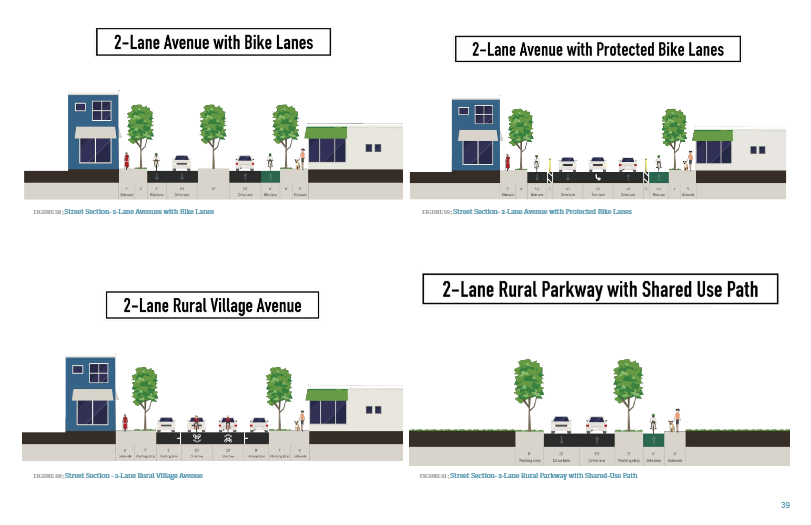
2. Speaking of future plans, we have the bike debate currently raging in the streets. Now, this is only tangential to my usual work, and I am not versed in the topic, so it’s nice to go in without preconceptions.

The city just finished work on Board of Public Works (BPW)-approved bike lanes on North Cayuga Street, specifically an unprotected bike lane on the east side (protected lanes were considered, but not approved). Although meetings gave due public notice, there were no letters sent to Cayuga Street residents informing them of the change, and a number of folks were caught off guard, including members of the city’s Common Council.

In the one corner, you have folks angry about the loss of parking, the inconvenience, and the danger it poses to the elderly. Unfortunately, you also have a council member describing biking-proponents in the same tone one would describe Albany lobbyists. The mayor has come out in favor of the N. Cayuga Street bike lane, although according to the Times, he’s not a fan of “resident-driven infrastructure”. It’s really a fascinating read from a planning perspective. – Times coverage here, Journal here.

bike_lanes_1

For what it’s worth, bike lanes are a major part of walkable communities and reduced ecological impacts (carbon footprints). I feel like I’ve seen this type of argument play out from the perspective of development quite a bit – every new Collegetown or downtown building gets the “Ithaca shouldn’t allow big buildings/they’re ruining Ithaca/where are they going to park” argument, and the “Ithaca is not a small town/it promotes walkable communities/suburban sprawl is destroying Tompkins green space” counter-argument. The key problem with the bike situation seems to be a lack of communication between the BPW and Common Council (and residents by extension). Luckily, the planning board doesn’t quite have this problem – everything they vote on gets publicized, on this blog if not elsewhere.

cornell_novarr_1

3. The last hurdle for John Novarr’s 215 Dryden Road project has been cleared. The Board of Zoning Appeals approved variances from the Collegetown Form Guidelines – the corner isn’t chamfered or set back enough and the building only has one main entrance (the form-based code mandates an entrance every 60 feet of non-residential space). The owner of the house across Linden from the corner was the lone opposition speaker, and the BZA vote was 4-1, with Marilyn Tebor Shaw opposed. No reason for Shaw’s decision was provided in the article.

With all the approvals tucked away, all that’s needed is for the city to sign off on the building permit. Expect this one to be underway within the next month.

image1 image2

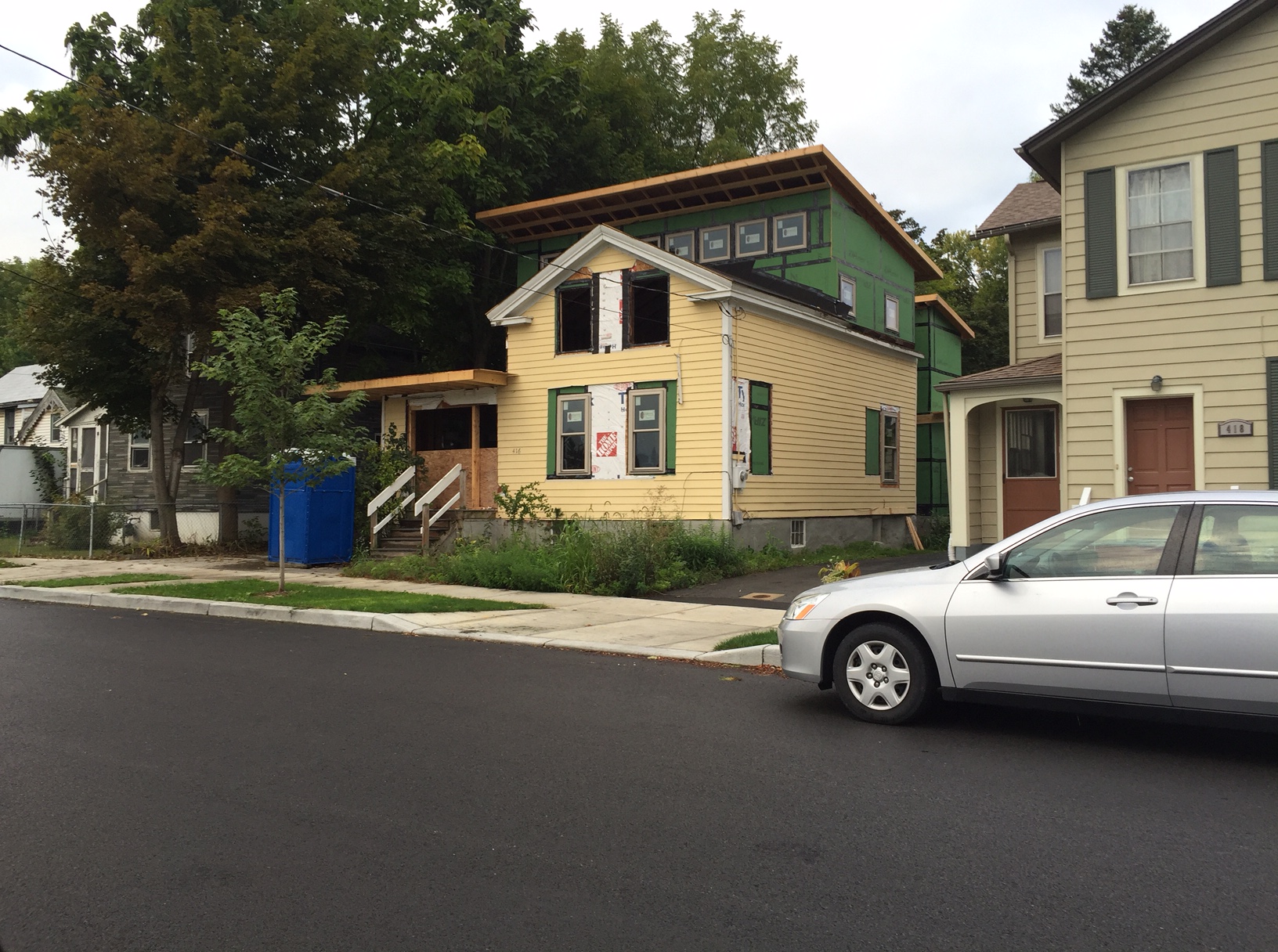
4. Reader submissions are always welcome. The photos for this week’s “House of the Week” featurette come courtesy of Frost Travis. The house receiving the addition is 416 North Plain Street in Ithaca’s Washington Park neighborhood. The current owners brought the property in October 2014. County records give it a 1900 construction date, which is often a default for old and unsure; it appears on an 1889 map of the area, but was not yet built in the 1866 map.

The rear addition looks like it’s been underway for a while – the exterior has been framed and sheathed with plywood Huber ZIP system roof and wall sheathing, which uses seams and tape to save time vs. traditional sheathing such as Tyvek housewrap. There are some windows fitted into the rough openings, but there’s still plenty of work to do with closing up the exterior and interior utilities rough-in. Looking at the original house, the owners appear to be fitting smaller windows in place of the originals – two window cutouts on the north wall have been filled in with sheathing, and a new window has been fitted in a new opening. The front door and adjacent window are gone, one large rough opening in their place. The front roof above the door and window was slanted, but has been dropped to a flat roof as part of the renovation and addition. Presumably, the butter yellow vinyl exterior will be re-finished as construction progresses. With any luck, this one will be finished before winter comes.

Pg-3-Rendering

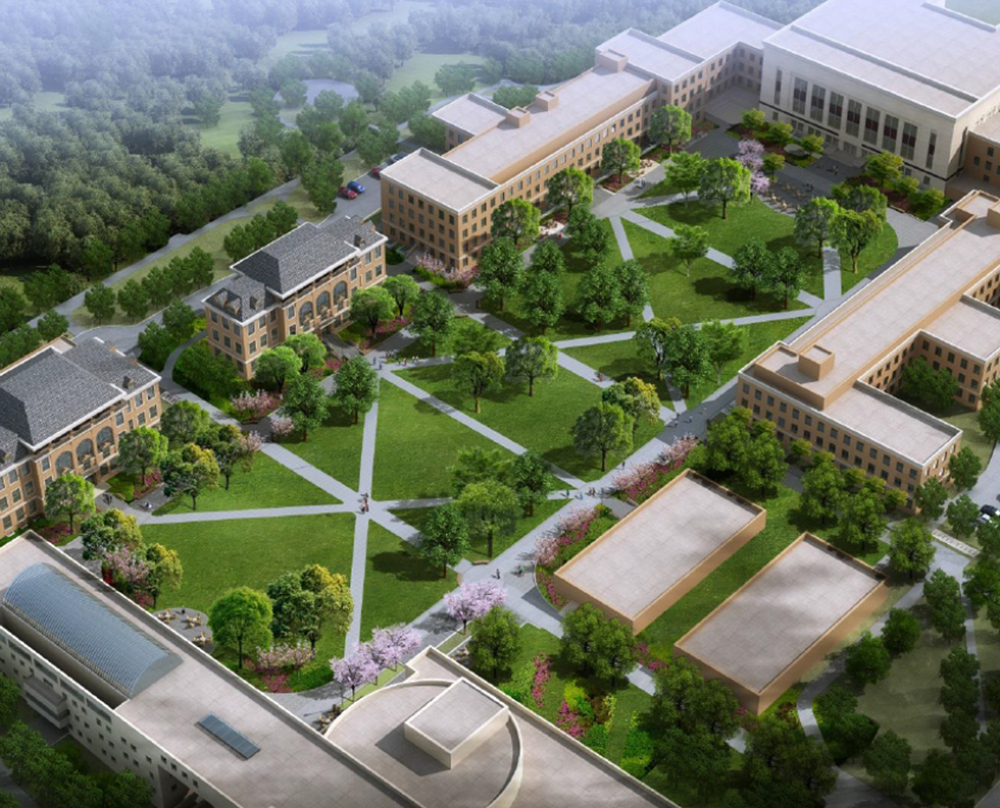
5. What a quick turnaround. The Cornell Daily Sun first made mention of the Ag Quad renovation last week as part of its coverage of the Collegetown Neighborhood Council meeting. Now only a week after Cornell shared a glimpse at the cards in its hand, they’re playing them. The $9.6 million project will be broken down into two phases, one that focuses on infrastructure, and one phase on landscape improvements (and being that much of the infrastructure is underground utilities, phase one could be described as churning up the ground, and phase two is making the upturned dirt pretty again). The renovations, which are set to start next summer and run through 2017, will include additional emergency phones, a rain garden, and outdoor gathering spaces in front of Mann Library and Roberts Hall (upper right and lower left in the above render).

Too bad those temp buildings are still there between Kennedy Hall and Plant Science. If the Southern Tier wins that Upstate Redevelopment competition, I have an idea where the new Plant Science Commericialization Building should go.

6. Plans for 416 E. State have evolved since the bar was first proposed. Originally conceived as a general bar/drinking establishment, developer and Argos Inn architect Ben Rosenblum has faced substantial opposition to the project – neighbors are vociferously opposed to a bar, citing noise problems and concerns about smokers, and the county planning department was not a fan of the traffic and parking arrangement, which had after hours parking across the street at Gateway Plaza. Although the project doesn’t need planning board approval, it does need BZA approval – area and setback deficiencies have resulted in the need for a zoning variance. The building itself won’t change dimensions, but the change in use triggers the city zoning laws.

416_e_state_v2_1

Representatives for Rosenblum and neighbors have met, and the compromise Rosenblum and his associates have proposed involves a lounge-type of establishment they’re calling “The Printing Press”, after one of the previous uses for the late 1940s warehouse. They’ll be going for an industrial/”speakeasy” aesthetic, and targeting the same older, more affluent clientele that patronizes the Bar Argos next door. Signage would be minimal, and exterior work limited largely to an accessory parking lot/handicap access, landscaping and a new coat of paint. Looking at the original plan vs. the revised plan, the bar no longer is in the rear corner, but moved closer to the building center so as to buffer the noise of patrons from disturbing neighbors. Parking will be shared and organized with the Argos Inn’s lot. For more info, cover letter here, renders here, vision statement here.

The new parking arrangement may assuage the county, and the low-key bar located centrally in the interior may be enough to satisfy some of the neighbors. But we’ll have to see the BZA’s reaction and what remaining opposition there is before anything is set in stone.

hotel_ithaca_v3_1

hotel_ithaca_v3_2

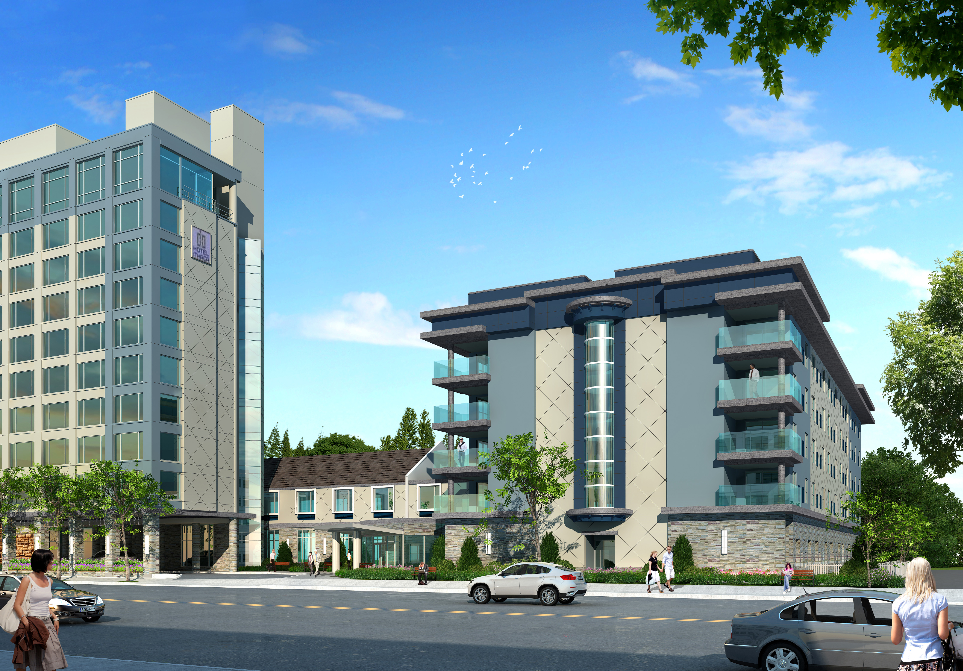
7. The Planning and Development Board has scheduled a Design Review Committee meeting to offer guidance and commentary on the styling of proposed buildings. While State Street Triangle isn’t on the agenda (yet), the Hotel Ithaca addition is. Renders here and here.

I’ve toned down my opinions over the years, but this…well, let’s just so those “sick burns” Nick Reynolds mentioned at the last planning board meeting were pretty well justified. I mean…yikes. The cross-hatched blank walls, the circular glazing, the “tourist trap” aesthetic. There’s an alternative being shown with small windows in place of the circular glazing, and rectangular facade hatching instead of the cross-hatching, but it’s not a great improvement. The board’s going to have a lot to say with this proposal.

215-221_spencer_v3_2

215-221_spencer_v3_1

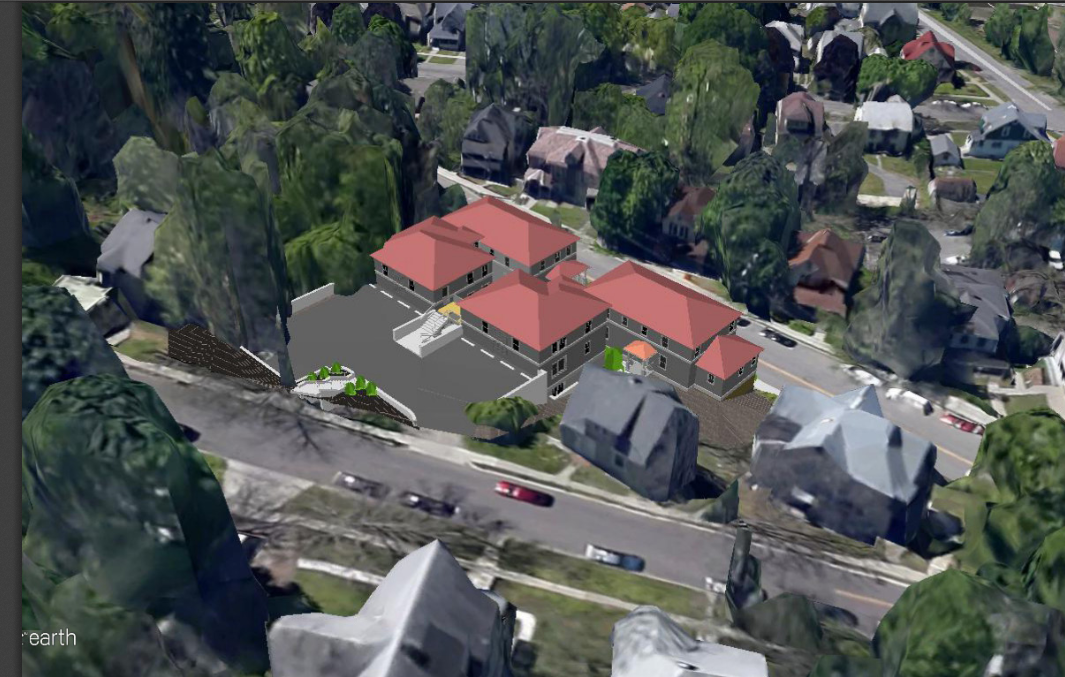
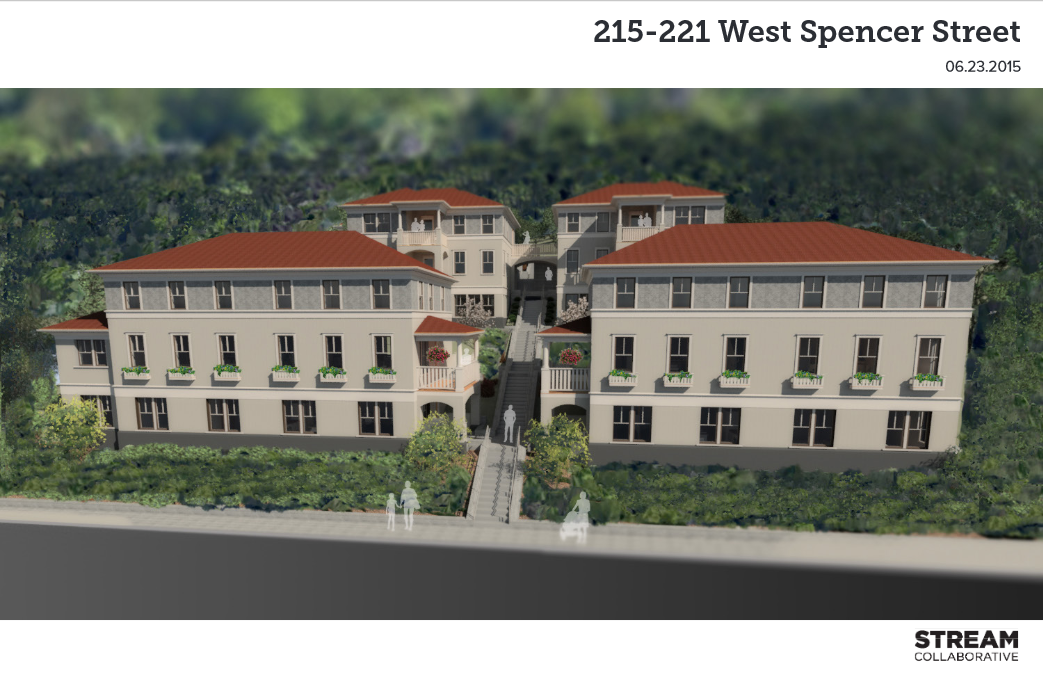
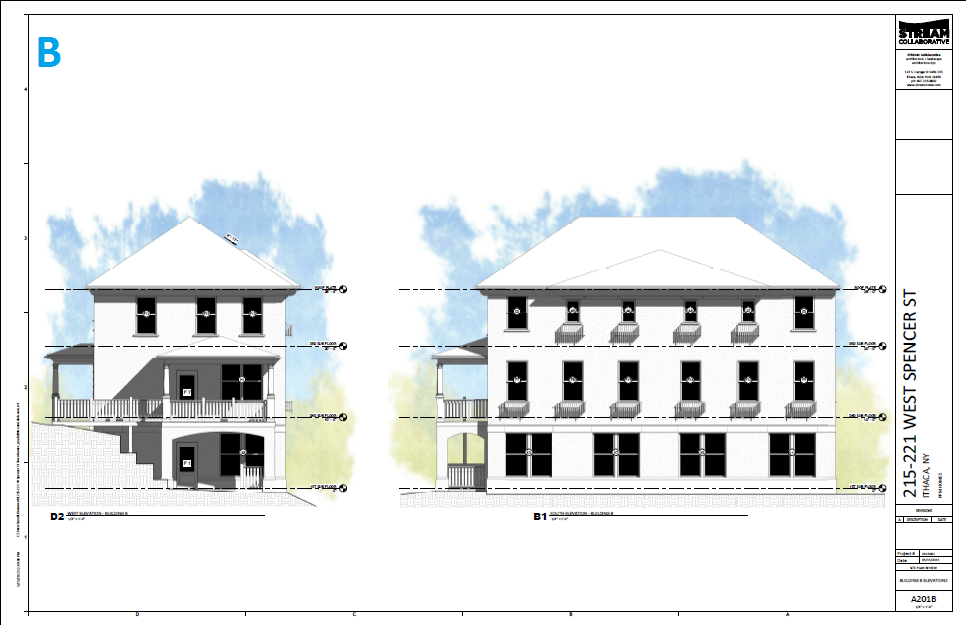
8. I had hopes that for the first time in three years, a major project would go through the boards without complaint or opposition. Hopes dashed. The complainant against the 4-building, 12-unit 215-211 West Spencer Street project cites the loss of the city’s parking lot on the site, the narrow width of S. Cayuga Street (the “rear” road), traffic, and no neighborly interactions because it’s a rental that faces Spencer Street.

215-221_w_spencer_orig

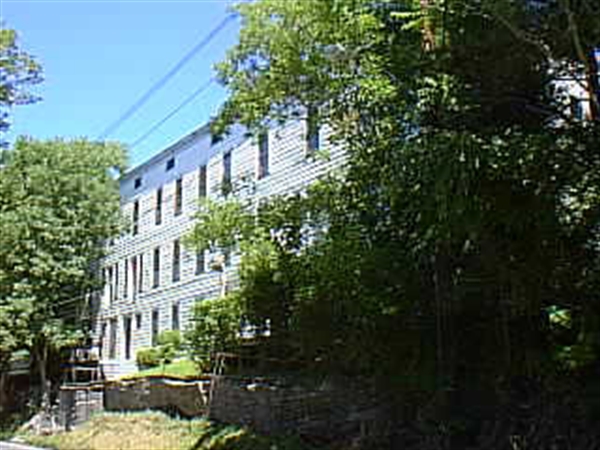
The kicker is, the letter-writer lives in an upscale Lansing subdivision. He rents out his 3-unit Cayuga Street property. The “house” that the letter claims used to be on the site is also misleading. It was a run-down multi-story apartment building (shown above in the photo from county records), demolished 12 years ago by the city, and turned into an informal parking lot that was never meant to be a long-term use. The land was sold by the city to Ed Cope for $110,000 last March.

I’m willing to entertain legitimate arguments and complaints to projects. But this isn’t one of them.


News Tidbits 9/19/15: It’s A Numbers Game

19 09 2015

tc_housing_permits_1984_2014

tc_housing_permits_pies_19904_20104

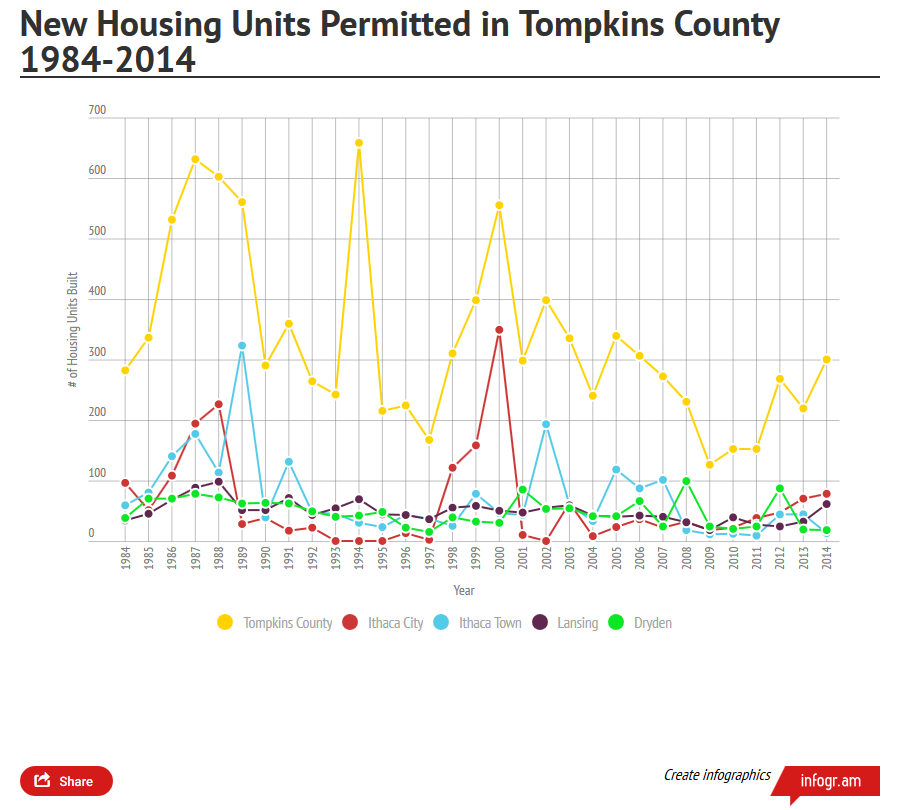
1. Readers might have noticed that there was no Monday night (Tuesday) piece this week. The piece that was originally scheduled evolved into the building permits analysis that was a featured article on the Voice (link here). The initial intent was to run a mirror of the piece on the same day, but things got a little delayed, and eventually I just scrapped running it as the topic-of-the-week.

The reaction was generally favorable (if maybe less traffic than hoped; math-y pieces typically aren’t big traffic generators), but there’s a couple of quick criticisms that came in that I want to address. Namely that I didn’t include proposed projects, and that I left out non-residential construction.

Truthfully, there is no reliable long-term record of non-residential construction. HUD doesn’t break it down in their SOCDS database, and the county doesn’t have complete data on non-residential construction (for their reports, they also rely on the HUD SOCDS database). Related to that, HUD data for 2015 is very preliminary, relying on imputed values. Finalized and corrected 2015 data won’t be available for use until March 2016.

That being said, residential permits are an effective gauge for a few reasons – one, residential is the largest individual construction sector nationwide; two most recent local construction is residential or institutional, and three, many of the projects built in Ithaca are “mixed-use” meaning they have commercial and residential components. although the commercial components aren’t kept in track, the residential construction permits are available, and are showing up in the city’s SOCDS data.

For proposed projects, it’s not prudent to “count your chickens before they’ve hatched”. This passage was originally in the piece, but was pulled before the final version was published:

“As mentioned earlier, news sources like us here the Voice are guilty are promoting the misconceptions. We try and keep tabs on all the big projects – when they get proposed, approved and underway. The thing is, not all projects go from proposed to built. Some never receive approvals. Some get approved, but wait years to get construction financing, if ever. So it seems like there’s more than there is.”

Without having hard evidence in front of me, I’d argue that if one were to somehow include office and retail, the area still isn’t booming if we’re looking in a historical timeframe – you’d have large spikes in retail during the mid 1970s when the mall was built, and from about 1997-2004 in Southwest Ithaca and Lansing for big box retail. For office space, there would be a peak in the late 1980s/early 1990s for the Cornell business park by the airport; there’s circumstantial evidence that the office market today is pretty weak, TFC’s HQ being the odd project out. Industrial space would have peaked with Borgwarner’s construction in the early 1980s, but in recent years it’s been minimal or even negative growth (due to the Emerson shutdown). Hotels might be the only category that shows a “boom” at present.

The point of the article remains that

1. If we look at available building permit data, Tompkins has seen an uptick in construction, but not a construction “boom”, and
2. It feels like a boom because the region’s coming off of a very low period of activity, and there’s more construction in the highly visible urban areas of Ithaca city, vs. the suburban and rural development that has been more prevalent in previous years.

20150829_121852 20150829_121855

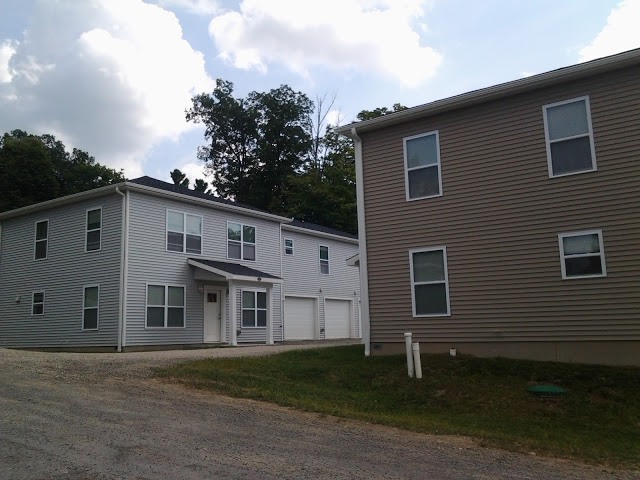
2. It’s time for a semi-regular house-of-the-week feature. I’ve been meaning to update on this for a while, but I keep missing the turn off Route 79. Local developer Chris Petrillose of Petrillose Properties (possibly related to Bob Petrillose, the founder of the Hot Truck) recently finished his second and third duplex  off of Wiedmeier Court in the town of Ithaca. Like the first duplex that was finished last year, each building consists of a 4-bedroom unit and 2-bedroom unit.

According to county records, the Wiedmeiers began to develop the land in the mid-2000s, building 2 duplexes of their own before deciding to sell the other lots (Petrillose bought the lots for the duplexes in 2012). The rest of the land, 12.34 acres, is currently for sale, so perhaps this won’t be the last visit.

3. Previously reported here and on the Voice, the city is studying whether or not to sell fire station No. 9, located in the heart of Collegetown at 309 College Avenue, to an interested private developer. We now know the consultant the city hired to perform the study.

Kingsbury Architecture, a small local firm, is investigating whether it would be worth the city’s investment to build a new station elsewhere on East Hill and sell the aging station, or invest in repairs and long-term maintenance for the current 1968 structure. Kingsbury has little presence online, but in an example of how small of a world this is, they were the initial firm used to plan St. Catherine of Siena’s new parish center, the project discussed in last week’s news update. However, according to church newsletter, the congregation amicably ended the partnership because of cost issues. The church staff went architect shopping, and that’s how Richard McElhiney Architects came into the project. Some of Kingsbury’s work can be found on the church’s webpage here. Kingsbury also appears to have done some interior renovation work at Cornell, and roof replacement at the Cascadilla Boathouse.

state_st_triangle_v5_1

4. New documents from Campus Advantage give insights on the tenant mix and parking situation in downtown Ithaca.

First, my personal disclaimer – Even though part of their market research cites work I’ve written for the Voice about the housing crisis, my work was done impartially.

The new information comes as part of Campus Advantage’s official response to the city planning board’s request for more specific values on resident population, parking utilization and bus capacity, among other details. The documents are provided as part of the planning board’s materials here.

Updated figures indicate the proposed building has gone on a diet – the number of bedrooms has dropped from 620 to 582, the number of units from 240 to 232, and the square footage from 288,845 SF to 216,434 SF, a 25% reduction in mass. The maximum height remains the same at 11 stories at 116 feet. The slimming down comes in response to unfavorable review of the previous design as “too massive”, especially on the side facing East State Street.

sst_stats_1

According to an internal study by Campus Advantage, the Texas developer forecasts that, of the 582 tenants when at full capacity, 77.8% (431) will be students, and 22.2% (123) non-students. Of those students, 78.4% (338) will be undergraduates. Cornell students would comprise 64% (276) of the student population, Ithaca College 32% (138), and TC3 4% (17). A quick glance at the details behind these projections shows that CA assumes 95% occupancy, studios and other smaller units will be half or majority non-student, and that undergrads will be more inclined towards shared 4-bedrooms and 5-bedroom units. CA conducted online surveys with student groups to gather information for their study.

sst_stats_2

The parking demand from residents is predicted to be 191-219 spaces, taken from a study conducted by third-party traffic engineering firm SRF Associates. A further 64 parking spaces will be required for commercial retail tenants on the first floor (57 customer spaces, 7 employee spaces), for a grand total of 283 parking spaces. The 2012 Randall/West Collegetown parking study used as reference looked at student and non-student vehicle ownership in the Collegetown neighborhood, and the higher end (or “more conservative”, as SRF calls it) 219-space figure comes from a calculation the Urban Land Institute, a non-profit urban planning think-tank. Given that Randall/west focused on Collegetown, the more conservative figure is the safer bet.

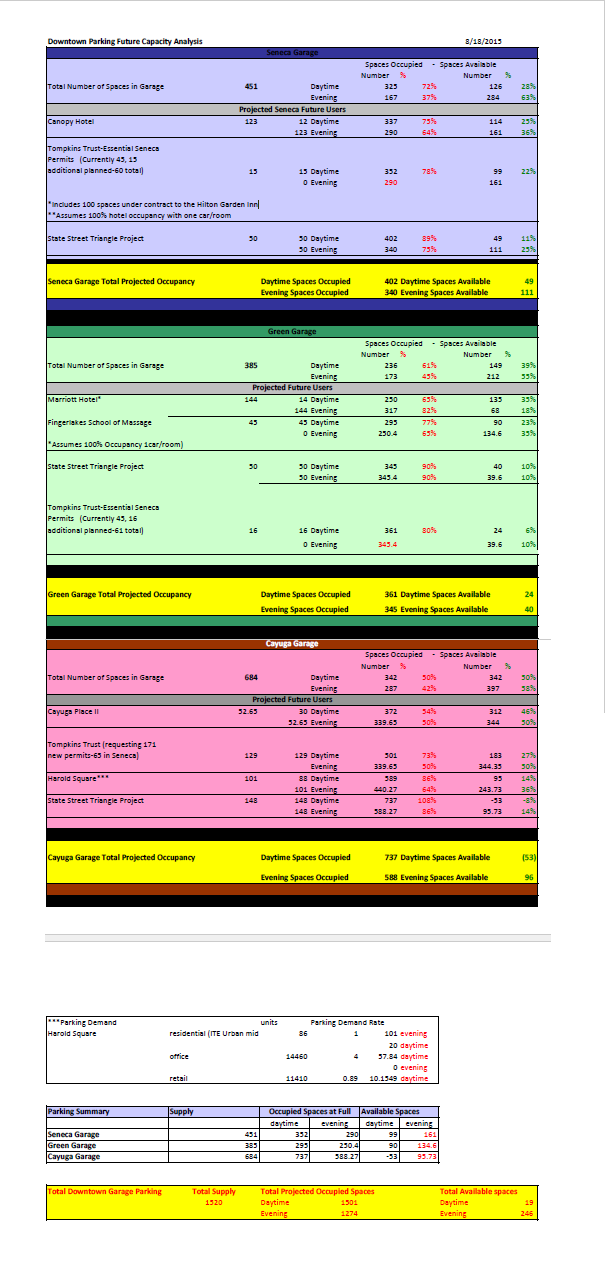
It’s not clear whether the parking garage study above is CA’s or the city’s, but the application itself states that the city’s Parking Director, Frank Nagy, has confirmed that enough parking is available, and a letter from TCAT’s Doug Swarts states that TCAT has the capacity for State Street Triangle’s potential tenants. Looking at the above study, though, it appears that if built, and if all the other approved and likely projects (i.e. don’t include 130 East Clinton) are built, the parking garages will be nearly full.

Since the new drawings were presented at the public open house on September 10th, there do not appear to have been revisions – what was shown then will be shown at the planning board meeting next Tuesday (links to those drawings here). However, the planning board will be looking to schedule a design review committee meeting, where board members provide suggestions and guidance on design features for the new building. In other words, this probably isn’t the building’s final design.

Also included in the attachment are two opposition letters – one from Historic Ithaca saying the building’s still too tall and massive, the other from former planning board and councilwoman Jane Marcham, who takes the unusual if debatable tact by saying that students living downtown deprives the colleges of campus life. Students comprise 40% of the market-rate downtown rental market, so there’s a few to interview for opinions should anyone be interested.

As always, the project is likely to inspire some debate at the planning board meeting. We’ll see if the changes are to the board’s liking.

815_s_aurora_1

5. Wrapping up this short but informative week, here’s a look at the Planning Board agenda for next week:

A. State Street Triangle – Public Hearing, City Environmental Quality Review (CEQR) discussion, and scheduling a Design Review Committee meeting. CEQR is they city’s more in-depth take on SEQR, where a project’s environmental impacts are considered, and a negative declaration (acceptance) is given only when adverse factors have been mitigated in a way the board sees fit. Design Review Committee pretty much is as it sounds – the board makes suggestions on the building design as a quality control / quality assurance measure.

B. 215-221 Spencer Street, Determination of Environmental Significance and Recommendation to the BZA – the board has decided to recommend approval of the parking variance (parking within the rear yard setback), given the site’s steep topography.

C. Site improvements, 416-418 East State Street416-418 East State Street is currently home to an underused 7,600 SF office and a connected manufacturing/storage building. The house dates from the 19th century, with various additions as recent as the 1970s. According to plans filed with the city, an LLC linked to Argos Inn architect Ben Rosenblum has plans to convert the old manufacturing space into a bar and storage space, with renovated offices and a 2 bedroom apartment in the original house. The project will include an accessory parking lot, revised landscaping and handicap access. Area and setback deficiencies have resulted in the need for a zoning variance, but a parking variance won’t be required because the bar will have after hours parking across the street at Gateway Plaza. The building itself won’t change dimensions, but the change in use triggers the city zoning laws.

There have been substantial concerns expressed about this project – neighbors are vociferously opposed to a bar, citing noise problems and concerns about smokers, and the county planning department is not a fan of the traffic and parking arrangement. The city will need to examine this project carefully.

Scott Whitham is serving as a consultant, and local architect Jason Demarest is designing the renovation.

D. Hotel Ithaca – Amended declaration of environmental significance. Backstory and plans here.

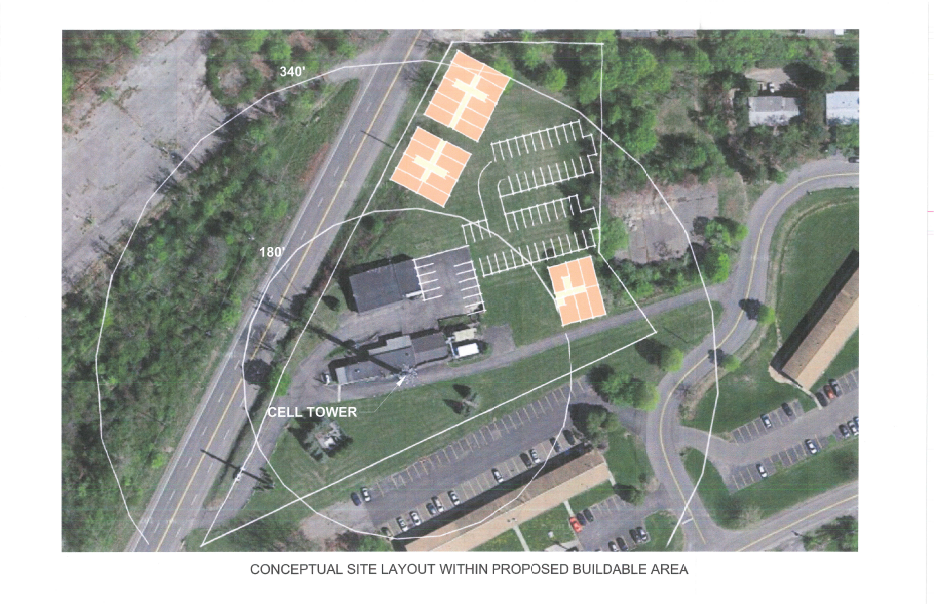
E. “Sketch Plan – 815 South Aurora Street, 87 unit housing project” – See conceptual design above, full backstory here. To recapitulate the salient details, local developer Todd Fox of Modern Living Rentals would like to build apartments on vacant land at 815 South Aurora Street, but can’t because the vast majority of the property is within the “fall zone” of a cell tower, which the city defines as twice the height of the tower. The 170′ tower creates a 340′ radius of no-man’s land (outer circle above), making the parcel virtually undevelopable. Fox had two private engineering companies (TAITEM Engineering and Spec Consulting) analyze the case, and they determined that an appropriate fall zone is the height of the tower plus 10 feet for a little wind/bounce – so 180′ total. With this info in hand, Fox tried to get the city to refine the zoning to allow the decrease in fall zone and therefore permit the land to be open for development. But when Fox and project architect Noah Demarest approached the BZA, they said they wouldn’t consider the 815 South Aurora Street application unless the law was amended, or Fox and Demarest go through the sketch plan and review process, and submit a formal application for a zoning variance.  So now we’re at the point of having a sketch plan to present. Regardless of design, the project will need an area variance issued by the BZA for the cell phone tower issue. At 87 units, this will be a pretty sizable project, and given Fox’s previous work (he’s been rather busy lately), it will likely be rentals, perhaps with Ithaca College students as the target market.

3 of the 5 projects above (SST, 215-221 West Spencer, and 815 South Aurora) have Noah Demarest/STREAM Collaborative as a lead or consulting architect. None of them have the same developer. Talk about having your fingers in many pots.


News Tidbits 9/12/15: Some Projects Lose Mass, and Some Hold Mass

12 09 2015

1. We’ll start this week off with a little bit of economic development news. According to paperwork filed with the Tompkins County IDA, CBORD, a Lansing-based software company, wants to move out of its digs in the Cornell office park by the airport, and into a new larger facility in renovated space in the South Hill Business Campus next to Ithaca College. CBORD would lease 41,000 SF of space with five year options to renew. All 245 local employees would be moved into the renovated space, which would be finished by the end of May 2016 and designed by local architect John Snyder.

The project is expected to cost about $3.7 million. No new jobs are stated in the application.

Assuming SHBC’s website is up-to-date, no contiguous spaces are currently large enough for the tenant, so either the internal space will be split up, or some other tenants will be jostled around to make room for CBORD.

As for the abatement itself, CBORD is requesting a sales tax abatement, one year in length, with a value of $296,000, about 8% of the project cost. It doesn’t appear to have made any waves at Thursday night’s meeting, so what;s likely to be a low-key public hearing and approval vote will be coming in the pipeline.

Also at the IDA meeting, final approvals were granted for tax abatements on the 209-215 Dryden project by John Novarr in conjunction with Cornell. and for INHS’s 210 Hancock affordable housing development in the city’s Northside neighborhood.

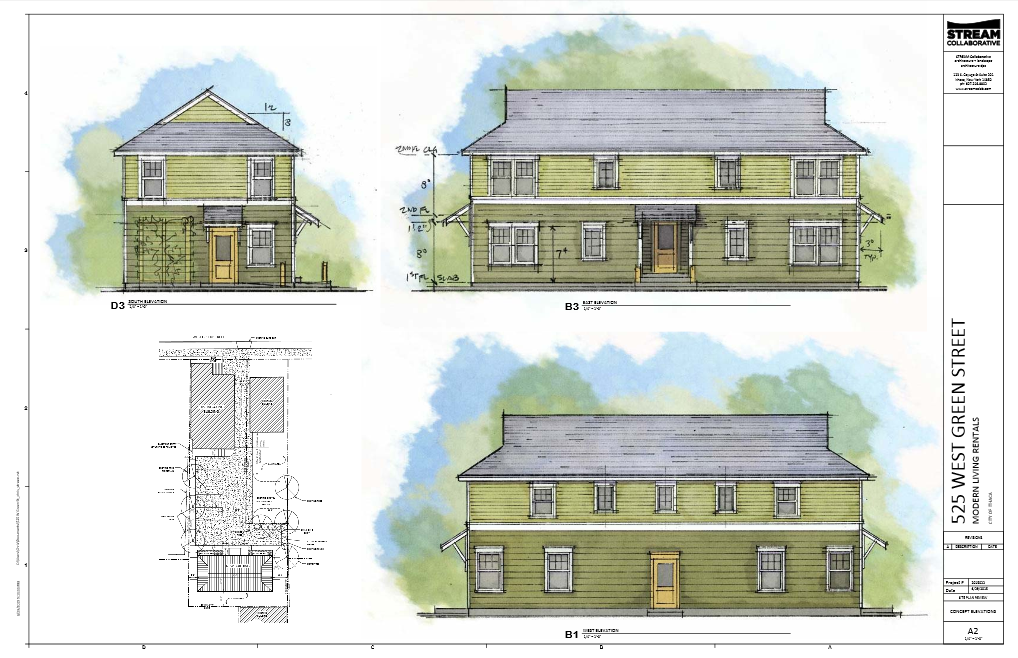
2. Another small infill project seeks approval from the city’s planning board and the Board of Zoning Appeals (BZA). 525 West Green Street, located on the edge of the South Side neighborhood, is currently home to a 4-unit apartment house. Local developer Todd Fox of Modern Living Rentals (MLR) is seeking to build a 4-unit, 4-bedroom apartment house at the rear of the property, where a clapped-out garage currently stands. The units would be rentals, but this far from Cornell and Ithaca College, the target market is likely to be permanent Ithaca residents – single professionals would be a good guess.

525_w_green_1

Plans drawn up by prolific local firm STREAM Collaborative call for a 2-story, 2,360 SF “carriage house” building designed to fit in with the rest of the neighborhood, although quite honestly no one would be able to see the new building unless one were looking down the driveway. A landscaped rear parking area for 8 vehicles would replace the current 4-car lot behind the existing building.
According to Site Plan Review documents, construction cost is estimated at $300,000, and construction would take place from November 2015 to July 2016. Area variances are required from the BZA since this building partially occupied space reserved for the rear setback, but according to the SPR the variance has already been granted.

Readers might recall that MLR has been a very busy company as of late – although relatively new to the Ithaca scene (MLR was established in 2010 by then-recent college graduates Charlie O’Connor and Todd Fox), the company has developed the 6-unit 707 East Seneca apartment building, a duplex at 605 South Aurora, and is currently going through the approvals process for solar-powered townhomes out in Varna. The duo also partnered with local real estate businessman Bryan Warren to purchase the Collegetown Bagels at 201-207 North Aurora Street.

As for the project itself, 525 West Green Street is perhaps the largest example of the carriage house trend Ithaca has been seeing lately, where old garages or unused rear lot spaces are being developed into small, detached apartments, typically no more than studio or 1-bedroom size. Other examples include 201 West Clinton, 607 Utica,  and new this month, a studio apartment proposed for a former workshop/garage at 701 North Aurora. Arguably, one could throw New Earth Living/Sue Cosentini’s Aurora Street pocket neighborhood in there as well.

Given that these properties are modestly-sized, rarely visible from the street, and provide rental income to property owners who in most cases live on the same lot, they seem like an appropriate way to increase density without upsetting Ithaca’s character balance.

troy_rd_rev1_1

3. Briefly in blurbs – according to the agenda for Ithaca town’s Public Works Committee (PWC), the town will be looking at sanitary sewer access for a potential development along Troy Road. Now, before anyone gets their blood pressure raised, this most likely has nothing to do with the 130-unit project that was mothballed a few months ago. But, there have been rumors of smaller-scale plans for one of the parcels that comprised the now-subdivided property. The development radar has been turned on, and if anything shows up, you’ll see it shared here.
4. Staying in Ithaca town for the time being, the town’s planning board has but one project on their agenda for next Tuesday – a new parish center for St. Catherine of Siena Church in the Northeast Ithaca neighborhood.

Yes, even in Ithaca, one of the least religious metros in the country, famously home to a school that pastors derided in fiery philippics 150 years ago for daring to not affiliate itself with a Christian denomination or enforce mandatory church attendance, churches can hold their own.

st_catherines_1

Plans call for a new 10,811 SF parish center at 302 St. Catherine Circle, on what is currently part of the church parking lot. Once built, the current parish center, a one-story, 10,275 SF jumble of boxes and corridors, would be demolished and replaced with parking spaces. Richard McElhiney Architects of NYC is the project architect, and a bit of an unusual choice since the firm doesn’t have a presence or previous work up here.

In an assessment by Ithaca town planner Christine Balestra, concerns were noted about a phased parking plan for the church while construction is underway, and minor requests for landscaping details (plans call for two fountains). Other than that, it doesn’t look like this is going to make any waves during the approvals process.

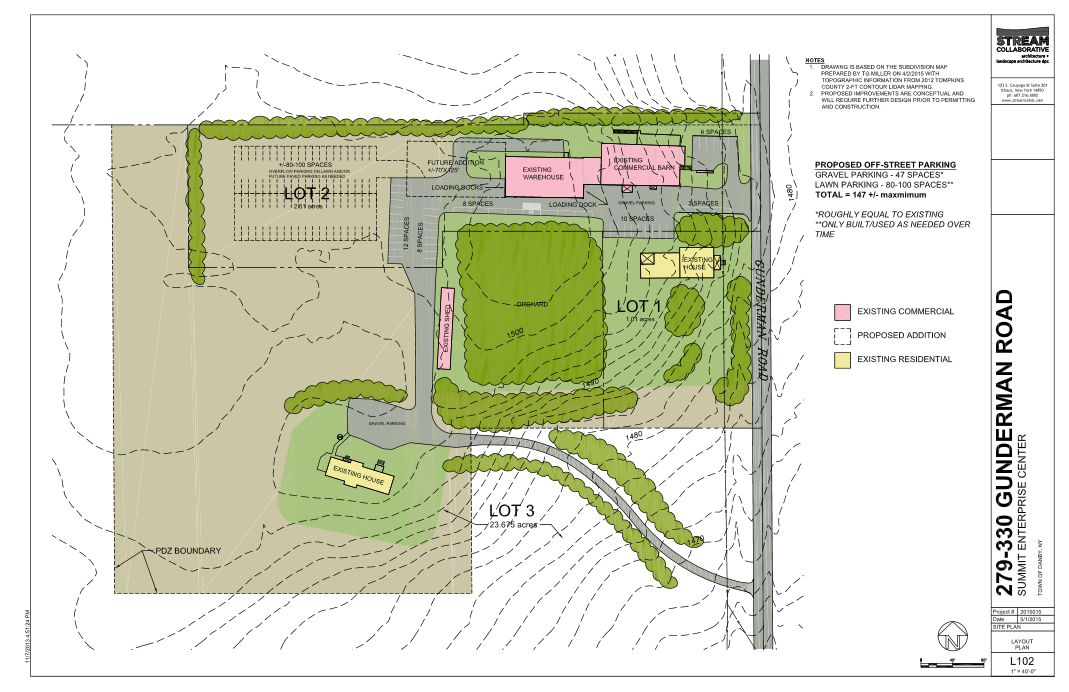
5. Over in the town of Danby, plans are underway to convert a former clothing design and warehouse facility into a mixed-tenant business center. Docs filed by STREAM Collaborative’s Noah Demarest on behalf of owner David Hall call for modifications of a Planned Development Zone for the property at 297-303 Gunderman Road. Danby’s PDZ is not unlike the city’s PUD and town of Ithaca’s PDZ, where the form and layout is regulated rather than the use. The original PDZ for the property dates from the mid-1990s.

summit_danby_1

The “Summit Enterprise Center” would be anchored by National Book Auctions currently on Danby Road, Blue Sky Center for Learning (a company that provides support and therapy for autistic individuals and their families), and New Moon Harvest, a food and beverage maker. Additional office, warehouse and industrial/food production space would be available to potential tenants. The existing 21,000 SF building and landscape would not be significantly changed, although future plans for a 4,147 SF addition and parking lot are noted.

chain_works_rev2_1

6. Speaking of PDZs and PUDs, I did take the opportunity when I spoke to David Lubin last week to ask how things were going with the Chain Works District development. Here’s what he said:

“Chain Works District is continuing. We’re working with the state and Emerson, investigating the site and making sure all the remediation plans are readied and approved. There will be public hearings. It’s a slow process. We will need DEC approval for the residential uses. We hope to obtain city approvals [for the draft environmental impact statement] this year.”

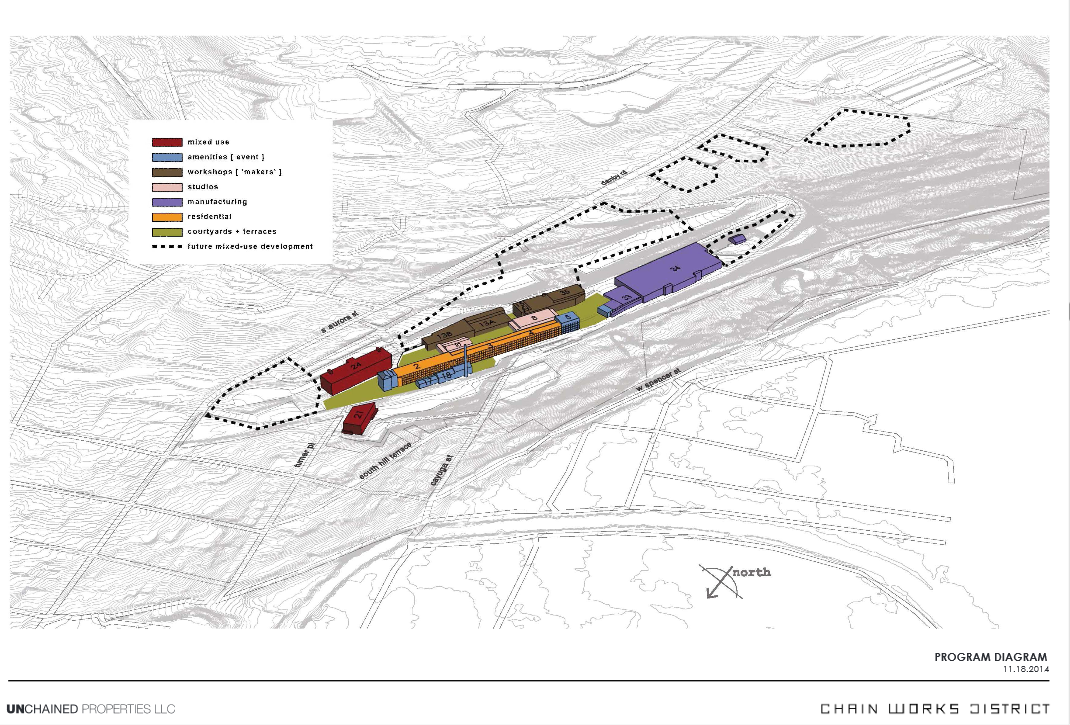
There’s no doubt the project will take time. With complicated topography, environmental issues, 800,000 SF of planned development space and two municipalities, it’s arguably the most complicated tax parcel in all of the county, if not the region. Readers may stretch their memories back and remember that the first phase will consist of the renovation of buildings 21, 24, 33 and 34 into mixed-use and manufacturing space. Ithaca Builds (come back Jason, Ithacans need someone with your knowledge) provides a detailed run-down here.

619_w_state_st_1

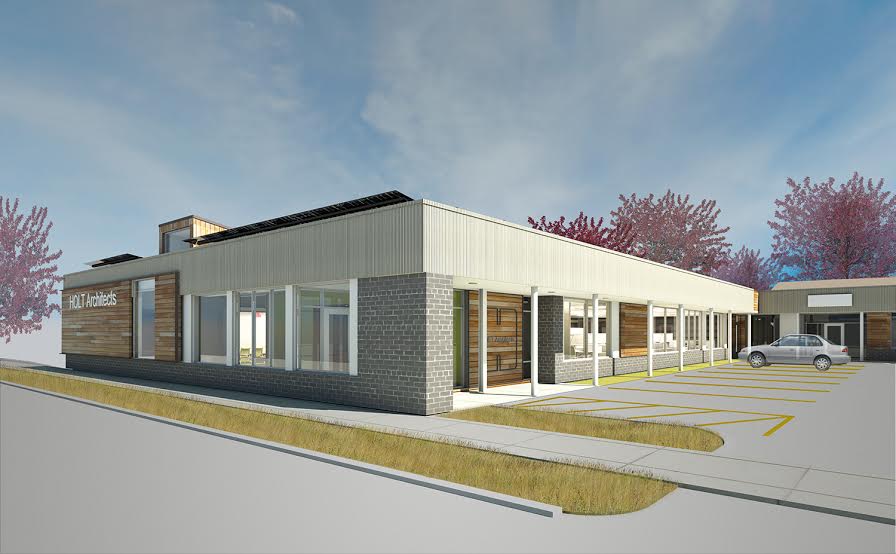
7. Courtesy of Maria Livingston at HOLT Architects, here’s a render of the renovation HOLT is undertaking for its new headquarters at 619 West State Street. Gone are the rather dated-looking decorative parapets, and in comes a clean, modern design with a mix of wood, brick and steel facade materials. HOLT’s 30 employees will occupy most of the new space in the  net-zero energy structure, but there will be space for two other tenants (one of which has already been claimed).

HOLT is spending about $900k on the renovation, which is due to be complete next March. Tompkins Trust Company is providing the financing, and local company McPherson Builders is in charge of general construction.

A copy of the official press release, and an interior render, can be found on HOLT’s blog here.

state_st_triangle_v5_1

8. We’ll wrap up this work with a topic at the tip of everyone’s tongue – State Street Triangle. Architects Kelly Grossman of Austin, Texas and Noah Demarest of STREAM have worked to redesign the project so that its massing is less imposing and its design a little more varied. Specifically, it now looks more like several buildings built next to each other with varying setbacks and heights, rather than one continuous mass – the change is especially prominent on the 300 Block of East State, where the most concern was raised.

The developers held a community meeting Thursday night (pro tip for Campus Advantage – next time, give more than 30 hours’ notice), which has been covered by the Journal here and the Voice here. That the developers scheduled their own community meeting outside of the confines of city hall is laudable.

As part of the redesign, the number of bedrooms has been reduced from 620 to 582. Recent estimates have now priced the project at $70 million. The developer has expressed interest in designated some of the units as affordable housing, in what would be an example of the inclusive zoning that some city staff are currently looking into.

state_st_triangle_v5_2

The project is seeking a tax abatement, though the formal details have yet to be released. Rents would be between $980-$1,600 per month per person, and would include utilities, gym and other “all-inclusive services”. I suspect that a parking space in the Cayuga Garage is an added cost.

Speaking strictly for myself, the design is an improvement, though I have subjective quibbles – for instance, would a lighter color material make the north wall of 11-story middle section less visible from a distance, and would it be possible to give the blank walls more character. Balancing pros and cons, I also think the design of the Commons-facing corner looks tasteful and classy. The prospect of affordable units in the building is intriguing. If I was a planning board member, I’d ask to see material samples to make sure the building doesn’t end up looking cheap.

state_st_triangle_v5_3

Additional images of the updated design can be found on the city’s website here, and a written summary of the changes from project consultant Scott Whitham of can be found here.


News Tidbits 9/5/15: Ithaca the Diva

5 09 2015

cornell_novarr_1

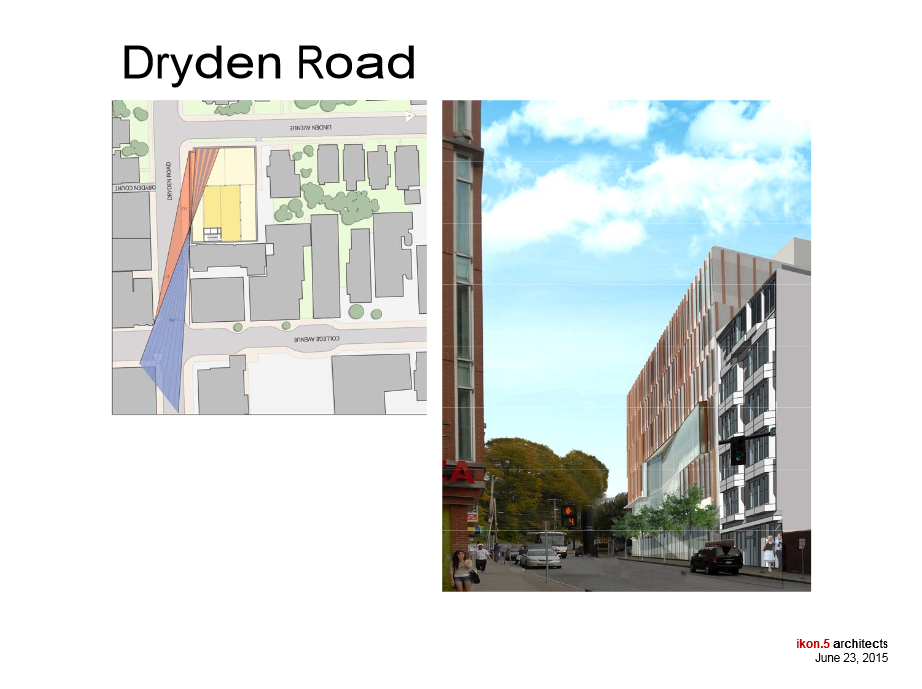
1. John Novarr’s project at 209-215 Dryden Road has been given the green light. The city of Ithaca’s Planning and Development Board approved the $12 million project at their August meeting. With approvals in hand, Novarr is free to start construction as soon as he has his construction loans, which should be no problem given that Cornell’s MBA program has agreed to occupy the whole building (though only about 70% of the space will actually be used at initial completion; the MBA program will fill out the building as their needs require). Conveniently, Novarr won’t have to worry about site demolition and asbestos removal because he cleared the site in May.

The 6-story, 73,000 SF building will begin construction in “four months” per the end-of-August Sun article, or November if the Site Plan Review (SPR) paperwork is still accurate. Completion of the building is anticipated for the second quarter of 2017. ikon.5 of Princeton, New Jersey is the project architect.

When filled out, the building will house 250 employees of the university, and 450 students of the Executive MBA program, who only attend classes in Ithaca during traditionally slow periods of the year (winter break and summer break; during the rest of the year, students attend weekend classes in the town of Palisades in Rockland County). To that effect, the project would go a long way in easing the strongly cyclical consumer traffic that makes it hard to do business in the largely-student neighborhood. Students also stay at the Statler while on campus, and staff and students will walk over from Cornell faculty/staff parking to get to the building.

Last month, the Tompkins County IDA approved a 50-year tax abatement for the project, in the form of a PILOT agreement. With the other option of Cornell buying the property and making it tax-exempt, the county has decided that something is better than nothing.

The project joins a slew of mostly residential projects under construction in the Collegetown neighborhood. 205 Dryden, 327 Eddy and 307 College are all underway, and several smaller projects were recently completed. The new investments total over $36 million, and with the exception of Novarr’s project, all the other projects will be taxed at full value.

902_dryden_2

902_dryden_1

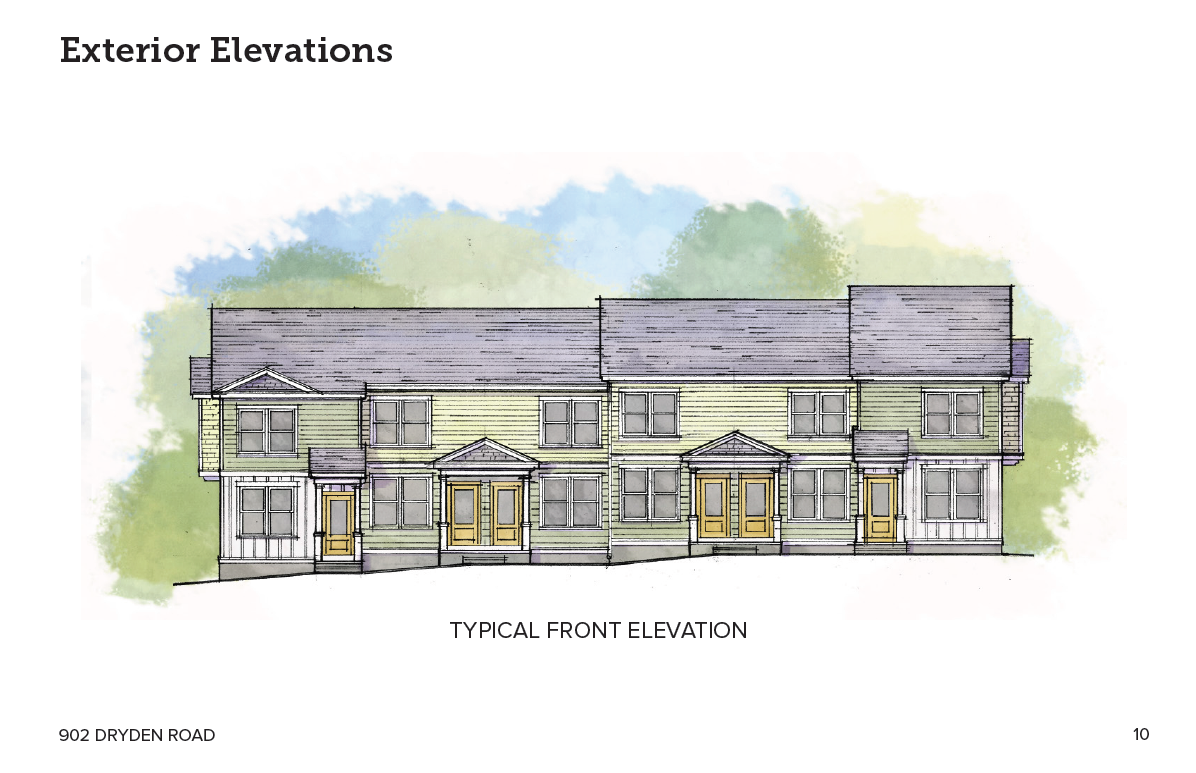
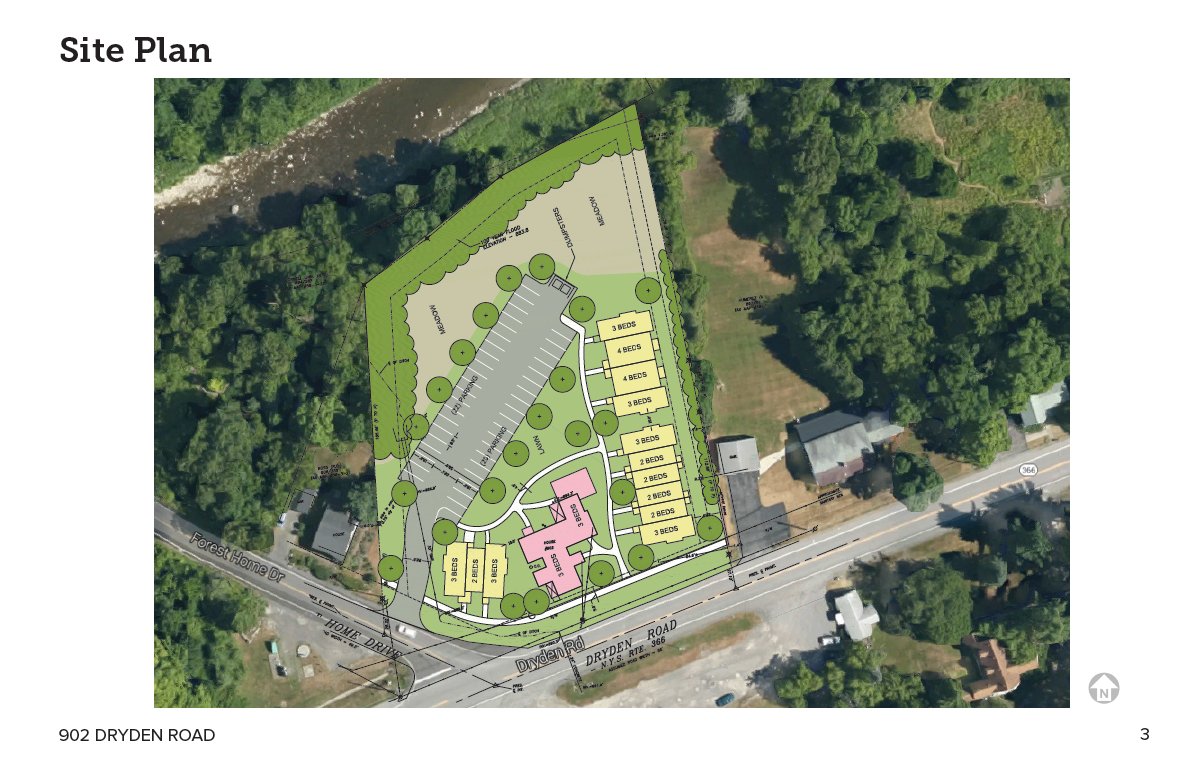
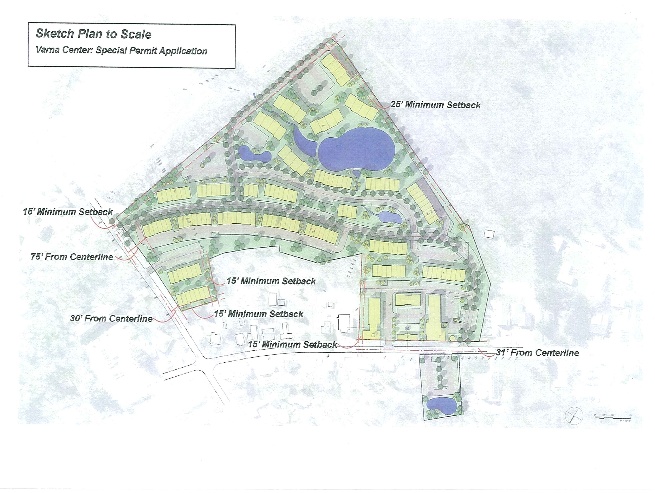
2. Meanwhile, there have some mild hang-ups with another project. The solar-powered townhomes in Dryden are seeing some resistance, mostly from the nearby Cornell Plantations, and from neighbors opposed to rental housing in Varna. The Ithaca Times piece uses this dandy of a line:

“Resident Cheryl Humerez, whose family and in-laws both own homes that neighbor the proposed project, was disgusted by the thought of a rental development, which might attract college students, becoming her neighbor.”

Going beyond the “disgusted” comment, most of the students that would live this far from Cornell’s campus would be graduate and professional students. Undergrads are less likely to have cars and tend to live in the neighborhoods immediately adjacent to Cornell’s core (Collegetown, Cornell Heights and parts of East Hill). Graduate and professional students tend to be like any other 20 or 30-something living on modest wages. The chances of a “keggers on Tuesday” kinda place are virtually nil. Also worth pointing out, Dryden’s town supervisor called Humerez out on that comment, saying she was saddened that renters were being described as a problem.

Cornell Plantations, as represented by Todd Bittner, has more legitimate concerns about litter, the driveway location and stormwater drainage; but glancing at the town minutes, it looks like the “I know we need development, just not in this neighborhood” argument also makes an appearance.

The town board (in Dryden, it seems the town board oversees public hearings of the planning board’s agenda) is taking a more level approach; acknowledging that it’s a decent project, community input is important for good development, and by incorporating mitigation measures to assuage worried neighbors, this has the potential to be a worthy community asset. Expect this project to evolve as we go through the next couple of months.

Also noted in the town minutes are plans for a 78,000 SF storage facility next to NYSEG at 1401 Dryden Road. Plans from a Cornell startup named “Storage Squad” call for “high quality, attractive self-storage” with 400 storage units in the first phase. The project will need site plan review.

402_s_cayuga_st_rev2_1

3. To anyone who’s passed by the vacant lot at 402 South Cayuga Street and wondered when INHS will start those for-sale townhomes: I’ve taken the liberty of checking. INHS director Paul Mazzarella stated in an email that “[t]he project is out to bid for a general contractor. The bids will be due next week. If the numbers are OK, we will start as soon as possible.” So barring any nasty shocks in the bids, the four-unit project (1 3-bedroom, 3 2-bedroom) will start in just a few weeks. As with other INHS projects, the units will be sold to qualified first-time homebuyers with modest incomes (anecdotally, that means the $40k-$50k range…it seems like half the buyers in the past year or so have been teachers in the ICSD).

4. In a rare bit of bad economic news in Ithaca, Ithaca College has announced its intent to slash about 40 staff positions from its workforce. This follows 47 job cuts in academic year 2014-2015, 39 of which were vacancies.

The cuts are part of an effort to bring tuition costs and help the college stabilize enrollment numbers, which have been sliding down lately. No faculty positions will be eliminated as part of the layoffs. IC currently has about 1,070 staff and 730 faculty, about 200 more than they employed a decade ago.

harolds_square_taylor

5. The rumor mill said that a reporter from the New York Times was in town last Friday, and apparently they liked what they saw; the piece in the NYT takes a very positive and gracious approach with Ithaca and its recent urban developments. If you haven’t read it already, the link is here.

[What follows is a spark-notes version of the Voice piece – I’ll update with links after the weekend holiday.]

More importantly are some useful details in the piece – one of which is that we now know the revised mix of uses for the 11-story Harold’s Square project calls for 86 apartments, up from 46 when it was first approved in 2013. The apartment units will be a mix of 1-bedroom and 2-bedrooms. Readers may recall that the project dropped two floors of office space in favor of two floors of apartments. The project also includes about 11,000 SF of retail on the Commons.

In a phone conversation with developer David Lubin, the current plan is to start construction of the $38 million project in early 2016:

“Rev will be out at the end of September. We’ll probably begin demolition after the first of the year, after the holiday shopping season, we don’t want to be a nuisance to Christmas shoppers. We’ll have pop-up store space available during the holidays. They’re not solid, but those are out plans. We’ll see how it goes”.

Also, the project will be going back to the planning board.

“The planning board re-approved the current design [last month]. However, there will be changes to the design, as we’ve changed the office space to apartments and they have different needs, window placement, things like that. When we’re ready, we’ll present those to the planning board. Not September and probably not the October meeting, but before the end of the year.”

The project was originally approved in August 2013, with a CIITAP tax abatement package approved two months later. However, putting a financial package together has been a task.

“These things take time,” Lubin stressed. “The Marriott, that needed 3 or 4 years before they started. It can be a slow process.”


simeons_1

6. For those keeping an eye on the Simeon’s reconstruction, expect to see some progress in the next couple of weeks. That’s according to an interview the Sun conducted with Simeon’s co-owner Rich Avery. The timeline has yet to be finalized, but the new restaurant space and luxury apartments are anticipated for completion by late next summer, with the resturant re-opening as early as February.

maplewood

7. Gosh, it’s nice to have the Sun back in session. Also from the Sun, incoming Cornell president Elizabeth Garrett has formally announced plans for new student housing, among other graduate student initiatives. From the Sun:

“Following her discussion on maintaining and promoting diversity among graduate students, Garrett announced the creation of new graduate student housing.

“My team and I are committed to working with the GPSA to create an inclusive and rewarding [graduate and] professional student living environment,” she said. “Most immediately, I am working now with my team to work on critical housing needs.”

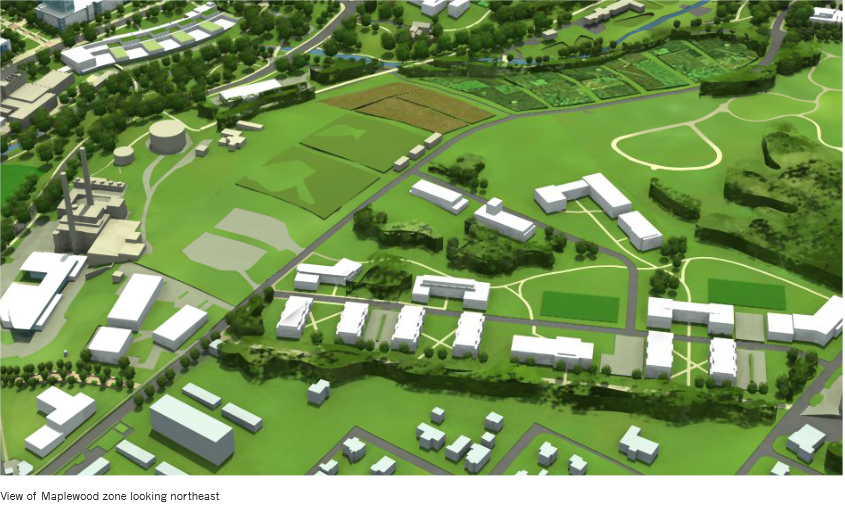
According to Garrett, since the University’s Maplewood Park Apartments — a graduate student housing facility located near the Veterinary School — is closing, the University is currently collaborating with private partners to create new graduate-student housing at the Maplewood site and to develop additional housing in the East Hill Village.”

Heads up folks, East Hill Village isn’t even a thing a yet, it’s just a concept from the master plan. Anyway, this goes along with Ithaca town supervisor Herb Engman’s comments to the county that Cornell is engaging with consultants to bring a plan forward. There’s nothing else known about the plans, and it’ll be a few years before any students start moving in to new Cornell-sponsored digs, but everything has to start somewhere, and Cornell’s created quite a deficit for itself when it comes to providing adequate amounts of graduate housing.

Also, note the “collaborating with private partners” bit – these may or may not be tax-exempt, we shall see what happens.

state_st_triangle_v3_3

8. Here’s the latest update on State Street Triangle, courtesy of the Ithaca Times. I have to admit, although I technically compete for eyeballs via the Voice, I like Josh Brokaw’s writing, he tends to be a bit of a wiseass and it’s entertaining.

The big hang-up is massing. Not height, not tenant mix. A couple of ideas floated or suggested include height setbacks or overall reductions, and a redesign of the facade to make it appear more like separate buildings built next to each other.

According to Brokaw’s piece, some landlords are even questioning the need for new units, saying that all these new units could drive prices down.

Captain Obvious just arrived into port. By the way, given the recent growth in general and student populations and corresponding increase in demand for living space, if a landlord is having trouble filling their units right now, it’s probably not the city’s fault.

Campus Advantage has already spent $500,000 on the project, but it doesn’t seem like they’re going to throw in the towel just yet. They were probably hoping for an approvals process as easy as their Pittsburgh apartment tower, but…live and learn.


Urban Renewal Part II: When Things Don’t Go To Plan

21 08 2015
Photo from C. Hadley Smith Collection

Photo from C. Hadley Smith Collection

For Part I, click *here*.

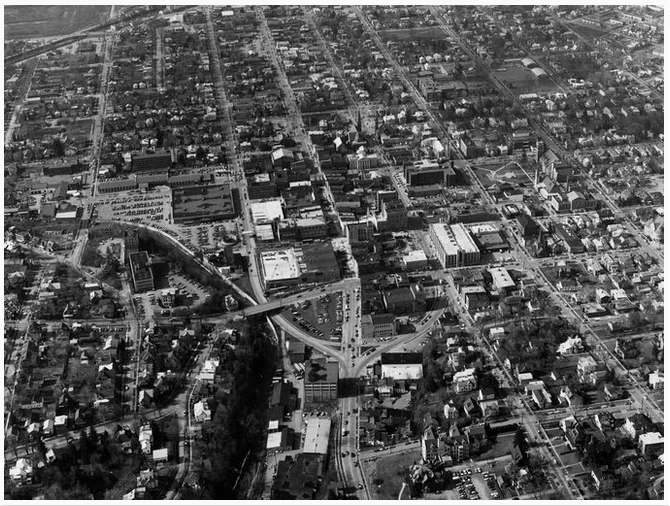
Once the federal funding for Project One came through in December 1964, the gears had started to turn. In Spring 1965, the president of the Hotel Ithaca bought the Clinton House for use as a temporary facility while the new hotel was built. Funds and plan details were formally accepted and approved by the Feds and Common Council in May 1965, and the Ithaca Urban Renewal Agency (IURA, which still exists today) was incorporated.

The IURA was long a sore spot among city councilmen because Democrats were opposed to it and Republicans were in favor of it. The city was a little less one-sided with its politics back then.

In 1966, two developers were designated for two properties in the Project One area. One would build a set of retail spaces, the other would be responsible for what would be the nation’s largest Woolworth’s department store.

For those too young to know, Woolworth’s was a major discount and department store chain – a sort of Walmart or Target of its day (and more like a Kmart towards the end), which was from the 1880s to 1990s. The Woolworth’s was supposed to draw people into downtown, and would be on the corner of S. Cayuga and W. Green Streets.

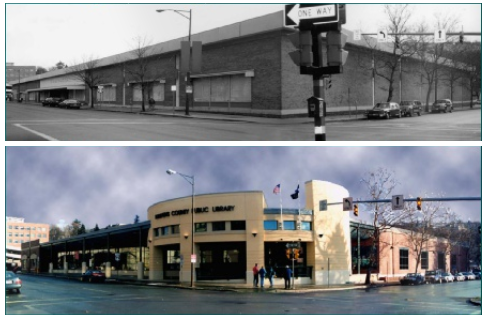
Problems arose when Woolworth’s said it would need even more parking space than planned. The city, fearing the department store would end up in the suburbs, rushed to condemn three properties on the edge of the project area, two car dealerships and a repair shop. The buildings were demolished, acres of parking laid, and the store opened in the winter of 1968/1969.

library_2000

Image property of QPK Architecture

It was not an attractive building by a long-shot, but the store did draw people downtown, and it remained open until about 1998, when the entire chain went under. Today it’s the county library, and the entire block has once again been redeveloped, which was previously written about here.

The closest Ithaca got to that chic modern hotel was the Ramada that opened in 1972 (later Holiday Inn, and now the Hotel Ithaca). That fell just outside the Project One boundary line. The original 1970s hotel, without the “Executive Tower” built in 1985, can be seen in the lead image.

The Hotel Ithaca fell to the wrecking ball in 1967, around the same time that the 2, 4 and 5-story buildings across the street from the Carey and CSMA also came tumbling down. Until the Marriott currently under construction, the city struggled to find a developer interested in the site; the site was developed in 1975 into the new Rothschild’s Building, but the older 1870s structure further up the Commons was demolished, the last of the federally-funded urban renewal demolitions.

After several years of attempting to find developers for the old Rothschild’s site, two local developers finally managed to cobble together enough funding to build Center Ithaca in 1981. Center Ithaca went bankrupt not long after opening, and Rothschild’s closed up in 1982, so the whole block over there has been pretty underwhelming ever since urban renewal touched it.

If anything, the south side of the tuning fork did worse; the potential bank tenant never followed through on its original intent, the city tried for years to sell the property. After several years they finally managed to get rid of the vacant lot. The Trebloc Building was originally planned to have two floors, but financial troubles reduced it to one. The abomination opened in 1974.

The Ithaca Commons, which also  opened in fall 1974 and was completed the following spring, falls outside of the realm of Urban Renewal as discussed here because it was funded with local bonds, rather than federal monies. The idea of a Commons didn’t start to gain traction until about 1971, after most of the urban renewal projects had left their mark on downtown Ithaca.

Like much of downtown, the Commons struggled with high vacancy rates for years, and the mix of stores never quite met the city’s expectations – where the city leaders envisioned department stores and “everyday retail” such as drugstores, neither of those have been historically successful on the Commons, and the use of the Commons as an open-air drug market was an unexpected, unpleasant surprise. It’s really only been in the past 15 years that the Commons has enjoyed low vacancy and strong tenant interest.

See, Ithaca’s urban renewal never quite stopped the overall trend of movement to the suburbs. With each decade, development sprawled further and further out, and it still is in parts of Ithaca town and Lansing. For the Jon and Jane Q’s just looking to buy groceries or hit up a fast food place, downtown Ithaca wasn’t on the radar.

But there were folks who were still drawn to the charm of a built-up downtown, where emphasis was on two feet rather than four wheels. It was an eclectic bunch – older residents still heavily invested in downtown, and younger, poorer, counter-culture types settling in the area during 1960s and 1970s. Ithaca’s dilapidated downtown, where many retail chains feared to tread, is where a lot of the region’s unique “vibe” sprouted, albeit unintentionally.

And, as things go, what’s old is new. There’s a renewed interest in denser, walkable communities, whether for sustainability, cultural amenities, or simply to experience something different from the cul-de-sacs and strip malls that many Gen X’ers and Millenials grew up with. Ithaca, with a stable, growing economy and plenty of fresh blood flowing in and out of the community, was poised to capitalize on this, and his done so with a fair amount of success in recent years, attracting both national retailers and keeping most of its character intact. Had it not for the renewed interest in walkable downtowns, newer urban renewal projects such as Cayuga Green would likely have been as unsuccessful as Center Ithaca.

The car, once a defining aspect of America’s cultural scene, is now more likely to be treated as an appliance, like a washing machine or microwave. It does what one needs it to do, but the allure isn’t what it used to be. Parking lots used to be eye-catching splashes of color, coral and peach, turquoise and sea green; and now, beige, grey, and subdued reds and blues. The symbolism is there.

ith_urban_renewal_plan_1964_2

Urban renewal in the tear-down and pave everything sense was stopped for two reasons – money and opposition. But money was the much more important one.

In the later 1960s, funds for urban renewal started to dry up. The city dropped projects two and three and combined elements of the two for a second phase of downtown, and a proposal for Collegetown. The Collegetown proposal was submitted (much to the chagrin of Collegetown landlords), but much of it got lost due to competing interests in the bureaucratic quagmire, and never moved forward under its original intent. The end result was the parking garage, Schwartz Center for the Performing Arts, and the Eddygate mixed-use complex, all of which came to fruition much later in the mid and late 1980s.

Meanwhile, residents began to rise up in protest after seeing so many historic buildings demolished in favor of projects that were never built, or were downright ugly. Although too late to save buildings like the Hotel Ithaca and the old City Hall, groups like Historic Ithaca were important in keeping buildings such as the Clinton House and DeWitt Mall from meeting the same fate.

20150727_145000

It would be unfair to cast those who supported urban renewal as malignant or devious. No city official, no mayor, no one with a vested interest in downtown Ithaca set out to wreck it. They were trying to revitalize it, and they were listening and applying the auto-centric, “old equals bad” thinking that had been popular in the years leading up to renewal. The results left a lot of hard feelings, and a lot of unmet hopes.

Yet, the issues that faced downtown Ithaca fifty years ago, the problems that the city’s political and business leaders were never quite able to solve, eventually became assets. Old buildings, now loved for character. Walkable streets, now appreciated. Mixed retail, offices and housing, contrary to single-use zoning, now embraced. Ithaca’s old bones, once a persistent ache, have assisted Ithaca in becoming the vibrant city that it is.

Buildings and streets can be planned. But the people occupying them? Maybe not so much.

Not everything can be planned. And that’s a good thing.


Urban Renewal Part I: Ithaca’s “Project One”

18 08 2015

hotel_ith_1964

It was called “Project One”.

The year was 1964. The tax base of Ithaca, and especially downtown Ithaca, had been eroding for over a decade. Suburban big-box stores started to appear on the south side of the city in 1950, and up towards Lansing, plans were already underway for a new suburban supermarket and department store (the Shops at Ithaca Mall wouldn’t come along for another twelve years). New neighborhoods were sprouting in northeast Ithaca and Eastern Heights, and cul-de-sacs were paving their way onto West Hill and South Hill. Ithaca College was moving its staff and students to a sprawling campus just beyond the city line. From 1954 to 1960, 48 offices and retail stores closed or moved out of downtown Ithaca, a drop of 18%. The city councilmen were concerned.

So how were they to draw people and tax dollars back into the city? The city officials looked around. In the 1950s and 1960s, it was trendy to have that rambling ranch house set back far from the street, it was fashionable to attend indoor shopping centers away from the rain and the cold.

Image courtesy of Tom Morgan

Image courtesy of Tom Morgan

But most importantly, the trendsetters agreed, was that one could not live the high life, one couldn’t even dream of being a part of the jet set, without a big, luxurious car at their command. Two tons of chrome and steel, heralding you’ve made it in this world, and your car will take you anywhere and everywhere you want to be. And if a place wasn’t accommodating for your stylish set of wheels, then it wasn’t a place worth visiting.

The councilmen and the city officials were taking note of all those chrome-trimmed Bel Airs and Galaxies, with their bright colors and sculpted fenders. Following the results of a study conducted in 1959 and finalized in 1962, they came to the conclusion that in order to revive downtown, they had to catch up with the times, to bring downtown into the mid-20th century future with a swagger and a swing.

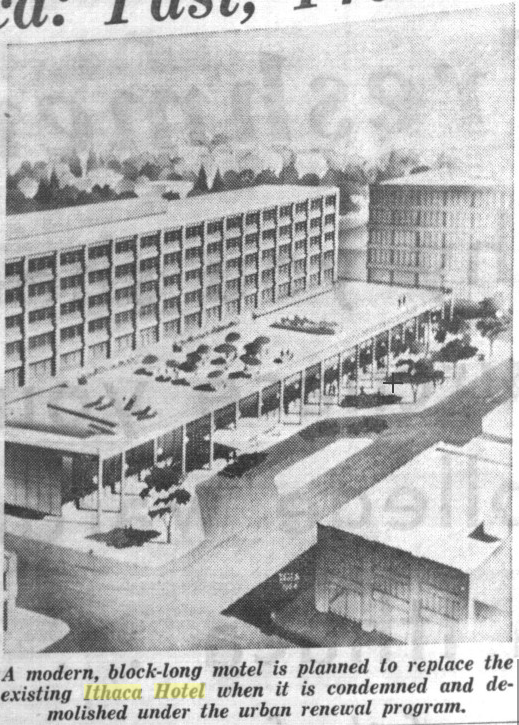
The plans were grand. In place of the nearly century-old Hotel Ithaca, a new hotel a block long, designed in the finest of modern taste. Out would go the decaying buildings of 60, 80, 100 years yore, in would come wider roads, ample parking, modern buildings and ideally, an influx of cash. Ithaca hoped it would bring new residents back into the city, while Cornell U., happy to give some money towards the effort, hoped it would bring in more industry and research organizations.

ith_urban_renewal_plan_1964_1

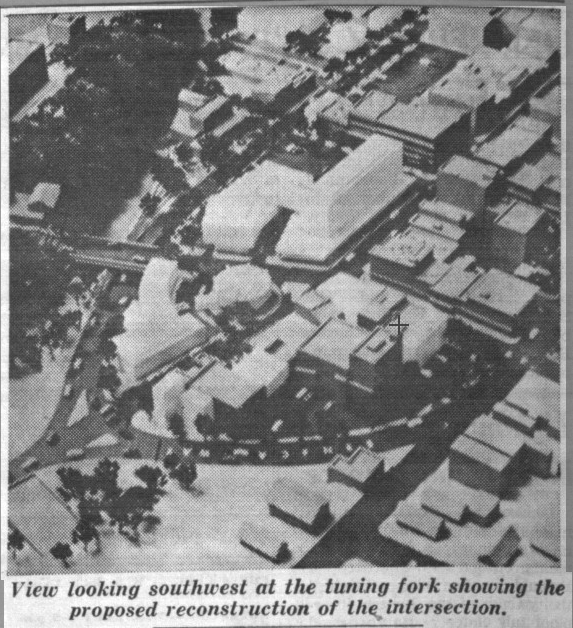
Project One was to be the first of three steps in Ithaca’s Urban Renewal plans. Plans in Project One called for the demolition of the Hotel Ithaca block and the buildings on the south side of the “tuning fork”, already built by that time (and taking out a number of buildings in the process). In their place, the new hotel would go, and a new bank office on the south side of the fork. In the model above, you can see what was once the Strand Theater (demo’d 1993), Restaurant Row and the old Rothschild’s Building (also gone now) still intact. There would be new auto dealerships, new department stores, traffic generators and tax generators.

Image from Cornell Daily Sun, 10/20/1966.

Image from Cornell Daily Sun, 10/20/1966.

The rest of Project One targeted about 26 acres of land bounded by State Street, Cayuga Street, and Six Mile Creek. Essentially, everything south of the Commons, and everything east of the present Hotel Ithaca/former Holiday Inn. Much of the area between Six Mile Creek and Cayuga Street was auto repair shops, dealerships and other car-oriented enterprises. Pritchard Automotive, a block further south, could be seen as the last vestige of when South Cayuga Street was “Automobile Row”.

The plans moved forward in fits and starts. Survey and planning work was brought to a stop in 1962 by Ithaca mayor John Ryan, who vetoed the plan. But following the election of Hunna Johns in 1964, the grand revitalization schemes moved forward again. The Common Council approved the federal application for Project One in June 1964.

ith_urban_renewal_plan_1964_2

After six months of delays, federal funding came through in December of that year. Cornell had already given funding to the tune of $500,000 (about $3.85 million today) to help pay for the projects, but the federal government would be the primary source of funds, which would pay 75% of the $6 million initial cost. Ithaca and the state of New York would each fund about $750,000. The city reasoned that it would bear the expense now for increased tax revenues in the future.

city_1

Of course, not everything worked out as planned. Nowhere close, really. That will be covered in Part II.


When Varna Needed A New Plan

14 07 2015

A couple of weeks ago, I wrote up a piece regarding new solar-powered townhomes proposed for 902 Dryden Road in the hamlet of Varna, located on the west side of Dryden town. There was a temptation to expand the piece quite a bit by looking at Varna’s 2012 development plan, but that would have been another article in itself. So here we are.

As with a lot of development plans and rezonings, the impetus for many participants was a large, politically divisive project. A lot of the details I’m featuring here come courtesy of blog posts or the links posted within the posts of the “Living in Dryden” blog written by Simon St. Laurent, though this retrospective comes without his vehement opposition.

varna_ii_2010

In February 2010, the Lucente family (locally large-scale developers who run Lifestyle Properties) began discussions for a new, very large project in the hamlet of Varna. Dubbed “Varna II”, the proposal called for 260 units of housing and 30,000 SF of commercial space off of Mount Pleasant Road and Route 366. The plan called for a build-out over ten years in three phases, and the residential units were mostly townhouses that would be sold in the $150k-$200k range. It wasn’t the first time the Lucentes had targeted Varna for a major project – a 170-unit project proposed in 2000 had previously been shelved. The zoning in Varna allowed projects of 2.5 units/acre, comparable to a lot of older suburban neighborhoods. The Varna II project, at about 16 units/acre, the project was much denser than what Varna was accustomed to – and permitted, for that matter, since the town zoning law had a maximum of about 14.5 units/acre. The project would be going forward as a Planned Unit Development.

Geographically, Varna is in an awkward position – it’s a hamlet of about 800 people just east of Cornell’s campus, which puts it in the figurative line of fire for development interests, one that greatly interferes with the bucolic lifestyle touted by some residents. On the other hand, Varna is not without need of major improvementsit’s a very auto-centric area, a lot of what is developed is underutilized, and some of the street-fronting properties have potential for redevelopment into a more walkable, cohesive community.

Timing-wise, the project was well-suited; Dryden was looking at revised zoning to reflect its 2005 comprehensive plan. The possibility of a large residential complex was definitely enough to draw more attention to the new zoning, especially its impacts on Varna. The old Varna zoning (R-C and R-D residential) wasn’t dense at 2.5 units/acre, but it also allowed for a whole range of uses from residential to commercial and farming; a proverbial grab-bag. The Lucente project made it clear that maybe it was time to give the future of Varna some real thought.

As with any divisive project, Varna II went through community meetings, hosting a meeting with the Varna Community Association during the summer. The VCA was a little more even-handed about the whole thing – they knew that development in Varna was inevitable, but they wanted a greater role in shaping it. The VCA stated that it was comfortable with doubling the density to 4-5 units/acre in some areas, as well as owner occupied homes, more walkable spaces, and smaller development sites.

The project never went through formal review – the initial PUD application appears to have been rejected, because Dryden’s PUD requires at least 100 acres – this project involved only 16.3 acres. The rejection was appealed to the town Zoning Board of Appeals in December 2010, issues with State Environmental Quality Review (SEQR) and procedural issues delayed the meeting on the project, and by spring 2011, the town had an unofficial moratorium in place on large-scale development, at least until the new plan for Varna was drawn up and approved (expected to be about 9 months).

varna_plan

Fast forward some months and meetings later, and the plan, created by Behan Planning and Design, was adopted in December 2012. The conceptual plan calls for New Urbanist guidelines – sidewalks, garages on side-streets, pocket parks, and mixed-use. The conceptual build-out above adds about 450 bedrooms to the hamlet. Some of the short-term goals called for improving bus stops and finalizing the Varna Trail in the short term (identified as 2012-2014), reworking the 366/Freese Road intersection into a roundabout during the medium term (2015-2017), and incentives for projects to follow the plan. The plan also suggests implementing complete streets in the 2015-2017 timeframe. The revised Varna zoning allows for units 6-10 units per acre, with density bonuses for LEED and certain forms of redvelopment.

Well, we’re in 2015 now, let’s see where things are at. The town applied for grants in 2013 for the “complete streets” multi-modal corridor on 366. But apart from that, not much else on the town’s end, something that Varna residents have noted with some distress. The town responded that plans are underway, they’re just going slower than anticipated.

902_dryden_1 902_dryden_2

On the private end, Modern Living Rentals’ 15-unit, 42-bedroom project for 902 Dryden is the first major project to hit the dirt since the plan was adopted. The 902 Dryden parcel is about 2.42 acres, so the project comes about to about 6.2 units/acre (based off of the zoning, I think 13 units/acre were possible with the green bonus for being solar-powered). Being 2-story townhouses, it’s in scale with Varna, and is a sizable but not large project, the type that the VCA expressed preference for back in 2010. 902 Dryden includes proposed street-facing sidewalks for when the town gets to that phase. Since it’s been approved, I would guess that the town is satisfied with the project.

As for the Lucentes, they’ve focused on other endeavors, such as their Village Solars apartment project in Lansing. They still own the land that Varna II was proposed for. There’s no indication if anything will happen here or if they’ll eventually sell it off, but it’s something to keep an eye on in the long-term.


News Tidbits 6/27/15: A Bad week for YIMBYs

27 06 2015

cornell_novarr_1

cornell_novarr_2 cornell_novarr_3

1. Starting this off with least controversial news-maker this week – John Novarr’s 209-215 Dryden Road project, which I wrote about for the Voice here and with site plan details and SPR/render links here. The first article’s a little helter-skelter as a write-up because there was a lot of frantic 11:30 PM fact-checking going on in an effort to get the news out.

The $12 million, 12,000 sq ft proposal is smaller than Collegetown Dryden, but more importantly, the project isn’t residential; it’s classroom and office space for Cornell’s MBA program, three floors for each of those uses. That definitely brings something different to Collegetown and its mostly residential focus. With assurances given that the property will be kept on the tax rolls, the initial opposition appears to mostly be related to the design, which to be honest, is rather avant-garde and an acquired taste (not one I’ve acquired, to be honest). However, bringing 200 staff and a few hundred professional students into Collegetown would be a real asset for businesses struggling to stay open amid the neighborhood’s 32/36-week profit window.

209-215 Dryden Road is within the MU-2 zoning from the looks of it, so a trip to the Board of Zoning Appeals (BZA) seems unlikely at the moment. We’ll see what happens moving forward, this one could be a fairly smooth approvals process.

2. For a smaller developer, Ithaca-based Modern Living Rentals has been pretty busy this year. Along with 707 East Seneca Street and 902 Dryden, they have a modular duplex (3 bedrooms each, 6 total) currently under construction at 605 South Aurora Street in Ithaca city. A construction permit was issued back in 2014, according to the city planning report. The orientation is a little odd in that the new duplex is being built in front of the old home on the property, since the house is longitudinally centered but set back on its lot. Taking a guess, the intended market is likely IC students. The new units look like they’ll be ready for occupancy in time for the fall semester.

3. Here’s an interesting piece of news, courtesy of the Tompkins County Government Operations Committee – plans to sell a vacant lot to non-profit housing developer INHS. In its May minutes, the committee announced intent to sell a vacant, foreclosed parcel in Freeville for affordable housing. The property is described as a 1.72 acre parcel on Cook Street in the village, which through a little deductive searching, turns up the lot in the map above, just north of the Lehigh Crossing Senior Apartments. The minutes state that INHS is in the process of drafting up an acquisition offer for the county attorney.

Freeville is outside of INHS’s usual realm of Ithaca city and town, but INHS expanded its reach when it merged with its county equivalent, Better Housing for Tompkins County (BHTC) last December.  This might be the first new rural project post-merger. The Lehigh Crossing Apartments have 24 units on 2.3 acres, so if INHS were to build at the same density, this site would be looking at something around 18 units. Not big, but not inconsequential, especially for a 520-person village.

cinema_drive_1

4. A decision to decrease sewer hookup costs in Lansing village also shares some details about a senior housing project in the works. The news comes from the Lansing Star, where the village voted to decrease its sewer hookup fee from $2,350 per unit to $1,000 for the first unit and $500 for each additional unit. Apparently the high fee was the result of the lack of a permitting process in the 1990s.

The article notes that the developer of a mixed-use request had requested a fee waiver because it would have cost $138,650 for their “59 units of senior housing”. Now it will be $30,000. Not as good as a waiver, but still pretty good. Lansing village only has one project that meets the description provided, the 87,500 sq ft Cinema Drive project covered here previously. The semi-educated guess back in May was 51 units, so the ballpark estimate wasn’t too shabby.

327_eddy_rev3_1

5. It’s official, 327 Eddy is under construction. Asbestos removal has been completed and the Club Sudz building is coming down. The Fontanas hope to have the building completed and ready for occupancy by next August. In replacement of Club Sudz’ and Pixel’s 7 units and 2,500 sq ft of commercial space, the new 5-story building will bring 1,800 of retail space and 22 new units with 53 bedrooms to the market.

Eagle-eyed readers might recall the building was originally going to be six floors, but a floor was lopped off since it was approved.

215-221_spencer_v3_1

215-221_spencer_v3_2

6. Updated renders for 215-221 West Spencer Street, coming right up. A little more detail on the facades, some window updates from the last version, and…well, honest personal opinion…it’s a very attractive design. Materials could underwhelm it, but as presented, it appears to be a lovely addition to South Hill. Good work STREAM Collaborative.

The 12-unit, 26-bed project plans to start construction next year. The project replaces an informal (dirt) parking lot.

oldlibe_franklin_proposal

travis_hude_libe_libe_v3

7. Touching on the Old Library decision briefly, a public meeting on the two proposals will be held Monday June 29th at 6:308:30pm at Greenstar’s “The Space” (700 West Buffalo Street). Douglas Sutherland will represent Franklin Properties (first image) and Frost Travis will be presenting for Travis Hyde. Should the County Legislature decide to take another vote to see if the stalemate will be broken, the next chance will be at their July 7th meeting.

EDIT: The public meeting scheduled for the 29th has been cancelled .

state_st_triangle_v2_1

8. Onto the thornier topics – Not sure what was worse this week, the reaction to the State Street Triangle project, or the INHS Hancock Street opposition. The objective, non-partisan write-up about the State Street project is on the Voice here. This and news piece #9 are opinion pieces, feel free to ignore them.

At least the State Street objections (latest renders here), I can understand the initial shock and recoil; there’s this perception that Ithaca is a small town, and this doesn’t jive with that. Regardless, by Ithaca standards it is massive, 11 stories with 289,000 sq ft of space and 620 bedrooms; if this was, say, a four-story building with an 11-story tower on the closest third to the Commons, the reaction would probably be less vitriolic (people would still hate it, but let’s entertain this thought exercise).

But that probably won’t happen. Not with this developer, or with any developer that purchases the Trebloc site. Here’s my theory why, and it goes a little more in-depth than “they want maximum profit”.

In December, Jason Fane’s 130 East Clinton project was rejected for tax abatements, and one of the reasons cited was that market-rate housing wasn’t enough of a community benefit. State Street Triangle is mostly apartments – it contains only a modest amount of retail space, with less than 13,000 sq ft it’s not even 5% of its usable space. If it were to apply for an abatement, it would likely be rejected for the same reason.

Arguably, they could try commercial office or even industrial “maker spaces”. But the market demand for office space doesn’t seem to be growing much, and industrial uses don’t tend to be a good fit in heavily populated areas. A developer could even try condos, but if developers knowledgeable with the area are hesitating, than a bank won’t hesitate to hold off on financing (aside on that – if the Old Library goes condo, other developers and financiers will view it as an experiment, or more positively, a pioneer; until it’s clear that the project is successful, don’t expect more condos in Ithaca).

However, nothing changes the fact that building downtown is quite expensive. So, being a for-profit company, if you want to build in an expensive area, you have two options to ensure return on your $40 million investment and get the construction loans you need – build as much as possible, and/or make your units as expensive as possible. If you’re a company that specializes in student housing, you’re not going to push the latter because there’s a lower ceiling on what students can afford. That would be my guess on how State Street Triangle came to be.

There are a few possibilities that might make the project more palatable to community members, such as free bus passes for tenants or a 10% affordable housing requirement within the tower (if the INHS project oppositions are any clue, this is going to be the only way to go from here on), but given the costs, those ideas just might kill the project completely. Which is exactly what some folks are looking for.

At the very least, let’s let the Planning Board do their work. If they can help change this:
hampton_new_1

to this:

canopy_hampton_rev4_1

Let’s see what they and the developer can negotiate here.

9. Now for 210 Hancock. Here is a project that’s been transparent, incredibly transparent, throughout their whole planning process. At first, there was little opposition. Now, it threatens the proposal, apartments, townhomes and all.

A wise man once told me in when I was preparing a piece, “There’s no point in talking about this with you, the public’s going to have issues with it either way”. At this point, I’m inclined to believe him.

I’ve read the petition, and I’ve read the facebook comments. It’s regrettable, to say the least.

A lot of the comments just seem to be misinformed. People saw the petition, thought that INHS was only building the apartments, and signed it. The petition was worded with charged and selective language. I’d like to take a few minutes out to refute and argue some of the commentary.

“there must be a safe place for children to play…”

“People need access to green space, yards and the ability to get outside directly from their living space.”

“I want my 3 year old to grow up in a neighborhood where he can safely ride a bike, play sports and walk his dog.”

You’re right. That’s why the project, as proposed by INHS and tweaked by the city Planning Board, builds a playground that blends into Conley Park without the threat of vehicular traffic (shown in the plan below). Adams Street and Lake Avenue would be removed, allowing kids living in the apartments and townhomes to go the playground without crossing any street.

inhs_pride_playground

“I’m a lifelong resident, and I’m frankly getting tired of seeing all these areas getting bulldozed and developed…especially when we have dozens of empty/condemned houses and buildings just sitting around!”

The rental vacancy rate is 0.5%. A healthy market is 3-5%. Further to that, if there are dozens of homes, even if they were for sale, it’s still not enough to handle the demand, which is in the few thousands.

“inadequate parking planned.”

“The parking issue is already a problem. This will only make it worse.”

“I am a Fall Creek resident and do not want this area in our neighborhood to resemble Collegetown in density or difficulty in parking.”

84 parking spaces are required by zoning, 64 are proposed. However, only 22 spaces are expected to be used by the 53 apartments. In the parking study of INHS tenants, 41% of apartment tenants have 1 car, 12% of those have two. One of the reasons why INHS’s parking utilization is so low is that many of its apartments are rented by seniors – for example, Breckenridge Place is 60% seniors on fixed incomes. With limited mobility and/or income, many don’t maintain personal cars.

In a sense, although the Cornerstone project for affordable senior housing wasn’t selected by the Old Library site, the INHS project on Hancock Street may serve in some ways as a reasonable alternative.

“We don’t owe any developer a profit on their development.”

INHS is a non-profit community developer. The townhouses sold at Holly Creek over the past year were in the $105-$120k range. For comparison’s sake, the townhomes in the Belle Sherman Cottages sold for double that, and those aren’t even considered high-end (high-end would be the $410,000 townhomes in Lansing’s Woodland Park).

The reason why construction won’t start until Fall 2016/Fall 2017, with the apartments finishing up in Fall 2017/Fall 2018, is that they are completely reliant on government grants and donations from community supporters. The townhouses won’t start for a couple of years (their time frame is 2018-2020) because funding for purchasable units is more difficult to get. Just like with the condominium debate, the government is more likely to disburse a grant if it knows there are buyers waiting in the wings. And for low and moderate-income households, far more are capable of renting versus buying. As for the rent-to-own option suggested by the petition writer, it’s speculative, complicated, and NYS/federal HUD will not provide grants for that type of property acquisition. INHS couldn’t do it if they wanted to.

“[need]assurance mixed income will be there”

It will. As I wrote in March:

“210 Hancock will have 53 apartments – the 3 bedrooms have been eliminated and split into 1 and 2 bedroom units, so the number of units has gone up but the total number of bedrooms remains the same (64). The units are targeted towards renters making 48-80% of annual median income (AMI). The AMI given is $59,150 for a one-bedroom and $71,000 for a two-bedroom. The one-bedroom units will be rent for $700-1,000/month to those making $29,600-$41,600, and the two-bedroom units will rent for $835-$1300/month to individuals making $34,720-$53,720. Three of the units will be fully handicap adapted.”

“A 54 apartment high-rise is not the appropriate place for children to grow up, low income or not.”

“It is too dense and not suited to Fall Creek or Northside.”

“I moved to Ithaca and settled in Fall Creek to live in a small town.”

For starters, it’s harder to make housing affordable if there are fewer units on the a plot of land. Secondly, because the INHS project takes lead on the city’s right-of-way (ROW) on Lake Avenue and Adams Street, the calculated density per acre is 23.6 units per acre. Cascadilla Green, one block to the north, is 20 units per acre. Also note that units are 1 and 2 bedrooms per unit; most of the houses on blocks in Northside and Fall Creek are 3 bedrooms per unit.

What probably bothers me the most are some of the comments in the online petition for INHS.

“Shame on you “Ithaca Neighborhood Housing” for even thinking of creating something that will breed trouble…”

“This is an uncivilized proposal…”

“if all on welfare, this will invite crime…”

One of the reasons I harp on affordable housing is that I grew up in affordable housing. This 147-unit mixed-income complex in suburban Syracuse. Apartment 28E. I shared a bed with one of my brothers until I was 10, and even after my mother was finally able to buy a small ranch house, we shared a bedroom until he graduated and went to college two years before I did (by that point, we had moved on up to bunk beds). My mother did what she could. We were never more than working class, but she worked hard (still does) and made sure her kids worked hard.

At least some of the comments are kind enough to be “I want affordable housing but”. Others really make it sound like that those in need of affordable housing are a contamination of the community. Those statements aren’t worth debating. They’re just hurtful.

Anyway, this might be the longest news update I’ve done, so I’m going to wrap this up and detach from the computer for a while. There may or may not be a photo update Monday night, we’ll see.


Lofts at Six Mile Creek Construction Update, 6/2015

12 06 2015

It won’t be long now, this project is in the home stretch. The protective plastic wrap is off and the product is almost ready to hit the market. The work at the “Lofts@Six MileCreek” site is mostly interior finishing at this point. A few of the exterior panels/window glazing had yet to be finished in these photos from last Friday, but a glance at the project’s facebook page shows that the windows have been installed, but the panelling has yet to be hung. Some other exterior finishes, such as balcony railings, are only partially completed as of now. A formal opening by late summer seems likely, thus completing the last phase of a 15-year project.

Looking at the rental agreement, tenants are allowed to have pets (for a $500 refundable fee and a $50 monthly rent surcharge), no more than two tenants may share a bedroom, and income is expect to be three times rent. 12 month leases only, 1 month’s rent as a security deposit.

With rents ranging from $1,220/month and up, that means that the minimum a tenant can make and live in the building is $43,920/year. A top end 2-bedroom unit, at $2,655/month, requires $95,580/year. The three studios range from $1,220-$1,460/month, one-bedrooms from $2,160-$2,355/month, and two bedrooms from $2,095-$2,655/month. There’s no doubt these are premium prices, and as discussed in the last update on this project, that’s not necessarily a bad thing for everyone else.

The Lofts at Six Mile Creek project consists of a a 7-story, 49,244 square foot structure that will contain 45 rental apartment units: 3 studios, 21 1-bedroom and 21 2-bedroom units. The building is being developed by Bloomfield/Schon + Partners out of Cincinnati, and construction is being handled by Turnbull-Wahlert Construction, also based in Cincinnati.

Leasing is being handled by CSP Management, and interested readers can apply for an apartment here or call 607-277-6961 if they feel so inclined. Questions can be directed to info@IthacaLofts.com.

20150605_114748 20150605_114809 20150605_114830 20150605_114902 20150605_114923 20150605_115108

cayugaplace_v5