Kendal at Ithaca Construction Update, 10/2015

13 10 2015

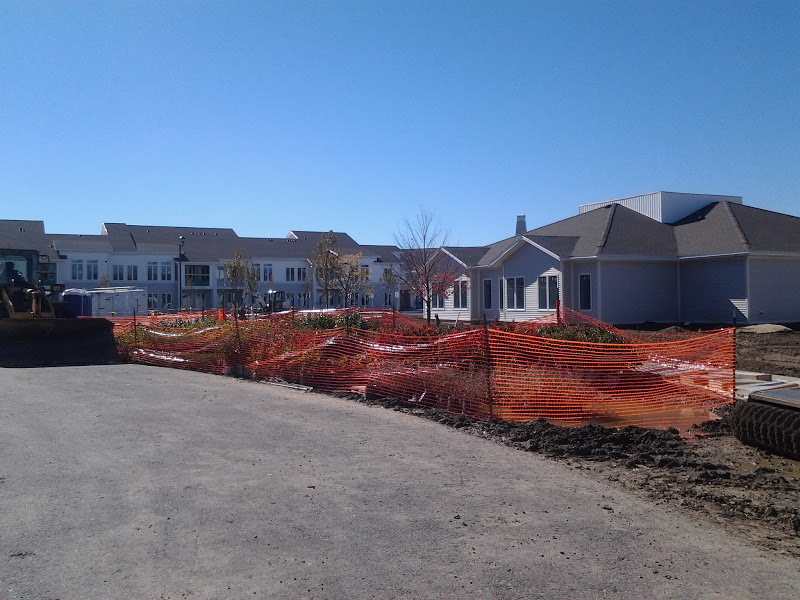
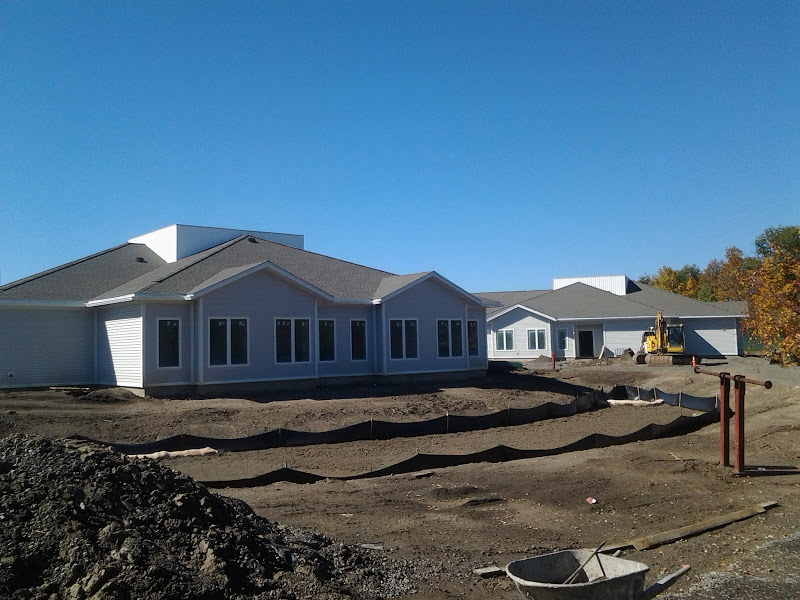
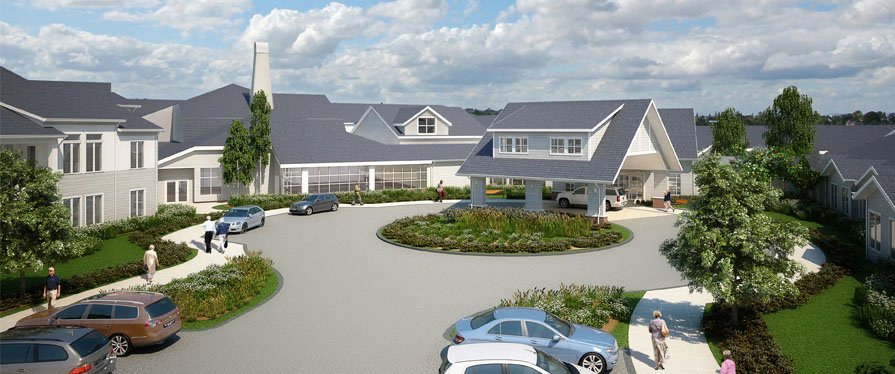
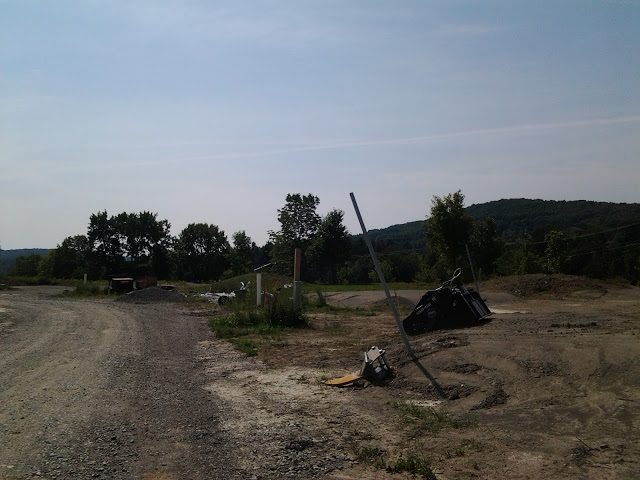
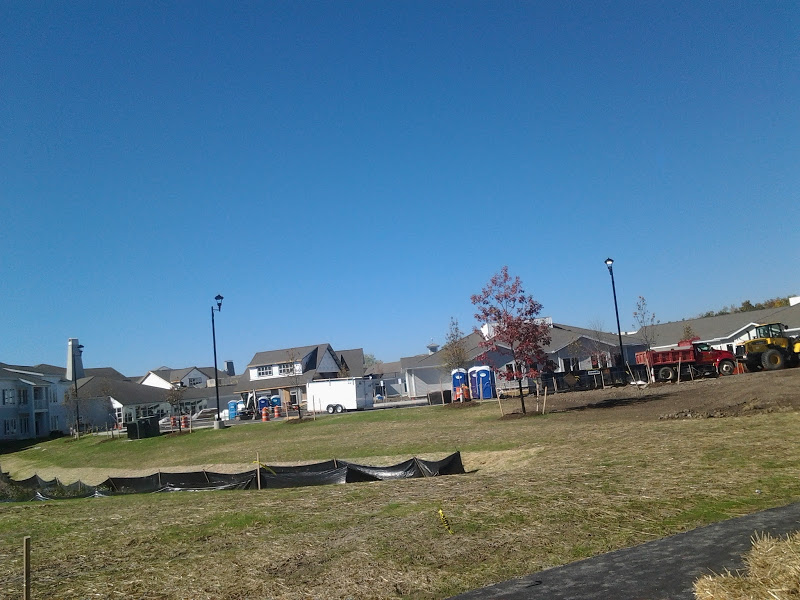
In Cayuga Heights, work is ongoing at the Kendal at Ithaca site as the project marches steadily towards its January 2016 opening date. The senior apartment wing is nearly complete, with just some minor exterior trim (balcony railings) and facade work left. New garages have been built for future tenants of the apartments. The skilled nursing facilities are largely finished from the outside, but are missing the decorative roofs and trusses, which will be installed later this fall. At least from the outside looking in, the new entrance circle/porte-cachere (photos four and five) looks like it has the most work left on its to-do list – windows have been fitted but the new entry and second-floor administrative offices have yet to have trim or facade materials installed. However, given that’s it’s one of the smaller additions, the project should pose no huge hurdle moving forward.

With the January opening date, landscaping work may not finish until the spring, when new trees and grass seeding can be done without fear of inclement weather.

Kendal at Ithaca is currently in the midst of a $29.3 million expansion. Three new wings will be built on the northeast side of the property as part of a new 48-bed skilled nursing center, an increase from the 35 beds currently available. On the southeast side of the complex, a new 2-story, 24-unit apartment wing is being built for independent seniors (16 one-bedroom, 8 two-bedroom). A new entrance, cafe, fitness center, and health center are also included in the additions, as well as major interior renovations. Landscaping additions and a 26-car parking lot are also planned. The construction project is aiming to achieve LEED Gold certification.

Construction began this past January. An estimated 20 to 25 new jobs will be created by the expansion, most of those in service positions that pay $24-$45k. The Kendal website seems to sidestep the discussion of costs, but a New York Times piece from when it opened in 1996 stated the entry fee was about $80,000 for a single person in the smallest unit, rising up to $267,000. Strictly calculating from inflation, the entrance fee may start around $120,000-$125,000 today.

Kendal was granted the privilege to issue tax-exempt municipal bonds by the county legislature to finance the construction of their new wings, but is not seeking any property tax abatement.

Local architecture firm Chiang O’Brien has partnered with the NYC office of Perkins Eastman to design the Kendal expansion. National contractor Lecesse Construction, with an office out of suburban Rochester, is in charge of general construction.

20151011_131238 20151011_131339 20151011_131344 20151011_131410 20151011_131433 20151011_131528 20151011_131532 20151011_131553

Kendal_1

expansion_banner


News Tidbits 10/3/15: Lying in Wait

3 10 2015

1.We’ll start with a news piece out of the ‘burbs. Over in Lansing town, wealthy homeowners are accusing the town board and the town planning board of disenfranchising and ignoring them over concerns about the proposed Novalane housing development. Dan Veaner at the Lansing Star gives a very thorough rundown here.

Quick summary, Novalane is a 19-lot high-end housing development slated for farmland between two other high end housing developments, the mostly-built Lakewatch and Eastlake subdivisions, the first phase of which is comprised of seven lots on the west side of the parcel. The sticking point has to do with access roads for the new homes. The developer proposes to connect the two developments via the Smuggler’s Path cul-de-sac, which would extend down through an undeveloped lot in Eastlake and connect with Eastlake Road.

According to the town, the intent has always been to connect the two developments – but apparently, no one ever had a good idea where. Neighbors on Reach Run are incensed because they’re afraid of additional traffic on their road if the connector isn’t extended all the way, but if connected, Eastlake residents are opposed to cross-traffic they suspect will cut through to get to East Shore Drive. Aside from that conundrum, some neighbors have suggested being okay with the road if it went all the way from Smuggler’s Path to form an intersection with Waterwagon Road, but that doesn’t seem possible given the property lines of the Rec Club. At the very least, it would be a big burden in the development costs.

So on the one hand, here is a town that has struggled with planning issues. On the other, you have wealthy residents angry about construction vehicles accessing the one house currently under construction in Lakewatch, and prepared to sue the town over the potential of seven more houses. There’s also this gem of a line:

“We’re large taxpayers.  It’s an autocracy.  To be treated like that by our own representatives is incorrect and not acceptable.  Who are they working for?”

Maybe all taxpayers and not just the large ones? Just saying.

2. Switching over to another ‘burb, the proprietors of Storage Squad made their pitch to the town of Dryden, per the Ithaca Times. Storage Squad, a Cornell startup that has expanded to twenty cities, seems to have a rather unique take on the appearance of self-storage. For their facility planned at 1401 Dryden Road, the company wants to build 79,600 SF of space, 70,000 SF of which would be in five buildings consisting of 400 storage units. 315 units may join 3-4 years down the line. According to the presentation, there would be a Cornell-inspired clock tower, brick and ivy growing on the side walls. Paved entries, gated, and split-face concrete masonry units. Apparently, it was enough to win the town supervisor over. A special zoning permit will be required, but approval is expected later this fall. No word on whether they’ll keep the 150-year old house on-site.

3.  Must be a good week for Dryden. The eyesore at 76 West Main Street has been sold and has a construction loan approved to finish renovations. The Ithaca Voice article I did on the reno is here. I toyed with the idea of calling Dryden mayor Reba Taylor for a quote, but I figured I’d get a very generic statement it any at all, and in the interest of time the idea was shelved. I might get a response to one-third of the calls I make regarding development/real estate stuff, which can be frustrating but I’ve gotten used to it.

state_st_triangle_v5_1

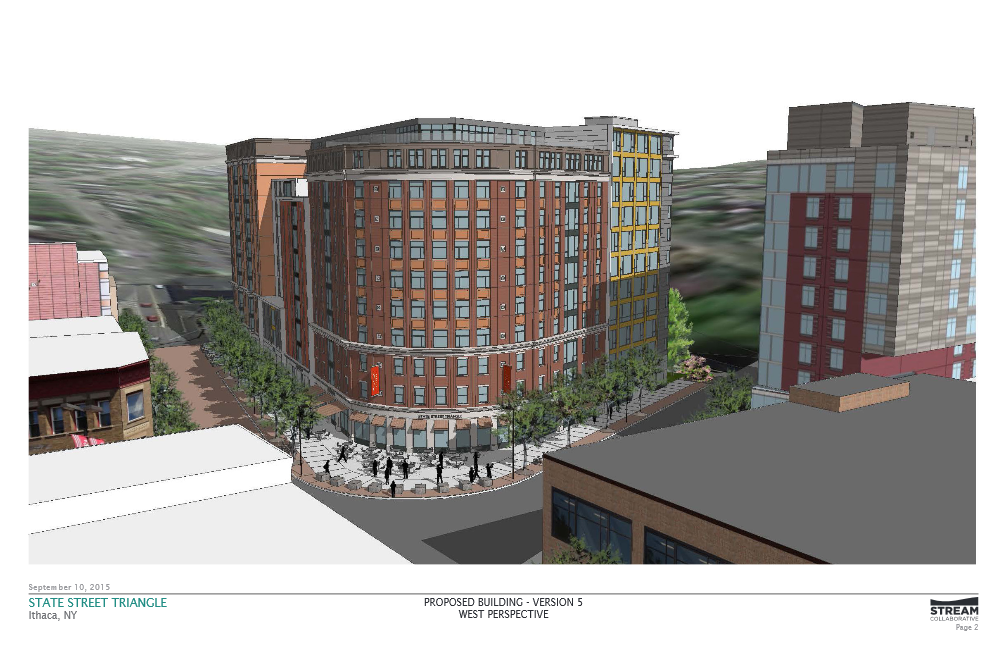
4. The Times’ Josh Brokaw brings out an update on the latest State Street Triangle news. The important details:

– CTB has agreed to take one of the commercial spaces. No word on how that would affect the North Aurora Street location a couple blocks away.

– The planning board didn’t have many words; One member suggested the curve portion was “too flat” and an arcade on the first floor (not the video game kind, but the archways over a walkway kind). A second brought up affordable housing, which the developers have given consideration, but isn’t in the current plan.

– In favor: the director of Cinemapolis, other developers, CTB’s owner and students. Not in favor – the head of Historic Ithaca, and councilman George McGonigal – who opposed the Stone Quarry Apartments, the waterfront rezoning, 210 Hancock and thinks the city can make Cornell build dorms. The Times has called him out as “anti-urban”. If a councilperson outside the first ward speaks out, it’ll get a lot more credence on this blog.

304_college_2

304_college_3

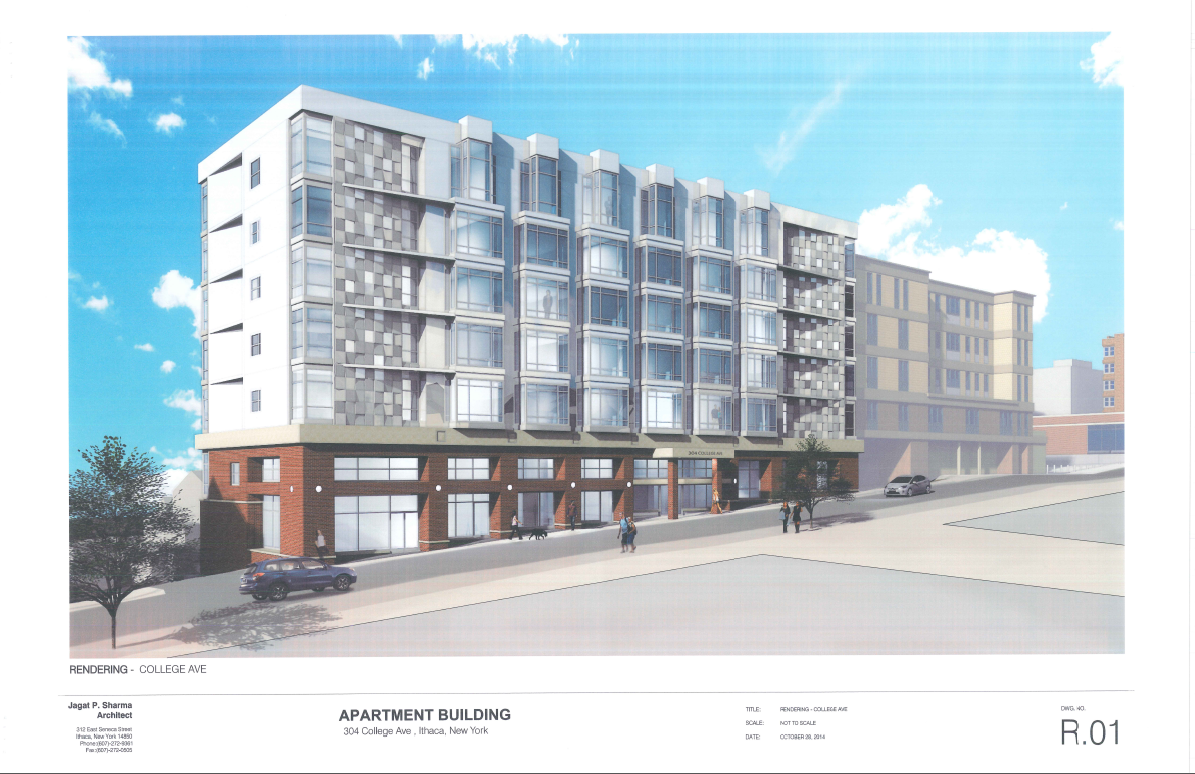
5. The city and Cornell gave an interesting presentation about development to the Collegetown Neighborhood Council this week. City planning director JoAnn Cornish gave a rundown of what’s planned, included the 102 apartments 302-306 College Avenue (phases one and two shown above). This one might still be in the hopper, but don’t expect it to move forward anytime soon – the developers (the Avramis family) have rented out the houses to be demolished through May 2017. It also seems like that one building would be in the 2017-2018 time frame, the second 2018-2019. So these two mid-rises are quite a ways out, assuming they’re still in the works. Also, Fane’s 12-story proposal for 330 College is still dead, but something more modest may come forward someday.

On another interesting note, Cornell’s lead planner, Leslie Schill, said the university may be looking into turning Eddy Gate and the Sheldon Court plaza into green spaces to offset the lack of parks in the neighborhood. Cornell might also renovate the Ag Quad into a richer pedestrian experience.

6. The Carpenter Business Park purchaser continues to intrigue. A company called Carpenter Business Park LLC, using a P.O. Box ties to the Miller Mayer law firm, has bought two more parcels after buying the four unused land parcels in the Carpenter Business Park for $2.4 million last August. This time around, the LLC purchased a nondescript one-story commercial building at 742 Cascadilla Street, and a nearby tiny silver of land between the Palisades Corporation and Cornell U. Press buildings for $304,000. It’s not clear what the buyer is intended to do with all these properties (we know it’s not a big box store), but it’s definitely curious. If something comes up, it’ll be shared here.


The Newfield UFO

29 09 2015
newfield_ufo_1

Image property of the Cornell Daily Sun

October 24, 1967. It was a typically crisp October night in Newfield. The hamlet and town were even quieter than they are now, just the scattered homes of farmers and a few commuters, tuned-out from the tumultuous world around them. They knew of the Soviets and Sputnik, of Johnson and the Apollo program, but were so far removed that it would serve only as a vague interest, coffee talk. By any account, it should have been just a normal, serene night in the hills and valleys southwest of Ithaca.

But at about 9:30 PM, the strangest set of events unfolded in the hamlet. A 12-year old boy named Donald Chiszar said he witnessed a “craft” hovering about 130 feet above the ground. There were markings on the craft, which he could not recognize, and a large window. Two humanoid figures could be seen in a saucer-shaped craft. “But then all of the sudden it leveled off real fast and disappeared”, Chizsar claimed. The visitors were “[r]ough-colored and brownish” beings with “big, wide hips”.

Though no one else claimed to see the craft up close, many other folks in Newfield that evening reported seeing strange lights. Red and white, or green and white, flashing in some kind of sequence. Stanley Orr, driving on 13 to Ithaca the night before, reported “two large, stationary red lights” visible from his car, but at no time thought they were a flying saucer, until he had heard about Chizsar’s experience.

Overnight, people in Newfield began to see UFOs everywhere. On October 30th, more than 100 sightings were claimed by local residents. So started the “Great Ithaca Flap“, as it would be later known.

Now, these sightings caused quite a stir. People wanted an explanation. Many of the witnesses were convinced that what they saw was not of this earth. Residents of Newfield invited UFO experts and an Air Force Lieutenant from the Hancock Air Force Base to a meeting at a local home, so they could hear about their experiences.

One of the UFO experts was intrigued by the stories, but said the lights could be easily mistaken, just tricks of the eye. The air force lieutenant, Gerald White, was less accommodating, saying that it sounded like airplanes to him, traveling along one of the major air traffic conduits out of and into New York City. Newfield laid below one of those routes. Cornell astronomers were rather incredulous as well.

The sightings continued well into November. One of the UFO investigators, William Donovan, set up shop on Newfield’s Main Street, and went about interviewing witnesses and examining sighting locations. A meeting was held in Ithaca, and the claims of sightings were in the hundreds. Although the police and military were skeptical, residents felt like the truth was being hidden from them. Some residents felt the UFOs were related to the Synchrotron (a particle accelerator) on Cornell’s campus; it was reasoned that being one of the few facilities able to bring atomic particles to near-light speed would attract alien visitors, and some of the “flight paths” came from that direction. The local papers picked up the stories and relayed them with interest. Folks crowded the secluded pull-offs and star-lit fields, hoping for a glimpse of something extraordinary.

Finally, in December, Donovan stated that he could find no proof that Newfield was seeing flying saucers. He didn’t offer ideas as to what people saw, he just said that there was no hard evidence that Newfielders were seeing UFOs.

Or course, that didn’t stop the college students from having fun with the news; students launched laundry bags filled with burning fuel, and in one case a local pilot fitted a strobe light to his plane to instigate the UFO-watchers below. Eventually, the sightings tapered off as interest waned. A year after the sightings, Donovan was charged with fraud on an unrelated matter. Occasional reports of UFOs still come in from all over the county.

So was there a UFO in Newfield on that cool October night? Well, probably not. A UFO tracking website reported on the case several years ago, and received the following email:

“I stumbled over references to UFOs over Newfield NY in 1967.
I guess I have a confession.
 
I was a student at Cornell University’s College of Engineering in 1967. I was curious about hot air balloons, and wondered whether or not I could make a working model. I took a dry cleaning bag, sealed up the openings at the top, built a framework to hold the bottom open, and then placed a “heat tab” from a Boy Scout Heat Tab stove on the frame.
 
I then brought the bag out to the “dust bowl” between the University Halls dormitories, lit the pellet, and held the bag upright to keep it from catching fire. Within a few minutes, the bag arose and began a journey, sailing out of sight to the southwest direction.
 
Within the same moments, I had drawn an audience of about a hundred freshmen students, curious as to what I was doing. Once the bag lifted off, some of the students began trying the same trick. Some succeeded while others failed. My success was based on the fuel: the heat tab.
 
I must say that my creation was a sight to behold. The heat tab produced a constant glow, and the clear bag took on the light in a way which magnified the existing light. It was strange, to say the least.
 
The next day, I was surprised to see an article in the Ithaca Journal titled, “UFOs Spotted over Newfield“. It didn’t take more than a split second to make the connection that the UFOs may have been the bags we sent aloft from Cornell. The direction and the timing were right!
 
Is there any possibility that my college prank was the cause of these UFO sightings over Newfield?”

It would seem Newfield has more to fear from curious college students than space aliens.


News Tidbits 9/26/15: Trying to Keep Tabs

26 09 2015

1. It’s rare for a substantial project to go completely under the radar from start to finish. Except that’s pretty much what happened with the following building.

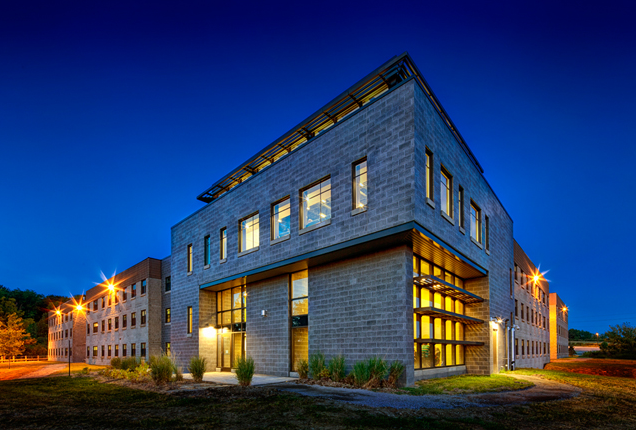
Tompkins Cortland Community College (TC3) recently finished renovations to two of their dorms on their Dryden campus. Along with the renovation of about 41,000 SF of existing space, the two dorms were connected by a new 3-story, 10,000 SF addition designed by Ithaca’s HOLT Architects. The existing dorms sat at a 90° angle to each other, so the addition by HOLT creates a single, L-shaped structure, with the expansion holding common space and amenities. Binghamton construction firm William H. Lane Inc. handled the build-out. The image above comes courtesy of HOLT’s website.

Technically, it did come up once on the blog, but it was misinterpreted. When William H. Lane announced it was opening an Ithaca office to handle the growth in their Ithaca/Tompkins work, one of the examples given in the Binghamton Press & Sun Bulletin was a dormitory expansion at TC3. At the time, I had done a search for the project and filed an inquiry with TC3, but there was no response, and my search only turned up renovations underway for the main classroom building. I assumed there was a miscommunication, so…oops.

2. In real estate sales, it looks like a couple of the smaller developers were in buying mode this week. Lansing’s SDM Rentals (Scott Morgan, owner of SDM Landscaping) bought a vacant 2.93 acre parcel at approximately 455 West Dryden Road in the town of Dryden for $21,000 on the 23rd. If past behavior is any indication, Morgan will probably be looking to do rentals, likely a few townhouses on the property. Currently, Morgan is planning 8 duplexes (16 units) at 543 Asbury Road in Dryden, which may or may not have a zoning issue. Morgan is also building out on Bone Plain Road in Dryden, and owns the recently-built Meadowbrook Apartments (14 units in the form of duplex townhouses) at 393 Peruville Road in Lansing.

Meanwhile over in Danby, Chris Petrillose of Petrillose Properties picked up a 2.11 acre parcel along the 400 block of Troy Road for $34,000. Given that that area has seen a lot of scattered small-scale development (1 & 2-family homes) in the past few years, and that Petrillose finished work on duplexes in Ithaca town, a couple rental units seems likely.

hotel_ithaca_2

3. How well was the Hotel Ithaca received? Let’s quote IJ Reporter Nick Reynolds’ Twitter:

Many sweet, way-over-my-head architecture burns thrown tonight. Let’s just say you guys aren’t getting a Hotel Ithaca update anytime soon.”

The primary complaint focus not on function but on form – according to the IJ follow-up article, materials and a dated design were dinged by board members (and comments about “LEED-certified stucco” and comparisons to the Bellagio didn’t help). NH Architecture’s portfolio tends to be the same general design, which means they’re going to have to go the extra mile on this one, or developer Hart Hotels might need to switch up their approach. Their Belhurst Castle Hotel design isn’t bad, so maybe they can channel some of that creativity into the downtown Ithaca site.

So rest assured, “Cornell PhD”, those cross-hatches aren’t making it off the drawing board anytime soon.

casca_landing_1

casca_landing_2

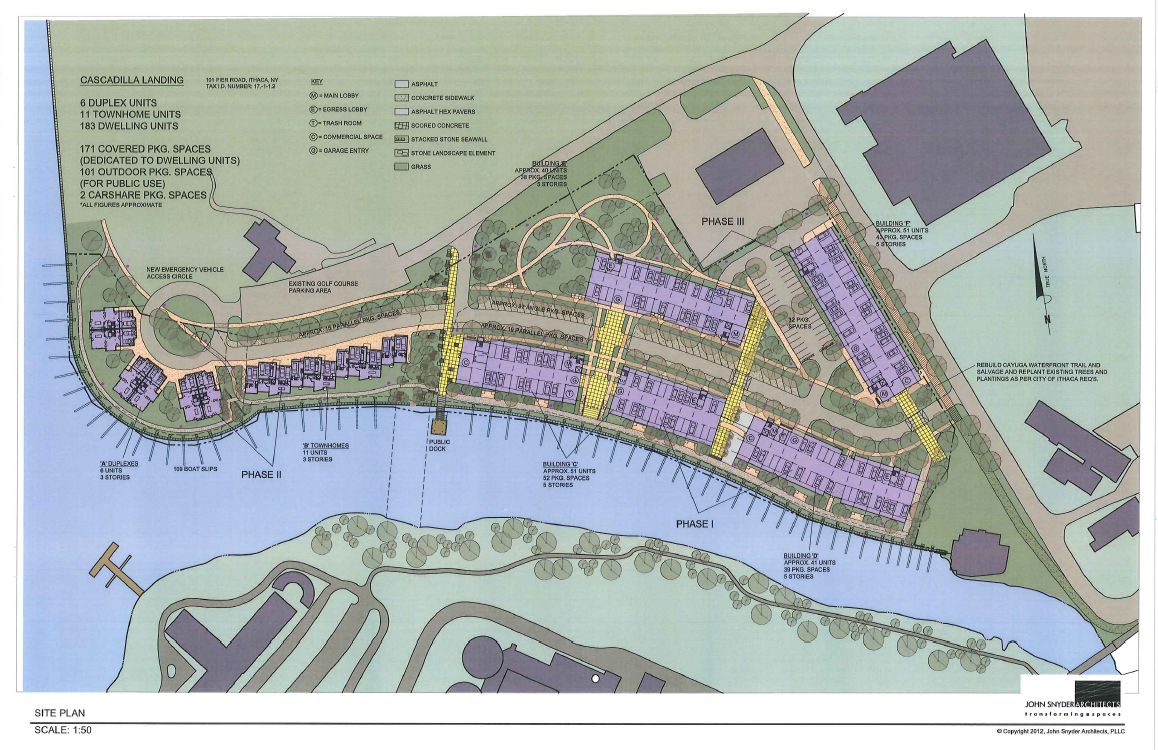
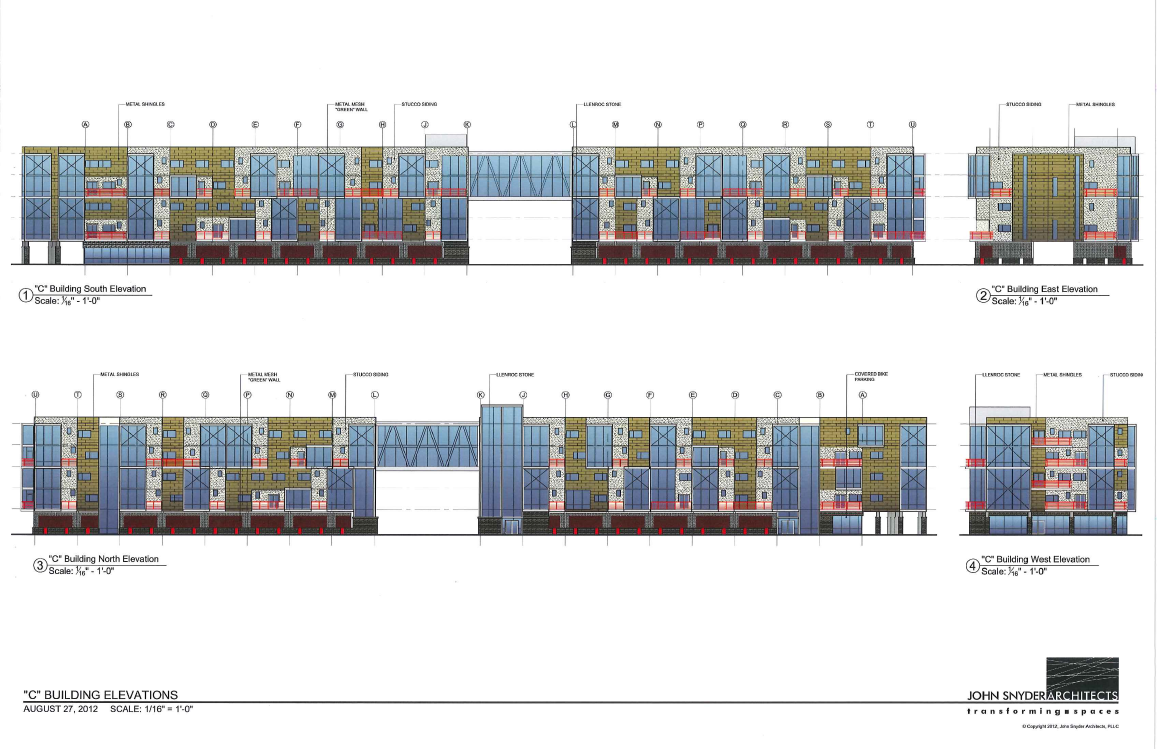
4. A few years ago (spring-summer 2012), the city planning board reviewed and approved a large project for the Ithaca waterfront called “Cascadilla Landing“. The three-phase, 183 unit project called for 6 units in duplexes, 11 townhouses, and the remainder to be built in 5-story apartment buildings designed by Ithaca architect John Snyder (the same gentleman behind the Carey Building addition). The first phase called for two buildings and 92 units, Buildings “C” and “D” (“C” shown above). So the project was approved and then…nothing. Never got off the ground.

However, the impending closure of Johnson’s Boatyard on Pier Road is piquing my curiosity. Now, initially it seemed highly unlikely because I thought Cascadilla Landing had never been fully approved (in fact, it received preliminary approval in September 2012 – thanks Noah). But since it was approved, all an ambitious individual would have to do is simply re-apply for approval if there are no changes to the plan (PB approval is only good for 2 years – part of the reason why Harold’s Square was back before the board last month). It’s still unlikely that the project is moving forward soon, but not impossible. A phone call to Snyder’s office and a call to Pier Road Properties (the developer as represented by accountant Andy LaVigne on the application materials) have so far not been returned.

chapter_house_reconst_3

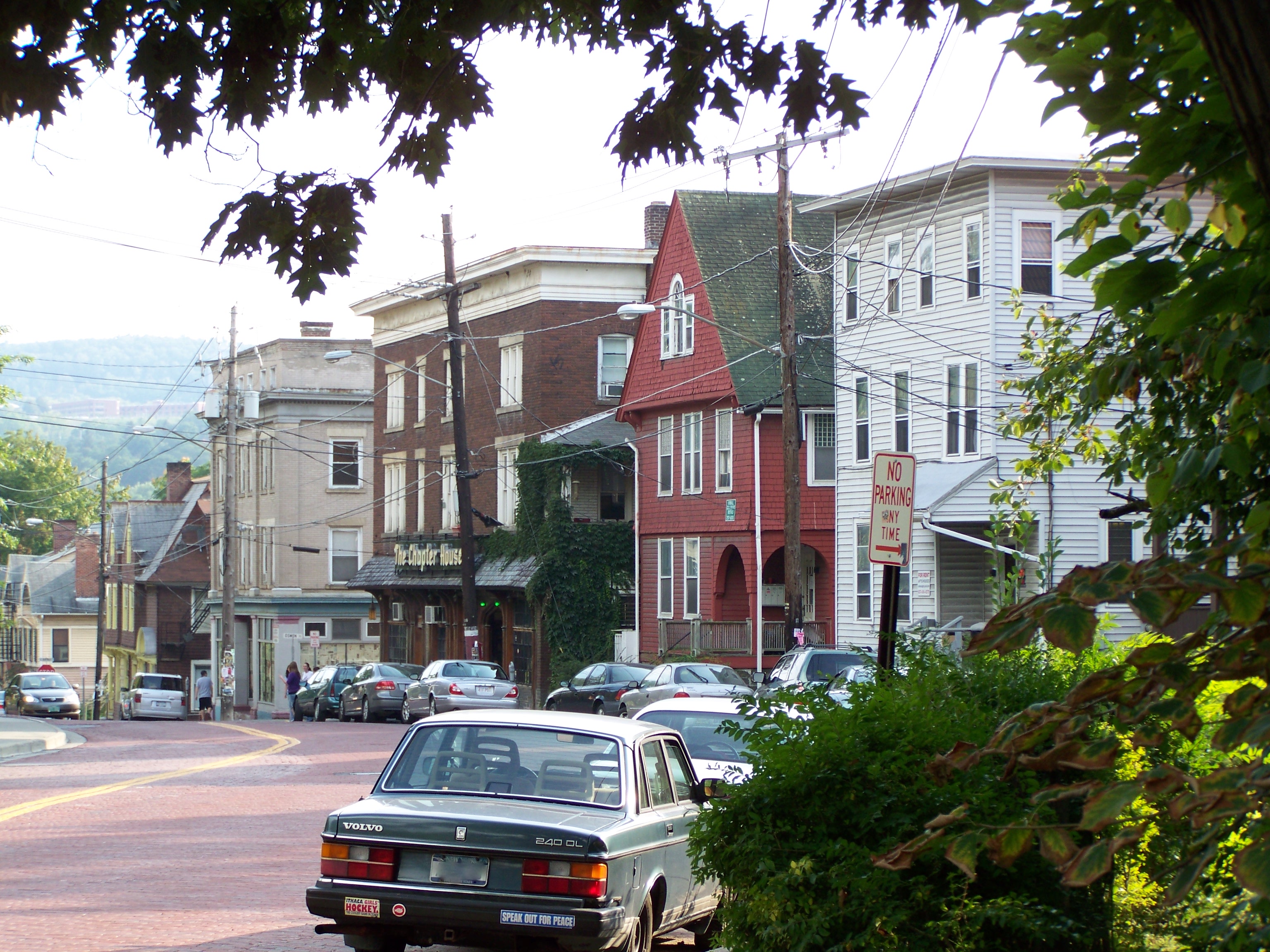
5. Preliminary, but it’s nice to see work progressing on the Chapter house redevelopment. Voice article here. The key thing to stress here is that there are design studies, and they’ll be subject to the ILPC’s whims. It looks like making the fourth floor of the Chapter House habitable or not is something that’s still being debated, along with the plans for the still-standing 408 Stewart. It’s hard to believe that things will be ready in August 2016, given that there’s no formal application yet, and the languid pace projects like this go through the commission.

Also, it was extraordinarily difficult to get a hold of most of the relevant parties for the article. Neither architect responded, I couldn’t get a hold of city Historic Preservation Planner Bryan McCracken…thankfully, Jerry Dietz was happy to assist, and although I felt a little bad calling ILPC Chair Ed Finegan since he has no formal part in the project itself, he was a big help. Both were keen to stress the preliminary aspect of this project, which hopefully came through in the article.

But I’ve just about had it with responding back to commenters on the Facebook article.


News Tidbits 9/19/15: It’s A Numbers Game

19 09 2015

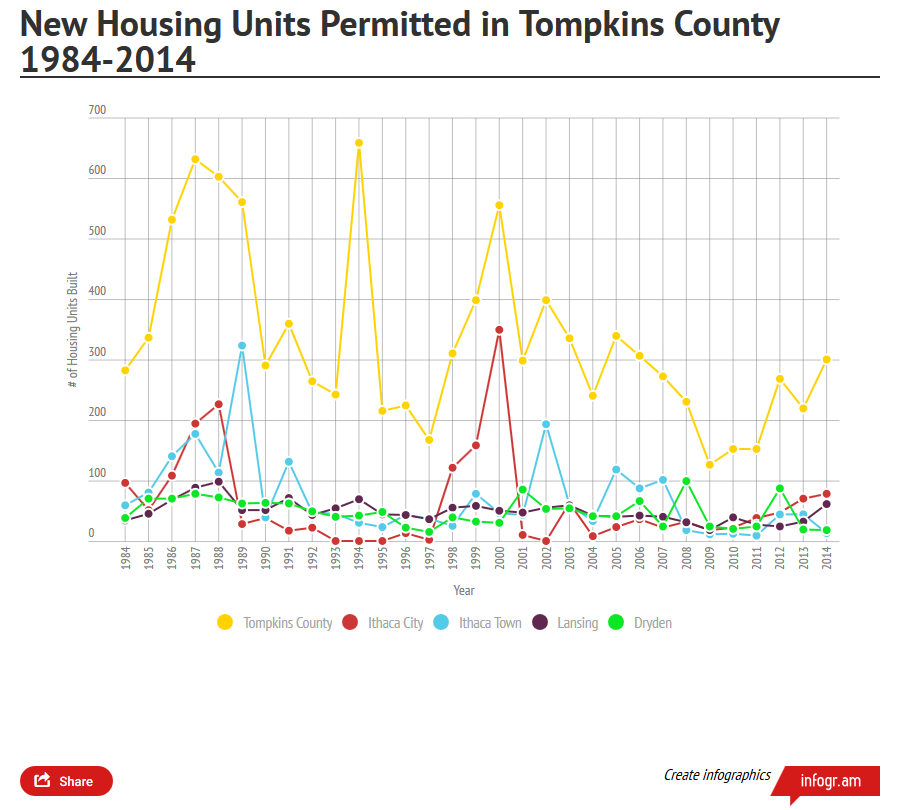
tc_housing_permits_1984_2014

tc_housing_permits_pies_19904_20104

1. Readers might have noticed that there was no Monday night (Tuesday) piece this week. The piece that was originally scheduled evolved into the building permits analysis that was a featured article on the Voice (link here). The initial intent was to run a mirror of the piece on the same day, but things got a little delayed, and eventually I just scrapped running it as the topic-of-the-week.

The reaction was generally favorable (if maybe less traffic than hoped; math-y pieces typically aren’t big traffic generators), but there’s a couple of quick criticisms that came in that I want to address. Namely that I didn’t include proposed projects, and that I left out non-residential construction.

Truthfully, there is no reliable long-term record of non-residential construction. HUD doesn’t break it down in their SOCDS database, and the county doesn’t have complete data on non-residential construction (for their reports, they also rely on the HUD SOCDS database). Related to that, HUD data for 2015 is very preliminary, relying on imputed values. Finalized and corrected 2015 data won’t be available for use until March 2016.

That being said, residential permits are an effective gauge for a few reasons – one, residential is the largest individual construction sector nationwide; two most recent local construction is residential or institutional, and three, many of the projects built in Ithaca are “mixed-use” meaning they have commercial and residential components. although the commercial components aren’t kept in track, the residential construction permits are available, and are showing up in the city’s SOCDS data.

For proposed projects, it’s not prudent to “count your chickens before they’ve hatched”. This passage was originally in the piece, but was pulled before the final version was published:

“As mentioned earlier, news sources like us here the Voice are guilty are promoting the misconceptions. We try and keep tabs on all the big projects – when they get proposed, approved and underway. The thing is, not all projects go from proposed to built. Some never receive approvals. Some get approved, but wait years to get construction financing, if ever. So it seems like there’s more than there is.”

Without having hard evidence in front of me, I’d argue that if one were to somehow include office and retail, the area still isn’t booming if we’re looking in a historical timeframe – you’d have large spikes in retail during the mid 1970s when the mall was built, and from about 1997-2004 in Southwest Ithaca and Lansing for big box retail. For office space, there would be a peak in the late 1980s/early 1990s for the Cornell business park by the airport; there’s circumstantial evidence that the office market today is pretty weak, TFC’s HQ being the odd project out. Industrial space would have peaked with Borgwarner’s construction in the early 1980s, but in recent years it’s been minimal or even negative growth (due to the Emerson shutdown). Hotels might be the only category that shows a “boom” at present.

The point of the article remains that

1. If we look at available building permit data, Tompkins has seen an uptick in construction, but not a construction “boom”, and
2. It feels like a boom because the region’s coming off of a very low period of activity, and there’s more construction in the highly visible urban areas of Ithaca city, vs. the suburban and rural development that has been more prevalent in previous years.

20150829_121852 20150829_121855

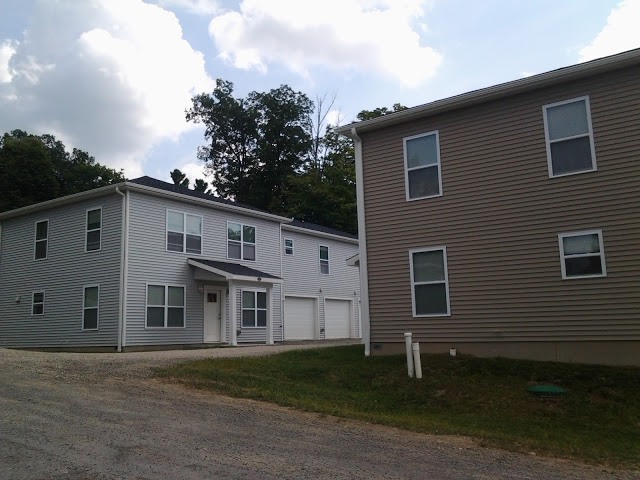
2. It’s time for a semi-regular house-of-the-week feature. I’ve been meaning to update on this for a while, but I keep missing the turn off Route 79. Local developer Chris Petrillose of Petrillose Properties (possibly related to Bob Petrillose, the founder of the Hot Truck) recently finished his second and third duplex  off of Wiedmeier Court in the town of Ithaca. Like the first duplex that was finished last year, each building consists of a 4-bedroom unit and 2-bedroom unit.

According to county records, the Wiedmeiers began to develop the land in the mid-2000s, building 2 duplexes of their own before deciding to sell the other lots (Petrillose bought the lots for the duplexes in 2012). The rest of the land, 12.34 acres, is currently for sale, so perhaps this won’t be the last visit.

3. Previously reported here and on the Voice, the city is studying whether or not to sell fire station No. 9, located in the heart of Collegetown at 309 College Avenue, to an interested private developer. We now know the consultant the city hired to perform the study.

Kingsbury Architecture, a small local firm, is investigating whether it would be worth the city’s investment to build a new station elsewhere on East Hill and sell the aging station, or invest in repairs and long-term maintenance for the current 1968 structure. Kingsbury has little presence online, but in an example of how small of a world this is, they were the initial firm used to plan St. Catherine of Siena’s new parish center, the project discussed in last week’s news update. However, according to church newsletter, the congregation amicably ended the partnership because of cost issues. The church staff went architect shopping, and that’s how Richard McElhiney Architects came into the project. Some of Kingsbury’s work can be found on the church’s webpage here. Kingsbury also appears to have done some interior renovation work at Cornell, and roof replacement at the Cascadilla Boathouse.

state_st_triangle_v5_1

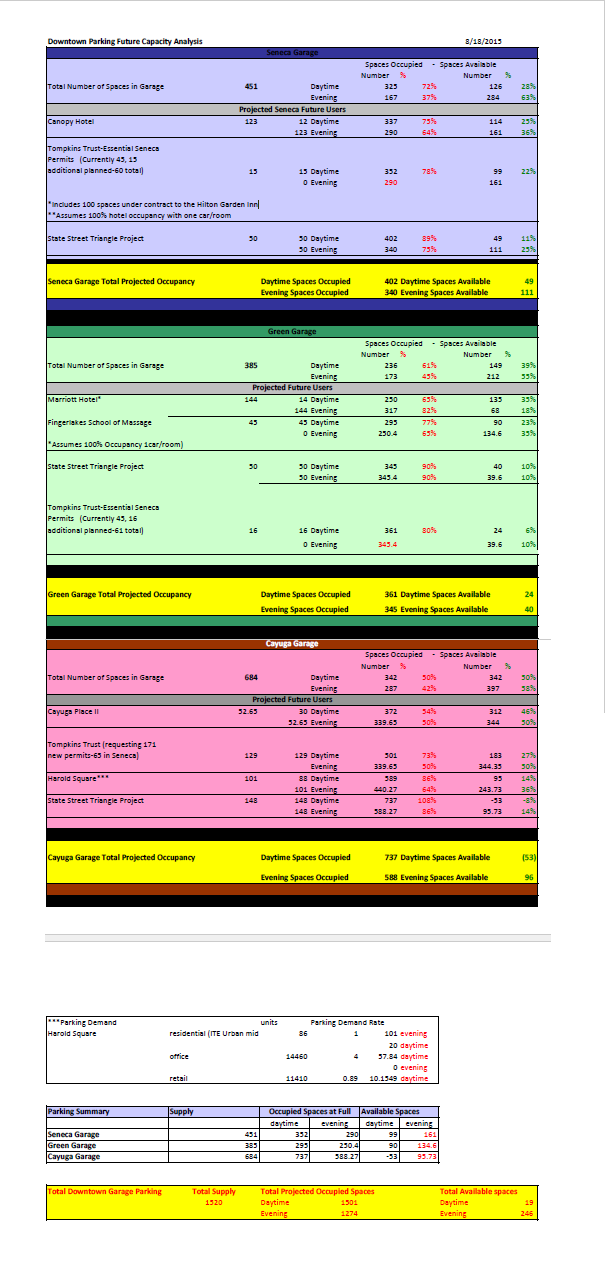
4. New documents from Campus Advantage give insights on the tenant mix and parking situation in downtown Ithaca.

First, my personal disclaimer – Even though part of their market research cites work I’ve written for the Voice about the housing crisis, my work was done impartially.

The new information comes as part of Campus Advantage’s official response to the city planning board’s request for more specific values on resident population, parking utilization and bus capacity, among other details. The documents are provided as part of the planning board’s materials here.

Updated figures indicate the proposed building has gone on a diet – the number of bedrooms has dropped from 620 to 582, the number of units from 240 to 232, and the square footage from 288,845 SF to 216,434 SF, a 25% reduction in mass. The maximum height remains the same at 11 stories at 116 feet. The slimming down comes in response to unfavorable review of the previous design as “too massive”, especially on the side facing East State Street.

sst_stats_1

According to an internal study by Campus Advantage, the Texas developer forecasts that, of the 582 tenants when at full capacity, 77.8% (431) will be students, and 22.2% (123) non-students. Of those students, 78.4% (338) will be undergraduates. Cornell students would comprise 64% (276) of the student population, Ithaca College 32% (138), and TC3 4% (17). A quick glance at the details behind these projections shows that CA assumes 95% occupancy, studios and other smaller units will be half or majority non-student, and that undergrads will be more inclined towards shared 4-bedrooms and 5-bedroom units. CA conducted online surveys with student groups to gather information for their study.

sst_stats_2

The parking demand from residents is predicted to be 191-219 spaces, taken from a study conducted by third-party traffic engineering firm SRF Associates. A further 64 parking spaces will be required for commercial retail tenants on the first floor (57 customer spaces, 7 employee spaces), for a grand total of 283 parking spaces. The 2012 Randall/West Collegetown parking study used as reference looked at student and non-student vehicle ownership in the Collegetown neighborhood, and the higher end (or “more conservative”, as SRF calls it) 219-space figure comes from a calculation the Urban Land Institute, a non-profit urban planning think-tank. Given that Randall/west focused on Collegetown, the more conservative figure is the safer bet.

It’s not clear whether the parking garage study above is CA’s or the city’s, but the application itself states that the city’s Parking Director, Frank Nagy, has confirmed that enough parking is available, and a letter from TCAT’s Doug Swarts states that TCAT has the capacity for State Street Triangle’s potential tenants. Looking at the above study, though, it appears that if built, and if all the other approved and likely projects (i.e. don’t include 130 East Clinton) are built, the parking garages will be nearly full.

Since the new drawings were presented at the public open house on September 10th, there do not appear to have been revisions – what was shown then will be shown at the planning board meeting next Tuesday (links to those drawings here). However, the planning board will be looking to schedule a design review committee meeting, where board members provide suggestions and guidance on design features for the new building. In other words, this probably isn’t the building’s final design.

Also included in the attachment are two opposition letters – one from Historic Ithaca saying the building’s still too tall and massive, the other from former planning board and councilwoman Jane Marcham, who takes the unusual if debatable tact by saying that students living downtown deprives the colleges of campus life. Students comprise 40% of the market-rate downtown rental market, so there’s a few to interview for opinions should anyone be interested.

As always, the project is likely to inspire some debate at the planning board meeting. We’ll see if the changes are to the board’s liking.

815_s_aurora_1

5. Wrapping up this short but informative week, here’s a look at the Planning Board agenda for next week:

A. State Street Triangle – Public Hearing, City Environmental Quality Review (CEQR) discussion, and scheduling a Design Review Committee meeting. CEQR is they city’s more in-depth take on SEQR, where a project’s environmental impacts are considered, and a negative declaration (acceptance) is given only when adverse factors have been mitigated in a way the board sees fit. Design Review Committee pretty much is as it sounds – the board makes suggestions on the building design as a quality control / quality assurance measure.

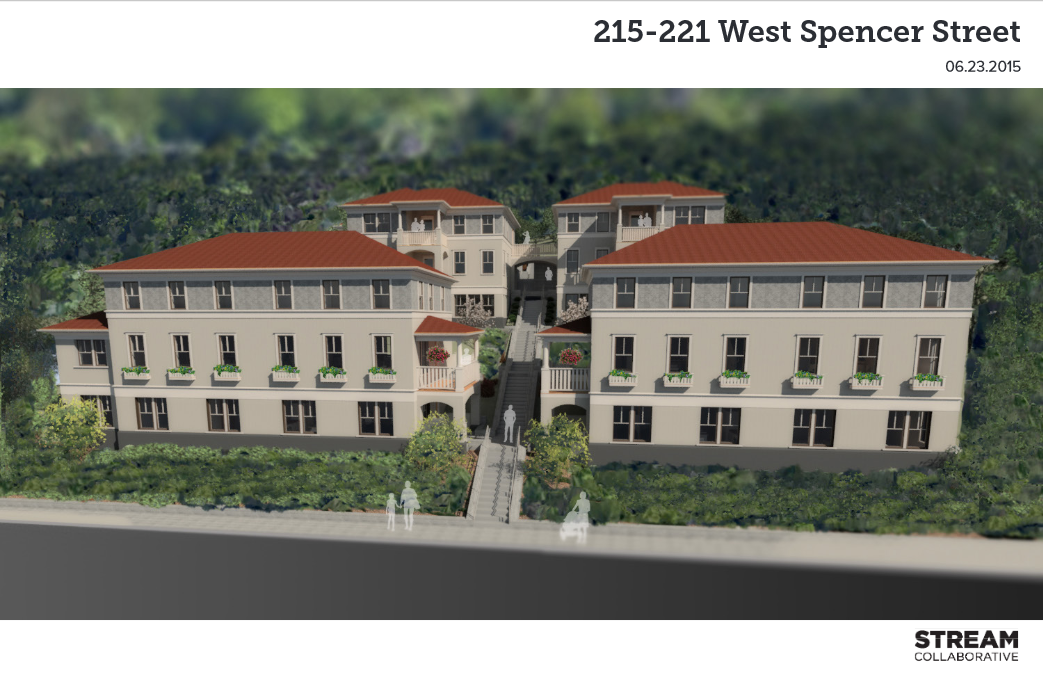
B. 215-221 Spencer Street, Determination of Environmental Significance and Recommendation to the BZA – the board has decided to recommend approval of the parking variance (parking within the rear yard setback), given the site’s steep topography.

C. Site improvements, 416-418 East State Street416-418 East State Street is currently home to an underused 7,600 SF office and a connected manufacturing/storage building. The house dates from the 19th century, with various additions as recent as the 1970s. According to plans filed with the city, an LLC linked to Argos Inn architect Ben Rosenblum has plans to convert the old manufacturing space into a bar and storage space, with renovated offices and a 2 bedroom apartment in the original house. The project will include an accessory parking lot, revised landscaping and handicap access. Area and setback deficiencies have resulted in the need for a zoning variance, but a parking variance won’t be required because the bar will have after hours parking across the street at Gateway Plaza. The building itself won’t change dimensions, but the change in use triggers the city zoning laws.

There have been substantial concerns expressed about this project – neighbors are vociferously opposed to a bar, citing noise problems and concerns about smokers, and the county planning department is not a fan of the traffic and parking arrangement. The city will need to examine this project carefully.

Scott Whitham is serving as a consultant, and local architect Jason Demarest is designing the renovation.

D. Hotel Ithaca – Amended declaration of environmental significance. Backstory and plans here.

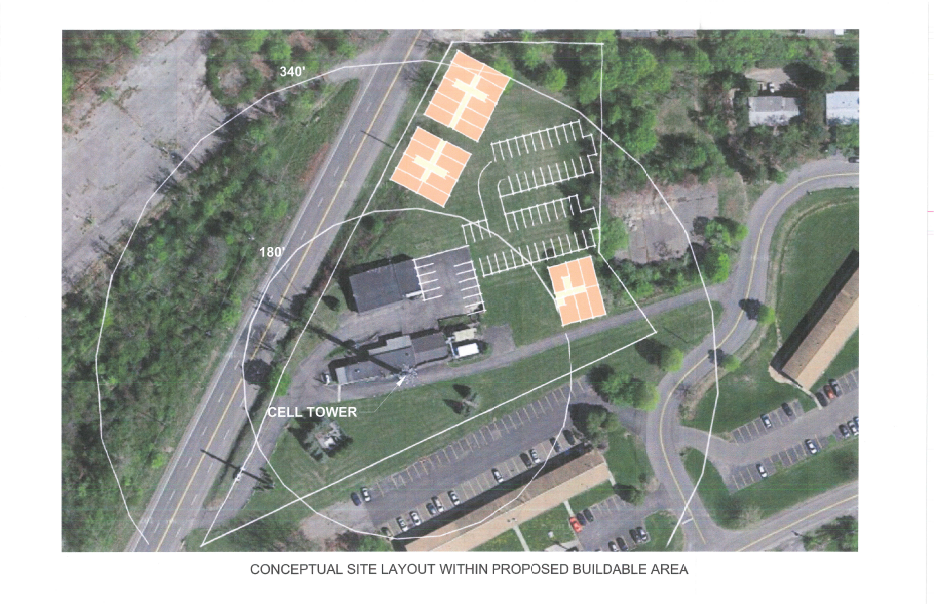
E. “Sketch Plan – 815 South Aurora Street, 87 unit housing project” – See conceptual design above, full backstory here. To recapitulate the salient details, local developer Todd Fox of Modern Living Rentals would like to build apartments on vacant land at 815 South Aurora Street, but can’t because the vast majority of the property is within the “fall zone” of a cell tower, which the city defines as twice the height of the tower. The 170′ tower creates a 340′ radius of no-man’s land (outer circle above), making the parcel virtually undevelopable. Fox had two private engineering companies (TAITEM Engineering and Spec Consulting) analyze the case, and they determined that an appropriate fall zone is the height of the tower plus 10 feet for a little wind/bounce – so 180′ total. With this info in hand, Fox tried to get the city to refine the zoning to allow the decrease in fall zone and therefore permit the land to be open for development. But when Fox and project architect Noah Demarest approached the BZA, they said they wouldn’t consider the 815 South Aurora Street application unless the law was amended, or Fox and Demarest go through the sketch plan and review process, and submit a formal application for a zoning variance.  So now we’re at the point of having a sketch plan to present. Regardless of design, the project will need an area variance issued by the BZA for the cell phone tower issue. At 87 units, this will be a pretty sizable project, and given Fox’s previous work (he’s been rather busy lately), it will likely be rentals, perhaps with Ithaca College students as the target market.

3 of the 5 projects above (SST, 215-221 West Spencer, and 815 South Aurora) have Noah Demarest/STREAM Collaborative as a lead or consulting architect. None of them have the same developer. Talk about having your fingers in many pots.


News Tidbits 9/12/15: Some Projects Lose Mass, and Some Hold Mass

12 09 2015

1. We’ll start this week off with a little bit of economic development news. According to paperwork filed with the Tompkins County IDA, CBORD, a Lansing-based software company, wants to move out of its digs in the Cornell office park by the airport, and into a new larger facility in renovated space in the South Hill Business Campus next to Ithaca College. CBORD would lease 41,000 SF of space with five year options to renew. All 245 local employees would be moved into the renovated space, which would be finished by the end of May 2016 and designed by local architect John Snyder.

The project is expected to cost about $3.7 million. No new jobs are stated in the application.

Assuming SHBC’s website is up-to-date, no contiguous spaces are currently large enough for the tenant, so either the internal space will be split up, or some other tenants will be jostled around to make room for CBORD.

As for the abatement itself, CBORD is requesting a sales tax abatement, one year in length, with a value of $296,000, about 8% of the project cost. It doesn’t appear to have made any waves at Thursday night’s meeting, so what;s likely to be a low-key public hearing and approval vote will be coming in the pipeline.

Also at the IDA meeting, final approvals were granted for tax abatements on the 209-215 Dryden project by John Novarr in conjunction with Cornell. and for INHS’s 210 Hancock affordable housing development in the city’s Northside neighborhood.

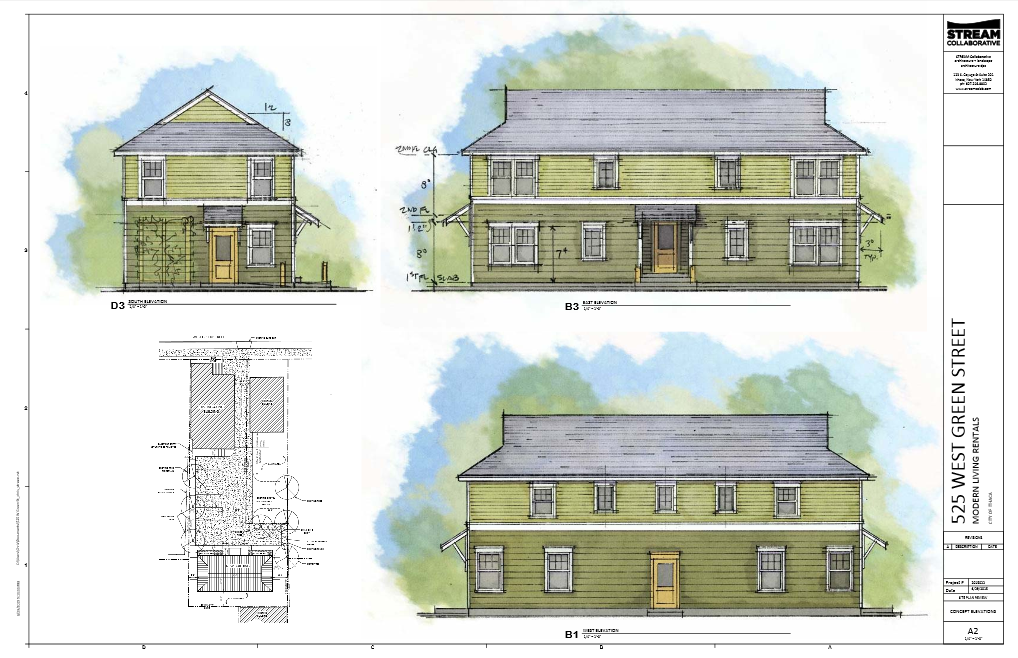
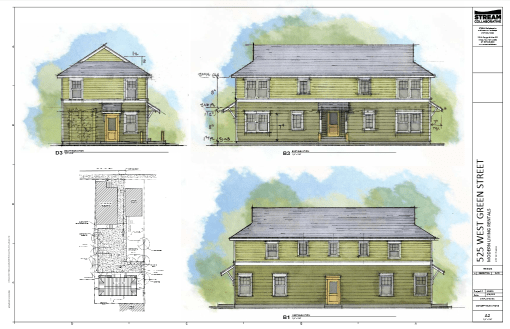
2. Another small infill project seeks approval from the city’s planning board and the Board of Zoning Appeals (BZA). 525 West Green Street, located on the edge of the South Side neighborhood, is currently home to a 4-unit apartment house. Local developer Todd Fox of Modern Living Rentals (MLR) is seeking to build a 4-unit, 4-bedroom apartment house at the rear of the property, where a clapped-out garage currently stands. The units would be rentals, but this far from Cornell and Ithaca College, the target market is likely to be permanent Ithaca residents – single professionals would be a good guess.
525_w_green_1

Plans drawn up by prolific local firm STREAM Collaborative call for a 2-story, 2,360 SF “carriage house” building designed to fit in with the rest of the neighborhood, although quite honestly no one would be able to see the new building unless one were looking down the driveway. A landscaped rear parking area for 8 vehicles would replace the current 4-car lot behind the existing building.

According to Site Plan Review documents, construction cost is estimated at $300,000, and construction would take place from November 2015 to July 2016. Area variances are required from the BZA since this building partially occupied space reserved for the rear setback, but according to the SPR the variance has already been granted.

Readers might recall that MLR has been a very busy company as of late – although relatively new to the Ithaca scene (MLR was established in 2010 by then-recent college graduates Charlie O’Connor and Todd Fox), the company has developed the 6-unit 707 East Seneca apartment building, a duplex at 605 South Aurora, and is currently going through the approvals process for solar-powered townhomes out in Varna. The duo also partnered with local real estate businessman Bryan Warren to purchase the Collegetown Bagels at 201-207 North Aurora Street.

As for the project itself, 525 West Green Street is perhaps the largest example of the carriage house trend Ithaca has been seeing lately, where old garages or unused rear lot spaces are being developed into small, detached apartments, typically no more than studio or 1-bedroom size. Other examples include 201 West Clinton, 607 Utica,  and new this month, a studio apartment proposed for a former workshop/garage at 701 North Aurora. Arguably, one could throw New Earth Living/Sue Cosentini’s Aurora Street pocket neighborhood in there as well.

Given that these properties are modestly-sized, rarely visible from the street, and provide rental income to property owners who in most cases live on the same lot, they seem like an appropriate way to increase density without upsetting Ithaca’s character balance.
troy_rd_rev1_1

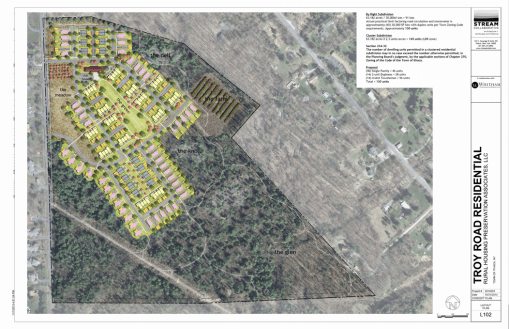
3. Briefly in blurbs – according to the agenda for Ithaca town’s Public Works Committee (PWC), the town will be looking at sanitary sewer access for a potential development along Troy Road. Now, before anyone gets their blood pressure raised, this most likely has nothing to do with the 130-unit project that was mothballed a few months ago. But, there have been rumors of smaller-scale plans for one of the parcels that comprised the now-subdivided property. The development radar has been turned on, and if anything shows up, you’ll see it shared here.

4. Staying in Ithaca town for the time being, the town’s planning board has but one project on their agenda for next Tuesday – a new parish center for St. Catherine of Siena Church in the Northeast Ithaca neighborhood.

Yes, even in Ithaca, one of the least religious metros in the country, famously home to a school that pastors derided in fiery philippics 150 years ago for daring to not affiliate itself with a Christian denomination or enforce mandatory church attendance, churches can hold their own.

st_catherines_1

Plans call for a new 10,811 SF parish center at 302 St. Catherine Circle, on what is currently part of the church parking lot. Once built, the current parish center, a one-story, 10,275 SF jumble of boxes and corridors, would be demolished and replaced with parking spaces. Richard McElhiney Architects of NYC is the project architect, and a bit of an unusual choice since the firm doesn’t have a presence or previous work up here.

In an assessment by Ithaca town planner Christine Balestra, concerns were noted about a phased parking plan for the church while construction is underway, and minor requests for landscaping details (plans call for two fountains). Other than that, it doesn’t look like this is going to make any waves during the approvals process.

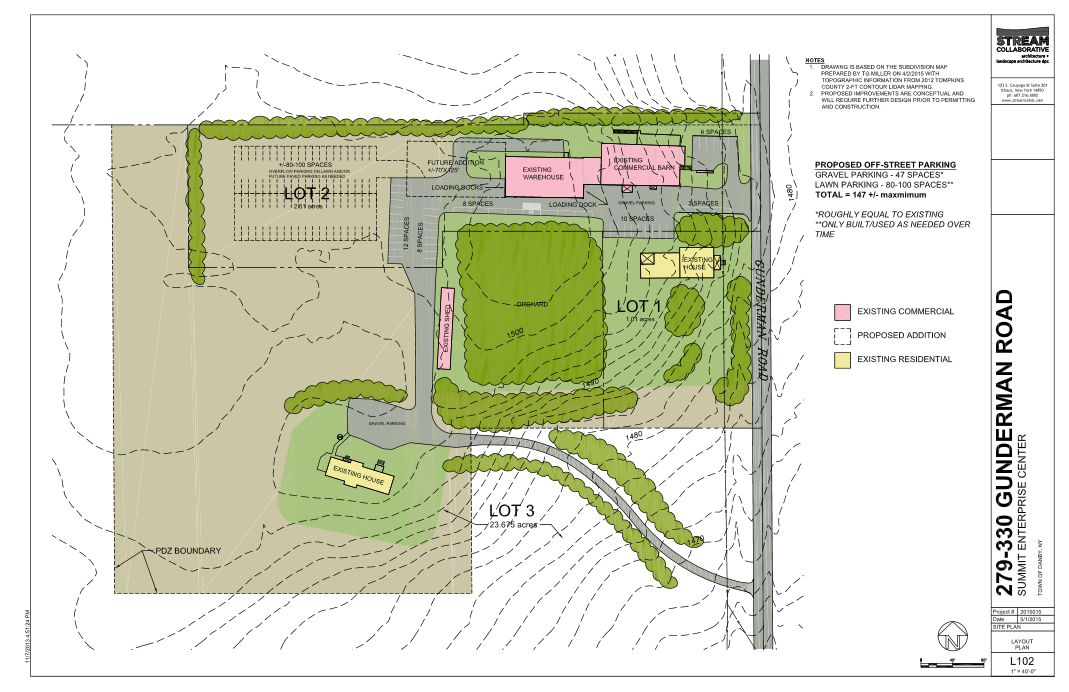
5. Over in the town of Danby, plans are underway to convert a former clothing design and warehouse facility into a mixed-tenant business center. Docs filed by STREAM Collaborative’s Noah Demarest on behalf of owner David Hall call for modifications of a Planned Development Zone for the property at 297-303 Gunderman Road. Danby’s PDZ is not unlike the city’s PUD and town of Ithaca’s PDZ, where the form and layout is regulated rather than the use. The original PDZ for the property dates from the mid-1990s.

summit_danby_1

The “Summit Enterprise Center” would be anchored by National Book Auctions currently on Danby Road, Blue Sky Center for Learning (a company that provides support and therapy for autistic individuals and their families), and New Moon Harvest, a food and beverage maker. Additional office, warehouse and industrial/food production space would be available to potential tenants. The existing 21,000 SF building and landscape would not be significantly changed, although future plans for a 4,147 SF addition and parking lot are noted.

chain_works_rev2_1

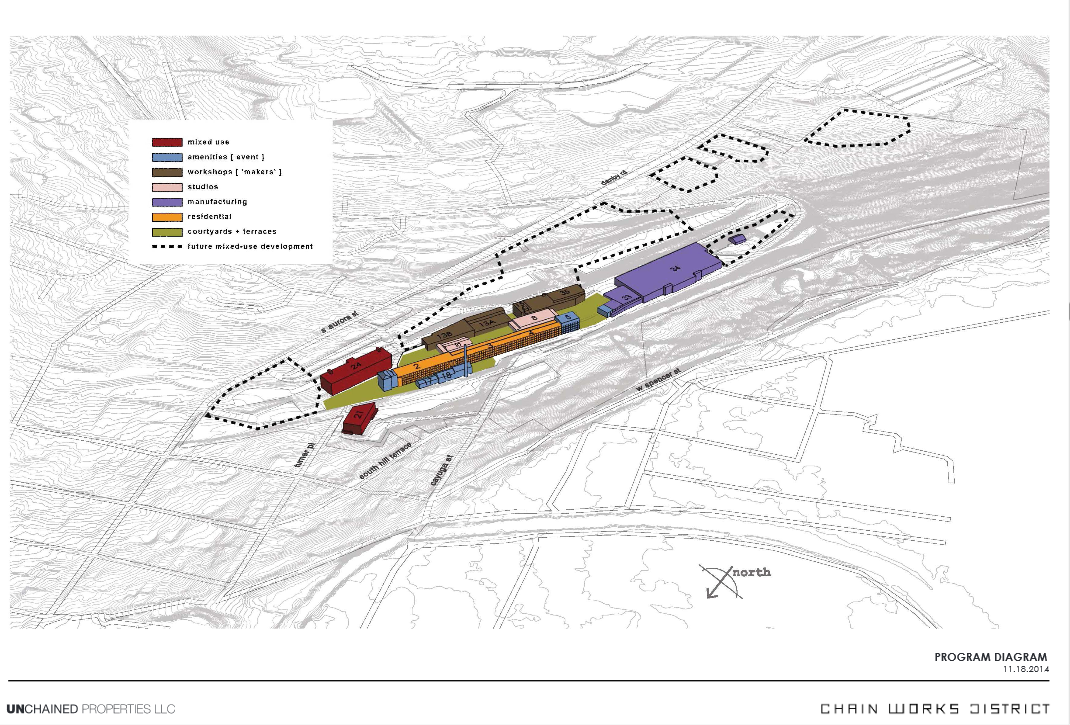
6. Speaking of PDZs and PUDs, I did take the opportunity when I spoke to David Lubin last week to ask how things were going with the Chain Works District development. Here’s what he said:

“Chain Works District is continuing. We’re working with the state and Emerson, investigating the site and making sure all the remediation plans are readied and approved. There will be public hearings. It’s a slow process. We will need DEC approval for the residential uses. We hope to obtain city approvals [for the draft environmental impact statement] this year.”

There’s no doubt the project will take time. With complicated topography, environmental issues, 800,000 SF of planned development space and two municipalities, it’s arguably the most complicated tax parcel in all of the county, if not the region. Readers may stretch their memories back and remember that the first phase will consist of the renovation of buildings 21, 24, 33 and 34 into mixed-use and manufacturing space. Ithaca Builds (come back Jason, Ithacans need someone with your knowledge) provides a detailed run-down here.

619_w_state_st_1

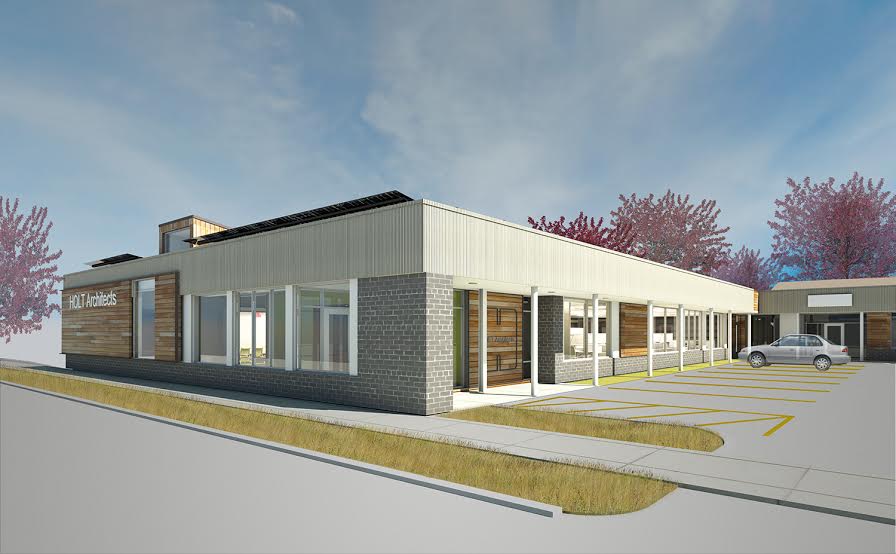
7. Courtesy of Maria Livingston at HOLT Architects, here’s a render of the renovation HOLT is undertaking for its new headquarters at 619 West State Street. Gone are the rather dated-looking decorative parapets, and in comes a clean, modern design with a mix of wood, brick and steel facade materials. HOLT’s 30 employees will occupy most of the new space in the  net-zero energy structure, but there will be space for two other tenants (one of which has already been claimed).

HOLT is spending about $900k on the renovation, which is due to be complete next March. Tompkins Trust Company is providing the financing, and local company McPherson Builders is in charge of general construction.

A copy of the official press release, and an interior render, can be found on HOLT’s blog here.

state_st_triangle_v5_1

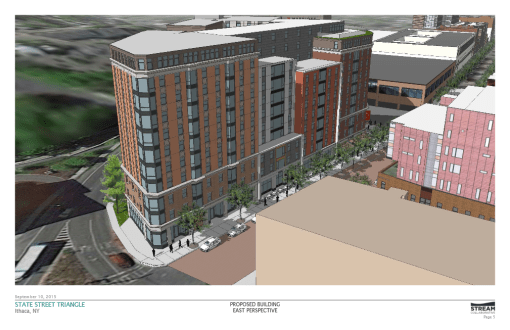
8. We’ll wrap up this work with a topic at the tip of everyone’s tongue – State Street Triangle. Architects Kelly Grossman of Austin, Texas and Noah Demarest of STREAM have worked to redesign the project so that its massing is less imposing and its design a little more varied. Specifically, it now looks more like several buildings built next to each other with varying setbacks and heights, rather than one continuous mass – the change is especially prominent on the 300 Block of East State, where the most concern was raised.

The developers held a community meeting Thursday night (pro tip for Campus Advantage – next time, give more than 30 hours’ notice), which has been covered by the Journal here and the Voice here. That the developers scheduled their own community meeting outside of the confines of city hall is laudable.

As part of the redesign, the number of bedrooms has been reduced from 620 to 582. Recent estimates have now priced the project at $70 million. The developer has expressed interest in designated some of the units as affordable housing, in what would be an example of the inclusive zoning that some city staff are currently looking into.
state_st_triangle_v5_2

The project is seeking a tax abatement, though the formal details have yet to be released. Rents would be between $980-$1,600 per month per person, and would include utilities, gym and other “all-inclusive services”. I suspect that a parking space in the Cayuga Garage is an added cost.

Speaking strictly for myself, the design is an improvement, though I have subjective quibbles – for instance, would a lighter color material make the north wall of 11-story middle section less visible from a distance, and would it be possible to give the blank walls more character. Balancing pros and cons, I also think the design of the Commons-facing corner looks tasteful and classy. The prospect of affordable units in the building is intriguing. If I was a planning board member, I’d ask to see material samples to make sure the building doesn’t end up looking cheap.

state_st_triangle_v5_3

Additional images of the updated design can be found on the city’s website here, and a written summary of the changes from project consultant Scott Whitham of can be found here.


Boiceville Cottages Construction Update, 9/2015

8 09 2015

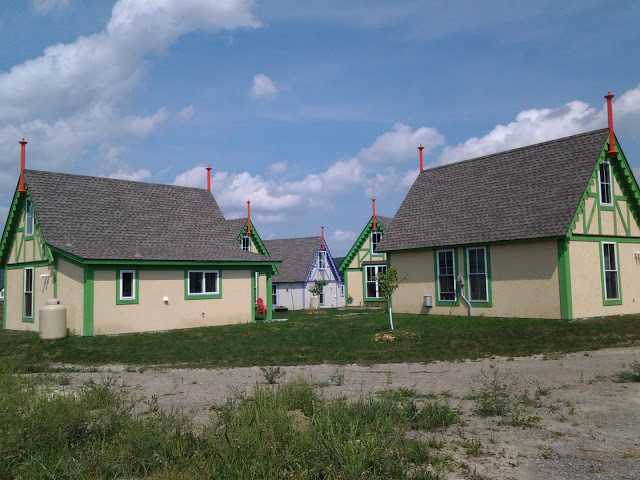
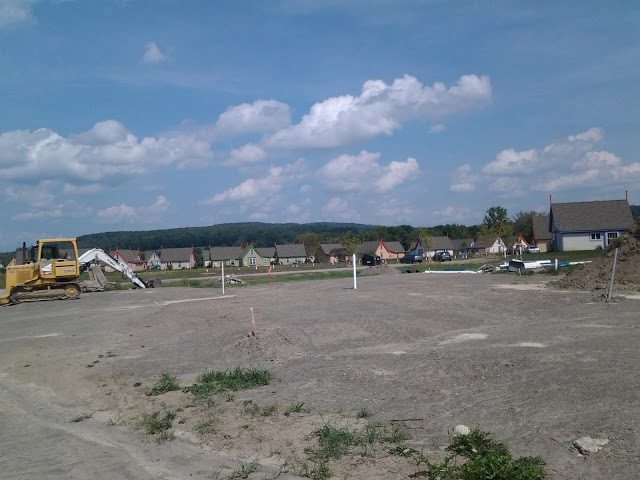
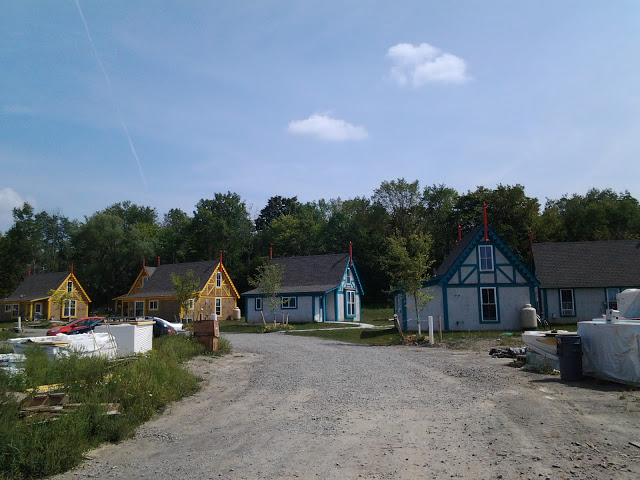
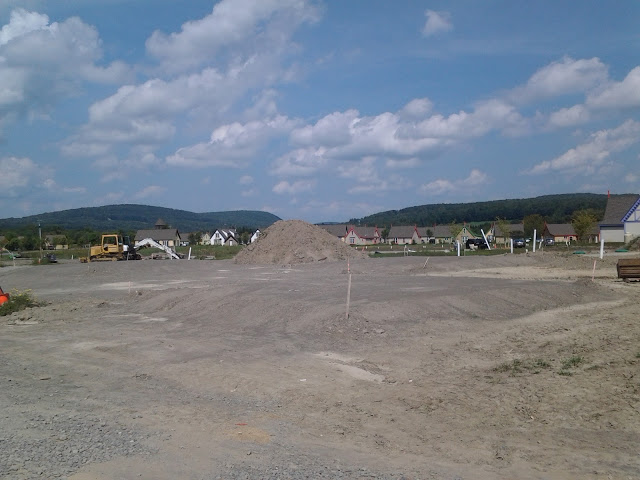
Out in Caroline, work at the Boiceville Cottages siteseems to have switched gears. Since the last update in May, the blue stucco houses with teal trim have been faced with stucco and had interior and exterior finishing completed (and occupied, judging from the 20-something I saw carrying boxes into one of the houses). Work at the site is less concentrated on cottage construction at the moment, and more focused on laying out where the rest of the homes will go as the loop road circles back around to Boiceville Road/ County Rte. 114.

Three concrete slabs indicate where new cottages are likely to be built in the next few months (I feel like the blog or the Voice should do a reader poll on what colors to use next). Scattered along the rest of the undeveloped area are cleared sites with layers of dirt and gravel. These are the sub-slab bases on which future concrete slabs will be poured. Survey work was enlisted to stake out the corners of the future cottages, with poles inserted into the  to indicate the corners of the planned units. In total, there were at least a dozen bases, and over the following months they will become the next dozen or so cottages.

Schickel Construction / Schickel Rentals of Dryden is developing and building out the project. Developer Bruno Schickel’s unusual design was inspired by cottages in a storybook he read to his daughter. The construction cost of the 75-unit addition (total 135 units) is at least $7.654 million – a loan for $5.454 million was given by Tompkins Trust in April 2013, and an additional loan for $2.2 million ($2,098,479 of which goes towards hard construction costs) was granted by Tompkins Trust in April of this year. The loan granted in April funds up to 15 2-bedroom and 16 1-bedroom units, and the legal date on file for completion is May 1, 2017.

20150829_120441 20150829_120350 20150829_120251 20150829_120208 20150829_120201 20150829_120138 20150829_120104 20150829_120059

How House Construction Works


The DeWitt House Senior Apartments

25 08 2015

travis_hude_libe_libe_v3

Most of the time, writing up initial project pages is mostly background details, along with whatever scant details were included in the sketch plan. It usually makes for an exciting post, though occasionally lacking in details.

Now here we have the total opposite – a project where many of the details have already been gone over with a fine-toothed comb. Here we have the county legislature’s preferred development for the Old Library site at 310 North Cayuga Street, the DeWitt House Senior Apartments. It has a website, a completed Site Plan Review (SPR) application (here), and the county is heavily involved with the approvals process.

I’m not going into the debate between this and the Franklin proposal with this piece. It’s intended more as a project summary.

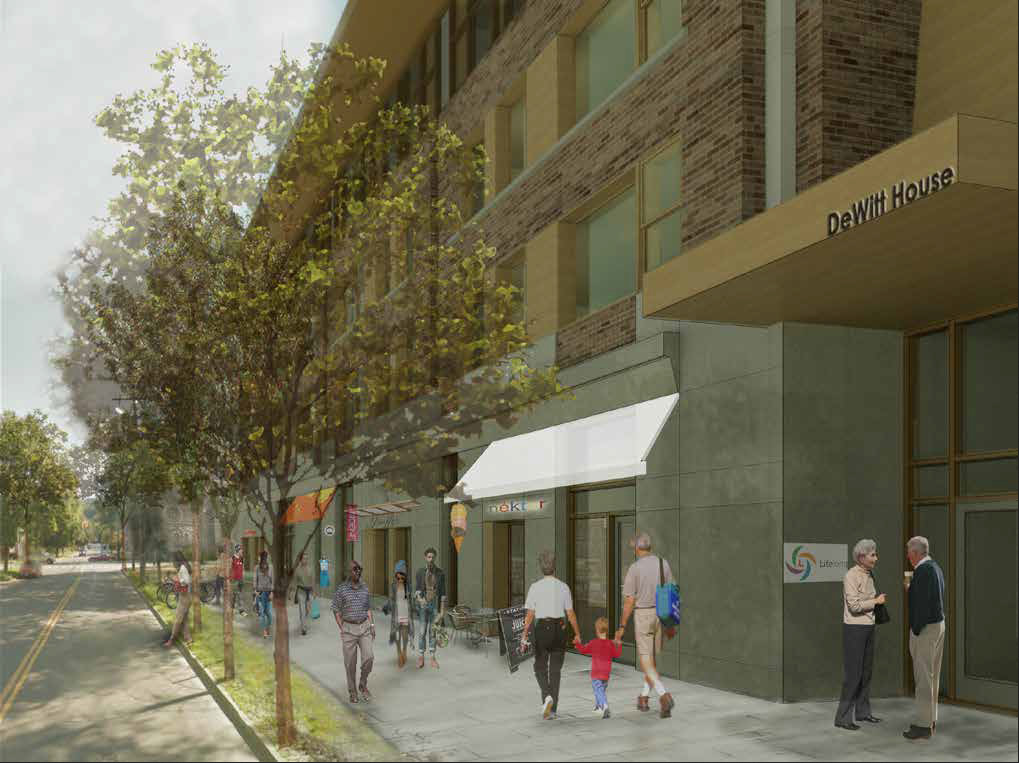
Plans call for a mixed-use, 4-story, 72,500 SF building. On the upper three floors are 39 1-bedroom and 21 2 -bedroom apartments aiming for the middle of the rental market, and serving renters aged 50 and older. Approximately 40 parking spaces will be provided, as well as CarShare and a shuttle. Along with the apartments, there will be community space on the southeast corner of the first floor (2,000 SF), new digs for senior services non-profit Lifelong on the west side (6,500 SF), and office/retail space facing Court Street (4,000 SF).

dewitt_house_5

The building will deconstruct the old library, and there are plans to reuse much of the foundation, steel, and possibly the brick from the 1967 structure. The one-story Lifelong building at 119 West Court Street, which dates from the 1950s, would also be taken down. The Lifelong annex building at 121 West Court Street, which dates from the late 1800s, would be renovated into a guest house for those visiting friends and family living in the apartments.

dewitt_house_2

HOLT Architects, which is among a few local firms to have accepted the Architecture 2030 Challenge, has designed the building to be carbon-neutral. Solar panels, rainwater collection from the roof, and a Combined Heat and Power system (CHP) are some of the green features.

dewitt_house_3

The project is being developer by local developer Travis Hyde Properties, and the design is the work of local design firm HOLT Architects. Contact info for both is provided here. TWMLA Landscape Architects, Esther Greenhouse, T.G. Miller Surveyors & Civil Engineers, Elwyn & Palmer Structural Engineers, and Delta Engineering are also providing services.

The SPR application indicates that the $14,000,000 building is aiming to launch construction in June 2016, and finishing up 12 months later. However, the timeline in the SPR says construction wouldn’t start until February or March of 2017, with completion in summer 2018. The renovation of the Lifelong Annex would be completed by the end of 2018.

The DeWitt House project will need not only approvals from the city Planning and Development Board, but also the Ithaca Landmarks Preservation Council (ILPC), since the land is a part of the DeWitt Park Historic District.

dewitt_house_4


News Tidbits 8/22/15: Throwing Fuel on the Fire

22 08 2015

state_st_triangle_v3_1

1. Campus Advantage has released revised parking numbers for its 11-story State Street Triangle project. According to newly-released documents here, parking will be handled with a “four-point program”:

I. The primary component is that CA is negotiating a deal for 250 parking spaces in the upper levels of the Cayuga Street garage. The document notes an average surplus of 300 parking spaces per day.

II. The city is willing to let CA reserve up to 100 parking spaces in the Seneca Street garage.

III. CA has identified 75 underused spaces in the Green Street garage, but no formal deal is planned yet.

IV. Surface parking lots near Cornell and in other parts of the city that could handle parking for those who only need vehicles on weekends or for holiday trips.

Given typical student vehicle ownership rates of about 27% (27% of 620 = 167 spaces), point I will probably be enough to handle resident traffic. Commercial traffic, estimated to be about 64 spaces in the SRF Associates traffic study, would more likely be taken care of by point II or III. So the parking situation appears to be better thought out at this point. CA is also planning a bike share and an Ithaca carshare location. Whether it’s enough to please city staff, we’ll see.

The revised document notes construction traffic would enter the site from E. Green Street, and exit via Seneca Way and East Seneca Street.

Regardless, some of the reactions from city officials have been quite strong – the following quote comes from a report from 3rd Ward councilwoman Ellen McCollister from last month’s IURA meeting:

“Common Council may end up concluding it made a mistake when it re-zoned that part of the city without examining the issue more contextually and architecturally.”
State Street Triangle will be undergoing a public hearing at Tuesday’s city Planning Board meeting, and the committee will be going over the project’s City Environmental Quality Review forms. CEQR is the city’s more stringent version of SEQR, and is used to assess project impacts – basically, mitigating the issues created by the project, and making sure it’s a net positive for the community. No voting is expected.
State Street Triangle has also applied for CIITAP tax abatements, but the IDA meeting has yet to be scheduled.
100_1466

2. Quick update on 406/408 Stewart – a copy of the Ithaca Landmarks Preservation Council (ILPC) from last month indicates that council members are across the spectrum when it comes to 408 Stewart (bluish-white building above) still being historic, and if a new apartment building will be built on just the site of 406 Stewart (red building, destroyed by the Chapter House fire), or on the site of both 406 and 408. Members had to stress to themselves to look at historic value and reconstruction separately, and the purpose of the site visit was to help figure out a decision. There’s been no news yet, but we’ll see what happens.

3. Over in the village of Groton, a small development project is stirring debate of its own.

The project, proposed by Rick Uhl of Genoa, calls for four duplexes and four single-family homes, for twelve units total. The temptation is there to approach this with urban condescension, but for Groton, population 2,400, it’s a big deal.

The homes would be built on several already-subdivided lots on a new road coming off of Elm Street on the eastern boundary of the village. The original plan called for duplexes on the west side of the street and closer to the village center, while single-family homes would be built on the lots on the east side of the street.

The debate lies with proposed zoning changes in Groton – a zoning change currently being considered by the village would downzone parts of the town to single-family homes only. That includes the lots the duplexes are slated for.

The zoning has been a source of debate among homeowners in Groton, because a number of them own larger homes that they’ve turned into duplexes, living in one unit and renting out the other. Although the law grandfathers in current buildings, they worry it could be a hassle in the future. The county’s planning department has also expressed issues with the plan, saying that it creates numerous non-conforming lots and that it goes against the county’s comprehensive plan.
A compromise had been reached between the developer and planning board last spring, where duplexes would be built on the new street’s east side and single-family homes on the west side (so as to keep apartment dwellers from mixing with family homes), but more recently the village has made moves toward an all single-family plan anyway, which is creating some consternation since it tosses the compromise out the figurative window.

The Times notes that a decision on the zoning, and the compromise by extension, is expected at the September meeting of Groton village’s Board of Trustees.

4. Looks like there’s going to be a lull in activity in the town of Ithaca for the next few weeks. The Planning Board meeting for the start of September has been cancelled. The Planning Committee, which is comprised of the town board members and planning department staff, will be discussing a “family entertainment facility concept” for the intersection of Elmira Road and Seven Mile Drive, and modifications to the Planned Development Zone for the South Hill Business Campus (SHBC), an industrial and office park that reuses the old NCR headquarters.

A quick email with SHBC manager Linda Luciano says that the meeting will be to expand the business types allowed under the PDZ, because they were uncertain who would be interested when they first renovated the facility, and they wish “to support a more wide array of possibilities”. No expansion plans are on the table, although rough plans have been around for a while.
Readers might recall that Maguire dealership chain proposed a HQ and expanded facilities along Elmira Road and Seven Mile Drive, but the plan was dropped last December due to differences in opinion on appropriate zoning for the site. A mini-golf plan was also floated a few months ago, but later dropped from consideration.
5. Here’s something worth a short note – a vacant 2.01 acre commercial property in Dryden Village sold for $31,500 on Wednesday the 19th, well below its $150,000 assessment. The buyer is an LLC called “NBN Properties”, registered in July 2014. A separate document identifies the members of the LLC, one of whom is the president of John C. Lowery Inc., an Ithaca construction company.

At a glance, this story had appeared much more interesting – the P.O. Box NBN Properties is using once belonged to Ed LaVigne, who’s running for Lansing town supervisor. But LaVigne stopped using the P.O. Box in 2014, which allowed NBN to reserve it.

Regardless of who runs “NBN Properties”, the site is a potentially good location – Poet’s Landing was built just a few minutes’ walk away to the west, and the DOT has been aiming for a move next door on an adjacent 10.8 acre parcel to the north.  The county has paid for a feasibility study, now underway, for moving the DOT from the city waterfront to the location off Enterprise Drive in Dryden village (costs have delayed the move for years). This part of Dryden village has seen some other new businesses in the past few years, including a microbrewery and a Dollar General. If anything interesting comes along, expect a follow-up.

harolds_square_taylor

6. Nothing “new new” coming up at Tuesday city Planning and Development Board meeting, but plenty to talk about. Here’s the agenda, a rundown of what to expect.

A. Subdivision – continued from last month, a subdivision at 106-108 Madison Street on the northside. The applicant seeks to create a lot for a new single-family home

B. 1. Harold’s Square, 123-129 East State Street

The project was approved two years ago this month, but no building permits have been filed. Under that circumstance, an approval is only good for two years. The applicant is looking for a re-approval with no changes. A contractor associated with the Cornerstone Old Library proposal estimated construction on the 11-story, mixed-use project would begin this fall. Harold’s Square developer David Lubin is seeking to bring retail, office space, and 46 apartments to the market.

2. INHS’s 210 Hancock Street affordable housing proposal is up for preliminary and final approval

3. Final approval for the Dibella’s proposed in Southwest Ithaca

4. Discussion on State Street Triangle, see above

5. Public hearing and possible prelim and final approval for John Novarr and Cornell’s 209-215 Dryden Road academic/office building

6. Sketch Plan – Old Library proposal, Travis Hyde. Not exactly new, but I’ll give it the standard project summary next week.


News Tidbits 8/15/15: Big Houses and Little Houses

15 08 2015

210_hancock_62015

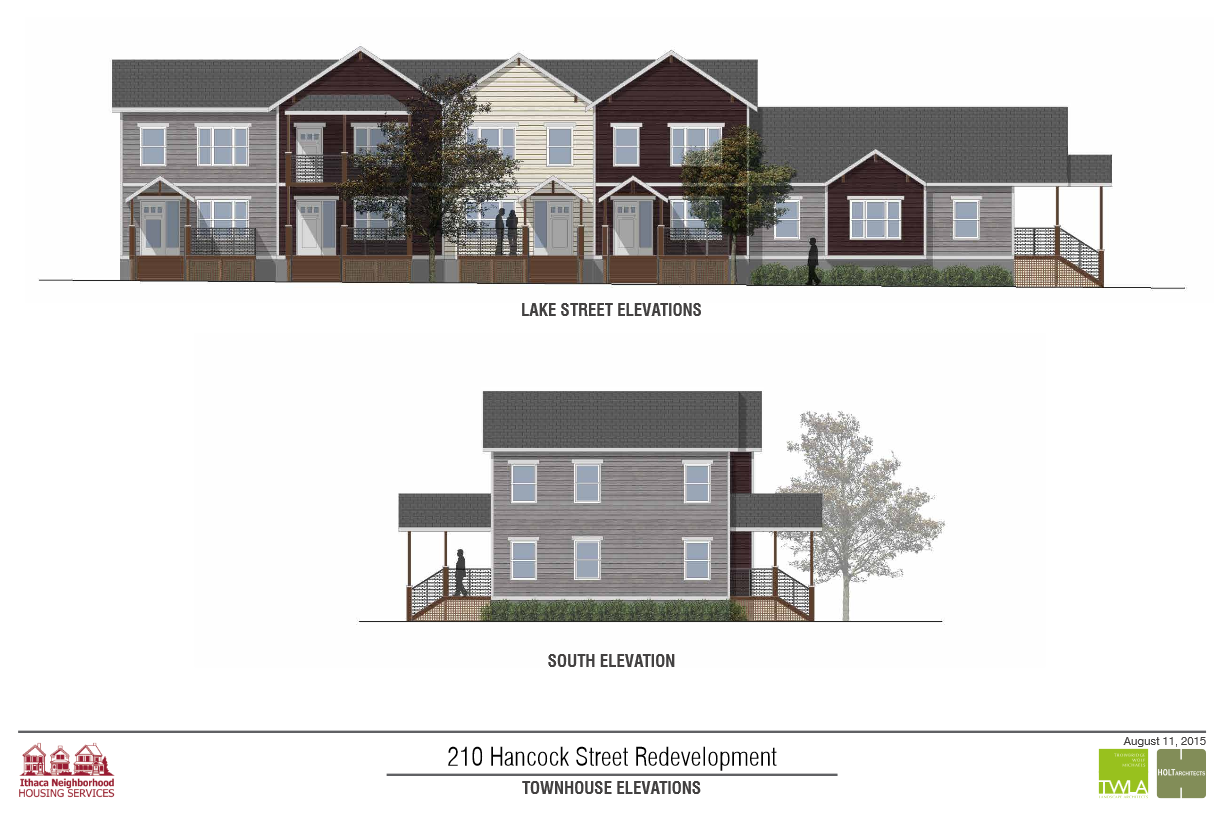
1. In good news, INHS’s 210 Hancock affordable housing development was granted all the necessary zoning variances from the Board of Zoning Appeals (BZA). The vote was 3-0 in favor; one board member abstained after expressing her distaste for the project. Variances were needed for the height (46.5 feet vs. the 40 feet legally permitted), the parking requirement (84 required, 64 planned) and loading zones for the three commercial spaces, which was granted at the previous BZA meeting. The project now moves on to the Planning Board again for preliminary approval.

210 Hancock also applied for $3.9 million in tax abatements from the Tompkins County IDA, and these were granted at last night’s meeting. According to the application, the tax abatement was requested because the commercial spaces and the pedestrian walkways along Lake Avenue and Adams Street can’t be covered by affordable housing grants. The foundation and high acquisition cost of the former grocery store were also cited as factors in the application.

Unfortunately, documents filed with the city indicate that the townhouses will no longer be for sale, they will only be rental units. INHS says that they received updated, detailed construction costs and the result is that it would be “infeasible to build and sell the townhouses affordably“. If there’s any silver lining to that, it’s that all the townhouse units will now be handicapped-accessible, and that they will be built at the same time as the apartment building (no need for subdivision or owner-occupied grant money, which is harder to get). Construction will be May 2016 to July 2017, rather than 2016-2019.

EDIT: INHS Executive Director Paul Maazarella sent an email this morning saying that the plans have been re-revised, and now 5 of the 12 units will be rentals. 7 of the units, all 2-bedrooms, will still be for sale. Quoting the email –

“This aspect of the project has many unknowns that still remain to be resolved, so we decided to take a cautious approach with the Planning Board and announce that they will all be rentals. Some of the challenges that we have for for-sale units on this site are:  very high land cost; the demo cost for the existing building; uncertainty about the availability of development subsidies; the type and cost of the ownership structure (condo, coop or HOA); the impact of high property taxes on affordability; and the overall development cost in relation to producing a unit at an affordable purchase price.  Since then, we’ve reviewed the numbers and reconsidered our earlier decision.

We have now firmed up a plan to keep 7 of the 12 units as for-sale units and make 5 of them rental units.  All 5 of the rental units will be 3-bedroom homes (the only 3-BRs in the project) and one of them will be fully accessible.
The 5 rental units will be clustered at the end nearest to Adams St.  The for-sale units will be closer to Hancock St.
The rental units will be built at the same time as the multifamily building.  We don’t yet know the timeline for the for-sale units.”

inhs_pride_design_v4_1

On that note, here’s an updated render of the townhouses. Quoting the memo from Trowbridge Wolf,

“The townhomes at 210 Hancock will utilize architectural details in the porches and roof lines as well as a mix of materials and colors to provide architectural diversity. Architectural precedent will include homes built in the late 19th/early 20th century and characterized as “tudor”, “arts and crafts”, “American four square” etc. The goal is to design the 12 townhomes as if they were built over time with some unifying features that make them feel part of the larger 210 Hancock community.”

2. From townhouses to big houses. Here’s an attractive proposal for a renovation at 109 Dearborn Place in Cornell Heights. 109 Dearborn is currently a 3,800 SF storage building with an attached apartment unit, and has been since the 1960s; previously it was an office building for the Paleontological Research Institute, and built specifically for PRI in the early 1930s. The building was purchased from Cornell by Dr. J. Lee Ambrose (M.D., so he can get away with using ‘Dr.’ outside of his field without sounding pretentious) for $177k in 2012. Bero Architects of Rochester and Ellis Construction of Lansing are in charge of the design and build respectively.

109_dearborn

The proposal involves new roofing, dormers, roof extensions, and a gut interior renovation to be done in phases over the next few years. Being in the Cornell Heights Historic District, the project needs Ithaca Landmarks Preservation Commission (ILPC) approval. Since the building is considered non-contributing to the historic district (the age is right but being a purpose-built office building isn’t), ILPC may be a little less stringent with this project.

3. Staying on the theme of grand houses, a lakeshore homesite has received a multi-million dollar loan. The property at 1325/1327 Taughannock in Ulysses is right on the lake, and two small houses once on the properties have been demolished. The loan, for $2.25 million, was filed on the 13th, with financing provided by Tompkins Trust.

The owner is a senior investment banker from New York with connections to Cornell. In other words, the type of person a lot of Ithacans love to hate. Looking on the bright side, this is an extra couple million for Ulysses’s tax rolls (my anecdotal finding is to tack on about 30% to hard construction costs to get the assessed value, and the hard costs here are $1.87 million…so $2.43 million). Single-family projects of this magnitude in Tompkins County are quite rare, they could be counted on two hands. It’ll definitely be worth a trip to see what this lakeside manse looks like as it moves towards its May 2016 completion.

4. Also in sales, the Carpenter Business Park was purchased by “Carpenter Business Park LLC” for $2.4 million from the lender that repo’d it from the owner earlier this year. Four parcels were purchased – all the land along Northside’s Carpenter Circle except for the community gardens and the building supply company. The LLC is registered to the same P.O. Box as Ithaca’s Miller Mayer law firm, and there’s no indication if there are plans for this site. But you’ll see something here if plans arise.

state_st_triangle_v3_1

5. The State Street Triangle public relations campaign begins in earnest – the CEO of Campus Advantage recently submitted an editorial in the Journal, and the Texas-based company has also launched a website, Ithacaliving.com. It’s as one would expect, it touts the economic impacts and the addition of housing to the underserved Ithaca market. For those who are more neutral, the site’s worth a look for some new perspective shots, courtesy of the folks at STREAM Collaborative. CA’s effort to assuage the concerns of city officials and the public has been lackluster so far, so we’ll see if this is a sign they’re willing to be more active and engaging.

college_crossings_v3_1

college_crossing_2

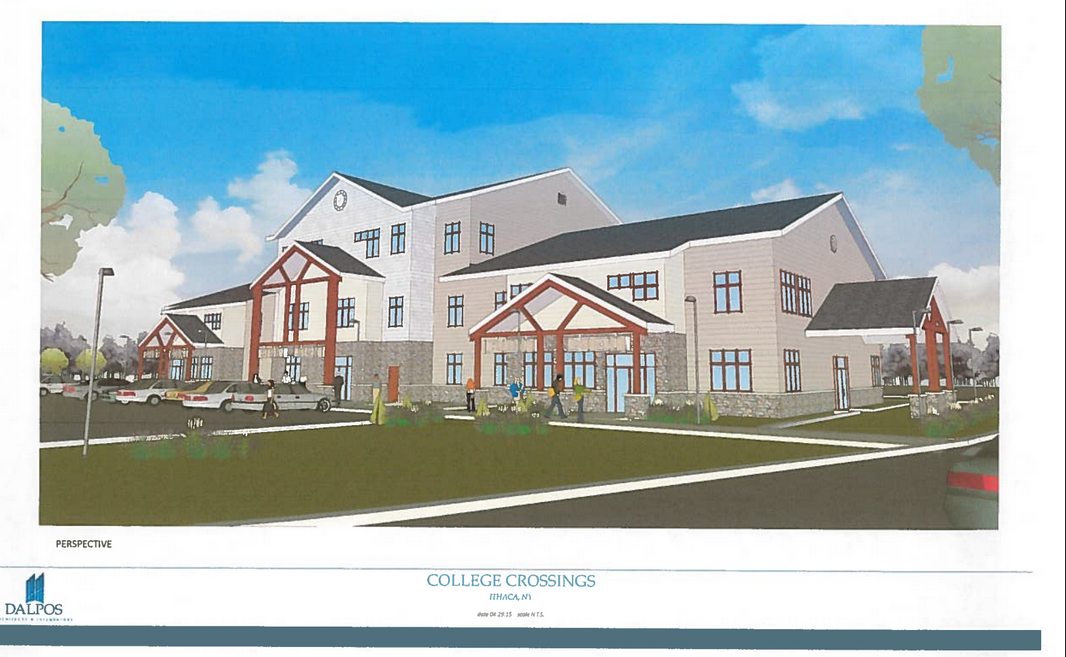
6. Over in Ithaca town, the State Environmental Quality Review (SEQR) is still underway for College Crossings. Only this time, the town acknowledges that plopping a building in the middle of a large parking lot doesn’t mesh with their comprehensive plan. The building is acceptable, but the site plan layout needs work seems to be the gist of the town planner’s review.

7. From the city of Ithaca Planning Board Project Review meeting next week, the phrase of the week will be “carriage house”. Specifically, two proposals in the city for accessory apartments in the style of carriage houses.

201_w_clinton_1

Carriage houses were essentially garages for horse-and-buggies. The first proposal, at 201 West Clinton Street, is highly reminiscent of those long-gone days, and it needs to be since it’s in Henry St. John Historic District (more talk about the meticulous restoration of the main house here). The proposal is going up to the planning board for recommendations for a zoning property line setback variance at the next BZA meeting. The 650 SF, 1 bedroom garage/carriage house would replace a non-contributing garage from the 1960s. The architect isn’t stated in the documents.

607_utica

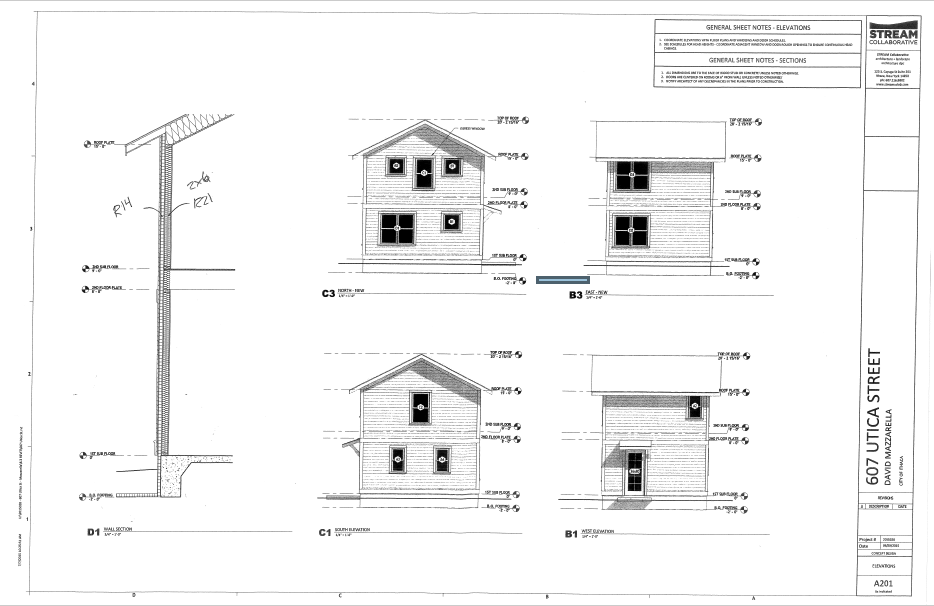
The other proposal is for 607 Utica Street in Fall Creek. The applicant is seeking demolish a rear garage in favor of a one-bedroom, 510 SF unit. In the zoning appeal application (one again for property line setbacks), the homeowner states “My goal has never been to become a landlord…I am hoping to do this only because the income from this would allow me to remain in the community”. Once again, the affordability problem is making itself known. Prolific local architecture firm STREAM Collaborative is responsible for 607 Utica’s “tiny house”.

As a matter of opinion, I think these are a great idea. These add to the housing stock, contribute income to homeowner-landlords living only feet away, they’re not obtrusive, and their small size lends well to modest, sustainable living. I hope they go forward.