1325 Taughannock Boulevard Construction Update, 1/2016

16 01 2016

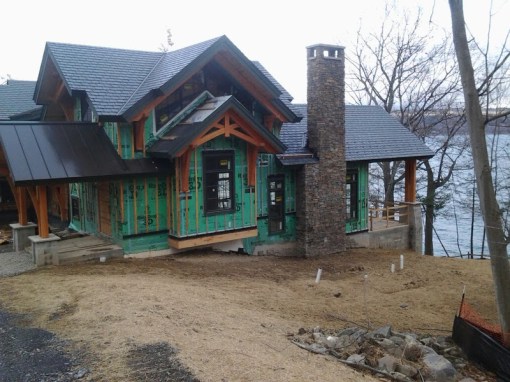
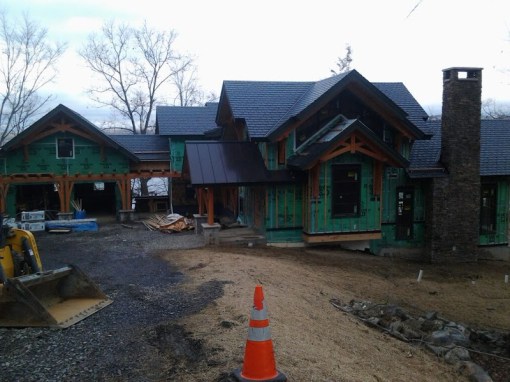
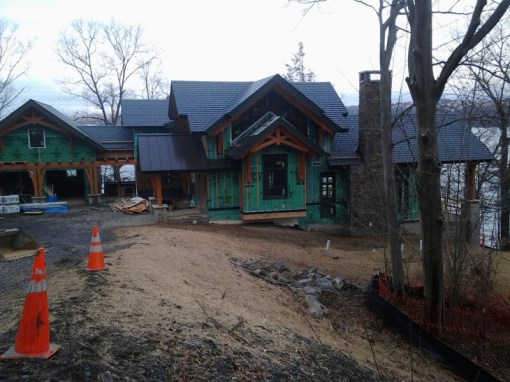
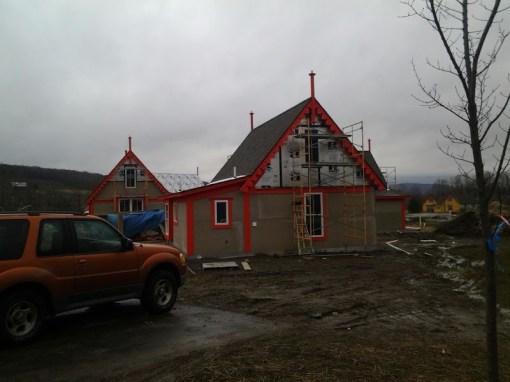
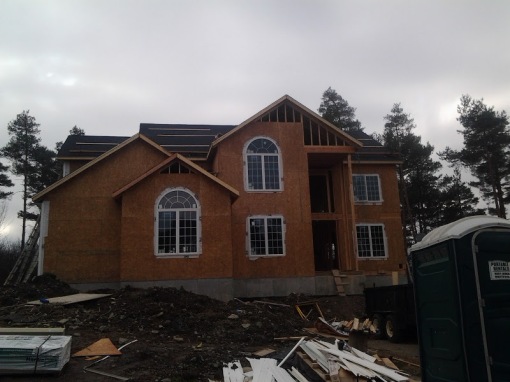
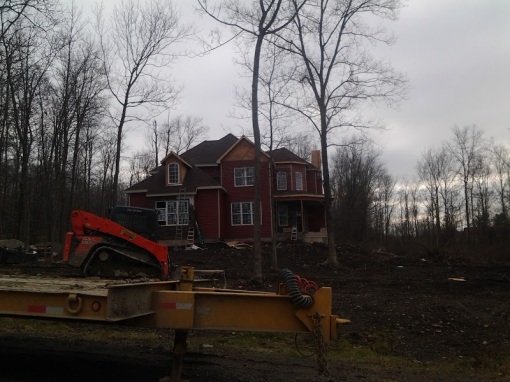
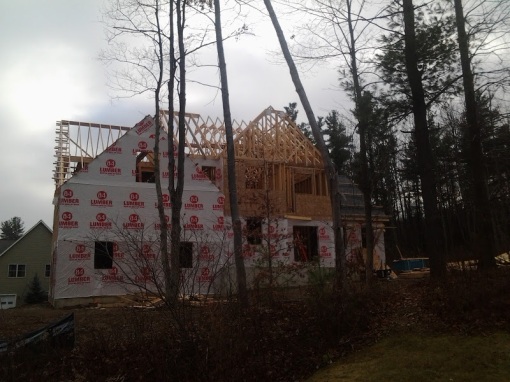
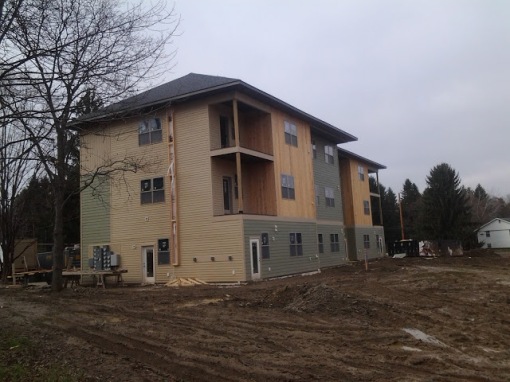
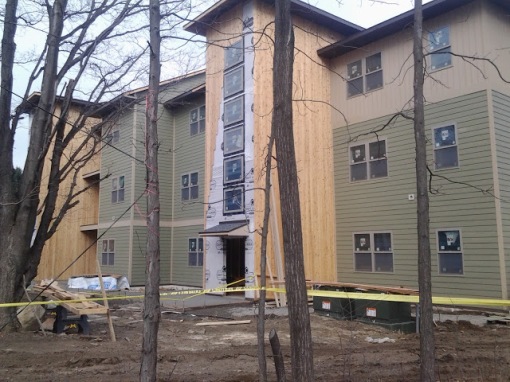
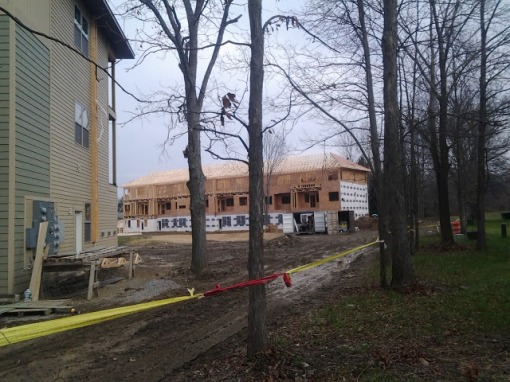
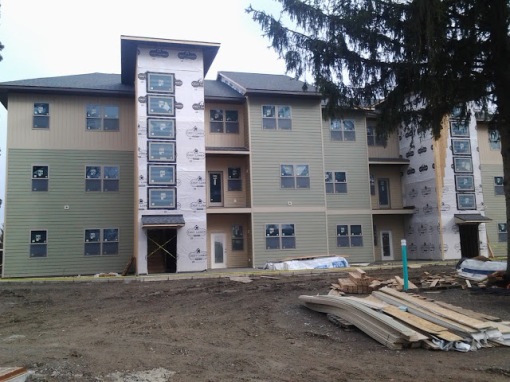
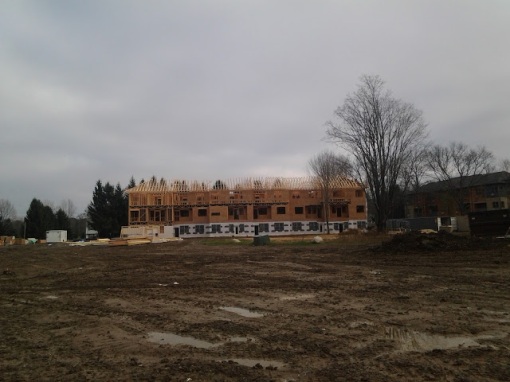
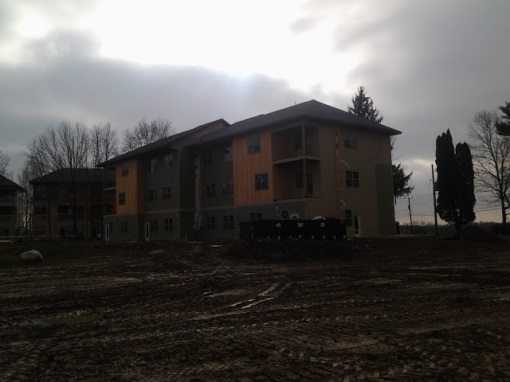
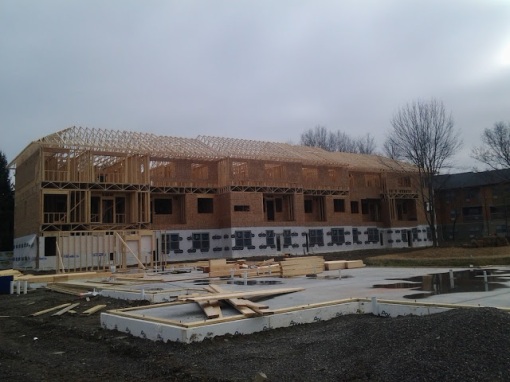
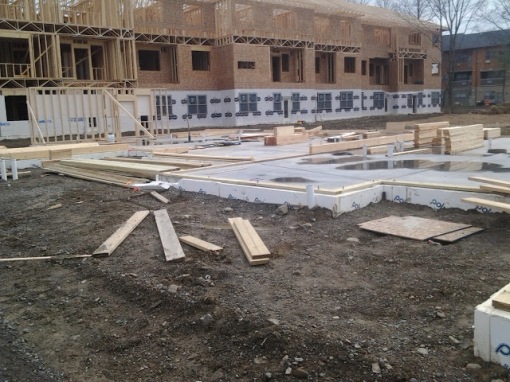
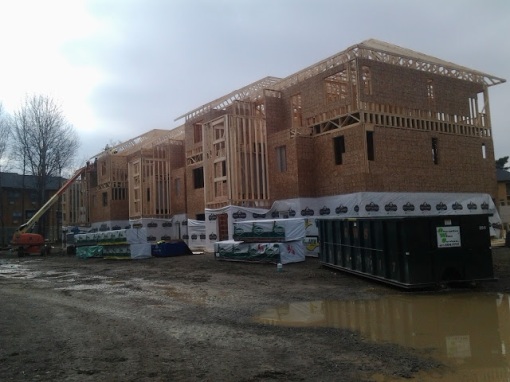
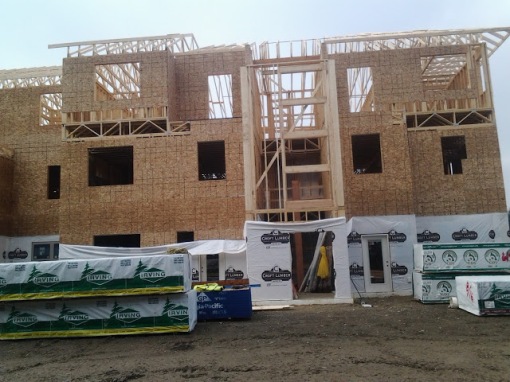
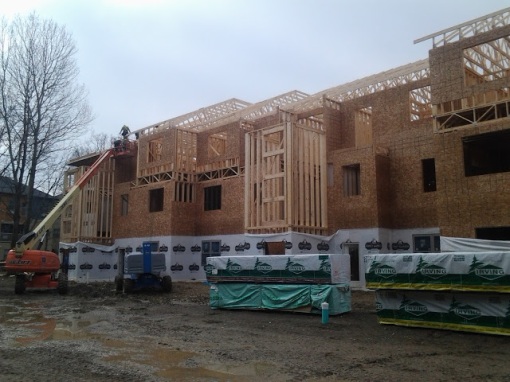
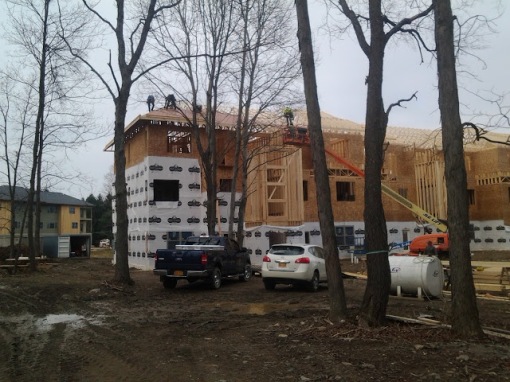
Quick progress report on the multimillion-dollar lakeside manse going up at 1325 Taughannock Boulevard in the town of Ulysses. Since November, most of the roof has been shingled or finished with metal panels, and the newly-completed hand-laid stone chimney looks nice. The Green Guard Raindrop 3D housewrap is still showing in most places, but you can see wood siding on the side of the garage in the first shot, and what looks like wood shingles on the second-floor bump-out in the second photo. From the rendering shown at the project site and from Farmington-based New Energy Works’ website, it looks like many of their design use a combination of shingles and lap siding, which gives some visual interest to go along with the warm look of fresh wood. The housewrap has been furred out to prevent dampness and to attach the wood siding.

The construction loan paperwork says this project will be finished no later than the end of May, but it will likely be a little sooner than that. As I finishing up taking photos, a gentleman in a Honda pulled over to drop off some paperwork (before I asked if he was the future homeowner, I felt my face burning because I was worried it might be the owner asking who the heck was taking photos of his house), and he thought it was due to be finished by the start of May.

20160109_143823 20160109_143910 20160109_143932 20160109_143942 20160109_143959

20151108_144517


News tidbits 1/16/2016: The Not-So-Best Laid Plans

16 01 2016

elmira_savings_1

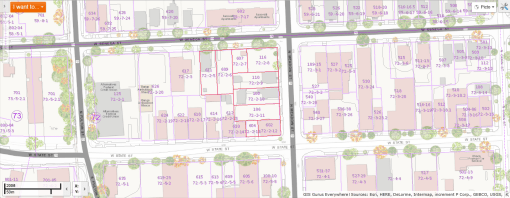
1. It isn’t exactly a shock that Elmira Savings Bank is pursuing plans for the $1.7 million in properties it just acquired on the west 100 block of Meadow Street between West State and West Seneca Streets. That being said, sending out 30-day eviction notices wasn’t a very good idea from a public relations standpoint.

Technically, it’s all above the law – the three tenants affected were on month-to-month leases, according to Nick Reynolds over at the Journal, and one had an expired lease and was in the process of relocating. The bank wasn’t interested in renting out the properties and decided to clear them out. That is plausible, if a little brusque – even if they had put forth a proposal for something at the next Planning Board meeting, approval would take months, in which case they could eased the tenants out of the current property. But instead, they ended up with a petition that, while mostly reading like a speech from the Politburo, does make the valid point that this was conducted poorly. Then it hit the airwaves, and the bank has gone into major damage control mode, giving the tenants until the end of March and reimbursing them $1,000 for the trouble.

Looking at some of the comments on the Voice, there is a lot of outcry against gentrification, but there’s not a whole lot the city can do to prevent that – even if Elmira Savings Bank didn’t build a thing and sold the buildings to someone else, the rapidly rising property values around the city would push the renters out, albeit more subtly, and the city can’t make a law that says someone can’t move in. Plus, as seen during the 210 Hancock, Stone Quarry and Cayuga Ridge debates, there’s a lot of pushback locally against affordable housing. Arguably the best solution going forward is to work an inclusionary zoning ordinance into law so that when Elmira Savings Bank does decide to build (and it’s more of a when than an if), that a few of the units be made available to those on more modest incomes.

Just to touch on that real quick, according to the Journal, the old Pancho Villa building at 602 West State Street will become a bank branch for ESB in the short-term, and plans are being considered for a mixed-use project at some point down the line (two months, two years, who knows). The zoning is WEDZ-1a, allowing for a five story, 65′ building, but there might be tweaks to that depending on the inclusionary zoning ordinance.

tmpud_waterfront_1

2. Keeping a focus on the west side of the city, the Planning and Economic Development Committee voted to circulate a proposal for a “Temporary Mandatory Planned Urban Development” (TM-PUD) over the waterfront. The reason for this is one part proactive, and one part reactive.

What the TM-PUD does is, for an 18-month period starting the day of Common Council approval, it gives the Common Council the right to oversee and if necessary vote down projects that it thinks will not be appropriate for the waterfront. The study area is currently a mix of zones: Waterfront (WF-1, WF-2), Southwest Mixed-Use (SW-2), Park (P-1) and Industrial (I-1). When the Comprehensive Plan was passed in 2015, it promoted a more walkable, dense, mixed-use waterfront. Therefore, some of the zones are outdated.

The city’s planning department is still in the process of drawing up specifics for how to implement the Comprehensive Plan’s walkable urban waterfront, but in the meanwhile, some of the zones don’t match up with the direction the city wishes to proceed. Take, for example, the industrial space on Cherry Street and Carpenter Circle. By zoning, residential uses aren’t allowed, although the city would like to see mixed-uses with condos and apartments in their vicinity. The planning department needs time to figure out the what and where on zoning so that those uses can be proposed without a developer spending extra months in front of the Planning Board and BZA, which can drive up costs and make construction financing more uncertain.

So that’s the proactive, benign part – the city needs time to plan out the zoning laws for the dense waterfront they want. Now comes the reactive, cynical part.

It’s a not-so-secret secret at this point that the Maguires are looking hard at Carpenter Circle for their car dealership headquarters and multiple sales outlets. Since Carpenter Business Park is zoned industrial, and Ithaca city zoning allows commercial uses in industrial space so long as they’re two floors, there’s a good chance they could build dealerships without the need of the BZA, and it would be an uncomfortable position for the planning board to have to debate a project that is totally legal but is something the city and much of the community doesn’t really want. So as a way to stall for time, the city’s pursuing this TM-PUD and giving the Common Council the authority to shoot down any unwelcome plans should they arise.

For comparison’s sake, there’s a similar scenario that is playing out in Ithaca town. The College Crossings project on South Hill was welcomed under the zoning and previous iterations had been approved, but after the town passed its 2014 Comprehensive Plan and attended the Form Ithaca charettes last summer, the planning board realized that a shopping center with a couple apartments above and in the middle of a large parking lot wasn’t something they really wanted anymore. While the project has been withdrawn, the process and debate has created a lot of discomfort, confusion and uncertainty, which is rather problematic given the area’s housing shortage. The town hopes to have some form-based zoning code ready this year.

So, looking back to the city, the occupants of 108 E. Green Street want things that are still illegal in much of the study area, but they don’t want a full-on moratorium because some spots like the Waterfront zones actually do accommodate what the city and many of its constituents want. The TM-PUD is an attempt to stave off the legal but undesirable projects until the revised West End zoning can go into effect.

Worth pointing out, at the meeting the boundary was changed to midway through the Meadow Street and Fulton Street blocks, rather than along Fulton Street. It may or may not affect Elmira Savings Bank’s parcels as mentioned above, but those long-term plans are in alignment with the city’s, so probably not.

south-hill-area

3. On a related note, the town is holding workshop sessions for those interested in designing a ped-friendly, mixed-use community for South Hill. The meetings are planned for 6:30 p.m. to 8 p.m. Jan. 26 to 28 at the Country Inn and Suites hotel at 1100 Danby Road in Ithaca. An open office has also been scheduled for 12 p.m. to 1 p.m. Jan. 27. Form Ithaca will be in attendance at the sessions to help formulate the form-based character code proposed for the neighborhood.

815_s_aurora_4 815_s_aurora_1

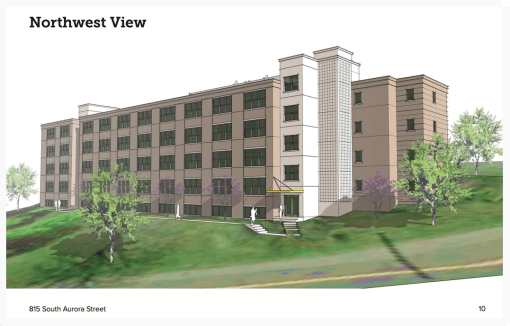
4. A revision to the cellphone tower law has taken one step closer to becoming reality. The city’s Planning and Economic Development Committee voted 4-1 to circulate a revised law that would reduce the size of the tower’s fall zone, where construction of any structures is prohibited. A revision to the current city law, which is twice the height of a tower, could potentially allow the 87-unit 815 South Aurora apartment project to proceed with planning board reviews and other BZA variances if necessary. Developers Todd Fox and Charlie O’Connor of local company Modern Living Rentals have been pushing for a fall zone radius of 180 feet for the 170-foot tall tower, rather than the 340 feet as the current law mandates.

From the discussion, it sounds like the concern has less to do with this parcel, and more to do with the possibility of cell phone companies pursuing towers on open land in the northern part of the city where spotty reception has to be weighed against the aesthetics of the lake shore. Anyway, we’ll be hearing more about possible changes to this law in a month, but for back reading, here’s the Voice article from a few months back.

5. In quick news, CBORD’s move to the South Hill Business Campus looks like a go. A $2.45 million construction loan was extended on the 8th by Tompkins Trust Company. CBORD, a software company founded in Ithaca in 1975, will move 245 employees into 41,000 square feet of freshly renovated SHBC space from the Cornell Business Park later this year. The project, which totals $3.7 million, was granted $296,000 worth of sales tax abatements.
409_college_avenue

ehub_1

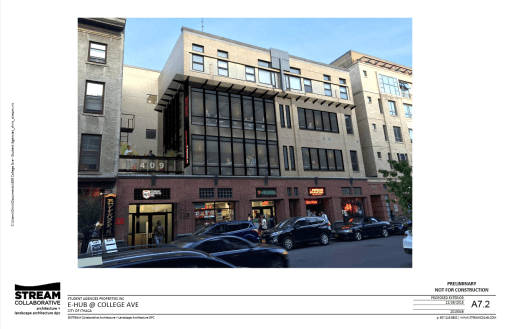
6. From the city’s Project Review Agenda next Tuesday, plans for a facadectomy of the 1980s Student Agencies Building at 409 College Avenue. Student Agencies, in collaboration with Cornell, plans on dropping $183k on the facade work, as well as the $2.8 million or so for the interior renovations of the second and third floors for the new eHub business incubator space. Prolific local architecture firm STREAM Collaborative is in charge of the design work, including the 9,660 SF of interior space. The work would go from January to April (the loan is already approved and most of the work is interior).

6-29-2014 163

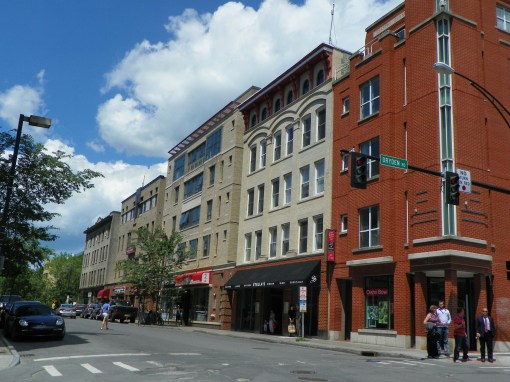
If I may play armchair architecture critic, which I have no credentials to do, I think the patio area is great, but I’m opposed to the brise-soleil, the wing like feature that serves as a sunscreen. I feel like that its location above the third floor throws off the rhythm of the block, by being lower than the cornices on adjacent structures. It might be fine over the glass curtain wall alone, but as is it feels a little out-of-place. Just one blogger’s opinion.

20160109_135258 20160109_135338


228_w_spencer_1

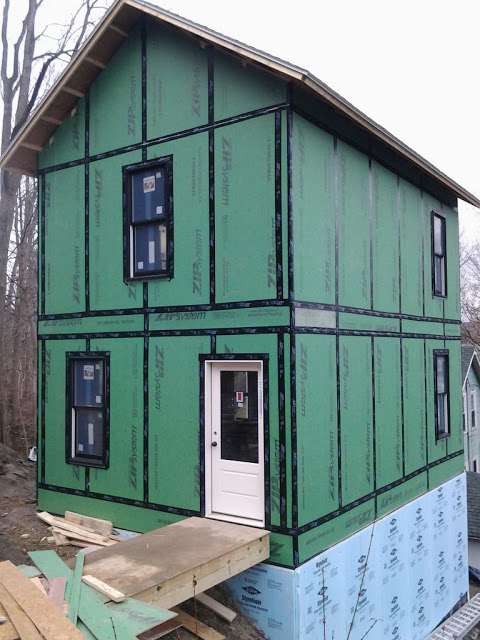
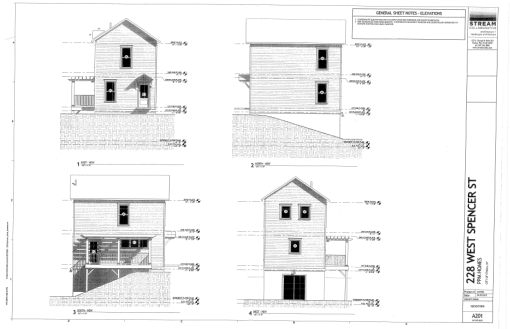
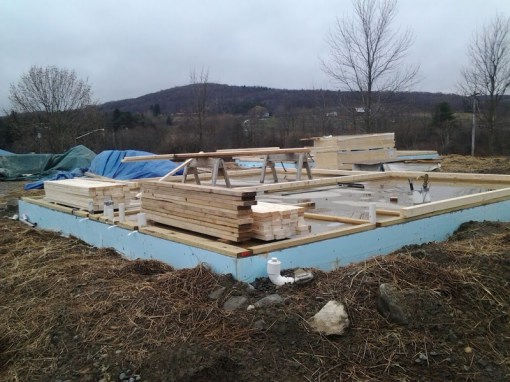
7. House of the week. 228 West Spencer Street in the city of Ithaca. Zero energy new construction, 2-bedrooms, on a rather difficult site. In the above photos from last weekend, the house has been framed and sheathed with Huber ZIP System plywood panels, the roof has been shingled, and doors and windoes have been fitted. The blue material on the concrete basement wall is Dow Styrofoam Tongue and Groove Insulation which protects against moisture and helps keep the heat loss to a minimum. The house should blend in nicely with its neighbors.

Ed Cope of PPM Homes is the developer, and Noah Demarest of STREAM Collaborative is the architect.


Boiceville Cottages Construction Update, 1/2016

15 01 2016

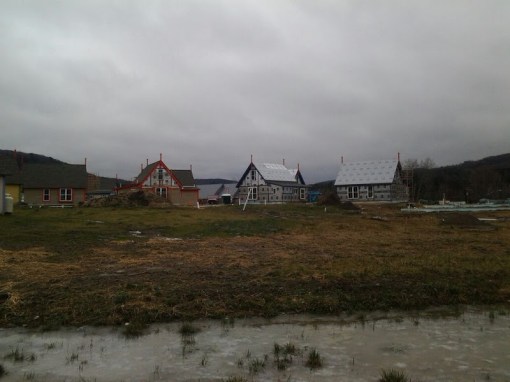
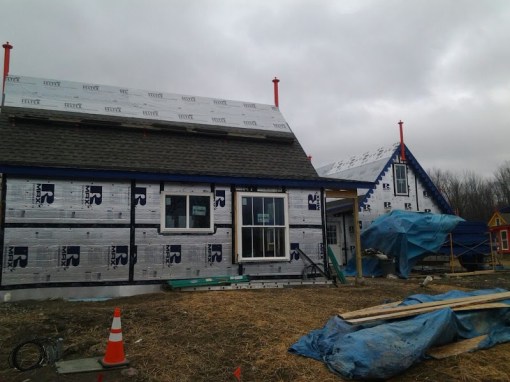
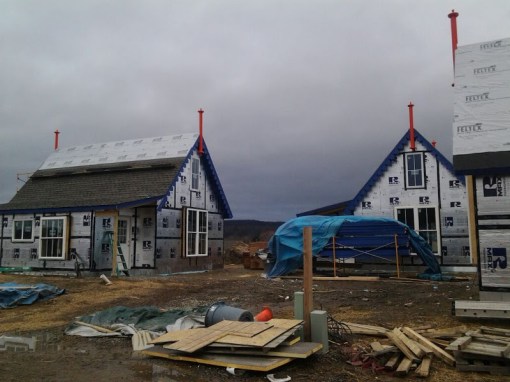
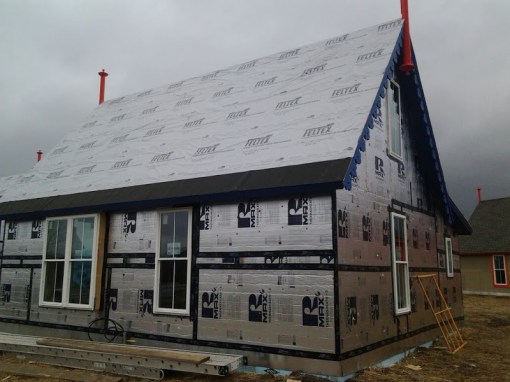
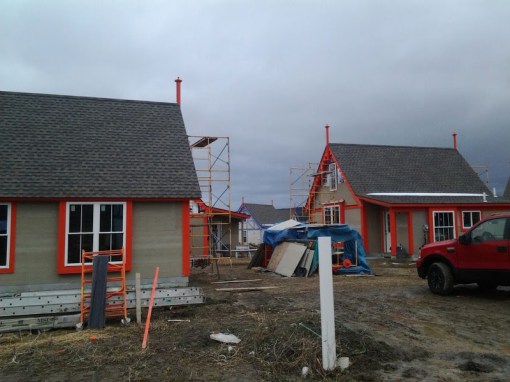
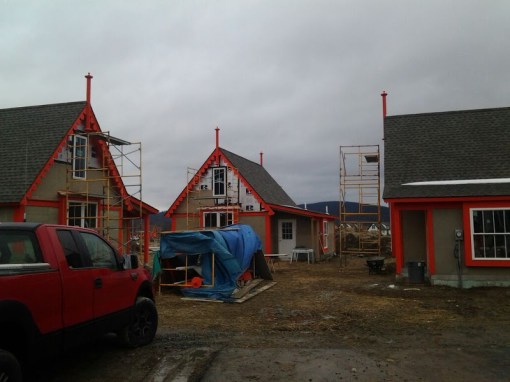
Just a pass through Caroline to check on the latest progress at the Boiceville Cottages. At present, it looks like about six new houses have been framed out – the three furthest along (red-orange trim) are receiving their exterior stucco coats, while the three less further along (cobalt blue trim) look rather like shiny ornaments thanks to the aluminum facer on the Rmax Thermasheath polyiso insulation (previously some red-faced Atlas polyiso was used). Rigid thermal foam plastic insulation board is lightweight, easy to cut, provides decent fire and moisture protection and provides a very high degree of insulation from the elements, greatly limiting the transfer of heat outward. As compared to traditional plywood sheathing however, it’s not as strong, and because the water control is on the outside with the foam sheathing, there are limitations or extra steps that need to be taken before applying many exterior facade materials like wood or fiber cement.

The roof foam boards are covered in Feltex synthetic roof underlayment before the shingles are attached. Compared to traditional asphalt-saturated felt, the synthetic material offers greater moisture resistance, and they’re light-weight and high-strength. However, wicking, where water can be drawn up the roof and promote leaks, can be a big issue with synthetic roof underlayment, so it has to be installed correctly and carefully.

Another set of homes is still at the concrete slab and sill plate stage, but it looks like some wood stud walls will be going up shortly. Schickel Construction is aiming to have all 17 of the new units complete by the end of the summer.
20160109_115011 20160109_115045 20160109_115125 20160109_115158 20160109_115217 20160109_115233 20160109_115309 20160109_115328 20160109_115354 20160109_115414 20160109_115432 20160109_115457 20160109_115503 20160109_115536

boiceville_1


News Tidbits 1/9/2016: Better Late Than Never

9 01 2016

Call it the big news round-up. This is what I get for not writing my weekly roundup last week.
339-Elmira-Road-cancel

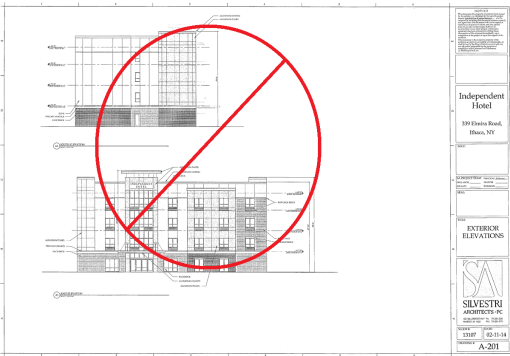
1. We’ll start off with some bad news. The plans for a boutique hotel at 339 Elmira are very likely done and over with. The 37-room, 6,468 SF hotel announced in February 2014 was planned for the 0.59 acre former Salvation Army property on the Southwest side of the city. For whatever their reasons were, the developer, (Rudra Management and Rosewood Hotels of Buffalo, decided put the property up for sale for $395,000. After several months, it finally sold at the discounted price of $300,000 to its next door neighbor, Arizona-based Amerco Real Estate, the parent company of U-Haul. Discounted is a relative term, by the way – Rudra had acquired the vacant property for $143,000 in a land auction in 2013. Back when Salvation Army was still there in 2009, the site sold for $175,000.

So with that sale to Amerco, it’s likely the property will be used for an expanded U-Haul parking lot. It’s unfortunate, but them’s the breaks. For what it’s worth, Rudra has commenced work with the other hotel they had planned, the 79-room Holiday Express at 371 Elmira Road, just down the street.

2. In modest but notable projects, the William George Agency in Dryden received a $2 million construction loan to conduct renovations and roof repairs to its cafeteria area. The non-profit residential treatment center for adolescents had secured building material sales tax abatements from the county to help cover their expenses (the project has originally been planned to start in Q1 2015). The agency, established in the 1890s, employs over 340, making it one of the larger private employers in Tompkins County.

20150613_194544

3. Thanks to Nick Reynolds over at the Journal for reminding readers that not every construction project is private. Noted in his writeup of projects that the city intends to fund this year – $430k in road repair projects, another $407k for parking stations, $1.3 million to replace Cass Park rink’s roof, $214k for design work for the new North Aurora street bridge, and $735k for design work for city dam reconstructions.

Perhaps most interesting to readers here will be the $500k that the city intends to spend on design and planning the new Station No. 9. With the awarding of funding from the Upstate Revitalization Initiative, the city can formally explore the possibility of a new fire station on a Cornell parking lot at 120 Maple Avenue. Once a new station is complete, the city could then sell the current Station No. 9, nearly 50 years old and in need of major renovations, to a private developer for redevelopment (the developer who expressed interest in the site is still unknown, but given Collegetown’s expensive real estate market, they must have really deep pockets).
biggs_2

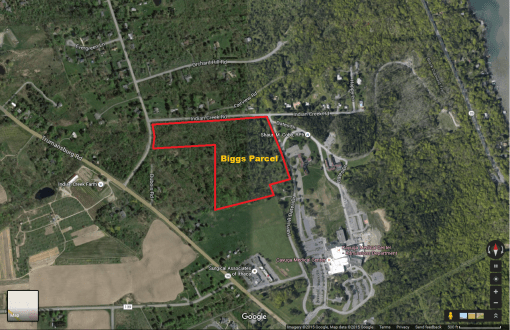
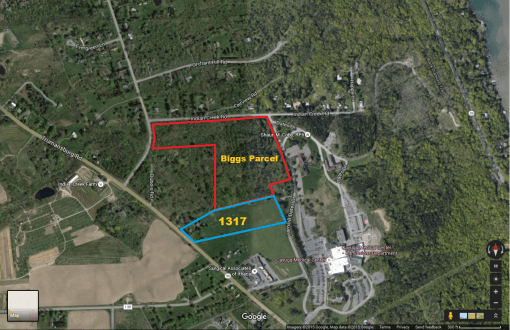
4. More talk of the Biggs Parcel. Jaime Cone at the Ithaca Times provides more details regarding neighbor Roy Luft’s proposal to build for-sale senior housing using the site. Luft is arguing his project is more environmentally friendly than the NRP project, it would take two to three years to come to fruition, that the units would be 700-1,000 SF, and he’s serious about building the senior housing, which is an under-served market. The Indian Creek Neighborhood Association, which has actively fought any sale, seems to at least be open to the idea, if not necessarily a fan of it.

For the record, since the ICNA doesn’t clarify it in their blog post, the county didn’t develop the NRP project. The county put out a request for proposals (RFP) just like they do with every other large development study or offering. Better Housing for Tompkins County and NRP happened to think they had a good project idea and responded to the RFP. It’s been made clear, multiple times, that the county has approached neighbors, Cayuga Medical, INHS and others for months, shopping the land around, and no one has made offers. To be completely honest, even if this land hit the real estate listings, it’s not as if anyone is clamoring to snatch this up; there’s demand to live in and near Ithaca, but land still takes several months to sell on average, and it’s not a stretch to think that developers would avoid this one after the NRP flaying. The county plans to start the listing process later this month if the ICNA doesn’t make an offer by the 15th.

Just a thought, but if $340,000/25.52 acres = $13,333/acre, and the acreage closest to Dates Road is probably developable, than shouldn’t that allow a ballpark fair-value estimate? I know NRP was to pay $500,000, but that had some transit and pedestrian cotingencies attached. Has the ICNA contacted NRP to ask how extensive the wetlands were, is the information on file with the county?

1317 Trumansburg is 10.17 acres, The Biggs parcel 25.52. Combined, they would be 35.69 acres. From the sound of it, Luft would like to reform the parcel boundaries to let his project, however big it may be, to move forward. The site is zoned low-density residential, which means a cluster subdivision can be 2.3 units/acre at maximum. Each structure can have up to 6 units. Taking a guess here, but Luft may be looking at more than 20 units, because anything less than 20 could be done with a subdivision of his current property. For comparison’s sake, the BHTC/NRP project was 58 units.

There is at least the potential that the county gets additional tax dollars from Luft’s project, and the woods would be protected, and there would be a happy ending to this story. But that’s dependent on both sides’ goodwill. Given the years of acrimony, that’s a big leap of faith.

5. For the restaurant-goers out there – Fine Line Bistro’s old spot at 404 West State has a new tenant called “The Rook” opening this month. Mark Anbinder provides the foodie rundown at 14850.com. Mid-tier American bistro/pub fare.

More importantly to this blog is the economic rundown, provided thanks to their application for a loan courtesy of the Ithaca Urban Renewal Agency (IURA). The three co-owners, all local restaurateurs, are seeking a $40,000 loan (3.5% interest, 6 year length) to complement their own dollars and a private loan. 8 hired staff (cooks/servers/dishwasher), but none living wage. With cash flow statements, restaurant plans, the menu, loan filings and resumes of the owners, this looks like a Cornell Hotelie’s senior class project.

It’s the IURA’s decision make, but at least it’s nice to know that good restaurant space in Ithaca is in strong demand.

Pg-3-Rendering

6. Out for bid, Cornell’s Ag Quad renovations. The bid filing estimates the budget at $6.6-6.8 million, and a construction timetable of late March 2016 to Summer 2017. Quoting the first write up from October:

“The $9.6 million project will be broken down into two phases, one that focuses on infrastructure, and one phase on landscape improvements (and being that much of the infrastructure is underground utilities, phase one could be described as churning up the ground, and phase two is making the upturned dirt pretty again). The renovations, which are set to start next summer and run through 2017, will include additional emergency phones, a rain garden, and outdoor gathering spaces in front of Mann Library and Roberts Hall (upper right and lower left in the above render).”

state_st_triangle_v5_1

7. Folks love a good rumor, and the Times’ Josh Brokaw had an interesting one to report in his 2016 futurecast regarding State Street Triangle

“Don’t think that the Austin-based developer is abandoning Ithaca, though a look at their previous projects shows this sort of downtown, mixed-use development is a new frontier for a company accustomed to building student housing mostly in green fields in the South and Midwest. CEO Mike Peter was spotted downtown at Mercado in December talking to consultant Scott Whitham; it wouldn’t surprise if the company came back this year with something conceptually similar—lots of rooms, ground-floor retail—but a much different look.”

Brokaw makes a reference to the inclusionary zoning slated for discussion next month, which is rumored to mandate affordable units in return for a larger footprint (rundown of how that works here). I also wonder if it will make reference to the “pillar” that Myrick mentioned previously – a taller, skinnier building, not as massive and perhaps only 3-4 floors over most of the site, and maybe a quarter of the site has a taller tower that’s 12 or 13 floors, whatever is permitted by the inclusionary zoning (strictly hypothetical, just one guess of many). Campus Advantage has plenty of time since they missed their original start date, but maybe later this year in the spring.

8. It’s always a brow-turner when a real estate listing is advertised as “a large corner lot ideal for a multi-unit development. In this case, it’s a 0.2 acre double lot at 404 Wood Street in Ithaca’s South Side neighborhood. The listing offers the ca. 1938 house and lot for $250,000 (tax rolls say the property is assessed at $125,000; the current owner picked it up for just $34,000 in 1993).

Playing with some numbers a little bit, there are a couple of options if a buyer wanted to build something. The first and probably easier option would be to subdivide the lot and build on the vacant corner parcel. That would give, per R-3b zoning regulations of 40% lot coverage and 4 floors, about 1400 SF per floor. That gives 5600 SF, and if one assumes 15% off for circulation/utilities and 850 SF per unit, you get a 5 or 6 unit building at theoretical maximum.

If one were more brazen and tear down the 1938 house, one gets about 3,485 SF per floor, 13,940 SF at max height. That allows about 14 units using the same figures as above. But that might be tougher for neighbors to swallow. Anyway, if it sells and it looks like there’s a possibility, it’ll get a followup in a future news post.
morris_avenue_2

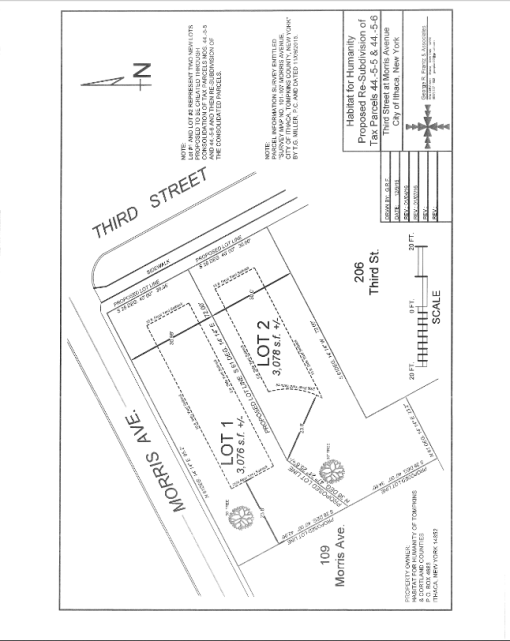
9. Nothing to exciting on municipal planning agendas this week. The town of Lansing cancelled their meeting, and all the town of Ithaca had was a cell phone tower on West Hill. The city has a little more interesting. The duplex at 424 Dryden is examining unusual parking arrangements to save trees, and Habitat for Humanity is planning an affordable-housing owner-occupied duplex for vacant lots at 101-107 Morris Avenue in the city’s North Side neighborhood.
morris_avenue_1

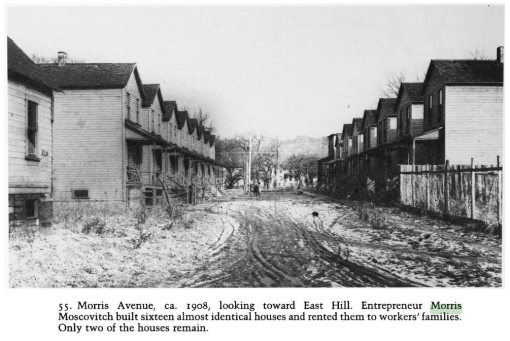
Morris Avenue has always had a focus on worker housing. As described in Ithaca’s Neighborhoods by Carol Sisler (1988), local businessman Morris Moscovitch built 16 nearly identical houses in 1908 to house worker’s families. But, with the effects of urban decay and urban renewal, only one of those 812 SF houses (109 Morris) is still standing today.

What Habitat for Humanity is proposing is to take the vacant lots at 101-105 Morris and 107 Morris (total 0.138 acres), combine them and create two new lots that will face Third Street. The new lots would need a zoning variance since they’re not wide enough (30′ and 30.98′, 35′ required). Being Habitat, these might take a little while to build and they probably won’t wow anyone design-wise, but there’s a lot of value to be placed in their “sweat equity” approach, and affordable owner-occupied housing is in severe need in Ithaca. Planner George Frantz is handling the application.

hotel_ithaca_final_1

10. Lastly, for what is a very long post, the Hotel Ithaca’s revised CIITAP application to the Tompkins County IDA. Now that the project is approved by the city, they can work on a revised tax deal. According to the project memo, the sales, mortgage and property tax abatements will total $1.781 million on the $15 million project. The property tax abatement is the standard 7-year abatement, and will generate almost $1 million in new tax revenue during the abatement period. The project would retain 71 positions and create 21 new jobs, most of which appear to be less than living wage. The application does note, perhaps ominously, that non-approval would result in functional obsolescence – the hotel shuts down. The IDA plans to examine the application at their meeting in the county office building next Thursday.


Ithaca Projects Map

5 01 2016

ith_proj_map_01042016

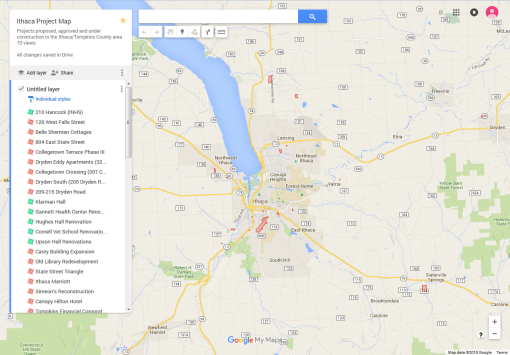
Soft roll-out on this little project, but one that will hopefully be useful. New for 2016, the Ithaca Projects Map. The map can be reached with this link, or by clicking the label next to the Welcome tag at the top of the blog column.

Taking a page from Jason Henderson over at Ithaca Builds, the map is color coded by for-profit (red), not-for-profit (green) and public projects (blue). A couple further details –

~Single family home and duplex sites are not included. There are well over 100 houses under construction in Tompkins County in a given year. Given their number and individually limited impacts, it wouldn’t be a good use of time to try and track them.

~For now, I’m leaving off recently completed projects. I’m also leaving off informal rumors or projects still in the early stages of development. The map only shows formal proposals, approved projects, and projects currently under construction. If a project is confirmed to be cancelled (ex. INHS’s Greenways, Collegetown Crossings on South Hill), it will be removed from the map.

~The information presented when you click on each polygon is a brief project description, the developer, and the project status. Links are provided to background reading on a given project.

~ Disclaimer: While I make an effort to make sure everything is accurate, there are possibilities that renders are outdated (old versions) or something may otherwise be incorrect. If you have questions or comments, leave a comment or shoot an email to ithacating*at*gmail.com.

Now for part II – clearing out my photo stash. Sometimes, I end up with photos that I never use, mostly massive single-family homes in established subdivisions. Along with modulars on the fringes of the county and the occasional large-acreage stick-built, these homes make up the large portion of the new single-family home builds in Tompkins County. Not the most environmentally friendly, and questionable urban/land planning, but it’s what zoning allows and what’s easiest to build.

There’s a few for reasons for that – on the builder/developer’s end, the Return on Investment (ROI) tends to be greatest on luxury home builds, and land’s cheaper in rural areas. On the municipal/community end, one-lot single-families don’t need board review unless they require zoning variances, and as a general rule of thumb, smaller projects, more rural projects, and projects targeting wealthier buyers face less neighbor opposition (the wealth effect is somewhat muted with rentals).

20151205_105519

Larisa Lane, Town of Ithaca (Westview Partners LLC)

20151205_111549

Southwoods Drive, Town of Ithaca (Heritage Builders)
20151205_111234

Old Gorge Road, Town of Ithaca (J. Clark Construction)

20151205_105748

Larisa Lane, Town of Ithaca (Westview Partners LLC)

20151205_130716
Blackchin Boulevard, Village of Lansing (Avalon Homes)

20151205_105216
Birdseye View Drive, Town of Ithaca (Birds-Eye View Properties, LLC)

20151205_111044
Southwoods Drive, Town of Ithaca (Heritage Builders)

20151205_110127

Beardsley Lane, Town of Danby (Westview Partners LLC)

20151205_110351
Loomis Court, Town of Danby (Jepsen Romig Development Inc.)
20151205_111422
Eldridge Circle, Town of Ithaca (TRJ Properties LLC)


News Tidbits 12/19/15: So New Even the Pavement Shines

19 12 2015

cayuga_view_1

1. We’ll start off this week with some eye candy. Over in Lansing village, the planning board is hammering out details regarding signage and covenants related to the Cinema Drive senior housing project. But it also gives the project a new name – from C.U. Suites to “Cayuga View Senior Living“. Lo and behold, one types that into Google and up comes the following partially-finished website. The name sounded familiar, and as it turns out there’s a good reason for that – Cayuga View is also the name of a portion of the Linderman Creek apartment complex in the town of Ithaca.

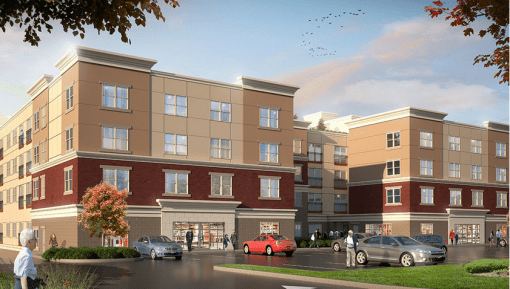
According to the website, the 55+ (“55 and BETTER”, as they tout on the page) apartment building at 50 Cinema Drive will contain 48 2-bedroom units and 12 1-bedroom units with four different four plans. The 4-story apartment building will have retail space on the first floor, “and will offer underground parking and storage, wireless internet, cable, business center, fitness center, rooftop garden, and scenic views. A companion dog or cat under 30 pounds will be allowed.”

No word on the project architect, but the project is being developed by the Thaler family, and Taylor the Builders out of suburban Rochester is the general contractor. The site was originally conceived as an office building several years ago, and then around 2012 it was proposed as a 39-unit mixed-use apartment building with an eye towards graduate students.

amabel_v4_1

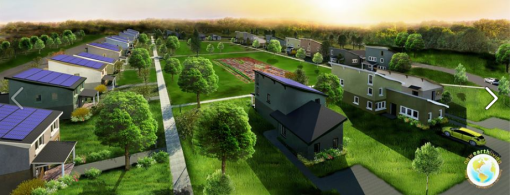
2. Sticking with residential development and fancy renders, here’s the latest render for New Earth Living LLC’s Amabel housing development, courtesy of their Facebook page. Final approval was granted just this week by the town of Ithaca. The 31-unit eco-friendly housing development (consisting of one standing farmhouse and 30 new homes facing inward from a loop road) will be located on undeveloped grass/woodland behind 619 Five Mile Drive. In the project literature, the site is said to be designed around a “pocket neighborhood” concept, with the houses facing towards each other for interaction, and away from the street for privacy. The houses may not be everyone’s cup of tea, but are designed for net-zero efficiency. Houses range from 1-3 bedrooms and 1,200-2,100 SF. No specific prices yet, but expect marketing to begin sometime early next year.

3. For the aspiring developer who wants to get a head start on planning – the 11.71 acre Bella Vista site at 901-999 Cliff Street in the city’s West Hill neighborhood is for sale for $395,000. As the advertisement on Homefinder notes, the project has received approvals for a 44-unit apartment or condo building (what it doesn’t say is that those would have to be renewed via a reaffirming vote by the planning board, since the project was approved more than two years ago). The property is currently assessed for $210,000.

w592-h-q

Primary Developers Inc., a company founded by local businessman Mauro Marinelli, purchased the land for $175,000 in 2002 and received approvals for the 44-unit Bella Vista project in 2007, and the units were marketed by local realtors as condominiums. But as the recession set in, sales foundered and the project never moved forward. Primary Developers Inc. sold the medical office building on the adjacent southern parcel and two other neighboring parcels of land to another local real estate company for $945,000 earlier this year.

chapter_house_materials

4. Some minor tweaks to the Chapter House project since its November sketch plan presentation to the Ithaca city planning board, which looks to mostly be a slightly lighter brick color and a little more detail on the rear wall. From top to bottom, the Chapter House reconstruction proposes Rheinzink zinc shingles, white trim of unknown material, a Redland Brick Heritage SWB bricks, Inspire Roofing Aldeora Slate Coachman (790) simulated slate shingles over the first floor bump-out, SDL (Simulated Divided Lites) transom windows with LePage Morocco textured glass glazing over the picture windows, Sherwin Williams “Tricorn Black” paint on the Chapter House bar exterior trim, and genuine bluestone not unlike the famous Llenroc bluestone used in many of Ithaca’s historic buildings. As far as they look online, they appear to be attractive, premium finishes.

The owner, Sebastian Mascaro of Florida and represented by Jerry Dietz of CSP Management, hopes to start construction in late January or early February for an August 2016 opening.

cornell_novarr_6

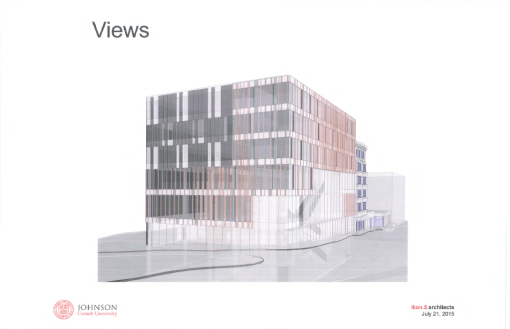
5. Note that there was ever much doubt, but it looks like local developers John Novarr and Philip Proujansky have secured the construction loan(s) needed to build 209-215 Dryden Road in Collegetown, a six-story academic and office building in which Cornell has committed to occupy 100% of the space for use in its Executive MBA program. According to loan documents filed with the county, there were two loans, one for $6,482,295.33 and the other for $9,430,528 (for a total of $15,912,823.33). Wells Fargo Northwest was the lender, and it looks like some of the funds are going through a “pass-through” trust.

The 73,000 SF building will host about 420 Cornell MBA students and staff when it opens in late Spring 2017, later increasing to 600 as Cornell fills out the rest of the square footage. Hayner Hoyt Corporation of Syracuse will be the general contractor. Ikon.5 of Princeton is the project architect.

20151205_094944 20151205_094957

6. Going to do a double-feature for house of the week this week, mostly because I have a backlog of images. Here’s number one.

The last house is underway at the Belle Sherman Cottages. After not hearing anything about it, I had presumed they had just decided not to build Lot #9, which is smaller than the other lots and was going to have a unique “cottage” design. Well, color me surprised. The town of Ithaca issued a permit in early November, and by the 5th of this month, the CMU block foundation was excavated and poured. Looking at builder Carina Construction’s facebook page, the modular units have since arrived and have been hoisted onto the foundation, assembled and secured. Custom interior finishes, porch framing, siding, backfilling and landscaping will follow as the house moves towards completion.

No renders for the finished house, unfortunately, although I suppose STREAM Collaborative might have something on file. Agora Home LLC of Skaneateles is the developer of the Belle Sherman Cottages, which includes 18 other single-family homes and 10 townhouses, all of which have been completed and sold.

20151205_095437 20151205_095453 20151205_095528

424_dryden_rd_1

7. Now for House of the Week #2. 424 Dryden Road’s subdivision earlier this year turned the rear parking lot into a second lot, and the owners, William and Angie Chen of Lansing, decided to build a duplex on the land, which has been bestowed the address of 319 Oak Avenue.

It seems a little odd that the trim already seems to be applied to the house when the windows haven’t been fitted yet. The standard Huber ZIP System sheathing is being covered with a mahogany-colored vinyl siding. Wooden wall studs can be seen from the rough window openings and there appears to be electrical wiring on the rear of the house, so it’s a fair guess that utilities rough-ins are probably underway.

Local architect Daniel R. Hirtler of Flatfield Designs penned the design, and according to the construction loan agreement on file with the county, Tompkins Trust Company lent the Chens $400,000 to help bring their duplex from the drawing board to reality.

416_e_state_v2_1

8. For those hoping for something new and exciting in next week’s Planning Board agenda, it’s going to be a downer month. Here’s what’s planned.

A. Revisions to the internal sidewalk plans at 804 East State Street to allow stripped asphalt vs. concrete.
B. Tweaks to the signage for the downtown Marriott currently under construction.
C. The “Printing Press” bar debate at 416-18 E. State Street, again.
D. Final approval for Tompkins Financial Corporation’s new HQ.

The agenda also includes a couple zoning variance reviews for house additions at 105 First Street in North Side, and 116 West Falls Street in Fall Creek. The board is planning a joint meeting with the ILPC to review and comment on the Travis Hyde plan for the Old Library site, tentatively scheduled for January 12th.


Village Solars Apartments Construction Update, 12/2015

13 12 2015

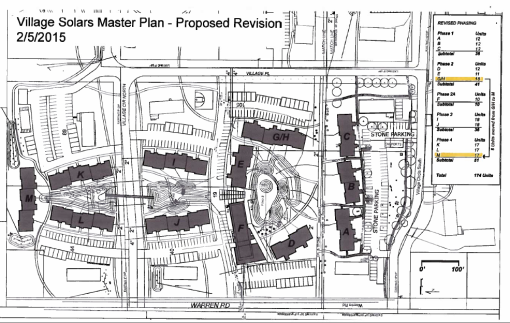
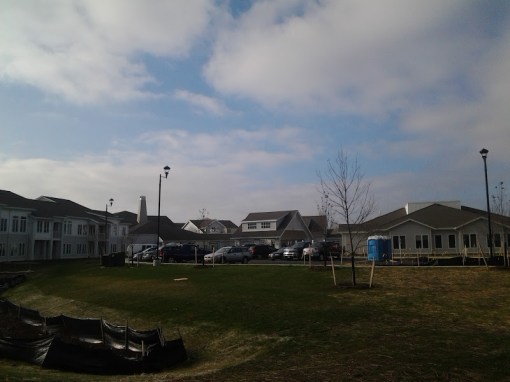
There’s been a fair amount of progress during the late fall at the Village Solars apartment complex site off of the 1000 Block of Warren Road in the town of Lansing. 12-unit Building “D” is finish up attachment of its exterior facade, which like buildings A-C, looks to be a combination of a wood grain board and earth-toned fiber cement board. Balcony railings and trim still have yet to be attached. I didn’t look inside, but based on the photos, it looks like the wood stud walls are still exposed near the entry doors on the first floor.

Across the future pond, 18-unit Building “G/H” (backstory here) has been framed out and some Tyvek-type sheathing has been attached (the material is labelled “Croft Lumber“, which is a building supply store down in Sayre, PA). Some first floor windows and doors have been fitted, but most of the future windows and doors are still rough openings. The roof trusses are all in place, and workers were installing ZIP system plywood sheathing while these photos were being taken.

11-unit Building “E” has had its foundation poured and is only just beginning framing, with just one standing exterior stud wall.

20151205_123855 20151205_123932 20151205_123941 20151205_124021 20151205_124106 20151205_124143 20151205_124218 20151205_124235 20151205_124335 20151205_124403 20151205_124407 20151205_124839

village_solars_2 village_solars


Kendal at Ithaca Construction Update, 12/2015

11 12 2015

This will probably be the last update for this project, since it’s slated to open next month. The new 24-unit apartment wing is completed from the outside, the carports are ready, and the new skilled nursing wings (48 beds, 16 in each wing) are mostly if not completely done. Originally, it appeared the skill nursing wings would have some decorative roof element (second image), but that appears to be from an early site plan of the design and may have been dropped. The landscaping has been prepared, with new saplings planted and hay strewn over the new grass seed.

More information about the project and Kendal can be found in the October update here, and the June update here.

Local architecture firm Chiang O’Brien partnered with the NYC office of Perkins Eastman to design the Kendal expansion. National contractor Lecesse Construction, with an office out of suburban Rochester, handled the build-out. The $29.3 million dollar expansion will create an estimated 20 to 25 new jobs. The project will be applying for LEED Gold certification.

20151205_133155 20151205_133210 20151205_133242 20151205_133310 20151205_133346 20151205_133429 20151205_133539 20151205_133542 20151205_133548

expansion_bannerKendal_1


News Tidbits 11/30/15: It’s like the 1990s All Over Again

30 11 2015

maplewood

1. I want to start this oddly-timed roundup with a big thanks to the readers and commenters who encouraged me to write last Monday’s op-ed. If it wasn’t for you guys, I would have held off. I’m not looking to make waves, but there is a significant, valid concern over Cornell’s housing shortage, and it merited a rebuke.

I also want to thank you guys because the emails I received (about 10 separate readers) were pretty much offloading on how much they hate Cornell, which completely missed the point the article. Worse still, one went into a rant on not only students, but on how much they hate racial minorities, and a second went off into a density rant (followed by stomach-churning quote “if nurses, police and teachers can’t afford to live here, they shouldn’t be living here”). If I thought they were representative of Ithaca for even a moment, I’d hang up my keyboard. But I know that there are good people like the readers here, who are more thoughtful, knowledgeable and arguably less crazy.

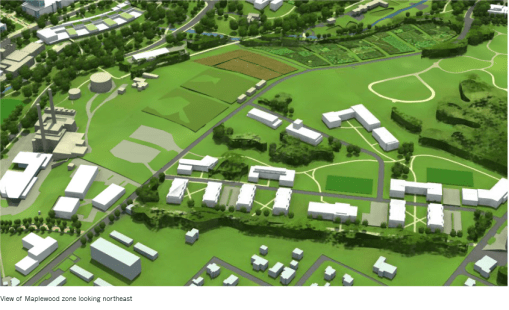
So, with all that noted, here’s the actual news – someone familiar with the Cornell Campus Planning Committee wrote in to say that the Maplewood replacement is expected to have 600-700 beds, and that the committee is still hopeful for an August 2017 opening, which would mean it would have to presented fairly soon (that would still leave a year-long gap in housing, but better late than never). They also acknowledged that “Cornell didn’t do such a good job” with planning for a possible housing shortage, which although not an official statement, seems as good of a justification for Monday’s piece as any.

gways_rev_1

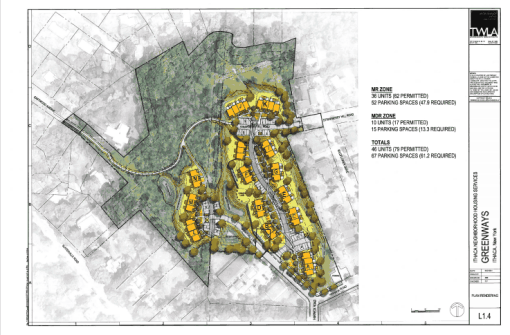
2. Then there was the other piece that dovetailed the affordable housing setbacks last week – Greenways, INHS’s 46-unit affordable owner-occupied townhouse project in the East Ithaca neighborhood, is being abandoned. A part two article with some hard data is being planned. There’s no real silver lining here. It’s Cornell land and the university could potentially revive it, but there’s no indication that will ever happen.

It’s just been a crappy week for housing affordability in Ithaca.

3. Over in Collegetown, several rental homes are being offloaded at once. The properties, 120-134 Linden Avenue, consist of six student apartment houses, with a listed price of $6.5 million. A check of the county website indicates the properties are assessed at $2.75 million, and a cross-check of the Collegetown Form Zoning shows most of these properties are CR-1 (the southern two homes) and CR-3 (the four northernmost homes). CR-1 is the least dense zoning, and CR-3 is a little denser, but mostly maxed out by the existing properties. In short, the code suggests significant redevelopment is unlikely, so the price seems to be based off of potential rental income.

The Halkiopoulos family currently owns the properties, which make up a sizable portion of their multi-million dollar Collegetown portfolio (they’re one of the medium-sized landlords). The Halkiopouloses’ M.O. has been to buy single-family homes and convert the property to student rentals, rather than building their own apartment buildings. It seems likely that the high price indicates they’ll go to one of the other big landlords, or to someone with really deep pockets looking to break into the Collegetown market.

4. A couple folks might be concerned this week after Jason Tillberg’s latest piece about Ithaca’s deflating economy. But there’s a caution light before this data is taken to be hard truth. Frankly, the BLS estimates suck.

A lot.

The numbers are subject to big revisions. Case in point, here are the pre-revision and post-revision 2013 and 2014 data:

ith_initial_1314 ith_revised_1314

It’s not uncommon for the numbers to be changed by thousands, because it’s based on a random sampling of non-government multi-person employers. 500,000 are sampled over the whole country each month, but only about 55 of the 3,300 or so orgs in Tompkins and Cortland Counties are included in the Ithaca metro sample (Cortland’s jobs numbers are included with Ithaca’s because jobs are measured by Combined Statistical Area [CSAs]. However, Ithaca is considered a separate metropolitan area [MSA] from the Cortland micropolitan area [µSA], so population stats are always distinct). The overall trend of the selected orgs is then applied to a base number. For places like Ithaca where the local economy is dominated by a few employers, random sampling isn’t the best approach because it misses crucial components of the local economic picture. But the BLS sticks with its current approach for consistency’s sake across regions and time periods.

During the first quarter of each year, the BLS conducts a full analysis and re-analysis of data going back the last three years. The general rule is, the data from three years ago is very good, the data from two years ago is okay, and the data from the previous year is…very, very preliminary. Tompkins County hasn’t had any large layoffs reported the state’s WARN database this year, and the only major retail closings recently have been A.C. Moore and Tim Horton’s.

In short, don’t let it keep you up at night, and wait until March before passing judgement on the 2015 economy.

902_dryden_v2_1

902_dryden_3
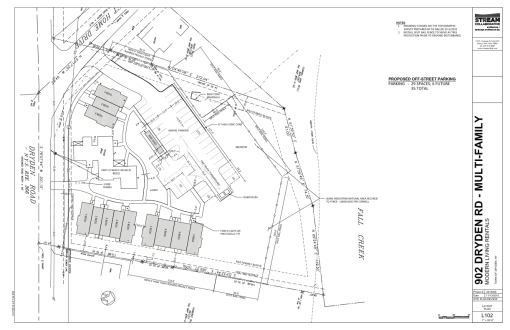
5. Over in Dryden town, the townhouse project proposed by local firm Modern Living Rentals (MLR) at 902 Dryden Road in Varna is a little smaller – 13 units and 40 bedrooms, versus the previous 15 units and 42 bedrooms; these numbers include the duplex with 6 bedrooms that currently exists on the site. Meanwhile, the procession of hate continued at the latest town meeting. The arguments are the same as before. To the earlier, larger proposal, some town councilpersons had given a tentative positive response, while at least one was opposed to the original proposal (in Dryden, the Town Board votes on projects rather than the Planning Board). MLR hopes to request approval at the town’s December 17th meeting – if approved, the construction period is planned for January-August 2016.

For those interested, the Stormwater Plan (SWPPP) is here, revised Full Environmental Assessment Form (FEAF) here, revised site plan here, project description courtesy of STREAM Collaborative here. No new renders, but presumably it still looks the same in terms of materials and colors.

biggs_1

6. Next up on the suburban tour, the fighting over the Biggs Parcel in the town of Ithaca. The Indian Creek Neighborhood Association (ICNA) presented a plan for the property – and the plan is, maybe we can find a way to force the county to keep it, but if not please don’t sell the land to anyone who will build on it. All the county wants is to sell the land so it pays taxes, and the ICNA plan seems to have failed to really address that point. Tompkins officials countered by saying that they’re not keeping it and that if the ICNA cares about this parcel of land so much, buy it. There was then some back and forth about doing a new assessment to account for the developmentally-prohibitive wetlands on site – in other words, decreasing its current $340,000 assessment, with the exact amount to be determined by the county assessment department. At 25.52 acres, of which some is still developable, the price will likely stay above six figures.

So the county’s doing its new assessment, because all it wants is to sell the land so that someone is paying taxes on it. Meanwhile, the ICNA has taken to venting on their web page, angry that the county still plans to sell, and that they may have to actually buy the land in order to dictate its future use.

327_w_state_demo

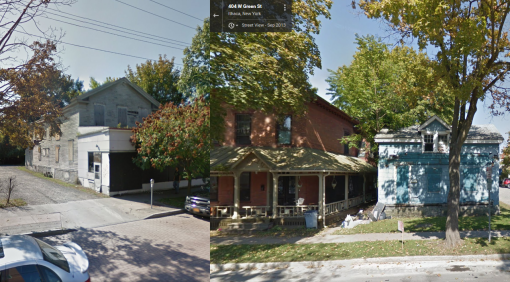
7. To wrap up a thoroughly depressing week, a couple of demolitions by neglect. 327 West State Street and 404 West Green Street will both be demolished by the end of the year, according to the Ithaca Times. Both are older, likely century-old structures, but too far gone to be salvageable. According to county records, the City Health Club, which abuts and owns both properties, purchased 404 West Green in 1987, and 327 West State Street in 1993. The porch on 404 came down sometime in the late 1990s or early 2000s, and the only change since then was painting the plywood on the boarded-up door and windows. County photos suggest 327 was in bad shape but possibly occupied up until 2000 or so, and steadily grew worse from there. Offhand, the procedure is to bill the owner for the demo. 404 West Green is B-2d zoning, 327 West State is CBD-60. But don’t expect any redevelopment anytime soon.

Hmmm…bad economic news, projects being cancelled, decay and demolitions in the city and fighting over suburban projects. For Ithaca and Tompkins County, it’s like the 1990s recession all over again.


News Tidbits 11/21/15: Building and Rebuilding

21 11 2015

inhs_pride_design_v5_2 inhs_pride_design_v5_3

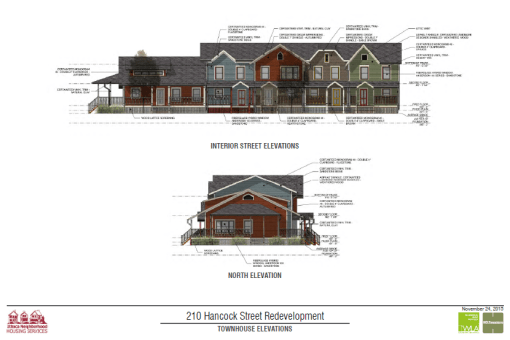
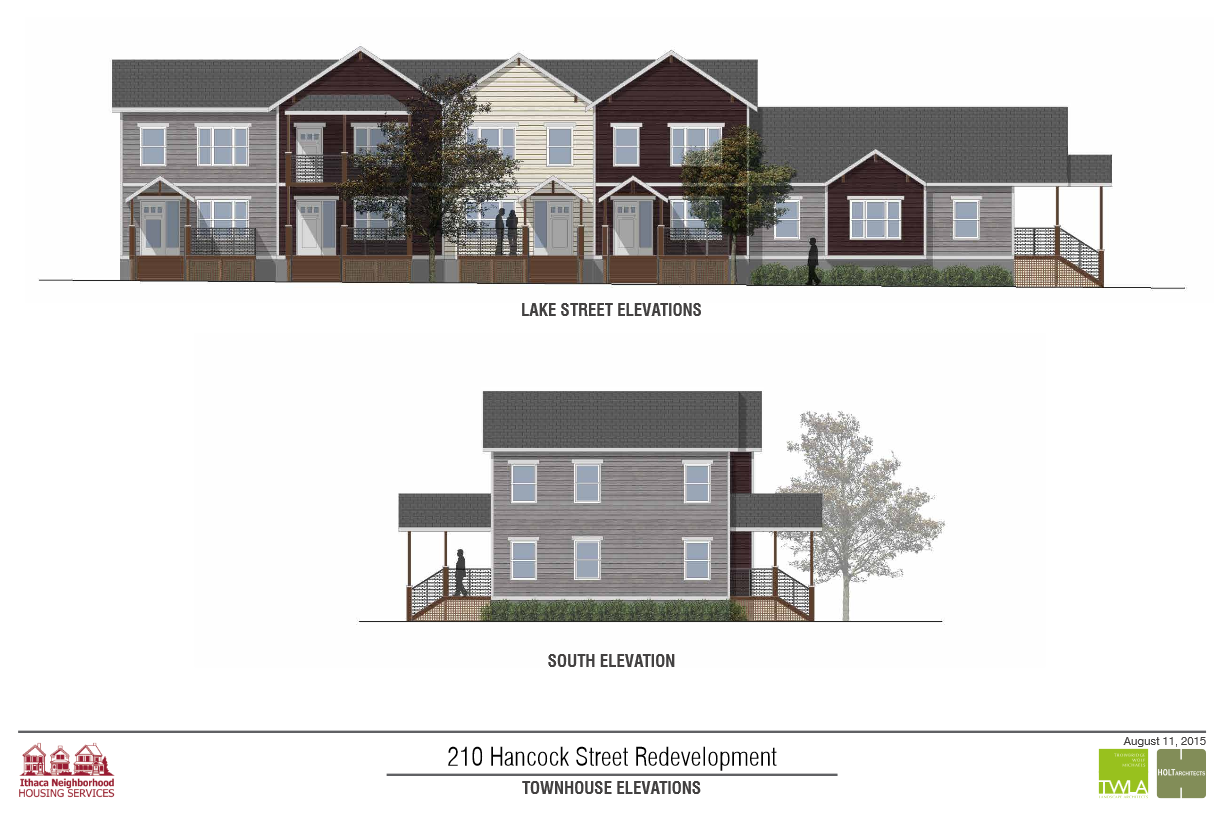
1. Starting off this week with some eye candy, here are some updates renders of the townhouses proposed for INHS’s 210 Hancock project in the city’s North Side neighborhood. Details and project status here. 210 Hancock has been approved by the Planning Board, and Cornell, the city and county do have dedicated funds ($200,000 total) going towards the affordable housing units, but still needs to be seventeen conditions prior to receiving a construction permit, one of which required revised townhouses to better reflect the neighborhood. The Common Council also need to vote to discontinue using the sections of Lake Avenue and Adams Street on which the new greenways and playground will be constructed, which apart from the time needed and paperwork generated, isn’t expected to encounter any obstacles, with formal conveyance to INHS anticipated by March 2016. INHS is shooting for a May construction start.

The Planning Board will be voting on “satisfaction of site plan approval” at its meeting next Tuesday, which should be a fairly smooth procedure, if the paperwork’s all correct.

Personal opinion, the townhouses, with more color and variation in style, appear to be an improvement over the previous version. These five will be rentals, while the other seven will be for-sale units, and built in a later phase (government funding for affordable rentals is easier to obtain than it is for affordable owner-occupied units, so it could take a year or two for those seven to get the necessary funding). The apartments have not had any substantial design changes since approval.

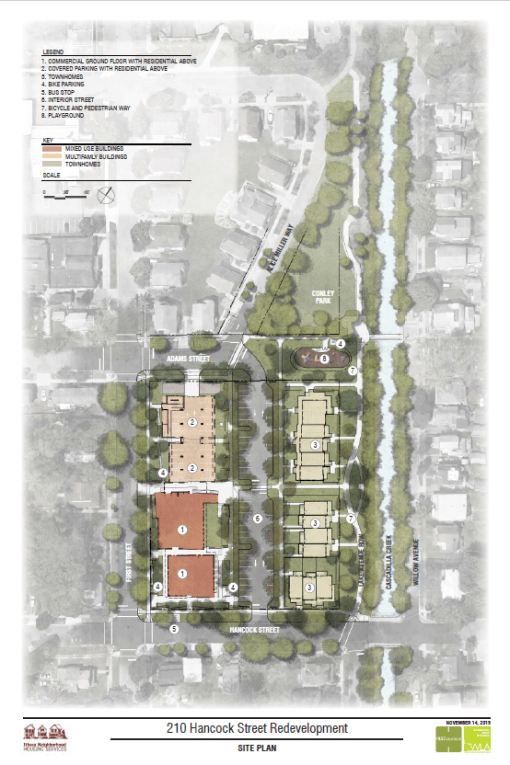
inhs_pride_design_v5_1

For what it’s worth, here’s the final site plan. The rental townhomes will be on the north corner of the parcel, furthest from Hancock.

2. Turning attention to the suburbs, someone’s put up some sizable chunks of land for sale in Lansing village. The properties consist of four parcels – 16.87 acres (the western parcel) for $500,000, right next to a previously-listed threesome of 28.07 acres (the eastern parcels) for $650,000. The eastern parcel also comes with a house, which the listing pretty much ignores. Lansing has it zoned as low-density residential, and given the prices (the western parcel is assessed at $397,600, the eastern parcels at $561,100 (1, 2, and 3)) and being surrounded by development on three sides, these seem likely to become suburban housing developments, possibly one big 30-lot development if the parcels are merged. For the suburbanites out there, it’s something to monitor.

20151108_133542 20151108_133710

201_w_clinton_1

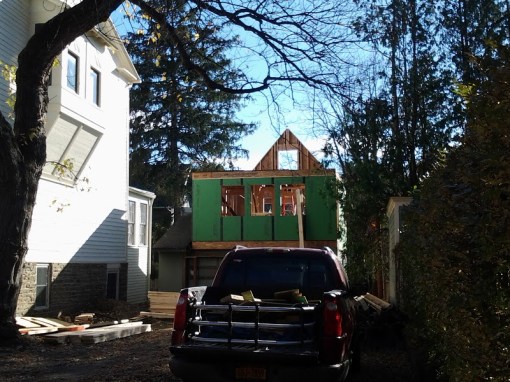
3. House of the week – or in this case, tiny house of the week. The 1-bedroom, 650 SF carriage house underway at 201 West Clinton Street draws inspiration from 19th century carriage houses, which makes sense given that it’s in Henry St. John Historic District. It and the main house are owned by former Planning Board member Isabel Fernández and her partner, TWMLA architect Zac Boggs. The two of them did a major and meticulous restoration of the main house, which used to house the local Red Cross chapter, a couple of years ago (more info on that here).

Anyway, the framing is underway and some ZIP System sheathing has been applied to the exterior plywood. No roof yet and probably not much in the way of interior rough-ins, but give it a couple of months and that 1960s garage will be given a new life as a tiny house.

travis_hude_libe_libe_v3

4. Time to take a look at the Planning and Development Board agenda for next Tuesday. For reference, here’s what a typical project guideline looks like:
PDB (Sketch Plan) -> PDB (Declaration of Lead Agency) -> PDB (Determination of Env’tal Signif., PDB BZA reccomendation if necessary) -> BZA (if necessary) -> PDB (prelim/final approval).

Here’s the meat of the agenda:

A. 210 Hancock – Satisfaction of Conditions of Site Plan Approval (see above)
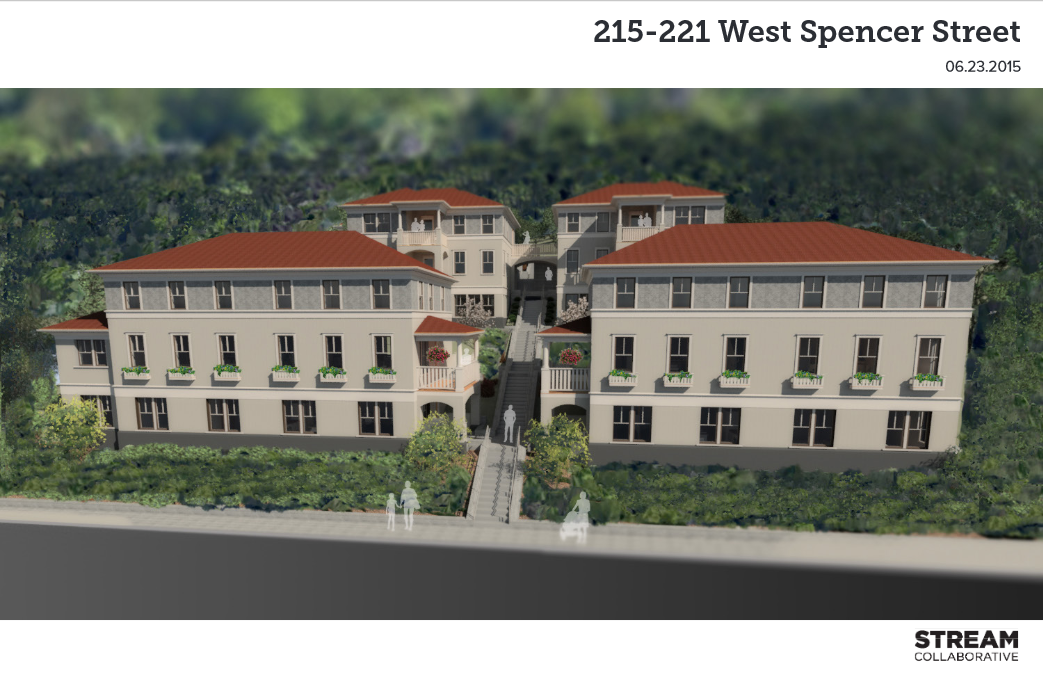
B. 215-221 Spencer St. – Consideration of Prelim/Final Site Plan Approval  – this one was first presented as sketch plan in March, to give an idea of how long this has been in front of the boards
C. 416-418 East State Street – Determination of Environmental Significance and Recommendation to the BZA – “The Printing Press” jazz bar is a proposed re-use for a former printshop and warehouse that has seen heavy neighbor opposition. The bar has changed its emphasis, redesigned the landscape and moved itself to a more internal location to mitigate concerns, but the opposition is still strong, mostly focusing on noise and traffic. The board has simply and succinctly recommended that the BZA grant a zoning variance.
D. 327 Elmira Road – Determination of Environmental Significance and Recommendation to the BZA – The Herson Wagner Funeral Home project. This one’s had pretty smooth sailing so far, only a couple complaints that Elmira Road isn’t appropriate for a funeral home. The Planning Board, however, applauds the proposal, which replaces a construction equipment storage yard, for better interfacing with the residential neighbors at the back of its property. It has been recommended for BZA approval.
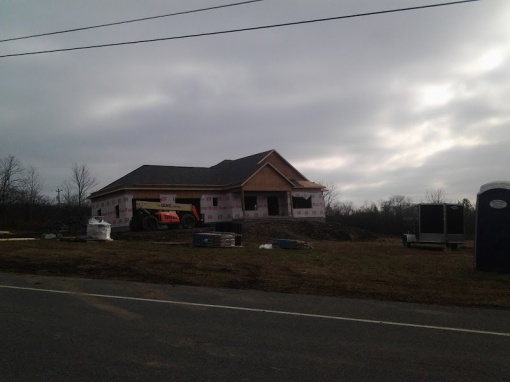
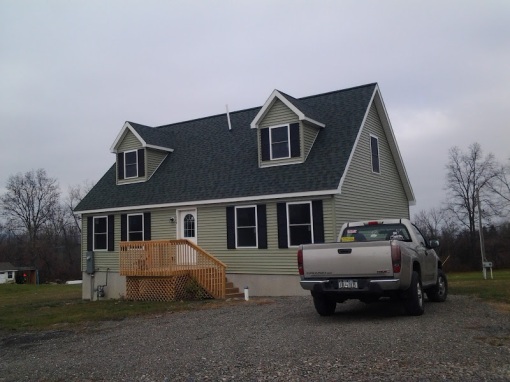
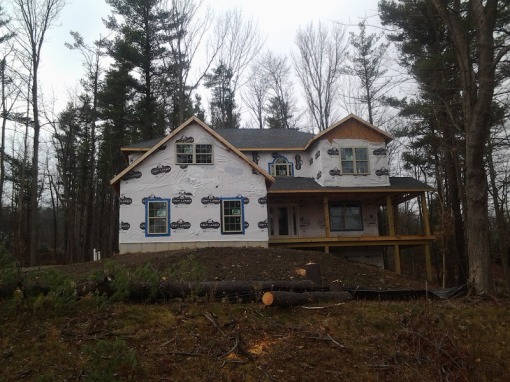
E. Simeon’s on the Commons Rebuild – Presentation & Design Review Meeting – Before anyone throws up their arms, this is only to talk about the materials and design of the reconstruction, and to get the planning board’s comment and recommendations.
F. The Chapter House Rebuild – Sketch Plan – The Ithaca Landmarks Preservation Commission (ILPC) must have come to some kind of acceptance on the proposed rebuild if the Chapter House is finally at the sketch plan stage. the Planning Board will have their own recommendations, which will have to be coordinated to some degree with the ILPC (the ILPC is arguably the much stricter of the two). We’ll see how it looks next week.
G. Hughes Hall Renovations – Sketch Plan – more on that in a moment
H. DeWitt House (Old Library Site) – Sketch Plan – originally slated to be seen a couple months ago, but pulled from the agenda. The 60-unit project is not only subject to Planning Board review, but ILPC review since it’s in the DeWitt Park Historic District.

5. So, Hughes Hall. Hughes Hall, built in 1963, has dorm housing and dining facilities for Cornell students attending the law school, but those 47 students will need to find alternative housing once the hall closes in May 2016 (yes, with Maplewood closing as well, Cornell is putting 527 graduate and professional students out on the open market next year…it’s gonna be rough). However, this has kinda been known for a while. Cornell has intended to renovate Hughes Hall since at least 2011, as Phase III of its law school expansion and renovation. The building was used as swing space while Phase I was underway, and then the phases were flipped and Phase II became Hughes Hall’s renovation, while Phase III became Myron Taylor Hall’s renovation. According to Boston-based Ann Beha Architects, who designed the law school addition (Phase I), the Hughes Hall renovation will “house offices, administrative support spaces, academic programs and meeting spaces.” Well see how the renovated digs look at Tuesday’s meeting.