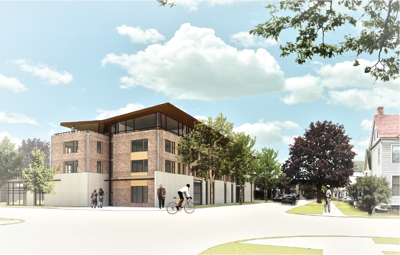
Village Solars Construction Update, 2/2019

3 03 2019

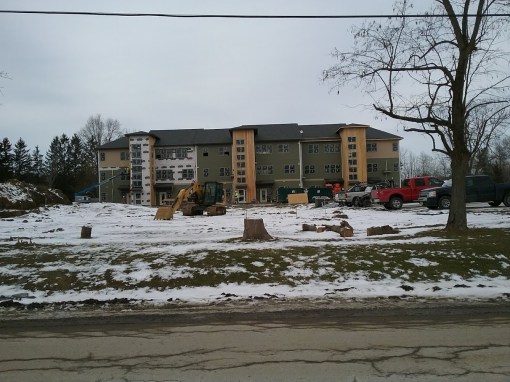
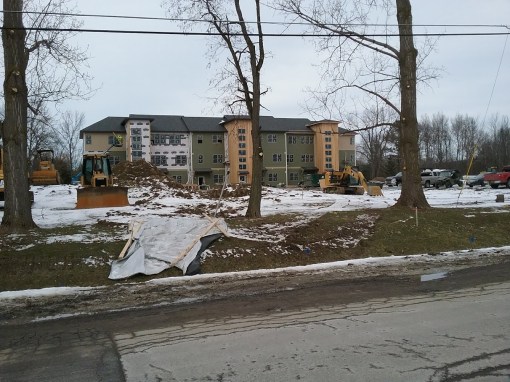
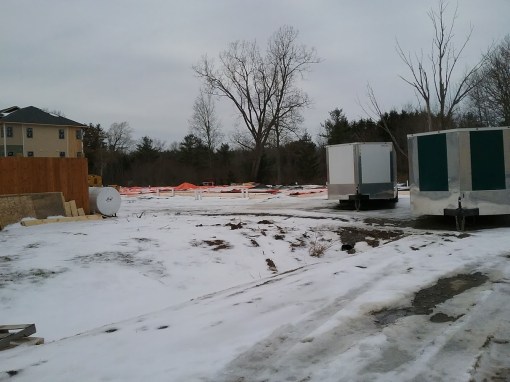
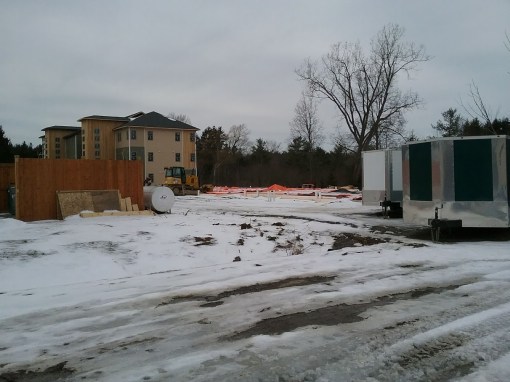
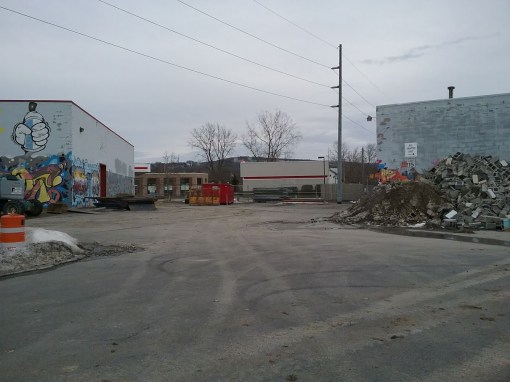
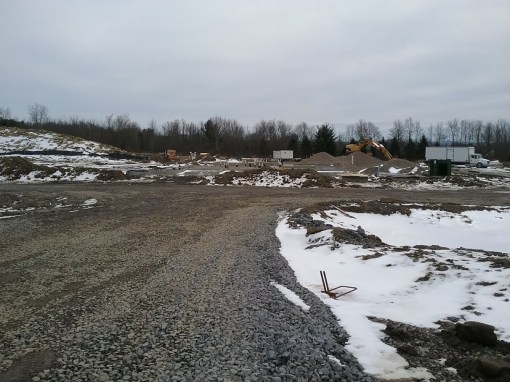
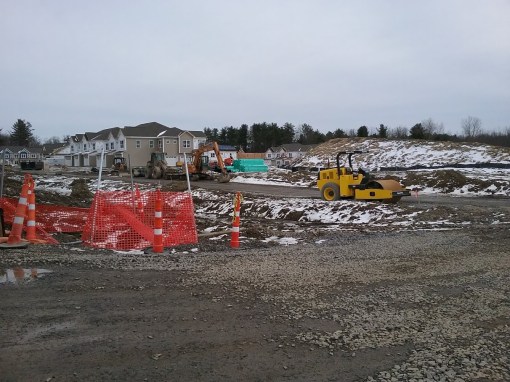
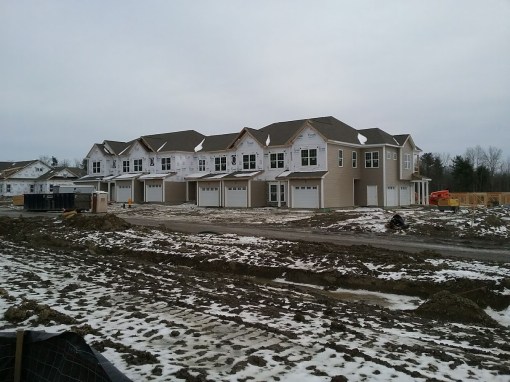
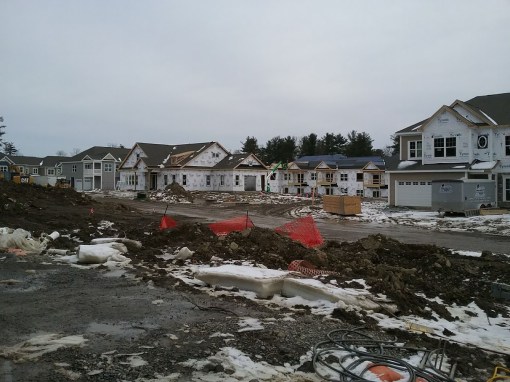
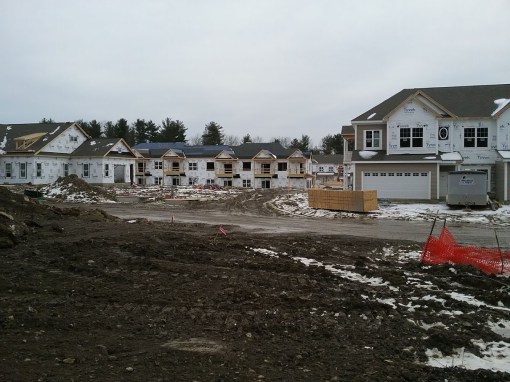
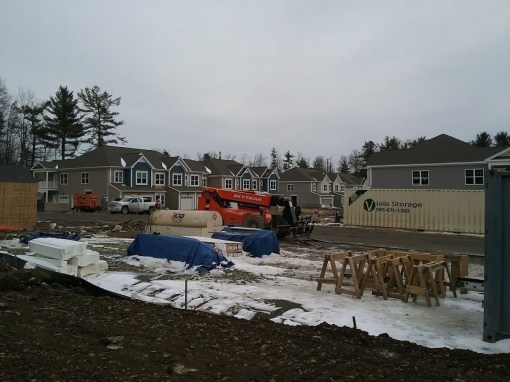
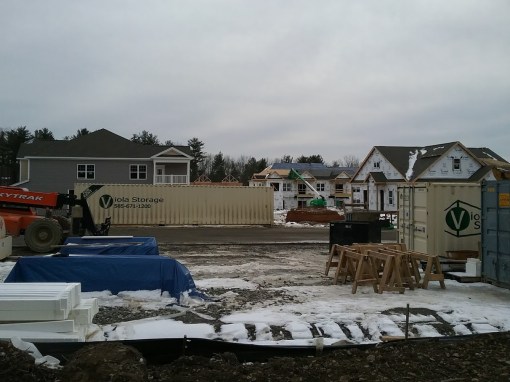
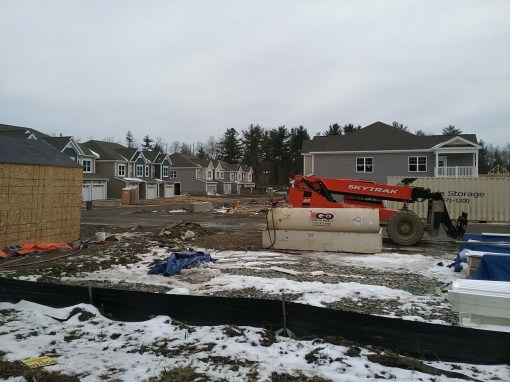
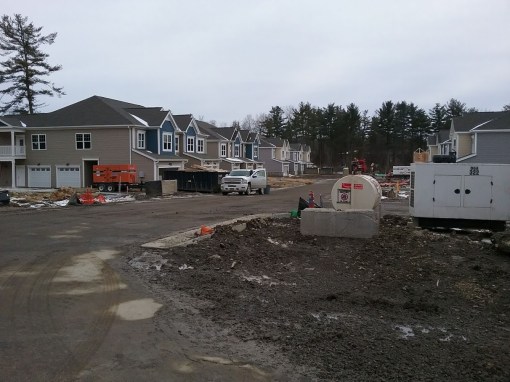
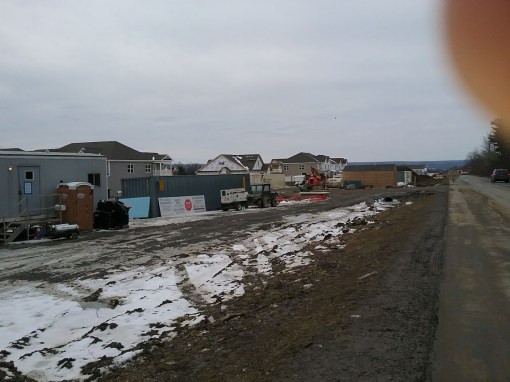
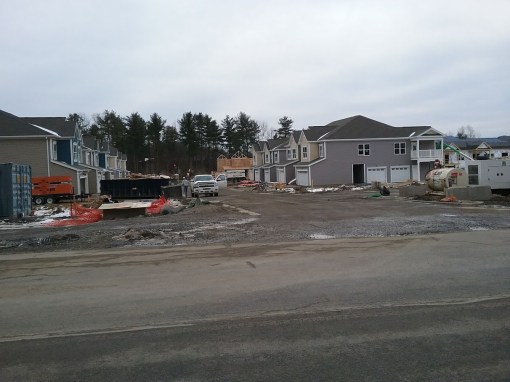
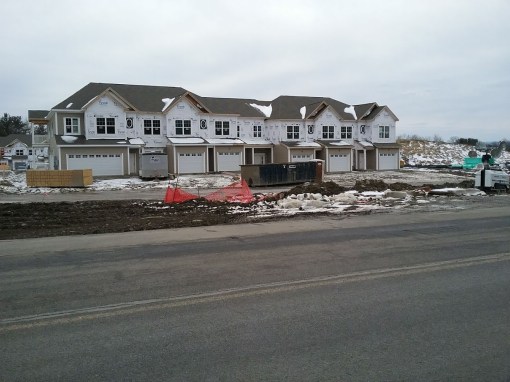
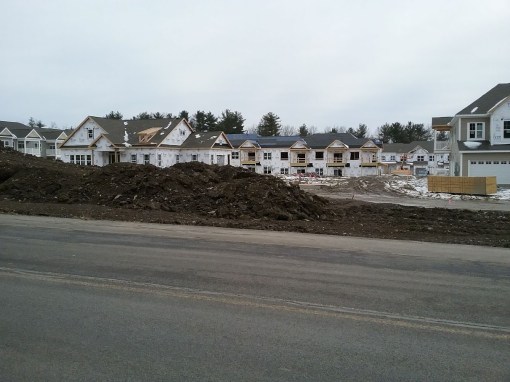
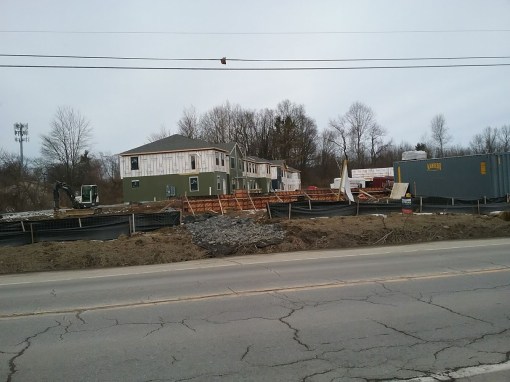
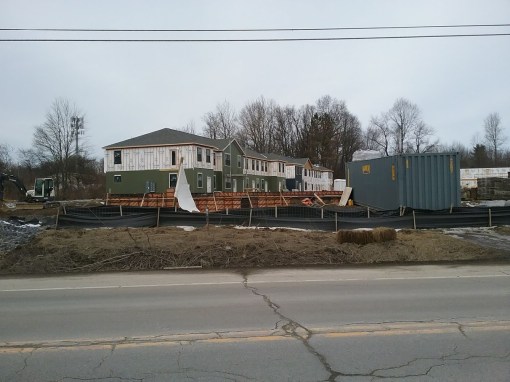
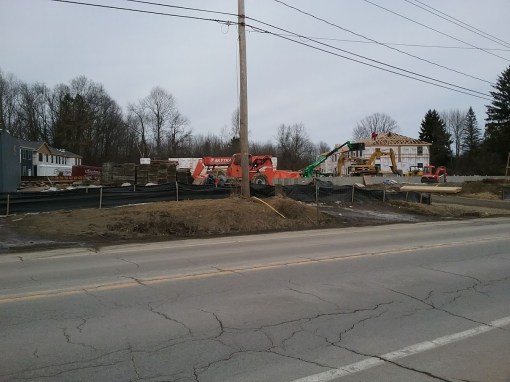
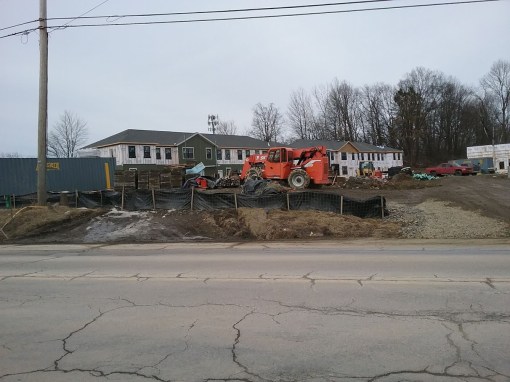
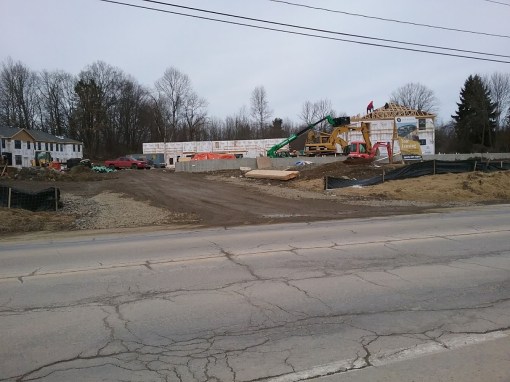
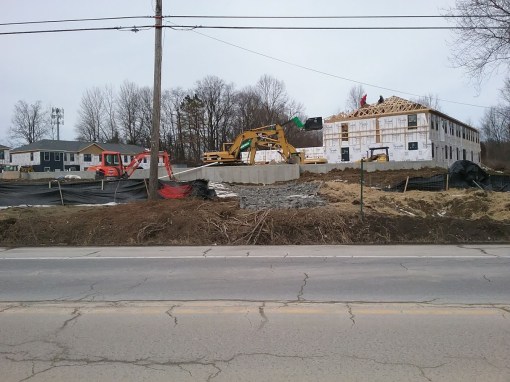
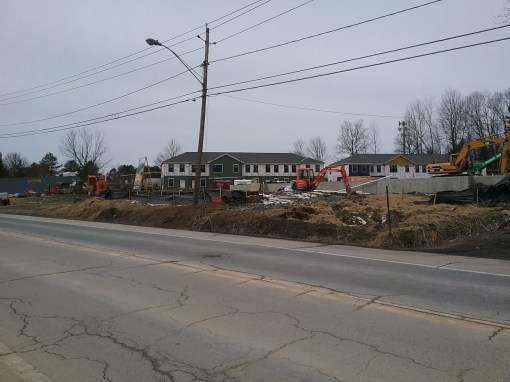
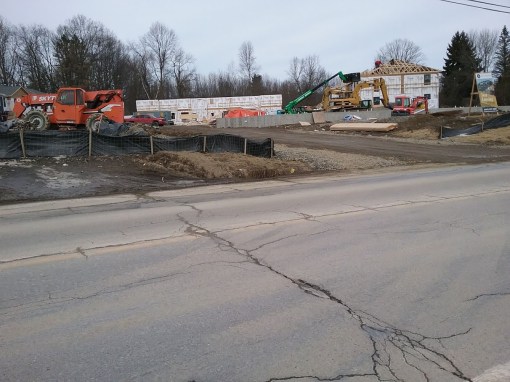
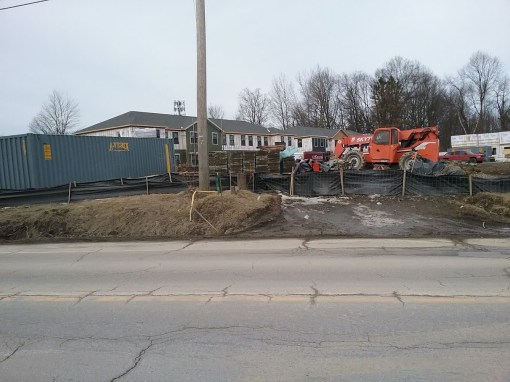
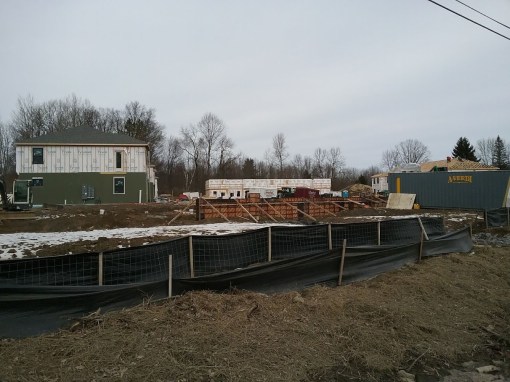
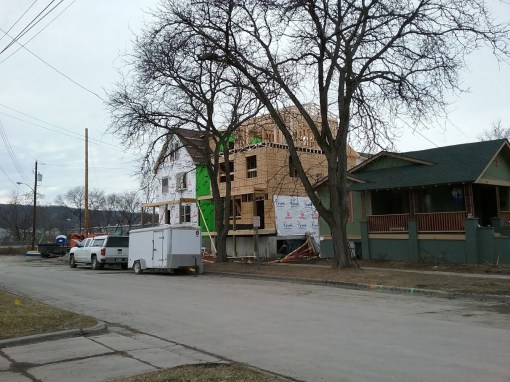
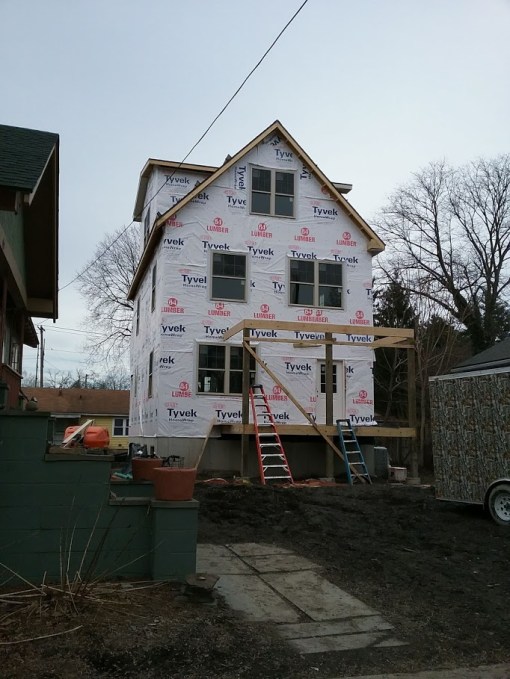
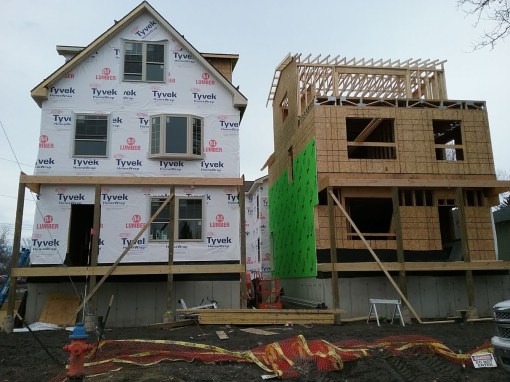
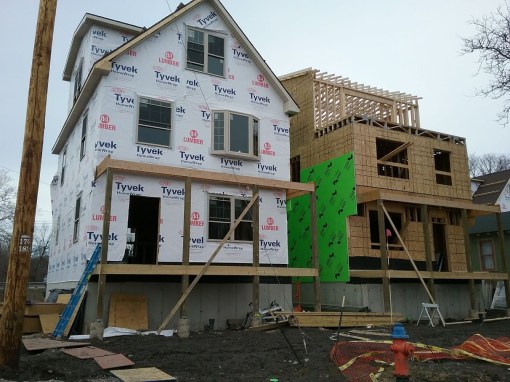
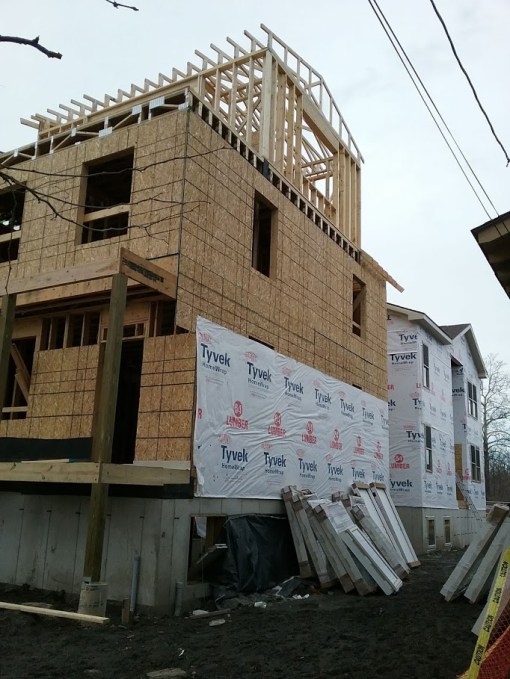
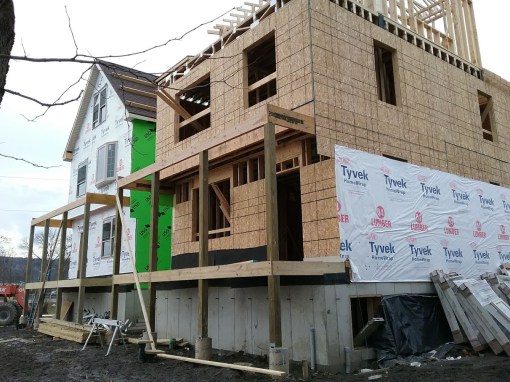
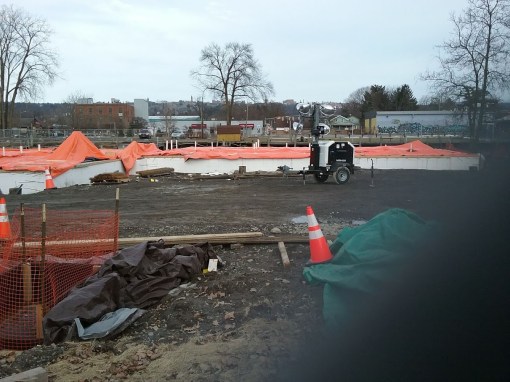
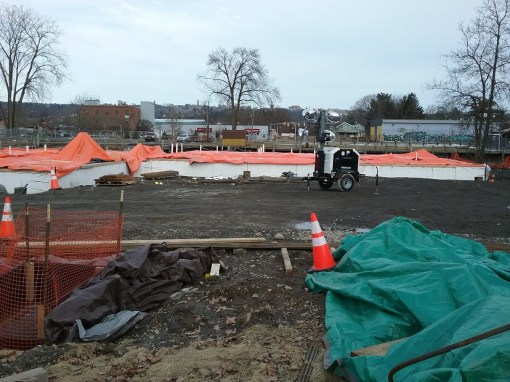
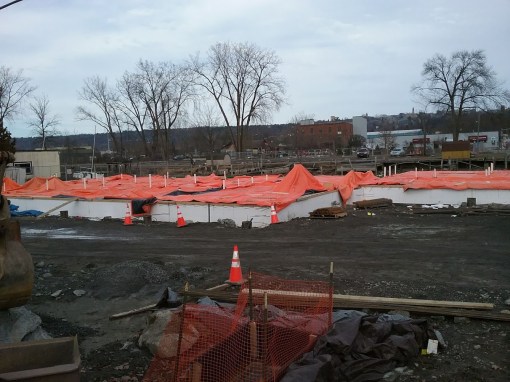
It was with some surprise that the latest trip to the never-ending Village Solars construction site yielded significant progress on only one apartment building, instead of the usual two or three. The 24-unit Building “L” is mostly complete from the outside, and likely to open for occupancy this spring, adding another 3 three-bedrooms, 6 two-bedrooms, 3 one-bedrooms and 12 studios to the market. 24-unit Building “K”, just to its east (right, in the photos), appears to have not made much progress; excavation was completed, and it looks like there are wood forms for the foundation on site, though with the snow and active work underway, it was hard to tell if the concrete slab had been poured – judging from the dirt piles, that’s a no.

Local Law #6 (2017) of the Village Solars PDA permitted three additional buildings to be built before Lifestyle Properties (the Lucente Property) was legally obligated to build the community center building (Building “F”), which is to contain a small amount of commercial space (restaurant), service space (gym, laundry, rental office) and up to twenty one-bedroom units. If “L” and “K” are completed this year, that will allow one more building to receive a building permit before the community center must be built and receive a certificate of occupancy (i.e. habitable and practically complete). Until then, no additional building permits are allowed. The law also stipulates that the community center has to be completed, regardless of the status of other apartment buildings, by the end of 2020.  Like other apartments, it won’t be subject to site plan review, bu any potential commercial applicant would have to undergo site plan review.


GreenStar Co-Operative Market Construction Update, 2/2019

2 03 2019

We’re going to rewind the clock a bit on this to before GreenStar. It’s early 2017. Two major regional medical service providers are eyeing locations in the affluent and growing city of Ithaca. The first is Cayuga Medical Center / Cayuga Medical Associates. The second is Guthrie Clinic / Guthrie Medical Group.

How bad did these two want to outdo each other and lock their rival out of the city? So much so that Cayuga Medical Center paid several times the value on Carpenter Business Park. So much so that Guthrie bought a site that would fail to meet their needs.

For neither CMC or Guthrie was it the best of moves, but not everything is done rationally. In June 2017, Guthrie paid $2.85 million for the properties at 750 and 770 Cascadilla Street, over the asking price of $2.7 million. For those millions they purchased 3.12 acres, with a 37,422 SF printing press/ warehouse built in 1980, and a 30,000 SF storage facility built in 1988. Cornell University had previously used the facilities as part of its printing press operations, and had been seeking to sell the properties since July 2016.

Guthrie started looking at its options at that point, and wasn’t liking them. But there appeared to be an opportunity. The developers of City Harbor, working on their mixed-use proposal a couple of blocks away, would provide Guthrie a convenient escape hatch to Pier Road, where they could build a structure from scratch that would suit their needs. In return, Guthrie would offer up its recently-purchased Cascadilla properties to GreenStar on a long-term lease, with an option to buy.

For GreenStar Co-Op Market, the site was a welcome opportunity of its own, a real estate version of “one man’s meat is another man’s poison”. Founded in 1971, GreenStar has been leasing its current location at 701 West Buffalo Street since the fall of 1992, following a fire that destroyed their store on North Cayuga Street. Satellite stores operate out of the DeWitt Mall at 215 North Cayuga Street in Downtown Ithaca, and at 307 College Avenue in Ithaca’s Collegetown neighborhood. Specializing in locally-sourced and organic foods, the co-op has enjoyed significant market growth in the past decade, with sales increasing by nearly 50% since 2011, to over $22 million annually.

That was both a good and a bad thing. As I wrote for the Voice back in April 2018, GreenStar makes a very small profit on sales, and relies on membership growth as a supplement. But their West End store was jam-packed, all built out with no more room and increasingly agitated co-op members. With other grocers moving in on the organic and natural food market, it was going to be grow, or perish, taking 200 jobs with it. GreenStar had been in talks with landlords and developers for a new space, and City Harbor’s project team was one of those who listened. Just as City Harbor’s Pier Road was Guthrie’s escape hatch, 770 Cascadilla Street was going to be GreenStar’s.

Plans were first announced in December. As a Co-Operative food market, GreenStar has to put any kind of move of this scale out to its shareholders for a vote, through paper and electronic ballots with a three week voting period in March of 2018. The vote for the move was 92% in favor. The project was approved by the city last July, and the groundbreaking was this past November. If all goes well, the lease agreement will allow GreenStar to buy the property from Guthrie in 2030; this passed the member vote with 97% saying yes.

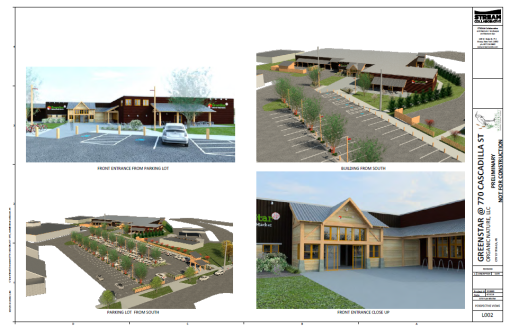
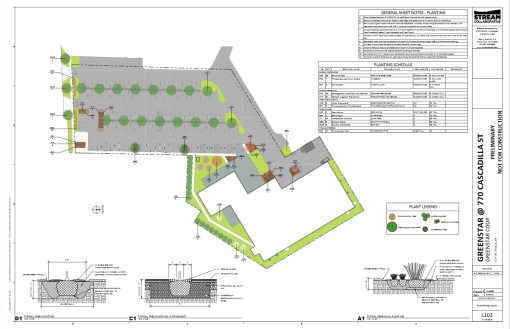
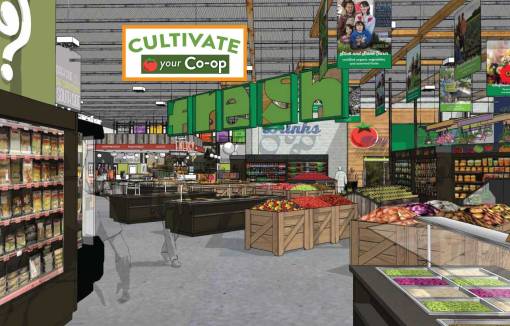
The plan is to renovate 770 Cascadilla into the latest and greatest GreenStar flagship. 750 Cascadilla would come down for a 160-space store parking lot and landscaping. The new space would have an edible garden, outdoor cafe, mezzanine stairway and classrooms. The building would be refinished, insulated, and potentially net-zero energy compatible, meaning all the energy it consumes comes from renewable sources. Breaking it down, the new retail area will be 16,500 SF, there will (well, was, see the last paragraph in this entry) be 5,200 SF mezzanine space for office and administrative functions, and a 13,000 SF kitchen and events space. With the addition of the mezzanine, the warehouse will be expanded in square footage from about 30,000 SF to 35,219 SF. The Space @ GreenStar would be moved to within the new store, and shrink from a 225-person capacity, to 125, and once moved in the old Space @ GreenStar location will be put up for sale. The Space isn’t much of a revenue generator for the Co-Op, and is rarely utilized at full capacity.

The project will take a little over a year, from November 2018 to December 2019 (the store itself wouldn’t open until February 2020, after the equipment is in, shelves are stocked and electronics are tested). Local architecture firm STREAM Collaborative is in charge of exterior design, and architect Pam Wooster will handle the interior layout. Elmira’s Edger Enterprises will be the general contractor for the buildout. Delaware River Solar will supply the solar energy to power the building via an off-site array.

GreenStar, which is carrying out the project with its City Harbor partners (Edger Enterprises, Morse Construction and Lambrou Real Estate) as Organic Nature LLC, did apply for and receive a standard seven-year tax abatement worth about $625k, about 4% of the project cost. $130k in new taxes would be paid over the period. GreenStar’s project would add at least 40 full-time equivalent positions with most jobs in the $15-$16/hour range plus benefits (Starting pay will be about $13.50/hour plus benefits; GreenStar has previously been certified as a living wage employer, though they appear to have been just below it in 2017). Generally speaking, the abatement application was one of the less contentious public hearings, which could be due to GreenStar’s stature in the Ithaca community, its labor and environmental practices, and because dedicated opposition could put 200 jobs and the whole Co-Op at risk of closure.

According to GreenStar’s TCIDA tax abatement application, while the project is $4.9 million to build (hard costs), the overall project costs are $14.8 million. Other sources have said $3.7 million in hard costs, so YMMV. Along with $8.7 million in bank and credit union financing, and $4.6 million in cash equity, the Co-Op has launched a $2.5 million capital campaign to sell investment shares to owners to help cover the project costs.

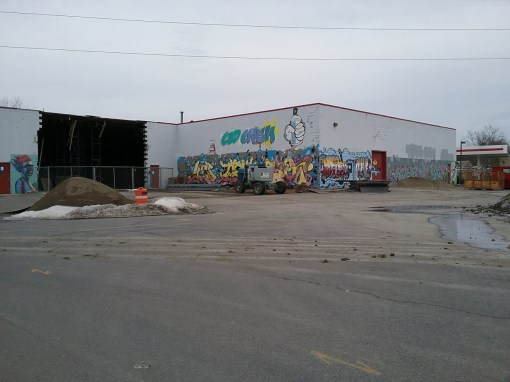
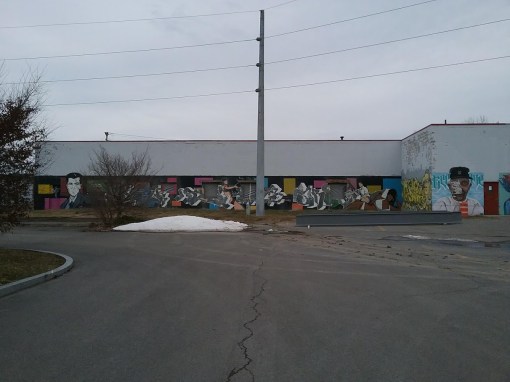
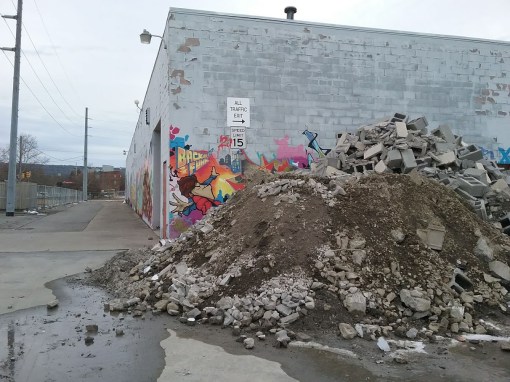
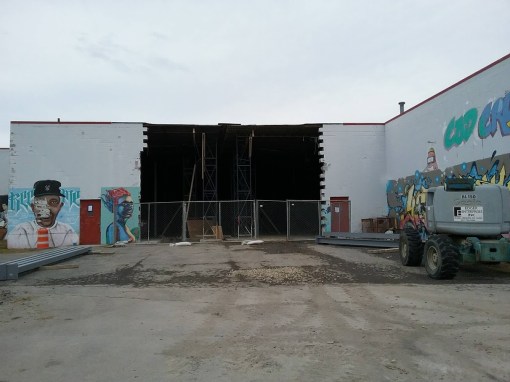
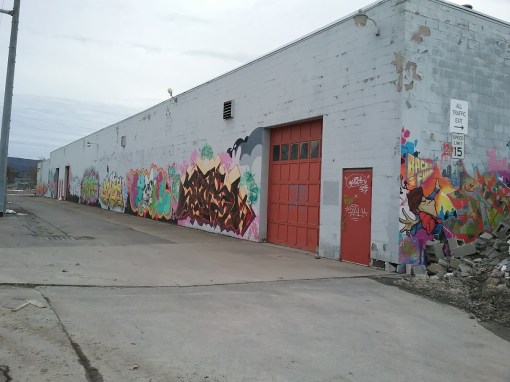
At present, a large gap has been opened in the exterior of 770 Cascadilla’s CMU facade. This is where the entrance of the new GreenStar will be, and it was practically the only major design change during the review process. The steel sitting aside the building may be for building out the mezzanine. A pile of debris sits next to 750 Cascadilla, which will itself be a pile of debris in due course. About the biggest loss here will be some pretty fantastic street art.

In the past couple of weeks, the interior was revised as a cost-cutting measure, shrinking the mezzanine by roughly half and reducing the size of the classrooms from 108 seats to a single room of 33, with the former first-floor classroom space now replaced by offices for GreenStar staff. The opening also appears to have been pushed back by 1-2 months, to “early spring 2020”.


Early render

early render

final render


East Pointe Apartments Construction Update, 2/2019

1 03 2019

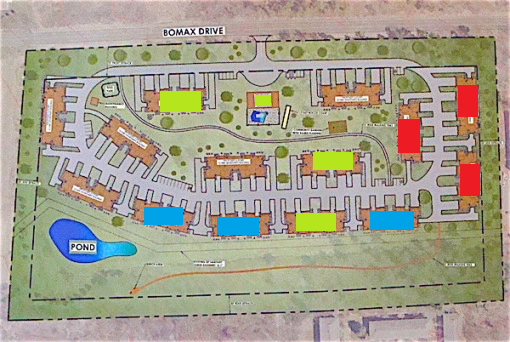
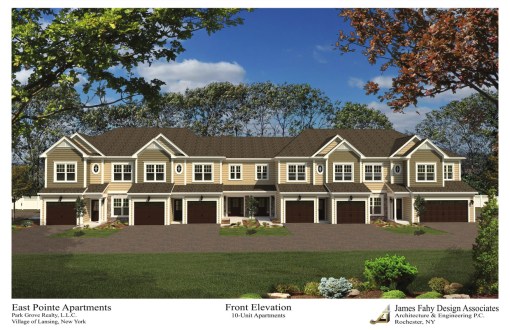
With so much construction underway at one site, I figured it’d be easiest to try and color code this using the site plan.

Red boxes overlay townhouse strings that are largely complete from the outside. Green is framed and sheathed (plywood with Tyvek housewrap), but lacks exterior siding, trimboards and architectural details. Blue are townhouse strings where framing is underway. Looking at the site and comparing it to the site plan above, it seems that the community center is actually to the east (right) of the entrance, so there likely going to be two townhouse strings to its left (west), one of which is framed and one of which is just a foundation at this point.

Knowing that the first units are expected to be open for occupancy on April 1st, I’d wager the three strings in red (~30 units) will be ready by that time, the community center and units in green (three strings, ~30 units) will be ready by June 1st, and the three strings in blue (~30 units) will be ready by September 1st. That would give roughly December 2019 and April 2020 for the last two sets, which sounds about right from the construction timeline I’ve seen for a spring 2020 completion.

Rents on the units are as follows, per the project website and multiple apartment advertising websites:

# BRs/ # BAs / Monthly Rent / Square Footage / Unit Code

1 BR 1 Bathroom    $1,695    820 Sq Ft   B
1 BR 1 Bathroom    $1,795    873 Sq Ft   C
2 BRs 2 Bathrooms $1,895 1,093 Sq Ft   A
2 BRs 2 Bathrooms $1,910 1,095 Sq Ft   E
2 BRs 2 Bathrooms $1,975 1,157 Sq Ft   G
2 BRs 2 Bathrooms $1,995 1,090 Sq Ft   F
3 BRs 2 Bathrooms $2,445 1,268 Sq Ft   D

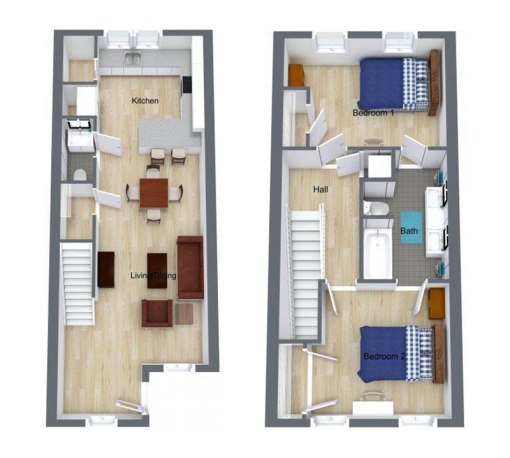
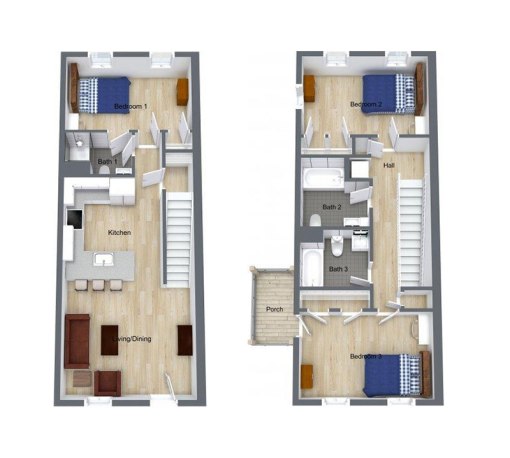
Layouts can be seen here. Each townhouse string contains a mix of 1-3 bedroom units. In total there are 14 three-bedroom, 90 two-bedroom, and 36 one-bedroom units, which doesn;t break down neatly by fourteen townhouse string, so there are some variations.

Those variations also show up in the exterior finishes. The units near completion now use what looks like Certainteed vinyl siding and trimboards. Type “1” is tan and navy blue siding with stone accents around entrances, and Type “2” is slate grey and yellow siding, though I didn’t get a close enough look to see if these have stone accents as well (there were crews actively working on site). The rendering in advertisements suggests there will be a third type, Type “3”, with beige and olive green vinyl siding and stone veneer accents.

Just like the townhouse strings, the community center is a different design than first advertised. So basically, nothing in the built project quite matches the plans that were publicly available, whether it be building designs or site plans. The only things that have stay constant are the fourteen strings of ten units with a community center and a loop road. Not a fan of surprises here, but we’ll see how the finished product is looking once more of the site has been built out later this year.

More information about the project’s history and seemingly accurate details can be found here.


TC3 Arthur Kuckes Childcare Center Construction Update, 2/2019

1 03 2019

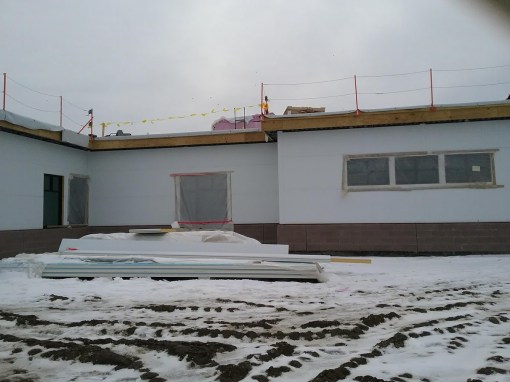
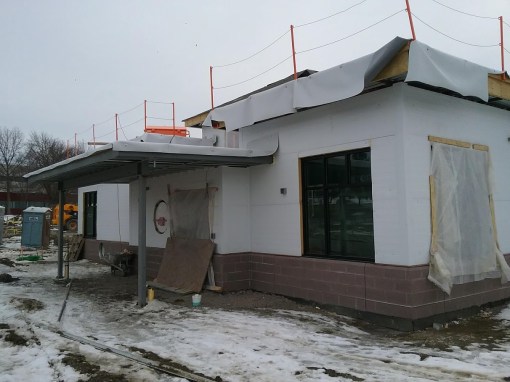
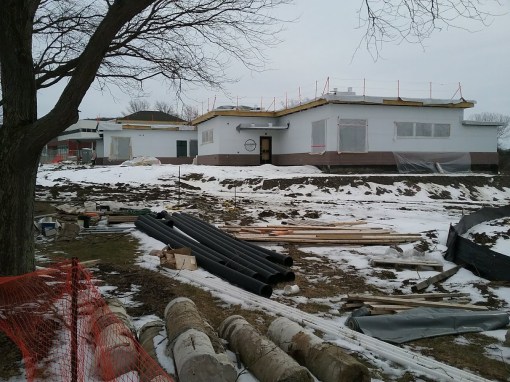
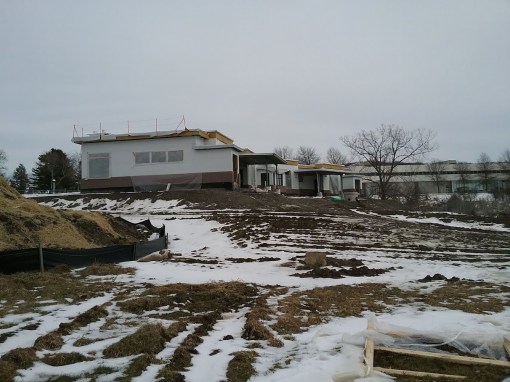
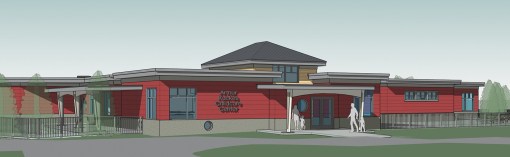
The new childcare center at Tompkins Cortland Community College has been fully framed and sheathed. Some of the windows are in, while the remainder remain rough openings, as do the doors. Given the fireproofing needed here those walls are most likely gypsum sheathing panels with a vapor/water barrier, atop a masonry base. Fiber cement and metal panels will be used in the exterior finishes. The hipped roof over the entrance has underlayment in place, but no shingles, and guessing from the temporary guardrails on the roof, it’s probably got some protective/vapor barrier down. But the pink stack on the roof is is insulating panels, and those will need to be in place before the top membrane (synthetic rubber probably) is laid. The project hasn’t made much news as of late, though it looks like some subcontracting work is out for bid. The $6.5 million, 9,875 SF project is expected to open in time for the fall semester.

More info about the childcare center can be found on the blog here.


802 Dryden Road Construction Update, 2/2019

28 02 2019

The townhouses at 802 Dryden Road are in varying states of construction, with no apparent pattern to the choices. Buildings “E” and “F” at the western end of the site have been framed, sheathed in Tyvek housewrap, roofed, shingled, and have doors and windows fitted. “E” has the navy blue panels, and “F” the olive green panels. Building “C”, at the eastern end of the site, is in the process of having its roof framed; a crew was on-site last weekend bolting together the trusses. Building “D” has partial framing and sheathing, Building “B” at the eastern front of the site has its slab concrete foundation finished but not framing as of yet, and forms for pouring the foundation walls are still on-site for Building “A”. So generally speaking, counterclockwise from lower left, buildings are progressively less far along.

For the record, each building, seven units apiece, will a unique address when finished – 802, 804, 806, 808, 810, and 812 Dryden Road.

It was previously noted that the purchaser was operating under an LLC tied to a Pittsburgh-area business executive, Matt Durbin. A new project website says the firm is “Maifly Development”, a small but seemingly deep-pocketed Pittsburgh company that appears to be pursuing a mixture of student-oriented and market-rate properties across the country. Along with the LEED Certified “(b)outique two-story townhome community abutting the Cornell University campus, nestled in a picturesque natural setting,” Maifly has developments in Pittsburgh and Eugene, Oregon (to be one of the city’s tallest buildings, the 230-unit/443-bed  “Hub Apartments”). In other words, this is the real estate development company Durbin owns and operates, and he has plenty on hand.

The new Ivy Ridge website shows four apartment plans, consisting of two two-bedroom formats, a three-bedroom unit, and a four-bedroom unit. The site also includes some new renders, including some interior perspectives included here at the end of the post. The number on the website is the number of C.S.P. Management, so it appears local real estate manager Jerry Dietz will be handling landlord duties on behalf of the developer.

Looking at the website Q&A, it’s clearly geared to Cornell students, and although rents haven’t been posted on most websites, it looks like C.S.P. discreetly listed them before anyone else. A two-bedroom will be $1,800/month, a three-bedroom $2,500/month, and a four-bedroom $3,200/month. Cable and most utilities (all except electric) are included in the rent, the units come partially furnished, and pets, include large dogs, are allowed. Stainless steel appliances, in-unit washer and dryer, and marble tile are also planned. Exterior features include 70 parking spaces, bike racks, stormwater ponds, bioretention areas, a childrens’ playground, and a dog park. Although the project isn’t expected to be complete until August, C.S.P. has some units listed for a June 1st occupancy, which given the site photos, it seems plausible that’s they’d open in two phases.

There’s a modest discrepancy in the construction sot, which is partially my fault. An early estimate for the 42-unit/108-bed, 50,000 SF project was $7.5 million, and that’s what I’ve used in some articles and posts. The final development cost with loan from M&T Bank is about $8.6 million.


105 Dearborn Place Construction Update, 2/2019

26 02 2019

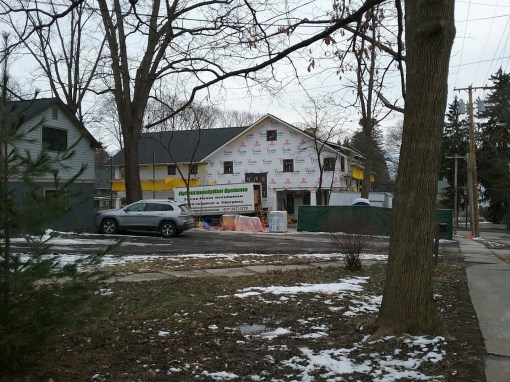
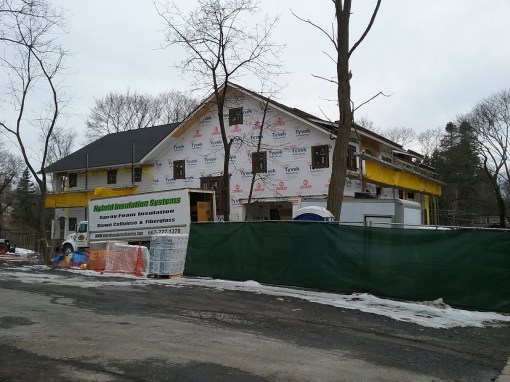
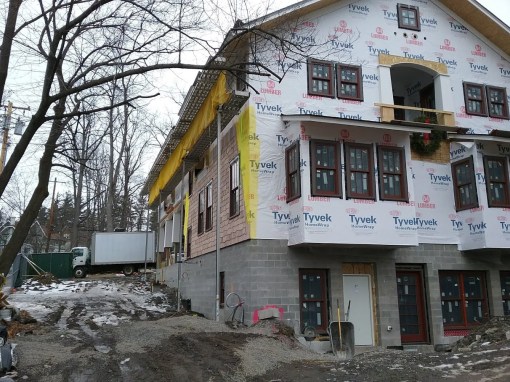
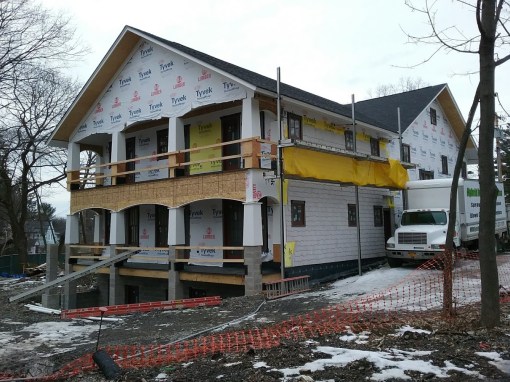
When you’re building a $4.2 million, 12-bedroom/16-person mansion for wealthy seniors, the material choices tend to be somewhat more upscale. At 105 Dearborn Place, over the typical Tyvek are a yellow waterproof barrier and traditional cedar shingles. These will be painted at a later time. The CMU block walls of the partially-exposed basement level will be layered over with cultured stone.

With the house fully-framed, the structural details are starting to show; along with banks of windows and shed dormers, and there are no less than five porches on the second level, four recessed and a more traditional open porch at the rear of the 10,930 SF building. Some of the architectural details will show up later (roof brackets, railings and balconies), and the porte-cochere has yet to be assembled.

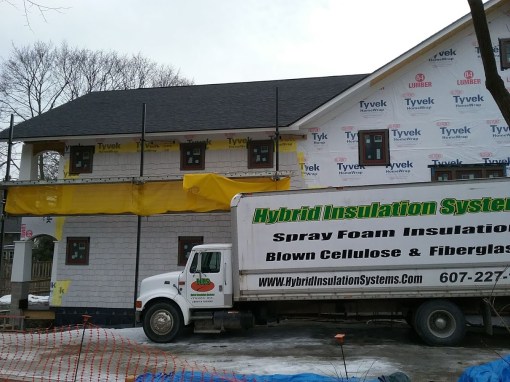
A truck on site and crew in full plastic suits suggested that spray foam insulation was underway inside, so the utilities rough-ins (electrical, plumbing, HVAC) are probably in place, but drywall, cabinetry/fixtures, and flooring are not. The insulation is being applied by Hybrid Insulation Systems of Ithaca.

There don’t appear to be any promotional advertisements for the new building yet, but keep an eye out as it moves closer to completion later this year. Owner Elizabeth Classen has been quite busy in the past year, signing on as a partner in Travis Hyde Properties’ Library Place project on the 300 Block of North Cayuga Street.

More information on 105 Dearborn Place can be found here.


128 West Falls Street Construction Update, 2/2019

26 02 2019

At a city planning committee meeting on infill housing, a Common Councillor well known for his dislike of nearly all things development described these houses at 128 West Falls Street as “an affront to the community” and “a monstrosity”. It seems rather misguided. This was a vacant lot, and the owners designed it with the possibility of future sale, either a small condo community, or in four separate lots if one includes the existing rentals between the new builds. As an argument over the issue of infill, this isn’t a good example anyway. The greater concern is adding new units to the rear yards of existing deep lot homes, not the development of vacant lots.

By and large, the built products are looking close to the original drawings, but not exact. The fully framed and sheathed out on the eastern end of the parcel was designed with its entry on the left side of the house, but the building under construction has its door on the right. Otherwise, the overall shape is true to plan, with dormers, gables, and porches, which are being framed after the primary structural frame has been built. The houses use Tyvek housewrap over plywood for the most part, except for the two-family structure with the breezeway; for fire safety, the walls facing each other in that pair have been sheathed with gypsum panels. The east hald of that building is still in the framin stages, with roof trusses yet to be fully assembled, but the other wind and other structures are framed, sheathed, and have most of their doors and windows fitted.The only worker on-site appeared to be working on utilities rough-ins in the unit with the bay window.

A summer occupancy seems fairly plausible. I haven’t seen any rentals for these yet, but Heritage Builders tends to go for the premium/upper-middle market bracket; the renovated two-bedroom house in the middle is going for $1800/month.

More info about the project can be found here.


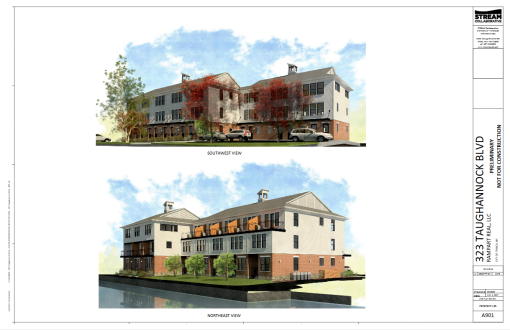
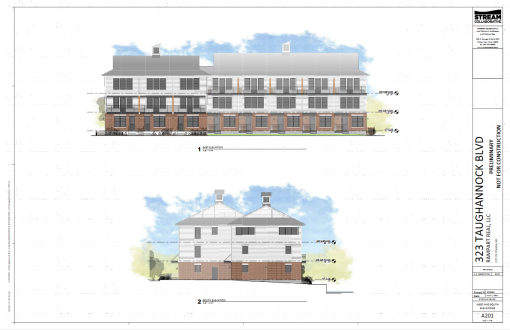
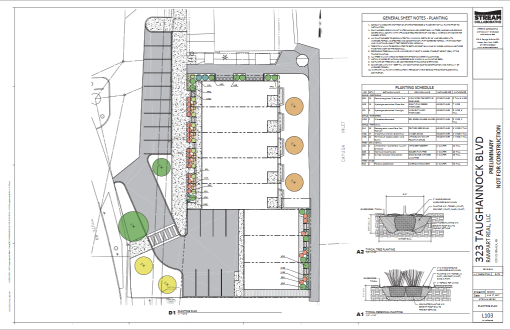
323 Taughannock Boulevard Construction Update, 2/2019

25 02 2019

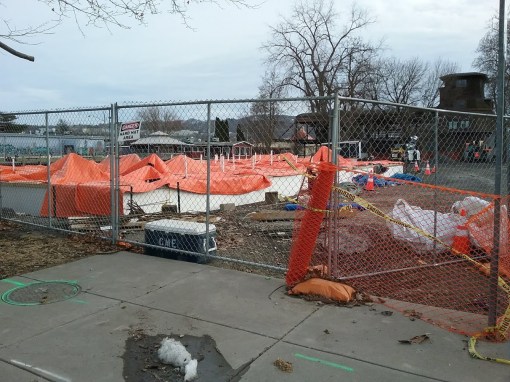
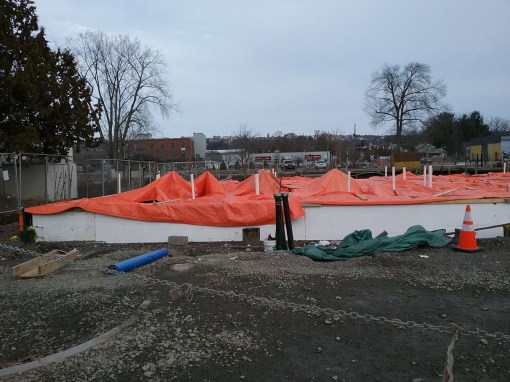
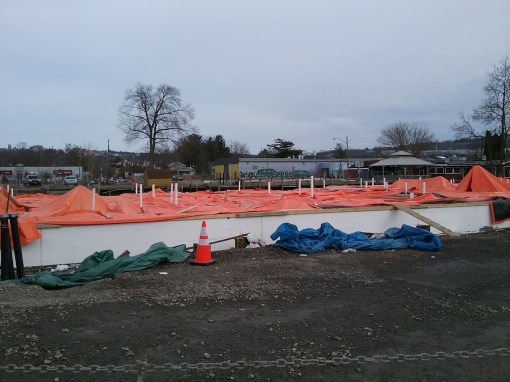
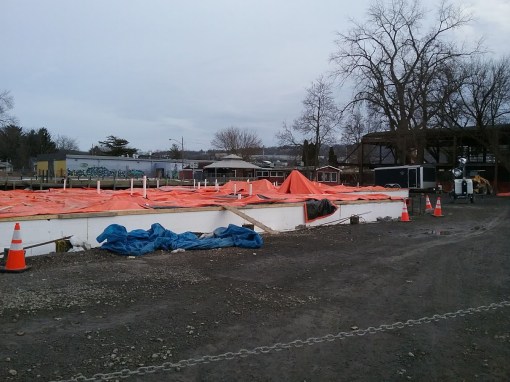
The timber piles are in and the 6″ concrete slab has been formed and poured, thus completing the lion’s share of foundation work for the 323 Taughannock residential project. The orange tarp is to allow curing without snow or rain penetrating and potentially upsetting the curing process and damaging the concrete, and ituility connections poke out through the slab. As previously mentioned, this a modular wood frame, and the pieces will be framed and sheathed off-site by Benson Wood Products, and then assembled on-site by local firm D Squared.

An interesting little note from Matt Butler’s piece at the Times, Flash initially intended for a five-story design, but found it cost-prohibitive. According to co-developer Steve Flash, “(w)hen we did soil samples and had a system for a five-story building, the costs of the foundation were too much for the number of units we could create. That might be different in a larger project where you could spread the costs out a little bit […] None of it was a surprise, we knew it going in […] We knew what we were getting into. It’s a challenge.”

To be a little more explicit, the larger the building, the heavier it would be. Given the waterlogged soils, the heavier the building would be, the deeper the piles would need to be, and likely, the structure would be too heavy for the budget-friendly wood timber pile system. They would have had to use much more expensive steel piles. In general, building denser is going to be more cost-efficient, but if it creates a sudden jump in hard costs, then it’s not in that “sweet spot” for construction costs vs. revenue, and out of the realm of economic feasibility.

Anyway, look for the pieces for the eight townhouse-like units (a studio and 2-BR in each), to start showing up over the next several weeks. Completion is expected this summer.


Milton Meadows Construction Update, 2/2019

24 02 2019

Out to Lansing for this latest addition to Tompkins County’s deeply underserved affordable housing market.

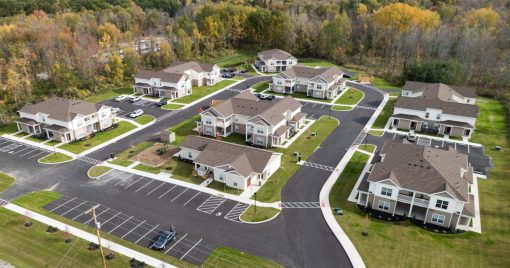
Here are the spark notes: Milton Meadows, a project by Cornerstone Development Group of Rochester, is a 72-unit, $17.3 million affordable housing complex in the Lansing Town Center consisting of ten buildings, nine eight-unit apartment buildings and a community center. 71 of the units will be set aside for individuals making 50-80% of area median income, and the last unit is for a live-in property manager. Veterans who meet the income guidelines will get preference in the application process. The project will use electric heat pumps and be built to LEED Silver standards.

Now for the in-depth. This apartment project, to be built on 13.5 acres, is the first development to get underway at the 156-acre Lansing Town Center, across from the town hall and near the intersection of Triphammer Road and Route 34B. This location comes with its pros and cons – the pro is, the town’s pretty keen on getting the land developed into a tax-generating, mixed-use environment, and has been generally supportive of development in this area, even though it dropped the ball with the first attempt several years ago. The con is that Milton Meadows is the only project underway, and looks to be the only project underway for some time yet. That means there is not much nearby- the Lansing Market the town library, a gas station, and a few other homes and small businesses.

This puts up in the affordable housing conundrum. It’s easier to get approval in rural areas where there are fewer neighbors, but it also isolates residents from needed goods and services, and often forces them to own and maintain a car, which makes living in these developments on the suburban fringe that much less affordable. However, when your alternatives are Trumansburg residents advocating the village seize land through eminent domain to prevent affordable housing, or going through the wringer down in Ithaca, one can understand why something this far out in Lansing might have some appeal.

This project is a little hard to follow through Google, because its name changed three times. It debuted as Lansing Commons in August 2017, changed to Lansing Trails in September, and then to Milton Meadows a few months later. Milton was actually the original name for Lansing, indirectly – Milton was changed to Genoa in 1808, and Lansing was split off from Genoa in 1817, the same year Tompkins County was established. It’s worth noting that “Lansing Commons” is the name of the housing development at the end of Woodsedge Drive, and “Lansing Meadows” is already taken.

For the sake of pointing it out, there was plenty of opposition here. The chairman of the town of Lansing Planning Board, typically one of the easiest boards to get approval from in the whole county, voted against the customary declaration of lead agency on the affordable apartment complex The reasoning was a fear that its lower-income occupants would create more crime. More appropriate commentary was made about taxes and increases in student enrollment. The chairman recused himself from further discussions after that outburst. Town supervisor Ed LaVigne has spoken in favor of the project as needed workforce housing by a responsible developer and property manager, and the project was approved last November.

Substantial funds were awarded by the state in May, and Cornerstone paid the town $337,500 for 22 acres at the end of October (for the approved phase and potential second phase). Construction work began in December.

Plans for a second phase of 56 units were shelved during the review process; Cornerstone can always revive it later, but it will be a second approvals process if/when that time comes. The reason for this was to provide space for the on-site sewage treatment field. The project will eventually hook into the town sewer when built, which will allows plans for the second phase to move ahead, expected in 3-5 years.

Gross rents (rent plus utilities) will range from $680 to $1,400 a month, with 64 units for households with incomes 50 to 80 percent of the area median income ($29,500-$47,200/year for a single person, $33,700-$53,900 for a two-person household). The remaining units are expected to rent at market rate. Along with veteran’s preference on all available units, five apartments will be set aside for veterans with physical disabilities. More specifically, expected rent ranges are $680 to $750 for one bedroom units, $835 to $850 for two bedroom apartments, and about $950 to $1,100 for three bedrooms. Market rate units may rent as high as $1,400 for a three bedroom unit.

Nine of the structures will be apartment buildings ranging from 6,600-10,200 square feet (SF), with 8 apartment units apiece. The buildings are designed so that all the units in a structure are the same size range, so all one-bedroom buildings (4), all two-bedroom buildings (3), and all three-bedroom buildings (2). The last building would be a 3,100 SF community center with a computer room, laundry room and gym. Also included are 139 parking spaces, a community garden, sidewalks, playground, and stormwater management facilities. SWBR Architects of Rochester is the architect. Cornerstone and its general contractor, Taylor the Builders of Rochester, have deployed this design in other towns, so they have a familiarity with the design, which allows for more efficient deployment of labor and a higher fit and finish because they know the design’s quirks, and where they’ve had issues in the past. Passero Associates served as project engineer.

As it often is for affordable housing, the financing comes from a variety of public and private sources. The project is supported by a NYS Homes and Community Renewal award of federal low-income housing tax credits (LIHTC) that generated about $9.9 million (from $5.1 million in credits; quick rehash, LIHTCs are sold to banks and similar financial institutions so that they get the tax credit, and the affordable housing developer gets the money they need to move forward with a project), and a $4.05 million loan from the Housing Trust Fund. The Community Preservation Corporation is providing a $2 million permanent loan through its funding agreement with the New York State Common Retirement Fund. Additionally, the Tompkins County Community Housing Development Fund is providing $256,875; NYSERDA is providing $63,200; and private firm Column Financial is providing a loan of $850,000.

Separately, Woodsedge Road, just to the south of the project, will be reconfigured to make a four-way intersection with the development. This is a $75,000 grant with in-kind labor from the town.

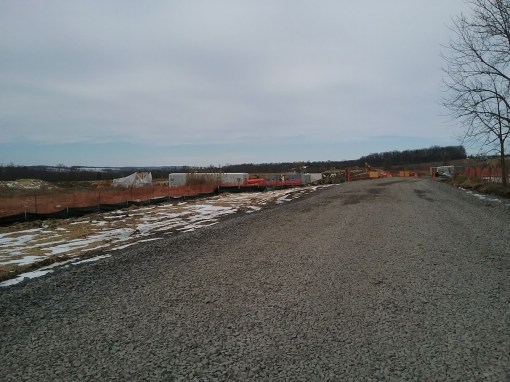
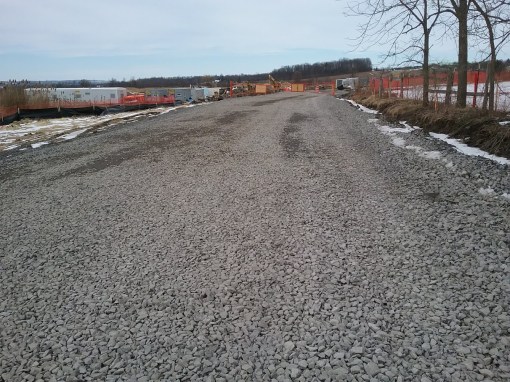
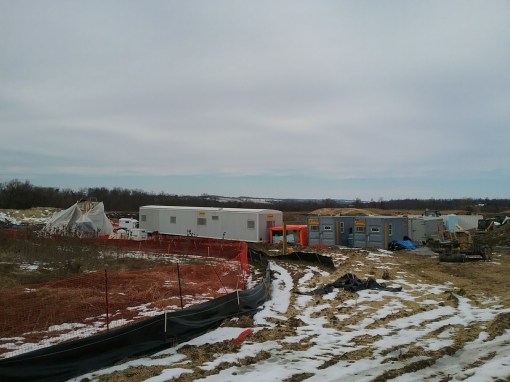
Site grading and prep work is currently underway at the project site. The access road is crushed stone for now, the asphalt planned are closed for the winter season. It will be paved in the spring, and christened “Louise Bement Lane” after the longtime town historian. The access road will be built by Cornerstone to town standards, and deeded over to the town for public use after the apartments have been finished. The internal road for the apartments will be Robin’s Way, after Robin Rubado, Cornerstone’s Vice-President of Housing. The prep for the interior roads is underway, but it will not be paved until most of the buildings are built. The first buildings will be opened by the end of June, with full occupancy by the end of September 2019.

More formation about the Milton Meadows project canbe found here.

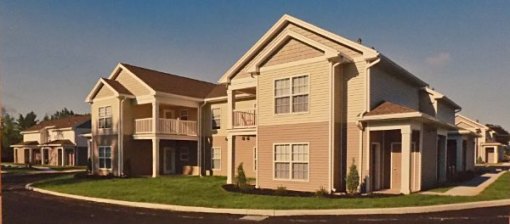
The Frances Apartments in the town of Sweden, a nearly identical design.


Library Place (Old Library Redevelopment) Construction Update, 2/2019

17 02 2019

I’ll admit I’ve actively avoided writing this one up because it has more twists and turns than a soap opera, and it ends up being extremely hard to follow as a result. There are over forty articles from local outlets regarding the site, and Travis Hyde Properties compiled about two dozen of the pieces it liked onto their website. The Voice has eighteen Old Library articles on file, but because of a tag mix-ups, it’s more like thirty. Here’s an attempt to distill everything into one post.

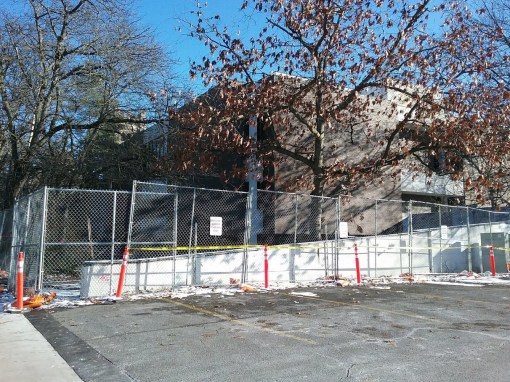
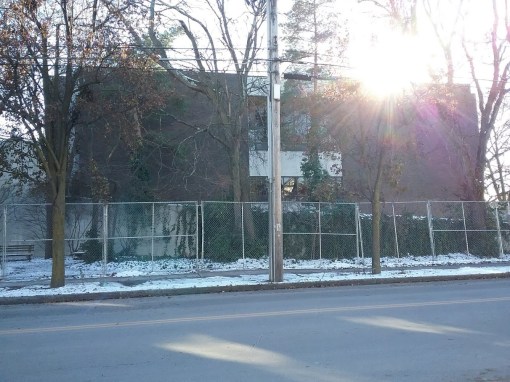
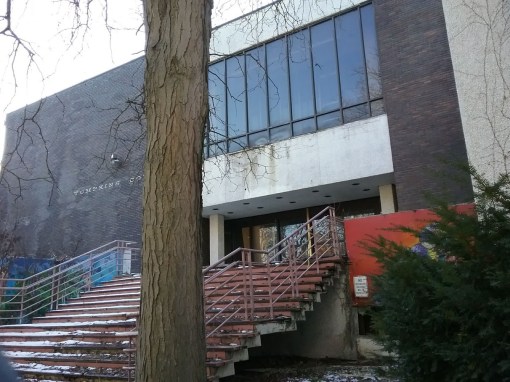
The Old Library site refers to the former Tompkins County Library, located at 310-14 North Cayuga Street. From 1967 to 2000, the library was housed there. However, once the library moved downtown in 2000, the building was used for day reporting for low-level criminal offenders, and for records storage. These were eventually relocated to other properties, and the 38,630 SF would be vacant by early 2015. However, the county didn’t like the idea of hanging onto it. Its unusual interior design (a large atrium) was difficult to adapt to other uses, inefficient from an energy standpoint, and the building’s utilities systems were running short on useful life, and would be expensive to replace. As a result, the building was declared surplus.

The idea of a Request for Expressions for Interest (RFEI), was hatched in late 2013. An RFEI is basically a prerequisite to a Request for Proposals (RFP), feeling out interest by asking for less paperwork – an RFP to RFPs in a sense. While the building was no longer useful for the county’s needs, it sits on a site close to downtown Ithaca, next to historic DeWitt Park (and in the DeWitt Park Historic District). It’s walkable, and the city’s 2013 rezoning allows up to four floors and 50 feet. The RFEI stressed mixed uses with an emphasis on senior housing, and compatibility, energy efficiency, and growth of the tax base. The hope was that someone would use the site to help the county meet its goals, though the county was unsure how it would go – an earlier RFP in 2000 garnered no interest in the property.

As luck would have it, there were six responses to the RFEI, which can be found here. Two, INHS and IAD, dropped out before an RFP went out – INHS had acquired the 210 Hancock site and decided to focus on that. The DPI condo proposal declined to respond to the county’s RFP, citing frustrations with the county’s frequent delays, and that had one of the favored proposals in the feedback I received. The other two “reader’s choices” were Cornerstone’s affordable housing plan, and Franklin Properties collaboration with STREAM Collaborative, which called for reusing the structure of the building.

By the time the RFP has been issued and responded to in April 2015, three projects were up for review – Cornerstone’s 73,600 SF 54-unit affordable housing plan (<80% AMI), Travis Hyde’s 72,500 SF, 60-unit market-rate senior apartments plan, and Franklin/STREAM’s 58,000 SF building, with 22 higher-end condominiums and medical office space. All would pay the county $925,000 for the site.

The next few months were not enjoyable. The Cornerstone project asked for a PILOT tax agreement and lost county support. That left Franklin and Travis Hyde and Franklin Properties. The Franklin project had strong public support. But in June 2015, the county Old Library Committee of legislators recommended the Travis Hyde project 3-2. Two legislators genuinely favored Travis Hyde, one voted in favor just to move it out of committee, one liked the Franklin proposal though expressed some unhappiness with all of them, and one thought all three proposals were outright terrible.

A week later came the full county legislature’s vote – 6-6, a hung vote with two absent. Neither proposal had the eight votes of support needed to move forward. That’s when things started to get ugly. The city’s Common Council and Planning Board submitted letters recommending the Franklin proposal, which ruffled some feathers in the legislature. One legislator was accused of an ethics violation because the Travis family donated to her congressional campaign two years earlier, and recused herself from future votes. The Old Library plan was sent back to committee, where the committee was unable to come up with an endorsement. There was a very good chance neither plan would get the required eight votes, and the county would be unable to make a decision on how to sell off a property they didn’t want. More failed votes ensued.

Finally, in early August, the Travis Hyde proposal got the nod in an 8-5 vote. There was definitely some bitterness afterwards, and an air of unscrupulous behavior. A legislator who switched his support to Travis Hyde would lose re-election to a strong advocate for the Franklin project later that year. He moved districts and into Fall Creek just as the other deciding vote retired from the Fall Creek district; there have been accusations it was orchestrated, but nothing was ever proven, and believe me, my then-editor, Jeff Stein who’s now at the Washington Post, had worked hard to find something.

For the record, this is why I have a strong aversion to RFPs. It works well when there’s one clear choice. But here, the disconnect between suburban and rural legislators, and passionate city residents, as well as all of the fighting and accusations that went with it, really created an unpleasant and rancorous experience. I dread the RFP for the NYS DOT site, which will come up in a year or two.

The project wouldn’t begin to move through municipal review until early 2016. The Ithaca Landmarks Preservation Commission (ILPC), who had stated a strong preference for the Franklin proposal, was first up – there was no point in going to the planning board if the ILPC isn’t on board (and the Planning Board is generally the more accommodating of the two). The project they were first presented had 51 units, 6,500 SF of space for senior services Lifelong, community space (2,000 SF), and a modest amount of street-level commercial space (4,000 SF).

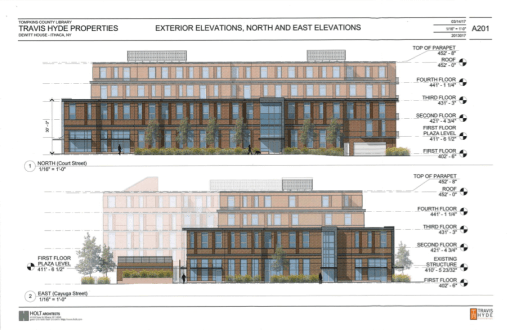
There were eight different designs that the development team submitted in an effort to satisfy the ILPC. Here’s the major ones – One. Two. Three. Four. Five. Six. Seven. Eight, the final design. If you want to be picky, there are some minor revisions too, for things like facade materials tweaks. As review continued, it was decided that it would be more efficient to hold the ILPC and Planning Board meetings on the project at the same time in one group, so that one panel wouldn’t contradict the other.

After several months and several major redesigns, it wasn’t looking good. The ILPC felt that every design was simply too big and one called it “an impossible building”. County staff and officials were getting angry because they felt that the city was trying to spite them, and one planning board member’s comment was effectively “you should do what we tell you to do,” so once again, the project site was in an uncertain and acrimonious situation.
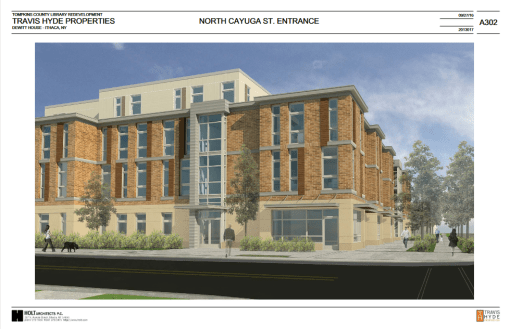
By October 2016, the plans had been modified to be 17 percent smaller, 73,400 SF with 57 units. This included a 950 SF ground-floor commercial space and a 1,900 SF community room to be administered by Lifelong, which had made the decision to stay in its building next door and not move into the new building. Some of the indoor parking was moved to an outdoor rear lot to shrink the structure further, and the fourth floor was set back from the rest of the building. This too was turned down, but there was just enough of a window for possible approval that Travis Hyde decided to give it one more shot.

Frankly, this project was hanging by a thread. Travis had informed the county that he was “bruised and battered”, but would make one last attempt. The last shot was February 2017’s meeting. The foundation of the old library would be reused in the latest design, and the third floor was pulled back from the street. It passed, 4-3. One vote essentially made all the difference. That allowed the project to move forward with environmental review SEQR) from the planning board.

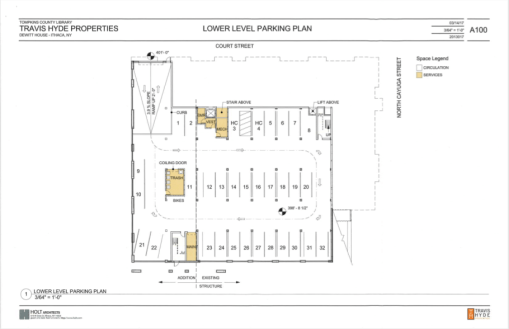
This reviewed version called for 54 senior apartment units, 32 parking spaces, a 2,000 SF community room, 1,160 SF of retail, and 86,700 SF of total space, as the interior parking was now underground as part of the reused old foundation. The sale of the site was approved by the county after the project was greenlighted, in September 2017. The 3 no’s in the 11-3 vote were two Franklin proposal advocates and the legislator who said all the projects were terrible two years earlier, so points for consistency.

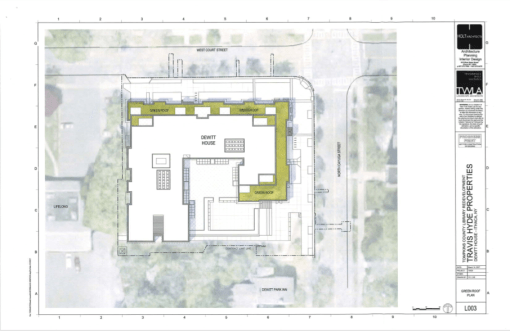
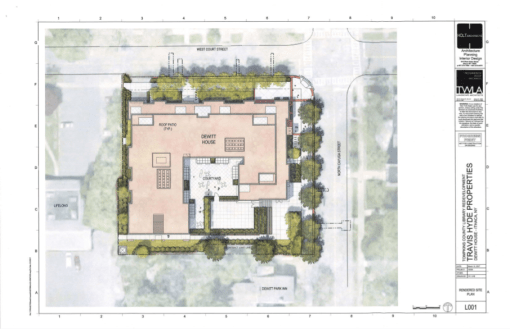
The actual interior layout at this point, is something of a question mark. In May 2018, it was announced that the project would be partnering with luxury senior services provider Bridges Cornell Heights on the project. As part of that, the design was updated to 67 units, though there was no change in total square footage. According to the press release, “(o)n site, there will be a restaurant, a la carte home health services from an on-site agency, a community room, courtyard gardens, workout facilities, pool and parking. The partners will also work with Lifelong to provide on-site activities and programs.” Units will be a mix of 1-3 bedrooms, market rate and available to renters 55 and older. The name of the project also changed, from “DeWitt House” to “Library Place”.

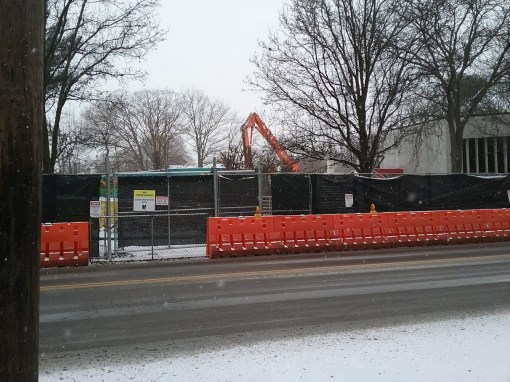
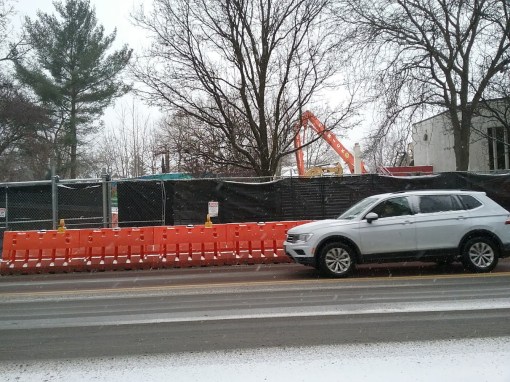
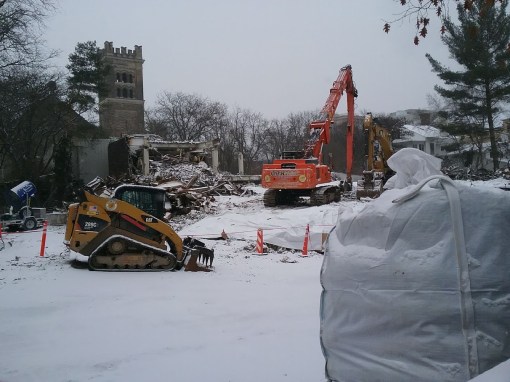
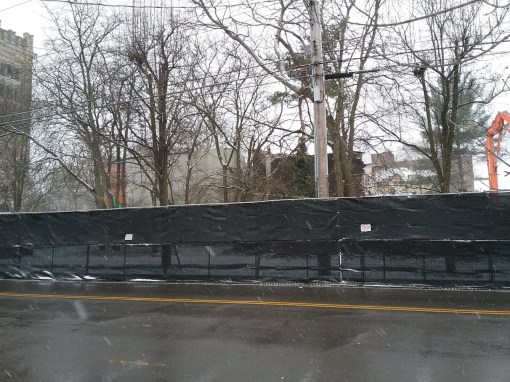
Continuing the theme of controversy with the project, by the time financing was secured for the now $17 million plan (up from $14 million in 2014), the building’s roof had become structurally unstable. The fear was that construction workers could be inside if it suddenly collapsed. An engineering report filed by Ryan Biggs/Clark Davis Engineering and Surveying in August led the city’s director of code enforcement to condemn the building. The initial demolition plan was to seal the building up and cart out the asbestos in sealed containers, a “contained” demolition. The new plan was to demolish on site with spraying to prevent airborne contaminants, a “controlled” demolition. This led to community protests, and the mayor threatened to torpedo the project unless a second engineering report was carried out by a third party engineer of the city’s choosing, with no affiliation to Travis Hyde. The second report, from Dende Engineering, confirmed the first report’s findings, so the city okayed, if somewhat begrudgingly, the new demolition plan. In response to the demolition, a neighboring couple wrapped their nearby home and rental buildings in plastic as a dramatic show of concern, which caught the attention of broadcast media.

The project is seeking a tax abatement, but the Tompkins County Industrial Development Authority (TCIDA) has yet to schedule a meeting to review the application and take a vote.

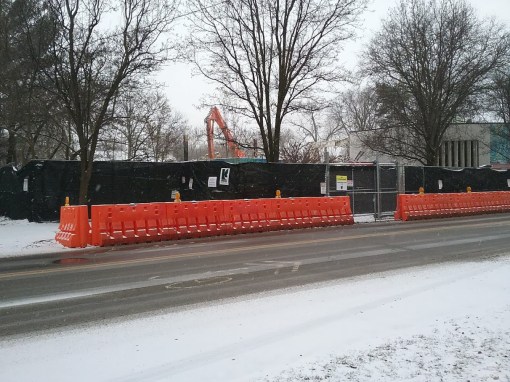
Demolition and site prep is expected to last through the winter, and construction will begin during the spring. A fall 2020 opening is anticipated. Alongside Travis Hyde Properties and Bridges Cornell Heights, the project team includes HOLT Architects for the building design (all eight of them), TWMLA for the landscape architecture, LeChase Construction as general contractor, and Hayes Strategy for marketing. Gorick Construction of Binghamton is handling the demolition, with Delta Engineers, Architects and Surveyors doing the air quality monitoring. The project website is here, as are the air quality reports.

December 9th:

January 19th: