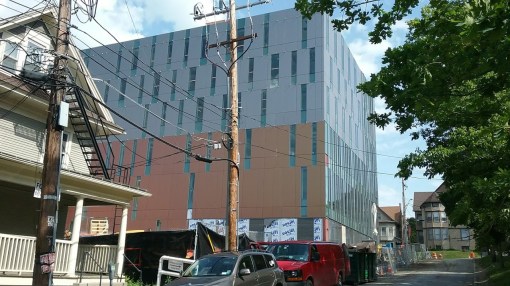
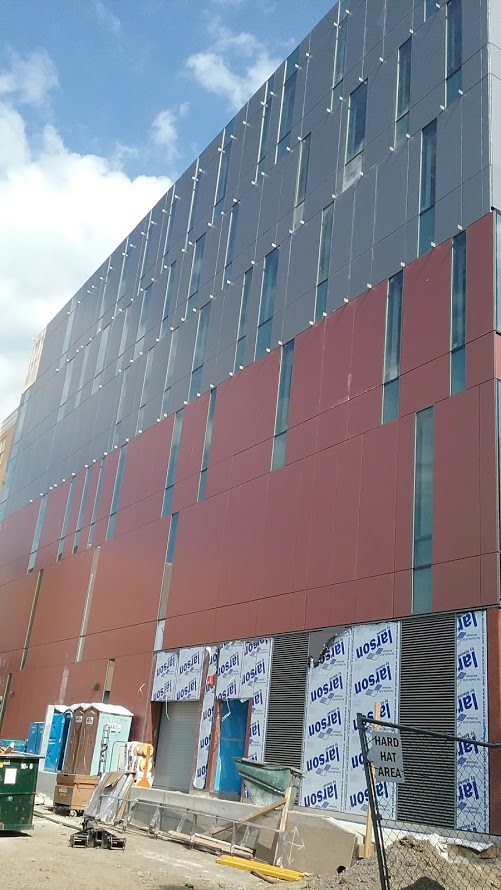
209-215 Dryden Road Construction Update, 6/2017

13 06 2017

For news about today’s event, please go to the Voice.

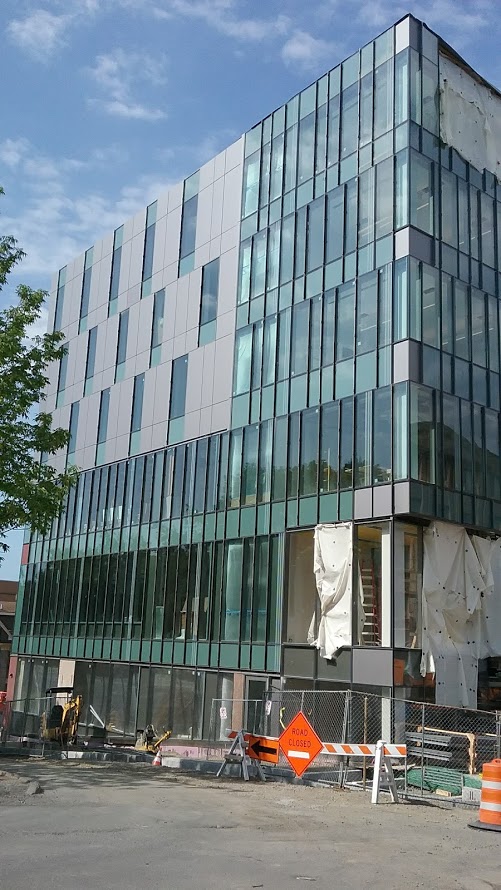
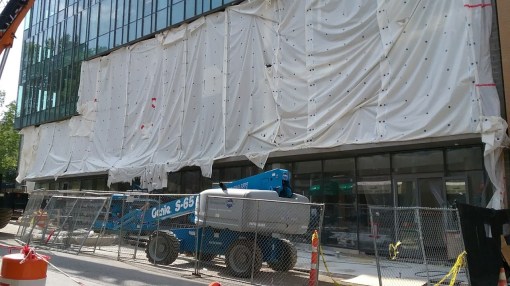
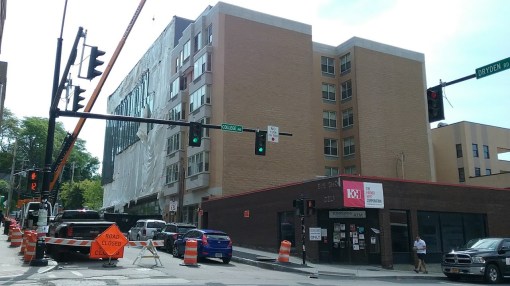
Most of the rear and east facade are complete on the Breazzano Center at 209-215 Dryden Road. The Larson sheeting on the utility/loading dock refers to Larson Alucoil, the brand name of the aluminum metal panels being used to complete the less photogenic vantage points of the new 6-story building. The clips on the rear wall will be used as hinges for architectural sunshades.

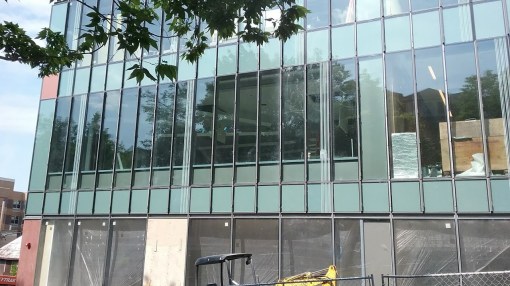
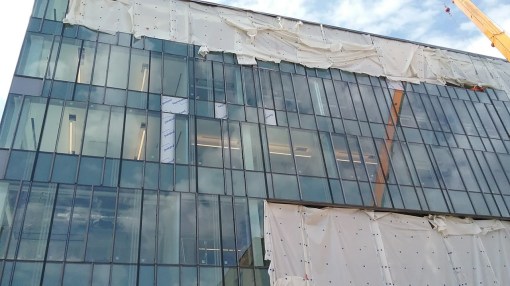
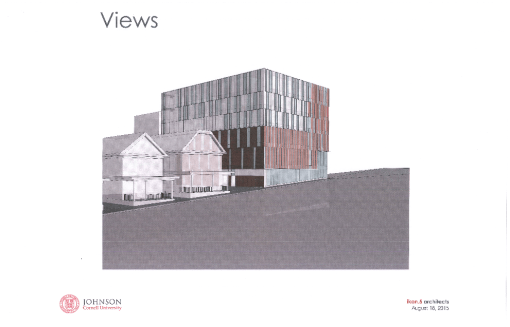
Most of the windows and spandrel glass has been installed on the read and east facade. Note that spandrel glass is purely decorative, and there are metal panels between the glass and the lip of the floor plate. The white stripes indicate where the salmon-colored metal panels will be installed over the glass, although I personally would be just as happy to see them go without; the glass curtain wall gives the building an airier, less overbearing appearance. The bottom floor uses clear glass to give the building greater transparency at street level, and is meant to enliven (“activate”) the block. In photo 9, you can see the ceiling of one of the large group instruction classrooms, meaning that the drywall has been hung on at least the lower floors, and utilities rough-ins have been completed.

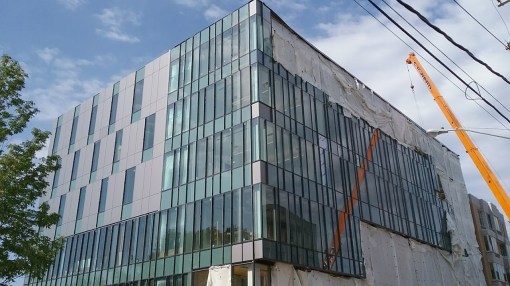
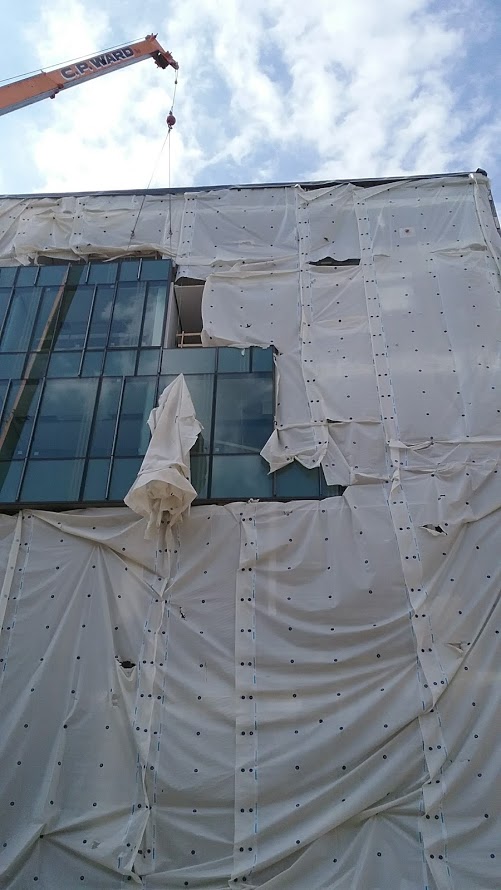
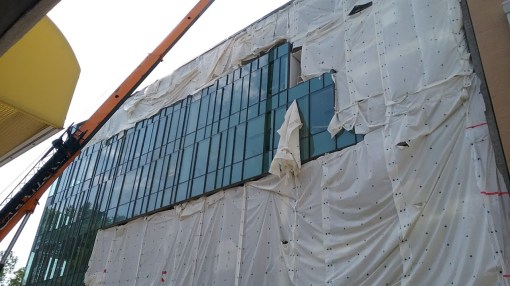
At the time these photos were taken, workers were easing a new panel section of the front curtain wall into place – it’s a bit of a delicate process to hoist the glazing with the crane and line everything up just right, and then quickly fasten it into place so they can move on with the next section, pulling the tarp back and continuing down the line. One imagines it must get a bit stuffy under the plastic sheeting this time of the year. More complicated exterior sections like the projecting atrium wall have yet to be tackled.

The Breazzano Center should be open in time for the fall 2017 semester. Not long thereafter, the staging area next door at 238 Linden will becoming a project of its own with the erection of a 4-story, 24-studio apartment building. That project is up for final approval later this month.


201 College Avenue Construction Update, 6/2017

12 06 2017

201 College is moving right along. W. H. Lane has been charging ahead at a rapid clip in order to have the 44-unit apartment building ready for occupancy in August. the front (west) half is further in the construction process – fireproof Georgia-Pacific DensGlass fiberglass mat sheathing, coated and sealed a pitch black air/vapor barrier (Carlisle Barriseal?), and layered with Dow Thermax polyiso insulation boards. The Thermax is coated in a reflective outer layer to repel incoming solar radiation and keep the building cool during the summer. Or at least, that’s what one of the construction guys told me. Some windows have been fitted into the structure on the lower floors.

The back half is not as far along. The northeast and east walls remain bare steel studs, while the southeast wall is just getting its DensGlass mats installed. The paired window layout might seem a little unusual, but many of the units will utilize a “mezzanine” intermediary floor to increase the living space in each unit.

One detail that has appeared to have changed from the images on file here are the stairwell windows above the front entrance. The drawings show one square window for each floor, while the finished building will have a pair of smaller square windows.

The front facade might seem a bit bland at the moment, but a plethora of exterior finishes should give the building a more visually interesting appearance – A large Sherwin-Williams Iron Ore (aka fancy off-black) metal canopy above the entrance, and fiber cement panels in shades of Allura Snow White, S-W Gauntlet Grey, and S-W Chinese Red, as well as woven bamboo siding. A stucco aggregate will be applied to exposed foundation sections (when you’re spending $10 million, you can afford the real deal over DryVit), and white cedar panels with a clear protective finish will be used for canopy ceilings and architectural screens. Long story short, variety of colors and materials should help break up the mass and make it look less overbearing.

With August just a scant two months away, we’ll have an idea of how nice the final product looks soon enough.


News Tidbits 6/10/17: In High Demand

10 06 2017

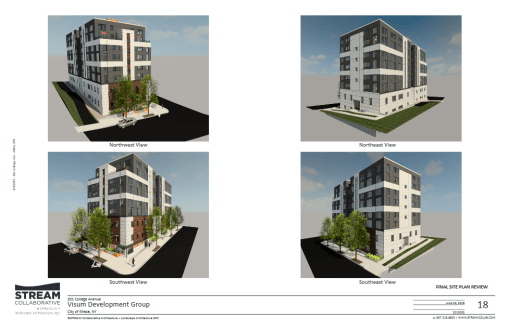
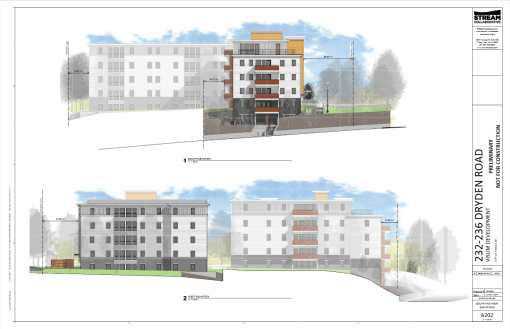
1. Start off this week with some eye candy. Here are the latest renders for Visum Development’s 191-bed, 60-unit project at 232-236 Dryden Road. The biggest change here is the Dryden Road facade – revised fenestration, and the addition of shingle-style balconies. STREAM Collaborative’s intent is to give the south building a little more historical sensitivity – when the Cascadilla school still had a dorm in the late 1800s and early 1900s, it included a 4-story shingle-style dormitory complete with dining room and gym. The balconies are throwbacks to the dormitory’s balconies.

However, given that this building will date open in 2018 and not 1898, instead of wood shingle, the balconies will use Allura “Redwood” fiber cement shinglewood pulp mixed with sand and cement, shaped for a wood-like appearance, but with the durability of concrete. Fiber cement is also more expensive to buy and install vs. materials like vinyl, which is why only more expensive or visible structures tend to use it. Other planned materials include Endicott manganese ironspot velour brick veneer, fiber cement panels with LP smart trim painted in Sherwin-Williams Pure White and Anonymous (actual name), lap siding in SW Pure White and Marigold, granite grey stucco (*real* stucco, not DryVit), a metal canopy and Andersen windows.

2. Business is good for STREAM Collaborative. So good that they’re expanding both in staff and space. The young, prolific architecture firm led by Noah Demarest will be moving out from its location in the City Hall Annex at 123 Sough Cayuga Street, and into a larger downtown space in the ca. 1872 Gregg Block at 108-112 West State Street, across from the State Theatre. The new digs are being renovated now, and are expected to be ready for occupancy by July 1st.

On another note, the owner of the city hall annex has taken to advertising the office space on Cragislist, which seems like the wrong choice to me. An apartment, sure. A house for sale or offices to rent? My impression is that folks prefer a more professional medium than what Craigslist offers. Kinda the same with jobs – servers or dog-sitters, sure. Accountants or architects? Ehh.

Maybe I’m just behind the times. Here’s the posting for the former Hal’s Deli on the 100 Block North Aurora Street. $5500/month.

3. WHCU is reporting that INHS has had no shortage of applicants for the 210 Hancock rentals. After receiving over 200 applications, they set up a lottery in which 122 “made it through” , and then selected the top 60 (there are 59 rental units though…might be a just in case there’s a drop-out, or it could just be conversational rounding). If it’s anything like New York City’s lottery, what happens is that each application is validated, sorted for requested unit type, and is assigned a randomized log number – those who get 1-48 for the one-bedroom subset, and 1-11 for the two-bedrooms subset, are awarded dibs on a unit, so long as they pass the income check and background check. Unit occupancy is expected late this summer, and marketing for the seven for-sale units will start…

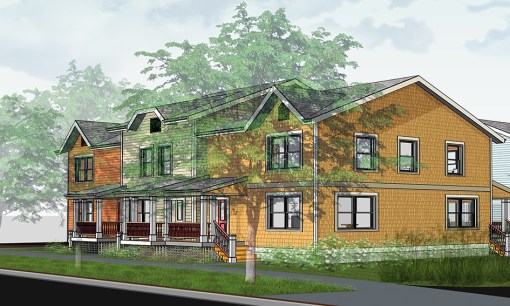
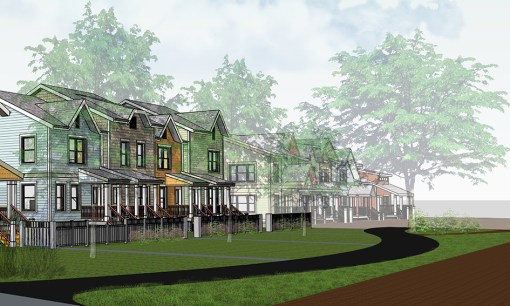
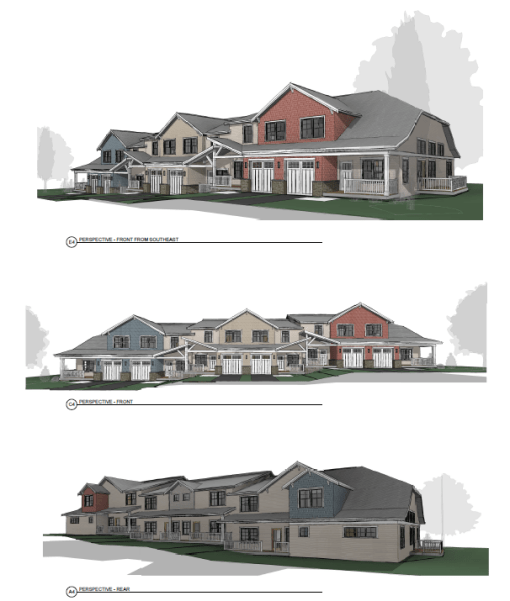
4. …pretty much now. The three units in the first image are 204, 206 and 208 Hancock Street, the four for-sales in image two are from L to R, 406, 408, 410 and 412 Lake Street. 206 Hancock, 408 Lake and 410 Lake will be 910 SF 2 bedroom, 1.5 bath units that will sell for $112,000 to qualified buyers. 406 Lake and 412 are 1088 SF, 2 bed 1.5 bath units priced at $129,000. The largest units, 204 Hancock and 208 Hancock, are 1300 SF, 3 bed 1.5 bath units that will sell for $145,000. The plan is to have buyers lined up for all seven units by the end of the year.

5. The county legislature has approved the Heritage Center acquisition. The county will pay $2 million for the 18,500 SF property, about $400,000 below assessment. Tompkins Financial Corporation is parting with its former offices next spring as it moves into a new HQ a block away. The plan is to have the heritage center, which will host tourism and history-focused non-profits, open for occupancy by the end of 2018, just as The History Center’s lease at 406 E. State runs out.

6. Seems like Lakeview is serious about their West End mixed-use project. The mental health services organization just purchased three properties on Thursday the 8th – 326 North Meadow for $150,000, 711-13 West Court Street for $525,000, and 329 North Meadow and 709 West Court (same owner) for $550,000.

Lakeview is planning a mixed-use 5-story building with a small amount of first-floor retail and 50 apartment units, all of which would be affordable, and half of which would be set aside for those with mental health ailments who are generally independent, but will have Lakeview staff to turn to in times of need. The project team requested $250,000 from the city IURA to help finance the $20.1 million project, but were only awarded $50,000 since it’s still at a relatively stage without detailed plans. The project team expects to submit their project for review later this year, with a 2018 construction start.

7. Tiny Timbers is doing well. In an update to their website, they note the completion of their first house, a “lofted L” model just over the county line in Hector, and a new house planned in Enfield (given that Enfield permitted just one new house last year, there’s probably a joke in there somewhere). There is another home just getting underway in Lansing’s Farm Pond Circle development, and a fourth will start soon on Grandview Drive in the city of Ithaca’s portion of South Hill. All the new units will be “big cubes” like the render shown above.

8. Looking at the city of Ithaca’s planning department memo this month, there’s nothing new to note for June. Smaller projects tend to show up in the memo, since the sketch plan for feedback isn’t as big of a deal for a small proposal, like a new store or a modest apartment building. Finger Lakes ReUse’s 22 studio units for vulnerable/formerly homeless populations will have its public hearing and Determination of Environmental Significant (step before prelim approval), the McDonald’s rebuild will have Declaration of Lead Agency, public hearing, BZA recs and DoES, 232-236 Dryden will have its DoES vote, and the Old Library redevelopment and 238 Linden will be up for approval.

9. Finishing off this week with a word of approval – the Dryden town board gave approval to Gary Sloan’s 36-unit Evergreen Townhouses at 1061 Dryden Road, per Cassie Negley at the Ithaca Times. At the boards’ (both planning and town) encouragement, the solar panels were replaced with electric heat pumps, which could utilize off-site solar and open up the possibility of a more environmentally sustainable project overall, given the proliferation of solar arrays underway in Tompkins and the region (my off the cuff estimate has at least enough solar arrays planned in Tompkins in the next 18 months to power over 10,000 homes). A play structure and 11 more parking spaces were also added.


News Tidbits 6/5/17: The Return, Part III

5 06 2017

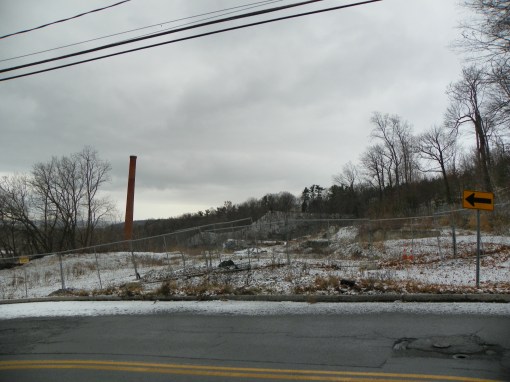
1. The Ithaca Gun site is almost in the clear, according to the NYS Department of Environmental Conservation (DEC). The state is proposing a “no further action” status for remediation of the Lake Street site along Fall Creek gorge, where the factory maintained a presence from 1885 to 1986. Testing the guns with lead bullets for decades had the unfortunate result of contaminating the gorge with toxic levels of lead and heavy metals, and the area has been under remediation in some form for almost 20 years. The first round of cleanup for the Superfund was from 2002-2004, but insufficient cleaning resulted in a second round of cleaning in 2014. A third round to excavate more contaminated soil along the steep slopes of the gorge was undertaken by the federal EPA over the past couple of years.

To quote: “Based on the results of the investigations at the site, the interim remedial measures and post-IRM screening that have been performed, the NYSDEC is proposing No Further Action as the remedy for the site…Periodic site inspections and reporting, which include additional removals of lead shot as needed, will ensure continued protection for the environment and public health.”

Note that this only impacts the part of the site that was donated to the city as parkland. A separate remediation plan has been crafted by Travis Hyde Properties as part of their plans to build 45 units of housing on the former factory site, the “Ithaca Falls Residences“. The completion of work on the city land would allow THP to put the finishing touches on their plan, and potentially move forward with their long-incubating housing proposal.

2. There was one detail that was initially missed when going over the failed candidacy of Lisa Bonniwell to the village of Lansing Board of Trustees. While her family’s housing development, the “Heights of Lansing”, has been in perpetual stall with only about 22 of the 80 units built since approval in 2005 (and the last townhouses in 2011-12, shown above), they do plan to start work on another “six-plex” string of luxury townhouses this year – Bonniwell cast blame on the gas moratorium for the holdup. Gives them something else to focus on after their lawsuit over the Park Grove Apartments re-zoning down the road, in which the courts decided in the village’s favor.

The existing units are 3 bedrooms, 2,297-2,400 SF and sell for about $350,000-375,000. Expect the next batch to be fairly similar, though with different exterior details – each string’s exterior finishes are unique.

3. Sticking with Lansing, the Cayuga Farms townhouses are planning some modest changes – the buildings will be smaller, which will allow 20% green space and the construction of a community clubhouse. There will still be 102 units with 3 bedrooms each, 1500-1800 SF, in the upper-middle (“premium”) market segment. The plan has been held up for years while trying to find appropriate ways to address wastewater/sewage, initially floating a pricey Orenco modular site-specific plan. However, with the likelihood of a sewer main being routed up North Triphammer Road in the near-future, that would render the sewage treatment issue a moot point and allow the already-approved project to move forward with permit requests.

4. Nothing too exciting with the local planning boards at the moment. The town of Ithaca is reviewing adjustments to the Westview subdivision that would allow homebuilder to have building permits open for more than two houses at any given time, and to allow him to build houses from different project phases (locations) so long as they have road frontage, sewer and water. Apparently the 2004 stipulations have created a headache with his newest home lots.

Meanwhile in Ulysses, the town planning board will be reviewing plans for additions to the Taughannock Inn at 2030 Gorge Road. The rather whimsical structure designed by architect Jason Demarest would add a “gatehouse/stable”, with five guest rooms, a check-in area, a bar and dining space, ice cream parlor, tent space, reflecting pools and whatever else that makes it sort of romantic events center for weddings, banquets and reunions. The 1870s inn will receive a new cupola, and the projects needs several zoning variance and a noise law revisions so that they can create to 90 dB until 1:30 AM.

5. Lansing’s 1020 Craft Road was picked up by an LLC tied to a construction company out of Endicott for $615,000 back in April, so that was was a strong indicator that something was planned. That plan looks like a gut renovation and 4,410 SF in additions, as well as a paved and landscaped parking lot. Pyramid Brokerage is already advertising professional office space in the 10,500 SF building, which was built around 1980 and used for manufacturing (sheet metal fabrication), and it was looking pretty run down by the time it was purchased. The lease is for $18.00/SF, with a minimum available space of 5,250 SF, which would be a pretty good sized office. Depending on the finishes though, it might have appeal for those looking for a suburban location with easy parking – CFCU’s headquarters is next door, and several other firms are housed in neighboring buildings.

6. The county released its report of potential tax foreclosures. The long story short is that if property taxes aren’t paid, the county may seize a property (courtesy says they give a couple warning first), which may then be sold by the county at auction to pay off the back taxes, or it may be given to a municipality if the community wants it, or it may be withheld completely if it is deemed to have special ecologic value (biodiversity, wetland, “Unique Natural Areas”, etc.)

There doesn’t appear to be anything too exciting in this year’s batch. The city almost got some prime waterfront real estate at a bargain price last year, but the owner was able to pay the tax bill before the city could claim it. This year, we see several rural properties that the county would like to put deed restrictions on for stream buffers and conservation options, a pair of industrial properties in Caroline and Dryden, and a handful of single-family homes around the area. Nothing that looks especially tempting to the ambitious, although there are a handful of individuals who scoop these properties up at auction and then market them at a much higher price (with some success).


News Tidbits 6/4/17: The Return, Part II

4 06 2017

1. The solar revolution is happening. Nothing makes that any clearer than putting up one of upstate’s largest solar arrays on land held as part of the Cayuga coal power point.

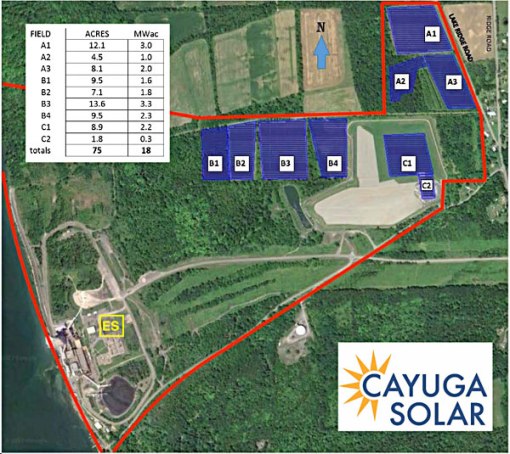
Just about every news agency in a fifty mile radius got the press release, but the Lansing Star has in-depth coverage. The $25 million project, to be built on 75 acres of the plant’s 434-acre site in Lansing, would create an 18 MW array that would be able to power 3,100 homes. 150 construction jobs would be created, although the permanent job growth is nearly nil. The site is well-suited because it is easy to hook-up to the existing grid, the zoning is appropriate, and Lansing is very keen on growing its tax base – overall, this seems like the right project at the right time. At a glance, this seems to skirt past the 2 MW rule from NYSDEC that limits each project’s size, as some arrays produce as much a 3.3 MW. However, there are nine arrays producing 18 MW, an average of 2 MW each for each array on the Cayuga plant’s property – so it technically meets regulations. It’s not clear if they have to pursue subdivision to make the panels fully legal.

Two potential debates are touched on in the Star article. For one, the project may pursue a solar tax PILOT, which would save a fair amount – instead of paying the property tax of about $770,625 (25 million on a tax rate of $30.825/1,000), they would pay something like $8,000/year/MW, just $144,000. The flipside is that local taxing authorities would not be enamored with such a deal. The second potential issue is that the Cayuga Operating Company was mum on whether they’ll close the coal plant, which is probably going to keep Town of Lansing officials up at night.

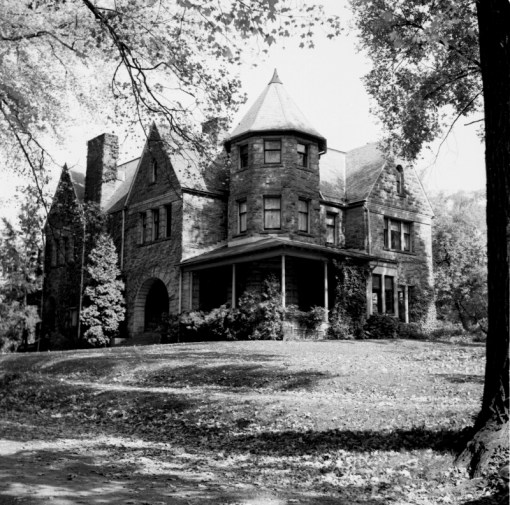
2 Fountain Place (President’s House), image courtesy of Ithaca College

2. Ithaca College is in the hunt for a new president’s house. The house at 2 Fountain Place in the city’s East Hill neighborhood was deemed unsuitable because it’s difficult to maintain (it was built in 1892), it has an awkward interior layout, and there’s not enough space to host events (it’s 9100 SF on 1.06 acres). The property was designed by Ithaca’s famous 19th century architect William Henry Miller for lawyer George Russell Williams, and was purchased by the college in 1938. Although future options are still being considered, if this hits the market, we are talking a multi-million dollar sale, but lest anyone be concerned, given its historic designation the possibility of inappropriate alterations or demolition is remote. The most recent work was in 2013 for ADA accessibility at the rear porch, an ADA-suitable bathroom, and air conditioning. With 7 existing bedrooms and 5 bathrooms, it could make for a cool boutique hotel or B&B, if someone doesn’t want a personal residence with venerable grandeur.

While Ithaca College searches for a new residence (pursumably large, newer and on South Hill), incoming president Shirley Collado and her husband will live in a downtown apartment paid for by the college.

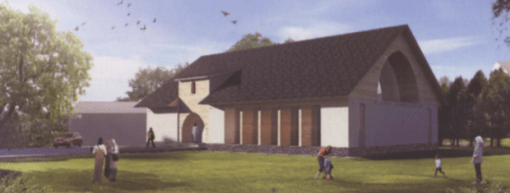
3. Hat tip to Chris Szabla for this one – the Al Huda Islamic Center planned for 112 Graham Road in Lansing village has been redesigned once again. It went from this in 2014:

to this in 2016:

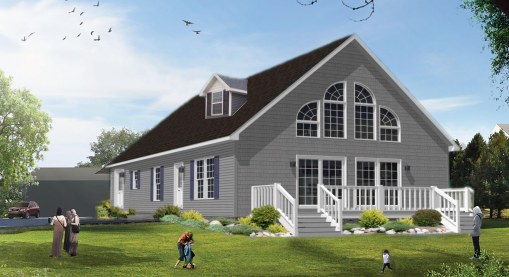
to this now:

Erm…with every due respect, this is a vinyl-sided modular with a poorly-photoshopped dormer and what appears to be a door in place of a garage. The first couple of designs embraced traditional Islamic architectural features, and the second was a great mix of traditional and contemporary design motifs. But this latest version honestly looks like, even if it was done for cost considerations, that every attempt was made to hide its use as a mosque and Islamic center. This image is so poorly done, I’m still not 100% sure if this is some kind of joke, but the floor plan matches up. Oof.

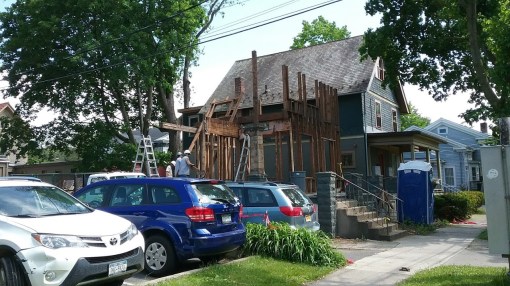
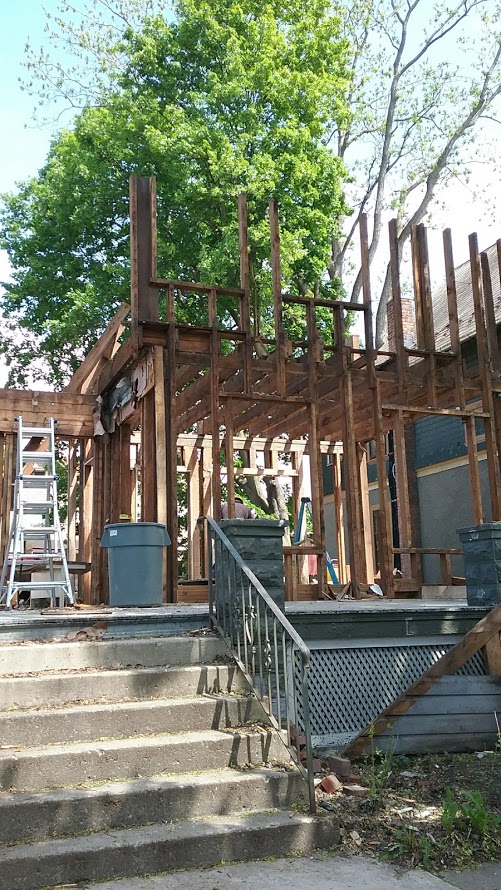
4. Not something one sees all the time – these are photos from last month’s deconstruction of Ithaca’s 107 South Albany Street in preparation for a new three-story, 11-unit apartment building. Developer Nick Stavropoulos hired Finger Lake Re-Use to do the deconstruction, which diverts about 70-90% of materials from the landfill by salvaging the structural components, processing and checking them to make sure they’re in good shape for re-use, and packaged and selling the materials at a low price to interested buyers – for instance, reclaimed lumber could go into bar counters, flooring, or any number of options looking for that well-used look. The cons to this approach are that more work and more time is involved vs. a traditional demolition, which means a greater cost. Also, though no fault of FLR, Historic Ithaca is not pleased (they get bonus shade for arguing in the same article the city should downzone to protect Patterson’s, an auto body shop built in 1983, and keep their “essential service” in downtown Ithaca). The pros are the environmental/sustainable aspect, the creation of “green-collar” jobs, and salvaged materials are tax deductible.

Construction on the new Daniel Hirtler-designed apartment building will begin this summer, with occupancy in about 12-13 months.

5. Skill-building for a good cause – The Second Wind Cottages, a housing complex in Newfield that houses formerly homeless men in 320 SF cottages, has connected with high school students and teachers to help assemble a new unit, cottage #13. Supervised students at a high school in suburban Rochester assembled a 320 SF unit in their school’s back lot as part of a class, then partially disassembled it and reassembled it in Newfield. The construction and transport process was borne out out over two days.

The non-profit project is led by local businessman Carmen Guidi, who hopes to do a second women’s housing plan further up Route 13 as the current 18-unit build-out wraps up.


News Tidbits 6/3/17: The Return, Part I

3 06 2017

My apologies for the lack of a weekly round-up. My day job has been busier than usual, and the list of topics just kept growing, making it an even more daunting task. Gonna try and work through a few at a time until everything’s caught up.
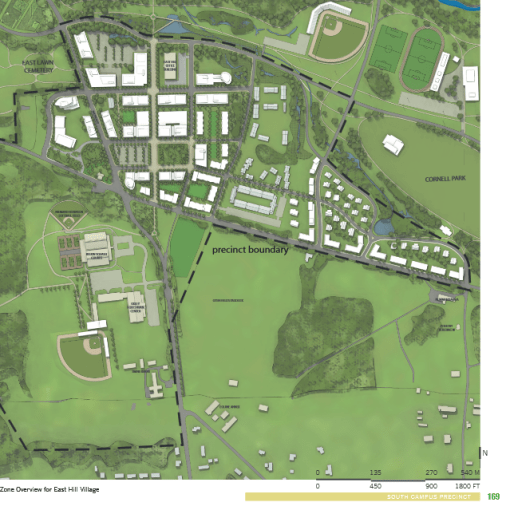
1. Cornell and EHVP’s East Hill Village webpage has started to flesh out their Q&A regarding the mixed-use megaproject slated to replace East Hill Plaza. Here are a few details:

– Cornell wants to make it clear that all images to date, include the conceptual from the master plan above, are strictly conceptual and have little bearing on the final product. The more realistic and nuanced take is that Cornell has an idea of what they want and the program format they want it in, for broad concepts like housing capacity, commercial/research space and general urban planning. In terms of an actual layout or tenant specifics, they probably don’t have much.

– Perhaps in response to a Voice commenter and former Ithaca town planning board member who accused the university of segmentation (meaning, during environmental review they illegally broke up a project into phases to avoid a greater analyses and to downplay impact), the FAQ notes that they didn’t really have this fleshed out and it’s separate from Maplewood. Given the size, scale, that it’s a physically separated set of properties, and vague goals they’re walking into this with, that’s a fair statement. If this were, say, a replacement for Ithaca East, which borders Maplewood, it’d be a different story.

– The current thinking is to keep the main retail strip, which was requested at the first community meeting. However, they may take down a portion of it to create a through-street, and reconfigure/relocate the parking.

– They haven’t written off pursuing a PILOT or tax abatement. They are exploring an affordable housing component. Eco-features like solar arrays, heat pumps and net-zero structures are being considered.

– Meetings will continue through the summer, with concept plans prepared for the town by the fall. Construction on the first phase would begin in 2019. It will be multi-phase.

No second meeting has been posted yet, but keep an eye out for updates.

2. Making its round around local governments and news outlets is a recently-published study by local structural engineering firm Taitem that tells of good news for heat pumps, and maybe serve to county one of the town of Lansing’s arguments regarding the West Dryden natural gas pipeline. Although the firm is a promoter of green initiatives, their study indicated that financially, the technological advancement in heat pumps over the past several years has made them competitive with natural gas, although each has pros and cons. For smaller units, a 1,500 SF townhouse in the study, it was found that an air-source heat pump was slightly less in annual cost than a natural gas furnace – for a modeled 4,000 SF detached custom home, it was a few percent more. Ground-source pumps were more expensive (but slightly “greener” than air pumps), and propane was the most costly, as well as the biggest carbon emitter. Although contractors are still adapting to heat pumps, the cost is decreasing somewhat as their use spreads and familiarity grows.

However, not everything is roses, at least not yet. For large-scale commercial and industrial operations whose heating needs are substantially greater, it appears that heat pumps have yet to be competitive, and even Taitem’s Ian Shapiro acknowledges that’s likely the case at present. But while the pipeline will continue to be an issue for larger commercial enterprises, homebuilders and residential developers should be able to adapt without too much additional financial burden or risk.

For the sake of example, the Village Solars charged a modest premium on rents when they went with pumps a few years ago (due to installation costs rather than operating costs), but having a strong product makes up for the extra short-term investment, the costs will potentially balance out over a few decades, and frankly, it makes for good marketing in eco-conscious Tompkins County.

I’ll admit to being skeptical over the past few years, and I still have concerns for economic impacts like the MACOM decision, but at least from a residential construction standpoint, the Village Solars and this study are making a strong statement.
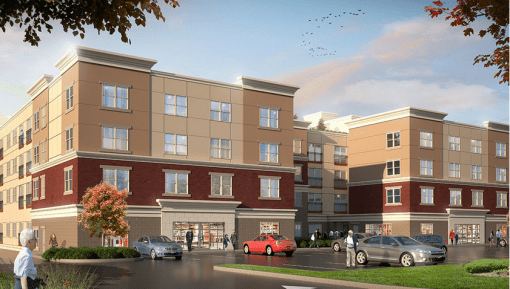
3. Move this one into the “construction” column – Cayuga View Senior Living has secured a construction loan. The mixed-use, 60-unit senior housing project at 25 Cinema Drive in Lansing village has been in stall mode for a year as financing remained elusive. However, according to a construction loan filed on May 25th, Five Star Bank is loaning the Thaler family and their associates $10.88 million to make their project become reality. Along with the loan, the Thalers and their business partners will be putting up $1,796,450 in equity to move the project forward, bring total costs to $12,676,450.

Here’s a cost breakdown – individual figures are blocked out to avoid potential legal issues. But for the sake of illustration, here is the breakdown of the finances. Source of funds to the left, breakdown of hard and soft costs to the right. Breaking down the terms, we’ll start with the hard costs: easements are the legal right to use someone else’s land for your own use – often seen with utilities, they can also be used for private improvements like sewer, solar, paths or driveways/parking. Site improvements include landscaping, driveways, and drainage. Building Cons. costs are actual materials/labor expenses, and tenant improvements are the costs of fitting out retail space as part of a lease agreement. Lastly, general conditions are a catch-all for non-construction labor costs, including site management like porto-potty rental and temp utilities, material transport costs and project management – for this project, site management falls under the general contractor, Taylor the Builders of Rochester.

Soft costs include contigency (cover your rear allowance),  overhead developer profit (the amount needed to compensate the development team, which isn’t necessarily the exact same group as those putting up equity, for taking on this project), construction interest and LOC [Line of Credit] fees to the lender, and other line items that are either self-explanatory or too vague to ascribe. At $145/SF, the cost is a fair 10% less than a similar project in Ithaca city (offhand, 210 Hancock’s apartments are ~$160/SF), which can be explained in part by lower land costs and a less complicated site to work within, and to get in and out of.

Five Star Bank is a regional bank based out of Wyoming County in the western part of the state. They hold a few local mortgages, but this appears to be their first construction loan recorded in Tompkins County.
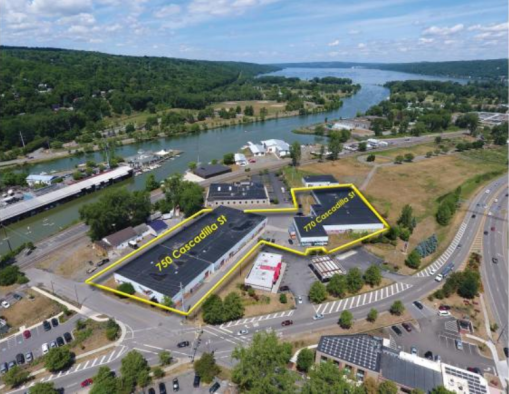
4. I’ll wrap up “Part 1” with a piece of interesting news – Cornell found a buyer for their printing facility and warehouse on Ithaca’s West End. According to a county filing on June 2nd, Guthrie Clinic is paying $2.85 million for the properties at 750 and 770 Cascadilla Street, which is over the asking price of $2.7 million. For that they get 3.12 acres, a 37,422 SF warehouse built in 1980, and a 30,000 SF storage facility built in 1988 and currently leased out.

Guthrie is a regional healthcare provider based out of Sayre, Pennsylvania – their premier facility is the 254-bed Robert Packer Memorial Hospital, which Ithacans might know as one of two locations someone is likely to be transported to in the event of a severe injury (the other being University Hospital up in Syracuse). For the record, Cayuga Medical Center has 204 beds.

Guthrie’s presence in Tompkins County includes some specialty offices and an existing 25,000 SF clinic at 1780 Hanshaw Road in Dryden. That building first opened in 1995, with an addition in 2000. Guthrie has been a building spree as of late, with a 25-bed hospital in Troy, PA that opened in 2013, and a 65-bed hospital in Corning that opened in 2014.

As for what they want to do on Ithaca’s West End, well, I’m working on figuring that one out. I’m hoping the Times writers who follow the blog will cut me some slack and let me try to unravel this one.



607 South Aurora Street Construction Update, 5/2017

2 06 2017

Projects are a bit like politicians in that the higher profile or most controversial ones get the vast majority of attention. 607 South Aurora Street fills neither of those specifications, and as a result, relatively few people are even aware of it.

The South Hill infill apartment project is located on an unusually large 0.73 acre lot. The property consists of an existing 5-bedroom, 2,300 SF home dating from about 1910, and had been in the possession of the Cassaniti family since at least the 1960s, legally split among the six Cassiniti brothers. If you’ve visited the hot dog and soda vendor on the Commons, you’ve met one of the Cassanitis.

Enter Charlie O’Connor of Modern Living Rentals (MLR). MLR is a young and ambitious rental company based out of Ithaca, a partnership primarily led by O’Connor and business partner Todd Fox. However, each has had their own ideas on how best to approach development – while Fox likes to think big and aim for high-profile projects, O’Connor is much more low-key and incremental in his approach. The two differ enough that they developer under different entities – Fox under his firm, Visum Development, and O’Connor as MLR. However, regardless of who develops, all their rental units are managed by MLR.

So while Fox is dreaming big with projects such as 201 College Avenue and 232-236 Dryden Road, and potentially sets off heated debates, O’Connor prefers to avoid controversy and take on less risk. His first project, with behind-the-scenes business partner Bryan Warren, was a pair of two-family houses at 312 West Spencer Road about half a mile southwest of 607. A bit of an unusual location, but close enough to urban destinations and Ithaca College that it was potentially viable, and after getting approvals last year, the project moved forward and is at least partially if not fully rented. Two existing houses that shared the original lot are being renovated as part of the project.

With those basically finished, O’Connor and Warren have moved onto MLR’s next project, 607 South Aurora. First proposed in August 2016, the location near downtown and IC makes it an easy sell, and in an area of 1.5-2.5 story owner-occupied and rental homes, four more two-family homes aren’t going to cause a big debate. In fact, in a city that loves giving its input, there were only ever a couple of neighbor comments about the project, and they were generally amenable – ‘better these than a large apartment building’ was the gist of it.

There were a few stipulations and revisions that were required, however. The original plan called for two homes near the street and two in the back of the L-shaped lot, with the renovated existing house in the middle. This was especially well received for aesthetic reasons (the city is still quite sore about the poorly-sited house MLR did two years before on the lot next door), so the site plan was redesigned to have three buildings on the interior side of the “L”, and one on the street to better match the curbside context. An internal driveway and clustered parking were added to help traffic and emergency vehicle circulation.

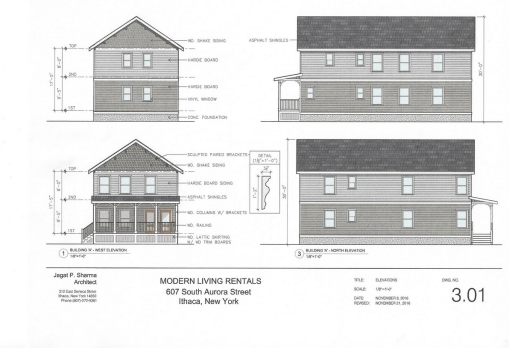
The building themselves didn’t change much – like 125 and 129 Elmira, they’re modular units on Superior Wall foundations. The unit facing Aurora has fiber cement siding and nicer details like a full lattice porch with railings, columns and brackets on the porch and roof. The rear units have small entry porches and use vinyl lap and shake siding.

With those details noted, the project was approved in November, and through an LLC, O’Connor and Warren bought 607 South Aurora, valued at $220,000 by the county, for $452,776 back in March (rule of thumb – if development is planned, expect a hefty premium).

Each of the eight new rental units will be three bedrooms and about 1,128 SF. The existing house will also be renovated and expanded slightly, raising the rear roof-line to add interior space. Expect occupancy by the start of the new academic semester in August. The apartments are being marketed at $2250/month, which works out to $750/bedroom.

According to county docs, the construction loan from Tioga State Bank was for $1.92 million and filed the day the house was sold. That figure is a combo of hard (materials, labor) and soft costs (acquisition, marketing, legal); by itself, the hard cost for the new construction and the renovation looks to be about $1.04 million.  Rochester’s Taylor the Builders, who will be doing Harold’s Square at some point, is the project’s general contractor.

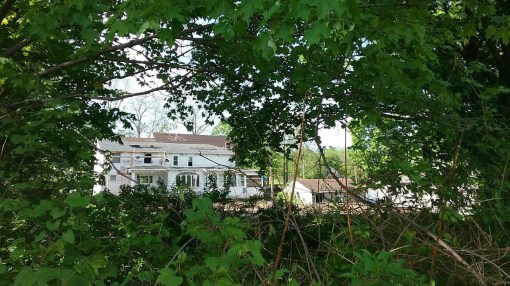
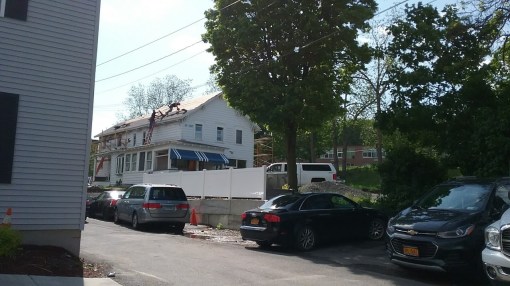
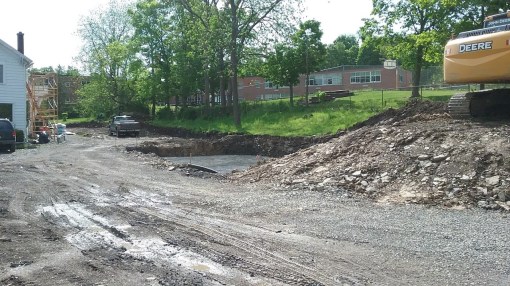
Looking at the site last month, a new roof is underway, and you can clearly see where the roof was raised in the roof by looking at the trim boards; the new section is housewrapped, and presumably the whole house will receive a new exterior finish at a later date. The windows in the rear are just rough openings for now, new windows will come along shortly. The soil has been excavated for the slab foundation of Building “A”, but due to the angle and slope of the site from the roads, it’s hard to tell how much of the site prep for “B”, “C” and “D” has been completed in the rear, apart from some disturbed soil.


Ithaka Terraces Construction Update, 5/2017

1 06 2017

Taking a look at the Ithaka Terraces site at 215-221 West Spencer Street, one question immediately comes to mind – is Building “D” still happening? The other three are far along, and yet there appears to be no sign of Building “D”, a mirror of Building “C”, starting construction. It could be cost concerns or pre-sales worries, or simply a matter of timing. The website doesn’t look like it’s been updated recently, and marketing for the condo units doesn’t seem to have started yet.

Apart from the completion of the roofing, not much additional work has occurred on the exterior of Building “A”. Its twin, Building “B”, has finished framing, sheathing, windows are being fitted and the roofing is well underway, sheathed and covered in Certainteed DiamondDeck and WinterGuard underlayments, but not yet shingled. Building “C” has had its multi-story porch erected and it looks like the R39 cellulose insulation is underway. New to this update are the Bituthene sheets on the concrete foundation walls of “C” – Grace Bituthene Membrane is a two-component system, the first is a sticky, liquid rubberized asphalt compound, the second a laminated HDPE film, and together they’re used for weather and moisture protection, handy when your walls will be exposed to moist soil uphill and several feet deep. The white walls facing the future grand staircase are water-resistive barriers to protect the plywood ZIP panels from the mositure-absorbing stucco finish.

Local eco-builder AquaZephyr LLC (run by Kendall and Mike Carpenter) is the general contractor, Taitem’s doing the structural engineering, T.G. Miller is in charge of civil engineering, STREAM’s the architect, and Ed Cope (PPM Homes) is the developer. Side note, I dropped by the Wyllie site and didn’t see work on the renovation underway, although it’s not clear if the state grant funding has been disbursed yet. It and the PPM’s Ithaca Glass Apartments are expected to get underway this spring.

Also, let’s not forget the ’80s hair metal blasting over the stereo on-site. I guess nothing gets the work done like Whitesnake and Twisted Sister.

UPDATE: From the architect, Noah Demarest, on the status of Building “D”: “It’s a logistic issue. Couldn’t get all the foundations in at the same time. Should be starting soon.”