Cayuga Meadows Construction Update, 11/2016

30 11 2016

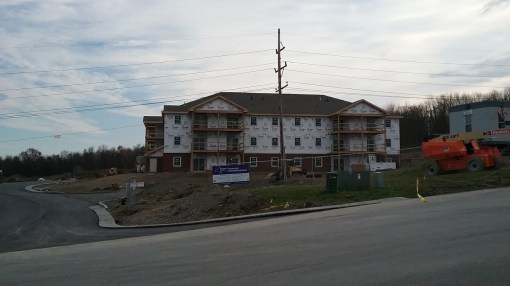
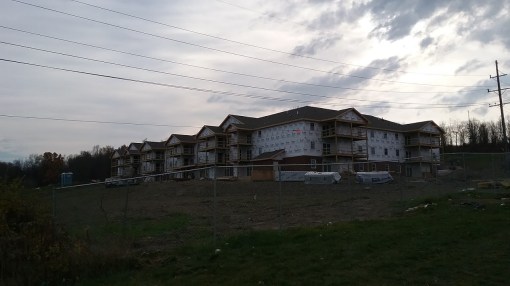
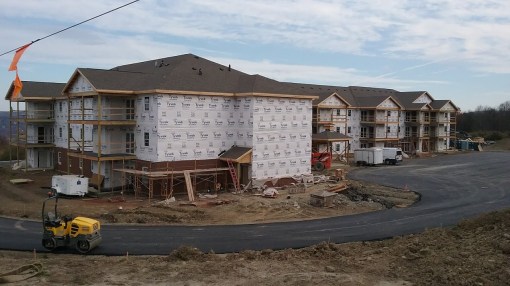
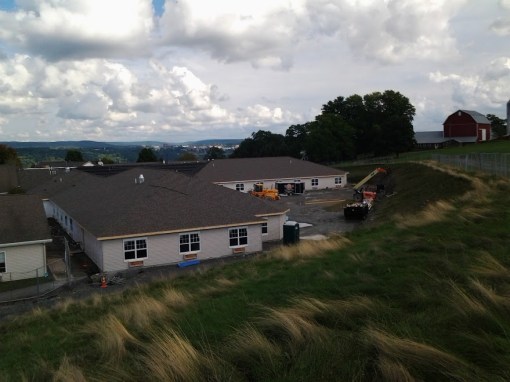
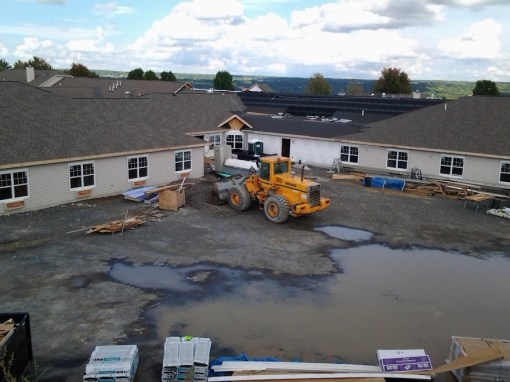
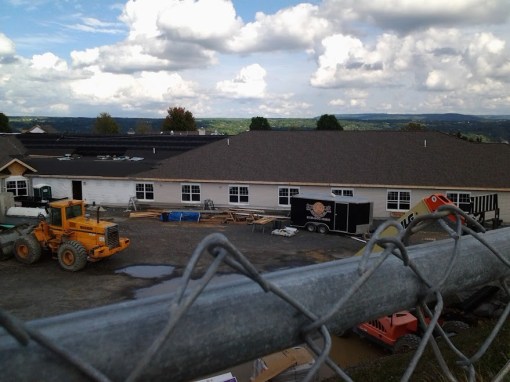
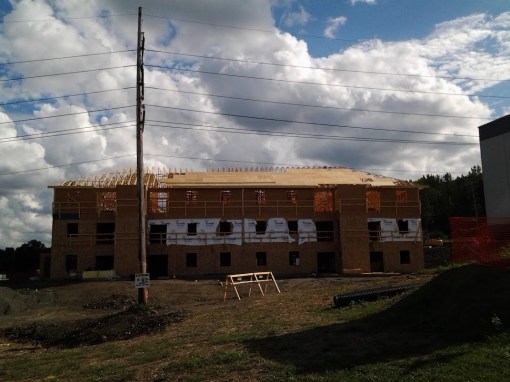
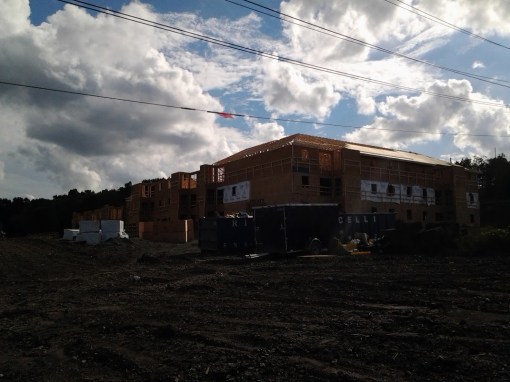
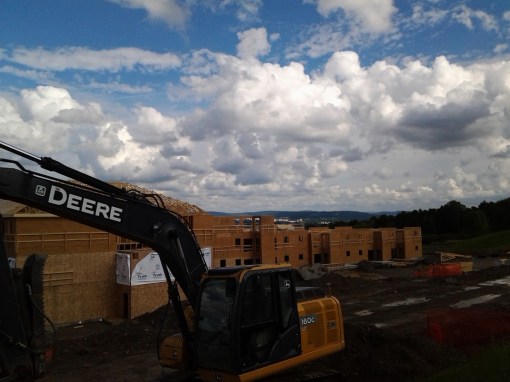
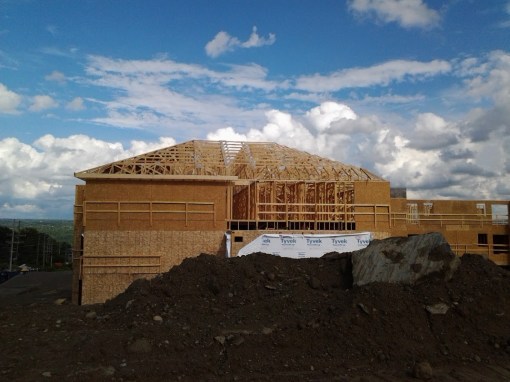
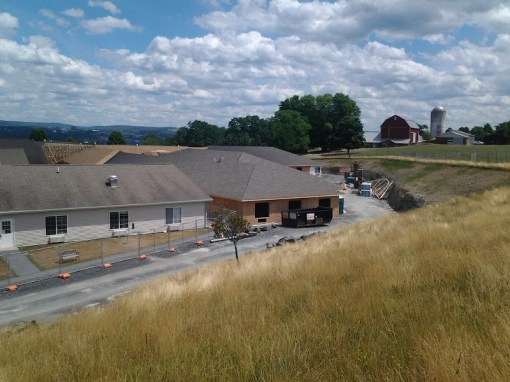
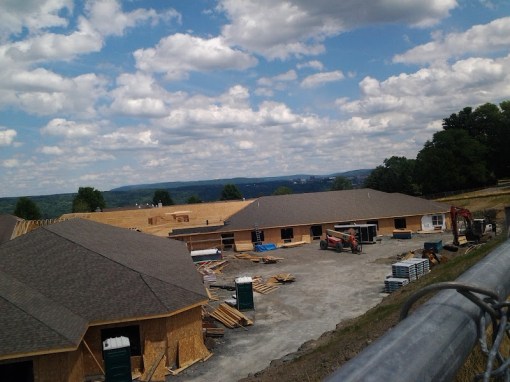
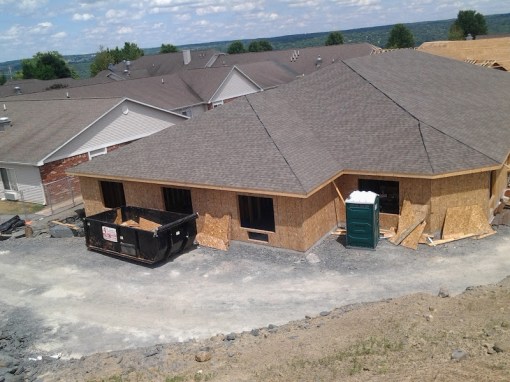
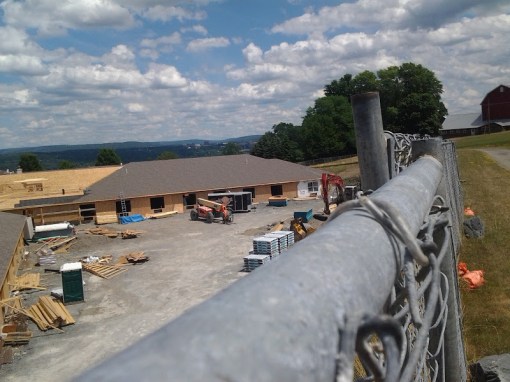
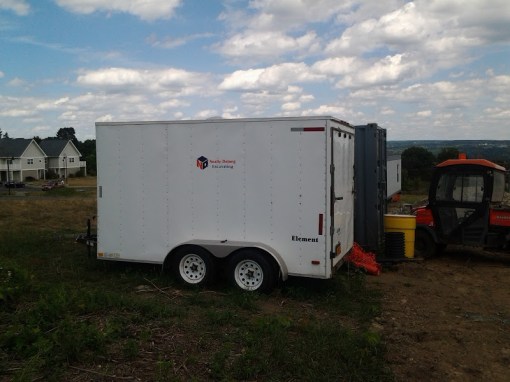
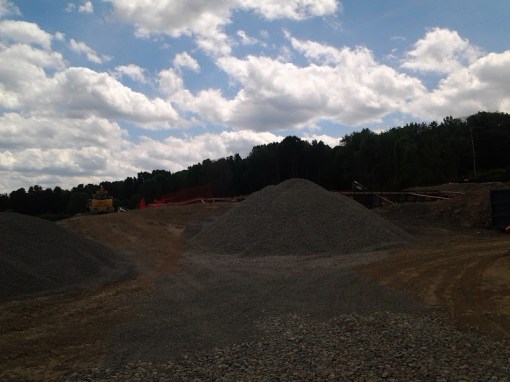
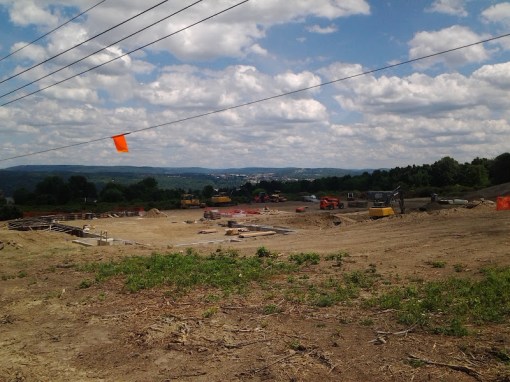
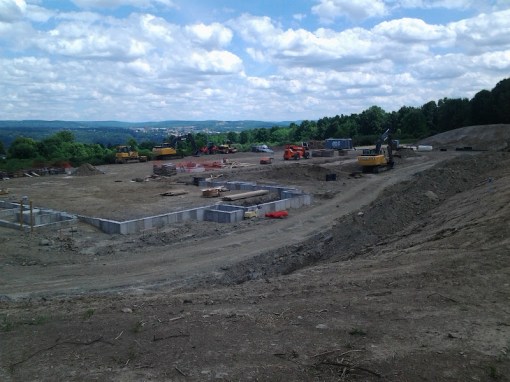
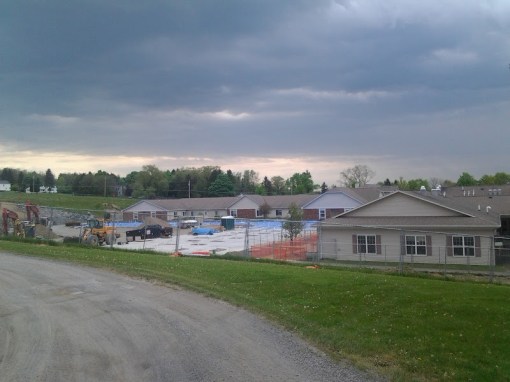
At the Cayuga Meadows site on West Hill, LeChase Construction has fully framed the new 68-unit apartment building. Windows and doors have been fitted into the wood stud walls. The roof looks to be pretty much complete, with the exception of trim pieces.The first floor is getting a brick veneer, and the balconies are built out but are also lacking their trim for the moment. The Tyvek waterproof housewrap will be covered over with Certainteed fiber cement “Savannah Wicker” Dutch Lap Siding and “Cypress Spruce” cedar-like shingle siding. Basically, beige and grey-green. Looks like the new access road has also been paved.

It might not be the most exciting design, but it’s one of Conifer LLC’s tried-and-proven approaches – an L-shaped structure with bumpouts, typically hosting small private balconies. One need only go a couple miles south to Conifer Village at Ithaca to see a similar example, albeit with some different material finishes. While Cayuga Meadows might not be especially unique, it does have its advantages – LeChase, who does nearly all of Conifer’s work through a partnership, has extensive experience with the design, and that familiarity should help with producing a high-quality and on-time product.

20161119_140224 20161119_140252 20161119_140343 20161119_140508 20161119_140529 20161119_140603

Cayuga-Meadows-2 Cayuga-Meadows-Shot


News Tidbits 10/29/16: Envision Small Spaces

29 10 2016

lansingaptsmap600

1. The heated debate over the Park Grove project in the village of Lansing continues. The primary opposition to rezoning continues to be the Jonson family of Ithaca Home (Forest City Realty / IJ Construction), and residents of their Heights of Lansing development at the end of Bomax Drive. Reasons cited include loss in property values, increased traffic, and slowing the completion of their own project.

Pardon the incredulity when hearing about property value concerns in a community with well-documented property appreciation. Furthermore, only two houses have been built in the Heights of Lansing development in the past couple of years. Since the project first launched in 2006, they have sold 17 townhouses and homes, in a development that planned for about 80. They’ve been moving at a snail’s pace for years, and it;s hard nothing to do with the zoning of nearby property. Another angry speaker asked why Lansing has to shoulder the county’s housing burden, but it’s not just Ithaca that has housing issues. In short, while I’m critical of this specific proposal, the zoning change makes sense. The board may consider a zoning change at its November 7th meeting.

holochuck

2. Thanks to the county planning department, we have a little more information about NRP Groups’ revival of the Holochuck Homes project on West Hill. It appears Tompkins is intending to award $300,000 in Community Housing Development Funds to the development team. The CHDF funds go towards affordable housing projects intended for households making 80% of Area Median Income or less (AMI is about $54,000/year, so roughly $43,000/year and less). It looks like 89 of the 106 units in this townhouse proposal will qualify for the funds; most likely the other 17 will be priced in the 80-100% AMI range. Like 210 Hancock and other larger projects, units typically aren’t restricted to one specific income bracket, there tends to be a mix of lower and lower-middle incomes. It also appears that Arbor Housing and Development, an affordable housing developer based out of Corning, will be partnering with NRP Group on the project. Ithaca would be new territory for Arbor Housing, whose next closest site is an apartment building in Odessa in Schuyler County.

tiny_timbers_1

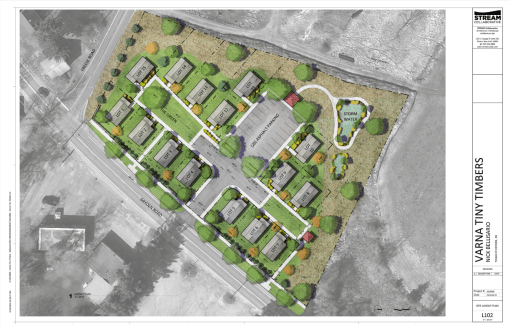
3. Looks like Tiny Timbers is one step closer to reality. The property at 5 Freese Road, once known as “Mt. Varna”, was sold on the 25th by Nick Bellisario to “VTT LLC” for $184,122.59. Presumably, VTT is short for Varna Tiny Timbers. Bellisario and co-owner Otis Phillips had purchased the land for $90k in 2006, and considered a couple different development plans for the site, including a 20-unit modular townhouse project for the site several years back. The land was most recently assessed at $100k. Philips is bowing out of ownership, but county documents show Bellisario and Tiny Timbers creator Buzz Dolph are co-partners in the LLC. The 15-unit Tiny Timbers project will be hosting an open house Saturday the 29th, and may be considered for final approval by the town of Dryden in November.

100_0520

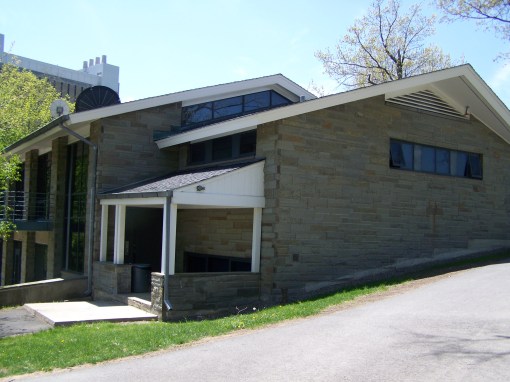
4. Up on Ezra’s former farm, a hefty donation will finance the renovation of Noyes Lodge into a campus welcome center. The family of trustee Marvin Tang ’70 is donating $3 million to partially finance the creation of what will be the Marvin Y. Tang Welcome Center, pending approval by the Board of Trustees. The gift responds to a challenge grant created by mega-donor Atlantic Philanthropies (funded by Charles Feeney ’56), which offered up to $3 million in matching funds to donations towards the new welcome center – so with $6 million secured, the renovation’s financing is secured and will be able to move forward. Cornell has long considered a reception and exhibition space by the gorges, having mulled over but ultimately backing away from a plan penned by architect Richard Meier in the late 1980s. Tang, now retired, was a venture capitalist based in Hong Kong, and the regional chairman of a recruitment firm for business executives.

The Noyes Lodge, a 9,100 SF building that opened in 1958 as a womens’ dining hall, is currently used for language classes and training. Those functions would be moved into newly renovated space in Stimson Hall. JMZ Architects of Glens Falls, a favorite of the SUNY System, will be the design firm in charge of the renovation and re-purposing. The exhibition space will be the work of Poulin and Morris Inc. of New York City. Cornell plans to open the new welcome center by Summer 2018.

village_solars_2

5. There seem to have been some changes to the Village Solars project up in Lansing. According to the newly-uploaded planning board minutes, the site plan has been revised from 174 units to 206 units, but most of that is tied up in unit reconfiguration. Reaching out for specifics, here’s the response from Rocco Lucente the younger:

We have found that the micro unit floor plans are very, very popular and the three bedroom units have been the only units we’ve had any problems with getting rented in a timely manner (like most companies we like to be rented out by the end of Cornell’s season if possible), so we will be modifying the three bedroom floor plans to become micro units and our new junior one bedrooms, which are slightly larger than the micro unit and includes a separate bedroom and living room/kitchen area. The total number of bedrooms goes up very, very slightly and the square footage should remain relatively unchanged.”

The micro units he’s referring to are the units created during phase two, when two larger units were split into smaller units as a sort of testing of the waters – apparently it worked out quite well. It’s worth noting that three-bedroom units had the highest vacancy rate in the Danter study. We’ll see if this creates significant design changes, but one thing’s for certain, it drives up the unit count per building – for instance, Building M, slated to be built in the next phase, has increased from 17 to 24 units.

f5321f76a7c2ce2d9c3d0b069686bdab18e656969cc9b4cce8063cbab0926e8aa52b0bc270ce88ac

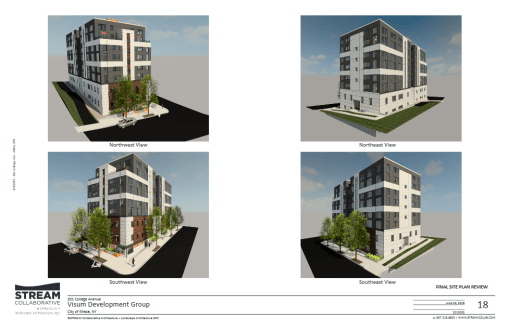
Modern Living Rentals has started advertising units for 201 College Avenue. Business partner Visum is shooting for August 2017, which will be a very quick pace – hopefully William H. Lane Inc., the general contractor, is up to the challenge. With heat included in the rent, a three-bedroom will run anywhere from $3,250-$4,170/month, a two-bedroom for $2,170/month, and a one-bedroom with top-floor patio access will cost $1,670/month,  which puts it pretty close to the high end of the Collegetown market. The “New York City-style loft apartments”, as the ads boast, come with such building amenities as a high-end gym, media lounge, bike room, and high-end security system. Apartment amenities include full furnishings, stainless steel appliances, granite countertops, in-unit dishwasher machines, washer and dryers, 16′ ceilings, and cargo nets. Yes, cargo nets – they extend from the bedroom and over the living room, and are billed as “the perfect place to relax and study”, capable of holding up to five people. I asked architect Noah Demarest about them, and he said the idea came from developer Todd Fox, and that examples can be found on Pinterest.

Meanwhile, Charlie O’Connor’s three-bedroom two-family houses underway on Old Elmira Road will be ready by February, and come in at $2,100/month per unit.


a-place-for-all-of-us

X. For those who might be interested, sign up for the Tompkins County Housing Summit can be found here. Attendance is free, and comes with a meet and greet on the night of Wednesday November 30th at the Greenstar workspace (“The Space”), and a day-long summit on Thursday December 1st (attendees can choose whether to attend one or both). It appears that there’s a wait-list already for the Thursday summit, but the Wednesday night reception still has space for new registrants.


Brookdale Ithaca Crossings Construction Update, 9/2016

25 09 2016

There’s only a few months left in Brookdale Ithaca’s construction timeline, and the new Crossings facility is starting to look a lot like the anticipated final product. In the past few months, the rough openings have been mostly fitted out with windows, and the exterior walls have been sheathed in housewrap and are in the process of being sided. The installation of A/C units is also underway. Most of the roof appears to be done, although in some sections the tar paper has yet to be shingled. Exterior trim panels and details like the decorative shutters will be attached after the roof and primary walls are finished. The excavated hill to the southwest (right side in the images) will be held back with a 10′ retaining wall, yet to be assembled.

Note that these photos are the living spaces and the bulk of the new 23,200 SF, 32-bed facility, but the front entrance is actually a diagonal (northeastward) extension between the two existing facilities and out towards the front circle. You can see a little bit of  the front entrance gable in the second-to-last photo. More details on the project can be found on the blog here and on the Voice here.

20160918_155022 20160918_155049 20160918_155112 20160918_155147 20160918_155202 20160918_155211

clarebridgecrossings_2 clarebridgecrossings_1


Cayuga Meadows Construction Update, 9/2016

22 09 2016

LeChase Construction is making good progress on Conifer LLC’s 68-unit Cayuga Meadows apartment project off of West Hill Drive in the town of Ithaca. The wood frame is topped out on the north side of the L-shaped building, where they’re starting to nail plywood (the decking) to the roof trusses – later they’ll be covered over with tar paper or a similar material, followed by the shingles. It also looks like they’ve started attaching a little Tyvek housewrap to the second floor of the structure. As you go southward, framing is only up to the second floor, with rough openings in the plywood for doors and windows. At the rear of the property, a trench has been dug for a new water main, which is being routed below what will be the building’s parking lot.

The apartment units, which are intended for seniors with limited incomes, are expect to be ready for occupancy next fall. More information about the project can be found here.

20160918_154000 20160918_154027 20160918_154050 20160918_154218 20160918_154325 20160918_154352 20160918_154401 20160918_154405

Cayuga-Meadows-2 Cayuga-Meadows-Shot


Brookdale Ithaca Crossings Construction Update, 7/2016

25 07 2016

Over at the Brookdale site on West Hill, work continues on the new transitional wing for the existing assisted living and specialized memory care facilities. The residential areas of the new wing have been framed out and roofed. Shingles have been attached and plywood has been attached, leaving rough openings for windows, doors and A/C units. Sheathing will follow (you can see a little Tyvek housewrap on the far end), and exterior materials will come along in due course.

The connector to the existing wings is not as far along; some exposed roof trusses can be seen, and some of the roof plywood has been installed but not tar papered and shingled.

The buildout appears to differ from the online plans slightly. The plans show standard rectilinear corners. The new wings have chamfered corners.

The 32-unit, 32-bedroom project is expected to open to new residents in the first quarter of 2017.

20160717_141559 20160717_141624 20160717_141658 20160717_141714 20160717_141722 20160717_141734

clarebridgecrossings_2 clarebridgecrossings_1


Cayuga Meadows Construction Update, 7/2016

18 07 2016

Safe to say this is under construction. Work has commenced on Conifer LLC’s Cayuga Meadows affordable senior housing project on West Hill.

Cayuga Meadows is a 3-story, 58,500 SF apartment building with 68 units, 59 1-bedroom and 9 2-bedroom. The units will be available to individuals aged 55 and older, with incomes 60% or less or the Area Median Income (AMI). AMI in Tompkins County is about $53,000 per household, so a qualifying senior household would have an annual income of $31,800 or less. 7 units will be accessible to mobility-impaired individuals, and 3 units will be designed to accommodate hearing or visually-impaired occupants. Included in the plans are two covered patios, a community garden, and stormwater, lighting and landscaping improvements. 67 parking spaces will be paved behind the building.

The history of Cayuga Meadows goes back a few years, and has its share of twists. Originally, the project had been conceived as “Conifer West Hill” in 2009 as a component to a Cornell-led mixed-use development on about 36 acres of land across from Cayuga Medical Center. Rochester-based Conifer’s part in the plan has always been the same – affordable housing for seniors. But Cornell had other plans for the rest of the acreage.

In Spring 2010, there were three different site plans being floated – the consistent components were Conifer’s project, a 68-bed assisted living facility called “Terrace at Ithaca”, medical office space, small-scale retail, 106 park-and-ride spaces, and 4,000 SF for a farmer’s market. Depending on the plan, there were townhomes, a hotel school conference center, or other institutional space for Cornell. Mixed-use, definitely, but the plans weren’t that walkable, traditional neighborhood feel that the town is looking for these days – in fact, they were fairly conventional suburban sprawl. Cornell’s approach to planning was different in the late 2000s. By good fortune, Ithaca Builds locally hosted a copy of those site plans here.

For a combination of reasons (financial feasibility, changing priorities), Cornell ended up shelving its plans. However, it would be incorrect to say the university isn’t still interested in the site – they recently bought the house at 1250 Trumansburg Road, whose property had been awkwardly carved out of the rest of the site in a subdivision long ago. In the 2010 plans, Cornell had to plan around the house, not to mention worry about the occupants complaining about Cornell’s plans. So when it came on the market and sat for a couple months, the Big Red decided to pick it up in June for $157,000, probably on the belief that it could pay off through easier site planning and development down the line.

While Cornell filed away their plans, Conifer continued with theirs since the university was still willing to give them land as long as they built affordable housing. Originally, it was conceived as 72 units when it first received preliminary approval in April 2012, but was trimmed to 68 when final approval was granted in November 2013, in order to make the project a little less expensive, and provide a little more space to the community garden. Between preliminary and final approval, Conifer also had to apply for rezoning (Medium-Density Residential to Multiple Residence in May 2012), zoning variances (June 2012, for height and building setbacks), and public works approval for utilities services to be installed.

Then came another few years’ wait while financing was being secured. As covered on the Voice, affordable housing grants are very competitive, so it often takes multiple rounds of applications before a project is finally given grant money. In Conifer’s case, the last piece of the puzzle, tax-exempt bonds, didn’t come through until late January 2016. Cayuga Meadows is a $14.9 million project – about $8.3 million comes from NYS Housing Finance Agency bonds, and another $6.3 million from Community Development Block Grant (CDBG) funds. First Niagara Bank provided the Letter of Credit for the bonds. The project will pay taxes.

With the funding in hand, Cornell and Conifer formally agreed to a subdivision of Cornell’s land – 4.9 acres for the senior housing, and another acre for the Right-Of-Way for the new road. Cornell and Conifer had to agree on a few choices for new road names, which they submitted to Ithaca’s Codes Enforcement Director (Bruce Bates), who checks with the county to make sure there are no issues with the choices, and then the three parties agree on a final selection. Cayuga Meadows’ address will be “108 Aster Lane”.

There’s yet to be a color render hosted online, but the exterior will use fiber cement siding – Certainteed “Savannah Wicker” Dutch Lap Siding and “Cypress Spruce” cedar-like shingle siding. For the sake of examples, the Belle Sherman Cottages and Stone Quarry Apartments have also used Savannah Wicker fiber cement. The roof will be Timberline “Weathered Wood” shingles.

At the project site right now, work is underway on the foundation. The building’s footprint has been cleared, the foundation is excavated, and footers are poured for where the concrete will transfer the weight into the ground. Wooden forms are built along the perimeter for the stem walls, rebar is laid for reinforcement of the concrete, and the concrete is poured and left to harden (cured). Once the concrete has had a chance to harden, the forms are lifted off and work moves onto the next section. The building will be a slab-on-grade foundation, so no worries about excavating a basement here.

As a side note, it seems fitting that the residents with east-facing windows will have some pretty fantastic views of Cornell.

Through a joint venture with Conifer, LeChase Construction of Rochester will be serving as general contractor. The excavating has been subcontracted out to Neally-DeJong Excavating of Corning, and concrete work to Architectural Concrete Plus of Dundee (Yates County, northwest of Watkins Glen). Thanks to “Drill Deep” for the clarification.

20160717_140406 20160717_140444 20160717_140449 20160717_140528 20160717_140557 20160717_140612 20160717_140804 20160717_140815 20160717_140828

Cayuga-Meadows-Shot

Cayuga-Meadows-2


News Tidbits 7/2/16: Not the (City Centre) of Attention

2 07 2016

201_college_v5_1
1. Let’s start this off with the big news of the week – the proposal for 201 College Avenue was approved by the Planning Board. The debate was spirited, to put it most politely; catty, to use the official write-up in the Voice; and in the follow-up phone call I had with my editor, who attended the meeting with a Voice summer intern, she described it by saying “both sides were pretty awful”. I am sympathetic to Neil’s predicament, although I think it’s also a fairly unique case; I hope some sort of arrangement with the solar panels is worked out.

The observations regarding age and view of the project is actually pretty similar to a conversation the Journal’s Nick Reynolds and I had on Twitter about the City Centre project – older Ithacans often have starkly different views on density and urban development than younger residents, who tend to be more pro-density and pro-urban infill/growth. The young aren’t naive and more so than the old are obsolete; but they are products of different times. Today’s older Ithacans are the same ones who were frowned upon by the old Ithacans of their youth (the Silent Generation and the Greatest Generation), who were much more politically conservative and made up the large majority of the city’s Republicans from when Ithaca was once a contested city, and the Boomers were moving in and tilting it leftward. A sociologist could probably make a good research paper studying Ithaca’s generational views of urban environments.

Anyway, construction on this project is supposed to start in short order; funding has already been secured, and Binghamton-based W. H. Lane Inc. will be the general contractor for the $6 million project.

trebloc-future
2. Meanwhile, City Centre’s sketch plan was also reviewed at the Planning Board meeting. The initial reaction seems muted, gauging from Nick Reynolds’ Twitter and the lack of comment from my Voice colleagues.

city_centre_1

city_centre_2


According to the sketch plan submission, the vast majority of units (240 of the 255) will be studios (120) ranging from 457-563 SF, and one-bedrooms (120) ranging from 580-754 SF. The other 15 will be two-bedroom units, eight 914 SF units and seven 1,370 SF units. All units are market-rate, with target demographics including young professionals and downsizing empty nesters. Students are allowed, though the units won’t be marketed to them. Ground floor retail will be 10,700 SF at the corner of State and Aurora. 7,220 SF fronting State Street will be “Leasing/Club Space” for building and tenant functions. The 71-space parking garage will be accessed via East Green Street, car share membership will be included in the rent, and there will be indoor bike racks.

With the mild initial reaction noted, we’ll see how the project details shape up as the summer progresses, and the board potentially launches formal project review (Declaration of Lead Agency) as soon as late July.


3. Hitting the market this week is a potential opportunity for the deep-pocketed investor/developer. The property is 2248 North Triphammer Road in the village of Lansing. The sale consists of two parcels totaling 3.42 acres – a 1.53 acre parcel with a 2,728 SF M&T Bank branch built in 1992 and holding a long-term triple-net (NNN) lease; the other, an undeveloped 1.89 acre parcel to the rear that the listing notes could be developed out into 13 housing units. The price for the pair is $2,125,000.

A triple-net lease means the tenant pays everything – insurance, maintenance and real estate taxes (formally, net insurance, net maitenance and net real estate taxes on the leased asset – the three nets).  Because of this, the rent is substantially lower than it otherwise might be. There are certain cases where a landowner might want to do triple-net – like when they’re a tax-exempt entity leasing out to a for-profit company. A quick check of the records shows the properties are owned by Cornell, and were acquired in 1953 and 1960. What the property has been to Cornell is a fairly safe investment (though with a lot of fine print to determine who pays for things like if a tornado hits or the foundation cracks), generating a modest amount of rent and functioning like an inflation-protected bond, but guaranteed by the lessee rather than the government. All the better when the tenant is stable and signed on for the long-term, as is the case here.

The county has the bank parcel assessed at $635,000, the undeveloped parcel at $140,000.  Lansing village zoning has Commercial High Traffic for the bank property, and High Density Residential for the vacant parcel. HDR zoning requires 6,000 SF of land per dwelling unit in a 35′ tall multi-unit building, and 1.89 acres = 82,215 SF, so that’s where the 13 units comes from. For comparison’s sake, single family is 12,000 SF, and duplexes 15,000 SF (or, doing the math, one could in theory carve out six home lots, or 5 duplex lots for 10 units, though with lot setbacks, the property’s triangular shape probably lowers those figures).

4. On the other end of the sales process, the former Maine’s supermarket has been sold. The six year-old, 26,146 SF building at 100 Commercial Avenue in the city of Ithaca was purchased for $4,150,000 on Thursday the 30th, by Illinois-based Agracel Inc., well above its $3.1 million assessment. Agracel is an industrial space and warehouse developer, fitting for a property once described as a “food and party warehouse”. The former Maine’s appears to be a little on the small side compared to the rest of their portfolio, but there is the possibility of expansion, or even a teardown and rebuild if they really felt the need.

Readers may recall that Maine’s closed its Ithaca store in February, which along with a closing in suburban Rochester reduced its stores from six to four.

20160701_095549

20160701_095552
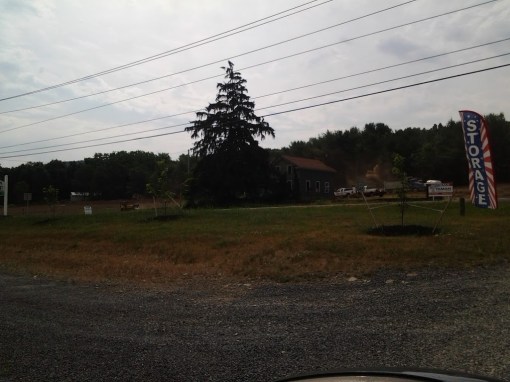
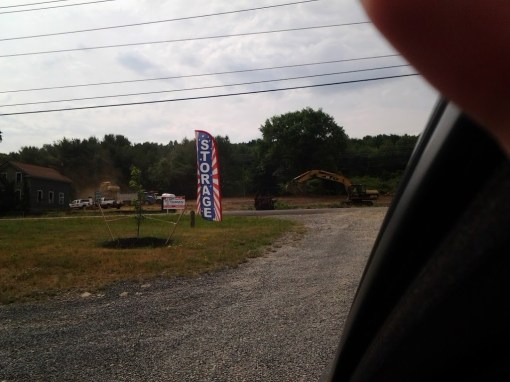
5. Work on the new Storage Squad facility has begun on the 1400 Block of Dryden Road east of Varna. Right now, the focus is on site clearing; the house was used by local fire departments for training exercises, and will come down in a controlled burn later this summer. The 79,000 SF storage facility should be ready for use by February 2017. One full time and a few part-time jobs will be created.

And for the record, I think that’s my middle finger.

6. So this is curious. The city recently uploaded a couple of older documents detailing development plans off of Floral Avenue on the southern tip of Ithaca’s West Hill neighborhood.

The first dates from Febraury 1992, and is a filing to create a 27-lot cluster subdivision on 4.15 acres at 452 Floral Avenue. The paperwork indicates that the intent was affordable housing, by a company named House Craft Builders. The city’s then-Planning Director, H. Matthys Van Cort, wrote a recommendation for negative declaration of environmental significance, and the project was approved in June 1992, but it never moved forward, and 452 remains vacant land today. It appears House Craft was dissolved in 2012; the officer was an architect for Ecovillage who has since retired and moved out of state.

The second is a subdivision requested by INHS in 1987. The filing requested 236 Floral Road be split into two parcels, with the intent of renovating a decrepit 236 into a for-sale affordable single-family home, and build a new house on 224. This was approved, and eventually, 236 was renovated and transferred to its owner in 1996, and 224 was built in 1994.

Now, as interesting as this all is, the city doesn’t upload decades-old subdivision files just to amuse nerds. The $64,000 question is, why were they uploaded now?


News Tidbits 6/4/16: A Stormy Summer Start

4 06 2016

201_college_v3_1
1. We’ll start this week off with a follow-up on the 201 College Avenue debate. All discussions of planning philosophy noted, one solid request, as reported by Josh Brokaw at the Ithaca Times, was to try and reduce the bulk from the College Avenue side, if not necessarily the building footprint. The above drawing was submitted by STREAM Collaborative’s Rob Morache earlier this week, with a cover letter describing the changes here. The modification reduces the building by 2 bedrooms, to 74, which to go by Todd Fox’s comment in the Times article, puts the project at the borderline of financial feasibility. The middle still pops out a little because that’s where the fire stairs are located. Some minor details were changed with the accent panels, and recessing the windows slightly on the south and west facades. For the record, the panels are Nichiha and Allura fiber cement, with painted metalwork and fiberglass window sashes.

Although now outdated, a shadow study for the previous design has since been uploaded by the city. There are two versions, with and without neighboring building shadows, here and here respectively.

Expect further detail refinements; the building is set to go in front of the Design Review Committee Tuesday morning.

20160414_120418

2. WSKG did a segment earlier this week on micro-apartments, with an interview with Frost Travis and the Carey Building project wrapping up on East State Street. A few details worth noting from the segment – 5 of the 20 rental units (which range from $1,225/month for the microunits to $2,699/month for a high-end penthouse 2-bedroom) are already spoken for and the building’s not even finished yet. For some reason, Monica Sandreczki says there will be about 35 residents at full occupancy, which is a big stretch since there are 16 micro-units and 4 two-bedroom units – going one person per micro-unit and bedroom, a better estimate would be 24.

The news piece also notes that the 201 College project contains micro-apartments – which is true, given that the building is 44 units and 74 bedrooms, and at least the early plans had a number of split-level 410-670 SF studio units.

401_lake

3. And 401 Lake Street will bite the dust. The Common Council voted 8-1 last Wednesday night to have structure demolished and the tax-foreclosed properties be designated as parkland. Cynthia Brock (D-1st) voted against the measure and preferred a sale for tax reasons, and her ward counterpart George McGonigal (D-1st) argued that the city was destroying historic working-class housing, though he ultimately supported the measure. Brock did take a whack at new affordable housing in the city, commenting that INHS is getting $75,000 for each townhouse, and Habitat for Humanity getting $75,000 for a duplex even with its volunteer labor, when there was a potential, cost-efficient opportunity for affordable housing designation with this unit. Josephine Martell (D-5th) seemed to be the strongest proponent for demo, stating that the unique potential to enhance the Ithaca Falls Natural Area should be taken every opportunity of. The city bought the tax-foreclosed property from the county; the background on that is on the Voice here.

The funds for the demolition, estimated at $25,000, will come from the sale of IURA land to the Hilton Canopy project. That measure was approved 6-3, with Brock, McGonigal and Graham Kerslick (D-4th) opposed. With work on the Lake Street Bridge currently underway, demolition is not expected for at least a few months.

There was a thought exercise regarding the selling the falls’ parking lot to INHS for development of 3-9 units of affordable housing; it’s an interesting idea, since 401 and the adjacent are right next to the Falls, but the 0.55 acres of city property adjacent to the Lake and Lincoln Streets intersection is still over 200 feet away at its closest point.

4. The rare bit of news out of Enfield. A $612,000 building loan was issued by the Bank of Greene County to provide funds for renovating and expanding the volunteer fire station at 172 Enfield Main Road.

Give that Enfield issues no more than a handful of new construction permits each year, it’s about the only other thing going on apart from the Black Oak Wind Farm debate. One would think that arguments like “the wind does not blow as much as it used to” would be easily shot down and things would move forward, but instead it’s Marguerite Wells, the project manager for BOWF, getting raked over the coals. I don’t have a dog in this fight, but I do feel bad for her.

5. In case anyone was wondering – county planner Megan McDonald says the Denter housing study will be publicly available by late July.

arpt_pk_1

6. Here’s something intriguing from the county’s Facilities and Infrastructure Committee agenda – a proposal to “Prepare airport land for future development“, seeking $500,000. None of the money comes from the county; it appears to be dependent on grants, or an interested developer. Which, given the fact that this shows up in budget docs going back to 2014, doesn’t exactly seem to be generating many queries.

The parcels are described as the “Cherry Road and Agway parcels”, which must be owned by the county since they want to lease out the land – but checking the deed records of parcels adjacent to the airport, there’s no record of an Agway in any of the deed histories. The parcels may be related to the properties in the airport business park feasibility study, shown above and awarded to the team of Clark Patterson Lee and Camoin Associates this past winter.

7. It’s unusual to see Cornell buying property these days, but this Friday, the university purchased the house at 1250 Trumansburg Road on Ithaca’s West Hill for $157,000. The house is a 19th century fixer-upper on 1.21 acres – Cornell owns the land surrounding it, some of which is being subdivided off to build the Cayuga Meadows affordable senior housing project. The house is assessed at $215,000, but the real estate listing notes it needs some work, and it’s been off and on the market for five years.

Several years ago, Cornell expressed intent to develop the 35 acres it owns into a mixed-use complex with a hotel institute, housing, offices and medical services, but the only part of the plan that ever really moved forward was Conifer’s project. I haven’t seen the plans in years, but I remember the early plans (there were a couple versions) were very sprawly; six, eight years ago, walkability was not as valued as it is now.

By buying the house, Cornell reduces its need to work around a neighbor and can incorporate the property into potential plans. This purchase would seem to suggest that Cornell still has strong interest in developing the rest of the West Hill property at some point. In the meanwhile, Cornell might rent it out while the school figures out what it wants to do with the acreage.

20160522_151346 20160522_151417

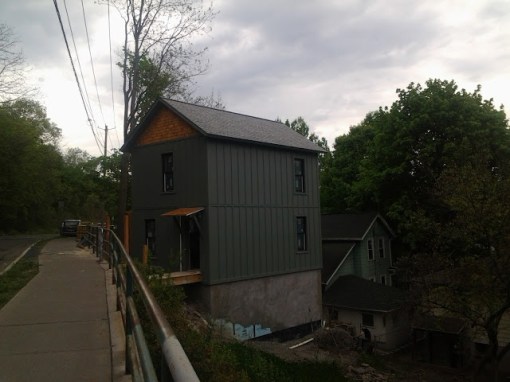
8. House of the week. From the outside, 228 West Spencer Street is almost done, and the interior is fairly far along as well, with finishing work underway. Architect Noah Demarest says the house will be put up for sale in a few weeks, if everything goes as planned.


Brookdale Ithaca Crossings Construction Update, 5/2016

30 05 2016

As the population ages, so do the need for specialized care facilities. Work continues on the the Brookdale Ithaca Crossings project on West Hill.

Plans call for a 23,200 SF, 1-story building with 32 bedrooms (32 beds total). Along with the new building, there will be updates to parking, landscaping stormwater facilities, and the addition of a couple of courtyards between the buildings. The project was first proposed in late 2014, and approved last July.

The facility is designed to complement Brookdale’s two other Ithaca facilities, which are adjacent to the project site – The first, a 46-unit facility to the north of the project site, is Brookdale Ithaca Assisted Living (formerly Sterling House), which serves as enhanced assisted living for seniors. The second, a 32-unit facility to the easy of the project site, is Brookdale Ithaca Memory Care (formerly Clare Bridge), which serves as assisted living for those with specific memory care needs, individuals suffering from advanced cases of Alzheimer’s Disease and dementia. Both of the older facilities opened in 1999. The current project was initially called “Clare Bridge Crossings”, but it was later renamed to Brookdale Ithaca Crossings.

For more information about memory care and a few more details about offerings, I wrote an article for the Voice here.

Nursing home and assisted living facilities have to demonstrate to the state that their is a local need for a project, and the “certificate of need” is only issued at the end of a project, after it’s been built and the state has concluded its inspection. According to Brookdale representatives, there’s no indication that the certificiate of need will not be issued.

Construction is expected to last around 14 months, which would give an estimate of Q1 2017 for completion. The architect is PDC Midwest, a Wisconsin firm that specializes in memory care facilities.

Looking at the site, the foundation has been excavated and footings have been poured, and it looks like the foundation slab is already in for the south wing. The blue material might be some kind of vapor barrier film to help protect against moisture.

20160522_160747 20160522_160812 20160522_160823 20160522_165738

clarebridgecrossings_1 clarebridgecrossings_2


News Tidbits 4/9/16: A Slippery Situation

9 04 2016

maplewood_site_plan_concept

maplewood_site_plan_concept_v2

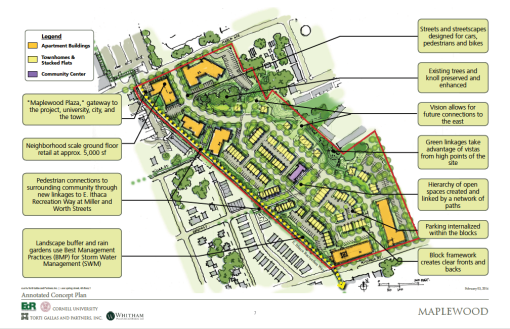
1. The town of Ithaca had their first substantive meeting about Cornell’s Maplewood Park Redevelopment, and later this month, the city of Ithaca will have their take on the 4.5% that sits within their boundaries (picture a line up Vine Street – that’s the city line). According to documents filed with the city, approvals from them will only be needed for one building. Application/SPR here, cover memo from Whitham Planning and Design here, Part I of the Full Environmental Assessment Form here, and narrative/drawings here.

From the SPR, the schedule as already been shifted slightly to an August 2018 completion rather than July – they also threw out a $3.67 million construction cost that doesn’t make much sense offhand. Edit: It looks like it’s just a basic estimate of 4.5% of the total project cost of $80 million.

The biggest change so far is a revision of the site plan. In response to community meetings, Cornell shifted smaller 2-3 story stacked flats and townhouses closer to the Belle Sherman Cottages, pulled back a couple of the larger apartment buildings, and added a new large apartment building to the southeast flank. Cornell has its goal of housing at least 850 in the redevelopment, so all design decisions revolve around accommodating those students with their families, while coming up with a design the community can live with.

The city will vote at its April meeting to defer Lead Agency to the Town of Ithaca, which will leave them with the ability to provide input, but the town board will be the ones voting on it.

2. It’s not often that a project gets undone by a single public commenter at a meeting. But the Journal’s Nick Reynolds got to experience such a momentous occasion at the town of Ithaca’s planning board meeting. He documents it on his Twitter account.

Someone that I didn’t cover because it wasn’t especially news-worthy is Cornell’s plan to replace the Peterson Parking Lot at the intersection of Tower and Judd Falls Roads with a cutting-edge 100% porous paved lot and a Cornell-created soil designed to promote rapid growth of trees in high traffic areas (a new island would be built in the middle of the lot). Basically, an eco-friendly, less-invasive parking lot, if there ever could be a thing.

Then Bruce Brittain, the Forest Home community historian, completely undid the plan with a contour map. Generations ago, the property was filled with debris and garbage, even old construction trucks. And while there may be a parking lot on it now, a porous lot, which would be heavier when watered, is liable to collapse right onto the Plantations below. Meaning, no porous lot, no green showcase. Back to the drawing board Cornell.

201_college_1

201_college_v2_1

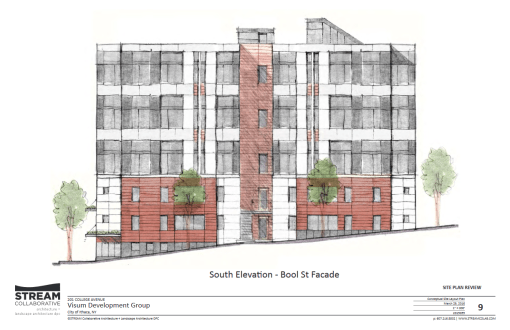
3. Here’s a little more information on the 5-story, 44-unit/76-bedroom apartment proposal for 201 College Avenue. SPR Application here, FEAF here, project narrative here, BZA worksheet here, drawings here , letter of discontent from Neil Golder here. Looking at the drawings, there have been some slight revisions, mostly with the College Avenue entrance and the materials and fenestration at street level. The SPR gives us a $6 million construction cost, and a proposed construction time frame of July 2016 – August 2017. Units will be a mix of 1 to 4 bedrooms (24 1-BD, 12 2-BD, 4 3-BD, 4 4-BD). While the project falls into the Collegetown Form District, an area variance will be required for a front yard setback from College Avenue, which the board feels will help the street be more like a boulevard.

The city planning board is expected to Declare itself Lead Agency for environmental review at the April meeting. Developer Todd Fox hopes to have approval by the end of the June meeting. STREAM Collaborative is the project architect.
902_dryden_final

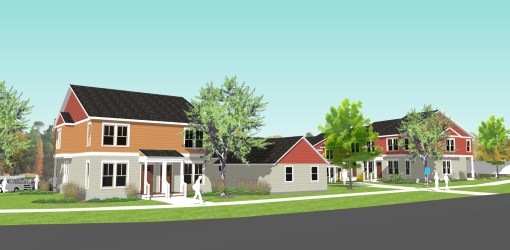
4. This week’s eye candy comes courtesy of Noah Demarest and Todd Fox (yes, they seem to be getting a lot of mentions this week). It had occurred to me that while an image of the revised 902 Dryden townhouses had been presented at the meeting where it was approved, the town never uploaded the copy. Noah and Todd were kind enough to send me a copy of the image presented at the meeting, and gave their permission to share it here. 8 new units, 26 new bedrooms. The duplex building in the middle already exists, but two new units will be built opposite a shared wall. Two three-unit clusters will be built on the east side of the parcel.

Cayuga-Meadows-Shot

5. It’s official as of March 28th. Construction permits have been issued for Conifer LLC’s 68-unit Cayuga Meadows project on West Hill in the town of Ithaca. Expect the first construction update, and a synopsis, when the first construction update comes around, which won’t be until mid-to-late May since West Hill projects get visits during odd-numbered months.

6. Just a couple minor city subdivisions to pass along. One, an application in outer Collegetown at 513-15 Dryden Road to separate the land into two parcels (513 and 515). The lot owner will then build himself a new house on the vacant lot. CR-1 Collegetown Form District, and it looks like no variances will be needed.

The other subdivision is on the city’s portion of West Hill. The property is a vacant lot that borders Westwood Knoll, Taylor Place and Campbell Avenue. The property owners, who live next door on Westwood, want to divide the vacant lot into two vacant lots to sell for single-family home construction. Once again, it looks like no zoning variances will be needed, just regulatory PB approval.

With the consolidation and realignment of 312-314 Spencer Road mentioned last week, this makes three subdivisions scheduled this month. That’s pretty unusual, as the city typically sees only one every 2 or 3 months on average.

7. Looks like someone made a tidy profit. Local landlord Ed Cope picked up 310 and 312 E. Buffalo Street for $885,000 on the 6th. 310 E. Buffalo is a 6-unit apartment building, 312 is a parking lot. The previous owner, a Philadelphia-based company, picked up the properties for $800,000 back in October 2014. So, $85,000 (+10.6%) for 18 months of ownership. The properties are part of the East Hill Historic District, where the Philly-based firm recently had a hell of an experience because the owners before them replaced the windows without notifying the city, and that was a big no-no as far as historic districts and the ILPC are concerned. They mandated the windows all be replaced with more historically-appropriate fittings. Hopefully that came up during the sales negotiations.

For what it’s worth, the parking lot is zoned R-3a – a 4 story building with 35% lot coverage. Since it’s in a historic district, a hypothetical proposal would likely look a lot like its neighbors.
11-24-2012 171

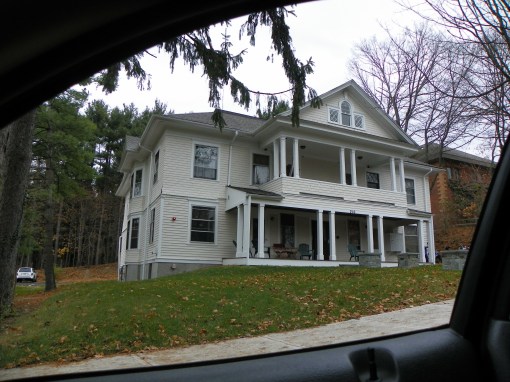
8. And another big sale this week, on Friday – the house at 210 Thurston sold for $2.5 million to the Alpha Chi Omega sorority. The house had been on the market since last November for $2.75 million. This actually sold relatively quick, given its large size and fairly unique nature. The seller purchased the property for $677,500 in December 2011, and renovated the property for use by the Cornell wrestling team.
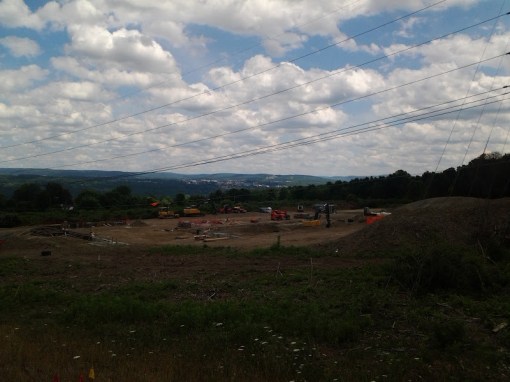
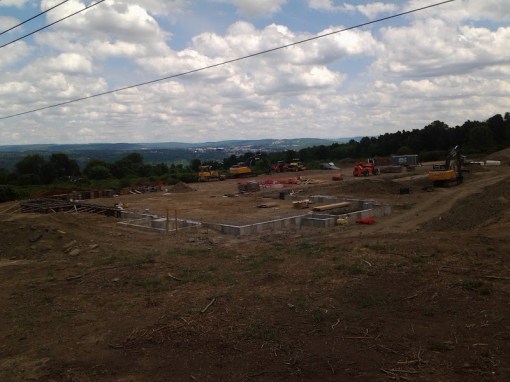
Alpha Chi Omega has occupied the house at 509 Wyckoff Road for a number of years, but did not own the property – the owner, who picked up the property in 1971, is a business partner of Kimball Real Estate.