News Tidbits 8/22/15: Throwing Fuel on the Fire

22 08 2015

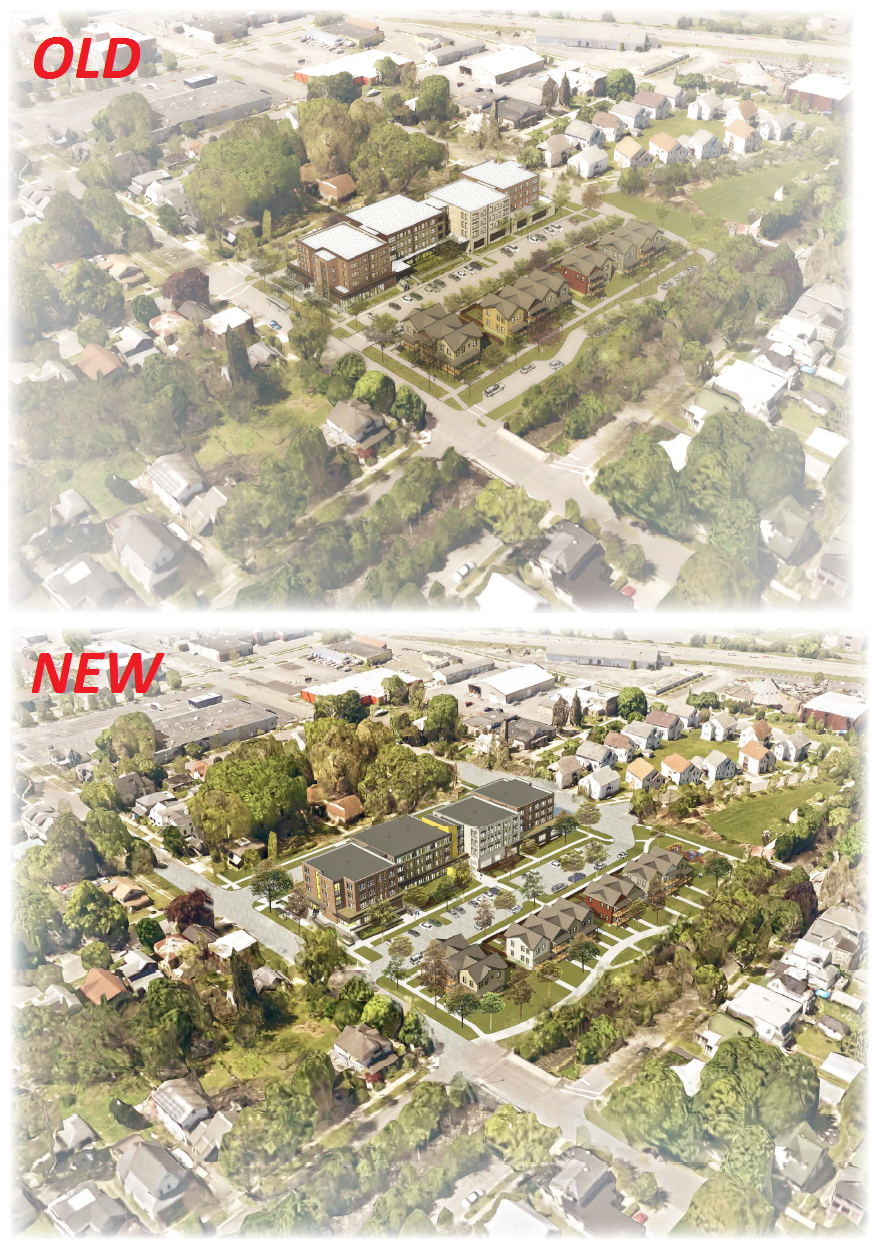
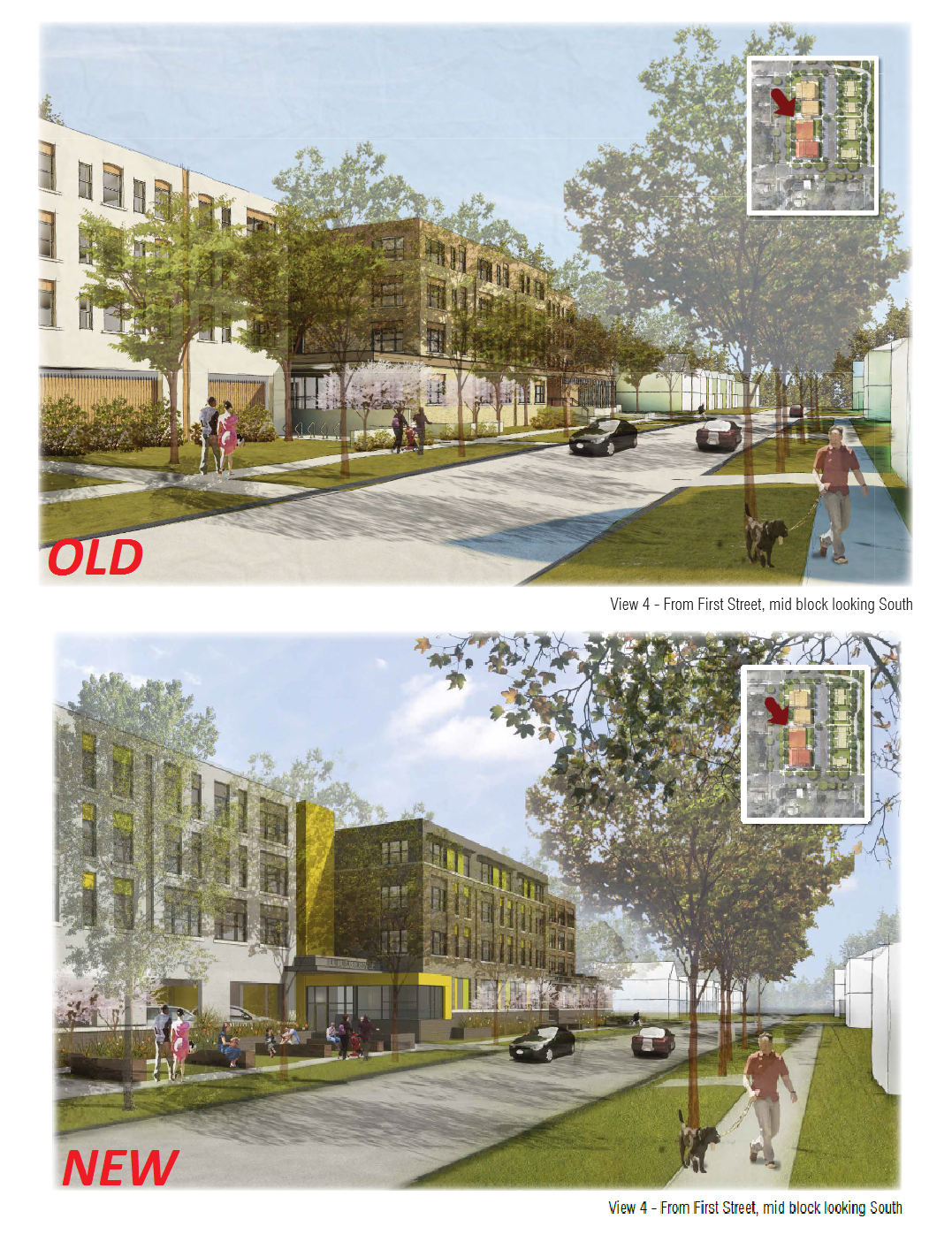
state_st_triangle_v3_1

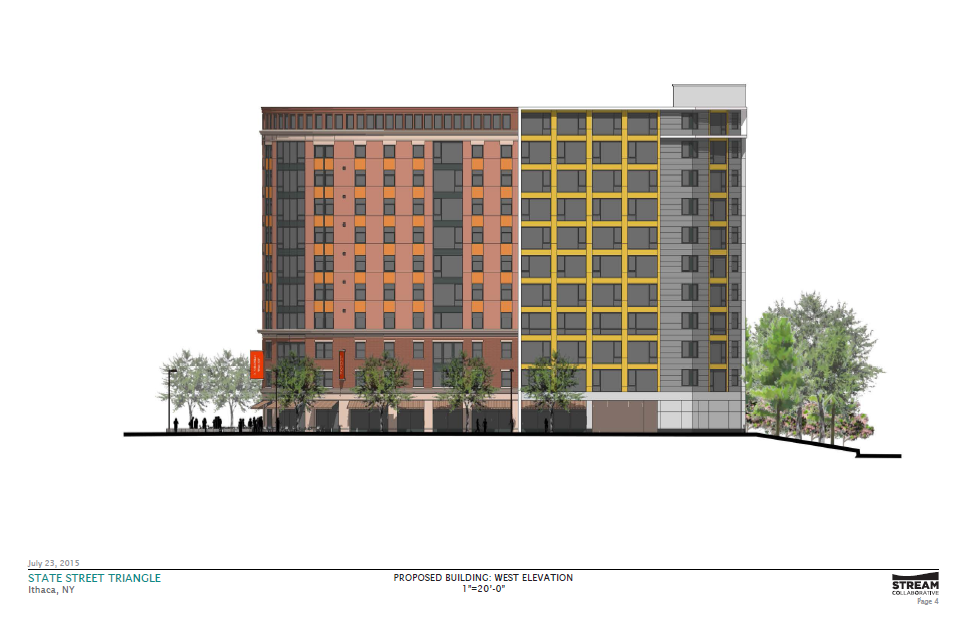
1. Campus Advantage has released revised parking numbers for its 11-story State Street Triangle project. According to newly-released documents here, parking will be handled with a “four-point program”:

I. The primary component is that CA is negotiating a deal for 250 parking spaces in the upper levels of the Cayuga Street garage. The document notes an average surplus of 300 parking spaces per day.

II. The city is willing to let CA reserve up to 100 parking spaces in the Seneca Street garage.

III. CA has identified 75 underused spaces in the Green Street garage, but no formal deal is planned yet.

IV. Surface parking lots near Cornell and in other parts of the city that could handle parking for those who only need vehicles on weekends or for holiday trips.

Given typical student vehicle ownership rates of about 27% (27% of 620 = 167 spaces), point I will probably be enough to handle resident traffic. Commercial traffic, estimated to be about 64 spaces in the SRF Associates traffic study, would more likely be taken care of by point II or III. So the parking situation appears to be better thought out at this point. CA is also planning a bike share and an Ithaca carshare location. Whether it’s enough to please city staff, we’ll see.

The revised document notes construction traffic would enter the site from E. Green Street, and exit via Seneca Way and East Seneca Street.

Regardless, some of the reactions from city officials have been quite strong – the following quote comes from a report from 3rd Ward councilwoman Ellen McCollister from last month’s IURA meeting:
“Common Council may end up concluding it made a mistake when it re-zoned that part of the city without examining the issue more contextually and architecturally.”
State Street Triangle will be undergoing a public hearing at Tuesday’s city Planning Board meeting, and the committee will be going over the project’s City Environmental Quality Review forms. CEQR is the city’s more stringent version of SEQR, and is used to assess project impacts – basically, mitigating the issues created by the project, and making sure it’s a net positive for the community. No voting is expected.
State Street Triangle has also applied for CIITAP tax abatements, but the IDA meeting has yet to be scheduled.
100_1466

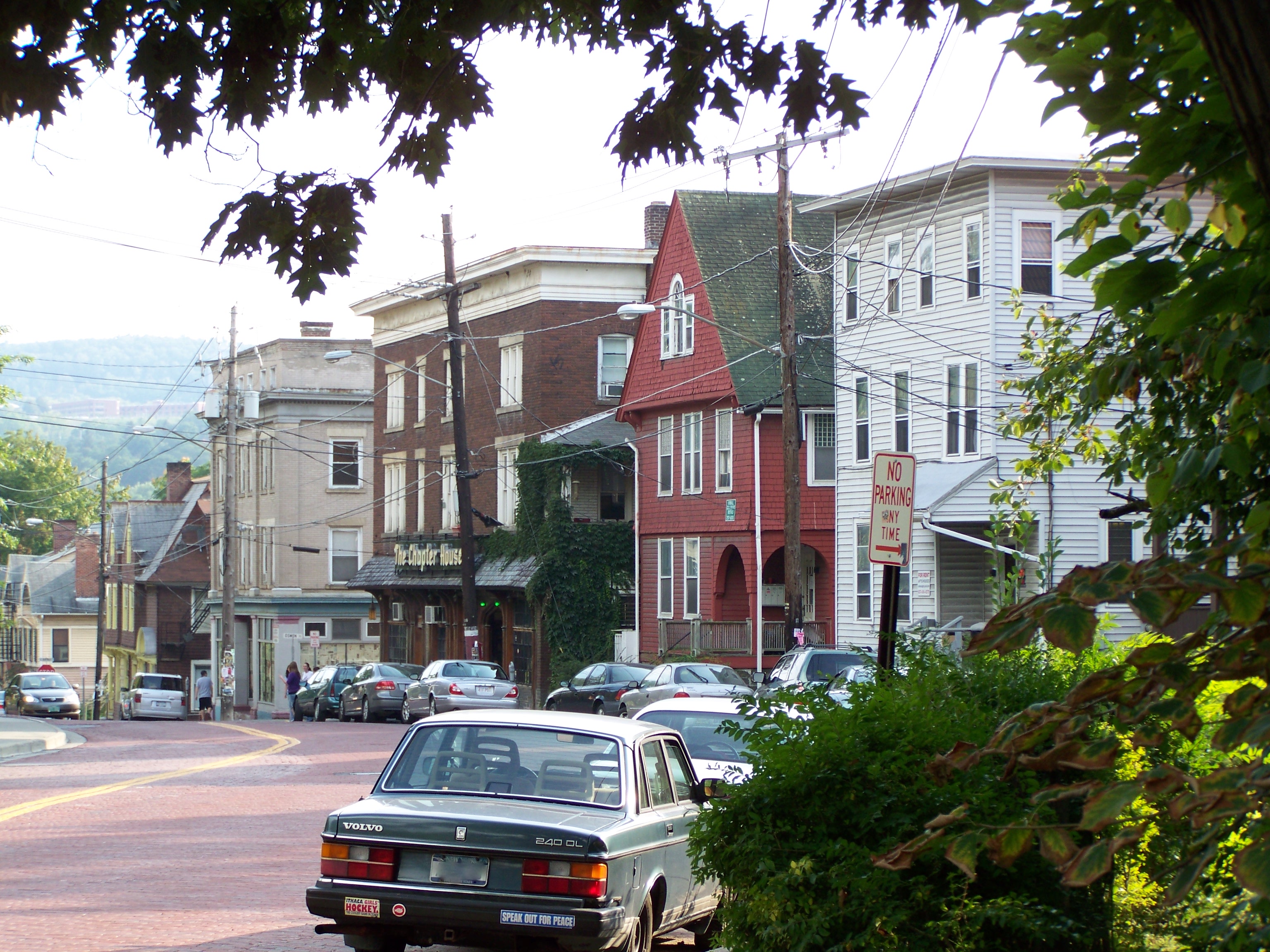
2. Quick update on 406/408 Stewart – a copy of the Ithaca Landmarks Preservation Council (ILPC) from last month indicates that council members are across the spectrum when it comes to 408 Stewart (bluish-white building above) still being historic, and if a new apartment building will be built on just the site of 406 Stewart (red building, destroyed by the Chapter House fire), or on the site of both 406 and 408. Members had to stress to themselves to look at historic value and reconstruction separately, and the purpose of the site visit was to help figure out a decision. There’s been no news yet, but we’ll see what happens.

3. Over in the village of Groton, a small development project is stirring debate of its own.

The project, proposed by Rick Uhl of Genoa, calls for four duplexes and four single-family homes, for twelve units total. The temptation is there to approach this with urban condescension, but for Groton, population 2,400, it’s a big deal.

The homes would be built on several already-subdivided lots on a new road coming off of Elm Street on the eastern boundary of the village. The original plan called for duplexes on the west side of the street and closer to the village center, while single-family homes would be built on the lots on the east side of the street.

The debate lies with proposed zoning changes in Groton – a zoning change currently being considered by the village would downzone parts of the town to single-family homes only. That includes the lots the duplexes are slated for.

The zoning has been a source of debate among homeowners in Groton, because a number of them own larger homes that they’ve turned into duplexes, living in one unit and renting out the other. Although the law grandfathers in current buildings, they worry it could be a hassle in the future. The county’s planning department has also expressed issues with the plan, saying that it creates numerous non-conforming lots and that it goes against the county’s comprehensive plan.

A compromise had been reached between the developer and planning board last spring, where duplexes would be built on the new street’s east side and single-family homes on the west side (so as to keep apartment dwellers from mixing with family homes), but more recently the village has made moves toward an all single-family plan anyway, which is creating some consternation since it tosses the compromise out the figurative window.

The Times notes that a decision on the zoning, and the compromise by extension, is expected at the September meeting of Groton village’s Board of Trustees.

4. Looks like there’s going to be a lull in activity in the town of Ithaca for the next few weeks. The Planning Board meeting for the start of September has been cancelled. The Planning Committee, which is comprised of the town board members and planning department staff, will be discussing a “family entertainment facility concept” for the intersection of Elmira Road and Seven Mile Drive, and modifications to the Planned Development Zone for the South Hill Business Campus (SHBC), an industrial and office park that reuses the old NCR headquarters.

A quick email with SHBC manager Linda Luciano says that the meeting will be to expand the business types allowed under the PDZ, because they were uncertain who would be interested when they first renovated the facility, and they wish “to support a more wide array of possibilities”. No expansion plans are on the table, although rough plans have been around for a while.

Readers might recall that Maguire dealership chain proposed a HQ and expanded facilities along Elmira Road and Seven Mile Drive, but the plan was dropped last December due to differences in opinion on appropriate zoning for the site. A mini-golf plan was also floated a few months ago, but later dropped from consideration.

5. Here’s something worth a short note – a vacant 2.01 acre commercial property in Dryden Village sold for $31,500 on Wednesday the 19th, well below its $150,000 assessment. The buyer is an LLC called “NBN Properties”, registered in July 2014. A separate document identifies the members of the LLC, one of whom is the president of John C. Lowery Inc., an Ithaca construction company.

At a glance, this story had appeared much more interesting – the P.O. Box NBN Properties is using once belonged to Ed LaVigne, who’s running for Lansing town supervisor. But LaVigne stopped using the P.O. Box in 2014, which allowed NBN to reserve it.

Regardless of who runs “NBN Properties”, the site is a potentially good location – Poet’s Landing was built just a few minutes’ walk away to the west, and the DOT has been aiming for a move next door on an adjacent 10.8 acre parcel to the north.  The county has paid for a feasibility study, now underway, for moving the DOT from the city waterfront to the location off Enterprise Drive in Dryden village (costs have delayed the move for years). This part of Dryden village has seen some other new businesses in the past few years, including a microbrewery and a Dollar General. If anything interesting comes along, expect a follow-up.

harolds_square_taylor

6. Nothing “new new” coming up at Tuesday city Planning and Development Board meeting, but plenty to talk about. Here’s the agenda, a rundown of what to expect.

A. Subdivision – continued from last month, a subdivision at 106-108 Madison Street on the northside. The applicant seeks to create a lot for a new single-family home

B. 1. Harold’s Square, 123-129 East State Street

The project was approved two years ago this month, but no building permits have been filed. Under that circumstance, an approval is only good for two years. The applicant is looking for a re-approval with no changes. A contractor associated with the Cornerstone Old Library proposal estimated construction on the 11-story, mixed-use project would begin this fall. Harold’s Square developer David Lubin is seeking to bring retail, office space, and 46 apartments to the market.

2. INHS’s 210 Hancock Street affordable housing proposal is up for preliminary and final approval

3. Final approval for the Dibella’s proposed in Southwest Ithaca

4. Discussion on State Street Triangle, see above

5. Public hearing and possible prelim and final approval for John Novarr and Cornell’s 209-215 Dryden Road academic/office building

6. Sketch Plan – Old Library proposal, Travis Hyde. Not exactly new, but I’ll give it the standard project summary next week.



News Tidbits 8/15/15: Big Houses and Little Houses

15 08 2015

210_hancock_62015

1. In good news, INHS’s 210 Hancock affordable housing development was granted all the necessary zoning variances from the Board of Zoning Appeals (BZA). The vote was 3-0 in favor; one board member abstained after expressing her distaste for the project. Variances were needed for the height (46.5 feet vs. the 40 feet legally permitted), the parking requirement (84 required, 64 planned) and loading zones for the three commercial spaces, which was granted at the previous BZA meeting. The project now moves on to the Planning Board again for preliminary approval.

210 Hancock also applied for $3.9 million in tax abatements from the Tompkins County IDA, and these were granted at last night’s meeting. According to the application, the tax abatement was requested because the commercial spaces and the pedestrian walkways along Lake Avenue and Adams Street can’t be covered by affordable housing grants. The foundation and high acquisition cost of the former grocery store were also cited as factors in the application.

Unfortunately, documents filed with the city indicate that the townhouses will no longer be for sale, they will only be rental units. INHS says that they received updated, detailed construction costs and the result is that it would be “infeasible to build and sell the townhouses affordably“. If there’s any silver lining to that, it’s that all the townhouse units will now be handicapped-accessible, and that they will be built at the same time as the apartment building (no need for subdivision or owner-occupied grant money, which is harder to get). Construction will be May 2016 to July 2017, rather than 2016-2019.

EDIT: INHS Executive Director Paul Maazarella sent an email this morning saying that the plans have been re-revised, and now 5 of the 12 units will be rentals. 7 of the units, all 2-bedrooms, will still be for sale. Quoting the email –

“This aspect of the project has many unknowns that still remain to be resolved, so we decided to take a cautious approach with the Planning Board and announce that they will all be rentals. Some of the challenges that we have for for-sale units on this site are:  very high land cost; the demo cost for the existing building; uncertainty about the availability of development subsidies; the type and cost of the ownership structure (condo, coop or HOA); the impact of high property taxes on affordability; and the overall development cost in relation to producing a unit at an affordable purchase price.  Since then, we’ve reviewed the numbers and reconsidered our earlier decision.

We have now firmed up a plan to keep 7 of the 12 units as for-sale units and make 5 of them rental units.  All 5 of the rental units will be 3-bedroom homes (the only 3-BRs in the project) and one of them will be fully accessible.
The 5 rental units will be clustered at the end nearest to Adams St.  The for-sale units will be closer to Hancock St.
The rental units will be built at the same time as the multifamily building.  We don’t yet know the timeline for the for-sale units.”

inhs_pride_design_v4_1

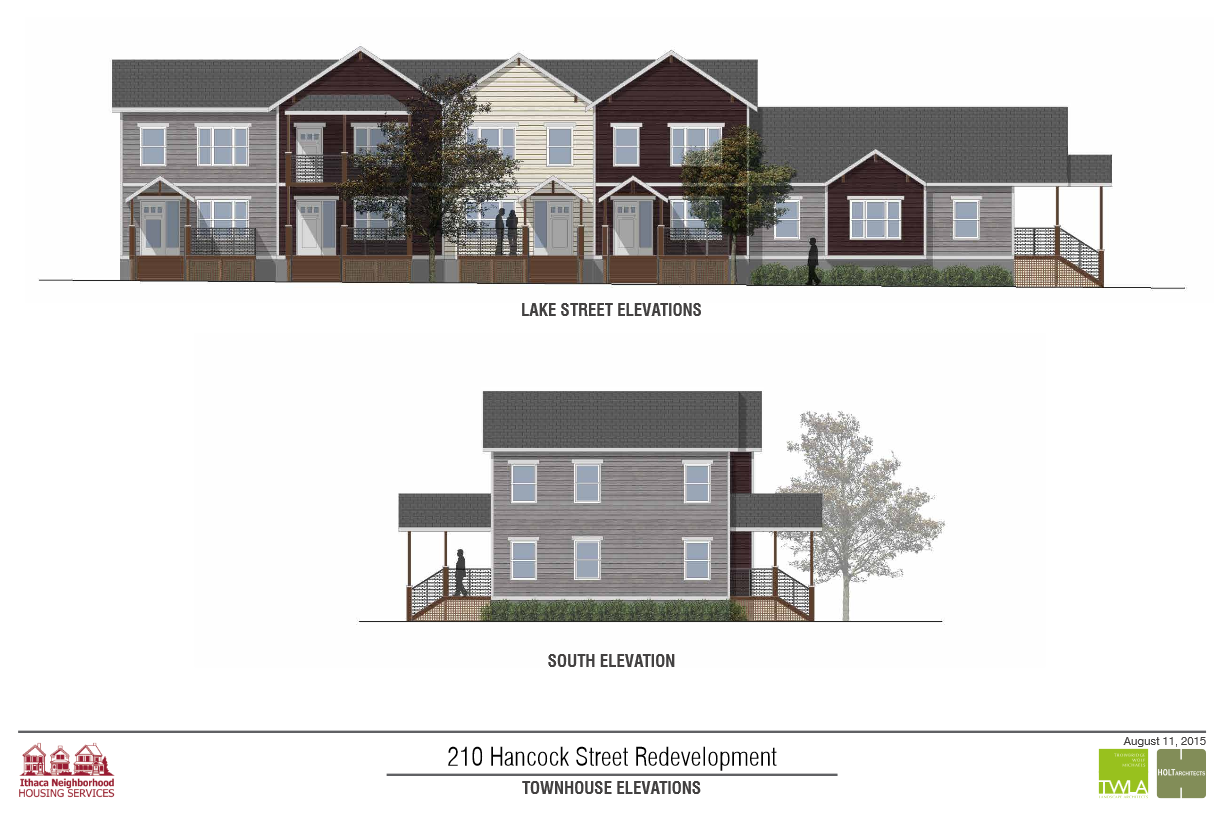
On that note, here’s an updated render of the townhouses. Quoting the memo from Trowbridge Wolf,

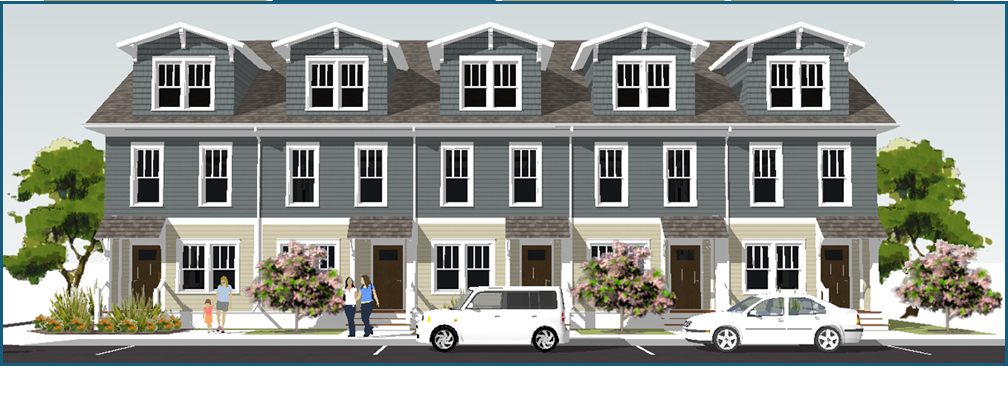
“The townhomes at 210 Hancock will utilize architectural details in the porches and roof lines as well as a mix of materials and colors to provide architectural diversity. Architectural precedent will include homes built in the late 19th/early 20th century and characterized as “tudor”, “arts and crafts”, “American four square” etc. The goal is to design the 12 townhomes as if they were built over time with some unifying features that make them feel part of the larger 210 Hancock community.”

2. From townhouses to big houses. Here’s an attractive proposal for a renovation at 109 Dearborn Place in Cornell Heights. 109 Dearborn is currently a 3,800 SF storage building with an attached apartment unit, and has been since the 1960s; previously it was an office building for the Paleontological Research Institute, and built specifically for PRI in the early 1930s. The building was purchased from Cornell by Dr. J. Lee Ambrose (M.D., so he can get away with using ‘Dr.’ outside of his field without sounding pretentious) for $177k in 2012. Bero Architects of Rochester and Ellis Construction of Lansing are in charge of the design and build respectively.

109_dearborn

The proposal involves new roofing, dormers, roof extensions, and a gut interior renovation to be done in phases over the next few years. Being in the Cornell Heights Historic District, the project needs Ithaca Landmarks Preservation Commission (ILPC) approval. Since the building is considered non-contributing to the historic district (the age is right but being a purpose-built office building isn’t), ILPC may be a little less stringent with this project.

3. Staying on the theme of grand houses, a lakeshore homesite has received a multi-million dollar loan. The property at 1325/1327 Taughannock in Ulysses is right on the lake, and two small houses once on the properties have been demolished. The loan, for $2.25 million, was filed on the 13th, with financing provided by Tompkins Trust.

The owner is a senior investment banker from New York with connections to Cornell. In other words, the type of person a lot of Ithacans love to hate. Looking on the bright side, this is an extra couple million for Ulysses’s tax rolls (my anecdotal finding is to tack on about 30% to hard construction costs to get the assessed value, and the hard costs here are $1.87 million…so $2.43 million). Single-family projects of this magnitude in Tompkins County are quite rare, they could be counted on two hands. It’ll definitely be worth a trip to see what this lakeside manse looks like as it moves towards its May 2016 completion.

4. Also in sales, the Carpenter Business Park was purchased by “Carpenter Business Park LLC” for $2.4 million from the lender that repo’d it from the owner earlier this year. Four parcels were purchased – all the land along Northside’s Carpenter Circle except for the community gardens and the building supply company. The LLC is registered to the same P.O. Box as Ithaca’s Miller Mayer law firm, and there’s no indication if there are plans for this site. But you’ll see something here if plans arise.

state_st_triangle_v3_1

5. The State Street Triangle public relations campaign begins in earnest – the CEO of Campus Advantage recently submitted an editorial in the Journal, and the Texas-based company has also launched a website, Ithacaliving.com. It’s as one would expect, it touts the economic impacts and the addition of housing to the underserved Ithaca market. For those who are more neutral, the site’s worth a look for some new perspective shots, courtesy of the folks at STREAM Collaborative. CA’s effort to assuage the concerns of city officials and the public has been lackluster so far, so we’ll see if this is a sign they’re willing to be more active and engaging.

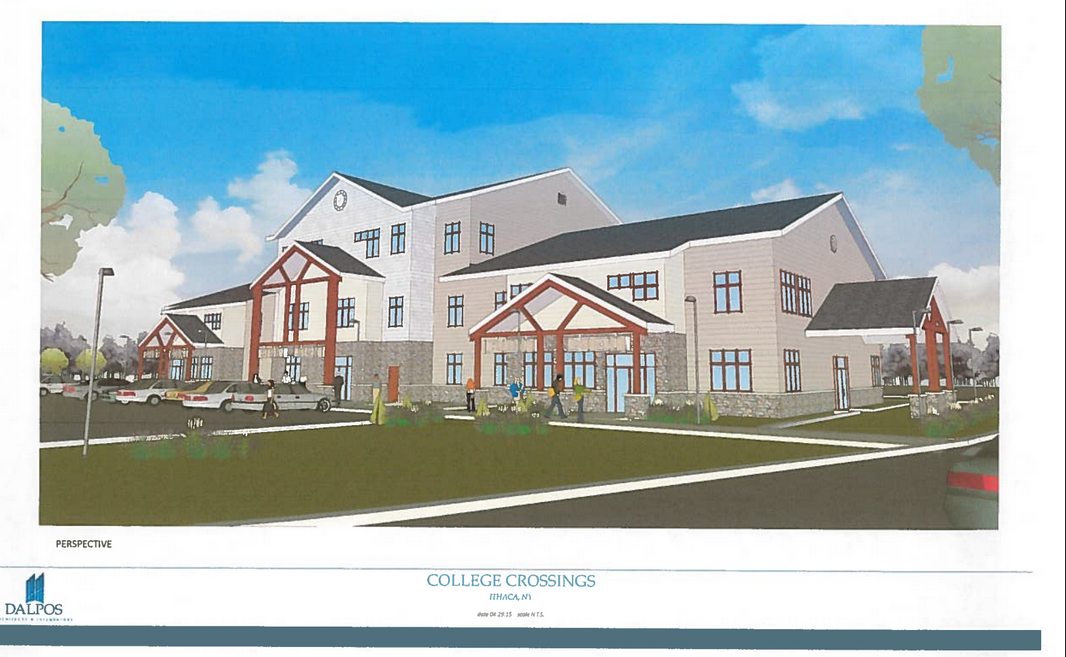
college_crossings_v3_1

college_crossing_2

6. Over in Ithaca town, the State Environmental Quality Review (SEQR) is still underway for College Crossings. Only this time, the town acknowledges that plopping a building in the middle of a large parking lot doesn’t mesh with their comprehensive plan. The building is acceptable, but the site plan layout needs work seems to be the gist of the town planner’s review.

7. From the city of Ithaca Planning Board Project Review meeting next week, the phrase of the week will be “carriage house”. Specifically, two proposals in the city for accessory apartments in the style of carriage houses.

201_w_clinton_1

Carriage houses were essentially garages for horse-and-buggies. The first proposal, at 201 West Clinton Street, is highly reminiscent of those long-gone days, and it needs to be since it’s in Henry St. John Historic District (more talk about the meticulous restoration of the main house here). The proposal is going up to the planning board for recommendations for a zoning property line setback variance at the next BZA meeting. The 650 SF, 1 bedroom garage/carriage house would replace a non-contributing garage from the 1960s. The architect isn’t stated in the documents.

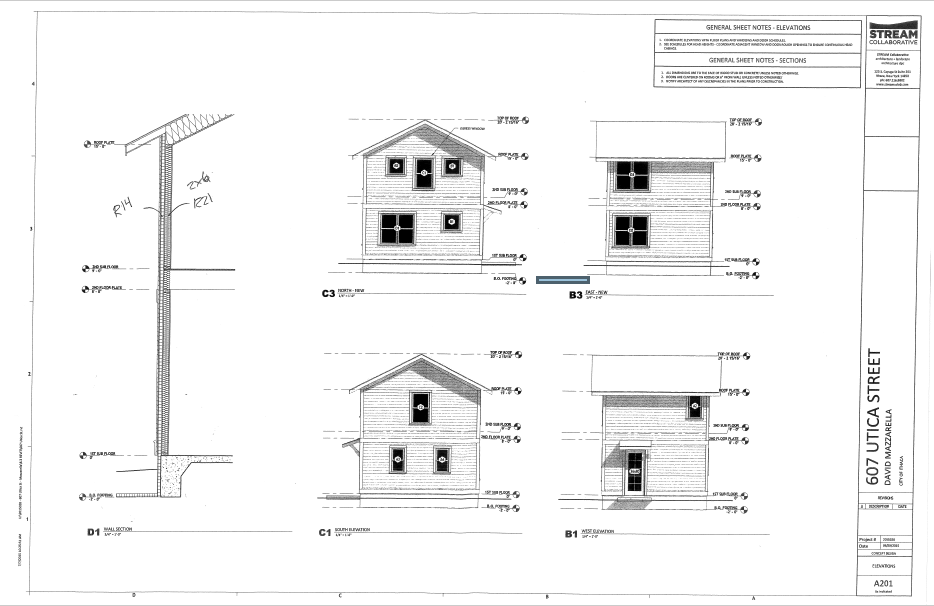
607_utica

The other proposal is for 607 Utica Street in Fall Creek. The applicant is seeking demolish a rear garage in favor of a one-bedroom, 510 SF unit. In the zoning appeal application (one again for property line setbacks), the homeowner states “My goal has never been to become a landlord…I am hoping to do this only because the income from this would allow me to remain in the community”. Once again, the affordability problem is making itself known. Prolific local architecture firm STREAM Collaborative is responsible for 607 Utica’s “tiny house”.

As a matter of opinion, I think these are a great idea. These add to the housing stock, contribute income to homeowner-landlords living only feet away, they’re not obtrusive, and their small size lends well to modest, sustainable living. I hope they go forward.


News Tidbits 8/1/15: Tempers As Hot as the Temperatures

1 08 2015

state_st_triangle_v3_3

1. I asked someone familiar with the State Street Triangle how the presentations went this week. “About as well as could be expected” was the diplomatic response received in turn.

The Times, Journal and Voice all devoted coverage to the controversial project this week since its CIITAP application was up for review, as well as revised plans being brought forth to the planning board. The project draws detractors from different angles – some because of size, some because it’s student housing, some because of the tax abatement.

The tax abatement is what confuses me somewhat, for reasons related to the theory I wrote up a few weeks ago, which no longer holds water. My own personal thought was that a sort of economy of scale would kick in with greater site efficiency, negating the need for a tax abatement. That isn’t to say that they still couldn’t try for one, because it meets all the CIITAP requirements, just that they didn’t need it (it would have been proverbial “icing on the cake” if granted). But now they’re saying it’s the only way to move forward. I don’t know the financials and what their necessary ROI is (and probably never will), but I’d happily listen to an explanation.

But the point I made in the piece still holds true – if Jason Fane’s project a couple blocks away was rejected for not having enough of a community benefit, market-rate student housing, even that which generates an extra $7.36 million in taxes over a decade, is going to be a big stretch, unless they plan on using the sheer size of it as a selling factor. The city planning board doesn’t have to worry about the controversy, because the project conforms wholly to a central business district zone. It’s going to be the tax abatement issue that makes or breaks this proposal.

2. As part of its 10th anniversary feature, the Lansing Star did a nice retrospective of what’s changed in the past ten years in Lansing. When it comes to development, it isn’t especially kind:

“Lansing hasn’t changed much in ten years.  While grand plans for the future of the Town have been explored, not many have been realized.”

The article then goes on to detail how after the sewer initiative was defeated by public vote, a few developers banded together to try and fulfill the town center that Lansing was pushing for. Quoting the article, “the town government couldn’t get its act together to make that happen, even though it wouldn’t be footing the bill for the infrastructure (including sewer)”. About the only development initiative that has taken off is the Warren Road corridor, which was spurred mostly by threats of a major employer (Transonic) leaving the town (and Transonic paid for the sewer study). Meanwhile, the Star characterizes the village government as simply existing for “maintenance” purposes.

The paper notes some successes with parks and wildlife initiatives, but the highlight of the piece seems to be that Lansing is routinely failing to achieve its municipal planning and development goals.

3. Back in Ithaca city, plans are underway for the major renovation of a shopping plaza into professional office space for a local architecture firm. According to documents filed with the county, an LLC associated with HOLT Architects is spending $897,500 on the renovation, and another $415,000 for acquisition costs. The renovations will start in late August should be completed by March 2016. Tompkins Trust Company is providing the financing, and local company McPherson Builders is in charge of general construction.

From the press release published late Friday, HOLT chose the West End location for its walk-ability and centralized location. The building will be renovated into a net-zero energy structure for the 30-person architecture firm. No renders yet, but they’ll be included in a future news roundup when they become available.

college_crossings_v3_1

4. As written in the Voice, College Crossings at the corner of East King Road and Rt. 96B in Ithaca town is back to the board for revision number three. This one increases the project by a floor, 13,000 square feet and six more apartments. It’s been no big secret that developer Evan Monkemeyer’s had difficulties getting the project off the ground (he resorted to Craigslist for marketing the retail spaces), and given a total of 18,000 SF spread among 8 apartments (doing the standard 15% deduction for circulation/utilities, one gets over 1,900 square feet per apartment) these units are almost certainly geared towards IC students. A solid market since they’re next door, though not likely to elicit warm fuzzies from the neighbors (although based off the response on the Voice’s facebook, most people just don’t care; if only 210 Hancock had it this easy). Previous plans can be found here.

south-hill-areaplan-1 plan-2

Personal opinion, I’m a little disappointed in the revision. The mixed-use aspect is fine, but I was hoping the developer would tap into some of the ideas presented for the land by Form Ithaca instead of plopping a building in the middle of a 120-space parking lot. Monkemeyer owns a lot of acreage in adjacent land parcels, so this doesn’t bode well for a “walkable center” in Ithaca town.

210_hancock_62015

5. Ithaca Neighborhood Housing Services (INHS) is armed with more 210 Hancock studies and analysis as it prepares to go in front of the city Board of Zoning Appeals next Tuesday. With the commercial loading space question settled, it leaves the height variance of 6.5 feet (40 feet zoned, 46.5 feet requested), and the parking variance of 20 spaces (84 required, 64 given). Original/full application here, new addendum analyses here.

The board requested additional information about pile driving and the parking situation. In response, INHS has conducted further analysis and shown that, 40′ or 46.5′, piles would be required either way. INHS has offered in its application to use a “vibratory oscillating” method of pile driving, where piles are vibrated into the ground rather than driven. This reduces noise (no hammer-like banging) and produces less overall vibration. Further parking studies found that 210 Hancock offers a greater percentage of parking than similar buildings like McGraw House, the Cayuga Apartments and Lakeview on Third Street, INHS’s parking study of its tenants was reiterated, and an analysis of its commercial tenants was given – the occupants will have 16 designated spaces from 7 AM to 5 PM, when the daycare and non-profit offices are in operation. After hours, they’ll serve as potential overflow parking.

It’s frustrating to think that a suburban market-rate project surrounded by a parking lot has no opposition, but a transparent project with affordable housing and a lot of community benefits gets so much grief.

6. For home-builders or those looking to build a palatial estate, here’s your latest opportunity – 5.45 acres at the end of Campbell Avenue in Ithaca city are up for sale. The area’s zoned for single-family homes, and the city is encouraging owner-occupied houses in that area. Previously, the property was seen as a potential 10-lot development in the late 1980s/early 1990s, but the plan was never carried out. The biggest barrier is probably that it’s West Hill, where neighbors have taken to going after their neighbors to keep them from subdividing and building homes.

7. Initially, this was going to be a Voice article, but when the revised plans were presented, no renders were included. The Voice’s more general audience wouldn’t be as interested in this piece. But if you’ve read this far, and you read this blog frequently enough, then you won’t mind clickable, expandable site plans (pdf here).

hotel_ithaca_phase_1 hotel_ithaca_phase_2

The Hotel Ithaca is once again seeking to expand its offerings.

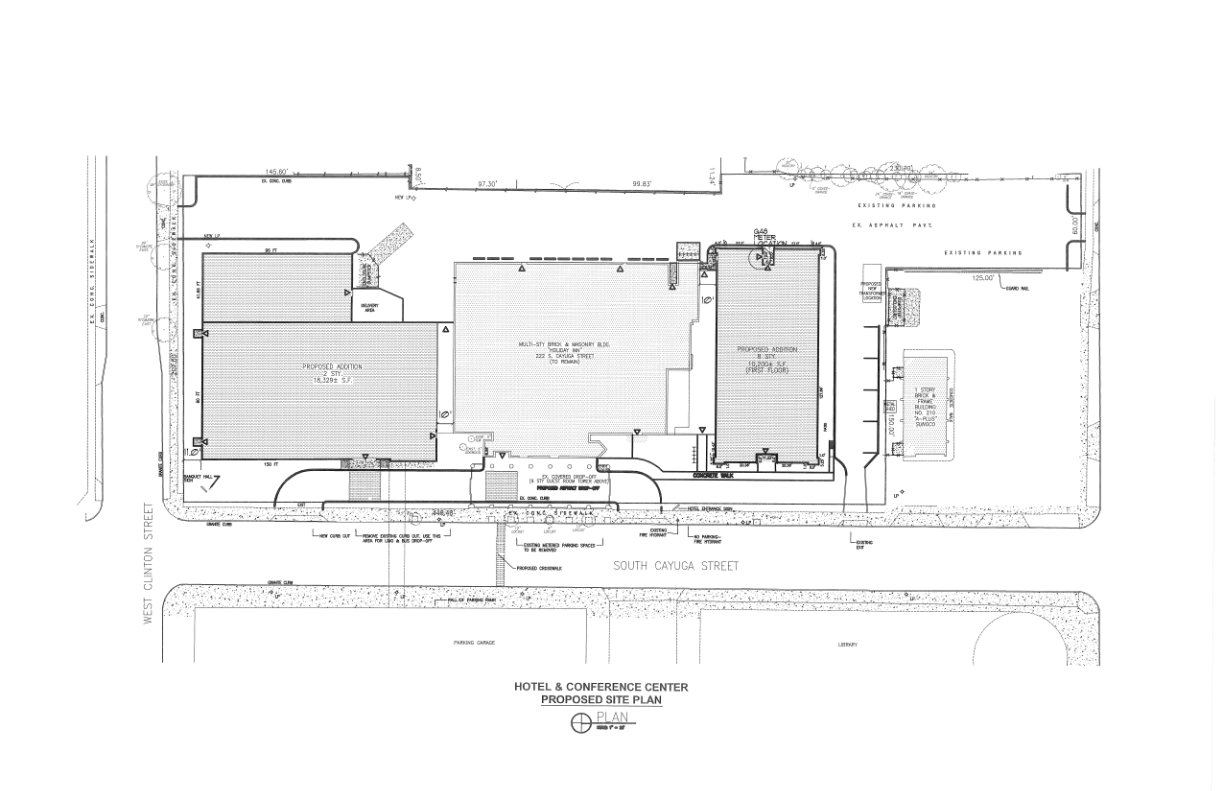
But this time around, it’s proposing to do in phases. Sketch plans presented at the Planning Board last Tuesday evening call for demolition of the two-story wings as before, but then the construction will be broken up into two phases.

The first consists of a five-story, 51,835 SF wing build on the northern side of the property, next to the gas station on the corner; the second phase, at a later, undetermined date, calls for three more floors on the hotel wing (bringing the new wing to eight stories and 81,600 SF), with a two-story, 18,300 SF conference center to be built on the corner of South Cayuga and West Clinton Streets.

The number of rooms in the addition has been unconfirmed, but given previous plans, it is likely to be little to no change from the current hotel, once the two-story wings are demolished. Until phase two is built, a parking lot would sit on the site of the future conference center.

The hotel is operated by Hart Hotels of Buffalo. Like several other Hart Hotels properties throughout the Northeast, the hotel has no chain affiliation, although the property was a Holiday Inn until the end of 2013. The 181-room hotel initially opened as a Ramada Inn in 1972, and the 10-story “Executive Tower” was completed in 1984.

Zoning at the site is CBD-100 (Central Business District), meaning that a proposed structure can be up to 100 feet (two floors at the least) with minimal required setbacks and no required on-site parking.

holiday_inn_expansion_1

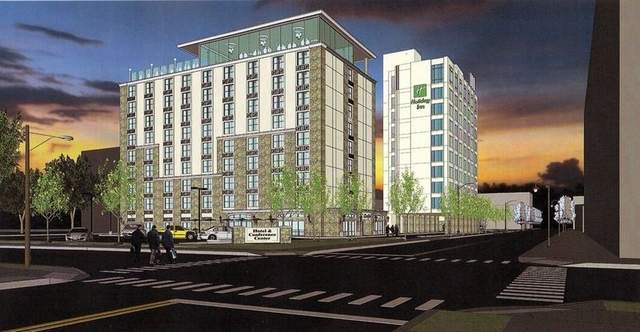
Under plans previously presented three years ago, the Hotel Ithaca sought to demolish the two-story wings of the hotel, and in their place the hotel would would build a new 9-story, 115-room tower, a kitchen addition, and a 15,000 SF conference center. The demolition would have resulted in a loss of 100 rooms, so the net gain was a total of 15 hotel rooms.

The then-$18 million project had significant local support from business owners, because Ithaca lacks the ability to host mid-size conferences and conventions (midsize meaning about 500 attendees), which sends conventioneers elsewhere. Currently, the lack of meeting space limits conferences to about 250 guests. The addition of a convention facility is seen as a major benefit to downtown retail, as well as other hotels that would handle overflow guest traffic. Convention traffic typically happens during weekdays, when regular tourist traffic is lowest.

However, the project, which was initially slated to start in November 2012, has failed to obtain financing for construction. The project applied for and received a property tax abatement for the new construction, and the Ithaca Urban Renewal Agency (IURA) even offered the possibility of a $250,000 loan if it would create a financial package that would allow the convention center to be built. But until now, there had been no indication of any plans moving forward.


News Tidbits 7/25/15: To Reuse and Rejuvenate

25 07 2015

travis_hude_libe_libe_v3 oldlibe_franklin_proposal

1. Let’s just outright say it – the Tompkins County Legisltaure’s Old Library decision is a complete mess at this point. As covered last week, there were three separate individual resolutions – one from legislator Mike Lane for the Travis Hyde proposal (first image), and one each from legislators Dooley Kiefer and Leslyn McBean-Clairborne for the Franklin proposal (second image).

They all failed. 8 yes’s are required. The Travis Hyde proposal failed with 5 yes and 7 no’s. The Franklin proposal failed with 5 yes and 7 no’s on Kiefer’s resolution, and 4 yes and 8 no’s on McBean-Clairborne’s resolution. Martha Robertson, a supporter of the Travis Hyde proposal, recused herself because she had received donations from Frost Travis during her failed congressional campaign in 2014. Legislator Glenn Morey, also a supporter of the Travis Hyde proposal, was absent from the meeting.

I don’t see any way this will ever get the eight votes required. Kathy Luz Herrera voted against the proposals because the resolution has a ground lease (meaning the county still owns the land but leases the property), and Dooley Kiefer has stated she refuses to support any of the projects unless they have a ground lease – in other words, these two have mutually exclusive votes. By voting against McBean-Clairborne, Kiefer’s made it clear she will vote against the Franklin project unless it meets her exact specifications. Shinagawa voted against Travis Hyde for not being what the community wanted, but won’t vote for the Franklin proposal unless they guarantee Lifelong’s involved. And Stein has come out in favor of the Travis Hyde proposal. There’s no solution on the horizon.

So now it heads back to the Old Library Committee. Sale to the highest bidder and demolition of the library are real options on the table.

cayugafarms_2

cayuga_farms_1
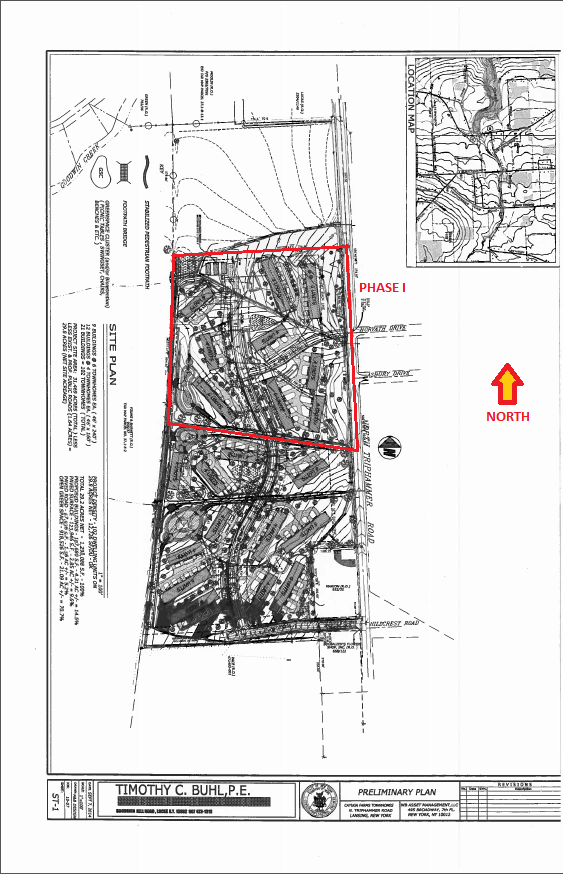
2. Turning to Lansing town, the planning board there has approved plans for the 102-unit Cayuga Farms townhouse project for a 31.4 acre parcel off of North Triphammer Road near Horvath Drive. First reported last Friday by the Lansing Star, the project received negative SEQR determination (meaning that, following the state’s environmental review guidelines, that the planning board decided the project will have no serious detrimental impact on the community) and issued preliminary site plan approval.

However, one issue still remains to be resolved before any shovels hit the dirt – sewer. The project currently has a modular package sewer treatment proposal that would work in place of the voter-defeated municipal sewer, and allow for denser development than the town’s rule on septic tanks. But the DEC’s interest in that type of treatment has been mixed. It could be a while before the situation gets sorted out.

Readers might remember this project because it’s one of the few I’ve openly derided. The 102 units are townhouse-style apartments marketed towards the upper end of the market. They would be built in phases over a period of several years.

cornell_novarr_5 cornell_novarr_6

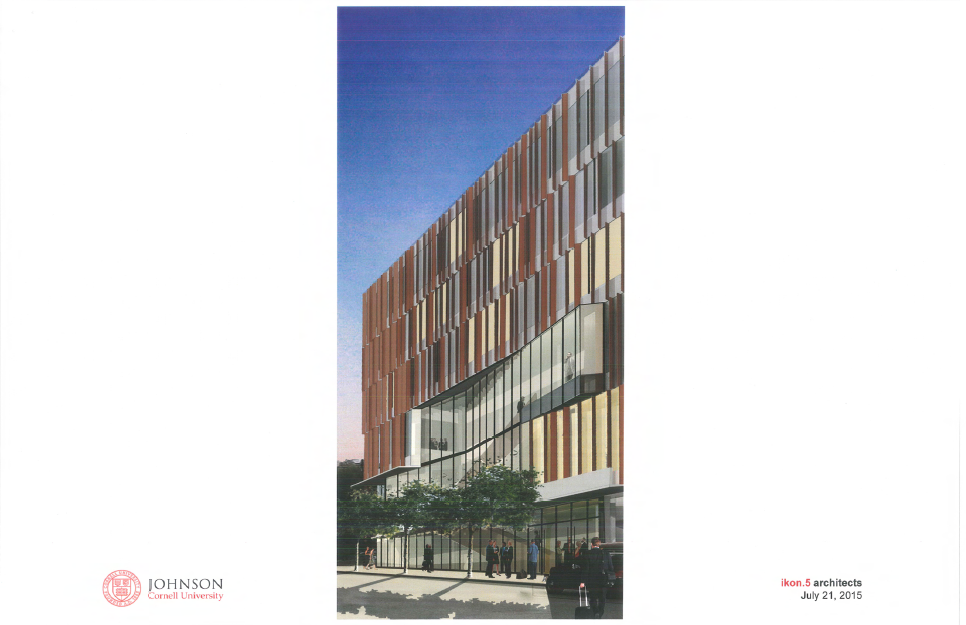
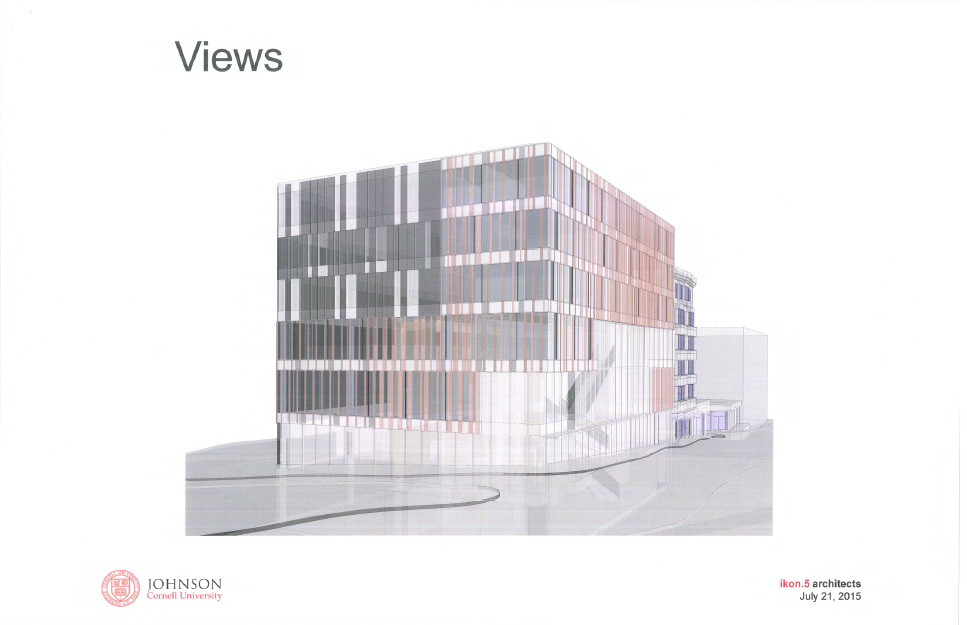
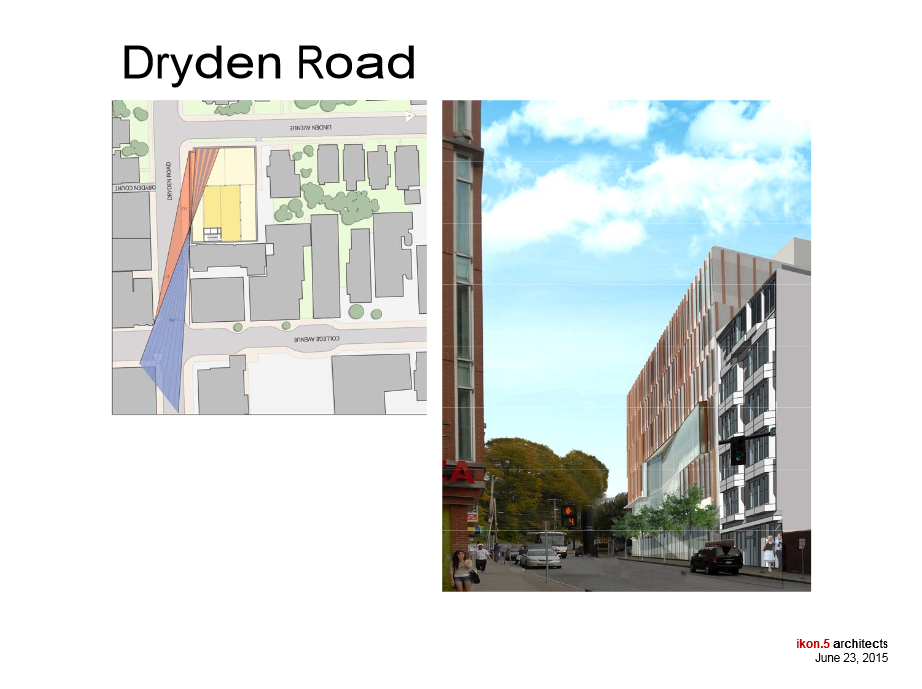
3. Now for some eye candy. Included with this week’s planning board project review committee agenda are additional renderings for John Novarr’s project at 209-215 Dryden Road. Doing a quick visual cross-check with the initial renderings, there don’t appear to be any substantial design changes, and the colorful metal cladding appears to retain the same pattern as before. Getting a little poetic here, the cascading metal bars are reminiscent of water running down a wall.

The city’s Full Environmental Assessment Form doesn’t express many worries about the project; some concerns have been raised about too many pedestrians on the street (the building would add 420 people to Collegetown’s sidewalks at the outset, 600 when fully occupied), but that seems to be about it for now.

The $12 million project is moving right along in an effort to start construction this fall. Declaration of Lead Agency and some CEQR discussion (the city’s more stringent version of SEQR, State Environmental Quality Review) are expected at the July planning board meeting. Plans call for 76,200 SF building with three floors of classrooms and three floors of offices for Cornell’s Johnson School Executive MBA program. The building would be ready for the Big Red’s B-students in April 2017. The property would remain on the tax rolls.

20150605_114431

4. A couple of interesting news notes courtesy of the Ithaca Urban Renewal Agency (IURA) Agenda:

First, popular downtown restaurant Madeline’s is looking to obtain an agency loan as part of a renovation project. The $470,000 project would add three jobs, only one of which pays living wage. The restaurant on the first floor of the Rothschild Building (the two-story building in the above photo) hopes to take advantage of the new hotels going up, and law firm Miller Mayer moving its 60 employees into the Rothschild Building. Previously the firm was in the Chemung Canal Trust Company building further up the Commons.

Second, the Finger Lakes School of Massage has applied for an agency loan to facilitate a move from West Hill to downtown. The school would move its ~34 staff and 75-95 students into 10,804 SF of leased space on the Rothschild Building’s second floor, with a further 1,700 SF on the ground level for a retail store and alumni massage clinic. The space would be renovated at a cost of about $194,300.

Although both projects come with risks (Madeline’s being a restaurant, FLSM having some worrying financial statements), both projects have been recommended for loan approval. The FLSM and Miller Mayer news suggest that most of the office space in the old Rothschild Building, left vacant when Tetra Tech moved to Cornell’s office park in 2010, has now been refilled.

The new window cut out built recently into the Rothschild Building’s east facade is part of the space where FLSM is moving into.

416_e_state_1

5. And now another reuse project – at 416-418 East State Street, currently home to an underused 7,600 SF office and a connected manufacturing/storage building. The house dates from the 19th century, with various additions as recent as the 1970s. According to plans filed with the city, an LLC linked to Argos Inn architect Ben Rosenblum has plans to convert the old manufacturing space into a bar and storage space, with renovated offices and a 2 bedroom apartment in the original house. The project will include an accessory parking lot, revised landscaping and handicap access. Area and setback deficiencies have resulted in the need for a zoning variance, but a parking variances won’t be required because the bar will have after hours parking across the street at Gateway Plaza. The building itself won’t change dimensions, but the change in use triggers the city zoning laws.

There have been some concerns expressed about this project – at least one neighbor is vociferously opposed to a bar, citing noise problems and concerns about smokers, and the county planning department is not a fan of the traffic and parking arrangement. Offhand, I think a bar is legal in B-4 zoning, but the noise impacts will merit further scrutiny.

The project is definitely something of interest to the Voice’s audience, but in an email, Rosenblum said that details are still being worked out and that he’d prefer to discuss the plan at a later date.

Scott Whitham is serving as a consultant, and local architect Jason Demarest is designing the renovation.

state_st_triangle_v3_1 state_st_triangle_v3_2 state_st_triangle_v3_3

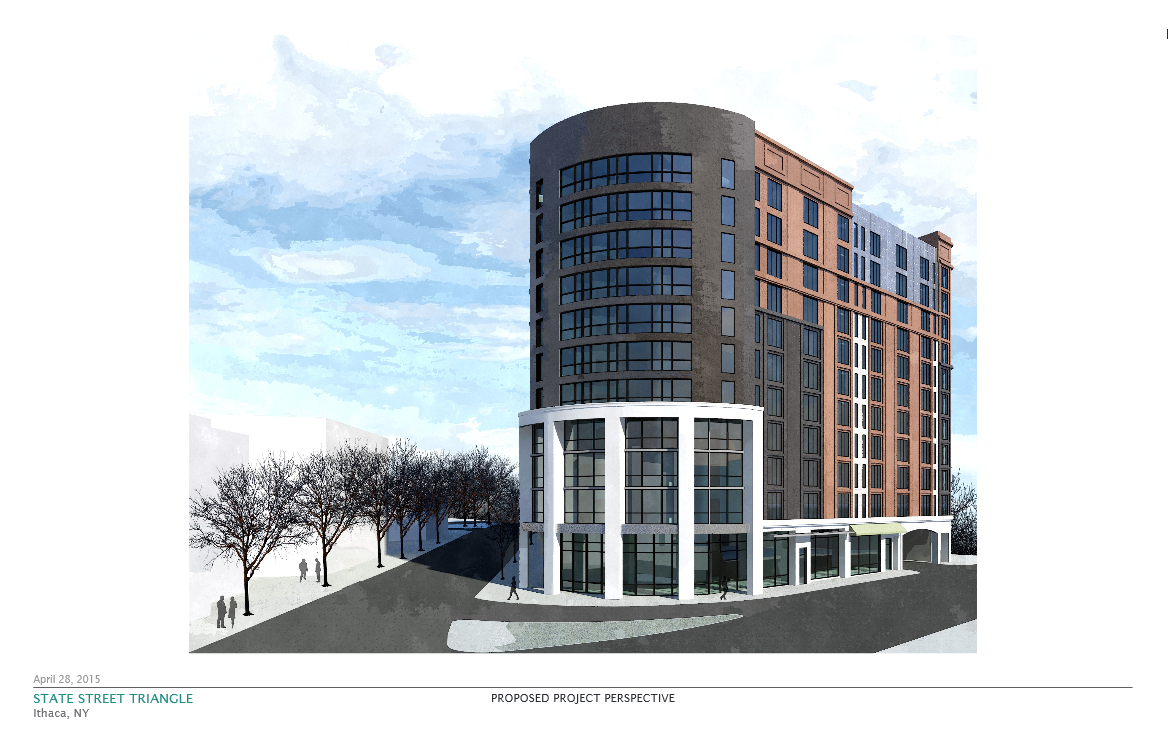
6. Some very substantial changes are in store for Campus Advantage’s $40 million, 240-unit State Street Triangle project at 301 East State Street in downtown Ithaca.

The Texas-based developer has recruited the assistance of Ithaca architecture firm STREAM Collaborative to help redesign the 240-unit project. And there’s clearly been a lot of work since the previous planning board rendition.

In this revision, a much greater emphasis has been placed on the street interaction and active street uses. Gone is the soaring corner, and in its place is a design with a greater use of horizontal elements (like the decorative belt above the third floor) in order to give the building a more human scale – crucial when you’re planning one of the largest buildings in Ithaca.

The developer is also seeking to remove the northbound turning lane from Aurora onto State Street, and replacing it with a pedestrian area with widened sidewalks, outdoor seating and dining spaces. The land would have to be procured from the city, or some other type of collaboration would have to take place with city officials and engineers.

In documents provided in the city’s planning board agenda for next Tuesday, the developer notes that the project remains student-oriented, but in order to play down comments of it being a massive dorm, 10 4-bedroom units were reconfigured into 40 studio apartments that the developer hopes will be appealing to non-student tenants looking for a less expensive, modestly-sized space.

The State Street Triangle project is also exploring LEED certification.

The project still has a lot of details to be addressed – city transportation engineer Tim Logue has expressed concerns that the traffic study underestimates the number of car trips, and has asked for a revised study. The project is also under closer analysis because the potential addition of 600 residents into downtown Ithaca would put a greater stress on utilities and infrastructure.

These and other questions are likely to be topics of discussion at next Tuesday’s meeting.

The State Street Triangle may be pursuing a CIITAP tax abatement (so much for my theory a couple weeks ago), but the city has not uploaded the application at the time of this writing.
7. Looks like a busy meeting next week for the Ithaca city planning board. In order:

1. A subdivision at 106-108 Madison Street on the Northside. The applicant wishes to create a new lot on the east side of the existing lot, for the purpose of building a new-single-family home.

2. A. Declaration of Environmental Significance and BZA recommendation for the Dibella’s sub shop proposed at 222 Elmira Road

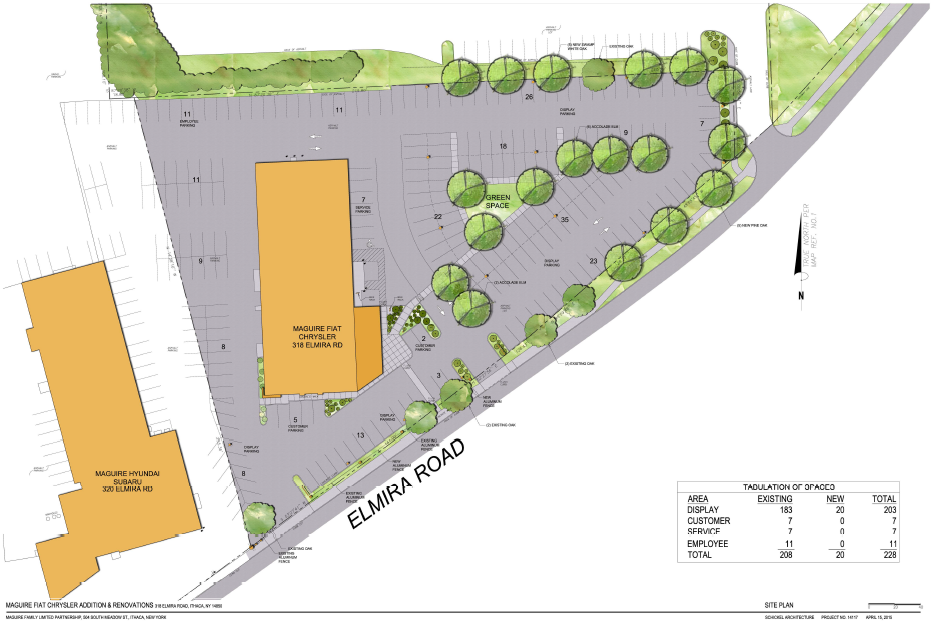
B. Declaration of Environmental Significance, BZA recommendation and potential approval for the 1,100 SF addition to the Maguire Chrsyler/Fiat dealership in Southwest Ithaca

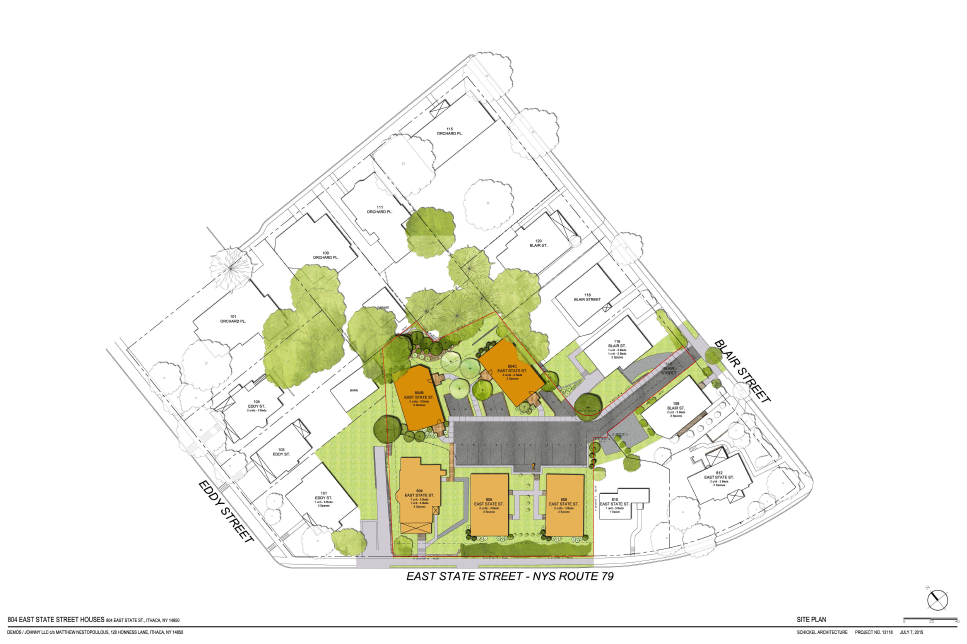
C. Declaration of Environmental Significance, and potential approval for the two duplexes proposed at 112 Blair/804 East State Street

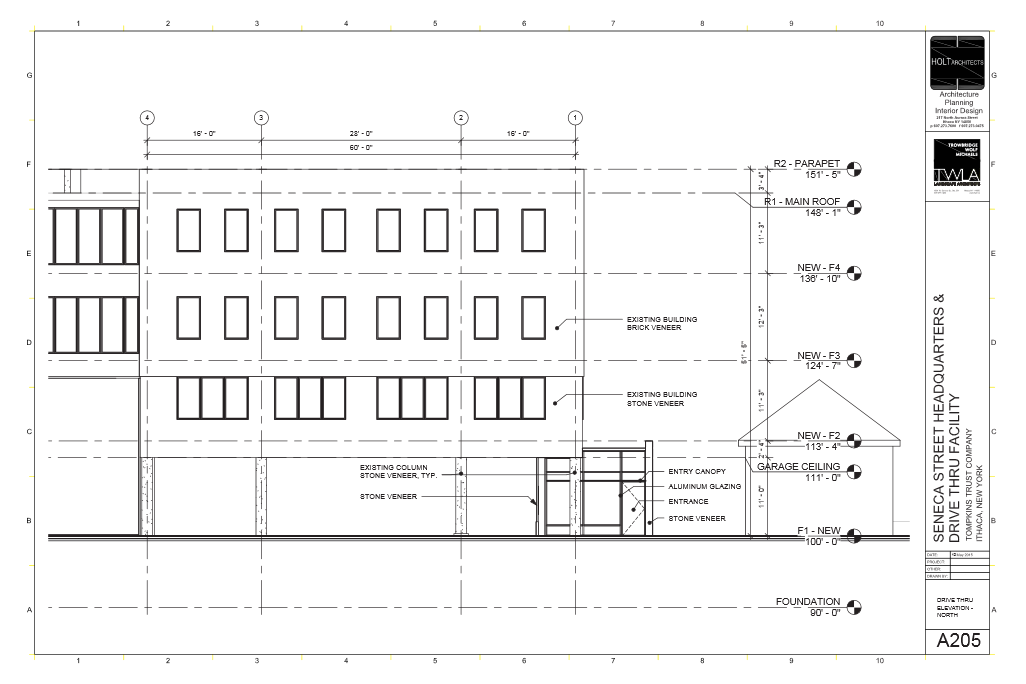
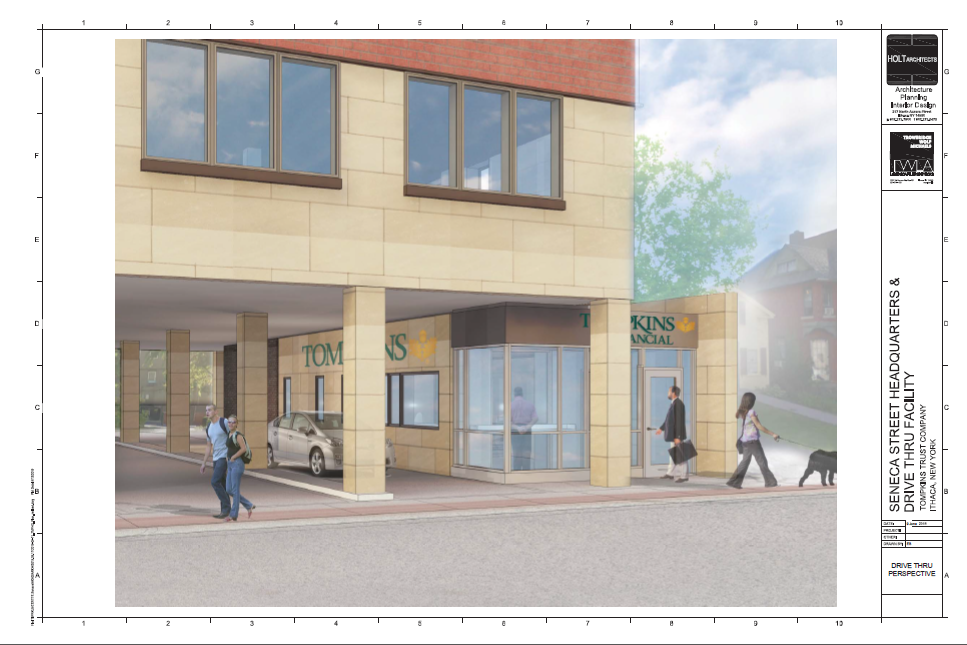
D. Site-plan approval for the first phase of the Tompkins Financial HQ (the new drive-through in the current HQ’s parking lot)

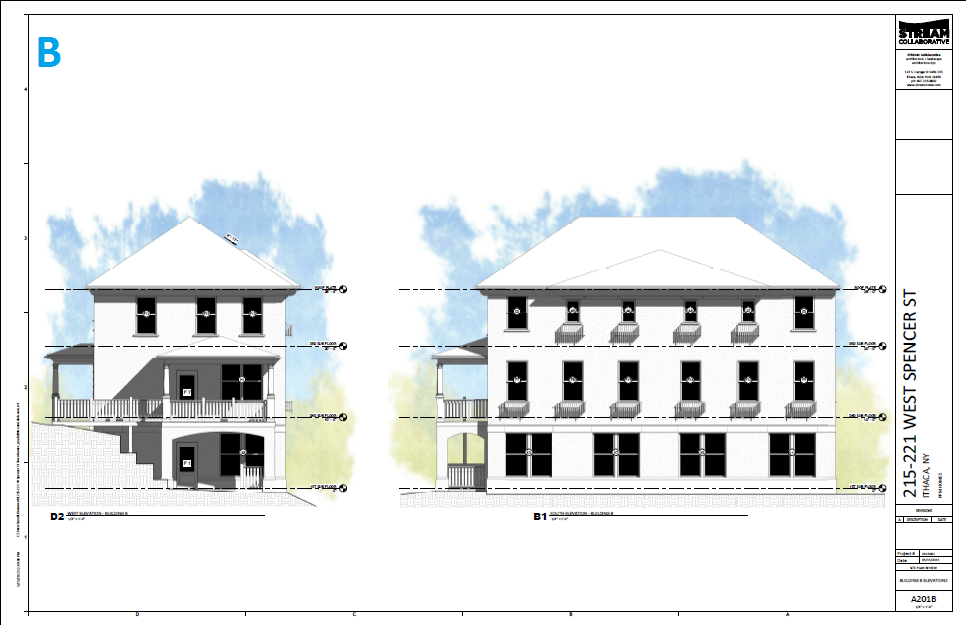
E. CEQR (the city’s version of SEQR) discussion for 215-221 W. Spencer Street

F. Declaration of Lead Agency and CEQR discussion on 209-215 Dryden (the Novarr project noted above)

G. Declaration of Lead Agency and CEQR discussion on State Street Triangle (

noted above)

holiday_inn_expansion_1

H. Sketch Plan – Hotel Ithaca Expansion. Readers might remember a 9-story addition and convention center were approved for the Hotel Ithaca almost two years ago (shown above). Nothing has happened with the expansion plans, for reasons which had been attributed to financing. Dunno what we can expect this time around, but we’ll find out next week.


News Tidbits 6/27/15: A Bad week for YIMBYs

27 06 2015

cornell_novarr_1

cornell_novarr_2 cornell_novarr_3

1. Starting this off with least controversial news-maker this week – John Novarr’s 209-215 Dryden Road project, which I wrote about for the Voice here and with site plan details and SPR/render links here. The first article’s a little helter-skelter as a write-up because there was a lot of frantic 11:30 PM fact-checking going on in an effort to get the news out.

The $12 million, 12,000 sq ft proposal is smaller than Collegetown Dryden, but more importantly, the project isn’t residential; it’s classroom and office space for Cornell’s MBA program, three floors for each of those uses. That definitely brings something different to Collegetown and its mostly residential focus. With assurances given that the property will be kept on the tax rolls, the initial opposition appears to mostly be related to the design, which to be honest, is rather avant-garde and an acquired taste (not one I’ve acquired, to be honest). However, bringing 200 staff and a few hundred professional students into Collegetown would be a real asset for businesses struggling to stay open amid the neighborhood’s 32/36-week profit window.

209-215 Dryden Road is within the MU-2 zoning from the looks of it, so a trip to the Board of Zoning Appeals (BZA) seems unlikely at the moment. We’ll see what happens moving forward, this one could be a fairly smooth approvals process.

2. For a smaller developer, Ithaca-based Modern Living Rentals has been pretty busy this year. Along with 707 East Seneca Street and 902 Dryden, they have a modular duplex (3 bedrooms each, 6 total) currently under construction at 605 South Aurora Street in Ithaca city. A construction permit was issued back in 2014, according to the city planning report. The orientation is a little odd in that the new duplex is being built in front of the old home on the property, since the house is longitudinally centered but set back on its lot. Taking a guess, the intended market is likely IC students. The new units look like they’ll be ready for occupancy in time for the fall semester.

3. Here’s an interesting piece of news, courtesy of the Tompkins County Government Operations Committee – plans to sell a vacant lot to non-profit housing developer INHS. In its May minutes, the committee announced intent to sell a vacant, foreclosed parcel in Freeville for affordable housing. The property is described as a 1.72 acre parcel on Cook Street in the village, which through a little deductive searching, turns up the lot in the map above, just north of the Lehigh Crossing Senior Apartments. The minutes state that INHS is in the process of drafting up an acquisition offer for the county attorney.

Freeville is outside of INHS’s usual realm of Ithaca city and town, but INHS expanded its reach when it merged with its county equivalent, Better Housing for Tompkins County (BHTC) last December.  This might be the first new rural project post-merger. The Lehigh Crossing Apartments have 24 units on 2.3 acres, so if INHS were to build at the same density, this site would be looking at something around 18 units. Not big, but not inconsequential, especially for a 520-person village.

cinema_drive_1

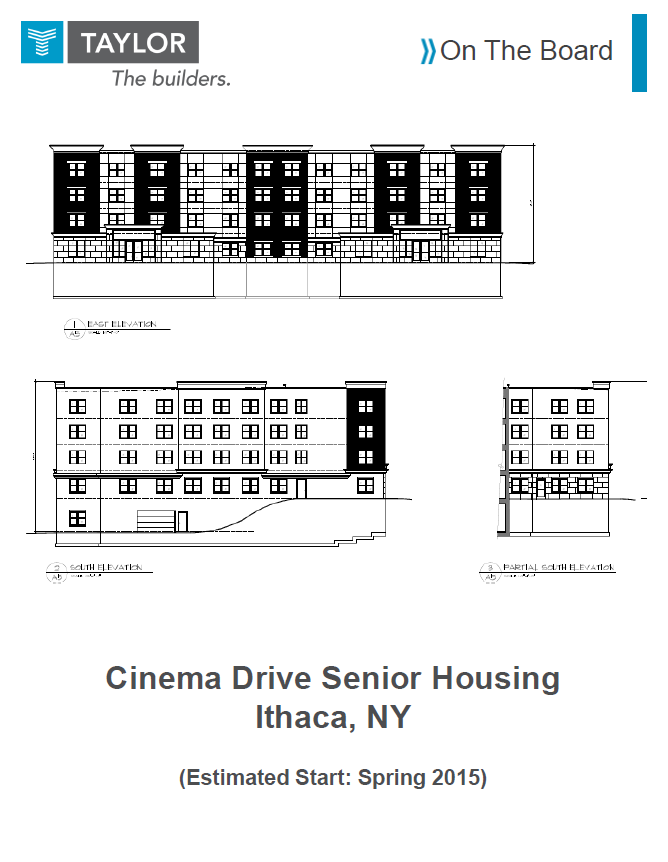
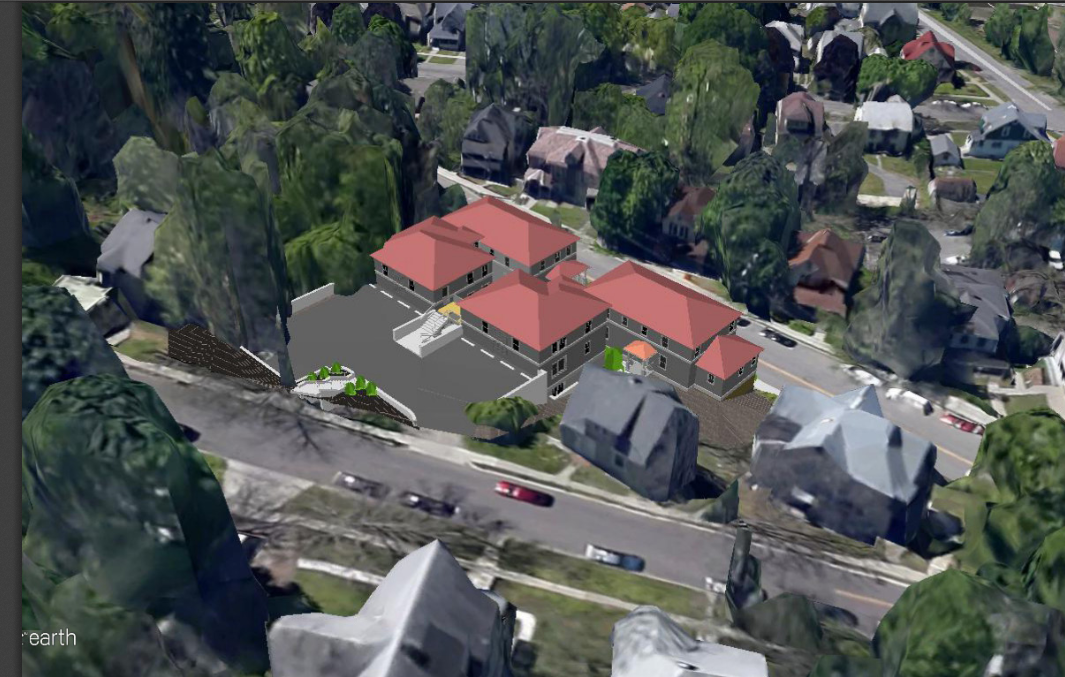
4. A decision to decrease sewer hookup costs in Lansing village also shares some details about a senior housing project in the works. The news comes from the Lansing Star, where the village voted to decrease its sewer hookup fee from $2,350 per unit to $1,000 for the first unit and $500 for each additional unit. Apparently the high fee was the result of the lack of a permitting process in the 1990s.

The article notes that the developer of a mixed-use request had requested a fee waiver because it would have cost $138,650 for their “59 units of senior housing”. Now it will be $30,000. Not as good as a waiver, but still pretty good. Lansing village only has one project that meets the description provided, the 87,500 sq ft Cinema Drive project covered here previously. The semi-educated guess back in May was 51 units, so the ballpark estimate wasn’t too shabby.

327_eddy_rev3_1

5. It’s official, 327 Eddy is under construction. Asbestos removal has been completed and the Club Sudz building is coming down. The Fontanas hope to have the building completed and ready for occupancy by next August. In replacement of Club Sudz’ and Pixel’s 7 units and 2,500 sq ft of commercial space, the new 5-story building will bring 1,800 of retail space and 22 new units with 53 bedrooms to the market.

Eagle-eyed readers might recall the building was originally going to be six floors, but a floor was lopped off since it was approved.

215-221_spencer_v3_1

215-221_spencer_v3_2

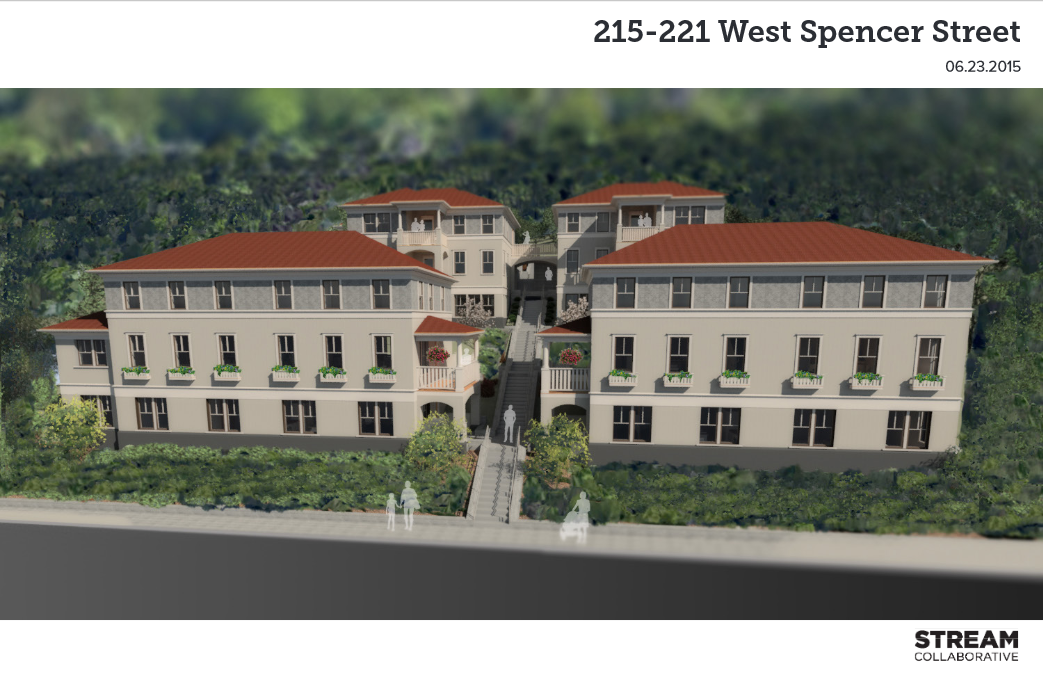
6. Updated renders for 215-221 West Spencer Street, coming right up. A little more detail on the facades, some window updates from the last version, and…well, honest personal opinion…it’s a very attractive design. Materials could underwhelm it, but as presented, it appears to be a lovely addition to South Hill. Good work STREAM Collaborative.

The 12-unit, 26-bed project plans to start construction next year. The project replaces an informal (dirt) parking lot.

oldlibe_franklin_proposal

travis_hude_libe_libe_v3

7. Touching on the Old Library decision briefly, a public meeting on the two proposals will be held Monday June 29th at 6:308:30pm at Greenstar’s “The Space” (700 West Buffalo Street). Douglas Sutherland will represent Franklin Properties (first image) and Frost Travis will be presenting for Travis Hyde. Should the County Legislature decide to take another vote to see if the stalemate will be broken, the next chance will be at their July 7th meeting.

EDIT: The public meeting scheduled for the 29th has been cancelled .

state_st_triangle_v2_1

8. Onto the thornier topics – Not sure what was worse this week, the reaction to the State Street Triangle project, or the INHS Hancock Street opposition. The objective, non-partisan write-up about the State Street project is on the Voice here. This and news piece #9 are opinion pieces, feel free to ignore them.

At least the State Street objections (latest renders here), I can understand the initial shock and recoil; there’s this perception that Ithaca is a small town, and this doesn’t jive with that. Regardless, by Ithaca standards it is massive, 11 stories with 289,000 sq ft of space and 620 bedrooms; if this was, say, a four-story building with an 11-story tower on the closest third to the Commons, the reaction would probably be less vitriolic (people would still hate it, but let’s entertain this thought exercise).

But that probably won’t happen. Not with this developer, or with any developer that purchases the Trebloc site. Here’s my theory why, and it goes a little more in-depth than “they want maximum profit”.

In December, Jason Fane’s 130 East Clinton project was rejected for tax abatements, and one of the reasons cited was that market-rate housing wasn’t enough of a community benefit. State Street Triangle is mostly apartments – it contains only a modest amount of retail space, with less than 13,000 sq ft it’s not even 5% of its usable space. If it were to apply for an abatement, it would likely be rejected for the same reason.

Arguably, they could try commercial office or even industrial “maker spaces”. But the market demand for office space doesn’t seem to be growing much, and industrial uses don’t tend to be a good fit in heavily populated areas. A developer could even try condos, but if developers knowledgeable with the area are hesitating, than a bank won’t hesitate to hold off on financing (aside on that – if the Old Library goes condo, other developers and financiers will view it as an experiment, or more positively, a pioneer; until it’s clear that the project is successful, don’t expect more condos in Ithaca).

However, nothing changes the fact that building downtown is quite expensive. So, being a for-profit company, if you want to build in an expensive area, you have two options to ensure return on your $40 million investment and get the construction loans you need – build as much as possible, and/or make your units as expensive as possible. If you’re a company that specializes in student housing, you’re not going to push the latter because there’s a lower ceiling on what students can afford. That would be my guess on how State Street Triangle came to be.

There are a few possibilities that might make the project more palatable to community members, such as free bus passes for tenants or a 10% affordable housing requirement within the tower (if the INHS project oppositions are any clue, this is going to be the only way to go from here on), but given the costs, those ideas just might kill the project completely. Which is exactly what some folks are looking for.

At the very least, let’s let the Planning Board do their work. If they can help change this:
hampton_new_1

to this:

canopy_hampton_rev4_1

Let’s see what they and the developer can negotiate here.

9. Now for 210 Hancock. Here is a project that’s been transparent, incredibly transparent, throughout their whole planning process. At first, there was little opposition. Now, it threatens the proposal, apartments, townhomes and all.

A wise man once told me in when I was preparing a piece, “There’s no point in talking about this with you, the public’s going to have issues with it either way”. At this point, I’m inclined to believe him.

I’ve read the petition, and I’ve read the facebook comments. It’s regrettable, to say the least.

A lot of the comments just seem to be misinformed. People saw the petition, thought that INHS was only building the apartments, and signed it. The petition was worded with charged and selective language. I’d like to take a few minutes out to refute and argue some of the commentary.

“there must be a safe place for children to play…”

“People need access to green space, yards and the ability to get outside directly from their living space.”

“I want my 3 year old to grow up in a neighborhood where he can safely ride a bike, play sports and walk his dog.”

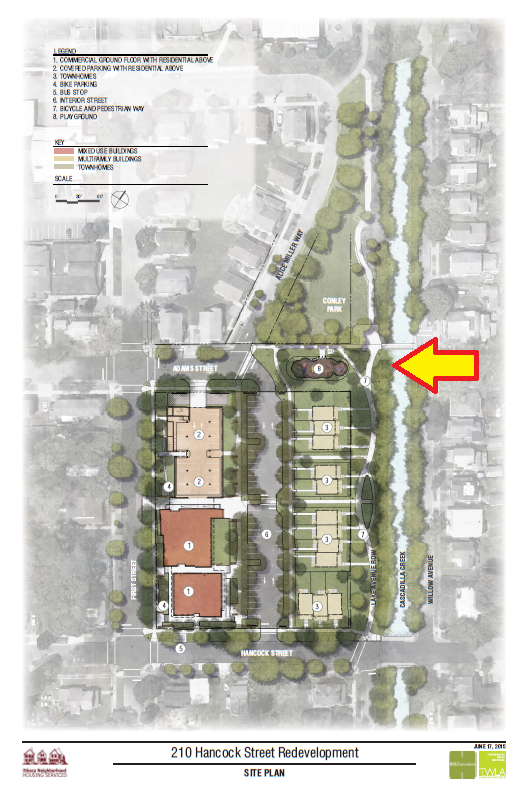
You’re right. That’s why the project, as proposed by INHS and tweaked by the city Planning Board, builds a playground that blends into Conley Park without the threat of vehicular traffic (shown in the plan below). Adams Street and Lake Avenue would be removed, allowing kids living in the apartments and townhomes to go the playground without crossing any street.

inhs_pride_playground

“I’m a lifelong resident, and I’m frankly getting tired of seeing all these areas getting bulldozed and developed…especially when we have dozens of empty/condemned houses and buildings just sitting around!”

The rental vacancy rate is 0.5%. A healthy market is 3-5%. Further to that, if there are dozens of homes, even if they were for sale, it’s still not enough to handle the demand, which is in the few thousands.

“inadequate parking planned.”

“The parking issue is already a problem. This will only make it worse.”

“I am a Fall Creek resident and do not want this area in our neighborhood to resemble Collegetown in density or difficulty in parking.”

84 parking spaces are required by zoning, 64 are proposed. However, only 22 spaces are expected to be used by the 53 apartments. In the parking study of INHS tenants, 41% of apartment tenants have 1 car, 12% of those have two. One of the reasons why INHS’s parking utilization is so low is that many of its apartments are rented by seniors – for example, Breckenridge Place is 60% seniors on fixed incomes. With limited mobility and/or income, many don’t maintain personal cars.

In a sense, although the Cornerstone project for affordable senior housing wasn’t selected by the Old Library site, the INHS project on Hancock Street may serve in some ways as a reasonable alternative.

“We don’t owe any developer a profit on their development.”

INHS is a non-profit community developer. The townhouses sold at Holly Creek over the past year were in the $105-$120k range. For comparison’s sake, the townhomes in the Belle Sherman Cottages sold for double that, and those aren’t even considered high-end (high-end would be the $410,000 townhomes in Lansing’s Woodland Park).

The reason why construction won’t start until Fall 2016/Fall 2017, with the apartments finishing up in Fall 2017/Fall 2018, is that they are completely reliant on government grants and donations from community supporters. The townhouses won’t start for a couple of years (their time frame is 2018-2020) because funding for purchasable units is more difficult to get. Just like with the condominium debate, the government is more likely to disburse a grant if it knows there are buyers waiting in the wings. And for low and moderate-income households, far more are capable of renting versus buying. As for the rent-to-own option suggested by the petition writer, it’s speculative, complicated, and NYS/federal HUD will not provide grants for that type of property acquisition. INHS couldn’t do it if they wanted to.

“[need]assurance mixed income will be there”

It will. As I wrote in March:

“210 Hancock will have 53 apartments – the 3 bedrooms have been eliminated and split into 1 and 2 bedroom units, so the number of units has gone up but the total number of bedrooms remains the same (64). The units are targeted towards renters making 48-80% of annual median income (AMI). The AMI given is $59,150 for a one-bedroom and $71,000 for a two-bedroom. The one-bedroom units will be rent for $700-1,000/month to those making $29,600-$41,600, and the two-bedroom units will rent for $835-$1300/month to individuals making $34,720-$53,720. Three of the units will be fully handicap adapted.”

“A 54 apartment high-rise is not the appropriate place for children to grow up, low income or not.”

“It is too dense and not suited to Fall Creek or Northside.”

“I moved to Ithaca and settled in Fall Creek to live in a small town.”

For starters, it’s harder to make housing affordable if there are fewer units on the a plot of land. Secondly, because the INHS project takes lead on the city’s right-of-way (ROW) on Lake Avenue and Adams Street, the calculated density per acre is 23.6 units per acre. Cascadilla Green, one block to the north, is 20 units per acre. Also note that units are 1 and 2 bedrooms per unit; most of the houses on blocks in Northside and Fall Creek are 3 bedrooms per unit.

What probably bothers me the most are some of the comments in the online petition for INHS.

“Shame on you “Ithaca Neighborhood Housing” for even thinking of creating something that will breed trouble…”

“This is an uncivilized proposal…”

“if all on welfare, this will invite crime…”

One of the reasons I harp on affordable housing is that I grew up in affordable housing. This 147-unit mixed-income complex in suburban Syracuse. Apartment 28E. I shared a bed with one of my brothers until I was 10, and even after my mother was finally able to buy a small ranch house, we shared a bedroom until he graduated and went to college two years before I did (by that point, we had moved on up to bunk beds). My mother did what she could. We were never more than working class, but she worked hard (still does) and made sure her kids worked hard.

At least some of the comments are kind enough to be “I want affordable housing but”. Others really make it sound like that those in need of affordable housing are a contamination of the community. Those statements aren’t worth debating. They’re just hurtful.

Anyway, this might be the longest news update I’ve done, so I’m going to wrap this up and detach from the computer for a while. There may or may not be a photo update Monday night, we’ll see.


News Tidbits 6/20/15: Big and Far, Small and Near

20 06 2015

Cornell Tech Passive Residential Building
1. In something not Ithaca but Ithaca-related, it seems like Cornell’s New York City-based Tech school is having quite a good week. Cornell announced that construction began earlier this month on a $115 million residential building at the Cornell Tech campus. the 26-story, 270′ tower is being built to passive house standards, the largest passive house building in the world.

According to an article in the New York Times –

“That means the building is able to maintain a comfortable interior climate without active heating or cooling systems, through the use of, among other things, an airtight envelope and a ventilator system that exchanges indoor and outdoor air. In climates like that of New York, however, standards allow small heating and cooling systems.

Making the Roosevelt Island tower airtight — creating what is essentially a giant thermos — was one of the biggest challenges, said Blake Middleton, the principal in charge and partner at Handel Architects, the building’s designer.”

The 350-unit, 530-bed building will house mostly graduate students, with some research staff and faculty also living in the tower. The apartments, designed by Handel Architects of NYC, are due to be completed sometime in 2017.

cornell_tech_v2

As noted at Curbed, to celebrate the groundbreaking, partner/developer Forest City Ratner released new renders of “The Bridge“, the tech incubator building on the right that looks like and ice cube cleaved into two pieces. As one might imagine, the new renders come with token florid language and eye-rolling descriptions (“an ecosystem of companies”). The Bridge, designed by New-York based Cornell alums Weiss/Manfredi, is being designed to LEED Silver standards, which is still better than about 99.5% of Ithaca. Construction permits were filed in January.

tech1

Last but not least, the $100 million Bloomberg donation, to name the first building “The Bloomberg Center”. The Bloomberg Center, designed by Thom Mayne of Morphosis Architects, will also open in 2017. To date (i.e. about three years since inception), philanthropy to the tech campus has totaled $685 million – and absolutely none of them care where you think the money would be better spent. Cornell hopes to raise $ 1 billion ($1,000,000,000) for the school by 2021.

For comparison’s sake, all of Cornell, Ithaca campus, Weill and Tech, raised $546.1 million in donations in 2014, and $474.9 million in 2013.

dibellas_v2_2

dibellas_v2_1

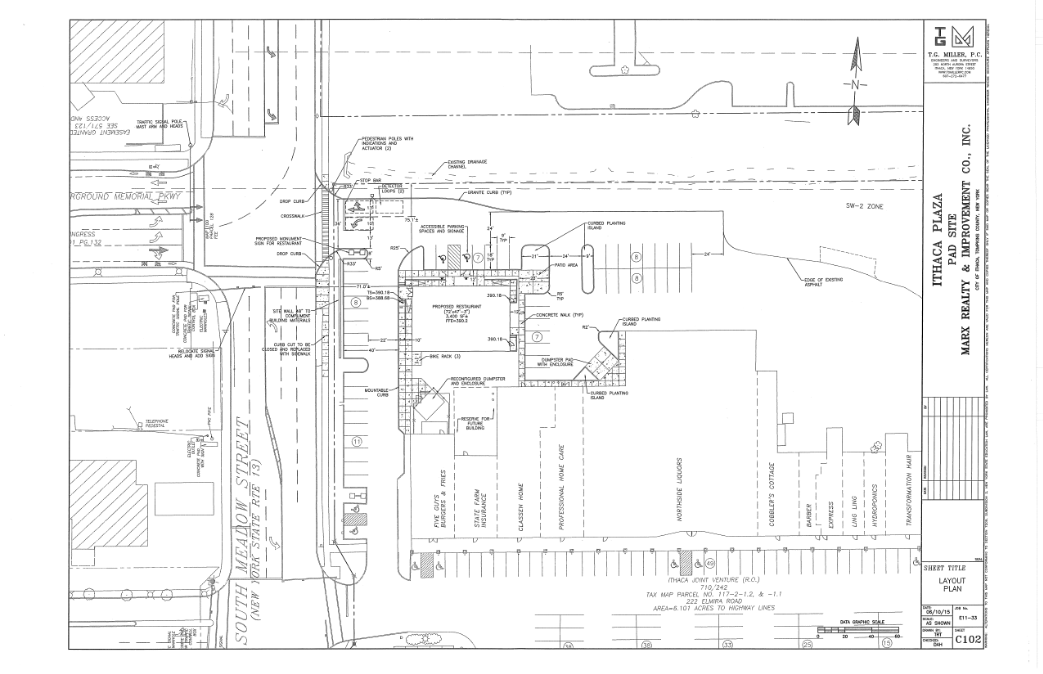
2. Now to go from something big and far away to something small and local.  It’s been a while since we’ve heard about DiBella’s, the Rochester-based sub sandwich chain that had been eying Ithaca last November. They’re back, and the proposal has has some pretty substantial tweaks.

The building itself is still about the same size (~3,400 sq ft), but the design of the building has been reworked to a brick facade with an asymmetrical door/window configuration. The building is now contiguous with the main shopping strip, no longer isolated from the rest of the stores by a driveway. No decisions are expected to be made at the June Planning Board meeting, it’s more of an update for the board as to what’s going on, and to solicit input.

Marx Realty of NYC is developing the pad property, and local architect Jason Demarest (brother of STREAM Collaborative’s Noah Demarest) is handling the design.

3. Shifting out to Dryden now; I don’t tend to write much about Dryden, since a lot of the local development is limited to single-family homes in semi-rural areas (and separately, bad things happen when I write about Dryden).

First, Dryden village. The village has seen quite a jump in population in the past couple of years thanks to the opening of the 72-unit Poet’s Landing affordable housing complex (affordable here meaning that it’s income restricted and rents range from the $600s/month for a 1-bedroom to about $900/month for a 3-bedroom). At least as far back as 2010, a second phase, at the time a 72-unit senior apartment building, was planned by Rochester-based developer Conifer LLC.

Glancing at the village’s outdated webpage, there were meetings in October about phase II. A little searching online shows the negative SEQR determination (meaning no major adverse impacts expected) was issued in February of this year. The determination announcement says that 48 more apartment units are planned for the land directly west of the current complex. The Poet’s Landing facebook page says that funding wasn’t allocated for the expansion this year, but they are hopeful for 2016.

It’s not the best location; affordable housing developments often vie for land outside of developed areas simply because the land is cheaper, but the trade-off is that residents are often isolated, especially if they don’t have money to maintain a car. Here at least the village’s main drag is close enough that residents aren’t totally isolated. And any affordable housing in Tompkins County is welcome.

4. Meanwhile, in Dryden town, there are a couple of projects going on. One involves the construction of 8 duplexes (16 units) at a 5 acre parcel on Asbury Road. Working with that piece of information, there was only one parcel that met the provided description – a property just east of the Lansing-Dryden town line that sold for $30k last August to “SDM Rentals”. Scott Morgan is given as the developer in the town documents.

SDM Rentals does have at least one other recently-developed property, the Meadowbrook Apartments, a set of at least 7 duplexes at 393 Peruville Road in Lansing for which he received a $1,000,000 construction loan in 2013 (2 were built in 2010), and rent for $995/month. The ones on Asbury Road will probably look similar.

The town notes that although the SEQR is still being prepared, the site was already being prepped with dirt fill, resulting in not one but two stop work orders. Looking online, it appears Morgan has a history of being a problem for local government, including a case in Lansing town where he was using a broken-down school bus for a pig barn.

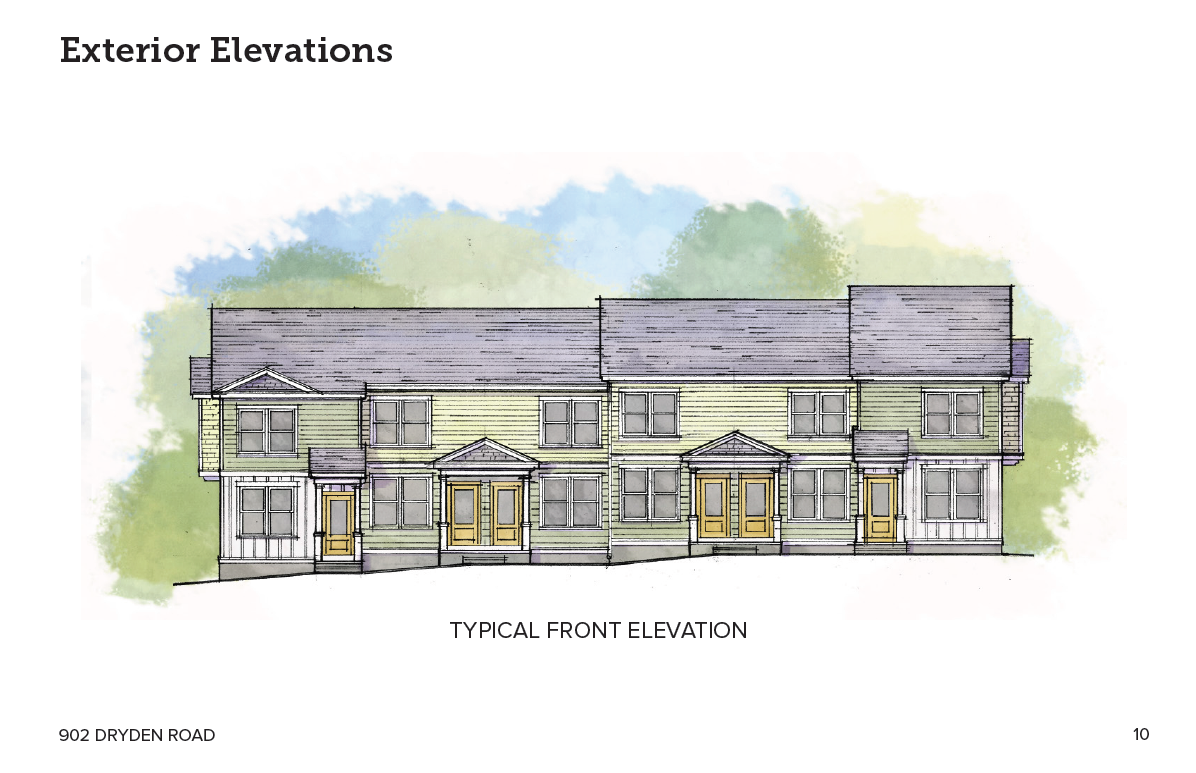
5. Now for project two, a multi-unit project at 902 Dryden Road. I’m just going to link to the Ithaca Voice article in an effort to save time. 15 units, (2 renovated, 13 new), 42 beds, and a $1.5 million investment.

902_dryden_2

I plan on touching on a couple of other minor Modern Living Rental projects at some point, but we’ll save those for a slower week.

20150613_180636 20150613_180659

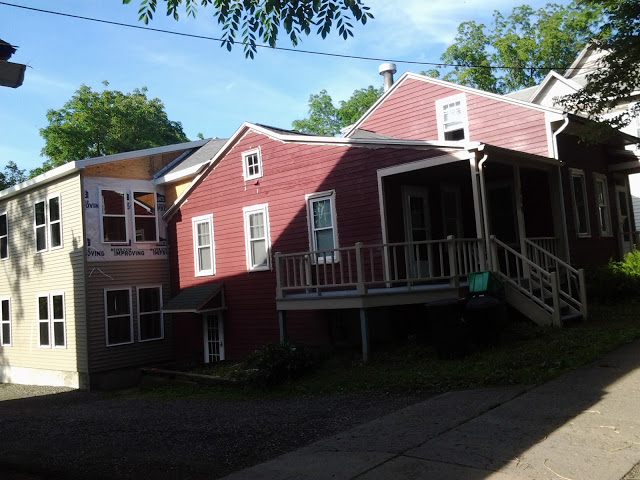
6. This week’s house of the week feature is 318-320 Pleasant Street on South Hill. The rear portion (foreground) is an addition, a duplex with 3 bedrooms each. Exterior siding is nearly complete, though some housewrap and plywood is still visible on the south (front) wall of the addition. A peek inside the interior showed that the drywall has been hung-up, but final details like carpeting have yet to be installed (several rolls of neutral-colored carpets lay stacked on the floor).  The owners of the 105-year old house are members of the Stavropoulos family, who run the Renting Ithaca rental company and the State Street Diner.

On a side note, the 200 Block of Pleasant Street must be one of the worst hills in the city. Walking it must be terrifying on icy days.

oldlibe_franklin_proposal

travis_hude_libe_libe_v3

7. The Old Library vote made quite a splash in this week’s news. With a 6-6 hung vote, everything’s up in the air. This is what I feared would happen.

There’s a couple of options to break this. Two legislators, Kathy Luz Herrera (D- District 2, Ithaca City/Fall Creek and Cornell Heights) and Peter Stein (D-District 11, Ithaca Town/East Ithaca), weren’t in attendance, and could call the measure back up for a vote. Herrera’s District is two blocks from the Old Library site, and Stein’s a retired Cornell professor, so although I shouldn’t be guessing people’s judgement, I don’t think it’s a stretch to imagine which of the two projects they’ll be swayed by. But if either one of them decides they dislike all three options, or if they split their votes, then everything will be stuck in limbo. At that point, it’s anyone’s guess – the building could be mothballed, or given that its HVAC and utility systems are at the end of their mechanical lives, it could even be demolished as a long-term cost-saving measure.

If the county does decide in favor of one proposal, it’s still a long road ahead – ILPC approval, Ithaca city planning board approval, and a variety of other measures, which could break the winning proposal. Both projects have potential challenges – with Travis Hyde, ILPC or the Planning Board may try and whittle down its units, removing the density lauded by some legislators, and perhaps the project will no longer be financially feasible. With the condos, one starts with a building that’s had asbestos and air quality issues in the past – one bad surprise in the renovation, and the project could be jeopardized, or at least priced well above the quoted $240-$400k. There are a lot of variables in either equation, and since they can’t all be quantified, both will have their risks.

I’m just going to hope that someone is able to bring new life to the site. I don’t want to see two years go to waste.

state_st_triangle_3

8. Almost to the end. Here’s your monthly look at the Planning Board Agenda for next Tuesday:

– No subdivisions this month, but there will be a 15-minute public comment period on the city’s new Comprehensive Plan.

A. 210 Hancock will be giving an update on its plan and up for recommendation for the Board of Zoning Appeals for parking (64 spaces vs. 84 required) and height variances (46.5 feet vs. the legal 40 feet). Quoting the pre-prepared document, “The Board strongly recommends granting the requested variances.”

B. An update on DiBella’s as described above

C. Tompkins Financial Corp’s Headquarters will be open for public comment, determination of environmental significance (SEQR negative/positive), and preliminary approval for both phases

D. 215-221 W. Spencer will be reviewed for Declaration of Lead Agency (Planning Board agrees to conduct of State Environmental Quality Review)

E. “Collegetown Housing Project at Dryden and Linden – Update”. A.k.a. whatever John Novarr’s planning for that five-building stretch of Dryden and Linden he just deconstructed. Readers might remember this site was part of his Collegetown Dryden project proposed last July, but there’s no indication if it’s a revision of that, or a totally different approach. The one thing that is constant is the zoning – MU-2 for the three properties on Dryden and 240 Linden, and CR-4 for 238 Linden. Neither zone requires parking, MU-2 allows six floors and necessitates mixed-use (often interpreted as ground-floor commercial), and CR-4 does not have mixed-use requirements but the height is limited to four floors. Expect an urban-friendly six-story building fronting Dryden with a four-story setback on Linden.

F. “State Street Triangle (Trebloc) Mixed-Use Project – Update” Anything could happen. Height decrease, site redesign, fewer units, major design changes…we’ll just have to wait and see how the 11-story, 600-bedroom tower has evolved given the initial recommendations of the Planning Board.

simeons_v2_1

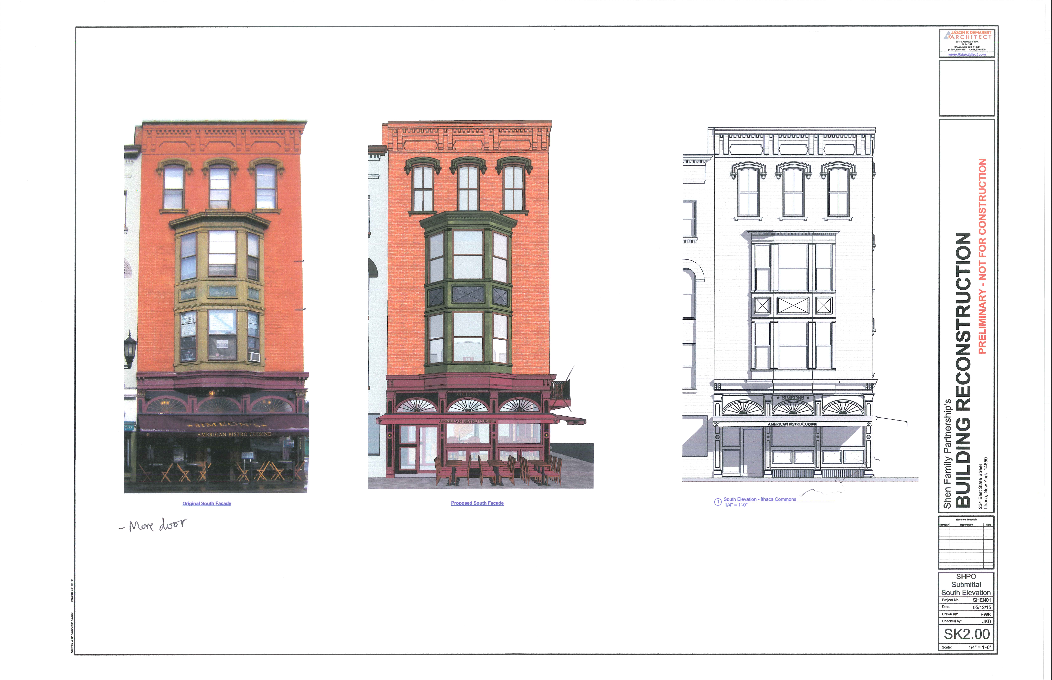
9. We’ll end this week on a happy note. Shen Properties LLC plans on launching their Simeon’s rebuild shortly; first and second floor restaurant space for Simeon’s, and five luxury apartments. The exterior will be a near-replica of the original facade of the Griffin Building, but the interior will be renovated to hold an elevator and a sprinkler system. In a quote to the Journal, property manager Jerry Dietz says to look for a reopening in the very late 2015 or early 2016 timeframe.


News Tidbits 5/16: Smart Developments, or Sprawl?

16 05 2015

Looks like this is going to be one of those longer roundups. I’m excited and intimidated at the same time.

tfc_v2_1 tfc_v2_2 tfc_v2_3

1. First off, I’m going to lead off with renders of the new Tompkins Financial Corporation. Write-up on the Voice here, more drawings here, traffic study here, cover letter here, Full Environmental Assessment Form (FEAF) here.

Rather than describe it in neutral generalities as I did with the Voice article, I’m going to afford the right to be a little subjective. The design is respectful of its neighbors through the use of brick and stone veneer. There’s no real surprises in the design, and corporate buildings tend to be pretty conservative anyway. At 104 feet (100 to the rooftop, and then 4 feet for the roof parapet), this will make a dent in the Ithaca skyline, but once again, it respects and balances out it neighbors by being a little taller than the DeWitt Mall, and a little shorter than 121′ Seneca Place. On a spectrum, the street front is on the nice side though not fantastic; a bank branch and some offices will engage with the street only modestly, but it’s much, much better than the drive-thru there now. The new building is built to the sidewalk, has an urban form, it’s a multi-million dollar private investment and a lot of other things that most upstate mayors would sell their mothers to get. The project is still shooting for a summer approval and construction starting not long thereafter.

One concern I have is that this will offload tens of thousands of square feet of office space onto the Ithaca market. Office space is one of the weaker sectors of the local market, and this may exacerbate the situation. It could cause some problems come 2017, and maybe with projects still in the pipeline such as Harold’s Square, which is shooting for a fall start after two years of trying to secure financing. I think that in the longer term, a few of the spaces such as the Seneca Building (121 East Seneca) might be ripe for a residential conversion.

With that concern noted, I think the parking situation will be okay. Since most of the jobs are shuffling around downtown, there’s not going to be a huge influx of workers. Offhand, I think the numbers are low double-digits (20 or 30) for transfers from Lansing into the city, and then the 77 brand new jobs created over the next several years.

belle_sherman_townhouses_1

2. And then there were none. With the sale of the last of their townhomes (lots 20-24), the Belle Sherman Cottages have technically sold out. I say technically because Lot 9, the new cottage design on the southwest corner of the parcel, has yet to be marketed let alone sold. I followed up with an email to developer Toby Millman of Agora Home LLC, and he replied that “[w]e are still working on the plans for that home and expect to release if for sale in the next month or so.” So keep an eye out for that.

3. Here’s an interesting piece of news from the Ithaca Urban Renewal Agency – the city recently showed off the 6-acre parcel it owns on Cherry Street to an employer looking to relocate 250 employees to the property, buying the lot and building a one-story “campus setting” over the whole six acres. This may or may not be the same one previous mentioned in the March minutes, regarding an inquiry from a business located outside the city. Since the parcel may have been shown in January or February, it seems that the two are likely the same entity.

This isn’t the first piece of news regarding some potentially major work in this isolated section of Ithaca’s West End – scrap steel mogul Ben Weitsman has also been rumored to have plans, and improved access from the Brindley Street Bridge would aid in redevelopment of this part of the city.

state_st_triangle_3

4. The planning board is cautiously enthusiastic about the State Street Triangle development. Per the minutes from the April meeting, they want the building to be as iconic as possible; board member John Schroeder went as fall as to suggest inspiration from the Carson Pirie Scott Building in Chicago:

Another member suggested a decorative crown. If my notes are right, a crown could exceed zoning as long as it’s not habitable space. Some other suggestions include a setback on the upper floors, and looking into incorporating other forms of housing.

5. A quick follow-up on the proposed removal of some lot setbacks at the Nate’s Floral Estates trailer park – according to a tweet from Ithaca Times writer Josh Brokaw, the removal would allow an extra 18 lots for manufactured housing. The trailer park currently has 112 lots, and it’s been noted to have a substantial waiting list. Nate’s Floral Estates serves as senior housing, so this is one way to make a dent in the affordable housing problem.

815_s_aurora_1

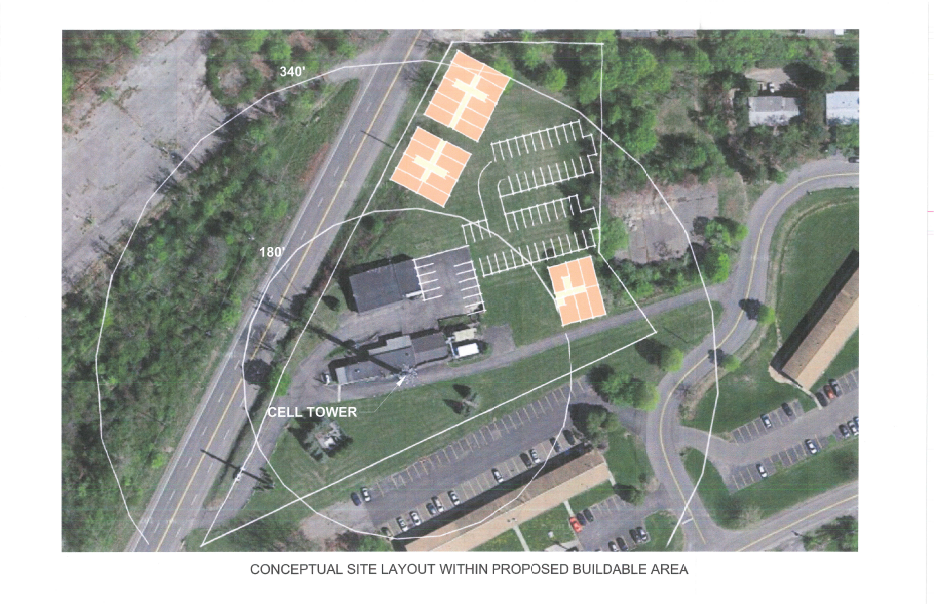
6. It’s not too often you see someone request a zoning interpretation. At 815 South Aurora Street on South Hill, that’s exactly what local architect Noah Demarest of STREAM Collaborative is doing on behalf of developer Todd Fox. Fox would like to develop the land with apartments (and he’s no stranger to South Hill, having built a couple duplexes on Hudson Street a couple years ago), but can’t. The city won’t allow construction in the “fall zone” of cell towers, which they define as twice the height of the tower. At 815 South Aurora, a 170′ tower creates a 340′ radius of no-man’s land (outer circle above), making the parcel undevelopable. The developer got a hold of two private engineering companies (TAITEM Engineering and Spec Consulting), both of whom determined that an appropriate fall zone is the height of the tower plus 10 feet for a little wind/bounce – so 180′ total. With this info in hand, Fox is trying to get the city to refine the zoning to allow the decrease in fall zone and therefore permit the land to be open for development. It’s an interesting case, and the result could be a sizable apartment complex down the pipeline. Stay tuned for the BZA review in June.

228_w_spencer_1

A couple other minor projects are up for zoning variances on parking – a small 2-bedroom house planned for 228 West Spencer is seeking a variance because the builder (Ed Cope of PPM Homes) says there’s no room on the hilly lot, and Todd Fox is requesting a parking variance for a 2-bedroom basement apartment to be built at 108 Ferris Place, saying that its central location and easy bus access should make having a car unnecessary. Coincidentally, architect Noah Demarest is handling both appeal applications.

troy_rd_rev1_1

7. To wrap things up, here’s the latest agenda from Ithaca town. There doesn’t appear to be anything too exciting going on next Tuesday. Cornell is renovating its softball field on East Hill with improved site access, a new restroom and ticket office, and replacing the existing bleaches, dugouts and press box. The 32-unit Clare Bridge assisted senior living project that was discussed last week will be reviewed. There are also sketch plans to be presented for a propane refueling station and sales office to be built on a vacant lot on Elmira Road/Rte. 13.

The planning board will also be reviewing plans to subdivide the Troy Road parcel that was once slated for a major residential project. The seller (Paul Rubin of Florida) apparently has a buyer for the triangular chunk of land south of the power lines (which can be seen in the old render above). With no explicit plans for either plot of land, there’s little reason to deny the subdivision at this time.

Personal opinion, I don’t like the direction this is going. It’s a real shame that the revised 130-road Troy Road project didn’t continue pursuit of approvals, it had really started to coalesce into a decent proposal. But now there’s a possibility where the land gets divvied into multiple chunks with homes scattered on it like bird crumbs. Single-family and duplex homes don’t have to go through board review, so there’s a lot less oversight when the land gets divided among multiple owners and built out in a piecemeal fashion. The last thing the town needs is expensive, sprawling, ecologically insensitive development.


State Street Triangle (Trebloc Building Site)

29 04 2015

state_st_triangle_3

Downtown Ithaca could be in for a very large addition in the next couple of years, if developer Campus Advantage has its way.

The Texas-based developer is planning an 11-story addition to downtown on the the Trebloc Building property at 301 East State Street/MLK Jr. Street. The building would reach the maximum of the 120-foot zoning allows on the property, and fill up nearly the whole plot of land bounded by East State, South Aurora and East Green Streets.state_st_triangle_1

In the initial sketch plan presented Tuesday night (link here), local architect Scott Whitham, a consultant for the project, showed floor plans for retail on the first floor of the proposed tower, with apartments on the floors above. The retail section includes five general retail spaces and one restaurant space, with sizes ranging from 1,800-2,300 sq ft each. Space for a fitness center and apartment amenities are also included on the first floor.

state_st_triangle_2

Upper floors look out into an interior courtyard on the second floor, and contain a variety of 1 bedroom, 2 bedroom and 4 bedroom units. Each floor would contain about 23 units per floor with 60 bedrooms. Over ten floors, that means that the State Street Triangle building would add 230 units of student-oriented apartments, with 600 bedrooms.

For perspective’s sake, that would make it one of the most populated buildings in the city. Cornell’s largest dorm, Clara Dickson Hall, tops out at around 460 students. The Towers of Ithaca College hold about 300 students each. Collegetown Terrace has the only private buildings that come close to having this many people in one building.state_st_triangle_4

There is no parking on the site. The city’s Central Business District (CBD) zoning does not require it. The CBD zoning allows for nearly full lot coverage as well. The CBD zoning is used only for what planners and officials want to be the densest downtown locations, where parking garages and mass transit are in easy access.

This skyline-altering project stands to have a very large impact on downtown and the city in general. It would be the first student-focused development in the downtown Ithaca area, and 600 students is certainly quite the addition. The project stands to capitalize on both Cornell students and IC students, since the project is within commuting distance of both schools.

There’s much to be debated and sorted out moving forward. More detailed site plans and features are expected to be delivered to the city sometime in May. This summer will be a very exciting one for the Ithaca Planning Board.


News Tidbits 4/25/15: Long Week, Long Reads

25 04 2015

Grab the popcorn and sodas, folks, this will be a long one.

inhs_pride_design_comparo_v1_v3_1

1. Let’s start with some new and updated renders for the evolving 210 Hancock Street development that INHS has planned for the Northside neighborhood.

In each image, the top half is the old version, the bottom half the newest version. The lead image, an aerial rendering, shows that the houses haven’t changed much, though at the city and neighborhood’s insistence, Lake Street has now been closed off to all vehicular traffic in the refined proposal. The biggest structural changes have been in the apartment buildings – the color scheme of materials has been changed up quite a bit, and the partitions between the buildings have been re-worked to try and make the buildings appear less connected (one of the complaints raised was that they were too much like a wall; for this same reason, the buildings are slightly offset from each other, so no continuous face is presented towards the street).

inhs_pride_design_comparo_v1_v3_2

inhs_pride_design_comparo_v1_v3_5

Looking closer at the individual apartment buildings themselves, the designs have been pretty thoroughly reworked. Different window layouts, different window sizes, different colors – about the only thing that’s been kept the same is the overall massing of each building. The plan calls for 53 1 and 2-bedroom apartments and about 65,000 square feet of space, of which 7,500 square feet will be covered parking. The included commercial space has been expanded from 8,200 sq ft in the initial proposal, to about 10,000 sq ft now. More renders of the newest iteration can be found here.

inhs_pride_design_v3_7

No real changes yet in the for-sale houses that will be included in the project, apart from a palette change (previous render here – the new one is less bright, with darker earth tones). These are designed to blend in with the surrounding homes, and fall in INHS’s typical 2-3 bedroom, 1,100-1,400 sq ft range. The houses are townhomes in rows of 2-4 units, All sporting one or two-story porches. These will be built in a phase separate from the apartments. Certain affordable housing grants are geared towards owner-occupied units specifically, so the Neighborhood Pride lot will be split up into two parcels, one with the apartment rentals, one for the homeowners.

Questions and comments can be directed to the City Planning Office at dgrunder@cityofithaca.org.

2. Up in Lansing village, it looks like a proposed mixed-use project may finally be moving forward after years of incubation. “CU Suites”, a 3-story, 43,000 square foot project proposed by the Thaler family for a vacant lot on Cinema Drive, is asking the village to waive sewer connection fees. Presumably, this is about getting their finances in order before moving into the construction phase; there has been no news if funding has been secured yet. Something to keep an eye on this summer, certainly.

The Cinema Drive site was previously approved for a project of those parameters in fall 2012, consisting of two commercial spaces and a 39-unit apartment building, but that plan has not been carried out. The CU Suites proposal went before the village for “alterations and possible clarification” last December. No updated renders on the village website, but a site plan of the previously approved plan can be found here.

20150405_141933

3. Here’s some more details on the “not feasible as presented” Flatiron project. Readers might recall the 12-unit affordable housing proposal at 910 West State Street was given low priority for HUD Entitlement Grant funding.

From the presentation notes recently posted online:

“The project application is not fully developed, but probably represents more of an effort to start a conversation about the project. There is a great need for affordable housing in the community. The project was conceived to address the high cost associated with typical renovations to properties which make them unaffordable. The project would be located in an oddly-shaped trapezoidal building which [Ishka Alpern] would like to renovate to match its prior condition. It would be a very nice, unique addition to Inlet Island. Inlet Island has historically been a location for affordable housing and it is important to maintain that, before too many unaffordable projects are built there. Unfortunately, it is difficult to build affordable housing units without some form of funding assistance.”

In the Q&A the committee had with developer Ishka Alpern, no time table was given, and Alpern said he was open to waiting a year to refine it. It was also noted that once a commercial lease on the property expires in four years, an even larger project could be proposed, though it could be limited by the poor soils. While it appears renovating is the most feasible approach, the city was not impressed with the cost of investment per beneficiary – larger projects like 210 Hancock mentioned above have economies of scale going for them, costing less to build per unit. Smaller projects like the Flatiron need proportionately more assistance, making them less attractive for grant money. The city’s looking for the greatest good for the greatest number, in a sense.

In other news from the Ithaca Urban Renewal Agency (IURA), a private developer, Viridius Property LLC, is buying five duplexes with 10 units of affordable housing from non-profit Community Housing of Ithaca with the intent of keeping them low-to-moderate income, but retrofitting the buildings to run on renewable energy sources. Viridius, a company run by computer scientist and tech CEO Stuart Staniford and his wife, was established in early 2014, and has been on a buying spree as of late. They own $1.7 million in rental real estate assets now, these duplexes will raise it $2.7 million, and the goal expressed in a letter to the IURA is $5 million.

Quoting the letter sent to the IURA:

“Viridius is oriented to the “triple-bottom-line.” Although as a privately owned business
we will look to return on investment, we also seek to improve the environment and society. We
are particularly focused on contributing to the solution to climate change by converting the
existing building stock to be appropriate for continued use in the twenty-first century. At each of our properties, Viridius is removing the propane, natural gas, coal, or oil heating systems and replacing these with systems based on renewables. The specifics depends on the particular
building; to date, we have used pellet boilers and air source heat pumps. Viridius is also
developing our first solar panels at one of our buildings, and elsewhere acquires commercial
renewable power for electricity. Also, at our own residence we have deployed geothermal heat
pumps for heating and cooling and have all our electrical needs taken care of by solar panels on site. Viridius is certified as a living wage employer by the Tompkins County Worker’s Center
and has five full time staff at present in addition to the owners.

So it’s eco-friendly and/or affordable housing. Most residents will welcome the new fish into the local pond, even if all the property being acquired is a bit eye-raising.

Lastly from the IURA, the Carpenter Business Park on the north side is on the market for $2.85 million. Four vacant parcels on Third Street and Carpenter Park Road on the north side of the city recently sold for $2.216 million from “Templar LLC” based in Ithaca to “Ithaca Lender LLC” out of New Jersey, in what may have been a foreclosure sale. The address on file is associated with a company called “Kennedy Funding Financial LLC”, which is described as “one of the largest direct private lenders in the country, specializing in bridge loans for commercial property and land acquisition, development, workouts, bankruptcies, and foreclosures.” A google search turns up a legal notice between the two entities a few months ago.

gannett5

4. Construction is gearing up for the Gannett Health Center’s addition on Cornell’s Central Campus. Work on the project officially launched March 30th, according to the Cornell Daily Sun. Expect site clearing, excavation, and pile driving as we move through the spring and into the summer. The project will be broken into phases – Phase I focuses on new construction, Phase II on renovation of the current building, and Phase III concludes the project with reconstruction of the Ho Plaza entrance. About 75% of the material removed from the old building is expected to be recycled.

The architect of record is local architecture/Cornell alumni-filled firm Chiang O’Brien. There will be two additions, the four-story, 55,000 square-foot building featured above, and an additional 18,600 square foot addition that replaces the northeast side of the current building. The project also includes a new entrance and substantial renovations to the original 1950s structure (22,400 square feet of the existing 35,000), as well as landscaping, site amenities, and utilities improvements. The projected cost is $55 million, and the target completion date is October 2017.

The Gannett Health Center expansion has been a long time coming. Initial plans in the late 2000s called for a completely new building on site. HOLT Architects prepared a plan for a 119,000 square foot building, and an all-new building was also included in Cornell’s 2008 Master Plan. But once the Great Recession waged its battle on Cornell’s finances, the Gannett redevelopment was scaled back to its current form. According to a statement given by Gannett Director Dr. Janet Corson-Rikert to the Sun, the earlier plan had a budget of $133 million; the new addition and renovations are expected to cost $55 million.

The project is expected to create about 175 construction jobs and 40 permanent jobs (additional doctors, counselors and support personnel) when completed.

5.  According to next week’s Board of Public Works agenda, the approved 327 Eddy apartment project has been pretty heavily modified.

Here’s the old design:
327_eddy_rev2_1

Here’s what the developer is planning to build:

327_eddy_rev3_1

I must have missed something? All the sources I’ve seen have referred to this as a six-story building, not five. The side windows were added late in the approvals process, I think. Anyway, the project is going to the BPW because the developer wants to project the top centerpiece window as a bay window rather than having it set back from the front facade. This would push two feet (2′ x 12′ isoceles triangle) into the city’s right-of-way over Eddy Street,  and the board is recommending to the council that the mayor authorize (he says she should he should, sheesh) the intrusion for an appraised value of $3,073.84, based on an appraisal value from Pomeroy Appraisal Associates in Syracuse.

The decrease in size also comes with a decrease in units and rooms – from 28 units and 64 beds to 22 units and 53 beds. This is a double-edged sword – some might cheer the loss of size or like that the roofline is continuous with its northern neighbor, but it will be harder to stem the tide of single-family home conversion to student apartments if Collegetown’s core isn’t as capable of absorbing Cornell’s student population growth.

The included email in the agenda says the planning board recommended an overhang bay window. Personally, I feel it would make the building look clunky. But that’s just me.

maguire_fiat_1

6. Here’s another project being served up to the Planning Board this Spring. Additions and renovations to a car dealership down in southwest Ithaca’s suburbia. Site Plan Review and drawings here. The dealership is Maguire Fiat Chrysler. Plans call for combining two show lots into continuous lot and adding 20 spaces, adding a 1,165 square foot showroom addition, and new landscaping and signage, including a second freestanding sign for Fiat that requires a sign variance (the max allowed by zoning is one freestanding sign). Documents indicate all the work will cost about $360k and run from September to December of 2015.

Observant readers might remember that Maguires proposed a delaership/headquarters compound in Ithaca town late last year; but due to irreconcilable differences regarding standard zoning vs. Planned Development zone, the plan was tabled.

100_1474

7. Woof. Almost to the end. The Ithaca Planning and Development Board is going to have their hands full at next Tuesday’s meeting. Agenda here. Here’s a rundown of what’s in store:

– A minor subdivision to create a new home lot at 201-203 Pearl Street.

A. Approving the adjustment to the Carey Building design discussed earlier this week

B. Enhancements to the pocket park next to the Lake Street bridge (landscaping, paving)

C. Declaration of Lead Agency and discussion on INHS’s 210 Hancock project

D. Declaration of Lead agency, Public Hearing and Determination of Environmental Significance for the proposed Texas Roadhouse on Meadow Street

E. Declaration of Lead agency for the Tompkins Financial HQ – hopefully, we’ll get some detailed renders at the meeting

F. “State Street Triangle Project (Trebloc Building site)” – This will be huge. I cannot stress by excitement enough at seeing the Trebloc Building demolished – I have not hidden my dislike of it, and in nearly seven years of writing this blog, it’s the only building I’ve ever called an “architectural turd“.  Located at 301 East State Street, the Trebloc Building was built in 1974 during the age of Urban Renewal, and was originally supposed to be two floors. The city has been quietly desiring redevelopment of the prominent corner for years, and the site was upzoned from 60 to 120 feet in late spring 2013.

According to some praise-worthy sleuthing by David Hill at the Ithaca Journal, the developer is Robert Colbert in cooperation with Austin Texas-based Campus Advantage, a large-scale developer of student apartments. plans call for a 120-foot building on site, with first floor retail and student-oriented apartments above.

This will be a tremendous project by Ithaca standards. The developer clearly states on its website that it’s only interested in working with sites that will provide at least 100 units of housing. Assuming the Trebloc Building’s footprint of 13,569 sq ft, one story retail followed by eleven floors of apartments yields almost 150,000 square feet of residential space. Figure a loss of 15% for utlities and circulation space, and an average size of about 980 square feet for an average residential apartment unit, and one gets 130 units and an unknown number of beds that could conceivably add a couple hundred students to downtown Ithaca’s population, not to mention millions of dollars of taxable real estate.

There’s a lot that will need to looked at – utility loads, parking, vehicle circulation, aesthetic impacts, and numerous other attributes. But the city’s holding the door open about as wide as it can for this site, and it’ll be an exciting process.

G. “Sketch Plan: Cornell Fine Arts Library – Rand Hall Addition”

Written about previously, it looks like the city will get its first chance to review the project. But someone with a insider’s look has some pretty harsh comments for the plan to renovate Rand hall.

Cornell Architecture professor Jonathan Ochshorn wrote in to tell readers here about the plans for the Fine Arts Library. I’m including a link to his blog post on the project here.

To try and sum up Prof. Ochshorn’s post would do him an injustice, but suffice it to say, the library plans will only keep the brick shell of Rand – the windows will be replaced, and a large “hat” will be placed on the roof. One that bears strong scrutiny from the Planning Board, since there could be significant visual aesthetic impacts on the Arts Quad Historic District.

I’m gonna tie up this post here and sit on the other items until next week. More weeks like this and I’ll need an intern.