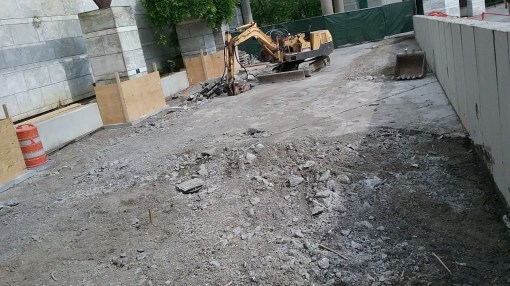
Schwartz Plaza Construction Update, 6/2017

15 06 2017

One of the biggest complaints about Collegetown is the lack of public gathering spaces – there’s no real park or public plaza that can be utilized for gatherings and events. The gorges aren’t all that accessible and aren’t suitable for large groups, and places like CTB and St. Luke’s provide for small private gatherings and community events, but the lack of a sizable public social space poses a challenge to the neighborhood’s ability to provide for its residents.

As Collegetown’s raison d’etre, Cornell is stepping up to the plate to offer a space with the renovation of Schwartz Plaza. It’s not truly a public space as something owned by the city or county, but Cornell’s large, multi-faceted presence offers a reasonable facsimile.

Part of the purpose for building the Schwartz Performing Arts Center in Collegetown was to draw in people from outside the neighborhood, and mix the non-students with the students. When the building first opened in 1989, the plaza was intended as an outdoor reception area for Schwartz patrons, and the original design by English architect James Stirling, which called for a lively “forecourt”, was never built out. Instead, the plaza was walled off from the street and there was little exposure or interaction with College Avenue. As a result, outside of performances, Schwartz Plaza tends to be barren, its only social function comes from being close to a bus stop.

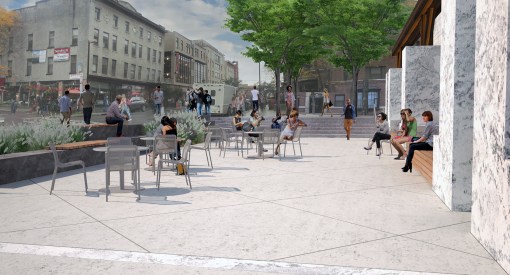
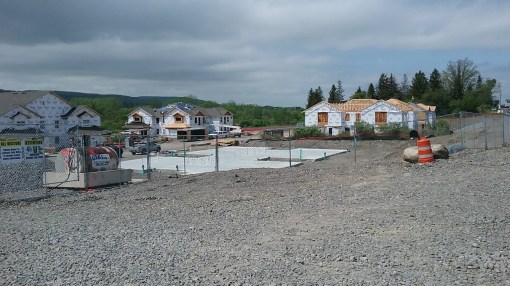
The stated goals for Schwartz Plaza’s renovation are to improve pedestrian circulation, increase safety by providing for better visibility, and to enhance aesthetics. To do this, Cornell will remove the 4-foot tall concrete wall that separates the plaza from the sidewalk, create a series of short stairs to facilitate “permeability” of pedestrians to and from the plaza, and adding new seating and landscaping to make the plaza more inviting – stone walls and pavers, wood-on-granite benches, recessed LED lighting, new bike racks and planters. It’s not really a new structure or even a change of use, but to make the plaza more effective for its intended use.

To quote the marketing pitch: “This project is expected to yield a lively new gathering space that serves as a catalyst for an enhanced pedestrian boulevard along College Avenue, the primary pedestrian gateway to the university. This project is conceived as a key node within a larger, future Collegetown public realm enhancement area.”

Being a fairly minor project, and having hosted some community meetings last fall to determine the neighborhood’s design preferences, this plan sailed through the city’s planning board review, in and out from February through March. I can’t seem to locate the SPR offhand, but the total cost is about $600,000.

As projects go, this one should be relatively short at about four months, May-August 2017. TWMLA is responsible for the plaza design, T. G. Miller for civil engineering work, and Taitem Engineering for electrical engineering. The contractor isn’t clear and (unusually) Cornell doesn’t have it listed on their webpages, but the invited bidders were all regional road/landscape construction firms.

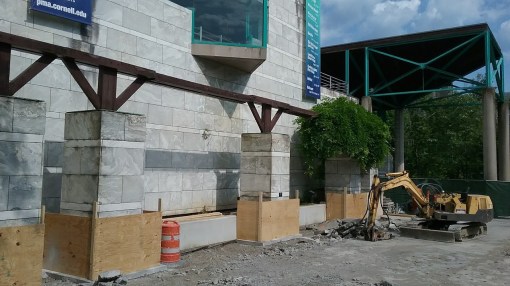
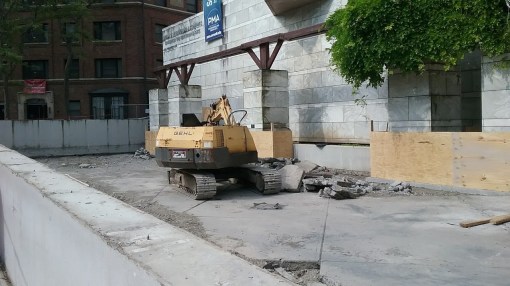
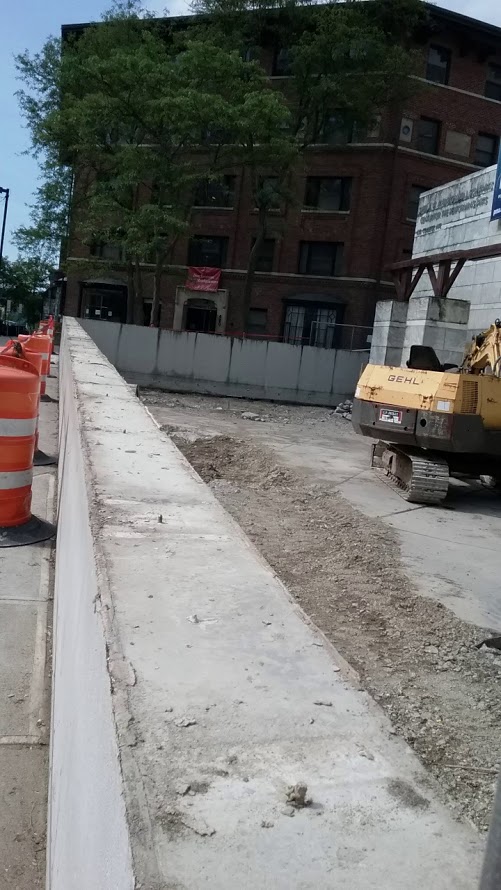
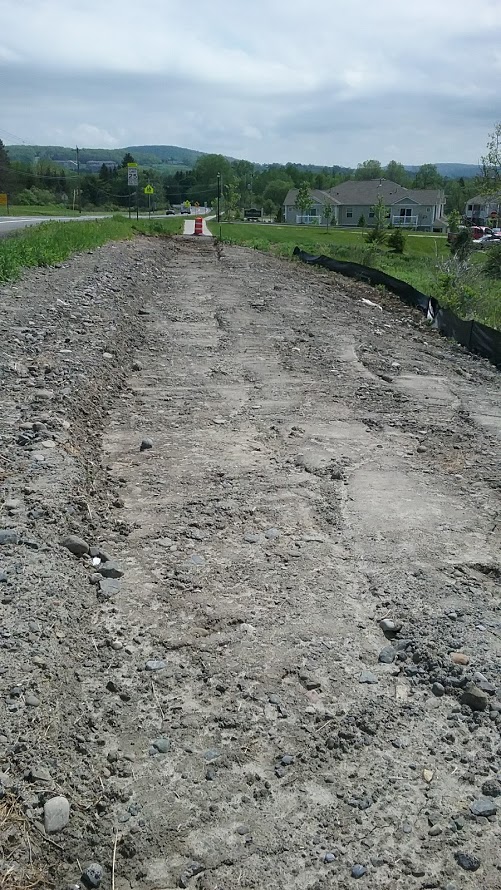
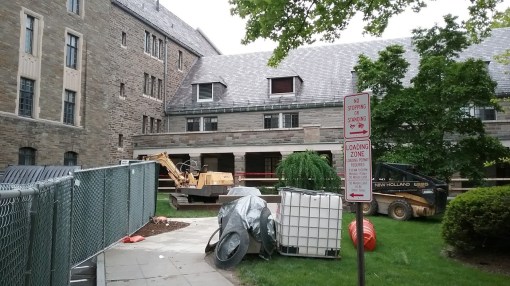
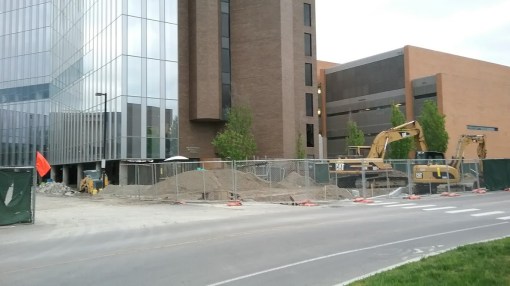
In the photos, it looks like removal of the old plaza is underway, with the wall soon to follow. The plywood around the Vermont marble columns is for protection (way back, the columns were intended to be limestone and brick stringcourses, but it was value-engineered to marble and off-white Dryvit).



209-215 Dryden Road Construction Update, 6/2017

13 06 2017

For news about today’s event, please go to the Voice.

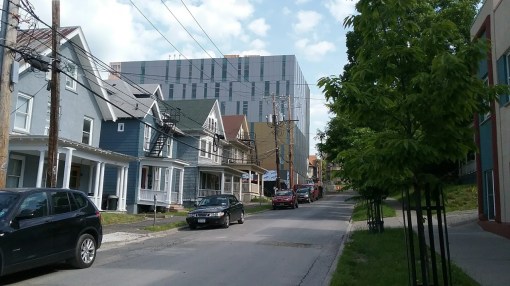
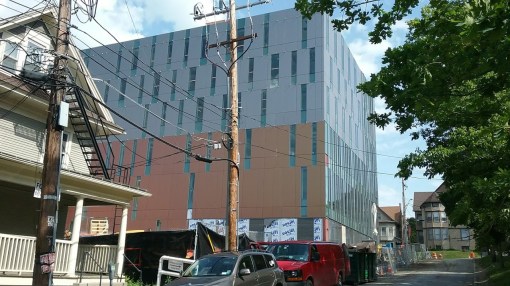
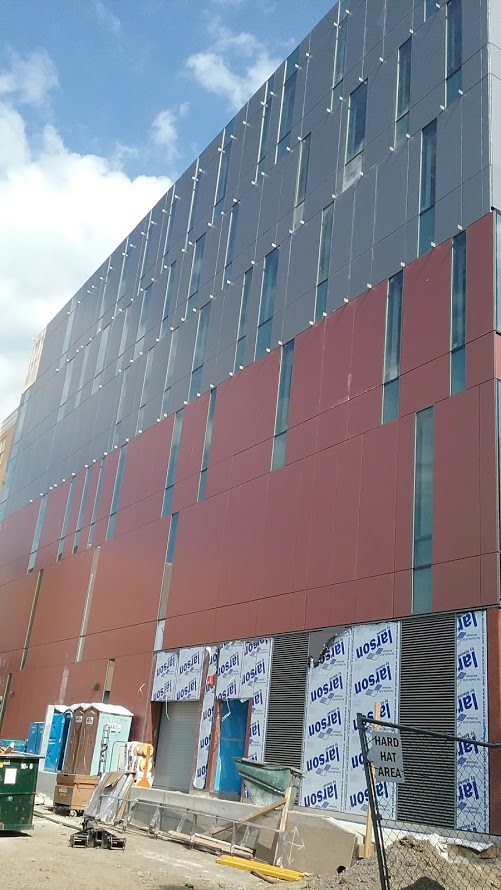
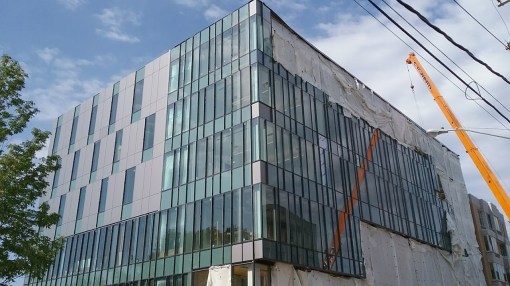
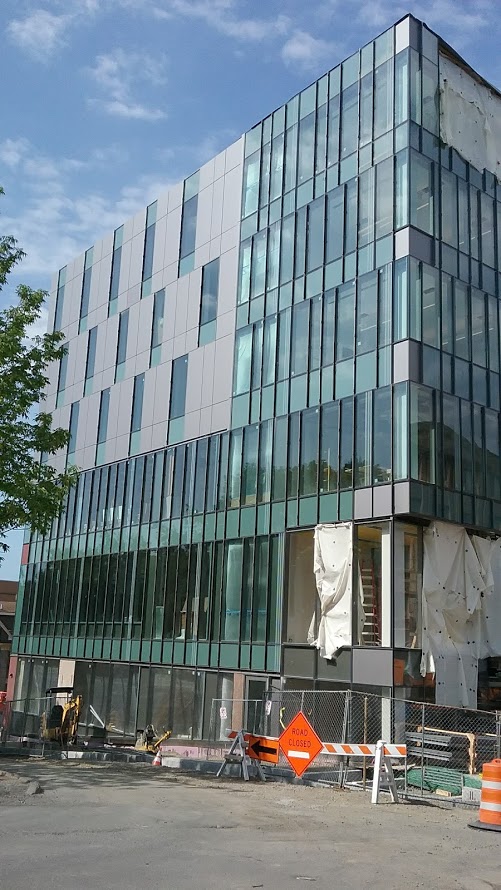
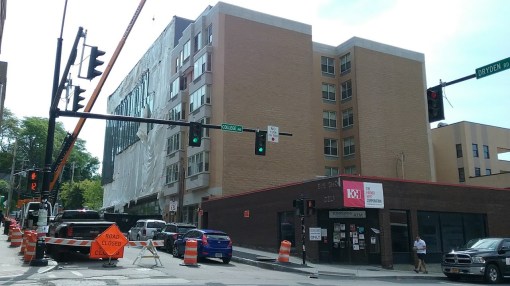
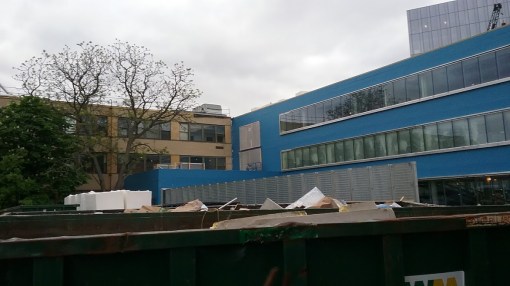
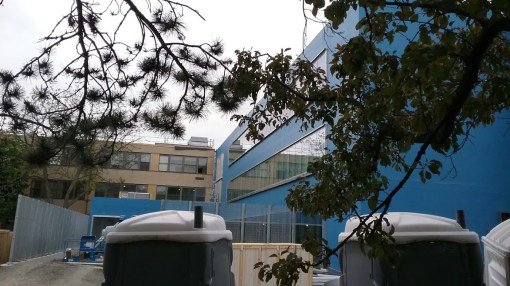
Most of the rear and east facade are complete on the Breazzano Center at 209-215 Dryden Road. The Larson sheeting on the utility/loading dock refers to Larson Alucoil, the brand name of the aluminum metal panels being used to complete the less photogenic vantage points of the new 6-story building. The clips on the rear wall will be used as hinges for architectural sunshades.

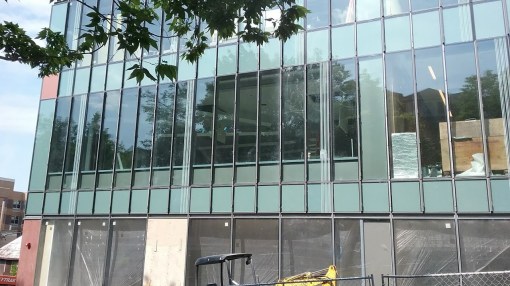
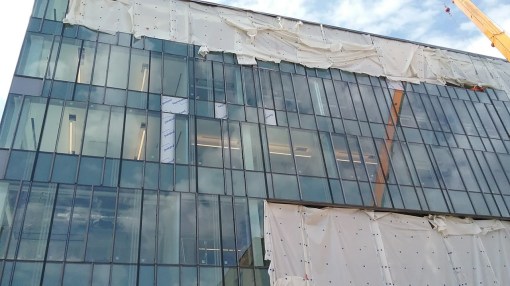
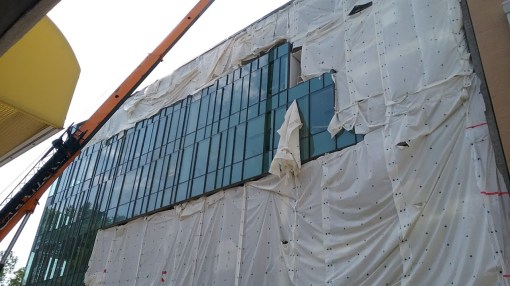
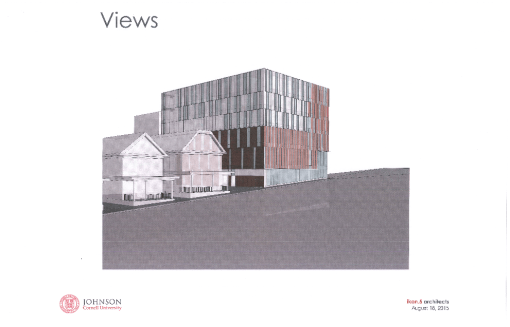
Most of the windows and spandrel glass has been installed on the read and east facade. Note that spandrel glass is purely decorative, and there are metal panels between the glass and the lip of the floor plate. The white stripes indicate where the salmon-colored metal panels will be installed over the glass, although I personally would be just as happy to see them go without; the glass curtain wall gives the building an airier, less overbearing appearance. The bottom floor uses clear glass to give the building greater transparency at street level, and is meant to enliven (“activate”) the block. In photo 9, you can see the ceiling of one of the large group instruction classrooms, meaning that the drywall has been hung on at least the lower floors, and utilities rough-ins have been completed.

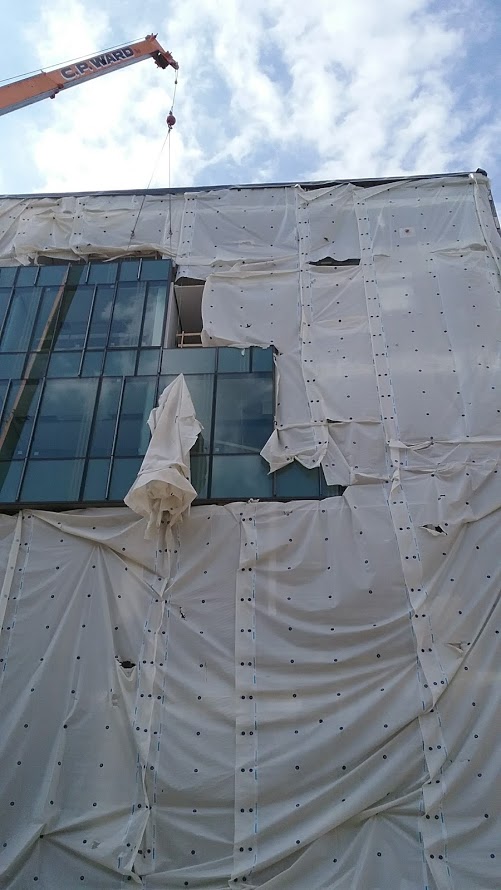
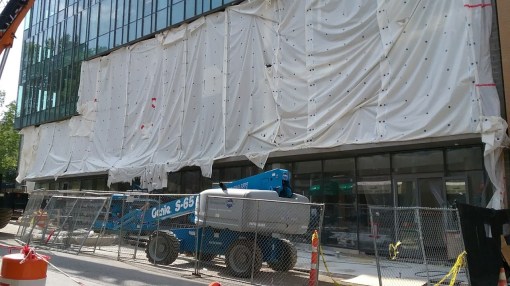
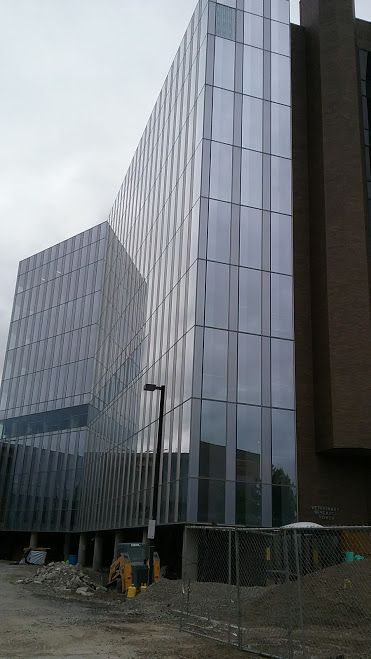
At the time these photos were taken, workers were easing a new panel section of the front curtain wall into place – it’s a bit of a delicate process to hoist the glazing with the crane and line everything up just right, and then quickly fasten it into place so they can move on with the next section, pulling the tarp back and continuing down the line. One imagines it must get a bit stuffy under the plastic sheeting this time of the year. More complicated exterior sections like the projecting atrium wall have yet to be tackled.

The Breazzano Center should be open in time for the fall 2017 semester. Not long thereafter, the staging area next door at 238 Linden will becoming a project of its own with the erection of a 4-story, 24-studio apartment building. That project is up for final approval later this month.


201 College Avenue Construction Update, 6/2017

12 06 2017

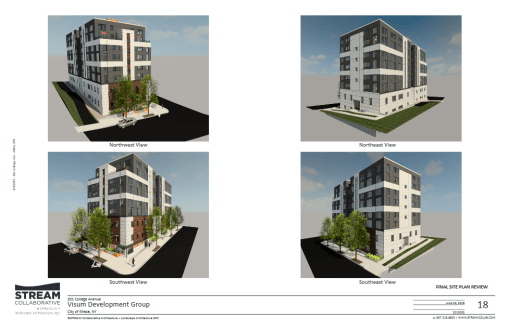
201 College is moving right along. W. H. Lane has been charging ahead at a rapid clip in order to have the 44-unit apartment building ready for occupancy in August. the front (west) half is further in the construction process – fireproof Georgia-Pacific DensGlass fiberglass mat sheathing, coated and sealed a pitch black air/vapor barrier (Carlisle Barriseal?), and layered with Dow Thermax polyiso insulation boards. The Thermax is coated in a reflective outer layer to repel incoming solar radiation and keep the building cool during the summer. Or at least, that’s what one of the construction guys told me. Some windows have been fitted into the structure on the lower floors.

The back half is not as far along. The northeast and east walls remain bare steel studs, while the southeast wall is just getting its DensGlass mats installed. The paired window layout might seem a little unusual, but many of the units will utilize a “mezzanine” intermediary floor to increase the living space in each unit.

One detail that has appeared to have changed from the images on file here are the stairwell windows above the front entrance. The drawings show one square window for each floor, while the finished building will have a pair of smaller square windows.

The front facade might seem a bit bland at the moment, but a plethora of exterior finishes should give the building a more visually interesting appearance – A large Sherwin-Williams Iron Ore (aka fancy off-black) metal canopy above the entrance, and fiber cement panels in shades of Allura Snow White, S-W Gauntlet Grey, and S-W Chinese Red, as well as woven bamboo siding. A stucco aggregate will be applied to exposed foundation sections (when you’re spending $10 million, you can afford the real deal over DryVit), and white cedar panels with a clear protective finish will be used for canopy ceilings and architectural screens. Long story short, variety of colors and materials should help break up the mass and make it look less overbearing.

With August just a scant two months away, we’ll have an idea of how nice the final product looks soon enough.


Ithaka Terraces Construction Update, 5/2017

1 06 2017

Taking a look at the Ithaka Terraces site at 215-221 West Spencer Street, one question immediately comes to mind – is Building “D” still happening? The other three are far along, and yet there appears to be no sign of Building “D”, a mirror of Building “C”, starting construction. It could be cost concerns or pre-sales worries, or simply a matter of timing. The website doesn’t look like it’s been updated recently, and marketing for the condo units doesn’t seem to have started yet.

Apart from the completion of the roofing, not much additional work has occurred on the exterior of Building “A”. Its twin, Building “B”, has finished framing, sheathing, windows are being fitted and the roofing is well underway, sheathed and covered in Certainteed DiamondDeck and WinterGuard underlayments, but not yet shingled. Building “C” has had its multi-story porch erected and it looks like the R39 cellulose insulation is underway. New to this update are the Bituthene sheets on the concrete foundation walls of “C” – Grace Bituthene Membrane is a two-component system, the first is a sticky, liquid rubberized asphalt compound, the second a laminated HDPE film, and together they’re used for weather and moisture protection, handy when your walls will be exposed to moist soil uphill and several feet deep. The white walls facing the future grand staircase are water-resistive barriers to protect the plywood ZIP panels from the mositure-absorbing stucco finish.

Local eco-builder AquaZephyr LLC (run by Kendall and Mike Carpenter) is the general contractor, Taitem’s doing the structural engineering, T.G. Miller is in charge of civil engineering, STREAM’s the architect, and Ed Cope (PPM Homes) is the developer. Side note, I dropped by the Wyllie site and didn’t see work on the renovation underway, although it’s not clear if the state grant funding has been disbursed yet. It and the PPM’s Ithaca Glass Apartments are expected to get underway this spring.

Also, let’s not forget the ’80s hair metal blasting over the stereo on-site. I guess nothing gets the work done like Whitesnake and Twisted Sister.

UPDATE: From the architect, Noah Demarest, on the status of Building “D”: “It’s a logistic issue. Couldn’t get all the foundations in at the same time. Should be starting soon.”


Rodeway Inn Construction Update, 5/2017

30 05 2017

So this is one of those small projects that would probably be missed unless someone were explicitly looking for it. At 654 Elmira Road south of the city-town line, hotelier Pratik Ahir has commenced with reconstruction and expansion of the Rodeway Inn motel.

The Rodeway Inn is one of Ithaca’s less-expensive, quirkier lodging options. A collection of four buildings dating from 1950s-1980 with later renovations, three buildings hosted 40 motel-style rooms with a dining/lobby space, and a detached house was home for a live-in manager.  With it came outdoor gazebos, a playground, and well-appointed if careworn rooms – an unusual blend of budget appearances and mid-tier amenities. Motels have been on the property since the Wonderland Motel was built in the 1950s, and the buildings have been owned by JAMNA Hospitality since 2005.

Reviews of the Rodeway generally note welcoming staff and clean units, but dated layouts and buildings in need of a serious upgrade. That is what JAMNA’s Pratik Ahir has set out to do here. The initial plan was to enlarge the rooms with a rear addition for more spacious bathrooms, and add new corner units to former mechanical closets on either end of the U-shaped “Building 1”. These plans were approved in December 2013.

After the approval, however, the plans were shelved. In 2014, the Maguires were seeking to do their “artisanal” dealerships and HQ down there, and that plan would have involved buying out and demolishing the Rodeway Inn. JAMNA was prepared to sell the property to the Maguires, but after the Maguire plan was cancelled following disagreements with the town over zoning, the motel owners were once again given a chance to re-evaluate their plans.

Revision number two to come before the town asked for the renovations as before, but added internal and external modifications, parking lot adjustments, and called for an additional 1,146 SF to the single-family home (“Building 2”) to turn it into a community center for guest recreation and dining. This was also approved.

Then we get to the final version, number three. This plan asked for the 1,146 SF addition as in Plan 2, but instead of Plan 1’s addition, JAMNA requested approval to tear down both arms of Building 1 and replace them with larger arms on the same footprint that would host an internal hallway – so less motel and more hotel. The work would also add four rooms, bringing the total to 44. Perhaps related to this confusion, JAMNA had already started demolition when the town issued a stop-work notice in January, requiring the new plans to be approved before work could continue.

Joe Turnowchyk of Pennsylvania-based Hex 9 Architects is the architect for the project; he’s also the guy behind JAMNA’s future plans for a 37,000 SF, 70-room Sleep Inn up the road. Anatoliy Bezpalko of “Time 4 Improvement LLC” is the general contractor. It’s a little odd that the architect’s from Southeast PA, and the contractor from Stroudsburg in the northeast near the Delaware Water Gap, as they are neither close to each other or to Ithaca. According to county records, the Rodeway Inn has a hard cost of $926,000. The lender is Generations Bank, a small bank based out of the Seneca Falls.

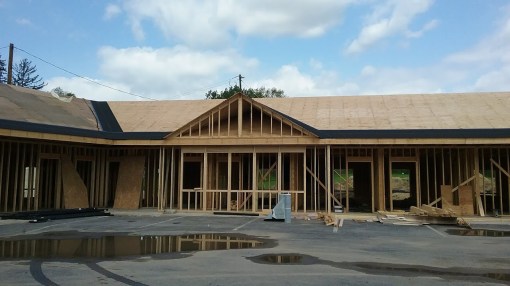
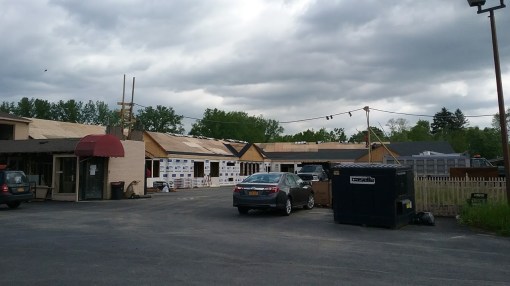
Looking at the site below, a fair amount of progress has already been made – stone veneer and some exterior finishes are up on the new community center, and wood framing is ongoing for the new motel wings. The large blank wall on the “tower” will be occupied by metal awnings, matching the metal roof. Some housewrap has already been adhered to the plywood sheathing. The roof has been sheathed and the underlayment is being attached. Buildings 3 and 4 will be renovated, but their square footage and layout should stay the same.


602 West State Street Construction Update, 5/2017

30 05 2017

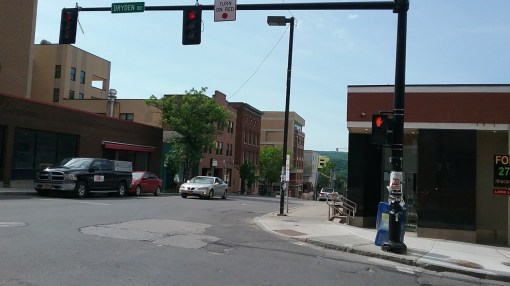
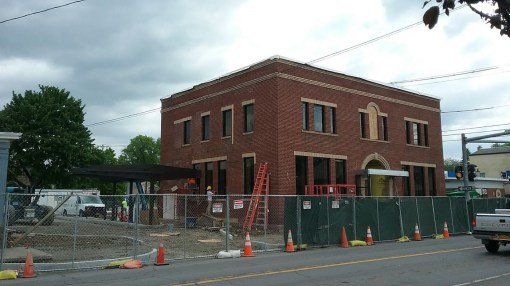
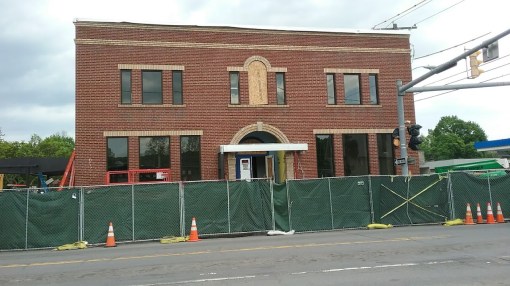
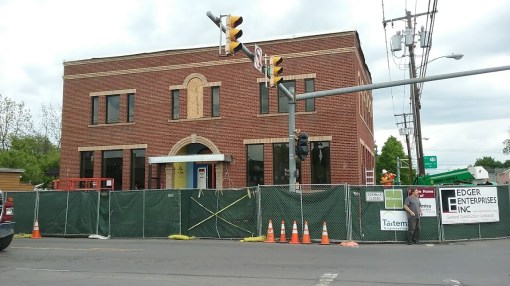
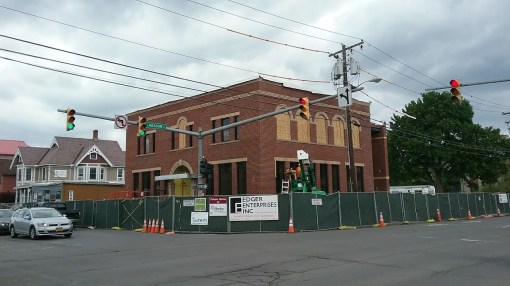
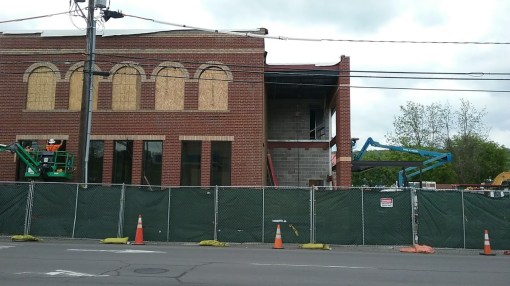
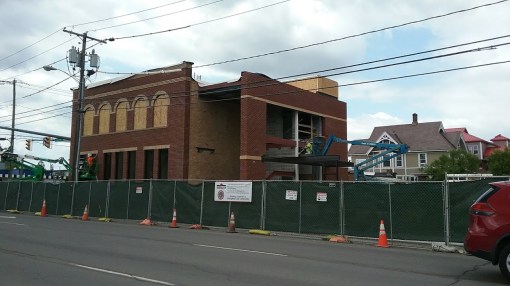
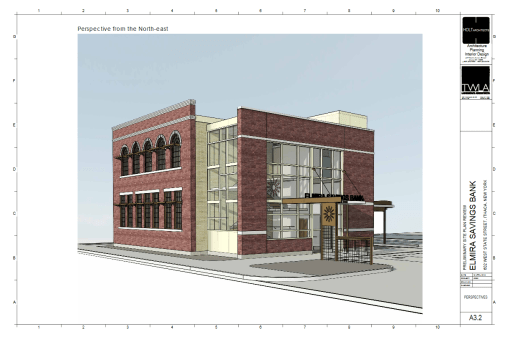
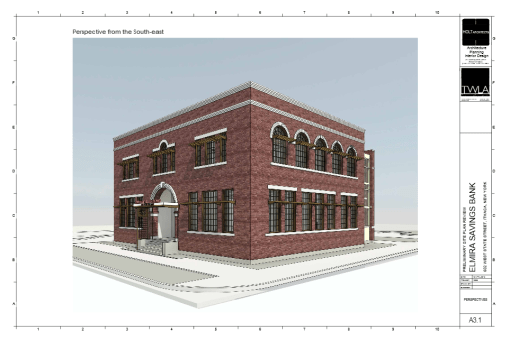
Starting to get a good idea of what the final product will look like at the future Elmira Savings Bank location at 602 West State Street. The structural steel for the drive-thru canopy is up, the new front and rear entrance canopies are being erected, and the new curbing is down. The new north addition has its steel and masonry with matching belt course, but it looks like the new interior stairs have yet to be built (the floor plan of the new addition is basically a stairwell albeit an imposing one, an elevator lobby and the elevator). the two-story opening facing Meadow Street will be framed with metal panels and fitted out with a contemporary glass curtain wall.

The early renders suggested a beige color for the aluminum panels, but according to the final materials submission, the panels will be Alucobond “Anodic Satin Mica”, which most folks would describe as a soft tan/dull tan. The alumnium roof coping, flashing and gutters/downspouts will be Hickman Sandstone, and the stucco will be painted Benjamin Moore Horizon Greyboth are close approximations of the building’s historic paint colors.

Taking a guess, the arched windows have to be custom-made, and given the time that takes, it might explain why they’re the last replacement windows to be inserted. The windows will be fitted with metal sunshades towards the end of the construction period.

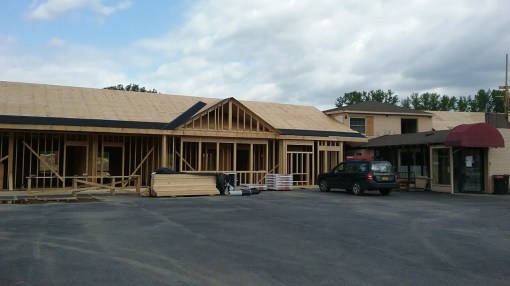
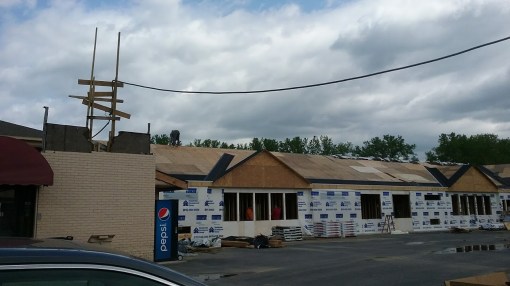
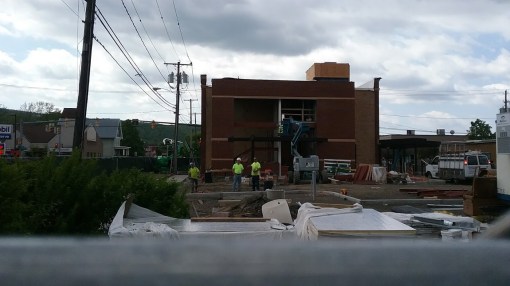
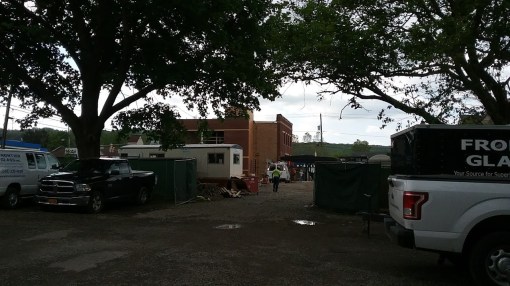
Construction on the $1.7 million renovation/addition (5,000SF/1,600 SF, total 6,600 SF) is due to wrap up in August. Elmira Savings Bank will occupy 3,300 SF on the first floor. The second floor, also about 3300 SF, will host for-rent office space (a little too big for the Voice though, which I’d wager at 800 SF off the cuff). HOLT Architects is in charge of design, and Elmira’s Edger Enterprises is in charge of the buildout. It looks like glazing has been subcontracted to Frontier Glass Inc. of Rochester.


902 Dryden Road Construction Update, 5/2017

27 05 2017

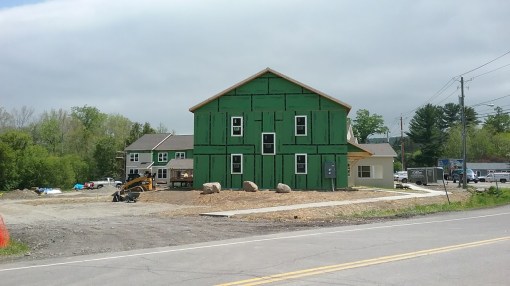
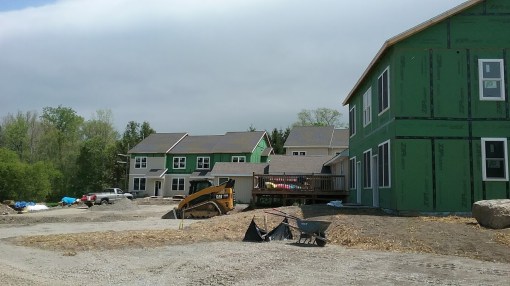
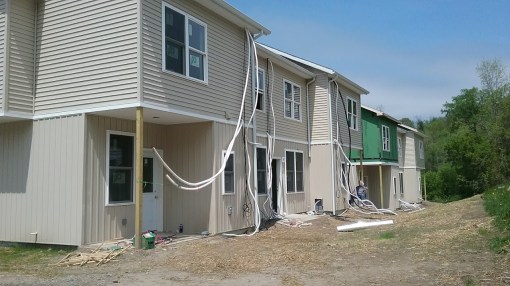
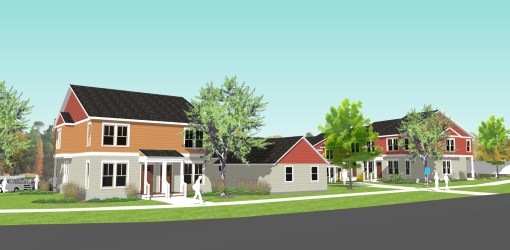
Visum Development/Modern Living Rentals’ project at 902 Dryden Road in Varna is coming along. Dropping by the site a few days ago, one of the things that stands out to be is that the design of the pair of townhouses closest to Forest Home Drive have been redesigned from the render that was shown when the project was approved by the Dryden town board in March 2016. Legally, this isn’t a big deal, since as long as the board stipulations have been met and it doesn’t affect the SEQR determination, then the modification is allowed. To be 100% honest, this armchair critic likes the redesign more, since it avoids the blank space near the party wall. Comparing the render to the other townhouse strings, it looks like there were some elevation adjustments and changes in fenestration, but the general appearance remains the same as approved.

However, one thing that I’m a little concerned about is the siding being all one color. It’s not a critical issue, but I think the monochrome makes the project bland and less pleasing to the eye. All the renders I’ve seen have shown a mixed palate, whether it be the grey/red/orange below, or the beige/blue/brown combination shown on MLR’s website. The mixed forms of siding – vertical, lap and shingle – but I hope that this isn’t the final exterior color.

Anyway, the buildings have all been roofed and sheathed with ZIP panels, doors and windows have been fitted, the interior stud walls are good to go and rough-ins are underway. On the older strings, some of the siding is up and trim boards have been attached. The wiring and tubes coming out of the eaves on the rear face are connections for the electric air-source heat pumps. Although not a part of the initial build-out, Visum is exploring the installation of an offsite photovoltaic grid that would make the project net-zero energy, meaning that all the energy used is generated from renewable resources.

The site will have 26 parking spaces for its 32 bedrooms (2 existing 3-bedroom units, 6 new 3-bedroom units, 2 new 4-bedroom units), well above the one parking space per unit required by zoning. The site will also be a “flag stop” for TCAT buses and have bike racks to serve 20-24 bikes. The units, which are going for about $600-$700/bedroom, will be ready for occupancy in time for the 2017-18 academic year. Bella Faccia Construction, who did 707 East Seneca, is the general contractor, and STREAM Collaborative is the architect. AJH Design and Fine Line Construction also serve on the project team.

Side note, Bella Faccia’s website claims they’re doing a Cici’s Pizza in Ithaca – that would have been news to me, and my editor at the Voice would have been over the moon, but it turns out it was a typo and they meant Horseheads.


Poet’s Landing Phase II Construction Update, 5/2017

26 05 2017

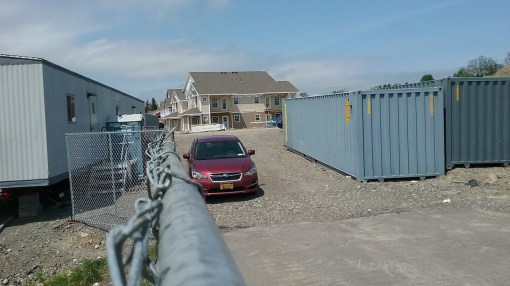
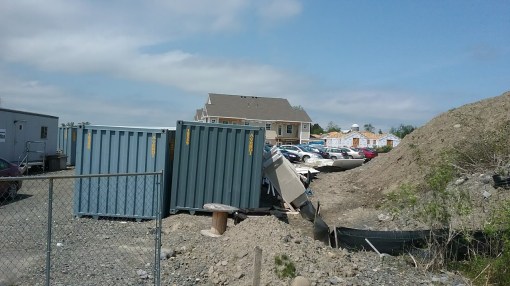
Continuing the theme of affordable housing from Conifer, here’s their other current local project, the $10.8 million second phase of the Poet’s Landing apartment complex in the village of Dryden. Six buildings, eight units per building – it looks like Conifer utilizes three unique two-story designs from NH Architecture with differing unit configurations.

Going counterclockwise, one sees the slab foundation of the latest building (which we’ll call “A”) to begin construction. The next building, “B”, is still being framed, its roof trusses nearly finished, while “C” is further along, roofed in sheets of plywood sheathing. All structures make use of a Tyvek-like housewrap for a vapor and moisture barrier. Building “D”, furthest from the road, is being papered and shingled, and windows have been installed in some of the rough openings. Building “E” and “F” are being sided (probably Saint-Gobain CertainTeed vinyl siding, if it’s like other Conifer projects). Taking a guess at what’s going on indoors, it’s bare stud walls in “B” and “C”, utility rough-ins (plumbing, electrical) in “D”, and drywall, paint priming and perhaps interior fixtures/trim in “E” and “F”.

As with most of Conifer’s affordable housing projects, LeChase Construction serves as general contractor through a joint venture partnership called Conifer-LeChase. Expect the units to come online building-by-building from September 1st through the fall. Information on income limits can be found in the summary post here, and rental inquiries can be sent through the contact page here.

Side note, it’s going to be really nice when they put the new sidewalk in – walking along Freeville Road is a bit of a harrowing experience.


Cornell Law School Renovation Update, 5/2017

24 05 2017

Externally, not much has changed since March, although it looks like work is starting on enclosing the north loggia. The Fork and Gavel Cafe is closed for renovations through September, but a carry-out offshoot will serve in its place. Most of the work on this $10.2 million project is internal, converting former dorms into academic office and support space. With any luck, the next visit will be from the inside.


Cornell Veterinary School Expansion Construction Update, 5/2017

24 05 2017

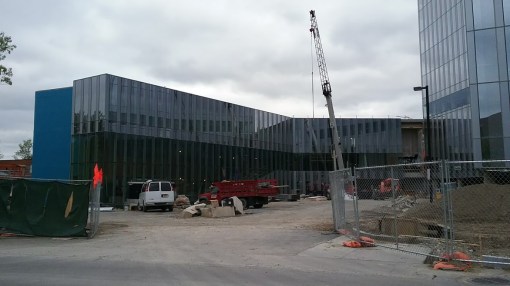
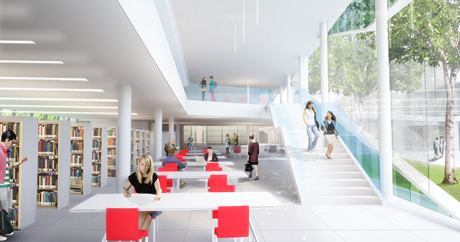
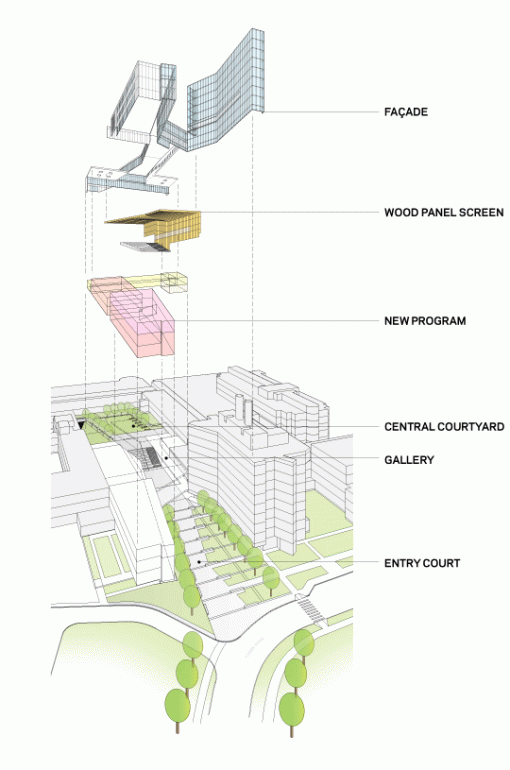
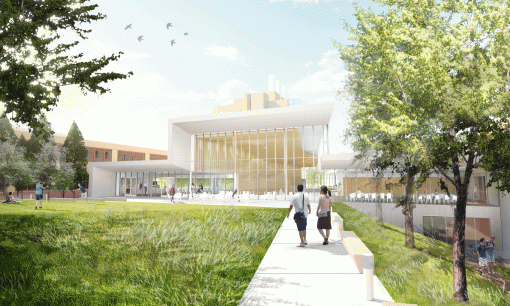
So many projects in the final stretch up on East Hill. The Vet School expansion’s multipurpose atrium is in the process of being closed up with its curtain wall glazing. An interior shot from the start of May shows interior stud walls are up and utilities rough-ins taking place, but drywall, interior trim and fixtures had not been undertaken.The concrete for the “grand staircase” had just been poured.

The atrium will be called “Takoda’s Run“, in honor of a greyhound adopted by alumna Janet Swanson (for whom Cornell’s wildlife rehabilitation center is named). The Swanson family are major university benefactors – Janet, Class of 1963, has given millions of dollars to the Vet School since the mid-2000s. Husband John (BS 1961, B.M.E. 1962, M.M.E. 1963), an engineer and tech executive, has given tens of millions to the university. The atrium in Duffield Hall and a lab suite in Weill are named for him, as well as several endowed professorships, fellowships and scholarships. Not just leaving it to Cornell, the couple has buildings named after them at Washington and Jefferson College in Pennsylvania, and a $41 million donation to the University of Pittsburgh led to the Swanson School of Engineering. My former editor at the Voice is definitely not a fan of this practice, but for those with a lot of money to burn, naming opportunities can be found or scoffed at here.

From the outside, the new administrative and library wing haven’t changed much since March, but at this point all Welliver has left is some window installs, exterior panels and finishes. Since I’m on a kick at the moment, the Flower-Sprecher library is named for former governor Roswell Flower (1892-94) for allocating funding, and in the early 1990s, Dr. Isidor Sprecker ’39 (Americanized from Sprecher) donated a substantial sum for renovation. It looks like some underground utilities work is going on out by the curb, possibly in preparation for the new landscaping and lighting fixtures.

The new Community Practice Service Building is underway, although I don’t have photos – the Poultry Virus Building has been demolished and the site was being cleared and readied for new construction. The timeline for the new 12,000 SF HOLT Architects-designed building is May 2017-May 2018, a couple months later than originally programmed.

The project seems to be a little bit behind schedule. The project team was initially aiming for a June completion, which was a little optimistic. The new schedule calls for an August opening.