News Tidbits 12/26/15: Do You Hear What I Hear

26 12 2015

1. Not as visible, but still important – Student Agencies Inc. has secured a $3 million construction loan from Tompkins Trust Company for a major renovation of its building at 409 College Avenue. Although details about the project itself are a bit scarce in the paperwork filed on the 18th, it is likely the eHub entrepreneurial space being built for Cornell students, faculty and staff. The eHub space will include space for PopShop (a space for student business planning and development), the eLab business incubator, conference space, mentors-in-residence, and basically all the physical space and things a budding businessperson would like to help them succeed.

According to a previous write-up by the Cornell Chronicle, the lab should be open later this Spring, with 10,000 SF on the second and third floors of 409 College Avenue, and 4,000 SF of space in Kennedy Hall on the Ag Quad. STREAM Collaborative of Ithaca will be the interior architect for 409 College, and Ithaca-based Morse Project Management LLC is the general contractor.

Now, this could be a great thing for Ithaca, because it leverages Cornell’s presence to foster business development. Sort of like a Cornell-centric Rev. And Rev, for what it’s worth, has had several successful associated firms in the past couple of years – Ursa Space Systems was named a STARTUP-NY partner and will be hiring 22 people, and Ithaca Hummus is looking at hiring 50 over the next five years. Even the Ithaca Voice grew from what was basically a one-person operation when it launched in June 2014 (hat-tip to Jeff Stein), to having several full-time staff as well as giving Ithaca a higher profile through viral hits like the Key West promotion and the Harry Potter Wizarding Weekend.

Anything that allows Ithaca to grow and diversify its economy is a great thing, and if it can utilize Cornell’s presence to help that cause, all the better.
20151205_124218

2. The Lansing Star is reporting that 2015 was a banner year in Lansing, with 200 single-family homes, apartments and townhouse in the works. Along with the 20 or so plans reviewed, the town is also looking at revising its Comprehensive Plan, and the town may even consider the adoption of form-based codes in certain locations such as the proposed and stalled Lansing Town Center.

One caveat I’d add is that the key word is reviewed, meaning approved. Not underway. The 102-townhome Cayuga Farms project still had major issues to work out with its proposed package sewer system. If one were to look at permits, it’d probably be 36 or so units with the Village Solars, and probably as many with scattered single-family homes and duplexes, which would make for an average-to-above average year – final 2015 values will be available from the HUD in March. The village could see a big boost from its usual single-digit permit total, if the Cayuga View project gets its construction permit this year.
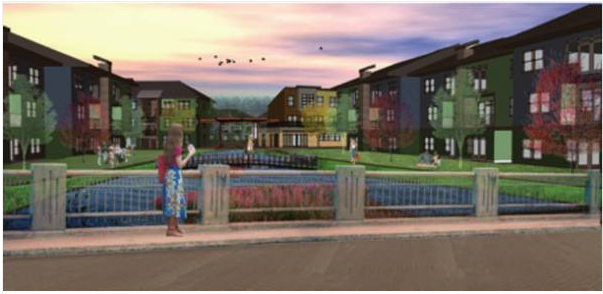
cayuga_view_1

3. Speaking of Cayuga View, the price point came up at a Lansing village meetings, the minutes of which came online this week. Drumroll please—

The targeted price point is $1600/month for a one-bedroom, one-bath unit (of which there will be 12), and $2700/month for a 2-bedroom, 2-bath unit (of which there will be 48).

That’s quite a high figure. Applying the standard 30% affordability threshold, the targeted income bracket for seniors is $64,000-$108,000/year. That’s comparable, or a little more than, the Lofts @ Six Mile Creek. It also draws parallels to inner Collegetown projects like Dryden South, where rents will be $1350/bedroom. But those projects fall in traditionally high land-value areas.

If it’s financed, then a lender must believe there’s a market for it, and given the general difficulty in financing projects in this region, that really is saying something. Increased affluence and number of retirees moving in? Hoping to capture the older, richer Cornell faculty/staff crowd? Bad judgement? Who knows.
tfc_v2_1

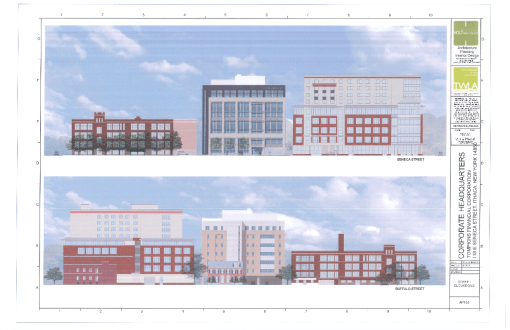
4. In the briefest of blurbs, the Times’ Josh Brokaw, who I applaud for attending even the less interesting city Planning Board meetings, reports that the Tompkins Trust HQ has been approved, with a permit likely once they get a minor curb-cut issue worked out. The contentious Printing Press Lounge debate also received the Planning Board’s go-ahead, if not necessarily its blessing. Expect a late winter or early spring construction start with the Tompkins Trust HQ, with completion the following year.
biggs_1

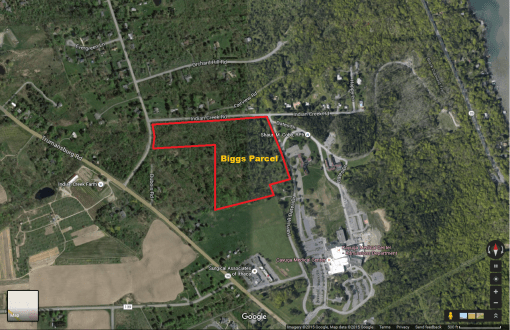
5. A couple of interesting developments for the Biggs Parcel in Ithaca town. According to the Times’ Jaime Cone (new writer, guys?), a member of the ICNA, Roy Luft, is prepared to make an offer for the Biggs Parcel that would preserve the vast majority of the land. Luft owns a 10-acre parcel to the south (street address 1317 Trumansburg Road). He proposes to take a non-wetland portion on the southern end of the Biggs Parcel, combine it with the open field behind his house, and pursue a cluster subdivision of homes intended as owner-occupied senior housing, which on the surface seems like a decent plan and location, given that owner-occupied senior housing is in demand and the land is adjacent to Cayuga Medical.

With this offer aired, the county, in a 4-1 vote, is giving the ICNA until January 15th to make an offer, otherwise they’ll put the land for sale on the general market. There is no assessment figure publicly available (though a new value has been determined); the ICNA says that’s unfair, while the county legislators have countered by saying not having the assessment value doesn’t stop the ICNA from making an offer, and that the neighbor group has already had a year and a half to make an offer.

20151205_134719

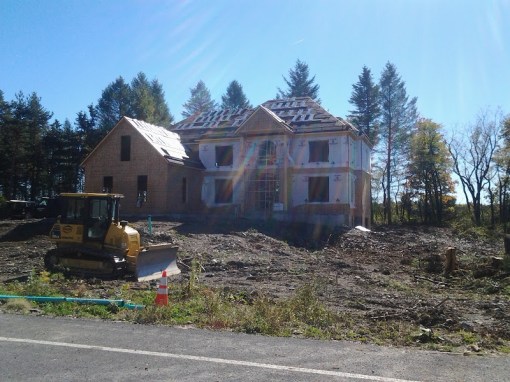
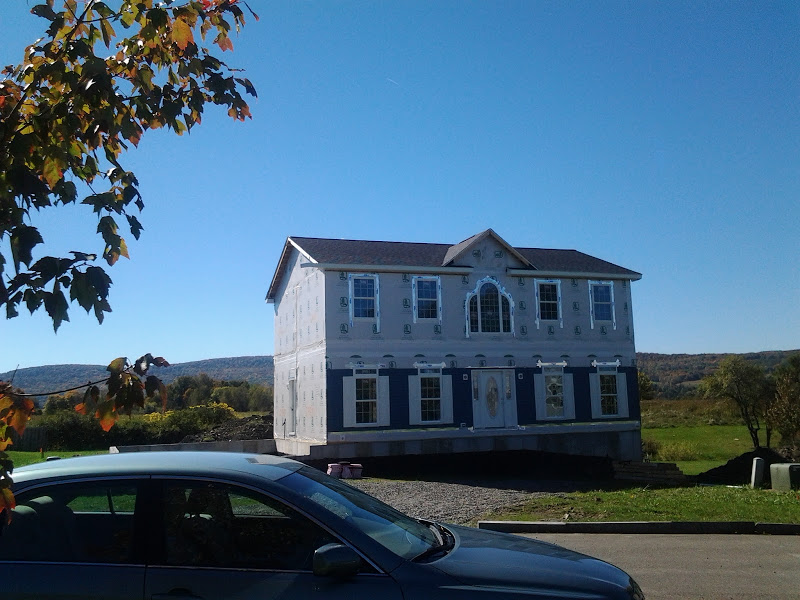
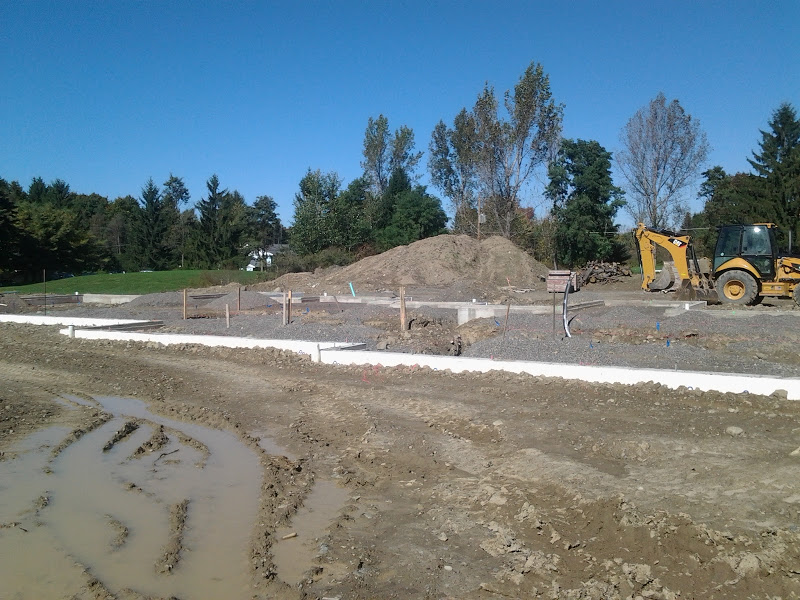
6. Once again, a double-feature house of the week. The theme of this week – high-end homes. Here we have home #1, 8 Pleasant Grove Lane in Cayuga Heights. The house has been mostly framed and the sides have been sheathed, but from the looks of the exposed roof trusses, if would seem that when this photo was taken a couple of weeks ago, the dormers still needed to be decked and the interior was still just stud walls and rough openings.

Design-wise, the home seems to fit in pretty well with its neighbors, which were mostly built in the late 1970s and early 1980s. The property was purchased in 2012 for $132,500 by an LLC traceable to a coach for a Cornell athletics team. Previously, the lot had been owned by its Pleasant Grove Road neighbors, and was sold in an estate sale.

20151205_131313 20151205_131331

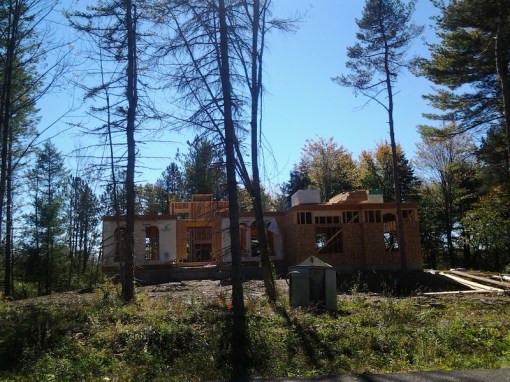
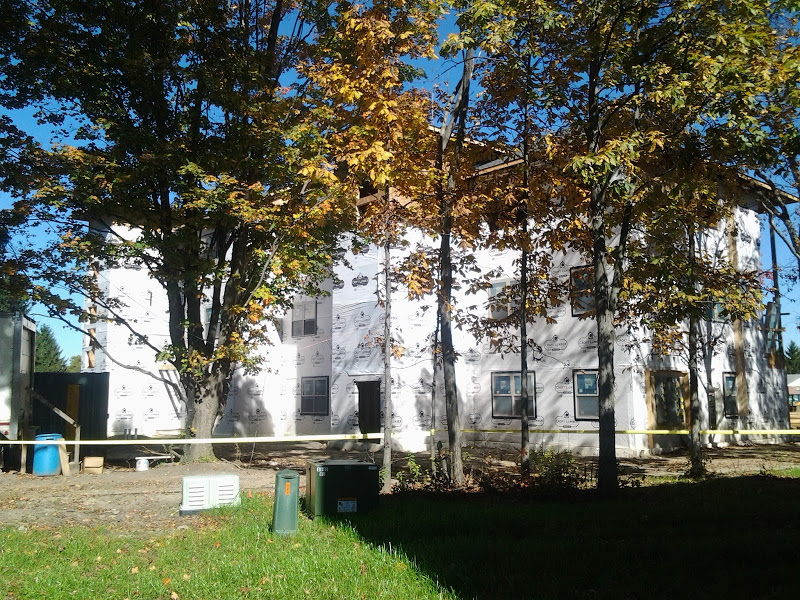
7. House of the week #2. I couldn’t pass up the chance to see the one house under construction that seems to have the entire lakefront mansion community so utterly pissed off. For the record, this house on the Captains Walk cul-de-sac has been under construction for years – you can see it in the satellite imagery for Google maps, which dates from 2013. It also appears to be even larger than many of its million-dollar neighbors. Three-car garage? Check. Courtyard-type entry? Check. Windows have been fitted, the roof has been shingled and the exterior has been sheathed with Huber ZIP System panels. A spring finish would be a good guess. Records indicate a couple from Pennsylvania, the founders of a chain of assisted care facilities, bought the undeveloped parcel for $213,800 in 2013.



News Tidbits 12/19/15: So New Even the Pavement Shines

19 12 2015

cayuga_view_1

1. We’ll start off this week with some eye candy. Over in Lansing village, the planning board is hammering out details regarding signage and covenants related to the Cinema Drive senior housing project. But it also gives the project a new name – from C.U. Suites to “Cayuga View Senior Living“. Lo and behold, one types that into Google and up comes the following partially-finished website. The name sounded familiar, and as it turns out there’s a good reason for that – Cayuga View is also the name of a portion of the Linderman Creek apartment complex in the town of Ithaca.

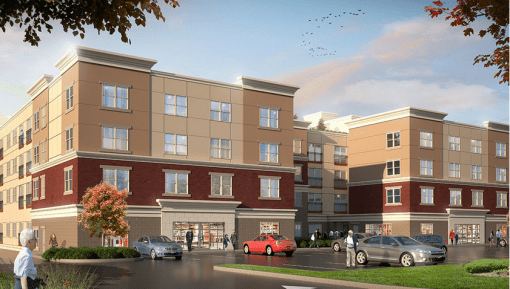
According to the website, the 55+ (“55 and BETTER”, as they tout on the page) apartment building at 50 Cinema Drive will contain 48 2-bedroom units and 12 1-bedroom units with four different four plans. The 4-story apartment building will have retail space on the first floor, “and will offer underground parking and storage, wireless internet, cable, business center, fitness center, rooftop garden, and scenic views. A companion dog or cat under 30 pounds will be allowed.”

No word on the project architect, but the project is being developed by the Thaler family, and Taylor the Builders out of suburban Rochester is the general contractor. The site was originally conceived as an office building several years ago, and then around 2012 it was proposed as a 39-unit mixed-use apartment building with an eye towards graduate students.

amabel_v4_1

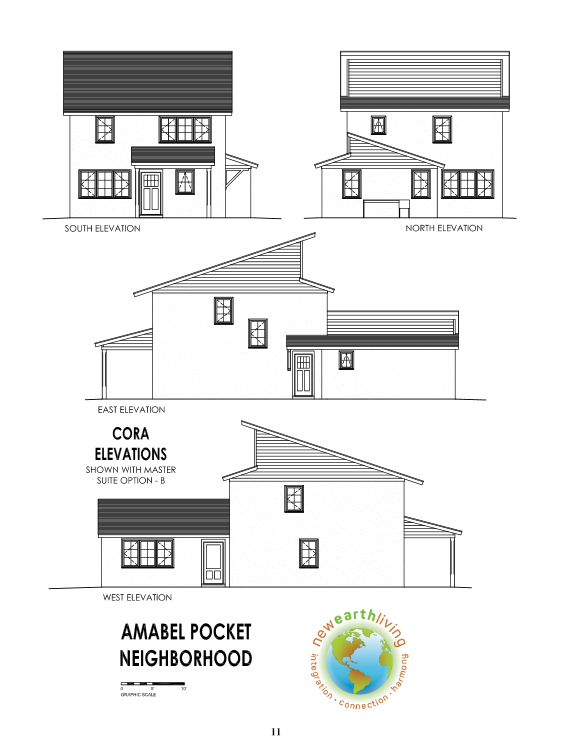
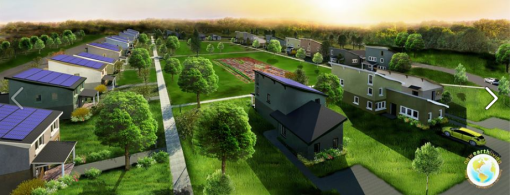
2. Sticking with residential development and fancy renders, here’s the latest render for New Earth Living LLC’s Amabel housing development, courtesy of their Facebook page. Final approval was granted just this week by the town of Ithaca. The 31-unit eco-friendly housing development (consisting of one standing farmhouse and 30 new homes facing inward from a loop road) will be located on undeveloped grass/woodland behind 619 Five Mile Drive. In the project literature, the site is said to be designed around a “pocket neighborhood” concept, with the houses facing towards each other for interaction, and away from the street for privacy. The houses may not be everyone’s cup of tea, but are designed for net-zero efficiency. Houses range from 1-3 bedrooms and 1,200-2,100 SF. No specific prices yet, but expect marketing to begin sometime early next year.

3. For the aspiring developer who wants to get a head start on planning – the 11.71 acre Bella Vista site at 901-999 Cliff Street in the city’s West Hill neighborhood is for sale for $395,000. As the advertisement on Homefinder notes, the project has received approvals for a 44-unit apartment or condo building (what it doesn’t say is that those would have to be renewed via a reaffirming vote by the planning board, since the project was approved more than two years ago). The property is currently assessed for $210,000.

w592-h-q

Primary Developers Inc., a company founded by local businessman Mauro Marinelli, purchased the land for $175,000 in 2002 and received approvals for the 44-unit Bella Vista project in 2007, and the units were marketed by local realtors as condominiums. But as the recession set in, sales foundered and the project never moved forward. Primary Developers Inc. sold the medical office building on the adjacent southern parcel and two other neighboring parcels of land to another local real estate company for $945,000 earlier this year.

chapter_house_materials

4. Some minor tweaks to the Chapter House project since its November sketch plan presentation to the Ithaca city planning board, which looks to mostly be a slightly lighter brick color and a little more detail on the rear wall. From top to bottom, the Chapter House reconstruction proposes Rheinzink zinc shingles, white trim of unknown material, a Redland Brick Heritage SWB bricks, Inspire Roofing Aldeora Slate Coachman (790) simulated slate shingles over the first floor bump-out, SDL (Simulated Divided Lites) transom windows with LePage Morocco textured glass glazing over the picture windows, Sherwin Williams “Tricorn Black” paint on the Chapter House bar exterior trim, and genuine bluestone not unlike the famous Llenroc bluestone used in many of Ithaca’s historic buildings. As far as they look online, they appear to be attractive, premium finishes.

The owner, Sebastian Mascaro of Florida and represented by Jerry Dietz of CSP Management, hopes to start construction in late January or early February for an August 2016 opening.

cornell_novarr_6

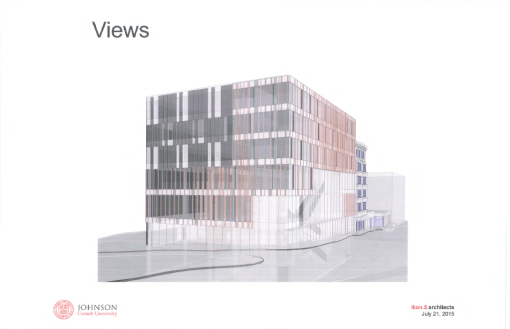
5. Note that there was ever much doubt, but it looks like local developers John Novarr and Philip Proujansky have secured the construction loan(s) needed to build 209-215 Dryden Road in Collegetown, a six-story academic and office building in which Cornell has committed to occupy 100% of the space for use in its Executive MBA program. According to loan documents filed with the county, there were two loans, one for $6,482,295.33 and the other for $9,430,528 (for a total of $15,912,823.33). Wells Fargo Northwest was the lender, and it looks like some of the funds are going through a “pass-through” trust.

The 73,000 SF building will host about 420 Cornell MBA students and staff when it opens in late Spring 2017, later increasing to 600 as Cornell fills out the rest of the square footage. Hayner Hoyt Corporation of Syracuse will be the general contractor. Ikon.5 of Princeton is the project architect.

20151205_094944 20151205_094957

6. Going to do a double-feature for house of the week this week, mostly because I have a backlog of images. Here’s number one.

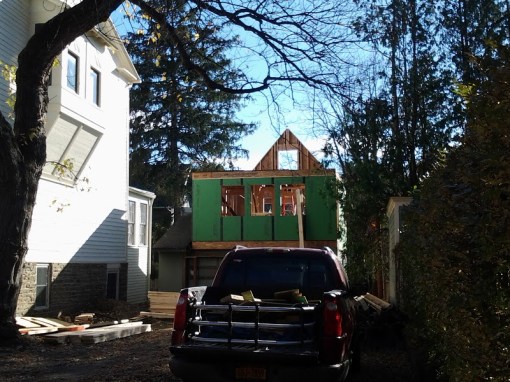
The last house is underway at the Belle Sherman Cottages. After not hearing anything about it, I had presumed they had just decided not to build Lot #9, which is smaller than the other lots and was going to have a unique “cottage” design. Well, color me surprised. The town of Ithaca issued a permit in early November, and by the 5th of this month, the CMU block foundation was excavated and poured. Looking at builder Carina Construction’s facebook page, the modular units have since arrived and have been hoisted onto the foundation, assembled and secured. Custom interior finishes, porch framing, siding, backfilling and landscaping will follow as the house moves towards completion.

No renders for the finished house, unfortunately, although I suppose STREAM Collaborative might have something on file. Agora Home LLC of Skaneateles is the developer of the Belle Sherman Cottages, which includes 18 other single-family homes and 10 townhouses, all of which have been completed and sold.

20151205_095437 20151205_095453 20151205_095528

424_dryden_rd_1

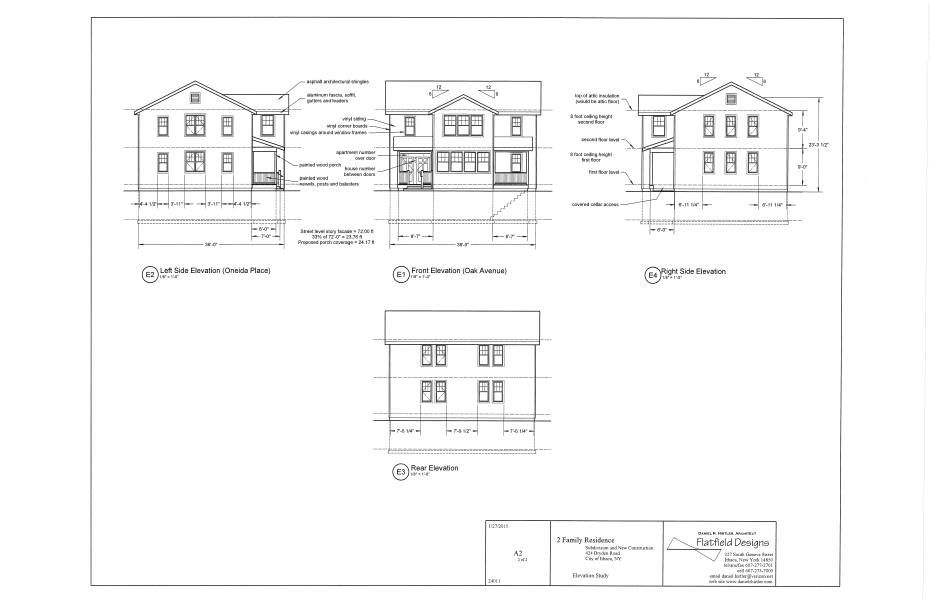
7. Now for House of the Week #2. 424 Dryden Road’s subdivision earlier this year turned the rear parking lot into a second lot, and the owners, William and Angie Chen of Lansing, decided to build a duplex on the land, which has been bestowed the address of 319 Oak Avenue.

It seems a little odd that the trim already seems to be applied to the house when the windows haven’t been fitted yet. The standard Huber ZIP System sheathing is being covered with a mahogany-colored vinyl siding. Wooden wall studs can be seen from the rough window openings and there appears to be electrical wiring on the rear of the house, so it’s a fair guess that utilities rough-ins are probably underway.

Local architect Daniel R. Hirtler of Flatfield Designs penned the design, and according to the construction loan agreement on file with the county, Tompkins Trust Company lent the Chens $400,000 to help bring their duplex from the drawing board to reality.

416_e_state_v2_1

8. For those hoping for something new and exciting in next week’s Planning Board agenda, it’s going to be a downer month. Here’s what’s planned.

A. Revisions to the internal sidewalk plans at 804 East State Street to allow stripped asphalt vs. concrete.
B. Tweaks to the signage for the downtown Marriott currently under construction.
C. The “Printing Press” bar debate at 416-18 E. State Street, again.
D. Final approval for Tompkins Financial Corporation’s new HQ.

The agenda also includes a couple zoning variance reviews for house additions at 105 First Street in North Side, and 116 West Falls Street in Fall Creek. The board is planning a joint meeting with the ILPC to review and comment on the Travis Hyde plan for the Old Library site, tentatively scheduled for January 12th.


Village Solars Apartments Construction Update, 12/2015

13 12 2015

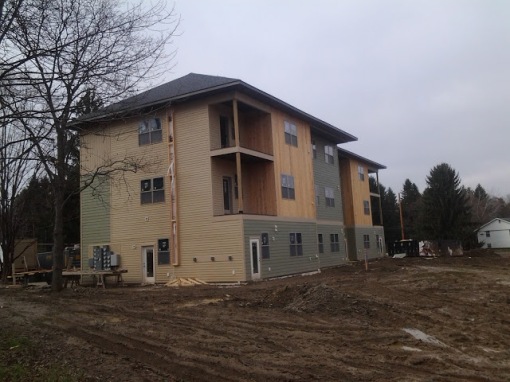
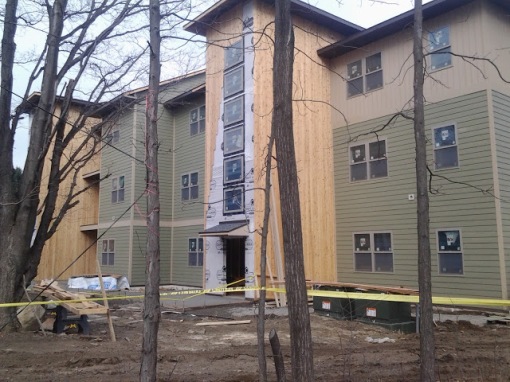
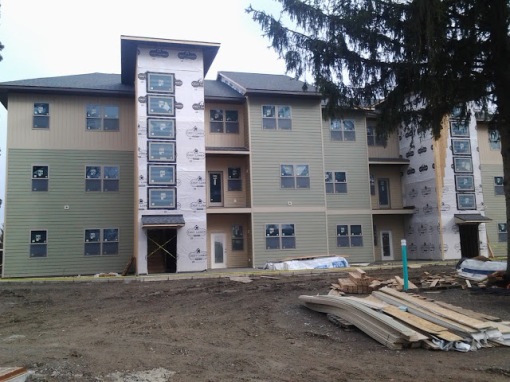
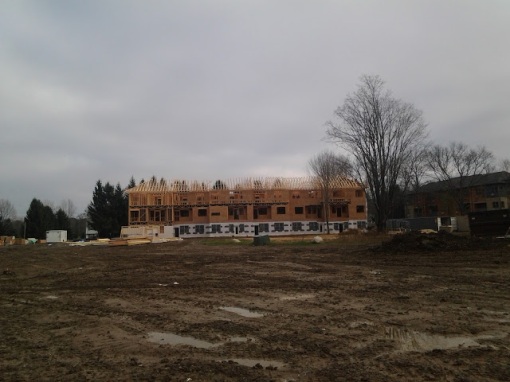
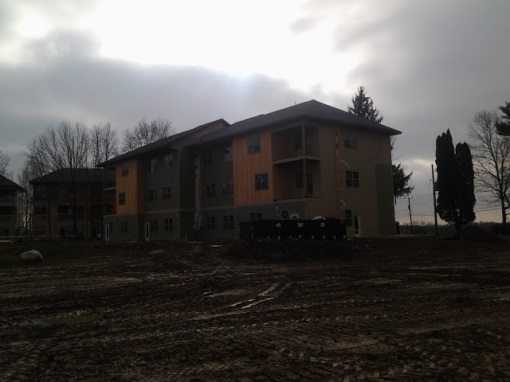
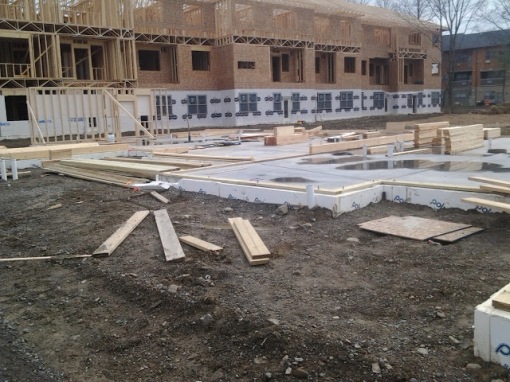
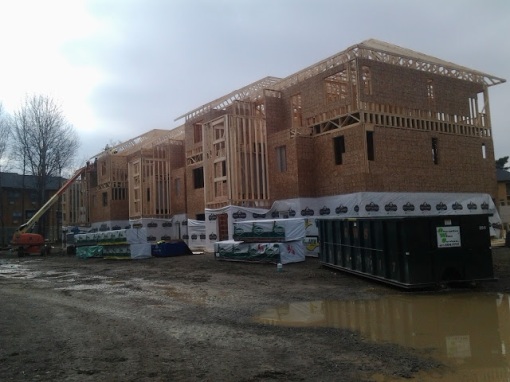
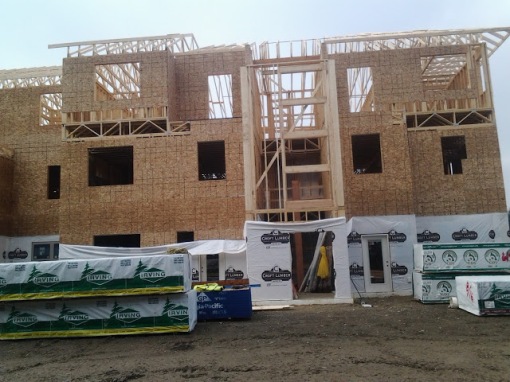
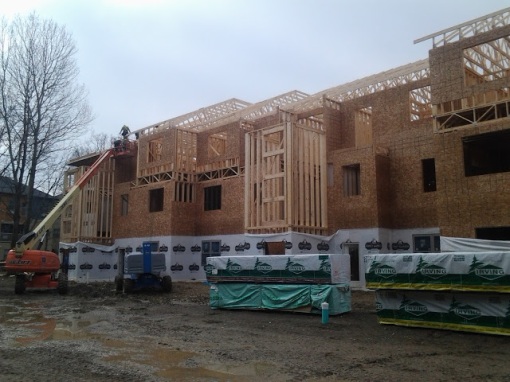
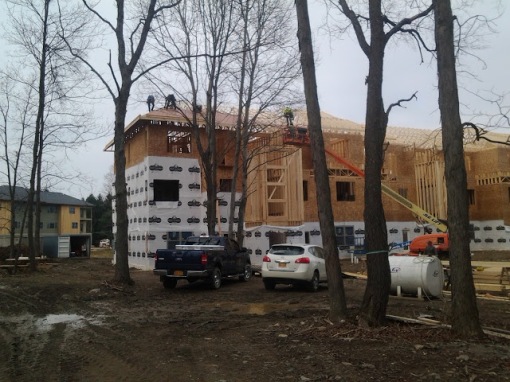
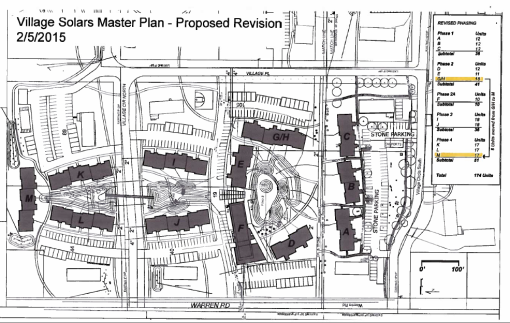
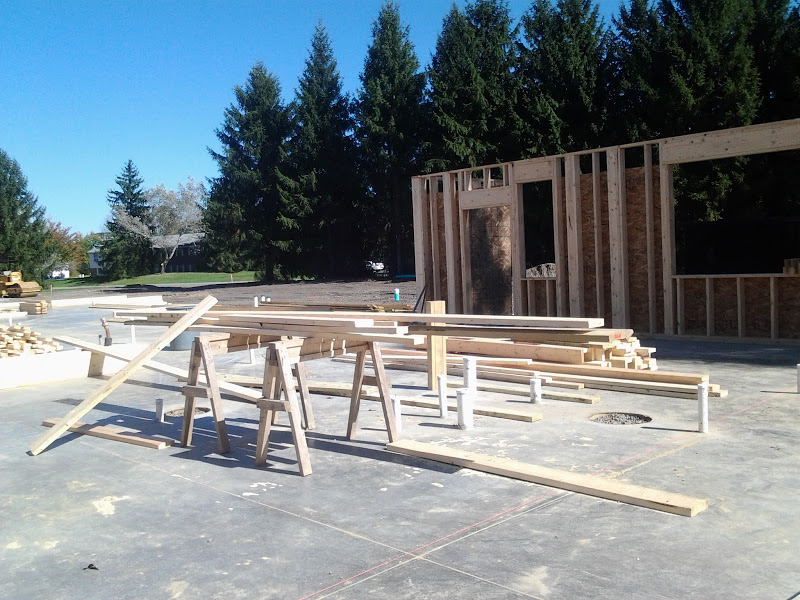
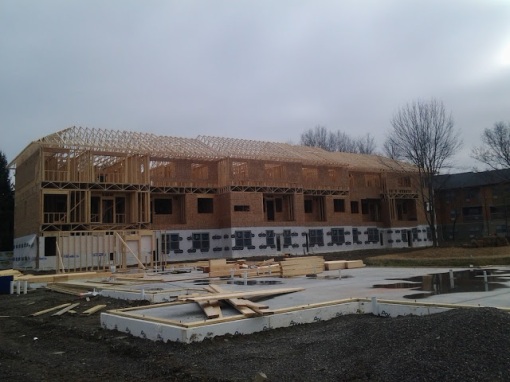
There’s been a fair amount of progress during the late fall at the Village Solars apartment complex site off of the 1000 Block of Warren Road in the town of Lansing. 12-unit Building “D” is finish up attachment of its exterior facade, which like buildings A-C, looks to be a combination of a wood grain board and earth-toned fiber cement board. Balcony railings and trim still have yet to be attached. I didn’t look inside, but based on the photos, it looks like the wood stud walls are still exposed near the entry doors on the first floor.

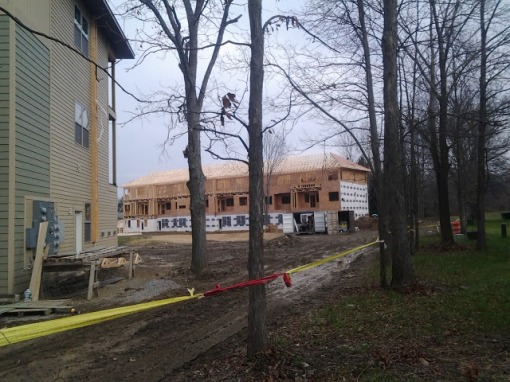
Across the future pond, 18-unit Building “G/H” (backstory here) has been framed out and some Tyvek-type sheathing has been attached (the material is labelled “Croft Lumber“, which is a building supply store down in Sayre, PA). Some first floor windows and doors have been fitted, but most of the future windows and doors are still rough openings. The roof trusses are all in place, and workers were installing ZIP system plywood sheathing while these photos were being taken.

11-unit Building “E” has had its foundation poured and is only just beginning framing, with just one standing exterior stud wall.

20151205_123855 20151205_123932 20151205_123941 20151205_124021 20151205_124106 20151205_124143 20151205_124218 20151205_124235 20151205_124335 20151205_124403 20151205_124407 20151205_124839

village_solars_2 village_solars


News Tidbits 11/21/15: Building and Rebuilding

21 11 2015

inhs_pride_design_v5_2 inhs_pride_design_v5_3

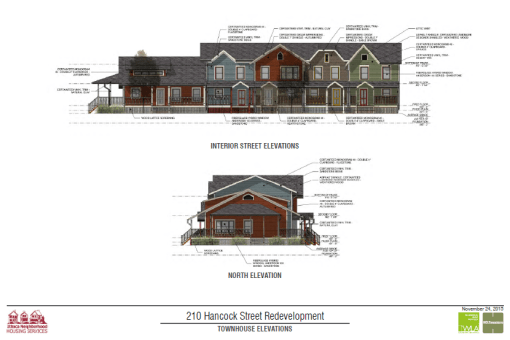
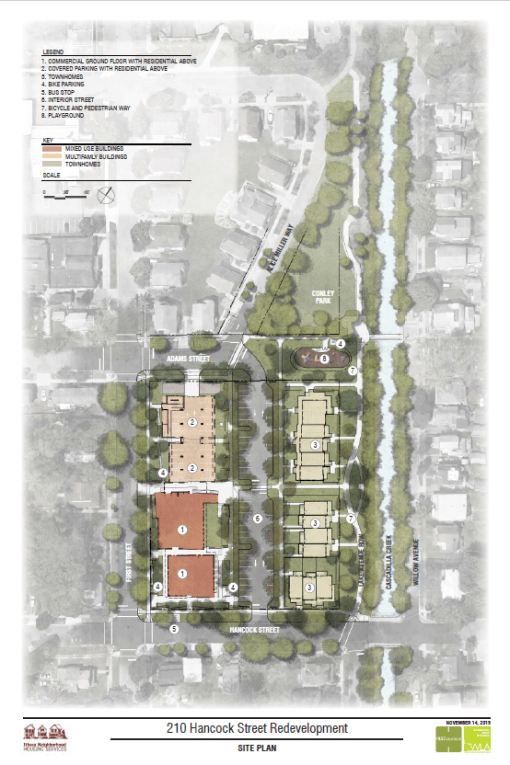
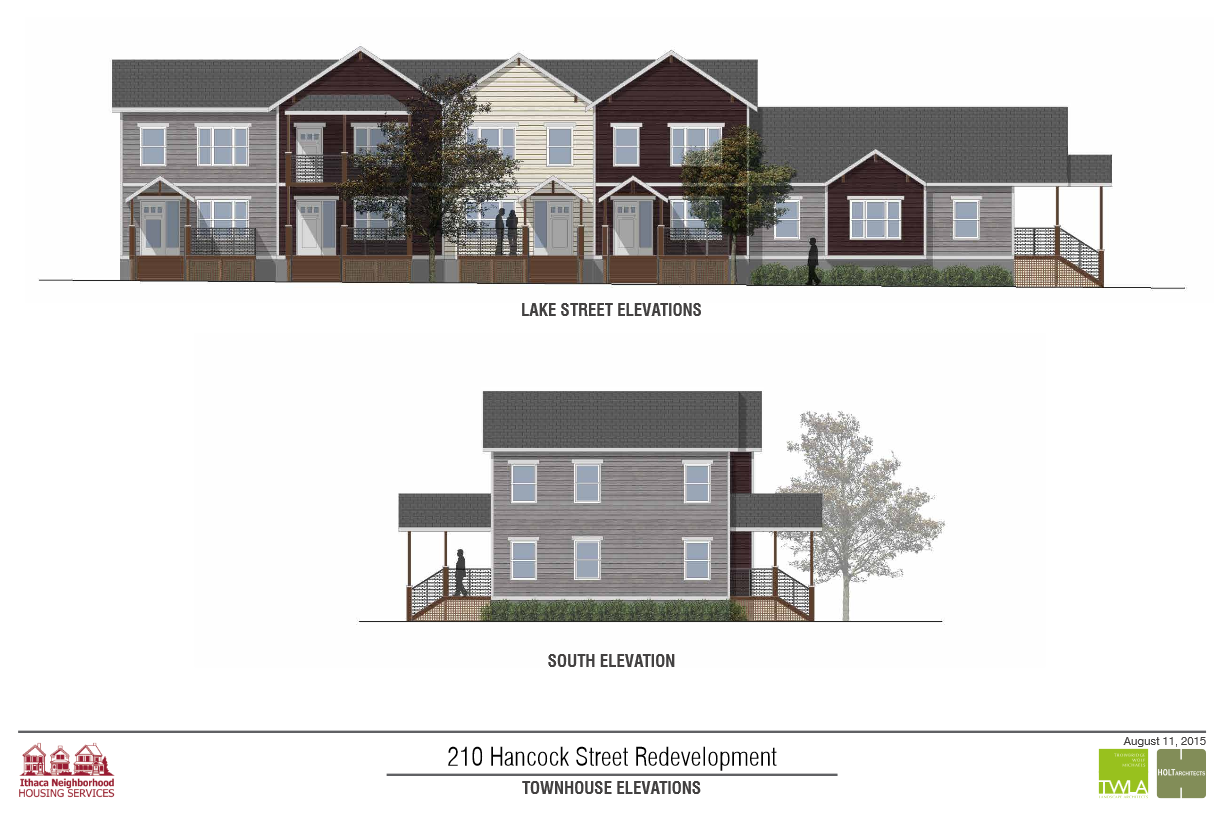
1. Starting off this week with some eye candy, here are some updates renders of the townhouses proposed for INHS’s 210 Hancock project in the city’s North Side neighborhood. Details and project status here. 210 Hancock has been approved by the Planning Board, and Cornell, the city and county do have dedicated funds ($200,000 total) going towards the affordable housing units, but still needs to be seventeen conditions prior to receiving a construction permit, one of which required revised townhouses to better reflect the neighborhood. The Common Council also need to vote to discontinue using the sections of Lake Avenue and Adams Street on which the new greenways and playground will be constructed, which apart from the time needed and paperwork generated, isn’t expected to encounter any obstacles, with formal conveyance to INHS anticipated by March 2016. INHS is shooting for a May construction start.

The Planning Board will be voting on “satisfaction of site plan approval” at its meeting next Tuesday, which should be a fairly smooth procedure, if the paperwork’s all correct.

Personal opinion, the townhouses, with more color and variation in style, appear to be an improvement over the previous version. These five will be rentals, while the other seven will be for-sale units, and built in a later phase (government funding for affordable rentals is easier to obtain than it is for affordable owner-occupied units, so it could take a year or two for those seven to get the necessary funding). The apartments have not had any substantial design changes since approval.

inhs_pride_design_v5_1

For what it’s worth, here’s the final site plan. The rental townhomes will be on the north corner of the parcel, furthest from Hancock.

2. Turning attention to the suburbs, someone’s put up some sizable chunks of land for sale in Lansing village. The properties consist of four parcels – 16.87 acres (the western parcel) for $500,000, right next to a previously-listed threesome of 28.07 acres (the eastern parcels) for $650,000. The eastern parcel also comes with a house, which the listing pretty much ignores. Lansing has it zoned as low-density residential, and given the prices (the western parcel is assessed at $397,600, the eastern parcels at $561,100 (1, 2, and 3)) and being surrounded by development on three sides, these seem likely to become suburban housing developments, possibly one big 30-lot development if the parcels are merged. For the suburbanites out there, it’s something to monitor.

20151108_133542 20151108_133710

201_w_clinton_1

3. House of the week – or in this case, tiny house of the week. The 1-bedroom, 650 SF carriage house underway at 201 West Clinton Street draws inspiration from 19th century carriage houses, which makes sense given that it’s in Henry St. John Historic District. It and the main house are owned by former Planning Board member Isabel Fernández and her partner, TWMLA architect Zac Boggs. The two of them did a major and meticulous restoration of the main house, which used to house the local Red Cross chapter, a couple of years ago (more info on that here).

Anyway, the framing is underway and some ZIP System sheathing has been applied to the exterior plywood. No roof yet and probably not much in the way of interior rough-ins, but give it a couple of months and that 1960s garage will be given a new life as a tiny house.

travis_hude_libe_libe_v3

4. Time to take a look at the Planning and Development Board agenda for next Tuesday. For reference, here’s what a typical project guideline looks like:

PDB (Sketch Plan) -> PDB (Declaration of Lead Agency) -> PDB (Determination of Env’tal Signif., PDB BZA reccomendation if necessary) -> BZA (if necessary) -> PDB (prelim/final approval).

Here’s the meat of the agenda:

A. 210 Hancock – Satisfaction of Conditions of Site Plan Approval (see above)
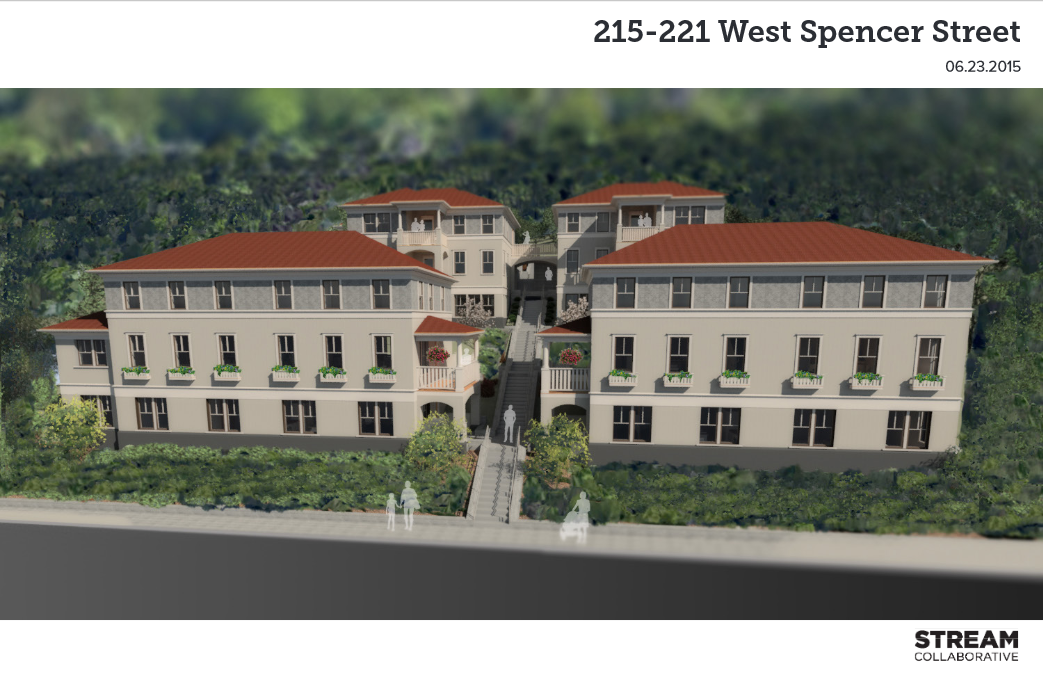
B. 215-221 Spencer St. – Consideration of Prelim/Final Site Plan Approval  – this one was first presented as sketch plan in March, to give an idea of how long this has been in front of the boards
C. 416-418 East State Street – Determination of Environmental Significance and Recommendation to the BZA – “The Printing Press” jazz bar is a proposed re-use for a former printshop and warehouse that has seen heavy neighbor opposition. The bar has changed its emphasis, redesigned the landscape and moved itself to a more internal location to mitigate concerns, but the opposition is still strong, mostly focusing on noise and traffic. The board has simply and succinctly recommended that the BZA grant a zoning variance.
D. 327 Elmira Road – Determination of Environmental Significance and Recommendation to the BZA – The Herson Wagner Funeral Home project. This one’s had pretty smooth sailing so far, only a couple complaints that Elmira Road isn’t appropriate for a funeral home. The Planning Board, however, applauds the proposal, which replaces a construction equipment storage yard, for better interfacing with the residential neighbors at the back of its property. It has been recommended for BZA approval.
E. Simeon’s on the Commons Rebuild – Presentation & Design Review Meeting – Before anyone throws up their arms, this is only to talk about the materials and design of the reconstruction, and to get the planning board’s comment and recommendations.
F. The Chapter House Rebuild – Sketch Plan – The Ithaca Landmarks Preservation Commission (ILPC) must have come to some kind of acceptance on the proposed rebuild if the Chapter House is finally at the sketch plan stage. the Planning Board will have their own recommendations, which will have to be coordinated to some degree with the ILPC (the ILPC is arguably the much stricter of the two). We’ll see how it looks next week.
G. Hughes Hall Renovations – Sketch Plan – more on that in a moment
H. DeWitt House (Old Library Site) – Sketch Plan – originally slated to be seen a couple months ago, but pulled from the agenda. The 60-unit project is not only subject to Planning Board review, but ILPC review since it’s in the DeWitt Park Historic District.

5. So, Hughes Hall. Hughes Hall, built in 1963, has dorm housing and dining facilities for Cornell students attending the law school, but those 47 students will need to find alternative housing once the hall closes in May 2016 (yes, with Maplewood closing as well, Cornell is putting 527 graduate and professional students out on the open market next year…it’s gonna be rough). However, this has kinda been known for a while. Cornell has intended to renovate Hughes Hall since at least 2011, as Phase III of its law school expansion and renovation. The building was used as swing space while Phase I was underway, and then the phases were flipped and Phase II became Hughes Hall’s renovation, while Phase III became Myron Taylor Hall’s renovation. According to Boston-based Ann Beha Architects, who designed the law school addition (Phase I), the Hughes Hall renovation will “house offices, administrative support spaces, academic programs and meeting spaces.” Well see how the renovated digs look at Tuesday’s meeting.


News Tidbits 11/14/15: To Plan or Not to Plan

14 11 2015

It’s another slow week. There was no PEDC meeting in Ithaca city, and no new projects hit the airwaves. But there might be some interesting things moving forward.

1. The Lansing Star has an insightful interview this week with newly elected Lansing town supervisor Ed LaVigne, who unseated incumbent Kathy Miller for the seat. From a development standpoint, it’s very interesting. From the interview, it sounds as if, given the possible loss of their biggest taxpayer, the $60 million Cayuga Power Plant, he kinda wants to throw the door open to developers in an attempt to soften the blow of its closure. In Lansing, there was a political divide when it came to planning – the Democrats wanted a full-time planner, but the Republicans wanted a part-time planner. The budget item for a full-time planner was eliminated along town board party lines, 3-2, and Lansing is currently served by part-time planner Michael Long.

20151011_124916

“That’s why it’s so critical to start moving some dirt, getting things built.  One of the things I’ve already told developers is that Lansing is in business.  How can we make you more prosperous?  We believe in prosperity.  And if you’re prosperous we all will benefit.  I don’t care how much money they make.  I hope they make more money than they ever dreamed of, because if they put their money in Lansing, Lansing wins.”

If I didn’t know where the quote was coming from, I wouldn’t believe it was from an elected official in Tompkins County. Most local officials are very measured in their comments on growth, if they welcome newcomers at all.

Just as a thought exercise, Lansing builds about 25 houses per year per HUD SOCDS, and a variable number of apartments, which right now is a few dozen per year thanks to the Village Solars project off Warren Road. Take about $300k per house, and $6 million for each major phase of the Village Solars, and one gets $13.5 million in new development. Not factoring in additional infrastructure or service costs or taxes from commercial/industrial construction, it would take four and a half years to make up the tax revenue lost from the closure of the power plant.

20151011_125007

Of course, development in Lansing is tricky – without sewer, houses have to be on at least one acre of land. After all the busted dreams with the town center proposal, the town will be more likely to stick with conventional suburban development and rural homesteads. On the one hand, Lansing has given a yes to development. On the other hand, the question of “smart” growth is still up in the air, and it’s not looking good.

By the way, the photos, which are a few weeks old, are of homes underway on Lansing’s Oakwood Drive. Cardamone Homes is the builder. The top one is for sale for $670,000.

***

college_crossing_2 plan-1

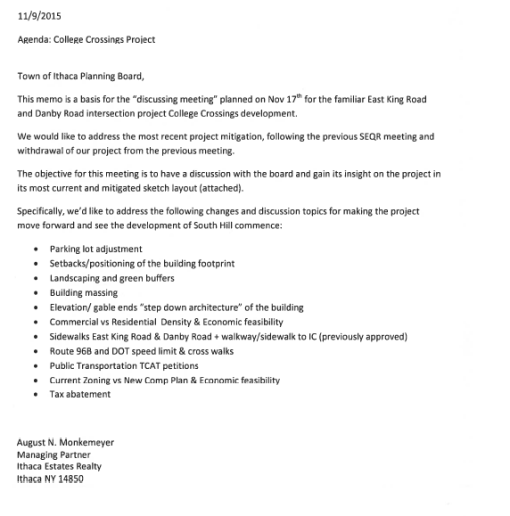
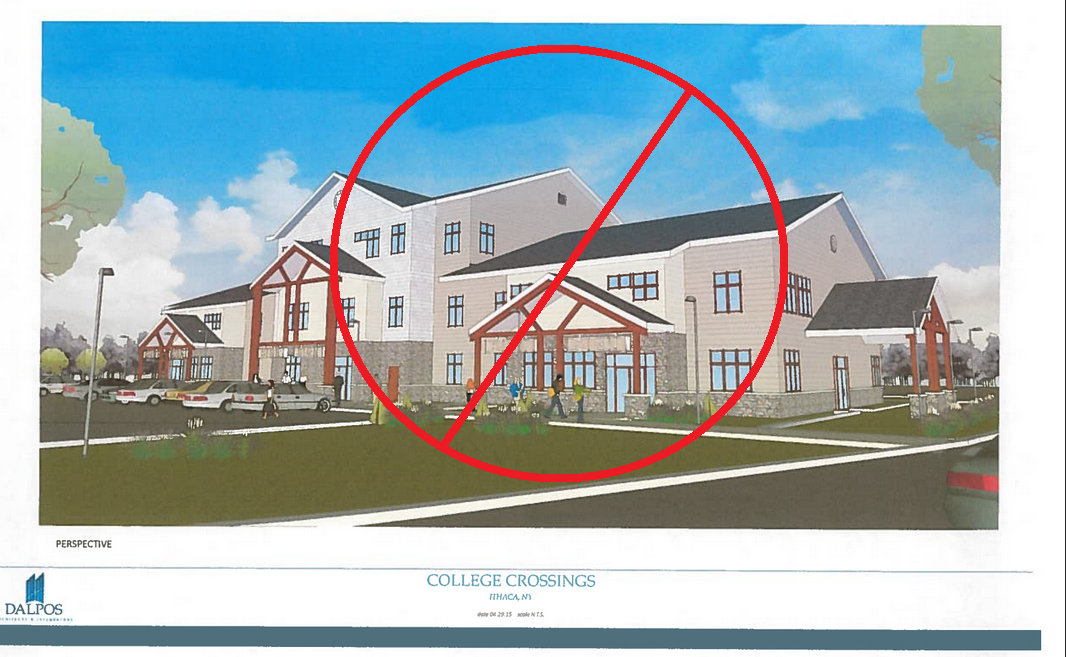
2. There’s nothing too exciting in the agenda for the Ithaca town planning board meeting next Tuesday. There’s a couple of legal clarifications required, one for a single-family home subdivision, the other to let Brookdale (formerly Clare Bridge / Sterling House) move forward with their 32-unit expansion project. The town planning board will also be reviewing some solar panels and changes to the sign law. Really, about the only noteworthy thing on the agenda is an open, informal discussion on College Crossings. After have a few months to take a deep breath, the developer, Evan Monkemeyer of Ithaca Estates Realty, would like to discuss what needs to be done in order to make the project fit with the town’s comprehensive plan, while keeping his plans economically feasible. A copy of the letter is below:

college_crossings_v4_letter

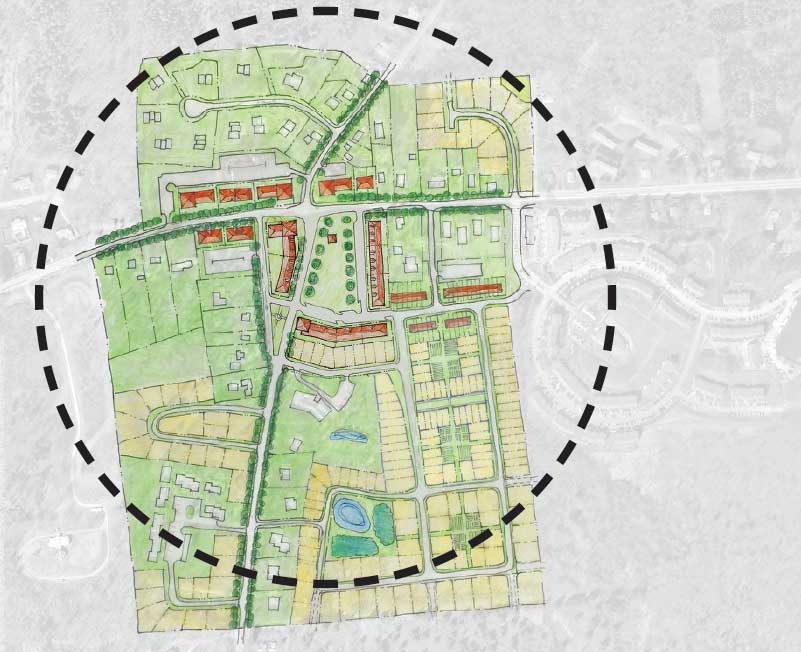
This is potentially a major opportunity for the town to show good stewardship. Ideally, the two sides will find a common ground that meets the town’s goal for a less auto-centric, mixed-use South Hill, while allowing the developer to move forward. A tax abatement isn’t going to fly with the IDA let alone the planning board, but there are other options that can be considered – density, height, and setbacks come to mind. The town’s comprehensive plan considers the site “TND [Traditional New Development] High Density” – one of the few high density spots in the town. The plan recommends 8-16 units per acre as an average (it’s a 3.75 acre site, so picture 30-60 units), and 10-20% open space. A project in a TND-HD area should be dense, transit-oriented, porous and walkable. The door is open, not only to the town, but members of the public interested in helping find that common ground (looking at you, Form Ithaca). It should be an interesting chat.

chain_works_rev3_1

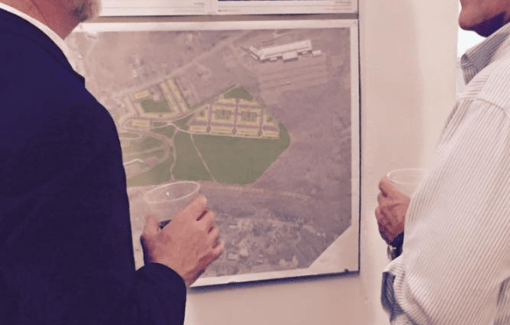
3. Local architecture firm STREAM Collaborative held an open house last Friday, and for those unable to attend, they shared photos online.

Look closely and you’ll find a copy of a conceptual build-out of the Chain Works District, which is still going through environmental site assessment (the ESA document is said to be tens of thousands of pages). The South Hill Business Campus is to the upper right, so the top of the image is directed south. Note that there’s nothing formal, and even the renovation of buildings 21, 24, 33 and 34 has yet to reach the boards (rumor mill says the renovations might start in 2017). But it’s great eye candy.

20151011_134013 20151011_134031

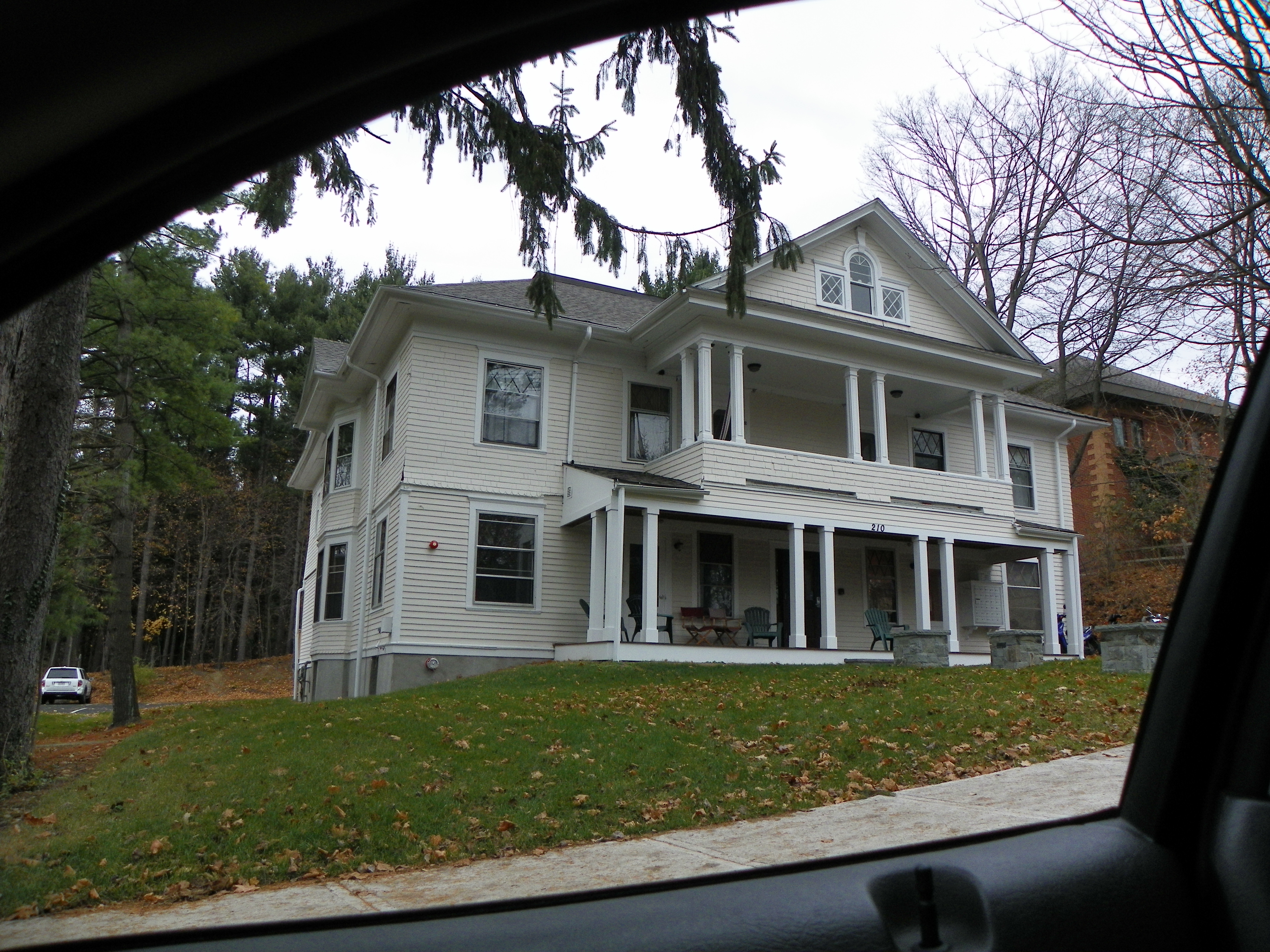
4. House of the week. Since I hit this house a couple of times while it was underway, I figured I would include a couple shots of the finished 3-bedroom, 1,276 SF home at 203 Pearl Street in Ithaca’s Belle Sherman neighborhood. Oddly enough, the builders, Gil and Naama Menda of 201 Pearl, used the same exterior trim colors as on the Belle Sherman Cottages a block away.

The lot is the result of a subdivision approved by the city during the spring; 203 Pearl had previously been combined with 201 Pearl and used as an in-ground swimming pool, which was filled in at some point.


News Tidbits 11/7/15: All the Small Things

7 11 2015

chapter_house_v2_1

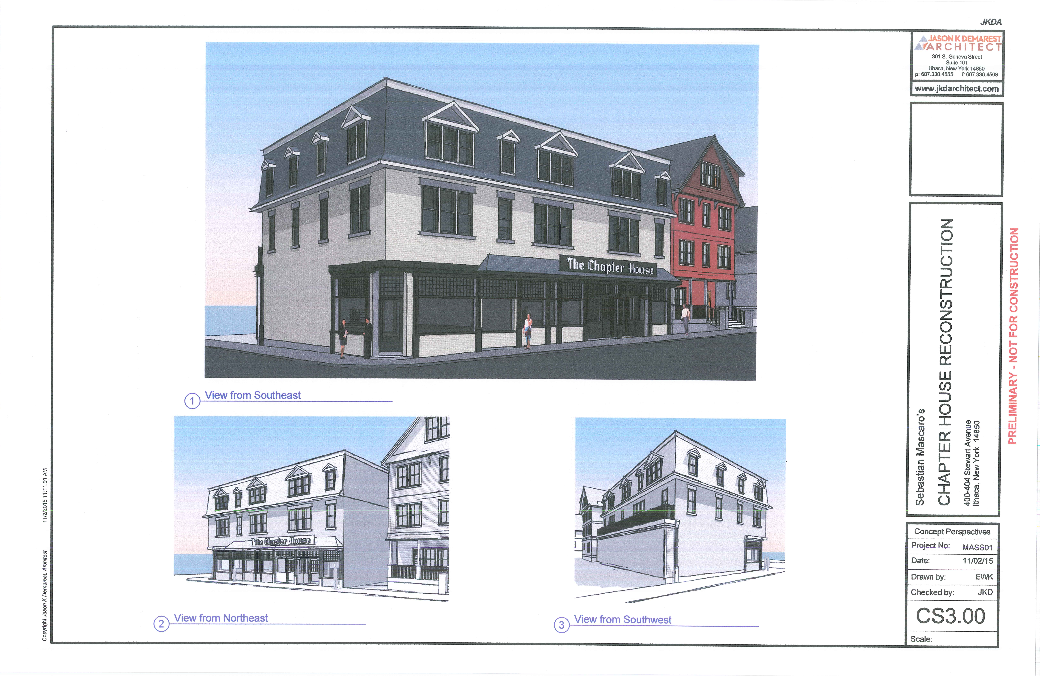
1. The Chapter House project is finally beginning the first stages of design review with the ever-stringent (or picky, pending your view) Ithaca Landmarks Preservation Council. As seen in the render above, gone is the fourth floor, and gone for now are plans to build a new structure at 408 Stewart, after some members of the ILPC expressed opposition to a tear-down, even though the exterior has been butchered and the architect called it a “fire trap”.

The committee also had disagreements over which version of the Chapter House is more historic, the original ca. 1903 design evoked above, or the 1920s renovation that everyone remembers. The September minutes showed intent towards the four story design seen previously, but the design shown above is three floors – whether that be to the committee’s persuasion, or concerns over a zoning variance isn’t clear. It might be in October’s minutes, but those haven’t been approved, and are therefore not available yet.

Also at Tuesday’s meeting, the committee is planning “Property Condition Review and Potential Action” for the decayed carriage house at 312 West State Street. The board was also set to provide “Early Design Review” for a project at 315 North Cayuga Street, probably some kind of renovation/restoration of the First Presbyterian Church, but the item has since been pulled.

11-24-2012 171

2. Wait long enough and history repeats itself. In March 2009, I did a post called “Warren Real Estate Tries to Sell a Frat House“. It looked at 210 Thurston Avenue in Cornell Heights, when it was on the market for $950,000. The house has historically been a Cornell fraternity house, built around 1900, re-purposed not long thereafter for the Delta Sigma Phi fraternity until WWII, when the brothers left for service and the chapter never reopened. It was then used by other GLOs over the decades (Alpha Omicron Pi in the 1940s, Sigma Alpha Mu from the late 1940s to early 2000s, and Phi Delta Theta’s annex in the late 2000s).

After sitting on the market for a couple of years, the house sold in December 2011 for $677,500 to an LLC representing the wealthy parent of a Cornell wrestler, who had the house renovated for the team in 2011/12. The legal occupancy increased from 33 to 40 persons as a result of the reno.

So now it’s on the market again, this time for $2,750,000. That must have been quite a renovation. An open house will be held 1-3 PM this Sunday.

I’d recommend it to the Phi Mu ladies given their recent rejection by Cayuga Heights’ zoning board, but the asking price is almost four times the house they were looking at 520 Wyckoff. The house on Wyckoff was also intended for 16 occupants rather than 40. Oh, and I suppose those urinals the owners installed would be a bit out of place.

We’ll see what happens. This one could be on the market for a while. Again.

3. Also new to the market this week, two parcels in the town of Ithaca that have the potential for development.

The first, 1564 Slaterville Road. The sale includes four parcels – 1564 Slaterville Road itself, a 19th century home on 1.52 acres, and the other three are vacant parcels with frontage on Slaterville Road and Park Lane, which serves as an entrance to the Eastern Heights neighborhood, and has seen a number of higher-end single-family homes in the past several years (there have been plans for a 16-lot housing development on the adjacent land to the north, but nothing has been approved). Altogether, the sale comprises 9.2 acres of land, on the market for $995,000. The properties are valued at $297,300 total, so if the owner is asking such a high price, either they’re delusional, or purposely going after developers. The land currently falls under Ithaca town’s Medium-Density Residential (MDR) zoning, which is single-family homes and duplexes only. The Comprehensive Plan calls for “Established Neighborhood” use, with an average of 2-4 units/acre, either homes, townhomes or apartments (sensitive to neighboring uses), and the possibility of low-intensity commercial (home office). Expect any potential form-based code to accommodate those details.

The other parcel up for sale is 969 East Shore Road, one of the few properties in the town’s lakeshore exclave. This one is also asking a huge premium, $1.45 million for a 2.09-acre property assessed at $300,000. The property was used as the headquarters for the John C. Lowery construction company until they moved to Freeville; it had been built in the 1960s for a chemical company. The seller, the CEO of a local manufacturer, picked up the property for $300,000 in December 2013.

Although it falls under the town’s Lakefront Commercial (LC) zoning, which in itself says only marinas and wind turbines are okay, special use permits allow for mixed-use, hotel, and other non-water options. Like the Slaterville parcel, this one also falls under the “Established Neighborhood” use guidelines.

If they sell, and it bears mentioning, it’ll be mentioned in a later news roundup.

20151011_142719 20151011_142734 20151011_142746

424_dryden_rd_1

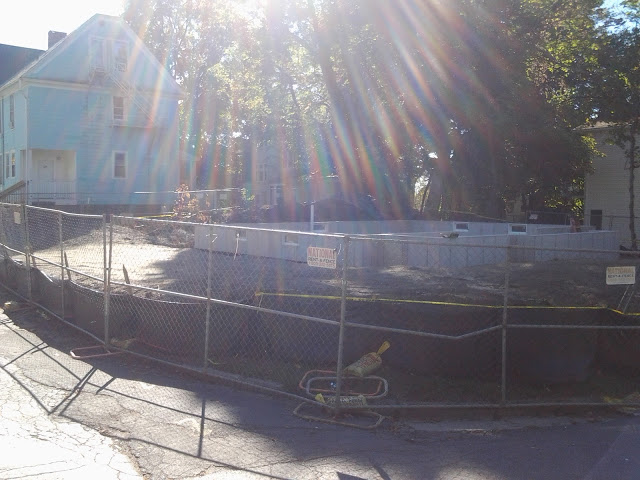
4. It’s house of the week. This week, 319 Oak Avenue in Collegetown. The lot was created by a subdivision of the existing lot, 424 Dryden Road, in February of this year. What was once a parking lot is now the foundation for a duplex with 3-bedrooms each. Foundation and stem walls have been poured and cured, and given that this photo is a couple weeks old, the foundation has probably been backfilled already, and rough framing may even be underway.

The site falls into the CR-2 Zone of the Collegetown Form District, meaning 2-3 floors, and pitched roofs and porches are required. The architect is Daniel Hirtler of Ithaca, and the developers are William and Angie Chen, also of Ithaca.

5. It’s a quiet week. The city of Ithaca’s projects memo has absolutely nothing new (not even new attachments to the three projects subject to review), and the town of Lansing has nothing interesting either. So we’ll wrap this up with some economic news:

A Lansing technology firm will be seeking sales tax abatements this month as part of a planned expansion project.

Advanced Design Consulting USA (ADC), located in a 15,000 SF facility at 126 Ridge Road in the town of Lansing, has submitted an application to the Tompkins County Industrial Development Authority (TCIDA) for review at their November 12th meeting.

The company is applying for a one-time sales tax abatement on the cost of construction materials, and is valued at $54,880.

ADC specializes in the design and manufacture of high-precision scientific instruments, especially those used in physics research. The firm states in their IDA application that their small size has limited their ability to gain large contracts, and it is necessary for them to expand in order to expand their business. The 5,000 SF expansion is valued at $910,000, and would retain 14 jobs and create 7 additional jobs in their Lansing facility, with a median salary of $40,000. If approved, the expansion project would be completed by June 2016. With the expansion, ADC’s revenues are predicted to increase from the current $2 million, to $2.7 million in three years. The company did not commit to local construction labor in their application.

In an interview in 2014, ADC President Alexander Deyhim explained that the company declined a business incentive to move to Oak Ridge, Tennessee because of Tompkins County’s high quality of life, and proximity to Cornell’s nano-fabrication facilities.

For ADC, which was founded in Tompkins County in 1995, it will be the third expansion in twelve years. The company had previously applied for and received tax abatement approvals for a larger, 20,000 SF expansion project, but according to the current application, the firm reassessed its needs and decided to go with a smaller plan for the time being. The original abatement was never utilized. Supplemental documents indicate the town of Lansing has approved the physical plans for the expansion.

***
So does one force the company to use local labor, or does one risk turning the company down and sending the whole operation to Tennessee? Tax abatements are hardly ever a black-and-white decision.


News Tidbits 10/24/15: Breckneck Builds and Market Slowdowns

24 10 2015

college_crossings_v3_end

1. College Crossings is dead. But its passing opens up an interesting conversation.

According to Ithaca town planning board minutes uploaded earlier this week, developer Evan Monkemeyer withdrew his proposal after planning board members weren’t comfortable with approving the environmental assessment and mitigation plan for the proposal (technically called a “negative declaration” by the lead agency on the SEQR). While at least one was bothered by the 3-story, 54′ height, many board members had visions of the Form Ithaca charrette for the property, and this didn’t quite jibe with Monkemeyer’s plans for South Hill’s King Road and Route 96B/Danby Road intersection. Minutes for the July and August meetings can be found here.

college_crossing_2

plan-2 plan-1

Now, I will gladly admit that I was not a fan of this project, and I too wanted something more along the lines of Form Ithaca. I’m surprised, though, that it was enough to derail approvals of the project.

Now, the problem is, the town’s new comprehensive plan embraces form-based codes and “Smart Growth”, but the zoning is auto-centric, outdated, and doesn’t mesh with the plan. If you’re a developer or builder, big or small, and what’s legal and what the town wants are two very separate things…Houston, we have a problem.

At this point, there’s two questions that come to mind – one, given that the town planning board has cancelled most of its meetings lately due to a lack of proposals, is the disconnect between plan and zoning halting projects, and two, when will revised zoning be ready. For guidance and knowledge, I reached out to town of Ithaca assistant planning director Dan Tasman, because he’s pleasant, responsive and a pretty great guy.

As for question one, here’s his quote: “Seriously, I think it’s … complicated.” His thoughts were that there’s no indication whether the recent slowdown were caused by the planning/zoning disconnect, or natural ebb and flow related to lending and planning on the ends of home-builders and developers.

As for question two, the response was summed up as, “a lot of communities face the same issue after they adopt new comp plans. On the positive side, Ithaca’s not growing that fast, and the pace of development is slow. Still, there’s a sense of urgency.”

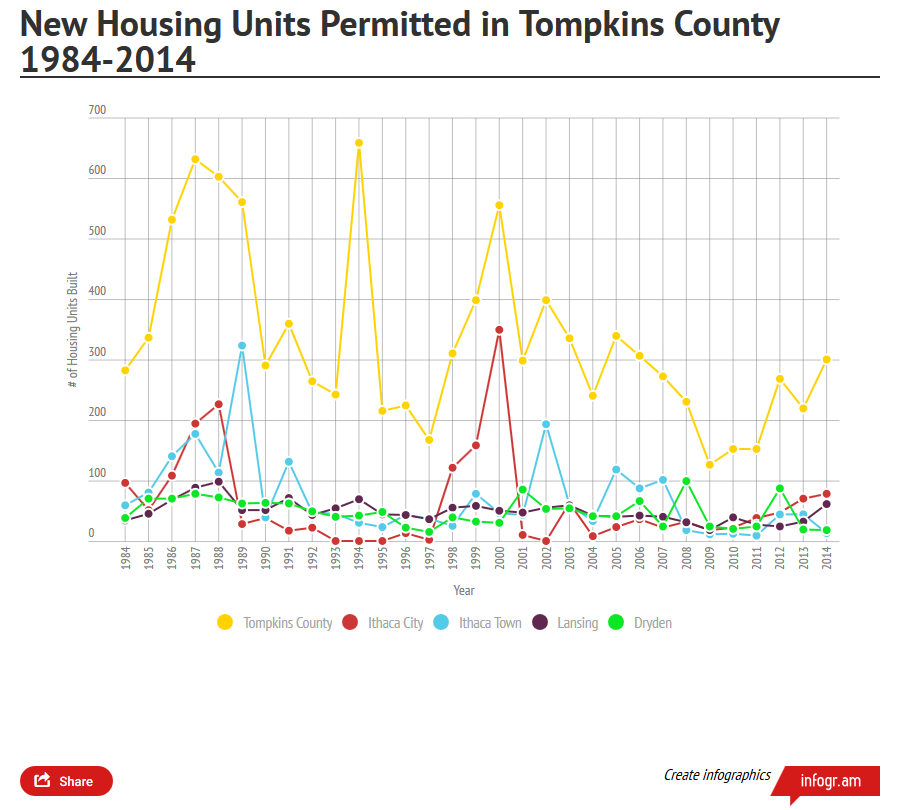
He’s right about the town not growing that fast. The permit records show that in September, the only new home-building permit was for a duplex at 214 Pennsylvania Avenue on South Hill (the Iacovellis building more student rentals for IC, probably). The previous month online, June, had four single-family homes, filling out lots in previous-approved subdivisions.

tc_housing_permits_1984_2014

Traditionally, the town of Ithaca has made up a pretty sizable chunk of the new home permits in the county. But if they only issue 30-40 this year (still better than last year’s 14), then it falls on the rest of the communities to try and make up the housing deficit, at least in the short term. Ithaca city’s total, anticipated to be 247 new units to be permitted in 2015, is only about 84 units right now, because John Novarr has yet to start Collegetown Terrace’s Phase III, and Steve Flash’s 323 Taughannock on Inlet Island has yet to start either. To bring down the deficit in a decade, as well as keep up with annual economic growth, the county would need over 600 units per year; it’s not certain if the total will reach even half that in 2015.

On the one hand, the town of Ithaca is trying to be proactive and adopt a new approach to development in quick and good order. On the other hand, it’s not a great situation for trying to make a dent in the housing deficit, with its attendant affordability issues, and there’s the possibility things are going to get worse before it gets better. I don’t know if there’s a right or a wrong way of going about it, but it’s a stressful setup.

2. On the county level, officials are seeking legislature approval for launching a study into the feasibility of an airport business/industrial park in Lansing. 52 acres of vacant land along Warren and Cherry Roads are being considered for the study, which would include a conceptual site plan of potential buildings and parcels, and an assessment of the needs and characteristics of companies most likely to open in the potential business park. Utilities and green infrastructure will also be looked at in the study. The projected cost is less than $50,000, and being paid for by the Tompkins County Industrial Development Agency (TCIDA). The feasibility study would be awarded next month, with authorization and approvals on the staff level.

arpt_pk_1

For what it’s worth, folks living up there are used to business traffic – Borg Warner’s 1,300 person plant is adjacent to the study site. The Warren Road Business Park lies a minute’s drive up the road, and the Cornell Business Park is about a minute’s drive south. The land also has municipal sewer, allowing for large-scale projects. A copy of the RFP states two that the two parcels shown above are the primary analysis area, with secondary areas closer to the airport runway and the resident land to the west separate from the park. They aren’t a part of the proposed business park, but the county asks that they be examined for development potential by the study.

holiday_inn_express_v2

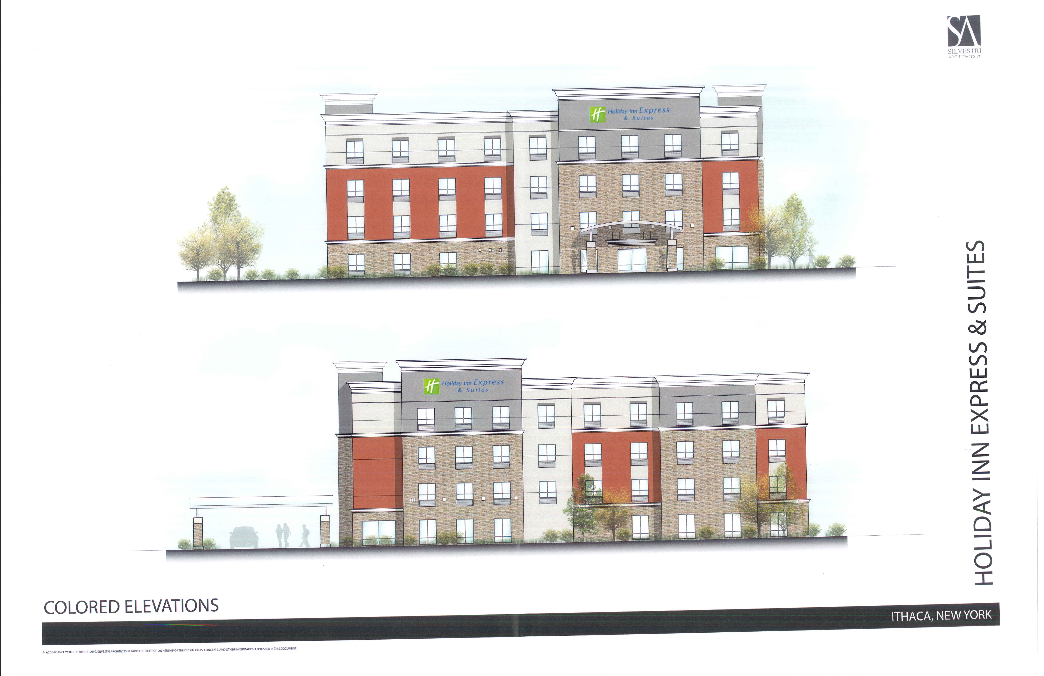
3. Details, details – the Holiday Inn Express already under construction in big-box land at 371 Elmira Road will be going in front of the city planning board this month for some slight modifications. The developer, Rudra Management and Rosewood Hotels of Cheektowaga, wants to increase the number of rooms from 76 to 79, and add three parking spaces accordingly. Along with that comes the bevy of supporting docs – technical drawings here, landscape plan here, landscape schedule here, and elevation drawings here. Apart from a palette change on the exterior (the red-brown color is “Decorous Amber“, part of the new official Holiday Inn color scheme per the architects’ cover letter), there are no changes to the design, the 3 additional rooms are just an update to the interior configuration of the hotel, one more room on each of floors 2-4. Apart from tastes in color and making sure the three new parking spaces pose no issues, the board won’t have to debate much here, and the hotel is still very likely to open next summer.

1015_dryden_1

4. In small but notable builds, Modern Living Rentals (MLR) is at it again. The relatively new Ithaca-based rental and development company is planning a triplex (3 units) at 1015 Dryden Road, just east of the hamlet of Varna. According to an email from MLR co-owner Todd Fox, the units, all 2-bedrooms, will start construction in the spring, and it’s a safe wager they’re shooting for an August 2016 completion, just in time for Cornell student renters. Judging from the renders on MLR’s site, each unit will be around 930 SF, so about 2,790 SF total. MLR teamed up once again with local architecture firm STREAM Collaborative for the design.

1015 Dryden is also home to a single-family home built in 1938, and a 4-unit apartment building from about 1980. The apartment building was badly damaged in a fire in 2011, renovated, and the site was sold to MLR for $425,000 in March 2014.

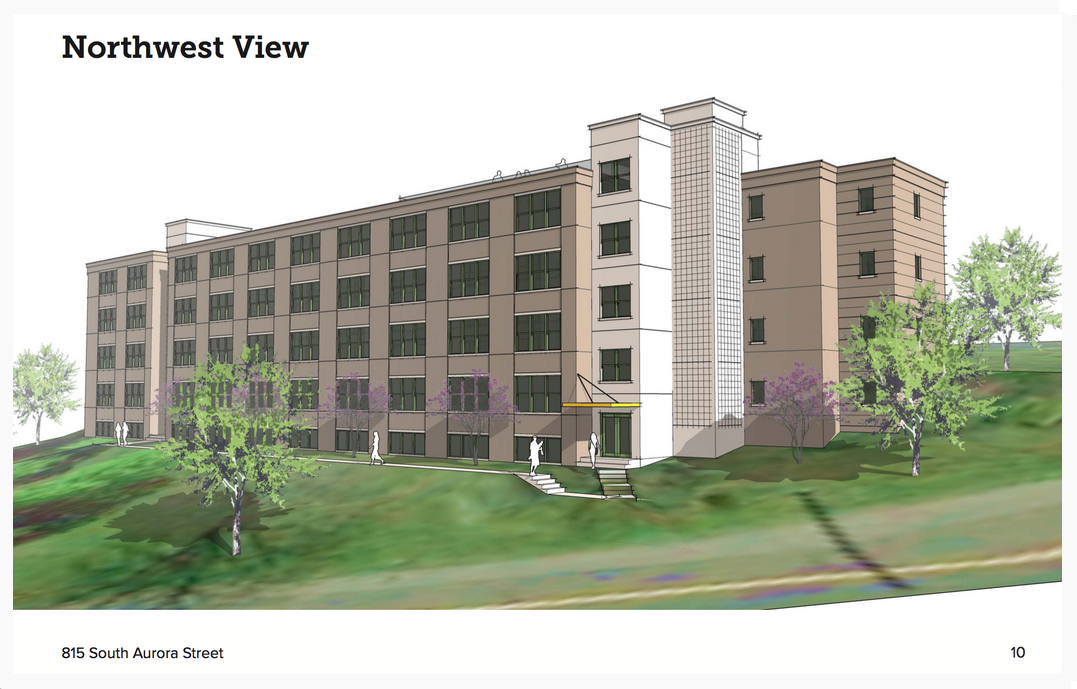
815_s_aurora_4 815_s_aurora_5 815_s_aurora_6

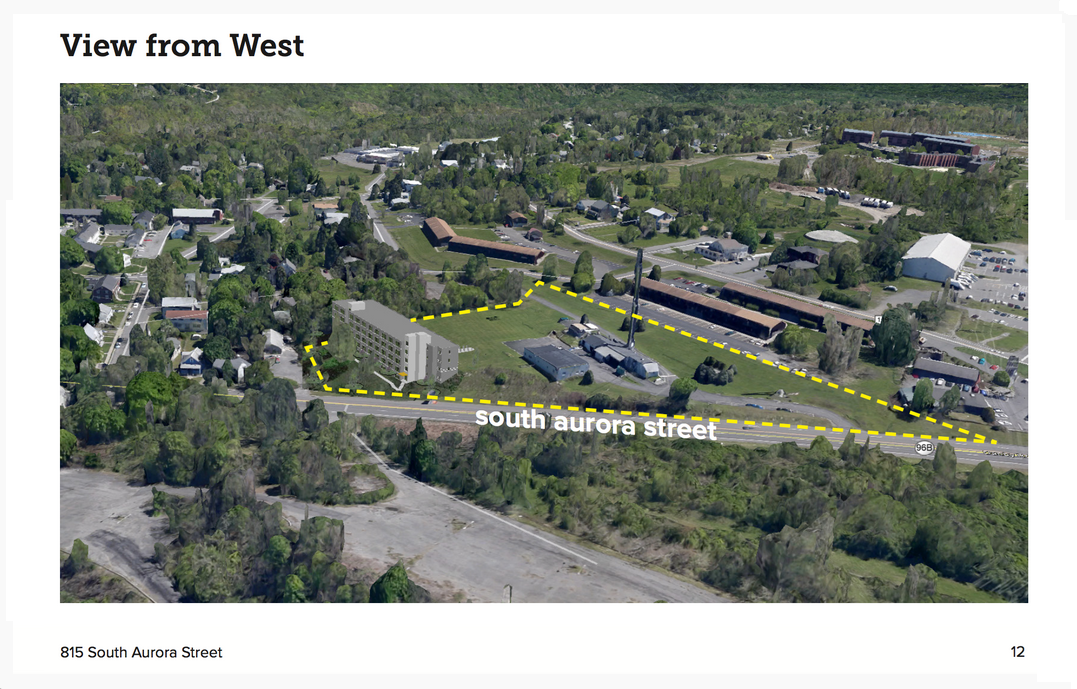
5. While on the topic of MLR, let’s throw in some eye candy. Along with the plans for 1015 Dryden, additional images for the proposed 87-unit project at 815 South Aurora Street on South Hill can be found on their website as well. I’ve included two perspective renderings and an aerial render, but more images can be found here. The 87 units will all be studio apartments. STREAM Collaborative is responsible for this design as well.

A detailed write-up of the project, including the related cell phone tower issue, can be found here.

6. Out in Lansing town, there are two attention-grabbing news pieces from Tuesday’s next planning board meeting. One is a plan for an LP gas / petroleum distribution facility on Town Barn Road (parcel address 3125 N. Triphammer Road). A 30,000 gallon storage tank and gravel drive are planned in the initial phase, with 5 15,000 gallon tanks, a garage/maintenance building, and an office planned in later phases. Now, normally a project like this is not a big deal, but there’s the outside possibility local contingents of the anti-Crestwood, anti-fossil fuel groups will go on the offensive to try and stop it. So the potential for political football is there.

The other detail isn’t up for discussion yet, but the town notes that 15 duplexes (30 units) are being planned by former Lansing town supervisor A. Scott Pinney for a site on Peruville Road (the county calls it 428 Scofield Road, but the land has frontage on both roads). The site already houses 4 duplexes built in 2011.

Breakneck_Builds_-_Master_Card

7. Instead of the the usual “House of the Week”, this week is more of a shout-out/advertisement. For those with cable, The DIY Network will be running a new episode of “Breckneck Builds” tonight at 11 PM (additional showings listed here), highlighting a just-finished home on Dryden’s Hollister Road. Quoting the promo write-up:

“Jordyn is ready to leave her rental behind and buy her first home, but what is most important to Jordyn is that her new home is eco friendly, so she is turning to the modular world to build a big house with a small carbon footprint.”

The modular home assembly was the work of local builder Carina Construction, who also tackled the modular units at the Belle Sherman Cottages site. Local builder, local resident, local project, so set your DVRs or TiVo.

8. Last but not least, here’s your Planning Board agenda for next Tuesday. Nothing new at this month’s meeting, but here’s the run-down:

A. Review of changes and revised approval for the Holiday Inn Express (see above)

B. Declaration of environmental significance and BZA reccomendations for 215-221 West Spencer Street– Pocket Neighborhood, 12 units w/ 26 bedrooms, Ed Cope/PPM Homes is the developer, Noah Demarest of STREAM Collaborative is the architect.

C. Environmental Review Discussion for the bar/lounge proposed for the renovation of 416 E. State – cover letter here, description here, letters of opposition in the agenda.

D. Public hearing and re-approval, Hotel Ithaca renovations, 222 S. Cayuga – Site Plan Review drawings here, renders here and here. Not sure there’s enough of a difference from the first time around, but at least the cross-catching on the exterior is gone.

E. Herson/Wagner Funeral Home renovation, 327 Elmira – Declaration of Lead Agency and Public Hearing – I wrote about that in the Voice here. Fun fact, the original proposed title was “Funeral home hopes to being new life to Elmira Road property”. It was rejected.


News Tidbits 10/17/15: Pressing the Issue

17 10 2015

amabel_v4_1

1. It looks like the Amabel housing development has another site plan. New pedestrian paths, a relocated community garden, and some substantial tweaks to the layout of the house, including a small access road for three homes near the southern termination of the loop road with Five Mile Drive (older plans here).

Marketing for the project hasn’t officially started, but New Earth Living LLC’s (Susan Cosentini’s) website does have interior renders for one of the proposed house styles, as well as an informational PDF. Plans call for Net-Zero energy efficiency homes, meaning that the amount of energy generated on site will power all the project’s energy needs. Example homes included in the PDF range from 1,184 SF to 2,083 SF – it looks like there will be four home models with alternate configuration options. Prices have yet to be announced.

amabel_v4_2

The Amabel project, proposed for 619 Five Mile Drive just southwest of the city of Ithaca’s boundary line, has been in the works for the past couple of years, a sort of grand follow-up to New Earth Living’s Aurora Street Pocket Neighborhood in Fall Creek. The project will have about 30 single-family homes at full build-out.

I know some of the more pessimistic readers here may call this suburban sprawl with a green sheen, but it’s a lot better than a cul-de-sac.

20151011_130755

2. The village of Lansing sent off their updated Comprehensive Plan to the county planning department this week for review and approval. Now, planning should be the village’s forte, since the village of Lansing was founded in the 1970s as a backlash against the construction of commercial and residential properties along Triphammer and Route 13, including what’s now The Shops at Ithaca Mall. The plan was last updated in 2005, and draft of the new plan can be found here.

The village seems to note with some distress that although population growth has slowed, traffic has continued to increase (due in large part to significant growth in Lansing town; many town residents pass through the village to get to employment centers in Ithaca). North Triphammer Road has already been widened, but there are concerns about the ability of infrastructure to handle further traffic increases. The village also notes a strong rise in the 55+ population, as well as the same affordable housing issues that plague Ithaca and much of the county; in Lansing’s case, the median household income can afford a $171,000 home by their estimate (2.5 x $54,721 = $136,800 qualifying mortgage, + 20% down-payment), but the average house in Lansing costs $258,000 (affordable to a household making ~$82,500; note all the numbers are 2010 values). The plan also shows that fair market rent in Lansing increased 64.1% from 2005-2015, meaning that unless a renter had an annual wage increase of 5.8%, they paid more of their income towards housing year after year.  29.4% of homeowners and 39.1% of renters pay above the HUD’s 30% of total income threshold for affordability. The village is concerned it will price aged residents right out of their homes.

In an effort to combat the growing problem, the village wants to focus new housing along main thoroughfares with easy bus access and bike infrastructure, and is aiming for smaller homes and apartments geared towards aging-in-place and senior communities. The village notes that 500 to 600 units of housing could potentially be developed over the next few decades (note Lansing averages ~10 units per year), mostly on the large, low-density home lots near the lake. These would almost certainly be geared towards the highest income brackets, but the benefit of greater supply might relieve pressure on other homes.

On the business end, the village would also like to encourage Cornell to relocate back-office and research operations to village sites. There’s also a push for senior-oriented businesses and a possible rethinking of the malls, not an uncommon thought in this age where malls are struggling and dying off.

There are arguably two senior developments planned that already fit their “want” category – the 12 senior units planned for the Lansing Meadows PDA (the ones planned next to BJ’s on Oakcrest Road), and 62 senior units for the CU Suites site on Cinema Drive (photo from last week above). Other residential growth will be fairly “organic”, with new homes built at the whim of owners and mom-and-pop builders. A new commercial medium-traffic zone along Hickory Hollow Drive might open some more business opportunities; as for Cornell, they seem to be more focused on their East Hill Village plans, but research park tenants are always a possibility.

The village plans to update its comprehensive plan again by 2025.

402_s_cayuga_st_rev2_1

3. On the topic of plans, here’s a progress report just released by the Ithaca Urban Renewal Agency regarding its five-year plan.

If you wanted another reason why housing in Ithaca is so expensive, the plan alludes to it here:

“A spike in local construction costs has delayed the start of construction on a planned four-unit first-time homebuyer project and a public facilities project that will improve a public recreational area. We anticipate these projects moving forward once they have been able to close their funding gaps.”

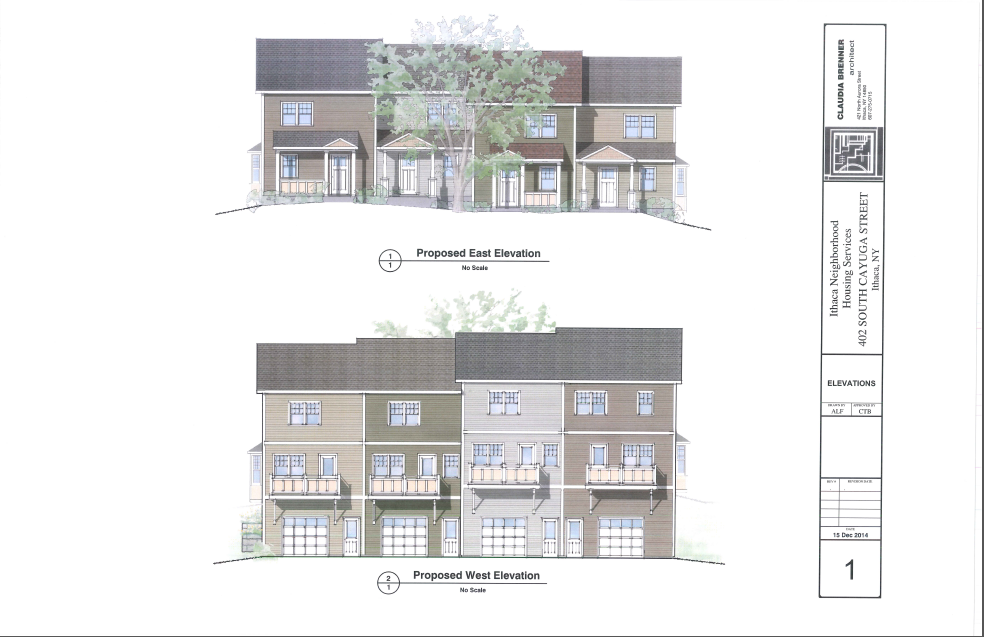
The four-unit homebuyer project is the townhouse project planned by INHS for 402 South Cayuga Street (shown above). INHS director Paul Mazzarella said the project was due to receive bids last month, and if they were within INHS’s budget, it would start construction. It hasn’t started.

Ithaca’s a small labor pool, so you either truck in labor from elsewhere and incur the wrath of construction unions, or you go local and pay a premium. But even then, with the relative burst in activity as of late, the local pool is getting tapped out and that’s driving prices up. Non-profits like INHS don’t have a lot of wiggle room in their budgets, and city government just won’t build if they can’t get affordable bids for infrastructure work. It also impacts programs that provide low-cost home repairs to those with low and fixed-incomes, because those low-cost repairs are no longer low-cost, and fewer people are able to be served.

One could one look at this as either a reason to limit approvals (which the construction trade unions are opposed to) or introducing more out-of-town labor to the market (which the trade unions are also opposed to). Stuck between two metaphorical rocks.

So long story short, in a region where the cost of housing is climbing dangerously fast, the city has a lot of work left to do meeting its affordability goals, with many actions/programs falling well short of annual numbers needed to meet the 5-year goal statistics. Hopefully some progress will be made in the upcoming year.

state_st_triangle_v5_1

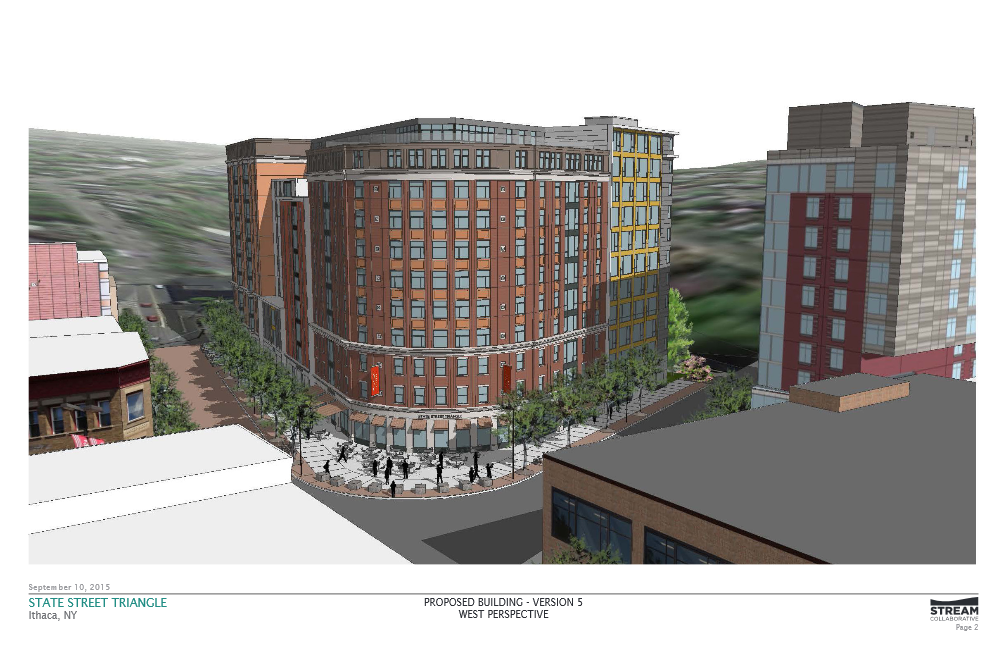
4. The mayor has dealt State Street Triangle a serious blow by announcing his opposition to the State Street Triangle, first reported on his facebook page and picked up by every news outlet in town, Svante Myrick cited the student housing focus and massing concerns for his opposition (he explicitly stated the height, 11 stories and 116 feet, was appropriate for its location, the 300 block of East State Street in the heart of downtown Ithaca). This is a big setback because apart from his social influence, the mayor sits on the county IDA, which is the governing body that votes on tax abatements.

A couple of the outlets have reached out to Campus Advantage, which is busy trying to formulate a response. They’ve hired a PR firm for whenever they’re ready. It could be the end of the project, it could still go on, it could be drastically altered. The chips have been tossed into the air, let them fall where they may.

20151011_121733 20151011_121800

5. House of the week. This week, a trip out to Maple Ridge in Dryden. Maple Ridge is a housing development within the village that had the unfortunate luck of launching right before the Great Recession. After struggling, it’s been picking up in the past couple of years with five houses built since 2013. This modular home is the “Cayuga Lake” model offered by American Homes in Dryden. The pieces have been assembled and fastened together on top of the poured foundation, and some finish work has started. The uncapped foundation section is most likely a future garage. Modular homes tend to move through construction pretty quick, and this one will likely be finished in time for the holidays.

waterfront_rfp

6. The county and city hosted a meeting discussing possible waterfront re-development plans for the NYS DOT site on Thursday night. Three plans were presented, two mixed-use commercial and residential, and a third that the Journal describes as just being “hotel”, but given the 7.66 acres on site, is probably mixed-use with a hotel component.

The third option is a little bit of a throwback because the city long-saw the waterfront as prime for a hotel. But the market has shifted towards downtown and Route 13, and with the market adding new hotels at a pretty good clip over the next few years (Marriott, Canopy, Holiday Inn Express), a hotel in that area is pretty unlikely. Local lawyer/developer Steve Flash proposed a five-story hotel on Inlet Island in 2007, but in the days before the waterfront zoning allowed five floors, the project was opposed and shelved.

An initial cost of the move is being pegged at $14 million, but it isn’t clear if a potential buyer would pay that directly, or the county/city, who then get reimbursed by a buyer. $14 million is quite an amount, but given the site’s potential, it’s feasible (but don’t expect any outside-the-box thinking; a developer will want to minimize risk since they have to make such a huge initial investment).

If anything is clear, it’s that, contrary to the opinion of at least one speaker at the meeting, most folks would like the snow plows and road salt stored somewhere else.

20150727_145000

6. I don’t comment on politics. I don’t comment on candidates. But I will comment on issues. And, probably no surprise to readers here, I find it worrisome when anti-development candidates come forward.

By and large, development in Ithaca isn’t happening “for the sake of development” like in the 1990s, when the local economy was mired in recession. It’s happening because the Ithaca area has added 6,000 jobs in ten years, mostly in healthcare and education. Cayuga Medical Center has added over 500 positions in 10 years, and while Cornell’s direct employment hasn’t changed much, the university has added nearly 2,500 students. That has created demand for thousands of units, but when combined with the slow pace of development within the county over the past decade, the result has been a critical housing deficit.

This is one of the major reasons behind the current affordable housing crisis – high demand, plus insufficient increases in supply, have resulted in very low vacancy rates and have made it a seller’s paradise when it comes to housing.

If you plan on selling your house or rental property and retiring to Florida in the next couple of years, you’re in for serious bank! Everyone else, whether through rents or increased tax assessments, ends up with a much greater burden. Housing costs are a big player in how Ithaca became the 8th most expensive city in the country.

If there are thousands of people coming here for work or retirement, and new housing isn’t there to absorb them, the wealthier folks moving in will simply pay a premium on what exists, and price out the existing working and middle class who can’t afford those premiums. Which some people are okay with.

Ithaca doesn’t need to “slow down” development, because that’s one of reasons why the affordability crisis is as bad as it is. What Ithaca needs is to be proactive about development, and generally it has been under Mayor Myrick. The city has actively worked to reformulate general guidelines like the Comprehensive Plan (first all-new plan since 1971!) and is starting work on part II, working on neighborhood-specific themes. Myrick’s government has also identified and maintained targeted development areas, like Collegetown’s Form Zoning and downtown density. The mayor has even come to bat for the $30k-$50k/year working class folks that “breed trouble” and need affordable housing, like with INHS’ 210 Hancock project.

Affordability is a long-term effort and a multi-pronged approach, by keeping vulnerable families in their homes, and providing new homes to accommodate the growing economy and population.

There’s still a lot of work to do, but hell, it’s a start. Sticking fingers in ones’ ears isn’t going to make the housing crisis go away.


Village Solars Construction Update, 10/2015

14 10 2015

With phase one of the Village Solars apartment complex completed and housing its first tenants, work is well underway on phase two. 12-unit Building “D”, which shares the same general design as phase one’s Building “B”, has already been framed, sheathed with a Tyvek-type of housewrap, mostly fitted-out (a couple windows and the balcony doors have not been installed), and even some siding has been installed on the ground level. This seems to be a change-up from the previous phase, which used ZIP System plywood for sheathing. Also, in a departure from Building “B”, Building “D” opts for larger windows in place of the very small juliet balconies on the upper floors.

Across the property to the east (and on the other side of the future pond) is the 18-unit Building “G/H”, a new design. Framing and wood studs are only beginning to arise on the ground floor. Plywood that will be used in future sheathing has been propeed up against the newly-erected wall studs. The concrete slab foundation has been poured and cured, and underground utilities have been installed.

Building “G/H” was created when developer Lifestyle Properties (the Lucente family) was working with NYSEG to lay out the utilities after approvals were granted and the first phase was underway. It was decided to make phase 2 all electric services, due to concerns that Lansing may not be able to provide gas service if the situation with the gas pipeline proposal on West Dryden Road doesn’t go in the town’s favor. One of the results of the utility infrastructure change was a difference in utilities layout, which impacted the site design for walkways, and the Lucentes are sought and received approvals last Spring to revise the PDA (planned development area, similar to the city’s PUD and the town’s PDZ) to change G and H from two separate buildings, to one large building that occupied a smaller footprint.

Lastly is Building “E”. “E” will be an 11-unit apartment building, though it’s not clear if it will be a new design, or simply an interior rearrangement of units. Right now, only the concrete forms for the foundation have been constructed, with what appears to be trenches for utility lines criss-crossing the site. Taking a rough guess, “D” will be completed and for rent before the end of this year, “G/H” by the end of Spring, and “E” will be finished in time for next year’s students, mid-to-late summer 2016.

Building “F” is part of a separate phase, “2A”. It will contain 10 units and a community center. According to Rocco Lucente in an interview last month, work on Building “F” will begin after the other phase two buildings are completed.

The first three buildings in the Village Solars complex, buildings “A”, “B” and “C” with 36 units in total, were completed this summer at a cost of $4.7 million, according to loan documents on file. Rents posted on Craigslist have one-bedroom units listed for $1050-$1145, two-bedroom units for $1235-$1369, and three-bedroom apartments rent for $1565-$1650. Prices vary a little depending on what floor the unit is on – the higher up a unit is, the more it costs.

Phase two will cost about $6 million, according to the construction loan filed with the county. Tompkins Trust Bank is providing financing. Future phases call for upwards of 300 units on site.

20151011_123635 20151011_123653 20151011_123739 20151011_123809 20151011_123838 20151011_123858 20151011_123922 20151011_123936 20151011_123954 20151011_124021 20151011_124113 20151011_124215 20151011_124255 20151011_124459

village_solars_2 village_solars


News Tidbits 10/3/15: Lying in Wait

3 10 2015

1.We’ll start with a news piece out of the ‘burbs. Over in Lansing town, wealthy homeowners are accusing the town board and the town planning board of disenfranchising and ignoring them over concerns about the proposed Novalane housing development. Dan Veaner at the Lansing Star gives a very thorough rundown here.

Quick summary, Novalane is a 19-lot high-end housing development slated for farmland between two other high end housing developments, the mostly-built Lakewatch and Eastlake subdivisions, the first phase of which is comprised of seven lots on the west side of the parcel. The sticking point has to do with access roads for the new homes. The developer proposes to connect the two developments via the Smuggler’s Path cul-de-sac, which would extend down through an undeveloped lot in Eastlake and connect with Eastlake Road.

According to the town, the intent has always been to connect the two developments – but apparently, no one ever had a good idea where. Neighbors on Reach Run are incensed because they’re afraid of additional traffic on their road if the connector isn’t extended all the way, but if connected, Eastlake residents are opposed to cross-traffic they suspect will cut through to get to East Shore Drive. Aside from that conundrum, some neighbors have suggested being okay with the road if it went all the way from Smuggler’s Path to form an intersection with Waterwagon Road, but that doesn’t seem possible given the property lines of the Rec Club. At the very least, it would be a big burden in the development costs.

So on the one hand, here is a town that has struggled with planning issues. On the other, you have wealthy residents angry about construction vehicles accessing the one house currently under construction in Lakewatch, and prepared to sue the town over the potential of seven more houses. There’s also this gem of a line:

“We’re large taxpayers.  It’s an autocracy.  To be treated like that by our own representatives is incorrect and not acceptable.  Who are they working for?”

Maybe all taxpayers and not just the large ones? Just saying.

2. Switching over to another ‘burb, the proprietors of Storage Squad made their pitch to the town of Dryden, per the Ithaca Times. Storage Squad, a Cornell startup that has expanded to twenty cities, seems to have a rather unique take on the appearance of self-storage. For their facility planned at 1401 Dryden Road, the company wants to build 79,600 SF of space, 70,000 SF of which would be in five buildings consisting of 400 storage units. 315 units may join 3-4 years down the line. According to the presentation, there would be a Cornell-inspired clock tower, brick and ivy growing on the side walls. Paved entries, gated, and split-face concrete masonry units. Apparently, it was enough to win the town supervisor over. A special zoning permit will be required, but approval is expected later this fall. No word on whether they’ll keep the 150-year old house on-site.

3.  Must be a good week for Dryden. The eyesore at 76 West Main Street has been sold and has a construction loan approved to finish renovations. The Ithaca Voice article I did on the reno is here. I toyed with the idea of calling Dryden mayor Reba Taylor for a quote, but I figured I’d get a very generic statement it any at all, and in the interest of time the idea was shelved. I might get a response to one-third of the calls I make regarding development/real estate stuff, which can be frustrating but I’ve gotten used to it.
state_st_triangle_v5_1

4. The Times’ Josh Brokaw brings out an update on the latest State Street Triangle news. The important details:

– CTB has agreed to take one of the commercial spaces. No word on how that would affect the North Aurora Street location a couple blocks away.

– The planning board didn’t have many words; One member suggested the curve portion was “too flat” and an arcade on the first floor (not the video game kind, but the archways over a walkway kind). A second brought up affordable housing, which the developers have given consideration, but isn’t in the current plan.

– In favor: the director of Cinemapolis, other developers, CTB’s owner and students. Not in favor – the head of Historic Ithaca, and councilman George McGonigal – who opposed the Stone Quarry Apartments, the waterfront rezoning, 210 Hancock and thinks the city can make Cornell build dorms. The Times has called him out as “anti-urban”. If a councilperson outside the first ward speaks out, it’ll get a lot more credence on this blog.

304_college_2

304_college_3

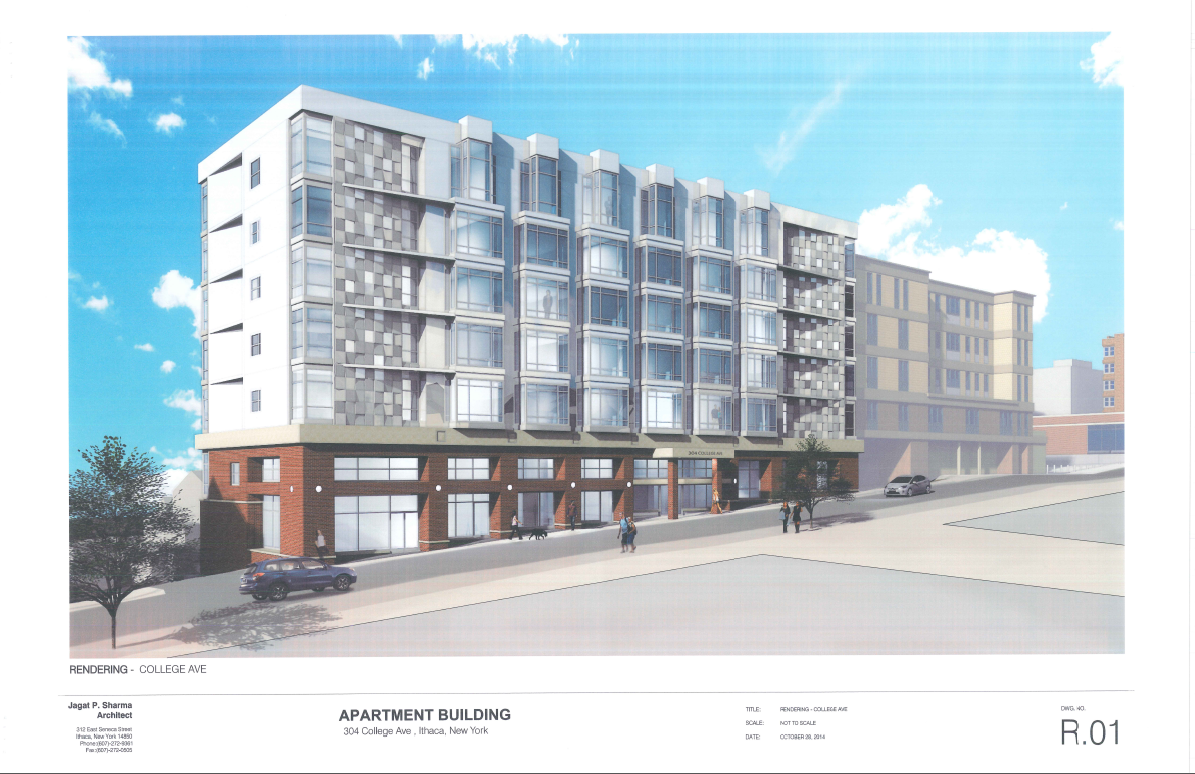
5. The city and Cornell gave an interesting presentation about development to the Collegetown Neighborhood Council this week. City planning director JoAnn Cornish gave a rundown of what’s planned, included the 102 apartments 302-306 College Avenue (phases one and two shown above). This one might still be in the hopper, but don’t expect it to move forward anytime soon – the developers (the Avramis family) have rented out the houses to be demolished through May 2017. It also seems like that one building would be in the 2017-2018 time frame, the second 2018-2019. So these two mid-rises are quite a ways out, assuming they’re still in the works. Also, Fane’s 12-story proposal for 330 College is still dead, but something more modest may come forward someday.

On another interesting note, Cornell’s lead planner, Leslie Schill, said the university may be looking into turning Eddy Gate and the Sheldon Court plaza into green spaces to offset the lack of parks in the neighborhood. Cornell might also renovate the Ag Quad into a richer pedestrian experience.

6. The Carpenter Business Park purchaser continues to intrigue. A company called Carpenter Business Park LLC, using a P.O. Box ties to the Miller Mayer law firm, has bought two more parcels after buying the four unused land parcels in the Carpenter Business Park for $2.4 million last August. This time around, the LLC purchased a nondescript one-story commercial building at 742 Cascadilla Street, and a nearby tiny silver of land between the Palisades Corporation and Cornell U. Press buildings for $304,000. It’s not clear what the buyer is intended to do with all these properties (we know it’s not a big box store), but it’s definitely curious. If something comes up, it’ll be shared here.