News Tidbits 7/9/16: Land Ho

9 07 2016

waterfront_foreclosure_parcels_0516

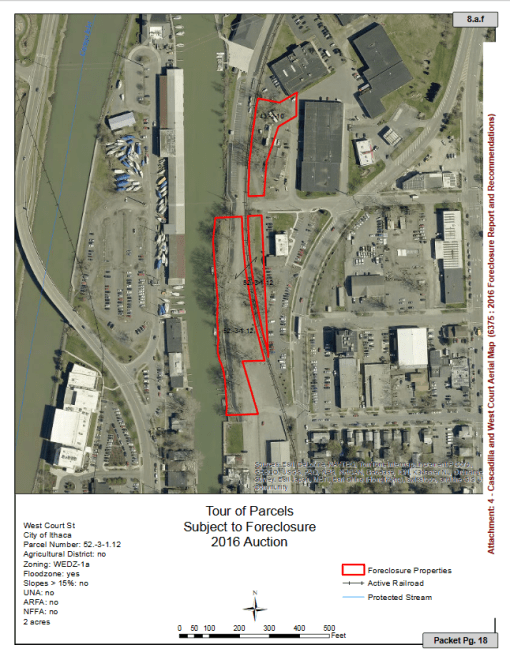
1. Starting off this week, a couple of new pieces regarding Ithaca’s waterfront. First, the city’s chances of picking up some prime waterfront real estate at a low, low price are gone, though not any fault of their own. Readers might recall that back in late May, the properties were about to be foreclosed on for unpaid taxes, and the county was discussing selling the parcels, worth over $630,000, to the city if the city paid off the $42,844 tax bill. Pretty sweet deal for the city, right?

But the owner, an LLC that has held the parcels since the late 1990s, managed to pay off the tax bill and an attached penalty fee, which means they get to keep the land. So, if the city had any plans for those parcels, they’ll be filing those away for a long while.

2. However, it looks like several properties are being put up for the sale in the city’s West End near the Waterfront. Local realtor Brent Katzmann has four properties listed – 321 N Fulton, a duplex on 0.11 acres for $144,800; 319 N Fulton, a single family on 0.04 acres for $109,875; 626 W Buffalo, a single family on a narrow and deep 0.15 acre lot, for $124,999; and 622 W Buffalo, a duplex on a narrow and deep 0.19 acre lot, for $134,800. The prices generally run at or up to 10% over the tax-assessed value ($130,000/$100,000/$125,000/$125,000). The currently owner is a Long Island-based LLC, led by a pair of New York City real estate lawyers, who acquired the properties from 2010-2012. Prior to them, many of the properties have been through a merry-go-round of owners over the past 10-15 years.

The properties are in fair to rough shape, and the marketing tactic being used isn’t renovation, but rather development potential. The four properties all fall within WEDZ-1a zoning, which is the city’s attempt at encouraging development on the West End. WEDZ-1a permits residential, commercial and mixed-use 2-5 story buildings, 90% lot coverage (100% if less than 50 feet on two sides – the Buffalo parcels and 319 N Fulton), and no parking requirement. The properties are not affected by the city’s TM-PUD.

The West Buffalo lots could be tough since the house in-between is owned by someone else, but deep lots and the corner of North Fulton and West Court offer some potential. Worth keeping an eye on, if only to see who they sell to.
20141227_140754

3. One less homebuilder around. Avalon Homes is closing up shop. The Ithaca-based company is selling off its lots and trying to wrap up the homes they have underway. Rumors abound as to why, but if firm, verifiable information can be obtained, there will be more to follow.

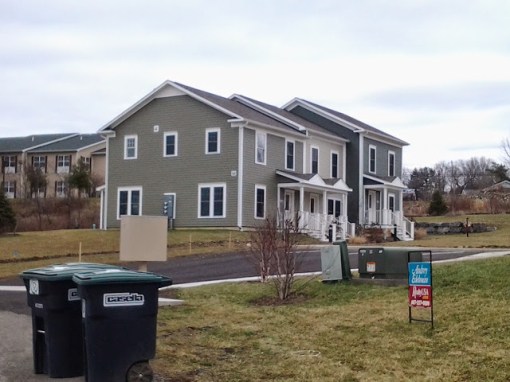
Avalon made its name doing stick-built built, with a focus on affordability and green construction. Avalon, a certified Living Wage employer, was the general contractor for INHS’s Holly Creek townhomes (shown above), and employed at least a dozen back in 2010.

old_library_thp_v4

old_libe_thp_holt_v6

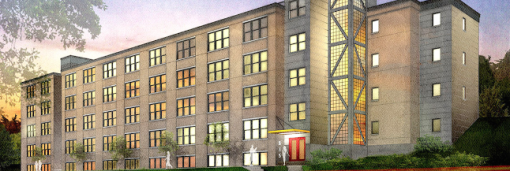
4. The Planning Board and the Ithaca Landmarks Preservation Commission will be conducting another joint meeting on Tuesday the 12th at 5:30 regarding the Travis Hyde Properties’ proposal for the Old Library. HOLT Architects responded to comments from the ILPC at its last meeting that the design needed to be “quiet” by submitting the revised elevations seen below.

Mission accomplished? Armchair architect comment here, but the revised design is too far the other way. There’s a joke about the color beige, coincidentally similar to the new brick, being an adjective for “dull, boring, indistinctive“. I like the previous design with its wood-like fiber cement and characterful roofline, and I wonder if perhaps a revised color palette of that design, with maybe a few less full-sized balconies, would be a happy medium.

5. As announced on city of Ithaca Mayor Svante Myrick’s Facebook page, the Namgyal Monastery Institute of Buddhist Studies will be the site of a library and museum of the Dalai Lamas, the first of its kind outside of Tibet. The facility would be located on the 28 acres Namgyal owns on South Hill at its Du Khor Choe Ling monastery complex. Architectural plans and costs are still being determined, but a quote from Ngawang Dhondup, administrator for Namgyal’s facility, says that it will be larger than Namgyal, which has been underway since 2007 and will be about 14,500 SF when completed.

All in all it’s a great feather in Ithaca’s cap, but two things to be a bit wary of moving forward are the reactions and possible opposition from neighbors to what will be a very high profile religious facility, and given geopolitical issues, the reception to the Library of the Dalai Lamas may not be so warm from some denizens of cosmopolitan Ithaca.
12-29-2011 003

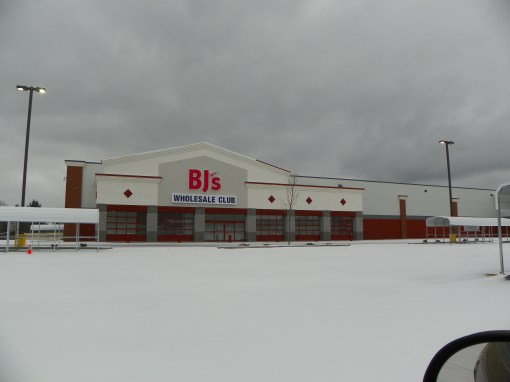
6. Way back in 2010 and early 2011, when the BJ’s Wholesale club was proposed in Lansing, one of the components of the proposal was to build 12 units of senior housing on land north of the then-proposed store. The project also called for wetlands, walking trails and a bird sanctuary on the undeveloped portion of the 11-acre property. Developer Eric Goetzmann (Arrowhead Ventures/Triax Group) faced considerable opposition to the plan since it involved big box retail and was housing outside of the density corridor, but after the IDA initially voted the project down in December 2010, a revised application calling for a smaller PILOT was passed by the IDA in April 2011 (some of the logic being that the county was in a financial bind during the recession, and some increase in taxable property was better than none).

Well, the BJ’s was built and opened the following year, but the wetlands and housing have had a much longer slog. The U.S. Army Corps of Engineers in in charge of new wetland permits, and the process is a complex, arduous one (man-made wetlands are difficult to build, and the Army Corps would rather they be done right than done fast). Goetzmann teamed up with The Upper Susquehanna Coalition and The Wetland Trust to design the “Inland Salt Marsh Bank”, which was just approved by the Army Corps, and the final permits expected shortly. With the wetlands taken care of, Arrowhead can begin to look towards the housing component, which they plan to put forward later this year for a 2017 construction date. As part of these plans, they want a one-year extension on the legal construction start for the housing from the IDA. Given that Arrowhead has met the other criteria and can demonstrate proof of progress on the wetlands, this probably won’t face much opposition. But eventually, it looks as if the village of Lansing will finally get those 12 units of senior housing.
biggs_1

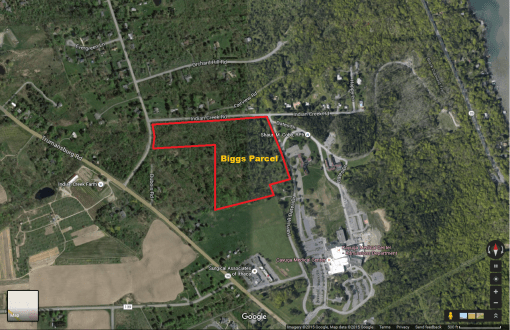
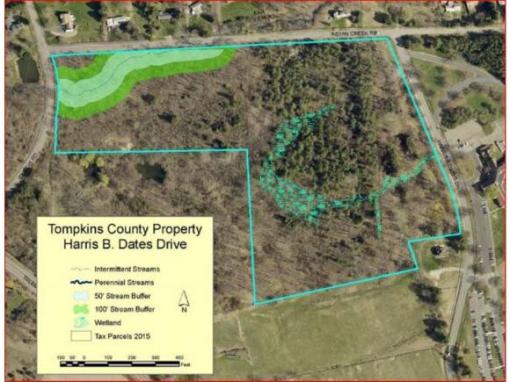
7 It looks like the Biggs Parcel is officially listed for sale. Local realtor CJ DelVecchio was selected by the county to manage the listing for the 25.52 acres near Cayuga Medical Center. The asking price is $275,000. The land comes with a conservation easement on the northwest side due to its proximity to a stream, and the wetlands near the center would be tricky to work with, because wetlands typically can’t be developed unless new wetlands are created, which is not cheap or easy to do.
c507

Readers might remember that this parcel has quite a history behind it. Declared surplus land by Tompkins County, the county had set up a tentative deal for a 58-unit affordable housing complex on the property, but the deal fell through after the wetlands were discovered to cover more area than previously thought.

Neighbors, via the Indian Creek Neighborhood Association (ICNA), have tried to force the county to hold onto the land to keep it from being developed. One of the big sticking points had been whether or not the 25.5 acres would be taxable – the county isn’t especially concerned at this point if the land gets developed or not, but they have made it clear that they want to sell it to a private owner that will pay taxes. The problem is, proposals to preserve the land often dovetailed with plans to donate it to an organization like Finger Lakes Land Trust, which would render the property tax-exempt. The ICNA did end up making a closed bid for the property, but the offer was rejected.

A neighbor to the south did propose reconfiguring the property to preserve the woods and build cottages on his back lot – by adding the Biggs land, he could have built more units under the regulations of the cluster zoning. But the plan fell through due to “size and complexity”, according to the ICNA’s Linda Grace-Kobas.

The land had been valued at $340,000 before the discovery of the additional wetlands, and the revised 2016 assessment brings that down to $240,000.


News Tidbits 7/2/16: Not the (City Centre) of Attention

2 07 2016

201_college_v5_1
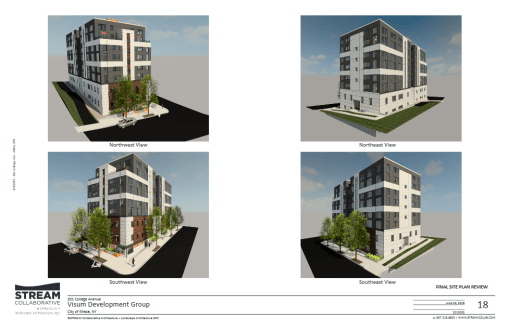
1. Let’s start this off with the big news of the week – the proposal for 201 College Avenue was approved by the Planning Board. The debate was spirited, to put it most politely; catty, to use the official write-up in the Voice; and in the follow-up phone call I had with my editor, who attended the meeting with a Voice summer intern, she described it by saying “both sides were pretty awful”. I am sympathetic to Neil’s predicament, although I think it’s also a fairly unique case; I hope some sort of arrangement with the solar panels is worked out.

The observations regarding age and view of the project is actually pretty similar to a conversation the Journal’s Nick Reynolds and I had on Twitter about the City Centre project – older Ithacans often have starkly different views on density and urban development than younger residents, who tend to be more pro-density and pro-urban infill/growth. The young aren’t naive and more so than the old are obsolete; but they are products of different times. Today’s older Ithacans are the same ones who were frowned upon by the old Ithacans of their youth (the Silent Generation and the Greatest Generation), who were much more politically conservative and made up the large majority of the city’s Republicans from when Ithaca was once a contested city, and the Boomers were moving in and tilting it leftward. A sociologist could probably make a good research paper studying Ithaca’s generational views of urban environments.

Anyway, construction on this project is supposed to start in short order; funding has already been secured, and Binghamton-based W. H. Lane Inc. will be the general contractor for the $6 million project.

trebloc-future
2. Meanwhile, City Centre’s sketch plan was also reviewed at the Planning Board meeting. The initial reaction seems muted, gauging from Nick Reynolds’ Twitter and the lack of comment from my Voice colleagues.

city_centre_1

city_centre_2


According to the sketch plan submission, the vast majority of units (240 of the 255) will be studios (120) ranging from 457-563 SF, and one-bedrooms (120) ranging from 580-754 SF. The other 15 will be two-bedroom units, eight 914 SF units and seven 1,370 SF units. All units are market-rate, with target demographics including young professionals and downsizing empty nesters. Students are allowed, though the units won’t be marketed to them. Ground floor retail will be 10,700 SF at the corner of State and Aurora. 7,220 SF fronting State Street will be “Leasing/Club Space” for building and tenant functions. The 71-space parking garage will be accessed via East Green Street, car share membership will be included in the rent, and there will be indoor bike racks.

With the mild initial reaction noted, we’ll see how the project details shape up as the summer progresses, and the board potentially launches formal project review (Declaration of Lead Agency) as soon as late July.


3. Hitting the market this week is a potential opportunity for the deep-pocketed investor/developer. The property is 2248 North Triphammer Road in the village of Lansing. The sale consists of two parcels totaling 3.42 acres – a 1.53 acre parcel with a 2,728 SF M&T Bank branch built in 1992 and holding a long-term triple-net (NNN) lease; the other, an undeveloped 1.89 acre parcel to the rear that the listing notes could be developed out into 13 housing units. The price for the pair is $2,125,000.

A triple-net lease means the tenant pays everything – insurance, maintenance and real estate taxes (formally, net insurance, net maitenance and net real estate taxes on the leased asset – the three nets).  Because of this, the rent is substantially lower than it otherwise might be. There are certain cases where a landowner might want to do triple-net – like when they’re a tax-exempt entity leasing out to a for-profit company. A quick check of the records shows the properties are owned by Cornell, and were acquired in 1953 and 1960. What the property has been to Cornell is a fairly safe investment (though with a lot of fine print to determine who pays for things like if a tornado hits or the foundation cracks), generating a modest amount of rent and functioning like an inflation-protected bond, but guaranteed by the lessee rather than the government. All the better when the tenant is stable and signed on for the long-term, as is the case here.

The county has the bank parcel assessed at $635,000, the undeveloped parcel at $140,000.  Lansing village zoning has Commercial High Traffic for the bank property, and High Density Residential for the vacant parcel. HDR zoning requires 6,000 SF of land per dwelling unit in a 35′ tall multi-unit building, and 1.89 acres = 82,215 SF, so that’s where the 13 units comes from. For comparison’s sake, single family is 12,000 SF, and duplexes 15,000 SF (or, doing the math, one could in theory carve out six home lots, or 5 duplex lots for 10 units, though with lot setbacks, the property’s triangular shape probably lowers those figures).
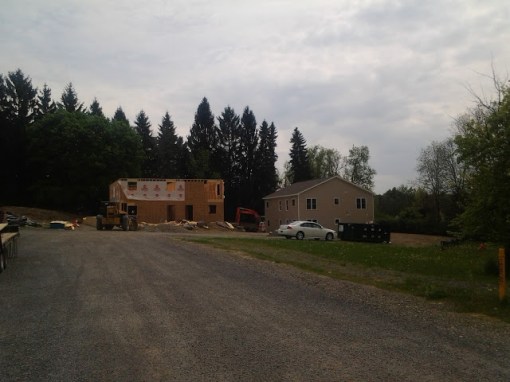
4. On the other end of the sales process, the former Maine’s supermarket has been sold. The six year-old, 26,146 SF building at 100 Commercial Avenue in the city of Ithaca was purchased for $4,150,000 on Thursday the 30th, by Illinois-based Agracel Inc., well above its $3.1 million assessment. Agracel is an industrial space and warehouse developer, fitting for a property once described as a “food and party warehouse”. The former Maine’s appears to be a little on the small side compared to the rest of their portfolio, but there is the possibility of expansion, or even a teardown and rebuild if they really felt the need.

Readers may recall that Maine’s closed its Ithaca store in February, which along with a closing in suburban Rochester reduced its stores from six to four.

20160701_095549

20160701_095552
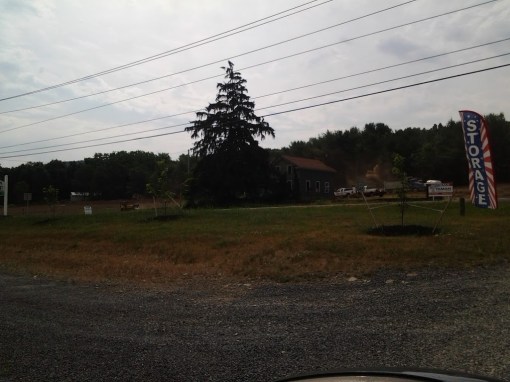
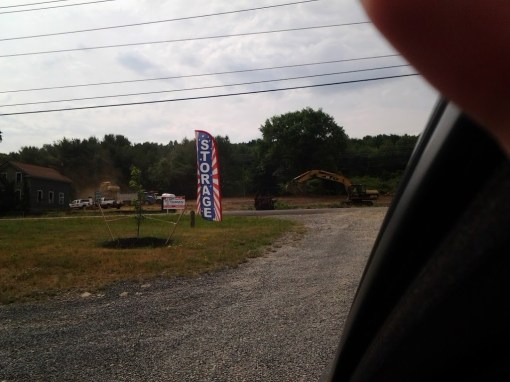
5. Work on the new Storage Squad facility has begun on the 1400 Block of Dryden Road east of Varna. Right now, the focus is on site clearing; the house was used by local fire departments for training exercises, and will come down in a controlled burn later this summer. The 79,000 SF storage facility should be ready for use by February 2017. One full time and a few part-time jobs will be created.

And for the record, I think that’s my middle finger.

6. So this is curious. The city recently uploaded a couple of older documents detailing development plans off of Floral Avenue on the southern tip of Ithaca’s West Hill neighborhood.

The first dates from Febraury 1992, and is a filing to create a 27-lot cluster subdivision on 4.15 acres at 452 Floral Avenue. The paperwork indicates that the intent was affordable housing, by a company named House Craft Builders. The city’s then-Planning Director, H. Matthys Van Cort, wrote a recommendation for negative declaration of environmental significance, and the project was approved in June 1992, but it never moved forward, and 452 remains vacant land today. It appears House Craft was dissolved in 2012; the officer was an architect for Ecovillage who has since retired and moved out of state.

The second is a subdivision requested by INHS in 1987. The filing requested 236 Floral Road be split into two parcels, with the intent of renovating a decrepit 236 into a for-sale affordable single-family home, and build a new house on 224. This was approved, and eventually, 236 was renovated and transferred to its owner in 1996, and 224 was built in 1994.

Now, as interesting as this all is, the city doesn’t upload decades-old subdivision files just to amuse nerds. The $64,000 question is, why were they uploaded now?


Village Solars Construction Update, 6/2016

22 06 2016

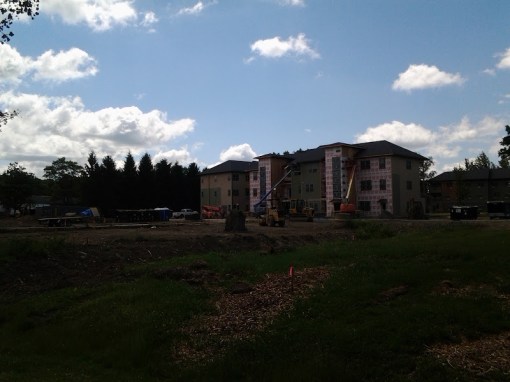
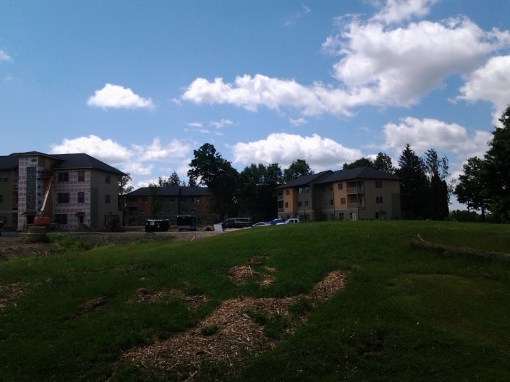
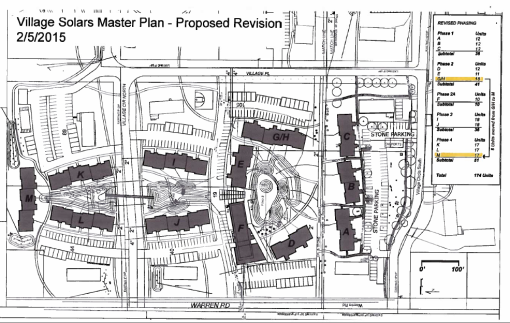
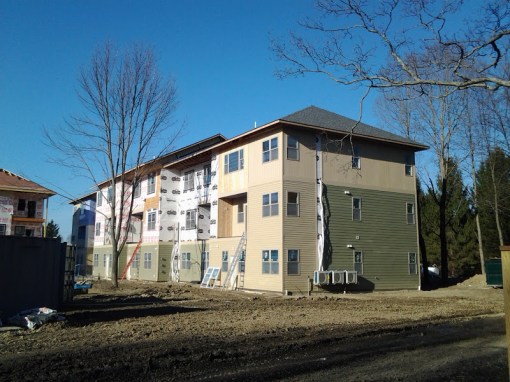
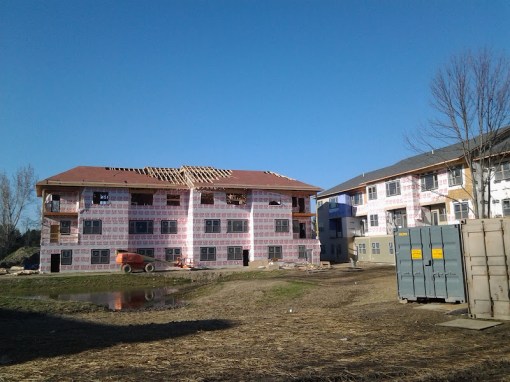
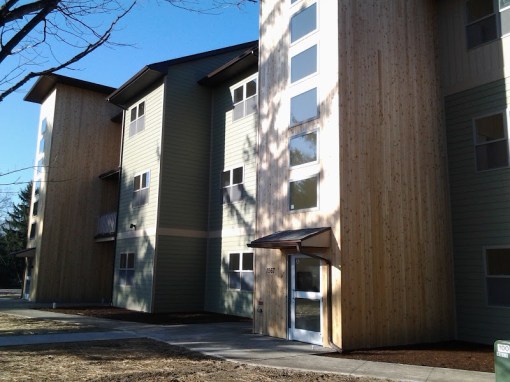
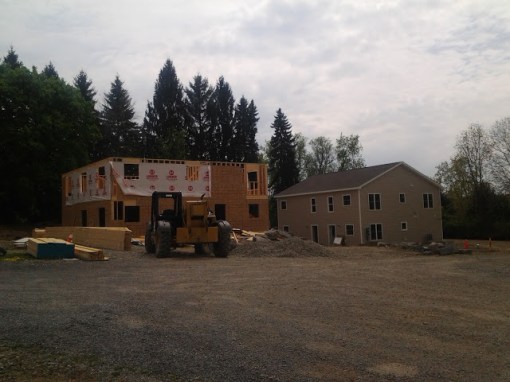
For being such a large project, the Village Solars apartments in the town of Lansing tend to slip by unnoticed. Work on Phase 2 is wrapping up, and work has already begun on Phase 3, with what looks like excavation work for the foundation of Building “I”. A rolling stone gathers no moss, I guess. “I” will be an 18-unit apartment building similar in design to Building “G/H”, the building in the fourth photo, and currently the largest individual apartment building in the complex.

Building “D” is essentially complete and has been available for occupancy since May. Building “G/H”, which is just finishing up any remaining interior finishes and exterior trim, will be ready for occupancy this month. Building “E”, which is still attaching exterior trim and finishes, as well as interior work, will be ready for its tenants by about July 15th. If past work is any indicator, “I” will be ready for occupancy sometime next spring. No word on Phase 2A and Building “F”, but it’s a good bet 18-unit Building “J”, the other half of Phase 3, will commence excavation once “G/H” and/or “E” are complete.

With the completion of Phase 2 this summer, The Village Solars additions will have resulted in 77 new housing units since they began construction in 2014. Rents on the units are ranging from $850+/month for a one-bedroom, $1235+/month for a 2-bedroom and $1600-$1650/month for a 3-bedroom unit.

20160609_110626 20160609_110629 20160609_110634 20160609_110653 20160609_110715 20160609_110834 20160609_110913 20160609_111059 20160609_111202 20160609_111227 20160609_111246 20160609_111259 20160609_111351 20160609_111423 20160609_111445 20160609_111451 20160609_111629

village_solars_2 village_solars


News Tidbits 6/11/16: Summer’s Heated Discussion

11 06 2016

Image Property of HOLT Architects

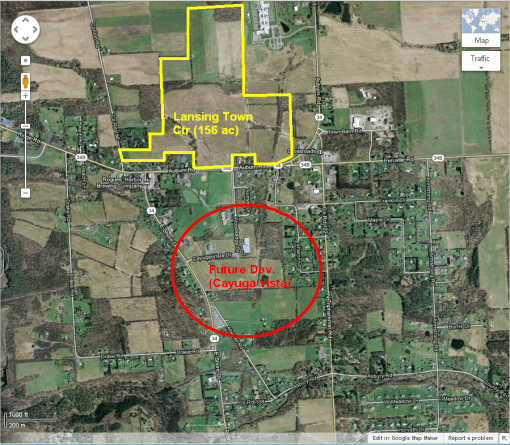
1. We’ll start this off out in Lansing. The 153 acres of land for the Lansing town center is once again in the news. The Lansing Star is reporting that the town is once again serious about selling the land.

So begins yet another chapter in the 20-year saga of the town center land. The town bought the land from the state in 1993 for $100,000, and at the time the land was deed-restricted to recreational use. In 2012, the town paid an additional $294,800 to remove the recreational deed restriction. An article about it was published here in August 2012 (original map below; dunno where why offhand it says 156 acres vs. the 153 reported now). HOLT Architects and TWMLA were hired to draw up some overarching design themes, a Request for Proposals was issued, and three developers responded.

lyc2

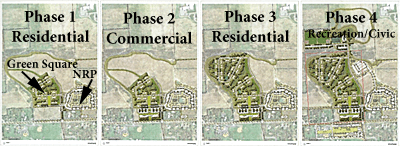
Calamar Enterprises’ Buffalo office submitted a proposal for a $17.4 million, 110-unit market-rate senior apartment building on 13.5 acres, and Cleveland-based NRP Group submitted plans for 80 one-story patio homes on about 15.5 acres. Calamar later re-sited their project at the town’s wish to the northern part of the land, and increased the number of units to 124. Green Square, led by David Taub and HOLT Principal Graham Gillespie, proposed 60 units of housing and 23,000 square feet of retail in 2-3 story arrangements, and civic and recreational space. Altogether, the value of the three would have approached $50 million.

gs_phases

However, all of this was contingent on a sewer being built, which did not happen. The developers agreed to do a package plant that would service just the town center, there was discussion of an IDA-backed tax incentive zone, and the town stood to make a hefty return on investment, but…to quote the Star, “However, the deals fell through.  Actually it seemed more like they just faded away. At least one of the developers had signed paperwork saying they intended to purchase acreage from the Town.  The Town didn’t seem in any hurry to sell the land, even with clearly interested developers.  When the developers disappeared there was no reported effort by the town to pursue the deals.”

Since then, the town continues to get a steady stream of interest, but no real idea on how they want to move forward. Like Ithaca city and town, they’re looking at the possibility of Form-Based zoning for the site, and the town hopes to issue a more specific RFP than before, incorporating revised assessment values. The most intensive approach involved the Form-Based Code and a specific RFP, the least specific is just putting up a for-sale sign ans seeing what happens. Whatever the case, the lax approach the town has taken the past few years may no longer be feasible, with the ticking tax time time bomb of the possible power plant closure looming over the town and schools’ budgets.

old_library_thp_v4

2. Speaking of long processes, the Old Library project has formally filed paperwork here to begin the application process for the Certificate of Appropriateness from the Ithaca Landmarks Preservation Commission. The meeting is scheduled for city hall at 5:30 Tuesday the 14th. Although it says early design review, a lot of the legwork has already been done at this point, since the Planning Board and ILPC have been conducting joint meetings with the project team over the past several months to create a design that they’re all comfortable with. However, the ILPC is likely to refine some details moving forward.

old_library_thp_v4_2
At this point, the unit mix consists of 22 1-bedroom units with about 700 SF each, 25 2-bedrooms with about 900 SF each, and 10 2-bedrooms with 1200 SF each, the extra space intended as a den or home office. The building also includes a 1,800 SF community room to be administered by Lifelong, and 3,750 SF of first floor commercial space. The total facility size comes out to about 85,600 SF, and parking for 25 cars and at least 12 bikes, and another 34 bike spaces for the community room. Exterior materials include brick, limestone, and a couple forms of fiber cement, including wood-textured fiber cement.

Southeast+Rendering

3. The STREAM Collaborative House at 228 West Spencer is up for sale. The house has its own website here. The 1,152 SF, 2-bedroom net-zero energy house is listed at a price of $305,000. For more info on the house, Noah Demarest was kind enough to give a construction tour of the house while it was underway, and the blog post I wrote up afterwards can be found here.

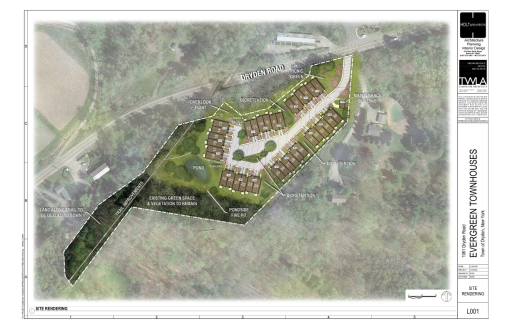
evergreen_dryden_1
4. It’s pretty clear at this point that the Evergreen Townhouses project at 1061 Dryden is evolving into the next hot-button development issue out in Varna. The Times has their interview with the angry neighbor here, and more info can be found in the town of Dryden’s April planning board meeting minutes here. So far, the only image of the townhouses themselves has been a perspective that only shows massing – 2 stories, gabled roofs.

Also of note is the town of Dryden Planning Department’s recommendation to the town board (and the planning board’s approval) for an increase in density in certain areas. The change in code affects parcels zoned rural residential, with municipal water and sewer access. The density would be increased from 2 units per acre to 6 per acre. Looking at the zoning map and the sewer map, that would primarily affect the corridor from Varna to the 13/366 intersection, and a rural swath just north of Dryden village near TC3. What this would do is allow 1061 Dryden Rd to withdraw PUD application, and apply for a special use permit (SUP), which are generally easier to obtain.

On a side note, googling Tiny Timbers brings up a Times editorial, written by the Times, that argues against Tiny Timbers for not fitting in with the appearance of Varna. Actually, it kinda takes everyone to task, from developers to town government to residents. But, to make one counter-point regarding mixed-use, commercial services need a certain amount of traffic (not necessarily vehicular) to thrive. If the population base within a certain radius isn’t there, the risk is too great for someone to put their money on the line and hope that they can somehow draw in customers. If Varna wants a mixed-use center with shops and cafes, they’re going to need the population to support it. Some think that will include 1061, some (probably more) think Tiny Timbers, but if there’s no “push”, the ball won’t be rolling.

201_college_v3_1

5. A couple of minor things to note in sales. The 4,200 SF former “Imperial Buffet” property next to the Shoppes at Ithaca Mall has sold to a Syracuse-bsed LLC (Watersprite LLC, established 2004) for $590,000 on Friday the 10th. I personally will always remember this place as being the only place my mother was comfortable with eating in Ithaca because she hates eating out, and felt everything else was “snobby and expensive”.

Meanwhile, the 12-bedroom, 2,837 SF house at 201 College Avenue, the property subject to a heated debate between Neil Golder and Todd Fox, sold for $2.65 million on Friday the 10th, which seems outrageous except that it’s becoming the norm for inner Collegetown transactions – Novarr picked up 5,500 SF 215 College for $5.3 million last year. There will be no delving into that debate again this week, but the city uploaded 580 pages of documentation here, and my colleague Mike Smith is preparing a story for the Voice.

20160522_143925 20160522_143949

6. Houses of the week. This pair of duplexes are being built on Birdseye View Drive near Ithaca College. Each house has a 4-bedroom unit and a 2-bedroom unit; recent advertisements on Craigslist (since expired, so no link, sorry!) have them $750/bedroom. The developer is the owner of Mahogany Grill downtown, who also happens to be a part of the business team renovating the former Lucatelli’s into a new restaurant, a Tapas and pasta restaurant called Mix Social Dining after the chef’s wife.

These photos are a couple weeks old now, but the one on the right looks nearly complete, while the one on the left was still in the (wood) framing and sheathing stage. Based off the rough window and door openings, they are not exactly the same, but expect them to look similar.


News Tidbits 6/4/16: A Stormy Summer Start

4 06 2016

201_college_v3_1
1. We’ll start this week off with a follow-up on the 201 College Avenue debate. All discussions of planning philosophy noted, one solid request, as reported by Josh Brokaw at the Ithaca Times, was to try and reduce the bulk from the College Avenue side, if not necessarily the building footprint. The above drawing was submitted by STREAM Collaborative’s Rob Morache earlier this week, with a cover letter describing the changes here. The modification reduces the building by 2 bedrooms, to 74, which to go by Todd Fox’s comment in the Times article, puts the project at the borderline of financial feasibility. The middle still pops out a little because that’s where the fire stairs are located. Some minor details were changed with the accent panels, and recessing the windows slightly on the south and west facades. For the record, the panels are Nichiha and Allura fiber cement, with painted metalwork and fiberglass window sashes.

Although now outdated, a shadow study for the previous design has since been uploaded by the city. There are two versions, with and without neighboring building shadows, here and here respectively.

Expect further detail refinements; the building is set to go in front of the Design Review Committee Tuesday morning.

20160414_120418

2. WSKG did a segment earlier this week on micro-apartments, with an interview with Frost Travis and the Carey Building project wrapping up on East State Street. A few details worth noting from the segment – 5 of the 20 rental units (which range from $1,225/month for the microunits to $2,699/month for a high-end penthouse 2-bedroom) are already spoken for and the building’s not even finished yet. For some reason, Monica Sandreczki says there will be about 35 residents at full occupancy, which is a big stretch since there are 16 micro-units and 4 two-bedroom units – going one person per micro-unit and bedroom, a better estimate would be 24.

The news piece also notes that the 201 College project contains micro-apartments – which is true, given that the building is 44 units and 74 bedrooms, and at least the early plans had a number of split-level 410-670 SF studio units.

401_lake

3. And 401 Lake Street will bite the dust. The Common Council voted 8-1 last Wednesday night to have structure demolished and the tax-foreclosed properties be designated as parkland. Cynthia Brock (D-1st) voted against the measure and preferred a sale for tax reasons, and her ward counterpart George McGonigal (D-1st) argued that the city was destroying historic working-class housing, though he ultimately supported the measure. Brock did take a whack at new affordable housing in the city, commenting that INHS is getting $75,000 for each townhouse, and Habitat for Humanity getting $75,000 for a duplex even with its volunteer labor, when there was a potential, cost-efficient opportunity for affordable housing designation with this unit. Josephine Martell (D-5th) seemed to be the strongest proponent for demo, stating that the unique potential to enhance the Ithaca Falls Natural Area should be taken every opportunity of. The city bought the tax-foreclosed property from the county; the background on that is on the Voice here.

The funds for the demolition, estimated at $25,000, will come from the sale of IURA land to the Hilton Canopy project. That measure was approved 6-3, with Brock, McGonigal and Graham Kerslick (D-4th) opposed. With work on the Lake Street Bridge currently underway, demolition is not expected for at least a few months.

There was a thought exercise regarding the selling the falls’ parking lot to INHS for development of 3-9 units of affordable housing; it’s an interesting idea, since 401 and the adjacent are right next to the Falls, but the 0.55 acres of city property adjacent to the Lake and Lincoln Streets intersection is still over 200 feet away at its closest point.

4. The rare bit of news out of Enfield. A $612,000 building loan was issued by the Bank of Greene County to provide funds for renovating and expanding the volunteer fire station at 172 Enfield Main Road.

Give that Enfield issues no more than a handful of new construction permits each year, it’s about the only other thing going on apart from the Black Oak Wind Farm debate. One would think that arguments like “the wind does not blow as much as it used to” would be easily shot down and things would move forward, but instead it’s Marguerite Wells, the project manager for BOWF, getting raked over the coals. I don’t have a dog in this fight, but I do feel bad for her.

5. In case anyone was wondering – county planner Megan McDonald says the Denter housing study will be publicly available by late July.

arpt_pk_1

6. Here’s something intriguing from the county’s Facilities and Infrastructure Committee agenda – a proposal to “Prepare airport land for future development“, seeking $500,000. None of the money comes from the county; it appears to be dependent on grants, or an interested developer. Which, given the fact that this shows up in budget docs going back to 2014, doesn’t exactly seem to be generating many queries.
The parcels are described as the “Cherry Road and Agway parcels”, which must be owned by the county since they want to lease out the land – but checking the deed records of parcels adjacent to the airport, there’s no record of an Agway in any of the deed histories. The parcels may be related to the properties in the airport business park feasibility study, shown above and awarded to the team of Clark Patterson Lee and Camoin Associates this past winter.

7. It’s unusual to see Cornell buying property these days, but this Friday, the university purchased the house at 1250 Trumansburg Road on Ithaca’s West Hill for $157,000. The house is a 19th century fixer-upper on 1.21 acres – Cornell owns the land surrounding it, some of which is being subdivided off to build the Cayuga Meadows affordable senior housing project. The house is assessed at $215,000, but the real estate listing notes it needs some work, and it’s been off and on the market for five years.

Several years ago, Cornell expressed intent to develop the 35 acres it owns into a mixed-use complex with a hotel institute, housing, offices and medical services, but the only part of the plan that ever really moved forward was Conifer’s project. I haven’t seen the plans in years, but I remember the early plans (there were a couple versions) were very sprawly; six, eight years ago, walkability was not as valued as it is now.

By buying the house, Cornell reduces its need to work around a neighbor and can incorporate the property into potential plans. This purchase would seem to suggest that Cornell still has strong interest in developing the rest of the West Hill property at some point. In the meanwhile, Cornell might rent it out while the school figures out what it wants to do with the acreage.

20160522_151346 20160522_151417

8. House of the week. From the outside, 228 West Spencer Street is almost done, and the interior is fairly far along as well, with finishing work underway. Architect Noah Demarest says the house will be put up for sale in a few weeks, if everything goes as planned.


News Tidbits 5/7/16: Everything’s Political

7 05 2016

815_s_aurora_night

1. Let’s start with government. The city of Ithaca passed revisions to its cell phone tower law reducing the no-build fall radius from 200% of height, to 120% of height. The 120% was decided upon after a check of other municipalities, where it was generally the most common figure.

The change allows development to proceed on the grassy field at 815 South Aurora Street on South Hill, although as mentioned last week, the fall zone revision isn’t as much as developers Todd Fox and Charlie O’Connor had hoped for. But it’s still enough to work with; according to Josh Brokaw at the Times, a revised plan that meets the new guidelines could be going to the planning board for sketch plan review in June, possibly with more units than the 87 studio units initially planned. It was also reported that the local neighborhood group (South Hill Civic Association, SHCA) is comfortable with the initial plan, so this might be a relatively smooth process when the project is ready for review.

2. Meanwhile, while one thing moves forward, Dryden’s been hit with a major setback. The Pinckney Road parcel sale in Dryden was foiled when voters, in a 1188-936 vote, rejected the town’s plans to use recreation reserve funds to purchase the 15 acre property. The town would have spent about $56,800 of a fund that has over $300,000, and the county would have contributed $15,000, so that the town could have turned it into park space in the long-term. The town was prepared to buy the property, but residents opposed to the sale managed to get enough signatures on a petition to force to to go up for a vote.

It sounded like a worthy and reasonable plan. But I get the feeling that there were a lot of folks who figured it would pass by a wide margin, so they just didn’t vote. In a marketing course a while back in college, I remember the professor sharing an interesting statistic – versus feeling neutral, the general public is three times more likely to support an initiative when they really like something, and nine times more likely to vote or speak out when they’re really opposed. People are more driven by aversion than reward, and that’s probably what happened here.

20141227_134402

3. Sticking with local governments, the town of Ithaca is set to vote on a moratorium on duplexes, but with some modifications from the initial proposal. For one, given construction seasons revolving around the warm season, and the time it takes to plan and get permits, it was decided to make it only nine months (January 2017) instead of one year, so that they could limit the possibility of dragging it through two construction seasons. And although the town planning committee chair wasn’t on board with it, an exemption is in place if one of the units will be owner-occupied. If their goal is to revise the approach to student housing, then at least these amendments fix or lessen some of the bigger issues a moratorium would produce.

https://twitter.com/streamcolab/status/657329991827509248
4. Just a wee bit more info on the “Tim Timbers” planned for the corner of Freese and Dryden Roads in Varna. The tiny houses are small though not micro-sized – they’re expected to be about 800 square feet. Local architecture firm STREAM Collaborative is working with businessman Nick Bellisario on the 16-lot subdivision and home development.

waterfront_concept_aerial_1waterfront_concept_mf_th_SP_1

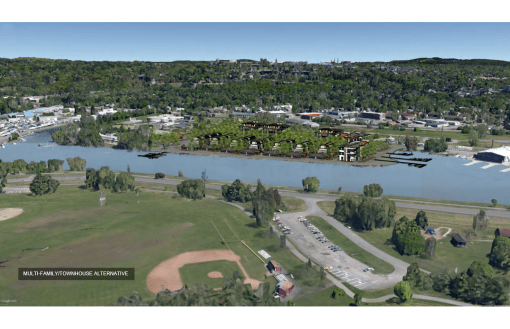
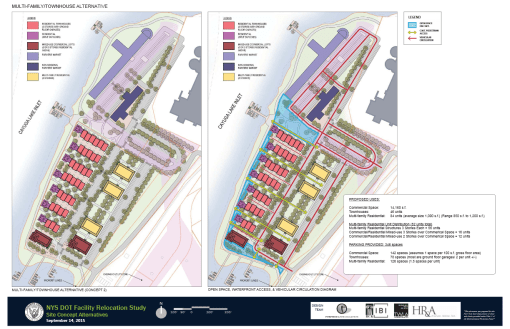
5. So the full 206-page, $78,000 NYS DOT waterfront redevelopment study by Fisher Associates is on the city’s website. The initial results were shared here back in October, but the final product has some additional, very interesting details.

waterfront_concept_timeline

One of those additions is a potential timeline for development. It calls for getting official support and commitments over the next several months, issuing an RFP later this year for the new DOT facility in Dryden, and issue an RFP for the NYSDOT waterfront site later this year, with review in Q1 2017 and developer selection in Q2 2017, assuming this doesn’t end up like the Old Library debate. The DOT would move to Dryden in Q3 2018, and the excess state land would be transferred to the county, sold in Q1 2019, and ready for occupancy by mid-2020.

The other really interesting new section is Appendix 5, stakeholder outreach. This consists of interviews with city officials and nearby property owners – Cornell (who say they have no plans for their waterfront properties), the Farmer’s Market, and some smaller businesses and organizations. The gist of the comments had more to do with Farmer’s Market than the DOT – namely, heavy traffic issues, needs more parking, and needs to physically expand to accommodate a waiting list of vendors and cool-season operations. There are early plans incubating for a nearby indoor market facility, if memory serves right. As for the DOT site, the mixed-use plan was deemed most favorable, and the stakeholders agreed that the site had great potential for redevelopment.

warren_medical_lansing_1

6. Looks like marketing has started for a proposed new medical office building in the village of Lansing. The new one-story building, which appears to be designed by Binghamton-based Keystone Associates, would be off of Warren Road, although it looks like the building would be accessed from a driveway coming off of Uptown Road. The 2.71 acre property is zoned “Human Health Services District” by the village, and borders undeveloped land owned by Cornell, and several other suburban medical office buildings built over the past few decades. The resolution on the attached site plan is too low to determine the square footage, though it looks to be in the low tens of thousands.

The property was purchased by Arleo Real Estate from Cornell for $378,600 in October 2014. Arleo Eye Associates owns and occupies the neighboring building to the south. Arleo built their 7,119 SF optometry office in 2007.


Village Solars Construction Update, 4/2016

19 04 2016

Heading into the spring, it looks like the Village Solars project off of Warren Road in Lansing has made some pretty substantial progress with its second phase.

Building “D”, which contains 12 apartments, is essentially complete inside and out, though not yet occupied.

Building “G/H”, which holds 18 units, is fairly far along from the outside – cement boards have been attached to most of the east face, and some more wood siding has been applied to the west face. Exterior details like balcony railings and trim boards have yet to be installed.

Building “E” is topped out, and the roof rafters are being sheathed with Huber ZIP panels. The stairwells are still being framed out. Windows have been fitted in most of the rough openings on the first and second floors, but have yet to reach the third floor. Housewrap covers most of the plywood walls, with the exception of the stairwells. “E” will have 11 apartments.

From observation, it looks like Lifestyle Properties (the Lucente family) could start renting out Building “D” tomorrow if they wanted, Building “G/H” towards the end of the Spring (possibly Mid-July from the Craigslist posting), and have Building “E” ready for occupancy before the semester starts. Phase two of the 174-unit apartment project is being built with a $6 million loan from Tompkins Trust. Phase one’s 36 units opened last year.

EDIT: From Rocco Lucente the younger – “We will have our first move ins for 1067 Warren Road (Building D) on May 1st. The other two buildings are currently scheduled for June 15th and July 15th completion. We did get our Certificate of Occupancy for Building D around two weeks ago, but with the various cleaning and landscaping work we set our target for May 1st.”

No loans have been secured yet for the three later phases, and plans are still in the works for an addition across Village Place that would bring the total number of new apartments to over 300.

20160414_174742 20160414_174754 20160414_174809 20160414_174852 20160414_174921 20160414_175002 20160414_175115 20160414_175233 20160414_175611 20160414_175618 20160414_175729

village_solars_2 village_solars


News Tidbits 2/27/16: A Leap Year, But Not A Leap Forward

27 02 2016

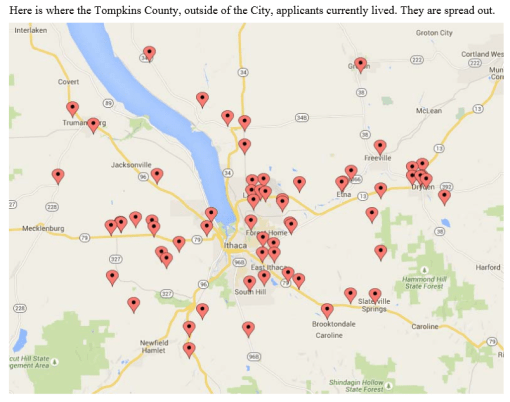
1. Let’s start this week off with some maps. The two below come courtesy of the Ithaca Urban Renewal Agency (IURA) agenda, submitted by INHS Director of Real Estate Development Scott Reynolds.

iura_inhs_map_1

iura_inhs_map_2
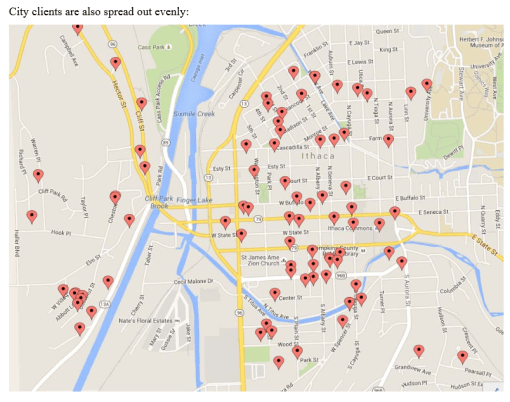
Each marker is the approximate location of current of an individual on Ithaca Neighborhood Housing Services’ (INHS’s) apartment wait-list. Dozens and dozens. As breakdowns go, 48% of waitlisted applicants live in the city of Ithaca, 38% outside of Ithaca but somewhere within Tompkins County, 8% live in other counties of New York State, and 6% come from outside the state. Counting the markers, my back-of-the-envelope calculation comes out to about 160 households.

The map implicitly describes the wealth of Ithaca’s neighborhoods – an increased number of applicants for affordable apartments come from South Side, the West Village area, and Northside, and further out, Dryden village and the apartment complexes in Lansing village. Wealthier areas like Fall Creek, East Hill, South Hill and Belle Sherman have very few or no individuals on the wait list.

The next time someone says affordability isn’t an issue, think of each dot on this map, and remember that’s someone, maybe even a while family, struggling but hoping to find decent, affordable housing.

Farm Pond Site RES'D & LOT s 010414

2. The Farm Pond Circle development in Lansing has finally sold on the 23rd for $164,840, well above both asking prices from last year. The purchaser was Dryden-based Schickel Construction, the same company responsible for the Boiceville Cottages. The restrictions on the ten for-sale lots carry over with the deeds. All things considered, Bruno Schickel knows this area well and his company could be one of the very few in the region interested but also capable in fulfilling Jack Jensen’s vision.

The development first went up for sale for $155,000 last March after the owner/developer, Jack Jensen, passed away suddenly in October 2014. In October, the price was knocked down to $125,000. Along with the lots Schickel picked up in the primary sale, a second purchase of $39,160 gave him three more undeveloped lots owned by other members of the Jensen family.

1015_dryden_1

3. On the other end of the sale scale, Ithaca real estate developer Modern Living Rentals has put their multi-family property at 1015 Dryden Road up for sale.  The asking price for the 5-unit property is $650,000. 1015 Dryden is home to a single-family home built in 1938, and a 4-unit apartment building from about 1980. The apartment building was badly damaged in a fire in 2011, renovated, and the site was sold to MLR for $425,000 in March 2014. The tax assessment is also $425,000.
Plans on MLR’s website shared a to-be-built 2,790 SF triplex designed by STREAM Collaborative, but the real estate listing notes plans filed for two side-by-side duplexes (4 units). All units when built would equal 24 bedrooms, but the bungalow house is just one bedroom, and although I can’t find total number of beds for the 4-unit, at 4,032 SF it’s probably 2 beds per unit, so…that’s 9 exisiting, plus six from the triplex, plus 9 bedrooms from the two side-by-sides? Not 100% sure. Potential landlords can contact the listing agent here.

elmira_savings_v1

4. As noted by the Ithaca Journal this week, Elmira Savings Bank now has regulatory approval to move its bank branch from 301 East State Street to the old Pancho Villa Building at 602 West State Street. The project would still need site plan review for the renovation of 602 alone, even if the rest of the site isn’t altered. However, if less than 10,000 SF, a non-residential structure may only need limited SPR, staff-level like a single-family house (I was a bit uncertain, but I have confirmed with a member of the planning board). So although the move is okayed, the bank may still have to go through the board before renovations can begin. In theory, they could move into the un-renovated building without board approval, since it would only be when substantial exterior alterations are planned that it would then fall under the board’s purview.

The bank still has no plans for the other properties acquired in their December purchase.

chain_works_rev3_3 chain_works_rev3_4

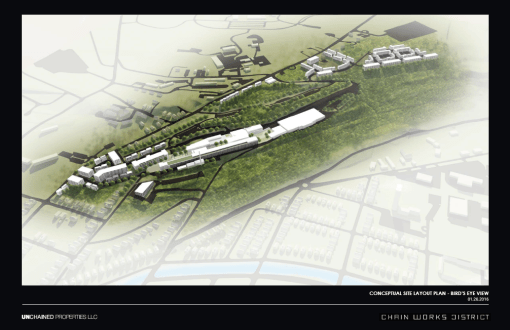
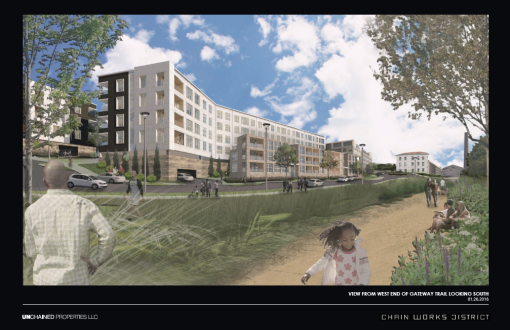
5. Now for some weekly eye candy. Additional images from Monday’s Ithaca Voice on the Chain Works District redevelopment, PDF here. These were left out because although these images are strictly conceptual and years away from reality, they show many new buildings, up to 5 floors in places, which could have had people freaking out that Chain Works was a Manhattan-izing of Ithaca and that a derelict brownfield was a suitable alternative. What gets written is tailored for its audience, and I didn’t think the Voice’s more general and broader reader base would handle these images well. Case in point, the ICSD shutting off drinking water in all of the schools as a precaution sent people into the Voice’s comment section panicking that every household on the municipal water system was contaminated with toxic levels of lead a la Flint. So, here are some visual extras to the much more rational readers of this blog.

The conceptual renderings are by Rochester-based Chaintreuil Jensen Stark Architects, the same group behind the design of Harold’s Square.

20160220_111241 20160220_111313 20160220_111336

424_dryden_rd_1

6. House of the week. Or rather, duplex of the week. From the outside, William and Angie Chen’s 2-unit, 6-bedroom duplex at 424 Dryden Road is nearly complete. Trim details like the porches have yet to be attached, and the foundation still needs to be backfilled, but most of the exterior looks good to go.

However, the parking lot has been a source of some BZA debate. The lot would require five off-street parking spaces, which the Chens can do with the construction of a three-car garage that tears down mature trees, but they would prefer to create uncovered five spaces that include two in the rear yard. CR-2 Zoning doesn’t allow for rear yard parking, so an area variance is required. The application also comes with a letter of opposition from a neighbor who seems to have mixed up the choices, asking for the variance to be denied for tearing down trees, when it’s the non-variance option that tears down trees.

Local architect Daniel Hirtler of Flatfield Designs is handling the duplex and the zoning variance.

341_coddington_1

341_coddington_2

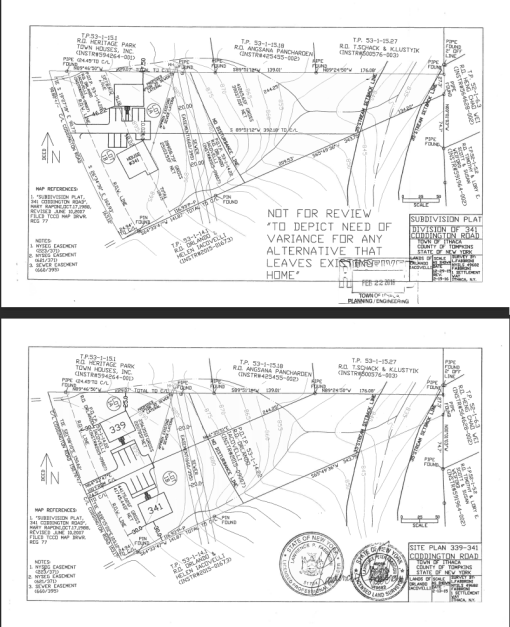
7. Status: It’s complicated. In Ithaca town, the Iacovelli family, longtime local landlords/builders, want to tear down a ca. 1845 house at 341 Coddington Road to put up two duplexes, which from the schematic appear to be the Iacovelli student special. To do so, they need to subdivide the property, one for each duplex.

On the one hand, the Iacovellis, who have been on South Hill since the 1920s (they’re the namesakes of Iacovelli Park at the end of Juniper Drive) and bought the property last year, have a right within existing law to do what they want with the property, which is next door to Orlando Iacovelli’s house. They want to subdivide the land into two parcels, and the only way to create two legal lots is to go right through the existing house.

On the other hand, it would be a shame to lose a 170-year house that’s in fair shape and has many of its original features intact, just so two fairly spartan duplexes can be built.

The town’s planning board seems to be cognizant of both sides in this dilemma. They asked at the last meeting to examine an alternative to allow subdivision and keep the 1845 house intact. The engineer for the project, Larry Fabbroni, did so, but the applicant is uncomfortable with trying to get zoning variances for the non-conforming setup, area, setback and a third claim about use for unrelated occupants (which the town planning department disputes).

This all comes at a time where the town is weighing a moratorium on 2-unit properties, and if this house comes down, there’s a good chance the town will vote the moratorium. Then Iacovelli won’t be able to build any duplexes, and no one else in the town of Ithaca would be able to either. But even if Mr. Iacovelli couldn’t build, he could still demolish the house and wait, should disagreements came to a boil.

Ideally, there would be a compromise where the 1845 house is preserved (by planning board/BZA stipulation or otherwise), and Iacovelli gets to subdivide so he can build a duplex on the other parcel. That way, he gets some economic return, and the town gets to keep an undesignated but arguably historic house. Few town board members want to come off as being anti-business to local families, and few developers want to come off as greedy or exploitative. A concession on both sides and some good will could go a long way in a time where tensions about student-focused housing are rising.

Comments can be sent to the board via the town clerk (Paulette Terwilliger) at townclerk@town.ithaca.ny.us . The board is expected to take a vote on the subdivision on Tuesday the 1st at 7 PM in the town hall.


Village Solars Construction Update, 2/2016

23 02 2016

At the Village Solars construction site, 12-unit Building “D” is nearly complete from the outside, with just a couple of small sections of exterior trim yet to be installed.

18-unit Building “G/H”, a new design, is a hodge-podge of materials at the moment. A few exterior wall sections are bare plywood, some have been covered in housewrap (looks like there are two different companies, the Croft Lumber black label and a red label that I did not take close enough photos of to identify), some have had exterior wood and cement board trim attached and for some unknown reason, the northwest corner has gypsum board from National Gypsum. Both are waterproof barriers, although they can vary on details like fireproofing. Windows and doors have been fitted and the plywood roof panels (Huber ZIP system) are now shingled.

11-unit Building “E” is up to the second floor, wrapped but without openings cut for the windows on the second floor (they’re there, just wrapped over) – perhaps the contractor’s using the wrap as something of a wind barrier while the crew puts up the interior stud walls.

Late spring and summer occupancies seem likely. The 41 new units are the $6 million second phase of a 174-unit, multi-phase project (an as-yet unapproved set of phases would bring the total to over 300 units). Phase one, with three buildings and 36 units, opened last year.

20160219_144704 20160219_144707 20160219_144923 20160219_144943 20160219_145014 20160219_145022 20160219_145118 20160219_145138 20160219_145226 20160219_145305 20160219_145347 20160219_145406 20160219_145609

village_solars_2village_solars


News Tidbits 2/13/16: A Week of Uncomfortable Prospects

13 02 2016

lansing_cmt
1. We’ll start off this week with some zoning and land-use discussion. the village of Lansing, which tends to have a very tight grip on their zoning, modified their code for a new addition, called “Commercial Medium Traffic” (CMT). The zone, which has taken about two years to get to this point, will override what is currently zoned a Commercial Low Traffic (CLT) area. As a result of the rezoning, some previously-okayed uses in their CLT zone – clinics, group homes, construction storage, sit-down restaurants – have been removed, but adds cafeterias and assisted living facilities. Splitting hairs, one supposes. Looking at the use guidelines, about the only big use the CMT allows that CLT doesn’t is “small-scale sales” like boutique shops, and “low-traffic food and beverage”, which covers bars and sit-down restaurants.

The reason for this change comes from a couple of angles – the village has a number of vacant or underutilized parcels in the affected area, which they feel is detracting. Developers have approached the board about building retail/restaurant space on some of the land, but that would have required rezoning to commercial high traffic. But the high traffic zone also allows “hotels and big boxes”, so the village needed an in-between. Now it’s finally in place.

ithaca_eddy_land

2. Now for another land use debate. The town of Ithaca has authorized doing an analysis on what a fair bid would be for the development rights of 33 acres of land off of Seven Mile Drive and Route 13. These parcels are currently farmed by the Eddy family, and a mini-golf facility was previously proposed on one of the properties. Before that, they were to be included in the 2014 Maguire development before the Maguires pulled their project, partially because the town said the dealership and headquarters proposal wasn’t in line with their new Comprehensive Plan.

The problem is, neither is this. The town would buy this with the intent on keeping all of it farm fields. The comprehensive plan called for TND Medium Residential (townhouses, elder cottages, small apartment buildings and compact single family) and the “Inlet Valley Gateway” (quoting the plan, “intended to be a setting for a mix of office, small-scale retail, hospitality, and tourism and agritourism uses, with low-impact light industrial, artisanal industrial, and skilled trade uses”). The concern is, if the town starts displacing development from the areas recommended, developers will start looking at areas where it’s not recommended.

For the record, the 22.38 acre parcel is for sale for $425,000, and the 10.59 acre parcel is for sale at $325,000. The assessed value is only $188,800 total. The development rights will probably fall somewhere between. This definitely isn’t as cut-and-dry as the 62 acres the town picked up for $160k in December. The town will have an idea of the cost for the rights later this year.

simeons_v2_2

3. A few notes from this week’s TCIDA agenda. The Hotel Ithaca project is up for final approval of its tax abatement, which given that the public meeting drew not a single commenter, shouldn’t have any issues going forward. 210 Hancock also has some slight tweaks to its agreement, and Simeon’s is applying for a sales tax exemption on construction materials and refurbishment. The $660,000 project’s exemption would be worth $27,079 by their calculation. Simeon’s estimates 27 jobs at opening, and 14 new positions over 3 years, about half of which appear to be living wage. The tax exemption amount is small enough that it seems like a non-issue, but we’ll see what happens if the application is accepted and a public hearing scheduled.

tmpud_waterfront_1
4. From the city Planning and Economic Development Committee – the Commons street-level active-use ordinance and the waterfront Temporary Mandatory Planned Unit Development (TM-PUD) were moved to go ahead to the Common Council next month. More on the Commons ordinance here, and the TM-PUD here.

Committee members were favorable to an amendment to the cell phone tower fall-zone law, though perhaps not in the most ideal way for Modern Living Rentals’ 87-unit 815 South Aurora proposal. On the bright side, a draft law for circulation could be ready by April. On the not so bright side, the city’s going with the 120% value used by other municipalities – that would give the 170 ft. tower near the project site a 204 ft. no-build fall zone instead of the current 340 ft. (200%), but it’s still greater than the 180 ft. MLR requested. This means the project would probably need to be revised somewhat if that’s the version of the law that moves forward. But, something would be better than nothing.

Oh, and the chicken law was voted for circulation, which opens the possibility of a council vote in April, for 20 test subjects in a pilot program.

402_s_cayuga_st_rev2_1

5. The Ithaca Urban Renewal Agency is in a bit of a dilemma. INHS’s 402 South Cayuga project, which has 4 units of affordable owner-occupied housing, is stalled. The construction costs are rapidly rising out of the range of feasibility. The only way it moves forward is if it’s a rental project, which is easier to finance.

402_s_cayuga_st_boggsfernandez

Ostensibly, the IURA would like owner-occupied housing. And a rival proposal has been offered by local architect Zac Boggs and his partner, former Planning Board member Isabel Fernández. It would offer four rentals for 2 to 5 years, and then go up for sale – in the $180-$230k range, which is somewhat more than the $110-$130k range typically offered by INHS. So what do you do? Sacrifice some affordability for some home ownership, or vice-versa? The IURA needs to figure that out. Additional renders and cover letter here.

hilton_canopy_v9_1

6. I think this is the ninth iteration of the Canopy hotel; quite possibly the most version of a single project I have on file. What’s changed since last time? Well, the inset panels in the northwest wall are back. Some cast stone was added to the base,  the second floor rood deck was tweaked, a cornice element was added to the mechanical screen, and the trellis and driveway pavers were revised. It looks like an improvement, and hopefully one that Baywood Hotels can bring to reality after being stuck in finance limbo for so long. Additional imagery here, cover letter from local architectural consultant Catherine de Almeida here.

varna_plan

7. The Times’ Michael Nocella ran a really nice piece this week looking at the past, present and future of development in Varna. According to the article, Modern Living Rentals (my sympathies to Charlie O’Connor and Todd Fox, since all of their projects seem to be wrapped up in one debate or another) needs a unanimous vote of approval for the 8-unit, 26-bed addition to 902 Dryden Road to be able to move forward (a 6-bed duplex already exists on the property). In Dryden, the five-member town board does the vote, and the current Dryden town supervisor helped close the sale of the parcel to MLR, so he must recuse himself. Shooting it down at this point, after the project’s cut its size by 40% from 18,000 SF to 11,000 SF, would be very unfortunate, and create an uncomfortable disconnect between the Varna Master Plan designed with community input, and what the board thinks Varna should have.

5_Freese_2013

As mentioned in the article, the northeast corner of Rt. 366 and Freese Road is one of those parcels where the town and Varna residents think development should happen, but really isn’t feasible. I remember when Todd Fox shared his proposal (STREAM Collaborative’s drawing above) with the town for that corner, and the reception was very positive, much more so than the owner’s earlier plan for 20 modular townhomes. Then not long after, everything ground to a halt. MLR decided not to buy the parcel after it turned out the land was incredibly unstable (there used to be a huge pile of material on the site, dubbed “Mount Varna”; the story of which gets written about extensively on the Living in Dryden blog, since Simon St. Laurent and the owners had quite the feud going). The chances of anything but grass growing on that corner is pretty low.

So, with the former “Mount Varna” land in mind, a master plan is not an exact thing; if it shows for three sets of five townhouses on a parcel, that’s not what may necessarily may happen. It just indicates the kind of density and scale of development the plan deems appropriate. 902 Dryden isn’t drawn on the master plan, but the plan welcomes the idea of townhouses on Forest Home Drive, which 902 abuts. So a vote in favor of the 8 new townhouses is, indirectly, a vote of support in the Varna Master Plan.

20151108_154139

8. The town of Ithaca’s Planning Committee will be looking into writing up and establishing a moratorium on all 2-unit residential buildings at its meeting next week. Doesn’t specify location, or rental vs. owner-occupied; just a ban on buildings with two units.

On the one hand, this is probably an attempt to curb student housing being built near IC; the town’s Planning Committee chair is someone with a long history of fighting development, and is seeking greater input on the Planning Board’s discussions. Students and student-amenable housing are just his favorite topics as of late. But the agenda doesn’t specify the type of unit or location, and that is very concerning. From a number of reasons, a broad-brush moratorium, without regard to neighborhood or owner occupancy, doesn’t seem like a good idea.

1) If the goal is to limit student housing, only a small geographic subset of the town is really necessary. IC students, which seem the primary cause of concern, congregate only in the neighborhood adjacent to campus.
2) The moratorium could harm affordable home-ownership. In a number of cases, one unit is occupied by the owner, and the other is rented out as a source of income.
3) Limiting new supply keeps housing costs high and pressures them to rise higher, since demand will not be altered by the moratorium.
4) The town only permits a small number of units each year. In 2014, it was 10 single-family and 2 2-unit properties (so, 14 units total). In 2013, it was 25 single-family, 10 2-unit. The preliminary 2015 numbers are 21 single-family, and 3 2-unit. There were no permits for structures with 3 units or more.

I asked Ithaca town planner Dan Tasman, and while his email notes that it’s targeted at student rentals, it doesn’t assuage my concerns of being too broad of an execution.

“The Town’s zoning code allows accessory apartments in some zones.  The intent is to let a resident have a close family member or friend live with them, or a tenant to help pay the mortgage, in a space that’s more private.  Basically, an in-law apartment.  However, a few builders are taking advantage of the privilege.  They’ll build a house with an accessory apartment, and rent out both units, with student tenants in mind.

There’s also concern about a growing number of “student specials” — very utilitarian duplexes, purpose-built for student rental.  There’s quite a few of them on Pennsylvania Avenue and Kendall Avenue, near Ithaca College.  Their design and siting can often seem institutional, and out of place with the neighborhood’s residential character.”

I’m not a proponent of moratoriums at all, but I’m hopeful this proposal isn’t as broad as it looks. If the net is cast too wide, this is going to do a lot more harm than good.