Upson Hall Construction Update, 11/2016

22 11 2016

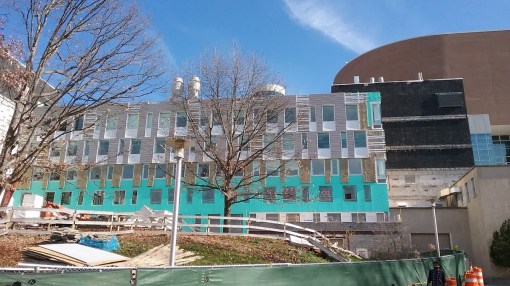
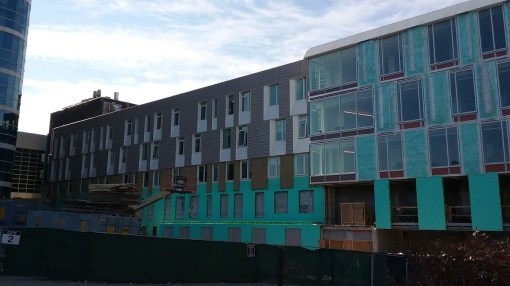
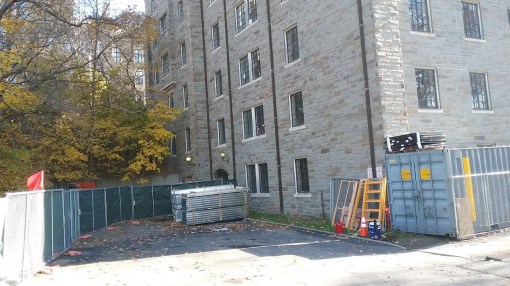
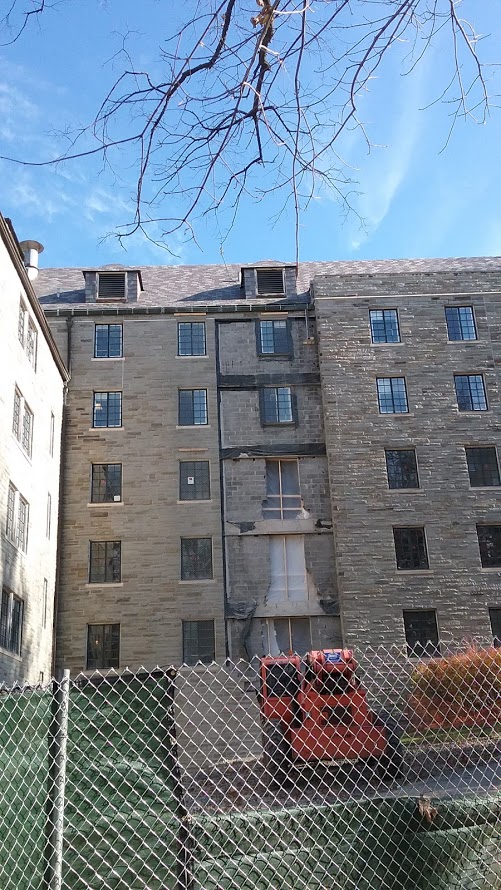
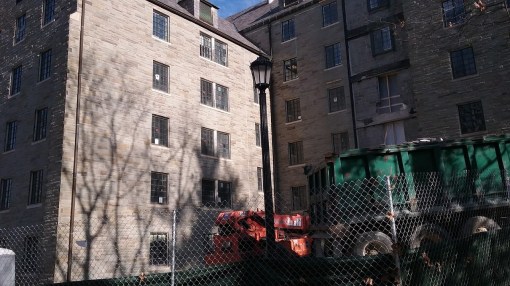
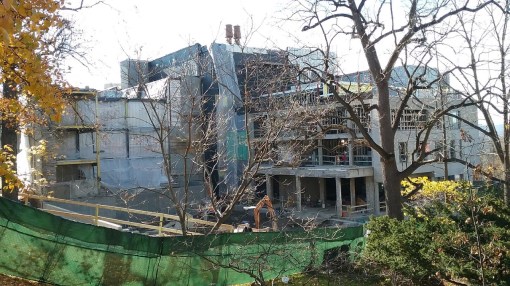
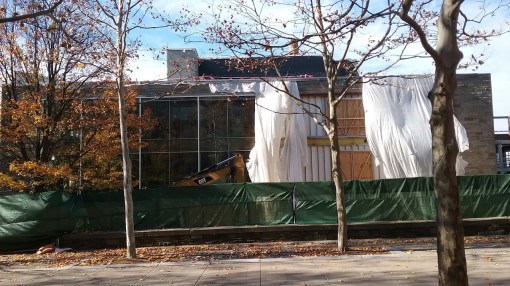
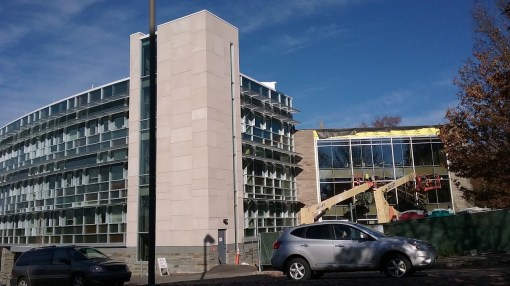
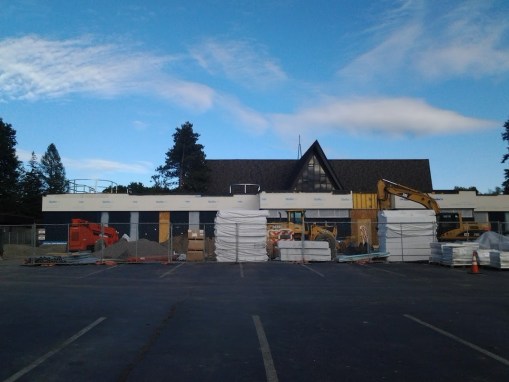
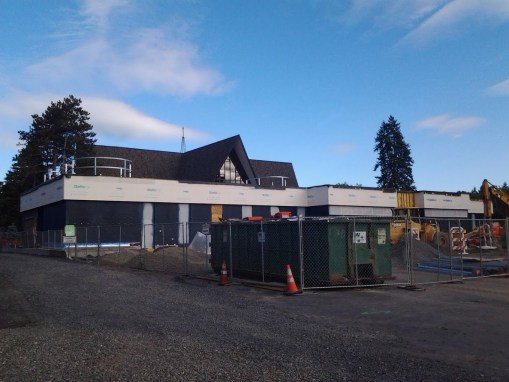
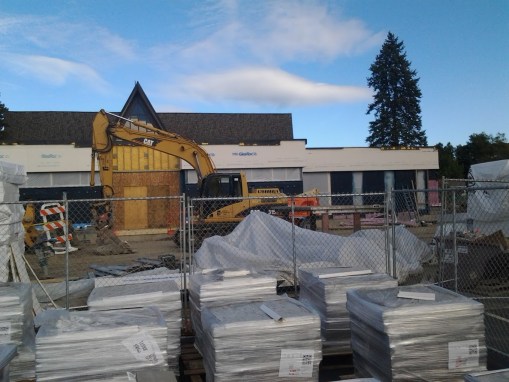
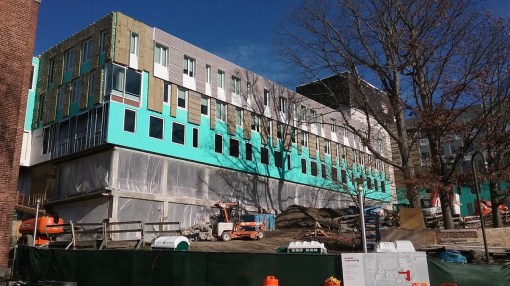
Because of the multi-phased, tiered buildout of Upson Hall’s renovation, it’s easy to miss the changes. For example, in the first photo, there really haven’t been any exterior changes to the fourth or fifth floor, but on the third floor, there’s been significant progress – the old stone has been removed, the new stud walls have been erected, gypsum-based glass mat sheathing has been laid and waterproofed, and new windows have been fitted. You can see the latest batch of exterior wall progress on the third floor of the west face, third photo below. The first and second floors have had their old exteriors stripped as well, but at the moment the frame is exposed. The interior has been gutted and new utilities rough-ins are being routed.

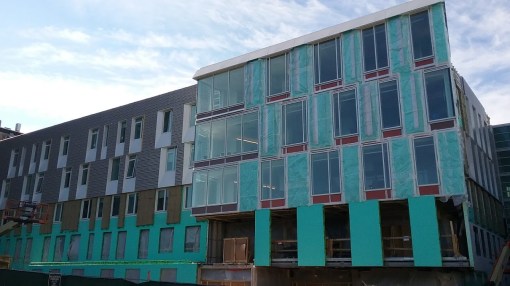
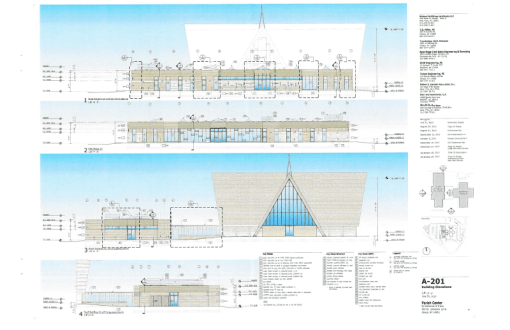
On the side facing the Engineering Quad, the progress has been similar – the third floor has seen the most work recently as the renovations work their way from top to bottom. Turning to the east face, sheathing extends to the bottom floor, and it looks like an aluminum roof cap has been installed on the new bump-out. The general contractor for Upson is The Pike Company, which is touting the project with computer-generated images of construction staging on its front webpage.
20161119_115304 20161119_115324 20161119_115359 20161119_115406 20161119_115453 20161119_115518 20161119_115541 20161119_115630 20161119_115651 20161119_115713 20161119_115733 upson-header-1920x700


Cornell Law School Renovation Update, 11/2016

22 11 2016

Introducing a new project to work into the rotation – work has begun on Cornell Law’s renovations of Hughes Hall. Coincidentally, I broke this story for the Voice almost a year ago to this date.

In Summer 2012, the Cornell Law program embarked on a three-phase renovation and expansion program to their facilities. The first phase was a 17,500 SF, mostly-subterranean addition of an auditorium space, two large-group classrooms. foyer space, and a renovated courtyard. Designed by Boston-based Ann Beha Architects and constructed by Welliver, that $23.8 million phase, certified LEED Platinum, was completed in late summer 2014. Plans for phase II came forth in November 2015, and were approved by the city this past March. Phase III, which calls for renovations to the law school library, has yet to be presented.

Hughes Hall was built by the university in 1963 and named for former professor Charles Evans Hughes. Hughes only spent two years at Cornell, partially because of the need to make better money from private practice, and partially because of familial pressures to leave behind a “one-horse town like Ithaca”. He would later serve as governor and a Chief Justice of the U.S. Supreme Court. Hughes was a source of inspiration for mid-20th century megadonor Myron Taylor, and so the new law school dorms were named in his honor. The building served as the dorm and dining facility for the law school until 2005, when the first and second floors were renovated for administrative and faculty office space.

The Hughes Hall remodeling will have three basic components: enclosing the open-air loggia that currently connects Hughes Hall with Myron Taylor Hall, adding a staircase to the west side of Hughes Hall, and repaving the dining terrace by the Fork and Gavel Café. Administrative offices and event spaces will be on the lower floors, and faculty offices on the upper floors. The renovations will be seeking LEED Silver certification – this is two levels lower than the LEED Platinum of phase one, but it’s a lot easier and cheaper to achieve energy savings when a project is underground.

As a result of the remodeling, the last law school dorm units, totaling 47 student beds, were removed. At the time this was announced, Maplewood had yet to come forth, and I did a rare editorial for the Voice calling Cornell out on a lack of planning and poor stewardship. Minor site plan and landscaping improvements are planned.

Design work is by KSS Architects, with offices in Princeton and Philadelphia. Frequent Cornell collaborator Welliver will serve as the general contractor. The project is expected to cost about $10.2 million and take about 13 months to complete. The project was initially slated to begin in June 2016 and wrap up in July 2017, but it appears the construction launch ended up being a few months later than anticipated.

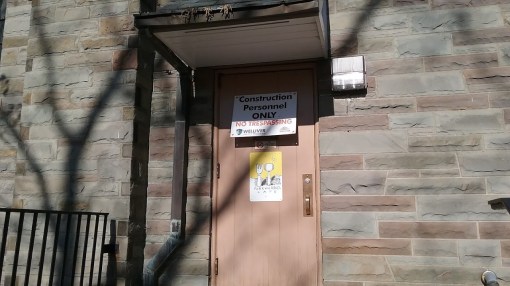
In the photos below, some of the exterior stone veneer has been stripped from the wall, and on the lower levels the windows and some of the concrete masonry wall has been removed. This will be where the new glass-enclosed staircase will go. Work on closing up the loggia has yet to start.

20161119_114538 20161119_114624 20161119_114638 20161119_114820 20161119_114831 20161119_114847 20161119_114920 20161119_114925

hughes_cornell_4 hughes_cornell_3 hughes_cornell_2


Gannett Health Center Construction Update, 11/2016

21 11 2016

Phase II of Cornell Health is advancing. A lot of the progress in the couple of months has focused on retrofitting the existing 1957 and 1979 additions – there will be a new three-story wing on the northeast side of the building, but it looks like only the foundation and subsurface utilities have been completed. New steel has been built on the 1979 wing, and rough window openings have been punched into the northern face. Meanwhile, the 1957 wing sports some new and very big panes of glass – recall that the building used to sport three levels of window bands separated by beige concrete panels. These large panes give the effect of a squatter, smaller structure, even though the external dimensions of the wing haven’t changed. The new entrance is still being built out. Looking closely, one can see new steel stud walls going into the interior as the old wings get completely gutted to meet the needs of a 21st century health center.

The renovations and new 18,000 SF northeast wing should be complete by August 2017. The $55 million project is being built by The Pike Company’s Syracuse office.

20161119_114006 20161119_114034 20161119_114055 20161119_114120 20161119_114142 20161119_114154 20161119_114214 20161119_114256

gannett_northeast_persp gannett_eat_persp gannett_north_final


News Tidbits 11/12/16: Oof.

12 11 2016

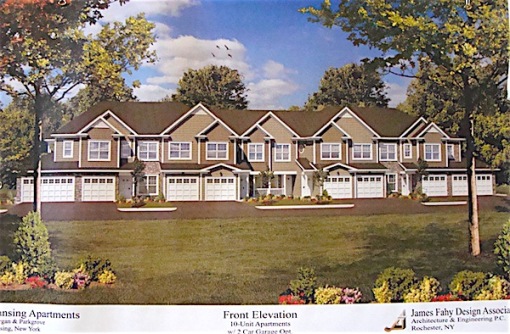
lansingapts600

1. Starting off this week in Lansing, the village has okayed a zoning change that would allow the planning board to move forward with consideration of a 140-unit upscale apartment project on Bomax Drive. Neighbors came out to oppose the zoning change for the 19.5 acre parcel from office park business/tech to high-density residential, saying it would create additional traffic and hurt property values. The village board, however, responded in dissent, noting a lack of housing, a fit with the 2015 village comprehensive plan, and that this was about the zoning and not the project, which the planning board will critique as a separate action. The zoning change was approved unanimously. Park Grove Realty is now free to submit plans to the village, and planning board review will go from there. Expect it to take at least a few months.

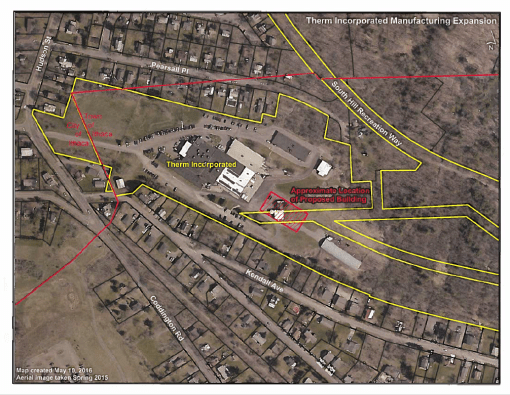
therm_1

2. A couple quick notes from the town of Ithaca – Therm Inc. has commenced construction on their 20,000 SF addition at their South Hill plant. It’s a few months later than originally anticipated, but underway nevertheless. The $2.5 million project is expected to create 10 manufacturing jobs, according to the county IDA.

Also underway at this point is the renovation and expansion of the Rodeway Inn on Elmira Road. The plans call for expanding the existing 25 motel units, adding 2 new units on the ends of the main structure, and renovating a house on the property for a 1,146 SF community room to serve guests. Landscaping and lighting would also be updated. The town pegs the construction cost at about $679,000.

341_coddington_1

3. Here’s some good news – it looks like someone has taken up the Iacovellis on their offer of a free historic house at 341 Coddington Road, providing that the taker moves it. It appears NYSEG was creating some hangups since the power lines have to be moved out of the way (NYSEG is infamously difficult to work with), but with any luck, the house itself will be saved. My colleague Mike Smith is doing the legwork on a story, so hopefully more details on the “buyer” will come forth shortly.

4. Back in July, several West End properties owned by an out-of-area LLC hit the market. Now, at least one of them has sold. The duplex at 622 West Buffalo (blue in the map above) was sold for $90,000 to a gentleman from suburban Syracuse. Immediately after, paperwork was filed with the county for a $179,145 building loan courtesy of Seneca Federal Savings and Loan, a small regional bank out of Syracuse. The paperwork does not indicate if it will be renovations/additions to the existing building, or a new structure (sometimes the sale price is a part of the building loan, but in this case the buyer paid separately, with $171,187 set aside for hard costs).

20161007_163922

5. Sticking with county filings, the construction loan for the third phase of the Village Solars was filed with Tompkins County this week. $6 million is being lent by Tompkins Trust to fund construction of 42 units, 21 in each building. Initially they were slated to have 18 units each, but because the three-bedroom properties don’t have quite the same appeal as smaller one-bedroom and two-bedroom units, Lifestyle Properties (the Lucente family) has broken up the units without significantly changing the exterior appearance and layout. Actual Contractors LLC, another Lucente company, is the general contractor, with Albanese Plumbing, T. U. Electric, and Bomak Contractors (excavation/foundation) rounding out the construction team.

119_125_college_1

6. This is one of those unusual months were the city projects memo and the project review meeting agenda go out in the same week. Apart from the Collegetown Townhouse project, there are no new projects being presented, but there is new information and new renders.

In the projects memo, Novarr’s project is the new shiny, while Amici House, the8-unit project at 607 South Aurora and City Centre are being carried over as old business. Regarding City Centre, it doesn’t look like any particular points of contention have been raised by city planning, the framework for mitigating Historic Ithaca’s design complaint is already included, and most of the other requests are for more information/paperwork. From the Design meeting, it looks like the debate on the townhouses project is minor, mostly with where to locate the trees out front, and window details. They will not be putting windows into the north face because it’s on the lot line, but they will vary the materials for visual interest. The Design Committee requested that City Centre insert more windows in some areas, and less signage, as well as consideration of decorative elements to highlight the curved facade facing Aurora and East State Streets.

The project review committee meeting has all of the above, plus updated submissions from the Maplewood project team. Although no substantial development will occur in the city, the Maplewood project crosses municipal boundaries and the city has deferred to the town for lead agency. The meeting will also have a few zoning variances to comment on. The only notable zoning variance is for local realtor Carol Bushberg, who wants to do a one-story 812 SF rear addition at her office at 528 West Green Street, which is in a WEDZ zone and requires two floors.

maplewood_v7_4

maplewood_v7_5

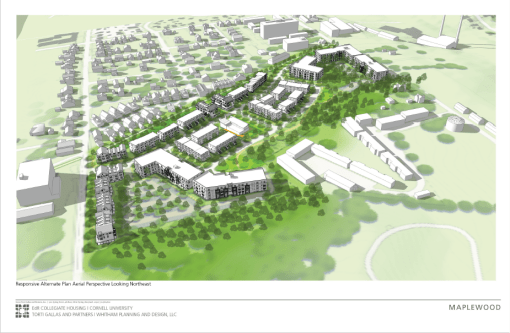
Looking at the Maplewood submission, the new dormer/gable style will be for the building strings that front Mitchell Street, and the two strings most visible from Walnut Street. More modern designs will be used for the remaining structures. Looking closely, the designs do vary from string to string, which will give the site some character and additional visual interest. The project timeline is pretty tight with submissions, meetings and approvals, aiming for preliminary approval from the town on December 20th, demolition to start immediately thereafter, and final site plan approval by January 3rd.

For links, here’s the Collegetown Townhouse updated submission, engineering narrative, site plan render, and cross section render. Here are the updated materials for 607 South Aurora (no significant changes, just a summary of submission materials),  here’s a new site survey for Amici House, and the project update for Maplewood.

7. Meanwhile, there’s nothing too exciting on any of the town boards next week. Lansing town will consider additions to a self-storage facility, a one-lot subdivision and a climbing wall facility next to The Rink. Ithaca town will be conducting their own analysis of Maplewood, and a one-lot subdivision.

Now, after this week’s election news, one might wonder if this has any impacts on local housing/development. Arguably, there are a few. Expect federal funds for affordable funding to be cut drastically, and grants for mass transit projects to also take a major hit. While those are major losses, the state has far greater control, so there will still be some funding available, but definitely not as much as would have been expected under a Democratic administration. Most land use and building issues are decided at the local level, so don’t expect significant impacts there.

More of a question would be infrastructure investments. The president elect wants to launch a massive rebuilding program, but the Republican Senate majority leader has already said that’s not something they’re interested in, so we’ll just have to see if he can force it through or not. If there’s any silver lining to all this, it might come in some form of deregulation, but while he might be a fan of urban environments, most of his cabinet will likely not. We also have to keep in mind the disdain for elite colleges like Cornell, so research funding, and the economy built off it, is probably going to take a hit. For the Ithaca area, the change in administrations is likely a net negative.


News Tidbits 11/5/16: Condemnation and Praise

5 11 2016

maguirebirdseye-620x420

1. The Maguire waterfront plan has been rejected. By an 8-2 vote, the Ithaca city Common Council voted to discontinue consideration of the state-of-the-art Ford/Lincoln/Nissan dealership, with most citing concerns about the project’s marginal or poor fit with the city’s comprehensive plan, which calls for an urban mixed-use form of development in the Carpenter Circle area where this dealership is proposed. The votes in favor of the proposal, from the third ward’s Donna Fleming and first ward’s George McGonigal, cited ways it could be conceived as fitting with the plan (greener alternative, local business expansion), and challenges the site offers to the city’s urban plan (poor soils, trains, chemical storage, power lines).

Although this shuts down the current proposal, this may not be the last we hear from the Maguires or the Carpenter Business Park site. At the meeting, company President Phil Maguire offered a teaser, saying they may partially liquidate their land holdings to bring in mixed-use development that would share the CBP space with the dealership. Given the heavy alterations that would need to occur, the council decided to vote down the existing proposal and send a message that it doesn’t fit the city’s goals. However, the council said they and the planning department would expedite review of an amended proposal, should it come forth.

20150613_175047

2. If you’ve ever wanted some explicit discussion of the challenges of doing affordable housing in Tompkins County, here’s a great summary courtesy of the the town of Ithaca. Back in August, the town’s Planning Committee (of town board members, similar to the city’s PEDC Committee) met with Ithaca Neighborhood Housing Services Director Paul Mazzarella for a Q&A. The town is considering regulations for inclusionary housing, and after INHS’s Greenways project fell through, they would like guidance and input on to make an effective code that promotes affordable housing without killing all residential development. Here are some of the highlights:

– Ithaca is a market of smaller builders. Local developers aren’t able or interested in doing huge projects, and most outsiders don’t see Tompkins County as a big enough or profitable enough market to tap into. So that leaves it to smaller builders who don’t have scale efficiencies, and are inclined to build luxury housing because the return on investment is more likely (i.e. less risky). The strong local economy also means that the local construction labor pool is largely tapped out, and additional crews have to be imported.

– Mandated affordable housing tends to work best in expensive, hot markets where the Return on Investment (ROI) for the market-rate units is more likely – your Seattles, San Franciscos and New Yorks. Even there, it is often paired with incentives such as height or square footage. Mazzarella noted he doesn’t think the city’s voluntary program will work very well. One thing to note with mixed-income projects is that the market-rate units will often be higher priced to cover the cost of lower-priced units. Simplified example – say you’re building ten houses for a sale price of $250,000. To meet an affordable mandate you sell two at $200,000, but to still obtain adequate ROI, that $100,000 is going to spread among the other eight – so you have two for sale at at $200,000, and eight at $262,500.

– We talk about modular homes as lower-cost alternatives, and for rural locations they often are, due to materials and labor costs. However, INHS found that in their experience for sites in the city and town, the cost is comparable to stick-built, although at larger scales, cost efficiencies may be achieved (ex. the Belle Sherman Cottages).

Another interesting read is the committee’s September meeting with city historic preservation planner Bryan McCracken and Historic Ithaca’s Christine O’Malley about protecting historical resources. As it turns out, the city cannot designate an individual landmark without the owner’s permission, and historic districts require the approval of 60% of affected property owners.

hipped_roof_tinytimbers

3. Seems like Tiny Timbers had a well-attended open house. On their blog, the Dolphs have shared a cross-sectional diagram of an exterior wall – beneath the hemlock siding and copper trim will be ZIP sheathing and polyiso (thermoset plastic foam) insulation. ZIP is everywhere in residential construction, polyiso less common – locally, it was used extensively with the Boiceville Cottages in Caroline. On the inside, one has sheetrock and bamboo flooring. Exposed hemlock posts and ceilings will complement the sheetrock.

Also being rolled out is a fifth home design, a larger two-bedroom, two-bath home with a hipped roof. Variety is the space of life, as the saying goes.

119_125_college_1

4. It was exciting to finally see the release of renderings for John Novarr’s College Townhouses project at 119-125 College Avenue. Links to the Site Plan Review document, historical documentation and drawings can be found in the Voice write-up here. There have yet to be images released for the garden apartment building to be built at the rear of the property, but look for the same general design features as the rowhouses. As expected from ikon.5 Architects, the design is modern and glassy, and given the Facebook comments and a couple of emails that came in, some neighbors are less than happy about that. However, this isn’t a historic district, so long as it meets zoning regulations, Novarr is free to hire whoever he darn well pleases. As mentioned in previous write-ups, he had ikon.5 design his guest house, so this isn’t strictly a cost thing, he genuinely likes their work. It was a bit surprising but interesting to see the well-researched history of the three 19th century boarding houses currently on the property, and it makes me wonder if that was a requirement. Novarr’s proven to be accommodating in the past, perhaps he’ll deconstruct rather than demolish, and the salvageable parts can be reused.

The project team will meet with members of the Planning Board on Tuesday afternoon for Design Review – about the only thing that stands out at initial glance is the lack of windows or visual interest with the north face, barely noticeable in the rendering. That probably won’t fly with the board, but we’ll see if it gets changed up as it goes through review. City Centre, the 8-story Trebloc site redevelopment, will also undergo further design review at the meeting.

chapter_house_reconst_v5_1

5. The Chapter House is going to the Ithaca Landmarks Preservation Commission (ILPC) yet again. The changes are subtle and few, but the rules are the rules. A service door will be added to the west (rear) wall, the inset vestibule is being reconfigured a bit, and the third-floor dormer windows are being changed from double-hung to casement – meaning that instead of sliding up and down, they’ll open with a crank. The ILPC will vote on the changes in November, which will probably sail through without much debate, and hopefully, just maybe, quite possibly, the Chapter House project can get underway.

sleep_inn_v2_1
6. A couple quick updates from the town of Ithaca Planning Board minutes – after some discussion and a bit of praise for the redesign effort, the board opted for timber-trimmed Design “A” for the Sleep Inn proposal on Elmira Road. The minutes from Maplewood’s EIS meeting were also uploaded, and it is rare to see this much positivity in discussion of a project – not to say there weren’t dissenters, but the alternative energy source and efficiency initiative, use of local labor, and softening of the design on Mitchell Street won most of the speaking audience over. Public comment closed on Halloween, and now the project team must respond to all the reasonable comments received as part of the review process.


News Tidbits 10/29/16: Envision Small Spaces

29 10 2016

lansingaptsmap600

1. The heated debate over the Park Grove project in the village of Lansing continues. The primary opposition to rezoning continues to be the Jonson family of Ithaca Home (Forest City Realty / IJ Construction), and residents of their Heights of Lansing development at the end of Bomax Drive. Reasons cited include loss in property values, increased traffic, and slowing the completion of their own project.

Pardon the incredulity when hearing about property value concerns in a community with well-documented property appreciation. Furthermore, only two houses have been built in the Heights of Lansing development in the past couple of years. Since the project first launched in 2006, they have sold 17 townhouses and homes, in a development that planned for about 80. They’ve been moving at a snail’s pace for years, and it;s hard nothing to do with the zoning of nearby property. Another angry speaker asked why Lansing has to shoulder the county’s housing burden, but it’s not just Ithaca that has housing issues. In short, while I’m critical of this specific proposal, the zoning change makes sense. The board may consider a zoning change at its November 7th meeting.

holochuck

2. Thanks to the county planning department, we have a little more information about NRP Groups’ revival of the Holochuck Homes project on West Hill. It appears Tompkins is intending to award $300,000 in Community Housing Development Funds to the development team. The CHDF funds go towards affordable housing projects intended for households making 80% of Area Median Income or less (AMI is about $54,000/year, so roughly $43,000/year and less). It looks like 89 of the 106 units in this townhouse proposal will qualify for the funds; most likely the other 17 will be priced in the 80-100% AMI range. Like 210 Hancock and other larger projects, units typically aren’t restricted to one specific income bracket, there tends to be a mix of lower and lower-middle incomes. It also appears that Arbor Housing and Development, an affordable housing developer based out of Corning, will be partnering with NRP Group on the project. Ithaca would be new territory for Arbor Housing, whose next closest site is an apartment building in Odessa in Schuyler County.

tiny_timbers_1

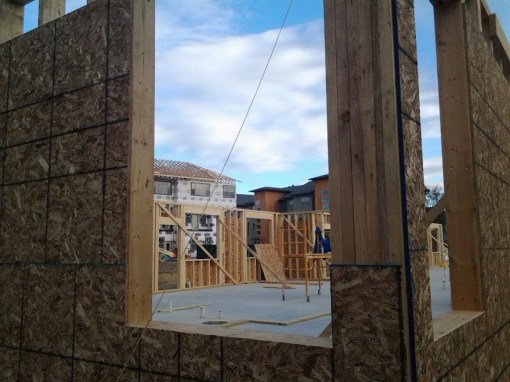
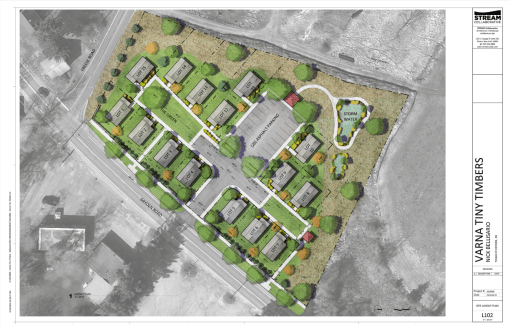
3. Looks like Tiny Timbers is one step closer to reality. The property at 5 Freese Road, once known as “Mt. Varna”, was sold on the 25th by Nick Bellisario to “VTT LLC” for $184,122.59. Presumably, VTT is short for Varna Tiny Timbers. Bellisario and co-owner Otis Phillips had purchased the land for $90k in 2006, and considered a couple different development plans for the site, including a 20-unit modular townhouse project for the site several years back. The land was most recently assessed at $100k. Philips is bowing out of ownership, but county documents show Bellisario and Tiny Timbers creator Buzz Dolph are co-partners in the LLC. The 15-unit Tiny Timbers project will be hosting an open house Saturday the 29th, and may be considered for final approval by the town of Dryden in November.

100_0520

4. Up on Ezra’s former farm, a hefty donation will finance the renovation of Noyes Lodge into a campus welcome center. The family of trustee Marvin Tang ’70 is donating $3 million to partially finance the creation of what will be the Marvin Y. Tang Welcome Center, pending approval by the Board of Trustees. The gift responds to a challenge grant created by mega-donor Atlantic Philanthropies (funded by Charles Feeney ’56), which offered up to $3 million in matching funds to donations towards the new welcome center – so with $6 million secured, the renovation’s financing is secured and will be able to move forward. Cornell has long considered a reception and exhibition space by the gorges, having mulled over but ultimately backing away from a plan penned by architect Richard Meier in the late 1980s. Tang, now retired, was a venture capitalist based in Hong Kong, and the regional chairman of a recruitment firm for business executives.

The Noyes Lodge, a 9,100 SF building that opened in 1958 as a womens’ dining hall, is currently used for language classes and training. Those functions would be moved into newly renovated space in Stimson Hall. JMZ Architects of Glens Falls, a favorite of the SUNY System, will be the design firm in charge of the renovation and re-purposing. The exhibition space will be the work of Poulin and Morris Inc. of New York City. Cornell plans to open the new welcome center by Summer 2018.

village_solars_2

5. There seem to have been some changes to the Village Solars project up in Lansing. According to the newly-uploaded planning board minutes, the site plan has been revised from 174 units to 206 units, but most of that is tied up in unit reconfiguration. Reaching out for specifics, here’s the response from Rocco Lucente the younger:

We have found that the micro unit floor plans are very, very popular and the three bedroom units have been the only units we’ve had any problems with getting rented in a timely manner (like most companies we like to be rented out by the end of Cornell’s season if possible), so we will be modifying the three bedroom floor plans to become micro units and our new junior one bedrooms, which are slightly larger than the micro unit and includes a separate bedroom and living room/kitchen area. The total number of bedrooms goes up very, very slightly and the square footage should remain relatively unchanged.”

The micro units he’s referring to are the units created during phase two, when two larger units were split into smaller units as a sort of testing of the waters – apparently it worked out quite well. It’s worth noting that three-bedroom units had the highest vacancy rate in the Danter study. We’ll see if this creates significant design changes, but one thing’s for certain, it drives up the unit count per building – for instance, Building M, slated to be built in the next phase, has increased from 17 to 24 units.

f5321f76a7c2ce2d9c3d0b069686bdab18e656969cc9b4cce8063cbab0926e8aa52b0bc270ce88ac

Modern Living Rentals has started advertising units for 201 College Avenue. Business partner Visum is shooting for August 2017, which will be a very quick pace – hopefully William H. Lane Inc., the general contractor, is up to the challenge. With heat included in the rent, a three-bedroom will run anywhere from $3,250-$4,170/month, a two-bedroom for $2,170/month, and a one-bedroom with top-floor patio access will cost $1,670/month,  which puts it pretty close to the high end of the Collegetown market. The “New York City-style loft apartments”, as the ads boast, come with such building amenities as a high-end gym, media lounge, bike room, and high-end security system. Apartment amenities include full furnishings, stainless steel appliances, granite countertops, in-unit dishwasher machines, washer and dryers, 16′ ceilings, and cargo nets. Yes, cargo nets – they extend from the bedroom and over the living room, and are billed as “the perfect place to relax and study”, capable of holding up to five people. I asked architect Noah Demarest about them, and he said the idea came from developer Todd Fox, and that examples can be found on Pinterest.

Meanwhile, Charlie O’Connor’s three-bedroom two-family houses underway on Old Elmira Road will be ready by February, and come in at $2,100/month per unit.


a-place-for-all-of-us

X. For those who might be interested, sign up for the Tompkins County Housing Summit can be found here. Attendance is free, and comes with a meet and greet on the night of Wednesday November 30th at the Greenstar workspace (“The Space”), and a day-long summit on Thursday December 1st (attendees can choose whether to attend one or both). It appears that there’s a wait-list already for the Thursday summit, but the Wednesday night reception still has space for new registrants.


News Tidbits 10/22/16: Seal of Approval

22 10 2016

201_college_v4_1

1. In yet another twist in the 201 College Avenue saga, the project will be moving forward. The Board of Zoning Appeals sided 3-1 with the city Zoning Director and denied the Planning Board’s consideration that the building be considered illegal due to facade length. According to a report from former Times reporter Josh Brokaw (now operating as an indy journalist),  the board was swayed by arguments of time and ambiguity in the code. Brokaw’s reading makes it sound like there’s still some raw feelings between staff and board. The way to solve the most pressing issue would be to clarify the code based on the facade debate, and have the common council ratify those changes over the next few months. All in all, the Form District code works pretty well, and a number of projects have been presented without big discussions over semantics. But in the case of 201, it’s clear that the CAFD wording and imagery could use further refinement, so that everyone is on the same page. With 201 resolved, now is a good time to do that.

Dunno what the completion date will be offhand (August 2017 would be a breakneck pace, but we’ll see). Neighbor Neil Golder has refiled his lawsuit, but the case isn’t especially strong.
elmira_savings_v2

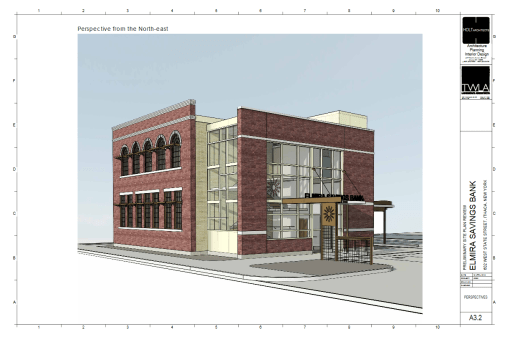
2. Also getting underway this week is the renovation of the former Pancho Villa restaurant at 602 West State Street into the West End branch of Elmira Savings Bank. This is quite a bit earlier than initially planned – Site Plan Review docs suggested a July-December 2017 construction/renovation. Edger Enterprises of Elmira will be the general contractor for the 6,600 SF, $1 million project, which is expected to be completed in March 2017.
evergreen_dryden_1

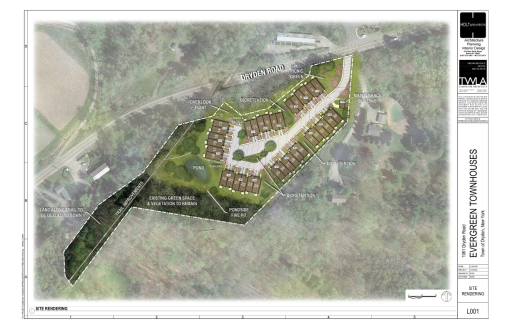
3. The Dryden town board has approved 4-1 the concept of the Evergreen Townhouses plan for 1061 Dryden Road just east of Varna. This means that they accept a PUD can be appropriately applied for the site, but the project will need to submit a formal, more detailed development plan before any final approvals will be considered. One of the major changes that is being requested is a 15-foot setback between the property line and the units at the southeast side of the parcel (25-36), so expect those to get a little trim off of the rear side (the dissenting vote, Councilwoman Linda Lavine, was because she preferred a 25-foot setback). If the setback and the other stipulations are accommodated, its chances of approval are pretty good. Developer and local businessman Gary Sloan has 270 days to submit detailed plans for review.

Meanwhile, Tiny Timbers will be up for Dryden Zoning Board of Appeals review in early November. Since an internal road will be used to access some of the home lots, the town board will be viewing the site as an “Open Development Area” (ODA), which by Dryden’s definition is development with no direct road access. The town board will hold their public meeting on the 20th to approve the ODA, the planning board’s acceptance on the 27th. The ZBA is the last or second-to-last step in the approvals process (not sure offhand if the town will need to vote again to give a final approval).

lansing_meadows_old

4. The senior housing next to the BJ’s in Lansing might finally be moving forward this spring. Dan Veaner has the full story here at the Lansing Star. The issue stems from working with the U.S. Army Corps of Engineers to determine what parts of the land can and cannot be developed – delineating the wetlands, basically. Apparently, the wetlands were created by an overflowing culvert back when the mall was built in the 1970s. But regardless of how they were created, the USACE deems they have to be protected, especially since it developed into a rare wetland environment called an “inland salt marsh”. Since then, it’s been back-and-forth on units – I’ve heard as few as 9 and as many as 18. A portion of the wetlands would still need to be relocated. The PDA boundaries were changed slightly by the board at the request of developer Eric Goetzmann earlier this month to accommodate the USACE determination. The tax break Goetzmann received to build BJ’s is contingent on the senior housing getting built, though at this point, one has to wonder just how much this wetlands tangle has cost him. Hope it was worth it.

maplewood_v7_3

5. From the sound of it, the Maplewood Park DEIS public hearing was fairly positive. Many of the neighbors are pleased with the changes, although some are still opposed to the density or have concerns about traffic. In response, it’s worth pointing out that the commute of Maplewood’s residents will almost entirely be bus, bike and foot during normal business/school hours, and its convenience to bus routes and services will also help minimize overall traffic impacts. As for density, well, if you want Cornell to house its students and reduce the burden on the open market, promoting density on the existing Maplewood site may result in a more sustainable, more cost efficient project if planned properly, with less of a neighborhood impact than building several hundred beds on an undeveloped parcel elsewhere (since the Maplewood site has been inhabited in some form since the 1940s, the growth in density would not be as prominent – about 490 beds, vs. 872 beds).

Should readers feel inclined, comments are still being accepted by town planners up until October 31st. The materials and submission email can be found here.

6. It looks like there were a couple big sales in the local real estate market this week. The first one was the Tops Plaza in big box land, just south of Wegmans. National retail developer DDR Corp. sold the property to another large firm, NYC-based DRA Advisors LLC, for $20 million on the 18th. The sale included three addresses – 710-734 South Meadow, 614 South Meadow, and 702 South Meadow – The Tops Plaza, The smaller strip to its south (called Threshold Plaza), and the pad parcels like Chili’s and Elmira Savings Bank. Perhaps the most notable part of this sale is that it’s slightly below the total assessed value of $20,941,000. However, DRA picked up the property as part of a bundle sale of 15 shopping centers in Western and Central New York, so maybe it was a bulk discount, or compensating for weaker properties.

The other big sale was between a long-time local landlord and a newer, rapidly growing one. The Lucente family (as Lucente Homes) sold 108, 116, 202 and 218 Sapsucker Woods Road to Viridius LLC for $1.276 million on the 18th. According to county records, each is a 4-unit building built in the 1970s and worth about $275k – meaning, Viridius just acquired 16 units for a little above the $1.1 million assessed. Viridius’s M.O. is to buy existing properties, do energy audits to determine what needs to be done where to maximize energy efficiency, disconnect them from fossil fuel heating and energy sources, install pellet stoves, heat pumps and the like, renovate/modernize the properties, and connect the more efficient house to a solar grid or other renewable energy sources. If Sustainable Tompkins were a developer, they’d look like Viridius.


7. This last one isn’t so much a big sale, but worth noting for future reference – 126 College Avenue sold for $510,000 on the 19th. The buyer was an LLC at an address owned by Visum Development’s Todd Fox.

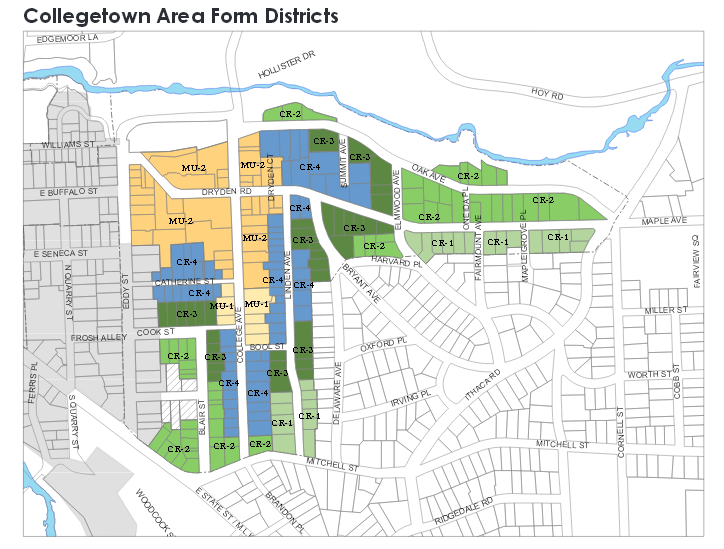
126 College is a 2-story, 6-bedroom house that might have been attractive long ago, but someone’s beaten it with an ugly stick and paved much of the front lawn (growing up near Syracuse, we called paved front lawns “Italian lawns”, with my uncle one of the many offenders). The purchase price is a little below the asking price of $529k, but more than double the assessment. Zoning at the property is CR-4 – up to 50% lot coverage, 25% green space, up to 4 floors and 45 feet in height, a choice of pitched or flat roofs, and required front porches, stoops or recessed entries. This is the lowest-density zone for which no parking is required. The city describes the zoning as “an essential bridge” between higher and lower density, geared towards townhouses, small apartment buildings and apartment houses.

Granted, not everything Visum/MLR does is new, some of their work focuses on renovation. But given the location, and given that frequent design collaborator STREAM had “conceptual” CR-4 designs on display during the design crawl earlier this month, it’s not a big stretch of the imagination.
city_centre_v3_2

8. Interesting agenda for the city planning board next week, if nothing new. Here’s the schedule:

AGENDA ITEM                 APPROX. START-TIME

1. Agenda Review                6:00
2. Privilege of the Floor         6:01

3. Subdivision Review
A. Project:  Minor Subdivision           6:15
Location: 404 Wood St.
Actions: Consideration of Final Subdivision Approval
A minor subdivision to split a double-lot in Ithaca’s South Side neighborhood into two lots, one with the existing house and one that would be used for a new house or small apartment building. A variance for an existing rear year deficiency of the house would need to be approved (the rear deficiency wouldn’t be affected by the new lot which is on the east side, but it’s a legal technicality).
B. Project:  Minor Subdivision             6:25
Location: 123 & 125 Eddy St.
Actions:  Consideration of Final Subdivision Approval
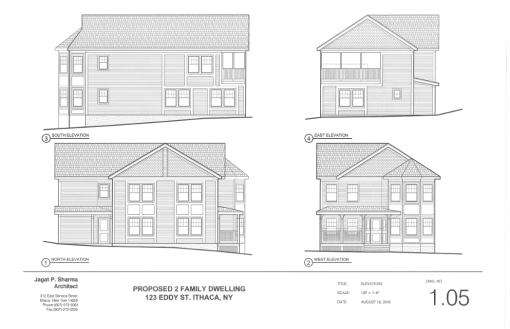
Collegetown landlord Nick Lambrou is planning subdivision of a double lot to build a new 2-unit, 6-bedroom house designed to be compatible with the East Hill Historic District. CEQR has been given neg dec (meaning, all’s mitigated and good to proceed), and zoning variances for deficient off-street parking have been granted.
C. Project:  Minor Subdivision                6:35
Location: 1001 N. Aurora St. (Tax Parcel # 12.-6-13)
Actions:  Consideration of Final Subdivision Approval
One of those small infill builds, this proposal in Fall Creek takes down an existing single-family home for two two-family homes on a subdivided lot. The design has been tweaked, with more windows, a belly band, more varied exterior materials, and additional gables to provide visual interest.

4. Site Plan Review

A. Project:  City Centre — Mixed Use Project (Housing & Retail)           6:45
Location: 301 E. State/M.L.K., Jr. St.
Applicant: Jeff Smetana for Newman Development Group, LLC
Actions:  Declaration of Lead Agency  │ Review of Full Environmental Assessment Form (FEAF), Part 2

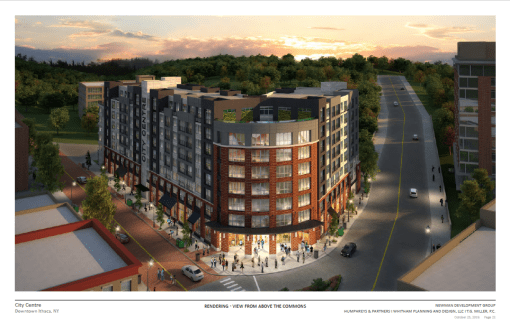
The 8-story mixed-use proposal for the Trebloc site. Comes with one letter of support, and a letter of opposition from Historic Ithaca, who have previously stated they will oppose anything greater than four floors on State Street, and six floors overall.
B. Project:  Amici House & Childcare Center            7:15
Location: 661-701 Spencer Rd.
Applicant: Tom Schickel for Tompkins Community Action (“TCAction”)
Actions: No Action — Review of Full Environmental Assessment Form (FEAF), Parts 2 & 3
C. Project:  Four Duplexes                               7:30
Location: 607 S. Aurora St.
Applicant: Charles O’Connor
Actions:  Declaration of Lead Agency  │ PUBLIC HEARING  │ Review of FEAF, Part 2
MLR’s four-building, 8-unit plan for South Hill. Comes with a letter of neighbor support saying the scale is appropriate.
D. 371 Elmira Rd. (Holiday Inn Express) — Approval of Project Changes      7:45
The debate over the Spencer Road staircase and rip-rap continues.
E. 312-314 Spencer Rd. — Satisfaction of Conditions: Building Materials   7:55
F. 119, 121, & 125 College Ave. (College Townhouse Project) — Update        8:05
Novarr’s 67-unit townhouse project geared towards Cornell faculty. No decisions planned, just an update on the project. Keeps your fingers crossed for some renders.
G. Maplewood Redevelopment Project — Planning Board Comments on Draft Generic Environmental Impact Statement (DGEIS)     8:20
The city’s deferred judgement to the town, but the board can still have their say. The comments will be recorded and addressed as part of the EIS review process.
5. Zoning Appeals                          8:35
• #3047, Area Variance, 123 Heights Court


St. Catherine of Siena Parish Center Construction Update, 10/2016

19 10 2016

Work continues on the new Parish Center for St. Catherine of Siena in Northeast Ithaca. Edger Enterprises of Elmira has framed the structure, and a water-resistant spray barrier has been applied. Windows still have yet to be fitted. It looks like sheathing is going on over the water barrier, and then the stone veneer is attached. The white boards are GlasRoc fiberglass mats layered with gypsum, over metal stud walls with cavities filled by spray insulation. The exposed plywood section will eventually be replaced with a floor-to-ceiling glass entryway.

Although the diocese doesn’t allow the parish to carry long-term debt, Tompkins Trust lent the church $3 million earlier this month.

20161007_162128 20161007_162132 20161007_162203 20161007_162236 20161007_162258 20161007_162313 20161007_162538

st_catherine_v2


409 College Avenue (Student Agencies eHub) Construction Update, 10/2016

17 10 2016

With all these Collegetown projects wrapping up over the past few months, I may need to re-balance my update schedule. The Student Agencies renovation is complete and eHub has opened. I intended to take a few interior photos, but the staff on the first floor were tied up with several other visitors, so I moved on to the next site.

I think the real benefit to this project isn’t so much the renovation as those who are occupying it. eHub is meant to encourage student entrepreneurs. They may migrate to Rev, they may be successful and grow their business locally, adding local jobs and helping to diversify the local economy beyond meds and eds.

For example, the tech startup Rosie was launched in 2012 by Cornell students, and was housed in eHub’s eLab space. After they graduated, the founders migrated to Rev, and have since migrated to office space on the Commons. Today, the company employs 21 people locally (26 total), with more hires planned. Another eHub “grad”, FiberSpark, has stayed local and provides the fastest internet service in Ithaca. Not all the companies are successful, and not all the successful companies stay in Ithaca. But if even a portion of them survive and thrive here, than that’s a real asset for the community. I look forward to seeing what an expanded program will cultivate.

20161007_155339 20161007_155357 20161007_155416


205 Dryden (Dryden South) Construction Update, 10/2016

16 10 2016

205 Dryden is practically finished from the outside. There may still be some work on interior finishes for spaces like the basement gym. It appears that the decorative pre-cast concrete crown has been modified, so that of a slightly projecting cornice, the crown is flat. That might be the result of value engineering, the rush to have the building finished, or both. The exterior wall facing the College/Dryden intersection might seem a bit stark, but chances are, that corner will be the site of its own construction project at some point in the near future. Photos of the furnished rooms can be found on the project’s website here.

20161007_155245 20161007_155313 20161007_160313

205_dryden_-_rendering