South Meadow Square Construction Update, 8/2018

6 08 2018

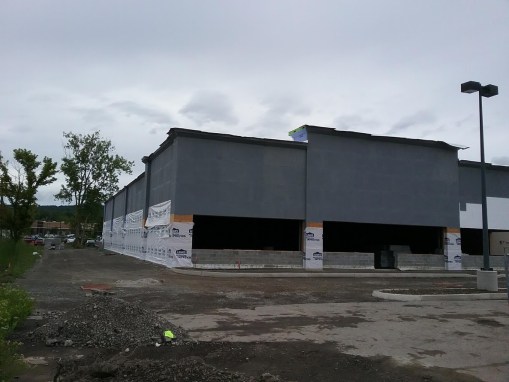
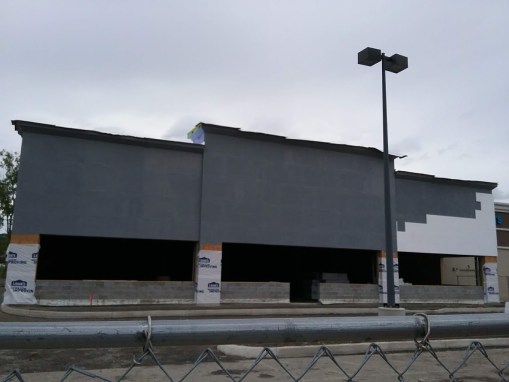
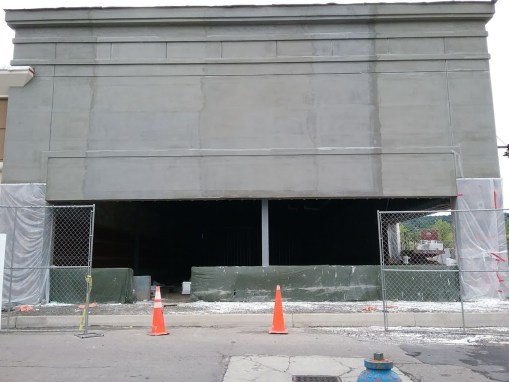
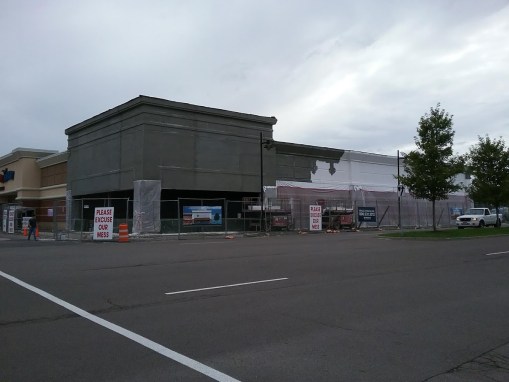
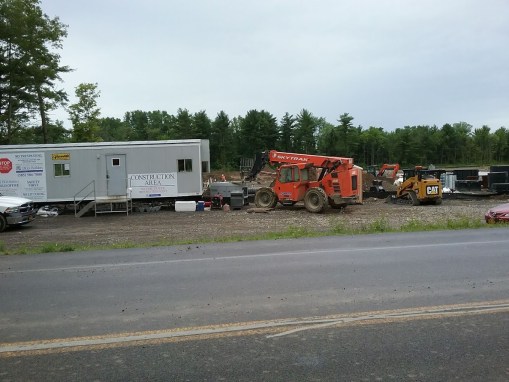
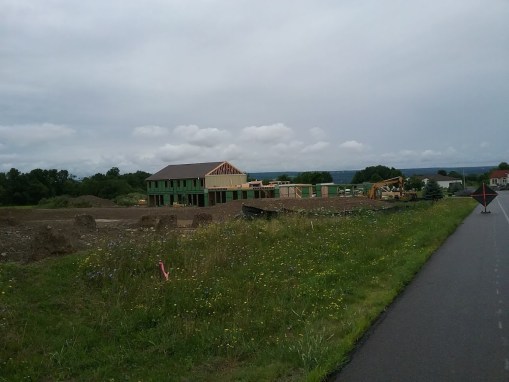
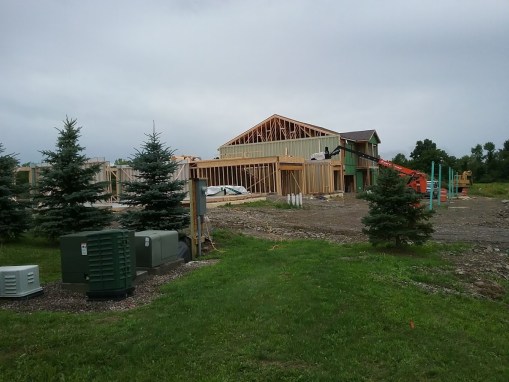
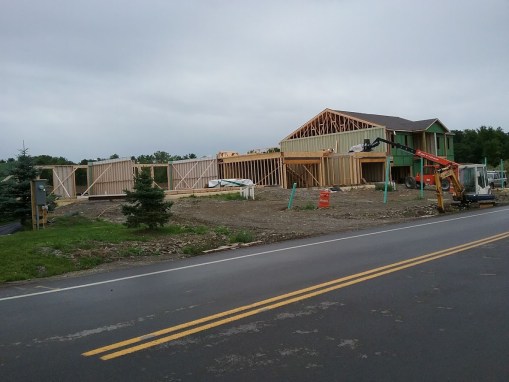
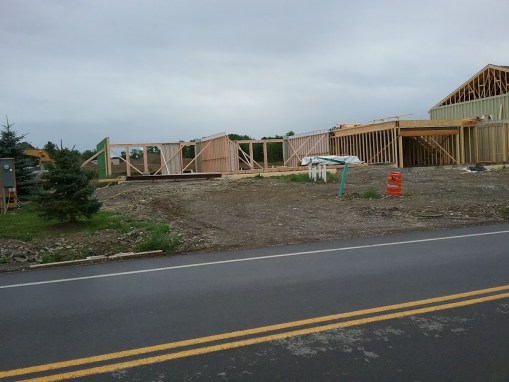
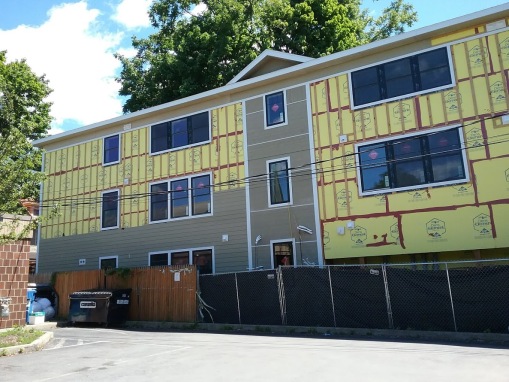
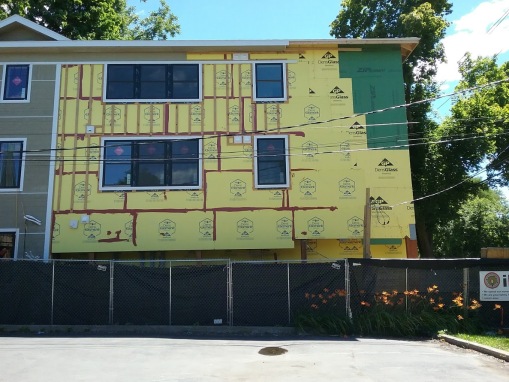
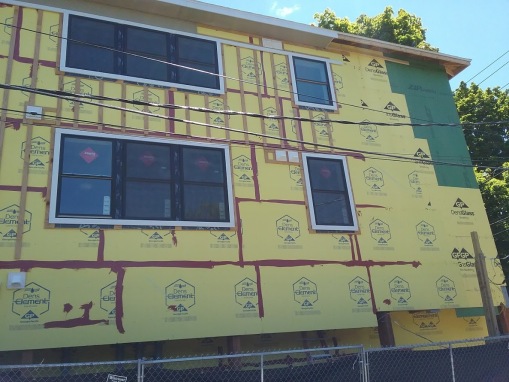
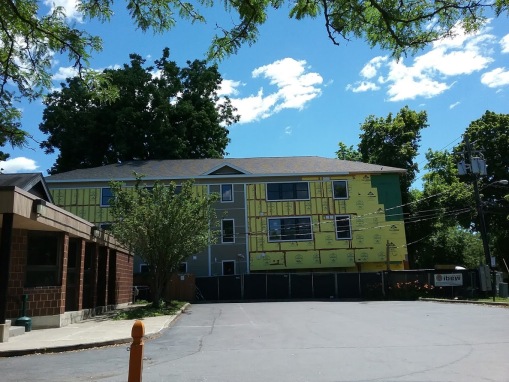
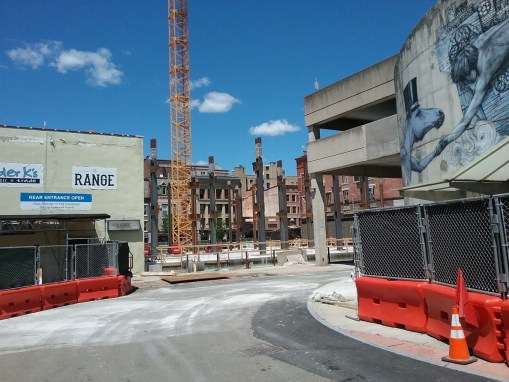
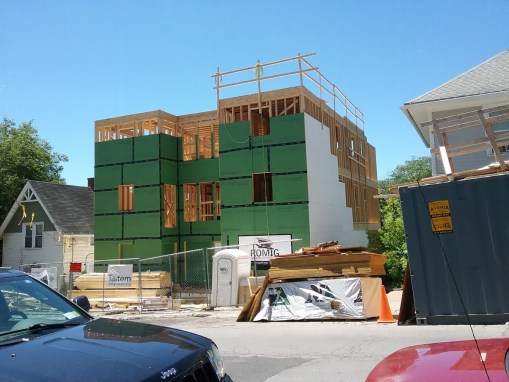
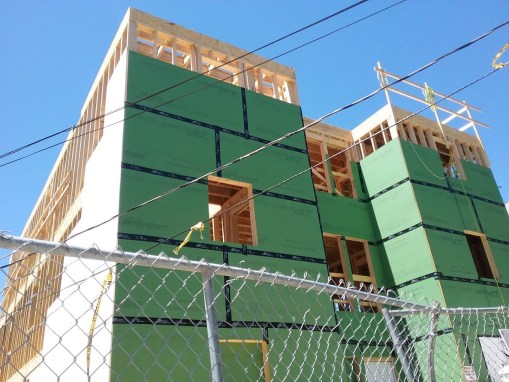
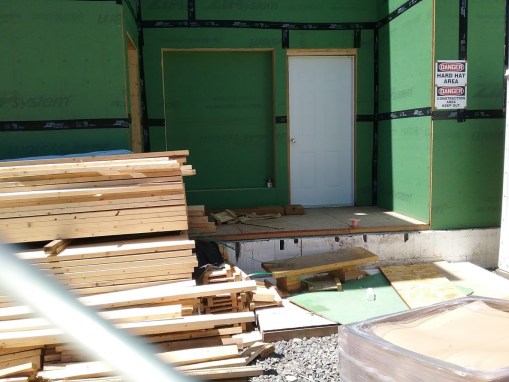
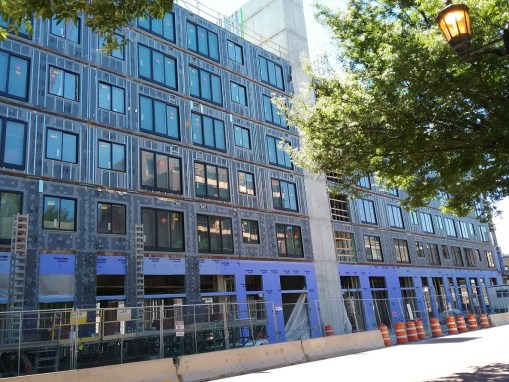
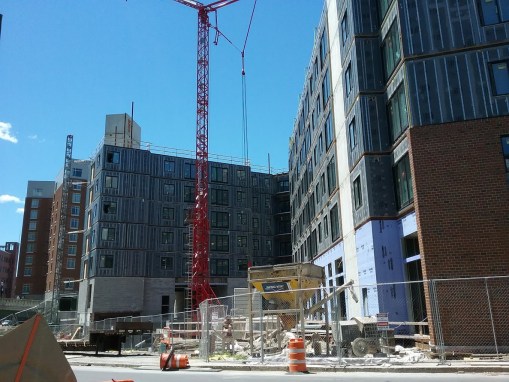
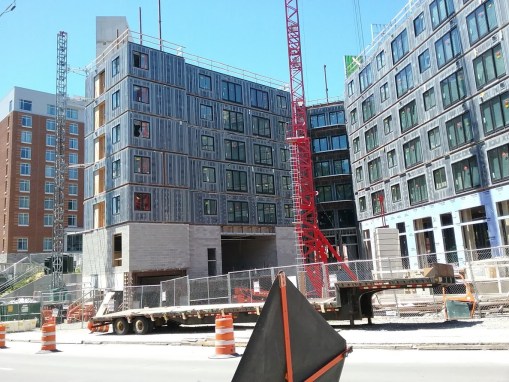
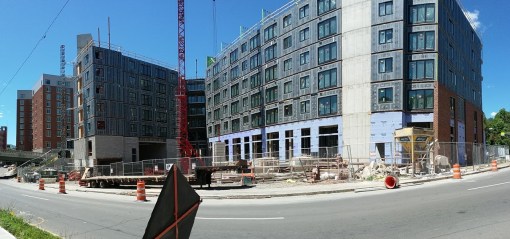
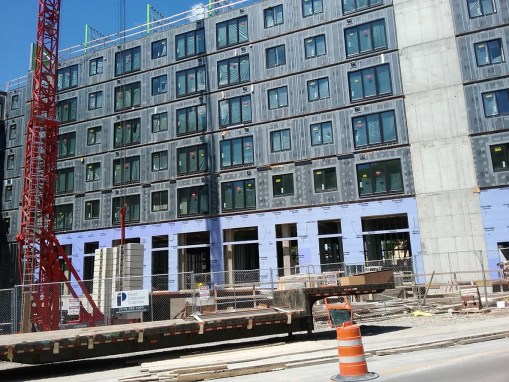
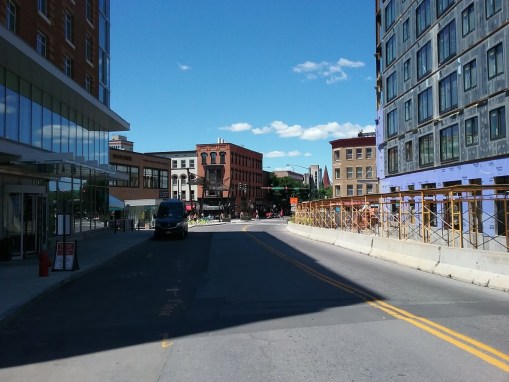
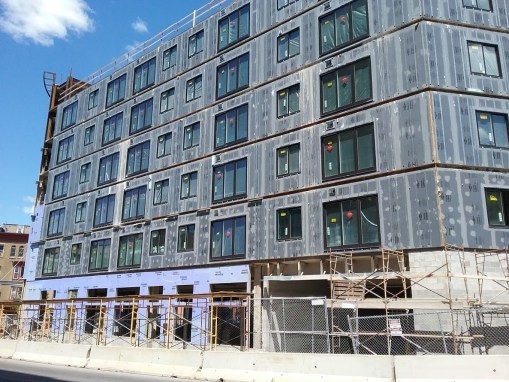
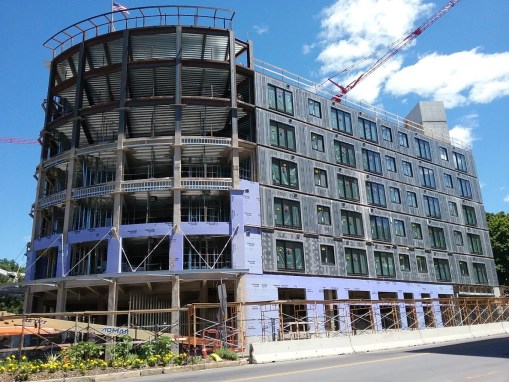
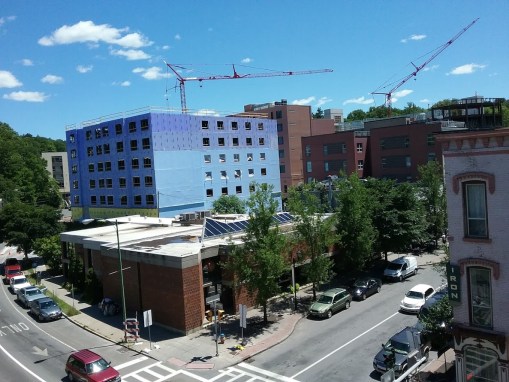
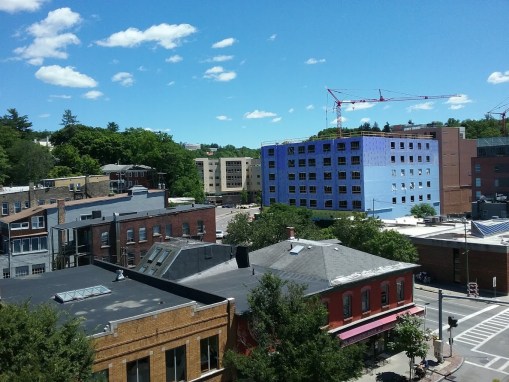
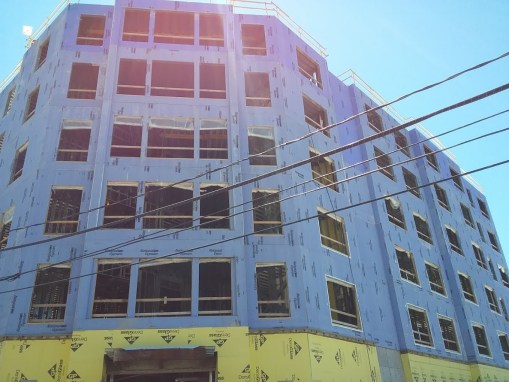
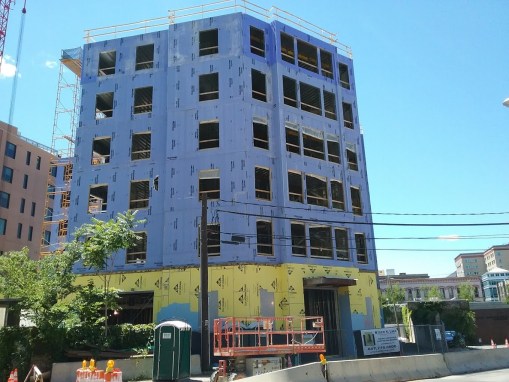
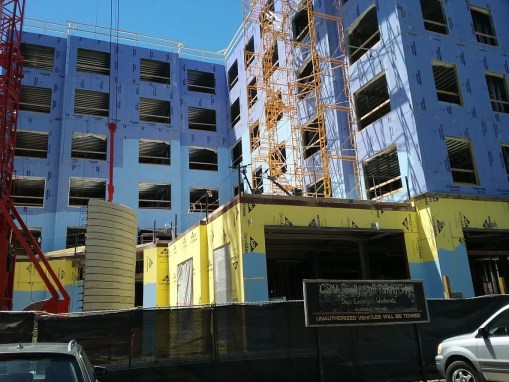
It looks like the new south retail endcap is using a standard EIFS (Exterior Insulation Finishing System) for the exteriors. EIFS, also known as synthetic stucco or by the brand name Dryvit, is a pretty common choice for commercial builds. Readers might remember when it was used with the Holiday Inn Express built a couple of years ago on Elmira Road. Over the plywood there’s a dark grey moisture barrier. This is being overlaid with an adhesive and insulation board, which will then get a reinforcing mesh, base/scratch coat, and a finish coat. Drainage cavities are then built over the barrier to allow water that has penetrated the surface to exit the wall without wrecking it (a big problem with early EIFS systems).  The north endcap looks like it already has insulation boards in place, as well as a base coat for the primary moisture barrier, and a white coat that might be a primer for the finish coat. New curbing, lighting and a fire hydrant have been installed.

Although the south endcap is 14,744 SF, the listing on commercial real estate website Loopnet says there are two spaces, one about 15,000 SF, and a second 3,400 SF. The property doesn’t show a 3,500 SF space, and the north endcap is 7,315 SF, so it’s not clear what that refers to. It could be the 3,200 SF space that is planned for a the pad parcel next to Firehouse Subs, but that hasn’t started yet. If that is the case, however, that implies Benderson Development may have a tenant under contract for the north endcap that they just haven’t yet announced.


East Pointe Apartments Construction Update, 8/2018

6 08 2018

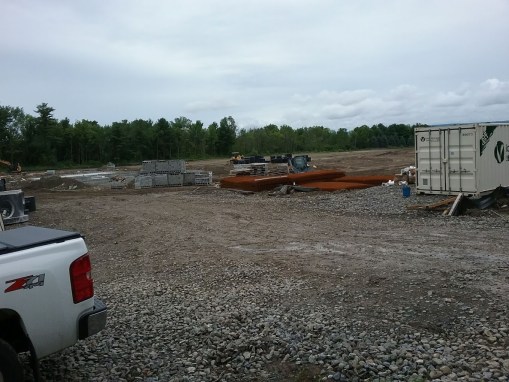
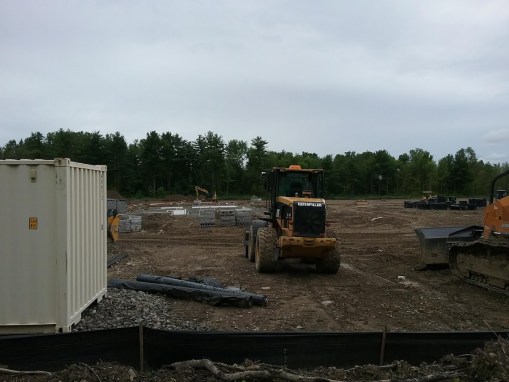
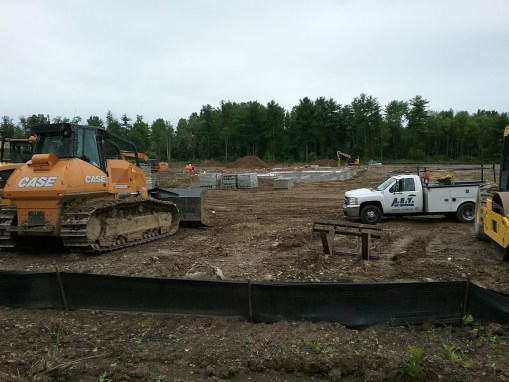
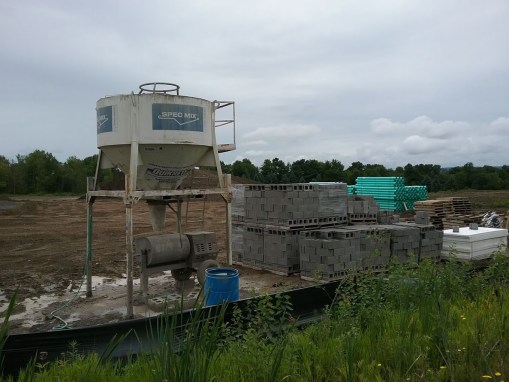
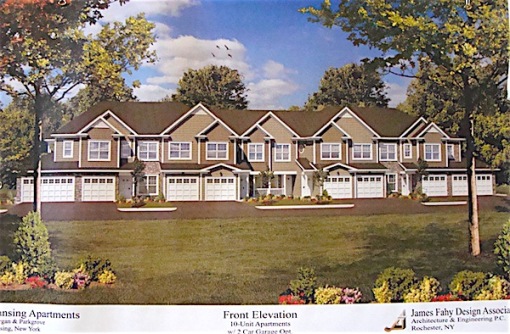
No one can say DGA Builders is wasting time. A visit on Friday showed three sets of CMU foundation walls have been assembled and mortared, each for a ten-unit townhouse string. A few crewmen kept an eye on a material placement truck, also known as a stone slinger, as it launched rocks into the footprint encased by the foundation walls. This may be a crushed stone base (hardfill) for a concrete slab pour, given the stacks of rebar with surface rust sitting nearby. A shallow foundation would work fine here because two-story buildings aren’t especially heavy as structures go, and it would be less expensive and time consuming than a deep foundation. Elsewhere around the site one sees PVC sanitation pipes (sea green), water pipes (blue), and pieces for utility junctions.

Meanwhile just a stone’s sling away on Nor Way, Forest City realty continues work on the six-unit string (hexplex?) of townhouses. Two are fully framed and roofed, two have had their first floor framed though not fully sheathed, and the other two are only partially framed on the first floor. As with all the townhouse strings, these will incorporated some unique design features while keeping the general unit layout the same. I know they’re not happy about the East Pointe townhomes, but it could be a good synergy – the price points ($1,400-$2,000/month fr East Pointe, $350k for the Heights of Lansing townhouses) are such that renters who may wish to stay in that neighborhood may look at the Heights townhomes as an option.

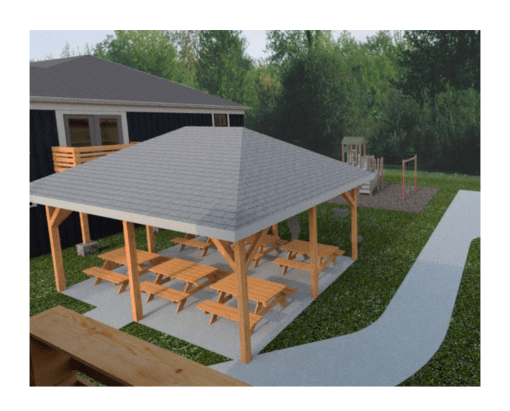
A website is now up and running for East Pointe. It’s mostly stock images and bland corporate-speak, but they do have floor plans and some new renders. Here’s the advertising pitch:

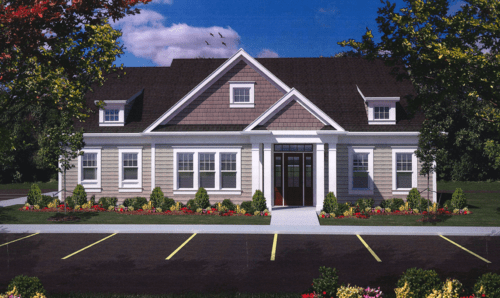
“This apartment community is located on 20 acres in Lansing, NY, which is part of the Ithaca, NY, market. This is new construction of 140 state-of-the-art apartments. There will be 36 one-bedroom units, 90 two-bedroom units, and 14 three-bedroom units. The project will include fourteen apartment buildings with 10 units in each building that will be walk-up garden style with private entrances and a community building. All units will have high end finishes and amenities, including stainless finish appliances, microwave, dishwasher, washer and dryer, ice maker, granite counter tops, wood cabinets, vinyl plank flooring and wall-to-wall carpeting, tile showers, high end plumbing fixtures and lighting fixtures. All apartments will include a patio or deck. The community building will include the leasing and maintenance office, Great Room and warming kitchen for gatherings, and a fitness center. The project also includes an outdoor pool with changing rooms and shower.”

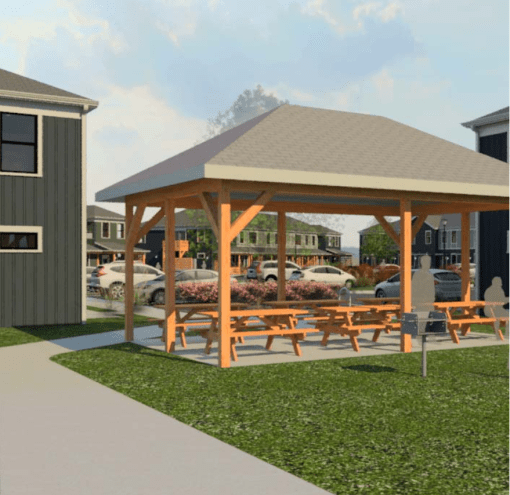
I have no idea what a warming kitchen is, but my very Sicilian mother is pretty good at turning kitchens into warming spaces around the holidays. A photo of the community center is included below.

UPDATE: I’m just going to add this here since the timing was ever so slightly off- on Monday the 6th, the construction loan was filed with the county. M&T Bank is lending Park Grove (represented by an LLC) $22.6 million for construction of the East Pointe project.


802 Dryden Road Construction Update, 8/2018

5 08 2018

Not a high-profile project here, but sizable. 802 Dryden Road, also called “Ivy Ridge”, is the latest project to come out of Modern Living Rentals (MLR). MLR is led by local developer Charlie O’Connor, and as I noted previously, “[h]e is arguably one of the most reticent developers in Ithaca, preferring unobtrusive projects that he hopes will create as little debate as possible. It’s kinda funny in a way, because although he’s a business partner with Todd Fox (Visum’s property management is handled by MLR), the two of them are near-opposites in that regard.”

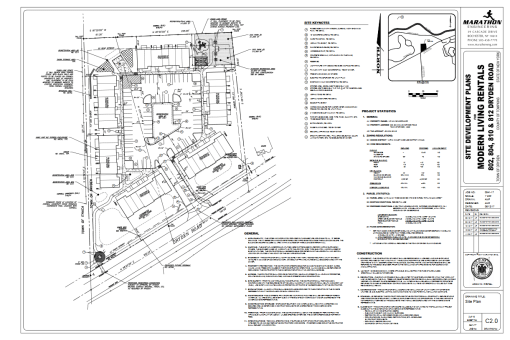
True to form, while 802 Dryden is a sizable 50,000 SF, $7.5 million project, it was the subject of relatively little public debate during its approvals process. It’s located next to arboretum, replaces four rental houses and a motorcycle repair shop, and the number of residences within 500 feet could be counted on two hands. The project consists of 42 two-story townhouse rental units on three acres, six strings of seven units in a right trapezoid layout. Each string contains four two-bedroom units, two three-bedroom units and a four-bedroom unit (108 beds total). It’s a two-minute drive from the east end of Cornell’s campus (B Lot), and an easy sell to students and staff looking to live in a quieter location near campus.

Zoning on the site is fairly dense, all things considered. Although rather far from Varna’s core, the project does fall under Varna Hamlet Mixed Use District zoning, which allows ten units per acre. A redevelopment bonus of dilapidated properties gave another two units per acre, and a green bonus of two units an acre was also permitted. The green features part required some debate and confirmation. The project seeks LEED Certification and will apply LEED standards for neighborhood design.

The project was first proposed in June 2017. At the time, its design was a virtual clone of another MLR project, 902 Dryden Road, albeit with different colors. The designs were revised at least three times. The design work was passed from STREAM Collaborative to John Snyder Architects, who did substantial alterations, and then again, and then STREAM once again did some work on it. The final set of renders are here, with the site plan docs here. Originally there were three townhouse string designs, but it looks like it was reduced to two in the final round. The six buildings are generally but not exactly the same – the gables are mirrored, some additional trim pieces are used on the gables for the Dryden Road pair, and they alternate between a dark blue vertical fiber cement panel (probably HardieBoard), and a dark green panel. Original approvals may have been issued in November 2017, but the last revisions were approved this past May.

Exterior features include 70 parking spaces, bike racks, trash/recycling enclosure, stormwater ponds, bioretention areas, signage, a childrens’ playground, pavilion and a dog park split up for large and small breeds. Planned interior features include granite counter tops, stainless steel appliances, a washer and dryer in each unit, contemporary lighting, and marble tile. Expect these to be in the same price range as the other recent MLR units, which have been in the $650-$750/bedroom range. The units are expected to be ready for occupancy by June 2019.

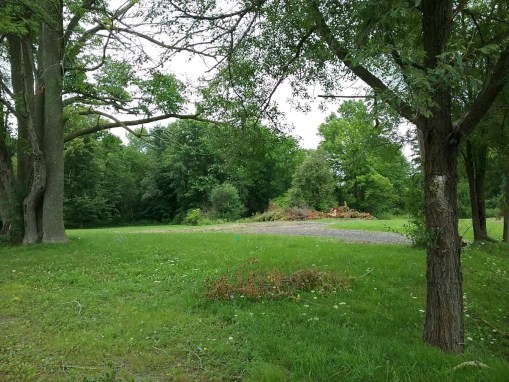
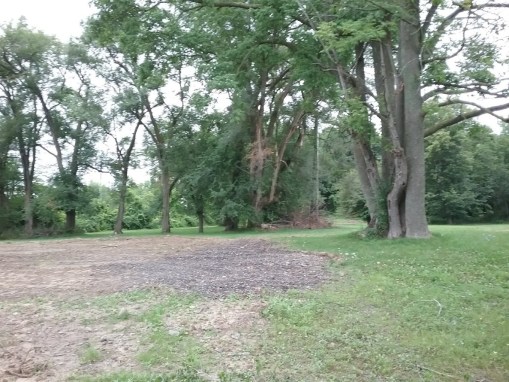
There’s a little bit of pre-building infrastructure work that had to take place before construction, because this is a sort of no man’s land between the settled parts of the town of Ithaca and the town of Dryden where no municipal water service was available. The public water main had to be extended to service the project, and the main will be deeded over to the town. At this time, the existing buildings have been removed, but the land has yet to be cleared; we’re really just at the initial phases of the project.

Along with MLR, STREAM and John Snyder Architects, GMB Consulting Services did the LEED score analysis, T.G. Miller P.C. handled land surveying and Marathon Engineering tackled the civil engineering work – Marathon’s Adam Fishel shepherded the project through the town boards. I don’t have a contractor listed, but will share it when I do.

Pre-construction (Google Maps, Nov. 2015)

Renders:

August 3rd:


Tompkins Center for History and Culture Construction Update, 7/2018

2 08 2018

I don’t usually spend much time covering renovations, but here’s a major project that deserves a good summary.

Let’s start this off with a little self-promotion by linking to the summary and project team interviews I did for the Voice pack in February. The History Center (THC) is a non-profit that celebrates Tompkins County’s past, with an eye towards improving its future. It’s a source for genealogists, historians, teachers, archivists, and many of the old-timey photos that the Voice, Times and other news outlets share with intrigued readers. The History Center has been renting space at 401 East State Street (Gateway Center) on a 25-year lease, due to expire this year.

When weighing their options, there were a couple of reasons why a move was looking better than a renewal of the lease. For one, it would give them a chance to find a more visible place to call home – a higher-profile location would give them more opportunity to be seen, and hopefully be heard. For two, the rent on their existing space was set to go up quite a bit, nearly doubling to $90,000/year.

It happened that Tompkins Trust was in the midst of building its new headquarters, so there was potentially some space opening up in the downtown area. A prime site availed itself in a pair of buildings along the pedestrian-only block of 100 North Tioga Street, better known as “Bank Alley” since nearly all the buildings along it were occupied by banks. 106 North Tioga Street, the shorter brick building, was the county clerk’s office when it was built back in 1863. Its neighbor at 112 is relatively young, built for the predecessors of Tompkins Financial in 1895. 106 was acquired by the bank in 1949, and various renovations from the 1950s through 1980s brought the buildings together as a bank complex with a modern connector space between them. After initial discussions in 2015, Tompkins Financial said it was open to a sale of the 18,826 square-foot space, and the county, who helps covers The History Center’s expenses, paid for a $15,000 feasibility study.

The first public discussion of the plan, then dubbed “The Tompkins County Heritage Education Center”, was in October 2016. The feasibility study checked out, so in January 2017, The History Center, in conjunction with other non-profits, requested $35,500 from the County Tourism Program for early stage development costs – a capital campaign, branding and marketing materials, and architectural drawings.

The project could be described as part “heritage tourism”, part visitor’s bureau and information center, and part non-profit office space. The Tompkins Center for History and Culture will house the CVB’s Downtown Visitors Center (part of the Tompkins County Chamber of Commerce) and The History Center on the first floor. The Wharton Studio Museum, the Dorothy Cotton Institute, and the Community Arts Partnership will also be major components of the project. Historic Ithaca and the Discovery Trail will also be affiliated with the Center, and a newly rebuilt “Tommy” bi-plane will be on permanent loan in the exhibit area. Most project partners will have office space on the second and third floors. The History Center is promoting the TCHC as a co-working space that would allow non-profit partner organizations to work together more efficiently, enabling them to share the costs of administrative functions, and tackle and divvy up larger grants and projects.

The Tompkins Center for History and Culture was a bit of an effort to name. It was initially turned down by the county legislature last summer because they wanted The History Center to do community outreach and make sure people were okay with the moniker. And two legislators still opposed the new name, one for not having the exact phrase of “Tompkins County” in it. To be honest, it’s a mouthful even now.

The project’s costs are estimated at about $3.75 million, but the enumerated amount is $3,345,100. Originally, the cost was $2.9 million. The county paid $2 million for the property, about $400,000 below assessment. The other $900,000 was for hard and soft costs related to the renovation itself. As for recuperating some those costs, $1.365 million is being paid for by a pair of NYS grants, a $1.06 million arts and culture grant, and a $305,000 economic development grant, which were awarded as part of the state’s economic development competition in December 2017. An earlier state grant gave $28,500 towards planning costs of the project. Another portion ($100,000) will be covered through some of the hotel room tax. Another $450,000 or so will come out of the $1.75 million being raised in the a capital campaign supported by individual and institutional private donors.

The county initially expected to be on the hook for $350,000. But in May, The TCHC requested and received an extra $445,100 in appropriations, which the county would have to cover in the short-term. The extra cost, raising the renovation’s price tag to $1,345,100, was attributed to bids coming in over projections and additional design costs. The legislature is hoping the expense is justified through the boost in tourism (30,000 visitors, a mix of local and non-local, will walk through its doors annually after it opens) as well as the modest rent it will charge the non-profits for the office space.

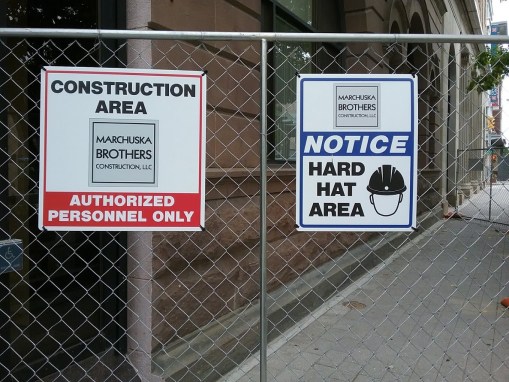
STREAM Collaborative is doing the design work, Tetra Tech did the structural engineering, New York’s Tessellate Studio is designing the new exhibit area and Iron Design developed the logo, website and marketing material. On the construction side, Marchuska Brothers Construction, LLC, of Endicott, has the the General Work Contract ($561,000); Johnson Controls, Inc., of Rochester, won the Mechanical Contract ($502,638); and Richardson Brothers Electrical Contractors, Inc., of Ithaca, earned the Electrical Contract ($135,550). Marchuska is a fairly recent addition to the Ithaca area, and just finished a gut renovation of a manufacturing facility into medical offices in Lansing village.

With Tompkins Financial now in its new HQ and out of Bank Alley, construction could proceed and the formal “groundbreaking” for renovation was last month, Tompkins Center for History and Culture is expected to open in early 2019. The website for TCHC can be found here.

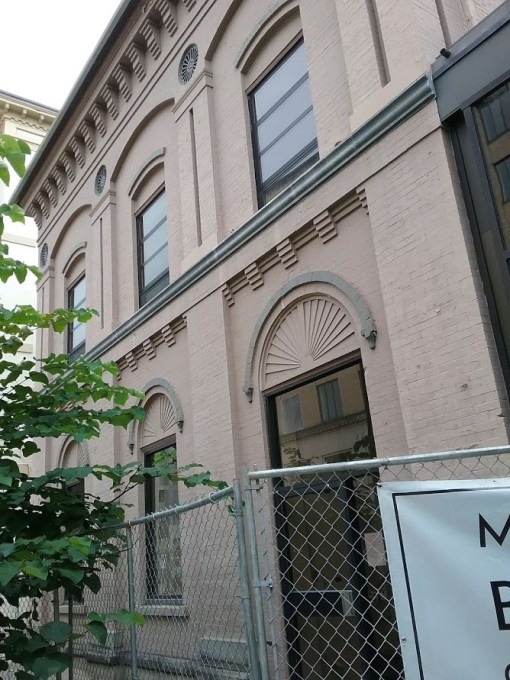
At this point, asbestos removal by LCP Group has been finished, and some of the windows have been removed in 112 North Tioga while non-load bearing interior walls are removed and the interior space is reconfigured for its new tenants. Exterior work will generally be limited to murals, lighting and signage.

Render:

July 7th:

July 27th:


238 Linden Avenue Construction Update, 7/2018

22 07 2018

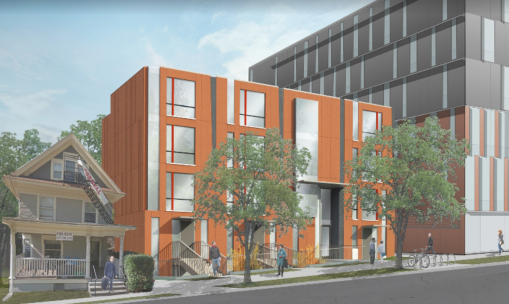
Might be jumping the gun a bit on this, but the fence encroachment into the street, pile driving equipment and steel/caisson tube liners on site are leading me to believe this one is in site prep.

Consider this project thr second half of a 2-for-1 package deal from developer John Novarr. Novarr and his business partner, Phil Proujansky, own a fairly large and widespread set of local properties, with the massive Collegetown Terrace project being the best known ($190 million investment, 1,250+ beds, 16 acres). Most of the rentals operate under Novarr-Mackesey Property Management. Their latest development was on behalf of Cornell, the 76,000 SF Breazzano Family Center for Business Education, which was dedicated last fall, an imposing six-story building at 209-215 College Avenue in Collegetown.

When Novarr first bought the properties that would be demolished to make way for the Breazzano, he bought a ramshackle six-bedroom house at 238 Linden Avenue for $1.35 million – this was in December 2010, before he had assembled his final, full group of properties (and realized Pat Kraft was flatly not interested in selling to him, later doing his own redevelopment at 205-07 Dryden), so the purchase of 238 Linden could be seen as a secondary purchase to give room for flexibility, and a place for construction staging in the notoriously tight spaces of inner Collegetown. In its last few years, Novarr did not rent out the house, which was in poor shape and torn down in June 2015. A redevelopment was always intended at some point, through it was only as the Breazzano plans were drafted did Novarr and Proujansky settle on a concept.

Inner Collegetown is a captive rental market – regardless of economic recessions, there will always be students willing to pay a premium to live near Cornell’s campus. The Breazzano project presented a unique opportunity – the project will serve up to 420 Executive Education students, who tend to be older, deep-pocketed, and infrequent visitors to campus, coming up for a few weeks of the year.

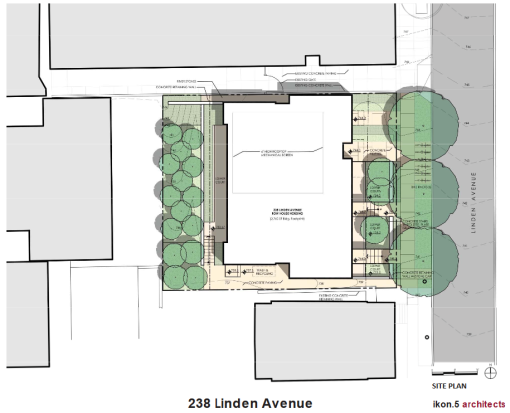
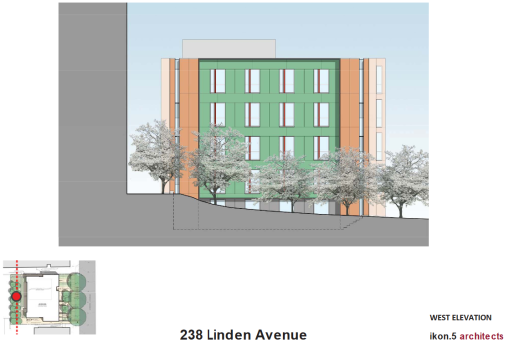
The new 238 Linden is designed to tap those Executive Education students who might come up more frequently, or prefer to have a second place to call home during their matriculation with the Johnson School. The project is a 13,715 square-foot building with 24 efficiency units (studios). It will be 4 stories with a habitable basement, just under 50% lot coverage, and is fully compatible with the site’s CR-4 zoning.  Each fully above-ground floor will host 5 efficiency units, with four in the partially-exposed basement. While intended for Johnson Executive Education students, it does not appear it would have provisions limiting the units to E-MBAs.

The design intent was to create a townhouse-like appearance, in form if not in function. The exterior includes fiber cement panels to complement the colors of the Breazzano, aluminum windows and a glass curtain wall with energy-efficient glazing. A number of green features are included in the project, such as LED lighting, low-water plumbing fixtures, and a sophisticated VRF high-efficency HVAC system, which uses air-source heat pumps.

Plantings, walkways, steps and retaining walls are planned, with decorative entry stair bridges and little landscaped courtyards to provide a pleasing aesthetic for the basement units. As with all inner Collegetown projects, no parking is required so long as a transportation demand management plan (TDMP) is filed and approved by city planning staff. During Site Plan Review, the project cost was estimated to be about $2 million.

The project had a pretty quick trip through the planning board – it was proposed in March, there were very few suggested aesthetic changes, and since everything conforms with the size and intent of zoning, the board was pretty comfortable with the proposal. However, while it was approved in July 2017, the project was unable to move forward because of a change in state fire codes that essentially made construction along Linden Avenue illegal for any building taller than 30 feet (and 238 Linden is 45 feet tall), because Linden is too narrow. The way around this was to petition the city Board of Public Works to treat the parking space on the street in front as a loading zone, creating a “wider” street since a fire crew would no longer have to worry about parked cars along the street frontage. This made it easier for the project to obtain a fire code variance from the state. Normally, BPW would reject this, but 238 Linden and Visum Development’s 210 Linden had already been approved when the code was changed, so they got a special, rare accommodation. Suffice it to say, any other Linden project would be difficult if not impossible under the revised state fire code.

As with all of his other projects, the architect is ikon.5 of Princeton, with local firm Trowbridge Wolf Michaels Landscape Architecture serving as the project team representatives, and T.G. Miller P.C. providing the civil engineering work. The modern design may not be to everyone’s taste, but Novarr likes the architecture firm’s work so much, he asked them to design an addition to his property in Cayuga Heights. Beauty is in the eye of the wallet-holder. No word on who the general contractor will be, but Novarr has often turned to Welliver for his construction work. The original buildout period was estimated at ten months, so a plausible occupancy for 238 Linden would be complete by Summer 2019.


107 South Albany Street Construction Update, 7/2018

18 07 2018

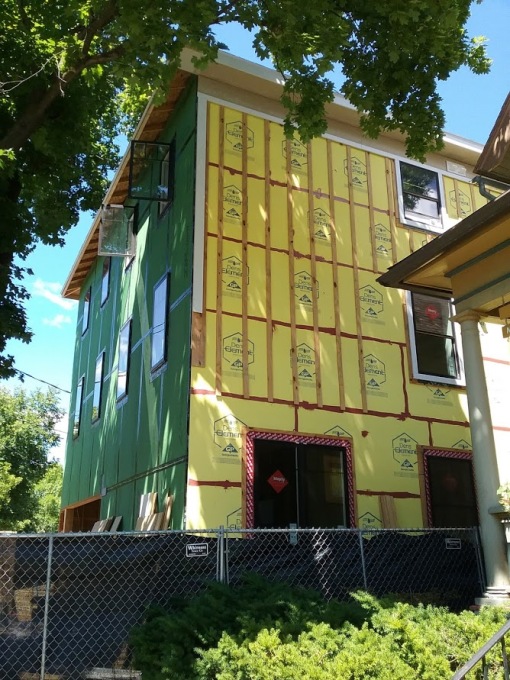
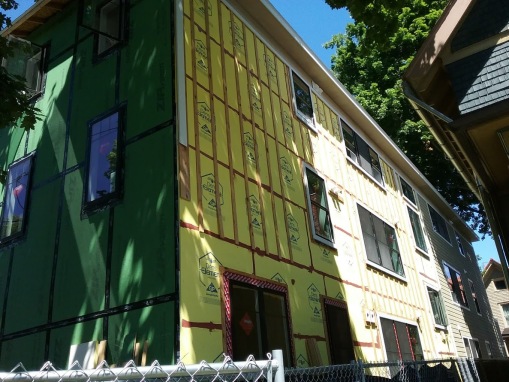
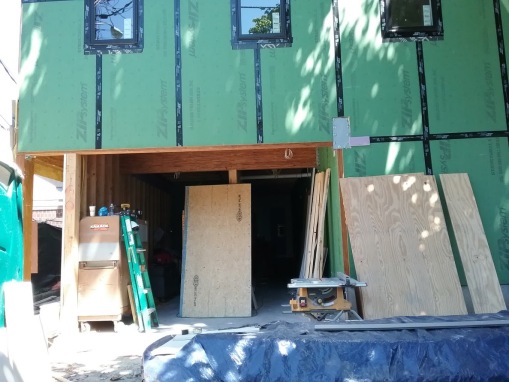
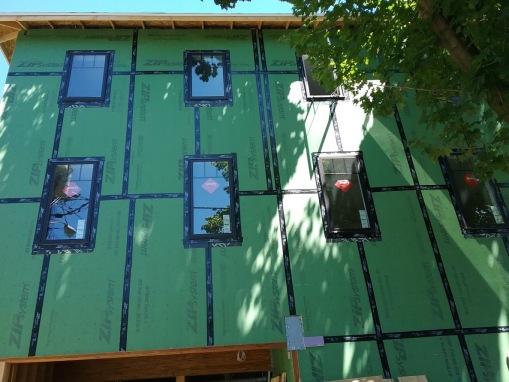
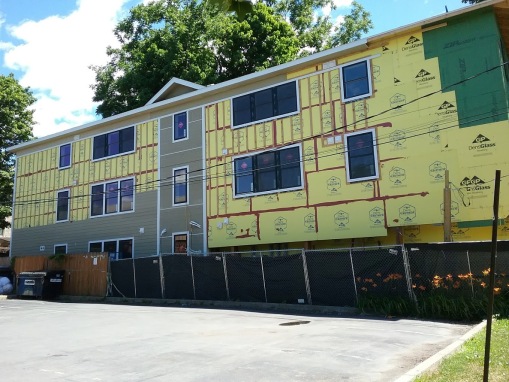
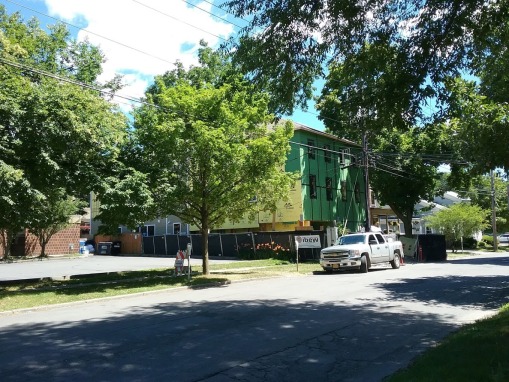
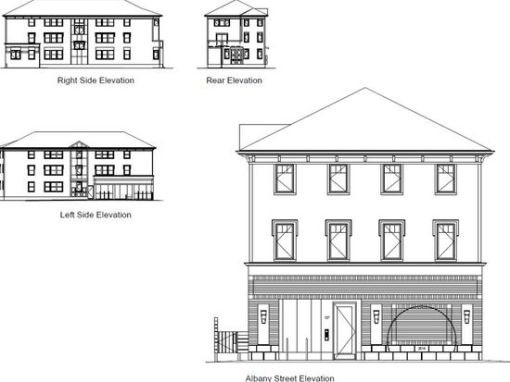
107 South Albany is a curious mix of sheathing. The front and part of the sides consists of standard Huber ZIP System plywood panels, while the sides use GP DensElement fiberglass mat sheets with maroon liquid flashing. Atop that, wood furring is being attached, and trimboards and fiber cement lap siding (or panels, for the wall next to the central staircase) are added to finish out the exterior. The front entry will have a brick veneer, but only on the first floor, so that doesn’t explain the difference in sheathing. The windows are fitted, but the front entry is not.

These apartments should be open for occupancy in time for the new academic semester. Advertisements say August 1st, but that might be a stretch. Still, these are coming in at a more modest cost than other new market additions ($1,100/month), and adds some density to the State Street Corridor.

Background information on the project and its specifications can be found here. Renting Ithaca (Nick Stavropoulos) is the developer, and Flatfield Designs (Daniel Hirtler) is the architect.


Harold’s Square Construction Update, 7/2018

17 07 2018

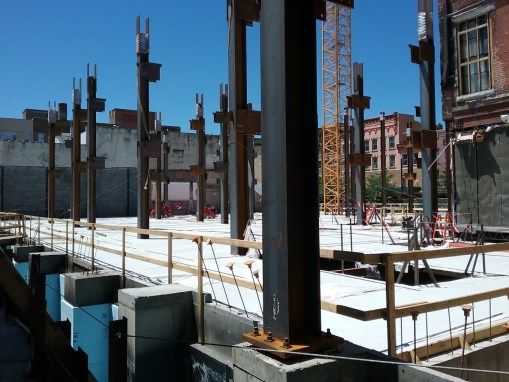
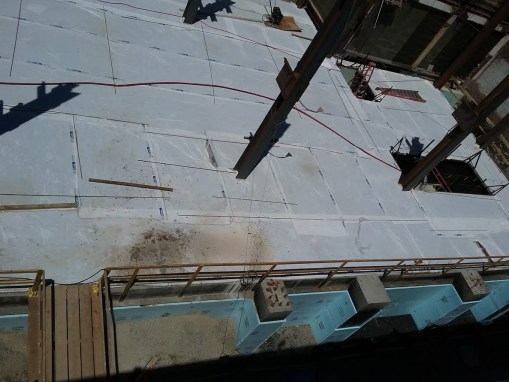
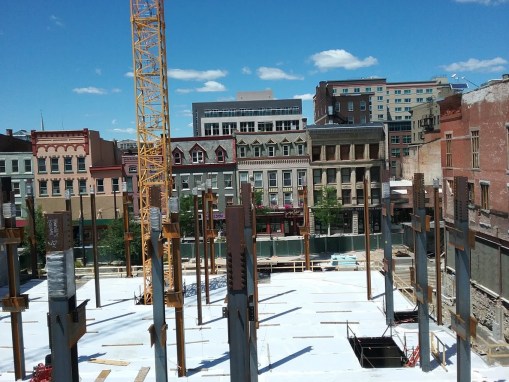
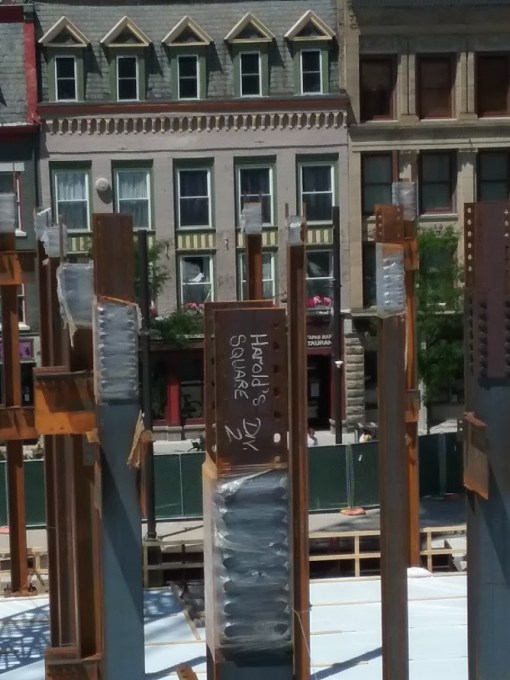
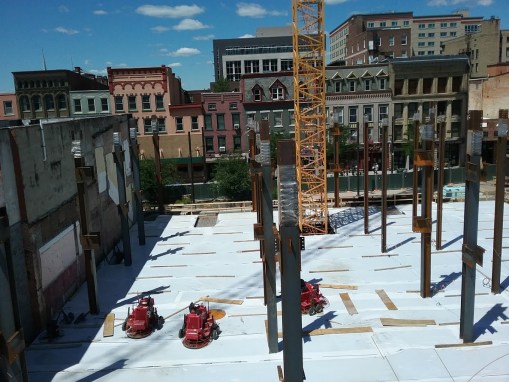
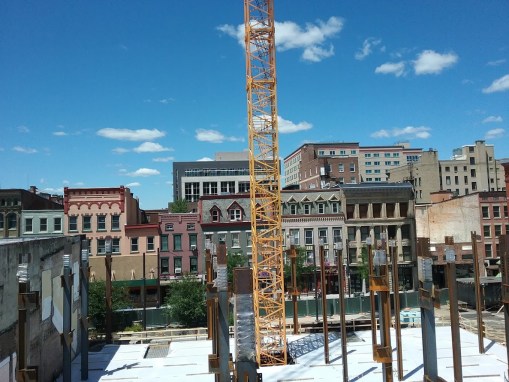
Harold’s Square is starting to take shape. The white sheets on top of the basement level are Sika Corporation UltraCure NCF curing blankets. When the steel was laid, corrugated decking was laid on top to create the base of the floor. A rebar wire mesh was then laid and tied into place, and the concrete was poured into the floor cavity, with wood forms to keep the pour in place. The rebar strengthens the concrete and ensures structural integrity. In this mid-June Facebook photo from the Harold’s Square page, you can see the decking going over the structural steel. A week and a half later, you can see the rebar grid over the completed decking. The concrete was poured in early July, the slab was covered in the cellulose fiber blankets to promote an even and structurally sound cure, and after seven days they tested the concrete and the results came back all-clear, meaning they can start to put weight on the concrete and work their way up.

Meanwhile, structural steel erection will be taking a short break as masonry work begins on the Commons-facing side of the project, followed by masonry work on the Sage Building. The steelwork will resume in late July. Subcontractor Paolangeli will be doing backfilling (earthwork to cover up the foundation) on the Green Street (south) side of the project now that the shell of the basement has been built.

The WordPress for the project can be found here, and the Ithacating project description here.


118 College Avenue Construction Update, 7/2018

16 07 2018

The last of Visum’s trio of Collegetown projects underway is the 5-unit, 28-bedroom building at 118 College Avenue. Officially, one other Visum project has city approvals and is permitted to start construction, a close fraternal twin to 118 College just a few houses up at 126 College Avenue. However, the existing house is rented out for the academic year, so any build-out there (and Visum seems to have deep enough pockets to eventually do it, all things considered) will not begin until June 2019 at the earliest.

As with 210 Linden, Romig General Contractors is in charge of the buildout, and Taitem Engineering is doing the structural engineering – as with Visum’s other projects designed by STREAM Collaborative, the building is built to be net-zero energy capable. Using electric heating and appliances, energy efficient fixtures, low-E windows, double-stud exterior walls and high grade insulation creates a very high degree of energy efficiency that they hope to tie into an off-site solar array, offsetting the carbon footprint of the building and its use.

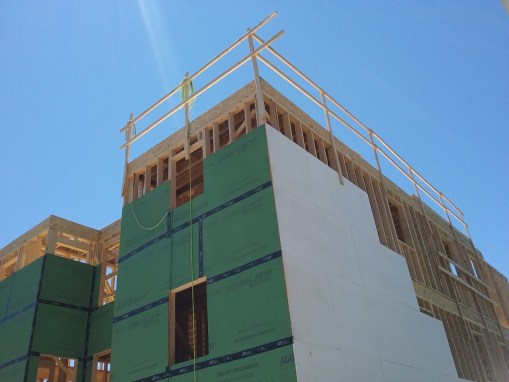
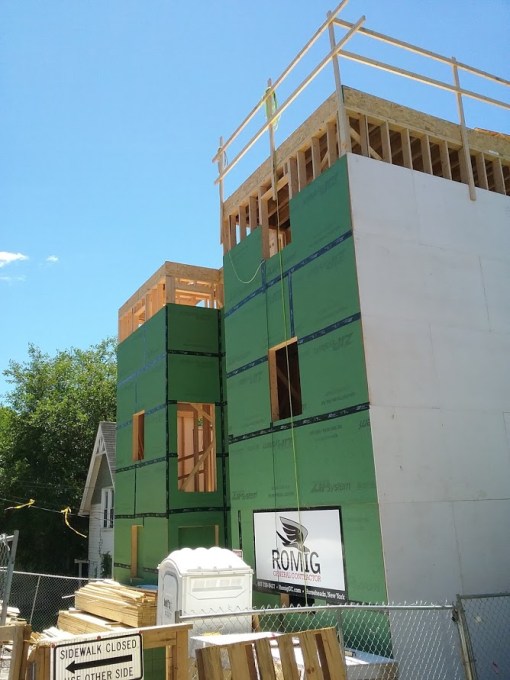
118 College still has another floor to go before it’s topped out, and the mechanicals will be hidden inside the historically-inspired “Italianate cupola” penthouse. Water and sewer service was installed this past week. I’m uncertain this one will be ready in time for returning Cornell students late next month, though it’s not impossible given that it’s a relatively small wood-frame structure. So far, with the rough window openings I’m seeing one substantial difference from the renders – the windows on the wings of the front facade are smaller than originally planned.


City Centre Construction Update, 7/2018

16 07 2018

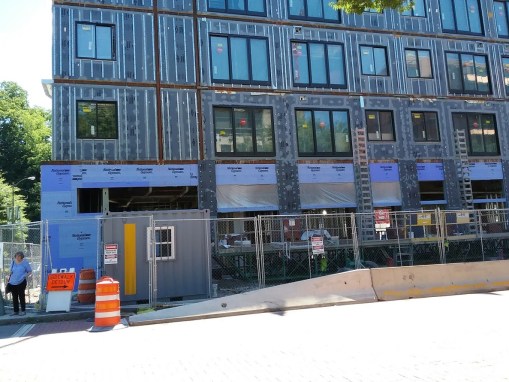
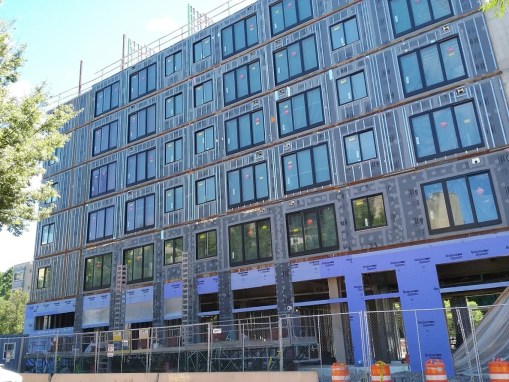
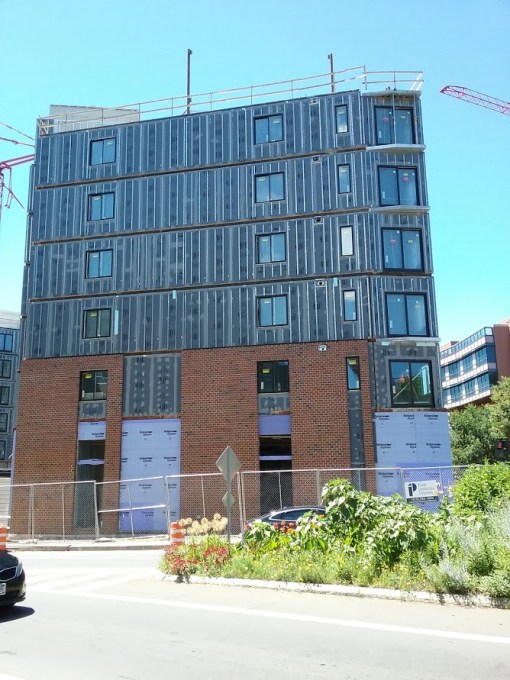
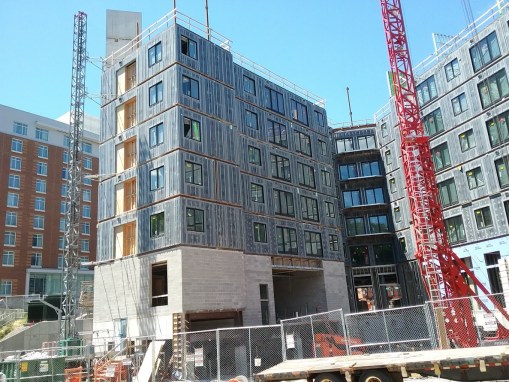
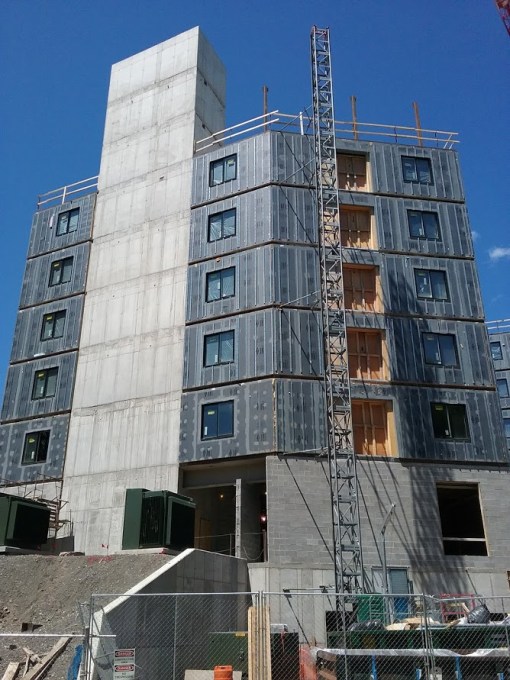
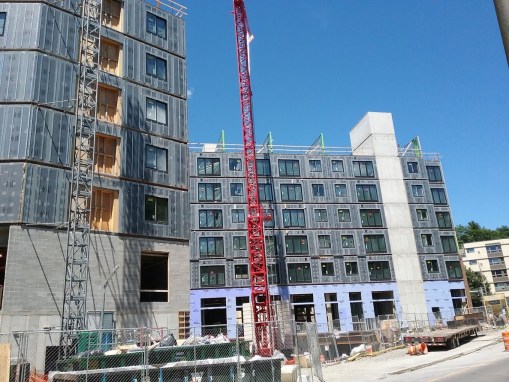
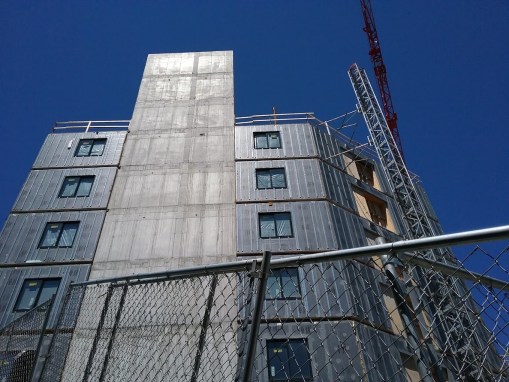
Not too much to add here regarding City Centre. The modular exterior panel system continues to rise. These photos were taken last weekend when the building was up to its sixth floor, and it’s not up to the seventh of its eight floors. For those needing a more regular fix, the webcam on the top of Seneca Way updates every fifteen minutes or so, and can be seen here. Looks like it missed me by three minutes.

Here’s an interesting little aside. A few folks have complained, in the way that many of us like to do, that the name “City Centre” is rather pretentious, particularly the faux-British English ‘Centre’. Newman Development Group has actually reused the name on another project they’re doing, in Lincoln Nebraska. That project is significantly larger than Ithaca’s, an $85 million downtown redevelopment of the former Lincoln Journal-Star newspaper office and printing press into a ten-story mixed-use with first-floor retail, two floors of offices, and 239 apartments on the upper floors. Like Ithaca’s project, it’s one of the largest urban projects in the city (rather impressive given Lincoln is ten times Ithaca’s size), and received a local tax abatement on the order of $15 million. Lincoln was selected by Newman specifically because its downtown area is close to a major university, in this case the University of Nebraska. Perhaps their Ithaca project is a new market pioneer for them – they see potential success in a mix of urban professionals and college students, and are looking for other opportunities in similar communities.

Looking at the apartment rental prices is enough to give most folks pause. Studios, which make up 33 of the 193 units, range from $1,795-$1,875/month. the 120 1-bedroom units go from $1,995-$3,015/month, and the 39 two-bedrooms range from $2,560-$3,415/month. With those prices, a prospective tenant could rent an entire house for themselves in Fall Creek or Northside; maybe it’s for the best that their attentions are drawn here instead. For the sake of comparison, City Centre Lincoln is $900-$1,200/month.

More information about Ithaca’s City Centre can be found here.


Hilton Canopy Hotel Construction Update, 7/2018

15 07 2018

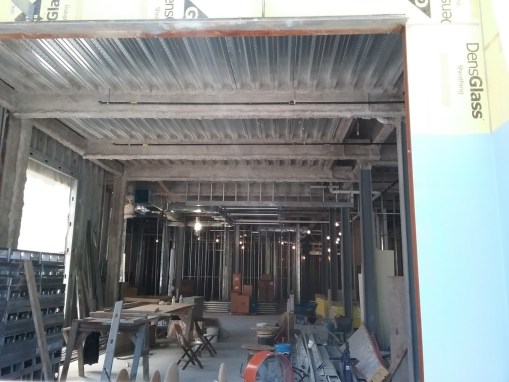
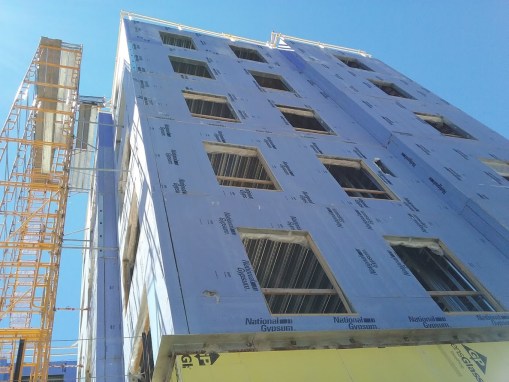
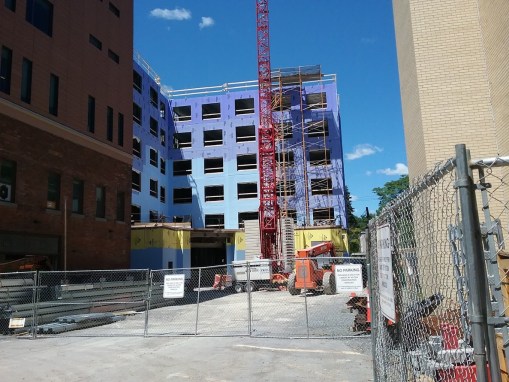
As previously mentioned on the Voice, the new 131-room Canopy by Hilton is one floor short of topping out. Interestingly, the ground level/lobby uses Georgia-Pacific DensGlass fiberglass mat sheathing, while the upper level use National Gypsum eXP boards. I’m not sure why the change – both are fire-rated, mold and water resistant. It probably doesn’t have to do with the exterior finishes (brick veneer is used at both ground level and on some of the wall projections above), but it’s possible it has to do with the construction material. The ground level is composed of poured concrete, while the upper floors are structural steel and accompanying steel stud walls. Regardless of the reason, both are being covered with the same water-resistive barrier. You can see the interior stud walls through the rough window openings, but interior work hasn’t progressed much farther than that on the more recently erected upper floors. The lower floors appear to be undergoing utility rough-ins.

It still isn’t clear what the replacement panel color will be for the yellowish “Applesauce Cake” – not sure if Whitham Planning and the rest of the project team persuaded the city “Dark Ash” grey was okay, or if another color was chosen. If someone knows, feel free to chime in the comments.

Further information on the Canopy hotel can be found here.