News Tidbits 7/30/16: The Unfortunate Surprise

30 07 2016

201_college_v5_1

201_college_site
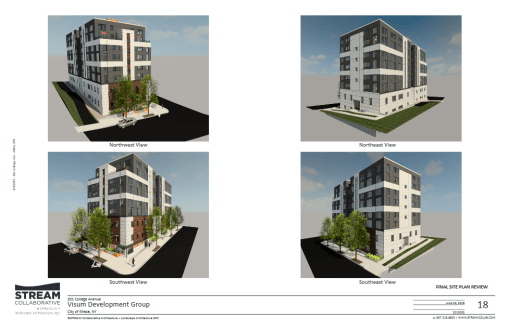
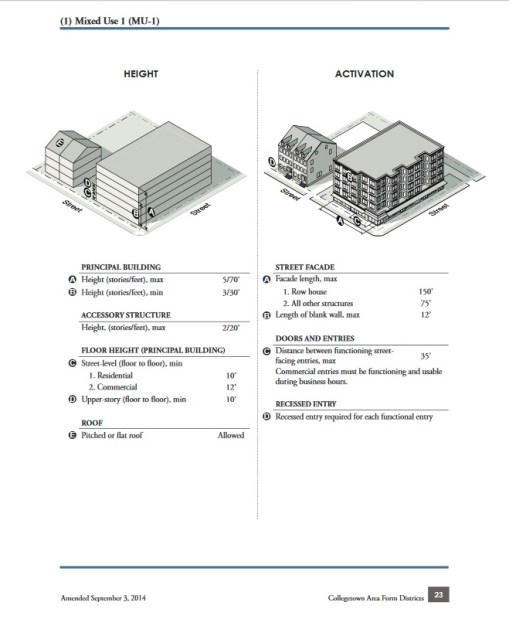
1. Pretty much everyone was caught off guard by the planning board’s decision to send 201 College Avenue to the Board of Zoning Appeals on a previously-undiscussed zoning technicality. The issue has to deal with facade height in connection to the length of a continuous wall – the argument being pushed by board member John Schroeder is that, since there are primary walls on College Avenue and Bool Street, the H-shaped proposal isn’t technically valid and the deep indentation actually has to be two separate buildings, one slightly shorter than the other since the site is on a slope. This was the subject of a prolonged and heated debate, since the code’s pretty ambiguous in that regard, and (as shown below) the design elements shown in the form district booklet demonstrate buildings with architectural indents/setbacks.

327_eddy_rev2_2

327_eddy_rev2_3

If recollection serves correctly, something similar came up in a previous discussion two years ago with 327 Eddy Street. The project fills the entirety of a sloped lot, but there was a hazy interpretation regarding one’s definition of floors and height where one could have called it 8 floors, so it had to be clarified and it became the average proposed height for cases with a sloped parcel. In this instance, there was one primary wall, on Eddy Street, which is why there’s just enough wiggle room left that a clarification request, however targeted it may be, is legally valid. The board agreed 4-3 to let the BZA issue a determination on 201 College, which could come anywhere from August 23rd to September 6th. That means a late September approval is maybe the best bet. That’s probably too late for an August 2017 opening, so whether or not the project would move forward (which could be immediately or in summer 2017 for a 2018 opening) if given approval is another question.
cafd_mu1

There is one other thing that is worrying from an impartiality standpoint. John Schroeder and Neil Golder served together as Collegetown’s Common Council reps in the 1990s. Although Schroeder’s not the biggest fan of Collegetown development, he hasn’t raised this much of a concern over other projects, and Neil has been very, very active in his outreach. There could be an argument that he should have recused himself from the decision-making process, or at least have formally acknowledged his longstanding professional relationship with the project’s primary opponent.

trebloc-future2-1-620x420

city_centre_site_options

2. Also from the Planning Board meeting, further discussion of the Trebloc project. Those following the IJ’s Nick Reynolds’ Twitter know that there was some talk about big changes with a lot of wonk talk, and this is what it has to do with. My thanks to my colleague Mike Smith for his notes.

Basically, Newman Development is floating a few different approaches to the site layout. One calls for a plaza area on State Street (the “accordion” approach”), one calls for green space (the “courtyard” approach), and the third actually breaks it up into two separate buildings. In these theoretical layouts, the square footage and number of units is kept roughly equal. All three also keep at least some emphasis on the corner facing the Commons, because that’s where the concentration of activity is, and that’s what’s going to appeal the most to first-floor retail/commercial tenants.

Each approach comes with pros and cons. The “accordion” approach opens up the sidewalk, but it opens away from the Commons (i.e. not appealing to pedestrians or retailers) and makes unit design tricky. The “courtyard” approach has public-ish green space, but it would be in unappealing, constant shadow – even if the building were just a few floors, the low angle of the sun in the cooler part of the year would keep light from reaching the courtyard. The two building approach offers an alley that could be interesting, but would likely not see much use since there’s very little activity towards that block of Green Street. Given the flaws in each, the inclination is to stay with the current “fish hook” shape, but the developers wanted to hear the planning board’s thought before committing to a layout.

Planning Board responses ran the gamut. A few members supported the State courtyard option, or stepping back the portion on State Street but building taller portions on Green if there’s a need to compensate (zoning’s 120 feet, so there’s perhaps two floors they could feasibly do that with, like an 11-story/9-story/7-story step down, without having to make a trip to the BZA and throwing additional, funding-jeopardizing uncertainty in there). One board member asked about a courtyard on the roof. The project will be pursuing tax abatements, with the hope that with those, density and smaller units, they can appeal to the middle of the rental market.
lansingapts600 lansingaptsmap600

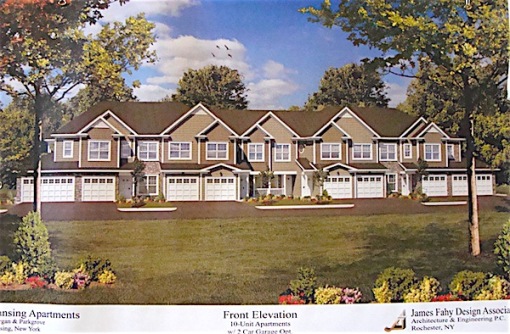
3. Thanks to Dan Veaner over at the Lansing Star, here’s a render and a site plan for the proposed Lansing Apartments / Parkgrove Apartments project for Bomax Drive in the village. The 19.46-acre property is currently owned by Cornell and is zoned to be part of its office/tech park. James Fahy Design Associates of Rochester is doing the design for the proposed 14-building, 140 unit project, and Park Grove LLC of Rochester is the developer, in tandem with retired Cornell Real Estate director and Lansing resident Tom Livigne.

According to the Star, “1,000 square foot one-bedroom apartments are anticipated to rent in the $1,300 to $1,400 range,  1,350 to 1,400 square foot two-bedroom apartments at around $1,600 to $1,700, and three-bedroom apartments up to 1,400 square feet would rent between $1,800 and $1,900.” The village of Lansing has to approve a zoning change from business to high-density residential in order for the project to move forward.

It’s a very auto-centric, premium-middle market project. For an area concerned about affordability and trying to move towards walkability and traditional neighborhoods, this really doesn’t seem like the most appropriate plan. It’s nothing against Livigne and Park Grove LLC, but I’m very critical of these kind of projects for just those reasons.
amabel_v4_1

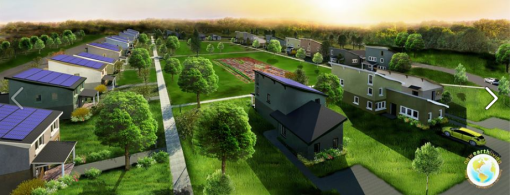
4. It’s been a while since it’s last been discussed, but the 31-unit Amabel Project by New Earth Living’s Sue Cosentini has been approved by the state attorney general to start marketing units. According to a December presentation, the net-zero homes will range from 1600-2100 SF and market in the $385,000-$425,000 range. While that is a rather high price range, some of that cost would be paid off via energy savings, which could be up to a few thousand dollars per year compared to comparably-sized and priced older homes on the market, and other possible savings exist with water recycling and low-maintenance exterior materials. So the sales pitch becomes something of acknowledging the high up-front costs, but explaining the long-term savings.


5. The first of two state funding grants to not this week. Cayuga Addiction Recovery Services (CARS) has received a $1 million grant for a new 25-bed adult residential facility. The new facility will be built on the Trumansburg campus, which if these notes are correct, is actually two facilities, and this new one will be built adjacent to a 60-bed facility on Mecklenburg Road, near the county line a couple miles to the southwest of Trumansburg. An undisclosed number of jobs are expected to be created.

Founded in a Cornell U. fraternity house in 1972, CARS provides treatment, counseling, skills training and support services to help clients overcome addictions and rebuild lives. The current facility was opened in 2004.

Image Courtesy of Lansing Star

Image Courtesy of Lansing Star

6. Also in state grants, Ithaca-Tompkins Regional Airport received $619,935 to build a flight academy building for the East Hill Flying Club. The new facility is expected to be built in the next 2 to 3 years. When the EHFC has moved in to their new digs, the existing hangar will be offered up to rent to other tenants. The new building will offer more instructional space, the ability to engage in training for twin-engine aircraft, and what the flying academy née club hopes will include state-of-the-art flying simulators.


Cayuga Meadows Construction Update, 7/2016

18 07 2016

Safe to say this is under construction. Work has commenced on Conifer LLC’s Cayuga Meadows affordable senior housing project on West Hill.

Cayuga Meadows is a 3-story, 58,500 SF apartment building with 68 units, 59 1-bedroom and 9 2-bedroom. The units will be available to individuals aged 55 and older, with incomes 60% or less or the Area Median Income (AMI). AMI in Tompkins County is about $53,000 per household, so a qualifying senior household would have an annual income of $31,800 or less. 7 units will be accessible to mobility-impaired individuals, and 3 units will be designed to accommodate hearing or visually-impaired occupants. Included in the plans are two covered patios, a community garden, and stormwater, lighting and landscaping improvements. 67 parking spaces will be paved behind the building.

The history of Cayuga Meadows goes back a few years, and has its share of twists. Originally, the project had been conceived as “Conifer West Hill” in 2009 as a component to a Cornell-led mixed-use development on about 36 acres of land across from Cayuga Medical Center. Rochester-based Conifer’s part in the plan has always been the same – affordable housing for seniors. But Cornell had other plans for the rest of the acreage.
In Spring 2010, there were three different site plans being floated – the consistent components were Conifer’s project, a 68-bed assisted living facility called “Terrace at Ithaca”, medical office space, small-scale retail, 106 park-and-ride spaces, and 4,000 SF for a farmer’s market. Depending on the plan, there were townhomes, a hotel school conference center, or other institutional space for Cornell. Mixed-use, definitely, but the plans weren’t that walkable, traditional neighborhood feel that the town is looking for these days – in fact, they were fairly conventional suburban sprawl. Cornell’s approach to planning was different in the late 2000s. By good fortune, Ithaca Builds locally hosted a copy of those site plans here.

For a combination of reasons (financial feasibility, changing priorities), Cornell ended up shelving its plans. However, it would be incorrect to say the university isn’t still interested in the site – they recently bought the house at 1250 Trumansburg Road, whose property had been awkwardly carved out of the rest of the site in a subdivision long ago. In the 2010 plans, Cornell had to plan around the house, not to mention worry about the occupants complaining about Cornell’s plans. So when it came on the market and sat for a couple months, the Big Red decided to pick it up in June for $157,000, probably on the belief that it could pay off through easier site planning and development down the line.

While Cornell filed away their plans, Conifer continued with theirs since the university was still willing to give them land as long as they built affordable housing. Originally, it was conceived as 72 units when it first received preliminary approval in April 2012, but was trimmed to 68 when final approval was granted in November 2013, in order to make the project a little less expensive, and provide a little more space to the community garden. Between preliminary and final approval, Conifer also had to apply for rezoning (Medium-Density Residential to Multiple Residence in May 2012), zoning variances (June 2012, for height and building setbacks), and public works approval for utilities services to be installed.

Then came another few years’ wait while financing was being secured. As covered on the Voice, affordable housing grants are very competitive, so it often takes multiple rounds of applications before a project is finally given grant money. In Conifer’s case, the last piece of the puzzle, tax-exempt bonds, didn’t come through until late January 2016. Cayuga Meadows is a $14.9 million project – about $8.3 million comes from NYS Housing Finance Agency bonds, and another $6.3 million from Community Development Block Grant (CDBG) funds. First Niagara Bank provided the Letter of Credit for the bonds. The project will pay taxes.

With the funding in hand, Cornell and Conifer formally agreed to a subdivision of Cornell’s land – 4.9 acres for the senior housing, and another acre for the Right-Of-Way for the new road. Cornell and Conifer had to agree on a few choices for new road names, which they submitted to Ithaca’s Codes Enforcement Director (Bruce Bates), who checks with the county to make sure there are no issues with the choices, and then the three parties agree on a final selection. Cayuga Meadows’ address will be “108 Aster Lane”.

There’s yet to be a color render hosted online, but the exterior will use fiber cement siding – Certainteed “Savannah Wicker” Dutch Lap Siding and “Cypress Spruce” cedar-like shingle siding. For the sake of examples, the Belle Sherman Cottages and Stone Quarry Apartments have also used Savannah Wicker fiber cement. The roof will be Timberline “Weathered Wood” shingles.

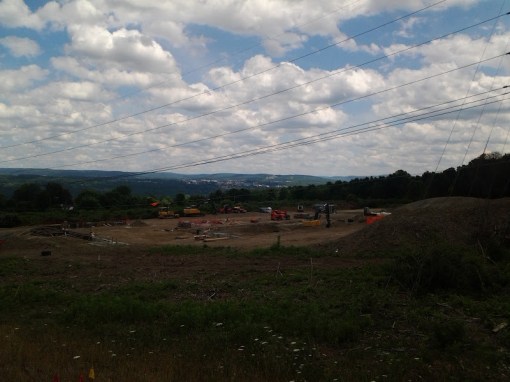
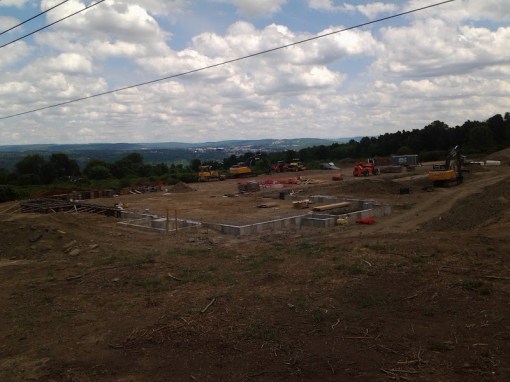
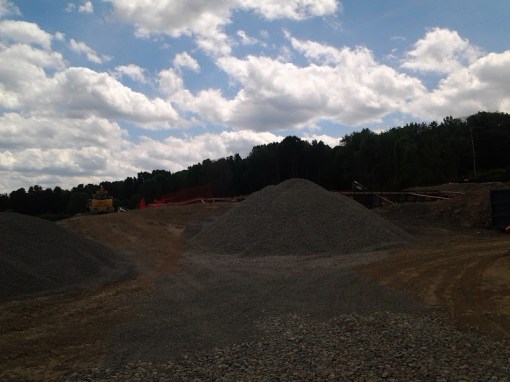
At the project site right now, work is underway on the foundation. The building’s footprint has been cleared, the foundation is excavated, and footers are poured for where the concrete will transfer the weight into the ground. Wooden forms are built along the perimeter for the stem walls, rebar is laid for reinforcement of the concrete, and the concrete is poured and left to harden (cured). Once the concrete has had a chance to harden, the forms are lifted off and work moves onto the next section. The building will be a slab-on-grade foundation, so no worries about excavating a basement here.

As a side note, it seems fitting that the residents with east-facing windows will have some pretty fantastic views of Cornell.

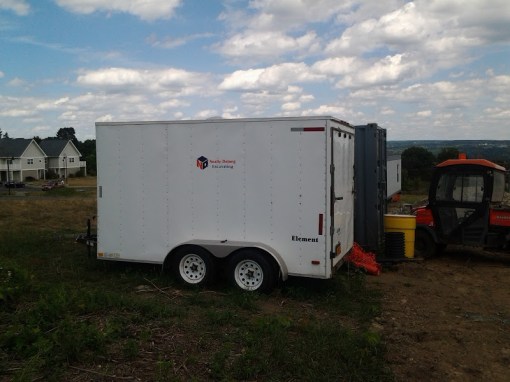
Through a joint venture with Conifer, LeChase Construction of Rochester will be serving as general contractor. The excavating has been subcontracted out to Neally-DeJong Excavating of Corning, and concrete work to Architectural Concrete Plus of Dundee (Yates County, northwest of Watkins Glen). Thanks to “Drill Deep” for the clarification.

20160717_140406 20160717_140444 20160717_140449 20160717_140528 20160717_140557 20160717_140612 20160717_140804 20160717_140815 20160717_140828

Cayuga-Meadows-Shot

Cayuga-Meadows-2


News Tidbits 7/16/16: Summer Storms of a Different Kind

16 07 2016

inhs_pride_design_v5_3
1. It looks like the first round of funding has been filed for INHS’s 210 Hancock project. The $7,790,511 construction loan was filed with the count on July 11th, with the lender of record listed as “CPC Funding SPE I LLC”. CPC is the Community Preservation Corporation, a non-profit lending institution funded by 69 different lenders in a revolving loan fund in New York, New Jersey, and Connecticut. This includes big banks like Citi and wells Fargo, and smaller regional banks like Chemung Canal Trust. Since affordable housing isn’t intended to be a moneymaker, it’s difficult to get lenders to cover the construction costs of a project. CPC serves as a middleman, allowing multiple private lenders to engage in modest amounts of financing for affordable, multi-family housing.

The 54 apartments and 5 townhouses partially funded by this loan are expected to be ready for occupancy next summer.

old_libe_thp_holt_v6

old_library_thp_v4

2. Things aren’t going well with the Old Library redevelopment. In Tuesday’s joint meeting between the ILPC and the Planning Board, some felt the current design of Travis Hyde’s DeWitt House proposal was too dull, some felt the previous design was best, and some fell in between. But, it seems like none of the three approaches has enough support to get a Certificate of Appropriateness, with a few of the members feeling that no design will work for the site because they feel they’re all too big. Frost Travis replied that the project can’t afford a major size reduction and still be feasible. Now the county’s getting involved since they selected the Travis Hyde proposal, and things are getting quite contentious.

Doing a quick check, for at least the previous iteration, the Travis Hyde proposal was about 85,600 SF, and the Franklin/STREAM condo proposal was 5 floors and 58,000 SF. Would residents have pushed Franklin/STREAM to reduce floors and potentially make the condo project infeasible? Who knows. If folks start clamoring for three floors or less, that will likely eliminate any proposals due to the cost of rehabilitation and reconstruction, and the county will have no viable options for a building in need of expensive repairs just to be usable. We’ll see what happens next month.

3. Namgyal Monastery has officially sold its city property. The house they owned at 412 North Aurora Street sold for $275,000 on the 13th, which is the same price it’s assessed at. Namgyal has purchased for the property for $150,000 in November 1992. A 2006 assets assessment placed the value of the Aurora Street house at $300,000, which might have been a bit generous.

On the one hand, the sale nets the monastery funds to continue construction of the new 13,000 SF facility on South Hill, which was recently selected to be a site of the Library of the Dalai Lamas. On the other hand, their webpage states they intended on keeping the Aurora Street house.

147962

4. The Ithaca Times’ Jaime Cone, new wind turbine laws in Newfield may effectively prohibit their construction. The town of Newfield decided to expand the radius of legally required unoccupied space from 1.5x the height of the turbine, to three times the radius of the propellers. In the case of the turbine that Black Oak Wind Farm (BOWF) was looking to put there, that raised the necessary easement support area from within 750 feet of the base, to 1,760 feet. Also, instead of 750 feet away from occupied structures, it’s 1,760 feet from any property line – in case anyone wanted to build on vacant land. Quoting Marguerite Wells, the beleaguered project manager of BOWF, “It makes it unbuildable…It’s a common way to outlaw wind farms in a town, to make the setback impossible.”

Apparently, things are so bad now, the town of Newfield voted to block a BOWF driveway that routed through Newfield to get to one of their Enfield sites. Given that a Tompkins County town is actively preventing and being malignant towards alternative clean energy sources and providers, it’s surprising there hasn’t been grater push-back from the sustainability proponents.

Overall, it’s been a rough month or so for green energy producers in Tompkins County – Ulysses is furious at Renovus and their solar panel installations, and Lansing’s planning board wants to vote in a moratorium on commercial solar panels.

amici house 1 county

5. The county’s PEDEEQ (Planning et al.) Committee is voting next week to take $2,500 from the county’s contingency fund to host a housing summit this fall. Another $2,500 will come from the Planning Department. The purpose of the $55,000 summit is to take all the updated plans and housing needs assessments (the county’s, which is the big one, is due out next week) and figure out way to incorporate them into an updated county housing strategy. $45k comes from a Park Foundation grant. From the tone of the summit description, it doesn’t sound like the county’s affordable housing issues have improved since 2006, but we’ll see just how severe the housing issue has become when the study comes out later this month.

On a separate note, the county is looking to award the 23-bed Amici House project $225,000 in affordable housing grants, plus a loan forgiveness of $75,000 in pre-development costs.

marriott_rev1_1

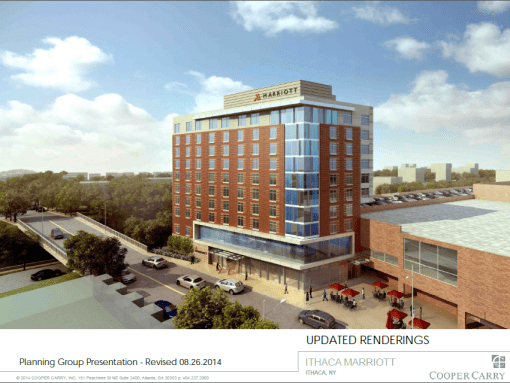
6. To round out this week of mostly unpleasant news, Mark Anbinder at 14850.com is reporting that the Marriott’s opening will be delayed from August 23rd to a likely opening in October, according to the director of sales. However, as extra padding in case of further delays, it appears won’t be taking further reservations for dates before mid-November. Unfortunately, this is well past Ithaca’s big tourist season, so it’s a safe bet to say neither Marriott nor the folks who had August and September reservations are pleased.


205 Dryden (Dryden South) Construction Update, 7/2016

11 07 2016

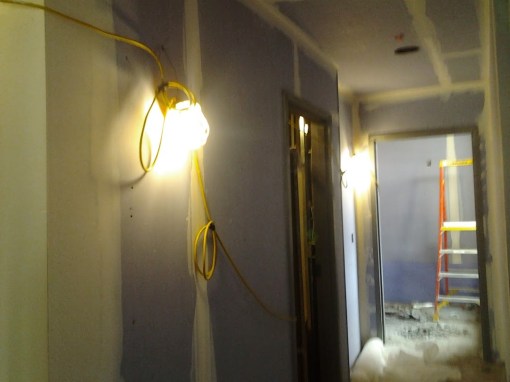
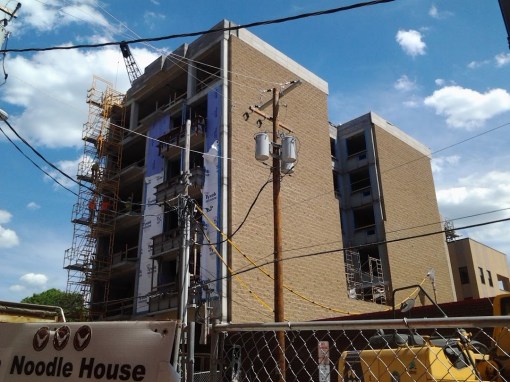
There were a lot more photos that did not make it into today’s Ithaca Voice piece. Developer and former Kraftee’s proprietor Patrick Kraft was kind enough to give a tour of the building as it goes through the furious final stretch of construction. On the outside, the decorative crown has been built out, and the housewrap and gypsum board will eventually be face with tan brick. On the inside, the lower the floor one is on, the further along the work is; a few brief descriptions are interspersed in the photos below.

Also, here’s some material from the interview with Kraft that didn’t make the final cut for the article. Definitely worth a read though.

Q: Are you concerned or excited about the Breazzano Center?

PK: Construction-wise, their impact is limited, they do their thing, we do ours. These [contractor] guys work together all the time. It hasn’t been much of a problem, our working relationship is pretty good. And Jagat [Sharma], he’s done a tremendous job, he’s a good guy. Jagat suggested doing a concrete building, and it turned out really well for us. These units are being furnished by Sam Peter, they met with Jagat, everything will match and be coordinated, even the lobby. Rich woods, the color scheme, stainless steel appliances, Most of the landlords around here are good guys, if I have a question they make time.

Q: During the 201 College debate, we saw a number of older residents express concerns about too much density in Collegetown, and too many students. Are the recent developments good or bad? What would you say to assuage the concerns of residents in Belle Sherman?

PK: I think there are a lot of positives to density, it centralizes the college students, and if you can do that, you get them out of the periphery, and higher density in the core could help get students out of Outer Collegetown and return homes to families and non-students. I have a friend who works at the Johnson, who lives just a block from Eddy Street. incoming faculty want walkability. People would have been incredulous ten years ago, but you know, people want to leave their car at home sometimes. I think that’s a good thing.
Q: With this new apartment building, have there been any issues or challenges? Or has everything been fairly smooth sailing?

PK: We’ve had our hiccups. The city does its inspections and has its variances, it’s not like we’re building a McDonald’s where every store looks alike. We haven’t had any major problems, just scheduling can be a major problem at times. I had to pay NYSEG to move the power lines, that was a 10-week delay.

20160630_125821 20160630_135113

According to Kraft, it was Jagat Sharma who insisted on reinforced concrete construction. This allowed the construction team to be flexible; handy for the structural tweaks (additional reinforcing) here in the light well, below the rough window openings. Kraft had nothing but praise for Sharma, even going as far as to say he gets an unfair rep because many of his buildings use CMU block in their exterior finish.

20160630_132859

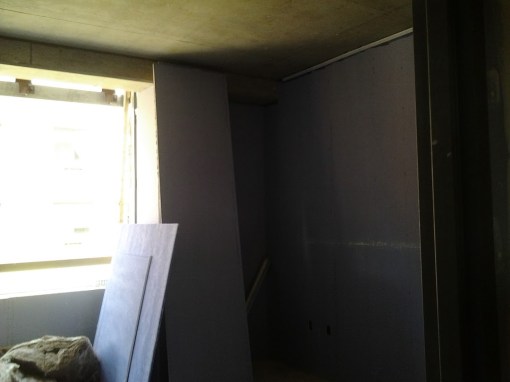
Most of the sheetrock has been hung in the second floor units. Kraft also had a lot of compliments for LeChase, the general contractor. He noted occasional problems like a bad concrete pour (which LeChase redid at their own expense), but otherwise they’ve been doing good work and have adhered to the schedule quite well.

20160630_132824 20160630_132812 20160630_125850

Originally, there were small light shafts in the east face, but those were removed when the Breazzano Center was being finalized next door. The two buildings will stand just two inches apart.20160630_142231 20160630_142218

20160630_142206 20160630_142203 20160630_142145 20160630_143001 20160630_142619 20160630_142359 20160630_142304 20160630_142256 20160630_143423

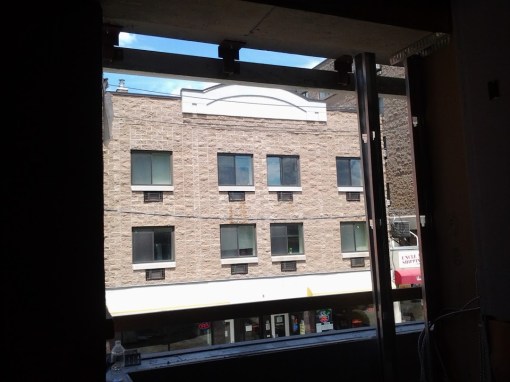
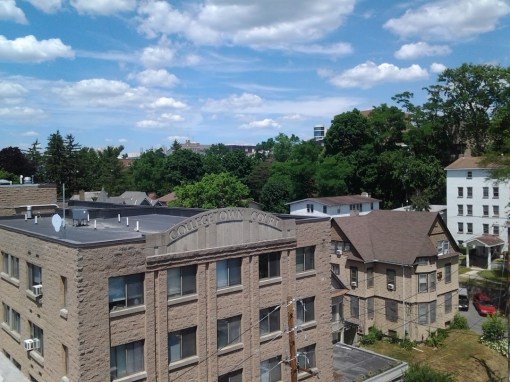
Sixth floor, rear unit view – Kraft said it was favorite view.

20160630_143402

Doing work in the elevator shaft

20160630_143316

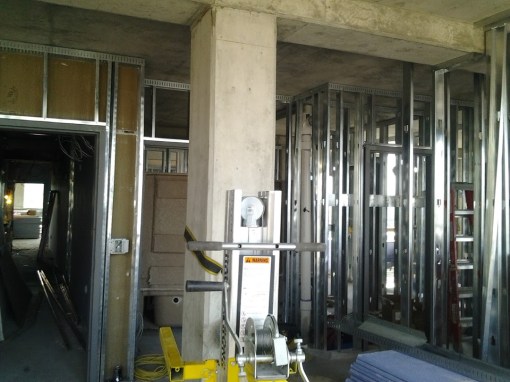
Steel interior stud walls on the sixth floor20160630_143310 20160630_143016

20160630_143946 20160630_143950

Framed closet spaces on the fourth floor20160630_144615

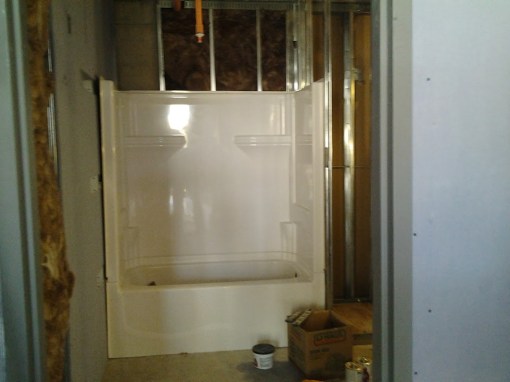
A tub fitting on the third floor

20160630_144929 20160630_145210

The brickwork on the backside is a little further along than the front, but the general appearances will be the same.

20160630_145213 20160630_145250 20160630_145359

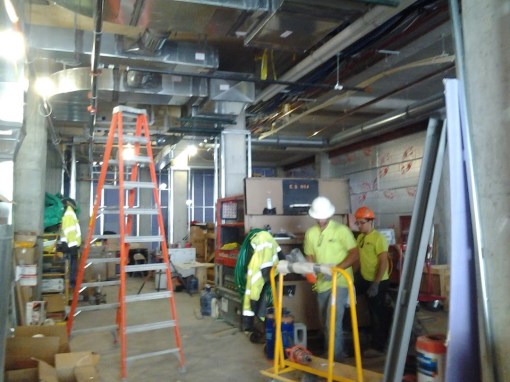
Members of the construction crew in the first-floor commercial space.20160630_145512

The basement area, which will have a trash/recycling room, a tenant gym and storage.20160630_151521


News Tidbits 7/9/16: Land Ho

9 07 2016

waterfront_foreclosure_parcels_0516

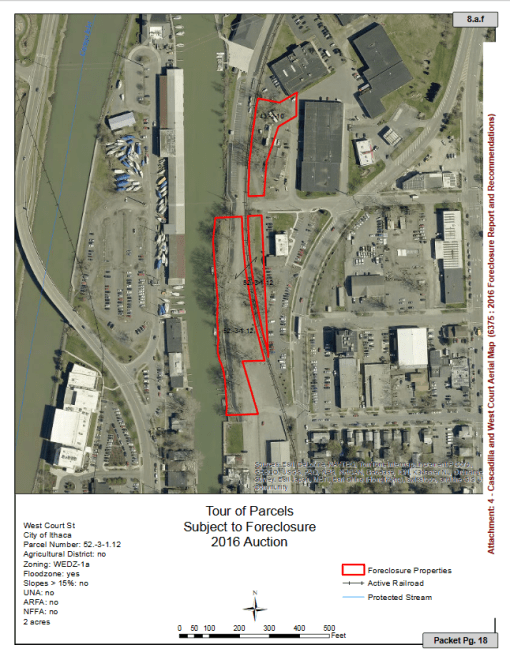
1. Starting off this week, a couple of new pieces regarding Ithaca’s waterfront. First, the city’s chances of picking up some prime waterfront real estate at a low, low price are gone, though not any fault of their own. Readers might recall that back in late May, the properties were about to be foreclosed on for unpaid taxes, and the county was discussing selling the parcels, worth over $630,000, to the city if the city paid off the $42,844 tax bill. Pretty sweet deal for the city, right?

But the owner, an LLC that has held the parcels since the late 1990s, managed to pay off the tax bill and an attached penalty fee, which means they get to keep the land. So, if the city had any plans for those parcels, they’ll be filing those away for a long while.

2. However, it looks like several properties are being put up for the sale in the city’s West End near the Waterfront. Local realtor Brent Katzmann has four properties listed – 321 N Fulton, a duplex on 0.11 acres for $144,800; 319 N Fulton, a single family on 0.04 acres for $109,875; 626 W Buffalo, a single family on a narrow and deep 0.15 acre lot, for $124,999; and 622 W Buffalo, a duplex on a narrow and deep 0.19 acre lot, for $134,800. The prices generally run at or up to 10% over the tax-assessed value ($130,000/$100,000/$125,000/$125,000). The currently owner is a Long Island-based LLC, led by a pair of New York City real estate lawyers, who acquired the properties from 2010-2012. Prior to them, many of the properties have been through a merry-go-round of owners over the past 10-15 years.

The properties are in fair to rough shape, and the marketing tactic being used isn’t renovation, but rather development potential. The four properties all fall within WEDZ-1a zoning, which is the city’s attempt at encouraging development on the West End. WEDZ-1a permits residential, commercial and mixed-use 2-5 story buildings, 90% lot coverage (100% if less than 50 feet on two sides – the Buffalo parcels and 319 N Fulton), and no parking requirement. The properties are not affected by the city’s TM-PUD.

The West Buffalo lots could be tough since the house in-between is owned by someone else, but deep lots and the corner of North Fulton and West Court offer some potential. Worth keeping an eye on, if only to see who they sell to.

20141227_140754

3. One less homebuilder around. Avalon Homes is closing up shop. The Ithaca-based company is selling off its lots and trying to wrap up the homes they have underway. Rumors abound as to why, but if firm, verifiable information can be obtained, there will be more to follow.

Avalon made its name doing stick-built built, with a focus on affordability and green construction. Avalon, a certified Living Wage employer, was the general contractor for INHS’s Holly Creek townhomes (shown above), and employed at least a dozen back in 2010.

old_library_thp_v4

old_libe_thp_holt_v6

4. The Planning Board and the Ithaca Landmarks Preservation Commission will be conducting another joint meeting on Tuesday the 12th at 5:30 regarding the Travis Hyde Properties’ proposal for the Old Library. HOLT Architects responded to comments from the ILPC at its last meeting that the design needed to be “quiet” by submitting the revised elevations seen below.

Mission accomplished? Armchair architect comment here, but the revised design is too far the other way. There’s a joke about the color beige, coincidentally similar to the new brick, being an adjective for “dull, boring, indistinctive“. I like the previous design with its wood-like fiber cement and characterful roofline, and I wonder if perhaps a revised color palette of that design, with maybe a few less full-sized balconies, would be a happy medium.

5. As announced on city of Ithaca Mayor Svante Myrick’s Facebook page, the Namgyal Monastery Institute of Buddhist Studies will be the site of a library and museum of the Dalai Lamas, the first of its kind outside of Tibet. The facility would be located on the 28 acres Namgyal owns on South Hill at its Du Khor Choe Ling monastery complex. Architectural plans and costs are still being determined, but a quote from Ngawang Dhondup, administrator for Namgyal’s facility, says that it will be larger than Namgyal, which has been underway since 2007 and will be about 14,500 SF when completed.

All in all it’s a great feather in Ithaca’s cap, but two things to be a bit wary of moving forward are the reactions and possible opposition from neighbors to what will be a very high profile religious facility, and given geopolitical issues, the reception to the Library of the Dalai Lamas may not be so warm from some denizens of cosmopolitan Ithaca.

12-29-2011 003

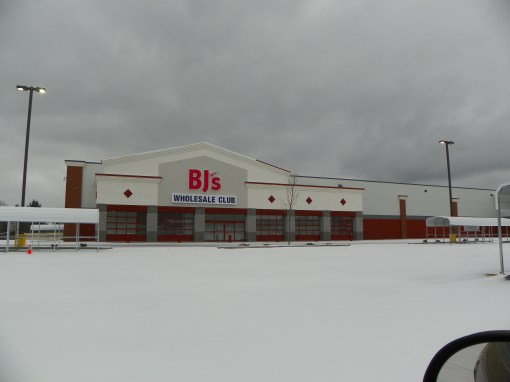
6. Way back in 2010 and early 2011, when the BJ’s Wholesale club was proposed in Lansing, one of the components of the proposal was to build 12 units of senior housing on land north of the then-proposed store. The project also called for wetlands, walking trails and a bird sanctuary on the undeveloped portion of the 11-acre property. Developer Eric Goetzmann (Arrowhead Ventures/Triax Group) faced considerable opposition to the plan since it involved big box retail and was housing outside of the density corridor, but after the IDA initially voted the project down in December 2010, a revised application calling for a smaller PILOT was passed by the IDA in April 2011 (some of the logic being that the county was in a financial bind during the recession, and some increase in taxable property was better than none).

Well, the BJ’s was built and opened the following year, but the wetlands and housing have had a much longer slog. The U.S. Army Corps of Engineers in in charge of new wetland permits, and the process is a complex, arduous one (man-made wetlands are difficult to build, and the Army Corps would rather they be done right than done fast). Goetzmann teamed up with The Upper Susquehanna Coalition and The Wetland Trust to design the “Inland Salt Marsh Bank”, which was just approved by the Army Corps, and the final permits expected shortly. With the wetlands taken care of, Arrowhead can begin to look towards the housing component, which they plan to put forward later this year for a 2017 construction date. As part of these plans, they want a one-year extension on the legal construction start for the housing from the IDA. Given that Arrowhead has met the other criteria and can demonstrate proof of progress on the wetlands, this probably won’t face much opposition. But eventually, it looks as if the village of Lansing will finally get those 12 units of senior housing.

biggs_1

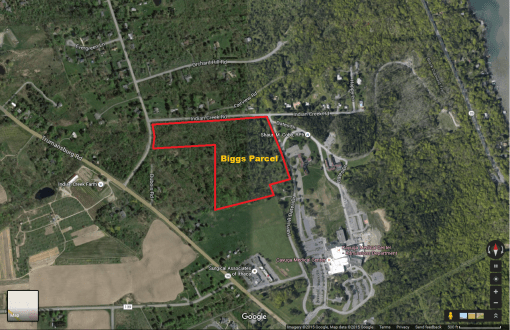
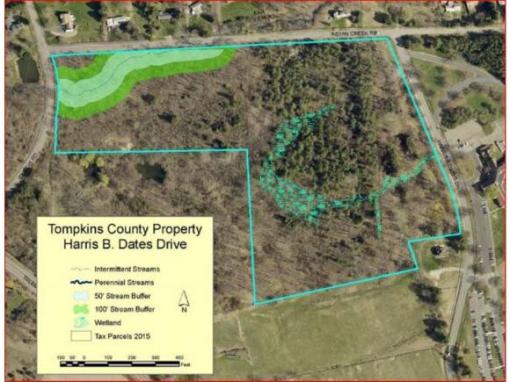
7 It looks like the Biggs Parcel is officially listed for sale. Local realtor CJ DelVecchio was selected by the county to manage the listing for the 25.52 acres near Cayuga Medical Center. The asking price is $275,000. The land comes with a conservation easement on the northwest side due to its proximity to a stream, and the wetlands near the center would be tricky to work with, because wetlands typically can’t be developed unless new wetlands are created, which is not cheap or easy to do.

c507

Readers might remember that this parcel has quite a history behind it. Declared surplus land by Tompkins County, the county had set up a tentative deal for a 58-unit affordable housing complex on the property, but the deal fell through after the wetlands were discovered to cover more area than previously thought.

Neighbors, via the Indian Creek Neighborhood Association (ICNA), have tried to force the county to hold onto the land to keep it from being developed. One of the big sticking points had been whether or not the 25.5 acres would be taxable – the county isn’t especially concerned at this point if the land gets developed or not, but they have made it clear that they want to sell it to a private owner that will pay taxes. The problem is, proposals to preserve the land often dovetailed with plans to donate it to an organization like Finger Lakes Land Trust, which would render the property tax-exempt. The ICNA did end up making a closed bid for the property, but the offer was rejected.

A neighbor to the south did propose reconfiguring the property to preserve the woods and build cottages on his back lot – by adding the Biggs land, he could have built more units under the regulations of the cluster zoning. But the plan fell through due to “size and complexity”, according to the ICNA’s Linda Grace-Kobas.

The land had been valued at $340,000 before the discovery of the additional wetlands, and the revised 2016 assessment brings that down to $240,000.


News Tidbits 7/2/16: Not the (City Centre) of Attention

2 07 2016

201_college_v5_1
1. Let’s start this off with the big news of the week – the proposal for 201 College Avenue was approved by the Planning Board. The debate was spirited, to put it most politely; catty, to use the official write-up in the Voice; and in the follow-up phone call I had with my editor, who attended the meeting with a Voice summer intern, she described it by saying “both sides were pretty awful”. I am sympathetic to Neil’s predicament, although I think it’s also a fairly unique case; I hope some sort of arrangement with the solar panels is worked out.

The observations regarding age and view of the project is actually pretty similar to a conversation the Journal’s Nick Reynolds and I had on Twitter about the City Centre project – older Ithacans often have starkly different views on density and urban development than younger residents, who tend to be more pro-density and pro-urban infill/growth. The young aren’t naive and more so than the old are obsolete; but they are products of different times. Today’s older Ithacans are the same ones who were frowned upon by the old Ithacans of their youth (the Silent Generation and the Greatest Generation), who were much more politically conservative and made up the large majority of the city’s Republicans from when Ithaca was once a contested city, and the Boomers were moving in and tilting it leftward. A sociologist could probably make a good research paper studying Ithaca’s generational views of urban environments.

Anyway, construction on this project is supposed to start in short order; funding has already been secured, and Binghamton-based W. H. Lane Inc. will be the general contractor for the $6 million project.

trebloc-future
2. Meanwhile, City Centre’s sketch plan was also reviewed at the Planning Board meeting. The initial reaction seems muted, gauging from Nick Reynolds’ Twitter and the lack of comment from my Voice colleagues.

city_centre_1

city_centre_2


According to the sketch plan submission, the vast majority of units (240 of the 255) will be studios (120) ranging from 457-563 SF, and one-bedrooms (120) ranging from 580-754 SF. The other 15 will be two-bedroom units, eight 914 SF units and seven 1,370 SF units. All units are market-rate, with target demographics including young professionals and downsizing empty nesters. Students are allowed, though the units won’t be marketed to them. Ground floor retail will be 10,700 SF at the corner of State and Aurora. 7,220 SF fronting State Street will be “Leasing/Club Space” for building and tenant functions. The 71-space parking garage will be accessed via East Green Street, car share membership will be included in the rent, and there will be indoor bike racks.

With the mild initial reaction noted, we’ll see how the project details shape up as the summer progresses, and the board potentially launches formal project review (Declaration of Lead Agency) as soon as late July.


3. Hitting the market this week is a potential opportunity for the deep-pocketed investor/developer. The property is 2248 North Triphammer Road in the village of Lansing. The sale consists of two parcels totaling 3.42 acres – a 1.53 acre parcel with a 2,728 SF M&T Bank branch built in 1992 and holding a long-term triple-net (NNN) lease; the other, an undeveloped 1.89 acre parcel to the rear that the listing notes could be developed out into 13 housing units. The price for the pair is $2,125,000.

A triple-net lease means the tenant pays everything – insurance, maintenance and real estate taxes (formally, net insurance, net maitenance and net real estate taxes on the leased asset – the three nets).  Because of this, the rent is substantially lower than it otherwise might be. There are certain cases where a landowner might want to do triple-net – like when they’re a tax-exempt entity leasing out to a for-profit company. A quick check of the records shows the properties are owned by Cornell, and were acquired in 1953 and 1960. What the property has been to Cornell is a fairly safe investment (though with a lot of fine print to determine who pays for things like if a tornado hits or the foundation cracks), generating a modest amount of rent and functioning like an inflation-protected bond, but guaranteed by the lessee rather than the government. All the better when the tenant is stable and signed on for the long-term, as is the case here.

The county has the bank parcel assessed at $635,000, the undeveloped parcel at $140,000.  Lansing village zoning has Commercial High Traffic for the bank property, and High Density Residential for the vacant parcel. HDR zoning requires 6,000 SF of land per dwelling unit in a 35′ tall multi-unit building, and 1.89 acres = 82,215 SF, so that’s where the 13 units comes from. For comparison’s sake, single family is 12,000 SF, and duplexes 15,000 SF (or, doing the math, one could in theory carve out six home lots, or 5 duplex lots for 10 units, though with lot setbacks, the property’s triangular shape probably lowers those figures).

4. On the other end of the sales process, the former Maine’s supermarket has been sold. The six year-old, 26,146 SF building at 100 Commercial Avenue in the city of Ithaca was purchased for $4,150,000 on Thursday the 30th, by Illinois-based Agracel Inc., well above its $3.1 million assessment. Agracel is an industrial space and warehouse developer, fitting for a property once described as a “food and party warehouse”. The former Maine’s appears to be a little on the small side compared to the rest of their portfolio, but there is the possibility of expansion, or even a teardown and rebuild if they really felt the need.

Readers may recall that Maine’s closed its Ithaca store in February, which along with a closing in suburban Rochester reduced its stores from six to four.

20160701_095549

20160701_095552
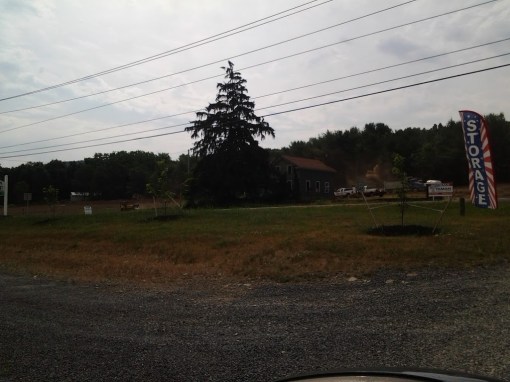
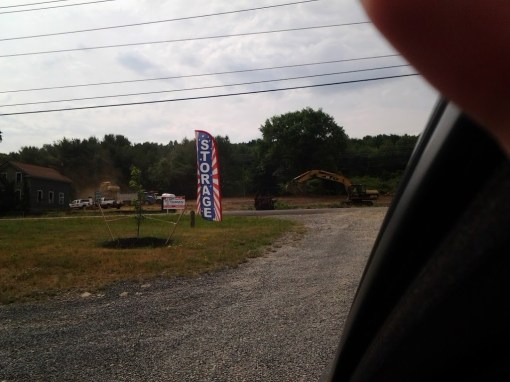
5. Work on the new Storage Squad facility has begun on the 1400 Block of Dryden Road east of Varna. Right now, the focus is on site clearing; the house was used by local fire departments for training exercises, and will come down in a controlled burn later this summer. The 79,000 SF storage facility should be ready for use by February 2017. One full time and a few part-time jobs will be created.

And for the record, I think that’s my middle finger.

6. So this is curious. The city recently uploaded a couple of older documents detailing development plans off of Floral Avenue on the southern tip of Ithaca’s West Hill neighborhood.

The first dates from Febraury 1992, and is a filing to create a 27-lot cluster subdivision on 4.15 acres at 452 Floral Avenue. The paperwork indicates that the intent was affordable housing, by a company named House Craft Builders. The city’s then-Planning Director, H. Matthys Van Cort, wrote a recommendation for negative declaration of environmental significance, and the project was approved in June 1992, but it never moved forward, and 452 remains vacant land today. It appears House Craft was dissolved in 2012; the officer was an architect for Ecovillage who has since retired and moved out of state.

The second is a subdivision requested by INHS in 1987. The filing requested 236 Floral Road be split into two parcels, with the intent of renovating a decrepit 236 into a for-sale affordable single-family home, and build a new house on 224. This was approved, and eventually, 236 was renovated and transferred to its owner in 1996, and 224 was built in 1994.

Now, as interesting as this all is, the city doesn’t upload decades-old subdivision files just to amuse nerds. The $64,000 question is, why were they uploaded now?


News Tidbits 6/18/16: Wit Fails Me After Eight Years

18 06 2016

201_college_v4_1 201_college_v4_2
1. Let’s start off with a brief update on 201 College Avenue. My colleague Mike Smith at the Voice did an encompassing article on the topic late last Friday, and there have been a couple more modest developments as of late. Apart from the multi-million dollar sale mentioned last week, the city’s Design Review Committee also gave their input on the project. They said they like the current form of thje building’s front (west) entrance, because it calls forth elements of Grandview House a few doors down. they also recommended darker or neutral grey colors to minimize the appearance of the fifth floor, more windows along College Avenue, warm accent colors, and tweaks to the window and cladding scheme. The resulting revisions were incorporated into the latest building design seen above, and for which additional images, material samples sheet and interior plans can be found here. The project will be discussed at the Project Review meeting next week, and the official Planning Board meeting Tuesday 6/28, at which the public hearing will be held, and consideration of preliminary approval.

107_s_albany_v2_2

107_s_albany_v2_1

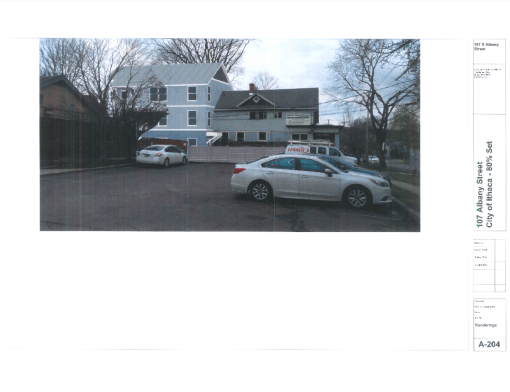
2. Speaking of design review, 107 South Albany also went through the committee this week. Recommendations included projecting window sills, stucco all the way back to the rear balconies, and noting on docs that the large sign on the existing building would be removed during the renovation. Site Plan Review app here, drawings here, Full Environmental Assessment Form (FEAF) here, planting plan here.

The renovation and addition seems like a good example of re-use in a corridor that the city is targeting for new investment. It preserves the century-old structure and adds housing in such a way that, by location and design, doesn’t have a significant visual impact. By zoning, Nick Stavropoulos could have sought five floors if he wanted. This plan will be going through the whole shebang at the June meeting – Declaration of Lead Agency, Public Hearing, Determination of environmental Significance, and Prelim and Final Approval.

Among other things to be discussed at Project Review and the Planning Board meetings – Prelim/Final Approval for 602 West State Street (the Elmira Savings Bank project), signage for Collegetown Crossing, and a few minor zoning variances. New sketch plans, if any, will be announced on the PB Agenda next week.

3. This week in big sales – someone plunked down $680,000 on a house at 107 Catherine Street in Collegetown. I say somebody because they conducted the purchase through an LLC (aptly named “105-107 Catherine Street LLC”) registered by a local law firm last summer. Just like the Maguire purchase of the Carpenter Circle land, this effectively hides the buyer from public view. The same purchase bought 105 Catherine for $780,000 last November. It looks like 105 has 10 bedrooms and 107 has 7 bedrooms, based off assessment docs.

cafd1

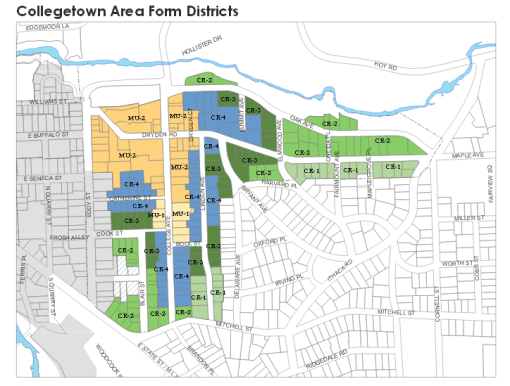
105 and 107 Catherine make up the edge of the CR-4 Form District. By zoning, an applicant could build up to four floors, no parking required. A development plan would likely consolidate lots. Something to keep an eye on. Collegetown is getting to be a very expensive place.

4. Meanwhile, here’s something that’s just hitting the market. For the budding landlords, 306 North Cayuga is up for sale. The “C. R. Williams House” was built in 1898 (interior/exterior photos from the early 1980s here). The current owner, Jeff Kalnitz, picked it up for $300k in 1997, had it on and off the market a couple of times, and then decided to do a thorough ILPC-approved renovation. The 12,500 SF property, which holds six high-end apartments and approvals for a seventh, is being offered at $1.45 million. It’s worth looking at the listing if only for the glamorous interior shots.

amici house 1 county
5. On Tuesday, the Tompkins County Legislature will vote on whether or not to take $118,000 from the county’s general fund to indirectly help build head start classrooms and a living facility for homeless young adults.

The $118,000 would be use to purchase a house at 661 Spencer, whose land would be incorporated into plans for a 23-person facility for homeless young adults (some with children) aged 18-25, and five classrooms. The classrooms would be built as one building, while the housing looks to be an addition to the TCAction building. The one-story house at 661 Spencer, built in 1950 and formerly formerly owned by the Amici family, would be removed.

The plan is the latest incarnation of TCAction’s Amici House project, slated to share their headquarters property at 701 Spencer Road on the southern edge of the city of Ithaca. TCAction first acquired their property with the help of the county back in 2001; the cost of the purchase is paid back to the county in the form of a 20-year lease.

If the legislature approves, the lease would be extended by two years so TCAction can pay them back for the up-front cost of buying 661 Spencer. The Amici House project would be completed by 2018.

6. Poet’s Landing in Dryden will be moving forward with its 48-unit second phase. The rentals, which are targeted at individuals making 60% of county median income, are expected to begin construction in August with a late summer 2017 opening. Phase I, which consisted of 72 units, opened in early 2013. The state awarded the project $1,600,000 from its Housing Trust Fund, and $734,956 in Low-Income Housing Tax Credits to help finance the apartments’ construction.

tfc_v2_1

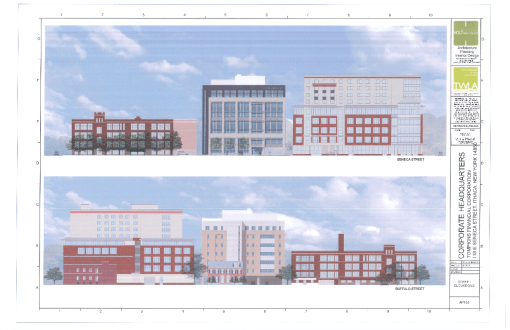
7. Tompkins Trust held the official groundbreaking this Friday for it’s new 7-story headquarters. Plans were slightly delayed after some issues arose with NYSEG. The current plan is to have the 123,000 SF building ready for occupancy by March 2018. Costs have risen somewhat, from $26.5 million to $31.3 million.


News Tidbits 6/11/16: Summer’s Heated Discussion

11 06 2016

Image Property of HOLT Architects

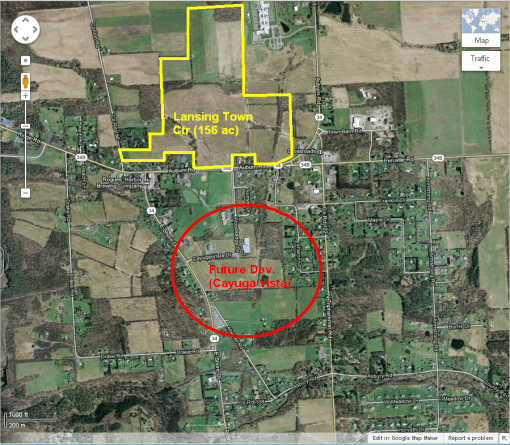
1. We’ll start this off out in Lansing. The 153 acres of land for the Lansing town center is once again in the news. The Lansing Star is reporting that the town is once again serious about selling the land.

So begins yet another chapter in the 20-year saga of the town center land. The town bought the land from the state in 1993 for $100,000, and at the time the land was deed-restricted to recreational use. In 2012, the town paid an additional $294,800 to remove the recreational deed restriction. An article about it was published here in August 2012 (original map below; dunno where why offhand it says 156 acres vs. the 153 reported now). HOLT Architects and TWMLA were hired to draw up some overarching design themes, a Request for Proposals was issued, and three developers responded.

lyc2

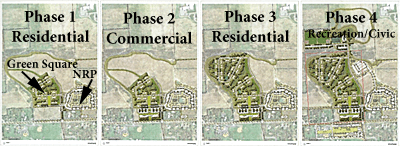
Calamar Enterprises’ Buffalo office submitted a proposal for a $17.4 million, 110-unit market-rate senior apartment building on 13.5 acres, and Cleveland-based NRP Group submitted plans for 80 one-story patio homes on about 15.5 acres. Calamar later re-sited their project at the town’s wish to the northern part of the land, and increased the number of units to 124. Green Square, led by David Taub and HOLT Principal Graham Gillespie, proposed 60 units of housing and 23,000 square feet of retail in 2-3 story arrangements, and civic and recreational space. Altogether, the value of the three would have approached $50 million.

gs_phases

However, all of this was contingent on a sewer being built, which did not happen. The developers agreed to do a package plant that would service just the town center, there was discussion of an IDA-backed tax incentive zone, and the town stood to make a hefty return on investment, but…to quote the Star, “However, the deals fell through.  Actually it seemed more like they just faded away. At least one of the developers had signed paperwork saying they intended to purchase acreage from the Town.  The Town didn’t seem in any hurry to sell the land, even with clearly interested developers.  When the developers disappeared there was no reported effort by the town to pursue the deals.”

Since then, the town continues to get a steady stream of interest, but no real idea on how they want to move forward. Like Ithaca city and town, they’re looking at the possibility of Form-Based zoning for the site, and the town hopes to issue a more specific RFP than before, incorporating revised assessment values. The most intensive approach involved the Form-Based Code and a specific RFP, the least specific is just putting up a for-sale sign ans seeing what happens. Whatever the case, the lax approach the town has taken the past few years may no longer be feasible, with the ticking tax time time bomb of the possible power plant closure looming over the town and schools’ budgets.

old_library_thp_v4

2. Speaking of long processes, the Old Library project has formally filed paperwork here to begin the application process for the Certificate of Appropriateness from the Ithaca Landmarks Preservation Commission. The meeting is scheduled for city hall at 5:30 Tuesday the 14th. Although it says early design review, a lot of the legwork has already been done at this point, since the Planning Board and ILPC have been conducting joint meetings with the project team over the past several months to create a design that they’re all comfortable with. However, the ILPC is likely to refine some details moving forward.

old_library_thp_v4_2
At this point, the unit mix consists of 22 1-bedroom units with about 700 SF each, 25 2-bedrooms with about 900 SF each, and 10 2-bedrooms with 1200 SF each, the extra space intended as a den or home office. The building also includes a 1,800 SF community room to be administered by Lifelong, and 3,750 SF of first floor commercial space. The total facility size comes out to about 85,600 SF, and parking for 25 cars and at least 12 bikes, and another 34 bike spaces for the community room. Exterior materials include brick, limestone, and a couple forms of fiber cement, including wood-textured fiber cement.

Southeast+Rendering

3. The STREAM Collaborative House at 228 West Spencer is up for sale. The house has its own website here. The 1,152 SF, 2-bedroom net-zero energy house is listed at a price of $305,000. For more info on the house, Noah Demarest was kind enough to give a construction tour of the house while it was underway, and the blog post I wrote up afterwards can be found here.

evergreen_dryden_1
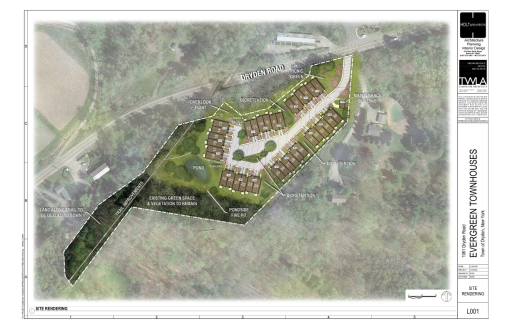
4. It’s pretty clear at this point that the Evergreen Townhouses project at 1061 Dryden is evolving into the next hot-button development issue out in Varna. The Times has their interview with the angry neighbor here, and more info can be found in the town of Dryden’s April planning board meeting minutes here. So far, the only image of the townhouses themselves has been a perspective that only shows massing – 2 stories, gabled roofs.

Also of note is the town of Dryden Planning Department’s recommendation to the town board (and the planning board’s approval) for an increase in density in certain areas. The change in code affects parcels zoned rural residential, with municipal water and sewer access. The density would be increased from 2 units per acre to 6 per acre. Looking at the zoning map and the sewer map, that would primarily affect the corridor from Varna to the 13/366 intersection, and a rural swath just north of Dryden village near TC3. What this would do is allow 1061 Dryden Rd to withdraw PUD application, and apply for a special use permit (SUP), which are generally easier to obtain.

On a side note, googling Tiny Timbers brings up a Times editorial, written by the Times, that argues against Tiny Timbers for not fitting in with the appearance of Varna. Actually, it kinda takes everyone to task, from developers to town government to residents. But, to make one counter-point regarding mixed-use, commercial services need a certain amount of traffic (not necessarily vehicular) to thrive. If the population base within a certain radius isn’t there, the risk is too great for someone to put their money on the line and hope that they can somehow draw in customers. If Varna wants a mixed-use center with shops and cafes, they’re going to need the population to support it. Some think that will include 1061, some (probably more) think Tiny Timbers, but if there’s no “push”, the ball won’t be rolling.

201_college_v3_1

5. A couple of minor things to note in sales. The 4,200 SF former “Imperial Buffet” property next to the Shoppes at Ithaca Mall has sold to a Syracuse-bsed LLC (Watersprite LLC, established 2004) for $590,000 on Friday the 10th. I personally will always remember this place as being the only place my mother was comfortable with eating in Ithaca because she hates eating out, and felt everything else was “snobby and expensive”.

Meanwhile, the 12-bedroom, 2,837 SF house at 201 College Avenue, the property subject to a heated debate between Neil Golder and Todd Fox, sold for $2.65 million on Friday the 10th, which seems outrageous except that it’s becoming the norm for inner Collegetown transactions – Novarr picked up 5,500 SF 215 College for $5.3 million last year. There will be no delving into that debate again this week, but the city uploaded 580 pages of documentation here, and my colleague Mike Smith is preparing a story for the Voice.

20160522_143925 20160522_143949

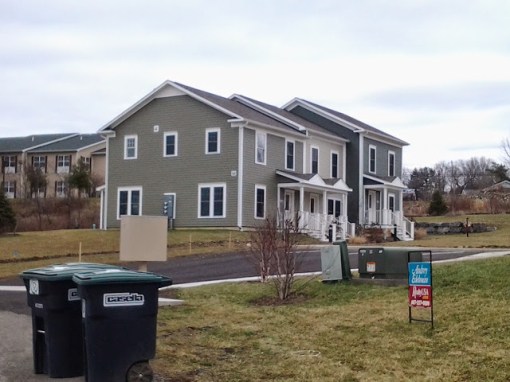
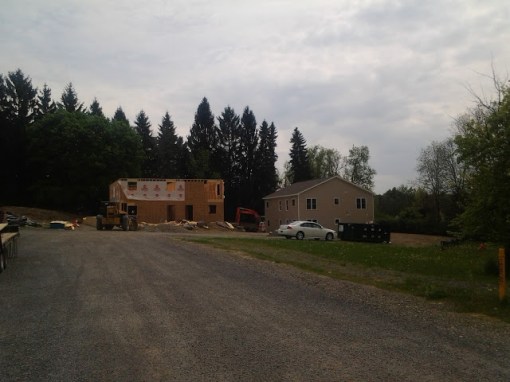
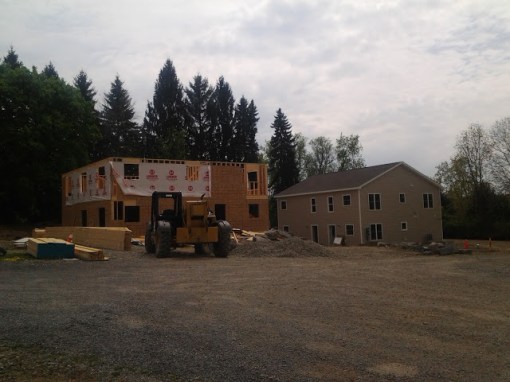
6. Houses of the week. This pair of duplexes are being built on Birdseye View Drive near Ithaca College. Each house has a 4-bedroom unit and a 2-bedroom unit; recent advertisements on Craigslist (since expired, so no link, sorry!) have them $750/bedroom. The developer is the owner of Mahogany Grill downtown, who also happens to be a part of the business team renovating the former Lucatelli’s into a new restaurant, a Tapas and pasta restaurant called Mix Social Dining after the chef’s wife.

These photos are a couple weeks old now, but the one on the right looks nearly complete, while the one on the left was still in the (wood) framing and sheathing stage. Based off the rough window and door openings, they are not exactly the same, but expect them to look similar.


News Tidbits 6/4/16: A Stormy Summer Start

4 06 2016

201_college_v3_1
1. We’ll start this week off with a follow-up on the 201 College Avenue debate. All discussions of planning philosophy noted, one solid request, as reported by Josh Brokaw at the Ithaca Times, was to try and reduce the bulk from the College Avenue side, if not necessarily the building footprint. The above drawing was submitted by STREAM Collaborative’s Rob Morache earlier this week, with a cover letter describing the changes here. The modification reduces the building by 2 bedrooms, to 74, which to go by Todd Fox’s comment in the Times article, puts the project at the borderline of financial feasibility. The middle still pops out a little because that’s where the fire stairs are located. Some minor details were changed with the accent panels, and recessing the windows slightly on the south and west facades. For the record, the panels are Nichiha and Allura fiber cement, with painted metalwork and fiberglass window sashes.

Although now outdated, a shadow study for the previous design has since been uploaded by the city. There are two versions, with and without neighboring building shadows, here and here respectively.

Expect further detail refinements; the building is set to go in front of the Design Review Committee Tuesday morning.

20160414_120418

2. WSKG did a segment earlier this week on micro-apartments, with an interview with Frost Travis and the Carey Building project wrapping up on East State Street. A few details worth noting from the segment – 5 of the 20 rental units (which range from $1,225/month for the microunits to $2,699/month for a high-end penthouse 2-bedroom) are already spoken for and the building’s not even finished yet. For some reason, Monica Sandreczki says there will be about 35 residents at full occupancy, which is a big stretch since there are 16 micro-units and 4 two-bedroom units – going one person per micro-unit and bedroom, a better estimate would be 24.

The news piece also notes that the 201 College project contains micro-apartments – which is true, given that the building is 44 units and 74 bedrooms, and at least the early plans had a number of split-level 410-670 SF studio units.

401_lake

3. And 401 Lake Street will bite the dust. The Common Council voted 8-1 last Wednesday night to have structure demolished and the tax-foreclosed properties be designated as parkland. Cynthia Brock (D-1st) voted against the measure and preferred a sale for tax reasons, and her ward counterpart George McGonigal (D-1st) argued that the city was destroying historic working-class housing, though he ultimately supported the measure. Brock did take a whack at new affordable housing in the city, commenting that INHS is getting $75,000 for each townhouse, and Habitat for Humanity getting $75,000 for a duplex even with its volunteer labor, when there was a potential, cost-efficient opportunity for affordable housing designation with this unit. Josephine Martell (D-5th) seemed to be the strongest proponent for demo, stating that the unique potential to enhance the Ithaca Falls Natural Area should be taken every opportunity of. The city bought the tax-foreclosed property from the county; the background on that is on the Voice here.

The funds for the demolition, estimated at $25,000, will come from the sale of IURA land to the Hilton Canopy project. That measure was approved 6-3, with Brock, McGonigal and Graham Kerslick (D-4th) opposed. With work on the Lake Street Bridge currently underway, demolition is not expected for at least a few months.

There was a thought exercise regarding the selling the falls’ parking lot to INHS for development of 3-9 units of affordable housing; it’s an interesting idea, since 401 and the adjacent are right next to the Falls, but the 0.55 acres of city property adjacent to the Lake and Lincoln Streets intersection is still over 200 feet away at its closest point.

4. The rare bit of news out of Enfield. A $612,000 building loan was issued by the Bank of Greene County to provide funds for renovating and expanding the volunteer fire station at 172 Enfield Main Road.

Give that Enfield issues no more than a handful of new construction permits each year, it’s about the only other thing going on apart from the Black Oak Wind Farm debate. One would think that arguments like “the wind does not blow as much as it used to” would be easily shot down and things would move forward, but instead it’s Marguerite Wells, the project manager for BOWF, getting raked over the coals. I don’t have a dog in this fight, but I do feel bad for her.

5. In case anyone was wondering – county planner Megan McDonald says the Denter housing study will be publicly available by late July.

arpt_pk_1

6. Here’s something intriguing from the county’s Facilities and Infrastructure Committee agenda – a proposal to “Prepare airport land for future development“, seeking $500,000. None of the money comes from the county; it appears to be dependent on grants, or an interested developer. Which, given the fact that this shows up in budget docs going back to 2014, doesn’t exactly seem to be generating many queries.

The parcels are described as the “Cherry Road and Agway parcels”, which must be owned by the county since they want to lease out the land – but checking the deed records of parcels adjacent to the airport, there’s no record of an Agway in any of the deed histories. The parcels may be related to the properties in the airport business park feasibility study, shown above and awarded to the team of Clark Patterson Lee and Camoin Associates this past winter.

7. It’s unusual to see Cornell buying property these days, but this Friday, the university purchased the house at 1250 Trumansburg Road on Ithaca’s West Hill for $157,000. The house is a 19th century fixer-upper on 1.21 acres – Cornell owns the land surrounding it, some of which is being subdivided off to build the Cayuga Meadows affordable senior housing project. The house is assessed at $215,000, but the real estate listing notes it needs some work, and it’s been off and on the market for five years.

Several years ago, Cornell expressed intent to develop the 35 acres it owns into a mixed-use complex with a hotel institute, housing, offices and medical services, but the only part of the plan that ever really moved forward was Conifer’s project. I haven’t seen the plans in years, but I remember the early plans (there were a couple versions) were very sprawly; six, eight years ago, walkability was not as valued as it is now.

By buying the house, Cornell reduces its need to work around a neighbor and can incorporate the property into potential plans. This purchase would seem to suggest that Cornell still has strong interest in developing the rest of the West Hill property at some point. In the meanwhile, Cornell might rent it out while the school figures out what it wants to do with the acreage.

20160522_151346 20160522_151417

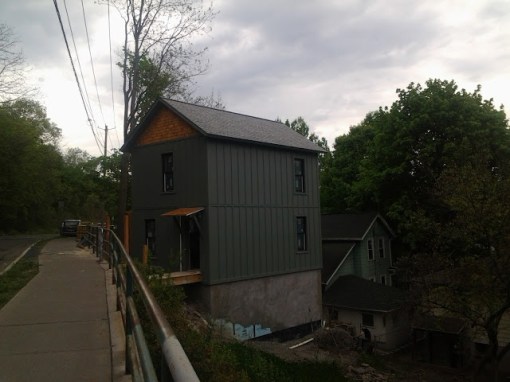
8. House of the week. From the outside, 228 West Spencer Street is almost done, and the interior is fairly far along as well, with finishing work underway. Architect Noah Demarest says the house will be put up for sale in a few weeks, if everything goes as planned.


Brookdale Ithaca Crossings Construction Update, 5/2016

30 05 2016

As the population ages, so do the need for specialized care facilities. Work continues on the the Brookdale Ithaca Crossings project on West Hill.

Plans call for a 23,200 SF, 1-story building with 32 bedrooms (32 beds total). Along with the new building, there will be updates to parking, landscaping stormwater facilities, and the addition of a couple of courtyards between the buildings. The project was first proposed in late 2014, and approved last July.

The facility is designed to complement Brookdale’s two other Ithaca facilities, which are adjacent to the project site – The first, a 46-unit facility to the north of the project site, is Brookdale Ithaca Assisted Living (formerly Sterling House), which serves as enhanced assisted living for seniors. The second, a 32-unit facility to the easy of the project site, is Brookdale Ithaca Memory Care (formerly Clare Bridge), which serves as assisted living for those with specific memory care needs, individuals suffering from advanced cases of Alzheimer’s Disease and dementia. Both of the older facilities opened in 1999. The current project was initially called “Clare Bridge Crossings”, but it was later renamed to Brookdale Ithaca Crossings.

For more information about memory care and a few more details about offerings, I wrote an article for the Voice here.

Nursing home and assisted living facilities have to demonstrate to the state that their is a local need for a project, and the “certificate of need” is only issued at the end of a project, after it’s been built and the state has concluded its inspection. According to Brookdale representatives, there’s no indication that the certificiate of need will not be issued.

Construction is expected to last around 14 months, which would give an estimate of Q1 2017 for completion. The architect is PDC Midwest, a Wisconsin firm that specializes in memory care facilities.

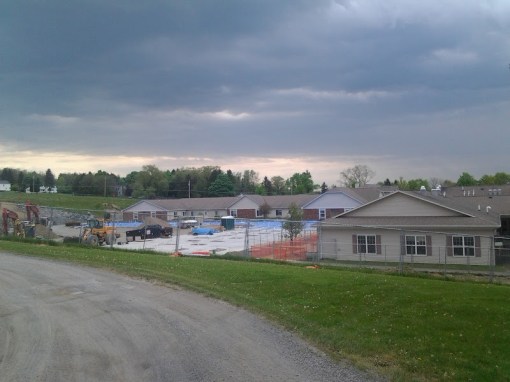
Looking at the site, the foundation has been excavated and footings have been poured, and it looks like the foundation slab is already in for the south wing. The blue material might be some kind of vapor barrier film to help protect against moisture.

20160522_160747 20160522_160812 20160522_160823 20160522_165738

clarebridgecrossings_1 clarebridgecrossings_2