Urban Renewal Part II: When Things Don’t Go To Plan

21 08 2015
Photo from C. Hadley Smith Collection

Photo from C. Hadley Smith Collection

For Part I, click *here*.

Once the federal funding for Project One came through in December 1964, the gears had started to turn. In Spring 1965, the president of the Hotel Ithaca bought the Clinton House for use as a temporary facility while the new hotel was built. Funds and plan details were formally accepted and approved by the Feds and Common Council in May 1965, and the Ithaca Urban Renewal Agency (IURA, which still exists today) was incorporated.

The IURA was long a sore spot among city councilmen because Democrats were opposed to it and Republicans were in favor of it. The city was a little less one-sided with its politics back then.

In 1966, two developers were designated for two properties in the Project One area. One would build a set of retail spaces, the other would be responsible for what would be the nation’s largest Woolworth’s department store.

For those too young to know, Woolworth’s was a major discount and department store chain – a sort of Walmart or Target of its day (and more like a Kmart towards the end), which was from the 1880s to 1990s. The Woolworth’s was supposed to draw people into downtown, and would be on the corner of S. Cayuga and W. Green Streets.

Problems arose when Woolworth’s said it would need even more parking space than planned. The city, fearing the department store would end up in the suburbs, rushed to condemn three properties on the edge of the project area, two car dealerships and a repair shop. The buildings were demolished, acres of parking laid, and the store opened in the winter of 1968/1969.
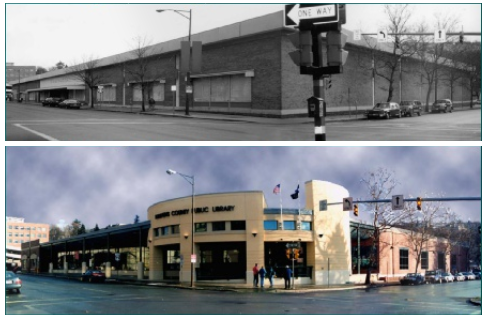
library_2000

Image property of QPK Architecture

It was not an attractive building by a long-shot, but the store did draw people downtown, and it remained open until about 1998, when the entire chain went under. Today it’s the county library, and the entire block has once again been redeveloped, which was previously written about here.

The closest Ithaca got to that chic modern hotel was the Ramada that opened in 1972 (later Holiday Inn, and now the Hotel Ithaca). That fell just outside the Project One boundary line. The original 1970s hotel, without the “Executive Tower” built in 1985, can be seen in the lead image.

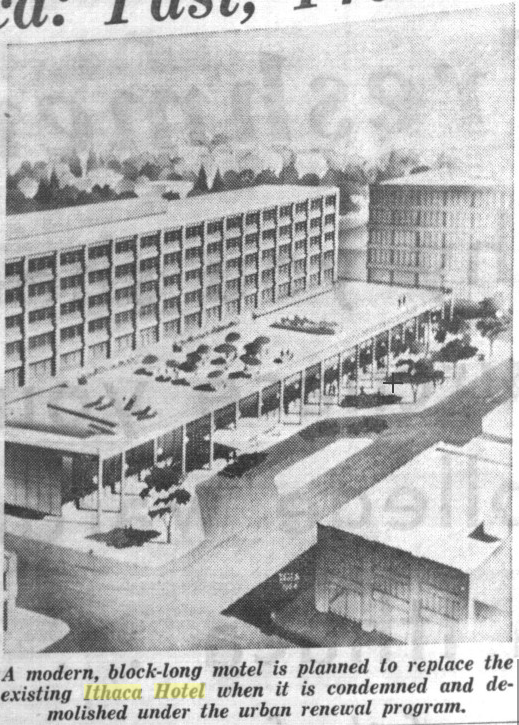
The Hotel Ithaca fell to the wrecking ball in 1967, around the same time that the 2, 4 and 5-story buildings across the street from the Carey and CSMA also came tumbling down. Until the Marriott currently under construction, the city struggled to find a developer interested in the site; the site was developed in 1975 into the new Rothschild’s Building, but the older 1870s structure further up the Commons was demolished, the last of the federally-funded urban renewal demolitions.

After several years of attempting to find developers for the old Rothschild’s site, two local developers finally managed to cobble together enough funding to build Center Ithaca in 1981. Center Ithaca went bankrupt not long after opening, and Rothschild’s closed up in 1982, so the whole block over there has been pretty underwhelming ever since urban renewal touched it.

If anything, the south side of the tuning fork did worse; the potential bank tenant never followed through on its original intent, the city tried for years to sell the property. After several years they finally managed to get rid of the vacant lot. The Trebloc Building was originally planned to have two floors, but financial troubles reduced it to one. The abomination opened in 1974.

The Ithaca Commons, which also  opened in fall 1974 and was completed the following spring, falls outside of the realm of Urban Renewal as discussed here because it was funded with local bonds, rather than federal monies. The idea of a Commons didn’t start to gain traction until about 1971, after most of the urban renewal projects had left their mark on downtown Ithaca.

Like much of downtown, the Commons struggled with high vacancy rates for years, and the mix of stores never quite met the city’s expectations – where the city leaders envisioned department stores and “everyday retail” such as drugstores, neither of those have been historically successful on the Commons, and the use of the Commons as an open-air drug market was an unexpected, unpleasant surprise. It’s really only been in the past 15 years that the Commons has enjoyed low vacancy and strong tenant interest.

See, Ithaca’s urban renewal never quite stopped the overall trend of movement to the suburbs. With each decade, development sprawled further and further out, and it still is in parts of Ithaca town and Lansing. For the Jon and Jane Q’s just looking to buy groceries or hit up a fast food place, downtown Ithaca wasn’t on the radar.

But there were folks who were still drawn to the charm of a built-up downtown, where emphasis was on two feet rather than four wheels. It was an eclectic bunch – older residents still heavily invested in downtown, and younger, poorer, counter-culture types settling in the area during 1960s and 1970s. Ithaca’s dilapidated downtown, where many retail chains feared to tread, is where a lot of the region’s unique “vibe” sprouted, albeit unintentionally.

And, as things go, what’s old is new. There’s a renewed interest in denser, walkable communities, whether for sustainability, cultural amenities, or simply to experience something different from the cul-de-sacs and strip malls that many Gen X’ers and Millenials grew up with. Ithaca, with a stable, growing economy and plenty of fresh blood flowing in and out of the community, was poised to capitalize on this, and his done so with a fair amount of success in recent years, attracting both national retailers and keeping most of its character intact. Had it not for the renewed interest in walkable downtowns, newer urban renewal projects such as Cayuga Green would likely have been as unsuccessful as Center Ithaca.

The car, once a defining aspect of America’s cultural scene, is now more likely to be treated as an appliance, like a washing machine or microwave. It does what one needs it to do, but the allure isn’t what it used to be. Parking lots used to be eye-catching splashes of color, coral and peach, turquoise and sea green; and now, beige, grey, and subdued reds and blues. The symbolism is there.

ith_urban_renewal_plan_1964_2

Urban renewal in the tear-down and pave everything sense was stopped for two reasons – money and opposition. But money was the much more important one.

In the later 1960s, funds for urban renewal started to dry up. The city dropped projects two and three and combined elements of the two for a second phase of downtown, and a proposal for Collegetown. The Collegetown proposal was submitted (much to the chagrin of Collegetown landlords), but much of it got lost due to competing interests in the bureaucratic quagmire, and never moved forward under its original intent. The end result was the parking garage, Schwartz Center for the Performing Arts, and the Eddygate mixed-use complex, all of which came to fruition much later in the mid and late 1980s.

Meanwhile, residents began to rise up in protest after seeing so many historic buildings demolished in favor of projects that were never built, or were downright ugly. Although too late to save buildings like the Hotel Ithaca and the old City Hall, groups like Historic Ithaca were important in keeping buildings such as the Clinton House and DeWitt Mall from meeting the same fate.
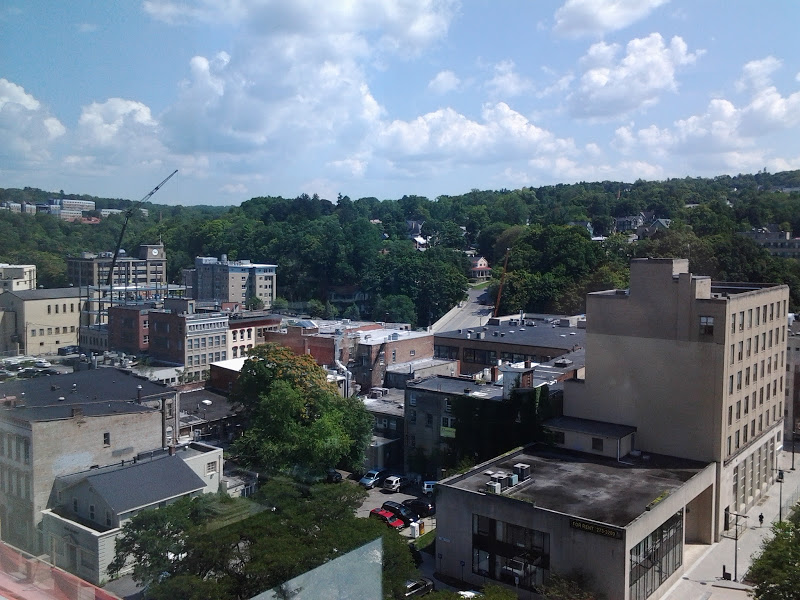
20150727_145000

It would be unfair to cast those who supported urban renewal as malignant or devious. No city official, no mayor, no one with a vested interest in downtown Ithaca set out to wreck it. They were trying to revitalize it, and they were listening and applying the auto-centric, “old equals bad” thinking that had been popular in the years leading up to renewal. The results left a lot of hard feelings, and a lot of unmet hopes.

Yet, the issues that faced downtown Ithaca fifty years ago, the problems that the city’s political and business leaders were never quite able to solve, eventually became assets. Old buildings, now loved for character. Walkable streets, now appreciated. Mixed retail, offices and housing, contrary to single-use zoning, now embraced. Ithaca’s old bones, once a persistent ache, have assisted Ithaca in becoming the vibrant city that it is.

Buildings and streets can be planned. But the people occupying them? Maybe not so much.

Not everything can be planned. And that’s a good thing.


Urban Renewal Part I: Ithaca’s “Project One”

18 08 2015

hotel_ith_1964

It was called “Project One”.

The year was 1964. The tax base of Ithaca, and especially downtown Ithaca, had been eroding for over a decade. Suburban big-box stores started to appear on the south side of the city in 1950, and up towards Lansing, plans were already underway for a new suburban supermarket and department store (the Shops at Ithaca Mall wouldn’t come along for another twelve years). New neighborhoods were sprouting in northeast Ithaca and Eastern Heights, and cul-de-sacs were paving their way onto West Hill and South Hill. Ithaca College was moving its staff and students to a sprawling campus just beyond the city line. From 1954 to 1960, 48 offices and retail stores closed or moved out of downtown Ithaca, a drop of 18%. The city councilmen were concerned.

So how were they to draw people and tax dollars back into the city? The city officials looked around. In the 1950s and 1960s, it was trendy to have that rambling ranch house set back far from the street, it was fashionable to attend indoor shopping centers away from the rain and the cold.

Image courtesy of Tom Morgan

Image courtesy of Tom Morgan

But most importantly, the trendsetters agreed, was that one could not live the high life, one couldn’t even dream of being a part of the jet set, without a big, luxurious car at their command. Two tons of chrome and steel, heralding you’ve made it in this world, and your car will take you anywhere and everywhere you want to be. And if a place wasn’t accommodating for your stylish set of wheels, then it wasn’t a place worth visiting.

The councilmen and the city officials were taking note of all those chrome-trimmed Bel Airs and Galaxies, with their bright colors and sculpted fenders. Following the results of a study conducted in 1959 and finalized in 1962, they came to the conclusion that in order to revive downtown, they had to catch up with the times, to bring downtown into the mid-20th century future with a swagger and a swing.

The plans were grand. In place of the nearly century-old Hotel Ithaca, a new hotel a block long, designed in the finest of modern taste. Out would go the decaying buildings of 60, 80, 100 years yore, in would come wider roads, ample parking, modern buildings and ideally, an influx of cash. Ithaca hoped it would bring new residents back into the city, while Cornell U., happy to give some money towards the effort, hoped it would bring in more industry and research organizations.

ith_urban_renewal_plan_1964_1

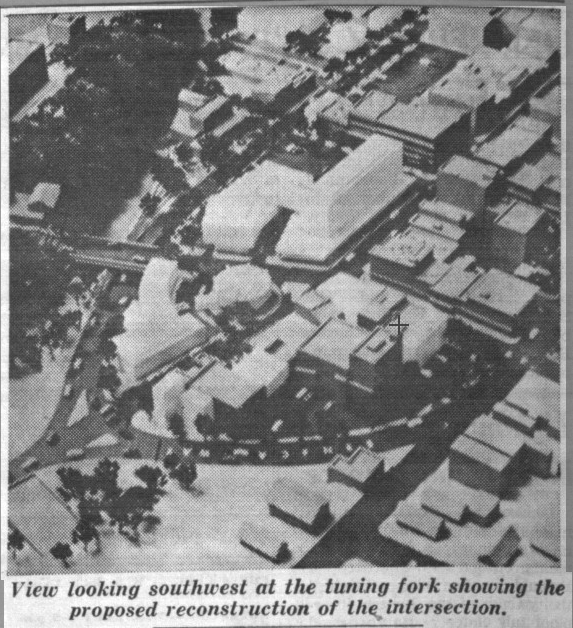
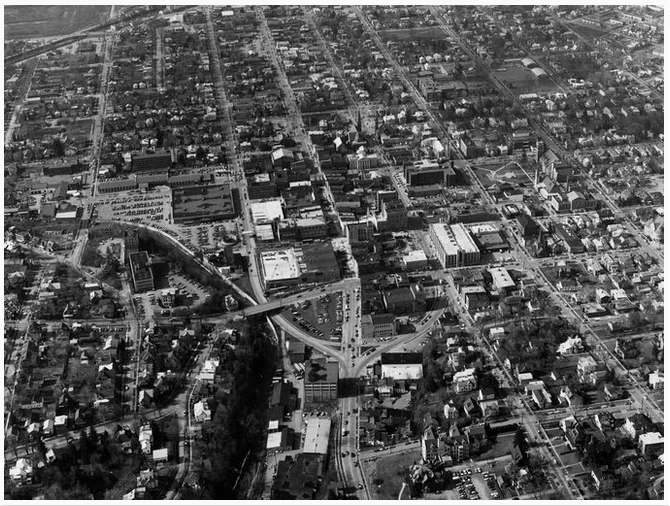
Project One was to be the first of three steps in Ithaca’s Urban Renewal plans. Plans in Project One called for the demolition of the Hotel Ithaca block and the buildings on the south side of the “tuning fork”, already built by that time (and taking out a number of buildings in the process). In their place, the new hotel would go, and a new bank office on the south side of the fork. In the model above, you can see what was once the Strand Theater (demo’d 1993), Restaurant Row and the old Rothschild’s Building (also gone now) still intact. There would be new auto dealerships, new department stores, traffic generators and tax generators.

Image from Cornell Daily Sun, 10/20/1966.

Image from Cornell Daily Sun, 10/20/1966.

The rest of Project One targeted about 26 acres of land bounded by State Street, Cayuga Street, and Six Mile Creek. Essentially, everything south of the Commons, and everything east of the present Hotel Ithaca/former Holiday Inn. Much of the area between Six Mile Creek and Cayuga Street was auto repair shops, dealerships and other car-oriented enterprises. Pritchard Automotive, a block further south, could be seen as the last vestige of when South Cayuga Street was “Automobile Row”.

The plans moved forward in fits and starts. Survey and planning work was brought to a stop in 1962 by Ithaca mayor John Ryan, who vetoed the plan. But following the election of Hunna Johns in 1964, the grand revitalization schemes moved forward again. The Common Council approved the federal application for Project One in June 1964.

ith_urban_renewal_plan_1964_2

After six months of delays, federal funding came through in December of that year. Cornell had already given funding to the tune of $500,000 (about $3.85 million today) to help pay for the projects, but the federal government would be the primary source of funds, which would pay 75% of the $6 million initial cost. Ithaca and the state of New York would each fund about $750,000. The city reasoned that it would bear the expense now for increased tax revenues in the future.

city_1

Of course, not everything worked out as planned. Nowhere close, really. That will be covered in Part II.


News Tidbits 8/15/15: Big Houses and Little Houses

15 08 2015

210_hancock_62015

1. In good news, INHS’s 210 Hancock affordable housing development was granted all the necessary zoning variances from the Board of Zoning Appeals (BZA). The vote was 3-0 in favor; one board member abstained after expressing her distaste for the project. Variances were needed for the height (46.5 feet vs. the 40 feet legally permitted), the parking requirement (84 required, 64 planned) and loading zones for the three commercial spaces, which was granted at the previous BZA meeting. The project now moves on to the Planning Board again for preliminary approval.
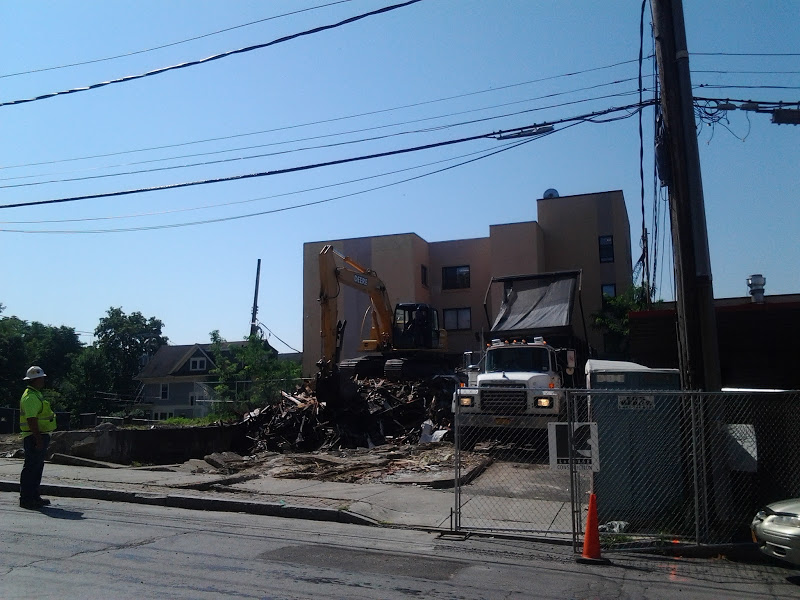
210 Hancock also applied for $3.9 million in tax abatements from the Tompkins County IDA, and these were granted at last night’s meeting. According to the application, the tax abatement was requested because the commercial spaces and the pedestrian walkways along Lake Avenue and Adams Street can’t be covered by affordable housing grants. The foundation and high acquisition cost of the former grocery store were also cited as factors in the application.

Unfortunately, documents filed with the city indicate that the townhouses will no longer be for sale, they will only be rental units. INHS says that they received updated, detailed construction costs and the result is that it would be “infeasible to build and sell the townhouses affordably“. If there’s any silver lining to that, it’s that all the townhouse units will now be handicapped-accessible, and that they will be built at the same time as the apartment building (no need for subdivision or owner-occupied grant money, which is harder to get). Construction will be May 2016 to July 2017, rather than 2016-2019.

EDIT: INHS Executive Director Paul Maazarella sent an email this morning saying that the plans have been re-revised, and now 5 of the 12 units will be rentals. 7 of the units, all 2-bedrooms, will still be for sale. Quoting the email –

“This aspect of the project has many unknowns that still remain to be resolved, so we decided to take a cautious approach with the Planning Board and announce that they will all be rentals. Some of the challenges that we have for for-sale units on this site are:  very high land cost; the demo cost for the existing building; uncertainty about the availability of development subsidies; the type and cost of the ownership structure (condo, coop or HOA); the impact of high property taxes on affordability; and the overall development cost in relation to producing a unit at an affordable purchase price.  Since then, we’ve reviewed the numbers and reconsidered our earlier decision.

We have now firmed up a plan to keep 7 of the 12 units as for-sale units and make 5 of them rental units.  All 5 of the rental units will be 3-bedroom homes (the only 3-BRs in the project) and one of them will be fully accessible.
The 5 rental units will be clustered at the end nearest to Adams St.  The for-sale units will be closer to Hancock St.
The rental units will be built at the same time as the multifamily building.  We don’t yet know the timeline for the for-sale units.”

inhs_pride_design_v4_1

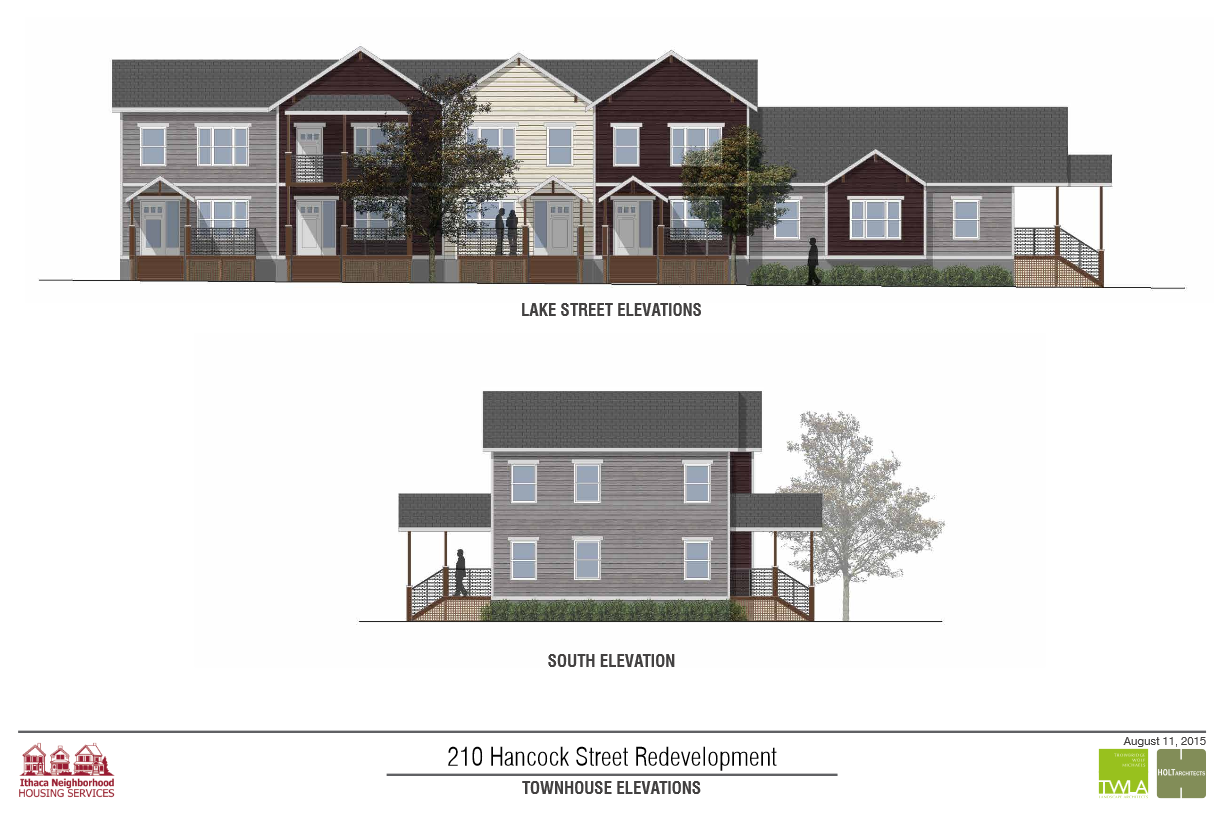
On that note, here’s an updated render of the townhouses. Quoting the memo from Trowbridge Wolf,

“The townhomes at 210 Hancock will utilize architectural details in the porches and roof lines as well as a mix of materials and colors to provide architectural diversity. Architectural precedent will include homes built in the late 19th/early 20th century and characterized as “tudor”, “arts and crafts”, “American four square” etc. The goal is to design the 12 townhomes as if they were built over time with some unifying features that make them feel part of the larger 210 Hancock community.”

2. From townhouses to big houses. Here’s an attractive proposal for a renovation at 109 Dearborn Place in Cornell Heights. 109 Dearborn is currently a 3,800 SF storage building with an attached apartment unit, and has been since the 1960s; previously it was an office building for the Paleontological Research Institute, and built specifically for PRI in the early 1930s. The building was purchased from Cornell by Dr. J. Lee Ambrose (M.D., so he can get away with using ‘Dr.’ outside of his field without sounding pretentious) for $177k in 2012. Bero Architects of Rochester and Ellis Construction of Lansing are in charge of the design and build respectively.

109_dearborn

The proposal involves new roofing, dormers, roof extensions, and a gut interior renovation to be done in phases over the next few years. Being in the Cornell Heights Historic District, the project needs Ithaca Landmarks Preservation Commission (ILPC) approval. Since the building is considered non-contributing to the historic district (the age is right but being a purpose-built office building isn’t), ILPC may be a little less stringent with this project.

3. Staying on the theme of grand houses, a lakeshore homesite has received a multi-million dollar loan. The property at 1325/1327 Taughannock in Ulysses is right on the lake, and two small houses once on the properties have been demolished. The loan, for $2.25 million, was filed on the 13th, with financing provided by Tompkins Trust.

The owner is a senior investment banker from New York with connections to Cornell. In other words, the type of person a lot of Ithacans love to hate. Looking on the bright side, this is an extra couple million for Ulysses’s tax rolls (my anecdotal finding is to tack on about 30% to hard construction costs to get the assessed value, and the hard costs here are $1.87 million…so $2.43 million). Single-family projects of this magnitude in Tompkins County are quite rare, they could be counted on two hands. It’ll definitely be worth a trip to see what this lakeside manse looks like as it moves towards its May 2016 completion.

4. Also in sales, the Carpenter Business Park was purchased by “Carpenter Business Park LLC” for $2.4 million from the lender that repo’d it from the owner earlier this year. Four parcels were purchased – all the land along Northside’s Carpenter Circle except for the community gardens and the building supply company. The LLC is registered to the same P.O. Box as Ithaca’s Miller Mayer law firm, and there’s no indication if there are plans for this site. But you’ll see something here if plans arise.

state_st_triangle_v3_1

5. The State Street Triangle public relations campaign begins in earnest – the CEO of Campus Advantage recently submitted an editorial in the Journal, and the Texas-based company has also launched a website, Ithacaliving.com. It’s as one would expect, it touts the economic impacts and the addition of housing to the underserved Ithaca market. For those who are more neutral, the site’s worth a look for some new perspective shots, courtesy of the folks at STREAM Collaborative. CA’s effort to assuage the concerns of city officials and the public has been lackluster so far, so we’ll see if this is a sign they’re willing to be more active and engaging.

college_crossings_v3_1

college_crossing_2

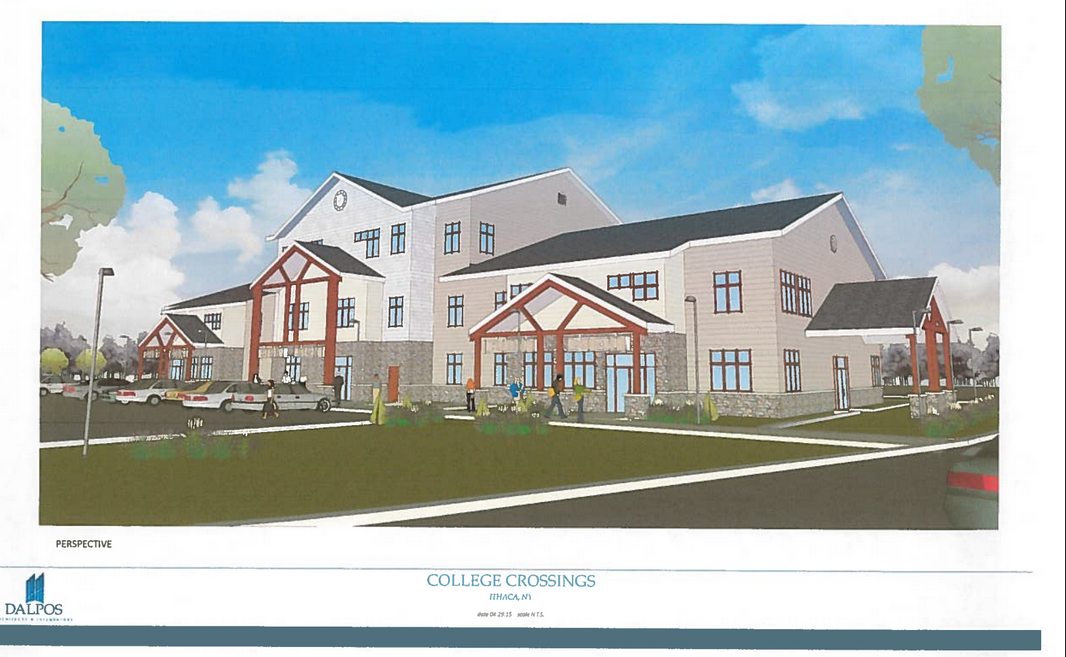
6. Over in Ithaca town, the State Environmental Quality Review (SEQR) is still underway for College Crossings. Only this time, the town acknowledges that plopping a building in the middle of a large parking lot doesn’t mesh with their comprehensive plan. The building is acceptable, but the site plan layout needs work seems to be the gist of the town planner’s review.

7. From the city of Ithaca Planning Board Project Review meeting next week, the phrase of the week will be “carriage house”. Specifically, two proposals in the city for accessory apartments in the style of carriage houses.

201_w_clinton_1

Carriage houses were essentially garages for horse-and-buggies. The first proposal, at 201 West Clinton Street, is highly reminiscent of those long-gone days, and it needs to be since it’s in Henry St. John Historic District (more talk about the meticulous restoration of the main house here). The proposal is going up to the planning board for recommendations for a zoning property line setback variance at the next BZA meeting. The 650 SF, 1 bedroom garage/carriage house would replace a non-contributing garage from the 1960s. The architect isn’t stated in the documents.

607_utica

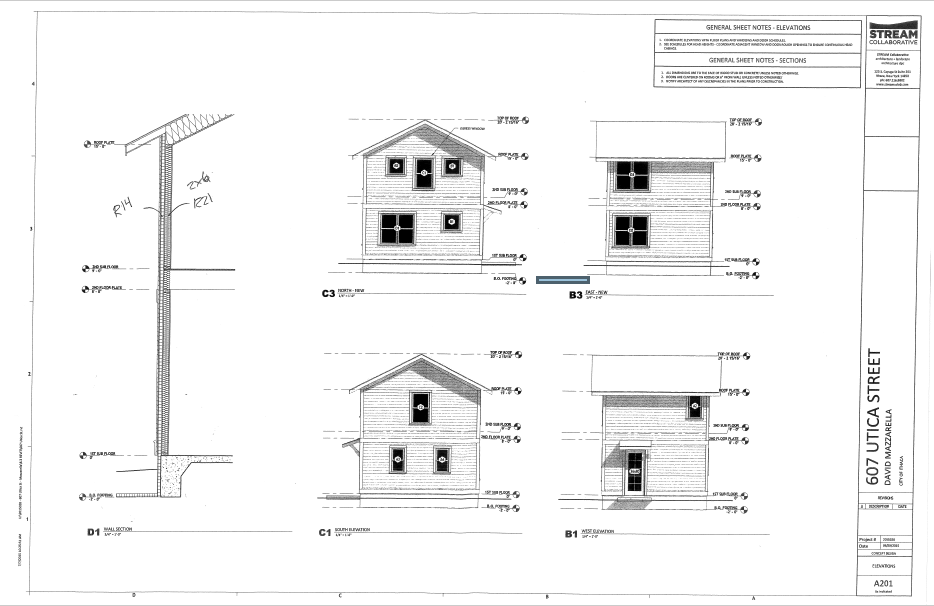
The other proposal is for 607 Utica Street in Fall Creek. The applicant is seeking demolish a rear garage in favor of a one-bedroom, 510 SF unit. In the zoning appeal application (one again for property line setbacks), the homeowner states “My goal has never been to become a landlord…I am hoping to do this only because the income from this would allow me to remain in the community”. Once again, the affordability problem is making itself known. Prolific local architecture firm STREAM Collaborative is responsible for 607 Utica’s “tiny house”.

As a matter of opinion, I think these are a great idea. These add to the housing stock, contribute income to homeowner-landlords living only feet away, they’re not obtrusive, and their small size lends well to modest, sustainable living. I hope they go forward.


707 East Seneca Street Construction Update, 8/2015

14 08 2015

By the time I had taken updated photos of the apartment building under construction at 707 East Seneca Street, most of the exterior work had been completed (looking at the photos closely, those might be some trim boards leaning next to the first-floor doorway). The work has shifted mostly to finishing out the interior, and then when the vast majority of work on the building is completed, landscaping and paving will follow. Everything looks to be on schedule for tenant move-in later this month.

For a look at interior progress photos, Modern Living Rentals has been posting occasional updates on their facebook page.

The building will have 6 3-bedroom units, 18 beds total. Todd Fox and Charlie O’Connor of Ithaca’s Modern Living Rentals are the developers, and the design of the building, heavily influenced by its location in the East Hill Historic District, is the work of local firms Schickel Architecture and STREAM Collaborative.

20150727_105957 20150727_110035 20150727_105910


114 Catherine Street Construction Update, 8/2015

13 08 2015

One of the “secrets” of Jagat Sharma’s success in Collegetown is that he designs unobtrusive, good-looking projects on a restrained budget. Sharma can probably add 114 Catherine Street to his list of successes.

The next few entries are more or less just to clear out my portfolio and keep the blog updated with separate entries to make searches for individual projects easier. If you’ve been reading the Voice, you won’t see anything “new”, but you will get more photos and more information.

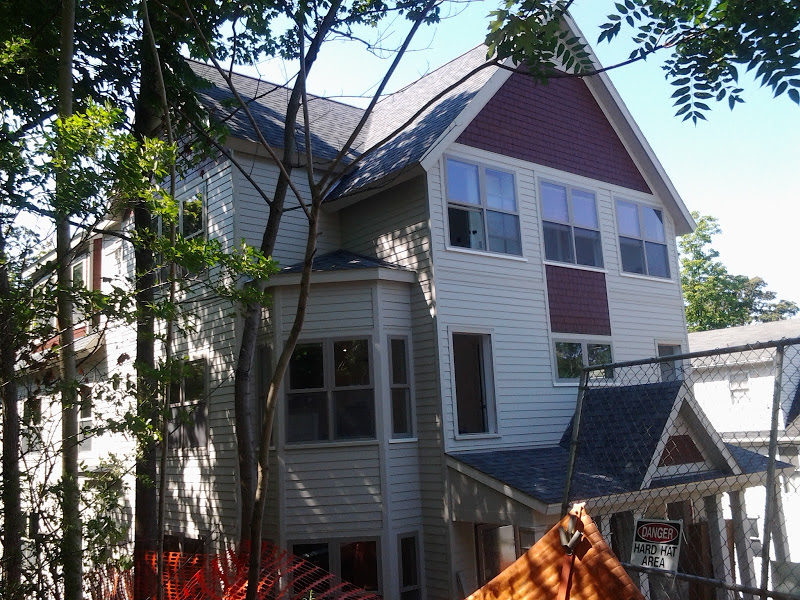
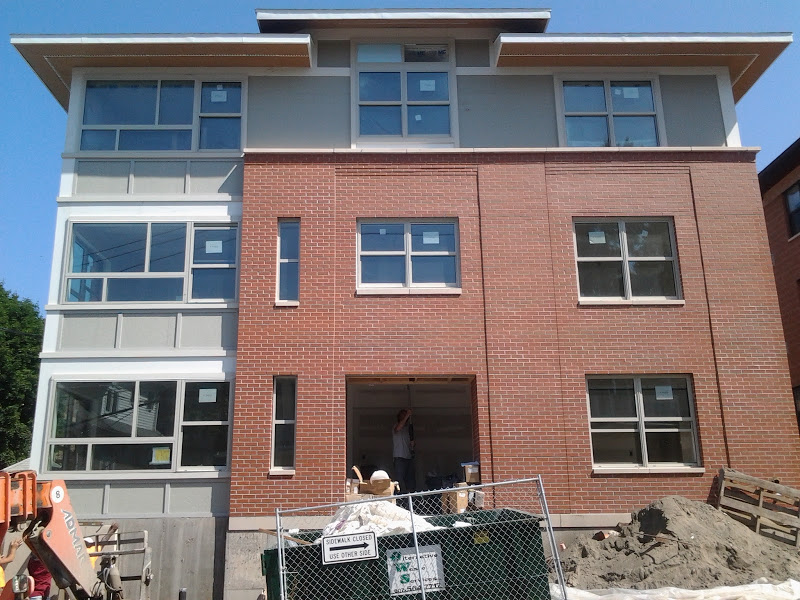
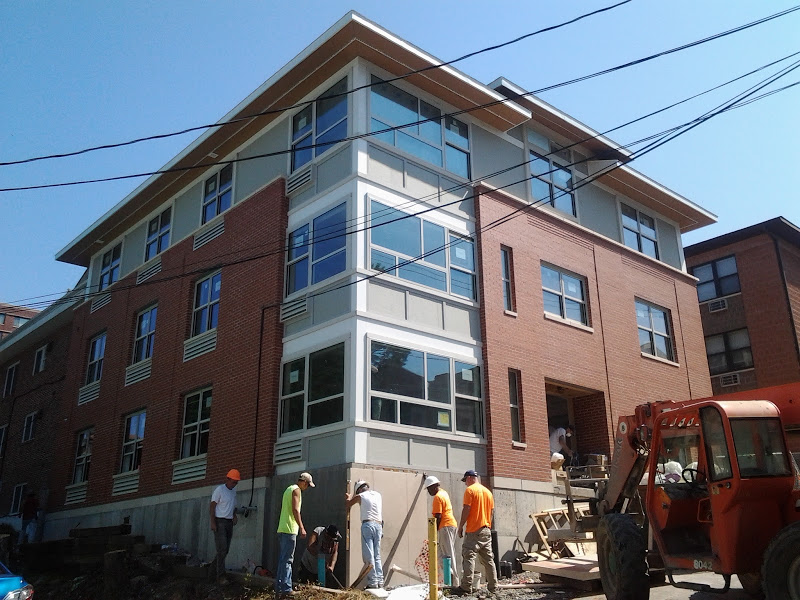
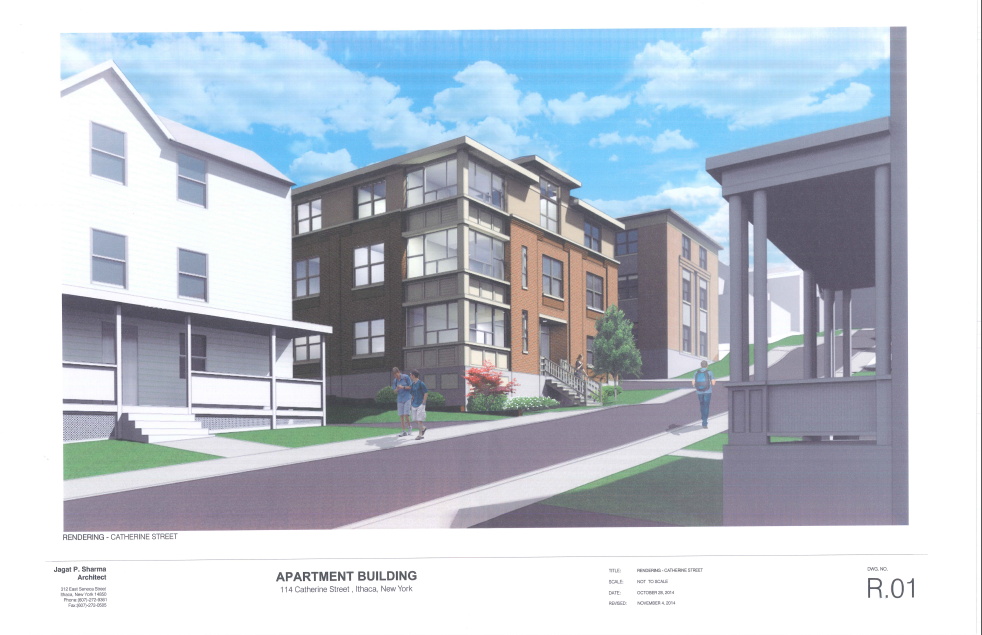
In these photos from the end of July, the work is nearly complete. A few workers were assembled around the concrete foundation, where the most visible corner will have an imprinted rectangular pattern for the sake of visual interest. The render I included this post was what I thought the version of 114 Catherine that was going to be built, but the corner windows aren’t as big, and the A/C units appear to be missing from the southward (front-facing) windows, and were moved to the side instead.

Workers are also busy with finishing out the interior, and the front door and stairs will be installed once it’s convenient. Landscaping will follow, and from there it’ll be ready for tenant occupancy later this month.

The building is being developed by Nick Lambrou of Lambrou Real Estate. Plans call for a 3-story, 4,180 sq ft structure with a 5-bedroom apartment on the first floor and a 6-bedroom apartment on the second floor and on the third floor. The building replaces a surface parking lot.

20150727_104740 20150727_104755 20150727_104816 20150727_104835

114_catherine_rev4_1


Belle Sherman Cottages Construction Update, 8/2015

12 08 2015

Normally, construction workers pay me no notice. This trip was a little unusual.

“Oh my God, is he taking photos of us!?”

“This is not my good side!”

“Worst glamor shots ever!”

Well noted gentlemen.

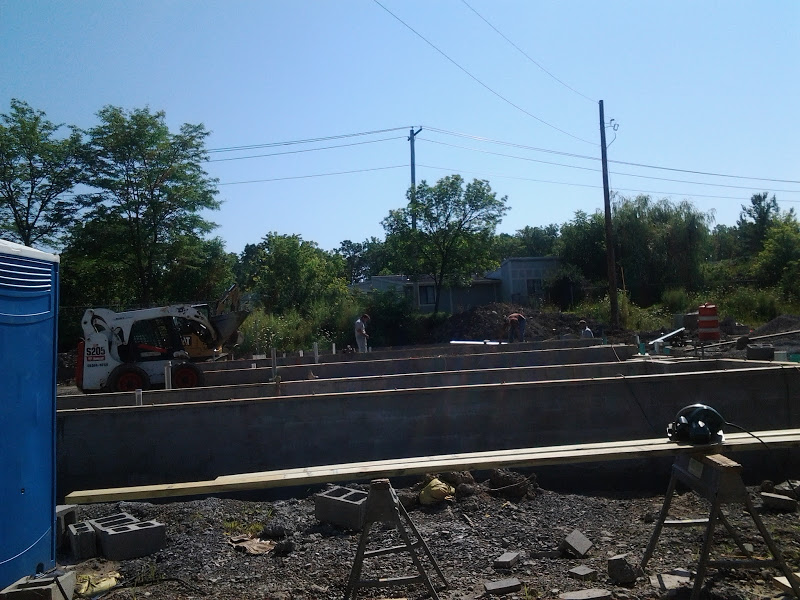
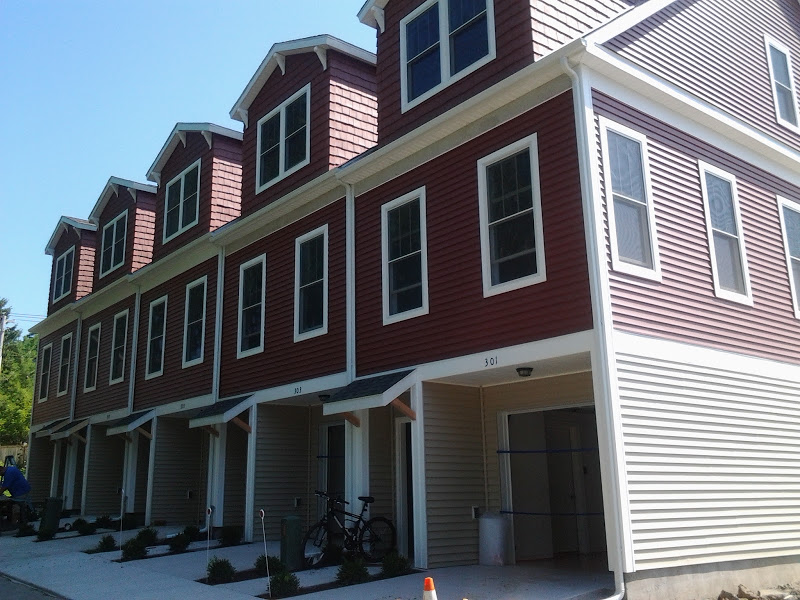
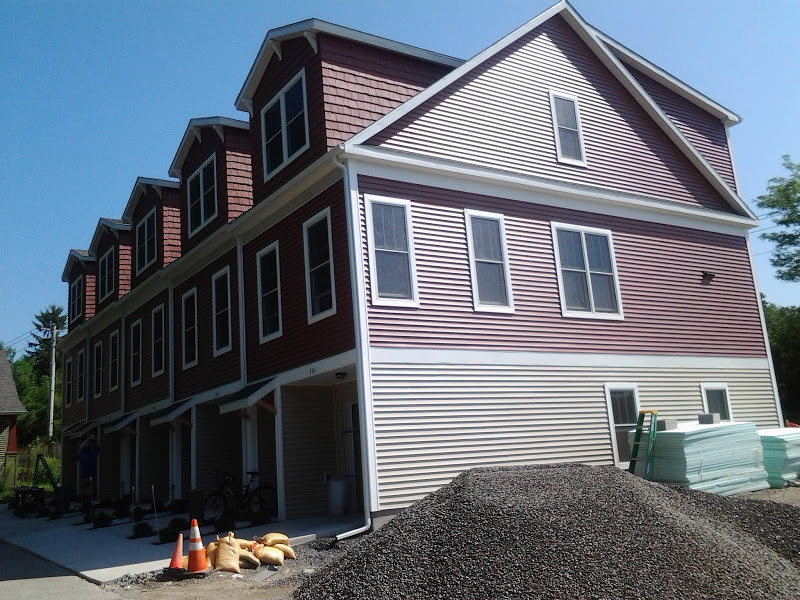
Workers from Ithaca firm Carina Construction continue on the last stage of the 29-unit Belle Sherman Cottages project just over the city’s eastern boundary line, in the town of Ithaca off the 800 block of Mitchell Street. On the first set of townhouses (lots 25-29), one gentlemen was busy cutting trim boards as exterior finish work was being wrapped up in time for the fall semester. Asked if he knew when the next modular units would arrive, he said “oh, just a couple weeks from now”. Since these photos are almost a couple weeks old now, one could say any day now, if they haven’t arrived already.

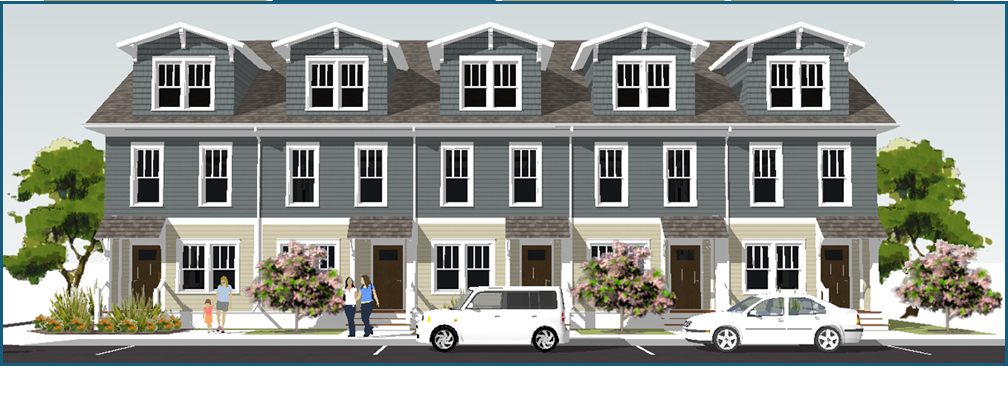
Unlike the five units already built, these will have Pacific Blue Certainteed clapboard siding instead of Autumn Red, and the garages will be in the back instead of the front. The Concrete Masonry Unit (CMU) block foundation walls are being assembled in preparation for the arrival of the Simplex modular units (covered in great detail by Ithaca Builds), which will be brought in and fitted before the leaves turn. Interior finishing and exterior work such roofing, siding. and porches will be completed over the next couple months and into the fall. The stand-alone homes, apart from whatever’s going on with lot 9, have been sold and assembled.

A quick glance at the sales records filed with the county shows a nice mix of buyers; retirees moving in from around town and from outside the Ithaca area, and a number of professionals who are making the jump from renters to owners. Prices for the homes started at around $330k, and in the mid $200s for the townhouses.

For those looking to buy in, you might have missed your chance; all the units are sold or reserved, and developer Toby Millman of Agora Homes and Development LLC says there are no current plans at the moment for another BSC-style development in Ithaca.

20150727_102705 20150727_102720 20150727_102735 20150727_102743 20150727_102801

20150727_102942

belle_sherman_townhouses_1


307 College Avenue (Collegetown Crossing) Construction Update, 8/2015

11 08 2015

The last in the Collegetown trio of midrise apartment buildings underway, and the biggest, is Josh Lower’s Collegetown Crossing project at 307 College Avenue. Like 205 Dryden and 327 Eddy, it’s time to give this building its first progress report.

A telescoping boom crane looms overhead as work continues on the foundation of the new building. An excavator is at work digging down to the appropriate level for foundation piling. The two-story concrete masonry unit (CMU) box that previously stood on-site has been demolished. Apart from the murals, there won’t be much missed about the ca. 1980 structure. 307 College had been home to a branch of Kinney Drugs up until about 2006, and afterwards, its commercial space was partially occupied by Ithaca Carshare. The second floor contained several apartments. The Lower family, who run the Urban Ithaca rental company in Collegetown, bought the property for $1.725 million in 2007.

Plans for the property were first announced back in 2009, but with parking requirements still in place, the project would have needed a zoning variance of 57 parking spaces, which the city was uncomfortable with. The project stalled and was unable to move forward with further review until the city passed revised zoning codes for Collegetown in March 2014. There were actually two notable impacts as a result of the zoning code update – one, that it could be built in the first place; and two, that the rear portion, which had been six stories like the rest of the building, had to be chopped down to 4 stories since it fell into a different zone (the building straddles two lots; the rear one is part of the new CR-4 zoning, which only allows four floors, and the front portion is MU-2). This reduced the number of bedrooms from 103 to 98, and later, 96. The final plans were approved last September, and the groundbreaking ceremony was just last month.

Collegetown Crossing will have 46 apartments with 96 bedrooms when it opens in August 2016. Along with those units, the project will host a 3,200 SF branch of local grocery co-op Greenstar on its ground floor. Two smaller commercial spaces are also included. A heated bus shelter and a narrow “pocket park” traversing College Avenue to Linden Avenue will also be available for public use. With a true grocery store coming to Collegetown, residents have generally been in favor of the project.

There’s no construction loan on file, but the FEAF estimated $5 million to build. The grapevine says it actually might be more in the line of $7-8 million. Also a plus, there were no tax breaks requested or given.

Local architect Jagat Sharma can put another feather in his cap, as this project is another of his designs. Syracuse-based Hayner Hoyt Corporation will be in charge of construction.

20150727_104229

20150727_104247

20150727_104304

ctown_crossing_rev2_1


327 Eddy Street (Dryden Eddy Apts) Construction Update 8/2015

10 08 2015

Another Collegetown construction project is getting its first real progress report. This time, it’s 327 Eddy Street in Collegetown, also known as the “Dryden Eddy Apartments”.

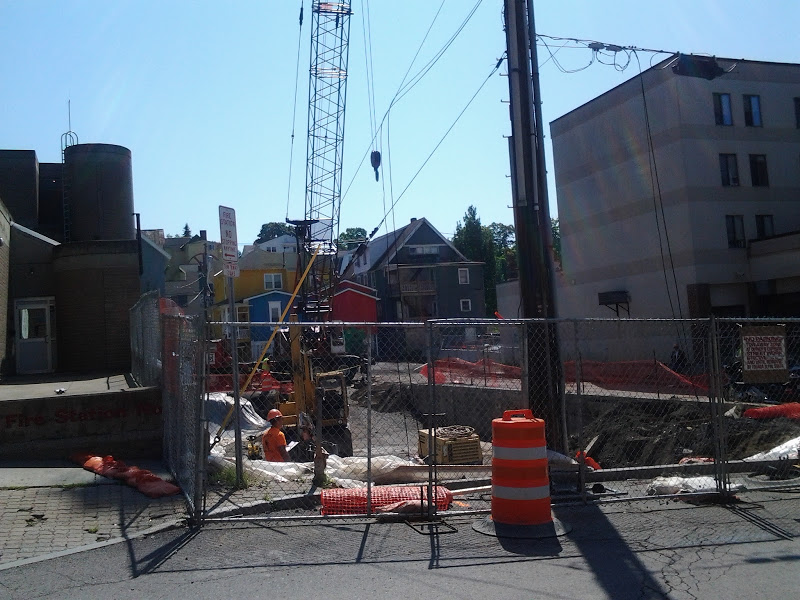
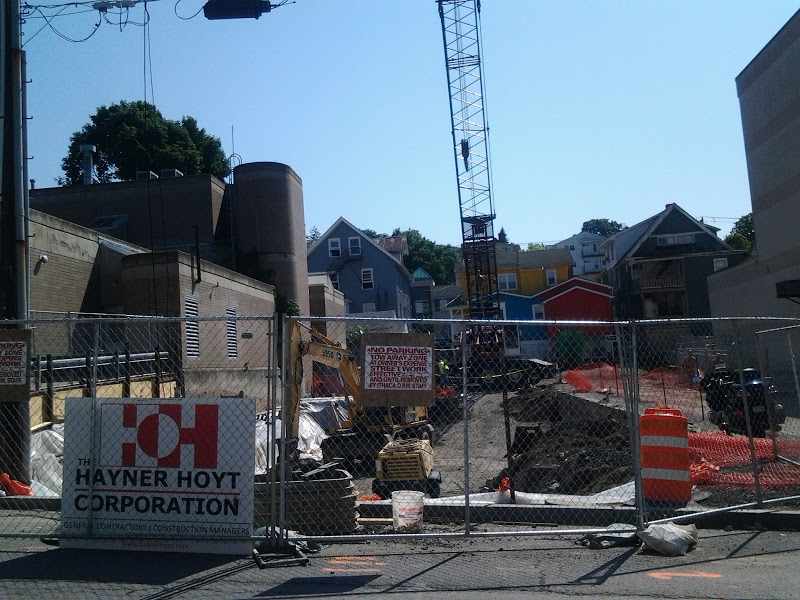
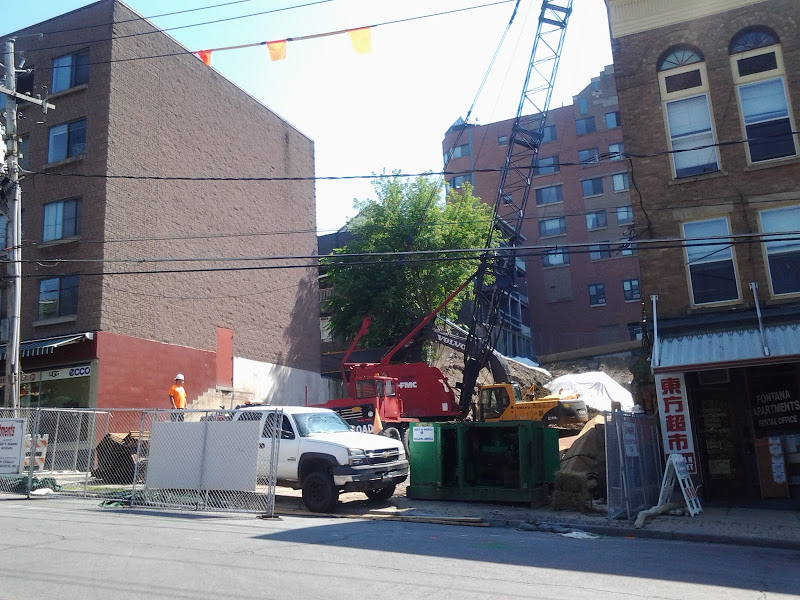
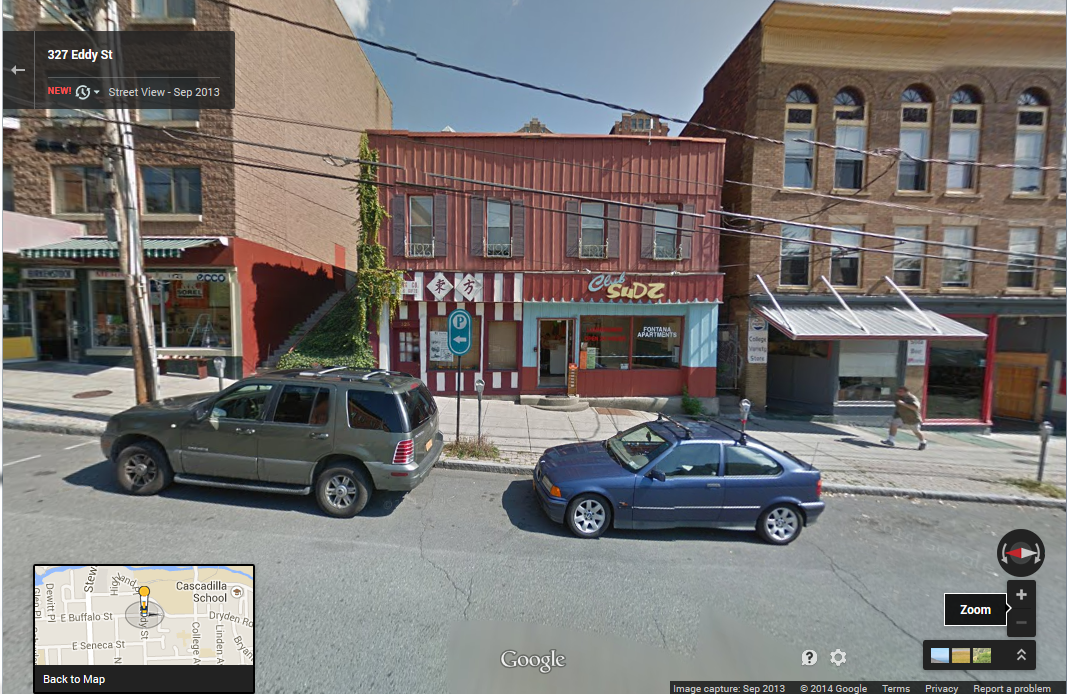
Excavation has been underway for a little while now, since the old Club Sudz/Tung Fong Grocery came down earlier this summer. The Club Sudz building had been built around 1910 as a 3-story building, but the structure was partially destroyed by a fire in 1970, and only the bottom two floors were rebuilt.

These photos are nearing two weeks old now, but a more recent photo taken by Mark Anbinder shows steel sheet piles on site. The project will use “flowable fill” to a depth of three feet in its foundation. Flowable fill is an alternative to concrete and is often used in roadwork or as retaining wall backfill.

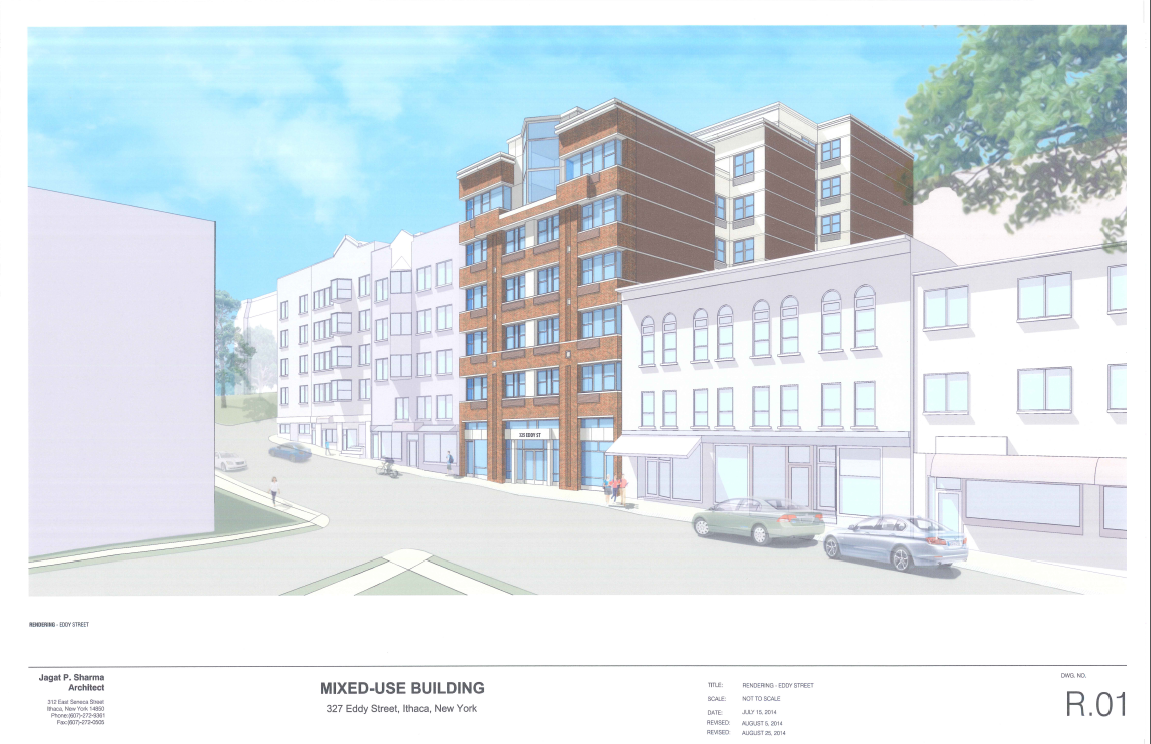
What comes in its place is a 5-story building broken into three stepped sections. As elevation increases going eastward, the building steps back to another five-story section. Initial plans approved in 2014 called for a 6-story building with a different crown treatment (which looked better, in my opinion). Somewhere along the way, the building lost a floor, and then very shortly before construction began, the crown was changed from a triangular prism to a glass box. Presumably, this doesn’t affect the appraisal for the crown projecting into the city’s right-of-way.

The new 5-story building will bring 1,800 SF of retail space and 22 new units with 53 bedrooms to the market in August 2016. Longtime Collegetown landlord Steve Fontana (of the Fontana’s Shoes family) is the developer, Jagat Sharma is the architect, and GM Crisalli & Associates of Syracuse will be overseeing construction. A construction loan of $4,824,000 is being provided by Tompkins Trust Company.

20150727_105349 20150727_105330

327_eddy_3

327_eddy_rev4_1


205 Dryden Road (Dryden South) Construction Update, 8/2015

9 08 2015

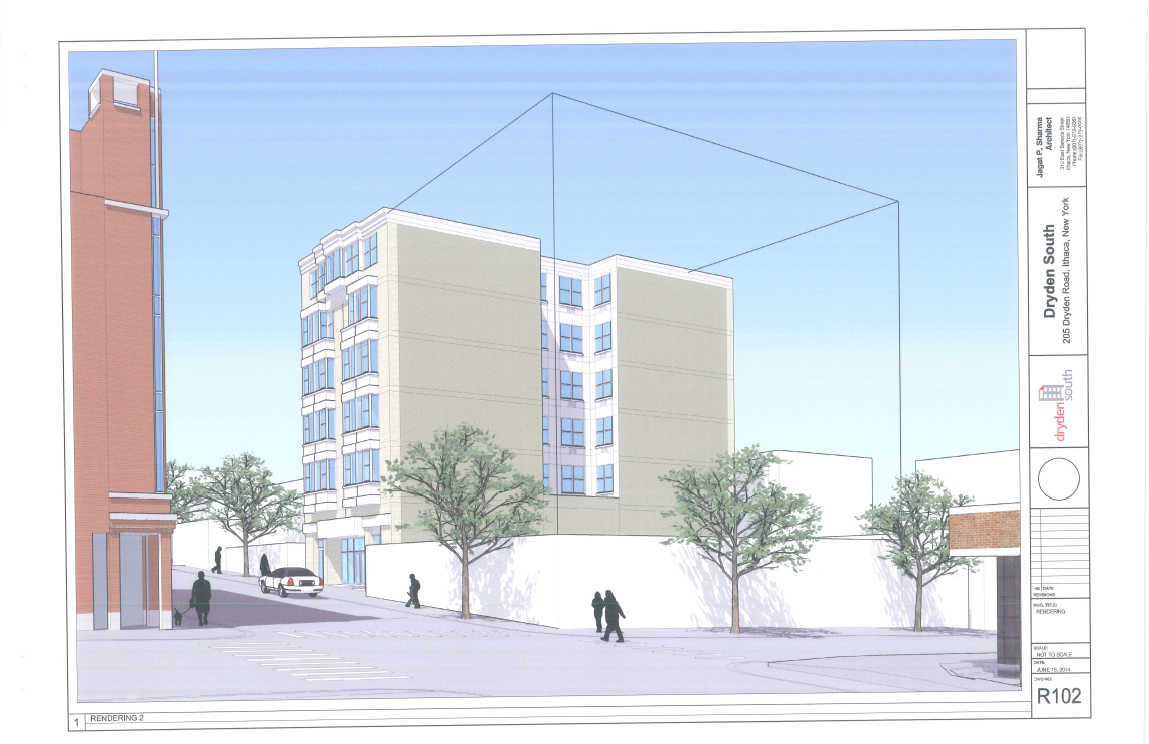
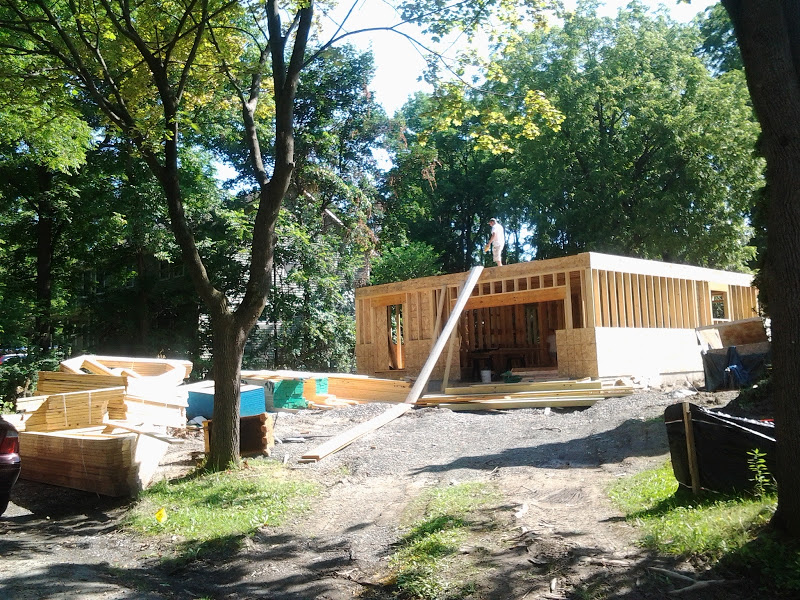
Demolition work has commenced at 205 Dryden Road, also known as “Dryden South”, in Collegetown. Only a pile of debris indicates where the old Kraftee’s building once stood. Once the site is cleared, Excavation work and pile driving for the foundation can begin. When completed in August 2016, 205 Dryden, a 6-story, 65-foot structure, will house Kraftee’s in 2,400 SF of retail sapce on its ground floor, and 2 4-bedroom apartments on each of the upper five floors, for a total of 10 units and 40 bedrooms.

Kraftee’s is one of the local private college department stores, and opened its second location in Ithaca in December 2002 (the first store opened in Herkimer in 1989, moved to Oswego in 1990, and is still open today). Owner/developer Pat Kraft bought 205 Dryden in August 2004, and in January 2008, moved the store to the old convenience store next door (325 College Avenue, now the home of PopShop). In fall 2011, Kraftee’s moved back into the Dryden Avenue space after 325 College was sold to John Novarr, and he decided to not renew Kraft’s lease. Now, with the new build underway, Kraftee’s is temporarily housed at 315-17 College Avenue, in a space rented from the Lambrou family.

As previously discussed, plans for a new building on the Kraftee’s property have been in motion for a while – since at least 2009, according to Dryden South’s website. Formal plans, however, were not presented until May 2014, after the new Collegetown zoning went into effect. Plans were approved last August, but given the student renting cycle and rented units in the upper floors, work on the site began only recently.

According to county records, the project was extended a $6,400,000 building loan from Oswego-based Pathfinder Bank on July 14th. Prolific Collegetown architect Jagat Sharma handled the design, and Rochester-based LeChase Contruction is in charge of the build-out.


20150727_104005

20150727_103951

6-29-2014 153

dryden_south_rev_1

dryden_south_rev_2


News Tidbits 8/8/15: A Shocker on Cayuga Street

8 08 2015

travis_hude_libe_libe_v3

1. As reported by several news outlets, the Tompkins County Legislature came to the surprise conclusion last Tuesday to give preference to the Travis Hyde proposal for the Old Library site at the corner of West Court and North Cayuga Streets. The final vote was 8-5.

I’ll be honest, I was shocked. I figured the county legislature would just never come to a resolution, or that on the off-chance that it did, it was going to be in favor of the Franklin Properties proposal, which had by far the most vocal support of the three proposals (the third being the unloved Cornerstone proposal for affordable senior housing). If this has been the city’s site to sell, the decision would have gone to Franklin, so I think this ordeal highlights the somewhat differing interests of the city and county. Regardless, I feel either proposal would have been successful for the Old Library site, and I am pleased to see something moving forward.

From here, the project is to move into an SEQR (State Environmental Quality Review) assessment coordinated with the city of Ithaca. The project also needs to go forward to the Ithaca Landmarks Preservation Council (ILPC) for a certificate of appropriateness. It is quite possible that the design will be changed during those reviews. Once those are approved, a sales agreement will be drawn up late this fall, the county authorizes sale around Christmas, and the actual sale of the property to Travis Hyde would happen in January 2016. If the Travis Hyde project can’t move forward and the sale hasn’t happened, then the county can authorize the Franklin proposal, which would also have to negotiate the same processes to arrive at the selling stage. In sum, a big hurdle has been jumped, but there’s a lot more that needs to happen before any shovels hit the dirt.

2. For all you would-be developers out there, here’s this week’s opportunity – since the folks that own Felicia’s Atomic Lounge have decided to focus on a new restaurant in Trumansburg, their Ithaca site is closing and the property is for sale. On the surface, you get a 1-story, 1,500 SF building at 508 West State Street for about $350,000. Dig deeper and zoning permits a 60′ tall building with no parking required. The city and county have designated the West State corridor as the place where they would like to focus denser development, and the zoning was revised in 2013 to reflect those desires. If/when the property sells, if it merits further attention you’ll see a news update here.

chapter_house_1905

3. Demolition of the Chapter House’s fire-damaged walls is taking longer than expected because the owner had to apply for a certificate of appropriateness from the ILPC to approve demolition. For those that are interested in reading about how water and fire damage have structurally comprised the structure, the application bundle can be found here. Apart from the usual applications like window and roof treatments, the ILPC is also set to begin discussion of 406 and 408 Stewart Avenue, where a new apartment building is likely to be built to replace the one totally destroyed by the Chapter House (and which I wrote about here on the Voice). For those interested in attending, the meeting is at 5:30 PM in the 2nd floor conference room at Ithaca City Hall.

tfc_v3_1

4. Looking at the city’s planning board projects memo for the month, August is going to have a lot og big decisions in store. Novarr’s academic building at 209-215 Dryden in Collegetown is up for preliminary approval, as is Tompkins Financial Corporation’s HQ (shown above) and the Dibella’s sub shop in southwest Ithaca. If INHS’s 210 Hancock gets zoning approvals at the Board of Zoning Appeals (BZA) meeting next Tuesday, it will be up for final approval at the August planning board meeting as well. The 12-unit “pocket neighborhood” at 215-221 West Sepncer will complete environmental review and possibly granted permission to face the BZA, and the massive State Street Triangle project will have more public discussion and review, with no decisions expected. A very busy month that will hopefully pane out to a busy construction season in 2016.

5. Looks like there’s a potential site being weighed for a new Collegetown fire station. In minutes from the Board of Fire Commissioners, the location is described as being towards Maple Avenue, on land that would either be donated or bought outright. That would place it up by the Fairview Apartments and Cornell facilities, assuming it’s not further out in Ithaca town (services are shared if I remember right). An unidentified consultant has been chosen to review the costs of selling the land in Inner Collegetown and building a new station vs. renovating the current 47 year-old property.

20150727_102527 20150727_102600

5. Random house of the week turns back to 203 Pearl Street in Ithaca’s Bryant Park/Belle Sherman neighborhood. I spy with my little eye, a large garage opening, a rough-in for a door to its left, a couple of rough window spaces, and lots of roof trusses. It’s supposed to be a 1,276 SF house, but one could be forgiven for thinking the owners are just building a nice garage. The lot was separate when the neighborhood was first plated, but decades ago 201 Pearl bought the land and used it for an in-ground pool. The pool was eventually filled up, and the land subdivided once again this past spring.