News Tidbits 8/13/16: The Forward Advance

13 08 2016

201_college_v5_1

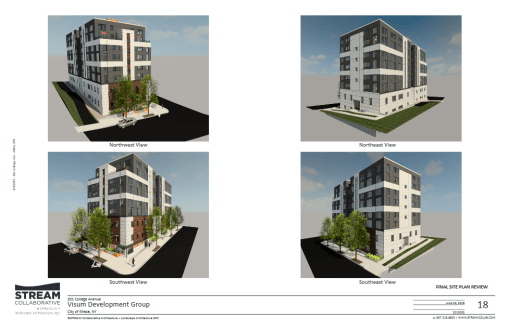
1. In the news, Neil Golder’s lawsuit against the planning board and the 201 College project was dismissed on technicality. The Tompkins County State Supreme Court decided that since the lawsuit was based on preliminary site plan approval and not final site plan approval, the project was subject to further changes and that it wasn’t appropriate for the court to hear this case at this time. So in other words, Neil will probably file his lawsuit again if/when final approval is granted, since changes between preliminary and final are unlikely to be significant. The scorched earth approach will likely continue.

It’s going to be a couple of weeks before that happens. In what the Times described as “an odd move”, the project is heading before the BZA for a zoning interpretation. Even the city’s planning department director, JoAnn Cornish, thinks it was a strange move on the board’s part, and one that kind of upends her department’s authority since they had looked at the facade length and decided it fit the zoning. More about the planning board’s (John Schroeder’s) odd decision and reasoning here.
waterfront_concept_aerial_1

dot_concept_1

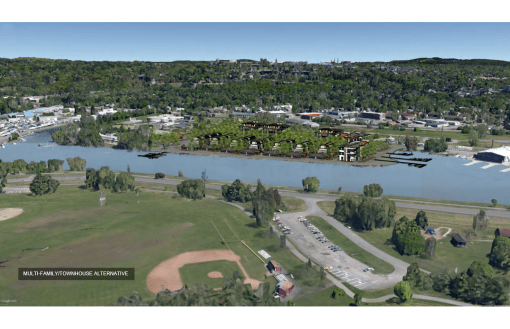
2. Looks like there’s a twist in Tompkins County’s plans to redevelop the NYS DOT site on the Ithaca waterfront. The DOT is no longer looking at moving to Enterprise Drive in Dryden, even though they bought the land there in 2005. Now they’re looking at a site along Warren Road up by the airport. So close to the airport, in fact, they apparently needed the Federal Aviation Administration (FAA) to sign off on it. The FAA has agreed to a location and the DOT is working out a long-term property lease. The cost of moving is now estimated at $11-$12 million, slightly less than the $14 million estimated for the Dryden location in the Fisher Associates study, but estimates being as they are, it would be prudent to keep an eye on those projections.


3. The Dryden town planning board recently reviewed plans to convert the former Stevens Furniture at 2085 Dryden Road into an auction house specializing in books. The 10,000 SF would be renovated with no substantial exterior modifications. It’s a fairly small, unobtrusive plan, and by itself not much of a write-up.

However, this project is being proposed by Danby’s David Hall. The same David Hall who wanted to create the Summit Enterprise Center on Danby’s Gunderman Road, and led to all sorts of rancor among town residents and officials. His company, National Book Auctions, was to be one of the tenants of the business center. Danby’s planning board notes are online up to June only,  so the question is, is the Danby plan still moving forward and this is a case of filling a pressing need, or is the Summit project done and out?
123_eddy_street_1

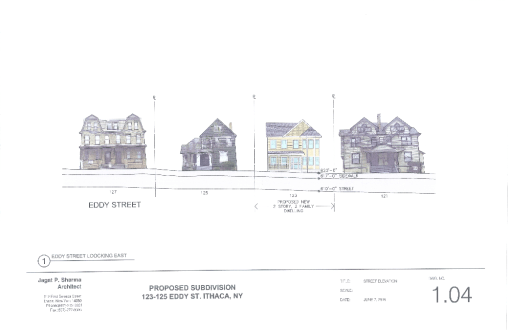
4. For this week’s eye candy, here’s the first image of the two-family home that Collegetown landlord Nick Lambrou wants to build at 123 Eddy Street. Jagat Sharma is the architect. The land is currently a double lot with 125 Eddy, and at present it’s part of the lawn. A planned subdivision would create a building lot on which Lambrou could put up the home. As part of the East Hill Historic District, the design has to pass ILPC muster, and at a glance, the projecting window bays (not sure they meet the definition of bay windows?), porch and comparably-pitched roof should help.

Note the lack of a garage. The street is up to 13 feet below the houses on that block, and there are no off-street parking spaces planned for either of the 3-bedroom units. The BZA would have to grant a zoning variance for a deficiency of two spaces.
tiny_timbers_1

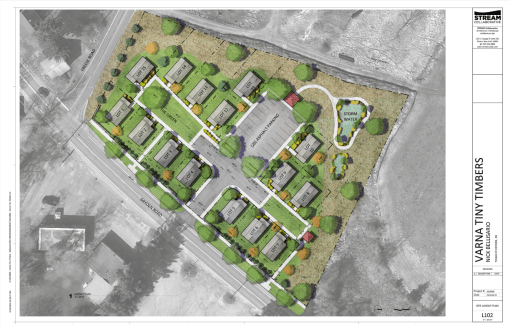
5. Tiny Timbers and the Evergreen Townhouses were both up for review by the town of Dryden’s Planning Board. Tiny Timbers once again had only a few minor quibbles among board members, who voted to approve the sketch plan and send it to the Dryden ZBA. The Evergreen Townhouses had much more resistance, but the PUD concept was approved with some stipulations on fleshing out the project further before it may continue in the process. In Dryden, the town board gives final approval to project proposals, so both of these are moving along, but not fully approved just yet. In the meanwhile, Tiny Timbers is finishing construction on prototype #2.

6. Someone’s had a busy week. On Wednesday, a Rochester-based LLC picked up the Chateau Claire Apartments, a ca. 1960 64-unit apartment complex in the village of Lansing, for $5.3 million. The same day, a second Rochester-based LLC picked up the adjacent 37,400 SF shopping center for $1.3 million. The properties are collectively assessed at just under $6 million, so the purchase price seems pretty reasonable for a decent if not especially desirable stretch of property.

With a little digging, it turns out under the LLCs, the sellers were the same for both, and the buyers the same for both. The sellers were the Goldberg family who owned Bishop’s of Ithaca, a home improvement store. After enjoying success with growing Bishop’s into a small chain, Stan Goldberg turned to development and was a major local developer from the ’60s through the early ’90s. He sold Bishops to his employees in 2003, and passed away last year. The buyer was Park Grove Realty, a startup real estate firm out of Rochester staffed by former Conifer LLC employees and making waves for proposing a 140-unit apartment complex on Bomax Drive two miles away. A little piece of old Ithaca fades, and a newcomer makes their first foray into the region.

Park Grove has taken out a $1.14 million construction loan to renovate the Chateau Claire units – kitchen and bathroom remodeling, washer-and-dryer installations, roof repair, new balconies, gutters, landscaping and lighting.

canopy_comparo_elevations_new_2

7. And the other big sale(s) of the week, also from Wednesday – Ithaca Downtown Associates LLC, the Patel family, finally purchased the properties for the 131-room Hilton Canopy hotel project. $1.8 million to the IURA for the parking lots at 320-324 East State Street, and $2.05 million to local landlord Joe Daley for the parking lots on the former Strand property at 310-312 East State Street. This marks a big step in moving the 77,800 SF, $20+ million project forward.


Holiday Inn Express Construction Update, 7/2016

21 07 2016

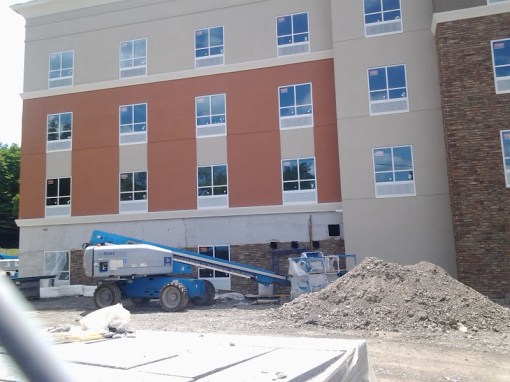
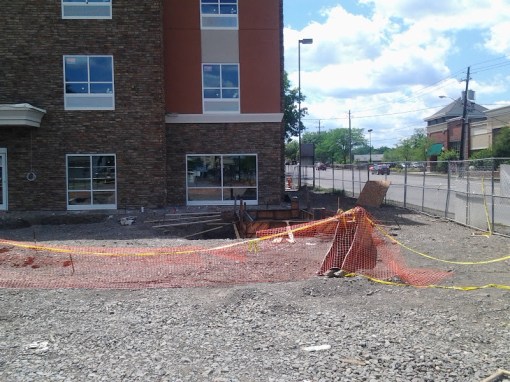
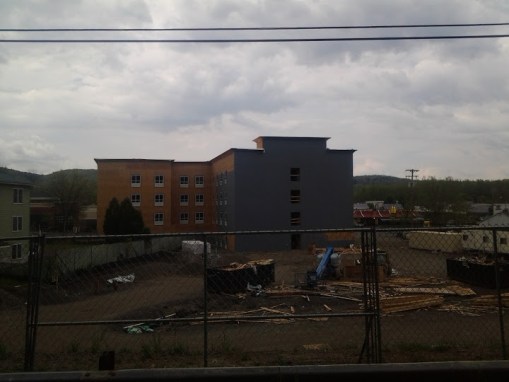
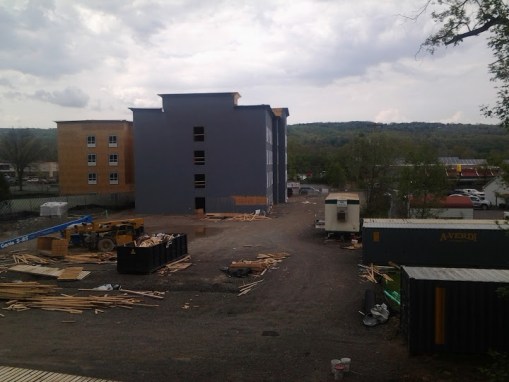
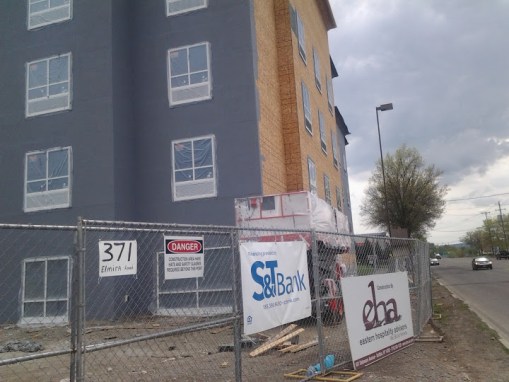
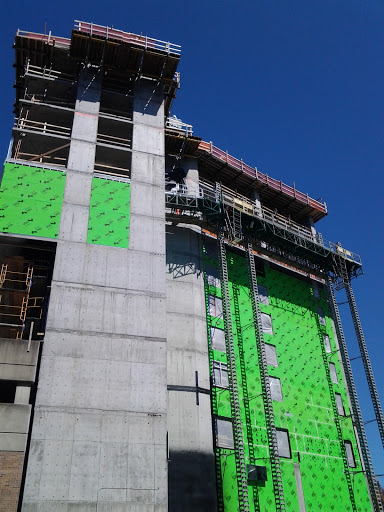
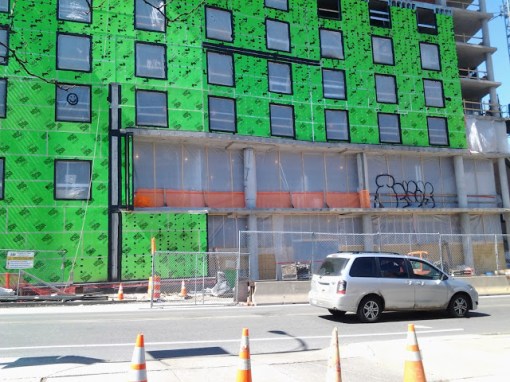
The Holiday Inn Express at 371 Elmira Road is looking more like the final product. From the back, you can see what the Exterior Insulation and Finish System (EIFS) installation process looks like – after the first moisture barrier comes insulation foam board, then comes the adhesive, fiberglass mesh, a base coat and the finish coat. On the north face, stone veneer is being installed on the first floor, and it looks like they’re doing the concrete and foundation work for the canopy and planters. The roof is still covered with temporary plastic sheeting, but will be finished with Isogard cover board, and a single-ply EPDM (synthetic rubber coating) finish. The 79-room hotel’s supposed to be open by late August, if the initial construction schedule is still correct.

20160717_132001 20160717_132050

eifs_plywood 20160717_133208 20160717_133231 20160717_133305 20160717_133337 20160717_133355

holiday-inn-express-original-1

20160717_133237


News Tidbits 7/16/16: Summer Storms of a Different Kind

16 07 2016

inhs_pride_design_v5_3
1. It looks like the first round of funding has been filed for INHS’s 210 Hancock project. The $7,790,511 construction loan was filed with the count on July 11th, with the lender of record listed as “CPC Funding SPE I LLC”. CPC is the Community Preservation Corporation, a non-profit lending institution funded by 69 different lenders in a revolving loan fund in New York, New Jersey, and Connecticut. This includes big banks like Citi and wells Fargo, and smaller regional banks like Chemung Canal Trust. Since affordable housing isn’t intended to be a moneymaker, it’s difficult to get lenders to cover the construction costs of a project. CPC serves as a middleman, allowing multiple private lenders to engage in modest amounts of financing for affordable, multi-family housing.

The 54 apartments and 5 townhouses partially funded by this loan are expected to be ready for occupancy next summer.

old_libe_thp_holt_v6

old_library_thp_v4

2. Things aren’t going well with the Old Library redevelopment. In Tuesday’s joint meeting between the ILPC and the Planning Board, some felt the current design of Travis Hyde’s DeWitt House proposal was too dull, some felt the previous design was best, and some fell in between. But, it seems like none of the three approaches has enough support to get a Certificate of Appropriateness, with a few of the members feeling that no design will work for the site because they feel they’re all too big. Frost Travis replied that the project can’t afford a major size reduction and still be feasible. Now the county’s getting involved since they selected the Travis Hyde proposal, and things are getting quite contentious.

Doing a quick check, for at least the previous iteration, the Travis Hyde proposal was about 85,600 SF, and the Franklin/STREAM condo proposal was 5 floors and 58,000 SF. Would residents have pushed Franklin/STREAM to reduce floors and potentially make the condo project infeasible? Who knows. If folks start clamoring for three floors or less, that will likely eliminate any proposals due to the cost of rehabilitation and reconstruction, and the county will have no viable options for a building in need of expensive repairs just to be usable. We’ll see what happens next month.

3. Namgyal Monastery has officially sold its city property. The house they owned at 412 North Aurora Street sold for $275,000 on the 13th, which is the same price it’s assessed at. Namgyal has purchased for the property for $150,000 in November 1992. A 2006 assets assessment placed the value of the Aurora Street house at $300,000, which might have been a bit generous.

On the one hand, the sale nets the monastery funds to continue construction of the new 13,000 SF facility on South Hill, which was recently selected to be a site of the Library of the Dalai Lamas. On the other hand, their webpage states they intended on keeping the Aurora Street house.

147962

4. The Ithaca Times’ Jaime Cone, new wind turbine laws in Newfield may effectively prohibit their construction. The town of Newfield decided to expand the radius of legally required unoccupied space from 1.5x the height of the turbine, to three times the radius of the propellers. In the case of the turbine that Black Oak Wind Farm (BOWF) was looking to put there, that raised the necessary easement support area from within 750 feet of the base, to 1,760 feet. Also, instead of 750 feet away from occupied structures, it’s 1,760 feet from any property line – in case anyone wanted to build on vacant land. Quoting Marguerite Wells, the beleaguered project manager of BOWF, “It makes it unbuildable…It’s a common way to outlaw wind farms in a town, to make the setback impossible.”

Apparently, things are so bad now, the town of Newfield voted to block a BOWF driveway that routed through Newfield to get to one of their Enfield sites. Given that a Tompkins County town is actively preventing and being malignant towards alternative clean energy sources and providers, it’s surprising there hasn’t been grater push-back from the sustainability proponents.

Overall, it’s been a rough month or so for green energy producers in Tompkins County – Ulysses is furious at Renovus and their solar panel installations, and Lansing’s planning board wants to vote in a moratorium on commercial solar panels.

amici house 1 county

5. The county’s PEDEEQ (Planning et al.) Committee is voting next week to take $2,500 from the county’s contingency fund to host a housing summit this fall. Another $2,500 will come from the Planning Department. The purpose of the $55,000 summit is to take all the updated plans and housing needs assessments (the county’s, which is the big one, is due out next week) and figure out way to incorporate them into an updated county housing strategy. $45k comes from a Park Foundation grant. From the tone of the summit description, it doesn’t sound like the county’s affordable housing issues have improved since 2006, but we’ll see just how severe the housing issue has become when the study comes out later this month.

On a separate note, the county is looking to award the 23-bed Amici House project $225,000 in affordable housing grants, plus a loan forgiveness of $75,000 in pre-development costs.

marriott_rev1_1

6. To round out this week of mostly unpleasant news, Mark Anbinder at 14850.com is reporting that the Marriott’s opening will be delayed from August 23rd to a likely opening in October, according to the director of sales. However, as extra padding in case of further delays, it appears won’t be taking further reservations for dates before mid-November. Unfortunately, this is well past Ithaca’s big tourist season, so it’s a safe bet to say neither Marriott nor the folks who had August and September reservations are pleased.


Ithaca Marriott Construction Update, 6/2016

16 06 2016

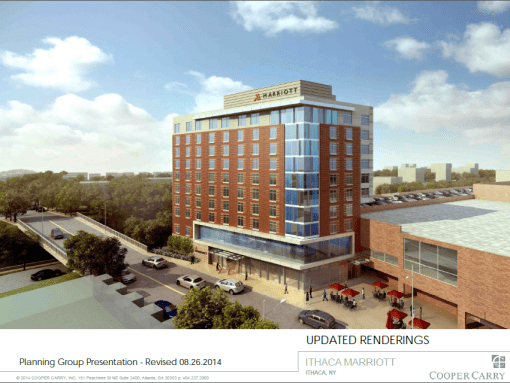
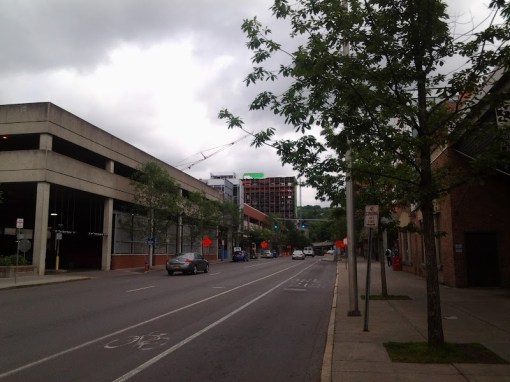
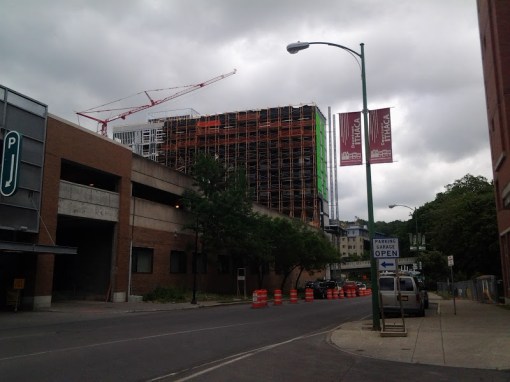
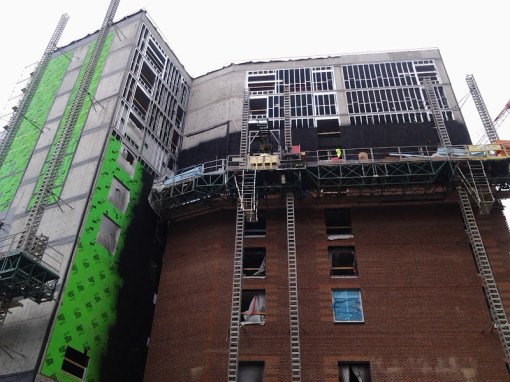
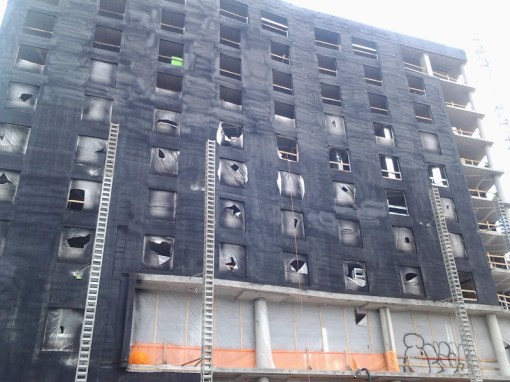
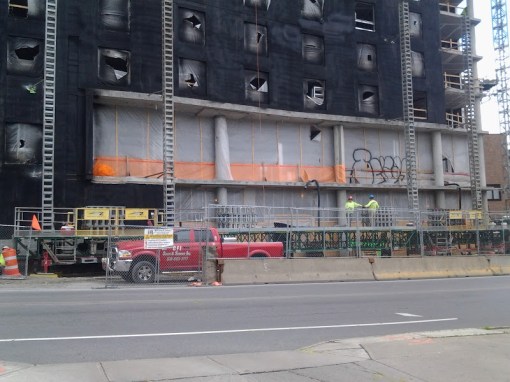
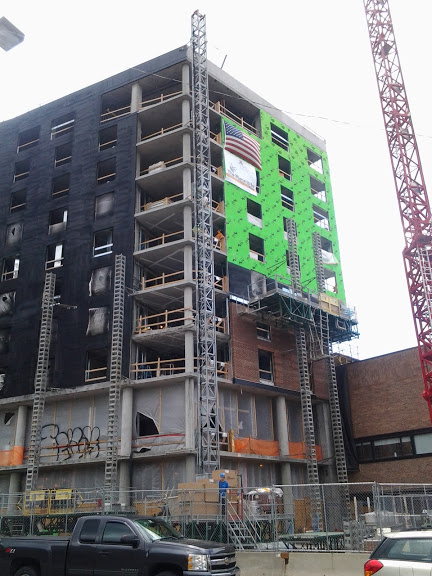
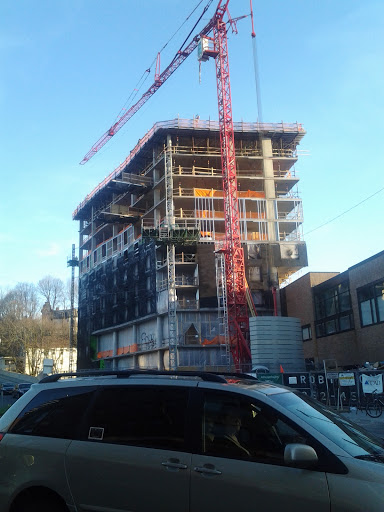
The Marriott is moving right along. Ten stories of reinforced concrete topped out at the beginning of May, with the mechanical penthouse being the last component. Exterior steel stud walls have been erected, fire-proof gypsum sheathing is being installed, and the black waterproofing material has been sprayed all along the front (east) face, and most of the back (west). Work on the brick veneer is steadily progressing up the north and south faces. The first floor facing South Aurora will have a stone veneer, while the top floor and the overhanging portion of the west face will use a few different shades of grey Nichiha fiber cement panels.

Work is also continuing inside as well – interior stud walls, electrical, plumbing, and HVAC. Specialty projects such as utilities are typically handled by various sub-contractors selected from bids.

In case you missed it, I did an interview with contractor W.H. Lane Inc. about the project for the Voice here. Plans still call for an August 23rd opening. During a debate on diversity at the latest city PEDC meeting, TCAD’s Heather McDaniel mentioned that Marriott has already hired four staff for the new hotel, of which three are women, including the general manager.

20160608_124634 20160608_124930 20160608_125143 20160608_131533 20160608_131621 20160608_131747 20160608_131812 20160608_131905 20160608_131932 20160608_132051 20160608_132111 20160608_132115 20160608_132201 20160608_132819 20160608_134654

marriott_rev1_1


Hotel Ithaca Construction Update, 6/2016

14 06 2016

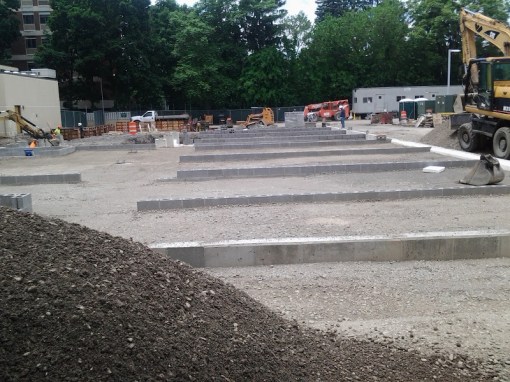
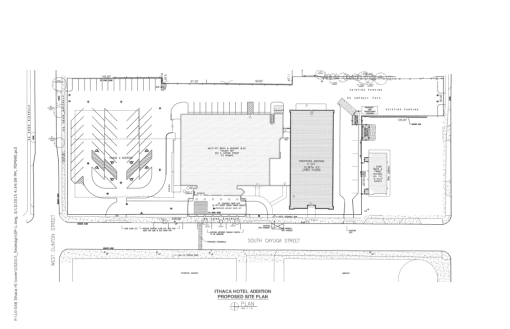
The Hotel Ithaca’s new wing seems to be moving right along. Most of the foundation has been completed. Some wooden forms used for foundation pours can be seen in the third photo, right next to the reinforced concrete footing. CMU walls create interior partitions within the building’s footprint – likely space for some of the 90 future hotel rooms, although none of the published materials online have shown an interior layout of the new wing. It’s suggested in the project site plan review documents that the new fitness center, breakout rooms and meeting rooms will be near where the new wing will connect to the existing hotel. Given the lack of windows or an entrance on the the first floor of the new wing facing South Cayuga, some of those function spaces are probably down at this east end of the wing, nearest to the street. Early plans did have an entrance on the South Cayuga side, but it was removed during project revisions.

The $9.5 million project is expected to open to guests in May 2017. More info about the project can be found here.

20160608_131325 20160608_131331 20160608_131351 20160608_131419 20160608_131442 20160608_131446


News Tidbits 5/28/16: A Battle Between Neighbors

28 05 2016

201_college_v2_3

1. It seems the Planning Board had something of a philosophical crisis at their meeting, per the Times’ Josh Brokaw. The cause of the crisis is Neil Golder, Todd Fox and 201 College Avenue. Here’s the backstory.

201 College is a 2.5 story, 12-bedroom house on the corner of College and Bool. Local developer Todd Fox has a proposal on the boards for a 5-story apartment building (shown above). Neil Golder lives next door at 203. He moved into 203 in 1972 when he was a grad student at Cornell, bought the place in the early ’90s, lived there with his partner Kathy until she passed a couple of years ago. He still lives there, and rents out spare bedrooms.

201 and 203 were rezoned as part of the 2014 Collegetown rezoning to MU-1. This came only after years of debate, and Neil was one of the residents who pushed to have the properties rezoned in 2009 with a payment in lieu of parking scheme that upset a lot of the landlords, who mounted a significant legal challenge that prevented the rezoning from happening – more about that can be found in this Voice explainer.

For the record, Golder has never been much of a fan of development in Collegetown. His two big things have been that density is bad (but he seems to have mellowed on this issue since the parking push in 2009), and that Collegetown needed a grocery store. He was supportive of Collegetown Crossing because the developer (the Lowers) live next door at 205 and Greenstar will be opening a grocery store on the ground floor.

So, back to the zoning. There are nine MU-1 properties. The four between Catherine and Cook belong to Novarr – he has not expressed any intent to redevelop them. The other five are 215, 209, 205, 203 and 201 College Avenue. Novarr has expressed intent to redevelop 215 starting in late 2017. 209 is Grandview House, a historic landmark, and pretty much untouchable. 205 is Lower’s house, 203 is Golder, and then you have 201.

201 is the southernmost of the nine, and therefore most likely to stand out. The thing is, zoning consistent, when development happens organically, it means the parcel most likely to stand out isn’t necessarily the last one to get developed, nor will it necessarily be the smallest. In this case, the physical transition is from 2.5-3.5 story houses, to 5-story apartment, to 2.5 story house, and then a 3.5 story house and 5-story boarding house.

As of right, Todd Fox can build up to 5 floors and 70 feet tall as an average height. The site slopes slightly, so the building is shorter on the north side than the south side. The design fits the zoning – but it has to go to the BZA for a couple of minor area variances, one for entrances off of Bool, and the other, the board requested the project incorporate – the building was moved northward slightly to allow for street trees and a wider sidewalk on College Avenue. The May agenda noted that the Board had no concerns with either variance.

Golder has sent letters to the Times and the Voice (directly to my colleagues Mike and Jolene but not to me, interestingly), he has been stopping people on the street to sign his petition, he’s tried the ILPC, Planning Board, Historic Ithaca, friends in city government, even the city forester, everything and everyone he can to try and halt the current plans, but there has yet to be a compelling, objective counter-argument.

Countering some of the claims in his many letters, the individual pine trees at the front are not historic landmarks or city-owned, the city has to review and approve of construction plans anyway, and the traffic issue had already been discussed back during the rezoning. The developer has agreed to push the building back, which will give more visibility to Golder’s driveway, and a curb bump-out at the corner is proposed as part of the project. So that leaves the aesthetic argument of “I don’t like it”, which puts the Planning Board in a really difficult spot because as long as the form districts say the design is fine, that argument won’t stand up to a legal challenge.

There is a strong argument with his solar panels, which have been a part of broader discussion within the city. 201’s height would marginalize Golder’s solar panels, so in that case the project causes non-subjective hardship; this could be mitigated if 201 has solar panels (they are being considered) and shares electric, or by other compensation. Although, it might depend on when the panels went in, before or after rezoning. If people start rushing to put up solar panels as a back-door method to thwart development, the city’s going to step in.

So here’s the essence of the issue – after years of fighting over zoning, and finally settling on a compromise in 2014, the city is faced with a development that is legal, but it’s vehemently opposed by a venerable and high-profile neighbor, where the objections can be effectively mitigated, but not necessarily the way he wants them to be. A planning board member has to find the balance between allowing everyone to have their say, and acknowledging valid issues that should be addressed, without letting individuals exert too much control over their neighbors and infringing on property rights.

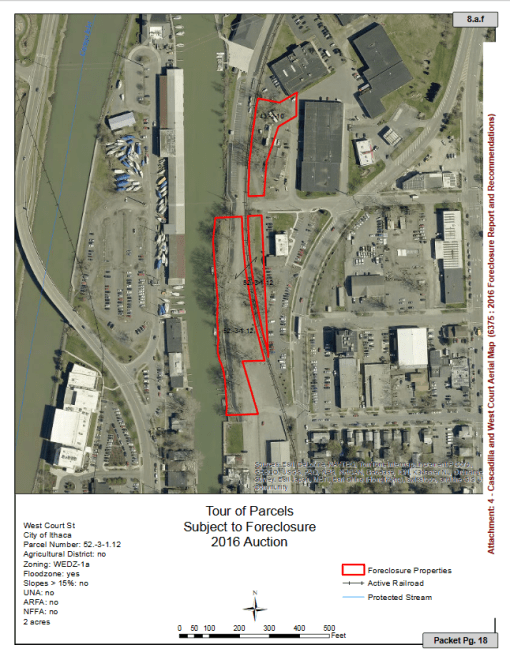
waterfront_foreclosure_parcels_0516

2. Okay, onto other things. The city might be acquiring a couple of sizable West End/Waterfront parcels from the county. The properties, which consist of a pier/boardwalk, informal parking and vacant land, are located at the end of West Court and Cascadilla Streets, and are being seized as a tax foreclosure. The county is looking at selling them to the city in exchange for the $42,844 in back taxes. The larger one is 2 acres, the smaller 0.6 acres, and in total they’re valued at $630,000. The owner, an LLC, picked them up for $156,625 in 1999.

If the city picks them up, they’ll be filed into the IURA’s holdings for potential sale down the line. As it is, the parcels have issues – the railway, accessibility, and soils down here are known for being difficult to build on. But in the long term, there’s potential for water-focused amenities, private development, or a combo of the two. It looks like a good investment given the city’s still-in-the-works plan to encourage redevelopment of the West End and Waterfront, so this is worth keeping an eye on as things move forward.

402_s_cayuga_st_boggsfernandez

3. The IURA reviewed funding proposals for affordable housing earlier this Spring, and the minutes are now online. the duplex at 622 West Clinton, and the affordable unit with the 4-unit 402 South Cayuga project were not funded. The IURA is encouraging 622’s applicant to re-submit for next year, and the minutes note that 402 is likely to still go forward, but without the affordable unit.

It’s also been noted that there is some discontent with INHS because the cost of their projects are coming in high, and that they would like more diversity in applying entities. However, the seven townhomes at 202 Hector and the single-family house at 304 Gector (all for-sale housing) are fully funded. The Habitat for Humanity duplex on the 200 Block of Third Street is also fully funded.

rumble_seat_1

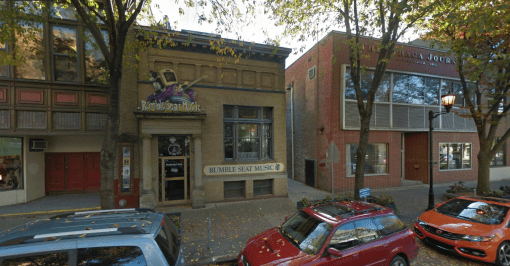
4. Another piece of news from the IURA – the new occupant for the Rumble Seat Music building. It appears to be a drink bar called “Watershed Union“, serving coffee and juice by day and adult beverages by night. Five or six living wage jobs would be created. There might be some grumbling over the moral evils of alcohol, but the business plan has the support of neighboring businesses and the Downtown Ithaca Alliance.

Also, the Canopy Hilton is still moving forward. But are doing a minor LLC ownership change to allow another Patel family member to be a part of the ownership team.

5. Hitting the market this week, for all those big-potato investors out there – the Belmont Townhouses at 324 Spencer Road. The listing from local realtor Brent Katzmann has the price set at $2,595,000, for a 14-unit complex that opened in 1995. The posting mentions the possibility of a 1031 Exchange, which allows an individual to sell a currently-owned investment property, and buy a new investment property of equal or greater value while avoiding capital gains taxes – continuity of investment locks up the profit gained from sale.
20160522_160150 20160522_160211
6. House of the week. This house is on the 100 Block of Campbell Avenue on Ithaca city’s portion of West Hill. This home is being built by Carina Construction, an Ithaca-based modular home specialist. The foundation and garage were poured and the pieces were probably craned on and locked together sometime in the past few weeks – a little bit of siding has started to show up on the front. The process is a lot like the one Carina used to assemble the Belle Sherman Cottages across town.

Color me impressed, the design is unique, and once exterior details like the porch and second-level deck go on, I imagine it’ll look really nice. Tompkins Trust lent $280,000 back in April, and the construction permits were issued not long thereafter (the total project cost is in the $320k range, per the permit filing). The land was created in a lot subdivision last year, and sold for $35,000 last August.


Holiday Inn Express Construction Update, 5/2016

25 05 2016

The new Holiday Inn Express at 371 Elmira Road seems to be coming along fairly quickly. Framing was completed a few weeks ago, and at this point most of the windows have been fitted. For those concerned that this is going to be a battleship grey eyesore, fear not. The plywood will be covered with varying colors of an Exterior Insulated Finishing System (EIFS, a synthetic stucco) and stone veneer. The grey is most likely a moisture barrier. Drainage cavities are then built over the barrier to allow water that has penetrated the surface to exit the wall without wrecking it (a big problem with early EIFS systems).

When finished, the hotel should look a lot like this one, with some minor design differences and an updated color scheme:

The project is being financed with a $5.98 million loan from S&T Bank, a regional bank in Western Pennsylvania, and Eastern Hospitality Advisors, a Buffalo contractor specializing in hotel construction, is managing the build-out.

The 4-story, 79-room hotel is expected to open late this summer.

20160522_145118 20160522_145153 20160522_145515 20160522_145542

holiday_inn_express_v2


Ithaca Marriott Construction Update, 4/2016

29 04 2016

Just clearing out the photo stash. An interview with Marriott contractor Mark Lane of W. H. Lane Inc. can be found on the Voice here.

Also, in the first photo, that’s probably the third-ugliest BMW in the world.

20160414_115436 20160414_115737 20160414_115827 20160414_115916 20160414_115920 20160414_115924 20160414_115958 20160414_120056 20160414_120121 20160414_120130 20160414_120212 20160414_120501 20160414_120856 20160414_121002 20160416_191249


Hotel Ithaca Construction Update, 4/2016

27 04 2016

Demolition and site preparation are the task du jour at the Hotel Ithaca at 222 South Cayuga Street. The north wing of hotel rooms is being demolished now, and the west wing of hotel rooms will be demolished once the new building is complete.

The new 30,000 SF, 5-story wing will contain 90 rooms, 2,900 SF of additional meeting space, breakout rooms, and a new fitness center. 100 hotel rooms are being taken offline and demolished, reducing the number available at the hotel from 180 to 170. But, the primary goal of the project is to modernize the Hotel’s offerings, and stay competitive with newer hotels downtown, including the Marriott currently underway, and the Canopy Hilton due to start later this year.  The project applied for, an received a 7-year tax abatement under the CIITAP program, making it the only project that has pursued the 7-year option over the more common 10-year enhanced option. CIITAP may not be popular from a P.R. standpoint, but as shown on Ithaca Builds, the high property tax rate downtown plays a large role in the program’s necessity.


Photo from C. Hadley Smith Collection

Photo from C. Hadley Smith Collection

The Hotel Ithaca originally opened in 1972 as part of the city’s urban renewal plans, initially operating as a Ramada. At the time, it only consisted of the two-story wings, as seen in the 1973 photo above; the 10-story “Executive Tower” was added in 1984/85. The hotel was rebranded as a Holiday Inn until the start of 2014, when it switched to an independent operation as the “Hotel Ithaca”. The Hotel Ithaca was also the working name of the Marriott project early on, so the two projects are easy to mix up. As part of the change, the hotel carried out $2.4 million in renovations (phase one) to the tower rooms and utlities.

holiday_inn_expansion_1

Early plans called for a $17.8 million, 140,000 SF addition with a 9-story, 115-room hotel, restaurant and conference center designed by Buffalo-based Roberts, Shackleton and Boy Architects. The conference center was very well received by local officials and business leaders, and is seen as really crucial to Ithaca’s business interests – the city lacks the ability to host mid-size conferences and conventions (midsize meaning about 500 attendees), which sends conventioneers elsewhere. Currently, the lack of meeting space limits conferences to about 250 guests. The addition of a convention facility is seen as a major benefit to downtown retail, as well as other hotels that would handle overflow guest traffic. Convention traffic typically happens during weekdays, when regular tourist traffic is lowest. The plan was later revised to 8 stories and 97 hotel rooms, and then that didn’t move forward due to financial difficulties.

hotel_ithaca_phase_1 hotel_ithaca_phase_2
The current project was proposed last September, and as the project had evolved, the tax abatement had to be re-voted (and passed 6-1). A potential third phase calls for a 3-story addition to the 5-story wing, and the coveted conference center, on the corner of W. Clinton and S. Cayuga Streets.

The $15 million second phase is aiming for a completion in May 2017. About 21 new jobs are expected to be created, most of those service positions near or a little above minimum wage.

Hart Hotels of Buffalo, founded by David Hart in 1985 and operating locally under the name Lenroc L.P., is the project developer. Krog Corporation, also of Buffalo and a favorite of Hart Hotels, is the general contractor. NH Architecture of Rochester, another frequent partner of Hart Hotels, is the project architect.


20160414_115147 20160414_115217 20160414_115246 20160414_115357

hotel_ithaca_final_1


News Tidbits 4/2/16: The Walls Come Tumbling Down

2 04 2016

hotel_ithaca_final_1

1. Demolition and site prep work has begun for the Hotel Ithaca’s new 5-story addition. The work appears to be right on schedule, since a March construction start had been planned. The $9.5 million, 90-room project replaces a two-story wing of rooms built in the early 1970s. Hart Hotels of Buffalo hopes to have the new wing open for guests this fall. NH Architecture of Rochester is the firm designing the project, which received some “sweet burns” when it was first presented with cross-hatched panels and “LEED-certified stucco”. Eventually, the planning board and developer settled on a design after review, and the project was approved late last year.

For those who like to see walls a-tumblin’, the Journal’s Nick Reynolds has a short video of the demolition on his Twitter feed here.

2. Looks like there’s a little more information about the 16-unit “small house” subdivision planned in Varna. A Dryden town board document refers to the document as “Tiny Timbers”. Which is a name that has come up before – in STREAM Collaborative’s twitter feed.

https://twitter.com/streamcolab/status/673601010313641984

https://twitter.com/streamcolab/status/657329991827509248

Making an educated guess here, STREAM is working with landowner and businessman Nick Bellisario to develop the parcel. It would also explain the huge mounds of material that had been on the site as of late – compressing the very poor soil so that something could be build onto it, even if they’re merely “tiny timbers”. It doesn’t look like these are more than one or two rooms, with an open floor plan on the first floor and either a room or loft space above.

At first impression, these are a great idea – relatively modest sizes tend to be more environmentally sensitive, and with the subdivision, it’s likely they would be for-sale units with a comparatively modest price tag. On the other hand, tiny houses are something that a lot of local zoning laws don’t accommodate well (minimum lot size, minimum house size, septic), so that would be something to be mindful of as the project is fleshed out more and starts heading through the town’s approval processes.

201_college_1

3. Here’s some good news – the initial reception to Visum’s 201 College Avenue project was favorable. Josh Brokaw at the Times is reporting that apart from debates over a more distinctive roofline and setbacks from the street (which is more ZBA than Planning Board), the board was supportive of the project.

Meanwhile, as for something they were not in support of, the possibility of removing the aesthetic parts of site plan review as a benefit to affordable housing incentive zoning was not something that sat well with them. One thing that does get missed in the article, though, is that that benefit would only be in areas with form zoning guidelines for building appearance and siting (right now, that’s only Collegetown).

cma_2 cma_3

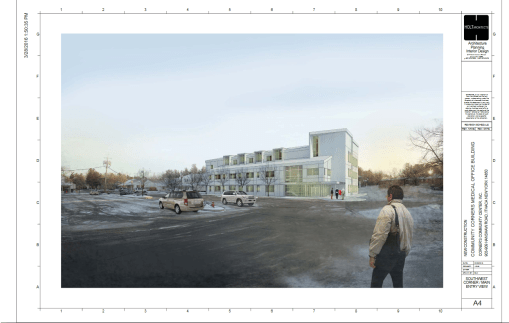
4. Never a fan of being scooped, but the Journal’s Nick Reynolds broke the news of a 3-story, 39,500 SF outpatient medical facility planned for Community Corners in Cayuga Heights. Owner/developer Tim Ciaschi (who also did the Lehigh Valley Condos on Inlet Island) will build-to-suit for Cayuga Medical Associates, with design work by HOLT Architects.

In most towns, this would be fairly cut and dry. But this is Cayuga Heights, which probably has the most stringent board in the county. The village routinely says no to anything that could draw students in (mostly housing, but historically it also included taverns and restaurants), and people prepare multi-page tirades against two-lot subdivisions, let alone what happens when a sorority tries to move in. In the project’s favor are its distance from homes and its modest densification of Community Corners, which the village has been slowly migrating towards in the past few years. The board’s raised concerns with not enough parking, so a traffic study was included with the March materials. We’ll see how this all plays out, a medical office building might work well with Cayuga Heights’ older population.

5. The city decided to take action on the owner of the Dennis-Newton House by fining him $5,000 for building code violations. Steven Centeno, who picked up the property from the Newtons in 1982, was initially charged with over 11,000 violations, and pleaded guilty to 35 counts. According to the city, Centeno was ordered to make repairs in 2012, and got the building permits, but never commenced with repair work. If he fails to bring the property up to compliance within six months, a further fine of $42,000 will be levied. This is not unlike the case last April where the city fined lawyer Aaron Pichel $5,000 for code violations on 102 East Court Street, the “Judd House”. Work on that property is underway.

maplewood_site_plan_concept

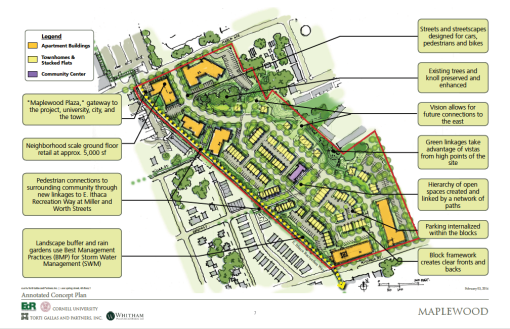
6. Likely to be some bureaucratic progress on the Maplewood Park redevelopment next week. The town of Ithaca will be looking at declaring itself Lead Agency for environmental review of the 500-600 unit project. designs and exact plans are still in the formative phases, so no new news on those quite yet. In order to build the new urbanist, form-based project as intended, Cornell will be seeking a Planned Unit Development (PUD), which will give them flexibility in how they can lay out the site. The portion in the city of Ithaca, the two buildings towards the northwest corner (boundary line goes down Vine Street), will be built as-of-right, and it looks like a sketch plan will be presented for the city’s portion during their April Planning Board meeting.

A FEAF is included in the meeting agenda, but since the project will have to undergo a Environmental Impact Statement (much more detailed than a FEAF), it’s not very descriptive.

341_coddington_1

341_coddington_3

7. Ugh. I give credit to the town of Ithaca’s planning board for trying to accommodate a solution where the 170-year old house could at least be moved to a different site. I’m disappointed in both the town of Ithaca’s Planning Committee (members of the town board) and the Iacovellis, neither of which seem to be devoting much thought to an amenable solution. The town’s planning committee chair is hell-bent on keeping students out, and the Iacovellis are now trying to rush the demo permit since they feel their livelihood is threatened. This is an unnecessary loss due to intransigence.