News Tidbits 11/30/15: It’s like the 1990s All Over Again

30 11 2015

maplewood

1. I want to start this oddly-timed roundup with a big thanks to the readers and commenters who encouraged me to write last Monday’s op-ed. If it wasn’t for you guys, I would have held off. I’m not looking to make waves, but there is a significant, valid concern over Cornell’s housing shortage, and it merited a rebuke.

I also want to thank you guys because the emails I received (about 10 separate readers) were pretty much offloading on how much they hate Cornell, which completely missed the point the article. Worse still, one went into a rant on not only students, but on how much they hate racial minorities, and a second went off into a density rant (followed by stomach-churning quote “if nurses, police and teachers can’t afford to live here, they shouldn’t be living here”). If I thought they were representative of Ithaca for even a moment, I’d hang up my keyboard. But I know that there are good people like the readers here, who are more thoughtful, knowledgeable and arguably less crazy.

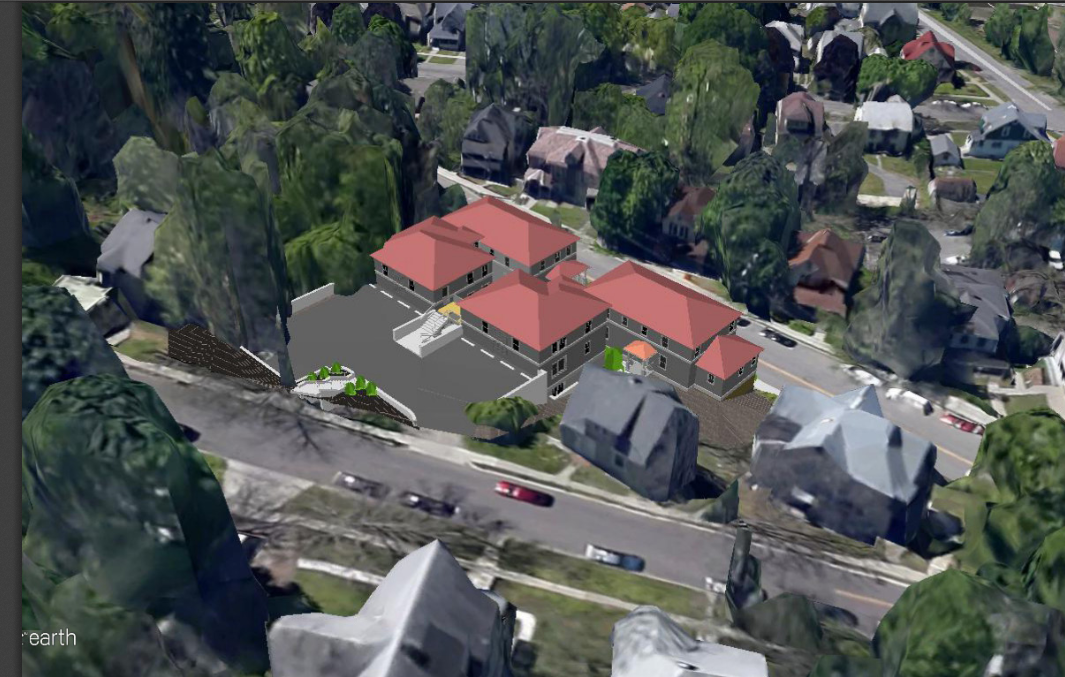
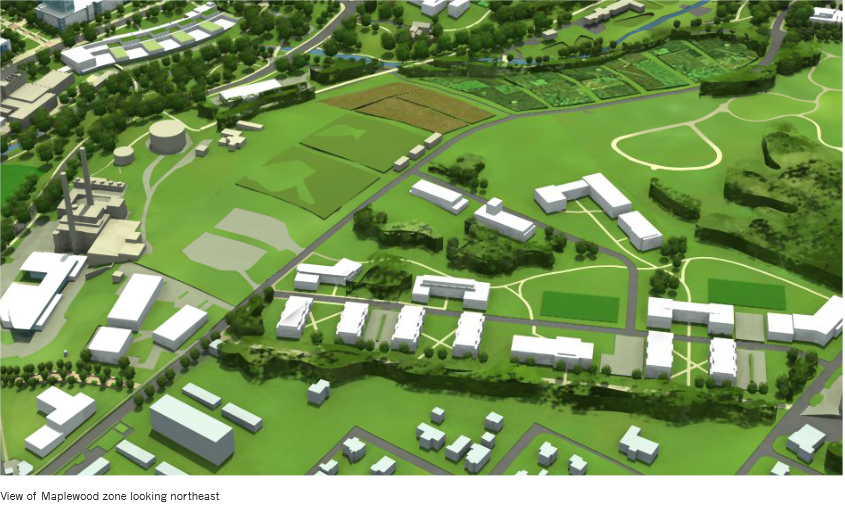
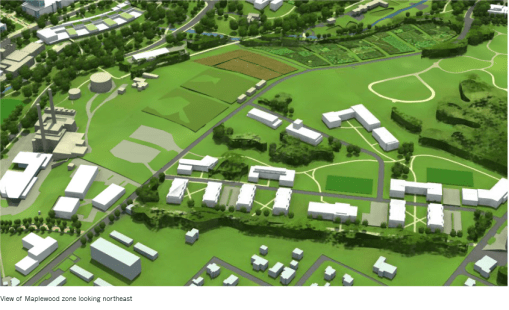
So, with all that noted, here’s the actual news – someone familiar with the Cornell Campus Planning Committee wrote in to say that the Maplewood replacement is expected to have 600-700 beds, and that the committee is still hopeful for an August 2017 opening, which would mean it would have to presented fairly soon (that would still leave a year-long gap in housing, but better late than never). They also acknowledged that “Cornell didn’t do such a good job” with planning for a possible housing shortage, which although not an official statement, seems as good of a justification for Monday’s piece as any.
gways_rev_1

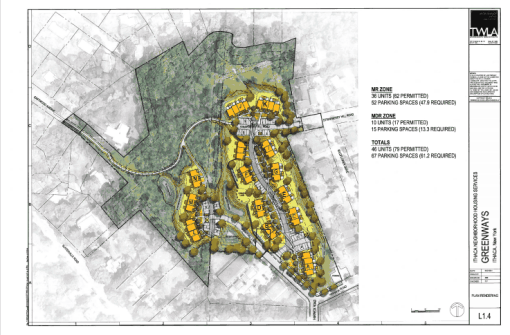
2. Then there was the other piece that dovetailed the affordable housing setbacks last week – Greenways, INHS’s 46-unit affordable owner-occupied townhouse project in the East Ithaca neighborhood, is being abandoned. A part two article with some hard data is being planned. There’s no real silver lining here. It’s Cornell land and the university could potentially revive it, but there’s no indication that will ever happen.

It’s just been a crappy week for housing affordability in Ithaca.

3. Over in Collegetown, several rental homes are being offloaded at once. The properties, 120-134 Linden Avenue, consist of six student apartment houses, with a listed price of $6.5 million. A check of the county website indicates the properties are assessed at $2.75 million, and a cross-check of the Collegetown Form Zoning shows most of these properties are CR-1 (the southern two homes) and CR-3 (the four northernmost homes). CR-1 is the least dense zoning, and CR-3 is a little denser, but mostly maxed out by the existing properties. In short, the code suggests significant redevelopment is unlikely, so the price seems to be based off of potential rental income.

The Halkiopoulos family currently owns the properties, which make up a sizable portion of their multi-million dollar Collegetown portfolio (they’re one of the medium-sized landlords). The Halkiopouloses’ M.O. has been to buy single-family homes and convert the property to student rentals, rather than building their own apartment buildings. It seems likely that the high price indicates they’ll go to one of the other big landlords, or to someone with really deep pockets looking to break into the Collegetown market.

4. A couple folks might be concerned this week after Jason Tillberg’s latest piece about Ithaca’s deflating economy. But there’s a caution light before this data is taken to be hard truth. Frankly, the BLS estimates suck.

A lot.

The numbers are subject to big revisions. Case in point, here are the pre-revision and post-revision 2013 and 2014 data:

ith_initial_1314 ith_revised_1314

It’s not uncommon for the numbers to be changed by thousands, because it’s based on a random sampling of non-government multi-person employers. 500,000 are sampled over the whole country each month, but only about 55 of the 3,300 or so orgs in Tompkins and Cortland Counties are included in the Ithaca metro sample (Cortland’s jobs numbers are included with Ithaca’s because jobs are measured by Combined Statistical Area [CSAs]. However, Ithaca is considered a separate metropolitan area [MSA] from the Cortland micropolitan area [µSA], so population stats are always distinct). The overall trend of the selected orgs is then applied to a base number. For places like Ithaca where the local economy is dominated by a few employers, random sampling isn’t the best approach because it misses crucial components of the local economic picture. But the BLS sticks with its current approach for consistency’s sake across regions and time periods.

During the first quarter of each year, the BLS conducts a full analysis and re-analysis of data going back the last three years. The general rule is, the data from three years ago is very good, the data from two years ago is okay, and the data from the previous year is…very, very preliminary. Tompkins County hasn’t had any large layoffs reported the state’s WARN database this year, and the only major retail closings recently have been A.C. Moore and Tim Horton’s.

In short, don’t let it keep you up at night, and wait until March before passing judgement on the 2015 economy.
902_dryden_v2_1

902_dryden_3
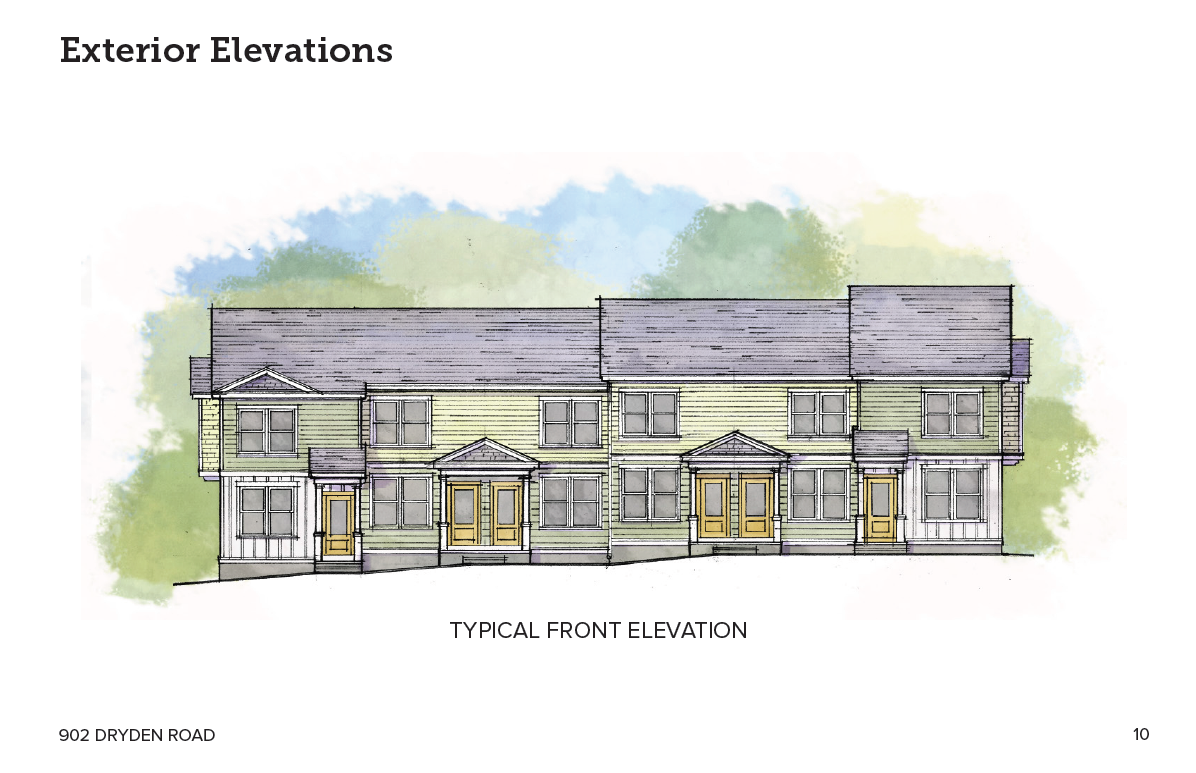
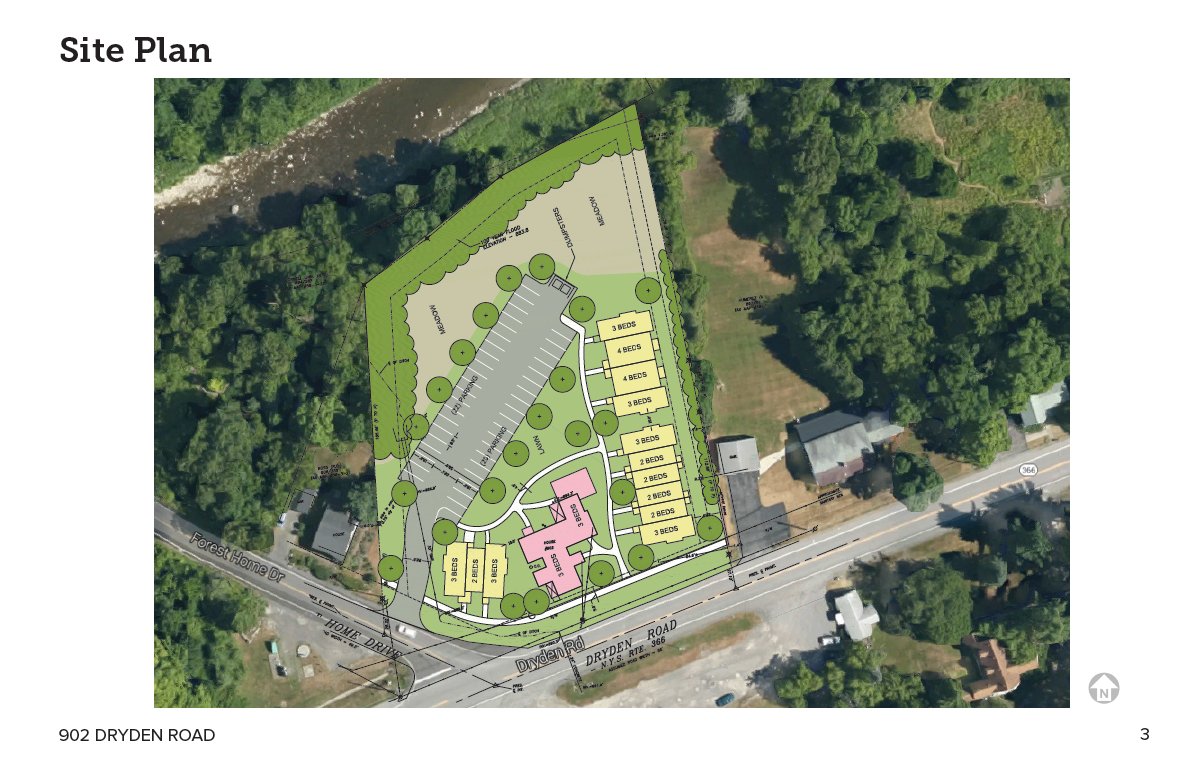
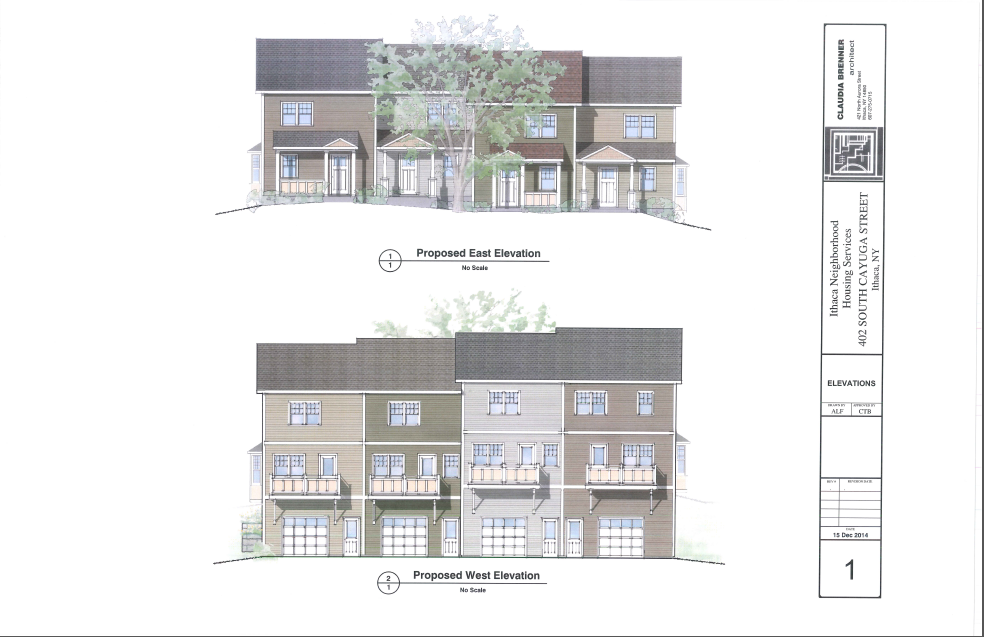
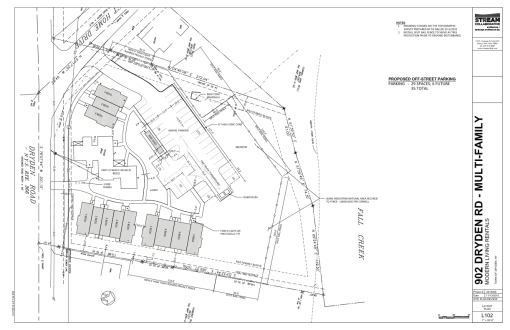
5. Over in Dryden town, the townhouse project proposed by local firm Modern Living Rentals (MLR) at 902 Dryden Road in Varna is a little smaller – 13 units and 40 bedrooms, versus the previous 15 units and 42 bedrooms; these numbers include the duplex with 6 bedrooms that currently exists on the site. Meanwhile, the procession of hate continued at the latest town meeting. The arguments are the same as before. To the earlier, larger proposal, some town councilpersons had given a tentative positive response, while at least one was opposed to the original proposal (in Dryden, the Town Board votes on projects rather than the Planning Board). MLR hopes to request approval at the town’s December 17th meeting – if approved, the construction period is planned for January-August 2016.

For those interested, the Stormwater Plan (SWPPP) is here, revised Full Environmental Assessment Form (FEAF) here, revised site plan here, project description courtesy of STREAM Collaborative here. No new renders, but presumably it still looks the same in terms of materials and colors.
biggs_1

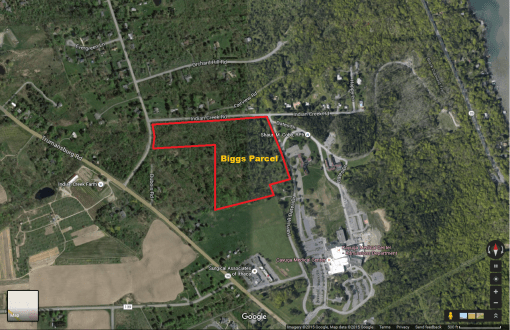
6. Next up on the suburban tour, the fighting over the Biggs Parcel in the town of Ithaca. The Indian Creek Neighborhood Association (ICNA) presented a plan for the property – and the plan is, maybe we can find a way to force the county to keep it, but if not please don’t sell the land to anyone who will build on it. All the county wants is to sell the land so it pays taxes, and the ICNA plan seems to have failed to really address that point. Tompkins officials countered by saying that they’re not keeping it and that if the ICNA cares about this parcel of land so much, buy it. There was then some back and forth about doing a new assessment to account for the developmentally-prohibitive wetlands on site – in other words, decreasing its current $340,000 assessment, with the exact amount to be determined by the county assessment department. At 25.52 acres, of which some is still developable, the price will likely stay above six figures.

So the county’s doing its new assessment, because all it wants is to sell the land so that someone is paying taxes on it. Meanwhile, the ICNA has taken to venting on their web page, angry that the county still plans to sell, and that they may have to actually buy the land in order to dictate its future use.
327_w_state_demo

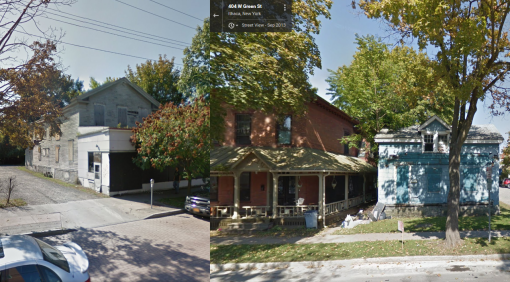
7. To wrap up a thoroughly depressing week, a couple of demolitions by neglect. 327 West State Street and 404 West Green Street will both be demolished by the end of the year, according to the Ithaca Times. Both are older, likely century-old structures, but too far gone to be salvageable. According to county records, the City Health Club, which abuts and owns both properties, purchased 404 West Green in 1987, and 327 West State Street in 1993. The porch on 404 came down sometime in the late 1990s or early 2000s, and the only change since then was painting the plywood on the boarded-up door and windows. County photos suggest 327 was in bad shape but possibly occupied up until 2000 or so, and steadily grew worse from there. Offhand, the procedure is to bill the owner for the demo. 404 West Green is B-2d zoning, 327 West State is CBD-60. But don’t expect any redevelopment anytime soon.

Hmmm…bad economic news, projects being cancelled, decay and demolitions in the city and fighting over suburban projects. For Ithaca and Tompkins County, it’s like the 1990s recession all over again.


News Tidbits 11/7/15: All the Small Things

7 11 2015

chapter_house_v2_1

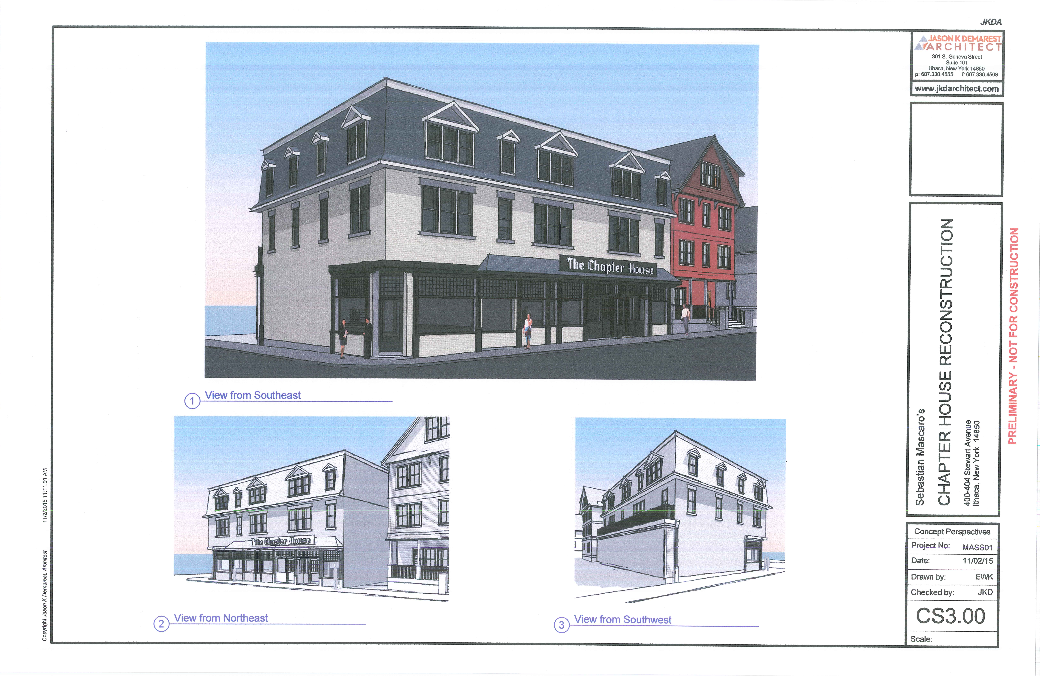
1. The Chapter House project is finally beginning the first stages of design review with the ever-stringent (or picky, pending your view) Ithaca Landmarks Preservation Council. As seen in the render above, gone is the fourth floor, and gone for now are plans to build a new structure at 408 Stewart, after some members of the ILPC expressed opposition to a tear-down, even though the exterior has been butchered and the architect called it a “fire trap”.

The committee also had disagreements over which version of the Chapter House is more historic, the original ca. 1903 design evoked above, or the 1920s renovation that everyone remembers. The September minutes showed intent towards the four story design seen previously, but the design shown above is three floors – whether that be to the committee’s persuasion, or concerns over a zoning variance isn’t clear. It might be in October’s minutes, but those haven’t been approved, and are therefore not available yet.

Also at Tuesday’s meeting, the committee is planning “Property Condition Review and Potential Action” for the decayed carriage house at 312 West State Street. The board was also set to provide “Early Design Review” for a project at 315 North Cayuga Street, probably some kind of renovation/restoration of the First Presbyterian Church, but the item has since been pulled.

11-24-2012 171

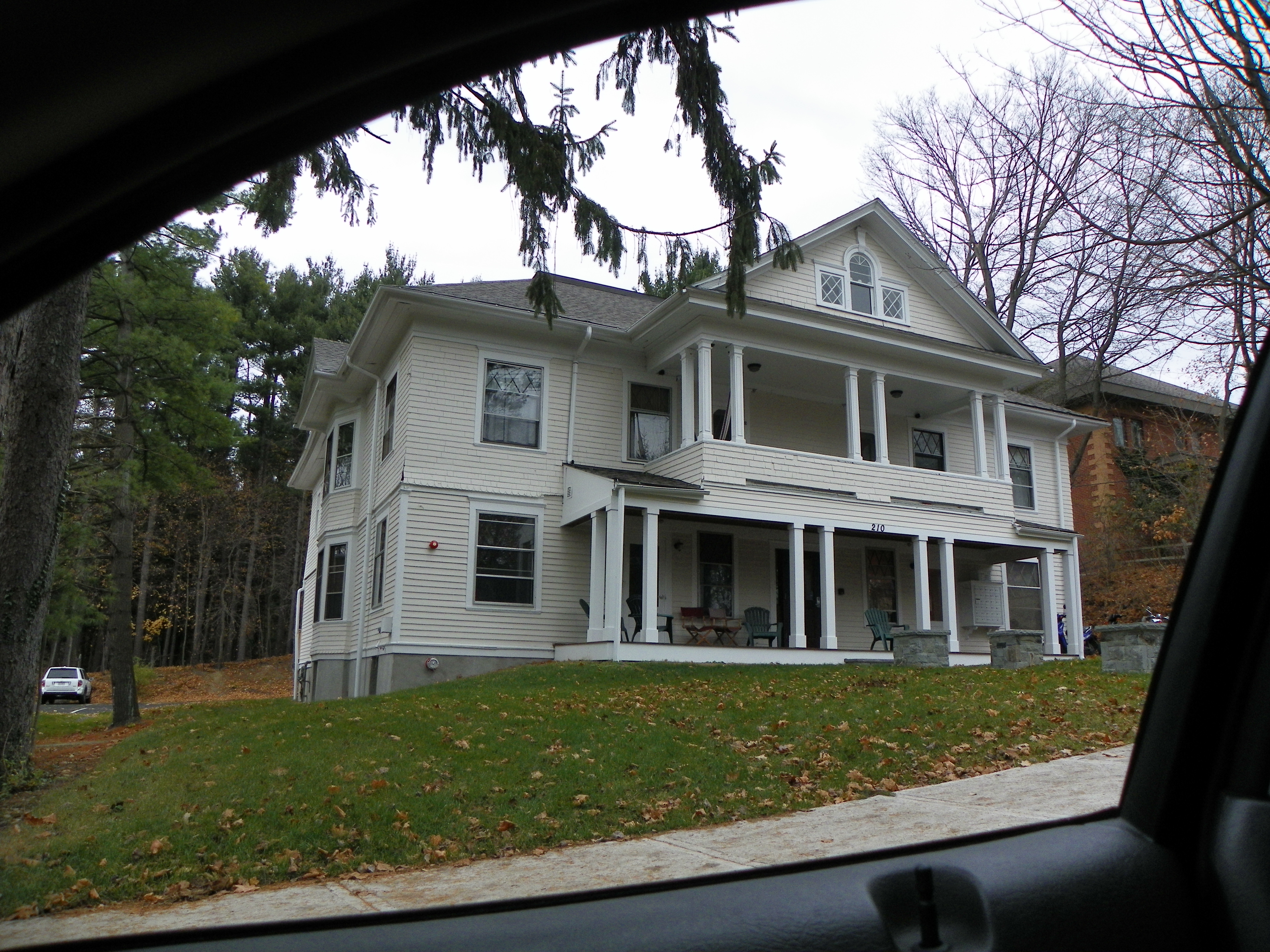
2. Wait long enough and history repeats itself. In March 2009, I did a post called “Warren Real Estate Tries to Sell a Frat House“. It looked at 210 Thurston Avenue in Cornell Heights, when it was on the market for $950,000. The house has historically been a Cornell fraternity house, built around 1900, re-purposed not long thereafter for the Delta Sigma Phi fraternity until WWII, when the brothers left for service and the chapter never reopened. It was then used by other GLOs over the decades (Alpha Omicron Pi in the 1940s, Sigma Alpha Mu from the late 1940s to early 2000s, and Phi Delta Theta’s annex in the late 2000s).

After sitting on the market for a couple of years, the house sold in December 2011 for $677,500 to an LLC representing the wealthy parent of a Cornell wrestler, who had the house renovated for the team in 2011/12. The legal occupancy increased from 33 to 40 persons as a result of the reno.

So now it’s on the market again, this time for $2,750,000. That must have been quite a renovation. An open house will be held 1-3 PM this Sunday.

I’d recommend it to the Phi Mu ladies given their recent rejection by Cayuga Heights’ zoning board, but the asking price is almost four times the house they were looking at 520 Wyckoff. The house on Wyckoff was also intended for 16 occupants rather than 40. Oh, and I suppose those urinals the owners installed would be a bit out of place.

We’ll see what happens. This one could be on the market for a while. Again.
3. Also new to the market this week, two parcels in the town of Ithaca that have the potential for development.

The first, 1564 Slaterville Road. The sale includes four parcels – 1564 Slaterville Road itself, a 19th century home on 1.52 acres, and the other three are vacant parcels with frontage on Slaterville Road and Park Lane, which serves as an entrance to the Eastern Heights neighborhood, and has seen a number of higher-end single-family homes in the past several years (there have been plans for a 16-lot housing development on the adjacent land to the north, but nothing has been approved). Altogether, the sale comprises 9.2 acres of land, on the market for $995,000. The properties are valued at $297,300 total, so if the owner is asking such a high price, either they’re delusional, or purposely going after developers. The land currently falls under Ithaca town’s Medium-Density Residential (MDR) zoning, which is single-family homes and duplexes only. The Comprehensive Plan calls for “Established Neighborhood” use, with an average of 2-4 units/acre, either homes, townhomes or apartments (sensitive to neighboring uses), and the possibility of low-intensity commercial (home office). Expect any potential form-based code to accommodate those details.

The other parcel up for sale is 969 East Shore Road, one of the few properties in the town’s lakeshore exclave. This one is also asking a huge premium, $1.45 million for a 2.09-acre property assessed at $300,000. The property was used as the headquarters for the John C. Lowery construction company until they moved to Freeville; it had been built in the 1960s for a chemical company. The seller, the CEO of a local manufacturer, picked up the property for $300,000 in December 2013.

Although it falls under the town’s Lakefront Commercial (LC) zoning, which in itself says only marinas and wind turbines are okay, special use permits allow for mixed-use, hotel, and other non-water options. Like the Slaterville parcel, this one also falls under the “Established Neighborhood” use guidelines.

If they sell, and it bears mentioning, it’ll be mentioned in a later news roundup.

20151011_142719 20151011_142734 20151011_142746

424_dryden_rd_1

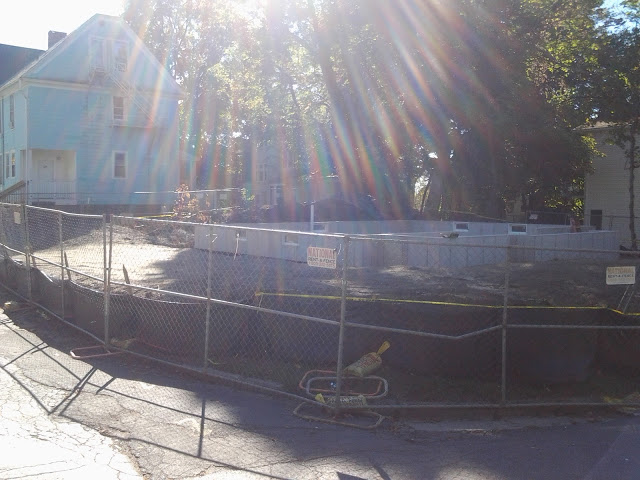
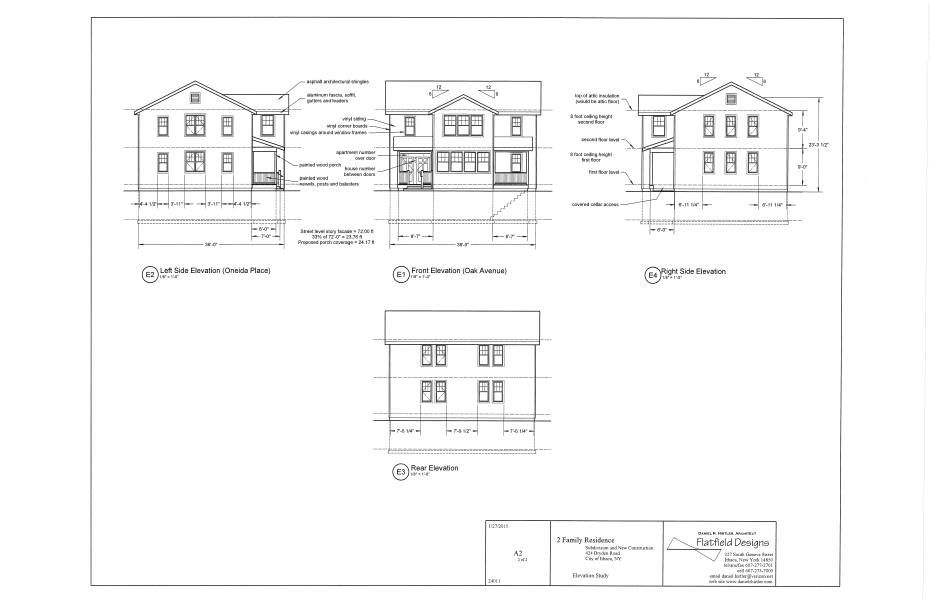
4. It’s house of the week. This week, 319 Oak Avenue in Collegetown. The lot was created by a subdivision of the existing lot, 424 Dryden Road, in February of this year. What was once a parking lot is now the foundation for a duplex with 3-bedrooms each. Foundation and stem walls have been poured and cured, and given that this photo is a couple weeks old, the foundation has probably been backfilled already, and rough framing may even be underway.

The site falls into the CR-2 Zone of the Collegetown Form District, meaning 2-3 floors, and pitched roofs and porches are required. The architect is Daniel Hirtler of Ithaca, and the developers are William and Angie Chen, also of Ithaca.

5. It’s a quiet week. The city of Ithaca’s projects memo has absolutely nothing new (not even new attachments to the three projects subject to review), and the town of Lansing has nothing interesting either. So we’ll wrap this up with some economic news:

A Lansing technology firm will be seeking sales tax abatements this month as part of a planned expansion project.

Advanced Design Consulting USA (ADC), located in a 15,000 SF facility at 126 Ridge Road in the town of Lansing, has submitted an application to the Tompkins County Industrial Development Authority (TCIDA) for review at their November 12th meeting.

The company is applying for a one-time sales tax abatement on the cost of construction materials, and is valued at $54,880.

ADC specializes in the design and manufacture of high-precision scientific instruments, especially those used in physics research. The firm states in their IDA application that their small size has limited their ability to gain large contracts, and it is necessary for them to expand in order to expand their business. The 5,000 SF expansion is valued at $910,000, and would retain 14 jobs and create 7 additional jobs in their Lansing facility, with a median salary of $40,000. If approved, the expansion project would be completed by June 2016. With the expansion, ADC’s revenues are predicted to increase from the current $2 million, to $2.7 million in three years. The company did not commit to local construction labor in their application.

In an interview in 2014, ADC President Alexander Deyhim explained that the company declined a business incentive to move to Oak Ridge, Tennessee because of Tompkins County’s high quality of life, and proximity to Cornell’s nano-fabrication facilities.

For ADC, which was founded in Tompkins County in 1995, it will be the third expansion in twelve years. The company had previously applied for and received tax abatement approvals for a larger, 20,000 SF expansion project, but according to the current application, the firm reassessed its needs and decided to go with a smaller plan for the time being. The original abatement was never utilized. Supplemental documents indicate the town of Lansing has approved the physical plans for the expansion.

***
So does one force the company to use local labor, or does one risk turning the company down and sending the whole operation to Tennessee? Tax abatements are hardly ever a black-and-white decision.


804 East State Street Construction Update, 10/2015

20 10 2015

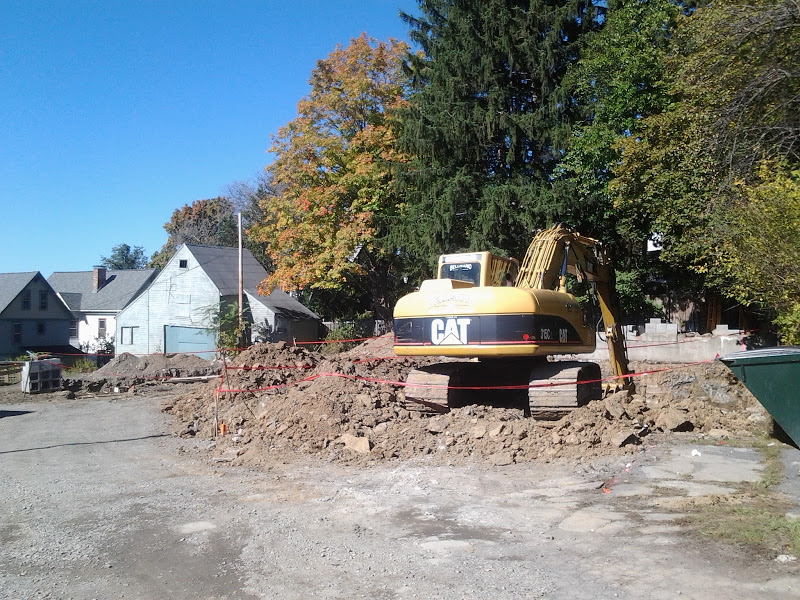
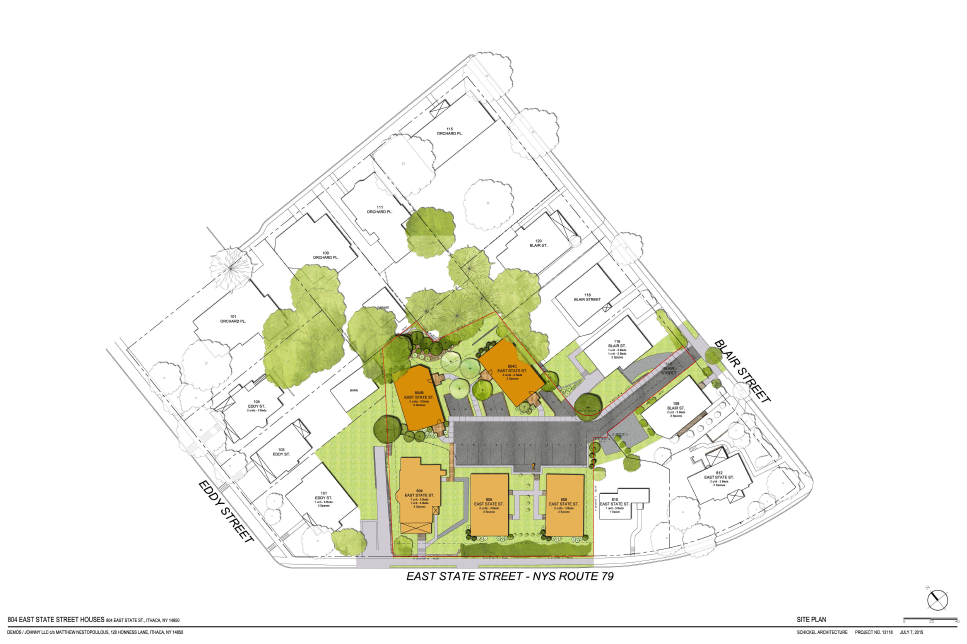
A new, small project to add to the list of projects underway, 804 East State has started construction on the fringe of Collegetown. The owners of the site, the Nestopoulos family of Ithaca, are building two modular duplexes, 4 units total, with 3 bedrooms each (12 total).

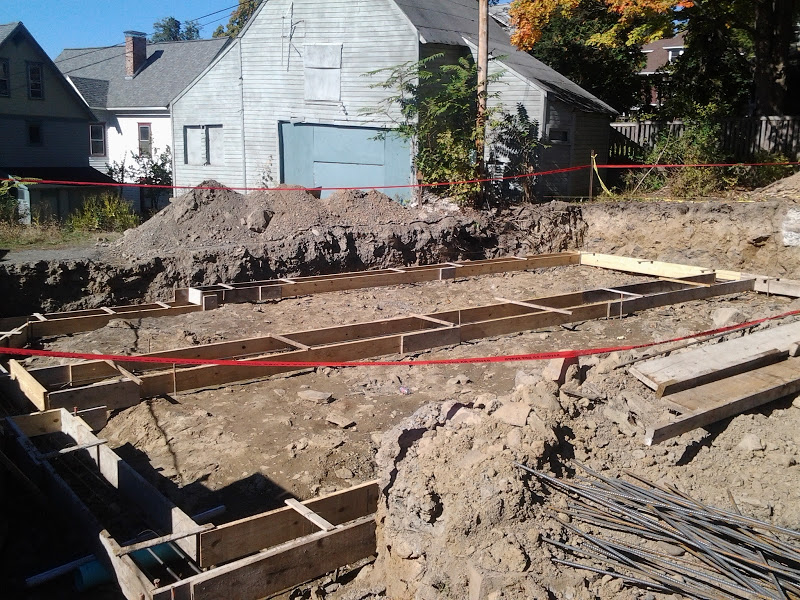
The foundations have been dug for both duplexes, and form boards have been placed in the footprints of the west building. The concrete foundation gets poured into the form boards, and the boards help the concrete hold its shape while it cures. Looking closely, you can see a few steps in the wood forms, since the site is sloped, the concrete foundation will be stepped. The small wood sticks on top of the forms are spreaders, to provide extra stiffness.

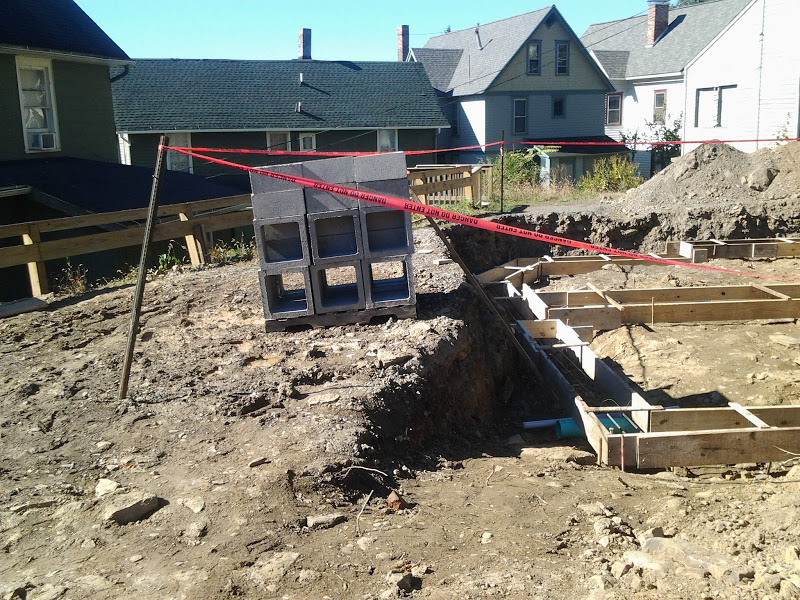
Once the forms are squared and levelled, the concrete will be poured in, levelled off and smoothed over. After a day or so, the forms can be removed, leaving the newly-finished foundation. Once the foundation is ready, the builders can begin erecting the concrete masonry unit (CMU) walls, the hollow concrete blocks seen in the photos. The modular pieces will then be brought in, hoisted into place and sealed together, not unlike the process at the Belle Sherman Cottages.

The plan is to have these completed by December 2015, with new occupants (likely students) moving in the following month. The project replaces a gravel parking lot. In an effort to appease neighbor opposition about the homes simple (and perhaps bland) design, the number of houses was reduced from three to two, they were oriented to minimize visual impact, parking was moved from below the units to surface lots, and extensive landscaping with an “outdoor room” is planned.

20151011_135439 20151011_135455 20151011_135513 20151011_135533 20151011_135556

112_blair_v4_2 112_blair_v4_1


205 Dryden Road (Dryden South) Construction Update, 10/2015

19 10 2015

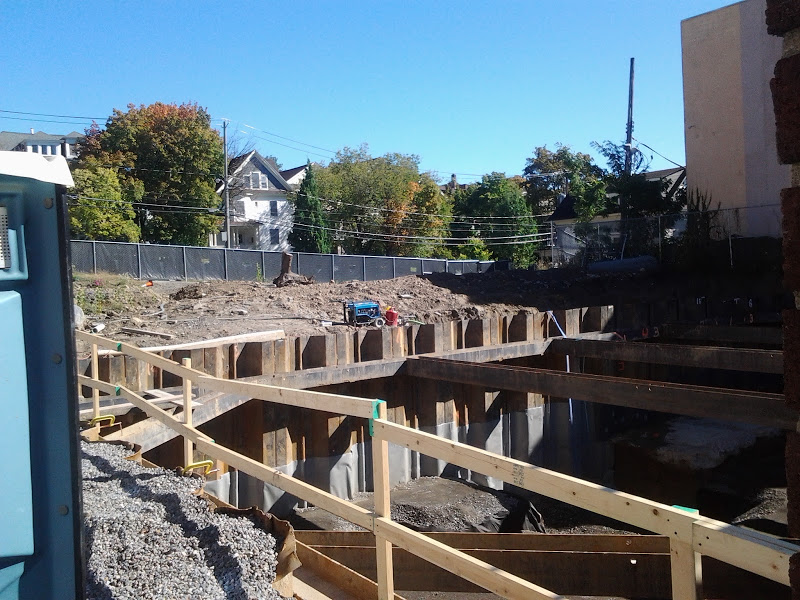
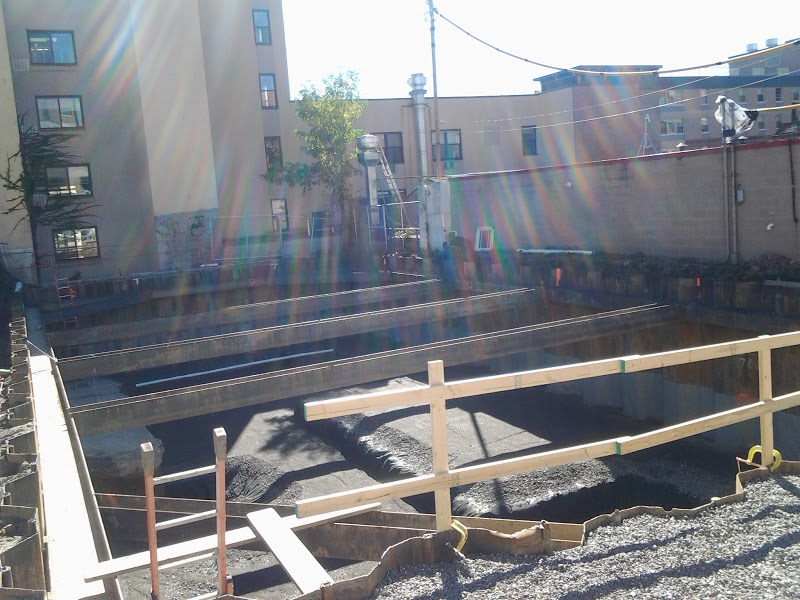
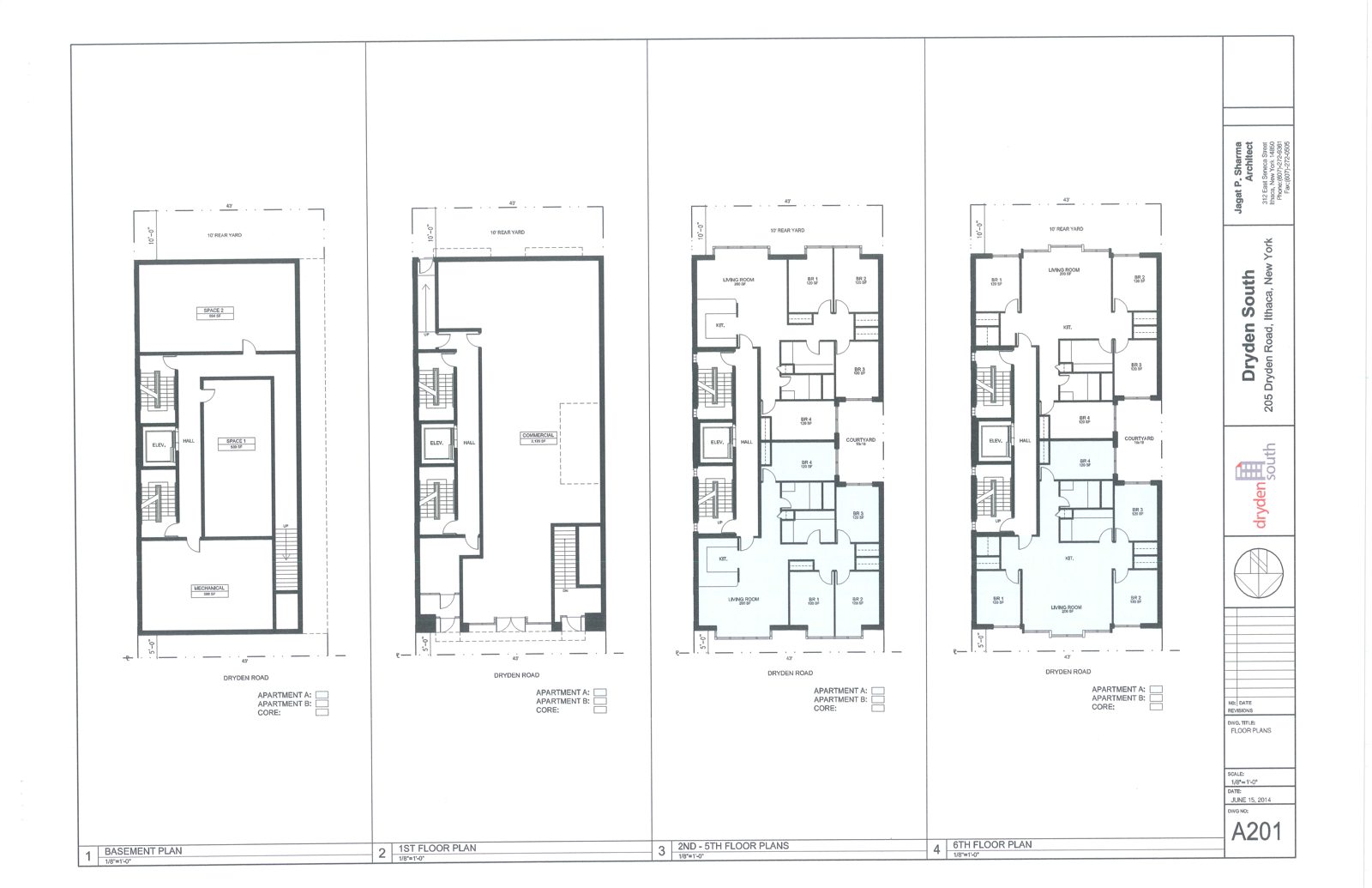
Turning the corner from 307 College, 205 Dryden (“Dryden South” for marketing purposes) is the third of Collegetown’s midrise apartment buildings under construction. The basement has been excavated and sheet metal piles keep the surrounding soil from spilling back in. The basement will contain the mechanical room and storage space. Structural steel has been erected up to street level. In the second image, the outlines of future interior basement walls and the base of the future elevator shaft can be seen.

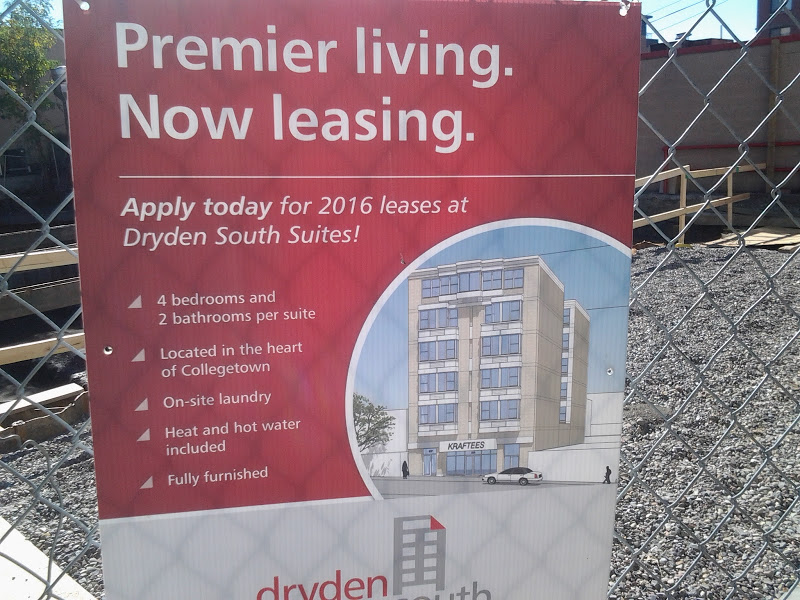
In what’s sure to stoke a few tempers, prices for Dryden South have been priced at $1350/bedroom per month, meaning $5400/month for each 4-bedroom unit. Incredibly expensive, but not especially surprising given the astronomically high land values in central Collegetown. Owner Pat Kraft, who also runs Kraftee’s book store, has actively marketed the apartments on Facebook, Craigslist and its own website.
When completed in July/August 2016, the 6-story, 65-foot structure will house Kraftee’s in 2,400 SF of retail space on its ground floor, and 2 4-bedroom apartments on each of the upper five floors, for a total of 10 units and 40 bedrooms.

As you can tell from the first photo, apart from the demolition earlier this summer, work has yet to begin on John Novarr’s Collegetown Dryden project next door. But with approvals in hand, that six-story research/office building will be starting something in the next month, if the site plan review document is still accurate. The $6.4 million project was designed by Ithaca architect Jagat Sharma and Rochester-based LeChase Contruction is in charge of the build-out.

20151011_141022 20151011_141041 20151011_141053 20151011_141111


307 College Avenue (Collegetown Crossing) Construction Update, 10/2015

18 10 2015

The largest of the apartment projects under way in Collegetown, Urban Ithaca (the Lower family’s) project at 307 College Avenue, the “Collegetown Crossing” development, has made significant progress in the past few months.

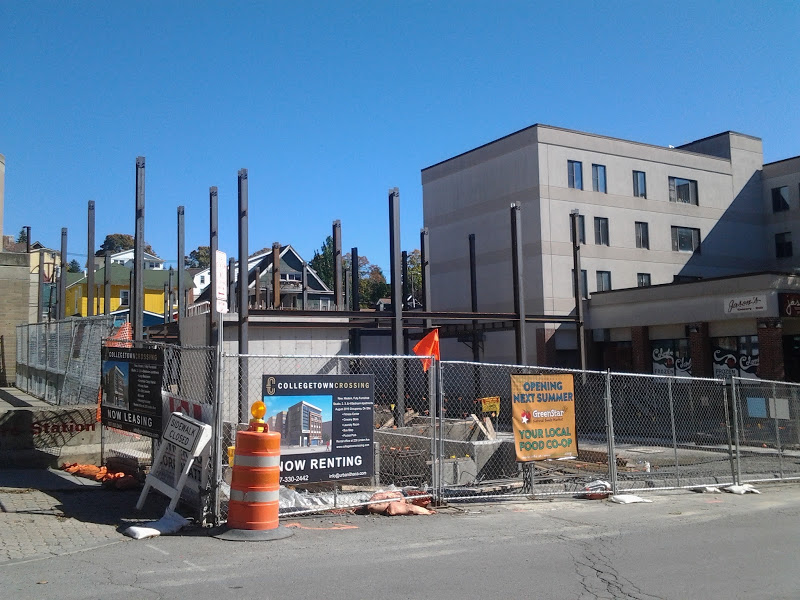
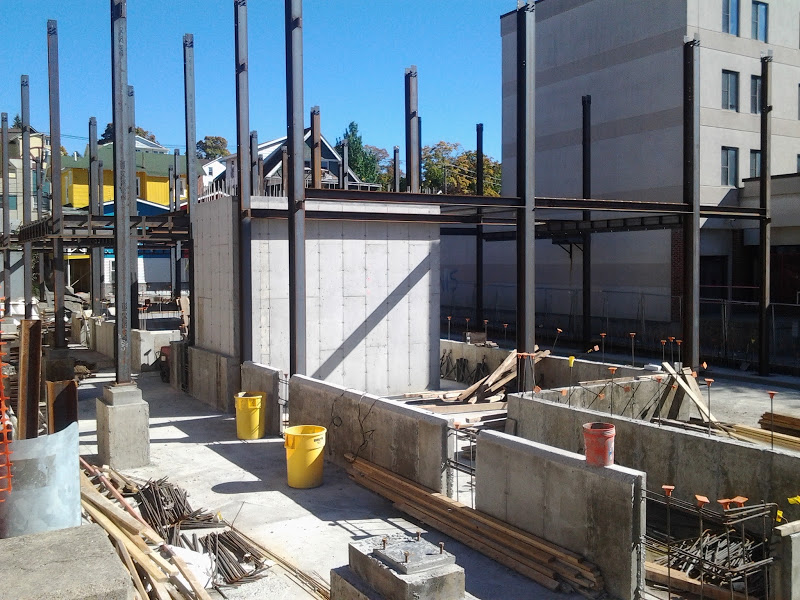
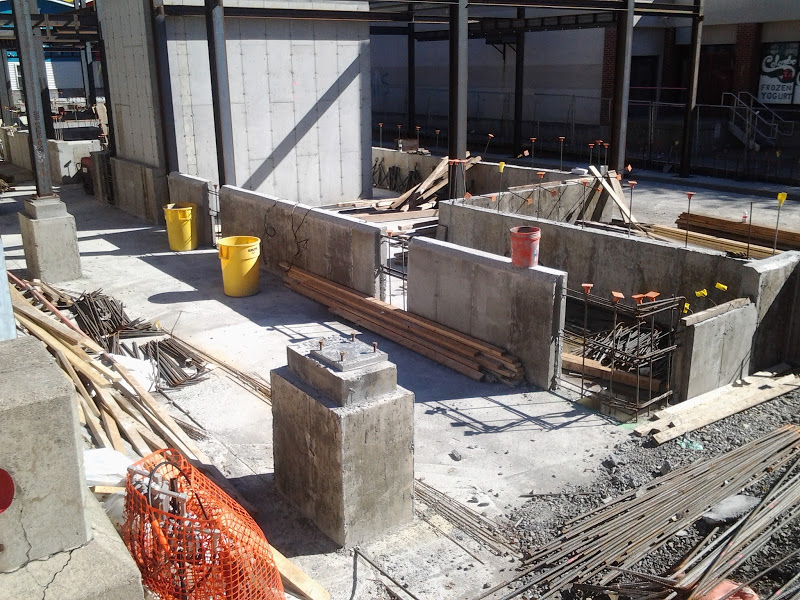
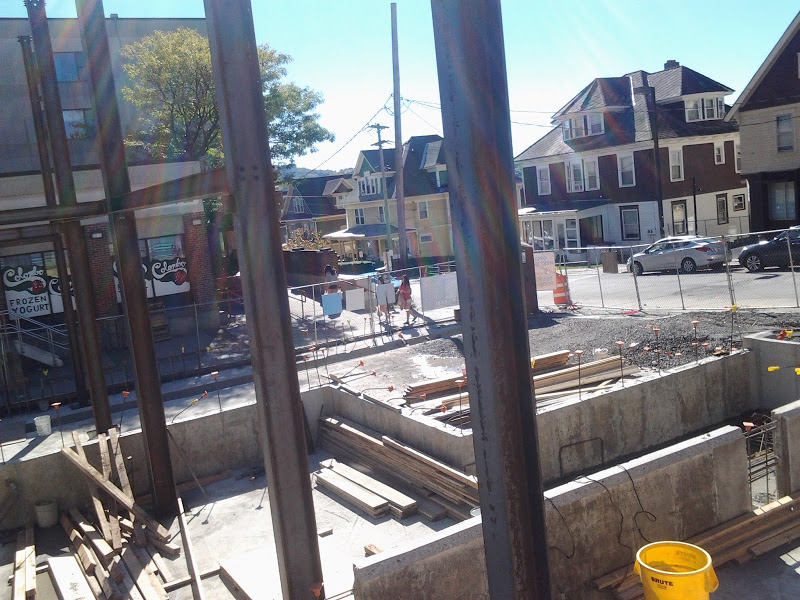
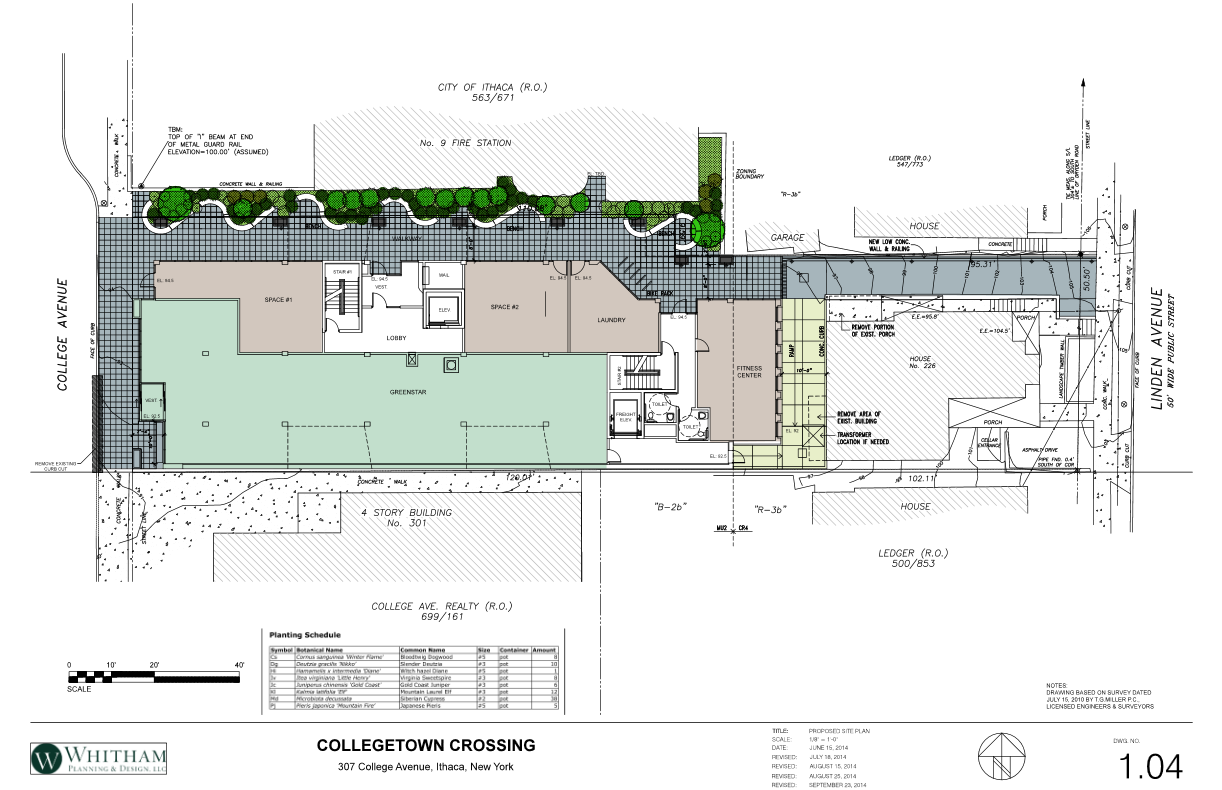
Structural steel columns have risen to the height of the building’s second floor, and some cross beams have been erected. The concrete area where the buckets are sitting in the second image is the future pedestrian walkway connecting College and Linden Avenues. A year from now, those pillars will support the second through sixth floors, while a vegetated pocket park and walkway will lead past the main lobby for the apartments, one of the commercial spaces, and the laundry area, before a kink in the path takes it past the entrance to rear stairs and a fitness center, and then out towards Linden Avenue.

Also, don’t let the perspective fool you – the fire station’s concrete pad (where the photos were taken from) is a little higher than the walkway, so the walkway’s height is greater than it looks.

Notice the three concrete boxes? The closest concrete box to where I’m standing is the lobby’s stairwell. The one a little further behind it is for the lobby elevator, and the third one, furthest back in the photo, is for the freight elevator and rear stairwell. One of the two smaller storefronts will be in front of the elevator shaft towards the street, its outline clearly visible in the poured concrete of the second photo. All three of these will rise with the rest of the building as it moves skyward.

The project will bring 96 bedrooms to market in 46 units, as well as a 3,200 SF full-service branch of the Greenstar Co-Op grocery store. Two other commercial spaces and an indoor TCAT bus stop are planned, but no tenant announcements have been made for the other retail spaces. Apartment rents are expected to be in $950-$1250/bedroom range. Everything should be open for occupancy by August 2016.

According to construction loan documents recently filed with county, the project’s cost is about $10.5 million. Collegetown favorite Jagat Sharma is the designer, and Hayner Hoyt Corporation out of Syracuse will be in charge of construction.

In case anyone’s wondering, the “harlequin house” behind 307 College, 226 Linden Avenue, is another Lower property. Just like 205 College.

20151011_140746 20151011_140800 20151011_140803 20151011_140821 20151011_140834

307college_rev2_1

307_college_site_plan_final

ctown_crossing_rev2_1


327 Eddy Street (Dryden Eddy Apts) Construction Update, 10/2015

16 10 2015

Of the three major Collegetown apartment projects currently underway, 327 Eddy is probably the least “impressive” to look at because it has yet to begin putting up structural steel. But this isn’t to say there isn’t work underway.

The site has been excavated and the base of the building has been established. A steel rebar grid mesh can be seen at the base of the upper tier, with utility lines feeding through. The rebar mesh is a reinforcement for the concrete when it gets poured, helping to prevent cracks that may from in the concrete from spreading throughout the foundation and causing major damage. The lower building tier have yet to receive the rebar mesh, but given the elevation render, it might be filled out first with the “flowable fill” referenced in the last update. Rimming the base are steel sheet piles, which lock together to form a wall designed to keep spoil and water from neighboring properties from spilling onto the construction site.

Plans call for a new 5-story building split into “steps” on the steeply-sloped site. The mixed-use building will bring 1,800 SF of retail space and 22 new apartment units with 53 bedrooms to the market in August 2016. Longtime Collegetown landlord Steve Fontana (of the Fontana’s Shoes family) is the developer, Jagat Sharma is the architect, and GM Crisalli & Associates of Syracuse will be overseeing construction. A construction loan of $4,824,000 is being provided by Tompkins Trust Company.

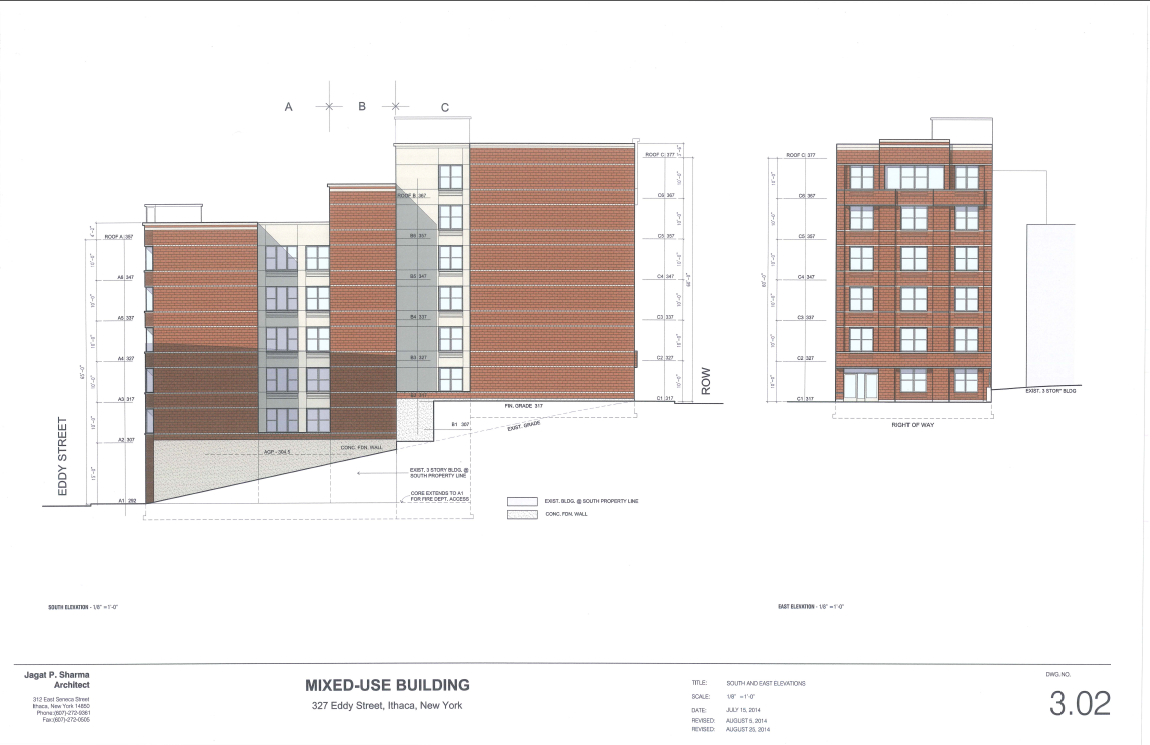
Note in the elevation drawing below, the building is six stories. It was reduced to five, and the decorative crown was reworked after approval was granted.

20151011_140231 20151011_140257 20151011_140309

327_eddy_rev4_1 327_eddy_rev2_3


News Tidbits 10/10/15: Meeting With the Stakeholders

10 10 2015

1.There is nothing wrong with a little speculation. In a follow-up of sorts to the Voice piece about parking capacity in Downtown Ithaca, the Times’ Josh Brokaw did an interview of his own with city of Ithaca parking director Frank Nagy. Nagy believes that the 248-car estimate used by State Street Triangle is “way high”, but given that one of the refrains is that there’s not enough parking, they’d rather be safe than sorry.

More importantly, Nagy believes that the Seneca Garage only has about 10 years of life before a new garage will need to be built (the Seneca garage was built in 1972). The structural situation at Green Street is severe enough that the city may have to remove the end pieces and build up the middle section, which was renovated several years ago. The property is being reviewed, and with Tompkins Trust vacating office space on its ground floor as part of the move to its new HQ, the assessment is well-timed.

If the Green Street garage decides to go up rather than out, that leaves two very valuable properties that the city could sell to its benefit (financial, affordable housing, or otherwise). Both ends of the Green Street garage are zoned CBD-140, which offhand is the densest zoning in the entire city, 140 feet maximum height with no parking requirement. A zealous councilperson might try and change that post-SST, but as is, a rebuild of Green Street a few years from now could yield a lot of possibilities for downtown development. Put that in the notebooks for 2020 or so.

100_1281

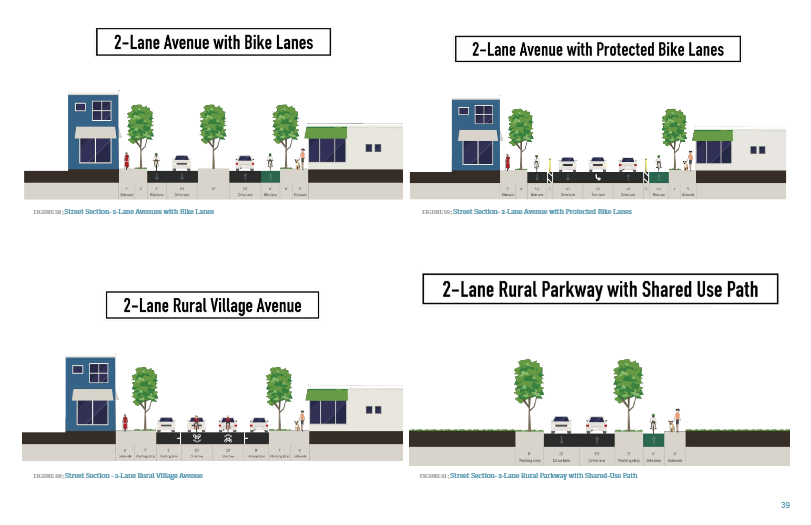
2. Speaking of future plans, we have the bike debate currently raging in the streets. Now, this is only tangential to my usual work, and I am not versed in the topic, so it’s nice to go in without preconceptions.

The city just finished work on Board of Public Works (BPW)-approved bike lanes on North Cayuga Street, specifically an unprotected bike lane on the east side (protected lanes were considered, but not approved). Although meetings gave due public notice, there were no letters sent to Cayuga Street residents informing them of the change, and a number of folks were caught off guard, including members of the city’s Common Council.

In the one corner, you have folks angry about the loss of parking, the inconvenience, and the danger it poses to the elderly. Unfortunately, you also have a council member describing biking-proponents in the same tone one would describe Albany lobbyists. The mayor has come out in favor of the N. Cayuga Street bike lane, although according to the Times, he’s not a fan of “resident-driven infrastructure”. It’s really a fascinating read from a planning perspective. – Times coverage here, Journal here.

bike_lanes_1

For what it’s worth, bike lanes are a major part of walkable communities and reduced ecological impacts (carbon footprints). I feel like I’ve seen this type of argument play out from the perspective of development quite a bit – every new Collegetown or downtown building gets the “Ithaca shouldn’t allow big buildings/they’re ruining Ithaca/where are they going to park” argument, and the “Ithaca is not a small town/it promotes walkable communities/suburban sprawl is destroying Tompkins green space” counter-argument. The key problem with the bike situation seems to be a lack of communication between the BPW and Common Council (and residents by extension). Luckily, the planning board doesn’t quite have this problem – everything they vote on gets publicized, on this blog if not elsewhere.

cornell_novarr_1

3. The last hurdle for John Novarr’s 215 Dryden Road project has been cleared. The Board of Zoning Appeals approved variances from the Collegetown Form Guidelines – the corner isn’t chamfered or set back enough and the building only has one main entrance (the form-based code mandates an entrance every 60 feet of non-residential space). The owner of the house across Linden from the corner was the lone opposition speaker, and the BZA vote was 4-1, with Marilyn Tebor Shaw opposed. No reason for Shaw’s decision was provided in the article.

With all the approvals tucked away, all that’s needed is for the city to sign off on the building permit. Expect this one to be underway within the next month.

image1 image2

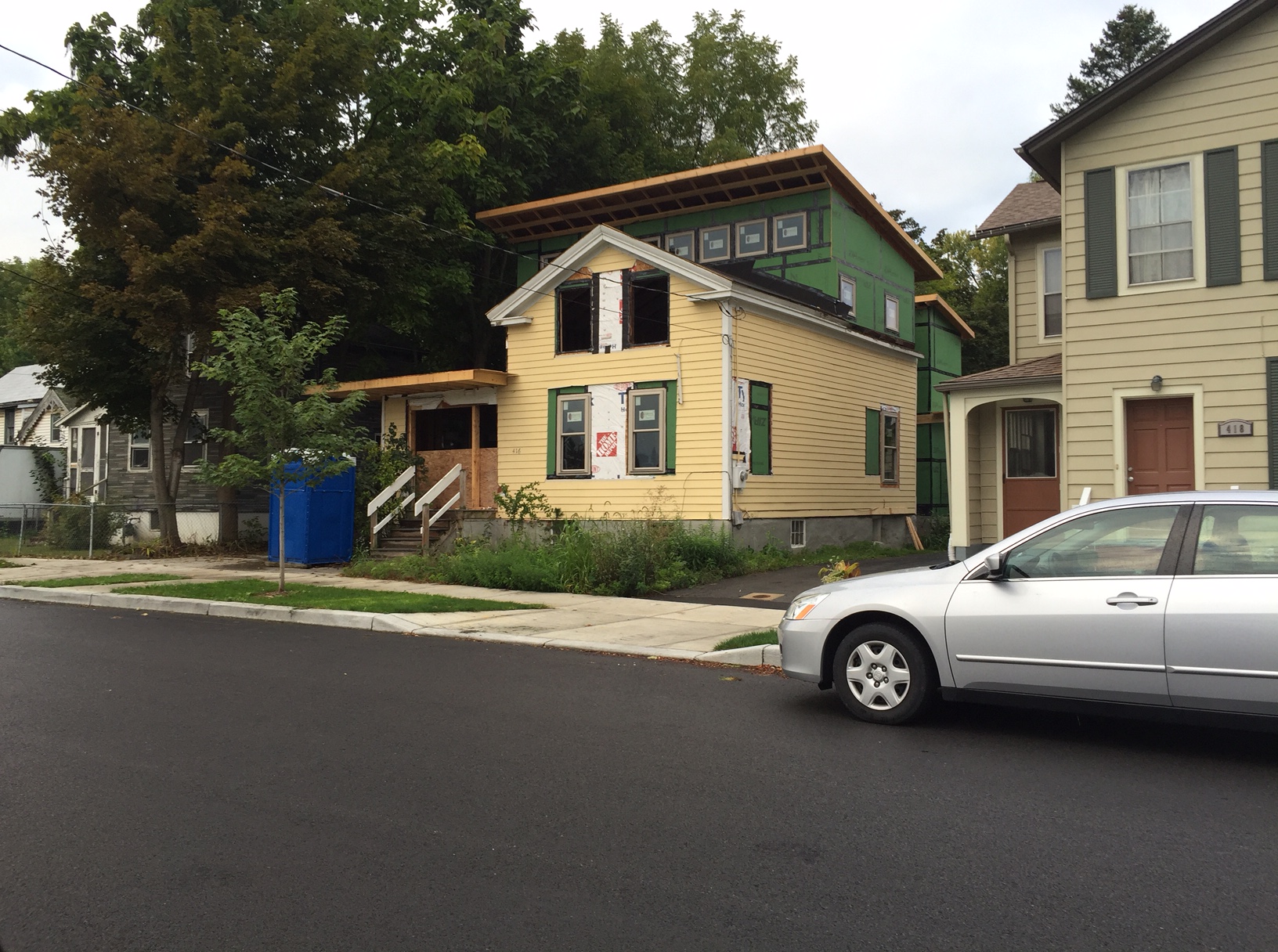
4. Reader submissions are always welcome. The photos for this week’s “House of the Week” featurette come courtesy of Frost Travis. The house receiving the addition is 416 North Plain Street in Ithaca’s Washington Park neighborhood. The current owners brought the property in October 2014. County records give it a 1900 construction date, which is often a default for old and unsure; it appears on an 1889 map of the area, but was not yet built in the 1866 map.

The rear addition looks like it’s been underway for a while – the exterior has been framed and sheathed with plywood Huber ZIP system roof and wall sheathing, which uses seams and tape to save time vs. traditional sheathing such as Tyvek housewrap. There are some windows fitted into the rough openings, but there’s still plenty of work to do with closing up the exterior and interior utilities rough-in. Looking at the original house, the owners appear to be fitting smaller windows in place of the originals – two window cutouts on the north wall have been filled in with sheathing, and a new window has been fitted in a new opening. The front door and adjacent window are gone, one large rough opening in their place. The front roof above the door and window was slanted, but has been dropped to a flat roof as part of the renovation and addition. Presumably, the butter yellow vinyl exterior will be re-finished as construction progresses. With any luck, this one will be finished before winter comes.

Pg-3-Rendering

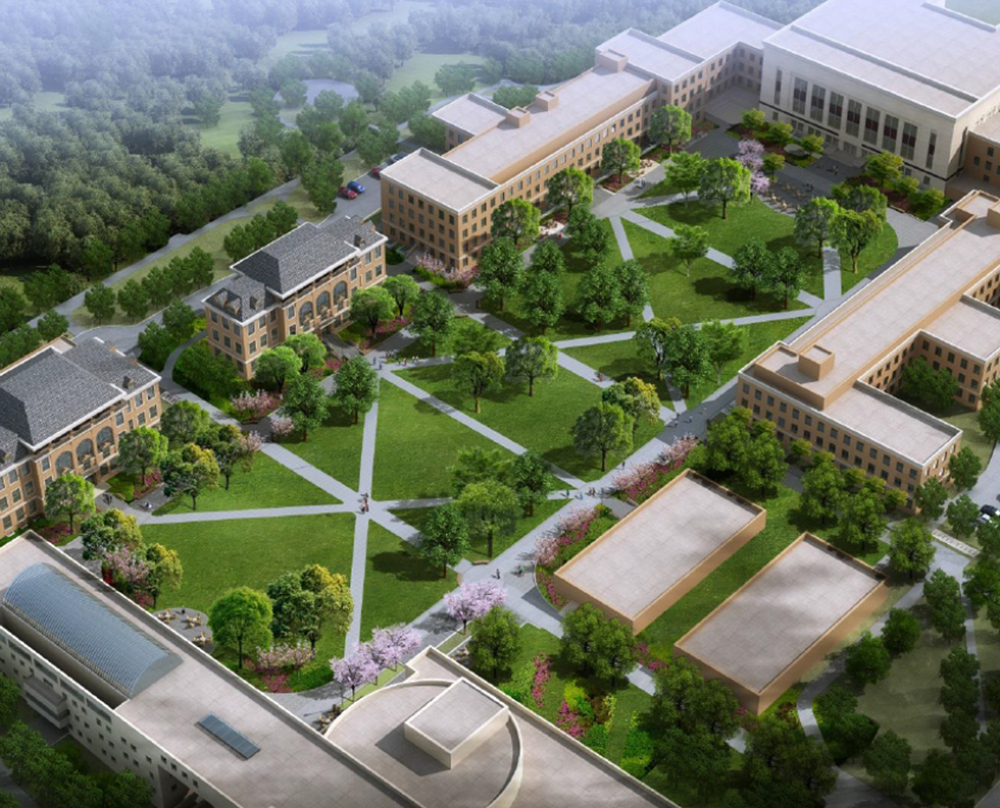
5. What a quick turnaround. The Cornell Daily Sun first made mention of the Ag Quad renovation last week as part of its coverage of the Collegetown Neighborhood Council meeting. Now only a week after Cornell shared a glimpse at the cards in its hand, they’re playing them. The $9.6 million project will be broken down into two phases, one that focuses on infrastructure, and one phase on landscape improvements (and being that much of the infrastructure is underground utilities, phase one could be described as churning up the ground, and phase two is making the upturned dirt pretty again). The renovations, which are set to start next summer and run through 2017, will include additional emergency phones, a rain garden, and outdoor gathering spaces in front of Mann Library and Roberts Hall (upper right and lower left in the above render).

Too bad those temp buildings are still there between Kennedy Hall and Plant Science. If the Southern Tier wins that Upstate Redevelopment competition, I have an idea where the new Plant Science Commericialization Building should go.

6. Plans for 416 E. State have evolved since the bar was first proposed. Originally conceived as a general bar/drinking establishment, developer and Argos Inn architect Ben Rosenblum has faced substantial opposition to the project – neighbors are vociferously opposed to a bar, citing noise problems and concerns about smokers, and the county planning department was not a fan of the traffic and parking arrangement, which had after hours parking across the street at Gateway Plaza. Although the project doesn’t need planning board approval, it does need BZA approval – area and setback deficiencies have resulted in the need for a zoning variance. The building itself won’t change dimensions, but the change in use triggers the city zoning laws.

416_e_state_v2_1

Representatives for Rosenblum and neighbors have met, and the compromise Rosenblum and his associates have proposed involves a lounge-type of establishment they’re calling “The Printing Press”, after one of the previous uses for the late 1940s warehouse. They’ll be going for an industrial/”speakeasy” aesthetic, and targeting the same older, more affluent clientele that patronizes the Bar Argos next door. Signage would be minimal, and exterior work limited largely to an accessory parking lot/handicap access, landscaping and a new coat of paint. Looking at the original plan vs. the revised plan, the bar no longer is in the rear corner, but moved closer to the building center so as to buffer the noise of patrons from disturbing neighbors. Parking will be shared and organized with the Argos Inn’s lot. For more info, cover letter here, renders here, vision statement here.

The new parking arrangement may assuage the county, and the low-key bar located centrally in the interior may be enough to satisfy some of the neighbors. But we’ll have to see the BZA’s reaction and what remaining opposition there is before anything is set in stone.

hotel_ithaca_v3_1

hotel_ithaca_v3_2

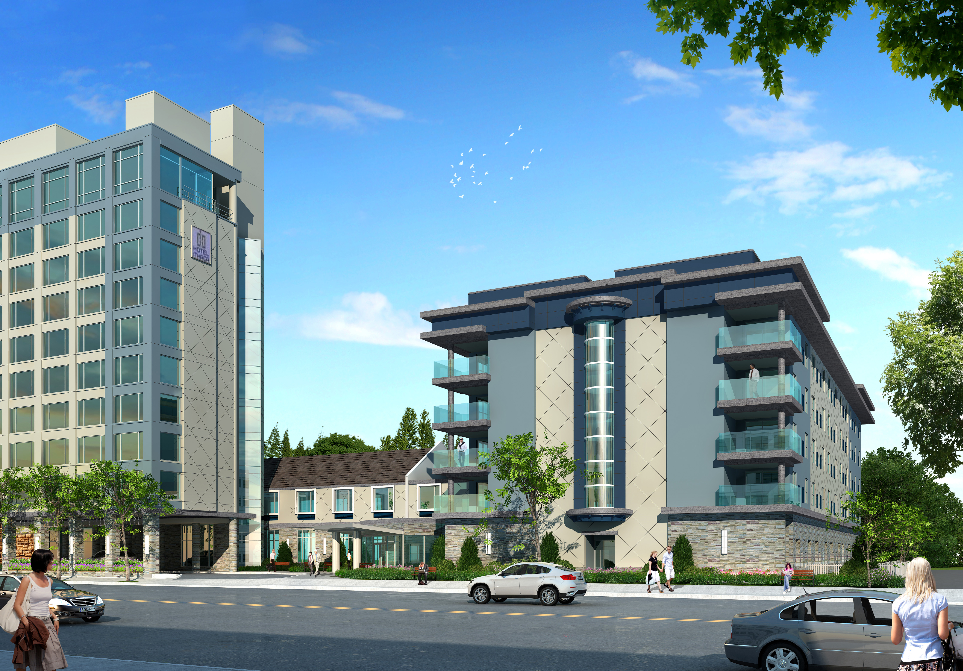
7. The Planning and Development Board has scheduled a Design Review Committee meeting to offer guidance and commentary on the styling of proposed buildings. While State Street Triangle isn’t on the agenda (yet), the Hotel Ithaca addition is. Renders here and here.

I’ve toned down my opinions over the years, but this…well, let’s just so those “sick burns” Nick Reynolds mentioned at the last planning board meeting were pretty well justified. I mean…yikes. The cross-hatched blank walls, the circular glazing, the “tourist trap” aesthetic. There’s an alternative being shown with small windows in place of the circular glazing, and rectangular facade hatching instead of the cross-hatching, but it’s not a great improvement. The board’s going to have a lot to say with this proposal.

215-221_spencer_v3_2

215-221_spencer_v3_1

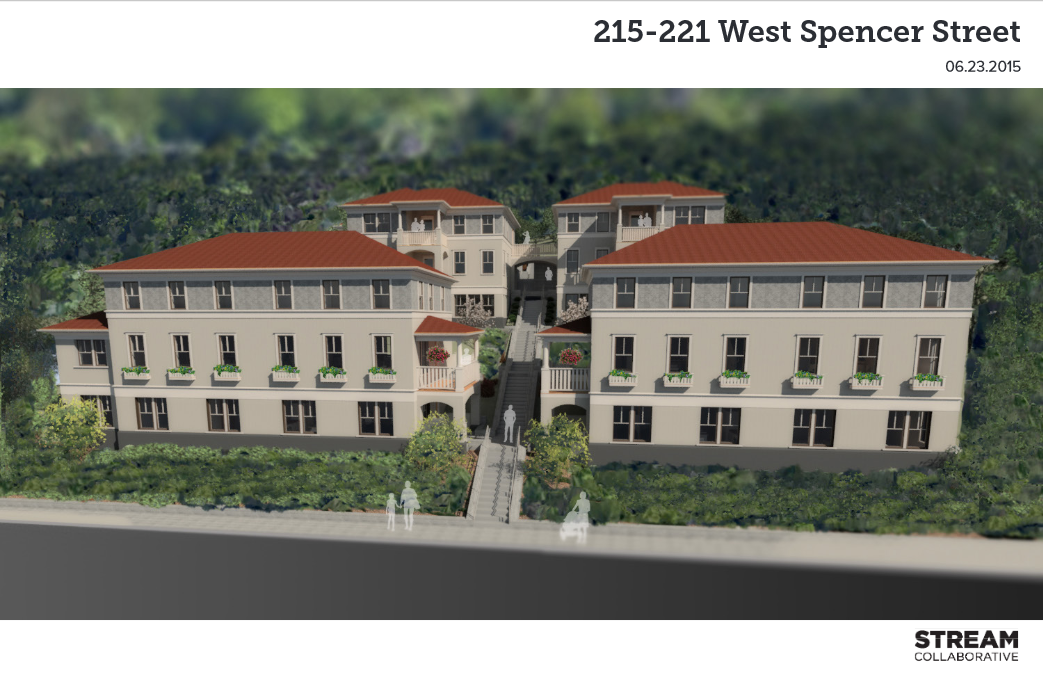
8. I had hopes that for the first time in three years, a major project would go through the boards without complaint or opposition. Hopes dashed. The complainant against the 4-building, 12-unit 215-211 West Spencer Street project cites the loss of the city’s parking lot on the site, the narrow width of S. Cayuga Street (the “rear” road), traffic, and no neighborly interactions because it’s a rental that faces Spencer Street.

215-221_w_spencer_orig

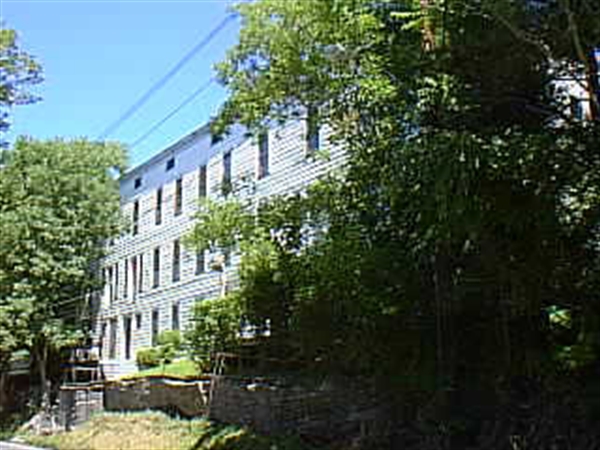
The kicker is, the letter-writer lives in an upscale Lansing subdivision. He rents out his 3-unit Cayuga Street property. The “house” that the letter claims used to be on the site is also misleading. It was a run-down multi-story apartment building (shown above in the photo from county records), demolished 12 years ago by the city, and turned into an informal parking lot that was never meant to be a long-term use. The land was sold by the city to Ed Cope for $110,000 last March.

I’m willing to entertain legitimate arguments and complaints to projects. But this isn’t one of them.


News Tidbits 10/3/15: Lying in Wait

3 10 2015

1.We’ll start with a news piece out of the ‘burbs. Over in Lansing town, wealthy homeowners are accusing the town board and the town planning board of disenfranchising and ignoring them over concerns about the proposed Novalane housing development. Dan Veaner at the Lansing Star gives a very thorough rundown here.

Quick summary, Novalane is a 19-lot high-end housing development slated for farmland between two other high end housing developments, the mostly-built Lakewatch and Eastlake subdivisions, the first phase of which is comprised of seven lots on the west side of the parcel. The sticking point has to do with access roads for the new homes. The developer proposes to connect the two developments via the Smuggler’s Path cul-de-sac, which would extend down through an undeveloped lot in Eastlake and connect with Eastlake Road.

According to the town, the intent has always been to connect the two developments – but apparently, no one ever had a good idea where. Neighbors on Reach Run are incensed because they’re afraid of additional traffic on their road if the connector isn’t extended all the way, but if connected, Eastlake residents are opposed to cross-traffic they suspect will cut through to get to East Shore Drive. Aside from that conundrum, some neighbors have suggested being okay with the road if it went all the way from Smuggler’s Path to form an intersection with Waterwagon Road, but that doesn’t seem possible given the property lines of the Rec Club. At the very least, it would be a big burden in the development costs.

So on the one hand, here is a town that has struggled with planning issues. On the other, you have wealthy residents angry about construction vehicles accessing the one house currently under construction in Lakewatch, and prepared to sue the town over the potential of seven more houses. There’s also this gem of a line:

“We’re large taxpayers.  It’s an autocracy.  To be treated like that by our own representatives is incorrect and not acceptable.  Who are they working for?”

Maybe all taxpayers and not just the large ones? Just saying.

2. Switching over to another ‘burb, the proprietors of Storage Squad made their pitch to the town of Dryden, per the Ithaca Times. Storage Squad, a Cornell startup that has expanded to twenty cities, seems to have a rather unique take on the appearance of self-storage. For their facility planned at 1401 Dryden Road, the company wants to build 79,600 SF of space, 70,000 SF of which would be in five buildings consisting of 400 storage units. 315 units may join 3-4 years down the line. According to the presentation, there would be a Cornell-inspired clock tower, brick and ivy growing on the side walls. Paved entries, gated, and split-face concrete masonry units. Apparently, it was enough to win the town supervisor over. A special zoning permit will be required, but approval is expected later this fall. No word on whether they’ll keep the 150-year old house on-site.

3.  Must be a good week for Dryden. The eyesore at 76 West Main Street has been sold and has a construction loan approved to finish renovations. The Ithaca Voice article I did on the reno is here. I toyed with the idea of calling Dryden mayor Reba Taylor for a quote, but I figured I’d get a very generic statement it any at all, and in the interest of time the idea was shelved. I might get a response to one-third of the calls I make regarding development/real estate stuff, which can be frustrating but I’ve gotten used to it.

state_st_triangle_v5_1

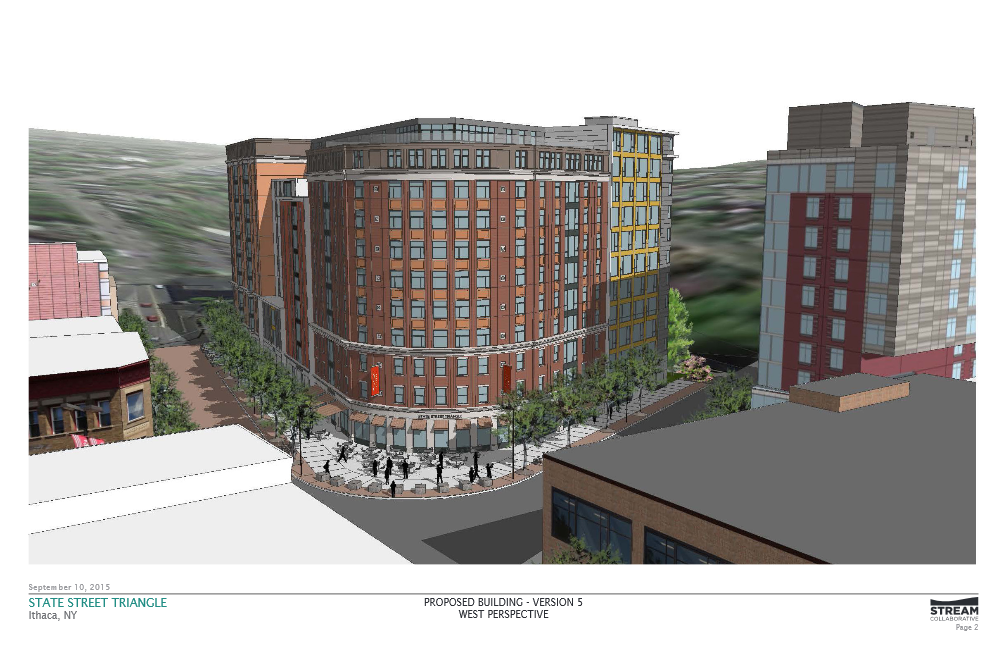
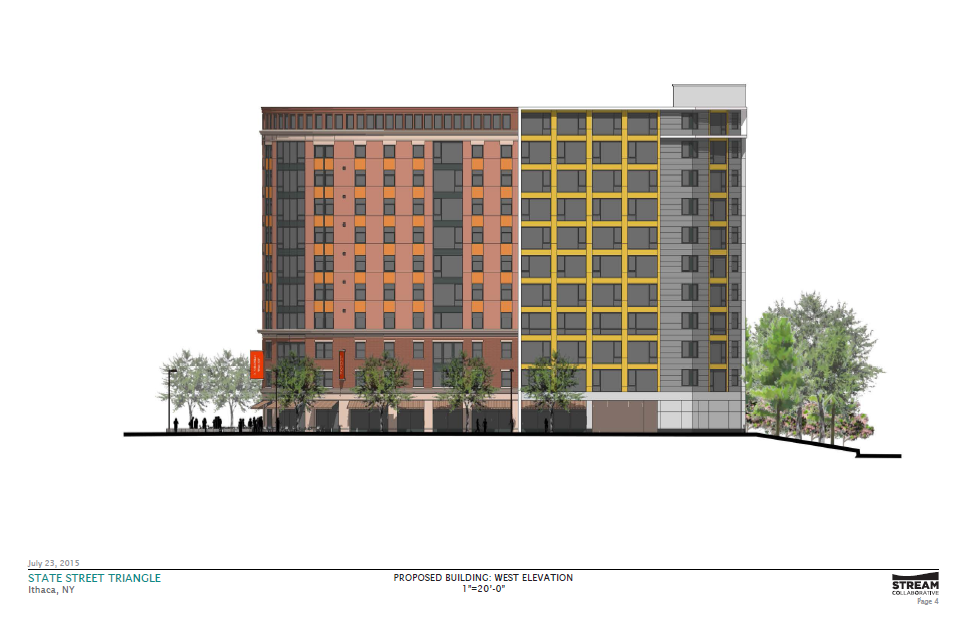
4. The Times’ Josh Brokaw brings out an update on the latest State Street Triangle news. The important details:

– CTB has agreed to take one of the commercial spaces. No word on how that would affect the North Aurora Street location a couple blocks away.

– The planning board didn’t have many words; One member suggested the curve portion was “too flat” and an arcade on the first floor (not the video game kind, but the archways over a walkway kind). A second brought up affordable housing, which the developers have given consideration, but isn’t in the current plan.

– In favor: the director of Cinemapolis, other developers, CTB’s owner and students. Not in favor – the head of Historic Ithaca, and councilman George McGonigal – who opposed the Stone Quarry Apartments, the waterfront rezoning, 210 Hancock and thinks the city can make Cornell build dorms. The Times has called him out as “anti-urban”. If a councilperson outside the first ward speaks out, it’ll get a lot more credence on this blog.

304_college_2

304_college_3

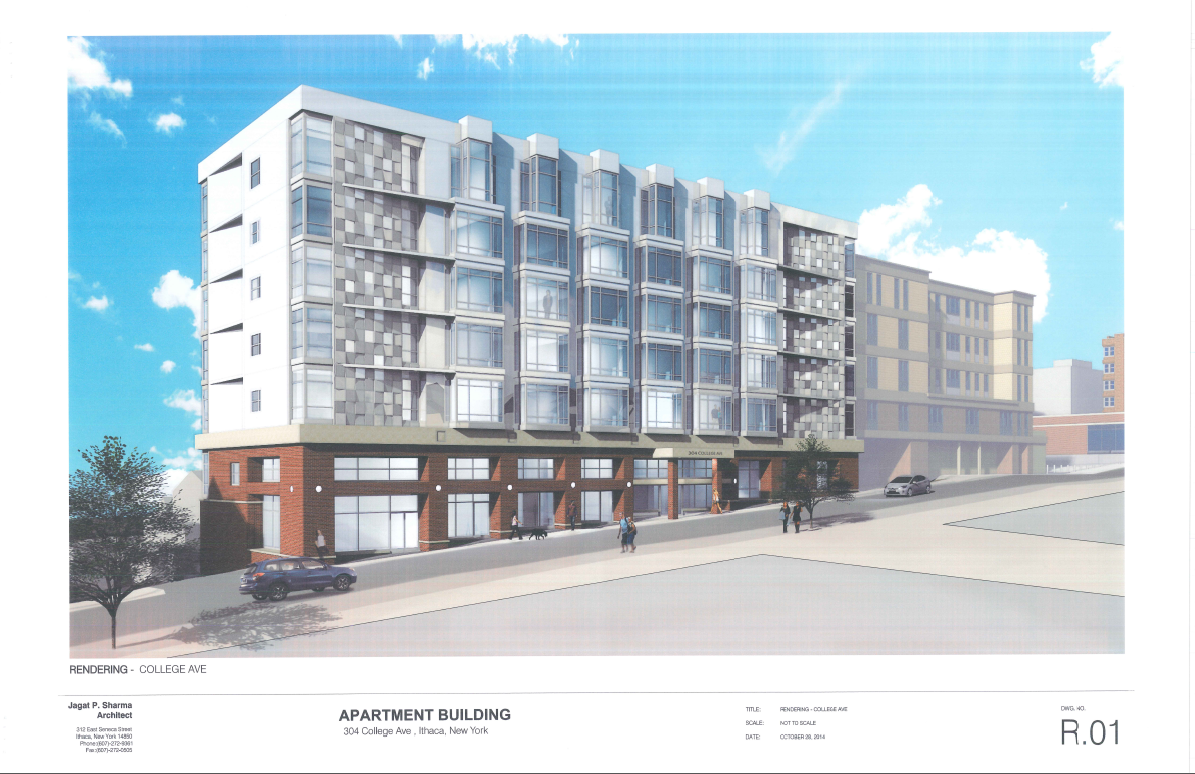
5. The city and Cornell gave an interesting presentation about development to the Collegetown Neighborhood Council this week. City planning director JoAnn Cornish gave a rundown of what’s planned, included the 102 apartments 302-306 College Avenue (phases one and two shown above). This one might still be in the hopper, but don’t expect it to move forward anytime soon – the developers (the Avramis family) have rented out the houses to be demolished through May 2017. It also seems like that one building would be in the 2017-2018 time frame, the second 2018-2019. So these two mid-rises are quite a ways out, assuming they’re still in the works. Also, Fane’s 12-story proposal for 330 College is still dead, but something more modest may come forward someday.

On another interesting note, Cornell’s lead planner, Leslie Schill, said the university may be looking into turning Eddy Gate and the Sheldon Court plaza into green spaces to offset the lack of parks in the neighborhood. Cornell might also renovate the Ag Quad into a richer pedestrian experience.

6. The Carpenter Business Park purchaser continues to intrigue. A company called Carpenter Business Park LLC, using a P.O. Box ties to the Miller Mayer law firm, has bought two more parcels after buying the four unused land parcels in the Carpenter Business Park for $2.4 million last August. This time around, the LLC purchased a nondescript one-story commercial building at 742 Cascadilla Street, and a nearby tiny silver of land between the Palisades Corporation and Cornell U. Press buildings for $304,000. It’s not clear what the buyer is intended to do with all these properties (we know it’s not a big box store), but it’s definitely curious. If something comes up, it’ll be shared here.


News Tidbits 9/26/15: Trying to Keep Tabs

26 09 2015

1. It’s rare for a substantial project to go completely under the radar from start to finish. Except that’s pretty much what happened with the following building.

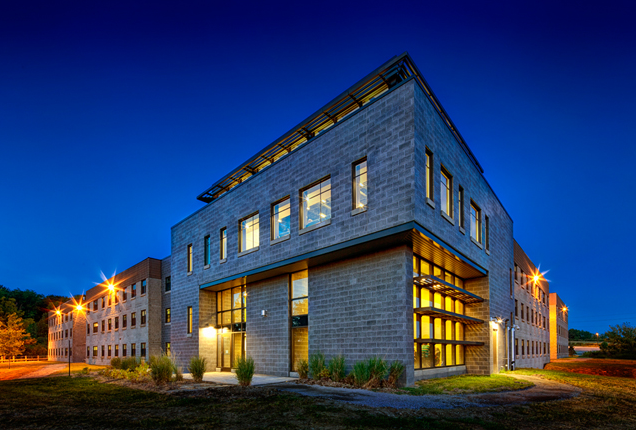
Tompkins Cortland Community College (TC3) recently finished renovations to two of their dorms on their Dryden campus. Along with the renovation of about 41,000 SF of existing space, the two dorms were connected by a new 3-story, 10,000 SF addition designed by Ithaca’s HOLT Architects. The existing dorms sat at a 90° angle to each other, so the addition by HOLT creates a single, L-shaped structure, with the expansion holding common space and amenities. Binghamton construction firm William H. Lane Inc. handled the build-out. The image above comes courtesy of HOLT’s website.

Technically, it did come up once on the blog, but it was misinterpreted. When William H. Lane announced it was opening an Ithaca office to handle the growth in their Ithaca/Tompkins work, one of the examples given in the Binghamton Press & Sun Bulletin was a dormitory expansion at TC3. At the time, I had done a search for the project and filed an inquiry with TC3, but there was no response, and my search only turned up renovations underway for the main classroom building. I assumed there was a miscommunication, so…oops.

2. In real estate sales, it looks like a couple of the smaller developers were in buying mode this week. Lansing’s SDM Rentals (Scott Morgan, owner of SDM Landscaping) bought a vacant 2.93 acre parcel at approximately 455 West Dryden Road in the town of Dryden for $21,000 on the 23rd. If past behavior is any indication, Morgan will probably be looking to do rentals, likely a few townhouses on the property. Currently, Morgan is planning 8 duplexes (16 units) at 543 Asbury Road in Dryden, which may or may not have a zoning issue. Morgan is also building out on Bone Plain Road in Dryden, and owns the recently-built Meadowbrook Apartments (14 units in the form of duplex townhouses) at 393 Peruville Road in Lansing.

Meanwhile over in Danby, Chris Petrillose of Petrillose Properties picked up a 2.11 acre parcel along the 400 block of Troy Road for $34,000. Given that that area has seen a lot of scattered small-scale development (1 & 2-family homes) in the past few years, and that Petrillose finished work on duplexes in Ithaca town, a couple rental units seems likely.

hotel_ithaca_2

3. How well was the Hotel Ithaca received? Let’s quote IJ Reporter Nick Reynolds’ Twitter:

Many sweet, way-over-my-head architecture burns thrown tonight. Let’s just say you guys aren’t getting a Hotel Ithaca update anytime soon.”

The primary complaint focus not on function but on form – according to the IJ follow-up article, materials and a dated design were dinged by board members (and comments about “LEED-certified stucco” and comparisons to the Bellagio didn’t help). NH Architecture’s portfolio tends to be the same general design, which means they’re going to have to go the extra mile on this one, or developer Hart Hotels might need to switch up their approach. Their Belhurst Castle Hotel design isn’t bad, so maybe they can channel some of that creativity into the downtown Ithaca site.

So rest assured, “Cornell PhD”, those cross-hatches aren’t making it off the drawing board anytime soon.

casca_landing_1

casca_landing_2

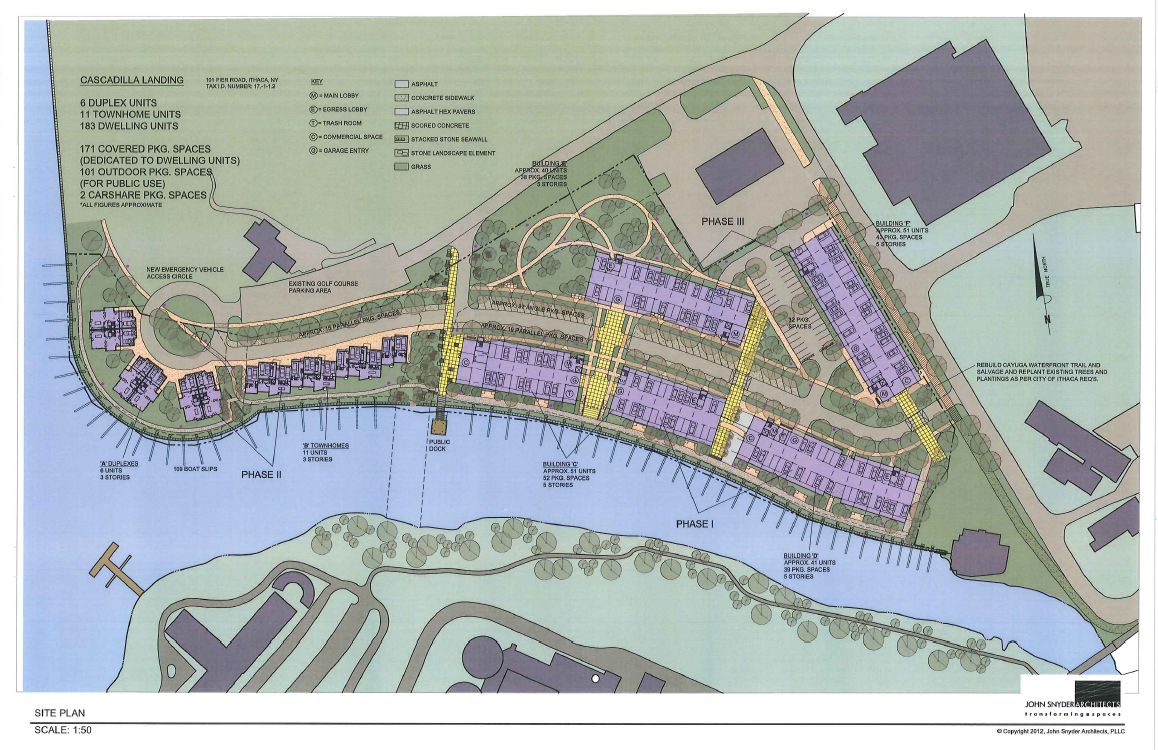
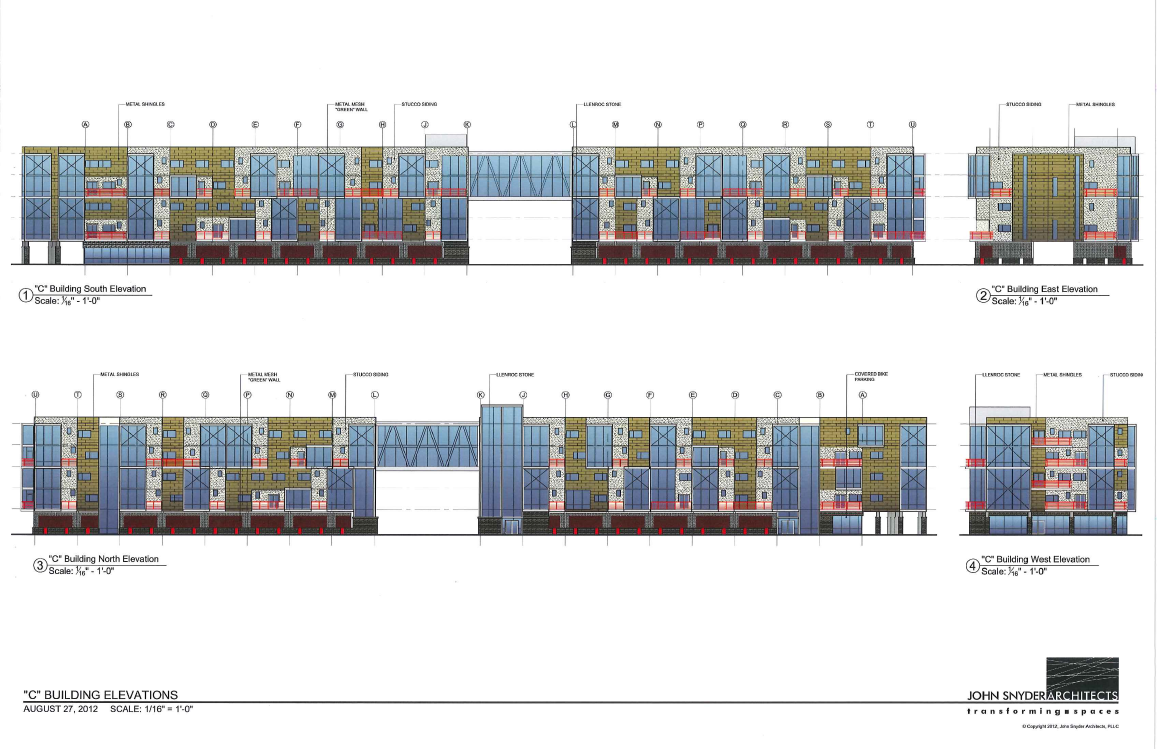
4. A few years ago (spring-summer 2012), the city planning board reviewed and approved a large project for the Ithaca waterfront called “Cascadilla Landing“. The three-phase, 183 unit project called for 6 units in duplexes, 11 townhouses, and the remainder to be built in 5-story apartment buildings designed by Ithaca architect John Snyder (the same gentleman behind the Carey Building addition). The first phase called for two buildings and 92 units, Buildings “C” and “D” (“C” shown above). So the project was approved and then…nothing. Never got off the ground.

However, the impending closure of Johnson’s Boatyard on Pier Road is piquing my curiosity. Now, initially it seemed highly unlikely because I thought Cascadilla Landing had never been fully approved (in fact, it received preliminary approval in September 2012 – thanks Noah). But since it was approved, all an ambitious individual would have to do is simply re-apply for approval if there are no changes to the plan (PB approval is only good for 2 years – part of the reason why Harold’s Square was back before the board last month). It’s still unlikely that the project is moving forward soon, but not impossible. A phone call to Snyder’s office and a call to Pier Road Properties (the developer as represented by accountant Andy LaVigne on the application materials) have so far not been returned.

chapter_house_reconst_3

5. Preliminary, but it’s nice to see work progressing on the Chapter house redevelopment. Voice article here. The key thing to stress here is that there are design studies, and they’ll be subject to the ILPC’s whims. It looks like making the fourth floor of the Chapter House habitable or not is something that’s still being debated, along with the plans for the still-standing 408 Stewart. It’s hard to believe that things will be ready in August 2016, given that there’s no formal application yet, and the languid pace projects like this go through the commission.

Also, it was extraordinarily difficult to get a hold of most of the relevant parties for the article. Neither architect responded, I couldn’t get a hold of city Historic Preservation Planner Bryan McCracken…thankfully, Jerry Dietz was happy to assist, and although I felt a little bad calling ILPC Chair Ed Finegan since he has no formal part in the project itself, he was a big help. Both were keen to stress the preliminary aspect of this project, which hopefully came through in the article.

But I’ve just about had it with responding back to commenters on the Facebook article.


News Tidbits 9/5/15: Ithaca the Diva

5 09 2015

cornell_novarr_1

1. John Novarr’s project at 209-215 Dryden Road has been given the green light. The city of Ithaca’s Planning and Development Board approved the $12 million project at their August meeting. With approvals in hand, Novarr is free to start construction as soon as he has his construction loans, which should be no problem given that Cornell’s MBA program has agreed to occupy the whole building (though only about 70% of the space will actually be used at initial completion; the MBA program will fill out the building as their needs require). Conveniently, Novarr won’t have to worry about site demolition and asbestos removal because he cleared the site in May.

The 6-story, 73,000 SF building will begin construction in “four months” per the end-of-August Sun article, or November if the Site Plan Review (SPR) paperwork is still accurate. Completion of the building is anticipated for the second quarter of 2017. ikon.5 of Princeton, New Jersey is the project architect.

When filled out, the building will house 250 employees of the university, and 450 students of the Executive MBA program, who only attend classes in Ithaca during traditionally slow periods of the year (winter break and summer break; during the rest of the year, students attend weekend classes in the town of Palisades in Rockland County). To that effect, the project would go a long way in easing the strongly cyclical consumer traffic that makes it hard to do business in the largely-student neighborhood. Students also stay at the Statler while on campus, and staff and students will walk over from Cornell faculty/staff parking to get to the building.

Last month, the Tompkins County IDA approved a 50-year tax abatement for the project, in the form of a PILOT agreement. With the other option of Cornell buying the property and making it tax-exempt, the county has decided that something is better than nothing.

The project joins a slew of mostly residential projects under construction in the Collegetown neighborhood. 205 Dryden, 327 Eddy and 307 College are all underway, and several smaller projects were recently completed. The new investments total over $36 million, and with the exception of Novarr’s project, all the other projects will be taxed at full value.

902_dryden_2

902_dryden_1

2. Meanwhile, there have some mild hang-ups with another project. The solar-powered townhomes in Dryden are seeing some resistance, mostly from the nearby Cornell Plantations, and from neighbors opposed to rental housing in Varna. The Ithaca Times piece uses this dandy of a line:

“Resident Cheryl Humerez, whose family and in-laws both own homes that neighbor the proposed project, was disgusted by the thought of a rental development, which might attract college students, becoming her neighbor.”

Going beyond the “disgusted” comment, most of the students that would live this far from Cornell’s campus would be graduate and professional students. Undergrads are less likely to have cars and tend to live in the neighborhoods immediately adjacent to Cornell’s core (Collegetown, Cornell Heights and parts of East Hill). Graduate and professional students tend to be like any other 20 or 30-something living on modest wages. The chances of a “keggers on Tuesday” kinda place are virtually nil. Also worth pointing out, Dryden’s town supervisor called Humerez out on that comment, saying she was saddened that renters were being described as a problem.

Cornell Plantations, as represented by Todd Bittner, has more legitimate concerns about litter, the driveway location and stormwater drainage; but glancing at the town minutes, it looks like the “I know we need development, just not in this neighborhood” argument also makes an appearance.

The town board (in Dryden, it seems the town board oversees public hearings of the planning board’s agenda) is taking a more level approach; acknowledging that it’s a decent project, community input is important for good development, and by incorporating mitigation measures to assuage worried neighbors, this has the potential to be a worthy community asset. Expect this project to evolve as we go through the next couple of months.

Also noted in the town minutes are plans for a 78,000 SF storage facility next to NYSEG at 1401 Dryden Road. Plans from a Cornell startup named “Storage Squad” call for “high quality, attractive self-storage” with 400 storage units in the first phase. The project will need site plan review.

402_s_cayuga_st_rev2_1

3. To anyone who’s passed by the vacant lot at 402 South Cayuga Street and wondered when INHS will start those for-sale townhomes: I’ve taken the liberty of checking. INHS director Paul Mazzarella stated in an email that “[t]he project is out to bid for a general contractor. The bids will be due next week. If the numbers are OK, we will start as soon as possible.” So barring any nasty shocks in the bids, the four-unit project (1 3-bedroom, 3 2-bedroom) will start in just a few weeks. As with other INHS projects, the units will be sold to qualified first-time homebuyers with modest incomes (anecdotally, that means the $40k-$50k range…it seems like half the buyers in the past year or so have been teachers in the ICSD).

4. In a rare bit of bad economic news in Ithaca, Ithaca College has announced its intent to slash about 40 staff positions from its workforce. This follows 47 job cuts in academic year 2014-2015, 39 of which were vacancies.

The cuts are part of an effort to bring tuition costs and help the college stabilize enrollment numbers, which have been sliding down lately. No faculty positions will be eliminated as part of the layoffs. IC currently has about 1,070 staff and 730 faculty, about 200 more than they employed a decade ago.

harolds_square_taylor

5. The rumor mill said that a reporter from the New York Times was in town last Friday, and apparently they liked what they saw; the piece in the NYT takes a very positive and gracious approach with Ithaca and its recent urban developments. If you haven’t read it already, the link is here.

[What follows is a spark-notes version of the Voice piece – I’ll update with links after the weekend holiday.]

More importantly are some useful details in the piece – one of which is that we now know the revised mix of uses for the 11-story Harold’s Square project calls for 86 apartments, up from 46 when it was first approved in 2013. The apartment units will be a mix of 1-bedroom and 2-bedrooms. Readers may recall that the project dropped two floors of office space in favor of two floors of apartments. The project also includes about 11,000 SF of retail on the Commons.

In a phone conversation with developer David Lubin, the current plan is to start construction of the $38 million project in early 2016:

“Rev will be out at the end of September. We’ll probably begin demolition after the first of the year, after the holiday shopping season, we don’t want to be a nuisance to Christmas shoppers. We’ll have pop-up store space available during the holidays. They’re not solid, but those are out plans. We’ll see how it goes”.

Also, the project will be going back to the planning board.

“The planning board re-approved the current design [last month]. However, there will be changes to the design, as we’ve changed the office space to apartments and they have different needs, window placement, things like that. When we’re ready, we’ll present those to the planning board. Not September and probably not the October meeting, but before the end of the year.”

The project was originally approved in August 2013, with a CIITAP tax abatement package approved two months later. However, putting a financial package together has been a task.

“These things take time,” Lubin stressed. “The Marriott, that needed 3 or 4 years before they started. It can be a slow process.”


simeons_1

6. For those keeping an eye on the Simeon’s reconstruction, expect to see some progress in the next couple of weeks. That’s according to an interview the Sun conducted with Simeon’s co-owner Rich Avery. The timeline has yet to be finalized, but the new restaurant space and luxury apartments are anticipated for completion by late next summer, with the resturant re-opening as early as February.

maplewood

7. Gosh, it’s nice to have the Sun back in session. Also from the Sun, incoming Cornell president Elizabeth Garrett has formally announced plans for new student housing, among other graduate student initiatives. From the Sun:

“Following her discussion on maintaining and promoting diversity among graduate students, Garrett announced the creation of new graduate student housing.

“My team and I are committed to working with the GPSA to create an inclusive and rewarding [graduate and] professional student living environment,” she said. “Most immediately, I am working now with my team to work on critical housing needs.”

According to Garrett, since the University’s Maplewood Park Apartments — a graduate student housing facility located near the Veterinary School — is closing, the University is currently collaborating with private partners to create new graduate-student housing at the Maplewood site and to develop additional housing in the East Hill Village.”

Heads up folks, East Hill Village isn’t even a thing a yet, it’s just a concept from the master plan. Anyway, this goes along with Ithaca town supervisor Herb Engman’s comments to the county that Cornell is engaging with consultants to bring a plan forward. There’s nothing else known about the plans, and it’ll be a few years before any students start moving in to new Cornell-sponsored digs, but everything has to start somewhere, and Cornell’s created quite a deficit for itself when it comes to providing adequate amounts of graduate housing.

Also, note the “collaborating with private partners” bit – these may or may not be tax-exempt, we shall see what happens.

state_st_triangle_v3_3

8. Here’s the latest update on State Street Triangle, courtesy of the Ithaca Times. I have to admit, although I technically compete for eyeballs via the Voice, I like Josh Brokaw’s writing, he tends to be a bit of a wiseass and it’s entertaining.

The big hang-up is massing. Not height, not tenant mix. A couple of ideas floated or suggested include height setbacks or overall reductions, and a redesign of the facade to make it appear more like separate buildings built next to each other.

According to Brokaw’s piece, some landlords are even questioning the need for new units, saying that all these new units could drive prices down.

Captain Obvious just arrived into port. By the way, given the recent growth in general and student populations and corresponding increase in demand for living space, if a landlord is having trouble filling their units right now, it’s probably not the city’s fault.

Campus Advantage has already spent $500,000 on the project, but it doesn’t seem like they’re going to throw in the towel just yet. They were probably hoping for an approvals process as easy as their Pittsburgh apartment tower, but…live and learn.