News Tidbits 10/10/15: Meeting With the Stakeholders

10 10 2015

1.There is nothing wrong with a little speculation. In a follow-up of sorts to the Voice piece about parking capacity in Downtown Ithaca, the Times’ Josh Brokaw did an interview of his own with city of Ithaca parking director Frank Nagy. Nagy believes that the 248-car estimate used by State Street Triangle is “way high”, but given that one of the refrains is that there’s not enough parking, they’d rather be safe than sorry.

More importantly, Nagy believes that the Seneca Garage only has about 10 years of life before a new garage will need to be built (the Seneca garage was built in 1972). The structural situation at Green Street is severe enough that the city may have to remove the end pieces and build up the middle section, which was renovated several years ago. The property is being reviewed, and with Tompkins Trust vacating office space on its ground floor as part of the move to its new HQ, the assessment is well-timed.

If the Green Street garage decides to go up rather than out, that leaves two very valuable properties that the city could sell to its benefit (financial, affordable housing, or otherwise). Both ends of the Green Street garage are zoned CBD-140, which offhand is the densest zoning in the entire city, 140 feet maximum height with no parking requirement. A zealous councilperson might try and change that post-SST, but as is, a rebuild of Green Street a few years from now could yield a lot of possibilities for downtown development. Put that in the notebooks for 2020 or so.

100_1281

2. Speaking of future plans, we have the bike debate currently raging in the streets. Now, this is only tangential to my usual work, and I am not versed in the topic, so it’s nice to go in without preconceptions.

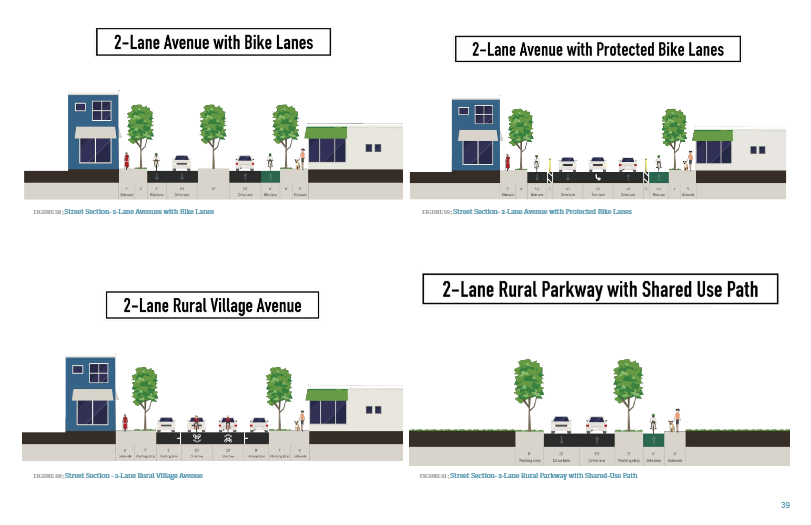
The city just finished work on Board of Public Works (BPW)-approved bike lanes on North Cayuga Street, specifically an unprotected bike lane on the east side (protected lanes were considered, but not approved). Although meetings gave due public notice, there were no letters sent to Cayuga Street residents informing them of the change, and a number of folks were caught off guard, including members of the city’s Common Council.

In the one corner, you have folks angry about the loss of parking, the inconvenience, and the danger it poses to the elderly. Unfortunately, you also have a council member describing biking-proponents in the same tone one would describe Albany lobbyists. The mayor has come out in favor of the N. Cayuga Street bike lane, although according to the Times, he’s not a fan of “resident-driven infrastructure”. It’s really a fascinating read from a planning perspective. – Times coverage here, Journal here.
bike_lanes_1

For what it’s worth, bike lanes are a major part of walkable communities and reduced ecological impacts (carbon footprints). I feel like I’ve seen this type of argument play out from the perspective of development quite a bit – every new Collegetown or downtown building gets the “Ithaca shouldn’t allow big buildings/they’re ruining Ithaca/where are they going to park” argument, and the “Ithaca is not a small town/it promotes walkable communities/suburban sprawl is destroying Tompkins green space” counter-argument. The key problem with the bike situation seems to be a lack of communication between the BPW and Common Council (and residents by extension). Luckily, the planning board doesn’t quite have this problem – everything they vote on gets publicized, on this blog if not elsewhere.

cornell_novarr_1

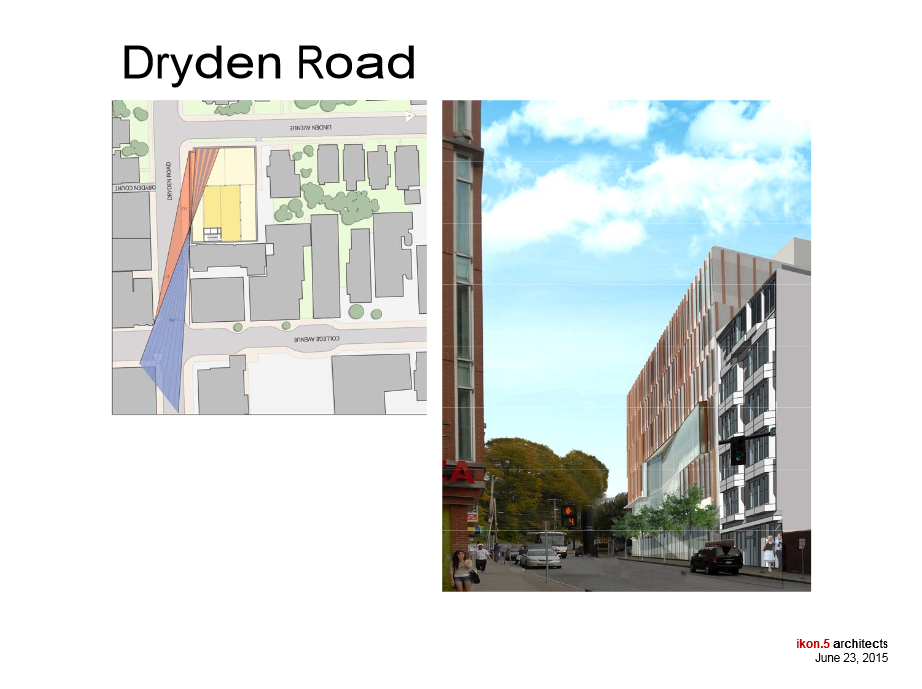
3. The last hurdle for John Novarr’s 215 Dryden Road project has been cleared. The Board of Zoning Appeals approved variances from the Collegetown Form Guidelines – the corner isn’t chamfered or set back enough and the building only has one main entrance (the form-based code mandates an entrance every 60 feet of non-residential space). The owner of the house across Linden from the corner was the lone opposition speaker, and the BZA vote was 4-1, with Marilyn Tebor Shaw opposed. No reason for Shaw’s decision was provided in the article.

With all the approvals tucked away, all that’s needed is for the city to sign off on the building permit. Expect this one to be underway within the next month.

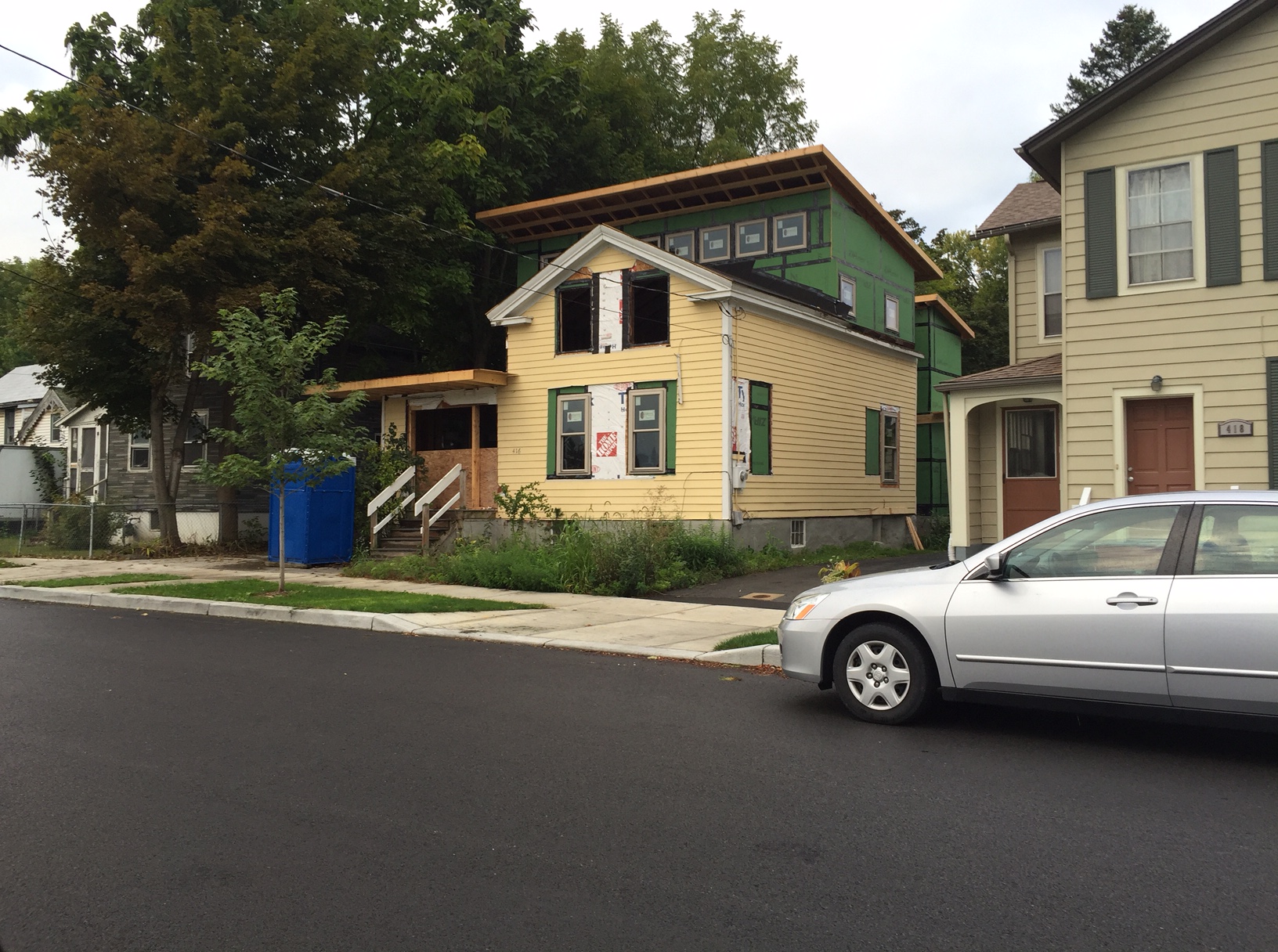
image1 image2

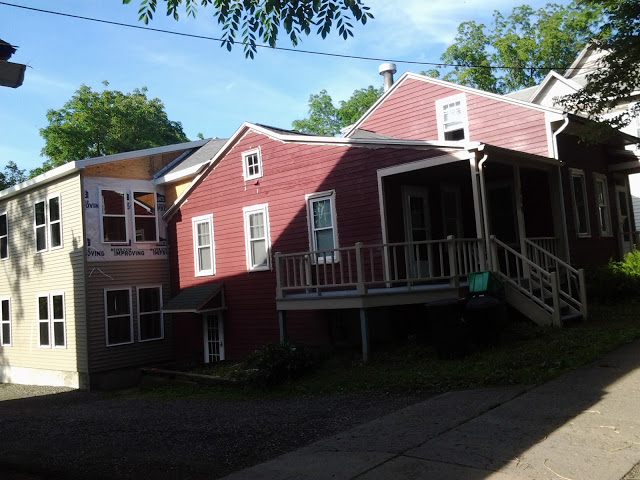
4. Reader submissions are always welcome. The photos for this week’s “House of the Week” featurette come courtesy of Frost Travis. The house receiving the addition is 416 North Plain Street in Ithaca’s Washington Park neighborhood. The current owners brought the property in October 2014. County records give it a 1900 construction date, which is often a default for old and unsure; it appears on an 1889 map of the area, but was not yet built in the 1866 map.

The rear addition looks like it’s been underway for a while – the exterior has been framed and sheathed with plywood Huber ZIP system roof and wall sheathing, which uses seams and tape to save time vs. traditional sheathing such as Tyvek housewrap. There are some windows fitted into the rough openings, but there’s still plenty of work to do with closing up the exterior and interior utilities rough-in. Looking at the original house, the owners appear to be fitting smaller windows in place of the originals – two window cutouts on the north wall have been filled in with sheathing, and a new window has been fitted in a new opening. The front door and adjacent window are gone, one large rough opening in their place. The front roof above the door and window was slanted, but has been dropped to a flat roof as part of the renovation and addition. Presumably, the butter yellow vinyl exterior will be re-finished as construction progresses. With any luck, this one will be finished before winter comes.
Pg-3-Rendering

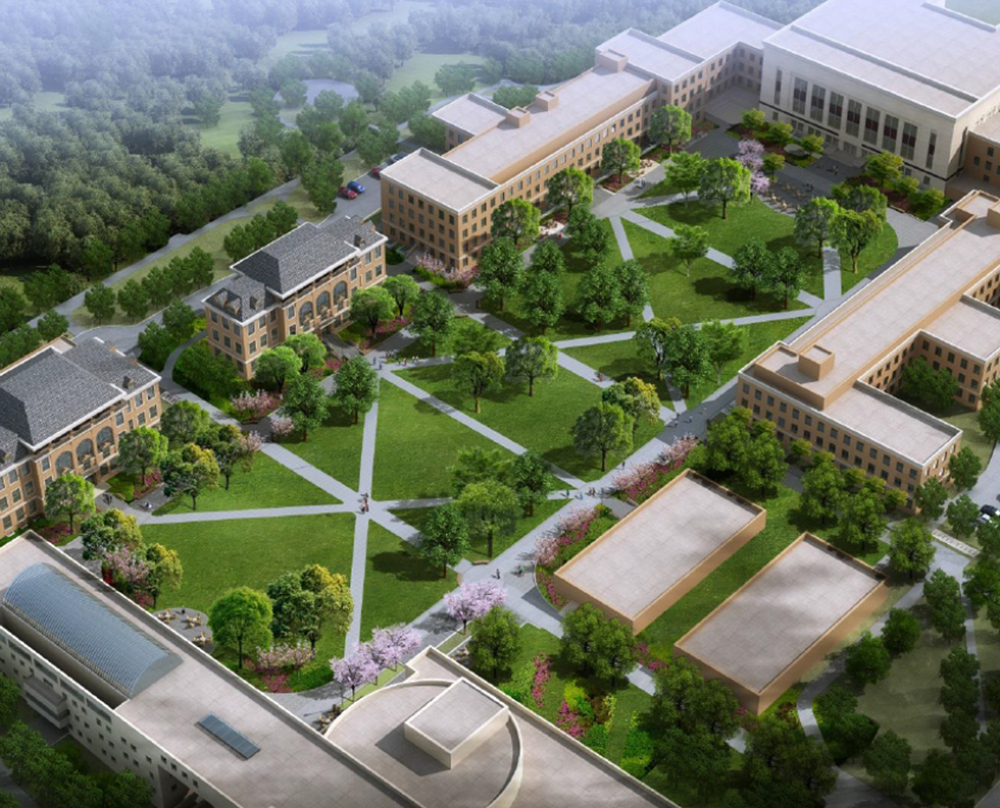
5. What a quick turnaround. The Cornell Daily Sun first made mention of the Ag Quad renovation last week as part of its coverage of the Collegetown Neighborhood Council meeting. Now only a week after Cornell shared a glimpse at the cards in its hand, they’re playing them. The $9.6 million project will be broken down into two phases, one that focuses on infrastructure, and one phase on landscape improvements (and being that much of the infrastructure is underground utilities, phase one could be described as churning up the ground, and phase two is making the upturned dirt pretty again). The renovations, which are set to start next summer and run through 2017, will include additional emergency phones, a rain garden, and outdoor gathering spaces in front of Mann Library and Roberts Hall (upper right and lower left in the above render).

Too bad those temp buildings are still there between Kennedy Hall and Plant Science. If the Southern Tier wins that Upstate Redevelopment competition, I have an idea where the new Plant Science Commericialization Building should go.

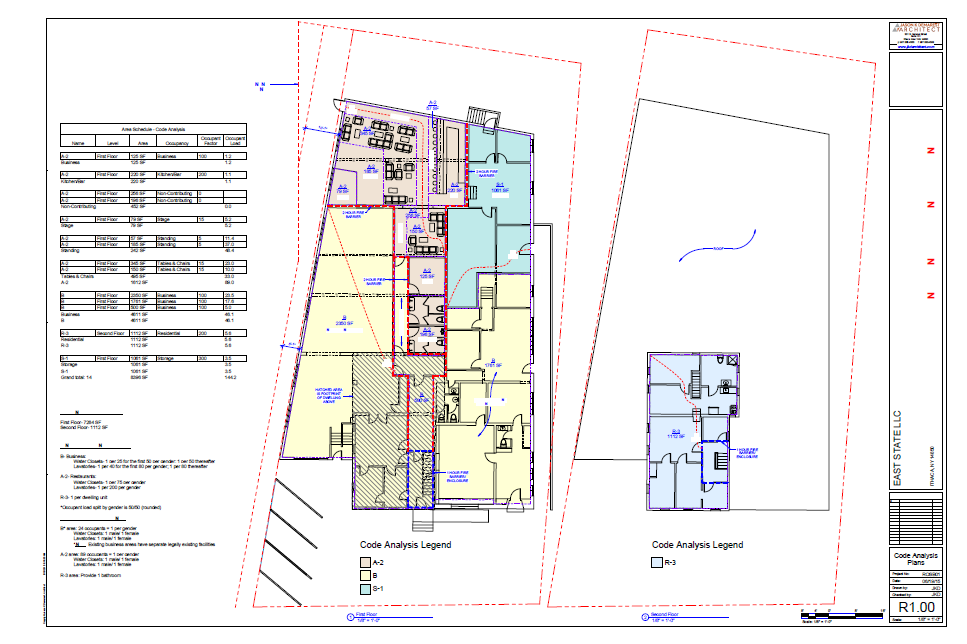
6. Plans for 416 E. State have evolved since the bar was first proposed. Originally conceived as a general bar/drinking establishment, developer and Argos Inn architect Ben Rosenblum has faced substantial opposition to the project – neighbors are vociferously opposed to a bar, citing noise problems and concerns about smokers, and the county planning department was not a fan of the traffic and parking arrangement, which had after hours parking across the street at Gateway Plaza. Although the project doesn’t need planning board approval, it does need BZA approval – area and setback deficiencies have resulted in the need for a zoning variance. The building itself won’t change dimensions, but the change in use triggers the city zoning laws.

416_e_state_v2_1

Representatives for Rosenblum and neighbors have met, and the compromise Rosenblum and his associates have proposed involves a lounge-type of establishment they’re calling “The Printing Press”, after one of the previous uses for the late 1940s warehouse. They’ll be going for an industrial/”speakeasy” aesthetic, and targeting the same older, more affluent clientele that patronizes the Bar Argos next door. Signage would be minimal, and exterior work limited largely to an accessory parking lot/handicap access, landscaping and a new coat of paint. Looking at the original plan vs. the revised plan, the bar no longer is in the rear corner, but moved closer to the building center so as to buffer the noise of patrons from disturbing neighbors. Parking will be shared and organized with the Argos Inn’s lot. For more info, cover letter here, renders here, vision statement here.

The new parking arrangement may assuage the county, and the low-key bar located centrally in the interior may be enough to satisfy some of the neighbors. But we’ll have to see the BZA’s reaction and what remaining opposition there is before anything is set in stone.

hotel_ithaca_v3_1

hotel_ithaca_v3_2

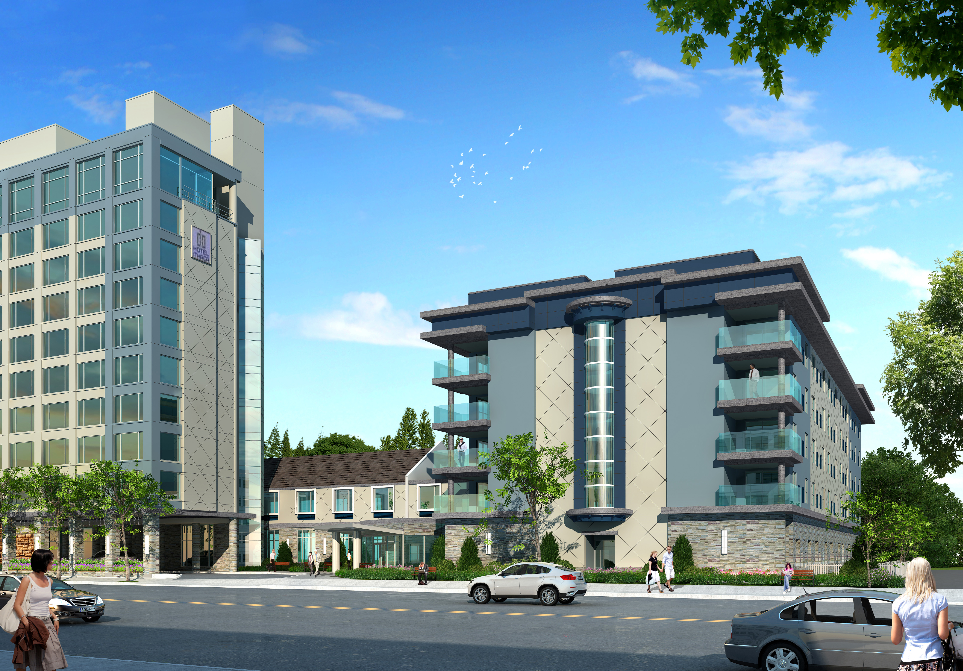
7. The Planning and Development Board has scheduled a Design Review Committee meeting to offer guidance and commentary on the styling of proposed buildings. While State Street Triangle isn’t on the agenda (yet), the Hotel Ithaca addition is. Renders here and here.

I’ve toned down my opinions over the years, but this…well, let’s just so those “sick burns” Nick Reynolds mentioned at the last planning board meeting were pretty well justified. I mean…yikes. The cross-hatched blank walls, the circular glazing, the “tourist trap” aesthetic. There’s an alternative being shown with small windows in place of the circular glazing, and rectangular facade hatching instead of the cross-hatching, but it’s not a great improvement. The board’s going to have a lot to say with this proposal.
215-221_spencer_v3_2

215-221_spencer_v3_1

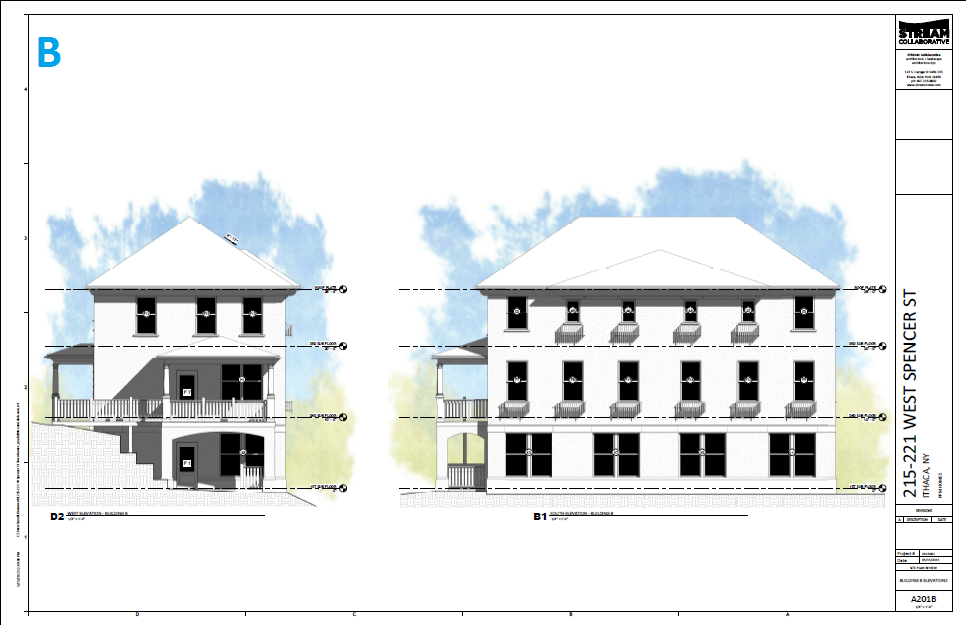
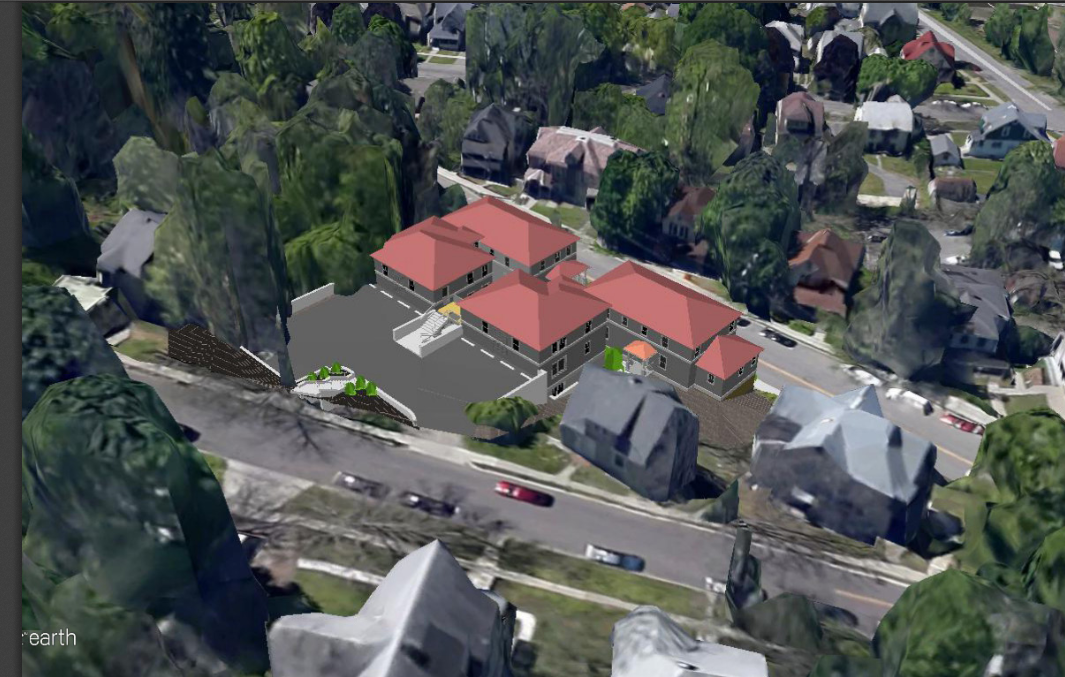
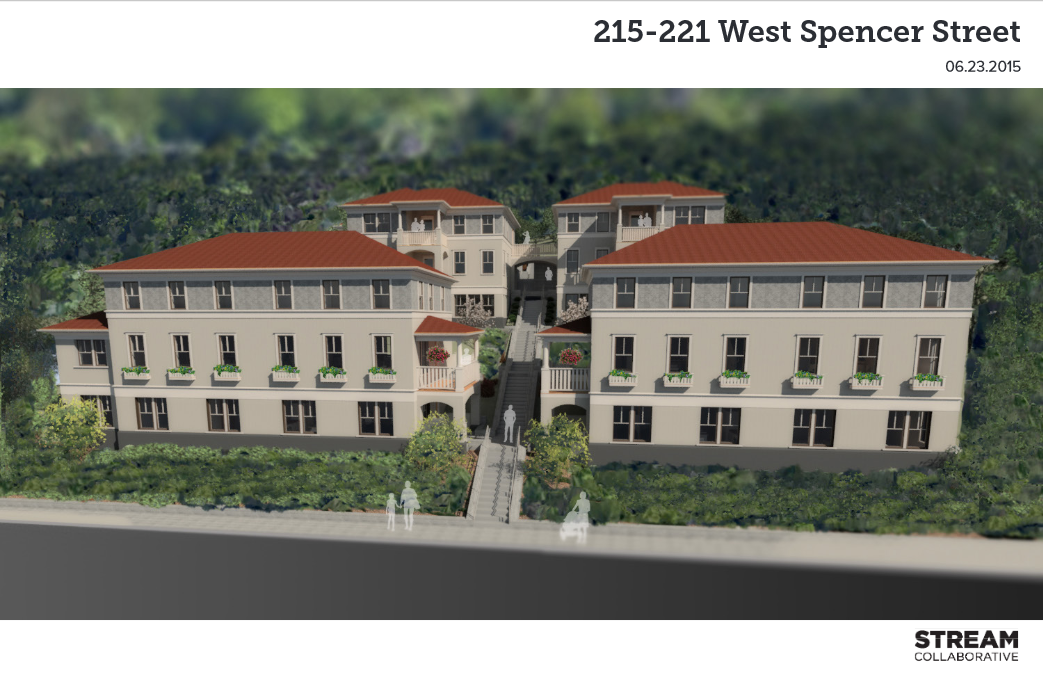
8. I had hopes that for the first time in three years, a major project would go through the boards without complaint or opposition. Hopes dashed. The complainant against the 4-building, 12-unit 215-211 West Spencer Street project cites the loss of the city’s parking lot on the site, the narrow width of S. Cayuga Street (the “rear” road), traffic, and no neighborly interactions because it’s a rental that faces Spencer Street.
215-221_w_spencer_orig

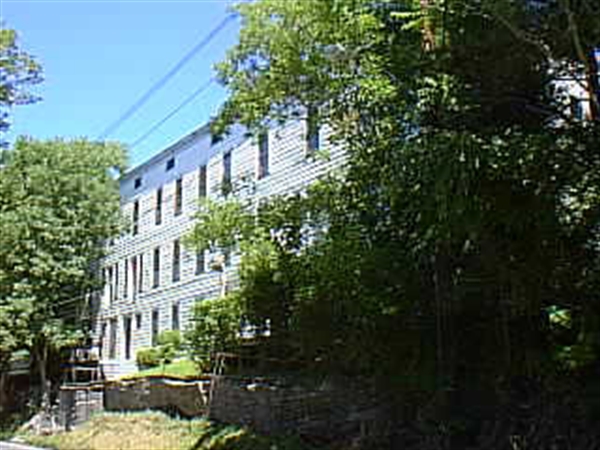
The kicker is, the letter-writer lives in an upscale Lansing subdivision. He rents out his 3-unit Cayuga Street property. The “house” that the letter claims used to be on the site is also misleading. It was a run-down multi-story apartment building (shown above in the photo from county records), demolished 12 years ago by the city, and turned into an informal parking lot that was never meant to be a long-term use. The land was sold by the city to Ed Cope for $110,000 last March.

I’m willing to entertain legitimate arguments and complaints to projects. But this isn’t one of them.


News Tidbits 9/5/15: Ithaca the Diva

5 09 2015

cornell_novarr_1

1. John Novarr’s project at 209-215 Dryden Road has been given the green light. The city of Ithaca’s Planning and Development Board approved the $12 million project at their August meeting. With approvals in hand, Novarr is free to start construction as soon as he has his construction loans, which should be no problem given that Cornell’s MBA program has agreed to occupy the whole building (though only about 70% of the space will actually be used at initial completion; the MBA program will fill out the building as their needs require). Conveniently, Novarr won’t have to worry about site demolition and asbestos removal because he cleared the site in May.

The 6-story, 73,000 SF building will begin construction in “four months” per the end-of-August Sun article, or November if the Site Plan Review (SPR) paperwork is still accurate. Completion of the building is anticipated for the second quarter of 2017. ikon.5 of Princeton, New Jersey is the project architect.

When filled out, the building will house 250 employees of the university, and 450 students of the Executive MBA program, who only attend classes in Ithaca during traditionally slow periods of the year (winter break and summer break; during the rest of the year, students attend weekend classes in the town of Palisades in Rockland County). To that effect, the project would go a long way in easing the strongly cyclical consumer traffic that makes it hard to do business in the largely-student neighborhood. Students also stay at the Statler while on campus, and staff and students will walk over from Cornell faculty/staff parking to get to the building.

Last month, the Tompkins County IDA approved a 50-year tax abatement for the project, in the form of a PILOT agreement. With the other option of Cornell buying the property and making it tax-exempt, the county has decided that something is better than nothing.

The project joins a slew of mostly residential projects under construction in the Collegetown neighborhood. 205 Dryden, 327 Eddy and 307 College are all underway, and several smaller projects were recently completed. The new investments total over $36 million, and with the exception of Novarr’s project, all the other projects will be taxed at full value.

902_dryden_2

902_dryden_1

2. Meanwhile, there have some mild hang-ups with another project. The solar-powered townhomes in Dryden are seeing some resistance, mostly from the nearby Cornell Plantations, and from neighbors opposed to rental housing in Varna. The Ithaca Times piece uses this dandy of a line:

“Resident Cheryl Humerez, whose family and in-laws both own homes that neighbor the proposed project, was disgusted by the thought of a rental development, which might attract college students, becoming her neighbor.”

Going beyond the “disgusted” comment, most of the students that would live this far from Cornell’s campus would be graduate and professional students. Undergrads are less likely to have cars and tend to live in the neighborhoods immediately adjacent to Cornell’s core (Collegetown, Cornell Heights and parts of East Hill). Graduate and professional students tend to be like any other 20 or 30-something living on modest wages. The chances of a “keggers on Tuesday” kinda place are virtually nil. Also worth pointing out, Dryden’s town supervisor called Humerez out on that comment, saying she was saddened that renters were being described as a problem.

Cornell Plantations, as represented by Todd Bittner, has more legitimate concerns about litter, the driveway location and stormwater drainage; but glancing at the town minutes, it looks like the “I know we need development, just not in this neighborhood” argument also makes an appearance.

The town board (in Dryden, it seems the town board oversees public hearings of the planning board’s agenda) is taking a more level approach; acknowledging that it’s a decent project, community input is important for good development, and by incorporating mitigation measures to assuage worried neighbors, this has the potential to be a worthy community asset. Expect this project to evolve as we go through the next couple of months.

Also noted in the town minutes are plans for a 78,000 SF storage facility next to NYSEG at 1401 Dryden Road. Plans from a Cornell startup named “Storage Squad” call for “high quality, attractive self-storage” with 400 storage units in the first phase. The project will need site plan review.

402_s_cayuga_st_rev2_1

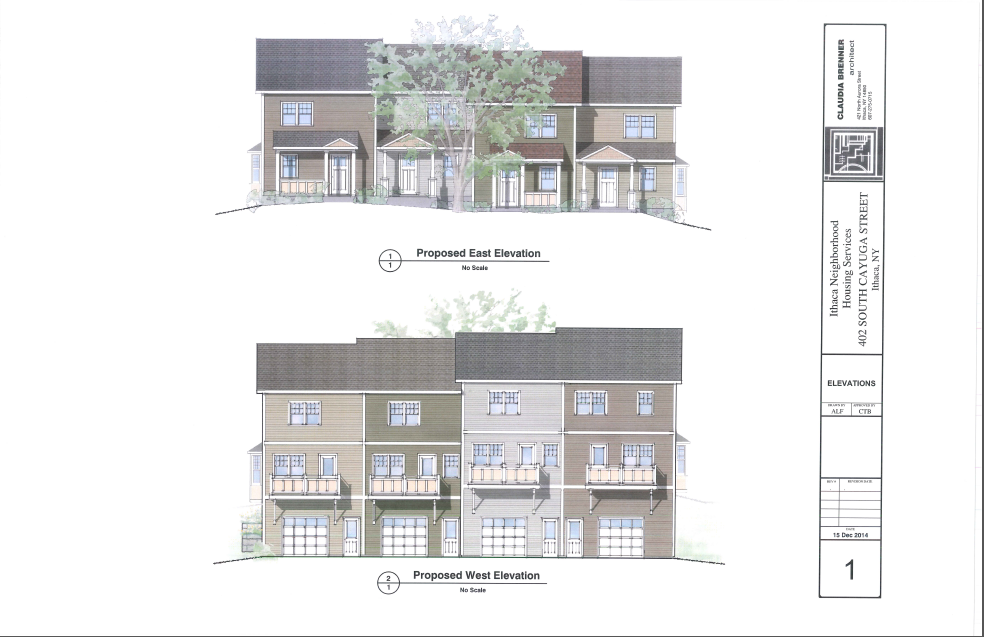
3. To anyone who’s passed by the vacant lot at 402 South Cayuga Street and wondered when INHS will start those for-sale townhomes: I’ve taken the liberty of checking. INHS director Paul Mazzarella stated in an email that “[t]he project is out to bid for a general contractor. The bids will be due next week. If the numbers are OK, we will start as soon as possible.” So barring any nasty shocks in the bids, the four-unit project (1 3-bedroom, 3 2-bedroom) will start in just a few weeks. As with other INHS projects, the units will be sold to qualified first-time homebuyers with modest incomes (anecdotally, that means the $40k-$50k range…it seems like half the buyers in the past year or so have been teachers in the ICSD).

4. In a rare bit of bad economic news in Ithaca, Ithaca College has announced its intent to slash about 40 staff positions from its workforce. This follows 47 job cuts in academic year 2014-2015, 39 of which were vacancies.

The cuts are part of an effort to bring tuition costs and help the college stabilize enrollment numbers, which have been sliding down lately. No faculty positions will be eliminated as part of the layoffs. IC currently has about 1,070 staff and 730 faculty, about 200 more than they employed a decade ago.

harolds_square_taylor

5. The rumor mill said that a reporter from the New York Times was in town last Friday, and apparently they liked what they saw; the piece in the NYT takes a very positive and gracious approach with Ithaca and its recent urban developments. If you haven’t read it already, the link is here.

[What follows is a spark-notes version of the Voice piece – I’ll update with links after the weekend holiday.]

More importantly are some useful details in the piece – one of which is that we now know the revised mix of uses for the 11-story Harold’s Square project calls for 86 apartments, up from 46 when it was first approved in 2013. The apartment units will be a mix of 1-bedroom and 2-bedrooms. Readers may recall that the project dropped two floors of office space in favor of two floors of apartments. The project also includes about 11,000 SF of retail on the Commons.

In a phone conversation with developer David Lubin, the current plan is to start construction of the $38 million project in early 2016:

“Rev will be out at the end of September. We’ll probably begin demolition after the first of the year, after the holiday shopping season, we don’t want to be a nuisance to Christmas shoppers. We’ll have pop-up store space available during the holidays. They’re not solid, but those are out plans. We’ll see how it goes”.

Also, the project will be going back to the planning board.

“The planning board re-approved the current design [last month]. However, there will be changes to the design, as we’ve changed the office space to apartments and they have different needs, window placement, things like that. When we’re ready, we’ll present those to the planning board. Not September and probably not the October meeting, but before the end of the year.”

The project was originally approved in August 2013, with a CIITAP tax abatement package approved two months later. However, putting a financial package together has been a task.

“These things take time,” Lubin stressed. “The Marriott, that needed 3 or 4 years before they started. It can be a slow process.”


simeons_1

6. For those keeping an eye on the Simeon’s reconstruction, expect to see some progress in the next couple of weeks. That’s according to an interview the Sun conducted with Simeon’s co-owner Rich Avery. The timeline has yet to be finalized, but the new restaurant space and luxury apartments are anticipated for completion by late next summer, with the resturant re-opening as early as February.

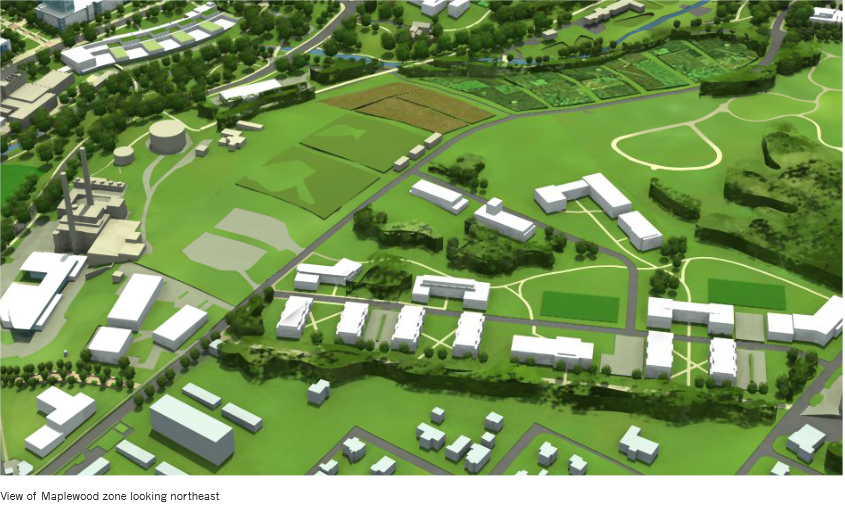
maplewood

7. Gosh, it’s nice to have the Sun back in session. Also from the Sun, incoming Cornell president Elizabeth Garrett has formally announced plans for new student housing, among other graduate student initiatives. From the Sun:

“Following her discussion on maintaining and promoting diversity among graduate students, Garrett announced the creation of new graduate student housing.

“My team and I are committed to working with the GPSA to create an inclusive and rewarding [graduate and] professional student living environment,” she said. “Most immediately, I am working now with my team to work on critical housing needs.”

According to Garrett, since the University’s Maplewood Park Apartments — a graduate student housing facility located near the Veterinary School — is closing, the University is currently collaborating with private partners to create new graduate-student housing at the Maplewood site and to develop additional housing in the East Hill Village.”

Heads up folks, East Hill Village isn’t even a thing a yet, it’s just a concept from the master plan. Anyway, this goes along with Ithaca town supervisor Herb Engman’s comments to the county that Cornell is engaging with consultants to bring a plan forward. There’s nothing else known about the plans, and it’ll be a few years before any students start moving in to new Cornell-sponsored digs, but everything has to start somewhere, and Cornell’s created quite a deficit for itself when it comes to providing adequate amounts of graduate housing.

Also, note the “collaborating with private partners” bit – these may or may not be tax-exempt, we shall see what happens.

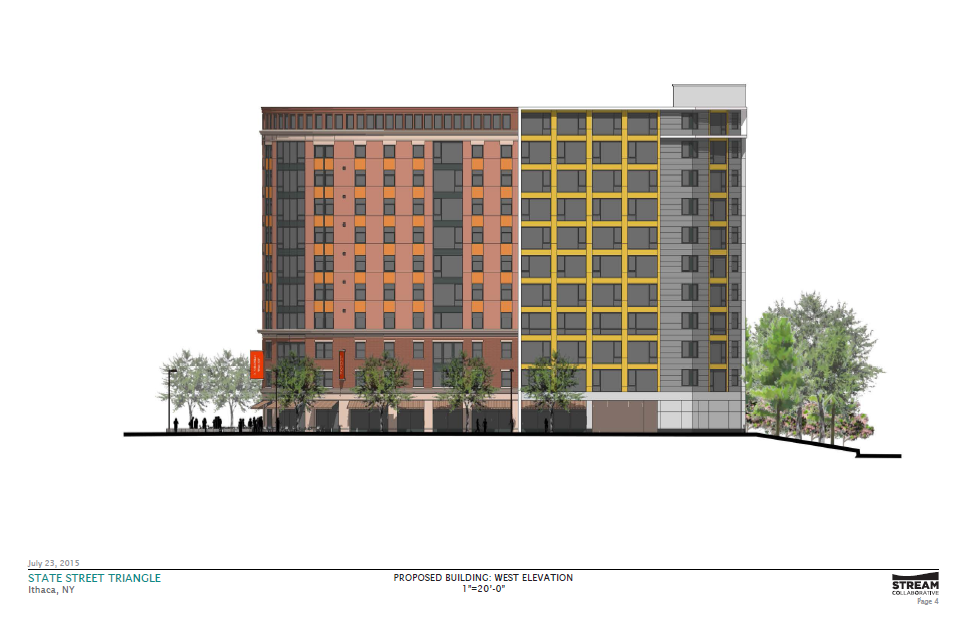
state_st_triangle_v3_3

8. Here’s the latest update on State Street Triangle, courtesy of the Ithaca Times. I have to admit, although I technically compete for eyeballs via the Voice, I like Josh Brokaw’s writing, he tends to be a bit of a wiseass and it’s entertaining.

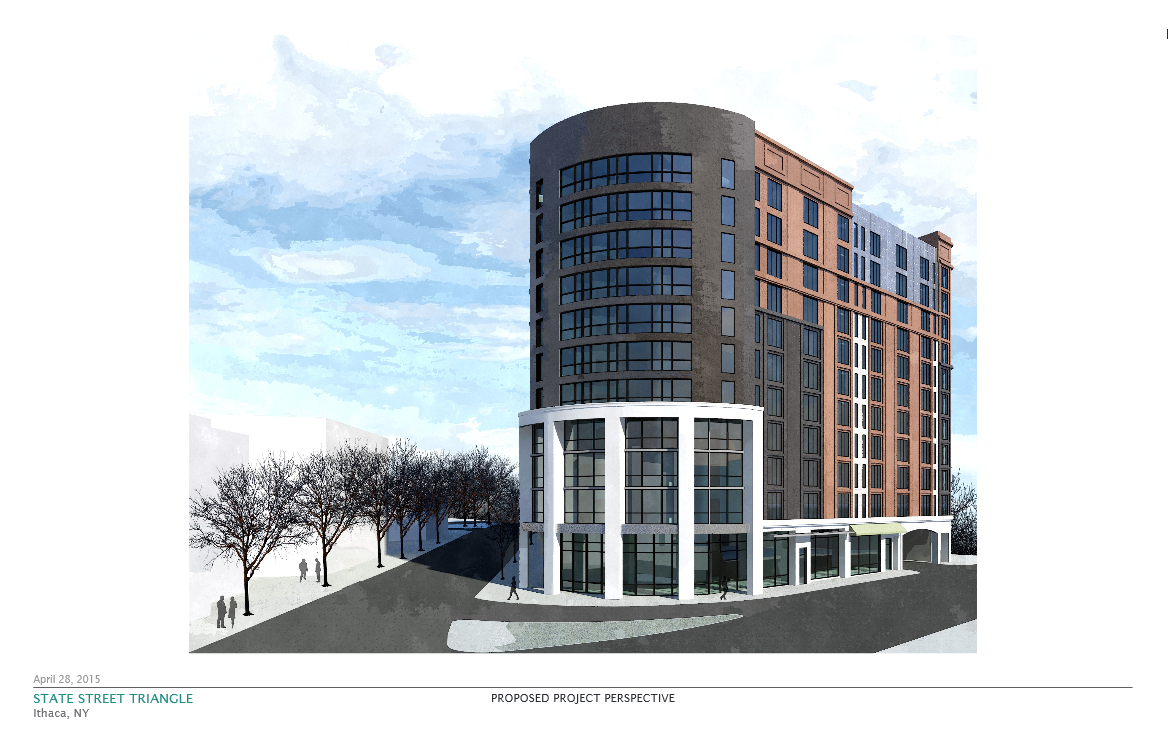
The big hang-up is massing. Not height, not tenant mix. A couple of ideas floated or suggested include height setbacks or overall reductions, and a redesign of the facade to make it appear more like separate buildings built next to each other.

According to Brokaw’s piece, some landlords are even questioning the need for new units, saying that all these new units could drive prices down.

Captain Obvious just arrived into port. By the way, given the recent growth in general and student populations and corresponding increase in demand for living space, if a landlord is having trouble filling their units right now, it’s probably not the city’s fault.

Campus Advantage has already spent $500,000 on the project, but it doesn’t seem like they’re going to throw in the towel just yet. They were probably hoping for an approvals process as easy as their Pittsburgh apartment tower, but…live and learn.


Cornell Veterinary School Expansion Construction Update, 9/2015

2 09 2015

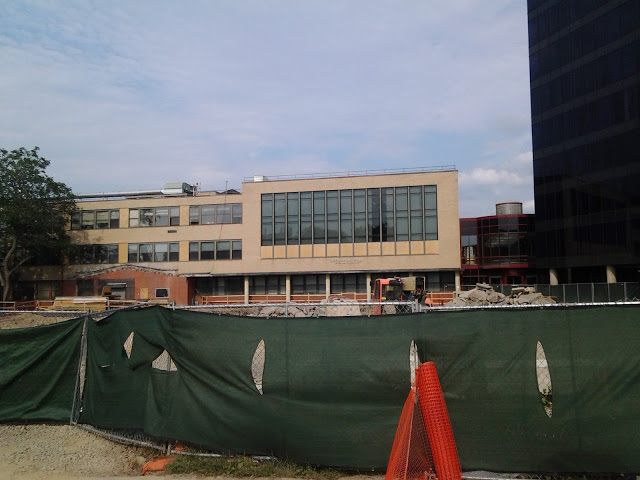
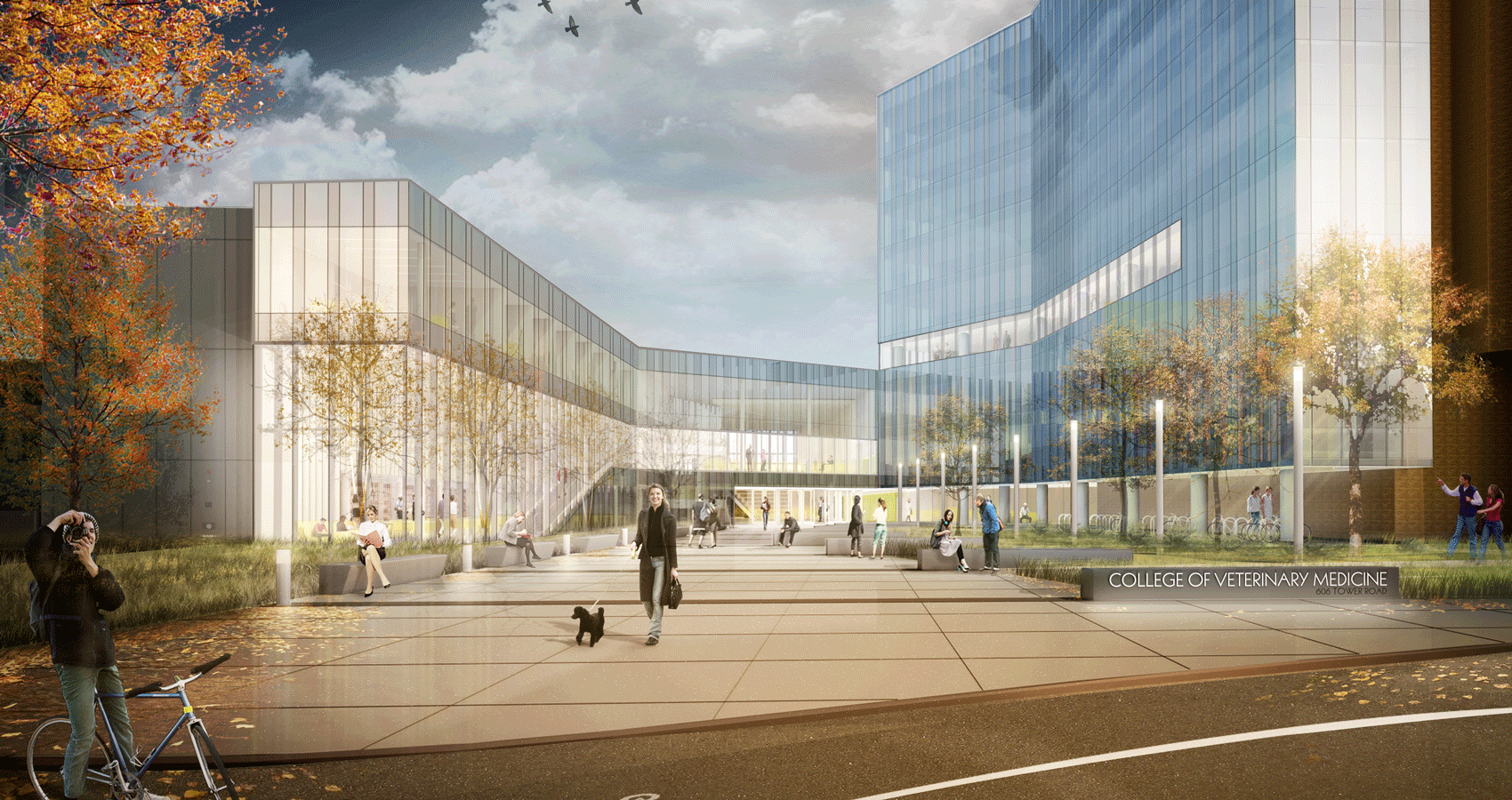
In an attempt to avoid the correct but lengthy word jumble this is, I’m just going to refer to this as the Vet School Expansion. Even then, in terms of physical square footage, expansion is something of a misnomer. The plan calls for the demolition of 68,000 SF of space, the addition of 65,000 SF of space, and the renovation of 33,000 SF. In sum, 3,000 SF less space than which the vet school started with.

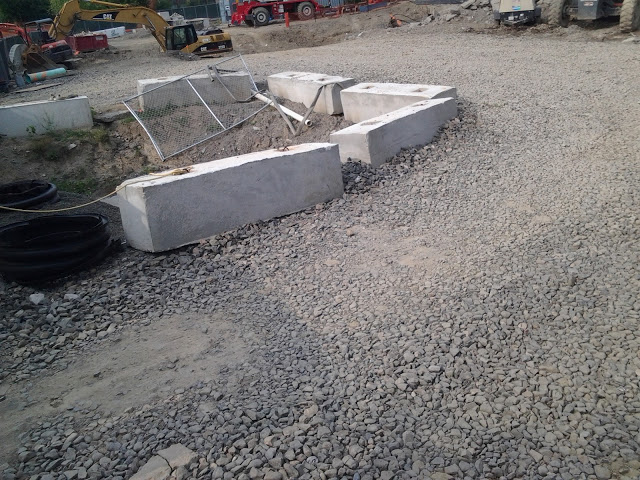
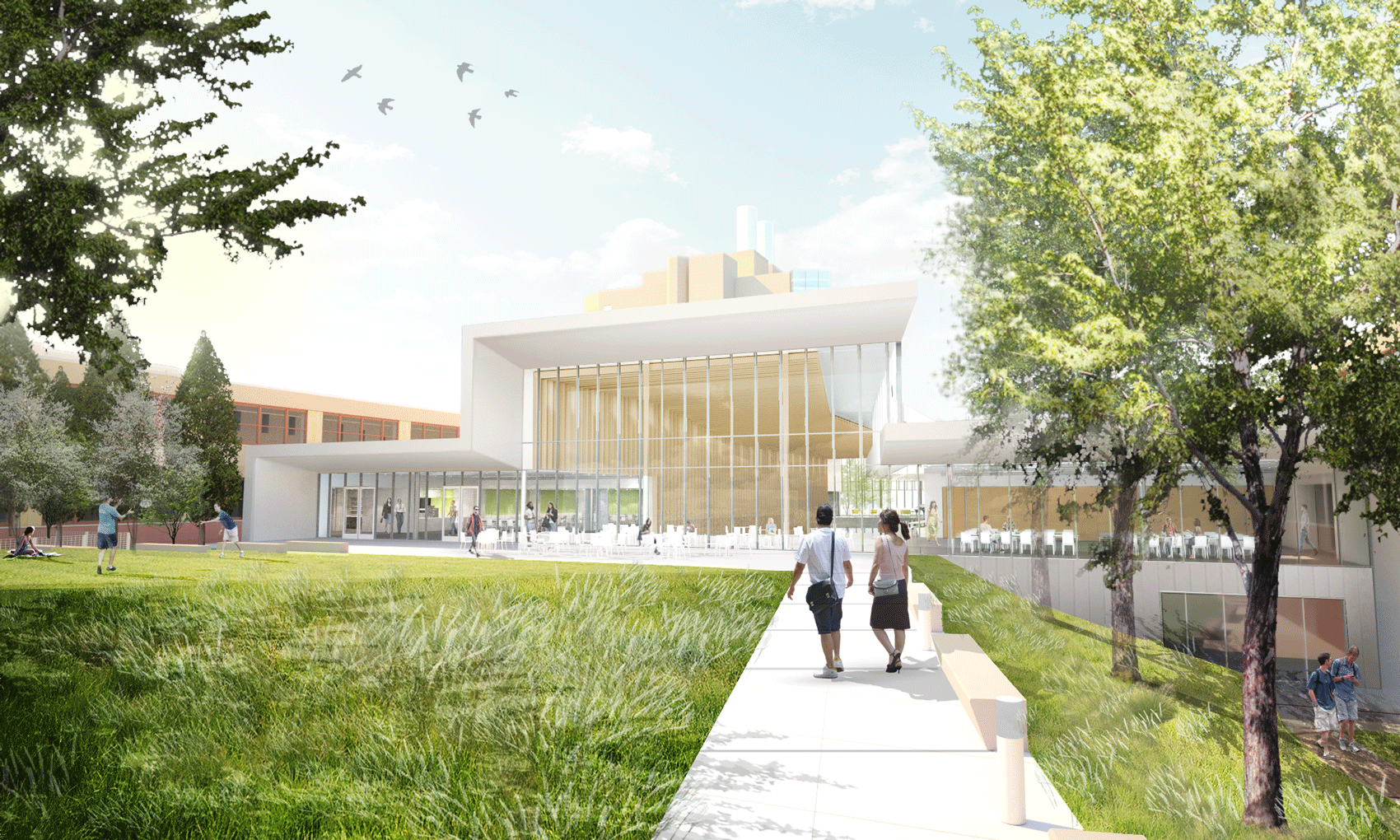
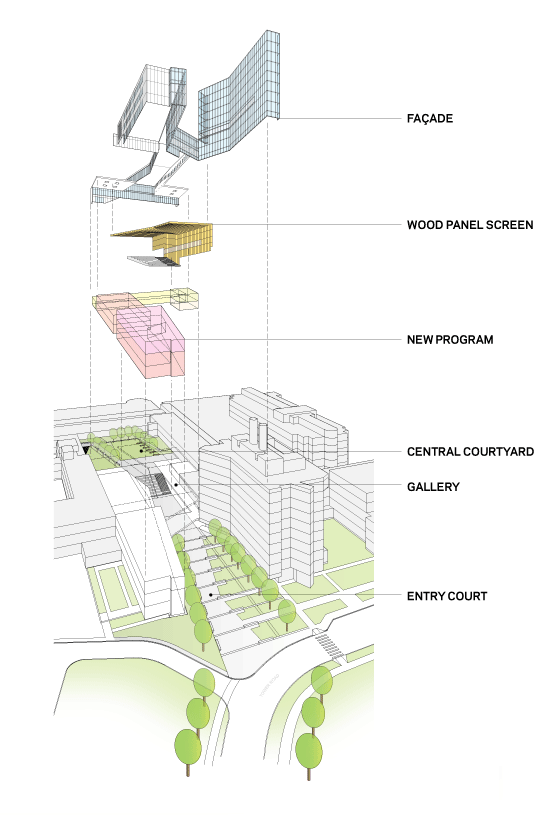
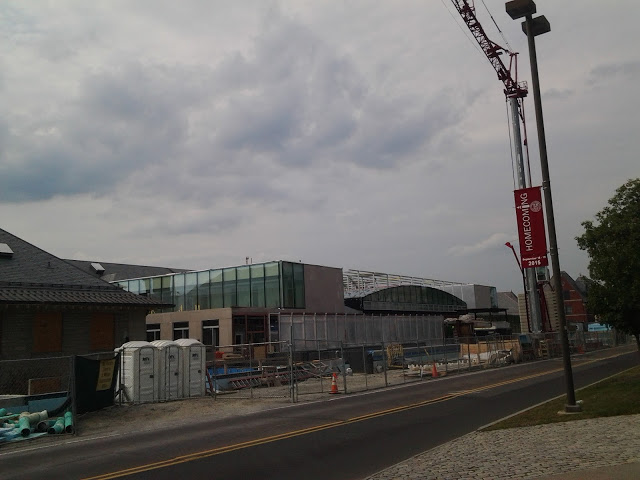
However, it’s less about space and more about efficiency. The plans include renovation and expansion of classrooms, teaching laboratories, cafeteria, locker rooms and shower facilities, and a combined Tower Road entrance. In the photos below, the entry plaza and the James Law Auditorium have been torn down. In its place will rise a new three-story addition that will house the vet school’s Flower-Sprecher Library. Parts of Schurman Hall will also be demolished and replaced with a new 2.5 story gallery/courtyard space. Extensive interior renovation will cluster classrooms, labs and service space, improving circulation through the numerous interconnected buildings that comprise the Vet School. The Vet Research Tower will be reclad in lighter, more transparent glass to match the new additions. The design of the expansion is a product of NYC firm Weiss/Manfredi, a Cornell favorite.

Renovations will increase the class size from 102 DVM students to 120 DVM students. Since a DVM degree takes four years, that means an additional 72 students.

Phase one for the vet school expansion is well underway, having a roughly January 2015- January 2016 time frame. The second phase will pick up immediately after the first and run from January 2016 to June 2017.

The budget for both phases is $74.1 million, with funds coming from the SUNY Construction Fund and private sources.

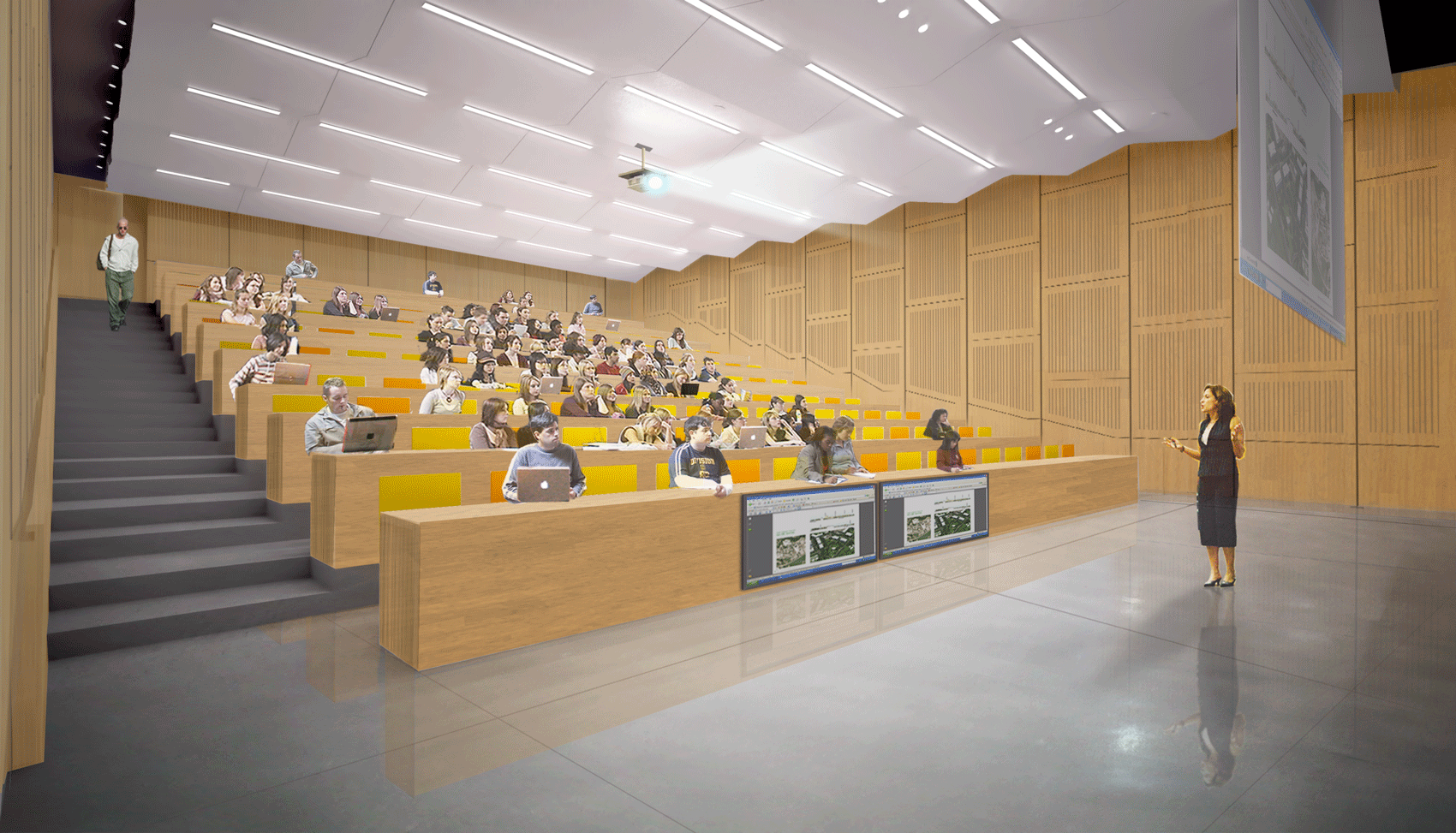
On a humorous note, while going through the project page on the architect’s website, I found an image of a lecture hall with some token presentation slides (last image). The placeholder image is a screenshot I had taken of the Cornell Master Plan back in 2008. Surprise surprise. For the record, I’m totally okay with it (even though I hate the screenshot, dating from the days before I thought to crop images).

20150829_162541 20150829_162526 20150829_162517

cad048742a281097e5667382eced4233

LibraryReadingRoom10-2

8f098b7e26544f579eb7411b9a1716aa

eea787361994de9625f74b19aa50d91e

655113b60367a0343c31545937948d57


Klarman Hall Construction Update, 9/2015

1 09 2015

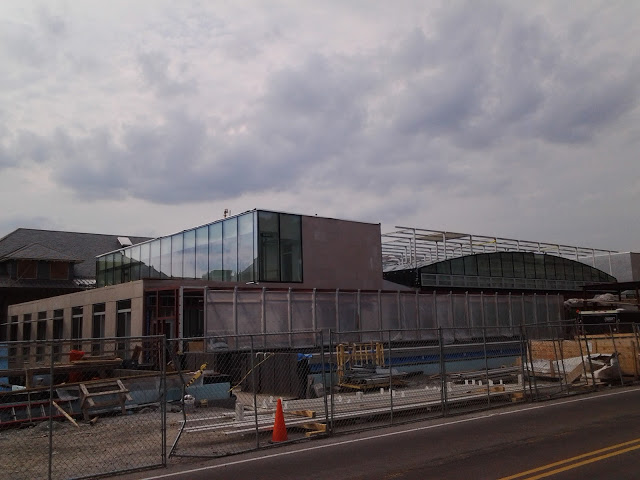
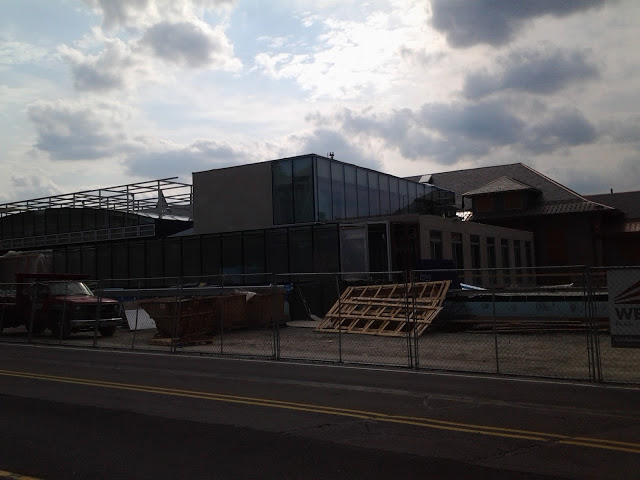
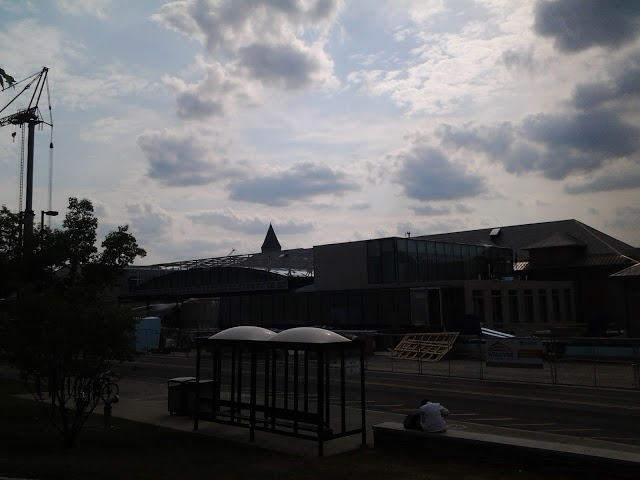
Klarman Hall is entering the home stretch now, just a few months from its anticipated January 2016 completion (and a few weeks behind the December 2015 date initially planned). Montour Falls-based Construction firm Welliver is busy sealing up the building’s exterior, while putting up drywall, painting and finishing-out the interior lower floors, and wrapping up services rough-in in the upper level offices.

From the looks of it, most if not all of the sandstone exterior wall panels have been installed. The vestibule has been framed out but has yet to be glazed (window installation), and while the atrium has been glazed, the glass-paneled roof above the atrium has not. Concrete stairs have been poured on the slope, and the rest of the landscaping will follow after the building has been completed and the warm, snowless weather of spring comes around. Construction progress of the project can be followed through aerial photos shared by Landmark Images here.

The 33,250 sq ft building was designed by Koetter | Kim & Associates, and is named for billionaire hedge fund manager Seth Klarman ’79. The building will be the first new humanities building on Cornell’s campus since Goldwin Smith Hall was built onto the old dairy science building in 1906. Just like Cornell did with Goldwin Smith over a century ago, the new building will be combined with the old building through hallways and commons areas. Klarman Hall will contain classrooms, faculty and graduate student offices, and in its the north section, a 350-seat auditorium. The large interior atrium makes use of the rotunda of Goldwin-Smith Hall for open-layout seating, a food/cafe area, and ingress/egress. Cornell is aiming to have the building achieve LEED Platinum certification.

The cost of the new building, which began construction in May 2013, is estimated at $61 million.

20150829_160955

20150829_161038 20150829_161058 20150829_161120 20150829_161151 20150829_161227 20150829_161250

klarman_1


Gannett Health Center Construction Update, 9/2015

31 08 2015

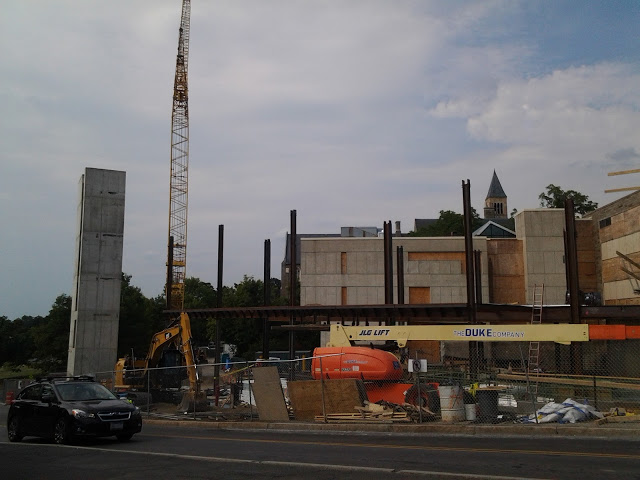
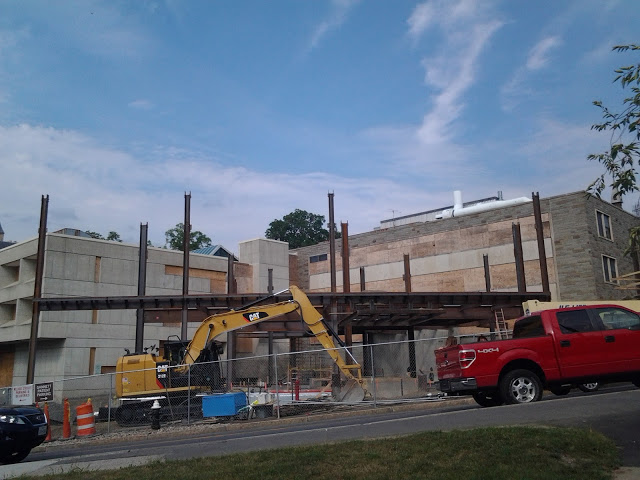
It wouldn’t be Cornell if they didn’t have at least a few construction projects underway on their campus, and this summer has been no exception. Here are some photos of the Gannett Health Center expansion taken last weekend.

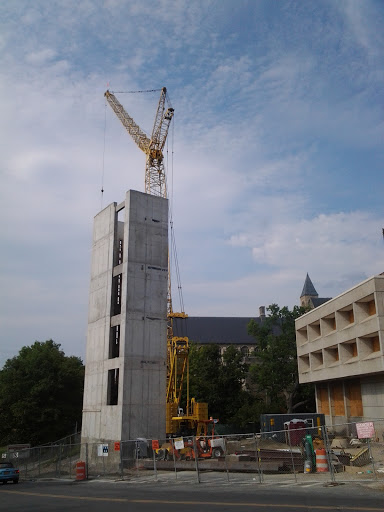
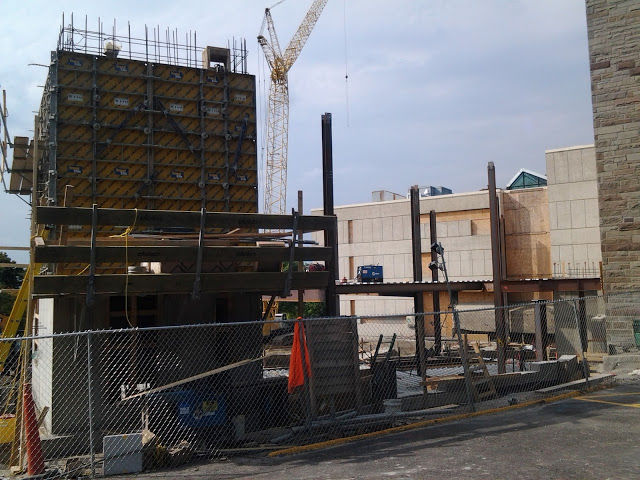
The poured concrete stairwells are probably the first thing passersby notice, given that they’re the tallest structures on-site (construction cranes notwithstanding). The western stairwell has been fully poured and topped out, while the eastern stairwell is currently underway. Look closely and you’ll see the wooden forms used on the concrete. These forms provide stability and shape while the concrete hardens, and they provide support to the reinforcing rods embedded in the concrete. They will move further up the stairwell as more concrete is poured and cured.

Between the stairwells, structural steel beams and joists are being hoisted by crane into plane, and corrugated steel decking for the floors is being laid down as the steel framing is built out. The new addition will continue to rise as the new building, the first phase of three, moves towards its July 2016 completion. Phase II focuses on renovations to the old building, and Phase III a reconstructed Ho Plaza entrance. The whole project is anticipated to be completed by August 2017. Construction firm Welliver is the general contractor for the project.

The building design is by local architecture firm Chiang O’Brien, with landscaping by Trowbridge Wolf Michaels Landscape Architects. There will be two additions to Gannett, a four-story, 55,000 square-foot building, and an additional 18,600 square foot addition that replaces the northeast side of the current building. The project also includes a new entrance and substantial renovations to the original 1956 structure (22,400 square feet of the existing 35,000), as well as landscaping, site amenities, and utilities improvements. The projected cost is $55 million.

20150829_160417 20150829_160443 20150829_160451 20150829_160456

20150829_160616

20150829_160517

gannett5


News Tidbits 6/27/15: A Bad week for YIMBYs

27 06 2015

cornell_novarr_1

cornell_novarr_2 cornell_novarr_3

1. Starting this off with least controversial news-maker this week – John Novarr’s 209-215 Dryden Road project, which I wrote about for the Voice here and with site plan details and SPR/render links here. The first article’s a little helter-skelter as a write-up because there was a lot of frantic 11:30 PM fact-checking going on in an effort to get the news out.

The $12 million, 12,000 sq ft proposal is smaller than Collegetown Dryden, but more importantly, the project isn’t residential; it’s classroom and office space for Cornell’s MBA program, three floors for each of those uses. That definitely brings something different to Collegetown and its mostly residential focus. With assurances given that the property will be kept on the tax rolls, the initial opposition appears to mostly be related to the design, which to be honest, is rather avant-garde and an acquired taste (not one I’ve acquired, to be honest). However, bringing 200 staff and a few hundred professional students into Collegetown would be a real asset for businesses struggling to stay open amid the neighborhood’s 32/36-week profit window.

209-215 Dryden Road is within the MU-2 zoning from the looks of it, so a trip to the Board of Zoning Appeals (BZA) seems unlikely at the moment. We’ll see what happens moving forward, this one could be a fairly smooth approvals process.

2. For a smaller developer, Ithaca-based Modern Living Rentals has been pretty busy this year. Along with 707 East Seneca Street and 902 Dryden, they have a modular duplex (3 bedrooms each, 6 total) currently under construction at 605 South Aurora Street in Ithaca city. A construction permit was issued back in 2014, according to the city planning report. The orientation is a little odd in that the new duplex is being built in front of the old home on the property, since the house is longitudinally centered but set back on its lot. Taking a guess, the intended market is likely IC students. The new units look like they’ll be ready for occupancy in time for the fall semester.

3. Here’s an interesting piece of news, courtesy of the Tompkins County Government Operations Committee – plans to sell a vacant lot to non-profit housing developer INHS. In its May minutes, the committee announced intent to sell a vacant, foreclosed parcel in Freeville for affordable housing. The property is described as a 1.72 acre parcel on Cook Street in the village, which through a little deductive searching, turns up the lot in the map above, just north of the Lehigh Crossing Senior Apartments. The minutes state that INHS is in the process of drafting up an acquisition offer for the county attorney.

Freeville is outside of INHS’s usual realm of Ithaca city and town, but INHS expanded its reach when it merged with its county equivalent, Better Housing for Tompkins County (BHTC) last December.  This might be the first new rural project post-merger. The Lehigh Crossing Apartments have 24 units on 2.3 acres, so if INHS were to build at the same density, this site would be looking at something around 18 units. Not big, but not inconsequential, especially for a 520-person village.

cinema_drive_1

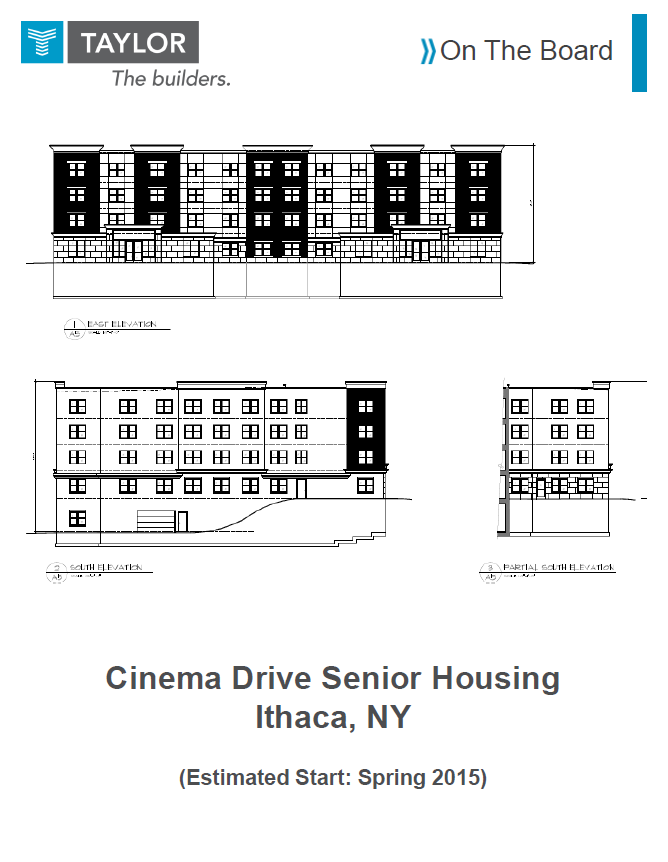
4. A decision to decrease sewer hookup costs in Lansing village also shares some details about a senior housing project in the works. The news comes from the Lansing Star, where the village voted to decrease its sewer hookup fee from $2,350 per unit to $1,000 for the first unit and $500 for each additional unit. Apparently the high fee was the result of the lack of a permitting process in the 1990s.

The article notes that the developer of a mixed-use request had requested a fee waiver because it would have cost $138,650 for their “59 units of senior housing”. Now it will be $30,000. Not as good as a waiver, but still pretty good. Lansing village only has one project that meets the description provided, the 87,500 sq ft Cinema Drive project covered here previously. The semi-educated guess back in May was 51 units, so the ballpark estimate wasn’t too shabby.

327_eddy_rev3_1

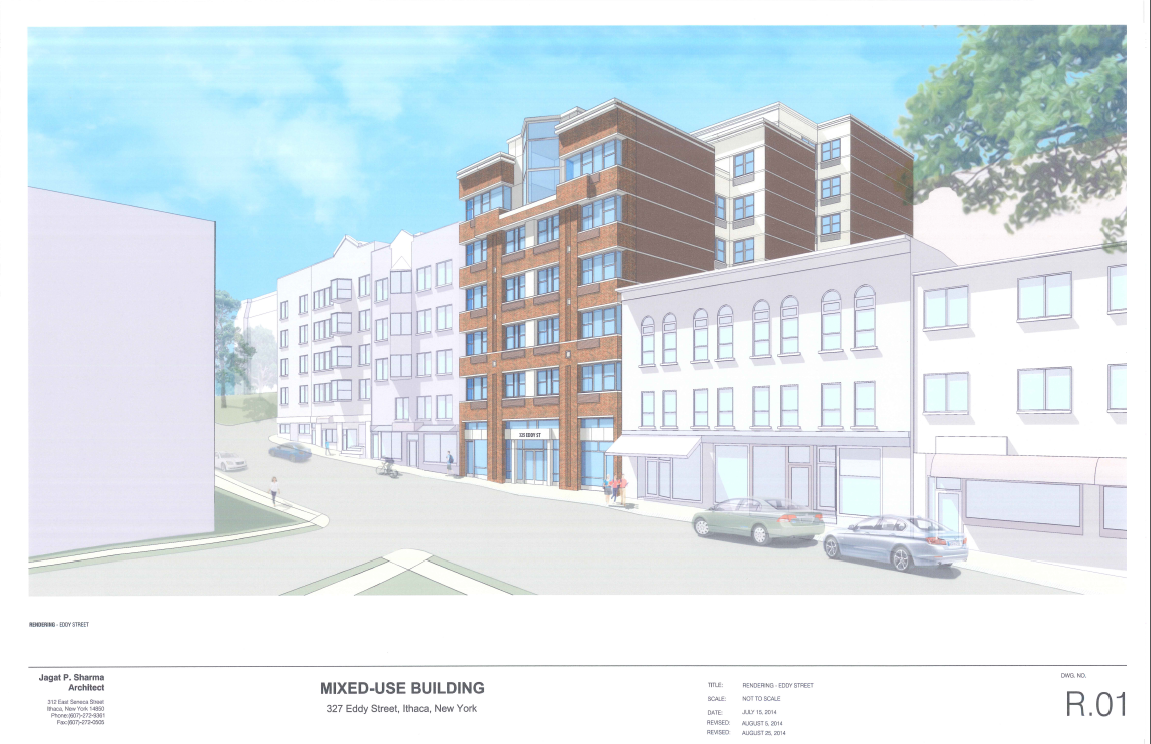
5. It’s official, 327 Eddy is under construction. Asbestos removal has been completed and the Club Sudz building is coming down. The Fontanas hope to have the building completed and ready for occupancy by next August. In replacement of Club Sudz’ and Pixel’s 7 units and 2,500 sq ft of commercial space, the new 5-story building will bring 1,800 of retail space and 22 new units with 53 bedrooms to the market.

Eagle-eyed readers might recall the building was originally going to be six floors, but a floor was lopped off since it was approved.

215-221_spencer_v3_1

215-221_spencer_v3_2

6. Updated renders for 215-221 West Spencer Street, coming right up. A little more detail on the facades, some window updates from the last version, and…well, honest personal opinion…it’s a very attractive design. Materials could underwhelm it, but as presented, it appears to be a lovely addition to South Hill. Good work STREAM Collaborative.

The 12-unit, 26-bed project plans to start construction next year. The project replaces an informal (dirt) parking lot.

oldlibe_franklin_proposal

travis_hude_libe_libe_v3

7. Touching on the Old Library decision briefly, a public meeting on the two proposals will be held Monday June 29th at 6:308:30pm at Greenstar’s “The Space” (700 West Buffalo Street). Douglas Sutherland will represent Franklin Properties (first image) and Frost Travis will be presenting for Travis Hyde. Should the County Legislature decide to take another vote to see if the stalemate will be broken, the next chance will be at their July 7th meeting.

EDIT: The public meeting scheduled for the 29th has been cancelled .

state_st_triangle_v2_1

8. Onto the thornier topics – Not sure what was worse this week, the reaction to the State Street Triangle project, or the INHS Hancock Street opposition. The objective, non-partisan write-up about the State Street project is on the Voice here. This and news piece #9 are opinion pieces, feel free to ignore them.

At least the State Street objections (latest renders here), I can understand the initial shock and recoil; there’s this perception that Ithaca is a small town, and this doesn’t jive with that. Regardless, by Ithaca standards it is massive, 11 stories with 289,000 sq ft of space and 620 bedrooms; if this was, say, a four-story building with an 11-story tower on the closest third to the Commons, the reaction would probably be less vitriolic (people would still hate it, but let’s entertain this thought exercise).

But that probably won’t happen. Not with this developer, or with any developer that purchases the Trebloc site. Here’s my theory why, and it goes a little more in-depth than “they want maximum profit”.

In December, Jason Fane’s 130 East Clinton project was rejected for tax abatements, and one of the reasons cited was that market-rate housing wasn’t enough of a community benefit. State Street Triangle is mostly apartments – it contains only a modest amount of retail space, with less than 13,000 sq ft it’s not even 5% of its usable space. If it were to apply for an abatement, it would likely be rejected for the same reason.

Arguably, they could try commercial office or even industrial “maker spaces”. But the market demand for office space doesn’t seem to be growing much, and industrial uses don’t tend to be a good fit in heavily populated areas. A developer could even try condos, but if developers knowledgeable with the area are hesitating, than a bank won’t hesitate to hold off on financing (aside on that – if the Old Library goes condo, other developers and financiers will view it as an experiment, or more positively, a pioneer; until it’s clear that the project is successful, don’t expect more condos in Ithaca).

However, nothing changes the fact that building downtown is quite expensive. So, being a for-profit company, if you want to build in an expensive area, you have two options to ensure return on your $40 million investment and get the construction loans you need – build as much as possible, and/or make your units as expensive as possible. If you’re a company that specializes in student housing, you’re not going to push the latter because there’s a lower ceiling on what students can afford. That would be my guess on how State Street Triangle came to be.

There are a few possibilities that might make the project more palatable to community members, such as free bus passes for tenants or a 10% affordable housing requirement within the tower (if the INHS project oppositions are any clue, this is going to be the only way to go from here on), but given the costs, those ideas just might kill the project completely. Which is exactly what some folks are looking for.

At the very least, let’s let the Planning Board do their work. If they can help change this:
hampton_new_1

to this:

canopy_hampton_rev4_1

Let’s see what they and the developer can negotiate here.

9. Now for 210 Hancock. Here is a project that’s been transparent, incredibly transparent, throughout their whole planning process. At first, there was little opposition. Now, it threatens the proposal, apartments, townhomes and all.

A wise man once told me in when I was preparing a piece, “There’s no point in talking about this with you, the public’s going to have issues with it either way”. At this point, I’m inclined to believe him.

I’ve read the petition, and I’ve read the facebook comments. It’s regrettable, to say the least.

A lot of the comments just seem to be misinformed. People saw the petition, thought that INHS was only building the apartments, and signed it. The petition was worded with charged and selective language. I’d like to take a few minutes out to refute and argue some of the commentary.

“there must be a safe place for children to play…”

“People need access to green space, yards and the ability to get outside directly from their living space.”

“I want my 3 year old to grow up in a neighborhood where he can safely ride a bike, play sports and walk his dog.”

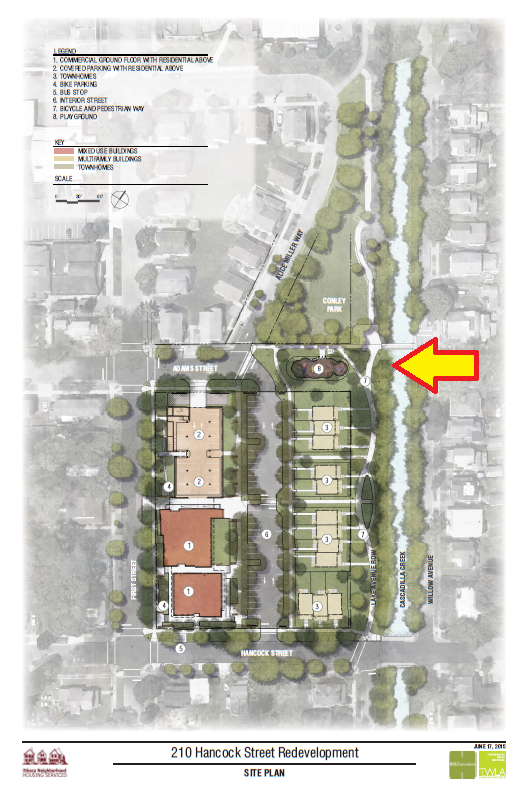
You’re right. That’s why the project, as proposed by INHS and tweaked by the city Planning Board, builds a playground that blends into Conley Park without the threat of vehicular traffic (shown in the plan below). Adams Street and Lake Avenue would be removed, allowing kids living in the apartments and townhomes to go the playground without crossing any street.

inhs_pride_playground

“I’m a lifelong resident, and I’m frankly getting tired of seeing all these areas getting bulldozed and developed…especially when we have dozens of empty/condemned houses and buildings just sitting around!”

The rental vacancy rate is 0.5%. A healthy market is 3-5%. Further to that, if there are dozens of homes, even if they were for sale, it’s still not enough to handle the demand, which is in the few thousands.

“inadequate parking planned.”

“The parking issue is already a problem. This will only make it worse.”

“I am a Fall Creek resident and do not want this area in our neighborhood to resemble Collegetown in density or difficulty in parking.”

84 parking spaces are required by zoning, 64 are proposed. However, only 22 spaces are expected to be used by the 53 apartments. In the parking study of INHS tenants, 41% of apartment tenants have 1 car, 12% of those have two. One of the reasons why INHS’s parking utilization is so low is that many of its apartments are rented by seniors – for example, Breckenridge Place is 60% seniors on fixed incomes. With limited mobility and/or income, many don’t maintain personal cars.

In a sense, although the Cornerstone project for affordable senior housing wasn’t selected by the Old Library site, the INHS project on Hancock Street may serve in some ways as a reasonable alternative.

“We don’t owe any developer a profit on their development.”

INHS is a non-profit community developer. The townhouses sold at Holly Creek over the past year were in the $105-$120k range. For comparison’s sake, the townhomes in the Belle Sherman Cottages sold for double that, and those aren’t even considered high-end (high-end would be the $410,000 townhomes in Lansing’s Woodland Park).

The reason why construction won’t start until Fall 2016/Fall 2017, with the apartments finishing up in Fall 2017/Fall 2018, is that they are completely reliant on government grants and donations from community supporters. The townhouses won’t start for a couple of years (their time frame is 2018-2020) because funding for purchasable units is more difficult to get. Just like with the condominium debate, the government is more likely to disburse a grant if it knows there are buyers waiting in the wings. And for low and moderate-income households, far more are capable of renting versus buying. As for the rent-to-own option suggested by the petition writer, it’s speculative, complicated, and NYS/federal HUD will not provide grants for that type of property acquisition. INHS couldn’t do it if they wanted to.

“[need]assurance mixed income will be there”

It will. As I wrote in March:

“210 Hancock will have 53 apartments – the 3 bedrooms have been eliminated and split into 1 and 2 bedroom units, so the number of units has gone up but the total number of bedrooms remains the same (64). The units are targeted towards renters making 48-80% of annual median income (AMI). The AMI given is $59,150 for a one-bedroom and $71,000 for a two-bedroom. The one-bedroom units will be rent for $700-1,000/month to those making $29,600-$41,600, and the two-bedroom units will rent for $835-$1300/month to individuals making $34,720-$53,720. Three of the units will be fully handicap adapted.”

“A 54 apartment high-rise is not the appropriate place for children to grow up, low income or not.”

“It is too dense and not suited to Fall Creek or Northside.”

“I moved to Ithaca and settled in Fall Creek to live in a small town.”

For starters, it’s harder to make housing affordable if there are fewer units on the a plot of land. Secondly, because the INHS project takes lead on the city’s right-of-way (ROW) on Lake Avenue and Adams Street, the calculated density per acre is 23.6 units per acre. Cascadilla Green, one block to the north, is 20 units per acre. Also note that units are 1 and 2 bedrooms per unit; most of the houses on blocks in Northside and Fall Creek are 3 bedrooms per unit.

What probably bothers me the most are some of the comments in the online petition for INHS.

“Shame on you “Ithaca Neighborhood Housing” for even thinking of creating something that will breed trouble…”

“This is an uncivilized proposal…”

“if all on welfare, this will invite crime…”

One of the reasons I harp on affordable housing is that I grew up in affordable housing. This 147-unit mixed-income complex in suburban Syracuse. Apartment 28E. I shared a bed with one of my brothers until I was 10, and even after my mother was finally able to buy a small ranch house, we shared a bedroom until he graduated and went to college two years before I did (by that point, we had moved on up to bunk beds). My mother did what she could. We were never more than working class, but she worked hard (still does) and made sure her kids worked hard.

At least some of the comments are kind enough to be “I want affordable housing but”. Others really make it sound like that those in need of affordable housing are a contamination of the community. Those statements aren’t worth debating. They’re just hurtful.

Anyway, this might be the longest news update I’ve done, so I’m going to wrap this up and detach from the computer for a while. There may or may not be a photo update Monday night, we’ll see.


News Tidbits 6/20/15: Big and Far, Small and Near

20 06 2015

Cornell Tech Passive Residential Building
1. In something not Ithaca but Ithaca-related, it seems like Cornell’s New York City-based Tech school is having quite a good week. Cornell announced that construction began earlier this month on a $115 million residential building at the Cornell Tech campus. the 26-story, 270′ tower is being built to passive house standards, the largest passive house building in the world.

According to an article in the New York Times –

“That means the building is able to maintain a comfortable interior climate without active heating or cooling systems, through the use of, among other things, an airtight envelope and a ventilator system that exchanges indoor and outdoor air. In climates like that of New York, however, standards allow small heating and cooling systems.

Making the Roosevelt Island tower airtight — creating what is essentially a giant thermos — was one of the biggest challenges, said Blake Middleton, the principal in charge and partner at Handel Architects, the building’s designer.”

The 350-unit, 530-bed building will house mostly graduate students, with some research staff and faculty also living in the tower. The apartments, designed by Handel Architects of NYC, are due to be completed sometime in 2017.

cornell_tech_v2

As noted at Curbed, to celebrate the groundbreaking, partner/developer Forest City Ratner released new renders of “The Bridge“, the tech incubator building on the right that looks like and ice cube cleaved into two pieces. As one might imagine, the new renders come with token florid language and eye-rolling descriptions (“an ecosystem of companies”). The Bridge, designed by New-York based Cornell alums Weiss/Manfredi, is being designed to LEED Silver standards, which is still better than about 99.5% of Ithaca. Construction permits were filed in January.

tech1

Last but not least, the $100 million Bloomberg donation, to name the first building “The Bloomberg Center”. The Bloomberg Center, designed by Thom Mayne of Morphosis Architects, will also open in 2017. To date (i.e. about three years since inception), philanthropy to the tech campus has totaled $685 million – and absolutely none of them care where you think the money would be better spent. Cornell hopes to raise $ 1 billion ($1,000,000,000) for the school by 2021.

For comparison’s sake, all of Cornell, Ithaca campus, Weill and Tech, raised $546.1 million in donations in 2014, and $474.9 million in 2013.

dibellas_v2_2

dibellas_v2_1

2. Now to go from something big and far away to something small and local.  It’s been a while since we’ve heard about DiBella’s, the Rochester-based sub sandwich chain that had been eying Ithaca last November. They’re back, and the proposal has has some pretty substantial tweaks.

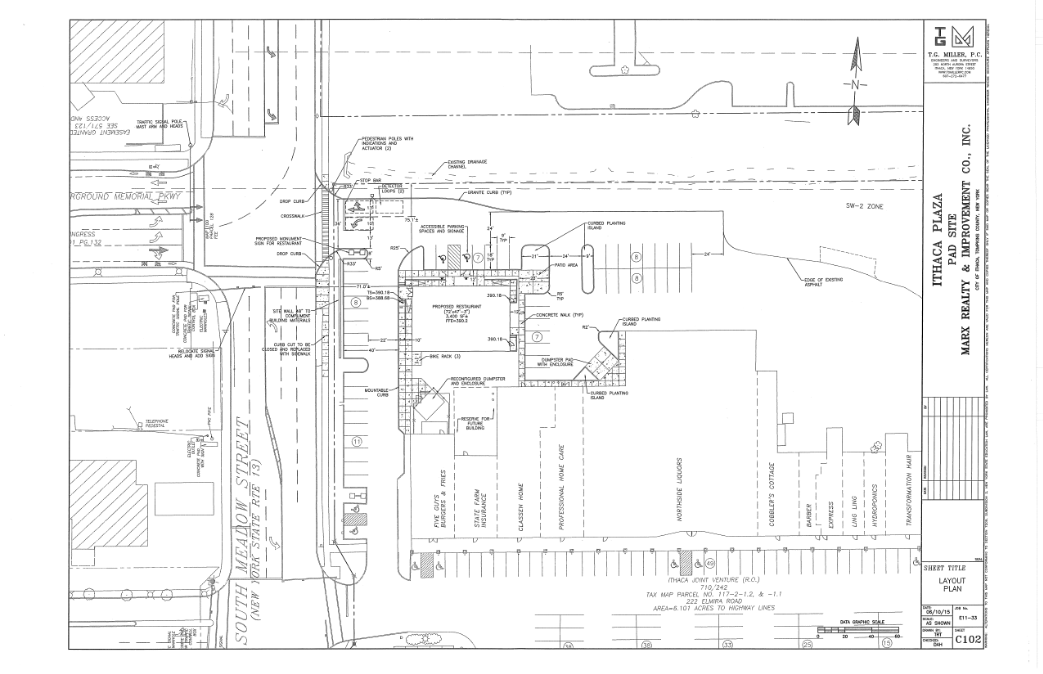
The building itself is still about the same size (~3,400 sq ft), but the design of the building has been reworked to a brick facade with an asymmetrical door/window configuration. The building is now contiguous with the main shopping strip, no longer isolated from the rest of the stores by a driveway. No decisions are expected to be made at the June Planning Board meeting, it’s more of an update for the board as to what’s going on, and to solicit input.

Marx Realty of NYC is developing the pad property, and local architect Jason Demarest (brother of STREAM Collaborative’s Noah Demarest) is handling the design.

3. Shifting out to Dryden now; I don’t tend to write much about Dryden, since a lot of the local development is limited to single-family homes in semi-rural areas (and separately, bad things happen when I write about Dryden).

First, Dryden village. The village has seen quite a jump in population in the past couple of years thanks to the opening of the 72-unit Poet’s Landing affordable housing complex (affordable here meaning that it’s income restricted and rents range from the $600s/month for a 1-bedroom to about $900/month for a 3-bedroom). At least as far back as 2010, a second phase, at the time a 72-unit senior apartment building, was planned by Rochester-based developer Conifer LLC.

Glancing at the village’s outdated webpage, there were meetings in October about phase II. A little searching online shows the negative SEQR determination (meaning no major adverse impacts expected) was issued in February of this year. The determination announcement says that 48 more apartment units are planned for the land directly west of the current complex. The Poet’s Landing facebook page says that funding wasn’t allocated for the expansion this year, but they are hopeful for 2016.

It’s not the best location; affordable housing developments often vie for land outside of developed areas simply because the land is cheaper, but the trade-off is that residents are often isolated, especially if they don’t have money to maintain a car. Here at least the village’s main drag is close enough that residents aren’t totally isolated. And any affordable housing in Tompkins County is welcome.

4. Meanwhile, in Dryden town, there are a couple of projects going on. One involves the construction of 8 duplexes (16 units) at a 5 acre parcel on Asbury Road. Working with that piece of information, there was only one parcel that met the provided description – a property just east of the Lansing-Dryden town line that sold for $30k last August to “SDM Rentals”. Scott Morgan is given as the developer in the town documents.

SDM Rentals does have at least one other recently-developed property, the Meadowbrook Apartments, a set of at least 7 duplexes at 393 Peruville Road in Lansing for which he received a $1,000,000 construction loan in 2013 (2 were built in 2010), and rent for $995/month. The ones on Asbury Road will probably look similar.

The town notes that although the SEQR is still being prepared, the site was already being prepped with dirt fill, resulting in not one but two stop work orders. Looking online, it appears Morgan has a history of being a problem for local government, including a case in Lansing town where he was using a broken-down school bus for a pig barn.

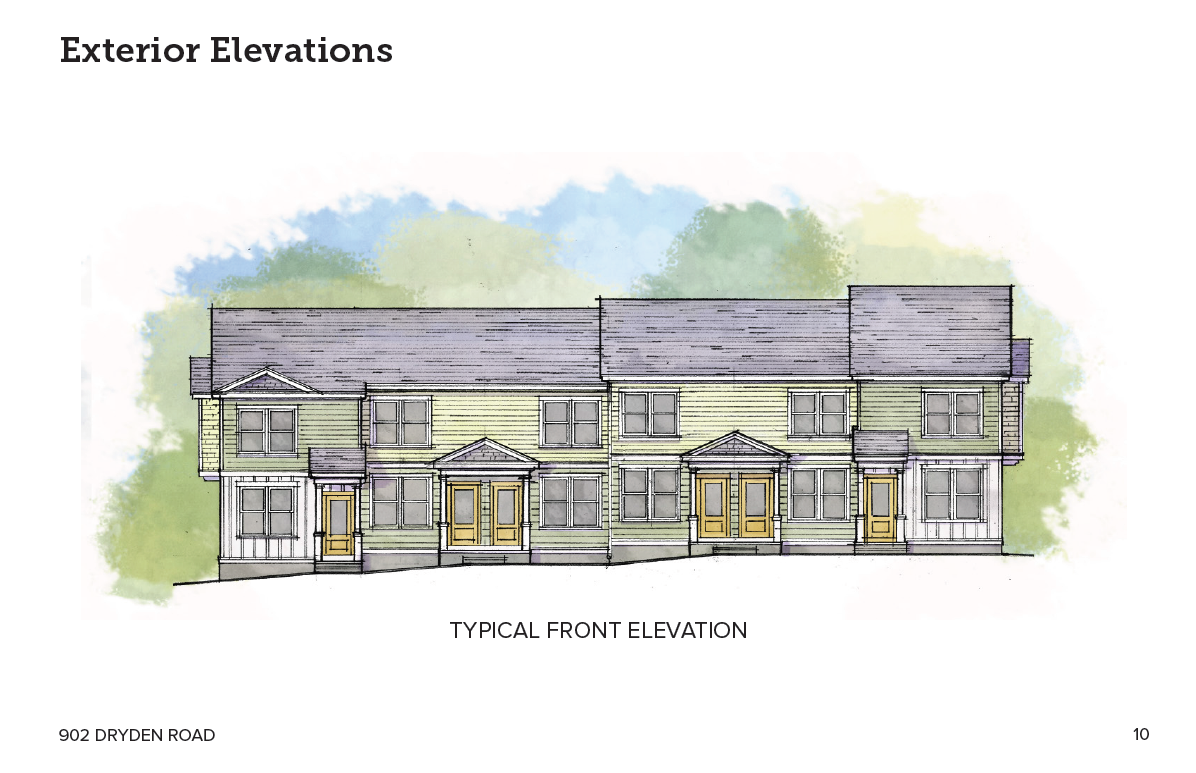
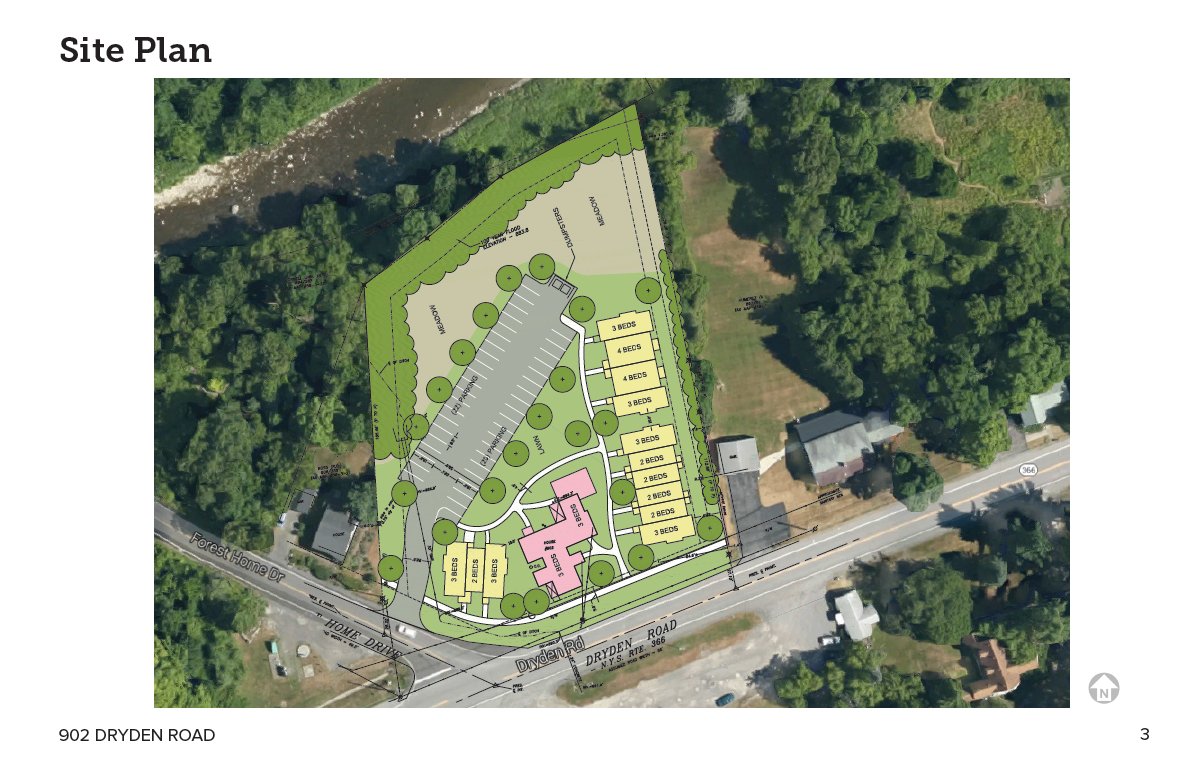
5. Now for project two, a multi-unit project at 902 Dryden Road. I’m just going to link to the Ithaca Voice article in an effort to save time. 15 units, (2 renovated, 13 new), 42 beds, and a $1.5 million investment.

902_dryden_2

I plan on touching on a couple of other minor Modern Living Rental projects at some point, but we’ll save those for a slower week.

20150613_180636 20150613_180659

6. This week’s house of the week feature is 318-320 Pleasant Street on South Hill. The rear portion (foreground) is an addition, a duplex with 3 bedrooms each. Exterior siding is nearly complete, though some housewrap and plywood is still visible on the south (front) wall of the addition. A peek inside the interior showed that the drywall has been hung-up, but final details like carpeting have yet to be installed (several rolls of neutral-colored carpets lay stacked on the floor).  The owners of the 105-year old house are members of the Stavropoulos family, who run the Renting Ithaca rental company and the State Street Diner.

On a side note, the 200 Block of Pleasant Street must be one of the worst hills in the city. Walking it must be terrifying on icy days.

oldlibe_franklin_proposal

travis_hude_libe_libe_v3

7. The Old Library vote made quite a splash in this week’s news. With a 6-6 hung vote, everything’s up in the air. This is what I feared would happen.

There’s a couple of options to break this. Two legislators, Kathy Luz Herrera (D- District 2, Ithaca City/Fall Creek and Cornell Heights) and Peter Stein (D-District 11, Ithaca Town/East Ithaca), weren’t in attendance, and could call the measure back up for a vote. Herrera’s District is two blocks from the Old Library site, and Stein’s a retired Cornell professor, so although I shouldn’t be guessing people’s judgement, I don’t think it’s a stretch to imagine which of the two projects they’ll be swayed by. But if either one of them decides they dislike all three options, or if they split their votes, then everything will be stuck in limbo. At that point, it’s anyone’s guess – the building could be mothballed, or given that its HVAC and utility systems are at the end of their mechanical lives, it could even be demolished as a long-term cost-saving measure.

If the county does decide in favor of one proposal, it’s still a long road ahead – ILPC approval, Ithaca city planning board approval, and a variety of other measures, which could break the winning proposal. Both projects have potential challenges – with Travis Hyde, ILPC or the Planning Board may try and whittle down its units, removing the density lauded by some legislators, and perhaps the project will no longer be financially feasible. With the condos, one starts with a building that’s had asbestos and air quality issues in the past – one bad surprise in the renovation, and the project could be jeopardized, or at least priced well above the quoted $240-$400k. There are a lot of variables in either equation, and since they can’t all be quantified, both will have their risks.

I’m just going to hope that someone is able to bring new life to the site. I don’t want to see two years go to waste.

state_st_triangle_3

8. Almost to the end. Here’s your monthly look at the Planning Board Agenda for next Tuesday:

– No subdivisions this month, but there will be a 15-minute public comment period on the city’s new Comprehensive Plan.

A. 210 Hancock will be giving an update on its plan and up for recommendation for the Board of Zoning Appeals for parking (64 spaces vs. 84 required) and height variances (46.5 feet vs. the legal 40 feet). Quoting the pre-prepared document, “The Board strongly recommends granting the requested variances.”

B. An update on DiBella’s as described above

C. Tompkins Financial Corp’s Headquarters will be open for public comment, determination of environmental significance (SEQR negative/positive), and preliminary approval for both phases

D. 215-221 W. Spencer will be reviewed for Declaration of Lead Agency (Planning Board agrees to conduct of State Environmental Quality Review)

E. “Collegetown Housing Project at Dryden and Linden – Update”. A.k.a. whatever John Novarr’s planning for that five-building stretch of Dryden and Linden he just deconstructed. Readers might remember this site was part of his Collegetown Dryden project proposed last July, but there’s no indication if it’s a revision of that, or a totally different approach. The one thing that is constant is the zoning – MU-2 for the three properties on Dryden and 240 Linden, and CR-4 for 238 Linden. Neither zone requires parking, MU-2 allows six floors and necessitates mixed-use (often interpreted as ground-floor commercial), and CR-4 does not have mixed-use requirements but the height is limited to four floors. Expect an urban-friendly six-story building fronting Dryden with a four-story setback on Linden.

F. “State Street Triangle (Trebloc) Mixed-Use Project – Update” Anything could happen. Height decrease, site redesign, fewer units, major design changes…we’ll just have to wait and see how the 11-story, 600-bedroom tower has evolved given the initial recommendations of the Planning Board.

simeons_v2_1

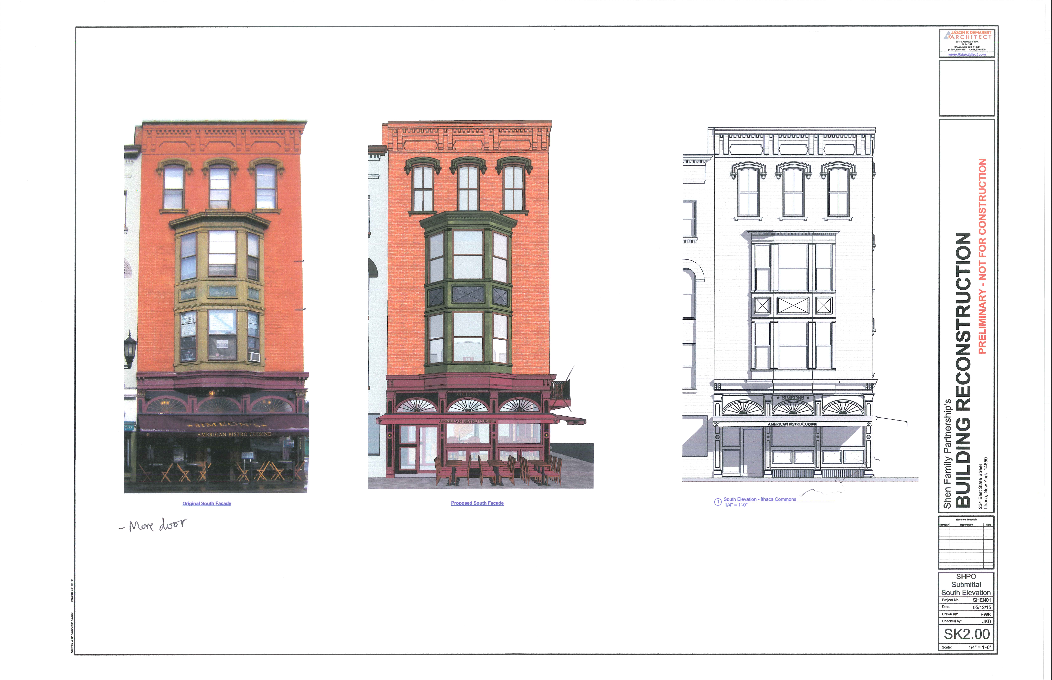
9. We’ll end this week on a happy note. Shen Properties LLC plans on launching their Simeon’s rebuild shortly; first and second floor restaurant space for Simeon’s, and five luxury apartments. The exterior will be a near-replica of the original facade of the Griffin Building, but the interior will be renovated to hold an elevator and a sprinkler system. In a quote to the Journal, property manager Jerry Dietz says to look for a reopening in the very late 2015 or early 2016 timeframe.


Klarman Hall Construction Update, 5/2015

19 05 2015

Since the last update on Klarman Hall in February, the snow has melted and East Avenue has been reopened to all vehicular traffic. Construction firm Welliver has been pouring concrete on the upper floors and the structural steel has been erected. Concrete pre-cast has been installed on the atrium-facing portions of the top floor, with bright green glass-mat sheathing visible on some of the panels. Within these panels, the window cutouts are visible, and as seen in the last photo, windows have already been installed on the south block facing into what will be the atrium. Windows will be installed in the north block shortly. To hoist these panels into place, a telescopic crane is used.

Less visible to the outside observer, interior wall framing is underway on the upper levels, with utilities rough-in continuing, and some drywall installation underway in the more complete areas. Openings have been created in Goldwin Smith’s rotunda (where people will flow in and out of Klarman’s atrium), and the sub-slab (the concrete below the new floor) is being poured.

The long-term construction schedule calls for window glazing (exterior glass wall installation) and drywall to be complete by the end of June. The atrium skylight glazing will take place during the summer, the elevator will be installed by August, and the green roof will be prepared just as the fall semester kicks in. Klarman Hall will open its doors to the public in December if all goes to schedule.

The 33,250 sq ft building was designed by Koetter | Kim & Associates, and is named for billionaire hedge fund manager Seth Klarman ’79. The cost of the new building, which began construction in May 2013, is estimated at $61 million.

20150516_143414 20150516_143445 20150516_143458 20150516_143530 20150516_143603 20150516_143644 20150516_143702 20150516_143751


The Cornell Fine Arts Library

6 05 2015

fine_arts_2

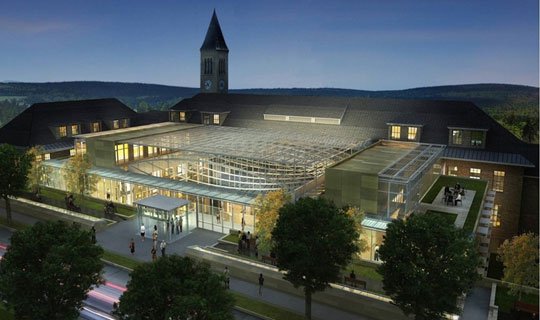
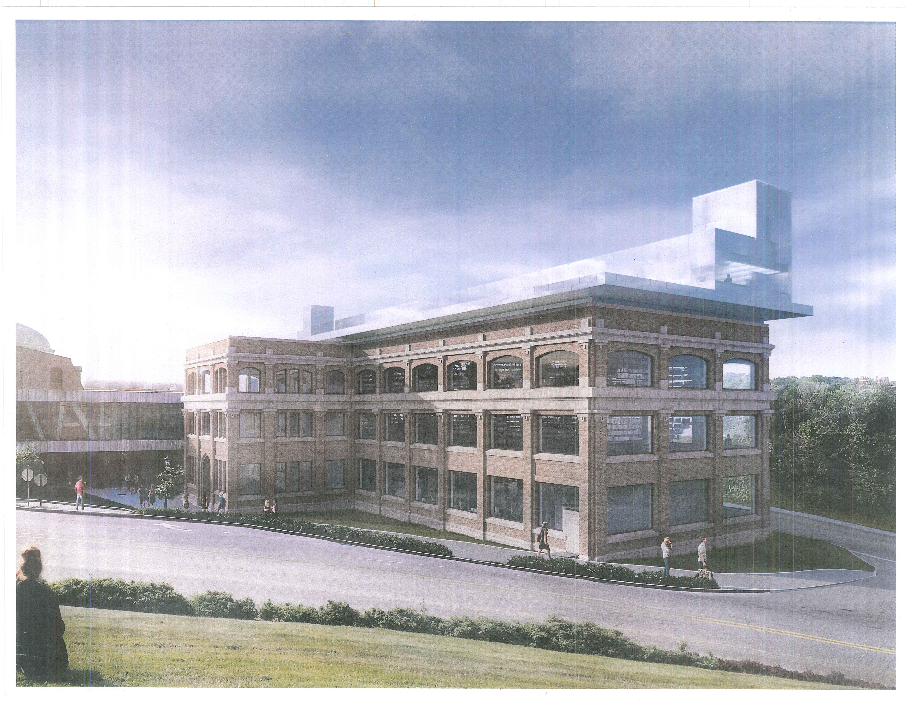
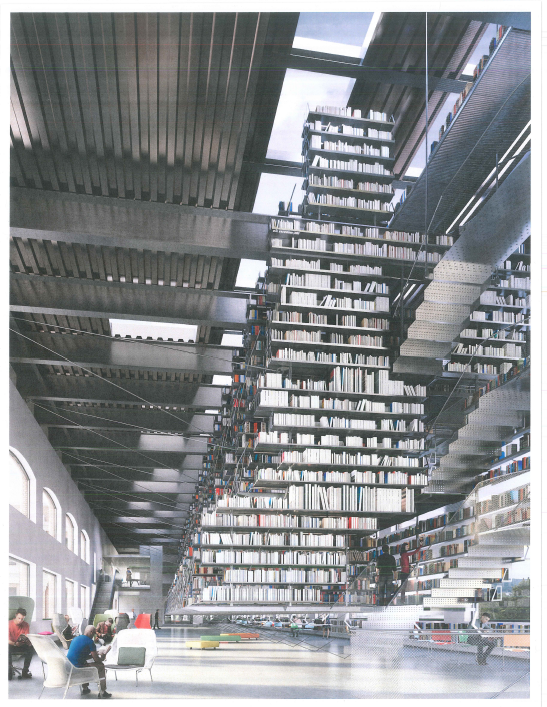
Here we go, renders of the Cornell Fine Arts Library, courtesy of the Ithaca Landmarks Preservation Council (ILPC) Agenda. Additional renders here, project narrative here. Apparently, the ILPC does get to review the addition, although looking at the agenda for the 14th, it doesn’t look like they’re making any decisions (and being just outside the Arts Quad Historic District, they may not be able to).

fine_arts_3

Quoting the front page of the narrative, “rather than acting as a physical symbol, it radiates activity and occupation”. The university wanted the new superstructure, which they’re calling a “lantern”, to be as visible as possible from campus entry points, and it is claimed that the addition will bring “distinction and excellence to the campus”.

fine_arts_4

The building will have two entrances, one public and one for AAP only. The interior will consist of four levels of mezzanine shelving for the Fine Arts Library’s collection, as well as interspersed work/study spaces. Floor-to-ceiling space will range from 48 feet on the north side of the reading room to 7.5 feet in some sections of the library stacks. Long, unobstructed hallways will run the length of Rand Hall. The large variation is meant to convey both grand spaces and “private engagement” with the books. The lantern will have a catwalk as well as working spaces.

fine_arts_5

The design replaces Rand’s multi-pane daylight-factory windows with single panes, removes the east stairwell, and is purposely designed to overhang above Rand, acting as a sort of canopy for rain and sunlight protection.

fine_arts_1

As previously covered, the architect is a Cornell alum, Vienna-based Wolfgang Tschapeller M.A. ’87. More of Tschapeller’s very avant-garde designs can be found at his website here. The project is being funded in part by a multi-million dollar donation from Cornell alumna, architect and UC-Berkeley professor Mui Ho ’62 B. Arch ’66. No construction time frame or total cost have been given at this time.

I’ll call a spade a spade. Rand Hall is getting an ugly hat. One that the rest of campus will be subjected to looking at for years to come.


News Tidbits 4/25/15: Long Week, Long Reads

25 04 2015

Grab the popcorn and sodas, folks, this will be a long one.

inhs_pride_design_comparo_v1_v3_1

1. Let’s start with some new and updated renders for the evolving 210 Hancock Street development that INHS has planned for the Northside neighborhood.

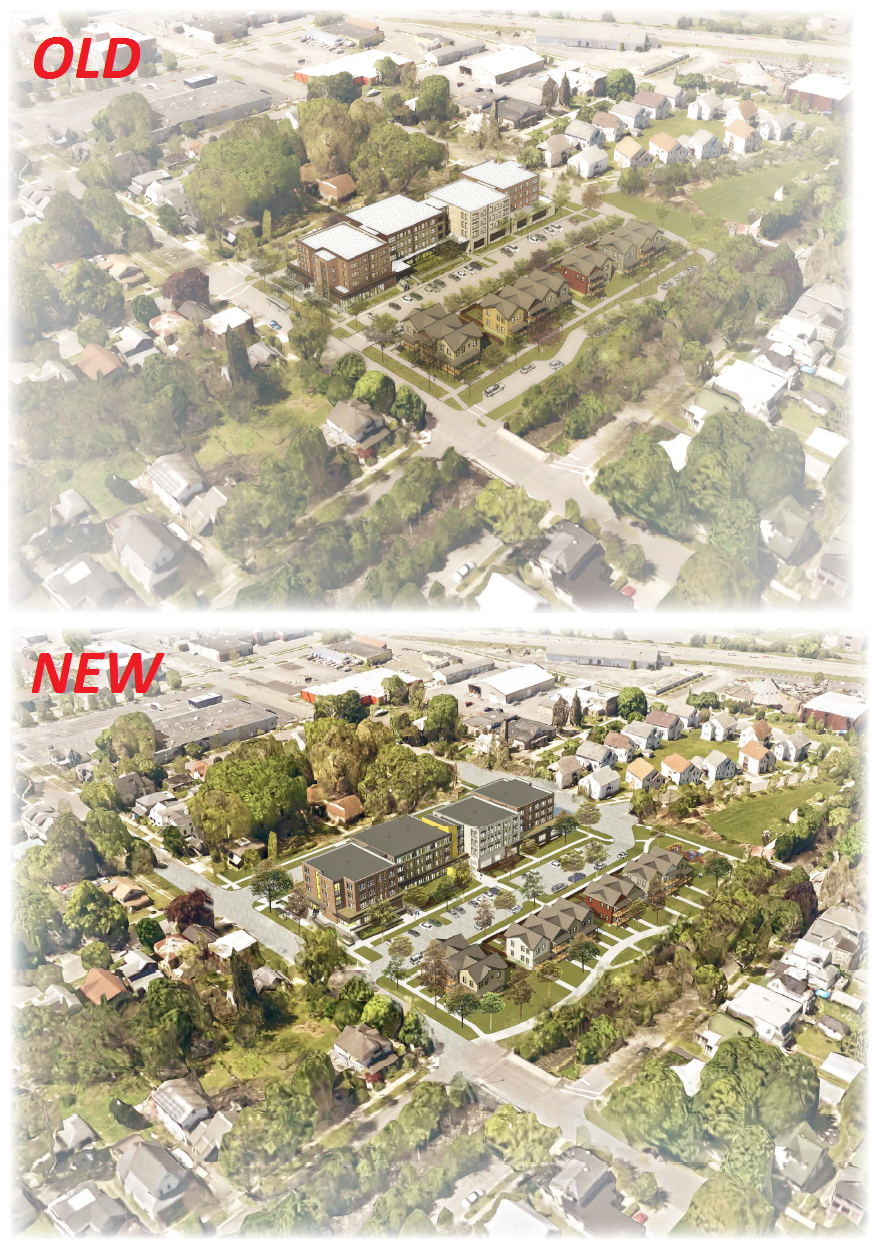
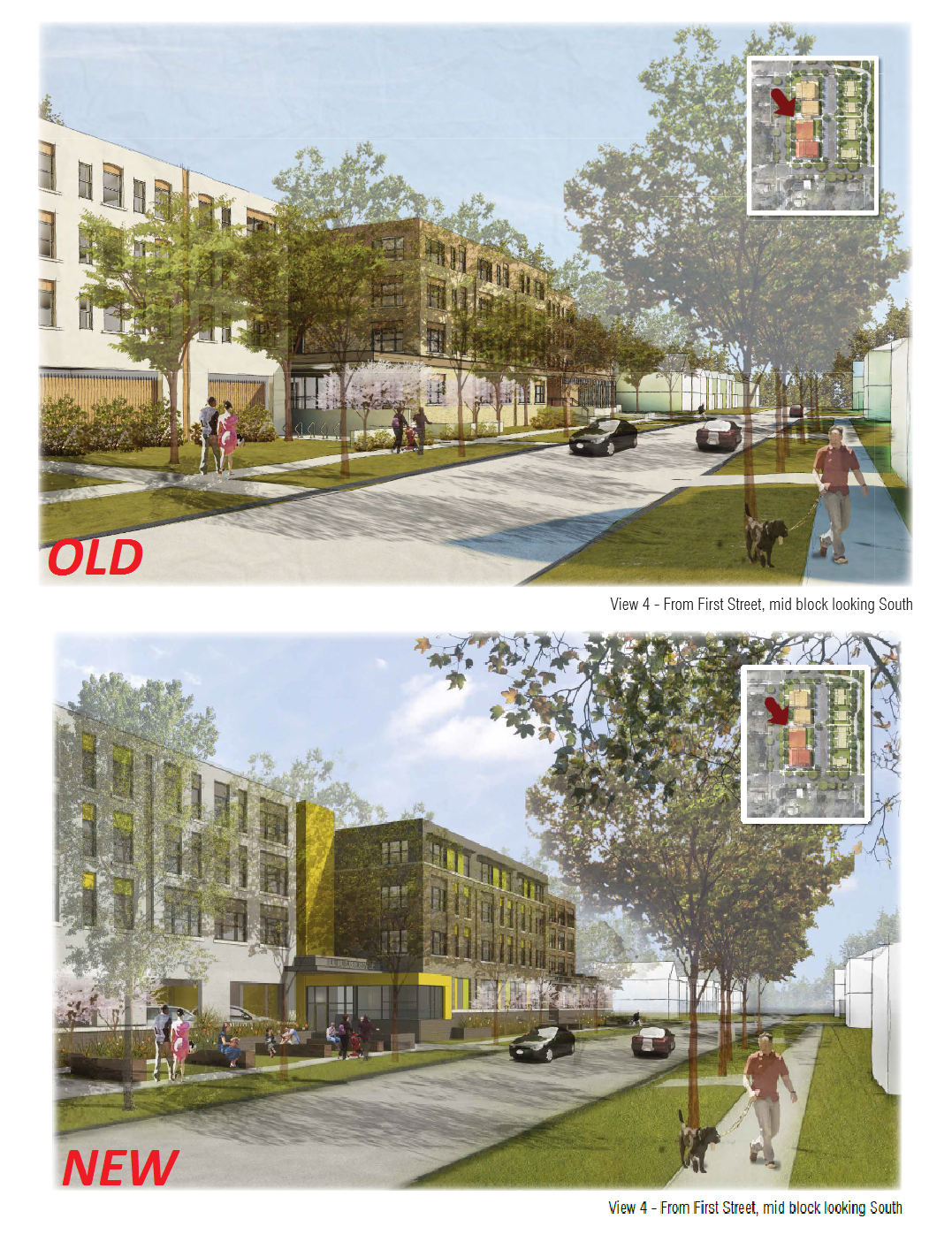
In each image, the top half is the old version, the bottom half the newest version. The lead image, an aerial rendering, shows that the houses haven’t changed much, though at the city and neighborhood’s insistence, Lake Street has now been closed off to all vehicular traffic in the refined proposal. The biggest structural changes have been in the apartment buildings – the color scheme of materials has been changed up quite a bit, and the partitions between the buildings have been re-worked to try and make the buildings appear less connected (one of the complaints raised was that they were too much like a wall; for this same reason, the buildings are slightly offset from each other, so no continuous face is presented towards the street).

inhs_pride_design_comparo_v1_v3_2

inhs_pride_design_comparo_v1_v3_5

Looking closer at the individual apartment buildings themselves, the designs have been pretty thoroughly reworked. Different window layouts, different window sizes, different colors – about the only thing that’s been kept the same is the overall massing of each building. The plan calls for 53 1 and 2-bedroom apartments and about 65,000 square feet of space, of which 7,500 square feet will be covered parking. The included commercial space has been expanded from 8,200 sq ft in the initial proposal, to about 10,000 sq ft now. More renders of the newest iteration can be found here.

inhs_pride_design_v3_7

No real changes yet in the for-sale houses that will be included in the project, apart from a palette change (previous render here – the new one is less bright, with darker earth tones). These are designed to blend in with the surrounding homes, and fall in INHS’s typical 2-3 bedroom, 1,100-1,400 sq ft range. The houses are townhomes in rows of 2-4 units, All sporting one or two-story porches. These will be built in a phase separate from the apartments. Certain affordable housing grants are geared towards owner-occupied units specifically, so the Neighborhood Pride lot will be split up into two parcels, one with the apartment rentals, one for the homeowners.

Questions and comments can be directed to the City Planning Office at dgrunder@cityofithaca.org.

2. Up in Lansing village, it looks like a proposed mixed-use project may finally be moving forward after years of incubation. “CU Suites”, a 3-story, 43,000 square foot project proposed by the Thaler family for a vacant lot on Cinema Drive, is asking the village to waive sewer connection fees. Presumably, this is about getting their finances in order before moving into the construction phase; there has been no news if funding has been secured yet. Something to keep an eye on this summer, certainly.

The Cinema Drive site was previously approved for a project of those parameters in fall 2012, consisting of two commercial spaces and a 39-unit apartment building, but that plan has not been carried out. The CU Suites proposal went before the village for “alterations and possible clarification” last December. No updated renders on the village website, but a site plan of the previously approved plan can be found here.

20150405_141933

3. Here’s some more details on the “not feasible as presented” Flatiron project. Readers might recall the 12-unit affordable housing proposal at 910 West State Street was given low priority for HUD Entitlement Grant funding.

From the presentation notes recently posted online:

“The project application is not fully developed, but probably represents more of an effort to start a conversation about the project. There is a great need for affordable housing in the community. The project was conceived to address the high cost associated with typical renovations to properties which make them unaffordable. The project would be located in an oddly-shaped trapezoidal building which [Ishka Alpern] would like to renovate to match its prior condition. It would be a very nice, unique addition to Inlet Island. Inlet Island has historically been a location for affordable housing and it is important to maintain that, before too many unaffordable projects are built there. Unfortunately, it is difficult to build affordable housing units without some form of funding assistance.”

In the Q&A the committee had with developer Ishka Alpern, no time table was given, and Alpern said he was open to waiting a year to refine it. It was also noted that once a commercial lease on the property expires in four years, an even larger project could be proposed, though it could be limited by the poor soils. While it appears renovating is the most feasible approach, the city was not impressed with the cost of investment per beneficiary – larger projects like 210 Hancock mentioned above have economies of scale going for them, costing less to build per unit. Smaller projects like the Flatiron need proportionately more assistance, making them less attractive for grant money. The city’s looking for the greatest good for the greatest number, in a sense.

In other news from the Ithaca Urban Renewal Agency (IURA), a private developer, Viridius Property LLC, is buying five duplexes with 10 units of affordable housing from non-profit Community Housing of Ithaca with the intent of keeping them low-to-moderate income, but retrofitting the buildings to run on renewable energy sources. Viridius, a company run by computer scientist and tech CEO Stuart Staniford and his wife, was established in early 2014, and has been on a buying spree as of late. They own $1.7 million in rental real estate assets now, these duplexes will raise it $2.7 million, and the goal expressed in a letter to the IURA is $5 million.

Quoting the letter sent to the IURA:

“Viridius is oriented to the “triple-bottom-line.” Although as a privately owned business
we will look to return on investment, we also seek to improve the environment and society. We
are particularly focused on contributing to the solution to climate change by converting the
existing building stock to be appropriate for continued use in the twenty-first century. At each of our properties, Viridius is removing the propane, natural gas, coal, or oil heating systems and replacing these with systems based on renewables. The specifics depends on the particular
building; to date, we have used pellet boilers and air source heat pumps. Viridius is also
developing our first solar panels at one of our buildings, and elsewhere acquires commercial
renewable power for electricity. Also, at our own residence we have deployed geothermal heat
pumps for heating and cooling and have all our electrical needs taken care of by solar panels on site. Viridius is certified as a living wage employer by the Tompkins County Worker’s Center
and has five full time staff at present in addition to the owners.

So it’s eco-friendly and/or affordable housing. Most residents will welcome the new fish into the local pond, even if all the property being acquired is a bit eye-raising.

Lastly from the IURA, the Carpenter Business Park on the north side is on the market for $2.85 million. Four vacant parcels on Third Street and Carpenter Park Road on the north side of the city recently sold for $2.216 million from “Templar LLC” based in Ithaca to “Ithaca Lender LLC” out of New Jersey, in what may have been a foreclosure sale. The address on file is associated with a company called “Kennedy Funding Financial LLC”, which is described as “one of the largest direct private lenders in the country, specializing in bridge loans for commercial property and land acquisition, development, workouts, bankruptcies, and foreclosures.” A google search turns up a legal notice between the two entities a few months ago.

gannett5

4. Construction is gearing up for the Gannett Health Center’s addition on Cornell’s Central Campus. Work on the project officially launched March 30th, according to the Cornell Daily Sun. Expect site clearing, excavation, and pile driving as we move through the spring and into the summer. The project will be broken into phases – Phase I focuses on new construction, Phase II on renovation of the current building, and Phase III concludes the project with reconstruction of the Ho Plaza entrance. About 75% of the material removed from the old building is expected to be recycled.

The architect of record is local architecture/Cornell alumni-filled firm Chiang O’Brien. There will be two additions, the four-story, 55,000 square-foot building featured above, and an additional 18,600 square foot addition that replaces the northeast side of the current building. The project also includes a new entrance and substantial renovations to the original 1950s structure (22,400 square feet of the existing 35,000), as well as landscaping, site amenities, and utilities improvements. The projected cost is $55 million, and the target completion date is October 2017.

The Gannett Health Center expansion has been a long time coming. Initial plans in the late 2000s called for a completely new building on site. HOLT Architects prepared a plan for a 119,000 square foot building, and an all-new building was also included in Cornell’s 2008 Master Plan. But once the Great Recession waged its battle on Cornell’s finances, the Gannett redevelopment was scaled back to its current form. According to a statement given by Gannett Director Dr. Janet Corson-Rikert to the Sun, the earlier plan had a budget of $133 million; the new addition and renovations are expected to cost $55 million.

The project is expected to create about 175 construction jobs and 40 permanent jobs (additional doctors, counselors and support personnel) when completed.

5.  According to next week’s Board of Public Works agenda, the approved 327 Eddy apartment project has been pretty heavily modified.

Here’s the old design:
327_eddy_rev2_1

Here’s what the developer is planning to build:

327_eddy_rev3_1

I must have missed something? All the sources I’ve seen have referred to this as a six-story building, not five. The side windows were added late in the approvals process, I think. Anyway, the project is going to the BPW because the developer wants to project the top centerpiece window as a bay window rather than having it set back from the front facade. This would push two feet (2′ x 12′ isoceles triangle) into the city’s right-of-way over Eddy Street,  and the board is recommending to the council that the mayor authorize (he says she should he should, sheesh) the intrusion for an appraised value of $3,073.84, based on an appraisal value from Pomeroy Appraisal Associates in Syracuse.

The decrease in size also comes with a decrease in units and rooms – from 28 units and 64 beds to 22 units and 53 beds. This is a double-edged sword – some might cheer the loss of size or like that the roofline is continuous with its northern neighbor, but it will be harder to stem the tide of single-family home conversion to student apartments if Collegetown’s core isn’t as capable of absorbing Cornell’s student population growth.

The included email in the agenda says the planning board recommended an overhang bay window. Personally, I feel it would make the building look clunky. But that’s just me.

maguire_fiat_1

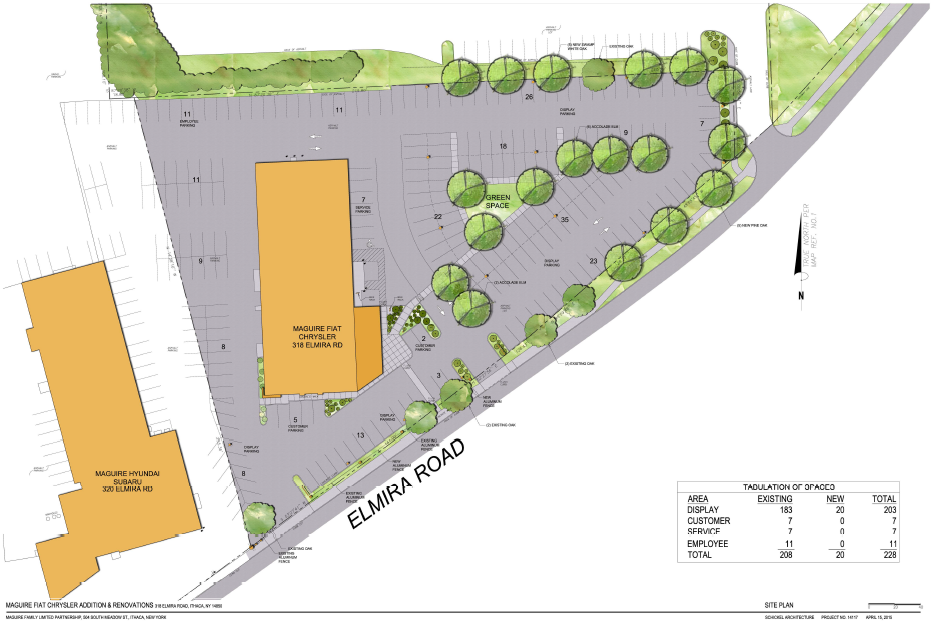
6. Here’s another project being served up to the Planning Board this Spring. Additions and renovations to a car dealership down in southwest Ithaca’s suburbia. Site Plan Review and drawings here. The dealership is Maguire Fiat Chrysler. Plans call for combining two show lots into continuous lot and adding 20 spaces, adding a 1,165 square foot showroom addition, and new landscaping and signage, including a second freestanding sign for Fiat that requires a sign variance (the max allowed by zoning is one freestanding sign). Documents indicate all the work will cost about $360k and run from September to December of 2015.

Observant readers might remember that Maguires proposed a delaership/headquarters compound in Ithaca town late last year; but due to irreconcilable differences regarding standard zoning vs. Planned Development zone, the plan was tabled.

100_1474

7. Woof. Almost to the end. The Ithaca Planning and Development Board is going to have their hands full at next Tuesday’s meeting. Agenda here. Here’s a rundown of what’s in store:

– A minor subdivision to create a new home lot at 201-203 Pearl Street.

A. Approving the adjustment to the Carey Building design discussed earlier this week

B. Enhancements to the pocket park next to the Lake Street bridge (landscaping, paving)

C. Declaration of Lead Agency and discussion on INHS’s 210 Hancock project

D. Declaration of Lead agency, Public Hearing and Determination of Environmental Significance for the proposed Texas Roadhouse on Meadow Street

E. Declaration of Lead agency for the Tompkins Financial HQ – hopefully, we’ll get some detailed renders at the meeting

F. “State Street Triangle Project (Trebloc Building site)” – This will be huge. I cannot stress by excitement enough at seeing the Trebloc Building demolished – I have not hidden my dislike of it, and in nearly seven years of writing this blog, it’s the only building I’ve ever called an “architectural turd“.  Located at 301 East State Street, the Trebloc Building was built in 1974 during the age of Urban Renewal, and was originally supposed to be two floors. The city has been quietly desiring redevelopment of the prominent corner for years, and the site was upzoned from 60 to 120 feet in late spring 2013.

According to some praise-worthy sleuthing by David Hill at the Ithaca Journal, the developer is Robert Colbert in cooperation with Austin Texas-based Campus Advantage, a large-scale developer of student apartments. plans call for a 120-foot building on site, with first floor retail and student-oriented apartments above.

This will be a tremendous project by Ithaca standards. The developer clearly states on its website that it’s only interested in working with sites that will provide at least 100 units of housing. Assuming the Trebloc Building’s footprint of 13,569 sq ft, one story retail followed by eleven floors of apartments yields almost 150,000 square feet of residential space. Figure a loss of 15% for utlities and circulation space, and an average size of about 980 square feet for an average residential apartment unit, and one gets 130 units and an unknown number of beds that could conceivably add a couple hundred students to downtown Ithaca’s population, not to mention millions of dollars of taxable real estate.

There’s a lot that will need to looked at – utility loads, parking, vehicle circulation, aesthetic impacts, and numerous other attributes. But the city’s holding the door open about as wide as it can for this site, and it’ll be an exciting process.

G. “Sketch Plan: Cornell Fine Arts Library – Rand Hall Addition”

Written about previously, it looks like the city will get its first chance to review the project. But someone with a insider’s look has some pretty harsh comments for the plan to renovate Rand hall.

Cornell Architecture professor Jonathan Ochshorn wrote in to tell readers here about the plans for the Fine Arts Library. I’m including a link to his blog post on the project here.

To try and sum up Prof. Ochshorn’s post would do him an injustice, but suffice it to say, the library plans will only keep the brick shell of Rand – the windows will be replaced, and a large “hat” will be placed on the roof. One that bears strong scrutiny from the Planning Board, since there could be significant visual aesthetic impacts on the Arts Quad Historic District.

I’m gonna tie up this post here and sit on the other items until next week. More weeks like this and I’ll need an intern.