Urban Renewal Part I: Ithaca’s “Project One”

18 08 2015

hotel_ith_1964

It was called “Project One”.

The year was 1964. The tax base of Ithaca, and especially downtown Ithaca, had been eroding for over a decade. Suburban big-box stores started to appear on the south side of the city in 1950, and up towards Lansing, plans were already underway for a new suburban supermarket and department store (the Shops at Ithaca Mall wouldn’t come along for another twelve years). New neighborhoods were sprouting in northeast Ithaca and Eastern Heights, and cul-de-sacs were paving their way onto West Hill and South Hill. Ithaca College was moving its staff and students to a sprawling campus just beyond the city line. From 1954 to 1960, 48 offices and retail stores closed or moved out of downtown Ithaca, a drop of 18%. The city councilmen were concerned.

So how were they to draw people and tax dollars back into the city? The city officials looked around. In the 1950s and 1960s, it was trendy to have that rambling ranch house set back far from the street, it was fashionable to attend indoor shopping centers away from the rain and the cold.

Image courtesy of Tom Morgan

Image courtesy of Tom Morgan

But most importantly, the trendsetters agreed, was that one could not live the high life, one couldn’t even dream of being a part of the jet set, without a big, luxurious car at their command. Two tons of chrome and steel, heralding you’ve made it in this world, and your car will take you anywhere and everywhere you want to be. And if a place wasn’t accommodating for your stylish set of wheels, then it wasn’t a place worth visiting.

The councilmen and the city officials were taking note of all those chrome-trimmed Bel Airs and Galaxies, with their bright colors and sculpted fenders. Following the results of a study conducted in 1959 and finalized in 1962, they came to the conclusion that in order to revive downtown, they had to catch up with the times, to bring downtown into the mid-20th century future with a swagger and a swing.

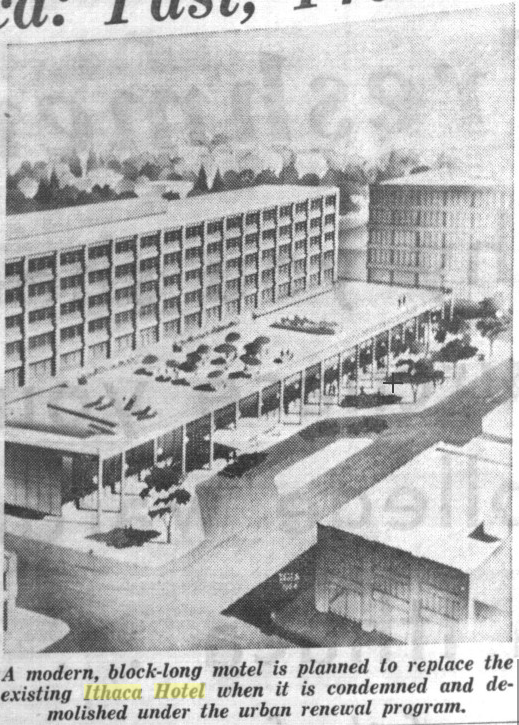
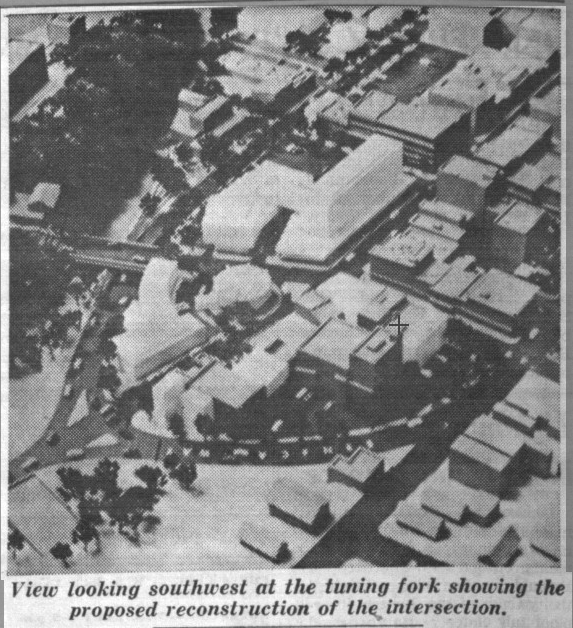
The plans were grand. In place of the nearly century-old Hotel Ithaca, a new hotel a block long, designed in the finest of modern taste. Out would go the decaying buildings of 60, 80, 100 years yore, in would come wider roads, ample parking, modern buildings and ideally, an influx of cash. Ithaca hoped it would bring new residents back into the city, while Cornell U., happy to give some money towards the effort, hoped it would bring in more industry and research organizations.
ith_urban_renewal_plan_1964_1

Project One was to be the first of three steps in Ithaca’s Urban Renewal plans. Plans in Project One called for the demolition of the Hotel Ithaca block and the buildings on the south side of the “tuning fork”, already built by that time (and taking out a number of buildings in the process). In their place, the new hotel would go, and a new bank office on the south side of the fork. In the model above, you can see what was once the Strand Theater (demo’d 1993), Restaurant Row and the old Rothschild’s Building (also gone now) still intact. There would be new auto dealerships, new department stores, traffic generators and tax generators.

Image from Cornell Daily Sun, 10/20/1966.

Image from Cornell Daily Sun, 10/20/1966.

The rest of Project One targeted about 26 acres of land bounded by State Street, Cayuga Street, and Six Mile Creek. Essentially, everything south of the Commons, and everything east of the present Hotel Ithaca/former Holiday Inn. Much of the area between Six Mile Creek and Cayuga Street was auto repair shops, dealerships and other car-oriented enterprises. Pritchard Automotive, a block further south, could be seen as the last vestige of when South Cayuga Street was “Automobile Row”.

The plans moved forward in fits and starts. Survey and planning work was brought to a stop in 1962 by Ithaca mayor John Ryan, who vetoed the plan. But following the election of Hunna Johns in 1964, the grand revitalization schemes moved forward again. The Common Council approved the federal application for Project One in June 1964.

ith_urban_renewal_plan_1964_2

After six months of delays, federal funding came through in December of that year. Cornell had already given funding to the tune of $500,000 (about $3.85 million today) to help pay for the projects, but the federal government would be the primary source of funds, which would pay 75% of the $6 million initial cost. Ithaca and the state of New York would each fund about $750,000. The city reasoned that it would bear the expense now for increased tax revenues in the future.

city_1

Of course, not everything worked out as planned. Nowhere close, really. That will be covered in Part II.

When Varna Needed A New Plan

14 07 2015

A couple of weeks ago, I wrote up a piece regarding new solar-powered townhomes proposed for 902 Dryden Road in the hamlet of Varna, located on the west side of Dryden town. There was a temptation to expand the piece quite a bit by looking at Varna’s 2012 development plan, but that would have been another article in itself. So here we are.
As with a lot of development plans and rezonings, the impetus for many participants was a large, politically divisive project. A lot of the details I’m featuring here come courtesy of blog posts or the links posted within the posts of the “Living in Dryden” blog written by Simon St. Laurent, though this retrospective comes without his vehement opposition.

varna_ii_2010

In February 2010, the Lucente family (locally large-scale developers who run Lifestyle Properties) began discussions for a new, very large project in the hamlet of Varna. Dubbed “Varna II”, the proposal called for 260 units of housing and 30,000 SF of commercial space off of Mount Pleasant Road and Route 366. The plan called for a build-out over ten years in three phases, and the residential units were mostly townhouses that would be sold in the $150k-$200k range. It wasn’t the first time the Lucentes had targeted Varna for a major project – a 170-unit project proposed in 2000 had previously been shelved. The zoning in Varna allowed projects of 2.5 units/acre, comparable to a lot of older suburban neighborhoods. The Varna II project, at about 16 units/acre, the project was much denser than what Varna was accustomed to – and permitted, for that matter, since the town zoning law had a maximum of about 14.5 units/acre. The project would be going forward as a Planned Unit Development.

Geographically, Varna is in an awkward position – it’s a hamlet of about 800 people just east of Cornell’s campus, which puts it in the figurative line of fire for development interests, one that greatly interferes with the bucolic lifestyle touted by some residents. On the other hand, Varna is not without need of major improvementsit’s a very auto-centric area, a lot of what is developed is underutilized, and some of the street-fronting properties have potential for redevelopment into a more walkable, cohesive community.

Timing-wise, the project was well-suited; Dryden was looking at revised zoning to reflect its 2005 comprehensive plan. The possibility of a large residential complex was definitely enough to draw more attention to the new zoning, especially its impacts on Varna. The old Varna zoning (R-C and R-D residential) wasn’t dense at 2.5 units/acre, but it also allowed for a whole range of uses from residential to commercial and farming; a proverbial grab-bag. The Lucente project made it clear that maybe it was time to give the future of Varna some real thought.

As with any divisive project, Varna II went through community meetings, hosting a meeting with the Varna Community Association during the summer. The VCA was a little more even-handed about the whole thing – they knew that development in Varna was inevitable, but they wanted a greater role in shaping it. The VCA stated that it was comfortable with doubling the density to 4-5 units/acre in some areas, as well as owner occupied homes, more walkable spaces, and smaller development sites.

The project never went through formal review – the initial PUD application appears to have been rejected, because Dryden’s PUD requires at least 100 acres – this project involved only 16.3 acres. The rejection was appealed to the town Zoning Board of Appeals in December 2010, issues with State Environmental Quality Review (SEQR) and procedural issues delayed the meeting on the project, and by spring 2011, the town had an unofficial moratorium in place on large-scale development, at least until the new plan for Varna was drawn up and approved (expected to be about 9 months).

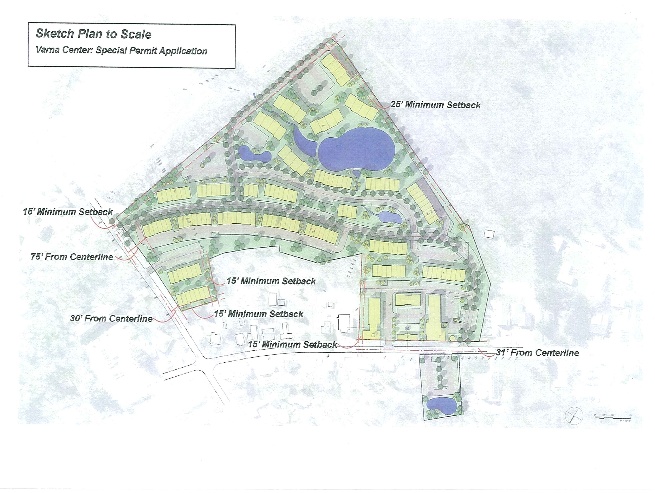
varna_plan

Fast forward some months and meetings later, and the plan, created by Behan Planning and Design, was adopted in December 2012. The conceptual plan calls for New Urbanist guidelines – sidewalks, garages on side-streets, pocket parks, and mixed-use. The conceptual build-out above adds about 450 bedrooms to the hamlet. Some of the short-term goals called for improving bus stops and finalizing the Varna Trail in the short term (identified as 2012-2014), reworking the 366/Freese Road intersection into a roundabout during the medium term (2015-2017), and incentives for projects to follow the plan. The plan also suggests implementing complete streets in the 2015-2017 timeframe. The revised Varna zoning allows for units 6-10 units per acre, with density bonuses for LEED and certain forms of redvelopment.

Well, we’re in 2015 now, let’s see where things are at. The town applied for grants in 2013 for the “complete streets” multi-modal corridor on 366. But apart from that, not much else on the town’s end, something that Varna residents have noted with some distress. The town responded that plans are underway, they’re just going slower than anticipated.

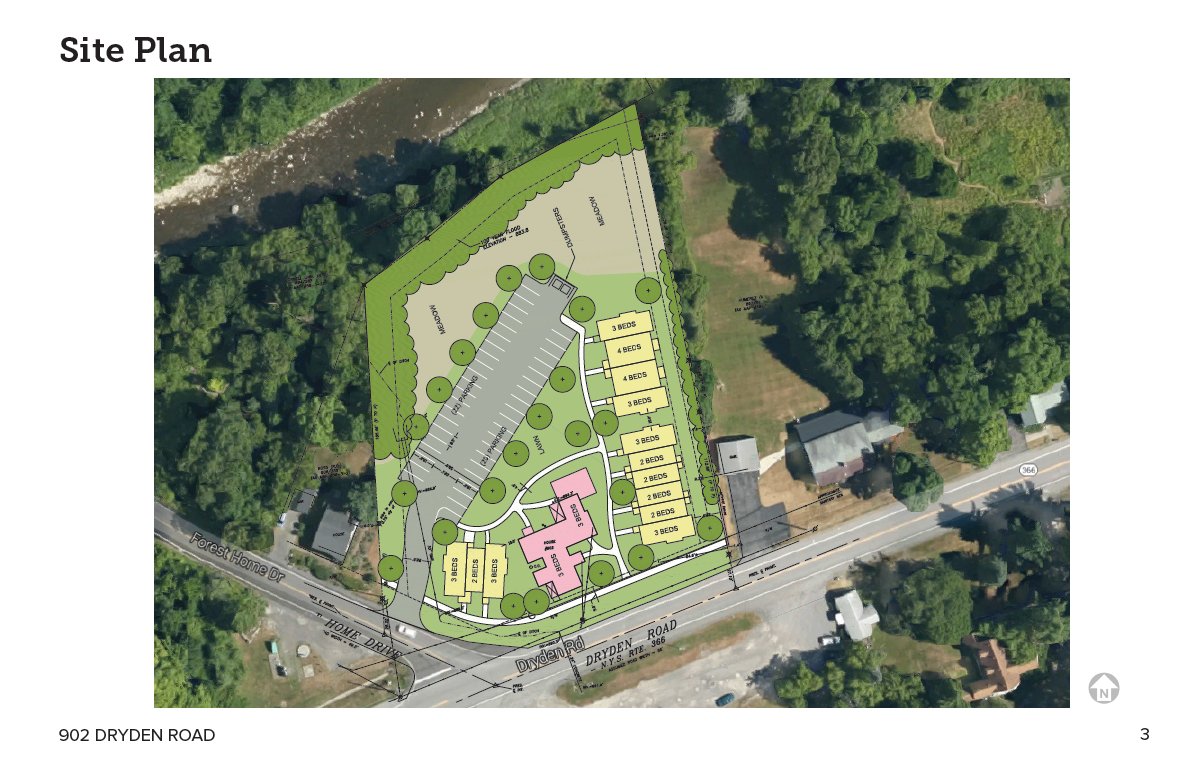
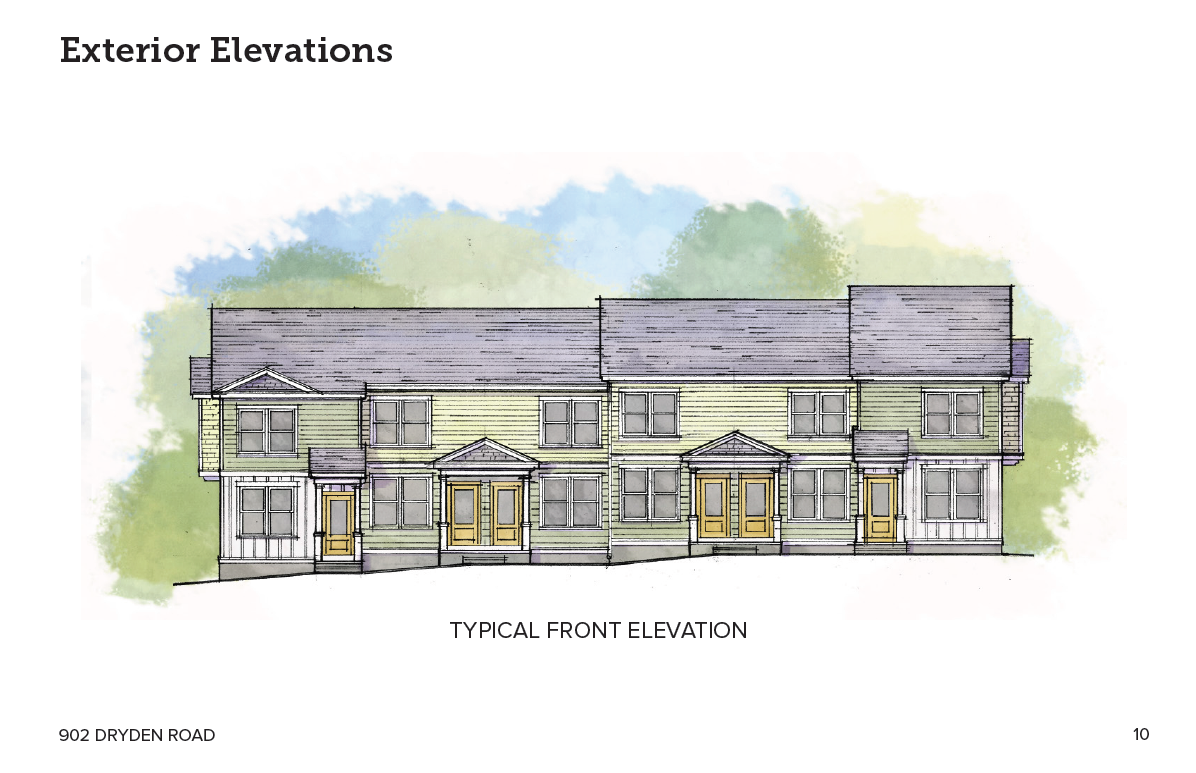
902_dryden_1 902_dryden_2

On the private end, Modern Living Rentals’ 15-unit, 42-bedroom project for 902 Dryden is the first major project to hit the dirt since the plan was adopted. The 902 Dryden parcel is about 2.42 acres, so the project comes about to about 6.2 units/acre (based off of the zoning, I think 13 units/acre were possible with the green bonus for being solar-powered). Being 2-story townhouses, it’s in scale with Varna, and is a sizable but not large project, the type that the VCA expressed preference for back in 2010. 902 Dryden includes proposed street-facing sidewalks for when the town gets to that phase. Since it’s been approved, I would guess that the town is satisfied with the project.

As for the Lucentes, they’ve focused on other endeavors, such as their Village Solars apartment project in Lansing. They still own the land that Varna II was proposed for. There’s no indication if anything will happen here or if they’ll eventually sell it off, but it’s something to keep an eye on in the long-term.


News Tidbits 6/6/15: I Give This Week A Frowny Face

6 06 2015

215-221_spencer_v2_2

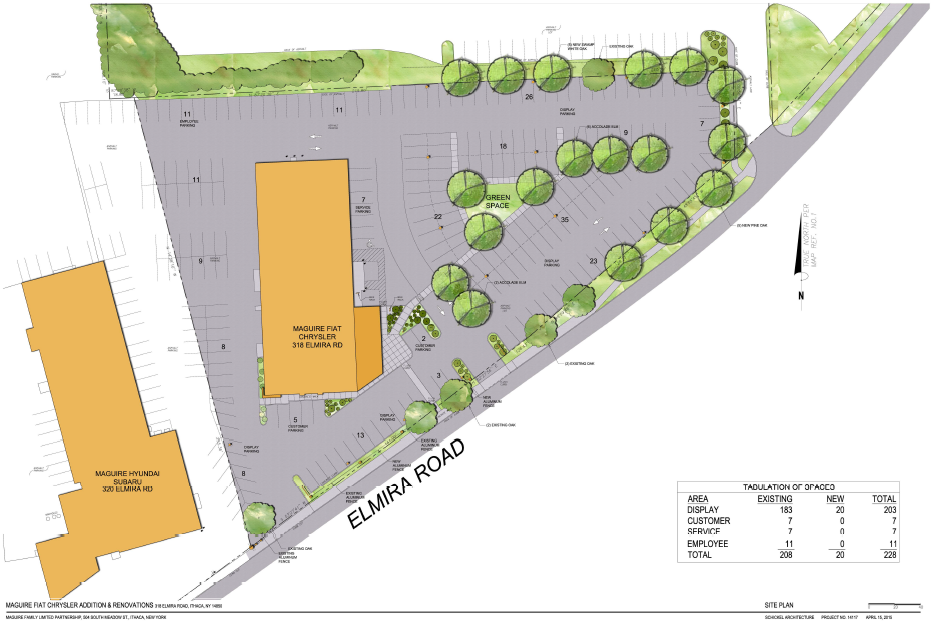
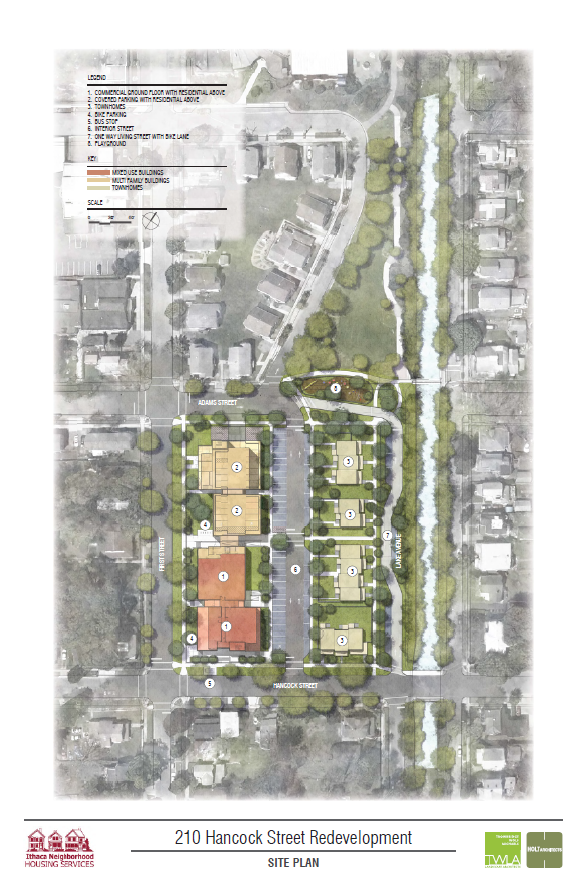
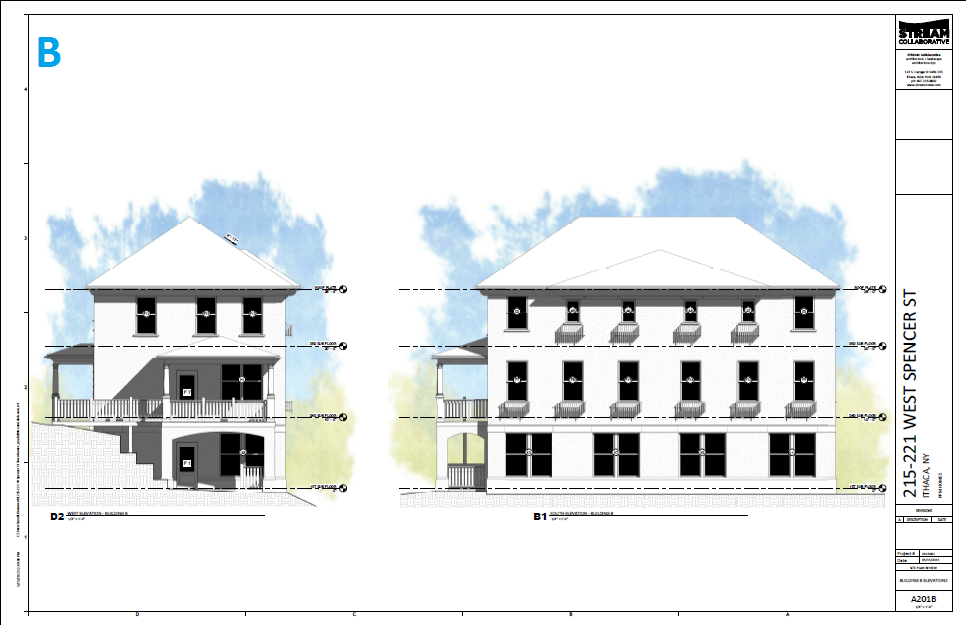
1. I’m thinking there is a genuine lull in the pipeline at the moment. The city’s projects memo, which is the document that city departments receive and comment on before the actual Planning Board meeting, doesn’t have much for consideration for this upcoming month. The one projects that is being “newly” considered is the 12-unit, 26-bedroom PPM Homes proposal at 215-221 W. Spencer Street. That project is expected to receive declaration of lead agency (in other words, the planning board formally agrees to review it) at the June meeting. Being carried over from the previous months are the two duplexes for 804 E. State Street, the Tompkins Financial HQ, INHS’s 210 Hancock project and the Maguire Fiat/Chrysler expansion. None of those are up for final approval.

Smaller projects and subdivisions will often first show up in the memo ahead of the meeting, but not this month. What will be, will be.

tfc_v2_1

2. On the other end of the scale, this looks to be a busy month for the Ithaca Landmarks Preservation Council. Most of their agenda focuses on window repairs and other minor details, but they will be reviewing the Tompkins Financial HQ and the new drive-thru across the street. Although neither is within a historic district, I suppose it’s being reviewed for the sake of feedback and the possibility of a visual impact on the skyline as seen from historic districts.

Cayuga-Meadows-Shot

3. In Old Library news, a decision was expected last Tuesday…but, the decision was postponed. After committee members started sharing their differences in opinion. Pardon my cynicism, but that’s a perfect microcosm of those whole process. Frequently delayed and bound to infuriate someone come decision time.

In a perfect world, all three of those would be built in the city, because they all address different housing needs in Ithaca, and they would all likely be successful. But of course, there can only be one. We’ll find out next Tuesday morning.

4. The Ithaca town Planning Committee is verifying two things already noted in previous news round-ups. One, the 68-unit Cayuga Meadows project hopes to begin construction in the very near future, and two, the Troy Road housing project is dead.

The committee also brought up the possibility of a moratorium for certain parts of town – two areas described as having significant student populations. One is almost certainly the area of South Hill next to IC, the other is not stated (but likely has to do with Cornell). This is part of a larger conversation to keep IC students from living off-campus in student rentals. Students aren’t a protected class, so whatever extra bureaucracy or laws the town wants to adopt are technically fair game. I would imagine, however, it would much easier to do that to IC’s undergrads than the professional and doctoral students attending Cornell. Looking at the numbers, one has been increasing much more than the other, and it’s not the undergrads. This, I suspect, is where potential laws become problematic.

Anyway, the moratorium is seen as a last-ditch effort. But the possibility of it should be enough to raise eyebrows.

815_s_aurora_1

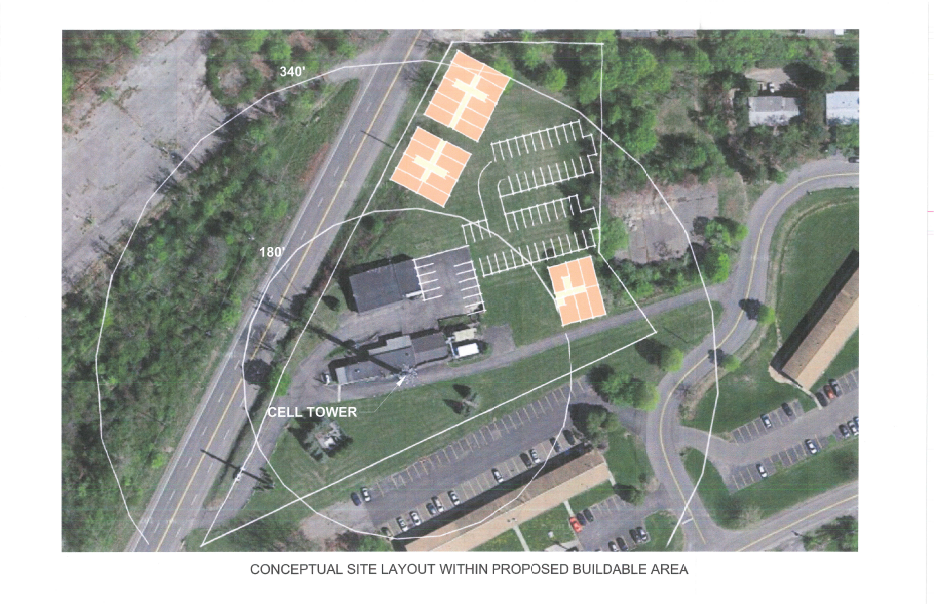
5. Time for some more unhappy – the city Board of Zoning Appeals isn’t touching the 815 South Aurora Street application.  To recapitulate the salient details, local developer Todd Fox would like to build apartments on the land but can’t because the vast majority of the property is within the “fall zone” of a cell tower, which the city defines as twice the height of the tower. At 815 South Aurora, a 170′ tower creates a 340′ radius of no-man’s land (outer circle above), making the parcel virtually undevelopable. Fox had two private engineering companies (TAITEM Engineering and Spec Consulting) analysis the case and they determined that an appropriate fall zone is the height of the tower plus 10 feet for a little wind/bounce – so 180′ total. With this info in hand, Fox is trying to get the city to refine the zoning to allow the decrease in fall zone and therefore permit the land to be open for development.

The BZA said it was acting on the city attorney’s advice that the committee can’t override a council-approved law. Which means that Noah Demarest, the architect appearing on behalf of Todd Fox, will either have to go to the Council to have the law amended, or he and Fox will have to go through a full sketch plan and review process, and apply for an area variance for whatever firm plans they have proposed. Meeting with the BZA was seen as way to avoid having to shell out all that time and money and risk still being rejected because of the cell tower issue. There’s a risk with moving forward at this point, and it’ll depend on just how much risk the developer is willing to take on this potential project.

6. We’ll wrap up with something positive – FormIthaca, the citizen group advocating for form-based zoning, is doing their design charettes this week. I’m writing this on Thursday night since I will be doing 5-year Cornell reunion stuff on Friday, but I do plan on being in attendance Friday afternoon meeting and am looking forward to seeing/hearing what ideas the presenters have to share.

I can assure a certain town of Ithaca board member that I have a personal preference to small street setbacks, and it sure as hell isn’t because they’re “hipper”.


The Evolving Plans For West Hill

2 06 2015

West Hill is, in a sense, Ithaca’s final frontier. The least developed of the hills, it isn’t nearly as built out as South Hill or East Hill, and what is there are mostly single-family homes.

For clarity’s sake, this post is about the part of West Hill within city lines.

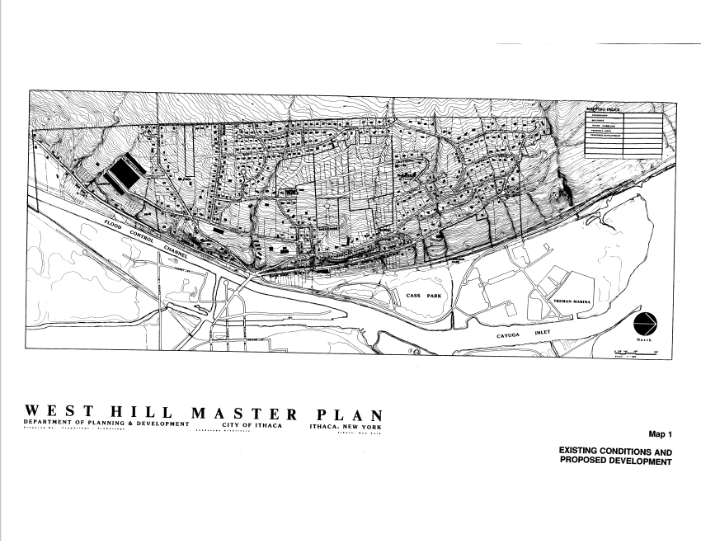
While looking up something else, I stumbled across West Hill’s Master Plan from 1992. Which, given its been over 20 years since it was written, gives an interesting perspective on how the city has wanted development on West Hill to fill out. The West Hill plan was created in response to strong developer interest in West Hill sites in the late 1980s, both in Ithaca city and Ithaca town. The plan notes that seven major projects were proposed during 1988 alone, in an area more accustomed to annual construction in the range of a few to several homes, and the very occasional apartment building or business.

west_hill_1992_1

The map above shows both the current and proposed projects at the time, There were eight in total, with dozens of units and lots. It’s hard to read even when blown up, but the proposed projects, which have a heavier lot outline and blurry labels, included subdivisions for single-family housing tracts in the proposed Deer Creek, McPherson and Sunrise Terrace projects, and individual sites with multi-unit potential like INHS and Overlook Park.

west_hill_2015_1

As seen in this 2015 map from the county, the majority of those late ’80s plans were never built, probably because the local economy tanked in the early 1990s. The four housing tracts in the middle of West Hill are still vacant today and under various private ownerships. The Overlook Park site eventually morphed into the 44-unit Bella Vista proposal in the 2000s, but that project was also never built.

A few plans did come to fruition, however. A site just east of West Village (380-90 Floral Avenue), called “LoPorto” on the 1992 map, became a 28-unit townhome development in 1995 that was sold to INHS five years later. The INHS site indentified in the 1992 map (310 Floral Avenue) became the 39-unit Cedar Creek Apartments in 2009, 17 years after the master plan was published. The last site, called “Clynes” after the owner, was subdivided into two lots, a currently vacant lot, and a house at 131 Haller Boulevard that was built in 1999.

Also, note the very different street configuration over on Inlet Island – this was the time of the original Ithaca “Octopus”, a jumble of streets feeding into one bridge, and infamous for its traffic problems. That’s a story for another day, but there are rundowns here and in a 1989 NYTimes article here.

west_hill_1992_2
The 1992 Master Plan called for a number of new roads criss-crossing West Hill, two new parks (one by West Village, the other in the undeveloped lands in the middle of the map), and a new bridge at the southwest edge of the city. Sidewalks were recommended for the large majority of residential streets, new feeder roads would be built with Ithaca town, and Cliff Street was to be upzoned, while most of West Hill would stay the same or be downzoned to “preserve character”. Here’s the current zoning map, but without a 1992 map it’s hard to cross-check and see what, if any zoning was changed. About the most I can ascertain is that swaths of West Hill near West Village were downzoned from R-3 to R-2 at some point.

The plan also notes the abnormally large lot size used by single-family homes on West Hill, which were less dense than even the city’s lowest-level R-1 zoning; but decided it was best to keep precedent and the plan suggested narrowing all residential streets as a character-protecting and traffic calming measure. Interestingly, a number of the newly-built or currently vacant single-family lots in West Hill are recent creations from subdivisions of larger parcels by their owners. So the streets are filling in via “organic growth”.

ith_big_plan_map

Now a look at the 2015 Comprehensive Plan. A large conservation swath (natural area with no permitted development) runs through the Floral Avenue and Cliff Street corridors, and chunks of medium density residential are put forth south of Hook Place and east of Chestnut Street. The 2015 plan notes that the undeveloped tracts in the middle of West Hill present significant opportunities for new single-family housing. The 2015 Plan notes that, just like 23 years ago, the lack of sidewalks is an issue. The cul-de-sacs, utility capacities, and “sensitivity of development to existing character” (a.k.a. be wary of neighborhood opposition) also pose issues and concerns that both existing homes and new projects need to address.

Off-hand, there haven’t been any major projects announced recently in the city’s portion of West Hill, and I haven’t heard any through the rumor mill (I can think of a couple homes I’ve heard about and that’s it). But it’ll be interesting to see how West Hill evolves in the next twenty or so years.


News Tidbits 5/9: Changing Elevations

9 05 2015

cinema_drive_1

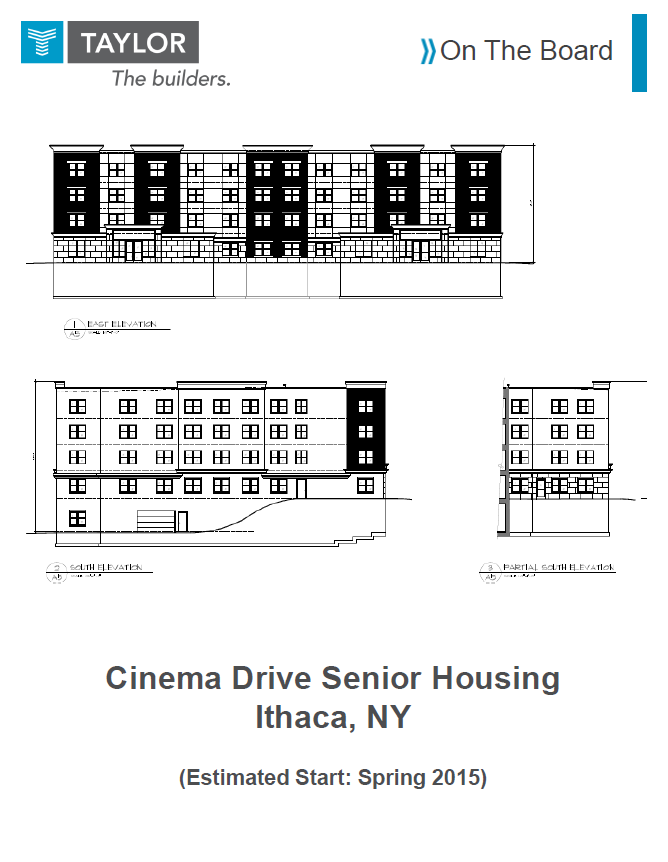
1. Looks like the CU Suites project is in fact the render shared by Taylor Contractors. Readers might remember these elevations from last week for a proposed “Cinema Drive Senior Housing”, but that the image didn’t match up with the proposal, a 3-story, 43,000 sq ft structure. According to the village of Lansing’s Board of Zoning Appeals agenda, the project is now a multi-story mixed-use building with a size of 87,515 square feet, which looks about right for the building proposed above. The project is seeking rear yard setback and height variances for not enough of a rear yard parking setback from the lot line, and for exceeding the maximum height allowed by zoning (which is 35 feet).

Doing some back of the envelope calculations, if one calls only the top three floors senior housing ((3/4.5) * 87515 = 58343) and uses the rough guidelines of 15% for circulation/utilities and 980 sq ft per unit, then one gets about 51 units, which makes this a pretty sizable project by local standards.

inhs_pride_v3_elevations_1 inhs_pride_v3_elevations_2

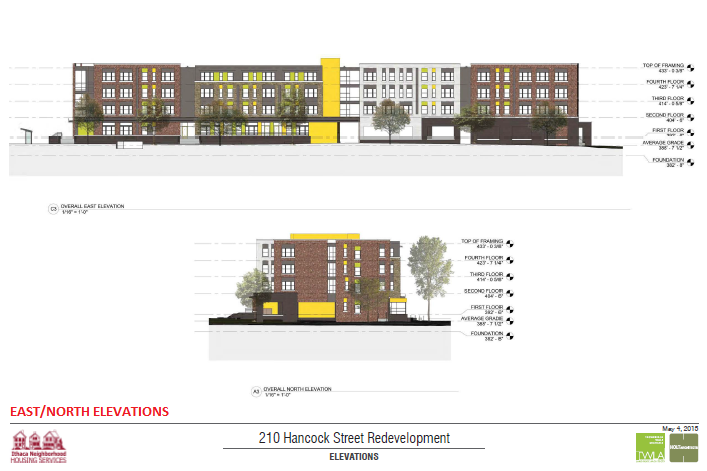
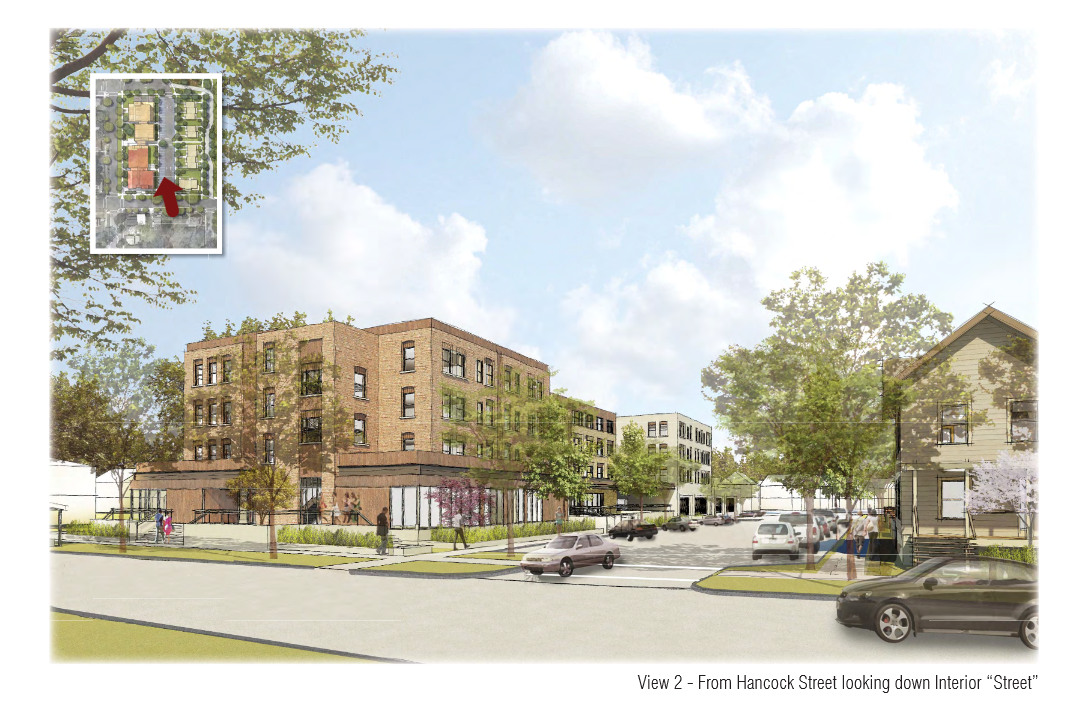
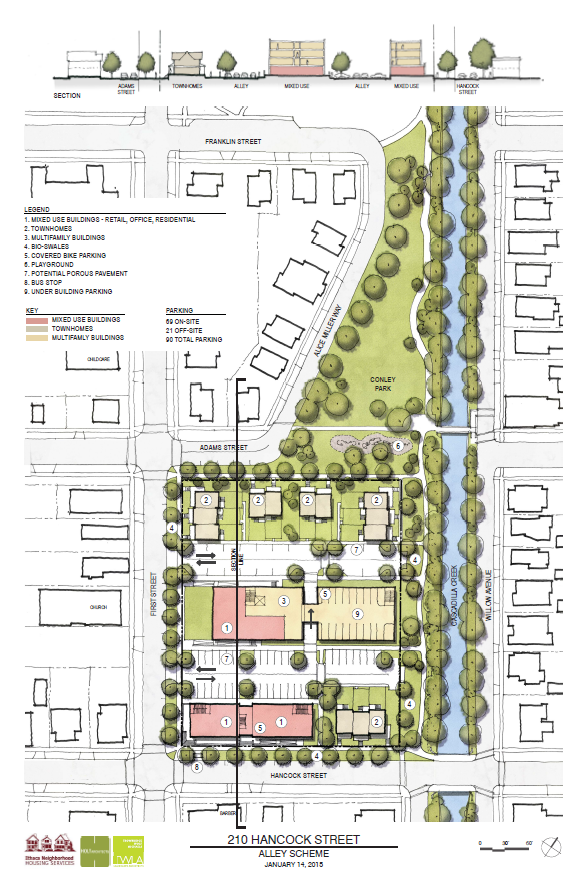
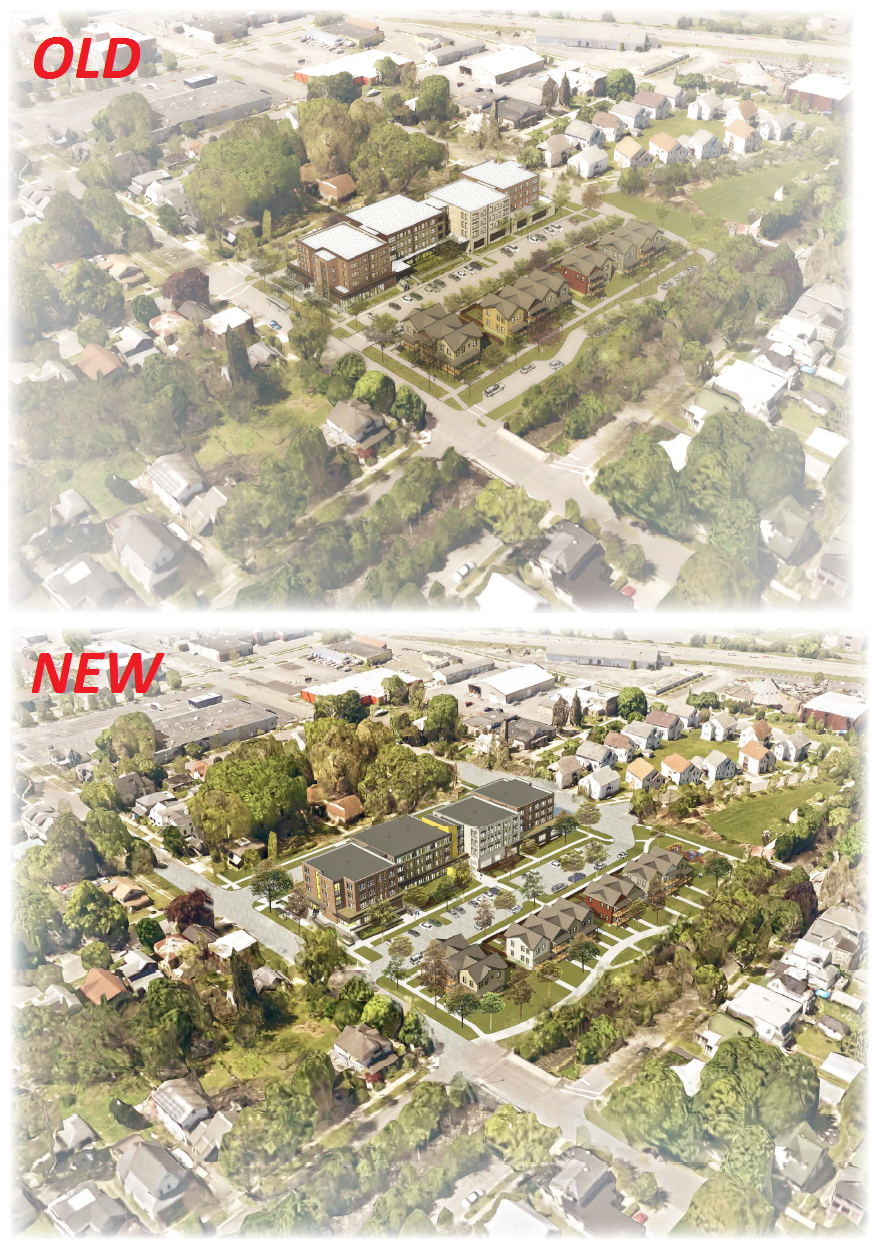
2. Now for a change or perspective – new perspectives of the 210 Hancock project, in the form of elevations found in higher resolution here. Now you can see what all of the buildings look like as a whole, rather than the simulated viewpoints previously shown. The elevations heights give the apartment building’s height at about 40 feet. Apart from some tweaks to the way the first-floor parking is screened, there haven’t been a whole lot of changes since the last planning board meeting. Note that the buildings are tucked in or pushed out and separated by “hyphen” connectors so they don’t present one continuous street wall. The design is by local firms TWLA and HOLT Architects.

Am I the only one who finds the lime green and goldenrod to be a bit..intense when compared to the other facade materials?

112_blair_v3_1 112_blair_v3_2

3. You want more new drawings? You get more new drawings! This batch represents the latest incarnation of the duplexes proposed for 112 Blair Street / 804 East State Street. Renders copied from here, project narrative here. Developer Demos / Johnny LLC (the Nestopoulos family) is still trying to have these ready in time for the Fall 2015 school year. Rather than continue seeking an area variance in zoning, the project is back down to two duplexes with three bedrooms and ~1,235 sq ft each (12 bedrooms total). After meeting with neighbors, it was decided to move back to surface building to reduce building height, and to add expansive front porches, which gives the otherwise bland duplexes a little character. Site Plan Review will take place this month.

clarebridgecrossings_1

4. Looks like there might be an expansion of senior care facilities in Ithaca town. The Ithaca Town Board is set to discuss changes next week to the Planned Development Zone (PDZ) for the Sterling Heights / Clare Bridge Cottage assisted living facilities, located on Bundy Road just north of the city-town line. Sterling House is a 48-unit assisted living facility, while Claire Bridge Cottage is a 32-unit facility specializing in memory care (Alzheimer’s and dementia). The new building, a 23,200 sq ft 32-unit facility to be called “Clare Bridge Crossings”, is designed to bridge the gap between the two – patients who might be in early stages of illness and experiencing mild symptoms, but otherwise still capable of some degree of personal independence.

The new building appears to be a one-story addition tucked between the other two structures, so it won’t be visible from the street. Along with the new building, there will be updates to parking, landscaping stormwater facilities, and the addition of a couple of courtyards between the buildings. The architect is PDC Midwest, a Wisconsin firm that specializes in memory care facilities.

Now, some readers might be saying, “who cares?”. There’s a couple of reasons to care. For one, this is important from a quality-of-life perspective. Picture a senior couple where one is reasonably healthy and the other has memory care needs. It means a lot to have a facility nearby that can care for their loved ones. Secondly, an expansion would bring with it a number of jobs to support the new residents – nurses, maintenance, kitchen staff and so forth. So there’s an economic benefit as well.

Full disclosure – my mother is a nurse who works for an assisted living program that includes clients with memory care concerns. So I’ve heard a thing or two about a thing or two.

east_hill_master_plan

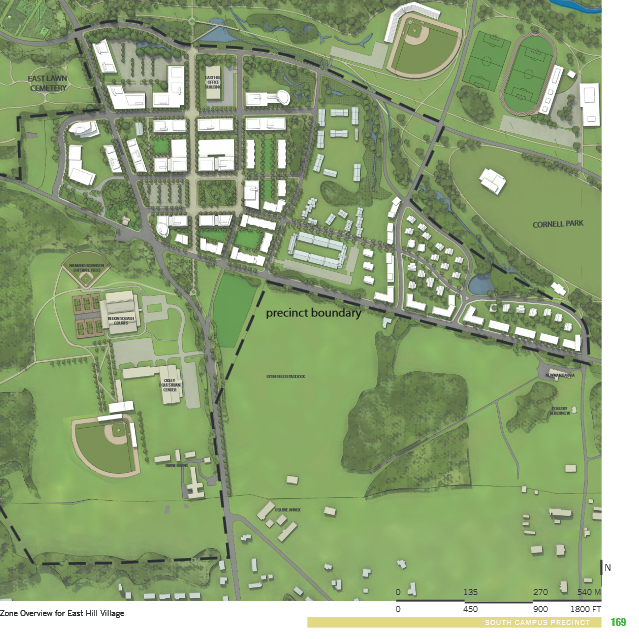
5. On a parting note for the week, here’s a little more information on Cornell’s redevelopment plans for East Hill Plaza. According to Planning Committee minutes from the town of Ithaca, Cornell will be taking part in a multi-day design charrette hosted by form-based zoning proponents FormIthaca in early June. Form-based zoning in a very small nutshell is zoning that focuses on design elements rather than use. Cornell is interested because the plan will hopefully lead to a regulating plan for the “compact mixed-use” development Cornell hopes to build to build in that area. The plan could provide language for a new Planned Development Zone that would potentially allow Cornell to move forward with a housing/retail mix at East Hill Plaza.

Cornell has sought to redevelop East Hill Plaza and surrounding parcels (most of which they already own) for several years. A vision for the plaza shows up in Cornell’s 2008 Master Plan (the so-called “East Hill Village” shown above), and given the need for housing in the area, East Hill Plaza would likely be one of the location where opposition would be less likely, given the the lack of homeowners nearby and the site’s proximity to Cornell.


Belle Sherman Cottages Construction Update, 2/2015

16 02 2015

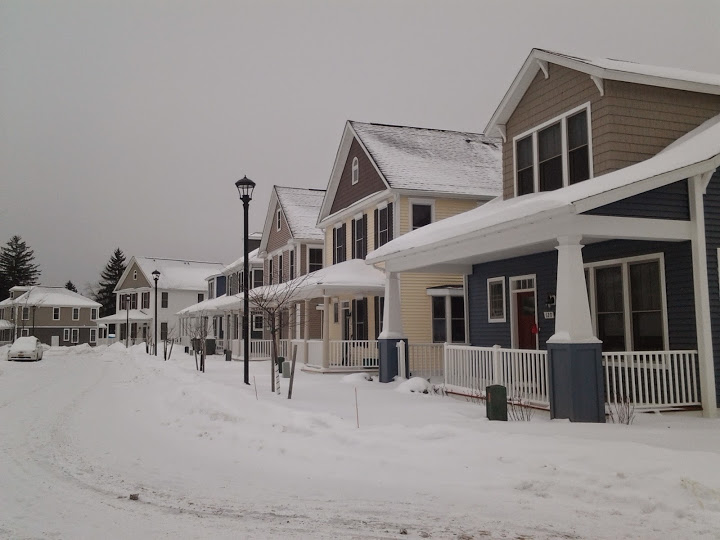
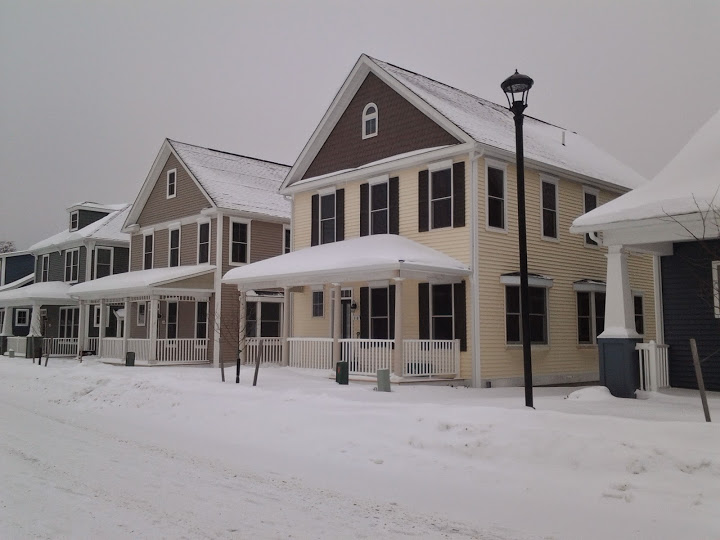
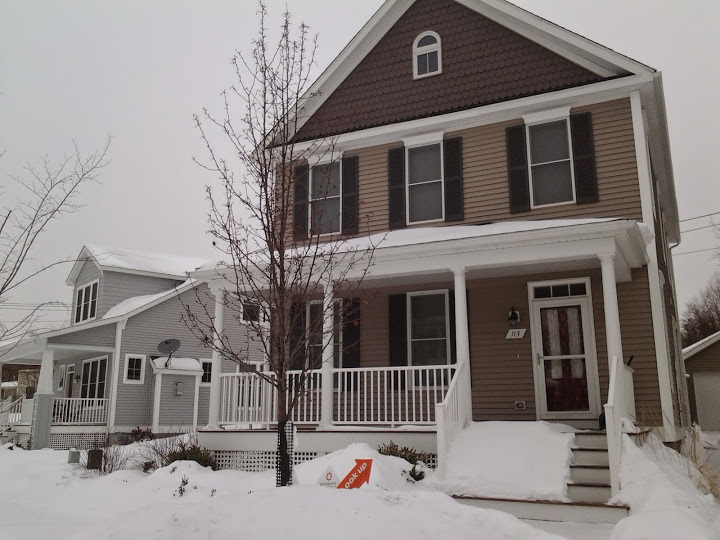
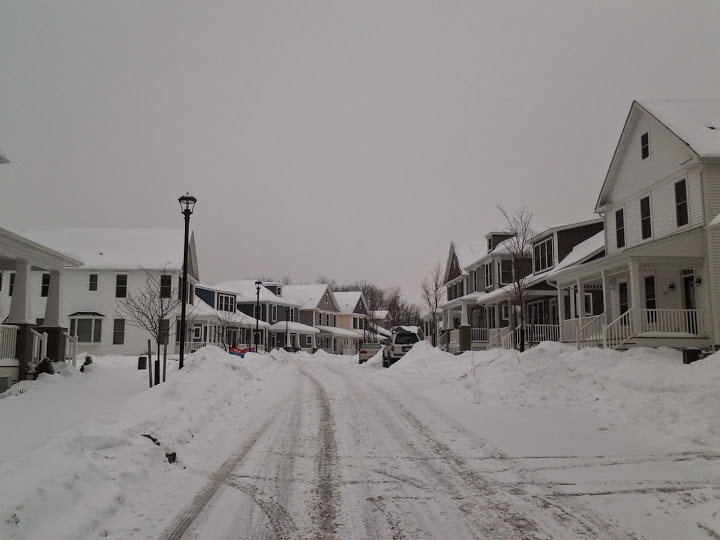
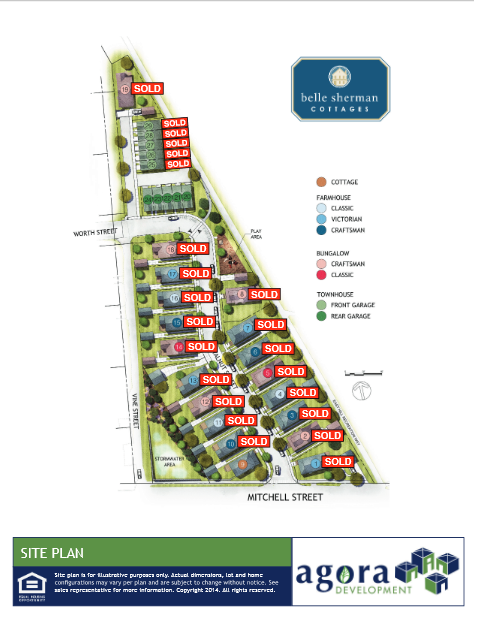
It feels a little surreal to be walking down Walnut Street (fun fact, there was originally a Walnut Street plated for Ithaca’s West Hill in the mid-1800s) and have it fulled out with homes on either side. Yet that is indeed the case. It’ll be easier at this point to count what’s not yet built in the Belle Sherman Cottages development – the townhouses (10 total, 5 due to start this Spring and 5 yet to be marketed), the new cottage design for the not-yet-marketed lot 9, and lots 11 and 12), which are sold and probably awaiting the arrival of warming weather before the foundations are excavated, poured and CMU block is laid. Heck, they might already be poured, but hidden under several inches of snow. So 16 of the 19 houses are built, with a couple of those, like lot 17, undergoing interior finishing and still in need of a little porch/column paint work before being turned over to their new owners. If you’re interested in learning more about the construction process, there’s a little more info in my previous post here, and on Ithaca Builds here.

Every couple of weeks, another sale shows up in the county property records, typically in the range of the low 300s to low 400s. Formal sale isn’t happening until a house is move-in ready (I suspect that while underway, a “sold” lot is actually reserved with a down payment), so following the county’s record of transactions is a useful indicator of progress. According to the Belle Sherman Cottages facebook page, Skaneateles-based Agora Homes and Development intends on completing the 29-unit development in 2015.

Veering into editorial territory here, I’ll admit that I was pessimistic about the project early on, thinking it was too much money for what was provided. But in retrospect, I think this is the right type of single-family housing for more suburban parcels, such as other sites in Ithaca town near the city line. Much of the zoning locally is designed to favor of large lots and large price tags. I wouldn’t call these affordable by any stretch, but they’re somewhat closer to the median value than most other single-family homes going up. Being this close to Cornell also adds a premium on their price tags; perhaps on a site in South Lansing or South Hill, they’d be somewhat less expensive. They’re a good (better?) alternative to the sprawling cul-de-sacs that seem to be the norm for housing developments in suburban Tompkins County. I think that, in the same vein of this project, though with more of a “green” sheen, the Amabel site in southwest Ithaca will be the next single-family development worth watching.

20150207_145459 20150207_145519 20150207_145651 20150207_145707 20150207_145742 20150207_145810 20150207_145843 20150207_145910 20150207_145926

belle_sherman_cottages_102714 belle_sherman_cottages_071814_2


News Tidbits 2/14/15: Zoning Out

14 02 2015

cpoz_1

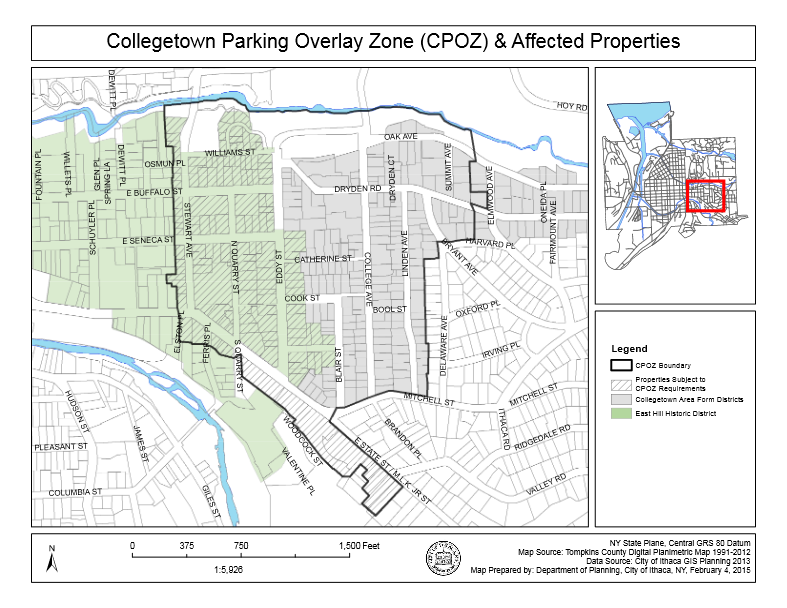
1. Leading off for the week, here’s an interesting piece of news: the city is set to repeal the Collegetown Parking Overlay Zone (CPOZ). The CPOZ was enacted in 2000 as a way to control the parking needs of Collegetown – essentially, it mandated more parking spaces per unit than was standard for a parcel’s zoning. For example, an apartment building of 6 occupants, zoned R-3a, would require 2 off-street parking spaces in Fall Creek, one for every three residents. But on East Hill, that same building would require 3 parking spaces, since the CPOZ mandates 1 off-street space for every 2 residents.

At the time, it made sense; East Hill tends to have more students, who bring their cars to school. But in the past 15 years, the proportion of students bringing cars has declined substantially – a study by Randall/West indicated that in 2000, 49% of Cornell students owned a car; by 2012, it was 27%, a change attributed to the rise of alternative transportation (car share, Cornell-subsidized bus passes), economic and cultural changes. At this point, there’s more parking than there is necessary.

It may seem at first glance that the CPOZ was eliminated with the Collegetown Form Zoning enacted last year, but the two maps don’t match up completely- there are 145 properties that weren’t affected by the new form zoning, but are still covered by the CPOZ parking requirement (see map above). Nearly all of these parcels are a part of the East Hill Historic District (the rest being Collegetown Terrace). A few recent cases, one with Collegetown Terrace and a couple of smaller projects, have highlighted the point that parking requirements have become excessive.

A change to the parking requirements could have a couple of desirable effects – one, less parking would be more historically accurate, and helps to preserve green space in the neighborhood. Two, it opens the idea of replacing a couple of the current parking lots with new housing, which would be designed to fit in closely with the current building stock since the properties are located in the East Hill Historic District (I know, landlords will never give up the money from renting spaces, but perhaps a new small apartment house might be more lucrative than a parking lot; looking at the tax maps, there are a few possible sites, including subdivisions). One mixed effect would be that it’s easier to convert a current single-family lot to student rentals, but the rental would now be less visually intrusive with fewer parking spaces. It’ll be interesting to see what comes forth as a result of this zoning repeal.

industrial_zones_1

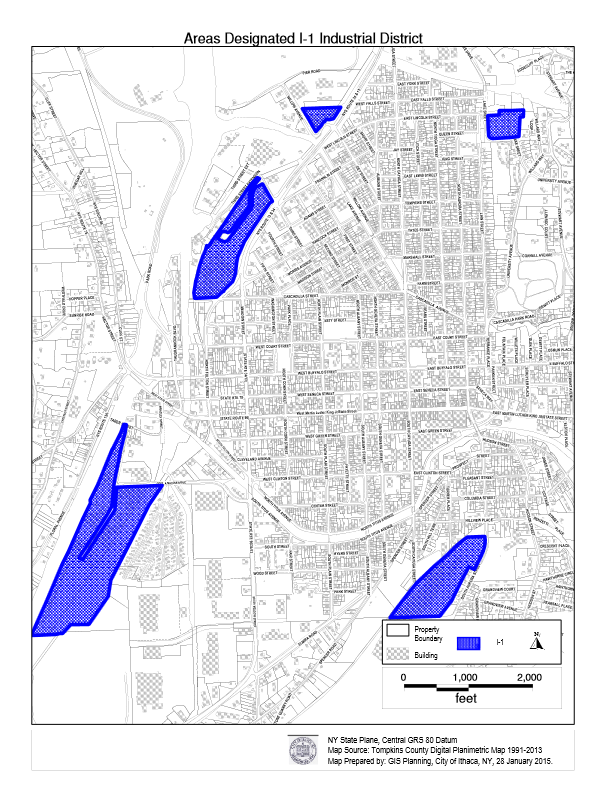
2. Among other zoning changes being considered is a change to industrial zones (the city has just a few). Commercial buildings can be built in industrial zones, but the city wants to raise the minimum number of floors for new commercial buildings in these zones to increase from 1 to 2 floors, a nod to the paucity of undeveloped land in the city (and perhaps the painful attraction of suburban big box stores). There are five sites on the map above, but it might as well be three – Emerson (lower right) is becoming a planned development zone, and the Ithaca Gun site (upper right) is expected to be rezoned from industrial to medium-density residential, in preparation for an apartment project still in the works.

canopy_hampton_rev4_1

3. What is up with the proposed hotels constantly delaying their schedules? First the Marriott pushed back its opening from Spring 2016 to Q3 (July-September) 2016. Now the Canopy Hilton is pushing their schedule back, from a construction start this Spring to an autumn start, which makes it difficult if not impossible to realize the cost savings from reusing the crane for the Carey Building. The tax abatements aren’t going to take that long to obtain, maybe another month or two before the county takes its vote.

Presumably, the project would open in autumn 2016 if the construction schedule is similar. But I feel like these delays send a message of incompetence, and that’s the last thing a project needs.

inhs_pride_design_6

4. Maybe the article I wrote about the new INHS project will have run in the Voice by the time this auto-publishes. But here’s a render that I decided to leave out of the final article to minimize space. The city uploaded the initial application Friday morning (sketch plan will be presented this month), and I’ll write a follow-up article, based on the application paperwork (so it will be different from the Voice article), and post it here on Ithacating in the next few days.

Cayuga-Meadows-Shot

5. Staying on the topic of affordable housing, these agenda notes from IURA Neighborhood Investment Committee reminded me of another affordable housing project that totally slipped off the radar- Cayuga Meadows, a 62-unit apartment building for seniors that was approved by the town of Ithaca for a site near Overlook at West Hill in late 2012. On page 52, it’s noted that the project is supposed to open in November 2015. That would imply that it should be starting construction soon if site prep hasn’t started already (I haven’t visited the site in over a year, so I have no clue). The pipeline document is dated from February 2014, so I have no idea if that’s still accurate. I emailed its developer, Conifer LLC, to see if the project was active, but received no response. Still, it’s something to keep an eye on.


News Tidbits 2/7/15: It Snows In Ithaca, But Verizon Makes It Rain In NYC

7 02 2015

1. As relayed by several outlets, Cornell just received a very generous $50 million donation from telecommuncations giant Verizon. I might make more news about this, but this donation is strictly for the shiny new tech campus down in New York City. The “Verizon Executive Education Center”, in the left of the above render, will be part of the first phase of the campus, set to open in 2017. This goes along with a 6-story, 236,000 sq ft building design by Weiss/Manfredi, and a 4-story, 188,600 sq ft building by Morphosis Architects, both of which are already underway. The skyscraper on the right of the render is a 26-story, 500-room dormitory for students and staff designed by Handel Architects; while not yet underway, it is also slated for a 2017 opening. A design for the tall building on the far left has not been released.

I’d like to see a breakdown of what proportion each campus received from Cornell’s $546.1 million in donations.

2. Looks like some Sun writers decided to do some digging regarding the potential Fine Arts library relocation and expansion. There’s not a whole lot more to add since the Ithaca Voice article; just that the timeline and final design haven’t been set, although the renovation is a “key academic priority”. Students of the AAP school also have mixed opinions about the growth of the library and the possible loss of studio space. But don’t fret dear readers, if a render comes out, it and any pertinent info will be shared here.

424_dryden_rd_1

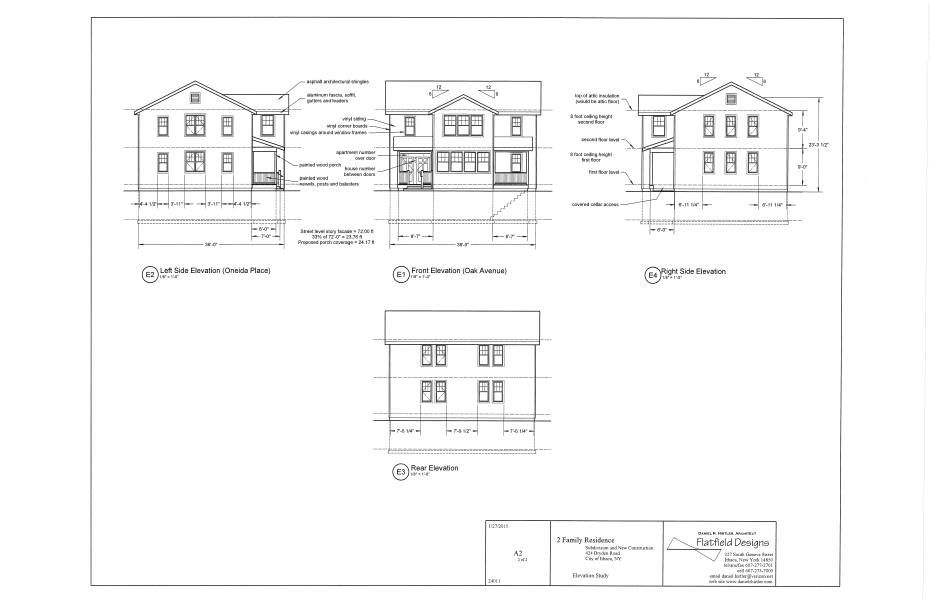
3. A subdivision filed with the city of Ithaca indicates plans for a new two-family, 6-bedroom home at the intersection of Oak Avenue and Oneida Place. The house would be built on land that currently serves as a rear parking lot for 424 Dryden Road. Application here, drawings here. The site falls into the CR-2 Zone of the Collegetown Form District, meaning 2-3 floors, and pitched roofs and porches are required. The architect is Daniel Hirtler of Ithaca, and the developers are William and Angie Chen, also of Ithaca. While not particularly notable, it’s an example of how the form-based zoning applied to Collegetown helps maintain the character of the less-dense outer neighborhood, while still allowing for new construction.

canopy_hampton_rev4_1

4. As with virtually every other sizable project in downtown Ithaca, the canopy Hotel by Hilton is filing an application requesting a tax abatement through the CIITAP program, making it the sixth applicant since the revised program was put into affect in 2013. Application here, and the notice of  public meeting, set for 5 PM February 9th at City Hall, is here. A refresher/review of CIITAP can be found here.

The applicant, “Ithaca Downtown Associates LLC”, a.k.a. the Patel Family of the Baywood Hotels Inc., notes that the 7-story, 123-room hotel project has an estimate cost of $20.15 million. Although the value of the tax abatement is not recorded in the city’s application (it will be written out, when reviewed by the county IDA), it looks like they’re seeking the standard 7-year abatement, which will save them something in the ballpark of a couple million dollars over those 7 years.

As with the previous Marriott and Hotel Ithaca applications, the applicant will only pay one-third to one-half of its projected employees a living wage, which is probably going to earn them the scorn and opposition of the Tompkins County Worker’s Center. But the city and Downtown Ithaca Alliance have been supporters of the project. Neighboring businesses seem to be have mixed opinions about the project, with some seeing a potential business source, and others mourning the loss of a convenient parking lot.

The 74,475 sq ft project is expecting to start construction during the spring, with completion in Spring 2016. Local firm Whitham Planning and Design is the architect.

For those already planning a stay, expect room rates of $160+/night, according to the Journal.

inhs_pride_alleydesign_v2

5. It’s PSA time again – INHS is planning meeting #4 for its proposed Neighborhood Pride redevelopment at 4:30 PM Wednesday the 11th, inside the vacant Neighborhood Pride grocery store. The one and only final design concept, shaped by community feedback, will be presented at this meeting. Keep an eye on the Voice for an article (and maybe a rerun here) next Thursday or Friday.

lake_st_bridge

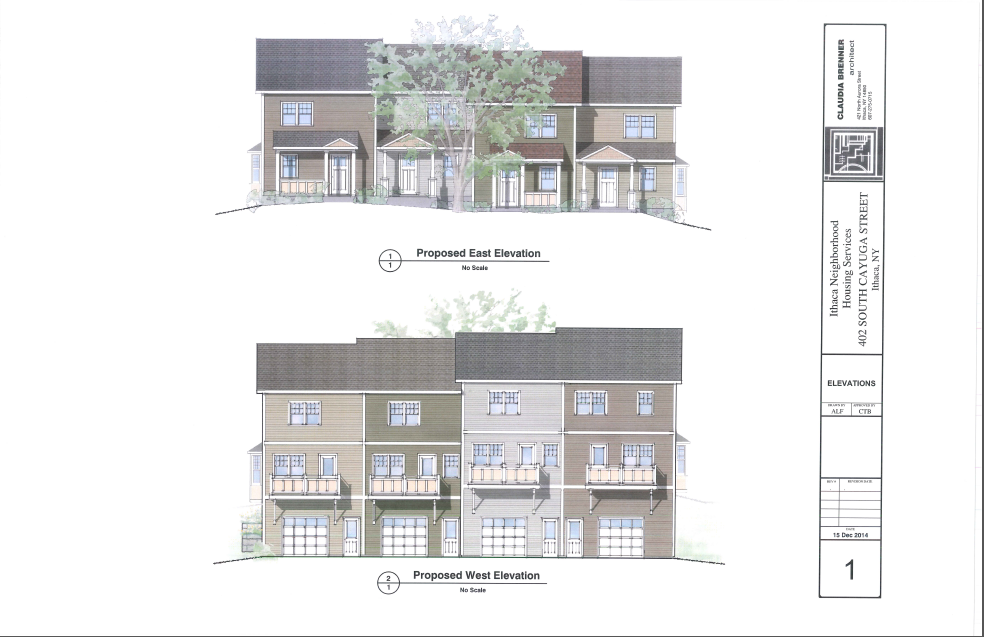
6. Looking at the city’s project memo going out to its departments, it doesn’t look like a whole lot needs to be reviewed this month. Cornell’s Upson hall renovation, the 6-unit building at 707 E. Seneca, and the 4 for-sale townhomes INHS wants to build at 402 S. Cayuga Street are ready for final approval this month. The 3-building, 6-unit project for 804 E. State (112 Blair) still needs to be reviewed by the zoning board, and will be completing environmental review (SEQR determination of significance).

The only new projects of note are the new house at 424 Dryden, and renovations to the Lake Street Bridge. The bridge project consists of rebuilding the current deteriorated bridge with a new deck and refurbished abutments (base supports), as well as scour reinforcements (to protect from creek erosion), a bumpout for viewing Ithaca Falls, some cute light-posts, and a bridge span that isn’t so degraded that it’s liable to collapse into the creek. That project has a $1,000,000 price tag, and is expected to run from June to November of this year.

For those that use this bridge, start prepping for a detour route – the bridge will be closed during construction, to both vehicles and pedestrians. The city estimates the detour will be an extra 1.7 miles for cars, and 0.7 miles for bikes and walkers.


Tompkins County’s Comprehensive Plan

3 02 2015

5-1-2012 120

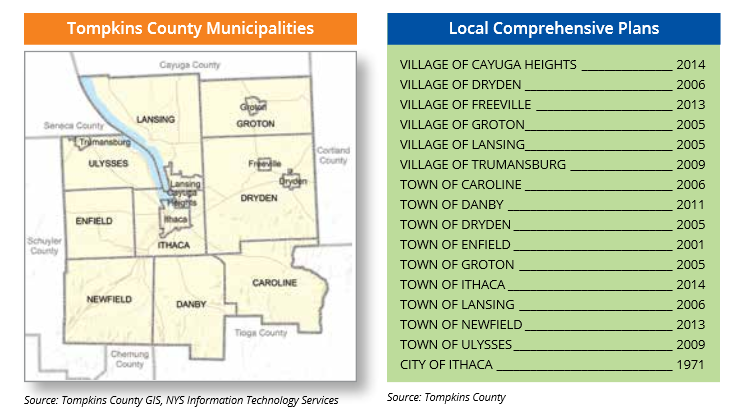
In keeping with the recent talk of Comprehensive Plans, Tompkins County has just released their new plan, their first since 2004. That might not seem like a big deal, but in that time period, the county has probably added 4,500 residents and a couple thousand housing units, so it’s more important than it might seem at first glance (for the sake of comparison, every county community except Ithaca city has made a plan since 2000; the city’s dates from 1971). Currently, the plan is in review and up for adoption by the County Legislature at their meeting on the 17th. The 109-page document has been in the works since the fall of 2013.

tc_compplan_1

Generally, the county doesn’t play a big role in what does and doesn’t get built in its constituent villages and towns. Building projects are required to get county input, but the county isn’t about to stop anything, nor does it have much authority to (unless you’re applying for tax breaks, like Jason Fane’s 130 E. Clinton project). Perhaps the largest point of contention at the moment is the intermunicipal NYSEG natural gas pipeline, which Lansing wants and needs to sustain its growth, but the county has issues with, saying it could upset their green energy goals. On the opposite end of the scale was the Cayuga Ridge project for the Biggs parcel, which the county planned to sell to an affordable housing developer, but received significant blowback from the West Hill community. Cayuga Ridge was later cancelled when a site check by the developer revealed more wetlands than previously thought.

Anyway, back to the plan. It’s available in small chunks on this page, or for those whose internet connection can handle all 109 pages at once, here it is.

The general theme here from a housing standpoint is to fill in the spaces within the city, villages and hamlets. There’s a strong push on the county level to keep farmland from being scooped up for new development – a major threat, considering some of the cheapest land to develop in the county happens to be far-flung agricultural properties, where a relative lack of neighbors and shoestring small town planning boards can make for a quick and easy process. The logic is, if development takes place in communities that are already settled and already have employers and amenities, it limits the need for getting into a car for every trip, and makes for a more “sustainable” environment and stronger communities. Urban/infill development also makes for a lower tax burden per new unit added – there’s no need to pave new roads or extend utility lines.

The county is also becoming a bigger proponent of mixed-use development – apartment buildings with retail on the first floor, projects that have space for both homes and offices, and so forth. The logic is the same as before – if it’s convenient, people are more likely to walk, and patronize their own community. Trends in smaller households leads to the county’s suggestion of smaller housing units, as well as more senior housing for the greying population that chooses to “age in place”.

This all sounds great on paper, but there are many issues in practice. Anti-development sentiment, the ideal candidates for development aren’t for sale, outdated municipal zoning and so forth.

Economically, the county plans on sustaining its biggest contributors, education and healthcare, while making an effort to diversify with incentives towards manufacturing, high-tech/tech startups, food processing, agriculture and tourism. Specifically, they’re hoping to leverage the Cornell tech scene into permanent jobs and new economic development, which has met with some success, though nothing on the scale of, say, Silicon Valley or the Research Triangle. The high taxes, isolated location and lack of access to capital are major hurdles in an area that has plenty of brain power to tap into. The county is hoping to alleviate some of the burden by utilizing the state’s STARTUP NY program, and supporting resources like the new Rev business incubator in downtown Ithaca.

tc_compplan_2

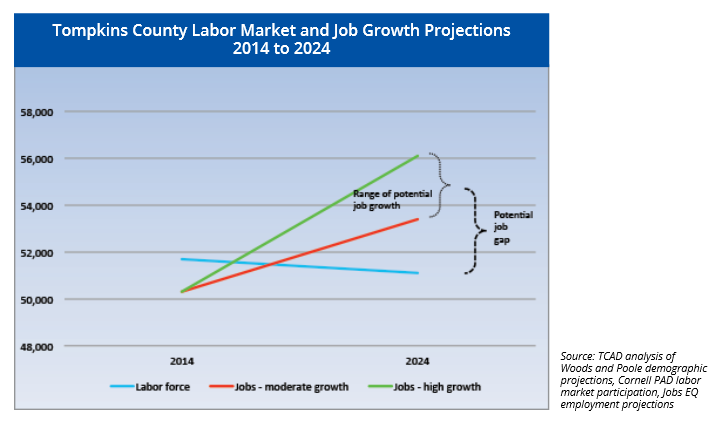
The county only seems to be expecting 3,000-6,000 new jobs in the next ten years – a number that seems a little conservative, if recent growth is any indicator. The county (aka the Ithaca metro, following the Federal BLS) has added 8,400 jobs since December 2004 (63,700 jobs in December 2004 to 72,100 in December 2014).

On an individual scale, the county is seeking to expand broadband internet infrastructure and maintain the airport, which has seen a sharp decrease in travelers over the past year, putting its long-term feasibility at risk. There will also be continued funding towards planning studies (a study examining the NYS DOT relocation from the waterfront is the latest example), tourism advertising and tax abatements when appropriate.

Finally, the county expounds the affordable housing issue, noting that 38% of renters and owners are above the “affordable” threshold, there are over 15,000 in-commuters, and very low vacancy rates creates a disincentive for slumlords to fix up their overpriced properties, which in turn makes communities less energy-efficient. Unfortunately, the county doesn’t offer many solutions. They note an affordable housing fund paid into by itself, the colleges and the city of Ithaca, put the partnership is set to expire this year, and the future is uncertain. The other is “increasing community support for the construction of more housing units”, which is much easier said than done.

There also sections on encouraging mass transit and alternative (non-car) commuting, natural resource preservation and wetland management, but those are too close to my day job for me to want to write about. But in sum, the theme is infill development in the hamlets and established areas, make the area more eco-friendly, preserving farms and green space, trying to expand affordable housing options and continue growing the economy. All of which are great goals, but given that these interests can conflict with each other, there will likely be many debates over the next several years.


News Tidbits 1/3/2015: Ringing In the New Year

3 01 2015

trans_developments

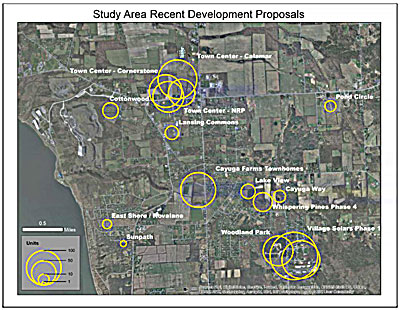
1. Leading off this week, here’s an article from the Lansing Star discussing a transportation study for Lansing. While I can’t say transportation studies are my cup of tea, the map of proposed developments certainly caught my eye.

Most of the large-scale developments are associated with the quagmire known as Lansing Town Center, and most of the smaller circles are single-family housing tracts. I dunno how much I trust this map though, because I thought the ~30 lots of Lake View/Whispering Pines/Cayuga Way were all the same project, and Cottonwood’s 20 lots only exist on maps. The 400+ units down towards the airport will make the intersection of Warren and Rte. 13 even more heart-racing. My back of the envelope math says the total number of units that I’m aware of is about 600 outside the town center projects, with more in the pipeline according to the town planning board’s latest minutes. That’s pretty impressive for a town that averages 25-30 units per year. This all makes for exciting math, but I have serious concerns that Lansing doesn’t know how to manage its growth.

20141220_163744

2. Normally I don’t write about just one house. Unless it’s the one lot in Ithaca town where adjusting the property line made it buildable, and drove the neighbors crazy. Then I write about it. Looks like that parcel on Tudor Road sold and an unassuming ranch-style home is under construction. I wonder if the six vacant lots on nearby Circle Lane will ever be developed.

upson_5

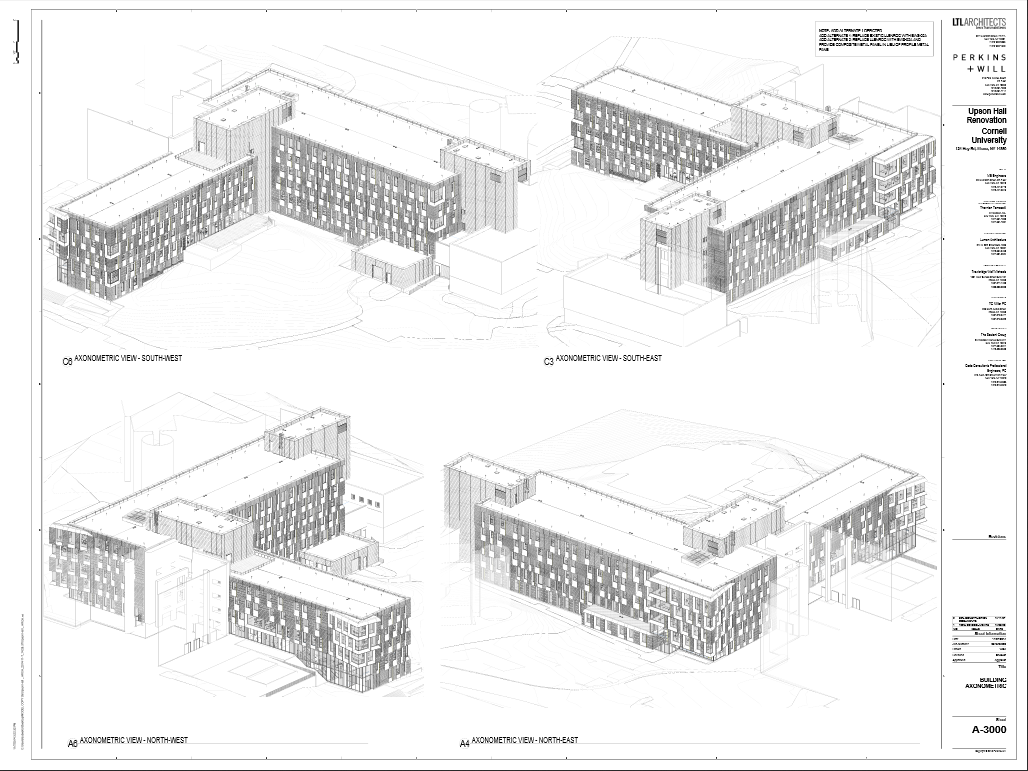
3. In typical Cornell fashion, reams of documentation have been provided for their upcoming Upson Hall renovation, which is due to go up for site plan review by the Planning Board in late January. I’ll boil it down to a few salient details. From the application, here are the numbers: the estimated cost is $40 million. The additions at the entrances will result in a net increase of 4,000 sq ft (Upson Hall is about 160,000 sq ft). The construction time frame is June 2015 to September 2017. There will be no additional jobs after completion, but about 150 construction jobs will be supported by the project (with at least 40-60 on-site on any given day). Here are elevations and renders, existing conditions, utility and demolition plans, floor and roof plans, phase 3 landscape drawings, the planning board presentation for January, construction stage diagrams, more staging and landscape plans, and a profile of the terracotta to be used in the new facade. It’s Cornell – where most applicants don’t provide enough info, Cornell overwhelms (not unlike a “shock and awe” military doctrine).

sonic_indoor_seating_location_rendering-thumb-525x262-15871

4. For those of you looking for your greasy drive-in food fix – The corporate parent of Sonic Drive-Ins is actively looking for an Ithaca franchisee. As part of its upstate NY roll-out, they’ve developed a new corporate design (pictured) that is more appropriate for the local climate, with large interior seating areas. Start-up costs are typically pegged around $500,000, with a total investment closer to $1.5 million. So if you know someone with restaurant experience and a cool million just lying around, Sonic would like to talk with them.

5. The Ithaca Times has come out in opposition of the IDA’s vote to not grant tax abatements to Jason Fane’s 130 E. Clinton project. This must be one of those rare times we agree. I do appreciate that they called out the steep slope argument, which is bull crap. They also point out that the door is open to an Article 78 lawsuit from Fane, if he’s feeling vindictive and that the IDA decision was made unjustly. Is there a chance he’ll do that? Yes. Is there a chance he’ll win? Also yes, if his lawyers can prove the decision was based on character judgement rather than the project itself. The project may be cancelled, but I don’t think Fane is done quite yet.