The Future is Now? Another Look At Form-Based Zoning

9 02 2016

It looks like plans are starting to come together for the form-based zoning that is being considered for the Town of Ithaca. Form Ithaca, whom have been working pretty closely with the town on their new plan, released the results of a study on their website last month. Based on the date of the PDF (the 22nd), it looks like it went up before the neighborhood plan meeting, and the write up on that meeting will make it into the Voice at some point.

form_ithaca_pt2_1
One of the key things that the code seeks to establish is to simplify the code from the current use-based setup (called ‘Euclidean” after the Euclid, Ohio court case that established its legality) to something based on size and shape. The current setup handles mixed-use projects poorly, and PDZ and PUDs create a whole lot of paperwork and eat up time the town could spend handling other issues. Another problem is that the Euclidean zoning purposely establishes work areas away from residential zones, which encourages car-dependent, parking-heavy types of development, the kind that are more expensive to maintain, more environmentally demanding, and increasingly out of favor, especially with younger demographics.

form_ithaca_pt2_2

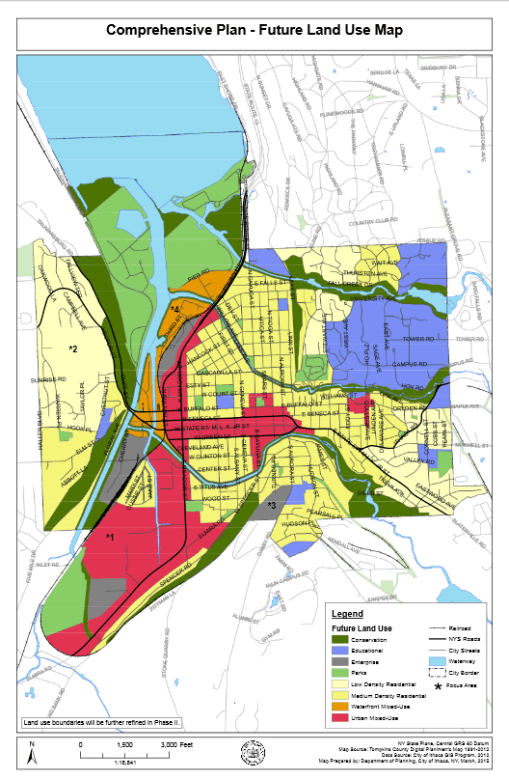
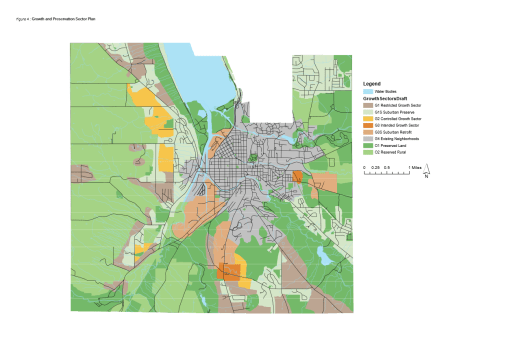
The above map is a rough idea of where Form Ithaca feels development would be best directed. The darker greens are either prohibited (O1, Preserved Land) or strongly discouraged (O2, Reserved Rural). Then from G1 to G3S, you have increasing levels of support for development and dense development. The only “new” neighborhoods established by the G3 zone are the South Hill Center (the 96B/King road intersection) and Cornell’s Maplewood Park east of the city. As already mentioned in the Maplewood writeup, Cornell’s pursuing a PDZ for the new urbanist project they have planned because their timing is a little quicker than Ithaca town’s – waiting for the new zoning would delay the project.

The plan also calls for retrofitting suburban areas, G3S. The 96B/South Hill Corridor,East Hill Plaza, and the city’s Southwest Corridor and Waterfront are targeted. The 96B corridor is currently undergoing a pedestrian and traffic study in part because the town wants to figure out how to protect pedestrians and encourage pedestrian-oriented development in what’s currently a suburban layout.

Recently, there have been privately-developed plans that haven’t been on board with these ideas. On the one end of the spectrum, early incarnations of the Troy Road housing development that was cancelled, which called for 200+ units in a “Restricted Growth Corridor”, a proposed type of zoning that suggests clustered development with substantial open space requirements. The project had been redesigned and reduced to fit 130 units in cluster zoning, but it was then cancelled. On the other end of the spectrum, the town is currently weighing a proposal to purchase agricultural easements on Eddy Hill Inc.’s farmland, which comprises most of the yellow on the southwest side of the town. That would prevent development in an area where development is thought to be more suitable.

form_ithaca_pt2_3

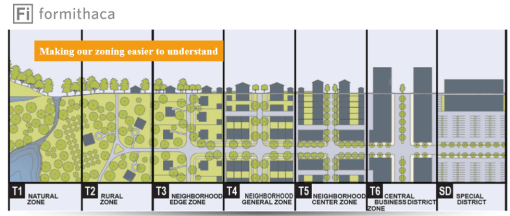
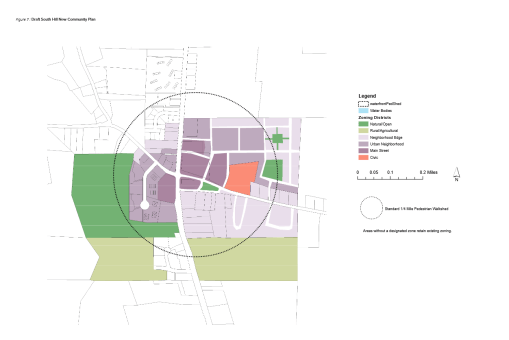
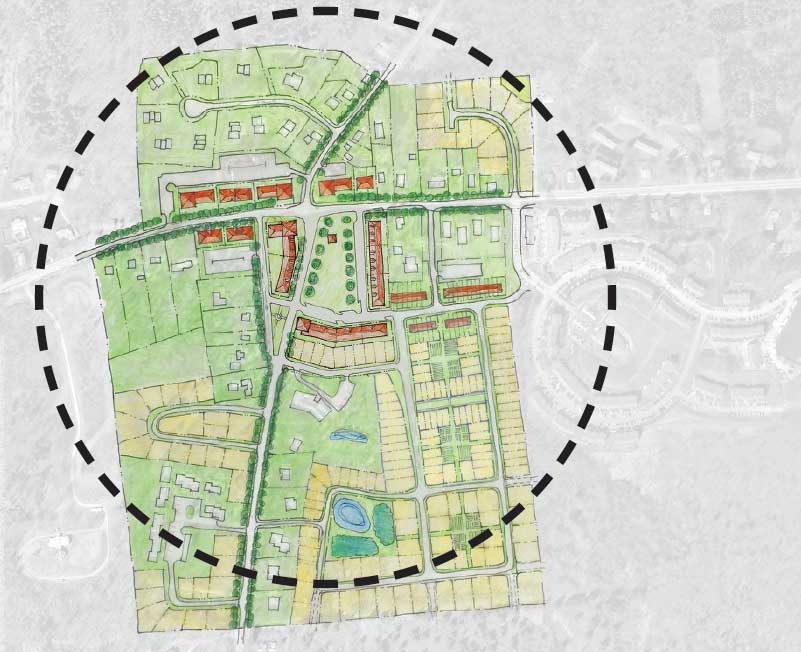
The above image is a proposed zoning setup for the South Hill center. Neighborhood Edge defines more typical single-family home development (T3), Urban Neighborhood towards a Fall creek type of density (T4, townhouses, duplexes/triplexes, closely spaced single-family homes), and Main Street would be more akin to the State Street Corridor (T5), first floor commercial or other active uses with apartment and condos on the couple floors above.

form_ithaca_pt2_4

There’s also an image regarding the Waterfront plans, but given the Maguire proposal, I’d rather wait until the dust settles and there’s a better idea of what’s going to happen.

This is all conceptual, and there are pros and cons – while it encourages less driving and establishes an activity hub in the town, it’s been noted that mixed-use can be more expensive to develop, which may be passed on to the occupants. Also, rezoning can impact current owners and create some tensions. Telling someone that density is encouraged in view of their house may not go over well, just as the landowner planning to sell to a housing developer may not be amused to find himself at odds with the town’s plans. But, given the issues facing Ithaca and Tompkins County, proposing something that attempt to address affordability, demographic and environmental issues is better than proposing nothing.


Cornell Finally Moving Forward on Maplewood Plan

3 02 2016

maplewood
Finally, finally, some real news. Cornell, through its Chronicle news outlet, has issued a statement regarding plans for the Maplewood Park Apartments replacement. Let’s look at the most important details.

– Cornell will be partnering with collegiate housing developer EdR. Cornell will own the land, but EdR will finance, construct and manage the development.

– Groundbreaking is expected this fall, with a summer (August) 2018 opening.

– Approximately 850 bedrooms are anticipated in the first phase, which is only for graduate and professional students. No undergrads here.

– Designs and unit mix are not yet finalized

– To quote Jeremy Thomas, Cornell’s senior director of real estate: ““Our goals for this site are to foster a close-knit neighborhood feel, while connecting this community through walkways and outdoor spaces to the university and surrounding neighborhoods, including the East Hill Plaza area where we are planning future mixed-use development.”

– EdR and Cornell will be meeting with neighborhood groups, the local landlords’ association, and since the project will contain a sizable portion of family housing, the ICSD.

Now, with all that acknowledged, let’s do a little more research. First, the developer. EdR (formerly Education Realty Trust) is a Memphis-based student housing developer following in the steps of Campus Advantage, CA-Ventures, and others who have tried and failed to make their way into the Ithaca market. The difference is, apart from EdR also being a Real Estate Investment Trust that finances its own projects (REITCampus Advantage was not, nor was Campus Acquisitions before it was bought), the company has Cornell’s blessing and the proposal is on Cornell land, which are very, very important cards in their hand. It would take a huge flaw to make local officials come out against this project, which will address a critical student housing shortage at the university.

EdR has been through upstate a few times before, though not in Ithaca. They developed and manage student housing for SUNY ESF in Syracuse (454-bed Centennial Hall), and developed two private apartment complexes adjacent to Syracuse University, the mixed-use 312-bed Campus West project, and the 423-bed University Village Apartments. They have a mix of arrangements with different schools – the SU projects are totally private, but Centennial Hall is owned by ESF and managed by EdR, an arrangement that sounds pretty similar to what Cornell will be doing.

Looking at the profile, I can’t find too much of a pattern in the choice of architects. In many cases, they’re local (the Univ. of Kentucky projects used Sherman Carter Barnhart, a Lexington firm, while University Village and Campus West used Holmes King Kallquist, a Syracuse firm), but there’s a few wild cards from outside a region – Centennial Hall used WTW Architects of Pittsburgh. In sum, it looks there might be a slight preference towards firms local to a project site, but apart from that, the chosen designers are literally and figuratively all over the map. EdR looks to have focused on mixed-use, compact and urban-friendly projects with their more recent partnerships.

As for price range, we’re talking some serious coin being tossed around. The Syracuse projects, which are half the size of Cornell’s project, cost $28-$30 million. EDR, in its own press release yesterday, estimates the project will cost about $80 million. Or course, it will be tax-exempt, but that much money translates to a lot of construction jobs, and Cornell is a strong supporter of trade unions. Local companies might get in as subcontractors, but with a project this large, one of Cornell’s preferred circle of general contractors (Welliver, Pike, LeChase) will most likely tackle the overall buildout.

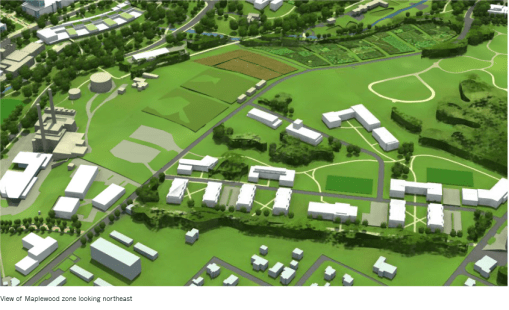
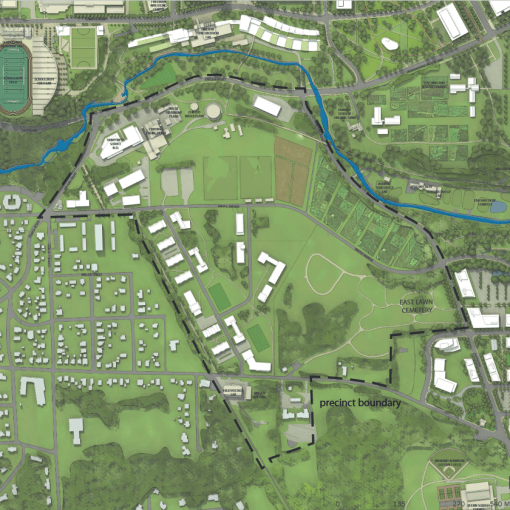
Now, thinking about the project itself, if it’s 850 beds (rough assumption of one bedroom per person), that’s almost twice the capacity of Maplewood and its 394 units/480 beds. Maplewood is 109,000 SF of usable space (122,000 SF gross) and sits on 16.02 acres. So the current density is about 24.6 units/acre, or 30 beds/acre, in one-story buildings that cover the vast majority of the site.

maplewood_3

The 2008 Master plan, if it’s any indication, calls for 15-30 units per acre (the number of beds is left up to interpretation) and up to 400,000 SF of space in 2-4 story buildings, creating a more campus-like appearance by going vertical instead of spreading out as the current Maplewood does. While the layout in the plan was totally conjecture, the specs are not. The town of Ithaca zoning (High Density Residential) caps it at 36 feet, but Cornell could probably get a floor or two of variance without much difficulty – the town’s 2014 Comprehensive Plan recognizes Maplewood as one of the appropriate sites for “Traditional Neighborhood Development High Density“, dense mixed-use thoroughly integrated into the surrounding street fabric, 6-30 units/acre but averaging 8-16 units/acre with 10-20% open space.

There’s one last detail to mull over in all of this. According to the city, Cornell will be exercising its right to take back the Ithaca East apartments to the east and northeast of Maplewood (I spoke/emailed with Abbott about this a few days ago when the city docs were released, so…convenient timing). According to property manager Bruce Abbott, Cornell renews every June and he has two years to finish out his management of the property, so Cornell won’t take over Ithaca East until June 2018 at the earliest – which would be just in time for a second phase if Cornell desires, right as phase one is finishing up. Cornell also purchased the homes between Maplewood and Ithaca East, in 1998 and 2013. So looking further ahead, here’s an adjacent 8.2 acres that seems likely to fall under the Big Red development radar in the next couple years, not to mention future plans for East Hill Plaza. EdR is going to be very busy over these next few years.


News tidbits 1/16/2016: The Not-So-Best Laid Plans

16 01 2016

elmira_savings_1

1. It isn’t exactly a shock that Elmira Savings Bank is pursuing plans for the $1.7 million in properties it just acquired on the west 100 block of Meadow Street between West State and West Seneca Streets. That being said, sending out 30-day eviction notices wasn’t a very good idea from a public relations standpoint.

Technically, it’s all above the law – the three tenants affected were on month-to-month leases, according to Nick Reynolds over at the Journal, and one had an expired lease and was in the process of relocating. The bank wasn’t interested in renting out the properties and decided to clear them out. That is plausible, if a little brusque – even if they had put forth a proposal for something at the next Planning Board meeting, approval would take months, in which case they could eased the tenants out of the current property. But instead, they ended up with a petition that, while mostly reading like a speech from the Politburo, does make the valid point that this was conducted poorly. Then it hit the airwaves, and the bank has gone into major damage control mode, giving the tenants until the end of March and reimbursing them $1,000 for the trouble.

Looking at some of the comments on the Voice, there is a lot of outcry against gentrification, but there’s not a whole lot the city can do to prevent that – even if Elmira Savings Bank didn’t build a thing and sold the buildings to someone else, the rapidly rising property values around the city would push the renters out, albeit more subtly, and the city can’t make a law that says someone can’t move in. Plus, as seen during the 210 Hancock, Stone Quarry and Cayuga Ridge debates, there’s a lot of pushback locally against affordable housing. Arguably the best solution going forward is to work an inclusionary zoning ordinance into law so that when Elmira Savings Bank does decide to build (and it’s more of a when than an if), that a few of the units be made available to those on more modest incomes.

Just to touch on that real quick, according to the Journal, the old Pancho Villa building at 602 West State Street will become a bank branch for ESB in the short-term, and plans are being considered for a mixed-use project at some point down the line (two months, two years, who knows). The zoning is WEDZ-1a, allowing for a five story, 65′ building, but there might be tweaks to that depending on the inclusionary zoning ordinance.

tmpud_waterfront_1

2. Keeping a focus on the west side of the city, the Planning and Economic Development Committee voted to circulate a proposal for a “Temporary Mandatory Planned Urban Development” (TM-PUD) over the waterfront. The reason for this is one part proactive, and one part reactive.

What the TM-PUD does is, for an 18-month period starting the day of Common Council approval, it gives the Common Council the right to oversee and if necessary vote down projects that it thinks will not be appropriate for the waterfront. The study area is currently a mix of zones: Waterfront (WF-1, WF-2), Southwest Mixed-Use (SW-2), Park (P-1) and Industrial (I-1). When the Comprehensive Plan was passed in 2015, it promoted a more walkable, dense, mixed-use waterfront. Therefore, some of the zones are outdated.

The city’s planning department is still in the process of drawing up specifics for how to implement the Comprehensive Plan’s walkable urban waterfront, but in the meanwhile, some of the zones don’t match up with the direction the city wishes to proceed. Take, for example, the industrial space on Cherry Street and Carpenter Circle. By zoning, residential uses aren’t allowed, although the city would like to see mixed-uses with condos and apartments in their vicinity. The planning department needs time to figure out the what and where on zoning so that those uses can be proposed without a developer spending extra months in front of the Planning Board and BZA, which can drive up costs and make construction financing more uncertain.

So that’s the proactive, benign part – the city needs time to plan out the zoning laws for the dense waterfront they want. Now comes the reactive, cynical part.

It’s a not-so-secret secret at this point that the Maguires are looking hard at Carpenter Circle for their car dealership headquarters and multiple sales outlets. Since Carpenter Business Park is zoned industrial, and Ithaca city zoning allows commercial uses in industrial space so long as they’re two floors, there’s a good chance they could build dealerships without the need of the BZA, and it would be an uncomfortable position for the planning board to have to debate a project that is totally legal but is something the city and much of the community doesn’t really want. So as a way to stall for time, the city’s pursuing this TM-PUD and giving the Common Council the authority to shoot down any unwelcome plans should they arise.

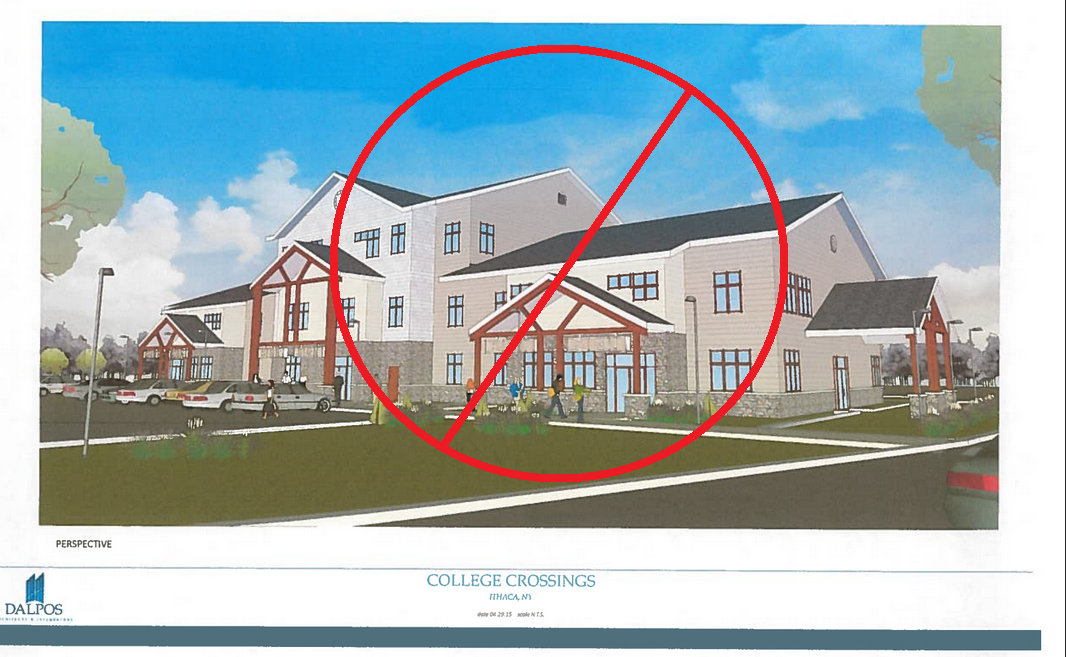
For comparison’s sake, there’s a similar scenario that is playing out in Ithaca town. The College Crossings project on South Hill was welcomed under the zoning and previous iterations had been approved, but after the town passed its 2014 Comprehensive Plan and attended the Form Ithaca charettes last summer, the planning board realized that a shopping center with a couple apartments above and in the middle of a large parking lot wasn’t something they really wanted anymore. While the project has been withdrawn, the process and debate has created a lot of discomfort, confusion and uncertainty, which is rather problematic given the area’s housing shortage. The town hopes to have some form-based zoning code ready this year.

So, looking back to the city, the occupants of 108 E. Green Street want things that are still illegal in much of the study area, but they don’t want a full-on moratorium because some spots like the Waterfront zones actually do accommodate what the city and many of its constituents want. The TM-PUD is an attempt to stave off the legal but undesirable projects until the revised West End zoning can go into effect.

Worth pointing out, at the meeting the boundary was changed to midway through the Meadow Street and Fulton Street blocks, rather than along Fulton Street. It may or may not affect Elmira Savings Bank’s parcels as mentioned above, but those long-term plans are in alignment with the city’s, so probably not.

south-hill-area

3. On a related note, the town is holding workshop sessions for those interested in designing a ped-friendly, mixed-use community for South Hill. The meetings are planned for 6:30 p.m. to 8 p.m. Jan. 26 to 28 at the Country Inn and Suites hotel at 1100 Danby Road in Ithaca. An open office has also been scheduled for 12 p.m. to 1 p.m. Jan. 27. Form Ithaca will be in attendance at the sessions to help formulate the form-based character code proposed for the neighborhood.

815_s_aurora_4 815_s_aurora_1

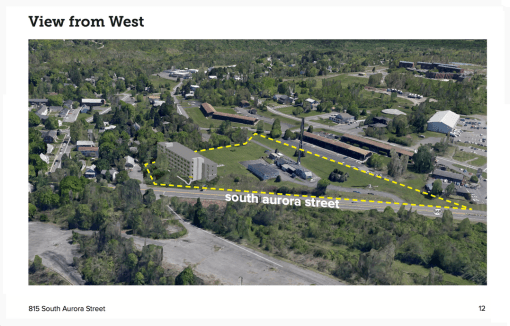
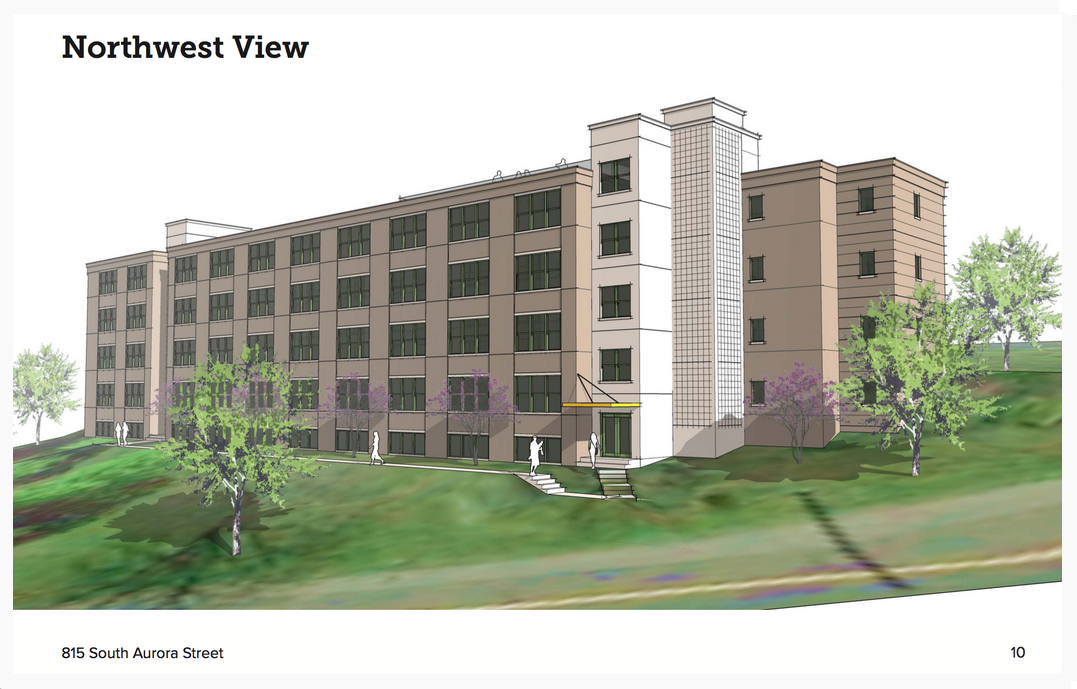
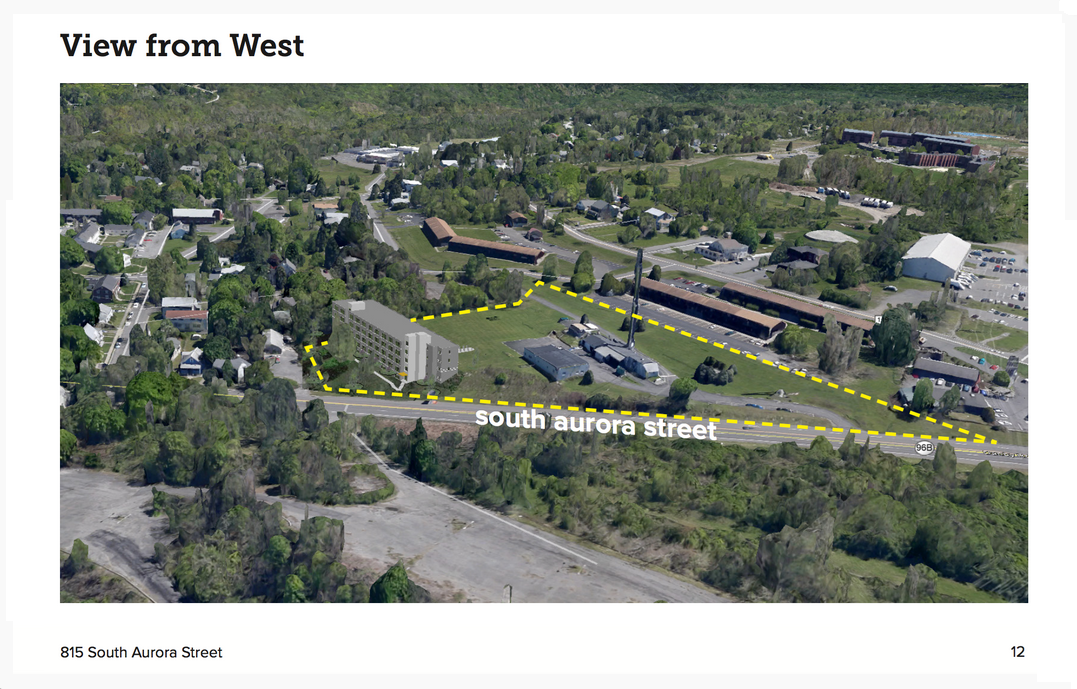
4. A revision to the cellphone tower law has taken one step closer to becoming reality. The city’s Planning and Economic Development Committee voted 4-1 to circulate a revised law that would reduce the size of the tower’s fall zone, where construction of any structures is prohibited. A revision to the current city law, which is twice the height of a tower, could potentially allow the 87-unit 815 South Aurora apartment project to proceed with planning board reviews and other BZA variances if necessary. Developers Todd Fox and Charlie O’Connor of local company Modern Living Rentals have been pushing for a fall zone radius of 180 feet for the 170-foot tall tower, rather than the 340 feet as the current law mandates.

From the discussion, it sounds like the concern has less to do with this parcel, and more to do with the possibility of cell phone companies pursuing towers on open land in the northern part of the city where spotty reception has to be weighed against the aesthetics of the lake shore. Anyway, we’ll be hearing more about possible changes to this law in a month, but for back reading, here’s the Voice article from a few months back.

5. In quick news, CBORD’s move to the South Hill Business Campus looks like a go. A $2.45 million construction loan was extended on the 8th by Tompkins Trust Company. CBORD, a software company founded in Ithaca in 1975, will move 245 employees into 41,000 square feet of freshly renovated SHBC space from the Cornell Business Park later this year. The project, which totals $3.7 million, was granted $296,000 worth of sales tax abatements.
409_college_avenue

ehub_1

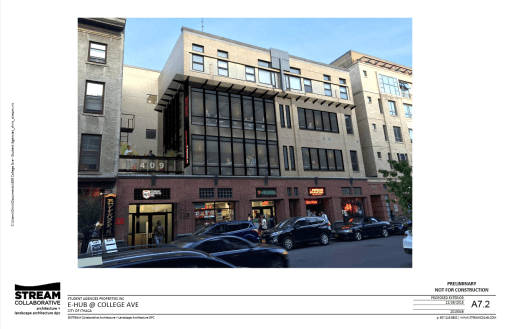
6. From the city’s Project Review Agenda next Tuesday, plans for a facadectomy of the 1980s Student Agencies Building at 409 College Avenue. Student Agencies, in collaboration with Cornell, plans on dropping $183k on the facade work, as well as the $2.8 million or so for the interior renovations of the second and third floors for the new eHub business incubator space. Prolific local architecture firm STREAM Collaborative is in charge of the design work, including the 9,660 SF of interior space. The work would go from January to April (the loan is already approved and most of the work is interior).

6-29-2014 163

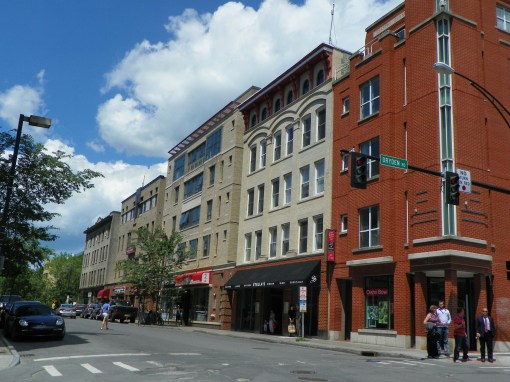
If I may play armchair architecture critic, which I have no credentials to do, I think the patio area is great, but I’m opposed to the brise-soleil, the wing like feature that serves as a sunscreen. I feel like that its location above the third floor throws off the rhythm of the block, by being lower than the cornices on adjacent structures. It might be fine over the glass curtain wall alone, but as is it feels a little out-of-place. Just one blogger’s opinion.

20160109_135258 20160109_135338


228_w_spencer_1

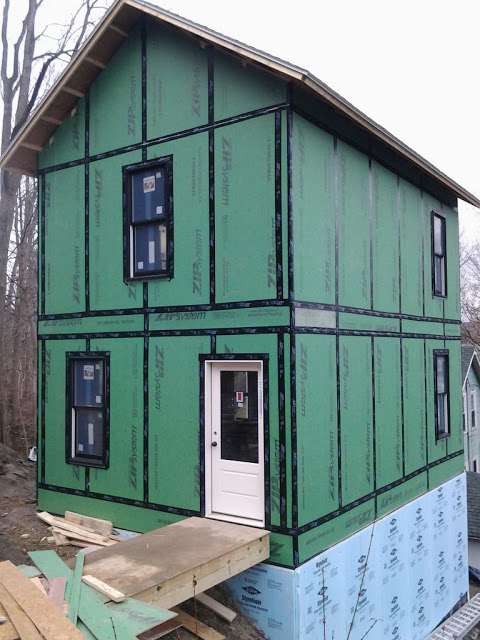
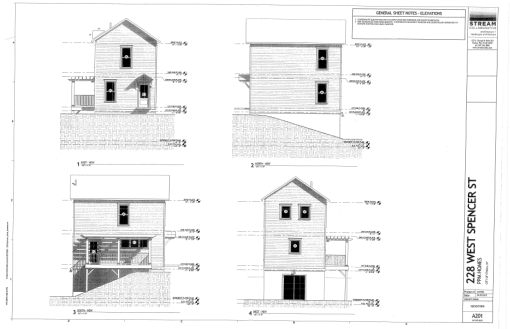
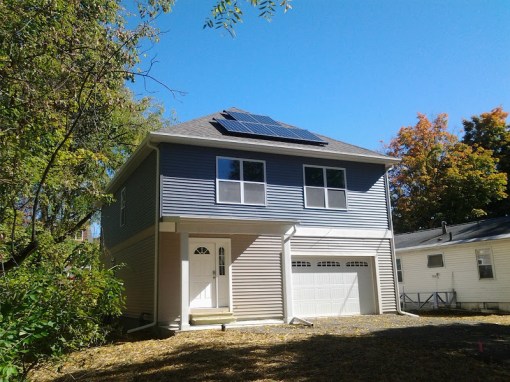
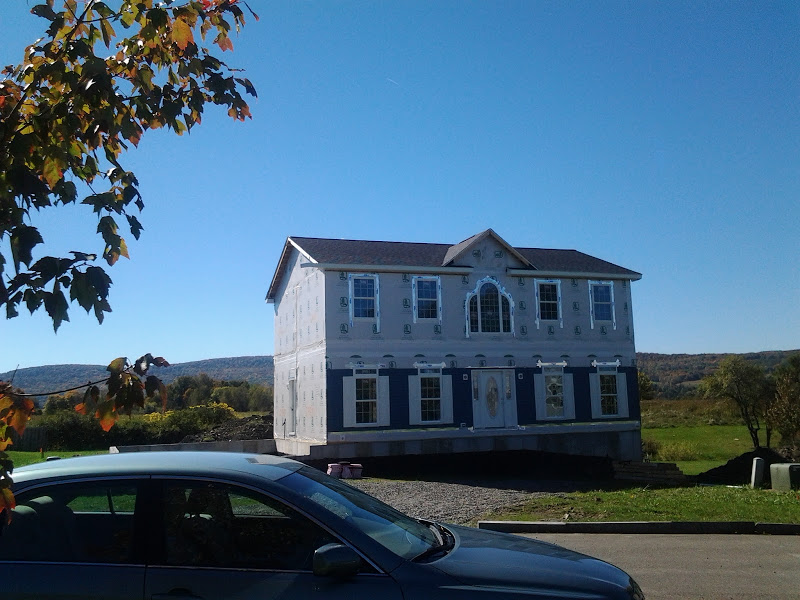
7. House of the week. 228 West Spencer Street in the city of Ithaca. Zero energy new construction, 2-bedrooms, on a rather difficult site. In the above photos from last weekend, the house has been framed and sheathed with Huber ZIP System plywood panels, the roof has been shingled, and doors and windoes have been fitted. The blue material on the concrete basement wall is Dow Styrofoam Tongue and Groove Insulation which protects against moisture and helps keep the heat loss to a minimum. The house should blend in nicely with its neighbors.

Ed Cope of PPM Homes is the developer, and Noah Demarest of STREAM Collaborative is the architect.


News Tidbits 12/12/15: Money Money Money Money

12 12 2015

canopy_hampton_rev4_1

1. Time to do a little rumor-killing. There’s been some confusion as to whether or not the Hilton Canopy is actually happening, since it was supposed to have started construction by this time and it hasn’t. There was also an article in the Ithaca Times that suggested that construction costs much higher than original estimates had caused the project to be cancelled.

Well, the project has definitely been delayed, but it looks like it will still be moving forward. According to a utility easement resolution at the Ithaca Urban Renewal Agency’s Economic Development Committee (IURA EDC) meeting, a project financing commitment has been secured and the developer of the Hilton (Neil Patel of Lighthouse Hotels LLC) is planning a construction start in the first quarter (Jan-Mar) of 2016, which would suggest a mid-2017 opening.

inhs_pride_design_v5_3

2. Also in financial news, INHS looks to have secured grant funding that will allow it to move forward with its 210 Hancock project in the next four months, according to INHS Executive Director Paul Mazzarella. The grants were officially awarded in an announcement from the governor’s office on Tuesday. $3.6 million will come from the state’s Housing and Community Renewal program, $500,000 from the state low-income housing tax credit (LIHTC) program, and $1.03 million from the U.S. Department of Housing and Urban Development’s LIHTC program. In total, the award is valued at $5.13 million, about a quarter of the estimated $20 million development cost. The project has received about $17 million in grants and tax credits to date.

The money awarded covers only the rental units – 54 apartments in the four-story mixed-use building, and five townhouses. The seven owner-occupied townhouses remain unfunded.

The apartments, which include a 30-child low-income daycare facility and commercial office space for non-profits, will welcome their first tenants in Summer 2017. They will rent from 27% to 105% of local median household income, depending on the unit. Descriptively, it’s a mixed-income project with residents’ incomes ranging from $25,000-$60,000 per year.

ith_big_plan_map_v2

3. From the Common Council’s Planning and Economic Development Committee, there are a few things of note this week –

A. The city seems to be looking towards greater encouragement and flexibility with redevelopment of waterfront parcels by making WF-1 and WF-2 zones Planned Unit Developments (PUDs). What a PUD does is allow greater flexibility in uses and design by removing or loosening zoning constraints on site use, and being more accommodating to mixed-use projects (the Chain Works District proposal is a PUD, for example). Previously, PUDs could only be applied to industrial sites. The other stipulation, however, is that the applicant would have to work with the Common Council to determine appropriate development of the site.

The Waterfront Zoning allows up to 5 stories and 100% lot coverage. The PUD will give flexibility beyond that, dependent on what the Common Council is comfortable with for a given site and proposal.  So if Applicant X shows up with a huge apartment building or a big industrial building, it’s probably not going to get very far. But if it’s well designed and has affordable units? Maybe the council will grant a little more density or another floor. It depends on a developer showing up with something that they feel offers some kind of community benefit and fits with the Comprehensive Plan, and whether the Common Council agrees with the developer’s reasoning.

There is great potential in the waterfront – those views can fetch a premium (i.e. higher land values, and more tax dollars), it’s far enough removed from the colleges that students would be unlikely residents, and many of the properties are underutilized, with only marginal public benefit.  So potentially, if someone wants to work with the Common Council (one can count on at least 8 or 9 of the 10 being willing to cooperate), there could be some benefits in the long-term.

B. The Commons first-floor active-use zoning ordinance looks to be heading for a Common Council vote in January. More about that ordinance here, Item 5.

C. That damned backyard chickens thing again. Only this time, it might be moving forward with a pilot program involving 20 families.

D. Per the Times’ Josh Brokaw, expect incentive/inclusionary zoning to be up for PEDC review in January.

tfc_comparo

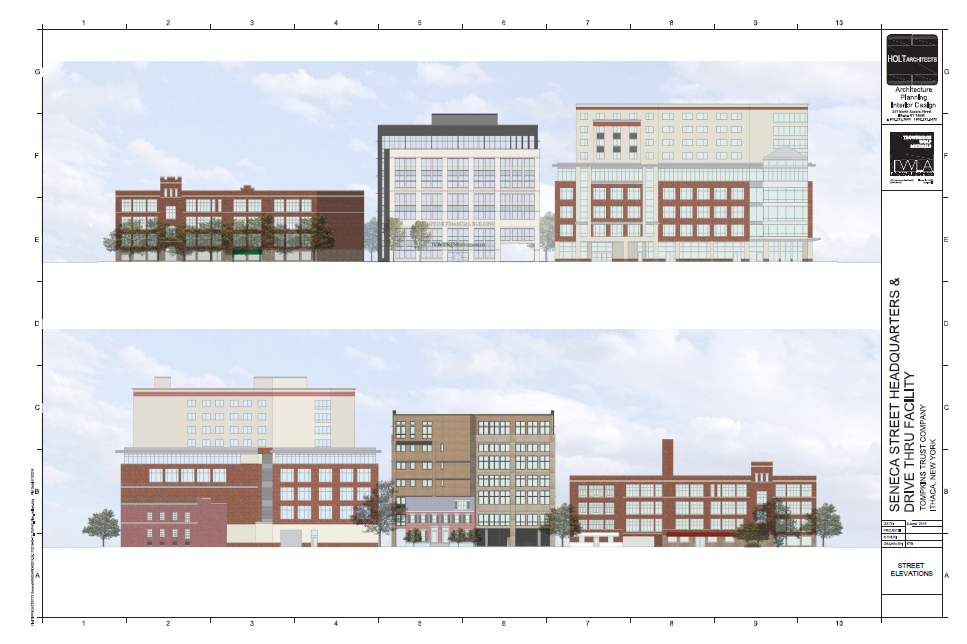
4. Hey look, this week’s eye candy. Tompkins Financial Corporation’s proposed downtown Ithaca Headquarters at 119 East Seneca Street will be reviewed for final project approval at this month’s Planning Board meeting. As part of that, here’s the final project design, part of the final Site Plan Review submission here.

From the front, it looks like some of the window layout has changed on the top floor and southwest corner, and there are fewer sunshades above the windows. There’s a third tree in the planting plan, and there’s variation in the cladding materials on the west wall facing the DeWitt Mall.

tfc_v3_1

In fact, it’s the non-primary facades that have changed the most, with different (and generally lighter-colored) brick and aluminum panels when compared to the previous rendition. Although there’s less glass than before, the lighter colors and greater variation in materials de-emphasize the bulk from the perspective of its townhouse neighbors at the rear. The 7-story, 110,000 SF commercial office building should begin construction in early 2016 with an eye towards completion the following spring.

elmira_savings_1

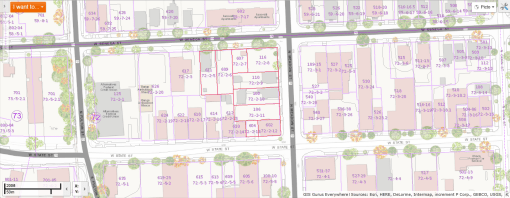
5. There was quite a sale on Ithaca’s West End last Friday. Nine properties outlined in red on the map above – 106, 108, 100 and 116 North Meadow Street, 607, 609 and 611 West Seneca Street, and 602 and 604 West State Street – were sold for $1,725,000 to Elmira Savings Bank.

Now, there are a few reasons why this is worthy of attention. For one, banks don’t typically shell out almost two million dollars without some kind of plan. For two, Elmira Saving Bank has been moving forward with expansion plans in the Ithaca area in hopes of capitalizing on the growing local economy. For three, there has been a lot of development in this neighborhood as of late – the Iacovelli Apartments (2013) and Planned Parenthood (2014) are right across the street, and it’s worth noting that the 18,000 SF HQ for Alternatives Federal Credit Union (2002) is on the other side of the block.

The properties are currently home to parking lots, several older, non-historic houses (most in poor condition) and a two-story 4,500 SF commercial building previously home to the Pancho Villa Mexican restaurant. The restaurant building had been on the market for $699,900.

The zoning here is all WEDZ-1a. West End Zone 1a allows for 2 to 5 story buildings, 90% lot coverage in the case of large assemblages such as this, and no off-street parking requirement. That means these parcels have a lot of potential. The previous owner had been rumored to be planning a mixed-use building on some of the properties, but nothing official ever came forth.

Two phone calls were placed to Elmira Savings Bank’s headquarters in Elmira, and two voicemails were left, but neither received a response. But these properties are definitely something to keep a close watch on over the following months.

6. That 9100 SF store being developed on the corner of East Shore and Cayuga Vista Drives in Lansing that was mentioned last week (here, Item 4)? It’s going to be a Dollar General. Not sure if that’s better than the auto/tire store speculated last week.

20151108_152102

7. Lest it be forgotten, it appears Lady Luck and some state bureaucrats smiled at the Southern Tier this week, awarded the region one of the three $500 million prizes of the Upstate Revitalization Initiative, known colloquially as the Upstate “Hunger Games”. Rochester/Finger Lakes and Syracuse/Central are the other $500 million winners. Seven regions competed, and the four losers will receive $80-$100 million for their priority projects. The money will be paid out in five annual installments of $100 million. A copy of the Southern Tier’s plan is here.

I wrote about Ithaca’s plans for its share on the Voice here. The first year projects alone will have a range of impacts, ranging from job creation and training to municipal construction projects to quality of life projects like museum expansions. Potentially, it could result in hundreds of jobs in Tompkins County, financial capital for several major projects, and make the area more attractive for investment for both local and external entities. As these projects move forward, they’ll receive their due write-ups here and on the Voice.

Of course, the key things are that the community can manage this monetary award, and that someone can track and guide these projects to completion – something the Southern Tier has struggled with, when one looks at the result of previous, much smaller awards.

8. The state’s just shoveling money into Ithaca this week. The New York State Office of Community Renewal (part of the state’s HUD equivalent, the Homes and Community Renewal agency) has awarded $500,000 towards the rehabilitation of the Masonic Temple at the corner of East Seneca and North Cayuga Streets in downtown Ithaca.

The Masonic Temple was built in 1926 and designated a local historic landmark in 1994. The property is owned by Ithaca Renting Company (Jason Fane), who purchased the building from the Masons in 1993. Fane’s never been a fan of the historic designation because the ILPC can be expensive and onerous to work with, nearly everyone else hasn’t been a fan of his long-deferred maintenance of the 90-year old building (if you have ever wondered why that CIITAP rule was added about an applicant being in building code compliance with all their other properties…now you know). A few years ago, Fane had not been shy in his interest in demolishing the building.

After rejecting a purchase offer to turn the building into a community center and space for the New Roots charter school, Fane decided to go the preservation route earlier this year and apply for a grant to renovate the interior and add an elevator to the building to make it ADA-compliant. This would make the building much more marketable to commercial tenants, many of which have shunned the 17,466 SF building. Fane laid out a few different options this past summer, including one where four commercial spaces (rental, office, restaurant) would be created. Based on the grant announcement, it looks like that will be the option pursued.

The Downtown Ithaca Alliance backed the application, as did the Common Council by unanimous vote at their July meeting.

The renovation will cost at least $1 million, and according to the grant announcement, seeks to start construction in summer 2016. Expect more info when it hits the ILPC and Planning Board at a later date.

20151205_121714 20151205_121736

9. House of the week. This week, INHS’s new 2-bedroom, 1150 SF single-family home underway at 203 Third Street in the city of Ithaca’s Northside neighborhood. The house is framed, roofed and sheathed. Siding (Hardie board?) and trim is being attached on the sides, and one can expect a nice gracious porch to be attached once exterior materials are installed on the front. A home of the design was previously built at 507 Cascadilla Street.

203 Third Street was a vacant that the city seized in a tax foreclosure in 2011. It was transferred to the Ithaca Urban Renewal Agency, who sold it to INHS for $17,000 in December 2014. The process is pretty similar for a lot of the home lots that INHS builds on – the non-profit buys dilapidated or vacant properties from the IURA, which they build or renovate into affordable single-family and duplex houses. In the case of 203 Third Street, INHS competed for the site, outscoring Habitat for Humanity’s submission in an IURA examination of proposals.

As with all INHS homes, this one will be sold to a buyer of modest means, which means someone making at or a little less than the county’s median household income of $53k/year (I think 80% of MHI is the low bound offhand, so about $42k/year). The houses will be a part of INHS’s Community Housing Trust, limiting the price it can be sold for and requiring that if put up for sale, it is sold to another family of modest means. It may just be one house, but it will mean a lot to one family.

Claudia Brenner is the architect, with Rick May Construction and Mike Babbitt in charge of construction (thanks to Claudia for the builder info).


The Swinging Pendulum of the CIITAP Program

17 11 2015

20151011_144907

If I had seen this before the Friday news roundup, I’d have included it there. But since I have no Monday night post scheduled this week, discussing the latest changes to CIITAP will be a fair substitute.

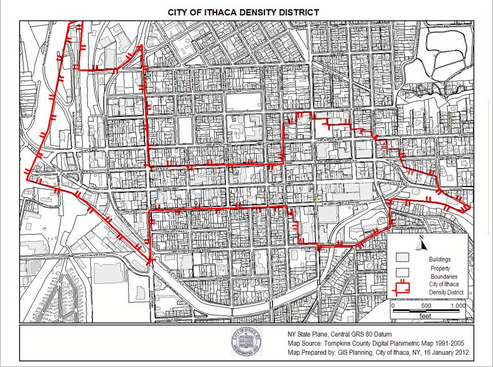
So, background. CIITAP stands for Community Investment Incentive Tax Abatement Program, and it’s a property tax abatement program that gives developers the opportunity to apply for abatement for a portion of their property taxes for a period of up to 7 years, or for an enhanced abatement of up to ten years if they can demonstrate financial hardship (i.e. without the abatement, there’s no way the project will be cost-effective; if it’s not cost-effective, a bank won’t offer construction loans, and the project doesn’t happen). Basically, it’s a tool designed to promote development in certain parts of the city where density is expected and/or encouraged, rather than lose tax-generating and job opportunities to the suburbs. A more substantial description can be found in a write-up for the Voice that I did back in January here.

The first version, which went into effect in 2001 as the Downtown Density Program, led to five projects being built, six if you split Cayuga Green into its garage and mixed-use components. The projects were worth about $62 million, and the earliest ones are now paying full taxes. Then the city decided it wanted more from the density incentive, and it created the CIIP Program, which was created in 2006. Over the following six years (2006-2012), that led to just one project, the $3.5 million Ital Thai renovation on the Commons. Part of it was that from 2006-2007, there was a moratorium on abatements, and another part was the recession. But another part of that was that CIIP was really lengthy and burdensome it had 48 stipulations, and a project had to meet 15 for partial assistance, and 23 for full assistance. It was so much paperwork that developers were disinterested and opted for other parts of the county.

ciitap_map

Onto round three, the current CIITAP – much more simplified, it initially had three stipulations – one, that it be in the density district; two, that it was a $500,000 investment in either a new building, or in the renovation of a historic building; and three, that if a new building, that it be at least three floors. A fourth was later added that said that all your other properties had to be up to code and have no outstanding violations, which arguably was a tacit response to Jason Fane’s application for 130 East Clinton while he let the Masonic Temple rot. However, in the past couple of years there have been complaints from various groups that the city wasn’t getting enough out of the bargain. You can kinda see how the pendulum swings – the political consensus is that the first version was too generous, the second version two burdensome, and the third version too generous.

The city put together a study group to examine revisions to CIITAP, chaired by a Common Council member (Ellen McCollister of the 3rd Ward), and consisting of City Planning and IURA staff, a representative from TCAD, a representative from a local labor union, a developer, and a representative from the Coalition for Sustainable Economic Development. In short, the city’s trying to get a broad spectrum of perspectives. The revised CIITAP is to presented at the PEDC meeting Tuesday night.
Here are the goals:

1. Retain the program as an effective tool to incentivize smart growth and discourage sprawl
2. Improve the program’s ability to deliver broad community benefits that may include:
*** An increased use of local labor
*** An increase in living wage job creation
*** More environmentally friendly building
*** Increased economic opportunities for people of all backgrounds

Note that given the previous versions, they’re easier said than done.

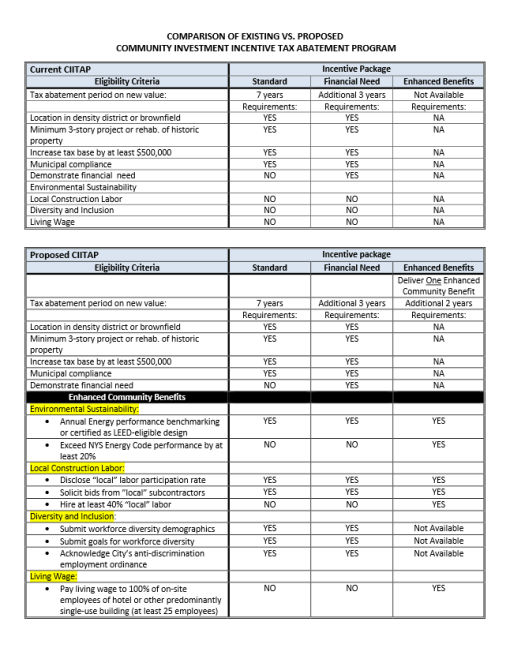
ciitap-revision

In addition the standard 7-year and 10-year abatement, there’s also a new very stringent “enhanced” 12-year abatement option. All the 7-year and 10-year stipulations carry over, but now there’s a few more requirements on the list in four categories – “Environmental Sustainability”, “Local Construction Labor”, “Diversity and Inclusion”, and “Living Wage” .

  • In the “Environmental Sustainability” category, the new rule on the standard 7-year abatement and 10-year abatement is one of two two choices. The first choice is an annual benchmarking of energy usage during the abatement period using free software from the EPA. The report would be given to the city, IDA and made public, to prove the building is using energy at the level designed. The second choice is that they could submit paperwork indicating they’re pursuing LEED Certification, and provide proof of certification upon completion.
  • The “Local Construction Labor” category defines “local” as tompkins or any of the counties it borders (Cayuga, Seneca, Schuyler, Chemung, Tioga, and Cortland Counties — so no Syracuse, Rochester or Binghamton). In order to be eligible for a tax abatement, an applicant must commit to the City in writing and submit to the IDA proof that the general contractor has solicited bids from local sub-contractors for all major trades required for the construction project, such as HVAC, electrical, plumbing, carpentry and masonry. Secondly, they must submit a copy of their monthly payroll monthly payroll reporting of all workers on site during construction with a summary of how many employees are “local”, using the address, zip-code, and total payroll amount per employee. I’m not sure if all this will be public info – privacy advocates might push for keeping the employee address and payroll information confidential to the city and IDA.
  • In the “Diversity and Inclusion” category, the new requirement for all applicants is a company or primary tenant’s workforce demographic analysis by gender, race/ethnicity, age, disability, job class with gender, and job class with race/Hispanic ethnicity; as well as acknowledgement they have read and understood the City’s Anti-Discrimination employment ordinance; and a statement of their company’s or the major tenant’s goals for workforce diversity.
  • The program does touch on an affordable housing fund or mandate, but it’s stated that members don’t feel CIITAP can adequately address affordable housing, and the committee recommends exploring inclusionary zoning.

Under this plan, the number of stipulations for the 7-year and 10-year abatements goes from four to seven. The rest of the procedure is as before – the city holds a public meeting, then decides whether or not to endorse the project, and it goes to the county (TCIDA) for their vote, which is typically in line with the city’s recommendation.

Now, a new option is the 12-year “super-abatement”. Along with the demonstrated financial need, a project must also commit to one of the following – 40% local labor, energy usage 20% less than NYS Energy Code Requirements, or living wages for single-use entities like hotels. This is in addition to the previous stipulations for 10-year abatements.

So now’s the magic question? Will it be acceptable to the broader community? The city’s HR director wrote in an email attached to the PEDC agenda that the program doesn’t do enough for diversity, and needs to mandate rather than encourage it. Without a doubt, this whole program, as we’ve seen in the past fifteen years, is a delicate balance between encouraging density while getting community benefits. Hopefully, the abatement pendulum stops swinging and it finally comes to rest in a comfortable middle ground.


News Tidbits 11/14/15: To Plan or Not to Plan

14 11 2015

It’s another slow week. There was no PEDC meeting in Ithaca city, and no new projects hit the airwaves. But there might be some interesting things moving forward.

1. The Lansing Star has an insightful interview this week with newly elected Lansing town supervisor Ed LaVigne, who unseated incumbent Kathy Miller for the seat. From a development standpoint, it’s very interesting. From the interview, it sounds as if, given the possible loss of their biggest taxpayer, the $60 million Cayuga Power Plant, he kinda wants to throw the door open to developers in an attempt to soften the blow of its closure. In Lansing, there was a political divide when it came to planning – the Democrats wanted a full-time planner, but the Republicans wanted a part-time planner. The budget item for a full-time planner was eliminated along town board party lines, 3-2, and Lansing is currently served by part-time planner Michael Long.

20151011_124916

“That’s why it’s so critical to start moving some dirt, getting things built.  One of the things I’ve already told developers is that Lansing is in business.  How can we make you more prosperous?  We believe in prosperity.  And if you’re prosperous we all will benefit.  I don’t care how much money they make.  I hope they make more money than they ever dreamed of, because if they put their money in Lansing, Lansing wins.”

If I didn’t know where the quote was coming from, I wouldn’t believe it was from an elected official in Tompkins County. Most local officials are very measured in their comments on growth, if they welcome newcomers at all.

Just as a thought exercise, Lansing builds about 25 houses per year per HUD SOCDS, and a variable number of apartments, which right now is a few dozen per year thanks to the Village Solars project off Warren Road. Take about $300k per house, and $6 million for each major phase of the Village Solars, and one gets $13.5 million in new development. Not factoring in additional infrastructure or service costs or taxes from commercial/industrial construction, it would take four and a half years to make up the tax revenue lost from the closure of the power plant.

20151011_125007

Of course, development in Lansing is tricky – without sewer, houses have to be on at least one acre of land. After all the busted dreams with the town center proposal, the town will be more likely to stick with conventional suburban development and rural homesteads. On the one hand, Lansing has given a yes to development. On the other hand, the question of “smart” growth is still up in the air, and it’s not looking good.

By the way, the photos, which are a few weeks old, are of homes underway on Lansing’s Oakwood Drive. Cardamone Homes is the builder. The top one is for sale for $670,000.

***

college_crossing_2 plan-1

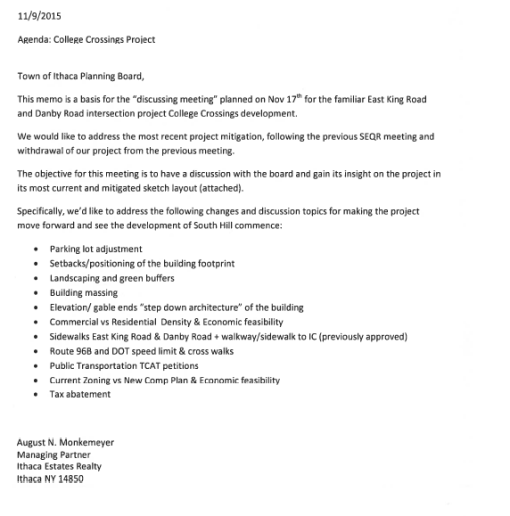
2. There’s nothing too exciting in the agenda for the Ithaca town planning board meeting next Tuesday. There’s a couple of legal clarifications required, one for a single-family home subdivision, the other to let Brookdale (formerly Clare Bridge / Sterling House) move forward with their 32-unit expansion project. The town planning board will also be reviewing some solar panels and changes to the sign law. Really, about the only noteworthy thing on the agenda is an open, informal discussion on College Crossings. After have a few months to take a deep breath, the developer, Evan Monkemeyer of Ithaca Estates Realty, would like to discuss what needs to be done in order to make the project fit with the town’s comprehensive plan, while keeping his plans economically feasible. A copy of the letter is below:

college_crossings_v4_letter

This is potentially a major opportunity for the town to show good stewardship. Ideally, the two sides will find a common ground that meets the town’s goal for a less auto-centric, mixed-use South Hill, while allowing the developer to move forward. A tax abatement isn’t going to fly with the IDA let alone the planning board, but there are other options that can be considered – density, height, and setbacks come to mind. The town’s comprehensive plan considers the site “TND [Traditional New Development] High Density” – one of the few high density spots in the town. The plan recommends 8-16 units per acre as an average (it’s a 3.75 acre site, so picture 30-60 units), and 10-20% open space. A project in a TND-HD area should be dense, transit-oriented, porous and walkable. The door is open, not only to the town, but members of the public interested in helping find that common ground (looking at you, Form Ithaca). It should be an interesting chat.

chain_works_rev3_1

3. Local architecture firm STREAM Collaborative held an open house last Friday, and for those unable to attend, they shared photos online.

Look closely and you’ll find a copy of a conceptual build-out of the Chain Works District, which is still going through environmental site assessment (the ESA document is said to be tens of thousands of pages). The South Hill Business Campus is to the upper right, so the top of the image is directed south. Note that there’s nothing formal, and even the renovation of buildings 21, 24, 33 and 34 has yet to reach the boards (rumor mill says the renovations might start in 2017). But it’s great eye candy.

20151011_134013 20151011_134031

4. House of the week. Since I hit this house a couple of times while it was underway, I figured I would include a couple shots of the finished 3-bedroom, 1,276 SF home at 203 Pearl Street in Ithaca’s Belle Sherman neighborhood. Oddly enough, the builders, Gil and Naama Menda of 201 Pearl, used the same exterior trim colors as on the Belle Sherman Cottages a block away.

The lot is the result of a subdivision approved by the city during the spring; 203 Pearl had previously been combined with 201 Pearl and used as an in-ground swimming pool, which was filled in at some point.


News Tidbits 10/24/15: Breckneck Builds and Market Slowdowns

24 10 2015

college_crossings_v3_end

1. College Crossings is dead. But its passing opens up an interesting conversation.

According to Ithaca town planning board minutes uploaded earlier this week, developer Evan Monkemeyer withdrew his proposal after planning board members weren’t comfortable with approving the environmental assessment and mitigation plan for the proposal (technically called a “negative declaration” by the lead agency on the SEQR). While at least one was bothered by the 3-story, 54′ height, many board members had visions of the Form Ithaca charrette for the property, and this didn’t quite jibe with Monkemeyer’s plans for South Hill’s King Road and Route 96B/Danby Road intersection. Minutes for the July and August meetings can be found here.

college_crossing_2

plan-2 plan-1

Now, I will gladly admit that I was not a fan of this project, and I too wanted something more along the lines of Form Ithaca. I’m surprised, though, that it was enough to derail approvals of the project.

Now, the problem is, the town’s new comprehensive plan embraces form-based codes and “Smart Growth”, but the zoning is auto-centric, outdated, and doesn’t mesh with the plan. If you’re a developer or builder, big or small, and what’s legal and what the town wants are two very separate things…Houston, we have a problem.

At this point, there’s two questions that come to mind – one, given that the town planning board has cancelled most of its meetings lately due to a lack of proposals, is the disconnect between plan and zoning halting projects, and two, when will revised zoning be ready. For guidance and knowledge, I reached out to town of Ithaca assistant planning director Dan Tasman, because he’s pleasant, responsive and a pretty great guy.

As for question one, here’s his quote: “Seriously, I think it’s … complicated.” His thoughts were that there’s no indication whether the recent slowdown were caused by the planning/zoning disconnect, or natural ebb and flow related to lending and planning on the ends of home-builders and developers.

As for question two, the response was summed up as, “a lot of communities face the same issue after they adopt new comp plans. On the positive side, Ithaca’s not growing that fast, and the pace of development is slow. Still, there’s a sense of urgency.”

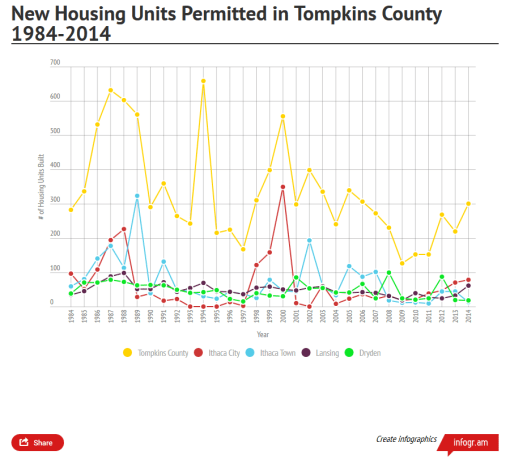
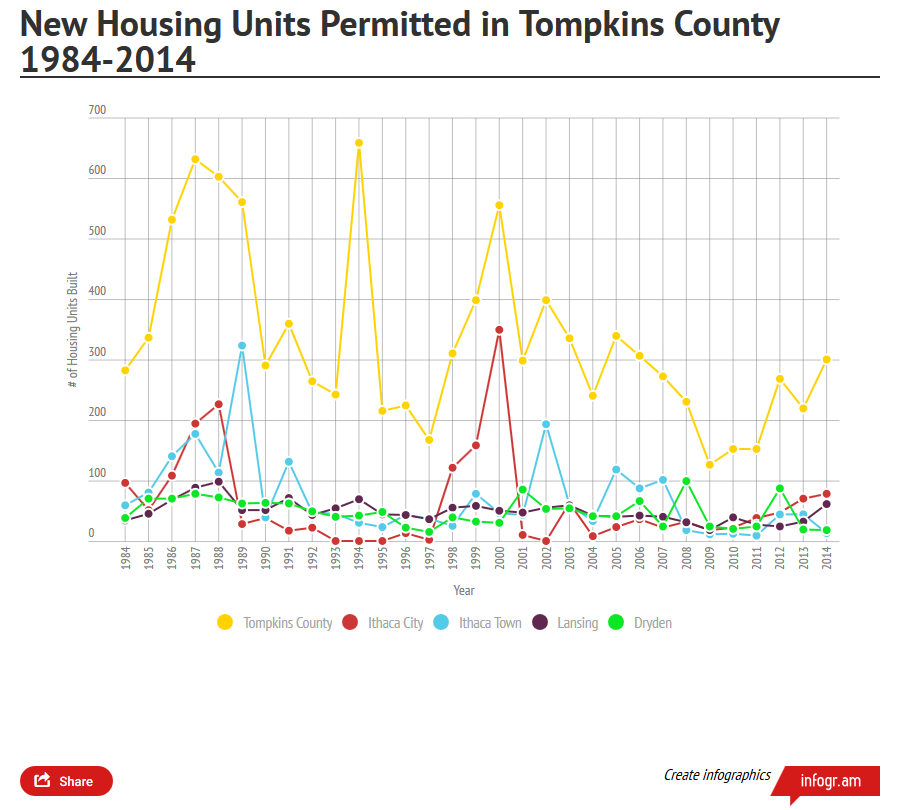
He’s right about the town not growing that fast. The permit records show that in September, the only new home-building permit was for a duplex at 214 Pennsylvania Avenue on South Hill (the Iacovellis building more student rentals for IC, probably). The previous month online, June, had four single-family homes, filling out lots in previous-approved subdivisions.
tc_housing_permits_1984_2014

Traditionally, the town of Ithaca has made up a pretty sizable chunk of the new home permits in the county. But if they only issue 30-40 this year (still better than last year’s 14), then it falls on the rest of the communities to try and make up the housing deficit, at least in the short term. Ithaca city’s total, anticipated to be 247 new units to be permitted in 2015, is only about 84 units right now, because John Novarr has yet to start Collegetown Terrace’s Phase III, and Steve Flash’s 323 Taughannock on Inlet Island has yet to start either. To bring down the deficit in a decade, as well as keep up with annual economic growth, the county would need over 600 units per year; it’s not certain if the total will reach even half that in 2015.

On the one hand, the town of Ithaca is trying to be proactive and adopt a new approach to development in quick and good order. On the other hand, it’s not a great situation for trying to make a dent in the housing deficit, with its attendant affordability issues, and there’s the possibility things are going to get worse before it gets better. I don’t know if there’s a right or a wrong way of going about it, but it’s a stressful setup.

2. On the county level, officials are seeking legislature approval for launching a study into the feasibility of an airport business/industrial park in Lansing. 52 acres of vacant land along Warren and Cherry Roads are being considered for the study, which would include a conceptual site plan of potential buildings and parcels, and an assessment of the needs and characteristics of companies most likely to open in the potential business park. Utilities and green infrastructure will also be looked at in the study. The projected cost is less than $50,000, and being paid for by the Tompkins County Industrial Development Agency (TCIDA). The feasibility study would be awarded next month, with authorization and approvals on the staff level.

arpt_pk_1

For what it’s worth, folks living up there are used to business traffic – Borg Warner’s 1,300 person plant is adjacent to the study site. The Warren Road Business Park lies a minute’s drive up the road, and the Cornell Business Park is about a minute’s drive south. The land also has municipal sewer, allowing for large-scale projects. A copy of the RFP states two that the two parcels shown above are the primary analysis area, with secondary areas closer to the airport runway and the resident land to the west separate from the park. They aren’t a part of the proposed business park, but the county asks that they be examined for development potential by the study.

holiday_inn_express_v2

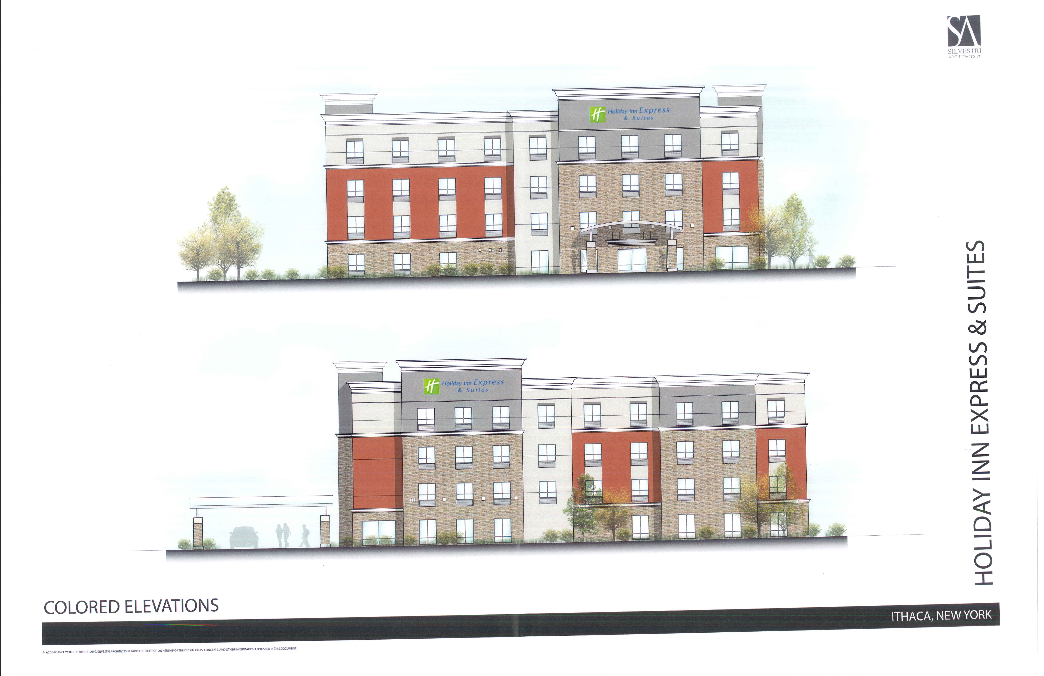
3. Details, details – the Holiday Inn Express already under construction in big-box land at 371 Elmira Road will be going in front of the city planning board this month for some slight modifications. The developer, Rudra Management and Rosewood Hotels of Cheektowaga, wants to increase the number of rooms from 76 to 79, and add three parking spaces accordingly. Along with that comes the bevy of supporting docs – technical drawings here, landscape plan here, landscape schedule here, and elevation drawings here. Apart from a palette change on the exterior (the red-brown color is “Decorous Amber“, part of the new official Holiday Inn color scheme per the architects’ cover letter), there are no changes to the design, the 3 additional rooms are just an update to the interior configuration of the hotel, one more room on each of floors 2-4. Apart from tastes in color and making sure the three new parking spaces pose no issues, the board won’t have to debate much here, and the hotel is still very likely to open next summer.

1015_dryden_1

4. In small but notable builds, Modern Living Rentals (MLR) is at it again. The relatively new Ithaca-based rental and development company is planning a triplex (3 units) at 1015 Dryden Road, just east of the hamlet of Varna. According to an email from MLR co-owner Todd Fox, the units, all 2-bedrooms, will start construction in the spring, and it’s a safe wager they’re shooting for an August 2016 completion, just in time for Cornell student renters. Judging from the renders on MLR’s site, each unit will be around 930 SF, so about 2,790 SF total. MLR teamed up once again with local architecture firm STREAM Collaborative for the design.

1015 Dryden is also home to a single-family home built in 1938, and a 4-unit apartment building from about 1980. The apartment building was badly damaged in a fire in 2011, renovated, and the site was sold to MLR for $425,000 in March 2014.
815_s_aurora_4 815_s_aurora_5 815_s_aurora_6

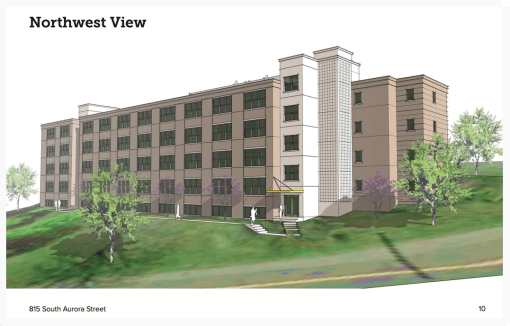
5. While on the topic of MLR, let’s throw in some eye candy. Along with the plans for 1015 Dryden, additional images for the proposed 87-unit project at 815 South Aurora Street on South Hill can be found on their website as well. I’ve included two perspective renderings and an aerial render, but more images can be found here. The 87 units will all be studio apartments. STREAM Collaborative is responsible for this design as well.

A detailed write-up of the project, including the related cell phone tower issue, can be found here.

6. Out in Lansing town, there are two attention-grabbing news pieces from Tuesday’s next planning board meeting. One is a plan for an LP gas / petroleum distribution facility on Town Barn Road (parcel address 3125 N. Triphammer Road). A 30,000 gallon storage tank and gravel drive are planned in the initial phase, with 5 15,000 gallon tanks, a garage/maintenance building, and an office planned in later phases. Now, normally a project like this is not a big deal, but there’s the outside possibility local contingents of the anti-Crestwood, anti-fossil fuel groups will go on the offensive to try and stop it. So the potential for political football is there.

The other detail isn’t up for discussion yet, but the town notes that 15 duplexes (30 units) are being planned by former Lansing town supervisor A. Scott Pinney for a site on Peruville Road (the county calls it 428 Scofield Road, but the land has frontage on both roads). The site already houses 4 duplexes built in 2011.

Breakneck_Builds_-_Master_Card

7. Instead of the the usual “House of the Week”, this week is more of a shout-out/advertisement. For those with cable, The DIY Network will be running a new episode of “Breckneck Builds” tonight at 11 PM (additional showings listed here), highlighting a just-finished home on Dryden’s Hollister Road. Quoting the promo write-up:

“Jordyn is ready to leave her rental behind and buy her first home, but what is most important to Jordyn is that her new home is eco friendly, so she is turning to the modular world to build a big house with a small carbon footprint.”

The modular home assembly was the work of local builder Carina Construction, who also tackled the modular units at the Belle Sherman Cottages site. Local builder, local resident, local project, so set your DVRs or TiVo.

8. Last but not least, here’s your Planning Board agenda for next Tuesday. Nothing new at this month’s meeting, but here’s the run-down:

A. Review of changes and revised approval for the Holiday Inn Express (see above)

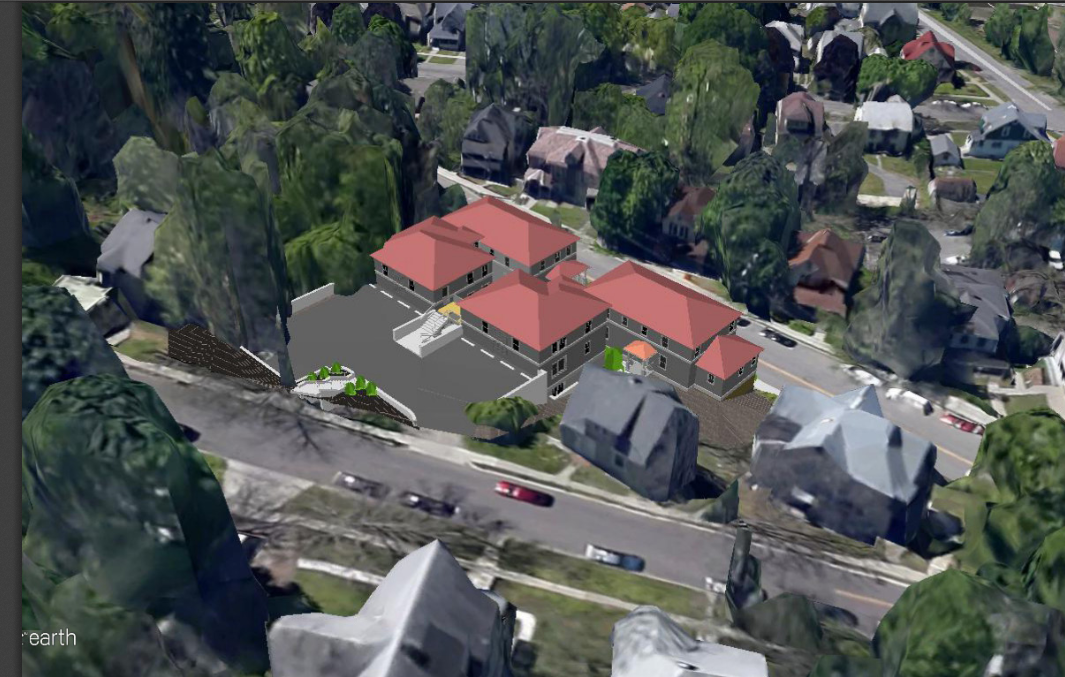
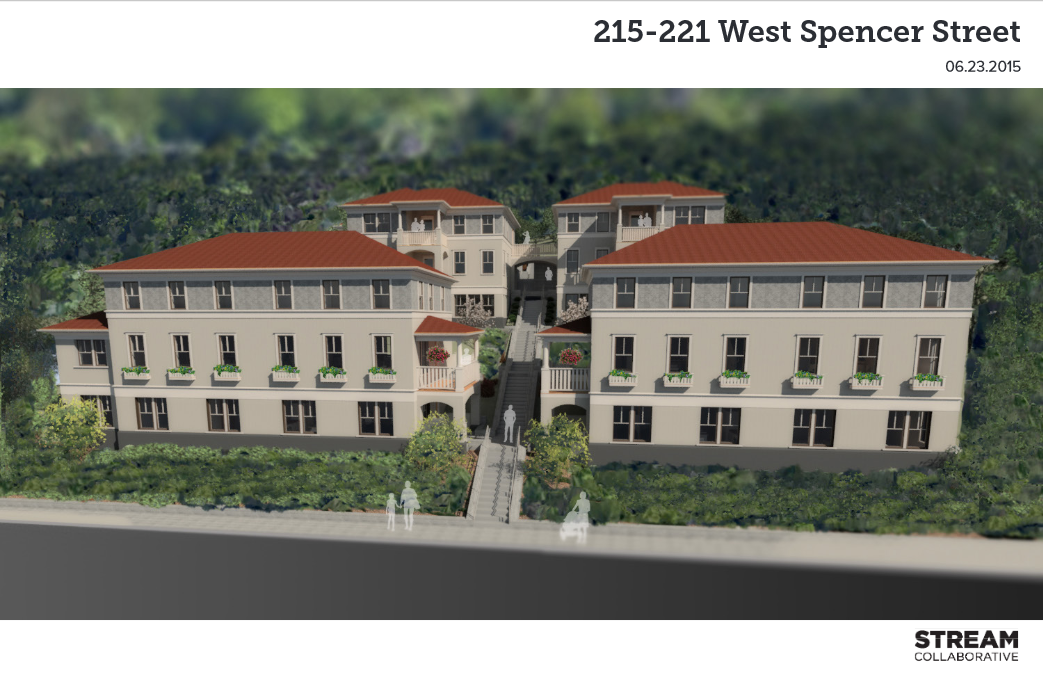
B. Declaration of environmental significance and BZA reccomendations for 215-221 West Spencer Street– Pocket Neighborhood, 12 units w/ 26 bedrooms, Ed Cope/PPM Homes is the developer, Noah Demarest of STREAM Collaborative is the architect.

C. Environmental Review Discussion for the bar/lounge proposed for the renovation of 416 E. State – cover letter here, description here, letters of opposition in the agenda.

D. Public hearing and re-approval, Hotel Ithaca renovations, 222 S. Cayuga – Site Plan Review drawings here, renders here and here. Not sure there’s enough of a difference from the first time around, but at least the cross-catching on the exterior is gone.

E. Herson/Wagner Funeral Home renovation, 327 Elmira – Declaration of Lead Agency and Public Hearing – I wrote about that in the Voice here. Fun fact, the original proposed title was “Funeral home hopes to being new life to Elmira Road property”. It was rejected.

News Tidbits 10/17/15: Pressing the Issue

17 10 2015

amabel_v4_1

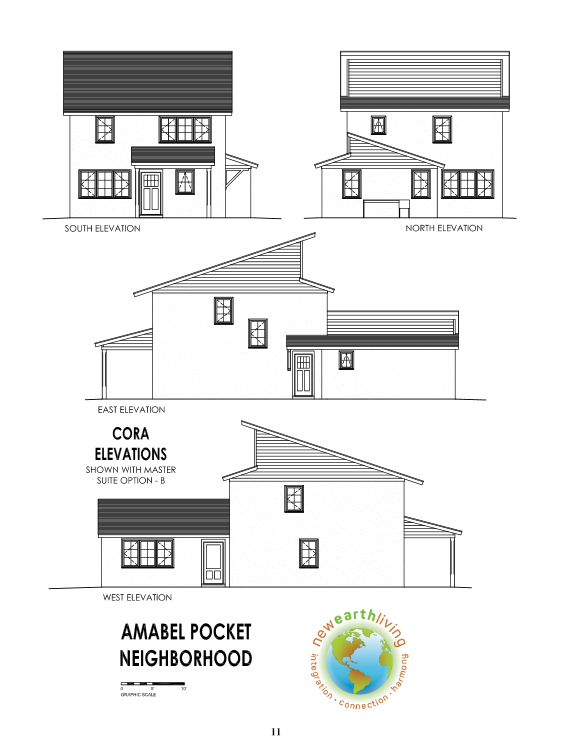
1. It looks like the Amabel housing development has another site plan. New pedestrian paths, a relocated community garden, and some substantial tweaks to the layout of the house, including a small access road for three homes near the southern termination of the loop road with Five Mile Drive (older plans here).

Marketing for the project hasn’t officially started, but New Earth Living LLC’s (Susan Cosentini’s) website does have interior renders for one of the proposed house styles, as well as an informational PDF. Plans call for Net-Zero energy efficiency homes, meaning that the amount of energy generated on site will power all the project’s energy needs. Example homes included in the PDF range from 1,184 SF to 2,083 SF – it looks like there will be four home models with alternate configuration options. Prices have yet to be announced.

amabel_v4_2

The Amabel project, proposed for 619 Five Mile Drive just southwest of the city of Ithaca’s boundary line, has been in the works for the past couple of years, a sort of grand follow-up to New Earth Living’s Aurora Street Pocket Neighborhood in Fall Creek. The project will have about 30 single-family homes at full build-out.

I know some of the more pessimistic readers here may call this suburban sprawl with a green sheen, but it’s a lot better than a cul-de-sac.

20151011_130755

2. The village of Lansing sent off their updated Comprehensive Plan to the county planning department this week for review and approval. Now, planning should be the village’s forte, since the village of Lansing was founded in the 1970s as a backlash against the construction of commercial and residential properties along Triphammer and Route 13, including what’s now The Shops at Ithaca Mall. The plan was last updated in 2005, and draft of the new plan can be found here.

The village seems to note with some distress that although population growth has slowed, traffic has continued to increase (due in large part to significant growth in Lansing town; many town residents pass through the village to get to employment centers in Ithaca). North Triphammer Road has already been widened, but there are concerns about the ability of infrastructure to handle further traffic increases. The village also notes a strong rise in the 55+ population, as well as the same affordable housing issues that plague Ithaca and much of the county; in Lansing’s case, the median household income can afford a $171,000 home by their estimate (2.5 x $54,721 = $136,800 qualifying mortgage, + 20% down-payment), but the average house in Lansing costs $258,000 (affordable to a household making ~$82,500; note all the numbers are 2010 values). The plan also shows that fair market rent in Lansing increased 64.1% from 2005-2015, meaning that unless a renter had an annual wage increase of 5.8%, they paid more of their income towards housing year after year.  29.4% of homeowners and 39.1% of renters pay above the HUD’s 30% of total income threshold for affordability. The village is concerned it will price aged residents right out of their homes.

In an effort to combat the growing problem, the village wants to focus new housing along main thoroughfares with easy bus access and bike infrastructure, and is aiming for smaller homes and apartments geared towards aging-in-place and senior communities. The village notes that 500 to 600 units of housing could potentially be developed over the next few decades (note Lansing averages ~10 units per year), mostly on the large, low-density home lots near the lake. These would almost certainly be geared towards the highest income brackets, but the benefit of greater supply might relieve pressure on other homes.

On the business end, the village would also like to encourage Cornell to relocate back-office and research operations to village sites. There’s also a push for senior-oriented businesses and a possible rethinking of the malls, not an uncommon thought in this age where malls are struggling and dying off.

There are arguably two senior developments planned that already fit their “want” category – the 12 senior units planned for the Lansing Meadows PDA (the ones planned next to BJ’s on Oakcrest Road), and 62 senior units for the CU Suites site on Cinema Drive (photo from last week above). Other residential growth will be fairly “organic”, with new homes built at the whim of owners and mom-and-pop builders. A new commercial medium-traffic zone along Hickory Hollow Drive might open some more business opportunities; as for Cornell, they seem to be more focused on their East Hill Village plans, but research park tenants are always a possibility.

The village plans to update its comprehensive plan again by 2025.

402_s_cayuga_st_rev2_1

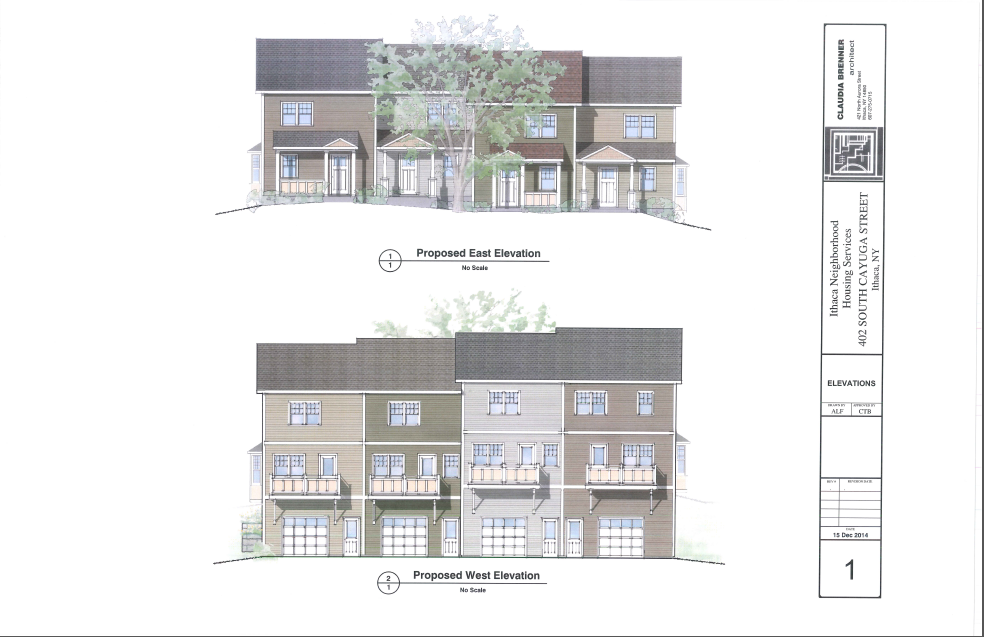
3. On the topic of plans, here’s a progress report just released by the Ithaca Urban Renewal Agency regarding its five-year plan.

If you wanted another reason why housing in Ithaca is so expensive, the plan alludes to it here:

“A spike in local construction costs has delayed the start of construction on a planned four-unit first-time homebuyer project and a public facilities project that will improve a public recreational area. We anticipate these projects moving forward once they have been able to close their funding gaps.”

The four-unit homebuyer project is the townhouse project planned by INHS for 402 South Cayuga Street (shown above). INHS director Paul Mazzarella said the project was due to receive bids last month, and if they were within INHS’s budget, it would start construction. It hasn’t started.
Ithaca’s a small labor pool, so you either truck in labor from elsewhere and incur the wrath of construction unions, or you go local and pay a premium. But even then, with the relative burst in activity as of late, the local pool is getting tapped out and that’s driving prices up. Non-profits like INHS don’t have a lot of wiggle room in their budgets, and city government just won’t build if they can’t get affordable bids for infrastructure work. It also impacts programs that provide low-cost home repairs to those with low and fixed-incomes, because those low-cost repairs are no longer low-cost, and fewer people are able to be served.

One could one look at this as either a reason to limit approvals (which the construction trade unions are opposed to) or introducing more out-of-town labor to the market (which the trade unions are also opposed to). Stuck between two metaphorical rocks.

So long story short, in a region where the cost of housing is climbing dangerously fast, the city has a lot of work left to do meeting its affordability goals, with many actions/programs falling well short of annual numbers needed to meet the 5-year goal statistics. Hopefully some progress will be made in the upcoming year.

state_st_triangle_v5_1

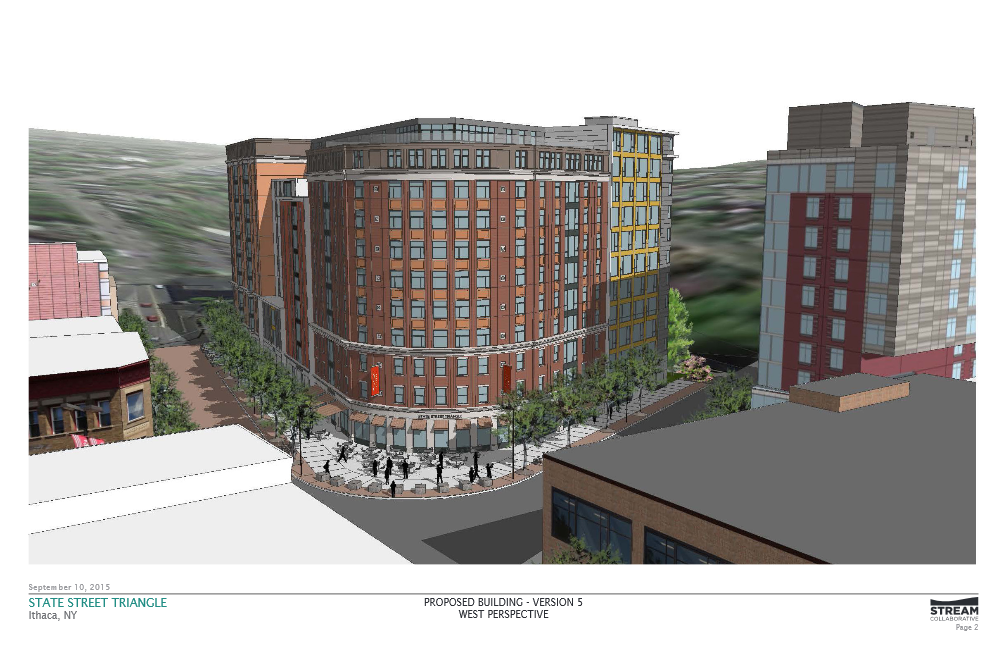
4. The mayor has dealt State Street Triangle a serious blow by announcing his opposition to the State Street Triangle, first reported on his facebook page and picked up by every news outlet in town, Svante Myrick cited the student housing focus and massing concerns for his opposition (he explicitly stated the height, 11 stories and 116 feet, was appropriate for its location, the 300 block of East State Street in the heart of downtown Ithaca). This is a big setback because apart from his social influence, the mayor sits on the county IDA, which is the governing body that votes on tax abatements.

A couple of the outlets have reached out to Campus Advantage, which is busy trying to formulate a response. They’ve hired a PR firm for whenever they’re ready. It could be the end of the project, it could still go on, it could be drastically altered. The chips have been tossed into the air, let them fall where they may.
20151011_121733 20151011_121800

5. House of the week. This week, a trip out to Maple Ridge in Dryden. Maple Ridge is a housing development within the village that had the unfortunate luck of launching right before the Great Recession. After struggling, it’s been picking up in the past couple of years with five houses built since 2013. This modular home is the “Cayuga Lake” model offered by American Homes in Dryden. The pieces have been assembled and fastened together on top of the poured foundation, and some finish work has started. The uncapped foundation section is most likely a future garage. Modular homes tend to move through construction pretty quick, and this one will likely be finished in time for the holidays.

waterfront_rfp

6. The county and city hosted a meeting discussing possible waterfront re-development plans for the NYS DOT site on Thursday night. Three plans were presented, two mixed-use commercial and residential, and a third that the Journal describes as just being “hotel”, but given the 7.66 acres on site, is probably mixed-use with a hotel component.

The third option is a little bit of a throwback because the city long-saw the waterfront as prime for a hotel. But the market has shifted towards downtown and Route 13, and with the market adding new hotels at a pretty good clip over the next few years (Marriott, Canopy, Holiday Inn Express), a hotel in that area is pretty unlikely. Local lawyer/developer Steve Flash proposed a five-story hotel on Inlet Island in 2007, but in the days before the waterfront zoning allowed five floors, the project was opposed and shelved.

An initial cost of the move is being pegged at $14 million, but it isn’t clear if a potential buyer would pay that directly, or the county/city, who then get reimbursed by a buyer. $14 million is quite an amount, but given the site’s potential, it’s feasible (but don’t expect any outside-the-box thinking; a developer will want to minimize risk since they have to make such a huge initial investment).

If anything is clear, it’s that, contrary to the opinion of at least one speaker at the meeting, most folks would like the snow plows and road salt stored somewhere else.

20150727_145000

6. I don’t comment on politics. I don’t comment on candidates. But I will comment on issues. And, probably no surprise to readers here, I find it worrisome when anti-development candidates come forward.

By and large, development in Ithaca isn’t happening “for the sake of development” like in the 1990s, when the local economy was mired in recession. It’s happening because the Ithaca area has added 6,000 jobs in ten years, mostly in healthcare and education. Cayuga Medical Center has added over 500 positions in 10 years, and while Cornell’s direct employment hasn’t changed much, the university has added nearly 2,500 students. That has created demand for thousands of units, but when combined with the slow pace of development within the county over the past decade, the result has been a critical housing deficit.

This is one of the major reasons behind the current affordable housing crisis – high demand, plus insufficient increases in supply, have resulted in very low vacancy rates and have made it a seller’s paradise when it comes to housing.

If you plan on selling your house or rental property and retiring to Florida in the next couple of years, you’re in for serious bank! Everyone else, whether through rents or increased tax assessments, ends up with a much greater burden. Housing costs are a big player in how Ithaca became the 8th most expensive city in the country.

If there are thousands of people coming here for work or retirement, and new housing isn’t there to absorb them, the wealthier folks moving in will simply pay a premium on what exists, and price out the existing working and middle class who can’t afford those premiums. Which some people are okay with.

Ithaca doesn’t need to “slow down” development, because that’s one of reasons why the affordability crisis is as bad as it is. What Ithaca needs is to be proactive about development, and generally it has been under Mayor Myrick. The city has actively worked to reformulate general guidelines like the Comprehensive Plan (first all-new plan since 1971!) and is starting work on part II, working on neighborhood-specific themes. Myrick’s government has also identified and maintained targeted development areas, like Collegetown’s Form Zoning and downtown density. The mayor has even come to bat for the $30k-$50k/year working class folks that “breed trouble” and need affordable housing, like with INHS’ 210 Hancock project.

Affordability is a long-term effort and a multi-pronged approach, by keeping vulnerable families in their homes, and providing new homes to accommodate the growing economy and population.

There’s still a lot of work to do, but hell, it’s a start. Sticking fingers in ones’ ears isn’t going to make the housing crisis go away.


News Tidbits 10/10/15: Meeting With the Stakeholders

10 10 2015

1.There is nothing wrong with a little speculation. In a follow-up of sorts to the Voice piece about parking capacity in Downtown Ithaca, the Times’ Josh Brokaw did an interview of his own with city of Ithaca parking director Frank Nagy. Nagy believes that the 248-car estimate used by State Street Triangle is “way high”, but given that one of the refrains is that there’s not enough parking, they’d rather be safe than sorry.

More importantly, Nagy believes that the Seneca Garage only has about 10 years of life before a new garage will need to be built (the Seneca garage was built in 1972). The structural situation at Green Street is severe enough that the city may have to remove the end pieces and build up the middle section, which was renovated several years ago. The property is being reviewed, and with Tompkins Trust vacating office space on its ground floor as part of the move to its new HQ, the assessment is well-timed.

If the Green Street garage decides to go up rather than out, that leaves two very valuable properties that the city could sell to its benefit (financial, affordable housing, or otherwise). Both ends of the Green Street garage are zoned CBD-140, which offhand is the densest zoning in the entire city, 140 feet maximum height with no parking requirement. A zealous councilperson might try and change that post-SST, but as is, a rebuild of Green Street a few years from now could yield a lot of possibilities for downtown development. Put that in the notebooks for 2020 or so.

100_1281

2. Speaking of future plans, we have the bike debate currently raging in the streets. Now, this is only tangential to my usual work, and I am not versed in the topic, so it’s nice to go in without preconceptions.

The city just finished work on Board of Public Works (BPW)-approved bike lanes on North Cayuga Street, specifically an unprotected bike lane on the east side (protected lanes were considered, but not approved). Although meetings gave due public notice, there were no letters sent to Cayuga Street residents informing them of the change, and a number of folks were caught off guard, including members of the city’s Common Council.

In the one corner, you have folks angry about the loss of parking, the inconvenience, and the danger it poses to the elderly. Unfortunately, you also have a council member describing biking-proponents in the same tone one would describe Albany lobbyists. The mayor has come out in favor of the N. Cayuga Street bike lane, although according to the Times, he’s not a fan of “resident-driven infrastructure”. It’s really a fascinating read from a planning perspective. – Times coverage here, Journal here.

bike_lanes_1

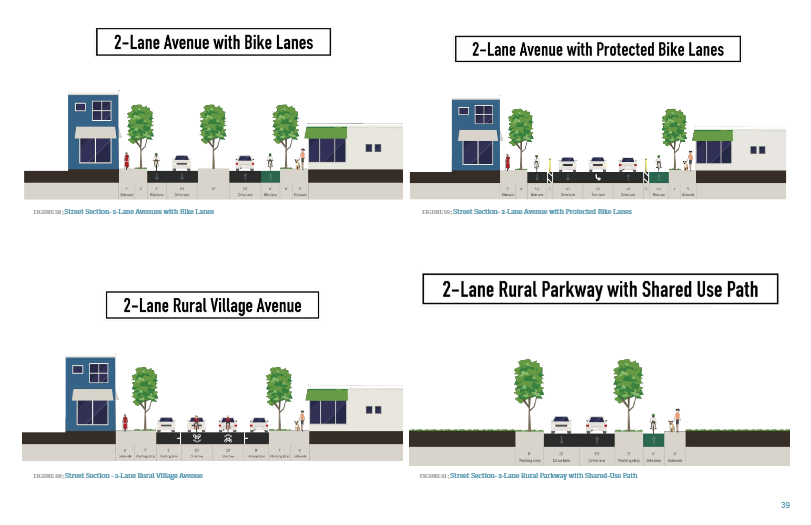
For what it’s worth, bike lanes are a major part of walkable communities and reduced ecological impacts (carbon footprints). I feel like I’ve seen this type of argument play out from the perspective of development quite a bit – every new Collegetown or downtown building gets the “Ithaca shouldn’t allow big buildings/they’re ruining Ithaca/where are they going to park” argument, and the “Ithaca is not a small town/it promotes walkable communities/suburban sprawl is destroying Tompkins green space” counter-argument. The key problem with the bike situation seems to be a lack of communication between the BPW and Common Council (and residents by extension). Luckily, the planning board doesn’t quite have this problem – everything they vote on gets publicized, on this blog if not elsewhere.

cornell_novarr_1

3. The last hurdle for John Novarr’s 215 Dryden Road project has been cleared. The Board of Zoning Appeals approved variances from the Collegetown Form Guidelines – the corner isn’t chamfered or set back enough and the building only has one main entrance (the form-based code mandates an entrance every 60 feet of non-residential space). The owner of the house across Linden from the corner was the lone opposition speaker, and the BZA vote was 4-1, with Marilyn Tebor Shaw opposed. No reason for Shaw’s decision was provided in the article.

With all the approvals tucked away, all that’s needed is for the city to sign off on the building permit. Expect this one to be underway within the next month.

image1 image2

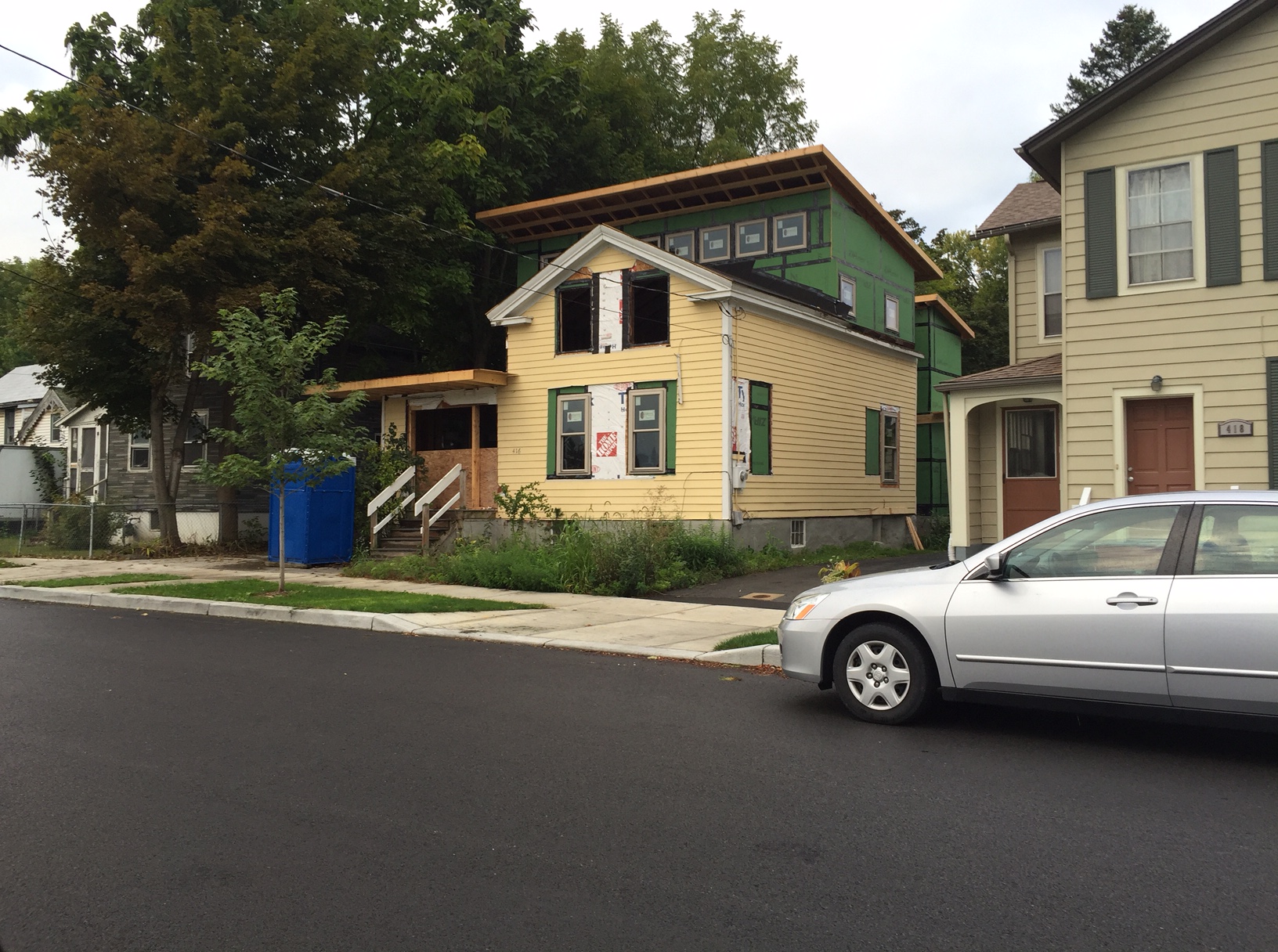
4. Reader submissions are always welcome. The photos for this week’s “House of the Week” featurette come courtesy of Frost Travis. The house receiving the addition is 416 North Plain Street in Ithaca’s Washington Park neighborhood. The current owners brought the property in October 2014. County records give it a 1900 construction date, which is often a default for old and unsure; it appears on an 1889 map of the area, but was not yet built in the 1866 map.

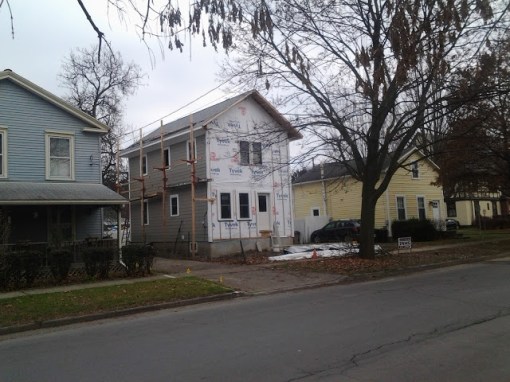
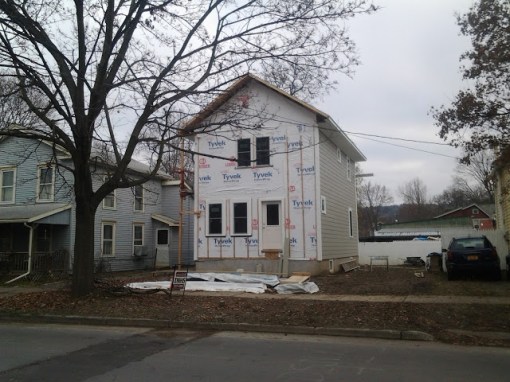
The rear addition looks like it’s been underway for a while – the exterior has been framed and sheathed with plywood Huber ZIP system roof and wall sheathing, which uses seams and tape to save time vs. traditional sheathing such as Tyvek housewrap. There are some windows fitted into the rough openings, but there’s still plenty of work to do with closing up the exterior and interior utilities rough-in. Looking at the original house, the owners appear to be fitting smaller windows in place of the originals – two window cutouts on the north wall have been filled in with sheathing, and a new window has been fitted in a new opening. The front door and adjacent window are gone, one large rough opening in their place. The front roof above the door and window was slanted, but has been dropped to a flat roof as part of the renovation and addition. Presumably, the butter yellow vinyl exterior will be re-finished as construction progresses. With any luck, this one will be finished before winter comes.

Pg-3-Rendering

5. What a quick turnaround. The Cornell Daily Sun first made mention of the Ag Quad renovation last week as part of its coverage of the Collegetown Neighborhood Council meeting. Now only a week after Cornell shared a glimpse at the cards in its hand, they’re playing them. The $9.6 million project will be broken down into two phases, one that focuses on infrastructure, and one phase on landscape improvements (and being that much of the infrastructure is underground utilities, phase one could be described as churning up the ground, and phase two is making the upturned dirt pretty again). The renovations, which are set to start next summer and run through 2017, will include additional emergency phones, a rain garden, and outdoor gathering spaces in front of Mann Library and Roberts Hall (upper right and lower left in the above render).

Too bad those temp buildings are still there between Kennedy Hall and Plant Science. If the Southern Tier wins that Upstate Redevelopment competition, I have an idea where the new Plant Science Commericialization Building should go.

6. Plans for 416 E. State have evolved since the bar was first proposed. Originally conceived as a general bar/drinking establishment, developer and Argos Inn architect Ben Rosenblum has faced substantial opposition to the project – neighbors are vociferously opposed to a bar, citing noise problems and concerns about smokers, and the county planning department was not a fan of the traffic and parking arrangement, which had after hours parking across the street at Gateway Plaza. Although the project doesn’t need planning board approval, it does need BZA approval – area and setback deficiencies have resulted in the need for a zoning variance. The building itself won’t change dimensions, but the change in use triggers the city zoning laws.

416_e_state_v2_1

Representatives for Rosenblum and neighbors have met, and the compromise Rosenblum and his associates have proposed involves a lounge-type of establishment they’re calling “The Printing Press”, after one of the previous uses for the late 1940s warehouse. They’ll be going for an industrial/”speakeasy” aesthetic, and targeting the same older, more affluent clientele that patronizes the Bar Argos next door. Signage would be minimal, and exterior work limited largely to an accessory parking lot/handicap access, landscaping and a new coat of paint. Looking at the original plan vs. the revised plan, the bar no longer is in the rear corner, but moved closer to the building center so as to buffer the noise of patrons from disturbing neighbors. Parking will be shared and organized with the Argos Inn’s lot. For more info, cover letter here, renders here, vision statement here.

The new parking arrangement may assuage the county, and the low-key bar located centrally in the interior may be enough to satisfy some of the neighbors. But we’ll have to see the BZA’s reaction and what remaining opposition there is before anything is set in stone.

hotel_ithaca_v3_1

hotel_ithaca_v3_2

7. The Planning and Development Board has scheduled a Design Review Committee meeting to offer guidance and commentary on the styling of proposed buildings. While State Street Triangle isn’t on the agenda (yet), the Hotel Ithaca addition is. Renders here and here.

I’ve toned down my opinions over the years, but this…well, let’s just so those “sick burns” Nick Reynolds mentioned at the last planning board meeting were pretty well justified. I mean…yikes. The cross-hatched blank walls, the circular glazing, the “tourist trap” aesthetic. There’s an alternative being shown with small windows in place of the circular glazing, and rectangular facade hatching instead of the cross-hatching, but it’s not a great improvement. The board’s going to have a lot to say with this proposal.

215-221_spencer_v3_2

215-221_spencer_v3_1

8. I had hopes that for the first time in three years, a major project would go through the boards without complaint or opposition. Hopes dashed. The complainant against the 4-building, 12-unit 215-211 West Spencer Street project cites the loss of the city’s parking lot on the site, the narrow width of S. Cayuga Street (the “rear” road), traffic, and no neighborly interactions because it’s a rental that faces Spencer Street.

215-221_w_spencer_orig

The kicker is, the letter-writer lives in an upscale Lansing subdivision. He rents out his 3-unit Cayuga Street property. The “house” that the letter claims used to be on the site is also misleading. It was a run-down multi-story apartment building (shown above in the photo from county records), demolished 12 years ago by the city, and turned into an informal parking lot that was never meant to be a long-term use. The land was sold by the city to Ed Cope for $110,000 last March.

I’m willing to entertain legitimate arguments and complaints to projects. But this isn’t one of them.


Urban Renewal Part II: When Things Don’t Go To Plan

21 08 2015
Photo from C. Hadley Smith Collection

Photo from C. Hadley Smith Collection

For Part I, click *here*.

Once the federal funding for Project One came through in December 1964, the gears had started to turn. In Spring 1965, the president of the Hotel Ithaca bought the Clinton House for use as a temporary facility while the new hotel was built. Funds and plan details were formally accepted and approved by the Feds and Common Council in May 1965, and the Ithaca Urban Renewal Agency (IURA, which still exists today) was incorporated.

The IURA was long a sore spot among city councilmen because Democrats were opposed to it and Republicans were in favor of it. The city was a little less one-sided with its politics back then.

In 1966, two developers were designated for two properties in the Project One area. One would build a set of retail spaces, the other would be responsible for what would be the nation’s largest Woolworth’s department store.

For those too young to know, Woolworth’s was a major discount and department store chain – a sort of Walmart or Target of its day (and more like a Kmart towards the end), which was from the 1880s to 1990s. The Woolworth’s was supposed to draw people into downtown, and would be on the corner of S. Cayuga and W. Green Streets.

Problems arose when Woolworth’s said it would need even more parking space than planned. The city, fearing the department store would end up in the suburbs, rushed to condemn three properties on the edge of the project area, two car dealerships and a repair shop. The buildings were demolished, acres of parking laid, and the store opened in the winter of 1968/1969.

library_2000

Image property of QPK Architecture

It was not an attractive building by a long-shot, but the store did draw people downtown, and it remained open until about 1998, when the entire chain went under. Today it’s the county library, and the entire block has once again been redeveloped, which was previously written about here.

The closest Ithaca got to that chic modern hotel was the Ramada that opened in 1972 (later Holiday Inn, and now the Hotel Ithaca). That fell just outside the Project One boundary line. The original 1970s hotel, without the “Executive Tower” built in 1985, can be seen in the lead image.

The Hotel Ithaca fell to the wrecking ball in 1967, around the same time that the 2, 4 and 5-story buildings across the street from the Carey and CSMA also came tumbling down. Until the Marriott currently under construction, the city struggled to find a developer interested in the site; the site was developed in 1975 into the new Rothschild’s Building, but the older 1870s structure further up the Commons was demolished, the last of the federally-funded urban renewal demolitions.

After several years of attempting to find developers for the old Rothschild’s site, two local developers finally managed to cobble together enough funding to build Center Ithaca in 1981. Center Ithaca went bankrupt not long after opening, and Rothschild’s closed up in 1982, so the whole block over there has been pretty underwhelming ever since urban renewal touched it.

If anything, the south side of the tuning fork did worse; the potential bank tenant never followed through on its original intent, the city tried for years to sell the property. After several years they finally managed to get rid of the vacant lot. The Trebloc Building was originally planned to have two floors, but financial troubles reduced it to one. The abomination opened in 1974.

The Ithaca Commons, which also  opened in fall 1974 and was completed the following spring, falls outside of the realm of Urban Renewal as discussed here because it was funded with local bonds, rather than federal monies. The idea of a Commons didn’t start to gain traction until about 1971, after most of the urban renewal projects had left their mark on downtown Ithaca.

Like much of downtown, the Commons struggled with high vacancy rates for years, and the mix of stores never quite met the city’s expectations – where the city leaders envisioned department stores and “everyday retail” such as drugstores, neither of those have been historically successful on the Commons, and the use of the Commons as an open-air drug market was an unexpected, unpleasant surprise. It’s really only been in the past 15 years that the Commons has enjoyed low vacancy and strong tenant interest.

See, Ithaca’s urban renewal never quite stopped the overall trend of movement to the suburbs. With each decade, development sprawled further and further out, and it still is in parts of Ithaca town and Lansing. For the Jon and Jane Q’s just looking to buy groceries or hit up a fast food place, downtown Ithaca wasn’t on the radar.

But there were folks who were still drawn to the charm of a built-up downtown, where emphasis was on two feet rather than four wheels. It was an eclectic bunch – older residents still heavily invested in downtown, and younger, poorer, counter-culture types settling in the area during 1960s and 1970s. Ithaca’s dilapidated downtown, where many retail chains feared to tread, is where a lot of the region’s unique “vibe” sprouted, albeit unintentionally.

And, as things go, what’s old is new. There’s a renewed interest in denser, walkable communities, whether for sustainability, cultural amenities, or simply to experience something different from the cul-de-sacs and strip malls that many Gen X’ers and Millenials grew up with. Ithaca, with a stable, growing economy and plenty of fresh blood flowing in and out of the community, was poised to capitalize on this, and his done so with a fair amount of success in recent years, attracting both national retailers and keeping most of its character intact. Had it not for the renewed interest in walkable downtowns, newer urban renewal projects such as Cayuga Green would likely have been as unsuccessful as Center Ithaca.

The car, once a defining aspect of America’s cultural scene, is now more likely to be treated as an appliance, like a washing machine or microwave. It does what one needs it to do, but the allure isn’t what it used to be. Parking lots used to be eye-catching splashes of color, coral and peach, turquoise and sea green; and now, beige, grey, and subdued reds and blues. The symbolism is there.

ith_urban_renewal_plan_1964_2

Urban renewal in the tear-down and pave everything sense was stopped for two reasons – money and opposition. But money was the much more important one.

In the later 1960s, funds for urban renewal started to dry up. The city dropped projects two and three and combined elements of the two for a second phase of downtown, and a proposal for Collegetown. The Collegetown proposal was submitted (much to the chagrin of Collegetown landlords), but much of it got lost due to competing interests in the bureaucratic quagmire, and never moved forward under its original intent. The end result was the parking garage, Schwartz Center for the Performing Arts, and the Eddygate mixed-use complex, all of which came to fruition much later in the mid and late 1980s.

Meanwhile, residents began to rise up in protest after seeing so many historic buildings demolished in favor of projects that were never built, or were downright ugly. Although too late to save buildings like the Hotel Ithaca and the old City Hall, groups like Historic Ithaca were important in keeping buildings such as the Clinton House and DeWitt Mall from meeting the same fate.

20150727_145000

It would be unfair to cast those who supported urban renewal as malignant or devious. No city official, no mayor, no one with a vested interest in downtown Ithaca set out to wreck it. They were trying to revitalize it, and they were listening and applying the auto-centric, “old equals bad” thinking that had been popular in the years leading up to renewal. The results left a lot of hard feelings, and a lot of unmet hopes.

Yet, the issues that faced downtown Ithaca fifty years ago, the problems that the city’s political and business leaders were never quite able to solve, eventually became assets. Old buildings, now loved for character. Walkable streets, now appreciated. Mixed retail, offices and housing, contrary to single-use zoning, now embraced. Ithaca’s old bones, once a persistent ache, have assisted Ithaca in becoming the vibrant city that it is.

Buildings and streets can be planned. But the people occupying them? Maybe not so much.

Not everything can be planned. And that’s a good thing.