Tompkins Financial Corporation HQ Construction Update, 10/2016

13 10 2016

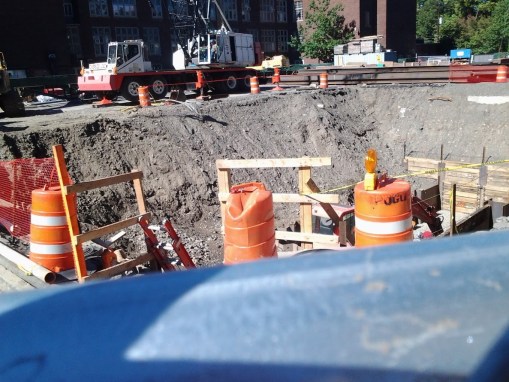
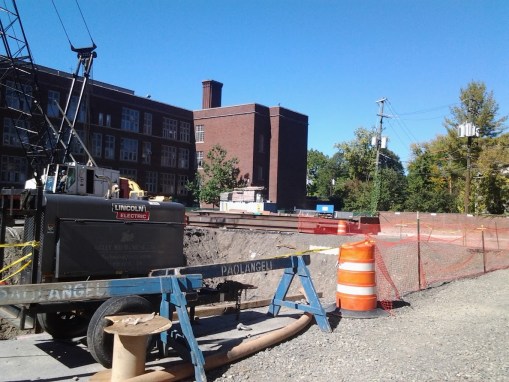
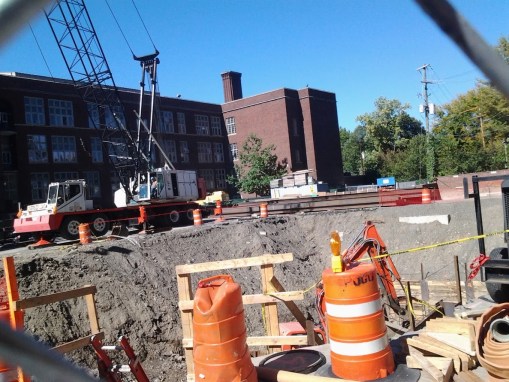
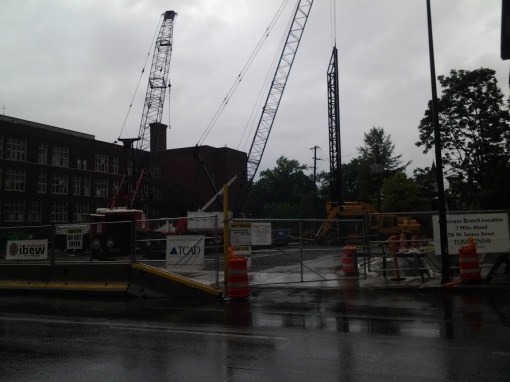
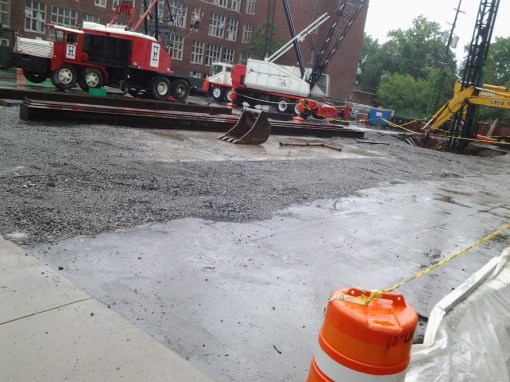
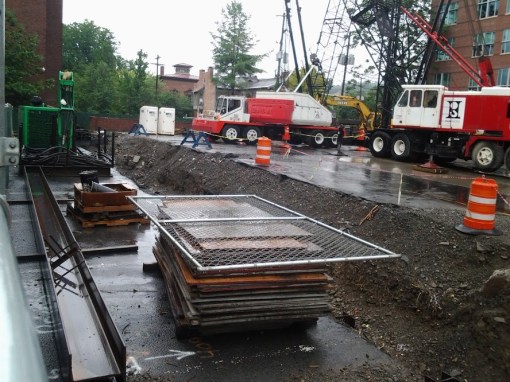
Normally, the phrase “wow, what a hole” isn’t a good thing. Here, it’s fine. Since this is a large, heavy building, and the soil near the surface is liable to settle and risk upsetting the building foundation, a deep foundation is required. According to the geotechnical report by Elwyn & Palmer, the end bearing piles will penetrate 65-70 feet into the ground. At this depth, the material is stable enough to allow each pile to handle the required heavy weight. The basement floor slab will be about 12 or 13 feet below street-level.

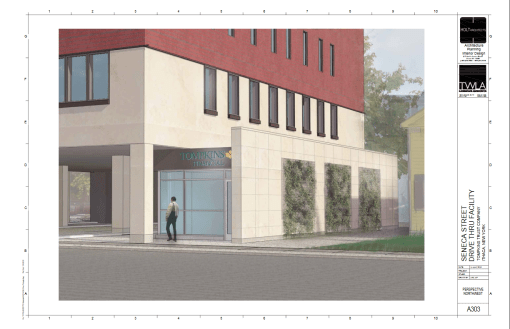
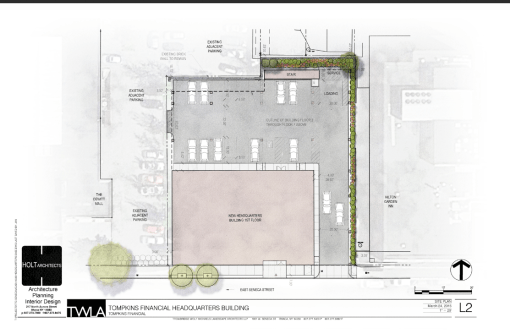
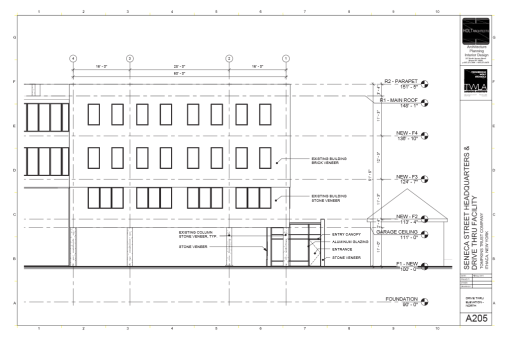
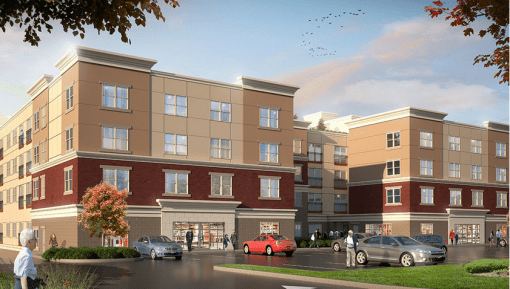
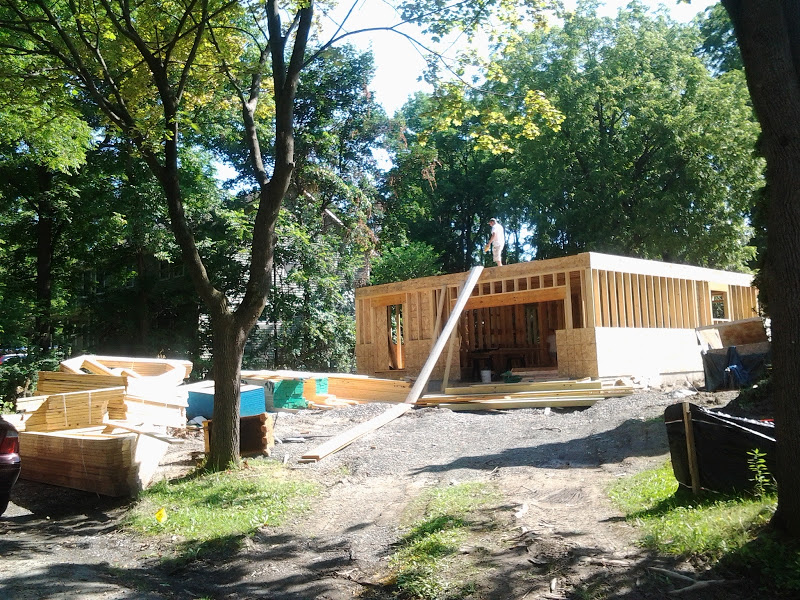
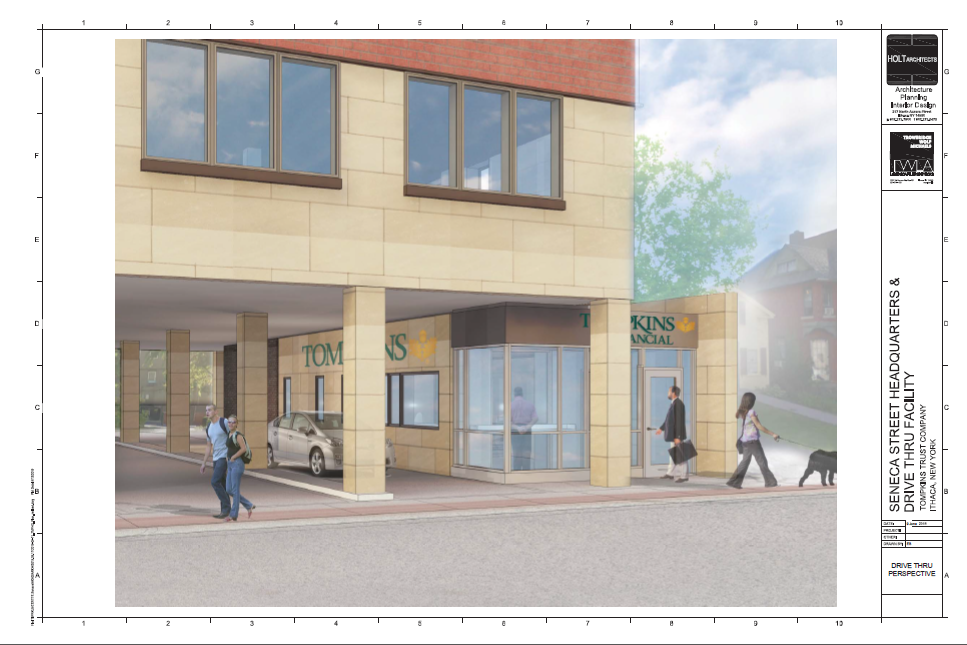
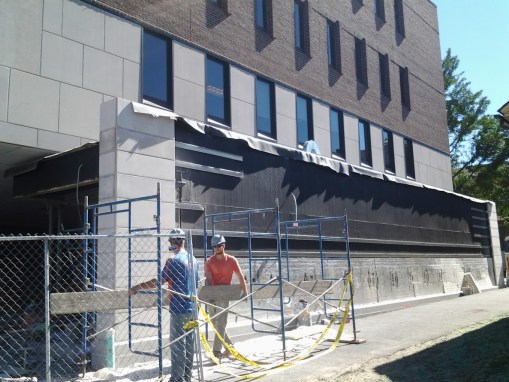
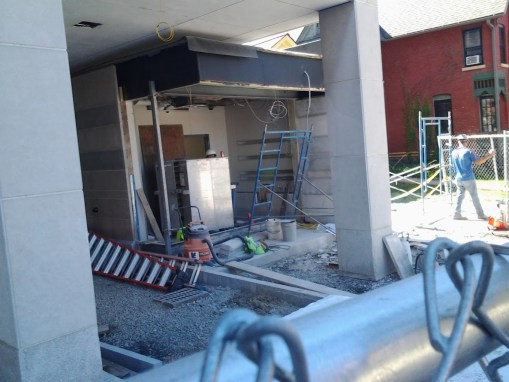
Across the street, the new 965 SF drive-thru building is moving right along. The much smaller building sits on a much easier, quicker and cheaper concrete slab-on-grade foundation. The metal clips on the west wall are for the limestone veneer, just like the panels on the corners. The wall will have metal screens with which vine-spreading plants will grow up and through, creating a green screen intended to make the otherwise blank wall more attractive to neighbors and passerby. The area by the front will have a glass-encased entryway and dark metal panels overhead.

More information about the project can be found here.

20161007_130747 20161007_130821 20161007_130827 20161007_130849 20161007_130919 20161007_130934 20161007_131000 20161007_131017

tfc_final_1 tfc_v3_3

tfc_v3_4


Tompkins Financial Corporation HQ Construction Update, 8/2016

31 08 2016

Tompkins Financial Corporation’s decision to build in downtown Ithaca is seen as something of a major victory by civic groups and local leaders. For one, it’s a major economic investment, and for two, it’s taken by many as a sign that downtown Ithaca has “turned the corner”.

Tompkins Financial Corporation is the parent company of Tompkins Trust Bank, as well as some other financial units. The company can trace its roots back to Tompkins County Bank’s formation in 1836. Along with Tompkins, TFC also manages several smaller banks throughout New York and Pennsylvania, totaling 67 branches and about 1,100 employees. About 280 of those work in downtown Ithaca at the current headquarters.

Currently, the office space is decentralized, scattered throughout multiple downtown sites and one suburban site, some of which are owned and others of which are rented. The bank began studies several years ago to examine a new headquarters, and looked at an urban location downtown, and a suburban location. Throughout the last 50 years, most large private companies have opted for the latter, and not without good reason. The logistics are simpler, the land is cheaper, the parking is easier – a study commissioned by TFC showed they could have saved over three million dollars by choosing a suburban site. But, as downtowns like Ithaca’s have made a resurgence in popularity, and given the bank’s long-time presence in downtown, they decided to pursue the urban option.

The new headquarters, first proposed in March 2015, will keep 282 employees in downtown (making an average annual wage of about $81k), add 18 more from the consolidation of the Craft Road office in Lansing, and potentially add a number of new jobs as the bank continues to grow. The IDA application gives 6 new positions over 3 years, all well over living wage; paperwork submitted to the city says 77 jobs over ten years. The project applied for and received a ten-year tax abatement from the Tompkins County IDA, saving about $4.06 million in property taxes and $2.112 million in one-time sales taxes. The community hearing was generally supportive for an abatement, and even with the reduced short-term tax bill, a net positive of $3.78 million will still be paid in taxes over the next decade.

Now, a little about the site and the building. The project is really two separate projects, one much smaller than the other. The first, at 119 E. Seneca, will build a 965 SF drive-thru bank branch on what is current first floor parking underneath a 1970s office building owned by TFC. The surface lot will be reconfigured to support the drive-thru functions, and retain a small amount of parking space.

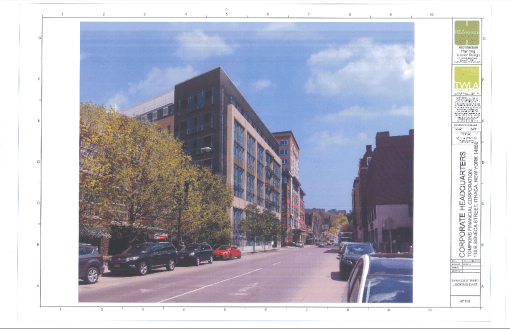
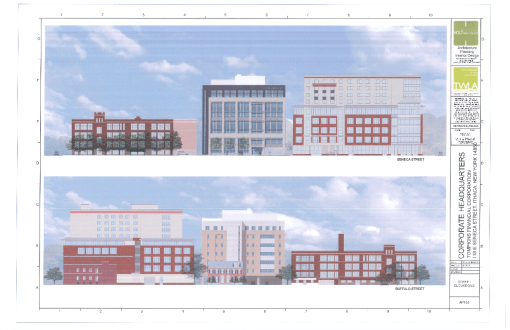
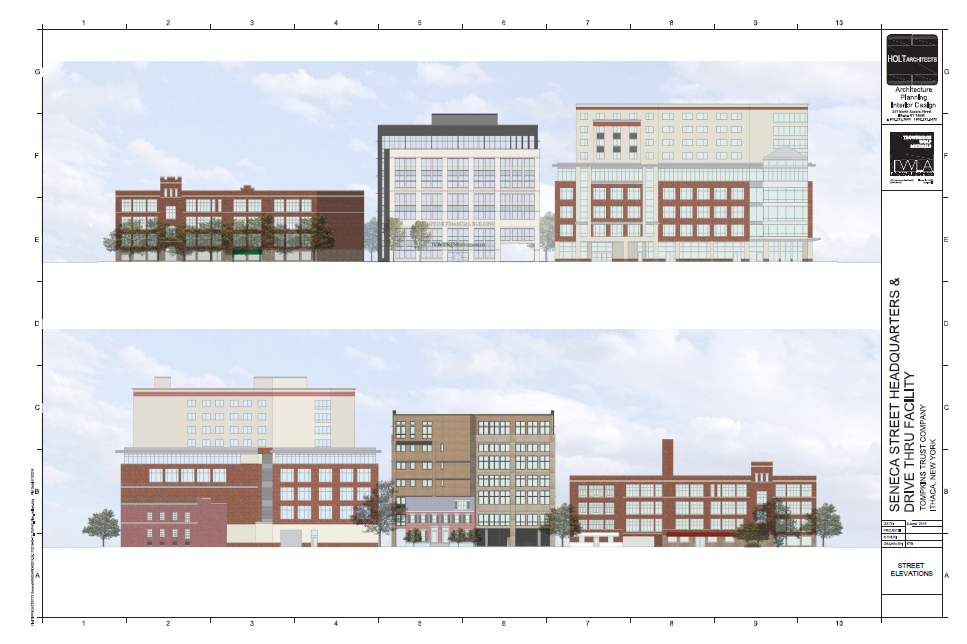
Across the street is where the real meat of the project is. Construction is currently underway on a 7-story, 110,000 SF commercial building at 118 East Seneca, with customer services and 20-25 parking spaces on the first floor and office space on floors 2-7, which will have larger floor-plates that will overhang over the first floor. The first through third floor offices will be geared towards consumer retail operations, and the top four floors will house general operations and senior leadership. The building will be 100 feet tall, just like the 10-story Marriott finishing up a few blocks away. Modern office buildings usually have 14′ floor-to-ceiling heights due to the size of heavy-duty commercial utility systems, better visibility and natural light penetration, and to provide ample accommodation for tenants’ computer equipment. A bit of a prestige factor also comes into play. Materials include a granite base, stone veneer on the front, light and dark brick veneer, and aluminum panels on the top floor’s sides and rear walls. TFC’s HQ will be built to LEED standards, but the company will not be seeking LEED certification due to the costs involved.

The new headquarters replaces a parking lot and drive-thru bank branch  built in 1990, and prior to that the site was home to the two-story Temple Theater, which despite described as “cramped”, “shabby” and “grungy”, brought to Ithaca the first showings of “The Godfather” and other big-budget films of the early 1970s. The Temple Theater operated from 1928 to 1976, when it closed not long after the mall opened in Lansing. The building was razed not long afterward.

Estimated costs have bounced around a little bit – initially reported as $26.5 million, they were up to $28 million by the time of the IDA application, and $31.3 million at the time of groundbreaking. The March sketch plan called for final approvals by June 2015, but they didn’t happen until December 2015. Not entirely the city’s fault, the timeline was very ambitious.

The site has been partially cleared and the existing drive-thru branch has been demolished. Currently, the project is undergoing foundation excavation and pile-driving. You can see the trenches being dug along the perimeter, and wood lagging and steel H beams have been laid along the outer edges to provide stability to the soil and buildings of adjacent properties. According to the report from Elwyn & Palmer, the project team will dig down about 12-13 feet for the sub-floor, thenceforth pile driving shall commence, 65-70 feet down. It’s anticipated the sandy soils will make the pile-driving move along faster, but the other buildings nearby will necessitate temporary support installations during the excavation process. Ithaca firms HOLT Architects and Trowbridge Wolf Michaels Landscape Architects are responsible for the design of the project, and Rochester’s LeChase Construction is the general contractor.

When TFC’s new headquarters opens in March 2018, expect something of a glut in the local office market as a lot of space is emptied in a short time. TFC CEO Grag Hartz has said that 119 and 121 East Seneca would be held onto and rented out, with the bank retaking space in those buildings as it needs. However, their office and bank on the Commons (the historic 2 and 3-story buildings on Bank Alley just south of the M&T Building) would be sold. The project is indirectly spurring Bank Tower’s conversion to apartments, given the tepid office market but very hot residential market downtown. Token teaser if you’ve read this far – a second conversion project is in the early stages.

20160821_131028 20160821_131051 20160821_131105 20160821_131118 20160821_131220 20160821_131331

tfc_final_1

tfc_v2_1

tfc_2

tfc_v3_3 tfc_3  tfc_v2_3


News Tidbits 6/18/16: Wit Fails Me After Eight Years

18 06 2016

201_college_v4_1 201_college_v4_2
1. Let’s start off with a brief update on 201 College Avenue. My colleague Mike Smith at the Voice did an encompassing article on the topic late last Friday, and there have been a couple more modest developments as of late. Apart from the multi-million dollar sale mentioned last week, the city’s Design Review Committee also gave their input on the project. They said they like the current form of thje building’s front (west) entrance, because it calls forth elements of Grandview House a few doors down. they also recommended darker or neutral grey colors to minimize the appearance of the fifth floor, more windows along College Avenue, warm accent colors, and tweaks to the window and cladding scheme. The resulting revisions were incorporated into the latest building design seen above, and for which additional images, material samples sheet and interior plans can be found here. The project will be discussed at the Project Review meeting next week, and the official Planning Board meeting Tuesday 6/28, at which the public hearing will be held, and consideration of preliminary approval.

107_s_albany_v2_2

107_s_albany_v2_1

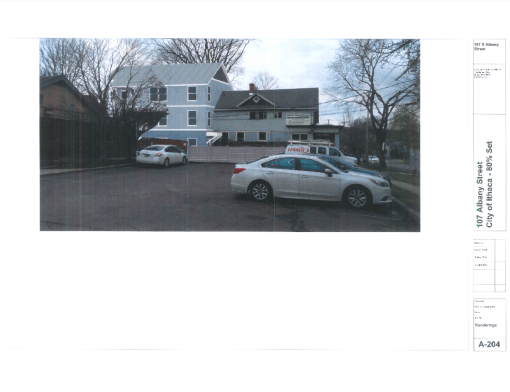
2. Speaking of design review, 107 South Albany also went through the committee this week. Recommendations included projecting window sills, stucco all the way back to the rear balconies, and noting on docs that the large sign on the existing building would be removed during the renovation. Site Plan Review app here, drawings here, Full Environmental Assessment Form (FEAF) here, planting plan here.

The renovation and addition seems like a good example of re-use in a corridor that the city is targeting for new investment. It preserves the century-old structure and adds housing in such a way that, by location and design, doesn’t have a significant visual impact. By zoning, Nick Stavropoulos could have sought five floors if he wanted. This plan will be going through the whole shebang at the June meeting – Declaration of Lead Agency, Public Hearing, Determination of environmental Significance, and Prelim and Final Approval.

Among other things to be discussed at Project Review and the Planning Board meetings – Prelim/Final Approval for 602 West State Street (the Elmira Savings Bank project), signage for Collegetown Crossing, and a few minor zoning variances. New sketch plans, if any, will be announced on the PB Agenda next week.

3. This week in big sales – someone plunked down $680,000 on a house at 107 Catherine Street in Collegetown. I say somebody because they conducted the purchase through an LLC (aptly named “105-107 Catherine Street LLC”) registered by a local law firm last summer. Just like the Maguire purchase of the Carpenter Circle land, this effectively hides the buyer from public view. The same purchase bought 105 Catherine for $780,000 last November. It looks like 105 has 10 bedrooms and 107 has 7 bedrooms, based off assessment docs.

cafd1

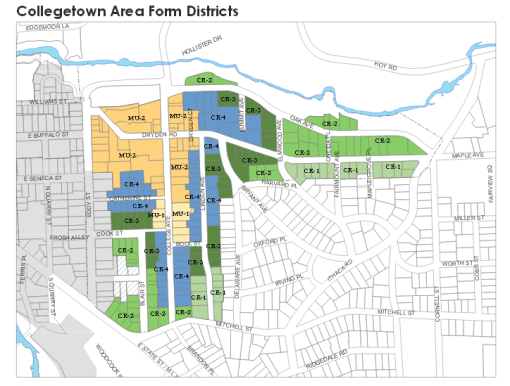
105 and 107 Catherine make up the edge of the CR-4 Form District. By zoning, an applicant could build up to four floors, no parking required. A development plan would likely consolidate lots. Something to keep an eye on. Collegetown is getting to be a very expensive place.

4. Meanwhile, here’s something that’s just hitting the market. For the budding landlords, 306 North Cayuga is up for sale. The “C. R. Williams House” was built in 1898 (interior/exterior photos from the early 1980s here). The current owner, Jeff Kalnitz, picked it up for $300k in 1997, had it on and off the market a couple of times, and then decided to do a thorough ILPC-approved renovation. The 12,500 SF property, which holds six high-end apartments and approvals for a seventh, is being offered at $1.45 million. It’s worth looking at the listing if only for the glamorous interior shots.

amici house 1 county
5. On Tuesday, the Tompkins County Legislature will vote on whether or not to take $118,000 from the county’s general fund to indirectly help build head start classrooms and a living facility for homeless young adults.

The $118,000 would be use to purchase a house at 661 Spencer, whose land would be incorporated into plans for a 23-person facility for homeless young adults (some with children) aged 18-25, and five classrooms. The classrooms would be built as one building, while the housing looks to be an addition to the TCAction building. The one-story house at 661 Spencer, built in 1950 and formerly formerly owned by the Amici family, would be removed.

The plan is the latest incarnation of TCAction’s Amici House project, slated to share their headquarters property at 701 Spencer Road on the southern edge of the city of Ithaca. TCAction first acquired their property with the help of the county back in 2001; the cost of the purchase is paid back to the county in the form of a 20-year lease.

If the legislature approves, the lease would be extended by two years so TCAction can pay them back for the up-front cost of buying 661 Spencer. The Amici House project would be completed by 2018.

6. Poet’s Landing in Dryden will be moving forward with its 48-unit second phase. The rentals, which are targeted at individuals making 60% of county median income, are expected to begin construction in August with a late summer 2017 opening. Phase I, which consisted of 72 units, opened in early 2013. The state awarded the project $1,600,000 from its Housing Trust Fund, and $734,956 in Low-Income Housing Tax Credits to help finance the apartments’ construction.

tfc_v2_1

7. Tompkins Trust held the official groundbreaking this Friday for it’s new 7-story headquarters. Plans were slightly delayed after some issues arose with NYSEG. The current plan is to have the 123,000 SF building ready for occupancy by March 2018. Costs have risen somewhat, from $26.5 million to $31.3 million.


News Tidbits 3/26/16: Big Plans and Small Town Intrigue

26 03 2016


201_college_1

1. Starting with with the new project of the week. In case it was missed, the write-up for the new 5-story apartment building proposed for 201 College Avenue can be found here. 201 College is being proposed by Todd Fox under his new development entity, Visum Development Group; Modern Living Rentals will continue to exist as a rental property management company. Excluding perhaps a small question with where the average grade is to determine the 70′ max height, is looks like the proposal fits the MU-1 zoning; and apart from a couple of the usual grumblings against students and/or density, there isn’t likely to be too much of an issue with the proposal. Noah Demarest of STREAM Collaborative is responsible for the design, which will make be faced with colored metal panels.

On a related note, the Journal broke this before the Voice, and it appears they may have used to the city’s Site Plan Review pre-application as a source. That’s not online for public viewing; someone would have had to give it to them. Which seems a bit dodgy, given one of the goals of the now-mandatory pre-application is to offer initial thoughts to make sure a project is palatable, and to avoid another public controversy like State Street Triangle.

312_spencer

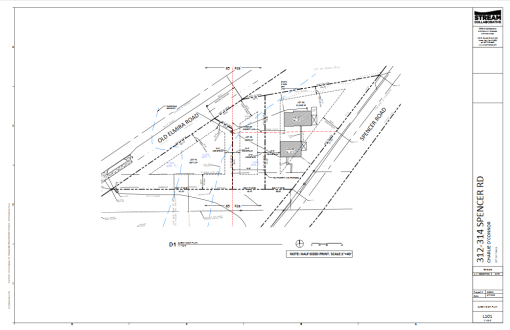
2. Meanwhile, the other partner in Modern Living Rentals, Charlie O’Connor, is pursuing a small project of his own on the other side of the city. O’Connor has submitted subdivision plans to merge two lots at 312 and 314 Spencer Road, and subdivide two legally-buildable lots from the merged property for a total of three, one of which will contain the existing houses. The new lots would be on vacant land behind the existing houses, which are currently owned by the Lucatellis (the same folks who ran Lucatelli’s next door). O’Connor would be purchasing the home and land pending approval of the subdivision. Each of the two new lots would then be developed into a 2-family home. Noah Demarest of STREAM Collaborative is handling the application. Drawings can be found here.

biggs_1

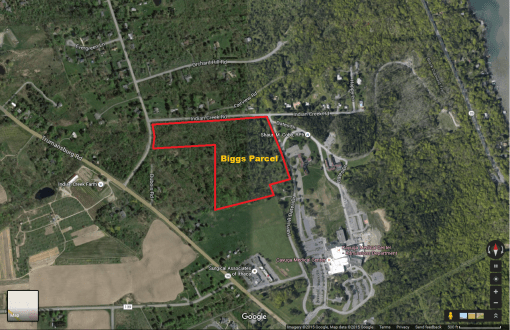
3. The Biggs Parcel will be put up for sale. As the county notes in its press release, the county administrator has been given permission to procure a realtor and market the property on the condition that any offers from the Indian Creek Neighborhood Association and/or the town of Ithaca be entertained (though not necessarily selected). The ICNA had offered some unknown amount for the property, which they have sought to keep undeveloped, but the offer was rejected. Previously, the site was the location of a proposed 58-unit affordable housing development, but the project was discontinued when more extensive wetlands were discovered on the property.

One of the big sticking points has been whether or not the 25.5 acres would be taxable – the county wants to sell to a private owner that will pay taxes, but proposals to preserve the land often dovetailed with plans to donate it to an organization like Finger Lakes Land Trust, which would render the property tax-exempt. The land had been valued at $340,000 before the discovery of the additional wetlands, and the reassessment value will become available on May 1st.

Realtors will apply to the county to list the parcel, and a realtor is expected to be chosen by the county by May 4th.


4. A large property in Trumansburg village noted for development potential has sold after being on the market for two and a half years. Local architect Claudia Brenner picked up the 19.27 acres in two adjacent parcels for $240,000 on the 22nd, about 25% off its original $300k asking price. 18.77 acres is registered to 46 South Street, the other 0.5 acres is a small L-shaped lot between 209 and 213 Pennsylvania Avenue. The previous owners used the property as cropland, and it had been in the same family since the 1940s.

In an email, Brenner said it’s too early to comment, but that future plans are being considered. The site has the village’s R-1 zoning, which allows home lots as small as 15,000 SF (~0.35 acres), and small scale multi-family residential and commercial services.

tfc_v2_1
5. Talk about big delays. Tompkins Financial will be pushing their $26.5 million project back a whole year, according to an interview a Cornell Sun staffer conducted with JoAnn Cornish, the city’s planning director. The project was supposed to start this quarter and be completed in Q1 2017. Now it will be completed in Q1 2018.

summit_danby_1

6. A few months ago, the Summit Enterprise Center proposal in Danby was described in one of the weekly news roundups. Docs filed by STREAM Collaborative’s Noah Demarest on behalf of owner David Hall call for modifications of a Planned Development Zone for the property at 297-303 Gunderman Road. Danby’s PDZ is not unlike the city’s PUD and town of Ithaca’s PDZ, where the form and layout is regulated rather than the use. The original PDZ for the property dates from the mid-1990s.

Well, after months of vociferous debate, the project has officially gone into bureaucratic Hell, complete with political turmoil and accusations a-flyin’. My colleague Mike Smith has the full story on the Voice. Rather than rehash Mike’s detailed explanation, let’s just leave it at this – Summit probably isn’t moving forward anytime soon.


News Tidbits 12/26/15: Do You Hear What I Hear

26 12 2015

1. Not as visible, but still important – Student Agencies Inc. has secured a $3 million construction loan from Tompkins Trust Company for a major renovation of its building at 409 College Avenue. Although details about the project itself are a bit scarce in the paperwork filed on the 18th, it is likely the eHub entrepreneurial space being built for Cornell students, faculty and staff. The eHub space will include space for PopShop (a space for student business planning and development), the eLab business incubator, conference space, mentors-in-residence, and basically all the physical space and things a budding businessperson would like to help them succeed.

According to a previous write-up by the Cornell Chronicle, the lab should be open later this Spring, with 10,000 SF on the second and third floors of 409 College Avenue, and 4,000 SF of space in Kennedy Hall on the Ag Quad. STREAM Collaborative of Ithaca will be the interior architect for 409 College, and Ithaca-based Morse Project Management LLC is the general contractor.

Now, this could be a great thing for Ithaca, because it leverages Cornell’s presence to foster business development. Sort of like a Cornell-centric Rev. And Rev, for what it’s worth, has had several successful associated firms in the past couple of years – Ursa Space Systems was named a STARTUP-NY partner and will be hiring 22 people, and Ithaca Hummus is looking at hiring 50 over the next five years. Even the Ithaca Voice grew from what was basically a one-person operation when it launched in June 2014 (hat-tip to Jeff Stein), to having several full-time staff as well as giving Ithaca a higher profile through viral hits like the Key West promotion and the Harry Potter Wizarding Weekend.

Anything that allows Ithaca to grow and diversify its economy is a great thing, and if it can utilize Cornell’s presence to help that cause, all the better.

20151205_124218

2. The Lansing Star is reporting that 2015 was a banner year in Lansing, with 200 single-family homes, apartments and townhouse in the works. Along with the 20 or so plans reviewed, the town is also looking at revising its Comprehensive Plan, and the town may even consider the adoption of form-based codes in certain locations such as the proposed and stalled Lansing Town Center.

One caveat I’d add is that the key word is reviewed, meaning approved. Not underway. The 102-townhome Cayuga Farms project still had major issues to work out with its proposed package sewer system. If one were to look at permits, it’d probably be 36 or so units with the Village Solars, and probably as many with scattered single-family homes and duplexes, which would make for an average-to-above average year – final 2015 values will be available from the HUD in March. The village could see a big boost from its usual single-digit permit total, if the Cayuga View project gets its construction permit this year.

cayuga_view_1

3. Speaking of Cayuga View, the price point came up at a Lansing village meetings, the minutes of which came online this week. Drumroll please—

The targeted price point is $1600/month for a one-bedroom, one-bath unit (of which there will be 12), and $2700/month for a 2-bedroom, 2-bath unit (of which there will be 48).

That’s quite a high figure. Applying the standard 30% affordability threshold, the targeted income bracket for seniors is $64,000-$108,000/year. That’s comparable, or a little more than, the Lofts @ Six Mile Creek. It also draws parallels to inner Collegetown projects like Dryden South, where rents will be $1350/bedroom. But those projects fall in traditionally high land-value areas.

If it’s financed, then a lender must believe there’s a market for it, and given the general difficulty in financing projects in this region, that really is saying something. Increased affluence and number of retirees moving in? Hoping to capture the older, richer Cornell faculty/staff crowd? Bad judgement? Who knows.

tfc_v2_1

4. In the briefest of blurbs, the Times’ Josh Brokaw, who I applaud for attending even the less interesting city Planning Board meetings, reports that the Tompkins Trust HQ has been approved, with a permit likely once they get a minor curb-cut issue worked out. The contentious Printing Press Lounge debate also received the Planning Board’s go-ahead, if not necessarily its blessing. Expect a late winter or early spring construction start with the Tompkins Trust HQ, with completion the following year.

biggs_1

5. A couple of interesting developments for the Biggs Parcel in Ithaca town. According to the Times’ Jaime Cone (new writer, guys?), a member of the ICNA, Roy Luft, is prepared to make an offer for the Biggs Parcel that would preserve the vast majority of the land. Luft owns a 10-acre parcel to the south (street address 1317 Trumansburg Road). He proposes to take a non-wetland portion on the southern end of the Biggs Parcel, combine it with the open field behind his house, and pursue a cluster subdivision of homes intended as owner-occupied senior housing, which on the surface seems like a decent plan and location, given that owner-occupied senior housing is in demand and the land is adjacent to Cayuga Medical.

With this offer aired, the county, in a 4-1 vote, is giving the ICNA until January 15th to make an offer, otherwise they’ll put the land for sale on the general market. There is no assessment figure publicly available (though a new value has been determined); the ICNA says that’s unfair, while the county legislators have countered by saying not having the assessment value doesn’t stop the ICNA from making an offer, and that the neighbor group has already had a year and a half to make an offer.

20151205_134719

6. Once again, a double-feature house of the week. The theme of this week – high-end homes. Here we have home #1, 8 Pleasant Grove Lane in Cayuga Heights. The house has been mostly framed and the sides have been sheathed, but from the looks of the exposed roof trusses, if would seem that when this photo was taken a couple of weeks ago, the dormers still needed to be decked and the interior was still just stud walls and rough openings.

Design-wise, the home seems to fit in pretty well with its neighbors, which were mostly built in the late 1970s and early 1980s. The property was purchased in 2012 for $132,500 by an LLC traceable to a coach for a Cornell athletics team. Previously, the lot had been owned by its Pleasant Grove Road neighbors, and was sold in an estate sale.

20151205_131313 20151205_131331

7. House of the week #2. I couldn’t pass up the chance to see the one house under construction that seems to have the entire lakefront mansion community so utterly pissed off. For the record, this house on the Captains Walk cul-de-sac has been under construction for years – you can see it in the satellite imagery for Google maps, which dates from 2013. It also appears to be even larger than many of its million-dollar neighbors. Three-car garage? Check. Courtyard-type entry? Check. Windows have been fitted, the roof has been shingled and the exterior has been sheathed with Huber ZIP System panels. A spring finish would be a good guess. Records indicate a couple from Pennsylvania, the founders of a chain of assisted care facilities, bought the undeveloped parcel for $213,800 in 2013.


News Tidbits 12/12/15: Money Money Money Money

12 12 2015

canopy_hampton_rev4_1

1. Time to do a little rumor-killing. There’s been some confusion as to whether or not the Hilton Canopy is actually happening, since it was supposed to have started construction by this time and it hasn’t. There was also an article in the Ithaca Times that suggested that construction costs much higher than original estimates had caused the project to be cancelled.

Well, the project has definitely been delayed, but it looks like it will still be moving forward. According to a utility easement resolution at the Ithaca Urban Renewal Agency’s Economic Development Committee (IURA EDC) meeting, a project financing commitment has been secured and the developer of the Hilton (Neil Patel of Lighthouse Hotels LLC) is planning a construction start in the first quarter (Jan-Mar) of 2016, which would suggest a mid-2017 opening.

inhs_pride_design_v5_3

2. Also in financial news, INHS looks to have secured grant funding that will allow it to move forward with its 210 Hancock project in the next four months, according to INHS Executive Director Paul Mazzarella. The grants were officially awarded in an announcement from the governor’s office on Tuesday. $3.6 million will come from the state’s Housing and Community Renewal program, $500,000 from the state low-income housing tax credit (LIHTC) program, and $1.03 million from the U.S. Department of Housing and Urban Development’s LIHTC program. In total, the award is valued at $5.13 million, about a quarter of the estimated $20 million development cost. The project has received about $17 million in grants and tax credits to date.

The money awarded covers only the rental units – 54 apartments in the four-story mixed-use building, and five townhouses. The seven owner-occupied townhouses remain unfunded.

The apartments, which include a 30-child low-income daycare facility and commercial office space for non-profits, will welcome their first tenants in Summer 2017. They will rent from 27% to 105% of local median household income, depending on the unit. Descriptively, it’s a mixed-income project with residents’ incomes ranging from $25,000-$60,000 per year.
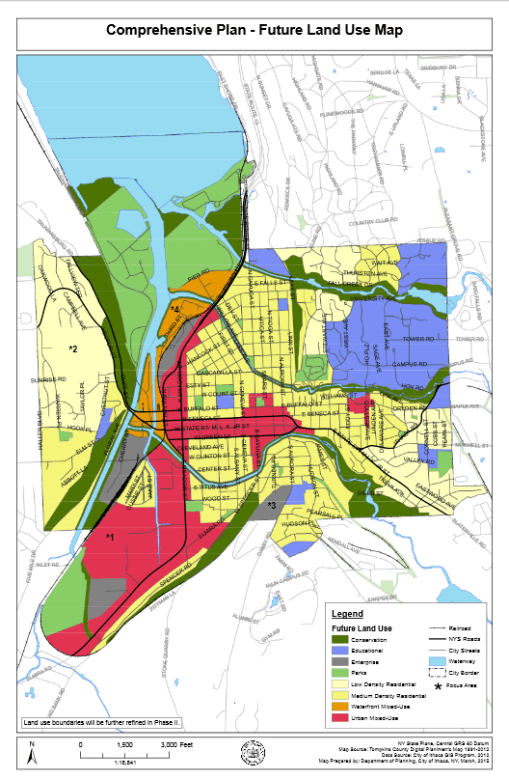
ith_big_plan_map_v2

3. From the Common Council’s Planning and Economic Development Committee, there are a few things of note this week –

A. The city seems to be looking towards greater encouragement and flexibility with redevelopment of waterfront parcels by making WF-1 and WF-2 zones Planned Unit Developments (PUDs). What a PUD does is allow greater flexibility in uses and design by removing or loosening zoning constraints on site use, and being more accommodating to mixed-use projects (the Chain Works District proposal is a PUD, for example). Previously, PUDs could only be applied to industrial sites. The other stipulation, however, is that the applicant would have to work with the Common Council to determine appropriate development of the site.

The Waterfront Zoning allows up to 5 stories and 100% lot coverage. The PUD will give flexibility beyond that, dependent on what the Common Council is comfortable with for a given site and proposal.  So if Applicant X shows up with a huge apartment building or a big industrial building, it’s probably not going to get very far. But if it’s well designed and has affordable units? Maybe the council will grant a little more density or another floor. It depends on a developer showing up with something that they feel offers some kind of community benefit and fits with the Comprehensive Plan, and whether the Common Council agrees with the developer’s reasoning.

There is great potential in the waterfront – those views can fetch a premium (i.e. higher land values, and more tax dollars), it’s far enough removed from the colleges that students would be unlikely residents, and many of the properties are underutilized, with only marginal public benefit.  So potentially, if someone wants to work with the Common Council (one can count on at least 8 or 9 of the 10 being willing to cooperate), there could be some benefits in the long-term.

B. The Commons first-floor active-use zoning ordinance looks to be heading for a Common Council vote in January. More about that ordinance here, Item 5.

C. That damned backyard chickens thing again. Only this time, it might be moving forward with a pilot program involving 20 families.

D. Per the Times’ Josh Brokaw, expect incentive/inclusionary zoning to be up for PEDC review in January.

tfc_comparo

4. Hey look, this week’s eye candy. Tompkins Financial Corporation’s proposed downtown Ithaca Headquarters at 119 East Seneca Street will be reviewed for final project approval at this month’s Planning Board meeting. As part of that, here’s the final project design, part of the final Site Plan Review submission here.

From the front, it looks like some of the window layout has changed on the top floor and southwest corner, and there are fewer sunshades above the windows. There’s a third tree in the planting plan, and there’s variation in the cladding materials on the west wall facing the DeWitt Mall.

tfc_v3_1

In fact, it’s the non-primary facades that have changed the most, with different (and generally lighter-colored) brick and aluminum panels when compared to the previous rendition. Although there’s less glass than before, the lighter colors and greater variation in materials de-emphasize the bulk from the perspective of its townhouse neighbors at the rear. The 7-story, 110,000 SF commercial office building should begin construction in early 2016 with an eye towards completion the following spring.
elmira_savings_1

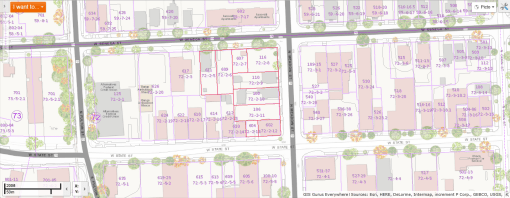
5. There was quite a sale on Ithaca’s West End last Friday. Nine properties outlined in red on the map above – 106, 108, 100 and 116 North Meadow Street, 607, 609 and 611 West Seneca Street, and 602 and 604 West State Street – were sold for $1,725,000 to Elmira Savings Bank.

Now, there are a few reasons why this is worthy of attention. For one, banks don’t typically shell out almost two million dollars without some kind of plan. For two, Elmira Saving Bank has been moving forward with expansion plans in the Ithaca area in hopes of capitalizing on the growing local economy. For three, there has been a lot of development in this neighborhood as of late – the Iacovelli Apartments (2013) and Planned Parenthood (2014) are right across the street, and it’s worth noting that the 18,000 SF HQ for Alternatives Federal Credit Union (2002) is on the other side of the block.

The properties are currently home to parking lots, several older, non-historic houses (most in poor condition) and a two-story 4,500 SF commercial building previously home to the Pancho Villa Mexican restaurant. The restaurant building had been on the market for $699,900.

The zoning here is all WEDZ-1a. West End Zone 1a allows for 2 to 5 story buildings, 90% lot coverage in the case of large assemblages such as this, and no off-street parking requirement. That means these parcels have a lot of potential. The previous owner had been rumored to be planning a mixed-use building on some of the properties, but nothing official ever came forth.

Two phone calls were placed to Elmira Savings Bank’s headquarters in Elmira, and two voicemails were left, but neither received a response. But these properties are definitely something to keep a close watch on over the following months.

6. That 9100 SF store being developed on the corner of East Shore and Cayuga Vista Drives in Lansing that was mentioned last week (here, Item 4)? It’s going to be a Dollar General. Not sure if that’s better than the auto/tire store speculated last week.
20151108_152102

7. Lest it be forgotten, it appears Lady Luck and some state bureaucrats smiled at the Southern Tier this week, awarded the region one of the three $500 million prizes of the Upstate Revitalization Initiative, known colloquially as the Upstate “Hunger Games”. Rochester/Finger Lakes and Syracuse/Central are the other $500 million winners. Seven regions competed, and the four losers will receive $80-$100 million for their priority projects. The money will be paid out in five annual installments of $100 million. A copy of the Southern Tier’s plan is here.

I wrote about Ithaca’s plans for its share on the Voice here. The first year projects alone will have a range of impacts, ranging from job creation and training to municipal construction projects to quality of life projects like museum expansions. Potentially, it could result in hundreds of jobs in Tompkins County, financial capital for several major projects, and make the area more attractive for investment for both local and external entities. As these projects move forward, they’ll receive their due write-ups here and on the Voice.

Of course, the key things are that the community can manage this monetary award, and that someone can track and guide these projects to completion – something the Southern Tier has struggled with, when one looks at the result of previous, much smaller awards.

8. The state’s just shoveling money into Ithaca this week. The New York State Office of Community Renewal (part of the state’s HUD equivalent, the Homes and Community Renewal agency) has awarded $500,000 towards the rehabilitation of the Masonic Temple at the corner of East Seneca and North Cayuga Streets in downtown Ithaca.

The Masonic Temple was built in 1926 and designated a local historic landmark in 1994. The property is owned by Ithaca Renting Company (Jason Fane), who purchased the building from the Masons in 1993. Fane’s never been a fan of the historic designation because the ILPC can be expensive and onerous to work with, nearly everyone else hasn’t been a fan of his long-deferred maintenance of the 90-year old building (if you have ever wondered why that CIITAP rule was added about an applicant being in building code compliance with all their other properties…now you know). A few years ago, Fane had not been shy in his interest in demolishing the building.

After rejecting a purchase offer to turn the building into a community center and space for the New Roots charter school, Fane decided to go the preservation route earlier this year and apply for a grant to renovate the interior and add an elevator to the building to make it ADA-compliant. This would make the building much more marketable to commercial tenants, many of which have shunned the 17,466 SF building. Fane laid out a few different options this past summer, including one where four commercial spaces (rental, office, restaurant) would be created. Based on the grant announcement, it looks like that will be the option pursued.

The Downtown Ithaca Alliance backed the application, as did the Common Council by unanimous vote at their July meeting.

The renovation will cost at least $1 million, and according to the grant announcement, seeks to start construction in summer 2016. Expect more info when it hits the ILPC and Planning Board at a later date.
20151205_121714 20151205_121736

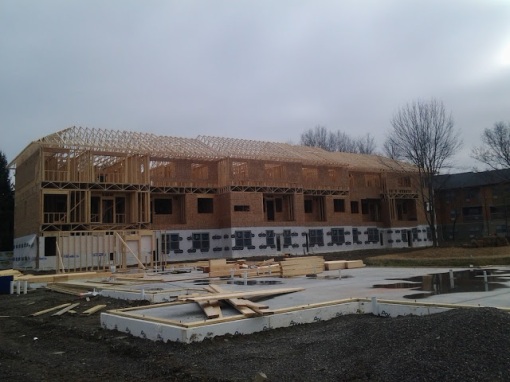
9. House of the week. This week, INHS’s new 2-bedroom, 1150 SF single-family home underway at 203 Third Street in the city of Ithaca’s Northside neighborhood. The house is framed, roofed and sheathed. Siding (Hardie board?) and trim is being attached on the sides, and one can expect a nice gracious porch to be attached once exterior materials are installed on the front. A home of the design was previously built at 507 Cascadilla Street.

203 Third Street was a vacant that the city seized in a tax foreclosure in 2011. It was transferred to the Ithaca Urban Renewal Agency, who sold it to INHS for $17,000 in December 2014. The process is pretty similar for a lot of the home lots that INHS builds on – the non-profit buys dilapidated or vacant properties from the IURA, which they build or renovate into affordable single-family and duplex houses. In the case of 203 Third Street, INHS competed for the site, outscoring Habitat for Humanity’s submission in an IURA examination of proposals.

As with all INHS homes, this one will be sold to a buyer of modest means, which means someone making at or a little less than the county’s median household income of $53k/year (I think 80% of MHI is the low bound offhand, so about $42k/year). The houses will be a part of INHS’s Community Housing Trust, limiting the price it can be sold for and requiring that if put up for sale, it is sold to another family of modest means. It may just be one house, but it will mean a lot to one family.

Claudia Brenner is the architect, with Rick May Construction and Mike Babbitt in charge of construction (thanks to Claudia for the builder info).


News Tidbits 8/8/15: A Shocker on Cayuga Street

8 08 2015

travis_hude_libe_libe_v3

1. As reported by several news outlets, the Tompkins County Legislature came to the surprise conclusion last Tuesday to give preference to the Travis Hyde proposal for the Old Library site at the corner of West Court and North Cayuga Streets. The final vote was 8-5.

I’ll be honest, I was shocked. I figured the county legislature would just never come to a resolution, or that on the off-chance that it did, it was going to be in favor of the Franklin Properties proposal, which had by far the most vocal support of the three proposals (the third being the unloved Cornerstone proposal for affordable senior housing). If this has been the city’s site to sell, the decision would have gone to Franklin, so I think this ordeal highlights the somewhat differing interests of the city and county. Regardless, I feel either proposal would have been successful for the Old Library site, and I am pleased to see something moving forward.

From here, the project is to move into an SEQR (State Environmental Quality Review) assessment coordinated with the city of Ithaca. The project also needs to go forward to the Ithaca Landmarks Preservation Council (ILPC) for a certificate of appropriateness. It is quite possible that the design will be changed during those reviews. Once those are approved, a sales agreement will be drawn up late this fall, the county authorizes sale around Christmas, and the actual sale of the property to Travis Hyde would happen in January 2016. If the Travis Hyde project can’t move forward and the sale hasn’t happened, then the county can authorize the Franklin proposal, which would also have to negotiate the same processes to arrive at the selling stage. In sum, a big hurdle has been jumped, but there’s a lot more that needs to happen before any shovels hit the dirt.

2. For all you would-be developers out there, here’s this week’s opportunity – since the folks that own Felicia’s Atomic Lounge have decided to focus on a new restaurant in Trumansburg, their Ithaca site is closing and the property is for sale. On the surface, you get a 1-story, 1,500 SF building at 508 West State Street for about $350,000. Dig deeper and zoning permits a 60′ tall building with no parking required. The city and county have designated the West State corridor as the place where they would like to focus denser development, and the zoning was revised in 2013 to reflect those desires. If/when the property sells, if it merits further attention you’ll see a news update here.

chapter_house_1905

3. Demolition of the Chapter House’s fire-damaged walls is taking longer than expected because the owner had to apply for a certificate of appropriateness from the ILPC to approve demolition. For those that are interested in reading about how water and fire damage have structurally comprised the structure, the application bundle can be found here. Apart from the usual applications like window and roof treatments, the ILPC is also set to begin discussion of 406 and 408 Stewart Avenue, where a new apartment building is likely to be built to replace the one totally destroyed by the Chapter House (and which I wrote about here on the Voice). For those interested in attending, the meeting is at 5:30 PM in the 2nd floor conference room at Ithaca City Hall.

tfc_v3_1

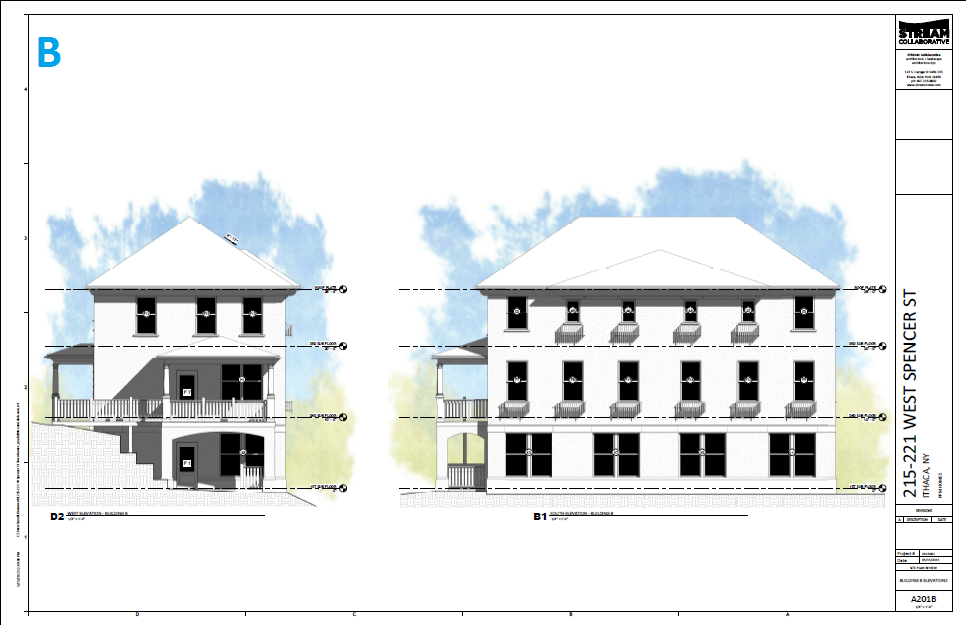
4. Looking at the city’s planning board projects memo for the month, August is going to have a lot og big decisions in store. Novarr’s academic building at 209-215 Dryden in Collegetown is up for preliminary approval, as is Tompkins Financial Corporation’s HQ (shown above) and the Dibella’s sub shop in southwest Ithaca. If INHS’s 210 Hancock gets zoning approvals at the Board of Zoning Appeals (BZA) meeting next Tuesday, it will be up for final approval at the August planning board meeting as well. The 12-unit “pocket neighborhood” at 215-221 West Sepncer will complete environmental review and possibly granted permission to face the BZA, and the massive State Street Triangle project will have more public discussion and review, with no decisions expected. A very busy month that will hopefully pane out to a busy construction season in 2016.

5. Looks like there’s a potential site being weighed for a new Collegetown fire station. In minutes from the Board of Fire Commissioners, the location is described as being towards Maple Avenue, on land that would either be donated or bought outright. That would place it up by the Fairview Apartments and Cornell facilities, assuming it’s not further out in Ithaca town (services are shared if I remember right). An unidentified consultant has been chosen to review the costs of selling the land in Inner Collegetown and building a new station vs. renovating the current 47 year-old property.

20150727_102527 20150727_102600

5. Random house of the week turns back to 203 Pearl Street in Ithaca’s Bryant Park/Belle Sherman neighborhood. I spy with my little eye, a large garage opening, a rough-in for a door to its left, a couple of rough window spaces, and lots of roof trusses. It’s supposed to be a 1,276 SF house, but one could be forgiven for thinking the owners are just building a nice garage. The lot was separate when the neighborhood was first plated, but decades ago 201 Pearl bought the land and used it for an in-ground pool. The pool was eventually filled up, and the land subdivided once again this past spring.


News Tidbits 7/18/15: Two Steps Forward, Two Steps Back

18 07 2015

oldlibe_franklin_proposaltravis_hude_libe_libe_v3

1. The Old Library conundrum continues. At last Friday’s meeting, the committee was unable to come up with an endorsement. As it also turns out, absent legislators Peter Stein and Kathy Luz Herrera can no longer re-introduce the preferred developer vote because absent legislators can  only re-introduce a resolution for the subsequent county meeting – in other words, they didn’t put it up for a re-vote on the 7th, so that option is no longer available. Stein didn’t make a resolution, and Luz Herrera was once again absent from the meeting.

Now things get a little more haphazard. Individual legislators can introduce resolutions for a preferred developer, which Dooley Kiefer and Leslyn McBean-Clairborne are doing for the Franklin/STREAM proposal (the 22 condos and medical office space, first image), and Mike Lane for Travis Hyde (the 60 apartments with space for Lifelong, second image). Either one would require eight votes in favor. Martha Robertson’s recusal makes the Travis Hyde proposal a little less likely to hit that magic number, but unless anyone’s had a change of heart, if Kathy Luz Herrera and Peter Stein don’t both vote in favor of the Franklin proposal, nothing moves forward. The county gets left with a building they can’t make a decision on and don’t want to keep.

The building needs hundreds of thousands of dollars in renovations at this point, not to mention routine maintenance; the lack of a decision could be a weight on any legislator’s re-election prospects. If there is no decision, what happens next is anyone’s guess; spending money to mothball the building, demolition, or even selling the property on the open market. whatever the case, this is definitely not a comfortable position for the county to be in.

amabel_v3_1

2. Looks like the Amabel housing development in Ithaca town is undergoing some site plan changes once again. Quoting the web page, “[w]e recently came to the conclusion that it is far better to park the cars at each house then to have car parks within the common space, allowing 2 cars per house if needed. This also allowed for more guest parking spaces.” Rather than having a road go through the middle of the housing development, the development is now encircled by the road coming in and out of Five Mile Drive. I asked developer Sue Cosentini of New Earth Living LLC if those were garages facing the driveways, and the reply was “no, [but] they may be carports though.” As a result of the revised site plan, the project would need to go back in front of the Ithaca planning board for re-approvals.

fingerlakes_reuse_v2_1

3. Recently, Finger Lakes ReUse has been working on plans to open a new “downtown” branch and HQ at the site of the former BOCES Building at 214 Elmira Road on the edge of big-box land. The plans for the gut renovation of the ca. 1950 building (Ithaca’s first big-box supermarket) have been in the works for a while, and grants have been awarded to fund the project.

One thing that appears to be a recent addition, though, is a three-story, 20,000 SF office building. The building, described as the “Main Headquarters”, is strictly a conceptual proposal. The grant announced in December funds two new buildings,  the renovation and what could be either be the proposed 5,000 SF warehouse to the west of the existing building, or the “tenant space” occupied by Boris Garage at 210 Elmira.

The office building is an interesting idea, adding density to the often-underutilized Southwest Corridor and showing what future plans might be in store for the non-profit.

tfc_v3_1

4. It seems like there was an unpleasant surprise at this month’s IDA meeting – the motion from committee member Will Burbank to put a moratorium on all tax abatements until a county CIITAP is in place for local labor/construction unions and prevailing wage policy. For those unfamiliar, a moratorium is in this case a temporary prohibition of all new tax abatements. After considerable debate and a split opinion from committee members, the motion was rescinded until next month.

Speaking as a matter of opinion, it might seem like a good idea on the surface, but an all-out moratorium sounds more like a case of “throwing out the baby with the bath water,” as one of my professors used to say. Generally, the policy for businesses to hire the contractor with the best price and a strong record for quality, on-time work. Sometimes that’s a local business with local labor; sometimes it’s a company in Binghamton, Syracuse or Rochester. Hence the debate.

The problem with a moratorium is that it stops everything applying for a tax abatement, including projects that already have plans to use local labor. And to be frank, local governments have a terrible track record with moratoriums, frequently extending them because of bureaucratic red tape. I think the unions support the CIITAP idea, but a moratorium that could place even larger numbers of their membership out of work for 12 or 18 months is undesirable and politically damaging. Local labor is important, but a moratorium isn’t the best approach.

On another note, the IDA did unanimously approve the tax abatement for the Tompkins Financial Headquarters project.The 7-story, 110,000 SF building proposed for 118 East Seneca Street in downtown Ithaca will likely start construction later this year.

ithaca_beer_2 ithaca_beer_1

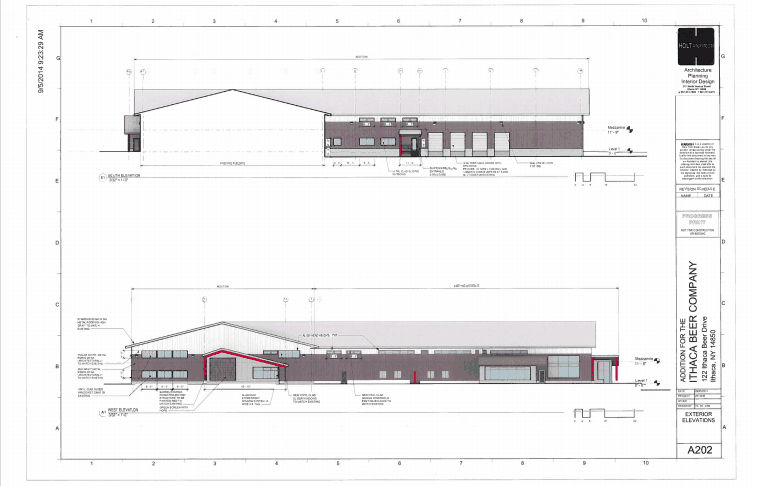
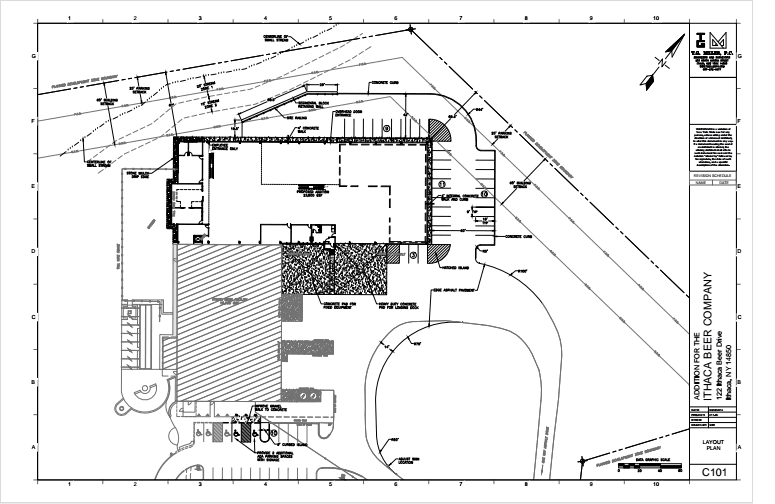
5. In economic news, Ithaca Beer had its informal groundbreaking Thursday the 16th for its expansion. The 23,800 SF addition by HOLT Architects will triple brewing capacity when it is completed in approximately eight months. The expansion at their site in Ithaca town is expected to create 22 new jobs.

clarebridgecrossings_2 clarebridgecrossings_1

6. Also in Ithaca town, a senior living facility is looking to receive final approval on its expansion. Brookdale Senior Living is looking to obtain final site plan approvals for its 32-unit Clare Bridge Crossings expansion at 101 Bundy Drive on West Hill. Brookdale is planning to start construction of the one-story 23,200 SF addition this October, with the first tenants moving in around October 2016. There’s no mention of job creation in the application, but there is a letter of opposition from a Cornell professor concerned that new construction will be detrimental to current residents.

Noted previously here back in May, the Brookdale site is a PDZ that consists of two facilities at the moment – Sterling House is a 48-unit assisted living facility, while Claire Bridge Cottage is a 32-unit facility specializing in memory care (Alzheimer’s and dementia). The new building, “Clare Bridge Crossings”, is designed to bridge the gap between the two – patients who might be in early stages of illness and experiencing mild symptoms, but otherwise still capable of some degree of personal independence. The whole complex is in the process of being renamed to Brookdale of Ithaca.

The new building will be tucked between the other two structures, so it won’t be visible from the street. Along with the new building, there will be updates to parking, landscaping stormwater facilities, and the addition of a couple of courtyards between the buildings. The architect is PDC Midwest, a Wisconsin firm that specializes in memory care facilities.

7. Let’s end off this week on a high note. Chances of a Chapter House rebuild are looking good. The owner’s looking into reusing the walls that remain standing, and even what’s left of the floorplates. The idea is to have the building look like it did before (though perhaps with a modern fire suppression system, one imagines). Looking forward to sharing renderings as they become available.


News Tidbits 6/13/15: Things that make you go Hmm

13 06 2015

travis_hude_libe_libe_v3

1. We’ll start this week’s round-up with the 800-pound gorilla in the room – the Old Library decision. The general, non-partisan rundown can be found in the article I did for the Voice. Rather than rehash that, I’ll give my own thoughts and opinions here.
In what should be no surprise to anyone, there’s a lot of acrimony flying around. The unavoidable problem here is that everyone has a different expectation for the site. To be honest, I was a little surprised that the Travis Hyde proposal was the winner. The Cornerstone and Franklin proposals were running about even when it came to public sentiment – many of the Voice commenters were stressing the need for affordable senior housing, just like the county did in the RFEI. Others used online petitions to push for the condos and saving the old library, but I personally felt that that was always going to be a stretch simply because the condos are a double-edged sword; they’re a needed commodity, but that “air of elitism” associated with the sale of a public asset for high-end homes would hound the legislators all the way to the voting booth.

The truth is, the RFP was designed to be unattainable, and I called it out for that last fall. There was no way a project was going to incorporate all the things it requested. Franklin couldn’t renovate the building and make their units at the affordable level. Cornerstone was able to make their units affordable but wasn’t as environmentally friendly as the others (it also requested a large PILOT). And I guess Travis Hyde was in the middle. Which on that 0-5 scale they used to score the projects, gives a simplified sort of 5-0 (2.5), 0-5 (2.5), 3-3 (3). With unrealistic expectations, of course the legislators were going to be disappointed, and they set up everyone else to be disappointed too. But the thought of holding onto a vacant building with its mechanical systems at the end of their useful lives, ready to put the county on the hook for hundreds of thousands of dollars in replacement costs, is probably the worst option out there.

TL;DR: There was going to a large contingent angry with the legislature’s decision, whatever it was. It’s times like this I wonder if the county should’ve just sold the site to the highest bidder.

Just for the record, because the three proposals were so different, and I thought all of three of them were good community assets, I honestly didn’t have a favorite. I had a slight preference towards DPI early on, but when they dropped out I became neutral about the whole process. But it’s only the Franklin supporters that are accusing me of subversively undermining them in the Voice write-ups, and it’s making me really cold to their cause.

inhs_pride_v3_elevations_2

2. From the Common Council’s Planning and Economic Development Committee (PEDC) agenda, more talk this week about removing the setbacks from Nate’s Floral Estates (more on that in a moment), and a Memorandum of Understanding that both the city and Cornell will be chipping in $100k from their affordable housing funds to help finance INHS’s 210 Hancock affordable housing project (specifically, the 53 apartments – the 12 for-sale townhomes are being financed separately).

As covered by Jeff in the Voice, concerns have been raised that the site is unfit for new development due to the possibility of environmental contamination. Nate’s is partially on the site of the old city landfill, and has been for 40 years. But concerns raised by Ithaca city councilwoman Cynthia Brock, Ithaca town board member Rich DePaolo, and environmental activist Walter Hang have tabled the zoning change for now until the Department of Health can re-review their previous correspondence on the park’s expansion and determine if the extra 30 feet is safe to build on. The expansion may still happen, and we’ll just have to wait on the DOH’s decision before any zoning changes move forward.

On a separate note, there’s this line from the March minutes, which are rolled into the agenda for approval:

Alderperson Brock would like to see an increase in owner-occupied housing in the City. She does agree that affordable housing is needed, but the need is for “for sale” housing.

The last I checked, Ithaca is the 11th most expensive city in the country for rents as a proportion of income. The city needs affordable housing, for-sale housing, and affordable for-sale housing.

tfc_v3_1

tfc_v3_2

3. Fresh renders of the Tompkins Financial HQ. This one’s had some pretty substantial revisions from the initial bland brick box. A little more character and a more varied use of materials. More drawings here, cover letter here. This project’s just scooting right along, the applicants hope to have preliminary site approval granted at the June 23rd Planning and Development Board meeting. Construction is now expected to start in August and wrap up in February 2017.

A traffic study conducted by SRF Associates of Rochester determined that with only 20 employees moving from the suburbs into downtown, that the impact to the vehicular traffic on East Seneca (thousands of cars per day) will be negligible. A long-term increase in traffic is likely if other entities move into the rented space TFC vacates, but that’s well outside the scope of a traffic study.

The initial work calls for site clearing, demo of the existing drive-thru branch on site, then excavation down to the first sub-floor, thenceforth pile driving shall commence. It’s anticipated the sandy soils will make the pile-driving move along faster, but the other buildings nearby will necessitate temporary support installations during the excavation process.

On a related note, Tompkins Financial has filed an application with the IDA for a 10-year tax abatement. The application for the $35 million project (of which $28 million is for construction of the new building) states that the requested abatement would save the project $4.06 million in property taxes, and $2.112 million in sales taxes. New taxes generated and paid over the same time period would equal $3.782 million.

In the application, TFC states that it would be a few million dollars cheaper to build at “a generic rural site”, and in order to make downtown headquarters more financially acceptable, they decided to apply for tax breaks.

The application only suggests 6 new jobs over the next three years, paying $37k-$84k annually. Given previous estimates of 77 new jobs over 10 years, this lack of major job growth early on forces the later years to pick up the slack.

tfc_v3_3

Of course, we also have a render of the new drive-thru across the street, which is nice but not nearly as exciting.

20150607_090520 20150607_090534

4. Sometimes I feel like I should do a random house of the week feature. Here we have a modular home being built on the 200 Block of Eastern Heights Drive in the town of Ithaca. It looks nearly finished at this point; permits for the home were filed back in March, so this one seems to have followed a normal building schedule with no major hangups.

Some modular homes are done on the cheap and look the part; others, like the Belle Sherman Cottages, do a great job with the finishes. This one may not look as great the Belle Sherman project, but it looks like a decent infill home for the Eastern Heights neighborhood. And it has great views to boot.

5. According to the town of Ithaca’s May 11th minutes, a developer has expressed interest in buying fire Station No. 9 at 309 College Avenue in Collegetown. An appraisal has been done and the City has hired a consultant to look into it. Fire Station No. 9 was built in 1968 to replace the original station, which is now The Nines. It sits in Collegetown’s densest zone, MU-2, so a potential replacement could be six floors with no parking requirement. There’s a lot to be looked at here, especially with the potential public safety impacts. But it’s something worth paying attention to over the next several months.

120_brindley_1

6. It’s unusual in Ithaca to see real estate advertisements posted with speculative commercial build-out plans. The above computer drawing is from the online posting for the sale of 120-140 Brindley Street in the West End. The three smaller buildings already exist – the “Aeroplane Factory” on the right and the other two properties comprise ~18,000 sq ft of flex office space. The drawing also shows an unbuilt 3-story office building; I don’t know how serious plans were for it, but it’s probably just conceptual. The real estate ad itself notes that a live/work building is possible, as well as a 6-story building of 25,000 sq ft.  The 2.38 acre site’s for sale for $2.79 million.


News Tidbits 6/6/15: I Give This Week A Frowny Face

6 06 2015

215-221_spencer_v2_2

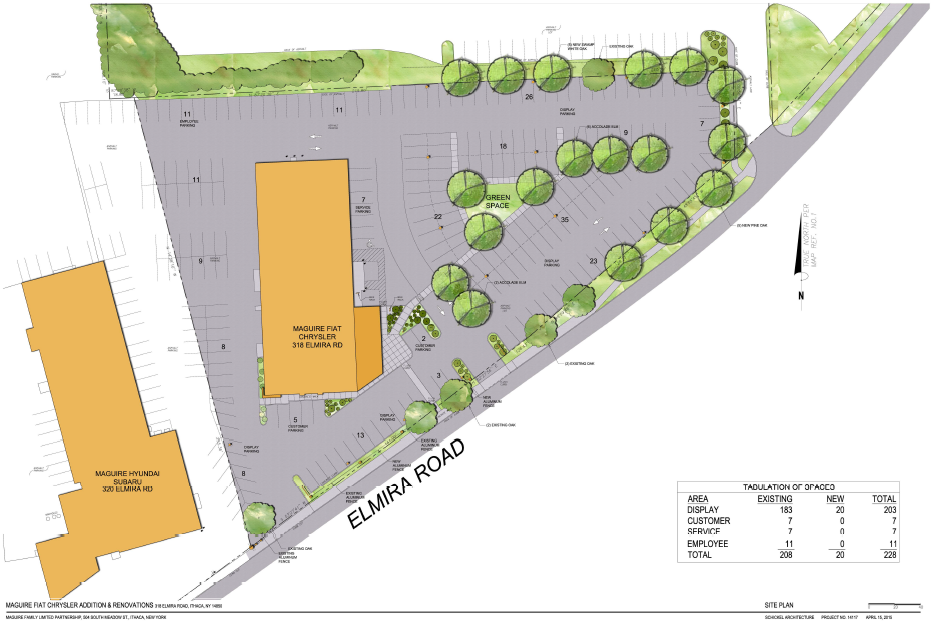
1. I’m thinking there is a genuine lull in the pipeline at the moment. The city’s projects memo, which is the document that city departments receive and comment on before the actual Planning Board meeting, doesn’t have much for consideration for this upcoming month. The one projects that is being “newly” considered is the 12-unit, 26-bedroom PPM Homes proposal at 215-221 W. Spencer Street. That project is expected to receive declaration of lead agency (in other words, the planning board formally agrees to review it) at the June meeting. Being carried over from the previous months are the two duplexes for 804 E. State Street, the Tompkins Financial HQ, INHS’s 210 Hancock project and the Maguire Fiat/Chrysler expansion. None of those are up for final approval.

Smaller projects and subdivisions will often first show up in the memo ahead of the meeting, but not this month. What will be, will be.

tfc_v2_1

2. On the other end of the scale, this looks to be a busy month for the Ithaca Landmarks Preservation Council. Most of their agenda focuses on window repairs and other minor details, but they will be reviewing the Tompkins Financial HQ and the new drive-thru across the street. Although neither is within a historic district, I suppose it’s being reviewed for the sake of feedback and the possibility of a visual impact on the skyline as seen from historic districts.

Cayuga-Meadows-Shot

3. In Old Library news, a decision was expected last Tuesday…but, the decision was postponed. After committee members started sharing their differences in opinion. Pardon my cynicism, but that’s a perfect microcosm of those whole process. Frequently delayed and bound to infuriate someone come decision time.

In a perfect world, all three of those would be built in the city, because they all address different housing needs in Ithaca, and they would all likely be successful. But of course, there can only be one. We’ll find out next Tuesday morning.

4. The Ithaca town Planning Committee is verifying two things already noted in previous news round-ups. One, the 68-unit Cayuga Meadows project hopes to begin construction in the very near future, and two, the Troy Road housing project is dead.

The committee also brought up the possibility of a moratorium for certain parts of town – two areas described as having significant student populations. One is almost certainly the area of South Hill next to IC, the other is not stated (but likely has to do with Cornell). This is part of a larger conversation to keep IC students from living off-campus in student rentals. Students aren’t a protected class, so whatever extra bureaucracy or laws the town wants to adopt are technically fair game. I would imagine, however, it would much easier to do that to IC’s undergrads than the professional and doctoral students attending Cornell. Looking at the numbers, one has been increasing much more than the other, and it’s not the undergrads. This, I suspect, is where potential laws become problematic.

Anyway, the moratorium is seen as a last-ditch effort. But the possibility of it should be enough to raise eyebrows.

815_s_aurora_1

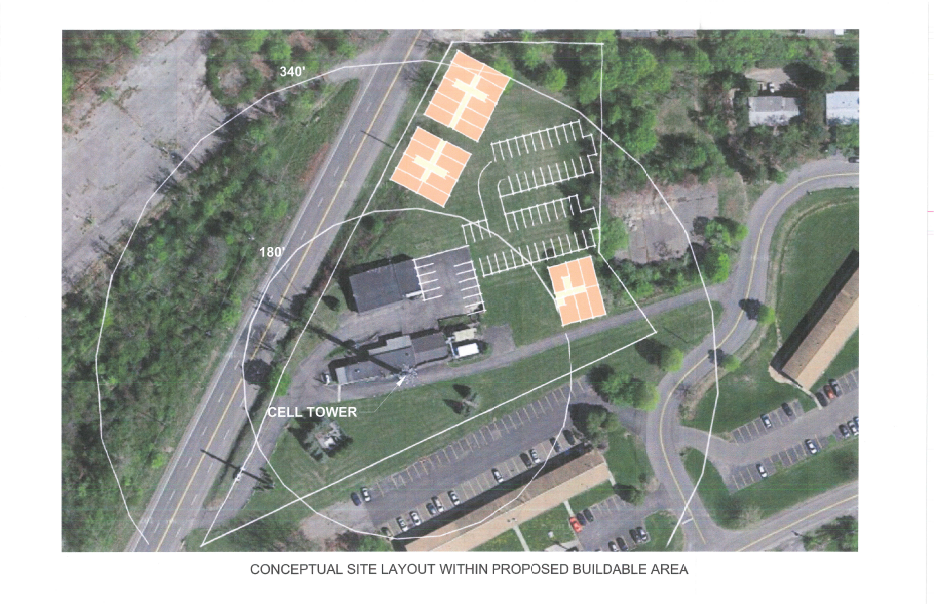
5. Time for some more unhappy – the city Board of Zoning Appeals isn’t touching the 815 South Aurora Street application.  To recapitulate the salient details, local developer Todd Fox would like to build apartments on the land but can’t because the vast majority of the property is within the “fall zone” of a cell tower, which the city defines as twice the height of the tower. At 815 South Aurora, a 170′ tower creates a 340′ radius of no-man’s land (outer circle above), making the parcel virtually undevelopable. Fox had two private engineering companies (TAITEM Engineering and Spec Consulting) analysis the case and they determined that an appropriate fall zone is the height of the tower plus 10 feet for a little wind/bounce – so 180′ total. With this info in hand, Fox is trying to get the city to refine the zoning to allow the decrease in fall zone and therefore permit the land to be open for development.

The BZA said it was acting on the city attorney’s advice that the committee can’t override a council-approved law. Which means that Noah Demarest, the architect appearing on behalf of Todd Fox, will either have to go to the Council to have the law amended, or he and Fox will have to go through a full sketch plan and review process, and apply for an area variance for whatever firm plans they have proposed. Meeting with the BZA was seen as way to avoid having to shell out all that time and money and risk still being rejected because of the cell tower issue. There’s a risk with moving forward at this point, and it’ll depend on just how much risk the developer is willing to take on this potential project.

6. We’ll wrap up with something positive – FormIthaca, the citizen group advocating for form-based zoning, is doing their design charettes this week. I’m writing this on Thursday night since I will be doing 5-year Cornell reunion stuff on Friday, but I do plan on being in attendance Friday afternoon meeting and am looking forward to seeing/hearing what ideas the presenters have to share.

I can assure a certain town of Ithaca board member that I have a personal preference to small street setbacks, and it sure as hell isn’t because they’re “hipper”.