205 Dryden Road (Dryden South) Construction Update, 6/2016

21 06 2016

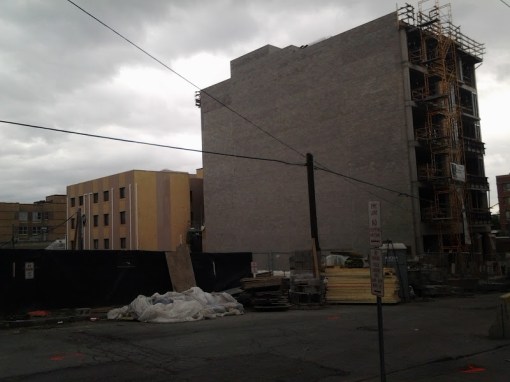
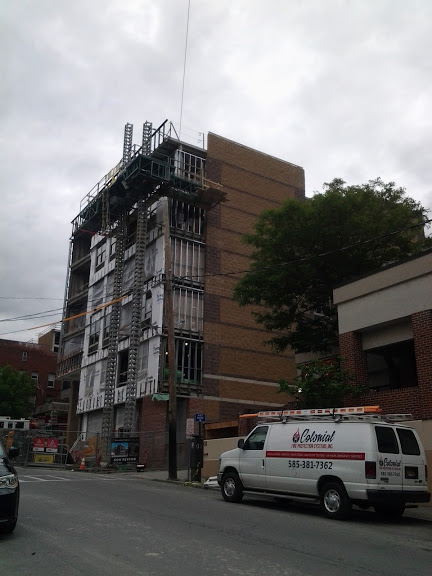
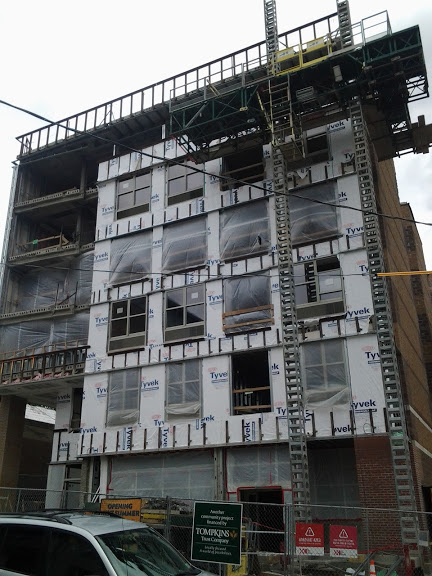
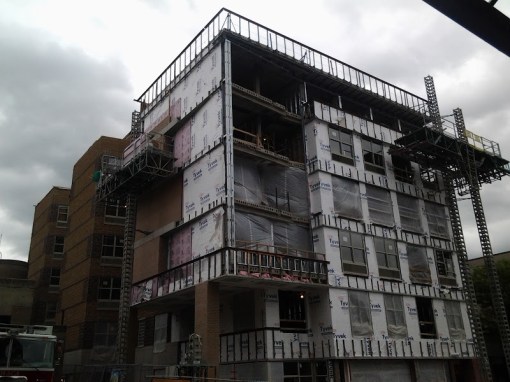
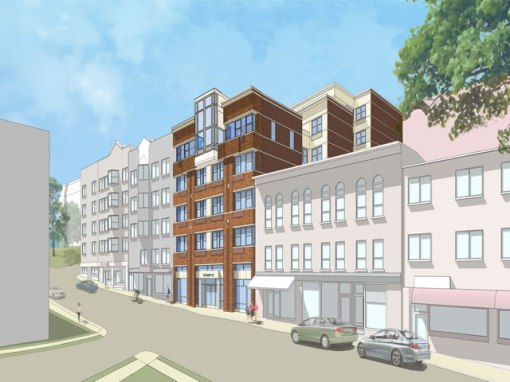
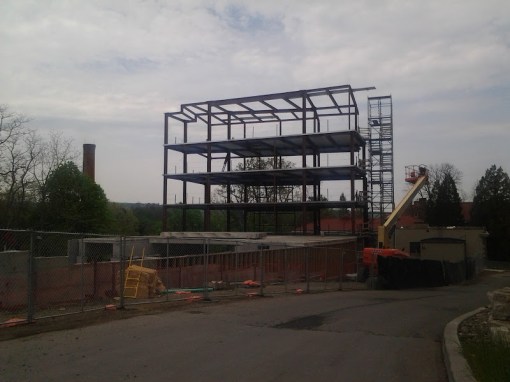
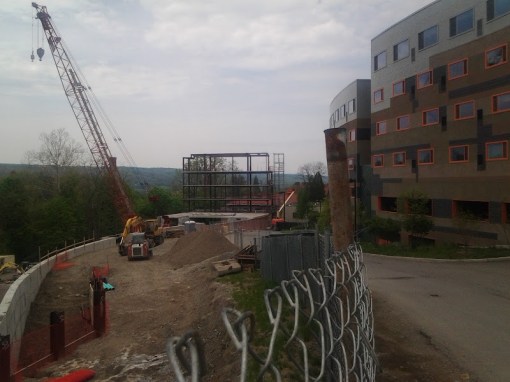
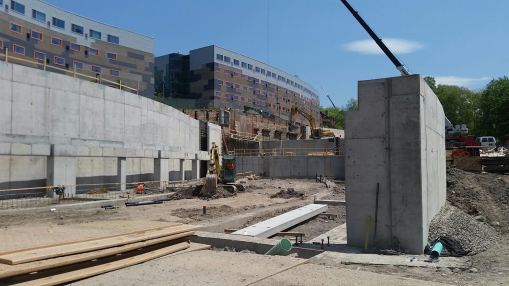
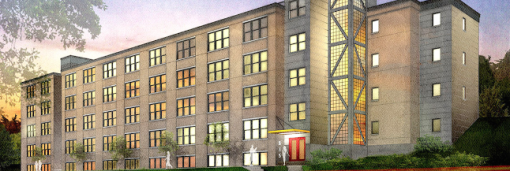
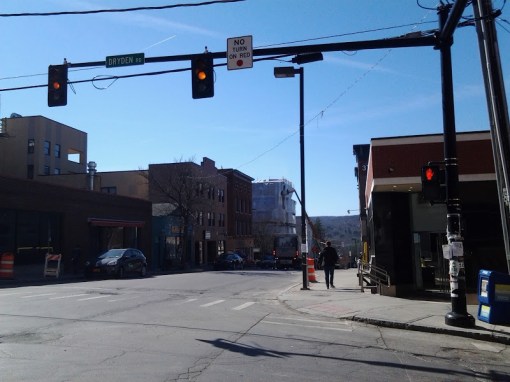
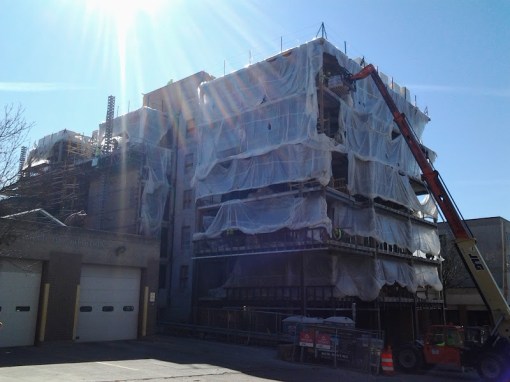
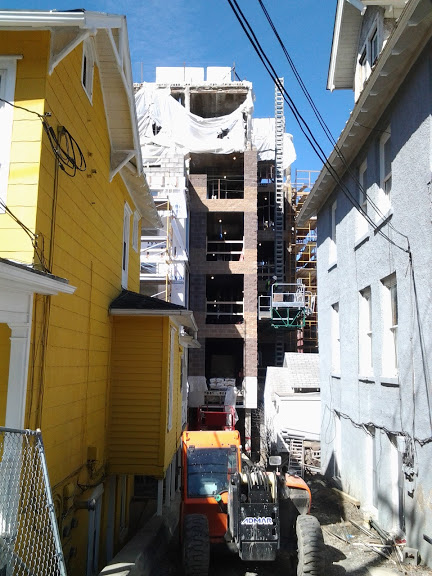
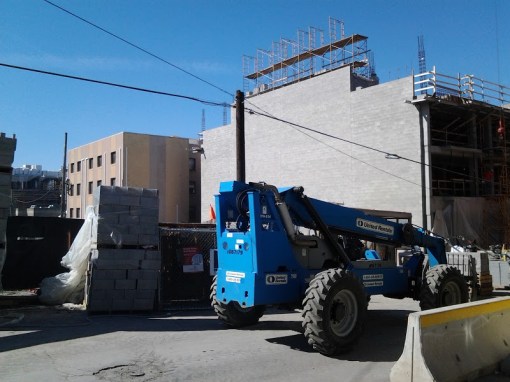
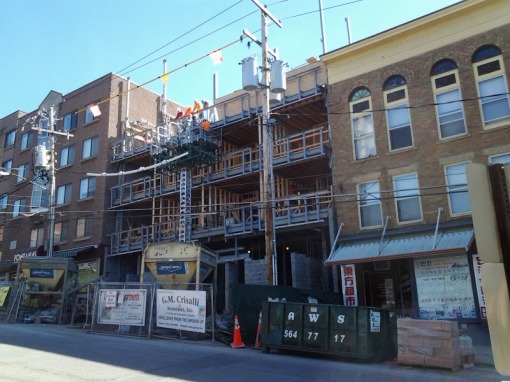
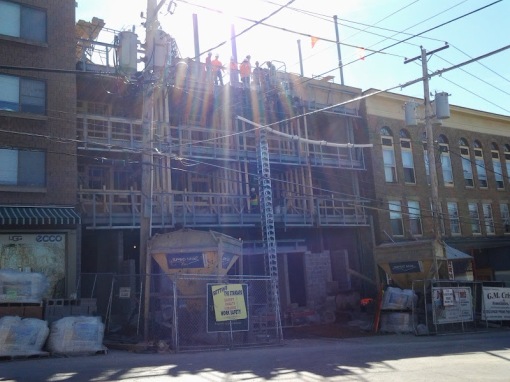
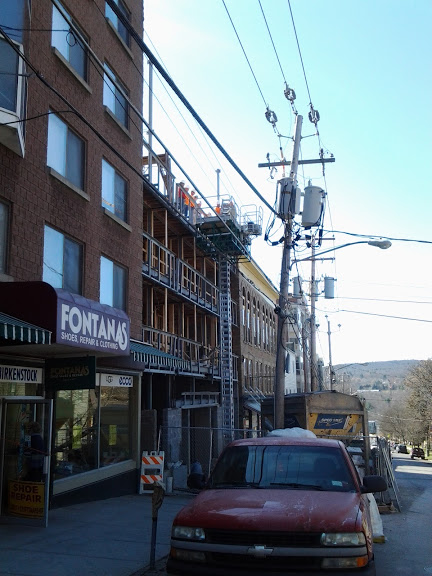
With occupancy expected by August, the trio of Collegetown midrises are moving at a pretty fast clip. 205 Dryden (Dryden South) has topped out, and construction crews are installing exterior steel stud walls and building out the structural frames for the projecting bay windows. Some light-colored brick can be seen on the pillars at the front entrance, and eventually it’ll expand to cover the front elevation, with limestone accents providing some visual interest. The interior light well seen from College and Dryden and the roof cap will be faced with colored metal panels in a shade similar to the limestone and brick. These photos are a week and a half old at this point, and since they were taken, the exterior stud walls have been sheathed with gypsum panels and Tyvek.

The building will have 10 4-bedroom suites, and according to the website, only one suite is left (5th floor, $1350/person), with rooms “for singles and small groups also available”.

A quick side note here – although the address when proposed was 205 Dryden, the address being used in the marketing materials is 207 Dryden. Either one is permitted, as the new Breazzano Center going up next door is 209-215 Dryden.

20160608_162342 20160608_162914 20160608_162951 20160608_164905 20160608_164919 20160608_164927 20160608_164946 20160608_165304

dryden_south_rev_1

205_dryden_-_rendering


307 College Avenue (Collegetown Crossing) Construction Update, 6/2016

20 06 2016

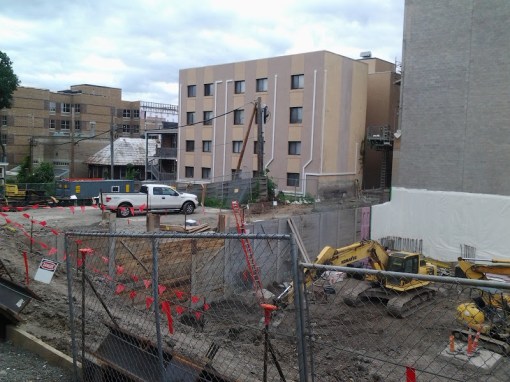
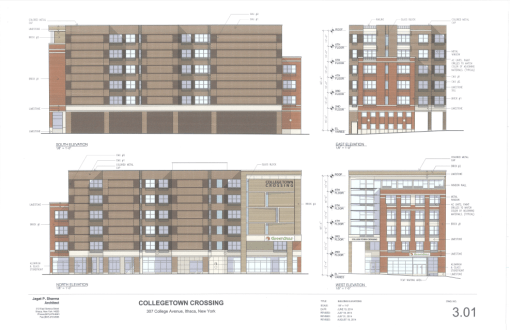
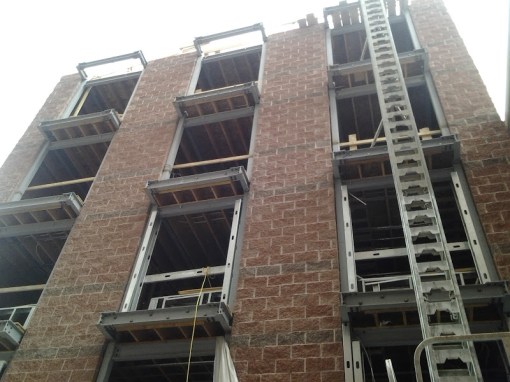
307 College isn’t too far from completion at this point. The angles where with CMU dominates the exterior look nearly finished from the outside. Some of the windows are in on the front side – the projecting section, currently covered in Tyvek housewrap, will be mostly faced with dark brick, similar to the brick used on the rear CR-4 portion. The bare expanses will be a glass curtain wall, and a lighter brick will be used on the sides and for the cornice. Traditional scaffolding needs a certain amount of space and time to be set up and taken down, so given the dense environment and summer deadline of the Collegetown Crossing project, mast climbing work platforms are used being for the bricklaying and other exterior facade work.

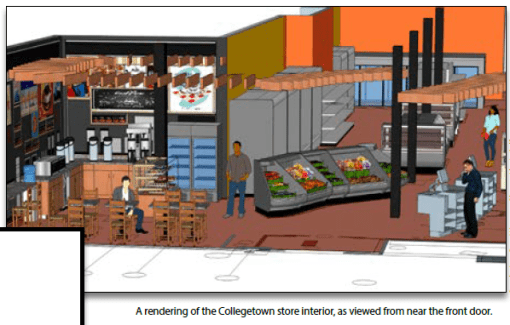
Greenstar’s new grocery location on the first floor should be opening August 17th, right around when the first tenants start moving into the apartments. It sounds like it will be a soft opening, with an actual Grand Opening celebration planned for some date in September. A render of the interior of the new Greenstar location, designed by architect Pam Wooster, is included below. Greenstar plans to employ 14 at the new location, and include a cafe/to-go space to complement its full-service grocery (some of the items, like those in the deli, won’t be prepared on site due to space constraints; they will be prepared at their central kitchen and brought in daily). There hasn’t been any news on tenants for the smaller two commercial spaces facing the pocket park.

20160608_162651 20160608_162721 20160608_162758 20160608_162805 20160608_162829 20160608_162923

20160608_161811 20160608_162435 20160608_162527

20160608_162035

307college_rev2_1

ctown_crossing_rev2_1

greenstar_ctown.png

greenstar_ctown_2.png


327 Eddy Street (Dryden Eddy Apts) Construction Update, 6/2016

19 06 2016

Steve Fontana’s mixed-use project at 327 Eddy Street has topped out since the April update. The exterior stud walls are up on the front facade, as is a little gypsum sheathing. The CMU Block rear portion is also topped out, although it appears that the design of the rear was also changed/value engineered such that it no longer have the larger band of windows on the top floor. The large window at top center is split between two units,  and using the wood stud walls as a guideline, one can kinda get the impression of soaring ceilings and a big, glassy open space. More interior wall faming can be seen from the rear of the building. Units range from studios to 5-bedroom apartments, with prices starting at $950/person and topping out at $1250/person for choice units.

While the apartments are able to command to premium price, Fontana has had issues finding a commercial tenant for the 1,800 SF first floor, and expressed his concerns at a city PEDC meeting where the active-use code for Collegetown was modified to match the slightly more flexible code used with the Commons.

Things should be moving right along for an August opening.

20160608_164146 20160608_164214 20160608_164236 20160608_164251 20160608_164449 20160608_164504 20160608_164509 20160608_164513

327_eddy_rev4_1

327_eddy_rev2_3


News Tidbits 6/11/16: Summer’s Heated Discussion

11 06 2016

Image Property of HOLT Architects

1. We’ll start this off out in Lansing. The 153 acres of land for the Lansing town center is once again in the news. The Lansing Star is reporting that the town is once again serious about selling the land.

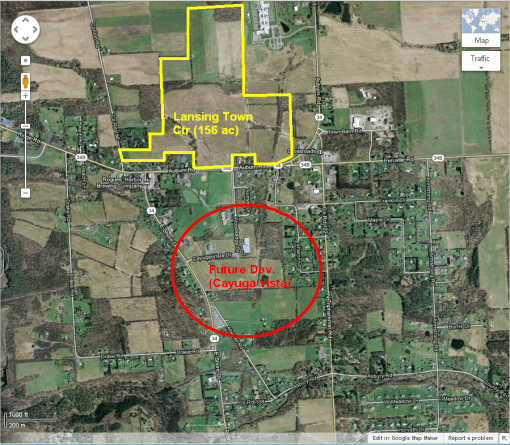
So begins yet another chapter in the 20-year saga of the town center land. The town bought the land from the state in 1993 for $100,000, and at the time the land was deed-restricted to recreational use. In 2012, the town paid an additional $294,800 to remove the recreational deed restriction. An article about it was published here in August 2012 (original map below; dunno where why offhand it says 156 acres vs. the 153 reported now). HOLT Architects and TWMLA were hired to draw up some overarching design themes, a Request for Proposals was issued, and three developers responded.
lyc2

Calamar Enterprises’ Buffalo office submitted a proposal for a $17.4 million, 110-unit market-rate senior apartment building on 13.5 acres, and Cleveland-based NRP Group submitted plans for 80 one-story patio homes on about 15.5 acres. Calamar later re-sited their project at the town’s wish to the northern part of the land, and increased the number of units to 124. Green Square, led by David Taub and HOLT Principal Graham Gillespie, proposed 60 units of housing and 23,000 square feet of retail in 2-3 story arrangements, and civic and recreational space. Altogether, the value of the three would have approached $50 million.
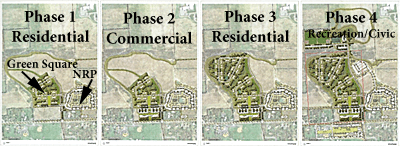
gs_phases

However, all of this was contingent on a sewer being built, which did not happen. The developers agreed to do a package plant that would service just the town center, there was discussion of an IDA-backed tax incentive zone, and the town stood to make a hefty return on investment, but…to quote the Star, “However, the deals fell through.  Actually it seemed more like they just faded away. At least one of the developers had signed paperwork saying they intended to purchase acreage from the Town.  The Town didn’t seem in any hurry to sell the land, even with clearly interested developers.  When the developers disappeared there was no reported effort by the town to pursue the deals.”

Since then, the town continues to get a steady stream of interest, but no real idea on how they want to move forward. Like Ithaca city and town, they’re looking at the possibility of Form-Based zoning for the site, and the town hopes to issue a more specific RFP than before, incorporating revised assessment values. The most intensive approach involved the Form-Based Code and a specific RFP, the least specific is just putting up a for-sale sign ans seeing what happens. Whatever the case, the lax approach the town has taken the past few years may no longer be feasible, with the ticking tax time time bomb of the possible power plant closure looming over the town and schools’ budgets.

old_library_thp_v4

2. Speaking of long processes, the Old Library project has formally filed paperwork here to begin the application process for the Certificate of Appropriateness from the Ithaca Landmarks Preservation Commission. The meeting is scheduled for city hall at 5:30 Tuesday the 14th. Although it says early design review, a lot of the legwork has already been done at this point, since the Planning Board and ILPC have been conducting joint meetings with the project team over the past several months to create a design that they’re all comfortable with. However, the ILPC is likely to refine some details moving forward.

old_library_thp_v4_2
At this point, the unit mix consists of 22 1-bedroom units with about 700 SF each, 25 2-bedrooms with about 900 SF each, and 10 2-bedrooms with 1200 SF each, the extra space intended as a den or home office. The building also includes a 1,800 SF community room to be administered by Lifelong, and 3,750 SF of first floor commercial space. The total facility size comes out to about 85,600 SF, and parking for 25 cars and at least 12 bikes, and another 34 bike spaces for the community room. Exterior materials include brick, limestone, and a couple forms of fiber cement, including wood-textured fiber cement.

Southeast+Rendering

3. The STREAM Collaborative House at 228 West Spencer is up for sale. The house has its own website here. The 1,152 SF, 2-bedroom net-zero energy house is listed at a price of $305,000. For more info on the house, Noah Demarest was kind enough to give a construction tour of the house while it was underway, and the blog post I wrote up afterwards can be found here.
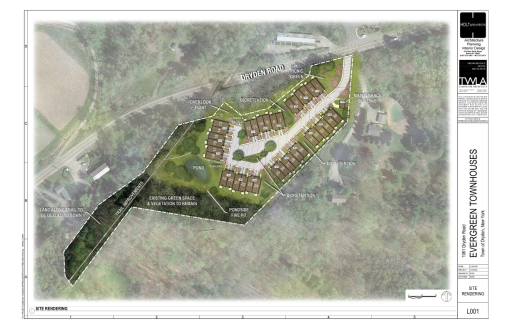
evergreen_dryden_1
4. It’s pretty clear at this point that the Evergreen Townhouses project at 1061 Dryden is evolving into the next hot-button development issue out in Varna. The Times has their interview with the angry neighbor here, and more info can be found in the town of Dryden’s April planning board meeting minutes here. So far, the only image of the townhouses themselves has been a perspective that only shows massing – 2 stories, gabled roofs.

Also of note is the town of Dryden Planning Department’s recommendation to the town board (and the planning board’s approval) for an increase in density in certain areas. The change in code affects parcels zoned rural residential, with municipal water and sewer access. The density would be increased from 2 units per acre to 6 per acre. Looking at the zoning map and the sewer map, that would primarily affect the corridor from Varna to the 13/366 intersection, and a rural swath just north of Dryden village near TC3. What this would do is allow 1061 Dryden Rd to withdraw PUD application, and apply for a special use permit (SUP), which are generally easier to obtain.

On a side note, googling Tiny Timbers brings up a Times editorial, written by the Times, that argues against Tiny Timbers for not fitting in with the appearance of Varna. Actually, it kinda takes everyone to task, from developers to town government to residents. But, to make one counter-point regarding mixed-use, commercial services need a certain amount of traffic (not necessarily vehicular) to thrive. If the population base within a certain radius isn’t there, the risk is too great for someone to put their money on the line and hope that they can somehow draw in customers. If Varna wants a mixed-use center with shops and cafes, they’re going to need the population to support it. Some think that will include 1061, some (probably more) think Tiny Timbers, but if there’s no “push”, the ball won’t be rolling.

201_college_v3_1

5. A couple of minor things to note in sales. The 4,200 SF former “Imperial Buffet” property next to the Shoppes at Ithaca Mall has sold to a Syracuse-bsed LLC (Watersprite LLC, established 2004) for $590,000 on Friday the 10th. I personally will always remember this place as being the only place my mother was comfortable with eating in Ithaca because she hates eating out, and felt everything else was “snobby and expensive”.

Meanwhile, the 12-bedroom, 2,837 SF house at 201 College Avenue, the property subject to a heated debate between Neil Golder and Todd Fox, sold for $2.65 million on Friday the 10th, which seems outrageous except that it’s becoming the norm for inner Collegetown transactions – Novarr picked up 5,500 SF 215 College for $5.3 million last year. There will be no delving into that debate again this week, but the city uploaded 580 pages of documentation here, and my colleague Mike Smith is preparing a story for the Voice.
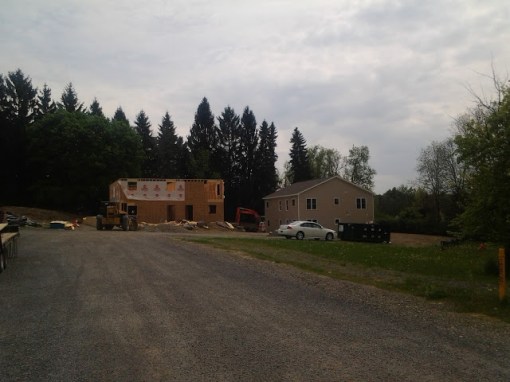
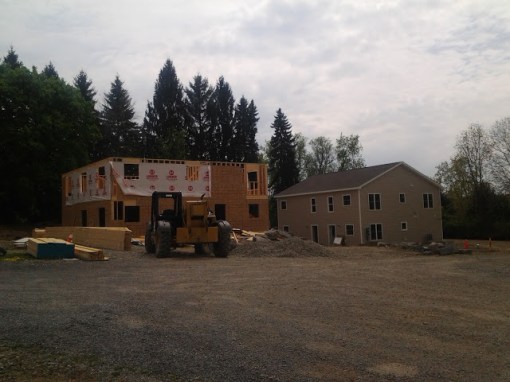
20160522_143925 20160522_143949

6. Houses of the week. This pair of duplexes are being built on Birdseye View Drive near Ithaca College. Each house has a 4-bedroom unit and a 2-bedroom unit; recent advertisements on Craigslist (since expired, so no link, sorry!) have them $750/bedroom. The developer is the owner of Mahogany Grill downtown, who also happens to be a part of the business team renovating the former Lucatelli’s into a new restaurant, a Tapas and pasta restaurant called Mix Social Dining after the chef’s wife.

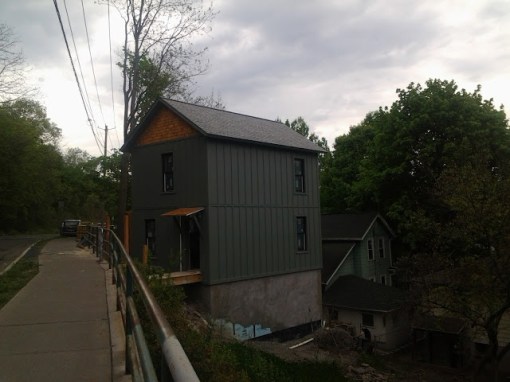
These photos are a couple weeks old now, but the one on the right looks nearly complete, while the one on the left was still in the (wood) framing and sheathing stage. Based off the rough window and door openings, they are not exactly the same, but expect them to look similar.


News Tidbits 6/4/16: A Stormy Summer Start

4 06 2016

201_college_v3_1
1. We’ll start this week off with a follow-up on the 201 College Avenue debate. All discussions of planning philosophy noted, one solid request, as reported by Josh Brokaw at the Ithaca Times, was to try and reduce the bulk from the College Avenue side, if not necessarily the building footprint. The above drawing was submitted by STREAM Collaborative’s Rob Morache earlier this week, with a cover letter describing the changes here. The modification reduces the building by 2 bedrooms, to 74, which to go by Todd Fox’s comment in the Times article, puts the project at the borderline of financial feasibility. The middle still pops out a little because that’s where the fire stairs are located. Some minor details were changed with the accent panels, and recessing the windows slightly on the south and west facades. For the record, the panels are Nichiha and Allura fiber cement, with painted metalwork and fiberglass window sashes.

Although now outdated, a shadow study for the previous design has since been uploaded by the city. There are two versions, with and without neighboring building shadows, here and here respectively.

Expect further detail refinements; the building is set to go in front of the Design Review Committee Tuesday morning.

20160414_120418

2. WSKG did a segment earlier this week on micro-apartments, with an interview with Frost Travis and the Carey Building project wrapping up on East State Street. A few details worth noting from the segment – 5 of the 20 rental units (which range from $1,225/month for the microunits to $2,699/month for a high-end penthouse 2-bedroom) are already spoken for and the building’s not even finished yet. For some reason, Monica Sandreczki says there will be about 35 residents at full occupancy, which is a big stretch since there are 16 micro-units and 4 two-bedroom units – going one person per micro-unit and bedroom, a better estimate would be 24.

The news piece also notes that the 201 College project contains micro-apartments – which is true, given that the building is 44 units and 74 bedrooms, and at least the early plans had a number of split-level 410-670 SF studio units.

401_lake

3. And 401 Lake Street will bite the dust. The Common Council voted 8-1 last Wednesday night to have structure demolished and the tax-foreclosed properties be designated as parkland. Cynthia Brock (D-1st) voted against the measure and preferred a sale for tax reasons, and her ward counterpart George McGonigal (D-1st) argued that the city was destroying historic working-class housing, though he ultimately supported the measure. Brock did take a whack at new affordable housing in the city, commenting that INHS is getting $75,000 for each townhouse, and Habitat for Humanity getting $75,000 for a duplex even with its volunteer labor, when there was a potential, cost-efficient opportunity for affordable housing designation with this unit. Josephine Martell (D-5th) seemed to be the strongest proponent for demo, stating that the unique potential to enhance the Ithaca Falls Natural Area should be taken every opportunity of. The city bought the tax-foreclosed property from the county; the background on that is on the Voice here.

The funds for the demolition, estimated at $25,000, will come from the sale of IURA land to the Hilton Canopy project. That measure was approved 6-3, with Brock, McGonigal and Graham Kerslick (D-4th) opposed. With work on the Lake Street Bridge currently underway, demolition is not expected for at least a few months.

There was a thought exercise regarding the selling the falls’ parking lot to INHS for development of 3-9 units of affordable housing; it’s an interesting idea, since 401 and the adjacent are right next to the Falls, but the 0.55 acres of city property adjacent to the Lake and Lincoln Streets intersection is still over 200 feet away at its closest point.

4. The rare bit of news out of Enfield. A $612,000 building loan was issued by the Bank of Greene County to provide funds for renovating and expanding the volunteer fire station at 172 Enfield Main Road.

Give that Enfield issues no more than a handful of new construction permits each year, it’s about the only other thing going on apart from the Black Oak Wind Farm debate. One would think that arguments like “the wind does not blow as much as it used to” would be easily shot down and things would move forward, but instead it’s Marguerite Wells, the project manager for BOWF, getting raked over the coals. I don’t have a dog in this fight, but I do feel bad for her.
5. In case anyone was wondering – county planner Megan McDonald says the Denter housing study will be publicly available by late July.

arpt_pk_1

6. Here’s something intriguing from the county’s Facilities and Infrastructure Committee agenda – a proposal to “Prepare airport land for future development“, seeking $500,000. None of the money comes from the county; it appears to be dependent on grants, or an interested developer. Which, given the fact that this shows up in budget docs going back to 2014, doesn’t exactly seem to be generating many queries.

The parcels are described as the “Cherry Road and Agway parcels”, which must be owned by the county since they want to lease out the land – but checking the deed records of parcels adjacent to the airport, there’s no record of an Agway in any of the deed histories. The parcels may be related to the properties in the airport business park feasibility study, shown above and awarded to the team of Clark Patterson Lee and Camoin Associates this past winter.

7. It’s unusual to see Cornell buying property these days, but this Friday, the university purchased the house at 1250 Trumansburg Road on Ithaca’s West Hill for $157,000. The house is a 19th century fixer-upper on 1.21 acres – Cornell owns the land surrounding it, some of which is being subdivided off to build the Cayuga Meadows affordable senior housing project. The house is assessed at $215,000, but the real estate listing notes it needs some work, and it’s been off and on the market for five years.

Several years ago, Cornell expressed intent to develop the 35 acres it owns into a mixed-use complex with a hotel institute, housing, offices and medical services, but the only part of the plan that ever really moved forward was Conifer’s project. I haven’t seen the plans in years, but I remember the early plans (there were a couple versions) were very sprawly; six, eight years ago, walkability was not as valued as it is now.

By buying the house, Cornell reduces its need to work around a neighbor and can incorporate the property into potential plans. This purchase would seem to suggest that Cornell still has strong interest in developing the rest of the West Hill property at some point. In the meanwhile, Cornell might rent it out while the school figures out what it wants to do with the acreage.

20160522_151346 20160522_151417

8. House of the week. From the outside, 228 West Spencer Street is almost done, and the interior is fairly far along as well, with finishing work underway. Architect Noah Demarest says the house will be put up for sale in a few weeks, if everything goes as planned.


Collegetown Terrace Construction Update, 5/2016

31 05 2016

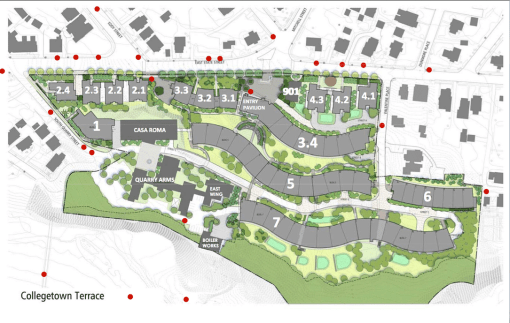
Just like in March, there are really two sets of photos here. The first set contains photos that I’ve taken from outside the fence. The second set of photos are from inside the fence, and come courtesy of Nick Robertson and Jocelyn Garrison at Welliver, the general contractor in charge of the project, and a big thanks goes out to them for taking and sharing photos from inside the fence.

The erection of the steel frame has started on the westernmost portion of the building, and corrugated decking is being attached to each level. Work on the building is generally progressing from west to east, and  the sheer length of the building allows the western sections to be quite a bit further along than the eastern sections, where foundation walls are still being formed. The reinforced concrete sections visible in the last of the Welliver photos is where the parking garage will go; readers might remember that Novarr sought and received a zoning variance to remove a floor of parking space and turn it into less expensive dorm-style housing, citing the lack of utilization of existing parking, and a desire to appeal to a larger segment of the rental market.

20160522_141042 20160522_141058 20160522_141148 20160522_141154 20160522_141222 20160522_141228 20160522_141237

Set two:

index index2 index3

ctown_terr_phase3


News Tidbits 5/7/16: Everything’s Political

7 05 2016

815_s_aurora_night

1. Let’s start with government. The city of Ithaca passed revisions to its cell phone tower law reducing the no-build fall radius from 200% of height, to 120% of height. The 120% was decided upon after a check of other municipalities, where it was generally the most common figure.

The change allows development to proceed on the grassy field at 815 South Aurora Street on South Hill, although as mentioned last week, the fall zone revision isn’t as much as developers Todd Fox and Charlie O’Connor had hoped for. But it’s still enough to work with; according to Josh Brokaw at the Times, a revised plan that meets the new guidelines could be going to the planning board for sketch plan review in June, possibly with more units than the 87 studio units initially planned. It was also reported that the local neighborhood group (South Hill Civic Association, SHCA) is comfortable with the initial plan, so this might be a relatively smooth process when the project is ready for review.

2. Meanwhile, while one thing moves forward, Dryden’s been hit with a major setback. The Pinckney Road parcel sale in Dryden was foiled when voters, in a 1188-936 vote, rejected the town’s plans to use recreation reserve funds to purchase the 15 acre property. The town would have spent about $56,800 of a fund that has over $300,000, and the county would have contributed $15,000, so that the town could have turned it into park space in the long-term. The town was prepared to buy the property, but residents opposed to the sale managed to get enough signatures on a petition to force to to go up for a vote.

It sounded like a worthy and reasonable plan. But I get the feeling that there were a lot of folks who figured it would pass by a wide margin, so they just didn’t vote. In a marketing course a while back in college, I remember the professor sharing an interesting statistic – versus feeling neutral, the general public is three times more likely to support an initiative when they really like something, and nine times more likely to vote or speak out when they’re really opposed. People are more driven by aversion than reward, and that’s probably what happened here.

20141227_134402

3. Sticking with local governments, the town of Ithaca is set to vote on a moratorium on duplexes, but with some modifications from the initial proposal. For one, given construction seasons revolving around the warm season, and the time it takes to plan and get permits, it was decided to make it only nine months (January 2017) instead of one year, so that they could limit the possibility of dragging it through two construction seasons. And although the town planning committee chair wasn’t on board with it, an exemption is in place if one of the units will be owner-occupied. If their goal is to revise the approach to student housing, then at least these amendments fix or lessen some of the bigger issues a moratorium would produce.

https://twitter.com/streamcolab/status/657329991827509248
4. Just a wee bit more info on the “Tim Timbers” planned for the corner of Freese and Dryden Roads in Varna. The tiny houses are small though not micro-sized – they’re expected to be about 800 square feet. Local architecture firm STREAM Collaborative is working with businessman Nick Bellisario on the 16-lot subdivision and home development.

waterfront_concept_aerial_1waterfront_concept_mf_th_SP_1

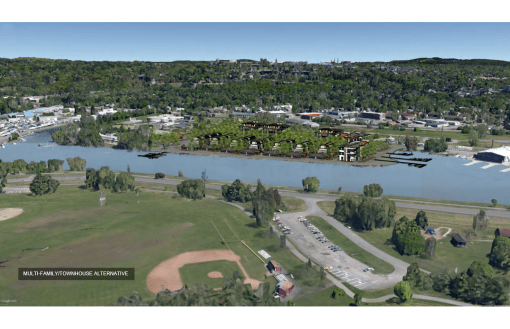
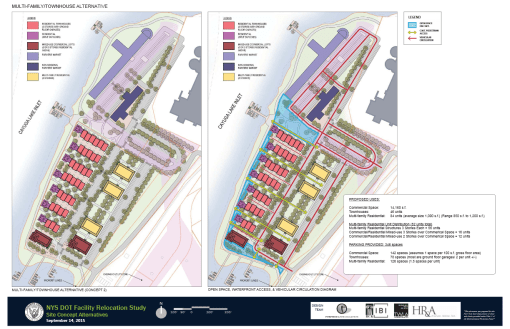
5. So the full 206-page, $78,000 NYS DOT waterfront redevelopment study by Fisher Associates is on the city’s website. The initial results were shared here back in October, but the final product has some additional, very interesting details.

waterfront_concept_timeline

One of those additions is a potential timeline for development. It calls for getting official support and commitments over the next several months, issuing an RFP later this year for the new DOT facility in Dryden, and issue an RFP for the NYSDOT waterfront site later this year, with review in Q1 2017 and developer selection in Q2 2017, assuming this doesn’t end up like the Old Library debate. The DOT would move to Dryden in Q3 2018, and the excess state land would be transferred to the county, sold in Q1 2019, and ready for occupancy by mid-2020.

The other really interesting new section is Appendix 5, stakeholder outreach. This consists of interviews with city officials and nearby property owners – Cornell (who say they have no plans for their waterfront properties), the Farmer’s Market, and some smaller businesses and organizations. The gist of the comments had more to do with Farmer’s Market than the DOT – namely, heavy traffic issues, needs more parking, and needs to physically expand to accommodate a waiting list of vendors and cool-season operations. There are early plans incubating for a nearby indoor market facility, if memory serves right. As for the DOT site, the mixed-use plan was deemed most favorable, and the stakeholders agreed that the site had great potential for redevelopment.

warren_medical_lansing_1

6. Looks like marketing has started for a proposed new medical office building in the village of Lansing. The new one-story building, which appears to be designed by Binghamton-based Keystone Associates, would be off of Warren Road, although it looks like the building would be accessed from a driveway coming off of Uptown Road. The 2.71 acre property is zoned “Human Health Services District” by the village, and borders undeveloped land owned by Cornell, and several other suburban medical office buildings built over the past few decades. The resolution on the attached site plan is too low to determine the square footage, though it looks to be in the low tens of thousands.

The property was purchased by Arleo Real Estate from Cornell for $378,600 in October 2014. Arleo Eye Associates owns and occupies the neighboring building to the south. Arleo built their 7,119 SF optometry office in 2007.


307 College Avenue (Collegetown Crossing) Construction Update, 4/2016

25 04 2016

Collegetown Crossing is starting to show its face. Windows are being installed, and the CMU walls are on display. The mostly glass front facade has yet to go on, and brickwork will eventually go over the Tyvek housewrap on the 4-story, CR-4 portion of the portion. As mentioned in the Voice piece, a construction worker on-site said that interior work is focused on interior wall framing, sheet-rock hanging, and electric rough-ins at the moment.

According to building developer Josh Lower of Urban Ithaca, the project is being included as a part of a city grant application related to public transit, though it’s not something I’ve heard much about. It definitely fits the bill – designated internal bus shelter and pull-off space for up to two buses, a pedestrian through-fare and pocket park that connects College Avenue and Linden Avenue, ample bike racks (12 spaces required, 24 being provided), 3,200 SF grocery store on the first floor and Ithaca Carshare is but a couple hundred feet away.

There are a couple smaller retail spaces included as part of the project, but there hasn’t been any indication as to whether they have tenants lines up.

Like Dryden South and the Dryden Eddy Apartments, Collegetown Crossing plans to open in time for the fall semester. Ithaca’s Jagat Sharma is the architect, and Hayner Hoyt Corporation out of Syracuse is in charge of the build-out.

20160415_102004 20160415_102109 20160415_102141 20160415_102216 20160415_102337 20160415_102359 20160415_102450 20160415_102754 20160415_104451

307_college_site_plan_final 307college_rev2_1

ctown_crossing_rev2_1


205 Dryden Road (Dryden South) Construction Update, 4/2016

25 04 2016

Another project in the mad dash for a summer completion (7/7/2016) is Pat Kraft’s mixed-use building at 205 Dryden Road, the “Dryden South” apartments. Workers under the direction of Rochester’s LeChase Construction are building up the reinforced concrete frame, and you can see steel rebar poking out of the fourth floor, which will be wrapped in wood forms and encased in concrete, with enough rebar poking out at the top to tie-in to future sections. The construction crane comes from C.P. Ward, a construction contractor in suburban Rochester. On the outside, the CMU walls are being assembled; not a whole lot of aesthetic effort is being put into the appearance of the east wall because it will be hidden by the 209-215 Dryden project within months of completion, although the renders show slit-windows on the building’s east face.

Kraftee’s was slated to occupy the first floor retail space, but the space is now being retooled. The project is in MU-2 zoning, and is legally obligated to have “active use” commercial on the 2,400 SF first floor: hotel, bank, theater, retail, and/or food service.

It looks Dryden South’s website has been overhauled. Apparently, if the building isn’t ready by August 1st, Kraft will refund renters twice the daily rent until the building is issued a certificate of occupancy. Rents range from $1190-$1350 per month, per bedroom, which is quite expensive, but this is also Inner Collegetown, which has the highest real estate values in the city.

20160415_101517 20160415_101531 20160415_101610 20160415_101703 20160415_101958

dryden_south_rev_2


327 Eddy Street (Dryden Eddy Apts) Construction Update, 4/2016

25 04 2016

Here are the latest photos for Steve Fontana’s mixed-use project at 327 Eddy Street. Work is up to the fourth floor in the front, and it looks like interior wall framing is underway on the lower floors, along with utilities rough-ins on the lowest levels. The rear section is further behind, steel is rising but workers have yet to move beyond the first floor. Progress should be happening fairly quickly from here on out, as the building needs to be ready for occupancy by the start of the fall semester. According to Fontana’s website (conveniently linked with the shoe store), unit prices range from $930 to $1250 per bedroom. The website doesn’t give any indication on how many units have been reserved.

There seems to be a slight discrepancy as to whether the project has 53 or 56 bedrooms in its 22 units. Counting on the webpage didn’t help, and the floor plans on the city’s website date from the 6-story, 64-bedroom version. A quick check shows my source was a Cornell Sun article from February 2015, no longer online. If anyone knows which number is accurate, please chime in.

A little more info can be found in last week’s Voice round-up here.

20160415_103153 20160415_103222 20160415_103243 20160415_104011
327_eddy_rev4_1