The Chain Works District DGEIS, Part One: Introduction

20 04 2016

chain_works_rev3_3

Chain Works is, without a doubt, the single largest project currently being considered in the Ithaca area. It’s a very large project in terms of square footage, in terms of cost, in terms of length of build-out. Being such a large and important, it needs to be examined carefully – it could help propel Ithaca’s economy and ambitions to a higher quality of life, or it could serve as 95 acres of dead weight.

Between March 29th and May 10th, the city is receiving public comments on the Draft Generic Environmental Impact Statement, the DGEIS. The city’s website appears to be outdated, but the Chain Works District website is up to date – any comments readers might have, any questions or concerns, are submitted to the City of Ithaca Planning Board as lead agency for environmental review. UnChained Properties LLC, the developer, offers a blank form here, or if one prefers, comments can be sent directly to Ithaca senior planner Lisa Nicholas at lnicholas@cityofithaca.org.

What a DGEIS does is evaluate the potential impacts of growth on local resources and facilities, such as traffic, water supply systems, utilities infrastructure, social and aesthetic impacts. The DGEIS, which will need to be finalized, is part of New York State’s Enviromental Quality Review (SEQR, pronounced “seeker”) and a necessary precursor to any planned/contemplated construction and development of the site.

So, the DGEIS main body is 422 pages, with about 3 GB’s worth of appendices. Although 45 days is allotted for public comment, not a whole lot of people want to read through 422 pages, but the table of contents allows people to jump around if there’s one or two thing they’re more keen to read about. A link to the DGEIS is offered by project partner Fagan Engineers here, but you might need to submit an email and name before being able to see it.

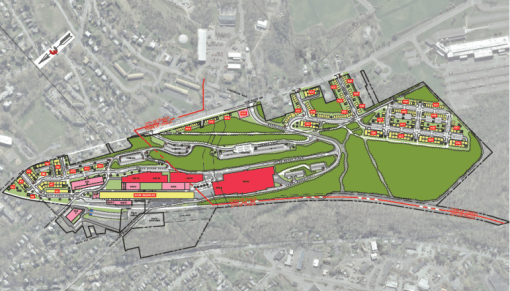
chain-works-map

So, basic details, per the “Description of Action”:

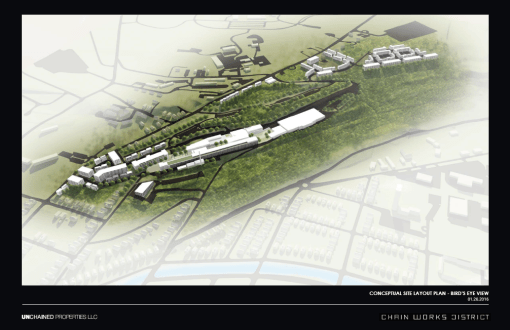
Chain Works District Project is a proposed mixed-use development consisting of residential, office, commercial, retail, restaurant/café, warehousing/distribution, manufacturing, and open space within the existing 95-acre Site which traverses the City and Town of Ithaca’s municipal boundary . Completion of the Project is estimated to be over a seven-to-ten year period. The first phase, referred to henceforth as Phase I, will consist of redeveloping four buildings generally located at the northernmost and southernmost ends of the complex of existing buildings. These first four buildings are approximately 331,450 square-feet (SF), and will house office, a mix of office and residential, and industrial uses. Subsequent phases of development will be determined as the Project proceeds and will include new structures to complete a full build-out of 1,706,150 SF.

So, just based off that, anything that gets developed, is as the market and NYS Dept. of Environmental Conservation (DEC) allows. If the market isn’t amenable or the cleanup plan isn’t approved, don’t expect the plans to move forward all that fast, if at all. If the market is good and the DEC signs off on plans, expect the build-out to be on the shorter end of the 7-to-10 year time-scale.
chainworks-before-771x441

chainworks-after-771x441

Related infrastructure work for the Project will include: (1) removing select buildings to create courtyards and a network of open spaces and roads; (2) creating pedestrian, bicycle, and vehicular connections through the Site from South Hill to Downtown Ithaca; (3) improving the existing roads within the Site while creating new access points into the Site; (4) mitigating existing environmental impacts from historic uses; (5) fostering the development of a link, the Gateway Trail, to the Black Diamond Trail network; and (6) installing stormwater management facilities, lighting, utilities, and plantings.

No big surprises – some buildings in the interconnected complex will come down, shared road concepts will dominate the internal transportation system of the neighborhood, the site will be more fully integrated into South Hill and trails, and usual site details like stormwater plans and landscaping are going to be incorporated into the project.

Given its complexity, the project team is pretty broad – eleven organizations, from the Ithaca, Elmira, Corning and Rochester areas. Local firms include STREAM Collaborative, which helped draw up the design standards and rezoning, Randall + West for more rezoning work, and Brous Consulting, which is handling public outreach. UnChained Properties is headed by David Lubin of Horseheads (suburban Elmira). From what I’ve been told, project development to-date has cost somewhere around $2 million dollars.

Likewise on the approvals – the project will need something like fifteen approvals from a dozen different government groups and agencies.

chain_works_history

Let me share an introduction and summary comparable but maybe more approachable than theirs – a background primer on why this is happening can be found on the Voice in my introduction article here, and Mike Smith’s summary article here.

Much of Chain Works reuses what was once the Morse Chain / Emerson Power Transmission (EPT) factory, which employed thousands from the 1900s, up until the last workers were let go and the facility shut its doors in 2011. During the mid 20th century, industrial processes used chemicals and compounds that are known to be toxic – Trichloroethylene (TCE) being the best known, but also heavy metals and oils. These not only affect the site and its building, they’re also in the soil and groundwater of South Hill.

chain_works_contamination

The site is classified as Class 2 Superfund site, which the DEC describes as “a significant threat to public health and/or the environment and requiring action”. While EPT is responsible for clean-up, they’re only responsible for the bare minimum (the industrial standard, what can be safely exposed to for 8 hours) unless otherwise specified by a proposed reuse, in which case they have to clean to a higher standard like residential use.

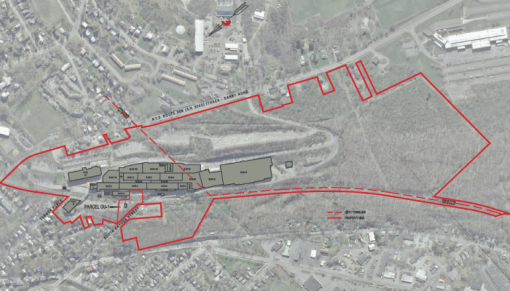
So that leaves us at present – a vacant 95.93 acre, 800,000 SF industrial site split between municipalities and with varied terrain and conditions. One of the most basic goals of CWD is to get the city and town to rezone the land to allow a mix of uses – PUD/PDZ, which give flexibility in site development based off of standards the developer, the city/town, and in this case NYSDEC mutually agree to.


chain_works_form_districts_1

So, in the PUD/PDZ, one of the broad takeaways is that each of the four form code has its own design standards – height, width, window-spacing, setbacks and most physical details, even signage. Unlike typical zoning, it’s the appearance that is more thoroughly managed, not the use. Those can be found in detail here. The design standards utilize what’s called LEED ND (Neighborhood Development), design standards created for large-scale green, well-integrated and sustainable development. A gated community it ain’t.

The goal of these design standards is to mitigate some of the adverse impact the new and renovated buildings will have on the community – promoting alternate transit reduces traffic, limiting floors and floor heights reduces visual impacts, and so on.

Build-out falls under four general form zones: (1) CW1- Natural Sub-Area, 23.9 acres of old woodland to be limited to passive recreation. (2) CW2- Neighborhood General Sub-Area, 21.2 acres of townhouses, stacked flats and similar moderately-dense development, mostly in Ithaca town; (3) CW3- Neighborhood Center Sub-Area, 39.7 acres of mixed-use, in a combination of renovated and new buildings towards the northern end of the property in the city, and (4) CW4, Industrial Sub-Area, a 10.3 acre zone for industrial uses in existing buildings at the Emerson site. The site borders Route 96B, single-family and multi-family homes, natural areas and steep terrain.

About 0.91 acres will be subdivided off and maintained by Emerson for active groundwater treatment. The other 95.02 acres would be sold to UnChained Properties.

chain_works_form_districts_2

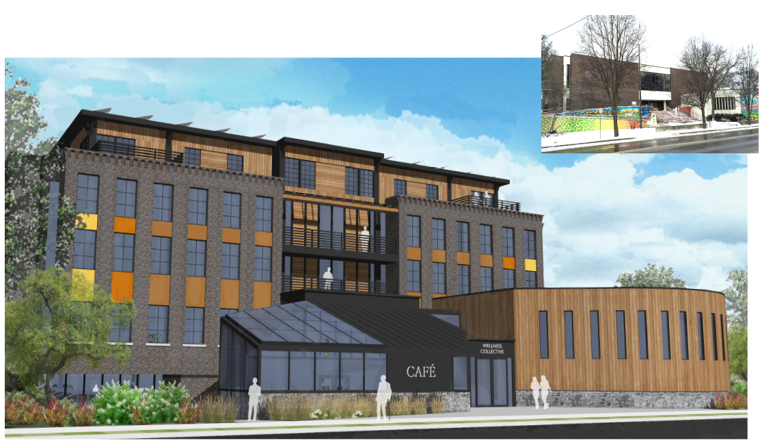
The re-development is fairly multifaceted. Some buildings will be renovated, a few will come down, a couple will receive additions, an quite a few others, like those in the all-residential CW2 zone, will be brand-new. Specifically in Phase One, four buildings – 21, 24, 33 and 34, will be renovated.

In Part Two, we’ll take a closer look at the neighborhood design standards and detailed plans for Phase One.



News Tidbits 4/16/16: The Real Estate Shopping Spree

16 04 2016

old_libe_thp_holt_v4

1. On Monday, the county’s Old Library Committee received an update from Travis Hyde Properties about the redevelopment. Perhaps the biggest development is that Lifelong is no longer moving into the building. Instead, they will sell keep their office at 119 W. Court Street, sell the historic building at 121 W. Court Street, and have free use of DeWitt House’s community room for classes and workshops. Lifelong would also be the administrator of the community room, so rental fees for use of the room by other organizations will be paid to Lifelong instead of Travis Hyde. Lifelong’s treasurer claims this arrangement will save them $50,000 vs. the original proposal.
According to the Ithaca Journal piece by Andrew Casler, law firms have expressed interest in the 121 West Court Street property, although other business and housing isn’t out of the question. 121 is just outside the DeWitt Park Historic District.

The number of units is down from 60 to 55 (though some of those are now 3-bedroom units…the Tines is reporting 57 units total), and parking spaces are down from 30 to 25, all internal to the building since Lifelong is no longer moving in. Frost Travis is quoted as saying he might be looking into expanding the age range of possible tenants (currently proposed as 55+), but that seems liable to garner significant blow-back from neighbors if pursued.

The current plan is to have approval by September, sale of the property by October, and after any final site plan approval tweaks, construction may begin next Spring.

20150727_145000

2. The Ithaca City PEDC had another crack at incentive zoning this past Wednesday. And the consensus is, everybody dislikes it for one reason for another. Some of the development community feels it doesn’t go far enough, while some local activists feels it goes way too far. Sounds like the plan is striking a good compromise if it’s ticking the stakeholders off for not being more like their way of thinking. But, proof would be in practice, and seeing if any developer would actually be interested in pursuing a plan that utilizes the incentive zoning.

On a related note, Svante Myrick deserve a laurel – when asked at the meeting why there’s a housing shortage in Ithaca, he pretty much nailed it – the growing economy, increasing student and retiree populations, and a renewed interest towards urban environments are driving demand higher than in decades past.

201_college_v2_3
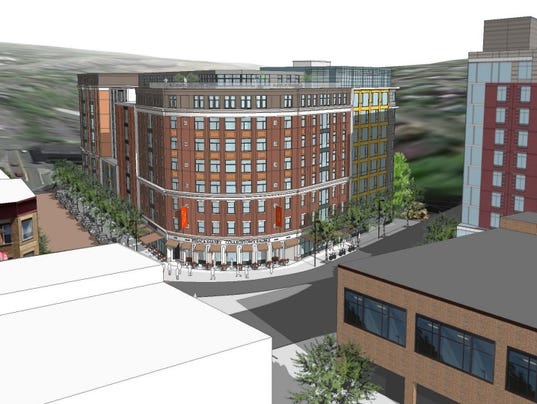
3. For this week’s eye candy, here’s a perspective drawing of the multistory apartment building proposed at 201 College Avenue. One thing that stands out here that doesn’t in the elevations (the latest of which can be found here) is that the corners are stepped down, so the bulk of the building is lessened. The planning board is expected to agree to be the lead agency for environmental review at its April meeting.

4. So I’m mostly leaving this to my colleague and editor Jolene Almendarez, because she is much more familiar with the Elmira Savings Bank situation than I am. But it’s worth noting that Steven Wells, the Massachusetts man who sold ESB the properties, was on a buying spree this week. On Tuesday, Wells paid $224,000 for 508 West State Street (the old Felicia’s Atomic Lounge), $884,638 for 622 Cascadilla Street where Zaza’s is located, and $1.5 million for 402-410 Third Street, a commercial plaza home to Finger Lakes Physical Therapy.  Felicia’s was noted here on the blog when it went up for sale last August for $350k.

ith_big_plan_map_v2

They all have different owners, and they’re in varying physical conditions. The only thing that unites these three properties is all that are in areas the city as ripe for redevelopment for urban mixed-use in the Comprehensive Plan. Felicia’s was upzoned in June 2013 to CBD-60, permitting a 60-foot tall building, no parking required. 622 Cascadilla is WEDZ-1a, allowing for five floors and no off-street parking requirement. Lastly, 402-410 Third Street is B-4, 40′ max and 50% lot coverage, but allows virtually any kind of business outside of adult entertainment. Those are some of the city’s more accommodating zoning types, so we’ll see what happens moving forward. At the very least, the public relations game will be starting from behind the proverbial eight ball.

5. Out in Dryden, the William George Agency is seeking county legislature approval to issue $2.7 million in bonds to finance construction of a new 24-bed residence hall. The facility will affect about 1 acre, be about 15,000 square feet, and start construction this Spring, taking about one year to build.

As the county deems appropriate, they can approve the issuance of tax-exempt municipal bonds to finance construction projects. First the planning committee signs off on it, and then the general legislature takes it up for a vote. The non-profit residential treatment center secured a $2 million construction loan this past January to fund roof repairs and renovations to cafeteria area. The agency, established in the 1890s, employs over 340, making it one of the larger private employers in Tompkins County.


News Tidbits 4/9/16: A Slippery Situation

9 04 2016

maplewood_site_plan_concept

maplewood_site_plan_concept_v2

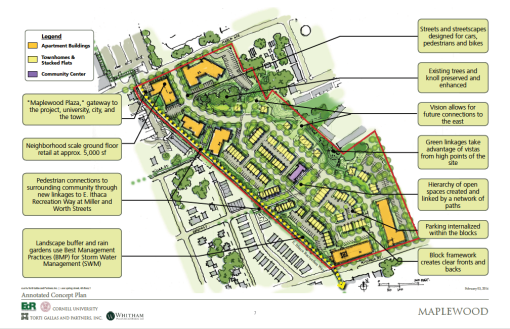
1. The town of Ithaca had their first substantive meeting about Cornell’s Maplewood Park Redevelopment, and later this month, the city of Ithaca will have their take on the 4.5% that sits within their boundaries (picture a line up Vine Street – that’s the city line). According to documents filed with the city, approvals from them will only be needed for one building. Application/SPR here, cover memo from Whitham Planning and Design here, Part I of the Full Environmental Assessment Form here, and narrative/drawings here.

From the SPR, the schedule as already been shifted slightly to an August 2018 completion rather than July – they also threw out a $3.67 million construction cost that doesn’t make much sense offhand. Edit: It looks like it’s just a basic estimate of 4.5% of the total project cost of $80 million.

The biggest change so far is a revision of the site plan. In response to community meetings, Cornell shifted smaller 2-3 story stacked flats and townhouses closer to the Belle Sherman Cottages, pulled back a couple of the larger apartment buildings, and added a new large apartment building to the southeast flank. Cornell has its goal of housing at least 850 in the redevelopment, so all design decisions revolve around accommodating those students with their families, while coming up with a design the community can live with.

The city will vote at its April meeting to defer Lead Agency to the Town of Ithaca, which will leave them with the ability to provide input, but the town board will be the ones voting on it.

2. It’s not often that a project gets undone by a single public commenter at a meeting. But the Journal’s Nick Reynolds got to experience such a momentous occasion at the town of Ithaca’s planning board meeting. He documents it on his Twitter account.

Someone that I didn’t cover because it wasn’t especially news-worthy is Cornell’s plan to replace the Peterson Parking Lot at the intersection of Tower and Judd Falls Roads with a cutting-edge 100% porous paved lot and a Cornell-created soil designed to promote rapid growth of trees in high traffic areas (a new island would be built in the middle of the lot). Basically, an eco-friendly, less-invasive parking lot, if there ever could be a thing.

Then Bruce Brittain, the Forest Home community historian, completely undid the plan with a contour map. Generations ago, the property was filled with debris and garbage, even old construction trucks. And while there may be a parking lot on it now, a porous lot, which would be heavier when watered, is liable to collapse right onto the Plantations below. Meaning, no porous lot, no green showcase. Back to the drawing board Cornell.

201_college_1

201_college_v2_1

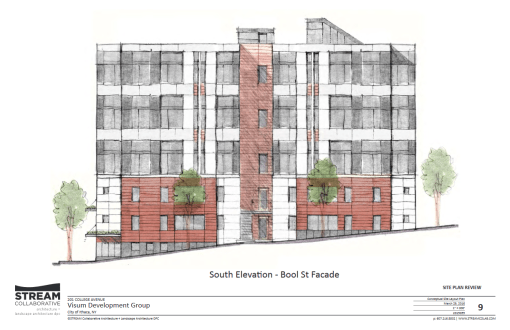
3. Here’s a little more information on the 5-story, 44-unit/76-bedroom apartment proposal for 201 College Avenue. SPR Application here, FEAF here, project narrative here, BZA worksheet here, drawings here , letter of discontent from Neil Golder here. Looking at the drawings, there have been some slight revisions, mostly with the College Avenue entrance and the materials and fenestration at street level. The SPR gives us a $6 million construction cost, and a proposed construction time frame of July 2016 – August 2017. Units will be a mix of 1 to 4 bedrooms (24 1-BD, 12 2-BD, 4 3-BD, 4 4-BD). While the project falls into the Collegetown Form District, an area variance will be required for a front yard setback from College Avenue, which the board feels will help the street be more like a boulevard.

The city planning board is expected to Declare itself Lead Agency for environmental review at the April meeting. Developer Todd Fox hopes to have approval by the end of the June meeting. STREAM Collaborative is the project architect.

902_dryden_final

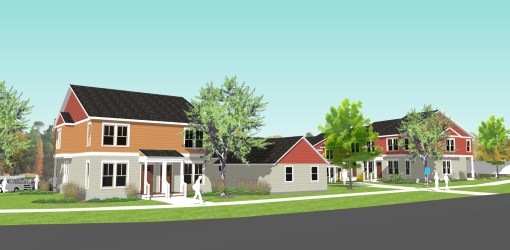
4. This week’s eye candy comes courtesy of Noah Demarest and Todd Fox (yes, they seem to be getting a lot of mentions this week). It had occurred to me that while an image of the revised 902 Dryden townhouses had been presented at the meeting where it was approved, the town never uploaded the copy. Noah and Todd were kind enough to send me a copy of the image presented at the meeting, and gave their permission to share it here. 8 new units, 26 new bedrooms. The duplex building in the middle already exists, but two new units will be built opposite a shared wall. Two three-unit clusters will be built on the east side of the parcel.

Cayuga-Meadows-Shot

5. It’s official as of March 28th. Construction permits have been issued for Conifer LLC’s 68-unit Cayuga Meadows project on West Hill in the town of Ithaca. Expect the first construction update, and a synopsis, when the first construction update comes around, which won’t be until mid-to-late May since West Hill projects get visits during odd-numbered months.

6. Just a couple minor city subdivisions to pass along. One, an application in outer Collegetown at 513-15 Dryden Road to separate the land into two parcels (513 and 515). The lot owner will then build himself a new house on the vacant lot. CR-1 Collegetown Form District, and it looks like no variances will be needed.

The other subdivision is on the city’s portion of West Hill. The property is a vacant lot that borders Westwood Knoll, Taylor Place and Campbell Avenue. The property owners, who live next door on Westwood, want to divide the vacant lot into two vacant lots to sell for single-family home construction. Once again, it looks like no zoning variances will be needed, just regulatory PB approval.

With the consolidation and realignment of 312-314 Spencer Road mentioned last week, this makes three subdivisions scheduled this month. That’s pretty unusual, as the city typically sees only one every 2 or 3 months on average.

7. Looks like someone made a tidy profit. Local landlord Ed Cope picked up 310 and 312 E. Buffalo Street for $885,000 on the 6th. 310 E. Buffalo is a 6-unit apartment building, 312 is a parking lot. The previous owner, a Philadelphia-based company, picked up the properties for $800,000 back in October 2014. So, $85,000 (+10.6%) for 18 months of ownership. The properties are part of the East Hill Historic District, where the Philly-based firm recently had a hell of an experience because the owners before them replaced the windows without notifying the city, and that was a big no-no as far as historic districts and the ILPC are concerned. They mandated the windows all be replaced with more historically-appropriate fittings. Hopefully that came up during the sales negotiations.

For what it’s worth, the parking lot is zoned R-3a – a 4 story building with 35% lot coverage. Since it’s in a historic district, a hypothetical proposal would likely look a lot like its neighbors.

11-24-2012 171

8. And another big sale this week, on Friday – the house at 210 Thurston sold for $2.5 million to the Alpha Chi Omega sorority. The house had been on the market since last November for $2.75 million. This actually sold relatively quick, given its large size and fairly unique nature. The seller purchased the property for $677,500 in December 2011, and renovated the property for use by the Cornell wrestling team.

Alpha Chi Omega has occupied the house at 509 Wyckoff Road for a number of years, but did not own the property – the owner, who picked up the property in 1971, is a business partner of Kimball Real Estate.


A Construction Tour of a Net-Zero Energy House

6 04 2016

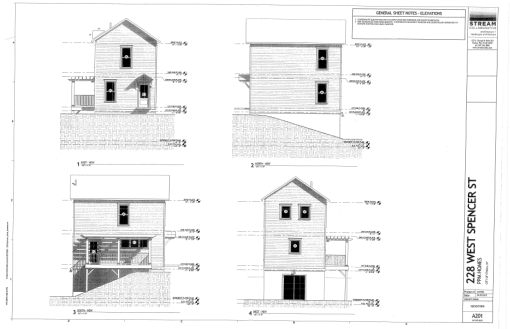
A couple of weeks ago, Noah Demarest was kind enough to give a tour of the new net-zero energy single-family house underway at 228 West Spencer Street in the South Hill neighborhood.

Most readers of the blog will be familiar with Noah Demarest’s name – he’s the head architect of STREAM Collaborative, which has been involved in projects like 902 Dryden Road, 201 College Avenue, State Street Triangle and the Franklin proposal for condos at the Old Library site.

228_w_spencer_1

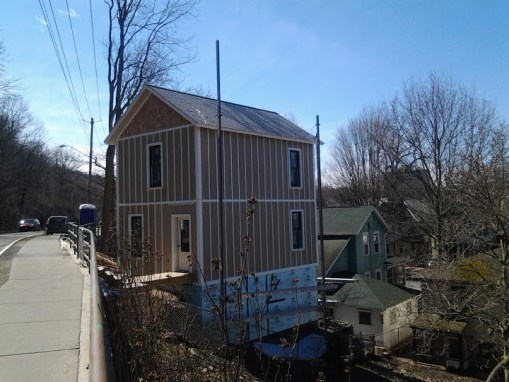
Noah’s a little more involved in this project than most – he’s in charge of the build-out, and the cost of construction is coming out of his own pocket. Local landlord Ed Cope is a silent partner in the project, having purchased the land from the previous owner for $15,000 last February. The sale came with a different set of house plans, and the unique topography and constraints of the site made it such that the BZA had to approve virtually any new construction proposed on the parcel – Noah drew up plans for a different design, and those were later accepted by the board.

20160319_130922

You can see how that unique site topography plays in here. The framing, sheathing (ZIP system), roofing and panelling of the house was done by local company Ironwood Builders. With much of the exterior work completed, activity has shifted largely to the interior spaces, which Noah is doing with his own construction team.

20160319_130936

My initial impression was that they were going for an exposed wood trim look similar to the framework of Tudor-style houses, but Noah says the trim will be painted the same color as the fiber cement siding. The shingles are a nice, Craftsman-style touch.

20160319_131043 20160319_131055

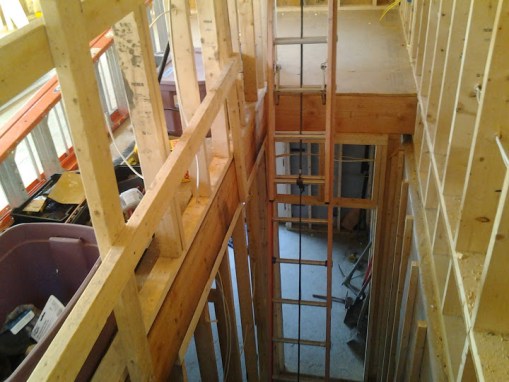
First photo is looking down, second is looking up. The house, just under 1,000 SF, has living space on three levels – the kitchen and living room will be on the second floor, and a bedroom and bathroom are on the first and third floors. This will be put up on the market for sale once it is ready – not a rental. Noah envisions this being the type of house that would be great for a young couple or even a deep-pocketed grad student.

By the way, just mentioning for the sake of acknowledgement – I’m not a fan of ladders.

20160319_131113 20160319_133609

As work moves closer to completion, a porch pergola will be built here.

20160319_133613 20160319_133748

This will be a net-zero energy house, meaning zero net energy consumption – what gets taken from the grid also gets returned to the grid. In the case of this home, an off-site set of solar panels will offset the energy that is taken from the grid. The house will also achieve a very high degree of energy efficiency. One of the ways that’s being accomplished here is the use of an air source heat pump, which transfers heat from outside to inside a building (and vice versa) via a refrigeration compressor and condenser. The system can absorb heat from the outside air and transport it into the home, and can work in reverse during the summer, absorbing heat from inside the home and transporting it outside.

According to Noah, the system tends to be somewhat less efficient in extremely cold weather (-10 F or so; at that point it becomes difficult to extract usable heat energy), but is otherwise very capable for providing heating and cooling needs. Appliances will be all-electric, no gas.

20160319_133939

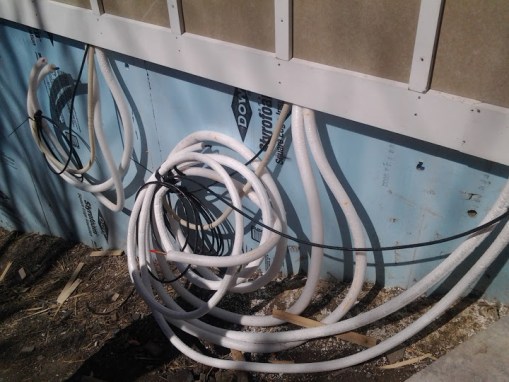
The house is also very heavily insulated – 2.5 inches of foam, with the fiber cement siding on top of that.

20160319_134029 20160319_134056
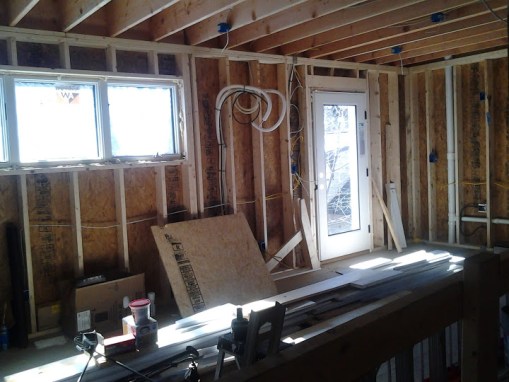
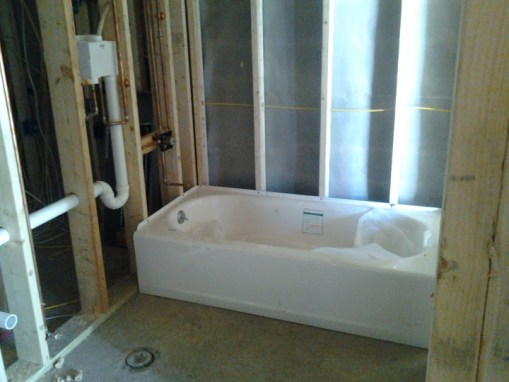
These last couple shots are from the bottom level – bathroom plumbing is in the process of being installed in the basement bathroom unit. The plan is to have the house ready for sale later this year.

One of the things that I personally am looking forward to is that Noah plans on making the costs of construction available to the city, as an example of what construction costs tend to look like for infill on an inner-city parcel. Having more examples to rely on, and a clear description of cost per square foot, gives the city more information to help guide its approach to planning and development. Noah noted during the tour was that the zero net-energy aspect is a relatively minor component in the expenses of the project.


News Tidbits 4/2/16: The Walls Come Tumbling Down

2 04 2016

hotel_ithaca_final_1

1. Demolition and site prep work has begun for the Hotel Ithaca’s new 5-story addition. The work appears to be right on schedule, since a March construction start had been planned. The $9.5 million, 90-room project replaces a two-story wing of rooms built in the early 1970s. Hart Hotels of Buffalo hopes to have the new wing open for guests this fall. NH Architecture of Rochester is the firm designing the project, which received some “sweet burns” when it was first presented with cross-hatched panels and “LEED-certified stucco”. Eventually, the planning board and developer settled on a design after review, and the project was approved late last year.

For those who like to see walls a-tumblin’, the Journal’s Nick Reynolds has a short video of the demolition on his Twitter feed here.

2. Looks like there’s a little more information about the 16-unit “small house” subdivision planned in Varna. A Dryden town board document refers to the document as “Tiny Timbers”. Which is a name that has come up before – in STREAM Collaborative’s twitter feed.

https://twitter.com/streamcolab/status/673601010313641984

https://twitter.com/streamcolab/status/657329991827509248

Making an educated guess here, STREAM is working with landowner and businessman Nick Bellisario to develop the parcel. It would also explain the huge mounds of material that had been on the site as of late – compressing the very poor soil so that something could be build onto it, even if they’re merely “tiny timbers”. It doesn’t look like these are more than one or two rooms, with an open floor plan on the first floor and either a room or loft space above.

At first impression, these are a great idea – relatively modest sizes tend to be more environmentally sensitive, and with the subdivision, it’s likely they would be for-sale units with a comparatively modest price tag. On the other hand, tiny houses are something that a lot of local zoning laws don’t accommodate well (minimum lot size, minimum house size, septic), so that would be something to be mindful of as the project is fleshed out more and starts heading through the town’s approval processes.

201_college_1

3. Here’s some good news – the initial reception to Visum’s 201 College Avenue project was favorable. Josh Brokaw at the Times is reporting that apart from debates over a more distinctive roofline and setbacks from the street (which is more ZBA than Planning Board), the board was supportive of the project.

Meanwhile, as for something they were not in support of, the possibility of removing the aesthetic parts of site plan review as a benefit to affordable housing incentive zoning was not something that sat well with them. One thing that does get missed in the article, though, is that that benefit would only be in areas with form zoning guidelines for building appearance and siting (right now, that’s only Collegetown).

cma_2 cma_3

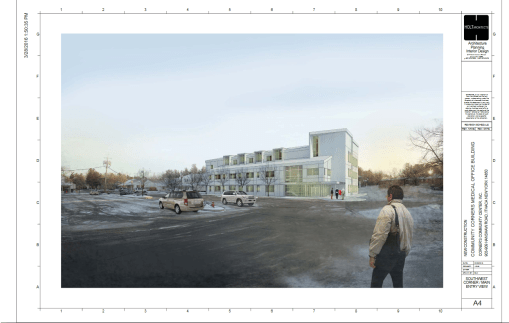
4. Never a fan of being scooped, but the Journal’s Nick Reynolds broke the news of a 3-story, 39,500 SF outpatient medical facility planned for Community Corners in Cayuga Heights. Owner/developer Tim Ciaschi (who also did the Lehigh Valley Condos on Inlet Island) will build-to-suit for Cayuga Medical Associates, with design work by HOLT Architects.

In most towns, this would be fairly cut and dry. But this is Cayuga Heights, which probably has the most stringent board in the county. The village routinely says no to anything that could draw students in (mostly housing, but historically it also included taverns and restaurants), and people prepare multi-page tirades against two-lot subdivisions, let alone what happens when a sorority tries to move in. In the project’s favor are its distance from homes and its modest densification of Community Corners, which the village has been slowly migrating towards in the past few years. The board’s raised concerns with not enough parking, so a traffic study was included with the March materials. We’ll see how this all plays out, a medical office building might work well with Cayuga Heights’ older population.

5. The city decided to take action on the owner of the Dennis-Newton House by fining him $5,000 for building code violations. Steven Centeno, who picked up the property from the Newtons in 1982, was initially charged with over 11,000 violations, and pleaded guilty to 35 counts. According to the city, Centeno was ordered to make repairs in 2012, and got the building permits, but never commenced with repair work. If he fails to bring the property up to compliance within six months, a further fine of $42,000 will be levied. This is not unlike the case last April where the city fined lawyer Aaron Pichel $5,000 for code violations on 102 East Court Street, the “Judd House”. Work on that property is underway.

maplewood_site_plan_concept

6. Likely to be some bureaucratic progress on the Maplewood Park redevelopment next week. The town of Ithaca will be looking at declaring itself Lead Agency for environmental review of the 500-600 unit project. designs and exact plans are still in the formative phases, so no new news on those quite yet. In order to build the new urbanist, form-based project as intended, Cornell will be seeking a Planned Unit Development (PUD), which will give them flexibility in how they can lay out the site. The portion in the city of Ithaca, the two buildings towards the northwest corner (boundary line goes down Vine Street), will be built as-of-right, and it looks like a sketch plan will be presented for the city’s portion during their April Planning Board meeting.

A FEAF is included in the meeting agenda, but since the project will have to undergo a Environmental Impact Statement (much more detailed than a FEAF), it’s not very descriptive.

341_coddington_1

341_coddington_3

7. Ugh. I give credit to the town of Ithaca’s planning board for trying to accommodate a solution where the 170-year old house could at least be moved to a different site. I’m disappointed in both the town of Ithaca’s Planning Committee (members of the town board) and the Iacovellis, neither of which seem to be devoting much thought to an amenable solution. The town’s planning committee chair is hell-bent on keeping students out, and the Iacovellis are now trying to rush the demo permit since they feel their livelihood is threatened. This is an unnecessary loss due to intransigence.


Cornell Veterinary School Expansion Construction Update, 3/2016

30 03 2016

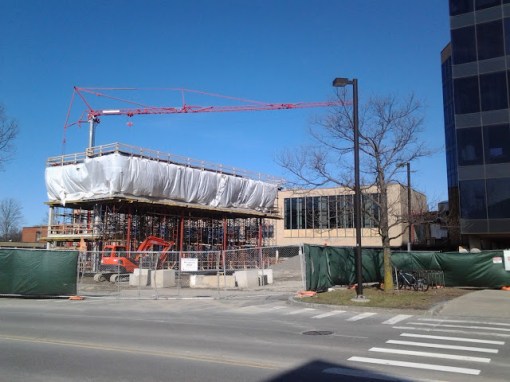
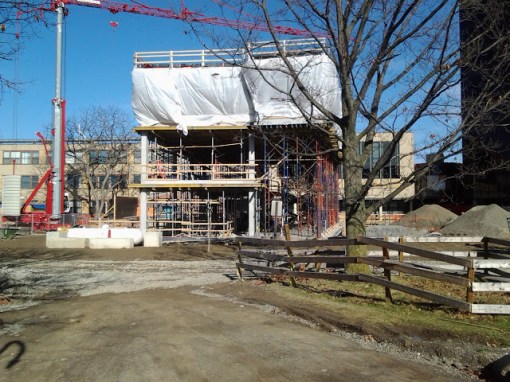
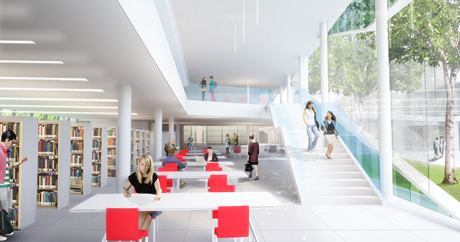
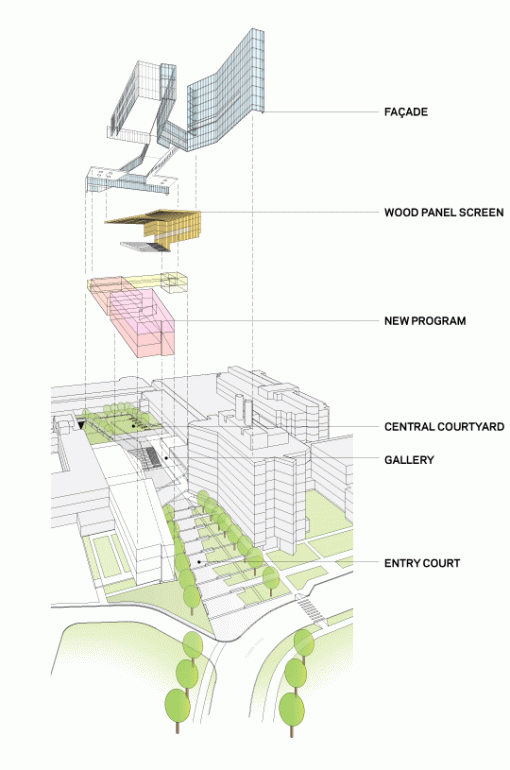
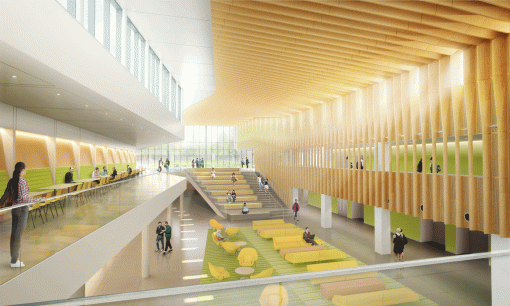
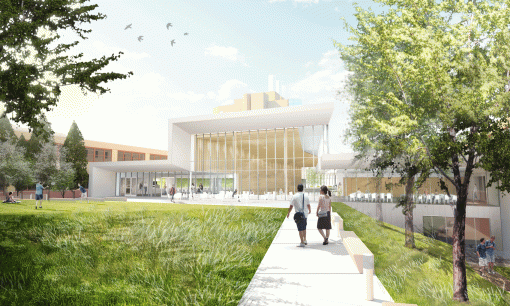
A generalized summary can be found on the Voice here. The concrete frame for the Veterinary School expansion is up to the third and final floor of what will be the new Flower-Sprecher library. As build-out continues, the existing building behind (east) of the new construction will come down and be replaced with new program space; the second floor will sit above an entry court and pedestrian walkway that leads to an indoor gallery space and central courtyard. The open space on the right (south) side of the structure will be a two-story atrium space. The addition will have a glass curtain wall, and the academic spaces that face the gallery will be faced with wood panels.

Cornell and general contractor Welliver will be looking to bring the project to completion by June 2017. Weiss/Manfredi is the project architect.

20160319_155209 20160319_155242 20160319_155305 20160319_155319 20160319_155335 20160319_155345

EntryPlaza10-2 LibraryReadingRoom10-2

3f5656954f5a3ef1021519c03b4abe9f 8f098b7e26544f579eb7411b9a1716aa

eea787361994de9625f74b19aa50d91e


Upson Hall Construction Update, 3/2016

28 03 2016

This one’s short and sweet for the moment due to time constraints. A generalized description of the latest progress can be found on the Voice here, and Cornell’s bi-weekly progress report is here. A more thorough rundown was given in January’s update here.

20160319_160249 20160319_160337 20160319_160400 20160319_160504 20160319_160527 20160319_160559 20160319_160644 20160319_160647 20160319_160654 20160319_160713 20160319_161727


Gannett Health Center Construction Update, 3/2016

27 03 2016

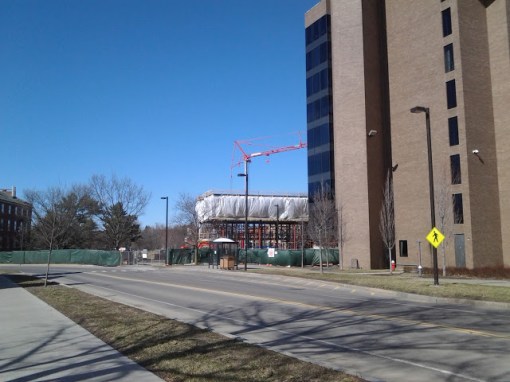
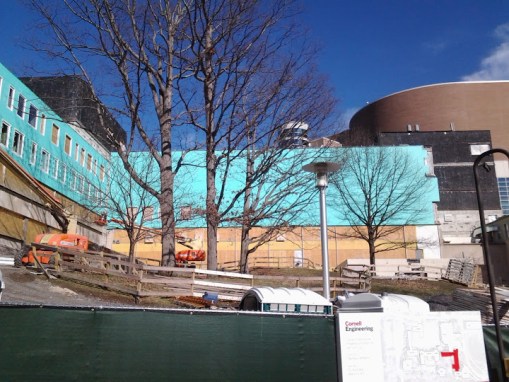
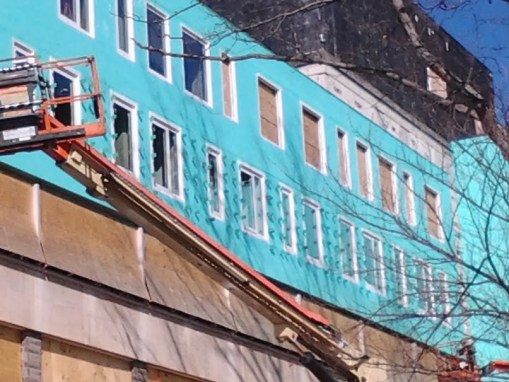
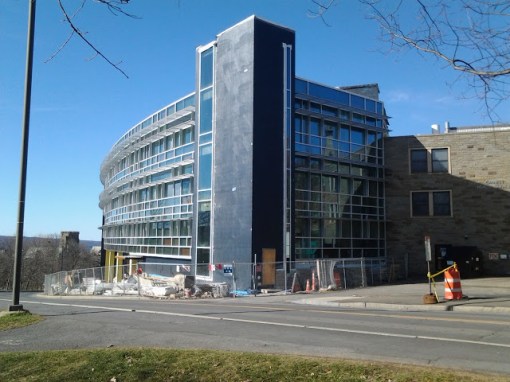
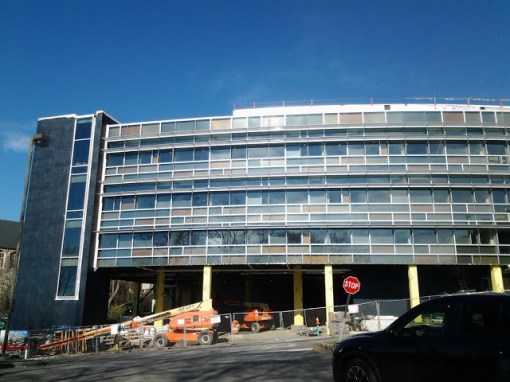
Most of the curtain walls are complete, only the stud walls on the northwest face are still exposed. Sunshades have been installed on the outside of each floor. The bluestone and limestone veneers will be apply to the base columns and walls at some point later this year. From the outside looking in, it looks like good progress is being made on finishing-out the interior of the new wing. A write-up can be found as a part of last week’s Voice article here.

Chiang O’Brien of Ithaca is the architect for the two-phase, $55 million project, and the general contractor is The Pike Company of Syracuse. The new wing will open late this summer, and the second phase, which is primarily renovations of the existing wings, will run from this summer to late summer 2017.
20160319_160951 20160319_161136 20160319_161158 20160319_161227 20160319_161247 20160319_161304 20160319_161310 20160319_161400 20160319_161508


Collegetown Terrace Construction Update, 3/2016

26 03 2016

So there are really two sets of photos here. The first set contains photos that I’ve taken from outside the fence. The second set of photos are from inside the fence, and come courtesy of Nick Robertson and Jocelyn Garrison at Welliver, the general contractor in charge of the project. Their photos are much more visually telling than mine, and a big thanks goes out to them both.

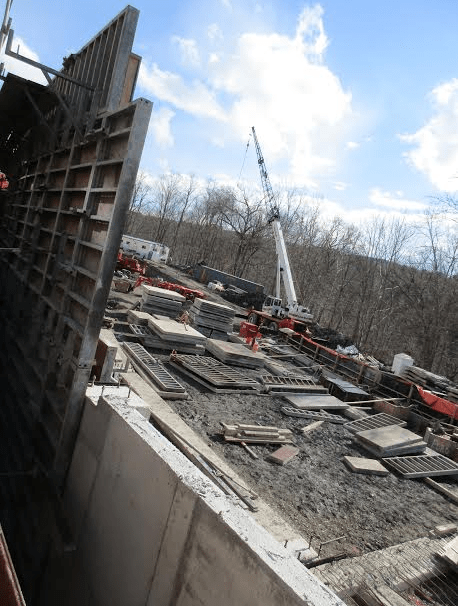
Currently, work is focusing on drilling piles, and forming and pouring the foundation walls. In some sections, foundation walls are being formed. Concrete pours as liquid and dries into a hard solid; forms are a solid barrier (typically wood or durable plastic) that simply forces the concrete to dry in the shape it’s supposed to. After the concrete has been poured and dries into the desired shape, the forms are removed and moved down to the next section. Work on the foundation walls appears to be progressing from west to east along the excavated and pile-driven footprint for building 7.

If you look closely at the Welliver photos, you can see the steel wire mesh that will be embedded in the concrete and provide stability for the walls. The additional steps on the forms may have to do with stepping the foundation up along the slope of the site.

20160319_154015 20160319_154025 20160319_154036 20160319_154053 20160319_154416 20160319_154420 20160319_154432

Set two:

welliver_ctown_0316_1

welliver_ctown_0316_2

welliver_ctown_0316_3

welliver_ctown_0316_4


News Tidbits 3/26/16: Big Plans and Small Town Intrigue

26 03 2016


201_college_1

1. Starting with with the new project of the week. In case it was missed, the write-up for the new 5-story apartment building proposed for 201 College Avenue can be found here. 201 College is being proposed by Todd Fox under his new development entity, Visum Development Group; Modern Living Rentals will continue to exist as a rental property management company. Excluding perhaps a small question with where the average grade is to determine the 70′ max height, is looks like the proposal fits the MU-1 zoning; and apart from a couple of the usual grumblings against students and/or density, there isn’t likely to be too much of an issue with the proposal. Noah Demarest of STREAM Collaborative is responsible for the design, which will make be faced with colored metal panels.

On a related note, the Journal broke this before the Voice, and it appears they may have used to the city’s Site Plan Review pre-application as a source. That’s not online for public viewing; someone would have had to give it to them. Which seems a bit dodgy, given one of the goals of the now-mandatory pre-application is to offer initial thoughts to make sure a project is palatable, and to avoid another public controversy like State Street Triangle.

312_spencer

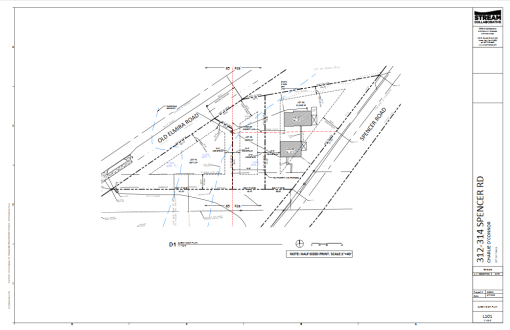
2. Meanwhile, the other partner in Modern Living Rentals, Charlie O’Connor, is pursuing a small project of his own on the other side of the city. O’Connor has submitted subdivision plans to merge two lots at 312 and 314 Spencer Road, and subdivide two legally-buildable lots from the merged property for a total of three, one of which will contain the existing houses. The new lots would be on vacant land behind the existing houses, which are currently owned by the Lucatellis (the same folks who ran Lucatelli’s next door). O’Connor would be purchasing the home and land pending approval of the subdivision. Each of the two new lots would then be developed into a 2-family home. Noah Demarest of STREAM Collaborative is handling the application. Drawings can be found here.

biggs_1

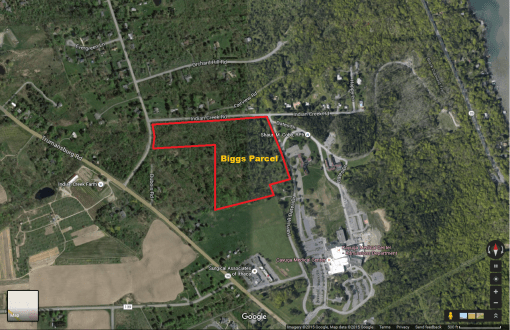
3. The Biggs Parcel will be put up for sale. As the county notes in its press release, the county administrator has been given permission to procure a realtor and market the property on the condition that any offers from the Indian Creek Neighborhood Association and/or the town of Ithaca be entertained (though not necessarily selected). The ICNA had offered some unknown amount for the property, which they have sought to keep undeveloped, but the offer was rejected. Previously, the site was the location of a proposed 58-unit affordable housing development, but the project was discontinued when more extensive wetlands were discovered on the property.

One of the big sticking points has been whether or not the 25.5 acres would be taxable – the county wants to sell to a private owner that will pay taxes, but proposals to preserve the land often dovetailed with plans to donate it to an organization like Finger Lakes Land Trust, which would render the property tax-exempt. The land had been valued at $340,000 before the discovery of the additional wetlands, and the reassessment value will become available on May 1st.

Realtors will apply to the county to list the parcel, and a realtor is expected to be chosen by the county by May 4th.


4. A large property in Trumansburg village noted for development potential has sold after being on the market for two and a half years. Local architect Claudia Brenner picked up the 19.27 acres in two adjacent parcels for $240,000 on the 22nd, about 25% off its original $300k asking price. 18.77 acres is registered to 46 South Street, the other 0.5 acres is a small L-shaped lot between 209 and 213 Pennsylvania Avenue. The previous owners used the property as cropland, and it had been in the same family since the 1940s.

In an email, Brenner said it’s too early to comment, but that future plans are being considered. The site has the village’s R-1 zoning, which allows home lots as small as 15,000 SF (~0.35 acres), and small scale multi-family residential and commercial services.

tfc_v2_1
5. Talk about big delays. Tompkins Financial will be pushing their $26.5 million project back a whole year, according to an interview a Cornell Sun staffer conducted with JoAnn Cornish, the city’s planning director. The project was supposed to start this quarter and be completed in Q1 2017. Now it will be completed in Q1 2018.

summit_danby_1

6. A few months ago, the Summit Enterprise Center proposal in Danby was described in one of the weekly news roundups. Docs filed by STREAM Collaborative’s Noah Demarest on behalf of owner David Hall call for modifications of a Planned Development Zone for the property at 297-303 Gunderman Road. Danby’s PDZ is not unlike the city’s PUD and town of Ithaca’s PDZ, where the form and layout is regulated rather than the use. The original PDZ for the property dates from the mid-1990s.

Well, after months of vociferous debate, the project has officially gone into bureaucratic Hell, complete with political turmoil and accusations a-flyin’. My colleague Mike Smith has the full story on the Voice. Rather than rehash Mike’s detailed explanation, let’s just leave it at this – Summit probably isn’t moving forward anytime soon.