News Tidbits 3/21/15: Imagine If It Was Trader Joe’s…

21 03 2015

texas_roadhouse_1 texas_roadhouse_2

texas_roadhouse_3

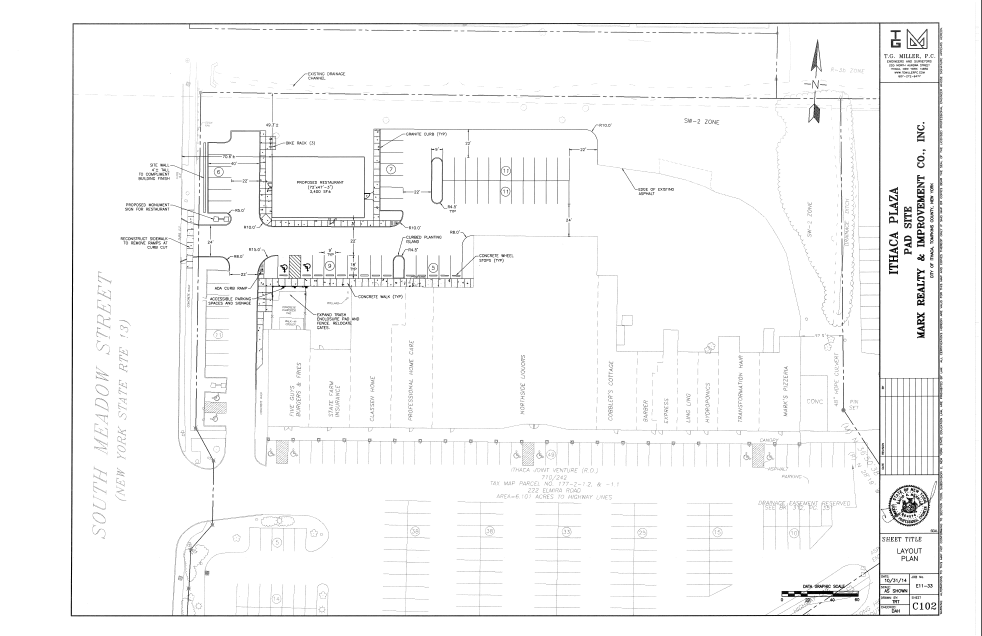
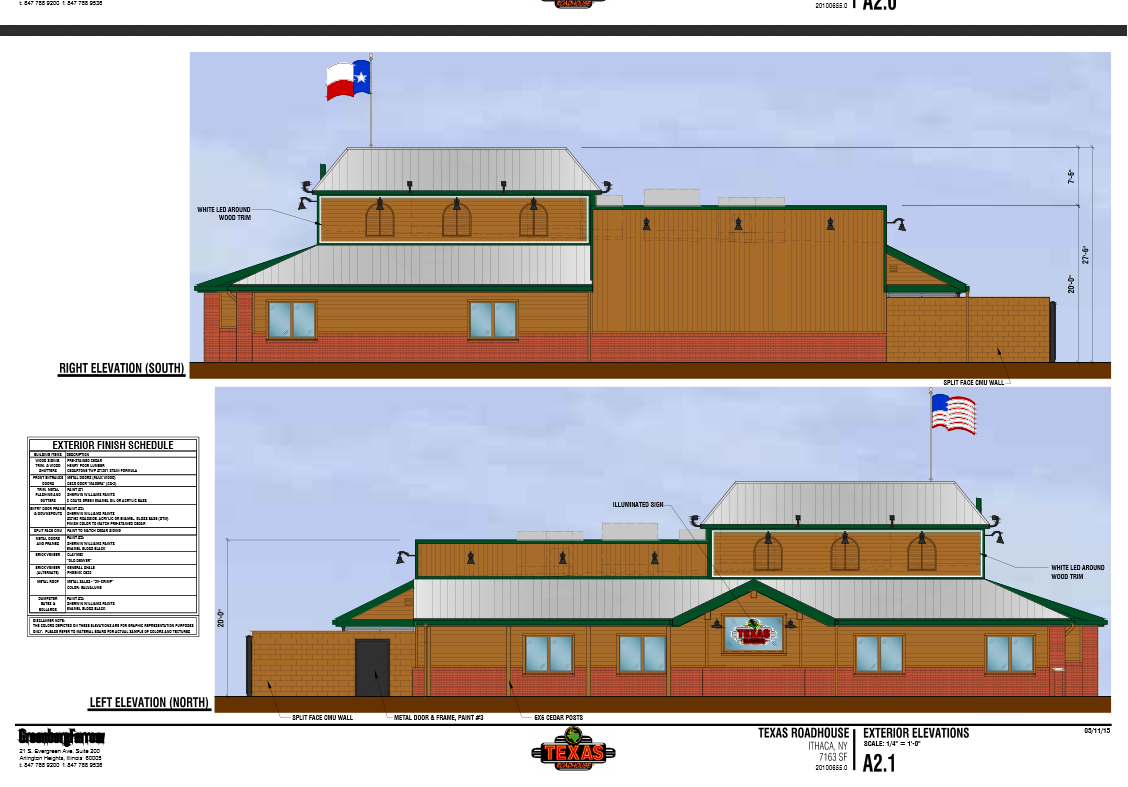
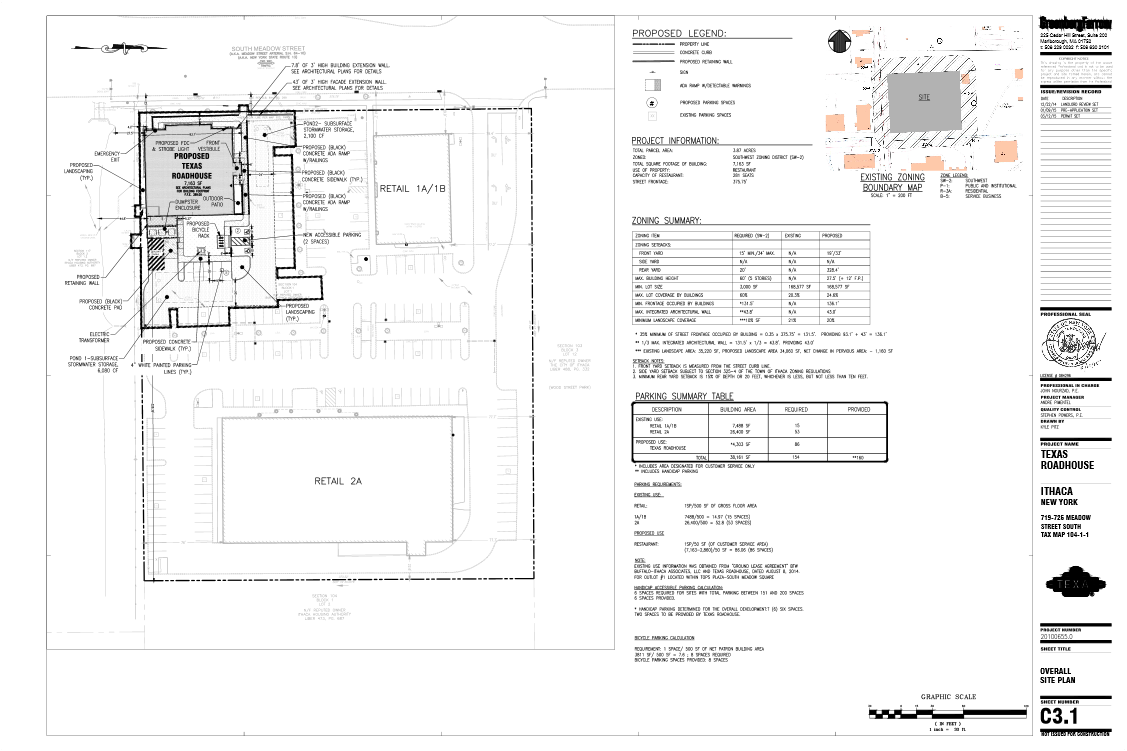
1. Yet another chain restaurant entering the Ithaca scene, this time Louisville, Kentucky-based Texas Roadhouse. There’s 24 separate documents on the city website, and I’ll link to the most useful ones here – the Building Application here, the elevation drawings here, the Full  Environmental Assessment Form (FEAF) here and overall site plan here. I wrote about this for the Voice, and I’ll recapitulate the salient details here-

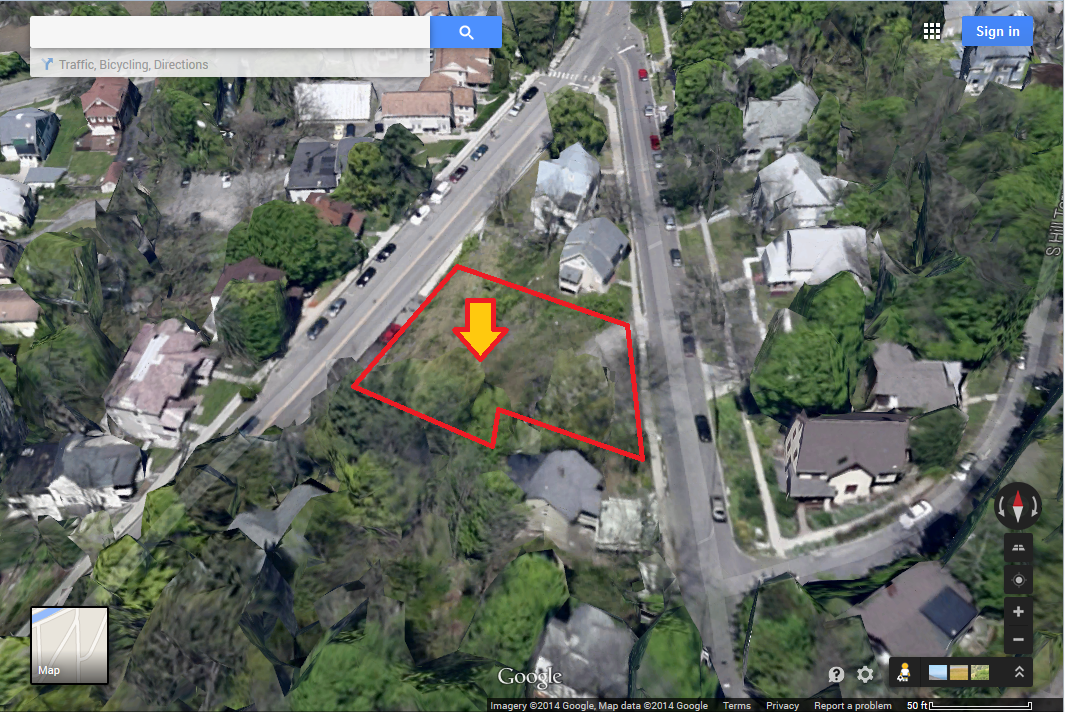
-The site location is 719 South Meadow Street, the northern end of big-box land. The site was previously home to a Cellular One and a 1980s one-story masonry building that was demolished in 2013, leaving the current vacant lot.

-The construction time period is expected to be from September 2015 to Spring 2016. The project will begin the PDC review process in April. The construction cost is pegged at $1.35 million, including landscaping and parking improvements.

-About 30 construction jobs and 40 permanent (albeit food service) jobs will be created, according to the application. Jeff Stein at the Ithaca Voice says that an email from Texas Roadhouse corporate expects 170 permanent jobs, so I’m not sure which figure is correct.

-The 7,163 sq ft store looks to be the standard corporate design theme for the 430-restuarant chain.

One of the things that continues to amaze me is that, here on the blog, news like this is not a big attention-getter, it’s worth a blurb and not much more. On the Voice, where the audience is more general, people go nuts when they hear about new chain places moving into Ithaca. The lovers and the haters, and sometimes even attacking each other in the comments. In the first 24 hours after the Roadhouse article was published, it was shared 300 times on facebook, and had 2600 likes. Any other real estate or business article would be lucky to get 1/20th of those figures. I never cease to be surprised.

troy_rd_rev1_1

2. Looks like another town of Ithaca project is hitting the dustbin. The 68 acres involved in Rural Housing Preservation Associates Troy Road project have been put up for sale. Originally proposed in February 2014 as a 216-unit project, the original design met with stiff resistance from neighbors and town officials. In November, a smaller, 130-unit plan (shown above) that included on-sire orchards and clustered housing was much better received, and the town planning board declared itself Lead Agency for site plan review, but the project never progressed further. In consideration of other dead mutil-family projects (such as NRP’s Cayuga Trails and Holochuck Homes’ 106-unit townhome development), the town is having a difficult time providing new housing, partly due to developer problems and partly due to local opposition and red tape.

Kendal_1

3. The writers over at the Ithaca Times have an article up this week about the Kendal at Ithaca expansion currently underway. In order to stay on schedule, Kendal had to do their groundbreaking in January, with the intent of finishing in January 2016. Even with the appalling winter we’ve had this year, the director of Kendal claims the project is only three days behind schedule.

The Kendal expansion will add 24 senior apartments and 13 skilled patient care beds to the current 212 apartment and 35 beds on-site. The $29.3 million project is expected to add about 20 jobs when complete. Local architecture firm Chiang O’Brien is handling the design of the building additions.

4. More bad news from Cornell, at least for this blog’s sake. From a Cornell Daily Sun writeup about a town hall-style budget meeting conducted by outgoing President David Skorton:

“Cornell can also cut costs further by reducing campus construction, a step Skorton recommends the University take. 

‘Much of the construction you’ve seen on campus over the last 20 years has been supported by debt,” Skorton said. “We are at the point now, for at least a few years, where we need to very, very seriously reduce construction of new space.'”

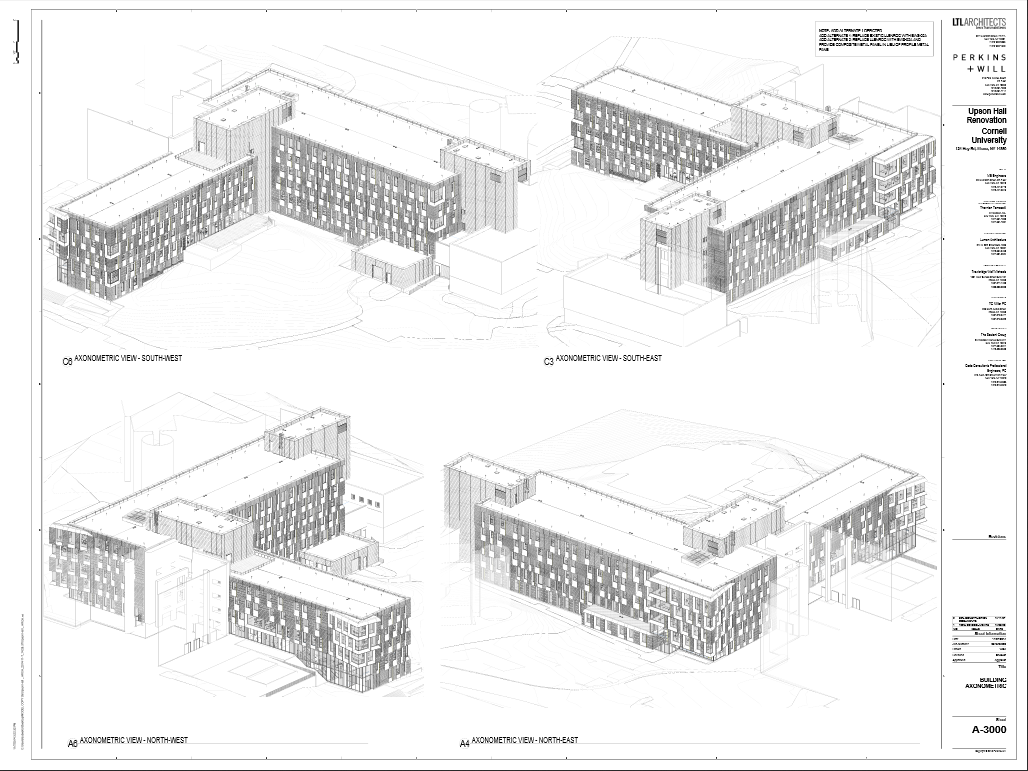
I could imagine a couple impacts from this. First off, this probably won’t affect projects with permits in hand and funding in place, like the Gannett addition or Upson Hall’s renovation. But through the rest of the decade, there could be a serious curtailing of new construction. This would hurt the local construction industry, for whom Cornell is a good chunk of their work. Skorton’s explanation also works as a reason to not build any new dorms, and that’s worrisome. The rapidly increasing student population has not only been crunched by tight supply, it’s spreading into adjacent neighborhoods and raising rents for permanent residents, and contributing to strains in town-gown relations.

One thing is clear. The impacts of Cornell’s latest budget issue will be felt throughout the community.
215_221_wspencer

5. Looking ahead at the agenda for next week’s city Planning and Development Board meeting, here’s what to expect:

A. Final Site Plan Approval for the 4-unit, 9-bedroom INHS affordable housing project at 402 Sough Cayuga Street

B. Public Hearing and possible approval for the Lake Street Bridge Replacement

C. Discussion (no actions expected) on INHS’s 210 Hancock development – some minor tweaks have been worked into the plan, such as moving the new Lake Avenue north of the playground and adding a crosswalk.

D. Sketch Plan for 215 W. Spencer Street by Noah Demarest of STREAM Collaborative. This should be interesting. Readers of the blog will know I’ve mentioned this site a couple of times – it was a vacant lot that was sold by the IURA to local rental developer PPM Homes a couple weeks ago, and apparently they’re wasting no time with getting their plans in motion.

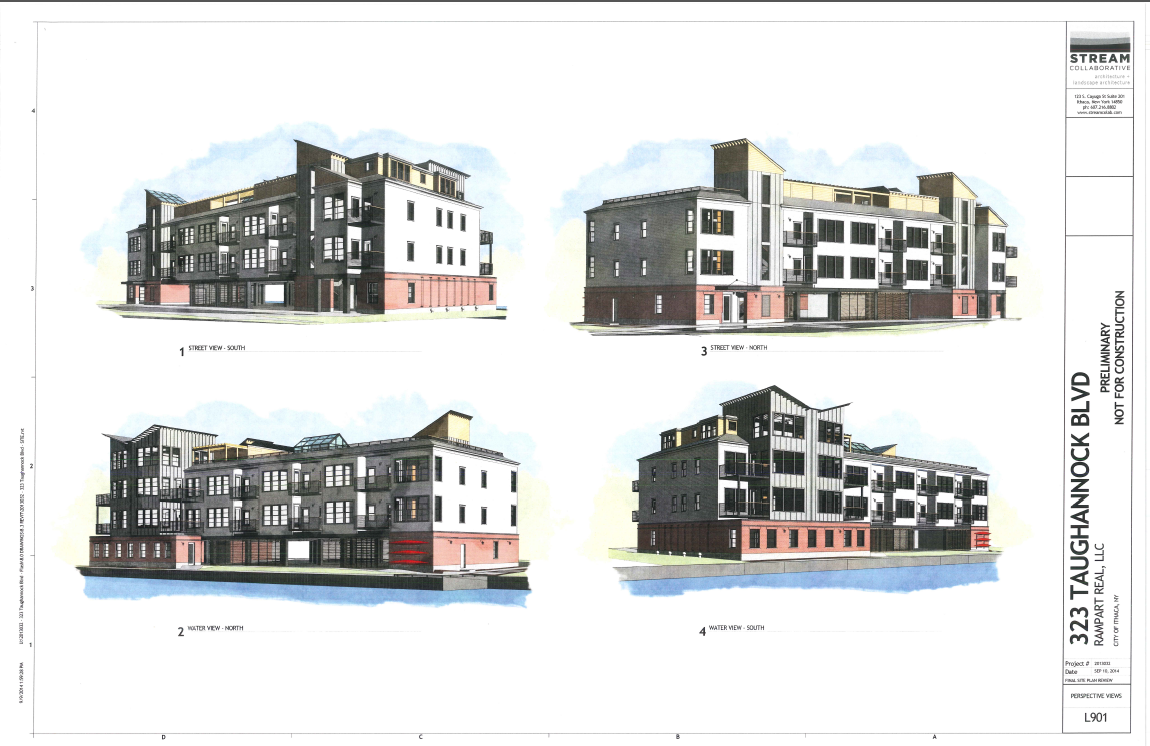
A 0.47 acre parcel (shown above), 215-221 West Spencer is in an R-3a zone that allows for a 40′ structure with 35% lot coverage. That’s a max theoretical buildout of 28,662 sq ft (which if you give 20,000 sq ft for the housing units, and 1,000 sq ft per unit, we get a hypothetical 20 units), but whatever does get proposed will likely be somewhat smaller. STREAM Collaborative is a local architecture firm with a few other projects under its belt, including the 21-unit 323 Taughannock project on Inlet Island, and the Franklin/O’Shae proposal for the Old Library site (the proposal that reuses the Old Library Building). STREAM Collaborative was also responsible for the design of the Troy Road project mentioned earlier, so at least they won’t be going without work anytime soon. Noah Demarest has done pretty good work previously, so I have high hopes for this project.

Along with these four discussion topics, the PDB will review a minor subdivision to create a new home lot at 104 Campbell Avenue on West Hill, a review of application materials to see if any revisions are desired, and discussion of the Planning Board Annual Report, 2014 Edition.

318_pleasant_1

6. It’s that time of the year for building new student rentals for 2015/16. Here we have a Craigslist posting for 318-320 Pleasant Street on South Hill. The rear portion (left) is an addition, a duplex with 3 bedrooms each. The owners of the 105-year old house are members of the Stavropoulos family, who run the Renting Ithaca rental company and the State Street Diner.


The Neighborhood Pride Site (210 Hancock Street)

15 02 2015

inhs_pride_design_1

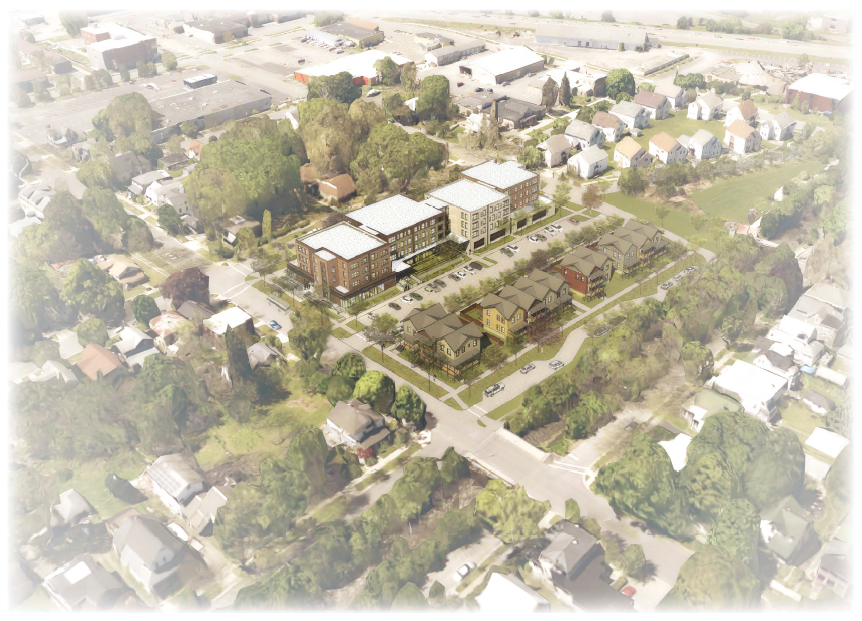
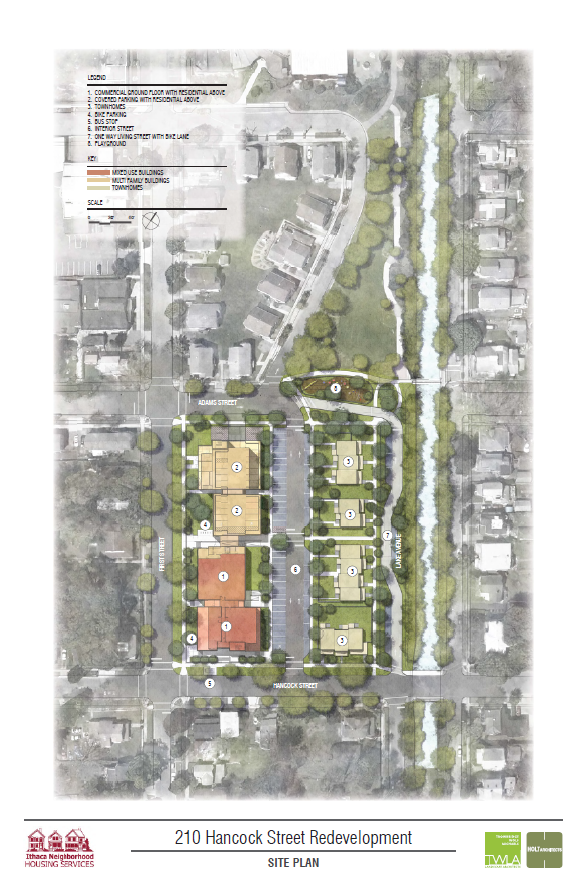
Avid readers will note that I’ve been writing about the Neighborhood Pride site on the Voice, keeping only brief notes here on Ithacating until a final design was unveiled. Now with that taken care of, here’s a description of what we’re working with, based on documents filed with the city on February 13th. There’s a brief application summary and cover letter here, or the 764-page FEAF (Full Environmental Assessment Form) here. I swear, no one reads those giant PDFs in their entirety, users only look for specific sections based on their prerogative. The rest is just there for gluteus maximus coverage.inhs_pride_design_2

Perhaps a little bit to my dismay, the project is not going to be complete until September 2020, tentatively. This isn’t a huge surprise though, INHS is a non-profit and dependent on grant disbursements. The buildout will begin in September 2016 and consist of three phases – my guess of the breakdown is the townhouses are one phase, the 2 southern apartment buildings are a second phase, and the northern two apartment buildings are the third phase, though not necessarily in that order. At some point, INHS anticipated subdividing the parcel into apartment and for-sale portions, which might be useful when applying for affordable housing grants.
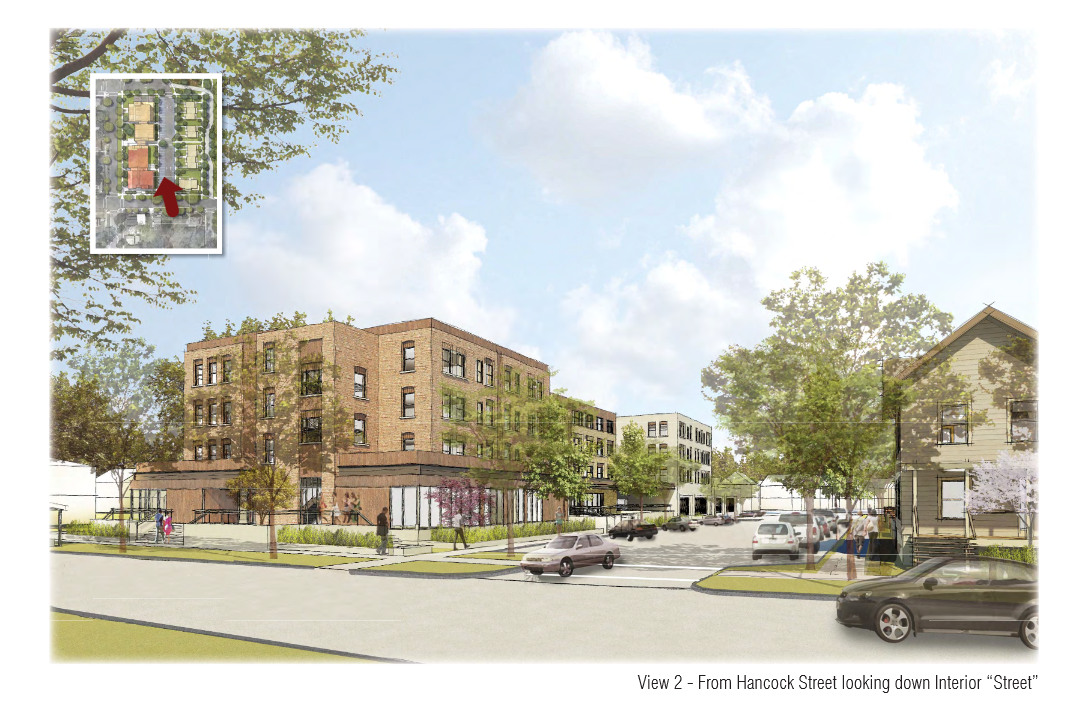
The apartments call for ~50 1 and 2-bedroom units, and 13 for-sale townhouses, although it still looks like 12 in the renders (who knows, maybe one is a small duplex). So about 63 units total, and about 8,200 sq feet or rentable commercial space in three spaces (proposed at 1,800, 2,500 and 3,900 sq ft, for a total of 8,200 sq ft). The apartment buildings will be 65,000 sq ft, 4 stories and 48′ tall (zoning max 4 stories/50′). The demolition of a one-story office building (built 1975) and a vacant grocery store (built 1957) will be required. Total construction cost is anticipated to be about $13.8 million.


inhs_pride_design_3

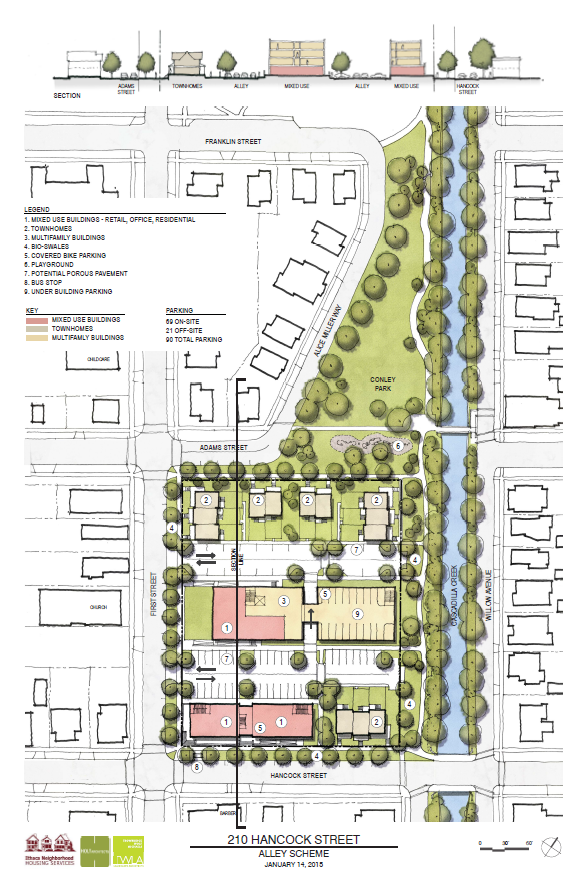
Interestingly, what looks like the community favorite (the street scheme) doesn’t read as the county’s favorite (which reads as the alley scheme). But the county only advises, the city decides. Lake Avenue will be what they call a one-way “living street” – a low-speed, low-capacity street shared by bikers and vehicles. With those features, it’s designed in a way that you’d only drive on the road if you live in one of the townhouses. Conley Park’s southern boundary will be opened up to flow freely into the property (it was blocked off with vegetation to begin with because of its proximity to the old P&C loading dock, which made for a loud, smelly experience).

As an honest personal opinion, the design – inspired by local 1900s industrial and manufacturing buildings, according to the application – is pretty nice. It’s contextual, it’s appropriate, it fits in without being a total historical throwback. The townhouses are well-designed as well. I think INHS’s willingness to have heavy community input, and the community’s willingness to help shape the project, really came together to create a nice product.inhs_pride_design_5

A parking variance will be required from the city – the site will have about 70 parking spaces, but zoning requires 86. Will a new TCAT bus shelter and on-street parking nearby, INHS anticipates that they will be able to obtain the parking variance without too much hassle. INHS also needs to be be mindful of the flood zone, which they seem to have accounted for in the site plan. The only portion of the site especially vulnerable to a 1-in 100 year flood event has covered parking on the first floor. The townhouses, which are in the 500-year zone, will be built two feet above the ground, and the commercial space, also in the 500-year zone, will be one foot above the ground.

In sum, we have a project that removes a vacant supermarket, fits well in the urban fabric and provides affordable housing. It might take forever and a day to build, but it’s a welcome resource in the city of Ithaca.

inhs_pride_design_4


News Tidbits 2/14/15: Zoning Out

14 02 2015

cpoz_1

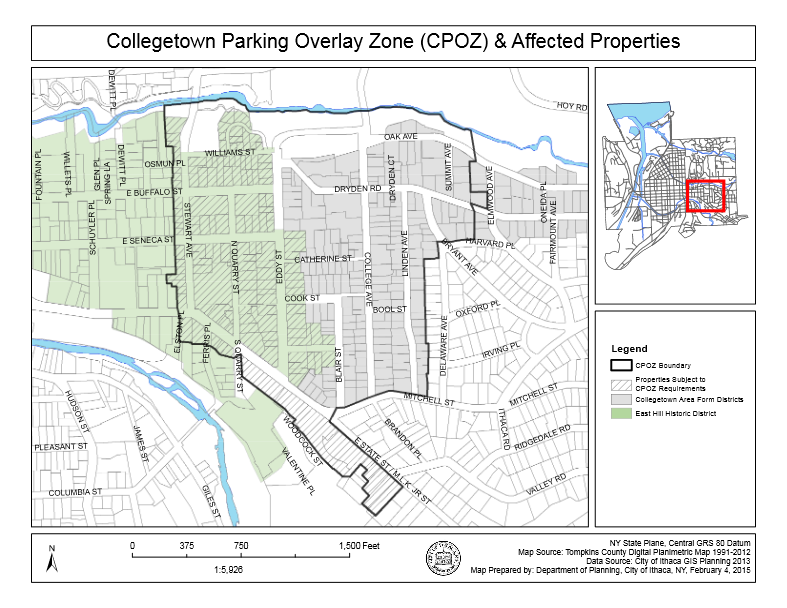
1. Leading off for the week, here’s an interesting piece of news: the city is set to repeal the Collegetown Parking Overlay Zone (CPOZ). The CPOZ was enacted in 2000 as a way to control the parking needs of Collegetown – essentially, it mandated more parking spaces per unit than was standard for a parcel’s zoning. For example, an apartment building of 6 occupants, zoned R-3a, would require 2 off-street parking spaces in Fall Creek, one for every three residents. But on East Hill, that same building would require 3 parking spaces, since the CPOZ mandates 1 off-street space for every 2 residents.

At the time, it made sense; East Hill tends to have more students, who bring their cars to school. But in the past 15 years, the proportion of students bringing cars has declined substantially – a study by Randall/West indicated that in 2000, 49% of Cornell students owned a car; by 2012, it was 27%, a change attributed to the rise of alternative transportation (car share, Cornell-subsidized bus passes), economic and cultural changes. At this point, there’s more parking than there is necessary.

It may seem at first glance that the CPOZ was eliminated with the Collegetown Form Zoning enacted last year, but the two maps don’t match up completely- there are 145 properties that weren’t affected by the new form zoning, but are still covered by the CPOZ parking requirement (see map above). Nearly all of these parcels are a part of the East Hill Historic District (the rest being Collegetown Terrace). A few recent cases, one with Collegetown Terrace and a couple of smaller projects, have highlighted the point that parking requirements have become excessive.

A change to the parking requirements could have a couple of desirable effects – one, less parking would be more historically accurate, and helps to preserve green space in the neighborhood. Two, it opens the idea of replacing a couple of the current parking lots with new housing, which would be designed to fit in closely with the current building stock since the properties are located in the East Hill Historic District (I know, landlords will never give up the money from renting spaces, but perhaps a new small apartment house might be more lucrative than a parking lot; looking at the tax maps, there are a few possible sites, including subdivisions). One mixed effect would be that it’s easier to convert a current single-family lot to student rentals, but the rental would now be less visually intrusive with fewer parking spaces. It’ll be interesting to see what comes forth as a result of this zoning repeal.

industrial_zones_1

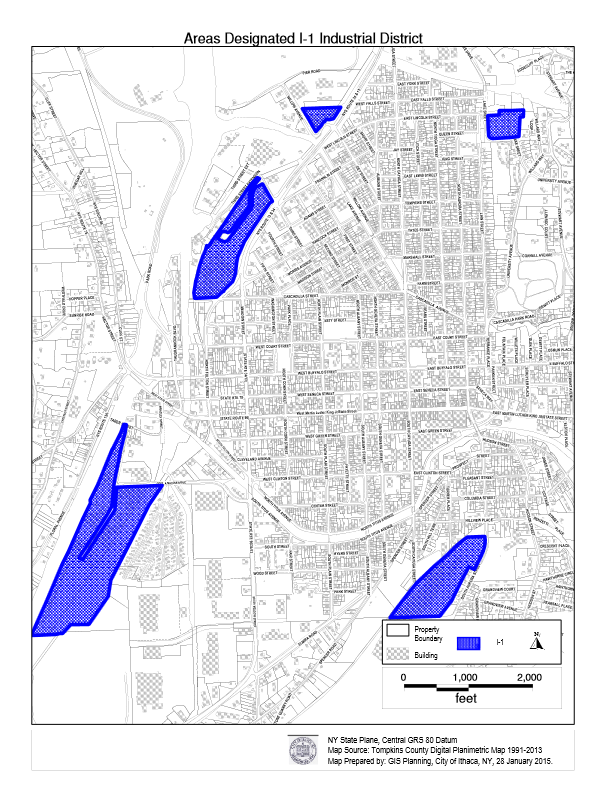
2. Among other zoning changes being considered is a change to industrial zones (the city has just a few). Commercial buildings can be built in industrial zones, but the city wants to raise the minimum number of floors for new commercial buildings in these zones to increase from 1 to 2 floors, a nod to the paucity of undeveloped land in the city (and perhaps the painful attraction of suburban big box stores). There are five sites on the map above, but it might as well be three – Emerson (lower right) is becoming a planned development zone, and the Ithaca Gun site (upper right) is expected to be rezoned from industrial to medium-density residential, in preparation for an apartment project still in the works.

canopy_hampton_rev4_1

3. What is up with the proposed hotels constantly delaying their schedules? First the Marriott pushed back its opening from Spring 2016 to Q3 (July-September) 2016. Now the Canopy Hilton is pushing their schedule back, from a construction start this Spring to an autumn start, which makes it difficult if not impossible to realize the cost savings from reusing the crane for the Carey Building. The tax abatements aren’t going to take that long to obtain, maybe another month or two before the county takes its vote.

Presumably, the project would open in autumn 2016 if the construction schedule is similar. But I feel like these delays send a message of incompetence, and that’s the last thing a project needs.

inhs_pride_design_6

4. Maybe the article I wrote about the new INHS project will have run in the Voice by the time this auto-publishes. But here’s a render that I decided to leave out of the final article to minimize space. The city uploaded the initial application Friday morning (sketch plan will be presented this month), and I’ll write a follow-up article, based on the application paperwork (so it will be different from the Voice article), and post it here on Ithacating in the next few days.

Cayuga-Meadows-Shot

5. Staying on the topic of affordable housing, these agenda notes from IURA Neighborhood Investment Committee reminded me of another affordable housing project that totally slipped off the radar- Cayuga Meadows, a 62-unit apartment building for seniors that was approved by the town of Ithaca for a site near Overlook at West Hill in late 2012. On page 52, it’s noted that the project is supposed to open in November 2015. That would imply that it should be starting construction soon if site prep hasn’t started already (I haven’t visited the site in over a year, so I have no clue). The pipeline document is dated from February 2014, so I have no idea if that’s still accurate. I emailed its developer, Conifer LLC, to see if the project was active, but received no response. Still, it’s something to keep an eye on.


News Tidbits 2/7/15: It Snows In Ithaca, But Verizon Makes It Rain In NYC

7 02 2015

1. As relayed by several outlets, Cornell just received a very generous $50 million donation from telecommuncations giant Verizon. I might make more news about this, but this donation is strictly for the shiny new tech campus down in New York City. The “Verizon Executive Education Center”, in the left of the above render, will be part of the first phase of the campus, set to open in 2017. This goes along with a 6-story, 236,000 sq ft building design by Weiss/Manfredi, and a 4-story, 188,600 sq ft building by Morphosis Architects, both of which are already underway. The skyscraper on the right of the render is a 26-story, 500-room dormitory for students and staff designed by Handel Architects; while not yet underway, it is also slated for a 2017 opening. A design for the tall building on the far left has not been released.

I’d like to see a breakdown of what proportion each campus received from Cornell’s $546.1 million in donations.

2. Looks like some Sun writers decided to do some digging regarding the potential Fine Arts library relocation and expansion. There’s not a whole lot more to add since the Ithaca Voice article; just that the timeline and final design haven’t been set, although the renovation is a “key academic priority”. Students of the AAP school also have mixed opinions about the growth of the library and the possible loss of studio space. But don’t fret dear readers, if a render comes out, it and any pertinent info will be shared here.

424_dryden_rd_1

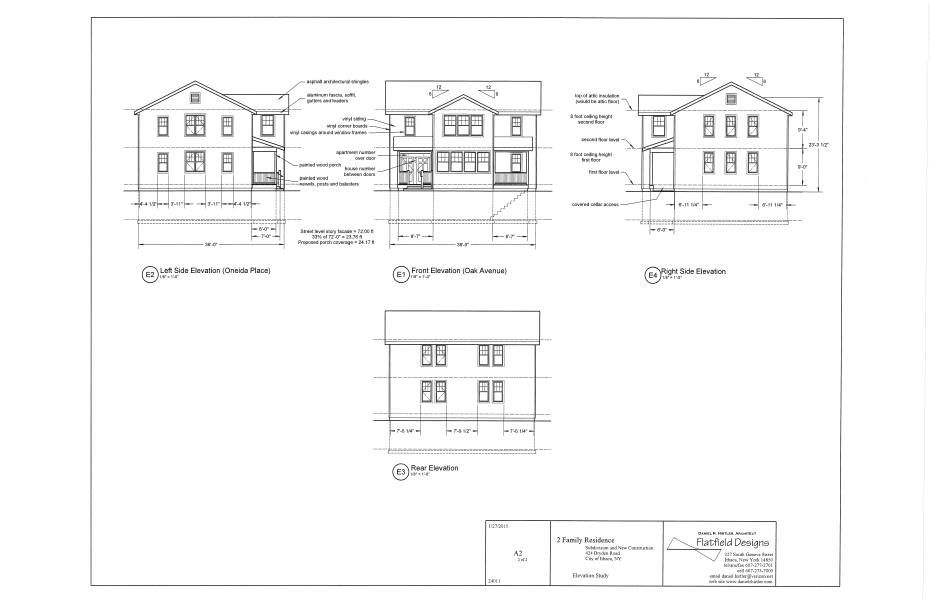
3. A subdivision filed with the city of Ithaca indicates plans for a new two-family, 6-bedroom home at the intersection of Oak Avenue and Oneida Place. The house would be built on land that currently serves as a rear parking lot for 424 Dryden Road. Application here, drawings here. The site falls into the CR-2 Zone of the Collegetown Form District, meaning 2-3 floors, and pitched roofs and porches are required. The architect is Daniel Hirtler of Ithaca, and the developers are William and Angie Chen, also of Ithaca. While not particularly notable, it’s an example of how the form-based zoning applied to Collegetown helps maintain the character of the less-dense outer neighborhood, while still allowing for new construction.

canopy_hampton_rev4_1

4. As with virtually every other sizable project in downtown Ithaca, the canopy Hotel by Hilton is filing an application requesting a tax abatement through the CIITAP program, making it the sixth applicant since the revised program was put into affect in 2013. Application here, and the notice of  public meeting, set for 5 PM February 9th at City Hall, is here. A refresher/review of CIITAP can be found here.

The applicant, “Ithaca Downtown Associates LLC”, a.k.a. the Patel Family of the Baywood Hotels Inc., notes that the 7-story, 123-room hotel project has an estimate cost of $20.15 million. Although the value of the tax abatement is not recorded in the city’s application (it will be written out, when reviewed by the county IDA), it looks like they’re seeking the standard 7-year abatement, which will save them something in the ballpark of a couple million dollars over those 7 years.

As with the previous Marriott and Hotel Ithaca applications, the applicant will only pay one-third to one-half of its projected employees a living wage, which is probably going to earn them the scorn and opposition of the Tompkins County Worker’s Center. But the city and Downtown Ithaca Alliance have been supporters of the project. Neighboring businesses seem to be have mixed opinions about the project, with some seeing a potential business source, and others mourning the loss of a convenient parking lot.

The 74,475 sq ft project is expecting to start construction during the spring, with completion in Spring 2016. Local firm Whitham Planning and Design is the architect.

For those already planning a stay, expect room rates of $160+/night, according to the Journal.

inhs_pride_alleydesign_v2

5. It’s PSA time again – INHS is planning meeting #4 for its proposed Neighborhood Pride redevelopment at 4:30 PM Wednesday the 11th, inside the vacant Neighborhood Pride grocery store. The one and only final design concept, shaped by community feedback, will be presented at this meeting. Keep an eye on the Voice for an article (and maybe a rerun here) next Thursday or Friday.

lake_st_bridge

6. Looking at the city’s project memo going out to its departments, it doesn’t look like a whole lot needs to be reviewed this month. Cornell’s Upson hall renovation, the 6-unit building at 707 E. Seneca, and the 4 for-sale townhomes INHS wants to build at 402 S. Cayuga Street are ready for final approval this month. The 3-building, 6-unit project for 804 E. State (112 Blair) still needs to be reviewed by the zoning board, and will be completing environmental review (SEQR determination of significance).

The only new projects of note are the new house at 424 Dryden, and renovations to the Lake Street Bridge. The bridge project consists of rebuilding the current deteriorated bridge with a new deck and refurbished abutments (base supports), as well as scour reinforcements (to protect from creek erosion), a bumpout for viewing Ithaca Falls, some cute light-posts, and a bridge span that isn’t so degraded that it’s liable to collapse into the creek. That project has a $1,000,000 price tag, and is expected to run from June to November of this year.

For those that use this bridge, start prepping for a detour route – the bridge will be closed during construction, to both vehicles and pedestrians. The city estimates the detour will be an extra 1.7 miles for cars, and 0.7 miles for bikes and walkers.


News Tidbits 1/17/15: Capturing “The Essence of Local Surroundings”

17 01 2015

inhs_pride_conceptsketch

1. Token PSA: The third meeting for INHS’s Hancock Street/Neighborhood Pride redevelopment is next Wednesday, the 21st, 4:40-7:30. Attendees are not required to be there for the entire time. The goal of meeting three is to discuss design concepts for the proposed buildings that comprise the two remaining/competing site plans. I look forward to writing a follow-up after the meeting.

cayugafarms_2

cayuga_farms_1


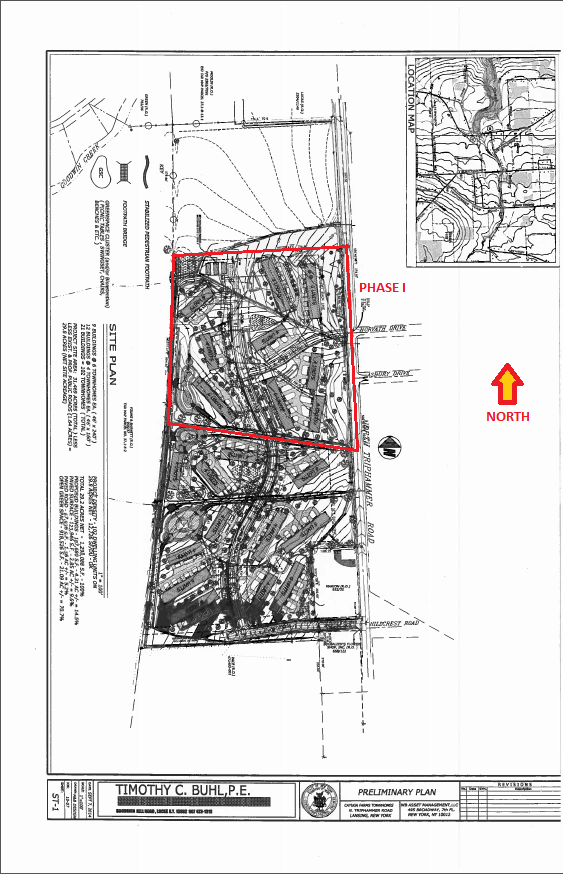
2. Finally, some drawings for the 102-unit Cayuga Farms townhouse project in Lansing, courtesy of the Lansing Star. They look like stereotypical “McMansions” that happen to have shared walls, and the rental price for the 2 and 3-bedroom units has the mansion part covered – $1800-$2200/month. If you use the 30% rule of affordable housing, that means the a household in the cheapest unit is expected to pull in $72,000/year. To quote the project engineer, Timothy Buhl:

“The idea is to capture the transient market of people coming from urban areas to work at the colleges,” Buhl said.  “They would ultimately buy a house, but don’t know where to locate.  We’re looking for young, two-worker families.  It’s an in-between type of rental of higher-end people that we’re looking for.”

In other words, “affordability” is not a word you’ll see in this conversation. The Cayuga Farms project was initially proposed several years ago as 144 townhouse condos (I miscounted and said 138 at the time), but the market for suburban high-end townhouse condos is pretty limited – there is Ivar Jonson’s Heights of Lansing which since 2006 has sold ~17 of the 70+ proposed townhouse units, and Woodland Park, which in three years has built ~6 of 48 planned. The market is virtually non-existent, hence rentals.

On the town’s website, there’s all sorts of other data uploaded: trail recommendations, on-site sewage system details, traffic generation estimates, erosion and sediment control plans, environmental review forms and so forth. Cayuga Farms is multi-phased, with 3-4 phases from 2015-2021; phase 1 will have 44 units. Since Lansing is at capacity on its natural gas pipeline, residents will be using propane appliances until the new natural gas pipeline from NYSEG is routed in. This project already gets dinged in my book for having 354 parking spaces when zoning requires only 153 (1.5 spaces per unit). Every unit gets 3.5 parking spaces. That seems like overkill. Anyway, the planning board reviewed the SEQR on the 12th, which is a big step towards approval of the townhouse development. My gut feeling is, while there’s no doubt Ithaca needs housing in most market segments, a high-end rental unit where you have to drive to everywhere bundles just about every criticism about local development into one convenient package.

Let’s be honest, I’m generally pro-development. But I do have a short list of projects I don’t support. This is one of them. With the sprawl, gobs of parking, and mediocre design, I question its value to the Lansing community.


10378252_313975992125799_95913780193412415_n 10917333_314783998711665_7443965770647794346_n

20141129_135859

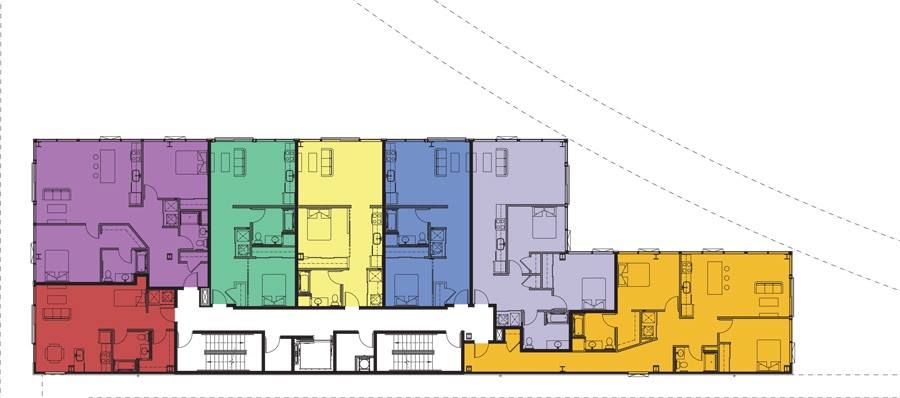
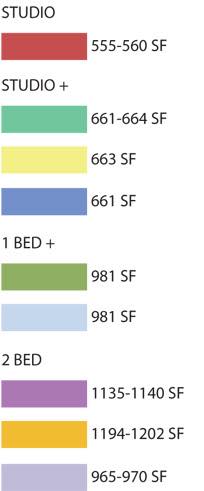
3. The Lofts @ Six Mile Creek project has posted preliminary unit sizes and floor plans on their facebook page. The “Studio +” and “1 Bed +” indicate bonus rooms inside the unit (suitable for another bedroom, home office, etc.). No word on rents just yet, but being new and downtown, expect an upmarket price for the 45 apartments due to enter the market late this spring. Their webpage notes they’ll be accepting reservations sometime prior to that.

canopy_v7_1

4. I think we’re up to version 7 now, but the differences in the proposed “canopy Hotel” are now so subtle that you’d have to be looking hard to spot the changes. The entrance facade is virtually the same, but the mechanical penthouse has been updated to better blend in the rest of the structure, and a couple of stylized wall inserts have been planted into the northwest wall to give the 7-story, 123-room hotel a little visual interest. More renders here, a geotechnical report here, a new cover letter here, and traffic study materials here and here. Thank goodness a lot of this work has gone paperless.

According to the documents, the new “canopy Hotel” brand by Hilton

“…is marketed towards the millennial generation (those born between 1980 and the mid-2000s), however, is relevant for the older generation of hotel guests. Each canopy Hotel is designed to incorporate the essence of its local surroundings and neighborhood feel; such as offering a local welcome gift and evening tastings of local food, beers, wines, and spirits to providing local fitness and recreation options in terms of jogging and bicycle routes (bicycles will be available for rent).”
Yes, ‘canopy’ is meant to be lower-case and ‘Hotel’ is capitalized. I’m sure the brand creators thought that was hip and edgy. Yet another reason why I would never be a good marketer. The 74,500 sq ft hotel includes a small restaurant space of 2,000 sq ft on the first floor, as well as standard hotel amenities like a small meeting room and a gym. The $19 million project hopes to start construction this spring.
upson_4
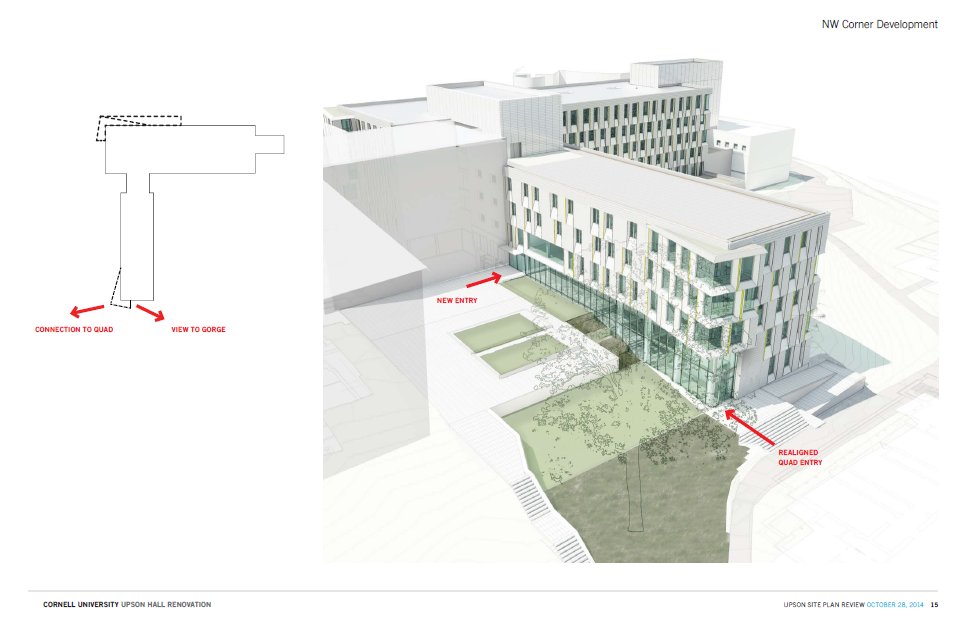
5. Looking ahead, here’s what the city Planning and Development Board seeks to do at its meeting later this month. For the canopy Hotel mentioned above, declaration of environmental significance and possible preliminary approval. INHS’s 402 S. Cayuga Street townhomes and the 6-unit 707 E. Seneca apartment project will be up for environmental review and recommendation to the zoning board for variances. The Planning Board will also declare itself lead agency for reviewing Cornell’s Upson Hall renovations, the 3 duplexes at 804 E. State Street (112 Blair). Board members will also consider approving a telecommuncations (cellphone) tower on top of a gas station at 214 N. Meadow Street, and weigh in on parking-related variances for 128 West Falls Street and 108-110 Eddy Street. It’s an interesting mix this month.


Holly Creek Construction Update, 12/2014

4 01 2015

Stone Quarry hasn’t been the only project INHS (Ithaca Neighborhood Housing Services) has been working on this past year. Over on South Hill, the non-profit affordable housing developer has been wrapping up Phase II of Holly Creek, a townhouse development just west of the intersection of King Road and Danby Road/Route 96B. Like the first phase, phase II totaled 11 units, bringing the total on-site to 22 units in rows of 3 or 4 units. No further phases are planned.

The 2-bedroom and 3-bedroom units are complete and the last few are for sale ($106k and up) to first-time homebuyers that meet INHS’s buyer criterion. The design is a product of local architect Claudia Brenner, and construction was handled by local firm Avalon Homes LLC. Some commenters on Voice articles have been asking about whether certain builders are local and pay living wages. I checked and yes, they do.

The project has received criticism in some circles for being in too suburban of a location. INHS stands by its choice of location for being on a bus route and because the site had infrastructure/utilities already in place.

20141227_140738 20141227_140754 20141227_140802 20141227_140830 20141227_140837 20141227_140953 20141227_140956 20141227_141002


News Tidbits 12/20/2014: Many Homes, One Community

20 12 2014

5-8-2012 347

1. Starting things off, here’s an update on Ithaca College’s Master Plan-in-progress, courtesy of the Ithacan. According to a presentation given by representatives of lead planning firm Perkins Eastman, the master plan will include a climate-controlled walkway connecting several buildings from the Gannett Library through the Center for Health Sciences, the removal of the upper and lower dorm quads and replacing them with academic lab/research space, an amphitheater just below the Dillingham Center fountain and a new entrance on Danby Road closer to Ithaca’s downtown.

Now, before residents in South Hill begin to panic that their neighborhood is about to be invaded by students displaced by IC’s decreased housing, I’d like to point out that master plans are rarely built out as designed, but are great for identifying academic needs. I don’t imagine that IC will start tearing down 11 buildings and 1,235 beds unless they really feel like getting into a fight with the town, or throwing up temp housing, neither of which ranks high on the to-do list. At least I get something to write about for a week or two when the new plan comes out this Spring.

2. What is known about Manos Diner’s future occupant: They’re leasing the space from Bill Manos, not buying. It’s a restaurant with owners who already own several restaurants, all outside NYS. It’s not necessarily a chain. It’s apparently a family operation and the food will be Mexican. And whoever it is must have really, really wanted to pry their way into the Ithaca market. I don’t see why they wouldn’t have chosen any number of other sites they could renovate…it seems really strange that an offer so fortuitous would come up that Manos would close his diner with hardly a notice to his employees (which is completely tasteless, for the record). New restaurants in Ithaca aren’t usually big news-makers by themselves, but the entry of this Manos replacement draws more questions than answers.

amabel_rev1_1

amabel_rev1_2

3. Looks like New Earth Living LLC has released some updated site plans and sketches of their approved Amabel project just southwest of the Ithaca city-town line. The houses on the northern two-thirds have been rearranged from the previous site plan, and if it’s still 31 units, then the center buildings must be two-family houses. I’ve been told that there will be six different house designs available, so don’t expect all the houses to look the same as in the concept sketch. One thing that the all designs will share are roof configurations that will allow enough solar panels to result in net zero energy use for each home. The city has approved the sale of its surplus land to the developer, and this project is due to start marketing in summer 2015.

http://public.tableausoftware.com/shared/XKG7RHY5H?:toolbar=no&:display_count=yes

4. Here’s a map, courtesy of real estate website Zillow, that prices out how much it would take to afford the median rent in a given metropolitan area, if paying no more than 30% of monthly income to rent (the federal affordable housing standard). Ithaca/Tompkins County comes in at $32.74 an hour, assuming a 40-hour week and 50-weeks working in a year. In other words, $65,480 ($1,637/month average rent). The number is skewed high from the number of expensive multi-bedroom units in Collegetown, but it’s still high when compared to Elmira ($28.08) or Syracuse ($27.74). For comparison’s sake to Ithaca-type communities, Boulder ($41.72) and Ann Arbor ($34.28) are higher, Charlottesville ($29.24), Madison ($27.54) and Asheville ($22.98) are lower.

village_solars

20141129_125556

5. Would you believe this is actually the first render I’ve ever seen for the Village Solars project in Lansing? This comes courtesy of their Craigslist ads. The Village Solars take their name from being designed with passive solar design with large amounts of natural light; I don’t know if they will have solar panels. For being a large project, this one has sailed under just about everyone’s radar, partially because it was approved 18 months before construction started. Since there has been so little news about this project, info comes in the form of government and business memos. Depending on the source, final build-out is between 292 and 320 units, which is enormous for the Ithaca area.

Rent’s not cheap with these new units – the minimum is $1235 for a first-floor 2-bedroom, going up to $1369 for a “penthouse” third floor 2-bedroom unit. The Craigslist ad says the first units (36 of them) will be ready for occupancy by March 1st 2015.

402_s_cayuga_st_rev2_1 402_s_cayuga_st_rev2_2

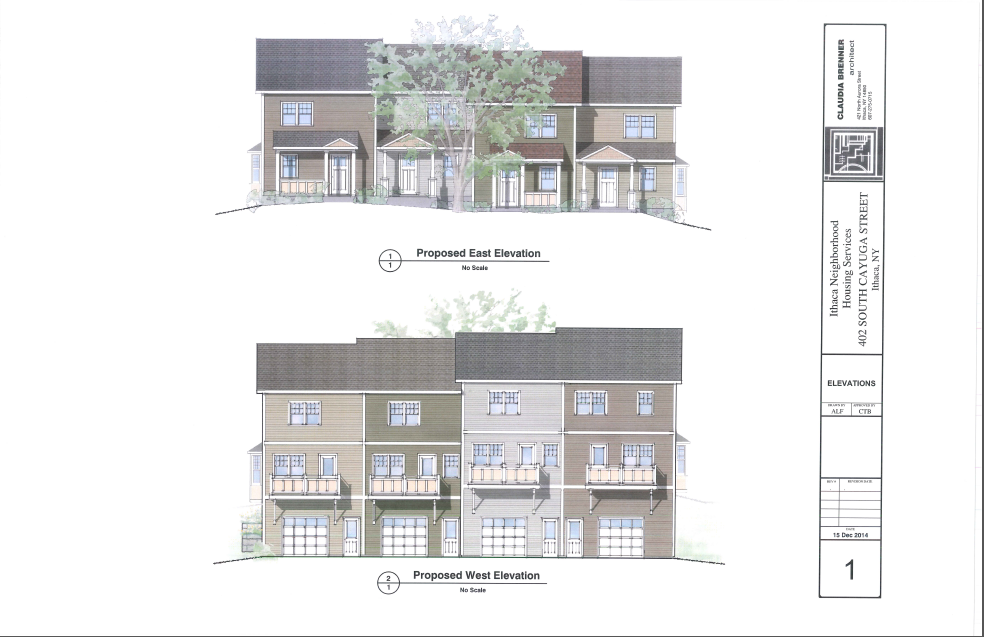
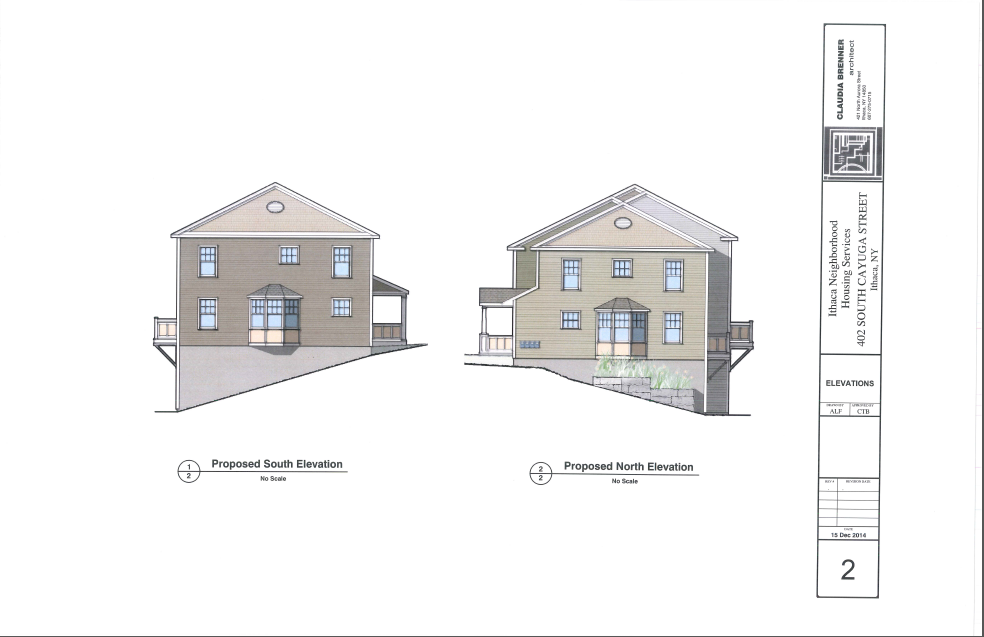
6. Updated doc and drawings for INHS’s 402 South Cayuga Street have been filed with the city. Application, FEAF and project description here, drawings here. According to the docs, the cost of construction will be $740,000 for the four units, and go from Spring 2015 to Spring 2016 (March 2016 in the FEAF). Some slight metal pollution from Emerson/Morse Chain has been noted in soil tests from below the foundation area, due to the Morse Chain subterranean pollution plume (metals, VOCs) that affects much of South Hill. Although the DEC requires no further action at this time, there will be an active sub-slab depressurization system in place as a safeguard. In other words, a fan blows air into the basement, and it gets vented back out.

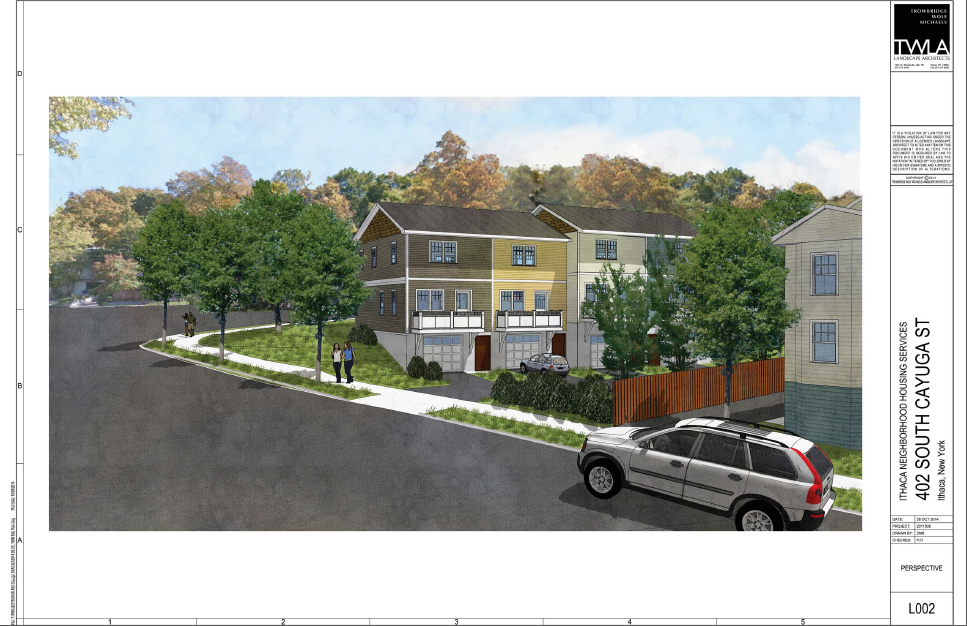
The design of the townhomes has been revised by architect Claudia Brenner to include more architectural detail – bay windows on the north and south ends, and larger/full porches vs. the stoops of the previous design. The siding has also been changed to all earth-tones. It’s an improvement, but I’d rather see two separate windows above the porches. This project will be presented at the January Planning Board meeting.

707_E_Seneca_1

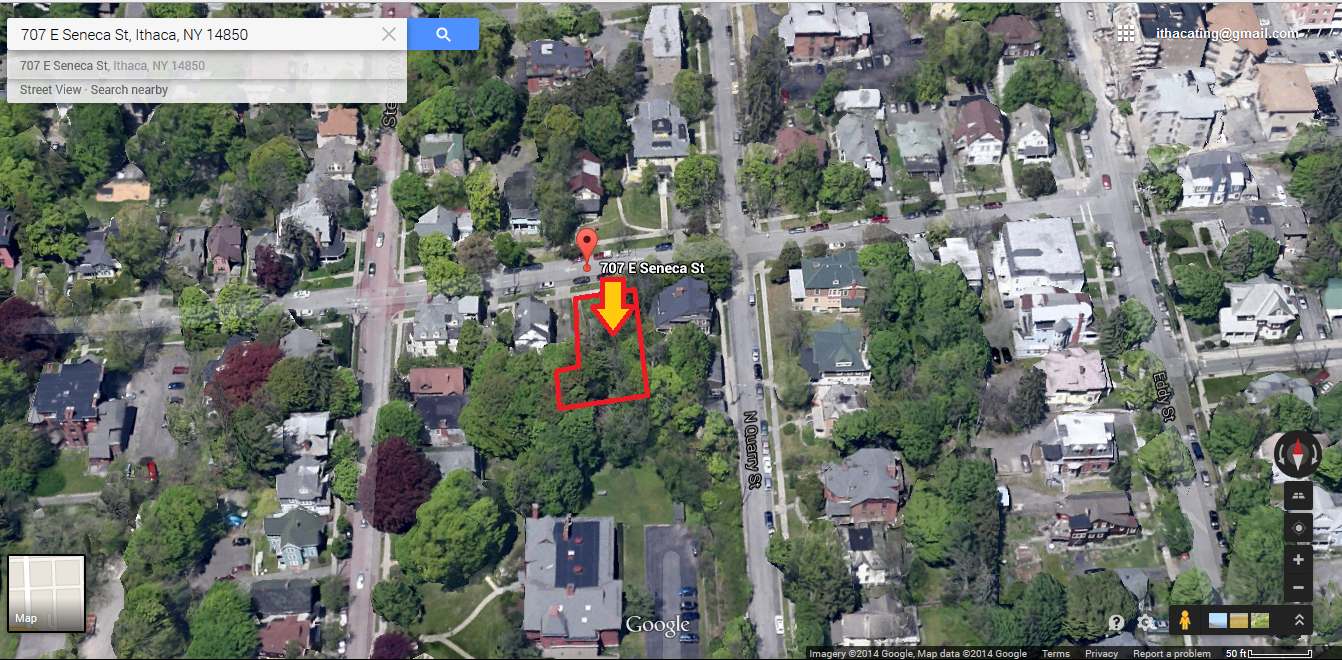
7. Here are some drawings for 707 E. Seneca. Readers might remember this is the 6-unit building proposed by Todd Fox for a derelict playground recently sold off by the city. The 18-bedroom design by local firm Schickel Architecture has already been critiqued thoroughly by the Ithaca Landmarks Preservation Council, since the site is within a historic district and needs to look the part. I’d say that they’ve done well, it’s a bit bulky but otherwise a tasteful addition. An area variance will be required from the Board of Zoning Appeals. Construction is expected to cost $220,000 and run from April to July 2015. For more info, the application is here, drawings here.

112_blair_1 112_blair_2

8. Since we’re talking about East Hill housing, here‘s the project application and here are the drawings for the duplexes proposed for the parking lot at 112 Blair Street. The Blair Street site will be combined with 804 East State Street, and the duplexes will have State Street addresses. The spartan design of these buildings is also by Schickel Architecture, and will add 12 bedrooms in 4 units. Cost is estimated at $213,000 and construction will start in April for a summer completion. The developer is Matthew Nestopoulos.


News Tidbits 12/6/14: Looking Forward, Looking Back

6 12 2014

11-24-2012 174

1. Not exactly a development, but this will make things interesting: As reported by the Ithaca Journal, INHS and Better Housing for Tompkins County (BHTC) are merging. Both of them have the same purpose, which is to provide low-to-middle income housing and structural rehab services, but INHS has traditionally focused in Ithaca city, and Better Housing in the rural towns. INHS also holds far greater assets, $24 million including 241 rental units , vs. BHTC’s $3 million and 121 rental units.

Over the past few years, INHS has put a lot of feathers in their cap. $2.13 million in grants has been awarded to the non-profit in just the past few months. Breckenridge Place and Holly Creek are complete and nearly complete respectively (total 74 units), while Stone Quarry and Greenways are prepping for site clearing and construction (total 81 units). Along with Cedar Creek and several single-family and duplex units, INHS has had a hand in over 120 units of housing in the past five years alone. With the Neighborhood Pride site undergoing concept design and the recently-awarded grant money, that number will almost certainly be greater in these next five years.

The story for BHTC has been quite the opposite. The 65-unit Lansing Reserve proposal failed due to neighbor opposition, and the 58-unit Cayuga Trails project for West Hill failed due to wetlands on site being greater than anticipated (and the neighborhood opposition didn’t help). BHTC has five older facilities in Trumansburg, Newfield and Slaterville Springs.  With any hope, the merged non-profit will qualify for larger grants, and BHTC can finally get some shovels in the ground in the hamlets and villages outside Ithaca.

On a separate note, it looks like INHS did its annual website update, formally announcing plans for a single-family home at 304 Hector Street on West Hill. The lot was purchased in late October after a plan to buy and renovate a home in Northside fell through. Stone Quarry will begin occupancy next September, and Greenways hopes to start in 2015.

112_blair_1

2. Here’s the site plan for 112 Blair Street. I’d include renders, if the sketch plan had any. Two buildings with two units each and three bedrooms per unit -> 2 x 2 x 3 = 12 bedrooms. Nothing large, just an infill project tucked away from the street. The design will be created by local firm Schickel Architecture, the same ones doing the Maguire project in Ithaca town. As noted by Planning Board member John Schroeder in a recent Sun article, projects like these won’t alleviate the housing crunch by themselves, but every little bit helps, and all the better if it recaptures living space from an underused parking lot.

canopy_hampton_rev4_1

3. Final design for the proposed Canopy Hotel? Possibly. In comparison to the last design, this latest incarnation adds more windows to the east face. I’m not going to lie, after six or so sets of designs (include three complete re-dos), I’m starting to lose track of the changes. On the upside, the latest project plan from the city’s documents includes some neat context views, renders of what the building would look like from various vantage points in the city.

114_catherine_rev4_1

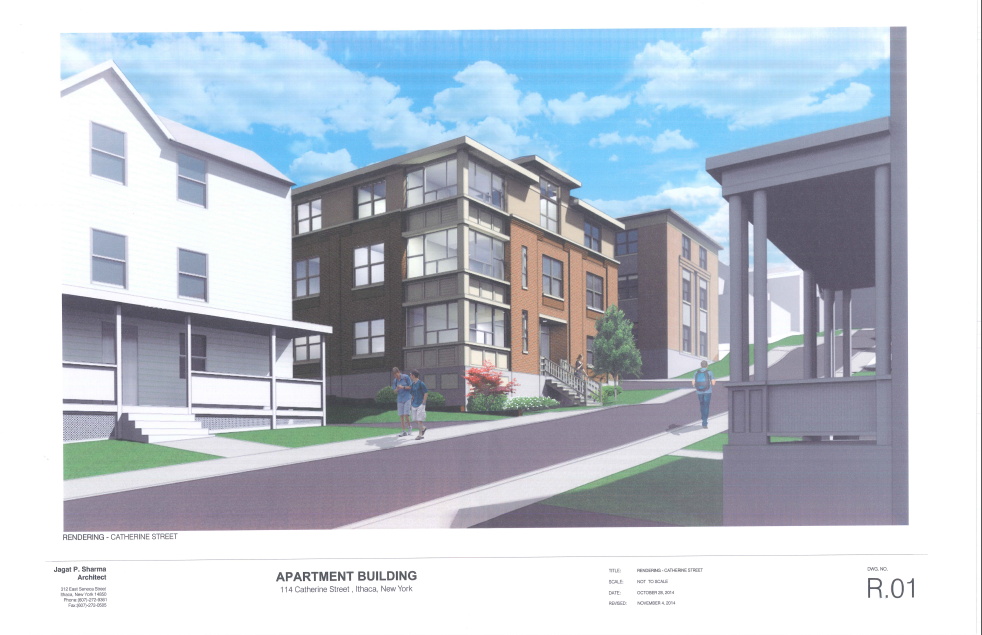
4. 114 Catherine has been approved, its Spring construction date looks good to go. When completed in August 2015, 17 more bedrooms will enter the Collegetown market – a drop in the bucket, but a valuable drop nevertheless.

chain_works_rev2_1

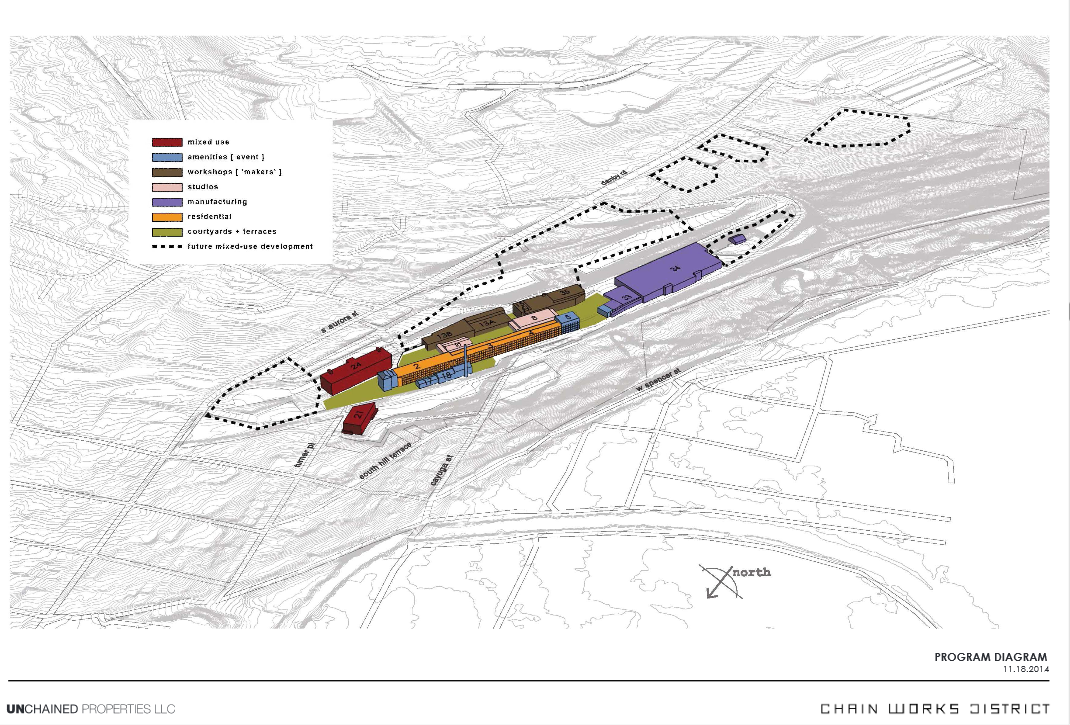
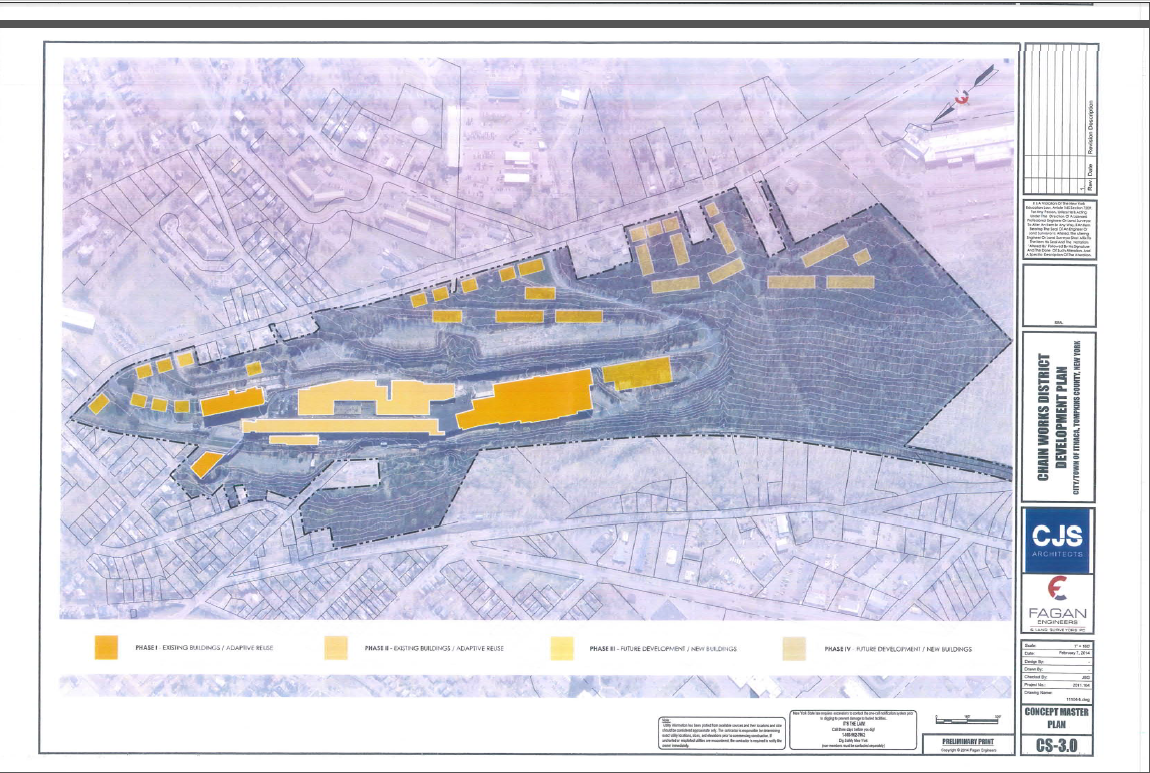
5. Towards South Hill, review of the draft generic environmental impact statement (DGEIS) continues for the massive Chain Works District proposal at the former Emerson Power/Morse Chain site. A scoping document of that DGEIS can be found here. In a nutshell, a DGEIS is part of the State Envrionmental Quality Review (SEQR), where the leading agency looks at a project, determines if any adverse project impacts are properly mitigated, and if so, issues a statement giving a negative declaration (approval). In this case, the NYS DEC also needs to be on board, approving the contaminated site for residential use. This is a pretty complicated project. There’s 800,000 sq ft of space to be removed or re-purposed, in an environmentally compromised site split between two political entities who are conducting joint meetings with their planning boards in an effort to try and move this project forward (the town of Ithaca board deferred to the city of Ithaca for lead agency; and both have been evaluating using their respective specialized mixed-use zones).

So far, there have been no nasty surprises on the polluted site. The site is mostly clean but still needed a little more for residential use, and Emerson will be flipping the bill for that. The comment period on the draft runs through the 10th, and the DGEIS will be finalized on the 16th. According to the project website, developer Unchained Properties LLC hopes to start Phase I, the renovation of four on-site buildings (21, 24, 33 and 34) into mixed-use and manufacturing space, during summer 2015. The mixed-use was initially proposed as office space only; but the developer behind the LLC (David Lubin) has struggled to fill the proposed office space in his Harold Square project, and seems to realize that having less office space would be a better plan for Chain Works as well.

6. The Cornell Daily Sun is reporting that the owner of CTB (Collegetown Bagels) is buying the Rulloff’s property and reopening the restaurant after it abruptly closed over the Labor Day weekend. The property was on the market for $395,000, and it’s fair to say the price was probably close to that figure. The murderous Edward Rulloff lives on.


News Tidbits 11/8/14: Getting the Word Out

8 11 2014

1. Let me start by acting all civic-minded and promote the public meeting INHS is hosting for the Neighborhood Pride site in the Northside neighborhood of the city. November 12th, 4:30-7:30 PM, inside the former grocery at 210 Hancock Street. As Jason at Ithaca Builds noted a few months back, this will likely be the largest development on the north side since the 1950s.

Here’s why your opinion is important. The site has walking access to many local venues, affordable housing is in very high demand, and the site as it currently stands is underutilized and an easy target for vandalism. INHS is looking to avoid a repeat of the battle that happened with Stone Quarry, and is actively engaging with the community to see what will and won’t mesh with neighbors. In theory (under zoning and given some assumptions), the site could host nearly 200 units of housing.  The city has already expressed a strong preference for an owner-occupied housing component, and the city comprehensive plan supports some small-scale commercial uses at the site, with higher-density residential. There have even been reports that the Sciencenter is interested in playing a role. So that’s the sort of framework here; how much housing, what proportion of renters vs. owners, and what sort of mixed uses if any.

chain_works_rev1_1

2. Well, this isn’t good – according to the Ithaca Journal, recent findings by Unchained Properties, the developer for the Chain Works District (a.k.a. the Emerson redevelopment), suggest the site is even more contaminated than previously thought. While the developer has said it remains committed to the project, I dread an Ithaca Gun repeat, where continually-worse pollution causes the project to grind to a standstill. According to the purchase agreement that Unchained Properties has with Emerson (which although it closed up shop in 2010, still owns the site), Emerson pays for all the remediation, which I suppose they’re okay with if it means getting rid of the site from their asset lists. A draft environmental impact statement is due for submission sometime after Christmas, with several city/town/developer meetings and discussions in the meanwhile.

dibellas_2

dibellas_1

dibellas_2

3. Now, I know everyone’s been complaining – we need more more suburban GeneriMerican chain restaurant boxes with ample parking. Your prayers have been answered! This time, the newcomer is DiBella’s, a chain sub sandwich restaurant based out of Rochester with about 43 locations scattered throughout six states in the Northeast and Midwest. Dibella’s “theme” is a vague 1930s/1940s look; the one near my office is just really dimly lit, reminiscent of my dead grandmother’s living room. Snark aside, the chain is looking to build a 3,400 sq ft building on an outparcel pad property at 222 Elmira Road – just north of Five Guys, and behind the Ithaca Shopping Plaza. Follows the “real estate guidelines” on Dibella’s website near-perfectly. Cover letter here, site plan review application here, more drawings and renders here, full environmental assessment form here. The application states that the construction cost will be about $600,000 and the time frame is from February to August 2015. They’ll need a BZA variance for lot coverage, which I don’t foresee being an issue. The plan is by NYC-based Marx Realty. It’s tax money, it’s “5+/-” jobs. Meh.

114_catherine_rev4_1

4. Some minor revisions to 114 Catherine, new renders here. Compared to the previous iteration, it has a little more detailing on the concrete base, and they changed up the panes in those corner windows. here’s the traffic plan, which kinda just states that students have access to buses, bike racks, delivery space and a little parking in the rear, and their own two feet. This one’s pretty much good to go for approval.

libe_0414

5. Friday the 7th, the county has another meeting to discuss the Old Library site, this one to finalize and release the actual RFP. For those interested in going tomorrow, it’s at 3 PM in the Heyman conference room at 125 East Court Street. I have a major concern here – the final choice on developer was supposed to be in March 2015. Now it’s January 2016. The county is putting an additional strain on all the proposals, because labor and material costs are increasing. This has the potential to remove desirable features from projects, or cause developers to simply walk away. The county was very fortunate to have six expressions of interest for the site; two have already walked away. If the county doesn’t get its act together or is perceived to be acting in bad faith, the potential is there for very few or no proposals when the due date comes in March 2015. It will be a very uncomfortable day for the legislature if that happens.

6. This could be interesting – according to the Times, the Maguire family (the ones with all the car dealerships) are proposing a new set of dealerships on the site of the current Rodeway Inn, south of the city on Rte. 13. The inn is looking to move to California (claiming the hotel boom is hurting his business) and the Maguires are proposing the following moves:

>Move sales of their Subaru-Hyundai, Fiat-Alfa Romeo, and Nissan dealerships — from Elmira Road out to the new site in the town. The site is currently vacant land, and the Economy and Rodeway Inns would be removed.

>relocate its Chevrolet Cadillac dealership from Lansing to southwest Ithaca city, where a new building would be built

>renovate its Dodge Chrysler Jeep Ram dealership in front of Wegmans.

It sounds like the only place losing business is Lansing. In a blend in all that is obnoxious and trendy in today’s planning, they’re calling it an “artisanal car dealership”. You sir, get a facepalm. Apparently, artisanal here means “modern architecture and a naturesque, university-style campus”. “Naturesque”. Another facepalm. Regardless of artisanal features, the project requires relocating the town’s proposed Saponi Meadows Park, and doesn’t fit with their comprehensive plan. Any movement on this will be slow (they tell the town they’re shooting for late 2015-2016 for a start date); but when those fancy artisanal renders come up, you’ll see copies of them here.


News Tidbits 11/1/2014: Houses Going Up Like Weeds

1 11 2014

cayuga_farms_1

We’ll start off this week in suburbia. In Lansing, discussion continues for the 102-unit “Cayuga Farms” townhome development, and now we have some more numbers to throw around. According to the Limited Environmental Assessment Form (LEAF), we’re looking at about 25.2 disturbed acres built out over 4 phases – the first starting as soon as approvals are in hand, and the last due for a completion all the way out in October 2021, partially because the last phase on the south side of the property will be accessed by a proposed public road. The north end gets developed in phase I, with 44 units. Apart from that sizable project, the Lansing town planning board isn’t too busy, with the other discussion item being two duplexes (4 units) on a former mobile home lot.

Amabel site PRESENTATION Model (1)

2. More in housing, this one from the town of Ithaca. According to its developer (Sue Cosentini of New Earth Living), the 31-unit eco-friendly housing development just southwest of the city-town line will begin formal marketing in summer 2015 at the earliest. It’s also going under a redesign of the site plan, so the above plan won’t be current for long. Just have to wait and see what the revised product looks like.

belle_sherman_cottages_102714

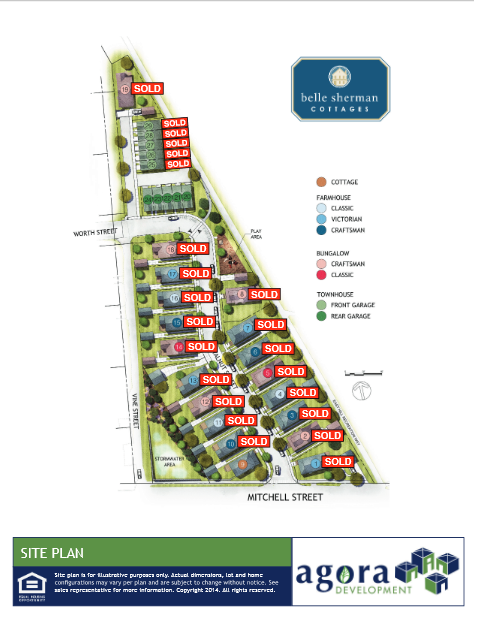
3. Sales have been robust with the Belle Sherman Cottages townhomes – two more sold between the 17th and 27th. That’s pretty darn impressive for a housing development in upstate. One of the last houses sold as well, leaving just one home lot, the yet-to-be-released new cottage design. If sales for the first set of 5 townhomes went that fast, I imagine that when marketing for the other 5 begin, they’ll be sold out within weeks.

402_s_cayuga_st_rev1_1

402_s_cayuga_st_rev1_2

4. New renders for INHS’s at 402 South Cayuga Street. Still 4 townhomes, but the design from local firm TWLA (Trowbridge Wolf) is completely new. Affordable housing is always welcome on a vacant lot near downtown. But I like the previous design better. If I remember right, they are 2 bedroom units, and set for a fall 2015 completion.

304_college_2

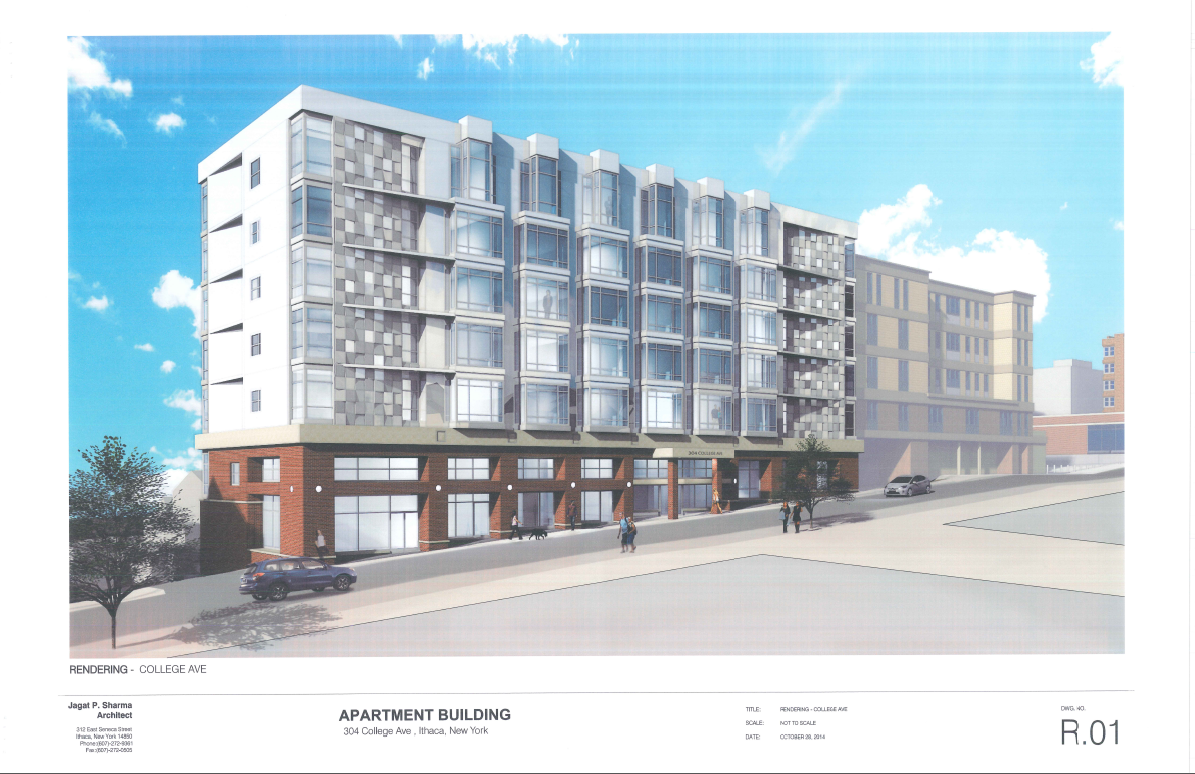
5. Last but certainly not least – a few more details about the two-part 304 College Avenue project, first shown yesterday. The Sun was kind enough to do some legwork and reach out to the real estate company, and for that effort we now know that the Avramises are shooting for a June 2016-August 2017 construction period for the 6-story building at 304 College. The Catherine Street structure may be built concurrently, but that is yet undecided. Like many of the new buildings, it’s intended to be focusing on the high end of the rental market, although it’s too early to specify actual rent prices. It includes a small amount of parking, which I’m sure will cost a mint. Declaration of lead agency is expected in early 2015 with approval some time in the spring, if past experience is any indicator.

It may seem unusual to propose such a far-flung construction date, but I suspect it has everything to do with costs and logistics. 114 Catherine and its 17 beds will be underway in the first half of 2015, and by summer 2015, 205 Dryden (Dryden South, 40 bedrooms), 307 College (Collegetown Crossing, 96 bedrooms), and 327 Eddy (64 bedrooms) will be underway. Labor will be at a premium, and since they’re within a couple of blocks of either, materials movement is going to be complicated. The Avramises may be hoping to start as other projects finish up, logistics improve and labor frees itself up. Problem is, Collegetown Terrace phase III starts in late 2015 and will run through 2017, so the construction labor market is going to be well-tapped regardless of whether they start in 2015 or 2016.