News Tidbits 11/12/16: Oof.

12 11 2016

lansingapts600

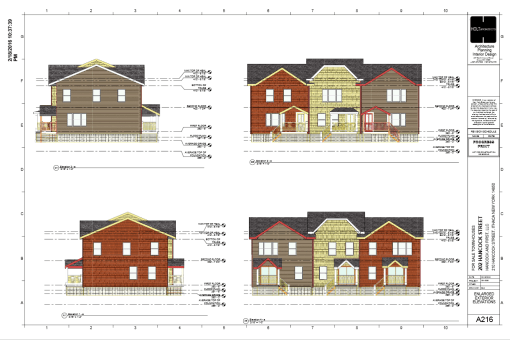
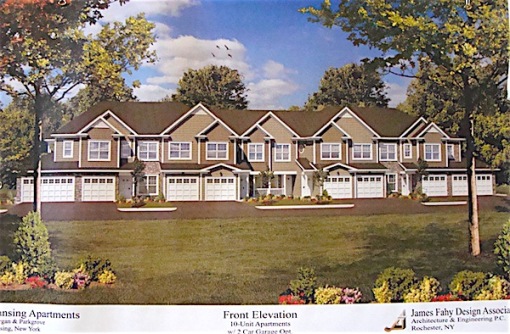
1. Starting off this week in Lansing, the village has okayed a zoning change that would allow the planning board to move forward with consideration of a 140-unit upscale apartment project on Bomax Drive. Neighbors came out to oppose the zoning change for the 19.5 acre parcel from office park business/tech to high-density residential, saying it would create additional traffic and hurt property values. The village board, however, responded in dissent, noting a lack of housing, a fit with the 2015 village comprehensive plan, and that this was about the zoning and not the project, which the planning board will critique as a separate action. The zoning change was approved unanimously. Park Grove Realty is now free to submit plans to the village, and planning board review will go from there. Expect it to take at least a few months.
therm_1

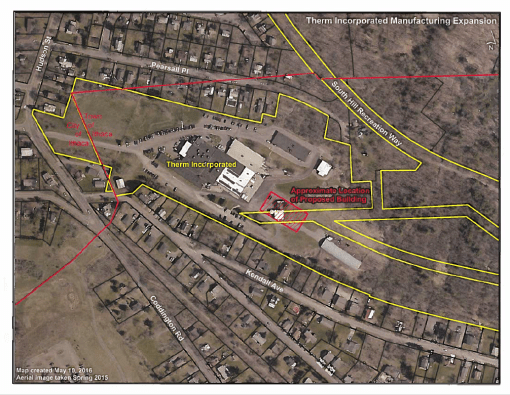
2. A couple quick notes from the town of Ithaca – Therm Inc. has commenced construction on their 20,000 SF addition at their South Hill plant. It’s a few months later than originally anticipated, but underway nevertheless. The $2.5 million project is expected to create 10 manufacturing jobs, according to the county IDA.

Also underway at this point is the renovation and expansion of the Rodeway Inn on Elmira Road. The plans call for expanding the existing 25 motel units, adding 2 new units on the ends of the main structure, and renovating a house on the property for a 1,146 SF community room to serve guests. Landscaping and lighting would also be updated. The town pegs the construction cost at about $679,000.

341_coddington_1

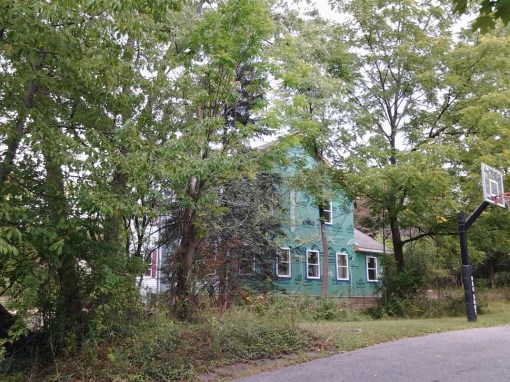
3. Here’s some good news – it looks like someone has taken up the Iacovellis on their offer of a free historic house at 341 Coddington Road, providing that the taker moves it. It appears NYSEG was creating some hangups since the power lines have to be moved out of the way (NYSEG is infamously difficult to work with), but with any luck, the house itself will be saved. My colleague Mike Smith is doing the legwork on a story, so hopefully more details on the “buyer” will come forth shortly.

4. Back in July, several West End properties owned by an out-of-area LLC hit the market. Now, at least one of them has sold. The duplex at 622 West Buffalo (blue in the map above) was sold for $90,000 to a gentleman from suburban Syracuse. Immediately after, paperwork was filed with the county for a $179,145 building loan courtesy of Seneca Federal Savings and Loan, a small regional bank out of Syracuse. The paperwork does not indicate if it will be renovations/additions to the existing building, or a new structure (sometimes the sale price is a part of the building loan, but in this case the buyer paid separately, with $171,187 set aside for hard costs).
20161007_163922

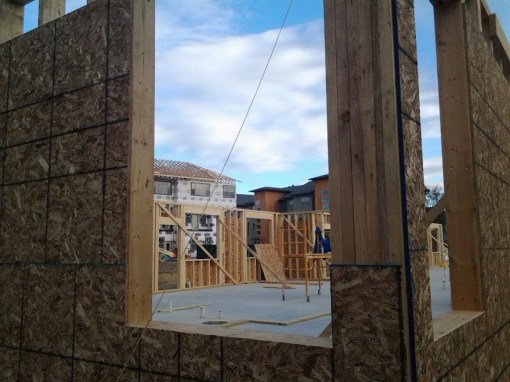
5. Sticking with county filings, the construction loan for the third phase of the Village Solars was filed with Tompkins County this week. $6 million is being lent by Tompkins Trust to fund construction of 42 units, 21 in each building. Initially they were slated to have 18 units each, but because the three-bedroom properties don’t have quite the same appeal as smaller one-bedroom and two-bedroom units, Lifestyle Properties (the Lucente family) has broken up the units without significantly changing the exterior appearance and layout. Actual Contractors LLC, another Lucente company, is the general contractor, with Albanese Plumbing, T. U. Electric, and Bomak Contractors (excavation/foundation) rounding out the construction team.

119_125_college_1

6. This is one of those unusual months were the city projects memo and the project review meeting agenda go out in the same week. Apart from the Collegetown Townhouse project, there are no new projects being presented, but there is new information and new renders.

In the projects memo, Novarr’s project is the new shiny, while Amici House, the8-unit project at 607 South Aurora and City Centre are being carried over as old business. Regarding City Centre, it doesn’t look like any particular points of contention have been raised by city planning, the framework for mitigating Historic Ithaca’s design complaint is already included, and most of the other requests are for more information/paperwork. From the Design meeting, it looks like the debate on the townhouses project is minor, mostly with where to locate the trees out front, and window details. They will not be putting windows into the north face because it’s on the lot line, but they will vary the materials for visual interest. The Design Committee requested that City Centre insert more windows in some areas, and less signage, as well as consideration of decorative elements to highlight the curved facade facing Aurora and East State Streets.

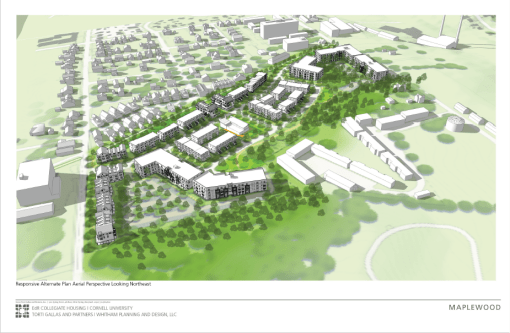
The project review committee meeting has all of the above, plus updated submissions from the Maplewood project team. Although no substantial development will occur in the city, the Maplewood project crosses municipal boundaries and the city has deferred to the town for lead agency. The meeting will also have a few zoning variances to comment on. The only notable zoning variance is for local realtor Carol Bushberg, who wants to do a one-story 812 SF rear addition at her office at 528 West Green Street, which is in a WEDZ zone and requires two floors.

maplewood_v7_4

maplewood_v7_5

Looking at the Maplewood submission, the new dormer/gable style will be for the building strings that front Mitchell Street, and the two strings most visible from Walnut Street. More modern designs will be used for the remaining structures. Looking closely, the designs do vary from string to string, which will give the site some character and additional visual interest. The project timeline is pretty tight with submissions, meetings and approvals, aiming for preliminary approval from the town on December 20th, demolition to start immediately thereafter, and final site plan approval by January 3rd.

For links, here’s the Collegetown Townhouse updated submission, engineering narrative, site plan render, and cross section render. Here are the updated materials for 607 South Aurora (no significant changes, just a summary of submission materials),  here’s a new site survey for Amici House, and the project update for Maplewood.

7. Meanwhile, there’s nothing too exciting on any of the town boards next week. Lansing town will consider additions to a self-storage facility, a one-lot subdivision and a climbing wall facility next to The Rink. Ithaca town will be conducting their own analysis of Maplewood, and a one-lot subdivision.

Now, after this week’s election news, one might wonder if this has any impacts on local housing/development. Arguably, there are a few. Expect federal funds for affordable funding to be cut drastically, and grants for mass transit projects to also take a major hit. While those are major losses, the state has far greater control, so there will still be some funding available, but definitely not as much as would have been expected under a Democratic administration. Most land use and building issues are decided at the local level, so don’t expect significant impacts there.

More of a question would be infrastructure investments. The president elect wants to launch a massive rebuilding program, but the Republican Senate majority leader has already said that’s not something they’re interested in, so we’ll just have to see if he can force it through or not. If there’s any silver lining to all this, it might come in some form of deregulation, but while he might be a fan of urban environments, most of his cabinet will likely not. We also have to keep in mind the disdain for elite colleges like Cornell, so research funding, and the economy built off it, is probably going to take a hit. For the Ithaca area, the change in administrations is likely a net negative.


News Tidbits 11/5/16: Condemnation and Praise

5 11 2016

maguirebirdseye-620x420

1. The Maguire waterfront plan has been rejected. By an 8-2 vote, the Ithaca city Common Council voted to discontinue consideration of the state-of-the-art Ford/Lincoln/Nissan dealership, with most citing concerns about the project’s marginal or poor fit with the city’s comprehensive plan, which calls for an urban mixed-use form of development in the Carpenter Circle area where this dealership is proposed. The votes in favor of the proposal, from the third ward’s Donna Fleming and first ward’s George McGonigal, cited ways it could be conceived as fitting with the plan (greener alternative, local business expansion), and challenges the site offers to the city’s urban plan (poor soils, trains, chemical storage, power lines).

Although this shuts down the current proposal, this may not be the last we hear from the Maguires or the Carpenter Business Park site. At the meeting, company President Phil Maguire offered a teaser, saying they may partially liquidate their land holdings to bring in mixed-use development that would share the CBP space with the dealership. Given the heavy alterations that would need to occur, the council decided to vote down the existing proposal and send a message that it doesn’t fit the city’s goals. However, the council said they and the planning department would expedite review of an amended proposal, should it come forth.

20150613_175047

2. If you’ve ever wanted some explicit discussion of the challenges of doing affordable housing in Tompkins County, here’s a great summary courtesy of the the town of Ithaca. Back in August, the town’s Planning Committee (of town board members, similar to the city’s PEDC Committee) met with Ithaca Neighborhood Housing Services Director Paul Mazzarella for a Q&A. The town is considering regulations for inclusionary housing, and after INHS’s Greenways project fell through, they would like guidance and input on to make an effective code that promotes affordable housing without killing all residential development. Here are some of the highlights:

– Ithaca is a market of smaller builders. Local developers aren’t able or interested in doing huge projects, and most outsiders don’t see Tompkins County as a big enough or profitable enough market to tap into. So that leaves it to smaller builders who don’t have scale efficiencies, and are inclined to build luxury housing because the return on investment is more likely (i.e. less risky). The strong local economy also means that the local construction labor pool is largely tapped out, and additional crews have to be imported.

– Mandated affordable housing tends to work best in expensive, hot markets where the Return on Investment (ROI) for the market-rate units is more likely – your Seattles, San Franciscos and New Yorks. Even there, it is often paired with incentives such as height or square footage. Mazzarella noted he doesn’t think the city’s voluntary program will work very well. One thing to note with mixed-income projects is that the market-rate units will often be higher priced to cover the cost of lower-priced units. Simplified example – say you’re building ten houses for a sale price of $250,000. To meet an affordable mandate you sell two at $200,000, but to still obtain adequate ROI, that $100,000 is going to spread among the other eight – so you have two for sale at at $200,000, and eight at $262,500.

– We talk about modular homes as lower-cost alternatives, and for rural locations they often are, due to materials and labor costs. However, INHS found that in their experience for sites in the city and town, the cost is comparable to stick-built, although at larger scales, cost efficiencies may be achieved (ex. the Belle Sherman Cottages).

Another interesting read is the committee’s September meeting with city historic preservation planner Bryan McCracken and Historic Ithaca’s Christine O’Malley about protecting historical resources. As it turns out, the city cannot designate an individual landmark without the owner’s permission, and historic districts require the approval of 60% of affected property owners.

hipped_roof_tinytimbers

3. Seems like Tiny Timbers had a well-attended open house. On their blog, the Dolphs have shared a cross-sectional diagram of an exterior wall – beneath the hemlock siding and copper trim will be ZIP sheathing and polyiso (thermoset plastic foam) insulation. ZIP is everywhere in residential construction, polyiso less common – locally, it was used extensively with the Boiceville Cottages in Caroline. On the inside, one has sheetrock and bamboo flooring. Exposed hemlock posts and ceilings will complement the sheetrock.

Also being rolled out is a fifth home design, a larger two-bedroom, two-bath home with a hipped roof. Variety is the space of life, as the saying goes.

119_125_college_1

4. It was exciting to finally see the release of renderings for John Novarr’s College Townhouses project at 119-125 College Avenue. Links to the Site Plan Review document, historical documentation and drawings can be found in the Voice write-up here. There have yet to be images released for the garden apartment building to be built at the rear of the property, but look for the same general design features as the rowhouses. As expected from ikon.5 Architects, the design is modern and glassy, and given the Facebook comments and a couple of emails that came in, some neighbors are less than happy about that. However, this isn’t a historic district, so long as it meets zoning regulations, Novarr is free to hire whoever he darn well pleases. As mentioned in previous write-ups, he had ikon.5 design his guest house, so this isn’t strictly a cost thing, he genuinely likes their work. It was a bit surprising but interesting to see the well-researched history of the three 19th century boarding houses currently on the property, and it makes me wonder if that was a requirement. Novarr’s proven to be accommodating in the past, perhaps he’ll deconstruct rather than demolish, and the salvageable parts can be reused.

The project team will meet with members of the Planning Board on Tuesday afternoon for Design Review – about the only thing that stands out at initial glance is the lack of windows or visual interest with the north face, barely noticeable in the rendering. That probably won’t fly with the board, but we’ll see if it gets changed up as it goes through review. City Centre, the 8-story Trebloc site redevelopment, will also undergo further design review at the meeting.

chapter_house_reconst_v5_1

5. The Chapter House is going to the Ithaca Landmarks Preservation Commission (ILPC) yet again. The changes are subtle and few, but the rules are the rules. A service door will be added to the west (rear) wall, the inset vestibule is being reconfigured a bit, and the third-floor dormer windows are being changed from double-hung to casement – meaning that instead of sliding up and down, they’ll open with a crank. The ILPC will vote on the changes in November, which will probably sail through without much debate, and hopefully, just maybe, quite possibly, the Chapter House project can get underway.

sleep_inn_v2_1
6. A couple quick updates from the town of Ithaca Planning Board minutes – after some discussion and a bit of praise for the redesign effort, the board opted for timber-trimmed Design “A” for the Sleep Inn proposal on Elmira Road. The minutes from Maplewood’s EIS meeting were also uploaded, and it is rare to see this much positivity in discussion of a project – not to say there weren’t dissenters, but the alternative energy source and efficiency initiative, use of local labor, and softening of the design on Mitchell Street won most of the speaking audience over. Public comment closed on Halloween, and now the project team must respond to all the reasonable comments received as part of the review process.


News Tidbits 10/15/16: Stoops and Stumbles, Growth and Gables

15 10 2016

maguirebirdseye-620x420

1. The Maguire proposal for Carpenter Business Park will be heading to the Common Council next month, but the prognosis isn’t good. The city council’s Planning Committee voted 4-0 to say that the proposal didn’t fit with the city’s Comprehensive Plan for the near-Waterfront property – the plan calls for walkable, urban mixed-uses, preferably with residential components. The discussion wasn’t unanimous in its logic – 2nd Ward Councilmen Nguyen and Murtagh were stronger adherents to the plan, while the 1st Ward’s Cynthia Brock doesn’t think housing is appropriate – but they all disagreed with the multi-brand car dealership plan as-is. Maguire has asked for a delay in vote so that the plan could be tweaked, but the Committee voted to move forward.

Because of the 18-month TMPUD in place, the Common Council has to vote to approve all projects in the waterfront area, so the resolution to decline further review of the project will be voted on at the next non-budget Council meeting. It will not be unanimous – the 3rd Ward’s Donna Fleming wrote a letter of support for the project, and the 1st Ward’s George McGonigal voiced support for the concept though not this particular plan. But the chances of approval are pretty slim at this point.

119_125_college_avenue_2

2. Judging from the site photos John Novarr’s project team sent along, it looks like environmental remediation has already commenced at the site of his faculty townhouse project at 119-125 College Avenue in Collegetown. 121 College, in particular, is already in the early stages of remediation. It’s a pretty extensive photo documentation, one that might have to do with historic preservation aspects, like determining what can be salvaged and reused. It’s pretty clear that the properties, which were recently acquired from an Endicott-based landlord who held the properties for decades, are in rough shape. Novarr seems to have a preference for prepping sites before plans are approved (ex. 209-215 Dryden), so it’s uncertain how much time these three boarding houses have left.

202_hancock_1

3. Courtesy of the Ithaca Urban Renewal Agency’s Neighborhood Investment Committee, we get to see a pretty thorough breakdown of the expenses and revenues of an owner-occupied affordable housing project.

The details come as part of INHS’s application for $314,125 in Federal HUD HOME funds, to be used for the 7 for-sale townhouse units included with the 210 Hancock project, collectively called 202 Hancock. The funds would be used to cover soft costs, like project management, engineering and architecture fees, legal fees, and site inspections.

inhs_202_financials

The 202 Hancock project construction cost is estimated at $1,754,860, about $344,000 per unit, or about $198/SF. That’s expensive, but not unusual – 203 Third Street was about $190/SF. The cost is high due to rapidly rising construction costs, and due to federal guidelines and lender specifications, INHS is required to hire contractors with extensive insurance. Add in soft costs and it jumps to $2,408.371.

Now let’s consider the sales. The five two-bedroom units are expected to sell for $130,052 to a household making no more than $38,046. The two three-bedrooms will sell for $164,979, to households making $42,428/year or less. Those incomes don’t meet the rule-of-thumb of 3.4x annual income, but HOME funds cover part of the cost ($24,000 for the 2-bedrooms, $36,000 for the three-bedrooms). INHS gets $960,218 in the project sales – and that’s the same amount Tompkins Trust Company is willing to cover with a construction loan. So the initial gap is $1,448,155. Now we’re starting to see why new housing can be so expensive.

INHS gets $7,000 in revenue from Energy Star rebates on appliances, and has up to $351,153 equity they can put towards the project, most of that being the value the of 202 Hancock’s land. The IURA would issue a low-interest bond for $215,875 to be paid back by INHS, and the non-profit has secured $280,000 in grants directly from the state (NYS AHC), and $280,000 in NYS CDBG funds awarded by local governments (this tactic is known as “subsidy layering“). This complicated puzzle of funding sources is why so many developers are not interested in doing affordable housing.

Side note, one of the pre-development costs is market analysis. Might seem silly, but grant reviewers want proof the housing crisis isn’t just bluster, and that these units won’t sit empty. An analysis by Randall/West determined that at a sale price of $136,000 for a 2-bedroom, and $162,000 for a 3-bedroom, qualified buyers would be found and under contract within 4.6 months. The units should be available for occupancy by June 2017.

202_hancock_2

Secondly, thanks to a legal settlement between the state and Morgan Stanley, a $4 million affordable housing grant is available for renovations of existing INHS scattered site rentals (98 units in 44 buildings across the city). Most of these units are rented to individuals making 60% or less of the area’s median income (about or less than $32k/yr). The funds would go towards major, long-term renovations, such as new roofs, windows, siding, and energy efficiency improvements. INHS could also use the funds, disbursed via the city, to refinance its portfolio, acquiring some of the properties and paying off $1.8 million in loans on already-purchased properties.

Here’s the short of it – the goal is to buy/pay off the scattered rental sites they manage, renovate and make them energy efficient and comfortable, lock them into the Community Housing Trust so that they become permanently affordable, transfer the land to a wholly-owned Housing Development Fund Corporation, and then sell some of the buildings to an LLC while INHS continues as property manager. The funds from sales would finance new affordable housing. This is all set up as it is to take advantage of legal and tax benefits of different corporate tax structures, while minimizing the drawbacks. Potentially, the Morgan Stanley settlement money could be used to leverage an additional $15 million in tax credits and affordable housing grants from the state.

Correction, per INHS’s Scott Reynolds in the comments section: rentals aren’t in the Community Housing Trust, but affordability would be required for 50 years.

Rochester-based SWBR would be in charge of renovation design plans, and 2+4 Construction will be general contractor. Tenants may need to be relocated as renovations occur, which will be coordinated by INHS staff. The goal is to have the settlement money accepted by the city by the end of the year, financing by April 2017, and renovations completed by the end of 2018.

cwd_bldg24_1

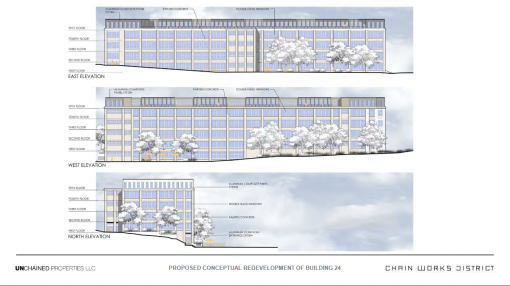
4. It’s another one of those special meetings – the city Planning Board will be sitting down next Tuesday to go over comments and sort another batch of public comments regarding the Chain Works DEIS, this time on public health. Once you get past the few pages of “this will never work and don’t bother trying”, there’s actually some interesting back and forth about remediation and what that entails. Also on the agenda are revisions to the Holiday Inn Express down in Southwest Ithaca – namely, they’re trying to avoid building the stairs to Spencer Road, as well as some other landscaping issues. At the second meeting later this month, the board is expected to Declare Lead Agency, open public hearings and review parts of the FEAF for TCAction’s Amici House, 8-unit 607 South Aurora, and the 8-story City Centre project on the Trebloc site downtown.

maplewood_v7_1

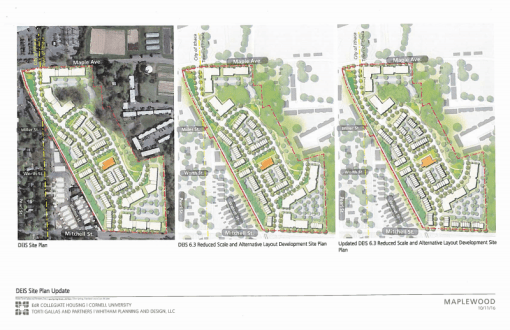
5. The plans for Maplewood have been modified yet again, in a change that the project team hopes will please neighbors and the town of Ithaca planning board. In revised plans submitted this past Wednesday, the 4-story apartment building planned for Mitchell Road has been replaced with a few sets of 2.5 and 3.5-story townhouses and stacked flats, and Building B to its north was extended slightly to compensate for the loss of bedrooms. Even so, the accompanying letter from Scott Whitham states that the unit and bed count have decreased slightly, from 473 units and 887 beds, to 442 units and 872 beds.

maplewood_v7_2 maplewood_v7_3

Also modified was their appearance – stoops, porches, dormers and gable roofs were added to give them a more harmonious appearance with the rest of the neighborhood. It’s not clear if the rest of the units were aesthetically modified as well.


News Tidbits 9/24/16: The Implicit and the Explicit

24 09 2016

tiny_timbers_1

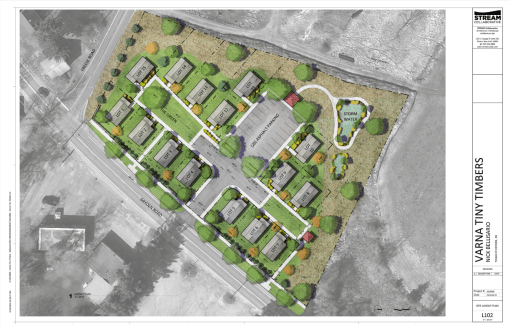
1. Over in the town of Dryden, it looks like Buzz Dolph and STREAM Collaborative’s Tiny Timbers project is up for preliminary approval. The site plan hasn’t changed much, just slight modifications for a dumpster/recycling enclosure and a bus pull-off. However, the home options have been expanded a bit. There will be five options, ranging from a 1-story 525 SF home starting at $99,500, to a 1,050 SF model priced at $184,500. Design specs (flooring, finishes, HVAC) can be found here.

Along with Tiny Timbers, Dolph is planning a similar, smaller project near his house on Quarry Road in Dryden town. That $800,000 project, called “Quarry Ridge Cooperative“, consists of two duplexes (four units), all owner-occupied. The homes will be connected to a shared driveway and carport through breezeways. Back of the envelope calculations suggest these units will be around 1,000 SF each. The 2.26 acres will be collectively owned by the four homeowners.

2. On a related note, another sister project to Tiny Timbers is being prepped for a site on the city’s portion of West Hill. Dolph et al. are looking to do a similar development to the one in Varna on a 5.45 acre parcel at the south end of the 400 Block of Campbell Avenue, which was noted in a weekly news roundup when it hit the market back for $195k in August 2015. The Journal’s Nick Reynolds touched on it in a through write-up he did earlier this week. The comprehensive plan calls this portion of West Hill low-density residential, less than 10 units per acre. Current zoning is R-1a, 10000 SF minimum lot size with mandatory off-street parking, although maybe a cluster subdivision would come into play here. The Varna property is a little over 6 units per acre. If one assumes a similar density to the Varna project, the ballpark is about 35 units, if sticking to the 10000 SF lot size, then 23 units.

On the one hand, expect some grumbling from neighbors who won’t be thrilled with development at the end of their dead-end street. On the other hand, these small houses are modestly-sized and priced, they’ll be owner-occupied, and if the Varna site is any indication, the landscaping and building design will be aesthetically pleasing.

201_college_v5_1

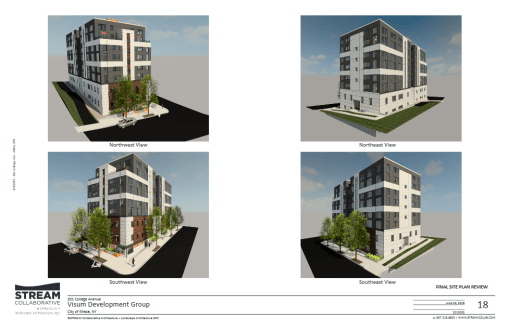
3. I dunno if I’ve ever seen such strenuous contention between the planning board and the city’s planning department. The planning board’s objected to Zoning Director Phyllis Radke’s determination that the project is legal per the Form District MU-1 Zoning.

The document put forth by John Schroeder and approved by the board rests on the following interpretations:
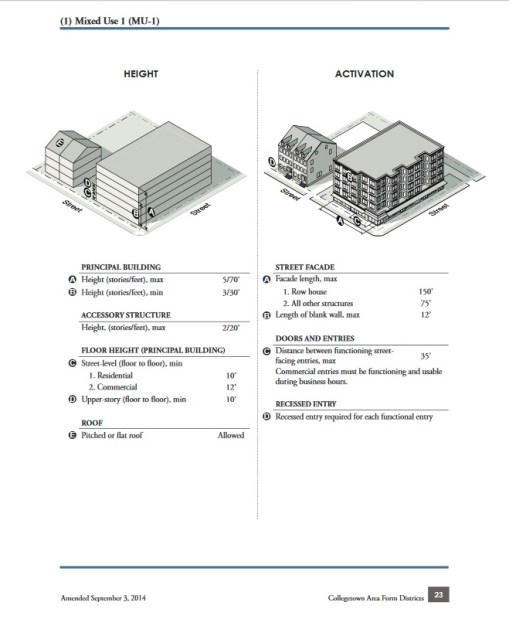
-in cases where the zoning isn’t explicitly stated in denser zones, it should rely on what is stated in less dense codes, and interpretations of the introductory “purpose and intent” section of the code, which qualifies similarities of form and scale if the numbers and dimensions for facade length aren’t explicitly stated.

-The argument also draws debate towards the unstated but implied interpretation of street facade, which refers to the building’s primary face, vs. building facades facing both streets. The board’s filing argues that the Bool Street facade was intended as a primary facade early on.

cafd_mu1

-Unlabeled parts of the diagram, such as MU-1’s, have no meaning. Even if they could give the impression of longer facades, it’s not the intent of the code.

The document goes on to say that Radke “invented claims unsupported by the text”, uses “tortured logic” and “silly conclusions”. Ouch.  Since interpretation is not a cut-and-dry matter of clear definitions, so we end up with an argument from both sides that relies on an interpretation of ambiguities, something more akin to a court room. A curious result of this discussion is that the Planning Board had to send out a letter to neighbors saying they would be arguing zoning determinations, which are going to be far out of most readers’ expertise, as the precise details and intent of the 2014 zoning will be the primary driver of this debate.

20160821_134831

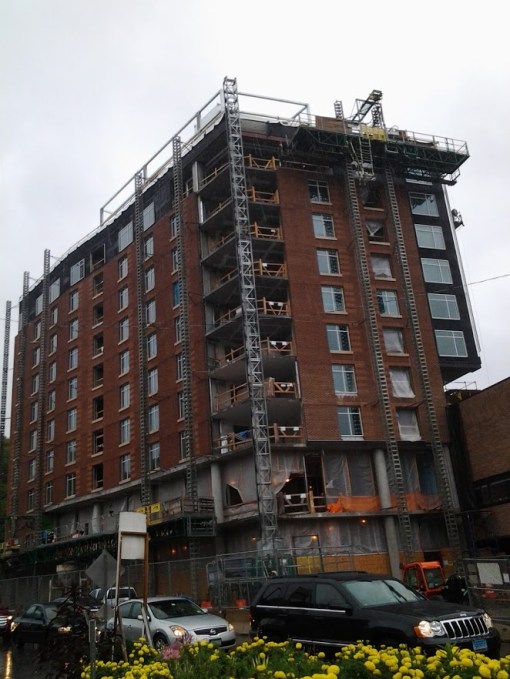
4. The Ithacan is reporting a mid-to-late October opening for the Marriott, the Journal is reporting November. Presumably, one of them is correct. The delay from the original August opening is attributed to a labor shortage. Hiring is currently underway for the 159-room hotel and its restaurant, which according to the IJ, are expected to employ 50 to 60 in total. About 75% will be full-time, and wages are expected to run from $10/hr + tips for wait staff, to $18-$19/hour, with the hope that a premium paycheck compared to similar positions at other local hotels will translate to a premium experience for guests.

tc3_daycare

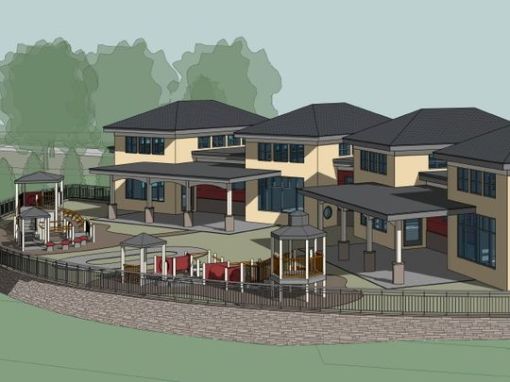
5. It looks like TC3’s Childcare facility is well on its way to reality. At least $4.5 million has been secured for the $5.5 million project and its scholarship endowment for students with children. $2.5 million for that was recently received in a set of state grant and funds, according to WHCU. Another $2 million comes from benefactor Arthur Kuckes, for whom the new facility will be named.

20160918_141051 20160918_141131

6. It’s been a while since I’ve done house of the week. So, here’s a new house underway on the 200 Block of Pearl Street in the city’s Bryant Park neighborhood. Ithaca’s Carina Construction is doing their modular magic here, the pieces have been assembled and most of the siding and roof trim has been attached. Not 100% sure if there will be a porch, the lack of siding above the door suggests it’s a possibility.

To be honest, when I was going through my list of single-families underway, I was mostly finding that Carina dominated the list. Since Avalon Homes went under, and most stick-builds are beaucoup bucks due to higher labor and materials costs, Carina’s offerings have broad appeal in Ithaca’s isolated, tight home market.

The lot was created four years ago by a subdivision of 222 Miller across the street. Since then, it exchanged hands a few times before a local realtor sold the property for $130,000 in July to a family who relocated to the area from Texas.

119_125_college_avenue

7. The Planning Board Agenda is up, and it’s the shortest in ages, thanks to that special meeting last week. Here’s the rundown:

1.  Agenda Review                                                      6:00
2.  Privilege of the Floor                                              6:01

 3.  Subdivision Review

A. Project:  Minor Subdivision                                      6:15
Location: 404 Wood St.
Actions: Declaration of Lead Agency  – PUBLIC HEARING – Determination of Environmental Significance – Recommendation to BZA

A minor subdivision to split a double-lot in Ithaca’s South Side neighborhood into two lots, one with the existing house and one that would be used for a new house or small apartment building. A variance for an existing rear year deficiency of the house would need to be approved (the rear deficiency wouldn’t be affected by the new lot which is on the east side, but it’s a legal technicality).
B. Project:  Minor Subdivision                                          6:30
Location: 1001 N. Aurora St. (Tax Parcel # 12.-6-13)
Actions: Declaration of Lead Agency – PUBLIC HEARING – Determination of Environmental Significance
Touched on this one last week. Deconstruction of an existing single-family home for two two-family homes, each on its lot.

4. Site Plan Review

A. Project:  Two Duplexes                                              6:45
Location: 1001 N. Aurora St. (Tax Parcel # 12.-6-13)
Applicant: Dan Hirtler for Stavros Stavropoulos
Actions: Declaration of Lead Agency – PUBLIC HEARING – Determination of Environmental Significance – Consideration of Preliminary & Final Site Plan Approval

B. SKETCH PLAN:  Townhomes & Apartments at 119-121 & 125 College Ave.        7:00

I’ve spilled some electronic ink on this project before – Novarr’s $10 million project for faculty townhomes and apartments. Rumor mill says “modern-looking” and “glassy”, which given Novarr’s fondness for ikon.5 architects (his guest house is on the main page of their portfolio), that isn’t a surprise. The three parcels are CR-4 zoning, so 4 stories and 50% lot coverage allowed. Previous estimates were for 50-60 units. I’d say the biggest uncertainty in approvals comes from the existing apartment houses, which haven’t been declared historic, but former councilwoman Mary Tomlan and the Planning Board’s John Schroeder recommended for consideration in 2009 (only 15 of the 31 suggestions were considered, and only 2 received historic designation, Snaith House and Grandview House). Novarr’s been amenable to compromises before (see Collegetown Terrace), so we’ll see what happens here.

5. Zoning Appeals
• #3044, Area Variance, 170 Pearsall Pl.
• #3046, Area Variance, 404 Wood St.
• #3048, Appeal of Zoning Determination, 201 College Ave.                                 7:30