114 Catherine Street Construction Update, 6/2015

10 06 2015

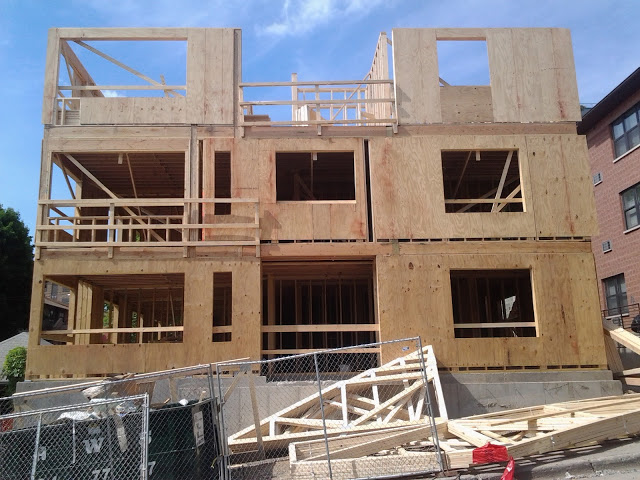
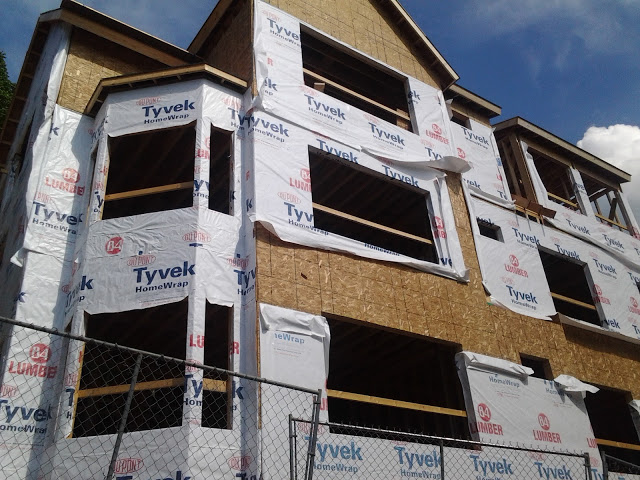
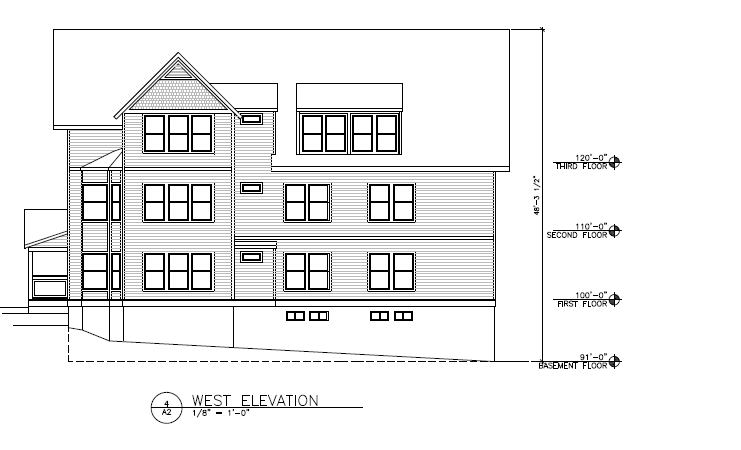
Workers have been busy at the site of 114 Catherine Street in Collegetown. On Friday, a flatbed truck was parked just off-site, delivering the roof gables for the 3-story, 17-bedroom apartment building. Framing for the structure is actively underway, with recently-created rough openings showing the position of the windows and doors in the new 3-unit structure.

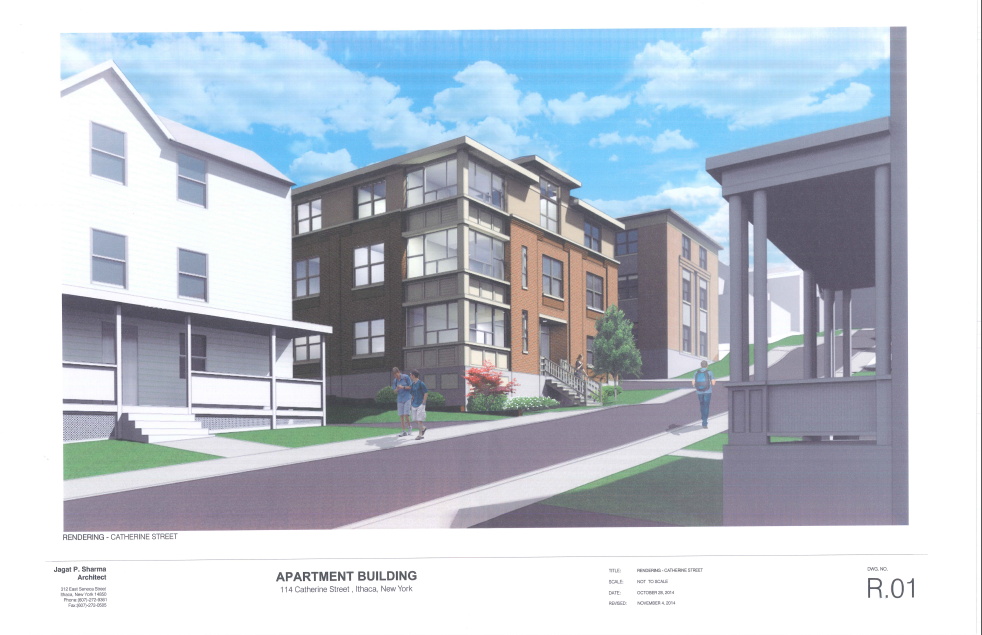
The architect behind this project is local architectural firm Jagat Sharma, and he building is being developed by Ithacan Nick Lambrou of Lambrou Real Estate. Plans call for the replacement of a parking lot with a 3-story, 4,180 sq ft structure with a 5-bedroom apartment on the first floor and a 6-bedroom apartment on the second floor and on the third floor. Building loan documents filed with the county establish the construction costs to be $1.3 million.

If construction stays to schedule, the building should be completed in time for Cornell’s fall semester.

20150605_155847 20150605_155912 20150605_155919 20150605_155943 20150605_160037

114_catherine_rev4_1


202 Eddy Street Construction Update, 6/2015

9 06 2015

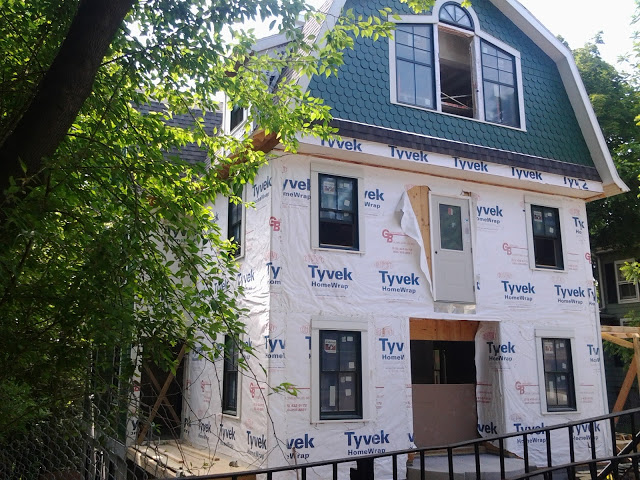
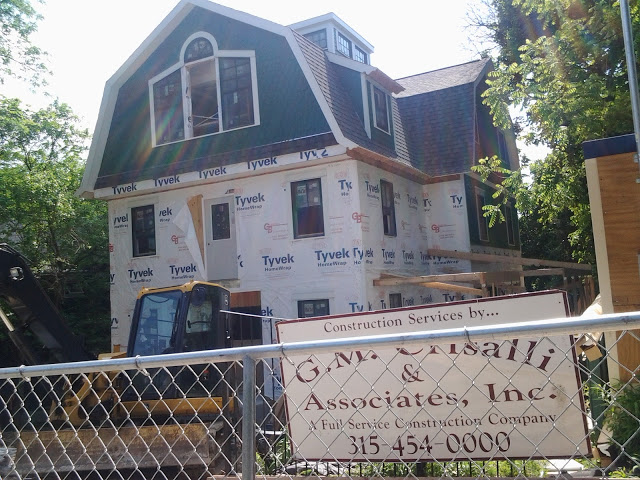
Work is progressing at 202 Eddy Street in Collegetown, where a reconstruction is underway to replace a historic building destroyed by fire in March 2014. Owner/developer Nick Lambrou announced plans to rebuild on the site shortly after the fire, with every intent of capturing the original home’s character. Being a part of the East Hill Historic District, the design of the replacement structure had to be approved by the Ithaca Landmarks Preservation Council (ILPC). After thorough review, the ILPC approved plans for a new 12-bedroom apartment building that completely replaces the fire-damaged building.

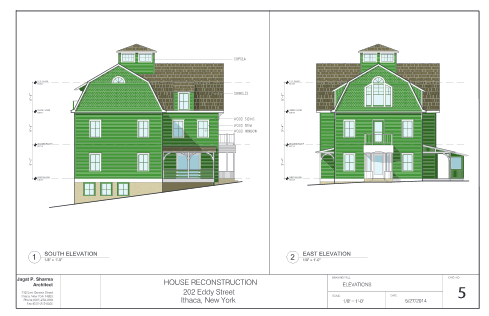
The new structure is a faithful interpretation of the original building, though it’s not an exact copy. An entrance door was repositioned, exterior emergency stairs will be internalized, and a chimney will not be rebuilt, but otherwise, its a close approximation of the original 19th century home. The architect is Ithaca-based Jagat Sharma, who has previous experience from the reconstruction of Sigma Pi’s house when it burnt down in 1995.

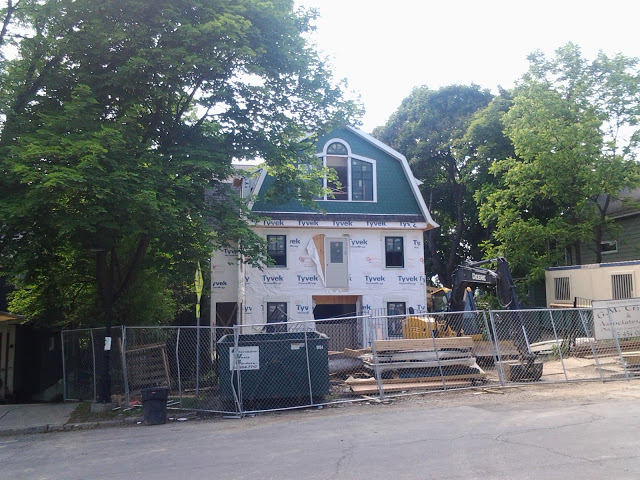
In these photos from Friday, most of the windows at least one of the doors have been fitted, and the exterior plywood is sheathed in Tyvek. The third floor, with its distinctive cupola, gives us a preview of the trim and siding – HardiePlank lap siding and half-round shingle siding, both in shades of green reminiscent of the original house, and “Arctic White” trim boards. Looking through the third floor window, there might be some drywall hanging underway, and judging from the first floor rough door opening, the interior lower floors may still be rough-ins phase.

202 Eddy is on the agenda this month by the ILPC; the council will conduct an inspection of materials just to make sure all is in good order, and as a prerequisite for issuing a Certificate of Appropriateness in July.

County records indicate the cost of construction is estimated at $750,000. Plans call for the new building to be completed and ready for occupancy by August, in time for the fall 2015 semester.

20150605_155608 20150605_155636 20150605_155702 20150605_155712

202_eddy


707 East Seneca Street Construction Update, 6/2015

8 06 2015

In and near the Collegetown neighborhood, several smaller construction projects are currently underway. One of those is 707 East Seneca, an urban infill project in the East Hill Historic District. Since the project was located in a historic district, the design had to go through the Ithaca Landmarks Preservation Council for approval, along with getting approval from the planning board, and the zoning board for an area variance (the lot was too small). After informational and voting meetings by different boards throughout the fall and winter, all the approvals were granted.

The design of the 3-story building is intended to be compatible with the historic homes from the late 1800s and early 1900s that surround the site. 707 East Seneca was originally the playground area for the now-closed East Hill School, and the lot was given to the city in 1982. The property fell into disuse, and the playground into disrepair.  The city voted to put the lot up for sale through the Ithaca Urban Renewal Agency (IURA) in summer 2014, and the vacant lot was sold for $130,000 last December. A building loan agreement filed with the county last Friday estimates the total “hard” construction cost for the building at $752,350. Hard construction costs leave out legal fees, permit fees, and other costs not directly related to construction.

When completed, the apartment building will have 6 units and 18 bedrooms. Four garage parking units will be located under the building and tucked into the hillside, in addition to five surface parking spaces. The building is expected to be completed before students return this August.

Note for the included renders, the black-and-white image with the small basement windows is the final design, but the colors are the same as the lead rendering.

In these photos taken last Friday, it appears that the building has been faced with plywood, topped out to its final storey and roofed. The exterior walls have been almost fully wrapped with Tyvek water barrier wrap. Some interior framing can be seen from the outside.

The design of the building is by Schickel Architecture of Ithaca, and the developer is Ithacan Todd Fox.

20150605_160815 20150605_160833 20150605_160902 20150605_160918 20150605_160932

707_E_Seneca_2

707_E_Seneca_rev1_1


News Tidbits 6/6/15: I Give This Week A Frowny Face

6 06 2015

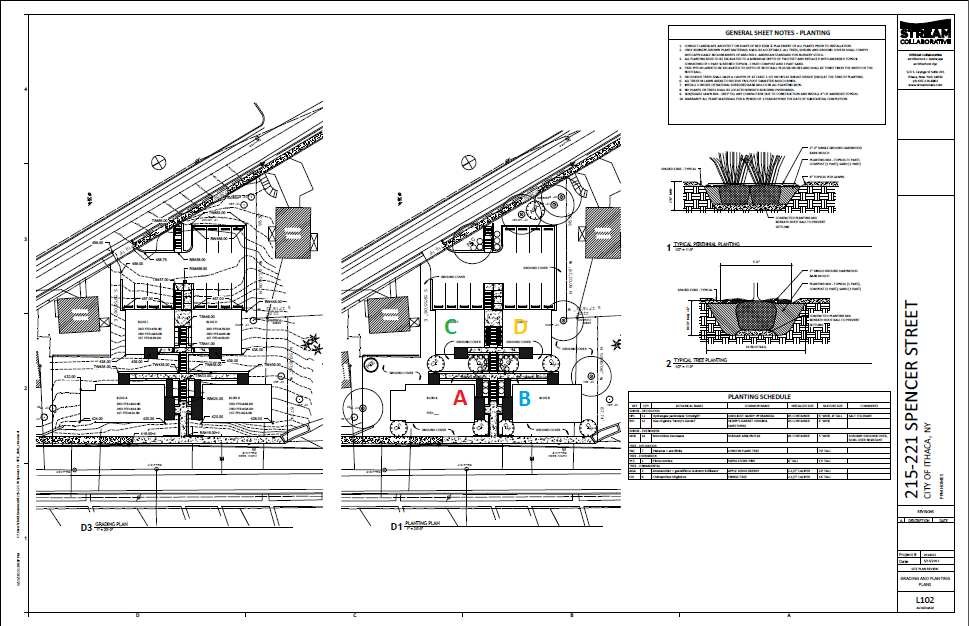
215-221_spencer_v2_2

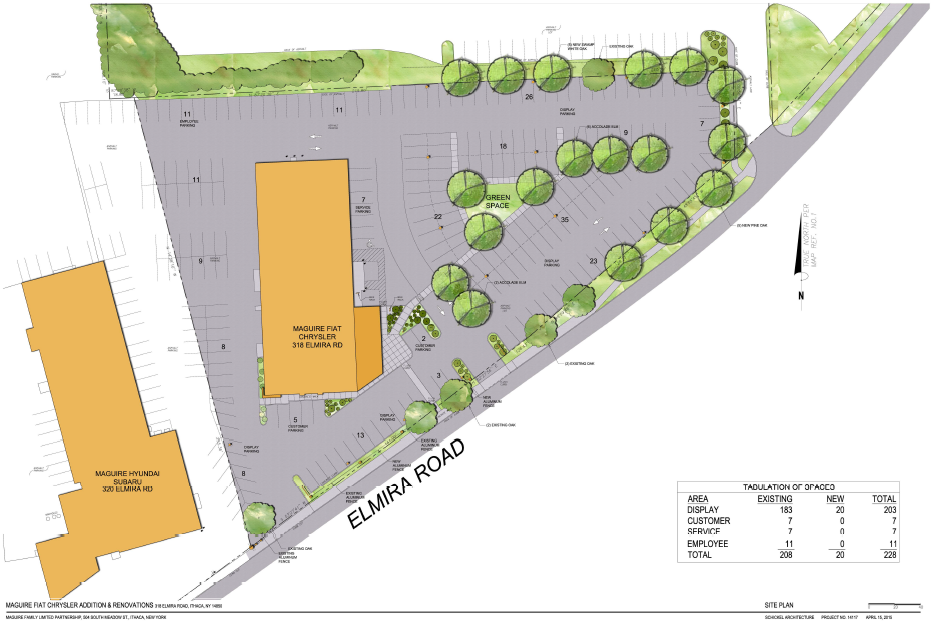
1. I’m thinking there is a genuine lull in the pipeline at the moment. The city’s projects memo, which is the document that city departments receive and comment on before the actual Planning Board meeting, doesn’t have much for consideration for this upcoming month. The one projects that is being “newly” considered is the 12-unit, 26-bedroom PPM Homes proposal at 215-221 W. Spencer Street. That project is expected to receive declaration of lead agency (in other words, the planning board formally agrees to review it) at the June meeting. Being carried over from the previous months are the two duplexes for 804 E. State Street, the Tompkins Financial HQ, INHS’s 210 Hancock project and the Maguire Fiat/Chrysler expansion. None of those are up for final approval.

Smaller projects and subdivisions will often first show up in the memo ahead of the meeting, but not this month. What will be, will be.

tfc_v2_1

2. On the other end of the scale, this looks to be a busy month for the Ithaca Landmarks Preservation Council. Most of their agenda focuses on window repairs and other minor details, but they will be reviewing the Tompkins Financial HQ and the new drive-thru across the street. Although neither is within a historic district, I suppose it’s being reviewed for the sake of feedback and the possibility of a visual impact on the skyline as seen from historic districts.

Cayuga-Meadows-Shot

3. In Old Library news, a decision was expected last Tuesday…but, the decision was postponed. After committee members started sharing their differences in opinion. Pardon my cynicism, but that’s a perfect microcosm of those whole process. Frequently delayed and bound to infuriate someone come decision time.

In a perfect world, all three of those would be built in the city, because they all address different housing needs in Ithaca, and they would all likely be successful. But of course, there can only be one. We’ll find out next Tuesday morning.

4. The Ithaca town Planning Committee is verifying two things already noted in previous news round-ups. One, the 68-unit Cayuga Meadows project hopes to begin construction in the very near future, and two, the Troy Road housing project is dead.

The committee also brought up the possibility of a moratorium for certain parts of town – two areas described as having significant student populations. One is almost certainly the area of South Hill next to IC, the other is not stated (but likely has to do with Cornell). This is part of a larger conversation to keep IC students from living off-campus in student rentals. Students aren’t a protected class, so whatever extra bureaucracy or laws the town wants to adopt are technically fair game. I would imagine, however, it would much easier to do that to IC’s undergrads than the professional and doctoral students attending Cornell. Looking at the numbers, one has been increasing much more than the other, and it’s not the undergrads. This, I suspect, is where potential laws become problematic.

Anyway, the moratorium is seen as a last-ditch effort. But the possibility of it should be enough to raise eyebrows.

815_s_aurora_1

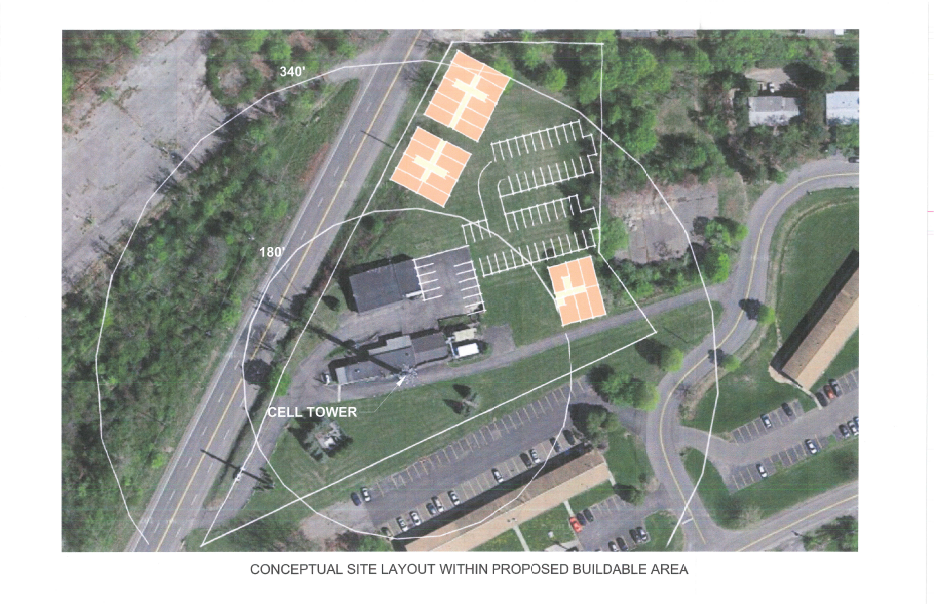
5. Time for some more unhappy – the city Board of Zoning Appeals isn’t touching the 815 South Aurora Street application.  To recapitulate the salient details, local developer Todd Fox would like to build apartments on the land but can’t because the vast majority of the property is within the “fall zone” of a cell tower, which the city defines as twice the height of the tower. At 815 South Aurora, a 170′ tower creates a 340′ radius of no-man’s land (outer circle above), making the parcel virtually undevelopable. Fox had two private engineering companies (TAITEM Engineering and Spec Consulting) analysis the case and they determined that an appropriate fall zone is the height of the tower plus 10 feet for a little wind/bounce – so 180′ total. With this info in hand, Fox is trying to get the city to refine the zoning to allow the decrease in fall zone and therefore permit the land to be open for development.

The BZA said it was acting on the city attorney’s advice that the committee can’t override a council-approved law. Which means that Noah Demarest, the architect appearing on behalf of Todd Fox, will either have to go to the Council to have the law amended, or he and Fox will have to go through a full sketch plan and review process, and apply for an area variance for whatever firm plans they have proposed. Meeting with the BZA was seen as way to avoid having to shell out all that time and money and risk still being rejected because of the cell tower issue. There’s a risk with moving forward at this point, and it’ll depend on just how much risk the developer is willing to take on this potential project.

6. We’ll wrap up with something positive – FormIthaca, the citizen group advocating for form-based zoning, is doing their design charettes this week. I’m writing this on Thursday night since I will be doing 5-year Cornell reunion stuff on Friday, but I do plan on being in attendance Friday afternoon meeting and am looking forward to seeing/hearing what ideas the presenters have to share.

I can assure a certain town of Ithaca board member that I have a personal preference to small street setbacks, and it sure as hell isn’t because they’re “hipper”.


The Evolving Plans For West Hill

2 06 2015

West Hill is, in a sense, Ithaca’s final frontier. The least developed of the hills, it isn’t nearly as built out as South Hill or East Hill, and what is there are mostly single-family homes.

For clarity’s sake, this post is about the part of West Hill within city lines.

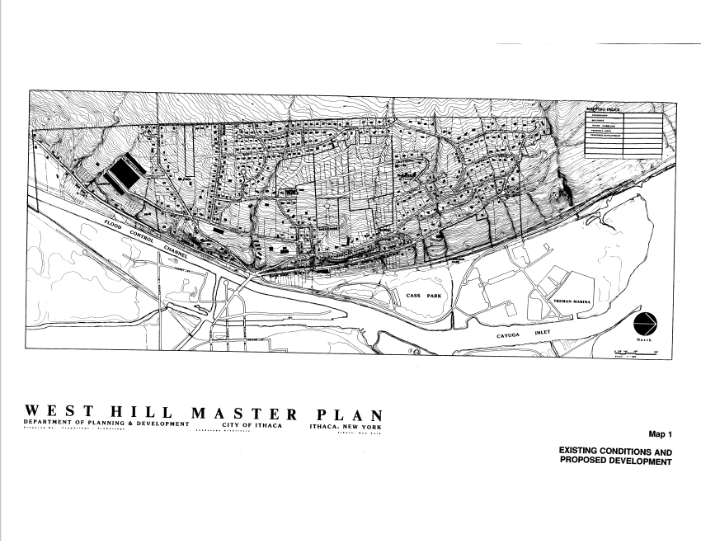
While looking up something else, I stumbled across West Hill’s Master Plan from 1992. Which, given its been over 20 years since it was written, gives an interesting perspective on how the city has wanted development on West Hill to fill out. The West Hill plan was created in response to strong developer interest in West Hill sites in the late 1980s, both in Ithaca city and Ithaca town. The plan notes that seven major projects were proposed during 1988 alone, in an area more accustomed to annual construction in the range of a few to several homes, and the very occasional apartment building or business.

west_hill_1992_1

The map above shows both the current and proposed projects at the time, There were eight in total, with dozens of units and lots. It’s hard to read even when blown up, but the proposed projects, which have a heavier lot outline and blurry labels, included subdivisions for single-family housing tracts in the proposed Deer Creek, McPherson and Sunrise Terrace projects, and individual sites with multi-unit potential like INHS and Overlook Park.

west_hill_2015_1

As seen in this 2015 map from the county, the majority of those late ’80s plans were never built, probably because the local economy tanked in the early 1990s. The four housing tracts in the middle of West Hill are still vacant today and under various private ownerships. The Overlook Park site eventually morphed into the 44-unit Bella Vista proposal in the 2000s, but that project was also never built.

A few plans did come to fruition, however. A site just east of West Village (380-90 Floral Avenue), called “LoPorto” on the 1992 map, became a 28-unit townhome development in 1995 that was sold to INHS five years later. The INHS site indentified in the 1992 map (310 Floral Avenue) became the 39-unit Cedar Creek Apartments in 2009, 17 years after the master plan was published. The last site, called “Clynes” after the owner, was subdivided into two lots, a currently vacant lot, and a house at 131 Haller Boulevard that was built in 1999.

Also, note the very different street configuration over on Inlet Island – this was the time of the original Ithaca “Octopus”, a jumble of streets feeding into one bridge, and infamous for its traffic problems. That’s a story for another day, but there are rundowns here and in a 1989 NYTimes article here.

west_hill_1992_2
The 1992 Master Plan called for a number of new roads criss-crossing West Hill, two new parks (one by West Village, the other in the undeveloped lands in the middle of the map), and a new bridge at the southwest edge of the city. Sidewalks were recommended for the large majority of residential streets, new feeder roads would be built with Ithaca town, and Cliff Street was to be upzoned, while most of West Hill would stay the same or be downzoned to “preserve character”. Here’s the current zoning map, but without a 1992 map it’s hard to cross-check and see what, if any zoning was changed. About the most I can ascertain is that swaths of West Hill near West Village were downzoned from R-3 to R-2 at some point.

The plan also notes the abnormally large lot size used by single-family homes on West Hill, which were less dense than even the city’s lowest-level R-1 zoning; but decided it was best to keep precedent and the plan suggested narrowing all residential streets as a character-protecting and traffic calming measure. Interestingly, a number of the newly-built or currently vacant single-family lots in West Hill are recent creations from subdivisions of larger parcels by their owners. So the streets are filling in via “organic growth”.

ith_big_plan_map

Now a look at the 2015 Comprehensive Plan. A large conservation swath (natural area with no permitted development) runs through the Floral Avenue and Cliff Street corridors, and chunks of medium density residential are put forth south of Hook Place and east of Chestnut Street. The 2015 plan notes that the undeveloped tracts in the middle of West Hill present significant opportunities for new single-family housing. The 2015 Plan notes that, just like 23 years ago, the lack of sidewalks is an issue. The cul-de-sacs, utility capacities, and “sensitivity of development to existing character” (a.k.a. be wary of neighborhood opposition) also pose issues and concerns that both existing homes and new projects need to address.

Off-hand, there haven’t been any major projects announced recently in the city’s portion of West Hill, and I haven’t heard any through the rumor mill (I can think of a couple homes I’ve heard about and that’s it). But it’ll be interesting to see how West Hill evolves in the next twenty or so years.


News Tidbits 5/30/15: Slow Week

30 05 2015

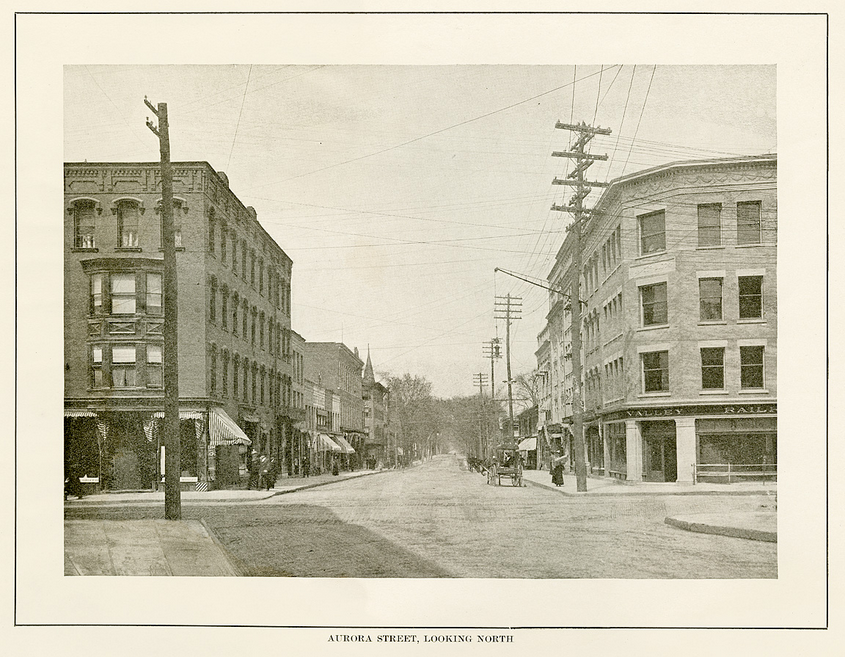
twit_aurora_st_1906

Not much of a news roundup this week. Nothing new to report from the city except that the Texas Roadhouse was approved, and the only item on the town of Ithaca’s planning board agenda for next week will be the review of a subdivision to create a new home lot off of Hanshaw Road. With the lack of news acknowledged, there were at least a few things I wrote up for the Ithaca Voice this past week that will happily fulfill your reading time if you haven’t glanced over them already.

1. Maplewood Park Closure, Replacement Likely – To loyal reader “CS PhD”, I honestly had no idea what you were referring to in your comment on the Boiceville post until a Cornell press release reached by inbox a couple hours later. I did reach out to Ithaca East (old Maple Hill) manager Bruce Abbott, who told me that Cornell has a two-year notice in case of closure, which gets renewed by June 30th. In practice, that means that the 81-unit Ithaca East apartment complex won’t close until June 30th 2017 at the earliest, but Cornell has until the end of next month to decide whether or not to extend that to at least 2018. As Abbott mentioned in his email, “Currently, I have 70% Cornell graduate students [in the tenant mix], so I may be considered a resource to them [Cornell] while they are replacing Maplewood.  Otherwise, I have about 35 days before I know what the future holds.” And we shall see what happens; Ithaca East with its couple hundred bedrooms likely won’t be closed until that much replacement housing has been built and opened at the Maplewood Park site. 480 bedrooms will be tough enough for the market to absorb as it is.

Edit: In a follow-up email, Bruce Abbott corrected the dates – Cornell has to notify him by June 1st and a theoretical closing would be May 30th, 2017 at the earliest.

2. National chain Smashburger plans to open Ithaca franchise – Although no locations were given, a casual check suggests that it’ll be in a suburban location in an already-built space, although urban spots aren’t completely out of the question. A typical Smashburger is a little over 2,000 sq ft, and they don’t have drive-thrus. For example, the one in suburban Albany reuses what was once a Friendly’s. Smashburger locations typically employ about 25, and franchising requires a net worth of $1.5 million, including $500k in liquid assets.

No surprise, the Voice readers have been spirited in their assessment…it definitely didn’t help Fine Line Bistro’s closing was published this morning. The reaction isn’t quite as controversial as Texas Roadhouse, probably because not as many people are familiar with Smashburger. I look both forward and dread the day I write about Sonic (which is looking to come into the market), Trader Joe’s (of which I’ve heard nothing), or any other very high profile chain makes their move into the area.

3. Which Tompkins County towns are growing fastest? – Most towns reported growth year-over-year, and the census revised the 2013 numbers upward. Ithaca city now stands at an estimated 30,720, an increase of 706 since the 2010 census. Ithaca town, for which the Census Bureau includes Cayuga Heights, stands at 20,515, an increase of 585.

Now comes my gut check – I think the city numbers and town numbers a little high. I base that off of building permits. If I count the number of annual permits given in the federal HUD SOCDS database, I get 127 units (75 single-family homes and 52 multi-unit) for 2010-2014, and just 14 units, 10 single-family homes and two duplexes, in all of 2014. If one assumes 3-bedroom house and 2-bedroom apartments for statistics’ sake, then one gets 329 residents. Cayuga Heights add 27 units – 24 1-bedrooms in the current Kendal expansion, one two-unit (most likely the rear addition to 207 Kelvin Place), and one new home since 2010. I think that equates to about 33. So 362 total, only ~62% of 585. As for the city, there were 259 new units, of which only 12 were single-family homes. Using the same math as before gives 530 residents in new units, 75% of total. I’m not sure how things like renovations or reuse projects are handled, so the city might be within the margin of error on my back-of-the-envelope calculation. But for the town, probably not.

Long story short, take the population estimates with a healthy dose of skepticism.


The Ithaca Economy, Part III: Ithaca’s Economic Health

27 05 2015

Part I looked at how in the past 25 years, Ithaca and Tompkins County had their keisters handed to them by a deep 1990s recession, but came out of the Great Recession of the late 2000s nearly unscathed. Part II provided a break down of job growth by BLS sectors – some sectors, like manufacturing and trade, have given way over the years to a workforce increasingly made up of engineers, scientists and social activists.

However, two big attractions have yet to be discussed – “Government” and “Education and Healthcare”. Those will be covered here in Part III.

ith_jobs_tseries_3

At left is the plot of jobs from 1990 to 2015 in the “Government” sector. Cue the sharpening of the pitchforks. Yes, the token government bureaucrat falls in this category. So do police officers, firefighters and military personnel. The sector shrank briefly in the early 1990s and has grown or held steady since. But in the 2000s recession, there’s an enormous boost – from November 2008’s 9,000 jobs to January 2010’s 10,300. The sector maxed at 10,400 jobs, over 15% of the local market, in October and November 2011. The annual average number of government jobs that year was 10,000, and it has fallen steadily since, with last year’s annual average total of government jobs being about 9,100.

Now the proverbial juggernaut, “Education and Health Services”. Cornell, Ithaca College, TC3, ICSD and other local school districts, as well as doctors, nurses and so forth. Just how much of the local economy does this sector comprise? I plotted it out in annual average proportions below.

ith_edu_health_1

Since 1990, it’s climbed from about 45% of the total job market to 55% of the total job market. The colleges and university by themselves account for nearly 10,000 jobs. In the BLS plot, the sector shrinks a little in the early 1990s, but then it’s climbed ever since, though with a strong amount of seasonality as a result of the academic year.

Now back to the recession question. If Cornell cut hundreds of jobs, and IC didn’t really grow (according to their own reports), what helped cosset Ithaca from the economic maelstrom a few years ago? Why did it do so much better in the 2000s than the 1990s?

The other half of that economic sector. Healthcare.

It’s no big secret that healthcare has been a big grower in the county for the past several years. The local healthcare industry was essentially untouched by the 2000s recession. Cayuga Medical Center has added over 500 jobs since 2008. Baby Boomers are retiring in large numbers, and they expect a full suite of healthcare services; and while the Boomers are generally fleeing this state by the truckload for warm, low-tax locales like Florida, college towns with a high quality of life, such as Ithaca, are seen as a major draw in their own regard. As more boomers look to a community like Ithaca as an alternative to the golf course-and-shuffleboard crowd, it creates more healthcare job opportunities, which are spearheading job growth in the region.

So there’s the hypothetical conclusion – growth in several small sectors and government helped to offset losses in other sectors during the late 2000s recession, but the real difference between the early 1990s and late 2000s is the growing healthcare market created in large part by an older, retiring population. Health services buoyed the local economy even when Cornell and IC were financially stressed. These days, they all work together to bring job growth to Ithaca and set new record highs in local employment.

Now comes the gut check – does that conclusion make sense? The question was posed to local economists and economic development officials.

“I think your gut is not too far off.” Replied Martha Armstrong, Vice President and Director of Economic Development Planning for TCAD. “Certainly Upstate New York had a prolonged and deep recession in the early 1990s and real estate values took a huge hit, actually losing ground, which was uncommon nationally.”

“Yes, education and health held up well during the great recession, never declining in Ithaca. Ithaca didn’t get involved in the housing bubble or predatory lending. Once the recession ended. Hiring in health and education really took off. As for Cornell’s 700 job cuts [during the recession], that’s 2% of 34,500 jobs in the sector, ” explained Elia Kacapyr, the head of the economics department at Ithaca College and the operator of the Ithaca Business Index. “I can’t confirm it was health care and not education jobs that saved us. The employment figures are combined into one sector. I suspect it was education services. It seems to me education employment dwarfs health in Ithaca. Cornell, Ithaca College, TC3, K – 12.”

Unfortunately, there was no real consensus because the conclusion was unable to be thoroughly proven. A slight disappointment, but for what it’s worth, there is no doubt that Ithaca’s economy handled the latest recession well. Tompkins County is a rare economic bright spot in an otherwise depressed upstate economy.


The Ithaca Economy, Part II: A Jack of All Trades

26 05 2015

Part I provided a brief examination of how the 1990s recession had a deep and lasting impact on the Ithaca economy, while the late 2000s recession was a minor hiccup in comparison. Here in Part II, those recessions will be looked at in greater detail by examining the different occupational groups that make up the Ithaca economy.

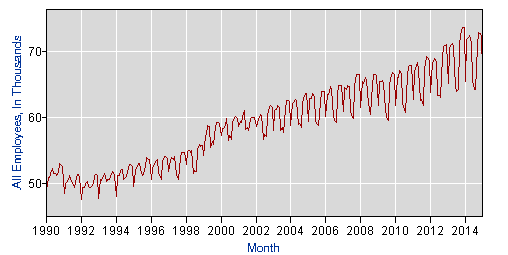
ithaca_bls_1990_2015

To see how the overall market changed, here is the plot of all the non-farm job sectors calculated, combined and tracked by the Federal Bureau of Labor Statistics (BLS) from 1990 to 2015. 1990 gives a nice 25-year figure, and it’s also as far as the online data goes back.

There are ten economic sectors defined by the BLS, and all counts are rounded to the nearest 100. Not all of them follow the same pattern as the overall numbers, as seen in the four sectors below.

ith_jobs_tseries_1

Even with the substantial growth in the Ithaca economy, not all parts of the local economy reflect that. At top left is “Mining, Logging and Construction,” which in Ithaca is mostly construction and the Cargill salt mines in Lansing. Employment peaked at 1,700 in August 1990, fell during the economic doldrums of the 1990s, and has made a very gentle climb since the late 1990s, most likely due to population growth and the slow if steady rise in construction demand. Cornell’s recent budget problems could derail that rise.

At top right, “Manufacturing”, industrial makers and producers. Manufacturing peaked at 4,600 in October and November 2000. The woes in this sector match much of upstate – manufacturers closed or left the area for cheaper sites down south or overseas, like Ithaca Gun in 1986/87, NCR/Axiohm in the 1990s and Morse Chain in the late 2000s (Morse Chain shed 500 jobs in the late 2000s, which explains some of the plunge). Fortunately, companies like Borg Warner still maintain a strong presence, and there has been some growth lately thanks to firms such as Groton’s Plastisol and Ithaca’s Incodema.

Lower left is “Trade, Transportation and Utilities”. In this category is where truckers, warehouse workers, retailers, wholesalers and utility crews fall. This category peaked at 7,000 jobs twice, in January 2006 and January 2008, but has fallen closer to 6,000 jobs in the past year or so. The early 1990s dip is there, as is a dip during the late 2000s recession. Overall, the sector’s employment hasn’t changed a whole lot in the past 25 years.

Last image in the figure, at the lower right, is “Information“. Publishers, broadcasters, news agencies like the Ithaca Voice, telecommunications, movie makers, and so on. The category has never employed more than 800 people locally, and is at an all time low as of late (on a national level, the industry has shrunk by a third since the early 2000s). It doesn’t follow the recessions, but it’s a tiny portion of the Ithaca market anyway.

Okay, so these four either held steady or fell during both recessions, and are decreasing or holding steady while the overall local economy has grown. Let’s look at the next four:

ith_jobs_tseries_2

The big difference between the first four and these four is that we can clearly see that these industries have grown in the past quarter century, some more than others.

“Financial Activities” at top left includes groups like bankers, insurance agents, and real estate agents. While currently at its highest ever, it’s hit that watermark many times in the past decade. The industries fell by similar amounts during both recessions, but the late 2000s down-period was much shorter.

The “Professional and Business Services” sector shown at top right includes engineers, architects, veterinarians, scientists and other technical professionals not associated with academia or government. They definitely saw a substantial drop during the ’90s recession, and it mimics that decade’s lengthy downturn. The late 2000s recession is barely noticeable, just like the overall jobs picture.

Leisure and Hospitality” at lower left is easy enough to define – hoteliers, restaurants, and professional entertainers like musicians and artists. There’s been a big push in the hospitality subsector with new hotels in Ithaca opening recently and in the near future, but the job growth isn’t all too impressive, only a few hundred jobs during peak periods. Once again, this sector was deeply impacted by ’90s recession, and jostled though not seriously damaged by the 2000s recession.

The last category, “Other Services” on the lower right, is a catch-all. In this category the BLS includes mechanics, dry cleaners, nannies, social and environmental non-profits, clergy and lobbyists. Given this area’s strong social activism, there’s little reason to wonder why the jobs totals have steadily risen, even during the recessions.

These four probably played a role in Ithaca’s growth in the past 25 years – the city and county have transitioned from factory workers and tradesmen to engineers and non-profits. But I still have yet to touch on the two biggest categories, “Government” and “Education and Healthcare.” Those two, plus some ideas on why the 1990s downturn was worse than the late 2000s recession, will be presented in Part III.


The Ithaca Economy, Part I: A Tale of Two Recessions

25 05 2015

20150207_151831

Ithaca’s economy has been growing in the past 25 years. Like any market, it’s also had its share of ups and downs – in particular, a recession in the early 1990s and a recession in the late 2000s. Nationally, the early 1990s recession was mild, especially in comparison to the Great Recession of the late 2000s. The 1990s recession only lasted 8 months on a national level (July 1990 – March 1991) and GDP loss was -1.4%. The Great Recession was 18 months (Dec 2007 – Jun 2009) and a GDP loss of -4.3%.

In Ithaca, these recessions played out a little differently.

ithaca_bls_1990_2015

According to the Federal Bureau of Labor Statistics (BLS), after a peak employment of 53,100 non-farm jobs in October 1990, the economy sputtered and shrank, falling as low as 47,700 jobs in January 1992, and not surpassing the 53,100 high mark until October 1995. The first half of the decade saw no real growth in jobs numbers.  The Ithaca College Economic Index, which establishes a number based on local economic indices, further highlights the poor 1990s ecnomy. The way the index works is that the index value in January 1985 = 100; 101 means 1% growth since Jan 1985. The county grew at a rapid pace in the late 1980s, and the index was 135.32 in March 1989. But by March 1992, it was 115.75; the economy shrank 14.5%. The index wouldn’t go above 135 again until February 1999. By this measure, Ithaca and Tompkins County had a lost decade.

In contrast, the late 2000s recession had a pre-recession peak of 158.66 in January 2008, fell as low as 149.44 in March 2009, and a new all-time high was established in June 2010. The economy index contracted only 5.8% during the recession, and Ithaca recovered relatively quickly compared to many cities. The jobs total is hardly a blip, an averaged loss of 200 jobs in 2009 that were quickly recovered in 2010’s growth.

So, why the difference? That’s the $64,000 question. An oft-cited reason is that Tompkins County’s institutions of Higher Education are responsible – Cornell, Ithaca College and TC3 were less buffeted by the economic headwaters that made the recession as bad as it was. Cornell published a report in the late 2000s saying that its construction projects alone provided over 700 jobs. Visitors to the university and staying in hotels and eating at local restaurants was claimed to have created almost 800 jobs.

But the colleges were here in the early 1990s as well. And while Cornell eliminated 900 positions during the recession by retirement or layoffs, the job numbers suggest that other employers must have picked up the slack in employment.

One of the ways to try and figure this out would be to look at the breakdown in employment by sector as described by the BLS. Perhaps education didn’t play as much of a role in the 1990s recession, or other industries grew while Cornell’s rank were whittled down in the late 2000s. Part II will be examining the job sector breakdowns and running some calculations to see just what changed in the job totals, and when.


News Tidbits 5/23: Cast A Discerning Eye

23 05 2015

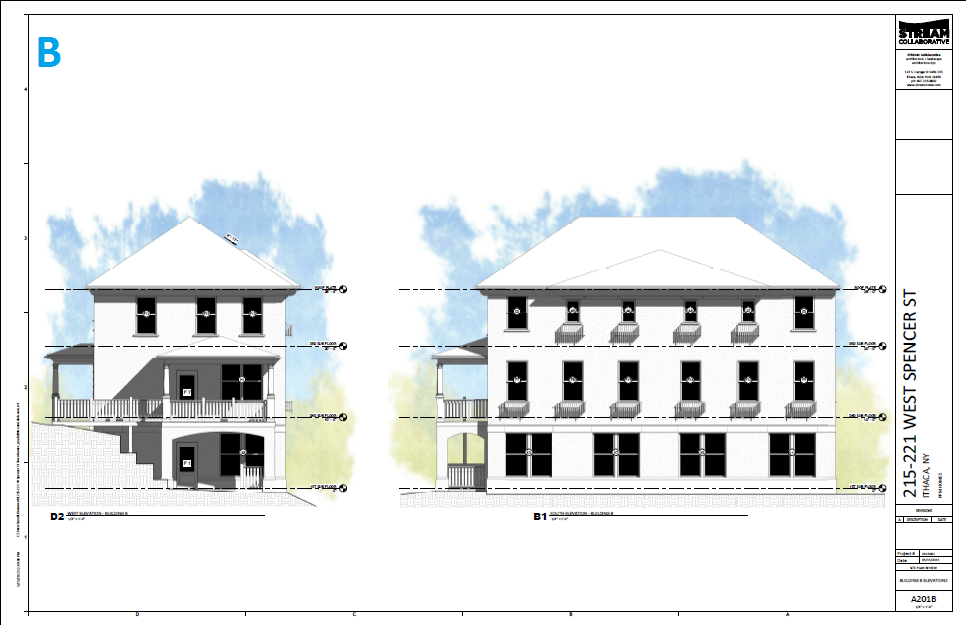
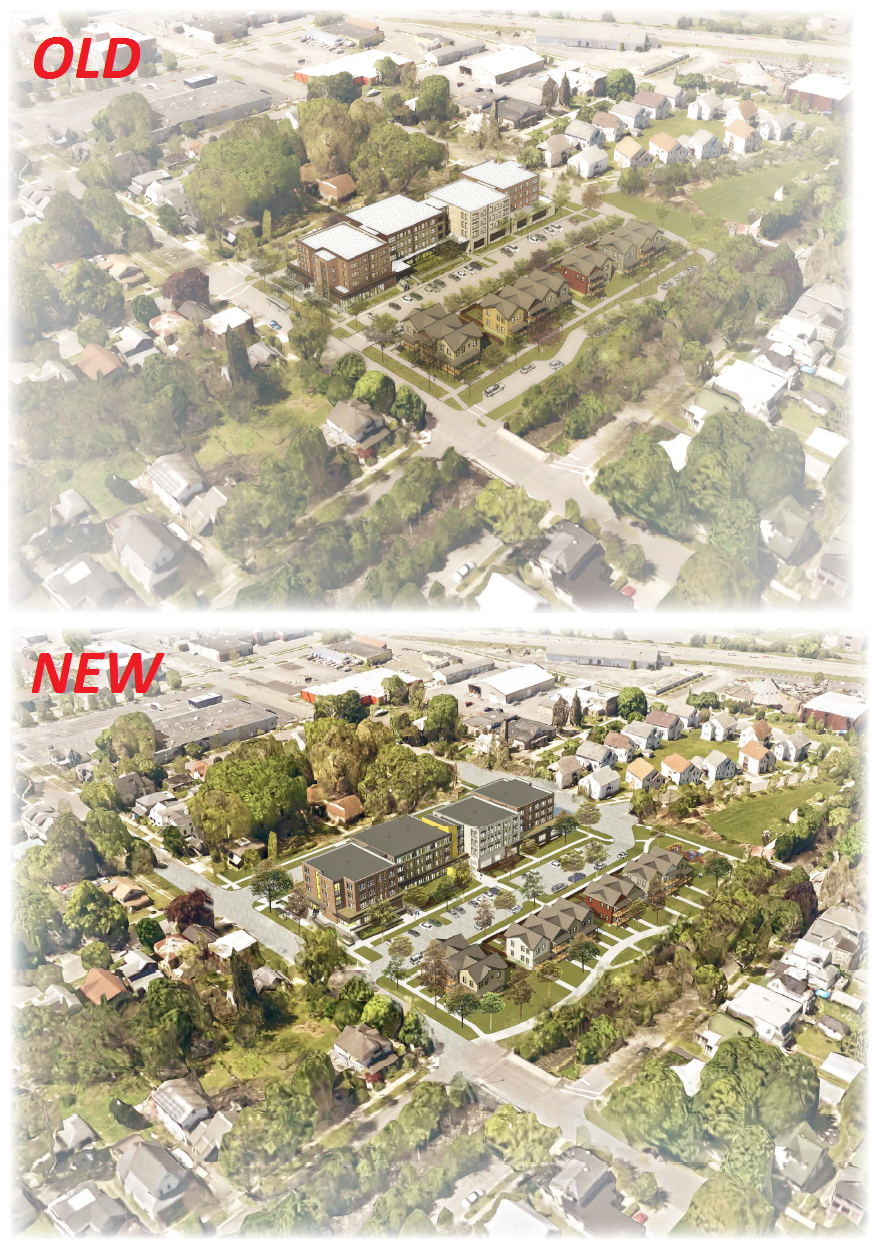
1. Starting off this week’s round-up, here are some new renders of PPM Homes’s apartment project proposed for 215-221 West Spencer Street just south of downtown.

215-221_spencer_v2_1

215-221_spencer_v2_2

215-221_spencer_v2_3

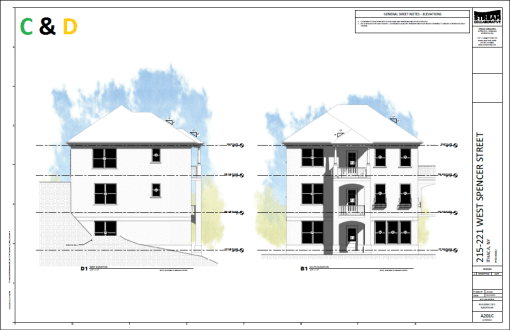
Note that C & D are the same design, but mirrored. The general forms are pretty much the same as the original sketch plan, but the porch and windows have been altered and the rooflines have been tweaked on A and B to give the Spencer Street facade a little more visual interest.

The 12-unit, 4-building project is being described as a “pocket neighborhood”. The two upper buildings closest to West Cayuga will have three two-bedroom units here, and the lower buildings facing West Spencer have a combined four two-bedroom units and two three-bedroom units, for a total of 26 bedrooms in the project. 12 parking spaces are provided as required by zoning. The owner is looking into remote net-metering of an off-site solar panel installation to provide all of the project’s electricity needs. The site will launch into the formal planning board review process next month.

The steeply-sloped 0.47 acre parcel has been vacant for several years, and currently sees use as an informal 12-space parking lot. The property was originally marketed for affordable housing projects only, but received no purchase bids. Once the affordable stipulation was removed, the parcel was marketed once again, and Ed Cope bought the parcel for $110,000 on March 6th.

The building designs are the work of local architect Noah Demarest of STREAM Collaborative.

215-221_spencer_v2_4

Random aside, I just found out that PPM’s Ed Cope is a Cornell biologist. And here I thought writing this blog and being an air quality scientist was an interesting contrast.

2. There might have been a day in not-too-distant past where someone said, “You know what Ithaca needs? Mini-golf.” Apparently someone heard those wishes. the Town of Ithaca’s Planning Committee will be looking at a possible zoning modification down near the intersection of Elmira Road and Seven Mile Drive that would allow a mini-gold establishment to move forward.

Stretching my memory here a bit, I seem to recall a mini-golf place up by Trumansburg, but if my google search is any indication, it closed a couple of years ago. I suppose there’s a niche to be filled.

Now comes the question of, “Does this fit with the town’s new Comprehensive Plan?” Here’s the description the town proposes for the Inlet Valley Gateway, including the area in question:

The Inlet Valley Gateway district is intended to be a setting for a mix of office, small-scale retail, hospitality, and tourism and agritourism uses, with low-impact light industrial, artisanal industrial, and skilled trade uses.
The scale, architecture and landscaping of future development will need to be carefully designed and articulated.

This area should retain a semi-rural character, with deep setbacks from arterial streets, wide spacing between uses, landscaped front yards, and vehicle parking sited on the side and/or rear of structures. Shared curb cuts will reduce potential conflicts with highway traffic. Sidewalks should follow streets, with connections to adjacent areas planned for residential development. Architectural design, landscaping, and site planning regulations should apply to all uses in this area, including industrial uses. Agglomeration of mechanical commercial uses, and incremental expansion of commercial zoning resulting in strip commercial development, will be strongly discouraged.

It sounds like that if the site is designed right, it could be a good fit. Probably a better fit than the Maguire’s dealership/HQ plan that was shelved a few months ago.

20150516_141049 20150516_141110

3. Here’s a couple of photos of the new duplex being built at 514 Linn Street. Each unit will be 3 bedrooms, and the apartments will be completed this summer. The building is being built on the foundation of the previous home that existed on the site, which dated from the late 1800s and was a near-copy of the peach-colored house next door. 514 Linn is being developed by the Stavropoulos family, who run the State Street Diner.

texas_roadhouse_v3_1

4. In an effort to win over the city, Texas Roadhouse is tweaking their proposed restaurant off of S. Meadow/13. Latest render here. Members of the planning board have previously expressed concerns that the original design had the entrance facing northward into the parking lot rather than the street, and that not enough attention was being placed on the street-facing west side. If the render is any indicator, the modified proposal still has a primary entrance on the north side of the building, but the street-facing side has a handicapped entryway, and the landscaping has been spruced up. Dunno if it’s what the board quite wanted, but they’ll decide if it’s good enough during their meeting next week.

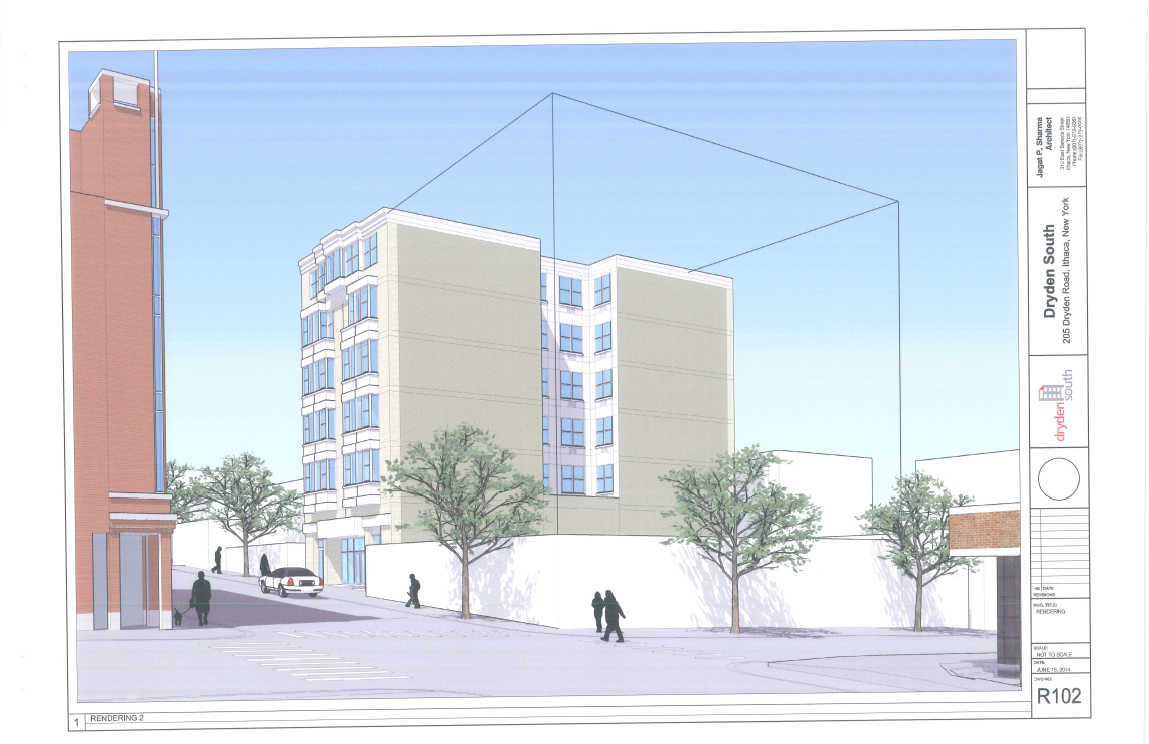
dryden_south_rev_1

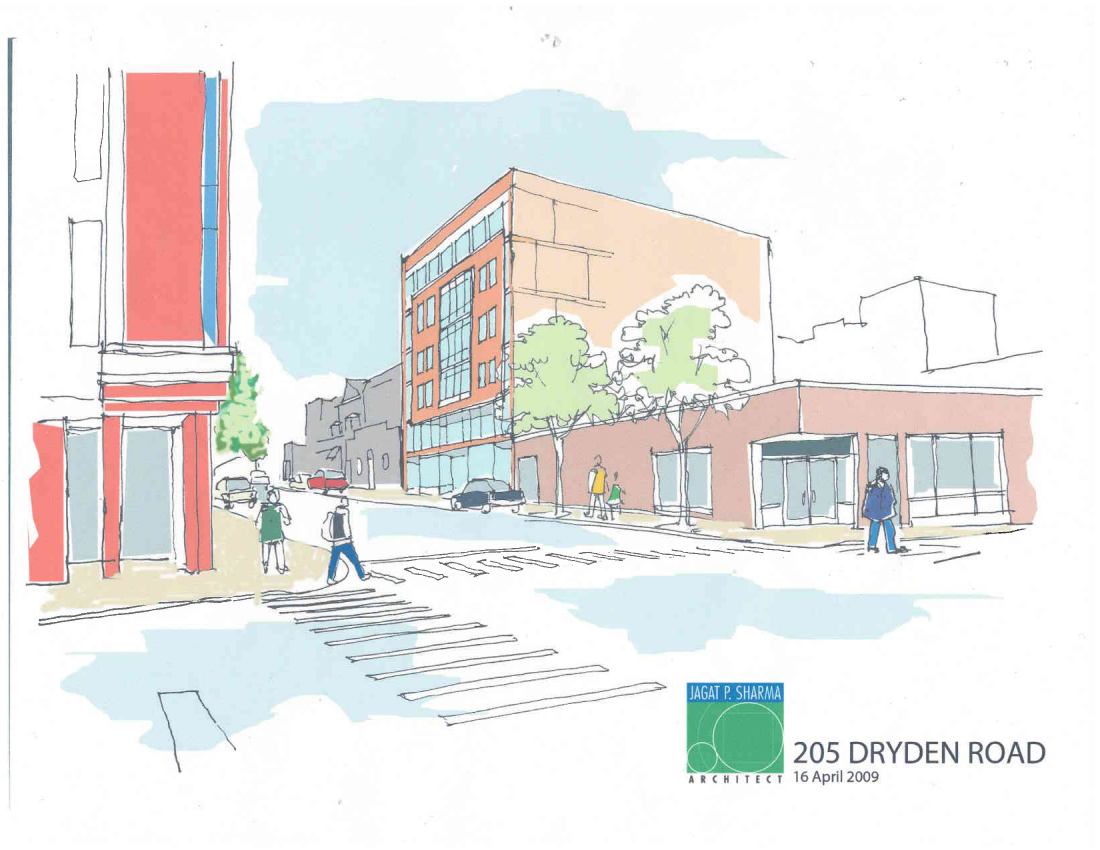
5. Looks like Pat Kraft’s Dryden South project (205 Dryden) has a website up and running. The 10-unit, 40 bedroom project will start site clearing in a few weeks, with excavation/foundation work going through the summer (according to an interview conducted by the Sun, Kraft hopes to have structural steel rising by the time students get back in late August). The 6-story, 65′ building will house Kraftee’s on its first floor, with two units of four bedrooms each on each floor above. units will be available for rent starting next August.

Dryden_south_2009_sketch

A neat little detail from the site is this old conceptual sketch done by Jagat Sharma for the site. Note the April 2009 date at lower right; this project has been in the planning stages for years, even though it only hit the Planning Board last Spring. On a personal note, I’m glad this hulking box didn’t end up being the final design.
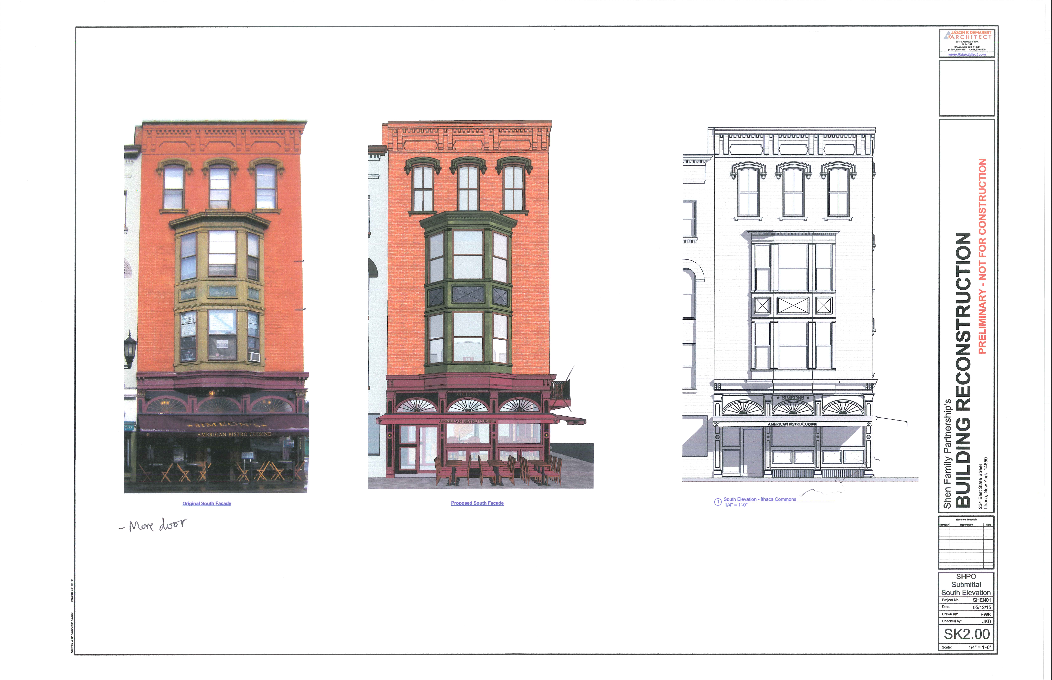
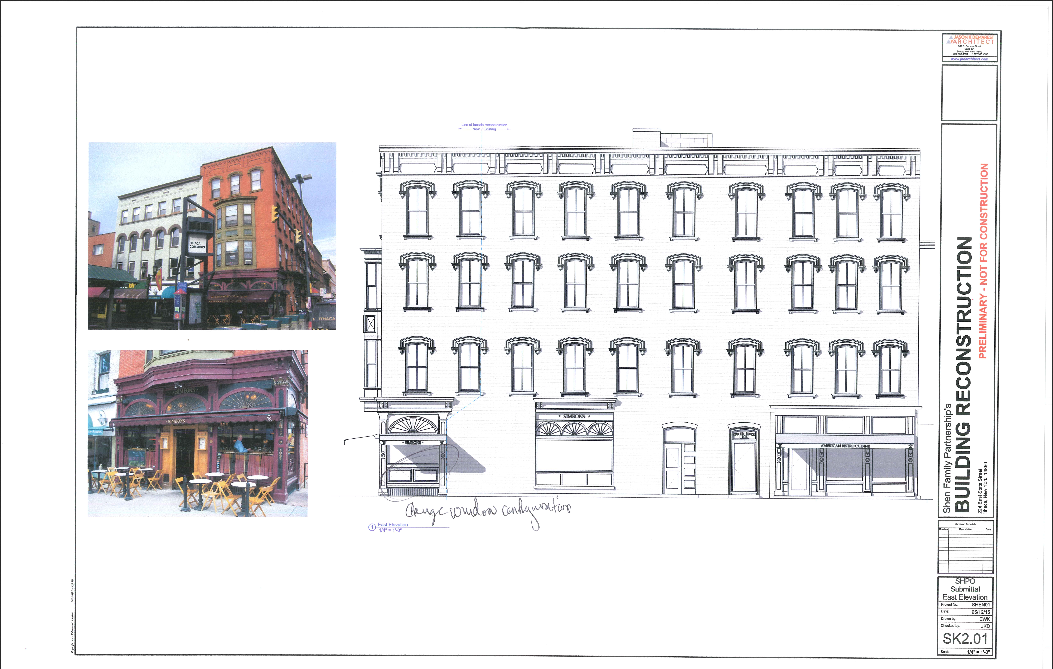
simeons_v2_1 simeons_v2_2

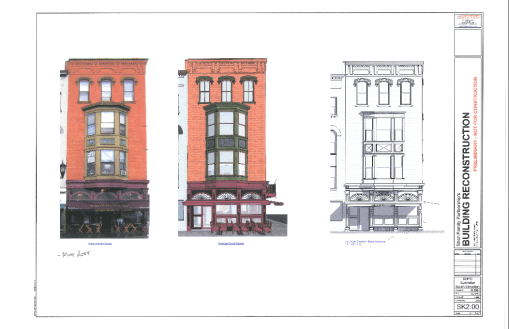
6. For those interested in what’s going on with Simeon’s, here’s an updated sketch design of the rebuild, courtesy of the Ithaca Landmarks Preservation Council (ILPC). The somewhat controversial side balcony/overhang is gone. About the only major difference between the original entrance and the rebuild is the location of the front door, which is now on the left (west) side instead of being in the center.

7.. Looks to be a quieter meeting for the planning board this month. No new sketch plans, and only one project, Texas Roadhouse, is being considered for approval. Here’s what’s up for discussion at Tuesday’s meeting:

IA. A minor subdivision to create a new home lot a 212 Hook Place on West Hill.

IB. A minor subdivision to divide a property on Hector Street on West Hill. The sisters applying for the subdivision are splitting the land among themselves but intend to keep both lots “Forever Wild”.

IIA. 210 Hancock gets its public hearing and possibly its Determination of Environmental Significance (which if okayed means that the project can be considered for prelim approval in June). I’m hearing there might be opposition mobilizing against the project. Given how transparent the whole design process has been, and that this is affordable housing in an urban area that struggles with housing costs, I’m going to be very, very disappointed if this happens.

B. Texas Roadhouse is up for Determination of Env. Signif. and possible Prelim/Final Site Plan Approval

C. Tompkins Financial’s new HQ will be reviewing parts of its Environmental Assessment Forms; no decisions expected

D. Declaration of Lead Agency (Planning Board agrees to conduct review) for the Maguire Fiat addition.

The board will also be conducting a review of State Environmental Quality Review (SEQR) forms used in determining environmental significance.