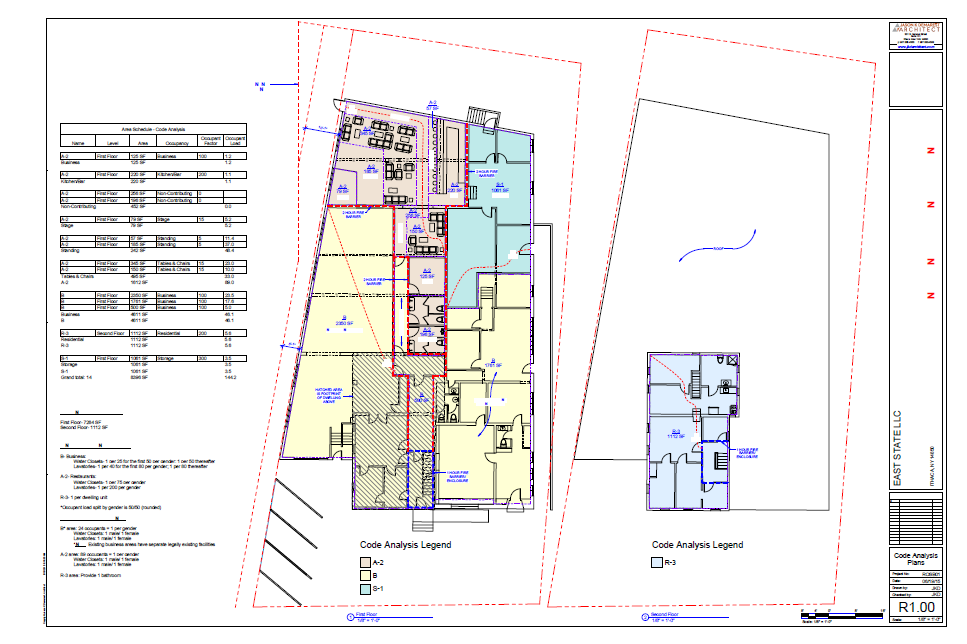
327 Eddy Street (Dryden Eddy Apts) Construction Update, 10/2015

16 10 2015

Of the three major Collegetown apartment projects currently underway, 327 Eddy is probably the least “impressive” to look at because it has yet to begin putting up structural steel. But this isn’t to say there isn’t work underway.

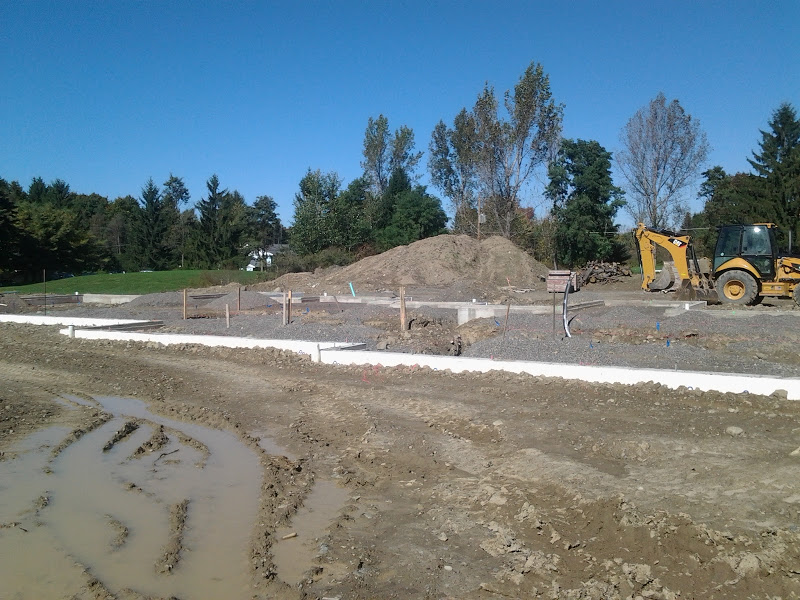
The site has been excavated and the base of the building has been established. A steel rebar grid mesh can be seen at the base of the upper tier, with utility lines feeding through. The rebar mesh is a reinforcement for the concrete when it gets poured, helping to prevent cracks that may from in the concrete from spreading throughout the foundation and causing major damage. The lower building tier have yet to receive the rebar mesh, but given the elevation render, it might be filled out first with the “flowable fill” referenced in the last update. Rimming the base are steel sheet piles, which lock together to form a wall designed to keep spoil and water from neighboring properties from spilling onto the construction site.

Plans call for a new 5-story building split into “steps” on the steeply-sloped site. The mixed-use building will bring 1,800 SF of retail space and 22 new apartment units with 53 bedrooms to the market in August 2016. Longtime Collegetown landlord Steve Fontana (of the Fontana’s Shoes family) is the developer, Jagat Sharma is the architect, and GM Crisalli & Associates of Syracuse will be overseeing construction. A construction loan of $4,824,000 is being provided by Tompkins Trust Company.

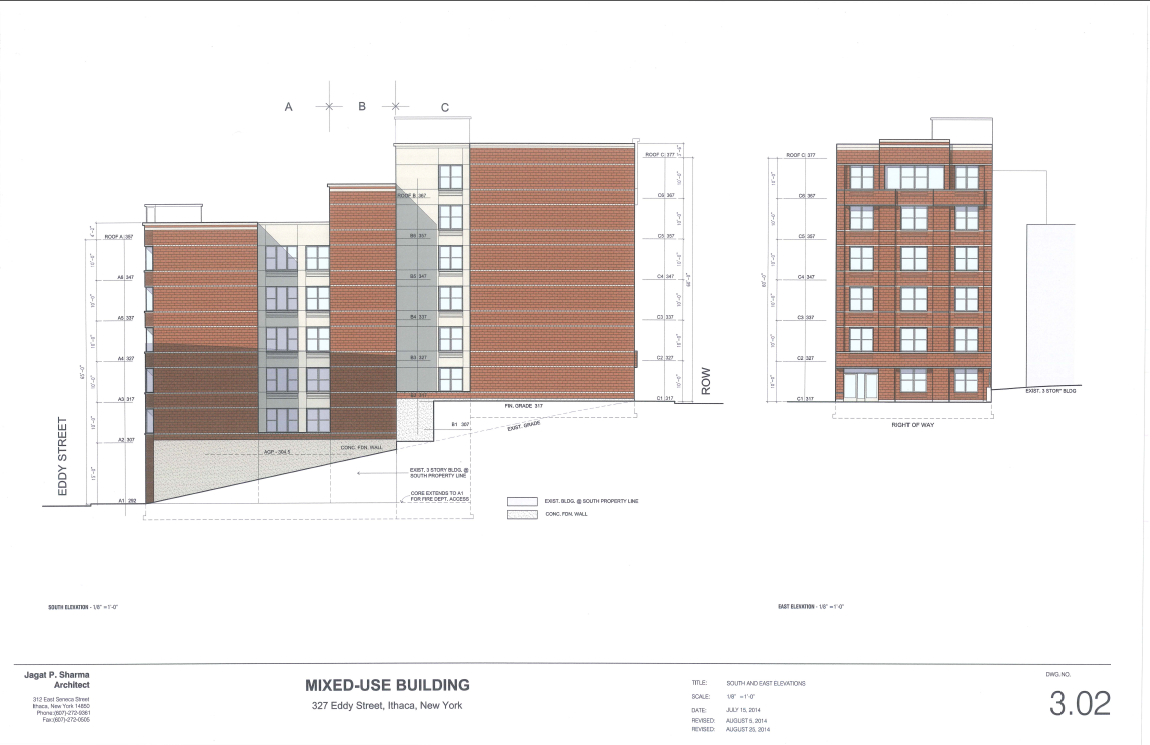
Note in the elevation drawing below, the building is six stories. It was reduced to five, and the decorative crown was reworked after approval was granted.

20151011_140231 20151011_140257 20151011_140309

327_eddy_rev4_1 327_eddy_rev2_3


Belle Sherman Cottage Construction Update, 10/2015

15 10 2015

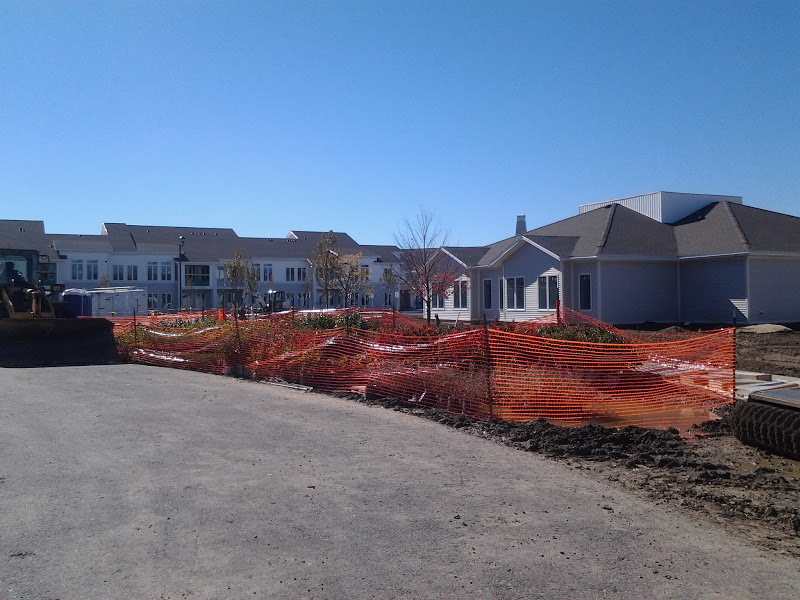
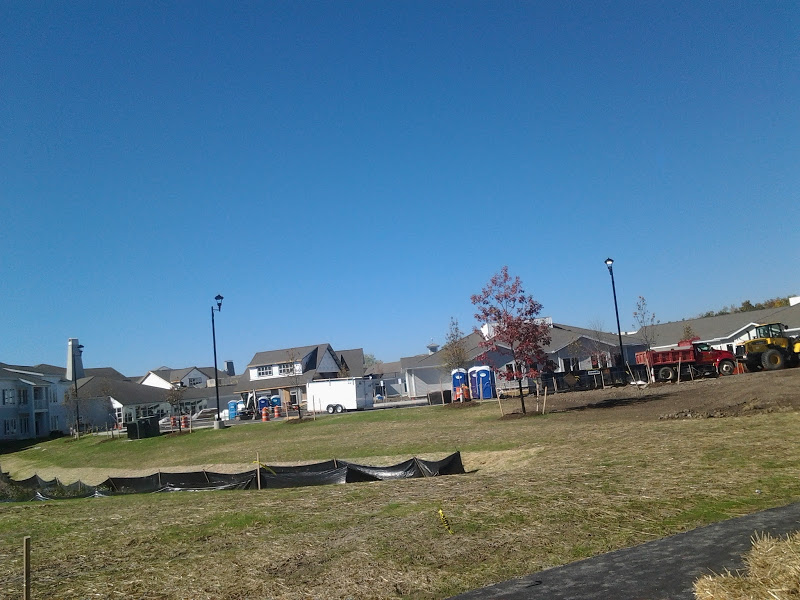
There’s not a whole lot left to say from a construction standpoint for the Belle Sherman Cottages project, located off of the 800 block of Mitchell Street. The townhouses are essentially complete, all that’s left is some landscaping and interior finishing-out. The Simplex modular pieces for the second set of five townhouses arrived on-site in mid-August, two for each townhouse unit. The pieces are then leveled and fitted together with steel plates, and then customized interior work begins for things like fixtures and flooring. On the outside, the foundation is backfilled, siding is attached, decks are built if the buyer chose to have one, and the landscaping is planted. The straw helps to keep the grass seed warm and moist so it can germinate, and it reduces the chance that wind will blow it away.

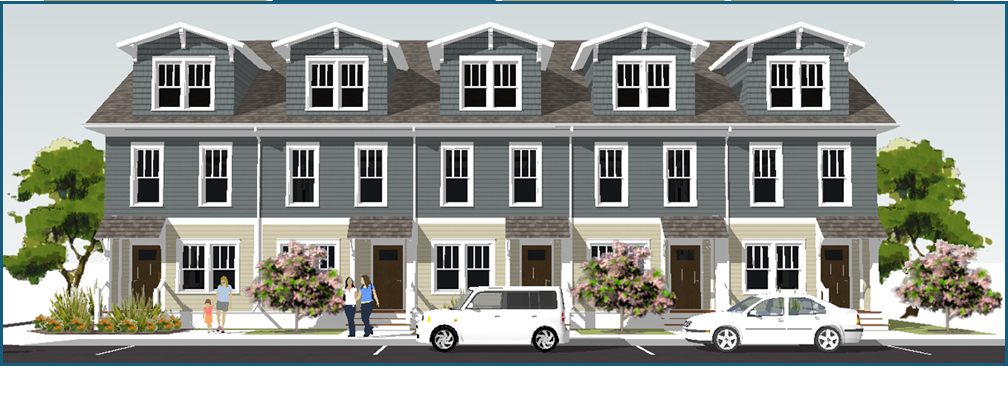
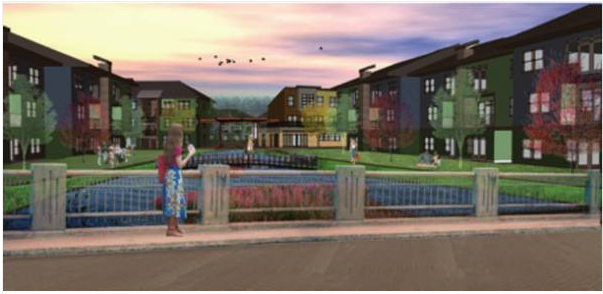
One difference from the computer rendering is that the render has all five townhouses at the same elevation. However, they’re actually staggered slightly, with the elevation dropping a few inches per unit as one moves from east to west. The same staggering effect was used on the first set of townhouses as well, with each unit dropping a few inches in elevation from north to south.

So, from start to finish, this was about…3.5 years? That’s not counting Lot 9, which doesn’t seem likely to happen anytime soon. Most of the new home construction was concentrated in just the past year and half – sales were slow at first, but they took off in early 2014.

The Belle Sherman Cottages project was developed by Agora Development of Skaneateles, and built by Carina Construction of Ithaca. Overall site design was penned by Ithaca-based STREAM Collaborative. The Simplex units were sourced from the company’s facility in Scranton, PA. A video of the construction process can be found on Carina’s Youtube account here.

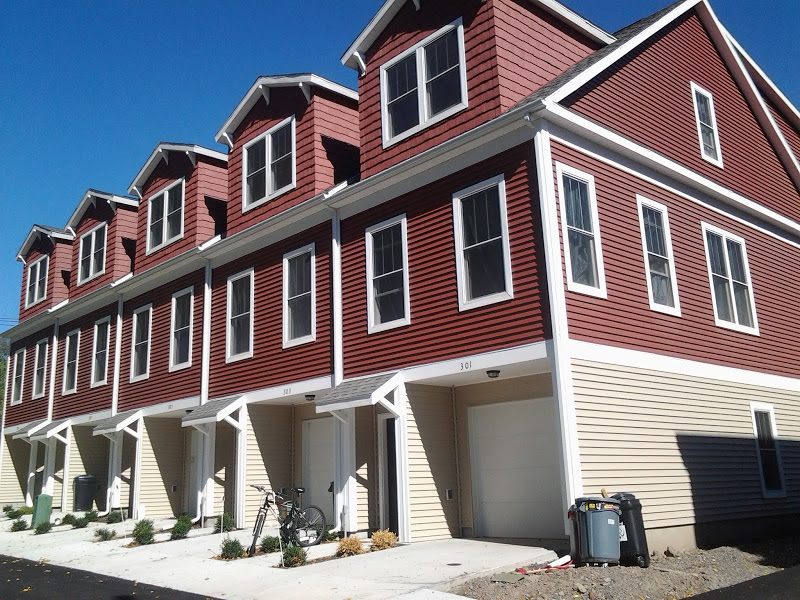
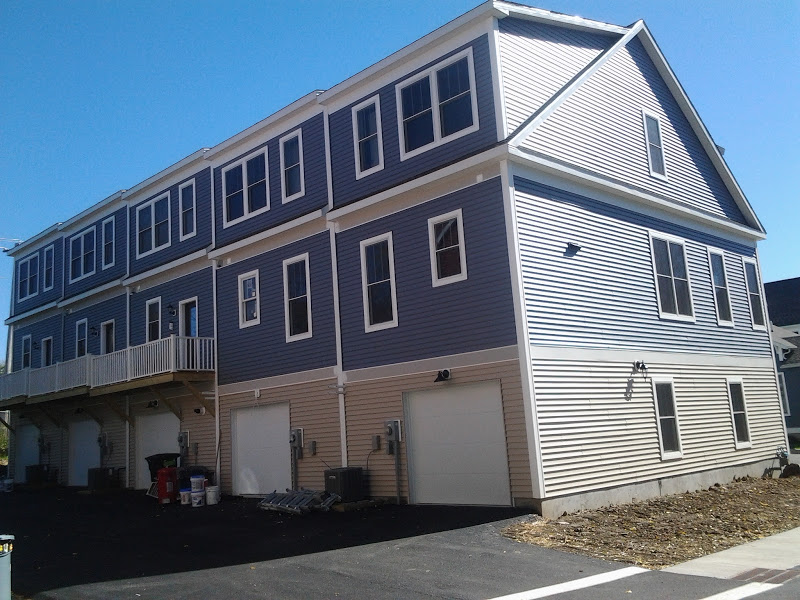
20151011_134134 20151011_134147 20151011_134221 20151011_134235 20151011_134255 20151011_134324 20151011_134339 20151011_134402

belle_sherman_townhouses_1


Village Solars Construction Update, 10/2015

14 10 2015

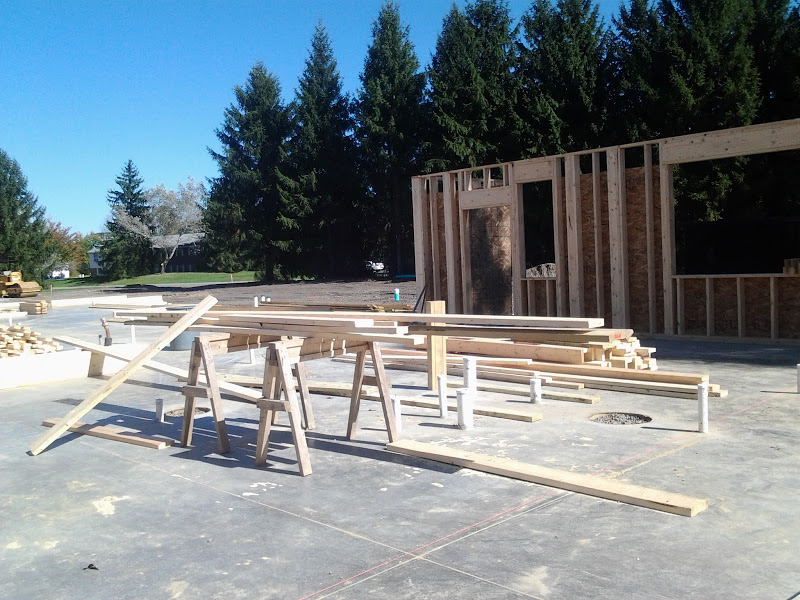
With phase one of the Village Solars apartment complex completed and housing its first tenants, work is well underway on phase two. 12-unit Building “D”, which shares the same general design as phase one’s Building “B”, has already been framed, sheathed with a Tyvek-type of housewrap, mostly fitted-out (a couple windows and the balcony doors have not been installed), and even some siding has been installed on the ground level. This seems to be a change-up from the previous phase, which used ZIP System plywood for sheathing. Also, in a departure from Building “B”, Building “D” opts for larger windows in place of the very small juliet balconies on the upper floors.

Across the property to the east (and on the other side of the future pond) is the 18-unit Building “G/H”, a new design. Framing and wood studs are only beginning to arise on the ground floor. Plywood that will be used in future sheathing has been propeed up against the newly-erected wall studs. The concrete slab foundation has been poured and cured, and underground utilities have been installed.

Building “G/H” was created when developer Lifestyle Properties (the Lucente family) was working with NYSEG to lay out the utilities after approvals were granted and the first phase was underway. It was decided to make phase 2 all electric services, due to concerns that Lansing may not be able to provide gas service if the situation with the gas pipeline proposal on West Dryden Road doesn’t go in the town’s favor. One of the results of the utility infrastructure change was a difference in utilities layout, which impacted the site design for walkways, and the Lucentes are sought and received approvals last Spring to revise the PDA (planned development area, similar to the city’s PUD and the town’s PDZ) to change G and H from two separate buildings, to one large building that occupied a smaller footprint.

Lastly is Building “E”. “E” will be an 11-unit apartment building, though it’s not clear if it will be a new design, or simply an interior rearrangement of units. Right now, only the concrete forms for the foundation have been constructed, with what appears to be trenches for utility lines criss-crossing the site. Taking a rough guess, “D” will be completed and for rent before the end of this year, “G/H” by the end of Spring, and “E” will be finished in time for next year’s students, mid-to-late summer 2016.

Building “F” is part of a separate phase, “2A”. It will contain 10 units and a community center. According to Rocco Lucente in an interview last month, work on Building “F” will begin after the other phase two buildings are completed.

The first three buildings in the Village Solars complex, buildings “A”, “B” and “C” with 36 units in total, were completed this summer at a cost of $4.7 million, according to loan documents on file. Rents posted on Craigslist have one-bedroom units listed for $1050-$1145, two-bedroom units for $1235-$1369, and three-bedroom apartments rent for $1565-$1650. Prices vary a little depending on what floor the unit is on – the higher up a unit is, the more it costs.

Phase two will cost about $6 million, according to the construction loan filed with the county. Tompkins Trust Bank is providing financing. Future phases call for upwards of 300 units on site.

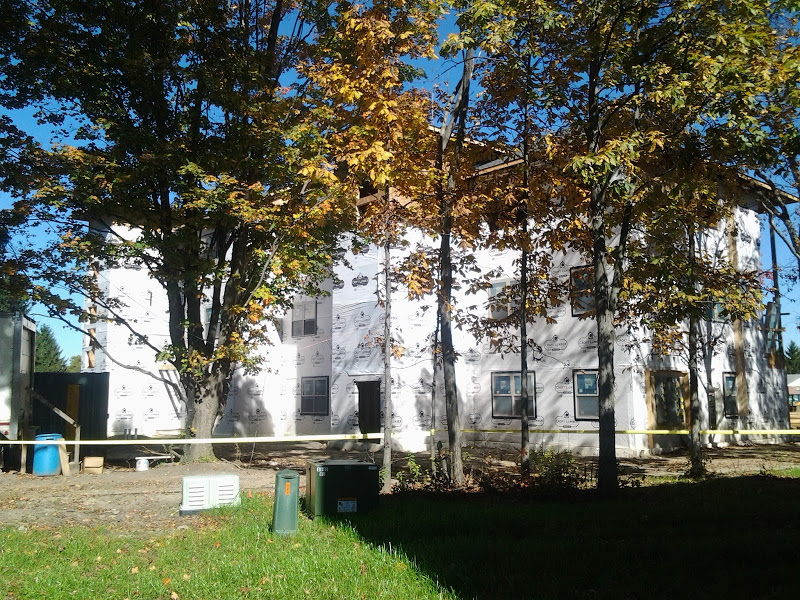
20151011_123635 20151011_123653 20151011_123739 20151011_123809 20151011_123838 20151011_123858 20151011_123922 20151011_123936 20151011_123954 20151011_124021 20151011_124113 20151011_124215 20151011_124255 20151011_124459

village_solars_2 village_solars


Kendal at Ithaca Construction Update, 10/2015

13 10 2015

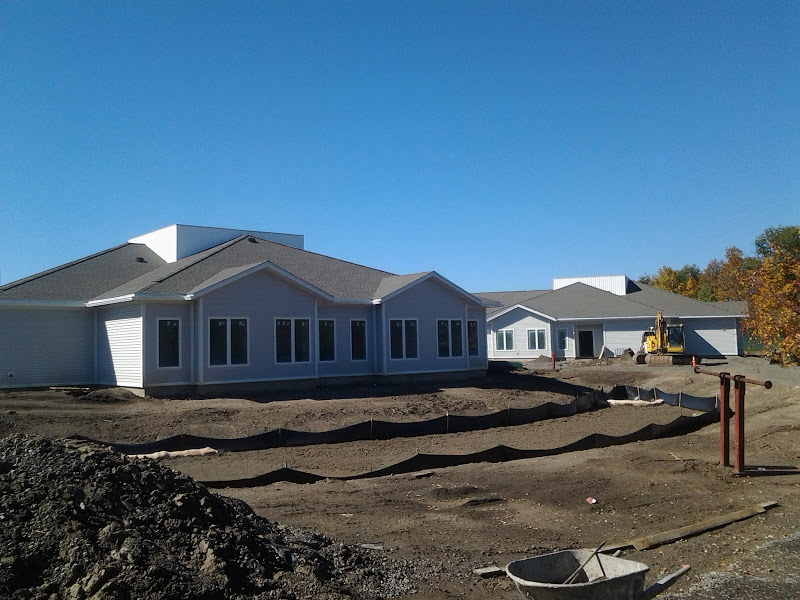
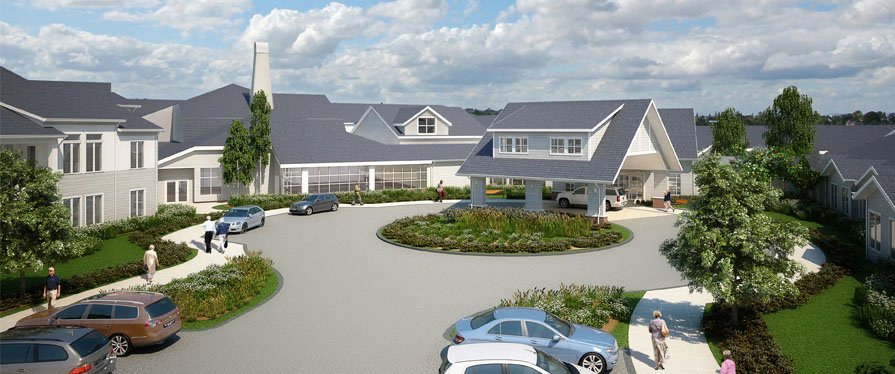
In Cayuga Heights, work is ongoing at the Kendal at Ithaca site as the project marches steadily towards its January 2016 opening date. The senior apartment wing is nearly complete, with just some minor exterior trim (balcony railings) and facade work left. New garages have been built for future tenants of the apartments. The skilled nursing facilities are largely finished from the outside, but are missing the decorative roofs and trusses, which will be installed later this fall. At least from the outside looking in, the new entrance circle/porte-cachere (photos four and five) looks like it has the most work left on its to-do list – windows have been fitted but the new entry and second-floor administrative offices have yet to have trim or facade materials installed. However, given that’s it’s one of the smaller additions, the project should pose no huge hurdle moving forward.

With the January opening date, landscaping work may not finish until the spring, when new trees and grass seeding can be done without fear of inclement weather.

Kendal at Ithaca is currently in the midst of a $29.3 million expansion. Three new wings will be built on the northeast side of the property as part of a new 48-bed skilled nursing center, an increase from the 35 beds currently available. On the southeast side of the complex, a new 2-story, 24-unit apartment wing is being built for independent seniors (16 one-bedroom, 8 two-bedroom). A new entrance, cafe, fitness center, and health center are also included in the additions, as well as major interior renovations. Landscaping additions and a 26-car parking lot are also planned. The construction project is aiming to achieve LEED Gold certification.

Construction began this past January. An estimated 20 to 25 new jobs will be created by the expansion, most of those in service positions that pay $24-$45k. The Kendal website seems to sidestep the discussion of costs, but a New York Times piece from when it opened in 1996 stated the entry fee was about $80,000 for a single person in the smallest unit, rising up to $267,000. Strictly calculating from inflation, the entrance fee may start around $120,000-$125,000 today.

Kendal was granted the privilege to issue tax-exempt municipal bonds by the county legislature to finance the construction of their new wings, but is not seeking any property tax abatement.

Local architecture firm Chiang O’Brien has partnered with the NYC office of Perkins Eastman to design the Kendal expansion. National contractor Lecesse Construction, with an office out of suburban Rochester, is in charge of general construction.

20151011_131238 20151011_131339 20151011_131344 20151011_131410 20151011_131433 20151011_131528 20151011_131532 20151011_131553

Kendal_1

expansion_banner


Upson Hall Construction Update, 10/2015

12 10 2015

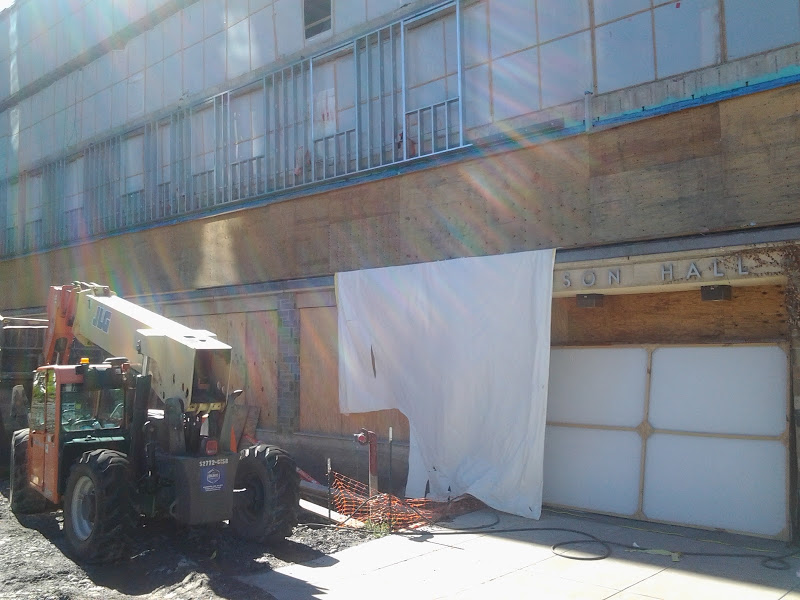
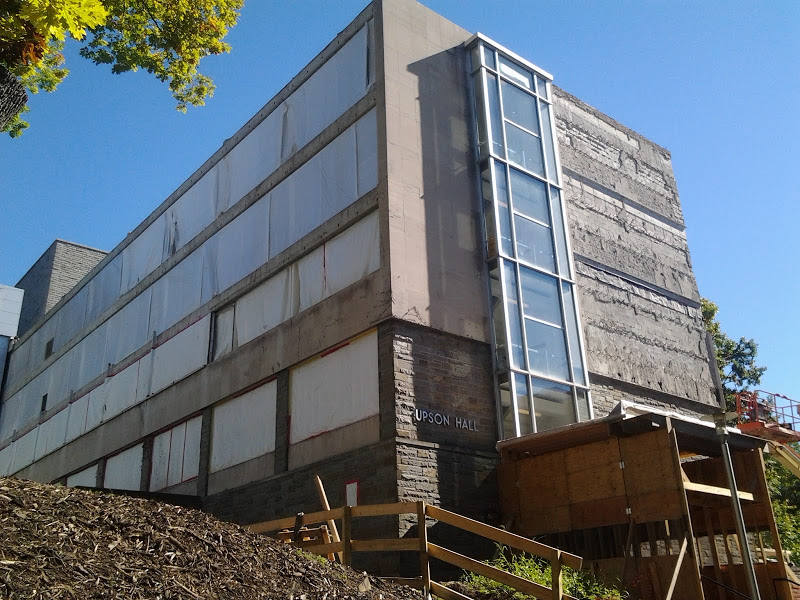
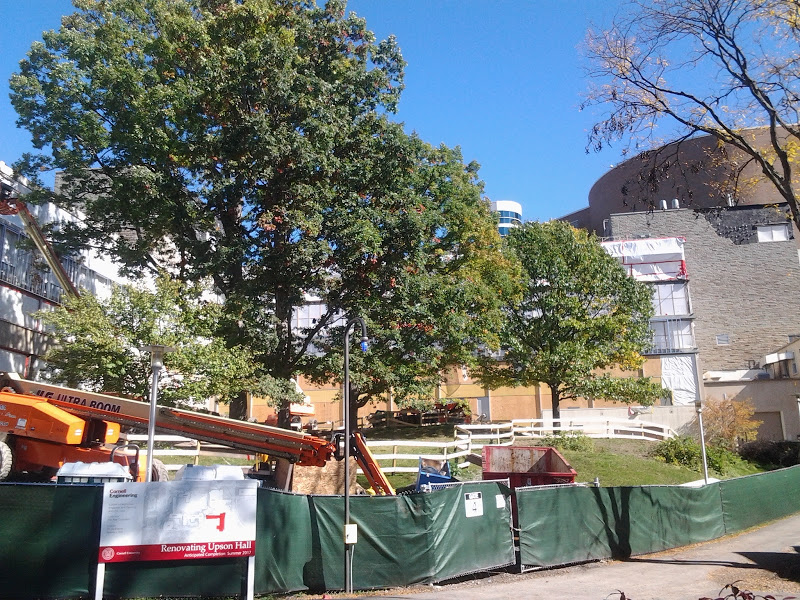
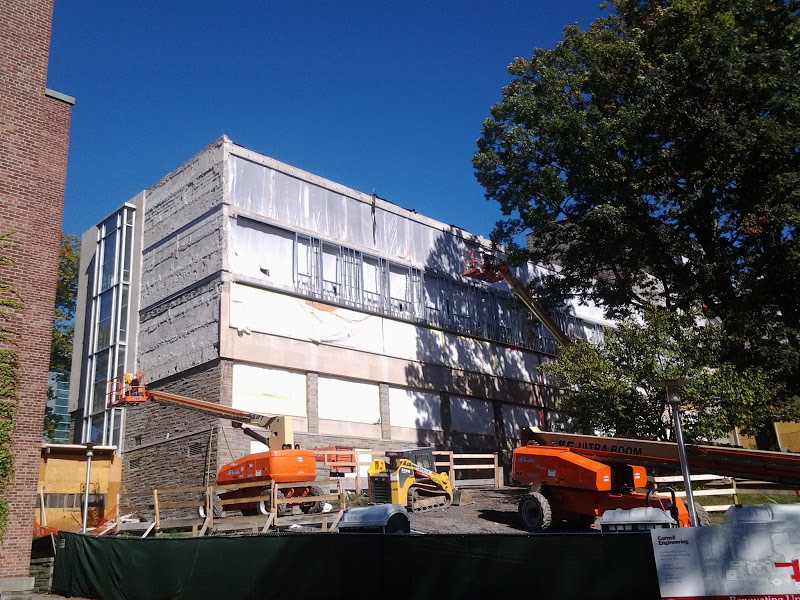
Over on the Engineering Quad of Cornell’s campus, work continues on the gut renovation of Upson Hall. Gone are the original Terra-cotta panels that banded the facade, and the bluestone that faced the building will be removed as the project progresses. Plastic sheeting covers the exterior, working as a vapor and weather barrier. Exterior metal studs, which form the walls, have started to show up on the third floor, with spaces indicating future window openings. These studs will be sheathed (probably with glass-mat gypsum sheet-rock) and later the facade will be put up after the windows have been installed and the building is fully closed in.

Inside the plastic sheets, new telecom rooms are being framed out on the first and second floors, and new drywall is being hung up. Wall framing for new classrooms and offices is underway on the third floor, as well as duct and pipe hanger installation (utilities rough-in). Floors four and five are still undergoing interior demolition – walls are being sandblasted to remove paint, worn-out mechanical, electrical and plumbing systems are being removed, and the old interior walls are being deconstructed so that the space can be re-purposed. New vertical shafts are being cur through the floors, and these will house state-of-the-art electrical and telecom infrastructure.

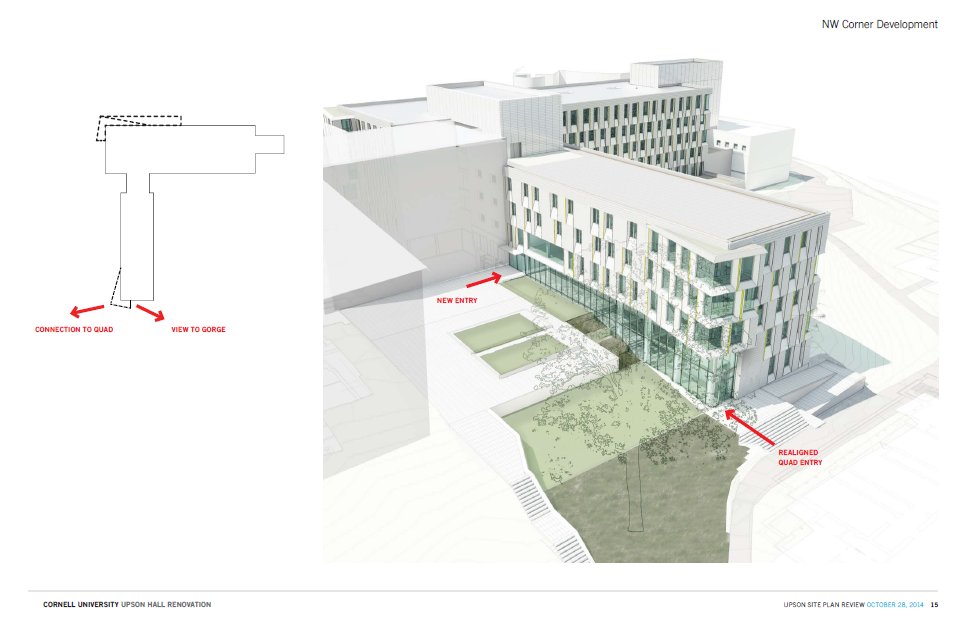
Sometime in the next couple of weeks (target date October 21st), the steel angle installation will begin for the northeast and northwest corners, which will be expanded outward as part of the renovation (the net gain in space will be about 4,000 SF). Steel clips will be attached to the existing structural steel, and then the new steel beams will follow. The entire project is expected to be completed by September 2017, with landscaping work in the second phase.

Upson Hall houses the Mechanical and Aerospace Engineering department, and previously housed labs and offices for computer science until the completion of Gates Hall last year. Built in 1956, the 160,000 SF building is being renovated and modernized at a cost of $63 million.The building will be seeking LEED Gold certification.

The New York office of Perkins + Will, who designed the original building during the height of modern architecture 60 years ago, are also working on the new design, in conjunction with New York-based LTL Architects and engineering firm Thornton-Tomasetti. The Pike Company out of Rochester has been hired on as the general contractor for the multi-million dollar project.

An interview with Robert Goodwin, the design director for Perkins + Will’s role in the project, can be found on the Voice here.

On a personal note, I walked through a spider web while getting photos, and once I got back to my car, found a fingernail-sized sandy-brown spider on my cheek. I quickly grabbed it and flung it onto my umbrella, and shook it out a moment later. Spiders don’t freak me out much, but if that had been a bee on my face, you’d be reading on the Voice that I either died of a heart attack, or drove into a wall.

20151011_132720 20151011_132726 20151011_132752 20151011_132846 20151011_132955 20151011_133005 20151011_133036 20151011_133040

100_2099upson_4


News Tidbits 10/10/15: Meeting With the Stakeholders

10 10 2015

1.There is nothing wrong with a little speculation. In a follow-up of sorts to the Voice piece about parking capacity in Downtown Ithaca, the Times’ Josh Brokaw did an interview of his own with city of Ithaca parking director Frank Nagy. Nagy believes that the 248-car estimate used by State Street Triangle is “way high”, but given that one of the refrains is that there’s not enough parking, they’d rather be safe than sorry.

More importantly, Nagy believes that the Seneca Garage only has about 10 years of life before a new garage will need to be built (the Seneca garage was built in 1972). The structural situation at Green Street is severe enough that the city may have to remove the end pieces and build up the middle section, which was renovated several years ago. The property is being reviewed, and with Tompkins Trust vacating office space on its ground floor as part of the move to its new HQ, the assessment is well-timed.

If the Green Street garage decides to go up rather than out, that leaves two very valuable properties that the city could sell to its benefit (financial, affordable housing, or otherwise). Both ends of the Green Street garage are zoned CBD-140, which offhand is the densest zoning in the entire city, 140 feet maximum height with no parking requirement. A zealous councilperson might try and change that post-SST, but as is, a rebuild of Green Street a few years from now could yield a lot of possibilities for downtown development. Put that in the notebooks for 2020 or so.

100_1281

2. Speaking of future plans, we have the bike debate currently raging in the streets. Now, this is only tangential to my usual work, and I am not versed in the topic, so it’s nice to go in without preconceptions.

The city just finished work on Board of Public Works (BPW)-approved bike lanes on North Cayuga Street, specifically an unprotected bike lane on the east side (protected lanes were considered, but not approved). Although meetings gave due public notice, there were no letters sent to Cayuga Street residents informing them of the change, and a number of folks were caught off guard, including members of the city’s Common Council.

In the one corner, you have folks angry about the loss of parking, the inconvenience, and the danger it poses to the elderly. Unfortunately, you also have a council member describing biking-proponents in the same tone one would describe Albany lobbyists. The mayor has come out in favor of the N. Cayuga Street bike lane, although according to the Times, he’s not a fan of “resident-driven infrastructure”. It’s really a fascinating read from a planning perspective. – Times coverage here, Journal here.

bike_lanes_1

For what it’s worth, bike lanes are a major part of walkable communities and reduced ecological impacts (carbon footprints). I feel like I’ve seen this type of argument play out from the perspective of development quite a bit – every new Collegetown or downtown building gets the “Ithaca shouldn’t allow big buildings/they’re ruining Ithaca/where are they going to park” argument, and the “Ithaca is not a small town/it promotes walkable communities/suburban sprawl is destroying Tompkins green space” counter-argument. The key problem with the bike situation seems to be a lack of communication between the BPW and Common Council (and residents by extension). Luckily, the planning board doesn’t quite have this problem – everything they vote on gets publicized, on this blog if not elsewhere.
cornell_novarr_1

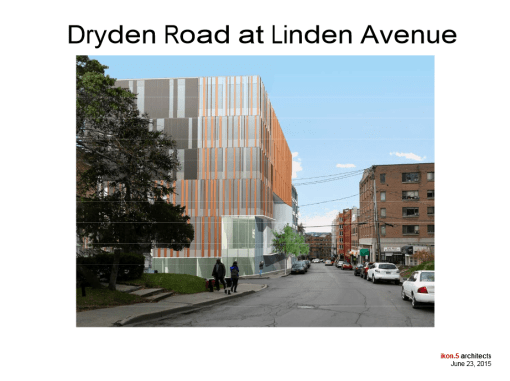
3. The last hurdle for John Novarr’s 215 Dryden Road project has been cleared. The Board of Zoning Appeals approved variances from the Collegetown Form Guidelines – the corner isn’t chamfered or set back enough and the building only has one main entrance (the form-based code mandates an entrance every 60 feet of non-residential space). The owner of the house across Linden from the corner was the lone opposition speaker, and the BZA vote was 4-1, with Marilyn Tebor Shaw opposed. No reason for Shaw’s decision was provided in the article.

With all the approvals tucked away, all that’s needed is for the city to sign off on the building permit. Expect this one to be underway within the next month.

image1 image2

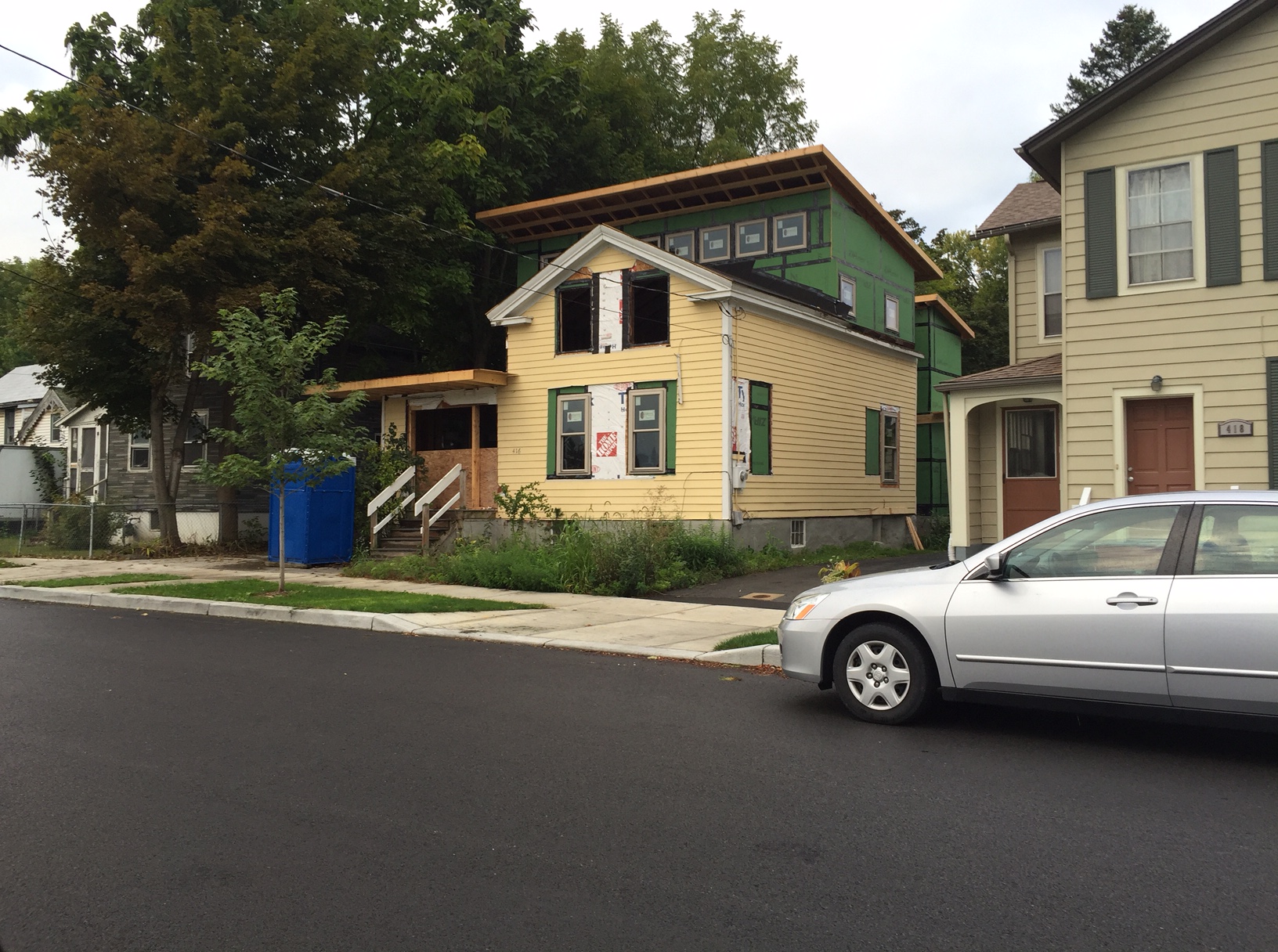
4. Reader submissions are always welcome. The photos for this week’s “House of the Week” featurette come courtesy of Frost Travis. The house receiving the addition is 416 North Plain Street in Ithaca’s Washington Park neighborhood. The current owners brought the property in October 2014. County records give it a 1900 construction date, which is often a default for old and unsure; it appears on an 1889 map of the area, but was not yet built in the 1866 map.

The rear addition looks like it’s been underway for a while – the exterior has been framed and sheathed with plywood Huber ZIP system roof and wall sheathing, which uses seams and tape to save time vs. traditional sheathing such as Tyvek housewrap. There are some windows fitted into the rough openings, but there’s still plenty of work to do with closing up the exterior and interior utilities rough-in. Looking at the original house, the owners appear to be fitting smaller windows in place of the originals – two window cutouts on the north wall have been filled in with sheathing, and a new window has been fitted in a new opening. The front door and adjacent window are gone, one large rough opening in their place. The front roof above the door and window was slanted, but has been dropped to a flat roof as part of the renovation and addition. Presumably, the butter yellow vinyl exterior will be re-finished as construction progresses. With any luck, this one will be finished before winter comes.

Pg-3-Rendering

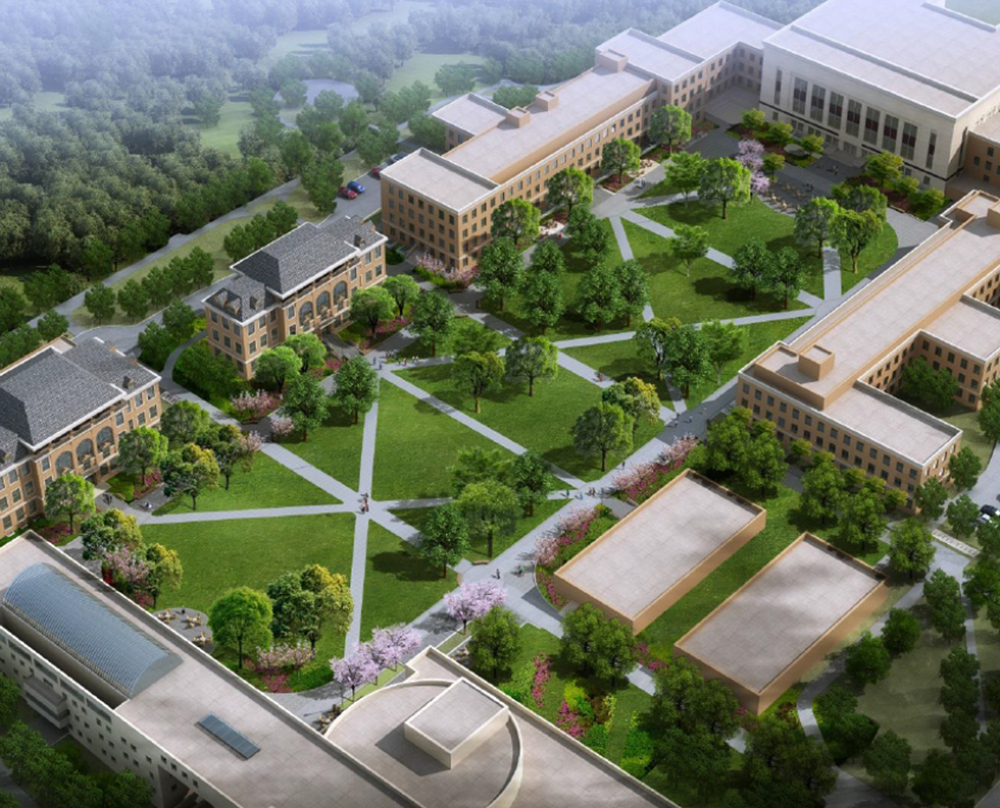
5. What a quick turnaround. The Cornell Daily Sun first made mention of the Ag Quad renovation last week as part of its coverage of the Collegetown Neighborhood Council meeting. Now only a week after Cornell shared a glimpse at the cards in its hand, they’re playing them. The $9.6 million project will be broken down into two phases, one that focuses on infrastructure, and one phase on landscape improvements (and being that much of the infrastructure is underground utilities, phase one could be described as churning up the ground, and phase two is making the upturned dirt pretty again). The renovations, which are set to start next summer and run through 2017, will include additional emergency phones, a rain garden, and outdoor gathering spaces in front of Mann Library and Roberts Hall (upper right and lower left in the above render).

Too bad those temp buildings are still there between Kennedy Hall and Plant Science. If the Southern Tier wins that Upstate Redevelopment competition, I have an idea where the new Plant Science Commericialization Building should go.

6. Plans for 416 E. State have evolved since the bar was first proposed. Originally conceived as a general bar/drinking establishment, developer and Argos Inn architect Ben Rosenblum has faced substantial opposition to the project – neighbors are vociferously opposed to a bar, citing noise problems and concerns about smokers, and the county planning department was not a fan of the traffic and parking arrangement, which had after hours parking across the street at Gateway Plaza. Although the project doesn’t need planning board approval, it does need BZA approval – area and setback deficiencies have resulted in the need for a zoning variance. The building itself won’t change dimensions, but the change in use triggers the city zoning laws.

416_e_state_v2_1

Representatives for Rosenblum and neighbors have met, and the compromise Rosenblum and his associates have proposed involves a lounge-type of establishment they’re calling “The Printing Press”, after one of the previous uses for the late 1940s warehouse. They’ll be going for an industrial/”speakeasy” aesthetic, and targeting the same older, more affluent clientele that patronizes the Bar Argos next door. Signage would be minimal, and exterior work limited largely to an accessory parking lot/handicap access, landscaping and a new coat of paint. Looking at the original plan vs. the revised plan, the bar no longer is in the rear corner, but moved closer to the building center so as to buffer the noise of patrons from disturbing neighbors. Parking will be shared and organized with the Argos Inn’s lot. For more info, cover letter here, renders here, vision statement here.

The new parking arrangement may assuage the county, and the low-key bar located centrally in the interior may be enough to satisfy some of the neighbors. But we’ll have to see the BZA’s reaction and what remaining opposition there is before anything is set in stone.

hotel_ithaca_v3_1

hotel_ithaca_v3_2

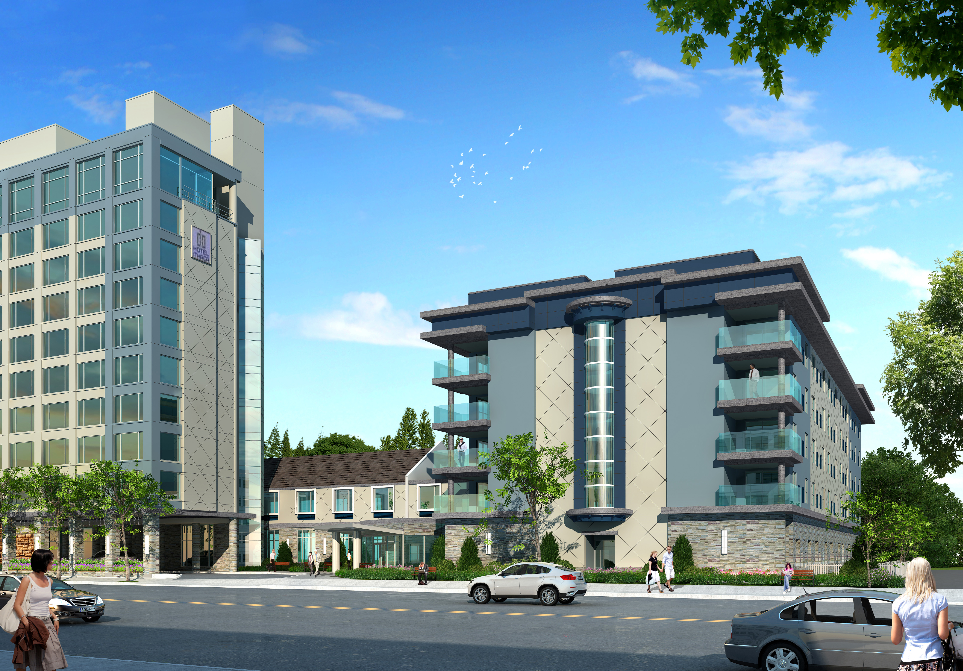
7. The Planning and Development Board has scheduled a Design Review Committee meeting to offer guidance and commentary on the styling of proposed buildings. While State Street Triangle isn’t on the agenda (yet), the Hotel Ithaca addition is. Renders here and here.

I’ve toned down my opinions over the years, but this…well, let’s just so those “sick burns” Nick Reynolds mentioned at the last planning board meeting were pretty well justified. I mean…yikes. The cross-hatched blank walls, the circular glazing, the “tourist trap” aesthetic. There’s an alternative being shown with small windows in place of the circular glazing, and rectangular facade hatching instead of the cross-hatching, but it’s not a great improvement. The board’s going to have a lot to say with this proposal.
215-221_spencer_v3_2

215-221_spencer_v3_1

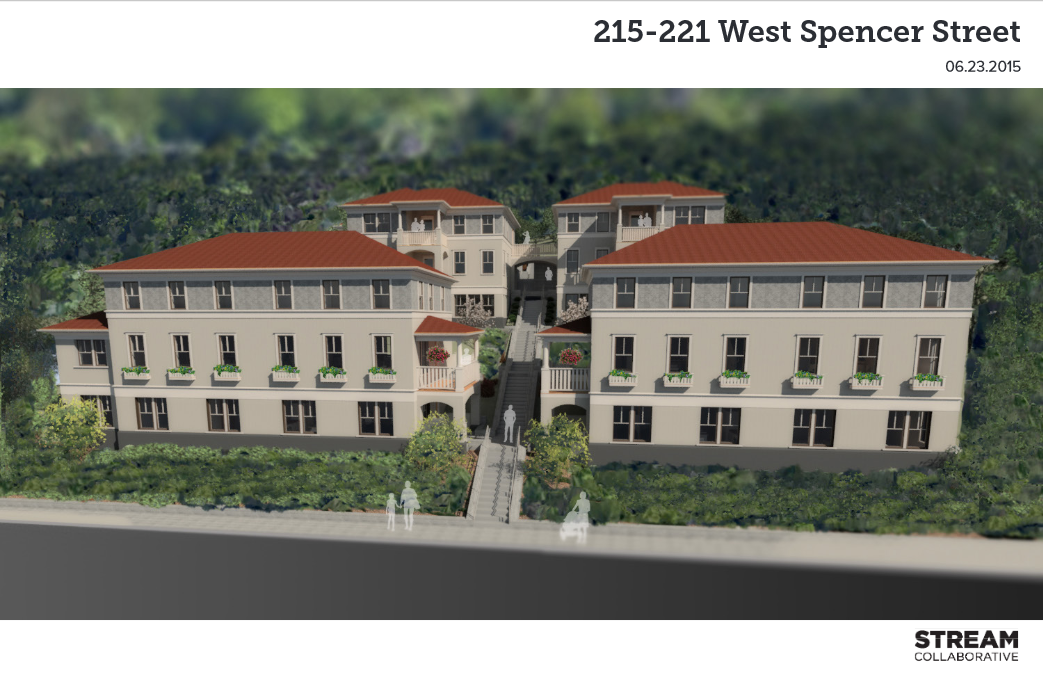
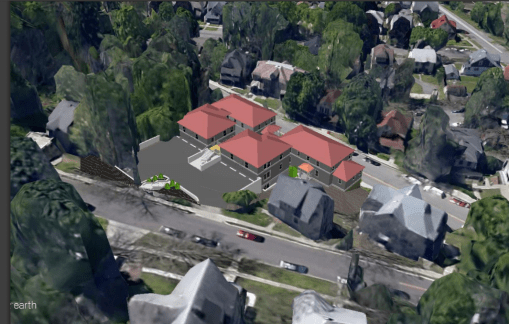
8. I had hopes that for the first time in three years, a major project would go through the boards without complaint or opposition. Hopes dashed. The complainant against the 4-building, 12-unit 215-211 West Spencer Street project cites the loss of the city’s parking lot on the site, the narrow width of S. Cayuga Street (the “rear” road), traffic, and no neighborly interactions because it’s a rental that faces Spencer Street.

215-221_w_spencer_orig

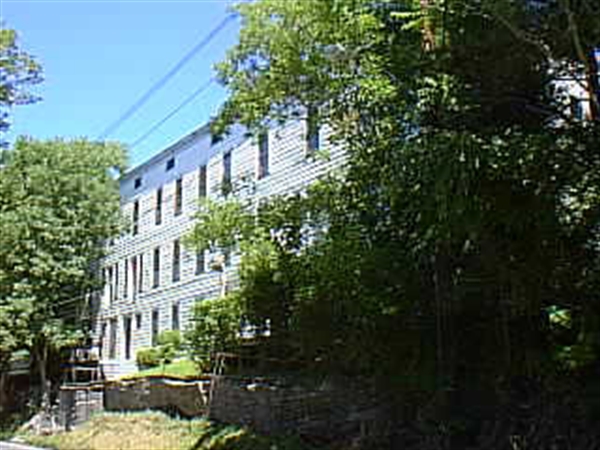
The kicker is, the letter-writer lives in an upscale Lansing subdivision. He rents out his 3-unit Cayuga Street property. The “house” that the letter claims used to be on the site is also misleading. It was a run-down multi-story apartment building (shown above in the photo from county records), demolished 12 years ago by the city, and turned into an informal parking lot that was never meant to be a long-term use. The land was sold by the city to Ed Cope for $110,000 last March.

I’m willing to entertain legitimate arguments and complaints to projects. But this isn’t one of them.


News Tidbits 10/3/15: Lying in Wait

3 10 2015

1.We’ll start with a news piece out of the ‘burbs. Over in Lansing town, wealthy homeowners are accusing the town board and the town planning board of disenfranchising and ignoring them over concerns about the proposed Novalane housing development. Dan Veaner at the Lansing Star gives a very thorough rundown here.

Quick summary, Novalane is a 19-lot high-end housing development slated for farmland between two other high end housing developments, the mostly-built Lakewatch and Eastlake subdivisions, the first phase of which is comprised of seven lots on the west side of the parcel. The sticking point has to do with access roads for the new homes. The developer proposes to connect the two developments via the Smuggler’s Path cul-de-sac, which would extend down through an undeveloped lot in Eastlake and connect with Eastlake Road.

According to the town, the intent has always been to connect the two developments – but apparently, no one ever had a good idea where. Neighbors on Reach Run are incensed because they’re afraid of additional traffic on their road if the connector isn’t extended all the way, but if connected, Eastlake residents are opposed to cross-traffic they suspect will cut through to get to East Shore Drive. Aside from that conundrum, some neighbors have suggested being okay with the road if it went all the way from Smuggler’s Path to form an intersection with Waterwagon Road, but that doesn’t seem possible given the property lines of the Rec Club. At the very least, it would be a big burden in the development costs.

So on the one hand, here is a town that has struggled with planning issues. On the other, you have wealthy residents angry about construction vehicles accessing the one house currently under construction in Lakewatch, and prepared to sue the town over the potential of seven more houses. There’s also this gem of a line:

“We’re large taxpayers.  It’s an autocracy.  To be treated like that by our own representatives is incorrect and not acceptable.  Who are they working for?”

Maybe all taxpayers and not just the large ones? Just saying.

2. Switching over to another ‘burb, the proprietors of Storage Squad made their pitch to the town of Dryden, per the Ithaca Times. Storage Squad, a Cornell startup that has expanded to twenty cities, seems to have a rather unique take on the appearance of self-storage. For their facility planned at 1401 Dryden Road, the company wants to build 79,600 SF of space, 70,000 SF of which would be in five buildings consisting of 400 storage units. 315 units may join 3-4 years down the line. According to the presentation, there would be a Cornell-inspired clock tower, brick and ivy growing on the side walls. Paved entries, gated, and split-face concrete masonry units. Apparently, it was enough to win the town supervisor over. A special zoning permit will be required, but approval is expected later this fall. No word on whether they’ll keep the 150-year old house on-site.

3.  Must be a good week for Dryden. The eyesore at 76 West Main Street has been sold and has a construction loan approved to finish renovations. The Ithaca Voice article I did on the reno is here. I toyed with the idea of calling Dryden mayor Reba Taylor for a quote, but I figured I’d get a very generic statement it any at all, and in the interest of time the idea was shelved. I might get a response to one-third of the calls I make regarding development/real estate stuff, which can be frustrating but I’ve gotten used to it.

state_st_triangle_v5_1

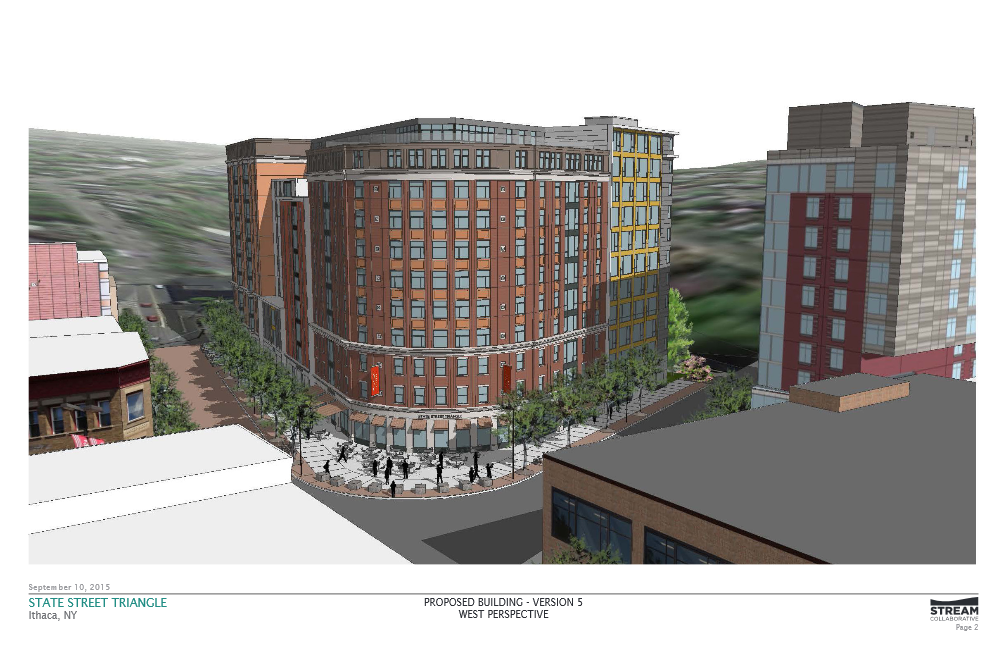
4. The Times’ Josh Brokaw brings out an update on the latest State Street Triangle news. The important details:

– CTB has agreed to take one of the commercial spaces. No word on how that would affect the North Aurora Street location a couple blocks away.

– The planning board didn’t have many words; One member suggested the curve portion was “too flat” and an arcade on the first floor (not the video game kind, but the archways over a walkway kind). A second brought up affordable housing, which the developers have given consideration, but isn’t in the current plan.

– In favor: the director of Cinemapolis, other developers, CTB’s owner and students. Not in favor – the head of Historic Ithaca, and councilman George McGonigal – who opposed the Stone Quarry Apartments, the waterfront rezoning, 210 Hancock and thinks the city can make Cornell build dorms. The Times has called him out as “anti-urban”. If a councilperson outside the first ward speaks out, it’ll get a lot more credence on this blog.

304_college_2

304_college_3

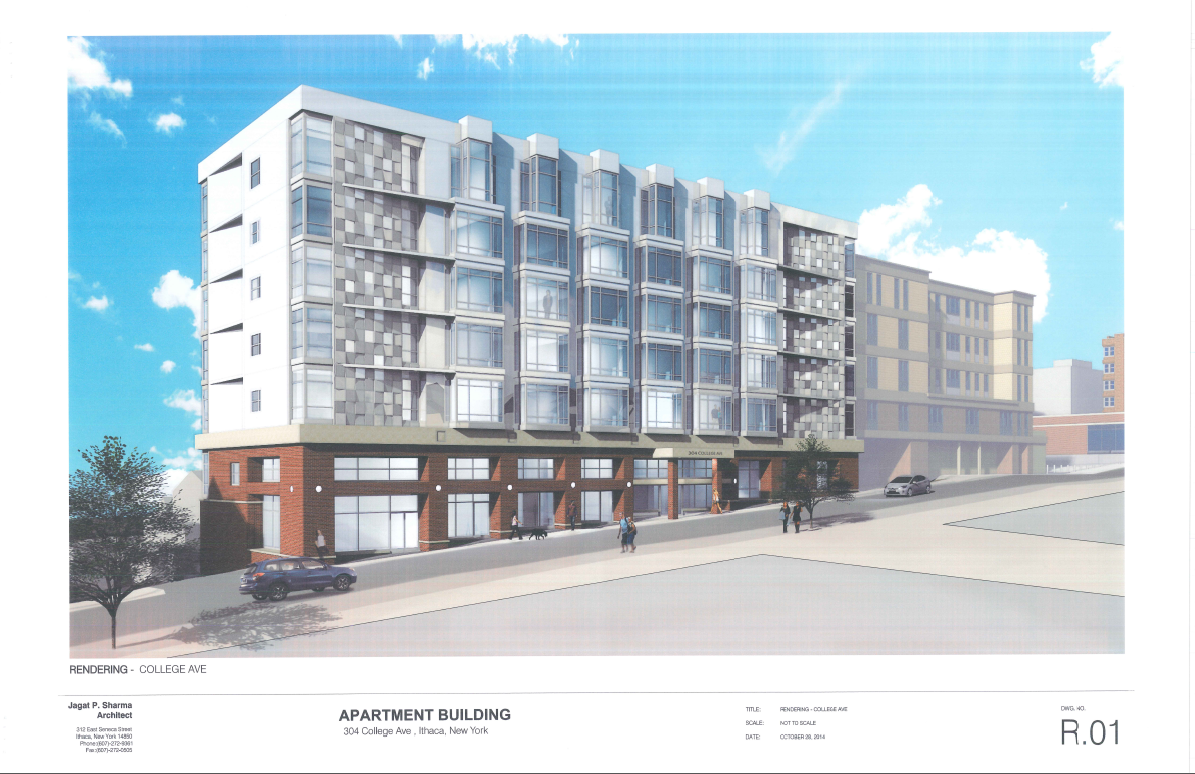
5. The city and Cornell gave an interesting presentation about development to the Collegetown Neighborhood Council this week. City planning director JoAnn Cornish gave a rundown of what’s planned, included the 102 apartments 302-306 College Avenue (phases one and two shown above). This one might still be in the hopper, but don’t expect it to move forward anytime soon – the developers (the Avramis family) have rented out the houses to be demolished through May 2017. It also seems like that one building would be in the 2017-2018 time frame, the second 2018-2019. So these two mid-rises are quite a ways out, assuming they’re still in the works. Also, Fane’s 12-story proposal for 330 College is still dead, but something more modest may come forward someday.

On another interesting note, Cornell’s lead planner, Leslie Schill, said the university may be looking into turning Eddy Gate and the Sheldon Court plaza into green spaces to offset the lack of parks in the neighborhood. Cornell might also renovate the Ag Quad into a richer pedestrian experience.

6. The Carpenter Business Park purchaser continues to intrigue. A company called Carpenter Business Park LLC, using a P.O. Box ties to the Miller Mayer law firm, has bought two more parcels after buying the four unused land parcels in the Carpenter Business Park for $2.4 million last August. This time around, the LLC purchased a nondescript one-story commercial building at 742 Cascadilla Street, and a nearby tiny silver of land between the Palisades Corporation and Cornell U. Press buildings for $304,000. It’s not clear what the buyer is intended to do with all these properties (we know it’s not a big box store), but it’s definitely curious. If something comes up, it’ll be shared here.


The Newfield UFO

29 09 2015
newfield_ufo_1

Image property of the Cornell Daily Sun

October 24, 1967. It was a typically crisp October night in Newfield. The hamlet and town were even quieter than they are now, just the scattered homes of farmers and a few commuters, tuned-out from the tumultuous world around them. They knew of the Soviets and Sputnik, of Johnson and the Apollo program, but were so far removed that it would serve only as a vague interest, coffee talk. By any account, it should have been just a normal, serene night in the hills and valleys southwest of Ithaca.

But at about 9:30 PM, the strangest set of events unfolded in the hamlet. A 12-year old boy named Donald Chiszar said he witnessed a “craft” hovering about 130 feet above the ground. There were markings on the craft, which he could not recognize, and a large window. Two humanoid figures could be seen in a saucer-shaped craft. “But then all of the sudden it leveled off real fast and disappeared”, Chizsar claimed. The visitors were “[r]ough-colored and brownish” beings with “big, wide hips”.

Though no one else claimed to see the craft up close, many other folks in Newfield that evening reported seeing strange lights. Red and white, or green and white, flashing in some kind of sequence. Stanley Orr, driving on 13 to Ithaca the night before, reported “two large, stationary red lights” visible from his car, but at no time thought they were a flying saucer, until he had heard about Chizsar’s experience.

Overnight, people in Newfield began to see UFOs everywhere. On October 30th, more than 100 sightings were claimed by local residents. So started the “Great Ithaca Flap“, as it would be later known.

Now, these sightings caused quite a stir. People wanted an explanation. Many of the witnesses were convinced that what they saw was not of this earth. Residents of Newfield invited UFO experts and an Air Force Lieutenant from the Hancock Air Force Base to a meeting at a local home, so they could hear about their experiences.

One of the UFO experts was intrigued by the stories, but said the lights could be easily mistaken, just tricks of the eye. The air force lieutenant, Gerald White, was less accommodating, saying that it sounded like airplanes to him, traveling along one of the major air traffic conduits out of and into New York City. Newfield laid below one of those routes. Cornell astronomers were rather incredulous as well.

The sightings continued well into November. One of the UFO investigators, William Donovan, set up shop on Newfield’s Main Street, and went about interviewing witnesses and examining sighting locations. A meeting was held in Ithaca, and the claims of sightings were in the hundreds. Although the police and military were skeptical, residents felt like the truth was being hidden from them. Some residents felt the UFOs were related to the Synchrotron (a particle accelerator) on Cornell’s campus; it was reasoned that being one of the few facilities able to bring atomic particles to near-light speed would attract alien visitors, and some of the “flight paths” came from that direction. The local papers picked up the stories and relayed them with interest. Folks crowded the secluded pull-offs and star-lit fields, hoping for a glimpse of something extraordinary.
Finally, in December, Donovan stated that he could find no proof that Newfield was seeing flying saucers. He didn’t offer ideas as to what people saw, he just said that there was no hard evidence that Newfielders were seeing UFOs.

Or course, that didn’t stop the college students from having fun with the news; students launched laundry bags filled with burning fuel, and in one case a local pilot fitted a strobe light to his plane to instigate the UFO-watchers below. Eventually, the sightings tapered off as interest waned. A year after the sightings, Donovan was charged with fraud on an unrelated matter. Occasional reports of UFOs still come in from all over the county.

So was there a UFO in Newfield on that cool October night? Well, probably not. A UFO tracking website reported on the case several years ago, and received the following email:

“I stumbled over references to UFOs over Newfield NY in 1967.
I guess I have a confession.
 
I was a student at Cornell University’s College of Engineering in 1967. I was curious about hot air balloons, and wondered whether or not I could make a working model. I took a dry cleaning bag, sealed up the openings at the top, built a framework to hold the bottom open, and then placed a “heat tab” from a Boy Scout Heat Tab stove on the frame.
 
I then brought the bag out to the “dust bowl” between the University Halls dormitories, lit the pellet, and held the bag upright to keep it from catching fire. Within a few minutes, the bag arose and began a journey, sailing out of sight to the southwest direction.
 
Within the same moments, I had drawn an audience of about a hundred freshmen students, curious as to what I was doing. Once the bag lifted off, some of the students began trying the same trick. Some succeeded while others failed. My success was based on the fuel: the heat tab.
 
I must say that my creation was a sight to behold. The heat tab produced a constant glow, and the clear bag took on the light in a way which magnified the existing light. It was strange, to say the least.
 
The next day, I was surprised to see an article in the Ithaca Journal titled, “UFOs Spotted over Newfield“. It didn’t take more than a split second to make the connection that the UFOs may have been the bags we sent aloft from Cornell. The direction and the timing were right!
 
Is there any possibility that my college prank was the cause of these UFO sightings over Newfield?”

It would seem Newfield has more to fear from curious college students than space aliens.


News Tidbits 9/26/15: Trying to Keep Tabs

26 09 2015

1. It’s rare for a substantial project to go completely under the radar from start to finish. Except that’s pretty much what happened with the following building.

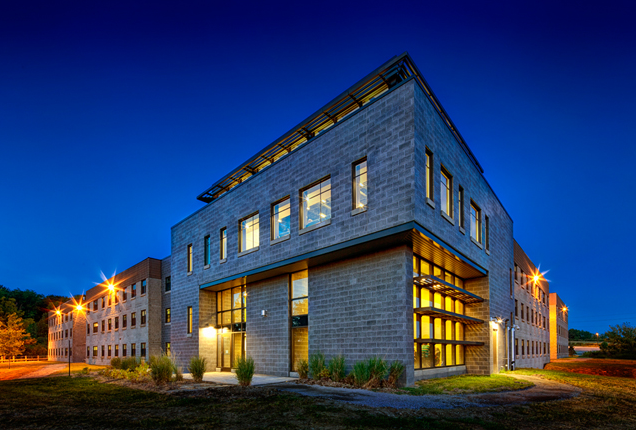
Tompkins Cortland Community College (TC3) recently finished renovations to two of their dorms on their Dryden campus. Along with the renovation of about 41,000 SF of existing space, the two dorms were connected by a new 3-story, 10,000 SF addition designed by Ithaca’s HOLT Architects. The existing dorms sat at a 90° angle to each other, so the addition by HOLT creates a single, L-shaped structure, with the expansion holding common space and amenities. Binghamton construction firm William H. Lane Inc. handled the build-out. The image above comes courtesy of HOLT’s website.

Technically, it did come up once on the blog, but it was misinterpreted. When William H. Lane announced it was opening an Ithaca office to handle the growth in their Ithaca/Tompkins work, one of the examples given in the Binghamton Press & Sun Bulletin was a dormitory expansion at TC3. At the time, I had done a search for the project and filed an inquiry with TC3, but there was no response, and my search only turned up renovations underway for the main classroom building. I assumed there was a miscommunication, so…oops.

2. In real estate sales, it looks like a couple of the smaller developers were in buying mode this week. Lansing’s SDM Rentals (Scott Morgan, owner of SDM Landscaping) bought a vacant 2.93 acre parcel at approximately 455 West Dryden Road in the town of Dryden for $21,000 on the 23rd. If past behavior is any indication, Morgan will probably be looking to do rentals, likely a few townhouses on the property. Currently, Morgan is planning 8 duplexes (16 units) at 543 Asbury Road in Dryden, which may or may not have a zoning issue. Morgan is also building out on Bone Plain Road in Dryden, and owns the recently-built Meadowbrook Apartments (14 units in the form of duplex townhouses) at 393 Peruville Road in Lansing.

Meanwhile over in Danby, Chris Petrillose of Petrillose Properties picked up a 2.11 acre parcel along the 400 block of Troy Road for $34,000. Given that that area has seen a lot of scattered small-scale development (1 & 2-family homes) in the past few years, and that Petrillose finished work on duplexes in Ithaca town, a couple rental units seems likely.

hotel_ithaca_2

3. How well was the Hotel Ithaca received? Let’s quote IJ Reporter Nick Reynolds’ Twitter:

Many sweet, way-over-my-head architecture burns thrown tonight. Let’s just say you guys aren’t getting a Hotel Ithaca update anytime soon.”

The primary complaint focus not on function but on form – according to the IJ follow-up article, materials and a dated design were dinged by board members (and comments about “LEED-certified stucco” and comparisons to the Bellagio didn’t help). NH Architecture’s portfolio tends to be the same general design, which means they’re going to have to go the extra mile on this one, or developer Hart Hotels might need to switch up their approach. Their Belhurst Castle Hotel design isn’t bad, so maybe they can channel some of that creativity into the downtown Ithaca site.

So rest assured, “Cornell PhD”, those cross-hatches aren’t making it off the drawing board anytime soon.

casca_landing_1

casca_landing_2

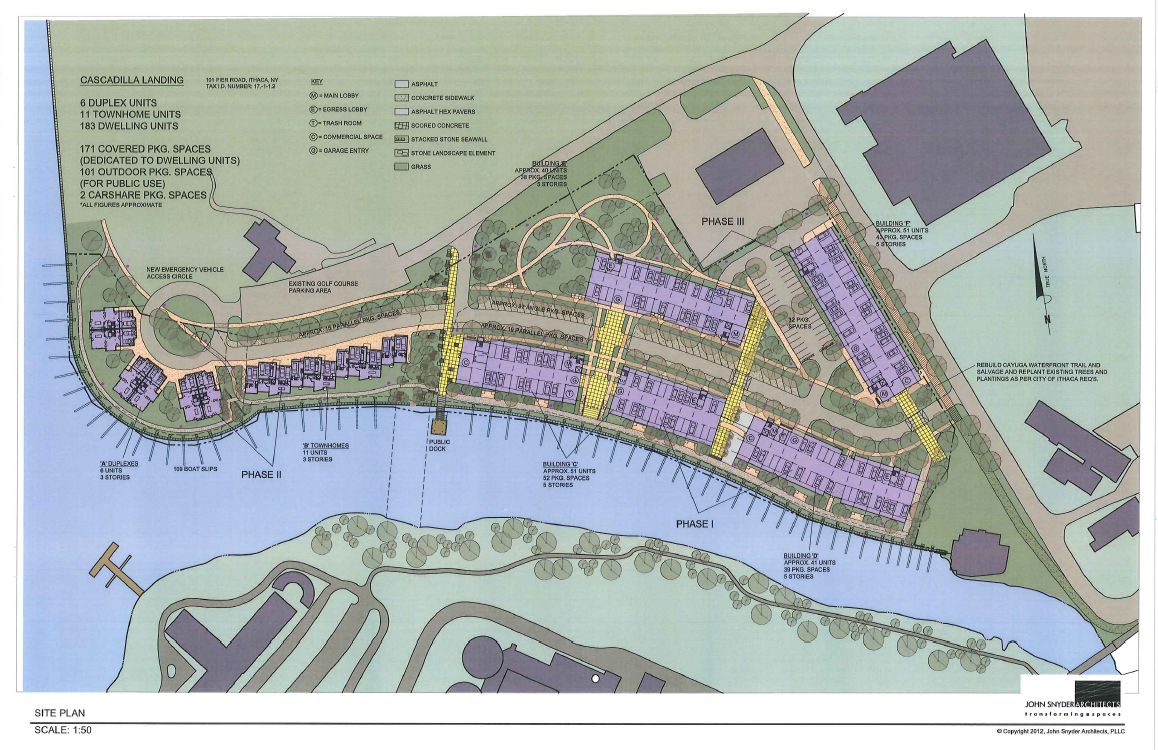
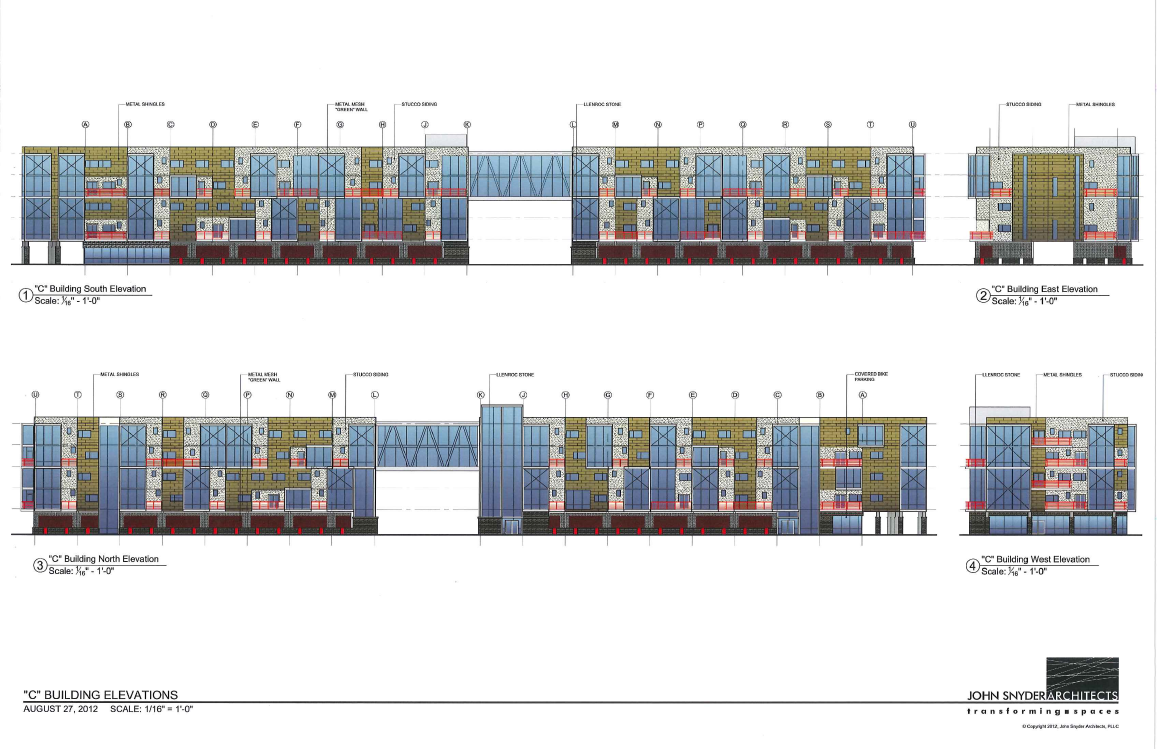
4. A few years ago (spring-summer 2012), the city planning board reviewed and approved a large project for the Ithaca waterfront called “Cascadilla Landing“. The three-phase, 183 unit project called for 6 units in duplexes, 11 townhouses, and the remainder to be built in 5-story apartment buildings designed by Ithaca architect John Snyder (the same gentleman behind the Carey Building addition). The first phase called for two buildings and 92 units, Buildings “C” and “D” (“C” shown above). So the project was approved and then…nothing. Never got off the ground.

However, the impending closure of Johnson’s Boatyard on Pier Road is piquing my curiosity. Now, initially it seemed highly unlikely because I thought Cascadilla Landing had never been fully approved (in fact, it received preliminary approval in September 2012 – thanks Noah). But since it was approved, all an ambitious individual would have to do is simply re-apply for approval if there are no changes to the plan (PB approval is only good for 2 years – part of the reason why Harold’s Square was back before the board last month). It’s still unlikely that the project is moving forward soon, but not impossible. A phone call to Snyder’s office and a call to Pier Road Properties (the developer as represented by accountant Andy LaVigne on the application materials) have so far not been returned.

chapter_house_reconst_3

5. Preliminary, but it’s nice to see work progressing on the Chapter house redevelopment. Voice article here. The key thing to stress here is that there are design studies, and they’ll be subject to the ILPC’s whims. It looks like making the fourth floor of the Chapter House habitable or not is something that’s still being debated, along with the plans for the still-standing 408 Stewart. It’s hard to believe that things will be ready in August 2016, given that there’s no formal application yet, and the languid pace projects like this go through the commission.

Also, it was extraordinarily difficult to get a hold of most of the relevant parties for the article. Neither architect responded, I couldn’t get a hold of city Historic Preservation Planner Bryan McCracken…thankfully, Jerry Dietz was happy to assist, and although I felt a little bad calling ILPC Chair Ed Finegan since he has no formal part in the project itself, he was a big help. Both were keen to stress the preliminary aspect of this project, which hopefully came through in the article.

But I’ve just about had it with responding back to commenters on the Facebook article.


The 160-foot Hurdle at 815 South Aurora Street

23 09 2015

815_s_aurora_2

Developer Todd Fox has big plans brewing for Ithaca’s South Hill, but a cell phone tower stands in the way.

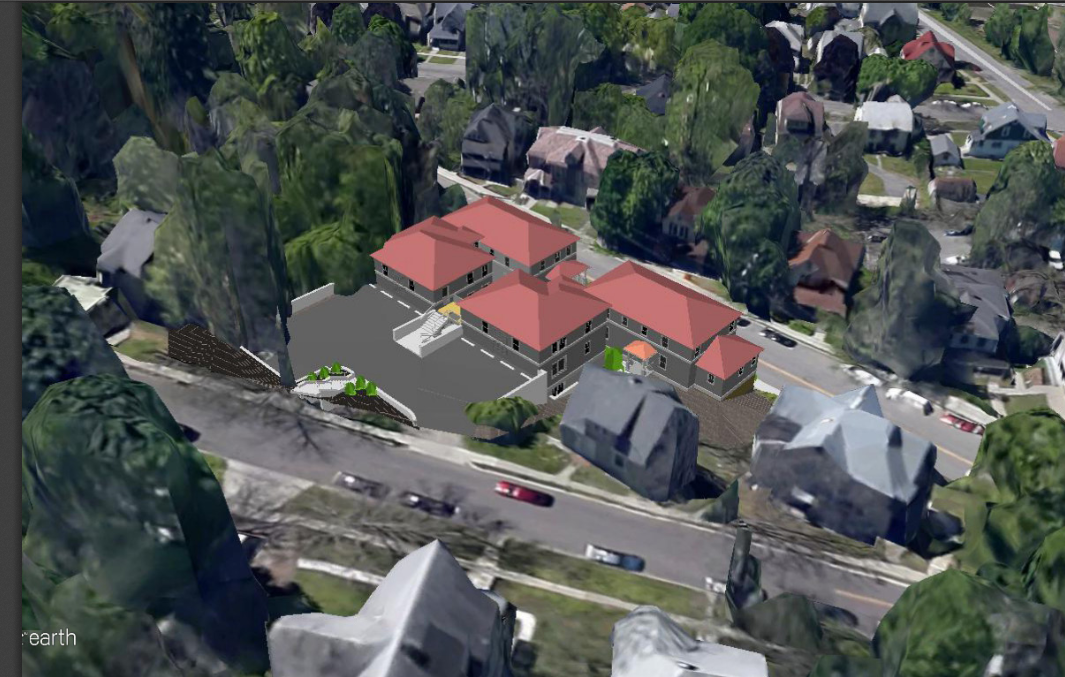
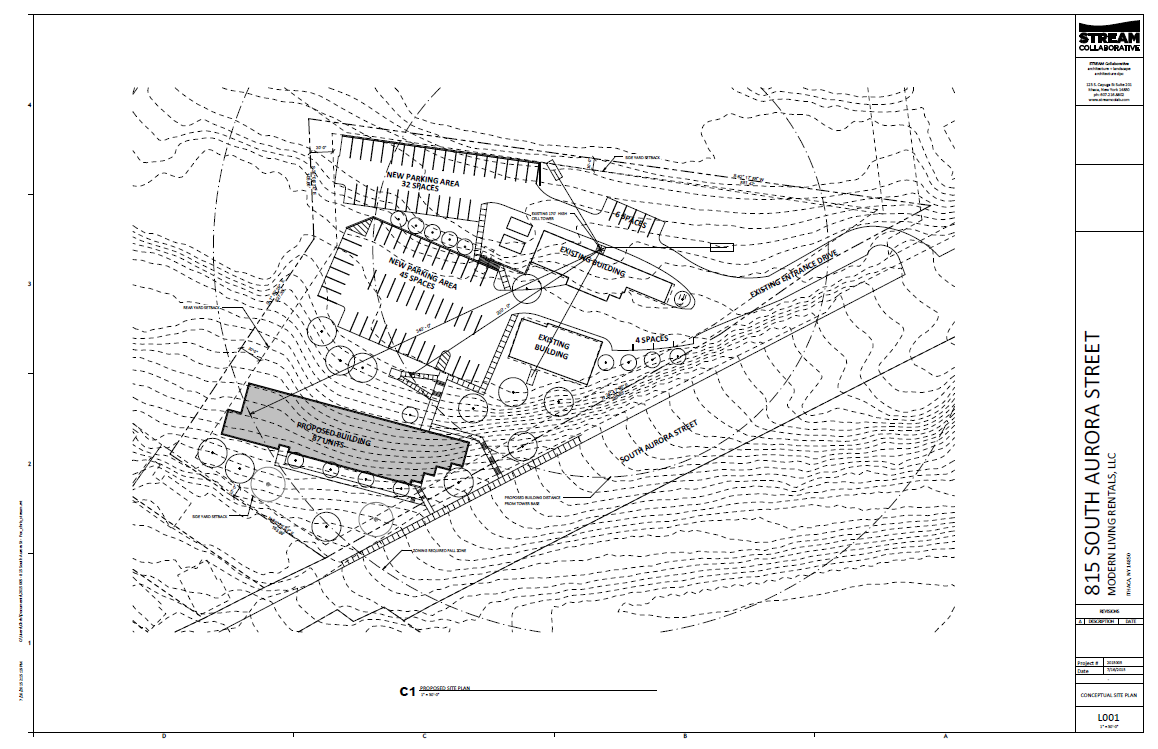
Fox, one of the owners of local rental company Modern Living Rentals (MLR), shared preliminary plans for an 87-unit apartment building at 815 South Aurora Street at the Planning and Development Board meeting Tuesday evening.

Fox’s plans call for a multi-story apartment building built into the hillside, a block from Ithaca College and near Rogan’s Corner. The design, created by Ithaca-based architecture firm STREAM Collaborative, is reminiscent of nearby Emerson Power Transmission, with design cues from the former factory incorporated into the new apartment building. All 87 units would be studio apartments (i.e. no formal bedroom space). 87 parking spaces are also planned.

The building site at 815 South Aurora Street is currently a sloping grass field on the north side of a 2.5 acre lot. Two other buildings on the same property would be unaffected.

Compared to other projects that have come before the board in the past couple of years, 815 South Aurora has a unique obstacle. A cell phone tower, and a city law by extension.

815_s_aurora_1

The current city ordinance states that buildings can’t be built within a radius equal to double the height of a communications tower. In this particular case, the tower stands 170 feet tall, meaning nothing can be built within 340 feet of the tower. Two apartment buildings in the Hudson Heights Studio Apartments complex, and the current buildings on site are grandfathered in; they were built before the law was enacted.

To help make his case, Fox hired two private engineering companies (Ithaca’s TAITEM Engineering and Groton’s Spec Consulting) to analyze the case, and their findings determined that an appropriate fall zone is the height of the tower plus 10 feet for a little wind/bounce – so 180 feet total. With this info in hand, Fox is trying to get the city to refine the zoning to allow the decrease in fall zone and therefore permit the land to be used for the proposed apartment building.

Previously in June, Fox had approached the Board of Zoning Appeals (BZA) asking for a modification from the law. However, the BZA said it would not consider the application. The city attorney advised the BZA that they can’t override a council-approved law outright. However, the BZA could make a consideration on a case-by-case basis, which meant that Fox and architect Noah Demarest would have to present a firm plan for the site, and then apply for a code variance before any decision could be made. Which leads us to the present; a project on the table, with a 160-foot hurdle.

In an email, Fox wrote “[a] fall zone of twice the height is an arbitrary safety distance. The ordinance was created at a time when Cell towers first began being constructed and there was not much knowledge about them at that time. We also contacted as many municipalities in Central New York that we could and everyone that we talked to had the fall zone being just the height of the cell tower plus several feet, give or take for debris throw off. ”

815_s_aurora_3

When asked how his project would be compatible with the rest of the neighborhood, Fox replied “[w]e feel like our project helps serve as a gateway into Ithaca. One of the things that we found very enticing about this project was the opportunity to pull Ithaca College students out of the South Hill neighborhood.”

“One of the constant complaints and desires of long-term residents is to try and see a shift away from the growing student population in the neighborhood. I don’t see the multifamily properties getting converted back to owner occupied anytime soon. But I do see the ability of single-family homes that are currently rentals, being sold back to families. The only way this is going to happen is if new developments are built that can support this transition. We need space for the students and we need space for families, and we think that our development helps create an opportunity for both of those demographics.”

Demographics or not, the project still doesn’t conform with the law. It will be up to the planning board and the BZA to decide whether or not the project site is safe, and if the proposed apartment building is a good fit with the South Hill community.