News Tidbits 6/6/15: I Give This Week A Frowny Face

6 06 2015

215-221_spencer_v2_2

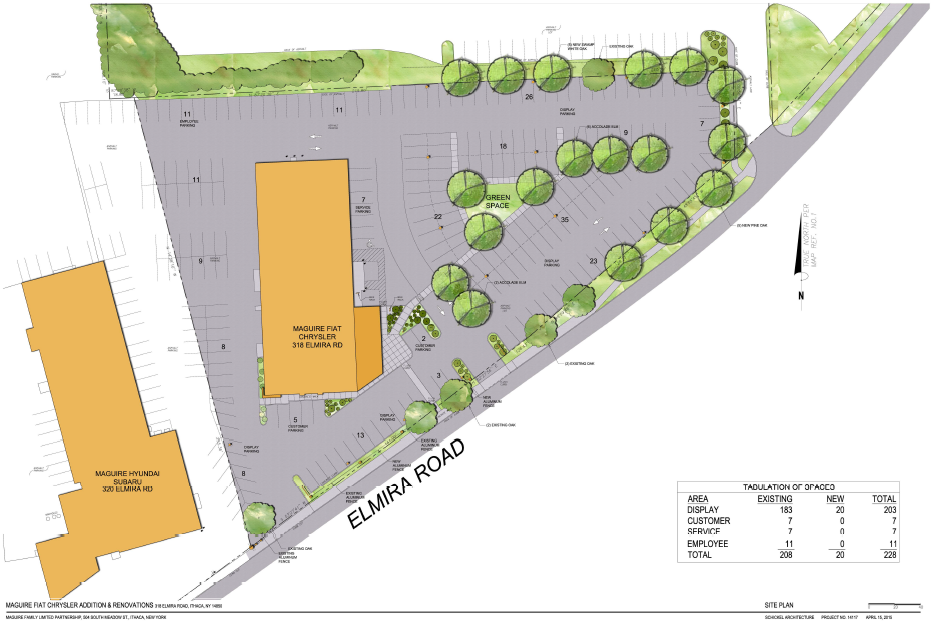
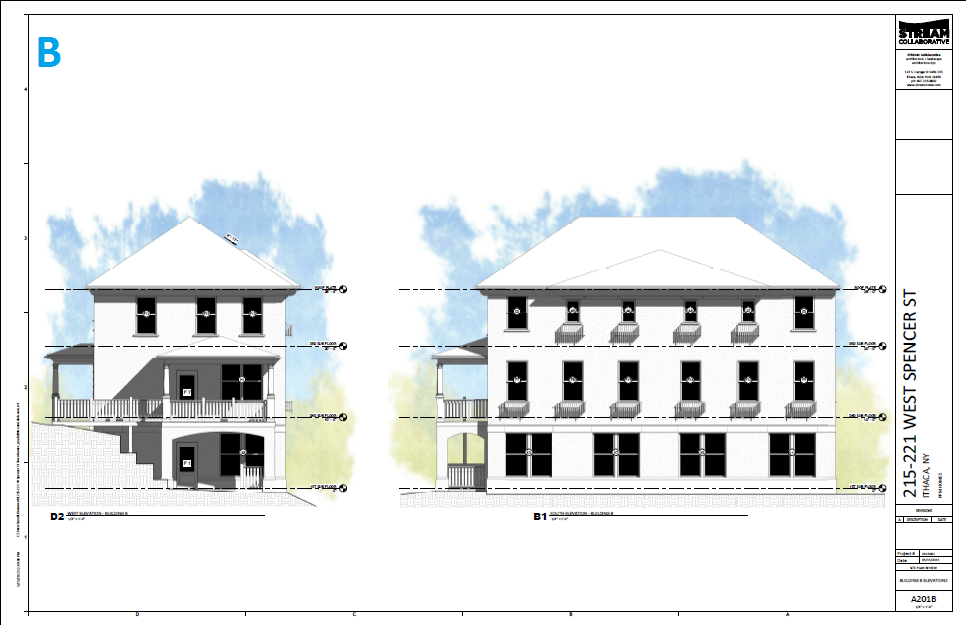
1. I’m thinking there is a genuine lull in the pipeline at the moment. The city’s projects memo, which is the document that city departments receive and comment on before the actual Planning Board meeting, doesn’t have much for consideration for this upcoming month. The one projects that is being “newly” considered is the 12-unit, 26-bedroom PPM Homes proposal at 215-221 W. Spencer Street. That project is expected to receive declaration of lead agency (in other words, the planning board formally agrees to review it) at the June meeting. Being carried over from the previous months are the two duplexes for 804 E. State Street, the Tompkins Financial HQ, INHS’s 210 Hancock project and the Maguire Fiat/Chrysler expansion. None of those are up for final approval.

Smaller projects and subdivisions will often first show up in the memo ahead of the meeting, but not this month. What will be, will be.

tfc_v2_1

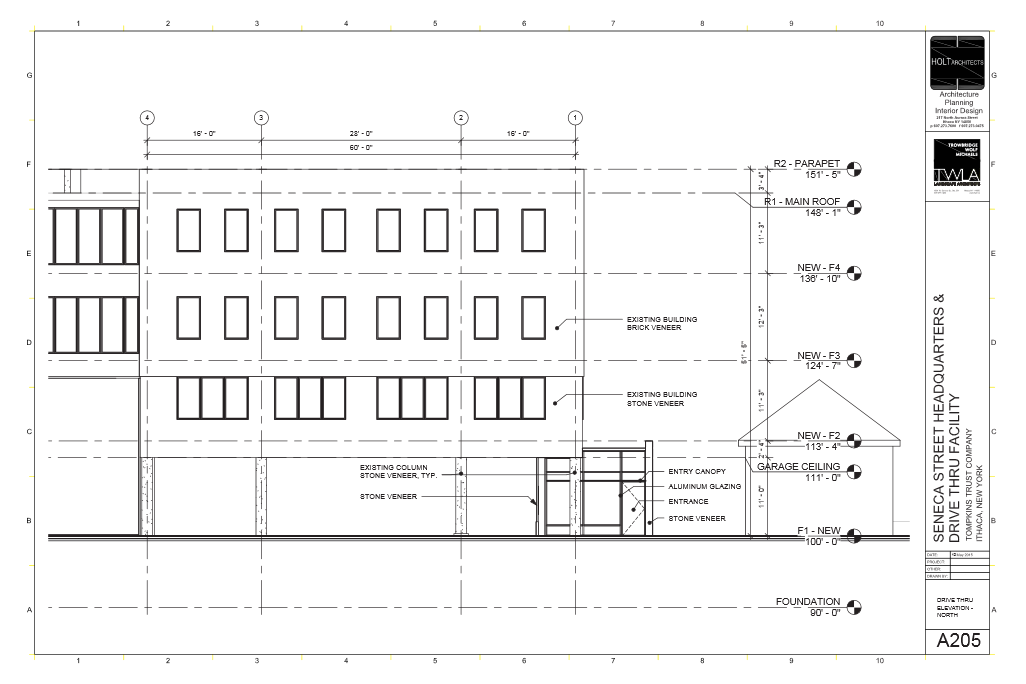
2. On the other end of the scale, this looks to be a busy month for the Ithaca Landmarks Preservation Council. Most of their agenda focuses on window repairs and other minor details, but they will be reviewing the Tompkins Financial HQ and the new drive-thru across the street. Although neither is within a historic district, I suppose it’s being reviewed for the sake of feedback and the possibility of a visual impact on the skyline as seen from historic districts.

Cayuga-Meadows-Shot

3. In Old Library news, a decision was expected last Tuesday…but, the decision was postponed. After committee members started sharing their differences in opinion. Pardon my cynicism, but that’s a perfect microcosm of those whole process. Frequently delayed and bound to infuriate someone come decision time.

In a perfect world, all three of those would be built in the city, because they all address different housing needs in Ithaca, and they would all likely be successful. But of course, there can only be one. We’ll find out next Tuesday morning.

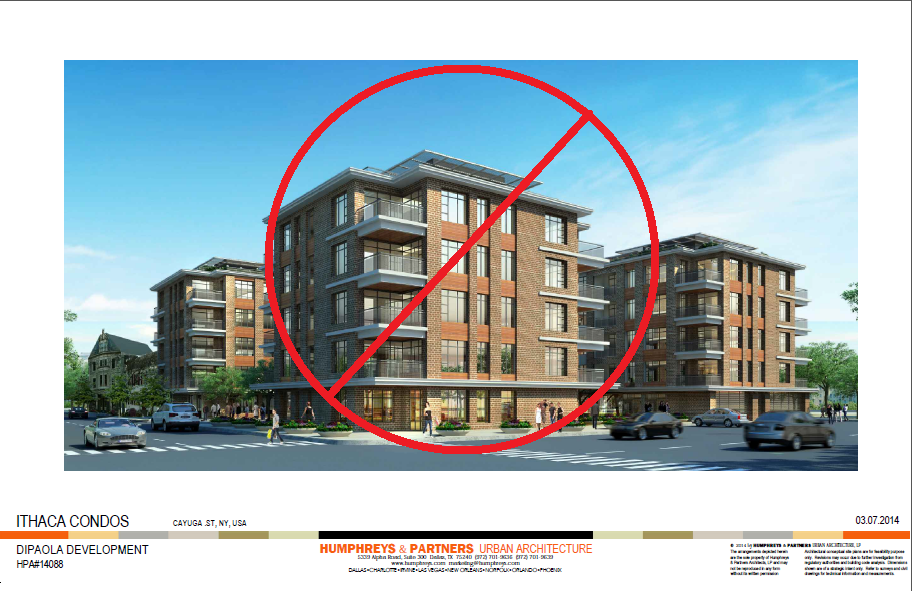
4. The Ithaca town Planning Committee is verifying two things already noted in previous news round-ups. One, the 68-unit Cayuga Meadows project hopes to begin construction in the very near future, and two, the Troy Road housing project is dead.

The committee also brought up the possibility of a moratorium for certain parts of town – two areas described as having significant student populations. One is almost certainly the area of South Hill next to IC, the other is not stated (but likely has to do with Cornell). This is part of a larger conversation to keep IC students from living off-campus in student rentals. Students aren’t a protected class, so whatever extra bureaucracy or laws the town wants to adopt are technically fair game. I would imagine, however, it would much easier to do that to IC’s undergrads than the professional and doctoral students attending Cornell. Looking at the numbers, one has been increasing much more than the other, and it’s not the undergrads. This, I suspect, is where potential laws become problematic.

Anyway, the moratorium is seen as a last-ditch effort. But the possibility of it should be enough to raise eyebrows.
815_s_aurora_1

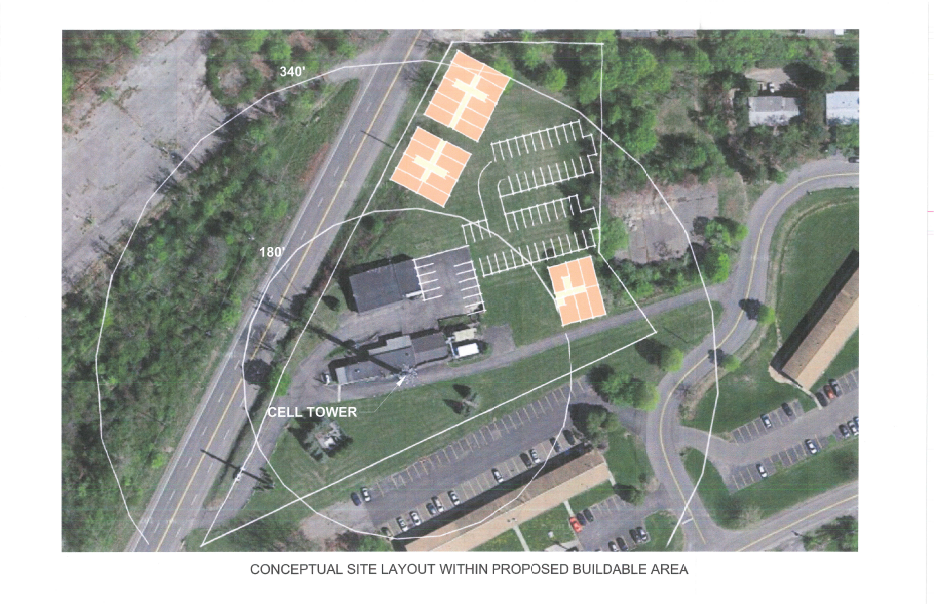
5. Time for some more unhappy – the city Board of Zoning Appeals isn’t touching the 815 South Aurora Street application.  To recapitulate the salient details, local developer Todd Fox would like to build apartments on the land but can’t because the vast majority of the property is within the “fall zone” of a cell tower, which the city defines as twice the height of the tower. At 815 South Aurora, a 170′ tower creates a 340′ radius of no-man’s land (outer circle above), making the parcel virtually undevelopable. Fox had two private engineering companies (TAITEM Engineering and Spec Consulting) analysis the case and they determined that an appropriate fall zone is the height of the tower plus 10 feet for a little wind/bounce – so 180′ total. With this info in hand, Fox is trying to get the city to refine the zoning to allow the decrease in fall zone and therefore permit the land to be open for development.

The BZA said it was acting on the city attorney’s advice that the committee can’t override a council-approved law. Which means that Noah Demarest, the architect appearing on behalf of Todd Fox, will either have to go to the Council to have the law amended, or he and Fox will have to go through a full sketch plan and review process, and apply for an area variance for whatever firm plans they have proposed. Meeting with the BZA was seen as way to avoid having to shell out all that time and money and risk still being rejected because of the cell tower issue. There’s a risk with moving forward at this point, and it’ll depend on just how much risk the developer is willing to take on this potential project.

6. We’ll wrap up with something positive – FormIthaca, the citizen group advocating for form-based zoning, is doing their design charettes this week. I’m writing this on Thursday night since I will be doing 5-year Cornell reunion stuff on Friday, but I do plan on being in attendance Friday afternoon meeting and am looking forward to seeing/hearing what ideas the presenters have to share.

I can assure a certain town of Ithaca board member that I have a personal preference to small street setbacks, and it sure as hell isn’t because they’re “hipper”.


The Evolving Plans For West Hill

2 06 2015

West Hill is, in a sense, Ithaca’s final frontier. The least developed of the hills, it isn’t nearly as built out as South Hill or East Hill, and what is there are mostly single-family homes.

For clarity’s sake, this post is about the part of West Hill within city lines.

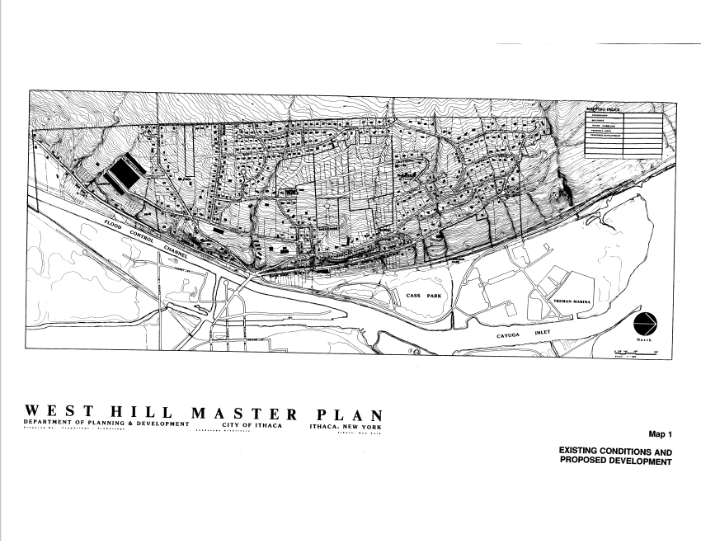
While looking up something else, I stumbled across West Hill’s Master Plan from 1992. Which, given its been over 20 years since it was written, gives an interesting perspective on how the city has wanted development on West Hill to fill out. The West Hill plan was created in response to strong developer interest in West Hill sites in the late 1980s, both in Ithaca city and Ithaca town. The plan notes that seven major projects were proposed during 1988 alone, in an area more accustomed to annual construction in the range of a few to several homes, and the very occasional apartment building or business.

west_hill_1992_1

The map above shows both the current and proposed projects at the time, There were eight in total, with dozens of units and lots. It’s hard to read even when blown up, but the proposed projects, which have a heavier lot outline and blurry labels, included subdivisions for single-family housing tracts in the proposed Deer Creek, McPherson and Sunrise Terrace projects, and individual sites with multi-unit potential like INHS and Overlook Park.

west_hill_2015_1

As seen in this 2015 map from the county, the majority of those late ’80s plans were never built, probably because the local economy tanked in the early 1990s. The four housing tracts in the middle of West Hill are still vacant today and under various private ownerships. The Overlook Park site eventually morphed into the 44-unit Bella Vista proposal in the 2000s, but that project was also never built.

A few plans did come to fruition, however. A site just east of West Village (380-90 Floral Avenue), called “LoPorto” on the 1992 map, became a 28-unit townhome development in 1995 that was sold to INHS five years later. The INHS site indentified in the 1992 map (310 Floral Avenue) became the 39-unit Cedar Creek Apartments in 2009, 17 years after the master plan was published. The last site, called “Clynes” after the owner, was subdivided into two lots, a currently vacant lot, and a house at 131 Haller Boulevard that was built in 1999.

Also, note the very different street configuration over on Inlet Island – this was the time of the original Ithaca “Octopus”, a jumble of streets feeding into one bridge, and infamous for its traffic problems. That’s a story for another day, but there are rundowns here and in a 1989 NYTimes article here.

west_hill_1992_2
The 1992 Master Plan called for a number of new roads criss-crossing West Hill, two new parks (one by West Village, the other in the undeveloped lands in the middle of the map), and a new bridge at the southwest edge of the city. Sidewalks were recommended for the large majority of residential streets, new feeder roads would be built with Ithaca town, and Cliff Street was to be upzoned, while most of West Hill would stay the same or be downzoned to “preserve character”. Here’s the current zoning map, but without a 1992 map it’s hard to cross-check and see what, if any zoning was changed. About the most I can ascertain is that swaths of West Hill near West Village were downzoned from R-3 to R-2 at some point.

The plan also notes the abnormally large lot size used by single-family homes on West Hill, which were less dense than even the city’s lowest-level R-1 zoning; but decided it was best to keep precedent and the plan suggested narrowing all residential streets as a character-protecting and traffic calming measure. Interestingly, a number of the newly-built or currently vacant single-family lots in West Hill are recent creations from subdivisions of larger parcels by their owners. So the streets are filling in via “organic growth”.
ith_big_plan_map

Now a look at the 2015 Comprehensive Plan. A large conservation swath (natural area with no permitted development) runs through the Floral Avenue and Cliff Street corridors, and chunks of medium density residential are put forth south of Hook Place and east of Chestnut Street. The 2015 plan notes that the undeveloped tracts in the middle of West Hill present significant opportunities for new single-family housing. The 2015 Plan notes that, just like 23 years ago, the lack of sidewalks is an issue. The cul-de-sacs, utility capacities, and “sensitivity of development to existing character” (a.k.a. be wary of neighborhood opposition) also pose issues and concerns that both existing homes and new projects need to address.
Off-hand, there haven’t been any major projects announced recently in the city’s portion of West Hill, and I haven’t heard any through the rumor mill (I can think of a couple homes I’ve heard about and that’s it). But it’ll be interesting to see how West Hill evolves in the next twenty or so years.


News Tidbits 5/16: Smart Developments, or Sprawl?

16 05 2015

Looks like this is going to be one of those longer roundups. I’m excited and intimidated at the same time.

tfc_v2_1 tfc_v2_2 tfc_v2_3

1. First off, I’m going to lead off with renders of the new Tompkins Financial Corporation. Write-up on the Voice here, more drawings here, traffic study here, cover letter here, Full Environmental Assessment Form (FEAF) here.

Rather than describe it in neutral generalities as I did with the Voice article, I’m going to afford the right to be a little subjective. The design is respectful of its neighbors through the use of brick and stone veneer. There’s no real surprises in the design, and corporate buildings tend to be pretty conservative anyway. At 104 feet (100 to the rooftop, and then 4 feet for the roof parapet), this will make a dent in the Ithaca skyline, but once again, it respects and balances out it neighbors by being a little taller than the DeWitt Mall, and a little shorter than 121′ Seneca Place. On a spectrum, the street front is on the nice side though not fantastic; a bank branch and some offices will engage with the street only modestly, but it’s much, much better than the drive-thru there now. The new building is built to the sidewalk, has an urban form, it’s a multi-million dollar private investment and a lot of other things that most upstate mayors would sell their mothers to get. The project is still shooting for a summer approval and construction starting not long thereafter.

One concern I have is that this will offload tens of thousands of square feet of office space onto the Ithaca market. Office space is one of the weaker sectors of the local market, and this may exacerbate the situation. It could cause some problems come 2017, and maybe with projects still in the pipeline such as Harold’s Square, which is shooting for a fall start after two years of trying to secure financing. I think that in the longer term, a few of the spaces such as the Seneca Building (121 East Seneca) might be ripe for a residential conversion.

With that concern noted, I think the parking situation will be okay. Since most of the jobs are shuffling around downtown, there’s not going to be a huge influx of workers. Offhand, I think the numbers are low double-digits (20 or 30) for transfers from Lansing into the city, and then the 77 brand new jobs created over the next several years.

belle_sherman_townhouses_1

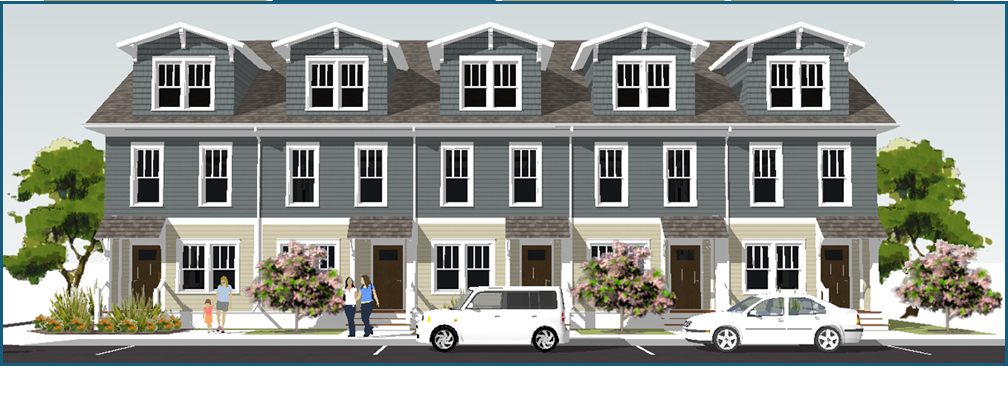
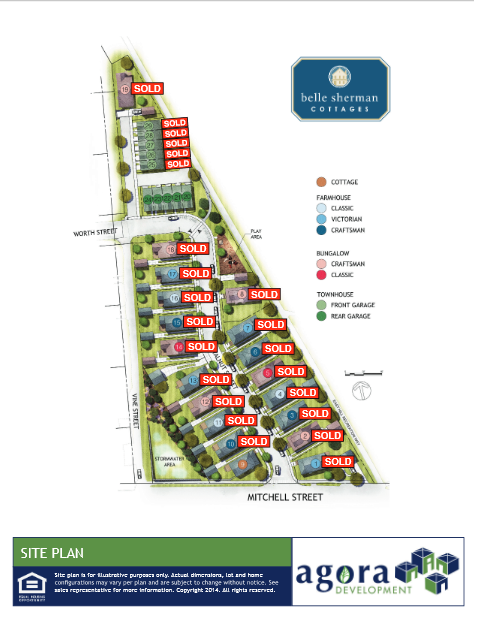
2. And then there were none. With the sale of the last of their townhomes (lots 20-24), the Belle Sherman Cottages have technically sold out. I say technically because Lot 9, the new cottage design on the southwest corner of the parcel, has yet to be marketed let alone sold. I followed up with an email to developer Toby Millman of Agora Home LLC, and he replied that “[w]e are still working on the plans for that home and expect to release if for sale in the next month or so.” So keep an eye out for that.

3. Here’s an interesting piece of news from the Ithaca Urban Renewal Agency – the city recently showed off the 6-acre parcel it owns on Cherry Street to an employer looking to relocate 250 employees to the property, buying the lot and building a one-story “campus setting” over the whole six acres. This may or may not be the same one previous mentioned in the March minutes, regarding an inquiry from a business located outside the city. Since the parcel may have been shown in January or February, it seems that the two are likely the same entity.

This isn’t the first piece of news regarding some potentially major work in this isolated section of Ithaca’s West End – scrap steel mogul Ben Weitsman has also been rumored to have plans, and improved access from the Brindley Street Bridge would aid in redevelopment of this part of the city.

state_st_triangle_3

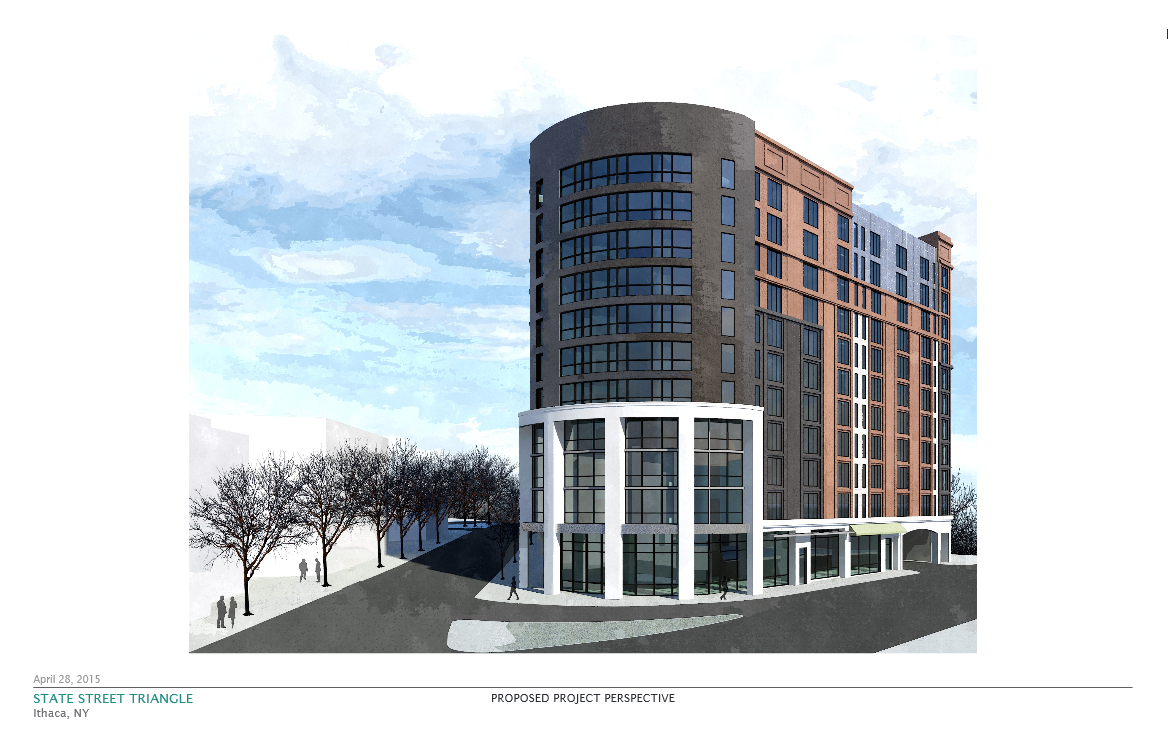
4. The planning board is cautiously enthusiastic about the State Street Triangle development. Per the minutes from the April meeting, they want the building to be as iconic as possible; board member John Schroeder went as fall as to suggest inspiration from the Carson Pirie Scott Building in Chicago:

Another member suggested a decorative crown. If my notes are right, a crown could exceed zoning as long as it’s not habitable space. Some other suggestions include a setback on the upper floors, and looking into incorporating other forms of housing.

5. A quick follow-up on the proposed removal of some lot setbacks at the Nate’s Floral Estates trailer park – according to a tweet from Ithaca Times writer Josh Brokaw, the removal would allow an extra 18 lots for manufactured housing. The trailer park currently has 112 lots, and it’s been noted to have a substantial waiting list. Nate’s Floral Estates serves as senior housing, so this is one way to make a dent in the affordable housing problem.

815_s_aurora_1

6. It’s not too often you see someone request a zoning interpretation. At 815 South Aurora Street on South Hill, that’s exactly what local architect Noah Demarest of STREAM Collaborative is doing on behalf of developer Todd Fox. Fox would like to develop the land with apartments (and he’s no stranger to South Hill, having built a couple duplexes on Hudson Street a couple years ago), but can’t. The city won’t allow construction in the “fall zone” of cell towers, which they define as twice the height of the tower. At 815 South Aurora, a 170′ tower creates a 340′ radius of no-man’s land (outer circle above), making the parcel undevelopable. The developer got a hold of two private engineering companies (TAITEM Engineering and Spec Consulting), both of whom determined that an appropriate fall zone is the height of the tower plus 10 feet for a little wind/bounce – so 180′ total. With this info in hand, Fox is trying to get the city to refine the zoning to allow the decrease in fall zone and therefore permit the land to be open for development. It’s an interesting case, and the result could be a sizable apartment complex down the pipeline. Stay tuned for the BZA review in June.

228_w_spencer_1

A couple other minor projects are up for zoning variances on parking – a small 2-bedroom house planned for 228 West Spencer is seeking a variance because the builder (Ed Cope of PPM Homes) says there’s no room on the hilly lot, and Todd Fox is requesting a parking variance for a 2-bedroom basement apartment to be built at 108 Ferris Place, saying that its central location and easy bus access should make having a car unnecessary. Coincidentally, architect Noah Demarest is handling both appeal applications.

troy_rd_rev1_1

7. To wrap things up, here’s the latest agenda from Ithaca town. There doesn’t appear to be anything too exciting going on next Tuesday. Cornell is renovating its softball field on East Hill with improved site access, a new restroom and ticket office, and replacing the existing bleaches, dugouts and press box. The 32-unit Clare Bridge assisted senior living project that was discussed last week will be reviewed. There are also sketch plans to be presented for a propane refueling station and sales office to be built on a vacant lot on Elmira Road/Rte. 13.

The planning board will also be reviewing plans to subdivide the Troy Road parcel that was once slated for a major residential project. The seller (Paul Rubin of Florida) apparently has a buyer for the triangular chunk of land south of the power lines (which can be seen in the old render above). With no explicit plans for either plot of land, there’s little reason to deny the subdivision at this time.

Personal opinion, I don’t like the direction this is going. It’s a real shame that the revised 130-road Troy Road project didn’t continue pursuit of approvals, it had really started to coalesce into a decent proposal. But now there’s a possibility where the land gets divvied into multiple chunks with homes scattered on it like bird crumbs. Single-family and duplex homes don’t have to go through board review, so there’s a lot less oversight when the land gets divided among multiple owners and built out in a piecemeal fashion. The last thing the town needs is expensive, sprawling, ecologically insensitive development.


News Tidbits 5/9: Changing Elevations

9 05 2015

cinema_drive_1

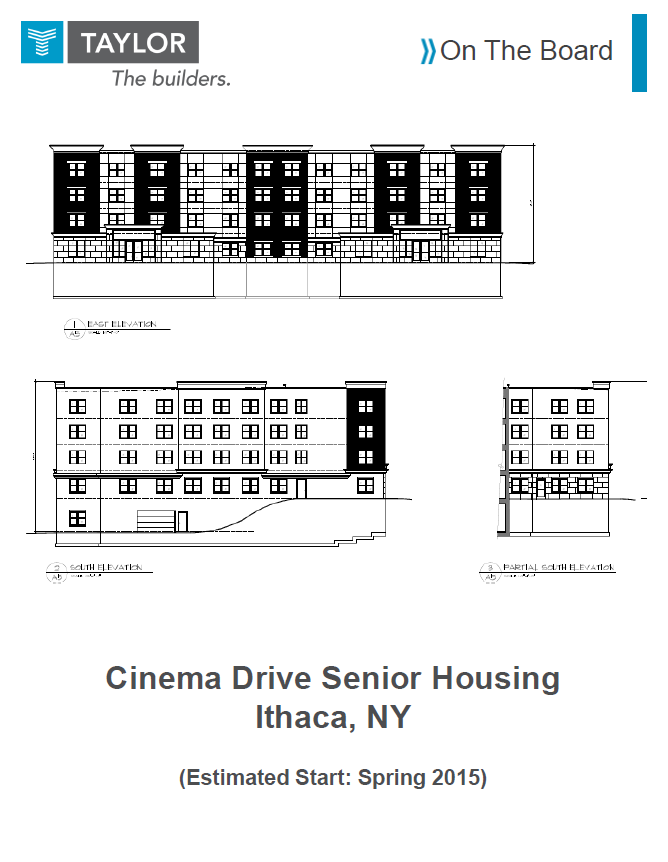
1. Looks like the CU Suites project is in fact the render shared by Taylor Contractors. Readers might remember these elevations from last week for a proposed “Cinema Drive Senior Housing”, but that the image didn’t match up with the proposal, a 3-story, 43,000 sq ft structure. According to the village of Lansing’s Board of Zoning Appeals agenda, the project is now a multi-story mixed-use building with a size of 87,515 square feet, which looks about right for the building proposed above. The project is seeking rear yard setback and height variances for not enough of a rear yard parking setback from the lot line, and for exceeding the maximum height allowed by zoning (which is 35 feet).

Doing some back of the envelope calculations, if one calls only the top three floors senior housing ((3/4.5) * 87515 = 58343) and uses the rough guidelines of 15% for circulation/utilities and 980 sq ft per unit, then one gets about 51 units, which makes this a pretty sizable project by local standards.

inhs_pride_v3_elevations_1 inhs_pride_v3_elevations_2

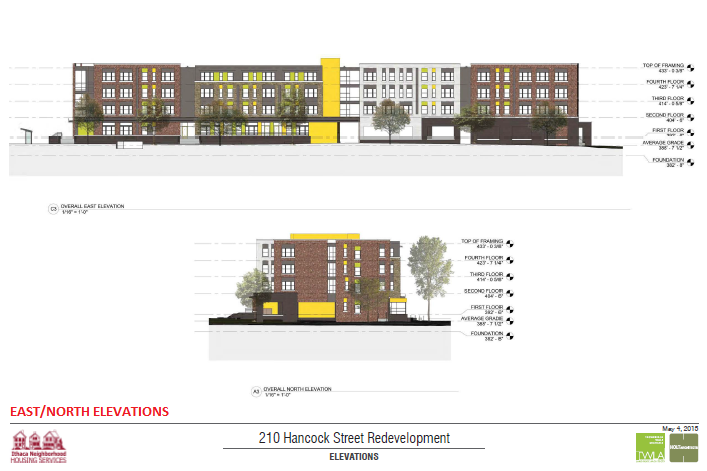
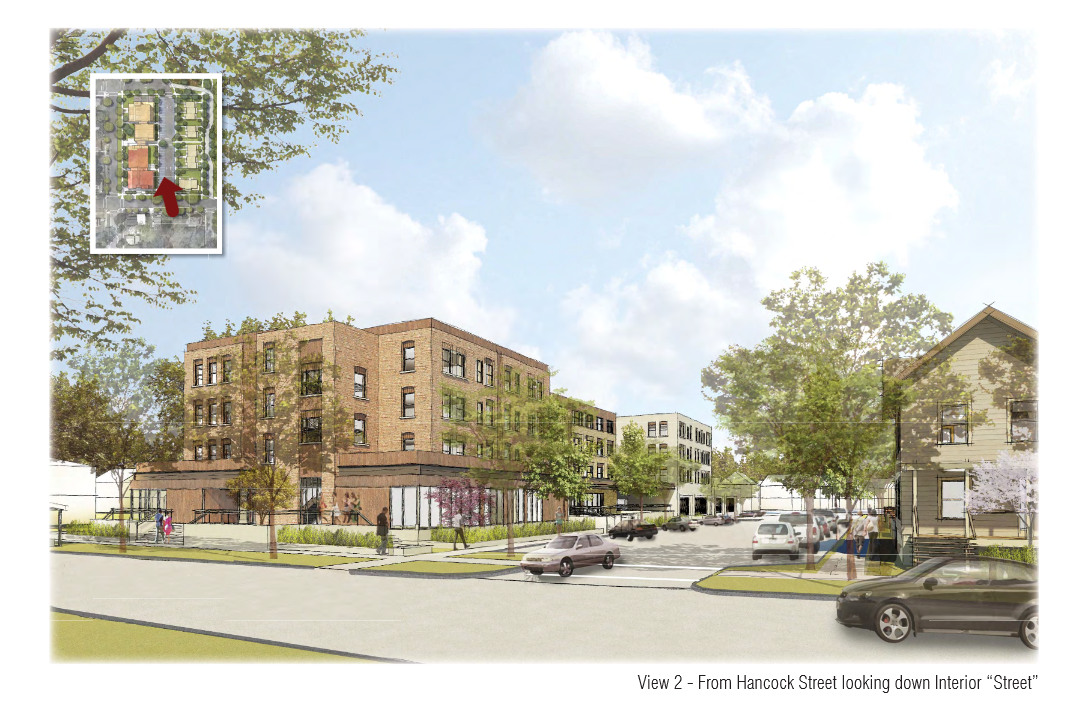
2. Now for a change or perspective – new perspectives of the 210 Hancock project, in the form of elevations found in higher resolution here. Now you can see what all of the buildings look like as a whole, rather than the simulated viewpoints previously shown. The elevations heights give the apartment building’s height at about 40 feet. Apart from some tweaks to the way the first-floor parking is screened, there haven’t been a whole lot of changes since the last planning board meeting. Note that the buildings are tucked in or pushed out and separated by “hyphen” connectors so they don’t present one continuous street wall. The design is by local firms TWLA and HOLT Architects.

Am I the only one who finds the lime green and goldenrod to be a bit..intense when compared to the other facade materials?

112_blair_v3_1 112_blair_v3_2

3. You want more new drawings? You get more new drawings! This batch represents the latest incarnation of the duplexes proposed for 112 Blair Street / 804 East State Street. Renders copied from here, project narrative here. Developer Demos / Johnny LLC (the Nestopoulos family) is still trying to have these ready in time for the Fall 2015 school year. Rather than continue seeking an area variance in zoning, the project is back down to two duplexes with three bedrooms and ~1,235 sq ft each (12 bedrooms total). After meeting with neighbors, it was decided to move back to surface building to reduce building height, and to add expansive front porches, which gives the otherwise bland duplexes a little character. Site Plan Review will take place this month.

clarebridgecrossings_1

4. Looks like there might be an expansion of senior care facilities in Ithaca town. The Ithaca Town Board is set to discuss changes next week to the Planned Development Zone (PDZ) for the Sterling Heights / Clare Bridge Cottage assisted living facilities, located on Bundy Road just north of the city-town line. Sterling House is a 48-unit assisted living facility, while Claire Bridge Cottage is a 32-unit facility specializing in memory care (Alzheimer’s and dementia). The new building, a 23,200 sq ft 32-unit facility to be called “Clare Bridge Crossings”, is designed to bridge the gap between the two – patients who might be in early stages of illness and experiencing mild symptoms, but otherwise still capable of some degree of personal independence.

The new building appears to be a one-story addition tucked between the other two structures, so it won’t be visible from the street. Along with the new building, there will be updates to parking, landscaping stormwater facilities, and the addition of a couple of courtyards between the buildings. The architect is PDC Midwest, a Wisconsin firm that specializes in memory care facilities.

Now, some readers might be saying, “who cares?”. There’s a couple of reasons to care. For one, this is important from a quality-of-life perspective. Picture a senior couple where one is reasonably healthy and the other has memory care needs. It means a lot to have a facility nearby that can care for their loved ones. Secondly, an expansion would bring with it a number of jobs to support the new residents – nurses, maintenance, kitchen staff and so forth. So there’s an economic benefit as well.

Full disclosure – my mother is a nurse who works for an assisted living program that includes clients with memory care concerns. So I’ve heard a thing or two about a thing or two.

east_hill_master_plan

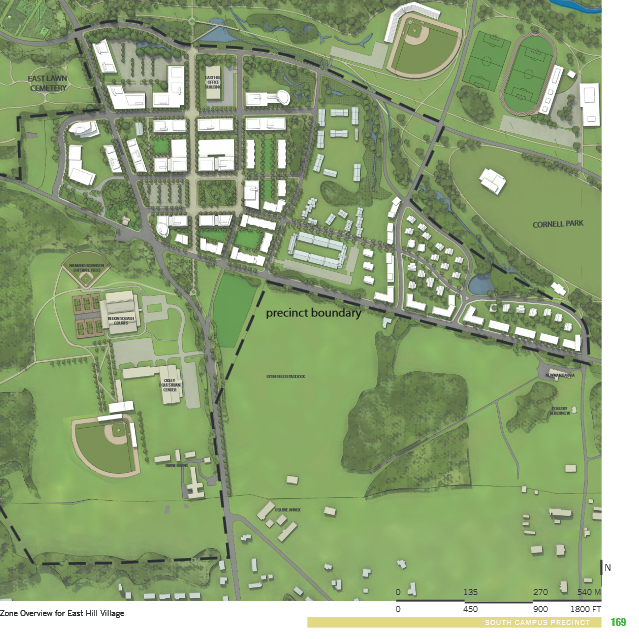
5. On a parting note for the week, here’s a little more information on Cornell’s redevelopment plans for East Hill Plaza. According to Planning Committee minutes from the town of Ithaca, Cornell will be taking part in a multi-day design charrette hosted by form-based zoning proponents FormIthaca in early June. Form-based zoning in a very small nutshell is zoning that focuses on design elements rather than use. Cornell is interested because the plan will hopefully lead to a regulating plan for the “compact mixed-use” development Cornell hopes to build to build in that area. The plan could provide language for a new Planned Development Zone that would potentially allow Cornell to move forward with a housing/retail mix at East Hill Plaza.

Cornell has sought to redevelop East Hill Plaza and surrounding parcels (most of which they already own) for several years. A vision for the plaza shows up in Cornell’s 2008 Master Plan (the so-called “East Hill Village” shown above), and given the need for housing in the area, East Hill Plaza would likely be one of the location where opposition would be less likely, given the the lack of homeowners nearby and the site’s proximity to Cornell.


Lofts at Six Mile Creek Construction Update 4/2015

22 04 2015

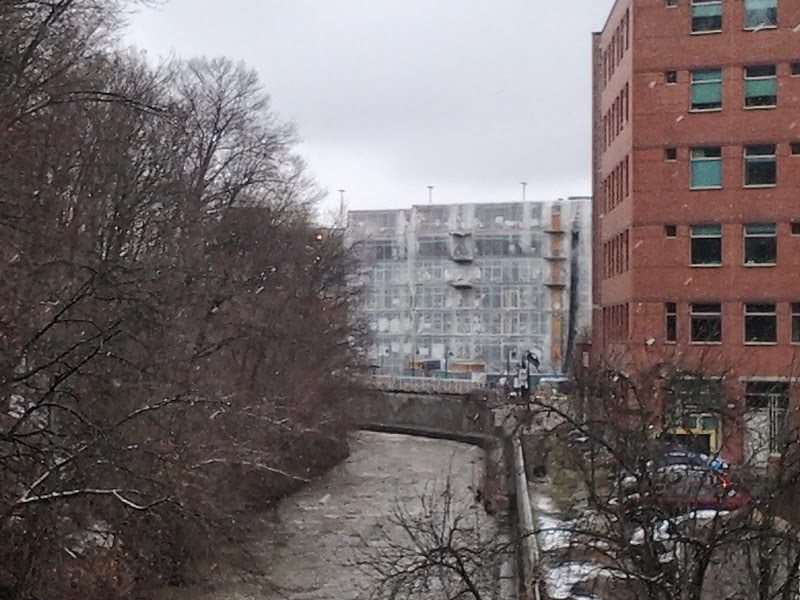
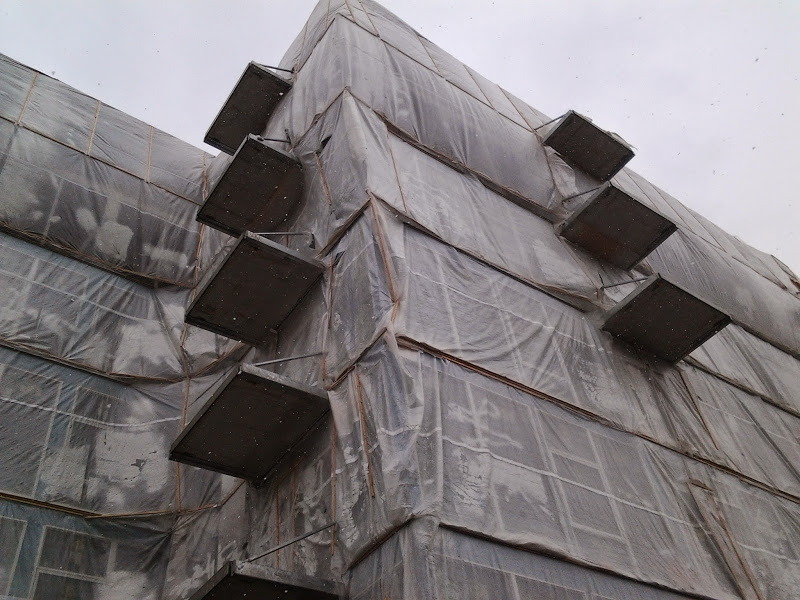
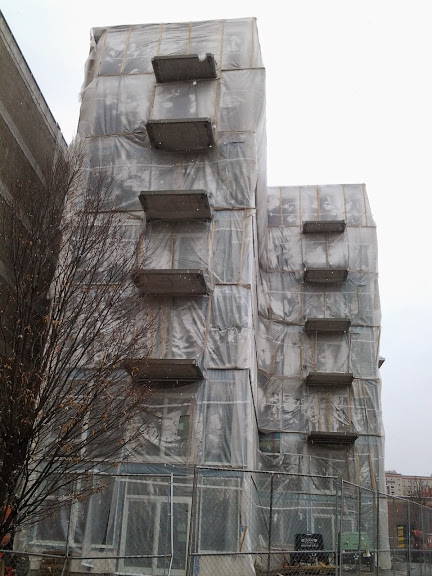
Heading back to downtown again, the “Lofts@SixMileCreek” (no spaces? no spaces…) apartment project is plodding away towards its anticipated late summer completion. From the outside, there’s been progress under all that protective plastic wrap – the first five floors have had their exterior walls framed and glazed (glass wall installation). The top couple of floors should be sealed up in short order.

According to an update from Jason at Ithaca Builds from the start of the month, walls and utility rough-in was underway inside the top floors, and drywall hanging and finish-work was beginning on the lowest floors of the apartment building. The Downtown Ithaca Alliance recently scheduled visits to the unfinished units as part of its Downtown Living Tour last Saturday.

Perhaps the most controversial thing about this project was when the rents were released at the start of the month – prices range from $1,220/month for a studio to $2,655/month for the largest two-bedroom on the upper floors. That got a lot of attention on the Ithaca Voice’s Facebook page, and much of it wasn’t good.

Jeff Stein, the Voice’s editor, followed up with an editorial saying that the criticism misses the point, the best way to alleviate the affordable housing crisis is to bring new units to the market at all income levels, which increases competition among landlords. Although I didn’t have a hand in the editorial, I support every word of it. Rents are high for this project, without a doubt. But the city not only needs units specifically for affordable housing, but units that will create competition for Ithaca’s burgeoning renter population.

With more units to better satisfy demand, landlords won’t be as able to charge premium prices on subpar units – inferior products will more likely be vacant. There would be a market push for owners to either upgrade their units to maintain a certain price point, or downgrade their prices to more affordable segments. Whether or not Ithaca will ever be able to get to that ideal balance between supply and demand is another story.

The Lofts at Six Mile Creek project consists of a a 7-story, 49,244 square foot structure that will contain 45 rental apartment units: 3 studios, 21 1-bedroom and 21 2-bedroom units. The building is being developed by Bloomfield/Schon + Partners out of Cincinnati, and construction is being handled by Turnbull-Wahlert Construction, also based in Cincinnati.

20150405_133449 20150405_133946 20150405_134010 20150405_134051 20150405_134118

cayugaplace_v5

10917333_314783998711665_7443965770647794346_n 10378252_313975992125799_95913780193412415_n


News Tidbits 4/11/15: Not Feasible As Presented

11 04 2015

dpi_libe_0414_end

1. If my inbox has been any clue over this past week, there are some folks who are pretty unhappy with the results of the county’s Request for Proposals (RFP) for the Old Library site. One more applicant has dropped out of the process – DPI chose not to respond to the RFP. DPI had proposed 76 condos and 8 apartments for the site, a move that was cheered by some residents who spoke passionately about the new for purchasable housing in the city. That leaves three contenders of the original six:

-The Syracuse-based Franklin Properties project, now called the West Court Lofts and Wellness Collective, would renovate the existing building and include 22 residential condominium units (down from 32 units in the RFEI), medical offices, a café, and community room.

-The Rochester-based Cornerstone Group project, known as the Dewitt Senior Apartments, would build 63 residential units of senior housing (down from 70-80 units in the RFEI), and include community space for nutrition education by Cooperative Extension.

-The Ithaca-based Travis-Hyde Properties project would build 60 residential senior-focused units (up from 48 units in the RFEI), and would include space for Lifelong, professional office, and a community room.

There have been no renderings published as of yet, but there will be a stand-alone post when they show up on the county’s website. The three proposals will be judged against each other over the course of the next couple months. A quick glance at the judgement criteria can be found in the Old Library meeting notes here.

The next meeting of the Old Library committee is scheduled for Thursday, April 30th at 9 AM. 5 PM Meetings will be set up during May for developer presentations to the public. Comments on the proposal can be emailed to Ed Marx, the County Planning Commissioner, at emarx@tompkins-co.org with the subject title “Old Library Property”.

2. Local credit union CFCU (Cornell-Fingerlakes Credit Union) is making some moves by buying a retail commercial strip with an eye towards redevelopment. The property, 501-507 S. Meadow Street, sold for $1,555,550 on March 30th, well above its assessed value of $950,000. According to a statement taken by the Ithaca Journal, “the current intention is to ultimately use the site for credit union-related purposes”.

The one-story, 9,203 sq ft strip buildings date from 1980 and 1990 and previously housed a Thai restaurant and offices for Lama Real Estate, the business of previous owner Robert Lama. The site is currently zoned the suburb-friendly SW-2, but like much of big box land, it has been targeted for urban mixed-use in the city’s Comprehensive Plan. CFCU is currently headquartered in about 30,000 sq ft of office space in two 1990s office buildings at 1030 and 1050 Craft Road in Lansing.

In short, nothing immediate going on here, but definitely a property worth keeping an eye on.

texas_roadhouse__v2_1

3. The proposal for a Texas Roadhouse on in Southwest Ithaca is getting a couple minor revisions. According to a cover letter from the restaurant chain, plantings have been revised to break up the expanse of blank walls, handicap ramps are now present in the new elevations, and signage has been tweaked. All in all, not a big change from the previously-shown drawings. It doesn’t look like this one will have too many issues moving forward.

canopy_hampton_rev4_1

4. At the city’s Planning and Economic Development Committee (PEDC) meeting on the 8th, the city voted to approve the sale of land at 320-324 E. State Street to Lighthouse Hotels LLC for construction of the new Hilton Canopy Hotel. Also up for discussion was the removal of 30′ setbacks on all sides of the special MH-1 zoning at the Nate’s Floral Estates mobile home park on the west side of the city. With the 30′ rear yard setbacks already in place and vegetative buffers installed by the big boxes to the south, it was felt by the city economic developer planner that the additional setback was redundant. The removal would facilitate setbacks reduced to 10′ on one side and 5′ on the other side, if I’m reading this right. According to the notes, the mobile home park has a waiting list of tenants. The proposal looks like it will allow a few more units in the park, though it looks pretty tightly packed as-is.

flatiron_1

5. According to the Ithaca Urban Renewal Agency (IURA) notes from the April 2nd meeting agenda, the board was not impressed with the Flatiron proposal. On page 6, it gives the project low pritority, with the description “not feasible as presented“. On the other hand, the INHS Hancock Street project was well received and given high priority.

402_s_cayuga_st_rev2_1

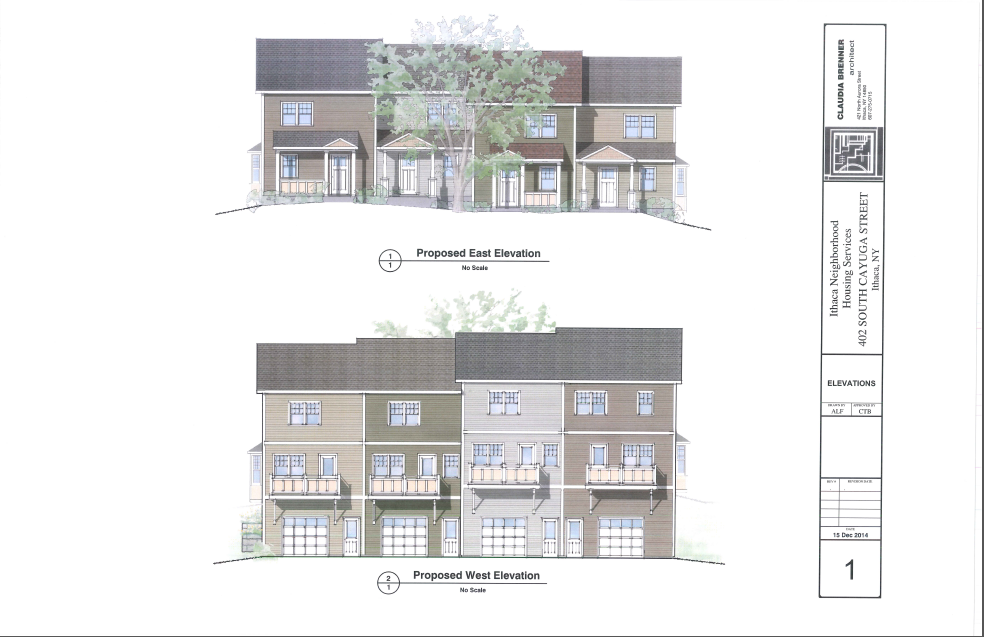
6. Looking at the March Planning and Development Board meeting minutes, 402 S. Cayuga Street has been approved, pending BZA approval of the variance (which was granted this week, if I have my notes right). The 4-unit, 9-bedroom project may be small, but it’s thoughtful infill and will help bring some affordable owner-occupied housing back into the city.

Approvals were also granted for the city project to replace the Lake Street this summer and fall, and refurbish the pocket park to its southeast. 210 Hancock was discussed without any voting, and sketch plans were presented for the TFC HQ downtown, and the 215 West Spencer Street apartment project, which have been written about previously. The board also discussed added additional questions to the CEQR (the city’s version of the SEQR used in project impact analysis), and the revised paperwork will be reviewed at a later meeting.

Oh, and on a more personal note, this totally made my day:

D. 2014 Planning Board Annual Report

[Senior city planner Lisa] Nicholas briefly walked through the annual report, observing it was a very busy year with a considerable number of additional housing units built. [Board member Garrick] Blalock asked if the annual report is publicized. Nicholas replied, no. Blalock replied it should at least be sent to the “Ithacating in Cornell Heights” and “IthacaBuilds” web sites. Nicholas agreed to do so.
I’ll be excited to have a copy. This would make scouting locations where construction photo updates are required a lot easier.

7. Wrapping this up with one final news piece, it looks like Dunkin’ Donuts is moving into the old Johnny O’s space at 406 College Avenue in Collegetown. So there will be one corporate coffee shop next to another corporate coffee shop and sharing a wall with a trendy fro-yo place. There’s probably a sociology thesis to be had in studying the changing retail scene of Collegetown.


News Tidbits 4/4/15: And They Called It “PlanIthaca”

4 04 2015

cayugaplace_v5

1. According to Ithaca Builds and those on a VIP list-serve, the Lofts @ Six Mile Creek have released tentative rental prices. $1,220/month for a studio to $2,655/month for a top-notch 2 bedroom. Using the affordability rule (30% of monthly income), one gets $48,800-$106,200 year – given the median income in Tompkins County of just over $53,000/yr, these prices could be described as upper-middle tier. I can already hear the grumbling from commenters on the Ithaca Voice if a construction update gets posted.

The 45 units are set to be completed this summer, but those looking to take a sneak peek can sign up for an April 18th tour of the building, courtesy of the Downtown Ithaca Alliance.

inhs_pride_design_v2_1

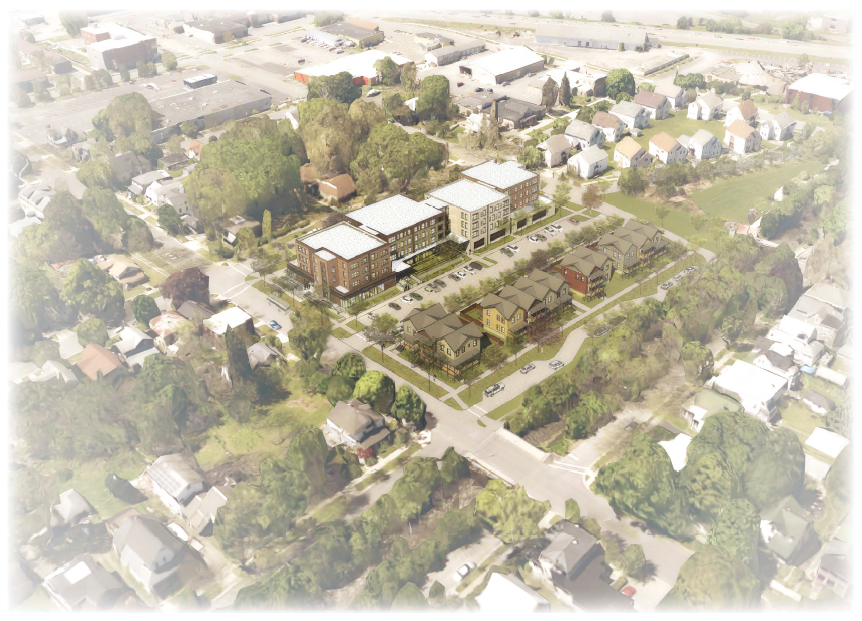
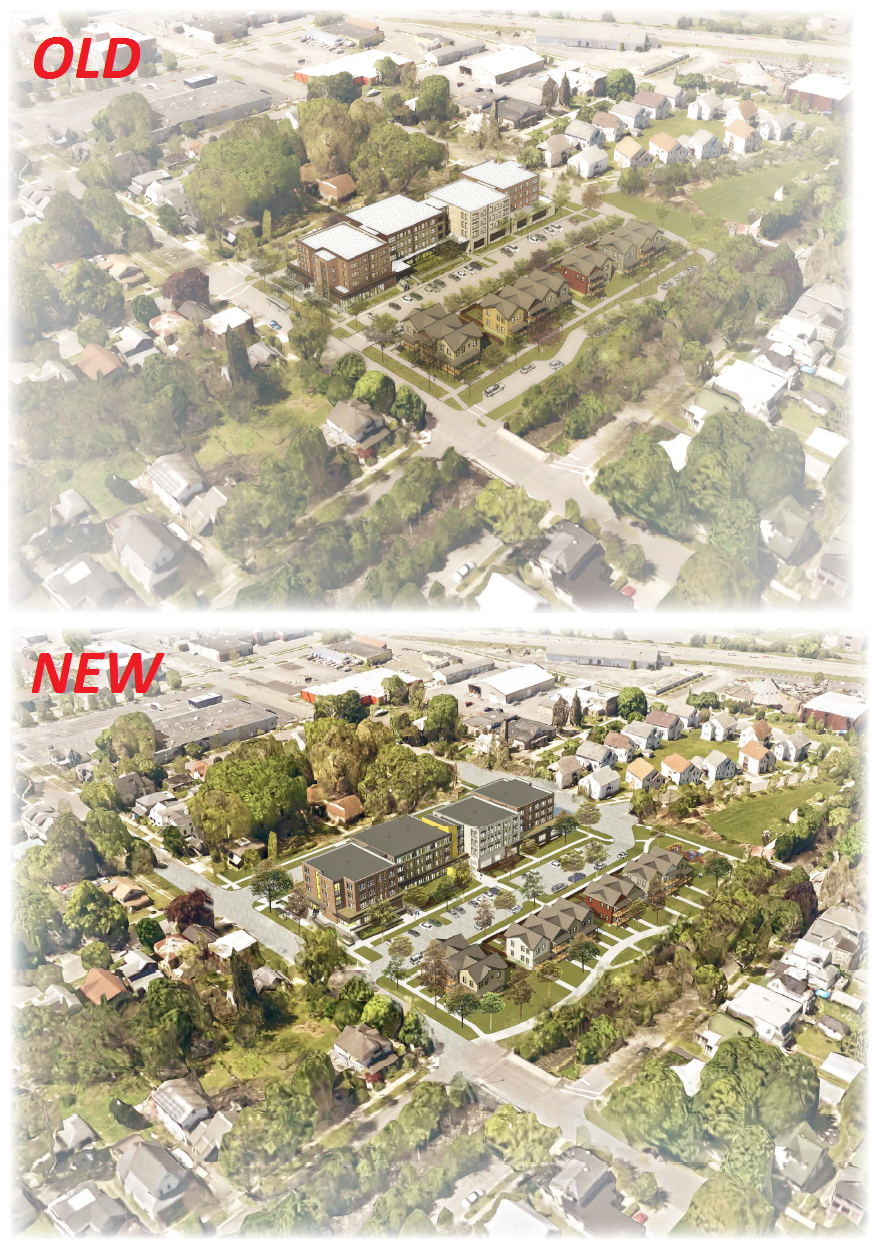
2. Here’s an updated aerial site rendering of INHS’s 210 Hancock redevelopment. The changes to the affordable housing proposal are largely in site landscaping and layout, the biggest changes being the closure Lake Avenue and moving the playground (which is not rendered in the aerial). Traffic studies, stormwater management plans, and parking studies can be found here (it turns out that compared to the old supermarket, there will be slightly more AM traffic, and a lot less PM traffic), revised site layout here, and about 18 other documents in the April site plan review planning board directory on the city’s website. 210 Hancock will be undergoing review by the city Planning and Development Board at their April meeting.

gways_rev_3

greenways3

greenways1_final

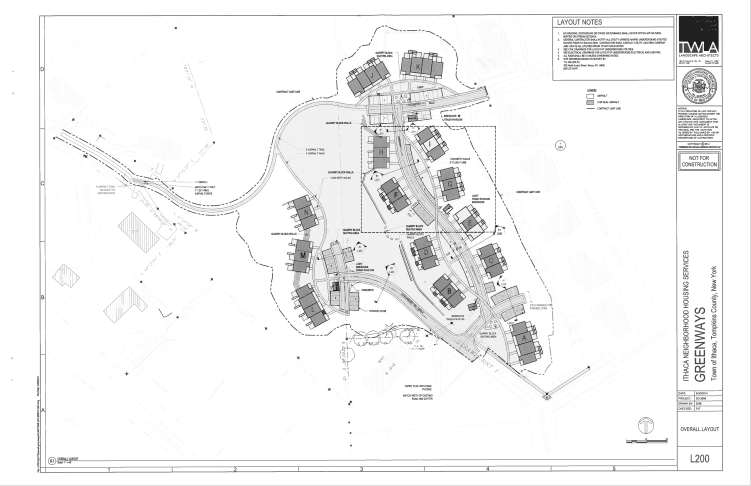
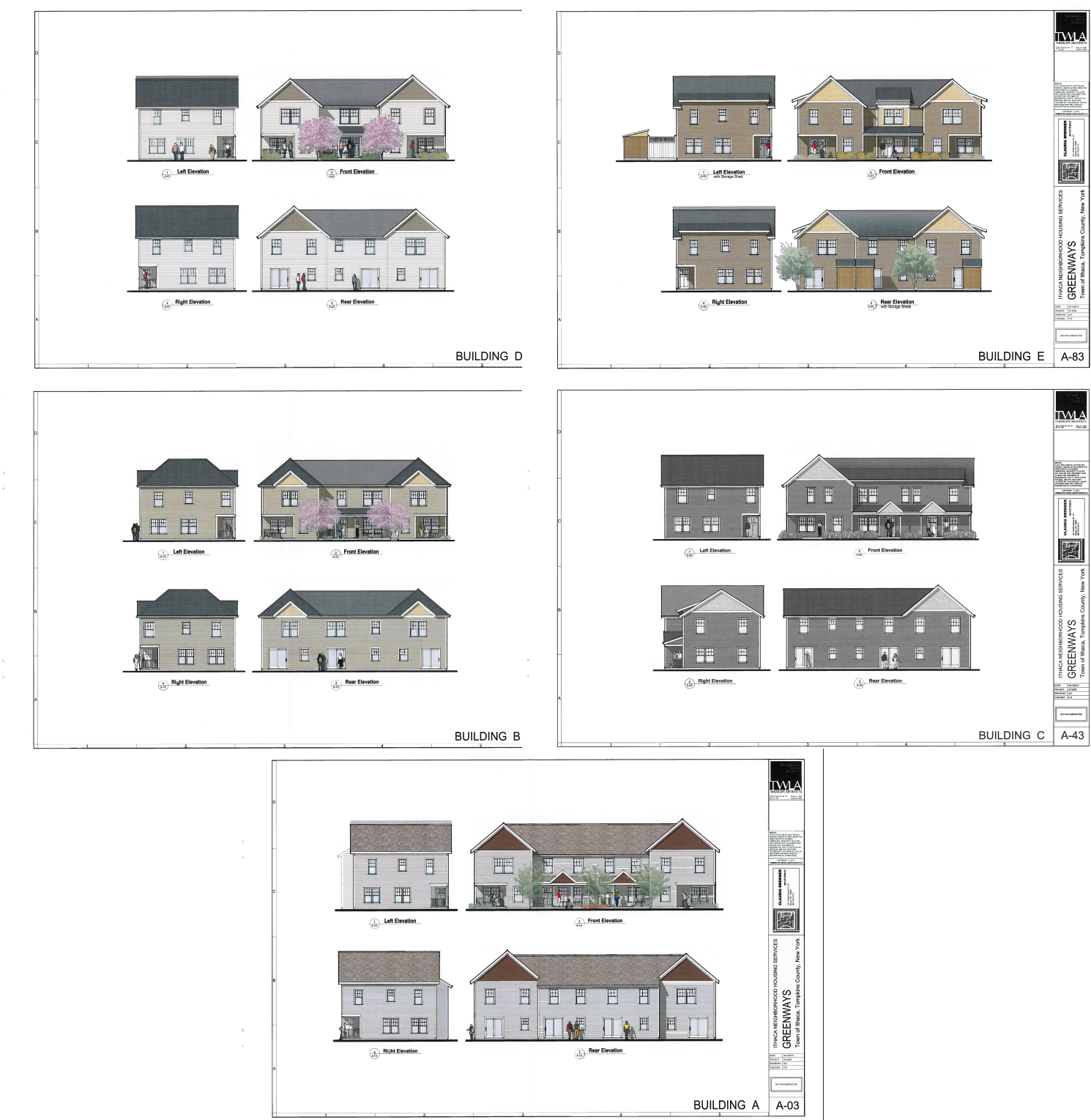
3. Turning to another INHS project, the Greenways development is going for final approval with the town of Ithaca’s Planning Board next Tuesday. The full suite of documents can be found here. The designs above, for buildings A, B, C, D, and E in Phase I, are very nearly final, though Building C looks like it was accidentally uploaded in grey-scale. B-E will have three units each, 2 2-bedroom (1,100 sq ft) and 1 3-bedroom (1,300 sq ft). Building A will have 2 2-bedroom and 2 3-bedroom units. In sum, Phase I has 16 units and 38 bedrooms. Assuming the other units are the same configuration, the final product will have 46 units and 110 bedrooms. Build-out could take 6-8 years according to the docs, and Building K in Phase II interferes with 0.09 acres of wetland, which the Army Corps of engineers requires to be filled in before development (wetlands under 0.1 acres and not contiguous with any other wetland can be filled in without need of replacement).

The designs are by local architect Claudia Brenner. The floorplans are designed with nearly identical layouts to save money, but the varied use of exterior architectural details and colors does a nice job of giving each building a unique appearance.

Readers might recall that these for-sale owner-occupied units are being developed for the affordable housing segment (individuals/families with incomes of $38k-$57k), and that Cornell is giving INHS the property for below market price on the condition that Cornell employees that fall into the income restraints have first dibs on the units as they hit the market. The property also makes use of “woonerfs“, so-called living streets that are shared by bikers, pedestrians and vehicles, and typically have a speed limit of no more than 10-12 MPH.

ith_big_plan_map_v2

4. The city of Ithaca’s draft Comprehensive Plan is now online. The 66-page draft, called “PlanIthaca”, can be looked at here, and the proposed land use map here. Over the past year, the Comprehensive Plan Committee has been busy fleshing out the original 16-page draft document to the full-fledged PlanIthaca document above. The city will be hosting a series of open houses throughout the city during April for interested parties to look through the plan and comment, with the first open house on Monday April 13th from 3:30-5 PM at St. Luke’s in Collegetown. Comments can also be submitted by email to city planner Megan Wilson at mwilson@cityofithaca.org.

I’ll probably expand on the plan in a future post, but readers of the blog won’t be surprised by anything it says. The map appears to be lacking the neighborhood mixed-use zoning, which from reading the plan appears to be an accident. Otherwise it’s the exact same map from last spring’s write-up.  There’s a couple of interesting concepts that will be explored as things move forward beyond the plan – ideas such as city-wide form-based zoning and a transfer of development rights between properties would make for a large departure from current policies.

tfc_1

5. If you’re looking for a little more light weekend reading, feel free to check out the double feature article on the Tompkins Financial HQ plans running the weekend on the Ithaca Voice. Summing up a few salient details here, the total project will cost $26.5 million, add 77 new jobs downtown over the next decade, and run from about June 2015 to January or February 2017. The new headquarters will be about 110,000 square feet in size, 7 stories and 100 feet tall, the maximum allowed by zoning. The first floor will have a 6,600 square foot (66 feet x 100 feet) bank branch, with parking for 20-25 cars behind the first floor and under the overhanging upper floors. A basement floor will also add 6,600 sq ft of space, and floors 2-7 will have 16,300 square feet each. Across the street at 119 East Seneca Street, a new drive-thru will be built underneath the existing building, consisting of revised drive-thru lanes, surface parking, an ATM and a 985 square foot teller building.


Belle Sherman Cottages Construction Update, 2/2015

16 02 2015

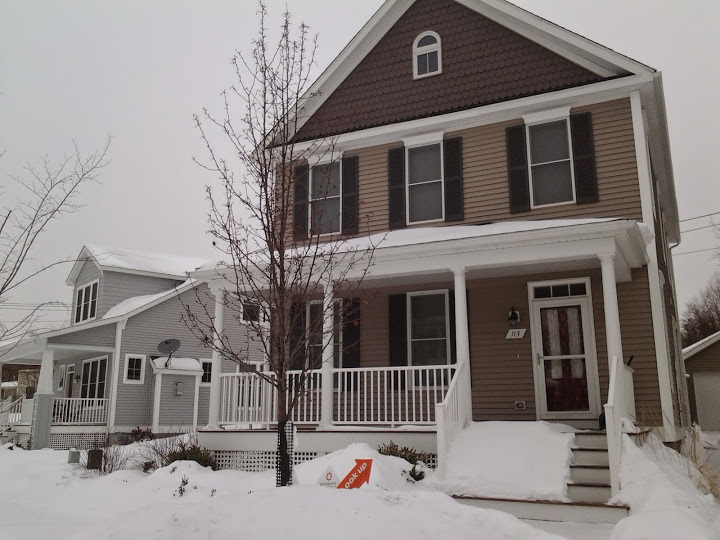
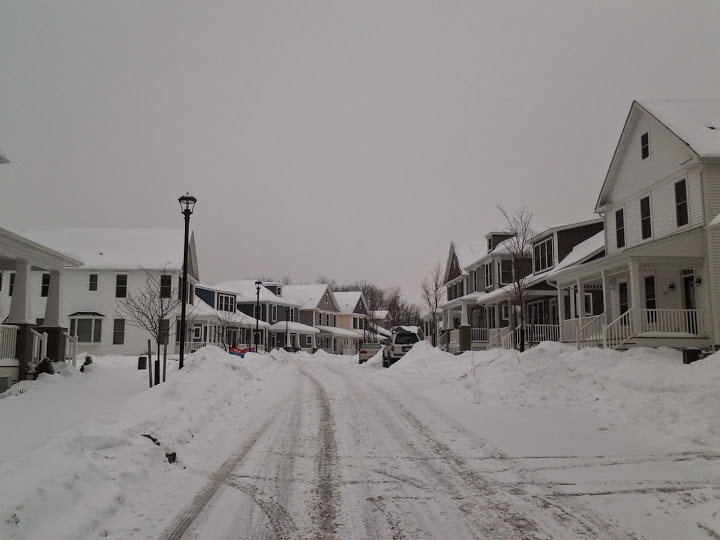
It feels a little surreal to be walking down Walnut Street (fun fact, there was originally a Walnut Street plated for Ithaca’s West Hill in the mid-1800s) and have it fulled out with homes on either side. Yet that is indeed the case. It’ll be easier at this point to count what’s not yet built in the Belle Sherman Cottages development – the townhouses (10 total, 5 due to start this Spring and 5 yet to be marketed), the new cottage design for the not-yet-marketed lot 9, and lots 11 and 12), which are sold and probably awaiting the arrival of warming weather before the foundations are excavated, poured and CMU block is laid. Heck, they might already be poured, but hidden under several inches of snow. So 16 of the 19 houses are built, with a couple of those, like lot 17, undergoing interior finishing and still in need of a little porch/column paint work before being turned over to their new owners. If you’re interested in learning more about the construction process, there’s a little more info in my previous post here, and on Ithaca Builds here.

Every couple of weeks, another sale shows up in the county property records, typically in the range of the low 300s to low 400s. Formal sale isn’t happening until a house is move-in ready (I suspect that while underway, a “sold” lot is actually reserved with a down payment), so following the county’s record of transactions is a useful indicator of progress. According to the Belle Sherman Cottages facebook page, Skaneateles-based Agora Homes and Development intends on completing the 29-unit development in 2015.

Veering into editorial territory here, I’ll admit that I was pessimistic about the project early on, thinking it was too much money for what was provided. But in retrospect, I think this is the right type of single-family housing for more suburban parcels, such as other sites in Ithaca town near the city line. Much of the zoning locally is designed to favor of large lots and large price tags. I wouldn’t call these affordable by any stretch, but they’re somewhat closer to the median value than most other single-family homes going up. Being this close to Cornell also adds a premium on their price tags; perhaps on a site in South Lansing or South Hill, they’d be somewhat less expensive. They’re a good (better?) alternative to the sprawling cul-de-sacs that seem to be the norm for housing developments in suburban Tompkins County. I think that, in the same vein of this project, though with more of a “green” sheen, the Amabel site in southwest Ithaca will be the next single-family development worth watching.

20150207_145459 20150207_145519 20150207_145651 20150207_145707 20150207_145742 20150207_145810 20150207_145843 20150207_145910 20150207_145926

belle_sherman_cottages_102714 belle_sherman_cottages_071814_2


The Neighborhood Pride Site (210 Hancock Street)

15 02 2015

inhs_pride_design_1

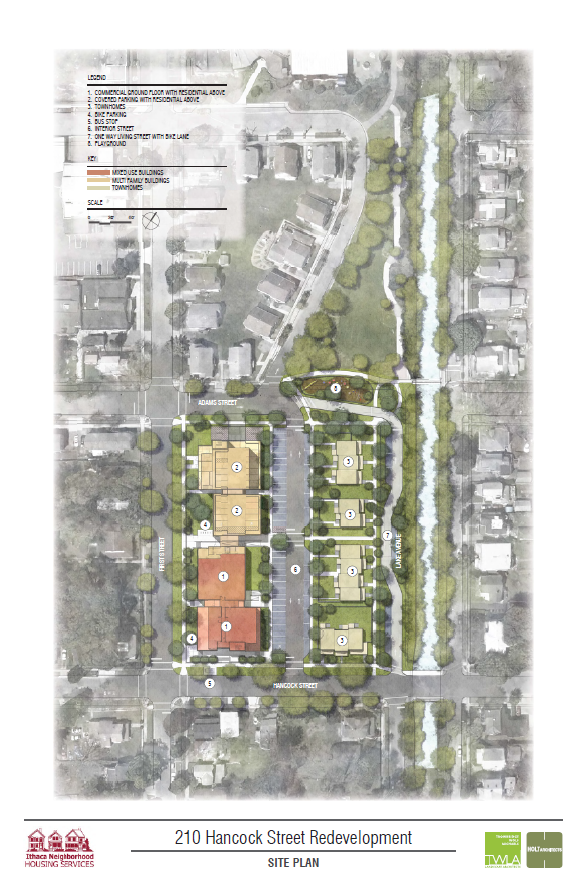
Avid readers will note that I’ve been writing about the Neighborhood Pride site on the Voice, keeping only brief notes here on Ithacating until a final design was unveiled. Now with that taken care of, here’s a description of what we’re working with, based on documents filed with the city on February 13th. There’s a brief application summary and cover letter here, or the 764-page FEAF (Full Environmental Assessment Form) here. I swear, no one reads those giant PDFs in their entirety, users only look for specific sections based on their prerogative. The rest is just there for gluteus maximus coverage.inhs_pride_design_2

Perhaps a little bit to my dismay, the project is not going to be complete until September 2020, tentatively. This isn’t a huge surprise though, INHS is a non-profit and dependent on grant disbursements. The buildout will begin in September 2016 and consist of three phases – my guess of the breakdown is the townhouses are one phase, the 2 southern apartment buildings are a second phase, and the northern two apartment buildings are the third phase, though not necessarily in that order. At some point, INHS anticipated subdividing the parcel into apartment and for-sale portions, which might be useful when applying for affordable housing grants.

The apartments call for ~50 1 and 2-bedroom units, and 13 for-sale townhouses, although it still looks like 12 in the renders (who knows, maybe one is a small duplex). So about 63 units total, and about 8,200 sq feet or rentable commercial space in three spaces (proposed at 1,800, 2,500 and 3,900 sq ft, for a total of 8,200 sq ft). The apartment buildings will be 65,000 sq ft, 4 stories and 48′ tall (zoning max 4 stories/50′). The demolition of a one-story office building (built 1975) and a vacant grocery store (built 1957) will be required. Total construction cost is anticipated to be about $13.8 million.


inhs_pride_design_3

Interestingly, what looks like the community favorite (the street scheme) doesn’t read as the county’s favorite (which reads as the alley scheme). But the county only advises, the city decides. Lake Avenue will be what they call a one-way “living street” – a low-speed, low-capacity street shared by bikers and vehicles. With those features, it’s designed in a way that you’d only drive on the road if you live in one of the townhouses. Conley Park’s southern boundary will be opened up to flow freely into the property (it was blocked off with vegetation to begin with because of its proximity to the old P&C loading dock, which made for a loud, smelly experience).

As an honest personal opinion, the design – inspired by local 1900s industrial and manufacturing buildings, according to the application – is pretty nice. It’s contextual, it’s appropriate, it fits in without being a total historical throwback. The townhouses are well-designed as well. I think INHS’s willingness to have heavy community input, and the community’s willingness to help shape the project, really came together to create a nice product.inhs_pride_design_5

A parking variance will be required from the city – the site will have about 70 parking spaces, but zoning requires 86. Will a new TCAT bus shelter and on-street parking nearby, INHS anticipates that they will be able to obtain the parking variance without too much hassle. INHS also needs to be be mindful of the flood zone, which they seem to have accounted for in the site plan. The only portion of the site especially vulnerable to a 1-in 100 year flood event has covered parking on the first floor. The townhouses, which are in the 500-year zone, will be built two feet above the ground, and the commercial space, also in the 500-year zone, will be one foot above the ground.

In sum, we have a project that removes a vacant supermarket, fits well in the urban fabric and provides affordable housing. It might take forever and a day to build, but it’s a welcome resource in the city of Ithaca.

inhs_pride_design_4


News Tidbits 2/14/15: Zoning Out

14 02 2015

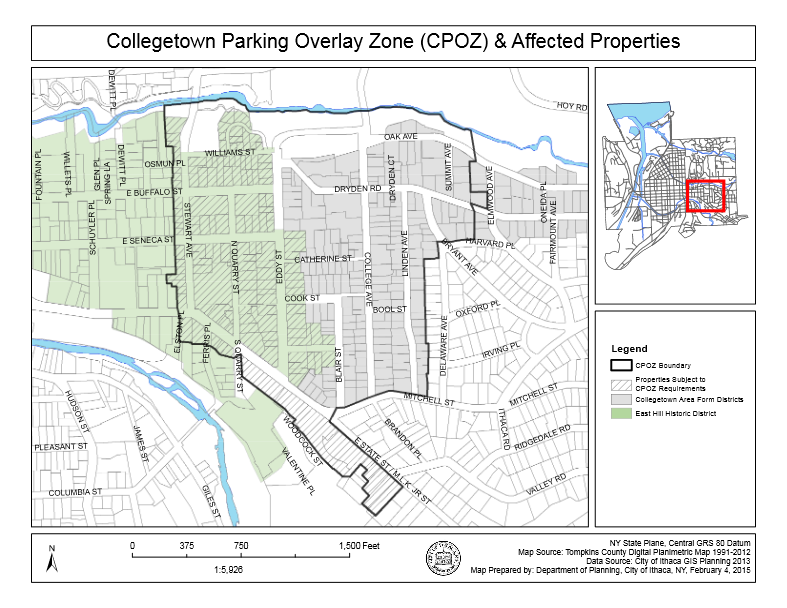
cpoz_1

1. Leading off for the week, here’s an interesting piece of news: the city is set to repeal the Collegetown Parking Overlay Zone (CPOZ). The CPOZ was enacted in 2000 as a way to control the parking needs of Collegetown – essentially, it mandated more parking spaces per unit than was standard for a parcel’s zoning. For example, an apartment building of 6 occupants, zoned R-3a, would require 2 off-street parking spaces in Fall Creek, one for every three residents. But on East Hill, that same building would require 3 parking spaces, since the CPOZ mandates 1 off-street space for every 2 residents.

At the time, it made sense; East Hill tends to have more students, who bring their cars to school. But in the past 15 years, the proportion of students bringing cars has declined substantially – a study by Randall/West indicated that in 2000, 49% of Cornell students owned a car; by 2012, it was 27%, a change attributed to the rise of alternative transportation (car share, Cornell-subsidized bus passes), economic and cultural changes. At this point, there’s more parking than there is necessary.

It may seem at first glance that the CPOZ was eliminated with the Collegetown Form Zoning enacted last year, but the two maps don’t match up completely- there are 145 properties that weren’t affected by the new form zoning, but are still covered by the CPOZ parking requirement (see map above). Nearly all of these parcels are a part of the East Hill Historic District (the rest being Collegetown Terrace). A few recent cases, one with Collegetown Terrace and a couple of smaller projects, have highlighted the point that parking requirements have become excessive.

A change to the parking requirements could have a couple of desirable effects – one, less parking would be more historically accurate, and helps to preserve green space in the neighborhood. Two, it opens the idea of replacing a couple of the current parking lots with new housing, which would be designed to fit in closely with the current building stock since the properties are located in the East Hill Historic District (I know, landlords will never give up the money from renting spaces, but perhaps a new small apartment house might be more lucrative than a parking lot; looking at the tax maps, there are a few possible sites, including subdivisions). One mixed effect would be that it’s easier to convert a current single-family lot to student rentals, but the rental would now be less visually intrusive with fewer parking spaces. It’ll be interesting to see what comes forth as a result of this zoning repeal.

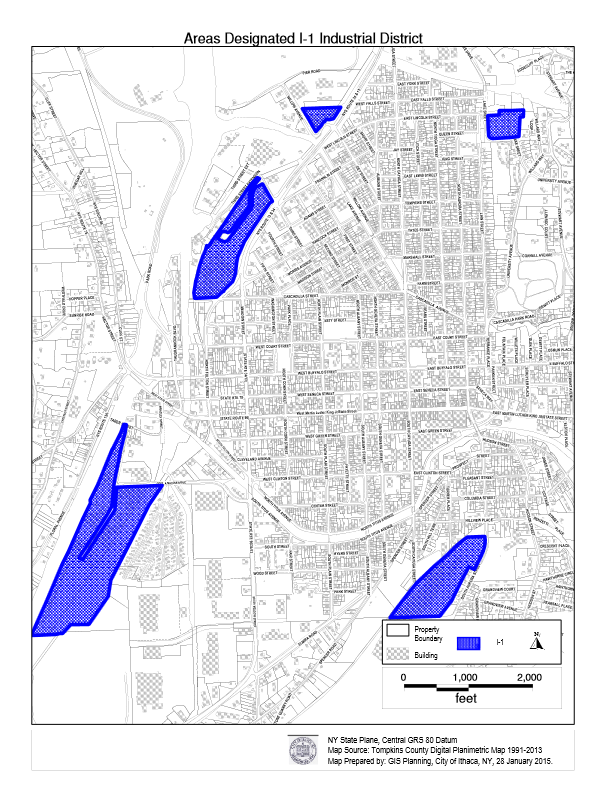
industrial_zones_1

2. Among other zoning changes being considered is a change to industrial zones (the city has just a few). Commercial buildings can be built in industrial zones, but the city wants to raise the minimum number of floors for new commercial buildings in these zones to increase from 1 to 2 floors, a nod to the paucity of undeveloped land in the city (and perhaps the painful attraction of suburban big box stores). There are five sites on the map above, but it might as well be three – Emerson (lower right) is becoming a planned development zone, and the Ithaca Gun site (upper right) is expected to be rezoned from industrial to medium-density residential, in preparation for an apartment project still in the works.

canopy_hampton_rev4_1

3. What is up with the proposed hotels constantly delaying their schedules? First the Marriott pushed back its opening from Spring 2016 to Q3 (July-September) 2016. Now the Canopy Hilton is pushing their schedule back, from a construction start this Spring to an autumn start, which makes it difficult if not impossible to realize the cost savings from reusing the crane for the Carey Building. The tax abatements aren’t going to take that long to obtain, maybe another month or two before the county takes its vote.

Presumably, the project would open in autumn 2016 if the construction schedule is similar. But I feel like these delays send a message of incompetence, and that’s the last thing a project needs.

inhs_pride_design_6

4. Maybe the article I wrote about the new INHS project will have run in the Voice by the time this auto-publishes. But here’s a render that I decided to leave out of the final article to minimize space. The city uploaded the initial application Friday morning (sketch plan will be presented this month), and I’ll write a follow-up article, based on the application paperwork (so it will be different from the Voice article), and post it here on Ithacating in the next few days.

Cayuga-Meadows-Shot

5. Staying on the topic of affordable housing, these agenda notes from IURA Neighborhood Investment Committee reminded me of another affordable housing project that totally slipped off the radar- Cayuga Meadows, a 62-unit apartment building for seniors that was approved by the town of Ithaca for a site near Overlook at West Hill in late 2012. On page 52, it’s noted that the project is supposed to open in November 2015. That would imply that it should be starting construction soon if site prep hasn’t started already (I haven’t visited the site in over a year, so I have no clue). The pipeline document is dated from February 2014, so I have no idea if that’s still accurate. I emailed its developer, Conifer LLC, to see if the project was active, but received no response. Still, it’s something to keep an eye on.