News Tidbits 12/4/2016: Not Forgotten

4 12 2016

old_libe_v7_1

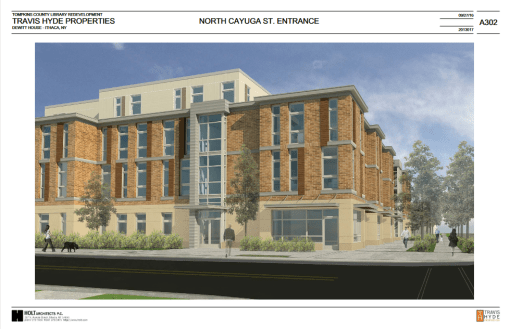
1. It looks like the Old Library proposal will be coming up to bat one last time. Developer Travis Hyde Properties and its project team will present one last major revision at the January Ithaca Landmarks Preservation Commission (ILPC) meeting. Things are well behind schedule at this point, as the ILPC continues to take issue with the old library proposal – which at last check, has had seven separate designs proposed and shot down for one reason or another. The Times reports that senior services non-profit Lifelong is one again involved in the project, although it had never really left – they will control the community room on the first floor, and will receive the revenues generated from renting it to outside entities. The last iteration may once again include first-floor interior parking, since that was the sticking point at the October ILPC meeting – the plan for design #8 is to increase parking from the proposed 10 spaces, to 25-30 spaces. If the January concept is acceptable, or at least close to ILPC approval, Travis Hyde will pursue the 55-60 unit plan; otherwise, it’s over.

The county had hoped that the sale of the property would generate $925,000 at the outset, as well as future tax revenues; the current building’s mechanical systems are past their useful life and in need of replacement, a cost likely to exceed a million dollars. With no sale, and a perceived “toxic” site for development due to opposition both during the RFP stage and during this review process, the county and city will be in a less than enviable position if things fall through.

At the housing summit, the old library came up as a point of concern and contention; JoAnn Cornish, the city’s planning director, suggested at one that if the county had been willing to part with the property for a token $1, than the need to build up on the site wouldn’t be so great. I happened to be taking notes next to a county legislator and Old Library Committee member who muttered that that was a terrible idea and Cornish had no idea what she was talking about. Anyone looking for common ground is going to have a real hard time finding it.
cma_v2_2

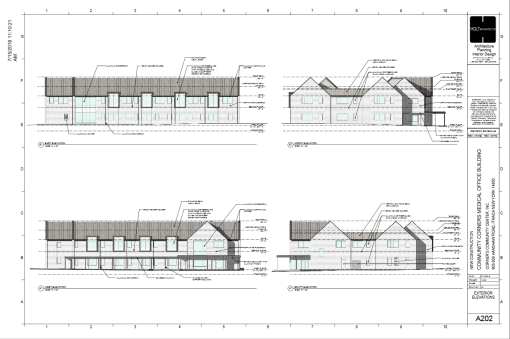
2. It looks like Cayuga Medical Associates’ plan for Community Heights is nearly good to go. Only a couple minor revisions were presented at the Cayuga Heights Planning Board’s meeting on the 28th – a rear (east) driveway, sidewalk work and a detention basin. Cover letter here, updated site plan here, and a letter noting a potential change in hosted medical specialties here. The $5.6 million medical office building at 903-909 Hanshaw Road is 2 floors and 28,000 SF (square-feet), of which 23,200 SF will be lease-able space. The initial presentation in March called for a 3-story, 39,500 SF structure. Two buildings, a one-story office building and a vacant drive-thru bank branch, would be demolished.

chapter_house_reconst_v5_1
3. Now for something that’s a little less certain – the 400-406 Stewart Avenue reconstruction. One can’t call it the Chapter House reconstruction, because there’s no certainty that that is what will happen. Nick Reynolds has the full story over at the Times. The Chapter House’s intended space on the first floor is being advertised by Pyramid Brokerage for $35/SF, double the bar’s rent from before the fire. The owner of the Chapter House referred to all this pre-development as a “money pit” as the building still has no anchor tenant, but he was still open to being a part of the rebuild. In short, it looks like we’re seeing some bickering between the developer and potential tenant spill out into the public domain, and we’ll see how it plays out.
amici_house_v3_1

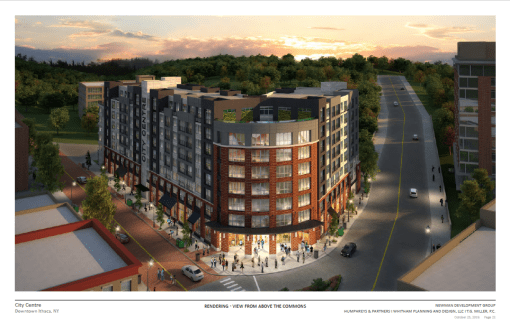
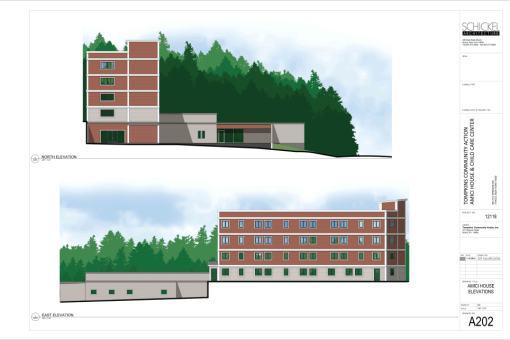
4. At the city planning board meeting last week, preliminary approval was granted to Charlie O’Connor’s four two-family homes at 607 South Aurora. City Centre also continued with its review, with comments focusing on sustainability and solar panels. Changes to the project are minor at this point, and we’re probably close to the final product at this stage. Amici House was also debated, with neighbors expressing concerns about the size, and uncertainty on whether TCAction can handle 23 homeless or vulnerable youth.

I’ll register a small complaint – the north stairwell of the residential building. I’d encourage TCAction and Schickel Architecture to explore using smoked or tinted glass to reduce glare, rather than bricking it in. It makes the building look cold and industrial, which seems just as unfriendly to neighbors as glare would be.

The board also went ahead with lead agency on Novarr’s College Townhouses project, and was shown brief presentation on two Visum Development Group projects, 126 College and 210 Linden. More on those here.
20160630_142619

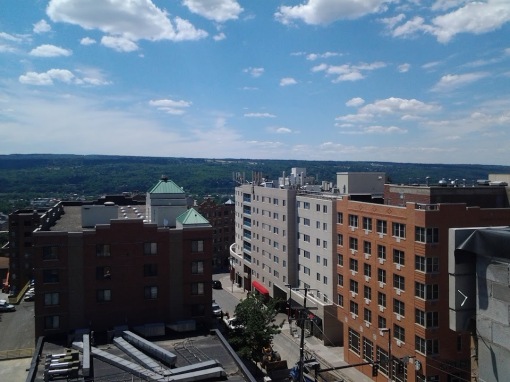
5. The Times included a quick Collegetown construction rundown about a week and a half ago. Two quick addendums –
A. Still no plan for 330 College Avenue, since Fane did the development version of trolling by proposing a 12-story building in a 6-story zone, and was told there was “no way in hell” it would happen;
B. Nothing scheduled for 302-306 College Avenue, aka “Avenue 102”, until at least mid-2018. The rumor mill says the Avramis family, who proposed a two-building, 102-unit sketch plan in October 2014, are concerned about market saturation. Given Cornell’s plans to increase their enrollment by raising their incoming freshman class size from 3250 to 3500, it might be worth another look.
downtown_design_guidelines_1

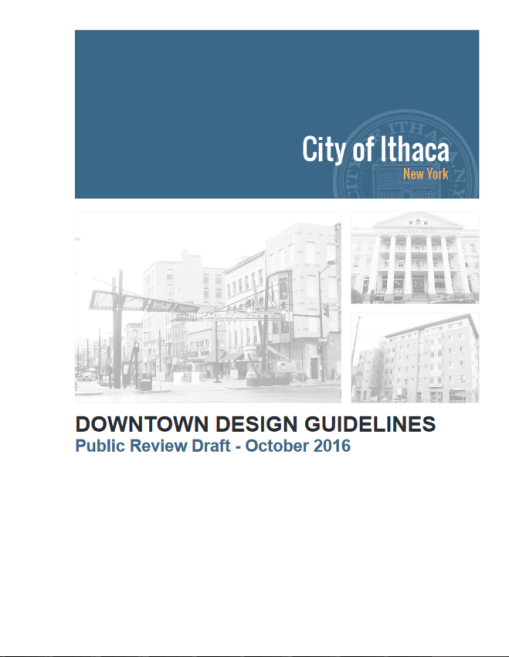
6. The city has released the preliminary design guidelines from Winter & Company. The Collegetown guidelines are here, Downtown’s here. Although there are suggested rather than mandatory, in theory, a project team could use these guidelines to formulate plans that would be less likely to get hung up in the city’s project review process – one could call it “form-based code lite”. There’s nothing particularly groundbreaking in here, but the guidelines do promote urban-friendly and contextual designs. These are draft open to public comment – those who would like to can send their thoughts to city planner Megan Wilson at mwilson*at*cityofithaca.org by December 15th. there are some differences between existing zoning and these guidelines (for example, setbacks) that will need to be addressed at some point – the revised drafts will roll out in mid-January.
20161201_121840

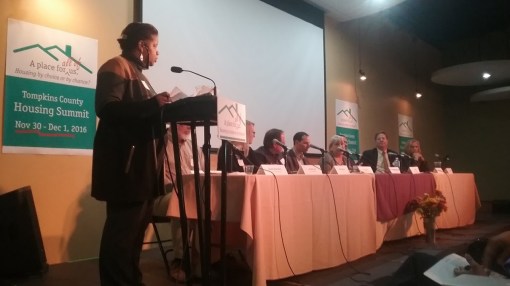
7. Now that the county housing summit is behind us, I think that while there wasn’t any sort of huge breakthrough at the event, it was helpful to the community to have the obstacles and suggested goals shared with a large audience. Although, as county legislator Anna Kelles pointed out, it wasn’t necessarily a wide audience – renters, younger residents and lower-income individuals were not well-represented. At least for me, the big, exciting news was Cornell’s plans for new housing, which I will be writing about for the Voice later this week. While not perfect, the event did bring to light certain issues – NIMBYism can be a delicate topic in an audience like this, but one of the points that was stressed at the summit was, if you support a project, then let the governing body in charge know you support it and why. Heck, JoAnn Cornish was saying the city gets opposition emails from residents of California and Oregon. A little support from local residents, even students, reminds city staff and board members that there a variety of opinions.

I can definitely say that not everyone who attended was pro-development – after the woman behind me asked if I was a reporter (I said yes, for the Voice), she kept passing me notes like “since when did development bring property taxes down”, “developers are just in it for the money” and “Ithaca shouldn’t have to change”. I don’t think she liked my replies – the first one I wrote back a response about spreading the tax burden out with new infill development, the second I wrote “strictly speaking perhaps, but they don’t want to turn out a terrible product”, and the last, I perhaps unkindly wrote “[t]ell that to the families being priced out. Something has to change.” She got up and left shortly afterward.


Brookdale Ithaca Crossings Construction Update, 11/2016

1 12 2016

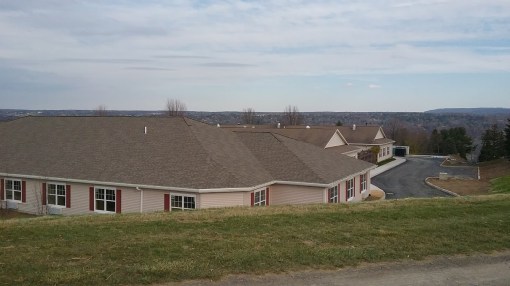
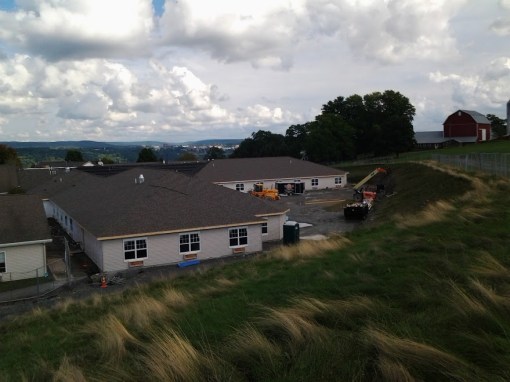
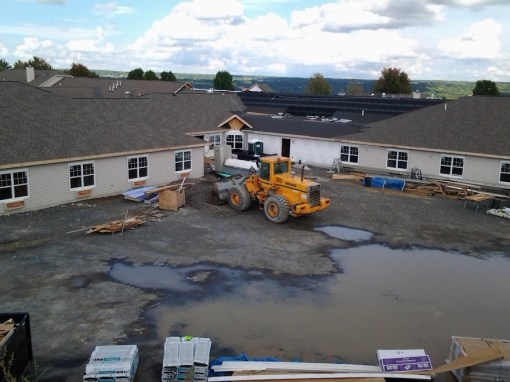
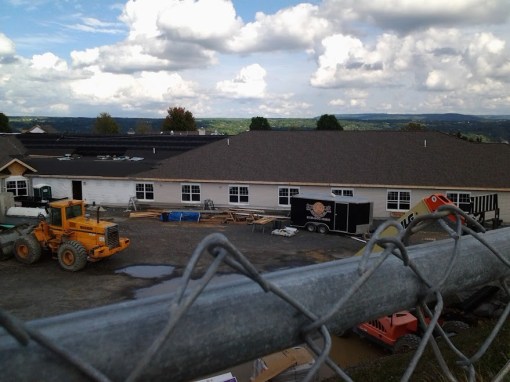
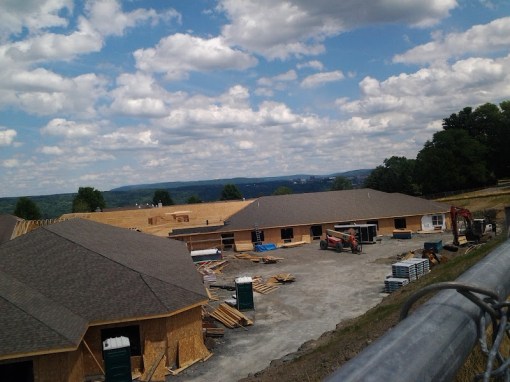
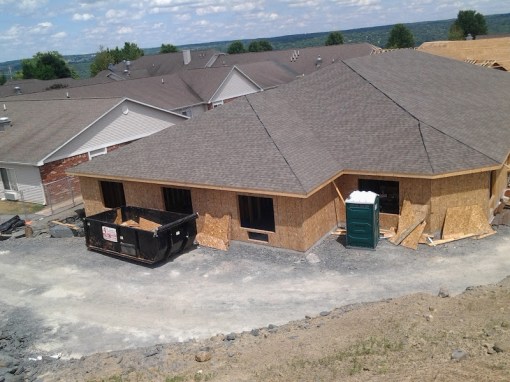
The Brookdale project is just about complete. It looks like most of the exterior is complete with only some minor trim left on the to-do list, and landscaping for the new 32-bed, 23,200 SF facility is underway. New trees and other flora will likely wait until early Spring, which will give them a chance to take root before dealing with an Ithaca winter. Occupants should begin moving in during January 2017.
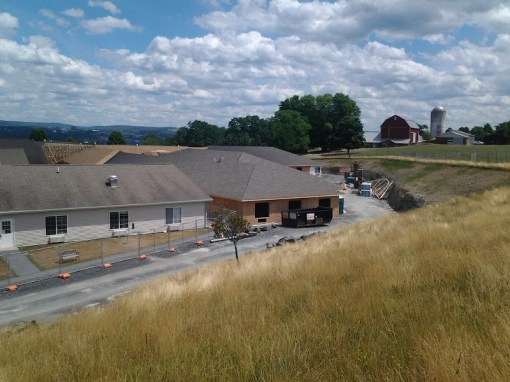
It might not be architecturally daring or a planning masterpiece, but the need for memory care facilities is demonstrated, it will bring a couple dozen new jobs to the area, and positively contribute to the quality of life of local families and mature adults. Should one have a family member in need of a facility, it’s a lot easier and more convenient to hop over to West Hill than to travel up to Syracuse or Rochester. On the balance, it’s a benefit to the Ithaca community.

Background information on the project can be found here. An interview with Brookdale staff can be found on the Voice here. Syracuse’s Hayner Hoyt is the general contractor, and Wisconsin firm PDC Midwest is the architect.

20161119_141147The  20161119_141220 20161119_141245 20161119_141329 20161119_141341

clarebridgecrossings_2 clarebridgecrossings_1


Cayuga Meadows Construction Update, 11/2016

30 11 2016

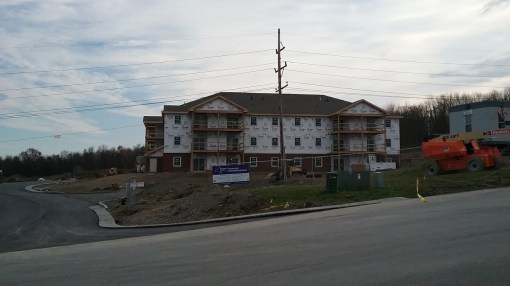
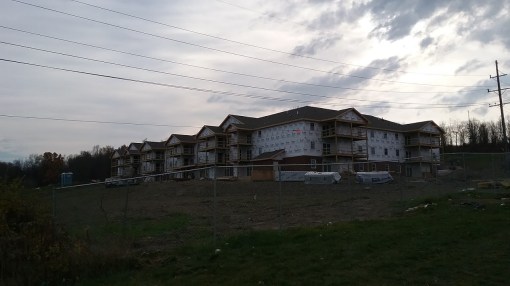
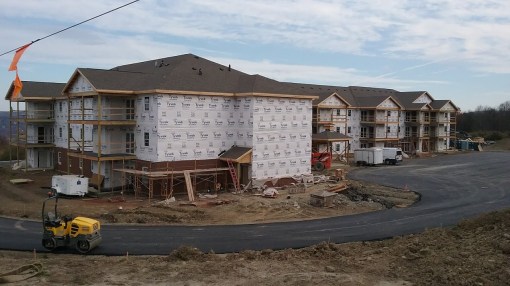
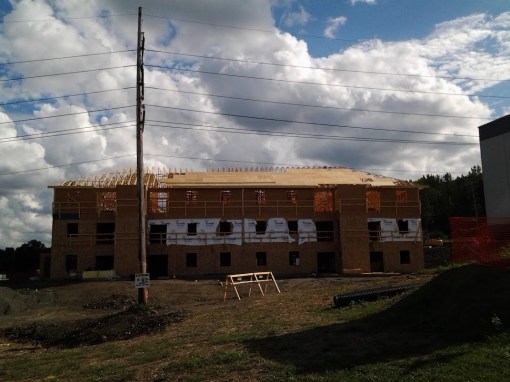
At the Cayuga Meadows site on West Hill, LeChase Construction has fully framed the new 68-unit apartment building. Windows and doors have been fitted into the wood stud walls. The roof looks to be pretty much complete, with the exception of trim pieces.The first floor is getting a brick veneer, and the balconies are built out but are also lacking their trim for the moment. The Tyvek waterproof housewrap will be covered over with Certainteed fiber cement “Savannah Wicker” Dutch Lap Siding and “Cypress Spruce” cedar-like shingle siding. Basically, beige and grey-green. Looks like the new access road has also been paved.
It might not be the most exciting design, but it’s one of Conifer LLC’s tried-and-proven approaches – an L-shaped structure with bumpouts, typically hosting small private balconies. One need only go a couple miles south to Conifer Village at Ithaca to see a similar example, albeit with some different material finishes. While Cayuga Meadows might not be especially unique, it does have its advantages – LeChase, who does nearly all of Conifer’s work through a partnership, has extensive experience with the design, and that familiarity should help with producing a high-quality and on-time product.

20161119_140224 20161119_140252 20161119_140343 20161119_140508 20161119_140529 20161119_140603

Cayuga-Meadows-2 Cayuga-Meadows-Shot


News Tidbits 10/22/16: Seal of Approval

22 10 2016

201_college_v4_1

1. In yet another twist in the 201 College Avenue saga, the project will be moving forward. The Board of Zoning Appeals sided 3-1 with the city Zoning Director and denied the Planning Board’s consideration that the building be considered illegal due to facade length. According to a report from former Times reporter Josh Brokaw (now operating as an indy journalist),  the board was swayed by arguments of time and ambiguity in the code. Brokaw’s reading makes it sound like there’s still some raw feelings between staff and board. The way to solve the most pressing issue would be to clarify the code based on the facade debate, and have the common council ratify those changes over the next few months. All in all, the Form District code works pretty well, and a number of projects have been presented without big discussions over semantics. But in the case of 201, it’s clear that the CAFD wording and imagery could use further refinement, so that everyone is on the same page. With 201 resolved, now is a good time to do that.

Dunno what the completion date will be offhand (August 2017 would be a breakneck pace, but we’ll see). Neighbor Neil Golder has refiled his lawsuit, but the case isn’t especially strong.

elmira_savings_v2

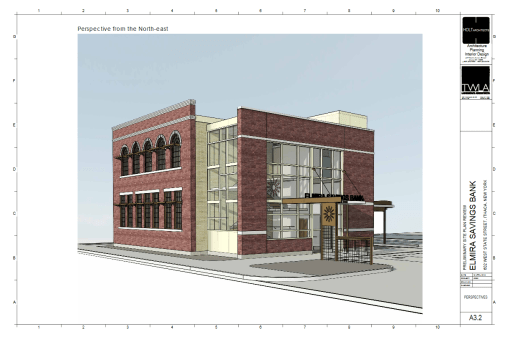
2. Also getting underway this week is the renovation of the former Pancho Villa restaurant at 602 West State Street into the West End branch of Elmira Savings Bank. This is quite a bit earlier than initially planned – Site Plan Review docs suggested a July-December 2017 construction/renovation. Edger Enterprises of Elmira will be the general contractor for the 6,600 SF, $1 million project, which is expected to be completed in March 2017.

evergreen_dryden_1

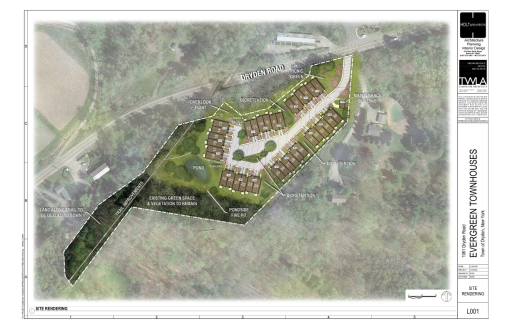
3. The Dryden town board has approved 4-1 the concept of the Evergreen Townhouses plan for 1061 Dryden Road just east of Varna. This means that they accept a PUD can be appropriately applied for the site, but the project will need to submit a formal, more detailed development plan before any final approvals will be considered. One of the major changes that is being requested is a 15-foot setback between the property line and the units at the southeast side of the parcel (25-36), so expect those to get a little trim off of the rear side (the dissenting vote, Councilwoman Linda Lavine, was because she preferred a 25-foot setback). If the setback and the other stipulations are accommodated, its chances of approval are pretty good. Developer and local businessman Gary Sloan has 270 days to submit detailed plans for review.

Meanwhile, Tiny Timbers will be up for Dryden Zoning Board of Appeals review in early November. Since an internal road will be used to access some of the home lots, the town board will be viewing the site as an “Open Development Area” (ODA), which by Dryden’s definition is development with no direct road access. The town board will hold their public meeting on the 20th to approve the ODA, the planning board’s acceptance on the 27th. The ZBA is the last or second-to-last step in the approvals process (not sure offhand if the town will need to vote again to give a final approval).

lansing_meadows_old

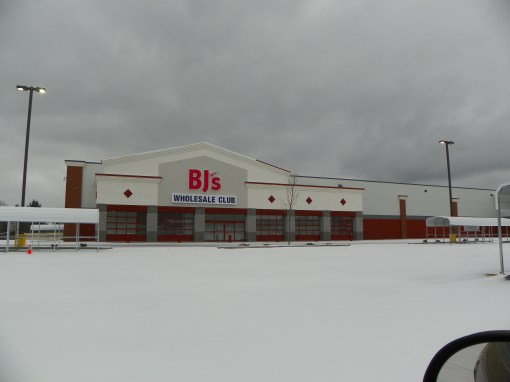
4. The senior housing next to the BJ’s in Lansing might finally be moving forward this spring. Dan Veaner has the full story here at the Lansing Star. The issue stems from working with the U.S. Army Corps of Engineers to determine what parts of the land can and cannot be developed – delineating the wetlands, basically. Apparently, the wetlands were created by an overflowing culvert back when the mall was built in the 1970s. But regardless of how they were created, the USACE deems they have to be protected, especially since it developed into a rare wetland environment called an “inland salt marsh”. Since then, it’s been back-and-forth on units – I’ve heard as few as 9 and as many as 18. A portion of the wetlands would still need to be relocated. The PDA boundaries were changed slightly by the board at the request of developer Eric Goetzmann earlier this month to accommodate the USACE determination. The tax break Goetzmann received to build BJ’s is contingent on the senior housing getting built, though at this point, one has to wonder just how much this wetlands tangle has cost him. Hope it was worth it.

maplewood_v7_3

5. From the sound of it, the Maplewood Park DEIS public hearing was fairly positive. Many of the neighbors are pleased with the changes, although some are still opposed to the density or have concerns about traffic. In response, it’s worth pointing out that the commute of Maplewood’s residents will almost entirely be bus, bike and foot during normal business/school hours, and its convenience to bus routes and services will also help minimize overall traffic impacts. As for density, well, if you want Cornell to house its students and reduce the burden on the open market, promoting density on the existing Maplewood site may result in a more sustainable, more cost efficient project if planned properly, with less of a neighborhood impact than building several hundred beds on an undeveloped parcel elsewhere (since the Maplewood site has been inhabited in some form since the 1940s, the growth in density would not be as prominent – about 490 beds, vs. 872 beds).

Should readers feel inclined, comments are still being accepted by town planners up until October 31st. The materials and submission email can be found here.

6. It looks like there were a couple big sales in the local real estate market this week. The first one was the Tops Plaza in big box land, just south of Wegmans. National retail developer DDR Corp. sold the property to another large firm, NYC-based DRA Advisors LLC, for $20 million on the 18th. The sale included three addresses – 710-734 South Meadow, 614 South Meadow, and 702 South Meadow – The Tops Plaza, The smaller strip to its south (called Threshold Plaza), and the pad parcels like Chili’s and Elmira Savings Bank. Perhaps the most notable part of this sale is that it’s slightly below the total assessed value of $20,941,000. However, DRA picked up the property as part of a bundle sale of 15 shopping centers in Western and Central New York, so maybe it was a bulk discount, or compensating for weaker properties.

The other big sale was between a long-time local landlord and a newer, rapidly growing one. The Lucente family (as Lucente Homes) sold 108, 116, 202 and 218 Sapsucker Woods Road to Viridius LLC for $1.276 million on the 18th. According to county records, each is a 4-unit building built in the 1970s and worth about $275k – meaning, Viridius just acquired 16 units for a little above the $1.1 million assessed. Viridius’s M.O. is to buy existing properties, do energy audits to determine what needs to be done where to maximize energy efficiency, disconnect them from fossil fuel heating and energy sources, install pellet stoves, heat pumps and the like, renovate/modernize the properties, and connect the more efficient house to a solar grid or other renewable energy sources. If Sustainable Tompkins were a developer, they’d look like Viridius.


7. This last one isn’t so much a big sale, but worth noting for future reference – 126 College Avenue sold for $510,000 on the 19th. The buyer was an LLC at an address owned by Visum Development’s Todd Fox.

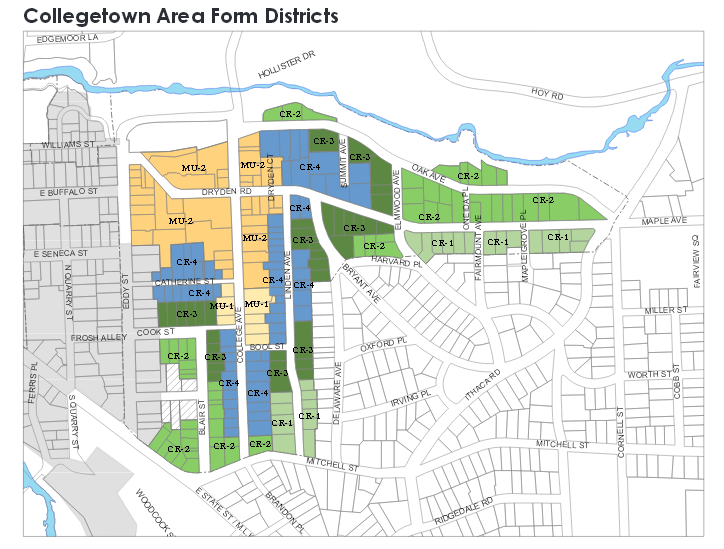
126 College is a 2-story, 6-bedroom house that might have been attractive long ago, but someone’s beaten it with an ugly stick and paved much of the front lawn (growing up near Syracuse, we called paved front lawns “Italian lawns”, with my uncle one of the many offenders). The purchase price is a little below the asking price of $529k, but more than double the assessment. Zoning at the property is CR-4 – up to 50% lot coverage, 25% green space, up to 4 floors and 45 feet in height, a choice of pitched or flat roofs, and required front porches, stoops or recessed entries. This is the lowest-density zone for which no parking is required. The city describes the zoning as “an essential bridge” between higher and lower density, geared towards townhouses, small apartment buildings and apartment houses.

Granted, not everything Visum/MLR does is new, some of their work focuses on renovation. But given the location, and given that frequent design collaborator STREAM had “conceptual” CR-4 designs on display during the design crawl earlier this month, it’s not a big stretch of the imagination.

city_centre_v3_2

8. Interesting agenda for the city planning board next week, if nothing new. Here’s the schedule:

AGENDA ITEM                 APPROX. START-TIME

1. Agenda Review                6:00
2. Privilege of the Floor         6:01

3. Subdivision Review
A. Project:  Minor Subdivision           6:15
Location: 404 Wood St.
Actions: Consideration of Final Subdivision Approval
A minor subdivision to split a double-lot in Ithaca’s South Side neighborhood into two lots, one with the existing house and one that would be used for a new house or small apartment building. A variance for an existing rear year deficiency of the house would need to be approved (the rear deficiency wouldn’t be affected by the new lot which is on the east side, but it’s a legal technicality).
B. Project:  Minor Subdivision             6:25
Location: 123 & 125 Eddy St.
Actions:  Consideration of Final Subdivision Approval
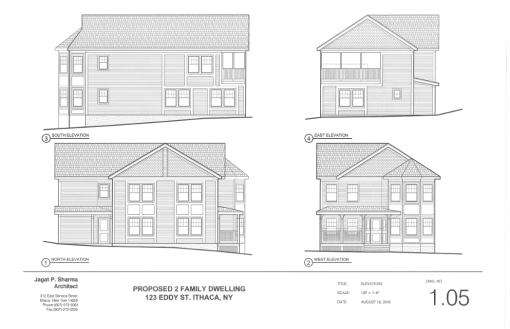
Collegetown landlord Nick Lambrou is planning subdivision of a double lot to build a new 2-unit, 6-bedroom house designed to be compatible with the East Hill Historic District. CEQR has been given neg dec (meaning, all’s mitigated and good to proceed), and zoning variances for deficient off-street parking have been granted.
C. Project:  Minor Subdivision                6:35
Location: 1001 N. Aurora St. (Tax Parcel # 12.-6-13)
Actions:  Consideration of Final Subdivision Approval
One of those small infill builds, this proposal in Fall Creek takes down an existing single-family home for two two-family homes on a subdivided lot. The design has been tweaked, with more windows, a belly band, more varied exterior materials, and additional gables to provide visual interest.

4. Site Plan Review

A. Project:  City Centre — Mixed Use Project (Housing & Retail)           6:45
Location: 301 E. State/M.L.K., Jr. St.
Applicant: Jeff Smetana for Newman Development Group, LLC
Actions:  Declaration of Lead Agency  │ Review of Full Environmental Assessment Form (FEAF), Part 2

The 8-story mixed-use proposal for the Trebloc site. Comes with one letter of support, and a letter of opposition from Historic Ithaca, who have previously stated they will oppose anything greater than four floors on State Street, and six floors overall.
B. Project:  Amici House & Childcare Center            7:15
Location: 661-701 Spencer Rd.
Applicant: Tom Schickel for Tompkins Community Action (“TCAction”)
Actions: No Action — Review of Full Environmental Assessment Form (FEAF), Parts 2 & 3
C. Project:  Four Duplexes                               7:30
Location: 607 S. Aurora St.
Applicant: Charles O’Connor
Actions:  Declaration of Lead Agency  │ PUBLIC HEARING  │ Review of FEAF, Part 2
MLR’s four-building, 8-unit plan for South Hill. Comes with a letter of neighbor support saying the scale is appropriate.
D. 371 Elmira Rd. (Holiday Inn Express) — Approval of Project Changes      7:45
The debate over the Spencer Road staircase and rip-rap continues.
E. 312-314 Spencer Rd. — Satisfaction of Conditions: Building Materials   7:55
F. 119, 121, & 125 College Ave. (College Townhouse Project) — Update        8:05
Novarr’s 67-unit townhouse project geared towards Cornell faculty. No decisions planned, just an update on the project. Keeps your fingers crossed for some renders.
G. Maplewood Redevelopment Project — Planning Board Comments on Draft Generic Environmental Impact Statement (DGEIS)     8:20
The city’s deferred judgement to the town, but the board can still have their say. The comments will be recorded and addressed as part of the EIS review process.
5. Zoning Appeals                          8:35
• #3047, Area Variance, 123 Heights Court


Brookdale Ithaca Crossings Construction Update, 9/2016

25 09 2016

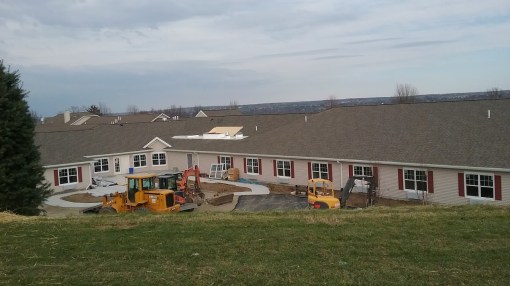
There’s only a few months left in Brookdale Ithaca’s construction timeline, and the new Crossings facility is starting to look a lot like the anticipated final product. In the past few months, the rough openings have been mostly fitted out with windows, and the exterior walls have been sheathed in housewrap and are in the process of being sided. The installation of A/C units is also underway. Most of the roof appears to be done, although in some sections the tar paper has yet to be shingled. Exterior trim panels and details like the decorative shutters will be attached after the roof and primary walls are finished. The excavated hill to the southwest (right side in the images) will be held back with a 10′ retaining wall, yet to be assembled.

Note that these photos are the living spaces and the bulk of the new 23,200 SF, 32-bed facility, but the front entrance is actually a diagonal (northeastward) extension between the two existing facilities and out towards the front circle. You can see a little bit of  the front entrance gable in the second-to-last photo. More details on the project can be found on the blog here and on the Voice here.

20160918_155022 20160918_155049 20160918_155112 20160918_155147 20160918_155202 20160918_155211

clarebridgecrossings_2 clarebridgecrossings_1


Cayuga Meadows Construction Update, 9/2016

22 09 2016

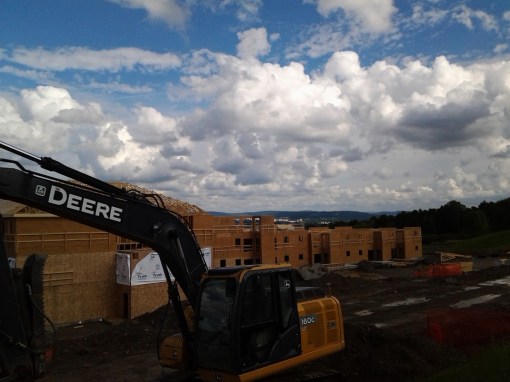
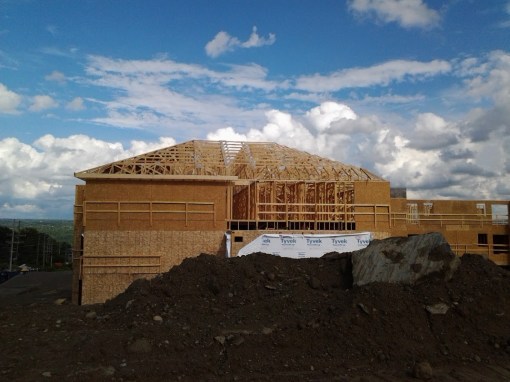
LeChase Construction is making good progress on Conifer LLC’s 68-unit Cayuga Meadows apartment project off of West Hill Drive in the town of Ithaca. The wood frame is topped out on the north side of the L-shaped building, where they’re starting to nail plywood (the decking) to the roof trusses – later they’ll be covered over with tar paper or a similar material, followed by the shingles. It also looks like they’ve started attaching a little Tyvek housewrap to the second floor of the structure. As you go southward, framing is only up to the second floor, with rough openings in the plywood for doors and windows. At the rear of the property, a trench has been dug for a new water main, which is being routed below what will be the building’s parking lot.

The apartment units, which are intended for seniors with limited incomes, are expect to be ready for occupancy next fall. More information about the project can be found here.

20160918_154000 20160918_154027 20160918_154050 20160918_154218 20160918_154325 20160918_154352 20160918_154401 20160918_154405

Cayuga-Meadows-2 Cayuga-Meadows-Shot


Brookdale Ithaca Crossings Construction Update, 7/2016

25 07 2016

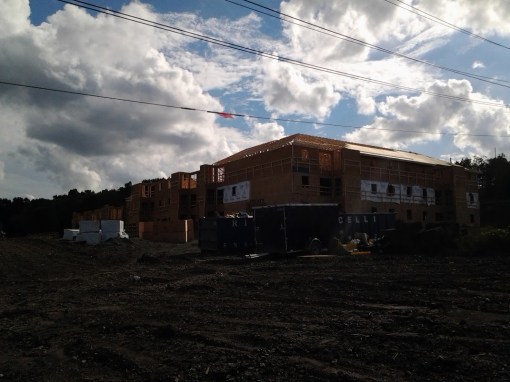
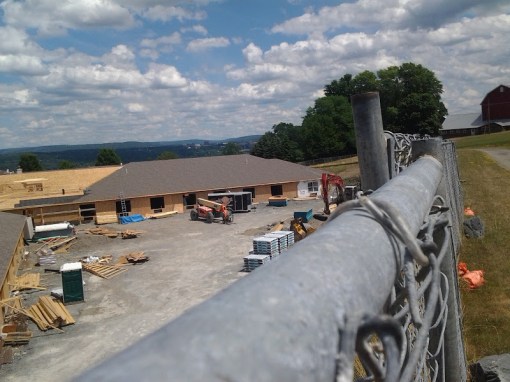
Over at the Brookdale site on West Hill, work continues on the new transitional wing for the existing assisted living and specialized memory care facilities. The residential areas of the new wing have been framed out and roofed. Shingles have been attached and plywood has been attached, leaving rough openings for windows, doors and A/C units. Sheathing will follow (you can see a little Tyvek housewrap on the far end), and exterior materials will come along in due course.

The connector to the existing wings is not as far along; some exposed roof trusses can be seen, and some of the roof plywood has been installed but not tar papered and shingled.

The buildout appears to differ from the online plans slightly. The plans show standard rectilinear corners. The new wings have chamfered corners.

The 32-unit, 32-bedroom project is expected to open to new residents in the first quarter of 2017.

20160717_141559 20160717_141624 20160717_141658 20160717_141714 20160717_141722 20160717_141734

clarebridgecrossings_2 clarebridgecrossings_1


Cayuga Meadows Construction Update, 7/2016

18 07 2016

Safe to say this is under construction. Work has commenced on Conifer LLC’s Cayuga Meadows affordable senior housing project on West Hill.

Cayuga Meadows is a 3-story, 58,500 SF apartment building with 68 units, 59 1-bedroom and 9 2-bedroom. The units will be available to individuals aged 55 and older, with incomes 60% or less or the Area Median Income (AMI). AMI in Tompkins County is about $53,000 per household, so a qualifying senior household would have an annual income of $31,800 or less. 7 units will be accessible to mobility-impaired individuals, and 3 units will be designed to accommodate hearing or visually-impaired occupants. Included in the plans are two covered patios, a community garden, and stormwater, lighting and landscaping improvements. 67 parking spaces will be paved behind the building.

The history of Cayuga Meadows goes back a few years, and has its share of twists. Originally, the project had been conceived as “Conifer West Hill” in 2009 as a component to a Cornell-led mixed-use development on about 36 acres of land across from Cayuga Medical Center. Rochester-based Conifer’s part in the plan has always been the same – affordable housing for seniors. But Cornell had other plans for the rest of the acreage.

In Spring 2010, there were three different site plans being floated – the consistent components were Conifer’s project, a 68-bed assisted living facility called “Terrace at Ithaca”, medical office space, small-scale retail, 106 park-and-ride spaces, and 4,000 SF for a farmer’s market. Depending on the plan, there were townhomes, a hotel school conference center, or other institutional space for Cornell. Mixed-use, definitely, but the plans weren’t that walkable, traditional neighborhood feel that the town is looking for these days – in fact, they were fairly conventional suburban sprawl. Cornell’s approach to planning was different in the late 2000s. By good fortune, Ithaca Builds locally hosted a copy of those site plans here.

For a combination of reasons (financial feasibility, changing priorities), Cornell ended up shelving its plans. However, it would be incorrect to say the university isn’t still interested in the site – they recently bought the house at 1250 Trumansburg Road, whose property had been awkwardly carved out of the rest of the site in a subdivision long ago. In the 2010 plans, Cornell had to plan around the house, not to mention worry about the occupants complaining about Cornell’s plans. So when it came on the market and sat for a couple months, the Big Red decided to pick it up in June for $157,000, probably on the belief that it could pay off through easier site planning and development down the line.

While Cornell filed away their plans, Conifer continued with theirs since the university was still willing to give them land as long as they built affordable housing. Originally, it was conceived as 72 units when it first received preliminary approval in April 2012, but was trimmed to 68 when final approval was granted in November 2013, in order to make the project a little less expensive, and provide a little more space to the community garden. Between preliminary and final approval, Conifer also had to apply for rezoning (Medium-Density Residential to Multiple Residence in May 2012), zoning variances (June 2012, for height and building setbacks), and public works approval for utilities services to be installed.

Then came another few years’ wait while financing was being secured. As covered on the Voice, affordable housing grants are very competitive, so it often takes multiple rounds of applications before a project is finally given grant money. In Conifer’s case, the last piece of the puzzle, tax-exempt bonds, didn’t come through until late January 2016. Cayuga Meadows is a $14.9 million project – about $8.3 million comes from NYS Housing Finance Agency bonds, and another $6.3 million from Community Development Block Grant (CDBG) funds. First Niagara Bank provided the Letter of Credit for the bonds. The project will pay taxes.

With the funding in hand, Cornell and Conifer formally agreed to a subdivision of Cornell’s land – 4.9 acres for the senior housing, and another acre for the Right-Of-Way for the new road. Cornell and Conifer had to agree on a few choices for new road names, which they submitted to Ithaca’s Codes Enforcement Director (Bruce Bates), who checks with the county to make sure there are no issues with the choices, and then the three parties agree on a final selection. Cayuga Meadows’ address will be “108 Aster Lane”.

There’s yet to be a color render hosted online, but the exterior will use fiber cement siding – Certainteed “Savannah Wicker” Dutch Lap Siding and “Cypress Spruce” cedar-like shingle siding. For the sake of examples, the Belle Sherman Cottages and Stone Quarry Apartments have also used Savannah Wicker fiber cement. The roof will be Timberline “Weathered Wood” shingles.

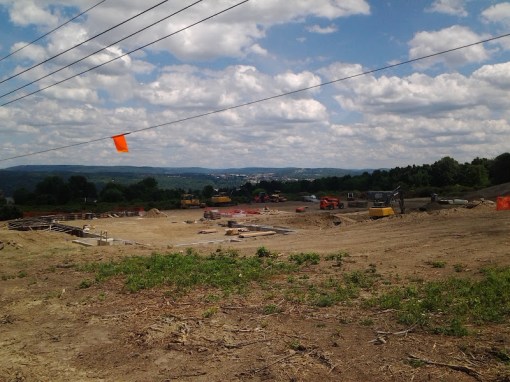
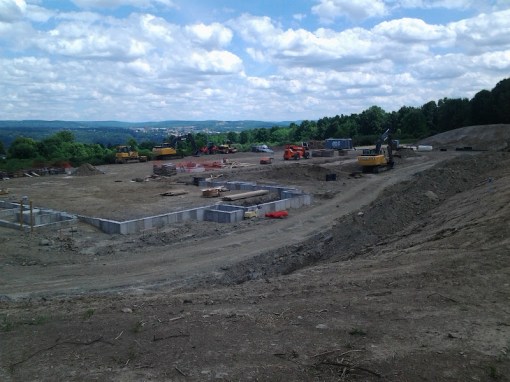
At the project site right now, work is underway on the foundation. The building’s footprint has been cleared, the foundation is excavated, and footers are poured for where the concrete will transfer the weight into the ground. Wooden forms are built along the perimeter for the stem walls, rebar is laid for reinforcement of the concrete, and the concrete is poured and left to harden (cured). Once the concrete has had a chance to harden, the forms are lifted off and work moves onto the next section. The building will be a slab-on-grade foundation, so no worries about excavating a basement here.

As a side note, it seems fitting that the residents with east-facing windows will have some pretty fantastic views of Cornell.

Through a joint venture with Conifer, LeChase Construction of Rochester will be serving as general contractor. The excavating has been subcontracted out to Neally-DeJong Excavating of Corning, and concrete work to Architectural Concrete Plus of Dundee (Yates County, northwest of Watkins Glen). Thanks to “Drill Deep” for the clarification.

20160717_140406 20160717_140444 20160717_140449 20160717_140528 20160717_140557 20160717_140612 20160717_140804 20160717_140815 20160717_140828

Cayuga-Meadows-Shot

Cayuga-Meadows-2


News Tidbits 7/9/16: Land Ho

9 07 2016

waterfront_foreclosure_parcels_0516

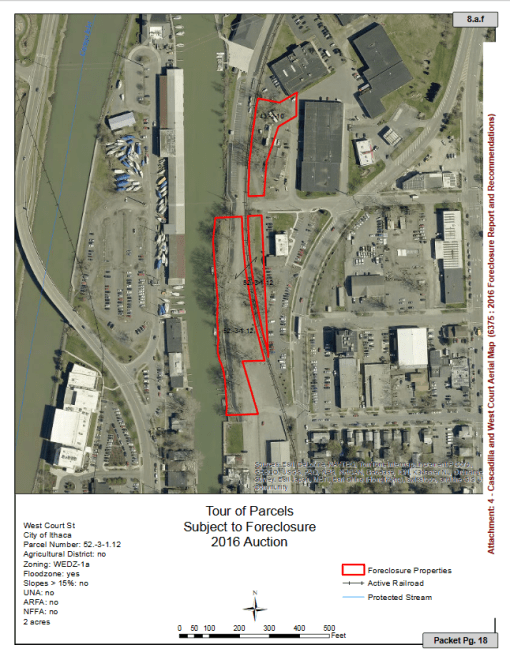
1. Starting off this week, a couple of new pieces regarding Ithaca’s waterfront. First, the city’s chances of picking up some prime waterfront real estate at a low, low price are gone, though not any fault of their own. Readers might recall that back in late May, the properties were about to be foreclosed on for unpaid taxes, and the county was discussing selling the parcels, worth over $630,000, to the city if the city paid off the $42,844 tax bill. Pretty sweet deal for the city, right?

But the owner, an LLC that has held the parcels since the late 1990s, managed to pay off the tax bill and an attached penalty fee, which means they get to keep the land. So, if the city had any plans for those parcels, they’ll be filing those away for a long while.

2. However, it looks like several properties are being put up for the sale in the city’s West End near the Waterfront. Local realtor Brent Katzmann has four properties listed – 321 N Fulton, a duplex on 0.11 acres for $144,800; 319 N Fulton, a single family on 0.04 acres for $109,875; 626 W Buffalo, a single family on a narrow and deep 0.15 acre lot, for $124,999; and 622 W Buffalo, a duplex on a narrow and deep 0.19 acre lot, for $134,800. The prices generally run at or up to 10% over the tax-assessed value ($130,000/$100,000/$125,000/$125,000). The currently owner is a Long Island-based LLC, led by a pair of New York City real estate lawyers, who acquired the properties from 2010-2012. Prior to them, many of the properties have been through a merry-go-round of owners over the past 10-15 years.

The properties are in fair to rough shape, and the marketing tactic being used isn’t renovation, but rather development potential. The four properties all fall within WEDZ-1a zoning, which is the city’s attempt at encouraging development on the West End. WEDZ-1a permits residential, commercial and mixed-use 2-5 story buildings, 90% lot coverage (100% if less than 50 feet on two sides – the Buffalo parcels and 319 N Fulton), and no parking requirement. The properties are not affected by the city’s TM-PUD.

The West Buffalo lots could be tough since the house in-between is owned by someone else, but deep lots and the corner of North Fulton and West Court offer some potential. Worth keeping an eye on, if only to see who they sell to.

20141227_140754

3. One less homebuilder around. Avalon Homes is closing up shop. The Ithaca-based company is selling off its lots and trying to wrap up the homes they have underway. Rumors abound as to why, but if firm, verifiable information can be obtained, there will be more to follow.

Avalon made its name doing stick-built built, with a focus on affordability and green construction. Avalon, a certified Living Wage employer, was the general contractor for INHS’s Holly Creek townhomes (shown above), and employed at least a dozen back in 2010.

old_library_thp_v4

old_libe_thp_holt_v6

4. The Planning Board and the Ithaca Landmarks Preservation Commission will be conducting another joint meeting on Tuesday the 12th at 5:30 regarding the Travis Hyde Properties’ proposal for the Old Library. HOLT Architects responded to comments from the ILPC at its last meeting that the design needed to be “quiet” by submitting the revised elevations seen below.

Mission accomplished? Armchair architect comment here, but the revised design is too far the other way. There’s a joke about the color beige, coincidentally similar to the new brick, being an adjective for “dull, boring, indistinctive“. I like the previous design with its wood-like fiber cement and characterful roofline, and I wonder if perhaps a revised color palette of that design, with maybe a few less full-sized balconies, would be a happy medium.

5. As announced on city of Ithaca Mayor Svante Myrick’s Facebook page, the Namgyal Monastery Institute of Buddhist Studies will be the site of a library and museum of the Dalai Lamas, the first of its kind outside of Tibet. The facility would be located on the 28 acres Namgyal owns on South Hill at its Du Khor Choe Ling monastery complex. Architectural plans and costs are still being determined, but a quote from Ngawang Dhondup, administrator for Namgyal’s facility, says that it will be larger than Namgyal, which has been underway since 2007 and will be about 14,500 SF when completed.

All in all it’s a great feather in Ithaca’s cap, but two things to be a bit wary of moving forward are the reactions and possible opposition from neighbors to what will be a very high profile religious facility, and given geopolitical issues, the reception to the Library of the Dalai Lamas may not be so warm from some denizens of cosmopolitan Ithaca.

12-29-2011 003

6. Way back in 2010 and early 2011, when the BJ’s Wholesale club was proposed in Lansing, one of the components of the proposal was to build 12 units of senior housing on land north of the then-proposed store. The project also called for wetlands, walking trails and a bird sanctuary on the undeveloped portion of the 11-acre property. Developer Eric Goetzmann (Arrowhead Ventures/Triax Group) faced considerable opposition to the plan since it involved big box retail and was housing outside of the density corridor, but after the IDA initially voted the project down in December 2010, a revised application calling for a smaller PILOT was passed by the IDA in April 2011 (some of the logic being that the county was in a financial bind during the recession, and some increase in taxable property was better than none).

Well, the BJ’s was built and opened the following year, but the wetlands and housing have had a much longer slog. The U.S. Army Corps of Engineers in in charge of new wetland permits, and the process is a complex, arduous one (man-made wetlands are difficult to build, and the Army Corps would rather they be done right than done fast). Goetzmann teamed up with The Upper Susquehanna Coalition and The Wetland Trust to design the “Inland Salt Marsh Bank”, which was just approved by the Army Corps, and the final permits expected shortly. With the wetlands taken care of, Arrowhead can begin to look towards the housing component, which they plan to put forward later this year for a 2017 construction date. As part of these plans, they want a one-year extension on the legal construction start for the housing from the IDA. Given that Arrowhead has met the other criteria and can demonstrate proof of progress on the wetlands, this probably won’t face much opposition. But eventually, it looks as if the village of Lansing will finally get those 12 units of senior housing.

biggs_1

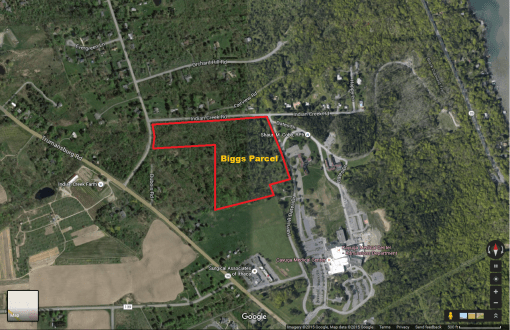
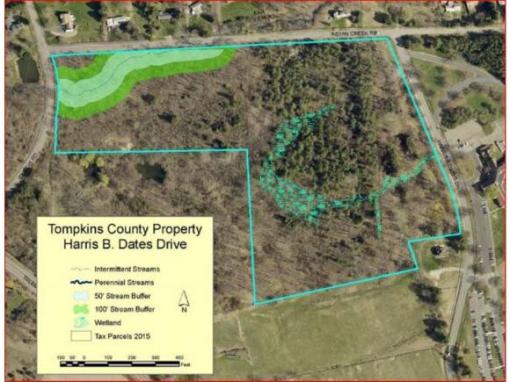
7 It looks like the Biggs Parcel is officially listed for sale. Local realtor CJ DelVecchio was selected by the county to manage the listing for the 25.52 acres near Cayuga Medical Center. The asking price is $275,000. The land comes with a conservation easement on the northwest side due to its proximity to a stream, and the wetlands near the center would be tricky to work with, because wetlands typically can’t be developed unless new wetlands are created, which is not cheap or easy to do.

c507

Readers might remember that this parcel has quite a history behind it. Declared surplus land by Tompkins County, the county had set up a tentative deal for a 58-unit affordable housing complex on the property, but the deal fell through after the wetlands were discovered to cover more area than previously thought.

Neighbors, via the Indian Creek Neighborhood Association (ICNA), have tried to force the county to hold onto the land to keep it from being developed. One of the big sticking points had been whether or not the 25.5 acres would be taxable – the county isn’t especially concerned at this point if the land gets developed or not, but they have made it clear that they want to sell it to a private owner that will pay taxes. The problem is, proposals to preserve the land often dovetailed with plans to donate it to an organization like Finger Lakes Land Trust, which would render the property tax-exempt. The ICNA did end up making a closed bid for the property, but the offer was rejected.

A neighbor to the south did propose reconfiguring the property to preserve the woods and build cottages on his back lot – by adding the Biggs land, he could have built more units under the regulations of the cluster zoning. But the plan fell through due to “size and complexity”, according to the ICNA’s Linda Grace-Kobas.

The land had been valued at $340,000 before the discovery of the additional wetlands, and the revised 2016 assessment brings that down to $240,000.


News Tidbits 6/11/16: Summer’s Heated Discussion

11 06 2016

Image Property of HOLT Architects

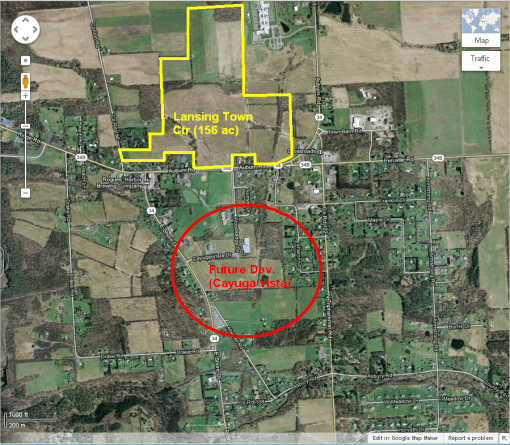
1. We’ll start this off out in Lansing. The 153 acres of land for the Lansing town center is once again in the news. The Lansing Star is reporting that the town is once again serious about selling the land.

So begins yet another chapter in the 20-year saga of the town center land. The town bought the land from the state in 1993 for $100,000, and at the time the land was deed-restricted to recreational use. In 2012, the town paid an additional $294,800 to remove the recreational deed restriction. An article about it was published here in August 2012 (original map below; dunno where why offhand it says 156 acres vs. the 153 reported now). HOLT Architects and TWMLA were hired to draw up some overarching design themes, a Request for Proposals was issued, and three developers responded.

lyc2

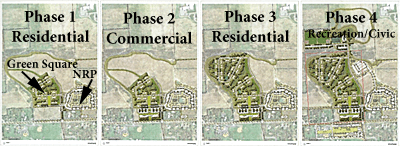
Calamar Enterprises’ Buffalo office submitted a proposal for a $17.4 million, 110-unit market-rate senior apartment building on 13.5 acres, and Cleveland-based NRP Group submitted plans for 80 one-story patio homes on about 15.5 acres. Calamar later re-sited their project at the town’s wish to the northern part of the land, and increased the number of units to 124. Green Square, led by David Taub and HOLT Principal Graham Gillespie, proposed 60 units of housing and 23,000 square feet of retail in 2-3 story arrangements, and civic and recreational space. Altogether, the value of the three would have approached $50 million.

gs_phases

However, all of this was contingent on a sewer being built, which did not happen. The developers agreed to do a package plant that would service just the town center, there was discussion of an IDA-backed tax incentive zone, and the town stood to make a hefty return on investment, but…to quote the Star, “However, the deals fell through.  Actually it seemed more like they just faded away. At least one of the developers had signed paperwork saying they intended to purchase acreage from the Town.  The Town didn’t seem in any hurry to sell the land, even with clearly interested developers.  When the developers disappeared there was no reported effort by the town to pursue the deals.”

Since then, the town continues to get a steady stream of interest, but no real idea on how they want to move forward. Like Ithaca city and town, they’re looking at the possibility of Form-Based zoning for the site, and the town hopes to issue a more specific RFP than before, incorporating revised assessment values. The most intensive approach involved the Form-Based Code and a specific RFP, the least specific is just putting up a for-sale sign ans seeing what happens. Whatever the case, the lax approach the town has taken the past few years may no longer be feasible, with the ticking tax time time bomb of the possible power plant closure looming over the town and schools’ budgets.

old_library_thp_v4

2. Speaking of long processes, the Old Library project has formally filed paperwork here to begin the application process for the Certificate of Appropriateness from the Ithaca Landmarks Preservation Commission. The meeting is scheduled for city hall at 5:30 Tuesday the 14th. Although it says early design review, a lot of the legwork has already been done at this point, since the Planning Board and ILPC have been conducting joint meetings with the project team over the past several months to create a design that they’re all comfortable with. However, the ILPC is likely to refine some details moving forward.

old_library_thp_v4_2
At this point, the unit mix consists of 22 1-bedroom units with about 700 SF each, 25 2-bedrooms with about 900 SF each, and 10 2-bedrooms with 1200 SF each, the extra space intended as a den or home office. The building also includes a 1,800 SF community room to be administered by Lifelong, and 3,750 SF of first floor commercial space. The total facility size comes out to about 85,600 SF, and parking for 25 cars and at least 12 bikes, and another 34 bike spaces for the community room. Exterior materials include brick, limestone, and a couple forms of fiber cement, including wood-textured fiber cement.

Southeast+Rendering

3. The STREAM Collaborative House at 228 West Spencer is up for sale. The house has its own website here. The 1,152 SF, 2-bedroom net-zero energy house is listed at a price of $305,000. For more info on the house, Noah Demarest was kind enough to give a construction tour of the house while it was underway, and the blog post I wrote up afterwards can be found here.

evergreen_dryden_1
4. It’s pretty clear at this point that the Evergreen Townhouses project at 1061 Dryden is evolving into the next hot-button development issue out in Varna. The Times has their interview with the angry neighbor here, and more info can be found in the town of Dryden’s April planning board meeting minutes here. So far, the only image of the townhouses themselves has been a perspective that only shows massing – 2 stories, gabled roofs.

Also of note is the town of Dryden Planning Department’s recommendation to the town board (and the planning board’s approval) for an increase in density in certain areas. The change in code affects parcels zoned rural residential, with municipal water and sewer access. The density would be increased from 2 units per acre to 6 per acre. Looking at the zoning map and the sewer map, that would primarily affect the corridor from Varna to the 13/366 intersection, and a rural swath just north of Dryden village near TC3. What this would do is allow 1061 Dryden Rd to withdraw PUD application, and apply for a special use permit (SUP), which are generally easier to obtain.

On a side note, googling Tiny Timbers brings up a Times editorial, written by the Times, that argues against Tiny Timbers for not fitting in with the appearance of Varna. Actually, it kinda takes everyone to task, from developers to town government to residents. But, to make one counter-point regarding mixed-use, commercial services need a certain amount of traffic (not necessarily vehicular) to thrive. If the population base within a certain radius isn’t there, the risk is too great for someone to put their money on the line and hope that they can somehow draw in customers. If Varna wants a mixed-use center with shops and cafes, they’re going to need the population to support it. Some think that will include 1061, some (probably more) think Tiny Timbers, but if there’s no “push”, the ball won’t be rolling.

201_college_v3_1

5. A couple of minor things to note in sales. The 4,200 SF former “Imperial Buffet” property next to the Shoppes at Ithaca Mall has sold to a Syracuse-bsed LLC (Watersprite LLC, established 2004) for $590,000 on Friday the 10th. I personally will always remember this place as being the only place my mother was comfortable with eating in Ithaca because she hates eating out, and felt everything else was “snobby and expensive”.

Meanwhile, the 12-bedroom, 2,837 SF house at 201 College Avenue, the property subject to a heated debate between Neil Golder and Todd Fox, sold for $2.65 million on Friday the 10th, which seems outrageous except that it’s becoming the norm for inner Collegetown transactions – Novarr picked up 5,500 SF 215 College for $5.3 million last year. There will be no delving into that debate again this week, but the city uploaded 580 pages of documentation here, and my colleague Mike Smith is preparing a story for the Voice.

20160522_143925 20160522_143949

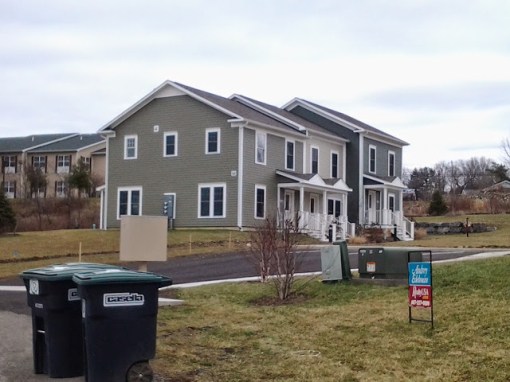
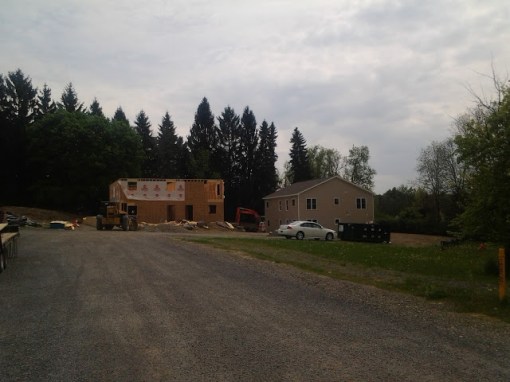
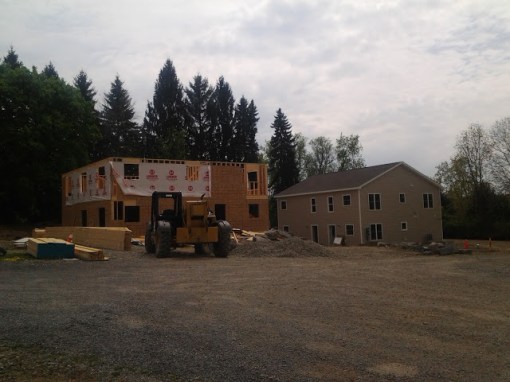
6. Houses of the week. This pair of duplexes are being built on Birdseye View Drive near Ithaca College. Each house has a 4-bedroom unit and a 2-bedroom unit; recent advertisements on Craigslist (since expired, so no link, sorry!) have them $750/bedroom. The developer is the owner of Mahogany Grill downtown, who also happens to be a part of the business team renovating the former Lucatelli’s into a new restaurant, a Tapas and pasta restaurant called Mix Social Dining after the chef’s wife.

These photos are a couple weeks old now, but the one on the right looks nearly complete, while the one on the left was still in the (wood) framing and sheathing stage. Based off the rough window and door openings, they are not exactly the same, but expect them to look similar.