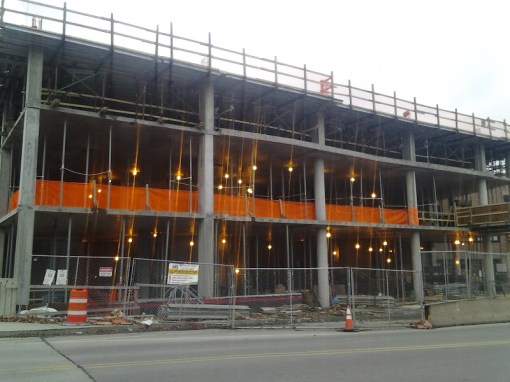
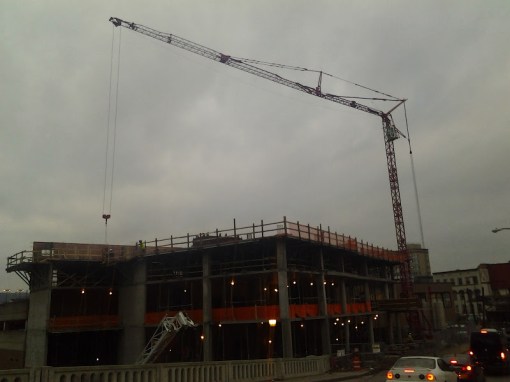
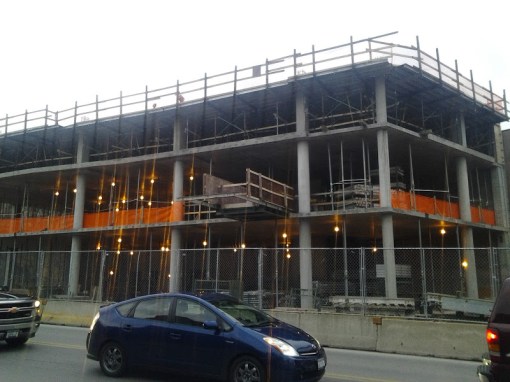
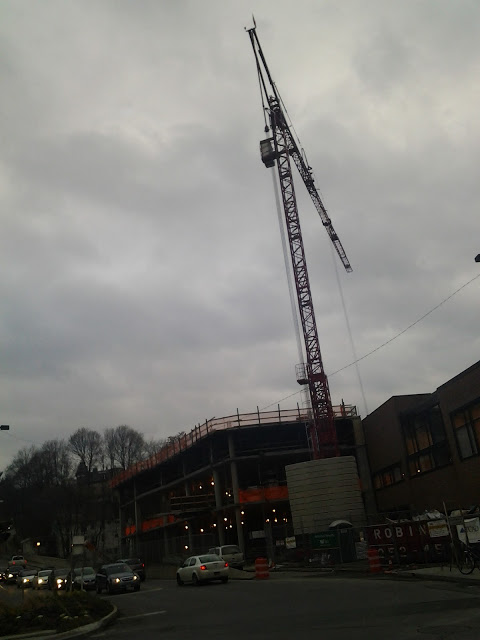
Holiday Inn Express Construction Update, 3/2016

22 03 2016

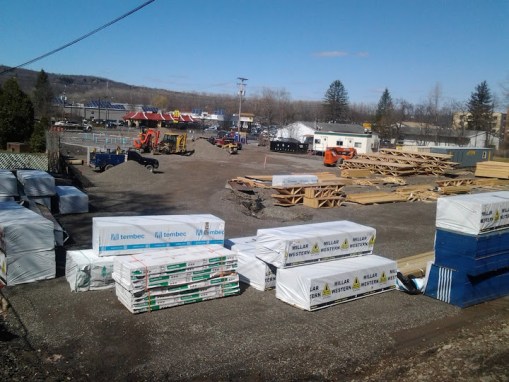
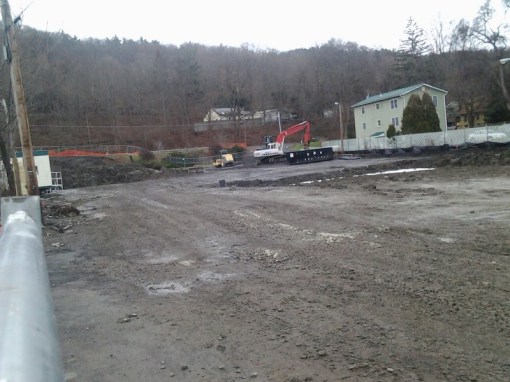
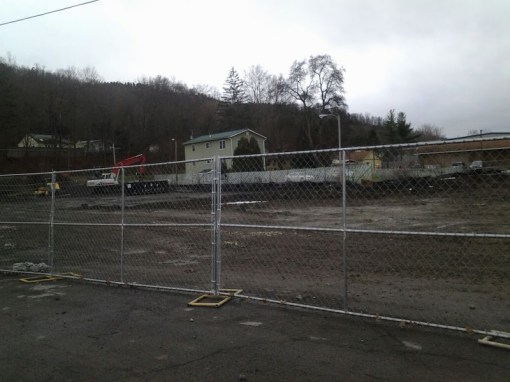
Work on the new Holiday Inn Express at 371 Elmira Road is progressing. the foundation work is currently underway. It looks like they’re going with a shallow, slab-on-grade foundation that spreads the weight of a building all around the concrete slab. The formwork’s been done, and rebar criss-crosses the yet-to-be-poured concrete. The rebar mesh is a reinforcement for the concrete when it gets poured, helping to prevent cracks that may form in the concrete from spreading throughout the foundation and causing major damage. The blue tubes are a part of the under-slab utilities. Elsewhere on the site, it looks like stacks of Tembec and Millar Western Canadian lumber are being used to assemble wood trusses that will be used in the hotel’s wooden frame.

The 4-story, 79-room hotel is expected to open late this summer. Rudra Management and Rosewood Hotels (Jayesh Patel) of suburban Buffalo is the developer.

20160319_141548 20160319_141636 20160319_141959 20160319_142012 20160319_142018

holiday_inn_express_v2

holiday-inn-express-original-1


Ithaca Marriott Construction Update, 2/2016

1 03 2016

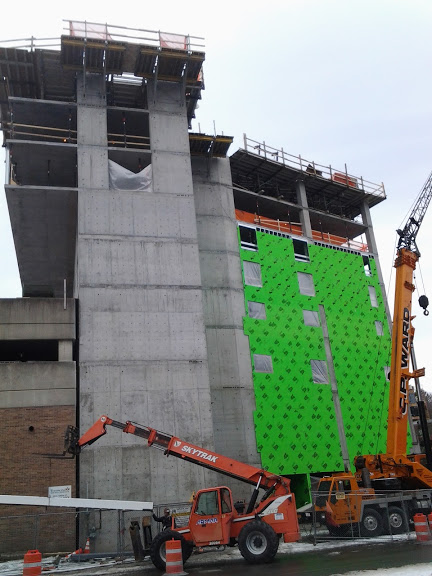
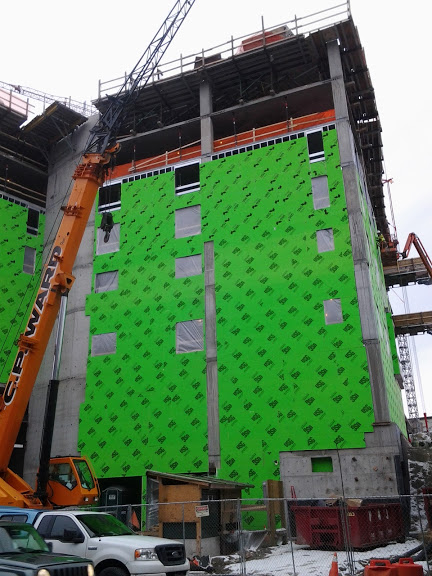
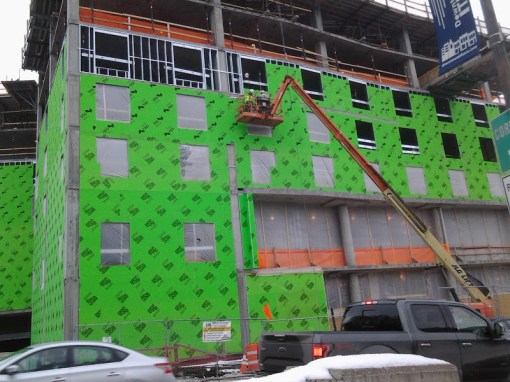
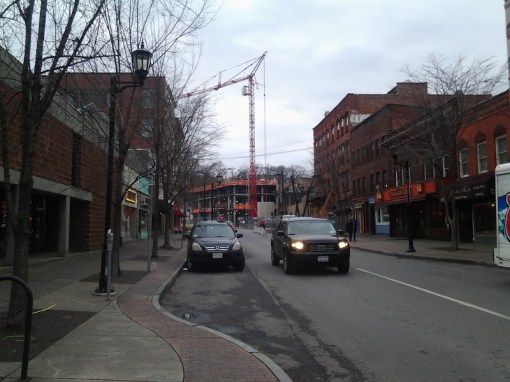
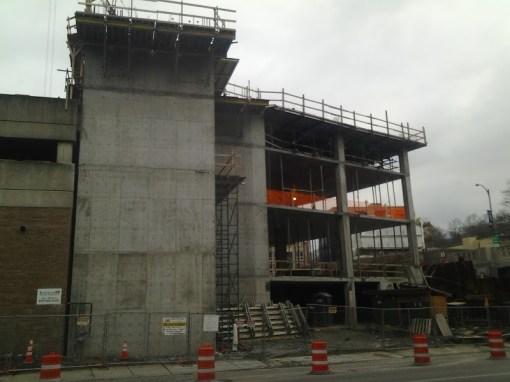
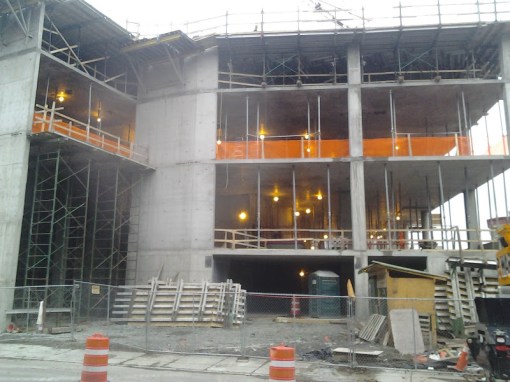
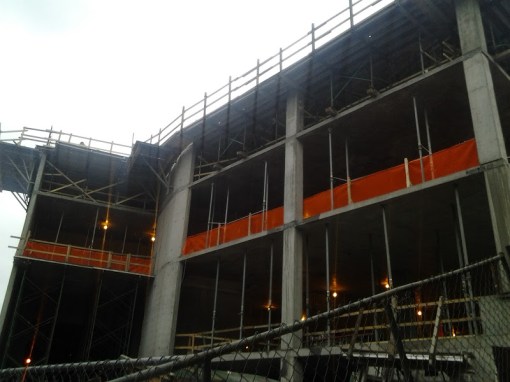
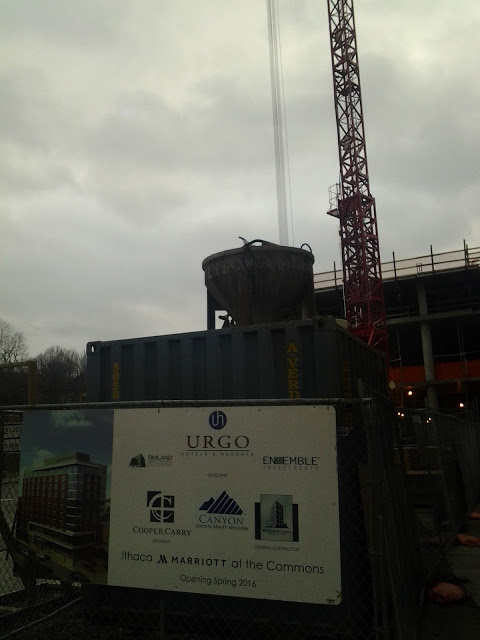
Now that the fairly complicated foundation work has been completed, things are moving along at a good pace over at the Marriott construction site in downtown Ithaca. Concrete has now been poured up to the seventh floor of the ten-story building. USG Securock glass-mat sheathing panels are being attached to exterior metal stud walls erected over the lowest levels. The floors are covered in plastic sheets from about the fourth level down, a sign of sprinkler fitting and major utilities roughs-in underway (given the major heat wave in the medium-range forecast, they may not be needed much longer).

A story I’ve heard through the grapevine is that Marriott worked with developer Urgo Hotels to design a new room design format for this Ithaca project. The rooms will be at a premium price point, but somewhat smaller than most comparable hotel rooms, so Marriott is approaching the hotel and the rooms themselves with new styling concepts that make efficient use of the space while maintaining a high-end look and feel to each hotel room. Marriott has a history of working with Urgo for new design areas, so if done well, this will be yet another proverbial feather in their cap.

This project gets a lot of flack from certain angles for not being “Ithaca-like”, but given that the site had been a small, awkwardly-accessed parking lot since the Green Street garage was erected in the early 1970s, it’s a huge, huge improvement. The hotel’s 160 rooms are expected to average occupancy between 70 and 80% (the market average is closer to 60%, but new hotels and downtown locations tend to have higher occupancy rates). That translates to 112 to 128 travelers on any typical day who will literally be able to walk right out onto the Commons, eating at restaurants, shopping at the boutique stores and spending their dollars on the “Ithaca-like” businesses that people hold near and dear. Not only does the project create dozens of jobs downtown, it has a real stabilizing effect on other businesses by offering a steady stream of well-heeled customers that will buoy bottom lines and be an asset to shopkeepers and restaurateurs as they ride out slow periods. For nearby businesses, there’s reason to look forward to its August opening.

The $32 million hotel was designed by  Cooper Carry Architecture of Atlanta, and Binghamton-based William H. Lane Inc. is the general contractor.

20160219_134825 20160219_134922 20160219_135002 20160219_135112 20160219_135231 20160219_135431 20160219_135503 20160219_135521marriott_rev1_1


News Tidbits 2/13/16: A Week of Uncomfortable Prospects

13 02 2016

lansing_cmt
1. We’ll start off this week with some zoning and land-use discussion. the village of Lansing, which tends to have a very tight grip on their zoning, modified their code for a new addition, called “Commercial Medium Traffic” (CMT). The zone, which has taken about two years to get to this point, will override what is currently zoned a Commercial Low Traffic (CLT) area. As a result of the rezoning, some previously-okayed uses in their CLT zone – clinics, group homes, construction storage, sit-down restaurants – have been removed, but adds cafeterias and assisted living facilities. Splitting hairs, one supposes. Looking at the use guidelines, about the only big use the CMT allows that CLT doesn’t is “small-scale sales” like boutique shops, and “low-traffic food and beverage”, which covers bars and sit-down restaurants.

The reason for this change comes from a couple of angles – the village has a number of vacant or underutilized parcels in the affected area, which they feel is detracting. Developers have approached the board about building retail/restaurant space on some of the land, but that would have required rezoning to commercial high traffic. But the high traffic zone also allows “hotels and big boxes”, so the village needed an in-between. Now it’s finally in place.

ithaca_eddy_land

2. Now for another land use debate. The town of Ithaca has authorized doing an analysis on what a fair bid would be for the development rights of 33 acres of land off of Seven Mile Drive and Route 13. These parcels are currently farmed by the Eddy family, and a mini-golf facility was previously proposed on one of the properties. Before that, they were to be included in the 2014 Maguire development before the Maguires pulled their project, partially because the town said the dealership and headquarters proposal wasn’t in line with their new Comprehensive Plan.

The problem is, neither is this. The town would buy this with the intent on keeping all of it farm fields. The comprehensive plan called for TND Medium Residential (townhouses, elder cottages, small apartment buildings and compact single family) and the “Inlet Valley Gateway” (quoting the plan, “intended to be a setting for a mix of office, small-scale retail, hospitality, and tourism and agritourism uses, with low-impact light industrial, artisanal industrial, and skilled trade uses”). The concern is, if the town starts displacing development from the areas recommended, developers will start looking at areas where it’s not recommended.

For the record, the 22.38 acre parcel is for sale for $425,000, and the 10.59 acre parcel is for sale at $325,000. The assessed value is only $188,800 total. The development rights will probably fall somewhere between. This definitely isn’t as cut-and-dry as the 62 acres the town picked up for $160k in December. The town will have an idea of the cost for the rights later this year.

simeons_v2_2

3. A few notes from this week’s TCIDA agenda. The Hotel Ithaca project is up for final approval of its tax abatement, which given that the public meeting drew not a single commenter, shouldn’t have any issues going forward. 210 Hancock also has some slight tweaks to its agreement, and Simeon’s is applying for a sales tax exemption on construction materials and refurbishment. The $660,000 project’s exemption would be worth $27,079 by their calculation. Simeon’s estimates 27 jobs at opening, and 14 new positions over 3 years, about half of which appear to be living wage. The tax exemption amount is small enough that it seems like a non-issue, but we’ll see what happens if the application is accepted and a public hearing scheduled.

tmpud_waterfront_1
4. From the city Planning and Economic Development Committee – the Commons street-level active-use ordinance and the waterfront Temporary Mandatory Planned Unit Development (TM-PUD) were moved to go ahead to the Common Council next month. More on the Commons ordinance here, and the TM-PUD here.

Committee members were favorable to an amendment to the cell phone tower fall-zone law, though perhaps not in the most ideal way for Modern Living Rentals’ 87-unit 815 South Aurora proposal. On the bright side, a draft law for circulation could be ready by April. On the not so bright side, the city’s going with the 120% value used by other municipalities – that would give the 170 ft. tower near the project site a 204 ft. no-build fall zone instead of the current 340 ft. (200%), but it’s still greater than the 180 ft. MLR requested. This means the project would probably need to be revised somewhat if that’s the version of the law that moves forward. But, something would be better than nothing.

Oh, and the chicken law was voted for circulation, which opens the possibility of a council vote in April, for 20 test subjects in a pilot program.

402_s_cayuga_st_rev2_1

5. The Ithaca Urban Renewal Agency is in a bit of a dilemma. INHS’s 402 South Cayuga project, which has 4 units of affordable owner-occupied housing, is stalled. The construction costs are rapidly rising out of the range of feasibility. The only way it moves forward is if it’s a rental project, which is easier to finance.

402_s_cayuga_st_boggsfernandez

Ostensibly, the IURA would like owner-occupied housing. And a rival proposal has been offered by local architect Zac Boggs and his partner, former Planning Board member Isabel Fernández. It would offer four rentals for 2 to 5 years, and then go up for sale – in the $180-$230k range, which is somewhat more than the $110-$130k range typically offered by INHS. So what do you do? Sacrifice some affordability for some home ownership, or vice-versa? The IURA needs to figure that out. Additional renders and cover letter here.

hilton_canopy_v9_1

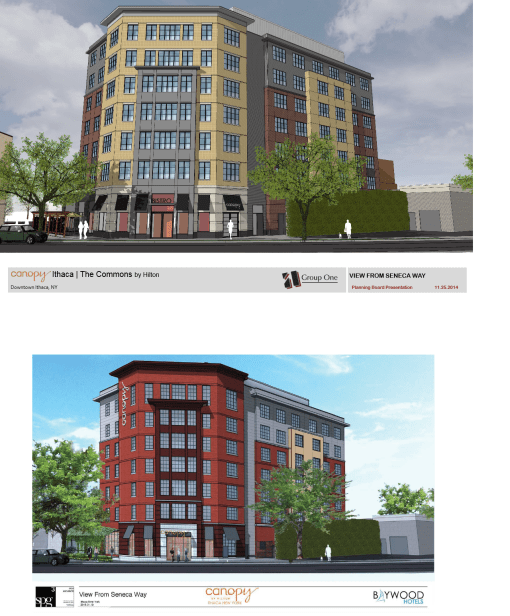
6. I think this is the ninth iteration of the Canopy hotel; quite possibly the most version of a single project I have on file. What’s changed since last time? Well, the inset panels in the northwest wall are back. Some cast stone was added to the base,  the second floor rood deck was tweaked, a cornice element was added to the mechanical screen, and the trellis and driveway pavers were revised. It looks like an improvement, and hopefully one that Baywood Hotels can bring to reality after being stuck in finance limbo for so long. Additional imagery here, cover letter from local architectural consultant Catherine de Almeida here.

varna_plan

7. The Times’ Michael Nocella ran a really nice piece this week looking at the past, present and future of development in Varna. According to the article, Modern Living Rentals (my sympathies to Charlie O’Connor and Todd Fox, since all of their projects seem to be wrapped up in one debate or another) needs a unanimous vote of approval for the 8-unit, 26-bed addition to 902 Dryden Road to be able to move forward (a 6-bed duplex already exists on the property). In Dryden, the five-member town board does the vote, and the current Dryden town supervisor helped close the sale of the parcel to MLR, so he must recuse himself. Shooting it down at this point, after the project’s cut its size by 40% from 18,000 SF to 11,000 SF, would be very unfortunate, and create an uncomfortable disconnect between the Varna Master Plan designed with community input, and what the board thinks Varna should have.

5_Freese_2013

As mentioned in the article, the northeast corner of Rt. 366 and Freese Road is one of those parcels where the town and Varna residents think development should happen, but really isn’t feasible. I remember when Todd Fox shared his proposal (STREAM Collaborative’s drawing above) with the town for that corner, and the reception was very positive, much more so than the owner’s earlier plan for 20 modular townhomes. Then not long after, everything ground to a halt. MLR decided not to buy the parcel after it turned out the land was incredibly unstable (there used to be a huge pile of material on the site, dubbed “Mount Varna”; the story of which gets written about extensively on the Living in Dryden blog, since Simon St. Laurent and the owners had quite the feud going). The chances of anything but grass growing on that corner is pretty low.

So, with the former “Mount Varna” land in mind, a master plan is not an exact thing; if it shows for three sets of five townhouses on a parcel, that’s not what may necessarily may happen. It just indicates the kind of density and scale of development the plan deems appropriate. 902 Dryden isn’t drawn on the master plan, but the plan welcomes the idea of townhouses on Forest Home Drive, which 902 abuts. So a vote in favor of the 8 new townhouses is, indirectly, a vote of support in the Varna Master Plan.

20151108_154139

8. The town of Ithaca’s Planning Committee will be looking into writing up and establishing a moratorium on all 2-unit residential buildings at its meeting next week. Doesn’t specify location, or rental vs. owner-occupied; just a ban on buildings with two units.

On the one hand, this is probably an attempt to curb student housing being built near IC; the town’s Planning Committee chair is someone with a long history of fighting development, and is seeking greater input on the Planning Board’s discussions. Students and student-amenable housing are just his favorite topics as of late. But the agenda doesn’t specify the type of unit or location, and that is very concerning. From a number of reasons, a broad-brush moratorium, without regard to neighborhood or owner occupancy, doesn’t seem like a good idea.

1) If the goal is to limit student housing, only a small geographic subset of the town is really necessary. IC students, which seem the primary cause of concern, congregate only in the neighborhood adjacent to campus.
2) The moratorium could harm affordable home-ownership. In a number of cases, one unit is occupied by the owner, and the other is rented out as a source of income.
3) Limiting new supply keeps housing costs high and pressures them to rise higher, since demand will not be altered by the moratorium.
4) The town only permits a small number of units each year. In 2014, it was 10 single-family and 2 2-unit properties (so, 14 units total). In 2013, it was 25 single-family, 10 2-unit. The preliminary 2015 numbers are 21 single-family, and 3 2-unit. There were no permits for structures with 3 units or more.

I asked Ithaca town planner Dan Tasman, and while his email notes that it’s targeted at student rentals, it doesn’t assuage my concerns of being too broad of an execution.

“The Town’s zoning code allows accessory apartments in some zones.  The intent is to let a resident have a close family member or friend live with them, or a tenant to help pay the mortgage, in a space that’s more private.  Basically, an in-law apartment.  However, a few builders are taking advantage of the privilege.  They’ll build a house with an accessory apartment, and rent out both units, with student tenants in mind.

There’s also concern about a growing number of “student specials” — very utilitarian duplexes, purpose-built for student rental.  There’s quite a few of them on Pennsylvania Avenue and Kendall Avenue, near Ithaca College.  Their design and siting can often seem institutional, and out of place with the neighborhood’s residential character.”

I’m not a proponent of moratoriums at all, but I’m hopeful this proposal isn’t as broad as it looks. If the net is cast too wide, this is going to do a lot more harm than good.


News Tidbits 1/30/2016: A Doozy of a Week For All the Wrong Reasons

30 01 2016

I’m not going to lie – this was a rough week. For those who like old buildings, the city tore down 404 West Green and 327 West State this week. For those who are consider themselves eco-activists, Black Oak wind farm is on life support. State Street Triangle is likely cancelled, the Printing Press Lounge is off the table, Cornell continues to pour most of its attention on its new New York City campus, and a grocery store and a downtown shop are closing their doors and putting people out of work. There have been better weeks for news round-ups.

state_st_triangle_v6_1

1. State Street Triangle isn’t dead per se, but it’s indefinitely stalled. I think the best headline goes to the Ithaca Times since they’re the most accurate. From chatting with planning consultant Scott Whitham, who’s involved with the project, it sounds like the impasse is the result of Campus Advantage wanting to pay less for the site since they can’t build as large of a project, which would decrease their revenue. The contract for the land purchase from Greenstate Properties/Trebloc Development (Rob Colbert) was up for re-negotiation after the December expiration, but neither side wants to budge on what they feel the price should be. So nothing can move forward without a deal between the two parties. I reached out to Colbert Wednesday, but the secretary paused for a minute and then said “he’s, uh, busy in a meeting, care to leave a message?” So he’s probably not going to say anything further.

Could it move forward? Possibly, it could be revived if a deal is made. But as things are, it’s stalled and it’s outside the control of any community group or government authority. It’s definitely a shame from the standpoint of Ithaca’s worsening housing crisis because it’s less that will be entering a market flooded with students, people moving here for work, and wealthy retirees who have apparently decided this is the Asheville of the north. And given the battles of “structural racist gentrification” and “uncivilized crime-producing trouble-making affordable housing“, where everything is accused of being one or the other, I’m not especially hopeful at the moment.

416_e_state_v2_1

2. Now for something that is definitely dead in the water – The Printing Press Lounge. Developer Ben Rosenblum had wanted to put a jazz lounge in a 7700 SF industrial warehouse at 416 East State Street, but neighbor objections to noise and traffic proved a little too much for the Board of Zoning Appeals, whose members appeared unlikely to support necessary variances for the vacant facility. So the developer pulled the lounge proposal, but the office space and apartment are still under consideration.

canopy_comparo_elevations_new_1

3. Also from the same phone conversation as State Street and Printing Press – the Canopy revisions were approved, so at least there’s a good chance that will be breaking ground this Spring. The Chain Works review schedule was also approved, although given the couple emails from the Voice article, the public review period is going to be groan-inducing. One of the letters commanded that nothing should be done there and it should be kept as is because it encourages traffic and “its density is ruining Ithaca”. They might have meant size, but density is a buzzword at the moment. Apparently, they also overlooked the fact that it’s already built and won’t be fully cleaned of toxic chemicals until a reuse plan is in place. The development team will have to respond to all of these comments, perceptive or not.

4. In real estate sales, an LLC in suburban Corning picked up the former Tim Horton’s and Cold Stone Creamery space on Elmira Road. 0.74 acre 407 Elmira sold for $640,000 on January 22nd. A little research into the rather exotically-named “Armiri LLC” shows that they were previously registered at an address home to an Econo Lodge, and that the owners have about 70 or so other LLCs related to hotels and the hospitality industry. A little more digging, and the owner turns out to be Corning-based Visions Hotels, a developer of suburban chain hotels with locations from Albany to Buffalo. So if I were to make a guess, the five-year old Tim Ho’s building won’t be long for this world, and a suburban hotel is likely to rise in its place in a couple years. But we’ll see what happens.

5. Meanwhile, just up the road, Maines will be shutting down their store at 100 Commercial Avenue. The 26,146 SF building was built for the Binghamton-based grocery chain in 2010. February 7th will be the last day. Although there don’t seem to be any figures online, the move will likely put at least a couple dozen people out of work. A phone call and email to Maine’s asking for employee totals and reasons for closure were not returned.

ctown_terr_phase3

6. Let’s talk about money. The construction loan docs for Collegetown Terrace Phase III were filed with the county this week. The price? A cool $39.25 million, from PNC Bank. That’s just for 247-unit, 344-bed Building 7. Previously Valentine Vision Associates LLC (John Novarr/Philip Proujansky) received $50 million on 8/22/13, $50 million on 7/1/2014, and $50 million on 11/20/14. Do the math out, and $189.25 million in loans is a lot of money. Then again, this is also a 1,200+ bed project.

The latest loan docs require an opening by fall 2018, but expect it to be about a year sooner than that, August 2017.

chapteR_house_reconst_v4_2

7. The Ithaca Landmarks Preservation Council has approved the Chapter House plans. All that’s needed at this point are the Building Department permits, which are technical and just require that everything will be built up to code. Things are looking good for that February construction start.

hughes_cornell_3

8. Something to look forward to at next month’s Planning Board meeting – further discussion of Cornell’s renovations to Hughes Hall. Planning Board Presentation here, drawings here, Site Plan Review application here. KSS Architects, with offices in Philadelphia and Princeton, will be in charge of design. KSS has been to Cornell’s campus before, having designed some of the Hotel School additions and part of the previous phase of law school renovations. Local firm TG Miller is handling the engineering work. The project is expected to cost $10.2 million and construction would go from June 2016 to July 2017.

Quick refresher, the plan is to renovate 4 floors of what were previously student dorms into academic office, admin and student organization space. Cornell anticipates about 200 construction jobs will be created, but nor more than 80 at any one time, and 20-40 on-site most days. No new permanent jobs, limited visibility, and minimal transportation/ground impacts will limit much of the customary Planning Board debate.

cornell_tech_v2

9. Meanwhile, New York City outlets are reporting on the progress of Cornell’s massive new tech campus in New York City. The Real Deal is reporting Snøhetta, an Oslo/NYC architectural firm, will design the Verizon Executive Education Building. The other three buildings underway are the Bloomberg Center, The Bridge, and CornellTECH Residential, which are the work of Morphosis Architecture, Weiss/Manfredi Architecture, and Handel Architects respectively.  300 students and 200 faculty/staff  will move into the new 26-story dorm by August 2017. Verizon paid $50 million for their naming rights, and billionaire former NYC mayor Michael Bloomberg paid $100 million, making up a sizable portion of the $590.6 million donated to Cornell over the past year. Once the initial wave of construction is complete, it’ll be worth seeing how donations break down – years ago, MetaEzra noted that Weill Medical received an outsized proportion of charitable giving.

Not to go all conspiracy theorist, but there are times when Living in Dryden blogger Simon St. Laurent’s thought piece seems uncomfortably relevant.

arpt_pk_1

10. At the county’s PEDEEQ Committee meeting Friday (PEDEEQ being the acronym for the unnecessarily long Planning, Economic Development, Energy, and Environmental Quality Committee; agenda here), the county did two things worth mentioning here. One, they awarded the $35,000 airport industrial park feasibility study to the team of Clark Patterson Lee of suburban Albany, and Saratoga Springs-based Camoin Associates. Two, they passed a resolution calling for “the Timely Development of the Black Oak Wind Farm” project in Enfield.

The Black Oak opposition really seems to have picked up momentum after one the major landowners involved with the project pulled out. Neighbors in the area are actively attacking the project by calling it a danger to human health and a destructive environmental menace financed by wealthy out-of-towners (a shot at Ithaca), and the wind farm’s executive board is struggling to address these accusations in the revised environmental review due to be completed in April. For the local eco-activist crowd, this is an unwelcome and unusual position to be in because more often than not, they’re the ones opposed to development. The county legislature, which has several green activists, is doing what they can by giving verbal support, and a subtle sort of wrist-slap to the opposition. Dunno if it will work, but we’ll see what happens this spring.

elmira_savings_v1

11. Here’s the sketch drawing for Elmira Savings Bank’s new West End Branch at 602 West State Street. It would appear the plans call for a modern addition to the north side of the building, and renovation of the rest of the two-story restaurant into office/service space. Local companies TWMLA and HOLT Architects are handling the design.

According to the Twitter feed of the IJ’s Nick Reynolds, the building plan was received well enough at the Planning Board meeting, but the rest of the plans call for demo of the other buildings, including the affordable housing that had some folks up in arms, for a parking lot. That didn’t go over very well. Demolition of low-cost housing for parking is going to be about as welcome as a Hitler costume at a bar mitzvah. Expect another trip to the board with some revised plans.

12. The Dewitt Park Inn is for sale for $950,000. Owners Tom Seaney and Nancy Medsker are selling the property they purchased for $320k in January 2012 and renovated into a high-end bed and breakfast. The two were vocal advocates for the popular though foregone Franklin/STREAM condo proposal for the Old Library site, although Medsker didn’t do the debate any favors when she decided to trash her rear neighbor, senior services non-profit and Travis Hyde project partner Lifelong in a letter to the Ithaca Journal. The county has the Dewitt Park Inn assessed at $575,000.

st_catherine_v2
13. Nothing too exciting for the town of Ithaca planning board agenda next week. The town’s planning board will choose whether or not to sign off on the review schedule for Chain Works, and they have to re-approved plans for a smaller parish center at St. Catherine of Siena in Northeast Ithaca. According to the provided docs, the parish center has been reduced from 10,811 SF to 8,878 SF due to rapidly rising construction costs (seems to be a common refrain these days).


Comparing and Contrasting the Canopy Hotel Designs

26 01 2016

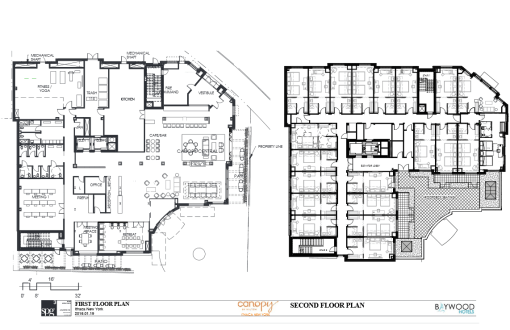
Now with Chain Works published and State Street Triangle covered, it’s time to turn to another project undergoing some major changes, the already-approved Canopy Hilton hotel slated for downtown Ithaca. The cover letter from local project consultant Scott Whitham can be found here, new drawings/renders here.

Some of the figures stay the same – the height, for instance, is still 80′, 92′ to the top of the rooftop mechanical. Some figures have changed a little bit – the gross square footage (GSF) has gone from 74,475 SF to 77,844 SF, which is an enlargement of about 4.5%. The number of hotel rooms has also increased, from 123 to 131.

canopy_comparo_siteplan_old

canopy_comparo_siteplan_new

It looks like the bumpouts (“nooks and crannies”) were reworked, which would explain the revised square footage. The biggest changes appear to be along the western and southern (left and bottom) faces. The cafe patio and restaurant patio are still in place, but it looks like the shade/rock garden went out in favor of a delivery area.

canopy_comparo_terrace_old canopy_comparo_terrace_new

The second-floor rooftop terrace has also been revised. It looks like the area itself has been reduced (assuming those are skylights at the corners), and the fire pits also appear to have been removed. Although not shown, terrace plantings are visible in the elevations.

canopy_comparo_floorplans_old

canopy_comparo_floorplans_new

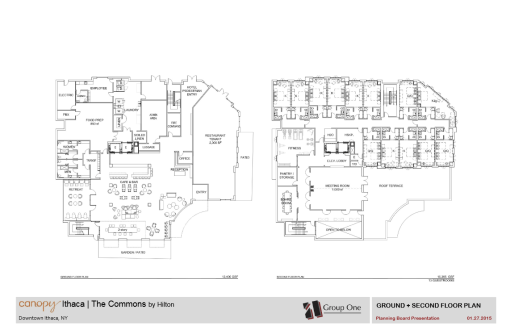
The internal arrangement has been jostled quite a bit. The hotel bar and cafe used to be towards the south side of the building, now its towards the east. The 2000 SF of standalone restaurant/retail that fronted Seneca Way is also gone, replaced by an expanded house offering. The second floor fitness center has been moved to the first floor where food prep and employee areas used to be, and the soaring two-storm meeting room was also axed.

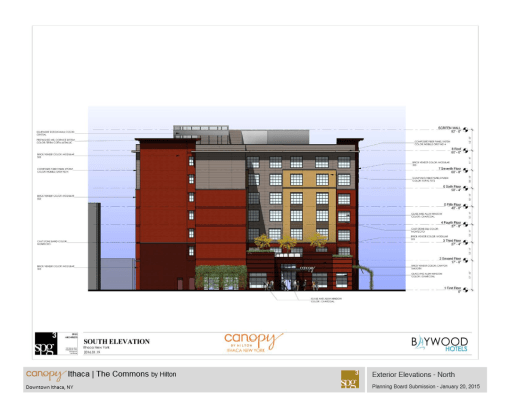
canopy_comparo_elevations_old canopy_comparo_elevations_new_1 canopy_comparo_elevations_new_2 canopy_comparo_elevations_new_3 canopy_comparo_elevations_new_4

The outside has also been thoroughly revamped. The original plans called for “buff”-colored brick veneer, pre-cast masonry on the first floor, metal panels for the cornice and “Nobills Grey” fiber cement siding. The new scheme replaces most of the buff brick veneer with “modular” and “canyon smooth” brick veneer, topaz and “Topaz” and “Nobills Grey” fiber cement panels, and metal coping. Both plans use warehouse-style aluminum windows, although they’ve been reshaped in some areas (northeast corner for instance).

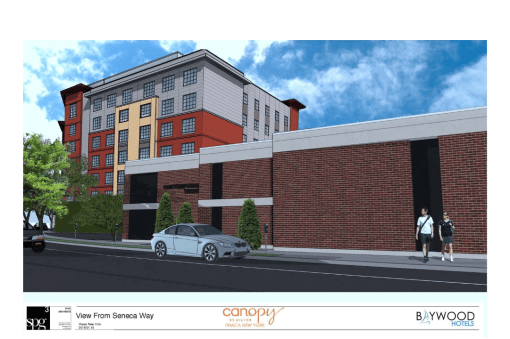
canopy_comparo_looking_SE_old

canopy_comparo_looking_SE_new

As a matter of personal opinion, the new design feels like a step back in a lot of ways, for example when looking SE as in the renders above. But the project had also struggled to obtain financing due to rapidly rising construction costs, which is what brought on a lot of the “value engineering”. For the record, there is financing in place now, whatever that finite amount is. If I were a hypothetical planning board member, I’d be thinking of recommendations that limit cost increase but still improve the appearance. I’d rather see the cornice atop the new southern stairwell go, and have the indents return on the NW fiber cement wall.

Another question that comes to mind offhand has to do with how this affects CIITAP. It doesn’t seem likely this has to go through the whole process again, but would these changes also have to be approved by the IDA as well? Perhaps a knowledgeable reader can chime in.


News Tidbits 1/23/2016: A Doozy of A Week Ahead

23 01 2016

1. Over in the town of Ithaca, an update is being considered for the Rodeway Inn budget motel at 654 Elmira Road. Previously, the motel had been approved for renovations that would expand the size of the 25 existing units and provide 2 new inside corner units, along with the associated landscape and site improvements. This proposal was originally approved by the town in December 2013, but then the project never went forward, partially because the Maguire group was looking at buying the property and tearing it down to make way for their artisanal car dealerships and headquarters. With the Maguire’s plan filed away in the circular drawer, the owners of the Rodeway Inn have decided to reconsider the renovation project.

rodeway_1
Along with the room expansion, the new plan also calls for renovating an existing on-site residence into a new office by building an 1146 SF addition, while the existing motel office is renovated into a community room to serve travelers. Variances for side-yard setbacks granted for the previous proposal must also be re-approved, since zoning variances in the town of Ithaca are only valid if construction starts within 18 months of being granted (in other words, the variance expired last June).

Pennsylvania-based HEX 9 Architects is in charge of design, and JAMNA Hospitality is the developer.

chapteR_house_reconst_v4_2

chapteR_house_reconst_v4_1

2. From the city of Ithaca Landmarks Preservation Council agenda next Tuesday, the latest iteration of the design plans for the Chapter House replacement and its neighbor at 406 Stewart Avenue. The Chapter House looks to be in the last stages of ILPC approval, while the apartment house next door is still in the early design review stage.

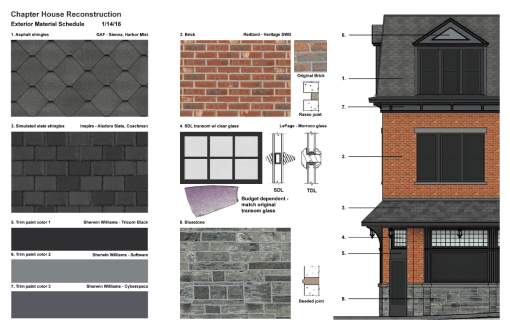
Looking at the Chapter house, the zinc roofing tiles have been replaced with asphalt, and two more paint colors will be included on the trim, which has gone from white to dark grey and black. The ILPC is doing what they do best, going over projects with a very fine toothed comb and debating every detail. Meanwhile, the current iteration of 406 Stewart Avenue calls for a 4-story apartment building with design features very similar to the previous 3-story building. That project still has some debates ahead of it, so we’ll see what happens moving forward.

Also on the agenda, discussion with the Planning Board about the DeWitt House/Old Library redevelopment, an update on repairs to 102 East Court Street, and some type of work being done at 210 Stewart Avenue (could be anything from paint color and shingle choices to major work; if it merits a post it’ll be included in a future update).

323taughannock_rev2_1

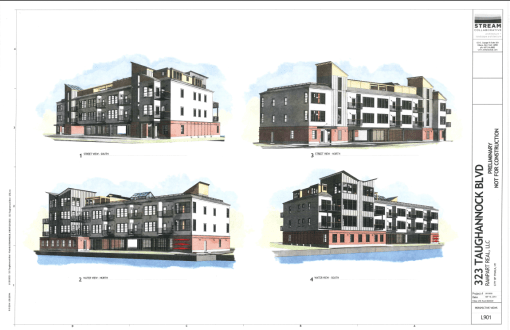
3. The Times’ Josh Brokaw wrote a nice summary of developments down at the Ithaca Waterfront, although I wish it hadn’t run when it did (re: HOLT update). Thanks to Josh, we have an idea of what’s going on with the approved but as-yet unbuilt 21-unit 323 Taughannock apartment project:

There was an “unexpected issue” that came up, Flash said, with the project, and so they must take “a sharper look at the engineering” to make the costs work.

I’m going to take a slightly educated guess – the soils were even crappier than anticipated. The high water table and easily-compacted soil in the West End and Waterfront pretty much mandate that multi-story projects have deep, expensive foundations to support the weight of structures. A soil issue was one of the problems that delayed the Lofts @ Six Mile project, and the reason why it’s built tall and narrow; also, since the Bloomfield/Schon has to pay for that deep foundation, it’s one of the reasons why the Lofts are so expensive. From the sounds of the Times article, balancing the deep foundation with adequate parking for the parcel is an issue. I’ll keep my fingers crossed, this project could be a real asset to that area.

Also, pretty sure that Cascadilla Landing still isn’t happening, and the Times has realized that. Anyway, it’s a good piece, and I’m not going to steal all of Josh’s thunder or his Myrick quotes, so spare two minutes and have a read through.

ith_big_plan_map_v2

4. For my moderate griping about timing with Josh’s Inlet Island development piece, I could note that this quote in the IURA Governance Commitee Agenda from city Planning and Economic Development Director JoAnn Cornish ties my article and his together:

“Cornish reported that the Planning and Economic Development Committee identified the Waterfront Neighborhood Plan as the Phase 2 plan of the Comprehensive Plan it would like to move forward with. Funding has been allocated for it. The plan would most likely be a hybrid Waterfront/West End neighborhood plan, in anticipation of significant development interest in that part of the city.”

In good news, affordable housing grants were thankfully saved in the federal budget, meaning that there will be a similar amount heading to NYS in 2016 as in 2015, and those funds would be available to future Ithaca projects should they jump through all the application hoops and be deemed worthy by Albany. The IURA is looking to smooth over any possible shortfalls by offering itself as a housing strategy consultant for the Waterfront/West End and Southside Phase II plans, and in the longer term, sales of parcels at the end of Cherry Street, at 410-426 Taughannock Boulevard, and Fire Station No. 9.

Also, the Argos Inn and Bandwagon Brewery/Restaurant have paid off their IURA loans. Proof that, although there have been failures (Finger Lakes Wine Center), the IURA can properly vet projects and be successful in its mission.

20160109_131947 20160109_132008

20160109_131909

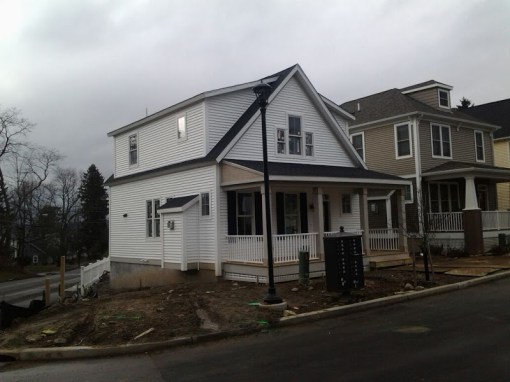
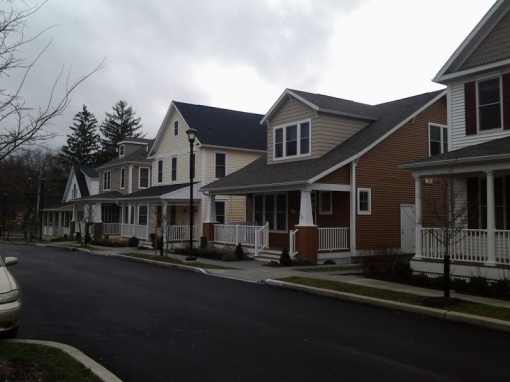
5. House of the week. 102 Walnut Street, town of Ithaca. the last of Agora Home LLC’s Belle Sherman Cottages is nearly complete, possibly to go on the market as a spec house. The house is a little small than its neighbors since the lot is smaller, but the unique design gives the street some extra diversity. Apart from landscaping, paving and some finish work (on the exterior trim at least, although being a Simplex modular means the inside is probably finishing up as well), the house is just about finished. Nice work Carina Construction.

6. Last but certainly not least, the Planning Board agenda for next Tuesday. It’s a big one.

I. Agenda Review
II. Public Comments
III. Special Order of Business – Chain Works District Redevelopment Project – Presentation of Draft Generic Envrionment Impact Statement (DGEIS) and Scheduling.

chain_works_rev1_1

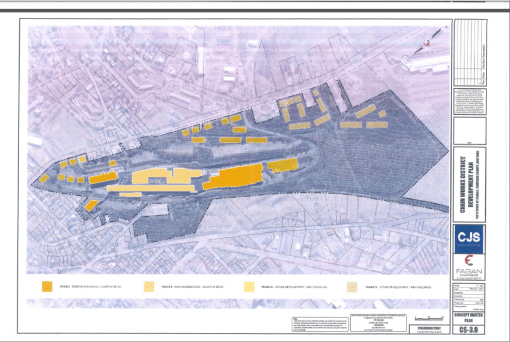
It’s finally moving forward. The Chain Works District, which was last presented at a meeting in November 2014, is finally ready to discuss parts of its environmental review and timelines. Per the agenda, “The project is a mixed‐use development consisting of four primary phases: (1) the redevelopment of four existing buildings (21, 24, 33, & 34); (2) the repurposing of the remaining existing buildings; (3) potential future development within areas of the remainder of the site adjacent to the existing buildings/parking areas; and (4) future developments within remaining areas of the site.” This will merit its own piece, but in the interest of time, Ithaca Builds offers a great summary of the previous steps and the proposal itself.

IV. Subdivision Review – 101-107 Morris Avenue. Declaration of Lead agency, Public Hearing, Declaration of Environmental Significance and Recommendation to the Board of Zoning Appeals (BZA). This subdivision proposed to reconfigure a pair of vacant North Side lots to allow a duplex to be built by Habitat for Humanity. The two 1400 SF units would be sold to families with modest incomes. There’s a letter of support and the Board has already drafted a recommendation to the BZA giving their thumbs-up.

V. Site Plan Review

A. Cayuga Green Phase II (Lofts @ Six Mile Creek). The applicant proposes to omit a green screen on the parking garage. A letter from the developer asserts that the wall will be adequately masked by trees.

canopy_hampton_rev8_comparo

B. Hilton Canopy Hotel – Project Update, addressing conditions of Site Plan Approval and Requested Changes. Developer Neil Patel (and represented by Scott Whitham) requests to increase the number of hotel rooms from 123 to 131, and increase building size from 74,475 to 77,884 SF. Height would remain the same. Once again, this is something that could be the subject of its own post, but will have to keep it brief for the moment.

state_st_triangle_v6_1

C. State Street Triangle – Project update, no decisions planned. 9 stories, 96′, 180 units, 452 bedrooms, 12,300 SF ground-floor retail, including space for Ithaca Bakery and CTB. See Thursday night’s Voice article for more info. Smaller, shorter, and maybe palatable.

D. 424 Dryden, parking lot rearrangement, Declaration of Lead Agency

E. E-Hub, 409 College Avenue, renovations. While technically it doesn’t require review, Student Agencies and STREAM are asking for thoughtful feedback.

F. Sketch Plan – Elmira Savings Bank, Route 13. Pretty sure this is the one tied up in that PR disaster. WEDZ-1a Zoning allows up to 90% lot coverage, 5 floors and 65′, but given previous statements, the short-term work might just have to do with renovations of the former Pancho Villa restaurant, maybe a drive thru lane or other major exterior work. We’ll see. Background reading on the parcels themselves here.

G. Sketch Plan – Cherry Artspace. Developer: Performance Premises LLC/Samuel Buggeln. Cherry Artspace, a theater company, is located at (where else?) 102 Cherry Street on the city’s southwest side. The building was purchased in August 2015 for $240,000, it had previously housed Renovus Energy before the solar panel company decided to move out to more spacious digs in Ulysses. The theater company, directed by Sam Buggeln (pronounced “bug-ellen”), wishes to renovate the ca. 1980, 1,154 SF building into dedicated performing arts space.

VI. Zoning appeal recs for the Habitat duplex

VII. Planning Board Resolution to the BPW regarding Seneca Street Streetscape work, Cascadilla Street Railing Options, and potential rezoning of a section East State Street/MLK Blvd. from B-4 to the more restrictive and residential-focused R-3a. Glancing at the zoning map, only the north side of the 400 Block is B-4, so the downzoning is probably intended for the houses on the corner of E. State and Schuyler, 420 and 422-24 E.State/MLK, and 108 Schuyler Place.

travis_hude_libe_libe_v3

Also worth noting, the Travis Hyde Old Library project will be discussed separately with the ILPC. That meeting is at 6 PM at City Hall. The Planning Board meeting at City Hall starts at 6:45 PM.


Holiday Inn Express Construction Update, 1/2016

19 01 2016

Nothing too exciting underway yet at the Holiday Inn Express at 371 Elmira Road, but the site is being cleared and prepped for construction. The site combined two tax parcels, one of which held a 7,556 SF 1970s office building, and the other a 960 SF engine repair shop. Both have which have been demolished to make way for the new 11,769 SF, 79-room hotel. Eventually, a retaining wall will be built on the back end (east side) of the parcel, to hold back the slope soil from what will be the hotel’s parking lot. A staircase and sidewalk will connect Spencer Road to the parking lot and Elmira Road.

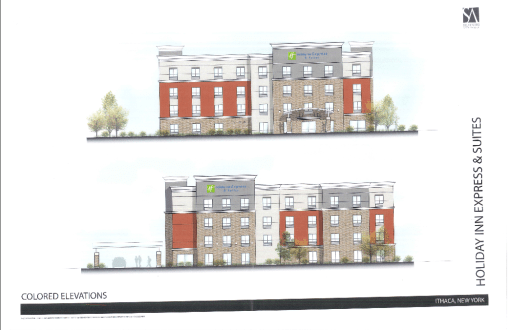
For those who aren’t especially big fans of chain hotels and corporate architecture, this one appears to have a relatively unique design, while following the standard materials and color scheme (called “Formula Blue“) for new Holiday Inn Expresses. Standard for the HI Express line, the hotel’s lobby will serve as a “great room”, there will be free high-speed internet, and while there will not be any full-service dining, a breakfast bar will be included.

Rudra Management and Rosewood Hotels (Jayesh Patel) of suburban Buffalo is the developer, while Silvestri Architects and Optima Design & Engineering, also of Buffalo, are in charge of design. The project is being financed with a $5.98 million loan from S&T Bank, a regional bank in Western Pennsylvania. The project required a little bit of time to obtain financing, having received approval in March 2014, but now receiving the construction loan until this past October. Another Rudra/Rosewood project just up the road at 339 Elmira Road was not so lucky. A Summer 2016 opening is planned.

20160109_141040 20160109_141046 20160109_141057

holiday_inn_express_v2

holiday-inn-express-original-1


News Tidbits 1/9/2016: Better Late Than Never

9 01 2016

Call it the big news round-up. This is what I get for not writing my weekly roundup last week.

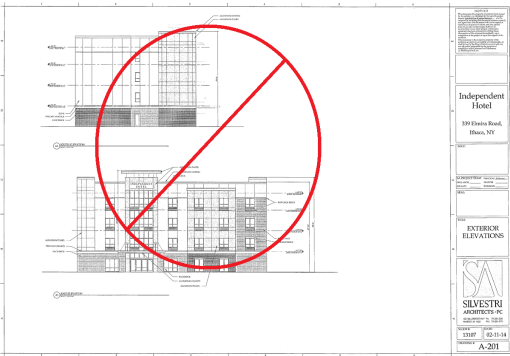
339-Elmira-Road-cancel

1. We’ll start off with some bad news. The plans for a boutique hotel at 339 Elmira are very likely done and over with. The 37-room, 6,468 SF hotel announced in February 2014 was planned for the 0.59 acre former Salvation Army property on the Southwest side of the city. For whatever their reasons were, the developer, (Rudra Management and Rosewood Hotels of Buffalo, decided put the property up for sale for $395,000. After several months, it finally sold at the discounted price of $300,000 to its next door neighbor, Arizona-based Amerco Real Estate, the parent company of U-Haul. Discounted is a relative term, by the way – Rudra had acquired the vacant property for $143,000 in a land auction in 2013. Back when Salvation Army was still there in 2009, the site sold for $175,000.

So with that sale to Amerco, it’s likely the property will be used for an expanded U-Haul parking lot. It’s unfortunate, but them’s the breaks. For what it’s worth, Rudra has commenced work with the other hotel they had planned, the 79-room Holiday Express at 371 Elmira Road, just down the street.

2. In modest but notable projects, the William George Agency in Dryden received a $2 million construction loan to conduct renovations and roof repairs to its cafeteria area. The non-profit residential treatment center for adolescents had secured building material sales tax abatements from the county to help cover their expenses (the project has originally been planned to start in Q1 2015). The agency, established in the 1890s, employs over 340, making it one of the larger private employers in Tompkins County.

20150613_194544

3. Thanks to Nick Reynolds over at the Journal for reminding readers that not every construction project is private. Noted in his writeup of projects that the city intends to fund this year – $430k in road repair projects, another $407k for parking stations, $1.3 million to replace Cass Park rink’s roof, $214k for design work for the new North Aurora street bridge, and $735k for design work for city dam reconstructions.

Perhaps most interesting to readers here will be the $500k that the city intends to spend on design and planning the new Station No. 9. With the awarding of funding from the Upstate Revitalization Initiative, the city can formally explore the possibility of a new fire station on a Cornell parking lot at 120 Maple Avenue. Once a new station is complete, the city could then sell the current Station No. 9, nearly 50 years old and in need of major renovations, to a private developer for redevelopment (the developer who expressed interest in the site is still unknown, but given Collegetown’s expensive real estate market, they must have really deep pockets).

biggs_2

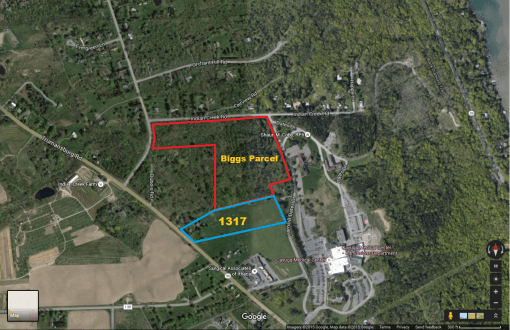
4. More talk of the Biggs Parcel. Jaime Cone at the Ithaca Times provides more details regarding neighbor Roy Luft’s proposal to build for-sale senior housing using the site. Luft is arguing his project is more environmentally friendly than the NRP project, it would take two to three years to come to fruition, that the units would be 700-1,000 SF, and he’s serious about building the senior housing, which is an under-served market. The Indian Creek Neighborhood Association, which has actively fought any sale, seems to at least be open to the idea, if not necessarily a fan of it.

For the record, since the ICNA doesn’t clarify it in their blog post, the county didn’t develop the NRP project. The county put out a request for proposals (RFP) just like they do with every other large development study or offering. Better Housing for Tompkins County and NRP happened to think they had a good project idea and responded to the RFP. It’s been made clear, multiple times, that the county has approached neighbors, Cayuga Medical, INHS and others for months, shopping the land around, and no one has made offers. To be completely honest, even if this land hit the real estate listings, it’s not as if anyone is clamoring to snatch this up; there’s demand to live in and near Ithaca, but land still takes several months to sell on average, and it’s not a stretch to think that developers would avoid this one after the NRP flaying. The county plans to start the listing process later this month if the ICNA doesn’t make an offer by the 15th.

Just a thought, but if $340,000/25.52 acres = $13,333/acre, and the acreage closest to Dates Road is probably developable, than shouldn’t that allow a ballpark fair-value estimate? I know NRP was to pay $500,000, but that had some transit and pedestrian cotingencies attached. Has the ICNA contacted NRP to ask how extensive the wetlands were, is the information on file with the county?

1317 Trumansburg is 10.17 acres, The Biggs parcel 25.52. Combined, they would be 35.69 acres. From the sound of it, Luft would like to reform the parcel boundaries to let his project, however big it may be, to move forward. The site is zoned low-density residential, which means a cluster subdivision can be 2.3 units/acre at maximum. Each structure can have up to 6 units. Taking a guess here, but Luft may be looking at more than 20 units, because anything less than 20 could be done with a subdivision of his current property. For comparison’s sake, the BHTC/NRP project was 58 units.

There is at least the potential that the county gets additional tax dollars from Luft’s project, and the woods would be protected, and there would be a happy ending to this story. But that’s dependent on both sides’ goodwill. Given the years of acrimony, that’s a big leap of faith.

5. For the restaurant-goers out there – Fine Line Bistro’s old spot at 404 West State has a new tenant called “The Rook” opening this month. Mark Anbinder provides the foodie rundown at 14850.com. Mid-tier American bistro/pub fare.

More importantly to this blog is the economic rundown, provided thanks to their application for a loan courtesy of the Ithaca Urban Renewal Agency (IURA). The three co-owners, all local restaurateurs, are seeking a $40,000 loan (3.5% interest, 6 year length) to complement their own dollars and a private loan. 8 hired staff (cooks/servers/dishwasher), but none living wage. With cash flow statements, restaurant plans, the menu, loan filings and resumes of the owners, this looks like a Cornell Hotelie’s senior class project.

It’s the IURA’s decision make, but at least it’s nice to know that good restaurant space in Ithaca is in strong demand.

Pg-3-Rendering

6. Out for bid, Cornell’s Ag Quad renovations. The bid filing estimates the budget at $6.6-6.8 million, and a construction timetable of late March 2016 to Summer 2017. Quoting the first write up from October:

“The $9.6 million project will be broken down into two phases, one that focuses on infrastructure, and one phase on landscape improvements (and being that much of the infrastructure is underground utilities, phase one could be described as churning up the ground, and phase two is making the upturned dirt pretty again). The renovations, which are set to start next summer and run through 2017, will include additional emergency phones, a rain garden, and outdoor gathering spaces in front of Mann Library and Roberts Hall (upper right and lower left in the above render).”

state_st_triangle_v5_1

7. Folks love a good rumor, and the Times’ Josh Brokaw had an interesting one to report in his 2016 futurecast regarding State Street Triangle

“Don’t think that the Austin-based developer is abandoning Ithaca, though a look at their previous projects shows this sort of downtown, mixed-use development is a new frontier for a company accustomed to building student housing mostly in green fields in the South and Midwest. CEO Mike Peter was spotted downtown at Mercado in December talking to consultant Scott Whitham; it wouldn’t surprise if the company came back this year with something conceptually similar—lots of rooms, ground-floor retail—but a much different look.”

Brokaw makes a reference to the inclusionary zoning slated for discussion next month, which is rumored to mandate affordable units in return for a larger footprint (rundown of how that works here). I also wonder if it will make reference to the “pillar” that Myrick mentioned previously – a taller, skinnier building, not as massive and perhaps only 3-4 floors over most of the site, and maybe a quarter of the site has a taller tower that’s 12 or 13 floors, whatever is permitted by the inclusionary zoning (strictly hypothetical, just one guess of many). Campus Advantage has plenty of time since they missed their original start date, but maybe later this year in the spring.

8. It’s always a brow-turner when a real estate listing is advertised as “a large corner lot ideal for a multi-unit development. In this case, it’s a 0.2 acre double lot at 404 Wood Street in Ithaca’s South Side neighborhood. The listing offers the ca. 1938 house and lot for $250,000 (tax rolls say the property is assessed at $125,000; the current owner picked it up for just $34,000 in 1993).

Playing with some numbers a little bit, there are a couple of options if a buyer wanted to build something. The first and probably easier option would be to subdivide the lot and build on the vacant corner parcel. That would give, per R-3b zoning regulations of 40% lot coverage and 4 floors, about 1400 SF per floor. That gives 5600 SF, and if one assumes 15% off for circulation/utilities and 850 SF per unit, you get a 5 or 6 unit building at theoretical maximum.

If one were more brazen and tear down the 1938 house, one gets about 3,485 SF per floor, 13,940 SF at max height. That allows about 14 units using the same figures as above. But that might be tougher for neighbors to swallow. Anyway, if it sells and it looks like there’s a possibility, it’ll get a followup in a future news post.

morris_avenue_2

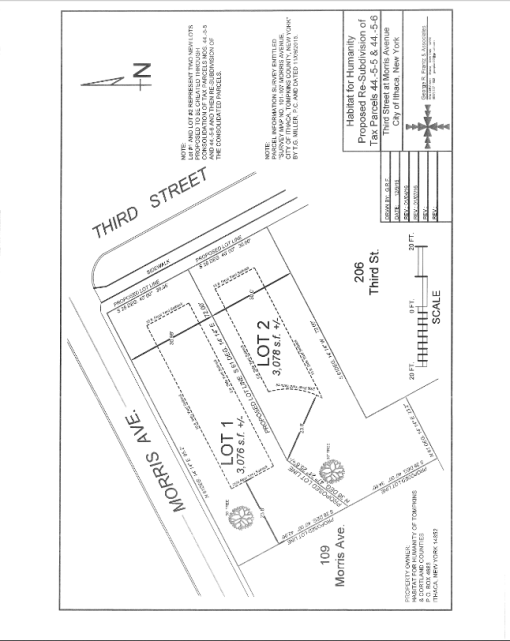
9. Nothing to exciting on municipal planning agendas this week. The town of Lansing cancelled their meeting, and all the town of Ithaca had was a cell phone tower on West Hill. The city has a little more interesting. The duplex at 424 Dryden is examining unusual parking arrangements to save trees, and Habitat for Humanity is planning an affordable-housing owner-occupied duplex for vacant lots at 101-107 Morris Avenue in the city’s North Side neighborhood.

morris_avenue_1

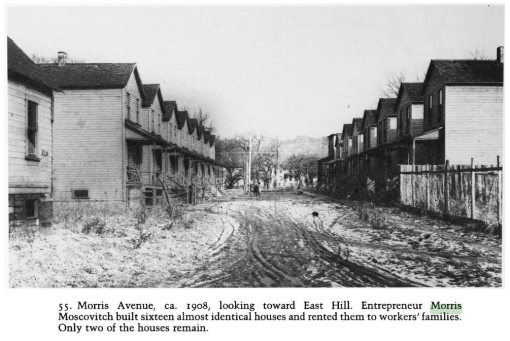
Morris Avenue has always had a focus on worker housing. As described in Ithaca’s Neighborhoods by Carol Sisler (1988), local businessman Morris Moscovitch built 16 nearly identical houses in 1908 to house worker’s families. But, with the effects of urban decay and urban renewal, only one of those 812 SF houses (109 Morris) is still standing today.

What Habitat for Humanity is proposing is to take the vacant lots at 101-105 Morris and 107 Morris (total 0.138 acres), combine them and create two new lots that will face Third Street. The new lots would need a zoning variance since they’re not wide enough (30′ and 30.98′, 35′ required). Being Habitat, these might take a little while to build and they probably won’t wow anyone design-wise, but there’s a lot of value to be placed in their “sweat equity” approach, and affordable owner-occupied housing is in severe need in Ithaca. Planner George Frantz is handling the application.

hotel_ithaca_final_1

10. Lastly, for what is a very long post, the Hotel Ithaca’s revised CIITAP application to the Tompkins County IDA. Now that the project is approved by the city, they can work on a revised tax deal. According to the project memo, the sales, mortgage and property tax abatements will total $1.781 million on the $15 million project. The property tax abatement is the standard 7-year abatement, and will generate almost $1 million in new tax revenue during the abatement period. The project would retain 71 positions and create 21 new jobs, most of which appear to be less than living wage. The application does note, perhaps ominously, that non-approval would result in functional obsolescence – the hotel shuts down. The IDA plans to examine the application at their meeting in the county office building next Thursday.


Ithaca Marriott Construction Update, 12/2015

14 12 2015

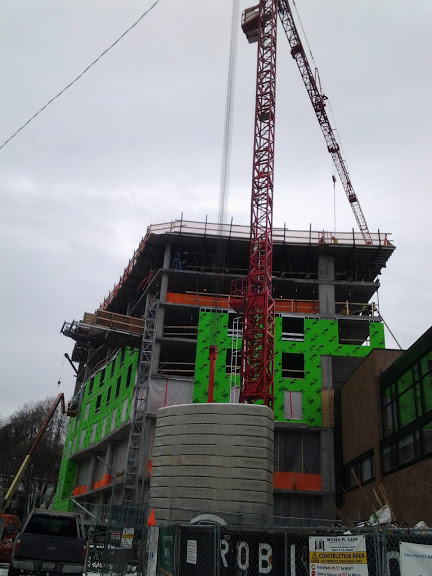
With the foundation work completed, the downtown Ithaca Marriott is heading skyward, now up to the third floor as of these photos from last week. From Green Street, one can see the rising south stairwell, the future trash and recycling room (basement floor), future restrooms and offices on the lobby floor, and hotel rooms on the floors above the lobby. Also on the basement floor are the fitness center, maintenance and linen rooms, storage space and utilities. Delivery trucks will pull in and unload under the cavernous space on the left side of the second photo.

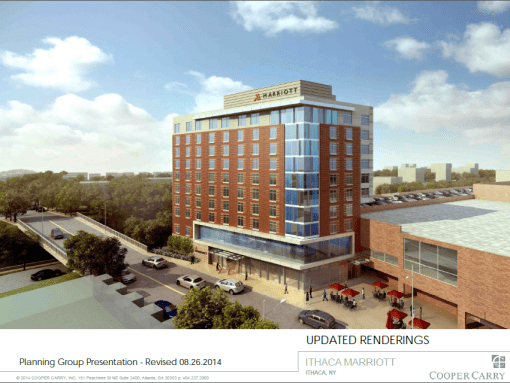
The lobby area facing Aurora Street may just be a concrete shell with some temporary lighting rigs at the moment, but in a year or so, that space will host a new 80-seat restaurant, which will be combination of lounge seats, bar seats and traditional tables. The kitchen and prep area will be set back from the street, facing the Green Street garage.

The second floor facing Aurora Street, which will have a glass curtain wall (or as it’s called in the elevations, a “thermally broken translucent linear channel glazing system”), will contain two large meeting rooms. 4 guestrooms will also be located on the second floor. Above that, the third floor will have 14 guestrooms, assuming the 2013 construction docs are still accurate.

The 10-story, 159 room hotel is expected to cost over $32 million and. According to the Ithaca Times, a general manager has been named and the hotel will officially open for its first guests on August 23rd, 2016. Suburban D.C.-based Urgo Hotels is the developer, Atlanta’s Cooper Carry Architecture is the designer, and William H. Lane Inc. of Binghamton (with a new Ithaca office as of last year) is the general contractor.

20151204_115445 20151204_153039 20151204_153059 20151204_153122 20151204_153203 20151204_153246 20151204_153255 20151204_153406 20151204_153422 20151204_154050 20151204_154219

marriott_rev1_1


News Tidbits 12/12/15: Money Money Money Money

12 12 2015

canopy_hampton_rev4_1

1. Time to do a little rumor-killing. There’s been some confusion as to whether or not the Hilton Canopy is actually happening, since it was supposed to have started construction by this time and it hasn’t. There was also an article in the Ithaca Times that suggested that construction costs much higher than original estimates had caused the project to be cancelled.

Well, the project has definitely been delayed, but it looks like it will still be moving forward. According to a utility easement resolution at the Ithaca Urban Renewal Agency’s Economic Development Committee (IURA EDC) meeting, a project financing commitment has been secured and the developer of the Hilton (Neil Patel of Lighthouse Hotels LLC) is planning a construction start in the first quarter (Jan-Mar) of 2016, which would suggest a mid-2017 opening.

inhs_pride_design_v5_3

2. Also in financial news, INHS looks to have secured grant funding that will allow it to move forward with its 210 Hancock project in the next four months, according to INHS Executive Director Paul Mazzarella. The grants were officially awarded in an announcement from the governor’s office on Tuesday. $3.6 million will come from the state’s Housing and Community Renewal program, $500,000 from the state low-income housing tax credit (LIHTC) program, and $1.03 million from the U.S. Department of Housing and Urban Development’s LIHTC program. In total, the award is valued at $5.13 million, about a quarter of the estimated $20 million development cost. The project has received about $17 million in grants and tax credits to date.

The money awarded covers only the rental units – 54 apartments in the four-story mixed-use building, and five townhouses. The seven owner-occupied townhouses remain unfunded.

The apartments, which include a 30-child low-income daycare facility and commercial office space for non-profits, will welcome their first tenants in Summer 2017. They will rent from 27% to 105% of local median household income, depending on the unit. Descriptively, it’s a mixed-income project with residents’ incomes ranging from $25,000-$60,000 per year.
ith_big_plan_map_v2

3. From the Common Council’s Planning and Economic Development Committee, there are a few things of note this week –

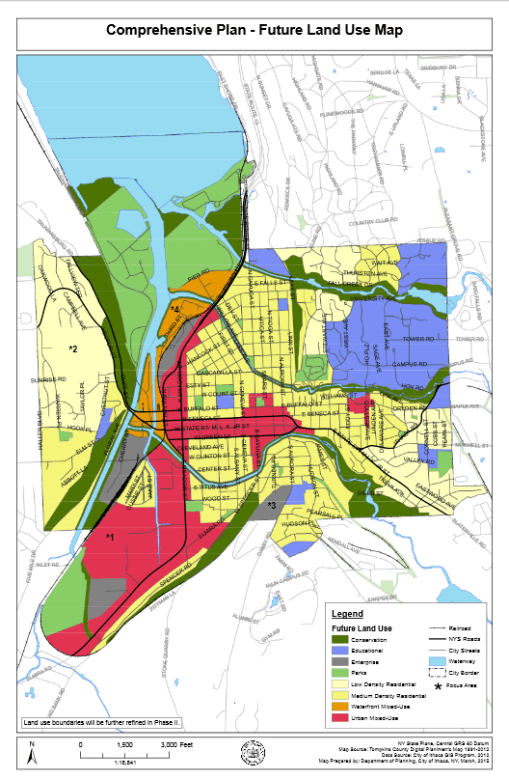
A. The city seems to be looking towards greater encouragement and flexibility with redevelopment of waterfront parcels by making WF-1 and WF-2 zones Planned Unit Developments (PUDs). What a PUD does is allow greater flexibility in uses and design by removing or loosening zoning constraints on site use, and being more accommodating to mixed-use projects (the Chain Works District proposal is a PUD, for example). Previously, PUDs could only be applied to industrial sites. The other stipulation, however, is that the applicant would have to work with the Common Council to determine appropriate development of the site.

The Waterfront Zoning allows up to 5 stories and 100% lot coverage. The PUD will give flexibility beyond that, dependent on what the Common Council is comfortable with for a given site and proposal.  So if Applicant X shows up with a huge apartment building or a big industrial building, it’s probably not going to get very far. But if it’s well designed and has affordable units? Maybe the council will grant a little more density or another floor. It depends on a developer showing up with something that they feel offers some kind of community benefit and fits with the Comprehensive Plan, and whether the Common Council agrees with the developer’s reasoning.

There is great potential in the waterfront – those views can fetch a premium (i.e. higher land values, and more tax dollars), it’s far enough removed from the colleges that students would be unlikely residents, and many of the properties are underutilized, with only marginal public benefit.  So potentially, if someone wants to work with the Common Council (one can count on at least 8 or 9 of the 10 being willing to cooperate), there could be some benefits in the long-term.

B. The Commons first-floor active-use zoning ordinance looks to be heading for a Common Council vote in January. More about that ordinance here, Item 5.

C. That damned backyard chickens thing again. Only this time, it might be moving forward with a pilot program involving 20 families.

D. Per the Times’ Josh Brokaw, expect incentive/inclusionary zoning to be up for PEDC review in January.

tfc_comparo

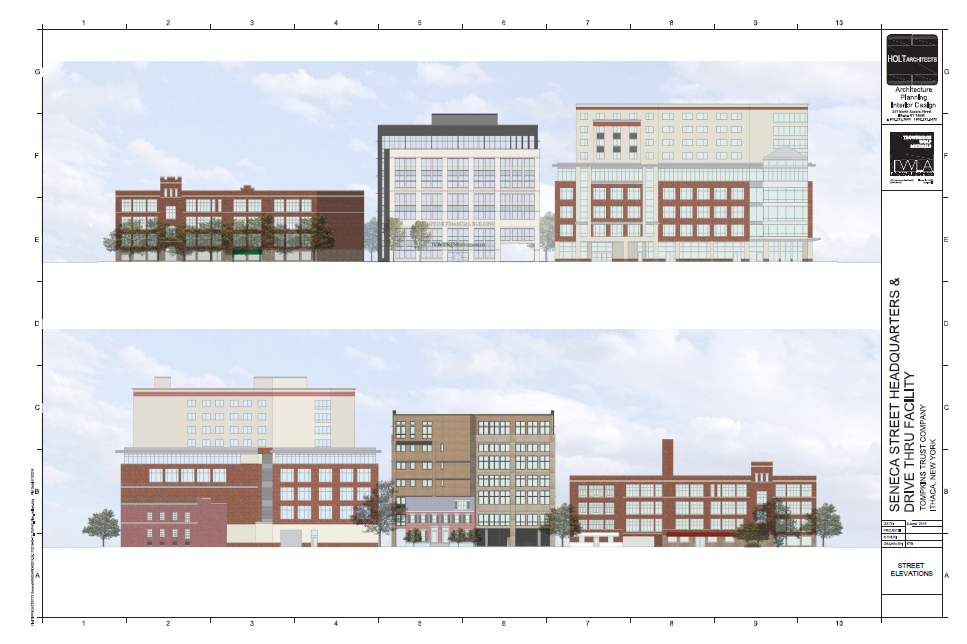
4. Hey look, this week’s eye candy. Tompkins Financial Corporation’s proposed downtown Ithaca Headquarters at 119 East Seneca Street will be reviewed for final project approval at this month’s Planning Board meeting. As part of that, here’s the final project design, part of the final Site Plan Review submission here.

From the front, it looks like some of the window layout has changed on the top floor and southwest corner, and there are fewer sunshades above the windows. There’s a third tree in the planting plan, and there’s variation in the cladding materials on the west wall facing the DeWitt Mall.

tfc_v3_1

In fact, it’s the non-primary facades that have changed the most, with different (and generally lighter-colored) brick and aluminum panels when compared to the previous rendition. Although there’s less glass than before, the lighter colors and greater variation in materials de-emphasize the bulk from the perspective of its townhouse neighbors at the rear. The 7-story, 110,000 SF commercial office building should begin construction in early 2016 with an eye towards completion the following spring.
elmira_savings_1

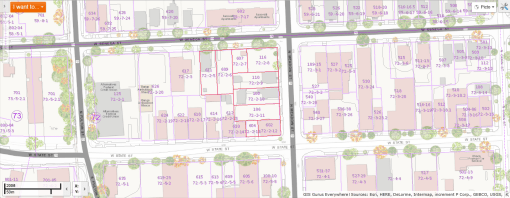
5. There was quite a sale on Ithaca’s West End last Friday. Nine properties outlined in red on the map above – 106, 108, 100 and 116 North Meadow Street, 607, 609 and 611 West Seneca Street, and 602 and 604 West State Street – were sold for $1,725,000 to Elmira Savings Bank.

Now, there are a few reasons why this is worthy of attention. For one, banks don’t typically shell out almost two million dollars without some kind of plan. For two, Elmira Saving Bank has been moving forward with expansion plans in the Ithaca area in hopes of capitalizing on the growing local economy. For three, there has been a lot of development in this neighborhood as of late – the Iacovelli Apartments (2013) and Planned Parenthood (2014) are right across the street, and it’s worth noting that the 18,000 SF HQ for Alternatives Federal Credit Union (2002) is on the other side of the block.

The properties are currently home to parking lots, several older, non-historic houses (most in poor condition) and a two-story 4,500 SF commercial building previously home to the Pancho Villa Mexican restaurant. The restaurant building had been on the market for $699,900.

The zoning here is all WEDZ-1a. West End Zone 1a allows for 2 to 5 story buildings, 90% lot coverage in the case of large assemblages such as this, and no off-street parking requirement. That means these parcels have a lot of potential. The previous owner had been rumored to be planning a mixed-use building on some of the properties, but nothing official ever came forth.

Two phone calls were placed to Elmira Savings Bank’s headquarters in Elmira, and two voicemails were left, but neither received a response. But these properties are definitely something to keep a close watch on over the following months.

6. That 9100 SF store being developed on the corner of East Shore and Cayuga Vista Drives in Lansing that was mentioned last week (here, Item 4)? It’s going to be a Dollar General. Not sure if that’s better than the auto/tire store speculated last week.
20151108_152102

7. Lest it be forgotten, it appears Lady Luck and some state bureaucrats smiled at the Southern Tier this week, awarded the region one of the three $500 million prizes of the Upstate Revitalization Initiative, known colloquially as the Upstate “Hunger Games”. Rochester/Finger Lakes and Syracuse/Central are the other $500 million winners. Seven regions competed, and the four losers will receive $80-$100 million for their priority projects. The money will be paid out in five annual installments of $100 million. A copy of the Southern Tier’s plan is here.

I wrote about Ithaca’s plans for its share on the Voice here. The first year projects alone will have a range of impacts, ranging from job creation and training to municipal construction projects to quality of life projects like museum expansions. Potentially, it could result in hundreds of jobs in Tompkins County, financial capital for several major projects, and make the area more attractive for investment for both local and external entities. As these projects move forward, they’ll receive their due write-ups here and on the Voice.

Of course, the key things are that the community can manage this monetary award, and that someone can track and guide these projects to completion – something the Southern Tier has struggled with, when one looks at the result of previous, much smaller awards.

8. The state’s just shoveling money into Ithaca this week. The New York State Office of Community Renewal (part of the state’s HUD equivalent, the Homes and Community Renewal agency) has awarded $500,000 towards the rehabilitation of the Masonic Temple at the corner of East Seneca and North Cayuga Streets in downtown Ithaca.

The Masonic Temple was built in 1926 and designated a local historic landmark in 1994. The property is owned by Ithaca Renting Company (Jason Fane), who purchased the building from the Masons in 1993. Fane’s never been a fan of the historic designation because the ILPC can be expensive and onerous to work with, nearly everyone else hasn’t been a fan of his long-deferred maintenance of the 90-year old building (if you have ever wondered why that CIITAP rule was added about an applicant being in building code compliance with all their other properties…now you know). A few years ago, Fane had not been shy in his interest in demolishing the building.

After rejecting a purchase offer to turn the building into a community center and space for the New Roots charter school, Fane decided to go the preservation route earlier this year and apply for a grant to renovate the interior and add an elevator to the building to make it ADA-compliant. This would make the building much more marketable to commercial tenants, many of which have shunned the 17,466 SF building. Fane laid out a few different options this past summer, including one where four commercial spaces (rental, office, restaurant) would be created. Based on the grant announcement, it looks like that will be the option pursued.

The Downtown Ithaca Alliance backed the application, as did the Common Council by unanimous vote at their July meeting.

The renovation will cost at least $1 million, and according to the grant announcement, seeks to start construction in summer 2016. Expect more info when it hits the ILPC and Planning Board at a later date.
20151205_121714 20151205_121736

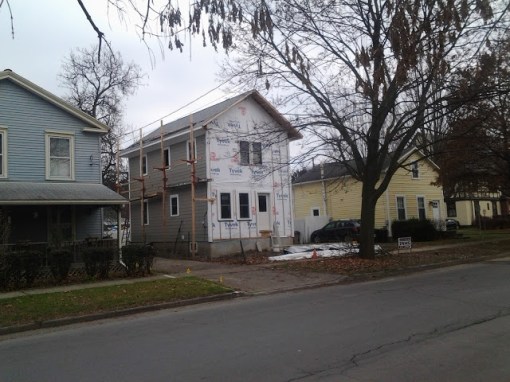
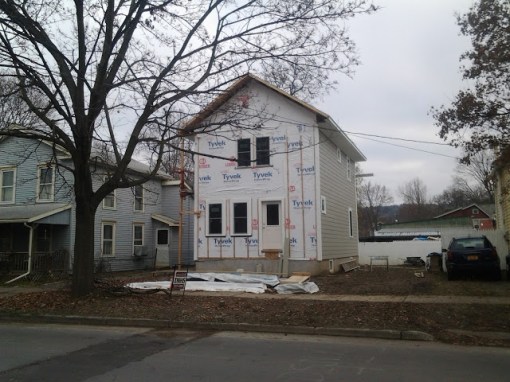
9. House of the week. This week, INHS’s new 2-bedroom, 1150 SF single-family home underway at 203 Third Street in the city of Ithaca’s Northside neighborhood. The house is framed, roofed and sheathed. Siding (Hardie board?) and trim is being attached on the sides, and one can expect a nice gracious porch to be attached once exterior materials are installed on the front. A home of the design was previously built at 507 Cascadilla Street.

203 Third Street was a vacant that the city seized in a tax foreclosure in 2011. It was transferred to the Ithaca Urban Renewal Agency, who sold it to INHS for $17,000 in December 2014. The process is pretty similar for a lot of the home lots that INHS builds on – the non-profit buys dilapidated or vacant properties from the IURA, which they build or renovate into affordable single-family and duplex houses. In the case of 203 Third Street, INHS competed for the site, outscoring Habitat for Humanity’s submission in an IURA examination of proposals.

As with all INHS homes, this one will be sold to a buyer of modest means, which means someone making at or a little less than the county’s median household income of $53k/year (I think 80% of MHI is the low bound offhand, so about $42k/year). The houses will be a part of INHS’s Community Housing Trust, limiting the price it can be sold for and requiring that if put up for sale, it is sold to another family of modest means. It may just be one house, but it will mean a lot to one family.

Claudia Brenner is the architect, with Rick May Construction and Mike Babbitt in charge of construction (thanks to Claudia for the builder info).