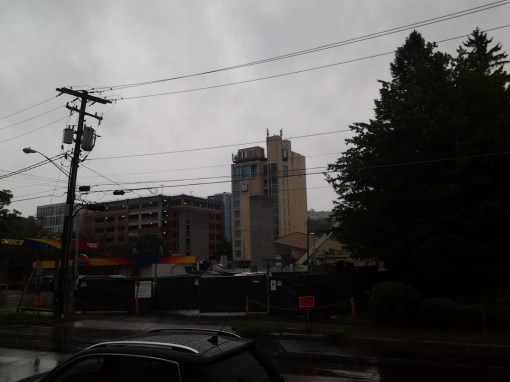
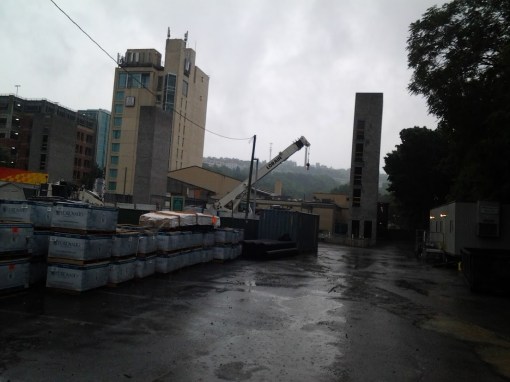
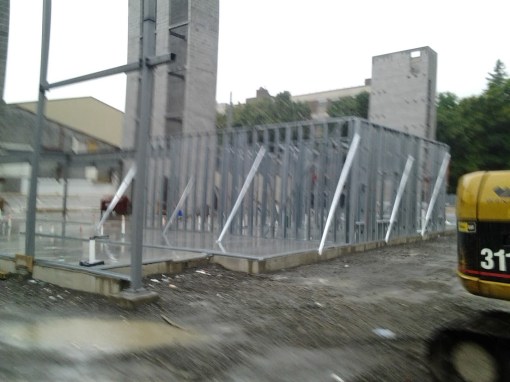
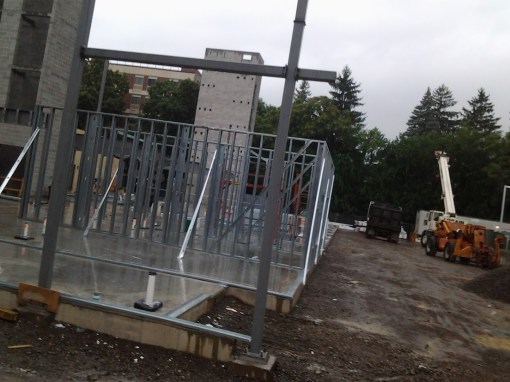
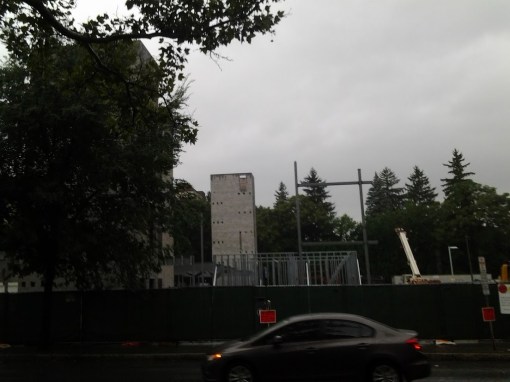
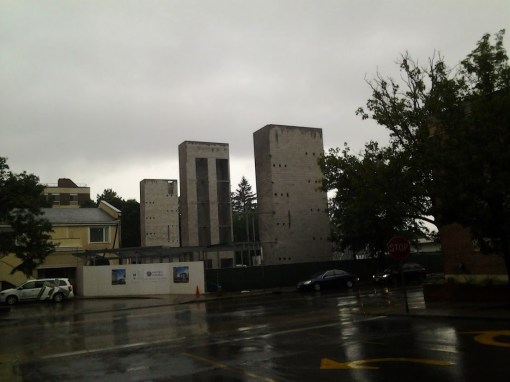
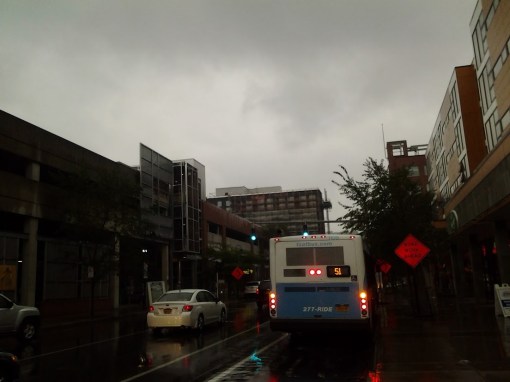
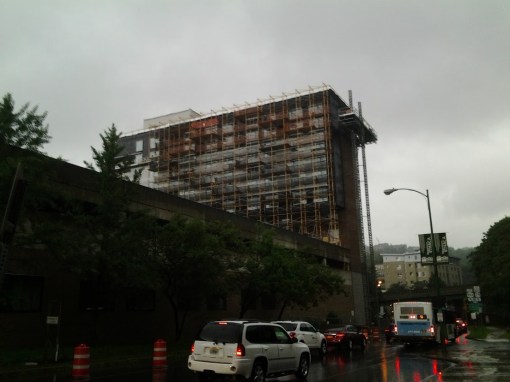
Hotel Ithaca Construction Update, 12/2016

15 12 2016

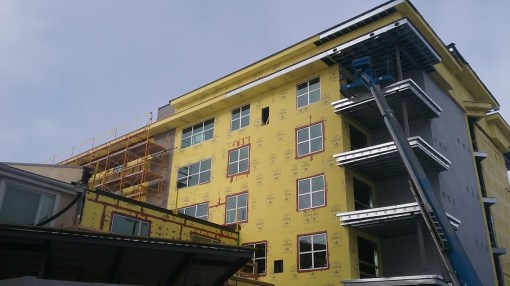
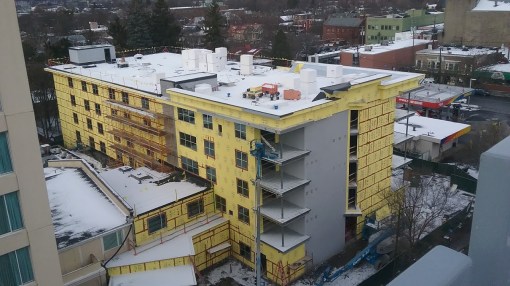
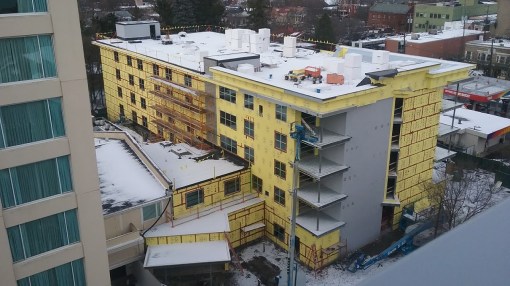
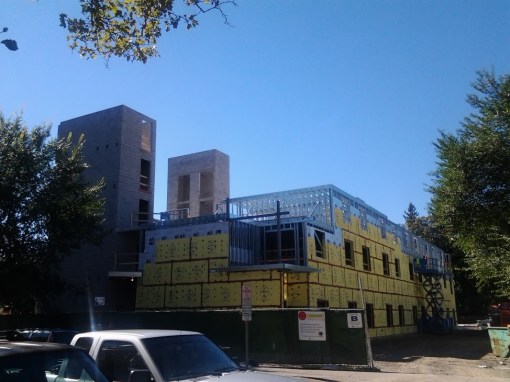
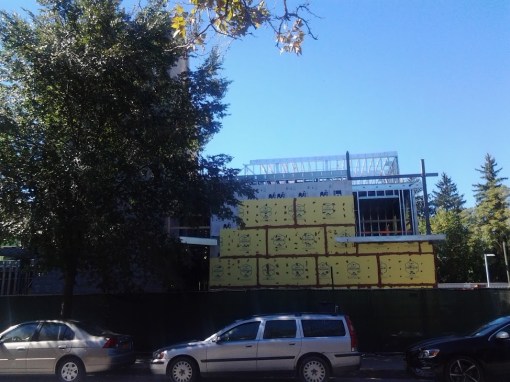
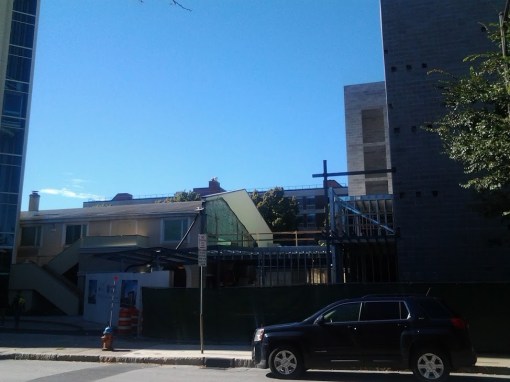
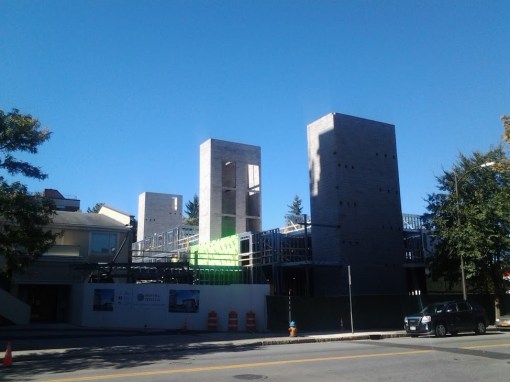
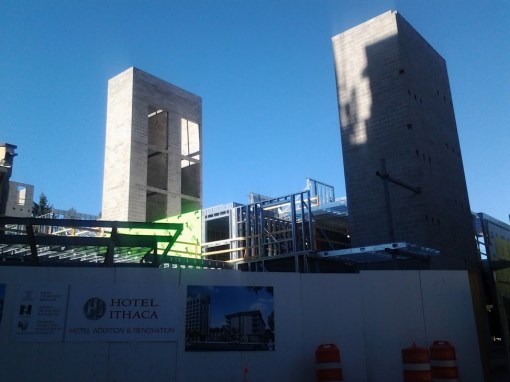
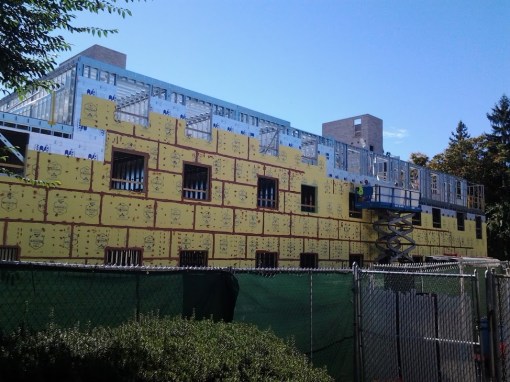
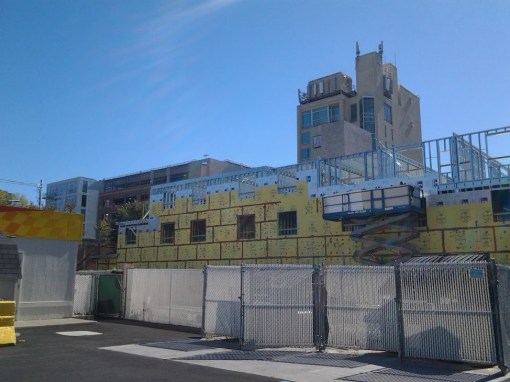
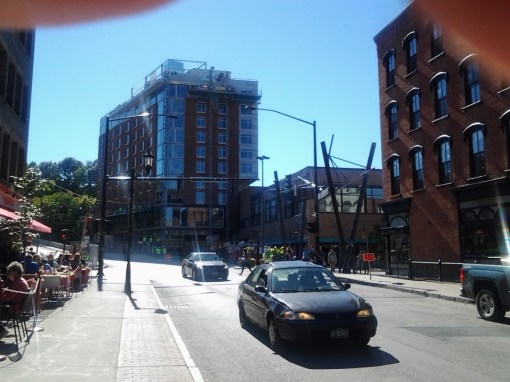
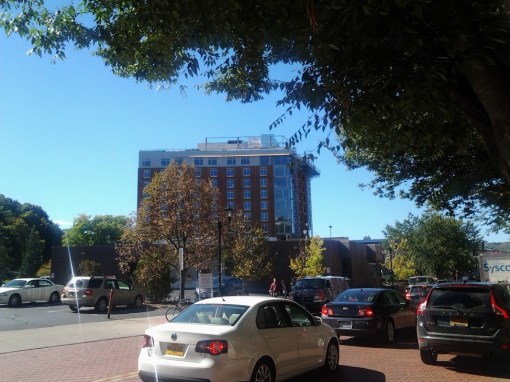
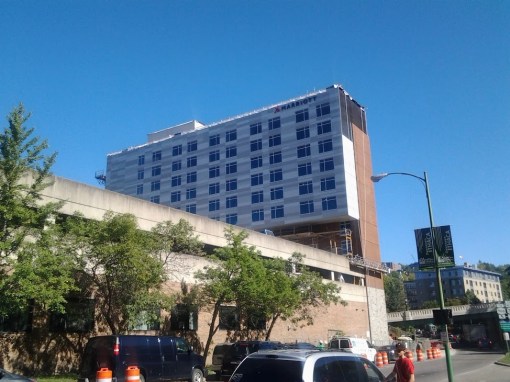
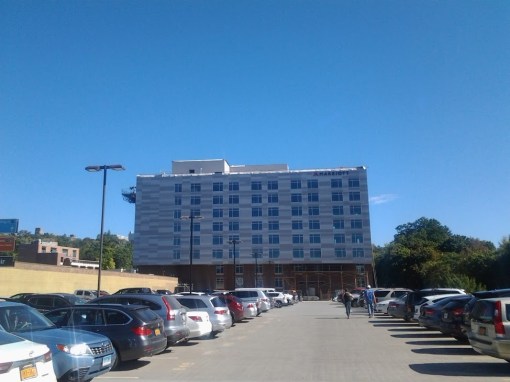
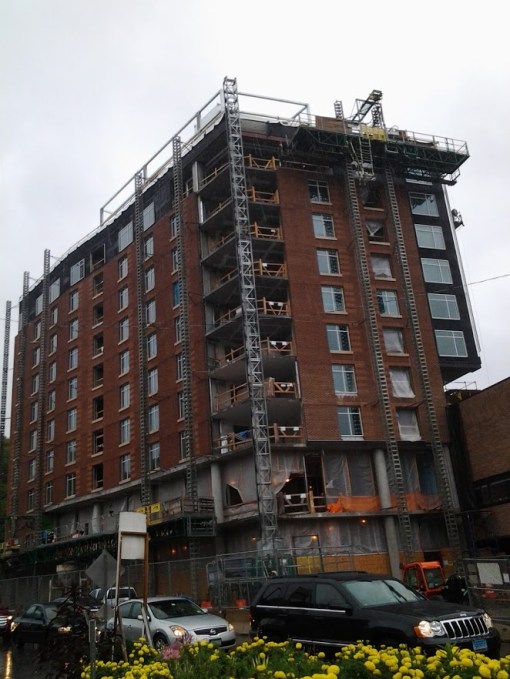
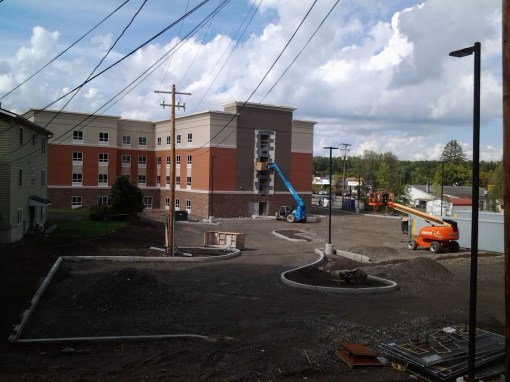
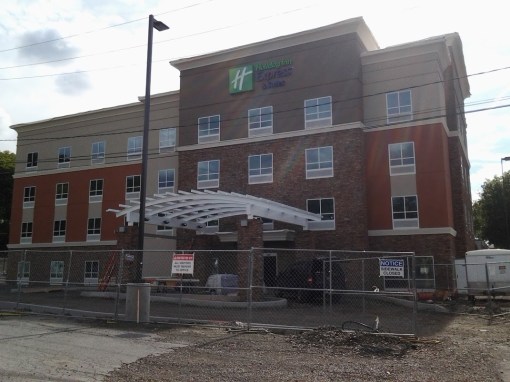
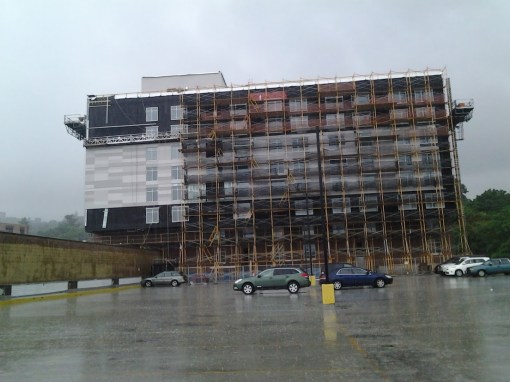
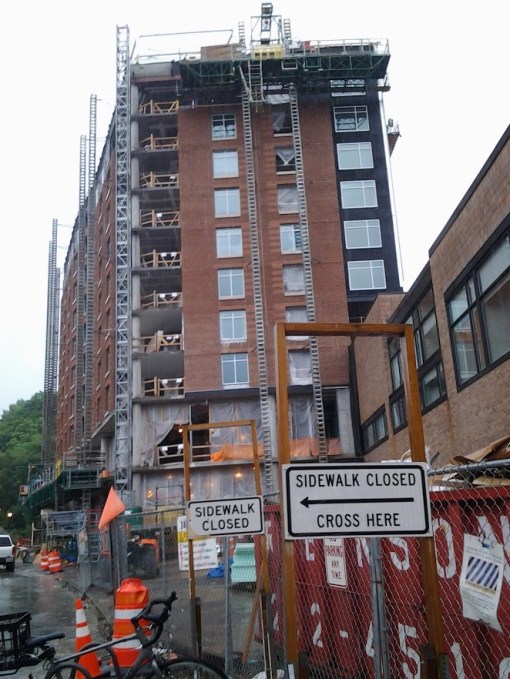
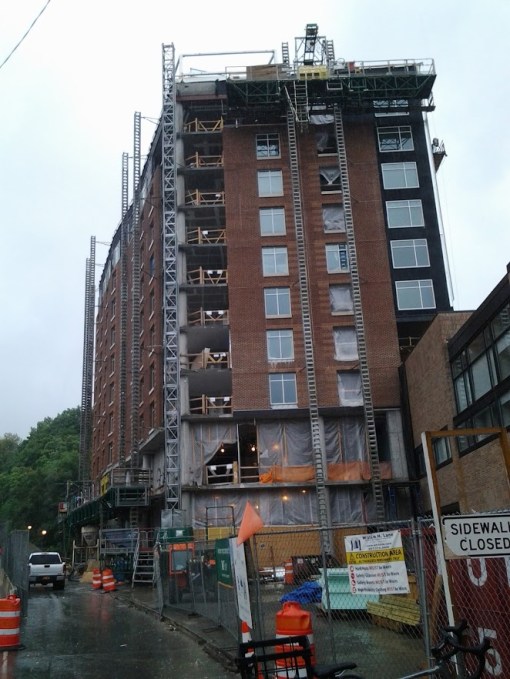
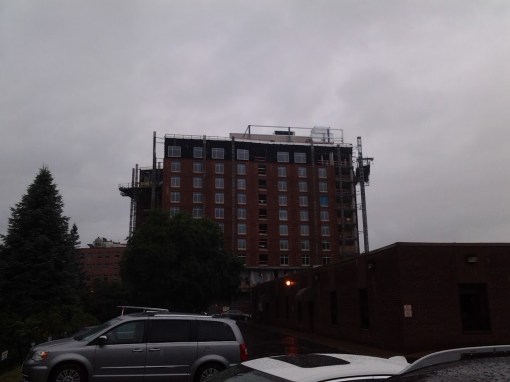
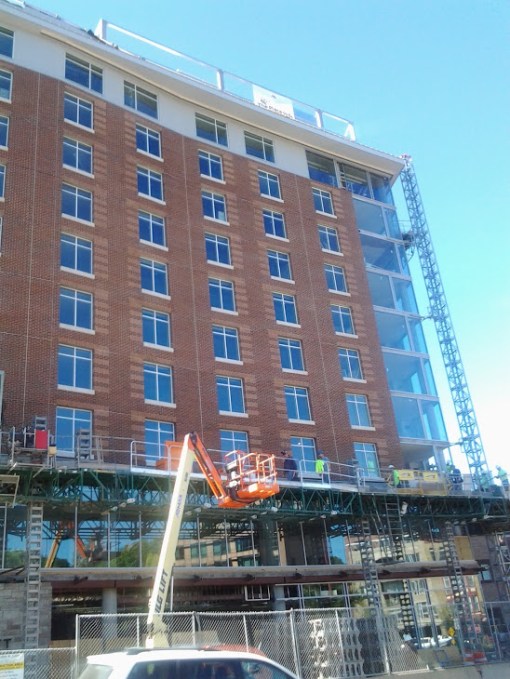
The Hotel Ithaca addition at 222 South Cayuga is topped off and has taken the shape of the final product. Most of the new windows have been fitted into the exterior walls. Air conditioning units will be installed in the smaller openings. Peering inside, it looks like the interior framing is all set, and utilities rough-ins are underway.

In most places, the DensGlass fiberglass mat sheathing is being sealed up with R-Guard FastFlash liquid flashing, to close up the seams, joints and fasteners. Some of the newer sections, like the south wall, have yet to be sealed – in fact, workers were cutring and installing the DensGlass boards on the balconies while these photos were being taken. Since the balconies aren’t meant for full-time occupancy, the fiberglass mats are going directly onto the steel studs, without the R-Max polyiso. Taking a guess here, the gray coat on the front (east) wall might be a primer material for the exterior facade.

Along with general contractor and frequent Hart Hotels partner Krog Corp, it looks like Henderson Johnson Inc. of Syracuse was tapped for some subcontracting, and IBEW-sponsored John Mills Electric of Ithaca is handling the electrical rough-ins for the new wing.

The new $13.77 million addition should open in May 2017, just in time for the big graduation weekends. More background info on the Hotel Ithaca project can be found here.
20161209_122235 20161209_122240 20161209_122252 20161209_122341 20161209_122350 20161209_122356 20161209_122509 20161209_122807 20161209_122819 20161209_122840

hotel_ithaca_final_1


News Tidbits 11/5/16: Condemnation and Praise

5 11 2016

maguirebirdseye-620x420

1. The Maguire waterfront plan has been rejected. By an 8-2 vote, the Ithaca city Common Council voted to discontinue consideration of the state-of-the-art Ford/Lincoln/Nissan dealership, with most citing concerns about the project’s marginal or poor fit with the city’s comprehensive plan, which calls for an urban mixed-use form of development in the Carpenter Circle area where this dealership is proposed. The votes in favor of the proposal, from the third ward’s Donna Fleming and first ward’s George McGonigal, cited ways it could be conceived as fitting with the plan (greener alternative, local business expansion), and challenges the site offers to the city’s urban plan (poor soils, trains, chemical storage, power lines).

Although this shuts down the current proposal, this may not be the last we hear from the Maguires or the Carpenter Business Park site. At the meeting, company President Phil Maguire offered a teaser, saying they may partially liquidate their land holdings to bring in mixed-use development that would share the CBP space with the dealership. Given the heavy alterations that would need to occur, the council decided to vote down the existing proposal and send a message that it doesn’t fit the city’s goals. However, the council said they and the planning department would expedite review of an amended proposal, should it come forth.

20150613_175047

2. If you’ve ever wanted some explicit discussion of the challenges of doing affordable housing in Tompkins County, here’s a great summary courtesy of the the town of Ithaca. Back in August, the town’s Planning Committee (of town board members, similar to the city’s PEDC Committee) met with Ithaca Neighborhood Housing Services Director Paul Mazzarella for a Q&A. The town is considering regulations for inclusionary housing, and after INHS’s Greenways project fell through, they would like guidance and input on to make an effective code that promotes affordable housing without killing all residential development. Here are some of the highlights:

– Ithaca is a market of smaller builders. Local developers aren’t able or interested in doing huge projects, and most outsiders don’t see Tompkins County as a big enough or profitable enough market to tap into. So that leaves it to smaller builders who don’t have scale efficiencies, and are inclined to build luxury housing because the return on investment is more likely (i.e. less risky). The strong local economy also means that the local construction labor pool is largely tapped out, and additional crews have to be imported.

– Mandated affordable housing tends to work best in expensive, hot markets where the Return on Investment (ROI) for the market-rate units is more likely – your Seattles, San Franciscos and New Yorks. Even there, it is often paired with incentives such as height or square footage. Mazzarella noted he doesn’t think the city’s voluntary program will work very well. One thing to note with mixed-income projects is that the market-rate units will often be higher priced to cover the cost of lower-priced units. Simplified example – say you’re building ten houses for a sale price of $250,000. To meet an affordable mandate you sell two at $200,000, but to still obtain adequate ROI, that $100,000 is going to spread among the other eight – so you have two for sale at at $200,000, and eight at $262,500.

– We talk about modular homes as lower-cost alternatives, and for rural locations they often are, due to materials and labor costs. However, INHS found that in their experience for sites in the city and town, the cost is comparable to stick-built, although at larger scales, cost efficiencies may be achieved (ex. the Belle Sherman Cottages).

Another interesting read is the committee’s September meeting with city historic preservation planner Bryan McCracken and Historic Ithaca’s Christine O’Malley about protecting historical resources. As it turns out, the city cannot designate an individual landmark without the owner’s permission, and historic districts require the approval of 60% of affected property owners.

hipped_roof_tinytimbers

3. Seems like Tiny Timbers had a well-attended open house. On their blog, the Dolphs have shared a cross-sectional diagram of an exterior wall – beneath the hemlock siding and copper trim will be ZIP sheathing and polyiso (thermoset plastic foam) insulation. ZIP is everywhere in residential construction, polyiso less common – locally, it was used extensively with the Boiceville Cottages in Caroline. On the inside, one has sheetrock and bamboo flooring. Exposed hemlock posts and ceilings will complement the sheetrock.

Also being rolled out is a fifth home design, a larger two-bedroom, two-bath home with a hipped roof. Variety is the space of life, as the saying goes.

119_125_college_1

4. It was exciting to finally see the release of renderings for John Novarr’s College Townhouses project at 119-125 College Avenue. Links to the Site Plan Review document, historical documentation and drawings can be found in the Voice write-up here. There have yet to be images released for the garden apartment building to be built at the rear of the property, but look for the same general design features as the rowhouses. As expected from ikon.5 Architects, the design is modern and glassy, and given the Facebook comments and a couple of emails that came in, some neighbors are less than happy about that. However, this isn’t a historic district, so long as it meets zoning regulations, Novarr is free to hire whoever he darn well pleases. As mentioned in previous write-ups, he had ikon.5 design his guest house, so this isn’t strictly a cost thing, he genuinely likes their work. It was a bit surprising but interesting to see the well-researched history of the three 19th century boarding houses currently on the property, and it makes me wonder if that was a requirement. Novarr’s proven to be accommodating in the past, perhaps he’ll deconstruct rather than demolish, and the salvageable parts can be reused.

The project team will meet with members of the Planning Board on Tuesday afternoon for Design Review – about the only thing that stands out at initial glance is the lack of windows or visual interest with the north face, barely noticeable in the rendering. That probably won’t fly with the board, but we’ll see if it gets changed up as it goes through review. City Centre, the 8-story Trebloc site redevelopment, will also undergo further design review at the meeting.

chapter_house_reconst_v5_1

5. The Chapter House is going to the Ithaca Landmarks Preservation Commission (ILPC) yet again. The changes are subtle and few, but the rules are the rules. A service door will be added to the west (rear) wall, the inset vestibule is being reconfigured a bit, and the third-floor dormer windows are being changed from double-hung to casement – meaning that instead of sliding up and down, they’ll open with a crank. The ILPC will vote on the changes in November, which will probably sail through without much debate, and hopefully, just maybe, quite possibly, the Chapter House project can get underway.

sleep_inn_v2_1
6. A couple quick updates from the town of Ithaca Planning Board minutes – after some discussion and a bit of praise for the redesign effort, the board opted for timber-trimmed Design “A” for the Sleep Inn proposal on Elmira Road. The minutes from Maplewood’s EIS meeting were also uploaded, and it is rare to see this much positivity in discussion of a project – not to say there weren’t dissenters, but the alternative energy source and efficiency initiative, use of local labor, and softening of the design on Mitchell Street won most of the speaking audience over. Public comment closed on Halloween, and now the project team must respond to all the reasonable comments received as part of the review process.


Hotel Ithaca Construction Update, 10/2016

12 10 2016

The Hotel Ithaca is moving at a pretty good clip. The stud walls are up to the third floor. If my notes from the August interview are right, the walls are assembled in sections off-site and trucked in for installation.

Most of the building uses R-Max polyiso insulation covered with Georgia-Pacific DensElement sheathing. The polyisocyanurate, a thermal plastic foam board, helps limit heat loss, and the DensGlass is gypsum panel coated with fiberglass mat, eliminating the need for spray-on waterproofing and fire-rated for the safety of guests (polyiso is a fire risk). The first floor by the elevator and mechanical spaces, and the areas under renovation by the lobby use US Gypsum Securock, and do not appear to have the polyiso layer. The change in sheathing, and use of R-Max might have to do with the expected heat loss from certain parts of the hotel, perhaps greater energy loss is expected from the hotel rooms than from the mechanical spaces. A peek inside shows exposed interior stud walls. The large space in the in the ninth photo will be a new entry area, coatroom and prefunction space.

A filing with Tompkins County indicates that M&T Bank is providing a $13,765,000 construction loan to finance construction, of which $1.6 million is going towards soft costs like legal fees and pre-opening administrative costs. The cost to furnish and equip the 90 new rooms and function/conference space is about $1,393,400.

20161007_124853 20161007_125437 20161007_125453 20161007_125510 20161007_125527 20161007_125553 20161007_125720 20161007_125725 20161007_125741 20161007_125826 20161007_125903 20161007_125910


Ithaca Marriott Construction Update, 10/2016

11 10 2016

Home stretch for the Marriott. Official opening is November 15th. Although that means they’ll be opening towards the start of the slow season for the local hospitality industry, the general manager says they hope that it’ll give them a chance to work out any wrinkles in service before the lodging season perks up again in March. Hiring has been underway for service staff, with full employment expected to be somewhere between 50 and 60, 75% full time, with wages starting at $10 plus tips for restaurant wait staff, up to $18-$19/hour for other service positions.

From what can be found by playing on the Ithaca Marriott Downtown on the Commons webpage, a mid-week one-night stay in a king or double queen will set you back $195 at a minimum, while the weekends start around $269/night. A run-down of some of the amenities can be found on the website, or in the August construction update. The hotel will have 151 regular guest rooms and 8 suites, which are the rooms with the floor-to-ceiling glass at the corner of State and Aurora.

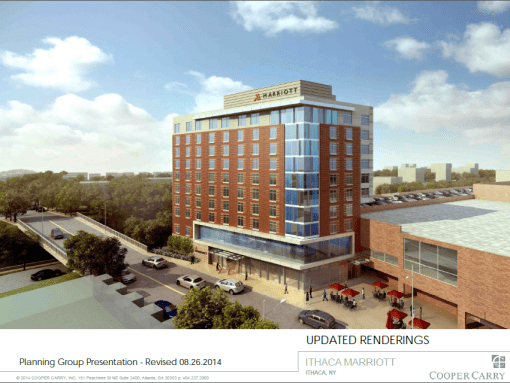
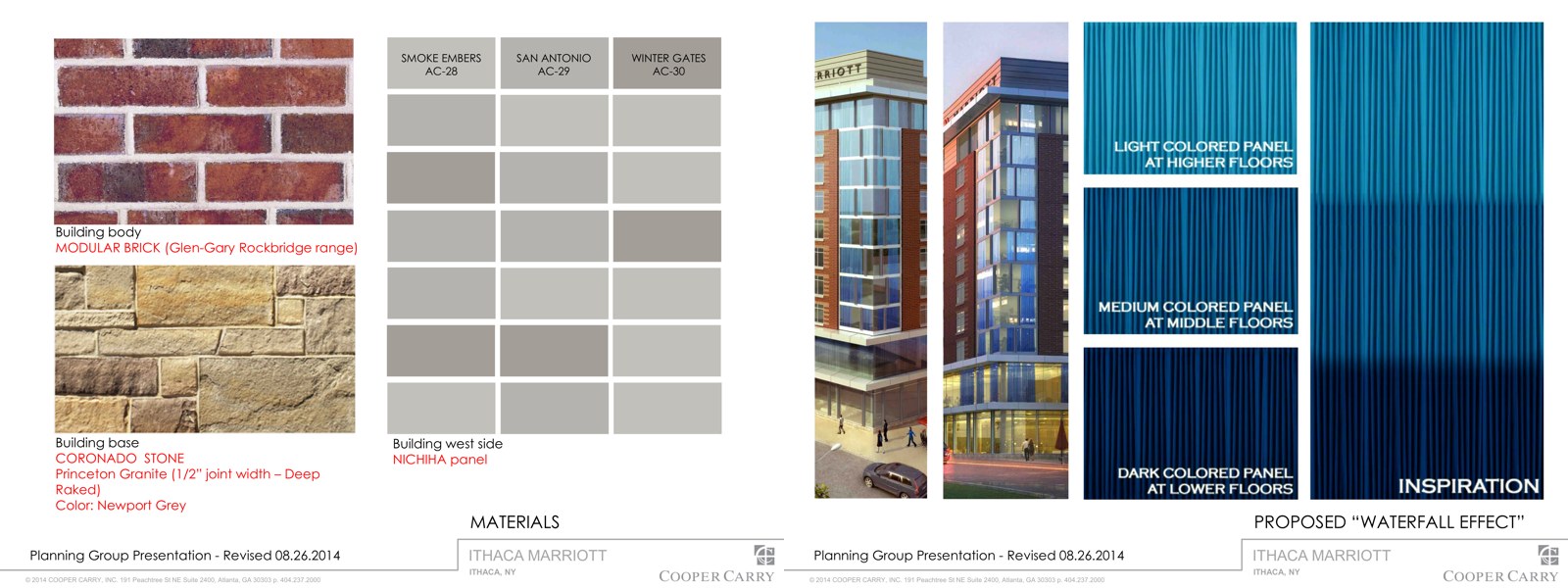
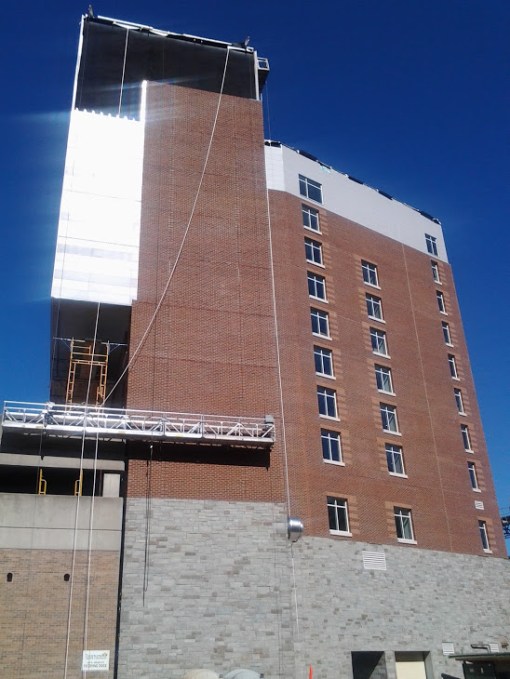
The Nichiha metal panels are almost complete, with just the west face exposed at this point. I did not expect them to be so bright, beyond the unintended gleam-o-vision of my camera. The rooftop mechanical penthouse has been framed but has yet to have its exterior panels attached. Some of the Marriott signage has been attached already. Most of the stone veneer has been attached, although the finishes for the Commons entrance are still a work in progress. Judging from the plastic sheets on the roof, the synthetic rubber membrane still has yet to be applied. Photos on the hotel’s facebook page show that the front desk is in and sheetrock has been hung and mudded in some places (the “mud” is a premixed joint compound used to cover joints and seams and to allow for a smooth finish for painting). The banner at the top of the penthouse says “The Place To Be”, with the Marriott logo at top.

20161007_123659 20161007_123741 20161007_123852 20161007_123941 20161007_124018 20161007_124049 20161007_124115 20161007_124119 20161007_124236 20161007_124312 20161007_124358 20161007_124615 20161007_124706


News Tidbits 10/8/16: No Rain, But the Money’s Flowing

8 10 2016

sleep_inn_v2_1
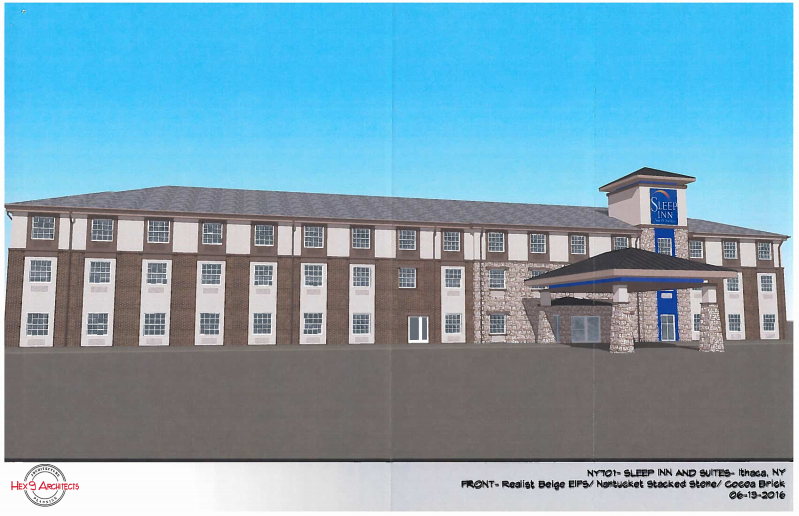
1. The Sleep Inn project at 635 Elmira Road went back to the town of Ithaca planning board last Tuesday. The initial write-up looked good – town planners were very pleased with the proposed changes, and the developer, local hotelier Pratik Ahir, proposed two different concepts to the board to see which one they were more comfortable with. The one that the board likes would be finalized in the plans and submitted for final approval later this year. No media were at the meeting, so I do not know which concept they preferred.

Both concepts by HEX 9 Architects attempt to maintain the rustic character that the town seeks to maintain for its part of the Inlet Valley Corridor. Concept one at top uses stone veneer (Elderado Stone), timber trusses, Hardie plank lap siding, and asphalt shingles. This design features balconies on both the front and rear of the building. Concept 2 incorporates a more varied roofline and building face, metal roof panels, stone veneer and a couple different types of Hardie Board. Concept 2 has less timber and no balconies. The town planning department felt that both concepts were unique enough and rustic enough to get its benediction in the SEQR analysis they sent over to the board. The concepts are a big improvement over the rendition we saw in August.

canopy_comparo_elevations_new_2
2. Looks like the Canopy Hilton is a go. The project secured a $19.5 million construction loan from ESL Federal Credit Union on Friday September 30th. ESL is a new face to the local market – “Eastman Savings and Loan” was founded in Rochester in 1920 to serve employees of former photography giant Eastman Kodak. The 7-story, 131-room hotel is expected to open in Spring 2018.

57e13f
3. Also funded this week – the second phase of Poet’s Landing out in the village of Dryden. Citibank is lending $7,702,326 to Rochester-based Confier LLC to build the 48 affordable apartment units across the street from Dryden High School, just west of 72-unit phase one. The documents were filed on Tuesday the 4th. The design of the second phase’s will be the same as phase one’s, an eight unit per building design by NH Architecture that is one of Conifer’s standard designs. The total project cost is $10.8 million, with the balance come from state affordable housing grants and tax credits. The build-out is expected to take about a year.

201_college_v5_1

4. So a few news bits about 201 College. The partially-deconstructed house at 201 College is now getting torn down, which had nothing to do with approval, and everything to do with break-ins and safety issues – there was evidence of squatters taking up residence, and the expense of a tear-down is worth avoiding a lawsuit or tragedy. Speaking of which, although a ruling on 201 College has yet to be issued and won’t be for a few weeks, Neil Golder’s lawsuit has already been re-filed. The court hearing is scheduled for December. According to an exchange with my colleague Mike Smith, Fox is planning rowhouses along Bool Street, within a 45-foot height limit but spanning the block, as it seems he has a purchase option on neighboring 202 Linden.

20161007_131502

5. According to Nick Reynolds at the Times (yes, he jumped papers), the buildings to be deconstructed for the Harold’s Square project are to be vacated by the end of October. Developer David Lubin plans to start the deconstruction process, which is a little more intensive and lengthier than a typical demolition, in November. Things have been complicated by the city’s decision to forego the project in the Restore NY grant application, where the $500,000 was allocated to pay for demolition, and must now be sourced from elsewhere. Once secured, the plan is to file for the permit, and by law they have up to 30 days to start deconstruction from the day the permit is issued. Construction should go for about 18 months, once the site is cleared.

607_s_aurora_2 607_s_aurora_1

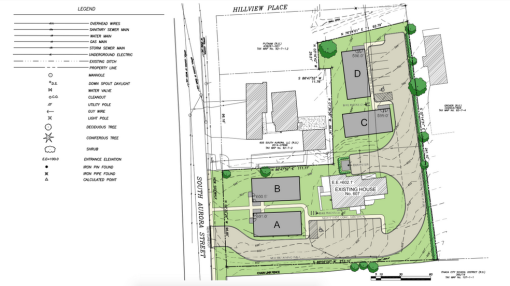
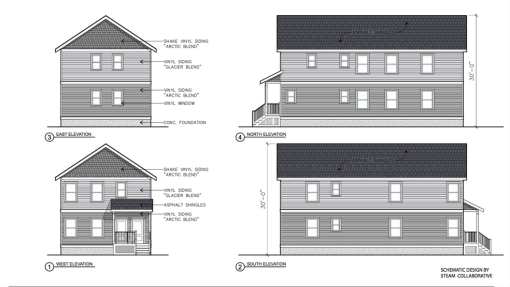
6. The 8-unit 607 South Aurora project will be seeking “Declaration of Lead Agency” at the Planning Board meeting, and materials have been filed with the city. Project narrative here, SPR application here, drawings here. The big changes since sketch plan were sidewalk and parking lot revisions, and rotating Building D to establish harmony with Hillview Place. The project is estimated to cost $1.5 million and aims for a construction timeline of March to September 2017. This is the next incremental step up for Charlie O’Connor of Modern Living Rentals, whose M.O. is to quietly pursue modestly-sized infill projects in less dense parts of the city (ex. the two duplexes planned for 312-314 Old Elmira). In a change of pace, the staff of Sharma Architecture are the designers this time around.

123_eddy_street_2

7. From the Board of Zoning Appeals meeting, the new two-family house at 123 Eddy Street has been granted zoning variances. Expect the Sharma-designed two-unit, six-bedroom rental property to start construction next year in time for the 2017-18 academic year.

20160918_155855 20160918_155910

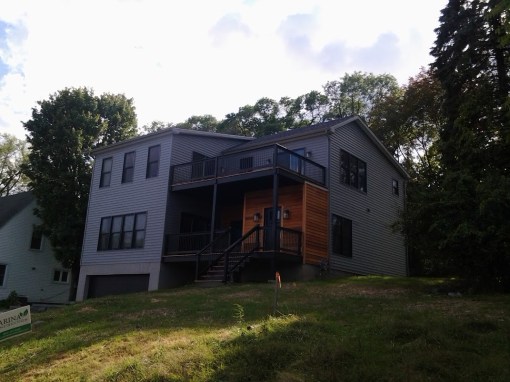
6. House of the week. Instead of one underway, this week will show two recent completions. Leading off is this house on West Hill’s Campbell Avenue, built by Carina Construction. This project came up in a weekly roundup back in late May – it’s a $320,000 project per the permit filing with the city, with $280,000 lent by Tompkins Trust. The contrast between the wood siding and the (fiber cement?) vinyl siding is a nice touch, as is the two-story porch. Definitely a unique house, and a showcase of just what kind of variety one can do with modular pieces if they’re willing to get creative.

20160918_162315 20160918_162648

Now for house number two. This isn’t a new build, but a very thorough renovation. Every time I take photos, I run into the owners, and normally I try to be as unobtrusive as possible. But, given that I’ve run into him twice, he’s familiar enough with me that we’ve had a conversation about his work.

20160109_151921

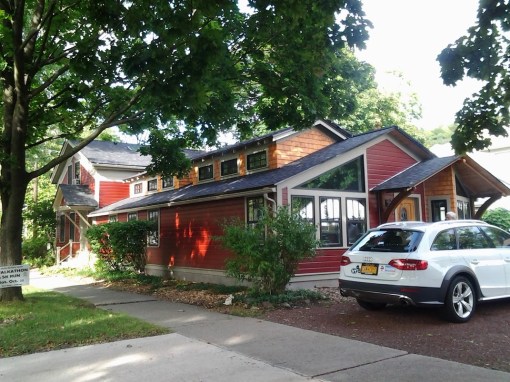
This is in Fall Creek on North Aurora. The couple who own this place moved in from Pennsylvania, they were just starting retirement when the wife’s father was no longer able to take care of it. It had been a duplex, but the other unit was more workshop space. The building was in good shape, but these folks wanted to modernize and refresh it, so they decided to do a to-the-studs renovation, basically turning it into a new home within an existing shell. Fiber cement, wood shingles, a few modern touches (the south bumpout, the unusual gable/shed hybrid dormers), a carriage house, a lot of work went into it over the past year and a half and it shows.


News Tidbits 9/24/16: The Implicit and the Explicit

24 09 2016

tiny_timbers_1

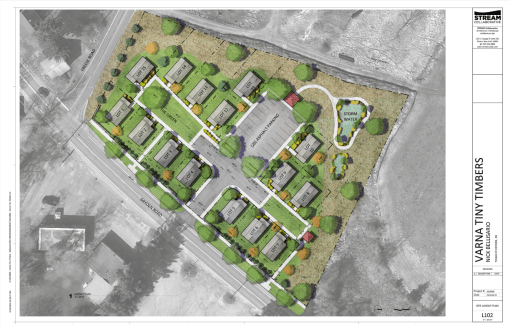
1. Over in the town of Dryden, it looks like Buzz Dolph and STREAM Collaborative’s Tiny Timbers project is up for preliminary approval. The site plan hasn’t changed much, just slight modifications for a dumpster/recycling enclosure and a bus pull-off. However, the home options have been expanded a bit. There will be five options, ranging from a 1-story 525 SF home starting at $99,500, to a 1,050 SF model priced at $184,500. Design specs (flooring, finishes, HVAC) can be found here.

Along with Tiny Timbers, Dolph is planning a similar, smaller project near his house on Quarry Road in Dryden town. That $800,000 project, called “Quarry Ridge Cooperative“, consists of two duplexes (four units), all owner-occupied. The homes will be connected to a shared driveway and carport through breezeways. Back of the envelope calculations suggest these units will be around 1,000 SF each. The 2.26 acres will be collectively owned by the four homeowners.

2. On a related note, another sister project to Tiny Timbers is being prepped for a site on the city’s portion of West Hill. Dolph et al. are looking to do a similar development to the one in Varna on a 5.45 acre parcel at the south end of the 400 Block of Campbell Avenue, which was noted in a weekly news roundup when it hit the market back for $195k in August 2015. The Journal’s Nick Reynolds touched on it in a through write-up he did earlier this week. The comprehensive plan calls this portion of West Hill low-density residential, less than 10 units per acre. Current zoning is R-1a, 10000 SF minimum lot size with mandatory off-street parking, although maybe a cluster subdivision would come into play here. The Varna property is a little over 6 units per acre. If one assumes a similar density to the Varna project, the ballpark is about 35 units, if sticking to the 10000 SF lot size, then 23 units.

On the one hand, expect some grumbling from neighbors who won’t be thrilled with development at the end of their dead-end street. On the other hand, these small houses are modestly-sized and priced, they’ll be owner-occupied, and if the Varna site is any indication, the landscaping and building design will be aesthetically pleasing.

201_college_v5_1

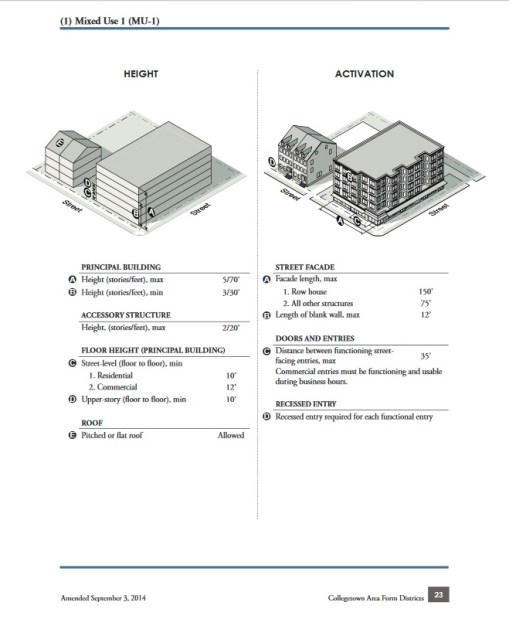
3. I dunno if I’ve ever seen such strenuous contention between the planning board and the city’s planning department. The planning board’s objected to Zoning Director Phyllis Radke’s determination that the project is legal per the Form District MU-1 Zoning.

The document put forth by John Schroeder and approved by the board rests on the following interpretations:
-in cases where the zoning isn’t explicitly stated in denser zones, it should rely on what is stated in less dense codes, and interpretations of the introductory “purpose and intent” section of the code, which qualifies similarities of form and scale if the numbers and dimensions for facade length aren’t explicitly stated.

-The argument also draws debate towards the unstated but implied interpretation of street facade, which refers to the building’s primary face, vs. building facades facing both streets. The board’s filing argues that the Bool Street facade was intended as a primary facade early on.

cafd_mu1

-Unlabeled parts of the diagram, such as MU-1’s, have no meaning. Even if they could give the impression of longer facades, it’s not the intent of the code.

The document goes on to say that Radke “invented claims unsupported by the text”, uses “tortured logic” and “silly conclusions”. Ouch.  Since interpretation is not a cut-and-dry matter of clear definitions, so we end up with an argument from both sides that relies on an interpretation of ambiguities, something more akin to a court room. A curious result of this discussion is that the Planning Board had to send out a letter to neighbors saying they would be arguing zoning determinations, which are going to be far out of most readers’ expertise, as the precise details and intent of the 2014 zoning will be the primary driver of this debate.

20160821_134831

4. The Ithacan is reporting a mid-to-late October opening for the Marriott, the Journal is reporting November. Presumably, one of them is correct. The delay from the original August opening is attributed to a labor shortage. Hiring is currently underway for the 159-room hotel and its restaurant, which according to the IJ, are expected to employ 50 to 60 in total. About 75% will be full-time, and wages are expected to run from $10/hr + tips for wait staff, to $18-$19/hour, with the hope that a premium paycheck compared to similar positions at other local hotels will translate to a premium experience for guests.

tc3_daycare

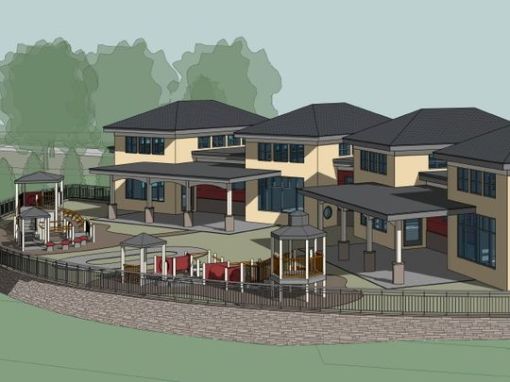
5. It looks like TC3’s Childcare facility is well on its way to reality. At least $4.5 million has been secured for the $5.5 million project and its scholarship endowment for students with children. $2.5 million for that was recently received in a set of state grant and funds, according to WHCU. Another $2 million comes from benefactor Arthur Kuckes, for whom the new facility will be named.

20160918_141051 20160918_141131

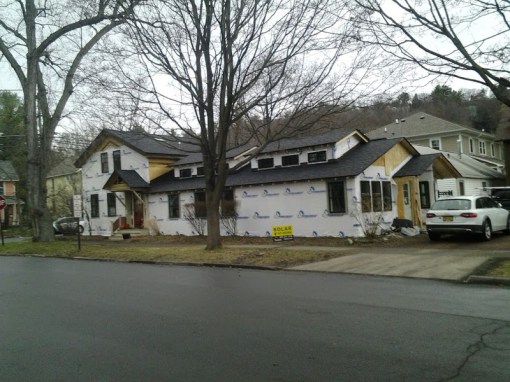
6. It’s been a while since I’ve done house of the week. So, here’s a new house underway on the 200 Block of Pearl Street in the city’s Bryant Park neighborhood. Ithaca’s Carina Construction is doing their modular magic here, the pieces have been assembled and most of the siding and roof trim has been attached. Not 100% sure if there will be a porch, the lack of siding above the door suggests it’s a possibility.

To be honest, when I was going through my list of single-families underway, I was mostly finding that Carina dominated the list. Since Avalon Homes went under, and most stick-builds are beaucoup bucks due to higher labor and materials costs, Carina’s offerings have broad appeal in Ithaca’s isolated, tight home market.

The lot was created four years ago by a subdivision of 222 Miller across the street. Since then, it exchanged hands a few times before a local realtor sold the property for $130,000 in July to a family who relocated to the area from Texas.

119_125_college_avenue

7. The Planning Board Agenda is up, and it’s the shortest in ages, thanks to that special meeting last week. Here’s the rundown:

1.  Agenda Review                                                      6:00
2.  Privilege of the Floor                                              6:01

 3.  Subdivision Review

A. Project:  Minor Subdivision                                      6:15
Location: 404 Wood St.
Actions: Declaration of Lead Agency  – PUBLIC HEARING – Determination of Environmental Significance – Recommendation to BZA

A minor subdivision to split a double-lot in Ithaca’s South Side neighborhood into two lots, one with the existing house and one that would be used for a new house or small apartment building. A variance for an existing rear year deficiency of the house would need to be approved (the rear deficiency wouldn’t be affected by the new lot which is on the east side, but it’s a legal technicality).
B. Project:  Minor Subdivision                                          6:30
Location: 1001 N. Aurora St. (Tax Parcel # 12.-6-13)
Actions: Declaration of Lead Agency – PUBLIC HEARING – Determination of Environmental Significance
Touched on this one last week. Deconstruction of an existing single-family home for two two-family homes, each on its lot.

4. Site Plan Review

A. Project:  Two Duplexes                                              6:45
Location: 1001 N. Aurora St. (Tax Parcel # 12.-6-13)
Applicant: Dan Hirtler for Stavros Stavropoulos
Actions: Declaration of Lead Agency – PUBLIC HEARING – Determination of Environmental Significance – Consideration of Preliminary & Final Site Plan Approval

B. SKETCH PLAN:  Townhomes & Apartments at 119-121 & 125 College Ave.        7:00

I’ve spilled some electronic ink on this project before – Novarr’s $10 million project for faculty townhomes and apartments. Rumor mill says “modern-looking” and “glassy”, which given Novarr’s fondness for ikon.5 architects (his guest house is on the main page of their portfolio), that isn’t a surprise. The three parcels are CR-4 zoning, so 4 stories and 50% lot coverage allowed. Previous estimates were for 50-60 units. I’d say the biggest uncertainty in approvals comes from the existing apartment houses, which haven’t been declared historic, but former councilwoman Mary Tomlan and the Planning Board’s John Schroeder recommended for consideration in 2009 (only 15 of the 31 suggestions were considered, and only 2 received historic designation, Snaith House and Grandview House). Novarr’s been amenable to compromises before (see Collegetown Terrace), so we’ll see what happens here.

5. Zoning Appeals
• #3044, Area Variance, 170 Pearsall Pl.
• #3046, Area Variance, 404 Wood St.
• #3048, Appeal of Zoning Determination, 201 College Ave.                                 7:30


Holiday Inn Express Construction Update, 9/2016

21 09 2016

When I paid a visit to the Holiday Inn Express site at 371 Elmira Road, I had figured the hotel would be complete and open by now. Unfortunately for them, it is not, which means not only did they miss the cash cow of student move-ins, they’re also missing the early fall, when the tourism trade is still strong and there’s plenty of business activity spurred on by the new academic session. Winters tend to be rough for Ithaca’s hospitality industry due to the seasonal drop in occupancy, and it looks like this hotel will have to suffer through that during its first few months of service.

That noted, it does look like the 79-room hotel will open by late fall. The porte cochere has been assembled and the HIE brand signage has been attached to the facade. The only remaining exterior work on the building seems to be applying the EPDM synthetic rubber coating to the roof, and the rear stairwell. They might be waiting until the interiors are far enough along (i.e. most of the materials have been moved in) before closing up the building, installing the rest of the insulation boards and applying the moisture barrier coats before finishing out the EIFS with the rest of the south face.

Outside the building, curbing has been laid (if you’ve never watched a curbing machine in action, it’s actually really cool – video here) and the lighting has been installed, but landscaping and paving have yet to be completed.

20160918_145948 20160918_150032 20160918_150342 20160918_150349

holiday-inn-express-original-1 holiday_inn_express_v2


Hotel Ithaca Construction Update, 8/2016

30 08 2016

In case you missed it, I did an interview with owner/developer David Hart of Hart Hotels, which can be found on the Voice here. Here’s some of the material that didn’t make the final cut.

Q: So, let’s start with a little about you. Hart Hotels is family operation, yes?

DH: My dad was the founder of our company, my sisters and I have followed him as principals. But we have non-family members who have been with us for a long time that have been a driving force. This is our 30th year in business.

Q: This is actually the second phase, right? There was a modernization and renovation already completed in the lobby and hotel area, if my notes are right.

DH: The 61 rooms in the hotel tower, we renovated down to the studs. The main building above the lobby has another 19 rooms, original 1970s guestrooms, we renovated to the studs as well, a little over a year ago. Now we’re into phase 2, which is new construction, and some more renovations.

Q: I believe plans filed with this plan have a third phase, right? One that considers the possibility of a three-story hotel addition on the wing going up now, and a conference center?

DH: Nothing planned or approved right now.

Q: Further on that topic, some folks have expressed concerns that [the hotel boom] is not economically sustainable. A sort of fear of a hotel bust to follow the hotel boom. What would you say to address those concerns?

DH: One of the things that we’re lacking is a large format meeting space, a type of conference center. It’s unusual for a city the size of Ithaca to not have its own meeting space, so part of our overall market preference is inhibited by not having that space. On the other hand, it’s not uncommon for demand to outstrip supply on many weekends in Tompkins County or downtown Ithaca, so I don’t see the problem of oversupply on most Fridays and Saturdays throughout the year. So Sunday-Thursday business is where the boat needs to be lifted a little bit, especially with all the new rooms. Our meeting space will help that a little bit.

Q: As a major hotel operator, what would you say are the biggest advantages to being in Ithaca and specifically, downtown Ithaca, and what are the biggest challenges? What opportunities do you see over the next years? Where do see the Hotel Ithaca, in say, five years from now?

DH: Some of the hurdles are the seasonality, the winter vs. summer. The Finger Lakes are a popular destination, but the seasonality is harsher when the schools are out of session, we’re reliant on the interest the schools and colleges generate. Cornell and Ithaca College bring a lot of business to us. Sports, scholastic events, meetings, they drive a lot of demand from the routine list of activities in the school calendar. This is a strong region for hospitality, we’ve been in the Ithaca area for a while, the region continues to grow in popularity with the wineries, the cheesemakers, the distillers and craft beer-makers, those are all part of the things we have to sell and market and promote. And lake activity and recreation is also a part of our overall marketing and selling of the region. That translates to hotel room demand.

…In terms of expansions, sites in downtown are hard to come by and expensive, so I don’t know how much more new supply there will be downtown. If you look at 13, there have been new hotels, they’re fringe, limited-service, so we might see some growth out there, but there are a fair number of rooms and brands there so I don’t know how much more they can grow….

We want to be ready for graduation, have the building closed up by winter. The frame is being assembled offsite.

20160821_132710 20160821_132811 20160821_132917 20160821_133100 20160821_133116 20160821_133129 20160821_133207 20160821_133238 20160821_133358


Ithaca Marriott Construction Update, 8/2016

27 08 2016

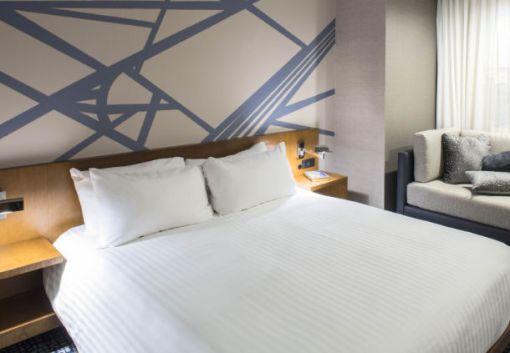
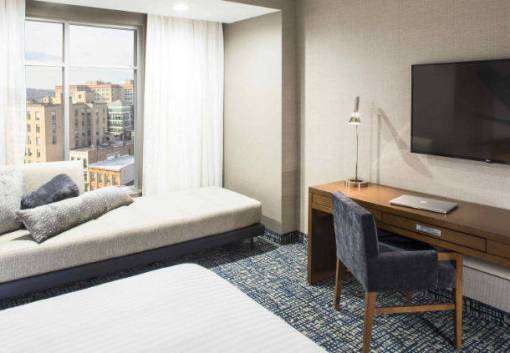
If all had happened to plan, the hotel would have opened this past Tuesday. Unfortunately, things did not work out as planned, as it often happens with large construction projects. Marriott’s website gives an October 2016 opening. A few simulations of the room interiors are included below. If I remember right, a while back someone told me that the rooms are a little smaller than Marriott’s standard (which looks to be true – the king-sized rooms are 300 SF, and comparables that I’m finding at other Marriotts are 360 SF), so the interiors were designed to be more plush and higher-quality to compensate. Among the amenities include 49″ TVs, Wi-Fi, mini-fridges, a business center, a fitness center, an “M Club Lounge“, laundry service, complimentary coffee/tea, down comforters, and a bunch of other things that are staples of premium hotels. The in-house restaurant will be called “Monks on the Commons”, and serve American comfort food, breakfast, lunch and dinner. Kinda interesting to see which local restaurants they chose to highlight on their website.

Of the 159 rooms (finally, a confirmation it’s not 160!), 8 will be suites, and the hotel’s 3 meeting rooms total just under 2,500 SF. I tried to set up a reservation to see the prices, but the website wasn’t allowing bookings. The “largest event space” can hold 198 guests, along with the ridiculously cheesy line of “Reserve our wedding venue in Ithaca, NY and say ‘I do’ in a ceremony as unique as your love. ”

So, those are to-be’s, now to the what-are’s. On the outside rear, the Nichiha metal panels are being attached to the waterproofed sheathing. The brick is done, but the stone veneer on the lower floors has yet to be applied. You can get an idea of the interior work underway by peering through the suite rooms, which face the Commons and State Street; notice the work on the ceilings progressing as one works their way down from the top floors.

20160821_133646 20160821_133806 20160821_134053 20160821_134658 20160821_134705 20160821_134831 20160821_135014 20160821_135108 20160821_135113 20160821_135159

ithmc_phototour06 ithmc_phototour07 ithmc_phototour12

marriott_rev1_1


News Tidbits 8/20/16: Another Campus Coming?

20 08 2016

Fairly quiet week, but still a few things going on-

inhs_pride_design_v5_3

1. The Journal’s Nick Reynolds followed up on the pile-driving underway at the 210 Hancock site in Ithaca’s North Side neighborhood. Admittedly, no one wants to live next to a site while hearing and feeling the bang of the pile-driver against the piles being inserted into the ground. Thankfully, this phase of the affordable housing project should be wrapped up by the end of the month. Lecesse Construction’s subcontractor, Ferraro Piling and Shoring of rural Erie County, is inserting 10-15 piles per day between the hours of 8 AM and 4 PM, and about 170 piles will be used in the project. Not fun for the neighbors, but this too shall pass.

sleep_inn_1

2. The town of Ithaca’s planning board had their close look at the Sleep Inn proposal for Elmira Road. They were not impressed. The primary complaints were that it was a one-sided design (meaning the front received significantly more cosmetic attention than the rear and sides), that it was big and that it was ugly.

The architect of the 70-room hotel, Joe Turnowchyk of HEX 9 Architects, responded with “all corporate hotels are basically ugly”, which isn’t the kind of response that will be well-received. It was followed with “[He thinks] that if they’re going to put more money into the front of the building, they shouldn’t need to address the rear”, which isn’t a good response either, because the rear faces the Black Diamond Trail.

Outsider looking in, one interpretation of the board’s commentary is that the stone and brick is fine, but they want less of a slab and more articulation – the recently-opened 64-room Best Western Plus in Cortlandville comes to mind. The massing is broken up, and architectural details and brickwork add visual interest, giving it aesthetic appeal even though the road is 40 or 45 MPH over there. The minutes note a comparison to an Arizona Sleep Inn to show what can be done with Choice Hotels brands. Anyway, the decision was tabled, with a revised design presentation planned for a September meeting.

3. New to the market this week – a duplex and five-unit mobile home park in Varna being marketed for “development potential”. The site is a one acre parcel at 10 Freese Road in Varna, touted as “perfect for townhouses or apartments”. Since the late 1980s, the “Wayside Mobile Home Park” has been the property of Ithaca attorney Ray Schlather, who was an ardent opponent of West End density and waterfront rezoning a few years back.

Zoning is Varna Hamlet Traditional District (VHTD), and it gets a little weird density-wise – per the guidelines, and being one acre, a developer could do four single-family homes, six townhouses, six condos, or three rental apartments, max 30% lot coverage. If LEED Certified, add 2 S-F homes, 2 townhouses, 1 condo, or 4 apartment units respectively. Lastly, there’s a redevelopment bonus, which honestly appears to be at the town’s discretion. If awarded, add another home, 2 townhouses, condo or 4 apartments. So in theory, max build-out for a green redevelopment is either 7 single-family houses, 10 townhouses, eight condos or eleven rental apartments on that acre of land. No idea what happens if they’re combos thereof.

Anyway, the property is being offered at $219,000, just a little over the $192,500 tax assessment.

4. So this is intriguing – the city of Ithaca Common Council will be taking a vote next Wednesday to take $150,000 from the $500,000 Capital Project fund to relocate and build a new Fire station #9, and fund two consolidation studies. One would consolidate the city hall, the Central Fire Station, Station No. 9, and Police HQ into a government campus at the site of the Central Fire Station at 310 West Green Street; the second is to study a centralized facility shared by water/sewer and streets/facilities. There’s a lot that need to be considered as part of the government campus study, which would likely involve buying neighboring properties, or building skyward. Also worth noting, the fire station parking lot is part of the Downtown West historic district. Anyway, look for a lot more discussion if the money is awarded and the study gets underway.
123_eddy_street_2

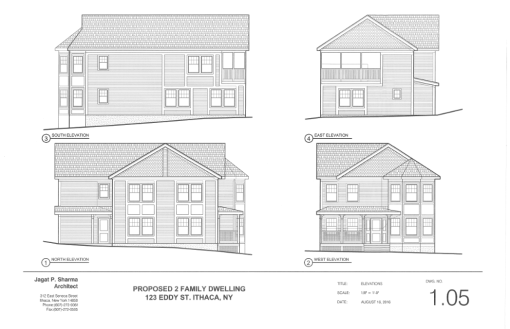
5. This week’s eye candy. Folks on Orchard Place asked for more detailed renders of the proposed two-family home at 123 Eddy Street, and here they are. Medium yellow Hardie board with white trim was the original plan. It appears that after the original drawing was submitted, the roof was realigned and one of the west-facing (front) second-floor windows was removed.
Note that this is just the planning board lot subdivision approval – although a single two-family home is typically too small to trigger planning board’s site plan review qualifications, the design still has to be approved by the ILPC and the Board of Zoning Appeals.

6. Case in point – If you live in Fall Creek, you might notice a new two-family house in the coming months. The Stavropoulos family, owners of the State Street Diner, just purchased the house for sale at 1001 North Aurora Street (above asking price, which is, for better or worse, quite common in Fall Creek) and plans to replace it with a duplex. Tompkins Trust gave them a $400,000 construction loan on the 18th. It’s a little different from the Stavropoulos’ typical M.O., which is to buy an existing house and do major renovations, as they did at 318-320 Pleasant Street and 514 Linn Street. This one looks like it will be a completely new build. No BZA, ILPC or Planning Board approval is required here, just staff level approval from the city.

7. Somewhat interesting Planning Board meeting next Tuesday. Here’s what in the bullpen:

1. Agenda Review 6:00
2. Privilege of the Floor 6:01
3. Subdivision Review 6:20

A. 123 & 125 Eddy St. (shown above)
Applicant: Nick Lambrou
Actions: Declaration of Lead Agency PUBLIC HEARING Determination of Environmental Significance Recommendation to BZA

4. Site Plan Review 6:40
A. Project: Mixed-Use Building (Harold’s Square)
Location: 123-139 E. State St. (The Commons)
Applicant: David Lubin for L Enterprises, LLC
Actions: Consideration of Project Changes

So I wrote about these changes for the Voice. The Planning Board resolution calls for modifications to the new design. The board mandates glass block for the elevator shaft on the north and lower west facades, restoration of the terra cotta cap and vertical bands on the Commons-facing facade, and restoring a deleted window from the East facade above the Sage Building. Could really used some updated renders right about now.

B. Project: Mixed-Use Building — Collegetown Crossing 6:55
Location: 307 College Ave.
Applicant: Scott Whitham for
Actions: Consideration of Project Changes (Landscape)

Project Description: Some slight tweaks here to the pedestrian walkway, mostly changes “simplifying and altering materials for the landscape”. The curvy benches are now straight, and the trees were eliminated in favor of shrubs because of concerns of branches extending onto the fire station’s property.

C. Project: Apartment Building 7:05
Location: 201 College Ave.
Applicant: Noah Demarest, STREAM Collaborative, for Visum Development Group
Actions: Consideration of Amended Negative Declaration of Environmental Significance, Request for Zoning Interpretation & Appeal Consideration of Final Site Plan Approval

Dunno what to say about this one at this point, since this is unfamiliar territory for everyone involved. We’ll see what happens.

D. SKETCH PLAN: 607 S. Aurora St. 7:35

The new project of the month is for 607 South Aurora Street on South Hill. It’s a single-family home on a 0.7 acre lot owned by Lou Cassaniti, the hot dog vendor on the Commons, but rumor mill says the applicant is Charlie O’Connor of Modern Living Rentals. Zoning is R-2a, which is detached single-family and duplex. Semi-educated guess, given lot size, zoning and rumored developer, the plans are small-scale infill, maybe subdividing the existing lot to build a duplex or two.

4. Zoning Appeals 7:50

5. Old/New Business 7:55

A. Chain Works District Redevelopment Project DGEIS: Special Planning Board Meeting, August 30, 2016, 6:00 p.m. to Review Comments/Responses
B. Maguire/Carpenter Business Park Temp. Mandatory Planned Unit Development (PUD): Public Information Session, Wednesday, August 31, 2016, 6:00 p.m., Common Council Chambers