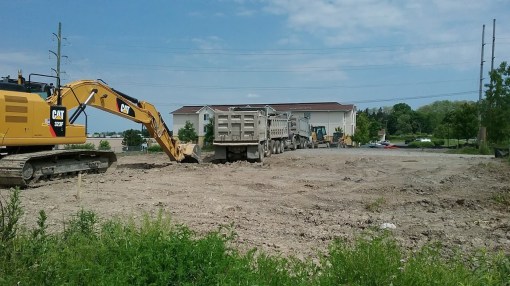
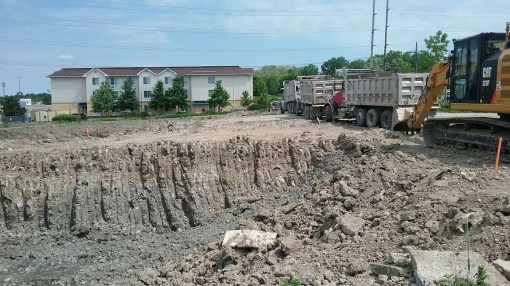
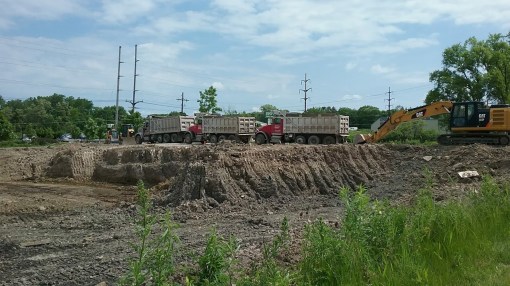
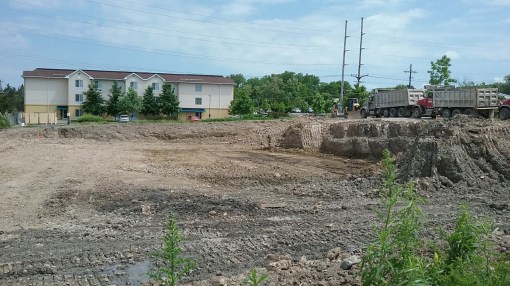
1001 North Aurora Street Construction Update, 6/2017

19 06 2017

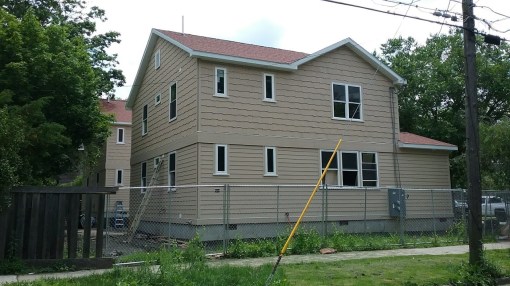
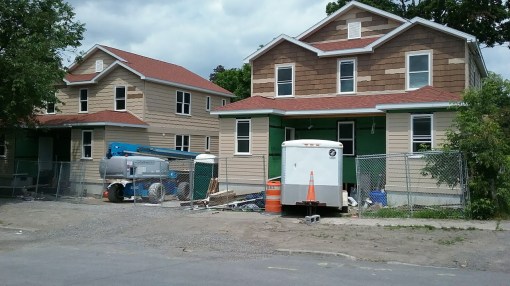
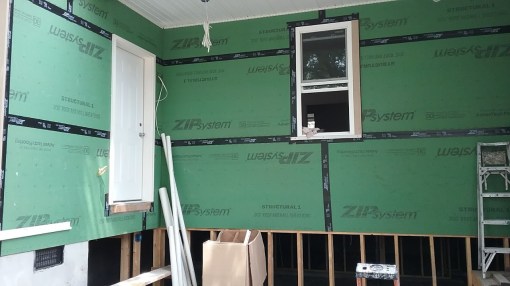
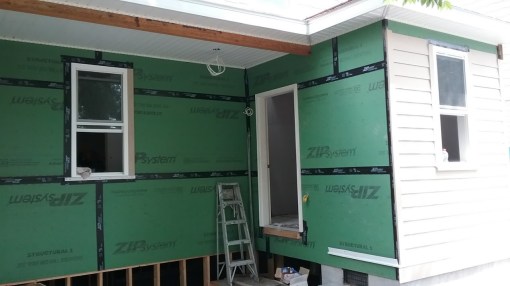
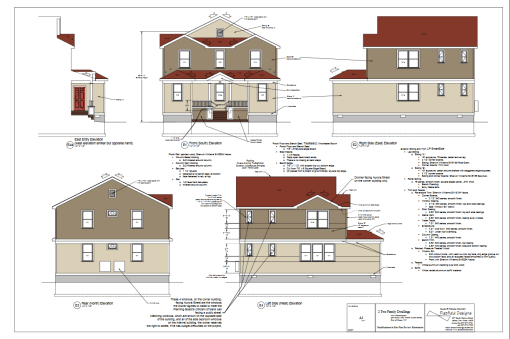
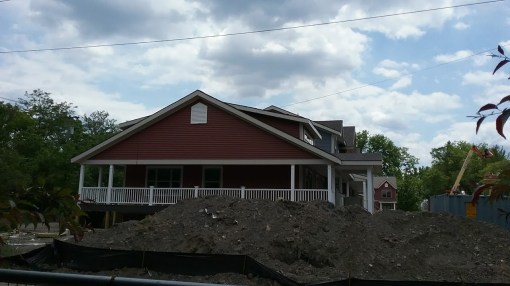
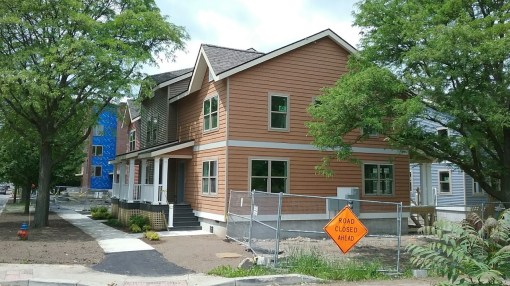
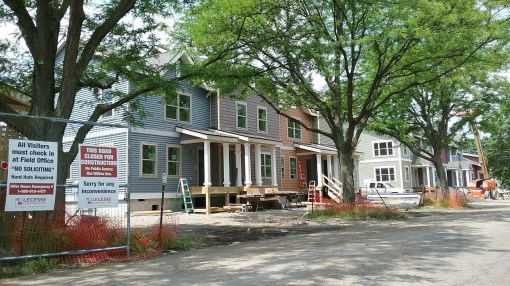
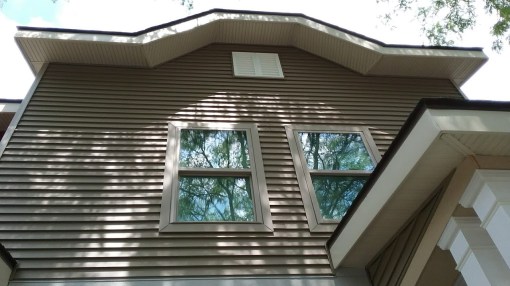
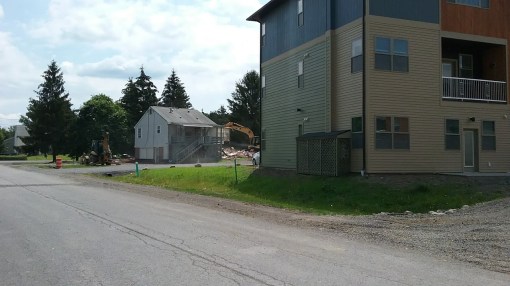
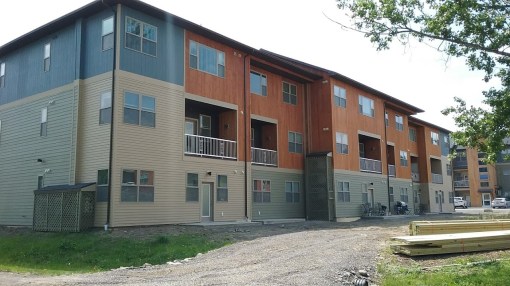
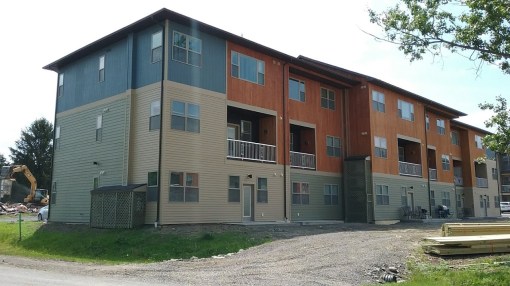
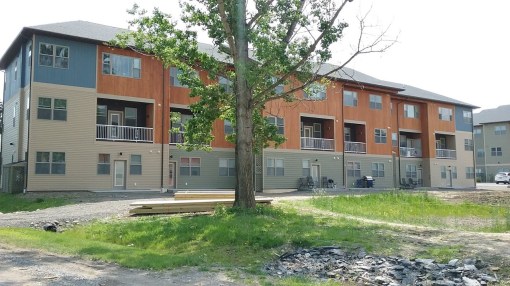
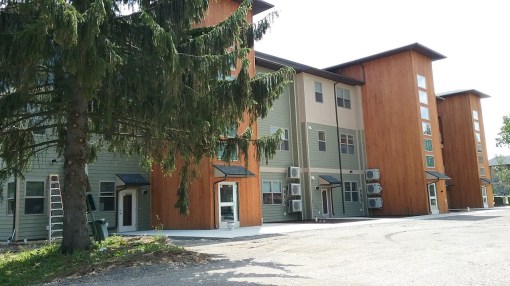
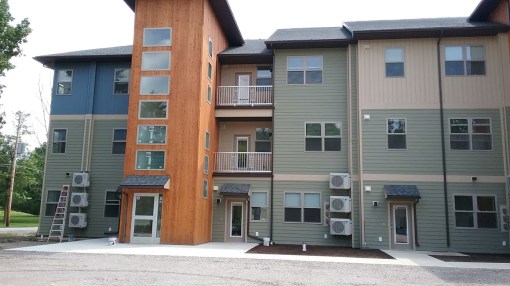
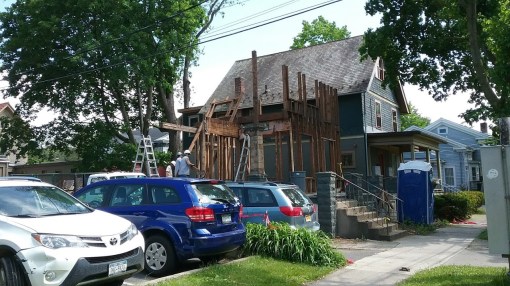
Admittedly, at the moment this pair of two-family homes looks rather bland from Aurora Street, and slapdash from Queen Street. However, it looks like the painting is just starting. The LP SmartSide wood siding will be painted with Sherwin-Williams “Rice Grain” on the first floor and dormer, and the second floor will use S-W “Sawdust”. The swatches of wood shingle on the eastern building have the darker color on both the second floor and dormer, which doesn’t match the city’s filing, but paint typically isn’t the type of detail that will get you in trouble unless it was a stipulation of approval. The short of it is, it’s not clear if anything has changed with the paint scheme, but it might have. The trim boards will be painted S-W “Nacre”.

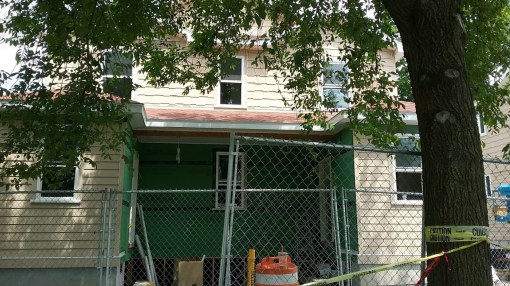
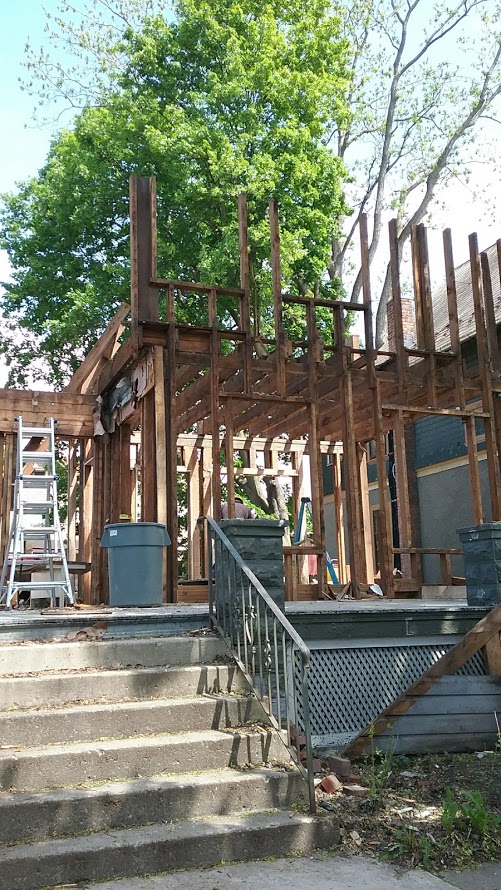
Another task still on the to-do list is building the porches that both units in the building will share. It’s a T-configuration – residents will step out and down their own step onto a shared landing at the top of the front steps. The porches will have decorative columns and banisters, and access panels below the porch landing. Most of the porch will be built with pressure-treated wood and painted in off-white “Nacre”, there will be dark brown steps (treated wood?), and the access panels will match the siding. About the only thing not wood will be the handrails, which will be steel.

A peek inside shows that the drywall has been hung. The next steps are typically flooring, cabinetry, bathroom fixtures and tiling, interior trim boards (baseboards, crown moulding) and painting. After that will come appliances and the finish work.

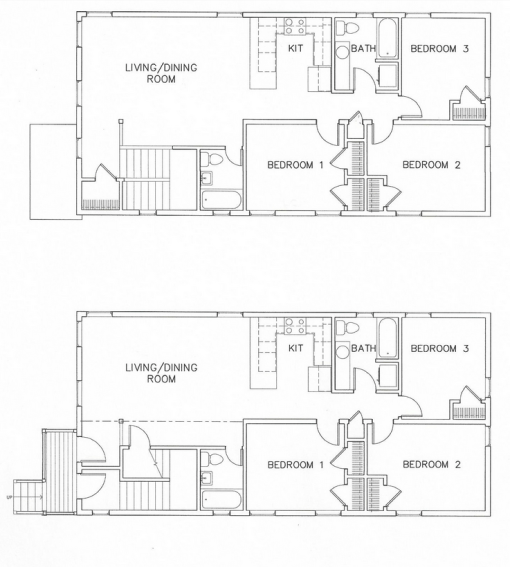
The 3-bedroom, 1.5 bath units at 202 and 206 Queen Street should be ready for occupancy later this summer. There were going for $2325/month ($775/bedroom) on Craigslist, and there haven’t been any ads lately, so it’s probably safe to assume all four units have been rented. Stavros (Nick) Stavropoulos is the developer, and Daniel Hirtler is the architect.


210 Hancock Construction Update, 6/2017

18 06 2017

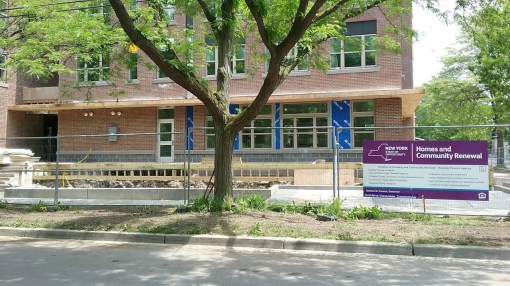
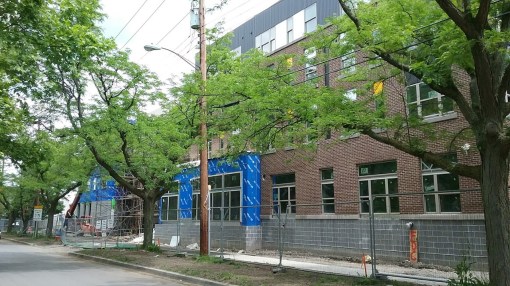
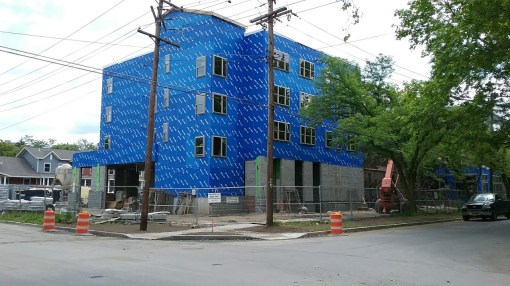
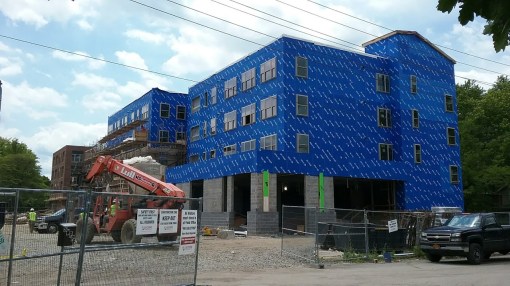
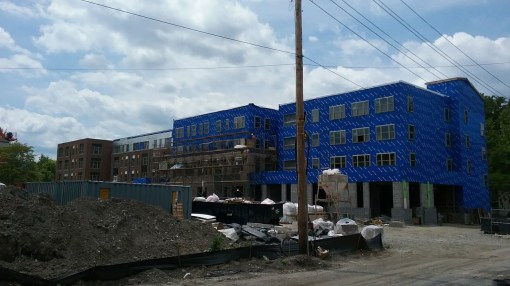
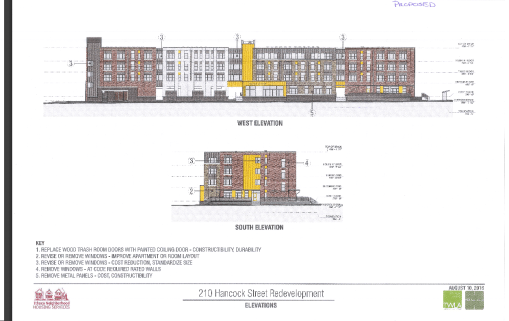
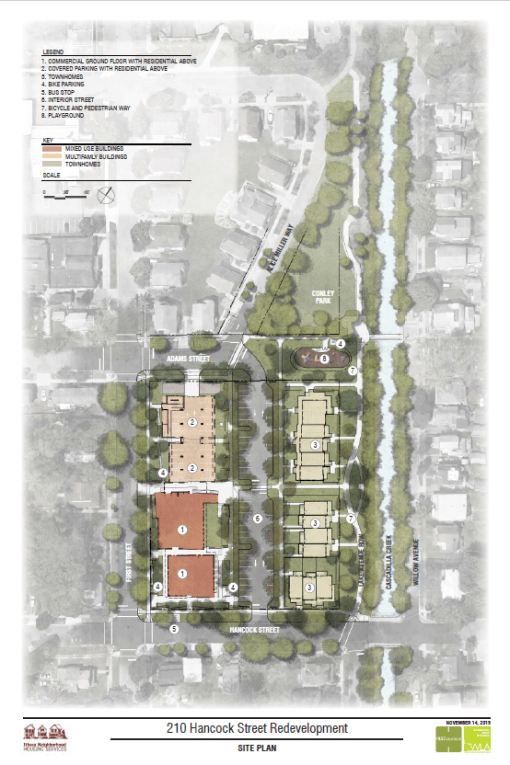
210 Hancock is chugging towards completion later this summer. Lecesse Construction has all four sub-components of the apartment building have been framed and sheathed. Building A is almost finished from the outside, with some exterior finished and trim still on the to-do list. The Blueskin will be faced with Alpolic aluminum panels, some of which have already been installed. Masonry work is underway on Building C, using Redland Whitehall Brick (it’s not often one sees unpainted white brick). More information on the exterior materials can be found in April’s post.

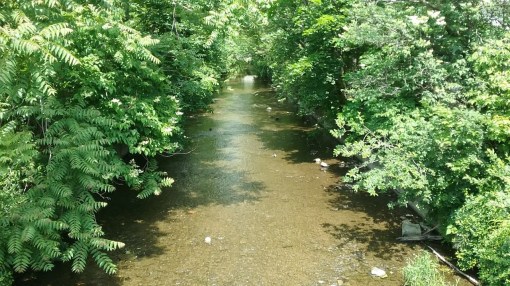
Note that the buildings are all elevated at least a few feet from ground level, and it’s particular noticeable with the five rental townhouses on the northeast corner. This is because of floodplain restrictions – several blocks of Fall Creek and Northside have the unfortunate luck of being in the 100-year floodplain, and most of Northside except for few blocks around Lewis and Jay Streets are in the 500-year floodplain. This approximated frequency is at risk of decreasing as the inlet gets clogged and layered with fresh silt, and with less volume and capacity, the un-dredged inlet would be more likely to have a high water event overflow its banks. It’s one of many reasons why the city is pressing for state dredging of the inlet before disaster strikes.

WHCU reported a few weeks ago that INHS has had no shortage of applicants for the 210 Hancock rentals. After receiving over 200 applications, they set up a lottery in which 122 “made it through” , and then selected the top 60 (there are 59 rental units though…might be a just in case there’s a drop-out, or it could just be conversational rounding). If it’s anything like New York City’s lottery, what happens is that each application is validated, sorted for requested unit type, and is assigned a randomized log number – those who get 1-48 for the one-bedroom subset, and 1-11 for the two-bedrooms subset, are awarded dibs on a unit, so long as they pass the income check and background check. In previous measures, about 86% of rental applicants, six out of every seven, came from inside Tompkins County, with just under half from other parts of the city of Ithaca.

The seven for-sale units are also just beginning sales marketing. The three on Hancock are, from east to west, 204, 206 and 208 Hancock Street, and the four for-sale units on Lake Street going south to north are 406, 408, 410 and 412 Lake Street. 206 Hancock, 408 Lake and 410 Lake will be 910 SF 2 bedroom, 1.5 bath units that will sell for $112,000 to qualified buyers. 406 Lake and 412 are 1088 SF, 2 bed 1.5 bath units priced at $129,000. The largest units, 204 Hancock and 208 Hancock, are 1300 SF, 3 bed 1.5 bath units that will sell for $145,000. The plan is to have buyers lined up for all seven units by the end of the year.


Cayuga View Senior Living Construction Update, 6/2017

17 06 2017

Figure Cayuga View can probably go under the “under/construction” column. Finally.

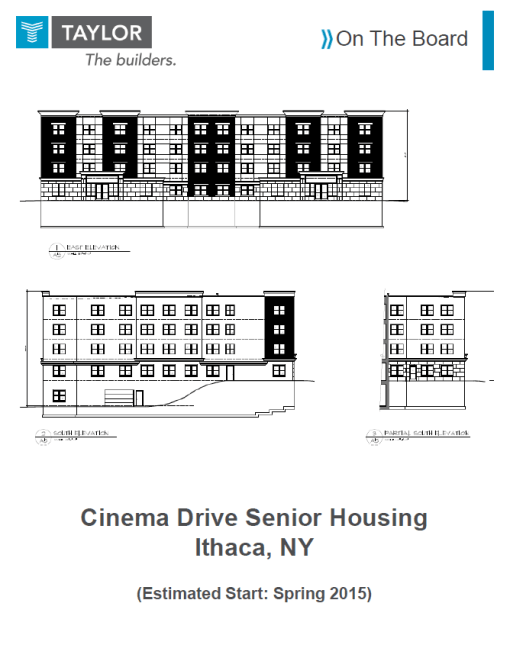
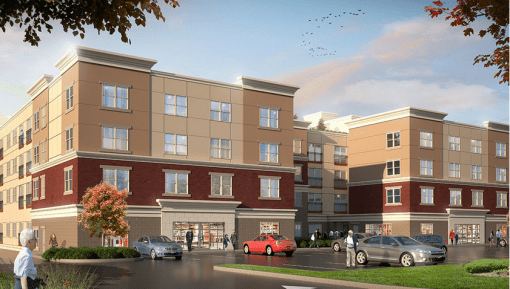
Cayuga View Senior Living, street address 16 Cinema Drive, is one of several Ithaca-area projects attempting to make a dent in the county’s lack of senior housing. Along with affordable housing and special needs housing, senior housing is often cited as something that the county needs a lot of more of, and soon. The county’s just-released housing strategy cites the need for 100-200 subsidized units by 2025, as well as a new skilled care facility. Various forms of senior care are expected to drive demand for an additional 750 units. A fully independent market-rate senior project like this isn’t explicitly categorized, but would potentially address some of the demand for senior housing in Tompkins County.

Cayuga View is a mixed-use 60-unit project on the last vacant high density-zoned parcel in the village of Lansing. Like many projects, the Thaler Family and their business partners have taken years to get to this point. The Thalers have owned the land since 1971, and have divided it up over the years, for example subdividing the property in 2000 to accommodate the construction of the CFCU branch next door. The first record of Cayuga View is really for an entirely different plan by the Thalers – in fall 2012, they proposed “C.U. Suites”, a 3-story, 43,000 SF building with 39 apartments geared towards Cornell graduate students. Along with those units were 26 covered parking spaces and two commercial spaces.

However, after getting approval for C.U. Suites, they decided to re-tool the project. At about this time, Taylor The Builders, a construction firm based out of Rochester, came on board as the general contractor, and it was determined that the student market angle “didn’t work very well”. In 2014, the revised plan, for “Cayuga View Senior Living” was rolled out. This was larger, 4 stories and 87,515 SF, with 59-62 apartment units depending on the iteration – Manley Thaler stated it wouldn’t be affordable or take federal funds, but he hoped to fill a niche below Kendal in the senior market.

It took some time to go through Lansing village boards, planning and zoning. Cayuga View required a number of zoning variances and reviews of its legalese to clarify the rules for a 55+ community in Lansing – namely, the boards didn’t want the project to revert to general housing, and there was debate over a 10 year stipulation vs. a 20 year or 30 year stipulation (I’ve honestly never heard of senior housing switching to general housing). One BZA person was upset by the height of the building and wanted it to be one floor less, and a planning board member was upset by the lack of parking, about 100 spaces.

After approvals for a tweaked 87,359 SF building were granted in Spring 2016, the project entered a sort of stall mode while it tried to obtain financing. Cayuga View Senior Living managed to land a construction loan earlier this year. According to a construction loan filed on May 25th, Five Star Bank of Warsaw (Wyoming County) is loaning the Thaler family and their associates $10.88 million to make their project become reality. Along with the loan, the Thalers and their business partners will be putting up $1,796,450 in equity to move the project forward, bring total costs to $12,676,450. It comes out to about $145/SF, a little less (~10%) than a comparable project in Ithaca city.

Included with the project are 12 1-bedroom, 1-bath units (725 SF), 48 2-bedroom, 2-bath units (three floor plans, 900-1,110 SF), and 2,680 SF of retail space, with preference towards coffee shops, small eateries or services like a salon or barber shop. The webpage comes with rendered 3-D tours; I dunno about you folks, but if there are two glasses of wine sitting on the kitchen counter at 10 AM, my concerns aren’t going to be about unit availability. 5% of the units will be built handicap-accessbile, but all will be handicap-adaptable.

The units will be priced upmarket, $1,550/month for a 1-bedroom, $2,250-$2,775/month for a two-bedroom, plus $200/month for top floor lake view units. With that comes a community center, in-unit washer/dryer, trash removal, fitness room, wi-fi, library/computer room, intercoms, rooftop garden, basic cable TV and pets under 30 lbs. for an additional monthly fee. Hot water shouldn’t be listed as a feature, but what do I know.

According to their Facebook page, Cayuga View S.L. will be ready for occupancy by Spring 2018. NH Architecture‘s Roger Langer is the project architect. Note in the foundation excavation photos that the building will be built into the slope of the hill – four floors in the front (east), five in the back (west). There has yet to be an updated site plan posted, but parking will mostly be on the side facing the bank.

At the end here is a shot of the Triphammer Apartments/former Chateau Claire renovation across the street. That is a separate $1.14 million project by Park Grove Realty to renovate 64 ca. 1960 apartment units (kitchen and bathroom remodeling, washer-and-dryer installations, roof repair, new balconies, gutters, landscaping and lighting), add parking stalls and a 425 SF rental office.


Village Solars Construction Update, 6/2017

17 06 2017

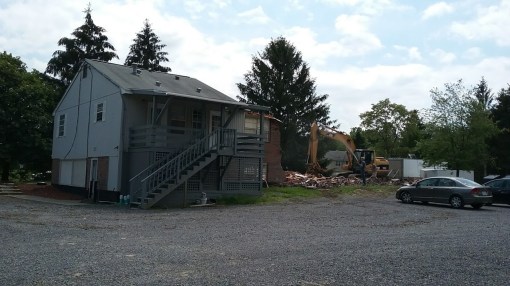
It’s not often that I run into someone who’s aware of this blog, let alone while taking site photos. When I arrived at the Village Solars property off of Warren Road in Lansing, I was immediately surprised to see they were taking down one of the older 1970s 10-unit properties, 102 Village Place. A salvage job this is not; the excavator was actively tearing through the brick veneer and wood window frames, leaving them in a pile as it slowly worked its way through the building. A gentlemen with a hose was spraying the fresh debris down to keep airborne dust to a minimum. To be honest, even if the building has little historic value, there’s always a bit of a bittersweet feeling to see a place that hundreds called home fall to the march of progress.

And the march of progress it is. As readers of the Voice may be aware, the plan for the Village Solars has been changed up. The next few phases will remove the 1960s-1970s 8-unit and 10-unit (all 1-bedroom) buildings and build new Village Solars buildings on their foundations. The net gain in units will be 70, bringing the number built and to be built from 502 to 572, and a gain in bedrooms of about 124.

It’s a bit complicated of a breakdown – four of the new building planned – 24-unit “K”, 24-unit “L”, and 18-unit “M” – were originally to be the next phase. When all that was said and done, Building “F”, which will host retail components, a community center and 20 studio units, was to be built. Those are being pushed off in favor of the replacement units. For example, 102 Village Place, coming down in the photos below, will be replaced with a 24-unit building that will also be called 102 Village Place. It’s five peers closest to the Village Solars will also be coming down for the construction of 18 or 24 unit apartment buildings on their footprints. There will be five phases, and it looks like two older buildings will come down and have replacements built each year for the next three years, with the last two being the all-new K/L/M and F. The designs for the six new buildings will be similar to the existing Village Solars.

So while taking photos, I happened to see a gentleman in a wide-brimmed hat and loafers, drinking a couple beers. I intended to not make waves and to just walk past when he broke the ice by saying “I’m surprised there aren’t more neighbors out watching. You don’t see something like this everyday.” I ended up making my acquaintance with Jon Lucente, the son of Rocco Sr., brother of Steve and uncle to Rocco Jr. – so, not as directly involved as the others, but still aware and knowledgeable. Turns out he lives in the Village Solars.

One of our conversation topics swirled around the hassles of regulation – a little talk on the Briarwood mess ten years ago, a little bit about Varna, and a lot about the Village Solars. To be frank, he had nothing but great things to say about Lansing town government. But he complained some of the building code regulations created headaches for his family and their in-house contracting team. For example, the buildings had be earthquake-proof, and the expensive sprinkler systems over the balconies are only legal until 2022 but they were the only type approved for use. Interestingly, they originally wanted to do four floors but building codes say an elevator is required for 4 or more floors (this tripped up Ecovillage as well as few years back). Jon brought this all back to the cost being passed on to tenants.

On my end, it was mostly just polite acknowledgement. I understand his point, but details like the elevator rule are in the building code for safety reasons. The thing is, building codes are an imprecise science – they may be too stringent in some circumstances, but lacking in others, so as a result they’re constantly re-evaluated. Given an event like the London Grenfell Tower fire disaster, where the Reynobond aluminum panels were stuffed with polyiso insulation, which is a risk because it can produce toxic fumes if it burns, there’s always good reason to take a hard look at the codes and reassess. For the record, polyiso is a common insulation material, although in the local cases I’m aware of, it goes on over the fireproofing and under the cladding, meaning it would be very difficult to set it on fire, and the Grenfell case implies the panels may have created a tunnel effect for heat and flame. The specific cladding that was used on Grenfell Tower is banned for use on buildings taller than 40 feet in the U.S.  

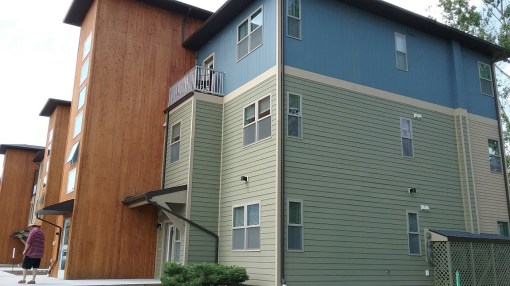
Anyway, I still enjoyed an opportunity to chat with one of the Lucentes. Building “I” is occupied and Building “J” will be open for occupancy at the start of July – just a little exterior trim left to do on the outside. The photos below have a close-up of the fiber cement board used on the Village Solars, which apropos to this post, doesn’t burn because it’s basically sand and concrete mixed with wood pulp. Won’t make the same claim about those wood-grain trim boards though.


Chapter House / 406 Stewart Avenue Construction Update, 6/2017

16 06 2017

The funny thing about this project is, I already did the synopsis back in February 2016, the first time that it seemed to be under construction.

At the time, the construction seemed ready to move forward, but then, well…it didn’t. Former 400-404 Stewart Avenue owner Sebastian Mascaro sold the property and plans over to neighbor Jim Goldman, who intended to carry them forward. However, citing unfavorable cost estimates, Goldman decided to wait, and only recently has the project obtained favorable terms that would allow it to proceed.

The plans are still the same, although the project manager has changed. CSP Management (Jerry Dietz) will still manage the apartment rentals, but the commercial component is under the control of Pyramid Brokerage, Syracuse-based Hayner Hoyt will be the general contractor, and the construction manager representing Goldman is not with Hayner Hoyt and does not appear to be from the Ithaca area.

As a frank aside, it has been a rare degree of frustration to dig up information about this project. Goldman, for whatever reason, is incredibly publicity-averse, and everyone involved with the Chapter House has been asked or told to not talk about it. The little bit of information the Voice and 14850 have been able to get has come from CSP Management, which in itself comes with lots of cautions and uncertain language. The one occasion I spoke with Goldman, he told me he knew nothing and no longer owned the site, which if true, isn’t in the county’s records.

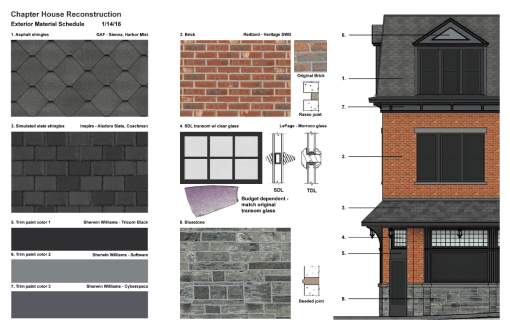
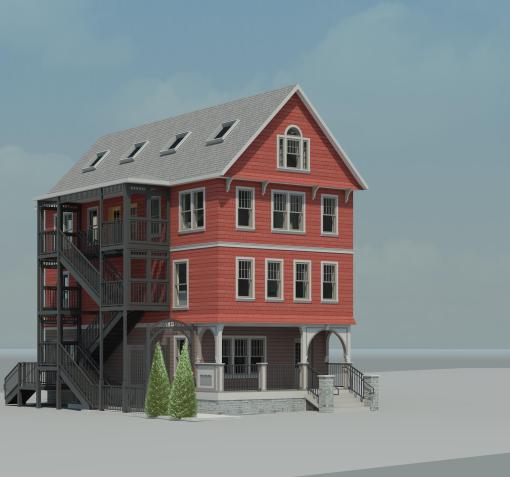
Here’s what is known. 406 Stewart Avenue will be 4 units, 7 bedrooms, replacing a similar-looking 1898 structure destroyed by fire in April 2015. 400-404 Stewart Avenue is about 9,000 SF with first floor retail with two floors of apartments – the number of bedrooms and units is not clear, as the number has been in flux. Note that calling it “the Chapter House project” is inaccurate – John Hoey, who owns the right to the Chapter House name, has not committed to reopening on the site, and the first-floor is being offered at a rather hefty $35/SF. For comparison’s sake, most downtown rates I’ve seen come in at about half that, although Pyramid is playing up its proximity to Cornell and the inner Collegetown market. A potential interior layout for a bar is included in the marketing material.

The current plan is to have 400-404 Stewart open by the end of the year, and 406 Stewart by Summer 2018. Jason K. Demarest is the architect for both buildings.

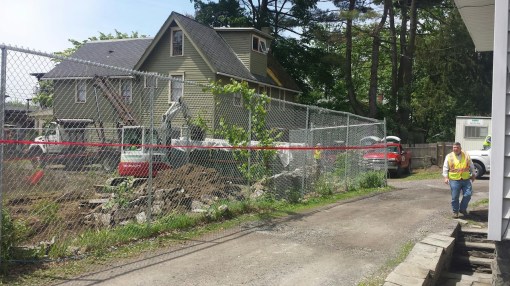
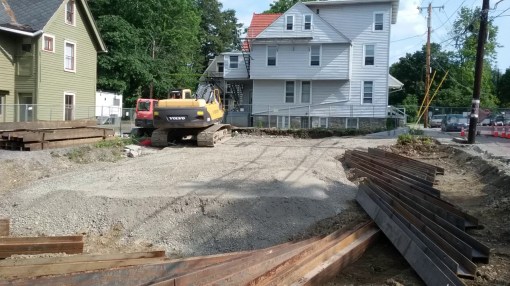
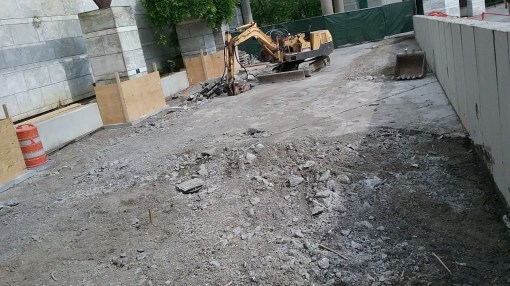
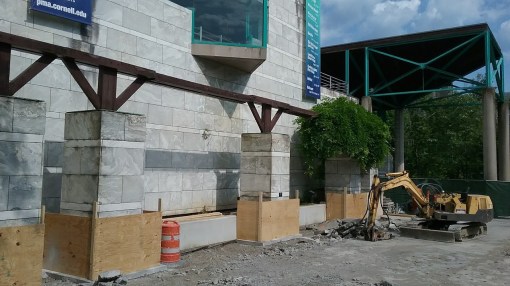
The first photo below is from my colleague Mike Blaney on May 23rd, as environmental remediation company ERSI was finishing clean-up of the fire-damaged site. In the following photos from this past weekend, the property has been leveled and graded, and a foundation is being excavated. The steel H-beams will be used as support for a retaining wall to shore up the soil, protecting the foundation and providing stability as the concrete is poured and cured.


Schwartz Plaza Construction Update, 6/2017

15 06 2017

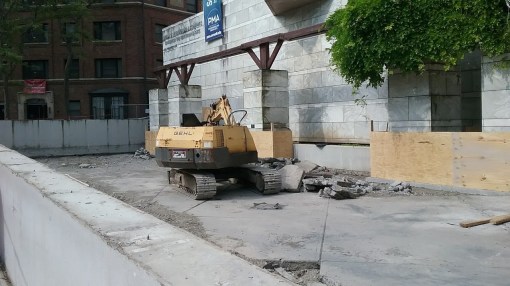
One of the biggest complaints about Collegetown is the lack of public gathering spaces – there’s no real park or public plaza that can be utilized for gatherings and events. The gorges aren’t all that accessible and aren’t suitable for large groups, and places like CTB and St. Luke’s provide for small private gatherings and community events, but the lack of a sizable public social space poses a challenge to the neighborhood’s ability to provide for its residents.

As Collegetown’s raison d’etre, Cornell is stepping up to the plate to offer a space with the renovation of Schwartz Plaza. It’s not truly a public space as something owned by the city or county, but Cornell’s large, multi-faceted presence offers a reasonable facsimile.

Part of the purpose for building the Schwartz Performing Arts Center in Collegetown was to draw in people from outside the neighborhood, and mix the non-students with the students. When the building first opened in 1989, the plaza was intended as an outdoor reception area for Schwartz patrons, and the original design by English architect James Stirling, which called for a lively “forecourt”, was never built out. Instead, the plaza was walled off from the street and there was little exposure or interaction with College Avenue. As a result, outside of performances, Schwartz Plaza tends to be barren, its only social function comes from being close to a bus stop.

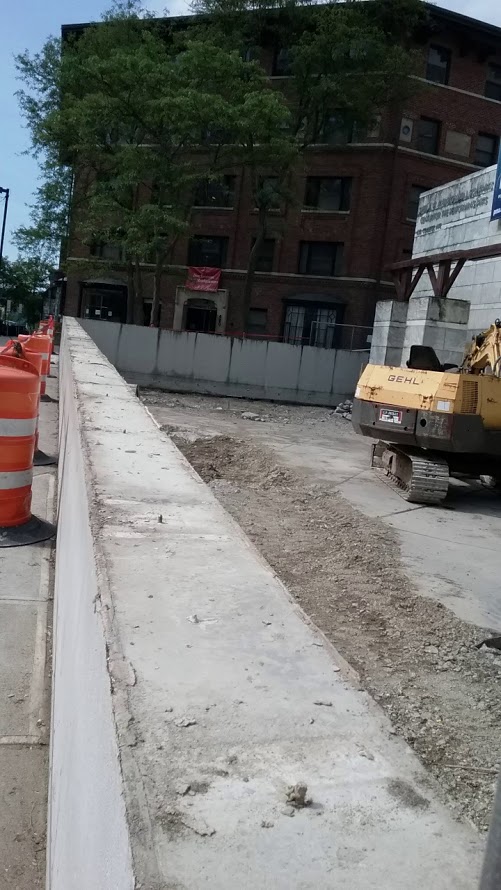
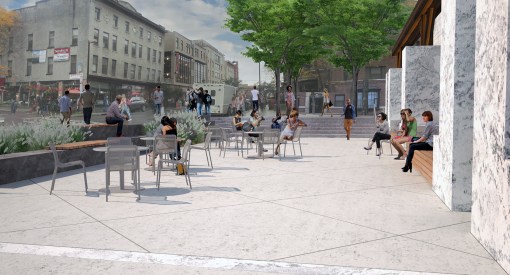
The stated goals for Schwartz Plaza’s renovation are to improve pedestrian circulation, increase safety by providing for better visibility, and to enhance aesthetics. To do this, Cornell will remove the 4-foot tall concrete wall that separates the plaza from the sidewalk, create a series of short stairs to facilitate “permeability” of pedestrians to and from the plaza, and adding new seating and landscaping to make the plaza more inviting – stone walls and pavers, wood-on-granite benches, recessed LED lighting, new bike racks and planters. It’s not really a new structure or even a change of use, but to make the plaza more effective for its intended use.

To quote the marketing pitch: “This project is expected to yield a lively new gathering space that serves as a catalyst for an enhanced pedestrian boulevard along College Avenue, the primary pedestrian gateway to the university. This project is conceived as a key node within a larger, future Collegetown public realm enhancement area.”

Being a fairly minor project, and having hosted some community meetings last fall to determine the neighborhood’s design preferences, this plan sailed through the city’s planning board review, in and out from February through March. I can’t seem to locate the SPR offhand, but the total cost is about $600,000.

As projects go, this one should be relatively short at about four months, May-August 2017. TWMLA is responsible for the plaza design, T. G. Miller for civil engineering work, and Taitem Engineering for electrical engineering. The contractor isn’t clear and (unusually) Cornell doesn’t have it listed on their webpages, but the invited bidders were all regional road/landscape construction firms.

In the photos, it looks like removal of the old plaza is underway, with the wall soon to follow. The plywood around the Vermont marble columns is for protection (way back, the columns were intended to be limestone and brick stringcourses, but it was value-engineered to marble and off-white Dryvit).


209-215 Dryden Road Construction Update, 6/2017

13 06 2017

For news about today’s event, please go to the Voice.

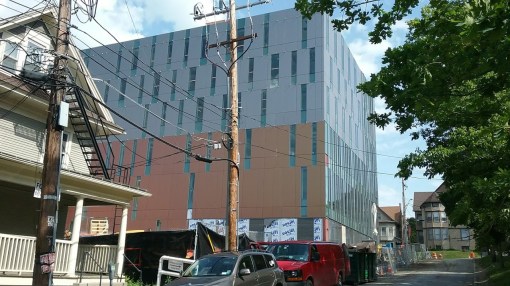
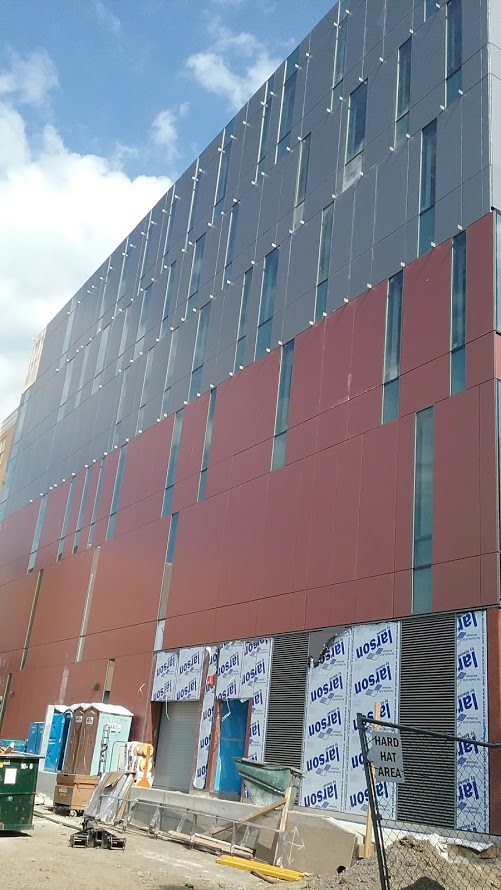
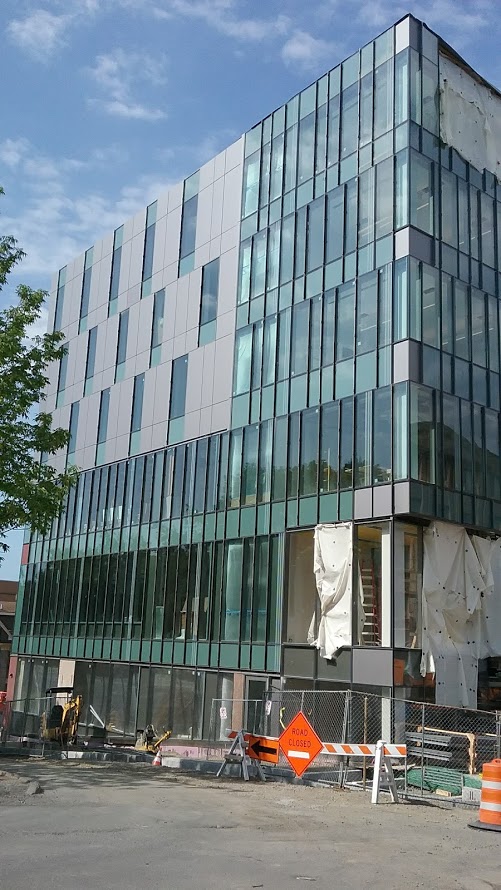
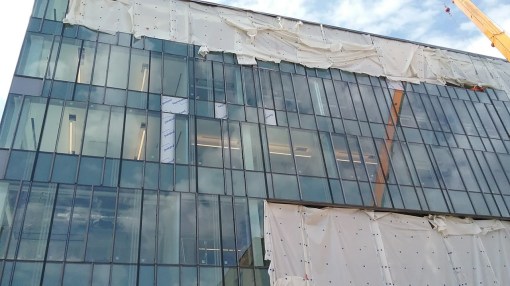
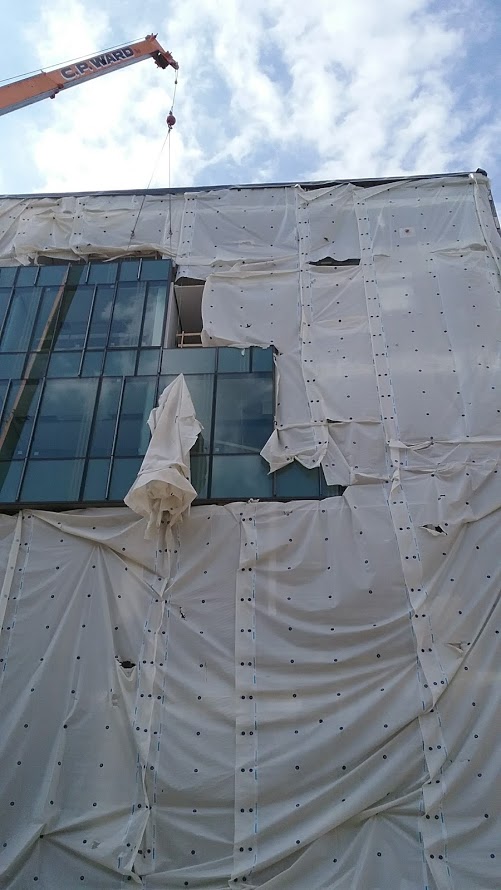
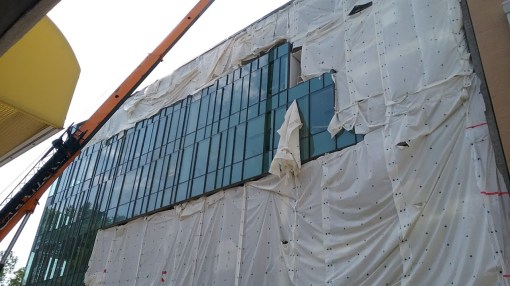
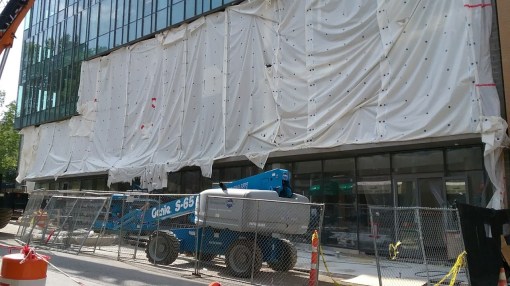
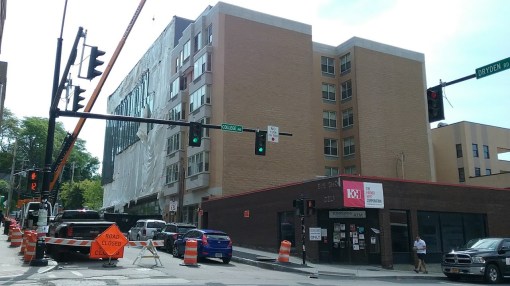
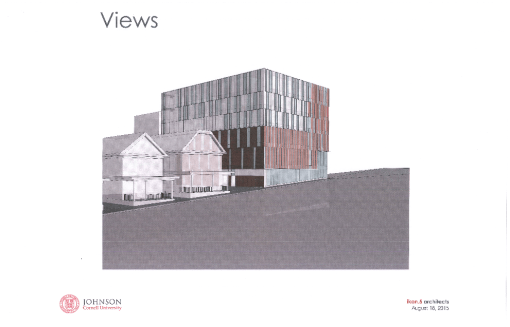
Most of the rear and east facade are complete on the Breazzano Center at 209-215 Dryden Road. The Larson sheeting on the utility/loading dock refers to Larson Alucoil, the brand name of the aluminum metal panels being used to complete the less photogenic vantage points of the new 6-story building. The clips on the rear wall will be used as hinges for architectural sunshades.

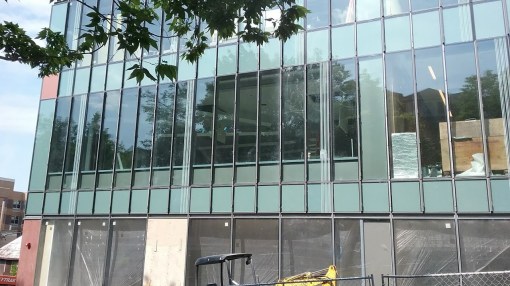
Most of the windows and spandrel glass has been installed on the read and east facade. Note that spandrel glass is purely decorative, and there are metal panels between the glass and the lip of the floor plate. The white stripes indicate where the salmon-colored metal panels will be installed over the glass, although I personally would be just as happy to see them go without; the glass curtain wall gives the building an airier, less overbearing appearance. The bottom floor uses clear glass to give the building greater transparency at street level, and is meant to enliven (“activate”) the block. In photo 9, you can see the ceiling of one of the large group instruction classrooms, meaning that the drywall has been hung on at least the lower floors, and utilities rough-ins have been completed.

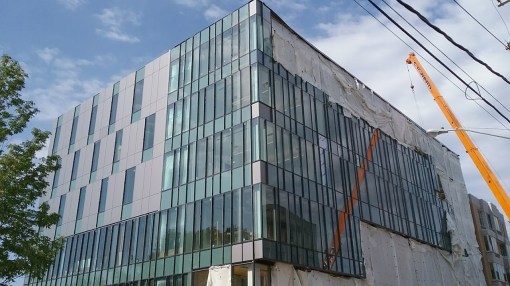
At the time these photos were taken, workers were easing a new panel section of the front curtain wall into place – it’s a bit of a delicate process to hoist the glazing with the crane and line everything up just right, and then quickly fasten it into place so they can move on with the next section, pulling the tarp back and continuing down the line. One imagines it must get a bit stuffy under the plastic sheeting this time of the year. More complicated exterior sections like the projecting atrium wall have yet to be tackled.

The Breazzano Center should be open in time for the fall 2017 semester. Not long thereafter, the staging area next door at 238 Linden will becoming a project of its own with the erection of a 4-story, 24-studio apartment building. That project is up for final approval later this month.


201 College Avenue Construction Update, 6/2017

12 06 2017

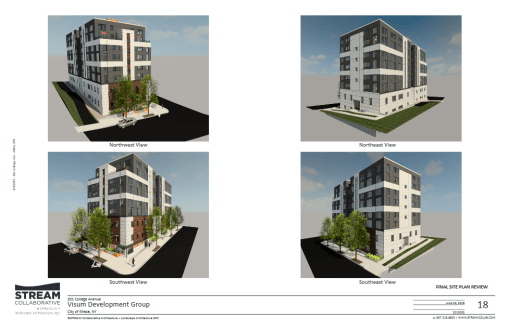
201 College is moving right along. W. H. Lane has been charging ahead at a rapid clip in order to have the 44-unit apartment building ready for occupancy in August. the front (west) half is further in the construction process – fireproof Georgia-Pacific DensGlass fiberglass mat sheathing, coated and sealed a pitch black air/vapor barrier (Carlisle Barriseal?), and layered with Dow Thermax polyiso insulation boards. The Thermax is coated in a reflective outer layer to repel incoming solar radiation and keep the building cool during the summer. Or at least, that’s what one of the construction guys told me. Some windows have been fitted into the structure on the lower floors.

The back half is not as far along. The northeast and east walls remain bare steel studs, while the southeast wall is just getting its DensGlass mats installed. The paired window layout might seem a little unusual, but many of the units will utilize a “mezzanine” intermediary floor to increase the living space in each unit.

One detail that has appeared to have changed from the images on file here are the stairwell windows above the front entrance. The drawings show one square window for each floor, while the finished building will have a pair of smaller square windows.

The front facade might seem a bit bland at the moment, but a plethora of exterior finishes should give the building a more visually interesting appearance – A large Sherwin-Williams Iron Ore (aka fancy off-black) metal canopy above the entrance, and fiber cement panels in shades of Allura Snow White, S-W Gauntlet Grey, and S-W Chinese Red, as well as woven bamboo siding. A stucco aggregate will be applied to exposed foundation sections (when you’re spending $10 million, you can afford the real deal over DryVit), and white cedar panels with a clear protective finish will be used for canopy ceilings and architectural screens. Long story short, variety of colors and materials should help break up the mass and make it look less overbearing.

With August just a scant two months away, we’ll have an idea of how nice the final product looks soon enough.


News Tidbits 6/4/17: The Return, Part II

4 06 2017

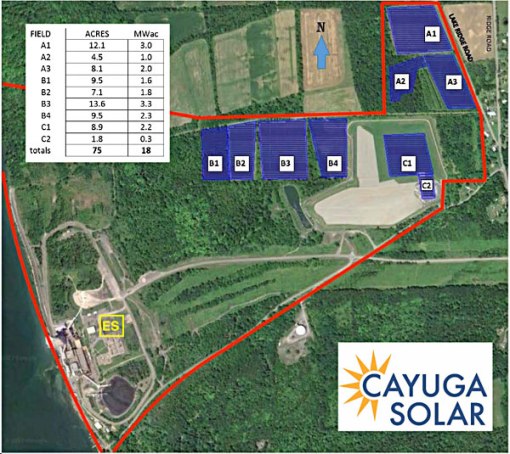
1. The solar revolution is happening. Nothing makes that any clearer than putting up one of upstate’s largest solar arrays on land held as part of the Cayuga coal power point.

Just about every news agency in a fifty mile radius got the press release, but the Lansing Star has in-depth coverage. The $25 million project, to be built on 75 acres of the plant’s 434-acre site in Lansing, would create an 18 MW array that would be able to power 3,100 homes. 150 construction jobs would be created, although the permanent job growth is nearly nil. The site is well-suited because it is easy to hook-up to the existing grid, the zoning is appropriate, and Lansing is very keen on growing its tax base – overall, this seems like the right project at the right time. At a glance, this seems to skirt past the 2 MW rule from NYSDEC that limits each project’s size, as some arrays produce as much a 3.3 MW. However, there are nine arrays producing 18 MW, an average of 2 MW each for each array on the Cayuga plant’s property – so it technically meets regulations. It’s not clear if they have to pursue subdivision to make the panels fully legal.

Two potential debates are touched on in the Star article. For one, the project may pursue a solar tax PILOT, which would save a fair amount – instead of paying the property tax of about $770,625 (25 million on a tax rate of $30.825/1,000), they would pay something like $8,000/year/MW, just $144,000. The flipside is that local taxing authorities would not be enamored with such a deal. The second potential issue is that the Cayuga Operating Company was mum on whether they’ll close the coal plant, which is probably going to keep Town of Lansing officials up at night.
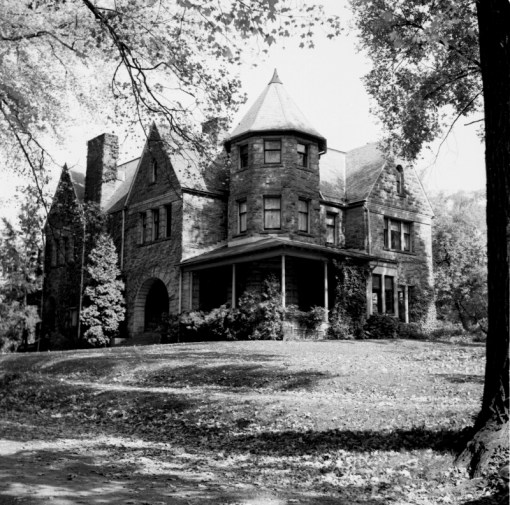
2 Fountain Place (President’s House), image courtesy of Ithaca College

2. Ithaca College is in the hunt for a new president’s house. The house at 2 Fountain Place in the city’s East Hill neighborhood was deemed unsuitable because it’s difficult to maintain (it was built in 1892), it has an awkward interior layout, and there’s not enough space to host events (it’s 9100 SF on 1.06 acres). The property was designed by Ithaca’s famous 19th century architect William Henry Miller for lawyer George Russell Williams, and was purchased by the college in 1938. Although future options are still being considered, if this hits the market, we are talking a multi-million dollar sale, but lest anyone be concerned, given its historic designation the possibility of inappropriate alterations or demolition is remote. The most recent work was in 2013 for ADA accessibility at the rear porch, an ADA-suitable bathroom, and air conditioning. With 7 existing bedrooms and 5 bathrooms, it could make for a cool boutique hotel or B&B, if someone doesn’t want a personal residence with venerable grandeur.

While Ithaca College searches for a new residence (pursumably large, newer and on South Hill), incoming president Shirley Collado and her husband will live in a downtown apartment paid for by the college.

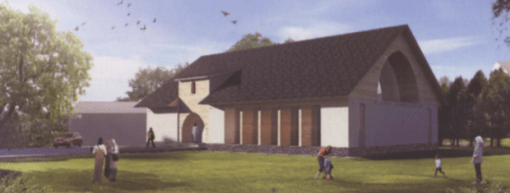
3. Hat tip to Chris Szabla for this one – the Al Huda Islamic Center planned for 112 Graham Road in Lansing village has been redesigned once again. It went from this in 2014:

to this in 2016:

to this now:

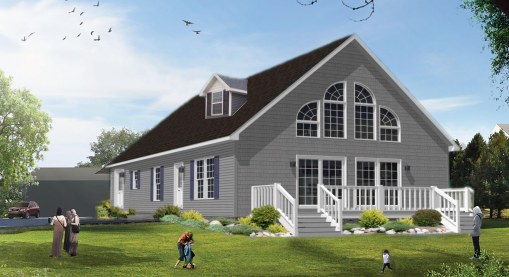
Erm…with every due respect, this is a vinyl-sided modular with a poorly-photoshopped dormer and what appears to be a door in place of a garage. The first couple of designs embraced traditional Islamic architectural features, and the second was a great mix of traditional and contemporary design motifs. But this latest version honestly looks like, even if it was done for cost considerations, that every attempt was made to hide its use as a mosque and Islamic center. This image is so poorly done, I’m still not 100% sure if this is some kind of joke, but the floor plan matches up. Oof.

4. Not something one sees all the time – these are photos from last month’s deconstruction of Ithaca’s 107 South Albany Street in preparation for a new three-story, 11-unit apartment building. Developer Nick Stavropoulos hired Finger Lake Re-Use to do the deconstruction, which diverts about 70-90% of materials from the landfill by salvaging the structural components, processing and checking them to make sure they’re in good shape for re-use, and packaged and selling the materials at a low price to interested buyers – for instance, reclaimed lumber could go into bar counters, flooring, or any number of options looking for that well-used look. The cons to this approach are that more work and more time is involved vs. a traditional demolition, which means a greater cost. Also, though no fault of FLR, Historic Ithaca is not pleased (they get bonus shade for arguing in the same article the city should downzone to protect Patterson’s, an auto body shop built in 1983, and keep their “essential service” in downtown Ithaca). The pros are the environmental/sustainable aspect, the creation of “green-collar” jobs, and salvaged materials are tax deductible.

Construction on the new Daniel Hirtler-designed apartment building will begin this summer, with occupancy in about 12-13 months.

5. Skill-building for a good cause – The Second Wind Cottages, a housing complex in Newfield that houses formerly homeless men in 320 SF cottages, has connected with high school students and teachers to help assemble a new unit, cottage #13. Supervised students at a high school in suburban Rochester assembled a 320 SF unit in their school’s back lot as part of a class, then partially disassembled it and reassembled it in Newfield. The construction and transport process was borne out out over two days.

The non-profit project is led by local businessman Carmen Guidi, who hopes to do a second women’s housing plan further up Route 13 as the current 18-unit build-out wraps up.


607 South Aurora Street Construction Update, 5/2017

2 06 2017

Projects are a bit like politicians in that the higher profile or most controversial ones get the vast majority of attention. 607 South Aurora Street fills neither of those specifications, and as a result, relatively few people are even aware of it.

The South Hill infill apartment project is located on an unusually large 0.73 acre lot. The property consists of an existing 5-bedroom, 2,300 SF home dating from about 1910, and had been in the possession of the Cassaniti family since at least the 1960s, legally split among the six Cassiniti brothers. If you’ve visited the hot dog and soda vendor on the Commons, you’ve met one of the Cassanitis.

Enter Charlie O’Connor of Modern Living Rentals (MLR). MLR is a young and ambitious rental company based out of Ithaca, a partnership primarily led by O’Connor and business partner Todd Fox. However, each has had their own ideas on how best to approach development – while Fox likes to think big and aim for high-profile projects, O’Connor is much more low-key and incremental in his approach. The two differ enough that they developer under different entities – Fox under his firm, Visum Development, and O’Connor as MLR. However, regardless of who develops, all their rental units are managed by MLR.

So while Fox is dreaming big with projects such as 201 College Avenue and 232-236 Dryden Road, and potentially sets off heated debates, O’Connor prefers to avoid controversy and take on less risk. His first project, with behind-the-scenes business partner Bryan Warren, was a pair of two-family houses at 312 West Spencer Road about half a mile southwest of 607. A bit of an unusual location, but close enough to urban destinations and Ithaca College that it was potentially viable, and after getting approvals last year, the project moved forward and is at least partially if not fully rented. Two existing houses that shared the original lot are being renovated as part of the project.

With those basically finished, O’Connor and Warren have moved onto MLR’s next project, 607 South Aurora. First proposed in August 2016, the location near downtown and IC makes it an easy sell, and in an area of 1.5-2.5 story owner-occupied and rental homes, four more two-family homes aren’t going to cause a big debate. In fact, in a city that loves giving its input, there were only ever a couple of neighbor comments about the project, and they were generally amenable – ‘better these than a large apartment building’ was the gist of it.

There were a few stipulations and revisions that were required, however. The original plan called for two homes near the street and two in the back of the L-shaped lot, with the renovated existing house in the middle. This was especially well received for aesthetic reasons (the city is still quite sore about the poorly-sited house MLR did two years before on the lot next door), so the site plan was redesigned to have three buildings on the interior side of the “L”, and one on the street to better match the curbside context. An internal driveway and clustered parking were added to help traffic and emergency vehicle circulation.

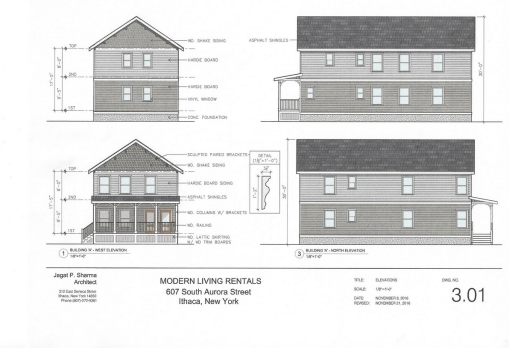
The building themselves didn’t change much – like 125 and 129 Elmira, they’re modular units on Superior Wall foundations. The unit facing Aurora has fiber cement siding and nicer details like a full lattice porch with railings, columns and brackets on the porch and roof. The rear units have small entry porches and use vinyl lap and shake siding.

With those details noted, the project was approved in November, and through an LLC, O’Connor and Warren bought 607 South Aurora, valued at $220,000 by the county, for $452,776 back in March (rule of thumb – if development is planned, expect a hefty premium).

Each of the eight new rental units will be three bedrooms and about 1,128 SF. The existing house will also be renovated and expanded slightly, raising the rear roof-line to add interior space. Expect occupancy by the start of the new academic semester in August. The apartments are being marketed at $2250/month, which works out to $750/bedroom.

According to county docs, the construction loan from Tioga State Bank was for $1.92 million and filed the day the house was sold. That figure is a combo of hard (materials, labor) and soft costs (acquisition, marketing, legal); by itself, the hard cost for the new construction and the renovation looks to be about $1.04 million.  Rochester’s Taylor the Builders, who will be doing Harold’s Square at some point, is the project’s general contractor.

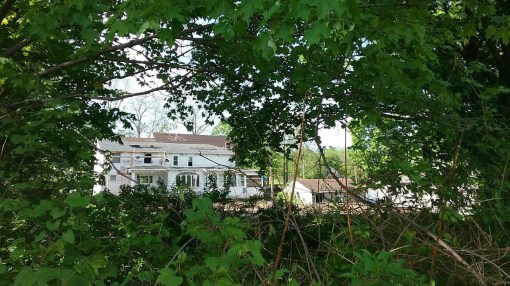
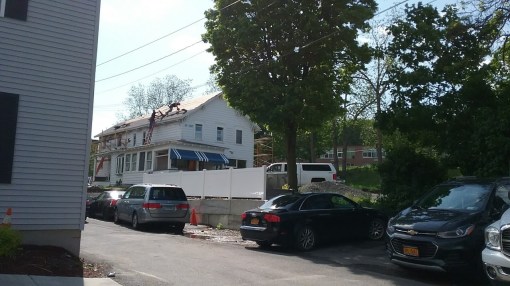
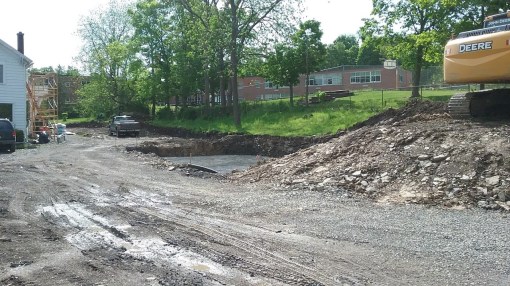
Looking at the site last month, a new roof is underway, and you can clearly see where the roof was raised in the roof by looking at the trim boards; the new section is housewrapped, and presumably the whole house will receive a new exterior finish at a later date. The windows in the rear are just rough openings for now, new windows will come along shortly. The soil has been excavated for the slab foundation of Building “A”, but due to the angle and slope of the site from the roads, it’s hard to tell how much of the site prep for “B”, “C” and “D” has been completed in the rear, apart from some disturbed soil.