118 College Avenue Construction Update, 4/2018

13 05 2018

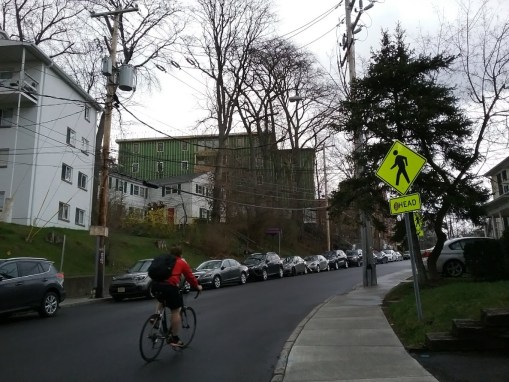
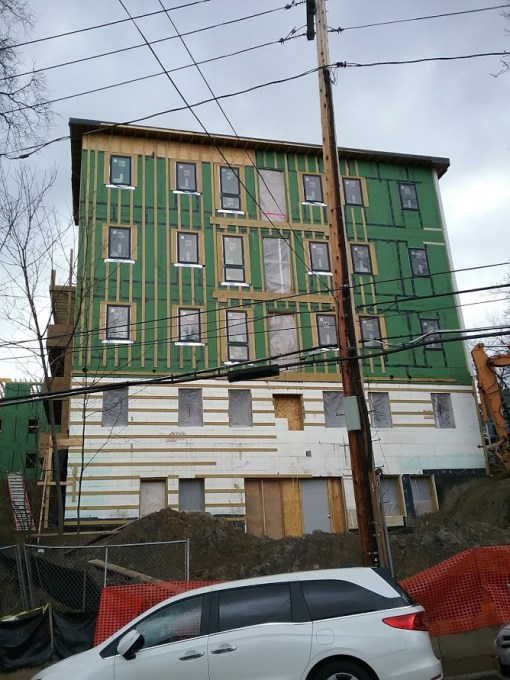
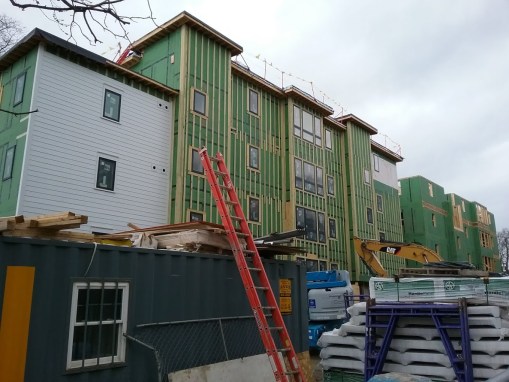
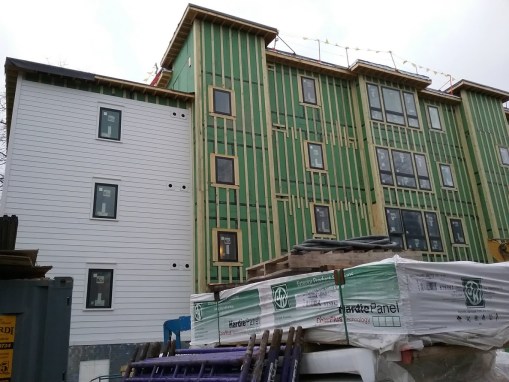
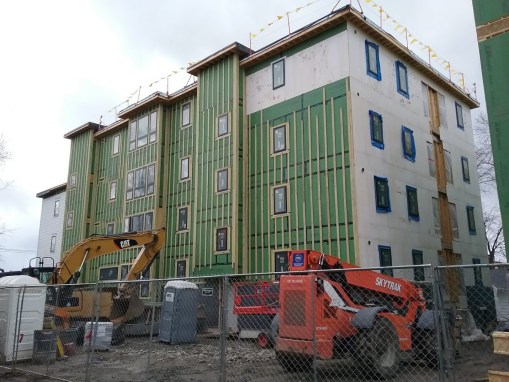
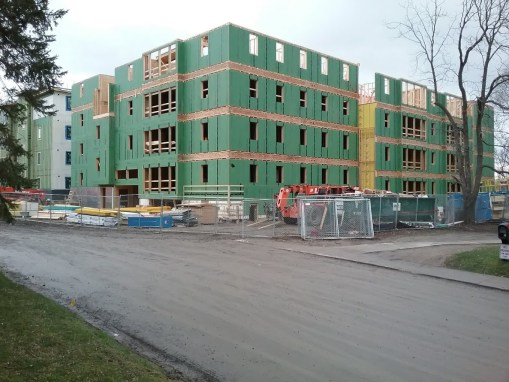
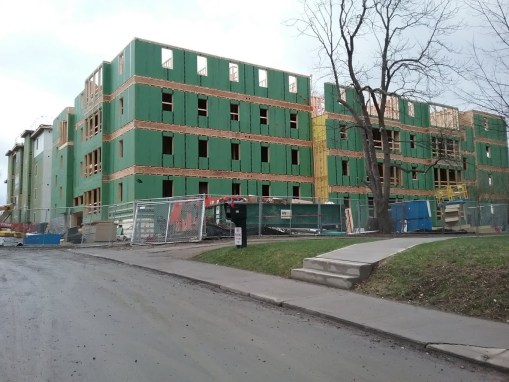
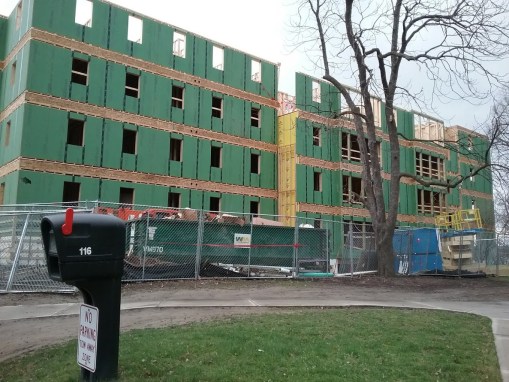
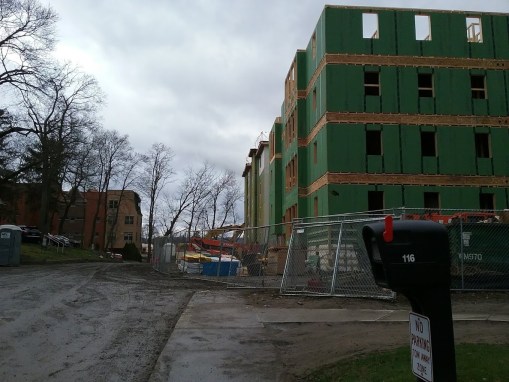
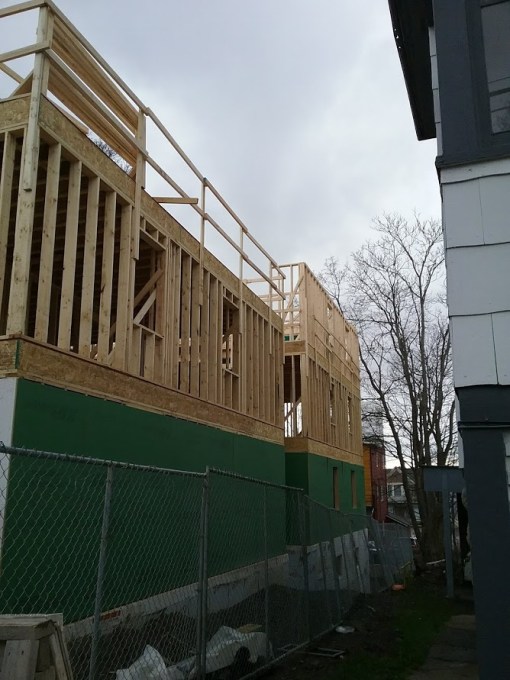
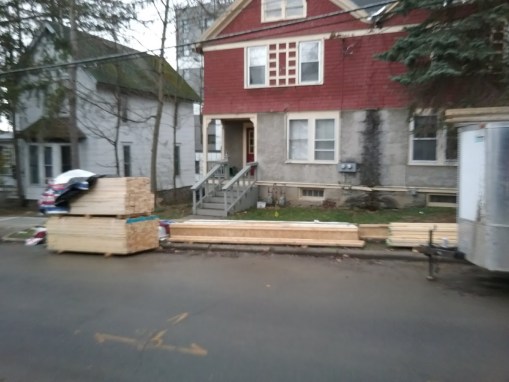
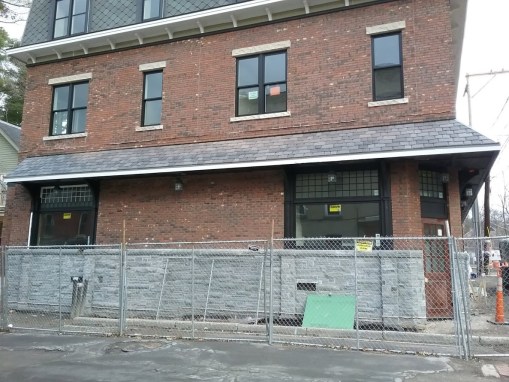
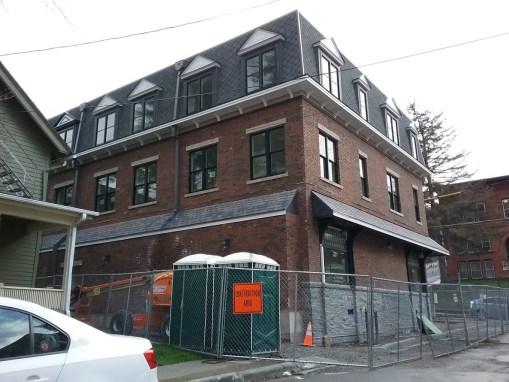
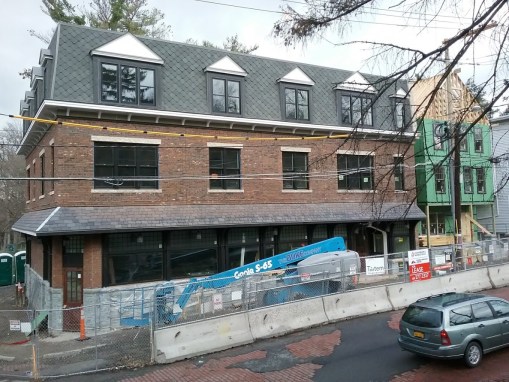
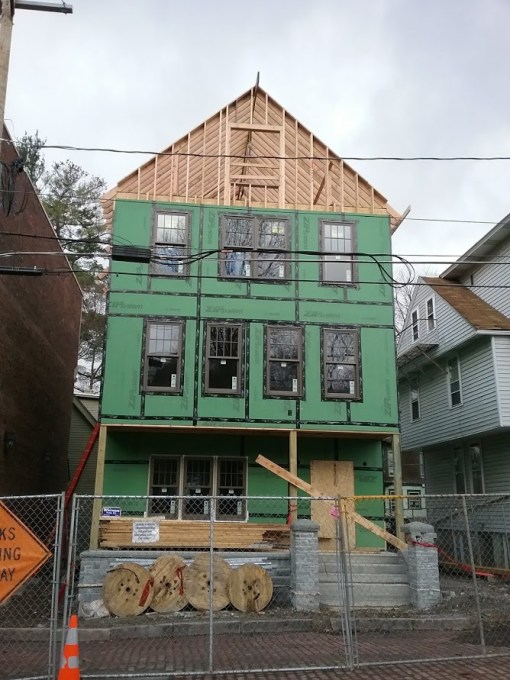
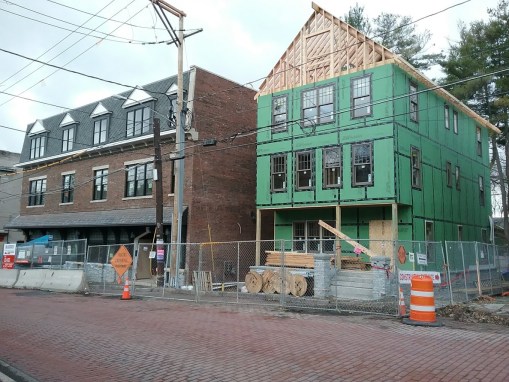
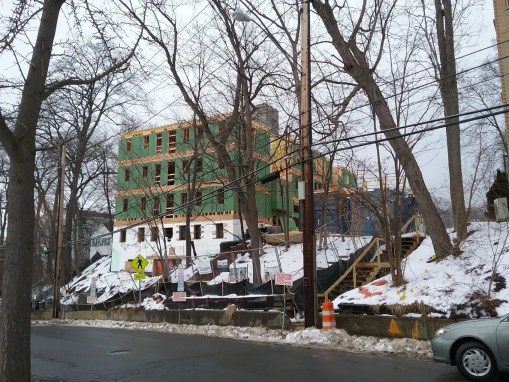
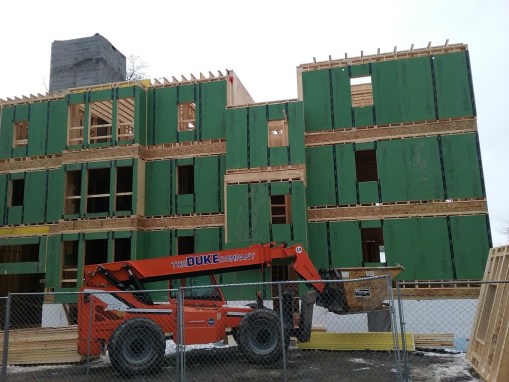
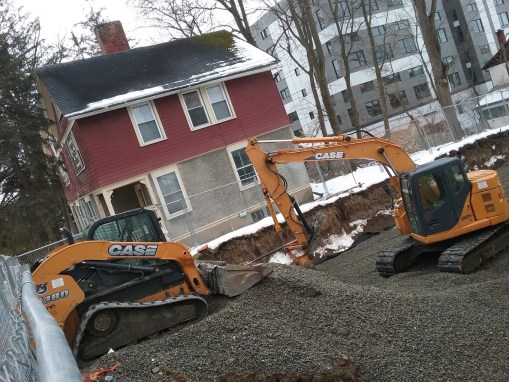
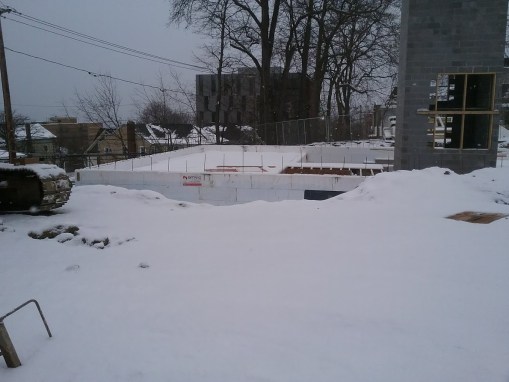
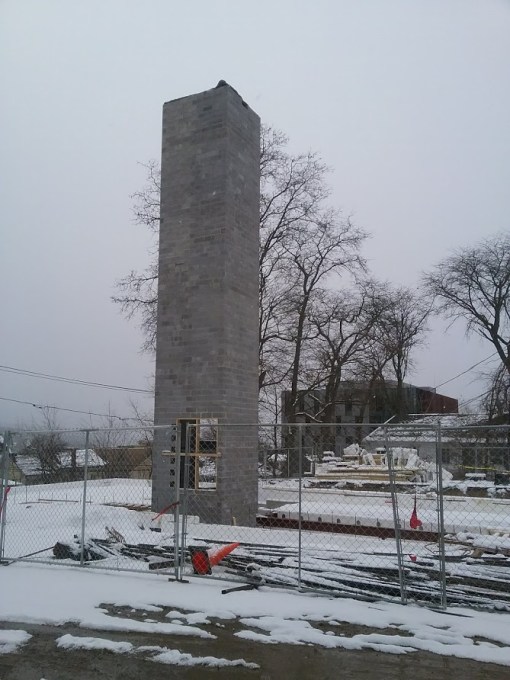
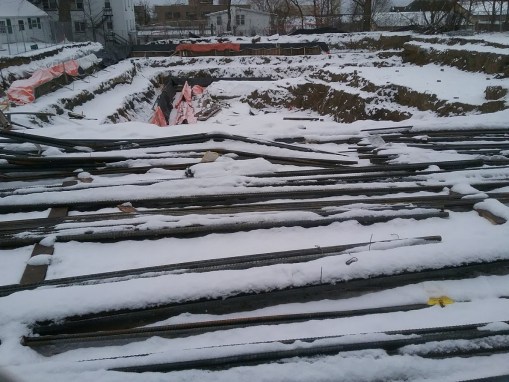
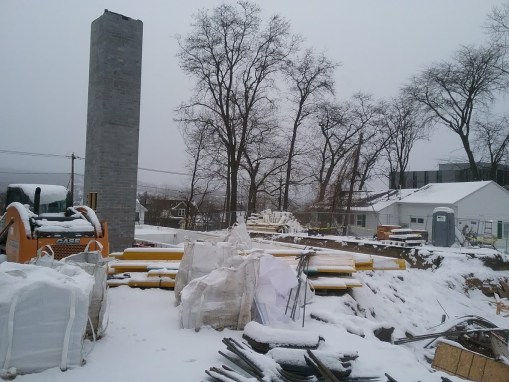
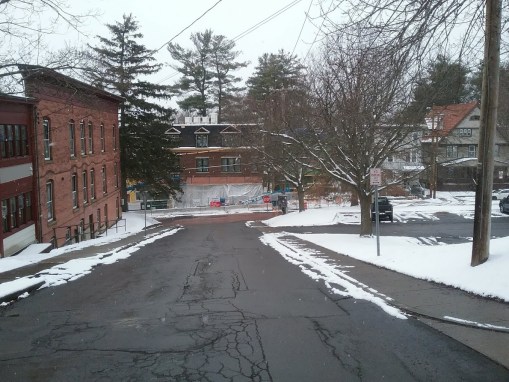
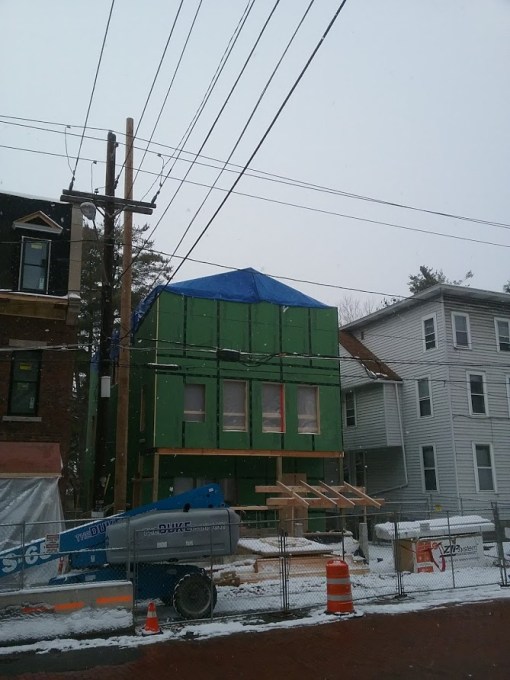
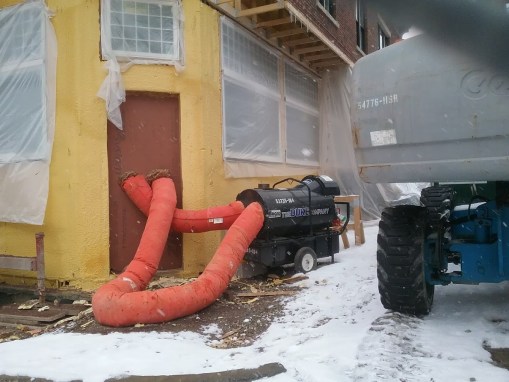
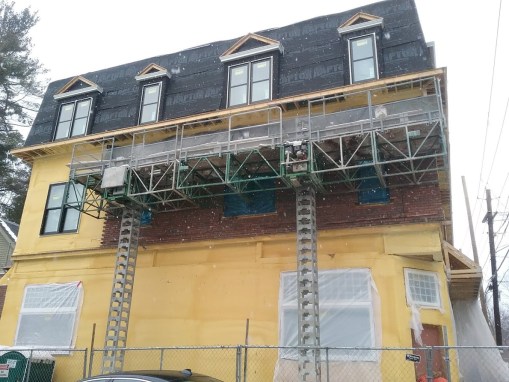
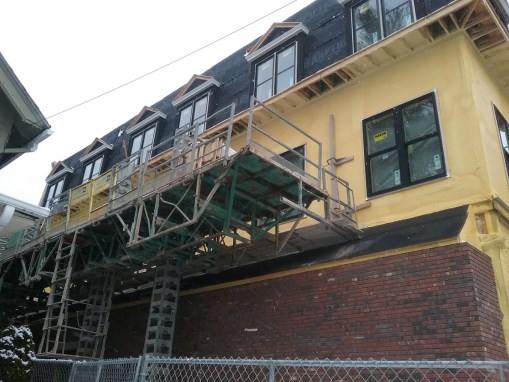
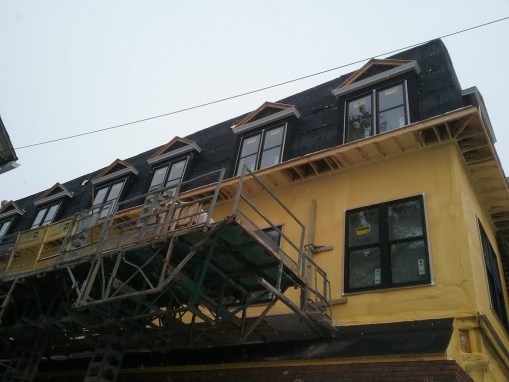
Finally, clearing out the last of that late April photo stash. Not many here, but a new, small Collegetown project is underway at 118 College Avenue.

This is a Visum project, and probably their lowest profile plan. In fact, this one never even went through the sketch plan part of the city review process, the project team went straight to asking for the city planning to declare itself lead agency for environmental review in March 2017. Approval was a short time later as Ithaca goes, in May 2017. Building permits were issued this past winter.

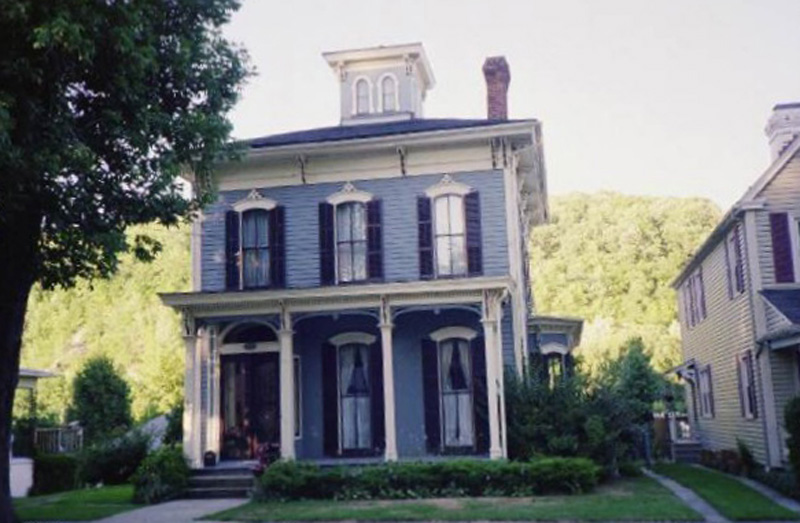
It wasn’t a rash decision by any means – the project is largely similar to a previously-approved plan a few houses up at 126 College Avenue, and there is very little difference between the two properties in terms of context. They are both CR-4 zones allowing 4 floors and 45′ heights. The original 118 College Avenue was a two-story, early 20th century rental house with six bedrooms and marginal historic value, though I imagine the house was rather pretty before some unfortunate additions threw off its symmetry. The property was purchased by Red Door Rentals (Greg Mezey and Ryan Mitchell) in April 2014, transferred to another Mezey/Mitchell company, “MPB Capital LLC” in October 2017, and then to an LLC associated with Visum on the same day as the MPB Capital transfer. It seems plausible Ryan and Mitchell are project investors, with Visum as developer.

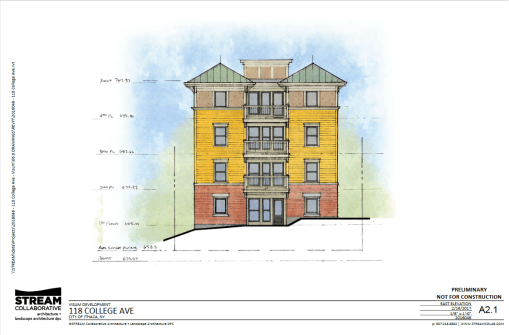
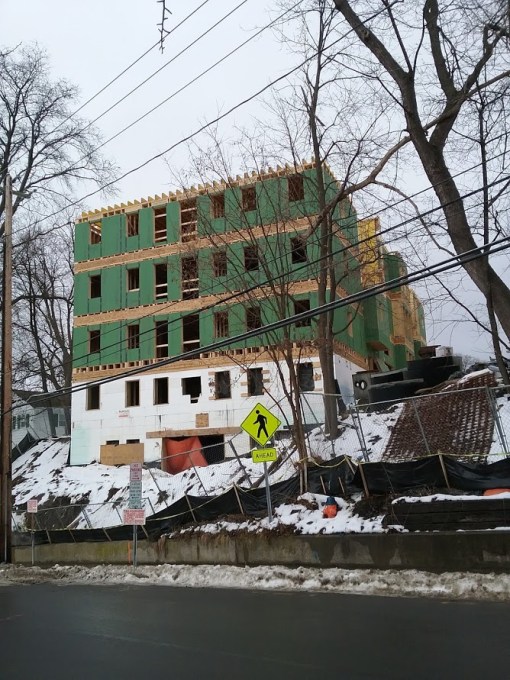
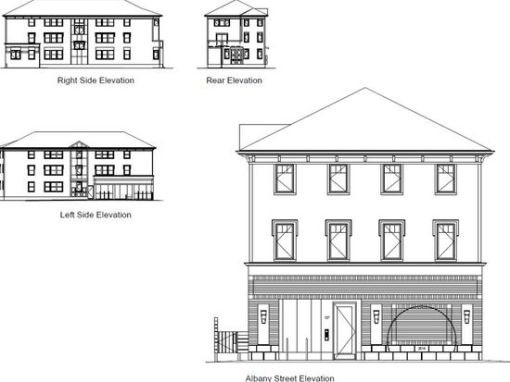
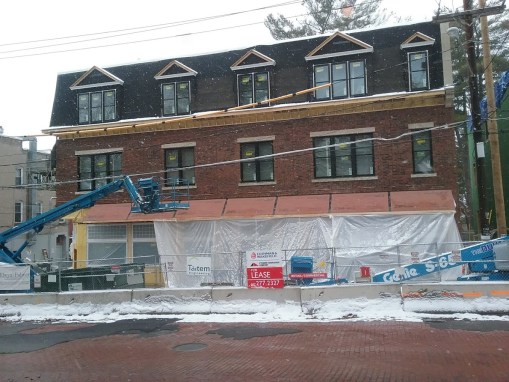
Plans call for a new 4-story, 45′ building on the sloped lot. With that slope, the basement is exposed on the west face, so it has the appearance of five floors from the rear and sides. A back of the envelope calculation says this building is about 9,000 SF. The roof hosts a 6′ architecturally-integrated mechanical screen; hides the mechanicals, but gives the apartment building an Italianate aesthetic. The building uses electric heat pumps and is designed to be net-zero energy compatible. The hard construction cost rings in $1.415 million, according to the SPR filing – it would be assessed at a substantially higher amount. Unabated taxes her, so while people may dislike Collegetown, projects like this help fill the city coffers.

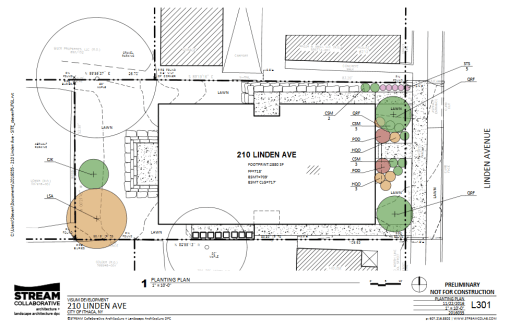
There will be 5 apartment units with 28 bedrooms – 4 six-bedroom units, 1 four-bedroom unit on the basement level. The project comes with five new trees, lush landscaping for its small lot, an outdoor bike rack, screened trash area, and bike storage and mechanical rooms in the basement. Tenants with valid licenses will be given membership in Ithaca Carshare, to try and dissuade them from bringing personal vehicles. Not a surprise here, but college students are the intended market.

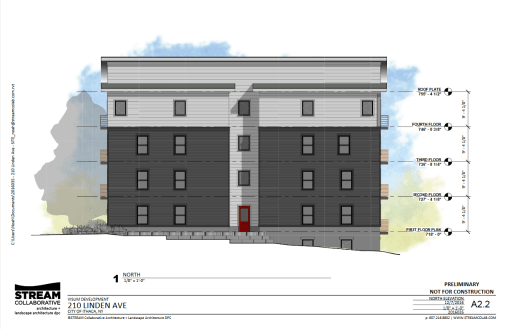
Only a couple minor changes occurred from start to finish – the window on the northeast face was replaced with a patterned trimboard to keep visual interest. The rooflines ware adjusted in the render below, but not the building plan, so we’ll see which is correct.

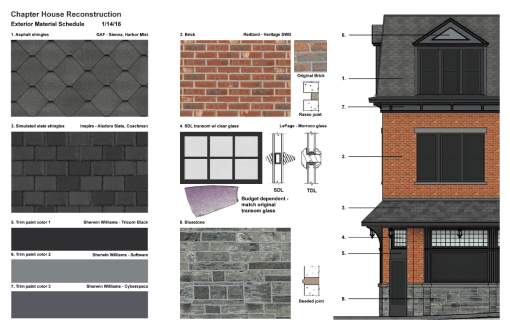
For materials, the basement-level will use stucco mixed with Sherwin-Williams “Sawdust” paint, the first level is a combination of Belden face brick (Belcrest) and S-W “Truepenny” fiber cement clapboards, more fiber cement clapboard on the mid-section in S-W “Overjoy“, trimboards, balcony trim and window casing colored S-W “Svelte Sage”, black window frames, stucco (in S-W “Favorite Tan”) with more fiber cement trim and frieze boards on the top level, and the pyramidal roof caps will be standing seam metal, Pac-Clad “Aged Copper”. Mix of materials, mix of colors – should stand out nicely.

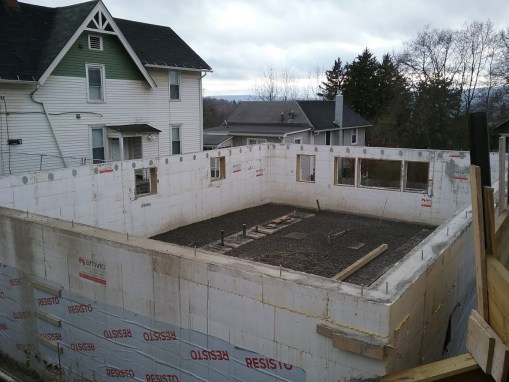
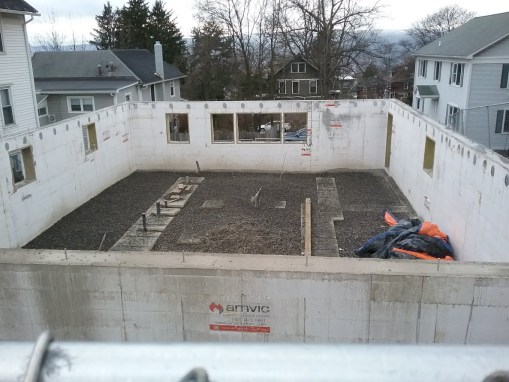
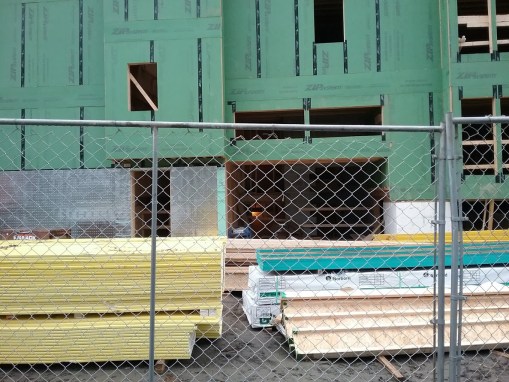
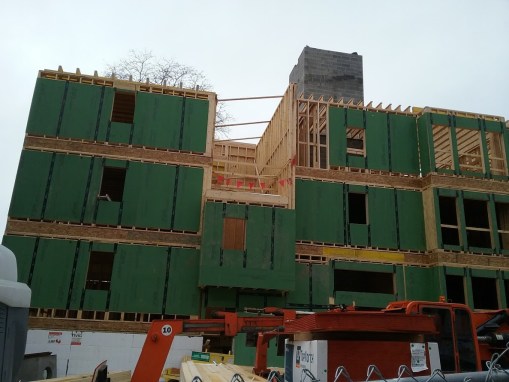
Expect buildout to look similar to 210 Linden and The Lux – Amvic insulated concrete forms at the basement level, double-stud Huber ZIP panel plywood sheathing, scratch coats on the portion to be covered in stucco, perhaps wood furring to raise the exterior clapboard and prevent dampness, and probably Anderson windows. The project is expected to be complete by August – units are going for $950/bedroom, plus utilities. Pricey, but at least they allow large dogs.

Along with Visum and Red Door Rentals for this ride through the development process is STREAM Collaborative as the building and landscape architect. Since they’re GC at 210 Linden Avenue, Romig General Contractors may be the manager of the construction crew here as well.


The Lux (232-236 Dryden Road) Construction Update, 4/2018

3 05 2018

At the site of The Lux at 232-236 Dryden Road, framing continues on the new apartment buildings. I’m under the impression that, like the Ithaka Terraces project also designed by STREAM, these are thick double-stud exterior walls. Double-stud walls are built using two sets of wood stud walls used in the exterior frame, parallel to each other but spaced apart by about 5 inches. That space is then filled (if like STREAM’s other projects) with R39 densely-packed cellulose insulation. The result has its pros and cons. The cons are that it’s more expensive to build, and it reduces the interior space a little bit. The pro is that it’s very energy efficient, which comes in handy for a project trying to achieve net-zero energy use.

On top of that appears to be wood furring strips for the cladding. I think the white panels on the north side might be boards with some kind of waterproofing? The roof on 232 Dryden appears to have had underlayment applied, but no EPDM (synthetic rubber) or similar finish yet.

The Amvic ICF will be faced with grey stucco and a black brick veneer, while the upper levels will use LP SmartSide white and marigold yellow fiber cement lap siding. The reflective material is likely insulation that’s also intended to keep out the moisture from the exterior brick.

The top floor will be finished with fiber cement panels with LP SmartTrim laid out patterned to give some visual interest to the top of the structures. The windows are Anderson 100 series units with black frames, and what will be white casings. Still rough openings in some of the walls, and the balconies are just starting to get built on the west face. 236 Dryden has yet to be fully framed, but the roof trusses are underway.

In its March email blast, the developer, local firm Visum Development group, announced that the contest to design lounge, gym and study rooms was won by two graduate architecture students from Cornell – for that, they win $2500 and will have a lounge named after them. The winning designs are here. As of February, about half of the 207 bedrooms were leased.

The project did pay a quick visit to the planning board recently to ask if they would could have permission to not screen some of the rooftop utilities – though less attractive and meant as a cost efficiency, these are less visible parts of the roof per the diagrams provided to the city. I didn’t hear any issues with it, so I assume it was deemed acceptable by the board.


210 Linden Avenue Construction Update 4/2018

1 05 2018

Looks like the first stud walls are going up on the third floor of the four-story 210 Linden apartment project (note the basement is partially exposed). Quite a bit of progress from the excavated hole and foundation pad back in February. This is a wood-frame structure with Huber ZIP System plywood panel sheathing and, presumably if like the other Visum projects, Amvic insulated concrete forms at the basement level. ICFs are thermally insulated plastic blocks filled with concrete – they tend to be a more expensive approach, but they also tend to have a higher grade of insulation (higher R-value), making for a more energy-efficient structure, and Visum and its project architect (STREAM Collaborative) have an eye towards net-zero energy capability, meaning all energy consumed by this building comes from renewable sources. ZIP panels are an increasingly popular to the traditional plywood and housewrap method (and since the integrated water-resistive barrier on the ZIP panels is a vivid green, they’re hard to miss). The choice of ZIP panels vs. housewrap really boils down to a matter of preference by the project team; ZIP panels tend to be easier to install (lower labor cost), but more expensive as a product.

Although my October notes show that William H. Lane Inc. was the general contractor on file, it appears that Romig General Contractor is the firm on-site. Romig of Horseheads is not known locally for involvement with multi-family projects, but as partners in Jepsen Romig Development (now Jepsen Holdings Inc.), they’ve been involved with several luxury homes built around the county (Southwoods, South Pointe, etc.) and they state on their website that they’ve provided commercial services to the ScienCenter and the Cayuga Ridge supervised care facility.

Also notable is that it appears the asking price for rent on the four-bedroom units has come down a fair amount since their first advertisements in the fall, from $1250/bedroom to $950/bedroom. This may be anecdotal evidence of some slack in the Collegetown market, as Maplewood’s 872 beds enter and steadily get absorbed into the rental market mix.

Background information on the project and more renders can be found here.


Chapter House / 406 Stewart Avenue Construction Update, 4/2018

30 04 2018

It’s hard to believe it’s been over three years now since the fire that decimated the Chapter House and the neighboring apartment house at 406 Stewart Avenue. According to a recent write-up by Mark Anbinder at 14850.com, the new build at 400-404 Stewart Avenue will host one eight units –  studio apartment, three 1-bedroom apartments, one 2-bedroom apartment, and three 3-bedroom apartments. The units are aiming for a summer occupancy, and CSP Management (Jerry Dietz and his team) are in charge of the rentals on behalf of developer/owner Jim Goldman.

From the outside, the building is practically complete, except for landscaping/paving, trim pieces, and facade installation of the ground-level bluestone veneer. The 4-unit, 11-bedroom apartment building next door is not as far along, with roof trusses only just being installed, and sheathing (ZIP panels) and window fittings underway on the lower floors. It’s a reasonable bet to say these will be available for their first tenants in time for the start of the new academic year in late August.

As fair as anyone’s aware, the ground-floor space restaurant/bar is still available for lease, at $35/SF (at 3,000 AF, that means $105,000 annually). Chapter House owner John Hoey has said in the comments here that the price is too high for his business. The possibility of a “Chapter II”, as some have dubbed it, seems increasingly remote. Any other potential lessees can contact David Huckle or August Monkemeyer at the Ithaca branch of Pyramid Brokerage.


The Lux (232-236 Dryden Road) Construction Update, 2/2018

19 02 2018

Things continue to move at a good clip over at “The Lux” at 232-236 Dryden Road. It looks like the insulated concrete forms (ICFs) have acquiesced to standard wood framing and ZIP panels on the upper floors. The building facing Dryden Road, 232/The Lux South, has commenced with framing of four of its five floors, and the elevator core/stairwell stands at full height (zoning only allows four floors/45 feet, but its a sloped site, so technically that bottom floor is a partially exposed basement level). 236/The Lux North has begun work on its basement level with the construction of ICFs covered with a vapor and water-resistant barrier (Resisto), and it appears that the first blocks for an elevator core/stair column are being assembled.

There might have been some internal reconfiguration. Site plan review documents noted that 232 Dryden will have 20 units and 53 bedrooms, and 236 Dryden will host 40 units and 138 bedrooms. But, a recent post on Visum’s facebook page suggests the project will have 207 bedrooms, not 191 as originally conceived. Everything appears to be on track for an August 2018 occupancy.

Even with the expected Cornell dorm additions in the next three years, the Lux’s location in inner Collegetown gives it an advantage over more remote housing options – students/parents with deep pockets will often pay more to be next to campus, while the amenities and worry-free living help seal the deal (worry-free in the sense that there’s no “deferred maintenance” to be concerned with when the units are brand new). Rents here are going for $1,200-$1,300 per bedroom, though they have a promotional running right now for 10% off rent for the first month.

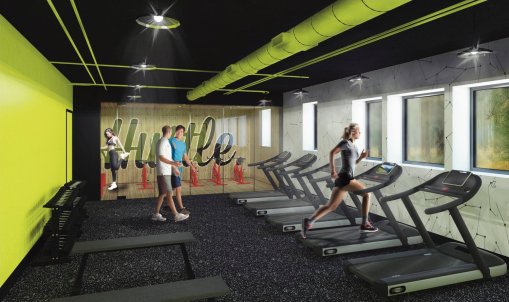
It appears there was an unusual but interesting contest held by Visum that invited students to compose interior designs for the three common rooms in the complex. Registered applicants (individual or group) received floor plans and interior documents to aid in their designs, and had about eight weeks to submit their final plans (December 2nd – January 21st). The winning team gets $2,500 and a building lounge will be named in their honor. Snagged from the website and included below are some mockups of the gym, a study room and a commons space.


210 Linden Construction Update, 2/2018

18 02 2018

So here’s some good news – 210 Linden Avenue is moving forward once again. The city’s Board of Public Works (BPW) held a special meeting on the 30th that would create a loading zone in front of 210 Linden Avenue. This is important because the new state fire code restrictions say no construction can occur along Linden since the street is no longer considered wide enough. By eliminating the parking space in front of 210 Linden and replacing it with a loading zone, it created a “wider” street since a fire crew would no longer have to worry about parked cars along the street frontage. This made it easier for the project to obtain a fire code variance from the state.

BPW is ostensibly not a fan of the arrangement, but given that the developer (Visum) was notified by the city of the change after the existing building had been torn down, they were willing to grant the loading zone given the unique circumstances.

Well, mostly unique. One other project was subject to the the same issue under very similar circumstances – Novarr-Mackesey’s 238 Linden Avenue. That project team is also asking for a loading zone during this month’s BPW meeting, and hopes to be granted a state fire code variance as well (and 210 Linden gives them reason to be optimistic). While every future project planned for Linden is now in limbo, it appears likely these two will be able to move forward.

Also in the good news category, a state fire code variance was granted for another Visum project, 118 College Avenue, under the expectation that the city and NYSEG will follow through with their plans to bury the power lines on College Avenue in the next two years. With the lines to be buried relatively soon, the state felt comfortable granting the variance for a building taller than 30 feet (118 College is just under 45 feet).

The buildings are aiming for an August 2018 completion. They are wood-framed structures, which in comparable economic circumstances, can move along faster than a concrete or steel. Even then, it’s still going to be a tight deadline for William H. Lane Inc.

A glance at Zillow shows that the basement 1-bedroom unit appears to be spoken for (the basement unit was a modification to the original plan, perhaps because many amenities will be shared with its siblings 201 College and “The Lux” at 232-236 Dryden Road), but the nine 4-bedrooms/2-bath units (1,365-1,440 SF) have not. Zillow says there are ten 4-bedroom units – that doesn’t seem correct. They are going for $4,400 apiece, or $1,100 a bedroom. That’s actually a sizable price drop from the $5,000/month they were being offered for before the fire code debacle.


News Tidbits 1/21/18: Twice in One Weekend

21 01 2018

1. It appears that 107 South Albany Street has had its exterior design heavily altered, even as the building is just starting framing. The old design’s flat roof and unusual stair column feature have been toned down to a pitched (gable) roof of about the same height and dimensions. According to ads on Zillow, the 1-bedroom units, which will be ready for occupancy by August 1st, will go for about $1,395/month. For the price comes a fully furnished unit with indoor bike storage, high-end appliances, tiled bath, custom cabinets and high-speed internet. Water and snow removal are included in rent, electric is not. Fairly certain Daniel Hirtler is still the architect for Stavros Stavropoulo’s latest residential project.

To be frank, I don’t know how much an exterior design can change without having to go back to the planning board – offhand, I think they can do pretty much whatever changes they like, so long as they don’t violate zoning laws or change the habitable square footage.

2. Ithaca architecture firm HOLT Architects totally revamped their website. Among the snazzy new updates was a video.

Now, there are an embarrassing number of HOLT projects I can think off the top of my head, but while watching the 1’22” film, there was one project I did not recognize at all. Above, we see two 4 or 5 story residential buildings along a waterfront – the perspective renders behind the gentlemen’s shoulder are likely all part of the same design set, and the white vehicles in the concept site plan are parked boats. It also appears TWMLA is involved as the landscape architect.

Blowing up the image gives the name “Lembeck Landing”. At first, I thought it said Lambrou Landing, and had reached out to see if it was part of City Harbor; the response was that this appears to be another project. I tried to analyze the streets, it doesn’t look like an Ithaca map, and one street may be named “Porter”. Probably not Ithaca, but someone’s getting some nice waterfront housing. Watch the video for brief shots showing the inside of CFCU’s new HQ and some selected material finishes.

Update: It’s Watkins Glen. An undeveloped parcel near its Porter Street. Thanks to Keith Eisenman for solving the mystery.

3. Let’s just touch on the waterfront real quick. City Harbor is going to be a very substantial project. The first sketch plan involved two large apartment buildings and medical space for Guthrie Clinic; Guthrie would lease its recently purchased warehouse at 770 Cascadilla Street to Greenstar for a bigger, grander co-op; and a third location that will be presented at this month’s planning board meeting. The apartment buildings will be 4 or 5 floors and had ground-level parking with large amounts of surface parking for Guthrie, something that planning board was not a fan of. The other Cascadilla industrial building, 750 Cascadilla, may come down for more parking.

On the one hand, underground parking is out of the question due to the high water table, and above ground parking structures have to contend with soil issues as well, likely leading to deep foundations and increased costs. But an asphalt sea on the city’s shores is not something that will get the board’s approval.

Still, we are potentially talking hundreds of units, as well as a substantial amount of commercial space (and perhaps jobs) with the Guthrie component and the Greenstar expansion. It may very well be that this and the Green Street Garage plan will be the big development stories for the year.

4. Cornell will not the idea of that glass “hat” die; they’re calling it a “suggestion of a future roof pavilion”. The city’s ILPC probably isn’t comfortable with that suggestion being so close to the historically-designated Arts Quad. Anyway, renovations are underway on Rand Hall into the Mui Ho Fine Arts Library. The $21.6 million project, about half of which is funded by donations, will be ready for students and staff in August 2019.

5. It sounds like the city has had just about enough with the state’s aerial apparatus fire code changes that halted much of Collegetown’s approved development projects. They’re prepared to take steps to eliminate parking on Linden because the new state law says Linden is too narrow as-is to have construction taller than 30 feet. This seems to be in addition to the power line issue. For 210 Linden, whose developer (Visum Dev. Group) specifically applied for some kind of relief, it would just be in front of the building; Todd Fox had already started work when the building codes department were notified and started enforcing the new code, which is not a good scenario.

Ithaca would prefer the state grant a broad variance (the new code has apparently been an issue across the state), and normally removing parking wouldn’t “fix” the underlying problem, but since New York State did not notify municipalities they were changing the law, they’re attempting to compromise on something that they normally would not. It might also explain why activity in Collegetown has been quiet these past few months outside of the inner core, where the streets are wider and the power lines are underground. The city is looking into how to make development work with the fire code if the state refuses to budge on code modifications. To be fair, there is tens of millions in development and its associated tax revenue that the city was expecting and that the state, in the midst of a budget crisis, is (literally?) hosing them on.

Whatever the city decided at its BPW meeting last week, it seems to have made Visum happy. They’ve started marketing 210 Linden’s units again. It’s saying there are 10 4-bedroom units, and 1 1-bedroom unit, while my notes say 9 4-bedroom units. Maybe the basement was reconfigured? Not sure.

Update: According to a Visum Rep, 210 Linden is 9 4-bedroom units and has added a basement 1-bedroom unit. So now it’s 10 units, 37 bedrooms.


6. Around the county, not a whole lot else on municipal agendas at the moment; one of the reasons for no update last week. Dryden town’s planning board will be looking at plans for a new warehouse next to 51 Hall Road, as well as a 5-lot subdivision at 1540 Ellis Hollow Road for Tiny Timbers, the Dryden-based modular home builder. Tiny Timbers uses the warehouse at 51 Hall Road, so it wouldn’t be a shock if the new one is purpose-built for Tiny Timber’s growing business. The town of Ithaca planning board cancelled their last meeting.

The city is fairly quiet. The planning board agenda for next week is short and mostly contains smaller submissions – the pair of infill duplexes proposed at 209 Hudson are on the agenda, with some slight design tweaks (the eyebrow windows are an interesting touch on the rear building). To the developer’s (Stavros Stavropoulo’s) credit, the units are design to accommodate families rather than students – the giveaway are the separate dining room areas, vs the eat-in kitchens one typically sees with student rentals. Senior planner Lisa Nicholas also gave written kudos for the quality exterior material choices (Hardie Board fiber cement panels, aesthetic wood timbering, stone retaining walls).

A fly in the ointment, per reader email: none of the bedrooms are legal for 2-person occupancy. They are 115 SF each; the state fire code says double occupancy must be at least 120 SF. So that would be an issue if one considers couples’ bedrooms.

The board is expected to declare itself lead agency, host a public hearing, and begin review of the SEQR forms needed before a negative declaration for adverse impacts can be declared. The 4-bedroom addition for Sophia House (111 the Knoll, Cornell Heights) is up for final approval. The proposed playground at Stewart Park is also up for discussion, with the board once again expected to declare itself lead agency, host a public hearing, and begin review of the SEQR forms.BPW is not comfortable accepted the $1.7 million playgrounds, gardens and splash pad unless Friends of Stewart Park creates a $75,000 annual maintenance fund. Lastly, City Harbor will be up for a second round sketch plan, informal discussion to obtain feedback for any future formal submission to consider.

The Nines project (311 College Avenue) is not on the board’s agenda this month. Things are up in the air, as the ILPC has chosen to pursue historic designation, even as there is an active project submission. A little awkward, certainly.

On the 30th, the Planning Board will convene for a special meeting to finalize the form-based code for the Planned Unit Development to be deployed for the Chain Works District.

According to notes from the city Planning Dept, the city approved $130 million in development in 2017. There were 29 projects with 568 housing units, 107 of which are designated affordable for lower & middle income (LMI) households. Also approved was 28,600 SF of new retail & office space. These were from a summary sheet from the planning department, and the detailed write-up will come next month.

7. On a closing note, preliminary estimates suggests that Tompkins County added an average of 1300 jobs over the 2017 calendar year, bringing the average annual job count to 65,300. The gain is just over 2.0%, comfortably above the national average of about 1.5%, but nothing that screams ‘boomtown’. Since 2007, the annual average has increased by 7,700 jobs, +13.8%. The numbers suggest that the gains are slightly better in the fall and spring (7500 – 7700 jobs) than for the summer and winter (7000 jobs), indicating that academic year seasonal jobs are growing slightly faster than the overall market.


The Lux (232-236 Dryden Road) Construction Update, 12/2017

18 12 2017

Some progress on Visum’s latest project, “The Lux” at 232-236 Dryden Road in Collegetown. 232 Dryden, the building closer to Dryden Road, has started work on exterior framing – the partially-above grade basement level, built into the slope of the site, appears to have been framed with Amvic insulated concrete forms (ICFs), similar to those seen at the Ithaka Terraces and the Fox Blocks at the Thurston Avenue Apartments. These are thermally insulated plastic blocks filled with concrete – they tend to be a more expensive approach, but they also tend to have a higher grade of insulation (higher R-value), making for a more energy-efficient structure. There has been talking of making the complex net-zero energy capable, provided that the energy of an off-site solar array can be procured. STREAM, the architect of The Lux, also did the Ithaka Terraces. The exterior walls will be assembled block by block, with new pours as rows of blocks are set in place. The rebar provides additional stability. It appears the cinder block elevator core/stairwell has been assembled as well.

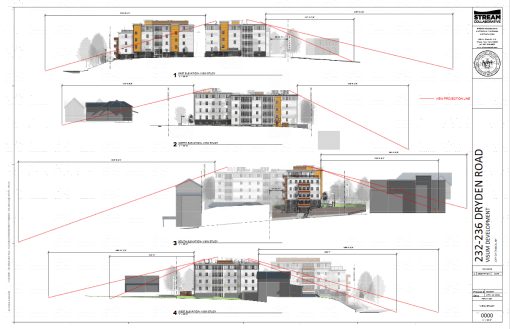
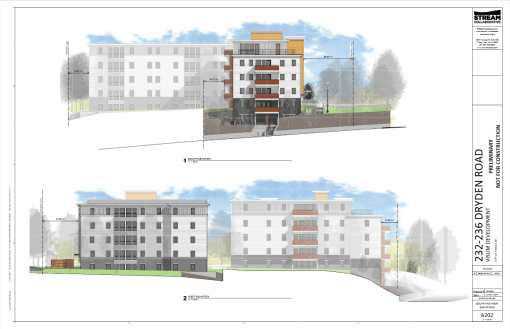
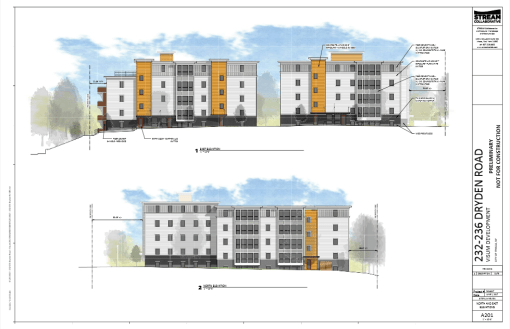
232 Dryden might be the more visually prominent of the two building, but it is also the smaller one – it will have 20 units and 53 bedrooms. 236 Dryden will host 40 units and 138 bedrooms.

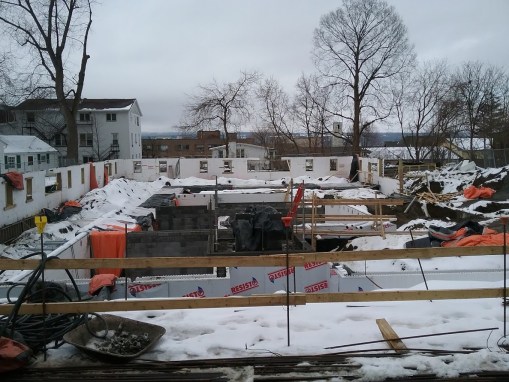
Speaking of 236 Dryden,  Welliver has the foundation excavated, and the steel piles are in. However, judging from the steel rebar sitting on the edge of the site, the concrete pours have yet to take place, and it looks like the wooden forms are just now being built on the far side of the footprint.

Pessimistically, I could note that this is one of the few Collegetown projects that was able to move forward after the building code change that brought multiple other projects to a halt – the power lines on Dryden Road aren’t close enough for the project to infringe on the new regulations. I had heard Visum might actually pay for the burial of power lines on the 200 Block of Linden Avenue, but even if they did, they would still have to deal with NYSEG’s slow schedule.


400-404 & 406 Stewart Avenue Construction Update, 12/2017

17 12 2017

400-404 Stewart Avenue, a.k.a. the former Chapter House site, is fully framed and the brickwork is in progress. The brick veneer is Redland Brick Inc.’s Heritage SWB, and is similar in appearance to the original brick of the Chapter House, which was damaged beyond repair in an April 2015 fire. So the way this has gone is that yellow closed-cell spray foam was applied over the sheathing, probably by a subcontractor such as Goodale Spray Foam out of King Ferry. Closed-cell spray foam, made with polyurethane and applied a few inches thick, provides insulation under the brick. Brick is a tricky material in some ways – the plywood ZIP Panels are great for sealing a structure to make it air-tight, but brick absorbs moisture, so the spray foam not only serves as an insulator, it also provides a protective moisture barrier between the plywood and the brick. It’s typical to have a drainage gap underneath the brick so that they can dry out, otherwise the uninsulated brick is at risk of long-term moisture damage.

The roof looks to be covered in tar paper or similar material; this will eventually be layered over with chamfered asphalt shingles. The roof ZIP panels that make up the “awning” being built over the first floor will be covered in shingles as well, but those will be more expensive simulated slate. The trim pieces like the cornice may be cast stone or fiberglass over wood, and it looks like the window sills and heads might be cast stone. It looks like they’re using Marvin Windows for the windows themselves.

406 Stewart Avenue is still being framed with ZIP panels, now up to the third floor with just the roof trusses left. The drawings I have on file suggest the fenestration has been changed – the position and size of the second floor windows are different from the renderings, in particular the window on the far left of the front face, and one of the windows on the north side was moved further back from the street. It suggests some modest interior alterations, but the ILPC will be watching this like a hawk since these builds are under their jurisdiction (the East Hill Historic District).


News Tidbits 12/2/17: The Changing Calculus

3 12 2017

1. Perhaps the big news of the week is that Visum Development Group’s project for 311 College Avenue (the Nines restaurant and Bar) was revived after negotiations with the seller moved in a favorable direction. This time around, it appears that Visum is bringing something close to an “A” game proposal; Jagat Sharma is still the architect of record, but Visum’s VP for New Market Development, Patrick Braga, had a heavy hand in the design work and historical research. The designs produced are more historically inspired and embrace some of the elements that make the old fire station attractive to the public – the first floor doors will pull up like garage bays or slide open to create a sort of open-air loggia on warm days, and a cornice element is retained. Floor to roof will be about 66 feet according to the Times’ Matt Butler, and still contain about 50 1-bedroom and studio apartments as well as 750 SF of retail. For the record, he and I did a bit of collaboration on describing the architectural features before we ran our respective stories.

The sketch plan had a kinder reception from the Planning Board this time around, if still cautious. Even though John Schroeder made it clear he would never accept any plan for The Nines, he said something to the effect of, if this design were proposed for any other MU-2 in Collegetown, he would have no problems with it whatsoever. The rest of the board did a quick poll to see if the other members would at least entertain a proposal, and no one else said no, so the project is considered active.

Now, things can get a little awkward from here. The city planning director, JoAnn Cornish, made it clear that they could move forward with design if they want, but there’s a risk that the property may get landmarked before they get approval. Speaking with the city historic preservation director Bryan McCracken the day after the article, he said that a decision on whether or not to move forward with the landmarking process would be on the agenda for the ILPC’s December meeting. If they move forward, it still has to go to Common Council. I had previously heard through the grapevine that the council was favorable to landmarking in the case of the Nines, but that was before Visum brought forward a new plan. The truth is, things are fairly unpredictable at the moment, and it’s a matter of waiting and watching how different stakeholders act and react.

2. I like Matt Butler, he has time to do the stories that I can’t. This time, a look into the plans for a centralized government facility at the site of the Central Fire Station on the 300 Block of West Green Street. That study is still active, under the guidance of Kingsbury Architecture and TWMLA, as is the second study for a combined Public Works facility. The appraisal process and estimates of cost are also still underway.

It’s kinda a given that this would have tremendous impacts, as noted in the Voice. A lucrative Collegetown site and other redevelopment sites would be on the market, and hundreds of workers and daily visitors would extend Ithaca’s core down State Street, which the city wants, considering it to be one of the few directions downtown can expand towards without compromising too much of Ithaca’s existing urban fabric. The ILPC would need to sign off on plans due to the fire station’s proximity to the “Downtown West” historic district (it actually contains the IFD’s parking lot for the sake of contiguous parcels), so “super-edgy hypermodern” probably isn’t on the table design-wise. The city also has to make a decision relatively soon – the current city hall (former NYSEG HQ, built 1939) and “Hall of Justice” (1920s, renovated/expanded 1964-66) are in need of major renovations.
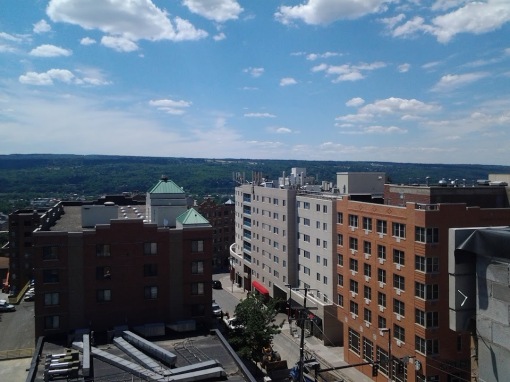
3. Also on the visionary end of discussion are future plans (2020 onward) for Collegetown’s transit network. Here, it is often a delicate case of balance; it’s a dense, lucrative secondary core of the city, but parking and traffic are problems, as is the lack of infrastructure for pedestrians and bicyclists. One option being explored is a new bike lane up College Avenue that would eliminate 35 parking spaces (and was not well received), and the other is a more modest plan that largely keeps College Avenue as is, which many didn’t like either.

Perhaps the most interesting note from the article is that the city is examining the feasibility of expanding the Dryden Road garage by adding additional floors to the 1980s structure. The Dryden Road garage has the highest parking rates and a high occupancy, and is the most lucrative of the city’s four garages. The city is also looking at incentives for on-site parking, which to be honest, probably isn’t going to work in Collegetown for a number of planning and financial reasons (i.e. a developer will make a lot more from a rentable unit per SF, than from a parking space per SF).

4. Nothing much of note from the town of Ithaca Planning Board agenda. The owners of a former convenience store at 614 Elmira Road are seeking to perform minor renovations to the building for a bottle and can return (to be called IthaCAN & Bottle Return), and Maplewood is asking the town planning board permission to work on Saturdays in a mad dash to have the 872-bed complex ready for occupancy before August. Normally, renovations don’t need to visit the board, but the zoning for the Elmira Road requires a visit for each change of occupancy/use.
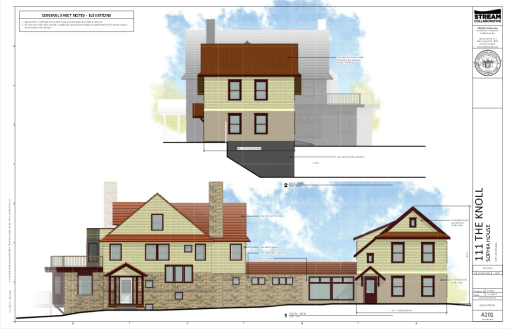
The city of Ithaca’s Planning Board memo is short as well, just the long-brewing plans for a garage-replacing addition to 115 The Knoll in Cornell Heights. The 1950s garage will be replaced with a 4-bed, 2-bath addition for Chesterton House, an all-male Christian interest group Sophia House, an all-female Christian group.  It appears the design has changed very little if at all since the plan first became public in May. The $349,900 addition, designed by STREAM Collaborative, would be built in the Spring and Summer of 2018 for an August opening. (Correction: Chesterton House is next door and owned by the same group. The project is for Sophia House. Thanks to Lyn for catching that.)
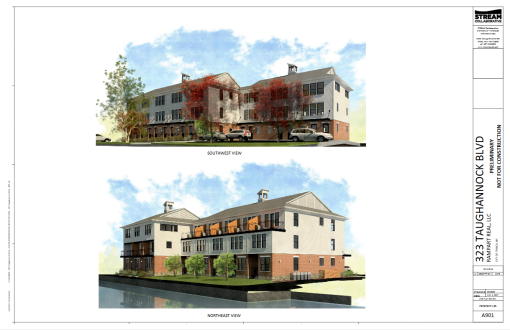
5. Local developers Steve Flash and Anne Chernish (d/b/a Rampart Real LLC) will be taking on a partner in the 323 Taughannock project. The couple sold a $203,000 stake in the 8-townhouse plan to Arnot Realty of Elmira (d/b/a 323T LLC) on the 22nd. For Flash and Chernish, it gives them a much bigger partner with experience and connections to contractors; for Arnot, it gives them a toehold in the buregoning Ithaca market, their first step into the city. The deed explicitly states this is a joint venture.

6. So this is interesting. On Friday 12/1, an LLC purchased an industrial/office building at 37-40 Elm Street in Dryden for $260,000. The property was built in the late 1980s and is about 25,000 SF, with a warehouse, manufacturing space, office space and three apartments.

The buyer was an LLC, but the LLC filing address traces back to 312 Fourth Street in Ithaca, a 13,800 SF complex of buildings and warehouses home to the All Stone & Tile Company, Ithaca Ice and Strawbridge & Jahn Construction. So either someone is growing out of space and the others are staying, or they are all moving. If they are all moving, that could be an opportunity. Zoning is B-4,  which allows a very wide variety of business and residential uses. Zoning is 4 floors/40 feet maximum height, 50% lot coverage, but being on the tip of the Waterfront/West End corridor, my suspicion is that the city could be a bit flexible with zoning variances for density and/or affordable housing. The only places one finds B-4 zones are the fringes of downtown, so it’s not well-suited for big projects, but there’s room to explore options. Of course, the electrical substation next door isn’t ideal, and the property isn’t even up for sale, but this is worth keeping an eye on.

7. So, there’s no real avoiding it this week – the tax bill in Congress. It really hurts Tompkins County. I did my one and only tweetstorm to cover some of the issues, and most of it still holds. Two last-minute changes softened the blow between then and now. One was the inclusion of the Collins amendment to reinstate a $10,000 cap on SALT (State and Local property tax) deductions, since the original Senate bill had no deduction. The other was raising the endowment from colleges with an endowment of $250,000/student, to those with $500,000/student. Cornell’s is about $310,000/student (6.8 billion/22,300 students). For the record, it wasn’t done to protect Cornell, it was done to protect conservative Hillsdale College after an amendment to give it an exclusive exemption failed. At least 30 schools were still hit, and this detail has to reconciled with the House Bill’s $250,000/student figure.

So apart from the SALT and college impacts I had already noted, one thing that got missed was that the bills allow prohibit schools from taxing out tax-exempt bonds to fund construction. For Cornell’s plan to add 2,000 beds, this is a problem.

So let’s just overview this real quick – a bond is a fixed-income investment in which an investor loans money to an entity, which borrows at a fixed or variable interest rate for a fixed period of time. When you buy a bond, you hold the debt for that entity. Most investors typically have some proportion of bonds in their portfolio – they typically are more stable investments than stocks, though the returns are typically less. Their relative safety is why financial planners recommend a higher proportion of bonds as one gets closer to retirement. The riskiness of a debtor not paying back is given by their bond rating. Cornell’s long-term debt rating is AA, which is very good, high-quality investment grade.

Now, in the case of non-profit schools, typically the tax-exempt bonds are issued with the approval of local and state authorities. The project to be financed by the bonds is determined by the school. The school does its internal approval of the project and bond plan, and the project it goes up to the community for planning board/environmental review. Once approved, the school chooses an approved issuer of bonds, often a state or local development authority (ex. The Dormitory Authority of NYS). A working group is put together to establish a timetable and structure for the bonds, and once the bond structure is settled and reviewed for issues, a public hearing is held on the bond issue, so that any issues or concerns are made clear before issuance. Barring no problems, the government signs off on the tax-exemption for the bond issue, a closing date is established and the bonds are marketed and sold, mostly to banks and big investment firms. The received funds are disbursed to pay for the project.
That’s getting taken away by this tax bill. That means any future bonds will be taxable, and have a much higher interest rate. Borrowing just became more expensive. A 30-year AA tax-exempt bond might be 2.76%, and a taxable bond 3.37%. That might seem a small difference, but a 2,000 bed project is on the order of $200 million (recall Maplewood is 872 beds and $80 million). So we’re talking millions of dollars more that Cornell will now have to pay to make those dorms happen. It opens up a distinct possibility that the project could be scaled back and/or delayed, which impacts the overall housing market. Probably the federal SALT tax cap is going to hurt much more.

Really, this bill was practically designed to decimate real and perceived enemies of politically conservative groups as much as it was designed to help billionaire donors and corporations. Poorly conceived, ignoring multiple non-partisan analyses and relying on overly optimistic projections, hastily put together and shoved through, blowing the debt trillions higher and immediately or eventually raising taxes on tens of millions. This is every cartoonish stereotype of Republicans amplified in one piece of legislation.

I don’t like to get political, but I’m a registered Republican, and have been my whole life. As a pragmatic never-Trump moderate, I joke that I’m a New York Republican and a Texas Democrat. When one writes about government red tape, the Cargill Mine, and Ithaca’s progressives attacking affordable housing, it tends to reaffirm beliefs.

But hell, this tax bill is throwing every principle out the window with this bill, causes a ton of damage to a place I care about, and with a morally deficient and unstable president at the helm, I can’t do it anymore. I mailed off the form today to become an independent. After this, I just can’t see myself voting Republican again, not for a long time.