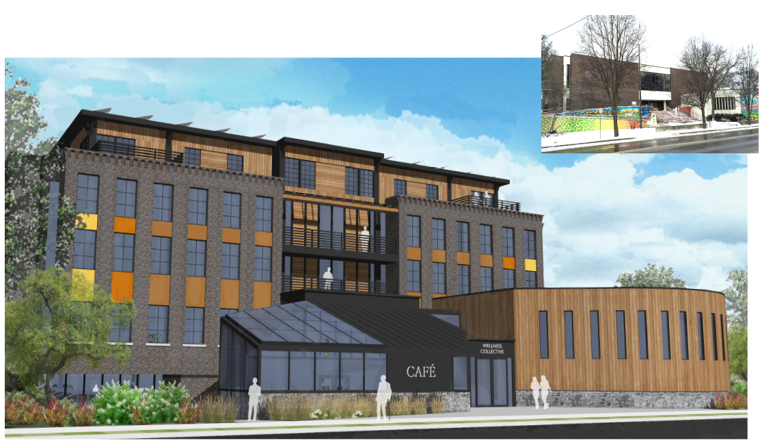
307 College Avenue (Collegetown Crossing) Construction Update, 4/2016

25 04 2016

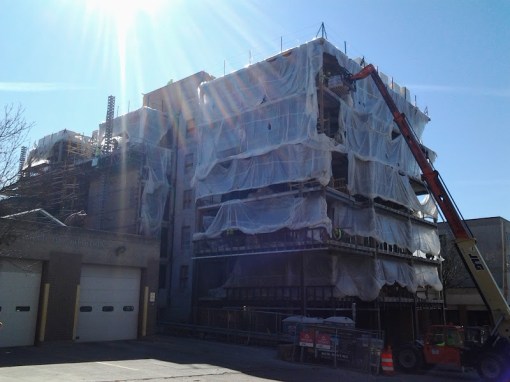
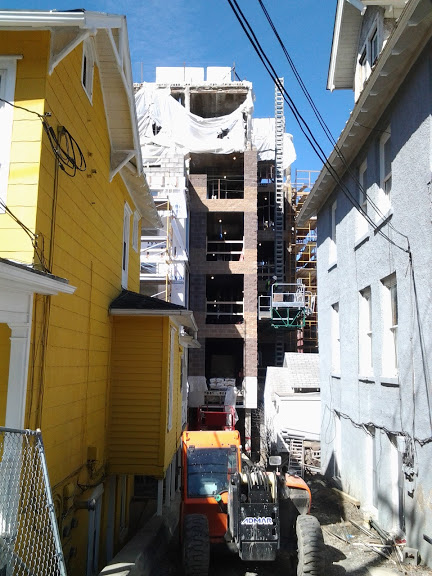
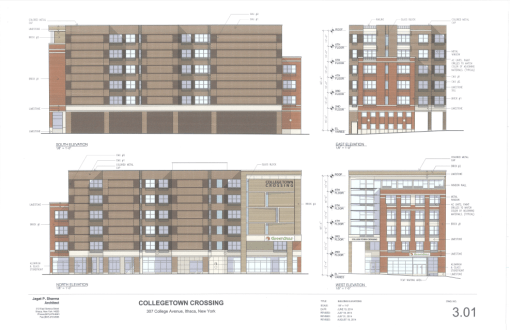
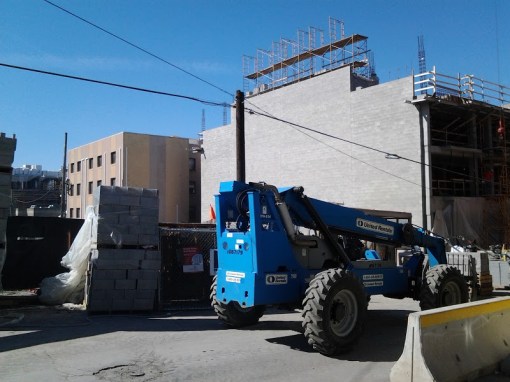
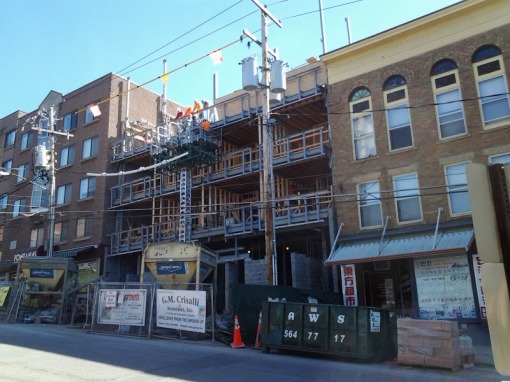
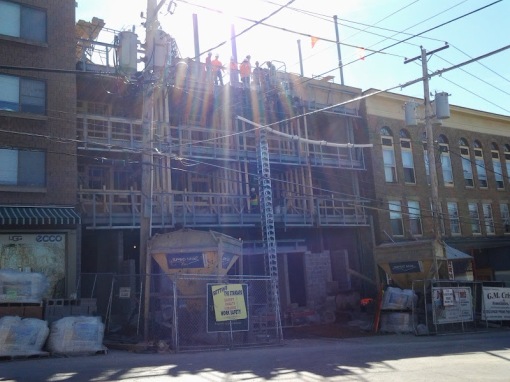
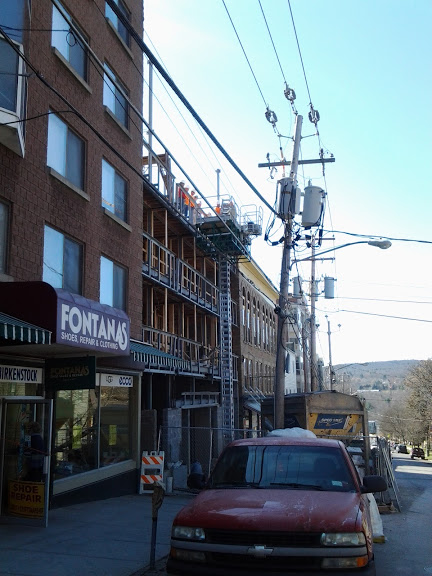
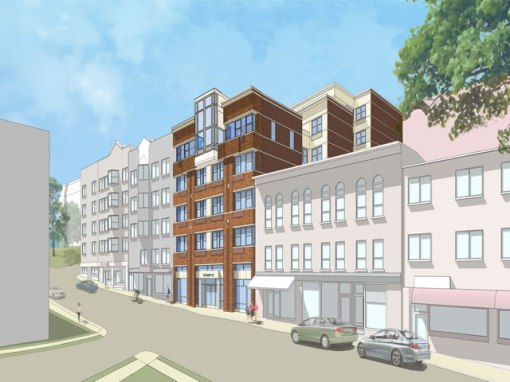
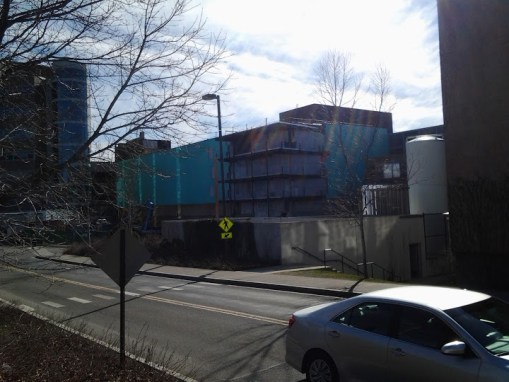
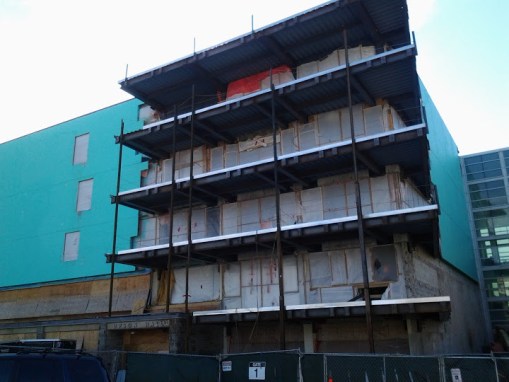
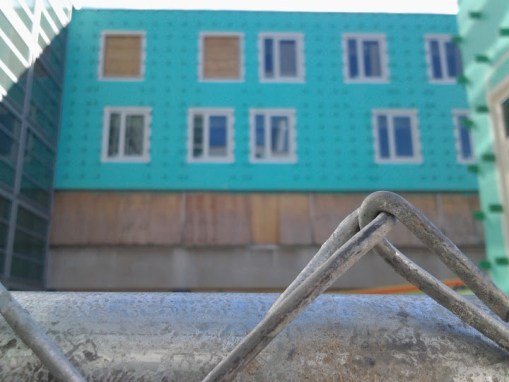
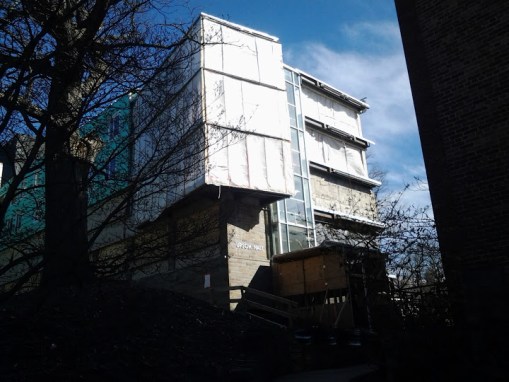
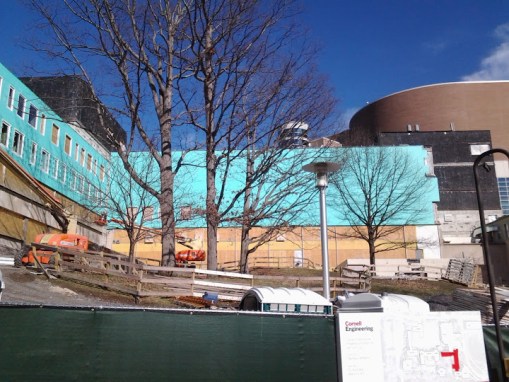
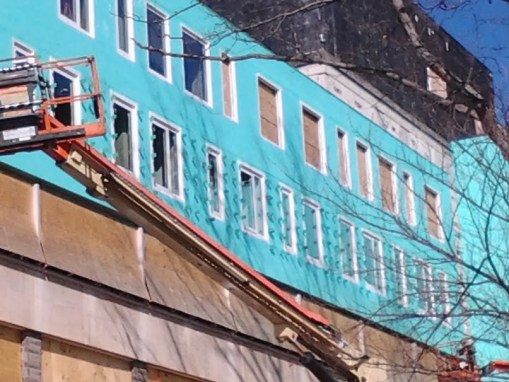
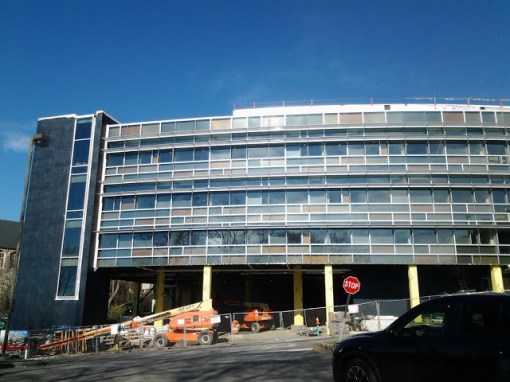
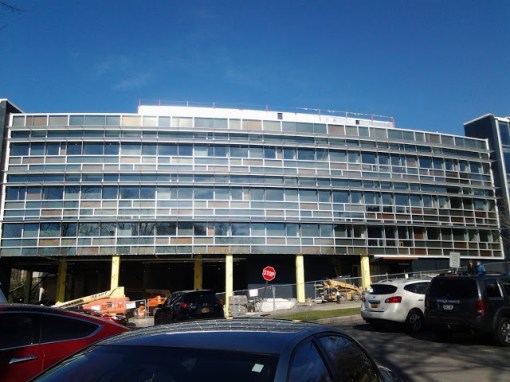
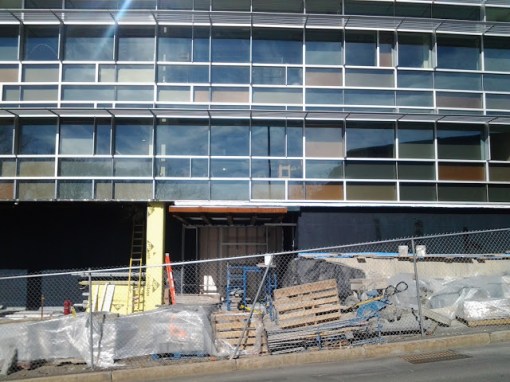
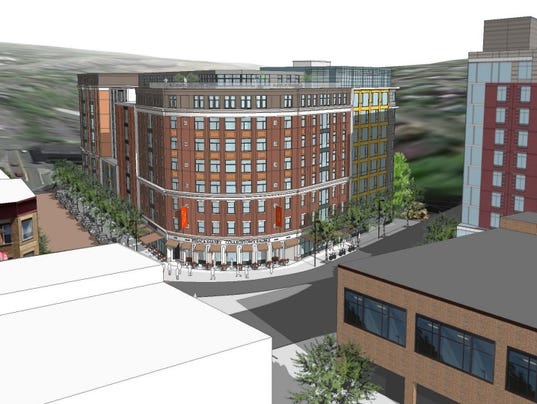
Collegetown Crossing is starting to show its face. Windows are being installed, and the CMU walls are on display. The mostly glass front facade has yet to go on, and brickwork will eventually go over the Tyvek housewrap on the 4-story, CR-4 portion of the portion. As mentioned in the Voice piece, a construction worker on-site said that interior work is focused on interior wall framing, sheet-rock hanging, and electric rough-ins at the moment.

According to building developer Josh Lower of Urban Ithaca, the project is being included as a part of a city grant application related to public transit, though it’s not something I’ve heard much about. It definitely fits the bill – designated internal bus shelter and pull-off space for up to two buses, a pedestrian through-fare and pocket park that connects College Avenue and Linden Avenue, ample bike racks (12 spaces required, 24 being provided), 3,200 SF grocery store on the first floor and Ithaca Carshare is but a couple hundred feet away.

There are a couple smaller retail spaces included as part of the project, but there hasn’t been any indication as to whether they have tenants lines up.

Like Dryden South and the Dryden Eddy Apartments, Collegetown Crossing plans to open in time for the fall semester. Ithaca’s Jagat Sharma is the architect, and Hayner Hoyt Corporation out of Syracuse is in charge of the build-out.

20160415_102004 20160415_102109 20160415_102141 20160415_102216 20160415_102337 20160415_102359 20160415_102450 20160415_102754 20160415_104451

307_college_site_plan_final 307college_rev2_1

ctown_crossing_rev2_1


205 Dryden Road (Dryden South) Construction Update, 4/2016

25 04 2016

Another project in the mad dash for a summer completion (7/7/2016) is Pat Kraft’s mixed-use building at 205 Dryden Road, the “Dryden South” apartments. Workers under the direction of Rochester’s LeChase Construction are building up the reinforced concrete frame, and you can see steel rebar poking out of the fourth floor, which will be wrapped in wood forms and encased in concrete, with enough rebar poking out at the top to tie-in to future sections. The construction crane comes from C.P. Ward, a construction contractor in suburban Rochester. On the outside, the CMU walls are being assembled; not a whole lot of aesthetic effort is being put into the appearance of the east wall because it will be hidden by the 209-215 Dryden project within months of completion, although the renders show slit-windows on the building’s east face.

Kraftee’s was slated to occupy the first floor retail space, but the space is now being retooled. The project is in MU-2 zoning, and is legally obligated to have “active use” commercial on the 2,400 SF first floor: hotel, bank, theater, retail, and/or food service.

It looks Dryden South’s website has been overhauled. Apparently, if the building isn’t ready by August 1st, Kraft will refund renters twice the daily rent until the building is issued a certificate of occupancy. Rents range from $1190-$1350 per month, per bedroom, which is quite expensive, but this is also Inner Collegetown, which has the highest real estate values in the city.

20160415_101517 20160415_101531 20160415_101610 20160415_101703 20160415_101958

dryden_south_rev_2


327 Eddy Street (Dryden Eddy Apts) Construction Update, 4/2016

25 04 2016

Here are the latest photos for Steve Fontana’s mixed-use project at 327 Eddy Street. Work is up to the fourth floor in the front, and it looks like interior wall framing is underway on the lower floors, along with utilities rough-ins on the lowest levels. The rear section is further behind, steel is rising but workers have yet to move beyond the first floor. Progress should be happening fairly quickly from here on out, as the building needs to be ready for occupancy by the start of the fall semester. According to Fontana’s website (conveniently linked with the shoe store), unit prices range from $930 to $1250 per bedroom. The website doesn’t give any indication on how many units have been reserved.

There seems to be a slight discrepancy as to whether the project has 53 or 56 bedrooms in its 22 units. Counting on the webpage didn’t help, and the floor plans on the city’s website date from the 6-story, 64-bedroom version. A quick check shows my source was a Cornell Sun article from February 2015, no longer online. If anyone knows which number is accurate, please chime in.

A little more info can be found in last week’s Voice round-up here.

20160415_103153 20160415_103222 20160415_103243 20160415_104011
327_eddy_rev4_1


209-215 Dryden Road Construction Update, 04/2016

25 04 2016

The overview came as part of the Ithaca Voice roundup last week, but the number of photos that can be included is rather limited for two reasons. One, the labyrinthine picture portfolio in the Voice’s storage eats up space, and two, the general readers of the Voice mostly only care to see a couple of photos per location.

Work is well into the excavation phase of construction. The building’s basement (“lower level”) will hold a 90-space large group instruction classroom, a commons area for dining and mingling, some business offices, utilities and storage space. The large atrium area is meant to give some feeling of connectivity and openness with the upper six floors.

Side note, looks like Collegetown’s graffiti artists have had a field day with the fencing.

Because of the tight situation, construction staging is taking place on land that used to be a boarding house at 238 Linden, and into the public right of way on Linden Avenue and Dryden Road. After the building is completed in 2017, don’t be surprised if 238 receives a housing replacement consistent with CR-4 zoning.

Local businessmen John Novarr and Philip Proujansky are spearheading the project, with Cornell as sold tenant. Syracuse’s Hayner Hoyt is the general contractor.

20160415_101058 20160415_101135 20160415_101213 20160415_101255 20160415_101320 20160415_101355

209-215_basement

209-215_2.png


A Look Inside HOLT Architects’ New HQ

22 04 2016

Most of my photos are from the outside, so it’s pretty cool when I get a chance to inside.

HOLT moved into their new digs at 619 West State Street a few weeks ago, a few minutes’ drive away from their old location at 217 North Aurora Street (a building that used to be Ithaca College’s gym). First walking in, one of the first things that stood out was that there was little street noise coming in from West State, even though several large windows front the road; the secretary said that even she was surprised with how quiet it is.

I like that HOLT displayed not just their latest work, but also several older building models in their reception area. Among the projects on display were the Educational Opportunity in Center in Buffalo; the Peggy Ryan Williams Center at Ithaca College; the Roy H. Park Building downtown, and a campus setting I didn’t quite recognize. The Roy H. Park Building was done in the early 1990s, so the Strand Theatre was still standing when the model was produced.

The spaces are pretty wide open; it was explained that this was purposely done to make it easy to exchange ideas between staff, who are often split into groups according to the projects they’re working on. Some of the desks are sitting, others are standing-enabled. The principals have personal offices on the east side of the building, the left side of the first photo below. The southern space / rear section is a miniature shop area to assemble models of projects.

I did get a chance to speak with a few of the architects on staff while visiting; one was Tom Covell, a long-time architect who recently joined the company from Rochester’s SWBR. SWBR was involved in the Cornerstone proposal for the Old Library project, but Covell said he was not a part of that work. Another architect who was nice enough to take out some time to chat was Andrew Gil, who specializes in architectural design of lab spaces; this led me off on some tangent about my primary employer, who is a major stakeholder/tenant in plans for a new building, and all of our senior research staff are essentially like kids in a candy store, while the architect is like the babysitter whom the parents only gave so many dollars to work with. Andrew, if you read this, thanks for tolerating my babbling.

Briefly, a few younger staff also introduced themselves – one was from the West Coast, another went to school in the region, and the third immigrated to the United States. It was definitely a mix of background, which hopefully translates to a variety of ideas.

The building is designed to be net-zero – the energy that goes in is equal to the amount of energy the building produces, so on the balance it has no impact on the power grid. This includes automated lighting systems, solar panels, and roof and building envelope improvements among other things. More info about the green features and the construction progress can be found in the blog’s “HOLT Architects” entries here. More about HOLT and their interest in the West End of Ithaca on the Voice here.

For the sake of acknowledgement, there were a few of their latest projects on the tables; but that wasn’t the point of the visit. They’ll hit the blog pages when they’re ready.

A big, big thanks to HOLT’s Maria Livingston for the tour!

20160415_162947 20160415_162954 20160415_163015 20160415_163022 20160415_163048

619_w_state_st_1

20160319_144734


210 Hancock Construction Update, 4/2016

21 04 2016

So far, not so good. When it first came out that INHS was dropping its contractor, Hayner-Hoyt of Syracuse, due to Hayner-Hoyt’s settlement in a government fraud of disabled veterans’ funds, my assumption was that alternatives had already been arranged and it would be just a token piece to fill out my writing quota.

Then came the interview with INHS’ Paul Mazzarella. And the words “in limbo”. That set a grim mood for the rest of our conversation.

At that point, there was some mental debate about passing the piece to someone else on the Voice staff, but given the complexity of the situation, there was a good chance it wouldn’t be done properly, or another news outlet would pick it up and miss some of the nuances. INHS didn’t know what was going on, since the investigation and negotiation were under seal. A check with the North New York District Court verified it. A bad situation that was in many ways beyond INHS’s control.

Dropping Hayner-Hoyt saved face, but also put the non-profit developer in a bind, since they were not just the general contractor, they were the construction manager, meaning that this was a design-build and everything had been priced out with Hayner-Hoyt’s help. Another contractor could have different, higher prices, which would put the project in jeopardy.

On the bright side, it looks like the project will move forward. Speaking face-to-face with Scott Reynolds last week, he described it as “more of a hiccup” at this point. Hayner Hoyt helped them locate new potential contractors, and there is likely a new firm who will take on construction manager duties. Hopefully, the Voice will have an article on that when INHS is ready to make the formal announcement.

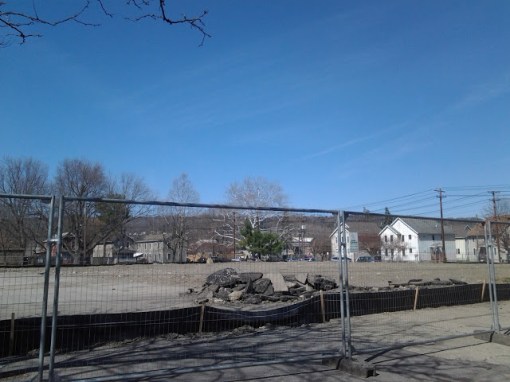
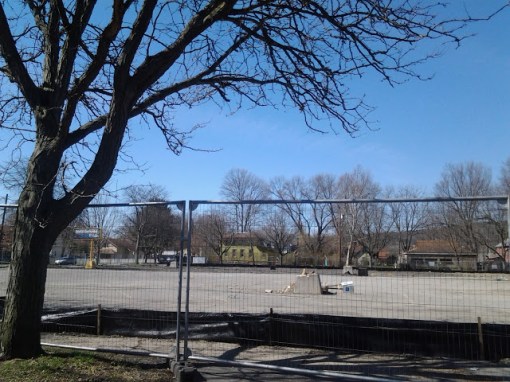
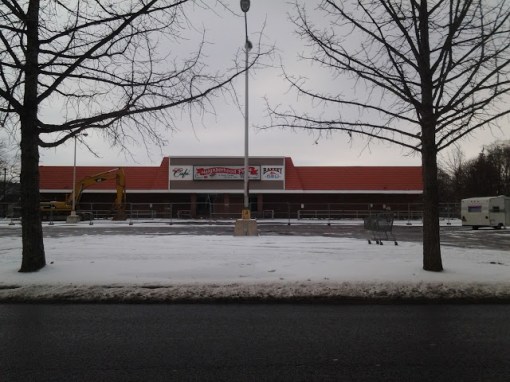
Turning to the project itself, the ca. 1957 grocery store, and one-story 1970s office building, are gone. Demolition is complete, and there’s a pause in work “while the contractors get organized”. Further site work is expected to commence no later than late May, with pile installation occurring over a one-month period at a rate of about six per day, between the hours of 8 AM and 4 PM. The before photo was taken in late February, the weekend before they started tearing down Neighborhood Pride, and the latest photos are from this past weekend.

The store was previously a P&C Foods, before P&C went bankrupt and the Ithaca stores were bought by Tops in 2010. The original builder of the grocery store, Tony Petito, launched a new independent grocery store called “Neighborhood Pride” in February 2013, which came with a $100,000 loan from the IURA. However, the store was unable to compete with other nearby grocers (Aldi’s, Wegman’s), and shut down at the end of the year. INHS acquired the property for $1.7 million in June 2014. Community meetings to develop a housing plan were held during the fall and winter of 2014/15, and the 210 Hancock proposal received planning board approval last year, after an unexpectedly heated debate. Originally, build-out was expected to start in September of this year, but the project was one of the very rare few that managed to get affordable housing funding from the state on the very first funding try (meaning that Ithaca has a well-documented need, and that it was a very good application).

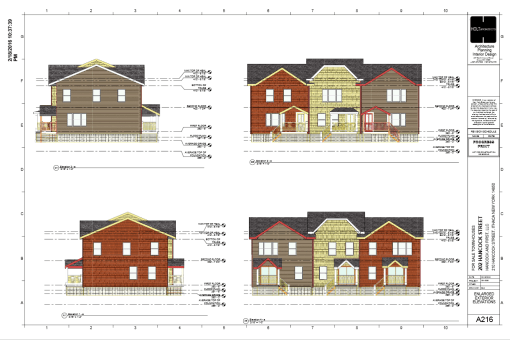
If built on schedule, 210 Hancock will bring 54 apartments and 12 moderate-income townhouses to market in July 2017. 7 of the townhouses will be for-sale units. Total construction cost is anticipated to be about $13.8 million.

The 54 apartment units (42 1-bedroom, 12 2-bedroom) are targeted towards renters making 48-80% of annual median income (AMI), defined by the HUD as $54,000 for a one-bedroom and $61,750 for a two-bedroom. The one-bedroom units will rent for $700-1,000/month to those making $25,950-$43,250, and the two-bedroom units will rent for $835-$1300/month to individuals making $29,640-$49,400. Three of the units will be fully handicap adapted. The project also includes two commercial spaces, one of which will host a daycare program run by TCAction for lower income families. The building would seek LEED Certification.

The two-story wood frame townhouses would also be LEED Certified. Of the seven for-sale units, five two bedroom units (1,147 SF) would be sold for about $114,000, and the two three-bedroom units (1,364 SF) for $136,000, available to those making 60-80% of local AMI, or $37,050-$49,400/year per the March 2016 IURA document. The townhouses would be a part of the Community Housing Trust (CHT), keeping them affordable even as they are sold to others in later years. The anticipated construction period is November 2016 – June 2017. The five rental units (4 2-bedroom, 1 3-bedroom) would be built at the same time as the apartment building.

To get on the waitlist for the affordable units, contact INHS here.
20160219_142643 20160415_105959 20160415_110003

inhs_pride_design_v5_3 inhs_pride_v3_elevations_1202_hancock_1 202_hancock_2


A Construction Tour of a Net-Zero Energy House

6 04 2016

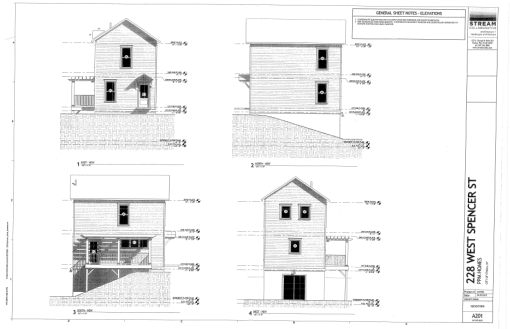
A couple of weeks ago, Noah Demarest was kind enough to give a tour of the new net-zero energy single-family house underway at 228 West Spencer Street in the South Hill neighborhood.

Most readers of the blog will be familiar with Noah Demarest’s name – he’s the head architect of STREAM Collaborative, which has been involved in projects like 902 Dryden Road, 201 College Avenue, State Street Triangle and the Franklin proposal for condos at the Old Library site.

228_w_spencer_1

Noah’s a little more involved in this project than most – he’s in charge of the build-out, and the cost of construction is coming out of his own pocket. Local landlord Ed Cope is a silent partner in the project, having purchased the land from the previous owner for $15,000 last February. The sale came with a different set of house plans, and the unique topography and constraints of the site made it such that the BZA had to approve virtually any new construction proposed on the parcel – Noah drew up plans for a different design, and those were later accepted by the board.

20160319_130922

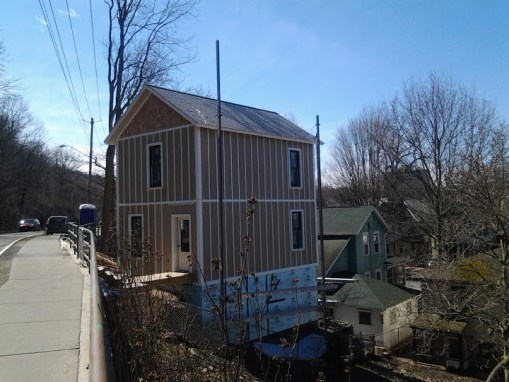
You can see how that unique site topography plays in here. The framing, sheathing (ZIP system), roofing and panelling of the house was done by local company Ironwood Builders. With much of the exterior work completed, activity has shifted largely to the interior spaces, which Noah is doing with his own construction team.

20160319_130936

My initial impression was that they were going for an exposed wood trim look similar to the framework of Tudor-style houses, but Noah says the trim will be painted the same color as the fiber cement siding. The shingles are a nice, Craftsman-style touch.

20160319_131043 20160319_131055

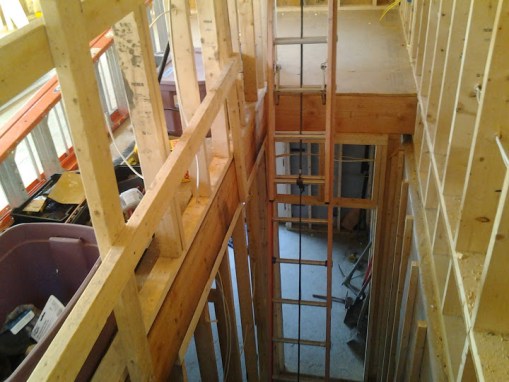
First photo is looking down, second is looking up. The house, just under 1,000 SF, has living space on three levels – the kitchen and living room will be on the second floor, and a bedroom and bathroom are on the first and third floors. This will be put up on the market for sale once it is ready – not a rental. Noah envisions this being the type of house that would be great for a young couple or even a deep-pocketed grad student.

By the way, just mentioning for the sake of acknowledgement – I’m not a fan of ladders.

20160319_131113 20160319_133609

As work moves closer to completion, a porch pergola will be built here.

20160319_133613 20160319_133748

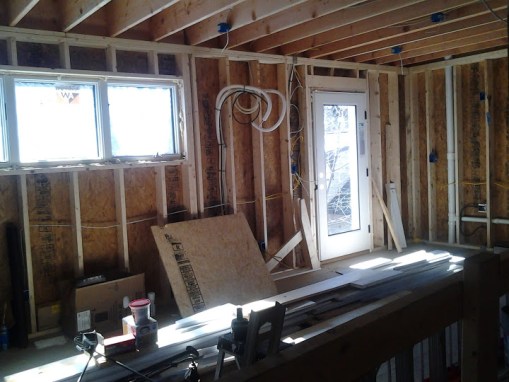
This will be a net-zero energy house, meaning zero net energy consumption – what gets taken from the grid also gets returned to the grid. In the case of this home, an off-site set of solar panels will offset the energy that is taken from the grid. The house will also achieve a very high degree of energy efficiency. One of the ways that’s being accomplished here is the use of an air source heat pump, which transfers heat from outside to inside a building (and vice versa) via a refrigeration compressor and condenser. The system can absorb heat from the outside air and transport it into the home, and can work in reverse during the summer, absorbing heat from inside the home and transporting it outside.

According to Noah, the system tends to be somewhat less efficient in extremely cold weather (-10 F or so; at that point it becomes difficult to extract usable heat energy), but is otherwise very capable for providing heating and cooling needs. Appliances will be all-electric, no gas.

20160319_133939

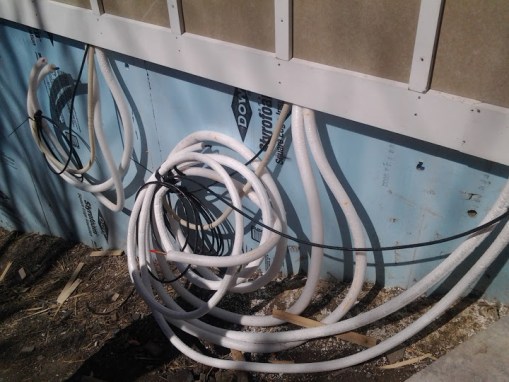
The house is also very heavily insulated – 2.5 inches of foam, with the fiber cement siding on top of that.

20160319_134029 20160319_134056
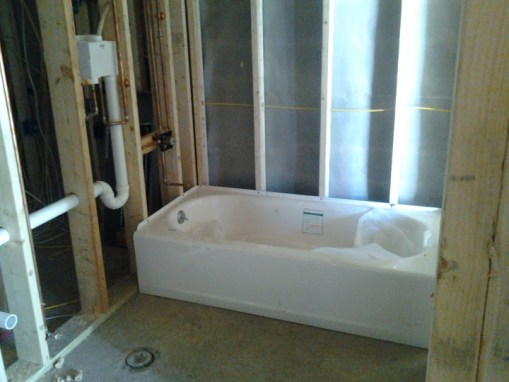
These last couple shots are from the bottom level – bathroom plumbing is in the process of being installed in the basement bathroom unit. The plan is to have the house ready for sale later this year.

One of the things that I personally am looking forward to is that Noah plans on making the costs of construction available to the city, as an example of what construction costs tend to look like for infill on an inner-city parcel. Having more examples to rely on, and a clear description of cost per square foot, gives the city more information to help guide its approach to planning and development. Noah noted during the tour was that the zero net-energy aspect is a relatively minor component in the expenses of the project.


Cornell Veterinary School Expansion Construction Update, 3/2016

30 03 2016

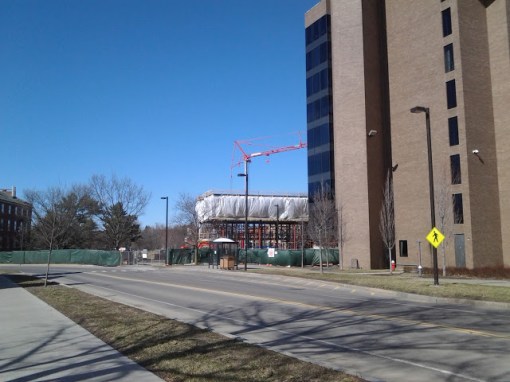
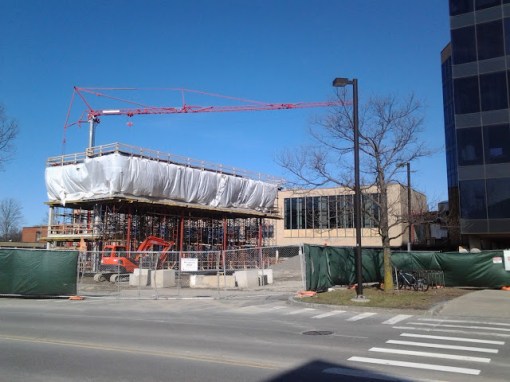
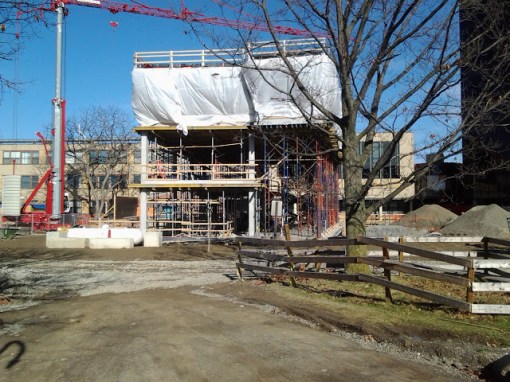
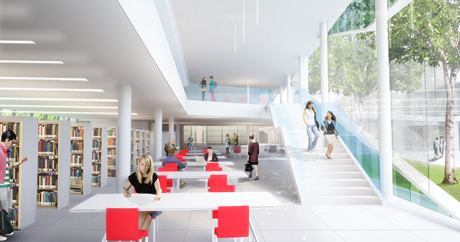
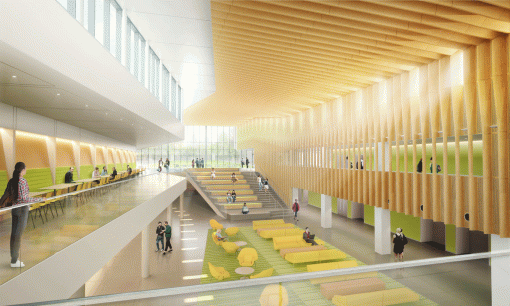
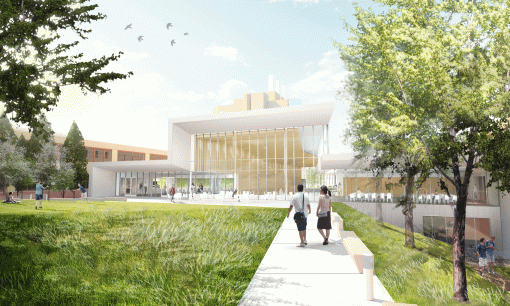
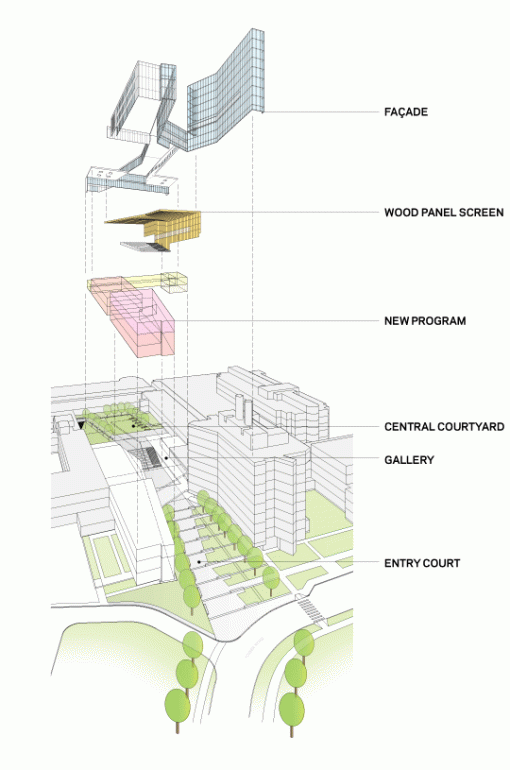
A generalized summary can be found on the Voice here. The concrete frame for the Veterinary School expansion is up to the third and final floor of what will be the new Flower-Sprecher library. As build-out continues, the existing building behind (east) of the new construction will come down and be replaced with new program space; the second floor will sit above an entry court and pedestrian walkway that leads to an indoor gallery space and central courtyard. The open space on the right (south) side of the structure will be a two-story atrium space. The addition will have a glass curtain wall, and the academic spaces that face the gallery will be faced with wood panels.

Cornell and general contractor Welliver will be looking to bring the project to completion by June 2017. Weiss/Manfredi is the project architect.

20160319_155209 20160319_155242 20160319_155305 20160319_155319 20160319_155335 20160319_155345

EntryPlaza10-2 LibraryReadingRoom10-2

3f5656954f5a3ef1021519c03b4abe9f 8f098b7e26544f579eb7411b9a1716aa

eea787361994de9625f74b19aa50d91e


Upson Hall Construction Update, 3/2016

28 03 2016

This one’s short and sweet for the moment due to time constraints. A generalized description of the latest progress can be found on the Voice here, and Cornell’s bi-weekly progress report is here. A more thorough rundown was given in January’s update here.

20160319_160249 20160319_160337 20160319_160400 20160319_160504 20160319_160527 20160319_160559 20160319_160644 20160319_160647 20160319_160654 20160319_160713 20160319_161727


Gannett Health Center Construction Update, 3/2016

27 03 2016

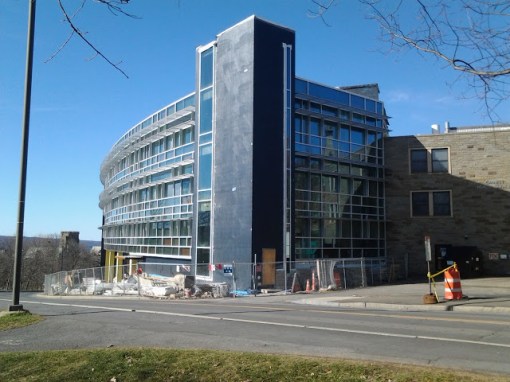
Most of the curtain walls are complete, only the stud walls on the northwest face are still exposed. Sunshades have been installed on the outside of each floor. The bluestone and limestone veneers will be apply to the base columns and walls at some point later this year. From the outside looking in, it looks like good progress is being made on finishing-out the interior of the new wing. A write-up can be found as a part of last week’s Voice article here.

Chiang O’Brien of Ithaca is the architect for the two-phase, $55 million project, and the general contractor is The Pike Company of Syracuse. The new wing will open late this summer, and the second phase, which is primarily renovations of the existing wings, will run from this summer to late summer 2017.
20160319_160951 20160319_161136 20160319_161158 20160319_161227 20160319_161247 20160319_161304 20160319_161310 20160319_161400 20160319_161508