News Tidbits 12/12/15: Money Money Money Money

12 12 2015

canopy_hampton_rev4_1

1. Time to do a little rumor-killing. There’s been some confusion as to whether or not the Hilton Canopy is actually happening, since it was supposed to have started construction by this time and it hasn’t. There was also an article in the Ithaca Times that suggested that construction costs much higher than original estimates had caused the project to be cancelled.

Well, the project has definitely been delayed, but it looks like it will still be moving forward. According to a utility easement resolution at the Ithaca Urban Renewal Agency’s Economic Development Committee (IURA EDC) meeting, a project financing commitment has been secured and the developer of the Hilton (Neil Patel of Lighthouse Hotels LLC) is planning a construction start in the first quarter (Jan-Mar) of 2016, which would suggest a mid-2017 opening.

inhs_pride_design_v5_3

2. Also in financial news, INHS looks to have secured grant funding that will allow it to move forward with its 210 Hancock project in the next four months, according to INHS Executive Director Paul Mazzarella. The grants were officially awarded in an announcement from the governor’s office on Tuesday. $3.6 million will come from the state’s Housing and Community Renewal program, $500,000 from the state low-income housing tax credit (LIHTC) program, and $1.03 million from the U.S. Department of Housing and Urban Development’s LIHTC program. In total, the award is valued at $5.13 million, about a quarter of the estimated $20 million development cost. The project has received about $17 million in grants and tax credits to date.

The money awarded covers only the rental units – 54 apartments in the four-story mixed-use building, and five townhouses. The seven owner-occupied townhouses remain unfunded.

The apartments, which include a 30-child low-income daycare facility and commercial office space for non-profits, will welcome their first tenants in Summer 2017. They will rent from 27% to 105% of local median household income, depending on the unit. Descriptively, it’s a mixed-income project with residents’ incomes ranging from $25,000-$60,000 per year.
ith_big_plan_map_v2

3. From the Common Council’s Planning and Economic Development Committee, there are a few things of note this week –

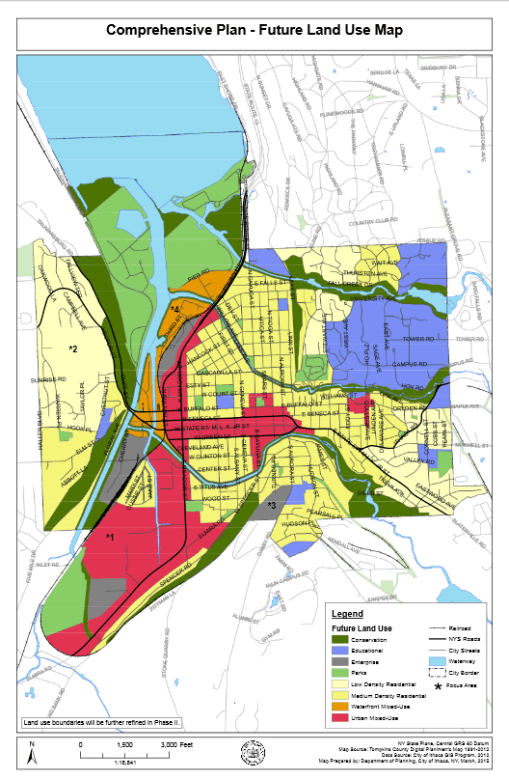
A. The city seems to be looking towards greater encouragement and flexibility with redevelopment of waterfront parcels by making WF-1 and WF-2 zones Planned Unit Developments (PUDs). What a PUD does is allow greater flexibility in uses and design by removing or loosening zoning constraints on site use, and being more accommodating to mixed-use projects (the Chain Works District proposal is a PUD, for example). Previously, PUDs could only be applied to industrial sites. The other stipulation, however, is that the applicant would have to work with the Common Council to determine appropriate development of the site.

The Waterfront Zoning allows up to 5 stories and 100% lot coverage. The PUD will give flexibility beyond that, dependent on what the Common Council is comfortable with for a given site and proposal.  So if Applicant X shows up with a huge apartment building or a big industrial building, it’s probably not going to get very far. But if it’s well designed and has affordable units? Maybe the council will grant a little more density or another floor. It depends on a developer showing up with something that they feel offers some kind of community benefit and fits with the Comprehensive Plan, and whether the Common Council agrees with the developer’s reasoning.

There is great potential in the waterfront – those views can fetch a premium (i.e. higher land values, and more tax dollars), it’s far enough removed from the colleges that students would be unlikely residents, and many of the properties are underutilized, with only marginal public benefit.  So potentially, if someone wants to work with the Common Council (one can count on at least 8 or 9 of the 10 being willing to cooperate), there could be some benefits in the long-term.

B. The Commons first-floor active-use zoning ordinance looks to be heading for a Common Council vote in January. More about that ordinance here, Item 5.

C. That damned backyard chickens thing again. Only this time, it might be moving forward with a pilot program involving 20 families.

D. Per the Times’ Josh Brokaw, expect incentive/inclusionary zoning to be up for PEDC review in January.

tfc_comparo

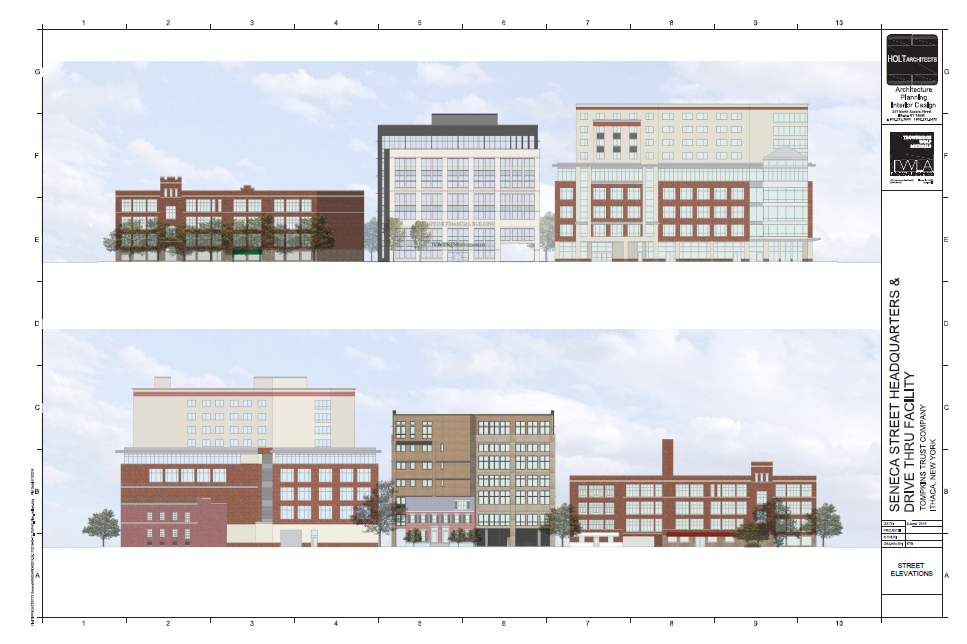
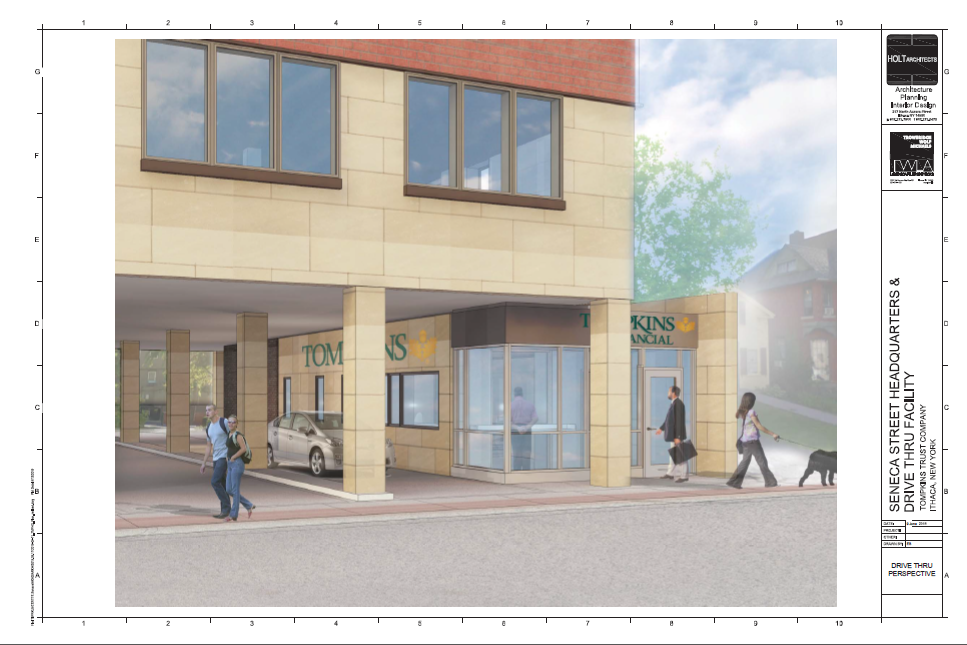
4. Hey look, this week’s eye candy. Tompkins Financial Corporation’s proposed downtown Ithaca Headquarters at 119 East Seneca Street will be reviewed for final project approval at this month’s Planning Board meeting. As part of that, here’s the final project design, part of the final Site Plan Review submission here.

From the front, it looks like some of the window layout has changed on the top floor and southwest corner, and there are fewer sunshades above the windows. There’s a third tree in the planting plan, and there’s variation in the cladding materials on the west wall facing the DeWitt Mall.

tfc_v3_1

In fact, it’s the non-primary facades that have changed the most, with different (and generally lighter-colored) brick and aluminum panels when compared to the previous rendition. Although there’s less glass than before, the lighter colors and greater variation in materials de-emphasize the bulk from the perspective of its townhouse neighbors at the rear. The 7-story, 110,000 SF commercial office building should begin construction in early 2016 with an eye towards completion the following spring.
elmira_savings_1

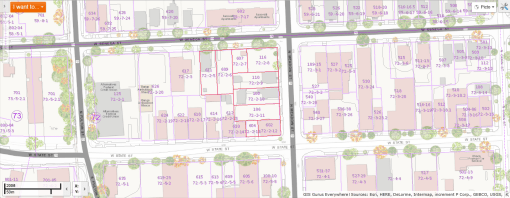
5. There was quite a sale on Ithaca’s West End last Friday. Nine properties outlined in red on the map above – 106, 108, 100 and 116 North Meadow Street, 607, 609 and 611 West Seneca Street, and 602 and 604 West State Street – were sold for $1,725,000 to Elmira Savings Bank.

Now, there are a few reasons why this is worthy of attention. For one, banks don’t typically shell out almost two million dollars without some kind of plan. For two, Elmira Saving Bank has been moving forward with expansion plans in the Ithaca area in hopes of capitalizing on the growing local economy. For three, there has been a lot of development in this neighborhood as of late – the Iacovelli Apartments (2013) and Planned Parenthood (2014) are right across the street, and it’s worth noting that the 18,000 SF HQ for Alternatives Federal Credit Union (2002) is on the other side of the block.

The properties are currently home to parking lots, several older, non-historic houses (most in poor condition) and a two-story 4,500 SF commercial building previously home to the Pancho Villa Mexican restaurant. The restaurant building had been on the market for $699,900.

The zoning here is all WEDZ-1a. West End Zone 1a allows for 2 to 5 story buildings, 90% lot coverage in the case of large assemblages such as this, and no off-street parking requirement. That means these parcels have a lot of potential. The previous owner had been rumored to be planning a mixed-use building on some of the properties, but nothing official ever came forth.

Two phone calls were placed to Elmira Savings Bank’s headquarters in Elmira, and two voicemails were left, but neither received a response. But these properties are definitely something to keep a close watch on over the following months.

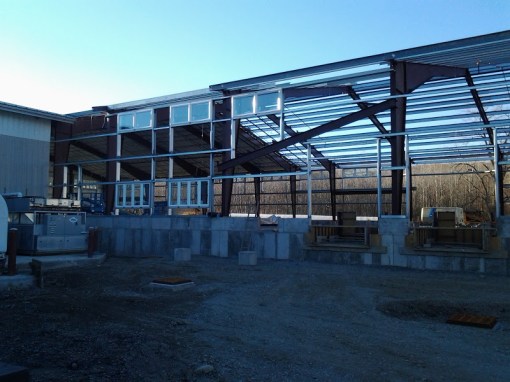
6. That 9100 SF store being developed on the corner of East Shore and Cayuga Vista Drives in Lansing that was mentioned last week (here, Item 4)? It’s going to be a Dollar General. Not sure if that’s better than the auto/tire store speculated last week.
20151108_152102

7. Lest it be forgotten, it appears Lady Luck and some state bureaucrats smiled at the Southern Tier this week, awarded the region one of the three $500 million prizes of the Upstate Revitalization Initiative, known colloquially as the Upstate “Hunger Games”. Rochester/Finger Lakes and Syracuse/Central are the other $500 million winners. Seven regions competed, and the four losers will receive $80-$100 million for their priority projects. The money will be paid out in five annual installments of $100 million. A copy of the Southern Tier’s plan is here.

I wrote about Ithaca’s plans for its share on the Voice here. The first year projects alone will have a range of impacts, ranging from job creation and training to municipal construction projects to quality of life projects like museum expansions. Potentially, it could result in hundreds of jobs in Tompkins County, financial capital for several major projects, and make the area more attractive for investment for both local and external entities. As these projects move forward, they’ll receive their due write-ups here and on the Voice.

Of course, the key things are that the community can manage this monetary award, and that someone can track and guide these projects to completion – something the Southern Tier has struggled with, when one looks at the result of previous, much smaller awards.

8. The state’s just shoveling money into Ithaca this week. The New York State Office of Community Renewal (part of the state’s HUD equivalent, the Homes and Community Renewal agency) has awarded $500,000 towards the rehabilitation of the Masonic Temple at the corner of East Seneca and North Cayuga Streets in downtown Ithaca.

The Masonic Temple was built in 1926 and designated a local historic landmark in 1994. The property is owned by Ithaca Renting Company (Jason Fane), who purchased the building from the Masons in 1993. Fane’s never been a fan of the historic designation because the ILPC can be expensive and onerous to work with, nearly everyone else hasn’t been a fan of his long-deferred maintenance of the 90-year old building (if you have ever wondered why that CIITAP rule was added about an applicant being in building code compliance with all their other properties…now you know). A few years ago, Fane had not been shy in his interest in demolishing the building.

After rejecting a purchase offer to turn the building into a community center and space for the New Roots charter school, Fane decided to go the preservation route earlier this year and apply for a grant to renovate the interior and add an elevator to the building to make it ADA-compliant. This would make the building much more marketable to commercial tenants, many of which have shunned the 17,466 SF building. Fane laid out a few different options this past summer, including one where four commercial spaces (rental, office, restaurant) would be created. Based on the grant announcement, it looks like that will be the option pursued.

The Downtown Ithaca Alliance backed the application, as did the Common Council by unanimous vote at their July meeting.

The renovation will cost at least $1 million, and according to the grant announcement, seeks to start construction in summer 2016. Expect more info when it hits the ILPC and Planning Board at a later date.
20151205_121714 20151205_121736

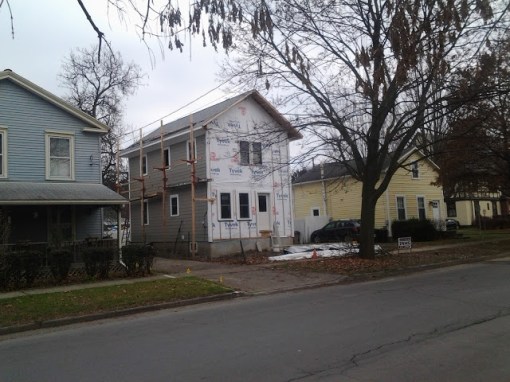
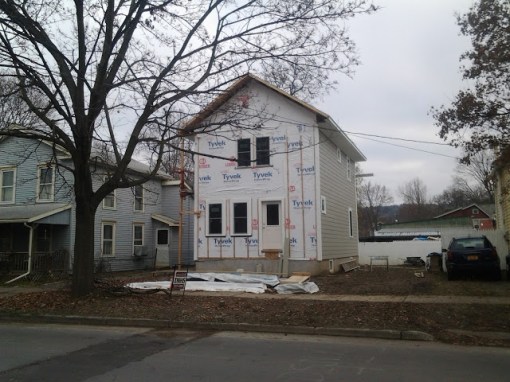
9. House of the week. This week, INHS’s new 2-bedroom, 1150 SF single-family home underway at 203 Third Street in the city of Ithaca’s Northside neighborhood. The house is framed, roofed and sheathed. Siding (Hardie board?) and trim is being attached on the sides, and one can expect a nice gracious porch to be attached once exterior materials are installed on the front. A home of the design was previously built at 507 Cascadilla Street.

203 Third Street was a vacant that the city seized in a tax foreclosure in 2011. It was transferred to the Ithaca Urban Renewal Agency, who sold it to INHS for $17,000 in December 2014. The process is pretty similar for a lot of the home lots that INHS builds on – the non-profit buys dilapidated or vacant properties from the IURA, which they build or renovate into affordable single-family and duplex houses. In the case of 203 Third Street, INHS competed for the site, outscoring Habitat for Humanity’s submission in an IURA examination of proposals.

As with all INHS homes, this one will be sold to a buyer of modest means, which means someone making at or a little less than the county’s median household income of $53k/year (I think 80% of MHI is the low bound offhand, so about $42k/year). The houses will be a part of INHS’s Community Housing Trust, limiting the price it can be sold for and requiring that if put up for sale, it is sold to another family of modest means. It may just be one house, but it will mean a lot to one family.

Claudia Brenner is the architect, with Rick May Construction and Mike Babbitt in charge of construction (thanks to Claudia for the builder info).


A Long Voyage Ahead for The Waterfront

27 10 2015

The NYS DOT property is probably the next big, Old Library-type project facing the county in the upcoming couple of years. There’s a lot to consider in a possible move of the DOT to Dryden, and subsequent sale of the site to a chosen developer. For that, the county paid $78,000 to Fisher Associates to conduct a feasibility study, the results of which are shared below.

The feasibility study examined multiple angles – environmental, physical, market and financial factors. It has to, because without a through examination of the site, the county could under-price themselves, or vice-versa, there may be fewer or no offers, should buyers think the site’s a poisoned chalice.

But let’s start with the initial disclaimer – things are years out. The Old Library site issued an RFEI in November 2013, and a preferred developer was only named in August. Plus, everything is still dependent on a DOT move, which will have its own schedule if it happens. All things considered, although the county has generously offers 2017 as a construction start date, it’ll probably be the end of the decade if not the 2020s before any soil starts to turn, assuming there’s an interested developer.

So let’s start with a look at the site’s history and environmental concerns. According to Fisher Associates’ Environmental Site Assessment (ESA, link here), the property was virtually unused until the NYS DOT bought the land and starting building their facilities on it in 1958. There were petroleum tanks underground, but they were removed and the land re-mediated in 2004, and now the only tanks on-site are above ground, and in good condition. Some concerns still exist with salt brine tanks, debris in the inlet, and materials from when the DOT used a septic system, before it was hooked up to the city sewer. None of these appear to be potential deal breakers, just things worth noting.

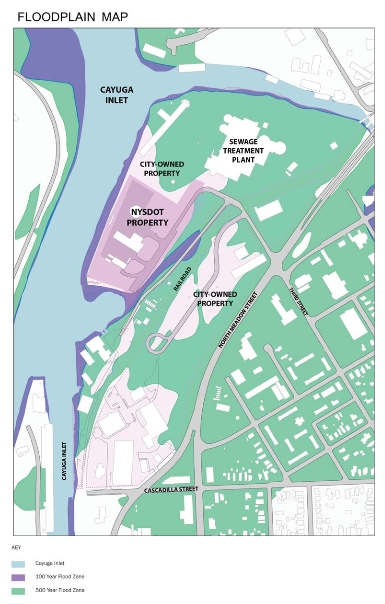
waterfront_floodplain

Perhaps surprisingly for a waterfront property, the vast majority of the site isn’t in the 100 or 500-year flood zone. Most of the site is elevated just enough to avoid flood risk.

Empire GeoServices of Cortland conducted the geotechnical report and site soil analysis. Looking at the soil conditions, being next to the water poses some limitations. Most of the lower elevations of the city suffer from poor, water-logged soils, which are soft and compressible near the top – in a few cases, shallow spread foundations, typically the cheapest option, have been damaged by excessive soil settling, so those are not recommended. Deep, pile foundations, like the ones used at the Lofts @ Six Mile Creek (micro-piles), Marriott (caissons) or some of the big box stores, are a safe option because they go down to more solid soil layers, but they’re more expensive. Shallow mat foundations can also be used in place of shallow spread foundations, but they’re also more complex and expensive, and are really only suitable for “light buildings” with less pounds for square inch. A mat foundation was used for Cornell’s new rowing center.

Long story short on the soils, it means that whatever is built will need a complex foundation, and its likely that whatever gets built will be priced at a premium. The study tacks on an extra 10% to the cost for townhouses and mixed-use buildings.

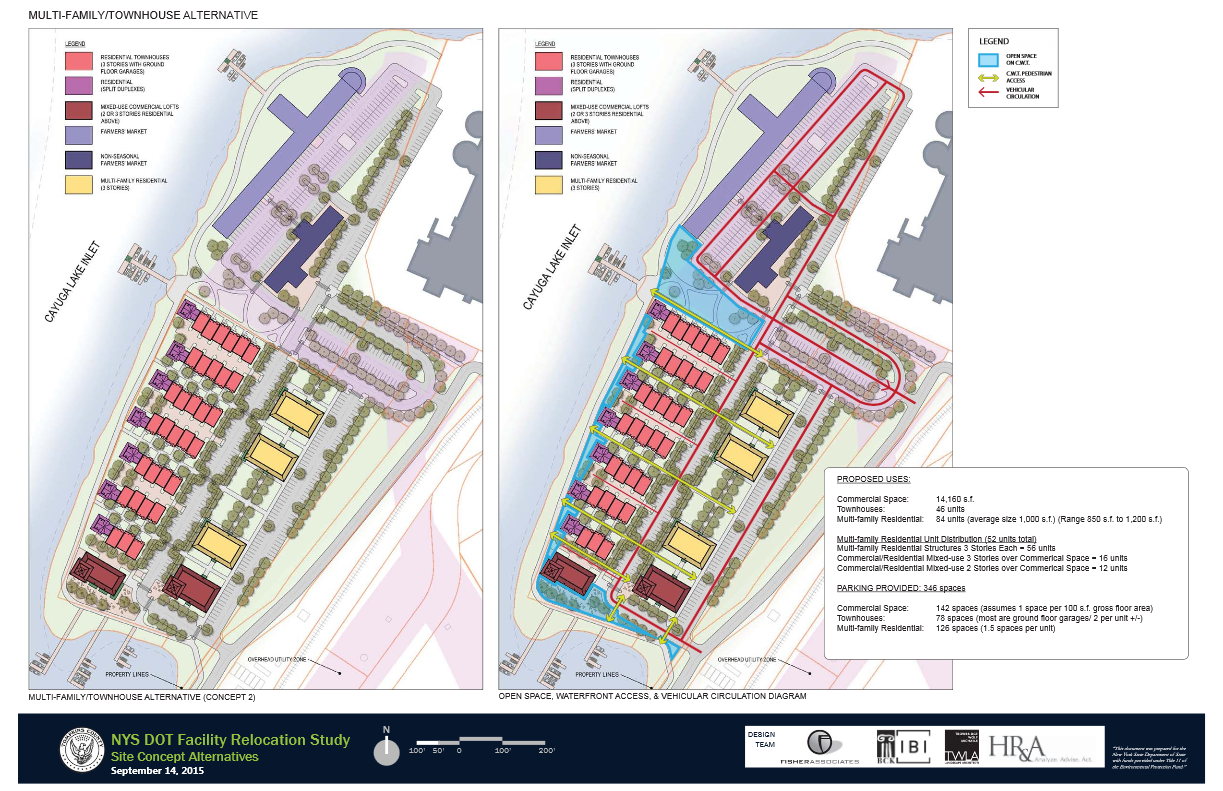
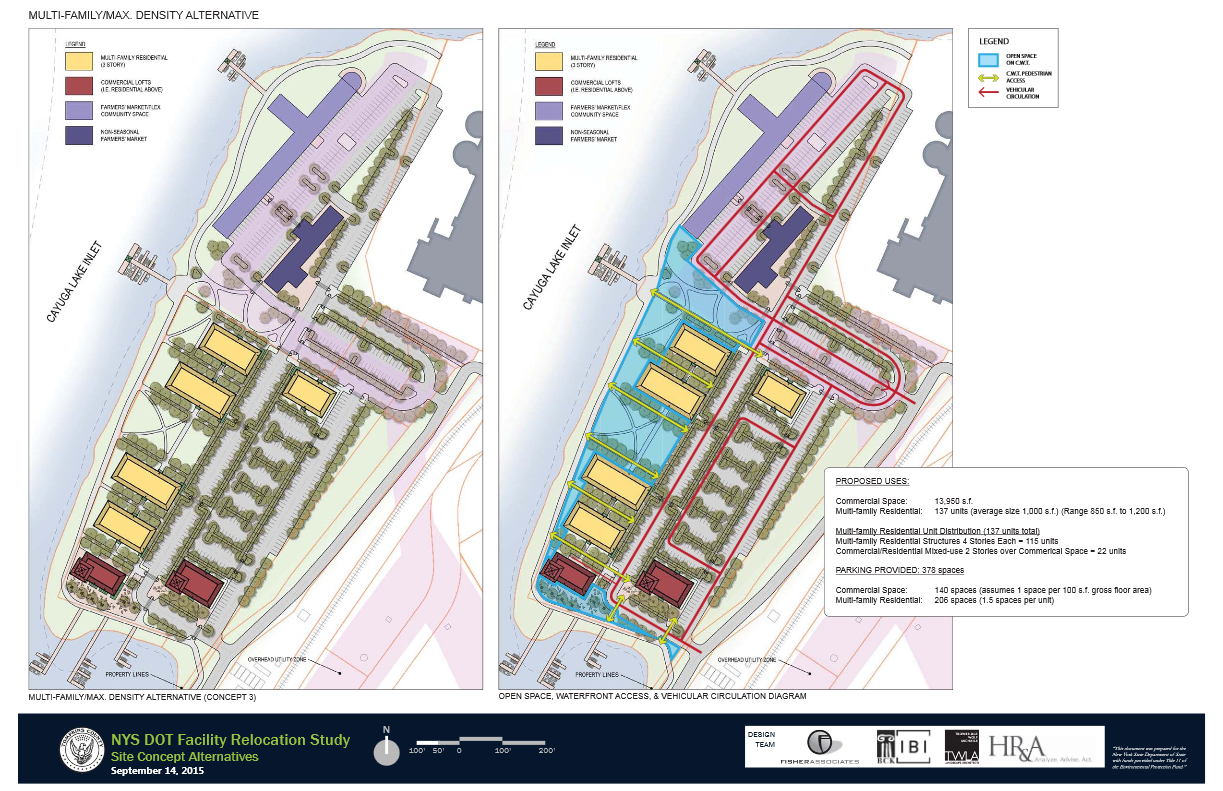
In the study, there are three plans considered – a hotel plan, a multifamily/townhouse “preferred” plan, and a maximum density plan. The site plan PDF is here, for you kids following along at home.

waterfront_concept_hotel_SP_1

The hotel plan imagines a 124-room hotel (midsize in the Ithaca market) with 6450 SF of commercial space. The plan includes 10 townhouses and 52 multi-family units in the 850-1200 SF range. There are 286 parking spaces, as required by zoning – 1 for each hotel room (124), 1 per 100 SF of commercial space (64), 2 for each townhouse (20) and 1.5 for each apartment-type unit (78). 1 Space for 100 SF commercial space is fairly generous to drivers – the ITE trip generation manual shows most commercial retail to be well below that threshold, with only service outlets like fast-food joints, coffee shops and bars exceeding the 1 space/100 SF value.

The market issues with this plan are focuses on the hotel. A hotel was envisioned for the waterfront for decades, but being off by itself with only few nearby attractions (the trail and farmer’s market, not much else), it’s not as desirable as downtown, nor is the land as cheap as the Southwest suburban corridor. The feasibility study notes the waterfront might be a draw in the summer, but the weather the rest of the year would limit its appeal. With increased interest in living in the city, the hotel idea has had less allure in recent years. Still, the option was included for the sake of comment and critique. The study says a hotel would need 120+ room to support fixed costs (taxes, maintenance), and recommends a brand not present in Ithaca, like Hyatt or Starwood (Westin/Sheraton).

waterfront_concept_mf_th_SP_1

The multi-family/townhouse plan does away with the hotel and instead focuses more on residential. The plan is composed of 14,160 SF of commercial space, 46 townhouses and 84 multi-family units (130 units total). 356 parking spaces are provided.

waterfront_concept_max_den_SP_1

The maximum density plan is as it sounds – the maximum legally allowed by zoning. The plan calls for 13,950 SF of commercial space, 137 multi-family units and 378 parking spaces.

Note that all three plans have a new indoor farmer’s market building, but that’s a separate development being spearheaded by the market.

waterfront_concept_aerial_1

Renderings make for great eye candy, but the emphasis is definitely not on the architecture here, because it’s a bit like predicting what new cars will look like in 2020. You know it will probably have four wheels, lights and doors, but everything else is just for show. Whoever buys it will come in with their own idea of how things should look (see Form Ithaca’s waterfront study for their take). For the sake of reference, a copy of the aerial renders of each layout is here.

Now for a financial summary (link), the feasibility in its essence. HR&A Advisors, who partnered with Fish Associates for the study, notes that development can work with a potential buyer’s bottom line, but it’s going to be expensive and the developer will seek to minimize risk as much as possible – there’s not much padding in the profit. There are few comparable products in the county to the site, which makes determining the market size, rents and level or risk somewhat more difficult than usual. The study assumes a 3-year, single-phase build-out.

waterfront_concept_financial_1

The study assumes about $2.15/SF for a residential unit – in other words, a 1,000 SF unit (like a larger 2 bedroom or smaller 3 bedroom unit) renting for $2,150/month, similar to the Lofts @ Six Mile Creek or Gateway Commons downtown, which were used as comparables. Luxury housing, without a doubt. The waterfront commands a price premium, but the disconnection to the rest of the city could hinder rentals. Some condos/owner-occupied units are possible, but rentals would be the majority. Development costs range from $165/SF for a townhouse, to $215/SF for a multi-family unit, to $287/SF for the hotel. The value of a project ranges from $39-$45 million depending on plan, and with development costs taken into count, the land could sell for something less than $1,000,000 to $2.5 million. Over time, the project may generate $13-$22 million in tax revenue over 20 years, depending on approach.

waterfront_concept_financial_2

The land itself will not sell for the price required to cover the DOT’s cost of moving, which will have to be underway before any sale takes place. The move is estimated at $14 million. This means that the city and county may have to chip in on upfront costs in order to get a good project in that will pay itself off via tax revenue. HR&A notes that an RFP should be flexible in its options, and be open to zoning variances that might improve a project’s chance of success.


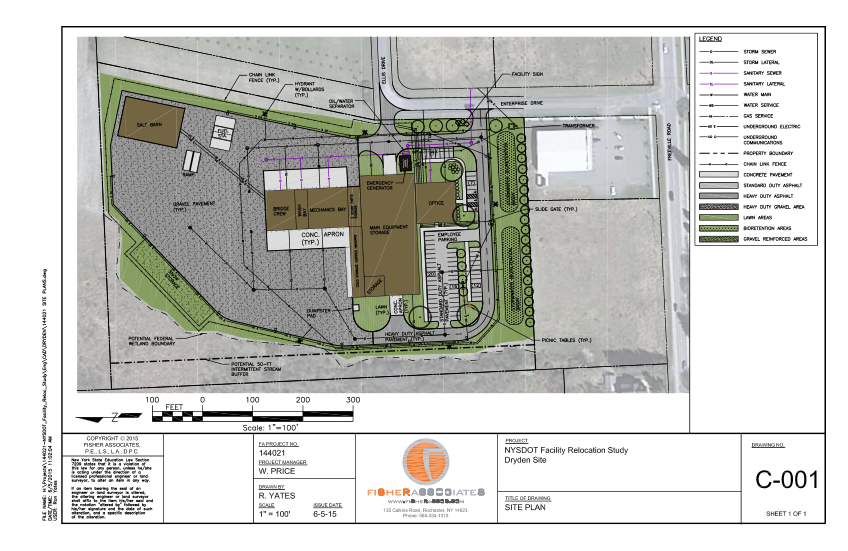
dot_concept_1

For what it’s worth, Fisher associates also did a conceptual layout for a new DOT facility here.

According to the county, here are the next steps in the process:

  • A financial plan for the redevelopment of the Cayuga Inlet site that reduces the risk for private developers and generates revenue to support the move of the existing NYS DOT facility.
  • An analysis of the project’s impacts on infrastructure and utilities, the natural environment, neighborhood and adjacent properties, and the surrounding road network.
  • An estimate of the land value of as well as the individual components of the plan. The result will be an order of magnitude valuation of the site to better understand the project’s ability to attract private investment, support debt, and support a purchase price and tax revenue stream that could be used to advance the NYS DOT facility’s relocation.
  • A draft Request for Proposals (RFP) to solicit developers to redevelop the site.
  • An estimate of the ongoing direct fiscal benefits to accrue to the City of Ithaca and to Tompkins County, including real property taxes, personal property taxes, school taxes, sales tax, and other applicable taxes and fees.
  • A financial strategy for moving the DOT site with some combination of revenue from sale of the site, direct funding from NY State, and, possibly, a local contribution from anticipated tax revenues.

Expect that last one to be potentially controversial. The state might move slow but could be supportive, but the city will have to explain and hope that a possible initial investment in the DOT’s move to Dryden could pay off over subsequent years. Voters don’t always like long-term plans.


News Tidbits 10/24/15: Breckneck Builds and Market Slowdowns

24 10 2015

college_crossings_v3_end

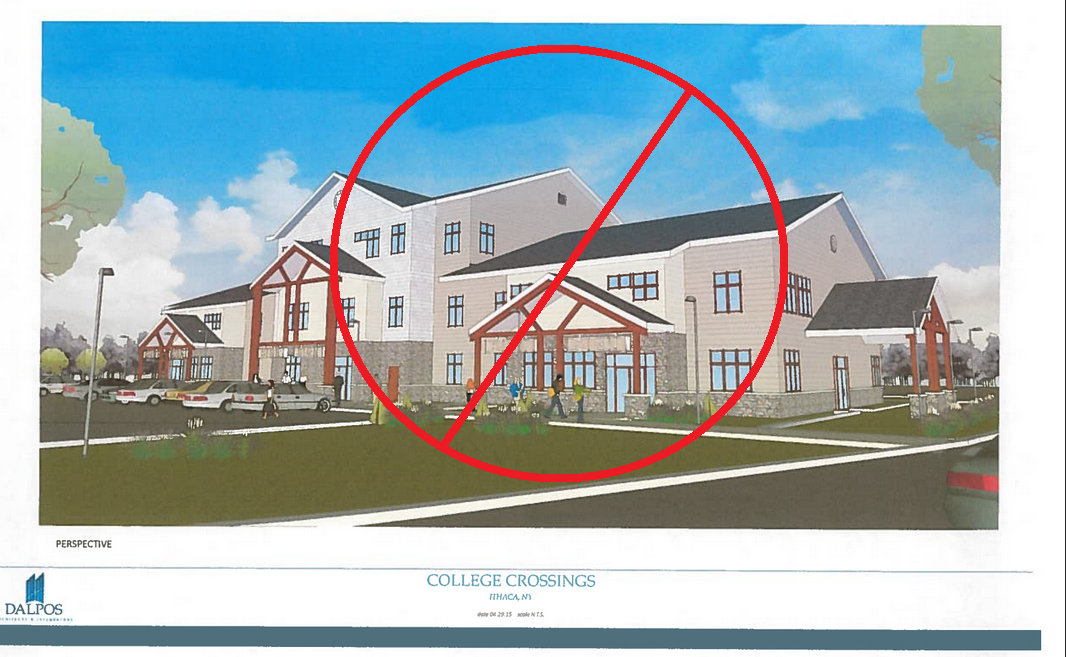
1. College Crossings is dead. But its passing opens up an interesting conversation.

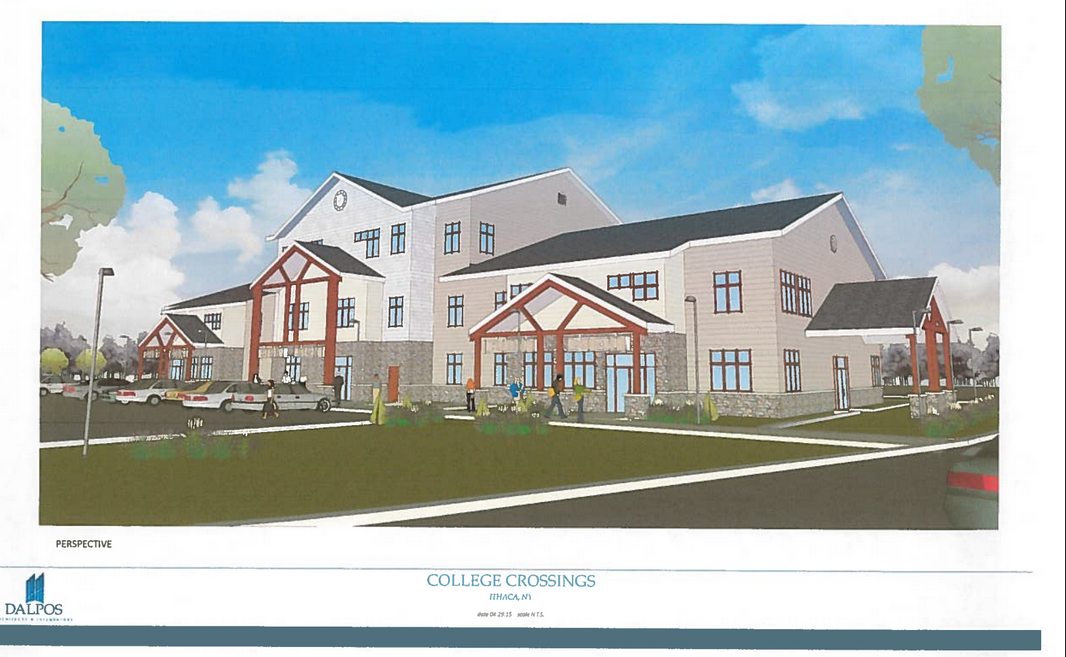
According to Ithaca town planning board minutes uploaded earlier this week, developer Evan Monkemeyer withdrew his proposal after planning board members weren’t comfortable with approving the environmental assessment and mitigation plan for the proposal (technically called a “negative declaration” by the lead agency on the SEQR). While at least one was bothered by the 3-story, 54′ height, many board members had visions of the Form Ithaca charrette for the property, and this didn’t quite jibe with Monkemeyer’s plans for South Hill’s King Road and Route 96B/Danby Road intersection. Minutes for the July and August meetings can be found here.

college_crossing_2

plan-2 plan-1

Now, I will gladly admit that I was not a fan of this project, and I too wanted something more along the lines of Form Ithaca. I’m surprised, though, that it was enough to derail approvals of the project.

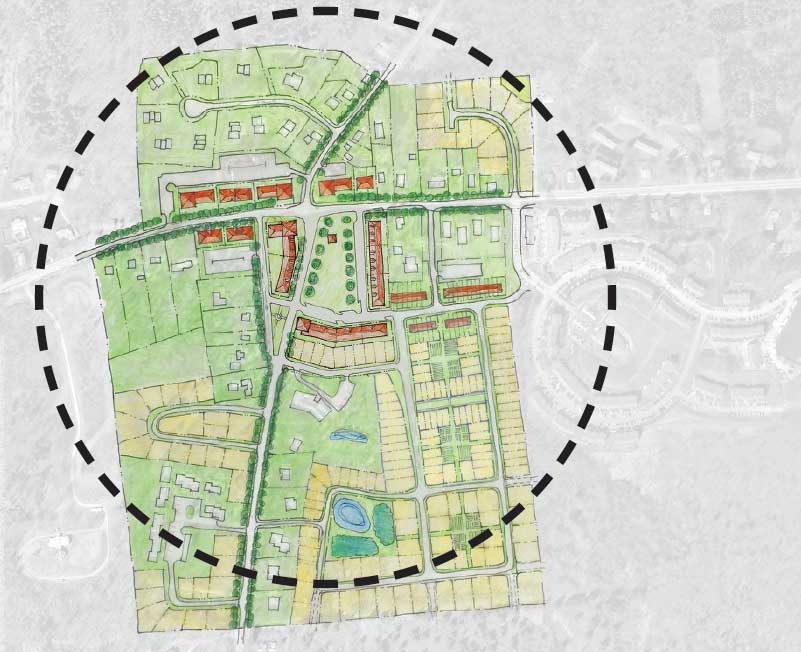
Now, the problem is, the town’s new comprehensive plan embraces form-based codes and “Smart Growth”, but the zoning is auto-centric, outdated, and doesn’t mesh with the plan. If you’re a developer or builder, big or small, and what’s legal and what the town wants are two very separate things…Houston, we have a problem.

At this point, there’s two questions that come to mind – one, given that the town planning board has cancelled most of its meetings lately due to a lack of proposals, is the disconnect between plan and zoning halting projects, and two, when will revised zoning be ready. For guidance and knowledge, I reached out to town of Ithaca assistant planning director Dan Tasman, because he’s pleasant, responsive and a pretty great guy.

As for question one, here’s his quote: “Seriously, I think it’s … complicated.” His thoughts were that there’s no indication whether the recent slowdown were caused by the planning/zoning disconnect, or natural ebb and flow related to lending and planning on the ends of home-builders and developers.

As for question two, the response was summed up as, “a lot of communities face the same issue after they adopt new comp plans. On the positive side, Ithaca’s not growing that fast, and the pace of development is slow. Still, there’s a sense of urgency.”

He’s right about the town not growing that fast. The permit records show that in September, the only new home-building permit was for a duplex at 214 Pennsylvania Avenue on South Hill (the Iacovellis building more student rentals for IC, probably). The previous month online, June, had four single-family homes, filling out lots in previous-approved subdivisions.

tc_housing_permits_1984_2014

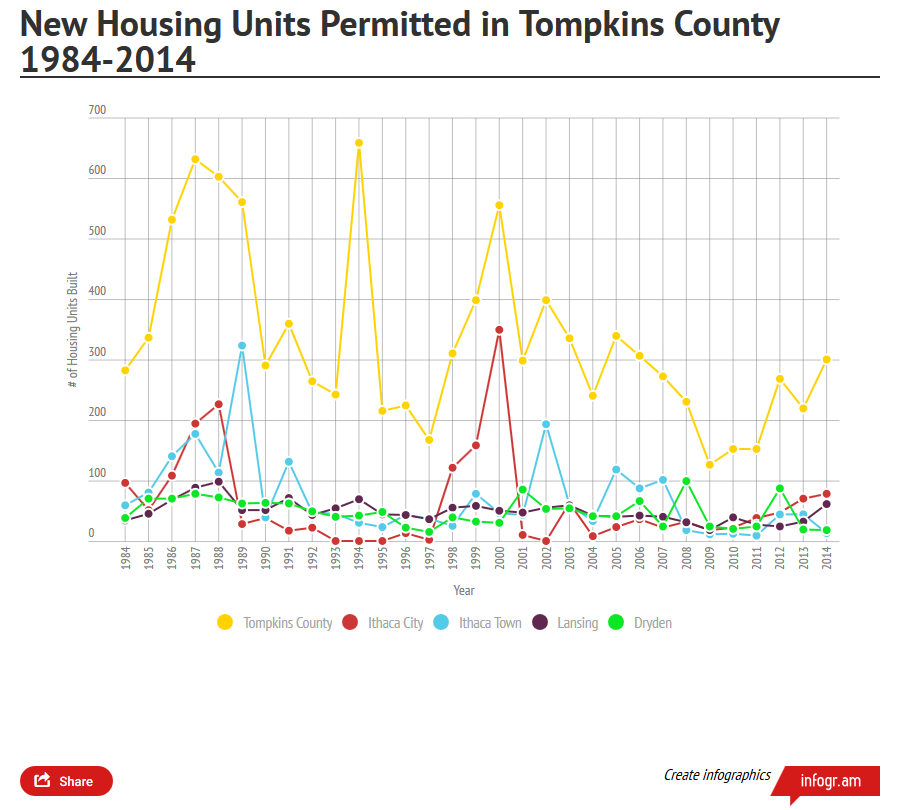
Traditionally, the town of Ithaca has made up a pretty sizable chunk of the new home permits in the county. But if they only issue 30-40 this year (still better than last year’s 14), then it falls on the rest of the communities to try and make up the housing deficit, at least in the short term. Ithaca city’s total, anticipated to be 247 new units to be permitted in 2015, is only about 84 units right now, because John Novarr has yet to start Collegetown Terrace’s Phase III, and Steve Flash’s 323 Taughannock on Inlet Island has yet to start either. To bring down the deficit in a decade, as well as keep up with annual economic growth, the county would need over 600 units per year; it’s not certain if the total will reach even half that in 2015.

On the one hand, the town of Ithaca is trying to be proactive and adopt a new approach to development in quick and good order. On the other hand, it’s not a great situation for trying to make a dent in the housing deficit, with its attendant affordability issues, and there’s the possibility things are going to get worse before it gets better. I don’t know if there’s a right or a wrong way of going about it, but it’s a stressful setup.

2. On the county level, officials are seeking legislature approval for launching a study into the feasibility of an airport business/industrial park in Lansing. 52 acres of vacant land along Warren and Cherry Roads are being considered for the study, which would include a conceptual site plan of potential buildings and parcels, and an assessment of the needs and characteristics of companies most likely to open in the potential business park. Utilities and green infrastructure will also be looked at in the study. The projected cost is less than $50,000, and being paid for by the Tompkins County Industrial Development Agency (TCIDA). The feasibility study would be awarded next month, with authorization and approvals on the staff level.

arpt_pk_1

For what it’s worth, folks living up there are used to business traffic – Borg Warner’s 1,300 person plant is adjacent to the study site. The Warren Road Business Park lies a minute’s drive up the road, and the Cornell Business Park is about a minute’s drive south. The land also has municipal sewer, allowing for large-scale projects. A copy of the RFP states two that the two parcels shown above are the primary analysis area, with secondary areas closer to the airport runway and the resident land to the west separate from the park. They aren’t a part of the proposed business park, but the county asks that they be examined for development potential by the study.

holiday_inn_express_v2

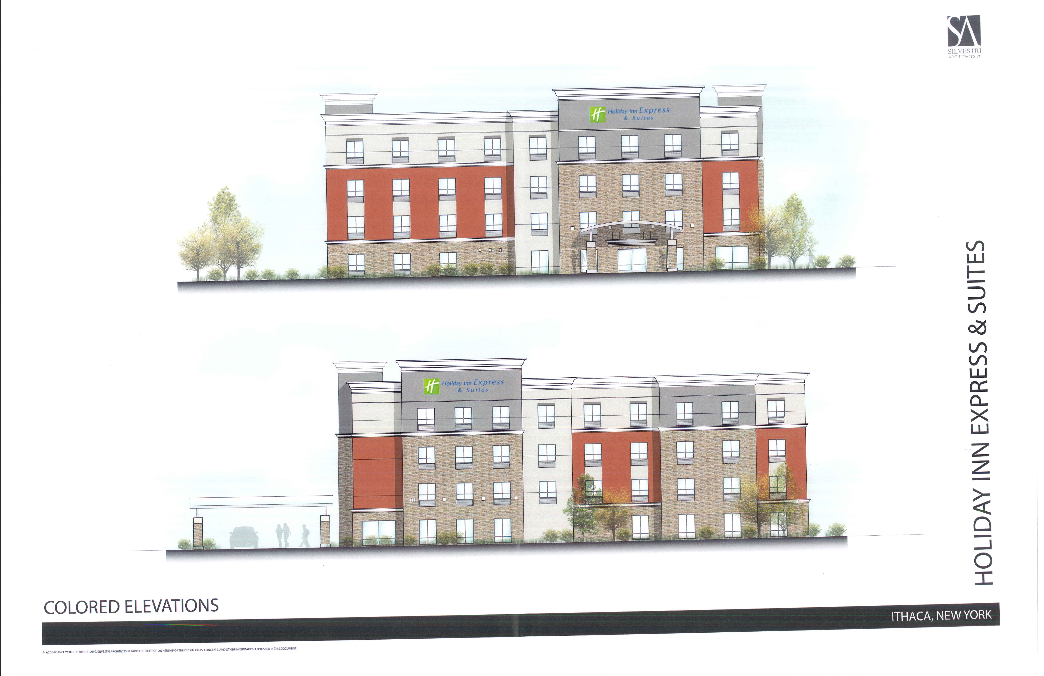
3. Details, details – the Holiday Inn Express already under construction in big-box land at 371 Elmira Road will be going in front of the city planning board this month for some slight modifications. The developer, Rudra Management and Rosewood Hotels of Cheektowaga, wants to increase the number of rooms from 76 to 79, and add three parking spaces accordingly. Along with that comes the bevy of supporting docs – technical drawings here, landscape plan here, landscape schedule here, and elevation drawings here. Apart from a palette change on the exterior (the red-brown color is “Decorous Amber“, part of the new official Holiday Inn color scheme per the architects’ cover letter), there are no changes to the design, the 3 additional rooms are just an update to the interior configuration of the hotel, one more room on each of floors 2-4. Apart from tastes in color and making sure the three new parking spaces pose no issues, the board won’t have to debate much here, and the hotel is still very likely to open next summer.

1015_dryden_1

4. In small but notable builds, Modern Living Rentals (MLR) is at it again. The relatively new Ithaca-based rental and development company is planning a triplex (3 units) at 1015 Dryden Road, just east of the hamlet of Varna. According to an email from MLR co-owner Todd Fox, the units, all 2-bedrooms, will start construction in the spring, and it’s a safe wager they’re shooting for an August 2016 completion, just in time for Cornell student renters. Judging from the renders on MLR’s site, each unit will be around 930 SF, so about 2,790 SF total. MLR teamed up once again with local architecture firm STREAM Collaborative for the design.

1015 Dryden is also home to a single-family home built in 1938, and a 4-unit apartment building from about 1980. The apartment building was badly damaged in a fire in 2011, renovated, and the site was sold to MLR for $425,000 in March 2014.

815_s_aurora_4 815_s_aurora_5 815_s_aurora_6

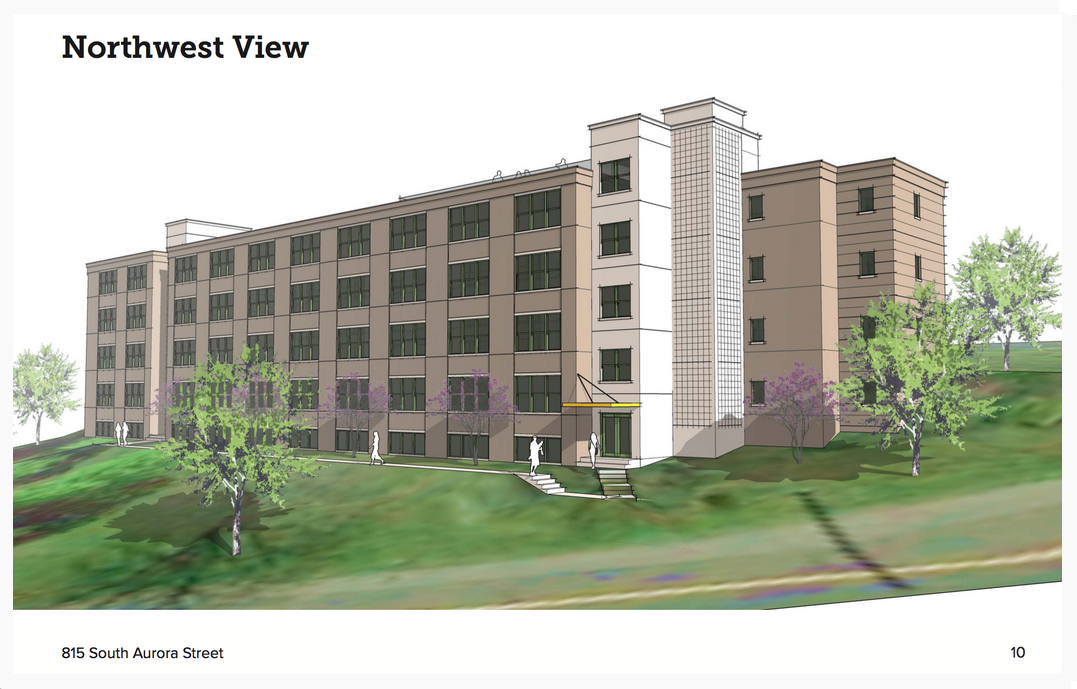
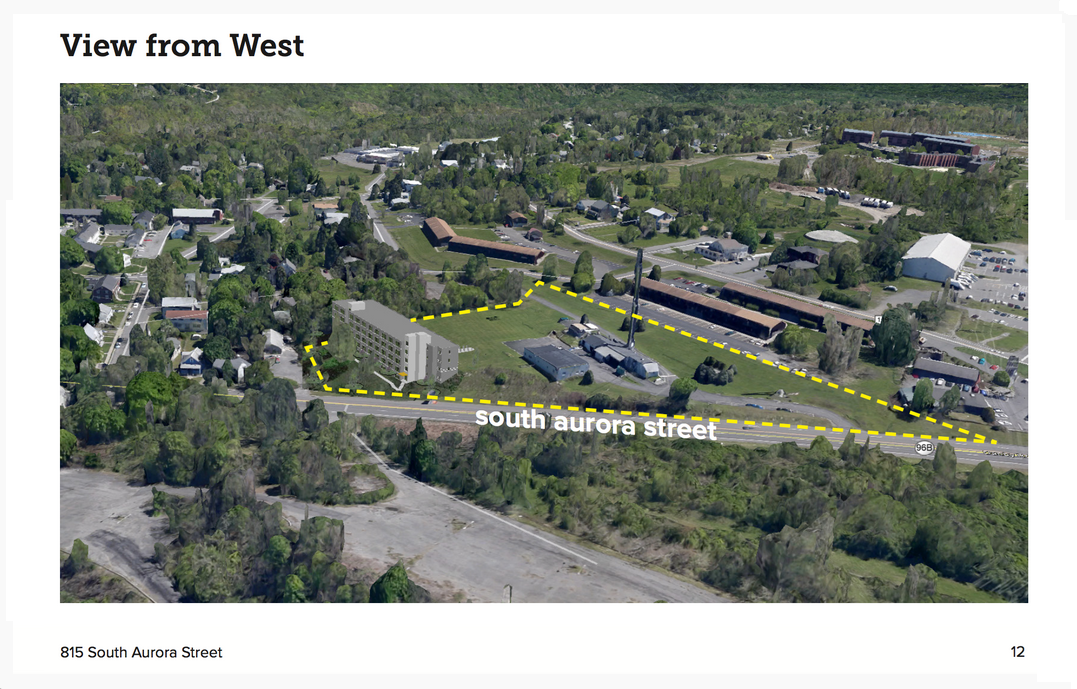
5. While on the topic of MLR, let’s throw in some eye candy. Along with the plans for 1015 Dryden, additional images for the proposed 87-unit project at 815 South Aurora Street on South Hill can be found on their website as well. I’ve included two perspective renderings and an aerial render, but more images can be found here. The 87 units will all be studio apartments. STREAM Collaborative is responsible for this design as well.

A detailed write-up of the project, including the related cell phone tower issue, can be found here.

6. Out in Lansing town, there are two attention-grabbing news pieces from Tuesday’s next planning board meeting. One is a plan for an LP gas / petroleum distribution facility on Town Barn Road (parcel address 3125 N. Triphammer Road). A 30,000 gallon storage tank and gravel drive are planned in the initial phase, with 5 15,000 gallon tanks, a garage/maintenance building, and an office planned in later phases. Now, normally a project like this is not a big deal, but there’s the outside possibility local contingents of the anti-Crestwood, anti-fossil fuel groups will go on the offensive to try and stop it. So the potential for political football is there.

The other detail isn’t up for discussion yet, but the town notes that 15 duplexes (30 units) are being planned by former Lansing town supervisor A. Scott Pinney for a site on Peruville Road (the county calls it 428 Scofield Road, but the land has frontage on both roads). The site already houses 4 duplexes built in 2011.

Breakneck_Builds_-_Master_Card

7. Instead of the the usual “House of the Week”, this week is more of a shout-out/advertisement. For those with cable, The DIY Network will be running a new episode of “Breckneck Builds” tonight at 11 PM (additional showings listed here), highlighting a just-finished home on Dryden’s Hollister Road. Quoting the promo write-up:

“Jordyn is ready to leave her rental behind and buy her first home, but what is most important to Jordyn is that her new home is eco friendly, so she is turning to the modular world to build a big house with a small carbon footprint.”

The modular home assembly was the work of local builder Carina Construction, who also tackled the modular units at the Belle Sherman Cottages site. Local builder, local resident, local project, so set your DVRs or TiVo.

8. Last but not least, here’s your Planning Board agenda for next Tuesday. Nothing new at this month’s meeting, but here’s the run-down:

A. Review of changes and revised approval for the Holiday Inn Express (see above)

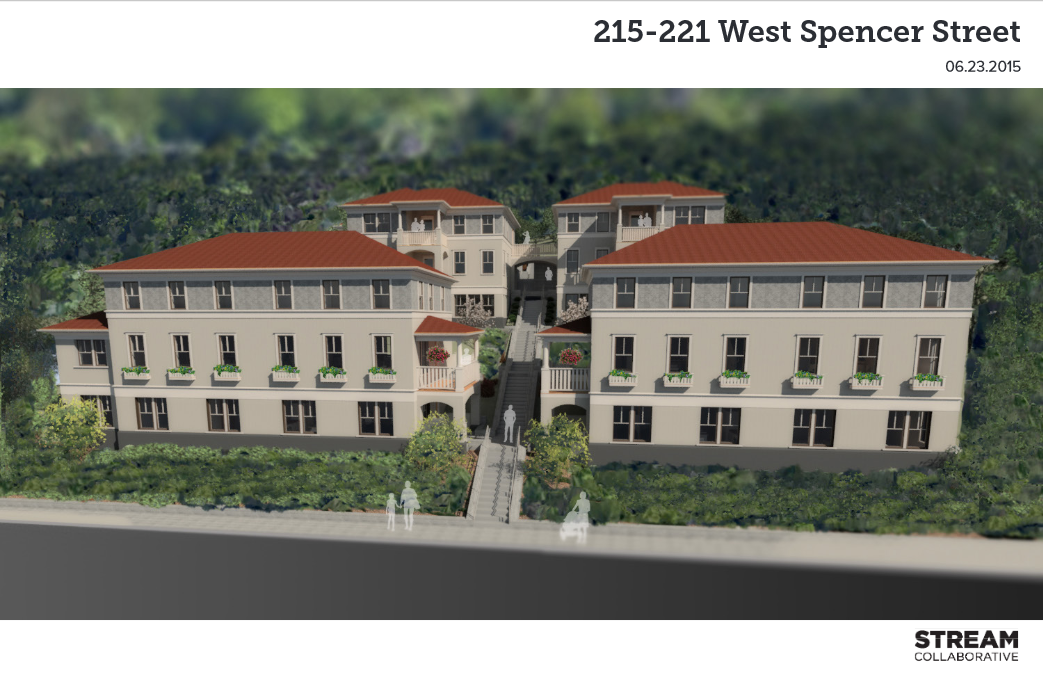
B. Declaration of environmental significance and BZA reccomendations for 215-221 West Spencer Street– Pocket Neighborhood, 12 units w/ 26 bedrooms, Ed Cope/PPM Homes is the developer, Noah Demarest of STREAM Collaborative is the architect.

C. Environmental Review Discussion for the bar/lounge proposed for the renovation of 416 E. State – cover letter here, description here, letters of opposition in the agenda.

D. Public hearing and re-approval, Hotel Ithaca renovations, 222 S. Cayuga – Site Plan Review drawings here, renders here and here. Not sure there’s enough of a difference from the first time around, but at least the cross-catching on the exterior is gone.

E. Herson/Wagner Funeral Home renovation, 327 Elmira – Declaration of Lead Agency and Public Hearing – I wrote about that in the Voice here. Fun fact, the original proposed title was “Funeral home hopes to being new life to Elmira Road property”. It was rejected.


Ithaca Marriott Construction Update, 10/2015

21 10 2015

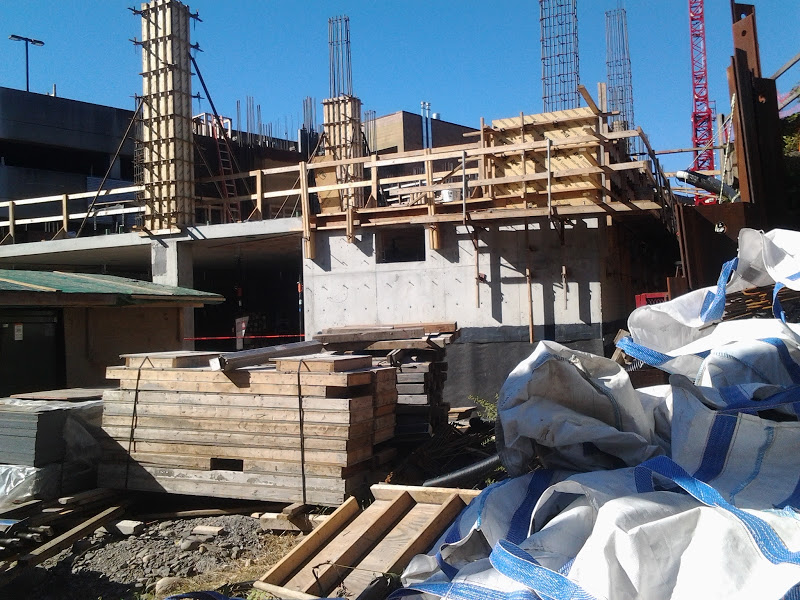
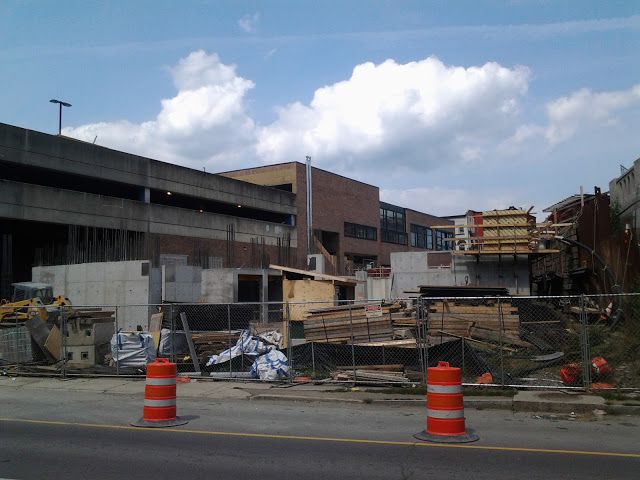
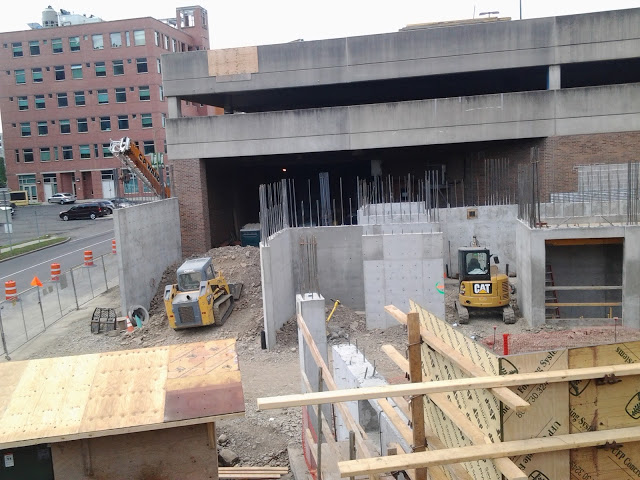
Over at the site of the new downtown Ithaca Marriott, the foundation has been dug and set, and the project is now about level with North Aurora Street. The rebar (reinforcing steel bars) that sticks out of the concrete footings will be used to tie-in the hotel’s walls as they’re constructed. Wooden forms are in place to provide rigidity and shape while newly-poured concrete hardens, and they give support to the rebar rods embedded in the concrete. The forms will move further upward as more concrete is poured and cured. On the side closer to the commons, caisson tubes, massive open pipes, encase the rebar up to 30 feet below ground level. These will transfer the heavy load of the upper floors down to the bedrock below, providing structural stability for the future 10-story hotel. Some of the materials have been supplied by UFP Concrete Forming Systems.

The foundation walls vary in thickness depending on the weight they’re designed to hold. The newly-poured section next to the Green Street garage will hold the elevator shaft, stairwell and space for utilities.

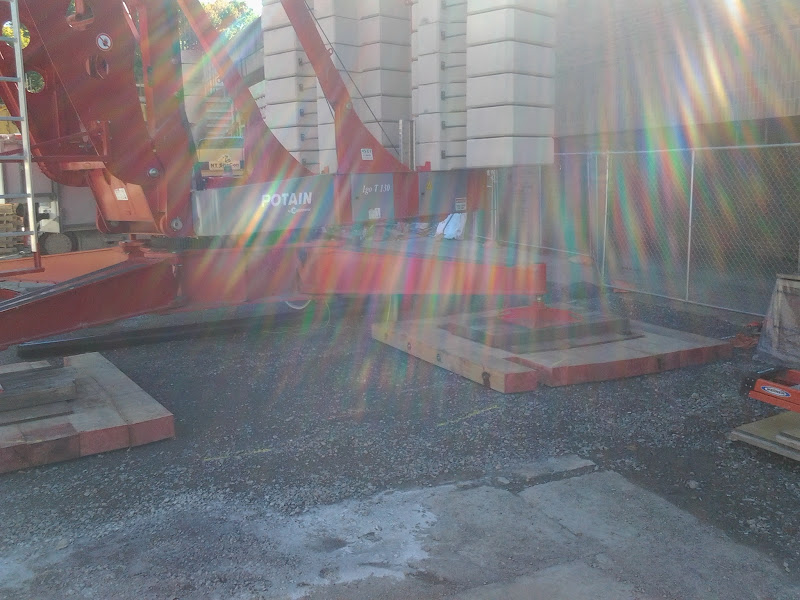
Contractor William H. Lane of Binghamton has a crane on site, and steel erection above the foundation walls will start fairly soon from the looks of it. The 159-room hotel should open next summer if all stays to schedule.

20151011_144642 20151011_144705 20151011_144743 20151011_144806

20151011_145109 20151011_145117 20151011_145131

From August 29th:

20150829_125449 20150829_125520 20150829_125630 20150829_125637

marriott_rev1_1


Hotel Ithaca Plans New 5-Story Wing in First Phase

10 09 2015

hotel_ithaca_1

The Hotel Ithaca is once again seeking to expand its offerings.

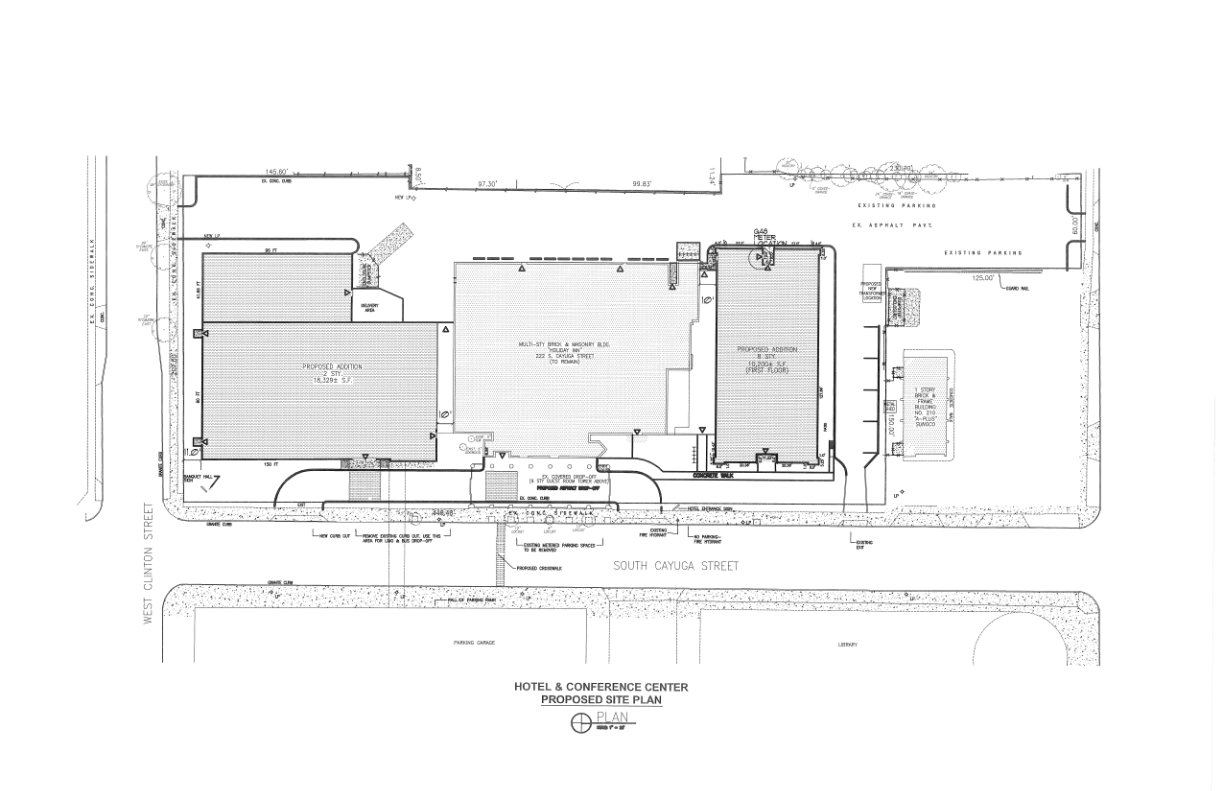
In what’s being billed as a “modernization”, owner David Hart of Buffalo-based Hart Hotels is proposing a $9.5 million project that includes a new 5-story addition to the hotel, located at 222 S. Cayuga Street in downtown Ithaca. The 2-story north and west wings of the Hotel Ithaca would be demolished. Site Plan Review documents filed with the city (link here) call for a November 2015 construction start, with the new wing opening in April 2017. NH Architecture of Rochester will be designing the new hotel wing (additional drawings of the new wings can be found here).

The construction would be the first phase of a multi-year project. Once the new wing is opened, the south wing of the hotel would be decommissioned and eventually demolished. Sketch plans presented presented at a Planning Board meeting earlier this summer indicated a second, later phase that adds three more floors on the hotel wing (bringing the new wing to eight stories), with a two-story convention center sitting on the corner of South Cayuga and West Clinton Streets.

hotel_ithaca_phase_2

Because of the demolitions and decommission of the south wing in favor of later construction plans, the net increase of hotel rooms is actually a decrease – from 180 down to 170 rooms.

Like several other Hart Hotels properties throughout the Northeast, the hotel has no chain affiliation, although the property was a Holiday Inn until the end of 2013. The 180-room hotel initially opened as a Ramada Inn in 1972, and the 10-story “Executive Tower” was completed in 1984.

Zoning at the site is CBD-100 (Central Business District), meaning that a proposed structure can be up to 100 feet (two floors at the least) with minimal required setbacks and no required on-site parking.

hotel_ithaca_2

Under plans previously presented three years ago, the Hotel Ithaca sought to demolish the two-story wings of the hotel, and in their place the hotel would would build a new 9-story, 115-room tower, a kitchen addition, and a 15,000 SF conference center.

The then-$18 million project had significant local support from business owners, because Ithaca lacks the ability to host mid-size conferences and conventions (midsize meaning about 500 attendees), which sends conventioneers elsewhere. Currently, the lack of meeting space limits conferences to about 250 guests. The addition of a convention facility is seen as a major benefit to downtown retail, as well as other hotels that would handle overflow guest traffic. Convention traffic typically happens during weekdays, when regular tourist traffic is lowest.

However, the project, which was initially slated to start in November 2012, has failed to obtain financing for construction. The project applied for and received a property tax abatement for the new construction, and the Ithaca Urban Renewal Agency (IURA) even offered the possibility of a $250,000 loan if it would create a financial package that would allow the convention center to be built. But until this summer, there had been no indication of any plans moving forward.

Due to the modifications of the original plan, the county IDA will need to re-approve the tax abatement incentive package previously offered to the hotel.


Ithaca Marriott Construction Update, 8/2015

4 08 2015

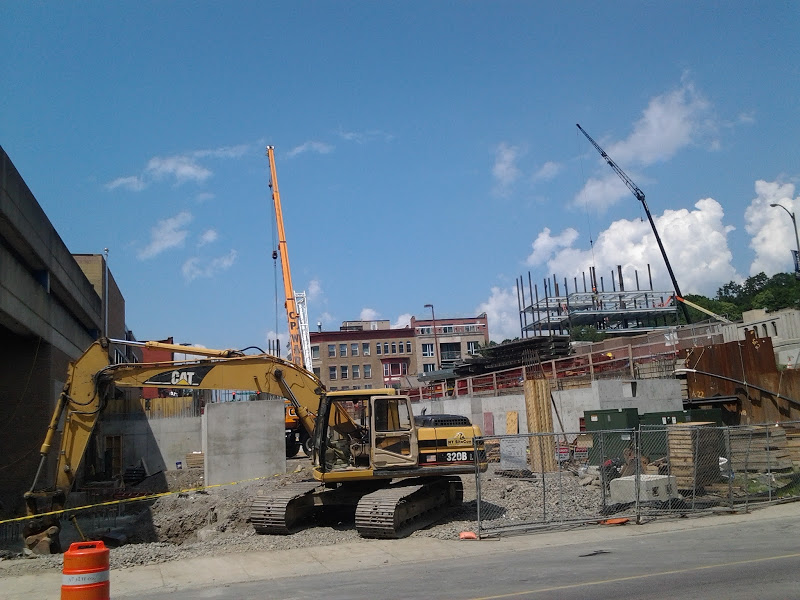
Over at the Marriott Construction site at downtown Ithaca’s 120 South Aurora Street, all of the caissons have been drilled and work is continuing on the foundation of the new 10-story hotel. Concrete foundation footers have been have been set on top of the caisson piles, with rebar sticking out to tie-in the walls as they’re built up. The foundation walls are being poured in a range of sizes, depending on how much weight they’re going to hold. A couple footings with much taller re-bar likely indicates the location of future stairwells, elevator shafts, and utility space.

Note the plywood on the Green Street parking garage in the first photo. As workers were drilling the last caisson, the rig broke, tipped over and smashed into the wall of the garage. Thankfully, that section had already been closed off due to the construction, and no one was hurt.

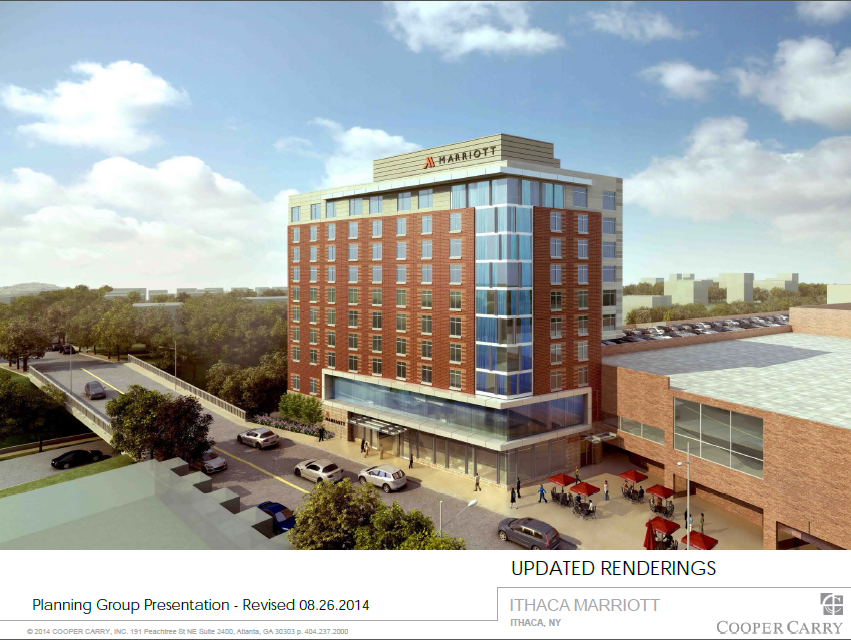
Maryland-based Urgo Hotels plans on opening the $32 million, 159-room hotel during the third quarter of 2016 (July-September time frame). The hotel will include a host of amenities, a fitness center, a restaurant with indoor and outdoor seating, and 3,000 sq ft of meeting space. Atlanta-based Cooper Carry Architecture did the design, and W.H. Lane of Binghamton is the general contractor.

The project, which replaces a small parking lot. could be considered the culmination of an effort to bring a hotel to this site since 2008, when Rimland Development proposed the “Hotel Ithaca”. The previous Hotel Ithaca once stood on part of this site and the Rothschild’s Building, before it (and every other building in its city block) was demolished during 1960s urban renewal.

20150727_142922 20150727_142940 20150727_143035 20150727_143050 20150727_143104

marriott_rev1_1

Ithaca-Hotel-1935


News Tidbits 8/1/15: Tempers As Hot as the Temperatures

1 08 2015

state_st_triangle_v3_3

1. I asked someone familiar with the State Street Triangle how the presentations went this week. “About as well as could be expected” was the diplomatic response received in turn.

The Times, Journal and Voice all devoted coverage to the controversial project this week since its CIITAP application was up for review, as well as revised plans being brought forth to the planning board. The project draws detractors from different angles – some because of size, some because it’s student housing, some because of the tax abatement.

The tax abatement is what confuses me somewhat, for reasons related to the theory I wrote up a few weeks ago, which no longer holds water. My own personal thought was that a sort of economy of scale would kick in with greater site efficiency, negating the need for a tax abatement. That isn’t to say that they still couldn’t try for one, because it meets all the CIITAP requirements, just that they didn’t need it (it would have been proverbial “icing on the cake” if granted). But now they’re saying it’s the only way to move forward. I don’t know the financials and what their necessary ROI is (and probably never will), but I’d happily listen to an explanation.

But the point I made in the piece still holds true – if Jason Fane’s project a couple blocks away was rejected for not having enough of a community benefit, market-rate student housing, even that which generates an extra $7.36 million in taxes over a decade, is going to be a big stretch, unless they plan on using the sheer size of it as a selling factor. The city planning board doesn’t have to worry about the controversy, because the project conforms wholly to a central business district zone. It’s going to be the tax abatement issue that makes or breaks this proposal.

2. As part of its 10th anniversary feature, the Lansing Star did a nice retrospective of what’s changed in the past ten years in Lansing. When it comes to development, it isn’t especially kind:

“Lansing hasn’t changed much in ten years.  While grand plans for the future of the Town have been explored, not many have been realized.”

The article then goes on to detail how after the sewer initiative was defeated by public vote, a few developers banded together to try and fulfill the town center that Lansing was pushing for. Quoting the article, “the town government couldn’t get its act together to make that happen, even though it wouldn’t be footing the bill for the infrastructure (including sewer)”. About the only development initiative that has taken off is the Warren Road corridor, which was spurred mostly by threats of a major employer (Transonic) leaving the town (and Transonic paid for the sewer study). Meanwhile, the Star characterizes the village government as simply existing for “maintenance” purposes.

The paper notes some successes with parks and wildlife initiatives, but the highlight of the piece seems to be that Lansing is routinely failing to achieve its municipal planning and development goals.

3. Back in Ithaca city, plans are underway for the major renovation of a shopping plaza into professional office space for a local architecture firm. According to documents filed with the county, an LLC associated with HOLT Architects is spending $897,500 on the renovation, and another $415,000 for acquisition costs. The renovations will start in late August should be completed by March 2016. Tompkins Trust Company is providing the financing, and local company McPherson Builders is in charge of general construction.

From the press release published late Friday, HOLT chose the West End location for its walk-ability and centralized location. The building will be renovated into a net-zero energy structure for the 30-person architecture firm. No renders yet, but they’ll be included in a future news roundup when they become available.

college_crossings_v3_1

4. As written in the Voice, College Crossings at the corner of East King Road and Rt. 96B in Ithaca town is back to the board for revision number three. This one increases the project by a floor, 13,000 square feet and six more apartments. It’s been no big secret that developer Evan Monkemeyer’s had difficulties getting the project off the ground (he resorted to Craigslist for marketing the retail spaces), and given a total of 18,000 SF spread among 8 apartments (doing the standard 15% deduction for circulation/utilities, one gets over 1,900 square feet per apartment) these units are almost certainly geared towards IC students. A solid market since they’re next door, though not likely to elicit warm fuzzies from the neighbors (although based off the response on the Voice’s facebook, most people just don’t care; if only 210 Hancock had it this easy). Previous plans can be found here.

south-hill-areaplan-1 plan-2

Personal opinion, I’m a little disappointed in the revision. The mixed-use aspect is fine, but I was hoping the developer would tap into some of the ideas presented for the land by Form Ithaca instead of plopping a building in the middle of a 120-space parking lot. Monkemeyer owns a lot of acreage in adjacent land parcels, so this doesn’t bode well for a “walkable center” in Ithaca town.

210_hancock_62015

5. Ithaca Neighborhood Housing Services (INHS) is armed with more 210 Hancock studies and analysis as it prepares to go in front of the city Board of Zoning Appeals next Tuesday. With the commercial loading space question settled, it leaves the height variance of 6.5 feet (40 feet zoned, 46.5 feet requested), and the parking variance of 20 spaces (84 required, 64 given). Original/full application here, new addendum analyses here.

The board requested additional information about pile driving and the parking situation. In response, INHS has conducted further analysis and shown that, 40′ or 46.5′, piles would be required either way. INHS has offered in its application to use a “vibratory oscillating” method of pile driving, where piles are vibrated into the ground rather than driven. This reduces noise (no hammer-like banging) and produces less overall vibration. Further parking studies found that 210 Hancock offers a greater percentage of parking than similar buildings like McGraw House, the Cayuga Apartments and Lakeview on Third Street, INHS’s parking study of its tenants was reiterated, and an analysis of its commercial tenants was given – the occupants will have 16 designated spaces from 7 AM to 5 PM, when the daycare and non-profit offices are in operation. After hours, they’ll serve as potential overflow parking.

It’s frustrating to think that a suburban market-rate project surrounded by a parking lot has no opposition, but a transparent project with affordable housing and a lot of community benefits gets so much grief.

6. For home-builders or those looking to build a palatial estate, here’s your latest opportunity – 5.45 acres at the end of Campbell Avenue in Ithaca city are up for sale. The area’s zoned for single-family homes, and the city is encouraging owner-occupied houses in that area. Previously, the property was seen as a potential 10-lot development in the late 1980s/early 1990s, but the plan was never carried out. The biggest barrier is probably that it’s West Hill, where neighbors have taken to going after their neighbors to keep them from subdividing and building homes.

7. Initially, this was going to be a Voice article, but when the revised plans were presented, no renders were included. The Voice’s more general audience wouldn’t be as interested in this piece. But if you’ve read this far, and you read this blog frequently enough, then you won’t mind clickable, expandable site plans (pdf here).

hotel_ithaca_phase_1 hotel_ithaca_phase_2

The Hotel Ithaca is once again seeking to expand its offerings.

But this time around, it’s proposing to do in phases. Sketch plans presented at the Planning Board last Tuesday evening call for demolition of the two-story wings as before, but then the construction will be broken up into two phases.

The first consists of a five-story, 51,835 SF wing build on the northern side of the property, next to the gas station on the corner; the second phase, at a later, undetermined date, calls for three more floors on the hotel wing (bringing the new wing to eight stories and 81,600 SF), with a two-story, 18,300 SF conference center to be built on the corner of South Cayuga and West Clinton Streets.

The number of rooms in the addition has been unconfirmed, but given previous plans, it is likely to be little to no change from the current hotel, once the two-story wings are demolished. Until phase two is built, a parking lot would sit on the site of the future conference center.

The hotel is operated by Hart Hotels of Buffalo. Like several other Hart Hotels properties throughout the Northeast, the hotel has no chain affiliation, although the property was a Holiday Inn until the end of 2013. The 181-room hotel initially opened as a Ramada Inn in 1972, and the 10-story “Executive Tower” was completed in 1984.

Zoning at the site is CBD-100 (Central Business District), meaning that a proposed structure can be up to 100 feet (two floors at the least) with minimal required setbacks and no required on-site parking.

holiday_inn_expansion_1

Under plans previously presented three years ago, the Hotel Ithaca sought to demolish the two-story wings of the hotel, and in their place the hotel would would build a new 9-story, 115-room tower, a kitchen addition, and a 15,000 SF conference center. The demolition would have resulted in a loss of 100 rooms, so the net gain was a total of 15 hotel rooms.

The then-$18 million project had significant local support from business owners, because Ithaca lacks the ability to host mid-size conferences and conventions (midsize meaning about 500 attendees), which sends conventioneers elsewhere. Currently, the lack of meeting space limits conferences to about 250 guests. The addition of a convention facility is seen as a major benefit to downtown retail, as well as other hotels that would handle overflow guest traffic. Convention traffic typically happens during weekdays, when regular tourist traffic is lowest.

However, the project, which was initially slated to start in November 2012, has failed to obtain financing for construction. The project applied for and received a property tax abatement for the new construction, and the Ithaca Urban Renewal Agency (IURA) even offered the possibility of a $250,000 loan if it would create a financial package that would allow the convention center to be built. But until now, there had been no indication of any plans moving forward.


News Tidbits 7/25/15: To Reuse and Rejuvenate

25 07 2015

travis_hude_libe_libe_v3 oldlibe_franklin_proposal

1. Let’s just outright say it – the Tompkins County Legisltaure’s Old Library decision is a complete mess at this point. As covered last week, there were three separate individual resolutions – one from legislator Mike Lane for the Travis Hyde proposal (first image), and one each from legislators Dooley Kiefer and Leslyn McBean-Clairborne for the Franklin proposal (second image).

They all failed. 8 yes’s are required. The Travis Hyde proposal failed with 5 yes and 7 no’s. The Franklin proposal failed with 5 yes and 7 no’s on Kiefer’s resolution, and 4 yes and 8 no’s on McBean-Clairborne’s resolution. Martha Robertson, a supporter of the Travis Hyde proposal, recused herself because she had received donations from Frost Travis during her failed congressional campaign in 2014. Legislator Glenn Morey, also a supporter of the Travis Hyde proposal, was absent from the meeting.

I don’t see any way this will ever get the eight votes required. Kathy Luz Herrera voted against the proposals because the resolution has a ground lease (meaning the county still owns the land but leases the property), and Dooley Kiefer has stated she refuses to support any of the projects unless they have a ground lease – in other words, these two have mutually exclusive votes. By voting against McBean-Clairborne, Kiefer’s made it clear she will vote against the Franklin project unless it meets her exact specifications. Shinagawa voted against Travis Hyde for not being what the community wanted, but won’t vote for the Franklin proposal unless they guarantee Lifelong’s involved. And Stein has come out in favor of the Travis Hyde proposal. There’s no solution on the horizon.

So now it heads back to the Old Library Committee. Sale to the highest bidder and demolition of the library are real options on the table.

cayugafarms_2

cayuga_farms_1
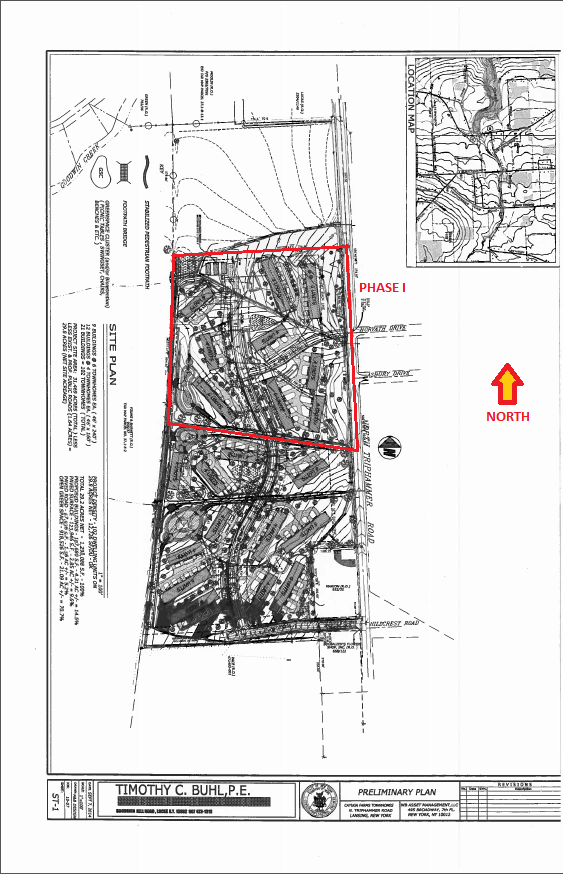
2. Turning to Lansing town, the planning board there has approved plans for the 102-unit Cayuga Farms townhouse project for a 31.4 acre parcel off of North Triphammer Road near Horvath Drive. First reported last Friday by the Lansing Star, the project received negative SEQR determination (meaning that, following the state’s environmental review guidelines, that the planning board decided the project will have no serious detrimental impact on the community) and issued preliminary site plan approval.

However, one issue still remains to be resolved before any shovels hit the dirt – sewer. The project currently has a modular package sewer treatment proposal that would work in place of the voter-defeated municipal sewer, and allow for denser development than the town’s rule on septic tanks. But the DEC’s interest in that type of treatment has been mixed. It could be a while before the situation gets sorted out.

Readers might remember this project because it’s one of the few I’ve openly derided. The 102 units are townhouse-style apartments marketed towards the upper end of the market. They would be built in phases over a period of several years.

cornell_novarr_5 cornell_novarr_6

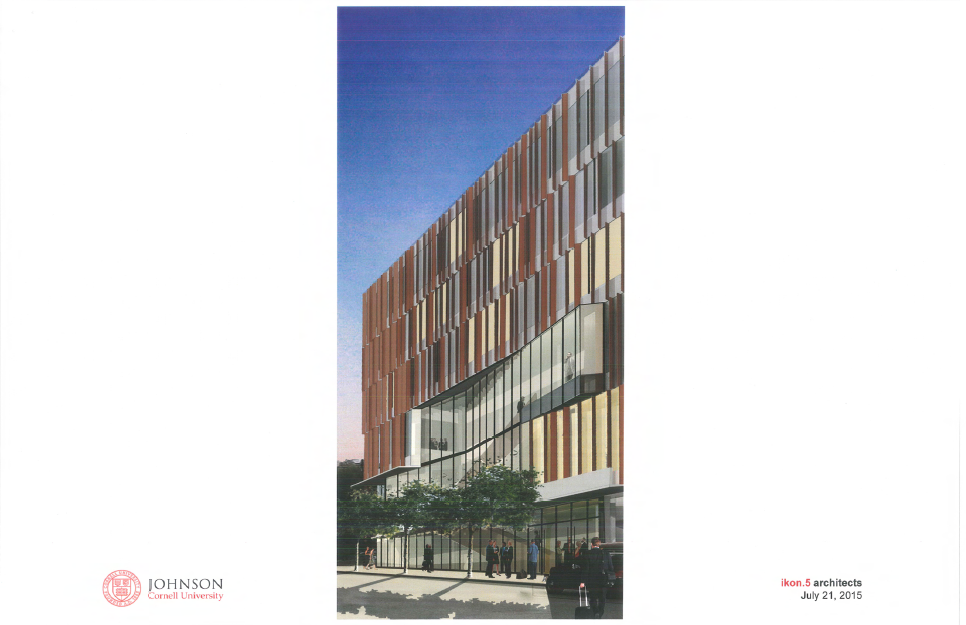
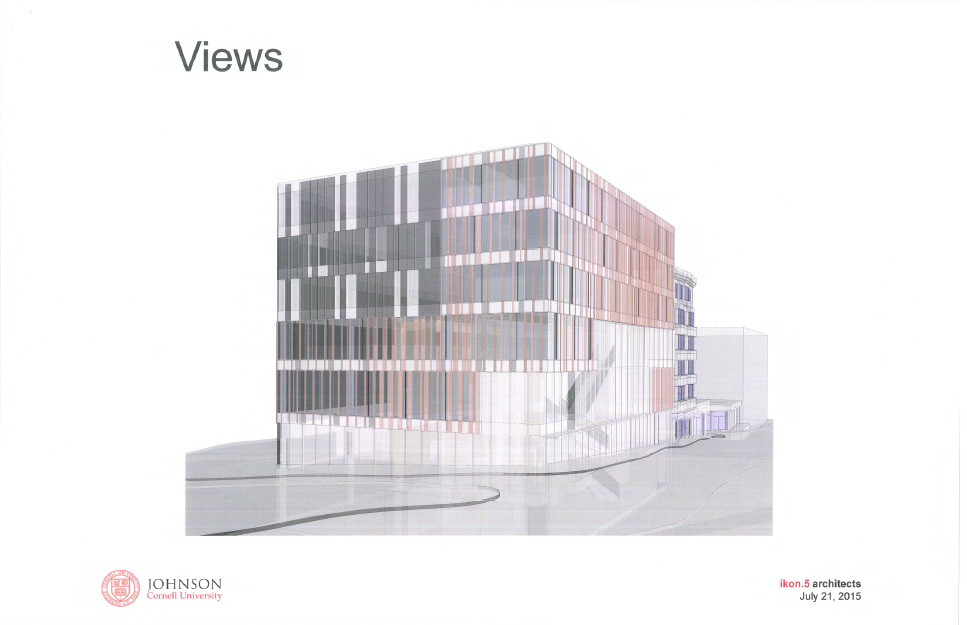
3. Now for some eye candy. Included with this week’s planning board project review committee agenda are additional renderings for John Novarr’s project at 209-215 Dryden Road. Doing a quick visual cross-check with the initial renderings, there don’t appear to be any substantial design changes, and the colorful metal cladding appears to retain the same pattern as before. Getting a little poetic here, the cascading metal bars are reminiscent of water running down a wall.

The city’s Full Environmental Assessment Form doesn’t express many worries about the project; some concerns have been raised about too many pedestrians on the street (the building would add 420 people to Collegetown’s sidewalks at the outset, 600 when fully occupied), but that seems to be about it for now.

The $12 million project is moving right along in an effort to start construction this fall. Declaration of Lead Agency and some CEQR discussion (the city’s more stringent version of SEQR, State Environmental Quality Review) are expected at the July planning board meeting. Plans call for 76,200 SF building with three floors of classrooms and three floors of offices for Cornell’s Johnson School Executive MBA program. The building would be ready for the Big Red’s B-students in April 2017. The property would remain on the tax rolls.

20150605_114431

4. A couple of interesting news notes courtesy of the Ithaca Urban Renewal Agency (IURA) Agenda:

First, popular downtown restaurant Madeline’s is looking to obtain an agency loan as part of a renovation project. The $470,000 project would add three jobs, only one of which pays living wage. The restaurant on the first floor of the Rothschild Building (the two-story building in the above photo) hopes to take advantage of the new hotels going up, and law firm Miller Mayer moving its 60 employees into the Rothschild Building. Previously the firm was in the Chemung Canal Trust Company building further up the Commons.

Second, the Finger Lakes School of Massage has applied for an agency loan to facilitate a move from West Hill to downtown. The school would move its ~34 staff and 75-95 students into 10,804 SF of leased space on the Rothschild Building’s second floor, with a further 1,700 SF on the ground level for a retail store and alumni massage clinic. The space would be renovated at a cost of about $194,300.

Although both projects come with risks (Madeline’s being a restaurant, FLSM having some worrying financial statements), both projects have been recommended for loan approval. The FLSM and Miller Mayer news suggest that most of the office space in the old Rothschild Building, left vacant when Tetra Tech moved to Cornell’s office park in 2010, has now been refilled.

The new window cut out built recently into the Rothschild Building’s east facade is part of the space where FLSM is moving into.

416_e_state_1

5. And now another reuse project – at 416-418 East State Street, currently home to an underused 7,600 SF office and a connected manufacturing/storage building. The house dates from the 19th century, with various additions as recent as the 1970s. According to plans filed with the city, an LLC linked to Argos Inn architect Ben Rosenblum has plans to convert the old manufacturing space into a bar and storage space, with renovated offices and a 2 bedroom apartment in the original house. The project will include an accessory parking lot, revised landscaping and handicap access. Area and setback deficiencies have resulted in the need for a zoning variance, but a parking variances won’t be required because the bar will have after hours parking across the street at Gateway Plaza. The building itself won’t change dimensions, but the change in use triggers the city zoning laws.

There have been some concerns expressed about this project – at least one neighbor is vociferously opposed to a bar, citing noise problems and concerns about smokers, and the county planning department is not a fan of the traffic and parking arrangement. Offhand, I think a bar is legal in B-4 zoning, but the noise impacts will merit further scrutiny.

The project is definitely something of interest to the Voice’s audience, but in an email, Rosenblum said that details are still being worked out and that he’d prefer to discuss the plan at a later date.

Scott Whitham is serving as a consultant, and local architect Jason Demarest is designing the renovation.

state_st_triangle_v3_1 state_st_triangle_v3_2 state_st_triangle_v3_3

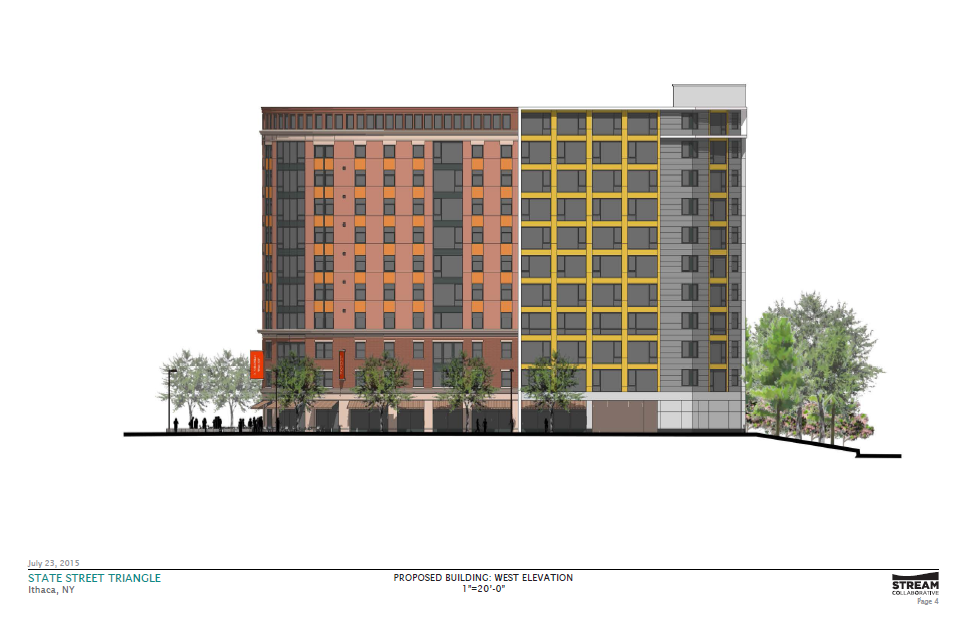
6. Some very substantial changes are in store for Campus Advantage’s $40 million, 240-unit State Street Triangle project at 301 East State Street in downtown Ithaca.

The Texas-based developer has recruited the assistance of Ithaca architecture firm STREAM Collaborative to help redesign the 240-unit project. And there’s clearly been a lot of work since the previous planning board rendition.

In this revision, a much greater emphasis has been placed on the street interaction and active street uses. Gone is the soaring corner, and in its place is a design with a greater use of horizontal elements (like the decorative belt above the third floor) in order to give the building a more human scale – crucial when you’re planning one of the largest buildings in Ithaca.

The developer is also seeking to remove the northbound turning lane from Aurora onto State Street, and replacing it with a pedestrian area with widened sidewalks, outdoor seating and dining spaces. The land would have to be procured from the city, or some other type of collaboration would have to take place with city officials and engineers.

In documents provided in the city’s planning board agenda for next Tuesday, the developer notes that the project remains student-oriented, but in order to play down comments of it being a massive dorm, 10 4-bedroom units were reconfigured into 40 studio apartments that the developer hopes will be appealing to non-student tenants looking for a less expensive, modestly-sized space.

The State Street Triangle project is also exploring LEED certification.

The project still has a lot of details to be addressed – city transportation engineer Tim Logue has expressed concerns that the traffic study underestimates the number of car trips, and has asked for a revised study. The project is also under closer analysis because the potential addition of 600 residents into downtown Ithaca would put a greater stress on utilities and infrastructure.

These and other questions are likely to be topics of discussion at next Tuesday’s meeting.

The State Street Triangle may be pursuing a CIITAP tax abatement (so much for my theory a couple weeks ago), but the city has not uploaded the application at the time of this writing.
7. Looks like a busy meeting next week for the Ithaca city planning board. In order:

1. A subdivision at 106-108 Madison Street on the Northside. The applicant wishes to create a new lot on the east side of the existing lot, for the purpose of building a new-single-family home.

2. A. Declaration of Environmental Significance and BZA recommendation for the Dibella’s sub shop proposed at 222 Elmira Road

B. Declaration of Environmental Significance, BZA recommendation and potential approval for the 1,100 SF addition to the Maguire Chrsyler/Fiat dealership in Southwest Ithaca

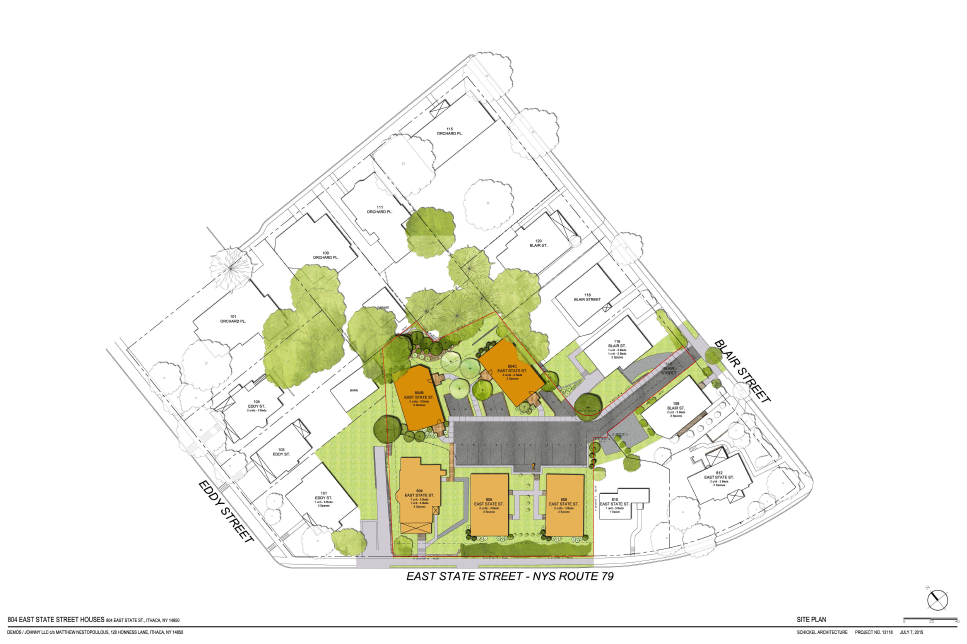
C. Declaration of Environmental Significance, and potential approval for the two duplexes proposed at 112 Blair/804 East State Street

D. Site-plan approval for the first phase of the Tompkins Financial HQ (the new drive-through in the current HQ’s parking lot)

E. CEQR (the city’s version of SEQR) discussion for 215-221 W. Spencer Street

F. Declaration of Lead Agency and CEQR discussion on 209-215 Dryden (the Novarr project noted above)

G. Declaration of Lead Agency and CEQR discussion on State Street Triangle (

noted above)

holiday_inn_expansion_1

H. Sketch Plan – Hotel Ithaca Expansion. Readers might remember a 9-story addition and convention center were approved for the Hotel Ithaca almost two years ago (shown above). Nothing has happened with the expansion plans, for reasons which had been attributed to financing. Dunno what we can expect this time around, but we’ll find out next week.


Ithaca Marriott Construction Update, 6/2015

14 06 2015

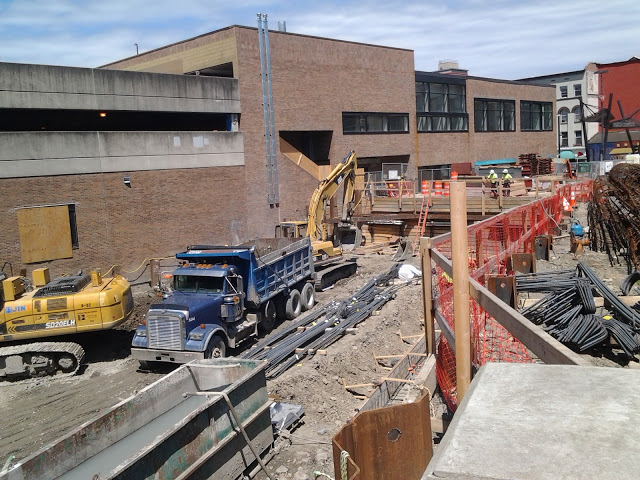
The pile driving work continues at the Marriott project site downtown. Quoting an anonymous source familiar with the project, about 10 more caissons are left to be piled, and grade beams are being built.  Per wikipedia, a grade beam is a reinforced concrete beam that transmits the load from a bearing wall into spaced foundations such as pile caps or caissons; a grade beam spans the the space between the caissons, distributing the weight among the caissons and ensuring the hotel’s structural stability. In image three, you can see the pile driver at work drilling a caisson, using a rotary bore so that it can more easily penetrate deep into the soil. The expectation is that the project will begin to rise starting in just a couple weeks, and builds its way skyward over the course of the summer and fall.

On a side note, check out that new window inserted into the Rothschild Building. Much better than the blank brick wall that was previously there.

The $32 million, 10-story, 159-room hotel is slated for an opening in Q3 of 2016 (July-September). The hotel will include a fitness center, a restaurant with indoor and outdoor seating, and 3,000 sq ft of meeting space.

The hotel has been designed by Atlanta-based Cooper Carry Architecture and development is a joint venture of Urgo Hotels of Bethesda and Ensemble Hotel Partners, a division of Ensemble Investments. Urgo’s portfolio includes at least 32 other hotels totaling 4,500 hotel rooms. Interior design will be handled by Design Continuum, W.H. Lane of Binghamton is the general contractor, and Rimland Development contributed the land to the joint venture and is a partner. Long Island-based Rimland was the original firm that pitched the project in 2008 as the “Hotel Ithaca”, before the old Holiday Inn downtown went independent.

20150605_114642 20150605_114629 20150605_114501 20150605_114439 20150605_114431 20150605_114345

marriott_rev1_1


The Ithaca Economy, Part II: A Jack of All Trades

26 05 2015

Part I provided a brief examination of how the 1990s recession had a deep and lasting impact on the Ithaca economy, while the late 2000s recession was a minor hiccup in comparison. Here in Part II, those recessions will be looked at in greater detail by examining the different occupational groups that make up the Ithaca economy.

ithaca_bls_1990_2015

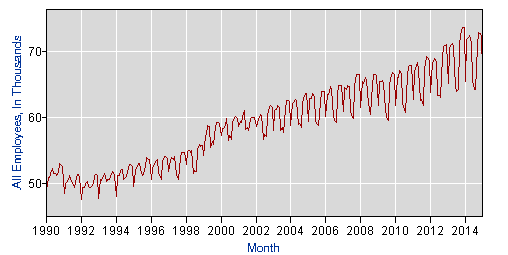
To see how the overall market changed, here is the plot of all the non-farm job sectors calculated, combined and tracked by the Federal Bureau of Labor Statistics (BLS) from 1990 to 2015. 1990 gives a nice 25-year figure, and it’s also as far as the online data goes back.

There are ten economic sectors defined by the BLS, and all counts are rounded to the nearest 100. Not all of them follow the same pattern as the overall numbers, as seen in the four sectors below.

ith_jobs_tseries_1

Even with the substantial growth in the Ithaca economy, not all parts of the local economy reflect that. At top left is “Mining, Logging and Construction,” which in Ithaca is mostly construction and the Cargill salt mines in Lansing. Employment peaked at 1,700 in August 1990, fell during the economic doldrums of the 1990s, and has made a very gentle climb since the late 1990s, most likely due to population growth and the slow if steady rise in construction demand. Cornell’s recent budget problems could derail that rise.

At top right, “Manufacturing”, industrial makers and producers. Manufacturing peaked at 4,600 in October and November 2000. The woes in this sector match much of upstate – manufacturers closed or left the area for cheaper sites down south or overseas, like Ithaca Gun in 1986/87, NCR/Axiohm in the 1990s and Morse Chain in the late 2000s (Morse Chain shed 500 jobs in the late 2000s, which explains some of the plunge). Fortunately, companies like Borg Warner still maintain a strong presence, and there has been some growth lately thanks to firms such as Groton’s Plastisol and Ithaca’s Incodema.

Lower left is “Trade, Transportation and Utilities”. In this category is where truckers, warehouse workers, retailers, wholesalers and utility crews fall. This category peaked at 7,000 jobs twice, in January 2006 and January 2008, but has fallen closer to 6,000 jobs in the past year or so. The early 1990s dip is there, as is a dip during the late 2000s recession. Overall, the sector’s employment hasn’t changed a whole lot in the past 25 years.

Last image in the figure, at the lower right, is “Information“. Publishers, broadcasters, news agencies like the Ithaca Voice, telecommunications, movie makers, and so on. The category has never employed more than 800 people locally, and is at an all time low as of late (on a national level, the industry has shrunk by a third since the early 2000s). It doesn’t follow the recessions, but it’s a tiny portion of the Ithaca market anyway.

Okay, so these four either held steady or fell during both recessions, and are decreasing or holding steady while the overall local economy has grown. Let’s look at the next four:

ith_jobs_tseries_2

The big difference between the first four and these four is that we can clearly see that these industries have grown in the past quarter century, some more than others.

“Financial Activities” at top left includes groups like bankers, insurance agents, and real estate agents. While currently at its highest ever, it’s hit that watermark many times in the past decade. The industries fell by similar amounts during both recessions, but the late 2000s down-period was much shorter.

The “Professional and Business Services” sector shown at top right includes engineers, architects, veterinarians, scientists and other technical professionals not associated with academia or government. They definitely saw a substantial drop during the ’90s recession, and it mimics that decade’s lengthy downturn. The late 2000s recession is barely noticeable, just like the overall jobs picture.

Leisure and Hospitality” at lower left is easy enough to define – hoteliers, restaurants, and professional entertainers like musicians and artists. There’s been a big push in the hospitality subsector with new hotels in Ithaca opening recently and in the near future, but the job growth isn’t all too impressive, only a few hundred jobs during peak periods. Once again, this sector was deeply impacted by ’90s recession, and jostled though not seriously damaged by the 2000s recession.

The last category, “Other Services” on the lower right, is a catch-all. In this category the BLS includes mechanics, dry cleaners, nannies, social and environmental non-profits, clergy and lobbyists. Given this area’s strong social activism, there’s little reason to wonder why the jobs totals have steadily risen, even during the recessions.

These four probably played a role in Ithaca’s growth in the past 25 years – the city and county have transitioned from factory workers and tradesmen to engineers and non-profits. But I still have yet to touch on the two biggest categories, “Government” and “Education and Healthcare.” Those two, plus some ideas on why the 1990s downturn was worse than the late 2000s recession, will be presented in Part III.